EP3447051A1 - Method for preparing tyrosine kinase inhibitor and derivative thereof - Google Patents
Method for preparing tyrosine kinase inhibitor and derivative thereof Download PDFInfo
- Publication number
- EP3447051A1 EP3447051A1 EP17788792.4A EP17788792A EP3447051A1 EP 3447051 A1 EP3447051 A1 EP 3447051A1 EP 17788792 A EP17788792 A EP 17788792A EP 3447051 A1 EP3447051 A1 EP 3447051A1
- Authority
- EP
- European Patent Office
- Prior art keywords
- compound
- group
- formula
- alkyl
- aryl
- Prior art date
- Legal status (The legal status is an assumption and is not a legal conclusion. Google has not performed a legal analysis and makes no representation as to the accuracy of the status listed.)
- Granted
Links
- 0 CN(*)[C@](C=CC(*)=O)I Chemical compound CN(*)[C@](C=CC(*)=O)I 0.000 description 2
Classifications
-
- C—CHEMISTRY; METALLURGY
- C07—ORGANIC CHEMISTRY
- C07D—HETEROCYCLIC COMPOUNDS
- C07D401/00—Heterocyclic compounds containing two or more hetero rings, having nitrogen atoms as the only ring hetero atoms, at least one ring being a six-membered ring with only one nitrogen atom
- C07D401/14—Heterocyclic compounds containing two or more hetero rings, having nitrogen atoms as the only ring hetero atoms, at least one ring being a six-membered ring with only one nitrogen atom containing three or more hetero rings
-
- C—CHEMISTRY; METALLURGY
- C07—ORGANIC CHEMISTRY
- C07D—HETEROCYCLIC COMPOUNDS
- C07D207/00—Heterocyclic compounds containing five-membered rings not condensed with other rings, with one nitrogen atom as the only ring hetero atom
- C07D207/02—Heterocyclic compounds containing five-membered rings not condensed with other rings, with one nitrogen atom as the only ring hetero atom with only hydrogen or carbon atoms directly attached to the ring nitrogen atom
- C07D207/04—Heterocyclic compounds containing five-membered rings not condensed with other rings, with one nitrogen atom as the only ring hetero atom with only hydrogen or carbon atoms directly attached to the ring nitrogen atom having no double bonds between ring members or between ring members and non-ring members
- C07D207/08—Heterocyclic compounds containing five-membered rings not condensed with other rings, with one nitrogen atom as the only ring hetero atom with only hydrogen or carbon atoms directly attached to the ring nitrogen atom having no double bonds between ring members or between ring members and non-ring members with hydrocarbon radicals, substituted by hetero atoms, attached to ring carbon atoms
-
- C—CHEMISTRY; METALLURGY
- C07—ORGANIC CHEMISTRY
- C07D—HETEROCYCLIC COMPOUNDS
- C07D207/00—Heterocyclic compounds containing five-membered rings not condensed with other rings, with one nitrogen atom as the only ring hetero atom
- C07D207/02—Heterocyclic compounds containing five-membered rings not condensed with other rings, with one nitrogen atom as the only ring hetero atom with only hydrogen or carbon atoms directly attached to the ring nitrogen atom
- C07D207/04—Heterocyclic compounds containing five-membered rings not condensed with other rings, with one nitrogen atom as the only ring hetero atom with only hydrogen or carbon atoms directly attached to the ring nitrogen atom having no double bonds between ring members or between ring members and non-ring members
- C07D207/10—Heterocyclic compounds containing five-membered rings not condensed with other rings, with one nitrogen atom as the only ring hetero atom with only hydrogen or carbon atoms directly attached to the ring nitrogen atom having no double bonds between ring members or between ring members and non-ring members with hetero atoms or with carbon atoms having three bonds to hetero atoms with at the most one bond to halogen, e.g. ester or nitrile radicals, directly attached to ring carbon atoms
- C07D207/16—Carbon atoms having three bonds to hetero atoms with at the most one bond to halogen, e.g. ester or nitrile radicals
-
- C—CHEMISTRY; METALLURGY
- C07—ORGANIC CHEMISTRY
- C07D—HETEROCYCLIC COMPOUNDS
- C07D401/00—Heterocyclic compounds containing two or more hetero rings, having nitrogen atoms as the only ring hetero atoms, at least one ring being a six-membered ring with only one nitrogen atom
- C07D401/02—Heterocyclic compounds containing two or more hetero rings, having nitrogen atoms as the only ring hetero atoms, at least one ring being a six-membered ring with only one nitrogen atom containing two hetero rings
- C07D401/12—Heterocyclic compounds containing two or more hetero rings, having nitrogen atoms as the only ring hetero atoms, at least one ring being a six-membered ring with only one nitrogen atom containing two hetero rings linked by a chain containing hetero atoms as chain links
-
- Y—GENERAL TAGGING OF NEW TECHNOLOGICAL DEVELOPMENTS; GENERAL TAGGING OF CROSS-SECTIONAL TECHNOLOGIES SPANNING OVER SEVERAL SECTIONS OF THE IPC; TECHNICAL SUBJECTS COVERED BY FORMER USPC CROSS-REFERENCE ART COLLECTIONS [XRACs] AND DIGESTS
- Y02—TECHNOLOGIES OR APPLICATIONS FOR MITIGATION OR ADAPTATION AGAINST CLIMATE CHANGE
- Y02P—CLIMATE CHANGE MITIGATION TECHNOLOGIES IN THE PRODUCTION OR PROCESSING OF GOODS
- Y02P20/00—Technologies relating to chemical industry
- Y02P20/50—Improvements relating to the production of bulk chemicals
- Y02P20/55—Design of synthesis routes, e.g. reducing the use of auxiliary or protecting groups
Definitions
- the present invention relates to a method for preparing a tyrosine kinase inhibitor and a derivative thereof, and also relates to a new intermediate and a method for preparing the same.
- Receptor tyrosine kinase is a class of transmembrane protein involved in signal transduction. It is expressed in a variety of cells, for regulating cell growth, differentiation and neovascularization.
- Tyrosine kinase inhibitors have been commercially available since 2001, and have become a new class of anticancer drugs that rise rapidly.
- tyrosine kinase inhibitors such as Canertinib (CI-1033), BIBW-2992, Neratinib (HKI-272) and Pelitinib (EKB-569)
- Canertinib is the first to enter clinical trials, which was found to cause thrombocytopenia in the phase II clinical trials. Therefore, research on Canertinib has been terminated.
- irreversible pan-ErbB inhibitors such as PF-00299804 obtained by modification of Canertinib, have been developed continuously. Pre-clinical trials have demonstrated that PF-00299804 can inhibit the EGFR mutant T790M and the wild-type thereof, as well as HER-2 resistant to Gefitinib.
- BIBW2992 is a novel drug developed by Pfizer as a first-line drug for the treatment of advanced non-small cell lung cancer (NSCLC).
- Neratinib is a small molecule tyrosine kinase inhibitor developed by Puma Biotechnology under the license of Wyeth and Pfizer, and is used in patients with solid tumors, metastatic breast cancer, and non-small cell lung cancer who have been treated with Herceptin.
- WO2011029265 discloses an effective tyrosine kinase inhibitor and a preparation method thereof, its chemical name is ( R , E )-N-(4-(3-chloro-4-(pyridin-2-ylmethoxy)phenylamino)-3-cyano-7-ethoxyquinoline -6-yl)-3-(1-methylpyrrolidin-2-yl)acrylamide, and its structure is as shown in formula I,
- CN102933574A discloses a dimaleate salt of the compound, which has improved physicochemical properties, pharmacokinetic properties, and bioavailability.
- the method for preparing the compound of formula I disclosed in the prior art is as follows: 6-amino-4-[[3-chloro-4-(2-pyridylmethoxy)phenyl]amino]-7-ethoxy-quinoline-3 -carbon itrile is reacted with diethyl phosphonoacetate, followed by reaction with 1-methylpyrrolidine-2-carbaldehyde to obtain the compound of formula I.
- the method has disadvantages such as complicated operation, high cost, low yield, low safety, and difficulty in amplifying the production.
- the object of the present invention is to provide a method for synthesizing a tyrosine kinase inhibitor and a derivative thereof, which is more suitable for industrial production.
- the present invention provides a compound of formula VI,
- the invention provides a method for preparing a compound of formula II or a pharmaceutically acceptable salt thereof, wherein:
- the compound of formula IV can also be introduced into the reaction in the form of an acid addition salt thereof, for example a hydrochloride salt and the like, to facilitate the feeding process.
- an acid addition salt thereof for example a hydrochloride salt and the like
- R is hydroxy
- the compound of formula IV can be reacted with the compound of formula III in the presence of a condensing agent
- the condensing agent can be a conventional condensing agent, for example one or more of DCC, EDC, BOP, HBTU, and EEDQ, preferably EEDQ.
- the solvent for the reaction can be one or more of pyridine, quinoline, acetonitrile, N-methylpyrrolidone, dichloromethane, ethyl acetate, tetrahydrofuran, N,N-dimethylformamide, and N,N-dimethylacetamide, preferably N-methylpyrrolidone.
- the reaction is preferably carried out at 20-30°C.
- R is a halogen, preferably chlorine.
- the method also comprises a step of reacting a compound of formula V with an acyl halogenating reagent to obtain a compound of formula IV.
- the acyl halogenating reagent can be one or more of oxalyl chloride, phosphorus halide, thionyl halide, and triphenylphosphine halide.
- the solvent for the two reactions can be one or more of pyridine, quinoline, acetonitrile, N-methylpyrrolidone, dichloromethane, ethyl acetate, tetrahydrofuran, N,N-dimethylformamide, and N,N-dimethylacetamide, preferably N-methylpyrrolidone.
- the compound of formula II can be a compound of formula I
- the compound of formula III can be a compound of formula VII
- the compound of formula IV can be a compound of formula VI
- the pharmaceutically acceptable salt of the compound of formula I can be p-toluenesulfonate salt, methanesulfonate salt, maleate salt, succinate salt or malate salt, preferably maleate salt, and more preferably dimaleate salt.
- the above salt of the compound of formula I can be prepared by a method disclosed in the prior art (for example CN102933574A ).
- the compound of formula II can be Neratinib
- the compound of formula III can be a compound of formula VII
- the compound of formula IV can be a compound of formula IX
- the present invention provides a method for preparing a compound of formula VI, comprising a Wittig-Horner reaction between a compound of formual VIII and phosphoryl carboxylate to obtain a compound of formula X,
- R is hydroxy or halogen
- the method also comprises a step of hydrolyzing the compound of formula X in the presence of an alkaline medium, the alkaline medium is one or more selected from the group consisting of Et 3 N, DBU, TMG, Py, DIPEA, K 2 CO 3 , KHCO 3 , Na 2 CO 3 , NaHCO 3 , KOH, NaOH, NaOMe, NaOEt, NaO t Bu, and NaH, preferably KOH.
- the method also comprises a step of reacting the product obtained by hydrolyzation in the previous step with an acyl halogenating reagent, the acyl halogenating reagent is one or more selected from the group consisting of oxalyl chloride and thionyl chloride.
- the method for preparing a tyrosine kinase inhibitor and a derivative thereof according to the present invention has the advantages of safe and simple operation, high optical purity of the product, safe reaction reagent, milder reaction conditions, lower cost, and is suitable for industrial production.
- the reaction results are superior to the prior art, with significant social and economic benefits.
- the process of condensation reaction using a condensing agent can be carried out at room temperature, column chromatography is avoided which simplifies the post-treatment process, the reaction is easy to monitor, the feeding amount is optimized to reduce the cost, the reaction is stable and easy to reproduce, and the like, therefore, the method is more suitable for industrial scale production.
- amino protecting group refers to a suitable group known in the art for protecting an amino group, such as the amino protecting groups disclosed in the document (" Protective Groups in Organic Synthesis", 5Th. Ed. T. W. Greene & P. G. M. Wuts ).
- the amino protecting group can be (C 1-10 alkyl or aryl)acyl, for example formyl, acetyl, benzoyl and the like; can be (C 1-6 alkyl or C 6-10 aryl)sulfonyl; also can be (C 1-6 alkoxy or C 6-10 aryloxy)carbonyl, Boc or Cbz.
- Alkyl refers to a linear or branched saturated aliphatic hydrocarbon group having 1 to 20 carbon atoms, preferably an alkyl group having 1 to 10 carbon atoms, for example methyl, ethyl, propyl, 2-propyl, n-butyl, isobutyl, tert-butyl, pentyl and the like, and more preferably a lower alkyl group having 1 to 6 carbon atoms, for example methyl, ethyl, propyl, 2-propyl, n-butyl, isobutyl, tert-butyl, pentyl, heptyl and the like.
- the alkyl can be substituted or unsubstituted.
- the substituent is preferably one or more groups independently selected from the group consisting of alkoxy, halogen, hydroxy, nitro, cyano, cycloalkyl, heterocyclyl , aryl, heteroaryl, and carbonyl.
- Aryl refers to a 6 to 14-membered all-carbon monocyclic ring or polycyclic fused ring ( i.e. each ring in the system shares an adjacent pair of carbon atoms with another ring in the system) having a conjugated ⁇ -electron system, preferably 6 to 10-membered aryl, more preferably phenyl and naphthyl, and most preferably phenyl.
- the aryl can be substituted or unsubstituted.
- the substituent is preferably one or more groups independently selected from the group consisting of alkyl, alkenyl, alkynyl, alkoxy, alkylthio, alkylamino, halogen, sulfhydryl, hydroxy, nitro, cyano, cycloalkyl, heterocycloalkyl, aryl, heteroaryl, cycloalkoxy, heterocycloalkoxy, cycloalkylthio, and heterocycloalkylthio.
- Heteroaryl refers to a heteroaromatic system comprising 1 to 4 heteroatoms and 5 to 14 ring atoms, wherein the heteroatom comprises O, S and N.
- the heteroaryl is preferably 6 to 10-membered.
- the heteroaryl is preferably 5 or 6-membered, for example furanyl, thienyl, pyridyl, pyrrolyl, N-alkylpyrrolyl, pyrimidinyl, pyrazinyl, imidazolyl, tetrazolyl and the like.
- the heteroaryl ring can be fused to an aryl, heterocyclyl or cycloalkyl ring, wherein the ring bound to the parent structure is the heteroaryl ring.
- the heteroaryl can be optionally substituted or unsubstituted.
- the substituent is preferably one or more groups independently selected from the group consisting of alkyl, alkenyl, alkynyl, alkoxy, alkylthio, alkylamino, halogen, thiol, hydroxy, nitro, cyano, cycloalkyl, heterocycloalkyl, aryl, heteroaryl, cycloalkoxy, heterocycloalkoxy, cycloalkylthio, heterocycloalkylthio, carbonyl, carboxy, and alkoxycarbonyl.
- Heterocyclyl refers to a 3 to 20-membered saturated or partially unsaturated monocyclic or polycyclic hydrocarbon group having one or more heteroatoms selected from the group consisting of N, O, and S(O) n (wherein n is an integer of 0 to 2) as ring atoms, but excluding -O-O-, -O-S- or -S-S- in the ring, with the remaining ring atoms being carbon atoms.
- the heterocyclyl has 3 to 12 ring atoms wherein 1 to 4 atoms are heteroatoms, more preferably 3 to 10 ring atoms.
- Nonlimiting examples of monocyclic heterocyclyl include pyrrolidinyl, piperidyl, piperazinyl, morpholinyl, thiomorpholinyl, homopiperazinyl and the like.
- Polycyclic heterocyclyl includes a heterocyclyl having a spiro ring, fused ring or bridged ring.
- Alkoxy refers to an -O-(alkyl) or an -O-(unsubstituted cycloalkyl) group, wherein the alkyl is as defined above. Nonlimiting examples include methoxy, ethoxy, propoxy, butoxy, cyclopropyloxy, cyclobutyloxy, cyclopentyloxy, cyclohexyloxy and the like. The alkoxy can be optionally substituted or unsubstituted.
- the substituent is preferably one or more groups independently selected from the group consisting of alkyl, alkenyl, alkynyl, alkoxy, alkylthio, alkylamino, halogen, thiol, hydroxy, nitro, cyano, cycloalkyl, heterocycloalkyl, aryl, heteroaryl, cycloalkoxy, heterocycloalkoxy, cycloalkylthio, heterocycloalkylthio, carbonyl, carboxy, and alkoxycarbonyl.
- “Hydroxy” refers to an -OH group.
- Optional or “optionally” means that the event or circumstance described subsequently can, but need not, occur, and this description includes the situation in which the event or circumstance does or does not occur.
- a heterocyclic group optionally substituted by an alkyl means that an alkyl group can be, but need not be, present, and this description includes the situation of the heterocyclic group being substituted by an alkyl and the situation of the heterocyclic group being not substituted by an alkyl.
- the main fraction was collected, concentrated under reduced pressure, and dissolved by addition of 64 kg of ethyl acetate.
- the solution was washed with 0.5N diluted hydrochloric acid solution, water and saturated brine successively, dried over anhydrous sodium sulfate, and concentrated to obtain 6.42 kg of pale yellow oil.
- the main fraction was collected and concentrated to obtain 1.12 kg of the compound of formula I, yield: 74.5%, with the HPLC purity of 99.71%.
- the mixture was extracted with dichloromethane, the pH of the aqueous phase was adjusted to 9-10 with 5% aqueous NaOH solution, and the resulting solid was filtered to obtain a product with a wet weight of about 5.2 kg. 88.4 kg of ethanol and 8.8 kg of acetone were added, and the mixture was heated to reflux until it was clear.
- the solution was cooled to room temperature under stirring to precipitate a crystal for 15 h.
- the mixture was filtered, and the filter cake was washed with ethanol to obtain 2.1 kg of the compound of formula I as a pale yellow solid, yield: 80.3%, with the HPLC purity of 99.68%.
Landscapes
- Chemical & Material Sciences (AREA)
- Organic Chemistry (AREA)
- Pharmaceuticals Containing Other Organic And Inorganic Compounds (AREA)
- Plural Heterocyclic Compounds (AREA)
- Pyrrole Compounds (AREA)
- Organic Low-Molecular-Weight Compounds And Preparation Thereof (AREA)
Abstract
Description
- The present invention relates to a method for preparing a tyrosine kinase inhibitor and a derivative thereof, and also relates to a new intermediate and a method for preparing the same.
- In recent years, cancer mortality in our country has increased obviously. The mortality of malignant tumors in urban residents is about 100-200/100,000. People's lives and life quality are seriously threatened by cancer. With regard to malignant tumor proliferation, the chemotherapy with conventional chemotherapy drugs or the radiotherapy is highly toxic and has poor specificity. Therefore, it is a challenging and significant subject nowadays in the life sciences to search for anti-tumor drugs with high efficacy and low toxicity. Receptor tyrosine kinase is a class of transmembrane protein involved in signal transduction. It is expressed in a variety of cells, for regulating cell growth, differentiation and neovascularization. Studies have shown that more than 50% of the proto-oncogene and oncogene products have tyrosine kinase activity, the abnormal expression of which causes tumorigenesis, and is also closely related to tumor invasion and metastasis, tumor neovascularization, and chemotherapy resistance of tumors. Tyrosine kinase inhibitors have been commercially available since 2001, and have become a new class of anticancer drugs that rise rapidly.
- A number of tyrosine kinase inhibitors, such as Canertinib (CI-1033), BIBW-2992, Neratinib (HKI-272) and Pelitinib (EKB-569), have been disclosed in the prior art. Among them, Canertinib is the first to enter clinical trials, which was found to cause thrombocytopenia in the phase II clinical trials. Therefore, research on Canertinib has been terminated. However, irreversible pan-ErbB inhibitors, such as PF-00299804 obtained by modification of Canertinib, have been developed continuously. Pre-clinical trials have demonstrated that PF-00299804 can inhibit the EGFR mutant T790M and the wild-type thereof, as well as HER-2 resistant to Gefitinib.
- BIBW2992 is a novel drug developed by Pfizer as a first-line drug for the treatment of advanced non-small cell lung cancer (NSCLC).
- Neratinib is a small molecule tyrosine kinase inhibitor developed by Puma Biotechnology under the license of Wyeth and Pfizer, and is used in patients with solid tumors, metastatic breast cancer, and non-small cell lung cancer who have been treated with Herceptin.


-
WO2011029265 discloses an effective tyrosine kinase inhibitor and a preparation method thereof, its chemical name is (R,E)-N-(4-(3-chloro-4-(pyridin-2-ylmethoxy)phenylamino)-3-cyano-7-ethoxyquinoline -6-yl)-3-(1-methylpyrrolidin-2-yl)acrylamide, and its structure is as shown in formula I,
- This compound has obvious pharmacodynamic advantages.
CN102933574A discloses a dimaleate salt of the compound, which has improved physicochemical properties, pharmacokinetic properties, and bioavailability. - The method for preparing the compound of formula I disclosed in the prior art is as follows:
6-amino-4-[[3-chloro-4-(2-pyridylmethoxy)phenyl]amino]-7-ethoxy-quinoline-3 -carbon itrile is reacted with diethyl phosphonoacetate, followed by reaction with 1-methylpyrrolidine-2-carbaldehyde to obtain the compound of formula I. The method has disadvantages such as complicated operation, high cost, low yield, low safety, and difficulty in amplifying the production. - In order to overcome the deficiencies of the prior art, the object of the present invention is to provide a method for synthesizing a tyrosine kinase inhibitor and a derivative thereof, which is more suitable for industrial production.
- In one aspect, the present invention provides a compound of formula VI,

- wherein R2 is selected from the group consisting of hydrogen, an amino protecting group, cycloalkyl, cycloalkenyl, alkyl, alkenyl, alkynyl, aralkyl, and substituted or unsubstituted aryl or heteroaryl;
- R is selected from the group consisting of hydroxy, -ORa, and halogen; and
- Ra is selected from the group consisting of alkyl, aryl, and alkylaryl, wherein the alkyl, aryl, and alkylaryl are each optionally substituted by a substituent.
- In another aspect, the invention provides a method for preparing a compound of formula II or a pharmaceutically acceptable salt thereof,


- R is selected from the group consisting of hydroxy, -ORa, and halogen;
- Ra is selected from the group consisting of alkyl, aryl, and alkylaryl, wherein the alkyl, aryl, and alkylaryl are each optionally substituted by a substituent;
- R1 is selected from the group consisting of hydrogen, cycloalkyl, cycloalkenyl, alkyl, alkenyl, alkynyl, aralkyl, and substituted or unsubstituted aryl or heteroaryl;
- R2 and R3 are each independently hydrogen, an amino protecting group, cycloalkyl, cycloalkenyl, alkyl, alkenyl, alkynyl, aralkyl, and substituted or unsubstituted aryl or heteroaryl group, or R1 and R3 together with the nitrogen to which R3 is attached form a nitrogen-containing heteroaryl or heterocyclyl, or R2 and R3 together with the nitrogen to which R3 is attached form a nitrogen-containing heteroaryl or heterocyclyl;
- A is selected from the group consisting of carbon atom and nitrogen atom;
- when A is a carbon atom, R5 is selected from the group consisting of hydrogen atom and alkoxy, wherein the alkoxy is optionally substituted by one or more substituents selected from the group consisting of halogen and alkoxy, and R6 is cyano;
- when A is a nitrogen atom, R5 is selected from the group consisting of hydrogen atom and alkoxy, wherein the alkoxy is optionally substituted by one or more substituents selected from the group consisting of halogen and alkoxy, and R6 is unsubstituted;
- R4 has the following structure:

- D is selected from the group consisting of aryl and heteroaryl, wherein the aryl and heteroaryl are each independently and optionally substituted by one or more substituents selected from the group consisting of halogen, alkyl and trifluoromethyl;
- T is selected from the group consisting of -(CH2)r-, -O(CH2)r-, -NH(CH2)r-, and -S(CH2)r;
- L is selected from the group consisting of aryl and heteroaryl, wherein the aryl and heteroaryl are each independently and optionally substituted by one or more halogen or alkyl; and
- r is 0, 1 or 2,
- the method comprises a step of reacting a compound of formula IV with a compound of formula III.
- The compound of formula IV can also be introduced into the reaction in the form of an acid addition salt thereof, for example a hydrochloride salt and the like, to facilitate the feeding process.
- In a preferred embodiment of the present invention, R is hydroxy, the compound of formula IV can be reacted with the compound of formula III in the presence of a condensing agent, the condensing agent can be a conventional condensing agent, for example one or more of DCC, EDC, BOP, HBTU, and EEDQ, preferably EEDQ.
- The solvent for the reaction can be one or more of pyridine, quinoline, acetonitrile, N-methylpyrrolidone, dichloromethane, ethyl acetate, tetrahydrofuran, N,N-dimethylformamide, and N,N-dimethylacetamide, preferably N-methylpyrrolidone. The reaction is preferably carried out at 20-30°C.
- In another preferred embodiment of the present invention, R is a halogen, preferably chlorine. The method also comprises a step of reacting a compound of formula V with an acyl halogenating reagent to obtain a compound of formula IV.

- The acyl halogenating reagent can be one or more of oxalyl chloride, phosphorus halide, thionyl halide, and triphenylphosphine halide. The solvent for the two reactions can be one or more of pyridine, quinoline, acetonitrile, N-methylpyrrolidone, dichloromethane, ethyl acetate, tetrahydrofuran, N,N-dimethylformamide, and N,N-dimethylacetamide, preferably N-methylpyrrolidone.
- Further, the compound of formula II can be a compound of formula I, the compound of formula III can be a compound of formula VII, and the compound of formula IV can be a compound of formula VI,


- wherein R2 is selected from the group consisting of hydrogen, an amino protecting group, cycloalkyl, cycloalkenyl, alkyl, alkenyl, alkynyl, aralkyl, and substituted or unsubstituted aryl or heteroaryl;
- R is selected from the group consisting of hydroxy, -ORa, and halogen; and
- Ra is selected from the group consisting of alkyl, aryl, and alkylaryl, wherein the alkyl, aryl, and alkylaryl are each optionally substituted by a substituent.
- The pharmaceutically acceptable salt of the compound of formula I can be p-toluenesulfonate salt, methanesulfonate salt, maleate salt, succinate salt or malate salt, preferably maleate salt, and more preferably dimaleate salt. The above salt of the compound of formula I can be prepared by a method disclosed in the prior art (for example
CN102933574A ). - Further, the compound of formula II can be Neratinib, the compound of formula III can be a compound of formula VII, and the compound of formula IV can be a compound of formula IX,

- wherein R is selected from the group consisting of hydroxy, -ORa, and halogen;
- Ra is selected from the group consisting of alkyl, aryl, and alkylaryl, wherein the alkyl, aryl, and alkylaryl are each optionally substituted by a substituent; and
- R2 and R3 are each independently hydrogen, an amino protecting group, cycloalkyl, cycloalkenyl, alkyl, alkenyl, alkynyl, aralkyl, and substituted or unsubstituted aryl or heteroaryl.
- In another aspect, the present invention provides a method for preparing a compound of formula VI, comprising a Wittig-Horner reaction between a compound of formual VIII and phosphoryl carboxylate to obtain a compound of formula X,

- wherein R2 is selected from the group consisting of hydrogen, an amino protecting group, cycloalkyl, cycloalkenyl, alkyl, alkenyl, alkynyl, aralkyl, and substituted or unsubstituted aryl or heteroaryl;
- R is selected from the group consisting of hydroxy, -ORa, and halogen; adn
- Ra is selected from the group consisting of alkyl, aryl, and alkylaryl, wherein the alkyl, aryl, and alkylaryl are each optionally substituted by a substituent, and the phosphoryl carboxylate is preferably triethyl phosphonoacetate.
- In a preferred embodiment of the present invention, R is hydroxy or halogen, the method also comprises a step of hydrolyzing the compound of formula X in the presence of an alkaline medium, the alkaline medium is one or more selected from the group consisting of Et3N, DBU, TMG, Py, DIPEA, K2CO3, KHCO3, Na2CO3, NaHCO3, KOH, NaOH, NaOMe, NaOEt, NaO t Bu, and NaH, preferably KOH.
- Further, when R is chlorine, the method also comprises a step of reacting the product obtained by hydrolyzation in the previous step with an acyl halogenating reagent, the acyl halogenating reagent is one or more selected from the group consisting of oxalyl chloride and thionyl chloride.
- The method for preparing a tyrosine kinase inhibitor and a derivative thereof according to the present invention has the advantages of safe and simple operation, high optical purity of the product, safe reaction reagent, milder reaction conditions, lower cost, and is suitable for industrial production. The reaction results are superior to the prior art, with significant social and economic benefits. The process of condensation reaction using a condensing agent can be carried out at room temperature, column chromatography is avoided which simplifies the post-treatment process, the reaction is easy to monitor, the feeding amount is optimized to reduce the cost, the reaction is stable and easy to reproduce, and the like, therefore, the method is more suitable for industrial scale production.
- "Amino protecting group" refers to a suitable group known in the art for protecting an amino group, such as the amino protecting groups disclosed in the document ("Protective Groups in Organic Synthesis", 5Th. Ed. T. W. Greene & P. G. M. Wuts). Preferably, the amino protecting group can be (C1-10 alkyl or aryl)acyl, for example formyl, acetyl, benzoyl and the like; can be (C1-6 alkyl or C6-10 aryl)sulfonyl; also can be (C1-6 alkoxy or C6-10 aryloxy)carbonyl, Boc or Cbz.
- "Alkyl" refers to a linear or branched saturated aliphatic hydrocarbon group having 1 to 20 carbon atoms, preferably an alkyl group having 1 to 10 carbon atoms, for example methyl, ethyl, propyl, 2-propyl, n-butyl, isobutyl, tert-butyl, pentyl and the like, and more preferably a lower alkyl group having 1 to 6 carbon atoms, for example methyl, ethyl, propyl, 2-propyl, n-butyl, isobutyl, tert-butyl, pentyl, heptyl and the like. The alkyl can be substituted or unsubstituted. When the alkyl is substituted, the substituent is preferably one or more groups independently selected from the group consisting of alkoxy, halogen, hydroxy, nitro, cyano, cycloalkyl, heterocyclyl , aryl, heteroaryl, and carbonyl.
- "Aryl" refers to a 6 to 14-membered all-carbon monocyclic ring or polycyclic fused ring (i.e. each ring in the system shares an adjacent pair of carbon atoms with another ring in the system) having a conjugated π-electron system, preferably 6 to 10-membered aryl, more preferably phenyl and naphthyl, and most preferably phenyl. The aryl can be substituted or unsubstituted. When the aryl is substituted, the substituent is preferably one or more groups independently selected from the group consisting of alkyl, alkenyl, alkynyl, alkoxy, alkylthio, alkylamino, halogen, sulfhydryl, hydroxy, nitro, cyano, cycloalkyl, heterocycloalkyl, aryl, heteroaryl, cycloalkoxy, heterocycloalkoxy, cycloalkylthio, and heterocycloalkylthio.
- "Heteroaryl" refers to a heteroaromatic system comprising 1 to 4 heteroatoms and 5 to 14 ring atoms, wherein the heteroatom comprises O, S and N. The heteroaryl is preferably 6 to 10-membered. The heteroaryl is preferably 5 or 6-membered, for example furanyl, thienyl, pyridyl, pyrrolyl, N-alkylpyrrolyl, pyrimidinyl, pyrazinyl, imidazolyl, tetrazolyl and the like. The heteroaryl ring can be fused to an aryl, heterocyclyl or cycloalkyl ring, wherein the ring bound to the parent structure is the heteroaryl ring. The heteroaryl can be optionally substituted or unsubstituted. When the heteroaryl is substituted, the substituent is preferably one or more groups independently selected from the group consisting of alkyl, alkenyl, alkynyl, alkoxy, alkylthio, alkylamino, halogen, thiol, hydroxy, nitro, cyano, cycloalkyl, heterocycloalkyl, aryl, heteroaryl, cycloalkoxy, heterocycloalkoxy, cycloalkylthio, heterocycloalkylthio, carbonyl, carboxy, and alkoxycarbonyl.
- "Heterocyclyl" refers to a 3 to 20-membered saturated or partially unsaturated monocyclic or polycyclic hydrocarbon group having one or more heteroatoms selected from the group consisting of N, O, and S(O)n (wherein n is an integer of 0 to 2) as ring atoms, but excluding -O-O-, -O-S- or -S-S- in the ring, with the remaining ring atoms being carbon atoms. Preferably, the heterocyclyl has 3 to 12 ring atoms wherein 1 to 4 atoms are heteroatoms, more preferably 3 to 10 ring atoms. Nonlimiting examples of monocyclic heterocyclyl include pyrrolidinyl, piperidyl, piperazinyl, morpholinyl, thiomorpholinyl, homopiperazinyl and the like. Polycyclic heterocyclyl includes a heterocyclyl having a spiro ring, fused ring or bridged ring.
- "Alkoxy" refers to an -O-(alkyl) or an -O-(unsubstituted cycloalkyl) group, wherein the alkyl is as defined above. Nonlimiting examples include methoxy, ethoxy, propoxy, butoxy, cyclopropyloxy, cyclobutyloxy, cyclopentyloxy, cyclohexyloxy and the like. The alkoxy can be optionally substituted or unsubstituted. When the alkoxy is substituted, the substituent is preferably one or more groups independently selected from the group consisting of alkyl, alkenyl, alkynyl, alkoxy, alkylthio, alkylamino, halogen, thiol, hydroxy, nitro, cyano, cycloalkyl, heterocycloalkyl, aryl, heteroaryl, cycloalkoxy, heterocycloalkoxy, cycloalkylthio, heterocycloalkylthio, carbonyl, carboxy, and alkoxycarbonyl. "Hydroxy" refers to an -OH group.
- "Optional" or "optionally" means that the event or circumstance described subsequently can, but need not, occur, and this description includes the situation in which the event or circumstance does or does not occur. For example, "a heterocyclic group optionally substituted by an alkyl" means that an alkyl group can be, but need not be, present, and this description includes the situation of the heterocyclic group being substituted by an alkyl and the situation of the heterocyclic group being not substituted by an alkyl.
- Unless otherwise stated, the English abbreviations used in the specification and claims have the following meanings.
Abbreviations Full name Et3N Triethylamine DBU 1,8-Diazabicyclo[5.4.0]undec-7-ene TMG N,N,N',N'-tetramethylguanidine Py Pyridine DIPEA Diisopropylethylamine NaOMe Sodium methoxide NaOEt Sodium ethoxide NaO t Bu Sodium tert-butoxide PCC Pyridinium chlorochromate EEDQ 2-Ethoxy-1-ethoxycarbonyl- 1,2-dihydroquinoline DMAC N,N-dimethylacetamide - The present invention is described in detail with reference to the following specific examples so that those skilled in the art will understand the present invention in a more comprehensive manner. The specific examples are used only to illustrate the technical solution of the present invention, but are not used to limit the scope of the present invention in any way.
-
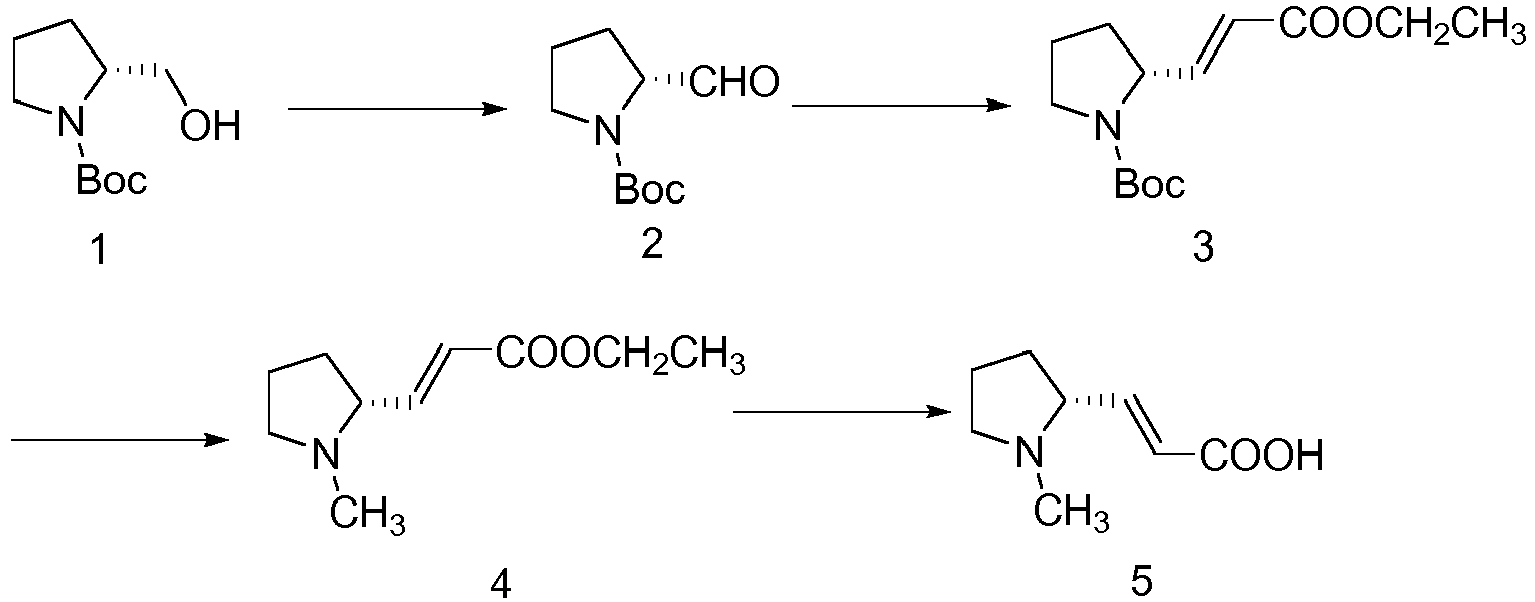
- 8.0 kg of compound 1, 264 kg of dichloromethane, and 13.0 kg of anhydrous sodium acetate were added to a 300 L reactor and stirred. The reaction system was cooled to 0°C by freezing brine. 17.14kg of PCC was added in batches under nitrogen protection. After the completion of the addition, the freeze was stopped, and the reaction was carried out for 5 h with the temperature rising naturally. After the completion of the reaction was determined by TLC detection (ethyl acetate: petroleum ether = 1:3), the mixture was filtered, and the filtrate was concentrated under reduced pressure to obtain a black oil. The product was eluted over column chromatography (the eluent was ethyl acetate: petroleum ether = 1:3). The main fraction was collected, concentrated under reduced pressure, and dissolved by addition of 64 kg of ethyl acetate. The solution was washed with 0.5N diluted hydrochloric acid solution, water and saturated brine successively, dried over anhydrous sodium sulfate, and concentrated to obtain 6.42 kg of pale yellow oil.
- 114 kg of dichloromethane and 3.05 kg of 60% sodium hydride were added to a 300 L reactor and stirred well, the mixture was cooled by freezing brine. 7.66 kg of triethyl phosphonoacetate was slowly added dropwise, and the addition was completed after about 30 min. The mixture was stirred at room temperature until no bubbles were produced. A solution of 6.4 kg of compound 2 obtained in the previous step in dichloromethane (85 kg) was added slowly dropwise, and the addition was completed after about 1 h, the reaction was carried out at room temperature for 1.5-2 h. After the completion of the reaction was determined by TLC detection, the mixture was cooled by freezing brine. An aqueous solution of ammonium chloride (1.26 kg of ammonium chloride dissolved in 4.0 kg of water) was added slowly until no bubbles were produced. The mixture was stirred for about 0.5 h. Purified water was then slowly added dropwise until the mixture was clear. Two phases were separated, and the aqueous phase was extracted once with dichloromethane. The organic phases were combined, washed with a saturated aqueous solution of sodium bicarbonate and saturated brine, dried over anhydrous sodium sulfate, and concentrated to obtain a crude ester product. The crude ester product was subjected to column chromatography (the eluent was ethyl acetate: petroleum ether = 1:8). The main fraction was collected and concentrated to obtain 4.82 kg of compound 3, yield: 45.0%. (The TLC condition was petroleum ether: ethyl acetate = 3:1, the Rf of the product = 0.7, the Rf of the starting material = 0.6).
- Compound 3: 1H NMR (400 MHz, CDCl3) δ = 6.85-6.80 (dd, 1H), 5.84-5.80 (d, 1H), 4.40 (br, 1H), 4.22-4.17 (q, 2H), 3.42 (s, 2H), 2.08-2.06 (m, 1H), 1.89-1.82 (m, 2H), 1.79-1.73 (m, 1H), 1.44 (s, 9H), 1.31-1.27 (t, 3H) ppm.
MS (M+Na): 292.1 - 4.8 kg of compound 3 and 58.6 kg of formic acid were added to a 100 L reactor and stirred at room temperature for 15 min. 2.63 kg of paraformaldehyde was then added, and the mixture was heated to slightly reflux at 90°C for 3-4 h until the starting material point disappeared by TLC detection. Most of formic acid in the reaction solution was concentrated (about 1/5 remained), and 1M hydrochloric acid was added to adjust the pH to 1.0. The mixture was washed with ethyl acetate. The aqueous phase was further added with a saturated aqueous solution of potassium carbonate to adjust the pH to 8.0, and extracted with ethyl acetate. The organic phases were combined, washed with a saturated aqueous solution of sodium chloride, dried over anhydrous sodium sulfate, and filtered. The filtrate was concentrated to obtain 2.42 kg of compound 4, yield: 73.5%.
- Compound 4: 1H NMR (400 MHz, CDCl3) δ =6.85-6.80 (dd, 1H), 5.96-5.92 (d, 1H), 4.22-4.17 (q, 2H), 3.15-3.10 (m, 1H), 2.76-2.70 (m, 1H), 2.28 (s, 3H), 2.28-2.21 (m, 1H), 2.04-1.98 (m, 1H), 1.91-1.84 (m, 1H), 1.82-1.74 (m, 1H), 1.72-1.65 (m, 1H) ppm.
MS (M+1): 184.2 - 2.4 kg of compound 4 and then 5.9 kg of methanol were added to a 20 L reaction flask. 1.49 kg of potassium hydroxide was added in batches at a controlled temperature no higher than 30°C, the addition was completed after about 1.5 h, and then the reaction was carried out at 30°C for 2 h. After the completion of the reaction was determined by TLC detection, the pH was adjusted to 4-5 with 4N hydrochloric acid in methanol in an ice bath. The mixture was filtered, the filtrate was concentrated to dryness, and 2.7 kg of acetonitrile was added under stirring to precipitate a crystal. The mixture was filtered and dried to obtain 1.06 kg of compound 5, yield: 52.1%.
- Compound 5: 1H NMR (400 MHz, d6 DMSO) δ = 12.60 (s, 1H), 11.72 (s, 1H), 6.94-6.88 (dd, 1H), 6.21-6.17 (d, 1H), 4.00 (s, 1H), 3.57 (s, 1H), 3.07 (s, 1H), 2.67 (s, 3H), 2.28-2.20 (m, 1H), 2.02-1.99 (m, 2H), 1.92-1.82 (m, 1H) ppm.
MS (M+1): 156.1 - 1.0 kg of compound 5 and 9.4 kg of acetonitrile were added to a 20 L reaction flask, and then 30 g of N,N-dimethylformamide was added dropwise. 630 g of oxalyl chloride was slowly added dropwise in an ice bath. After the completion of the addition, the mixture was stirred at 20°C for 5 h. A small amount of solid remained at the bottom of the reaction solution, and the reaction solution was directly used in the following condensation reaction without treatment.
- 1.15 kg of compound VII was dissolved in 7.2 kg of N-methylpyrrolidone and stirred for 10 min. The previous reaction solution was added dropwise in an ice bath, and the reaction was stirred at room temperature overnight. After the completion of the reaction was determined by TLC detection, the reaction solution was poured into warm water (45.0 kg) at about 40°C, and 10% sodium hydroxide solution was slowly added under stirring to adjust the pH to 10. The mixture was filtered to obtain a yellow solid. The resulting filter cake was pulped with warm water (about 5.0 kg) at 40°C, and then filtered. The filter cake was dissolved in dichloromethane to remove water, dried, concentrated, and purified by column chromatography with gradient elution, the starting eluent was dichloromethane: methanol = 25:1, and finally increased to 15:1. The main fraction was collected and concentrated to obtain 1.12 kg of the compound of formula I, yield: 74.5%, with the HPLC purity of 99.71%.
- Compound of formula I: 1H NMR (400 MHz, CDCl3) δ =9.20 (s, 1H), 8.59-8.58 (t, 1H), 8.40 (s, 1H), 8.07-8.03 (d, 2H), 7.77-7.32 (m, 1H), 7.63-7.62 (d, 1H), 7.25-7.23 (q, 1H), 7.14 (s, 1H), 7.111-7.106 (d, 1H), 6.97-6.92 (q, 1H), 6.86-6.83 (q, 1H), 6.79-6.76 (q, 1H), 6.17-6.14 (d, 1H), 5.21 (s, 2H), 4.23-4.18 (q, 2H), 3.16-3.12 (m, 1H), 2.84-2.82 (d, 1H), 2.30-2.27 (t, 4H), 2.06-1.99 (m, 1H), 1.90-1.85 (m, 1H), 1.83-1.72 (m, 1H), 1.68-1.60 (m, 1H), 1.54-1.52 (t, 3H) ppm.
MS (M+1): 583.2 - 2.0 kg of the compound of formula VII was dissolved in 20 L of N-methylpyrrolidone in a 50 L reactor. 1.2 kg of compound 5 and then 1.7 kg of EEDQ were added, and the reaction was stirred for 14-17 h at a controlled temperature of 20-25°C. 2.5 kg of water was slowly added in an ice bath, and the pH was adjusted to 9-10 with 5% aqueous NaOH solution (about 25 L). The mixture was filtered to obtain a product with a wet weight of about 4.9 kg. The resulting yellow solid was added with 30 kg of water, and 1 M HCl solution was added dropwise under stirring to adjust the pH to 2-5. The mixture was stirred until it was clear. The mixture was extracted with dichloromethane, the pH of the aqueous phase was adjusted to 9-10 with 5% aqueous NaOH solution, and the resulting solid was filtered to obtain a product with a wet weight of about 5.2 kg. 88.4 kg of ethanol and 8.8 kg of acetone were added, and the mixture was heated to reflux until it was clear. The solution was cooled to room temperature under stirring to precipitate a crystal for 15 h. The mixture was filtered, and the filter cake was washed with ethanol to obtain 2.1 kg of the compound of formula I as a pale yellow solid, yield: 80.3%, with the HPLC purity of 99.68%.
- Since the present invention has been described based on the specific embodiments thereof, some modifications and equivalent variations are apparent to those skilled in the art and are within the scope of the present invention.
Claims (14)
- A method for preparing a compound of formula II or a pharmaceutically acceptable salt thereof,
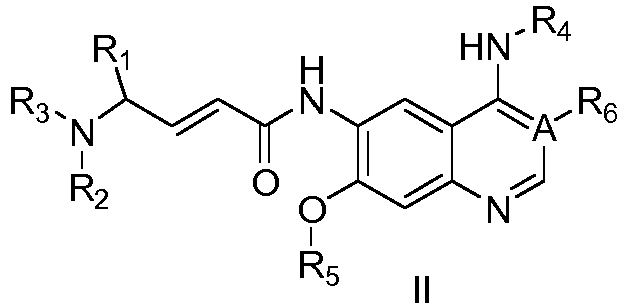
 R is selected from the group consisting of hydroxy, -ORa, and halogen;Ra is selected from the group consisting of alkyl, aryl, and alkylaryl, wherein the alkyl, aryl, and alkylaryl are each optionally substituted by a substituent;R1 is selected from the group consisting of hydrogen, cycloalkyl, cycloalkenyl, alkyl, alkenyl, alkynyl, aralkyl, and substituted or unsubstituted aryl or heteroaryl;R2 and R3 are each independently hydrogen, an amino protecting group, cycloalkyl, cycloalkenyl, alkyl, alkenyl, alkynyl, aralkyl, and substituted or unsubstituted aryl or heteroaryl, or R1 and R3 together with the nitrogen to which R3 is attached form a nitrogen-containing heteroaryl or heterocyclyl, or R2 and R3 together with the nitrogen to which R3 is attached form a nitrogen-containing heteroaryl or heterocyclyl;A is selected from the group consisting of carbon atom and nitrogen atom;when A is a carbon atom, R5 is selected from the group consisting of hydrogen atom and alkoxy, wherein the alkoxy is optionally substituted by one or more substituents selected from the group consisting of halogen and alkoxy, and R6 is cyano;when A is a nitrogen atom, R5 is selected from the group consisting of hydrogen atom and alkoxy, wherein the alkoxy is optionally substituted by one or more substituents selected from the group consisting of halogen and alkoxy, and R5 is unsubstituted;R4 has the following structure:
 D is selected from the group consisting of aryl and heteroaryl, wherein the aryl and heteroaryl are each independently and optionally substituted by one or more substituents selected from the group consisting of halogen, alkyl and trifluoromethyl;T is selected from the group consisting of -(CH2)r-, -O(CH2)r-, -NH(CH2)r-, and -S(CH2)r;L is selected from the group consisting of aryl and heteroaryl, wherein the aryl and heteroaryl are each independently and optionally substituted by one or more halogen or alkyl; andr is 0, 1 or 2,the method comprises a step of reacting a compound of formula IV with a compound of formula III.
 - The method for preparing a compound of formula II or a pharmaceutically acceptable salt thereof according to claim 1, characterized in that R is hydroxy, the method comprises a step of reacting the compound of formula IV with the compound of formula III in the presence of a condensing agent, the condensing agent is one or more selected from the group consisting of DCC, EDC, BOP, HBTU, and EEDQ, preferably EEDQ.
- The method for preparing a compound of formula II or a pharmaceutically acceptable salt thereof according to claim 2, characterized in that a solvent used in the reaction is one or more selected from the group consisting of pyridine, quinoline, acetonitrile, N-methylpyrrolidone, dichloromethane, ethyl acetate, tetrahydrofuran, N,N-dimethylformamide, and N,N-dimethylacetamide, preferably N-methylpyrrolidone.
- The method for preparing a compound of formula II or a pharmaceutically acceptable salt thereof according to claim 1, characterized in that R is halogen, preferably chlorine.
- The method for preparing a compound of formula II or a pharmaceutically acceptable salt thereof according to claim 4, also comprising a step of reacting a compound of formula V with an acyl halogenating reagent to obtain a compound of formula IV,

- The method for preparing a compound of formula II or a pharmaceutically acceptable salt thereof according to claim 5, characterized in that the acyl halogenating reagent is one or more selected from the group consisting of oxalyl chloride, phosphorus halide, thionyl halide, and triphenylphosphine halide.
- The method for preparing a compound of formula II or a pharmaceutically acceptable salt thereof according to claim 4, characterized in that a solvent used in the reaction is one or more selected from the group consisting of pyridine, quinoline, acetonitrile, N-methylpyrrolidone, dichloromethane, ethyl acetate, tetrahydrofuran, N,N-dimethylformamide, and N,N-dimethylacetamide, preferably N-methylpyrrolidone.
- The method for preparing a compound of formula II or a pharmaceutically acceptable salt thereof according to claims 1 to 7, characterized in that the compound of formula II is a compound of formula I, the compound of formula III is a compound of formula VII, and the compound of formula IV is a compound of formula VI,

 wherein R2 is selected from the group consisting of hydrogen, an amino protecting group, cycloalkyl, cycloalkenyl, alkyl, alkenyl, alkynyl, aralkyl, and substituted or unsubstituted aryl or heteroaryl;R is selected from the group consisting of hydroxy, -ORa, and halogen; andRa is selected from the group consisting of alkyl, aryl, and alkylaryl, wherein the alkyl, aryl, and alkylaryl are each optionally substituted by a substituent.
 - The method for preparing a compound of formula II or a pharmaceutically acceptable salt thereof according to claim 8, characterized in that the pharmaceutically acceptable salt of the compound of formula I is selected from the group consisting of p-toluenesulfonate salt, methanesulfonate salt, maleate salt, succinate salt and malate salt, preferably maleate salt, and more preferably dimaleate salt.
- The method for preparing a compound of formula II or a pharmaceutically acceptable salt thereof according to claim 2 or 3, characterized in that the compound of formula II is Neratinib, the compound of formula III is a compound of formula VII, and the compound of formula IV is a compound of formula IX,
 wherein R is selected from the group consisting of hydroxy, -ORa, and halogen;Ra is selected from the group consisting of alkyl, aryl, and alkylaryl, wherein the alkyl, aryl, and alkylaryl are each optionally substituted by a substituent; andR2 and R3 are each independently hydrogen, an amino protecting group, cycloalkyl, cycloalkenyl, alkyl, alkenyl, alkynyl, aralkyl, and substituted or unsubstituted aryl or heteroaryl.
 - A compound of formula VI,
 wherein R2 is selected from the group consisting of hydrogen, an amino protecting group, cycloalkyl, cycloalkenyl, alkyl, alkenyl, alkynyl, aralkyl, and substituted or unsubstituted aryl or heteroaryl;R is selected from the group consisting of hydroxy, -ORa, and halogen; andRa is selected from the group consisting of alkyl, aryl, and alkylaryl, wherein the alkyl, aryl, and alkylaryl are each optionally substituted by a substituent.
 - A method for preparing a compound of formula VI, comprising a Wittig-Horner reaction between a compound of formula VIII and phosphoryl carboxylate to obtain a compound of formula X,
 wherein R2 is selected from the group consisting of hydrogen, an amino protecting group, cycloalkyl, cycloalkenyl, alkyl, alkenyl, alkynyl, aralkyl, and substituted or unsubstituted aryl or heteroaryl;R is selected from the group consisting of hydroxy, -ORa, and halogen; andRa is selected from the group consisting of alkyl, aryl, and alkylaryl, wherein the alkyl, aryl, and alkylaryl are each optionally substituted by a substituent, and the phosphoryl carboxylate is preferably triethyl phosphonoacetate.
 - The method for preparing a compound of formula VI according to claim 12, characterized in that R is hydroxy or halogen, the method also comprises a step of hydrolyzing the compound of formula X in the presence of an alkaline medium, the alkaline medium is one or more selected from the group consisting of Et3N, DBU, TMG, Py, DIPEA, K2CO3, KHCO3, Na2CO3, NaHCO3, KOH, NaOH, NaOMe, NaOEt, NaO t Bu, and NaH, preferably KOH.
- The method for preparing a compound of formula VI according to claim 13, characterized in that R is chlorine, the method also comprises a step of reacting the product obtained by hydrolyzation with an acyl halogenating reagent, the acyl halogenating reagent is one or more selected from the group consisting of oxalyl chloride, phosphorus halide, thionyl halide, and triphenylphosphine halide.
Priority Applications (1)
| Application Number | Priority Date | Filing Date | Title |
|---|---|---|---|
| PL17788792T PL3447051T3 (en) | 2016-04-28 | 2017-04-27 | Method for preparing tyrosine kinase inhibitor and derivative thereof |
Applications Claiming Priority (2)
| Application Number | Priority Date | Filing Date | Title |
|---|---|---|---|
| CN201610274566 | 2016-04-28 | ||
| PCT/CN2017/082164 WO2017186140A1 (en) | 2016-04-28 | 2017-04-27 | Method for preparing tyrosine kinase inhibitor and derivative thereof |
Publications (3)
| Publication Number | Publication Date |
|---|---|
| EP3447051A1 true EP3447051A1 (en) | 2019-02-27 |
| EP3447051A4 EP3447051A4 (en) | 2019-11-27 |
| EP3447051B1 EP3447051B1 (en) | 2021-12-15 |
Family
ID=60160713
Family Applications (1)
| Application Number | Title | Priority Date | Filing Date |
|---|---|---|---|
| EP17788792.4A Active EP3447051B1 (en) | 2016-04-28 | 2017-04-27 | Method for preparing tyrosine kinase inhibitor and derivative thereof |
Country Status (13)
| Country | Link |
|---|---|
| US (2) | US10793548B2 (en) |
| EP (1) | EP3447051B1 (en) |
| JP (1) | JP6947749B2 (en) |
| CN (1) | CN108290867B (en) |
| BR (1) | BR112018071617A2 (en) |
| CA (1) | CA3021471A1 (en) |
| DK (1) | DK3447051T3 (en) |
| ES (1) | ES2903416T3 (en) |
| HU (1) | HUE057402T2 (en) |
| PL (1) | PL3447051T3 (en) |
| PT (1) | PT3447051T (en) |
| TW (1) | TWI739825B (en) |
| WO (1) | WO2017186140A1 (en) |
Families Citing this family (10)
| Publication number | Priority date | Publication date | Assignee | Title |
|---|---|---|---|---|
| CN108314639B (en) * | 2018-05-09 | 2019-04-30 | 山东铂源药业有限公司 | Compound (E) -3-(1- methylpyrrolidin- 2- yl)-acrylic acid hydrochloride and synthetic method |
| CN110960529A (en) * | 2018-09-30 | 2020-04-07 | 江苏恒瑞医药股份有限公司 | Tyrosine kinase inhibitor bulk drug with reduced toxic impurity content |
| CN111138414A (en) * | 2018-11-05 | 2020-05-12 | 江苏恒瑞医药股份有限公司 | Crystal form of tyrosine kinase inhibitor and preparation method thereof |
| TW202115027A (en) * | 2019-08-30 | 2021-04-16 | 大陸商江蘇恒瑞醫藥股份有限公司 | Tyrosine kinase inhibitor with low impurity content |
| CN112625025B (en) * | 2020-12-31 | 2022-03-29 | 河南省医药科学研究院 | Pyridyl-substituted quinoline derivatives and preparation method and use thereof |
| CN112759583B (en) * | 2020-12-31 | 2022-10-11 | 河南省医药科学研究院 | Quinoline derivative containing furyl and preparation method and application thereof |
| CN114890930A (en) * | 2022-04-18 | 2022-08-12 | 重庆医药高等专科学校 | Synthesis method of pyrroltinib intermediate (R, E) -3- (1-methylpyrrolidine-2-yl) acrylic acid hydrochloride |
| CN115073344B (en) * | 2022-06-24 | 2024-03-26 | 苏州富士莱医药股份有限公司 | Preparation method and application of R- (1-tert-butyloxycarbonyl pyrrolidine-2-yl) acrylic acid |
| CN114920683B (en) * | 2022-06-24 | 2024-03-26 | 苏州富士莱医药股份有限公司 | Preparation method of Boc-prolyl aldehyde and (R, E) - (1-methylpyrrolidin-2-yl) acrylic acid |
| EP4682143A1 (en) * | 2023-03-10 | 2026-01-21 | Convalife Pharmaceuticals Co., Ltd. | Pharmaceutical composition containing egfr inhibitor, and preparation method therefor and use thereof |
Family Cites Families (20)
| Publication number | Priority date | Publication date | Assignee | Title |
|---|---|---|---|---|
| US5747501A (en) * | 1992-04-07 | 1998-05-05 | Pfizer, Inc. | Indole derivatives |
| US5599902A (en) * | 1994-11-10 | 1997-02-04 | Arizona Board Of Regents Acting On Behalf Of Arizona State University | Cancer inhibitory peptides |
| US6002008A (en) * | 1997-04-03 | 1999-12-14 | American Cyanamid Company | Substituted 3-cyano quinolines |
| CL2004000016A1 (en) * | 2003-01-21 | 2005-04-15 | Wyeth Corp | 4-AMINO-2-BUTENOYL CHLORIDE COMPOUND OR A PHARMACEUTICALLY ACCEPTABLE SALT OF THE SAME; PROCEDURE TO PREPARE SUCH COMPOUND, USEFUL AS INTERMEDIARY IN THE SYNTHESIS OF INHIBITING COMPOUNDS OF PROTEIN QUINASA TIROSINA. |
| US7399865B2 (en) * | 2003-09-15 | 2008-07-15 | Wyeth | Protein tyrosine kinase enzyme inhibitors |
| CN101128425B (en) * | 2005-02-25 | 2012-12-26 | 泰特拉洛吉克药业公司 | Dimeric IAP inhibitors |
| TW200716110A (en) | 2005-04-20 | 2007-05-01 | Smithkline Beecham Corp | Inhibitors of AKT activity |
| WO2006127203A2 (en) * | 2005-05-25 | 2006-11-30 | Wyeth | Methods of synthesizing 6-alkylaminoquinoline derivatives |
| JP2007084530A (en) * | 2005-08-22 | 2007-04-05 | Sankyo Co Ltd | Pharmaceutical composition containing indanol derivative |
| WO2010048477A2 (en) * | 2008-10-24 | 2010-04-29 | Wyeth Llc | Improved process for preparation of coupled products from 4-amino-3-cyanoquinolines using stabilized intermediates |
| CN102020639A (en) * | 2009-09-14 | 2011-04-20 | 上海恒瑞医药有限公司 | 6-amido quinazoline or 3-cyano quinoline derivative, preparation method thereof and application of derivative to medicament |
| CA2774476A1 (en) * | 2009-10-07 | 2011-04-14 | Francis Barany | Coferons and methods of making and using them |
| CN105037333A (en) * | 2009-12-21 | 2015-11-11 | 张强 | Novel quinazoline derivatives |
| GB0922302D0 (en) * | 2009-12-22 | 2010-02-03 | Imp Innovations Ltd | Compounds |
| CN102382106A (en) * | 2010-08-30 | 2012-03-21 | 黄振华 | Aniline substituted quinazoline derivative |
| CN102675287A (en) * | 2011-03-11 | 2012-09-19 | 江苏恒瑞医药股份有限公司 | Pharmaceutically acceptable salts of (E)-N-(4-((3-chloro-4-(2-pyridyl methoxy) phenyl) amino)-3-cyano-7-ethyoxyl-6-quinolyl)-3-((2R)-1-methyl pyrrolidine-2-propyl)-2-acrylamide, preparation method and application of salts in medicines |
| CN104203242B (en) * | 2012-04-04 | 2017-03-15 | 杭州德润玉成生物科技有限公司 | Substituted quinolines as Bruton's tyrosine kinase inhibitors |
| TWI609012B (en) * | 2013-04-28 | 2017-12-21 | 廣東東陽光藥業有限公司 | Aminoquinazoline derivatives and their salts and methods of use thereof |
| WO2015028409A1 (en) * | 2013-08-27 | 2015-03-05 | Bayer Pharma Aktiengesellschaft | 6,7-dihydro-5h-benzo[7]annulene derivatives, method for the preparation thereof, pharmaceutical preparations comprising them, and the use thereof for producing medicaments |
| CN105330646B (en) * | 2015-12-04 | 2019-05-24 | 上海勋和医药科技有限公司 | A kind of preparation method of antineoplastic maleic acid linatinib |
-
2017
- 2017-04-27 ES ES17788792T patent/ES2903416T3/en active Active
- 2017-04-27 DK DK17788792.4T patent/DK3447051T3/en active
- 2017-04-27 TW TW106114079A patent/TWI739825B/en not_active IP Right Cessation
- 2017-04-27 JP JP2018552751A patent/JP6947749B2/en not_active Expired - Fee Related
- 2017-04-27 US US16/094,278 patent/US10793548B2/en not_active Expired - Fee Related
- 2017-04-27 PT PT177887924T patent/PT3447051T/en unknown
- 2017-04-27 PL PL17788792T patent/PL3447051T3/en unknown
- 2017-04-27 BR BR112018071617-0A patent/BR112018071617A2/en not_active Application Discontinuation
- 2017-04-27 WO PCT/CN2017/082164 patent/WO2017186140A1/en not_active Ceased
- 2017-04-27 CN CN201780004193.XA patent/CN108290867B/en active Active
- 2017-04-27 EP EP17788792.4A patent/EP3447051B1/en active Active
- 2017-04-27 CA CA3021471A patent/CA3021471A1/en active Pending
- 2017-04-27 HU HUE17788792A patent/HUE057402T2/en unknown
-
2020
- 2020-08-28 US US17/005,489 patent/US11198683B2/en not_active Expired - Fee Related
Also Published As
| Publication number | Publication date |
|---|---|
| PT3447051T (en) | 2022-01-06 |
| US20200392111A1 (en) | 2020-12-17 |
| DK3447051T3 (en) | 2022-01-17 |
| ES2903416T3 (en) | 2022-04-01 |
| TW201738236A (en) | 2017-11-01 |
| US20190127350A1 (en) | 2019-05-02 |
| JP6947749B2 (en) | 2021-10-13 |
| CN108290867B (en) | 2022-02-08 |
| HUE057402T2 (en) | 2022-05-28 |
| WO2017186140A1 (en) | 2017-11-02 |
| BR112018071617A2 (en) | 2019-02-19 |
| EP3447051B1 (en) | 2021-12-15 |
| JP2019520305A (en) | 2019-07-18 |
| CA3021471A1 (en) | 2017-11-02 |
| PL3447051T3 (en) | 2022-03-14 |
| US10793548B2 (en) | 2020-10-06 |
| EP3447051A4 (en) | 2019-11-27 |
| CN108290867A (en) | 2018-07-17 |
| US11198683B2 (en) | 2021-12-14 |
| TWI739825B (en) | 2021-09-21 |
Similar Documents
| Publication | Publication Date | Title |
|---|---|---|
| US11198683B2 (en) | Method for preparing tyrosine kinase inhibitor and derivative thereof | |
| EP2408739B1 (en) | A process for the preparation of 6-(7-((1-aminocyclopropyl)methoxy)-6-methoxyquinolin-4-yloxy)-n-methyl-1-naphthamide and synthetic intermediates thereof | |
| CA3016826C (en) | Salt of pyridinyl amino pyrimidine derivative, preparation method therefor, and application thereof | |
| EP2763981B1 (en) | Method for preparing 1-(4-(4-(3,4-dichloro-2-fluorophenylamino)-7-methoxyquinazolin-6-yloxy)piperidin-1-yl)-prop-2-en-1-one hydrochloride and intermediates used therein | |
| DE69427283T2 (en) | PROPENONE DERIVATIVES | |
| EP4249077A1 (en) | Novel acridinium salt and method for producing same | |
| CN111100123A (en) | Simple method for preparing ellipticine or substituted ellipticine | |
| JP7279134B2 (en) | Method for producing prolinamide compound | |
| JP7693921B2 (en) | Method for producing prolinamide compound | |
| CN119431379B (en) | WRN degrading agents, their preparation methods and applications | |
| HK1255262A1 (en) | Method for preparing tyrosine kinase inhibitor and derivative thereof | |
| HK1255262B (en) | Method for preparing tyrosine kinase inhibitor and derivative thereof | |
| CN112707887A (en) | Preparation method of aryloxy quinoline compound | |
| JP6803410B2 (en) | Method for producing indazole compound and indazole compound | |
| CN114014847A (en) | Benzothiophene pyrimidine derivative, preparation method thereof and application thereof in preparation of antitumor drugs | |
| JPH10324688A (en) | Imidazopyridine derivative and its production | |
| CN117658986A (en) | Preparation method of AR antagonist TRC-253 | |
| EP3906235A1 (en) | Method for preparing sulfonamides drugs | |
| KR20150130327A (en) | Substituted (r)-3-(4-methylcarbamoyl-3-fluorophenylamino)tetrahydrofuran-3-ene-carboxylic acid(variants) and ester thereof, method for producing and using same | |
| EP1634879A1 (en) | Method of selectively introducing amino substituent | |
| HK1231871A1 (en) | A process for the preparation of compound and synthetic intermediates thereof | |
| KR20200143796A (en) | Method for synthesizing thioaurones | |
| HK1167136B (en) | A process for the preparation of 6-(7-((1-aminocyclopropyl)methoxy)-6-methoxyquinolin-4-yloxy)-n-methyl-1-naphthamide and synthetic intermediates thereof |
Legal Events
| Date | Code | Title | Description |
|---|---|---|---|
| STAA | Information on the status of an ep patent application or granted ep patent |
Free format text: STATUS: THE INTERNATIONAL PUBLICATION HAS BEEN MADE |
|
| PUAI | Public reference made under article 153(3) epc to a published international application that has entered the european phase |
Free format text: ORIGINAL CODE: 0009012 |
|
| STAA | Information on the status of an ep patent application or granted ep patent |
Free format text: STATUS: REQUEST FOR EXAMINATION WAS MADE |
|
| 17P | Request for examination filed |
Effective date: 20181120 |
|
| AK | Designated contracting states |
Kind code of ref document: A1 Designated state(s): AL AT BE BG CH CY CZ DE DK EE ES FI FR GB GR HR HU IE IS IT LI LT LU LV MC MK MT NL NO PL PT RO RS SE SI SK SM TR |
|
| AX | Request for extension of the european patent |
Extension state: BA ME |
|
| DAV | Request for validation of the european patent (deleted) | ||
| DAX | Request for extension of the european patent (deleted) | ||
| A4 | Supplementary search report drawn up and despatched |
Effective date: 20191025 |
|
| RIC1 | Information provided on ipc code assigned before grant |
Ipc: C07D 207/08 20060101ALI20191021BHEP Ipc: C07D 401/12 20060101ALI20191021BHEP Ipc: C07D 207/16 20060101ALI20191021BHEP Ipc: C07D 401/14 20060101AFI20191021BHEP |
|
| STAA | Information on the status of an ep patent application or granted ep patent |
Free format text: STATUS: EXAMINATION IS IN PROGRESS |
|
| 17Q | First examination report despatched |
Effective date: 20201026 |
|
| GRAP | Despatch of communication of intention to grant a patent |
Free format text: ORIGINAL CODE: EPIDOSNIGR1 |
|
| STAA | Information on the status of an ep patent application or granted ep patent |
Free format text: STATUS: GRANT OF PATENT IS INTENDED |
|
| INTG | Intention to grant announced |
Effective date: 20210722 |
|
| GRAS | Grant fee paid |
Free format text: ORIGINAL CODE: EPIDOSNIGR3 |
|
| GRAA | (expected) grant |
Free format text: ORIGINAL CODE: 0009210 |
|
| STAA | Information on the status of an ep patent application or granted ep patent |
Free format text: STATUS: THE PATENT HAS BEEN GRANTED |
|
| AK | Designated contracting states |
Kind code of ref document: B1 Designated state(s): AL AT BE BG CH CY CZ DE DK EE ES FI FR GB GR HR HU IE IS IT LI LT LU LV MC MK MT NL NO PL PT RO RS SE SI SK SM TR |
|
| REG | Reference to a national code |
Ref country code: GB Ref legal event code: FG4D Ref country code: CH Ref legal event code: EP |
|
| REG | Reference to a national code |
Ref country code: IE Ref legal event code: FG4D Ref country code: DE Ref legal event code: R096 Ref document number: 602017051010 Country of ref document: DE |
|
| REG | Reference to a national code |
Ref country code: PT Ref legal event code: SC4A Ref document number: 3447051 Country of ref document: PT Date of ref document: 20220106 Kind code of ref document: T Free format text: AVAILABILITY OF NATIONAL TRANSLATION Effective date: 20211230 |
|
| REG | Reference to a national code |
Ref country code: AT Ref legal event code: REF Ref document number: 1455425 Country of ref document: AT Kind code of ref document: T Effective date: 20220115 |
|
| REG | Reference to a national code |
Ref country code: DK Ref legal event code: T3 Effective date: 20220114 |
|
| REG | Reference to a national code |
Ref country code: SE Ref legal event code: TRGR |
|
| REG | Reference to a national code |
Ref country code: NL Ref legal event code: FP |
|
| REG | Reference to a national code |
Ref country code: GR Ref legal event code: EP Ref document number: 20220400052 Country of ref document: GR Effective date: 20220211 |
|
| REG | Reference to a national code |
Ref country code: ES Ref legal event code: FG2A Ref document number: 2903416 Country of ref document: ES Kind code of ref document: T3 Effective date: 20220401 |
|
| REG | Reference to a national code |
Ref country code: LT Ref legal event code: MG9D |
|
| PG25 | Lapsed in a contracting state [announced via postgrant information from national office to epo] |
Ref country code: RS Free format text: LAPSE BECAUSE OF FAILURE TO SUBMIT A TRANSLATION OF THE DESCRIPTION OR TO PAY THE FEE WITHIN THE PRESCRIBED TIME-LIMIT Effective date: 20211215 Ref country code: LT Free format text: LAPSE BECAUSE OF FAILURE TO SUBMIT A TRANSLATION OF THE DESCRIPTION OR TO PAY THE FEE WITHIN THE PRESCRIBED TIME-LIMIT Effective date: 20211215 Ref country code: FI Free format text: LAPSE BECAUSE OF FAILURE TO SUBMIT A TRANSLATION OF THE DESCRIPTION OR TO PAY THE FEE WITHIN THE PRESCRIBED TIME-LIMIT Effective date: 20211215 Ref country code: BG Free format text: LAPSE BECAUSE OF FAILURE TO SUBMIT A TRANSLATION OF THE DESCRIPTION OR TO PAY THE FEE WITHIN THE PRESCRIBED TIME-LIMIT Effective date: 20220315 |
|
| PGFP | Annual fee paid to national office [announced via postgrant information from national office to epo] |
Ref country code: GB Payment date: 20220324 Year of fee payment: 6 |
|
| REG | Reference to a national code |
Ref country code: AT Ref legal event code: MK05 Ref document number: 1455425 Country of ref document: AT Kind code of ref document: T Effective date: 20211215 |
|
| REG | Reference to a national code |
Ref country code: HU Ref legal event code: AG4A Ref document number: E057402 Country of ref document: HU |
|
| PG25 | Lapsed in a contracting state [announced via postgrant information from national office to epo] |
Ref country code: NO Free format text: LAPSE BECAUSE OF FAILURE TO SUBMIT A TRANSLATION OF THE DESCRIPTION OR TO PAY THE FEE WITHIN THE PRESCRIBED TIME-LIMIT Effective date: 20220315 Ref country code: LV Free format text: LAPSE BECAUSE OF FAILURE TO SUBMIT A TRANSLATION OF THE DESCRIPTION OR TO PAY THE FEE WITHIN THE PRESCRIBED TIME-LIMIT Effective date: 20211215 Ref country code: HR Free format text: LAPSE BECAUSE OF FAILURE TO SUBMIT A TRANSLATION OF THE DESCRIPTION OR TO PAY THE FEE WITHIN THE PRESCRIBED TIME-LIMIT Effective date: 20211215 |
|
| PGFP | Annual fee paid to national office [announced via postgrant information from national office to epo] |
Ref country code: SE Payment date: 20220328 Year of fee payment: 6 Ref country code: PL Payment date: 20220328 Year of fee payment: 6 Ref country code: GR Payment date: 20220331 Year of fee payment: 6 |
|
| PGFP | Annual fee paid to national office [announced via postgrant information from national office to epo] |
Ref country code: NL Payment date: 20220420 Year of fee payment: 6 |
|
| PG25 | Lapsed in a contracting state [announced via postgrant information from national office to epo] |
Ref country code: SM Free format text: LAPSE BECAUSE OF FAILURE TO SUBMIT A TRANSLATION OF THE DESCRIPTION OR TO PAY THE FEE WITHIN THE PRESCRIBED TIME-LIMIT Effective date: 20211215 Ref country code: SK Free format text: LAPSE BECAUSE OF FAILURE TO SUBMIT A TRANSLATION OF THE DESCRIPTION OR TO PAY THE FEE WITHIN THE PRESCRIBED TIME-LIMIT Effective date: 20211215 Ref country code: RO Free format text: LAPSE BECAUSE OF FAILURE TO SUBMIT A TRANSLATION OF THE DESCRIPTION OR TO PAY THE FEE WITHIN THE PRESCRIBED TIME-LIMIT Effective date: 20211215 Ref country code: EE Free format text: LAPSE BECAUSE OF FAILURE TO SUBMIT A TRANSLATION OF THE DESCRIPTION OR TO PAY THE FEE WITHIN THE PRESCRIBED TIME-LIMIT Effective date: 20211215 Ref country code: CZ Free format text: LAPSE BECAUSE OF FAILURE TO SUBMIT A TRANSLATION OF THE DESCRIPTION OR TO PAY THE FEE WITHIN THE PRESCRIBED TIME-LIMIT Effective date: 20211215 |
|
| PGFP | Annual fee paid to national office [announced via postgrant information from national office to epo] |
Ref country code: PT Payment date: 20220419 Year of fee payment: 6 Ref country code: IT Payment date: 20220328 Year of fee payment: 6 Ref country code: HU Payment date: 20220412 Year of fee payment: 6 Ref country code: FR Payment date: 20220408 Year of fee payment: 6 Ref country code: ES Payment date: 20220506 Year of fee payment: 6 Ref country code: DK Payment date: 20220412 Year of fee payment: 6 Ref country code: DE Payment date: 20220329 Year of fee payment: 6 |
|
| PG25 | Lapsed in a contracting state [announced via postgrant information from national office to epo] |
Ref country code: AT Free format text: LAPSE BECAUSE OF FAILURE TO SUBMIT A TRANSLATION OF THE DESCRIPTION OR TO PAY THE FEE WITHIN THE PRESCRIBED TIME-LIMIT Effective date: 20211215 |
|
| PGFP | Annual fee paid to national office [announced via postgrant information from national office to epo] |
Ref country code: TR Payment date: 20220425 Year of fee payment: 6 Ref country code: CH Payment date: 20220421 Year of fee payment: 6 Ref country code: BE Payment date: 20220420 Year of fee payment: 6 |
|
| REG | Reference to a national code |
Ref country code: DE Ref legal event code: R097 Ref document number: 602017051010 Country of ref document: DE |
|
| PG25 | Lapsed in a contracting state [announced via postgrant information from national office to epo] |
Ref country code: IS Free format text: LAPSE BECAUSE OF FAILURE TO SUBMIT A TRANSLATION OF THE DESCRIPTION OR TO PAY THE FEE WITHIN THE PRESCRIBED TIME-LIMIT Effective date: 20220415 |
|
| PLBE | No opposition filed within time limit |
Free format text: ORIGINAL CODE: 0009261 |
|
| STAA | Information on the status of an ep patent application or granted ep patent |
Free format text: STATUS: NO OPPOSITION FILED WITHIN TIME LIMIT |
|
| PG25 | Lapsed in a contracting state [announced via postgrant information from national office to epo] |
Ref country code: AL Free format text: LAPSE BECAUSE OF FAILURE TO SUBMIT A TRANSLATION OF THE DESCRIPTION OR TO PAY THE FEE WITHIN THE PRESCRIBED TIME-LIMIT Effective date: 20211215 |
|
| 26N | No opposition filed |
Effective date: 20220916 |
|
| PG25 | Lapsed in a contracting state [announced via postgrant information from national office to epo] |
Ref country code: SI Free format text: LAPSE BECAUSE OF FAILURE TO SUBMIT A TRANSLATION OF THE DESCRIPTION OR TO PAY THE FEE WITHIN THE PRESCRIBED TIME-LIMIT Effective date: 20211215 |
|
| PG25 | Lapsed in a contracting state [announced via postgrant information from national office to epo] |
Ref country code: MC Free format text: LAPSE BECAUSE OF FAILURE TO SUBMIT A TRANSLATION OF THE DESCRIPTION OR TO PAY THE FEE WITHIN THE PRESCRIBED TIME-LIMIT Effective date: 20211215 Ref country code: LU Free format text: LAPSE BECAUSE OF NON-PAYMENT OF DUE FEES Effective date: 20220427 |
|
| PG25 | Lapsed in a contracting state [announced via postgrant information from national office to epo] |
Ref country code: IE Free format text: LAPSE BECAUSE OF NON-PAYMENT OF DUE FEES Effective date: 20220427 |
|
| REG | Reference to a national code |
Ref country code: DE Ref legal event code: R119 Ref document number: 602017051010 Country of ref document: DE |
|
| REG | Reference to a national code |
Ref country code: DK Ref legal event code: EBP Effective date: 20230430 |
|
| REG | Reference to a national code |
Ref country code: SE Ref legal event code: EUG |
|
| REG | Reference to a national code |
Ref country code: CH Ref legal event code: PL |
|
| REG | Reference to a national code |
Ref country code: NL Ref legal event code: MM Effective date: 20230501 |
|
| GBPC | Gb: european patent ceased through non-payment of renewal fee |
Effective date: 20230427 |
|
| REG | Reference to a national code |
Ref country code: BE Ref legal event code: MM Effective date: 20230430 |
|
| PG25 | Lapsed in a contracting state [announced via postgrant information from national office to epo] |
Ref country code: GR Free format text: LAPSE BECAUSE OF NON-PAYMENT OF DUE FEES Effective date: 20231110 Ref country code: GB Free format text: LAPSE BECAUSE OF NON-PAYMENT OF DUE FEES Effective date: 20230427 |
|
| PG25 | Lapsed in a contracting state [announced via postgrant information from national office to epo] |
Ref country code: PT Free format text: LAPSE BECAUSE OF NON-PAYMENT OF DUE FEES Effective date: 20231027 Ref country code: NL Free format text: LAPSE BECAUSE OF NON-PAYMENT OF DUE FEES Effective date: 20230501 Ref country code: LI Free format text: LAPSE BECAUSE OF NON-PAYMENT OF DUE FEES Effective date: 20230430 Ref country code: HU Free format text: LAPSE BECAUSE OF NON-PAYMENT OF DUE FEES Effective date: 20230428 Ref country code: GR Free format text: LAPSE BECAUSE OF NON-PAYMENT OF DUE FEES Effective date: 20231110 Ref country code: GB Free format text: LAPSE BECAUSE OF NON-PAYMENT OF DUE FEES Effective date: 20230427 Ref country code: FR Free format text: LAPSE BECAUSE OF NON-PAYMENT OF DUE FEES Effective date: 20230430 Ref country code: DE Free format text: LAPSE BECAUSE OF NON-PAYMENT OF DUE FEES Effective date: 20231103 Ref country code: CH Free format text: LAPSE BECAUSE OF NON-PAYMENT OF DUE FEES Effective date: 20230430 Ref country code: SE Free format text: LAPSE BECAUSE OF NON-PAYMENT OF DUE FEES Effective date: 20230428 |
|
| PG25 | Lapsed in a contracting state [announced via postgrant information from national office to epo] |
Ref country code: BE Free format text: LAPSE BECAUSE OF NON-PAYMENT OF DUE FEES Effective date: 20230430 |
|
| PG25 | Lapsed in a contracting state [announced via postgrant information from national office to epo] |
Ref country code: MK Free format text: LAPSE BECAUSE OF FAILURE TO SUBMIT A TRANSLATION OF THE DESCRIPTION OR TO PAY THE FEE WITHIN THE PRESCRIBED TIME-LIMIT Effective date: 20211215 Ref country code: IT Free format text: LAPSE BECAUSE OF NON-PAYMENT OF DUE FEES Effective date: 20230427 Ref country code: DK Free format text: LAPSE BECAUSE OF NON-PAYMENT OF DUE FEES Effective date: 20230430 Ref country code: CY Free format text: LAPSE BECAUSE OF FAILURE TO SUBMIT A TRANSLATION OF THE DESCRIPTION OR TO PAY THE FEE WITHIN THE PRESCRIBED TIME-LIMIT Effective date: 20211215 |
|
| REG | Reference to a national code |
Ref country code: ES Ref legal event code: FD2A Effective date: 20240531 |
|
| PG25 | Lapsed in a contracting state [announced via postgrant information from national office to epo] |
Ref country code: ES Free format text: LAPSE BECAUSE OF NON-PAYMENT OF DUE FEES Effective date: 20230428 |
|
| PG25 | Lapsed in a contracting state [announced via postgrant information from national office to epo] |
Ref country code: ES Free format text: LAPSE BECAUSE OF NON-PAYMENT OF DUE FEES Effective date: 20230428 |
|
| PG25 | Lapsed in a contracting state [announced via postgrant information from national office to epo] |
Ref country code: MT Free format text: LAPSE BECAUSE OF FAILURE TO SUBMIT A TRANSLATION OF THE DESCRIPTION OR TO PAY THE FEE WITHIN THE PRESCRIBED TIME-LIMIT Effective date: 20211215 |
|
| PG25 | Lapsed in a contracting state [announced via postgrant information from national office to epo] |
Ref country code: PL Free format text: LAPSE BECAUSE OF NON-PAYMENT OF DUE FEES Effective date: 20230427 |
|
| PG25 | Lapsed in a contracting state [announced via postgrant information from national office to epo] |
Ref country code: PL Free format text: LAPSE BECAUSE OF NON-PAYMENT OF DUE FEES Effective date: 20230427 |