EP3446138B1 - System, verfahren und computerprogramm zur bestimmung einer impulsfolge für einen magnetresonanzscanner - Google Patents
System, verfahren und computerprogramm zur bestimmung einer impulsfolge für einen magnetresonanzscanner Download PDFInfo
- Publication number
- EP3446138B1 EP3446138B1 EP17718379.5A EP17718379A EP3446138B1 EP 3446138 B1 EP3446138 B1 EP 3446138B1 EP 17718379 A EP17718379 A EP 17718379A EP 3446138 B1 EP3446138 B1 EP 3446138B1
- Authority
- EP
- European Patent Office
- Prior art keywords
- sequence
- parameter
- hierarchy
- modules
- pulse
- Prior art date
- Legal status (The legal status is an assumption and is not a legal conclusion. Google has not performed a legal analysis and makes no representation as to the accuracy of the status listed.)
- Active
Links
Images




Classifications
-
- G—PHYSICS
- G01—MEASURING; TESTING
- G01R—MEASURING ELECTRIC VARIABLES; MEASURING MAGNETIC VARIABLES
- G01R33/00—Arrangements or instruments for measuring magnetic variables
- G01R33/20—Arrangements or instruments for measuring magnetic variables involving magnetic resonance
- G01R33/44—Arrangements or instruments for measuring magnetic variables involving magnetic resonance using nuclear magnetic resonance [NMR]
- G01R33/48—NMR imaging systems
- G01R33/54—Signal processing systems, e.g. using pulse sequences ; Generation or control of pulse sequences; Operator console
- G01R33/543—Control of the operation of the MR system, e.g. setting of acquisition parameters prior to or during MR data acquisition, dynamic shimming, use of one or more scout images for scan plane prescription
-
- A—HUMAN NECESSITIES
- A61—MEDICAL OR VETERINARY SCIENCE; HYGIENE
- A61B—DIAGNOSIS; SURGERY; IDENTIFICATION
- A61B5/00—Measuring for diagnostic purposes; Identification of persons
- A61B5/05—Detecting, measuring or recording for diagnosis by means of electric currents or magnetic fields; Measuring using microwaves or radio waves
- A61B5/055—Detecting, measuring or recording for diagnosis by means of electric currents or magnetic fields; Measuring using microwaves or radio waves involving electronic [EMR] or nuclear [NMR] magnetic resonance, e.g. magnetic resonance imaging
-
- G—PHYSICS
- G01—MEASURING; TESTING
- G01R—MEASURING ELECTRIC VARIABLES; MEASURING MAGNETIC VARIABLES
- G01R33/00—Arrangements or instruments for measuring magnetic variables
- G01R33/20—Arrangements or instruments for measuring magnetic variables involving magnetic resonance
- G01R33/28—Details of apparatus provided for in groups G01R33/44 - G01R33/64
- G01R33/38—Systems for generation, homogenisation or stabilisation of the main or gradient magnetic field
- G01R33/385—Systems for generation, homogenisation or stabilisation of the main or gradient magnetic field using gradient magnetic field coils
Definitions
- SAR Specific Absorption Rate
- PNS peripheral nerve stimulation
- acoustics such as acoustic resonance effects of the MR scanner.
- a method to configure at least one partial range of pulse sequence for operating a magnetic resonance device is known, wherein the pulse sequence is composed of at least two different program units, wherein information and/or at least one parameter is exchanged between the individual program units by a computerized mediator unit.
- a system for providing at least part of a pulse sequence for acquiring imaging information using a magnetic resonance scanner comprises: a sequence module providing unit configured to provide sequence modules, wherein one or more sequence modules comprise a hierarchy description arranged for comprising one or more hierarchically subordinated sequence modules, and/or a parameter description arranged for comprising one or more parameter dependencies; a sequence hierarchy generating unit configured to generate a sequence hierarchy based on the sequence modules and the hierarchy description; a parameter dependency graph generating unit configured to generate a parameter dependency graph based on the parameter dependencies comprised in the parameter description of the sequence modules and based on the sequence hierarchy; and a parameter determination unit configured to determine a parameter of the pulse sequence based on at least part of the parameter dependency graph.
- sequence modules can comprise parameter dependencies which are always valid regardless of the particular order of the sequence modules in the sequence hierarchy. This is of particular advantage in complex sequences, in which many parameter dependencies of various sequence modules can be interwoven, crossing hierarchical barriers.
- an improved determination method can be implemented by the parameter determination unit for determining a particular parameter of the pulse sequence.
- the parameter can, for instance, be a complete parameter of the pulse sequence, wherein a complete parameter is a physical parameter that characterizes the pulse sequence as a whole.
- the complete parameter can be a total energy of the pulse sequence, a total duration of the pulse sequence, an absorbed energy, i.e. the SAR over time, a maximum PNS, acoustic resonance effects of the MR scanner or any other technical/physical parameter that can be determined from the pulse sequence.
- parameters of the pulse sequence are configured by an operator of the scanner.
- Parameters set or defined by an operator can have an influence on the pulse sequence as a whole and on other parameters of the pulse sequence. It is of importance that information about physically or logically impractical parameters be provided.
- the aim can be to check a parameter value range for valid and invalid intervals that are the result of calculations specific to the pulse sequence.
- an operator can introduce apparently feasible parameters, which due to complex dependencies result in other parameters to be impractical, such as a duration of a physical pulse to be smaller than zero.
- one or more sequence modules comprise a hierarchy description and a parameter description.
- one or more sequence modules can comprise only the hierarchy description and one or more sequence modules can comprise only the parameter description.
- system further comprises a pulse sequence instantiation unit configured to instantiate at least part of the pulse sequence based on at least part of the parameter dependency graph and at least part of the sequence hierarchy.
- the pulse sequence instantiation unit firstly calculates parameters that have been resolved based on the parameter dependency graph and then uses the sequence hierarchy to instantiate at least part of the pulse sequence based on the calculated parameters based on the resolved parameter dependencies, and based on the sequence hierarchy provided by the sequence hierarchy generating unit.
- the parameter dependencies are decoupled from the sequence hierarchy, structure elements, i.e. sequence modules, of the pulse sequence can be exchanged easily, without implying adaptations to the parameter dependencies.
- the hierarchy description of one or more sequence modules is further arranged for comprising at least one structural operation description for defining a structural operation on the sequence hierarchy, wherein the sequence hierarchy generating unit is arranged for generating the sequence hierarchy further based on the at least one structural operation description in the sequence module.
- a structural operation on the sequence hierarchy which is defined in one or more sequence modules, can be a copy and/or clone operation, which copies/clones one sequence module to a particular position within the sequence hierarchy.
- This allows, for instance and without being limited, optimization methods to be implemented within the pulse sequence or modules to be reutilized at various positions within the pulse sequence.
- the structural operation be context aware such that a context, for instance parameter dependencies and hierarchical connections, within the sequence hierarchy is considered upon performing the structural operation.
- the hierarchy description comprises hierarchically directly subordinated sequence modules and/or hierarchically subordinated sequence modules with one or more hierarchically intermediate sequence modules.
- At least one of the sequence module defines at least one hierarchically subordinated sequence module or a parameter dependency implicitly.
- An implicit definition is used as an implied definition by reference to another sequence module or parameter without explicitly defining the reference.
- sequence module relies on sequence element properties that it does not provide itself.
- the missing hierarchical elements or nodes of the parameter dependency graph need to be provided elsewhere during the sequence hierarchy and parameter dependency graph generating processes, e.g. by another sequence module comprising a different sequence element description, to allow for well-defined structures.
- At least one of the sequence modules comprises an identifier for at least one of the hierarchically subordinated sequence modules in the hierarchy description.
- One or more sequence modules can be instantiated in more than one instance within the pulse sequence.
- an identifier such as a name for the sequence module, can be used.
- parameter dependency inconsistencies among subordinated sequence modules can be avoided.
- At least one of the sequence modules comprises calculation instructions as part of the parameter description.
- Calculation instructions implement the actual method or sequence, such as including instructions for operating a MR scanner.
- a trapezoidal gradient pulse can be defined through its start time, integral, duration and the condition to rise to the system-wide maximum amplitude at a certain percentage of the system capabilities. Based on these parameters, an adequate set of calculations can be realized as parameter graph dependencies that result in the start time, ramp times, the plateau time and the amplitude of the pulse, uniquely defining the sequence element as one or more system instructions for operating the MR scanner.
- sequence modules and calculation instructions are contemplated.
- the sequence hierarchy generating unit is arranged for generating the sequence hierarchy based on the sequence modules and the respectively comprised hierarchically subordinated sequence modules of the hierarchy description. More precisely, the sequence hierarchy generating unit generates the overall sequence hierarchy by considering hierarchically subordinated sequence modules comprised in the hierarchy description of respective sequence modules and arranging the subordinated sequence modules at a lower hierarchy than the sequence module that comprises the hierarchically subordinated sequence modules.
- Hierarchically subordinated sequence modules can be directly subordinated, implicitly defined or subordinated over multiple hierarchical layers as detailed above.
- the sequence hierarchy generating unit can in some embodiments consider structural operations comprised within one or more sequence modules for performing structural operations on the sequence structure.
- the pulse sequence instantiation unit is arranged for combining the sequence hierarchy and the parameter dependency graph to a sequence parameter graph and for determining parameters from the resolved parameter dependencies within the sequence parameter graph.
- a parameter of the pulse sequence can advantageously not be determined as a property of the respectively associated sequence module but as part of the sequence parameter graph which is global for the entire pulse sequence.
- the sequence hierarchy generating unit is arranged to provide the sequence hierarchy as a directed tree structure and/or the parameter dependency graph generating unit is arranged to provide the parameter dependencies graph as a directed acyclic graph.
- Evaluation and manipulation of parameters represented as a directed acyclic graph is beneficial in terms of processing and causal relations, e.g. it is sufficient to evaluate successor elements in an acyclic graph in case a parameter changes instead of re-evaluating the entire parameter graph or even the entire pulse sequence.
- the method further comprises instantiating at least part of the pulse sequence based on the parameter dependency graph and the sequence hierarchy.
- the sequence hierarchy is represented as a directed tree structure and the parameter dependencies graph is represented as a directed acyclic graph.
- a computer program for determining at least part of a pulse sequence for acquiring imaging information using a magnetic resonance scanner.
- the computer program comprises program code means for causing a system as defined in claim 1 to carry out the method as defined in claim 11, when the computer program is run on the system.
- a computer program for driving a magnetic resonance scanner comprises program code means for causing a magnetic resonance scanner, or a simulation of a magnetic resonance scanner, to execute at least part of a pulse sequence for acquiring imaging information by carrying out the steps of: i) receiving a sequence hierarchy comprising one or more sequence modules, wherein the sequence modules comprise a hierarchy description arranged for comprising one or more hierarchically subordinated sequence modules, and a parameter description arranged for comprising one or more parameter dependencies, ii) receiving a parameter dependency graph comprising parameters of the pulse sequence connected by parameter dependencies, and iii) executing at least part of the pulse sequence by calculating a parameter of the pulse sequence based on the parameter dependency graph.
- a logic for calculating or determining the parameters of the pulse sequence does not have to be explicitly provided in the sequence modules or the sequence hierarchy but can be determined based on the parameter descriptions and the parameter dependency graph alone. This allows reusability of the sequence modules in different structures without the need to provide adaptations to several sequence modules, since even if parameter depencendies cross hierarchical borders, the dependencies between parameters and the required order of calculations are determined by the parameter dependency graph which is decoupled from the sequence hierarchy.
- the at least part of the pulse sequence can easily be determined by traversing the sequence hierarchy and the parameter dependency graph, which is decoupled from the sequence hierarchy. Accordingly, a straightforward implementation of the computer program for driving or simulating a magnetic resonance scanner even on different types of magnetic resonance scanners is facilitated.
- the system for determining at least part of a pulse sequence for acquiring imaging information using a magnetic resonance scanner of claim 1 the method for determining at least part of a pulse sequence for acquiring imaging information using a magnetic resonance scanner of claim 11 and the computer program for determining at least part of a pulse sequence for acquiring imaging information using a magnetic resonance scanner of claim 14 have similar and/or identical preferred embodiments, in particular, as defined in the dependent claims.
- Fig. 1 schematically and exemplarily shows a magnetic resonance (MR) scanner 5 which receives input from a determination system 1 according to the invention, which is described in more detail with reference to Fig. 2 .
- MR scanner 5 consists of the actual scanner 7, which comprises at least a magnet (not shown), a gradient magnetic field source such as gradient coils (not shown), a radio frequency (RF) source such as a RF coil (not shown), and a RF reception coil for receiving the MR response (not shown).
- Determination system 1 is arranged for determining at least part of a pulse sequence for acquiring imaging information using MR scanner 5.
- Fig. 2 shows schematically and exemplarily determination system 1, which comprises a sequence module providing unit 10, a sequence hierarchy generating unit 20, a parameter dependency graph generating unit 30, a parameter determination unit 40 and a pulse sequence instantiation unit 50.
- Sequence module providing unit 10 is arranged for providing sequence modules.
- Sequence modules comprise a hierarchy description, which is arranged for comprising one or more hierarchically subordinated sequence modules. Additionally, or alternatively, a sequence module comprises a parameter description arranged for comprising one or more parameter dependencies. Further, sequence modules can comprise at least one structural operation description, which describes a structural operation on the sequence hierarchy. Together with the parameter description, the sequence module can comprise calculation instructions, which eventually operate the MR scanner after being instantiated and inputted to the scanner. Examples of structure modules used in the prior art are provided in Figs. 3a to 3d . Practical examples of sequence modules provided by sequence module providing unit 10 are then given in Figs. 4 to 9 .
- Sequence hierarchy generating unit 20 generates a sequence hierarchy based on the sequence modules provided by sequence module providing unit 10 and the hierarchy description contained within one or more sequence modules out of the provided sequence modules.
- sequence hierarchy generating unit 20 generates the sequence hierarchy as a tree-structure comprising the sequence modules as leaves and nodes of a tree-structure.
- Sequence modules without hierarchically subordinated sequence modules could be represented by leaves, wherein sequence modules comprising one or more hierarchically subordinated sequence modules can be represented as nodes having links to the respectively subordinated sequence modules.
- the hierarchy description can comprise explicitly defined subordinate modules, over either one or multiple hierarchical layers or an implicit/ clone definition of subordinated modules, which could, for instance, be resolved by structural operations on the sequence hierarchy.
- Parameter dependency graph generating unit 30 generates a parameter dependency graph based on the parameter dependencies comprised in the parameter description of the sequence modules. Parameter dependencies express how target parameters depend on other parameters. Since parameter dependency graph generating unit 30 generates the parameter dependency graph which is independent from the sequence hierarchy, i.e. parameter dependency is decoupled from sequence hierarchy, input parameters do not have to be predefined in the description or sequence modules provided by sequence module providing unit 10. Further, it is not necessary that the target parameter be associated with the sequence module defining it. For instance, a pulse being an example of a sequence module on a low hierarchical layer can comprise the flip angle as a parameter it is dependent on.
- This parameter can be defined through a protocol parameter, which would correspond to a parameter property of a high hierarchical layer. Further, this parameter, or more precisely the parameter's dependency, does not necessarily have to be defined at the high hierarchical layer, but can instead be defined in an intermediate hierarchical layer. A resulting advantage is that responsibilities of a module can be separated by their function and thus be reused. At the same time, structural changes to the sequence structures through multiple hierarchical layers become possible without the need to manipulate the definition of intermediate sequence modules.
- a sequence module can provide an abstract strategy to describe certain parameters that are relevant to the pulse sequence.
- the module does not need to provide a fully self-contained set of operations, but can be left incomplete to allow other sequence modules to influence this strategy.
- a sequence module can be more versatile. Without the added context given by the other sequence modules, parameter calculations are not well-defined when sequence modules are not self-contained. For this reason, parameter dependency graph determination unit 30 is required to resolve the parameter dependencies of the whole sequence in a more comprehensive manner to yield the parameter graph structure.
- Parameter determination unit 40 determines a parameter of the pulse sequence based on at least part of the parameter dependency graph. Since parameter determination unit 40 just relies on the parameter dependency graph for the determination of a parameter, the parameter can be determined in an efficient way, without carrying out unnecessary calculations or investigation on possible interactions between parameters. Parameter determination unit 40 can thus determine information about physically or logically impractical parameters, which allows to check a parameter segment for valid and invalid subsegments, which would be the result of pulse sequence specific calculations.
- Pulse sequence instantiation unit 50 instantiates at least part of the pulse sequence based on at least part of the parameter dependency graph and at least part of the sequence hierarchy.
- Modularity and connectivity of logical structure elements within MRI sequences is non-trivial and non-compatible with a strict hierarchy in its theoretical nature. Since modules are not defined directly, but implicitly, the connection of structural elements is part of the sequence module description. By allowing open definitions and the resulting possibilities of modularized structure definitions of sequence modules, the development process of developing pulse sequences is simplified to only defining differences. This way, pulse sequences can be developed further without having to duplicate a preparation routine with complex structural connections.
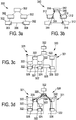
- Figs. 3a to 3d schematically and exemplarily illustrate deficiencies of sequence modules defining pulse sequences known in the art. It is known to assemble multiple MRI sequence elements or sequence modules to form more complex sequence elements that eventually lead to the pulse sequence.
- the foundation of this process i.e. sequence modules at the lowest hierarchy, is a set of basic elements that correspond to device instructions such as setting a coil voltage.
- the topmost level of abstraction i.e. the sequence module at the highest hierarchy, is the full MRI pulse sequence, which ultimately controls those basic sequence modules depending on a set of more abstract parameters, called sequence protocol.
- Fig. 3a shows an example of a monolithically defined sequence 300, i.e. a self-contained sequence which is defined without modularity.
- the hierarchy of sequence 300 comprising five sequence elements 302 is configured from outside and assembled manually for each sequence.
- a required calculation 306 between two parameters 304 and 308 of two sequence elements 302 is specified manually. This way, modules and calculation routines can be exchanged regardless of their hierarchical relation. However, the high amount of responsibility of this configuration from outside antagonizes modularization.
- Fig. 3b illustrates modular sequence hierarchy 310, in which sequence elements 312 are highly modularized. There is no information exchange beyond multiple hierarchical layers and each sequence module 312 has the responsibility to configure its directly subordinated hierarchy only. As compared to the monolithical configuration in Fig. 3a , a parameter dependency between parameter 314 and 316, i.e. a calculation dependency that crosses hierarchical boundaries, needs to be passed through each intermediate layer. Accordingly, structural changes in lower hierarchical layers would require manipulation of all intermediate modules.
- Fig. 3c illustrates a sequence hierarchy 320, comprising multiple sequence modules 322, which combines two self-contained modularized methods 321.
- Each of the methods 321 requires parameters 324, 326, 328 from the other module, which were not provided in their original implementation, since they are only relevant to this specific combination.
- the dependencies are indicated with lines 325 and 327 connecting the modularized methods 321. However, the dependencies 325 and 327 are not feasible, since they cross a hierarchical boundary.
- both methods 321 need to be adapted in the way shown in Fig. 3d to make the newly required parameters 324, 326 and 328 available.
- the modularization hinders the structural change. That way, logical independent methods 321 are not autonomously reusable.
- Fig. 4a illustrates a sequence description 400 comprising three sequence modules 410, 420 and 430.
- the sequence description comprises a hierarchy description 402 and a parameter description 404.
- Parameter description 404 of module 410 comprises three parameters 412, 414 and 416.
- Parameters 412 and 416 in this example are constant values, wherein parameter 414 depends on parameter 416.
- Module 410 has modules 420 and 430 as directly subordinated sequence modules.
- Sequence module 420 comprises parameters 422 and 424.
- Parameter 422 depends on parameter 412 and parameter 424 depends on parameter 422 and 414.
- parameter 424 has dependencies on parameters of the same module, namely parameter 422, and of another module, namely parameter 414.
- sequence module 430 comprises parameter dependencies, namely parameter 432, which depends on parameters 424 and 416, i.e. parameters of modules 410 and 420, parameter 434, which only depends on parameter 432, and parameter 436, which depends on parameter 416.
- sequence description 400 is represented by a directed tree showing module 410 on the top and the hierarchically subordinated modules 420 and 430 below. Further, a directed acyclic graph representing the parameter dependencies is overlaid over the directed tree, such that the parameters are part of a sequence global parameter graph and can be viewed linked to the modules that they are associated with.
- sequence description 400 is translated to the prepared sequence by assembling the partially implicit hierarchical properties and the completely implicit parameter dependencies to explicit connections of the directed tree and the acyclic graph. The resulting acyclic graph structure of the parameters allows simplifications that cannot be realized by imperative calculation instructions.
- sequence description 400 possesses a logic that can be utilized to simplify and accelerate parameter calculations and the development process.
- the parameters are embedded into a global data structure that makes side-effects and relevance of parameters accessible and enables the potential for more versatile algorithms and parameter operations for the pulse sequence.
- the resulting data structures are complex because they contain the cumulative complexity of all modules 410, 420, 430 that define sequence description 400. Therefore, it cannot be expected from a sequence developer to interact or manipulate this structure directly. It is the result of the implicit module descriptions and should only be manipulated through those.
- Modules 410, 420, 430 can be flexibly reused, because depending on the context, dependencies of subordinated modules at any layer can be injected and reassembled differently to yield the desired result.
- a phase encoding gradient can be configured to run with a maximal amplitude during dummy cycles but have its amplitude defined through the row index during the actual measurement.
- depending parameters such as the rewinder gradient, stay consistent in both contexts if they are defined depending on the phase encoding gradient amplitude, for instance.
- the implicit configuration is enabled by the decoupling of parameter calculation procedures 404 from module hierarchy 402.
- the partially implicit structural definitions and parameter dependencies are assembled to yield the context- and application-specific sequence hierarchy and parameter dependency graph.
- Parameters are not calculated, saved and manipulated as part of its associated sequence module, but are instead part of the sequence-global parameter graph.
- calculation and manipulation of parameters can be achieved independent of sequence hierarchy and calculation operations can be reduced.
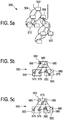
- Fig. 5a illustrates a tree-structure of a sequence hierarchy 500, in which a traversal operation is performed.
- Traversal 504 starts at sequence module 502 at the top of the hierarchy and follows its way along the tree-structure.
- Various sequence modules 510 are traversed in this example until the traversal arrives at a loop module 506.
- Loop module 506 indicates repetitions over the subordinated modules including a basic module 520.
- further algorithms can be performed on sequence hierarchy 500 instead of traversal 504, such as a depth search and a width search.
- a depth search is an uninformed search that searches deeper and deeper into the hierarchy, starting at sequence module 502 and expanding the respective first of the subordinated sequence modules or follow-up nodes.
- a width search is an uninformed search that searches the width of sequence hierarchy 500 for a sequence module, starting from sequence module 502 and expanding individual hierarchy levels of sequence hierarchy 500.
- Fig. 5b illustrates a parameter dependency graph 550 of three sequence modules 555.
- Various parameters indicated as circles within the sequence modules 555 are connected with edges, representing dependencies.
- a manipulation operation is performed on parameter 560. This manipulation operation leads to an invalidation of all dependent parameters 570, which will be reevaluated directly or upon request after parameter 560 has been manipulated.
- the execution of calculation operations can be necessary for reevaluating parameters 570 in some examples.
- Remaining parameters 580 are not dependent on parameter 560 and thus do not have to be reevaluated.
- Fig. 5c indicates the same parameter dependency graph 550 as Fig. 5b , wherein a calculation operation is performed on parameter 565.
- all parameters 575 and 585, from which parameter 565 depends have to be evaluated as well.
- parameters 585 are already valid and evaluated and thus can directly be considered.
- Parameters 575 are tagged as invalid and have to be evaluated in order to become valid prior to the determination of parameter 565.
- execution of the pulse sequence on hardware corresponds to a traversal 504 of the sequence structure tree and corresponding execution of the calculation instructions.
- the calculation instructions are included in sequence modules 502, i.e. the nodes of the tree structure themselves. In this case, it is a task of the user to ensure that calculations in hierarchically lower parts of the sequence are implemented correctly and in the right order.
- the system according to the invention allows for the user to leave the determination of the order of calculations to the system, since this complexity is represented within the parameter dependency graph structure.
- the logic of executing the sequence is indeed limited to traversing the tree structure and setting and/or getting a parameter of parameter dependency graph 550 at certain points of traversal.
- “setting” of parameters can be parameters which are adjusted by an operator of the MRI scanner at an operating terminal or adjusting loop count parameters during execution, which correspond to the acquisition of a particular image line.
- a "getting" of parameters for instance of properties of a trapezoidal gradient pulse, a safety relevant parameter or the overall time of the pulse sequence can be given.
- the basic module 520 can then include instructions for directly operating the hardware, i.e. the magnetic resonance scanner.
- a sequence module can dictate structure operations, which concern or act on the sequence structure itself.
- Fig. 6 illustrates an example for structure abstraction, which is enabled by the sequence modules of the present invention.
- An abstract preparation module 610, an excitation module 620 and a read-out module630 are provided.
- a structure sequence module 640 is defined, which includes three hierarchically subordinated sequence modules 642, 644 and 646, which are implicitly defined with parameter connections 643 and 645 between these subordinated sequence modules.
- the actual components to be used as sequence module 642, 644 and 646 are not defined at that time.
- a root sequence module 652 defines to use the abstract sequence module 640 and defines the explicit sequence modules 610, 620 and 630 to be inserted in sequence module 640. From these structure operations, the actual sequence structure 650 is defined.
- Fig. 7 schematically and exemplarily shows an example of a sequence structure 700 implementing a structure and module dependent parameter calculation.
- a root sequence module 702 defines a compensating sequence module 704 and a calculation sequence module 708 as hierarchically subordinated sequence modules.
- compensating sequence module 704 is directed to refocus the signal to negate the T2* decay and comprises a parameter dependency 706, which depends on the actual pulse sequence.
- the compensation module can be described independent of the sequence and just depends on a resulting parameter, indicated as parameter 706.
- calculation sequence module 708 comprises a place holder 710 for inserting the actual pulse sequence or a part thereof to be executed.
- pulse sequence module 720 is inserted at the position of place holder 710 and the RF pulse for refocusing the MR response is calculated over the sequence defined through sequence module 720.
- sequence module 720 is cloned together with its subordinated hierarchy modules to the context of calculation sequence module 708, such that the RF pulse needed for the compensating sequence module 704 can be determined.
- sequence structure 700 allows for a generic determination of a RF pulse for refocusing, without necessary adaptations to the actual sequence.
- this example has been given in the context refocusing a MR response, also other physical models, peripheral nerve stimulation, gradient moments and the like can alternatively be described independent of the sequence and thus, likewise be used. For instance, in another example, an influence of eddy currents can be calculated and compensated for.
- Fig. 8 exemplarily and schematically shows an example of sequence structure 800, which implements an optimization routine as a further example of a versatile structure module.
- a root sequence module 802 defines a subordinated sequence module 808, which comprises a place holder 810 for inserting another sequence module including the dependent sequence hierarchy therein.
- Sequence module 808 defines an optimization routine 812 independent of the structural context.
- a sequence module 820 is inserted in the place holder 810 and the optimization routine 812 is executed on a cloned instance of sequence module 820.
- parameter 814 has been optimized and an optimized parameter 822 is provided to the original sequence module 820.
- Fig. 9 schematically and exemplarily illustrates a further example of a sequence structure 900 implementing structure operations.
- a root or main module 902 comprises sequence module 908 as hierarchically subordinated module.
- Sequence module 908 defines two subordinated loop structures 910 and 912.
- Sequence module 908 and both loop structures 910 and 912 comprise a placeholder 914, into which in this example a copy of sequence module 920 is inserted.
- Sequence module 920 comprises a dependency on parameter 922.
- Parameter 922 in this example is the amplitude of a gradient pulse, without being limited to the amplitude of a gradient pulse and can be different in a different example.
- Sequence module 920 is instantiated under loop module 911 and 913 for both loop structures 910, 912, respectively, as indicated with linking line 916.
- dummy loop 910 is executed 50 times, as defined by parameter 924.
- sequence module 920 is executed at fixed amplitude 922, as indicated by line 926.
- loop module 913 is repeated for a number of times dependent on parameter 928, wherein the sequence module 920 receives values 930 for amplitude 922 dependent on the loop index.
- amplitude can thus be adapted for each respective row of the image.
- sequence structure 900 allows an implementation of a dummy cycle and a measurement loop independent of the structure of the source structure module.
- the system 1 for determining at least part of a pulse sequence for acquiring imaging information using a magnetic resonance scanner in accordance with the method for determining at least part of a pulse sequence for acquiring imaging information using a magnetic resonance scanner can be implemented as program code means of a computer program and/or as dedicated hardware.
- a computer program may be stored/distributed on a suitable medium, such as an optical storage medium or a solid-state medium, supplied together with or as part of other hardware, but may also be distributed in other forms, such as via the Internet or other wired or wireless telecommunication systems.
- a suitable medium such as an optical storage medium or a solid-state medium, supplied together with or as part of other hardware, but may also be distributed in other forms, such as via the Internet or other wired or wireless telecommunication systems.
- the invention relates to a system for providing at least part of a pulse sequence for acquiring imaging information using a magnetic resonance scanner, a corresponding method and a corresponding computer program.
- the system comprises a sequence module providing unit 10, wherein one or more sequence modules comprise a hierarchy description and a parameter description, a sequence hierarchy generating unit 20 for generating a sequence hierarchy based on the sequence modules and the hierarchy description, a parameter dependency graph generating unit 30 for generating a parameter dependency graph based on the parameter dependencies comprised in the parameter description of the sequence modules.
- the parameter dependencies are decoupled from the sequence hierarchy.
- the system, method and computer program of the invention allow for an improved determination of at least part of a pulse sequence.
Landscapes
- Physics & Mathematics (AREA)
- Health & Medical Sciences (AREA)
- Life Sciences & Earth Sciences (AREA)
- Engineering & Computer Science (AREA)
- High Energy & Nuclear Physics (AREA)
- Nuclear Medicine, Radiotherapy & Molecular Imaging (AREA)
- Condensed Matter Physics & Semiconductors (AREA)
- General Physics & Mathematics (AREA)
- Biophysics (AREA)
- Molecular Biology (AREA)
- Signal Processing (AREA)
- Pathology (AREA)
- Biomedical Technology (AREA)
- Heart & Thoracic Surgery (AREA)
- Medical Informatics (AREA)
- Radiology & Medical Imaging (AREA)
- Surgery (AREA)
- Animal Behavior & Ethology (AREA)
- General Health & Medical Sciences (AREA)
- Public Health (AREA)
- Veterinary Medicine (AREA)
- Magnetic Resonance Imaging Apparatus (AREA)
Claims (15)
- System zum Bestimmen wenigstens eines Teils einer Pulssequenz zum Akquirieren von Bildinformationen unter Verwendung eines Magnetresonanzscanners, wobei das System aufweist:- eine Sequenzmodul-Bereitstellungseinheit (10), die ausgelegt ist, Sequenzmodule bereitzustellen, wobei ein oder mehrere Sequenzmodule eine Hierarchie-Beschreibung, die ein oder mehrere hierarchisch untergeordnete Sequenzmodule aufweist, und eine Parameterbeschreibung, die ein oder mehrere Parameterabhängigkeiten aufweist, aufweisen,- eine Sequenzhierarchie-Erzeugungseinheit (20), die ausgelegt ist, eine Sequenzhierarchie basierend auf den Sequenzmodulen und der Hierarchie-Beschreibung zu erzeugen,wobei das System dadurch gekennzeichnet ist, dass es weiter aufweist:- eine Parameterabhängigkeitsgraph-Erzeugungseinheit (30), die ausgelegt ist, einen Parameterabhängigkeitsgraphen basierend auf den Parameterabhängigkeiten, die in der Parameterbeschreibung der Sequenzmodule umfasst sind, und basierend auf der Sequenzhierarchie zu erzeugen, und- eine Parameterbestimmungseinheit (40), die ausgelegt ist, einen Parameter der Pulssequenz basierend auf wenigstens einem Teil des Parameterabhängigkeitsgraphen zu bestimmen.
- System nach Anspruch 1, das weiter aufweist:- eine Pulssequenz-Instanziierungseinheit (50), die ausgelegt ist, wenigstens einen Teil der Pulssequenz basierend auf wenigstens einem Teil des Parameterabhängigkeitsgraphen und wenigstens einem Teil der Sequenzhierarchie zu instanziieren.
- System nach Anspruch 1, wobei die Hierarchie-Beschreibung von einem oder mehreren Sequenzmodulen weiter wenigstens eine strukturelle Operationsbeschreibung zum Definieren einer strukturellen Operation zum Anwenden auf die Sequenzhierarchie aufweist, wobei die Sequenzhierarchie-Erzeugungseinheit ausgebildet ist, die Sequenzhierarchie weiter basierend auf wenigstens einer strukturellen Operationsbeschreibung in dem Sequenzmodul zu erzeugen.
- System nach Anspruch 1, wobei die Hierarchie-Beschreibung hierarchisch direkt untergeordnete Sequenzmodule und/oder hierarchisch untergeordnete Sequenzmodule mit einem oder mehreren hierarchisch dazwischenliegenden Sequenzmodulen aufweist.
- System nach Anspruch 1, wobei wenigstens eins der Sequenzmodule wenigstens ein hierarchisch untergeordnetes Sequenzmodul oder eine Parameterabhängigkeit implizit definiert.
- System nach Anspruch 1, wobei wenigstens eins der Sequenzmodule weiter einen Identifizierer von wenigstens einem der hierarchisch untergeordneten Sequenzmodule in der Hierarchie-Beschreibung aufweist.
- System nach Anspruch 1, wobei wenigstens eines der Sequenzmodule weiter Berechnungsinstruktionen als Teil der Parameterbeschreibung aufweist.
- System nach Anspruch 1, wobei die Sequenzhierarchie-Erzeugungseinheit ausgebildet ist, die Sequenzhierarchie basierend auf den Sequenzmodulen und den jeweils umfassten hierarchisch untergeordneten Sequenzmodulen der Hierarchie-Beschreibung zu erzeugen.
- System nach Anspruch 2, wobei die Pulssequenz-Instanziierungseinheit ausgebildet ist, die Sequenzhierarchie und den Parameterabhängigkeitsgraphen zu einem Sequenzparametergraphen zu kombinieren und Parameter auf Basis der aufgelösten Parameterabhängigkeiten innerhalb des Sequenzparametergraphen zu bestimmen.
- System nach Anspruch 1, wobei
die Sequenzhierarchie-Erzeugungseinheit ausgebildet ist, die Sequenzhierarchie als eine direkte Baumstruktur bereitzustellen, und/oder wobei
die Parameterabhängigkeitsgraph-Erzeugungseinheit ausgebildet ist, den Parameterabhängigkeitsgraphen als einen direkten azyklischen Graphen bereitzustellen. - Verfahren zum Bestimmen wenigstens eines Teils einer Pulssequenz zum Akquirieren von Bildinformationen unter Verwendung eines Magnetresonanzscanners, wobei das Verfahren aufweist:- Bereitstellen von Sequenzmodulen,
wobei ein oder mehrere Sequenzmodule eine Hierarchie-Beschreibung, die ein oder mehrere hierarchisch untergeordnete Sequenzmodule aufweist, und eine Parameterbeschreibung, die ein oder mehrere Parameterabhängigkeiten aufweist, aufweisen,- Erzeugen einer Sequenzhierarchie basierend auf den Sequenzmodulen und der Hierarchie-Beschreibung,wobei das Verfahren dadurch gekennzeichnet ist, dass es weiter aufweist:- Erzeugen eines Parameterabhängigkeitsgraphen basierend auf den Parameterabhängigkeiten, die in der Parameterbeschreibung der Sequenzmodule umfasst sind, und basierend auf der Sequenzhierarchie, und- Bestimmen wenigstens eines Teils der Pulssequenz basierend auf wenigstens einem Teil des Parameterabhängigkeitsgraphen. - Verfahren nach Anspruch 11, das weiter aufweist:- Instanziieren von wenigstens einem Teil der Pulssequenz basierend auf dem Parameterabhängigkeitsgraphen und der Sequenzhierarchie.
- Verfahren nach Anspruch 11, wobei die Sequenzhierarchie als eine direkte Baumstruktur dargestellt ist und wobei der Parameterabhängigkeitsgraph als ein direkter azyklischer Graph dargestellt ist.
- Computerprogramm zum Bestimmen wenigstens eines Teils einer Pulssequenz zum Akquirieren von Bildinformationen unter Verwendung eines Magnetresonanzscanners, wobei das Computerprogramm Programmcodemittel aufweist, um ein System, das wie in Anspruch 1 definiert ist, zu veranlassen, das Verfahren, das wie in Anspruch 11 definiert ist, auszuführen, wenn das Computerprogramm auf dem System läuft.
- Computerprogramm zum Ansteuern eines Magnetresonanzscanners, wobei das Computerprogramm Programmcodemittel aufweist, um einen Magnetresonanzscannerzu veranlassen, wenigstens einen Teil einer Pulssequenz zum Akquirieren von Bildinformationen durch Ausführen folgender Schritte auszuführen:- Erhalten einer Sequenzhierarchie, die ein oder mehrere Sequenzmodule aufweist, wobei die Sequenzmodule eine Hierarchie-Beschreibung, die ein oder mehrere hierarchisch untergeordnete Sequenzmodule aufweist, und eine Parameterbeschreibung, die ein oder mehrere Parameterabhängigkeiten aufweist, aufweisen,wobei das Computerprogramm dadurch gekennzeichnet, dass es weiter die folgenden Schritte ausführt:- Erhalten eines Parameterabhängigkeitsgraphen, der Parameter der Pulssequenz, die durch Parameterabhängigkeiten verbunden sind, aufweist, und- Ausführen von wenigstens einem Teil der Pulssequenz durch Berechnen eines Parameters der Pulssequenz basierend auf dem Parameterabhängigkeitsgraphen.
Applications Claiming Priority (2)
| Application Number | Priority Date | Filing Date | Title |
|---|---|---|---|
| DE102016206720 | 2016-04-20 | ||
| PCT/EP2017/059413 WO2017182579A1 (en) | 2016-04-20 | 2017-04-20 | System, method and computer program for determining a pulse sequence for a magnetic resonance scanner |
Publications (2)
| Publication Number | Publication Date |
|---|---|
| EP3446138A1 EP3446138A1 (de) | 2019-02-27 |
| EP3446138B1 true EP3446138B1 (de) | 2020-08-19 |
Family
ID=58578953
Family Applications (1)
| Application Number | Title | Priority Date | Filing Date |
|---|---|---|---|
| EP17718379.5A Active EP3446138B1 (de) | 2016-04-20 | 2017-04-20 | System, verfahren und computerprogramm zur bestimmung einer impulsfolge für einen magnetresonanzscanner |
Country Status (4)
| Country | Link |
|---|---|
| US (1) | US10816627B2 (de) |
| EP (1) | EP3446138B1 (de) |
| CN (1) | CN109073724B (de) |
| WO (1) | WO2017182579A1 (de) |
Families Citing this family (2)
| Publication number | Priority date | Publication date | Assignee | Title |
|---|---|---|---|---|
| CN110412494B (zh) | 2019-07-08 | 2021-08-17 | 上海联影医疗科技股份有限公司 | 扫描序列确定方法、装置、计算机设备和存储介质 |
| CN112817811B (zh) * | 2020-12-31 | 2022-09-06 | 深圳市联影高端医疗装备创新研究院 | 扫描失败率的预测方法、装置、设备及存储介质 |
Family Cites Families (12)
| Publication number | Priority date | Publication date | Assignee | Title |
|---|---|---|---|---|
| US4481608A (en) * | 1979-12-26 | 1984-11-06 | Varian Associates, Inc. | Reentrant asynchronous FIFO |
| US7020844B2 (en) * | 2001-11-21 | 2006-03-28 | General Electric Company | Method and apparatus for managing workflow in prescribing and processing medical images |
| WO2005022184A1 (en) * | 2003-08-27 | 2005-03-10 | Koninklijke Philips Electronics N.V. | Determination of spatial sensitivity profiles of rf coils in magnetic resonance imaging |
| DE102006034397B3 (de) * | 2006-07-25 | 2007-12-27 | Siemens Ag | Verfahren zum Erstellen und Ausführen einer Messsequenz für ein Magnet-Resonanz-Gerät sowie Magnet-Resonanz-Gerät und Computerprogramm |
| JP5398145B2 (ja) * | 2008-01-08 | 2014-01-29 | 株式会社東芝 | 磁気共鳴イメージング装置、撮像条件設定装置および撮像条件設定プログラム |
| DE102008044828B3 (de) * | 2008-08-28 | 2010-04-15 | Siemens Aktiengesellschaft | Verwendung eines Magnetresonanz-Sequenzmodells zur formalen Beschreibung einer Messsequenz |
| CA2674250A1 (en) * | 2009-04-01 | 2010-10-01 | National Research Council Of Canada | Wavelet encoding in gradient-echo mri |
| DE102009057582B4 (de) * | 2009-12-09 | 2012-07-26 | Siemens Aktiengesellschaft | Verfahren zum Aufbau von zumindest einem Teilbereich einer Pulssequenz einer Magnetresonanzvorrichtung und entsprechende Pulssequenz |
| DE102012212402B3 (de) * | 2012-03-20 | 2013-10-17 | Siemens Aktiengesellschaft | Ermittlung einer MR-Sequenz unter Berücksichtigung der Energieverteilungsfunktion im k-Raum |
| DE102012204625B4 (de) * | 2012-03-22 | 2013-11-28 | Siemens Aktiengesellschaft | Bestimmen eines Gesamtparameters einer Pulssequenz anhand einer Baumstruktur |
| CN104215922B (zh) * | 2013-05-31 | 2018-04-03 | 上海联影医疗科技有限公司 | 控制脉冲序列执行的方法和装置 |
| DE102013220288B4 (de) * | 2013-10-08 | 2016-09-01 | Siemens Healthcare Gmbh | Optimieren von Steuerbefehlen zum Aufnehmen von Magnetresonanz-Bilddaten |
-
2017
- 2017-04-20 CN CN201780024771.6A patent/CN109073724B/zh active Active
- 2017-04-20 US US16/095,348 patent/US10816627B2/en active Active
- 2017-04-20 EP EP17718379.5A patent/EP3446138B1/de active Active
- 2017-04-20 WO PCT/EP2017/059413 patent/WO2017182579A1/en not_active Ceased
Non-Patent Citations (1)
| Title |
|---|
| None * |
Also Published As
| Publication number | Publication date |
|---|---|
| CN109073724B (zh) | 2020-11-27 |
| US10816627B2 (en) | 2020-10-27 |
| US20190128983A1 (en) | 2019-05-02 |
| CN109073724A (zh) | 2018-12-21 |
| WO2017182579A1 (en) | 2017-10-26 |
| EP3446138A1 (de) | 2019-02-27 |
Similar Documents
| Publication | Publication Date | Title |
|---|---|---|
| CN101661087B (zh) | 使用形式描述的磁共振序列模型以使测量序列设计自动化 | |
| JP2021503319A (ja) | 人工知能による解剖学的ランドマークのローカライゼーション | |
| DE102012208431B4 (de) | Korrigieren von Phasenfehlern bei multidimensionalen ortsselektiven Hochfrequenz-MR-Anregungspulsen | |
| US10241175B2 (en) | Medical imaging apparatus having multiple subsystems, and operating method therefor | |
| JP6320357B2 (ja) | 複数のサブシステムを含む医療用撮像検査デバイスの動作 | |
| US10101425B2 (en) | Medical imaging apparatus having multiple subsystems, and operating method therefor | |
| US10191131B2 (en) | Medical imaging apparatus having multiple subsystems, and operating method therefor | |
| JP2021501015A5 (de) | ||
| US8712714B2 (en) | Measurement protocol for a medical technology apparatus | |
| US20220068472A1 (en) | System and method for standardized mri examinations with patient-centric scan workflow adaptations | |
| US20110169490A1 (en) | Magnetic resonance imaging apparatus | |
| DE102012208425A1 (de) | Kontinuierliches Korrigieren von Phasenfehlern einer multidimensionalen, ortsselektiven Magnetresonanz-Messsequenz | |
| US10816627B2 (en) | System, method and computer program for magnetic resonance scanners | |
| US11029380B2 (en) | Magnetic resonance imaging apparatus | |
| US20180078228A1 (en) | Method and magnetic resonance apparatus for automatic selection of a scan program for a magnetic resonance examination of a patient | |
| JP3980897B2 (ja) | 磁気共鳴映像装置、磁気共鳴映像装置の種々のパラメータ設定に関する情報提供方法、及び当該情報提供システム | |
| US20200022610A1 (en) | Generating setting parameters for an mri sequence | |
| DE16713754T1 (de) | Medizinisches Instrument zur Beschallung eines Satzes von Zielvolumina | |
| CN111096747B (zh) | 在磁共振成像中选择测量线圈的方法和磁共振设施 | |
| US20160169995A1 (en) | Method and magnetic resonance apparatus for determining a phase describing map by a min-cut/max-flow | |
| CN113440126B (zh) | 用于提供磁共振检查的流程规划的方法 | |
| US12078704B2 (en) | Interleaved execution of MRI measurement sequences | |
| JP2024539034A (ja) | 機械学習ベースのシム設定を用いた磁気共鳴イメージング | |
| US6947796B2 (en) | Hardware configuration and interfacing in a component-based environment for a medical scanner | |
| US20260009876A1 (en) | Transfer of an Image Impression Between Different Magnetic Resonance Imaging Systems |
Legal Events
| Date | Code | Title | Description |
|---|---|---|---|
| STAA | Information on the status of an ep patent application or granted ep patent |
Free format text: STATUS: UNKNOWN |
|
| STAA | Information on the status of an ep patent application or granted ep patent |
Free format text: STATUS: THE INTERNATIONAL PUBLICATION HAS BEEN MADE |
|
| PUAI | Public reference made under article 153(3) epc to a published international application that has entered the european phase |
Free format text: ORIGINAL CODE: 0009012 |
|
| STAA | Information on the status of an ep patent application or granted ep patent |
Free format text: STATUS: REQUEST FOR EXAMINATION WAS MADE |
|
| 17P | Request for examination filed |
Effective date: 20181120 |
|
| AK | Designated contracting states |
Kind code of ref document: A1 Designated state(s): AL AT BE BG CH CY CZ DE DK EE ES FI FR GB GR HR HU IE IS IT LI LT LU LV MC MK MT NL NO PL PT RO RS SE SI SK SM TR |
|
| AX | Request for extension of the european patent |
Extension state: BA ME |
|
| RIN1 | Information on inventor provided before grant (corrected) |
Inventor name: HONROTH, THORSTEN Inventor name: CORDES, CRISTOFFER Inventor name: ARCHIPOVAS, SAULIUS Inventor name: PORTER, DAVID Inventor name: GUENTHER, MATTHIAS |
|
| DAV | Request for validation of the european patent (deleted) | ||
| DAX | Request for extension of the european patent (deleted) | ||
| GRAP | Despatch of communication of intention to grant a patent |
Free format text: ORIGINAL CODE: EPIDOSNIGR1 |
|
| STAA | Information on the status of an ep patent application or granted ep patent |
Free format text: STATUS: GRANT OF PATENT IS INTENDED |
|
| INTG | Intention to grant announced |
Effective date: 20200320 |
|
| GRAS | Grant fee paid |
Free format text: ORIGINAL CODE: EPIDOSNIGR3 |
|
| GRAA | (expected) grant |
Free format text: ORIGINAL CODE: 0009210 |
|
| STAA | Information on the status of an ep patent application or granted ep patent |
Free format text: STATUS: THE PATENT HAS BEEN GRANTED |
|
| AK | Designated contracting states |
Kind code of ref document: B1 Designated state(s): AL AT BE BG CH CY CZ DE DK EE ES FI FR GB GR HR HU IE IS IT LI LT LU LV MC MK MT NL NO PL PT RO RS SE SI SK SM TR |
|
| REG | Reference to a national code |
Ref country code: CH Ref legal event code: EP |
|
| REG | Reference to a national code |
Ref country code: DE Ref legal event code: R096 Ref document number: 602017021931 Country of ref document: DE |
|
| REG | Reference to a national code |
Ref country code: AT Ref legal event code: REF Ref document number: 1304562 Country of ref document: AT Kind code of ref document: T Effective date: 20200915 |
|
| REG | Reference to a national code |
Ref country code: IE Ref legal event code: FG4D |
|
| REG | Reference to a national code |
Ref country code: NL Ref legal event code: FP |
|
| REG | Reference to a national code |
Ref country code: LT Ref legal event code: MG4D |
|
| PG25 | Lapsed in a contracting state [announced via postgrant information from national office to epo] |
Ref country code: BG Free format text: LAPSE BECAUSE OF FAILURE TO SUBMIT A TRANSLATION OF THE DESCRIPTION OR TO PAY THE FEE WITHIN THE PRESCRIBED TIME-LIMIT Effective date: 20201119 Ref country code: SE Free format text: LAPSE BECAUSE OF FAILURE TO SUBMIT A TRANSLATION OF THE DESCRIPTION OR TO PAY THE FEE WITHIN THE PRESCRIBED TIME-LIMIT Effective date: 20200819 Ref country code: NO Free format text: LAPSE BECAUSE OF FAILURE TO SUBMIT A TRANSLATION OF THE DESCRIPTION OR TO PAY THE FEE WITHIN THE PRESCRIBED TIME-LIMIT Effective date: 20201119 Ref country code: PT Free format text: LAPSE BECAUSE OF FAILURE TO SUBMIT A TRANSLATION OF THE DESCRIPTION OR TO PAY THE FEE WITHIN THE PRESCRIBED TIME-LIMIT Effective date: 20201221 Ref country code: FI Free format text: LAPSE BECAUSE OF FAILURE TO SUBMIT A TRANSLATION OF THE DESCRIPTION OR TO PAY THE FEE WITHIN THE PRESCRIBED TIME-LIMIT Effective date: 20200819 Ref country code: LT Free format text: LAPSE BECAUSE OF FAILURE TO SUBMIT A TRANSLATION OF THE DESCRIPTION OR TO PAY THE FEE WITHIN THE PRESCRIBED TIME-LIMIT Effective date: 20200819 Ref country code: GR Free format text: LAPSE BECAUSE OF FAILURE TO SUBMIT A TRANSLATION OF THE DESCRIPTION OR TO PAY THE FEE WITHIN THE PRESCRIBED TIME-LIMIT Effective date: 20201120 Ref country code: HR Free format text: LAPSE BECAUSE OF FAILURE TO SUBMIT A TRANSLATION OF THE DESCRIPTION OR TO PAY THE FEE WITHIN THE PRESCRIBED TIME-LIMIT Effective date: 20200819 |
|
| REG | Reference to a national code |
Ref country code: AT Ref legal event code: MK05 Ref document number: 1304562 Country of ref document: AT Kind code of ref document: T Effective date: 20200819 |
|
| PG25 | Lapsed in a contracting state [announced via postgrant information from national office to epo] |
Ref country code: RS Free format text: LAPSE BECAUSE OF FAILURE TO SUBMIT A TRANSLATION OF THE DESCRIPTION OR TO PAY THE FEE WITHIN THE PRESCRIBED TIME-LIMIT Effective date: 20200819 Ref country code: PL Free format text: LAPSE BECAUSE OF FAILURE TO SUBMIT A TRANSLATION OF THE DESCRIPTION OR TO PAY THE FEE WITHIN THE PRESCRIBED TIME-LIMIT Effective date: 20200819 Ref country code: LV Free format text: LAPSE BECAUSE OF FAILURE TO SUBMIT A TRANSLATION OF THE DESCRIPTION OR TO PAY THE FEE WITHIN THE PRESCRIBED TIME-LIMIT Effective date: 20200819 Ref country code: IS Free format text: LAPSE BECAUSE OF FAILURE TO SUBMIT A TRANSLATION OF THE DESCRIPTION OR TO PAY THE FEE WITHIN THE PRESCRIBED TIME-LIMIT Effective date: 20201219 |
|
| PG25 | Lapsed in a contracting state [announced via postgrant information from national office to epo] |
Ref country code: EE Free format text: LAPSE BECAUSE OF FAILURE TO SUBMIT A TRANSLATION OF THE DESCRIPTION OR TO PAY THE FEE WITHIN THE PRESCRIBED TIME-LIMIT Effective date: 20200819 Ref country code: SM Free format text: LAPSE BECAUSE OF FAILURE TO SUBMIT A TRANSLATION OF THE DESCRIPTION OR TO PAY THE FEE WITHIN THE PRESCRIBED TIME-LIMIT Effective date: 20200819 Ref country code: RO Free format text: LAPSE BECAUSE OF FAILURE TO SUBMIT A TRANSLATION OF THE DESCRIPTION OR TO PAY THE FEE WITHIN THE PRESCRIBED TIME-LIMIT Effective date: 20200819 Ref country code: DK Free format text: LAPSE BECAUSE OF FAILURE TO SUBMIT A TRANSLATION OF THE DESCRIPTION OR TO PAY THE FEE WITHIN THE PRESCRIBED TIME-LIMIT Effective date: 20200819 Ref country code: CZ Free format text: LAPSE BECAUSE OF FAILURE TO SUBMIT A TRANSLATION OF THE DESCRIPTION OR TO PAY THE FEE WITHIN THE PRESCRIBED TIME-LIMIT Effective date: 20200819 |
|
| REG | Reference to a national code |
Ref country code: DE Ref legal event code: R097 Ref document number: 602017021931 Country of ref document: DE |
|
| PG25 | Lapsed in a contracting state [announced via postgrant information from national office to epo] |
Ref country code: AL Free format text: LAPSE BECAUSE OF FAILURE TO SUBMIT A TRANSLATION OF THE DESCRIPTION OR TO PAY THE FEE WITHIN THE PRESCRIBED TIME-LIMIT Effective date: 20200819 Ref country code: AT Free format text: LAPSE BECAUSE OF FAILURE TO SUBMIT A TRANSLATION OF THE DESCRIPTION OR TO PAY THE FEE WITHIN THE PRESCRIBED TIME-LIMIT Effective date: 20200819 Ref country code: ES Free format text: LAPSE BECAUSE OF FAILURE TO SUBMIT A TRANSLATION OF THE DESCRIPTION OR TO PAY THE FEE WITHIN THE PRESCRIBED TIME-LIMIT Effective date: 20200819 |
|
| PLBE | No opposition filed within time limit |
Free format text: ORIGINAL CODE: 0009261 |
|
| STAA | Information on the status of an ep patent application or granted ep patent |
Free format text: STATUS: NO OPPOSITION FILED WITHIN TIME LIMIT |
|
| PG25 | Lapsed in a contracting state [announced via postgrant information from national office to epo] |
Ref country code: SK Free format text: LAPSE BECAUSE OF FAILURE TO SUBMIT A TRANSLATION OF THE DESCRIPTION OR TO PAY THE FEE WITHIN THE PRESCRIBED TIME-LIMIT Effective date: 20200819 |
|
| 26N | No opposition filed |
Effective date: 20210520 |
|
| PG25 | Lapsed in a contracting state [announced via postgrant information from national office to epo] |
Ref country code: SI Free format text: LAPSE BECAUSE OF FAILURE TO SUBMIT A TRANSLATION OF THE DESCRIPTION OR TO PAY THE FEE WITHIN THE PRESCRIBED TIME-LIMIT Effective date: 20200819 |
|
| PG25 | Lapsed in a contracting state [announced via postgrant information from national office to epo] |
Ref country code: MC Free format text: LAPSE BECAUSE OF FAILURE TO SUBMIT A TRANSLATION OF THE DESCRIPTION OR TO PAY THE FEE WITHIN THE PRESCRIBED TIME-LIMIT Effective date: 20200819 |
|
| PG25 | Lapsed in a contracting state [announced via postgrant information from national office to epo] |
Ref country code: LU Free format text: LAPSE BECAUSE OF NON-PAYMENT OF DUE FEES Effective date: 20210420 |
|
| REG | Reference to a national code |
Ref country code: BE Ref legal event code: MM Effective date: 20210430 |
|
| PG25 | Lapsed in a contracting state [announced via postgrant information from national office to epo] |
Ref country code: CH Free format text: LAPSE BECAUSE OF NON-PAYMENT OF DUE FEES Effective date: 20210430 Ref country code: LI Free format text: LAPSE BECAUSE OF NON-PAYMENT OF DUE FEES Effective date: 20210430 |
|
| PG25 | Lapsed in a contracting state [announced via postgrant information from national office to epo] |
Ref country code: IE Free format text: LAPSE BECAUSE OF NON-PAYMENT OF DUE FEES Effective date: 20210420 |
|
| PG25 | Lapsed in a contracting state [announced via postgrant information from national office to epo] |
Ref country code: IS Free format text: LAPSE BECAUSE OF FAILURE TO SUBMIT A TRANSLATION OF THE DESCRIPTION OR TO PAY THE FEE WITHIN THE PRESCRIBED TIME-LIMIT Effective date: 20201219 |
|
| PG25 | Lapsed in a contracting state [announced via postgrant information from national office to epo] |
Ref country code: BE Free format text: LAPSE BECAUSE OF NON-PAYMENT OF DUE FEES Effective date: 20210430 |
|
| P01 | Opt-out of the competence of the unified patent court (upc) registered |
Effective date: 20230524 |
|
| PG25 | Lapsed in a contracting state [announced via postgrant information from national office to epo] |
Ref country code: CY Free format text: LAPSE BECAUSE OF FAILURE TO SUBMIT A TRANSLATION OF THE DESCRIPTION OR TO PAY THE FEE WITHIN THE PRESCRIBED TIME-LIMIT Effective date: 20200819 |
|
| PG25 | Lapsed in a contracting state [announced via postgrant information from national office to epo] |
Ref country code: HU Free format text: LAPSE BECAUSE OF FAILURE TO SUBMIT A TRANSLATION OF THE DESCRIPTION OR TO PAY THE FEE WITHIN THE PRESCRIBED TIME-LIMIT; INVALID AB INITIO Effective date: 20170420 |
|
| PG25 | Lapsed in a contracting state [announced via postgrant information from national office to epo] |
Ref country code: MK Free format text: LAPSE BECAUSE OF FAILURE TO SUBMIT A TRANSLATION OF THE DESCRIPTION OR TO PAY THE FEE WITHIN THE PRESCRIBED TIME-LIMIT Effective date: 20200819 |
|
| PG25 | Lapsed in a contracting state [announced via postgrant information from national office to epo] |
Ref country code: MT Free format text: LAPSE BECAUSE OF FAILURE TO SUBMIT A TRANSLATION OF THE DESCRIPTION OR TO PAY THE FEE WITHIN THE PRESCRIBED TIME-LIMIT Effective date: 20200819 |
|
| PGFP | Annual fee paid to national office [announced via postgrant information from national office to epo] |
Ref country code: NL Payment date: 20250422 Year of fee payment: 9 |
|
| PGFP | Annual fee paid to national office [announced via postgrant information from national office to epo] |
Ref country code: DE Payment date: 20250417 Year of fee payment: 9 |
|
| PGFP | Annual fee paid to national office [announced via postgrant information from national office to epo] |
Ref country code: IT Payment date: 20250430 Year of fee payment: 9 |
|
| PGFP | Annual fee paid to national office [announced via postgrant information from national office to epo] |
Ref country code: FR Payment date: 20250428 Year of fee payment: 9 |
|
| PG25 | Lapsed in a contracting state [announced via postgrant information from national office to epo] |
Ref country code: TR Free format text: LAPSE BECAUSE OF FAILURE TO SUBMIT A TRANSLATION OF THE DESCRIPTION OR TO PAY THE FEE WITHIN THE PRESCRIBED TIME-LIMIT Effective date: 20200819 |
|
| PGFP | Annual fee paid to national office [announced via postgrant information from national office to epo] |
Ref country code: GB Payment date: 20260324 Year of fee payment: 10 |