EP3444818B1 - An apparatus for encoding a speech signal employing acelp in the autocorrelation domain - Google Patents
An apparatus for encoding a speech signal employing acelp in the autocorrelation domain Download PDFInfo
- Publication number
- EP3444818B1 EP3444818B1 EP18184592.6A EP18184592A EP3444818B1 EP 3444818 B1 EP3444818 B1 EP 3444818B1 EP 18184592 A EP18184592 A EP 18184592A EP 3444818 B1 EP3444818 B1 EP 3444818B1
- Authority
- EP
- European Patent Office
- Prior art keywords
- matrix
- vector
- codebook vector
- speech signal
- autocorrelation matrix
- Prior art date
- Legal status (The legal status is an assumption and is not a legal conclusion. Google has not performed a legal analysis and makes no representation as to the accuracy of the status listed.)
- Active
Links
Images


Classifications
-
- G—PHYSICS
- G10—MUSICAL INSTRUMENTS; ACOUSTICS
- G10L—SPEECH ANALYSIS TECHNIQUES OR SPEECH SYNTHESIS; SPEECH RECOGNITION; SPEECH OR VOICE PROCESSING TECHNIQUES; SPEECH OR AUDIO CODING OR DECODING
- G10L19/00—Speech or audio signals analysis-synthesis techniques for redundancy reduction, e.g. in vocoders; Coding or decoding of speech or audio signals, using source filter models or psychoacoustic analysis
- G10L19/04—Speech or audio signals analysis-synthesis techniques for redundancy reduction, e.g. in vocoders; Coding or decoding of speech or audio signals, using source filter models or psychoacoustic analysis using predictive techniques
- G10L19/08—Determination or coding of the excitation function; Determination or coding of the long-term prediction parameters
- G10L19/10—Determination or coding of the excitation function; Determination or coding of the long-term prediction parameters the excitation function being a multipulse excitation
- G10L19/107—Sparse pulse excitation, e.g. by using algebraic codebook
-
- G—PHYSICS
- G10—MUSICAL INSTRUMENTS; ACOUSTICS
- G10L—SPEECH ANALYSIS TECHNIQUES OR SPEECH SYNTHESIS; SPEECH RECOGNITION; SPEECH OR VOICE PROCESSING TECHNIQUES; SPEECH OR AUDIO CODING OR DECODING
- G10L19/00—Speech or audio signals analysis-synthesis techniques for redundancy reduction, e.g. in vocoders; Coding or decoding of speech or audio signals, using source filter models or psychoacoustic analysis
- G10L19/02—Speech or audio signals analysis-synthesis techniques for redundancy reduction, e.g. in vocoders; Coding or decoding of speech or audio signals, using source filter models or psychoacoustic analysis using spectral analysis, e.g. transform vocoders or subband vocoders
- G10L19/032—Quantisation or dequantisation of spectral components
- G10L19/038—Vector quantisation, e.g. TwinVQ audio
-
- G—PHYSICS
- G10—MUSICAL INSTRUMENTS; ACOUSTICS
- G10L—SPEECH ANALYSIS TECHNIQUES OR SPEECH SYNTHESIS; SPEECH RECOGNITION; SPEECH OR VOICE PROCESSING TECHNIQUES; SPEECH OR AUDIO CODING OR DECODING
- G10L19/00—Speech or audio signals analysis-synthesis techniques for redundancy reduction, e.g. in vocoders; Coding or decoding of speech or audio signals, using source filter models or psychoacoustic analysis
- G10L19/04—Speech or audio signals analysis-synthesis techniques for redundancy reduction, e.g. in vocoders; Coding or decoding of speech or audio signals, using source filter models or psychoacoustic analysis using predictive techniques
-
- G—PHYSICS
- G10—MUSICAL INSTRUMENTS; ACOUSTICS
- G10L—SPEECH ANALYSIS TECHNIQUES OR SPEECH SYNTHESIS; SPEECH RECOGNITION; SPEECH OR VOICE PROCESSING TECHNIQUES; SPEECH OR AUDIO CODING OR DECODING
- G10L19/00—Speech or audio signals analysis-synthesis techniques for redundancy reduction, e.g. in vocoders; Coding or decoding of speech or audio signals, using source filter models or psychoacoustic analysis
- G10L19/04—Speech or audio signals analysis-synthesis techniques for redundancy reduction, e.g. in vocoders; Coding or decoding of speech or audio signals, using source filter models or psychoacoustic analysis using predictive techniques
- G10L19/08—Determination or coding of the excitation function; Determination or coding of the long-term prediction parameters
- G10L19/10—Determination or coding of the excitation function; Determination or coding of the long-term prediction parameters the excitation function being a multipulse excitation
-
- G—PHYSICS
- G10—MUSICAL INSTRUMENTS; ACOUSTICS
- G10L—SPEECH ANALYSIS TECHNIQUES OR SPEECH SYNTHESIS; SPEECH RECOGNITION; SPEECH OR VOICE PROCESSING TECHNIQUES; SPEECH OR AUDIO CODING OR DECODING
- G10L19/00—Speech or audio signals analysis-synthesis techniques for redundancy reduction, e.g. in vocoders; Coding or decoding of speech or audio signals, using source filter models or psychoacoustic analysis
- G10L2019/0001—Codebooks
Definitions
- the present invention relates to audio signal coding, and, in particular, to an apparatus for encoding a speech signal employing ACELP in the autocorrelation domain.
- CELP Code-Excited Linear Prediction
- LP linear predictive
- LTP long-time predictor
- a residual signal represented by a codebook also known as the fixed codebook
- ACELP Algebraic Code-Excited Linear Prediction
- ACELP is based on modeling the spectral envelope by a linear predictive (LP) filter, the fundamental frequency of voiced sounds by a long time predictor (LTP) and the prediction residual by an algebraic codebook.
- LTP and algebraic codebook parameters are optimized by a least squares algorithm in a perceptual domain, where the perceptual domain is specified by a filter.
- the perceptual model (which usually corresponds to a weighted LP model) is omitted, but it is assumed that the perceptual model is included in the impulse response h(k). This omission has no impact on the generality of results, but simplifies notation.
- the inclusion of the perceptual model is applied as in [1].
- the above measure of fitness can be simplified as follows.
- d H T x is a vector comprising the correlation between the target vector and the impulse response h(n) and superscript T denotes transpose.
- the vector d and the matrix B are computed before the codebook search. This formula is commonly used in optimization of both the LTP and the pulse codebook.
- ZIR zero impulse response
- the concept appears when considering the original domain synthesis signal in comparison to the synthesised residual.
- the residual is encoded in blocks corresponding to the frame or sub-frame size.
- the fixed length residual will have an infinite length "tail", corresponding to the impulse response of the LP filter. That is, although the residual codebook vector is of finite length, it will have an effect on the synthesis signal far beyond the current frame or sub-frame. The effect of a frame into the future can be calculated by extending the codebook vector with zeros and calculating the synthesis output of Equation 1 for this extended signal.
- This extension of the synthesised signal is known as the zero impulse response. Then, to take into account the effect of prior frames in encoding the current frame, the ZIR of the prior frame is subtracted from the target of the current frame. In encoding the current frame, thus, only that part of the signal is considered, which was not already modelled by the previous frame.
- the ZIR is taken into account as follows: When a (sub)frame N-1 has been encoded, the quantized residual is extended with zeros to the length of the next (sub)frame N. The extended quantized residual is filtered by the LP to obtain the ZIR of the quantized signal. The ZIR of the quantized signal is then subtracted from the original (not quantized) signal and this modified signal forms the target signal when encoding (sub)frame N. This way, all quantization errors made in (sub)frame N-1 will be taken into account when quantizing (sub)frame N. This practice improves the perceptual quality of the output signal considerably.
- US5265167 A discloses a speech signal which is input to an excitation signal generating section, a prediction filter and a prediction parameter calculator.
- the prediction parameter calculator calculates a predetermined number of prediction parameters (LPC parameter or reflection coefficient) by an autocorrelation method or covariance method, and supplies the acquired prediction parameters to a prediction parameter coder.
- the codes of the prediction parameters are sent to a decoder and a multiplexer.
- the decoder sends decoded values of the codes of the prediction parameters to the prediction filter and the excitation signal generating section.
- the prediction filter calculates a prediction residual signal, which is the difference between the input speech signal and the decoded prediction parameter, and sends it to the excitation signal generating section.
- the excitation signal generating section calculates the pulse interval and amplitude for each of a predetermined number of subframes based on the input speech signal, the prediction residual signal and the quantized value of the prediction parameter, and sends them to the multiplexer.
- the multiplexer combines these codes and the codes of the prediction parameters, and send the results as an output signal of a coding apparatus to a transmission path or the like.
- the object of the present invention is to provide such improved concepts for audio object coding.
- the object of the present invention is solved by an apparatus according to claim 1, by a method for encoding according to claim 14 and by a computer program according to claim 16.
- An apparatus for encoding a speech signal by determining a codebook vector of a speech coding algorithm comprises a matrix determiner for determining an autocorrelation matrix R , and a codebook vector determiner for determining the codebook vector depending on the autocorrelation matrix R .
- the apparatus is configured to determine a plurality of linear predictive coefficients depending on the speech signal.
- the apparatus is configured to determine a residual signal depending on the plurality of linear predictive coefficients.
- the matrix determiner is configured to determine the autocorrelation matrix R depending on the residual signal.
- the apparatus is configured to use the codebook vector to encode the speech signal.
- the apparatus may generate the encoded speech signal such that the encoded speech signal comprises a plurality of Linear Prediction coefficients, an indication of the fundamental frequency of voiced sounds (e.g., pitch parameters), and an indication of the codebook vector, e.g, an index of the codebook vector.
- a decoder is described for decoding an encoded speech signal being encoded by an apparatus according to the above-described embodiment to obtain a decoded speech signal.
- the system comprises an apparatus according to the above-described embodiment for encoding an input speech signal to obtain an encoded speech signal. Moreover, the system comprises a decoder according to the above-described embodiment for decoding the encoded speech signal to obtain a decoded speech signal.
- Improved concepts for the objective function of the speech coding algorithm ACELP are provided, which take into account not only the effect of the impulse response of the previous frame to the current frame, but also the effect of the impulse response of the current frame into the next frame, when optimizing parameters of current frame.
- Some embodiments realize these improvements by changing the correlation matrix, which is central to conventional ACELP optimisation to an autocorrelation matrix, which has Hermitian Toeplitz structure. By employing this structure, it is possible to make ACELP optimisation more efficient in terms of both computational complexity as well as memory requirements. Concurrently, also the perceptual model applied becomes more consistent and interframe dependencies can be avoided to improve performance under the influence of packet-loss.
- Speech coding with the ACELP paradigm is based on a least squares algorithm in a perceptual domain, where the perceptual domain is specified by a filter.
- the computational complexity of the conventional definition of the least squares problem can be reduced by taking into account the impact of the zero impulse response into the next frame.
- the provided modifications introduce a Toeplitz structure to a correlation matrix appearing in the objective function, which simplifies the structure and reduces computations.
- the proposed concepts reduce computational complexity up to 17% without reducing perceptual quality.
- Embodiments are based on the finding that by a slight modification of the objective function, complexity in the optimization of the residual codebook can be further reduced. This reduction in complexity comes without reduction in perceptual quality.
- ACELP residual optimization is based on iterative search algorithms, with the presented modification, it is possible to increase the number of iterations without an increase in complexity, and in this way obtain an improved perceptual quality.
- the optimal solution to the conventional approach is not necessarily optimal with respect to the modified objective function and vice versa. This alone does not mean that one approach would be better than the other, but analytic arguments do show that the modified objective function is more consistent.
- the provided concepts treat all samples within a sub-frame equally, with consistent and well-defined perceptual and signal models.
- the proposed modifications can be applied such that they only change the optimization of the residual codebook. It does therefore not change the bit-stream structure and can be applied in a back-ward compatible manner to existing ACELP codecs.
- a method for encoding a speech signal by determining a codebook vector of a speech coding algorithm comprises:
- Determining an autocorrelation matrix R comprises determining vector coefficients of a vector r .
- the autocorrelation matrix R comprises a plurality of rows and a plurality of columns.
- R(i, j) indicates the coefficients of the autocorrelation matrix R , wherein i is a first index indicating one of a plurality of rows of the autocorrelation matrix R , and wherein j is a second index indicating one of the plurality of columns of the autocorrelation matrix R .
- the method comprises:
- Fig. 1 illustrates an apparatus for encoding a speech signal by determining a codebook vector of a speech coding algorithm according to an embodiment.
- the apparatus comprises a matrix determiner (110) for determining an autocorrelation matrix R , and a codebook vector determiner (120) for determining the codebook vector depending on the autocorrelation matrix R .
- the matrix determiner (110) is configured to determine the autocorrelation matrix R by determining vector coefficients of a vector r .
- R(i, j) indicates the coefficients of the autocorrelation matrix R , wherein i is a first index indicating one of a plurality of rows of the autocorrelation matrix R , and wherein j is a second index indicating one of the plurality of columns of the autocorrelation matrix R .
- the apparatus is configured to use the codebook vector to encode the speech signal.
- the apparatus may generate the encoded speech signal such that the encoded speech signal comprises a plurality of Linear Prediction coefficients, an indication of the fundamental frequency of voiced sounds (e.g. pitch parameters), and an indication of the codebook vector.
- the apparatus is configured to determine a plurality of linear predictive coefficients (a(k)) depending on the speech signal. Moreover, the apparatus is configured to determine a residual signal depending on the plurality of linear predictive coefficients (a(k)). Furthermore, the matrix determiner 110 may be configured to determine the autocorrelation matrix R depending on the residual signal.
- Equation 4 The ACELP algorithm is centred around Equation 4, which in turn is based on Equation 3.
- Equation 3 should thus be extended such that it takes into account the ZIR into the next frame. It should be noticed that here, inter alia, the difference to prior art is that both the ZIR from the previous frame and also the ZIR into the next frame are taken into account.
- Equation 4 This objective function is very similar to Equation 4. The main difference is that instead of the correlation matrix B, here a Hermitian Toeplitz matrix R is in the denominator.
- this novel formulation has the benefit that all samples of the residual e within a frame will receive the same perceptual weighting.
- Some embodiments employ the concepts of the present invention by, wherever in the ACELP algorithm, where the correlation matrix B appears, it is replaced by the autocorrelation matrix R . If all instances of the matrix B are omitted, then calculating its value can be avoided.
- the autocorrelation matrix R is determined by determining the coefficients of the first column r(0), .., r(N-1) of the autocorrelation matrix R.
- sequence r(k) is the autocorrelation of h(k).
- r(k) can be obtained by even more effective means.
- the sequence h(k) is the impulse response of a linear predictive filter A(z) filtered by a perceptual weighting function W(z), which is taken to include the pre-emphasis.
- W(z) perceptual weighting function
- a codebook vector of a codebook may then, e.g., be determined based on the autocorrelation matrix R .
- (10) may, according to some embodiments, be used to determine a codebook vector of the codebook.
- the objective function is basically a normalized correlation between the target vector d and the codebook vector ê and the best possible codebook vector is that, which gives the highest value for the normalized correlation f ( ê ), e.g., which maximizes the normalized correlation f ( ê ).
- Codebook vectors can thus optimized with the same approaches as in the mentioned standards. Specifically, for example, the very simple algorithm for finding the best algebraic codebook (i.e. the fixed codebook) vector ê for the residual can be applied, as described below. It should, however, be noted, that significant effort has been invested in the design of efficient search algorithms (c.f. AMR and G.718), and this search algorithm is only an illustrative example of application.
- the target is modified such that it includes the ZIR into the following frame.
- Equation 1 describes the linear predictive model used in ACELP-type codecs.
- the Zero Impulse Response (ZIR, also sometimes known as the Zero Input Response), refers to the output of the linear predictive model when the residual of the current frame (and all future frames) is set to zero.
- This target is in principle exactly equal to the target in the AMR and G.718 standards.
- the quantized signal d ⁇ ( n ) is compared to d(n) for the duration of a frame K ⁇ n ⁇ K + N.
- the residual of the current frame has an influence on the following frames, whereby it is useful to consider its influence when quantizing the signal, that is, one thus may want to evaluate the difference d ⁇ ( n ) - d ( n ) also beyond the current frame, n > K + N .
- the long-time predictor (LTP) is actually also a linear predictor.
- the matrix determiner 110 may be configured to determine the autocorrelation matrix R depending on a perceptually weighted linear predictor, for example, depending on the long-time predictor.
- the LP and LTP can be convolved into one joint predictor, which includes both the spectral envelope shape as well as the harmonic structure.
- the impulse response of such a predictor will be very long, whereby it is even more difficult to handle with prior art.
- the autocorrelation of the linear predictor is already known, then the autocorrelation of the joint predictor can be calculated by simply filtering the autocorrelation with the LTP forward and backward, or with a similar process in the frequency domain.
- ACELP systems are complex because filtering by LP causes complicated correlations between the residual samples, which are described by the matrix B or in the current context by matrix R . Since the samples of e(n) are correlated, it is not possible to just quantise e(n) with desired accuracy, but many combinations of different quantisations with a trial-and-error approach have to be tried, to find the best quantisation with respect to the objective function of (3) or (10), respectively.
- R has Hermitian Toeplitz structure
- several efficient matrix decompositions can be applied, such as the singular value decomposition, Cholesky decomposition or Vandermonde decomposition of Hankel matrices (Hankel matrices are upside-down Toeplitz matrices, whereby the same decompositions can be applied to Toeplitz and Hankel matrices) (see [6] and [7]).
- R E D E H be a decomposition of R such that D is a diagonal matrix of the same size and rank as R.
- Some embodiments employ equation 12 to determine a codebook vector of the codebook.
- Equation 12 since the elements of f' are orthogonal (as can be seen from Equation 12) and they have the same weight in the objective function of Equation 12, they can be quantized separately, and with the same quantization step size. That quantization will automatically find the optimal (the largest) value of the objective function in Equation 12, which is possible with that quantization accuracy. In other words, the quantization algorithms presented above, will both return the optimal quantization with respect to Equation 12.
- Vandermonde factorization of a Toeplitz matrix can be chosen such that the Vandermonde matrix is a Fourier transform matrix but with unevenly distributed frequencies.
- the Vandermonde matrix corresponds to a frequency-warped Fourier transform. It follows that in this case the vector f corresponds to a frequency domain representation of the residual signal on a warped frequency scale (see the "rootexchange property" in [8]).
- H a convolution matrix like in Equation 2
- e Hx - Hx ⁇
- the path through which inter-frame dependency is generated can be quantified by the ZIR from the current frame into the next is realized.
- three modifications to the conventional ACELP need to be made.
- Embodiments modify conventional ACELP algorithms by inclusion of the effect of the impulse response of the current frame into the next frame, into the objective function of the current frame.
- this modification corresponds to replacing a correlation matrix with an autocorrelation matrix that has Hermitian Toeplitz structure. This modification has the following benefits:
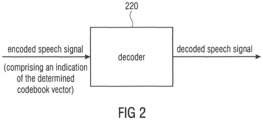
- Fig. 2 illustrates a decoder 220 for decoding an encoded speech signal being encoded by an apparatus according to the above-described embodiment to obtain a decoded speech signal.
- the decoder 220 is configured to receive the encoded speech signal, wherein the encoded speech signal comprises the an indication of the codebook vector, being determined by an apparatus for encoding a speech signal according to one of the above-described embodiments, for example, an index of the determined codebook vector. Furthermore, the decoder 220 is configured to decode the encoded speech signal to obtain a decoded speech signal depending on the codebook vector.
- Fig. 3 illustrates a system according to an embodiment.
- the system comprises an apparatus 210 according to one of the above-described embodiments for encoding an input speech signal to obtain an encoded speech signal.
- the encoded speech signal comprises an indication of the determined codebook vector determined by the apparatus 210 for encoding a speech signal, e.g., it comprises an index of the codebook vector.
- the system comprises a decoder 220 according to the above-described embodiment for decoding the encoded speech signal to obtain a decoded speech signal.
- the decoder 220 is configured to receive the encoded speech signal.
- the decoder 220 is configured to decode the encoded speech signal to obtain a decoded speech signal depending on the determined codebook vector.
- aspects have been described in the context of an apparatus, these aspects also represent a description of the corresponding method, where a block or device corresponds to a method step or a feature of a method step. Analogously, aspects described in the context of a method step also represent a description of a corresponding block or item or feature of a corresponding apparatus.
- the inventive decomposed signal can be stored on a digital storage medium or can be transmitted on a transmission medium such as a wireless transmission medium or a wired transmission medium such as the Internet.
- embodiments of the invention can be implemented in hardware or in software.
- the implementation can be performed using a digital storage medium, for example a floppy disk, a DVD, a CD, a ROM, a PROM, an EPROM, an EEPROM or a FLASH memory, having electronically readable control signals stored thereon, which cooperate (or are capable of cooperating) with a programmable computer system such that the respective method is performed.
- a digital storage medium for example a floppy disk, a DVD, a CD, a ROM, a PROM, an EPROM, an EEPROM or a FLASH memory, having electronically readable control signals stored thereon, which cooperate (or are capable of cooperating) with a programmable computer system such that the respective method is performed.
- Some embodiments according to the invention comprise a non-transitory data carrier having electronically readable control signals, which are capable of cooperating with a programmable computer system, such that one of the methods described herein is performed.
- embodiments of the present invention can be implemented as a computer program product with a program code, the program code being operative for performing one of the methods when the computer program product runs on a computer.
- the program code may for example be stored on a machine readable carrier.
- inventions comprise the computer program for performing one of the methods described herein, stored on a machine readable carrier.
- an embodiment of the inventive method is, therefore, a computer program having a program code for performing one of the methods described herein, when the computer program runs on a computer.
- a further embodiment of the inventive methods is, therefore, a data carrier (or a digital storage medium, or a computer-readable medium) comprising, recorded thereon, the computer program for performing one of the methods described herein.
- a further embodiment of the inventive method is, therefore, a data stream or a sequence of signals representing the computer program for performing one of the methods described herein.
- the data stream or the sequence of signals may for example be configured to be transferred via a data communication connection, for example via the Internet.
- a further embodiment comprises a processing means, for example a computer, or a programmable logic device, configured to or adapted to perform one of the methods described herein.
- a processing means for example a computer, or a programmable logic device, configured to or adapted to perform one of the methods described herein.
- a further embodiment comprises a computer having installed thereon the computer program for performing one of the methods described herein.
- a programmable logic device for example a field programmable gate array
- a field programmable gate array may cooperate with a microprocessor in order to perform one of the methods described herein.
- the methods are preferably performed by any hardware apparatus.
Landscapes
- Engineering & Computer Science (AREA)
- Physics & Mathematics (AREA)
- Signal Processing (AREA)
- Multimedia (AREA)
- Acoustics & Sound (AREA)
- Human Computer Interaction (AREA)
- Audiology, Speech & Language Pathology (AREA)
- Health & Medical Sciences (AREA)
- Computational Linguistics (AREA)
- Spectroscopy & Molecular Physics (AREA)
- Mathematical Analysis (AREA)
- Theoretical Computer Science (AREA)
- Pure & Applied Mathematics (AREA)
- Mathematical Physics (AREA)
- Mathematical Optimization (AREA)
- General Physics & Mathematics (AREA)
- Algebra (AREA)
- Compression, Expansion, Code Conversion, And Decoders (AREA)
Priority Applications (1)
| Application Number | Priority Date | Filing Date | Title |
|---|---|---|---|
| EP23160479.4A EP4213146A1 (en) | 2012-10-05 | 2013-07-31 | An apparatus for encoding a speech signal employing acelp in the autocorrelation domain |
Applications Claiming Priority (3)
| Application Number | Priority Date | Filing Date | Title |
|---|---|---|---|
| US201261710137P | 2012-10-05 | 2012-10-05 | |
| EP13742646.6A EP2904612B1 (en) | 2012-10-05 | 2013-07-31 | An apparatus for encoding a speech signal employing acelp in the autocorrelation domain |
| PCT/EP2013/066074 WO2014053261A1 (en) | 2012-10-05 | 2013-07-31 | An apparatus for encoding a speech signal employing acelp in the autocorrelation domain |
Related Parent Applications (2)
| Application Number | Title | Priority Date | Filing Date |
|---|---|---|---|
| EP13742646.6A Division EP2904612B1 (en) | 2012-10-05 | 2013-07-31 | An apparatus for encoding a speech signal employing acelp in the autocorrelation domain |
| EP13742646.6A Division-Into EP2904612B1 (en) | 2012-10-05 | 2013-07-31 | An apparatus for encoding a speech signal employing acelp in the autocorrelation domain |
Related Child Applications (2)
| Application Number | Title | Priority Date | Filing Date |
|---|---|---|---|
| EP23160479.4A Division-Into EP4213146A1 (en) | 2012-10-05 | 2013-07-31 | An apparatus for encoding a speech signal employing acelp in the autocorrelation domain |
| EP23160479.4A Division EP4213146A1 (en) | 2012-10-05 | 2013-07-31 | An apparatus for encoding a speech signal employing acelp in the autocorrelation domain |
Publications (2)
| Publication Number | Publication Date |
|---|---|
| EP3444818A1 EP3444818A1 (en) | 2019-02-20 |
| EP3444818B1 true EP3444818B1 (en) | 2023-04-19 |
Family
ID=48906260
Family Applications (3)
| Application Number | Title | Priority Date | Filing Date |
|---|---|---|---|
| EP18184592.6A Active EP3444818B1 (en) | 2012-10-05 | 2013-07-31 | An apparatus for encoding a speech signal employing acelp in the autocorrelation domain |
| EP23160479.4A Pending EP4213146A1 (en) | 2012-10-05 | 2013-07-31 | An apparatus for encoding a speech signal employing acelp in the autocorrelation domain |
| EP13742646.6A Active EP2904612B1 (en) | 2012-10-05 | 2013-07-31 | An apparatus for encoding a speech signal employing acelp in the autocorrelation domain |
Family Applications After (2)
| Application Number | Title | Priority Date | Filing Date |
|---|---|---|---|
| EP23160479.4A Pending EP4213146A1 (en) | 2012-10-05 | 2013-07-31 | An apparatus for encoding a speech signal employing acelp in the autocorrelation domain |
| EP13742646.6A Active EP2904612B1 (en) | 2012-10-05 | 2013-07-31 | An apparatus for encoding a speech signal employing acelp in the autocorrelation domain |
Country Status (21)
| Country | Link |
|---|---|
| US (4) | US10170129B2 (enExample) |
| EP (3) | EP3444818B1 (enExample) |
| JP (1) | JP6122961B2 (enExample) |
| KR (1) | KR101691549B1 (enExample) |
| CN (1) | CN104854656B (enExample) |
| AR (1) | AR092875A1 (enExample) |
| AU (1) | AU2013327192B2 (enExample) |
| BR (1) | BR112015007137B1 (enExample) |
| CA (3) | CA2887009C (enExample) |
| ES (2) | ES2701402T3 (enExample) |
| FI (1) | FI3444818T3 (enExample) |
| MX (1) | MX347921B (enExample) |
| MY (1) | MY194208A (enExample) |
| PL (2) | PL2904612T3 (enExample) |
| PT (2) | PT3444818T (enExample) |
| RU (1) | RU2636126C2 (enExample) |
| SG (1) | SG11201502613XA (enExample) |
| TR (1) | TR201818834T4 (enExample) |
| TW (1) | TWI529702B (enExample) |
| WO (1) | WO2014053261A1 (enExample) |
| ZA (1) | ZA201503025B (enExample) |
Families Citing this family (6)
| Publication number | Priority date | Publication date | Assignee | Title |
|---|---|---|---|---|
| JP3080621B1 (ja) | 1999-10-13 | 2000-08-28 | 大和紡績株式会社 | コイルフアスナー継手形成用スライダー |
| CA2887009C (en) * | 2012-10-05 | 2019-12-17 | Fraunhofer-Gesellschaft Zur Forderung Der Angewandten Forschung E.V. | An apparatus for encoding a speech signal employing acelp in the autocorrelation domain |
| EP2919232A1 (en) * | 2014-03-14 | 2015-09-16 | Fraunhofer-Gesellschaft zur Förderung der angewandten Forschung e.V. | Encoder, decoder and method for encoding and decoding |
| BR112016022466B1 (pt) | 2014-04-17 | 2020-12-08 | Voiceage Evs Llc | método para codificar um sinal sonoro, método para decodificar um sinal sonoro, dispositivo para codificar um sinal sonoro e dispositivo para decodificar um sinal sonoro |
| EP3537439B1 (en) | 2014-05-01 | 2020-05-13 | Nippon Telegraph and Telephone Corporation | Periodic-combined-envelope-sequence generation device, periodic-combined-envelope-sequence generation method, periodic-combined-envelope-sequence generation program and recording medium |
| EA201992556A1 (ru) * | 2015-10-08 | 2021-03-31 | Долби Лэборетериз Лайсенсинг Корпорейшн | Аудиодекодер и способ декодирования |
Family Cites Families (47)
| Publication number | Priority date | Publication date | Assignee | Title |
|---|---|---|---|---|
| US4815135A (en) * | 1984-07-10 | 1989-03-21 | Nec Corporation | Speech signal processor |
| US4868867A (en) * | 1987-04-06 | 1989-09-19 | Voicecraft Inc. | Vector excitation speech or audio coder for transmission or storage |
| US4910781A (en) * | 1987-06-26 | 1990-03-20 | At&T Bell Laboratories | Code excited linear predictive vocoder using virtual searching |
| EP0422232B1 (en) * | 1989-04-25 | 1996-11-13 | Kabushiki Kaisha Toshiba | Voice encoder |
| CA2010830C (en) * | 1990-02-23 | 1996-06-25 | Jean-Pierre Adoul | Dynamic codebook for efficient speech coding based on algebraic codes |
| US5495555A (en) * | 1992-06-01 | 1996-02-27 | Hughes Aircraft Company | High quality low bit rate celp-based speech codec |
| FR2700632B1 (fr) * | 1993-01-21 | 1995-03-24 | France Telecom | Système de codage-décodage prédictif d'un signal numérique de parole par transformée adaptative à codes imbriqués. |
| JP3209248B2 (ja) * | 1993-07-05 | 2001-09-17 | 日本電信電話株式会社 | 音声の励振信号符号化法 |
| US5854998A (en) * | 1994-04-29 | 1998-12-29 | Audiocodes Ltd. | Speech processing system quantizer of single-gain pulse excitation in speech coder |
| FR2729245B1 (fr) * | 1995-01-06 | 1997-04-11 | Lamblin Claude | Procede de codage de parole a prediction lineaire et excitation par codes algebriques |
| FR2729247A1 (fr) * | 1995-01-06 | 1996-07-12 | Matra Communication | Procede de codage de parole a analyse par synthese |
| US5751901A (en) * | 1996-07-31 | 1998-05-12 | Qualcomm Incorporated | Method for searching an excitation codebook in a code excited linear prediction (CELP) coder |
| CN1163870C (zh) * | 1996-08-02 | 2004-08-25 | 松下电器产业株式会社 | 声音编码装置和方法,声音译码装置,以及声音译码方法 |
| US5794182A (en) * | 1996-09-30 | 1998-08-11 | Apple Computer, Inc. | Linear predictive speech encoding systems with efficient combination pitch coefficients computation |
| EP0994462B1 (en) * | 1996-11-07 | 2002-04-03 | Matsushita Electric Industrial Co., Ltd | Excitation vector generation |
| US6055496A (en) * | 1997-03-19 | 2000-04-25 | Nokia Mobile Phones, Ltd. | Vector quantization in celp speech coder |
| US5924062A (en) * | 1997-07-01 | 1999-07-13 | Nokia Mobile Phones | ACLEP codec with modified autocorrelation matrix storage and search |
| KR100319924B1 (ko) * | 1999-05-20 | 2002-01-09 | 윤종용 | 음성 부호화시에 대수코드북에서의 대수코드 탐색방법 |
| GB9915842D0 (en) * | 1999-07-06 | 1999-09-08 | Btg Int Ltd | Methods and apparatus for analysing a signal |
| US6704703B2 (en) * | 2000-02-04 | 2004-03-09 | Scansoft, Inc. | Recursively excited linear prediction speech coder |
| WO2002031815A1 (en) * | 2000-10-13 | 2002-04-18 | Science Applications International Corporation | System and method for linear prediction |
| CA2327041A1 (en) * | 2000-11-22 | 2002-05-22 | Voiceage Corporation | A method for indexing pulse positions and signs in algebraic codebooks for efficient coding of wideband signals |
| KR100464369B1 (ko) * | 2001-05-23 | 2005-01-03 | 삼성전자주식회사 | 음성 부호화 시스템의 여기 코드북 탐색 방법 |
| US6766289B2 (en) * | 2001-06-04 | 2004-07-20 | Qualcomm Incorporated | Fast code-vector searching |
| DE10140507A1 (de) * | 2001-08-17 | 2003-02-27 | Philips Corp Intellectual Pty | Verfahren für die algebraische Codebook-Suche eines Sprachsignalkodierers |
| US7003461B2 (en) * | 2002-07-09 | 2006-02-21 | Renesas Technology Corporation | Method and apparatus for an adaptive codebook search in a speech processing system |
| US7363218B2 (en) * | 2002-10-25 | 2008-04-22 | Dilithium Networks Pty. Ltd. | Method and apparatus for fast CELP parameter mapping |
| US7243064B2 (en) * | 2002-11-14 | 2007-07-10 | Verizon Business Global Llc | Signal processing of multi-channel data |
| KR100656788B1 (ko) * | 2004-11-26 | 2006-12-12 | 한국전자통신연구원 | 비트율 신축성을 갖는 코드벡터 생성 방법 및 그를 이용한 광대역 보코더 |
| SG123639A1 (en) * | 2004-12-31 | 2006-07-26 | St Microelectronics Asia | A system and method for supporting dual speech codecs |
| EP1854095A1 (en) * | 2005-02-15 | 2007-11-14 | BBN Technologies Corp. | Speech analyzing system with adaptive noise codebook |
| KR20080015878A (ko) * | 2005-05-25 | 2008-02-20 | 코닌클리케 필립스 일렉트로닉스 엔.브이. | 복수 채널 신호의 예측 엔코딩 |
| JP3981399B1 (ja) * | 2006-03-10 | 2007-09-26 | 松下電器産業株式会社 | 固定符号帳探索装置および固定符号帳探索方法 |
| EP1994531B1 (fr) * | 2006-02-22 | 2011-08-10 | France Telecom | Codage ou decodage perfectionnes d'un signal audionumerique, en technique celp |
| US8566106B2 (en) * | 2007-09-11 | 2013-10-22 | Voiceage Corporation | Method and device for fast algebraic codebook search in speech and audio coding |
| JP5425066B2 (ja) * | 2008-06-19 | 2014-02-26 | パナソニック株式会社 | 量子化装置、符号化装置およびこれらの方法 |
| US20100011041A1 (en) * | 2008-07-11 | 2010-01-14 | James Vannucci | Device and method for determining signals |
| US8315396B2 (en) * | 2008-07-17 | 2012-11-20 | Fraunhofer-Gesellschaft Zur Foerderung Der Angewandten Forschung E.V. | Apparatus and method for generating audio output signals using object based metadata |
| US20100153100A1 (en) * | 2008-12-11 | 2010-06-17 | Electronics And Telecommunications Research Institute | Address generator for searching algebraic codebook |
| EP2211335A1 (en) * | 2009-01-21 | 2010-07-28 | Fraunhofer-Gesellschaft zur Förderung der angewandten Forschung e.V. | Apparatus, method and computer program for obtaining a parameter describing a variation of a signal characteristic of a signal |
| US8315204B2 (en) * | 2009-07-06 | 2012-11-20 | Intel Corporation | Beamforming using base and differential codebooks |
| BR112012004797A2 (pt) * | 2009-09-02 | 2017-02-21 | Rockstar Bidco Lp | sistemas e métodos para codificação usando uma tabela de codificação reduzida com reconfiguração adaptativa |
| US9112591B2 (en) | 2010-04-16 | 2015-08-18 | Samsung Electronics Co., Ltd. | Apparatus for encoding/decoding multichannel signal and method thereof |
| CA2887009C (en) * | 2012-10-05 | 2019-12-17 | Fraunhofer-Gesellschaft Zur Forderung Der Angewandten Forschung E.V. | An apparatus for encoding a speech signal employing acelp in the autocorrelation domain |
| ES2700246T3 (es) * | 2013-08-28 | 2019-02-14 | Dolby Laboratories Licensing Corp | Mejora paramétrica de la voz |
| EP2916319A1 (en) * | 2014-03-07 | 2015-09-09 | Fraunhofer-Gesellschaft zur Förderung der angewandten Forschung e.V. | Concept for encoding of information |
| EP2919232A1 (en) * | 2014-03-14 | 2015-09-16 | Fraunhofer-Gesellschaft zur Förderung der angewandten Forschung e.V. | Encoder, decoder and method for encoding and decoding |
-
2013
- 2013-07-31 CA CA2887009A patent/CA2887009C/en active Active
- 2013-07-31 EP EP18184592.6A patent/EP3444818B1/en active Active
- 2013-07-31 RU RU2015116458A patent/RU2636126C2/ru active
- 2013-07-31 FI FIEP18184592.6T patent/FI3444818T3/fi active
- 2013-07-31 ES ES13742646T patent/ES2701402T3/es active Active
- 2013-07-31 ES ES18184592T patent/ES2948895T3/es active Active
- 2013-07-31 MY MYPI2015000805A patent/MY194208A/en unknown
- 2013-07-31 BR BR112015007137-6A patent/BR112015007137B1/pt active IP Right Grant
- 2013-07-31 MX MX2015003927A patent/MX347921B/es active IP Right Grant
- 2013-07-31 PT PT181845926T patent/PT3444818T/pt unknown
- 2013-07-31 JP JP2015534940A patent/JP6122961B2/ja active Active
- 2013-07-31 CA CA2979857A patent/CA2979857C/en active Active
- 2013-07-31 EP EP23160479.4A patent/EP4213146A1/en active Pending
- 2013-07-31 TR TR2018/18834T patent/TR201818834T4/tr unknown
- 2013-07-31 KR KR1020157011110A patent/KR101691549B1/ko active Active
- 2013-07-31 WO PCT/EP2013/066074 patent/WO2014053261A1/en not_active Ceased
- 2013-07-31 CA CA2979948A patent/CA2979948C/en active Active
- 2013-07-31 SG SG11201502613XA patent/SG11201502613XA/en unknown
- 2013-07-31 CN CN201380063912.7A patent/CN104854656B/zh active Active
- 2013-07-31 AU AU2013327192A patent/AU2013327192B2/en active Active
- 2013-07-31 EP EP13742646.6A patent/EP2904612B1/en active Active
- 2013-07-31 PL PL13742646T patent/PL2904612T3/pl unknown
- 2013-07-31 PL PL18184592.6T patent/PL3444818T3/pl unknown
- 2013-07-31 PT PT13742646T patent/PT2904612T/pt unknown
- 2013-08-08 TW TW102128480A patent/TWI529702B/zh active
- 2013-10-02 AR ARP130103567A patent/AR092875A1/es active IP Right Grant
-
2015
- 2015-04-03 US US14/678,610 patent/US10170129B2/en active Active
- 2015-05-04 ZA ZA2015/03025A patent/ZA201503025B/en unknown
-
2018
- 2018-12-04 US US16/209,610 patent/US11264043B2/en active Active
-
2022
- 2022-01-14 US US17/576,797 patent/US12002481B2/en active Active
-
2024
- 2024-05-31 US US18/680,606 patent/US20240321284A1/en active Pending
Also Published As
Similar Documents
| Publication | Publication Date | Title |
|---|---|---|
| US12002481B2 (en) | Apparatus for encoding a speech signal employing ACELP in the autocorrelation domain | |
| US10586548B2 (en) | Encoder, decoder and method for encoding and decoding | |
| HK40003828B (en) | An apparatus for encoding a speech signal employing acelp in the autocorrelation domain | |
| HK40003828A (en) | An apparatus for encoding a speech signal employing acelp in the autocorrelation domain | |
| HK1213359B (en) | An apparatus for encoding a speech signal employing acelp in the autocorrelation domain |
Legal Events
| Date | Code | Title | Description |
|---|---|---|---|
| PUAI | Public reference made under article 153(3) epc to a published international application that has entered the european phase |
Free format text: ORIGINAL CODE: 0009012 |
|
| STAA | Information on the status of an ep patent application or granted ep patent |
Free format text: STATUS: THE APPLICATION HAS BEEN PUBLISHED |
|
| AC | Divisional application: reference to earlier application |
Ref document number: 2904612 Country of ref document: EP Kind code of ref document: P |
|
| AK | Designated contracting states |
Kind code of ref document: A1 Designated state(s): AL AT BE BG CH CY CZ DE DK EE ES FI FR GB GR HR HU IE IS IT LI LT LU LV MC MK MT NL NO PL PT RO RS SE SI SK SM TR |
|
| STAA | Information on the status of an ep patent application or granted ep patent |
Free format text: STATUS: REQUEST FOR EXAMINATION WAS MADE |
|
| 17P | Request for examination filed |
Effective date: 20190815 |
|
| RBV | Designated contracting states (corrected) |
Designated state(s): AL AT BE BG CH CY CZ DE DK EE ES FI FR GB GR HR HU IE IS IT LI LT LU LV MC MK MT NL NO PL PT RO RS SE SI SK SM TR |
|
| REG | Reference to a national code |
Ref country code: HK Ref legal event code: DE Ref document number: 40003828 Country of ref document: HK |
|
| STAA | Information on the status of an ep patent application or granted ep patent |
Free format text: STATUS: EXAMINATION IS IN PROGRESS |
|
| 17Q | First examination report despatched |
Effective date: 20200527 |
|
| RAP3 | Party data changed (applicant data changed or rights of an application transferred) |
Owner name: FRAUNHOFER-GESELLSCHAFT ZUR FOERDERUNG DER ANGEWANDTEN FORSCHUNG E.V. |
|
| GRAP | Despatch of communication of intention to grant a patent |
Free format text: ORIGINAL CODE: EPIDOSNIGR1 |
|
| STAA | Information on the status of an ep patent application or granted ep patent |
Free format text: STATUS: GRANT OF PATENT IS INTENDED |
|
| INTG | Intention to grant announced |
Effective date: 20221025 |
|
| GRAS | Grant fee paid |
Free format text: ORIGINAL CODE: EPIDOSNIGR3 |
|
| GRAA | (expected) grant |
Free format text: ORIGINAL CODE: 0009210 |
|
| STAA | Information on the status of an ep patent application or granted ep patent |
Free format text: STATUS: THE PATENT HAS BEEN GRANTED |
|
| AC | Divisional application: reference to earlier application |
Ref document number: 2904612 Country of ref document: EP Kind code of ref document: P |
|
| AK | Designated contracting states |
Kind code of ref document: B1 Designated state(s): AL AT BE BG CH CY CZ DE DK EE ES FI FR GB GR HR HU IE IS IT LI LT LU LV MC MK MT NL NO PL PT RO RS SE SI SK SM TR |
|
| REG | Reference to a national code |
Ref country code: GB Ref legal event code: FG4D |
|
| REG | Reference to a national code |
Ref country code: DE Ref legal event code: R096 Ref document number: 602013083662 Country of ref document: DE |
|
| REG | Reference to a national code |
Ref country code: CH Ref legal event code: EP |
|
| REG | Reference to a national code |
Ref country code: IE Ref legal event code: FG4D |
|
| REG | Reference to a national code |
Ref country code: AT Ref legal event code: REF Ref document number: 1561799 Country of ref document: AT Kind code of ref document: T Effective date: 20230515 |
|
| P01 | Opt-out of the competence of the unified patent court (upc) registered |
Effective date: 20230517 |
|
| REG | Reference to a national code |
Ref country code: FI Ref legal event code: FGE |
|
| P02 | Opt-out of the competence of the unified patent court (upc) changed |
Effective date: 20230523 |
|
| REG | Reference to a national code |
Ref country code: PT Ref legal event code: SC4A Ref document number: 3444818 Country of ref document: PT Date of ref document: 20230630 Kind code of ref document: T Free format text: AVAILABILITY OF NATIONAL TRANSLATION Effective date: 20230626 |
|
| REG | Reference to a national code |
Ref country code: NL Ref legal event code: FP |
|
| REG | Reference to a national code |
Ref country code: SE Ref legal event code: TRGR |
|
| REG | Reference to a national code |
Ref country code: LT Ref legal event code: MG9D |
|
| REG | Reference to a national code |
Ref country code: AT Ref legal event code: MK05 Ref document number: 1561799 Country of ref document: AT Kind code of ref document: T Effective date: 20230419 |
|
| REG | Reference to a national code |
Ref country code: ES Ref legal event code: FG2A Ref document number: 2948895 Country of ref document: ES Kind code of ref document: T3 Effective date: 20230921 |
|
| PG25 | Lapsed in a contracting state [announced via postgrant information from national office to epo] |
Ref country code: NO Free format text: LAPSE BECAUSE OF FAILURE TO SUBMIT A TRANSLATION OF THE DESCRIPTION OR TO PAY THE FEE WITHIN THE PRESCRIBED TIME-LIMIT Effective date: 20230719 Ref country code: AT Free format text: LAPSE BECAUSE OF FAILURE TO SUBMIT A TRANSLATION OF THE DESCRIPTION OR TO PAY THE FEE WITHIN THE PRESCRIBED TIME-LIMIT Effective date: 20230419 |
|
| PG25 | Lapsed in a contracting state [announced via postgrant information from national office to epo] |
Ref country code: RS Free format text: LAPSE BECAUSE OF FAILURE TO SUBMIT A TRANSLATION OF THE DESCRIPTION OR TO PAY THE FEE WITHIN THE PRESCRIBED TIME-LIMIT Effective date: 20230419 Ref country code: LV Free format text: LAPSE BECAUSE OF FAILURE TO SUBMIT A TRANSLATION OF THE DESCRIPTION OR TO PAY THE FEE WITHIN THE PRESCRIBED TIME-LIMIT Effective date: 20230419 Ref country code: LT Free format text: LAPSE BECAUSE OF FAILURE TO SUBMIT A TRANSLATION OF THE DESCRIPTION OR TO PAY THE FEE WITHIN THE PRESCRIBED TIME-LIMIT Effective date: 20230419 Ref country code: IS Free format text: LAPSE BECAUSE OF FAILURE TO SUBMIT A TRANSLATION OF THE DESCRIPTION OR TO PAY THE FEE WITHIN THE PRESCRIBED TIME-LIMIT Effective date: 20230819 Ref country code: HR Free format text: LAPSE BECAUSE OF FAILURE TO SUBMIT A TRANSLATION OF THE DESCRIPTION OR TO PAY THE FEE WITHIN THE PRESCRIBED TIME-LIMIT Effective date: 20230419 Ref country code: GR Free format text: LAPSE BECAUSE OF FAILURE TO SUBMIT A TRANSLATION OF THE DESCRIPTION OR TO PAY THE FEE WITHIN THE PRESCRIBED TIME-LIMIT Effective date: 20230720 |
|
| PG25 | Lapsed in a contracting state [announced via postgrant information from national office to epo] |
Ref country code: SK Free format text: LAPSE BECAUSE OF FAILURE TO SUBMIT A TRANSLATION OF THE DESCRIPTION OR TO PAY THE FEE WITHIN THE PRESCRIBED TIME-LIMIT Effective date: 20230419 |
|
| REG | Reference to a national code |
Ref country code: DE Ref legal event code: R097 Ref document number: 602013083662 Country of ref document: DE |
|
| PG25 | Lapsed in a contracting state [announced via postgrant information from national office to epo] |
Ref country code: SM Free format text: LAPSE BECAUSE OF FAILURE TO SUBMIT A TRANSLATION OF THE DESCRIPTION OR TO PAY THE FEE WITHIN THE PRESCRIBED TIME-LIMIT Effective date: 20230419 Ref country code: SK Free format text: LAPSE BECAUSE OF FAILURE TO SUBMIT A TRANSLATION OF THE DESCRIPTION OR TO PAY THE FEE WITHIN THE PRESCRIBED TIME-LIMIT Effective date: 20230419 Ref country code: RO Free format text: LAPSE BECAUSE OF FAILURE TO SUBMIT A TRANSLATION OF THE DESCRIPTION OR TO PAY THE FEE WITHIN THE PRESCRIBED TIME-LIMIT Effective date: 20230419 Ref country code: EE Free format text: LAPSE BECAUSE OF FAILURE TO SUBMIT A TRANSLATION OF THE DESCRIPTION OR TO PAY THE FEE WITHIN THE PRESCRIBED TIME-LIMIT Effective date: 20230419 Ref country code: DK Free format text: LAPSE BECAUSE OF FAILURE TO SUBMIT A TRANSLATION OF THE DESCRIPTION OR TO PAY THE FEE WITHIN THE PRESCRIBED TIME-LIMIT Effective date: 20230419 Ref country code: CZ Free format text: LAPSE BECAUSE OF FAILURE TO SUBMIT A TRANSLATION OF THE DESCRIPTION OR TO PAY THE FEE WITHIN THE PRESCRIBED TIME-LIMIT Effective date: 20230419 |
|
| PLBE | No opposition filed within time limit |
Free format text: ORIGINAL CODE: 0009261 |
|
| STAA | Information on the status of an ep patent application or granted ep patent |
Free format text: STATUS: NO OPPOSITION FILED WITHIN TIME LIMIT |
|
| PG25 | Lapsed in a contracting state [announced via postgrant information from national office to epo] |
Ref country code: MC Free format text: LAPSE BECAUSE OF FAILURE TO SUBMIT A TRANSLATION OF THE DESCRIPTION OR TO PAY THE FEE WITHIN THE PRESCRIBED TIME-LIMIT Effective date: 20230419 |
|
| PG25 | Lapsed in a contracting state [announced via postgrant information from national office to epo] |
Ref country code: MC Free format text: LAPSE BECAUSE OF FAILURE TO SUBMIT A TRANSLATION OF THE DESCRIPTION OR TO PAY THE FEE WITHIN THE PRESCRIBED TIME-LIMIT Effective date: 20230419 |
|
| REG | Reference to a national code |
Ref country code: CH Ref legal event code: PL |
|
| PG25 | Lapsed in a contracting state [announced via postgrant information from national office to epo] |
Ref country code: LU Free format text: LAPSE BECAUSE OF NON-PAYMENT OF DUE FEES Effective date: 20230731 |
|
| 26N | No opposition filed |
Effective date: 20240122 |
|
| PG25 | Lapsed in a contracting state [announced via postgrant information from national office to epo] |
Ref country code: LU Free format text: LAPSE BECAUSE OF NON-PAYMENT OF DUE FEES Effective date: 20230731 |
|
| REG | Reference to a national code |
Ref country code: IE Ref legal event code: MM4A |
|
| PG25 | Lapsed in a contracting state [announced via postgrant information from national office to epo] |
Ref country code: CH Free format text: LAPSE BECAUSE OF NON-PAYMENT OF DUE FEES Effective date: 20230731 |
|
| PG25 | Lapsed in a contracting state [announced via postgrant information from national office to epo] |
Ref country code: SI Free format text: LAPSE BECAUSE OF FAILURE TO SUBMIT A TRANSLATION OF THE DESCRIPTION OR TO PAY THE FEE WITHIN THE PRESCRIBED TIME-LIMIT Effective date: 20230419 |
|
| PG25 | Lapsed in a contracting state [announced via postgrant information from national office to epo] |
Ref country code: SI Free format text: LAPSE BECAUSE OF FAILURE TO SUBMIT A TRANSLATION OF THE DESCRIPTION OR TO PAY THE FEE WITHIN THE PRESCRIBED TIME-LIMIT Effective date: 20230419 |
|
| PG25 | Lapsed in a contracting state [announced via postgrant information from national office to epo] |
Ref country code: IE Free format text: LAPSE BECAUSE OF NON-PAYMENT OF DUE FEES Effective date: 20230731 |
|
| PG25 | Lapsed in a contracting state [announced via postgrant information from national office to epo] |
Ref country code: IE Free format text: LAPSE BECAUSE OF NON-PAYMENT OF DUE FEES Effective date: 20230731 |
|
| PG25 | Lapsed in a contracting state [announced via postgrant information from national office to epo] |
Ref country code: BG Free format text: LAPSE BECAUSE OF FAILURE TO SUBMIT A TRANSLATION OF THE DESCRIPTION OR TO PAY THE FEE WITHIN THE PRESCRIBED TIME-LIMIT Effective date: 20230419 |
|
| PG25 | Lapsed in a contracting state [announced via postgrant information from national office to epo] |
Ref country code: BG Free format text: LAPSE BECAUSE OF FAILURE TO SUBMIT A TRANSLATION OF THE DESCRIPTION OR TO PAY THE FEE WITHIN THE PRESCRIBED TIME-LIMIT Effective date: 20230419 |
|
| PGFP | Annual fee paid to national office [announced via postgrant information from national office to epo] |
Ref country code: PT Payment date: 20250625 Year of fee payment: 13 |
|
| PG25 | Lapsed in a contracting state [announced via postgrant information from national office to epo] |
Ref country code: CY Free format text: LAPSE BECAUSE OF FAILURE TO SUBMIT A TRANSLATION OF THE DESCRIPTION OR TO PAY THE FEE WITHIN THE PRESCRIBED TIME-LIMIT; INVALID AB INITIO Effective date: 20130731 |
|
| PG25 | Lapsed in a contracting state [announced via postgrant information from national office to epo] |
Ref country code: HU Free format text: LAPSE BECAUSE OF FAILURE TO SUBMIT A TRANSLATION OF THE DESCRIPTION OR TO PAY THE FEE WITHIN THE PRESCRIBED TIME-LIMIT; INVALID AB INITIO Effective date: 20130731 |
|
| PGFP | Annual fee paid to national office [announced via postgrant information from national office to epo] |
Ref country code: NL Payment date: 20250723 Year of fee payment: 13 |
|
| PGFP | Annual fee paid to national office [announced via postgrant information from national office to epo] |
Ref country code: ES Payment date: 20250819 Year of fee payment: 13 Ref country code: FI Payment date: 20250722 Year of fee payment: 13 |
|
| PGFP | Annual fee paid to national office [announced via postgrant information from national office to epo] |
Ref country code: DE Payment date: 20250722 Year of fee payment: 13 |
|
| PGFP | Annual fee paid to national office [announced via postgrant information from national office to epo] |
Ref country code: PL Payment date: 20250724 Year of fee payment: 13 Ref country code: TR Payment date: 20250728 Year of fee payment: 13 Ref country code: IT Payment date: 20250731 Year of fee payment: 13 |
|
| PGFP | Annual fee paid to national office [announced via postgrant information from national office to epo] |
Ref country code: BE Payment date: 20250722 Year of fee payment: 13 Ref country code: GB Payment date: 20250724 Year of fee payment: 13 |
|
| PGFP | Annual fee paid to national office [announced via postgrant information from national office to epo] |
Ref country code: FR Payment date: 20250723 Year of fee payment: 13 |
|
| PGFP | Annual fee paid to national office [announced via postgrant information from national office to epo] |
Ref country code: SE Payment date: 20250723 Year of fee payment: 13 |