EP3444367A1 - Aluminum alloy material, production method therefor, basket for cask, and cask - Google Patents
Aluminum alloy material, production method therefor, basket for cask, and cask Download PDFInfo
- Publication number
- EP3444367A1 EP3444367A1 EP16917774.8A EP16917774A EP3444367A1 EP 3444367 A1 EP3444367 A1 EP 3444367A1 EP 16917774 A EP16917774 A EP 16917774A EP 3444367 A1 EP3444367 A1 EP 3444367A1
- Authority
- EP
- European Patent Office
- Prior art keywords
- aluminum alloy
- alloy material
- manganese
- solid solution
- aluminum
- Prior art date
- Legal status (The legal status is an assumption and is not a legal conclusion. Google has not performed a legal analysis and makes no representation as to the accuracy of the status listed.)
- Pending
Links
Images

Classifications
-
- B—PERFORMING OPERATIONS; TRANSPORTING
- B22—CASTING; POWDER METALLURGY
- B22D—CASTING OF METALS; CASTING OF OTHER SUBSTANCES BY THE SAME PROCESSES OR DEVICES
- B22D11/00—Continuous casting of metals, i.e. casting in indefinite lengths
- B22D11/04—Continuous casting of metals, i.e. casting in indefinite lengths into open-ended moulds
- B22D11/049—Continuous casting of metals, i.e. casting in indefinite lengths into open-ended moulds for direct chill casting, e.g. electromagnetic casting
-
- B—PERFORMING OPERATIONS; TRANSPORTING
- B22—CASTING; POWDER METALLURGY
- B22D—CASTING OF METALS; CASTING OF OTHER SUBSTANCES BY THE SAME PROCESSES OR DEVICES
- B22D11/00—Continuous casting of metals, i.e. casting in indefinite lengths
- B22D11/001—Continuous casting of metals, i.e. casting in indefinite lengths of specific alloys
- B22D11/003—Aluminium alloys
-
- B—PERFORMING OPERATIONS; TRANSPORTING
- B22—CASTING; POWDER METALLURGY
- B22F—WORKING METALLIC POWDER; MANUFACTURE OF ARTICLES FROM METALLIC POWDER; MAKING METALLIC POWDER; APPARATUS OR DEVICES SPECIALLY ADAPTED FOR METALLIC POWDER
- B22F9/00—Making metallic powder or suspensions thereof
- B22F9/02—Making metallic powder or suspensions thereof using physical processes
- B22F9/06—Making metallic powder or suspensions thereof using physical processes starting from liquid material
- B22F9/08—Making metallic powder or suspensions thereof using physical processes starting from liquid material by casting, e.g. through sieves or in water, by atomising or spraying
- B22F9/082—Making metallic powder or suspensions thereof using physical processes starting from liquid material by casting, e.g. through sieves or in water, by atomising or spraying atomising using a fluid
-
- C—CHEMISTRY; METALLURGY
- C22—METALLURGY; FERROUS OR NON-FERROUS ALLOYS; TREATMENT OF ALLOYS OR NON-FERROUS METALS
- C22C—ALLOYS
- C22C1/00—Making non-ferrous alloys
- C22C1/02—Making non-ferrous alloys by melting
-
- C—CHEMISTRY; METALLURGY
- C22—METALLURGY; FERROUS OR NON-FERROUS ALLOYS; TREATMENT OF ALLOYS OR NON-FERROUS METALS
- C22C—ALLOYS
- C22C21/00—Alloys based on aluminium
-
- C—CHEMISTRY; METALLURGY
- C22—METALLURGY; FERROUS OR NON-FERROUS ALLOYS; TREATMENT OF ALLOYS OR NON-FERROUS METALS
- C22F—CHANGING THE PHYSICAL STRUCTURE OF NON-FERROUS METALS AND NON-FERROUS ALLOYS
- C22F1/00—Changing the physical structure of non-ferrous metals or alloys by heat treatment or by hot or cold working
- C22F1/002—Changing the physical structure of non-ferrous metals or alloys by heat treatment or by hot or cold working by rapid cooling or quenching; cooling agents used therefor
-
- C—CHEMISTRY; METALLURGY
- C22—METALLURGY; FERROUS OR NON-FERROUS ALLOYS; TREATMENT OF ALLOYS OR NON-FERROUS METALS
- C22F—CHANGING THE PHYSICAL STRUCTURE OF NON-FERROUS METALS AND NON-FERROUS ALLOYS
- C22F1/00—Changing the physical structure of non-ferrous metals or alloys by heat treatment or by hot or cold working
- C22F1/04—Changing the physical structure of non-ferrous metals or alloys by heat treatment or by hot or cold working of aluminium or alloys based thereon
-
- G—PHYSICS
- G21—NUCLEAR PHYSICS; NUCLEAR ENGINEERING
- G21F—PROTECTION AGAINST X-RADIATION, GAMMA RADIATION, CORPUSCULAR RADIATION OR PARTICLE BOMBARDMENT; TREATING RADIOACTIVELY CONTAMINATED MATERIAL; DECONTAMINATION ARRANGEMENTS THEREFOR
- G21F1/00—Shielding characterised by the composition of the materials
- G21F1/02—Selection of uniform shielding materials
- G21F1/08—Metals; Alloys; Cermets, i.e. sintered mixtures of ceramics and metals
-
- G—PHYSICS
- G21—NUCLEAR PHYSICS; NUCLEAR ENGINEERING
- G21F—PROTECTION AGAINST X-RADIATION, GAMMA RADIATION, CORPUSCULAR RADIATION OR PARTICLE BOMBARDMENT; TREATING RADIOACTIVELY CONTAMINATED MATERIAL; DECONTAMINATION ARRANGEMENTS THEREFOR
- G21F5/00—Transportable or portable shielded containers
- G21F5/005—Containers for solid radioactive wastes, e.g. for ultimate disposal
- G21F5/008—Containers for fuel elements
- G21F5/012—Fuel element racks in the containers
-
- B—PERFORMING OPERATIONS; TRANSPORTING
- B22—CASTING; POWDER METALLURGY
- B22F—WORKING METALLIC POWDER; MANUFACTURE OF ARTICLES FROM METALLIC POWDER; MAKING METALLIC POWDER; APPARATUS OR DEVICES SPECIALLY ADAPTED FOR METALLIC POWDER
- B22F1/00—Metallic powder; Treatment of metallic powder, e.g. to facilitate working or to improve properties
- B22F1/05—Metallic powder characterised by the size or surface area of the particles
-
- B—PERFORMING OPERATIONS; TRANSPORTING
- B22—CASTING; POWDER METALLURGY
- B22F—WORKING METALLIC POWDER; MANUFACTURE OF ARTICLES FROM METALLIC POWDER; MAKING METALLIC POWDER; APPARATUS OR DEVICES SPECIALLY ADAPTED FOR METALLIC POWDER
- B22F2998/00—Supplementary information concerning processes or compositions relating to powder metallurgy
- B22F2998/10—Processes characterised by the sequence of their steps
Definitions
- the present disclosure relates to an aluminum alloy material, a method for producing the same, a basket for a cask, and a cask.
- An aluminum alloy containing manganese which is excellent in thermal stability, is often used as the material of a member used in a high-temperature environment for a long period of time.
- a metal cask for transporting or storing a used fuel stores a spent nuclear fuel for a long period (e.g., 60 years) therein and then transports it to a nuclear reprocessing facility or the like. That is, the metal cask and a structural member thereof are exposed to heat by decay heat of the spent nuclear fuel (heating element) over a long period of storing the used fuel.
- Non-Patent Document 1 discloses using an aluminum alloy containing manganese as the material of a structural member (e.g., basket) of the metal cask.
- Patent Document 1 discloses producing a material characteristic evaluation sample simulating a heat degradation phenomenon such as coarse precipitation which can occur in an actual product depending on thermal history, in order to evaluate strength characteristics of an aluminum alloy material including an aluminum alloy containing manganese.
- Patent Document 1 JP5960335B
- Non-Patent Document 1 Japan Society of Mechanical Engineers, "Codes for construction of spent nuclear fuel storage facilities --Rules on transport/storage packagings for spent nuclear fuel-- (2007)", published on February, 2008
- An aluminum alloy containing manganese (e.g., 3000 series aluminum alloys) is excellent in thermal stability but is inferior in strength characteristics, compared to other aluminum alloys (e.g., 2000 series aluminum alloys containing duralumin). For this reason, the aluminum alloy containing manganese has been hardly used as a strength member, and there has been little need for improvement in strength characteristics of the aluminum alloy containing manganese.
- an object of at least one embodiment of the present invention is to provide an aluminum alloy material with improved strength characteristics.
- manganese is a metallic element which contributes to precipitation strengthening. That is, manganese is precipitated as an Al-Mn compound and forms precipitates, thereby improving strength characteristics of the aluminum alloy material.
- the maximum solubility limit of manganese in aluminum is 1.82 wt% at 658.5°C (eutectic temperature)
- manganese usually does not enter into solid solution in the aluminum alloy containing 1.82 wt% or more of manganese at the eutectic temperature or lower.
- such an aluminum alloy does not form a precipitate which contribute to improvement in strength characteristics but forms a eutectic structure of aluminum (Al) and Al 6 Mn which does not substantially contribute to improvement in strength characteristics. Accordingly, it is considered that it is difficult to achieve the strength characteristic improvement effect from the aluminum alloy containing more than 1.82% of manganese.
- a producing method allows micro particles of Al 6 Mn to be precipitated in solid Al using Si and Fe as precipitate nuclei at the eutectic temperature or lower in the aluminum alloy containing more than the maximum solubility limit of manganese as in the above (1). Consequently, more manganese than usual can be precipitated in the aluminum as micro particles of Al 6 Mn. Thus, it is possible to obtain the aluminum alloy material with improved strength characteristics.
- the aluminum alloy material contains at least a part of the manganese as a non-equilibrium precipitate of Al 6 Mn, which contribute to improvement in strength characteristics.
- the aluminum alloy material described in the above (2) has improved strength characteristics, compared with an aluminum alloy material in which the eutectic structure is formed.
- the basket for a cask is formed of the above aluminum alloy material (1), which has improved strength characteristics since more manganese than usual is precipitated in the aluminum as micro particles of Al 6 Mn.
- the basket for a cask with improved strength characteristics.
- the basket for a cask is formed of the above aluminum alloy material (1), which has improved strength characteristics since more manganese than usual is precipitated in the aluminum as micro particles of Al 6 Mn.
- the basket for a cask with improved strength characteristics.
- the melt of the aluminum alloy containing more than the maximum solubility limit (1.82 wt%) of manganese is appropriately cooled so that the manganese enters into solid solution in the aluminum in a supersaturated manner without forming a eutectic structure of aluminum (Al) and Al 6 Mn. Then, the supersaturated solid solution thus obtained is subjected to a heat treatment to precipitate at least a part of the manganese dissolved in the aluminum in the supersaturated solid solution as Al 6 Mn.
- the above producing method (6) allows micro particles of Al 6 Mn to be precipitated in solid Al in the aluminum alloy containing more than the maximum solubility limit of manganese. Consequently, more manganese than usual can be precipitated as micro particles in the aluminum. Thus, it is possible to obtain the aluminum alloy material with improved strength characteristics.
- the melt of the aluminum alloy containing manganese is atomized and rapidly cooled by jetting a gas to the melt, it is possible to form the supersaturated solid solution in which the manganese enters into solid solution in the aluminum in a supersaturated manner. Then, the supersaturated solid solution thus obtained is subjected to a heat treatment to precipitate at least a part of the manganese dissolved in the aluminum in the supersaturated solid solution as Al 6 Mn. Thereby, it is possible to obtain the aluminum alloy material with improved strength characteristics.
- the powder obtained by jetting a gas to the melt of the aluminum alloy has an average particle size of 5 ⁇ m or more as in the above producing method (8)
- the powder can be easily formed by jetting the gas to the melt.
- the powder has an average particle size of 80 ⁇ m or less as in the above producing method (8), the specific surface area is relatively large, and the melt can be easily rapidly cooled when atomized. Thus, the supersaturated solid solution can be easily formed.
- the powdered supersaturated solid solution obtained by atomizing the melt is subjected to the oxidation treatment, so that an aluminum oxide layer is formed on the surface of the powder. If aluminum oxide thus formed is incorporated in an aluminum parent phase for instance in a downstream process such as molding, strength characteristics of the aluminum alloy are improved through dispersed-particle strengthening. Thus, with the above producing method (9), it is possible to improve strength characteristics of the aluminum alloy material even more.
- the above producing method (11) makes it possible to effectively precipitate Al 6 Mn particles, which contribute to improvement in strength characteristics of the aluminum alloy.
- an aluminum alloy material with improved strength characteristics.
- the aluminum alloy material according to some embodiments is mainly composed of aluminum (Al) and further contains 0.1 wt% or more and 0.3 wt% or less of silicon (Si), 0.1 wt% or more and 0.7 wt% or less of iron (Fe), 1.8 wt% or more and 3.0 wt% or less of manganese (Mn), and 0.8 wt% or more and 1.3 wt% or less of magnesium (Mg).
- manganese is a metallic element which contributes to precipitation strengthening. That is, manganese is precipitated as an Al-Mn compound and forms precipitates, thereby improving strength characteristics of the aluminum alloy material.
- the aluminum alloy with the above configuration contains 1.8 wt% or more and 3.0 wt% or less of manganese (Mn). That is, the aluminum alloy contains the maximum solubility limit (1.82 wt% at 658.5°C (eutectic temperature)) or more of manganese.
- This eutectic structure has a laminated structure and does not substantially contribute to improvement in strength characteristics. Accordingly, it is generally considered that it is difficult to achieve the strength characteristic improvement effect from the aluminum alloy containing more than the maximum solubility limit of manganese.
- a producing method allows micro particles of Al 6 Mn to be precipitated in solid Al using Si and Fe as precipitate nuclei at the eutectic temperature or lower in the aluminum alloy containing more than the maximum solubility limit of manganese. Consequently, more manganese than usual can be precipitated as micro particles of Al 6 Mn in the aluminum. Thus, it is possible to obtain the aluminum alloy material containing the maximum solubility limit or more of manganese with improved strength characteristics.
- the content of Si is 0.1 wt% or more, it is possible to sufficiently precipitate the manganese as an Al-Mn compound using Si as precipitate nuclei in the aluminum alloy. Further, when the content of Si is 0.3 wt% or less, it is possible to suppress embrittlement of the aluminum alloy material.
- the content of Fe when the content of Fe is 0.1 wt% or more, it is possible to sufficiently precipitate the manganese as an Al-Mn compound using Fe as precipitate nuclei in the aluminum alloy. Further, when the content of Fe is 0.7 wt% or less, it is possible to suppress embrittlement of the aluminum alloy material.
- At least a part of Mn is contained as a non-equilibrium precipitate of Al 6 Mn.
- the non-equilibrium precipitate of Al 6 Mn contributes to improvement in strength characteristics in the aluminum alloy material.
- strength characteristics of the aluminum alloy material are improved by containing at least a part of Mn as the non-equilibrium precipitate of Al 6 Mn.
- the non-equilibrium precipitate of Al 6 Mn is granular precipitates.
- the method for producing the aluminum alloy material starts with melting an aluminum alloy based on aluminum (Al) and containing 1.8 wt% or more and 3.0 wt% or less of manganese (Mn) to obtain a melt of the aluminum alloy.
- the melt is then cooled so that the manganese enters into solid solution in an aluminum parent phase in a supersaturated manner to obtain a supersaturated solid solution.
- the resulting supersaturated solid solution is subjected to a heat treatment to precipitate at least a part of the manganese as Al 6 Mn. Consequently, the aluminum alloy material is obtained.
- the aluminum alloy based on aluminum (Al) and containing 1.8 wt% or more and 3.0 wt% or less of manganese (Mn) is melted.
- various additives may be added to the melt of the aluminum alloy so that a final aluminum alloy material has a desired composition.
- the melt of the aluminum alloy may contain 0.1 wt% or more and 0.3 wt% or less of silicon (Si) and 0.1 wt% or more and 0.7 wt% or less of iron (Fe).
- Si silicon
- Fe iron
- the content of Si or Fe is the above-described lower limit or more, it is possible to sufficiently precipitate the manganese as an Al-Mn compound using Si or Fe as precipitate nuclei in the aluminum alloy.
- the content of Si or Fe is the above-described upper limit or less, it is possible to suppress embrittlement of the aluminum alloy material.
- the melt of the aluminum alloy is appropriately cooled so that the manganese enters into solid solution in the aluminum in a supersaturated manner to obtain a supersaturated solid solution without forming a eutectic structure of aluminum (Al) and Al 6 Mn.
- the melt of the aluminum alloy is relatively rapidly cooled to obtain a supersaturated solid solution in which the manganese enters into solid solution in the aluminum in a supersaturated manner.
- FIG. 1 is a diagram showing a part of the aluminum side of an Al-Mn binary phase diagram.
- the melt of the aluminum alloy is relatively rapidly cooled.
- This enables formation of a supersaturated solid solution in which the maximum solubility limit or more of manganese enters into solid solution in an aluminum parent phase.
- the manganese in the supersaturated solid solution can be precipitated as micro particles of MnAl 6 in solid Al. Consequently, more manganese than usual can be precipitated as micro particles in the aluminum.
- the cooling step includes jetting a gas to the melt of the aluminum alloy containing manganese to atomize the melt. That is, in an embodiment, the melt of the aluminum alloy containing manganese is made into powder by an atomization method.
- the melt of the aluminum alloy containing manganese is atomized and rapidly cooled by jetting a gas to the melt, it is possible to form the supersaturated solid solution in which the manganese enters into solid solution in the aluminum in a supersaturated manner.
- the cooling step includes forming a molding of the supersaturated solid solution by a DC casting method (Direct Chill Casting).
- a molding is obtained while a molten metal is directly cooled with a coolant. That is, when the DC casting method is adopted in the cooling step, since the molding is obtained while the melt of the aluminum alloy is directly cooled with a coolant (e.g., water), the melt can be rapidly cooled. Thus, it is possible to obtain the molding of the supersaturated solid solution in which the manganese enters into solid solution in the aluminum in a supersaturated manner.
- a coolant e.g., water
- the supersaturated solid solution obtained in the cooling step is subjected to a heat treatment to precipitate at least a part of the manganese dissolved in the aluminum in the supersaturated solid solution as Al 6 Mn.
- the heat treatment step includes heating and keeping the supersaturated solid solution within a temperature range of 400°C or higher and 620°C or lower.
- powder of a neutron absorbing material may be mixed to the powdered supersaturated solid solution, for instance. In this case, it is possible to impart the neutron absorbing function to the resulting metallic material.
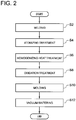
- FIG. 2 is a flowchart of the method for producing the aluminum alloy material according to an embodiment.
- each step described below can also be applied in a case where a method other than the atomization method is adopted in the cooling step.
- the heat treatment step described below can be applied in a case where the cooling step is performed with the DC casting method.
- the method for producing the aluminum alloy material starts with melting an aluminum alloy containing 1.8 wt% or more and 3.0 wt% or less of manganese (Mn) to obtain a melt of the aluminum alloy (S2; the above-described "melting step").
- a gas is jetted to the melt of the aluminum alloy containing manganese to atomize the melt (S4; the above-described "cooling step”).
- the melt of the aluminum alloy is atomized and relatively rapidly cooled by the atomization method to obtain a supersaturated solid solution in which the manganese enters into solid solution in the aluminum in a supersaturated manner.
- the powder of the supersaturated solid solution obtained by atomizing the melt of the aluminum alloy by the atomization method may have an average particle size of 5 ⁇ m or more and 80 ⁇ m or less.
- the powder obtained by jetting a gas to the melt of the aluminum alloy has an average particle size of 5 ⁇ m or more, the powder can be easily formed by jetting the gas to the melt.
- the powder has an average particle size of 80 ⁇ m or less, the specific surface area is relatively large, and the melt can be easily rapidly cooled when atomized. Thus, the supersaturated solid solution can be easily formed.
- the powdered supersaturated solid solution obtained by the atomizing treatment in step S4 is subjected to a homogenizing heat treatment (S6).
- the homogenizing heat treatment is performed to obtain homogeneous fine precipitates by subjecting the manganese dissolved in the supersaturated solid solution in the aluminum alloy to a heat treatment.
- the homogenizing heat treatment may be performed by keeping the supersaturated solid solution within a temperature range of 400°C or higher and 620°C or lower, for 0.5 hour or more.
- the powdered supersaturated solid solution obtained by the atomizing treatment in step S4 is subjected to an oxidation treatment (S8).
- the powdered supersaturated solid solution is molded by, for instance, pressure molding under a hydrostatic pressure (S10), and the molded sample is sintered under vacuum to precipitate a least a part of the manganese dissolved in the aluminum in the supersaturated solid solution as Al 6 Mn (S12; the above-described "heat treatment step").
- Step S12 may be performed by keeping the supersaturated solid solution within a temperature range of 400°C or higher and 620°C or lower, for 0.5 hour or more.
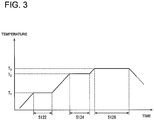
- FIG. 3 is a diagram showing an example of temperature change of the aluminum alloy when the vacuum sintering (heat treatment step S12) is performed.
- Steps S122 to S126 are performed under a reduced pressure (e.g., 20 Pa or less).
- the supersaturated solid solution of the aluminum alloy is heated to T 1 and kept for 0.5 hour or more in a vacuum sintering furnace to remove adsorbed water contained in the supersaturated solid solution (S122).
- the temperature T 1 may be within a range of 100°C or higher and 180°C or lower.
- the temperature is further raised to T 2 and kept for 0.5 hour or more to remove adsorbed water, such as hydrated water, chemically or physically adsorbed to the supersaturated solid solution (S124).
- the temperature T 2 may be within a range of 350°C or higher and 480°C or lower.
- the temperature is further raised to T 3 and kept for 0.5 hour or more to sinter the supersaturated solid solution under vacuum (S126).
- the temperature T 3 may be within a range of 400°C or higher and 620°C or lower.
- whether the moisture is sufficiently removed or not may be judged by the pressure in the vacuum sintering furnace.
- the pressure increases with evaporation of moisture, the pressure decreases back with a decrease in moisture contained in the supersaturated solid solution by the evaporation. Accordingly, after starting to keep the temperature at T 1 or T 2 , when the pressure increases and then decreases back (for instance, to 20 Pa or less), it may be judged that the moisture is sufficiently removed.
- the temperature may be raised at a temperature increase rate of 100°C/hour or less.
- Steps S2 to S8 described above allow micro particles of Al 6 Mn to be precipitated in solid Al in the aluminum alloy containing more than the maximum solubility limit of manganese. Consequently, more manganese than usual can be precipitated in the aluminum as micro particles. Thus, it is possible to obtain the aluminum alloy material with improved strength characteristics.
- the homogenizing heat treatment step S6 may be performed simultaneously with the vacuum sintering step (heat treatment step) S12.
- the homogenizing heat treatment step S6 and the oxidation treatment S8 are optional steps which are not necessarily performed and may be performed as needed.
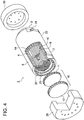
- FIG. 4 is a configuration diagram of a cask according to an embodiment.
- the cask shown in FIG. 4 is a metal cask for transporting or storing a used fuel.
- the cask 1 includes a basket 16, a main body 2 accommodating the basket 16, and a lid portion 10 for closing an end opening of the main body 2.
- the basket 16 is formed of the aluminum alloy material according to the above-described embodiments.
- the cask 1 includes a resin 4, for shielding neutrons, disposed around an outer periphery of the main body 2, an external cylinder 6 therearound, and a bottom portion 8.
- the main body 2 and the bottom portion 8 may be forging products made of carbon steel, which shields ⁇ rays.
- the lid portion 10 may include a primary lid 11 and a secondary lid 12.
- the primary lid 11 and the secondary lid 12 may be made of stainless steel.
- the main body 2 and the bottom portion 8 may be joined by butt welding.
- the structure may include a tertiary lid.
- Trunnions 24 for suspending the cask 1 may be disposed on both sides of a cask body 22. In FIG. 4 , one of the trunnions 24 is not shown for clarity.
- shock absorbers 26, 28 in which a shock-absorbing member such as wood is encapsulated are attached on both ends of the cask body 22.
- a plurality of internal fins 14 for thermal conduction is disposed between the main body 2 and the external cylinder 6.
- the resin 4 is injected in a fluid state into a space formed by the internal fins 14 and then solidified by thermal curing or the like.
- the basket 16 includes an assembly of rectangular pipes 18 which are bundled and is inserted into a cavity 20 of the main body 2.
- the rectangular pipes 18 may be formed of the aluminum alloy material according to the above-described embodiments.
- the aluminum alloy constituting the rectangular pipes 18 may contain a neutron absorbing member (boron: B) for absorbing neutrons from the spent nuclear fuel.
- An individual storage space (cell) formed by each of the rectangular pipes 18 may store a single used fuel assembly.
- the basket 16 or the rectangular pipes 18 may be formed in the shape of a product by extrusion or other processing on the aluminum alloy material according to the above-described embodiments.
- the rectangular pipes 18 may be formed in a grid structure like box of cakes.
- the basket for the cask is formed by the aluminum alloy material according to the above-described embodiments; this aluminum alloy material has improved strength characteristics since more manganese than usual is precipitated in the aluminum as micro particles of Al 6 Mn. Thus, it is possible to form the basket with improved strength characteristics.
- an expression of relative or absolute arrangement such as “in a direction”, “along a direction”, “parallel”, “orthogonal”, “centered”, “concentric” and “coaxial” shall not be construed as indicating only the arrangement in a strict literal sense, but also includes a state where the arrangement is relatively displaced by a tolerance, or by an angle or a distance whereby it is possible to achieve the same function.
- an expression of an equal state such as “same” “equal” and “uniform” shall not be construed as indicating only the state in which the feature is strictly equal, but also includes a state in which there is a tolerance or a difference that can still achieve the same function.
- an expression of a shape such as a rectangular shape or a cylindrical shape shall not be construed as only the geometrically strict shape, but also includes a shape with unevenness or chamfered corners within the range in which the same effect can be achieved.
Landscapes
- Chemical & Material Sciences (AREA)
- Engineering & Computer Science (AREA)
- Mechanical Engineering (AREA)
- Metallurgy (AREA)
- Materials Engineering (AREA)
- Physics & Mathematics (AREA)
- Organic Chemistry (AREA)
- High Energy & Nuclear Physics (AREA)
- Thermal Sciences (AREA)
- General Engineering & Computer Science (AREA)
- Crystallography & Structural Chemistry (AREA)
- Ceramic Engineering (AREA)
- Powder Metallurgy (AREA)
- Manufacture Of Metal Powder And Suspensions Thereof (AREA)
- Continuous Casting (AREA)
Abstract
Description
- The present disclosure relates to an aluminum alloy material, a method for producing the same, a basket for a cask, and a cask.
- An aluminum alloy containing manganese, which is excellent in thermal stability, is often used as the material of a member used in a high-temperature environment for a long period of time.
- For instance, a metal cask for transporting or storing a used fuel stores a spent nuclear fuel for a long period (e.g., 60 years) therein and then transports it to a nuclear reprocessing facility or the like. That is, the metal cask and a structural member thereof are exposed to heat by decay heat of the spent nuclear fuel (heating element) over a long period of storing the used fuel. Non-Patent
Document 1 discloses using an aluminum alloy containing manganese as the material of a structural member (e.g., basket) of the metal cask. -
Patent Document 1 discloses producing a material characteristic evaluation sample simulating a heat degradation phenomenon such as coarse precipitation which can occur in an actual product depending on thermal history, in order to evaluate strength characteristics of an aluminum alloy material including an aluminum alloy containing manganese. - Patent Document 1:
JP5960335B - Non-Patent Document 1: Japan Society of Mechanical Engineers, "Codes for construction of spent nuclear fuel storage facilities --Rules on transport/storage packagings for spent nuclear fuel-- (2007)", published on February, 2008
- An aluminum alloy containing manganese (e.g., 3000 series aluminum alloys) is excellent in thermal stability but is inferior in strength characteristics, compared to other aluminum alloys (e.g., 2000 series aluminum alloys containing duralumin). For this reason, the aluminum alloy containing manganese has been hardly used as a strength member, and there has been little need for improvement in strength characteristics of the aluminum alloy containing manganese.
- However, it is desired to improve strength characteristics such as high-temperature strength of the aluminum alloy material containing manganese excellent in thermal stability to improve storage density of the above-described metal cask or to deal with higher burnup fuels.
- In view of the above, an object of at least one embodiment of the present invention is to provide an aluminum alloy material with improved strength characteristics.
-
- (1) An aluminum alloy material according to at least one embodiment of the present invention is based on aluminum (Al) and comprises: 0.1 wt% or more and 0.3 wt% or less of silicon (Si); 0.1 wt% or more and 0.7 wt% or less of iron (Fe); 1.8 wt% or more and 3.0 wt% or less of manganese (Mn); and 0.8 wt% or more and 1.3 wt% or less of magnesium (Mg).
- In the aluminum alloy, manganese is a metallic element which contributes to precipitation strengthening. That is, manganese is precipitated as an Al-Mn compound and forms precipitates, thereby improving strength characteristics of the aluminum alloy material. Although the maximum solubility limit of manganese in aluminum is 1.82 wt% at 658.5°C (eutectic temperature), manganese usually does not enter into solid solution in the aluminum alloy containing 1.82 wt% or more of manganese at the eutectic temperature or lower. Thus, such an aluminum alloy does not form a precipitate which contribute to improvement in strength characteristics but forms a eutectic structure of aluminum (Al) and Al6Mn which does not substantially contribute to improvement in strength characteristics. Accordingly, it is considered that it is difficult to achieve the strength characteristic improvement effect from the aluminum alloy containing more than 1.82% of manganese.
- In this regard, a producing method according to an embodiment described below allows micro particles of Al6Mn to be precipitated in solid Al using Si and Fe as precipitate nuclei at the eutectic temperature or lower in the aluminum alloy containing more than the maximum solubility limit of manganese as in the above (1). Consequently, more manganese than usual can be precipitated in the aluminum as micro particles of Al6Mn. Thus, it is possible to obtain the aluminum alloy material with improved strength characteristics.
- (2) In some embodiments, in the aluminum alloy material described in the above (1), at least a part of the manganese is contained as a non-equilibrium precipitate of Al6Mn.
- When the melt of the aluminum alloy with the composition described in the above (1), (i.e., the aluminum alloy containing more than the maximum solubility limit of manganese) is relatively slowly cooled so that the equilibrium state is maintained, a eutectic structure of aluminum (Al) and Al6Mn is formed. If such a eutectic structure is formed, it is difficult to achieve the strength characteristic improvement effect in the aluminum alloy material.
- In this regard, in the above configuration (2), the aluminum alloy material contains at least a part of the manganese as a non-equilibrium precipitate of Al6Mn, which contribute to improvement in strength characteristics. Thus, the aluminum alloy material described in the above (2) has improved strength characteristics, compared with an aluminum alloy material in which the eutectic structure is formed.
- (3) In some embodiments, in the above configuration (2), the non-equilibrium precipitate of Al6Mn is a granular precipitate.
- In the above configuration (3), since the non-equilibrium precipitate of Al6Mn contained in the aluminum alloy material is a granular precipitate, strength characteristics of the aluminum alloy material are improved compared with a case where a laminated eutectic structure is formed.
- (4) A basket for a cask according to at least one embodiment of the present invention is formed of the aluminum alloy material described in any one of the above (1) to (3).
- In the above configuration (4), the basket for a cask is formed of the above aluminum alloy material (1), which has improved strength characteristics since more manganese than usual is precipitated in the aluminum as micro particles of Al6Mn. Thus, it is possible to obtain the basket for a cask with improved strength characteristics.
- (5) A cask according at least one embodiment of the present invention comprises: the basket described in the above (4); a main body accommodating the basket; and a lid portion for closing an end opening of the main body.
- In the above configuration (5), the basket for a cask is formed of the above aluminum alloy material (1), which has improved strength characteristics since more manganese than usual is precipitated in the aluminum as micro particles of Al6Mn. Thus, it is possible to obtain the basket for a cask with improved strength characteristics.
- (6) A method for producing an aluminum alloy material according to at least one embodiment of the present invention comprises: a cooling step of cooling a melt of an aluminum alloy based on aluminum (Al) and containing 1.8 wt% or more and 3.0 wt% or less of manganese (Mn) so that the manganese enters into solid solution in an aluminum parent phase in a supersaturated manner to obtain a supersaturated solid solution; and a heat treatment step of subjecting the supersaturated solid solution to a heat treatment to precipitate at least a part of the manganese as Al6Mn, whereby an aluminum alloy material is obtained.
- In the above producing method (6), the melt of the aluminum alloy containing more than the maximum solubility limit (1.82 wt%) of manganese is appropriately cooled so that the manganese enters into solid solution in the aluminum in a supersaturated manner without forming a eutectic structure of aluminum (Al) and Al6Mn. Then, the supersaturated solid solution thus obtained is subjected to a heat treatment to precipitate at least a part of the manganese dissolved in the aluminum in the supersaturated solid solution as Al6Mn.
- Accordingly, the above producing method (6) allows micro particles of Al6Mn to be precipitated in solid Al in the aluminum alloy containing more than the maximum solubility limit of manganese. Consequently, more manganese than usual can be precipitated as micro particles in the aluminum. Thus, it is possible to obtain the aluminum alloy material with improved strength characteristics.
- (7) In some embodiments, in the above producing method (6), the cooling step includes jetting a gas to the melt to atomize the melt.
- In the above producing method (7), since the melt of the aluminum alloy containing manganese is atomized and rapidly cooled by jetting a gas to the melt, it is possible to form the supersaturated solid solution in which the manganese enters into solid solution in the aluminum in a supersaturated manner. Then, the supersaturated solid solution thus obtained is subjected to a heat treatment to precipitate at least a part of the manganese dissolved in the aluminum in the supersaturated solid solution as Al6Mn. Thereby, it is possible to obtain the aluminum alloy material with improved strength characteristics.
- (8) In some embodiments, in the above producing method (7), powder of the supersaturated solid solution obtained by the cooling step has an average particle size of 5 µm or more and 80 µm or less.
- When the powder obtained by jetting a gas to the melt of the aluminum alloy has an average particle size of 5 µm or more as in the above producing method (8), the powder can be easily formed by jetting the gas to the melt. When the powder has an average particle size of 80 µm or less as in the above producing method (8), the specific surface area is relatively large, and the melt can be easily rapidly cooled when atomized. Thus, the supersaturated solid solution can be easily formed.
- (9) In some embodiments, the above producing method (7) or (8) further comprises a step of subjecting the supersaturated solid solution in a powder state to an oxidation treatment, before the heat treatment step.
- In the above producing method (9), the powdered supersaturated solid solution obtained by atomizing the melt is subjected to the oxidation treatment, so that an aluminum oxide layer is formed on the surface of the powder. If aluminum oxide thus formed is incorporated in an aluminum parent phase for instance in a downstream process such as molding, strength characteristics of the aluminum alloy are improved through dispersed-particle strengthening. Thus, with the above producing method (9), it is possible to improve strength characteristics of the aluminum alloy material even more.
- (10) In some embodiments, in the above producing method (6), the cooling step includes forming a molding of the supersaturated solid solution by a DC casting method (Direct Chill Casting).
- In the above producing method (10), since the molding is obtained while the melt of the aluminum alloy is directly cooled with a coolant through the DC casting method, the melt can be rapidly cooled. Thus, it is possible to obtain the molding of the supersaturated solid solution in which the manganese enters into solid solution in the aluminum in a supersaturated manner.
- (11) In some embodiments, in any of the above producing methods (6) to (10), the heat treatment step includes heating and keeping the supersaturated solid solution within a temperature range of 400°C or higher and 620°C or lower.
- As in the above producing method (11), when the supersaturated solid solution is heated and kept at 400°C or higher, fine Al6Mn particles are easily precipitated. Further, as in the above producing method (11), when the supersaturated solid solution is heated and kept at 620°C or lower, homogeneous Al6Mn particles are easily precipitated.
- Thus, the above producing method (11) makes it possible to effectively precipitate Al6Mn particles, which contribute to improvement in strength characteristics of the aluminum alloy.
- According to at least one embodiment of the present invention, there is provided an aluminum alloy material with improved strength characteristics.
-
-
FIG. 1 is a diagram showing a part of the aluminum side of an Al-Mn binary phase diagram. -
FIG. 2 is a flowchart of a method for producing an aluminum alloy material according to an embodiment. -
FIG. 3 is a diagram showing an example of temperature change of an aluminum alloy when heat treatment step is performed. -
FIG. 4 is a configuration diagram of a cask according to an embodiment. - Embodiments of the present invention will now be described in detail with reference to the accompanying drawings. It is intended, however, that unless particularly identified, dimensions, materials, shapes, relative positions and the like of components described in the embodiments shall be interpreted as illustrative only and not intended to limit the scope of the present invention.
- First, a configuration of an aluminum alloy material according to some embodiments will be described.
- The aluminum alloy material according to some embodiments is mainly composed of aluminum (Al) and further contains 0.1 wt% or more and 0.3 wt% or less of silicon (Si), 0.1 wt% or more and 0.7 wt% or less of iron (Fe), 1.8 wt% or more and 3.0 wt% or less of manganese (Mn), and 0.8 wt% or more and 1.3 wt% or less of magnesium (Mg).
- In the aluminum alloy, manganese is a metallic element which contributes to precipitation strengthening. That is, manganese is precipitated as an Al-Mn compound and forms precipitates, thereby improving strength characteristics of the aluminum alloy material.
- The aluminum alloy with the above configuration contains 1.8 wt% or more and 3.0 wt% or less of manganese (Mn). That is, the aluminum alloy contains the maximum solubility limit (1.82 wt% at 658.5°C (eutectic temperature)) or more of manganese.
- The aluminum alloy containing manganese in an amount of more than 1.82 wt%, the maximum solubility limit, forms a eutectic structure of aluminum (Al) and Al6Mn at the eutectic temperature or lower. This eutectic structure has a laminated structure and does not substantially contribute to improvement in strength characteristics. Accordingly, it is generally considered that it is difficult to achieve the strength characteristic improvement effect from the aluminum alloy containing more than the maximum solubility limit of manganese.
- In this regard, a producing method according to an embodiment described below allows micro particles of Al6Mn to be precipitated in solid Al using Si and Fe as precipitate nuclei at the eutectic temperature or lower in the aluminum alloy containing more than the maximum solubility limit of manganese. Consequently, more manganese than usual can be precipitated as micro particles of Al6Mn in the aluminum. Thus, it is possible to obtain the aluminum alloy material containing the maximum solubility limit or more of manganese with improved strength characteristics.
- As described above, when the content of Si is 0.1 wt% or more, it is possible to sufficiently precipitate the manganese as an Al-Mn compound using Si as precipitate nuclei in the aluminum alloy. Further, when the content of Si is 0.3 wt% or less, it is possible to suppress embrittlement of the aluminum alloy material.
- Additionally, as described above, when the content of Fe is 0.1 wt% or more, it is possible to sufficiently precipitate the manganese as an Al-Mn compound using Fe as precipitate nuclei in the aluminum alloy. Further, when the content of Fe is 0.7 wt% or less, it is possible to suppress embrittlement of the aluminum alloy material.
- In some embodiments, in the aluminum alloy material, at least a part of Mn is contained as a non-equilibrium precipitate of Al6Mn.
- The non-equilibrium precipitate of Al6Mn contributes to improvement in strength characteristics in the aluminum alloy material. Thus, strength characteristics of the aluminum alloy material are improved by containing at least a part of Mn as the non-equilibrium precipitate of Al6Mn.
- In some embodiments, the non-equilibrium precipitate of Al6Mn is granular precipitates.
- When the non-equilibrium precipitate of Al6Mn contained in the aluminum alloy material is granular precipitates, strength characteristics of the aluminum alloy material are improved compared with a case where a laminated eutectic structure is formed.
- Next, a method for producing the aluminum alloy material according to some embodiments will be described.
- The method for producing the aluminum alloy material according to some embodiments starts with melting an aluminum alloy based on aluminum (Al) and containing 1.8 wt% or more and 3.0 wt% or less of manganese (Mn) to obtain a melt of the aluminum alloy. The melt is then cooled so that the manganese enters into solid solution in an aluminum parent phase in a supersaturated manner to obtain a supersaturated solid solution. The resulting supersaturated solid solution is subjected to a heat treatment to precipitate at least a part of the manganese as Al6Mn. Consequently, the aluminum alloy material is obtained.
- In the step of obtaining the melt of the aluminum alloy, the aluminum alloy based on aluminum (Al) and containing 1.8 wt% or more and 3.0 wt% or less of manganese (Mn) is melted. In this step, various additives may be added to the melt of the aluminum alloy so that a final aluminum alloy material has a desired composition.
- For instance, the melt of the aluminum alloy may contain 0.1 wt% or more and 0.3 wt% or less of silicon (Si) and 0.1 wt% or more and 0.7 wt% or less of iron (Fe). When the content of Si or Fe is the above-described lower limit or more, it is possible to sufficiently precipitate the manganese as an Al-Mn compound using Si or Fe as precipitate nuclei in the aluminum alloy. When the content of Si or Fe is the above-described upper limit or less, it is possible to suppress embrittlement of the aluminum alloy material.
- In the step of cooling the melt of the aluminum alloy, the melt of the aluminum alloy is appropriately cooled so that the manganese enters into solid solution in the aluminum in a supersaturated manner to obtain a supersaturated solid solution without forming a eutectic structure of aluminum (Al) and Al6Mn.
- For instance, the melt of the aluminum alloy is relatively rapidly cooled to obtain a supersaturated solid solution in which the manganese enters into solid solution in the aluminum in a supersaturated manner.
-
FIG. 1 is a diagram showing a part of the aluminum side of an Al-Mn binary phase diagram. - When the melt of the aluminum alloy containing more than the maximum solubility limit of manganese is relatively slowly cooled so that the equilibrium state is maintained, a eutectic structure of aluminum (Al) and Al6Mn is formed, as described below.
- That is, as shown in
FIG. 1 , in a region where the Mn content is more than the maximum solubility limit, i.e., 1.82 wt%, the aluminum alloy at a temperature higher than the eutectic temperature, i.e., 658.5°C, is in a state where liquid and an Al-Mn compound coexist (region indicated by "L+MnAl6" inFIG. 1 ). Accordingly, when the molten aluminum alloy containing more than 1.82 wt% (the maximum solubility limit) of manganese is relatively slowly cooled, in the course of cooling, a eutectic structure of Al and Al6Mn is formed rather than Al6Mn is precipitated as small precipitates, through the region where liquid and an Al-Mn compound coexist (region indicated by "L+MnAl6") on the phase diagram because the diffusion rate of manganese is relatively high in a liquid phase. - If the eutectic structure is formed in the aluminum alloy, it is difficult to achieve the strength characteristic improvement effect in the aluminum alloy material.
- By contrast, in the cooling step according to the above embodiment, for instance, the melt of the aluminum alloy is relatively rapidly cooled. This enables formation of a supersaturated solid solution in which the maximum solubility limit or more of manganese enters into solid solution in an aluminum parent phase. Thus, in a subsequent heat treatment step, the manganese in the supersaturated solid solution can be precipitated as micro particles of MnAl6 in solid Al. Consequently, more manganese than usual can be precipitated as micro particles in the aluminum. Thus, it is possible to obtain the aluminum alloy material with improved strength characteristics.
- In an embodiment, the cooling step includes jetting a gas to the melt of the aluminum alloy containing manganese to atomize the melt. That is, in an embodiment, the melt of the aluminum alloy containing manganese is made into powder by an atomization method.
- In this case, since the melt of the aluminum alloy containing manganese is atomized and rapidly cooled by jetting a gas to the melt, it is possible to form the supersaturated solid solution in which the manganese enters into solid solution in the aluminum in a supersaturated manner.
- In an embodiment, the cooling step includes forming a molding of the supersaturated solid solution by a DC casting method (Direct Chill Casting).
- In the DC casting method, a molding is obtained while a molten metal is directly cooled with a coolant. That is, when the DC casting method is adopted in the cooling step, since the molding is obtained while the melt of the aluminum alloy is directly cooled with a coolant (e.g., water), the melt can be rapidly cooled. Thus, it is possible to obtain the molding of the supersaturated solid solution in which the manganese enters into solid solution in the aluminum in a supersaturated manner.
- In the heat treatment step, the supersaturated solid solution obtained in the cooling step is subjected to a heat treatment to precipitate at least a part of the manganese dissolved in the aluminum in the supersaturated solid solution as Al6Mn. In some embodiments, the heat treatment step includes heating and keeping the supersaturated solid solution within a temperature range of 400°C or higher and 620°C or lower.
- As described above, when the supersaturated solid solution is heated and kept at 400°C or higher, fine Al6Mn particles are easily precipitated. Further, as described above, when the supersaturated solid solution is heated and kept at 620°C or lower, homogeneous Al6Mn particles are easily precipitated.
- Thus, when supersaturated solid solution is heated and kept within the above temperature range, it is possible to effectively precipitate Al6Mn particles, which contribute to improvement in strength characteristics of the aluminum alloy.
- In a case of manufacturing a metallic material for use in a basket for a cask described later, before the heat treatment step, powder of a neutron absorbing material (e.g., B4C) may be mixed to the powdered supersaturated solid solution, for instance. In this case, it is possible to impart the neutron absorbing function to the resulting metallic material.
- The entire method for producing the aluminum alloy material in a case where the atomization method is adopted in the cooling step will now be described with a flowchart.
-
FIG. 2 is a flowchart of the method for producing the aluminum alloy material according to an embodiment. - Each step described below can also be applied in a case where a method other than the atomization method is adopted in the cooling step. For instance, the heat treatment step described below can be applied in a case where the cooling step is performed with the DC casting method.
- As shown in
FIG. 2 , the method for producing the aluminum alloy material according to an embodiment starts with melting an aluminum alloy containing 1.8 wt% or more and 3.0 wt% or less of manganese (Mn) to obtain a melt of the aluminum alloy (S2; the above-described "melting step"). - Then, in an embodiment, in the cooling step, a gas is jetted to the melt of the aluminum alloy containing manganese to atomize the melt (S4; the above-described "cooling step"). In this way, the melt of the aluminum alloy is atomized and relatively rapidly cooled by the atomization method to obtain a supersaturated solid solution in which the manganese enters into solid solution in the aluminum in a supersaturated manner.
- The powder of the supersaturated solid solution obtained by atomizing the melt of the aluminum alloy by the atomization method may have an average particle size of 5 µm or more and 80 µm or less.
- When the powder obtained by jetting a gas to the melt of the aluminum alloy has an average particle size of 5 µm or more, the powder can be easily formed by jetting the gas to the melt. When the powder has an average particle size of 80 µm or less, the specific surface area is relatively large, and the melt can be easily rapidly cooled when atomized. Thus, the supersaturated solid solution can be easily formed.
- Then, the powdered supersaturated solid solution obtained by the atomizing treatment in step S4 is subjected to a homogenizing heat treatment (S6). The homogenizing heat treatment is performed to obtain homogeneous fine precipitates by subjecting the manganese dissolved in the supersaturated solid solution in the aluminum alloy to a heat treatment.
- The homogenizing heat treatment may be performed by keeping the supersaturated solid solution within a temperature range of 400°C or higher and 620°C or lower, for 0.5 hour or more.
- Further, the powdered supersaturated solid solution obtained by the atomizing treatment in step S4 is subjected to an oxidation treatment (S8).
- When the powdered supersaturated solid solution obtained by atomizing the melt is subjected to the oxidation treatment, an aluminum oxide layer is formed on the surface of the powder. If aluminum oxide thus formed is incorporated in an aluminum parent phase for instance in a downstream process such as molding, strength characteristics of the aluminum alloy are improved through dispersed-particle strengthening. Thus, it is possible to improve strength characteristics of the aluminum alloy material even more.
- Then, the powdered supersaturated solid solution is molded by, for instance, pressure molding under a hydrostatic pressure (S10), and the molded sample is sintered under vacuum to precipitate a least a part of the manganese dissolved in the aluminum in the supersaturated solid solution as Al6Mn (S12; the above-described "heat treatment step").
- Step S12 may be performed by keeping the supersaturated solid solution within a temperature range of 400°C or higher and 620°C or lower, for 0.5 hour or more.
-
FIG. 3 is a diagram showing an example of temperature change of the aluminum alloy when the vacuum sintering (heat treatment step S12) is performed. - In an embodiment, as shown in
FIG. 3 , before the vacuum sintering (S126), moisture contained in the supersaturated solid solution of the aluminum alloy is removed (S122 and S124). Steps S122 to S126 are performed under a reduced pressure (e.g., 20 Pa or less). - First, the supersaturated solid solution of the aluminum alloy is heated to T1 and kept for 0.5 hour or more in a vacuum sintering furnace to remove adsorbed water contained in the supersaturated solid solution (S122). The temperature T1 may be within a range of 100°C or higher and 180°C or lower.
- Once the moisture is sufficiently removed in step S122, the temperature is further raised to T2 and kept for 0.5 hour or more to remove adsorbed water, such as hydrated water, chemically or physically adsorbed to the supersaturated solid solution (S124). The temperature T2 may be within a range of 350°C or higher and 480°C or lower.
- Once the moisture is sufficiently removed in step S124, the temperature is further raised to T3 and kept for 0.5 hour or more to sinter the supersaturated solid solution under vacuum (S126). The temperature T3 may be within a range of 400°C or higher and 620°C or lower.
- In S122 and S124, whether the moisture is sufficiently removed or not may be judged by the pressure in the vacuum sintering furnace. During removal of moisture, although the pressure increases with evaporation of moisture, the pressure decreases back with a decrease in moisture contained in the supersaturated solid solution by the evaporation. Accordingly, after starting to keep the temperature at T1 or T2, when the pressure increases and then decreases back (for instance, to 20 Pa or less), it may be judged that the moisture is sufficiently removed.
- In each step of S122 to S126, for increasing the temperature, the temperature may be raised at a temperature increase rate of 100°C/hour or less.
- Steps S2 to S8 described above allow micro particles of Al6Mn to be precipitated in solid Al in the aluminum alloy containing more than the maximum solubility limit of manganese. Consequently, more manganese than usual can be precipitated in the aluminum as micro particles. Thus, it is possible to obtain the aluminum alloy material with improved strength characteristics.
- The homogenizing heat treatment step S6 may be performed simultaneously with the vacuum sintering step (heat treatment step) S12. The homogenizing heat treatment step S6 and the oxidation treatment S8 are optional steps which are not necessarily performed and may be performed as needed.
- Next, a cask and a basket for a cask according to an embodiment will be described.
-
FIG. 4 is a configuration diagram of a cask according to an embodiment. The cask shown inFIG. 4 is a metal cask for transporting or storing a used fuel. - As shown in
FIG. 4 , thecask 1 according to an embodiment includes abasket 16, amain body 2 accommodating thebasket 16, and alid portion 10 for closing an end opening of themain body 2. Thebasket 16 is formed of the aluminum alloy material according to the above-described embodiments. - The
cask 1 includes aresin 4, for shielding neutrons, disposed around an outer periphery of themain body 2, an external cylinder 6 therearound, and abottom portion 8. Themain body 2 and thebottom portion 8 may be forging products made of carbon steel, which shields γ rays. Thelid portion 10 may include aprimary lid 11 and asecondary lid 12. Theprimary lid 11 and thesecondary lid 12 may be made of stainless steel. Themain body 2 and thebottom portion 8 may be joined by butt welding. Although not illustrated, the structure may include a tertiary lid. -
Trunnions 24 for suspending thecask 1 may be disposed on both sides of acask body 22. InFIG. 4 , one of thetrunnions 24 is not shown for clarity. - Further,
shock absorbers cask body 22. - A plurality of
internal fins 14 for thermal conduction is disposed between themain body 2 and the external cylinder 6. Theresin 4 is injected in a fluid state into a space formed by theinternal fins 14 and then solidified by thermal curing or the like. - The
basket 16 includes an assembly ofrectangular pipes 18 which are bundled and is inserted into acavity 20 of themain body 2. Therectangular pipes 18 may be formed of the aluminum alloy material according to the above-described embodiments. The aluminum alloy constituting therectangular pipes 18 may contain a neutron absorbing member (boron: B) for absorbing neutrons from the spent nuclear fuel. An individual storage space (cell) formed by each of therectangular pipes 18 may store a single used fuel assembly. - The
basket 16 or therectangular pipes 18 may be formed in the shape of a product by extrusion or other processing on the aluminum alloy material according to the above-described embodiments. Therectangular pipes 18 may be formed in a grid structure like box of cakes. - In the cask described above, the basket for the cask is formed by the aluminum alloy material according to the above-described embodiments; this aluminum alloy material has improved strength characteristics since more manganese than usual is precipitated in the aluminum as micro particles of Al6Mn. Thus, it is possible to form the basket with improved strength characteristics.
- Embodiments of the present invention were described in detail above, but the present invention is not limited thereto, and various amendments and modifications may be implemented.
- Further, in the present specification, an expression of relative or absolute arrangement such as "in a direction", "along a direction", "parallel", "orthogonal", "centered", "concentric" and "coaxial" shall not be construed as indicating only the arrangement in a strict literal sense, but also includes a state where the arrangement is relatively displaced by a tolerance, or by an angle or a distance whereby it is possible to achieve the same function.
- For instance, an expression of an equal state such as "same" "equal" and "uniform" shall not be construed as indicating only the state in which the feature is strictly equal, but also includes a state in which there is a tolerance or a difference that can still achieve the same function.
- Further, for instance, an expression of a shape such as a rectangular shape or a cylindrical shape shall not be construed as only the geometrically strict shape, but also includes a shape with unevenness or chamfered corners within the range in which the same effect can be achieved.
- On the other hand, an expression such as "comprise", "include", "have", "contain" and "constitute" are not intended to be exclusive of other components.
-
- 1
- Cask
- 2
- Main body
- 4
- Resin
- 6
- External cylinder
- 8
- Bottom portion
- 10
- Lid portion
- 11
- Primary lid
- 12
- Secondary lid
- 14
- Internal fin
- 16
- Basket
- 18
- Rectangular pipe
- 20
- Cavity
- 22
- Cask body
- 24
- Trunnion
- 26
- Shock absorber
- 28
- Shock absorber
Claims (11)
- An aluminum alloy material based on aluminum (Al), comprising:0.1 wt% or more and 0.3 wt% or less of silicon (Si);0.1 wt% or more and 0.7 wt% or less of iron (Fe);1.8 wt% or more and 3.0 wt% or less of manganese (Mn); and0.8 wt% or more and 1.3 wt% or less of magnesium (Mg).
- The aluminum alloy material according to claim 1,
wherein at least a part of the manganese is contained as a non-equilibrium precipitate of Al6Mn. - The aluminum alloy material according to claim 2,
wherein the non-equilibrium precipitate of Al6Mn is a granular precipitate. - A basket for a cask, formed of the aluminum alloy material according to any one of claims 1 to 3.
- A cask comprising:the basket according to claim 4;a main body accommodating the basket; anda lid portion for closing an end opening of the main body.
- A method for producing an aluminum alloy material, comprising:a cooling step of cooling a melt of an aluminum alloy based on aluminum (Al) and containing 1.8 wt% or more and 3.0 wt% or less of manganese (Mn) so that the manganese enters into solid solution in an aluminum parent phase in a supersaturated manner to obtain a supersaturated solid solution; anda heat treatment step of subjecting the supersaturated solid solution to a heat treatment to precipitate at least a part of the manganese as Al6Mn, whereby an aluminum alloy material is obtained.
- The method for producing an aluminum alloy material according to claim 6,
wherein the cooling step includes jetting a gas to the melt to atomize the melt. - The method for producing an aluminum alloy material according to claim 7,
wherein powder of the supersaturated solid solution obtained by the cooling step has an average particle size of 5 µm or more and 80 µm or less. - The method for producing an aluminum alloy material according to claim 7 or 8, further comprising a step of subjecting the supersaturated solid solution in a powder state to an oxidation treatment, before the heat treatment step.
- The method for producing an aluminum alloy material according to claim 6,
wherein the cooling step includes forming a molding of the supersaturated solid solution by a DC casting method. - The method for producing an aluminum alloy material according to any one of claims 6 to 10,
wherein the heat treatment step includes heating and keeping the supersaturated solid solution within a temperature range of 400°C or higher and 620°C or lower.
Applications Claiming Priority (2)
| Application Number | Priority Date | Filing Date | Title |
|---|---|---|---|
| JP2016192463A JP6289573B1 (en) | 2016-09-30 | 2016-09-30 | Aluminum alloy material, method for producing the same, cask basket and cask |
| PCT/JP2016/085035 WO2018061225A1 (en) | 2016-09-30 | 2016-11-25 | Aluminum alloy material, production method therefor, basket for cask, and cask |
Publications (2)
| Publication Number | Publication Date |
|---|---|
| EP3444367A1 true EP3444367A1 (en) | 2019-02-20 |
| EP3444367A4 EP3444367A4 (en) | 2019-05-01 |
Family
ID=61558373
Family Applications (1)
| Application Number | Title | Priority Date | Filing Date |
|---|---|---|---|
| EP16917774.8A Pending EP3444367A4 (en) | 2016-09-30 | 2016-11-25 | ALUMINUM ALLOY MATERIAL, METHOD FOR PRODUCING THE SAME, BASKET FOR DRINKING AND DRINKING |
Country Status (3)
| Country | Link |
|---|---|
| EP (1) | EP3444367A4 (en) |
| JP (1) | JP6289573B1 (en) |
| WO (1) | WO2018061225A1 (en) |
Families Citing this family (3)
| Publication number | Priority date | Publication date | Assignee | Title |
|---|---|---|---|---|
| JP7112275B2 (en) * | 2018-07-26 | 2022-08-03 | 三菱重工業株式会社 | Aluminum alloy material, method for producing aluminum alloy material, basket for cask and cask |
| CN111842915A (en) * | 2020-06-30 | 2020-10-30 | 同济大学 | A kind of aluminum-manganese alloy powder for 3D printing and preparation method thereof |
| CN111842916A (en) * | 2020-06-30 | 2020-10-30 | 同济大学 | A kind of aluminum-magnesium-silicon alloy powder for 3D printing and preparation method thereof |
Family Cites Families (11)
| Publication number | Priority date | Publication date | Assignee | Title |
|---|---|---|---|---|
| CH572268A5 (en) * | 1973-02-16 | 1976-01-30 | Alusuisse | |
| US3930895A (en) * | 1974-04-24 | 1976-01-06 | Amax Aluminum Company, Inc. | Special magnesium-manganese aluminum alloy |
| JP2711970B2 (en) * | 1992-10-13 | 1998-02-10 | スカイアルミニウム 株式会社 | High-strength aluminum alloy wrought material having a matte dark gray to black color after anodizing and a method for producing the same |
| JPH07180005A (en) * | 1993-12-22 | 1995-07-18 | Mitsubishi Alum Co Ltd | Production of aluminum alloy sheet excellent in di workability |
| JPH1161490A (en) * | 1997-08-27 | 1999-03-05 | Fujikura Ltd | Solar heat absorbing plate |
| JP3188256B2 (en) * | 1999-05-27 | 2001-07-16 | 三菱重工業株式会社 | Baskets and casks |
| JP4541969B2 (en) * | 2005-05-13 | 2010-09-08 | 日本軽金属株式会社 | Aluminum powder alloy composite material for neutron absorption, method for manufacturing the same, and basket manufactured therewith |
| JP4461080B2 (en) * | 2005-08-05 | 2010-05-12 | 日本軽金属株式会社 | Aluminum powder alloy composite material for neutron absorption, method for manufacturing the same, and basket manufactured therewith |
| EP1956107B1 (en) * | 2007-01-31 | 2019-06-26 | Nippon Light Metal Company, Ltd. | Aluminum powder alloy composite material for absorbing neutrons, process of production thereof and basket made thereof |
| JP2010095433A (en) * | 2008-10-20 | 2010-04-30 | Sumitomo Chemical Co Ltd | Method of manufacturing silicon |
| JP5960335B1 (en) * | 2015-09-30 | 2016-08-02 | 三菱重工業株式会社 | Preparation method and characteristic evaluation method of metal material characteristic evaluation sample |
-
2016
- 2016-09-30 JP JP2016192463A patent/JP6289573B1/en active Active
- 2016-11-25 WO PCT/JP2016/085035 patent/WO2018061225A1/en not_active Ceased
- 2016-11-25 EP EP16917774.8A patent/EP3444367A4/en active Pending
Also Published As
| Publication number | Publication date |
|---|---|
| JP2018053329A (en) | 2018-04-05 |
| JP6289573B1 (en) | 2018-03-07 |
| EP3444367A4 (en) | 2019-05-01 |
| WO2018061225A1 (en) | 2018-04-05 |
Similar Documents
| Publication | Publication Date | Title |
|---|---|---|
| US20200027587A1 (en) | Composite moderator for nuclear reactor systems | |
| Manfredi et al. | Laser powder bed fusion of aluminum alloys | |
| JP7289808B2 (en) | Ceramic nuclear fuel dispersed in alloy matrix | |
| JP2002022880A (en) | Aluminum composite powder and method for producing the same, aluminum composite material, spent fuel storage member and method for producing the same | |
| KR20010050427A (en) | Aluminum composite material, manufacturing method therefor, and basket and cask using the same | |
| KR20070024535A (en) | Improved neutron absorption effectiveness for boron content aluminum materials | |
| JPS5825859A (en) | Method and apparatus for producing hollow thick walled casting | |
| JP5462230B2 (en) | Manufacturing method of NdFeB-based sintered magnet | |
| KR101754754B1 (en) | Storage container for spent nuclear fuel | |
| EP1251526B1 (en) | Method of manufacturing a billet for forming a radioactive-substance storage member and square pipe | |
| JP6289573B1 (en) | Aluminum alloy material, method for producing the same, cask basket and cask | |
| RU2509818C1 (en) | Method of making composite material | |
| JP2013167586A (en) | Neutron absorber and method of manufacturing the same, and molten fuel treatment method | |
| EP3611283A2 (en) | Aluminum alloy material, method for producing aluminum alloy material, basket for cask, and cask | |
| US9779844B2 (en) | Containment cask for radioactive material | |
| Kim et al. | Microstructural characterization of U‐Zr alloy fuel slugs for sodium‐cooled fast reactor | |
| US6730180B1 (en) | Neutron absorbing alloys | |
| Liu et al. | Influence of Colloidal Additivation with Surfactant‐Free Laser‐Generated Metal Nanoparticles on the Microstructure of Suction‐Cast Nd–Fe–B Alloy | |
| JP2004069620A (en) | Basket for storing recycle fuel assembly and container for storing recycle fuel assembly | |
| JP2004163120A (en) | Basket for storing recycled fuel assembly and recycled fuel assembly storage container | |
| EP3415648A1 (en) | SINTERED BODY OF TiAl INTERMETALLIC COMPOUND AND METHOD FOR PRODUCING SINTERED BODY OF TiAl INTERMETALLIC COMPOUND | |
| JP2003121590A (en) | Aluminium-base complex material, production method therefor and complex product therewith | |
| CN100590749C (en) | Fuel rods for fast reactors | |
| JP2003322698A (en) | Basket for stowing spent fuel assembly and element used to constitute basket | |
| Saify et al. | Fabrication of Metallic Fuel Slugs for Irradiation Experiments in Fast Breeder Test Reactor |
Legal Events
| Date | Code | Title | Description |
|---|---|---|---|
| STAA | Information on the status of an ep patent application or granted ep patent |
Free format text: STATUS: THE INTERNATIONAL PUBLICATION HAS BEEN MADE |
|
| PUAI | Public reference made under article 153(3) epc to a published international application that has entered the european phase |
Free format text: ORIGINAL CODE: 0009012 |
|
| STAA | Information on the status of an ep patent application or granted ep patent |
Free format text: STATUS: REQUEST FOR EXAMINATION WAS MADE |
|
| 17P | Request for examination filed |
Effective date: 20181115 |
|
| AK | Designated contracting states |
Kind code of ref document: A1 Designated state(s): AL AT BE BG CH CY CZ DE DK EE ES FI FR GB GR HR HU IE IS IT LI LT LU LV MC MK MT NL NO PL PT RO RS SE SI SK SM TR |
|
| AX | Request for extension of the european patent |
Extension state: BA ME |
|
| A4 | Supplementary search report drawn up and despatched |
Effective date: 20190402 |
|
| RIC1 | Information provided on ipc code assigned before grant |
Ipc: C22F 1/04 20060101ALI20190327BHEP Ipc: C22F 1/00 20060101ALI20190327BHEP Ipc: G21F 5/012 20060101ALI20190327BHEP Ipc: B22F 1/02 20060101ALI20190327BHEP Ipc: C22C 21/00 20060101AFI20190327BHEP Ipc: B22F 1/00 20060101ALI20190327BHEP Ipc: B22F 9/08 20060101ALI20190327BHEP Ipc: B22D 11/00 20060101ALI20190327BHEP Ipc: G21F 1/08 20060101ALI20190327BHEP Ipc: C22C 1/02 20060101ALI20190327BHEP Ipc: B22D 11/049 20060101ALI20190327BHEP Ipc: G21C 19/32 20060101ALI20190327BHEP Ipc: C22C 1/04 20060101ALI20190327BHEP |
|
| STAA | Information on the status of an ep patent application or granted ep patent |
Free format text: STATUS: EXAMINATION IS IN PROGRESS |
|
| DAV | Request for validation of the european patent (deleted) | ||
| DAX | Request for extension of the european patent (deleted) | ||
| 17Q | First examination report despatched |
Effective date: 20191220 |