EP3443953A2 - Method for manufacturing nucleic acid film and apparatus for injecting medicine using nucleic acid film - Google Patents
Method for manufacturing nucleic acid film and apparatus for injecting medicine using nucleic acid film Download PDFInfo
- Publication number
- EP3443953A2 EP3443953A2 EP17782711.0A EP17782711A EP3443953A2 EP 3443953 A2 EP3443953 A2 EP 3443953A2 EP 17782711 A EP17782711 A EP 17782711A EP 3443953 A2 EP3443953 A2 EP 3443953A2
- Authority
- EP
- European Patent Office
- Prior art keywords
- nucleic acid
- acid film
- film
- coating layer
- mold
- Prior art date
- Legal status (The legal status is an assumption and is not a legal conclusion. Google has not performed a legal analysis and makes no representation as to the accuracy of the status listed.)
- Granted
Links
Images




Classifications
-
- A—HUMAN NECESSITIES
- A61—MEDICAL OR VETERINARY SCIENCE; HYGIENE
- A61K—PREPARATIONS FOR MEDICAL, DENTAL OR TOILETRY PURPOSES
- A61K47/00—Medicinal preparations characterised by the non-active ingredients used, e.g. carriers or inert additives; Targeting or modifying agents chemically bound to the active ingredient
- A61K47/06—Organic compounds, e.g. natural or synthetic hydrocarbons, polyolefins, mineral oil, petrolatum or ozokerite
- A61K47/26—Carbohydrates, e.g. sugar alcohols, amino sugars, nucleic acids, mono-, di- or oligo-saccharides; Derivatives thereof, e.g. polysorbates, sorbitan fatty acid esters or glycyrrhizin
-
- A—HUMAN NECESSITIES
- A61—MEDICAL OR VETERINARY SCIENCE; HYGIENE
- A61K—PREPARATIONS FOR MEDICAL, DENTAL OR TOILETRY PURPOSES
- A61K9/00—Medicinal preparations characterised by special physical form
-
- A—HUMAN NECESSITIES
- A61—MEDICAL OR VETERINARY SCIENCE; HYGIENE
- A61K—PREPARATIONS FOR MEDICAL, DENTAL OR TOILETRY PURPOSES
- A61K9/00—Medicinal preparations characterised by special physical form
- A61K9/0012—Galenical forms characterised by the site of application
- A61K9/0014—Skin, i.e. galenical aspects of topical compositions
-
- A—HUMAN NECESSITIES
- A61—MEDICAL OR VETERINARY SCIENCE; HYGIENE
- A61K—PREPARATIONS FOR MEDICAL, DENTAL OR TOILETRY PURPOSES
- A61K9/00—Medicinal preparations characterised by special physical form
- A61K9/0012—Galenical forms characterised by the site of application
- A61K9/0019—Injectable compositions; Intramuscular, intravenous, arterial, subcutaneous administration; Compositions to be administered through the skin in an invasive manner
- A61K9/0021—Intradermal administration, e.g. through microneedle arrays or needleless injectors
-
- A—HUMAN NECESSITIES
- A61—MEDICAL OR VETERINARY SCIENCE; HYGIENE
- A61K—PREPARATIONS FOR MEDICAL, DENTAL OR TOILETRY PURPOSES
- A61K9/00—Medicinal preparations characterised by special physical form
- A61K9/70—Web, sheet or filament bases ; Films; Fibres of the matrix type containing drug
-
- A—HUMAN NECESSITIES
- A61—MEDICAL OR VETERINARY SCIENCE; HYGIENE
- A61K—PREPARATIONS FOR MEDICAL, DENTAL OR TOILETRY PURPOSES
- A61K9/00—Medicinal preparations characterised by special physical form
- A61K9/70—Web, sheet or filament bases ; Films; Fibres of the matrix type containing drug
- A61K9/7007—Drug-containing films, membranes or sheets
-
- A—HUMAN NECESSITIES
- A61—MEDICAL OR VETERINARY SCIENCE; HYGIENE
- A61M—DEVICES FOR INTRODUCING MEDIA INTO, OR ONTO, THE BODY; DEVICES FOR TRANSDUCING BODY MEDIA OR FOR TAKING MEDIA FROM THE BODY; DEVICES FOR PRODUCING OR ENDING SLEEP OR STUPOR
- A61M37/00—Other apparatus for introducing media into the body; Percutany, i.e. introducing medicines into the body by diffusion through the skin
-
- A—HUMAN NECESSITIES
- A61—MEDICAL OR VETERINARY SCIENCE; HYGIENE
- A61M—DEVICES FOR INTRODUCING MEDIA INTO, OR ONTO, THE BODY; DEVICES FOR TRANSDUCING BODY MEDIA OR FOR TAKING MEDIA FROM THE BODY; DEVICES FOR PRODUCING OR ENDING SLEEP OR STUPOR
- A61M37/00—Other apparatus for introducing media into the body; Percutany, i.e. introducing medicines into the body by diffusion through the skin
- A61M37/0015—Other apparatus for introducing media into the body; Percutany, i.e. introducing medicines into the body by diffusion through the skin by using microneedles
-
- A—HUMAN NECESSITIES
- A61—MEDICAL OR VETERINARY SCIENCE; HYGIENE
- A61P—SPECIFIC THERAPEUTIC ACTIVITY OF CHEMICAL COMPOUNDS OR MEDICINAL PREPARATIONS
- A61P17/00—Drugs for dermatological disorders
- A61P17/02—Drugs for dermatological disorders for treating wounds, ulcers, burns, scars, keloids, or the like
-
- B—PERFORMING OPERATIONS; TRANSPORTING
- B29—WORKING OF PLASTICS; WORKING OF SUBSTANCES IN A PLASTIC STATE IN GENERAL
- B29C—SHAPING OR JOINING OF PLASTICS; SHAPING OF MATERIAL IN A PLASTIC STATE, NOT OTHERWISE PROVIDED FOR; AFTER-TREATMENT OF THE SHAPED PRODUCTS, e.g. REPAIRING
- B29C39/00—Shaping by casting, i.e. introducing the moulding material into a mould or between confining surfaces without significant moulding pressure; Apparatus therefor
- B29C39/02—Shaping by casting, i.e. introducing the moulding material into a mould or between confining surfaces without significant moulding pressure; Apparatus therefor for making articles of definite length, i.e. discrete articles
- B29C39/026—Shaping by casting, i.e. introducing the moulding material into a mould or between confining surfaces without significant moulding pressure; Apparatus therefor for making articles of definite length, i.e. discrete articles characterised by the shape of the surface
-
- A—HUMAN NECESSITIES
- A61—MEDICAL OR VETERINARY SCIENCE; HYGIENE
- A61M—DEVICES FOR INTRODUCING MEDIA INTO, OR ONTO, THE BODY; DEVICES FOR TRANSDUCING BODY MEDIA OR FOR TAKING MEDIA FROM THE BODY; DEVICES FOR PRODUCING OR ENDING SLEEP OR STUPOR
- A61M37/00—Other apparatus for introducing media into the body; Percutany, i.e. introducing medicines into the body by diffusion through the skin
- A61M37/0015—Other apparatus for introducing media into the body; Percutany, i.e. introducing medicines into the body by diffusion through the skin by using microneedles
- A61M2037/0023—Drug applicators using microneedles
-
- A—HUMAN NECESSITIES
- A61—MEDICAL OR VETERINARY SCIENCE; HYGIENE
- A61M—DEVICES FOR INTRODUCING MEDIA INTO, OR ONTO, THE BODY; DEVICES FOR TRANSDUCING BODY MEDIA OR FOR TAKING MEDIA FROM THE BODY; DEVICES FOR PRODUCING OR ENDING SLEEP OR STUPOR
- A61M37/00—Other apparatus for introducing media into the body; Percutany, i.e. introducing medicines into the body by diffusion through the skin
- A61M37/0015—Other apparatus for introducing media into the body; Percutany, i.e. introducing medicines into the body by diffusion through the skin by using microneedles
- A61M2037/0046—Solid microneedles
-
- B—PERFORMING OPERATIONS; TRANSPORTING
- B29—WORKING OF PLASTICS; WORKING OF SUBSTANCES IN A PLASTIC STATE IN GENERAL
- B29K—INDEXING SCHEME ASSOCIATED WITH SUBCLASSES B29B, B29C OR B29D, RELATING TO MOULDING MATERIALS OR TO MATERIALS FOR MOULDS, REINFORCEMENTS, FILLERS OR PREFORMED PARTS, e.g. INSERTS
- B29K2089/00—Use of proteins, e.g. casein, gelatine or derivatives thereof, as moulding material
-
- B—PERFORMING OPERATIONS; TRANSPORTING
- B29—WORKING OF PLASTICS; WORKING OF SUBSTANCES IN A PLASTIC STATE IN GENERAL
- B29L—INDEXING SCHEME ASSOCIATED WITH SUBCLASS B29C, RELATING TO PARTICULAR ARTICLES
- B29L2031/00—Other particular articles
- B29L2031/753—Medical equipment; Accessories therefor
- B29L2031/7544—Injection needles, syringes
-
- B—PERFORMING OPERATIONS; TRANSPORTING
- B29—WORKING OF PLASTICS; WORKING OF SUBSTANCES IN A PLASTIC STATE IN GENERAL
- B29L—INDEXING SCHEME ASSOCIATED WITH SUBCLASS B29C, RELATING TO PARTICULAR ARTICLES
- B29L2031/00—Other particular articles
- B29L2031/756—Microarticles, nanoarticles
Definitions
- the present invention relates to a nucleic acid film fabrication method and a nucleic acid film-based drug administration device, and, more particularly, to a nucleic acid film fabrication method and nucleic acid film-based drug administration device which can be applied to a transdermal delivery technology relying on drug diffusion across the human skin so as to improve drug penetration into the skin while preventing skin problems.
- drugs are administered orally.
- some drugs particularly protein and peptide drugs, cannot be effectively adsorbed due to severe decomposition in the gastrointestinal tract, poor absorption by the intestinal membranes, and/or interruption of first pass metabolism in the liver.
- syringe injection causes needle phobia, substantial pain, and local damage to the skin in many patients. Collection of body fluids such as blood for diagnostic purposes causes similar anxieties. In addition, syringe injection is not ideal for continuous drug delivery or for continuous diagnosis.
- transdermal delivery that commonly relies on drug diffusion across the skin.
- this method is not widely used due to insufficient permeability of the skin to many drugs.
- the outermost layer of the skin, that is, the horny layer is a primary barrier to transdermal drug penetration. Once a drug reaches the dermis (under the epithelium), the drug rapidly spreads into deep tissue layers and other parts of the body through blood circulation.
- Embodiments of the present invention provide a nucleic acid film fabrication method and nucleic acid film-based drug administration device which can be applied to a transdermal delivery technology relying on drug diffusion across the human skin so as to improve drug penetration into the skin while preventing skin problems.
- a nucleic acid film fabrication method including: a mixing step in which a nucleic acid is added in powder form to distilled water or deionized water to prepare a mixed solution; a stirring step in which the mixed solution is stirred; a mixed solution application step in which the mixed solution is applied to a mold corresponding in shape to a final product of a nucleic acid film; and a drying step in which the mixed solution applied to the mold is dried to be formed into the nucleic acid film, wherein the mold has a groove formed thereon in a thickness direction thereof, such that the nucleic acid film passing through the drying step has a protrusion protruding from one surface thereof toward the human skin to correspond to the groove.
- the nucleic acid film fabrication method may further include an oblique angle deposition step in which a coating layer is formed on the one surface of the nucleic acid film such that a tip of the protrusion is exposed, after the drying step.
- the nucleic acid film fabrication method may further include an oblique angle deposition step in which a coating layer is formed on the mold excluding a bottom end of the groove, before the mixed solution application step.
- the nucleic acid film fabrication method may further include an oblique angle deposition step in which a coating layer is formed on the other surface of the nucleic acid film such that a portion of the coating layer corresponding to the protrusion is open, after the drying step.
- the nucleic acid film fabrication method may further include: a finishing application step in which a finishing liquid is applied to cover the coating layer; and a finishing drying step in which the finishing liquid is dried to be formed into a finishing layer, after the oblique angle deposition step.
- the nucleic acid film fabrication method may further include at least one of a film acquisition step in which the nucleic acid film is separated from the mold after the drying step; a mold preparation step in which the mold is machined to correspond in shape to the final product of the nucleic acid film before the mixed solution application step; and a surface treatment step in a surface of the mold is treated to be hydrophobic before the mixed solution application step.
- 1 part by weight to 100 parts by weight of a drug may be further added in liquid or capsule form to the mixed solution.
- the nucleic acid may be extracted from at least one of by-products of marine food processing and by-products of plant food processing.
- a nucleic acid film-based drug administration device including: a nucleic acid film configured to contact the human skin and fabricated by the nucleic acid film fabrication method set forth above; a finishing film stacked on the nucleic acid film; and a drug filling a space between the nucleic acid film and the finishing film.
- the nucleic acid film-based drug administration device may further include: a boundary film stacked between the nucleic acid film and the finishing film; and a decomposing liquid filling a space between the boundary film and the finishing film and comprising distilled water or deionized water, wherein the finishing film may include a perforation needle protruding therefrom toward the boundary film and configured to perforate the boundary film, and the drug may fill a space between the nucleic acid film and the boundary film.
- a nucleic acid film-based drug administration device including a nucleic acid film fabricated by the nucleic acid film fabrication method in which, in the mixing step, 1 part by weight to 100 parts by weight of a drug is further added in liquid, powder, or capsule form to the mixed solution.
- the nucleic acid film-based drug administration device may further include: a boundary film stacked on the nucleic acid film; a finishing film stacked on the boundary film and including a perforation needle protruding therefrom toward the boundary film, the perforation needle being configured to perforate the boundary film; and a decomposing liquid filling a space between the boundary film and the finishing film and comprising distilled water or deionized water.
- the nucleic acid film may include a microneedle protruding from one surface thereof toward a human skin.
- the nucleic acid film may include a buffer groove formed on the other surface thereof to correspond to the microneedle.
- the nucleic acid film-based drug administration device may further include a coating layer formed on the one surface of the nucleic acid film such that a tip of the microneedle is exposed.
- the nucleic acid film-based drug administration device may further include a coating layer formed on the other surface of the nucleic acid film such that a portion of the coating layer corresponding to the microneedle is open.
- the nucleic acid film may include a drug delivery portion protruding from one surface thereof toward the human skin, wherein the drug delivery portion may have a drug injection hole formed therethrough to allow the drug to be discharged through the drug injection hole.
- the nucleic acid film-based drug administration device may further include: a coating layer formed on the one surface of the nucleic acid film such that a tip of the drug delivery portion is exposed.
- the nucleic acid film-based drug administration device may further include a coating layer formed on the other surface of the nucleic acid film such that a portion of the coating layer corresponding to the drug injection hole is open.
- the nucleic acid film-based drug administration device may further include a protective film detachably coupled to the one surface of the nucleic acid film such that the drug injection hole is open or closed.
- the nucleic acid film fabrication method and nucleic acid film-based drug administration device according to the present invention can be applied to transdermal delivery technology relying on drug diffusion across the human skin, thereby improving drug penetration into the skin while preventing skin problems.
- a microneedle, a buffer groove, and a drug delivery portion having a drug injection hole 14 formed therethrough can be easily formed on a nucleic acid film and the nucleic acid film can have a uniform thickness.
- the nucleic acid film can retain the shape thereof for a long time.
- a decomposing liquid can be stably supplied to the nucleic acid film, thereby enabling stable drug delivery.
- the nucleic acid film can be patterned in various ways and the dosage of a drug can be adjusted according to the pattern of the nucleic acid film.
- leakage of a drug through the drug injection hole and intrusion of foreign matter into the drug can be prevented while protecting the nucleic acid film.
- spatially relative terms such as “above,” “upper (portion),” “upper surface,” and the like may be understood as meaning “below,” “lower (portion),” “lower surface,” and the like according to a reference orientation.
- the expressions of spatial orientations are to be construed as indicating relative orientations instead of absolute orientations (that is, orientations with respect to the direction of gravity).
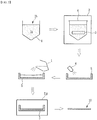
- FIG. 1 is a flowchart of a nucleic acid film fabrication method according to a first embodiment of the present invention
- FIG. 2 is a view illustrating each process in the nucleic acid film fabrication method according to the first embodiment
- FIG. 3 is a sectional view of a mold used in the nucleic acid film fabrication method according to the first embodiment
- FIG. 4 is an image of a microneedle of a nucleic acid film fabricated by the nucleic acid film fabrication method according to the first embodiment
- FIG. 5 is a view showing a process of directly forming a coating layer on a nucleic acid film in the nucleic acid film fabrication method according to the first embodiment.
- FIG. 3(a) is a view of a first mold 301 formed with a needle groove 31
- FIG. 3(b) is a view of a second mold 302 formed with a buffer formation groove 312 and a needle groove 31
- FIG. 3(c) is a view of a third mold 303 formed with a delivery groove 313 and an injection protrusion 314, wherein the first to third molds are used as a mold 5 according to the present invention.
- FIG. 5 shows an oblique angle deposition process for forming a coating layer 15 on a final product of a nucleic acid film 10 and the bottom of FIG. 5 shows a state in which the coating layer 15 is secured to the final product of the nucleic acid film 10.
- the nucleic acid film 10 is fabricated using a powdery nucleic acid 1b.
- the nucleic acid 1b may be extracted from at least one of by-products of marine food processing and by-products of plant food processing.
- Examples of the by-products of marine food processing may include salmon testes, salmon skins, pollack testes, crab carapaces, squid inks, and mixtures thereof.
- Examples of the by-products of plant food processing may include yeasts of cereal crops or seed grains, such as brewer's yeast, rice yeast, and barley yeast, and mixtures thereof.
- the nucleic acid 1b may include a salmon nucleic acid extracted from salmon, among the by-products of marine food processing.
- the nucleic acid 1b includes a salmon nucleic acid
- poly deoxy ribo nucleotide (PDRN) in the salmon nucleic acid can help treatment of wounds and scars and skin regeneration without addition of specific drugs.
- the salmon nucleic acid can help to quickly heal skin wounds caused by a microneedle after removing a drug administration device from the human skin.
- the nucleic acid film fabrication method includes a mixing step (S1), a stirring step (S2), a mixed solution application step (S3), and a drying step (S4).
- a mixed solution is prepared by adding the nucleic acid 1b to an aqueous solution 1a in a mixing container 1.
- the mixing container 1 is reduced in width toward the bottom thereof, such that the aqueous solution 1a and the nucleic acid 1b can be stably stirred.
- the aqueous solution 1a may include distilled water or deionized water and the nucleic acid 1b may be provided in powder form.
- the mixed solution is prepared by adding 0.5 parts by weight to 5 parts by weight of the nucleic acid 1b to 100 parts by weight of the aqueous solution 1a (distilled water or deionized water).
- the amount of the nucleic acid 1b may be adjusted according to the thickness of the final product of the nucleic acid film 10.
- the nucleic acid 1b may be present in an amount of 0.5 parts by weight to 2 parts by weight relative to 100 parts by weight of the aqueous solution 1a.
- the nucleic acid 1b may be present in an amount of 1 part by weight to 3 parts by weight relative to 100 parts by weight of the aqueous solution 1a.
- the nucleic acid 1b may be present in an amount of 0.5 parts by weight to 3 parts by weight relative to 100 parts by weight of the aqueous solution 1a.
- the amount of the nucleic acid 1b may be changed in multiples of 0.5 parts by weight within a range of 0.5 parts by weight to 5 parts by weight.
- the final product of the nucleic acid film 10 can have holes, cannot have a film shape, or can have cracks.
- the final product of the nucleic acid film 10 when the final product of the nucleic acid film 10 is in use, it takes a long time for the final product of the nucleic acid film 10 to be decomposed, causing a delay in penetration of a drug into the skin.
- the final product of the nucleic acid film 10 can stably have a film shape without any cracks and can be decomposed in a predetermined period of time using a decomposing liquid 50 described below, thereby improving penetration of a drug into the skin.
- the mixing container 1 may be washed in advance with deionized water, isopropyl alcohol, acetone, and deionized water, in that order.
- 1 part by weight to 100 parts by weight of a drug 40 is further added in liquid, powder, or capsule form to the mixed solution.
- the amount of the drug 40 may be changed in multiples of 0.5 parts by weight within a range of 1 part by weight to 100 parts by weight relative to 100 parts by weight of the mixed solution.
- the amount of the drug 40 may be adjusted according to a desired dosage of the drug into the human skin.
- both the nucleic acid 1b and the drug 40 are mixed with the aqueous solution 1a, it is possible to obtain a final product of the nucleic acid film 10 in which the nucleic acid 1b is integrated with the drug 40.
- the stirring step (S2) the mixed solution obtained through the mixing step (S1) is stirred.
- the stirring step (S2) the mixing container 1 is sealed with a sealant 4 such as Parafilm, followed by stirring the mixed solution in a stirring unit 2.
- the stirring unit 2 may be a magnetic stirrer, wherein a magnet 3 of the magnetic stirrer may be immersed in the mixed solution in the mixing container 1 after being washed with deionized water. It should be understood that the mixing container may be sealed with the sealant 4 after immersing the magnet 3 in the mixed solution.
- the mixed solution is rotated only in one direction to retain a conical shape, such that the nucleic acid 1b is uniformly mixed in the mixed solution.
- stirring of the mixed solution is performed at 600 rpm to 1000 rpm for 10 to 24 hours.
- the mixed solution may be stirred at 700 rpm for 1 to 1.5 hours, followed by further stirring at 900 rpm for 9 to 10 hours.
- the mixed solution may be allowed to stand for a predetermined period of time in a space shielded from UV light and sunlight so as to stabilize the mixed phase of the mixed solution.
- the mixed solution passing through the stirring step (S2) is applied to the mold 5.
- the mold 5 may have a shape corresponding to the shape of the final product of the nucleic acid film 10.
- the amount of the mixed solution applied to the mold 5 may be adjusted according to the size and thickness of the final product of the nucleic acid film 10.
- vacuum treatment may be performed for about 1 hour (for example, 55 to 70 minutes) so as to keep the mixed solution applied to the mold 5 in a stable manner and to promote drying of the mixed solution.
- the mixed solution applied to the mold 5 is dried to be formed into the nucleic acid film 10.
- the mold 5 having the mixed solution applied thereto is dried in a drying unit 7 at a predetermined temperature for a predetermined period of time.
- the drying step (S4) may include drying the mold 5 having the mixed solution applied thereto in the drying unit 7 at a temperature of 40°C to 60°C for 2 to 4 days.
- the drying step (S4) may include drying the mold 5 having the mixed solution applied thereto in the drying unit 7 at a temperature of 45°C to 50°C for 3 to 4 days. If the temperature of the drying unit 7 is below the lower limit of the temperature range set forth above, the time required for drying can be increased, whereas, if the temperature of the drying unit 7 exceeds the upper limit of the temperature range set forth above, the final product of the nucleic acid film 10 can have defects such as cracks.
- the drying step (S4) is performed at the predetermined temperature for the predetermined period of time as set forth above, the final product of the nucleic acid film 10 can have a stable structure.
- bubbles may be removed from the mixed solution dried in the mold 5 using a pipetting unit 8.
- the nucleic acid film fabrication method according to the first embodiment may further include at least one of a surface treatment step (S5), a mold preparation step (S6), a film acquisition step (S7), and an oblique angle deposition step (S8).
- a surface of the mold 5 is treated to be hydrophobic prior to the mixed solution application step (S3).
- the surface of the mold 5 may be treated to be hydrophobic using a surface treatment unit 6 generating oxygen plasma.
- the mold 5 subjected to surface-treatment using the surface treatment unit 6 may be dried at room temperature for about 1 day.
- a hydrophilic surface of the mold 5 can be turned hydrophobic, while the mixed solution can be applied to the mold 5 to a uniform thickness.
- the mold 5 is subjected to machining to correspond in shape to the final product of the nucleic acid film 10, before the mixed solution application step (S3), more specifically, before the surface treatment step (S5).
- the mold 5 in the mold preparation step (S6), the mold 5 may be machined to have a flat surface.
- the mold 5 may be machined to have a needle groove 311.
- a mold 5 will be referred to as a first mold 301. That is, the first mold 301 has a needle groove 311 formed on a surface thereof to be tapered in a thickness direction thereof, as shown in FIG. 3(a) . Accordingly, the final product of the nucleic acid film 10 includes a microneedle 11 protruding therefrom.
- the mold 5 may be machined to have a buffer formation groove 312.
- a mold 5 will be referred to as a second mold 302. That is, the second mold 302 has a buffer formation groove 312 formed on a surface thereof, as shown in FIG. 3(b) , wherein the buffer formation groove corresponds to a portion of the final product of the nucleic acid film configured to receive the drug 40.
- a needle groove 311 may be further formed on the buffer formation groove 312.
- the final product of the nucleic acid film 10 includes a buffer groove 12 formed convex toward the human skin and a microneedle 11 protruding from an outer surface of the buffer groove 12 toward the human skin.
- the mold 5 may be machined to have a delivery groove 313 and an injection protrusion 314 formed on the delivery groove 313.
- a mold 5 will be referred to as a third mold 303. That is, the third mold 303 has a delivery groove 313 formed on the surface thereof to be tapered in a thickness direction thereof and the injection protrusion 314 protruding from the delivery groove 313.
- the final product of the nucleic acid film 10 includes a drug delivery portion 13 protruding from a surface thereof and a drug injection hole 15 passing through the drug delivery portion 13.
- the nucleic acid film 10 passing through the drying step (S4) is separated from the mold 5.
- the film acquisition step S7 it is possible to obtain the nucleic acid film 10 having a predetermined thickness.
- the nucleic acid film 10 may have a thickness of 10 nanometers to several hundred micrometers.
- the nucleic acid film 10 may have a thickness of several hundred nanometers.
- a coating layer 15 is formed on the final product of the nucleic acid film 10.
- the coating layer 15 may be formed of an inorganic or organic material which is not decomposed by the decomposing liquid 50 described below and is harmless to humans.
- the coating layer 15 may contain a material such as gold, silver, etc. as a main ingredient.
- the geometries of the microneedle 11, the buffer groove 12, and the drug delivery portion 13 protruding from the nucleic acid film 10 can be maintained for a long time, while the nucleic acid film 10 can remain flat or remain held against the human body for a long time.
- the oblique angle deposition step (S8) is performed for the final product of the nucleic acid film 10 obtained by applying the mixed solution to the mold 5, that is, the first mold 301, the second mold 302, or the third mold 303, followed by the drying step (S4) or the film acquisition step (S7), as shown in FIG. 1 and FIG. 5 .
- the final product of the nucleic acid film 10 obtained through the drying step (S4) or the film acquisition step (S7) includes the microneedle 11 or the drug delivery portion 13 extending therefrom toward the human skin.
- the coating layer 15 may be formed to cover at least the microneedle 11 such that a tip of the microneedle 11 is exposed or may be formed to cover at least the drug delivery portion 13 such that a tip of the drug delivery portion 13 is exposed. Particularly, for the nucleic acid film 10 formed with the drug delivery portion 13, the coating layer 15 is formed not to close the drug injection hole 14 described below.
- the coating layer 15 may be formed to cover at least the microneedle 11.
- the coating layer 15 may be formed to cover at least the drug delivery portion 13.
- the phrase "the tip of the microneedle 11 or the tip of the drug delivery portion 13 is exposed” may mean that the coating layer 15 is formed on the final product of the nucleic acid film 10 in the following manner:
- the coating layer 15 may cover only the microneedle 11 excluding the tip of the microneedle 11, may cover the microneedle 11 excluding the tip of the microneedle 11 and a portion of one surface of the nucleic acid film 10 on which the microneedle 11 is formed, or may cover the microneedle 11 excluding the tip of the microneedle 11 and the entirety of one surface of the nucleic acid film 10 on which the microneedle 11 is formed.
- the phrase "the tip of the microneedle 11 or the tip of the drug delivery portion 13 is exposed” may mean that the coating layer 15 is formed on the final nucleic acid film 10 in the following manner:
- the coating layer 15 may cover only an outer surface of the buffer groove 12, may cover the outer surface of the buffer groove 12 and the microneedle 11 excluding the end of the microneedle 11, may cover at least the outer surface of the buffer groove 12 and a portion of one surface of the nucleic acid film 10 on which the buffer groove 12 is formed, or may cover at least the outer surface of the buffer groove 12 and the entirety of one surface of the nucleic acid film 10 on which the buffer groove 12 is formed.
- the phrase "the tip of the microneedle 11 or the tip of the drug delivery portion 13 is exposed” may mean that the coating layer 15 is formed on the final nucleic acid film 10 in the following manner:
- the coating layer 15 may cover only the drug delivery portion 13 excluding the tip of the drug delivery portion 13, may cover the drug delivery portion 13 excluding the tip of the drug delivery portion 13 and a portion of one surface of the nucleic acid film 10 on which the drug delivery portion 13 is formed, or may cover the drug delivery portion 13 excluding the end of drug delivery portion 13 and the entirety of one surface of the nucleic acid film 10 on which the drug delivery portion 13 is formed.
- the coating layer can be formed on the microneedle 11, the buffer groove 12, and the drug delivery portion 13 formed with the drug injection hole 14 of the final product of the nucleic acid film 10.
- any typical method such as oblique angle deposition, partial plating, partial coating, or sputtering may be employed to exclude the tip of the microneedle 11 or the tip of the drug delivery portion 13 from being covered with the coating layer.
- oblique angle deposition is employed to exclude the tip of the microneedle 11 or the tip of the drug delivery portion 13 from being covered with the coating layer.
- the oblique angle deposition step S8 includes a process of curing the coating layer 15.
- the coating layer 15 can be formed on the final product of the nucleic acid film 10 such that the tip of the microneedle 11 or the tip of the drug delivery portion 13 is exposed.
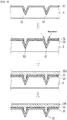
- FIG. 6 is a flowchart of the nucleic acid film fabrication method according to the second embodiment and FIG. 7 shows a process of forming a coating layer on a nucleic acid film using a mold formed with the coating layer in the nucleic acid film fabrication method according to the second embodiment.
- FIG. 7 shows a coating layer 15 formed on a mold 5
- the middle of FIG. 7 shows a nucleic acid film 10 stacked on the mold 5 formed with the coating layer 15
- the bottom of FIG. 7 shows the nucleic acid film 10 and the coating layer 15 removed from the mold 5, wherein the coating layer 15 is secured to the nucleic acid film 10.
- the nucleic acid film fabrication method includes a mixing step (S1), a stirring step (S2), a mixed solution application step (S3), and a drying step (S4).
- the nucleic acid film fabrication method according to the second embodiment may further include at least one of a surface treatment step (S5), a mold preparation step (S6), a film acquisition step (S7), and an oblique angle deposition step (S8).
- nucleic acid film fabrication method according to the second embodiment the same components as those used in the nucleic acid film fabrication method according to the first embodiment will be denoted by the same reference numerals as in the first embodiment and description thereof will be omitted.
- the coating layer 15 is secured to the nucleic acid film 10 after being formed on the mold 5.
- the oblique angle deposition step (S8) is performed on the first mold 301 or the second mold 302, which is used as the mold 5 according to the present invention, prior to the mixed solution application step (S3).
- the oblique angle deposition step (S8) is performed on the first mold 301, the second mold 302, or the third mold 303, as the mold 5, after the surface treatment step (S5) and before the mixed solution application step (S3).
- a needle groove 311 tapered in a thickness direction thereof may be formed on the mold 5.
- the coating layer 15 is formed at at least an entrance of the needle groove 311 excluding a bottom end of the needle groove 311.
- the phrase "excluding a bottom end of the needle groove 311" may mean that the coating layer 15 is formed on the first mold in the following manner:
- the coating layer 15 may be formed only at the entrance of the needle groove 311, may be formed at the entrance of the needle groove 311 and on a portion of one surface of the mold 5 on which the needle groove 311 is formed, or may be formed at the entrance of the needle groove 311 and on the entirety of one surface of the mold 5 on which the needle groove 311 is formed.
- the phrase “excluding a bottom end of the needle groove 311" may mean that the coating layer 15 is formed on the second mold in the following manner:
- the coating layer 15 may also be formed on the buffer formation groove 312.
- the coating layer 15 may be formed only on the buffer formation groove 312, may be formed on the buffer formation groove 312 and at the entrance of the needle groove 311, may be formed at least on the buffer formation groove 312 and on a portion of one surface of the mold 5 on which the buffer formation groove 312 is formed, or may be formed at least on the buffer formation groove 312 and on the entirety of one surface of the mold 5 on which the buffer formation groove 312 is formed.
- the phrase "excluding a bottom end of the needle groove 311" may mean that the coating layer 15 is formed in the following manner:
- the coating layer 15 may also be formed on the delivery groove 313.
- the coating layer 15 may be formed only on the delivery groove 313, may be formed at least on the delivery groove 313 and on a portion of one surface of the mold 5 on which the delivery groove 313 is formed, or may be formed at least on the delivery groove 313 and on the entirety of one surface of the mold 5 on which the delivery groove 313 is formed.
- the injection protrusion 314 is not involved in formation of the coating layer 15.
- the coating layer 15 may be formed at the entrance of the needle groove 311 or the delivery groove 313, followed by removal of the deposition aid member.
- any typical method such as oblique angle deposition, partial plating, partial coating, or sputtering may be employed to exclude the bottom end of the needle groove 311, the bottom end of the buffer formation groove 312, or the bottom end of the delivery groove 313 from being covered with the coating layer.
- oblique angle deposition is employed to form the coating layer 15.
- the oblique angle deposition step (S8) includes a process of curing the coating layer 15.
- the mixed solution application step (S3) the mixed solution is applied to the mold 5 while filling the needle groove 311, and, in the drying step (S4), the coating layer 15 is integrated with a final product of the nucleic acid film 10. Accordingly, in the film acquisition step (S7), the nucleic acid film 10 and the coating layer 15 integrated with each other are removed from the mold 5 at the same time.
- the final product of the nucleic acid film 10 has the coating layer 15 formed thereon such that a tip of a microneedle 11 formed using the needle groove 311 is exposed.
- FIG. 8 is a flowchart of a nucleic acid film fabrication method according to a third embodiment of the present invention
- FIG. 9 is a view illustrating a process of embedding a coating layer in a nucleic acid film in the nucleic acid film fabrication method according to the third embodiment of the present invention.
- the top of FIG. 9 shows a nucleic acid film 10 having a buffer groove 12 formed thereon
- the upper middle of FIG. 9 shows a coating layer 15 stacked on the nucleic acid film 10 having the buffer groove 12 formed thereon
- the lower middle of FIG. 9 shows a finishing layer 100 stacked on the nucleic acid film 10 having the coating layer 15 stacked thereon
- the bottom of FIG. 9 shows the nucleic acid film 10 removed from a mold 5, wherein the coating layer 15 and the finishing layer 100 are secured to the nucleic acid film 10.
- the nucleic acid film fabrication method includes a mixing step (S1), a stirring step (S2), a mixed solution application step (S3), and a drying step (S4).
- the nucleic acid film fabrication method according to the third embodiment may further include at least one of a surface treatment step (S5), a mold preparation step (S6), and a film acquisition step (S7).
- nucleic acid film fabrication method according to the third embodiment the same components as those used in the nucleic acid film fabrication method according to the first or second embodiment will be denoted by the same reference numerals as in the first or second embodiment and description thereof will be omitted.
- the nucleic acid film fabrication method according to the third embodiment may further include an oblique angle deposition step (S8), a finishing application step (S9) and a finishing drying step (S10).
- a coating layer 15 is stacked on a nucleic acid film 10, followed by stacking a finishing layer 100 thereon such that the coating layer 15 is embedded between the nucleic acid film 10 and the finishing layer 100.
- a final product of the nucleic acid film 10 may include a microneedle 11 or a drug delivery portion 13 formed on one surface thereof.
- the coating layer 15 is formed on the other surface of the nucleic acid film 10 such that a portion of the coating layer corresponding to the microneedle 11 or the drug delivery portion 13 is open.
- the finishing application step (S9) a finishing liquid is applied to the other surface of the nucleic acid film 10 on which the coating layer 15 is formed, and, in the finishing drying step (S10), the finishing liquid applied to the nucleic acid film 10 is dried to be formed into a finishing layer 100.
- the film acquisition step (S7) it is possible to obtain the nucleic acid film 10 including the coating layer 15 and the finishing layer 100 integrated therewith.
- the nucleic acid film 10 may include a microneedle 11 extending from one surface thereof toward the human skin and a buffer groove 12 formed on the other surface thereof to correspond to the microneedle 11 through the mixed solution application step (S3) and the drying step (S4).
- the buffer groove 12 may be formed using the second mold 302, which is used as the mold 5 according to the invention.
- the buffer groove 12 may be formed through a process in which, after the mixed solution application step S3 or during the drying step (S4), a groove formation member (not shown) corresponding in shape to the needle groove 311, the buffer formation groove 312, or the delivery groove 313 is inserted into the needle groove 311, the buffer formation groove 312, or the delivery groove 313, followed by removal of the groove formation member 10a from the nucleic acid film 10 subsequent to the drying step (S4), as shown in the top of FIG. 9 .
- the nucleic acid film 10 may be formed with the buffer groove 12 and the microneedle 11 or may be formed with the drug delivery portion 13 having the drug injection hole 14 formed therethrough.
- the coating layer 15 is formed at at least an entrance of the buffer groove 12 excluding the bottom end of the buffer groove 12, as shown in FIG. 8 and FIG. 9 .
- the phrase “excluding the bottom end of the buffer groove 12" means that the bottom end of the buffer groove 12 is open, and, more specifically, means that the coating layer 15 is formed on the nucleic acid film 10 in the following manner:
- the coating layer 15 may be formed only at the entrance of the buffer groove 12, may be formed at the entrance of the buffer groove 12 and on a portion of the other surface of the nucleic acid film 10 on which the buffer groove 12 is formed, or may be formed at the entrance of the buffer groove 12 and on the entirety of the other surface of the nucleic acid film 10 on which the buffer groove 12 is formed.
- the phase "excluding the bottom end of the buffer groove 12" may mean that the coating layer 15 is formed at least on an inner wall of the drug injection hole 14 such that the drug injection hole 14 can remain open.
- the coating layer 15 may be formed at the entrance of the buffer groove 12, followed by removal of the deposition aid member (not shown).
- the coating layer 15 may be formed by oblique angle deposition.
- the oblique angle deposition step (S8) includes a process of curing the coating layer 15.
- a finishing liquid is applied to the mold 5 passing through the oblique angle deposition (S8) to fill the buffer groove 12 of the nucleic acid film 10 while covering the coating layer 15.
- the finishing liquid is used to form the finishing layer 100 and may include the mixed solution set forth above for formation of a nucleic acid film or a mixed solution containing vitamins, collagen and the like for formation of a water-soluble functional film.
- the finishing liquid may contain a drug to be absorbed by the human body.
- the finishing liquid applied to the mold 5 is dried to be transformed into the finishing layer 100.
- the finishing layer 100 may be formed into a nucleic acid film as set forth above or may be formed into a separate water-soluble functional film.
- the film acquisition step (S7) a final product of the nucleic acid film 10 having the coating layer 15 and the finishing layer 100 integrated therewith can be obtained.
- the coating layer 15 is embedded between the finishing layer 100 and the nucleic acid film 10.
- the buffer groove 12 or the drug delivery portion 13 formed with the drug injection hole 14 may also be formed on the finishing layer 100 by utilizing the method of forming the buffer groove 12 on the nucleic acid film 10 as described in the third embodiment.
- the buffer groove 12 or the drug injection hole 14 may be formed on the finishing layer 100 through a process in which, after the finishing application step (S9) or during the finishing drying step (S10), a groove formation member (not shown) having a different size than the groove formation member inserted into the nucleic acid film 10 is inserted into the finishing layer 100, followed by removal of the groove formation member from the finishing layer 100 subsequent to the finishing drying step (S10).
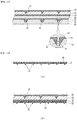
- FIG. 10 is a sectional view of a nucleic acid film-based drug administration device according to a first embodiment of the present invention.
- the nucleic acid film-based drug administration device according to the first embodiment of the present invention includes a nucleic acid film 10 fabricated by any one of the nucleic acid film fabrication methods set forth above.
- the nucleic acid film-based drug administration device includes the nucleic acid film 10, a finishing film 30, and a drug 40.
- the nucleic acid film 10 is fabricated by any one of the nucleic acid film fabrication methods set forth above and is configured to contact the human skin.
- the nucleic acid film 10 may include the microneedle 11 protruding therefrom, wherein the microneedle 11 is formed using the mold 5 formed with the needle groove 311.
- the microneedle 11 may extend from a surface of the nucleic acid film 10 toward the human skin.
- the microneedle 11 may be reduced in cross-sectional area with increasing distance from the surface of the nucleic acid film 10, that is, may have an inverted conical shape.
- a maximum diameter of the microneedle 11, that is, a diameter of the base of the microneedle adjoining the surface of the nucleic acid film 10 (the diameter of an imaginary circle in which the cross-sectional area of the microneedle 11 is inscribed), may range from 200 ⁇ m to 400 ⁇ m
- a diameter of a tip of the microneedle 11 may range from 20 ⁇ m to 30 ⁇ m
- a height of the microneedle 11 from the surface of the nucleic acid film 10 may range from 200 ⁇ m to 300 ⁇ m.
- the microneedle 11 can collapse or can be bent with respect to the nucleic acid film 10. Conversely, when the dimensions of the microneedle 11 fall within the aforementioned ranges, the nucleic acid film 10 can retain a protruding shape thereof, can allow the drug 40 to easily penetrate the skin therethrough, can be prevented from being bent or broken when in use, and can be prevented from being broken when separated from the mold 5.
- the nucleic acid film 10 includes the coating layer 15 formed thereon such that the tip of the microneedle 11 is exposed.
- the coating layer 15 may be formed on the nucleic acid film 10 by any one of the nucleic acid film fabrication methods set forth above.
- the nucleic acid film 10 may further include the finishing layer 100 formed thereon.
- the coating layer 15 and the finishing layer 100 may be formed on the nucleic acid film 10 by any one of the nucleic acid film fabrication methods set forth above.
- the strength of the microneedle 11 can be reinforced while the microneedle 11 can be prevented from being bent or broken.
- the finishing film 30 is stacked and supported on the nucleic acid film 10.
- the finishing film 30 may be configured in various ways without limitation, so long as the finishing film can prevent degeneration of the drug 40.
- the drug 40 fills a space between the nucleic acid film 10 and the finishing film 30.
- the drug 40 does not decompose the nucleic acid film 10.
- the drug 40 may be comprised of any one selected from therapeutic or health-aid drugs, including drugs for hormone regulation, anesthesia, anti-aging of skin, wrinkle removal, tattoo removal, tattoo formation, and sebum absorption.
- the drug 40 may include hyaluronic acid for anti-aging or wrinkle removal.
- the drug 40 can penetrate the human skin as the nucleic acid film 10 is decomposed by moisture remaining on the surface of the nucleic acid film 10, moisture remaining on the human skin, or distilled water or deionized water applied to at least one of the nucleic acid film 10 and the human skin.
- the nucleic acid film-based drug administration device may further include a boundary film 20.
- the boundary film 20 is stacked and supported between the nucleic acid film 10 and the finishing film 30.
- the drug 40 fills a space between the nucleic acid film 10 and the boundary film 20.
- a decomposing liquid 50 fills a space between the boundary film 20 and the finishing film 30.
- the decomposing liquid 50 may include distilled water or deionized water.
- the finishing film 30 may include a perforation needle 31 protruding therefrom and configured to penetrate the boundary film 20.
- the decomposing liquid 50 When the drug administration device is attached to and pressed against the human skin, the decomposing liquid 50 is moved toward the drug 40 as the perforation needle 31 perforates the boundary film 20, such that the nucleic acid film 10 can be decomposed by the decomposing liquid 50 without separately applying distilled water or deionized water to the nucleic acid film 10, thereby allowing the drug 40 to penetrate the human skin.
- FIG. 11 is a sectional view of a nucleic acid film-based drug administration device according to a second embodiment of the present invention.
- the nucleic acid film-based drug administration device according to the second embodiment of the present invention includes a nucleic acid film 10 fabricated by any one of the nucleic acid film fabrication methods set forth above.
- the nucleic acid film-based drug administration device includes the nucleic acid film 10, a boundary film 20, a finishing film 30, a drug 40, and a decomposing liquid 50.
- the nucleic acid film 10 is fabricated by any one of the nucleic acid film fabrication methods set forth above and is configured to contact the human skin.
- the nucleic acid film 10 may have the buffer groove 12 formed thereon, wherein the buffer groove 12 is formed using the mold 5 formed with the buffer formation groove 312.
- the buffer groove 12 defines a space for receiving the drug 40.
- the nucleic acid film 10 may have the microneedle 11 protruding from the buffer groove 12, wherein the microneedle 11 is formed using the mold formed with the needle groove 311.
- the buffer groove 12 is convex toward the human skin and the microneedle 11 extends from the buffer groove 12 toward the human skin.
- the boundary film 20 is stacked and supported on the nucleic acid film 10.
- the boundary film 20 may be configured in various ways without limitation, so long as the boundary film 20 can isolate the drug 40 from the decomposing liquid 50 and can be perforated by a perforation needle 31 protruding from the finishing film 30.
- the nucleic acid film 10 includes the coating layer 15 formed thereon in such a way that the tip of the microneedle 11 is exposed.
- the coating layer 15 may be formed on the nucleic acid film 10 by any one of the nucleic acid film fabrication methods set forth above.
- the nucleic acid film 10 may further include the finishing layer 100 formed thereon.
- the coating layer 15 and the finishing layer 100 may be formed on the nucleic acid film 10 by any one of the nucleic acid film fabrication methods set forth above.
- the strength of the microneedle 11 can be reinforced while the microneedle 11 can be prevented from being bent or broken.
- the finishing film 30 is stacked and supported on the boundary film 10.
- the finishing film 30 may be configured in various ways without limitation, so long as the finishing film can prevent degeneration of the drug 40.
- the finishing film 30 may include a perforation needle 31 protruding therefrom and configured to perforate the boundary film 20.
- the drug 40 fills a space between the nucleic acid film 10 and the boundary film 30.
- the drug 40 does not decompose the nucleic acid film 10.
- the drug 40 may be comprised of any one selected from therapeutic or health-aid drugs, including drugs for hormone regulation, anesthesia, anti-aging of skin, wrinkle removal, tattoo removal, tattoo formation, and sebum absorption.
- the drug 40 may include hyaluronic acid for anti-aging or wrinkle removal.
- the decomposing liquid 50 fills a space between the boundary film 20 and the finishing film 30.
- the decomposing liquid 50 may include distilled water or deionized water.
- the decomposing liquid 50 When the drug administration device is attached to and pressed against the human skin, the decomposing liquid 50 is moved toward the drug 40 as the perforation needle 31 perforates the boundary film 20, such that the nucleic acid film 10 can be decomposed by the decomposing liquid 50 without separately applying distilled water or deionized water to the nucleic acid film 10, thereby allowing the drug 40 to penetrate the human skin.
- FIG. 12 is a sectional view of a nucleic acid film-based drug administration device according to a third embodiment of the present invention.
- the nucleic acid film-based drug administration device according to the third embodiment of the present invention includes a nucleic acid film 10 fabricated by any one of the nucleic acid film fabrication methods set forth above.
- the nucleic acid film-based drug administration device includes the nucleic acid film 10, a boundary film 20, a finishing film 30, a drug 40, and a decomposing liquid 50.
- the nucleic acid film 10 is fabricated by any one of the nucleic acid film fabrication methods set forth above and is configured to contact the human skin.
- the nucleic acid film 10 may have the drug delivery portion 13 protruding therefrom, wherein the drug delivery portion is formed using the mold 5 formed with the delivery groove 313.
- the nucleic acid film may have the drug injection hole 14 passing through the drug delivery portion 13, wherein the drug injection hole 14 is formed using the mold formed with the injection protrusion 314.
- the drug delivery portion 13 extends from the nucleic acid film 10 toward the human skin and the drug injection hole 14 is configured such that leakage of the drug 40 therethrough can be prevented due to surface tension of the drug 40.
- the nucleic acid film 10 includes the coating layer 15 formed thereon such that the tip of the microneedle 11 is exposed.
- the coating layer 15 may be formed on the nucleic acid film 10 by any one of the nucleic acid film fabrication methods set forth above.
- the nucleic acid film 10 may further include the finishing layer 100 formed thereon.
- the coating layer 15 and the finishing layer 100 may be formed on the nucleic acid film 10 by any one of the nucleic acid film fabrication methods set forth above.
- the strength of the microneedle 11 can be reinforced while the microneedle 11 can be prevented from being bent or broken.
- the boundary film 20 is stacked and supported on the nucleic acid film 10.
- the boundary film 20 may be configured in various ways without limitation, so along as the boundary film can isolate the drug 40 from the decomposing liquid 50 and can be perforated by a perforation needle 31 protruding from the finishing film 30.
- the finishing film 30 is stacked and supported on the boundary film 20.
- the finishing film 30 may be configured in various ways without limitation, so long as the finishing film can prevent degeneration of the drug 40.
- the finishing film 30 has the perforation needle 31 protruding therefrom and configured to perforate the boundary film 20.
- the drug 40 fills a space between the nucleic acid film 10 and the boundary film 20.
- the drug 40 does not decompose the nucleic acid film 10.
- the drug 40 may be comprised of any one selected from therapeutic or health-aid drugs, including drugs for hormone regulation, anesthesia, anti-aging of skin, wrinkle removal, tattoo removal, tattoo formation, and sebum absorption.
- the drug 40 may include hyaluronic acid for anti-aging or wrinkle removal.
- the decomposing liquid 50 fills a space between the boundary film 20 and the finishing film 30.
- the decomposing liquid 50 may include distilled water or deionized water.
- the decomposing liquid 50 When the drug administration device is attached to and pressed against the human skin, the decomposing liquid 50 is moved toward the drug 40 as the perforation needle 31 perforates the boundary film 20, such that the nucleic acid film 10 can be decomposed by the decomposing liquid 50 without separately applying distilled water or deionized water to the nucleic acid film 10, thereby allowing the drug 40 to penetrate the human skin.
- the nucleic acid film-based drug administration device may further include a protective film 60 and a separation layer 70.
- the protective film 60 is detachably coupled to the nucleic acid film 10 such that the drug injection hole 14 can be open or closed.
- the separation layer 70 is secured to the protective film 60 to be attached to or detached from the nucleic acid film 10.
- the separation layer 70 is configured not to be mixed with the drug 40.
- the protective film 60 or the separation layer 70 further prevents leakage of the drug 40 through the drug injection hole 14 during transport or storage of the drug administration device while preventing intrusion of foreign matter into the drug injection hole 14.
- FIG. 13 is a sectional view of a nucleic acid film-based drug administration device according to a fourth embodiment of the present invention.
- the nucleic acid film-based drug administration device according to the fourth embodiment includes a nucleic acid film 10 fabricated by the method in which the aqueous solution 1a is mixed with the nucleic acid 1b and the drug 40, among the nucleic acid film fabrication methods set forth above.
- the nucleic acid film-based drug administration device includes the nucleic acid film 10.
- the nucleic acid film 10 may be fabricated by the method in which the aqueous solution 1a is mixed with both the nucleic acid 1b and the drug 40, among the nucleic acid film fabrication methods set forth above.
- the nucleic acid film 10 may have the microneedle 11 protruding therefrom, wherein the microneedle 11 may be formed by the nucleic acid film fabrication method according to the first embodiment of the invention.
- the nucleic acid film 10 includes the coating layer 15 formed thereon such that the tip of the microneedle 11 is exposed.
- the coating layer 15 may be formed on the nucleic acid film 10 by any one of the nucleic acid film fabrication methods set forth above.
- the nucleic acid film 10 may further include the finishing layer 100 formed thereon.
- the coating layer 15 and the finishing layer 100 may be formed on the nucleic acid film 10 by any one of the nucleic acid film fabrication methods set forth above.
- the strength of the microneedle 11 can be reinforced while the microneedle 11 can be prevented from being bent or broken.
- the nucleic acid film-based drug administration device may further include a boundary film 20, a finishing film 30, and a decomposing liquid 50.
- boundary film 20, the finishing film 30, and the decomposing liquid 50 are the same as those of the drug administration device according to any one of the first to third embodiments, description thereof will be omitted.
- the nucleic acid film 10 is applied to a transdermal delivery technology that relies on drug diffusion across the human skin, thereby improving penetration of the drug 40 into the skin while preventing skin problems.
- the microneedle 11, the buffer groove 12, and the drug delivery portion 13 having the drug injection hole 14 formed therethrough can be easily formed on the nucleic acid film 10 and the nucleic acid film 10 can have a uniform thickness.
- the present invention it is possible to prevent intrusion of foreign matter into the nucleic acid film 10 while improving decomposition of the nucleic acid film 10. Moreover, the decomposing liquid 50 can be stably supplied to the nucleic acid film 10, thereby enabling stable delivery of the drug 40. Furthermore, depending on the form of delivery of the drug 40, the nucleic acid film can be patterned in various ways and the dosage of the drug 40 can be adjusted according to the pattern of the nucleic acid film.
- leakage of the drug 40 through the drug injection hole 14 and intrusion of foreign matter into the drug 40 can be prevented while protecting the nucleic acid film 10.
Landscapes
- Health & Medical Sciences (AREA)
- Life Sciences & Earth Sciences (AREA)
- Chemical & Material Sciences (AREA)
- Engineering & Computer Science (AREA)
- Animal Behavior & Ethology (AREA)
- General Health & Medical Sciences (AREA)
- Public Health (AREA)
- Veterinary Medicine (AREA)
- Medicinal Chemistry (AREA)
- Pharmacology & Pharmacy (AREA)
- Epidemiology (AREA)
- Dermatology (AREA)
- Bioinformatics & Cheminformatics (AREA)
- Hematology (AREA)
- Heart & Thoracic Surgery (AREA)
- Biomedical Technology (AREA)
- Anesthesiology (AREA)
- Medical Informatics (AREA)
- Chemical Kinetics & Catalysis (AREA)
- General Chemical & Material Sciences (AREA)
- Molecular Biology (AREA)
- Biochemistry (AREA)
- Oil, Petroleum & Natural Gas (AREA)
- Organic Chemistry (AREA)
- Nuclear Medicine, Radiotherapy & Molecular Imaging (AREA)
- Media Introduction/Drainage Providing Device (AREA)
- Medicinal Preparation (AREA)
- Pharmaceuticals Containing Other Organic And Inorganic Compounds (AREA)
- Micromachines (AREA)
Abstract
Description
- The present invention relates to a nucleic acid film fabrication method and a nucleic acid film-based drug administration device, and, more particularly, to a nucleic acid film fabrication method and nucleic acid film-based drug administration device which can be applied to a transdermal delivery technology relying on drug diffusion across the human skin so as to improve drug penetration into the skin while preventing skin problems.
- Generally, most drugs are administered orally. However, when orally administered, some drugs, particularly protein and peptide drugs, cannot be effectively adsorbed due to severe decomposition in the gastrointestinal tract, poor absorption by the intestinal membranes, and/or interruption of first pass metabolism in the liver.
- Another drug delivery technique is parenteral administration using a standard syringe or catheter. However, syringe injection causes needle phobia, substantial pain, and local damage to the skin in many patients. Collection of body fluids such as blood for diagnostic purposes causes similar anxieties. In addition, syringe injection is not ideal for continuous drug delivery or for continuous diagnosis.
- Yet another drug delivery technique is transdermal delivery that commonly relies on drug diffusion across the skin. However, this method is not widely used due to insufficient permeability of the skin to many drugs. The outermost layer of the skin, that is, the horny layer is a primary barrier to transdermal drug penetration. Once a drug reaches the dermis (under the epithelium), the drug rapidly spreads into deep tissue layers and other parts of the body through blood circulation.
- In an attempt to improve protein drug delivery through the skin, chemical enhancers, iontophoresis, electroporation, ultrasonication, and thermal elements have been used to supplement drug delivery. However, these techniques are not appropriate for certain drug forms and often do not provide therapeutic delivery. In addition, these techniques sometimes cause unwanted skin reactions and are impractical to control drug delivery over several hours or several days.
- Embodiments of the present invention provide a nucleic acid film fabrication method and nucleic acid film-based drug administration device which can be applied to a transdermal delivery technology relying on drug diffusion across the human skin so as to improve drug penetration into the skin while preventing skin problems.
- In accordance with one aspect of the present invention, there is provided a nucleic acid film fabrication method including: a mixing step in which a nucleic acid is added in powder form to distilled water or deionized water to prepare a mixed solution; a stirring step in which the mixed solution is stirred; a mixed solution application step in which the mixed solution is applied to a mold corresponding in shape to a final product of a nucleic acid film; and a drying step in which the mixed solution applied to the mold is dried to be formed into the nucleic acid film, wherein the mold has a groove formed thereon in a thickness direction thereof, such that the nucleic acid film passing through the drying step has a protrusion protruding from one surface thereof toward the human skin to correspond to the groove.
- The nucleic acid film fabrication method may further include an oblique angle deposition step in which a coating layer is formed on the one surface of the nucleic acid film such that a tip of the protrusion is exposed, after the drying step.
- The nucleic acid film fabrication method may further include an oblique angle deposition step in which a coating layer is formed on the mold excluding a bottom end of the groove, before the mixed solution application step.
- The nucleic acid film fabrication method may further include an oblique angle deposition step in which a coating layer is formed on the other surface of the nucleic acid film such that a portion of the coating layer corresponding to the protrusion is open, after the drying step.
- The nucleic acid film fabrication method may further include: a finishing application step in which a finishing liquid is applied to cover the coating layer; and a finishing drying step in which the finishing liquid is dried to be formed into a finishing layer, after the oblique angle deposition step.
- The nucleic acid film fabrication method may further include at least one of a film acquisition step in which the nucleic acid film is separated from the mold after the drying step; a mold preparation step in which the mold is machined to correspond in shape to the final product of the nucleic acid film before the mixed solution application step; and a surface treatment step in a surface of the mold is treated to be hydrophobic before the mixed solution application step.
- In the mixing step, 1 part by weight to 100 parts by weight of a drug may be further added in liquid or capsule form to the mixed solution.
- The nucleic acid may be extracted from at least one of by-products of marine food processing and by-products of plant food processing.
- In accordance with another aspect of the present invention, there is provided a nucleic acid film-based drug administration device including: a nucleic acid film configured to contact the human skin and fabricated by the nucleic acid film fabrication method set forth above; a finishing film stacked on the nucleic acid film; and a drug filling a space between the nucleic acid film and the finishing film.
- The nucleic acid film-based drug administration device may further include: a boundary film stacked between the nucleic acid film and the finishing film; and a decomposing liquid filling a space between the boundary film and the finishing film and comprising distilled water or deionized water, wherein the finishing film may include a perforation needle protruding therefrom toward the boundary film and configured to perforate the boundary film, and the drug may fill a space between the nucleic acid film and the boundary film.
- In accordance with a further aspect of the present invention, there is provided a nucleic acid film-based drug administration device including a nucleic acid film fabricated by the nucleic acid film fabrication method in which, in the mixing step, 1 part by weight to 100 parts by weight of a drug is further added in liquid, powder, or capsule form to the mixed solution.
- The nucleic acid film-based drug administration device may further include: a boundary film stacked on the nucleic acid film; a finishing film stacked on the boundary film and including a perforation needle protruding therefrom toward the boundary film, the perforation needle being configured to perforate the boundary film; and a decomposing liquid filling a space between the boundary film and the finishing film and comprising distilled water or deionized water.
- The nucleic acid film may include a microneedle protruding from one surface thereof toward a human skin.
- The nucleic acid film may include a buffer groove formed on the other surface thereof to correspond to the microneedle.
- The nucleic acid film-based drug administration device may further include a coating layer formed on the one surface of the nucleic acid film such that a tip of the microneedle is exposed.
- The nucleic acid film-based drug administration device may further include a coating layer formed on the other surface of the nucleic acid film such that a portion of the coating layer corresponding to the microneedle is open.
- The nucleic acid film may include a drug delivery portion protruding from one surface thereof toward the human skin, wherein the drug delivery portion may have a drug injection hole formed therethrough to allow the drug to be discharged through the drug injection hole.
- The nucleic acid film-based drug administration device may further include: a coating layer formed on the one surface of the nucleic acid film such that a tip of the drug delivery portion is exposed.
- The nucleic acid film-based drug administration device may further include a coating layer formed on the other surface of the nucleic acid film such that a portion of the coating layer corresponding to the drug injection hole is open.
- The nucleic acid film-based drug administration device may further include a protective film detachably coupled to the one surface of the nucleic acid film such that the drug injection hole is open or closed.
- The nucleic acid film fabrication method and nucleic acid film-based drug administration device according to the present invention can be applied to transdermal delivery technology relying on drug diffusion across the human skin, thereby improving drug penetration into the skin while preventing skin problems.
- In addition, a microneedle, a buffer groove, and a drug delivery portion having a
drug injection hole 14 formed therethrough can be easily formed on a nucleic acid film and the nucleic acid film can have a uniform thickness. - Further, according to the present invention, the nucleic acid film can retain the shape thereof for a long time.
- Moreover, according to the present invention, it is possible to prevent intrusion of foreign matter into the nucleic acid film while improving decomposition of the nucleic acid film.
- Furthermore, a decomposing liquid can be stably supplied to the nucleic acid film, thereby enabling stable drug delivery.
- In addition, depending on the form of drug delivery, the nucleic acid film can be patterned in various ways and the dosage of a drug can be adjusted according to the pattern of the nucleic acid film.
- Further, according to the present invention, leakage of a drug through the drug injection hole and intrusion of foreign matter into the drug can be prevented while protecting the nucleic acid film.
-
-
FIG. 1 is a flowchart of a nucleic acid film fabrication method according to a first embodiment of the present invention. -
FIG. 2 is a view illustrating each process step of the nucleic acid film fabrication method according to the first embodiment. -
FIG. 3 is a sectional view of a mold used in the nucleic acid film fabrication method according to the first embodiment. -
FIG. 4 is an image of a microneedle of a nucleic acid film fabricated by the nucleic acid film fabrication method according to the first embodiment. -
FIG. 5 is a view showing a process of directly forming a coating layer on a nucleic acid film in the nucleic acid film fabrication method according to the first embodiment. -
FIG. 6 is a flowchart of a nucleic acid film fabrication method according to a second embodiment. -
FIG. 7 shows a process of forming a coating layer on a nucleic acid film using a mold having the coating layer formed thereon in the nucleic acid film fabrication method according to the second embodiment. -
FIG. 8 is a flowchart of a nucleic acid film fabrication method according to a third embodiment of the present invention. -
FIG. 9 is a view illustrating a process of embedding a coating layer in a nucleic acid film in the nucleic acid film fabrication method according to the third embodiment of the present invention. -
FIG. 10 is a sectional view of a nucleic acid film-based drug administration device according to a first embodiment of the present invention. -
FIG. 11 is a sectional view of a nucleic acid film-based drug administration device according to a second embodiment of the present invention. -
FIG. 12 is a sectional view of a nucleic acid film-based drug administration device according to a third embodiment of the present invention. -
FIG. 13 is a sectional view of a nucleic acid film-based drug administration device according to a fourth embodiment of the present invention. - Hereinafter, embodiments of the present invention will be described with reference to the accompanying drawings. It should be understood that the present invention is not limited to the following embodiments and may be embodied in different ways.
- In the drawings, portions irrelevant to the description will be omitted for clarity. Like components will be denoted by like reference numerals throughout the specification.
- It will be understood that when an element is referred to as being "connected to" another element, it can be directly connected to the other element, or intervening elements may also be present. In addition, it will be understood that the terms "includes", "comprises", "including" and/or "comprising," when used in this specification, specify the presence of stated features, steps, operations, elements, and/or components, but do not preclude the presence or addition of one or more other features, steps, operations, elements, components, and/or groups.
- It will be understood that when an element such as a layer, film, region or substrate is referred to as being placed "above"/"below" or "on"/"under" another element, it can be directly placed on the other element, or intervening layer(s) may also be present. In addition, spatially relative terms, such as "above," "upper (portion)," "upper surface," and the like may be understood as meaning "below," "lower (portion)," "lower surface," and the like according to a reference orientation. In other words, the expressions of spatial orientations are to be construed as indicating relative orientations instead of absolute orientations (that is, orientations with respect to the direction of gravity).
- Now, a nucleic acid film fabrication method according to a first embodiment of the present invention will be described.
FIG. 1 is a flowchart of a nucleic acid film fabrication method according to a first embodiment of the present invention,FIG. 2 is a view illustrating each process in the nucleic acid film fabrication method according to the first embodiment,FIG. 3 is a sectional view of a mold used in the nucleic acid film fabrication method according to the first embodiment,FIG. 4 is an image of a microneedle of a nucleic acid film fabricated by the nucleic acid film fabrication method according to the first embodiment, andFIG. 5 is a view showing a process of directly forming a coating layer on a nucleic acid film in the nucleic acid film fabrication method according to the first embodiment. - Here,
FIG. 3(a) is a view of afirst mold 301 formed with aneedle groove 311,FIG. 3(b) is a view of asecond mold 302 formed with abuffer formation groove 312 and aneedle groove 311, andFIG. 3(c) is a view of athird mold 303 formed with adelivery groove 313 and aninjection protrusion 314, wherein the first to third molds are used as amold 5 according to the present invention. - In addition, the top of
FIG. 5 shows an oblique angle deposition process for forming acoating layer 15 on a final product of anucleic acid film 10 and the bottom ofFIG. 5 shows a state in which thecoating layer 15 is secured to the final product of thenucleic acid film 10. - Referring to
FIG. 1 to FIG. 5 , in the nucleic acid film fabrication method according to the first embodiment of the invention, thenucleic acid film 10 is fabricated using a powderynucleic acid 1b. - Here, the
nucleic acid 1b may be extracted from at least one of by-products of marine food processing and by-products of plant food processing. - Examples of the by-products of marine food processing may include salmon testes, salmon skins, pollack testes, crab carapaces, squid inks, and mixtures thereof.
- Examples of the by-products of plant food processing may include yeasts of cereal crops or seed grains, such as brewer's yeast, rice yeast, and barley yeast, and mixtures thereof.
- Specifically, the
nucleic acid 1b may include a salmon nucleic acid extracted from salmon, among the by-products of marine food processing. When thenucleic acid 1b includes a salmon nucleic acid, poly deoxy ribo nucleotide (PDRN) in the salmon nucleic acid can help treatment of wounds and scars and skin regeneration without addition of specific drugs. In addition, the salmon nucleic acid can help to quickly heal skin wounds caused by a microneedle after removing a drug administration device from the human skin. - The nucleic acid film fabrication method according to the first embodiment includes a mixing step (S1), a stirring step (S2), a mixed solution application step (S3), and a drying step (S4).
- In the mixing step (S1), a mixed solution is prepared by adding the
nucleic acid 1b to an aqueous solution 1a in a mixingcontainer 1. - The mixing
container 1 is reduced in width toward the bottom thereof, such that the aqueous solution 1a and thenucleic acid 1b can be stably stirred. Here, the aqueous solution 1a may include distilled water or deionized water and thenucleic acid 1b may be provided in powder form. - Specifically, the mixed solution is prepared by adding 0.5 parts by weight to 5 parts by weight of the
nucleic acid 1b to 100 parts by weight of the aqueous solution 1a (distilled water or deionized water). Here, the amount of thenucleic acid 1b may be adjusted according to the thickness of the final product of thenucleic acid film 10. - By way of one example, the
nucleic acid 1b may be present in an amount of 0.5 parts by weight to 2 parts by weight relative to 100 parts by weight of the aqueous solution 1a. By way of another example, thenucleic acid 1b may be present in an amount of 1 part by weight to 3 parts by weight relative to 100 parts by weight of the aqueous solution 1a. By way of a further example, thenucleic acid 1b may be present in an amount of 0.5 parts by weight to 3 parts by weight relative to 100 parts by weight of the aqueous solution 1a. In other words, the amount of thenucleic acid 1b may be changed in multiples of 0.5 parts by weight within a range of 0.5 parts by weight to 5 parts by weight. - If the amount of the
nucleic acid 1b is outside the predetermined range set forth above, the final product of thenucleic acid film 10 can have holes, cannot have a film shape, or can have cracks. In addition, when the final product of thenucleic acid film 10 is in use, it takes a long time for the final product of thenucleic acid film 10 to be decomposed, causing a delay in penetration of a drug into the skin. - Conversely, when the amount of the
nucleic acid 1b falls within the predetermined range, the final product of thenucleic acid film 10 can stably have a film shape without any cracks and can be decomposed in a predetermined period of time using a decomposingliquid 50 described below, thereby improving penetration of a drug into the skin. - In order to prevent the aqueous solution 1a and the
nucleic acid 1b from being contaminated during mixing of the aqueous solution 1a and thenucleic acid 1b, the mixingcontainer 1 may be washed in advance with deionized water, isopropyl alcohol, acetone, and deionized water, in that order. - Particularly, in the mixing step (S1), 1 part by weight to 100 parts by weight of a
drug 40 is further added in liquid, powder, or capsule form to the mixed solution. In other words, the amount of thedrug 40 may be changed in multiples of 0.5 parts by weight within a range of 1 part by weight to 100 parts by weight relative to 100 parts by weight of the mixed solution. In addition, the amount of thedrug 40 may be adjusted according to a desired dosage of the drug into the human skin. - In this way, since both the
nucleic acid 1b and thedrug 40 are mixed with the aqueous solution 1a, it is possible to obtain a final product of thenucleic acid film 10 in which thenucleic acid 1b is integrated with thedrug 40. - In the stirring step (S2), the mixed solution obtained through the mixing step (S1) is stirred. In the stirring step (S2), the mixing
container 1 is sealed with asealant 4 such as Parafilm, followed by stirring the mixed solution in astirring unit 2. - For example, the stirring
unit 2 may be a magnetic stirrer, wherein amagnet 3 of the magnetic stirrer may be immersed in the mixed solution in the mixingcontainer 1 after being washed with deionized water. It should be understood that the mixing container may be sealed with thesealant 4 after immersing themagnet 3 in the mixed solution. - In the stirring step (S2), the mixed solution is rotated only in one direction to retain a conical shape, such that the
nucleic acid 1b is uniformly mixed in the mixed solution. - In the stirring step (S2), stirring of the mixed solution is performed at 600 rpm to 1000 rpm for 10 to 24 hours. For example, in the stirring step (S2), the mixed solution may be stirred at 700 rpm for 1 to 1.5 hours, followed by further stirring at 900 rpm for 9 to 10 hours.
- In addition, in the stirring step (S2), the mixed solution may be allowed to stand for a predetermined period of time in a space shielded from UV light and sunlight so as to stabilize the mixed phase of the mixed solution.
- In the mixed solution application step (S3), the mixed solution passing through the stirring step (S2) is applied to the
mold 5. Here, themold 5 may have a shape corresponding to the shape of the final product of thenucleic acid film 10. - The amount of the mixed solution applied to the
mold 5 may be adjusted according to the size and thickness of the final product of thenucleic acid film 10. - In the mixed solution application step (S3), after applying the mixed solution to the
mold 5, vacuum treatment may be performed for about 1 hour (for example, 55 to 70 minutes) so as to keep the mixed solution applied to themold 5 in a stable manner and to promote drying of the mixed solution. - In the drying step (S4), the mixed solution applied to the
mold 5 is dried to be formed into thenucleic acid film 10. In the drying step (S4), themold 5 having the mixed solution applied thereto is dried in adrying unit 7 at a predetermined temperature for a predetermined period of time. - The drying step (S4) may include drying the
mold 5 having the mixed solution applied thereto in thedrying unit 7 at a temperature of 40°C to 60°C for 2 to 4 days. For example, the drying step (S4) may include drying themold 5 having the mixed solution applied thereto in thedrying unit 7 at a temperature of 45°C to 50°C for 3 to 4 days. If the temperature of thedrying unit 7 is below the lower limit of the temperature range set forth above, the time required for drying can be increased, whereas, if the temperature of thedrying unit 7 exceeds the upper limit of the temperature range set forth above, the final product of thenucleic acid film 10 can have defects such as cracks. - When the drying step (S4) is performed at the predetermined temperature for the predetermined period of time as set forth above, the final product of the
nucleic acid film 10 can have a stable structure. - In the drying step (S4), bubbles may be removed from the mixed solution dried in the
mold 5 using a pipetting unit 8. - The nucleic acid film fabrication method according to the first embodiment may further include at least one of a surface treatment step (S5), a mold preparation step (S6), a film acquisition step (S7), and an oblique angle deposition step (S8).
- In the surface treatment step (S5), a surface of the
mold 5 is treated to be hydrophobic prior to the mixed solution application step (S3). In the surface treatment step (S5), the surface of themold 5 may be treated to be hydrophobic using asurface treatment unit 6 generating oxygen plasma. In the surface treatment step (S5), themold 5 subjected to surface-treatment using thesurface treatment unit 6 may be dried at room temperature for about 1 day. - Through the surface treatment step (S5), a hydrophilic surface of the
mold 5 can be turned hydrophobic, while the mixed solution can be applied to themold 5 to a uniform thickness. - In addition, due to hydrophobicity of the surface of the
mold 5, a virtual membrane is formed between the mixed solution and themold 5, thereby allowing the final product of thenucleic acid film 10 to be safely separated from themold 5. - In the mold preparation step S6, the
mold 5 is subjected to machining to correspond in shape to the final product of thenucleic acid film 10, before the mixed solution application step (S3), more specifically, before the surface treatment step (S5). - By way of one example, in the mold preparation step (S6), the
mold 5 may be machined to have a flat surface. - By way of another example, in the mold preparation step (S6), the
mold 5 may be machined to have aneedle groove 311. Such amold 5 will be referred to as afirst mold 301. That is, thefirst mold 301 has aneedle groove 311 formed on a surface thereof to be tapered in a thickness direction thereof, as shown inFIG. 3(a) . Accordingly, the final product of thenucleic acid film 10 includes a microneedle 11 protruding therefrom. - By way of a further example, in the mold preparation step (S6), the
mold 5 may be machined to have abuffer formation groove 312. Such amold 5 will be referred to as asecond mold 302. That is, thesecond mold 302 has abuffer formation groove 312 formed on a surface thereof, as shown inFIG. 3(b) , wherein the buffer formation groove corresponds to a portion of the final product of the nucleic acid film configured to receive thedrug 40. In addition, aneedle groove 311 may be further formed on thebuffer formation groove 312. Accordingly, the final product of thenucleic acid film 10 includes abuffer groove 12 formed convex toward the human skin and a microneedle 11 protruding from an outer surface of thebuffer groove 12 toward the human skin. - By way of yet another example, in the mold preparation step (S6), the
mold 5 may be machined to have adelivery groove 313 and aninjection protrusion 314 formed on thedelivery groove 313. Such amold 5 will be referred to as athird mold 303. That is, thethird mold 303 has adelivery groove 313 formed on the surface thereof to be tapered in a thickness direction thereof and theinjection protrusion 314 protruding from thedelivery groove 313. Accordingly, the final product of thenucleic acid film 10 includes adrug delivery portion 13 protruding from a surface thereof and adrug injection hole 15 passing through thedrug delivery portion 13. - In the film acquisition step (S7), the
nucleic acid film 10 passing through the drying step (S4) is separated from themold 5. Through the film acquisition step S7, it is possible to obtain thenucleic acid film 10 having a predetermined thickness. Here, thenucleic acid film 10 may have a thickness of 10 nanometers to several hundred micrometers. For example, thenucleic acid film 10 may have a thickness of several hundred nanometers. - In the oblique angle deposition step (S8), a
coating layer 15 is formed on the final product of thenucleic acid film 10. Thecoating layer 15 may be formed of an inorganic or organic material which is not decomposed by the decomposingliquid 50 described below and is harmless to humans. For example, thecoating layer 15 may contain a material such as gold, silver, etc. as a main ingredient. Through the oblique angle deposition step (S8), thenucleic acid film 10 can retain a shape thereof in a stable manner. Particularly, through the oblique angle deposition step (S8), the geometries of the microneedle 11, thebuffer groove 12, and thedrug delivery portion 13 protruding from thenucleic acid film 10 can be maintained for a long time, while thenucleic acid film 10 can remain flat or remain held against the human body for a long time. - The oblique angle deposition step (S8) is performed for the final product of the
nucleic acid film 10 obtained by applying the mixed solution to themold 5, that is, thefirst mold 301, thesecond mold 302, or thethird mold 303, followed by the drying step (S4) or the film acquisition step (S7), as shown inFIG. 1 andFIG. 5 . - Here, the final product of the
nucleic acid film 10 obtained through the drying step (S4) or the film acquisition step (S7) includes the microneedle 11 or thedrug delivery portion 13 extending therefrom toward the human skin. - In the oblique angle deposition step (S8), the
coating layer 15 may be formed to cover at least the microneedle 11 such that a tip of the microneedle 11 is exposed or may be formed to cover at least thedrug delivery portion 13 such that a tip of thedrug delivery portion 13 is exposed. Particularly, for thenucleic acid film 10 formed with thedrug delivery portion 13, thecoating layer 15 is formed not to close thedrug injection hole 14 described below. - In the oblique angle deposition step (S8), with the tip of the microneedle 11 covered with a first
deposition aid member 15a, thecoating layer 15 may be formed to cover at least the microneedle 11. In addition, in the oblique angle deposition step S8, with the tip of thedrug delivery portion 13 covered with the firstdeposition aid member 15a, thecoating layer 15 may be formed to cover at least thedrug delivery portion 13. After formation of thecoating layer 15 in the oblique angle deposition step (S8), the firstdeposition aid member 15a is removed from thenucleic acid film 10. - Firstly, for a final product of the
nucleic acid film 10 obtained using thefirst mold 301, the phrase "the tip of the microneedle 11 or the tip of thedrug delivery portion 13 is exposed" may mean that thecoating layer 15 is formed on the final product of thenucleic acid film 10 in the following manner: Thecoating layer 15 may cover only the microneedle 11 excluding the tip of the microneedle 11, may cover the microneedle 11 excluding the tip of the microneedle 11 and a portion of one surface of thenucleic acid film 10 on which themicroneedle 11 is formed, or may cover the microneedle 11 excluding the tip of the microneedle 11 and the entirety of one surface of thenucleic acid film 10 on which themicroneedle 11 is formed. - Secondly, for a final product of the
nucleic acid film 10 obtained using thesecond mold 302, the phrase "the tip of the microneedle 11 or the tip of thedrug delivery portion 13 is exposed" may mean that thecoating layer 15 is formed on the finalnucleic acid film 10 in the following manner: Thecoating layer 15 may cover only an outer surface of thebuffer groove 12, may cover the outer surface of thebuffer groove 12 and the microneedle 11 excluding the end of the microneedle 11, may cover at least the outer surface of thebuffer groove 12 and a portion of one surface of thenucleic acid film 10 on which thebuffer groove 12 is formed, or may cover at least the outer surface of thebuffer groove 12 and the entirety of one surface of thenucleic acid film 10 on which thebuffer groove 12 is formed. - Thirdly, for a final
nucleic acid film 10 obtained using thethird mold 303, the phrase "the tip of the microneedle 11 or the tip of thedrug delivery portion 13 is exposed" may mean that thecoating layer 15 is formed on the finalnucleic acid film 10 in the following manner: Thecoating layer 15 may cover only thedrug delivery portion 13 excluding the tip of thedrug delivery portion 13, may cover thedrug delivery portion 13 excluding the tip of thedrug delivery portion 13 and a portion of one surface of thenucleic acid film 10 on which thedrug delivery portion 13 is formed, or may cover thedrug delivery portion 13 excluding the end ofdrug delivery portion 13 and the entirety of one surface of thenucleic acid film 10 on which thedrug delivery portion 13 is formed. - In this way, in the nucleic acid film fabrication method according to the first embodiment, the coating layer can be formed on the microneedle 11, the
buffer groove 12, and thedrug delivery portion 13 formed with thedrug injection hole 14 of the final product of thenucleic acid film 10. - In the oblique angle deposition step (S8), any typical method such as oblique angle deposition, partial plating, partial coating, or sputtering may be employed to exclude the tip of the microneedle 11 or the tip of the
drug delivery portion 13 from being covered with the coating layer. In the nucleic acid film fabrication method according to the first embodiment, oblique angle deposition is employed to exclude the tip of the microneedle 11 or the tip of thedrug delivery portion 13 from being covered with the coating layer. The oblique angle deposition step S8 includes a process of curing thecoating layer 15. - In this way, the
coating layer 15 can be formed on the final product of thenucleic acid film 10 such that the tip of the microneedle 11 or the tip of thedrug delivery portion 13 is exposed. - Next, a nucleic acid film fabrication method according to a second embodiment of the present invention will be described.
FIG. 6 is a flowchart of the nucleic acid film fabrication method according to the second embodiment andFIG. 7 shows a process of forming a coating layer on a nucleic acid film using a mold formed with the coating layer in the nucleic acid film fabrication method according to the second embodiment. - Here, the top of
FIG. 7 shows acoating layer 15 formed on amold 5, the middle ofFIG. 7 shows anucleic acid film 10 stacked on themold 5 formed with thecoating layer 15, and the bottom ofFIG. 7 shows thenucleic acid film 10 and thecoating layer 15 removed from themold 5, wherein thecoating layer 15 is secured to thenucleic acid film 10. - Referring to
FIG. 6 andFIG. 7 , the nucleic acid film fabrication method according to the second embodiment includes a mixing step (S1), a stirring step (S2), a mixed solution application step (S3), and a drying step (S4). - In addition, the nucleic acid film fabrication method according to the second embodiment may further include at least one of a surface treatment step (S5), a mold preparation step (S6), a film acquisition step (S7), and an oblique angle deposition step (S8).
- With regard to the nucleic acid film fabrication method according to the second embodiment, the same components as those used in the nucleic acid film fabrication method according to the first embodiment will be denoted by the same reference numerals as in the first embodiment and description thereof will be omitted.
- In the oblique angle deposition (S8) according to this embodiment, the
coating layer 15 is secured to thenucleic acid film 10 after being formed on themold 5. - The oblique angle deposition step (S8) is performed on the
first mold 301 or thesecond mold 302, which is used as themold 5 according to the present invention, prior to the mixed solution application step (S3). In other words, the oblique angle deposition step (S8) is performed on thefirst mold 301, thesecond mold 302, or thethird mold 303, as themold 5, after the surface treatment step (S5) and before the mixed solution application step (S3). - For example, in the mold preparation step (S6), a
needle groove 311 tapered in a thickness direction thereof may be formed on themold 5. - In the oblique angle deposition (S8), the
coating layer 15 is formed at at least an entrance of theneedle groove 311 excluding a bottom end of theneedle groove 311. - By way of one example, with regard to the
first mold 301, the phrase "excluding a bottom end of theneedle groove 311" may mean that thecoating layer 15 is formed on the first mold in the following manner: Thecoating layer 15 may be formed only at the entrance of theneedle groove 311, may be formed at the entrance of theneedle groove 311 and on a portion of one surface of themold 5 on which theneedle groove 311 is formed, or may be formed at the entrance of theneedle groove 311 and on the entirety of one surface of themold 5 on which theneedle groove 311 is formed. - By way of another example, with regard to the
second mold 302, the phrase "excluding a bottom end of theneedle groove 311" may mean that thecoating layer 15 is formed on the second mold in the following manner: Thecoating layer 15 may also be formed on thebuffer formation groove 312. Thecoating layer 15 may be formed only on thebuffer formation groove 312, may be formed on thebuffer formation groove 312 and at the entrance of theneedle groove 311, may be formed at least on thebuffer formation groove 312 and on a portion of one surface of themold 5 on which thebuffer formation groove 312 is formed, or may be formed at least on thebuffer formation groove 312 and on the entirety of one surface of themold 5 on which thebuffer formation groove 312 is formed. - By way of a further example, with regard to the
third mold 303, the phrase "excluding a bottom end of theneedle groove 311" may mean that thecoating layer 15 is formed in the following manner: Thecoating layer 15 may also be formed on thedelivery groove 313. Thecoating layer 15 may be formed only on thedelivery groove 313, may be formed at least on thedelivery groove 313 and on a portion of one surface of themold 5 on which thedelivery groove 313 is formed, or may be formed at least on thedelivery groove 313 and on the entirety of one surface of themold 5 on which thedelivery groove 313 is formed. Here, theinjection protrusion 314 is not involved in formation of thecoating layer 15. - Although not shown in the drawings, in the oblique angle deposition step S8, with the bottom end of the
needle groove 311, the bottom end of thebuffer formation groove 312, or the bottom end of thedelivery groove 313 covered with a separate deposition aid member (not shown), thecoating layer 15 may be formed at the entrance of theneedle groove 311 or thedelivery groove 313, followed by removal of the deposition aid member. - In the oblique angle deposition step (S8), any typical method such as oblique angle deposition, partial plating, partial coating, or sputtering may be employed to exclude the bottom end of the
needle groove 311, the bottom end of thebuffer formation groove 312, or the bottom end of thedelivery groove 313 from being covered with the coating layer. In the nucleic acid film fabrication method according to the second embodiment, oblique angle deposition is employed to form thecoating layer 15. The oblique angle deposition step (S8) includes a process of curing thecoating layer 15. - In the mixed solution application step (S3), the mixed solution is applied to the
mold 5 while filling theneedle groove 311, and, in the drying step (S4), thecoating layer 15 is integrated with a final product of thenucleic acid film 10. Accordingly, in the film acquisition step (S7), thenucleic acid film 10 and thecoating layer 15 integrated with each other are removed from themold 5 at the same time. - In this way, the final product of the
nucleic acid film 10 has thecoating layer 15 formed thereon such that a tip of a microneedle 11 formed using theneedle groove 311 is exposed. - Next, a nucleic acid film fabrication method according to a third embodiment of the present invention will be described.
FIG. 8 is a flowchart of a nucleic acid film fabrication method according to a third embodiment of the present invention andFIG. 9 is a view illustrating a process of embedding a coating layer in a nucleic acid film in the nucleic acid film fabrication method according to the third embodiment of the present invention. - Here, the top of
FIG. 9 shows anucleic acid film 10 having abuffer groove 12 formed thereon, the upper middle ofFIG. 9 shows acoating layer 15 stacked on thenucleic acid film 10 having thebuffer groove 12 formed thereon, the lower middle ofFIG. 9 shows afinishing layer 100 stacked on thenucleic acid film 10 having thecoating layer 15 stacked thereon, and the bottom ofFIG. 9 shows thenucleic acid film 10 removed from amold 5, wherein thecoating layer 15 and thefinishing layer 100 are secured to thenucleic acid film 10. - Referring to
FIG. 8 andFIG. 9 , the nucleic acid film fabrication method according to the third embodiment includes a mixing step (S1), a stirring step (S2), a mixed solution application step (S3), and a drying step (S4). - In addition, the nucleic acid film fabrication method according to the third embodiment may further include at least one of a surface treatment step (S5), a mold preparation step (S6), and a film acquisition step (S7).
- With regard to the nucleic acid film fabrication method according to the third embodiment, the same components as those used in the nucleic acid film fabrication method according to the first or second embodiment will be denoted by the same reference numerals as in the first or second embodiment and description thereof will be omitted.
- The nucleic acid film fabrication method according to the third embodiment may further include an oblique angle deposition step (S8), a finishing application step (S9) and a finishing drying step (S10).
- In the nucleic acid film fabrication method according to the third embodiment, a
coating layer 15 is stacked on anucleic acid film 10, followed by stacking afinishing layer 100 thereon such that thecoating layer 15 is embedded between thenucleic acid film 10 and thefinishing layer 100. - By way of one example, a final product of the
nucleic acid film 10 may include a microneedle 11 or adrug delivery portion 13 formed on one surface thereof. Thus, in the oblique angle deposition step (S8), thecoating layer 15 is formed on the other surface of thenucleic acid film 10 such that a portion of the coating layer corresponding to the microneedle 11 or thedrug delivery portion 13 is open. Then, in the finishing application step (S9), a finishing liquid is applied to the other surface of thenucleic acid film 10 on which thecoating layer 15 is formed, and, in the finishing drying step (S10), the finishing liquid applied to thenucleic acid film 10 is dried to be formed into afinishing layer 100. In this way, in the film acquisition step (S7), it is possible to obtain thenucleic acid film 10 including thecoating layer 15 and thefinishing layer 100 integrated therewith. - By way of another example, before the oblique angle deposition step (S8), the
nucleic acid film 10 may include a microneedle 11 extending from one surface thereof toward the human skin and abuffer groove 12 formed on the other surface thereof to correspond to the microneedle 11 through the mixed solution application step (S3) and the drying step (S4). - Here, the
buffer groove 12 may be formed using thesecond mold 302, which is used as themold 5 according to the invention. - In addition, the
buffer groove 12 may be formed through a process in which, after the mixed solution application step S3 or during the drying step (S4), a groove formation member (not shown) corresponding in shape to theneedle groove 311, thebuffer formation groove 312, or thedelivery groove 313 is inserted into theneedle groove 311, thebuffer formation groove 312, or thedelivery groove 313, followed by removal of the groove formation member 10a from thenucleic acid film 10 subsequent to the drying step (S4), as shown in the top ofFIG. 9 . Here, depending upon the intended use of the groove formation member 10a, thenucleic acid film 10 may be formed with thebuffer groove 12 and the microneedle 11 or may be formed with thedrug delivery portion 13 having thedrug injection hole 14 formed therethrough. - After the drying step (S4), in the oblique angle deposition step (S8), the
coating layer 15 is formed at at least an entrance of thebuffer groove 12 excluding the bottom end of thebuffer groove 12, as shown inFIG. 8 andFIG. 9 . - Here, the phrase "excluding the bottom end of the
buffer groove 12" means that the bottom end of thebuffer groove 12 is open, and, more specifically, means that thecoating layer 15 is formed on thenucleic acid film 10 in the following manner: Thecoating layer 15 may be formed only at the entrance of thebuffer groove 12, may be formed at the entrance of thebuffer groove 12 and on a portion of the other surface of thenucleic acid film 10 on which thebuffer groove 12 is formed, or may be formed at the entrance of thebuffer groove 12 and on the entirety of the other surface of thenucleic acid film 10 on which thebuffer groove 12 is formed. - Although not shown in the drawings, the phase "excluding the bottom end of the
buffer groove 12" may mean that thecoating layer 15 is formed at least on an inner wall of thedrug injection hole 14 such that thedrug injection hole 14 can remain open. - Although not shown in the drawings, in the oblique angle deposition step (S8), with the bottom end of the
buffer groove 12 covered with a separate deposition aid member (not shown), thecoating layer 15 may be formed at the entrance of thebuffer groove 12, followed by removal of the deposition aid member (not shown). - In the oblique angle deposition step (S8), any typical method such as oblique angle deposition, partial plating, partial coating, or sputtering may be employed may be employed to exclude the bottom end of the
buffer groove 12 from being covered with the coating layer. In the nucleic acid film fabrication method according to the third embodiment, thecoating layer 15 may be formed by oblique angle deposition. The oblique angle deposition step (S8) includes a process of curing thecoating layer 15. - In the finishing application step (S9), a finishing liquid is applied to the
mold 5 passing through the oblique angle deposition (S8) to fill thebuffer groove 12 of thenucleic acid film 10 while covering thecoating layer 15. Here, the finishing liquid is used to form thefinishing layer 100 and may include the mixed solution set forth above for formation of a nucleic acid film or a mixed solution containing vitamins, collagen and the like for formation of a water-soluble functional film. In addition, the finishing liquid may contain a drug to be absorbed by the human body. - In the finishing drying step (S10), the finishing liquid applied to the
mold 5 is dried to be transformed into thefinishing layer 100. As a result, thefinishing layer 100 may be formed into a nucleic acid film as set forth above or may be formed into a separate water-soluble functional film. - In this way, in the film acquisition step (S7), a final product of the
nucleic acid film 10 having thecoating layer 15 and thefinishing layer 100 integrated therewith can be obtained. Here, thecoating layer 15 is embedded between the finishinglayer 100 and thenucleic acid film 10. - Although not shown in the drawings, the
buffer groove 12 or thedrug delivery portion 13 formed with thedrug injection hole 14 may also be formed on thefinishing layer 100 by utilizing the method of forming thebuffer groove 12 on thenucleic acid film 10 as described in the third embodiment. - For example, the
buffer groove 12 or thedrug injection hole 14 may be formed on thefinishing layer 100 through a process in which, after the finishing application step (S9) or during the finishing drying step (S10), a groove formation member (not shown) having a different size than the groove formation member inserted into thenucleic acid film 10 is inserted into thefinishing layer 100, followed by removal of the groove formation member from thefinishing layer 100 subsequent to the finishing drying step (S10). - Next, a nucleic acid film-based drug administration device according to a first embodiment of the present invention will be described.
FIG. 10 is a sectional view of a nucleic acid film-based drug administration device according to a first embodiment of the present invention. Referring toFIG. 1 to FIG. 10 , the nucleic acid film-based drug administration device according to the first embodiment of the present invention includes anucleic acid film 10 fabricated by any one of the nucleic acid film fabrication methods set forth above. - The nucleic acid film-based drug administration device according to the first embodiment includes the
nucleic acid film 10, a finishingfilm 30, and adrug 40. - The
nucleic acid film 10 is fabricated by any one of the nucleic acid film fabrication methods set forth above and is configured to contact the human skin. Here, thenucleic acid film 10 may include the microneedle 11 protruding therefrom, wherein the microneedle 11 is formed using themold 5 formed with theneedle groove 311. The microneedle 11 may extend from a surface of thenucleic acid film 10 toward the human skin. - Here, the microneedle 11 may be reduced in cross-sectional area with increasing distance from the surface of the
nucleic acid film 10, that is, may have an inverted conical shape. A maximum diameter of the microneedle 11, that is, a diameter of the base of the microneedle adjoining the surface of the nucleic acid film 10 (the diameter of an imaginary circle in which the cross-sectional area of the microneedle 11 is inscribed), may range from 200 µm to 400 µm, a diameter of a tip of the microneedle 11 may range from 20 µm to 30 µm, and a height of the microneedle 11 from the surface of thenucleic acid film 10 may range from 200 µm to 300 µm. If the dimensions of the microneedle 11 are outside the aforementioned ranges, the microneedle 11 can collapse or can be bent with respect to thenucleic acid film 10. Conversely, when the dimensions of the microneedle 11 fall within the aforementioned ranges, thenucleic acid film 10 can retain a protruding shape thereof, can allow thedrug 40 to easily penetrate the skin therethrough, can be prevented from being bent or broken when in use, and can be prevented from being broken when separated from themold 5. - Although not shown in the drawings, the
nucleic acid film 10 includes thecoating layer 15 formed thereon such that the tip of the microneedle 11 is exposed. Here, thecoating layer 15 may be formed on thenucleic acid film 10 by any one of the nucleic acid film fabrication methods set forth above. - In addition to the
coating layer 15, thenucleic acid film 10 may further include thefinishing layer 100 formed thereon. Here, thecoating layer 15 and thefinishing layer 100 may be formed on thenucleic acid film 10 by any one of the nucleic acid film fabrication methods set forth above. - With the
coating layer 15, the strength of the microneedle 11 can be reinforced while the microneedle 11 can be prevented from being bent or broken. - The finishing
film 30 is stacked and supported on thenucleic acid film 10. Here, the finishingfilm 30 may be configured in various ways without limitation, so long as the finishing film can prevent degeneration of thedrug 40. - The
drug 40 fills a space between thenucleic acid film 10 and the finishingfilm 30. Here, thedrug 40 does not decompose thenucleic acid film 10. Thedrug 40 may be comprised of any one selected from therapeutic or health-aid drugs, including drugs for hormone regulation, anesthesia, anti-aging of skin, wrinkle removal, tattoo removal, tattoo formation, and sebum absorption. For example, thedrug 40 may include hyaluronic acid for anti-aging or wrinkle removal. - When the
nucleic acid film 10 is attached to the human skin, thedrug 40 can penetrate the human skin as thenucleic acid film 10 is decomposed by moisture remaining on the surface of thenucleic acid film 10, moisture remaining on the human skin, or distilled water or deionized water applied to at least one of thenucleic acid film 10 and the human skin. - The nucleic acid film-based drug administration device according to the first embodiment may further include a
boundary film 20. Theboundary film 20 is stacked and supported between thenucleic acid film 10 and the finishingfilm 30. Thedrug 40 fills a space between thenucleic acid film 10 and theboundary film 20. In addition, a decomposingliquid 50 fills a space between theboundary film 20 and the finishingfilm 30. The decomposingliquid 50 may include distilled water or deionized water. Here, the finishingfilm 30 may include aperforation needle 31 protruding therefrom and configured to penetrate theboundary film 20. - When the drug administration device is attached to and pressed against the human skin, the decomposing
liquid 50 is moved toward thedrug 40 as theperforation needle 31 perforates theboundary film 20, such that thenucleic acid film 10 can be decomposed by the decomposingliquid 50 without separately applying distilled water or deionized water to thenucleic acid film 10, thereby allowing thedrug 40 to penetrate the human skin. - Next, a nucleic acid film-based drug administration device according to a second embodiment of the present invention will be described.
FIG. 11 is a sectional view of a nucleic acid film-based drug administration device according to a second embodiment of the present invention. Referring toFIG. 1 to FIG. 9 andFIG. 11 , the nucleic acid film-based drug administration device according to the second embodiment of the present invention includes anucleic acid film 10 fabricated by any one of the nucleic acid film fabrication methods set forth above. - The nucleic acid film-based drug administration device according to the second embodiment includes the
nucleic acid film 10, aboundary film 20, a finishingfilm 30, adrug 40, and a decomposingliquid 50. - The
nucleic acid film 10 is fabricated by any one of the nucleic acid film fabrication methods set forth above and is configured to contact the human skin. Thenucleic acid film 10 may have thebuffer groove 12 formed thereon, wherein thebuffer groove 12 is formed using themold 5 formed with thebuffer formation groove 312. Thebuffer groove 12 defines a space for receiving thedrug 40. In addition, thenucleic acid film 10 may have the microneedle 11 protruding from thebuffer groove 12, wherein the microneedle 11 is formed using the mold formed with theneedle groove 311. Here, thebuffer groove 12 is convex toward the human skin and the microneedle 11 extends from thebuffer groove 12 toward the human skin. - The
boundary film 20 is stacked and supported on thenucleic acid film 10. Here, theboundary film 20 may be configured in various ways without limitation, so long as theboundary film 20 can isolate thedrug 40 from the decomposingliquid 50 and can be perforated by aperforation needle 31 protruding from the finishingfilm 30. - Although not shown in the drawings, the
nucleic acid film 10 includes thecoating layer 15 formed thereon in such a way that the tip of the microneedle 11 is exposed. Here, thecoating layer 15 may be formed on thenucleic acid film 10 by any one of the nucleic acid film fabrication methods set forth above. - In addition to the
coating layer 15, thenucleic acid film 10 may further include thefinishing layer 100 formed thereon. Here, thecoating layer 15 and thefinishing layer 100 may be formed on thenucleic acid film 10 by any one of the nucleic acid film fabrication methods set forth above. - With the
coating layer 15, the strength of the microneedle 11 can be reinforced while the microneedle 11 can be prevented from being bent or broken. - The finishing
film 30 is stacked and supported on theboundary film 10. Here, the finishingfilm 30 may be configured in various ways without limitation, so long as the finishing film can prevent degeneration of thedrug 40. The finishingfilm 30 may include aperforation needle 31 protruding therefrom and configured to perforate theboundary film 20. - The
drug 40 fills a space between thenucleic acid film 10 and theboundary film 30. Here, thedrug 40 does not decompose thenucleic acid film 10. Thedrug 40 may be comprised of any one selected from therapeutic or health-aid drugs, including drugs for hormone regulation, anesthesia, anti-aging of skin, wrinkle removal, tattoo removal, tattoo formation, and sebum absorption. For example, thedrug 40 may include hyaluronic acid for anti-aging or wrinkle removal. - The decomposing
liquid 50 fills a space between theboundary film 20 and the finishingfilm 30. The decomposingliquid 50 may include distilled water or deionized water. - When the drug administration device is attached to and pressed against the human skin, the decomposing
liquid 50 is moved toward thedrug 40 as theperforation needle 31 perforates theboundary film 20, such that thenucleic acid film 10 can be decomposed by the decomposingliquid 50 without separately applying distilled water or deionized water to thenucleic acid film 10, thereby allowing thedrug 40 to penetrate the human skin. - Next, a nucleic acid film-based drug administration device according to a third embodiment of the present invention will be described.
FIG. 12 is a sectional view of a nucleic acid film-based drug administration device according to a third embodiment of the present invention. Referring toFIG. 1 to FIG. 9 andFIG. 12 , the nucleic acid film-based drug administration device according to the third embodiment of the present invention includes anucleic acid film 10 fabricated by any one of the nucleic acid film fabrication methods set forth above. - The nucleic acid film-based drug administration device according to the third embodiment includes the
nucleic acid film 10, aboundary film 20, a finishingfilm 30, adrug 40, and a decomposingliquid 50. - The
nucleic acid film 10 is fabricated by any one of the nucleic acid film fabrication methods set forth above and is configured to contact the human skin. Thenucleic acid film 10 may have thedrug delivery portion 13 protruding therefrom, wherein the drug delivery portion is formed using themold 5 formed with thedelivery groove 313. In addition, the nucleic acid film may have thedrug injection hole 14 passing through thedrug delivery portion 13, wherein thedrug injection hole 14 is formed using the mold formed with theinjection protrusion 314. Here, thedrug delivery portion 13 extends from thenucleic acid film 10 toward the human skin and thedrug injection hole 14 is configured such that leakage of thedrug 40 therethrough can be prevented due to surface tension of thedrug 40. - Although not shown in the drawings, the
nucleic acid film 10 includes thecoating layer 15 formed thereon such that the tip of the microneedle 11 is exposed. Here, thecoating layer 15 may be formed on thenucleic acid film 10 by any one of the nucleic acid film fabrication methods set forth above. - In addition to the
coating layer 15, thenucleic acid film 10 may further include thefinishing layer 100 formed thereon. Here, thecoating layer 15 and thefinishing layer 100 may be formed on thenucleic acid film 10 by any one of the nucleic acid film fabrication methods set forth above. - With the
coating layer 15, the strength of the microneedle 11 can be reinforced while the microneedle 11 can be prevented from being bent or broken. - The
boundary film 20 is stacked and supported on thenucleic acid film 10. Theboundary film 20 may be configured in various ways without limitation, so along as the boundary film can isolate thedrug 40 from the decomposingliquid 50 and can be perforated by aperforation needle 31 protruding from the finishingfilm 30. - The finishing
film 30 is stacked and supported on theboundary film 20. The finishingfilm 30 may be configured in various ways without limitation, so long as the finishing film can prevent degeneration of thedrug 40. The finishingfilm 30 has theperforation needle 31 protruding therefrom and configured to perforate theboundary film 20. - The
drug 40 fills a space between thenucleic acid film 10 and theboundary film 20. Here, thedrug 40 does not decompose thenucleic acid film 10. Thedrug 40 may be comprised of any one selected from therapeutic or health-aid drugs, including drugs for hormone regulation, anesthesia, anti-aging of skin, wrinkle removal, tattoo removal, tattoo formation, and sebum absorption. For example, thedrug 40 may include hyaluronic acid for anti-aging or wrinkle removal. - The decomposing
liquid 50 fills a space between theboundary film 20 and the finishingfilm 30. The decomposingliquid 50 may include distilled water or deionized water. - When the drug administration device is attached to and pressed against the human skin, the decomposing
liquid 50 is moved toward thedrug 40 as theperforation needle 31 perforates theboundary film 20, such that thenucleic acid film 10 can be decomposed by the decomposingliquid 50 without separately applying distilled water or deionized water to thenucleic acid film 10, thereby allowing thedrug 40 to penetrate the human skin. - The nucleic acid film-based drug administration device according to the third embodiment may further include a
protective film 60 and aseparation layer 70. - The
protective film 60 is detachably coupled to thenucleic acid film 10 such that thedrug injection hole 14 can be open or closed. In addition, theseparation layer 70 is secured to theprotective film 60 to be attached to or detached from thenucleic acid film 10. Theseparation layer 70 is configured not to be mixed with thedrug 40. - The
protective film 60 or theseparation layer 70 further prevents leakage of thedrug 40 through thedrug injection hole 14 during transport or storage of the drug administration device while preventing intrusion of foreign matter into thedrug injection hole 14. - Next, a nucleic acid film-based drug administration device according to a fourth embodiment of the present invention will be described.
FIG. 13 is a sectional view of a nucleic acid film-based drug administration device according to a fourth embodiment of the present invention. Referring toFIG. 1 to FIG. 9 andFIG. 13 , the nucleic acid film-based drug administration device according to the fourth embodiment includes anucleic acid film 10 fabricated by the method in which the aqueous solution 1a is mixed with thenucleic acid 1b and thedrug 40, among the nucleic acid film fabrication methods set forth above. - The nucleic acid film-based drug administration device according to the fourth embodiment includes the
nucleic acid film 10. Thenucleic acid film 10 may be fabricated by the method in which the aqueous solution 1a is mixed with both thenucleic acid 1b and thedrug 40, among the nucleic acid film fabrication methods set forth above. Here, thenucleic acid film 10 may have the microneedle 11 protruding therefrom, wherein the microneedle 11 may be formed by the nucleic acid film fabrication method according to the first embodiment of the invention. - Although not shown in the drawings, the
nucleic acid film 10 includes thecoating layer 15 formed thereon such that the tip of the microneedle 11 is exposed. Here, thecoating layer 15 may be formed on thenucleic acid film 10 by any one of the nucleic acid film fabrication methods set forth above. - In addition to the
coating layer 15, thenucleic acid film 10 may further include thefinishing layer 100 formed thereon. Here, thecoating layer 15 and thefinishing layer 100 may be formed on thenucleic acid film 10 by any one of the nucleic acid film fabrication methods set forth above. - With the
coating layer 15, the strength of the microneedle 11 can be reinforced while the microneedle 11 can be prevented from being bent or broken. - The nucleic acid film-based drug administration device according to the fourth embodiment may further include a
boundary film 20, a finishingfilm 30, and a decomposingliquid 50. - Since the
boundary film 20, the finishingfilm 30, and the decomposingliquid 50 are the same as those of the drug administration device according to any one of the first to third embodiments, description thereof will be omitted. - According to the nucleic acid film fabrication methods and the nucleic acid film-based drug administration devices set forth above, the
nucleic acid film 10 is applied to a transdermal delivery technology that relies on drug diffusion across the human skin, thereby improving penetration of thedrug 40 into the skin while preventing skin problems. In addition, themicroneedle 11, thebuffer groove 12, and thedrug delivery portion 13 having thedrug injection hole 14 formed therethrough can be easily formed on thenucleic acid film 10 and thenucleic acid film 10 can have a uniform thickness. - Further, according to the present invention, it is possible to prevent intrusion of foreign matter into the
nucleic acid film 10 while improving decomposition of thenucleic acid film 10. Moreover, the decomposingliquid 50 can be stably supplied to thenucleic acid film 10, thereby enabling stable delivery of thedrug 40. Furthermore, depending on the form of delivery of thedrug 40, the nucleic acid film can be patterned in various ways and the dosage of thedrug 40 can be adjusted according to the pattern of the nucleic acid film. - In addition, according to the present invention, leakage of the
drug 40 through thedrug injection hole 14 and intrusion of foreign matter into thedrug 40 can be prevented while protecting thenucleic acid film 10. - Although some embodiments have been described herein, it should be understood that these embodiments are provided for illustration only and are not to be construed in any way as limiting the present invention, and that various modifications, changes, alterations, and equivalent embodiments can be made by those skilled in the art without departing from the spirit and scope of the invention.
-
S1: mixing step S2: stirring step S3: mixed solution application step S4: drying step S5: surface treatment step S6: mold preparation step S7: film acquisition step S8: oblique angle deposition step S9: finishing application step S10: finishing drying step 1: mixing container 1a: aqueous solution 1b: nucleic acid 2: stirring unit 3: magnet 4: sealant 5: mold 301: first mold 302: second mold 303: third mold 311: needle groove 312: buffer formation groove 313: delivery groove 314: injection protrusion 6: surface treatment unit 7: drying unit 8: pipetting unit 10: nucleic acid film 100: finishing layer 10a: groove formation member 11: microneedle 12: buffer groove 13: drug delivery portion 14: drug injection hole 15: coating layer 15a: first deposition aid member 20: boundary film 30: finishing film 31: perforation needle 40: drug 50: decomposing liquid 60: protective film 70: separation layer
Claims (20)
- A nucleic acid film fabrication method, comprising:a mixing step in which a nucleic acid is added in powder form to distilled water or deionized water to prepare a mixed solution;a stirring step in which the mixed solution is stirred;a mixed solution application step in which the mixed solution is applied to a mold corresponding in shape to a final product of a nucleic acid film; anda drying step in which the mixed solution applied to the mold is dried to be formed into the nucleic acid film,wherein the mold has a groove formed thereon in a thickness direction thereof, such that the nucleic acid film passing through the drying step has a protrusion protruding from one surface thereof toward human skin to correspond to the groove.
- The nucleic acid film fabrication method according to claim 1, further comprising:
an oblique angle deposition step in which a coating layer is formed on the one surface of the nucleic acid film such that a tip of the protrusion is exposed, after the drying step. - The nucleic acid film fabrication method according to claim 1, further comprising:
an oblique angle deposition step in which a coating layer is formed on the mold excluding a bottom end of the groove, before the mixed solution application step. - The nucleic acid film fabrication method according to claim 1, further comprising:
an oblique angle deposition step in which a coating layer is formed on the other surface of the nucleic acid film such that a portion of the coating layer corresponding to the protrusion is open, after the drying step. - The nucleic acid film fabrication method according to claim 4, further comprising:a finishing application step in which a finishing liquid is applied to cover the coating layer; anda finishing drying step in which the finishing liquid is dried to be formed into a finishing layer, after the oblique angle deposition step.
- The nucleic acid film fabrication method according to claim 1, further comprising:
at least one of a film acquisition step in which the nucleic acid film is separated from the mold after the drying step; a mold preparation step in which the mold is machined to correspond in shape to the final product of the nucleic acid film before the mixed solution application step; and a surface treatment step in which a surface of the mold is treated to be hydrophobic before the mixed solution application step. - The nucleic acid film fabrication method according to claim 1, wherein, in the mixing step, 1 part by weight to 100 parts by weight of a drug is further added in liquid, powder, or capsule form to the mixed solution.
- The nucleic acid film fabrication method according to any one of claims 1 to 7, wherein the nucleic acid is extracted from at least one of by-products of marine food processing and by-products of plant food processing.
- A nucleic acid film-based drug administration device, comprising:a nucleic acid film configured to contact human skin and fabricated by the nucleic acid film fabrication method according to claim 1;a finishing film stacked on the nucleic acid film; anda drug filling a space between the nucleic acid film and the finishing film.
- The nucleic acid film-based drug administration device according to claim 9, further comprising:a boundary film stacked between the nucleic acid film and the finishing film; anda decomposing liquid filling a space between the boundary film and the finishing film and comprising distilled water or deionized water,wherein the finishing film comprises a perforation needle protruding therefrom toward the boundary film and configured to perforate the boundary film, and the drug fills a space between the nucleic acid film and the boundary film.
- A nucleic acid film-based drug administration device comprising:
a nucleic acid film configured to contact human skin and fabricated by the nucleic acid film fabrication method according to claim 7. - The nucleic acid film-based drug administration device according to claim 11, further comprising:a boundary film stacked on the nucleic acid film;a finishing film stacked on the boundary film and comprising a perforation needle protruding therefrom toward the boundary film, the perforation needle being configured to perforate the boundary film; anda decomposing liquid filling a space between the boundary film and the finishing film and comprising distilled water or deionized water.
- The nucleic acid film-based drug administration device according to claim 9 or 11, wherein the nucleic acid film comprises a microneedle protruding from one surface thereof toward human skin.
- The nucleic acid film-based drug administration device according to claim 13, wherein the nucleic acid film comprises a buffer groove formed on the other surface thereof to correspond to the microneedle.
- The nucleic acid film-based drug administration device according to claim 13, further comprising:
a coating layer formed on the one surface of the nucleic acid film such that a tip of the microneedle is exposed. - The nucleic acid film-based drug administration device according to claim 13, further comprising:
a coating layer formed on the other surface of the nucleic acid film such that a portion of the coating layer corresponding to the microneedle is open. - The nucleic acid film-based drug administration device according to claim 9, wherein the nucleic acid film comprises a drug delivery portion protruding from one surface thereof toward the human skin, the drug delivery portion having a drug injection hole formed therethrough to allow the drug to be discharged through the drug injection hole.
- The nucleic acid film-based drug administration device according to claim 17, further comprising:
a coating layer formed on the one surface of the nucleic acid film such that a tip of the drug delivery portion is exposed. - The nucleic acid film-based drug administration device according to claim 17, further comprising:
a coating layer formed on the other surface of the nucleic acid film such that a portion of the coating layer corresponding to the drug injection hole is open. - The nucleic acid film-based drug administration device according to claim 17, further comprising:
a protective film detachably coupled to the one surface of the nucleic acid film such that the drug injection hole is open or closed.
Applications Claiming Priority (3)
| Application Number | Priority Date | Filing Date | Title |
|---|---|---|---|
| KR1020160046275A KR101713119B1 (en) | 2016-04-15 | 2016-04-15 | Manufacturing method of salmon deoxyribonucleic acid film and apparatus for injecting medicine using the salmon deoxyribonucleic acid film |
| KR1020160117332A KR20180030294A (en) | 2016-09-12 | 2016-09-12 | Manufacturing method of deoxyribonucleic acid film and apparatus for injecting medicine using the deoxyribonucleic acid film |
| PCT/KR2017/004084 WO2017179956A2 (en) | 2016-04-15 | 2017-04-14 | Method for manufacturing nucleic acid film and apparatus for injecting medicine using nucleic acid film |
Publications (4)
| Publication Number | Publication Date |
|---|---|
| EP3443953A2 true EP3443953A2 (en) | 2019-02-20 |
| EP3443953A4 EP3443953A4 (en) | 2020-02-05 |
| EP3443953B1 EP3443953B1 (en) | 2024-11-13 |
| EP3443953B8 EP3443953B8 (en) | 2024-12-18 |
Family
ID=60041988
Family Applications (1)
| Application Number | Title | Priority Date | Filing Date |
|---|---|---|---|
| EP17782711.0A Active EP3443953B8 (en) | 2016-04-15 | 2017-04-14 | Method for manufacturing nucleic acid film and apparatus for injecting medicine using nucleic acid film |
Country Status (5)
| Country | Link |
|---|---|
| US (2) | US11040103B2 (en) |
| EP (1) | EP3443953B8 (en) |
| JP (2) | JP7034425B2 (en) |
| CN (1) | CN109640963B (en) |
| WO (1) | WO2017179956A2 (en) |
Families Citing this family (1)
| Publication number | Priority date | Publication date | Assignee | Title |
|---|---|---|---|---|
| KR102497679B1 (en) * | 2021-09-15 | 2023-02-08 | 주식회사 알비티 | Manufacturing method for micro needle bio sensor with support layer |
Family Cites Families (34)
| Publication number | Priority date | Publication date | Assignee | Title |
|---|---|---|---|---|
| JPS4629825Y1 (en) * | 1969-09-26 | 1971-10-15 | ||
| US6197934B1 (en) * | 1998-05-22 | 2001-03-06 | Collagenesis, Inc. | Compound delivery using rapidly dissolving collagen film |
| JP2000325082A (en) * | 1999-05-19 | 2000-11-28 | Mitsubishi Rayon Co Ltd | Laminate of nucleic acid-immobilized film and slice thereof |
| JP4206456B2 (en) | 1999-09-09 | 2009-01-14 | 日生バイオ株式会社 | Method for producing water-insoluble DNA cross-linked product by ultraviolet irradiation and use of the cross-linked product as environmental purification material |
| JP4629825B2 (en) * | 2000-02-18 | 2011-02-09 | 株式会社Adeka | Manufacturing method of molded body |
| GB0017999D0 (en) | 2000-07-21 | 2000-09-13 | Smithkline Beecham Biolog | Novel device |
| JP2002124126A (en) * | 2000-10-16 | 2002-04-26 | Yuasa Corp | Ion conductor and method for producing the same |
| US7803392B2 (en) * | 2000-12-27 | 2010-09-28 | University Of Kentucky Research Foundation | pH-Sensitive mucoadhesive film-forming gels and wax-film composites suitable for topical and mucosal delivery of molecules |
| ES2333849T3 (en) | 2001-04-20 | 2010-03-02 | Alza Corporation | PROVISION OF MICROSALIENTS PRESENTED BY A COVERING CONTAINING A BENEFICIAL AGENT. |
| JP2004531578A (en) | 2001-06-29 | 2004-10-14 | ベクトン・ディキンソン・アンド・カンパニー | Intradermal delivery of vaccines and gene therapeutics by microcannula |
| JP2003063924A (en) * | 2001-08-24 | 2003-03-05 | Toshin Kagaku Kk | Filmy skin care preparation |
| WO2004019885A2 (en) * | 2002-08-29 | 2004-03-11 | Linguagen Corp. | Fast dissolving film delivery of nucleotides that inhibit the unpleasant taste of bitter tasting medications |
| US7273474B2 (en) * | 2003-06-17 | 2007-09-25 | Industrial Technology Research Institute | Flexible substrate structure for microneedle arrays and its manufacturing method |
| JP4235817B2 (en) * | 2004-03-29 | 2009-03-11 | 株式会社マルハニチロ食品 | A method for preparing DNA as a functional material and a method for preparing a highly functional DNA film using DNA as a functional material. |
| US7316665B2 (en) * | 2004-08-25 | 2008-01-08 | Becton, Dickinson And Company | Method and device for the delivery of a substance including a covering |
| EP1827564B1 (en) * | 2004-11-18 | 2015-07-29 | 3M Innovative Properties Company | Masking method for coating a microneedle array |
| CA2573472A1 (en) * | 2006-01-23 | 2007-07-23 | Tyco Healthcare Group Lp | Biodegradable hemostatic compositions |
| EP2015803A4 (en) * | 2006-05-09 | 2009-05-06 | Apogee Technology Inc | STRUCTURES OF NANOFIBRES PRESENTED ON ASPEERIES INTENDED TO SEQUESTER, WEAR AND TRANSFER SUBSTANCES |
| WO2007140483A2 (en) * | 2006-05-31 | 2007-12-06 | The Trustees Of The Boston University | Films and particles |
| EP2146689B1 (en) * | 2007-04-16 | 2020-08-12 | Corium, Inc. | Solvent-cast microneedle arrays containing active |
| WO2009142741A1 (en) | 2008-05-21 | 2009-11-26 | Theraject, Inc. | Method of manufacturing solid solution peforator patches and uses thereof |
| WO2011135531A2 (en) | 2010-04-28 | 2011-11-03 | Kimberly-Clark Worldwide, Inc. | MEDICAL DEVICES FOR DELIVERY OF siRNA |
| US20120027837A1 (en) * | 2010-07-27 | 2012-02-02 | Massachusetts Institute Of Technology | Multilayer coating compositions, coated substrates and methods thereof |
| BR112015022625B1 (en) * | 2013-03-15 | 2023-01-31 | Corium, Inc | MICROSTRUCTURE DEVICE FOR DELIVERY OF THERAPEUTIC AGENT |
| ES3059965T3 (en) * | 2014-04-24 | 2026-03-24 | Georgia Tech Res Inst | Microneedles and methods of manufacture thereof |
| JP6285277B2 (en) | 2014-05-15 | 2018-02-28 | 富士フイルム株式会社 | Transdermal absorption sheet and method for producing percutaneous absorption sheet |
| KR101724655B1 (en) * | 2014-06-02 | 2017-04-13 | 주식회사 아모라이프사이언스 | Micro-needle patch and menufacturing method thereof |
| US9827282B2 (en) * | 2015-07-24 | 2017-11-28 | Bao Tran | Medication dispensing system |
| CN105126243B (en) | 2015-09-06 | 2018-08-07 | 台州薇凯生物科技有限公司 | Microneedle injection bullet and preparation method thereof and microneedle injection equipment |
| KR101785930B1 (en) * | 2015-12-30 | 2017-10-16 | 주식회사 쿼드메디슨 | Manufacturing of microneedle systems for inhibition of deformation in moisture environment |
| KR101713119B1 (en) * | 2016-04-15 | 2017-03-08 | 한국기계연구원 | Manufacturing method of salmon deoxyribonucleic acid film and apparatus for injecting medicine using the salmon deoxyribonucleic acid film |
| US20230015942A1 (en) * | 2019-12-11 | 2023-01-19 | The Regents Of The University Of California | Microneedle delivery device with detachable hybrid microneedle depots for localized delivery of cells |
| WO2021252673A1 (en) * | 2020-06-12 | 2021-12-16 | The Regents Of The University Of California | Microneedle patch for in-situ seeding of cells |
| TWI783807B (en) * | 2021-12-02 | 2022-11-11 | 怡定興科技股份有限公司 | Multi-layered microneedle patch and method of manufacturing the same |
-
2017
- 2017-04-14 WO PCT/KR2017/004084 patent/WO2017179956A2/en not_active Ceased
- 2017-04-14 US US16/091,521 patent/US11040103B2/en active Active
- 2017-04-14 EP EP17782711.0A patent/EP3443953B8/en active Active
- 2017-04-14 CN CN201780023886.3A patent/CN109640963B/en active Active
- 2017-04-14 JP JP2018553442A patent/JP7034425B2/en active Active
-
2021
- 2021-05-18 US US17/322,942 patent/US12329819B2/en active Active
- 2021-10-08 JP JP2021166239A patent/JP7191346B2/en active Active
Also Published As
| Publication number | Publication date |
|---|---|
| US12329819B2 (en) | 2025-06-17 |
| WO2017179956A3 (en) | 2017-12-07 |
| CN109640963B (en) | 2025-10-17 |
| JP2019519472A (en) | 2019-07-11 |
| US11040103B2 (en) | 2021-06-22 |
| US20210268111A1 (en) | 2021-09-02 |
| US20190125876A1 (en) | 2019-05-02 |
| EP3443953A4 (en) | 2020-02-05 |
| JP7034425B2 (en) | 2022-03-14 |
| JP2022008985A (en) | 2022-01-14 |
| WO2017179956A2 (en) | 2017-10-19 |
| EP3443953B1 (en) | 2024-11-13 |
| EP3443953B8 (en) | 2024-12-18 |
| JP7191346B2 (en) | 2022-12-19 |
| CN109640963A (en) | 2019-04-16 |
Similar Documents
| Publication | Publication Date | Title |
|---|---|---|
| Sivadasan et al. | The design features, quality by design approach, characterization, therapeutic applications, and clinical considerations of transdermal drug delivery systems—a comprehensive review | |
| US11318292B2 (en) | Microneedle patch for transdermal injections | |
| ES3061748T3 (en) | Composition comprising microneedle particles | |
| Chen et al. | Implantable polymeric microneedles with phototriggerable properties as a patient-controlled transdermal analgesia system | |
| KR100993477B1 (en) | Fast dissolving micro-perforators for drug delivery and other applications | |
| Bala et al. | Transdermal drug delivery system (TDDS)-a multifaceted approach for drug delivery | |
| CN1756575A (en) | Active agent delivery device having composite members | |
| EP3409318A1 (en) | Microneedle array, and microneedle sheet | |
| EP3178475B1 (en) | Manufacturing method of a microstructure | |
| US12329819B2 (en) | Method for manufacturing nucleic acid film and apparatus for injecting medicine using nucleic acid film | |
| RU2375971C2 (en) | Method of removing pigments from pigmented part of skin | |
| Li et al. | Advances in microneedle-based drug delivery system for metabolic diseases: structural considerations, design strategies, and future perspectives | |
| KR101713119B1 (en) | Manufacturing method of salmon deoxyribonucleic acid film and apparatus for injecting medicine using the salmon deoxyribonucleic acid film | |
| Lee et al. | Enhancement of skin permeation of vitamin C using vibrating microneedles | |
| CN110478613A (en) | Device for delivering formulation, device and method for making needle array in device | |
| KR102784098B1 (en) | Manufacturing method of deoxyribonucleic acid film and apparatus for injecting medicine using the deoxyribonucleic acid film | |
| Prasad et al. | Advancements in minimally invasive transdermal drug delivery systems | |
| WO2024148177A2 (en) | Microneedle particles and methods of incorporating a substance into or onto microneedle particles | |
| US12622815B2 (en) | Mold for manufacturing skin attachable thin film and method for manufacturing skin attachable thin film by using same | |
| Mohite et al. | Revisiting the advancement with painless microneedles for the diagnosis and treatment of dermal infections: A review | |
| KR102372815B1 (en) | Mold for manufacturing thin film attached to skin and manufacturing method of the thin film using the same | |
| Jiawook | Manufacturing nanoimprint lithography system to produce efficient microneedles patch for transdermal drug delivery | |
| CN112587791A (en) | Micro-current nano microneedle chip device and method for introducing exosome | |
| Hadgraft et al. | Biotechnological aspects of transport across human skin | |
| Kochhar et al. | Introduction & Literature Review |
Legal Events
| Date | Code | Title | Description |
|---|---|---|---|
| STAA | Information on the status of an ep patent application or granted ep patent |
Free format text: STATUS: THE INTERNATIONAL PUBLICATION HAS BEEN MADE |
|
| PUAI | Public reference made under article 153(3) epc to a published international application that has entered the european phase |
Free format text: ORIGINAL CODE: 0009012 |
|
| STAA | Information on the status of an ep patent application or granted ep patent |
Free format text: STATUS: REQUEST FOR EXAMINATION WAS MADE |
|
| 17P | Request for examination filed |
Effective date: 20181114 |
|
| AK | Designated contracting states |
Kind code of ref document: A2 Designated state(s): AL AT BE BG CH CY CZ DE DK EE ES FI FR GB GR HR HU IE IS IT LI LT LU LV MC MK MT NL NO PL PT RO RS SE SI SK SM TR |
|
| AX | Request for extension of the european patent |
Extension state: BA ME |
|
| RIN1 | Information on inventor provided before grant (corrected) |
Inventor name: JUNG, JOO YUN Inventor name: JEON, SO HEE Inventor name: LEE, JI HYE Inventor name: JEONG, JUN-HO Inventor name: LEE, YUN WOO Inventor name: CHOI, JUNHYUK Inventor name: CHOI, DAE-GUEN |
|
| DAV | Request for validation of the european patent (deleted) | ||
| DAX | Request for extension of the european patent (deleted) | ||
| RIC1 | Information provided on ipc code assigned before grant |
Ipc: A61K 47/26 20060101ALI20191219BHEP Ipc: A61K 38/00 20060101ALI20191219BHEP Ipc: A61M 37/00 20060101ALI20191219BHEP Ipc: A61K 48/00 20060101ALI20191219BHEP Ipc: A61K 9/00 20060101ALI20191219BHEP Ipc: A61K 9/70 20060101AFI20191219BHEP |
|
| A4 | Supplementary search report drawn up and despatched |
Effective date: 20200109 |
|
| RIN1 | Information on inventor provided before grant (corrected) |
Inventor name: CHOI, JUNHYUK Inventor name: JEONG, JUN-HO Inventor name: JEON, SO HEE Inventor name: CHOI, DAE-GUEN Inventor name: LEE, YUN WOO Inventor name: JUNG, JOO YUN Inventor name: LEE, JI HYE |
|
| STAA | Information on the status of an ep patent application or granted ep patent |
Free format text: STATUS: EXAMINATION IS IN PROGRESS |
|
| 17Q | First examination report despatched |
Effective date: 20220816 |
|
| REG | Reference to a national code |
Ref country code: DE Free format text: PREVIOUS MAIN CLASS: A61K0009700000 Ref country code: DE Ref legal event code: R079 Ref document number: 602017086114 Country of ref document: DE Free format text: PREVIOUS MAIN CLASS: A61K0009700000 Ipc: A61K0009000000 |
|
| GRAP | Despatch of communication of intention to grant a patent |
Free format text: ORIGINAL CODE: EPIDOSNIGR1 |
|
| STAA | Information on the status of an ep patent application or granted ep patent |
Free format text: STATUS: GRANT OF PATENT IS INTENDED |
|
| RIC1 | Information provided on ipc code assigned before grant |
Ipc: A61P 17/02 20060101ALI20240527BHEP Ipc: A61M 37/00 20060101ALI20240527BHEP Ipc: A61K 47/26 20060101ALI20240527BHEP Ipc: A61K 9/70 20060101ALI20240527BHEP Ipc: A61K 9/00 20060101AFI20240527BHEP |
|
| INTG | Intention to grant announced |
Effective date: 20240613 |
|
| GRAS | Grant fee paid |
Free format text: ORIGINAL CODE: EPIDOSNIGR3 |
|
| GRAA | (expected) grant |
Free format text: ORIGINAL CODE: 0009210 |
|
| STAA | Information on the status of an ep patent application or granted ep patent |
Free format text: STATUS: THE PATENT HAS BEEN GRANTED |
|
| AK | Designated contracting states |
Kind code of ref document: B1 Designated state(s): AL AT BE BG CH CY CZ DE DK EE ES FI FR GB GR HR HU IE IS IT LI LT LU LV MC MK MT NL NO PL PT RO RS SE SI SK SM TR |
|
| REG | Reference to a national code |
Ref country code: GB Ref legal event code: FG4D |
|
| REG | Reference to a national code |
Ref country code: CH Ref legal event code: EP |
|
| REG | Reference to a national code |
Ref country code: CH Ref legal event code: PK Free format text: BERICHTIGUNG B8 |
|
| REG | Reference to a national code |
Ref country code: IE Ref legal event code: FG4D |
|
| REG | Reference to a national code |
Ref country code: DE Ref legal event code: R096 Ref document number: 602017086114 Country of ref document: DE |
|
| RAP2 | Party data changed (patent owner data changed or rights of a patent transferred) |
Owner name: KOREA INSTITUTE OF MACHINERY & MATERIALS |
|
| REG | Reference to a national code |
Ref country code: DE Ref legal event code: R081 Ref document number: 602017086114 Country of ref document: DE Owner name: KOREA INSTITUTE OF MACHINERY & MATERIALS, KR Free format text: FORMER OWNER: ADMBIOSCIENCE INC., DAEJEON, KR |
|
| REG | Reference to a national code |
Ref country code: LT Ref legal event code: MG9D |
|
| REG | Reference to a national code |
Ref country code: NL Ref legal event code: MP Effective date: 20241113 |
|
| REG | Reference to a national code |
Ref country code: DE Ref legal event code: R082 Ref document number: 602017086114 Country of ref document: DE |
|
| PG25 | Lapsed in a contracting state [announced via postgrant information from national office to epo] |
Ref country code: HR Free format text: LAPSE BECAUSE OF FAILURE TO SUBMIT A TRANSLATION OF THE DESCRIPTION OR TO PAY THE FEE WITHIN THE PRESCRIBED TIME-LIMIT Effective date: 20241113 Ref country code: PT Free format text: LAPSE BECAUSE OF FAILURE TO SUBMIT A TRANSLATION OF THE DESCRIPTION OR TO PAY THE FEE WITHIN THE PRESCRIBED TIME-LIMIT Effective date: 20250313 Ref country code: IS Free format text: LAPSE BECAUSE OF FAILURE TO SUBMIT A TRANSLATION OF THE DESCRIPTION OR TO PAY THE FEE WITHIN THE PRESCRIBED TIME-LIMIT Effective date: 20250313 |
|
| PG25 | Lapsed in a contracting state [announced via postgrant information from national office to epo] |
Ref country code: NL Free format text: LAPSE BECAUSE OF FAILURE TO SUBMIT A TRANSLATION OF THE DESCRIPTION OR TO PAY THE FEE WITHIN THE PRESCRIBED TIME-LIMIT Effective date: 20241113 Ref country code: FI Free format text: LAPSE BECAUSE OF FAILURE TO SUBMIT A TRANSLATION OF THE DESCRIPTION OR TO PAY THE FEE WITHIN THE PRESCRIBED TIME-LIMIT Effective date: 20241113 |
|
| REG | Reference to a national code |
Ref country code: AT Ref legal event code: MK05 Ref document number: 1741116 Country of ref document: AT Kind code of ref document: T Effective date: 20241113 |
|
| PG25 | Lapsed in a contracting state [announced via postgrant information from national office to epo] |
Ref country code: BG Free format text: LAPSE BECAUSE OF FAILURE TO SUBMIT A TRANSLATION OF THE DESCRIPTION OR TO PAY THE FEE WITHIN THE PRESCRIBED TIME-LIMIT Effective date: 20241113 |
|
| PG25 | Lapsed in a contracting state [announced via postgrant information from national office to epo] |
Ref country code: ES Free format text: LAPSE BECAUSE OF FAILURE TO SUBMIT A TRANSLATION OF THE DESCRIPTION OR TO PAY THE FEE WITHIN THE PRESCRIBED TIME-LIMIT Effective date: 20241113 |
|
| PG25 | Lapsed in a contracting state [announced via postgrant information from national office to epo] |
Ref country code: NO Free format text: LAPSE BECAUSE OF FAILURE TO SUBMIT A TRANSLATION OF THE DESCRIPTION OR TO PAY THE FEE WITHIN THE PRESCRIBED TIME-LIMIT Effective date: 20250213 |
|
| PG25 | Lapsed in a contracting state [announced via postgrant information from national office to epo] |
Ref country code: LV Free format text: LAPSE BECAUSE OF FAILURE TO SUBMIT A TRANSLATION OF THE DESCRIPTION OR TO PAY THE FEE WITHIN THE PRESCRIBED TIME-LIMIT Effective date: 20241113 Ref country code: AT Free format text: LAPSE BECAUSE OF FAILURE TO SUBMIT A TRANSLATION OF THE DESCRIPTION OR TO PAY THE FEE WITHIN THE PRESCRIBED TIME-LIMIT Effective date: 20241113 Ref country code: GR Free format text: LAPSE BECAUSE OF FAILURE TO SUBMIT A TRANSLATION OF THE DESCRIPTION OR TO PAY THE FEE WITHIN THE PRESCRIBED TIME-LIMIT Effective date: 20250214 |
|
| PG25 | Lapsed in a contracting state [announced via postgrant information from national office to epo] |
Ref country code: PL Free format text: LAPSE BECAUSE OF FAILURE TO SUBMIT A TRANSLATION OF THE DESCRIPTION OR TO PAY THE FEE WITHIN THE PRESCRIBED TIME-LIMIT Effective date: 20241113 |
|
| PG25 | Lapsed in a contracting state [announced via postgrant information from national office to epo] |
Ref country code: RS Free format text: LAPSE BECAUSE OF FAILURE TO SUBMIT A TRANSLATION OF THE DESCRIPTION OR TO PAY THE FEE WITHIN THE PRESCRIBED TIME-LIMIT Effective date: 20250213 |
|
| PG25 | Lapsed in a contracting state [announced via postgrant information from national office to epo] |
Ref country code: SM Free format text: LAPSE BECAUSE OF FAILURE TO SUBMIT A TRANSLATION OF THE DESCRIPTION OR TO PAY THE FEE WITHIN THE PRESCRIBED TIME-LIMIT Effective date: 20241113 |
|
| PGFP | Annual fee paid to national office [announced via postgrant information from national office to epo] |
Ref country code: DE Payment date: 20250305 Year of fee payment: 9 |
|
| PG25 | Lapsed in a contracting state [announced via postgrant information from national office to epo] |
Ref country code: DK Free format text: LAPSE BECAUSE OF FAILURE TO SUBMIT A TRANSLATION OF THE DESCRIPTION OR TO PAY THE FEE WITHIN THE PRESCRIBED TIME-LIMIT Effective date: 20241113 |
|
| PG25 | Lapsed in a contracting state [announced via postgrant information from national office to epo] |
Ref country code: RO Free format text: LAPSE BECAUSE OF FAILURE TO SUBMIT A TRANSLATION OF THE DESCRIPTION OR TO PAY THE FEE WITHIN THE PRESCRIBED TIME-LIMIT Effective date: 20241113 |
|
| PG25 | Lapsed in a contracting state [announced via postgrant information from national office to epo] |
Ref country code: SK Free format text: LAPSE BECAUSE OF FAILURE TO SUBMIT A TRANSLATION OF THE DESCRIPTION OR TO PAY THE FEE WITHIN THE PRESCRIBED TIME-LIMIT Effective date: 20241113 |
|
| PG25 | Lapsed in a contracting state [announced via postgrant information from national office to epo] |
Ref country code: CZ Free format text: LAPSE BECAUSE OF FAILURE TO SUBMIT A TRANSLATION OF THE DESCRIPTION OR TO PAY THE FEE WITHIN THE PRESCRIBED TIME-LIMIT Effective date: 20241113 |
|
| REG | Reference to a national code |
Ref country code: DE Ref legal event code: R097 Ref document number: 602017086114 Country of ref document: DE |
|
| PG25 | Lapsed in a contracting state [announced via postgrant information from national office to epo] |
Ref country code: SE Free format text: LAPSE BECAUSE OF FAILURE TO SUBMIT A TRANSLATION OF THE DESCRIPTION OR TO PAY THE FEE WITHIN THE PRESCRIBED TIME-LIMIT Effective date: 20241113 |
|
| PLBE | No opposition filed within time limit |
Free format text: ORIGINAL CODE: 0009261 |
|
| STAA | Information on the status of an ep patent application or granted ep patent |
Free format text: STATUS: NO OPPOSITION FILED WITHIN TIME LIMIT |
|
| 26N | No opposition filed |
Effective date: 20250814 |
|
| REG | Reference to a national code |
Ref country code: CH Ref legal event code: H13 Free format text: ST27 STATUS EVENT CODE: U-0-0-H10-H13 (AS PROVIDED BY THE NATIONAL OFFICE) Effective date: 20251125 |
|
| PG25 | Lapsed in a contracting state [announced via postgrant information from national office to epo] |
Ref country code: LU Free format text: LAPSE BECAUSE OF NON-PAYMENT OF DUE FEES Effective date: 20250414 |
|
| PG25 | Lapsed in a contracting state [announced via postgrant information from national office to epo] |
Ref country code: MC Free format text: LAPSE BECAUSE OF FAILURE TO SUBMIT A TRANSLATION OF THE DESCRIPTION OR TO PAY THE FEE WITHIN THE PRESCRIBED TIME-LIMIT Effective date: 20241113 |
|
| GBPC | Gb: european patent ceased through non-payment of renewal fee |
Effective date: 20250414 |
|
| REG | Reference to a national code |
Ref country code: BE Ref legal event code: MM Effective date: 20250430 |
|
| PG25 | Lapsed in a contracting state [announced via postgrant information from national office to epo] |
Ref country code: GB Free format text: LAPSE BECAUSE OF NON-PAYMENT OF DUE FEES Effective date: 20250414 |
|
| PG25 | Lapsed in a contracting state [announced via postgrant information from national office to epo] |
Ref country code: BE Free format text: LAPSE BECAUSE OF NON-PAYMENT OF DUE FEES Effective date: 20250430 |
|
| PG25 | Lapsed in a contracting state [announced via postgrant information from national office to epo] |
Ref country code: CH Free format text: LAPSE BECAUSE OF NON-PAYMENT OF DUE FEES Effective date: 20250430 |
|
| PG25 | Lapsed in a contracting state [announced via postgrant information from national office to epo] |
Ref country code: IE Free format text: LAPSE BECAUSE OF NON-PAYMENT OF DUE FEES Effective date: 20250414 |
|
| PGFP | Annual fee paid to national office [announced via postgrant information from national office to epo] |
Ref country code: IT Payment date: 20260320 Year of fee payment: 10 |
|
| PGFP | Annual fee paid to national office [announced via postgrant information from national office to epo] |
Ref country code: FR Payment date: 20260309 Year of fee payment: 10 |