EP3441963B1 - Massnahmen zur bildprüfung - Google Patents
Massnahmen zur bildprüfung Download PDFInfo
- Publication number
- EP3441963B1 EP3441963B1 EP18187870.3A EP18187870A EP3441963B1 EP 3441963 B1 EP3441963 B1 EP 3441963B1 EP 18187870 A EP18187870 A EP 18187870A EP 3441963 B1 EP3441963 B1 EP 3441963B1
- Authority
- EP
- European Patent Office
- Prior art keywords
- image
- eye
- modified
- display
- reference image
- Prior art date
- Legal status (The legal status is an assumption and is not a legal conclusion. Google has not performed a legal analysis and makes no representation as to the accuracy of the status listed.)
- Active
Links
Images




Classifications
-
- H—ELECTRICITY
- H04—ELECTRIC COMMUNICATION TECHNIQUE
- H04N—PICTORIAL COMMUNICATION, e.g. TELEVISION
- H04N17/00—Diagnosis, testing or measuring for television systems or their details
-
- G—PHYSICS
- G06—COMPUTING OR CALCULATING; COUNTING
- G06T—IMAGE DATA PROCESSING OR GENERATION, IN GENERAL
- G06T7/00—Image analysis
- G06T7/90—Determination of colour characteristics
-
- G—PHYSICS
- G06—COMPUTING OR CALCULATING; COUNTING
- G06T—IMAGE DATA PROCESSING OR GENERATION, IN GENERAL
- G06T7/00—Image analysis
- G06T7/0002—Inspection of images, e.g. flaw detection
- G06T7/0004—Industrial image inspection
- G06T7/001—Industrial image inspection using an image reference approach
-
- G—PHYSICS
- G06—COMPUTING OR CALCULATING; COUNTING
- G06T—IMAGE DATA PROCESSING OR GENERATION, IN GENERAL
- G06T7/00—Image analysis
- G06T7/0002—Inspection of images, e.g. flaw detection
-
- G—PHYSICS
- G09—EDUCATION; CRYPTOGRAPHY; DISPLAY; ADVERTISING; SEALS
- G09G—ARRANGEMENTS OR CIRCUITS FOR CONTROL OF INDICATING DEVICES USING STATIC MEANS TO PRESENT VARIABLE INFORMATION
- G09G3/00—Control arrangements or circuits, of interest only in connection with visual indicators other than cathode-ray tubes
- G09G3/006—Electronic inspection or testing of displays and display drivers, e.g. of LED or LCD displays
-
- H—ELECTRICITY
- H04—ELECTRIC COMMUNICATION TECHNIQUE
- H04N—PICTORIAL COMMUNICATION, e.g. TELEVISION
- H04N1/00—Scanning, transmission or reproduction of documents or the like, e.g. facsimile transmission; Details thereof
- H04N1/46—Colour picture communication systems
- H04N1/56—Processing of colour picture signals
- H04N1/60—Colour correction or control
- H04N1/6011—Colour correction or control with simulation on a subsidiary picture reproducer
-
- H—ELECTRICITY
- H04—ELECTRIC COMMUNICATION TECHNIQUE
- H04N—PICTORIAL COMMUNICATION, e.g. TELEVISION
- H04N1/00—Scanning, transmission or reproduction of documents or the like, e.g. facsimile transmission; Details thereof
- H04N1/46—Colour picture communication systems
- H04N1/56—Processing of colour picture signals
- H04N1/60—Colour correction or control
- H04N1/6083—Colour correction or control controlled by factors external to the apparatus
- H04N1/6088—Colour correction or control controlled by factors external to the apparatus by viewing conditions, i.e. conditions at picture output
-
- H—ELECTRICITY
- H04—ELECTRIC COMMUNICATION TECHNIQUE
- H04N—PICTORIAL COMMUNICATION, e.g. TELEVISION
- H04N17/00—Diagnosis, testing or measuring for television systems or their details
- H04N17/04—Diagnosis, testing or measuring for television systems or their details for receivers
- H04N17/045—Self-contained testing apparatus
-
- G—PHYSICS
- G06—COMPUTING OR CALCULATING; COUNTING
- G06T—IMAGE DATA PROCESSING OR GENERATION, IN GENERAL
- G06T2207/00—Indexing scheme for image analysis or image enhancement
- G06T2207/30—Subject of image; Context of image processing
- G06T2207/30108—Industrial image inspection
- G06T2207/30121—CRT, LCD or plasma display
-
- G—PHYSICS
- G06—COMPUTING OR CALCULATING; COUNTING
- G06T—IMAGE DATA PROCESSING OR GENERATION, IN GENERAL
- G06T2207/00—Indexing scheme for image analysis or image enhancement
- G06T2207/30—Subject of image; Context of image processing
- G06T2207/30168—Image quality inspection
-
- G—PHYSICS
- G09—EDUCATION; CRYPTOGRAPHY; DISPLAY; ADVERTISING; SEALS
- G09G—ARRANGEMENTS OR CIRCUITS FOR CONTROL OF INDICATING DEVICES USING STATIC MEANS TO PRESENT VARIABLE INFORMATION
- G09G2300/00—Aspects of the constitution of display devices
- G09G2300/04—Structural and physical details of display devices
- G09G2300/0439—Pixel structures
- G09G2300/0452—Details of colour pixel setup, e.g. pixel composed of a red, a blue and two green components
-
- G—PHYSICS
- G09—EDUCATION; CRYPTOGRAPHY; DISPLAY; ADVERTISING; SEALS
- G09G—ARRANGEMENTS OR CIRCUITS FOR CONTROL OF INDICATING DEVICES USING STATIC MEANS TO PRESENT VARIABLE INFORMATION
- G09G2340/00—Aspects of display data processing
- G09G2340/02—Handling of images in compressed format, e.g. JPEG, MPEG
-
- G—PHYSICS
- G09—EDUCATION; CRYPTOGRAPHY; DISPLAY; ADVERTISING; SEALS
- G09G—ARRANGEMENTS OR CIRCUITS FOR CONTROL OF INDICATING DEVICES USING STATIC MEANS TO PRESENT VARIABLE INFORMATION
- G09G2380/00—Specific applications
- G09G2380/08—Biomedical applications
-
- G—PHYSICS
- G09—EDUCATION; CRYPTOGRAPHY; DISPLAY; ADVERTISING; SEALS
- G09G—ARRANGEMENTS OR CIRCUITS FOR CONTROL OF INDICATING DEVICES USING STATIC MEANS TO PRESENT VARIABLE INFORMATION
- G09G5/00—Control arrangements or circuits for visual indicators common to cathode-ray tube indicators and other visual indicators
- G09G5/02—Control arrangements or circuits for visual indicators common to cathode-ray tube indicators and other visual indicators characterised by the way in which colour is displayed
Definitions
- One or more aspects of embodiments according to the present disclosure relate to displays, and more particularly to a system and method for testing the operation of a display and the quality of an image being displayed.
- Displays are generally composed of patterned arrays of pixels configured to emit light in various colors. These pixels are generally composed of organic light emitting diodes (OLEDs), liquid crystals used in combination with a backlight (e.g., LCDs), micro light emitting diodes (microLEDs), etc. Each pixel generally includes multiple subpixels that are each configured to emit specific wavelengths of light. For example, subpixels typically include red, blue, and green subpixels. These subpixels and pixels may be arranged and driven in a number of ways, with the goal of accurately reproducing an image to the human visual system.
- OLEDs organic light emitting diodes
- LCDs liquid crystals used in combination with a backlight
- microLEDs micro light emitting diodes
- Each pixel generally includes multiple subpixels that are each configured to emit specific wavelengths of light. For example, subpixels typically include red, blue, and green subpixels. These subpixels and pixels may be arranged and driven in a number of ways, with the goal of accurately reproducing an image to
- a common configuration of pixels is a RGB stripe configuration which has red, blue, and green subpixels in every pixel.
- the subpixels may be subsampled, for example, an RGBG display has a green subpixel for each pixel, but only one red and one blue subpixel for two pixels.
- various compression techniques may be applied to an image that is transmitted to the display.
- the compression technique utilized may result in what is termed as a "visually lossless" image being displayed by the display meaning that a typical person would not perceive any artifacts introduced by the compression technique.
- Some techniques result in perceivable artifacts being noticeable to a user observing a display.
- the artifacts may include incorrect colors, blur, flickering, aliasing, blockiness, etc.
- Common objective testing systems utilize a variety of metrics to attempt to quantify visual quality, but they have not proven to be as effective as subjective test scoring.
- common objective testing systems that use peak signal to noise ratios (PSNRs) and pattern-color sensitivity are typically used for performing preliminary testing before utilizing human test subjects.
- PSNRs peak signal to noise ratios
- One of the issues with the objective measures is that they do not incorporate display spatial characteristics (e.g. subpixel configuration) or human perception characteristics.
- display spatial characteristics e.g. subpixel configuration
- human perception characteristics e.g.
- US 2014/254897 discloses a method of generating perceptual differences using a model of a medical imaging device and a reference model.
- US 2011/148902 discloses an evaluation method of a display device.
- US 2013/258386 discloses a method comprising performing an exact comparison between a first bitmap and a second bitmap, calculating a number of miscompared pixels that occurred during the comparison, and calculating a quantity value representing a characteristic of the miscompared pixels.
- Embodiments of the present disclosure include a system and method for image testing.
- the system allows for the objective evaluation of image quality being displayed on a given display system.
- the system allows for the inclusion of information about the display that will be displaying the image such as subpixel arrangement and spectral emission.
- the system also incorporates the physics of the human eye.
- a reference and a test image may be supplied to the system which in turns modifies the images according to the display and eye information. The modified images may then be compared to determine the human perceivable visual quality of the test image.
- Lossless compression algorithms by definition allow for data to be compressed and perfectly reconstructed into its original form. Lossy compression algorithms are generally capable of further reducing the size of data (e.g., an image or video) at the expense of losing some of the original data.
- a compression algorithm In the field of image and video, a compression algorithm is said to be "visually lossless" when the differences between the original image and the compressed image are imperceptible to a human when displayed on a display. Being able to predict when a compression algorithm will result in a "visually lossless" picture is important for determining the compression parameters.
- Embodiments of the present system improve on the deficiencies of past systems by providing an increased accuracy objective testing system.
- the testing system employs a computational observer (e.g., a computational human observer) to process the images to find the perceivable differences.
- the system is configured to transform the image being tested to account for the specific display being used to show the image. For example, many displays may not exactly reproduce the source image due to their configuration and characteristics.
- the system may then take into account the perceptional abilities of the human eye.
- the modified images are compared, the comparison shows an estimate of what an actual human would perceive differently when viewing the images on the display.
- Embodiments of the present disclosure provide for a specific combination of techniques that provide the speed and ease of use of an objective testing system with the accuracy of subjective testing (e.g., an improved correlation).
- the present system provides high levels of versatility to the user.
- the system may be used with any display and images of any size.
- a user may apply various human physiological models according to their preferences and current research.
- the system for image testing utilizes physics-based models, and therefore can be easily modified based on application.
- the system employees a set of physics and physiological-based rules to provide improvements on prior systems and methods.
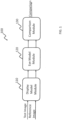
- FIG. 1 depicts a system for image testing according to various embodiments.
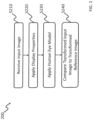
- FIG. 2 depicts a method of image testing according to various embodiments.
- an image testing system 100 and method 200 are configured to receive a test image and a reference image, process the images using display and eye characteristics, and compare the processed images to determine the human perceivable differences.
- the image testing system 100 may operate on a computing device, such as a server, workstation, laptop, or other computing device and work in conjunction with various input sources such as measurement devices for assessing display attributes.
- the testing system 100 includes a display model module 110, an eye model module 120, and a comparison module 130
- the test image includes an image that results from the use of a lossy compression algorithm used on the reference image.
- the display model module receives the test image and the reference image (S210).
- the display model module 110 is configured to apply the physical properties of a display to each of the reference image and the test image (e.g., to modify the image as if it were being displayed by the display).
- a given display may have a particular subpixel arrangement and a spectral emission.
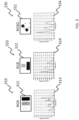
- FIG. 3 depicts various display subpixel and spectral emissions according to various embodiments.
- a display may have a variety of subpixel compositions.
- a display may have an RGB, RGBY, RGBW, RGBG, or other subpixel configuration.
- the subpixels may have various pixel geometries.
- an RGB display may have an RGB stripe arrangement, a triangular pattern arrangement, a diagonal pattern arrangement, a diamond arrangement, or other pixel arrangement (e.g., the second subpixel arrangement 322).
- RGBG, GRBY, and GRBW displays may have a variety of subpixel arrangements as well.
- a first display 310 has a first RGB subpixel arrangement 312
- a second display 320 has a second RGB subpixel arrangement 322
- a third display 330 has an RGBG subpixel arrangement 332.
- the subpixel arrangement of a display may be known, while in other embodiments, the subpixel arrangement may be determined by measuring using an infrared scanner or microscope. Once the arrangement has been determined, a user provides the subpixel arrangement (e.g., subpixel layout) to the display model module 110.
- the display model module 110 also incorporates the spectral emission of a display.
- the spectral emission of the display may, for example, be known or may be physically measured using a spectral radiometer.
- the first display 310 may have a first spectral emission 314, the second display 320 may have a second spectral emission 324, and the third display may have a third spectral emission 334.
- the user provides the spectral emission to the display model module 110.
- the spectral emission of the display and the subpixel arrangement is then used by the display model module 110 to modify an input image (e.g., the reference image and the test image) with the display properties and provide a display modified image to the eye model module (S220).
- an input image e.g., the reference image and the test image
- the eye model module S220
- the eye model module 120 is configured to receive display module modified input images (e.g., the reference image and the test image) and apply a human eye model to the images (S230).
- the human eye model may include an optical transfer function modeled on the perception of a human.
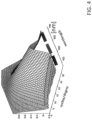
- FIG. 4 depicts an example optical transfer function of a human eye according to various embodiments.
- the eye model module 120 is configured to apply human eye characteristics to each input image (e.g., the test image and the reference image).
- the eye model module 120 is configured to apply an optical transfer function to each input image.
- the optical transfer function may be based on wavelength sensitivity and the complexity of the image measured by the spatial number of cycles per degree on the retina. As shown in FIG. 4 , human vision is generally more sensitive to green wavelengths than to blue and red wavelengths when viewing a complex image with a high number of cycles per degree. For example, a smoothly varying gradient (less than one cycle per degree spatial change) will pass the full visible spectrum. However, a complex image with noisy patterns, e.g.
- the eye model module 120 applies the optical transfer function to the display modified test image and reference image to generate display and eye modified reference and test images.
- the display and eye modified reference and test images are received by the comparison module 130.
- the comparison module 130 determines the differences between the transformed reference and test images (S240). For example, in various embodiments the comparison module 130 may transform the reference and test images into CIELAB color space (e.g., CIE L*a*b*). The transformed images may then be differenced and an output showing the perceivable differences may be generated. Thus, the user may objectively evaluate the quality of the test image.
- CIELAB color space e.g., CIE L*a*b*
- FIG. 5 depicts an embodiment of the testing system according to various embodiments.
- FIG. 6 depicts an embodiment of a method of testing an image according to various embodiments.
- the testing system 500 and method 600 may be configured to operate using spectral and three color (e.g., RGB) domains.
- an input image may include 3 color data and a display may be configured to receive the 3 color data and reproduce the input image according to a spectrum.
- a human observer likewise may process the image according to the spectral emission.
- a computational observer 505 is configured to receive an input image (S610) and process it based on the display and human physiology.
- the computational observer 505 may be configured to receive an RGB image (e.g., 3-color space image), apply a display's properties to the image to convert it to a spectral image, apply human physiological properties to the image, and convert the image back to RGB for further processing.
- the computational observer 505 may utilize Image System Engineering Toolbox for BIOlogy (ISETBIO) for performing operations.
- the computational observer 505 includes a display model module 510 and an eye model module 520.
- the display model module 510 receives the input image and a display subpixel arrangement.
- the display model module 512 includes a spatial arrangement module for modeling the displays subpixel layout and a spectral properties module 514 for modeling the displays spectral emission.
- the spatial arrangement module 512 uses the subpixel arrangement, creates a virtual subpixel matrix for the display (S620).
- the image is then applied to the virtual subpixel matrix to simulate the subpixel array displaying the input image (S630).
- the spectral properties module 514 receives the simulated subpixel array and converts the image from an RGB image to a spectrum image according to the spectral properties of the display (S640).
- a user may measure the actual spectral properties of the display and supply the spectral properties to the spectral properties module 514.
- the display modified spectral image is supplied to the eye model module 520 which applies a human retinal model (S650).
- the eye model module 520 includes a retinal model module 522 for simulating the retinal response to the supplied image and a cone absorption module 524 for simulating the absorption of image on simulated cones.
- the retinal model module 522 is configured to apply an optical transfer function to the supplied spectral image (e.g., as discussed above).
- the retinal modified image may be converted back to 3-color space from the spectral space (S660).
- cone absorption module 524 is configured to simulate the absorption of various colors based on sample arrangements of an eye's cones.
- the cone absorption module 524 applies cone absorption to the image (S670).
- the processed image may then be passed from the computational observer module 505 to the comparison module 530 which performs a comparison between the test image and the reference image (S680).
- describing a single pixel in the spectral domain may include 31 values (e.g., 31 8-bit values) instead of the 3 values (e.g., 3 8-bit or 10-bit values) used in the RGB domain.
- An input image may for example include a relatively high resolution.
- an input image may include a FullHD resolution (1920x1080 pixels), a 4k resolution (3840 x 2160 pixels), an 8k resolution (7680x4320 pixels), or any other resolution.
- converting an image from 3-color space to a spectral image may result in a relatively large size (e.g. a 10x increase in size).
- the testing system 500 may be configured to split an input image supplied to the system into a plurality of portions and the test system 500 and method 600 may run multiple times until each full image has been processed.
- the each portion of each image may be processed and the comparison module 530 may receive the complete processed test and reference images for comparison.
- corresponding portions of the test and reference images may be processed either consecutively or concurrently and the comparison module may compare each corresponding portion.
- FIG. 7 depicts an example method of processing an image by an eye model module according to various embodiments.
- FIG. 8 depicts example cone mosaics used by the eye model module according to various embodiments.
- the testing system is configured to apply an eye model that uses both retinal and cone absorption.
- a spectral image is received for applying human eye model processing (S710) (e.g., received at an eye model module as described above).
- a retinal model may be applied to the received image (S720).
- an optical transfer function may be applied to the spectral image.
- the image may then be converted from a spectral image to an RGB image (e.g., a 3-color image) (S730).
- a cone absorption mosaic may then be applied to the RGB image (S740).
- FIG. 8 depicts two examples of cone mosaics. On the left is an actual cone mosaic and on the right is a sampled representation.
- human eyes have 3 types of cones, each being configured to absorb different spectra of light. For example, short cones perceive blue light, medium cones perceive green light, and long cones perceive red light.
- the cone mosaics provide a simulation of the positioning of the cones in the retina.
- the cone mosaics may be applied for a plurality of eye positions (e.g., for twenty eye positions). For example, a person's eyes may make a variety of movements due to tremors, drift, and microcascades. Each of the resulting images may then be averaged (S750) and the resulting image may be output (S760).
- FIG. 9 depicts an example image comparison method according to various embodiments.
- the difference between the reference and test images may be calculated.
- a machine learning classifier may be used to classify whether the differences between the images are perceivable.
- the system may provide an output with numerical differences between the two images.
- the processed reference and test images are received and processed in CIELAB color space.
- S-CIELAB is utilized to compare the processed test and reference images.
- a 3-color reference image and a 3-color test image are received at CIE XYZ 910, 912 and converted from an "X, Y, Z" color space to "L*, a*, b*" color space at CIE L*a*b* 920, 922.
- the differences between the L*, a*, b* components at each pixel for the two images are calculated 930.
- the Euclidean distance is then be calculated (e.g. the square root of the sum of the squares of the differences for each component) 940.
- a pooling function 950 is then used to provide a single output representing the differences between the two images.
- the pooling function may include an average of the difference (e.g., Euclidean distances) across every pixel (e.g., the mean delta E ( ⁇ E )).
- the pooling function may use percentile (e.g., the median or 99th percentile).
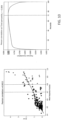
- FIGS. 10 , 11 , and 12 depict example results comparing the present system to past objective image testing systems.
- FIG. 10 depicts example results using a prior objective system (S-CIELAB).
- S-CIELAB prior objective system
- On the left is an error map comparing the mean delta E as a function of the mean response fraction.
- On the right is a graph of the Pearson correlation between the p-th percentile rank pooling of the error map.
- the prior art objective system results in a correlation of 0.8012 when compared to subjective results for an entire dataset.
- percentile rank pooling the correlation is slightly higher at 0.809 at the maximum for the 72nd percentile.
- FIG. 11 depicts example results using various embodiments of the present disclosure.
- FIG. 12 depicts a graphical comparison of the mean delta E and percentile rank methods using the correlation of embodiments of the present disclosure.
- the correlation using mean delta E is 0.8356 (as shown by the left chart) while the correlation using percentile rank increases to 0.8916 (as shown by the right chart).
- the outliers of the right chart are much closer to the estimated correlation line, thereby showing the improvement provided by the percentile rank pooling method.
- the term “substantially,” “about,” “approximately,” and similar terms are used as terms of approximation and not as terms of degree, and are intended to account for the inherent deviations in measured or calculated values that would be recognized by those of ordinary skill in the art.
- “About” or “approximately,” as used herein, is inclusive of the stated value and means within an acceptable range of deviation for the particular value as determined by one of ordinary skill in the art, considering the measurement in question and the error associated with measurement of the particular quantity (i.e., the limitations of the measurement system). For example, “about” may mean within one or more standard deviations, or within ⁇ 30%, 20%, 10%, 5% of the stated value.
- a specific process order may be performed differently from the described order.
- two consecutively described processes may be performed substantially at the same time or performed in an order opposite to the described order.
- a buried region formed by implantation may result in some implantation in the region between the buried region and the surface through which the implantation takes place.
- the regions illustrated in the drawings are schematic in nature and their shapes are not intended to illustrate the actual shape of a region of a device and are not intended to be limiting.
- the electronic or electric devices and/or any other relevant devices or components according to embodiments of the present disclosure described herein may be implemented utilizing any suitable hardware, firmware (e.g. an application-specific integrated circuit), software, or a combination of software, firmware, and hardware.
- the various components of these devices may be formed on one integrated circuit (IC) chip or on separate IC chips.
- the various components of these devices may be implemented on a flexible printed circuit film, a tape carrier package (TCP), a printed circuit board (PCB), or formed on one substrate.
- the various components of these devices may be a process or thread, running on one or more processors, in one or more computing devices, executing computer program instructions and interacting with other system components for performing the various functionalities described herein.
- the computer program instructions are stored in a memory which may be implemented in a computing device using a standard memory device, such as, for example, a random access memory (RAM).
- the computer program instructions may also be stored in other non-transitory computer readable media such as, for example, a CD-ROM, flash drive, or the like.
- a person of skill in the art should recognize that the functionality of various computing devices may be combined or integrated into a single computing device, or the functionality of a particular computing device may be distributed across one or more other computing devices without departing from the scope of the exemplary embodiments of the present disclosure.
Landscapes
- Engineering & Computer Science (AREA)
- Theoretical Computer Science (AREA)
- Physics & Mathematics (AREA)
- General Physics & Mathematics (AREA)
- Signal Processing (AREA)
- Multimedia (AREA)
- Computer Vision & Pattern Recognition (AREA)
- Quality & Reliability (AREA)
- Biomedical Technology (AREA)
- Computer Hardware Design (AREA)
- General Health & Medical Sciences (AREA)
- Health & Medical Sciences (AREA)
- Eye Examination Apparatus (AREA)
- Testing, Inspecting, Measuring Of Stereoscopic Televisions And Televisions (AREA)
- Measurement Of The Respiration, Hearing Ability, Form, And Blood Characteristics Of Living Organisms (AREA)
Claims (3)
- Verfahren zum Vergleichen von Bildern für die objektive Bewertung der Qualität eines Bildes, das von einer Anzeigevorrichtung angezeigt wird, unter Verwendung eines Bildtestsystems, das einen Prozessor und einen Speicher umfasst, wobei das Verfahren Folgendes umfasst:Anwenden einer Vielzahl von Anzeigeeigenschaften der Anzeigevorrichtung auf ein Testbild, um ein anzeigemodifiziertes Testbild zu erzeugen;wobei das Testbild ein Bild ist, das eine modifizierte Version eines Referenzbildes ist, wobei die modifizierte Version des Referenzbildes ein Bild ist, das aus der Anwendung eines verlustbehafteten Kompressionsalgorithmus auf das Referenzbild resultiert;wobei die Vielzahl von Anzeigeeigenschaften ein Subpixellayout und eine spektrale Emission (314; 324; 334) umfasst; undwobei das Anwenden der Vielzahl von Anzeigeeigenschaften auf das Testbild, um das anzeigemodifizierte Testbild zu erzeugen, die folgenden Schritte umfasst:(i) Erzeugen einer Subpixelmatrix für die Anzeige auf Grundlage des Subpixellayouts;(ii) Anwenden der Subpixelmatrix auf das Testbild;(iii) Umwandeln des Testbildes in den Spektralbereich aus dem 3-Farben-Raum; und(iv) Anwenden der spektralen Emission (314; 324; 334) auf das Testbild;Anwenden der Vielzahl von Anzeigeeigenschaften auf das Referenzbild, um ein anzeigemodifiziertes Referenzbild zu erzeugen;wobei das Anwenden der Vielzahl von Anzeigeeigenschaften auf das Referenzbild, um das anzeigemodifizierte Referenzbild zu erzeugen, Folgendes umfasst:(i) Anwenden der Subpixelmatrix auf das Referenzbild;(ii) Umwandeln des Referenzbildes in die Spektraldomäne aus dem 3-Farben-Raum; und(iii) Anwenden der spektralen Emission (314; 324; 334) auf die Referenz;Anwenden eines menschlichen Augenmodells auf das anzeigemodifizierte Testbild, um ein augenmodifiziertes Testbild zu erzeugen;Anwenden des menschlichen Augenmodells auf das anzeigemodifizierte Referenzbild, um ein augenmodifiziertes Referenzbild zu erzeugen; undVergleichen des augenmodifizierten Testbildes mit dem augenmodifizierten Referenzbild, um eine Schätzung dessen zu bestimmen, was ein Mensch beim Betrachten des Testbildes und des Referenzbildes auf der Anzeige unterschiedlich wahrnehmen würde,wobei das Anwenden des menschlichen Augenmodells Folgendes umfasst:Umwandeln des augenmodifizierten Testbildes aus der Spektraldomäne in einen 3-Farben-Raum;Umwandeln des augenmodifizierten Referenzbildes aus der Spektraldomäne in einen 3-Farben-Raum;Anwenden eines Konusabsorptionsmosaiks auf das augenmodifizierte Testbild für eine Vielzahl von Augenpositionen, um eine Vielzahl von Konusabsorptionstestbildern zu erzeugen;Anwenden eines Konusabsorptionsmosaiks auf das augenmodifizierte Referenzbild für die Vielzahl von Augenpositionen, um eine Vielzahl von Konusabsorptionsreferenzbildern zu erzeugen;Mitteln der Vielzahl von Konusabsorptionstestbildern, um das augenmodifizierte Testbild zu erzeugen; undMitteln der Vielzahl von Konusabsorptionsreferenzbildern, um das augenmodifizierte Referenzbild zu erzeugen,wobei das Vergleichen des augenmodifizierten Testbildes mit dem augenmodifizierten Referenzbild Folgendes umfasst:Transformieren des augenmodifizierten Referenzbildes und des augenmodifizierten Testbildes in den CIELAB-Farbraum;Berechnen des euklidischen Abstands zwischen jedem Pixel in dem augenmodifizierten Referenzbild und dem entsprechenden Pixel in dem augenmodifizierten Referenzbild; undAnwenden einer Pooling-Funktion (950) auf die euklidischen Abstände, um eine einzige Ausgabe bereitzustellen, die die Unterschiede zwischen den beiden Bildern darstellt.
- Verfahren nach Anspruch 1, wobei:Anwenden eines menschlichen Augenmodells auf das anzeigemodifizierte Testbild, um ein augenmodifiziertes Testbild zu erzeugen, das Anwenden einer optischen Übertragungsfunktion auf das anzeigemodifizierte Testbild umfasst; undAnwenden des menschlichen Augenmodells auf das anzeigemodifizierte Referenzbild, um ein augenmodifiziertes Referenzbild zu erzeugen, das Anwenden der optischen Übertragungsfunktion auf das anzeigemodifizierte Referenzbild umfasst.
- Bildtestsystem für die objektive Bewertung der Qualität eines Bildes, das durch eine Anzeigevorrichtung angezeigt wird, wobei das System Folgendes umfasst:
einen Prozessor und einen Speicher, der Anweisungen speichert, um den Prozessor zu Folgendem zu veranlassen:Anwenden einer Vielzahl von Anzeigeeigenschaften der Anzeigevorrichtung unter Verwendung eines Anzeigemodellmoduls (110; 510) der Anzeigevorrichtung auf ein Testbild, um ein anzeigemodifiziertes Testbild zu erzeugen;wobei das Testbild ein Bild einschließt, das eine modifizierte Version eines Referenzbildes ist, wobei die modifizierte Version des Referenzbildes ein Bild ist, das aus der Anwendung eines verlustbehafteten Kompressionsalgorithmus auf das Referenzbild resultiert;wobei die Vielzahl von Anzeigeeigenschaften ein Subpixellayout und eine spektrale Emission (314; 324; 334) umfasst undwobei das Anwenden der Vielzahl von Anzeigeeigenschaften auf das Testbild, um das anzeigemodifizierte Testbild zu erzeugen, die folgenden Schritte umfasst:(i) Erzeugen einer Subpixelmatrix für die Anzeige auf Grundlage des Subpixellayouts;(ii) Anwenden der Subpixelmatrix auf das Testbild;(iii) Umwandeln des Testbildes in den Spektralbereich aus dem 3-Farben-Raum; und(iv) Anwenden der spektralen Emission (314; 324; 334) auf das Testbild;Anwenden der Vielzahl von Anzeigeeigenschaften unter Verwendung des Anzeigemodellmoduls (110; 510) auf das Referenzbild, um ein modifiziertes Anzeigereferenzbild zu erzeugen;wobei das Anwenden der Vielzahl von Anzeigeeigenschaften auf das Referenzbild, um das anzeigemodifizierte Referenzbild zu erzeugen, die folgenden Schritte umfasst:(i) Anwenden der Subpixelmatrix auf das Referenzbild;(ii) Umwandeln des Referenzbildes in die Spektraldomäne aus dem 3-Farben-Raum; und(iii) Anwenden der spektralen Emission (314; 324; 334) auf das Referenzbild;Anwenden, unter Verwendung eines Augenmodellmoduls (120; 520), eines menschlichen Augenmodells auf das anzeigemodifizierte Testbild, um ein augenmodifiziertes Testbild zu erzeugen;Anwenden, unter Verwendung des Augenmodellmoduls (120; 520), eines menschlichen Augenmodells auf das anzeigemodifizierte Referenzbild, um ein augenmodifiziertes Referenzbild zu erzeugen; undVergleichen des augenmodifizierten Testbilds mit dem augenmodifizierten Referenzbild unter Verwendung eines Vergleichsmoduls (130; 530), um eine Schätzung dessen zu bestimmen, was ein Mensch beim Betrachten des Testbilds und des Referenzbilds auf der Anzeige anders wahrnehmen würde, wobei das Anwenden des menschlichen Augenmodells Folgendes umfasst:Umwandeln des augenmodifizierten Testbildes aus der Spektraldomäne in einen 3-Farben-Raum;Umwandeln des augenmodifizierten Referenzbildes aus der Spektraldomäne in einen 3-Farben-Raum;Anwenden eines Konusabsorptionsmosaiks auf das augenmodifizierte Testbild für eine Vielzahl von Augenpositionen, um eine Vielzahl von Konusabsorptionstestbildern zu erzeugen;Anwenden eines Konusabsorptionsmosaiks auf das augenmodifizierte Referenzbild für die Vielzahl von Augenpositionen, um eine Vielzahl von Konusabsorptionsreferenzbildern zu erzeugen;Mitteln der Vielzahl von Konusabsorptionstestbildern, um das augenmodifizierte Testbild zu erzeugen; undMitteln der Vielzahl von Konusabsorptionsreferenzbildern, um das augenmodifizierte Referenzbild zu erzeugen,wobei das Vergleichen des augenmodifizierten Testbildes mit dem augenmodifizierten Referenzbild Folgendes umfasst:Transformieren des augenmodifizierten Referenzbildes und des augenmodifizierten Testbildes in den CIELAB-Farbraum;Berechnen des euklidischen Abstands zwischen jedem Pixel in dem augenmodifizierten Referenzbild und dem entsprechenden Pixel in dem augenmodifizierten Referenzbild; undAnwenden einer Pooling-Funktion (950) auf die euklidischen Abstände, um eine einzige Ausgabe bereitzustellen, die die Unterschiede zwischen den beiden Bildern darstellt.
Applications Claiming Priority (2)
| Application Number | Priority Date | Filing Date | Title |
|---|---|---|---|
| US201762542245P | 2017-08-07 | 2017-08-07 | |
| US16/052,545 US10769817B2 (en) | 2017-08-07 | 2018-08-01 | Measures for image testing |
Publications (2)
| Publication Number | Publication Date |
|---|---|
| EP3441963A1 EP3441963A1 (de) | 2019-02-13 |
| EP3441963B1 true EP3441963B1 (de) | 2023-05-03 |
Family
ID=63174021
Family Applications (1)
| Application Number | Title | Priority Date | Filing Date |
|---|---|---|---|
| EP18187870.3A Active EP3441963B1 (de) | 2017-08-07 | 2018-08-07 | Massnahmen zur bildprüfung |
Country Status (4)
| Country | Link |
|---|---|
| US (2) | US10769817B2 (de) |
| EP (1) | EP3441963B1 (de) |
| KR (1) | KR20190016460A (de) |
| CN (1) | CN109474821B (de) |
Families Citing this family (5)
| Publication number | Priority date | Publication date | Assignee | Title |
|---|---|---|---|---|
| CN110472003B (zh) * | 2019-08-08 | 2022-02-22 | 东北大学 | 基于图卷积网络的社交网络文本情感细粒度分类方法 |
| WO2022044478A1 (ja) * | 2020-08-25 | 2022-03-03 | 株式会社Jvcケンウッド | 評価システム、評価管理方法、端末装置及び評価方法 |
| US12165384B2 (en) * | 2022-05-17 | 2024-12-10 | Fmr Llc | Methods and systems for automated cross-browser user interface testing |
| WO2025147948A1 (en) * | 2024-01-11 | 2025-07-17 | Jade Bird Display (shanghai) Limited | Method and system for correcting nonuniformity of near-eye display |
| US20260070487A1 (en) * | 2024-09-09 | 2026-03-12 | GM Global Technology Operations LLC | Digital mirror monitoring system using microsensors |
Citations (2)
| Publication number | Priority date | Publication date | Assignee | Title |
|---|---|---|---|---|
| US20100149344A1 (en) * | 2008-12-12 | 2010-06-17 | Tektronix, Inc. | Method and apparatus for implementing moving image color appearance model for video quality ratings prediction |
| EP2611187A2 (de) * | 2011-12-29 | 2013-07-03 | Tektronix Inc. | Verfahren zur Vorhersage von Wahrnehmungsunterschieden zwischen Erinnerung und direkt angezeigten Farben in einem Video |
Family Cites Families (42)
| Publication number | Priority date | Publication date | Assignee | Title |
|---|---|---|---|---|
| US5664158A (en) * | 1995-04-25 | 1997-09-02 | The United States Of America As Represented By The Administrator Of The National Aeronautics And Space Administration | Video display engineering and optimization system |
| JP2000163594A (ja) * | 1998-11-30 | 2000-06-16 | Canon Inc | 画像パタ―ン検出方法及び装置 |
| KR100618975B1 (ko) * | 1999-09-03 | 2006-09-01 | 삼성전자주식회사 | 디스플레이장치의 음영 보정장치 및 그 방법 |
| US6791716B1 (en) * | 2000-02-18 | 2004-09-14 | Eastmas Kodak Company | Color image reproduction of scenes with preferential color mapping |
| US6781724B1 (en) * | 2000-06-13 | 2004-08-24 | Eastman Kodak Company | Image processing and manipulation system |
| US9143706B2 (en) * | 2001-06-06 | 2015-09-22 | Andrew Zador | Imaging system utilizing spatial image oscillation |
| DE10234085B4 (de) * | 2002-07-26 | 2012-10-18 | Koenig & Bauer Aktiengesellschaft | Verfahren zur Analyse von Farbabweichungen von Bildern mit einem Bildsensor |
| DE10314071B3 (de) * | 2003-03-28 | 2004-09-30 | Koenig & Bauer Ag | Verfahren zur qualitativen Beurteilung eines Materials mit mindestens einem Erkennungsmerkmal |
| WO2006049352A1 (en) * | 2004-11-01 | 2006-05-11 | Samsung Electronics Co., Ltd. | The test system and method of image regeneration apparatus |
| WO2006060393A2 (en) * | 2004-11-30 | 2006-06-08 | Bg Medicine, Inc. | Biological systems analysis |
| US20060167670A1 (en) * | 2005-01-26 | 2006-07-27 | Deering Michael F | Photon-based modeling of the human eye and visual perception |
| US7586644B2 (en) * | 2006-02-15 | 2009-09-08 | Conexant Systems, Inc. | Color conversion system and method |
| US8243326B2 (en) | 2006-09-11 | 2012-08-14 | Electronics For Imaging, Inc. | Methods and apparatus for color profile editing |
| US20080117231A1 (en) * | 2006-11-19 | 2008-05-22 | Tom Kimpe | Display assemblies and computer programs and methods for defect compensation |
| EP1971156A1 (de) * | 2007-03-13 | 2008-09-17 | Thomson Licensing | Verfahren zur Anzeige von Bildern mit Anwendung von Metamerie als Schutz vor illegaler Kopie |
| JP5398156B2 (ja) * | 2008-03-04 | 2014-01-29 | キヤノン株式会社 | ホワイトバランス制御装置およびその制御方法並びに撮像装置 |
| US8031938B2 (en) | 2008-04-14 | 2011-10-04 | Eastman Kodak Company | Method and apparatus for providing improved human observer XYZ functions and calculations for CIELAB |
| DE102008041458B4 (de) * | 2008-08-22 | 2012-11-08 | Carl Zeiss Vision Gmbh | Verfahren und Vorrichtung zur Bestimmung der neuronalen Kontrastempfindlichkeit |
| KR20110098845A (ko) * | 2008-12-23 | 2011-09-01 | 프라운호퍼 게젤샤프트 쭈르 푀르데룽 데어 안겐반텐 포르슝 에. 베. | 인간에 대한 일주 효력을 가지는 디스플레이 시스템 |
| JP2011135216A (ja) * | 2009-12-22 | 2011-07-07 | Sony Corp | 表示装置の評価方法 |
| KR101080846B1 (ko) | 2010-03-30 | 2011-11-07 | 중앙대학교 산학협력단 | 보정 행렬의 추정에 의한 영상의 색상 손상 보정장치 및 방법 |
| EP2375230A1 (de) | 2010-04-09 | 2011-10-12 | Thomson Licensing | Verfahren zur Steuerung einer Bildanzeigevorrichtung, um die gleiche Farbwahrnehmung für eine Vielzahl von Beobachtern zu gewährleisten |
| US8532371B2 (en) * | 2010-10-04 | 2013-09-10 | Datacolor Holding Ag | Method and apparatus for evaluating color in an image |
| US9087274B2 (en) * | 2010-12-07 | 2015-07-21 | Prosper Creative Co., Ltd. | Color information processing method, color information processing apparatus, and color information processing system |
| EP2788855B1 (de) * | 2011-12-06 | 2016-06-01 | Dolby Laboratories Licensing Corporation | Vorrichtung und verfahren zur verbesserung eines bilddatenaustauschs auf basis einer wahrnehmungsbezogenen luminanznichtlinearität zwischen verschiedenen anzeigefunktionen |
| US8705071B2 (en) * | 2012-04-03 | 2014-04-22 | Infoprint Solutions Company Llc | Bitmap compare mechanism |
| US9256803B2 (en) | 2012-09-14 | 2016-02-09 | Palo Alto Research Center Incorporated | Automatic detection of persistent changes in naturally varying scenes |
| CN104364820B (zh) * | 2012-10-08 | 2018-04-10 | 皇家飞利浦有限公司 | 具有颜色约束的亮度改变图像处理 |
| CN202928783U (zh) * | 2012-11-22 | 2013-05-08 | 清华大学深圳研究生院 | 裸眼3d显示图像源和显示设备综合测试系统 |
| EP2743657B1 (de) | 2012-12-13 | 2016-03-02 | Thomson Licensing | Verfahren zur Steuerung einer Bildanzeigevorrichtung um zu ermöglichen, dass ein Beobachter Farben wahrnehmen kann wie ein anderer Beobachter |
| US20140254897A1 (en) * | 2013-03-06 | 2014-09-11 | Tektronix, Inc. | Design verification and diagnostics for image devices |
| US9164874B1 (en) * | 2013-12-20 | 2015-10-20 | Amazon Technologies, Inc. | Testing conversion and rendering of digital content |
| RU2686642C2 (ru) * | 2014-08-08 | 2019-04-29 | Конинклейке Филипс Н.В. | Способы и устройства для кодирования hdr-изображений |
| AU2015207825A1 (en) * | 2015-07-28 | 2017-02-16 | Canon Kabushiki Kaisha | Method, apparatus and system for encoding video data for selected viewing conditions |
| JP6320440B2 (ja) * | 2015-08-04 | 2018-05-09 | ドルビー ラボラトリーズ ライセンシング コーポレイション | ハイダイナミックレンジ信号のための信号再構成 |
| AU2015218498A1 (en) * | 2015-08-27 | 2017-03-16 | Canon Kabushiki Kaisha | Method, apparatus and system for displaying images |
| KR102121676B1 (ko) * | 2015-09-21 | 2020-06-10 | 돌비 레버러토리즈 라이쎈싱 코오포레이션 | 지각 코드 공간에서 디스플레이를 동작시키기 위한 기술들 |
| US20190057673A1 (en) * | 2016-01-18 | 2019-02-21 | Waveshift Llc | Method and apparatus for reducing myopiagenic effect of electronic displays |
| US10679544B2 (en) * | 2016-01-29 | 2020-06-09 | Barco Nv | Digital image processing chain and processing blocks and a display including the same |
| US10397586B2 (en) * | 2016-03-30 | 2019-08-27 | Dolby Laboratories Licensing Corporation | Chroma reshaping |
| US10659790B2 (en) * | 2016-04-22 | 2020-05-19 | Dolby Laboratories Licensing Corporation | Coding of HDR video signals in the ICtCp color format |
| US10542296B2 (en) * | 2016-05-10 | 2020-01-21 | Dolby Laboratories Licensing Corporation | Chroma reshaping of HDR video signals |
-
2018
- 2018-08-01 US US16/052,545 patent/US10769817B2/en not_active Expired - Fee Related
- 2018-08-07 KR KR1020180092066A patent/KR20190016460A/ko not_active Ceased
- 2018-08-07 CN CN201810892304.1A patent/CN109474821B/zh active Active
- 2018-08-07 EP EP18187870.3A patent/EP3441963B1/de active Active
-
2020
- 2020-07-28 US US16/941,340 patent/US10902644B2/en active Active
Patent Citations (2)
| Publication number | Priority date | Publication date | Assignee | Title |
|---|---|---|---|---|
| US20100149344A1 (en) * | 2008-12-12 | 2010-06-17 | Tektronix, Inc. | Method and apparatus for implementing moving image color appearance model for video quality ratings prediction |
| EP2611187A2 (de) * | 2011-12-29 | 2013-07-03 | Tektronix Inc. | Verfahren zur Vorhersage von Wahrnehmungsunterschieden zwischen Erinnerung und direkt angezeigten Farben in einem Video |
Non-Patent Citations (1)
| Title |
|---|
| MARTIN R A ET AL: "COLOR MATRIX DISPLAY SIMULATION BASED UPON LUMINANCE AND CHROMATIC CONTRAST SENSITIVITY OF EARLY VISION", PROCEEDINGS OF SPIE/ IS & T,, vol. 1666, 10 February 1992 (1992-02-10), pages 336 - 342, XP008005090, ISBN: 978-1-62841-730-2, DOI: 10.1117/12.135979 * |
Also Published As
| Publication number | Publication date |
|---|---|
| US10769817B2 (en) | 2020-09-08 |
| US10902644B2 (en) | 2021-01-26 |
| US20200388055A1 (en) | 2020-12-10 |
| KR20190016460A (ko) | 2019-02-18 |
| EP3441963A1 (de) | 2019-02-13 |
| CN109474821B (zh) | 2022-05-06 |
| US20190043222A1 (en) | 2019-02-07 |
| CN109474821A (zh) | 2019-03-15 |
Similar Documents
| Publication | Publication Date | Title |
|---|---|---|
| US10902644B2 (en) | Measures for image testing | |
| Mantiuk et al. | Fovvideovdp: A visible difference predictor for wide field-of-view video | |
| US8831343B2 (en) | Image processing and displaying methods for devices that implement color appearance models | |
| CN112954304B (zh) | 一种显示面板Mura缺陷评估方法 | |
| Adams et al. | Naturally glossy: Gloss perception, illumination statistics, and tone mapping | |
| US9076376B2 (en) | Subtractive color based display white point calibration | |
| Hincapié-Ramos et al. | SmartColor: real-time color and contrast correction for optical see-through head-mounted displays | |
| Chen et al. | Pea-pods: Perceptual evaluation of algorithms for power optimization in xr displays | |
| KR20230099610A (ko) | 스크린 광 누설량을 추정하는 방법, 장치 및 전자기기 | |
| CN104902141A (zh) | 图像处理方法及装置 | |
| Zabala‐Travers et al. | Effect of color visualization and display hardware on the visual assessment of pseudocolor medical images | |
| Coninx et al. | Visualization of uncertain scalar data fields using color scales and perceptually adapted noise | |
| KR102942136B1 (ko) | 영상 보정 장치 및 영상 보정 방법 | |
| Liang et al. | Image browsing in slow medical liquid crystal displays | |
| Zerman et al. | Effects of display rendering on HDR image quality assessment | |
| Badano et al. | Effect of viewing angle on visual detection in liquid crystal displays | |
| Kim et al. | High-accurate and fast power model based on channel dependency for mobile AMOLED displays | |
| US20240240985A1 (en) | Information Processing Apparatus And Information Processing Method | |
| Tsai et al. | Identifying regions of interest in reading an image | |
| Bhaumik et al. | Analyzing colorimetric characterization models for virtual reality headsets: a comparative study | |
| Choudhury et al. | Prediction of HDR quality by combining perceptually transformed display measurements with machine learning | |
| Lin et al. | Image quality of a mobile display under different illuminations | |
| Li et al. | 3‐4: Human Perception as a Measure: Evaluating Waveguide Non‐Uniformity in Augmented Reality Technology | |
| Aydin et al. | Predicting display visibility under dynamically changing lighting conditions | |
| Farrell et al. | Characterization of visual stimuli using the standard display model |
Legal Events
| Date | Code | Title | Description |
|---|---|---|---|
| PUAI | Public reference made under article 153(3) epc to a published international application that has entered the european phase |
Free format text: ORIGINAL CODE: 0009012 |
|
| STAA | Information on the status of an ep patent application or granted ep patent |
Free format text: STATUS: REQUEST FOR EXAMINATION WAS MADE |
|
| 17P | Request for examination filed |
Effective date: 20181211 |
|
| AK | Designated contracting states |
Kind code of ref document: A1 Designated state(s): AL AT BE BG CH CY CZ DE DK EE ES FI FR GB GR HR HU IE IS IT LI LT LU LV MC MK MT NL NO PL PT RO RS SE SI SK SM TR |
|
| AX | Request for extension of the european patent |
Extension state: BA ME |
|
| STAA | Information on the status of an ep patent application or granted ep patent |
Free format text: STATUS: EXAMINATION IS IN PROGRESS |
|
| 17Q | First examination report despatched |
Effective date: 20200226 |
|
| RIC1 | Information provided on ipc code assigned before grant |
Ipc: G09G 3/00 20060101AFI20210414BHEP Ipc: G09G 5/02 20060101ALI20210414BHEP Ipc: G06T 7/00 20170101ALN20210414BHEP Ipc: H04N 17/04 20060101ALN20210414BHEP |
|
| RIC1 | Information provided on ipc code assigned before grant |
Ipc: G09G 3/00 20060101AFI20210421BHEP Ipc: G09G 5/02 20060101ALI20210421BHEP Ipc: G06T 7/00 20170101ALN20210421BHEP Ipc: H04N 17/04 20060101ALN20210421BHEP |
|
| GRAP | Despatch of communication of intention to grant a patent |
Free format text: ORIGINAL CODE: EPIDOSNIGR1 |
|
| STAA | Information on the status of an ep patent application or granted ep patent |
Free format text: STATUS: GRANT OF PATENT IS INTENDED |
|
| RIC1 | Information provided on ipc code assigned before grant |
Ipc: H04N 17/04 20060101ALN20221026BHEP Ipc: G06T 7/00 20170101ALN20221026BHEP Ipc: G09G 5/02 20060101ALI20221026BHEP Ipc: G09G 3/00 20060101AFI20221026BHEP |
|
| RIC1 | Information provided on ipc code assigned before grant |
Ipc: H04N 17/04 20060101ALN20221104BHEP Ipc: G06T 7/00 20170101ALN20221104BHEP Ipc: G09G 5/02 20060101ALI20221104BHEP Ipc: G09G 3/00 20060101AFI20221104BHEP |
|
| INTG | Intention to grant announced |
Effective date: 20221121 |
|
| GRAS | Grant fee paid |
Free format text: ORIGINAL CODE: EPIDOSNIGR3 |
|
| GRAA | (expected) grant |
Free format text: ORIGINAL CODE: 0009210 |
|
| STAA | Information on the status of an ep patent application or granted ep patent |
Free format text: STATUS: THE PATENT HAS BEEN GRANTED |
|
| AK | Designated contracting states |
Kind code of ref document: B1 Designated state(s): AL AT BE BG CH CY CZ DE DK EE ES FI FR GB GR HR HU IE IS IT LI LT LU LV MC MK MT NL NO PL PT RO RS SE SI SK SM TR |
|
| REG | Reference to a national code |
Ref country code: GB Ref legal event code: FG4D |
|
| REG | Reference to a national code |
Ref country code: DE Ref legal event code: R096 Ref document number: 602018049126 Country of ref document: DE |
|
| REG | Reference to a national code |
Ref country code: AT Ref legal event code: REF Ref document number: 1565336 Country of ref document: AT Kind code of ref document: T Effective date: 20230515 Ref country code: CH Ref legal event code: EP |
|
| REG | Reference to a national code |
Ref country code: IE Ref legal event code: FG4D |
|
| P01 | Opt-out of the competence of the unified patent court (upc) registered |
Effective date: 20230516 |
|
| REG | Reference to a national code |
Ref country code: NL Ref legal event code: FP |
|
| REG | Reference to a national code |
Ref country code: LT Ref legal event code: MG9D |
|
| REG | Reference to a national code |
Ref country code: AT Ref legal event code: MK05 Ref document number: 1565336 Country of ref document: AT Kind code of ref document: T Effective date: 20230503 |
|
| PG25 | Lapsed in a contracting state [announced via postgrant information from national office to epo] |
Ref country code: SE Free format text: LAPSE BECAUSE OF FAILURE TO SUBMIT A TRANSLATION OF THE DESCRIPTION OR TO PAY THE FEE WITHIN THE PRESCRIBED TIME-LIMIT Effective date: 20230503 Ref country code: PT Free format text: LAPSE BECAUSE OF FAILURE TO SUBMIT A TRANSLATION OF THE DESCRIPTION OR TO PAY THE FEE WITHIN THE PRESCRIBED TIME-LIMIT Effective date: 20230904 Ref country code: NO Free format text: LAPSE BECAUSE OF FAILURE TO SUBMIT A TRANSLATION OF THE DESCRIPTION OR TO PAY THE FEE WITHIN THE PRESCRIBED TIME-LIMIT Effective date: 20230803 Ref country code: ES Free format text: LAPSE BECAUSE OF FAILURE TO SUBMIT A TRANSLATION OF THE DESCRIPTION OR TO PAY THE FEE WITHIN THE PRESCRIBED TIME-LIMIT Effective date: 20230503 Ref country code: AT Free format text: LAPSE BECAUSE OF FAILURE TO SUBMIT A TRANSLATION OF THE DESCRIPTION OR TO PAY THE FEE WITHIN THE PRESCRIBED TIME-LIMIT Effective date: 20230503 |
|
| PG25 | Lapsed in a contracting state [announced via postgrant information from national office to epo] |
Ref country code: RS Free format text: LAPSE BECAUSE OF FAILURE TO SUBMIT A TRANSLATION OF THE DESCRIPTION OR TO PAY THE FEE WITHIN THE PRESCRIBED TIME-LIMIT Effective date: 20230503 Ref country code: PL Free format text: LAPSE BECAUSE OF FAILURE TO SUBMIT A TRANSLATION OF THE DESCRIPTION OR TO PAY THE FEE WITHIN THE PRESCRIBED TIME-LIMIT Effective date: 20230503 Ref country code: LV Free format text: LAPSE BECAUSE OF FAILURE TO SUBMIT A TRANSLATION OF THE DESCRIPTION OR TO PAY THE FEE WITHIN THE PRESCRIBED TIME-LIMIT Effective date: 20230503 Ref country code: LT Free format text: LAPSE BECAUSE OF FAILURE TO SUBMIT A TRANSLATION OF THE DESCRIPTION OR TO PAY THE FEE WITHIN THE PRESCRIBED TIME-LIMIT Effective date: 20230503 Ref country code: IS Free format text: LAPSE BECAUSE OF FAILURE TO SUBMIT A TRANSLATION OF THE DESCRIPTION OR TO PAY THE FEE WITHIN THE PRESCRIBED TIME-LIMIT Effective date: 20230903 Ref country code: HR Free format text: LAPSE BECAUSE OF FAILURE TO SUBMIT A TRANSLATION OF THE DESCRIPTION OR TO PAY THE FEE WITHIN THE PRESCRIBED TIME-LIMIT Effective date: 20230503 Ref country code: GR Free format text: LAPSE BECAUSE OF FAILURE TO SUBMIT A TRANSLATION OF THE DESCRIPTION OR TO PAY THE FEE WITHIN THE PRESCRIBED TIME-LIMIT Effective date: 20230804 |
|
| PG25 | Lapsed in a contracting state [announced via postgrant information from national office to epo] |
Ref country code: FI Free format text: LAPSE BECAUSE OF FAILURE TO SUBMIT A TRANSLATION OF THE DESCRIPTION OR TO PAY THE FEE WITHIN THE PRESCRIBED TIME-LIMIT Effective date: 20230503 |
|
| PG25 | Lapsed in a contracting state [announced via postgrant information from national office to epo] |
Ref country code: SK Free format text: LAPSE BECAUSE OF FAILURE TO SUBMIT A TRANSLATION OF THE DESCRIPTION OR TO PAY THE FEE WITHIN THE PRESCRIBED TIME-LIMIT Effective date: 20230503 |
|
| PG25 | Lapsed in a contracting state [announced via postgrant information from national office to epo] |
Ref country code: SM Free format text: LAPSE BECAUSE OF FAILURE TO SUBMIT A TRANSLATION OF THE DESCRIPTION OR TO PAY THE FEE WITHIN THE PRESCRIBED TIME-LIMIT Effective date: 20230503 Ref country code: SK Free format text: LAPSE BECAUSE OF FAILURE TO SUBMIT A TRANSLATION OF THE DESCRIPTION OR TO PAY THE FEE WITHIN THE PRESCRIBED TIME-LIMIT Effective date: 20230503 Ref country code: RO Free format text: LAPSE BECAUSE OF FAILURE TO SUBMIT A TRANSLATION OF THE DESCRIPTION OR TO PAY THE FEE WITHIN THE PRESCRIBED TIME-LIMIT Effective date: 20230503 Ref country code: EE Free format text: LAPSE BECAUSE OF FAILURE TO SUBMIT A TRANSLATION OF THE DESCRIPTION OR TO PAY THE FEE WITHIN THE PRESCRIBED TIME-LIMIT Effective date: 20230503 Ref country code: DK Free format text: LAPSE BECAUSE OF FAILURE TO SUBMIT A TRANSLATION OF THE DESCRIPTION OR TO PAY THE FEE WITHIN THE PRESCRIBED TIME-LIMIT Effective date: 20230503 Ref country code: CZ Free format text: LAPSE BECAUSE OF FAILURE TO SUBMIT A TRANSLATION OF THE DESCRIPTION OR TO PAY THE FEE WITHIN THE PRESCRIBED TIME-LIMIT Effective date: 20230503 |
|
| REG | Reference to a national code |
Ref country code: DE Ref legal event code: R097 Ref document number: 602018049126 Country of ref document: DE |
|
| PLBE | No opposition filed within time limit |
Free format text: ORIGINAL CODE: 0009261 |
|
| STAA | Information on the status of an ep patent application or granted ep patent |
Free format text: STATUS: NO OPPOSITION FILED WITHIN TIME LIMIT |
|
| PG25 | Lapsed in a contracting state [announced via postgrant information from national office to epo] |
Ref country code: MC Free format text: LAPSE BECAUSE OF FAILURE TO SUBMIT A TRANSLATION OF THE DESCRIPTION OR TO PAY THE FEE WITHIN THE PRESCRIBED TIME-LIMIT Effective date: 20230503 |
|
| REG | Reference to a national code |
Ref country code: CH Ref legal event code: PL |
|
| PG25 | Lapsed in a contracting state [announced via postgrant information from national office to epo] |
Ref country code: MC Free format text: LAPSE BECAUSE OF FAILURE TO SUBMIT A TRANSLATION OF THE DESCRIPTION OR TO PAY THE FEE WITHIN THE PRESCRIBED TIME-LIMIT Effective date: 20230503 |
|
| 26N | No opposition filed |
Effective date: 20240206 |
|
| PG25 | Lapsed in a contracting state [announced via postgrant information from national office to epo] |
Ref country code: LU Free format text: LAPSE BECAUSE OF NON-PAYMENT OF DUE FEES Effective date: 20230807 |
|
| PG25 | Lapsed in a contracting state [announced via postgrant information from national office to epo] |
Ref country code: LU Free format text: LAPSE BECAUSE OF NON-PAYMENT OF DUE FEES Effective date: 20230807 Ref country code: CH Free format text: LAPSE BECAUSE OF NON-PAYMENT OF DUE FEES Effective date: 20230831 |
|
| PG25 | Lapsed in a contracting state [announced via postgrant information from national office to epo] |
Ref country code: SI Free format text: LAPSE BECAUSE OF FAILURE TO SUBMIT A TRANSLATION OF THE DESCRIPTION OR TO PAY THE FEE WITHIN THE PRESCRIBED TIME-LIMIT Effective date: 20230503 |
|
| REG | Reference to a national code |
Ref country code: BE Ref legal event code: MM Effective date: 20230831 |
|
| REG | Reference to a national code |
Ref country code: IE Ref legal event code: MM4A |
|
| PG25 | Lapsed in a contracting state [announced via postgrant information from national office to epo] |
Ref country code: SI Free format text: LAPSE BECAUSE OF FAILURE TO SUBMIT A TRANSLATION OF THE DESCRIPTION OR TO PAY THE FEE WITHIN THE PRESCRIBED TIME-LIMIT Effective date: 20230503 Ref country code: IT Free format text: LAPSE BECAUSE OF FAILURE TO SUBMIT A TRANSLATION OF THE DESCRIPTION OR TO PAY THE FEE WITHIN THE PRESCRIBED TIME-LIMIT Effective date: 20230503 |
|
| PG25 | Lapsed in a contracting state [announced via postgrant information from national office to epo] |
Ref country code: IE Free format text: LAPSE BECAUSE OF NON-PAYMENT OF DUE FEES Effective date: 20230807 |
|
| PG25 | Lapsed in a contracting state [announced via postgrant information from national office to epo] |
Ref country code: IE Free format text: LAPSE BECAUSE OF NON-PAYMENT OF DUE FEES Effective date: 20230807 Ref country code: FR Free format text: LAPSE BECAUSE OF NON-PAYMENT OF DUE FEES Effective date: 20230831 |
|
| PG25 | Lapsed in a contracting state [announced via postgrant information from national office to epo] |
Ref country code: BE Free format text: LAPSE BECAUSE OF NON-PAYMENT OF DUE FEES Effective date: 20230831 |
|
| PG25 | Lapsed in a contracting state [announced via postgrant information from national office to epo] |
Ref country code: BG Free format text: LAPSE BECAUSE OF FAILURE TO SUBMIT A TRANSLATION OF THE DESCRIPTION OR TO PAY THE FEE WITHIN THE PRESCRIBED TIME-LIMIT Effective date: 20230503 |
|
| PG25 | Lapsed in a contracting state [announced via postgrant information from national office to epo] |
Ref country code: BG Free format text: LAPSE BECAUSE OF FAILURE TO SUBMIT A TRANSLATION OF THE DESCRIPTION OR TO PAY THE FEE WITHIN THE PRESCRIBED TIME-LIMIT Effective date: 20230503 |
|
| PG25 | Lapsed in a contracting state [announced via postgrant information from national office to epo] |
Ref country code: CY Free format text: LAPSE BECAUSE OF FAILURE TO SUBMIT A TRANSLATION OF THE DESCRIPTION OR TO PAY THE FEE WITHIN THE PRESCRIBED TIME-LIMIT; INVALID AB INITIO Effective date: 20180807 |
|
| PG25 | Lapsed in a contracting state [announced via postgrant information from national office to epo] |
Ref country code: HU Free format text: LAPSE BECAUSE OF FAILURE TO SUBMIT A TRANSLATION OF THE DESCRIPTION OR TO PAY THE FEE WITHIN THE PRESCRIBED TIME-LIMIT; INVALID AB INITIO Effective date: 20180807 |
|
| PGFP | Annual fee paid to national office [announced via postgrant information from national office to epo] |
Ref country code: NL Payment date: 20250722 Year of fee payment: 8 |
|
| PGFP | Annual fee paid to national office [announced via postgrant information from national office to epo] |
Ref country code: DE Payment date: 20250721 Year of fee payment: 8 |
|
| PGFP | Annual fee paid to national office [announced via postgrant information from national office to epo] |
Ref country code: GB Payment date: 20250722 Year of fee payment: 8 |
|
| PG25 | Lapsed in a contracting state [announced via postgrant information from national office to epo] |
Ref country code: TR Free format text: LAPSE BECAUSE OF FAILURE TO SUBMIT A TRANSLATION OF THE DESCRIPTION OR TO PAY THE FEE WITHIN THE PRESCRIBED TIME-LIMIT Effective date: 20230503 |