EP3441491B2 - Manufacturing method for a high strength extruded aluminum alloy material - Google Patents
Manufacturing method for a high strength extruded aluminum alloy material Download PDFInfo
- Publication number
- EP3441491B2 EP3441491B2 EP17774503.1A EP17774503A EP3441491B2 EP 3441491 B2 EP3441491 B2 EP 3441491B2 EP 17774503 A EP17774503 A EP 17774503A EP 3441491 B2 EP3441491 B2 EP 3441491B2
- Authority
- EP
- European Patent Office
- Prior art keywords
- aluminum alloy
- extruded material
- less
- billet
- high strength
- Prior art date
- Legal status (The legal status is an assumption and is not a legal conclusion. Google has not performed a legal analysis and makes no representation as to the accuracy of the status listed.)
- Active
Links
Images

Classifications
-
- C—CHEMISTRY; METALLURGY
- C22—METALLURGY; FERROUS OR NON-FERROUS ALLOYS; TREATMENT OF ALLOYS OR NON-FERROUS METALS
- C22F—CHANGING THE PHYSICAL STRUCTURE OF NON-FERROUS METALS AND NON-FERROUS ALLOYS
- C22F1/00—Changing the physical structure of non-ferrous metals or alloys by heat treatment or by hot or cold working
- C22F1/04—Changing the physical structure of non-ferrous metals or alloys by heat treatment or by hot or cold working of aluminium or alloys based thereon
- C22F1/053—Changing the physical structure of non-ferrous metals or alloys by heat treatment or by hot or cold working of aluminium or alloys based thereon of alloys with zinc as the next major constituent
-
- B—PERFORMING OPERATIONS; TRANSPORTING
- B21—MECHANICAL METAL-WORKING WITHOUT ESSENTIALLY REMOVING MATERIAL; PUNCHING METAL
- B21C—MANUFACTURE OF METAL SHEETS, WIRE, RODS, TUBES, PROFILES OR LIKE SEMI-MANUFACTURED PRODUCTS OTHERWISE THAN BY ROLLING; AUXILIARY OPERATIONS USED IN CONNECTION WITH METAL-WORKING WITHOUT ESSENTIALLY REMOVING MATERIAL
- B21C23/00—Extruding metal; Impact extrusion
-
- B—PERFORMING OPERATIONS; TRANSPORTING
- B22—CASTING; POWDER METALLURGY
- B22D—CASTING OF METALS; CASTING OF OTHER SUBSTANCES BY THE SAME PROCESSES OR DEVICES
- B22D11/00—Continuous casting of metals, i.e. casting in indefinite lengths
- B22D11/001—Continuous casting of metals, i.e. casting in indefinite lengths of specific alloys
- B22D11/003—Aluminium alloys
-
- C—CHEMISTRY; METALLURGY
- C22—METALLURGY; FERROUS OR NON-FERROUS ALLOYS; TREATMENT OF ALLOYS OR NON-FERROUS METALS
- C22C—ALLOYS
- C22C21/00—Alloys based on aluminium
- C22C21/10—Alloys based on aluminium with zinc as the next major constituent
-
- C—CHEMISTRY; METALLURGY
- C22—METALLURGY; FERROUS OR NON-FERROUS ALLOYS; TREATMENT OF ALLOYS OR NON-FERROUS METALS
- C22F—CHANGING THE PHYSICAL STRUCTURE OF NON-FERROUS METALS AND NON-FERROUS ALLOYS
- C22F1/00—Changing the physical structure of non-ferrous metals or alloys by heat treatment or by hot or cold working
- C22F1/002—Changing the physical structure of non-ferrous metals or alloys by heat treatment or by hot or cold working by rapid cooling or quenching; cooling agents used therefor
Definitions
- the present invention relates to a method for manufacturing an aluminum alloy extruded material according to the preamble of claim 1, in particular an improved material of 7000-series Al-Zn-Mg based aluminum alloys.
- JP 2009/013479 A A method of the related art is known from JP 2009/013479 A .
- An extruded material of a 7000-series aluminum alloy for use as a structural member in vehicles is required to exhibit not only high strength but also bending workability and stress corrosion cracking resistance.
- Mg, Zn, and Cu improves strength in 7000-series aluminum alloy, but significantly decreases extrudability. Increase of MgZn 2 precipitation also occurs and causes decrease in stress corrosion cracking resistance.
- transition elements such as Cr, Mn, and Zr are added, however, large amounts of addition affect quench sensitivity.
- the extruded material must be subjected to rapid quenching by water cooling during die end quenching immediately after extrusion processing.
- the die end quenching by water cooling causes cooling strain that causes warp or deformation of cross section in the extruded material.
- An Al-Zn-Mg-Cu alloy disclosed in JP-A-2009-114514 ( Japanese Patent No. 5083816 )has relatively large amounts of Cu and Mg, and only extruded into a thick, simple shape, such as a sheet 6 mm thick and a pipe 7.5 mm thick, as disclosed in the above patent document.
- the extruded material must also be subjected to rolling or drawing to achieve high strength.
- US 2013/146 183 A1 discloses a method according to the preamble of independent claim 1, in which at a different casting rate, the cast billet is subject to further treatment of extruding, cooling and artificial ageing.
- EP 1 543 174 A2 suggests a different casting rate for billets, extrudes a member, cools down the member by preferably liquid cooling, but does not foresee any artificial ageing step.
- An object of the invention is to provide a method for manufacturing an aluminum alloy extruded material that exhibits high strength and excellent stress corrosion cracking resistance. The object is solved by a method of claim 1.
- a high-strength aluminum alloy extruded material having excellent corrosion resistance and favorable quenching properties, comprising, by mass: 6.0 to 8.0% of Zn, 1.50 to 2.70% of Mg, 0.20 to 1.50% of Cu, 0.005 to 0.05% of Ti, 0.10 to 0.25% of Zr, 0.3% or less of Mn, 0.05% or less of Cr, 0.25% or less of Sr, and 0.10 to 0.50% in total among Zr, Mn, Cr and Sr, with the balance being Al and unavoidable impurities.
- An extruded material of a high-strength aluminum alloy includes aspects as below:
- extruded materials of a high-strength aluminum alloy described above each further includes aspects as below:
- the high-strength aluminum alloy extruded material according to the first aspect may have a tension strength of 480 MPa or more and a 0.2% proof stress of 450 MPa or more.
- the component range of the aluminum alloy is selected for the following reasons.
- the addition amount of Zn is 6.0% or more by mass to achieve high strength.
- the addition amount of Zn falls within a range of 6.0 to 8.0%.
- the addition amount of Zn is preferably more than 6.5% and less than or equal to 8.0%.
- Mg is most effective in achieving high strength.
- the addition amount of Mg falls within a range of 1.50 to 2.70%.
- the addition amount of Mg is preferably 1.7% at the lowest and 2.70% at the highest to ensure a tensile strength of 530 MPa or more and a 0.2% proof stress of 500 MPa or more.
- Cu contributes to an improvement in strength by solid solution effect. An excess addition, however, decreases extrudability and corrosion resistance.
- the addition amount of Cu falls within a range of 0.20 to 1.50%.
- the addition amount of Cu preferably falls within a range of 0.20 to 1.0%.
- the addition amount of Cu may be set within a range of more than 0.40% and less than 0.8%.
- Zr, Mn, and Cr have an effect to suppress the depth (thickness) of a recrystallized layer formed on the surface of the extruded material during extrusion processing.
- the effect of Zr on quench sensitivity is the smallest among the three components, and a sufficiently high strength is achieved through fan air cooling as die end quenching immediately after extrusion.
- the addition amount of Zr is 0.10 to 0.25%, since Zr is difficult to be dissolved in a molten aluminum alloy to an amount exceeding 0.25%.
- Cr is preferably not added. If Cr is added, the addition amount of Cr is limited to 0.05% or less.
- Mn is preferably not added. If Mn is added, the addition amount of Mn is limited to 0.3% or less.
- Sr has an effect to prevent coarsening of crystalized grains in a texture of a billet during casting, and also prevents formation of a recrystallized layer on the surface of the billet after extrusion processing.
- a larger addition amount of Sr causes coarse crystallized products that have Sr as a nucleus to be easily crystallized. If Sr is added, the addition amount of Sr is 0.25% or less.
- the invention is characterized in that a total amount of Zr, Mn, Cr and Sr is set in a range of 0.10 to 0.50% to achieve both high strength and reduced thickness (depth) of a recrystallized layer on the surface.
- the total amount of Zr and Mn falls within a range of 0.10 to 0.50%.
- Ti is effective in making crystalized grains finer during casting of a billet. Ti is added within a range of 0.005 to 0.05%.
- Fe and Si are easily mixed as impurities during preparing a molten aluminum alloy and casting a billet. A large amount of addition may cause decrease in properties such as strength. Thus, the addition amount of Fe is limited to 0.2% or less and that of Si is limited to 0.01% or less.
- a recrystallized layer is formed on the surface of the extruded material during extrusion processing. By keeping crystalized grain diameters small in the cast texture of the billet, the depth of the recrystallized layer becomes thinner.
- the casting rate of the columnar billet is set to 50 mm/min or more, preferably 65 mm/min or more.
- the cast billet is subjected to homogenization treatment at a homogenization treatment (homo) temperature of 470 to 530°C, preferably 480 to 520°C, for two to 24 hours.
- a homogenization treatment homo
- the homogenized billet is then pre-heated to a temperature of 400 to 480°C and extruded by an extrusion press machine.
- Fan air cooling is performed immediately after the extrusion processing at an average cooling rate of 450°C/min or less (die end quenching by fan air cooling).
- the average cooling rate falls within a range of 100 to 450°C/min.
- the average cooling rate more preferably falls within a range of 250 to 450°C/min.
- a first-stage aging is performed at a temperature of 90 to 120°C for one to 24 hours followed by a second-stage aging at a temperature of 130 to 180°C for one to 24 hours.
- An extruded material of an aluminum alloy according to the present invention has a high strength by setting the addition amounts of Zn, Mg, and Cu, good quenching properties by preparing a trace amount of components such as Zr, Mn, Cr, and Sr, and a recrystallized layer with reduced thickness on the surface of the extruded material.
- the extruded material of an aluminum alloy having high-strength, excellent corrosion resistance, and good quenching properties is thus obtained.
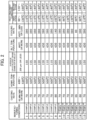
- a molten aluminum alloy with alloy components listed in the table of FIG. 1 was prepared to be cast into a columnar billet at a casting rate listed in the table of FIG. 2 , wherein each aluminum alloy of examples 1 -15 has a composition which is not in the claimed range.
- the homo temperature indicates homogenizing conditions of the billet.
- Samples were cut from the surface of the billets. The surfaces of the samples were mirror-polished and then etched by Keller's reagent (0.5% HF). Average crystalized grain diameters of the cast billets were observed by an optical microscope.
- the average crystalized grain diameters each was measured by subjecting a 100X microscope image to image-processing.
- the billet was pre-heated at a BLT temperature shown in the table of FIG. 2 and extruded into an extruded material having a U-shaped or channel cross section and 3 to 4 mm in thickness.
- the extruded material was air cooled (fan air cooled) at the cooling rate shown in the table of FIG. 2 , and then was subjected to two-stage artificial aging treatment under the heat treatment conditions shown in the table of FIG. 2 .
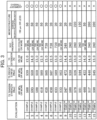
- the evaluation results are shown in the table of FIG.3 .
- test pieces Under a stress of 80% relative to the proof stress, the test pieces were subjected to 720 cycles of a process described later to examine SCC resistance (stress corrosion cracking resistance). The test pieces without cracks were regarded to attain the target. For the test pieces cracked in a smaller number than 720 cycles, the number of cycles in which crack occurred were counted.
- test pieces were immersed with a water solution of 3.5% NaCl at 25°C for 10 minutes, then left at 25°C and a humidity of 40% for 50 minutes, and then let dry naturally.
- the surface of the extruded material was mirror-polished and etched in a water solution of 3% NaOH. Then, the average thickness of the recrystallized layer on the surface of the extruded material was measured as a recrystallization depth with a 100X optical microscope image.
- the evaluation results of FIG. 3 show that the extruded materials of aluminum alloys in examples 1 to 8 attained all the targets of tension strength of 480 MPa or more, a 0.2% proof stress of 450 MPa or more, extension of 10% or more, and SCC resistance of 720 cycles or more.
- the proof stress is preferably 460 MPa or more.
- the examples 1 to 8 were free of Cr. Further, the examples 1, 2, and 7 were free of Mn.
- the example 8 was free of Sr.
- the comparative example 14 contained 0.26% Cr.
- the aluminum alloy extruded material according to the invention exhibits high strength and excellent corrosion resistance, and thus may be used as structural members for vehicles and industrial machines.
Landscapes
- Chemical & Material Sciences (AREA)
- Engineering & Computer Science (AREA)
- Mechanical Engineering (AREA)
- Materials Engineering (AREA)
- Metallurgy (AREA)
- Organic Chemistry (AREA)
- Physics & Mathematics (AREA)
- Thermal Sciences (AREA)
- Crystallography & Structural Chemistry (AREA)
- Extrusion Of Metal (AREA)
Description
- The present invention relates to a method for manufacturing an aluminum alloy extruded material according to the preamble of
claim 1, in particular an improved material of 7000-series Al-Zn-Mg based aluminum alloys. - A method of the related art is known from
JP 2009/013479 A - Among high-strength aluminum alloys, 7000-series aluminum alloys have been drawing attentions to achieve weight reduction as a way to increase fuel economy in vehicles.
- An extruded material of a 7000-series aluminum alloy for use as a structural member in vehicles is required to exhibit not only high strength but also bending workability and stress corrosion cracking resistance.
- An increased addition amount of Mg, Zn, and Cu improves strength in 7000-series aluminum alloy, but significantly decreases extrudability. Increase of MgZn2 precipitation also occurs and causes decrease in stress corrosion cracking resistance.
- In addition, during extrusion processing, recrystallized grains on the surface of the extruded material becomes coarsened and recrystallization extends to a deeper depth. This causes decrease in stress corrosion cracking resistance.
- Accordingly, transition elements such as Cr, Mn, and Zr are added, however, large amounts of addition affect quench sensitivity. To achieve a predetermined high strength, the extruded material must be subjected to rapid quenching by water cooling during die end quenching immediately after extrusion processing.
- The die end quenching by water cooling causes cooling strain that causes warp or deformation of cross section in the extruded material.
- An Al-Zn-Mg-Cu alloy disclosed in
JP-A-2009-114514 Japanese Patent No. 5083816 sheet 6 mm thick and a pipe 7.5 mm thick, as disclosed in the above patent document. The extruded material must also be subjected to rolling or drawing to achieve high strength. -
US 2013/146 183 A1 discloses a method according to the preamble ofindependent claim 1, in which at a different casting rate, the cast billet is subject to further treatment of extruding, cooling and artificial ageing. -
EP 1 543 174 A2 - An object of the invention is to provide a method for manufacturing an aluminum alloy extruded material that exhibits high strength and excellent stress corrosion cracking resistance. The object is solved by a method of
claim 1. - According to one aspect, there is provided a high-strength aluminum alloy extruded material having excellent corrosion resistance and favorable quenching properties, comprising, by mass:
6.0 to 8.0% of Zn, 1.50 to 2.70% of Mg, 0.20 to 1.50% of Cu, 0.005 to 0.05% of Ti, 0.10 to 0.25% of Zr, 0.3% or less of Mn, 0.05% or less of Cr, 0.25% or less of Sr, and 0.10 to 0.50% in total among Zr, Mn, Cr and Sr, with the balance being Al and unavoidable impurities. - An extruded material of a high-strength aluminum alloy includes aspects as below:
- In the aluminum alloy extruded material, Cr may not be included and a total amount of Zr, Mn, and Sr may fall within a range of 0.10 to 0.50%.
- In the aluminum alloy extruded material, Cr and Sr may not be included and a total amount of Zr and Mn may fall within a range of 0.10 to 0.50%.
- In the aluminum alloy extruded material, Cr and Mn may not be included and a total amount of Zr and Sr may fall within a range of 0.10 to 0.50%.
- The extruded materials of a high-strength aluminum alloy described above each further includes aspects as below:
- In the aluminum alloy extruded material, the amount of Cu may fall within a range of more than 0.4% and less than 0.8%.
- In the above aluminum alloy extruded material, the amount of Zn may fall within a range of more than 6.5% and less than or equal to 8.0%.
- In the first aspect, a recrystallization depth on a surface of the extruded material may be 150 µm or less.
- The high-strength aluminum alloy extruded material according to the first aspect may have a tension strength of 480 MPa or more and a 0.2% proof stress of 450 MPa or more.
- The component range of the aluminum alloy is selected for the following reasons.
- Since Zn in relatively high concentrations causes little degradation in extrudability, the addition amount of Zn is 6.0% or more by mass to achieve high strength.
- An addition exceeding 8.0%, however, decreases stress corrosion cracking resistance.
- Thus, the addition amount of Zn falls within a range of 6.0 to 8.0%.
- To keep Mg at relatively small concentration, the addition amount of Zn is preferably more than 6.5% and less than or equal to 8.0%.
- Mg is most effective in achieving high strength.
- Thus, the addition amount of Mg falls within a range of 1.50 to 2.70%.
- An addition exceeding 2.70% decreases extrudability.
- Further, the addition amount of Mg is preferably 1.7% at the lowest and 2.70% at the highest to ensure a tensile strength of 530 MPa or more and a 0.2% proof stress of 500 MPa or more.
- Cu contributes to an improvement in strength by solid solution effect. An excess addition, however, decreases extrudability and corrosion resistance.
- Thus, the addition amount of Cu falls within a range of 0.20 to 1.50%.
- In view of preventing decrease of corrosion resistance, the addition amount of Cu preferably falls within a range of 0.20 to 1.0%. To ensure a 0.2% proof stress of 530 MPa or more, the addition amount of Cu may be set within a range of more than 0.40% and less than 0.8%.
- Zr, Mn, and Cr have an effect to suppress the depth (thickness) of a recrystallized layer formed on the surface of the extruded material during extrusion processing.
- Among the above three components, the effect of Cr on the quench sensitivity during extrusion processing is the largest, while that of Mn is the second largest, therefore cooling immediately after extrusion at a rapid rate is required to achieve high strength.
- The effect of Zr on quench sensitivity is the smallest among the three components, and a sufficiently high strength is achieved through fan air cooling as die end quenching immediately after extrusion.
- Accordingly, in the present invention, the addition amount of Zr is 0.10 to 0.25%, since Zr is difficult to be dissolved in a molten aluminum alloy to an amount exceeding 0.25%.
- For the above reasons, Cr is preferably not added. If Cr is added, the addition amount of Cr is limited to 0.05% or less.
- Also, Mn is preferably not added. If Mn is added, the addition amount of Mn is limited to 0.3% or less.
- Sr has an effect to prevent coarsening of crystalized grains in a texture of a billet during casting, and also prevents formation of a recrystallized layer on the surface of the billet after extrusion processing.
- A larger addition amount of Sr, however, causes coarse crystallized products that have Sr as a nucleus to be easily crystallized. If Sr is added, the addition amount of Sr is 0.25% or less.
- The invention is characterized in that a total amount of Zr, Mn, Cr and Sr is set in a range of 0.10 to 0.50% to achieve both high strength and reduced thickness (depth) of a recrystallized layer on the surface.
- If Cr is not contained, the total amount of Zr, Mn, and Sr falls within a range of 0.10 to 0.50%
- If Cr and Sr are not contained, the total amount of Zr and Mn falls within a range of 0.10 to 0.50%.
- If Cr and Mn are not included, the total amounts of Zr and Sr falls within a range of 0.10 to 0.50%
- Ti is effective in making crystalized grains finer during casting of a billet. Ti is added within a range of 0.005 to 0.05%.
- Fe and Si are easily mixed as impurities during preparing a molten aluminum alloy and casting a billet. A large amount of addition may cause decrease in properties such as strength. Thus, the addition amount of Fe is limited to 0.2% or less and that of Si is limited to 0.01% or less.
- Next, a manufacturing condition will be described.
- First, for manufacturing, a columnar billet for extrusion processing needs to be cast.
- A recrystallized layer is formed on the surface of the extruded material during extrusion processing. By keeping crystalized grain diameters small in the cast texture of the billet, the depth of the recrystallized layer becomes thinner.
- In addition to the effect of Sr and Ti addition as components of the aluminum alloy, a casting rate also has an influence on the billet.
- The casting rate of the columnar billet is set to 50 mm/min or more, preferably 65 mm/min or more.
- The cast billet is subjected to homogenization treatment at a homogenization treatment (homo) temperature of 470 to 530°C, preferably 480 to 520°C, for two to 24 hours.
- The homogenized billet is then pre-heated to a temperature of 400 to 480°C and extruded by an extrusion press machine.
- Fan air cooling is performed immediately after the extrusion processing at an average cooling rate of 450°C/min or less (die end quenching by fan air cooling).
- The average cooling rate falls within a range of 100 to 450°C/min.
- The average cooling rate more preferably falls within a range of 250 to 450°C/min.
- Next, a first-stage aging is performed at a temperature of 90 to 120°C for one to 24 hours followed by a second-stage aging at a temperature of 130 to 180°C for one to 24 hours.
- That is, a so-called two-stage artificial aging is performed.
- An extruded material of an aluminum alloy according to the present invention has a high strength by setting the addition amounts of Zn, Mg, and Cu, good quenching properties by preparing a trace amount of components such as Zr, Mn, Cr, and Sr, and a recrystallized layer with reduced thickness on the surface of the extruded material.
- The extruded material of an aluminum alloy having high-strength, excellent corrosion resistance, and good quenching properties is thus obtained.
-
-
FIG.1 illustrates the composition of each aluminum alloy used for evaluation. -
FIG.2 illustrates manufacturing conditions of billets and extruded materials. -
FIG.3 illustrates the evaluation results for each extruded material. - A molten aluminum alloy with alloy components listed in the table of
FIG. 1 was prepared to be cast into a columnar billet at a casting rate listed in the table ofFIG. 2 , wherein each aluminum alloy of examples 1 -15 has a composition which is not in the claimed range. - In the table of
FIG. 2 , the homo temperature indicates homogenizing conditions of the billet. Samples were cut from the surface of the billets. The surfaces of the samples were mirror-polished and then etched by Keller's reagent (0.5% HF). Average crystalized grain diameters of the cast billets were observed by an optical microscope. - The average crystalized grain diameters each was measured by subjecting a 100X microscope image to image-processing.
- The billet was pre-heated at a BLT temperature shown in the table of
FIG. 2 and extruded into an extruded material having a U-shaped or channel cross section and 3 to 4 mm in thickness. - Immediately after extrusion, the extruded material was air cooled (fan air cooled) at the cooling rate shown in the table of
FIG. 2 , and then was subjected to two-stage artificial aging treatment under the heat treatment conditions shown in the table ofFIG. 2 . - The evaluation results are shown in the table of
FIG.3 . - Each item was evaluated as described below.
- No. 5 tension test pieces were prepared from the extruded material in accordance with Japanese Industrial Standard JIS-Z2241, and T5 tension strength (MPa), T5 proof stress (0.2%, MPa), and T5 extension (%) were measured using a tension tester that conforms to the JIS standard.
- Under a stress of 80% relative to the proof stress, the test pieces were subjected to 720 cycles of a process described later to examine SCC resistance (stress corrosion cracking resistance). The test pieces without cracks were regarded to attain the target. For the test pieces cracked in a smaller number than 720 cycles, the number of cycles in which crack occurred were counted.
- The test pieces were immersed with a water solution of 3.5% NaCl at 25°C for 10 minutes, then left at 25°C and a humidity of 40% for 50 minutes, and then let dry naturally.
- The surface of the extruded material was mirror-polished and etched in a water solution of 3% NaOH. Then, the average thickness of the recrystallized layer on the surface of the extruded material was measured as a recrystallization depth with a 100X optical microscope image.
- The evaluation results of
FIG. 3 show that the extruded materials of aluminum alloys in examples 1 to 8 attained all the targets of tension strength of 480 MPa or more, a 0.2% proof stress of 450 MPa or more, extension of 10% or more, and SCC resistance of 720 cycles or more. - The proof stress is preferably 460 MPa or more.
- The examples 1 to 8 were free of Cr. Further, the examples 1, 2, and 7 were free of Mn.
- The example 8 was free of Sr.
- The examples 3, 4, 5 and 7, which contained Cu of more than 0.4%, exhibited relatively high values in tension and proof strengths.
- Comparative examples 9 to 12, 14, and 15 did not reach the target of SCC resistance.
- This may be because the amount of Cu exceeds 1.50%.
- For the comparative example 13, cooling rate after extrusion processing was low and the strength was insufficient.
- The comparative example 14 contained 0.26% Cr.
- The aluminum alloy extruded material according to the invention exhibits high strength and excellent corrosion resistance, and thus may be used as structural members for vehicles and industrial machines.
Claims (1)
- A method for manufacturing a high strength aluminum alloy extruded material, the aluminum alloy extruded material comprising, by mass:6.0 to 8.0% of Zn, 1.50 to 2.70% of Mg, 0.20 to 1.50% of Cu, 0.005 to 0.05% of Ti, and 0.10 to 0.25% of Zr, 0.3% or less of Mn, 0.05% or less of Cr, 0.25% or less of Sr, and 0.10 to 0.50% in total among Zr, Mn, Cr and Sr, with the balance being AI and unavoidable impurities including 0.2% or less Fe and 0.01% or less Si,characterized in thata columnar billet casted at a casting rate of 50 mm/min or more and having an average crystalized grain diameter of 250 µm or less is subjected to homogenization treatment at a temperature of 470 to 530°C for two to 24 hours, the homogenized billet is then pre-heated to a temperature of 400 to 480°C to obtain a cast billet, the resulting cast billet is subjected to extrusion processing,fan air cooling the extruded material at an average cooling rate of 100 to 450°C/min immediately after the extrusion processing, andthe extruded material is then subjected to artificial aging treatment, andthe artificial aging treatment comprises a first-stage aging at a temperature of 90 to 120°C for one to 24 hours, and a subsequent second-stage aging at a temperature of 130 to 180°C for one to 24 hours.
Applications Claiming Priority (2)
| Application Number | Priority Date | Filing Date | Title |
|---|---|---|---|
| JP2016066950 | 2016-03-30 | ||
| PCT/JP2017/011145 WO2017169962A1 (en) | 2016-03-30 | 2017-03-21 | High strength extruded aluminum alloy material with excellent corrosion resistance and favorable quenching properties and manufacturing method therefor |
Publications (4)
| Publication Number | Publication Date |
|---|---|
| EP3441491A1 EP3441491A1 (en) | 2019-02-13 |
| EP3441491A4 EP3441491A4 (en) | 2019-09-25 |
| EP3441491B1 EP3441491B1 (en) | 2021-12-01 |
| EP3441491B2 true EP3441491B2 (en) | 2024-10-30 |
Family
ID=59964288
Family Applications (1)
| Application Number | Title | Priority Date | Filing Date |
|---|---|---|---|
| EP17774503.1A Active EP3441491B2 (en) | 2016-03-30 | 2017-03-21 | Manufacturing method for a high strength extruded aluminum alloy material |
Country Status (5)
| Country | Link |
|---|---|
| US (1) | US11136658B2 (en) |
| EP (1) | EP3441491B2 (en) |
| JP (1) | JP6955483B2 (en) |
| CN (1) | CN108884525B (en) |
| WO (1) | WO2017169962A1 (en) |
Families Citing this family (19)
| Publication number | Priority date | Publication date | Assignee | Title |
|---|---|---|---|---|
| JP7093611B2 (en) * | 2016-11-30 | 2022-06-30 | アイシン軽金属株式会社 | Aluminum alloy for extruded material and method for manufacturing extruded material and extruded material using it |
| CN107964615A (en) * | 2017-11-22 | 2018-04-27 | 华南理工大学 | A kind of extrudate high-strength 7xxx line aluminium alloys and preparation method thereof |
| JP7018332B2 (en) * | 2018-02-24 | 2022-02-10 | アイシン軽金属株式会社 | Manufacturing method of bent molded products using aluminum alloy |
| JP2019206748A (en) * | 2018-05-23 | 2019-12-05 | アイシン軽金属株式会社 | Manufacturing method of high strength aluminum alloy extrusion material |
| US11827967B2 (en) * | 2019-02-22 | 2023-11-28 | Aisin Keikinzoku Co., Ltd. | Method for producing aluminum alloy extruded material |
| JP7479854B2 (en) * | 2019-02-22 | 2024-05-09 | アイシン軽金属株式会社 | Manufacturing method of aluminum alloy extrusion material |
| JP6672503B1 (en) * | 2019-03-28 | 2020-03-25 | 株式会社神戸製鋼所 | Automotive door beams made of extruded aluminum alloy |
| JP2022532347A (en) * | 2019-06-03 | 2022-07-14 | ノベリス・インコーポレイテッド | Ultra-high-strength aluminum alloy products and their manufacturing methods |
| CN110396629B (en) * | 2019-08-16 | 2021-04-20 | 中国航发北京航空材料研究院 | A kind of 800MPa grade aluminum alloy extruded profile and preparation method thereof |
| US12319989B2 (en) | 2019-12-05 | 2025-06-03 | Kaiser Aluminum Fabricated Products, Llc | High strength press quenchable 7XXX alloy |
| JP7698953B2 (en) * | 2020-01-15 | 2025-06-26 | アイシン軽金属株式会社 | Manufacturing method for high-strength aluminum alloy extrusion material with excellent toughness and corrosion resistance |
| JPWO2021157356A1 (en) * | 2020-02-04 | 2021-08-12 | ||
| CN111250698B (en) * | 2020-02-19 | 2021-01-29 | 湖南金天铝业高科技股份有限公司 | A kind of light-weight wear-resistant aluminum-based powder metallurgy composite material rail transit brake disc and preparation method thereof |
| JP2021188102A (en) * | 2020-06-02 | 2021-12-13 | 国立大学法人九州大学 | Aluminum alloy material and hydrogen embrittlement inhibitor for aluminum alloy material |
| CN116761904A (en) * | 2021-02-25 | 2023-09-15 | 爱信轻金属株式会社 | Manufacturing method of aluminum alloy extruded materials |
| DE112022001181T5 (en) * | 2021-02-25 | 2023-12-21 | Aisin Keikinzoku Co., Ltd. | METHOD FOR PRODUCING AN EXTRUSTED ALUMINUM ALLOY MATERIAL WITH HIGH STRENGTH AND EXCELLENT SCC RESISTANCE AND HARDENABILITY |
| CN114080460A (en) * | 2021-07-30 | 2022-02-22 | 三菱铝株式会社 | High strength and high elongation aluminum alloy and aluminum alloy extrusion materials |
| CN116065067A (en) * | 2021-11-01 | 2023-05-05 | 东风汽车有限公司东风日产乘用车公司 | A kind of high-strength corrosion-resistant Al-Zn-Mg aluminum alloy and its preparation method |
| CN116815083A (en) * | 2023-06-30 | 2023-09-29 | 中国航发北京航空材料研究院 | A method to improve the stress corrosion properties of high-strength aluminum alloys |
Citations (1)
| Publication number | Priority date | Publication date | Assignee | Title |
|---|---|---|---|---|
| EP0449771A1 (en) † | 1990-03-26 | 1991-10-02 | Alusuisse-Lonza Services Ag | Controlled feeding of molten metal into the moulds of an automatic continuous casting plant |
Family Cites Families (16)
| Publication number | Priority date | Publication date | Assignee | Title |
|---|---|---|---|---|
| RU2165995C1 (en) * | 1999-10-05 | 2001-04-27 | Государственное предприятие "Всероссийский научно-исследовательский институт авиационных материалов" | Highly string aluminium-based alloy and product made of said alloy |
| US20040099352A1 (en) * | 2002-09-21 | 2004-05-27 | Iulian Gheorghe | Aluminum-zinc-magnesium-copper alloy extrusion |
| JP4977281B2 (en) * | 2005-09-27 | 2012-07-18 | アイシン軽金属株式会社 | High-strength aluminum alloy extruded material excellent in shock absorption and stress corrosion cracking resistance and method for producing the same |
| EP2141253B1 (en) * | 2007-03-26 | 2015-09-16 | Aisin Keikinzoku Co., Ltd. | Process for producing a 7000 aluminum alloy extrudate |
| JP5343333B2 (en) * | 2007-07-06 | 2013-11-13 | 日本軽金属株式会社 | Method for producing high-strength aluminum alloy material with excellent resistance to stress corrosion cracking |
| JP5083816B2 (en) | 2007-11-08 | 2012-11-28 | 住友軽金属工業株式会社 | Al-Zn-Mg-Cu alloy extruded material excellent in warm workability, production method thereof, and warm worked material using the extruded material |
| JP5360591B2 (en) | 2009-01-08 | 2013-12-04 | 日本軽金属株式会社 | Aluminum alloy ingot and method for producing the same |
| CN102108463B (en) * | 2010-01-29 | 2012-09-05 | 北京有色金属研究总院 | Aluminium alloy product suitable for manufacturing structures and preparation method |
| US9163304B2 (en) * | 2010-04-20 | 2015-10-20 | Alcoa Inc. | High strength forged aluminum alloy products |
| JP2012207302A (en) * | 2011-03-16 | 2012-10-25 | Kobe Steel Ltd | METHOD FOR MANUFACTURING EXTRUDED MATERIAL OF HEAT TREATMENT TYPE Al-Zn-Mg-BASED ALUMINUM ALLOY |
| US10697047B2 (en) | 2011-12-12 | 2020-06-30 | Kobe Steel, Ltd. | High strength aluminum alloy extruded material excellent in stress corrosion cracking resistance |
| JP5830006B2 (en) * | 2012-12-27 | 2015-12-09 | 株式会社神戸製鋼所 | Extruded aluminum alloy with excellent strength |
| CN105088033A (en) * | 2014-05-08 | 2015-11-25 | 比亚迪股份有限公司 | Aluminium alloy and preparation method thereof |
| JP6193808B2 (en) * | 2014-05-22 | 2017-09-06 | 株式会社神戸製鋼所 | Aluminum alloy extruded material and method for producing the same |
| JP6378937B2 (en) * | 2014-05-29 | 2018-08-22 | 三菱重工業株式会社 | Method for producing aluminum alloy member |
| RU2576283C1 (en) * | 2014-09-05 | 2016-02-27 | Российская Федерация, от имени которой выступает Министерство промышленности и торговли Российской Федерации (Минпромторг России) | Procedure for thermal treatment of items out of high strength aluminium alloys |
-
2017
- 2017-03-21 WO PCT/JP2017/011145 patent/WO2017169962A1/en not_active Ceased
- 2017-03-21 JP JP2018509080A patent/JP6955483B2/en active Active
- 2017-03-21 CN CN201780019516.2A patent/CN108884525B/en active Active
- 2017-03-21 EP EP17774503.1A patent/EP3441491B2/en active Active
-
2018
- 2018-09-26 US US16/142,379 patent/US11136658B2/en active Active
Patent Citations (1)
| Publication number | Priority date | Publication date | Assignee | Title |
|---|---|---|---|---|
| EP0449771A1 (en) † | 1990-03-26 | 1991-10-02 | Alusuisse-Lonza Services Ag | Controlled feeding of molten metal into the moulds of an automatic continuous casting plant |
Non-Patent Citations (1)
| Title |
|---|
| R. SHAHANI ET AL: "High strength 7XXX alloys for ultra-thick aerospace plate : optimisation of alloy composition", PROCEEDINGS OF ICAA-6 INTERNATIONAL CONFERENCE ON ALUMINIUM ALLOYS, vol. 2, 1 January 1998 (1998-01-01), pages 1105 - 1110 † |
Also Published As
| Publication number | Publication date |
|---|---|
| US11136658B2 (en) | 2021-10-05 |
| EP3441491A4 (en) | 2019-09-25 |
| JP6955483B2 (en) | 2021-10-27 |
| WO2017169962A1 (en) | 2017-10-05 |
| EP3441491A1 (en) | 2019-02-13 |
| CN108884525A (en) | 2018-11-23 |
| JPWO2017169962A1 (en) | 2019-02-14 |
| CN108884525B (en) | 2020-07-10 |
| US20190024224A1 (en) | 2019-01-24 |
| EP3441491B1 (en) | 2021-12-01 |
Similar Documents
| Publication | Publication Date | Title |
|---|---|---|
| EP3441491B2 (en) | Manufacturing method for a high strength extruded aluminum alloy material | |
| US10087508B2 (en) | Aluminum alloy and method of manufacturing extrusion using same | |
| US8357249B2 (en) | High strength, heat treatable aluminum alloy | |
| US8168013B2 (en) | Al-Mg-Si aluminum alloy extruded product exhibiting excellent fatigue strength and impact fracture resistance | |
| US20100059151A1 (en) | High-strength aluminum alloy product and method of producing the same | |
| EP2811043B1 (en) | High-strength aluminum alloy extrudate with excellent corrosion resistance, ductility, and hardenability and process for producing same | |
| JP7018274B2 (en) | Aluminum alloy for extrusion molding and method for manufacturing extruded material using it | |
| US10900108B2 (en) | Method for manufacturing bent article using aluminum alloy | |
| AU2017367371B2 (en) | Aluminum alloy for extruded material, extruded material using the same, and method for producing extruded material | |
| JP6612029B2 (en) | High strength aluminum alloy extruded material with excellent impact resistance and method for producing the same | |
| US20220364213A1 (en) | Method for Producing Aluminum Alloy Extrusion | |
| US9039850B2 (en) | Aluminum alloy material for forging | |
| NO20211429A1 (en) | A 6xxx aluminium alloy with improved properties and a process for manufacturing extruded products | |
| US11827967B2 (en) | Method for producing aluminum alloy extruded material | |
| US20250065385A1 (en) | Recycled Material-Containing 7000 Series Aluminum Alloy, Billet And Extruded Material Using The Same, And Method Of Manufacturing Extruded Material | |
| US20250066895A1 (en) | Method For Producing High Strength Aluminum Alloy Extruded Material With High SCC Resistance | |
| CN118703848A (en) | Method for producing high-strength aluminum alloy extruded material having excellent SCC resistance and aluminum alloy used therein |
Legal Events
| Date | Code | Title | Description |
|---|---|---|---|
| STAA | Information on the status of an ep patent application or granted ep patent |
Free format text: STATUS: THE INTERNATIONAL PUBLICATION HAS BEEN MADE |
|
| PUAI | Public reference made under article 153(3) epc to a published international application that has entered the european phase |
Free format text: ORIGINAL CODE: 0009012 |
|
| STAA | Information on the status of an ep patent application or granted ep patent |
Free format text: STATUS: REQUEST FOR EXAMINATION WAS MADE |
|
| 17P | Request for examination filed |
Effective date: 20180926 |
|
| AK | Designated contracting states |
Kind code of ref document: A1 Designated state(s): AL AT BE BG CH CY CZ DE DK EE ES FI FR GB GR HR HU IE IS IT LI LT LU LV MC MK MT NL NO PL PT RO RS SE SI SK SM TR |
|
| AX | Request for extension of the european patent |
Extension state: BA ME |
|
| DAV | Request for validation of the european patent (deleted) | ||
| DAX | Request for extension of the european patent (deleted) | ||
| A4 | Supplementary search report drawn up and despatched |
Effective date: 20190827 |
|
| RIC1 | Information provided on ipc code assigned before grant |
Ipc: B22D 7/00 20060101ALI20190821BHEP Ipc: B21C 23/00 20060101ALI20190821BHEP Ipc: C22F 1/00 20060101ALI20190821BHEP Ipc: C22C 21/10 20060101AFI20190821BHEP Ipc: C22F 1/053 20060101ALI20190821BHEP |
|
| STAA | Information on the status of an ep patent application or granted ep patent |
Free format text: STATUS: EXAMINATION IS IN PROGRESS |
|
| 17Q | First examination report despatched |
Effective date: 20200831 |
|
| TPAC | Observations filed by third parties |
Free format text: ORIGINAL CODE: EPIDOSNTIPA |
|
| GRAP | Despatch of communication of intention to grant a patent |
Free format text: ORIGINAL CODE: EPIDOSNIGR1 |
|
| STAA | Information on the status of an ep patent application or granted ep patent |
Free format text: STATUS: GRANT OF PATENT IS INTENDED |
|
| RIC1 | Information provided on ipc code assigned before grant |
Ipc: C22C 21/10 20060101AFI20210607BHEP Ipc: C22F 1/053 20060101ALI20210607BHEP Ipc: C22F 1/00 20060101ALI20210607BHEP Ipc: B22D 11/00 20060101ALI20210607BHEP Ipc: B21C 23/00 20060101ALN20210607BHEP |
|
| INTG | Intention to grant announced |
Effective date: 20210707 |
|
| RIN1 | Information on inventor provided before grant (corrected) |
Inventor name: SHIBATA KARIN Inventor name: YOSHIDA TOMOO |
|
| GRAS | Grant fee paid |
Free format text: ORIGINAL CODE: EPIDOSNIGR3 |
|
| GRAA | (expected) grant |
Free format text: ORIGINAL CODE: 0009210 |
|
| STAA | Information on the status of an ep patent application or granted ep patent |
Free format text: STATUS: THE PATENT HAS BEEN GRANTED |
|
| AK | Designated contracting states |
Kind code of ref document: B1 Designated state(s): AL AT BE BG CH CY CZ DE DK EE ES FI FR GB GR HR HU IE IS IT LI LT LU LV MC MK MT NL NO PL PT RO RS SE SI SK SM TR |
|
| REG | Reference to a national code |
Ref country code: GB Ref legal event code: FG4D |
|
| REG | Reference to a national code |
Ref country code: AT Ref legal event code: REF Ref document number: 1451815 Country of ref document: AT Kind code of ref document: T Effective date: 20211215 Ref country code: CH Ref legal event code: EP |
|
| REG | Reference to a national code |
Ref country code: IE Ref legal event code: FG4D |
|
| REG | Reference to a national code |
Ref country code: DE Ref legal event code: R096 Ref document number: 602017050245 Country of ref document: DE |
|
| REG | Reference to a national code |
Ref country code: LT Ref legal event code: MG9D |
|
| REG | Reference to a national code |
Ref country code: NL Ref legal event code: MP Effective date: 20211201 |
|
| REG | Reference to a national code |
Ref country code: AT Ref legal event code: MK05 Ref document number: 1451815 Country of ref document: AT Kind code of ref document: T Effective date: 20211201 |
|
| PG25 | Lapsed in a contracting state [announced via postgrant information from national office to epo] |
Ref country code: RS Free format text: LAPSE BECAUSE OF FAILURE TO SUBMIT A TRANSLATION OF THE DESCRIPTION OR TO PAY THE FEE WITHIN THE PRESCRIBED TIME-LIMIT Effective date: 20211201 Ref country code: LT Free format text: LAPSE BECAUSE OF FAILURE TO SUBMIT A TRANSLATION OF THE DESCRIPTION OR TO PAY THE FEE WITHIN THE PRESCRIBED TIME-LIMIT Effective date: 20211201 Ref country code: FI Free format text: LAPSE BECAUSE OF FAILURE TO SUBMIT A TRANSLATION OF THE DESCRIPTION OR TO PAY THE FEE WITHIN THE PRESCRIBED TIME-LIMIT Effective date: 20211201 Ref country code: BG Free format text: LAPSE BECAUSE OF FAILURE TO SUBMIT A TRANSLATION OF THE DESCRIPTION OR TO PAY THE FEE WITHIN THE PRESCRIBED TIME-LIMIT Effective date: 20220301 Ref country code: AT Free format text: LAPSE BECAUSE OF FAILURE TO SUBMIT A TRANSLATION OF THE DESCRIPTION OR TO PAY THE FEE WITHIN THE PRESCRIBED TIME-LIMIT Effective date: 20211201 |
|
| PG25 | Lapsed in a contracting state [announced via postgrant information from national office to epo] |
Ref country code: SE Free format text: LAPSE BECAUSE OF FAILURE TO SUBMIT A TRANSLATION OF THE DESCRIPTION OR TO PAY THE FEE WITHIN THE PRESCRIBED TIME-LIMIT Effective date: 20211201 Ref country code: PL Free format text: LAPSE BECAUSE OF FAILURE TO SUBMIT A TRANSLATION OF THE DESCRIPTION OR TO PAY THE FEE WITHIN THE PRESCRIBED TIME-LIMIT Effective date: 20211201 Ref country code: NO Free format text: LAPSE BECAUSE OF FAILURE TO SUBMIT A TRANSLATION OF THE DESCRIPTION OR TO PAY THE FEE WITHIN THE PRESCRIBED TIME-LIMIT Effective date: 20220301 Ref country code: LV Free format text: LAPSE BECAUSE OF FAILURE TO SUBMIT A TRANSLATION OF THE DESCRIPTION OR TO PAY THE FEE WITHIN THE PRESCRIBED TIME-LIMIT Effective date: 20211201 Ref country code: HR Free format text: LAPSE BECAUSE OF FAILURE TO SUBMIT A TRANSLATION OF THE DESCRIPTION OR TO PAY THE FEE WITHIN THE PRESCRIBED TIME-LIMIT Effective date: 20211201 Ref country code: GR Free format text: LAPSE BECAUSE OF FAILURE TO SUBMIT A TRANSLATION OF THE DESCRIPTION OR TO PAY THE FEE WITHIN THE PRESCRIBED TIME-LIMIT Effective date: 20220302 Ref country code: ES Free format text: LAPSE BECAUSE OF FAILURE TO SUBMIT A TRANSLATION OF THE DESCRIPTION OR TO PAY THE FEE WITHIN THE PRESCRIBED TIME-LIMIT Effective date: 20211201 |
|
| PG25 | Lapsed in a contracting state [announced via postgrant information from national office to epo] |
Ref country code: NL Free format text: LAPSE BECAUSE OF FAILURE TO SUBMIT A TRANSLATION OF THE DESCRIPTION OR TO PAY THE FEE WITHIN THE PRESCRIBED TIME-LIMIT Effective date: 20211201 |
|
| PG25 | Lapsed in a contracting state [announced via postgrant information from national office to epo] |
Ref country code: SM Free format text: LAPSE BECAUSE OF FAILURE TO SUBMIT A TRANSLATION OF THE DESCRIPTION OR TO PAY THE FEE WITHIN THE PRESCRIBED TIME-LIMIT Effective date: 20211201 Ref country code: SK Free format text: LAPSE BECAUSE OF FAILURE TO SUBMIT A TRANSLATION OF THE DESCRIPTION OR TO PAY THE FEE WITHIN THE PRESCRIBED TIME-LIMIT Effective date: 20211201 Ref country code: RO Free format text: LAPSE BECAUSE OF FAILURE TO SUBMIT A TRANSLATION OF THE DESCRIPTION OR TO PAY THE FEE WITHIN THE PRESCRIBED TIME-LIMIT Effective date: 20211201 Ref country code: PT Free format text: LAPSE BECAUSE OF FAILURE TO SUBMIT A TRANSLATION OF THE DESCRIPTION OR TO PAY THE FEE WITHIN THE PRESCRIBED TIME-LIMIT Effective date: 20220401 Ref country code: EE Free format text: LAPSE BECAUSE OF FAILURE TO SUBMIT A TRANSLATION OF THE DESCRIPTION OR TO PAY THE FEE WITHIN THE PRESCRIBED TIME-LIMIT Effective date: 20211201 Ref country code: CZ Free format text: LAPSE BECAUSE OF FAILURE TO SUBMIT A TRANSLATION OF THE DESCRIPTION OR TO PAY THE FEE WITHIN THE PRESCRIBED TIME-LIMIT Effective date: 20211201 |
|
| REG | Reference to a national code |
Ref country code: DE Ref legal event code: R026 Ref document number: 602017050245 Country of ref document: DE |
|
| PLBI | Opposition filed |
Free format text: ORIGINAL CODE: 0009260 |
|
| PG25 | Lapsed in a contracting state [announced via postgrant information from national office to epo] |
Ref country code: IS Free format text: LAPSE BECAUSE OF FAILURE TO SUBMIT A TRANSLATION OF THE DESCRIPTION OR TO PAY THE FEE WITHIN THE PRESCRIBED TIME-LIMIT Effective date: 20220401 |
|
| 26 | Opposition filed |
Opponent name: FRKELLY Effective date: 20220901 |
|
| PG25 | Lapsed in a contracting state [announced via postgrant information from national office to epo] |
Ref country code: MC Free format text: LAPSE BECAUSE OF FAILURE TO SUBMIT A TRANSLATION OF THE DESCRIPTION OR TO PAY THE FEE WITHIN THE PRESCRIBED TIME-LIMIT Effective date: 20211201 Ref country code: DK Free format text: LAPSE BECAUSE OF FAILURE TO SUBMIT A TRANSLATION OF THE DESCRIPTION OR TO PAY THE FEE WITHIN THE PRESCRIBED TIME-LIMIT Effective date: 20211201 Ref country code: AL Free format text: LAPSE BECAUSE OF FAILURE TO SUBMIT A TRANSLATION OF THE DESCRIPTION OR TO PAY THE FEE WITHIN THE PRESCRIBED TIME-LIMIT Effective date: 20211201 |
|
| REG | Reference to a national code |
Ref country code: CH Ref legal event code: PL |
|
| PLAX | Notice of opposition and request to file observation + time limit sent |
Free format text: ORIGINAL CODE: EPIDOSNOBS2 |
|
| GBPC | Gb: european patent ceased through non-payment of renewal fee |
Effective date: 20220321 |
|
| PG25 | Lapsed in a contracting state [announced via postgrant information from national office to epo] |
Ref country code: SI Free format text: LAPSE BECAUSE OF FAILURE TO SUBMIT A TRANSLATION OF THE DESCRIPTION OR TO PAY THE FEE WITHIN THE PRESCRIBED TIME-LIMIT Effective date: 20211201 |
|
| REG | Reference to a national code |
Ref country code: BE Ref legal event code: MM Effective date: 20220331 |
|
| PG25 | Lapsed in a contracting state [announced via postgrant information from national office to epo] |
Ref country code: LU Free format text: LAPSE BECAUSE OF NON-PAYMENT OF DUE FEES Effective date: 20220321 Ref country code: LI Free format text: LAPSE BECAUSE OF NON-PAYMENT OF DUE FEES Effective date: 20220331 Ref country code: IE Free format text: LAPSE BECAUSE OF NON-PAYMENT OF DUE FEES Effective date: 20220321 Ref country code: GB Free format text: LAPSE BECAUSE OF NON-PAYMENT OF DUE FEES Effective date: 20220321 Ref country code: FR Free format text: LAPSE BECAUSE OF NON-PAYMENT OF DUE FEES Effective date: 20220331 Ref country code: CH Free format text: LAPSE BECAUSE OF NON-PAYMENT OF DUE FEES Effective date: 20220331 |
|
| PG25 | Lapsed in a contracting state [announced via postgrant information from national office to epo] |
Ref country code: BE Free format text: LAPSE BECAUSE OF NON-PAYMENT OF DUE FEES Effective date: 20220331 |
|
| PLBB | Reply of patent proprietor to notice(s) of opposition received |
Free format text: ORIGINAL CODE: EPIDOSNOBS3 |
|
| PG25 | Lapsed in a contracting state [announced via postgrant information from national office to epo] |
Ref country code: IT Free format text: LAPSE BECAUSE OF FAILURE TO SUBMIT A TRANSLATION OF THE DESCRIPTION OR TO PAY THE FEE WITHIN THE PRESCRIBED TIME-LIMIT Effective date: 20211201 |
|
| PG25 | Lapsed in a contracting state [announced via postgrant information from national office to epo] |
Ref country code: HU Free format text: LAPSE BECAUSE OF FAILURE TO SUBMIT A TRANSLATION OF THE DESCRIPTION OR TO PAY THE FEE WITHIN THE PRESCRIBED TIME-LIMIT; INVALID AB INITIO Effective date: 20170321 |
|
| PG25 | Lapsed in a contracting state [announced via postgrant information from national office to epo] |
Ref country code: MK Free format text: LAPSE BECAUSE OF FAILURE TO SUBMIT A TRANSLATION OF THE DESCRIPTION OR TO PAY THE FEE WITHIN THE PRESCRIBED TIME-LIMIT Effective date: 20211201 Ref country code: CY Free format text: LAPSE BECAUSE OF FAILURE TO SUBMIT A TRANSLATION OF THE DESCRIPTION OR TO PAY THE FEE WITHIN THE PRESCRIBED TIME-LIMIT Effective date: 20211201 |
|
| PUAH | Patent maintained in amended form |
Free format text: ORIGINAL CODE: 0009272 |
|
| STAA | Information on the status of an ep patent application or granted ep patent |
Free format text: STATUS: PATENT MAINTAINED AS AMENDED |
|
| PG25 | Lapsed in a contracting state [announced via postgrant information from national office to epo] |
Ref country code: MT Free format text: LAPSE BECAUSE OF FAILURE TO SUBMIT A TRANSLATION OF THE DESCRIPTION OR TO PAY THE FEE WITHIN THE PRESCRIBED TIME-LIMIT Effective date: 20211201 |
|
| 27A | Patent maintained in amended form |
Effective date: 20241030 |
|
| AK | Designated contracting states |
Kind code of ref document: B2 Designated state(s): AL AT BE BG CH CY CZ DE DK EE ES FI FR GB GR HR HU IE IS IT LI LT LU LV MC MK MT NL NO PL PT RO RS SE SI SK SM TR |
|
| REG | Reference to a national code |
Ref country code: DE Ref legal event code: R102 Ref document number: 602017050245 Country of ref document: DE |
|
| PG25 | Lapsed in a contracting state [announced via postgrant information from national office to epo] |
Ref country code: TR Free format text: LAPSE BECAUSE OF FAILURE TO SUBMIT A TRANSLATION OF THE DESCRIPTION OR TO PAY THE FEE WITHIN THE PRESCRIBED TIME-LIMIT Effective date: 20211201 |
|
| PGFP | Annual fee paid to national office [announced via postgrant information from national office to epo] |
Ref country code: DE Payment date: 20260327 Year of fee payment: 10 |