EP3438310A1 - Ferritic stainless steel sheet - Google Patents
Ferritic stainless steel sheet Download PDFInfo
- Publication number
- EP3438310A1 EP3438310A1 EP17773922.4A EP17773922A EP3438310A1 EP 3438310 A1 EP3438310 A1 EP 3438310A1 EP 17773922 A EP17773922 A EP 17773922A EP 3438310 A1 EP3438310 A1 EP 3438310A1
- Authority
- EP
- European Patent Office
- Prior art keywords
- content
- stainless steel
- less
- ferritic stainless
- steel sheet
- Prior art date
- Legal status (The legal status is an assumption and is not a legal conclusion. Google has not performed a legal analysis and makes no representation as to the accuracy of the status listed.)
- Granted
Links
Images

Classifications
-
- C—CHEMISTRY; METALLURGY
- C22—METALLURGY; FERROUS OR NON-FERROUS ALLOYS; TREATMENT OF ALLOYS OR NON-FERROUS METALS
- C22C—ALLOYS
- C22C38/00—Ferrous alloys, e.g. steel alloys
- C22C38/18—Ferrous alloys, e.g. steel alloys containing chromium
- C22C38/40—Ferrous alloys, e.g. steel alloys containing chromium with nickel
- C22C38/54—Ferrous alloys, e.g. steel alloys containing chromium with nickel with boron
-
- C—CHEMISTRY; METALLURGY
- C21—METALLURGY OF IRON
- C21D—MODIFYING THE PHYSICAL STRUCTURE OF FERROUS METALS; GENERAL DEVICES FOR HEAT TREATMENT OF FERROUS OR NON-FERROUS METALS OR ALLOYS; MAKING METAL MALLEABLE, e.g. BY DECARBURISATION OR TEMPERING
- C21D6/00—Heat treatment of ferrous alloys
- C21D6/004—Heat treatment of ferrous alloys containing Cr and Ni
-
- C—CHEMISTRY; METALLURGY
- C21—METALLURGY OF IRON
- C21D—MODIFYING THE PHYSICAL STRUCTURE OF FERROUS METALS; GENERAL DEVICES FOR HEAT TREATMENT OF FERROUS OR NON-FERROUS METALS OR ALLOYS; MAKING METAL MALLEABLE, e.g. BY DECARBURISATION OR TEMPERING
- C21D6/00—Heat treatment of ferrous alloys
- C21D6/005—Heat treatment of ferrous alloys containing Mn
-
- C—CHEMISTRY; METALLURGY
- C21—METALLURGY OF IRON
- C21D—MODIFYING THE PHYSICAL STRUCTURE OF FERROUS METALS; GENERAL DEVICES FOR HEAT TREATMENT OF FERROUS OR NON-FERROUS METALS OR ALLOYS; MAKING METAL MALLEABLE, e.g. BY DECARBURISATION OR TEMPERING
- C21D6/00—Heat treatment of ferrous alloys
- C21D6/007—Heat treatment of ferrous alloys containing Co
-
- C—CHEMISTRY; METALLURGY
- C21—METALLURGY OF IRON
- C21D—MODIFYING THE PHYSICAL STRUCTURE OF FERROUS METALS; GENERAL DEVICES FOR HEAT TREATMENT OF FERROUS OR NON-FERROUS METALS OR ALLOYS; MAKING METAL MALLEABLE, e.g. BY DECARBURISATION OR TEMPERING
- C21D6/00—Heat treatment of ferrous alloys
- C21D6/008—Heat treatment of ferrous alloys containing Si
-
- C—CHEMISTRY; METALLURGY
- C21—METALLURGY OF IRON
- C21D—MODIFYING THE PHYSICAL STRUCTURE OF FERROUS METALS; GENERAL DEVICES FOR HEAT TREATMENT OF FERROUS OR NON-FERROUS METALS OR ALLOYS; MAKING METAL MALLEABLE, e.g. BY DECARBURISATION OR TEMPERING
- C21D8/00—Modifying the physical properties of ferrous metals or ferrous alloys by deformation combined with, or followed by, heat treatment
- C21D8/02—Modifying the physical properties of ferrous metals or ferrous alloys by deformation combined with, or followed by, heat treatment during manufacturing of plates or strips
-
- C—CHEMISTRY; METALLURGY
- C21—METALLURGY OF IRON
- C21D—MODIFYING THE PHYSICAL STRUCTURE OF FERROUS METALS; GENERAL DEVICES FOR HEAT TREATMENT OF FERROUS OR NON-FERROUS METALS OR ALLOYS; MAKING METAL MALLEABLE, e.g. BY DECARBURISATION OR TEMPERING
- C21D8/00—Modifying the physical properties of ferrous metals or ferrous alloys by deformation combined with, or followed by, heat treatment
- C21D8/02—Modifying the physical properties of ferrous metals or ferrous alloys by deformation combined with, or followed by, heat treatment during manufacturing of plates or strips
- C21D8/0221—Modifying the physical properties of ferrous metals or ferrous alloys by deformation combined with, or followed by, heat treatment during manufacturing of plates or strips characterised by the working steps
- C21D8/0226—Hot rolling
-
- C—CHEMISTRY; METALLURGY
- C21—METALLURGY OF IRON
- C21D—MODIFYING THE PHYSICAL STRUCTURE OF FERROUS METALS; GENERAL DEVICES FOR HEAT TREATMENT OF FERROUS OR NON-FERROUS METALS OR ALLOYS; MAKING METAL MALLEABLE, e.g. BY DECARBURISATION OR TEMPERING
- C21D8/00—Modifying the physical properties of ferrous metals or ferrous alloys by deformation combined with, or followed by, heat treatment
- C21D8/02—Modifying the physical properties of ferrous metals or ferrous alloys by deformation combined with, or followed by, heat treatment during manufacturing of plates or strips
- C21D8/0221—Modifying the physical properties of ferrous metals or ferrous alloys by deformation combined with, or followed by, heat treatment during manufacturing of plates or strips characterised by the working steps
- C21D8/0236—Cold rolling
-
- C—CHEMISTRY; METALLURGY
- C21—METALLURGY OF IRON
- C21D—MODIFYING THE PHYSICAL STRUCTURE OF FERROUS METALS; GENERAL DEVICES FOR HEAT TREATMENT OF FERROUS OR NON-FERROUS METALS OR ALLOYS; MAKING METAL MALLEABLE, e.g. BY DECARBURISATION OR TEMPERING
- C21D8/00—Modifying the physical properties of ferrous metals or ferrous alloys by deformation combined with, or followed by, heat treatment
- C21D8/02—Modifying the physical properties of ferrous metals or ferrous alloys by deformation combined with, or followed by, heat treatment during manufacturing of plates or strips
- C21D8/0247—Modifying the physical properties of ferrous metals or ferrous alloys by deformation combined with, or followed by, heat treatment during manufacturing of plates or strips characterised by the heat treatment
- C21D8/0263—Modifying the physical properties of ferrous metals or ferrous alloys by deformation combined with, or followed by, heat treatment during manufacturing of plates or strips characterised by the heat treatment following hot rolling
-
- C—CHEMISTRY; METALLURGY
- C21—METALLURGY OF IRON
- C21D—MODIFYING THE PHYSICAL STRUCTURE OF FERROUS METALS; GENERAL DEVICES FOR HEAT TREATMENT OF FERROUS OR NON-FERROUS METALS OR ALLOYS; MAKING METAL MALLEABLE, e.g. BY DECARBURISATION OR TEMPERING
- C21D9/00—Heat treatment, e.g. annealing, hardening, quenching or tempering, adapted for particular articles; Furnaces therefor
- C21D9/46—Heat treatment, e.g. annealing, hardening, quenching or tempering, adapted for particular articles; Furnaces therefor for sheet metals
-
- C—CHEMISTRY; METALLURGY
- C22—METALLURGY; FERROUS OR NON-FERROUS ALLOYS; TREATMENT OF ALLOYS OR NON-FERROUS METALS
- C22C—ALLOYS
- C22C38/00—Ferrous alloys, e.g. steel alloys
- C22C38/001—Ferrous alloys, e.g. steel alloys containing N
-
- C—CHEMISTRY; METALLURGY
- C22—METALLURGY; FERROUS OR NON-FERROUS ALLOYS; TREATMENT OF ALLOYS OR NON-FERROUS METALS
- C22C—ALLOYS
- C22C38/00—Ferrous alloys, e.g. steel alloys
- C22C38/002—Ferrous alloys, e.g. steel alloys containing In, Mg, or other elements not provided for in one single group C22C38/001 - C22C38/60
-
- C—CHEMISTRY; METALLURGY
- C22—METALLURGY; FERROUS OR NON-FERROUS ALLOYS; TREATMENT OF ALLOYS OR NON-FERROUS METALS
- C22C—ALLOYS
- C22C38/00—Ferrous alloys, e.g. steel alloys
- C22C38/005—Ferrous alloys, e.g. steel alloys containing rare earths, i.e. Sc, Y, Lanthanides
-
- C—CHEMISTRY; METALLURGY
- C22—METALLURGY; FERROUS OR NON-FERROUS ALLOYS; TREATMENT OF ALLOYS OR NON-FERROUS METALS
- C22C—ALLOYS
- C22C38/00—Ferrous alloys, e.g. steel alloys
- C22C38/008—Ferrous alloys, e.g. steel alloys containing tin
-
- C—CHEMISTRY; METALLURGY
- C22—METALLURGY; FERROUS OR NON-FERROUS ALLOYS; TREATMENT OF ALLOYS OR NON-FERROUS METALS
- C22C—ALLOYS
- C22C38/00—Ferrous alloys, e.g. steel alloys
- C22C38/02—Ferrous alloys, e.g. steel alloys containing silicon
-
- C—CHEMISTRY; METALLURGY
- C22—METALLURGY; FERROUS OR NON-FERROUS ALLOYS; TREATMENT OF ALLOYS OR NON-FERROUS METALS
- C22C—ALLOYS
- C22C38/00—Ferrous alloys, e.g. steel alloys
- C22C38/04—Ferrous alloys, e.g. steel alloys containing manganese
-
- C—CHEMISTRY; METALLURGY
- C22—METALLURGY; FERROUS OR NON-FERROUS ALLOYS; TREATMENT OF ALLOYS OR NON-FERROUS METALS
- C22C—ALLOYS
- C22C38/00—Ferrous alloys, e.g. steel alloys
- C22C38/06—Ferrous alloys, e.g. steel alloys containing aluminium
-
- C—CHEMISTRY; METALLURGY
- C22—METALLURGY; FERROUS OR NON-FERROUS ALLOYS; TREATMENT OF ALLOYS OR NON-FERROUS METALS
- C22C—ALLOYS
- C22C38/00—Ferrous alloys, e.g. steel alloys
- C22C38/18—Ferrous alloys, e.g. steel alloys containing chromium
- C22C38/20—Ferrous alloys, e.g. steel alloys containing chromium with copper
-
- C—CHEMISTRY; METALLURGY
- C22—METALLURGY; FERROUS OR NON-FERROUS ALLOYS; TREATMENT OF ALLOYS OR NON-FERROUS METALS
- C22C—ALLOYS
- C22C38/00—Ferrous alloys, e.g. steel alloys
- C22C38/18—Ferrous alloys, e.g. steel alloys containing chromium
- C22C38/22—Ferrous alloys, e.g. steel alloys containing chromium with molybdenum or tungsten
-
- C—CHEMISTRY; METALLURGY
- C22—METALLURGY; FERROUS OR NON-FERROUS ALLOYS; TREATMENT OF ALLOYS OR NON-FERROUS METALS
- C22C—ALLOYS
- C22C38/00—Ferrous alloys, e.g. steel alloys
- C22C38/18—Ferrous alloys, e.g. steel alloys containing chromium
- C22C38/24—Ferrous alloys, e.g. steel alloys containing chromium with vanadium
-
- C—CHEMISTRY; METALLURGY
- C22—METALLURGY; FERROUS OR NON-FERROUS ALLOYS; TREATMENT OF ALLOYS OR NON-FERROUS METALS
- C22C—ALLOYS
- C22C38/00—Ferrous alloys, e.g. steel alloys
- C22C38/18—Ferrous alloys, e.g. steel alloys containing chromium
- C22C38/26—Ferrous alloys, e.g. steel alloys containing chromium with niobium or tantalum
-
- C—CHEMISTRY; METALLURGY
- C22—METALLURGY; FERROUS OR NON-FERROUS ALLOYS; TREATMENT OF ALLOYS OR NON-FERROUS METALS
- C22C—ALLOYS
- C22C38/00—Ferrous alloys, e.g. steel alloys
- C22C38/18—Ferrous alloys, e.g. steel alloys containing chromium
- C22C38/28—Ferrous alloys, e.g. steel alloys containing chromium with titanium or zirconium
-
- C—CHEMISTRY; METALLURGY
- C22—METALLURGY; FERROUS OR NON-FERROUS ALLOYS; TREATMENT OF ALLOYS OR NON-FERROUS METALS
- C22C—ALLOYS
- C22C38/00—Ferrous alloys, e.g. steel alloys
- C22C38/18—Ferrous alloys, e.g. steel alloys containing chromium
- C22C38/30—Ferrous alloys, e.g. steel alloys containing chromium with cobalt
-
- C—CHEMISTRY; METALLURGY
- C22—METALLURGY; FERROUS OR NON-FERROUS ALLOYS; TREATMENT OF ALLOYS OR NON-FERROUS METALS
- C22C—ALLOYS
- C22C38/00—Ferrous alloys, e.g. steel alloys
- C22C38/18—Ferrous alloys, e.g. steel alloys containing chromium
- C22C38/32—Ferrous alloys, e.g. steel alloys containing chromium with boron
-
- C—CHEMISTRY; METALLURGY
- C22—METALLURGY; FERROUS OR NON-FERROUS ALLOYS; TREATMENT OF ALLOYS OR NON-FERROUS METALS
- C22C—ALLOYS
- C22C38/00—Ferrous alloys, e.g. steel alloys
- C22C38/18—Ferrous alloys, e.g. steel alloys containing chromium
- C22C38/40—Ferrous alloys, e.g. steel alloys containing chromium with nickel
- C22C38/42—Ferrous alloys, e.g. steel alloys containing chromium with nickel with copper
-
- C—CHEMISTRY; METALLURGY
- C22—METALLURGY; FERROUS OR NON-FERROUS ALLOYS; TREATMENT OF ALLOYS OR NON-FERROUS METALS
- C22C—ALLOYS
- C22C38/00—Ferrous alloys, e.g. steel alloys
- C22C38/18—Ferrous alloys, e.g. steel alloys containing chromium
- C22C38/40—Ferrous alloys, e.g. steel alloys containing chromium with nickel
- C22C38/44—Ferrous alloys, e.g. steel alloys containing chromium with nickel with molybdenum or tungsten
-
- C—CHEMISTRY; METALLURGY
- C22—METALLURGY; FERROUS OR NON-FERROUS ALLOYS; TREATMENT OF ALLOYS OR NON-FERROUS METALS
- C22C—ALLOYS
- C22C38/00—Ferrous alloys, e.g. steel alloys
- C22C38/18—Ferrous alloys, e.g. steel alloys containing chromium
- C22C38/40—Ferrous alloys, e.g. steel alloys containing chromium with nickel
- C22C38/46—Ferrous alloys, e.g. steel alloys containing chromium with nickel with vanadium
-
- C—CHEMISTRY; METALLURGY
- C22—METALLURGY; FERROUS OR NON-FERROUS ALLOYS; TREATMENT OF ALLOYS OR NON-FERROUS METALS
- C22C—ALLOYS
- C22C38/00—Ferrous alloys, e.g. steel alloys
- C22C38/18—Ferrous alloys, e.g. steel alloys containing chromium
- C22C38/40—Ferrous alloys, e.g. steel alloys containing chromium with nickel
- C22C38/48—Ferrous alloys, e.g. steel alloys containing chromium with nickel with niobium or tantalum
-
- C—CHEMISTRY; METALLURGY
- C22—METALLURGY; FERROUS OR NON-FERROUS ALLOYS; TREATMENT OF ALLOYS OR NON-FERROUS METALS
- C22C—ALLOYS
- C22C38/00—Ferrous alloys, e.g. steel alloys
- C22C38/18—Ferrous alloys, e.g. steel alloys containing chromium
- C22C38/40—Ferrous alloys, e.g. steel alloys containing chromium with nickel
- C22C38/50—Ferrous alloys, e.g. steel alloys containing chromium with nickel with titanium or zirconium
-
- C—CHEMISTRY; METALLURGY
- C22—METALLURGY; FERROUS OR NON-FERROUS ALLOYS; TREATMENT OF ALLOYS OR NON-FERROUS METALS
- C22C—ALLOYS
- C22C38/00—Ferrous alloys, e.g. steel alloys
- C22C38/18—Ferrous alloys, e.g. steel alloys containing chromium
- C22C38/40—Ferrous alloys, e.g. steel alloys containing chromium with nickel
- C22C38/52—Ferrous alloys, e.g. steel alloys containing chromium with nickel with cobalt
-
- C—CHEMISTRY; METALLURGY
- C22—METALLURGY; FERROUS OR NON-FERROUS ALLOYS; TREATMENT OF ALLOYS OR NON-FERROUS METALS
- C22C—ALLOYS
- C22C38/00—Ferrous alloys, e.g. steel alloys
- C22C38/60—Ferrous alloys, e.g. steel alloys containing lead, selenium, tellurium, or antimony, or more than 0.04% by weight of sulfur
-
- C—CHEMISTRY; METALLURGY
- C21—METALLURGY OF IRON
- C21D—MODIFYING THE PHYSICAL STRUCTURE OF FERROUS METALS; GENERAL DEVICES FOR HEAT TREATMENT OF FERROUS OR NON-FERROUS METALS OR ALLOYS; MAKING METAL MALLEABLE, e.g. BY DECARBURISATION OR TEMPERING
- C21D2211/00—Microstructure comprising significant phases
- C21D2211/005—Ferrite
Definitions
- the present invention relates to a ferritic stainless steel sheet.
- the present invention relates to a ferritic stainless steel sheet that has excellent weld penetration characteristics and which has low susceptibility to exfoliation of black spots on the weld bead during bending.
- Ferritic stainless steel sheets are less costly and have better price stability than austenitic stainless steel sheets, which contain a high amount of Ni. Furthermore, ferritic stainless steel sheets have excellent corrosion resistance and are thus used in a variety of applications, such as building materials, transport equipment, home appliances, and kitchen equipment.
- Ti-stabilized ferritic stainless steel sheet which includes Ti, a stabilizing element. Containing Ti results in formation of Ti carbonitride in the steel, which reduces dissolved C and dissolved N, and also promotes development of a ⁇ 111 ⁇ recrystallization texture. As a result, the steel sheet has excellent workability.
- TIG welding Tungsten Inert Gas welding
- oxides called black spots tend to form on the weld bead even when sufficient gas shielding is provided.
- Patent Literature 1 and 2 Techniques for reducing the formation of black spots on the weld bead are disclosed in Patent Literature 1 and 2.
- Patent Literature 1 discloses a ferritic stainless steel that achieves a reduced formation of black spots.
- the ferritic stainless steel satisfies a BI value (3Al + Ti + 0.5Si + 200Ca) expressed by the steel composition being 0.8 or less.
- Patent Literature 2 discloses a ferritic stainless steel that achieves a reduced formation of black spots.
- the ferritic stainless steel satisfies the above described BI value by the steel composition being 0.8 or less.
- Ti-stabilized ferritic stainless steel sheets are widely used in household appliances in order to reduce product costs.
- structures of such home appliances are increasingly complex, and accordingly, there are cases in which a Ti-stabilized ferritic stainless steel sheet is applied to a portion that is to be exposed to a severe corrosive environment after its weld zone is processed by bending.
- a Ti-stabilized stainless steel sheet that has low susceptibility to crevice corrosion attack which is caused by exfoliation of black spots even in the case that the weld bead is processed by bending.
- the present invention is directed toward providing a ferritic stainless steel sheet that has low susceptibility to exfoliation of black spots in a TIG weld zone during bending.
- the steel composition may be defined to have an O (oxygen) content of not greater than a specific value and have a PBI value, expressed by "(7Al + 2Ti + Si + 10Zr + 130Ca) ⁇ O (oxygen) ⁇ 1000", of not greater than a specific value.
- This composition reduces the occurrence of exfoliation of black spots during bending regardless of the ratio of the total lengths of black spots in the bead direction to the full length of the weld bead (black spot formation length ratio).
- the weld bead has less tendency to penetrate in the sheet thickness direction and thus the weld penetration characteristics are degraded. Accordingly, the present inventors discovered that, by formulating defining the steel composition to have an O (oxygen) content within a specific range and have a PBI value within a specific range, good weld penetration characteristics and good inhibition of black spot exfoliation can both be achieved. The mechanism is believed to be as follows.
- the black spot moves on the weld bead as if the black spot were dragged by the electrode with increasing in size, and after being increased to a certain size or larger, the black spot is fixed to the edge of the weld bead.
- a ferritic stainless steel sheet when the content of an element having a high affinity for oxygen or the content of oxygen is low, the surface tension of the molten pool that forms during TIG welding decreases as the temperature increases. As a result, a strong flow forms on the surface of the molten pool, in a direction from the center of the weld bead, where the temperature is high, to the edge of the weld bead, where the temperature is low.
- the gist of the invention is as follows.
- the present invention provides a ferritic stainless steel sheet that has low susceptibility to exfoliation of black spots in a TIG weld zone during bending. Furthermore, the ferritic stainless steel sheet of the present invention has excellent characteristics of weld bead penetration and also exhibits excellent corrosion resistance even at its bent portion.
- Fig. 1 is a diagram illustrating the appearance of black spots that formed in Example No. 3, of Table 1, which will be described later.
- the ferritic stainless steel sheet of the present invention satisfies the following formula (1).
- PBI (7Al + 2Ti + Si + 10Zr + 130Ca) ⁇ O (oxygen) ⁇ 1000
- Al, Ti, Si, Zr, Ca, and O (oxygen) each represent the content [mass%] of the corresponding element in the ferritic stainless steel sheet, and the content of an element not contained in the ferritic stainless steel sheet is 0).
- Al, Ti, Si, Zr, and Ca are elements having a particularly high affinity for oxygen and tend to form oxides. When the product of the value of the contents of these elements and the value of the oxygen content is large, black spots tend to exfoliate during bending.
- the coefficients of Al, Ti, Si, Zr, and Ca are determined based on the magnitude of the influence on the characteristics of weld bead penetration and on the magnitude of the influence that causes exfoliation of black spots during bending.
- the PBI value is greater than 20.0
- black spots exfoliate during bending.
- the PBI value is not greater than 20.0.
- the PBI value is not greater than 5.0, the exfoliation of black spots during bending can be further inhibited effectively.
- the PBI value is less than 0.5, the characteristics of weld bead penetration in the sheet thickness direction is deteriorated. Accordingly, the PBI value is not less than 0.5 in the present invention. In the case that the PBI value is 1.5 or greater, the characteristics of weld bead penetration are excellent.
- the PBI value is 1.5 or greater
- good inhibition of exfoliation of black spots during bending is achieved compared with the case in which the PBI value is less than 1.5. This is believed to be due to the fact that, as described above, the weld penetration characteristics are better in the case that the PBI value is 1.5 or greater than in the case that the PBI value is less than 1.5.
- the PBI value it is further preferable that the PBI value be 1.5 or greater and 5.0 or less.
- the C is an effective element for increasing the strength of steel.
- the C content it is preferable that the C content not be less than 0.001%.
- the C content is greater than 0.020%, corrosion resistance and workability deteriorate significantly.
- the C content is not greater than 0.020 %.
- the C content is preferably not greater than 0.015% and more preferably not greater than 0.010%.
- Si is an element which is useful as a deoxidizer. This effect is obtained when the Si content is 0.05% or greater. It is preferable that the Si content not be less than 0.08%. If the Si content is greater than 0.50%, the steel hardens and workability is deteriorated. In addition, even when the composition satisfies formula (1), black spots formed in TIG welding of a ferritic stainless steel sheet tend to exfoliate during bending, and the sites after such exfoliation may act as initiation sites for crevice corrosion. Thus, the Si content is not greater than 0.50%. The Si content is preferably not greater than 0.30% and more preferably not greater than 0.15%.
- Mn acts as a deoxidizer. This effect is obtained when the Mn content is 0.05% or greater.
- the Mn content is preferably not less than 0.10%, more preferably not less than 0.15%, and even more preferably not less than 0.17%. If the Mn content is greater than 0.50%, precipitation and coarsening of MnS is promoted, which causes deterioration of corrosion resistance. Thus, the Mn content is not greater than 0.50%.
- the Mn content is preferably less than 0.30% and more preferably not greater than 0.20%.
- P is an element that deteriorates corrosion resistance.
- P deteriorates hot workability due to segregation at grain boundaries.
- the P content is desirably as low as possible and is thus not greater than 0.040%. It is preferable that the P content not be greater than 0.030%.
- the lower limit of the P content is not particularly specified.
- the S content is desirably low and is thus not greater than 0.030%. It is preferable that the S content not be greater than 0.020%. The S content is more preferably not greater than 0.010% and even more preferably not greater than 0.005%. The lower limit of the S content is not particularly specified.
- Al is an effective element for deoxidation. This effect is obtained when the Al content is 0.001% or greater.
- the Al content is preferably not less than 0.005% and more preferably not less than 0.010%. If the Al content is greater than 0.150%, formation of scales on the slab upper surface, which produce a lubricating effect in hot rolling, is reduced and thus surface defects tend to form, which deteriorates productivity. In addition, if the Al content is greater than 0.150%, black spots formed in TIG welding of steel sheets tend to exfoliate during bending even when the composition satisfies formula (1), and the sites after such exfoliation may act as initiation sites for crevice corrosion. Thus, the Al content is not greater than 0.150%.
- the Al content is preferably not greater than 0.100% and more preferably not greater than 0.050%.
- Cr is an element that enhances corrosion resistance by forming a passivation film on the surface. If the Cr content is less than 18.0%, sufficient corrosion resistance is not achieved. Thus, the Cr content is not less than 18.0, preferably not less than 20.0%, and more preferably not less than 20.5%. If the Cr content is greater than 25.0%, toughness tends to be deteriorated because of the influence of the ⁇ phase or 475°C embrittlement. Thus, the Cr content is not greater than 25.0%. The Cr content is preferably not greater than 23.0% and more preferably not greater than 21.5%.
- Ti is an effective element for deoxidation. Also, Ti is an effective element to improve corrosion resistance, because it suppresses formation of Cr carbonitrides and Cr-depleted zones by stabilizing C and N. Furthermore, Ti improves workability by promoting development of a ⁇ 111 ⁇ recrystallization texture. These effects are obtained when the Ti content is 0.01% or greater.
- the Ti content is preferably not less than 0.05% and more preferably not less than 0.20%. If the Ti content is greater than 0.50%, the ferritic stainless steel sheet hardens and thus bendability is deteriorated. Further, TiN acts as corrosion initiation sites, which deteriorates corrosion.
- the Ti content is greater than 0.50%, black spots formed in TIG welding of a steel sheet tend to exfoliate during bending even when the composition satisfies formula (1), and the sites after such exfoliation may act as initiation sites for crevice corrosion.
- the Ti content is not greater than 0.50%.
- the Ti content is preferably not greater than 0.40% and more preferably not greater than 0.30%.
- Ca is an effective element for deoxidation. This effect is obtained when the Ca content is 0.0001% or greater.
- the Ca content is preferably not less than 0.0002% and more preferably not less than 0.0003%. If Ca is contained in an amount of greater than 0.0015%, black spots formed in TIG welding of a steel sheet tend to exfoliate during bending even when the composition satisfies formula (1), and the sites after such exfoliation may act as initiation sites for crevice corrosion. Thus, the Ca content is not greater than 0.0015%.
- the Ca content is preferably not greater than 0.0010% and more preferably not greater than 0.0005%.
- O (oxygen) is an element that improves characteristics of weld bead penetration in the sheet thickness direction in TIG welding. This effect is obtained when the O (oxygen) content is 0.0015% or greater.
- the O (oxygen) content is preferably not less than 0.0020% and more preferably not less than 0.0025%. If O (oxygen) is contained in an amount of greater than 0.0040%, black spots formed in TIG welding of a steel sheet tend to exfoliate during bending even when the composition satisfies formula (1), and the sites after such exfoliation may act as initiation sites for crevice corrosion. Thus, the O (oxygen) content is not greater than 0.0040%.
- the O (oxygen) is preferably not greater than 0.0035% and more preferably not greater than 0.0030%.
- the N content is not greater than 0.025%. It is desirable that N be reduced as much as possible.
- the N content is preferably not greater than 0.020% and more preferably not greater than 0.015%. The lower limit of the N content is not particularly specified.
- Zr is an effective element for deoxidation.
- Zr is an element that improves corrosion resistance, since it suppresses formation of Cr carbonitrides and Cr-depleted zones and prevent sensitization by stabilizing C and N.
- the Zr content it is preferable that the Zr content not be less than 0.01%.
- the Zr content is more preferably not less than 0.02% and even more preferably not less than 0.03%.
- the Zr content is greater than 0.80%, the ferritic stainless steel sheet hardens and thus bendability may be deteriorated.
- the Zr content is greater than 0.80%, black spots formed in TIG welding of a steel sheet tend to exfoliate during bending even when the composition satisfies formula (1), and this may result in initiation sites for crevice corrosion.
- the Zr content is not greater than 0.80%.
- the Zr content is more preferably not greater than 0.30% and even more preferably not greater than 0.10%.
- Nb 0.01% or greater and less than 0.40%
- Nb is an element that improves corrosion resistance, since it suppresses formation of Cr carbonitrides and Cr-depleted zones and prevent sensitization by stabilizing C and N.
- the Nb content it is preferable that the Nb content not be less than 0.01%.
- the Nb content is more preferably not less than 0.03% and even more preferably not less than 0.05%. If the Nb content is 0.40% or greater, the ferritic stainless steel sheet hardens and may thus have deteriorated bendability, and in addition, the recrystallization temperature increases, which deteriorates productivity. Thus, it is preferable that the Nb content be less than 0.40%.
- the Nb content is more preferably not greater than 0.30% and even more preferably not greater than 0.15%.
- V 0.01 to 0.50%
- V is an element that improves the crevice corrosion resistance of the ferritic stainless steel sheet. In order to obtain this effect, it is preferable that the V content not be less than 0.01%. The V content is more preferably not less than 0.03% and even more preferably not less than 0.05%. If the V content is greater than 0.50%, workability may be deterioarated. Thus, it is preferable that the V content not be greater than 0.50%. The V content is more preferably not greater than 0.30% and even more preferably not greater than 0.10%.
- Cu is an element that improves corrosion resistance by strengthening the passivation film. If Cu is contained in excessive amounts, ⁇ -Cu tends to precipitate, which may deteriorate corrosion resistance. Thus, it is preferable that the Cu content be from 0.30 to 0.80%.
- the lower limit of the Cu content is more preferably not less than 0.35% and even more preferably not less than 0.40%.
- the upper limit of the Cu content is more preferably not greater than 0.50% and even more preferably not greater than 0.45%.
- Ni is an element that suppresses acid-induced anode reaction and thus makes it possible to maintain a passive state even at a lower pH. That is, Ni is highly effective in improving crevice corrosion resistance and noticeably suppresses the progress of corrosion in a state of active dissolution, and thus improves corrosion resistance. In order to obtain this effect, it is preferable that the Ni content not be less than 0.01%.
- the Ni content is more preferably not less than 0.05% and even more preferably not less than 0.10%. If the Ni content is greater than 2.50%, hydrogen embrittlement cracking tends to occur at worked portions. Thus, it is preferable that the Ni content not be greater than 2.50%.
- the Ni content is more preferably not greater than 0.80% and even more preferably not greater than 0.25%.
- Co is an element that improves the crevice corrosion resistance of the ferritic stainless steel. In order to obtain this effect, it is preferable that the Co content not be less than 0.01%. It is more preferable that the Co content not be less than 0.10%. If the Co content is greater than 0.50%, workability may be deterioarated. Thus, it is preferable that the Co content not be greater than 0.50%. The Co content is more preferably not greater than 0.30% and even more preferably not greater than 0.15%.
- Mo has the effect of improving the crevice corrosion resistance of the ferritic stainless steel sheet.
- the Mo content not be less than 0.01%.
- the Mo content is more preferably not less than 0.10 and even more preferably not less than 0.30%. If the Mo content is greater than 2.00%, coarse intermetallic compounds may form, which may deterioarate toughness. Thus, it is preferable that the Mo content not be greater than 2.00%.
- the Mo content is more preferably not greater than 1.00% and even more preferably not greater than 0.60%.
- W is an element that improves the crevice corrosion resistance of the ferritic stainless steel sheet. In order to obtain this effect, it is preferable that the W content not be less than 0.01%. It is more preferable that the W content not be less than 0.10%. If the W content is greater than 0.50%, workability may be deteriorated. Thus, it is preferable that the W content not be greater than 0.50%. It is more preferable that the W content not be greater than 0.30%.
- B is an element that improves hot workability and secondary workability. It is known that addition of B to a Ti-containing steel is effective. In order to obtain this effect, it is preferable that the B content not be less than 0.0003%. It is more preferable that the B content not be less than 0.0010%. If the B content is greater than 0.0030%, toughness may be deteriorated. Thus, it is preferable that the B content not be greater than 0.0030%. It is more preferable that the B content not be greater than 0.0025%.
- Mg acts as deoxidizer by forming a Mg oxide together with Al in molten steel. In order to obtain this effect, it is preferable that the Mg content not be less than 0.0005%. It is more preferable that the Mg content not be less than 0.0010%. If the Mg content is greater than 0.0100%, the toughness of the steel is deteriorated, which may reduce productivity. Thus, it is preferable that the Mg content not be greater than 0.0100%. The Mg content is more preferably not greater than 0.0050% and even more preferably not greater than 0.0030%.
- Y is an element that prevents a decrease in viscosity of molten steel and improves the cleanliness of the molten steel. In order to obtain this effect, it is preferable that the Y content not be less than 0.001%. If the Y content is greater than 0.20%, workability may be deteriorated. Thus, it is preferable that the Y content not be greater than 0.20%. It is more preferable that the Y content not be greater than 0.10%.
- REMs rare earth metals: elements having atomic numbers from 57 to 71, e.g., La, Ce, and Nd
- the REM content it is preferable that the REM content not be less than 0.001%. It is more preferable that the REM content not be less than 0.005%. If the REM content is greater than 0.10%, surface defects may form during hot rolling. Thus, it is preferable that the REM content not be greater than 0.10%. It is more preferable that the REM content not be greater than 0.05%.
- Sn is effective in reducing the formation of work-induced surface roughness composed of a deformation zone which is inevitably induced during rolling. In order to obtain this effect, it is preferable that the Sn content not be less than 0.01%. It is more preferable that the Sn content not be less than 0.03%. If the Sn content is greater than 0.50%, workability may be deteriorated. Thus, it is preferable that the Sn content not be greater than 0.50%. It is more preferable that the Sn content not be greater than 0.20%.
- Sb is effective in reducing the formation of work-induced surface roughness composed of a deformation zone which is inevitably induced during rolling.
- the Sb content it is preferable that the Sb content not be less than 0.01%. It is more preferable that the Sb content not be less than 0.03%. If the Sb content is greater than 0.50%, workability may be deteriorated. Thus, it is preferable that the Sb content not be greater than 0.50%. It is more preferable that the Sb content not be greater than 0.20%
- the balance, other than the elements described above, is Fe and incidental impurities.
- the hot-rolled sheet, produced in this manner, is annealed at a temperature of 850°C to 1100°C and pickled and is next cold-rolled and then subjected to cold-rolled-sheet annealing at a temperature of 800°C to 1000°C. After cold-rolled-sheet annealing, pickling is performed for descaling.
- the descaled cold-rolled sheet may be subjected to skin pass rolling.
- the ferritic stainless steel sheet of the present invention is effectively used not only as a cold-rolled sheet product as described above, but also as a hot-rolled sheet product.
- the ferritic stainless steel sheet of the present invention is suitable for bending.
- the ferritic stainless steel sheet of the present invention is suitable for applications in which the weld zone is processed by bending.
- Such a weld zone may be formed by any welding method.
- such a weld zone is formed by TIG welding.
- Steelmaking was performed to produce 100-kg ingots of ferritic stainless steels having chemical compositions shown in Tables 1 to 5 (the balance being Fe and incidental impurities). Thereafter, heating to a temperature of 1200°C was performed and hot rolling was performed to obtain a hot-rolled sheet of 3.0 mm sheet thickness. Subsequently, annealing was performed at 1050°C and pickling was performed by a common method. Thereafter, cold rolling was performed to a sheet thickness of 1.0 mm, and further, annealing was performed at 900°C and pickling was performed by a common method.
- Pieces of 35 mm ⁇ 200 mm were cut from the obtained cold-rolled and annealed sheet, and both sides of flat surface were dry-polished with #600 emery paper. Thereafter, the edge surface was scraped to obtain test pieces.
- I-shaped groove TIG welding was performed on the obtained test pieces to prepare welded members.
- the TIG welding conditions included a welding current of 70 A, a welding voltage of 11 V, and a welding speed of 40 cm/min.
- the shielding gas used was argon, with a flow rate of 15 L/min for the torch side and 10 L/min for the back side.
- Test pieces that had no exfoliation observed through either of the optical microscopes or the scanning electron microscope were given a rating of "O" (pass: excellent), test pieces that had no exfoliation observed through the optical microscope but had exfoliation observed through the scanning electron microscope were given a rating of " ⁇ ” (pass), and test pieces that had exfoliation observed through both microscopes were given a rating of " ⁇ ” (fail).
- O pass: excellent
- ⁇ pass
- ⁇ test pieces that had exfoliation observed through both microscopes were given a rating of " ⁇ ” (fail).
- the evaluation results are shown in the column “Exfoliation during bending" in Tables 1 to 5.
- a compound cycle corrosion test was conducted on the aforementioned bending test pieces processed by bending.
- the end portions of the test piece were covered by vinyl tape, and thereafter the test piece was placed in a testing apparatus, with the front edge of the bent portion oriented upward in the vertical direction.
- the test environment was in accordance with JASO M609-91.
- One cycle was as follows: salt spray (5% NaCl), 2 h ⁇ drying (60°C), 4 h ⁇ exposure to humidity (50°C), 2h.
- Test pieces that had no outflow rust observed after 10 cycles of the test were given a rating of " ⁇ " (pass: excellent), test pieces that had no outflow rust observed at the time when 5 cycles of the test were completed but had outflow rust observed after 10 cycles of the test were given a rating of " ⁇ " (pass), and test pieces that had outflow rust observed at the time when 5 cycles of the test were completed were given a rating of " ⁇ " (fail).
- the evaluation results are shown in the column “Corrosion resistance” in Tables 1 to 5.
- the bead widths of the front bead and the back bead of the aforementioned welded member were measured. Then, the bead width of the front bead was divided by the bead width of the back bead to obtain a value (bead width of front bead/bead width of back bead value) for evaluation. Test pieces having a value of 2 or less were given a rating of " ⁇ " (pass: excellent), test pieces having a value of greater than 2 and not greater than 3 were given a rating of " ⁇ " (pass), and test pieces having a value of greater than 3 were given a rating of " ⁇ " (fail). The evaluation results are shown in the column “Weldability" in Tables 1 to 5.
- the stainless steel sheet of the present invention has excellent characteristics of weld bead penetration, has low susceptibility to exfoliation, during bending, of black spots that form during welding, and has low susceptibility to occurrence of crevice corrosion due to exfoliation of black spots.
- the ferritic stainless steel sheet of the present invention is suitable for elevator inner panels, interiors, duct hoods, muffler cutters, lockers, home appliance parts, office equipment parts, automotive interior parts, automotive exhaust pipes, building materials, drain covers, marine transport containers, vessels, kitchen equipment, building interior and exterior materials, automotive parts, escalators, railway vehicles, and electrical device housing panels, for example.
Landscapes
- Chemical & Material Sciences (AREA)
- Engineering & Computer Science (AREA)
- Mechanical Engineering (AREA)
- Materials Engineering (AREA)
- Metallurgy (AREA)
- Organic Chemistry (AREA)
- Physics & Mathematics (AREA)
- Thermal Sciences (AREA)
- Crystallography & Structural Chemistry (AREA)
- Heat Treatment Of Sheet Steel (AREA)
- Arc Welding In General (AREA)
Abstract
Description
- The present invention relates to a ferritic stainless steel sheet. In particular, the present invention relates to a ferritic stainless steel sheet that has excellent weld penetration characteristics and which has low susceptibility to exfoliation of black spots on the weld bead during bending.
- Ferritic stainless steel sheets are less costly and have better price stability than austenitic stainless steel sheets, which contain a high amount of Ni. Furthermore, ferritic stainless steel sheets have excellent corrosion resistance and are thus used in a variety of applications, such as building materials, transport equipment, home appliances, and kitchen equipment.
- Among ferritic stainless steel sheets there is a Ti-stabilized ferritic stainless steel sheet, which includes Ti, a stabilizing element. Containing Ti results in formation of Ti carbonitride in the steel, which reduces dissolved C and dissolved N, and also promotes development of a {111} recrystallization texture. As a result, the steel sheet has excellent workability. When a Ti-stabilized ferritic stainless steel sheet is subjected to TIG welding (Tungsten Inert Gas welding), however, oxides called black spots tend to form on the weld bead even when sufficient gas shielding is provided.
- Techniques for reducing the formation of black spots on the weld bead are disclosed in
Patent Literature -
Patent Literature 1 discloses a ferritic stainless steel that achieves a reduced formation of black spots. The ferritic stainless steel satisfies a BI value (3Al + Ti + 0.5Si + 200Ca) expressed by the steel composition being 0.8 or less. -
Patent Literature 2 discloses a ferritic stainless steel that achieves a reduced formation of black spots. The ferritic stainless steel satisfies the above described BI value by the steel composition being 0.8 or less. -
- PTL 1: Japanese Unexamined Patent Application Publication No.
2010-202973 - PTL 2: Japanese Unexamined Patent Application Publication No.
2012-36444 - When large and thick black spots form, one problem is as follows. In the case that the steel sheet including the weld bead is subjected to bending, black spots may exfoliate and the sites after such black spots have exfoliated may act as initiation sites for crevice corrosion, which may result in deterioration of corrosion resistance. Neither of the technologies disclosed in
Patent Literature Patent Literature - Currently, Ti-stabilized ferritic stainless steel sheets, described above, are widely used in household appliances in order to reduce product costs. On the other hand, structures of such home appliances are increasingly complex, and accordingly, there are cases in which a Ti-stabilized ferritic stainless steel sheet is applied to a portion that is to be exposed to a severe corrosive environment after its weld zone is processed by bending. Thus, there is a need for a Ti-stabilized stainless steel sheet that has low susceptibility to crevice corrosion attack which is caused by exfoliation of black spots even in the case that the weld bead is processed by bending.
- The present invention is directed toward providing a ferritic stainless steel sheet that has low susceptibility to exfoliation of black spots in a TIG weld zone during bending.
- To address the problems described above, the present inventors conducted extensive research to inhibit exfoliation of black spots during bending. As a result, the following was found. The steel composition may be defined to have an O (oxygen) content of not greater than a specific value and have a PBI value, expressed by "(7Al + 2Ti + Si + 10Zr + 130Ca) × O (oxygen) × 1000", of not greater than a specific value. This composition reduces the occurrence of exfoliation of black spots during bending regardless of the ratio of the total lengths of black spots in the bead direction to the full length of the weld bead (black spot formation length ratio).
- Also, it was found that, in the case that the O (oxygen) content or the PBI value is extremely small, the weld bead has less tendency to penetrate in the sheet thickness direction and thus the weld penetration characteristics are degraded. Accordingly, the present inventors discovered that, by formulating defining the steel composition to have an O (oxygen) content within a specific range and have a PBI value within a specific range, good weld penetration characteristics and good inhibition of black spot exfoliation can both be achieved. The mechanism is believed to be as follows.
- During TIG welding, the black spot moves on the weld bead as if the black spot were dragged by the electrode with increasing in size, and after being increased to a certain size or larger, the black spot is fixed to the edge of the weld bead. In a ferritic stainless steel sheet, when the content of an element having a high affinity for oxygen or the content of oxygen is low, the surface tension of the molten pool that forms during TIG welding decreases as the temperature increases. As a result, a strong flow forms on the surface of the molten pool, in a direction from the center of the weld bead, where the temperature is high, to the edge of the weld bead, where the temperature is low. With this strong flow, outward Marangoni convection becomes active. As a result, the black spot, in a state of being relatively small, is fixed to the bead edge. Thus, the individual black spots are thin and small, which results in a reduced occurrence of exfoliation during bending.
- If the content of an element having a high affinity for oxygen or the content of oxygen is excessively low in a ferritic stainless steel sheet, outward Marangoni convection becomes extremely active and thus the "depth to width" ratio of the molten pool becomes extremely small. Consequently, characteristics of weld bead penetration in the sheet thickness direction are degraded.
- Further studies were conducted based on the above findings, and the present invention was made. The gist of the invention is as follows.
- [1] A ferritic stainless steel sheet including, in mass%, C: 0.020% or less, Si: 0.05 to 0.50%, Mn: 0.05 to 0.50%, P: 0.040% or less, S: 0.030% or less, Al: 0.001 to 0.150%, Cr: 18.0 to 25.0%, Ti: 0.01 to 0.50%, Ca: 0.0001 to 0.0015%, O (oxygen): 0.0015 to 0.0040%, and N: 0.025% or less, with the balance being Fe and incidental impurities, the ferritic stainless steel sheet further satisfying formula (1), below.

- [2] The ferritic stainless steel sheet according to [1], further including, in mass%, at least one selected from Zr: 0.01 to 0.80%, Nb: 0.01% or greater and less than 0.40%, and V: 0.01 to 0.50%.
- [3] The ferritic stainless steel sheet according to [1] or [2], further including, in mass%, at least one selected from Cu: 0.30 to 0.80%, Ni: 0.01 to 2.50%, Co: 0.01 to 0.50%, Mo: 0.01 to 2.00%, and W: 0.01 to 0.50%.
- [4] The ferritic stainless steel sheet according to any one of [1] to [3], further including, in mass%, at least one selected from B: 0.0003 to 0.0030%, Mg: 0.0005 to 0.0100%, Y: 0.001 to 0.20%, REM (rare earth metal): 0.001 to 0.10%, Sn: 0.01 to 0.50%, and Sb: 0.01 to 0.50%.
- [5] The ferritic stainless steel sheet according to any one of [1] to [4], wherein the ferritic stainless steel sheet has low susceptibility to exfoliation of black spots in a weld zone during bending.
- The present invention provides a ferritic stainless steel sheet that has low susceptibility to exfoliation of black spots in a TIG weld zone during bending. Furthermore, the ferritic stainless steel sheet of the present invention has excellent characteristics of weld bead penetration and also exhibits excellent corrosion resistance even at its bent portion.
-
Fig. 1 is a diagram illustrating the appearance of black spots that formed in Example No. 3, of Table 1, which will be described later. - Embodiments of the present invention, including the best mode, will be described below.
- The ferritic stainless steel sheet of the present invention satisfies the following formula (1).

(In formula (1), Al, Ti, Si, Zr, Ca, and O (oxygen) each represent the content [mass%] of the corresponding element in the ferritic stainless steel sheet, and the content of an element not contained in the ferritic stainless steel sheet is 0). - Al, Ti, Si, Zr, and Ca are elements having a particularly high affinity for oxygen and tend to form oxides. When the product of the value of the contents of these elements and the value of the oxygen content is large, black spots tend to exfoliate during bending. In equation (1), the coefficients of Al, Ti, Si, Zr, and Ca are determined based on the magnitude of the influence on the characteristics of weld bead penetration and on the magnitude of the influence that causes exfoliation of black spots during bending.
- In the case that the PBI value is greater than 20.0, black spots exfoliate during bending. To inhibit such exfoliation, the PBI value is not greater than 20.0. In the case that the PBI value is not greater than 5.0, the exfoliation of black spots during bending can be further inhibited effectively.
- In the case that the PBI value is less than 0.5, the characteristics of weld bead penetration in the sheet thickness direction is deteriorated. Accordingly, the PBI value is not less than 0.5 in the present invention. In the case that the PBI value is 1.5 or greater, the characteristics of weld bead penetration are excellent.
- Furthermore, in the case that the PBI value is 1.5 or greater, good inhibition of exfoliation of black spots during bending is achieved compared with the case in which the PBI value is less than 1.5. This is believed to be due to the fact that, as described above, the weld penetration characteristics are better in the case that the PBI value is 1.5 or greater than in the case that the PBI value is less than 1.5. Thus, in the present invention, it is further preferable that the PBI value be 1.5 or greater and 5.0 or less.
- Next, reasons for limiting the chemical composition to the aforementioned ranges in the present invention will be described. The percentages indicating the chemical composition of the steel are mass percentages unless otherwise specified.
- C is an effective element for increasing the strength of steel. Thus, it is preferable that the C content not be less than 0.001%. On the other hand, if the C content is greater than 0.020%, corrosion resistance and workability deteriorate significantly. Thus, the C content is not greater than 0.020 %. The C content is preferably not greater than 0.015% and more preferably not greater than 0.010%.
- Si is an element which is useful as a deoxidizer. This effect is obtained when the Si content is 0.05% or greater. It is preferable that the Si content not be less than 0.08%. If the Si content is greater than 0.50%, the steel hardens and workability is deteriorated. In addition, even when the composition satisfies formula (1), black spots formed in TIG welding of a ferritic stainless steel sheet tend to exfoliate during bending, and the sites after such exfoliation may act as initiation sites for crevice corrosion. Thus, the Si content is not greater than 0.50%. The Si content is preferably not greater than 0.30% and more preferably not greater than 0.15%.
- Mn acts as a deoxidizer. This effect is obtained when the Mn content is 0.05% or greater. The Mn content is preferably not less than 0.10%, more preferably not less than 0.15%, and even more preferably not less than 0.17%. If the Mn content is greater than 0.50%, precipitation and coarsening of MnS is promoted, which causes deterioration of corrosion resistance. Thus, the Mn content is not greater than 0.50%. The Mn content is preferably less than 0.30% and more preferably not greater than 0.20%.
- P is an element that deteriorates corrosion resistance. In addition, P deteriorates hot workability due to segregation at grain boundaries. For this reason, the P content is desirably as low as possible and is thus not greater than 0.040%. It is preferable that the P content not be greater than 0.030%. The lower limit of the P content is not particularly specified.
- S, together with Mn, forms precipitated MnS. Such MnS deteriorates corrosion resistance due to acting as corrosion initiation sites. Thus, the S content is desirably low and is thus not greater than 0.030%. It is preferable that the S content not be greater than 0.020%. The S content is more preferably not greater than 0.010% and even more preferably not greater than 0.005%. The lower limit of the S content is not particularly specified.
- Al is an effective element for deoxidation. This effect is obtained when the Al content is 0.001% or greater. The Al content is preferably not less than 0.005% and more preferably not less than 0.010%. If the Al content is greater than 0.150%, formation of scales on the slab upper surface, which produce a lubricating effect in hot rolling, is reduced and thus surface defects tend to form, which deteriorates productivity. In addition, if the Al content is greater than 0.150%, black spots formed in TIG welding of steel sheets tend to exfoliate during bending even when the composition satisfies formula (1), and the sites after such exfoliation may act as initiation sites for crevice corrosion. Thus, the Al content is not greater than 0.150%. The Al content is preferably not greater than 0.100% and more preferably not greater than 0.050%.
- Cr is an element that enhances corrosion resistance by forming a passivation film on the surface. If the Cr content is less than 18.0%, sufficient corrosion resistance is not achieved. Thus, the Cr content is not less than 18.0, preferably not less than 20.0%, and more preferably not less than 20.5%. If the Cr content is greater than 25.0%, toughness tends to be deteriorated because of the influence of the σ phase or 475°C embrittlement. Thus, the Cr content is not greater than 25.0%. The Cr content is preferably not greater than 23.0% and more preferably not greater than 21.5%.
- Ti is an effective element for deoxidation. Also, Ti is an effective element to improve corrosion resistance, because it suppresses formation of Cr carbonitrides and Cr-depleted zones by stabilizing C and N. Furthermore, Ti improves workability by promoting development of a {111} recrystallization texture. These effects are obtained when the Ti content is 0.01% or greater. The Ti content is preferably not less than 0.05% and more preferably not less than 0.20%. If the Ti content is greater than 0.50%, the ferritic stainless steel sheet hardens and thus bendability is deteriorated. Further, TiN acts as corrosion initiation sites, which deteriorates corrosion. In addition, if the Ti content is greater than 0.50%, black spots formed in TIG welding of a steel sheet tend to exfoliate during bending even when the composition satisfies formula (1), and the sites after such exfoliation may act as initiation sites for crevice corrosion. For the above reasons, the Ti content is not greater than 0.50%. The Ti content is preferably not greater than 0.40% and more preferably not greater than 0.30%.
- Ca is an effective element for deoxidation. This effect is obtained when the Ca content is 0.0001% or greater. The Ca content is preferably not less than 0.0002% and more preferably not less than 0.0003%. If Ca is contained in an amount of greater than 0.0015%, black spots formed in TIG welding of a steel sheet tend to exfoliate during bending even when the composition satisfies formula (1), and the sites after such exfoliation may act as initiation sites for crevice corrosion. Thus, the Ca content is not greater than 0.0015%. The Ca content is preferably not greater than 0.0010% and more preferably not greater than 0.0005%.
- O (oxygen) is an element that improves characteristics of weld bead penetration in the sheet thickness direction in TIG welding. This effect is obtained when the O (oxygen) content is 0.0015% or greater. The O (oxygen) content is preferably not less than 0.0020% and more preferably not less than 0.0025%. If O (oxygen) is contained in an amount of greater than 0.0040%, black spots formed in TIG welding of a steel sheet tend to exfoliate during bending even when the composition satisfies formula (1), and the sites after such exfoliation may act as initiation sites for crevice corrosion. Thus, the O (oxygen) content is not greater than 0.0040%. The O (oxygen) is preferably not greater than 0.0035% and more preferably not greater than 0.0030%.
- If N is contained in an amount of greater than 0.025%, corrosion resistance and workability significantly is deteriorated. Thus, the N content is not greater than 0.025%. It is desirable that N be reduced as much as possible. The N content is preferably not greater than 0.020% and more preferably not greater than 0.015%. The lower limit of the N content is not particularly specified.
- While basic components have been described above, other elements, described below, can be contained in the present invention.
- Similarly to Ti, Zr is an effective element for deoxidation. In addition, Zr is an element that improves corrosion resistance, since it suppresses formation of Cr carbonitrides and Cr-depleted zones and prevent sensitization by stabilizing C and N. In order to obtain these effects, it is preferable that the Zr content not be less than 0.01%. The Zr content is more preferably not less than 0.02% and even more preferably not less than 0.03%. On the other hand, if the Zr content is greater than 0.80%, the ferritic stainless steel sheet hardens and thus bendability may be deteriorated. In addition, if the Zr content is greater than 0.80%, black spots formed in TIG welding of a steel sheet tend to exfoliate during bending even when the composition satisfies formula (1), and this may result in initiation sites for crevice corrosion. Thus, the Zr content is not greater than 0.80%. The Zr content is more preferably not greater than 0.30% and even more preferably not greater than 0.10%.
- Similarly to Ti, Nb is an element that improves corrosion resistance, since it suppresses formation of Cr carbonitrides and Cr-depleted zones and prevent sensitization by stabilizing C and N. In order to obtain this effect, it is preferable that the Nb content not be less than 0.01%. The Nb content is more preferably not less than 0.03% and even more preferably not less than 0.05%. If the Nb content is 0.40% or greater, the ferritic stainless steel sheet hardens and may thus have deteriorated bendability, and in addition, the recrystallization temperature increases, which deteriorates productivity. Thus, it is preferable that the Nb content be less than 0.40%. The Nb content is more preferably not greater than 0.30% and even more preferably not greater than 0.15%.
- V is an element that improves the crevice corrosion resistance of the ferritic stainless steel sheet. In order to obtain this effect, it is preferable that the V content not be less than 0.01%. The V content is more preferably not less than 0.03% and even more preferably not less than 0.05%. If the V content is greater than 0.50%, workability may be deterioarated. Thus, it is preferable that the V content not be greater than 0.50%. The V content is more preferably not greater than 0.30% and even more preferably not greater than 0.10%.
- Cu is an element that improves corrosion resistance by strengthening the passivation film. If Cu is contained in excessive amounts, ε-Cu tends to precipitate, which may deteriorate corrosion resistance. Thus, it is preferable that the Cu content be from 0.30 to 0.80%. The lower limit of the Cu content is more preferably not less than 0.35% and even more preferably not less than 0.40%. The upper limit of the Cu content is more preferably not greater than 0.50% and even more preferably not greater than 0.45%.
- Ni is an element that suppresses acid-induced anode reaction and thus makes it possible to maintain a passive state even at a lower pH. That is, Ni is highly effective in improving crevice corrosion resistance and noticeably suppresses the progress of corrosion in a state of active dissolution, and thus improves corrosion resistance. In order to obtain this effect, it is preferable that the Ni content not be less than 0.01%. The Ni content is more preferably not less than 0.05% and even more preferably not less than 0.10%. If the Ni content is greater than 2.50%, hydrogen embrittlement cracking tends to occur at worked portions. Thus, it is preferable that the Ni content not be greater than 2.50%. The Ni content is more preferably not greater than 0.80% and even more preferably not greater than 0.25%.
- Co is an element that improves the crevice corrosion resistance of the ferritic stainless steel. In order to obtain this effect, it is preferable that the Co content not be less than 0.01%. It is more preferable that the Co content not be less than 0.10%. If the Co content is greater than 0.50%, workability may be deterioarated. Thus, it is preferable that the Co content not be greater than 0.50%. The Co content is more preferably not greater than 0.30% and even more preferably not greater than 0.15%.
- Mo has the effect of improving the crevice corrosion resistance of the ferritic stainless steel sheet. In order to obtain this effect, it is preferable that the Mo content not be less than 0.01%. The Mo content is more preferably not less than 0.10 and even more preferably not less than 0.30%. If the Mo content is greater than 2.00%, coarse intermetallic compounds may form, which may deterioarate toughness. Thus, it is preferable that the Mo content not be greater than 2.00%. The Mo content is more preferably not greater than 1.00% and even more preferably not greater than 0.60%.
- W is an element that improves the crevice corrosion resistance of the ferritic stainless steel sheet. In order to obtain this effect, it is preferable that the W content not be less than 0.01%. It is more preferable that the W content not be less than 0.10%. If the W content is greater than 0.50%, workability may be deteriorated. Thus, it is preferable that the W content not be greater than 0.50%. It is more preferable that the W content not be greater than 0.30%.
- B is an element that improves hot workability and secondary workability. It is known that addition of B to a Ti-containing steel is effective. In order to obtain this effect, it is preferable that the B content not be less than 0.0003%. It is more preferable that the B content not be less than 0.0010%. If the B content is greater than 0.0030%, toughness may be deteriorated. Thus, it is preferable that the B content not be greater than 0.0030%. It is more preferable that the B content not be greater than 0.0025%.
- Mg acts as deoxidizer by forming a Mg oxide together with Al in molten steel. In order to obtain this effect, it is preferable that the Mg content not be less than 0.0005%. It is more preferable that the Mg content not be less than 0.0010%. If the Mg content is greater than 0.0100%, the toughness of the steel is deteriorated, which may reduce productivity. Thus, it is preferable that the Mg content not be greater than 0.0100%. The Mg content is more preferably not greater than 0.0050% and even more preferably not greater than 0.0030%.
- Y is an element that prevents a decrease in viscosity of molten steel and improves the cleanliness of the molten steel. In order to obtain this effect, it is preferable that the Y content not be less than 0.001%. If the Y content is greater than 0.20%, workability may be deteriorated. Thus, it is preferable that the Y content not be greater than 0.20%. It is more preferable that the Y content not be greater than 0.10%.
- REMs (rare earth metals: elements having atomic numbers from 57 to 71, e.g., La, Ce, and Nd) are elements that improve high-temperature oxidation resistance. In order to obtain this effect, it is preferable that the REM content not be less than 0.001%. It is more preferable that the REM content not be less than 0.005%. If the REM content is greater than 0.10%, surface defects may form during hot rolling. Thus, it is preferable that the REM content not be greater than 0.10%. It is more preferable that the REM content not be greater than 0.05%.
- Sn is effective in reducing the formation of work-induced surface roughness composed of a deformation zone which is inevitably induced during rolling.
In order to obtain this effect, it is preferable that the Sn content not be less than 0.01%. It is more preferable that the Sn content not be less than 0.03%. If the Sn content is greater than 0.50%, workability may be deteriorated. Thus, it is preferable that the Sn content not be greater than 0.50%. It is more preferable that the Sn content not be greater than 0.20%. - Similarly to Sn, Sb is effective in reducing the formation of work-induced surface roughness composed of a deformation zone which is inevitably induced during rolling. In order to obtain this effect, it is preferable that the Sb content not be less than 0.01%. It is more preferable that the Sb content not be less than 0.03%. If the Sb content is greater than 0.50%, workability may be deteriorated. Thus, it is preferable that the Sb content not be greater than 0.50%. It is more preferable that the Sb content not be greater than 0.20%
- The balance, other than the elements described above, is Fe and incidental impurities.
- Next, a suitable method for producing the ferritic stainless steel sheet of the present invention will be described. Steelmaking is performed by a known method using, for example, a converter, an electric furnace, or a vacuum melting furnace to obtain a steel having the chemical composition described above. Next, secondary refining is performed by, for example, VOD (vacuum oxygen decarburization) to control the oxygen concentration. Thereafter, a continuous casting process or an ingot casting-slabbing process is performed to produce a steel material (slab). The steel material is heated to a temperature of 1000°C to 1200°C and is thereafter hot-rolled to a sheet thickness of 2.0 mm to 5.0 mm under conditions including a finishing temperature of 700°C to 1000°C. The hot-rolled sheet, produced in this manner, is annealed at a temperature of 850°C to 1100°C and pickled and is next cold-rolled and then subjected to cold-rolled-sheet annealing at a temperature of 800°C to 1000°C. After cold-rolled-sheet annealing, pickling is performed for descaling. The descaled cold-rolled sheet may be subjected to skin pass rolling.
- The ferritic stainless steel sheet of the present invention is effectively used not only as a cold-rolled sheet product as described above, but also as a hot-rolled sheet product. In addition, the ferritic stainless steel sheet of the present invention is suitable for bending. Furthermore, the ferritic stainless steel sheet of the present invention is suitable for applications in which the weld zone is processed by bending. Such a weld zone may be formed by any welding method. Preferably, such a weld zone is formed by TIG welding.
- Examples of the present invention will be described below. The scope of the present invention is not limited to the examples described below.
- Steelmaking was performed to produce 100-kg ingots of ferritic stainless steels having chemical compositions shown in Tables 1 to 5 (the balance being Fe and incidental impurities). Thereafter, heating to a temperature of 1200°C was performed and hot rolling was performed to obtain a hot-rolled sheet of 3.0 mm sheet thickness. Subsequently, annealing was performed at 1050°C and pickling was performed by a common method. Thereafter, cold rolling was performed to a sheet thickness of 1.0 mm, and further, annealing was performed at 900°C and pickling was performed by a common method.
- Pieces of 35 mm × 200 mm were cut from the obtained cold-rolled and annealed sheet, and both sides of flat surface were dry-polished with #600 emery paper. Thereafter, the edge surface was scraped to obtain test pieces. I-shaped groove TIG welding was performed on the obtained test pieces to prepare welded members. The TIG welding conditions included a welding current of 70 A, a welding voltage of 11 V, and a welding speed of 40 cm/min. The shielding gas used was argon, with a flow rate of 15 L/min for the torch side and 10 L/min for the back side.
- To evaluate black spot exfoliation during bending, bending test pieces of 30 mm × 200 mm, including the weld bead, were cut from the obtained welded members. The test pieces were subjected to 180° tight bending such that the black spot formation area was the center of bending. Only a region including the front edge, in the bend, was cut and the front edge of the bend was observed with an optical microscope and a scanning electron microscope at a magnification of 120x and 3000x, respectively. Test pieces that had no exfoliation observed through either of the optical microscopes or the scanning electron microscope were given a rating of "O" (pass: excellent), test pieces that had no exfoliation observed through the optical microscope but had exfoliation observed through the scanning electron microscope were given a rating of "□" (pass), and test pieces that had exfoliation observed through both microscopes were given a rating of "▲" (fail). The evaluation results are shown in the column "Exfoliation during bending" in Tables 1 to 5.
- To evaluate the corrosion resistance of the bent portion with black spots, a compound cycle corrosion test was conducted on the aforementioned bending test pieces processed by bending. The end portions of the test piece were covered by vinyl tape, and thereafter the test piece was placed in a testing apparatus, with the front edge of the bent portion oriented upward in the vertical direction. The test environment was in accordance with JASO M609-91. One cycle was as follows: salt spray (5% NaCl), 2 h → drying (60°C), 4 h → exposure to humidity (50°C), 2h. Test pieces that had no outflow rust observed after 10 cycles of the test were given a rating of "○" (pass: excellent), test pieces that had no outflow rust observed at the time when 5 cycles of the test were completed but had outflow rust observed after 10 cycles of the test were given a rating of "□" (pass), and test pieces that had outflow rust observed at the time when 5 cycles of the test were completed were given a rating of "▲" (fail). The evaluation results are shown in the column "Corrosion resistance" in Tables 1 to 5.
- To evaluate the characteristics of weld bead penetration in the sheet thickness direction, the bead widths of the front bead and the back bead of the aforementioned welded member were measured. Then, the bead width of the front bead was divided by the bead width of the back bead to obtain a value (bead width of front bead/bead width of back bead value) for evaluation. Test pieces having a value of 2 or less were given a rating of "○" (pass: excellent), test pieces having a value of greater than 2 and not greater than 3 were given a rating of "□" (pass), and test pieces having a value of greater than 3 were given a rating of "▲" (fail). The evaluation results are shown in the column "Weldability" in Tables 1 to 5.

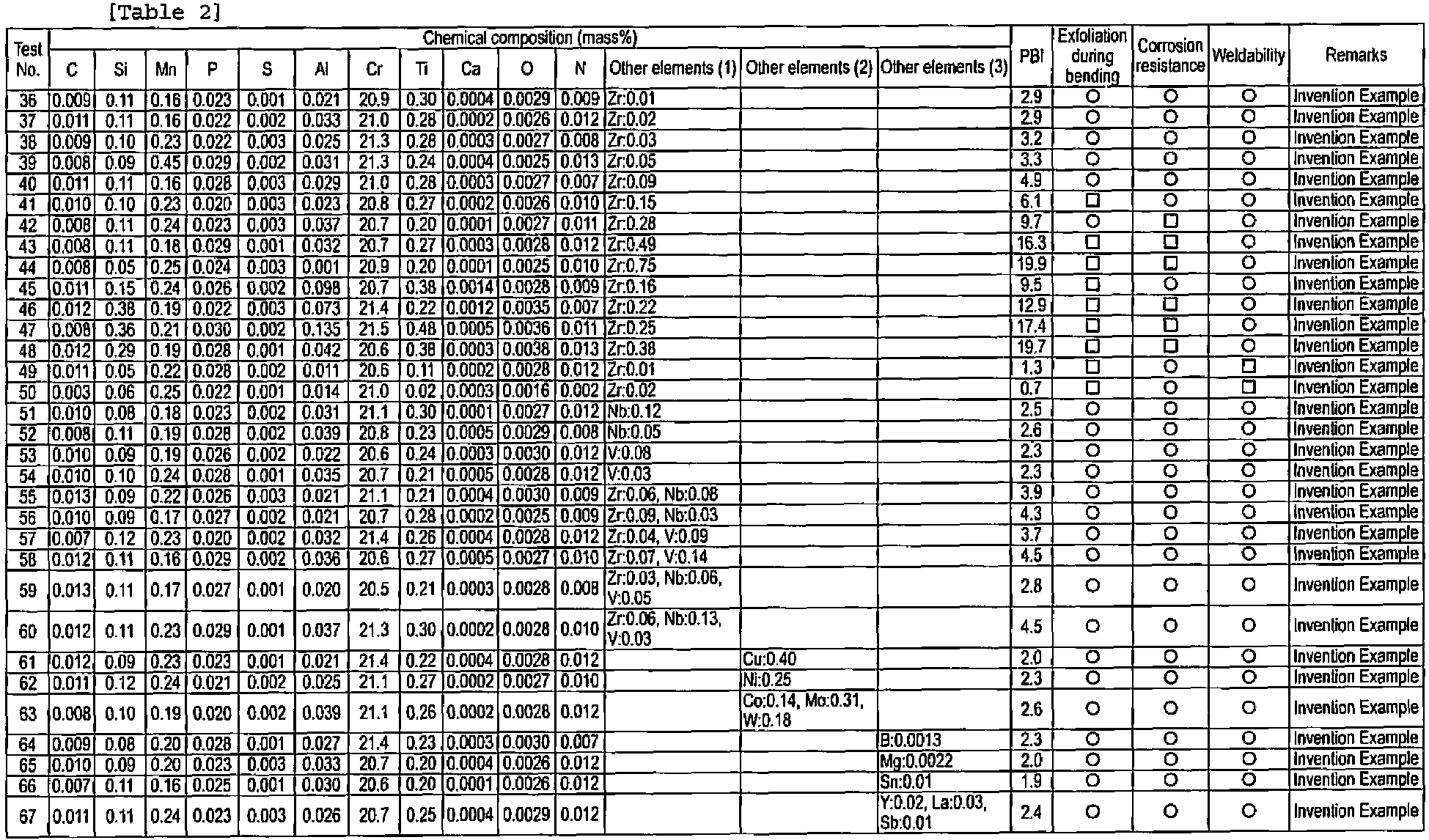


- The results obtained are shown in Tables 1 to 5. Invention Examples were evaluated as "pass" for all "Exfoliation during bending", "Corrosion resistance", and "Weldability". Furthermore, Invention Examples having a PBI value of 1.5 or greater and 5.0 or less, of all the Invention Examples, were excellent because the examples had a rating of "○" for all of the following: evaluation of black spot exfoliation during bending; corrosion resistance of the black spot formation area after bending; and characteristics of weld bead penetration in the sheet thickness direction. That is, it is seen that, in those examples, no black spots exfoliated during bending of the weld bead and thus corrosion resistance was excellent, and further the weld bead easily penetrated.
- In Comparative Examples of Test Nos. 116, 118, 120 to 123 and 127, the contents of Al, Ti, Si, Ca, O, and Zr were each above the range in the present invention. As a result, black spots exfoliated during bending and the regions after such exfoliation had low corrosion resistance.
- In Comparative Examples of Test Nos. 117 and 119, the contents of Cr and Ti were each below the range in the present invention. As a result, although no black spots exfoliated during bending, the regions including black spots had low corrosion resistance.
- In Comparative Examples of Test Nos. 124 and 125, the content of O (oxygen) was below the range in the present invention. As a result, characteristics of weld bead penetration were poor.
- In Comparative Example of Test No. 126, the content of N was above the range in the present invention. As a result, although no black spots exfoliated during bending, the regions including black spots had low corrosion resistance.
- In Comparative Examples of Test Nos. 128 and 129, the contents of the elements were within the ranges in the present invention respectively, but the PBI value of each was greater than 20.0. As a result, black spots exfoliated during bending and the regions after such exfoliation had low corrosion resistance.
- In Comparative Examples of Test Nos. 130 to 132, the contents of the elements were within the ranges in the present invention respectively, but the PBI value of each was less than 0.5. As a result, characteristics of weld bead penetration were poor.
- The stainless steel sheet of the present invention has excellent characteristics of weld bead penetration, has low susceptibility to exfoliation, during bending, of black spots that form during welding, and has low susceptibility to occurrence of crevice corrosion due to exfoliation of black spots. Thus, the ferritic stainless steel sheet of the present invention is suitable for elevator inner panels, interiors, duct hoods, muffler cutters, lockers, home appliance parts, office equipment parts, automotive interior parts, automotive exhaust pipes, building materials, drain covers, marine transport containers, vessels, kitchen equipment, building interior and exterior materials, automotive parts, escalators, railway vehicles, and electrical device housing panels, for example.
Claims (5)
- A ferritic stainless steel sheet comprising, in mass%,C: 0.020% or less,Si: 0.05 to 0.50%,Mn: 0.05 to 0.50%,P: 0.040% or less,S: 0.030% or less,Al: 0.001 to 0.150%,Cr: 18.0 to 25.0%,Ti: 0.01 to 0.50%,Ca: 0.0001 to 0.0015%,O (oxygen): 0.0015 to 0.0040%, andN: 0.025% or less, with the balance being Fe and incidental impurities,the ferritic stainless steel sheet further satisfying formula (1), below:

- The ferritic stainless steel sheet according to Claim 1, further comprising, in mass%, at least one selected fromZr: 0.01 to 0.80%,Nb: 0.01% or greater and less than 0.40%, andV: 0.01 to 0.50%.
- The ferritic stainless steel sheet according to Claim 1 or 2, further comprising, in mass%, at least one selected fromCu: 0.30 to 0.80%,Ni: 0.01 to 2.50%,Co: 0.01 to 0.50%,Mo: 0.01 to 2.00%, andW: 0.01 to 0.50%.
- The ferritic stainless steel sheet according to any one of Claims 1 to 3, further comprising, in mass%, at least one selected fromB: 0.0003 to 0.0030%,Mg: 0.0005 to 0.0100%,Y: 0.001 to 0.20%,REM (rare earth metal): 0.001 to 0.10%,Sn: 0.01 to 0.50%, andSb: 0.01 to 0.50%.
- The ferritic stainless steel sheet according to any one of Claims 1 to 4, wherein the ferritic stainless steel sheet has low susceptibility to exfoliation of black spots in a weld zone during bending.
Applications Claiming Priority (2)
| Application Number | Priority Date | Filing Date | Title |
|---|---|---|---|
| JP2016065695 | 2016-03-29 | ||
| PCT/JP2017/006973 WO2017169377A1 (en) | 2016-03-29 | 2017-02-24 | Ferritic stainless steel sheet |
Publications (3)
| Publication Number | Publication Date |
|---|---|
| EP3438310A1 true EP3438310A1 (en) | 2019-02-06 |
| EP3438310A4 EP3438310A4 (en) | 2019-02-06 |
| EP3438310B1 EP3438310B1 (en) | 2022-06-29 |
Family
ID=59963174
Family Applications (1)
| Application Number | Title | Priority Date | Filing Date |
|---|---|---|---|
| EP17773922.4A Active EP3438310B1 (en) | 2016-03-29 | 2017-02-24 | Ferritic stainless steel sheet used for tig welding |
Country Status (7)
| Country | Link |
|---|---|
| US (1) | US20190106775A1 (en) |
| EP (1) | EP3438310B1 (en) |
| JP (1) | JP6206624B1 (en) |
| KR (1) | KR102113416B1 (en) |
| CN (1) | CN109072373A (en) |
| ES (1) | ES2922626T3 (en) |
| WO (1) | WO2017169377A1 (en) |
Families Citing this family (13)
| Publication number | Priority date | Publication date | Assignee | Title |
|---|---|---|---|---|
| MX378757B (en) | 2016-02-08 | 2025-03-11 | Jfe Steel Corp | HIGH STRENGTH SEAMLESS STAINLESS STEEL TUBE FOR TUBULAR PRODUCTS FOR THE PETROLEUM INDUSTRY AND MANUFACTURING METHOD FOR HIGH STRENGTH SEAMLESS STAINLESS STEEL TUBE. |
| WO2018043310A1 (en) * | 2016-09-02 | 2018-03-08 | Jfeスチール株式会社 | Ferritic stainless steel |
| JP6418338B2 (en) | 2016-09-02 | 2018-11-07 | Jfeスチール株式会社 | Ferritic stainless steel |
| KR20190085029A (en) * | 2016-12-21 | 2019-07-17 | 제이에프이 스틸 가부시키가이샤 | Ferritic stainless steel |
| US11268161B2 (en) | 2017-01-13 | 2022-03-08 | Jfe Steel Corporation | High strength seamless stainless steel pipe and method for producing same |
| WO2018155041A1 (en) | 2017-02-24 | 2018-08-30 | Jfeスチール株式会社 | High strength seamless stainless steel pipe for oil well and production method therefor |
| CN110462079B (en) | 2017-03-30 | 2021-07-13 | 杰富意钢铁株式会社 | Ferritic stainless steel |
| CN118854188A (en) * | 2017-05-26 | 2024-10-29 | 杰富意钢铁株式会社 | Ferritic stainless steel |
| WO2020194484A1 (en) * | 2019-03-26 | 2020-10-01 | Jfeスチール株式会社 | Ferritic stainless steel sheet and method for producing same |
| JP7271261B2 (en) * | 2019-03-29 | 2023-05-11 | 日鉄ステンレス株式会社 | High-purity ferritic stainless steel and high-purity ferritic stainless steel slab |
| CN109913758B (en) * | 2019-03-29 | 2020-08-11 | 东北大学 | Ferritic stainless steel sheet with good high temperature strength and formability and preparation method thereof |
| CN110527895B (en) * | 2019-08-28 | 2022-03-15 | 嘉诚(厦门)工业有限公司 | Stainless steel material and preparation method and application thereof |
| JP7550587B2 (en) | 2020-09-29 | 2024-09-13 | 日鉄ステンレス株式会社 | Ferritic stainless steel sheet forming method and ferritic stainless steel sheet |
Family Cites Families (16)
| Publication number | Priority date | Publication date | Assignee | Title |
|---|---|---|---|---|
| TW420719B (en) * | 1995-09-26 | 2001-02-01 | Kawasaki Steel Co | Ferritic stainless steel sheet having less planar anisotropy and excellent anti-ridging characteristics and its manufacturing method |
| JP3624732B2 (en) * | 1998-01-30 | 2005-03-02 | 住友金属工業株式会社 | Ferritic stainless steel and ferritic stainless steel casts with excellent formability |
| JPH11323502A (en) * | 1998-05-12 | 1999-11-26 | Sumitomo Metal Ind Ltd | Ferritic stainless steel and its slab with excellent workability and toughness |
| JP4259097B2 (en) * | 2002-11-21 | 2009-04-30 | Jfeスチール株式会社 | Ti-containing high workability ferritic chromium steel sheet excellent in ridging resistance and method for producing the same |
| JP2004204252A (en) * | 2002-12-24 | 2004-07-22 | Jfe Steel Kk | Ti-containing highly workable ferritic chromium steel sheet having excellent ridging resistance and method for producing the same |
| JP5489759B2 (en) * | 2009-02-09 | 2014-05-14 | 新日鐵住金ステンレス株式会社 | Ferritic stainless steel with few black spots |
| JP2011068967A (en) * | 2009-09-28 | 2011-04-07 | Nisshin Steel Co Ltd | Water storage tank constructed by welding panel made from stainless steel |
| JP2011202254A (en) * | 2010-03-26 | 2011-10-13 | Nisshin Steel Co Ltd | Ferritic stainless steel having excellent corrosion resistance in weld zone |
| JP5793283B2 (en) * | 2010-08-06 | 2015-10-14 | 新日鐵住金ステンレス株式会社 | Ferritic stainless steel with few black spots |
| TWI450983B (en) * | 2011-03-29 | 2014-09-01 | Nippon Steel & Sumikin Sst | Fused parts with excellent corrosion resistance and strength of fat iron and stainless steel TIG welded structure |
| JP5780598B2 (en) * | 2012-02-15 | 2015-09-16 | 新日鐵住金ステンレス株式会社 | Austenitic stainless steel for high temperature equipment of welded pipe structure |
| JP6004700B2 (en) * | 2012-03-30 | 2016-10-12 | 新日鐵住金ステンレス株式会社 | Clad steel plate made of duplex stainless steel and method for producing the same |
| CN104662187A (en) * | 2012-09-25 | 2015-05-27 | 杰富意钢铁株式会社 | Ferritic stainless steel |
| IN2015DN01886A (en) * | 2012-12-07 | 2015-08-07 | Jfe Steel Corp | |
| JP5935792B2 (en) * | 2013-12-27 | 2016-06-15 | Jfeスチール株式会社 | Ferritic stainless steel |
| KR20170018457A (en) * | 2014-07-31 | 2017-02-17 | 제이에프이 스틸 가부시키가이샤 | Ferritic stainless steel sheet for plasma welding and welding method therefor |
-
2017
- 2017-02-24 CN CN201780020205.8A patent/CN109072373A/en active Pending
- 2017-02-24 US US16/087,486 patent/US20190106775A1/en not_active Abandoned
- 2017-02-24 WO PCT/JP2017/006973 patent/WO2017169377A1/en not_active Ceased
- 2017-02-24 EP EP17773922.4A patent/EP3438310B1/en active Active
- 2017-02-24 KR KR1020187027205A patent/KR102113416B1/en active Active
- 2017-02-24 ES ES17773922T patent/ES2922626T3/en active Active
- 2017-02-24 JP JP2017529096A patent/JP6206624B1/en active Active
Also Published As
| Publication number | Publication date |
|---|---|
| EP3438310A4 (en) | 2019-02-06 |
| JPWO2017169377A1 (en) | 2018-04-05 |
| WO2017169377A1 (en) | 2017-10-05 |
| KR102113416B1 (en) | 2020-05-20 |
| EP3438310B1 (en) | 2022-06-29 |
| KR20180118163A (en) | 2018-10-30 |
| ES2922626T3 (en) | 2022-09-19 |
| CN109072373A (en) | 2018-12-21 |
| US20190106775A1 (en) | 2019-04-11 |
| JP6206624B1 (en) | 2017-10-04 |
Similar Documents
| Publication | Publication Date | Title |
|---|---|---|
| EP3438310B1 (en) | Ferritic stainless steel sheet used for tig welding | |
| KR101564152B1 (en) | High-purity ferritic stainless steel sheet having excellent oxidation resistance and high-temperature strength, and method for producing same | |
| US9487849B2 (en) | Ferritic stainless steel | |
| JP5489759B2 (en) | Ferritic stainless steel with few black spots | |
| JP6792951B2 (en) | Duplex stainless steel for ozone-containing water | |
| WO2012018074A1 (en) | Ferritic stainless steel | |
| JP5534119B1 (en) | Ferritic stainless steel | |
| KR101463525B1 (en) | High-corrosion resistantce cold rolled ferritic stainless steel sheet excellent in toughness and method for manufacturing the same | |
| EP1918399B9 (en) | Ferritic stainless-steel sheet with excellent corrosion resistance and process for producing the same | |
| WO2013099132A1 (en) | Ferritic stainless steel | |
| WO2011093516A1 (en) | Highly corrosion-resistant hot-rolled ferrite stainless steel sheet having excellent toughness | |
| JP4963043B2 (en) | Bright annealed ferritic stainless steel sheet with excellent rust resistance and workability and method for producing the same | |
| KR101940427B1 (en) | Ferritic stainless steel sheet | |
| US20160168673A1 (en) | Ferritic stainless steel having excellent corrosion resistance of weld zone | |
| JP4457492B2 (en) | Stainless steel with excellent workability and weldability | |
| JP7458902B2 (en) | Ferritic Stainless Steel | |
| JP5556951B2 (en) | Ferritic stainless steel | |
| JP2518795B2 (en) | Soft austenitic stainless steel with excellent hot workability |
Legal Events
| Date | Code | Title | Description |
|---|---|---|---|
| STAA | Information on the status of an ep patent application or granted ep patent |
Free format text: STATUS: THE INTERNATIONAL PUBLICATION HAS BEEN MADE |
|
| PUAI | Public reference made under article 153(3) epc to a published international application that has entered the european phase |
Free format text: ORIGINAL CODE: 0009012 |
|
| STAA | Information on the status of an ep patent application or granted ep patent |
Free format text: STATUS: REQUEST FOR EXAMINATION WAS MADE |
|
| 17P | Request for examination filed |
Effective date: 20180926 |
|
| A4 | Supplementary search report drawn up and despatched |
Effective date: 20181217 |
|
| AK | Designated contracting states |
Kind code of ref document: A1 Designated state(s): AL AT BE BG CH CY CZ DE DK EE ES FI FR GB GR HR HU IE IS IT LI LT LU LV MC MK MT NL NO PL PT RO RS SE SI SK SM TR |
|
| AX | Request for extension of the european patent |
Extension state: BA ME |
|
| DAV | Request for validation of the european patent (deleted) | ||
| DAX | Request for extension of the european patent (deleted) | ||
| STAA | Information on the status of an ep patent application or granted ep patent |
Free format text: STATUS: EXAMINATION IS IN PROGRESS |
|
| 17Q | First examination report despatched |
Effective date: 20200103 |
|
| RIC1 | Information provided on ipc code assigned before grant |
Ipc: C21D 8/02 20060101ALI20211222BHEP Ipc: C21D 6/00 20060101ALI20211222BHEP Ipc: C22C 38/28 20060101ALI20211222BHEP Ipc: C22C 38/60 20060101ALI20211222BHEP Ipc: C22C 38/02 20060101ALI20211222BHEP Ipc: C22C 38/04 20060101ALI20211222BHEP Ipc: C22C 38/06 20060101ALI20211222BHEP Ipc: C22C 38/20 20060101ALI20211222BHEP Ipc: C22C 38/22 20060101ALI20211222BHEP Ipc: C22C 38/24 20060101ALI20211222BHEP Ipc: C22C 38/26 20060101ALI20211222BHEP Ipc: C22C 38/30 20060101ALI20211222BHEP Ipc: C22C 38/32 20060101ALI20211222BHEP Ipc: C22C 38/42 20060101ALI20211222BHEP Ipc: C22C 38/46 20060101ALI20211222BHEP Ipc: C22C 38/48 20060101ALI20211222BHEP Ipc: C22C 38/50 20060101ALI20211222BHEP Ipc: C22C 38/52 20060101ALI20211222BHEP Ipc: C22C 38/54 20060101ALI20211222BHEP Ipc: C22C 38/00 20060101AFI20211222BHEP |
|
| GRAP | Despatch of communication of intention to grant a patent |
Free format text: ORIGINAL CODE: EPIDOSNIGR1 |
|
| STAA | Information on the status of an ep patent application or granted ep patent |
Free format text: STATUS: GRANT OF PATENT IS INTENDED |
|
| INTG | Intention to grant announced |
Effective date: 20220222 |
|
| RIN1 | Information on inventor provided before grant (corrected) |
Inventor name: KAMI, CHIKARA Inventor name: FUJISAWA, MITSUYUKI Inventor name: ISHII, TOMOHIRO Inventor name: NISHIDA, SHUJI |
|
| GRAS | Grant fee paid |
Free format text: ORIGINAL CODE: EPIDOSNIGR3 |
|
| GRAA | (expected) grant |
Free format text: ORIGINAL CODE: 0009210 |
|
| STAA | Information on the status of an ep patent application or granted ep patent |
Free format text: STATUS: THE PATENT HAS BEEN GRANTED |
|
| AK | Designated contracting states |
Kind code of ref document: B1 Designated state(s): AL AT BE BG CH CY CZ DE DK EE ES FI FR GB GR HR HU IE IS IT LI LT LU LV MC MK MT NL NO PL PT RO RS SE SI SK SM TR |
|
| REG | Reference to a national code |
Ref country code: CH Ref legal event code: EP |
|
| REG | Reference to a national code |
Ref country code: AT Ref legal event code: REF Ref document number: 1501405 Country of ref document: AT Kind code of ref document: T Effective date: 20220715 |
|
| REG | Reference to a national code |
Ref country code: IE Ref legal event code: FG4D |
|
| REG | Reference to a national code |
Ref country code: DE Ref legal event code: R096 Ref document number: 602017059026 Country of ref document: DE |
|
| REG | Reference to a national code |
Ref country code: FI Ref legal event code: FGE |
|
| REG | Reference to a national code |
Ref country code: ES Ref legal event code: FG2A Ref document number: 2922626 Country of ref document: ES Kind code of ref document: T3 Effective date: 20220919 |
|
| REG | Reference to a national code |
Ref country code: LT Ref legal event code: MG9D |
|
| PG25 | Lapsed in a contracting state [announced via postgrant information from national office to epo] |
Ref country code: SE Free format text: LAPSE BECAUSE OF FAILURE TO SUBMIT A TRANSLATION OF THE DESCRIPTION OR TO PAY THE FEE WITHIN THE PRESCRIBED TIME-LIMIT Effective date: 20220629 Ref country code: NO Free format text: LAPSE BECAUSE OF FAILURE TO SUBMIT A TRANSLATION OF THE DESCRIPTION OR TO PAY THE FEE WITHIN THE PRESCRIBED TIME-LIMIT Effective date: 20220929 Ref country code: LT Free format text: LAPSE BECAUSE OF FAILURE TO SUBMIT A TRANSLATION OF THE DESCRIPTION OR TO PAY THE FEE WITHIN THE PRESCRIBED TIME-LIMIT Effective date: 20220629 Ref country code: HR Free format text: LAPSE BECAUSE OF FAILURE TO SUBMIT A TRANSLATION OF THE DESCRIPTION OR TO PAY THE FEE WITHIN THE PRESCRIBED TIME-LIMIT Effective date: 20220629 Ref country code: GR Free format text: LAPSE BECAUSE OF FAILURE TO SUBMIT A TRANSLATION OF THE DESCRIPTION OR TO PAY THE FEE WITHIN THE PRESCRIBED TIME-LIMIT Effective date: 20220930 Ref country code: BG Free format text: LAPSE BECAUSE OF FAILURE TO SUBMIT A TRANSLATION OF THE DESCRIPTION OR TO PAY THE FEE WITHIN THE PRESCRIBED TIME-LIMIT Effective date: 20220929 |
|
| REG | Reference to a national code |
Ref country code: NL Ref legal event code: MP Effective date: 20220629 |
|
| REG | Reference to a national code |
Ref country code: AT Ref legal event code: MK05 Ref document number: 1501405 Country of ref document: AT Kind code of ref document: T Effective date: 20220629 |
|
| PG25 | Lapsed in a contracting state [announced via postgrant information from national office to epo] |
Ref country code: RS Free format text: LAPSE BECAUSE OF FAILURE TO SUBMIT A TRANSLATION OF THE DESCRIPTION OR TO PAY THE FEE WITHIN THE PRESCRIBED TIME-LIMIT Effective date: 20220629 Ref country code: LV Free format text: LAPSE BECAUSE OF FAILURE TO SUBMIT A TRANSLATION OF THE DESCRIPTION OR TO PAY THE FEE WITHIN THE PRESCRIBED TIME-LIMIT Effective date: 20220629 |
|
| PG25 | Lapsed in a contracting state [announced via postgrant information from national office to epo] |
Ref country code: NL Free format text: LAPSE BECAUSE OF FAILURE TO SUBMIT A TRANSLATION OF THE DESCRIPTION OR TO PAY THE FEE WITHIN THE PRESCRIBED TIME-LIMIT Effective date: 20220629 |
|
| PG25 | Lapsed in a contracting state [announced via postgrant information from national office to epo] |
Ref country code: SM Free format text: LAPSE BECAUSE OF FAILURE TO SUBMIT A TRANSLATION OF THE DESCRIPTION OR TO PAY THE FEE WITHIN THE PRESCRIBED TIME-LIMIT Effective date: 20220629 Ref country code: SK Free format text: LAPSE BECAUSE OF FAILURE TO SUBMIT A TRANSLATION OF THE DESCRIPTION OR TO PAY THE FEE WITHIN THE PRESCRIBED TIME-LIMIT Effective date: 20220629 Ref country code: RO Free format text: LAPSE BECAUSE OF FAILURE TO SUBMIT A TRANSLATION OF THE DESCRIPTION OR TO PAY THE FEE WITHIN THE PRESCRIBED TIME-LIMIT Effective date: 20220629 Ref country code: PT Free format text: LAPSE BECAUSE OF FAILURE TO SUBMIT A TRANSLATION OF THE DESCRIPTION OR TO PAY THE FEE WITHIN THE PRESCRIBED TIME-LIMIT Effective date: 20221031 Ref country code: EE Free format text: LAPSE BECAUSE OF FAILURE TO SUBMIT A TRANSLATION OF THE DESCRIPTION OR TO PAY THE FEE WITHIN THE PRESCRIBED TIME-LIMIT Effective date: 20220629 Ref country code: AT Free format text: LAPSE BECAUSE OF FAILURE TO SUBMIT A TRANSLATION OF THE DESCRIPTION OR TO PAY THE FEE WITHIN THE PRESCRIBED TIME-LIMIT Effective date: 20220629 |
|
| PG25 | Lapsed in a contracting state [announced via postgrant information from national office to epo] |
Ref country code: PL Free format text: LAPSE BECAUSE OF FAILURE TO SUBMIT A TRANSLATION OF THE DESCRIPTION OR TO PAY THE FEE WITHIN THE PRESCRIBED TIME-LIMIT Effective date: 20220629 Ref country code: IS Free format text: LAPSE BECAUSE OF FAILURE TO SUBMIT A TRANSLATION OF THE DESCRIPTION OR TO PAY THE FEE WITHIN THE PRESCRIBED TIME-LIMIT Effective date: 20221029 |
|
| REG | Reference to a national code |
Ref country code: DE Ref legal event code: R097 Ref document number: 602017059026 Country of ref document: DE |
|
| PG25 | Lapsed in a contracting state [announced via postgrant information from national office to epo] |
Ref country code: AL Free format text: LAPSE BECAUSE OF FAILURE TO SUBMIT A TRANSLATION OF THE DESCRIPTION OR TO PAY THE FEE WITHIN THE PRESCRIBED TIME-LIMIT Effective date: 20220629 |
|
| PG25 | Lapsed in a contracting state [announced via postgrant information from national office to epo] |
Ref country code: DK Free format text: LAPSE BECAUSE OF FAILURE TO SUBMIT A TRANSLATION OF THE DESCRIPTION OR TO PAY THE FEE WITHIN THE PRESCRIBED TIME-LIMIT Effective date: 20220629 Ref country code: CZ Free format text: LAPSE BECAUSE OF FAILURE TO SUBMIT A TRANSLATION OF THE DESCRIPTION OR TO PAY THE FEE WITHIN THE PRESCRIBED TIME-LIMIT Effective date: 20220629 |
|
| PLBE | No opposition filed within time limit |
Free format text: ORIGINAL CODE: 0009261 |
|
| STAA | Information on the status of an ep patent application or granted ep patent |
Free format text: STATUS: NO OPPOSITION FILED WITHIN TIME LIMIT |
|
| 26N | No opposition filed |
Effective date: 20230330 |
|
| PG25 | Lapsed in a contracting state [announced via postgrant information from national office to epo] |
Ref country code: SI Free format text: LAPSE BECAUSE OF FAILURE TO SUBMIT A TRANSLATION OF THE DESCRIPTION OR TO PAY THE FEE WITHIN THE PRESCRIBED TIME-LIMIT Effective date: 20220629 |
|
| PG25 | Lapsed in a contracting state [announced via postgrant information from national office to epo] |
Ref country code: MC Free format text: LAPSE BECAUSE OF FAILURE TO SUBMIT A TRANSLATION OF THE DESCRIPTION OR TO PAY THE FEE WITHIN THE PRESCRIBED TIME-LIMIT Effective date: 20220629 |
|
| REG | Reference to a national code |
Ref country code: CH Ref legal event code: PL |
|
| REG | Reference to a national code |
Ref country code: BE Ref legal event code: MM Effective date: 20230228 |
|
| GBPC | Gb: european patent ceased through non-payment of renewal fee |
Effective date: 20230224 |
|
| PG25 | Lapsed in a contracting state [announced via postgrant information from national office to epo] |
Ref country code: LU Free format text: LAPSE BECAUSE OF NON-PAYMENT OF DUE FEES Effective date: 20230224 Ref country code: LI Free format text: LAPSE BECAUSE OF NON-PAYMENT OF DUE FEES Effective date: 20230228 Ref country code: CH Free format text: LAPSE BECAUSE OF NON-PAYMENT OF DUE FEES Effective date: 20230228 |
|
| REG | Reference to a national code |
Ref country code: IE Ref legal event code: MM4A |
|
| PG25 | Lapsed in a contracting state [announced via postgrant information from national office to epo] |
Ref country code: GB Free format text: LAPSE BECAUSE OF NON-PAYMENT OF DUE FEES Effective date: 20230224 |
|
| PG25 | Lapsed in a contracting state [announced via postgrant information from national office to epo] |
Ref country code: IT Free format text: LAPSE BECAUSE OF FAILURE TO SUBMIT A TRANSLATION OF THE DESCRIPTION OR TO PAY THE FEE WITHIN THE PRESCRIBED TIME-LIMIT Effective date: 20220629 Ref country code: IE Free format text: LAPSE BECAUSE OF NON-PAYMENT OF DUE FEES Effective date: 20230224 Ref country code: GB Free format text: LAPSE BECAUSE OF NON-PAYMENT OF DUE FEES Effective date: 20230224 Ref country code: FR Free format text: LAPSE BECAUSE OF NON-PAYMENT OF DUE FEES Effective date: 20230228 |
|
| PG25 | Lapsed in a contracting state [announced via postgrant information from national office to epo] |
Ref country code: BE Free format text: LAPSE BECAUSE OF NON-PAYMENT OF DUE FEES Effective date: 20230228 |
|
| PG25 | Lapsed in a contracting state [announced via postgrant information from national office to epo] |
Ref country code: BG Free format text: LAPSE BECAUSE OF FAILURE TO SUBMIT A TRANSLATION OF THE DESCRIPTION OR TO PAY THE FEE WITHIN THE PRESCRIBED TIME-LIMIT Effective date: 20220629 |
|
| PG25 | Lapsed in a contracting state [announced via postgrant information from national office to epo] |
Ref country code: BG Free format text: LAPSE BECAUSE OF FAILURE TO SUBMIT A TRANSLATION OF THE DESCRIPTION OR TO PAY THE FEE WITHIN THE PRESCRIBED TIME-LIMIT Effective date: 20220629 |
|
| PG25 | Lapsed in a contracting state [announced via postgrant information from national office to epo] |
Ref country code: CY Free format text: LAPSE BECAUSE OF FAILURE TO SUBMIT A TRANSLATION OF THE DESCRIPTION OR TO PAY THE FEE WITHIN THE PRESCRIBED TIME-LIMIT; INVALID AB INITIO Effective date: 20170224 |
|
| PG25 | Lapsed in a contracting state [announced via postgrant information from national office to epo] |
Ref country code: HU Free format text: LAPSE BECAUSE OF FAILURE TO SUBMIT A TRANSLATION OF THE DESCRIPTION OR TO PAY THE FEE WITHIN THE PRESCRIBED TIME-LIMIT; INVALID AB INITIO Effective date: 20170224 |
|
| PG25 | Lapsed in a contracting state [announced via postgrant information from national office to epo] |
Ref country code: TR Free format text: LAPSE BECAUSE OF FAILURE TO SUBMIT A TRANSLATION OF THE DESCRIPTION OR TO PAY THE FEE WITHIN THE PRESCRIBED TIME-LIMIT Effective date: 20220629 |
|
| PGFP | Annual fee paid to national office [announced via postgrant information from national office to epo] |
Ref country code: ES Payment date: 20260304 Year of fee payment: 10 |
|
| PGFP | Annual fee paid to national office [announced via postgrant information from national office to epo] |
Ref country code: DE Payment date: 20260102 Year of fee payment: 10 |
|
| PGFP | Annual fee paid to national office [announced via postgrant information from national office to epo] |
Ref country code: FI Payment date: 20260213 Year of fee payment: 10 |