EP3438283A1 - Method for detecting gene mutation - Google Patents
Method for detecting gene mutation Download PDFInfo
- Publication number
- EP3438283A1 EP3438283A1 EP17775181.5A EP17775181A EP3438283A1 EP 3438283 A1 EP3438283 A1 EP 3438283A1 EP 17775181 A EP17775181 A EP 17775181A EP 3438283 A1 EP3438283 A1 EP 3438283A1
- Authority
- EP
- European Patent Office
- Prior art keywords
- base
- nucleotide
- primer
- nucleic acid
- mutant
- Prior art date
- Legal status (The legal status is an assumption and is not a legal conclusion. Google has not performed a legal analysis and makes no representation as to the accuracy of the status listed.)
- Granted
Links
Images


Classifications
-
- C—CHEMISTRY; METALLURGY
- C12—BIOCHEMISTRY; BEER; SPIRITS; WINE; VINEGAR; MICROBIOLOGY; ENZYMOLOGY; MUTATION OR GENETIC ENGINEERING
- C12Q—MEASURING OR TESTING PROCESSES INVOLVING ENZYMES, NUCLEIC ACIDS OR MICROORGANISMS; COMPOSITIONS OR TEST PAPERS THEREFOR; PROCESSES OF PREPARING SUCH COMPOSITIONS; CONDITION-RESPONSIVE CONTROL IN MICROBIOLOGICAL OR ENZYMOLOGICAL PROCESSES
- C12Q1/00—Measuring or testing processes involving enzymes, nucleic acids or microorganisms; Compositions therefor; Processes of preparing such compositions
- C12Q1/68—Measuring or testing processes involving enzymes, nucleic acids or microorganisms; Compositions therefor; Processes of preparing such compositions involving nucleic acids
- C12Q1/6844—Nucleic acid amplification reactions
- C12Q1/6858—Allele-specific amplification
-
- C—CHEMISTRY; METALLURGY
- C12—BIOCHEMISTRY; BEER; SPIRITS; WINE; VINEGAR; MICROBIOLOGY; ENZYMOLOGY; MUTATION OR GENETIC ENGINEERING
- C12Q—MEASURING OR TESTING PROCESSES INVOLVING ENZYMES, NUCLEIC ACIDS OR MICROORGANISMS; COMPOSITIONS OR TEST PAPERS THEREFOR; PROCESSES OF PREPARING SUCH COMPOSITIONS; CONDITION-RESPONSIVE CONTROL IN MICROBIOLOGICAL OR ENZYMOLOGICAL PROCESSES
- C12Q1/00—Measuring or testing processes involving enzymes, nucleic acids or microorganisms; Compositions therefor; Processes of preparing such compositions
- C12Q1/68—Measuring or testing processes involving enzymes, nucleic acids or microorganisms; Compositions therefor; Processes of preparing such compositions involving nucleic acids
- C12Q1/6813—Hybridisation assays
- C12Q1/6827—Hybridisation assays for detection of mutation or polymorphism
-
- C—CHEMISTRY; METALLURGY
- C12—BIOCHEMISTRY; BEER; SPIRITS; WINE; VINEGAR; MICROBIOLOGY; ENZYMOLOGY; MUTATION OR GENETIC ENGINEERING
- C12N—MICROORGANISMS OR ENZYMES; COMPOSITIONS THEREOF; PROPAGATING, PRESERVING, OR MAINTAINING MICROORGANISMS; MUTATION OR GENETIC ENGINEERING; CULTURE MEDIA
- C12N15/00—Mutation or genetic engineering; DNA or RNA concerning genetic engineering, vectors, e.g. plasmids, or their isolation, preparation or purification; Use of hosts therefor
-
- C—CHEMISTRY; METALLURGY
- C12—BIOCHEMISTRY; BEER; SPIRITS; WINE; VINEGAR; MICROBIOLOGY; ENZYMOLOGY; MUTATION OR GENETIC ENGINEERING
- C12N—MICROORGANISMS OR ENZYMES; COMPOSITIONS THEREOF; PROPAGATING, PRESERVING, OR MAINTAINING MICROORGANISMS; MUTATION OR GENETIC ENGINEERING; CULTURE MEDIA
- C12N15/00—Mutation or genetic engineering; DNA or RNA concerning genetic engineering, vectors, e.g. plasmids, or their isolation, preparation or purification; Use of hosts therefor
- C12N15/09—Recombinant DNA-technology
-
- C—CHEMISTRY; METALLURGY
- C12—BIOCHEMISTRY; BEER; SPIRITS; WINE; VINEGAR; MICROBIOLOGY; ENZYMOLOGY; MUTATION OR GENETIC ENGINEERING
- C12Q—MEASURING OR TESTING PROCESSES INVOLVING ENZYMES, NUCLEIC ACIDS OR MICROORGANISMS; COMPOSITIONS OR TEST PAPERS THEREFOR; PROCESSES OF PREPARING SUCH COMPOSITIONS; CONDITION-RESPONSIVE CONTROL IN MICROBIOLOGICAL OR ENZYMOLOGICAL PROCESSES
- C12Q1/00—Measuring or testing processes involving enzymes, nucleic acids or microorganisms; Compositions therefor; Processes of preparing such compositions
- C12Q1/68—Measuring or testing processes involving enzymes, nucleic acids or microorganisms; Compositions therefor; Processes of preparing such compositions involving nucleic acids
-
- C—CHEMISTRY; METALLURGY
- C12—BIOCHEMISTRY; BEER; SPIRITS; WINE; VINEGAR; MICROBIOLOGY; ENZYMOLOGY; MUTATION OR GENETIC ENGINEERING
- C12Q—MEASURING OR TESTING PROCESSES INVOLVING ENZYMES, NUCLEIC ACIDS OR MICROORGANISMS; COMPOSITIONS OR TEST PAPERS THEREFOR; PROCESSES OF PREPARING SUCH COMPOSITIONS; CONDITION-RESPONSIVE CONTROL IN MICROBIOLOGICAL OR ENZYMOLOGICAL PROCESSES
- C12Q1/00—Measuring or testing processes involving enzymes, nucleic acids or microorganisms; Compositions therefor; Processes of preparing such compositions
- C12Q1/68—Measuring or testing processes involving enzymes, nucleic acids or microorganisms; Compositions therefor; Processes of preparing such compositions involving nucleic acids
- C12Q1/6806—Preparing nucleic acids for analysis, e.g. for polymerase chain reaction [PCR] assay
-
- C—CHEMISTRY; METALLURGY
- C12—BIOCHEMISTRY; BEER; SPIRITS; WINE; VINEGAR; MICROBIOLOGY; ENZYMOLOGY; MUTATION OR GENETIC ENGINEERING
- C12Q—MEASURING OR TESTING PROCESSES INVOLVING ENZYMES, NUCLEIC ACIDS OR MICROORGANISMS; COMPOSITIONS OR TEST PAPERS THEREFOR; PROCESSES OF PREPARING SUCH COMPOSITIONS; CONDITION-RESPONSIVE CONTROL IN MICROBIOLOGICAL OR ENZYMOLOGICAL PROCESSES
- C12Q1/00—Measuring or testing processes involving enzymes, nucleic acids or microorganisms; Compositions therefor; Processes of preparing such compositions
- C12Q1/68—Measuring or testing processes involving enzymes, nucleic acids or microorganisms; Compositions therefor; Processes of preparing such compositions involving nucleic acids
- C12Q1/6876—Nucleic acid products used in the analysis of nucleic acids, e.g. primers or probes
-
- C—CHEMISTRY; METALLURGY
- C12—BIOCHEMISTRY; BEER; SPIRITS; WINE; VINEGAR; MICROBIOLOGY; ENZYMOLOGY; MUTATION OR GENETIC ENGINEERING
- C12Q—MEASURING OR TESTING PROCESSES INVOLVING ENZYMES, NUCLEIC ACIDS OR MICROORGANISMS; COMPOSITIONS OR TEST PAPERS THEREFOR; PROCESSES OF PREPARING SUCH COMPOSITIONS; CONDITION-RESPONSIVE CONTROL IN MICROBIOLOGICAL OR ENZYMOLOGICAL PROCESSES
- C12Q1/00—Measuring or testing processes involving enzymes, nucleic acids or microorganisms; Compositions therefor; Processes of preparing such compositions
- C12Q1/68—Measuring or testing processes involving enzymes, nucleic acids or microorganisms; Compositions therefor; Processes of preparing such compositions involving nucleic acids
- C12Q1/6876—Nucleic acid products used in the analysis of nucleic acids, e.g. primers or probes
- C12Q1/6883—Nucleic acid products used in the analysis of nucleic acids, e.g. primers or probes for diseases caused by alterations of genetic material
- C12Q1/6886—Nucleic acid products used in the analysis of nucleic acids, e.g. primers or probes for diseases caused by alterations of genetic material for cancer
-
- C—CHEMISTRY; METALLURGY
- C12—BIOCHEMISTRY; BEER; SPIRITS; WINE; VINEGAR; MICROBIOLOGY; ENZYMOLOGY; MUTATION OR GENETIC ENGINEERING
- C12Q—MEASURING OR TESTING PROCESSES INVOLVING ENZYMES, NUCLEIC ACIDS OR MICROORGANISMS; COMPOSITIONS OR TEST PAPERS THEREFOR; PROCESSES OF PREPARING SUCH COMPOSITIONS; CONDITION-RESPONSIVE CONTROL IN MICROBIOLOGICAL OR ENZYMOLOGICAL PROCESSES
- C12Q2531/00—Reactions of nucleic acids characterised by
- C12Q2531/10—Reactions of nucleic acids characterised by the purpose being amplify/increase the copy number of target nucleic acid
- C12Q2531/113—PCR
-
- C—CHEMISTRY; METALLURGY
- C12—BIOCHEMISTRY; BEER; SPIRITS; WINE; VINEGAR; MICROBIOLOGY; ENZYMOLOGY; MUTATION OR GENETIC ENGINEERING
- C12Q—MEASURING OR TESTING PROCESSES INVOLVING ENZYMES, NUCLEIC ACIDS OR MICROORGANISMS; COMPOSITIONS OR TEST PAPERS THEREFOR; PROCESSES OF PREPARING SUCH COMPOSITIONS; CONDITION-RESPONSIVE CONTROL IN MICROBIOLOGICAL OR ENZYMOLOGICAL PROCESSES
- C12Q2600/00—Oligonucleotides characterized by their use
- C12Q2600/106—Pharmacogenomics, i.e. genetic variability in individual responses to drugs and drug metabolism
-
- C—CHEMISTRY; METALLURGY
- C12—BIOCHEMISTRY; BEER; SPIRITS; WINE; VINEGAR; MICROBIOLOGY; ENZYMOLOGY; MUTATION OR GENETIC ENGINEERING
- C12Q—MEASURING OR TESTING PROCESSES INVOLVING ENZYMES, NUCLEIC ACIDS OR MICROORGANISMS; COMPOSITIONS OR TEST PAPERS THEREFOR; PROCESSES OF PREPARING SUCH COMPOSITIONS; CONDITION-RESPONSIVE CONTROL IN MICROBIOLOGICAL OR ENZYMOLOGICAL PROCESSES
- C12Q2600/00—Oligonucleotides characterized by their use
- C12Q2600/156—Polymorphic or mutational markers
-
- C—CHEMISTRY; METALLURGY
- C12—BIOCHEMISTRY; BEER; SPIRITS; WINE; VINEGAR; MICROBIOLOGY; ENZYMOLOGY; MUTATION OR GENETIC ENGINEERING
- C12Q—MEASURING OR TESTING PROCESSES INVOLVING ENZYMES, NUCLEIC ACIDS OR MICROORGANISMS; COMPOSITIONS OR TEST PAPERS THEREFOR; PROCESSES OF PREPARING SUCH COMPOSITIONS; CONDITION-RESPONSIVE CONTROL IN MICROBIOLOGICAL OR ENZYMOLOGICAL PROCESSES
- C12Q2600/00—Oligonucleotides characterized by their use
- C12Q2600/158—Expression markers
-
- C—CHEMISTRY; METALLURGY
- C12—BIOCHEMISTRY; BEER; SPIRITS; WINE; VINEGAR; MICROBIOLOGY; ENZYMOLOGY; MUTATION OR GENETIC ENGINEERING
- C12Y—ENZYMES
- C12Y207/00—Transferases transferring phosphorus-containing groups (2.7)
- C12Y207/07—Nucleotidyltransferases (2.7.7)
- C12Y207/07007—DNA-directed DNA polymerase (2.7.7.7), i.e. DNA replicase
Definitions
- the present invention relates to a method for specifically detecting a certain single nucleotide polymorphism (SNP) or point mutation contained in a nucleic acid sample.
- SNP single nucleotide polymorphism
- Genetic mutations include a genetically inherited germline mutation and a somatic mutation that is acquired and induced in each cell, and it is reported that a certain single nucleotide polymorphism (SNP) of a certain gene among germline mutations and a point mutation (single nucleotide mutation), which is representative somatic mutation, are associated with various kinds of diseases, and in recent years, detection of these mutations is used for screening patients for which a certain drug is expected to be effective.
- SNP single nucleotide polymorphism
- EGFR gene mutation test is performed for judging the efficacy of a tyrosine kinase inhibitor (TKI) that is a therapeutic agent for lung cancer.
- EGFR gene mutationa are characterized in that various forms mutations such as deletions, insertions, and point mutations etc. are found.
- point mutations occurring at codon 719 in exon 18 cause substitution of the 2155th base G with A or T, or the 2156th base G with C, resulting in three types of amino acid substitutions.
- Non-Patent Document 2 While TKI resistance is imparted when the 2369th base C is substituted with T at codon 790 in exon 20 of EGFR gene, a point mutation at codon 797 in exon 20 is recently newly reported as a gene mutation imparting resistance to the third generation TKI (Non-Patent Document 2) and has two forms of point mutations causing substations of the 2389th base T with A, or the 2390th base G with C.
- a mutation detection method is desirably as simple as possible and capable of ensuring discriminatory power.
- a representative method for discriminating such a single base substitution is an ASP-PCR method in which an allele specific primer (ASP) is combined with a polymerase chain reaction method (PCR).
- the ASP is generally designed such that a nucleotide at 3' end of a primer corresponds to a mutated (or wild-type) nucleotide of SNP, and the 3' end hybridizes with a mutated (or wild-type) template so that elongation proceeds, while the 3' end does not hybridize with a wild-type (or mutated) template so that the elongation does not proceed.
- the presence/absence of single base substitution is judged depending on whether an amplification product resulting from the ASP is obtained.
- primer design methods have been devised. For example, a method is disclosed for conveniently and accurately detecting a single base substitution by using a detection primer having at the 3' end a base complementary to the particular base to be tested in the test nucleic acid sample, the base at the second base from the 3' end being complementary to the base of the test nucleic acid, and at least one base upstream of the third base from the 3' end being substituted with a base (artificial mismatch) different from the base complementary to the base of the test nucleic acid (Patent Document 1).
- a technique for enabling easy and unambiguous determination by using a wild-type primer in which the second base from the 3' end of the wild-type primer corresponds to the expected wild-type nucleotide of a single nucleotide polymorphism site, in which one of bases from the third base of the 3' end to the 5' end of the primer may be substituted with a base not complementary to the base of the strand to be hybridized with the primer in the chromosome or a fragment thereof, and in which the other bases in the primer are complementary to bases of the strand to be hybridized with the primer in the chromosome or a fragment thereof, as well as a mutant primer in which the second base from the 3' end of the mutant primer corresponds to the expected mutant nucleotide of a single nucleotide polymorphism site, in which one of bases from the third base of the 3' end to the 5' end of the primer may be substituted with a base not complementary to the base of the strand to be hybridized with the primer
- Patent Document 1 it is required to use a capture oligonucleotide probe having a sequence complementary to a base sequence including an artificial mismatch generated by primer elongation, and in the method of Patent Document 2, it is required to use a wild-type primer and one or two kinds of mutant primers. Since an ASP is in principle designed in accordance with the mutation of each base, a large number of primers must be prepared as the number of single base substitutions desired to be detected increases, and if two or more point mutations occur in one codon as in some of the RAS gene or EGFR gene mutations, the kinds of primers to be designed inevitably increase in number.
- Patent Document 1 requiring a capture oligonucleotide probe and the method of Patent Document 2 requiring a total of two or three kinds of wild-type and mutant primers cause concern about increased cost of the mutation detection reagent in some cases. Therefore, a method for designing a new primer satisfying both convenience and discriminatory power is required.
- An object of the present invention is to provide a method for designing a new primer ensuring reactivity and discriminatory power in a method for detecting a single base substitution based on an ASP-PCR method, as well as a method for easily detecting multiple point mutations within overlapping amplicons, particularly, single base substitutions of two adjacent single nucleotide polymorphism sites, for solving the problem.
- the present invention has the following configurations [1] to [7].
- the present invention provides a method for detecting a base sequence, or particularly, detecting a single base substitution, and enables provision of a detection method, a detection reagent, and a kit having remarkable effects such as an ability to inexpensively, easily, and accurately detect a large number of specimens efficiently without requiring a special device and an equipment for detection.
- the present invention provides a method for designing a novel ASP ensuring reactivity and discriminatory power, and combines the method with a conventional ASP design method to enable provision of a method for detecting multiple point mutations within overlapping amplicons, particularly, single base substitutions of two adjacent single nucleotide polymorphism sites, by using a minimum number of the ASP.
- the present invention relates to a method for detecting a single base substitution by hybridizing a mutant primer to a target nucleic acid in a nucleic acid sample and selectively amplifying only a DNA sequence including a single base substitution.
- the nucleic acid sample is not particularly limited as long as the sample contains a nucleic acid.
- the nucleic acid sample may be a sample containing extracted or synthesized nucleic acid or a biological sample containing various body fluids such as blood and spinal fluid, mucosa, tissues such as hair, and cells derived therefrom, or may be a sample containing individual organisms themselves such as single cell organisms and microorganisms.
- the origins of these nucleic acids are not limited, and nucleic acids derived from any biological and virus species are usable.
- the nucleic acids may be nucleic acids in the cell nuclei or extranuclear nucleic acids retained by organelles represented by mitochondria, chloroplast, nucleolus, etc.
- artificially synthesized nucleic acids or plasmids or viral vectors commonly used as vectors may be used.
- the type of nucleic acid may be either DNA or RNA.
- DNA various generally known DNA are usable, and genomic DNA and DNA obtained by reverse transcription of mRNA such as complementary DNA (cDNA) may also be used.
- cDNA complementary DNA
- RNA various RNAs such as generally known mRNA, rRNA, and viral RNA are usable.
- the method used for nucleic acid amplification in the present invention is not particularly limited, the nucleic acid amplification can be performed by a conventionally known method and can be performed by a generally known PCR method etc.
- the nucleic acid sequence to be amplified is not particularly limited. Any sequence can be amplified as long as the sequence is a nucleic acid sequence, and both DNA and RNA can be amplified.
- a nucleic acid derived from an organism can be amplified, and its species is not particularly limited.
- a region corresponding to an ORF (open reading frame) as well as the other portions are amplifiable.
- the nucleic acid derived from a living body includes a region in which a single nucleotide polymorphism due to mutation of one or more nucleotides is identified. More preferably, the nucleic acid derived from a living body includes a region in which two adjacent single nucleotide polymorphism sites are identified.
- the nucleic acid derived from a living body includes a DNA region containing a single nucleotide polymorphism of EGFR gene, KRAS gene, or NRAS gene of the human species.
- the DNA region containing a single nucleotide polymorphism of EGFR gene is preferably a DNA region containing any one or more of codons 719, 790, and 797.
- the DNA region containing a single nucleotide polymorphism of KRAS gene is preferably a DNA region containing any one or more of codons 12, 13, 59, 61, 117, and 146.
- the DNA region containing a single nucleotide polymorphism of NRAS gene is preferably a DNA region containing any one or more of codons 12, 13, 59, 61, 117, and 146.
- the mutant primer used in the present invention is not particularly limited as long as the primer can be used in an ordinary PCR.
- the base of the third nucleotide from the 3' end is complementary to the base of a mutant nucleotide of the single nucleotide polymorphism site of the strand of a target nucleic acid to be hybridized with the primer, and the second base from the 3' end is substituted with a base that is not complementary to the corresponding base of the strand of the target nucleic acid to be hybridized with the primer, while the other bases are complementary to the corresponding bases of the strand of the target nucleic acid to be hybridized with the primer.
- the mutant primer used for performing nucleic acid amplification may correspond to either forward or reverse primer, and the other primer may have an arbitrary sequence. Alternatively, both the forward and reverse primers may be mutant primers.
- the DNA prepared for evaluation of the discriminatory power of the ASP designed according to the present invention were DNA containing T790M and C797S mutations in exon 20 of human EGFR gene (mutant DNA) and DNA without the two gene mutations (wild-type DNA).
- mutant DNA plasmid DNA incorporating sequences (SEQ ID NO: 2, SEQ ID NOs: 3 and 4) including the respective gene mutations were prepared (consigned to Eurofins Genomics), and for the wild-type DNA, a genomic DNA extracted and purified from K562 cell line was used.
- SEQ ID NO: 2 is a sequence including the T790M mutation of EGFR gene, with codon 790 underlined and the single nucleotide polymorphism site indicated by boldface.
- SEQ ID NOs: 3 and 4 are sequences in the same region as SEQ ID NO: 2 of EGFR gene and include respective different C797S mutations. Codon 797 is underlined, and the single nucleotide polymorphism sites are indicated by boldface.
- SEQ ID NO: 1 is a portion of the wild-type sequence in the same region as SEQ ID NOs: 2 to 4 of EGFR gene.
- Primers 1 to 4 Synthesis of oligonucleotides having base sequences shown in SEQ ID NOs: 5 to 8 (hereinafter referred to as Primers 1 to 4) was consigned to a DNA synthesis service provider (Sigma-Aldrich LLC).
- Primer 1 has a sequence complementary to one strand (the complementary strand of SEQ ID NO: 2) of a mutant nucleic acid containing codon 790 of human EGFR gene, the base (T) of the third nucleotide from the 3' end thereof corresponding to the single nucleotide polymorphism site, but has a base (C) which is the base of the second nucleotide from the 3' end and is not complementary to the base of the corresponding nucleotide of the strand (i.e., Primer 1 is hybridized to the complementary strand of SEQ ID NO: 2 with a mismatch of one base).
- Primer 2 has a sequence complementary to one strand (the strand of SEQ ID NO: 4) of a mutant nucleic acid containing codon 797 of human EGFR gene, the base (G) of the third nucleotide from the 3' end thereof corresponding to the single nucleotide polymorphism site shown in SEQ ID NO: 4, but has a base (T) which is the base of the second nucleotide from the 3' end and is not complementary to the base of the corresponding nucleotide of the strand (i.e., Primer 2 is hybridized to the strand of SEQ ID NO: 4 with a mismatch of one base).
- Primer 2 has a sequence complementary to one strand (the strand of SEQ ID NO: 3) of a mutant nucleic acid containing codon 797 of human EGFR gene, the base (T) of the second nucleotide from the 3' end thereof corresponding to the single nucleotide polymorphism site shown in SEQ ID NO: 3, but has a base (G) which is the base of the third nucleotide from the 3' end and is not complementary to the base of the corresponding nucleotide of the strand (i.e., Primer 2 is hybridized to the strand of SEQ ID NO: 3 with a mismatch of one base).
- Primer 2 has a sequence complementary to one strand (the strand of SEQ ID NO: 1) of a wild-type nucleic acid containing codon 797 of human EGFR gene, but has bases (GT) which are the third and second nucleotides from the 3' end and are not complementary to the bases of the corresponding nucleotides of the strand (i.e., Primer 2 is hybridized to the strand of SEQ ID NO: 1 with a mismatch of two bases).
- GT bases
- Primer 3 is a reverse primer paired with Primer 1
- Primer 4 is a forward primer paired with Primer 2.
- the bases corresponding to the single nucleotide polymorphism sites of Primers 1 and 2 are indicated by boldface, and the bases not complementary to the bases of the corresponding nucleotides of the strands to be hybridized with the primers are underlined.
- Figs. 1 and 2 The results are shown in Figs. 1 and 2 .
- the primers designed according to the present invention were used, no significant amplification from the wild-type DNA was recognized until 40 cycles, and the mutant DNA was selectively amplifiable (the mutant DNA was discriminable from the wild-type DNA).
- the mutant DNA was discriminable from the wild-type DNA.
- codon 797 of EGFR gene two forms of mutations can selectively be amplified at the same time with one primer, which is efficient.
- DNA prepared for evaluation of the discriminatory power of the ASP designed according to the present invention were DNA (mutant DNA) containing three kinds of mutations (G719A, G719S, G719C) at codon 719 in exon 18 of human EGFR gene and DNA (wild-type DNA) without the three gene mutations.
- mutant DNA plasmid DNA incorporating sequences (SEQ ID NOs: 10, 11, and 12) including the respective gene mutations were prepared (consigned to Eurofins Genomics), and for the wild-type DNA, a genomic DNA extracted and purified from K562 cell line was used as in Example 1.
- SEQ ID NOs: 10, 11, and 12 are sequences including the G719A mutation, the G719S mutation, and the G719C mutation, respectively, of EGFR gene, with the codon 719 underlined and the single nucleotide polymorphism sites indicated by boldface.
- SEQ ID NOs: 10, 11, and 12 are all sequences in the same region of EGFR gene.
- SEQ ID NO: 9 is a portion of the wild-type sequence in the same region as SEQ ID NOs: 10 to 12 of EGFR gene.
- Primer 5 has a sequence complementary to one strand (the strand of SEQ ID NO: 10) of a mutant nucleic acid containing codon 719 of human EGFR gene, the base (G) of the third nucleotide from the 3' end thereof corresponding to the single nucleotide polymorphism site of the G719A mutation, but has a nucleotide (T) which is the second nucleotide from the 3' end the base of which is not complementary to the base of the corresponding nucleotide of the strand (i.e., Primer 5 is hybridized to the strand of SEQ ID NO: 10 with a mismatch of one base).
- Primer 5 has a sequence complementary to one strand (the strand of SEQ ID NO: 11) of a mutant nucleic acid containing codon 719 of human EGFR gene, the base (T) of the second nucleotide from the 3' end thereof corresponding to the single nucleotide polymorphism site of the G719S mutation, but has a nucleotide (G) which is the third nucleotide from the 3' end the base of which is not complementary to the base of the corresponding nucleotide of the strand (i.e., Primer 5 is hybridized to the strand of SEQ ID NO: 11 with a mismatch of one base).
- Primer 5 has a sequence complementary to one strand (the strand of SEQ ID NO: 12) of a mutant nucleic acid containing codon 719 of human EGFR gene, but has bases (GT) which are the bases of the third and second nucleotides from the 3' end and are not complementary to the bases of the corresponding nucleotides of the strand (i.e., Primer 5 is hybridized to the strand of SEQ ID NO: 12 with a mismatch of two bases).
- GT bases
- Primer 5 has a sequence complementary to one strand (the strand of SEQ ID NO: 9) of a wild-type nucleic acid containing codon 719 of human EGFR gene, but has bases (GT) which are the third and second nucleotides from the 3' end and are not complementary to the bases of the corresponding nucleotides of the strand (i.e., Primer 5 is hybridized to the strand of SEQ ID NO: 9 with a mismatch of two bases).
- GT bases
- Primer 6 has a sequence complementary to one strand (the strand of SEQ ID NO: 10) of a mutant nucleic acid containing codon 719 of human EGFR gene, the base (G) of the third nucleotide from the 3' end thereof corresponding to the single nucleotide polymorphism site of the G719A mutation, but has a nucleotide (A) which is the second nucleotide from the 3' end the base of which is not complementary to the base of the corresponding nucleotide of the strand (i.e., Primer 6 is hybridized to the strand of SEQ ID NO: 10 with a mismatch of one base).
- Primer 6 has a sequence complementary to one strand (the strand of SEQ ID NO: 12) of a mutant nucleic acid containing codon 719 of human EGFR gene, the base (A) of the second nucleotide from the 3' end thereof corresponding to the single nucleotide polymorphism site of the G719C mutation, but has a nucleotide (G) which is the third nucleotide from the 3' end the base of which is not complementary to the base of the corresponding nucleotide of the strand (i.e., Primer 6 is hybridized to the strand of SEQ ID NO: 12 with a mismatch of one base).
- Primer 6 has a sequence complementary to one strand (the strand of SEQ ID NO: 11) of a mutant nucleic acid containing codon 719 of human EGFR gene, but has bases (GA) which are the bases of the third and second nucleotides from the 3' end and are not complementary to the bases of the corresponding nucleotides of the strand (i.e., Primer 6 is hybridized to the strand of SEQ ID NO: 11 with a mismatch of two bases).
- Primer 6 has a sequence complementary to one strand (the strand of SEQ ID NO: 9) of a wild-type nucleic acid containing codon 719 of human EGFR gene, but has bases (GA) which are the bases of the third and second nucleotides from the 3' end and are not complementary to the bases of the corresponding nucleotides of the strand (i.e., Primer 6 is hybridized to the strand of SEQ ID NO: 9 with a mismatch of two bases).
- Primer 7 is a common forward primer paired with primers 5 and 6.
- the bases corresponding to the single nucleotide polymorphism sites of primers 5 and 6 are indicated by boldface, and the bases not complementary to the bases of the corresponding nucleotides of the strands to be hybridized with the primers are underlined.
- Figs. 3 and 4 The results are shown in Figs. 3 and 4 .
- the primers designed according to the present invention were used, no significant amplification from the wild-type DNA was recognized until 40 cycles, and the mutant DNA was selectively amplifiable (specific mutant DNA was discriminable from the wild-type DNA and another mutant DNA).
- the mutant DNA was selectively amplifiable (specific mutant DNA was discriminable from the wild-type DNA and another mutant DNA).
- codon 719 of EGFR gene three forms of mutations can selectively be amplified with two kinds of primers, which is efficient.
- Plasmid DNAs incorporating respective genetic mutation sequences (SEQ ID NOs: 17 to 28) (consigned to Eurofins Genomics) as well as a gene sequence absent of the two gene mutations as the wild type (SEQ ID NO: 16) were prepared, and the discriminatory power of the ASP designed according to the present invention was evaluated.
- Primer 8 has a sequence complementary to G12S and G12D mutant nucleic acid at codon 12 in exon 2 of human KRAS gene, has a nucleotide (T) which is the third nucleotide from the 3' end thereof, the base of which being complementary to a mutant nucleotide at the G12D nucleotide polymorphism site, the nucleotide though being in a noncomplementary relationship at the G12S, but has a nucleotide (T) which is the second nucleotide from the 3' end thereof, the base of which being not complementary to G12D, the nucleotide though being complementary to a G12S nucleotide polymorphism site (A).
- T nucleotide which is the third nucleotide from the 3' end thereof, the base of which being complementary to a mutant nucleotide at the G12D nucleotide polymorphism site, the nucleotide though being in a noncomplementary
- Primer 9 has a sequence complementary to G12R and G12A mutant nucleic acid at codon 12 in exon 2 of human KRAS gene, has a nucleotide (G) which is the third nucleotide from the 3' end thereof, the base of which being complementary to a mutant nucleotide at the G12A nucleotide polymorphism site, the nucleotide though being in a noncomplementary relationship at the G12R, but has a nucleotide (G) which is the second nucleotide from the 3' end thereof, the base of which being not complementary to G12A, the nucleotide though being complementary to a G12R nucleotide polymorphism site (C).
- G nucleotide which is the third nucleotide from the 3' end thereof, the base of which being complementary to a mutant nucleotide at the G12A nucleotide polymorphism site, the nucleotide though being in a noncomplementary
- Primer 10 has a sequence complementary to G12C and G12V mutant nucleic acid at codon 12 in exon 2 of human KRAS gene, has a nucleotide (A) which is the third nucleotide from the 3' end thereof, the base of which being complementary to a mutant nucleotide at the G12V nucleotide polymorphism site, the nucleotide though being in a noncomplementary relationship at the G12C, but has a nucleotide (A) which is the second nucleotide from the 3' end thereof, the base of which being not complementary to G12V, the nucleotide though being complementary to a G12C nucleotide polymorphism site (T).
- A is the third nucleotide from the 3' end thereof, the base of which being complementary to a mutant nucleotide at the G12V nucleotide polymorphism site, the nucleotide though being in a noncomplementary relationship at the G12C
- Primer 11 has a sequence complementary to G13S and G13A mutant nucleic acid at codon 13 in exon 2 of human KRAS gene, has a nucleotide (G) which is the third nucleotide from the 3' end thereof, the base of which being complementary to a mutant nucleotide at the G13A nucleotide polymorphism site, the nucleotide though being in a noncomplementary relationship at the G13S, but has a nucleotide (T) which is the second nucleotide from the 3' end thereof, the base of which being not complementary to G13A, the nucleotide though being complementary to a G13S nucleotide polymorphism site (A).
- G nucleotide
- T the second nucleotide from the 3' end thereof, the base of which being not complementary to G13A, the nucleotide though being complementary to a G13S nucleotide polymorphism site (A).
- Primer 12 has a sequence complementary to G13R and G13V mutant nucleic acid at codon 13 in exon 2 of human KRAS gene, has a nucleotide (A) which is the third nucleotide from the 3' end thereof, the base of which being complementary to a mutant nucleotide at the G13V nucleotide polymorphism site, the nucleotide though being in a noncomplementary relationship at the G13R, but has a nucleotide (G) which is the second nucleotide from the 3' end thereof, the base of which being not complementary to G13V, the nucleotide though being complementary to a G13R nucleotide polymorphism site (C).
- A is the third nucleotide from the 3' end thereof, the base of which being complementary to a mutant nucleotide at the G13V nucleotide polymorphism site, the nucleotide though being in a noncomplementary relationship at the G13R
- Primer 13 has a sequence complementary to G13C and G13D mutant nucleic acid at codon 13 in exon 2 of human KRAS gene, has a nucleotide (T) which is the third nucleotide from the 3' end thereof, the base of which being complementary to a mutant nucleotide at the G13D nucleotide polymorphism site, the nucleotide though being in a noncomplementary relationship at the G13C, but has a nucleotide (A) which is the second nucleotide from the 3' end thereof, the base of which being not complementary to G13D, the nucleotide though being complementary to a G13C nucleotide polymorphism site (T).
- T nucleotide which is the third nucleotide from the 3' end thereof, the base of which being complementary to a mutant nucleotide at the G13D nucleotide polymorphism site, the nucleotide though being in a noncomplementary
- Primer 14 is a common forward primer paired with Primers 8 to 13.
- the results for codon 12 are shown in Figs. 5 to 7
- the results for codon 13 are shown in Figs. 8 to 10 .
- the primers designed according to the present invention are used, no amplification from the wild type was observed, and it can be said that the mutant can specifically be amplified.
- the number of primers for detecting 12 patterns of mutations at codons 12 and 13 is reduced to half so that selective amplification can be achieved with six kinds of primers, which contributes to simplification and labor saving of detection reagents and operations.
- the primer according to the primer designing method of the present invention can be used for a genetic diagnosis using a biological sample, a genetic diagnosis reagent, a pedigree analysis method, a pedigree analysis reagent, a plant variety identification method, a plant variety identification reagent, a meat breed judgment method, a meat breed judgment method reagent, a forensic analysis method, a forensic analysis reagent, etc.
Landscapes
- Chemical & Material Sciences (AREA)
- Life Sciences & Earth Sciences (AREA)
- Organic Chemistry (AREA)
- Health & Medical Sciences (AREA)
- Engineering & Computer Science (AREA)
- Zoology (AREA)
- Wood Science & Technology (AREA)
- Proteomics, Peptides & Aminoacids (AREA)
- Genetics & Genomics (AREA)
- Analytical Chemistry (AREA)
- General Engineering & Computer Science (AREA)
- Biotechnology (AREA)
- Bioinformatics & Cheminformatics (AREA)
- Immunology (AREA)
- General Health & Medical Sciences (AREA)
- Biophysics (AREA)
- Biochemistry (AREA)
- Molecular Biology (AREA)
- Physics & Mathematics (AREA)
- Microbiology (AREA)
- Pathology (AREA)
- Biomedical Technology (AREA)
- Chemical Kinetics & Catalysis (AREA)
- Hospice & Palliative Care (AREA)
- Oncology (AREA)
- Plant Pathology (AREA)
- Measuring Or Testing Involving Enzymes Or Micro-Organisms (AREA)
Abstract
Description
- The present invention relates to a method for specifically detecting a certain single nucleotide polymorphism (SNP) or point mutation contained in a nucleic acid sample.
- Genetic mutations include a genetically inherited germline mutation and a somatic mutation that is acquired and induced in each cell, and it is reported that a certain single nucleotide polymorphism (SNP) of a certain gene among germline mutations and a point mutation (single nucleotide mutation), which is representative somatic mutation, are associated with various kinds of diseases, and in recent years, detection of these mutations is used for screening patients for which a certain drug is expected to be effective.
- For example, it is found that no therapeutic effect is expected from an anti-EGFR antibody used as a therapeutic agent for colon cancer when a point mutation is found in the exon 2, 3, 4 regions of the patient's KRAS gene and NRAS gene, and a kit is developed for enabling detection of RAS (KRAS/NRAS) gene mutations associated with a total of 48 amino acid substitutions at
codons - An EGFR gene mutation test is performed for judging the efficacy of a tyrosine kinase inhibitor (TKI) that is a therapeutic agent for lung cancer. EGFR gene mutationa are characterized in that various forms mutations such as deletions, insertions, and point mutations etc. are found. Among several point mutations, point mutations occurring at codon 719 in exon 18 cause substitution of the 2155th base G with A or T, or the 2156th base G with C, resulting in three types of amino acid substitutions. While TKI resistance is imparted when the 2369th base C is substituted with T at codon 790 in
exon 20 of EGFR gene, a point mutation at codon 797 inexon 20 is recently newly reported as a gene mutation imparting resistance to the third generation TKI (Non-Patent Document 2) and has two forms of point mutations causing substations of the 2389th base T with A, or the 2390th base G with C. - As described above, for some of the RAS gene or EGFR gene mutations, it is required to deal with the detection of single base substitutions in the case of occurrence of two or more point mutations in one codon, and a mutation detection method is desirably as simple as possible and capable of ensuring discriminatory power.
- A representative method for discriminating such a single base substitution is an ASP-PCR method in which an allele specific primer (ASP) is combined with a polymerase chain reaction method (PCR). The ASP is generally designed such that a nucleotide at 3' end of a primer corresponds to a mutated (or wild-type) nucleotide of SNP, and the 3' end hybridizes with a mutated (or wild-type) template so that elongation proceeds, while the 3' end does not hybridize with a wild-type (or mutated) template so that the elongation does not proceed. The presence/absence of single base substitution is judged depending on whether an amplification product resulting from the ASP is obtained.
- However, to ensure discriminatory power by a difference of only one nucleotide at the 3' end, it is necessary to extremely strictly control a temperature condition etc. during reaction. Therefore, primer design methods have been devised. For example, a method is disclosed for conveniently and accurately detecting a single base substitution by using a detection primer having at the 3' end a base complementary to the particular base to be tested in the test nucleic acid sample, the base at the second base from the 3' end being complementary to the base of the test nucleic acid, and at least one base upstream of the third base from the 3' end being substituted with a base (artificial mismatch) different from the base complementary to the base of the test nucleic acid (Patent Document 1). Furthermore, a technique is disclosed for enabling easy and unambiguous determination by using a wild-type primer in which the second base from the 3' end of the wild-type primer corresponds to the expected wild-type nucleotide of a single nucleotide polymorphism site, in which one of bases from the third base of the 3' end to the 5' end of the primer may be substituted with a base not complementary to the base of the strand to be hybridized with the primer in the chromosome or a fragment thereof, and in which the other bases in the primer are complementary to bases of the strand to be hybridized with the primer in the chromosome or a fragment thereof, as well as a mutant primer in which the second base from the 3' end of the mutant primer corresponds to the expected mutant nucleotide of a single nucleotide polymorphism site, in which one of bases from the third base of the 3' end to the 5' end of the primer may be substituted with a base not complementary to the base of the strand to be hybridized with the primer in the chromosome or a fragment thereof, and in which the other bases in the primer are complementary to bases of the strand to be hybridized with the primer in the chromosome or a fragment thereof (Patent Document 2).
- However, in the method of Patent Document 1, it is required to use a capture oligonucleotide probe having a sequence complementary to a base sequence including an artificial mismatch generated by primer elongation, and in the method of Patent Document 2, it is required to use a wild-type primer and one or two kinds of mutant primers. Since an ASP is in principle designed in accordance with the mutation of each base, a large number of primers must be prepared as the number of single base substitutions desired to be detected increases, and if two or more point mutations occur in one codon as in some of the RAS gene or EGFR gene mutations, the kinds of primers to be designed inevitably increase in number. Therefore, the method of Patent Document 1 requiring a capture oligonucleotide probe and the method of Patent Document 2 requiring a total of two or three kinds of wild-type and mutant primers cause concern about increased cost of the mutation detection reagent in some cases. Therefore, a method for designing a new primer satisfying both convenience and discriminatory power is required.
-
- Patent Document 1: Japanese Laid-Open Patent Publication No.
2005-160430 - Patent Document 2: Japanese Patent No.
3937136 -
- Non-Patent Document 1: Yoshino T, Muro K, Yamaguchi K, Nishina T, Denda T, Kudo T, Okamoto W, Taniguchi H, Akagi K, Kajiwara T, Hironaka S, Satoh T. Clinical Validation of a Multiplex Kit for RAS Mutations in Colorectal Cancer: Results of the RASKET (RAS KEy Testing) Prospective, Multicenter Study. EBioMedicine. 2015 Feb 14;2(4):317-23.
- Non-Patent Document 2: Thress KS, Paweletz CP, Felip E, Cho BC, Stetson D, Dougherty B, Lai Z, Markovets A, Vivancos A, Kuang Y, Ercan D, Matthews SE, Cantarini M, Barrett JC, Jaenne PA, Oxnard GR. Acquired EGFR C797S mutation mediates resistance to AZD9291 in non-small cell lung cancer harboring EGFR T790M. Nat Med. 2015 Jun;21(6):560-2.
- An object of the present invention is to provide a method for designing a new primer ensuring reactivity and discriminatory power in a method for detecting a single base substitution based on an ASP-PCR method, as well as a method for easily detecting multiple point mutations within overlapping amplicons, particularly, single base substitutions of two adjacent single nucleotide polymorphism sites, for solving the problem.
- The present invention has the following configurations [1] to [7].
-
- [1] A method for detecting a single base substitution at a single nucleotide polymorphism site contained in a nucleic acid sample by utilizing a nucleic acid amplification reaction, the method combines the steps of:
- (a) hybridizing to the nucleic acid a mutant primer in which the base of the third nucleotide from the 3' end corresponds to the base of a mutant nucleotide of the single nucleotide polymorphism, in which the base of the second nucleotide from the 3' end is not complementary to the base of the corresponding nucleotide of the nucleic acid, and in which the bases of the other nucleotides are complementary to bases of the corresponding nucleotides of the nucleic acid;
- (b) elongating the mutant primer with a DNA polymerase and deoxyribonucleoside triphosphate that is a substrate thereof; and
- (c) detecting the single base substitution contained in the nucleic acid sample based on whether the mutant primer is elongated or not.
- [2] The method for detecting a single base substitution according to [1] above, wherein the single nucleotide polymorphism site is a first and a second adjacent single nucleotide polymorphism sites, and wherein the step (a) is a step of hybridizing to the nucleic acid a mutant primer in which the base of the third nucleotide from the 3' end corresponds to the base of a mutant nucleotide of the first single nucleotide polymorphism, in which the base of the second nucleotide from the 3' end is not complementary to the base of the corresponding nucleotide of the nucleic acid having a mutant nucleotide of the first single nucleotide polymorphism, in which the base of the second nucleotide from the 3' end corresponds to the base of a mutant nucleotide of the second single nucleotide polymorphism, in which the base of the third nucleotide from the 3' end is not complementary to the base of the corresponding nucleotide of the nucleic acid having a mutant nucleotide of the second single nucleotide polymorphism, and in which the bases of the other nucleotides are complementary to the bases of the corresponding nucleotides of the nucleic acid.
- [3] The method for detecting a single base substitution according to [1] or [2] above, wherein the single base substitution is a single base substitution of EGFR gene, KRAS gene, or NRAS gene.
- [4] The method according to any one of [1] to [3] above, wherein the nucleic acid amplification reaction is a polymerase chain reaction.
- [5] The method according to [4] above, wherein whether the mutant primer is elongated or not is determined based on the presence or absence of an amplification product of the polymerase chain reaction.
- [6] A reagent containing a mutant primer for use in a method for detecting a single base substitution of a single nucleotide polymorphism site contained in a nucleic acid sample by utilizing a nucleic acid amplification reaction, the reagent containing a mutant primer in which the base of the third nucleotide from the 3' end corresponds to the base of a mutant nucleotide of the single nucleotide polymorphism, in which the base of the second nucleotide from the 3' end is not complementary to the base of the corresponding nucleotide of the nucleic acid, and in which the bases of the other nucleotides are complementary to the bases of the corresponding nucleotides of the nucleic acid.
- [7] The reagent according to [6] above, wherein the mutant primer amplifies a mutant allele of EGFR gene, KRAS gene, or NRAS gene.
- [8] The reagent according to [6] or [7] above, wherein the nucleic acid amplification reaction is a polymerase chain reaction.
- [9] A method for amplifying a fragment of nucleotides comprising the steps of:
- (i) hybridizing a first primer and a second primer to a deoxyribonucleic acid (DNA) molecule containing a single nucleotide polymorphism site in a sample;
- (ii) elongating the first primer and the second primer with a DNA polymerase in the presence of deoxyribonucleoside triphosphate;
- (iii) hybridizing the second primer to the elongated first primer and hybridizing the first primer to the elongated second primer;
- (iv) elongating the second primer hybridized to the elongated first primer and the first primer hybridized to the elongated second primer in the presence of deoxyribonucleoside triphosphate with a DNA polymerase; and
- (v) optionally repeating the steps (iii) and (iv) once to 50 times, preferably 5 to 45 times, 10 to 45 times, 10 to 40 times, 10 to 35 times, 15 to 35 times, 20 to 35 times, or 25 to 35 times, wherein
the nucleotide sequence of the second primer is complementary to the other strand of the DNA molecule, and wherein
when hybridized to the deoxyribonucleic acid (DNA) molecule containing the single nucleotide polymorphism site in the sample, the 3' ends of the first primer and the second primer are each located on the 3' side viewed from the 3' ends of the other primers. - [10] The method for amplifying a fragment of nucleotides according to [9] above, wherein the single nucleotide polymorphism site is a first and a second adjacent single nucleotide polymorphism sites, and wherein the nucleotide sequence of the first primer is complementary to one strand of the DNA molecule, the base of the third nucleotide from the 3' end corresponding to the base characterizing one genotype of the first single nucleotide polymorphism, whereas the second base from the 3' end is not complementary to the base of the corresponding nucleotide of the DNA strand, and the base of the second nucleotide from the 3' end corresponding to the base characterizing one genotype of the second single nucleotide polymorphism, whereas the third base from the 3' end is not complementary to the base of the corresponding nucleotide of the DNA strand.
- The present invention provides a method for detecting a base sequence, or particularly, detecting a single base substitution, and enables provision of a detection method, a detection reagent, and a kit having remarkable effects such as an ability to inexpensively, easily, and accurately detect a large number of specimens efficiently without requiring a special device and an equipment for detection.
- The present invention provides a method for designing a novel ASP ensuring reactivity and discriminatory power, and combines the method with a conventional ASP design method to enable provision of a method for detecting multiple point mutations within overlapping amplicons, particularly, single base substitutions of two adjacent single nucleotide polymorphism sites, by using a minimum number of the ASP.
-
- [
Fig. 1] Fig. 1 shows the result of selective amplification of a PCR product from DNA containing T790M mutation inexon 20 of EGFR gene. - [
Fig. 2] Fig. 2 shows the result of selective amplification of a PCR product from DNA containing C797S mutation inexon 20 of EGFR gene. - [
Fig. 3] Fig. 3 shows the result of selective amplification of a PCR product from DNA containing G719A mutation and G719S mutation in exon 18 of EGFR gene. - [
Fig. 4] Fig. 3 shows the result of selective amplification of a PCR product from DNA containing G719A mutation and G719C mutation in exon 18 of EGFR gene. - [
Fig. 5] Fig. 5 shows the result of selective amplification of a PCR product from DNA containing G12S and G12D mutations atcodon 12 in exon 2 of KRAS gene. - [
Fig. 6] Fig. 6 shows the result of selective amplification of a PCR product from DNA containing G12R and G12A mutations atcodon 12 in exon 2 of KRAS gene. - [
Fig. 7] Fig. 7 shows the result of selective amplification of a PCR product from DNA containing G12C and G12V mutations atcodon 12 in exon 2 of KRAS gene. - [
Fig. 8] Fig. 8 shows the result of selective amplification of a PCR product from DNA containing G13S and G13A mutations atcodon 13 in exon 2 of KRAS gene. - [
Fig. 9] Fig. 9 shows the result of selective amplification of a PCR product from DNA containing G13R and G13V mutations atcodon 13 in exon 2 of KRAS gene. - [
Fig. 10] Fig. 10 shows the result of selective amplification of a PCR product from DNA containing G13C and G13D mutations atcodon 13 in exon 2 of KRAS gene. - The present invention relates to a method for detecting a single base substitution by hybridizing a mutant primer to a target nucleic acid in a nucleic acid sample and selectively amplifying only a DNA sequence including a single base substitution.
- The nucleic acid sample is not particularly limited as long as the sample contains a nucleic acid. The nucleic acid sample may be a sample containing extracted or synthesized nucleic acid or a biological sample containing various body fluids such as blood and spinal fluid, mucosa, tissues such as hair, and cells derived therefrom, or may be a sample containing individual organisms themselves such as single cell organisms and microorganisms. The origins of these nucleic acids are not limited, and nucleic acids derived from any biological and virus species are usable. The nucleic acids may be nucleic acids in the cell nuclei or extranuclear nucleic acids retained by organelles represented by mitochondria, chloroplast, nucleolus, etc. Furthermore, artificially synthesized nucleic acids or plasmids or viral vectors commonly used as vectors may be used.
- The type of nucleic acid may be either DNA or RNA. In the case of DNA, various generally known DNA are usable, and genomic DNA and DNA obtained by reverse transcription of mRNA such as complementary DNA (cDNA) may also be used. For RNA, various RNAs such as generally known mRNA, rRNA, and viral RNA are usable.
- Although the method used for nucleic acid amplification in the present invention is not particularly limited, the nucleic acid amplification can be performed by a conventionally known method and can be performed by a generally known PCR method etc.
- The nucleic acid sequence to be amplified is not particularly limited. Any sequence can be amplified as long as the sequence is a nucleic acid sequence, and both DNA and RNA can be amplified. A nucleic acid derived from an organism can be amplified, and its species is not particularly limited. A region corresponding to an ORF (open reading frame) as well as the other portions are amplifiable. Preferably, the nucleic acid derived from a living body includes a region in which a single nucleotide polymorphism due to mutation of one or more nucleotides is identified. More preferably, the nucleic acid derived from a living body includes a region in which two adjacent single nucleotide polymorphism sites are identified. Furthermore, preferably, the nucleic acid derived from a living body includes a DNA region containing a single nucleotide polymorphism of EGFR gene, KRAS gene, or NRAS gene of the human species. The DNA region containing a single nucleotide polymorphism of EGFR gene is preferably a DNA region containing any one or more of codons 719, 790, and 797. The DNA region containing a single nucleotide polymorphism of KRAS gene is preferably a DNA region containing any one or more of
codons codons - The mutant primer used in the present invention is not particularly limited as long as the primer can be used in an ordinary PCR. In the sequence of the mutant primer, the base of the third nucleotide from the 3' end is complementary to the base of a mutant nucleotide of the single nucleotide polymorphism site of the strand of a target nucleic acid to be hybridized with the primer, and the second base from the 3' end is substituted with a base that is not complementary to the corresponding base of the strand of the target nucleic acid to be hybridized with the primer, while the other bases are complementary to the corresponding bases of the strand of the target nucleic acid to be hybridized with the primer. The mutant primer used for performing nucleic acid amplification may correspond to either forward or reverse primer, and the other primer may have an arbitrary sequence. Alternatively, both the forward and reverse primers may be mutant primers.
- The present invention will hereinafter be described in detail with examples; however, the present invention is not limited to the following examples.
- The DNA prepared for evaluation of the discriminatory power of the ASP designed according to the present invention were DNA containing T790M and C797S mutations in
exon 20 of human EGFR gene (mutant DNA) and DNA without the two gene mutations (wild-type DNA). For the mutant DNA, plasmid DNA incorporating sequences (SEQ ID NO: 2, SEQ ID NOs: 3 and 4) including the respective gene mutations were prepared (consigned to Eurofins Genomics), and for the wild-type DNA, a genomic DNA extracted and purified from K562 cell line was used. - SEQ ID NO: 2 is a sequence including the T790M mutation of EGFR gene, with codon 790 underlined and the single nucleotide polymorphism site indicated by boldface. SEQ ID NOs: 3 and 4 are sequences in the same region as SEQ ID NO: 2 of EGFR gene and include respective different C797S mutations. Codon 797 is underlined, and the single nucleotide polymorphism sites are indicated by boldface. SEQ ID NO: 1 is a portion of the wild-type sequence in the same region as SEQ ID NOs: 2 to 4 of EGFR gene.
- SEQ ID NO: 1 (portion of wild-type sequence of EGFR gene)
[Chem 1]
- SEQ ID NO: 2 (T790M mutant sequence of EGFR gene; [ATG] fragment)
[Chem 2]
- SEQ ID NO: 3 (C797S mutant sequence of EGFR gene; [AGC] fragment)
[Chem 3]
- SEQ ID NO: 4 (C797S mutant sequence of EGFR gene; [TCC] fragment)
[Chem 4]
- Synthesis of oligonucleotides having base sequences shown in SEQ ID NOs: 5 to 8 (hereinafter referred to as Primers 1 to 4) was consigned to a DNA synthesis service provider (Sigma-Aldrich LLC).
- Primer 1 has a sequence complementary to one strand (the complementary strand of SEQ ID NO: 2) of a mutant nucleic acid containing codon 790 of human EGFR gene, the base (T) of the third nucleotide from the 3' end thereof corresponding to the single nucleotide polymorphism site, but has a base (C) which is the base of the second nucleotide from the 3' end and is not complementary to the base of the corresponding nucleotide of the strand (i.e., Primer 1 is hybridized to the complementary strand of SEQ ID NO: 2 with a mismatch of one base).
- Primer 2 has a sequence complementary to one strand (the strand of SEQ ID NO: 4) of a mutant nucleic acid containing codon 797 of human EGFR gene, the base (G) of the third nucleotide from the 3' end thereof corresponding to the single nucleotide polymorphism site shown in SEQ ID NO: 4, but has a base (T) which is the base of the second nucleotide from the 3' end and is not complementary to the base of the corresponding nucleotide of the strand (i.e., Primer 2 is hybridized to the strand of SEQ ID NO: 4 with a mismatch of one base). Furthermore, Primer 2 has a sequence complementary to one strand (the strand of SEQ ID NO: 3) of a mutant nucleic acid containing codon 797 of human EGFR gene, the base (T) of the second nucleotide from the 3' end thereof corresponding to the single nucleotide polymorphism site shown in SEQ ID NO: 3, but has a base (G) which is the base of the third nucleotide from the 3' end and is not complementary to the base of the corresponding nucleotide of the strand (i.e., Primer 2 is hybridized to the strand of SEQ ID NO: 3 with a mismatch of one base). Primer 2 has a sequence complementary to one strand (the strand of SEQ ID NO: 1) of a wild-type nucleic acid containing codon 797 of human EGFR gene, but has bases (GT) which are the third and second nucleotides from the 3' end and are not complementary to the bases of the corresponding nucleotides of the strand (i.e., Primer 2 is hybridized to the strand of SEQ ID NO: 1 with a mismatch of two bases).
- Primer 3 is a reverse primer paired with Primer 1, and Primer 4 is a forward primer paired with Primer 2. The bases corresponding to the single nucleotide polymorphism sites of Primers 1 and 2 are indicated by boldface, and the bases not complementary to the bases of the corresponding nucleotides of the strands to be hybridized with the primers are underlined.
- SEQ ID NO: 5 (Primer 1)
[Chem 5]
5'-CCGTGCAGCTCATCAT CC-3' - SEQ ID NO: 6 (Primer 2)
[Chem 6] 5'-GGACATAGTCCAGGAGGG TG-3' (when hybridized to the strand of SEQ ID NO: 4) 5' -GGACATAGTCCAGGAGGG TG-3' (when hybridized to the strand of SEQ ID NO: 3) 5' -GGACATAGTCCAGGAGGGTG-3' (when hybridized to the strand of SEQ ID NO: 1) - SEQ ID NO: 7 (Primer 3)
[Chem 7]
5'-GGGAGCCAATATTGTCTTTGTG-3' - SEQ ID NO: 8 (Primer 4)
[Chem 8]
5'-ATGCGAAGCCACACTGAC-3' - A 25 µL reaction solution containing the following reagents was prepared and two-step real-time PCR analysis was performed using CFX96 (Bio-Rad).
[Table 1] 5× buffer (for 05) 5µL 10 mM dNTP 0.5µL 10µM forward primer 1.25µL 10µM reverse primer 1.25µL 20× EvaGreen (registered trademark) 1.25µL 2000 U/mL 05 DNA polymerase (New England Biolabs Japan Inc.) 0.25µL Nuclease-free Water 10.5µL DNA specimen 5µL (7500 copies of linear plasmid DNA cleaved with appropriate restriction enzyme or 25 ng of extracted DNA) Amplification condition 98°C for 30 seconds 98°C for 10 seconds, 64°C for 30 seconds (40 cycles) - The results are shown in
Figs. 1 and 2 . When the primers designed according to the present invention were used, no significant amplification from the wild-type DNA was recognized until 40 cycles, and the mutant DNA was selectively amplifiable (the mutant DNA was discriminable from the wild-type DNA). Particularly, in the case of codon 797 of EGFR gene, two forms of mutations can selectively be amplified at the same time with one primer, which is efficient. - DNA prepared for evaluation of the discriminatory power of the ASP designed according to the present invention were DNA (mutant DNA) containing three kinds of mutations (G719A, G719S, G719C) at codon 719 in exon 18 of human EGFR gene and DNA (wild-type DNA) without the three gene mutations. For the mutant DNA, plasmid DNA incorporating sequences (SEQ ID NOs: 10, 11, and 12) including the respective gene mutations were prepared (consigned to Eurofins Genomics), and for the wild-type DNA, a genomic DNA extracted and purified from K562 cell line was used as in Example 1.
- SEQ ID NOs: 10, 11, and 12 are sequences including the G719A mutation, the G719S mutation, and the G719C mutation, respectively, of EGFR gene, with the codon 719 underlined and the single nucleotide polymorphism sites indicated by boldface. SEQ ID NOs: 10, 11, and 12 are all sequences in the same region of EGFR gene. SEQ ID NO: 9 is a portion of the wild-type sequence in the same region as SEQ ID NOs: 10 to 12 of EGFR gene.
- SEQ ID NO: 9 (portion of wild-type sequence of EGFR gene)
[Chem 9]
- SEQ ID NO: 10 (G719A mutant sequence of EGFR gene; [GCC] fragment)
[Chem 10]
- SEQ ID NO: 11 (G719S mutant sequence of EGFR gene; [AGC] fragment)
[Chem 11]
- SEQ ID NO: 12 (G719C mutant sequence of EGFR gene; [TGC] fragment)
[Chem 12]
- Synthesis of oligonucleotides having base sequences shown in SEQ ID NOs: 13 to 15 (hereinafter referred to as Primers 5 to 7) was consigned to a DNA synthesis service provider (Sigma-Aldrich LLC).
- Primer 5 has a sequence complementary to one strand (the strand of SEQ ID NO: 10) of a mutant nucleic acid containing codon 719 of human EGFR gene, the base (G) of the third nucleotide from the 3' end thereof corresponding to the single nucleotide polymorphism site of the G719A mutation, but has a nucleotide (T) which is the second nucleotide from the 3' end the base of which is not complementary to the base of the corresponding nucleotide of the strand (i.e., Primer 5 is hybridized to the strand of SEQ ID NO: 10 with a mismatch of one base). Furthermore, Primer 5 has a sequence complementary to one strand (the strand of SEQ ID NO: 11) of a mutant nucleic acid containing codon 719 of human EGFR gene, the base (T) of the second nucleotide from the 3' end thereof corresponding to the single nucleotide polymorphism site of the G719S mutation, but has a nucleotide (G) which is the third nucleotide from the 3' end the base of which is not complementary to the base of the corresponding nucleotide of the strand (i.e., Primer 5 is hybridized to the strand of SEQ ID NO: 11 with a mismatch of one base). Primer 5 has a sequence complementary to one strand (the strand of SEQ ID NO: 12) of a mutant nucleic acid containing codon 719 of human EGFR gene, but has bases (GT) which are the bases of the third and second nucleotides from the 3' end and are not complementary to the bases of the corresponding nucleotides of the strand (i.e., Primer 5 is hybridized to the strand of SEQ ID NO: 12 with a mismatch of two bases). Primer 5 has a sequence complementary to one strand (the strand of SEQ ID NO: 9) of a wild-type nucleic acid containing codon 719 of human EGFR gene, but has bases (GT) which are the third and second nucleotides from the 3' end and are not complementary to the bases of the corresponding nucleotides of the strand (i.e., Primer 5 is hybridized to the strand of SEQ ID NO: 9 with a mismatch of two bases).
- Primer 6 has a sequence complementary to one strand (the strand of SEQ ID NO: 10) of a mutant nucleic acid containing codon 719 of human EGFR gene, the base (G) of the third nucleotide from the 3' end thereof corresponding to the single nucleotide polymorphism site of the G719A mutation, but has a nucleotide (A) which is the second nucleotide from the 3' end the base of which is not complementary to the base of the corresponding nucleotide of the strand (i.e., Primer 6 is hybridized to the strand of SEQ ID NO: 10 with a mismatch of one base). Furthermore, Primer 6 has a sequence complementary to one strand (the strand of SEQ ID NO: 12) of a mutant nucleic acid containing codon 719 of human EGFR gene, the base (A) of the second nucleotide from the 3' end thereof corresponding to the single nucleotide polymorphism site of the G719C mutation, but has a nucleotide (G) which is the third nucleotide from the 3' end the base of which is not complementary to the base of the corresponding nucleotide of the strand (i.e., Primer 6 is hybridized to the strand of SEQ ID NO: 12 with a mismatch of one base). Primer 6 has a sequence complementary to one strand (the strand of SEQ ID NO: 11) of a mutant nucleic acid containing codon 719 of human EGFR gene, but has bases (GA) which are the bases of the third and second nucleotides from the 3' end and are not complementary to the bases of the corresponding nucleotides of the strand (i.e., Primer 6 is hybridized to the strand of SEQ ID NO: 11 with a mismatch of two bases). Primer 6 has a sequence complementary to one strand (the strand of SEQ ID NO: 9) of a wild-type nucleic acid containing codon 719 of human EGFR gene, but has bases (GA) which are the bases of the third and second nucleotides from the 3' end and are not complementary to the bases of the corresponding nucleotides of the strand (i.e., Primer 6 is hybridized to the strand of SEQ ID NO: 9 with a mismatch of two bases).
- Primer 7 is a common forward primer paired with primers 5 and 6. The bases corresponding to the single nucleotide polymorphism sites of primers 5 and 6 are indicated by boldface, and the bases not complementary to the bases of the corresponding nucleotides of the strands to be hybridized with the primers are underlined.
- SEQ ID NO: 13 (Primer 5)
[Chem 13]
5' -CGAACGCACCGGAGG TC-3' (when hybridized to the strand of SEQ ID NO: 10) 5' -CGAACGCACCGCAGG TC-3' (when hybridized to the strand of SEQ ID NO: 11) 5'-CGAACGCACCGGAGGTC-3' (when hybridized to the strands of SEQ ID NOs: 12 and 9) - SEQ ID NO: 14 (primer 6)
[Chem 14]
5' -CGAACGCACCGGAGG AC-3' (when hybridized to the strand of SEQ ID NO: 10) 5'-CGAACGCACCGGAGG AC-3' (when hybridized to the strand of SEQ ID NO: 12) 5' -CGAACGCACCGGAGGAC-3' (when hybridized to the strands of SEQ ID NOs: 11 and 9) - SEQ ID NO: 15 (primer 7)
[Chem 15]
5'-AGCTCTCTTGAGGATCTTGAAGG-3' - The analysis was performed under the same conditions as Example 1.
- The results are shown in
Figs. 3 and 4 . When the primers designed according to the present invention were used, no significant amplification from the wild-type DNA was recognized until 40 cycles, and the mutant DNA was selectively amplifiable (specific mutant DNA was discriminable from the wild-type DNA and another mutant DNA). Particularly, in the case of codon 719 of EGFR gene, three forms of mutations can selectively be amplified with two kinds of primers, which is efficient. - As shown in Table 2, it is known that six kinds of point mutations occur at
codons codons [Table 2] Codon 12Codon 13A.A. Chng. Base Seq. A.A. Chng. Base Seq. WT G12 GGT G13 GGC Mut G12S AGT G13S AGC G12R CGT G13R CGC G12C TGT G13C TGC G12D GAT G13D GAC G12A GCT G13A GCC G12V GTT G13V GTC A.A. Chng.: Amino Acid Change
Base Seq.: Base Sequence
WT: Wild type
Mut: Mutant - Plasmid DNAs incorporating respective genetic mutation sequences (SEQ ID NOs: 17 to 28) (consigned to Eurofins Genomics) as well as a gene sequence absent of the two gene mutations as the wild type (SEQ ID NO: 16) were prepared, and the discriminatory power of the ASP designed according to the present invention was evaluated.
- SEQ ID NO: 16 (
codon 12 mutant sequence [GGT] andcodon 13 mutant sequence [GGC] in exon 2 of KRAS gene; common fragment)
[Chem 16]
- SEQ ID NO: 17 (
codon 12 mutant sequence in exon 2 of KRAS gene; G12S [AGT] fragment)
[Chem 17]
- SEQ ID NO: 18 (
codon 12 mutant sequence in exon 2 of KRAS gene; G12R [CGT] fragment)
[Chem 18]
- SEQ ID NO: 19 (
codon 12 mutant sequence in exon 2 of KRAS gene; G12C [TGT] fragment)
[Chem 19]
- SEQ ID NO: 20 (
codon 12 mutant sequence in exon 2 of KRAS gene; G12D [GAT] fragment)
[Chem 20]
- SEQ ID NO: 21 (
codon 12 mutant sequence in exon 2 of KRAS gene; G12A [GCT] fragment)
[Chem 21]
- SEQ ID NO: 22 (
codon 12 mutant sequence in exon 2 of KRAS gene; G12V [GTT] fragment)
[Chem 22]
- SEQ ID NO: 23 (
codon 13 mutant sequence in exon 2 of KRAS gene; G13S [AGC] fragment)
[Chem 23]
- SEQ ID NO: 24 (
codon 13 mutant sequence in exon 2 of KRAS gene; G13R [CGC] fragment)
[Chem 24]
- SEQ ID NO: 25 (
codon 13 mutant sequence in exon 2 of KRAS gene; G13C [TGC] fragment)
[Chem 25]
- SEQ ID NO: 26 (
codon 13 mutant sequence in exon 2 of KRAS gene; G13D [GAC] fragment)
[Chem 26]
- SEQ ID NO: 27 (
codon 13 mutant sequence in exon 2 of KRAS gene; G13A [GCC] fragment)
[Chem 27]
- SEQ ID NO: 28 (
codon 13 mutant sequence in exon 2 of KRAS gene; G13V [GTC] fragment)
[Chem 28]
- Synthesis of oligonucleotides having the base sequences shown in SEQ ID NOs: 29 to 35 (hereinafter referred to as
Primers 8 to 14) was consigned to a DNA synthesis service provider (Sigma-Aldrich LLC). -
Primer 8 has a sequence complementary to G12S and G12D mutant nucleic acid atcodon 12 in exon 2 of human KRAS gene, has a nucleotide (T) which is the third nucleotide from the 3' end thereof, the base of which being complementary to a mutant nucleotide at the G12D nucleotide polymorphism site, the nucleotide though being in a noncomplementary relationship at the G12S, but has a nucleotide (T) which is the second nucleotide from the 3' end thereof, the base of which being not complementary to G12D, the nucleotide though being complementary to a G12S nucleotide polymorphism site (A). -
Primer 9 has a sequence complementary to G12R and G12A mutant nucleic acid atcodon 12 in exon 2 of human KRAS gene, has a nucleotide (G) which is the third nucleotide from the 3' end thereof, the base of which being complementary to a mutant nucleotide at the G12A nucleotide polymorphism site, the nucleotide though being in a noncomplementary relationship at the G12R, but has a nucleotide (G) which is the second nucleotide from the 3' end thereof, the base of which being not complementary to G12A, the nucleotide though being complementary to a G12R nucleotide polymorphism site (C). -
Primer 10 has a sequence complementary to G12C and G12V mutant nucleic acid atcodon 12 in exon 2 of human KRAS gene, has a nucleotide (A) which is the third nucleotide from the 3' end thereof, the base of which being complementary to a mutant nucleotide at the G12V nucleotide polymorphism site, the nucleotide though being in a noncomplementary relationship at the G12C, but has a nucleotide (A) which is the second nucleotide from the 3' end thereof, the base of which being not complementary to G12V, the nucleotide though being complementary to a G12C nucleotide polymorphism site (T). -
Primer 11 has a sequence complementary to G13S and G13A mutant nucleic acid atcodon 13 in exon 2 of human KRAS gene, has a nucleotide (G) which is the third nucleotide from the 3' end thereof, the base of which being complementary to a mutant nucleotide at the G13A nucleotide polymorphism site, the nucleotide though being in a noncomplementary relationship at the G13S, but has a nucleotide (T) which is the second nucleotide from the 3' end thereof, the base of which being not complementary to G13A, the nucleotide though being complementary to a G13S nucleotide polymorphism site (A). -
Primer 12 has a sequence complementary to G13R and G13V mutant nucleic acid atcodon 13 in exon 2 of human KRAS gene, has a nucleotide (A) which is the third nucleotide from the 3' end thereof, the base of which being complementary to a mutant nucleotide at the G13V nucleotide polymorphism site, the nucleotide though being in a noncomplementary relationship at the G13R, but has a nucleotide (G) which is the second nucleotide from the 3' end thereof, the base of which being not complementary to G13V, the nucleotide though being complementary to a G13R nucleotide polymorphism site (C). -
Primer 13 has a sequence complementary to G13C and G13D mutant nucleic acid atcodon 13 in exon 2 of human KRAS gene, has a nucleotide (T) which is the third nucleotide from the 3' end thereof, the base of which being complementary to a mutant nucleotide at the G13D nucleotide polymorphism site, the nucleotide though being in a noncomplementary relationship at the G13C, but has a nucleotide (A) which is the second nucleotide from the 3' end thereof, the base of which being not complementary to G13D, the nucleotide though being complementary to a G13C nucleotide polymorphism site (T). - Primer 14 is a common forward primer paired with
Primers 8 to 13. - SEQ ID NO: 29 (Primer 8)
[Chem 29]
5'-CTCTTGCCTACGCCATTA-3' - SEQ ID NO: 30 (Primer 9)
[Chem 30]
5'-TCTTGCCTACGCCAGGA-3' - SEQ ID NO: 31 (Primer 10)
[Chem 31]
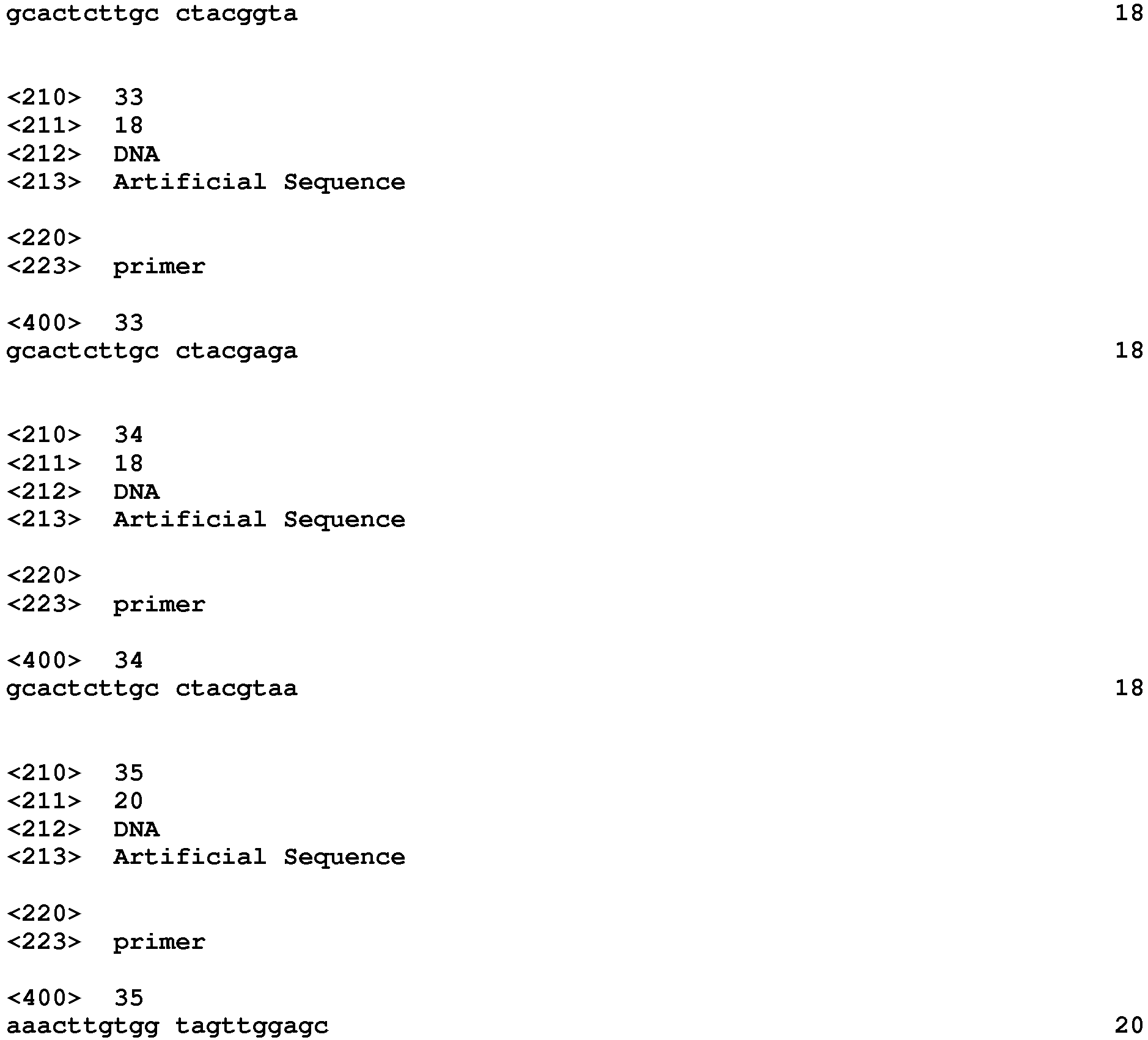
5'-CTCTTGCCTACGCCAAAA-3' - SEQ ID NO: 32 (Primer 11)
[Chem 32]
5'-GCACTCTTGCCTACGGTA-3' - SEQ ID NO: 33 (Primer 12)
[Chem 33]
5'-GCACTCTTGCCTACGAGA-3' - SEQ ID NO: 34 (Primer 13)
[Chem 34]
5'-GCACTCTTGCCTACGTAA-3' - SEQ ID NO: 35 (Primer 14)
[Chem 35]
5'-AAACTTGTGGTAGTTGGAGC-3' - A 25 µL reaction solution containing the following reagents was prepared and two-step real-time PCR analysis was performed with CFX96 (Bio-Rad).
[Table 3] 5× buffer (for Q5) 5µL 10 mM dNTP 0.5µL 10µM forward primer [SEQ ID N0: 35] 1.25µL 10µM reverse primer [SEQ ID N0s: 29 to 34] 1.25µL 20× EvaGreen 1.25µL 2000 U/mL Q5 DNA polymerase 0.25µL Nuclease-free Water 10.5µL DNA specimen 5µL (Linear plasmid DNA [SEQ ID N0s 16 to 28] cleaved with appropriate restriction enzyme; 7500 copies) Amplification condition 98°C for 30 seconds 98°C for 10 seconds, 62°C for 30 seconds (40 cycles) - The results for
codon 12 are shown inFigs. 5 to 7 , and the results forcodon 13 are shown inFigs. 8 to 10 . When the primers designed according to the present invention are used, no amplification from the wild type was observed, and it can be said that the mutant can specifically be amplified. Particularly, in the case of KRAS gene, the number of primers for detecting 12 patterns of mutations atcodons - The primer according to the primer designing method of the present invention can be used for a genetic diagnosis using a biological sample, a genetic diagnosis reagent, a pedigree analysis method, a pedigree analysis reagent, a plant variety identification method, a plant variety identification reagent, a meat breed judgment method, a meat breed judgment method reagent, a forensic analysis method, a forensic analysis reagent, etc.


Claims (10)
- A method for detecting a single base substitution at a single nucleotide polymorphism site contained in a nucleic acid sample by utilizing a nucleic acid amplification reaction, the method combines the steps of:(a) hybridizing to the nucleic acid a mutant primer in which the base of the third nucleotide from the 3' end corresponds to the base of a mutant nucleotide of the single nucleotide polymorphism, in which the base of the second nucleotide from the 3' end is not complementary to the base of the corresponding nucleotide of the nucleic acid, and in which the bases of the other nucleotides are complementary to bases of the corresponding nucleotides of the nucleic acid;(b) elongating the mutant primer with a DNA polymerase and deoxyribonucleoside triphosphate that is a substrate thereof; and(c) detecting the single base substitution contained in the nucleic acid sample based on whether the mutant primer is elongated or not.
- The method for detecting a single base substitution according to claim 1, wherein the single nucleotide polymorphism site is a first and a second adjacent single nucleotide polymorphism sites, and wherein the step (a) is a step of hybridizing to the nucleic acid a mutant primer in which the base of the third nucleotide from the 3' end corresponds to the base of a mutant nucleotide of the first single nucleotide polymorphism, in which the base of the second nucleotide from the 3' end is not complementary to the base of the corresponding nucleotide of the nucleic acid having a mutant nucleotide of the first single nucleotide polymorphism, in which the base of the second nucleotide from the 3' end corresponds to the base of a mutant nucleotide of the second single nucleotide polymorphism, in which the base of the third nucleotide from the 3' end is not complementary to the base of the corresponding nucleotide of the nucleic acid having a mutant nucleotide of the second single nucleotide polymorphism, and in which the bases of the other nucleotides are complementary to the bases of the corresponding nucleotides of the nucleic acid.
- The method for detecting a single base substitution according to claim 1 or 2 , wherein the single base substitution is a single base substitution of EGFR gene, KRAS gene, or NRAS gene.
- The method according to any one of claims 1 to 3, wherein the nucleic acid amplification reaction is a polymerase chain reaction.
- The method according to claim 4, wherein whether the mutant primer is elongated or not is determined based on the presence or absence of an amplification product of the polymerase chain reaction.
- A reagent containing a mutant primer for use in a method for detecting a single base substitution of a single nucleotide polymorphism site contained in a nucleic acid sample by utilizing a nucleic acid amplification reaction, the reagent containing a mutant primer in which the base of the third nucleotide from the 3' end corresponds to the base of a mutant nucleotide of the single nucleotide polymorphism, in which the base of the second nucleotide from the 3' end is not complementary to the base of the corresponding nucleotide of the nucleic acid, and in which the bases of the other nucleotides are complementary to the bases of the corresponding nucleotides of the nucleic acid.
- The reagent according to claim 6, wherein the mutant primer amplifies a mutant allele of EGFR gene, KRAS gene, or NRAS gene.
- The reagent according to claim 6 or 7, wherein the nucleic acid amplification reaction is a polymerase chain reaction.
- A method for amplifying a fragment of nucleotides comprising the steps of:(i) hybridizing a first primer and a second primer to a deoxyribonucleic acid (DNA) molecule containing a single nucleotide polymorphism site in a sample;(ii) elongating the first primer and the second primer with a DNA polymerase in the presence of deoxyribonucleoside triphosphate;(iii) hybridizing the second primer to the elongated first primer and hybridizing the first primer to the elongated second primer;(iv) elongating the second primer hybridized to the elongated first primer and the first primer hybridized to the elongated second primer in the presence of deoxyribonucleoside triphosphate with a DNA polymerase; and(v) optionally repeating the steps (iii) and (iv) once to 50 times, preferably 5 to 45 times, 10 to 45 times, 10 to 40 times, 10 to 35 times, 15 to 35 times, 20 to 35 times, or 25 to 35 times, whereinthe nucleotide sequence of the first primer is complementary to one strand of the DNA molecule, the base of the third nucleotide from the 3' end corresponding to the base characterizing one genotype of the single nucleotide polymorphism, whereas the second base from the 3' end is not complementary to the base of the corresponding nucleotide of the DNA strand, wherein
the nucleotide sequence of the second primer is complementary to the other strand of the DNA molecule, and wherein
when hybridized to the deoxyribonucleic acid (DNA) molecule containing the single nucleotide polymorphism site in the sample, the 3' ends of the first primer and the second primer are each located on the 3' side viewed from the 3' ends of the other primers. - The method for amplifying a fragment of nucleotides according to claim 9, wherein the single nucleotide polymorphism site is a first and a second adjacent single nucleotide polymorphism sites, and wherein the nucleotide sequence of the first primer is complementary to one strand of the DNA molecule, the base of the third nucleotide from the 3' end corresponding to the base characterizing one genotype of the first single nucleotide polymorphism, whereas the second base from the 3' end is not complementary to the base of the corresponding nucleotide of the DNA strand, and the base of the second nucleotide from the 3' end corresponding to the base characterizing one genotype of the second single nucleotide polymorphism, whereas the third base from the 3' end is not complementary to the base of the corresponding nucleotide of the DNA strand.
Applications Claiming Priority (3)
| Application Number | Priority Date | Filing Date | Title |
|---|---|---|---|
| JP2016071361 | 2016-03-31 | ||
| JP2016182728 | 2016-09-20 | ||
| PCT/JP2017/012820 WO2017170644A1 (en) | 2016-03-31 | 2017-03-29 | Method for detecting gene mutation |
Publications (3)
| Publication Number | Publication Date |
|---|---|
| EP3438283A1 true EP3438283A1 (en) | 2019-02-06 |
| EP3438283A4 EP3438283A4 (en) | 2019-09-18 |
| EP3438283B1 EP3438283B1 (en) | 2021-11-17 |
Family
ID=59965649
Family Applications (1)
| Application Number | Title | Priority Date | Filing Date |
|---|---|---|---|
| EP17775181.5A Active EP3438283B1 (en) | 2016-03-31 | 2017-03-29 | Method for detecting gene mutation |
Country Status (6)
| Country | Link |
|---|---|
| US (1) | US11702688B2 (en) |
| EP (1) | EP3438283B1 (en) |
| JP (1) | JP6343404B2 (en) |
| KR (1) | KR102294796B1 (en) |
| CN (1) | CN109072290A (en) |
| WO (1) | WO2017170644A1 (en) |
Families Citing this family (5)
| Publication number | Priority date | Publication date | Assignee | Title |
|---|---|---|---|---|
| CN107988371A (en) * | 2017-12-27 | 2018-05-04 | 广州誉嘉生物科技有限公司 | Primer and application based on the detection mankind's EGFA gene mutations of Sanger PCR sequencing PCRs |
| WO2020091448A1 (en) | 2018-10-31 | 2020-05-07 | 주식회사 엘지화학 | Lithium secondary battery |
| CN111378751A (en) * | 2018-12-29 | 2020-07-07 | 成都华青精准医疗科技有限公司 | Nucleotide sequence group for detecting KRAS gene mutation and application thereof |
| KR102560137B1 (en) * | 2019-12-20 | 2023-07-26 | 고려대학교 산학협력단 | Primer for detecting the minimum rare single nucleotide variant and method for specific and sensitive detecting of the minimum rare single nucleotide variant using the same |
| CN112852934B (en) * | 2021-04-16 | 2022-02-18 | 武汉友芝友医疗科技股份有限公司 | Primer, reagent and kit for detecting gene methylation |
Family Cites Families (8)
| Publication number | Priority date | Publication date | Assignee | Title |
|---|---|---|---|---|
| WO2001042498A1 (en) * | 1999-12-10 | 2001-06-14 | Toyo Boseki Kabushiki Kaisha | Method of detecting nucleotide polymorphism |
| US20030148301A1 (en) * | 1999-12-10 | 2003-08-07 | Toshiya Aono | Method of detecting nucleotide polymorphism |
| JP3752466B2 (en) * | 2002-04-24 | 2006-03-08 | 株式会社日立製作所 | Genetic testing method |
| JP2005160430A (en) * | 2003-12-04 | 2005-06-23 | Japan Clinical Laboratories Inc | Method for inspection of gene sequence |
| WO2007020708A1 (en) * | 2005-08-19 | 2007-02-22 | Matsushita Electric Industrial Co., Ltd. | Method of determining target base included in dna and allele-specific primer to be used in the method |
| JP2010035532A (en) * | 2008-08-08 | 2010-02-18 | Canon Inc | Method for allele-specific pcr |
| US9340833B2 (en) * | 2010-04-30 | 2016-05-17 | Arkray, Inc. | Method for adjusting amplification efficiency of target polynucleotide |
| CN104862401B (en) * | 2015-05-29 | 2017-10-31 | 沈阳优吉诺生物科技有限公司 | Detect primer, kit and its PCR method of KRAS gene hot mutant sites |
-
2017
- 2017-03-29 KR KR1020187031013A patent/KR102294796B1/en active Active
- 2017-03-29 WO PCT/JP2017/012820 patent/WO2017170644A1/en not_active Ceased
- 2017-03-29 CN CN201780025043.7A patent/CN109072290A/en active Pending
- 2017-03-29 US US16/086,144 patent/US11702688B2/en active Active
- 2017-03-29 JP JP2017549546A patent/JP6343404B2/en active Active
- 2017-03-29 EP EP17775181.5A patent/EP3438283B1/en active Active
Also Published As
| Publication number | Publication date |
|---|---|
| KR102294796B1 (en) | 2021-08-26 |
| US20190032123A1 (en) | 2019-01-31 |
| JPWO2017170644A1 (en) | 2018-04-05 |
| WO2017170644A1 (en) | 2017-10-05 |
| CN109072290A (en) | 2018-12-21 |
| KR20180131581A (en) | 2018-12-10 |
| EP3438283B1 (en) | 2021-11-17 |
| JP6343404B2 (en) | 2018-06-13 |
| EP3438283A4 (en) | 2019-09-18 |
| US11702688B2 (en) | 2023-07-18 |
Similar Documents
| Publication | Publication Date | Title |
|---|---|---|
| JP3693352B2 (en) | Methods for detecting genetic polymorphisms and monitoring allelic expression using probe arrays | |
| EP3438283B1 (en) | Method for detecting gene mutation | |
| JP6968894B2 (en) | Multiple detection method for methylated DNA | |
| ES2538214T3 (en) | A method for nucleic acid methylation analysis | |
| KR20070011354A (en) | Methods of detecting STRPs such as fragile mucosal syndrome | |
| KR20140010093A (en) | Kit and method for sequencing a target dna in a mixed population | |
| KR20130099092A (en) | Method for inhibiting nucleic acid amplification using light and highly sensitive method for selective nucleic acid amplification | |
| US20180163263A1 (en) | High-sensitivity method for detecting target nucleic acid | |
| WO2017112738A1 (en) | Methods for measuring microsatellite instability | |
| EP3350347B1 (en) | Methods and materials for detection of mutations | |
| CN108456721A (en) | Synchronous detection gene mutation and the method and its application to methylate | |
| CN107513578A (en) | A kind of nucleic acid Mass Spectrometry detection method early sieved for lung cancer driving gene and tumor susceptibility gene | |
| WO2011071046A1 (en) | Probe for detecting polymorphism in disease-associated gene, and use thereof | |
| EP2025764A1 (en) | Probe for detection of mutation in abl gene and use thereof | |
| KR20130094498A (en) | Method for detecting target genes or their mutations using ligase reaction and nicking amplification reaction | |
| JP5258760B2 (en) | Method for amplifying methylated or unmethylated nucleic acid | |
| AU2020275447A1 (en) | Melting temperature methods, kits and reporter oligo for detecting variant nucleic acids | |
| US20140295431A1 (en) | Method of allele-specific amplification | |
| CN110709522A (en) | Method for measuring nucleic acid mass of biological sample | |
| EP3348650B1 (en) | Kit and method for detecting single nucleotide polymorphism | |
| KR100986960B1 (en) | Analysis of gene methylation and ratio | |
| WO2016103727A1 (en) | Method for promoting amplification of specific nucleic acid sequence | |
| CN108018285B (en) | Super-sensitive primer and design method and application thereof | |
| CN105506140B (en) | ROS1 fusion ARMS fluorescence quantitive PCR typing detection kit | |
| KR20190071950A (en) | Pepetide nucleic acid probe for genotyping age related hearing loss (presbycusis) and Method using the same |
Legal Events
| Date | Code | Title | Description |
|---|---|---|---|
| STAA | Information on the status of an ep patent application or granted ep patent |
Free format text: STATUS: THE INTERNATIONAL PUBLICATION HAS BEEN MADE |
|
| PUAI | Public reference made under article 153(3) epc to a published international application that has entered the european phase |
Free format text: ORIGINAL CODE: 0009012 |
|
| STAA | Information on the status of an ep patent application or granted ep patent |
Free format text: STATUS: REQUEST FOR EXAMINATION WAS MADE |
|
| 17P | Request for examination filed |
Effective date: 20181018 |
|
| AK | Designated contracting states |
Kind code of ref document: A1 Designated state(s): AL AT BE BG CH CY CZ DE DK EE ES FI FR GB GR HR HU IE IS IT LI LT LU LV MC MK MT NL NO PL PT RO RS SE SI SK SM TR |
|
| AX | Request for extension of the european patent |
Extension state: BA ME |
|
| DAV | Request for validation of the european patent (deleted) | ||
| DAX | Request for extension of the european patent (deleted) | ||
| A4 | Supplementary search report drawn up and despatched |
Effective date: 20190821 |
|
| RIC1 | Information provided on ipc code assigned before grant |
Ipc: C12Q 1/68 20180101AFI20190814BHEP Ipc: C12N 15/09 20060101ALI20190814BHEP Ipc: C12N 15/00 20060101ALI20190814BHEP |
|
| STAA | Information on the status of an ep patent application or granted ep patent |
Free format text: STATUS: EXAMINATION IS IN PROGRESS |
|
| 17Q | First examination report despatched |
Effective date: 20210113 |
|
| GRAP | Despatch of communication of intention to grant a patent |
Free format text: ORIGINAL CODE: EPIDOSNIGR1 |
|
| STAA | Information on the status of an ep patent application or granted ep patent |
Free format text: STATUS: GRANT OF PATENT IS INTENDED |
|
| INTG | Intention to grant announced |
Effective date: 20210727 |
|
| GRAS | Grant fee paid |
Free format text: ORIGINAL CODE: EPIDOSNIGR3 |
|
| GRAA | (expected) grant |
Free format text: ORIGINAL CODE: 0009210 |
|
| STAA | Information on the status of an ep patent application or granted ep patent |
Free format text: STATUS: THE PATENT HAS BEEN GRANTED |
|
| AK | Designated contracting states |
Kind code of ref document: B1 Designated state(s): AL AT BE BG CH CY CZ DE DK EE ES FI FR GB GR HR HU IE IS IT LI LT LU LV MC MK MT NL NO PL PT RO RS SE SI SK SM TR |
|
| REG | Reference to a national code |
Ref country code: GB Ref legal event code: FG4D |
|
| REG | Reference to a national code |
Ref country code: IE Ref legal event code: FG4D |
|
| REG | Reference to a national code |
Ref country code: DE Ref legal event code: R096 Ref document number: 602017049489 Country of ref document: DE |
|
| REG | Reference to a national code |
Ref country code: AT Ref legal event code: REF Ref document number: 1448092 Country of ref document: AT Kind code of ref document: T Effective date: 20211215 |
|
| REG | Reference to a national code |
Ref country code: LT Ref legal event code: MG9D |
|
| REG | Reference to a national code |
Ref country code: NL Ref legal event code: MP Effective date: 20211117 |
|
| REG | Reference to a national code |
Ref country code: AT Ref legal event code: MK05 Ref document number: 1448092 Country of ref document: AT Kind code of ref document: T Effective date: 20211117 |
|
| PG25 | Lapsed in a contracting state [announced via postgrant information from national office to epo] |
Ref country code: RS Free format text: LAPSE BECAUSE OF FAILURE TO SUBMIT A TRANSLATION OF THE DESCRIPTION OR TO PAY THE FEE WITHIN THE PRESCRIBED TIME-LIMIT Effective date: 20211117 Ref country code: LT Free format text: LAPSE BECAUSE OF FAILURE TO SUBMIT A TRANSLATION OF THE DESCRIPTION OR TO PAY THE FEE WITHIN THE PRESCRIBED TIME-LIMIT Effective date: 20211117 Ref country code: FI Free format text: LAPSE BECAUSE OF FAILURE TO SUBMIT A TRANSLATION OF THE DESCRIPTION OR TO PAY THE FEE WITHIN THE PRESCRIBED TIME-LIMIT Effective date: 20211117 Ref country code: BG Free format text: LAPSE BECAUSE OF FAILURE TO SUBMIT A TRANSLATION OF THE DESCRIPTION OR TO PAY THE FEE WITHIN THE PRESCRIBED TIME-LIMIT Effective date: 20220217 Ref country code: AT Free format text: LAPSE BECAUSE OF FAILURE TO SUBMIT A TRANSLATION OF THE DESCRIPTION OR TO PAY THE FEE WITHIN THE PRESCRIBED TIME-LIMIT Effective date: 20211117 |
|
| PG25 | Lapsed in a contracting state [announced via postgrant information from national office to epo] |
Ref country code: IS Free format text: LAPSE BECAUSE OF FAILURE TO SUBMIT A TRANSLATION OF THE DESCRIPTION OR TO PAY THE FEE WITHIN THE PRESCRIBED TIME-LIMIT Effective date: 20220317 Ref country code: SE Free format text: LAPSE BECAUSE OF FAILURE TO SUBMIT A TRANSLATION OF THE DESCRIPTION OR TO PAY THE FEE WITHIN THE PRESCRIBED TIME-LIMIT Effective date: 20211117 Ref country code: PT Free format text: LAPSE BECAUSE OF FAILURE TO SUBMIT A TRANSLATION OF THE DESCRIPTION OR TO PAY THE FEE WITHIN THE PRESCRIBED TIME-LIMIT Effective date: 20220317 Ref country code: PL Free format text: LAPSE BECAUSE OF FAILURE TO SUBMIT A TRANSLATION OF THE DESCRIPTION OR TO PAY THE FEE WITHIN THE PRESCRIBED TIME-LIMIT Effective date: 20211117 Ref country code: NO Free format text: LAPSE BECAUSE OF FAILURE TO SUBMIT A TRANSLATION OF THE DESCRIPTION OR TO PAY THE FEE WITHIN THE PRESCRIBED TIME-LIMIT Effective date: 20220217 Ref country code: NL Free format text: LAPSE BECAUSE OF FAILURE TO SUBMIT A TRANSLATION OF THE DESCRIPTION OR TO PAY THE FEE WITHIN THE PRESCRIBED TIME-LIMIT Effective date: 20211117 Ref country code: LV Free format text: LAPSE BECAUSE OF FAILURE TO SUBMIT A TRANSLATION OF THE DESCRIPTION OR TO PAY THE FEE WITHIN THE PRESCRIBED TIME-LIMIT Effective date: 20211117 Ref country code: HR Free format text: LAPSE BECAUSE OF FAILURE TO SUBMIT A TRANSLATION OF THE DESCRIPTION OR TO PAY THE FEE WITHIN THE PRESCRIBED TIME-LIMIT Effective date: 20211117 Ref country code: GR Free format text: LAPSE BECAUSE OF FAILURE TO SUBMIT A TRANSLATION OF THE DESCRIPTION OR TO PAY THE FEE WITHIN THE PRESCRIBED TIME-LIMIT Effective date: 20220218 Ref country code: ES Free format text: LAPSE BECAUSE OF FAILURE TO SUBMIT A TRANSLATION OF THE DESCRIPTION OR TO PAY THE FEE WITHIN THE PRESCRIBED TIME-LIMIT Effective date: 20211117 |
|
| PG25 | Lapsed in a contracting state [announced via postgrant information from national office to epo] |
Ref country code: SM Free format text: LAPSE BECAUSE OF FAILURE TO SUBMIT A TRANSLATION OF THE DESCRIPTION OR TO PAY THE FEE WITHIN THE PRESCRIBED TIME-LIMIT Effective date: 20211117 Ref country code: SK Free format text: LAPSE BECAUSE OF FAILURE TO SUBMIT A TRANSLATION OF THE DESCRIPTION OR TO PAY THE FEE WITHIN THE PRESCRIBED TIME-LIMIT Effective date: 20211117 Ref country code: RO Free format text: LAPSE BECAUSE OF FAILURE TO SUBMIT A TRANSLATION OF THE DESCRIPTION OR TO PAY THE FEE WITHIN THE PRESCRIBED TIME-LIMIT Effective date: 20211117 Ref country code: EE Free format text: LAPSE BECAUSE OF FAILURE TO SUBMIT A TRANSLATION OF THE DESCRIPTION OR TO PAY THE FEE WITHIN THE PRESCRIBED TIME-LIMIT Effective date: 20211117 Ref country code: DK Free format text: LAPSE BECAUSE OF FAILURE TO SUBMIT A TRANSLATION OF THE DESCRIPTION OR TO PAY THE FEE WITHIN THE PRESCRIBED TIME-LIMIT Effective date: 20211117 Ref country code: CZ Free format text: LAPSE BECAUSE OF FAILURE TO SUBMIT A TRANSLATION OF THE DESCRIPTION OR TO PAY THE FEE WITHIN THE PRESCRIBED TIME-LIMIT Effective date: 20211117 |
|
| REG | Reference to a national code |
Ref country code: DE Ref legal event code: R097 Ref document number: 602017049489 Country of ref document: DE |
|
| PLBE | No opposition filed within time limit |
Free format text: ORIGINAL CODE: 0009261 |
|
| STAA | Information on the status of an ep patent application or granted ep patent |
Free format text: STATUS: NO OPPOSITION FILED WITHIN TIME LIMIT |
|
| 26N | No opposition filed |
Effective date: 20220818 |
|
| PG25 | Lapsed in a contracting state [announced via postgrant information from national office to epo] |
Ref country code: MC Free format text: LAPSE BECAUSE OF FAILURE TO SUBMIT A TRANSLATION OF THE DESCRIPTION OR TO PAY THE FEE WITHIN THE PRESCRIBED TIME-LIMIT Effective date: 20211117 Ref country code: AL Free format text: LAPSE BECAUSE OF FAILURE TO SUBMIT A TRANSLATION OF THE DESCRIPTION OR TO PAY THE FEE WITHIN THE PRESCRIBED TIME-LIMIT Effective date: 20211117 |
|
| REG | Reference to a national code |
Ref country code: CH Ref legal event code: PL |
|
| PG25 | Lapsed in a contracting state [announced via postgrant information from national office to epo] |
Ref country code: SI Free format text: LAPSE BECAUSE OF FAILURE TO SUBMIT A TRANSLATION OF THE DESCRIPTION OR TO PAY THE FEE WITHIN THE PRESCRIBED TIME-LIMIT Effective date: 20211117 |
|
| REG | Reference to a national code |
Ref country code: BE Ref legal event code: MM Effective date: 20220331 |
|
| PG25 | Lapsed in a contracting state [announced via postgrant information from national office to epo] |
Ref country code: LU Free format text: LAPSE BECAUSE OF NON-PAYMENT OF DUE FEES Effective date: 20220329 Ref country code: LI Free format text: LAPSE BECAUSE OF NON-PAYMENT OF DUE FEES Effective date: 20220331 Ref country code: IE Free format text: LAPSE BECAUSE OF NON-PAYMENT OF DUE FEES Effective date: 20220329 Ref country code: CH Free format text: LAPSE BECAUSE OF NON-PAYMENT OF DUE FEES Effective date: 20220331 |
|
| PG25 | Lapsed in a contracting state [announced via postgrant information from national office to epo] |
Ref country code: BE Free format text: LAPSE BECAUSE OF NON-PAYMENT OF DUE FEES Effective date: 20220331 |
|
| PG25 | Lapsed in a contracting state [announced via postgrant information from national office to epo] |
Ref country code: IT Free format text: LAPSE BECAUSE OF FAILURE TO SUBMIT A TRANSLATION OF THE DESCRIPTION OR TO PAY THE FEE WITHIN THE PRESCRIBED TIME-LIMIT Effective date: 20211117 |
|
| P01 | Opt-out of the competence of the unified patent court (upc) registered |
Effective date: 20230522 |
|
| PG25 | Lapsed in a contracting state [announced via postgrant information from national office to epo] |
Ref country code: HU Free format text: LAPSE BECAUSE OF FAILURE TO SUBMIT A TRANSLATION OF THE DESCRIPTION OR TO PAY THE FEE WITHIN THE PRESCRIBED TIME-LIMIT; INVALID AB INITIO Effective date: 20170329 |
|
| PG25 | Lapsed in a contracting state [announced via postgrant information from national office to epo] |
Ref country code: MK Free format text: LAPSE BECAUSE OF FAILURE TO SUBMIT A TRANSLATION OF THE DESCRIPTION OR TO PAY THE FEE WITHIN THE PRESCRIBED TIME-LIMIT Effective date: 20211117 Ref country code: CY Free format text: LAPSE BECAUSE OF FAILURE TO SUBMIT A TRANSLATION OF THE DESCRIPTION OR TO PAY THE FEE WITHIN THE PRESCRIBED TIME-LIMIT Effective date: 20211117 |
|
| PG25 | Lapsed in a contracting state [announced via postgrant information from national office to epo] |
Ref country code: MT Free format text: LAPSE BECAUSE OF FAILURE TO SUBMIT A TRANSLATION OF THE DESCRIPTION OR TO PAY THE FEE WITHIN THE PRESCRIBED TIME-LIMIT Effective date: 20211117 |
|
| PG25 | Lapsed in a contracting state [announced via postgrant information from national office to epo] |
Ref country code: TR Free format text: LAPSE BECAUSE OF FAILURE TO SUBMIT A TRANSLATION OF THE DESCRIPTION OR TO PAY THE FEE WITHIN THE PRESCRIBED TIME-LIMIT Effective date: 20211117 |
|
| PGFP | Annual fee paid to national office [announced via postgrant information from national office to epo] |
Ref country code: GB Payment date: 20260209 Year of fee payment: 10 |
|
| PGFP | Annual fee paid to national office [announced via postgrant information from national office to epo] |
Ref country code: DE Payment date: 20260204 Year of fee payment: 10 |
|
| PGFP | Annual fee paid to national office [announced via postgrant information from national office to epo] |
Ref country code: FR Payment date: 20260209 Year of fee payment: 10 |