EP3436095B1 - Abgabesystem für wirkstoffbeschichteten ballon - Google Patents
Abgabesystem für wirkstoffbeschichteten ballon Download PDFInfo
- Publication number
- EP3436095B1 EP3436095B1 EP17715380.6A EP17715380A EP3436095B1 EP 3436095 B1 EP3436095 B1 EP 3436095B1 EP 17715380 A EP17715380 A EP 17715380A EP 3436095 B1 EP3436095 B1 EP 3436095B1
- Authority
- EP
- European Patent Office
- Prior art keywords
- delivery system
- shaft
- balloon
- balloon catheter
- sheath
- Prior art date
- Legal status (The legal status is an assumption and is not a legal conclusion. Google has not performed a legal analysis and makes no representation as to the accuracy of the status listed.)
- Active
Links
Images




Classifications
-
- A—HUMAN NECESSITIES
- A61—MEDICAL OR VETERINARY SCIENCE; HYGIENE
- A61M—DEVICES FOR INTRODUCING MEDIA INTO, OR ONTO, THE BODY; DEVICES FOR TRANSDUCING BODY MEDIA OR FOR TAKING MEDIA FROM THE BODY; DEVICES FOR PRODUCING OR ENDING SLEEP OR STUPOR
- A61M25/00—Catheters; Hollow probes
- A61M25/01—Introducing, guiding, advancing, emplacing or holding catheters
- A61M25/0194—Tunnelling catheters
-
- A—HUMAN NECESSITIES
- A61—MEDICAL OR VETERINARY SCIENCE; HYGIENE
- A61L—METHODS OR APPARATUS FOR STERILISING MATERIALS OR OBJECTS IN GENERAL; DISINFECTION, STERILISATION OR DEODORISATION OF AIR; CHEMICAL ASPECTS OF BANDAGES, DRESSINGS, ABSORBENT PADS OR SURGICAL ARTICLES; MATERIALS FOR BANDAGES, DRESSINGS, ABSORBENT PADS OR SURGICAL ARTICLES
- A61L29/00—Materials for catheters, medical tubing, cannulae, or endoscopes or for coating catheters
- A61L29/04—Macromolecular materials
- A61L29/041—Macromolecular materials obtained by reactions only involving carbon-to-carbon unsaturated bonds
-
- A—HUMAN NECESSITIES
- A61—MEDICAL OR VETERINARY SCIENCE; HYGIENE
- A61L—METHODS OR APPARATUS FOR STERILISING MATERIALS OR OBJECTS IN GENERAL; DISINFECTION, STERILISATION OR DEODORISATION OF AIR; CHEMICAL ASPECTS OF BANDAGES, DRESSINGS, ABSORBENT PADS OR SURGICAL ARTICLES; MATERIALS FOR BANDAGES, DRESSINGS, ABSORBENT PADS OR SURGICAL ARTICLES
- A61L29/00—Materials for catheters, medical tubing, cannulae, or endoscopes or for coating catheters
- A61L29/04—Macromolecular materials
- A61L29/049—Mixtures of macromolecular compounds
-
- A—HUMAN NECESSITIES
- A61—MEDICAL OR VETERINARY SCIENCE; HYGIENE
- A61L—METHODS OR APPARATUS FOR STERILISING MATERIALS OR OBJECTS IN GENERAL; DISINFECTION, STERILISATION OR DEODORISATION OF AIR; CHEMICAL ASPECTS OF BANDAGES, DRESSINGS, ABSORBENT PADS OR SURGICAL ARTICLES; MATERIALS FOR BANDAGES, DRESSINGS, ABSORBENT PADS OR SURGICAL ARTICLES
- A61L29/00—Materials for catheters, medical tubing, cannulae, or endoscopes or for coating catheters
- A61L29/04—Macromolecular materials
- A61L29/06—Macromolecular materials obtained otherwise than by reactions only involving carbon-to-carbon unsaturated bonds
-
- A—HUMAN NECESSITIES
- A61—MEDICAL OR VETERINARY SCIENCE; HYGIENE
- A61L—METHODS OR APPARATUS FOR STERILISING MATERIALS OR OBJECTS IN GENERAL; DISINFECTION, STERILISATION OR DEODORISATION OF AIR; CHEMICAL ASPECTS OF BANDAGES, DRESSINGS, ABSORBENT PADS OR SURGICAL ARTICLES; MATERIALS FOR BANDAGES, DRESSINGS, ABSORBENT PADS OR SURGICAL ARTICLES
- A61L29/00—Materials for catheters, medical tubing, cannulae, or endoscopes or for coating catheters
- A61L29/08—Materials for coatings
-
- A—HUMAN NECESSITIES
- A61—MEDICAL OR VETERINARY SCIENCE; HYGIENE
- A61L—METHODS OR APPARATUS FOR STERILISING MATERIALS OR OBJECTS IN GENERAL; DISINFECTION, STERILISATION OR DEODORISATION OF AIR; CHEMICAL ASPECTS OF BANDAGES, DRESSINGS, ABSORBENT PADS OR SURGICAL ARTICLES; MATERIALS FOR BANDAGES, DRESSINGS, ABSORBENT PADS OR SURGICAL ARTICLES
- A61L29/00—Materials for catheters, medical tubing, cannulae, or endoscopes or for coating catheters
- A61L29/08—Materials for coatings
- A61L29/085—Macromolecular materials
-
- A—HUMAN NECESSITIES
- A61—MEDICAL OR VETERINARY SCIENCE; HYGIENE
- A61L—METHODS OR APPARATUS FOR STERILISING MATERIALS OR OBJECTS IN GENERAL; DISINFECTION, STERILISATION OR DEODORISATION OF AIR; CHEMICAL ASPECTS OF BANDAGES, DRESSINGS, ABSORBENT PADS OR SURGICAL ARTICLES; MATERIALS FOR BANDAGES, DRESSINGS, ABSORBENT PADS OR SURGICAL ARTICLES
- A61L29/00—Materials for catheters, medical tubing, cannulae, or endoscopes or for coating catheters
- A61L29/14—Materials characterised by their function or physical properties, e.g. lubricating compositions
-
- A—HUMAN NECESSITIES
- A61—MEDICAL OR VETERINARY SCIENCE; HYGIENE
- A61L—METHODS OR APPARATUS FOR STERILISING MATERIALS OR OBJECTS IN GENERAL; DISINFECTION, STERILISATION OR DEODORISATION OF AIR; CHEMICAL ASPECTS OF BANDAGES, DRESSINGS, ABSORBENT PADS OR SURGICAL ARTICLES; MATERIALS FOR BANDAGES, DRESSINGS, ABSORBENT PADS OR SURGICAL ARTICLES
- A61L29/00—Materials for catheters, medical tubing, cannulae, or endoscopes or for coating catheters
- A61L29/14—Materials characterised by their function or physical properties, e.g. lubricating compositions
- A61L29/16—Biologically active materials, e.g. therapeutic substances
-
- A—HUMAN NECESSITIES
- A61—MEDICAL OR VETERINARY SCIENCE; HYGIENE
- A61L—METHODS OR APPARATUS FOR STERILISING MATERIALS OR OBJECTS IN GENERAL; DISINFECTION, STERILISATION OR DEODORISATION OF AIR; CHEMICAL ASPECTS OF BANDAGES, DRESSINGS, ABSORBENT PADS OR SURGICAL ARTICLES; MATERIALS FOR BANDAGES, DRESSINGS, ABSORBENT PADS OR SURGICAL ARTICLES
- A61L29/00—Materials for catheters, medical tubing, cannulae, or endoscopes or for coating catheters
- A61L29/14—Materials characterised by their function or physical properties, e.g. lubricating compositions
- A61L29/18—Materials at least partially X-ray or laser opaque
-
- A—HUMAN NECESSITIES
- A61—MEDICAL OR VETERINARY SCIENCE; HYGIENE
- A61M—DEVICES FOR INTRODUCING MEDIA INTO, OR ONTO, THE BODY; DEVICES FOR TRANSDUCING BODY MEDIA OR FOR TAKING MEDIA FROM THE BODY; DEVICES FOR PRODUCING OR ENDING SLEEP OR STUPOR
- A61M25/00—Catheters; Hollow probes
- A61M25/10—Balloon catheters
-
- A—HUMAN NECESSITIES
- A61—MEDICAL OR VETERINARY SCIENCE; HYGIENE
- A61L—METHODS OR APPARATUS FOR STERILISING MATERIALS OR OBJECTS IN GENERAL; DISINFECTION, STERILISATION OR DEODORISATION OF AIR; CHEMICAL ASPECTS OF BANDAGES, DRESSINGS, ABSORBENT PADS OR SURGICAL ARTICLES; MATERIALS FOR BANDAGES, DRESSINGS, ABSORBENT PADS OR SURGICAL ARTICLES
- A61L2300/00—Biologically active materials used in bandages, wound dressings, absorbent pads or medical devices
- A61L2300/40—Biologically active materials used in bandages, wound dressings, absorbent pads or medical devices characterised by a specific therapeutic activity or mode of action
- A61L2300/416—Anti-neoplastic or anti-proliferative or anti-restenosis or anti-angiogenic agents, e.g. paclitaxel, sirolimus
-
- A—HUMAN NECESSITIES
- A61—MEDICAL OR VETERINARY SCIENCE; HYGIENE
- A61L—METHODS OR APPARATUS FOR STERILISING MATERIALS OR OBJECTS IN GENERAL; DISINFECTION, STERILISATION OR DEODORISATION OF AIR; CHEMICAL ASPECTS OF BANDAGES, DRESSINGS, ABSORBENT PADS OR SURGICAL ARTICLES; MATERIALS FOR BANDAGES, DRESSINGS, ABSORBENT PADS OR SURGICAL ARTICLES
- A61L2400/00—Materials characterised by their function or physical properties
- A61L2400/10—Materials for lubricating medical devices
-
- A—HUMAN NECESSITIES
- A61—MEDICAL OR VETERINARY SCIENCE; HYGIENE
- A61M—DEVICES FOR INTRODUCING MEDIA INTO, OR ONTO, THE BODY; DEVICES FOR TRANSDUCING BODY MEDIA OR FOR TAKING MEDIA FROM THE BODY; DEVICES FOR PRODUCING OR ENDING SLEEP OR STUPOR
- A61M25/00—Catheters; Hollow probes
- A61M25/01—Introducing, guiding, advancing, emplacing or holding catheters
- A61M25/06—Body-piercing guide needles or the like
- A61M25/0662—Guide tubes
- A61M2025/0681—Systems with catheter and outer tubing, e.g. sheath, sleeve or guide tube
-
- A—HUMAN NECESSITIES
- A61—MEDICAL OR VETERINARY SCIENCE; HYGIENE
- A61M—DEVICES FOR INTRODUCING MEDIA INTO, OR ONTO, THE BODY; DEVICES FOR TRANSDUCING BODY MEDIA OR FOR TAKING MEDIA FROM THE BODY; DEVICES FOR PRODUCING OR ENDING SLEEP OR STUPOR
- A61M25/00—Catheters; Hollow probes
- A61M25/10—Balloon catheters
- A61M2025/1043—Balloon catheters with special features or adapted for special applications
- A61M2025/105—Balloon catheters with special features or adapted for special applications having a balloon suitable for drug delivery, e.g. by using holes for delivery, drug coating or membranes
-
- A—HUMAN NECESSITIES
- A61—MEDICAL OR VETERINARY SCIENCE; HYGIENE
- A61M—DEVICES FOR INTRODUCING MEDIA INTO, OR ONTO, THE BODY; DEVICES FOR TRANSDUCING BODY MEDIA OR FOR TAKING MEDIA FROM THE BODY; DEVICES FOR PRODUCING OR ENDING SLEEP OR STUPOR
- A61M25/00—Catheters; Hollow probes
- A61M25/10—Balloon catheters
- A61M2025/1043—Balloon catheters with special features or adapted for special applications
- A61M2025/1075—Balloon catheters with special features or adapted for special applications having a balloon composed of several layers, e.g. by coating or embedding
-
- A—HUMAN NECESSITIES
- A61—MEDICAL OR VETERINARY SCIENCE; HYGIENE
- A61M—DEVICES FOR INTRODUCING MEDIA INTO, OR ONTO, THE BODY; DEVICES FOR TRANSDUCING BODY MEDIA OR FOR TAKING MEDIA FROM THE BODY; DEVICES FOR PRODUCING OR ENDING SLEEP OR STUPOR
- A61M25/00—Catheters; Hollow probes
- A61M25/10—Balloon catheters
- A61M2025/1043—Balloon catheters with special features or adapted for special applications
- A61M2025/1079—Balloon catheters with special features or adapted for special applications having radio-opaque markers in the region of the balloon
-
- A—HUMAN NECESSITIES
- A61—MEDICAL OR VETERINARY SCIENCE; HYGIENE
- A61M—DEVICES FOR INTRODUCING MEDIA INTO, OR ONTO, THE BODY; DEVICES FOR TRANSDUCING BODY MEDIA OR FOR TAKING MEDIA FROM THE BODY; DEVICES FOR PRODUCING OR ENDING SLEEP OR STUPOR
- A61M25/00—Catheters; Hollow probes
- A61M25/10—Balloon catheters
- A61M2025/1043—Balloon catheters with special features or adapted for special applications
- A61M2025/1081—Balloon catheters with special features or adapted for special applications having sheaths or the like for covering the balloon but not forming a permanent part of the balloon, e.g. retractable, dissolvable or tearable sheaths
-
- A—HUMAN NECESSITIES
- A61—MEDICAL OR VETERINARY SCIENCE; HYGIENE
- A61M—DEVICES FOR INTRODUCING MEDIA INTO, OR ONTO, THE BODY; DEVICES FOR TRANSDUCING BODY MEDIA OR FOR TAKING MEDIA FROM THE BODY; DEVICES FOR PRODUCING OR ENDING SLEEP OR STUPOR
- A61M25/00—Catheters; Hollow probes
- A61M25/10—Balloon catheters
- A61M2025/1043—Balloon catheters with special features or adapted for special applications
- A61M2025/1088—Balloon catheters with special features or adapted for special applications having special surface characteristics depending on material properties or added substances, e.g. for reducing friction
-
- A—HUMAN NECESSITIES
- A61—MEDICAL OR VETERINARY SCIENCE; HYGIENE
- A61M—DEVICES FOR INTRODUCING MEDIA INTO, OR ONTO, THE BODY; DEVICES FOR TRANSDUCING BODY MEDIA OR FOR TAKING MEDIA FROM THE BODY; DEVICES FOR PRODUCING OR ENDING SLEEP OR STUPOR
- A61M25/00—Catheters; Hollow probes
- A61M25/10—Balloon catheters
- A61M2025/1043—Balloon catheters with special features or adapted for special applications
- A61M2025/1093—Balloon catheters with special features or adapted for special applications having particular tip characteristics
-
- A—HUMAN NECESSITIES
- A61—MEDICAL OR VETERINARY SCIENCE; HYGIENE
- A61M—DEVICES FOR INTRODUCING MEDIA INTO, OR ONTO, THE BODY; DEVICES FOR TRANSDUCING BODY MEDIA OR FOR TAKING MEDIA FROM THE BODY; DEVICES FOR PRODUCING OR ENDING SLEEP OR STUPOR
- A61M25/00—Catheters; Hollow probes
- A61M25/0067—Catheters; Hollow probes characterised by the distal end, e.g. tips
- A61M25/0068—Static characteristics of the catheter tip, e.g. shape, atraumatic tip, curved tip or tip structure
- A61M25/007—Side holes, e.g. their profiles or arrangements; Provisions to keep side holes unblocked
Definitions
- Embodiments herein relate to delivery systems for active agent coated balloons and related methods.
- the vascular system of the human is subject to blockage due to plaque within the arteries. Partial and even complete blockage of arteries by the formation of an atherosclerotic plaque is a well-known and frequent medical problem. Frequently, such blockage occurs in the coronary arteries. Blockages may also occur secondary to past treatment of specific sites (restenosis - such as that stemming from rapidly dividing smooth muscle cells). In addition, blockages can also occur in the context of peripheral arteries.
- PTCA percutaneous transluminal coronary angioplasty
- a catheter having an inflatable balloon at its distal end is introduced into the coronary artery, the deflated, folded balloon is positioned at the stenotic site (or target lesion), and then the balloon is inflated. Inflation of the balloon disrupts and flattens the plaque against the arterial wall, and stretches the arterial wall, resulting in enlargement of the intraluminal passageway and increased blood flow. After such expansion, the balloon is deflated, and the balloon catheter removed.
- PTA percutaneous transluminal angioplasty
- Such active agents can be disposed onto the balloon and then transferred to the tissue site or target lesion when the balloon is expanded.
- US 2013/0237950 A1 discloses an adjustable balloon catheter including an inner tubular member that has an inflation lumen defined therein. An expandable member is coupled to the distal end portion of the inner tubular member and has an inner chamber in fluid communication with the inflation lumen.
- WO 2014/186729 A1 discloses a delivery composition for local administration of a hydrophobic active agent to a tissue or organ of a patient.
- the delivery composition includes a cationic delivery agent, a therapeutically effective amount of a hydrophobic active agent, and a pharmaceutically acceptable aqueous carrier.
- US 2010/0228333 A1 discloses a thin-walled sheath placed over a balloon of a balloon dilation catheter. An anti-restenotic drug is placed on the balloon. The sheath protects the drug from dissolution into the blood and allows improved delivery to the lesion site. A rolling action of the sheath prevents the drug from loss due to shearing motion.
- the sheath can also provide a protected surface for carrying the drug and providing exposure to the lesion site for delivery of the drug.
- WO 2015/077545 A1 discloses a balloon catheter having a drug coated balloon and an enlarged portion distal to the drug coated balloon. The enlarged portion has a diameter larger than the diameter of the pleated balloon when wrapped (aka folded) about the inner shaft of the balloon catheter, and a selectively retractable tubular member surrounding at least the pleated and wrapped balloon and having a distal end located in circumferential contact with the enlarged portion distal to the drug coated balloon to inhibit blood flow proximally into the distal end of the selectively retractable tubular member.
- US 2012/296313 A1 discloses an introducer sheath for use in inserting a balloon catheter into a patient's vasculature.
- a delivery system for introducing an active agent coated balloon into a subject is included.
- the delivery system can include a tunneling sheath.
- the tunneling sheath can include a tubular shaft having an outer diameter and defining a lumen, the shaft having a proximal end and a distal end.
- the tunneling sheath can include a proximal collar defining a lumen.
- the proximal collar can be attached to the tubular shaft at the proximal end.
- the proximal collar can have an outer diameter that is greater than the outer diameter of the tubular shaft.
- the delivery system can further include a balloon catheter.
- the balloon catheter can include a balloon catheter shaft disposed within the tubular shaft.
- the balloon catheter shaft can include a lumen for the passage of a fluid therein.
- the balloon catheter can include an expandable balloon disposed on the balloon catheter shaft in fluid communication with the lumen of the balloon catheter shaft.
- the balloon catheter shaft can include an active agent layer disposed on the expandable balloon. The position of the expandable balloon can be configured to be stationary relative to the tubular shaft as the delivery system is passed through a blood vessel of a patient.
- the method can include inserting a delivery system for introducing an active agent coated balloon into a subject.
- the method can further include advancing the delivery system through a blood vessel of the subject so as to be adjacent the site of an area to be treated, wherein the position of the expandable balloon is stationary relative to the tubular shaft as the delivery system is advanced through the blood vessel of the patient.
- the method can further include advancing the balloon catheter shaft and the expandable balloon out of the tubular shaft.
- the method can further include inflating the expandable balloon so that it contacts the area to be treated.
- one useful approach to delivering an active agent to a target site or target lesion is to dispose the active agent or drug onto an expandable balloon of a balloon catheter and then position the catheter appropriately and inflate the balloon.
- the active agent can be transferred from the balloon surface to the desired tissue site and/or move with the fluid in the vasculature into which the balloon was placed.
- the balloon can contact the surfaces of other medical components and a certain amount of the active agent can be lost through such contact.
- the surfaces of the active agent coating can sometimes be damaged.
- a delivery system for introducing an active agent coated balloon into a subject can include a tunneling sheath and a balloon catheter.
- the position of the expandable balloon can be configured to be stationary relative to the tubular shaft as the delivery system is passed through a blood vessel of a patient.
- the tunneling sheath can act as a balloon protector during clinician handing of the device.
- the balloon can stay dry and the active agent coating on the balloon can avoid contact with moisture, blood, etc. during the procedure preparation stage of the operation.
- the tunneling sheath can protect the active agent coated balloon during introduction of the delivery system through a hemostatic valve. Further, the tunneling sheath can prevent active agent loss during transport of the balloon through to a site to be treated.
- the tunneling sheath can assist in guiding the active agent coated balloon catheter through lesions.
- the tunneling sheath can aid in positioning of the active agent coated balloon catheter.
- FIG. 1 a schematic view is shown of a delivery system 100 in accordance with various embodiments herein.
- the delivery system 100 is shown passing through an access site 158 into a vessel 150 of a patient.
- the vessel 150 can include a first branch 152 and a second branch 154.
- the vessel 150 can include a target lesion 156 (or site to be treated).
- the access site 158 can be in a first branch 152 of a vessel 150 that is contralateral from a second branch 154 that contains the target lesion 156.
- the delivery system 100 can include a tunneling sheath 104 and a balloon catheter 106 disposed within the tunneling sheath 104.
- the tunneling sheath 104 has a distal end 107 and a proximal collar 105 (or hub).
- the balloon catheter 106 can pass through the proximal collar 105 and can have a balloon 108 disposed therein.
- the tunneling sheath 104 and the balloon catheter 106 are disposed within an introducing sheath 102.
- the introducing sheath 102 has a distal end 101 and a proximal collar 103.
- the delivery system 100 is within the vessel 150. Specifically, the delivery system 100 is within the introducing sheath 102.
- the tunneling sheath 104 and a balloon catheter 106 can move together through the introducing sheath 102. Specifically, the tunneling sheath 104 and a balloon catheter 106 can be fixed with respect to one another so that they move together.
- the proximal collar 105 can be fastened onto the balloon catheter 106, such as through a twisting motion of the proximal collar 105 that can reduce the diameter of an aperture passing through the proximal collar 105.
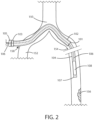
- FIG. 2 a schematic view is shown of the delivery system 100 in accordance with various embodiments herein.
- the tunneling sheath 104 and the balloon catheter 106 have moved together through the introducing sheath 102 in order to get a closer approach to the target lesion 156.
- the distal end 107 of the tunneling sheath 104, and the balloon 108 therein has passed out of the distal end 101 of the introducing sheath 102.
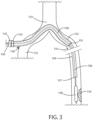
- FIG. 3 a schematic view is shown of a delivery system in accordance with various embodiments herein.
- the balloon catheter 106 (and the balloon 108) have passed out of the distal end of the tunneling sheath 104.
- the balloon 108 has moved into a position adjacent the target lesion 156. If the proximal collar 105 was previously fastened onto the balloon catheter 106, then it is loosened other otherwise detached so that the balloon catheter 106 can move independently from the tunneling sheath 104.
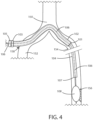
- FIG. 4 a schematic view is shown of a delivery system 100 in accordance with various embodiments herein.
- the balloon 108 of the balloon catheter 106 has now been inflated in order to treat the target lesion 156.
- the balloon can include an active agent layer thereon including a bioactive agent (or active agent) for treating restenosis.
- the bioactive agent can be selected from the group consisting of paclitaxel, rapamycin and derivatives thereof.
- exemplary active agents are described in greater detail below.
- an introducing sheath may be omitted.
- FIG. 5 a schematic view is shown of a delivery system 100 in accordance with various embodiments herein.
- the tunneling sheath 104 and the balloon catheter 106 can pass through the vessel 150 of a patient without being disposed within an introducing sheath.
- the introducing sheath may have been removed.
- an introducing sheath is simply not used.
- the tunneling sheath 104 can include a shaft 602, a proximal collar 105 and a distal end 107.
- an annular tip 608 can be disposed on the distal end 107 of the tunneling sheath 104.
- the annular tip 608 can define a central aperture 606 which leads to the lumen of the tunneling sheath 104.
- the annular tip 608 can be formed of a material, such as a polymer, with a relatively soft durometer rating.
- the material of the annular tip 608 can have a durometer rating in the range of about 30 to about 80.
- the annular tip can be formed of a material having a durometer rating that is different than the durometer rating of a material of the shaft.
- the shaft 602 can be formed of a polymer.
- Exemplary polymers can include, but are not limited to, polyurethane, PEBA (polyether block amide, e.g. VESTAMID E or PEBAX,), polytetrafluoroethylene, fluorinated ethylene propylene (FEP), and polyamide (such as polyamide 12, NYLON), amongst others.
- PEBA polyether block amide, e.g. VESTAMID E or PEBAX
- FEP fluorinated ethylene propylene
- polyamide such as polyamide 12, NYLON
- the wall of the shaft exhibits high kink resistance.
- the wall of the shaft 602 can be relatively thin.
- the wall of the shaft 602 can have a thickness of about 0.01inch to about 0.1 inch.
- a lubricious coating can be disposed on the inside of the tunneling sheath 104, the outside of the tunneling sheath 104, or on both the inside and the outside of the tunneling sheath 104. Exemplary polymers for lubricious coatings are described in greater detail below.
- the tunneling sheath can be of various lengths. In some embodiments, the tunneling sheath can be about 30 to about 70 centimeters. In some embodiments, the tunneling sheath can be about 40 to about 55 centimeters. In various embodiments, the tunneling sheath can be longer than an introducer sheath that is used for a procedure.
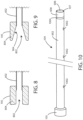
- the proximal collars of the tunneling sheath 104 can have various configurations. Referring now to FIG. 8 , a schematic cross-sectional view is shown of a proximal collar 105 in accordance with various embodiments herein.
- the proximal end of the shaft 602 can fit within at least a portion of the proximal collar 105.
- the proximal collar 105 can define a central lumen 802.
- the proximal collar 105 can be formed of a material 804.
- the proximal collar 105 can specifically be formed of a polymer. Exemplary polymers can include, but are not limited to, silicones (polysiloxanes), PEBA (polyether block amide, e.g.
- VESTAMID E or PEBAX polytetrafluoroethylene
- FEP fluorinated ethylene propylene
- Polymers herein can include homopolymers of the foregoing, blends including such polymers, and/or copolymers including portions of such polymers.
- FIG. 9 is a schematic cross-sectional view is shown of a proximal collar in accordance with various embodiments herein.
- the proximal end of the shaft 602 can fit within at least a portion of the proximal collar 105.
- the proximal collar 105 can define a central lumen 802.
- the central lumen 802 can include a taper 904, such that the lumen is wider at the proximal end than at the distal end.
- the shaft of the tunneling sheath can include apertures (or vents or ports) along the lengthwise axis. Aperture or ports can be useful so as to provide for a way for fluid to enter or leave from the lumen of the tunneling sheath.
- FIG. 10 a schematic view is shown of a tunneling sheath 104 in accordance with various embodiments herein.
- the tunneling sheath 104 can include a shaft 602, a proximal collar 105 and a distal end 107.
- an annular tip 608 can be disposed on the distal end 107 of the tunneling sheath 104.
- the annular tip 608 can define a central aperture 606 which leads to the lumen of the tunneling sheath 104.
- a plurality of apertures 1002 can be disposed along the length of the shaft 602.
- the tunneling sheath 104 can also include a radiopaque marker 1004 disposed on the tubular shaft adjacent to the distal end of the shaft 602. The volume of the tubular shaft that is not taken up by the balloon catheter is filled with a biocompatible liquid.
- the balloon catheter 106 can be, for example, a drug eluting balloon catheter.
- Balloon catheter constructions are described in various documents, for example, U.S. Patent Nos. 4,195,637 , 5,041,089 , 5,087,246 , 5,318,587 , 5,382,234 , 5,571,089 , 5,776,101 , 5,807,331 , 5,882,336 , 6,394,995 , 6,517,515 , 6,623,504 , 6,896,842 , and 7,163,523 .
- the balloon catheter can also include a stent, scaffold, scoring device or the like.
- the balloon catheter 106 includes a catheter shaft 1102 and a manifold end 1105.
- the balloon catheter 106 also includes an inflatable balloon 108 (or expandable balloon) disposed around the catheter shaft 1102.
- the balloon 108 is shown in an inflated configuration.
- the catheter shaft 1102 can include a channel to convey air through the catheter shaft 1102 and to or from the balloon 108, so that the balloon 108 can selectively go from a deflated configuration to the inflated configuration and back again.
- the catheter shaft, and/or the balloon can have a coating, such as those described herein, disposed thereon. Referring now to FIG. 12 , a cross-sectional view of a balloon catheter shaft is shown as taken along line 12-12' of FIG. 11 .
- the catheter shaft 1102 can include a first lumen 1106, such as to convey a fluid to and from the balloon, and a second lumen 1104, such as to accommodate a guide wire passing there through.
- the catheter shaft 1102 can include from 1 to 8 lumens or internal passageways therein.
- the catheter shaft 1102 can include a substrate 1108.
- the substrate 1108 can be formed of various materials including, but not limited to, polymers such as PET (polyethylene terephthalate), PEBA (polyether block amide, e.g. VESTAMID E or PEBAX,), polyamides (such as polyamide 12, NYLON), polyesters, polyurethanes, polyolefins, styrenic block polymers, and the like. Polymers herein can include homopolymers of the foregoing, blends including such polymers, and/or copolymers including portions of such polymers.
- a method of delivering an active agent coated balloon into a subject can include inserting a delivery system for introducing an active agent coated balloon into a subject.
- the balloon catheter can already be disposed within the tubular shaft of the tunneling sheath when the delivery system is introduced into a patient.
- the balloon catheter can be preloaded into the tunneling sheath before being handled by a clinician, such as during a manufacturing process.
- the balloon catheter can be loaded into the tunneling sheath (but before introduction into the patient) by the clinician at the time of use.
- inserting a delivery system into a subject comprises inserting the delivery system into an introducer sheath.
- the delivery system can include a tubular shaft having an outer diameter and defining a lumen, the shaft having a proximal end and a distal end.
- the delivery system can further include a proximal collar defining a lumen.
- the proximal collar can be attached to the tubular shaft at the proximal end.
- the proximal collar can have an outer diameter that is greater than the outer diameter of the tubular shaft.
- the delivery system can further include a balloon catheter comprising a balloon catheter shaft disposed within the tubular shaft, the balloon catheter shaft comprising a lumen for the passage of a fluid therein.
- the balloon catheter can further include an expandable balloon disposed on the balloon catheter shaft in fluid communication with the lumen of the balloon catheter shaft.
- An active agent layer can be disposed on the expandable balloon.
- the method can further include advancing the delivery system through a blood vessel of the subject so as to be adjacent the site of an area to be treated.
- the position of the expandable balloon can be stationary relative to the tubular shaft as the delivery system is advanced through the blood vessel of the patient.
- the method can further include advancing the balloon catheter shaft and the expandable balloon out of the tubular shaft.
- the method can further include inflating the expandable balloon so that it contacts the area to be treated.
- the method can further include deflating the expandable balloon, moving the balloon catheter shaft and the expandable balloon back into the tubular shaft, and withdrawing the delivery system from the blood vessel of the patient.
- the area to be treated can be a target lesion.
- the method can further include engaging an attachment mechanism to keep the tubular shaft and the balloon catheter shaft static to one another as the delivery system is advanced through the blood vessel of the subject. Inserting a delivery system for introducing an active agent coated balloon into a subject further comprises inserting the delivery system through an introducer sheath (or a guide catheter or guide sheath, etc.). In some embodiments not covered by the scope of the present invention, inserting a delivery system for introducing an active agent coated balloon into a subject can be performed without the delivery system passing through an introducer sheath.
- Portions of delivery systems herein can be covered with a coating.
- hydrophilic polymeric coatings can be applied to portions of the delivery system to impart lubricity and decrease particulate shedding.
- portions of the tunneling sheath can be coated with hydrophilic polymers to induce lubricity.
- the inner and/or outer diameter of the shaft of the tunneling sheath can be coated with lubricious low friction coatings such as hydrophilic polymers to induce lubricity.
- the outer diameter of the shaft of the balloon catheter can coated or lined with lubricious low friction coatings.
- Lubricious low friction coatings can be formed with friction reducing or lubricating materials such as silicone oil, perfluorinated oils or waxes or with covalently bonded coatings that impart lower friction, such as hydrophilic polymers described herein.
- Exemplary embodiments of surfaces, including low-friction surfaces for the devices herein include substrates prepared from low friction materials (e.g. PTFE and PTFE liners) and surfaces that can be made to be low friction by addition of coatings (e.g. coatings with hydrophilic polymers).
- substrates prepared from low friction materials e.g. PTFE and PTFE liners
- coatings e.g. coatings with hydrophilic polymers
- hydrophilic polymers useful as polymeric materials for hydrophilic coating formation can be synthetic hydrophilic polymers.
- Synthetic hydrophilic polymers that are biostable i.e., that show no appreciable degradation in vivo
- any suitable monomer including acrylic monomers, vinyl monomers, ether monomers, or combinations of any one or more of these types of monomers.
- Acrylic monomers include, for example, methacrylate, methyl methacrylate, hydroxyethyl methacrylate, hydroxyethyl acrylate, methacrylic acid, acrylic acid, glycerol acrylate, glycerol methacrylate, acrylamide, methacrylamide, dimethylacrylamide (DMA), and derivatives and/or mixtures of any of these.
- Vinyl monomers include, for example, vinyl acetate, vinylpyrrolidone, vinyl alcohol, and derivatives of any of these.
- Ether monomers include, for example, ethylene oxide, propylene oxide, butylene oxide, and derivatives of any of these.
- polymers that can be formed from these monomers include poly(acrylamide), poly(methacrylamide), poly(vinylpyrrolidone), poly(acrylic acid), poly(ethylene glycol), poly(vinyl alcohol), and poly(HEMA).
- hydrophilic copolymers include, for example, methyl vinyl ether/maleic anhydride copolymers and vinyl pyrrolidone/(meth)acrylamide copolymers. Mixtures of homopolymers and/or copolymers can be used.
- acrylamide-based polymers such as poly(N,Ndimethylacrylamide-co-aminopropylmethacrylamide) and poly(acrylamide-co-N,Ndimethylaminopropylmethacrylamide) are described in example 2 of U.S. Patent No. 7,807,750 (Taton et al. ).
- hydrophilic polymers that can be useful in the present disclosure are derivatives of acrylamide polymers with photoreactive groups.
- One such representative hydrophilic polymer can be the copolymerization of N-[3-(4-benzoylbenzamido)propyl]methacrylamide (Formula I) with N-(3-aminopropyl)methacrylamide (Formula II) to produce the polymer poly(N-3-aminopropyl)methacrylamide-co- N-[3-(4-benzoylbenzamido)propyl]methacrylamide (Formula III).
- the preparation of the polymer is disclosed in Example 1 of US Patent Publication 2007/0032882 (to Lodhi, et al. ).
- the hydrophilic polymer can be a vinyl pyrrolidone polymer, or a vinyl pyrrolidone/(meth)acrylamide copolymer such as poly(vinylpyrrolidone-co-methacrylamide). If a PVP copolymer is used, it can be a copolymer of vinylpyrrolidone and a monomer selected from the group of acrylamide monomers.
- Exemplary acrylamide monomers include (meth)acrylamide and (meth)acrylamide derivatives, such as alkyl(meth)acrylamide, as exemplified by dimethylacrylamide, and aminoalkyl(meth)acrylamide, as exemplified by aminopropylmethacrylamide and dimethylaminopropylmethacrylamide.
- alkyl(meth)acrylamide as exemplified by dimethylacrylamide
- aminoalkyl(meth)acrylamide as exemplified by aminopropylmethacrylamide and dimethylaminopropylmethacrylamide.
- poly(vinylpyrrolidone-co-N,N-dimethylaminopropylmethacrylamide) is described in example 2 of U.S. Patent No. 7,807,750 (Taton et al. ).
- the polymers and copolymers as described are derivatized with one or more photoactivatable group(s).
- exemplary photoreactive groups that can be pendent from biostable hydrophilic polymer include aryl ketones, such as acetophenone, benzophenone, anthraquinone, anthrone, quinone, and anthrone-like heterocycles.
- Aryl ketones herein can specifically include diaryl ketones.
- Polymers herein can provide a hydrophilic polymer having a pendent activatable photogroup that can be applied to the expandable and collapsible structure, and can then treated with actinic radiation sufficient to activate the photogroups and cause covalent bonding to a target, such as the material of the expandable and collapsible structure.
- a target such as the material of the expandable and collapsible structure.
- photo-hydrophilic polymers can be used to provide a durable coating of a flexible hydrogel matrix, with the hydrophilic polymeric materials covalently bonded to the material of the expandable and collapsible structure.
- a hydrophilic polymer having pendent photoreactive groups can be used to prepare the flexible hydrogel coating.
- Methods of preparing hydrophilic polymers having photoreactive groups are known in the art. For example, methods for the preparation of photo-PVP are described in U.S. Patent No. 5,414,075 , the disclosure of which is incorporated herein by reference.
- Hydrophilic photo-polyacrylamide polymers such as poly(acrylamide-co-N-(3-(4-benzoylbenzamido)propyl)methacylamide), "Photo PA" , and derivatives thereof can be used to form hydrophilic coatings in exemplary embodiments of the present disclosure. Methods for the preparation of photo-polyacrylamide are described in U.S. Patent No. 6,007,833 .
- hydrophilic coatings include derivatives of photo-polyacrylamide polymers incorporating additional reactive moieties.
- Some exemplary reactive moieties include N-oxysuccinimide and glycidyl methacrylate.
- Representative photo-polyacrylamide derivatives incorporating additional reactive moieties include poly(acrylamide-co-maleic-6-aminocaproic acid-N-oxysuccinimide-co-N-(3-(4-benzoylbenzamido)propyl)methacrylamide) and poly(acrylamide-co-(3-(4-benzoylbenzamido)propyl)methacrylamide)-co-glycidylmethacrylate.
- the hydrophilic coating can include derivatives of photo-polyacrylamide polymers incorporating charged moieties.
- Charged moieties include both positively and negatively charged species.
- Exemplary charged species include, but are not limited to, sulfonates, phosphates and quaternary amine derivatives.
- Some examples include the negatively charged species N-acetylated poly(acrylamide-co-sodium-2-acrylamido-2-methylpropanesulfonate-co-N-(3-(4-benzoylbenzamido)propyl)methacrylamide)-co-methoxy poly(ethylene glycol) monomethacrylate.
- Other negatively charged species that can be incorporated into the hydrophilic coating are described in US Patent No. 4,973,993 .
- Positively charged species can include poly(acrylamide-co-N-(3-(4-benzoylbenzamido)propyl)methacrylamide)-co-(3-(methacryloylamino)propyl)trimethylammonium chloride.
- Other positively charged species that can be incorporated into the hydrophilic coating are described in US Patent No. 5,858,653 (to Duran et al. ).
- the polymers and copolymers as described are derivatized with one or more polymerizable group(s).
- Polymers with pendent polymerizable groups are commonly referred to as macromers.
- the polymerizable group(s) can be present at the terminal portions (ends) of the polymeric strand or can be present along the length of the polymer. In one embodiment polymerizable groups are located randomly along the length of the polymer.
- Exemplary hydrophilic polymer coatings can be prepared using polymer grafting techniques.
- Polymer grafting techniques can include applying a nonpolymeric grafting agent and monomers to a substrate surface then causing polymerization of the monomers on the substrate surface upon appropriate activation (for example, but not limited to, UV radiation) of the grafting agent.
- Grafting methods producing hydrophilic polymeric surfaces are exemplified in US Pat. Nos. 7,348,055 ; 7,736,689 and 8,039,524 (all to Chappa et al. )
- the coating can include a crosslinking agent.
- a crosslinking agent can promote the association of polymers in the coating, or the bonding of polymers to the coated surface.
- the choice of a particular crosslinking agent can depend on the ingredients of the coating composition.
- Suitable crosslinking agents can include two or more activatable groups, which can react with the polymers in the composition.
- Suitable activatable groups can include photoreactive groups as described herein, like aryl ketones, such as acetophenone, benzophenone, anthraquinone, anthrone, quinone, and anthrone-like heterocycles.
- a crosslinking agent including a photoreactive group can be referred to as a photo-crosslinker or photoactivatable crosslinking agent.
- the photoactivatable crosslinking agent can be ionic, and can have good solubility in an aqueous composition. Thus, in some embodiments, at least one ionic photoactivatable crosslinking agent can be used to form the coating.
- the ionic crosslinking agent can include an acidic group or salt thereof, such as selected from sulfonic acids, carboxylic acids, phosphonic acids, salts thereof, and the like.
- exemplary counter ions include alkali, alkaline earths metals, ammonium, protonated amines, and the like.
- Exemplary ionic photoactivatable crosslinking agents include 4,5-bis(4-benzoylphenylmethyleneoxy) benzene-1,3-disulfonic acid or salt; 2,5-bis(4-benzoylphenylmethyleneoxy)benzene-1,4-disulfonic acid or salt; 2,5-bis(4-benzoylmethyleneoxy)benzene-1-sulfonic acid or salt; N,N-bis[2-(4-benzoylbenzyloxy)ethyl]-2-aminoethanesulfonic acid or salt, and the like. See U.S. Patent Nos. 6,077,698 (Swan et al. ), 6,278,018 (Swan ), 6,603,040 (Swan ) and 7,138,541 (Swan ).
- restrained multifunctional reagents with photoactivatable crosslinking groups can be used.
- these restrained multifunctional reagents include tetrakis (4-benzoylbenzyl ether) of pentaerthyritol and the tetrakis (4-benzoylbenzoate ester) of pentaerthyritol. See U.S. Patent Nos. 5,414,075 (Swan et al. ) and 5,637,460 (Swan et al. ).
- Additional crosslinking agents can include those having formula Photo1-LG-Photo2, wherein Photo1 and Photo2 independently represent at least one photoreactive group and LG represents a linking group comprising at least one silicon or at least one phosphorus atom, wherein the degradable linking agent comprises a covalent linkage between at least one photoreactive group and the linking group, wherein the covalent linkage between at least one photoreactive group and the linking group is interrupted by at least one heteroatom. See U.S. Patent No. 8,889,760 (Kurdyumov, et al. ).
- crosslinking agents can include those having a core molecule with one or more charged groups and one or more photoreactive groups covalently attached to the core molecule by one or more degradable linkers. See U.S. Publ. Pat. App. No. 2011/0144373 (Swan, et al .).
- Crosslinking agents used in accordance with embodiments herein can include those with at least two photoreactive groups. Exemplary crosslinking agents are described in U.S. Patent No. 8,889,760 .
- the first and/or second crosslinking agent can have a molecular weight of less than about 1500 kDa. In some embodiments the crosslinking agent can have a molecular weight of less than about 1200, 1100, 1000, 900, 800, 700, 600, 500, or 400.
- At least one of the first and second crosslinking agents comprising a linking agent having formula Photo1-LG-Photo2, wherein Photo1 and Photo2, independently represent at least one photoreactive group and LG represents a linking group comprising at least one silicon or at least one phosphorus atom, there is a covalent linkage between at least one photoreactive group and the linking group, wherein the covalent linkage between at least one photoreactive group and the linking group is interrupted by at least one heteroatom.
- At least one of the first and second crosslinking agents comprising a linking agent having a formula selected from:
- the crosslinking agent can be bis(4-benzoylphenyl) phosphate.
- the photoactivatable crosslinking agent can be ionic, and can have good solubility in an aqueous composition, such as the first and/or second coating composition.
- at least one ionic photoactivatable crosslinking agent is used to form the coating.
- an ionic photoactivatable crosslinking agent can crosslink the polymers within the second coating layer which can also improve the durability of the coating.
- the ionic photoactivatable crosslinking agent is a compound of formula I: X1--Y--X2 where Y is a radical containing at least one acidic group, basic group, or a salt of an acidic group or basic group.
- X1 and X2 are each independently a radical containing a latent photoreactive group.
- the photoreactive groups can be the same as those described herein. Spacers can also be part of X1 or X2 along with the latent photoreactive group.
- the latent photoreactive group includes an aryl ketone or a quinone.
- the radical Y in formula I provides the desired water solubility for the ionic photoactivatable crosslinking agent.
- the water solubility (at room temperature and optimal pH) is at least about 0.05 mg/ml. In some embodiments, the solubility is about 0.1 to about 10 mg/ml or about 1 to about 5 mg/ml.
- Y is a radical containing at least one acidic group or salt thereof.
- a photoactivatable crosslinking agent can be anionic depending upon the pH of the coating composition.
- Suitable acidic groups include, for example, sulfonic acids, carboxylic acids, phosphonic acids, and the like.
- Suitable salts of such groups include, for example, sulfonate, carboxylate, and phosphate salts.
- the ionic crosslinking agent includes a sulfonic acid or sulfonate group.
- Suitable counter ions include alkali, alkaline earths metals, ammonium, protonated amines, and the like.
- a compound of formula I can have a radical Y that contains a sulfonic acid or sulfonate group; X1 and X2 can contain photoreactive groups such as aryl ketones.
- Such compounds include 4,5-bis(4-benzoylphenylmethyleneoxy)benzene-1,3-disulfonic acid or salt; 2,5-bis(4-benzoylphenylmethyleneoxy)benzene-1,4-disulfonic acid or salt; 2,5-bis(4-benzoylmethyleneoxy)benzene-1-sulfonic acid or salt; N,N-bis[2-(4-benzoylbenzyloxy)ethyl]-2-aminoethanesulfonic acid or salt, and the like. See U.S. Pat. No. 6,278,018 .
- the counter ion of the salt can be, for example, ammonium or an alkali metal such as sodium, potassium, or lithium.
- Y can be a radical that contains a basic group or a salt thereof.
- Y radicals can include, for example, an ammonium, a phosphonium, or a sulfonium group. The group can be neutral or positively charged, depending upon the pH of the coating composition.
- the radical Y includes an ammonium group.
- Suitable counter ions include, for example, carboxylates, halides, sulfate, and phosphate.
- compounds of formula I can have a Y radical that contains an ammonium group; X1 and X2 can contain photoreactive groups that include aryl ketones.
- Such photoactivatable crosslinking agents include ethylenebis(4-benzoylbenzyldimethylammonium) salt; hexamethylenebis (4-benzoylbenzyldimethylammonium) salt; 1,4-bis(4-benzoylbenzyl)-1,4-dimethylpiperazinediium) salt, bis(4-benzoylbenzyl)hexamethylenetetraminediium salt, bis[2-(4-benzoylbenzyldimethylammonio)ethyl]-4-benzoylbenzylmethylammonium salt; 4,4-bis(4-benzoylbenzyl)morpholinium salt; ethylenebis[(2-(4-benzoylbenzyldimethylammonio)ethyl)-4-benzoylbenzylmethylammonium] salt; and 1,1,4,4-tetrakis(4-benzoylbenzyl)piperzinediium salt. See U.S. Pat.
- the ionic photoactivatable crosslinking agent can be a compound having the formula: wherein X1 includes a first photoreactive group; X2 includes a second photoreactive group; Y includes a core molecule; Z includes at least one charged group; D1 includes a first degradable linker; and D2 includes a second degradable linker.
- Additional exemplary degradable ionic photoactivatable crosslinking agents are described in US Patent Application Publication US 2011/0144373 (Swan et al. , "Water Soluble Degradable Crosslinker").
- a non-ionic photoactivatable crosslinking agent can be used.
- the non-ionic photoactivatable crosslinking agent has the formula XR1R2R3R4, where X is a chemical backbone, and R1, R2, R3, and R4 are radicals that include a latent photoreactive group.
- Exemplary non-ionic crosslinking agents are described, for example, in U.S. Pat. Nos. 5,414,075 and 5,637,460 (Swan et al. , "Restrained Multifunctional Reagent for Surface Modification"). Chemically, the first and second photoreactive groups, and respective spacers, can be the same or different.
- the non-ionic photoactivatable crosslinking agent can be represented by the formula: PG2-LE2-X-LE1-PG1 wherein PG1 and PG2 include, independently, one or more photoreactive groups, for example, an aryl ketone photoreactive group, including, but not limited to, aryl ketones such as acetophenone, benzophenone, anthraquinone, anthrone, anthrone-like heterocycles, their substituted derivatives or a combination thereof; LE1 and LE2 are, independently, linking elements, including, for example, segments that include urea, carbamate, or a combination thereof; and X represents a core molecule, which can be either polymeric or non-polymeric, including, but not limited to a hydrocarbon, including a hydrocarbon that is linear, branched, cyclic, or a combination thereof; aromatic, non-aromatic, or a combination thereof; monocyclic, polycyclic, carbocyclic, heterocyclic, or
- non-ionic photoactivatable crosslinking agents can include, for example, those described in US Pat. Publication 2013/0143056 (Swan et al. , "Photo-Vinyl Primers/Crosslinkers").
- Exemplary crosslinking agents can include non-ionic photoactivatable crosslinking agents having the general formula R1 - X - R2, wherein R1 is a radical comprising a vinyl group, X is a radical comprising from about one to about twenty carbon atoms, and R2 is a radical comprising a photoreactive group.
- a single photoactivatable crosslinking agent or any combination of photoactivatable crosslinking agents can be used in forming the coating.
- at least one nonionic crosslinking agent such as tetrakis(4-benzoylbenzyl ether) of pentaerythritol can be used with at least one ionic crosslinking agent.
- At least one non-ionic photoactivatable crosslinking agent can be used with at least one cationic photoactivatable crosslinking agent such as an ethylenebis(4-benzoylbenzyldimethylammonium) salt or at least one anionic photoactivatable crosslinking agent such as 4,5-bis(4-benzoyl-phenylmethyleneoxy)benzene-1,3-disulfonic acid or salt.
- at least one nonionic crosslinking agent can be used with at least one cationic crosslinking agent and at least one anionic crosslinking agent.
- a least one cationic crosslinking agent can be used with at least one anionic crosslinking agent but without a non-ionic crosslinking agent.
- An exemplary crosslinking agent is disodium 4,5-bis[(4-benzoylbenzyl)oxy]-1,3-benzenedisulfonate (DBDS).
- DBDS disodium 4,5-bis[(4-benzoylbenzyl)oxy]-1,3-benzenedisulfonate
- This reagent can be prepared by combining 4,5-Dihydroxylbenzyl-1,3-disulfonate (CHBDS) with 4-bromomethylbenzophenone (BMBP) in THF and sodium hydroxide, then refluxing and cooling the mixture followed by purification and recrystallization (also as described in U.S. Pat. No. 5,714,360 ).
- CHBDS 4,5-Dihydroxylbenzyl-1,3-disulfonate
- BMBP 4-bromomethylbenzophenone
- crosslinking agents can include the crosslinking agents described in U.S. Publ. Pat. App. No. 2010/0274012 (to Guire et al. ) and U.S. Pat. No. 7,772,393 (to Guire et al. ).
- crosslinking agents can include boron-containing linking agents including, but not limited to, the boron-containing linking agents disclosed in US Pat. Publication 2013/0302529 entitled “Boron-Containing Linking Agents" by Kurdyumov et al.
- linking agents can include borate, borazine, or boronate groups and coatings and devices that incorporate such linking agents, along with related methods.
- the linking agent includes a compound having the structure (I): wherein R1 is a radical comprising a photoreactive group; R2 is selected from OH and a radical comprising a photoreactive group, an alkyl group and an aryl group; and R3 is selected from OH and a radical comprising a photoreactive group.
- the bonds B-R1, B-R2 and B-R3 can be chosen independently to be interrupted by a heteroatom, such as O, N, S, or mixtures thereof.
- Additional agents for use with embodiments herein can include stilbene-based reactive compounds including, but not limited to, those disclosed in U.S. Pat. No. 8,487,137, entitled “Stilbene-Based Reactive Compounds, Polymeric Matrices Formed Therefrom, and Articles Visualizable by Fluorescence" by Kurdyumov et al.
- Natural polymers can also be used to form the hydrophilic coating. Natural polymers include polysaccharides, for example, polydextrans, carboxymethylcellulose, and hydroxymethylcellulose; glycosaminoglycans, for example, hyaluronic acid; polypeptides, for example, soluble proteins such as collagen, albumin, and avidin; and combinations of these natural polymers. Combinations of natural and synthetic polymers can also be used.
- a tie layer can be used between the hydrophilic layer and the substrate.
- the tie layer can be added to the hydrophilic layer.
- the tie layer can act to increase the adhesion of the hydrophilic layer to the substrate.
- the tie layer can act to increase adhesion of the hydrophobic active agent to the hydrophilic layer.
- exemplary ties layers include, but are not limited to silane, butadiene, polyurethane and parylene. Silane tie layers are described in US Patent Publication 2012/0148852 (to Jelle, et al. ).
- the hydrophilic layer can include tannic acid, polydopamine or other catechol containing materials.
- the active agent disposed on balloons herein includes one or more hydrophilic or hydrophobic active agents.
- hydrophobic active agent refers to an active agent having solubility in water of less than about 100 ⁇ g/mL at 25 °C and neutral pH, less than about 10 ⁇ g/mL at 25 °C and neutral pH, or less than about 5 ⁇ g/ml at 25 °C and neutral pH.
- the hydrophobic active agent is crystalline.
- the term “crystalline” refers to a thermodynamically stable solid form of an active agent having "long range molecular order" in which the molecules are packed in a regularly ordered, repeating pattern.
- the hydrophobic active agent is amorphous.
- amorphous refers to a solid form of an active agent in which the molecules do not have “long range molecular order", but rather are randomly arranged or retain only a "short range molecular order" typical of liquids.
- compositions herein generally include at least about 1 mg/ml, 2 mg/ml, 3 mg/ml, 4 mg/ml, 5 mg/ml, or 10 mg/ml, 15 mg/ml, 20 mg/ml, or 25 mg/ml or up to about 25 mg/ml, 50 mg/ml, 75 mg/ml, 100 mg/ml, 125 mg/ml or 150 mg/ml hydrophobic active agent.
- hydrophobic active agents can include agents having many different types of activities.
- hydrophobic active agents can include, but are not limited to, antiproliferatives such as paclitaxel, sirolimus (rapamycin), everolimus, biolimus A9, zotarolimus, tacrolimus, and pimecrolimus and mixtures thereof; analgesics and anti-inflammatory agents such as aloxiprin, auranofin, azapropazone, benorylate, diflunisal, etodolac, fenbufen, fenoprofen calcium, flurbiprofen, ibuprofen, indomethacin, ketoprofen, meclofenamic acid, mefenamic acid, nabumetone, naproxen, oxyphenbutazone, phenylbutazone, piroxicam, sulindac; anti-arrhythmic agents such as amiodarone HCl, disopyr
- hydrophobic active agents include, but are not limited to, active agents for treatment of hypertension (HTN), such as guanethidine.
- HTN hypertension
- the hydrophobic active agent includes paclitaxel, sirolimus (rapamycin), everolimus, biolimus A9, zotarolimus, tacrolimus, and pimecrolimus and mixtures thereof.
- the hydrophobic active agent includes chemotherapeutics, exemplified by the family of fluorouracils (e.g. 4-FU and 5-FU) and carmustine (bis-chloroethylnitrosourea; BCNU).
- chemotherapeutics exemplified by the family of fluorouracils (e.g. 4-FU and 5-FU) and carmustine (bis-chloroethylnitrosourea; BCNU).
- the hydrophobic active agent is combined with a cationic delivery agent in solution. In various embodiments, the hydrophobic active agent is combined with a cationic delivery agent to form a suspension. In another embodiment, solid hydrophobic active agent, amorphous or crystalline, is combined with pure or neat cationic delivery agent, amorphous or crystalline, to form a mixture. In other embodiments, the hydrophobic active agents is conjugated to a cationic delivery agent. The conjugation can include a hydrophobic active agent covalently bonded to the cationic delivery agent. In some embodiments wherein the hydrophobic agent is conjugated to the cationic delivery agent a linking agent can be used to attach the hydrophobic agent to the cationic delivery agent.
- linking agents include, but are not limited to, polyethylene glycol, polyethylene oxide and polypeptides of naturally-occurring and non-naturally occurring amino acids.
- linking agents can be biodegradable or cleavable in vivo to assist in release of the hydrophobic active agents.
- Exemplary linking agents can further include alkane or aromatic compounds with heteroatom-substitutions such as N, S, Si, Se or O.
- the active agent composition in the active agent layer includes a hydrophobic active agent and cationic delivery agent. While not wishing to be bound by theory, it is believed that the charge provided by the cationic delivery agents results in the composition being electrostatically attracted to negative charges and/or polar groups associated with the lipid bilayer present on or in a tissues or organs of a patient or charged/polar groups associated with the extracellular matrix (e.g., collagen, fibronectin, laminin, etc.). Consequently, combining an active agent, particularly a hydrophobic active agent with a cationic delivery agent in a composition for local administration can help retain the hydrophobic active agent near the site of administration. It is also thought that the cationic delivery agent may increase tissue permeability, thereby enhancing uptake of the active agent by the target tissue and/or organ.
- Cationic delivery agents can specifically include cationic lipids and net neutral lipids that have a cationic group.
- Exemplary lipids can include, but are not limited to, 3B-[N-(N',N'-dimethylaminoethane)-carbamoyl]cholesterol hydrochloride (DC-cholesterol); 1,2-dioleoyl-3-trimethylammonium-propane (DOTAP); dimethyldioctadecylammonium (DDAB); 1,2-dioleoyl-sn-glycero-3-ethylphosphocholine (EPC); 1,2-di-O-octadecenyl-3-trimethylammonium propane (DOTMA); 1,2-di-(9Z-octadecenoyl)-3-dimethylammonium-propane (DODAP); 1,2-dilinoleyloxy-3-dimethylaminopropane (DLinDMA)
- Additional lipids can include, but are not limited to, 1,2-dioleoyl-sn-glycero-3-phosphoethanolamine (DOPE); cholesterol; 1,2-dioctadecanoyl-sn-glycero-3-phosphocholine (DSPC); 1,2-distearoyl-sn-glycero-3-phosphoethanolamine (DSPE).
- DOPE 1,2-dioleoyl-sn-glycero-3-phosphoethanolamine
- DSPC 1,2-dioctadecanoyl-sn-glycero-3-phosphocholine
- DSPE 1,2-distearoyl-sn-glycero-3-phosphoethanolamine
- Cationic delivery agents can specifically include cationic polymers.
- Cationic delivery agents can also include polycation-containing cyclodextrin, histones, protamines, cationized human serum albumin, aminopolysaccharides such as chitosan, peptides such as poly-L-lysine, poly-L-ornithine, and poly(4-hydroxy-L-proline ester, and polyamines such as polyethylenimine (PEI; available from Sigma Aldrich), polypropylenimine, polyamidoamine dendrimers (PAMAM; available from Sigma Aldrich), cationic polyoxazoline, polyvinylamine (PVAm), and poly(beta-aminoesters).
- PEI polyethylenimine
- PAMAM polyamidoamine dendrimers
- PVAm polyvinylamine
- PVAm poly(beta-aminoesters
- Cationic delivery agents can also specifically include cationic lipidoids (as described by K.T. Love in the publication PNAS 107, 1864-1869 (2010 )).
- Other exemplary cationic polymers include, but are not limited to, block copolymers such as PEG-PEI and PLGA-PEI copolymers.
Landscapes
- Health & Medical Sciences (AREA)
- Life Sciences & Earth Sciences (AREA)
- Animal Behavior & Ethology (AREA)
- Veterinary Medicine (AREA)
- Public Health (AREA)
- General Health & Medical Sciences (AREA)
- Epidemiology (AREA)
- Chemical & Material Sciences (AREA)
- Engineering & Computer Science (AREA)
- Heart & Thoracic Surgery (AREA)
- Biomedical Technology (AREA)
- Chemical Kinetics & Catalysis (AREA)
- Anesthesiology (AREA)
- Pulmonology (AREA)
- Biophysics (AREA)
- Hematology (AREA)
- Medicinal Chemistry (AREA)
- Child & Adolescent Psychology (AREA)
- Optics & Photonics (AREA)
- Molecular Biology (AREA)
- Physics & Mathematics (AREA)
- Materials For Medical Uses (AREA)
- Polymers & Plastics (AREA)
- Organic Chemistry (AREA)
Claims (12)
- Abgabesystem (100) zum Einführen eines mit einem Wirkstoff beschichteten Ballons in ein Subjekt, umfassend:eine Einführungshülle (102);eine Tunnelhülle (104), welche innerhalb der Einführungshülle (102) angeordnet ist, wobei die Tunnelhülle (104) umfasst:einen rohrförmigen Schaft (602), welcher einen Außendurchmesser aufweist und ein Lumen definiert, wobei der Schaft (602) ein proximales Ende und ein distales Ende aufweist; undeine proximale Manschette (105), welche ein Lumen definiert, wobei die proximale Manschette (105) an dem proximalen Ende an dem rohrförmigen Schaft (602) befestigt ist, wobei die proximale Manschette (602) einen Außendurchmesser umfasst, welcher größer als der Außendurchmesser des rohrförmigen Schafts (602) ist; und einen Ballonkatheter (106), welcher innerhalb der Tunnelhülle (104) und der Einführungshülle (104) angeordnet ist, wobei der Ballonkatheter (106) umfasst:einen Ballonkatheterschaft (1102), welcher innerhalb des rohrförmigen Schafts (602) angeordnet ist, wobei der Ballonkatheterschaft (1102) ein Lumen für den Durchfluss eines Fluids darin umfasst;einen dehnbaren Ballon (108), welcher auf dem Ballonkatheterschaft (1102) in Fluidverbindung mit dem Lumen des Ballonkatheterschafts (1102) angeordnet ist; undeine Wirkstoffschicht, welche auf dem dehnbaren Ballon (108) angeordnet ist;wobei die Tunnelhülle (104) und der Ballonkatheter (106) dazu konfiguriert sind, mit Bezug aufeinander so fixiert zu sein, dass die Position des dehnbaren Ballons (108) dazu konfiguriert ist, stationär relativ zu dem rohrförmigen Schaft (602) zu sein, wenn das Abgabesystem (100) durch eine Blutgefäß eines Patienten geführt wird, und die Tunnelhülle (104) und der Ballonkatheter (106) zusammen durch die Einführungshülle (102) beweglich sind:
wobei ein Volumen des rohrförmigen Schafts (602), welches nicht durch den Ballonkatheter (1102) beansprucht wird, mit einer biokompatiblen Flüssigkeit gefüllt ist. - Abgabesystem nach Anspruch 1, weiter einen strahlenundurchlässigen Marker (1004) umfassend, welcher auf dem rohrförmigen Schaft (602) angrenzend an das distale Ende angeordnet ist.
- Abgabesystem nach einem der Ansprüche 1-2, weiter eine gleitfähige Beschichtung umfassend, welche auf der luminalen und abluminalen Oberfläche des rohrförmigen Schafts (602) angeordnet ist.
- Abgabesystem nach Anspruch 3, wobei die gleitfähige Beschichtung ein fotoaktives Reagens umfasst.
- Abgabesystem nach einem der Ansprüche 1-4, wobei der rohrförmige Schaft (602) Polyurethan, Polyether-Block-Amid, Polytetrafluorethylen, Fluorethylenpropylen oder Polyamid umfasst.
- Abgabesystem nach einem der Ansprüche 1-5, wobei die proximale Manschette Silikon, Polyether-Block-Amid oder Polytetrafluorethylen umfasst.
- Abgabesystem nach einem der Ansprüche 1-6, weiter eine ringförmige Spitze (608) umfassend, welche an dem distalen Ende des Schafts (602) befestigt ist, wobei die ringförmige Spitze (608) ein Material umfasst, welches eine Durometer-Bewertung aufweist, welche sich von der Durometer-Bewertung eines Materials des Schafts (602) unterscheidet.
- Abgabesystem nach einem der Ansprüche 1-7, wobei das Lumen der proximalen Manschette (105) verjüngt ist.
- Abgabesystem nach einem der Ansprüche 1-8, wobei sich das Lumen der proximalen Manschette (105) von einem ersten an das proximale Ende des Abgabesystems (100) angrenzenden Durchmesser zu einem zweiten Durchmesser weiter weg von dem proximalen Ende des Abgabesystems (100) verjüngt, wobei der zweite Durchmesser kleiner ist als der erste Durchmesser.
- Abgabesystem nach einem der Ansprüche 1-9, wobei die Wirkstoffschicht ein bioaktives Mittel zum Behandeln von Restenose umfasst.
- Abgabesystem nach Anspruch 10, wobei das bioaktive Mittel aus der Gruppe bestehend aus Paclitaxel, Rapamycin und Derivaten davon ausgewählt ist.
- Abgabesystem nach einem der Ansprüche 1-11, wobei der rohrförmige Schaft (602) eine oder mehrere Öffnungen (1002) entlang der Länge des Schafts (602) umfasst, welche sich von dem proximalen und distalen Ende unterscheiden, wobei die eine oder mehreren Öffnungen (1002) Fluidverbindung zwischen der luminalen und abluminalen Seite des rohrförmigen Schafts (602) bereitstellen.
Applications Claiming Priority (3)
| Application Number | Priority Date | Filing Date | Title |
|---|---|---|---|
| US201662315788P | 2016-03-31 | 2016-03-31 | |
| US15/467,530 US10918835B2 (en) | 2016-03-31 | 2017-03-23 | Delivery system for active agent coated balloon |
| PCT/US2017/024286 WO2017172607A1 (en) | 2016-03-31 | 2017-03-27 | Delivery system for active agent coated balloon |
Publications (3)
| Publication Number | Publication Date |
|---|---|
| EP3436095A1 EP3436095A1 (de) | 2019-02-06 |
| EP3436095B1 true EP3436095B1 (de) | 2024-07-24 |
| EP3436095C0 EP3436095C0 (de) | 2024-07-24 |
Family
ID=59959037
Family Applications (1)
| Application Number | Title | Priority Date | Filing Date |
|---|---|---|---|
| EP17715380.6A Active EP3436095B1 (de) | 2016-03-31 | 2017-03-27 | Abgabesystem für wirkstoffbeschichteten ballon |
Country Status (3)
| Country | Link |
|---|---|
| US (1) | US10918835B2 (de) |
| EP (1) | EP3436095B1 (de) |
| WO (1) | WO2017172607A1 (de) |
Families Citing this family (3)
| Publication number | Priority date | Publication date | Assignee | Title |
|---|---|---|---|---|
| US10478546B2 (en) | 2015-09-15 | 2019-11-19 | Surmodics, Inc. | Hemodialysis catheter sleeve |
| US10918835B2 (en) | 2016-03-31 | 2021-02-16 | Surmodics, Inc. | Delivery system for active agent coated balloon |
| US20230241363A1 (en) * | 2020-07-09 | 2023-08-03 | Dignity Health | Systems and methods for a hydrophilic catheter introduction system |
Citations (3)
| Publication number | Priority date | Publication date | Assignee | Title |
|---|---|---|---|---|
| US5304121A (en) * | 1990-12-28 | 1994-04-19 | Boston Scientific Corporation | Drug delivery system making use of a hydrogel polymer coating |
| WO2001002045A1 (en) * | 1999-07-06 | 2001-01-11 | Datascope Investment Corp. | Universal protective catheter sleeve |
| US20120296313A1 (en) * | 2011-05-20 | 2012-11-22 | Abbott Cardiovascular Systems Inc. | Drug Coated Balloon Hemostatic Valve Insertion/Balloon Sheath |
Family Cites Families (59)
| Publication number | Priority date | Publication date | Assignee | Title |
|---|---|---|---|---|
| CH616337A5 (de) | 1977-10-21 | 1980-03-31 | Schneider Medintag Ag | |
| US5041089A (en) | 1987-12-11 | 1991-08-20 | Devices For Vascular Intervention, Inc. | Vascular dilation catheter construction |
| US5582165A (en) | 1988-02-28 | 1996-12-10 | Bryan; James F. | Pre-assembled sealed, sheathed catheters and related valve elements with quick disconnect means for endotracheal suctioning |
| US5087246A (en) | 1988-12-29 | 1992-02-11 | C. R. Bard, Inc. | Dilation catheter with fluted balloon |
| US4973993A (en) | 1989-07-11 | 1990-11-27 | Hewlett-Packard Company | Ink-quantity and low ink sensing for ink-jet printers |
| US5318587A (en) | 1989-08-25 | 1994-06-07 | C. R. Bard, Inc. | Pleated balloon dilatation catheter and method of use |
| CN1056430A (zh) | 1990-05-15 | 1991-11-27 | 段励夫 | 掩锋式穿刺引流针 |
| EP0479730B1 (de) | 1990-10-04 | 1995-04-19 | Schneider (Europe) Ag | Ballondilationskatheter |
| US5254107A (en) * | 1991-03-06 | 1993-10-19 | Cordis Corporation | Catheter having extended braid reinforced transitional tip |
| US5634901A (en) | 1992-11-02 | 1997-06-03 | Localmed, Inc. | Method of using a catheter sleeve |
| US5414075A (en) | 1992-11-06 | 1995-05-09 | Bsi Corporation | Restrained multifunctional reagent for surface modification |
| US5382234A (en) | 1993-04-08 | 1995-01-17 | Scimed Life Systems, Inc. | Over-the-wire balloon catheter |
| US5344402A (en) | 1993-06-30 | 1994-09-06 | Cardiovascular Dynamics, Inc. | Low profile perfusion catheter |
| US6896842B1 (en) | 1993-10-01 | 2005-05-24 | Boston Scientific Corporation | Medical device balloons containing thermoplastic elastomers |
| AU2359395A (en) | 1994-04-20 | 1995-11-16 | Ronald J. Solar | Active perfusion dilatation catheter |
| US5667493A (en) | 1994-12-30 | 1997-09-16 | Janacek; Jaroslav | Dilation catheter |
| US5714360A (en) | 1995-11-03 | 1998-02-03 | Bsi Corporation | Photoactivatable water soluble cross-linking agents containing an onium group |
| US6121027A (en) | 1997-08-15 | 2000-09-19 | Surmodics, Inc. | Polybifunctional reagent having a polymeric backbone and photoreactive moieties and bioactive groups |
| US5858653A (en) | 1997-09-30 | 1999-01-12 | Surmodics, Inc. | Reagent and method for attaching target molecules to a surface |
| US6465178B2 (en) | 1997-09-30 | 2002-10-15 | Surmodics, Inc. | Target molecule attachment to surfaces |
| US6762019B2 (en) | 1997-09-30 | 2004-07-13 | Surmodics, Inc. | Epoxide polymer surfaces |
| US6156016A (en) | 1998-01-06 | 2000-12-05 | Maginot Vascular Systems | Catheter systems and associated methods utilizing removable inner catheter or catheters |
| US6517515B1 (en) | 1998-03-04 | 2003-02-11 | Scimed Life Systems, Inc. | Catheter having variable size guide wire lumen |
| US6007833A (en) | 1998-03-19 | 1999-12-28 | Surmodics, Inc. | Crosslinkable macromers bearing initiator groups |
| US6394995B1 (en) | 1998-05-15 | 2002-05-28 | X Technologies Inc. | Enhanced balloon dilatation system |
| US6190371B1 (en) | 1999-01-15 | 2001-02-20 | Maginot Vascular Systems | Catheter system having retractable working catheter and associated method |
| US20050059925A1 (en) | 1999-01-15 | 2005-03-17 | Maginot Thomas J. | Catheter systems and associated methods |
| US6278018B1 (en) | 1999-12-14 | 2001-08-21 | Surmodics, Inc. | Surface coating agents |
| US6623504B2 (en) | 2000-12-08 | 2003-09-23 | Scimed Life Systems, Inc. | Balloon catheter with radiopaque distal tip |
| US7348055B2 (en) | 2001-12-21 | 2008-03-25 | Surmodics, Inc. | Reagent and method for providing coatings on surfaces |
| JP4575361B2 (ja) | 2003-02-26 | 2010-11-04 | ボストン サイエンティフィック リミテッド | バルーンカテーテル |
| US7309593B2 (en) | 2003-10-01 | 2007-12-18 | Surmodics, Inc. | Attachment of molecules to surfaces |
| US7807750B2 (en) | 2004-08-06 | 2010-10-05 | Surmodics, Inc. | Thermally-reactive polymers |
| JP4700059B2 (ja) | 2004-10-25 | 2011-06-15 | コロプラスト アクティーゼルスカブ | 男性用伸縮式カテーテル |
| US7772393B2 (en) | 2005-06-13 | 2010-08-10 | Innovative Surface Technologies, Inc. | Photochemical crosslinkers for polymer coatings and substrate tie-layer |
| CA2615868C (en) | 2005-07-20 | 2014-04-15 | Surmodics, Inc. | Polymeric coatings and methods for cell attachment |
| US20070141365A1 (en) | 2005-08-26 | 2007-06-21 | Jelle Bruce M | Silane Coating Compositions, Coating Systems, and Methods |
| US20080125750A1 (en) | 2006-09-27 | 2008-05-29 | Henning Arthur Gaissert | Medical catheter removal |
| US10188826B2 (en) | 2006-09-29 | 2019-01-29 | Covidien Lp | Catheters including antimicrobial sleeve and methods of making catheters |
| MY148410A (en) | 2007-02-28 | 2013-04-30 | Dsm Ip Assets Bv | Hydrophilic coating |
| WO2008104572A2 (en) | 2007-02-28 | 2008-09-04 | Dsm Ip Assets B.V. | Hydrophilic coating |
| US8679063B2 (en) | 2009-02-11 | 2014-03-25 | Becton, Dickinson And Company | Systems and methods for providing a catheter assembly |
| US20100228333A1 (en) * | 2009-03-04 | 2010-09-09 | William Joseph Drasler | Drug eluting surface covering |
| BR112012010227A2 (pt) | 2009-10-29 | 2018-03-20 | E Helm Robert | curativos de cateter estéril selado |
| US20110144373A1 (en) | 2009-12-10 | 2011-06-16 | Surmodics, Inc. | Water-soluble degradable photo-crosslinker |
| WO2011123441A1 (en) | 2010-03-30 | 2011-10-06 | Surmodics, Inc. | Degradable photo-crosslinker |
| CN201683986U (zh) | 2010-04-01 | 2010-12-29 | 赵百亲 | 新型胸腔穿刺针 |
| US9327101B2 (en) * | 2010-09-17 | 2016-05-03 | Abbott Cardiovascular Systems Inc. | Length and diameter adjustable balloon catheter |
| US10315987B2 (en) | 2010-12-13 | 2019-06-11 | Surmodics, Inc. | Photo-crosslinker |
| US9522266B2 (en) | 2011-02-28 | 2016-12-20 | Gmedix, Inc. | Hemostasis sealing device |
| DE102011017506B4 (de) | 2011-04-26 | 2014-04-30 | Hilti Aktiengesellschaft | Vorrichtung mit einem Trittelement zum Fixieren eines Werkstückes durch einen Bediener |
| US20130143056A1 (en) | 2011-06-08 | 2013-06-06 | Surmodics, Inc. | Photo-vinyl linking agents |
| US9410044B2 (en) | 2012-05-11 | 2016-08-09 | Surmodics, Inc. | Boron-containing linking agents |
| WO2014015297A1 (en) * | 2012-07-19 | 2014-01-23 | Boston Scientific Scimed, Inc. | Torqueable catheter hub and related methods of use |
| CA2912690C (en) | 2013-05-16 | 2022-05-03 | Surmodics, Inc. | Compositions and methods for delivery of hydrophobic active agents |
| WO2015077545A1 (en) | 2013-11-24 | 2015-05-28 | Cordis Corporation | Drug delivery system |
| US20150190618A1 (en) | 2014-01-09 | 2015-07-09 | Medtronic Vascular, Inc. | Balloon Catheter With Elastomeric Sheath and Methods |
| US10478546B2 (en) | 2015-09-15 | 2019-11-19 | Surmodics, Inc. | Hemodialysis catheter sleeve |
| US10918835B2 (en) | 2016-03-31 | 2021-02-16 | Surmodics, Inc. | Delivery system for active agent coated balloon |
-
2017
- 2017-03-23 US US15/467,530 patent/US10918835B2/en active Active
- 2017-03-27 WO PCT/US2017/024286 patent/WO2017172607A1/en not_active Ceased
- 2017-03-27 EP EP17715380.6A patent/EP3436095B1/de active Active
Patent Citations (3)
| Publication number | Priority date | Publication date | Assignee | Title |
|---|---|---|---|---|
| US5304121A (en) * | 1990-12-28 | 1994-04-19 | Boston Scientific Corporation | Drug delivery system making use of a hydrogel polymer coating |
| WO2001002045A1 (en) * | 1999-07-06 | 2001-01-11 | Datascope Investment Corp. | Universal protective catheter sleeve |
| US20120296313A1 (en) * | 2011-05-20 | 2012-11-22 | Abbott Cardiovascular Systems Inc. | Drug Coated Balloon Hemostatic Valve Insertion/Balloon Sheath |
Also Published As
| Publication number | Publication date |
|---|---|
| EP3436095A1 (de) | 2019-02-06 |
| EP3436095C0 (de) | 2024-07-24 |
| WO2017172607A1 (en) | 2017-10-05 |
| US20170281913A1 (en) | 2017-10-05 |
| US10918835B2 (en) | 2021-02-16 |
Similar Documents
| Publication | Publication Date | Title |
|---|---|---|
| US12083249B2 (en) | Delivery of hydrophobic active agent particles | |
| AU2019200196B2 (en) | Removable covers for drug eluting medical devices | |
| CA2912690C (en) | Compositions and methods for delivery of hydrophobic active agents | |
| CA2974962C (en) | Delivery of hydrophobic active agent particles | |
| US11246963B2 (en) | Compositions and methods for delivery of hydrophobic active agents | |
| CN103533967A (zh) | 具有在互锁网络中含有亲水化合物的润滑涂层的医疗器械 | |
| US10898446B2 (en) | Delivery of hydrophobic active agents from hydrophilic polyether block amide copolymer surfaces | |
| EP3436095B1 (de) | Abgabesystem für wirkstoffbeschichteten ballon | |
| EP3554571B1 (de) | Beschichtungen mit hydrophoben wirkstoffpartikeln und verfahren zur behandlung | |
| US12226552B2 (en) | Active agent depots formed in situ | |
| US20230338623A1 (en) | Medical device coatings with microcrystalline active agents | |
| CA3036822A1 (en) | Lubricious insertion tools for medical devices and methods for using | |
| US20250144182A1 (en) | Active agent depots formed in situ for maintaining long-term lesion patency | |
| EP3436097A1 (de) | Lokalisierte behandlung von gewebe durch transkatheterfreisetzung von wirkstoffen | |
| HK1193054A (en) | Medical device having a lubricious coating with a hydrophilic compound in an interlocking network |
Legal Events
| Date | Code | Title | Description |
|---|---|---|---|
| STAA | Information on the status of an ep patent application or granted ep patent |
Free format text: STATUS: UNKNOWN |
|
| STAA | Information on the status of an ep patent application or granted ep patent |
Free format text: STATUS: THE INTERNATIONAL PUBLICATION HAS BEEN MADE |
|
| PUAI | Public reference made under article 153(3) epc to a published international application that has entered the european phase |
Free format text: ORIGINAL CODE: 0009012 |
|
| STAA | Information on the status of an ep patent application or granted ep patent |
Free format text: STATUS: REQUEST FOR EXAMINATION WAS MADE |
|
| 17P | Request for examination filed |
Effective date: 20181031 |
|
| AK | Designated contracting states |
Kind code of ref document: A1 Designated state(s): AL AT BE BG CH CY CZ DE DK EE ES FI FR GB GR HR HU IE IS IT LI LT LU LV MC MK MT NL NO PL PT RO RS SE SI SK SM TR |
|
| AX | Request for extension of the european patent |
Extension state: BA ME |
|
| DAV | Request for validation of the european patent (deleted) | ||
| DAX | Request for extension of the european patent (deleted) | ||
| STAA | Information on the status of an ep patent application or granted ep patent |
Free format text: STATUS: EXAMINATION IS IN PROGRESS |
|
| 17Q | First examination report despatched |
Effective date: 20230420 |
|
| GRAP | Despatch of communication of intention to grant a patent |
Free format text: ORIGINAL CODE: EPIDOSNIGR1 |
|
| STAA | Information on the status of an ep patent application or granted ep patent |
Free format text: STATUS: GRANT OF PATENT IS INTENDED |
|
| RIC1 | Information provided on ipc code assigned before grant |
Ipc: A61L 29/14 20060101ALI20240124BHEP Ipc: A61L 29/18 20060101ALI20240124BHEP Ipc: A61L 29/16 20060101ALI20240124BHEP Ipc: A61L 29/06 20060101ALI20240124BHEP Ipc: A61L 29/04 20060101ALI20240124BHEP Ipc: A61M 25/06 20060101ALI20240124BHEP Ipc: A61M 25/00 20060101ALI20240124BHEP Ipc: A61M 25/10 20130101ALI20240124BHEP Ipc: A61L 29/08 20060101AFI20240124BHEP |
|
| INTG | Intention to grant announced |
Effective date: 20240219 |
|
| GRAS | Grant fee paid |
Free format text: ORIGINAL CODE: EPIDOSNIGR3 |
|
| GRAA | (expected) grant |
Free format text: ORIGINAL CODE: 0009210 |
|
| STAA | Information on the status of an ep patent application or granted ep patent |
Free format text: STATUS: THE PATENT HAS BEEN GRANTED |
|
| AK | Designated contracting states |
Kind code of ref document: B1 Designated state(s): AL AT BE BG CH CY CZ DE DK EE ES FI FR GB GR HR HU IE IS IT LI LT LU LV MC MK MT NL NO PL PT RO RS SE SI SK SM TR |
|
| REG | Reference to a national code |
Ref country code: GB Ref legal event code: FG4D |
|
| REG | Reference to a national code |
Ref country code: CH Ref legal event code: EP |
|
| REG | Reference to a national code |
Ref country code: DE Ref legal event code: R096 Ref document number: 602017083502 Country of ref document: DE |
|
| REG | Reference to a national code |
Ref country code: IE Ref legal event code: FG4D |
|
| U01 | Request for unitary effect filed |
Effective date: 20240808 |
|
| U07 | Unitary effect registered |
Designated state(s): AT BE BG DE DK EE FI FR IT LT LU LV MT NL PT SE SI Effective date: 20240826 |
|
| PG25 | Lapsed in a contracting state [announced via postgrant information from national office to epo] |
Ref country code: NO Free format text: LAPSE BECAUSE OF FAILURE TO SUBMIT A TRANSLATION OF THE DESCRIPTION OR TO PAY THE FEE WITHIN THE PRESCRIBED TIME-LIMIT Effective date: 20241024 |
|
| PG25 | Lapsed in a contracting state [announced via postgrant information from national office to epo] |
Ref country code: GR Free format text: LAPSE BECAUSE OF FAILURE TO SUBMIT A TRANSLATION OF THE DESCRIPTION OR TO PAY THE FEE WITHIN THE PRESCRIBED TIME-LIMIT Effective date: 20241025 Ref country code: PL Free format text: LAPSE BECAUSE OF FAILURE TO SUBMIT A TRANSLATION OF THE DESCRIPTION OR TO PAY THE FEE WITHIN THE PRESCRIBED TIME-LIMIT Effective date: 20240724 |
|
| PG25 | Lapsed in a contracting state [announced via postgrant information from national office to epo] |
Ref country code: IS Free format text: LAPSE BECAUSE OF FAILURE TO SUBMIT A TRANSLATION OF THE DESCRIPTION OR TO PAY THE FEE WITHIN THE PRESCRIBED TIME-LIMIT Effective date: 20241124 |
|
| PG25 | Lapsed in a contracting state [announced via postgrant information from national office to epo] |
Ref country code: HR Free format text: LAPSE BECAUSE OF FAILURE TO SUBMIT A TRANSLATION OF THE DESCRIPTION OR TO PAY THE FEE WITHIN THE PRESCRIBED TIME-LIMIT Effective date: 20240724 |
|
| PG25 | Lapsed in a contracting state [announced via postgrant information from national office to epo] |
Ref country code: ES Free format text: LAPSE BECAUSE OF FAILURE TO SUBMIT A TRANSLATION OF THE DESCRIPTION OR TO PAY THE FEE WITHIN THE PRESCRIBED TIME-LIMIT Effective date: 20240724 Ref country code: RS Free format text: LAPSE BECAUSE OF FAILURE TO SUBMIT A TRANSLATION OF THE DESCRIPTION OR TO PAY THE FEE WITHIN THE PRESCRIBED TIME-LIMIT Effective date: 20241024 |
|
| PG25 | Lapsed in a contracting state [announced via postgrant information from national office to epo] |
Ref country code: RS Free format text: LAPSE BECAUSE OF FAILURE TO SUBMIT A TRANSLATION OF THE DESCRIPTION OR TO PAY THE FEE WITHIN THE PRESCRIBED TIME-LIMIT Effective date: 20241024 Ref country code: PL Free format text: LAPSE BECAUSE OF FAILURE TO SUBMIT A TRANSLATION OF THE DESCRIPTION OR TO PAY THE FEE WITHIN THE PRESCRIBED TIME-LIMIT Effective date: 20240724 Ref country code: NO Free format text: LAPSE BECAUSE OF FAILURE TO SUBMIT A TRANSLATION OF THE DESCRIPTION OR TO PAY THE FEE WITHIN THE PRESCRIBED TIME-LIMIT Effective date: 20241024 Ref country code: IS Free format text: LAPSE BECAUSE OF FAILURE TO SUBMIT A TRANSLATION OF THE DESCRIPTION OR TO PAY THE FEE WITHIN THE PRESCRIBED TIME-LIMIT Effective date: 20241124 Ref country code: HR Free format text: LAPSE BECAUSE OF FAILURE TO SUBMIT A TRANSLATION OF THE DESCRIPTION OR TO PAY THE FEE WITHIN THE PRESCRIBED TIME-LIMIT Effective date: 20240724 Ref country code: GR Free format text: LAPSE BECAUSE OF FAILURE TO SUBMIT A TRANSLATION OF THE DESCRIPTION OR TO PAY THE FEE WITHIN THE PRESCRIBED TIME-LIMIT Effective date: 20241025 Ref country code: ES Free format text: LAPSE BECAUSE OF FAILURE TO SUBMIT A TRANSLATION OF THE DESCRIPTION OR TO PAY THE FEE WITHIN THE PRESCRIBED TIME-LIMIT Effective date: 20240724 |
|
| U20 | Renewal fee for the european patent with unitary effect paid |
Year of fee payment: 9 Effective date: 20250205 |
|
| PG25 | Lapsed in a contracting state [announced via postgrant information from national office to epo] |
Ref country code: SM Free format text: LAPSE BECAUSE OF FAILURE TO SUBMIT A TRANSLATION OF THE DESCRIPTION OR TO PAY THE FEE WITHIN THE PRESCRIBED TIME-LIMIT Effective date: 20240724 Ref country code: RO Free format text: LAPSE BECAUSE OF FAILURE TO SUBMIT A TRANSLATION OF THE DESCRIPTION OR TO PAY THE FEE WITHIN THE PRESCRIBED TIME-LIMIT Effective date: 20240724 |
|
| PG25 | Lapsed in a contracting state [announced via postgrant information from national office to epo] |
Ref country code: CZ Free format text: LAPSE BECAUSE OF FAILURE TO SUBMIT A TRANSLATION OF THE DESCRIPTION OR TO PAY THE FEE WITHIN THE PRESCRIBED TIME-LIMIT Effective date: 20240724 |
|
| PG25 | Lapsed in a contracting state [announced via postgrant information from national office to epo] |
Ref country code: SK Free format text: LAPSE BECAUSE OF FAILURE TO SUBMIT A TRANSLATION OF THE DESCRIPTION OR TO PAY THE FEE WITHIN THE PRESCRIBED TIME-LIMIT Effective date: 20240724 |
|
| PGFP | Annual fee paid to national office [announced via postgrant information from national office to epo] |
Ref country code: GB Payment date: 20250206 Year of fee payment: 9 |
|
| PLBE | No opposition filed within time limit |
Free format text: ORIGINAL CODE: 0009261 |
|
| STAA | Information on the status of an ep patent application or granted ep patent |
Free format text: STATUS: NO OPPOSITION FILED WITHIN TIME LIMIT |
|
| 26N | No opposition filed |
Effective date: 20250425 |
|
| PG25 | Lapsed in a contracting state [announced via postgrant information from national office to epo] |
Ref country code: MC Free format text: LAPSE BECAUSE OF FAILURE TO SUBMIT A TRANSLATION OF THE DESCRIPTION OR TO PAY THE FEE WITHIN THE PRESCRIBED TIME-LIMIT Effective date: 20240724 |
|
| REG | Reference to a national code |
Ref country code: CH Ref legal event code: H13 Free format text: ST27 STATUS EVENT CODE: U-0-0-H10-H13 (AS PROVIDED BY THE NATIONAL OFFICE) Effective date: 20251023 |