EP3433388B1 - Process and facility for thermal treatment of a sulfur-containing ore - Google Patents
Process and facility for thermal treatment of a sulfur-containing ore Download PDFInfo
- Publication number
- EP3433388B1 EP3433388B1 EP17715066.1A EP17715066A EP3433388B1 EP 3433388 B1 EP3433388 B1 EP 3433388B1 EP 17715066 A EP17715066 A EP 17715066A EP 3433388 B1 EP3433388 B1 EP 3433388B1
- Authority
- EP
- European Patent Office
- Prior art keywords
- gas
- reactor
- ore
- recycling
- process according
- Prior art date
- Legal status (The legal status is an assumption and is not a legal conclusion. Google has not performed a legal analysis and makes no representation as to the accuracy of the status listed.)
- Active
Links
Images
Classifications
-
- C—CHEMISTRY; METALLURGY
- C22—METALLURGY; FERROUS OR NON-FERROUS ALLOYS; TREATMENT OF ALLOYS OR NON-FERROUS METALS
- C22B—PRODUCTION AND REFINING OF METALS; PRETREATMENT OF RAW MATERIALS
- C22B1/00—Preliminary treatment of ores or scrap
- C22B1/02—Roasting processes
-
- C—CHEMISTRY; METALLURGY
- C22—METALLURGY; FERROUS OR NON-FERROUS ALLOYS; TREATMENT OF ALLOYS OR NON-FERROUS METALS
- C22B—PRODUCTION AND REFINING OF METALS; PRETREATMENT OF RAW MATERIALS
- C22B11/00—Obtaining noble metals
-
- C—CHEMISTRY; METALLURGY
- C22—METALLURGY; FERROUS OR NON-FERROUS ALLOYS; TREATMENT OF ALLOYS OR NON-FERROUS METALS
- C22B—PRODUCTION AND REFINING OF METALS; PRETREATMENT OF RAW MATERIALS
- C22B15/00—Obtaining copper
- C22B15/0002—Preliminary treatment
- C22B15/001—Preliminary treatment with modification of the copper constituent
- C22B15/0013—Preliminary treatment with modification of the copper constituent by roasting
-
- C—CHEMISTRY; METALLURGY
- C22—METALLURGY; FERROUS OR NON-FERROUS ALLOYS; TREATMENT OF ALLOYS OR NON-FERROUS METALS
- C22B—PRODUCTION AND REFINING OF METALS; PRETREATMENT OF RAW MATERIALS
- C22B23/00—Obtaining nickel or cobalt
- C22B23/005—Preliminary treatment of ores, e.g. by roasting or by the Krupp-Renn process
Definitions
- the invention relates to a process and a plant for thermal treatment of a sulfur-containing ore in which the ore is calcined at temperatures of between 600 and 1200 °C in the presence of oxygen in a reactor so that between 1 and 90 % by weight of the sulfur contained in the ore is burned to sulfur dioxide and impurities contained are driven off in gaseous form, in which exhaust gas being produced and containing the sulfur dioxide is fed into a gas purification comprising at least one component and/or in which the calcined ore is fed into at least one further process stage.
- the ore is heated at a temperature of between 600 and 1200 °C, preferably 600 to 900 °C.
- This operation is also referred to as calcining.
- sulfur contained in the ore is burned to sulfur dioxide (SO 2 ), by which again heat is produced. Therefore, preferably, this process, after ignition with externally fed fuel, can be conducted in an autothermic manner.
- US 3,351,462 A is directed to a process for producing metallic copper from copper concentrates containing iron sulfide and copper sulphide.
- the process comprises a roasting step for the copper concentrate in the presence of oxygen at a sufficiently high temperature to convert substantially all the iron sulfide to iron oxide and at least a part of the copper sulfide to copper oxide. Further, it covers a smelting step wherein the roasted concentrate is directly smelted in an electric furnace in the presence of slag forming agents and an amount of sulfur corresponding in molecular proportion to about one-sixth' of the amount of copper present. In the smelting step, temperature is sufficiently high to cause the sulfur to react with the copper oxide to reduce the copper oxide to metallic copper and to cause the iron oxide to form a molten slag with the slag-forming agents.
- US 2006/230879 A1 relates to a method and a plant for the heat treatment of sulfidic ores, in which solids are heated to a temperature of approximately 450 to 1500 °C in a fluidized bed reactor.
- a first gas or gas mixture from below through a gas supply tube into a mixing chamber of the reactor, the gas supply tube being at least partly surrounded by a stationary annular fluidized bed which is fluidized by supplying fluidizing gas.
- the gas velocities of the first gas or gas mixture as well as of the fluidizing gas for the annular fluidized bed are adjusted such that the particle Froude numbers in the gas supply tube are between 1 and 100, in the annular fluidized bed between 0.02 and 2 and in the mixing chamber between 0.3 and 30.
- EP 0 508 542 A2 describes roasting of ores with metal values such as precious metal ores for recovery of metal values with conversion of arsenic to an insoluble form in-situ in presence of an additive such as iron and in presence of oxygen injected initially or supplementary in a roaster such as in a circulating fluid bed roaster; volatilized arsenic in roasting of ores may also be converted to an insoluble form in gas phase in a two stage roaster process after removal of solids from a gas phase and contact with an additive at high oxygen concentration in a second stage roaster.
- metal values such as precious metal ores for recovery of metal values with conversion of arsenic to an insoluble form in-situ in presence of an additive such as iron and in presence of oxygen injected initially or supplementary in a roaster such as in a circulating fluid bed roaster; volatilized arsenic in roasting of ores may also be converted to an insoluble form in gas phase in a two stage roaster process after removal of solids from a gas
- the energy demand of this process increases with the amounts of impurities in the ore. So the sulfur contained is either no longer capable of allowing an autothermic process control or a very large proportion of the sulfur contained is already consumed during this calcining process, so that into the later melt of the ore more fuel has to be fed from outside.
- a sulfur-containing ore is fed into an autothermal operated reactor and there it is thermally treated at a temperature of between 600 and 1200 °C, preferably 600 and 900 °C, particularly preferably 650 and 750 °C in the presence of oxygen. So 1 to 90 % by weight, preferably 10 to 60 % by weight of the sulfur contained in the ore is burned to sulfur dioxide and impurities contained are driven off in gaseous form. Such a process is referred to as partial calcination.
- a typical ore is characterized by the following composition: Table 1: typical composition of ore.
- Element Range in % by weight Preferable range in % by weight Copper 20 - 45 25 - 35 Cobalt 0 - 5 0 - 2 Sulfur 20 - 35 25 - 30 Arsenic 1 - 15 2 - 5 antimony 0 - 2 0.5 - 1 Iron 5 - 25 10 - 20
- an exhaust gas which contains both, the sulfur dioxide and also gaseous impurities, and which is fed into a gas purification comprising at least one component.
- a gas purification comprising at least one component.
- an exhaust gas from one component of the gas purification and/or an exhaust gas from the further process stage are fed into the reactor as recycling gas.
- a gas used for cooling before, during and/or after the gas purification and/or a gas used for cooling before, during and/or after a process stage is also possible to use a gas used for cooling before, during and/or after the gas purification and/or a gas used for cooling before, during and/or after a process stage as recycling gas or, in an even more preferred embodiment, to use coils in the reactor for a heat transfer medium.
- the recycling gas must have a temperature of higher than 100 °C and thus reduce the energy demand for operating in the given temperature range by feeding it into the reactor.
- the energy demand in the reactor is reduced so that a lower amount of sulfur being contained in the ore has to be burned. So also ores being characterized by lower contents of sulfur can be calcined more easily.
- the procedure according to the present invention is also preferable, because so the calcined ore is characterized by a higher content of sulfur which in turn can act as an internal energy supplier in downstream processing stages.
- the reactor is operated in an autothermic manner, i.e. that during steady operation no fuel has to be fed in or the reactor has to be cooled. This considerably reduces the effort in connection with the required equipment, because in this manner no fuel has to be fed into the reactor.
- the temperature in the reactor is controlled by the amount of oxygen which is fed in, because the amount of sulfur which can be burned depends on the oxygen being available.
- the driven off impurities contain arsenic and/or antimony in amounts of between 0.1 and 10 % by weight, preferably 0.5 and 5 % by weight, based on the composition of the ore being fed into the reactor.
- Arsenic and antimony are compounds which in particularly at temperatures of between 650 and 750 °C evaporate and thus can be discharged in gaseous form. At the same time, arsenic and antimony are highly toxic and thus have to be removed from the ore as early as possible.
- the ore contains in addition at least 20 % by weight of copper, cobalt, gold and/or nickel, whereby the conduction of the process according to the present invention is particularly cost-effective.
- the recycling gas has a temperature of between 200 and 500 °C, particularly preferably between 300 and 450 °C, because in this manner as much as possible heat is introduced into the reactor.
- the temperature of the gas is not so high that the required equipment would be subjected to temperatures which are too high and thus correspondingly would be more cost-intensive to purchase.
- the recycling gas has a proportion of oxygen of between 3 and 20 % by weight.
- a proportion of oxygen is sufficient for operating the reactor at the required temperatures in an autothermic manner.
- a further advantage of the invention is that due to the fact that now a lower amount of sulfur has to be burned for achieving the required temperatures also the amount of oxygen which has to be provided for the reaction is lower.
- by a decrease of the oxygen content it is possible to reliably avoid the formation of arsenic and/or antimony oxides, which cannot be removed from the ore in gaseous state any longer and thus remain in it and reduce the quality thereof.
- the recycling gas is a mixture of several exhaust gases and/or gases which are used for cooling.
- a mixture in which the oxygen content is adjusted in a targeted manner to the desired temperature in the reactor due to the burning of sulfur is a mixture which is of advantage.
- the ore is fed into a process stage being designed as a melt and gases from this melt and/or from a downstream cooling are returned back into the reactor as recycling gas or constituent of the recycling gas.
- the advantage is that the melt is realized at very high temperatures (> 1200 °C) so that also cooling and/or exhaust gases from the melt are characterized by correspondingly high temperatures and a total gas flow which is smaller has to be returned back, since it is already characterized by a very high content of energy.
- a preferable design of the invention is characterized by a gas purification which comprises a process for producing sulfuric acid from sulfur dioxide being contained in the exhaust gas.
- a gas purification which comprises a process for producing sulfuric acid from sulfur dioxide being contained in the exhaust gas.
- Such a process for producing sulfuric acid is, for example, described in DE 10 2005 008109 A1 .
- Such a process releases relatively much energy, so that it is of advantage to reuse this energy for calcination in the form of the recycling gas.
- the source of oxygen is air.
- a gas which is poor in oxygen results, wherein poor in oxygen in the sense of the invention means a proportion of oxygen which is lower than 21 % by volume, preferably lower than 18 % by volume.
- This gas which is poor in oxygen can then be returned back into the reactor as recycling gas or as constituent of the recycling gas, so that here the provision of oxygen is minimized and therefore the risk of forming arsenic and/or antimony oxides is considerably reduced.
- the gas purification comprises a process for producing sulfuric acid from SO 2
- the SO 3 is absorbed with sulfuric acid in at least two stages and that between two adjacent stages the sulfuric acid is guided through a heat exchanger.
- a recovery process is also described in DE 10 2005 008109 A1 .
- the heat exchanger uses air or another gas, preferably with an oxygen content of ⁇ 20 % by volume, so that the cooling gas of the heat exchanger is returned back into the reactor as recycling gas or constituent of the recycling gas.
- the sulfur dioxide is at first reacted to sulfur trioxide and subsequently the sulfur trioxide is absorbed in sulfuric acid.
- the gas which is poor in oxygen from the heterogeneous reaction of SO 2 to SO 3 and also the heated air from the at least one heat exchanger between both absorbers in the absorption stage are mixed with air so that a specific oxygen content of between 3 and 20 % by weight is adjusted, whereby the temperature in the reactor can be regulated or controlled by regulating or controlling the amount of sulfur to be burned and thus the additional energy amount through the oxygen content.
- Such a facility for thermal treatment of a sulfur-containing ore comprises an autothermal reactor in which the ore is calcined at temperatures of between 600 and 1200 °C, preferably 600 and 900 °C, particularly preferably 650 to 750 °C in the presence of oxygen. Furthermore, such a facility comprises at least one component of a gas purification and/or a further process stage for treating the ore.
- the facility comprises a return line from at least one component of the gas purification and/or the further process stage and/or a return line from a cooling within the gas purification and/or a cooling for the further process stage.
- heated gas as recycling gas can be returned back into the reactor for calcining, whereby, in addition to the burning of sulfur, the required energy input is reduced.
- the oxygen content in the calcining reactor can be reduced which decreases the risk of forming oxides which can be removed only with high effort, and, on the other hand, so a lower amount of sulfur has to be burned. Therefore, it is possible to process ore with a sulfur content which is not sufficient for achieving the required temperature at all, or the sulfur content of the calcined ore remains higher so that the ore in downstream process stages can be processed better due to the inherent energy content.
- the reactor is designed as a fluidized bed reactor, because such a fluidized bed reactor results in very homogenous conditions throughout the whole fluidized bed.
- cooling coils are foreseen. This is particular preferred for a fluidized bed reactor wherein the coils at least partly are immersed into the fluidized bed during operation, but it is not restricted to this reactor type. With these cooling coils, instable process conditions as well as start-up and shut down of the plant can be handled.
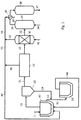
- Fig. 1 shows a procedure according to the present invention in a schematic manner.
- reactor 1 the ore is thermally treated in a so-called calcining process at temperatures of between 550 and 1000 °C, preferably 680 and 720 °C under autothermal conditions.
- sulfur contained in the ore is burned so that SO 2 and heat are formed.
- impurities in particularly arsenic and/or antimony, are evaporated which is an energy consuming process.
- Exhaust gases consisting of the introduced air, the produced SO 2 and gaseous impurities are subsequently drawn off via line 11 and are fed into a cyclone 20.
- the gas purification 22 preferably, comprises a hot filtration and/or a quench, preferably with water, and/or a wet filtration and/or a mercury removal and/or a gas drying, particularly preferably in this arrangement.
- Exhaust gases which are produced so and/or a gas which is used for cooling of one of the mentioned gas components or between the mentioned gas purification components can then be returned back into the reactor 10 via lines 23, 41 and 40 as recycling gas, wherein this recycling gas has a temperature of higher than 100 °C, preferably 300 to 450 °C.
- the gas from the gas purification facility 22 or also directly from line 21 is fed into a sulfur trioxide reactor 30 via line 23 for reacting SO 2 to SO 3 in a heterogeneously catalyzed reaction.
- the oxygen required for this reaction is introduced via line 31.
- lines 22 or 23 also an introduction into lines 22 or 23 would be imaginable.
- the exhaust gas which is produced and which is oxygen-depleted, since oxygen from air has been used for the reaction of SO 2 to SO 3 is fed as recycling gas into reactor 10 via line 42 and line 40.
- the absorption is characterized by a design of at least two stages so that line 35 does not immediately withdraw the end product, but does it fed into a second absorption stage 36 from which then the end product is drawn off via line 37.
- a heat exchanger 39 is located which also uses a gas, preferably air, as a heat carrier medium. So the air fed via line 38 into the heat exchanger 39 can be heated and it can be fed into recycling line 40 via line 44, 43. Similarly, also the use of a process gas which is poor in oxygen instead of air would be imaginable.
- gas which is poor in oxygen thus gas with an oxygen content of between 5 and 20 % by weight, preferably 8 to 14 % by weight is drawn off from the sulfur trioxide reactor 30 via line 42.
- This step of drawing off can also be realized via a chimney (not shown), thus after passing both absorption stages.
- the oxygen content in lines 43, 40 optionally also by further admixing via line 41, can be controlled or regulated.
- a definition of the oxygen content also results in the stoichiometrically possible conversion of sulfur in reactor 10, whereby in this manner also the amount of heat generated by the burning of sulfur and thus finally the temperature in reactor 10 can be controlled.
- the ore is drawn off from reactor 10 via line 12.
- the particles and fine dusts separated in cyclone 20 are fed by means of line 24.
- the ore can be used elsewhere or it can be directly further processed in a cluster of production plants.
- the ore is fed into a melting furnace 50 via line 51 in which the ore is further purified.
- Exhaust gases which are produced here and originate either directly from the melting furnace 50 or also from a cooling downstream of the melting furnace 50 (not shown) can be fed into reactor 10 via a recycling gas line 60.
- reactor 10 is designed as a fluidized bed reactor so that the recycling gas is used completely or partially as fluidization gas.
- a stationary fluidized bed and also a circulating fluid bed are possible.
Landscapes
- Engineering & Computer Science (AREA)
- Chemical & Material Sciences (AREA)
- Mechanical Engineering (AREA)
- Manufacturing & Machinery (AREA)
- Materials Engineering (AREA)
- Metallurgy (AREA)
- Organic Chemistry (AREA)
- Geochemistry & Mineralogy (AREA)
- Geology (AREA)
- General Life Sciences & Earth Sciences (AREA)
- Environmental & Geological Engineering (AREA)
- Life Sciences & Earth Sciences (AREA)
- Manufacture And Refinement Of Metals (AREA)
- Inorganic Compounds Of Heavy Metals (AREA)
Description
- The invention relates to a process and a plant for thermal treatment of a sulfur-containing ore in which the ore is calcined at temperatures of between 600 and 1200 °C in the presence of oxygen in a reactor so that between 1 and 90 % by weight of the sulfur contained in the ore is burned to sulfur dioxide and impurities contained are driven off in gaseous form, in which exhaust gas being produced and containing the sulfur dioxide is fed into a gas purification comprising at least one component and/or in which the calcined ore is fed into at least one further process stage.
- With the increasing demand for raw materials metallic resources, in particularly also copper-, cobalt-, gold- and nickel-containing ores, are exploited more and more. This results in the fact that resources which can be exploited without large effort or which provide highly pure raw materials meanwhile are nearly exhausted. So today exploited resources of ores are characterized by a higher proportion of impurities, in particularly it is known that copper-, cobalt- and/or nickel-containing ores also comprise arsenic and antimony. Before melting the ore, the content of these impurities has to be reduced strongly.
- For that, normally, the ore is heated at a temperature of between 600 and 1200 °C, preferably 600 to 900 °C. This operation is also referred to as calcining. By this heating also sulfur contained in the ore is burned to sulfur dioxide (SO2), by which again heat is produced. Therefore, preferably, this process, after ignition with externally fed fuel, can be conducted in an autothermic manner.
-
US 3,351,462 A is directed to a process for producing metallic copper from copper concentrates containing iron sulfide and copper sulphide. The process comprises a roasting step for the copper concentrate in the presence of oxygen at a sufficiently high temperature to convert substantially all the iron sulfide to iron oxide and at least a part of the copper sulfide to copper oxide. Further, it covers a smelting step wherein the roasted concentrate is directly smelted in an electric furnace in the presence of slag forming agents and an amount of sulfur corresponding in molecular proportion to about one-sixth' of the amount of copper present. In the smelting step, temperature is sufficiently high to cause the sulfur to react with the copper oxide to reduce the copper oxide to metallic copper and to cause the iron oxide to form a molten slag with the slag-forming agents. -
US 2006/230879 A1 relates to a method and a plant for the heat treatment of sulfidic ores, in which solids are heated to a temperature of approximately 450 to 1500 °C in a fluidized bed reactor. In order to improve the energy utilization, it is proposed to introduce a first gas or gas mixture from below through a gas supply tube into a mixing chamber of the reactor, the gas supply tube being at least partly surrounded by a stationary annular fluidized bed which is fluidized by supplying fluidizing gas. The gas velocities of the first gas or gas mixture as well as of the fluidizing gas for the annular fluidized bed are adjusted such that the particle Froude numbers in the gas supply tube are between 1 and 100, in the annular fluidized bed between 0.02 and 2 and in the mixing chamber between 0.3 and 30. -
EP 0 508 542 A2 describes roasting of ores with metal values such as precious metal ores for recovery of metal values with conversion of arsenic to an insoluble form in-situ in presence of an additive such as iron and in presence of oxygen injected initially or supplementary in a roaster such as in a circulating fluid bed roaster; volatilized arsenic in roasting of ores may also be converted to an insoluble form in gas phase in a two stage roaster process after removal of solids from a gas phase and contact with an additive at high oxygen concentration in a second stage roaster. - Due to the higher amounts of impurities in the ore used and, connected there-with, the requirement of evaporating higher proportions, the energy demand of this process increases with the amounts of impurities in the ore. So the sulfur contained is either no longer capable of allowing an autothermic process control or a very large proportion of the sulfur contained is already consumed during this calcining process, so that into the later melt of the ore more fuel has to be fed from outside.
- Therefore, it is an object of the present invention to provide a process with which the energy demand for the removal of impurities during the calcining step can be reduced.
- This object is solved by a process with the features of
patent claim 1. - For that a sulfur-containing ore is fed into an autothermal operated reactor and there it is thermally treated at a temperature of between 600 and 1200 °C, preferably 600 and 900 °C, particularly preferably 650 and 750 °C in the presence of oxygen. So 1 to 90 % by weight, preferably 10 to 60 % by weight of the sulfur contained in the ore is burned to sulfur dioxide and impurities contained are driven off in gaseous form. Such a process is referred to as partial calcination.
- In such a case, a typical ore is characterized by the following composition:
Table 1: typical composition of ore. Element Range in % by weight Preferable range in % by weight Copper 20 - 45 25 - 35 Cobalt 0 - 5 0 - 2 Sulfur 20 - 35 25 - 30 Arsenic 1 - 15 2 - 5 antimony 0 - 2 0.5 - 1 Iron 5 - 25 10 - 20 - By the thermal treatment an exhaust gas is produced which contains both, the sulfur dioxide and also gaseous impurities, and which is fed into a gas purification comprising at least one component. In an alternative or in addition, it is possible to feed the calcined ore into at least one further process stage.
- For autothermal conditions the energy demand in this process, either an exhaust gas from one component of the gas purification and/or an exhaust gas from the further process stage are fed into the reactor as recycling gas. During unstable process conditions, it is also possible to use a gas used for cooling before, during and/or after the gas purification and/or a gas used for cooling before, during and/or after a process stage as recycling gas or, in an even more preferred embodiment, to use coils in the reactor for a heat transfer medium. But in any case, the recycling gas must have a temperature of higher than 100 °C and thus reduce the energy demand for operating in the given temperature range by feeding it into the reactor.
- Using a gas with high inlet temperature, the energy demand in the reactor is reduced so that a lower amount of sulfur being contained in the ore has to be burned. So also ores being characterized by lower contents of sulfur can be calcined more easily. When the ore in deed has a sufficient sulfur demand for the calcination, then the procedure according to the present invention is also preferable, because so the calcined ore is characterized by a higher content of sulfur which in turn can act as an internal energy supplier in downstream processing stages.
- However, it is essential that the reactor is operated in an autothermic manner, i.e. that during steady operation no fuel has to be fed in or the reactor has to be cooled. This considerably reduces the effort in connection with the required equipment, because in this manner no fuel has to be fed into the reactor. The autothermic operation is realized by burning a sufficient amount of sulfur which is also contained in the ore to SO2:
S + O2 ---> SO2, ΔHR = - 297.03 kJ.
- Preferably, in this case the temperature in the reactor is controlled by the amount of oxygen which is fed in, because the amount of sulfur which can be burned depends on the oxygen being available.
- Preferably, the driven off impurities contain arsenic and/or antimony in amounts of between 0.1 and 10 % by weight, preferably 0.5 and 5 % by weight, based on the composition of the ore being fed into the reactor. Arsenic and antimony are compounds which in particularly at temperatures of between 650 and 750 °C evaporate and thus can be discharged in gaseous form. At the same time, arsenic and antimony are highly toxic and thus have to be removed from the ore as early as possible.
- Preferably, the ore contains in addition at least 20 % by weight of copper, cobalt, gold and/or nickel, whereby the conduction of the process according to the present invention is particularly cost-effective.
- Furthermore, it was shown to be advantageous, when the reactor is operated as a fluid bed reactor. In this case it is particularly favorable, when the recycling gas is fed into the fluid bed as fluidization gas. On the one hand, so the gas amount for the fluid bed is created in advance, and on the other hand, the problem that the reactor is cooled down by cold fluidization air does not exist.
- Preferably, the recycling gas has a temperature of between 200 and 500 °C, particularly preferably between 300 and 450 °C, because in this manner as much as possible heat is introduced into the reactor. At the same time, the temperature of the gas is not so high that the required equipment would be subjected to temperatures which are too high and thus correspondingly would be more cost-intensive to purchase.
- Furthermore, it was shown to be advantageous, when the recycling gas has a proportion of oxygen of between 3 and 20 % by weight. When the reaction procedure is conducted according to the present invention, then such a proportion of oxygen is sufficient for operating the reactor at the required temperatures in an autothermic manner. A further advantage of the invention is that due to the fact that now a lower amount of sulfur has to be burned for achieving the required temperatures also the amount of oxygen which has to be provided for the reaction is lower. However, by a decrease of the oxygen content it is possible to reliably avoid the formation of arsenic and/or antimony oxides, which cannot be removed from the ore in gaseous state any longer and thus remain in it and reduce the quality thereof.
- Furthermore, it was shown to be advantageous, when the recycling gas is a mixture of several exhaust gases and/or gases which are used for cooling. In particular a mixture in which the oxygen content is adjusted in a targeted manner to the desired temperature in the reactor due to the burning of sulfur is a mixture which is of advantage.
- In addition, it was shown to be favorable, when after the reactor the ore is fed into a process stage being designed as a melt and gases from this melt and/or from a downstream cooling are returned back into the reactor as recycling gas or constituent of the recycling gas. In particular, the advantage is that the melt is realized at very high temperatures (> 1200 °C) so that also cooling and/or exhaust gases from the melt are characterized by correspondingly high temperatures and a total gas flow which is smaller has to be returned back, since it is already characterized by a very high content of energy. Here it is also imaginable that small amounts of very hot cooling and/or exhaust gases from the melt are fed in before the reactor and there are mixed with fresh air so that the temperature of the gas is not an unnecessary burden for the parts of the plant, but the returned gas flow is smaller and thus the design of the required equipment may be characterized by smaller dimensions.
- A preferable design of the invention is characterized by a gas purification which comprises a process for producing sulfuric acid from sulfur dioxide being contained in the exhaust gas. Such a process for producing sulfuric acid is, for example, described in
DE 10 2005 008109 A1 - Preferably, in such a process under heterogeneous catalysis with addition of air at first SO2 is reacted to SO3. In this case, the source of oxygen is air. Besides SO3, from this reaction also a gas which is poor in oxygen results, wherein poor in oxygen in the sense of the invention means a proportion of oxygen which is lower than 21 % by volume, preferably lower than 18 % by volume. This gas which is poor in oxygen, according to the present invention, can then be returned back into the reactor as recycling gas or as constituent of the recycling gas, so that here the provision of oxygen is minimized and therefore the risk of forming arsenic and/or antimony oxides is considerably reduced.
- When the gas purification comprises a process for producing sulfuric acid from SO2, then, furthermore, it was shown to be favorable that the SO3 is absorbed with sulfuric acid in at least two stages and that between two adjacent stages the sulfuric acid is guided through a heat exchanger. Such a recovery process is also described in
DE 10 2005 008109 A1 - According to the present invention, it is particularly preferable, when the sulfur dioxide is at first reacted to sulfur trioxide and subsequently the sulfur trioxide is absorbed in sulfuric acid. In this case, both, the gas which is poor in oxygen from the heterogeneous reaction of SO2 to SO3 and also the heated air from the at least one heat exchanger between both absorbers in the absorption stage are mixed with air so that a specific oxygen content of between 3 and 20 % by weight is adjusted, whereby the temperature in the reactor can be regulated or controlled by regulating or controlling the amount of sulfur to be burned and thus the additional energy amount through the oxygen content.
- In addition, it is also imaginable to burn sulfur yet in addition during the production of sulfuric acid. The heat resulting from this burning can also be used for the partial calcination, either directly in the form of the exhaust gas or indirectly as vapor.
- Furthermore, a plant is designed for conducting a process with the features of patent claims 1 to 12.
- Such a facility for thermal treatment of a sulfur-containing ore comprises an autothermal reactor in which the ore is calcined at temperatures of between 600 and 1200 °C, preferably 600 and 900 °C, particularly preferably 650 to 750 °C in the presence of oxygen. Furthermore, such a facility comprises at least one component of a gas purification and/or a further process stage for treating the ore.
- Furthermore, according to the present invention, the facility comprises a return line from at least one component of the gas purification and/or the further process stage and/or a return line from a cooling within the gas purification and/or a cooling for the further process stage. So heated gas as recycling gas can be returned back into the reactor for calcining, whereby, in addition to the burning of sulfur, the required energy input is reduced. So, on the one hand, the oxygen content in the calcining reactor can be reduced which decreases the risk of forming oxides which can be removed only with high effort, and, on the other hand, so a lower amount of sulfur has to be burned. Therefore, it is possible to process ore with a sulfur content which is not sufficient for achieving the required temperature at all, or the sulfur content of the calcined ore remains higher so that the ore in downstream process stages can be processed better due to the inherent energy content.
- It is particularly preferable, when the reactor is designed as a fluidized bed reactor, because such a fluidized bed reactor results in very homogenous conditions throughout the whole fluidized bed.
- However, in principle, it is also imaginable to conduct the reaction in a rotary kiln or a multiple-hearth furnace.
- In a preferred embodiment, cooling coils are foreseen. This is particular preferred for a fluidized bed reactor wherein the coils at least partly are immersed into the fluidized bed during operation, but it is not restricted to this reactor type. With these cooling coils, instable process conditions as well as start-up and shut down of the plant can be handled.
- In the following, the invention is explained in more detail by means of a figure. Here, all described and/or depicted features form on its own or in arbitrary combination the subject matter of the invention, independently from their summary in the patent claims or their back reference.
-
Fig. 1 shows a procedure according to the present invention in a schematic manner. - In
Fig. 1 vialine 1 an ore is introduced into thereactor 10 which has the following composition:Table 2: composition of the introduced ore. Element % by weight Cu 28.1 Fe 12.9 S 24.5 As 3.3 Sb 0.1 Pb < 0.1 Zn 0.6 Ag < 0.1 - But similarly the described process is also possible for each ore composition mentioned in table 1.
- In
reactor 1 the ore is thermally treated in a so-called calcining process at temperatures of between 550 and 1000 °C, preferably 680 and 720 °C under autothermal conditions. Here, on the one hand, sulfur contained in the ore is burned so that SO2 and heat are formed. On the other hand, at the prevailing reaction temperatures impurities, in particularly arsenic and/or antimony, are evaporated which is an energy consuming process. Exhaust gases consisting of the introduced air, the produced SO2 and gaseous impurities are subsequently drawn off vialine 11 and are fed into acyclone 20. - In this
cyclone 20 the particles entrained by the exhaust gas flow are separated from the gas flow. The so purified gas from which dusts and small particles (< 20 µm) have been removed is then fed into agas purification 22. - The
gas purification 22, preferably, comprises a hot filtration and/or a quench, preferably with water, and/or a wet filtration and/or a mercury removal and/or a gas drying, particularly preferably in this arrangement. Exhaust gases which are produced so and/or a gas which is used for cooling of one of the mentioned gas components or between the mentioned gas purification components can then be returned back into thereactor 10 vialines - Furthermore, the gas from the
gas purification facility 22 or also directly fromline 21 is fed into asulfur trioxide reactor 30 vialine 23 for reacting SO2 to SO3 in a heterogeneously catalyzed reaction. The oxygen required for this reaction is introduced vialine 31. Similarly, also an introduction intolines reactor 10 vialine 42 andline 40. - Via
line 32 the produced SO3 is fed into at least oneabsorption stage 33. Into thisabsorption stage 33 vialine 34 sulfuric acid is introduced and vialine 35 drawn off again. In the sulfuric acid SO3 and H2SO4 form disulfuric acid H2S2O7 which in contact with water decomposes into two molecules of sulfuric acid. This product is drawn off vialine 35. - Preferably, as shown, the absorption is characterized by a design of at least two stages so that
line 35 does not immediately withdraw the end product, but does it fed into asecond absorption stage 36 from which then the end product is drawn off vialine 37. In line 35 aheat exchanger 39 is located which also uses a gas, preferably air, as a heat carrier medium. So the air fed vialine 38 into theheat exchanger 39 can be heated and it can be fed intorecycling line 40 vialine - Preferably, gas which is poor in oxygen, thus gas with an oxygen content of between 5 and 20 % by weight, preferably 8 to 14 % by weight is drawn off from the
sulfur trioxide reactor 30 vialine 42. This step of drawing off can also be realized via a chimney (not shown), thus after passing both absorption stages. By mixing the gases inlines lines line 41, can be controlled or regulated. A definition of the oxygen content also results in the stoichiometrically possible conversion of sulfur inreactor 10, whereby in this manner also the amount of heat generated by the burning of sulfur and thus finally the temperature inreactor 10 can be controlled. - The ore is drawn off from
reactor 10 vialine 12. Preferably, into it the particles and fine dusts separated incyclone 20 are fed by means ofline 24. Then, the ore can be used elsewhere or it can be directly further processed in a cluster of production plants. - In an alternative or in addition to the described recycling gas guidance from the gas purification, when the further processing is conducted on-site, it is possible to recover recycling gas also in a downstream ore processing stage. Preferably, in this case, the ore is fed into a melting
furnace 50 vialine 51 in which the ore is further purified. Exhaust gases which are produced here and originate either directly from the meltingfurnace 50 or also from a cooling downstream of the melting furnace 50 (not shown) can be fed intoreactor 10 via arecycling gas line 60. - Similarly, also other stages for further processing the ore are imaginable from which either directly gas and/or cooling gas used in a corresponding cooling can be used as recycling gas or as constituent of the recycling gas. In the shown process, at the same time, the melting furnace is cooled and via the same recycling gas line in its function as a heat carrier medium also heated gas is returned back into
reactor 10. - Furthermore, generally, it is also imaginable to mix the recycling gas from recycling
gas line 60 independently from its origin with the recycling gas fromline 40. - Preferably,
reactor 10 is designed as a fluidized bed reactor so that the recycling gas is used completely or partially as fluidization gas. In this case, both, a stationary fluidized bed and also a circulating fluid bed are possible. -
- 1
- line
- 10
- reactor
- 11, 12
- line
- 20
- cyclone
- 21
- line
- 22
- gas purification stage
- 23
- line
- 30
- sulfur trioxide reactor
- 31, 32
- line
- 33
- absorption stage
- 34, 35
- line
- 36
- absorption stage
- 37, 38
- line
- 39
- heat exchanger
- 40-44
- line
- 50
- melting furnace
- 51
- line
- 60
- line
Claims (13)
- A process for thermal treatment of a sulfur-containing ore in which the ore is calcined at temperatures of between 600 and 1200 °C in the presence of oxygen in a reactor so that between 1 and 90 % by weight of the sulfur contained in the ore is burned to sulfur dioxide and impurities contained are driven off in gaseous form, in which exhaust gas being produced and containing the sulfur dioxide is fed into a gas purification comprising at least one component wherein an exhaust gas from the gas purification is at least partially returned back into the reactor as recycling gas having a temperature of > 100 °C and that the reactor is operated in an autothermic manner.
- The process according to claim 1, characterized in that the calcined ore is fed into at least one further process stage, and that an exhaust gas from the process stage and/or a gas used for cooling within the further process stage is at least partially returned back into the reactor as recycling gas having a temperature of > 100 °C.
- The process according to claim 1 or 2, characterized in that the driven off impurities arsenic and/or antimony are contained in amounts of between 1 and 10 % by weight, based on their content in the sulfur-containing ore used, and/or that the ore contains at least 70 % by weight of copper, cobalt, gold and/or nickel.
- The process according to one of the preceding claims, characterized in that the oxygen content of the recycling gas is used as command or control variable for controlling or regulating the temperature in the reactor.
- The process according to one of the preceding claims, characterized in that the recycling gas is used as fluidization gas in the reactor being designed as a fluid bed reactor or as combustion air in the reactor being designed as a rotary kiln.
- The process according to one of the preceding claims, characterized in that the recycling gas has a temperature of between 100 and 600 °C.
- The process according to one of the preceding claims, characterized in that the recycling gas has a proportion of oxygen of between 3 and 20 % by weight.
- The process according to one of the preceding claims, characterized in that the recycling gas is a mixture of several exhaust gases and/or gases which are used for cooling.
- The process according to one of the preceding claims, characterized in that the ore after the reactor is fed into a melt and exhaust gas from this melt and/or a gas from a cooling downstream of it is returned back into the reactor as recycling gas or constituent of the recycling gas.
- The process according to one of the preceding claims, characterized in that the gas purification comprises a process for producing sulfuric acid from the sulfur dioxide contained in the exhaust gas and from this process gas is returned back into the reactor as recycling gas or constituent of the recycling gas.
- The process according to claim 10, characterized in that the SO2 with addition of air is reacted to SO3 and a gas which is poor in oxygen and that the gas which is poor in oxygen is returned back into the reactor as recycling gas or constituent of the recycling gas.
- The process according to claim 11, characterized in that the SO3 is absorbed with sulfuric acid in at least two stages, that the sulfuric acid between two series-connected stages is guided through at least one heat exchanger, that in this heat exchanger air is used as heat transport medium and that this air is returned back into the reactor as recycling gas or constituent of the recycling gas.
- The process according to claim 12, characterized in that gas which is poor in oxygen from the reaction of SO2 to SO3 and heated air from the at least one heat exchanging between both absorption stages are mixed such that a specific oxygen content of between 3 and 20 % by weight is adjusted with which the temperature in the reactor is controlled or regulated.
Priority Applications (1)
| Application Number | Priority Date | Filing Date | Title |
|---|---|---|---|
| RS20201332A RS61023B1 (en) | 2016-03-24 | 2017-03-24 | Process and facility for thermal treatment of a sulfur-containing ore |
Applications Claiming Priority (2)
| Application Number | Priority Date | Filing Date | Title |
|---|---|---|---|
| DE102016105574.3A DE102016105574A1 (en) | 2016-03-24 | 2016-03-24 | Method and device for the thermal treatment of a sulphurous ore |
| PCT/EP2017/057087 WO2017162857A1 (en) | 2016-03-24 | 2017-03-24 | Process and facility for thermal treatment of a sulfur-containing ore |
Publications (2)
| Publication Number | Publication Date |
|---|---|
| EP3433388A1 EP3433388A1 (en) | 2019-01-30 |
| EP3433388B1 true EP3433388B1 (en) | 2020-08-19 |
Family
ID=58464512
Family Applications (1)
| Application Number | Title | Priority Date | Filing Date |
|---|---|---|---|
| EP17715066.1A Active EP3433388B1 (en) | 2016-03-24 | 2017-03-24 | Process and facility for thermal treatment of a sulfur-containing ore |
Country Status (11)
| Country | Link |
|---|---|
| US (1) | US20190017143A1 (en) |
| EP (1) | EP3433388B1 (en) |
| CN (1) | CN108884514A (en) |
| CA (1) | CA3018017C (en) |
| CL (1) | CL2018002651A1 (en) |
| DE (1) | DE102016105574A1 (en) |
| EA (1) | EA201891921A1 (en) |
| PE (1) | PE20181707A1 (en) |
| PL (1) | PL3433388T3 (en) |
| RS (1) | RS61023B1 (en) |
| WO (1) | WO2017162857A1 (en) |
Families Citing this family (2)
| Publication number | Priority date | Publication date | Assignee | Title |
|---|---|---|---|---|
| CN110054163A (en) * | 2019-05-13 | 2019-07-26 | 安徽华尔泰化工股份有限公司 | Gas washing in SA production heat-energy recovering apparatus |
| EP3932534B1 (en) * | 2020-06-30 | 2022-12-07 | AURA Technologie GmbH | Method and device for recycling waste containing valuable metals |
Family Cites Families (13)
| Publication number | Priority date | Publication date | Assignee | Title |
|---|---|---|---|---|
| US1974886A (en) * | 1931-12-15 | 1934-09-25 | Ici Ltd | Roasting of sulphide ores |
| US2910348A (en) * | 1952-08-18 | 1959-10-27 | Duisburger Kupferhuette | Working up of sulfide iron ores |
| US3351462A (en) * | 1965-01-29 | 1967-11-07 | Anaconda Co | Electric furnace smelting of copper concentrates |
| GB1366712A (en) * | 1972-02-03 | 1974-09-11 | Simon Eng Dudley Ltd | Extraction of metals from ores |
| DE2515464C2 (en) * | 1975-04-09 | 1977-03-31 | Kloeckner Humboldt Deutz Ag | METHOD AND DEVICE FOR THE PREVENTION OF SULFIDIC COPPER ORE CONCENTRATES |
| SE8303184L (en) * | 1983-06-06 | 1984-12-07 | Boliden Ab | PROCEDURE FOR THE PREPARATION OF COPPER MELT MATERIALS AND SIMILAR MATERIALS CONTAINING HIGH CONTAINERS ARSENIK AND / OR ANTIMON |
| ES2117028T3 (en) * | 1991-04-12 | 1998-08-01 | Metallgesellschaft Ag | PROCEDURE FOR THE TREATMENT OF MINERAL WITH VALUE OF RECOVERABLE METALS INCLUDING ARSENIC-CONTAINING COMPONENTS. |
| DE19609284A1 (en) * | 1996-03-09 | 1997-09-11 | Metallgesellschaft Ag | Treating granular sulphidic ores containing gold and/or silver |
| US5993514A (en) * | 1997-10-24 | 1999-11-30 | Dynatec Corporation | Process for upgrading copper sulphide residues containing nickel and iron |
| DE10260735B4 (en) * | 2002-12-23 | 2005-07-14 | Outokumpu Oyj | Process and plant for heat treatment of sulfide ores |
| DE102004009176B4 (en) * | 2004-02-25 | 2006-04-20 | Outokumpu Oyj | Process for the reduction of copper-containing solids in a fluidized bed |
| DE102005008109A1 (en) | 2005-02-21 | 2006-08-24 | Outokumpu Technology Oy | Process and plant for the production of sulfuric acid |
| DE102008033558A1 (en) * | 2008-07-11 | 2010-01-14 | Outotec Oyj | Process and plant for the production of calcine products |
-
2016
- 2016-03-24 DE DE102016105574.3A patent/DE102016105574A1/en not_active Withdrawn
-
2017
- 2017-03-24 CA CA3018017A patent/CA3018017C/en active Active
- 2017-03-24 PE PE2018001831A patent/PE20181707A1/en unknown
- 2017-03-24 RS RS20201332A patent/RS61023B1/en unknown
- 2017-03-24 CN CN201780018103.2A patent/CN108884514A/en active Pending
- 2017-03-24 EP EP17715066.1A patent/EP3433388B1/en active Active
- 2017-03-24 PL PL17715066.1T patent/PL3433388T3/en unknown
- 2017-03-24 EA EA201891921A patent/EA201891921A1/en unknown
- 2017-03-24 WO PCT/EP2017/057087 patent/WO2017162857A1/en not_active Ceased
-
2018
- 2018-09-14 CL CL2018002651A patent/CL2018002651A1/en unknown
- 2018-09-17 US US16/133,057 patent/US20190017143A1/en not_active Abandoned
Non-Patent Citations (1)
| Title |
|---|
| None * |
Also Published As
| Publication number | Publication date |
|---|---|
| US20190017143A1 (en) | 2019-01-17 |
| CA3018017C (en) | 2024-04-23 |
| PL3433388T3 (en) | 2021-02-22 |
| CA3018017A1 (en) | 2017-09-28 |
| CN108884514A (en) | 2018-11-23 |
| CL2018002651A1 (en) | 2018-12-14 |
| EA201891921A1 (en) | 2019-03-29 |
| PE20181707A1 (en) | 2018-10-24 |
| EP3433388A1 (en) | 2019-01-30 |
| DE102016105574A1 (en) | 2017-09-28 |
| WO2017162857A1 (en) | 2017-09-28 |
| RS61023B1 (en) | 2020-12-31 |
Similar Documents
| Publication | Publication Date | Title |
|---|---|---|
| EP0174641B1 (en) | A process for recovering valuable metals from an iron dust containing a higher content of zinc | |
| SU1674694A3 (en) | Method and apparatus for preparing molten iron-containing materials from finely divided ore | |
| KR0158210B1 (en) | How to reapply precious metals from dust containing zinc | |
| EP3052665B1 (en) | Method and plant for removing arsenic and/or antimony from flue dusts | |
| US4588436A (en) | Method of recovering metals from liquid slag | |
| MX2013006707A (en) | Process and plant for treating ore concentrate particles containing valuable metal. | |
| Hammerschmidt et al. | Roasting of gold ore in the circulating fluidized-bed technology | |
| CA1125031A (en) | Process for the roasting and chlorination of finely-divided iron ores and/or concentrates containing non-ferrous metals | |
| RO111442B1 (en) | Process and plant for the preparation of alkalin chromates | |
| JP3618813B2 (en) | Method for producing high-grade nickel matte from nickel-containing raw material at least partially purified by high temperature metallurgy | |
| US3948639A (en) | Process and device for flash smelting sulphide ores and concentrates | |
| US20190017143A1 (en) | Process and facility for thermal treatment of a sulfur-containing ore | |
| US3034884A (en) | Reduction roasting of iron ores | |
| CN216808148U (en) | Apparatus for the thermal treatment of solid materials | |
| US10501824B2 (en) | Treatment of complex sulfide concentrate | |
| AU592398B2 (en) | Oxidation-reduction smelting of zn ores | |
| US11649523B2 (en) | Process and apparatus for roasting of metal sulfide concentrates and/or residues | |
| US6517603B2 (en) | Method for recovery of metals having low vaporization temperature | |
| US4437884A (en) | Ore roasting with recycle of gases | |
| CN85106114A (en) | Reclaim the melting method of various metals and implement the device of this method from non-ferrous metal oxidized ore or its concentrate and/or from fine particle nonferrous metal sulfide mineral or its concentrate | |
| US2663631A (en) | Reduction of oxides | |
| US4082542A (en) | Copper precipitate agglomerization process | |
| CN222770919U (en) | Leaching slag desulfurization and iron extraction system | |
| CN222352861U (en) | Suspension smelting furnace | |
| JPS62243706A (en) | Method for circulating gas generated in melt reduction smelting |
Legal Events
| Date | Code | Title | Description |
|---|---|---|---|
| STAA | Information on the status of an ep patent application or granted ep patent |
Free format text: STATUS: UNKNOWN |
|
| STAA | Information on the status of an ep patent application or granted ep patent |
Free format text: STATUS: THE INTERNATIONAL PUBLICATION HAS BEEN MADE |
|
| PUAI | Public reference made under article 153(3) epc to a published international application that has entered the european phase |
Free format text: ORIGINAL CODE: 0009012 |
|
| STAA | Information on the status of an ep patent application or granted ep patent |
Free format text: STATUS: REQUEST FOR EXAMINATION WAS MADE |
|
| 17P | Request for examination filed |
Effective date: 20180920 |
|
| AK | Designated contracting states |
Kind code of ref document: A1 Designated state(s): AL AT BE BG CH CY CZ DE DK EE ES FI FR GB GR HR HU IE IS IT LI LT LU LV MC MK MT NL NO PL PT RO RS SE SI SK SM TR |
|
| AX | Request for extension of the european patent |
Extension state: BA ME |
|
| DAV | Request for validation of the european patent (deleted) | ||
| DAX | Request for extension of the european patent (deleted) | ||
| GRAP | Despatch of communication of intention to grant a patent |
Free format text: ORIGINAL CODE: EPIDOSNIGR1 |
|
| STAA | Information on the status of an ep patent application or granted ep patent |
Free format text: STATUS: GRANT OF PATENT IS INTENDED |
|
| INTG | Intention to grant announced |
Effective date: 20200421 |
|
| GRAS | Grant fee paid |
Free format text: ORIGINAL CODE: EPIDOSNIGR3 |
|
| GRAA | (expected) grant |
Free format text: ORIGINAL CODE: 0009210 |
|
| STAA | Information on the status of an ep patent application or granted ep patent |
Free format text: STATUS: THE PATENT HAS BEEN GRANTED |
|
| AK | Designated contracting states |
Kind code of ref document: B1 Designated state(s): AL AT BE BG CH CY CZ DE DK EE ES FI FR GB GR HR HU IE IS IT LI LT LU LV MC MK MT NL NO PL PT RO RS SE SI SK SM TR |
|
| REG | Reference to a national code |
Ref country code: CH Ref legal event code: EP |
|
| REG | Reference to a national code |
Ref country code: DE Ref legal event code: R096 Ref document number: 602017021927 Country of ref document: DE |
|
| REG | Reference to a national code |
Ref country code: AT Ref legal event code: REF Ref document number: 1304008 Country of ref document: AT Kind code of ref document: T Effective date: 20200915 |
|
| REG | Reference to a national code |
Ref country code: IE Ref legal event code: FG4D |
|
| REG | Reference to a national code |
Ref country code: FI Ref legal event code: FGE |
|
| REG | Reference to a national code |
Ref country code: SE Ref legal event code: TRGR |
|
| REG | Reference to a national code |
Ref country code: LT Ref legal event code: MG4D |
|
| REG | Reference to a national code |
Ref country code: NL Ref legal event code: MP Effective date: 20200819 |
|
| PG25 | Lapsed in a contracting state [announced via postgrant information from national office to epo] |
Ref country code: GR Free format text: LAPSE BECAUSE OF FAILURE TO SUBMIT A TRANSLATION OF THE DESCRIPTION OR TO PAY THE FEE WITHIN THE PRESCRIBED TIME-LIMIT Effective date: 20201120 Ref country code: LT Free format text: LAPSE BECAUSE OF FAILURE TO SUBMIT A TRANSLATION OF THE DESCRIPTION OR TO PAY THE FEE WITHIN THE PRESCRIBED TIME-LIMIT Effective date: 20200819 Ref country code: HR Free format text: LAPSE BECAUSE OF FAILURE TO SUBMIT A TRANSLATION OF THE DESCRIPTION OR TO PAY THE FEE WITHIN THE PRESCRIBED TIME-LIMIT Effective date: 20200819 Ref country code: NO Free format text: LAPSE BECAUSE OF FAILURE TO SUBMIT A TRANSLATION OF THE DESCRIPTION OR TO PAY THE FEE WITHIN THE PRESCRIBED TIME-LIMIT Effective date: 20201119 Ref country code: PT Free format text: LAPSE BECAUSE OF FAILURE TO SUBMIT A TRANSLATION OF THE DESCRIPTION OR TO PAY THE FEE WITHIN THE PRESCRIBED TIME-LIMIT Effective date: 20201221 |
|
| REG | Reference to a national code |
Ref country code: AT Ref legal event code: MK05 Ref document number: 1304008 Country of ref document: AT Kind code of ref document: T Effective date: 20200819 |
|
| PG25 | Lapsed in a contracting state [announced via postgrant information from national office to epo] |
Ref country code: NL Free format text: LAPSE BECAUSE OF FAILURE TO SUBMIT A TRANSLATION OF THE DESCRIPTION OR TO PAY THE FEE WITHIN THE PRESCRIBED TIME-LIMIT Effective date: 20200819 Ref country code: LV Free format text: LAPSE BECAUSE OF FAILURE TO SUBMIT A TRANSLATION OF THE DESCRIPTION OR TO PAY THE FEE WITHIN THE PRESCRIBED TIME-LIMIT Effective date: 20200819 Ref country code: IS Free format text: LAPSE BECAUSE OF FAILURE TO SUBMIT A TRANSLATION OF THE DESCRIPTION OR TO PAY THE FEE WITHIN THE PRESCRIBED TIME-LIMIT Effective date: 20201219 |
|
| PG25 | Lapsed in a contracting state [announced via postgrant information from national office to epo] |
Ref country code: RO Free format text: LAPSE BECAUSE OF FAILURE TO SUBMIT A TRANSLATION OF THE DESCRIPTION OR TO PAY THE FEE WITHIN THE PRESCRIBED TIME-LIMIT Effective date: 20200819 Ref country code: DK Free format text: LAPSE BECAUSE OF FAILURE TO SUBMIT A TRANSLATION OF THE DESCRIPTION OR TO PAY THE FEE WITHIN THE PRESCRIBED TIME-LIMIT Effective date: 20200819 Ref country code: CZ Free format text: LAPSE BECAUSE OF FAILURE TO SUBMIT A TRANSLATION OF THE DESCRIPTION OR TO PAY THE FEE WITHIN THE PRESCRIBED TIME-LIMIT Effective date: 20200819 Ref country code: EE Free format text: LAPSE BECAUSE OF FAILURE TO SUBMIT A TRANSLATION OF THE DESCRIPTION OR TO PAY THE FEE WITHIN THE PRESCRIBED TIME-LIMIT Effective date: 20200819 Ref country code: SM Free format text: LAPSE BECAUSE OF FAILURE TO SUBMIT A TRANSLATION OF THE DESCRIPTION OR TO PAY THE FEE WITHIN THE PRESCRIBED TIME-LIMIT Effective date: 20200819 |
|
| REG | Reference to a national code |
Ref country code: DE Ref legal event code: R097 Ref document number: 602017021927 Country of ref document: DE |
|
| PG25 | Lapsed in a contracting state [announced via postgrant information from national office to epo] |
Ref country code: AL Free format text: LAPSE BECAUSE OF FAILURE TO SUBMIT A TRANSLATION OF THE DESCRIPTION OR TO PAY THE FEE WITHIN THE PRESCRIBED TIME-LIMIT Effective date: 20200819 Ref country code: AT Free format text: LAPSE BECAUSE OF FAILURE TO SUBMIT A TRANSLATION OF THE DESCRIPTION OR TO PAY THE FEE WITHIN THE PRESCRIBED TIME-LIMIT Effective date: 20200819 Ref country code: ES Free format text: LAPSE BECAUSE OF FAILURE TO SUBMIT A TRANSLATION OF THE DESCRIPTION OR TO PAY THE FEE WITHIN THE PRESCRIBED TIME-LIMIT Effective date: 20200819 |
|
| PLBE | No opposition filed within time limit |
Free format text: ORIGINAL CODE: 0009261 |
|
| STAA | Information on the status of an ep patent application or granted ep patent |
Free format text: STATUS: NO OPPOSITION FILED WITHIN TIME LIMIT |
|
| PG25 | Lapsed in a contracting state [announced via postgrant information from national office to epo] |
Ref country code: SK Free format text: LAPSE BECAUSE OF FAILURE TO SUBMIT A TRANSLATION OF THE DESCRIPTION OR TO PAY THE FEE WITHIN THE PRESCRIBED TIME-LIMIT Effective date: 20200819 |
|
| 26N | No opposition filed |
Effective date: 20210520 |
|
| PG25 | Lapsed in a contracting state [announced via postgrant information from national office to epo] |
Ref country code: IT Free format text: LAPSE BECAUSE OF FAILURE TO SUBMIT A TRANSLATION OF THE DESCRIPTION OR TO PAY THE FEE WITHIN THE PRESCRIBED TIME-LIMIT Effective date: 20200819 |
|
| PG25 | Lapsed in a contracting state [announced via postgrant information from national office to epo] |
Ref country code: SI Free format text: LAPSE BECAUSE OF FAILURE TO SUBMIT A TRANSLATION OF THE DESCRIPTION OR TO PAY THE FEE WITHIN THE PRESCRIBED TIME-LIMIT Effective date: 20200819 |
|
| REG | Reference to a national code |
Ref country code: DE Ref legal event code: R119 Ref document number: 602017021927 Country of ref document: DE |
|
| PG25 | Lapsed in a contracting state [announced via postgrant information from national office to epo] |
Ref country code: MC Free format text: LAPSE BECAUSE OF FAILURE TO SUBMIT A TRANSLATION OF THE DESCRIPTION OR TO PAY THE FEE WITHIN THE PRESCRIBED TIME-LIMIT Effective date: 20200819 |
|
| REG | Reference to a national code |
Ref country code: CH Ref legal event code: PL |
|
| GBPC | Gb: european patent ceased through non-payment of renewal fee |
Effective date: 20210324 |
|
| REG | Reference to a national code |
Ref country code: BE Ref legal event code: MM Effective date: 20210331 |
|
| PG25 | Lapsed in a contracting state [announced via postgrant information from national office to epo] |
Ref country code: GB Free format text: LAPSE BECAUSE OF NON-PAYMENT OF DUE FEES Effective date: 20210324 Ref country code: IE Free format text: LAPSE BECAUSE OF NON-PAYMENT OF DUE FEES Effective date: 20210324 Ref country code: FR Free format text: LAPSE BECAUSE OF NON-PAYMENT OF DUE FEES Effective date: 20210331 Ref country code: DE Free format text: LAPSE BECAUSE OF NON-PAYMENT OF DUE FEES Effective date: 20211001 Ref country code: CH Free format text: LAPSE BECAUSE OF NON-PAYMENT OF DUE FEES Effective date: 20210331 Ref country code: LI Free format text: LAPSE BECAUSE OF NON-PAYMENT OF DUE FEES Effective date: 20210331 Ref country code: LU Free format text: LAPSE BECAUSE OF NON-PAYMENT OF DUE FEES Effective date: 20210324 |
|
| PG25 | Lapsed in a contracting state [announced via postgrant information from national office to epo] |
Ref country code: BE Free format text: LAPSE BECAUSE OF NON-PAYMENT OF DUE FEES Effective date: 20210331 |
|
| PG25 | Lapsed in a contracting state [announced via postgrant information from national office to epo] |
Ref country code: CY Free format text: LAPSE BECAUSE OF FAILURE TO SUBMIT A TRANSLATION OF THE DESCRIPTION OR TO PAY THE FEE WITHIN THE PRESCRIBED TIME-LIMIT Effective date: 20200819 |
|
| PG25 | Lapsed in a contracting state [announced via postgrant information from national office to epo] |
Ref country code: HU Free format text: LAPSE BECAUSE OF FAILURE TO SUBMIT A TRANSLATION OF THE DESCRIPTION OR TO PAY THE FEE WITHIN THE PRESCRIBED TIME-LIMIT; INVALID AB INITIO Effective date: 20170324 |
|
| REG | Reference to a national code |
Ref country code: FI Ref legal event code: PCE Owner name: METSO OUTOTEC FINLAND OY, FI |
|
| PG25 | Lapsed in a contracting state [announced via postgrant information from national office to epo] |
Ref country code: MK Free format text: LAPSE BECAUSE OF FAILURE TO SUBMIT A TRANSLATION OF THE DESCRIPTION OR TO PAY THE FEE WITHIN THE PRESCRIBED TIME-LIMIT Effective date: 20200819 |
|
| REG | Reference to a national code |
Ref country code: FI Ref legal event code: PCE Owner name: METSO METALS OY |
|
| PG25 | Lapsed in a contracting state [announced via postgrant information from national office to epo] |
Ref country code: TR Free format text: LAPSE BECAUSE OF FAILURE TO SUBMIT A TRANSLATION OF THE DESCRIPTION OR TO PAY THE FEE WITHIN THE PRESCRIBED TIME-LIMIT Effective date: 20200819 |
|
| PG25 | Lapsed in a contracting state [announced via postgrant information from national office to epo] |
Ref country code: MT Free format text: LAPSE BECAUSE OF FAILURE TO SUBMIT A TRANSLATION OF THE DESCRIPTION OR TO PAY THE FEE WITHIN THE PRESCRIBED TIME-LIMIT Effective date: 20200819 |
|
| PGFP | Annual fee paid to national office [announced via postgrant information from national office to epo] |
Ref country code: SE Payment date: 20260319 Year of fee payment: 10 |
|
| PGFP | Annual fee paid to national office [announced via postgrant information from national office to epo] |
Ref country code: FI Payment date: 20260323 Year of fee payment: 10 |
|
| PGFP | Annual fee paid to national office [announced via postgrant information from national office to epo] |
Ref country code: RS Payment date: 20260313 Year of fee payment: 10 |
|
| PGFP | Annual fee paid to national office [announced via postgrant information from national office to epo] |
Ref country code: PL Payment date: 20260313 Year of fee payment: 10 |
|
| PGFP | Annual fee paid to national office [announced via postgrant information from national office to epo] |
Ref country code: BG Payment date: 20260324 Year of fee payment: 10 |