EP3432387A1 - Positive electrode mixture for secondary batteries, manufacturing method for positive electrodes for secondary batteries, and manufacturing method for secondary batteries - Google Patents
Positive electrode mixture for secondary batteries, manufacturing method for positive electrodes for secondary batteries, and manufacturing method for secondary batteries Download PDFInfo
- Publication number
- EP3432387A1 EP3432387A1 EP16894578.0A EP16894578A EP3432387A1 EP 3432387 A1 EP3432387 A1 EP 3432387A1 EP 16894578 A EP16894578 A EP 16894578A EP 3432387 A1 EP3432387 A1 EP 3432387A1
- Authority
- EP
- European Patent Office
- Prior art keywords
- positive electrode
- secondary battery
- active material
- electrode active
- acid
- Prior art date
- Legal status (The legal status is an assumption and is not a legal conclusion. Google has not performed a legal analysis and makes no representation as to the accuracy of the status listed.)
- Granted
Links
Images
Classifications
-
- H—ELECTRICITY
- H01—ELECTRIC ELEMENTS
- H01M—PROCESSES OR MEANS, e.g. BATTERIES, FOR THE DIRECT CONVERSION OF CHEMICAL ENERGY INTO ELECTRICAL ENERGY
- H01M4/00—Electrodes
- H01M4/02—Electrodes composed of, or comprising, active material
- H01M4/62—Selection of inactive substances as ingredients for active masses, e.g. binders, fillers
-
- H—ELECTRICITY
- H01—ELECTRIC ELEMENTS
- H01M—PROCESSES OR MEANS, e.g. BATTERIES, FOR THE DIRECT CONVERSION OF CHEMICAL ENERGY INTO ELECTRICAL ENERGY
- H01M4/00—Electrodes
- H01M4/02—Electrodes composed of, or comprising, active material
- H01M4/36—Selection of substances as active materials, active masses, active liquids
- H01M4/362—Composites
- H01M4/364—Composites as mixtures
-
- H—ELECTRICITY
- H01—ELECTRIC ELEMENTS
- H01M—PROCESSES OR MEANS, e.g. BATTERIES, FOR THE DIRECT CONVERSION OF CHEMICAL ENERGY INTO ELECTRICAL ENERGY
- H01M10/00—Secondary cells; Manufacture thereof
- H01M10/05—Accumulators with non-aqueous electrolyte
- H01M10/052—Li-accumulators
- H01M10/0525—Rocking-chair batteries, i.e. batteries with lithium insertion or intercalation in both electrodes; Lithium-ion batteries
-
- H—ELECTRICITY
- H01—ELECTRIC ELEMENTS
- H01M—PROCESSES OR MEANS, e.g. BATTERIES, FOR THE DIRECT CONVERSION OF CHEMICAL ENERGY INTO ELECTRICAL ENERGY
- H01M10/00—Secondary cells; Manufacture thereof
- H01M10/05—Accumulators with non-aqueous electrolyte
- H01M10/058—Construction or manufacture
-
- H—ELECTRICITY
- H01—ELECTRIC ELEMENTS
- H01M—PROCESSES OR MEANS, e.g. BATTERIES, FOR THE DIRECT CONVERSION OF CHEMICAL ENERGY INTO ELECTRICAL ENERGY
- H01M10/00—Secondary cells; Manufacture thereof
- H01M10/42—Methods or arrangements for servicing or maintenance of secondary cells or secondary half-cells
- H01M10/44—Methods for charging or discharging
-
- H—ELECTRICITY
- H01—ELECTRIC ELEMENTS
- H01M—PROCESSES OR MEANS, e.g. BATTERIES, FOR THE DIRECT CONVERSION OF CHEMICAL ENERGY INTO ELECTRICAL ENERGY
- H01M4/00—Electrodes
- H01M4/02—Electrodes composed of, or comprising, active material
- H01M4/04—Processes of manufacture in general
- H01M4/0402—Methods of deposition of the material
- H01M4/0404—Methods of deposition of the material by coating on electrode collectors
-
- H—ELECTRICITY
- H01—ELECTRIC ELEMENTS
- H01M—PROCESSES OR MEANS, e.g. BATTERIES, FOR THE DIRECT CONVERSION OF CHEMICAL ENERGY INTO ELECTRICAL ENERGY
- H01M4/00—Electrodes
- H01M4/02—Electrodes composed of, or comprising, active material
- H01M4/13—Electrodes for accumulators with non-aqueous electrolyte, e.g. for lithium-accumulators; Processes of manufacture thereof
- H01M4/131—Electrodes based on mixed oxides or hydroxides, or on mixtures of oxides or hydroxides, e.g. LiCoOx
-
- H—ELECTRICITY
- H01—ELECTRIC ELEMENTS
- H01M—PROCESSES OR MEANS, e.g. BATTERIES, FOR THE DIRECT CONVERSION OF CHEMICAL ENERGY INTO ELECTRICAL ENERGY
- H01M4/00—Electrodes
- H01M4/02—Electrodes composed of, or comprising, active material
- H01M4/36—Selection of substances as active materials, active masses, active liquids
- H01M4/362—Composites
- H01M4/366—Composites as layered products
-
- H—ELECTRICITY
- H01—ELECTRIC ELEMENTS
- H01M—PROCESSES OR MEANS, e.g. BATTERIES, FOR THE DIRECT CONVERSION OF CHEMICAL ENERGY INTO ELECTRICAL ENERGY
- H01M4/00—Electrodes
- H01M4/02—Electrodes composed of, or comprising, active material
- H01M4/36—Selection of substances as active materials, active masses, active liquids
- H01M4/48—Selection of substances as active materials, active masses, active liquids of inorganic oxides or hydroxides
- H01M4/50—Selection of substances as active materials, active masses, active liquids of inorganic oxides or hydroxides of manganese
- H01M4/505—Selection of substances as active materials, active masses, active liquids of inorganic oxides or hydroxides of manganese of mixed oxides or hydroxides containing manganese for inserting or intercalating light metals, e.g. LiMn2O4 or LiMn2OxFy
-
- H—ELECTRICITY
- H01—ELECTRIC ELEMENTS
- H01M—PROCESSES OR MEANS, e.g. BATTERIES, FOR THE DIRECT CONVERSION OF CHEMICAL ENERGY INTO ELECTRICAL ENERGY
- H01M4/00—Electrodes
- H01M4/02—Electrodes composed of, or comprising, active material
- H01M4/36—Selection of substances as active materials, active masses, active liquids
- H01M4/48—Selection of substances as active materials, active masses, active liquids of inorganic oxides or hydroxides
- H01M4/52—Selection of substances as active materials, active masses, active liquids of inorganic oxides or hydroxides of nickel, cobalt or iron
- H01M4/525—Selection of substances as active materials, active masses, active liquids of inorganic oxides or hydroxides of nickel, cobalt or iron of mixed oxides or hydroxides containing iron, cobalt or nickel for inserting or intercalating light metals, e.g. LiNiO2, LiCoO2 or LiCoOxFy
-
- H—ELECTRICITY
- H01—ELECTRIC ELEMENTS
- H01M—PROCESSES OR MEANS, e.g. BATTERIES, FOR THE DIRECT CONVERSION OF CHEMICAL ENERGY INTO ELECTRICAL ENERGY
- H01M4/00—Electrodes
- H01M4/02—Electrodes composed of, or comprising, active material
- H01M4/62—Selection of inactive substances as ingredients for active masses, e.g. binders, fillers
- H01M4/621—Binders
- H01M4/622—Binders being polymers
- H01M4/623—Binders being polymers fluorinated polymers
-
- H—ELECTRICITY
- H01—ELECTRIC ELEMENTS
- H01M—PROCESSES OR MEANS, e.g. BATTERIES, FOR THE DIRECT CONVERSION OF CHEMICAL ENERGY INTO ELECTRICAL ENERGY
- H01M4/00—Electrodes
- H01M4/02—Electrodes composed of, or comprising, active material
- H01M2004/021—Physical characteristics, e.g. porosity, surface area
-
- H—ELECTRICITY
- H01—ELECTRIC ELEMENTS
- H01M—PROCESSES OR MEANS, e.g. BATTERIES, FOR THE DIRECT CONVERSION OF CHEMICAL ENERGY INTO ELECTRICAL ENERGY
- H01M4/00—Electrodes
- H01M4/02—Electrodes composed of, or comprising, active material
- H01M2004/026—Electrodes composed of, or comprising, active material characterised by the polarity
- H01M2004/028—Positive electrodes
-
- Y—GENERAL TAGGING OF NEW TECHNOLOGICAL DEVELOPMENTS; GENERAL TAGGING OF CROSS-SECTIONAL TECHNOLOGIES SPANNING OVER SEVERAL SECTIONS OF THE IPC; TECHNICAL SUBJECTS COVERED BY FORMER USPC CROSS-REFERENCE ART COLLECTIONS [XRACs] AND DIGESTS
- Y02—TECHNOLOGIES OR APPLICATIONS FOR MITIGATION OR ADAPTATION AGAINST CLIMATE CHANGE
- Y02E—REDUCTION OF GREENHOUSE GAS [GHG] EMISSIONS, RELATED TO ENERGY GENERATION, TRANSMISSION OR DISTRIBUTION
- Y02E60/00—Enabling technologies; Technologies with a potential or indirect contribution to GHG emissions mitigation
- Y02E60/10—Energy storage using batteries
-
- Y—GENERAL TAGGING OF NEW TECHNOLOGICAL DEVELOPMENTS; GENERAL TAGGING OF CROSS-SECTIONAL TECHNOLOGIES SPANNING OVER SEVERAL SECTIONS OF THE IPC; TECHNICAL SUBJECTS COVERED BY FORMER USPC CROSS-REFERENCE ART COLLECTIONS [XRACs] AND DIGESTS
- Y02—TECHNOLOGIES OR APPLICATIONS FOR MITIGATION OR ADAPTATION AGAINST CLIMATE CHANGE
- Y02P—CLIMATE CHANGE MITIGATION TECHNOLOGIES IN THE PRODUCTION OR PROCESSING OF GOODS
- Y02P70/00—Climate change mitigation technologies in the production process for final industrial or consumer products
- Y02P70/50—Manufacturing or production processes characterised by the final manufactured product
Definitions
- a present exemplary embodiment relates to a positive electrode mixture for a secondary battery, a method for manufacturing a positive electrode for a secondary battery, and a method for manufacturing a secondary battery.
- lithium-ion secondary batteries Since lithium-ion secondary batteries have a high energy density and a good charge-discharge cycle characteristic, they are widely used as a power source for small-size mobile apparatuses, such as cellular phones and notebook PCs. In recent years, in consideration of environmental issues and also due to heightened awareness of energy saving, the lithium-ion secondary batteries are expected to be applied to large-sized batteries, which are demanded to have a large capacity and a long life, in such fields as electric vehicles, such as hybrid electric vehicles, and electric power storage.
- Patent Literatures 1 to 6 disclose a technology of making a positive electrode for a lithium-ion secondary battery by using a positive electrode mixture comprising a positive electrode active material, a binder, and an organic acid.
- a slurry of the positive electrode mixture may be thickened, which may hinder application of the positive electrode mixture onto a positive electrode current collector.
- a secondary battery made using a thus-obtained positive electrode has a low capacity maintenance rate in a charge-discharge cycle.
- An object of the exemplary embodiment is to provide a positive electrode mixture for a secondary battery, where the positive electrode mixture allowing provision of a secondary battery that exhibits a high capacity maintenance rate in the charge-discharge cycle.
- a positive electrode mixture for a secondary battery is a positive electrode mixture for a secondary battery comprising: a positive electrode active material; a binder; and an organic acid, wherein the positive electrode active material comprises a lithium nickel complex oxide having a layered crystal structure, the binder comprises a vinylidene fluoride-based polymer, and when a solution prepared by suspending the positive electrode active material in pure water has a pH of A, and the content of the organic acid per 100 parts by mass of the positive electrode active material is B parts by mass, A and B satisfy the following expression (1).
- a method for manufacturing a positive electrode for a secondary battery comprises a step of applying the positive electrode mixture for a secondary battery onto a positive electrode current collector.
- a method for manufacturing a secondary battery according to the exemplary embodiment comprises: manufacturing a positive electrode for a secondary battery by the method; and assembling the secondary battery comprising the positive electrode for a secondary battery, and a negative electrode.
- the present exemplary embodiment can provide a positive electrode mixture for a secondary battery, where the positive electrode mixture allowing provision of a secondary battery that exhibits a high capacity maintenance rate in a charge-discharge cycle.
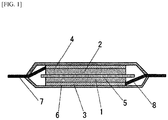
- Figure 1 is a sectional view illustrating one example of a secondary battery manufactured by a method for manufacturing a secondary battery according to an exemplary embodiment.
- a positive electrode mixture for a secondary battery (hereinafter also referred to as a mixture) according to an exemplary embodiment comprises a positive electrode active material, a binder, and an organic acid.
- the positive electrode active material comprises a lithium nickel complex oxide having a layered crystal structure.
- the binder comprises a vinylidene fluoride-based polymer.
- the secondary battery exhibits a high capacity maintenance rate in a charge-discharge cycle, the secondary battery including the positive electrode for a secondary battery that is made using the positive electrode mixture for a secondary battery according to the exemplary embodiment.
- the presence of an alkaline component promotes the reaction between the vinylidene fluoride-based polymer and a small amount of moisture, resulting in dehydrofluorination or a crosslinking reaction of the vinylidene fluoride-based polymer. Accordingly, the slurry of the mixture is thickened and gelatinized. As a result, the slurry loses flowability, which makes application of the mixture difficult.
- the minute microgels are made of vinylidene fluoride-based polymer that is a binder, the binder also unevenly present in the positive electrode active material layer. Accordingly, the strength of adhesion between the positive electrode active material layer and the positive electrode current collector deteriorates, resulting in deterioration of the cycle characteristic.
- lithium nickel complex oxide having a layered crystal structure When a lithium nickel complex oxide having a layered crystal structure is used as the positive electrode active material in particular, a large amount of alkaline components that promote the reaction of the vinylidene fluoride polymer are brought into the mixture, since the lithium nickel complex oxide comprises a large amount of lithium hydroxide and lithium carbonate as impurities.
- the present inventor has found out that when the positive electrode active material comprises the lithium nickel complex oxide having a layered crystal structure and the binder comprises the vinylidene fluoride-based polymer, an optimum amount of organic acid to be added into the mixture varies depending on the pH of the solution prepared by suspending the positive electrode active material in pure water. More specifically, in the exemplary embodiment, when a solution prepared by suspending the positive electrode active material in pure water has a pH of A, and the content of the organic acid per 100 parts by mass of the positive electrode active material is B parts by mass, A and B satisfy the expression (1) and thereby the obtained secondary battery exhibits a high capacity maintenance rate in the charge-discharge cycle.
- the organic acid changes the crystal structure of the vinylidene fluoride polymer at the time of drying of the mixture.
- the strength of adhesion between the positive electrode active material layer and the positive electrode current collector deteriorates, resulting in deterioration of the cycle characteristic.
- the positive electrode mixture for a secondary battery according to the exemplary embodiment can be a positive electrode mixture for a lithium-ion secondary battery.
- each configuration in the exemplary embodiment will be described in detail.
- the positive electrode active material according to the exemplary embodiment comprises a lithium nickel complex oxide having a layered crystal structure.
- the lithium nickel complex oxide is not particularly limited as long as it has a layered crystal structure.
- a lithium nickel complex oxide represented by Li ⁇ Ni x M 1-x O 2 (provided that 0 ⁇ ⁇ ⁇ 1.15, 0.2 ⁇ x ⁇ 0.9, and M is at least one selected from the group consisting of Co, Mn, Mg, and Al) is preferable.
- ⁇ is preferably 0.2 ⁇ ⁇ ⁇ 1.10, and more preferably 0.5 ⁇ ⁇ ⁇ 1.05.
- x is preferably 0.3 ⁇ x ⁇ 0.87, and more preferably 0.4 ⁇ x ⁇ 0.85.
- One lithium nickel complex oxide may be used, or two or more lithium nickel complex oxides may be used in combination.
- the method for manufacturing the lithium nickel complex oxide is not particularly limited.
- the lithium nickel complex oxide may be manufactured by a publicly-known method.
- the lithium nickel complex oxide may be manufactured according to the method disclosed in JP3897387B .
- the lithium nickel complex oxide has a layered crystal structure is determined by powder X-ray diffraction measurement.
- the amount of the lithium nickel complex oxide having a layered crystal structure and contained in the positive electrode active material of 100 % by mass is preferably 50 % by mass or more, more preferably 80 % by mass or more, and still more preferably 90 % by mass or more. It is particularly preferable that the amount of the lithium nickel complex oxide is 100 % by mass, that is, the positive electrode active material is made of the lithium nickel complex oxide having a layered crystal structure.
- the pH (A) of the solution prepared by suspending the positive electrode active material in pure water is preferably 8 to 14, and more preferably 9 to 13 from the viewpoint of enhancing the capacity maintenance rate in the charge-discharge cycle.
- the pH (A) of the solution prepared by suspending the positive electrode active material in pure water in the expression (1) is a value measured according to JIS K5101-17-2. Specifically, the pH of a supernatant liquid, obtained by adding 100 cm 3 of water and 2 g of the positive electrode active material into a glass container, mixing the content for five minutes, and leaving the content at rest for thirty seconds, is measured according to JIS Z8802. The pH is measured by a hydrogen ion meter using glass electrodes (tradename: HM-40V, made by DKK-TOA Corporation). The pH is measured at 27°C.
- the average particle size of the positive electrode active material is preferably 5 to 20 ⁇ m, and more preferably 7 to 15 ⁇ m from the viewpoint of applicability of the mixture and output characteristics of the secondary battery.
- the BET specific surface area of the positive electrode active material is preferably 0.1 to 2.0 m 2 /g, and more preferably 0.2 to 1.0 m 2 /g from the viewpoint of the output characteristics of the secondary battery.
- the average particle size refers to a particle diameter (median diameter: D50) at at cumulative value of 50% in a particle size distribution (volumetric basis) by a laser diffraction scattering method.
- the BET specific surface area is a value measured by a BET method.
- a solid content ratio of the positive electrode active material in the positive electrode mixture for a secondary battery is not particularly limited, the solid content ratio may be set to 85 to 96 % by mass, for example.
- the binder according to the exemplary embodiment comprises a vinylidene fluoride-based polymer.
- the vinylidene fluoride-based polymer is not particularly limited, examples of the vinylidene fluoride-based polymer may include vinylidene fluoride homopolymer, vinylidene fluoride copolymer, and modified compounds thereof. Specific examples include polyvinylidene fluoride (PVDF). One of these substances may be used, or two or more thereof may be used in combination.
- the amount of the vinylidene fluoride-based polymer contained in the binder of 100 % by mass is preferably 80 % by mass or more, and more preferably 90 % by mass or more. It is still more preferable that the amount of the vinylidene fluoride-based polymer is 100 % by mass, that is, the binder is made of the vinylidene fluoride-based polymer.
- the content of the vinylidene fluoride-based polymer per 100 parts by mass of the positive electrode active material is preferably 1 to 10 parts by mass, and more preferably 2 to 7 parts by mass. When the content is 1 part by mass or more, peeling of the positive electrode active material layer is suppressed. When the content is 10 parts by mass or less, the ratio of the positive electrode active material in the positive electrode active material layer becomes larger, and so the capacity per mass becomes larger.
- the solid content ratio of the vinylidene fluoride-based polymer in the positive electrode mixture for a secondary battery is preferably 1 to 10 % by mass, and more preferably 2 to 7 % by mass.
- the organic acid according to the exemplary embodiment is not particularly limited, oxalic acid, malonic acid, succinic acid, glutaric acid, adipic acid, pimelic acid, suberic acid, azelaic acid, sebacic acid, phthalic acid, and fumaric acid are preferable from the viewpoint of the effect of characteristic improvement.
- One of these acids may be used, or two or more thereof may be used in combination.
- oxalic acid is more preferable as the organic acid.
- the content of the organic acid (B parts by mass) per 100 parts by mass of the positive electrode active material satisfies the expression (1) in a relationship with the pH (A) of the solution prepared by suspending the positive electrode active material in pure water.
- a and B preferably satisfy the following expression (2), more preferably satisfy the following expression (3), and particularly preferably satisfy the following expression (4).
- the content of the organic acid (B parts by mass) per 100 parts by mass of the positive electrode active material is preferably 0.03 to 0.50 parts by mass, more preferably 0.04 to 0.30 parts by mass, and still more preferably 0.05 to 0.15 parts by mass from the viewpoint of enhancing the capacity maintenance rate in the charge-discharge cycle.
- the positive electrode mixture for a secondary battery according to the exemplary preferably comprises a conductive auxiliary agent from the viewpoint of enhancing the effect of the exemplary embodiment and also the conductivity of the positive electrode active material layer.
- the conductive auxiliary agent is not particularly limited, examples of the conductive auxiliary agent may include carbon black, Ketchen black, acetylene black, natural graphite, artificial graphite, and carbon fibers. One of these substances may be used, or two or more thereof may be used in combination.
- the content of the conductive auxiliary agent per 100 parts by mass of the positive electrode active material is preferably 1 to 10 parts by mass, and more preferably 2 to 7 parts by mass. Good conductivity is provided when the content is 1 part by mass or more. When the content is 10 parts by mass or less, the ratio of the positive electrode active material in the positive electrode active material layer becomes larger, and so the capacity per mass becomes larger.
- the solid content ratio of the conductive auxiliary agent in the positive electrode mixture for a secondary battery is preferably 1 to 10 % by mass, and more preferably 2 to 7 % by mass.
- the positive electrode mixture for a secondary battery according to the exemplary embodiment can comprise a solvent.
- a solvent an organic solvent that can dissolve a vinylidene fluoride-based polymer can be used.
- the organic solvent may include N-methyl-pyrrolidone (NMP).
- a method for manufacturing a positive electrode for a secondary battery according to the exemplary embodiment comprises a step of applying a positive electrode mixture for a secondary battery according to the exemplary embodiment onto a positive electrode current collector. According to the method, the positive electrode for a secondary battery that exhibits a high capacity maintenance rate in the charge-discharge cycle can be manufactured.
- the positive electrode for a secondary battery can be a positive electrode for a lithium-ion secondary battery.
- Examples of the material of the positive electrode current collector may include aluminum, stainless steel, nickel, titanium, or alloys thereof.
- the positive electrode current collector may have a shape such as a foil shape, a plate shape, and a mesh shape.
- As the positive electrode current collector an aluminum foil is preferable in particular.
- the thickness of the positive electrode current collector is not particularly limited, it may be set to 10 to 50 ⁇ m, for example.
- an apparatus for forming a positive electrode active material layer by applying the positive electrode mixture for a secondary battery onto the positive electrode current collector apparatuses that perform various coating methods, such as a doctor blade, a die coater, a gravure coater, a transfer method, a deposition method, and a combination of these coating apparatuses may be used.
- the die coater is preferably used from the viewpoint that an end portion of the positive electrode active material layer can be formed with sufficient precision.
- the coating method of the positive electrode mixture for a secondary battery with the die coater is mainly divided into two types including a continuous coating method and an intermittent coating method.
- the continuous coating method is for continuously coating the positive electrode mixture for a secondary battery on a long positive electrode current collector along a longitudinal direction of the positive electrode current collector.
- the intermittent coating method is for repeatedly and alternately forming a portion coated with the positive electrode mixture for a secondary battery and a portion uncoated with the positive electrode mixture along the longitudinal direction of the positive electrode current collector.
- the coating method may suitably be selected from these two methods.
- the thickness of the positive electrode active material layer is not particularly limited, and can suitably be set in accordance with desired characteristics.
- the positive electrode active material layer can be set to be thick from the viewpoint of energy density.
- the positive electrode active material layer may be set to be thin from the viewpoint of the output characteristics.
- the thickness of the positive electrode active material layer can suitably be set, for example, in the range of 10 to 250 ⁇ m.
- the thickness of the positive electrode active material layer is preferably 20 to 200 ⁇ m, and more preferably 50 to 180 ⁇ m.
- the density of the positive electrode active material layer is preferably 2.55 to 3.45 g/cm 3 . When the density of the positive electrode active material layer is within the range, the discharge capacity when the positive electrode is used at a high discharge rate is enhanced.
- a method for manufacturing a secondary battery according to the exemplary embodiment includes a step of manufacturing a positive electrode for a secondary battery by the method according to the exemplary embodiment; and a step of assembling the secondary battery including the positive electrode for a secondary battery, and a negative electrode.
- the method makes it possible to manufacture the secondary battery that exhibits a high capacity maintenance rate in the charge-discharge cycle.
- the secondary battery can be a lithium-ion secondary battery.
- the secondary battery illustrated in Figure 1 has a positive electrode and a negative electrode.
- the positive electrode includes a positive electrode current collector 3, and a positive electrode active material layer 1 comprising a positive electrode active material provided on the positive electrode current collector 3.
- the negative electrode includes a negative electrode current collector 4, and a negative electrode active material layer 2 comprising a negative electrode active material provided on the negative electrode current collector 4.
- the positive electrode and the negative electrode are laminated through a separator 5 such that the positive electrode active material layer 1 and the negative electrode active material layer 2 face each other.
- the electrode pair is housed in an outer packaging 6.
- an electrode group made up of a plurality of laminated electrode pairs may be housed in the outer packaging 6. Other than the laminated electrodes, the electrodes may be wound electrodes.
- the positive electrode current collector 3 is connected to a positive electrode tab 8.
- the negative electrode current collector 4 is connected to a negative electrode tab 7. These tabs are pulled out from the outer packaging 6.
- An electrolyte solution not shown is injected in the outer packaging 6.
- the secondary battery can be manufactured according to a publicly-known method.
- the secondary battery may have any shape, such as a coin shape, a button shape, a sheet shape, a cylindrical shape, a square shape, and a flat shape.
- the negative electrode according to the exemplary embodiment can be a negative electrode that enables lithium to be inserted therein and be removed therefrom.
- the negative electrode can include a negative electrode active material layer comprising a negative electrode active material, and also comprising a binder and a conductive auxiliary agent as necessary.
- the negative electrode according to the exemplary embodiment can include a negative electrode current collector and the negative electrode active material layer provided on the negative electrode current collector.
- the negative electrode active material materials capable of occluding and releasing lithium can be used, the materials including lithium metal, carbon materials, and Si-based materials.
- the carbon materials may include graphite, amorphous carbon, diamond-like carbon, fulleren, carbon nanotubes, and carbon nanohorns that occlude lithium.
- the Si-based materials materials such as Si, SiO 2 , SiO x (0 ⁇ x ⁇ 2), and Si-contained composite materials can be used. A composite comprising two or more types of these materials may also be used.
- the average particle size of the negative electrode active material is preferably 1 ⁇ m or more, more preferably 2 ⁇ m or more, and still more preferably 5 ⁇ m or more from the viewpoint that a side reaction at the time of charging and discharging can be suppressed and that the deterioration of the charging and discharging efficiency can be suppressed.
- the average particle size is preferably 80 ⁇ ms or less, and more preferably 40 ⁇ ms or less.
- the average particle size refers to a particle diameter (median diameter: D50) at cumulative value of 50% in a particle size distribution (volumetric basis) by a laser diffraction scattering method.
- the negative electrode can be formed by methods such as a melt-quenching method, a liquid-quenching method, an atomization method, a vacuum deposition method, a sputtering method, a plasma CVD method, an optical CVD method, a heat CVD method, and a sol-gel method.
- a carbon material is used as the negative electrode active material
- the negative electrode can be formed by a method involving, for example, mixing the carbon material with a binder such as PVDF, kneading the mixture in the state of being dispersed in a solvent such as NMP, and coating the kneaded mixture on the negative electrode current collector.
- the negative electrode can also be formed by methods, such as a deposition method, a CVD method, and a spattering method.
- the binder and the conductive auxiliary agent the same ones as the binder and the conductive auxiliary agent usable for the positive electrode mixture described before can be used.
- the negative electrode current collector copper, stainless steel, nickel, titanium, or alloys thereof can be used.
- the electrolyte solution can comprise an organic solvent and lithium salt, for example.
- organic solvent cyclic carbonates such as ethylene carbonate (EC), propylene carbonate (PC), vinylene carbonate (VC), and butylene carbonate (BC); chain carbonates such as ethyl methyl carbonate (EMC), diethyl carbonate (DEC), dimethyl carbonate (DMC), and dipropyl carbonate (DPC); aliphatic carboxylic acid esters; ⁇ -lactones such as ⁇ -butyrolactone; chain ethers; cyclic ethers, and the like can be used.
- lithium salt may include a lithium imido salt, LiPF 6 , LiAsF 6 , LiAlCl 4 , LiClO 4 , LiBF4, and LiSbF 6 .
- LiPF 6 LiAsF 6
- LiAlCl 4 LiClO 4
- LiBF4 LiB 4
- LiSbF 6 LiSbF 6
- the separator can be a porous membrane made of resin, a woven fabric, and a nonwoven fabric.
- the resin may include polyolefin resin, such as polypropylene and polyethylene, polyester resin, acrylic resin, styrene resin, and nylon resin.
- polyolefin resin such as polypropylene and polyethylene
- polyester resin acrylic resin
- styrene resin and nylon resin.
- a polyolefin-based fine porous membrane is preferable in particular as it is excellent in ionic permeability and in the performance of physically separating the positive electrode and the negative electrode.
- a layer comprising inorganic particles may be formed as necessary.
- the inorganic particles may include insulating oxides, nitrides, sulfides, and carbides.
- TiO 2 and Al 2 O 3 are preferable as the inorganic particles.
- the flexible film may be formed by providing a resin layer on at least one surface of a metal layer serving as a substrate.
- the metal layer may be made of a material selected from those having a barrier property that can prevent leakage of an electrolyte solution, invasion of moisture from the outside, and the like. Examples of the material may include aluminum, and stainless steel.
- a heat-sealable resin layer made of modified polyolefin or the like can be provided at least on one surface of the metal layer.
- the outer packaging is formed by making the heat-sealable resin layers of the flexible films face each other, and sealing the periphery of a portion for housing the electrode pair with heat.
- a resin layer made of a nylon film, a polyester film, or the like can be provided on another outer packaging surface that is opposite to the surface where the heat-sealable resin layer is formed.
- a lithium nickel complex oxide (LiNi 0.80 Co 0.15 Al 0.05 O 2 ) having a layered crystal structure with an average particle size of 8.4 ⁇ m and a BET specific surface area of 0.44 m 2 /g was prepared.
- the pH of a solution prepared by suspending the lithium nickel complex oxide in pure water was 12.5. Dry blending of 100 parts by mass of the lithium nickel complex oxide and 4.3 parts by mass of carbon black serving as a conductive auxiliary agent was performed.
- the obtained mixture, and 4.3 parts by mass of polyvinylidene fluorides (PVDF) as a binder, and oxalic acid as the organic acid were added into N-methyl-2-pyrrolidone (NMP), and were dispersed uniformly to obtain a positive electrode mixture for a secondary battery.
- the amount of oxalic acid to be added as the organic acid was as shown in Table 1.
- the solid content ratio of carbon black in the positive electrode mixture for a secondary battery was 4 % by mass.
- the solid content ratio of PVDF in the positive electrode mixture for a secondary battery was 4 % by mass.
- the solid content ratio of lithium nickel complex oxide in the positive electrode mixture for a secondary battery was 91.8 to 92.0 % by mass.
- the positive electrode mixture for a secondary battery was coated on an aluminum foil with a thickness of 20 ⁇ m, the aluminum foil serving as a positive electrode current collector.
- NMP was evaporated to form a positive electrode active material layer with a thickness of 85 ⁇ m on the positive electrode current collector.
- the positive electrode for a secondary battery was obtained.
- the mixture was dispersed in NMP to obtain a negative electrode mixture for a secondary battery.
- the negative electrode mixture for a secondary battery was coated on a copper foil with a thickness of 10 ⁇ m, the copper foil serving as a negative electrode current collector. By drying the negative electrode mixture, NMP was evaporated to make a negative electrode for a secondary battery.
- the positive electrode for a secondary battery and the negative electrode for a secondary battery were laminated through a separator made of polyethylene. The electrode pair was enclosed, together with an electrolyte solution that comprises LiPF 6 as an electrolyte at a concentration of 1 mol/L, in the outer packaging to make a secondary battery.
- the positive electrode active material As the positive electrode active material, a mixture (mixing ratio of 1:1 (mass ratio)) of a lithium nickel complex oxide (LiNi 0.8 Co 0.1 Mn 0.1 O 2 ) and a lithium nickel complex oxide (LNi 0.5 Co 0.2 Mn 0.3 O 2 ) was prepared, the lithium nickel complex oxide (LiNi 0.8 Co 0.1 Mn 0.1 O 2 ) having a layered crystal structure with an average particle size of 8.1 ⁇ m and a BET specific surface area of 0.42 m 2 /g, the lithium nickel complex oxide (LiNi 0.5 Co 0.2 Mn 0.3 O 2 ) having a layered crystal structure with an average particle size of 7.9 ⁇ m and a BET specific surface area of 0.30 m 2 /g.
- the lithium nickel complex oxide (LiNi 0.5 Co 0.2 Mn 0.3 O 2 ) having a layered crystal structure with an average particle size of 7.9 ⁇ m and a BET specific surface area of 0.30 m 2
- the pH of a solution prepared by suspending the mixture in pure water was 11.6.
- a positive electrode mixture for a secondary battery, a positive electrode for a secondary battery, and a secondary battery were made in the same manner as in Example 1 except that the mixture was used as the positive electrode active material.
- the amount of oxalic acid to be added as the organic acid was as shown in Table 2.
- the positive electrode active material As the positive electrode active material, a mixture (mixing ratio of 1:1 (mass ratio)) of a lithium nickel complex oxide (LiNi 0.80 Co 0.15 Al 0.05 O 2 ) and a lithium manganese complex oxide (Li 1.1 Mn 1.9 O 4 ) was prepared, the lithium nickel complex oxide (LiNi 0.80 Co 0.15 Al 0.05 O 2 ) having a layered crystal structure with an average particle size of 8.4 ⁇ m and a BET specific surface area of 0.44 m 2 /g, the lithium manganese complex oxide (Li 1.1 Mn 1.9 O 4 ) having a layered crystal structure with an average particle size of 10.1 ⁇ m and a BET specific surface area of 0.80 m 2 /g.
- the pH of a solution prepared by suspending the mixture in pure water was 10.1.
- a positive electrode mixture for a secondary battery, a positive electrode for a secondary battery, and a secondary battery were made in the same manner as in Example 1 except that the mixture was used as the positive electrode active material.
- the amount of oxalic acid to be added as the organic acid was as shown in Table 3.
- the positive electrode active material As the positive electrode active material, a mixture (mixing ratio of 2:8 (mass ratio)) of a lithium nickel complex oxide (LiNi 0.80 Co 0.15 Al 0.05 O 2 ) and a lithium manganese complex oxide (Li 1.1 Mn 1.9 O 4 ) was prepared, the lithium nickel complex oxide (LiNi 0.80 Co 0.15 Al 0.05 O 2 ) having a layered crystal structure with an average particle size of 8.4 ⁇ m and a BET specific surface area of 0.44 m 2 /g, the lithium manganese complex oxide (Li 1.1 Mn 1.9 O 4 ) having a layered crystal structure with an average particle size of 10.1 ⁇ m and a BET specific surface area of 0.80 m 2 /g.
- the pH of a solution prepared by suspending the mixture in pure water was 8.9.
- a positive electrode mixture for a secondary battery, a positive electrode for a secondary battery, and a secondary battery were made in the same manner as in Example 1 except that the mixture was used as the positive electrode active material.
- the amount of oxalic acid to be added as the organic acid was as shown in Table 4.
- a positive electrode mixture for a secondary battery, a positive electrode for a secondary battery, and a secondary battery were made in the same manner as in Example 1 except that the organic acid shown in Table 5 was used as the organic acid, and 0.15 parts by mass of the organic acid were added.
Landscapes
- Chemical & Material Sciences (AREA)
- Chemical Kinetics & Catalysis (AREA)
- Electrochemistry (AREA)
- General Chemical & Material Sciences (AREA)
- Engineering & Computer Science (AREA)
- Manufacturing & Machinery (AREA)
- Composite Materials (AREA)
- Inorganic Chemistry (AREA)
- Materials Engineering (AREA)
- Battery Electrode And Active Subsutance (AREA)
Abstract
Description
- A present exemplary embodiment relates to a positive electrode mixture for a secondary battery, a method for manufacturing a positive electrode for a secondary battery, and a method for manufacturing a secondary battery.
- Since lithium-ion secondary batteries have a high energy density and a good charge-discharge cycle characteristic, they are widely used as a power source for small-size mobile apparatuses, such as cellular phones and notebook PCs. In recent years, in consideration of environmental issues and also due to heightened awareness of energy saving, the lithium-ion secondary batteries are expected to be applied to large-sized batteries, which are demanded to have a large capacity and a long life, in such fields as electric vehicles, such as hybrid electric vehicles, and electric power storage.
- Patent Literatures 1 to 6 disclose a technology of making a positive electrode for a lithium-ion secondary battery by using a positive electrode mixture comprising a positive electrode active material, a binder, and an organic acid.
-
- Patent Literature 1:
JP H09-306502A - Patent Literature 2:
JP H11-086846A - Patent Literature 3:
JP H11-176422A - Patent Literature 4:
JP H11-176425A - Patent Literature 5:
JP 2001-035495A - Patent Literature 6:
JP 2005-011594A - However, when the capacity of the lithium-ion secondary battery is further increased by using a lithium nickel complex oxide having a large specific volume per mass as a positive electrode active material and using a vinylidene fluoride-based polymer having a high adhesiveness as a binder, a slurry of the positive electrode mixture may be thickened, which may hinder application of the positive electrode mixture onto a positive electrode current collector. In the case where a large amount of solvent is added to a highly-thickened slurry of the positive electrode mixture to allow application of the slurry onto a positive electrode current collector, a secondary battery made using a thus-obtained positive electrode has a low capacity maintenance rate in a charge-discharge cycle.
- An object of the exemplary embodiment is to provide a positive electrode mixture for a secondary battery, where the positive electrode mixture allowing provision of a secondary battery that exhibits a high capacity maintenance rate in the charge-discharge cycle.
- A positive electrode mixture for a secondary battery according to the exemplary embodiment is a positive electrode mixture for a secondary battery comprising: a positive electrode active material; a binder; and an organic acid, wherein the positive electrode active material comprises a lithium nickel complex oxide having a layered crystal structure, the binder comprises a vinylidene fluoride-based polymer, and when a solution prepared by suspending the positive electrode active material in pure water has a pH of A, and the content of the organic acid per 100 parts by mass of the positive electrode active material is B parts by mass, A and B satisfy the following expression (1).

- A method for manufacturing a positive electrode for a secondary battery according to the exemplary embodiment comprises a step of applying the positive electrode mixture for a secondary battery onto a positive electrode current collector.
- A method for manufacturing a secondary battery according to the exemplary embodiment comprises: manufacturing a positive electrode for a secondary battery by the method; and assembling the secondary battery comprising the positive electrode for a secondary battery, and a negative electrode.
- The present exemplary embodiment can provide a positive electrode mixture for a secondary battery, where the positive electrode mixture allowing provision of a secondary battery that exhibits a high capacity maintenance rate in a charge-discharge cycle.
-
Figure 1 is a sectional view illustrating one example of a secondary battery manufactured by a method for manufacturing a secondary battery according to an exemplary embodiment. - A positive electrode mixture for a secondary battery (hereinafter also referred to as a mixture) according to an exemplary embodiment comprises a positive electrode active material, a binder, and an organic acid. The positive electrode active material comprises a lithium nickel complex oxide having a layered crystal structure. The binder comprises a vinylidene fluoride-based polymer. When a solution prepared by suspending the positive electrode active material in pure water has a pH of A, and the content of the organic acid per 100 parts by mass of the positive electrode active material is B parts by mass, A and B satisfy the following expression (1).

- The secondary battery exhibits a high capacity maintenance rate in a charge-discharge cycle, the secondary battery including the positive electrode for a secondary battery that is made using the positive electrode mixture for a secondary battery according to the exemplary embodiment. Although the reason why such a secondary battery can be implemented is not necessarily clear, the following reasons can be considered.
- When a vinylidene fluoride-based polymer is used as a binder, the presence of an alkaline component promotes the reaction between the vinylidene fluoride-based polymer and a small amount of moisture, resulting in dehydrofluorination or a crosslinking reaction of the vinylidene fluoride-based polymer. Accordingly, the slurry of the mixture is thickened and gelatinized. As a result, the slurry loses flowability, which makes application of the mixture difficult. Even when the amount of solvent is adjusted to allow application of the mixture, since a crosslinking reaction of the vinylidene fluoride-based polymer locally occurs in the slurry, polymerized vinylidene fluoride-based polymer swells with the solvent, and minute microgels are generated. The presence of the minute microgels causes unevenness of the conductive auxiliary agent in a positive electrode active material layer that is obtained by coating and drying of the mixture. As a consequence, the volume resistivity of the positive electrode itself rises, as a result of which the resistance of the secondary battery increases, and a cycle characteristic deteriorates.
- Since the minute microgels are made of vinylidene fluoride-based polymer that is a binder, the binder also unevenly present in the positive electrode active material layer. Accordingly, the strength of adhesion between the positive electrode active material layer and the positive electrode current collector deteriorates, resulting in deterioration of the cycle characteristic.
- When a lithium nickel complex oxide having a layered crystal structure is used as the positive electrode active material in particular, a large amount of alkaline components that promote the reaction of the vinylidene fluoride polymer are brought into the mixture, since the lithium nickel complex oxide comprises a large amount of lithium hydroxide and lithium carbonate as impurities.
- As a result of intensive examination, the present inventor has found out that when the positive electrode active material comprises the lithium nickel complex oxide having a layered crystal structure and the binder comprises the vinylidene fluoride-based polymer, an optimum amount of organic acid to be added into the mixture varies depending on the pH of the solution prepared by suspending the positive electrode active material in pure water. More specifically, in the exemplary embodiment, when a solution prepared by suspending the positive electrode active material in pure water has a pH of A, and the content of the organic acid per 100 parts by mass of the positive electrode active material is B parts by mass, A and B satisfy the expression (1) and thereby the obtained secondary battery exhibits a high capacity maintenance rate in the charge-discharge cycle.
- Meanwhile, when the content of the organic acid is small in the expression (1), it is difficult to suppress the reaction of the vinylidene fluoride polymer caused by the alkaline components derived from the lithium nickel complex oxide. As a result, the slurry of the mixture thickens, and application of the mixture becomes difficult. In the case where the solvent is excessively added to decrease the viscosity of the thickened slurry and to thereby allow application of the mixture, the cycle characteristic deteriorates due to the above-stated generation of the minute microgels. Since the binder is also unevenly present as described before, the strength of adhesion between the positive electrode active material layer and the positive electrode current collector deteriorates, which causes deterioration of the cycle characteristic.
- When the content of the organic acid is large in the expression (1), the organic acid changes the crystal structure of the vinylidene fluoride polymer at the time of drying of the mixture. As a result, the strength of adhesion between the positive electrode active material layer and the positive electrode current collector deteriorates, resulting in deterioration of the cycle characteristic.
- The positive electrode mixture for a secondary battery according to the exemplary embodiment can be a positive electrode mixture for a lithium-ion secondary battery. Hereinafter, each configuration in the exemplary embodiment will be described in detail.
- The positive electrode active material according to the exemplary embodiment comprises a lithium nickel complex oxide having a layered crystal structure. The lithium nickel complex oxide is not particularly limited as long as it has a layered crystal structure. However, a lithium nickel complex oxide represented by LiαNixM1-xO2 (provided that 0 < α ≤ 1.15, 0.2 ≤ x ≤ 0.9, and M is at least one selected from the group consisting of Co, Mn, Mg, and Al) is preferable. In the expression, α is preferably 0.2 ≤ α ≤ 1.10, and more preferably 0.5 ≤ α ≤ 1.05. From the viewpoint of increasing the capacity of the secondary battery, x is preferably 0.3 ≤ x ≤ 0.87, and more preferably 0.4 ≤ x ≤ 0.85. One lithium nickel complex oxide may be used, or two or more lithium nickel complex oxides may be used in combination. The method for manufacturing the lithium nickel complex oxide is not particularly limited. The lithium nickel complex oxide may be manufactured by a publicly-known method. For example, the lithium nickel complex oxide may be manufactured according to the method disclosed in
JP3897387B - Whether or not the lithium nickel complex oxide has a layered crystal structure is determined by powder X-ray diffraction measurement. The amount of the lithium nickel complex oxide having a layered crystal structure and contained in the positive electrode active material of 100 % by mass is preferably 50 % by mass or more, more preferably 80 % by mass or more, and still more preferably 90 % by mass or more. It is particularly preferable that the amount of the lithium nickel complex oxide is 100 % by mass, that is, the positive electrode active material is made of the lithium nickel complex oxide having a layered crystal structure.
- In the expression (1), the pH (A) of the solution prepared by suspending the positive electrode active material in pure water is preferably 8 to 14, and more preferably 9 to 13 from the viewpoint of enhancing the capacity maintenance rate in the charge-discharge cycle. The pH (A) of the solution prepared by suspending the positive electrode active material in pure water in the expression (1) is a value measured according to JIS K5101-17-2. Specifically, the pH of a supernatant liquid, obtained by adding 100 cm3 of water and 2 g of the positive electrode active material into a glass container, mixing the content for five minutes, and leaving the content at rest for thirty seconds, is measured according to JIS Z8802. The pH is measured by a hydrogen ion meter using glass electrodes (tradename: HM-40V, made by DKK-TOA Corporation). The pH is measured at 27°C.
- The average particle size of the positive electrode active material is preferably 5 to 20 µm, and more preferably 7 to 15 µm from the viewpoint of applicability of the mixture and output characteristics of the secondary battery. The BET specific surface area of the positive electrode active material is preferably 0.1 to 2.0 m2/g, and more preferably 0.2 to 1.0 m2/g from the viewpoint of the output characteristics of the secondary battery. The average particle size refers to a particle diameter (median diameter: D50) at at cumulative value of 50% in a particle size distribution (volumetric basis) by a laser diffraction scattering method. The BET specific surface area is a value measured by a BET method.
- Although a solid content ratio of the positive electrode active material in the positive electrode mixture for a secondary battery is not particularly limited, the solid content ratio may be set to 85 to 96 % by mass, for example.
- The binder according to the exemplary embodiment comprises a vinylidene fluoride-based polymer. Although the vinylidene fluoride-based polymer is not particularly limited, examples of the vinylidene fluoride-based polymer may include vinylidene fluoride homopolymer, vinylidene fluoride copolymer, and modified compounds thereof. Specific examples include polyvinylidene fluoride (PVDF). One of these substances may be used, or two or more thereof may be used in combination. The amount of the vinylidene fluoride-based polymer contained in the binder of 100 % by mass is preferably 80 % by mass or more, and more preferably 90 % by mass or more. It is still more preferable that the amount of the vinylidene fluoride-based polymer is 100 % by mass, that is, the binder is made of the vinylidene fluoride-based polymer.
- The content of the vinylidene fluoride-based polymer per 100 parts by mass of the positive electrode active material is preferably 1 to 10 parts by mass, and more preferably 2 to 7 parts by mass. When the content is 1 part by mass or more, peeling of the positive electrode active material layer is suppressed. When the content is 10 parts by mass or less, the ratio of the positive electrode active material in the positive electrode active material layer becomes larger, and so the capacity per mass becomes larger. The solid content ratio of the vinylidene fluoride-based polymer in the positive electrode mixture for a secondary battery is preferably 1 to 10 % by mass, and more preferably 2 to 7 % by mass.
- Although the organic acid according to the exemplary embodiment is not particularly limited, oxalic acid, malonic acid, succinic acid, glutaric acid, adipic acid, pimelic acid, suberic acid, azelaic acid, sebacic acid, phthalic acid, and fumaric acid are preferable from the viewpoint of the effect of characteristic improvement. One of these acids may be used, or two or more thereof may be used in combination. Among these acids, oxalic acid is more preferable as the organic acid.
- The content of the organic acid (B parts by mass) per 100 parts by mass of the positive electrode active material satisfies the expression (1) in a relationship with the pH (A) of the solution prepared by suspending the positive electrode active material in pure water. A and B preferably satisfy the following expression (2), more preferably satisfy the following expression (3), and particularly preferably satisfy the following expression (4).


- The content of the organic acid (B parts by mass) per 100 parts by mass of the positive electrode active material is preferably 0.03 to 0.50 parts by mass, more preferably 0.04 to 0.30 parts by mass, and still more preferably 0.05 to 0.15 parts by mass from the viewpoint of enhancing the capacity maintenance rate in the charge-discharge cycle.
- The positive electrode mixture for a secondary battery according to the exemplary preferably comprises a conductive auxiliary agent from the viewpoint of enhancing the effect of the exemplary embodiment and also the conductivity of the positive electrode active material layer. Although the conductive auxiliary agent is not particularly limited, examples of the conductive auxiliary agent may include carbon black, Ketchen black, acetylene black, natural graphite, artificial graphite, and carbon fibers. One of these substances may be used, or two or more thereof may be used in combination.
- The content of the conductive auxiliary agent per 100 parts by mass of the positive electrode active material is preferably 1 to 10 parts by mass, and more preferably 2 to 7 parts by mass. Good conductivity is provided when the content is 1 part by mass or more. When the content is 10 parts by mass or less, the ratio of the positive electrode active material in the positive electrode active material layer becomes larger, and so the capacity per mass becomes larger. The solid content ratio of the conductive auxiliary agent in the positive electrode mixture for a secondary battery is preferably 1 to 10 % by mass, and more preferably 2 to 7 % by mass.
- The positive electrode mixture for a secondary battery according to the exemplary embodiment can comprise a solvent. As the solvent, an organic solvent that can dissolve a vinylidene fluoride-based polymer can be used. Examples of the organic solvent may include N-methyl-pyrrolidone (NMP).
- A method for manufacturing a positive electrode for a secondary battery according to the exemplary embodiment comprises a step of applying a positive electrode mixture for a secondary battery according to the exemplary embodiment onto a positive electrode current collector. According to the method, the positive electrode for a secondary battery that exhibits a high capacity maintenance rate in the charge-discharge cycle can be manufactured. The positive electrode for a secondary battery can be a positive electrode for a lithium-ion secondary battery.
- Examples of the material of the positive electrode current collector may include aluminum, stainless steel, nickel, titanium, or alloys thereof. The positive electrode current collector may have a shape such as a foil shape, a plate shape, and a mesh shape. As the positive electrode current collector, an aluminum foil is preferable in particular. Although the thickness of the positive electrode current collector is not particularly limited, it may be set to 10 to 50 µm, for example.
- As an apparatus for forming a positive electrode active material layer by applying the positive electrode mixture for a secondary battery onto the positive electrode current collector, apparatuses that perform various coating methods, such as a doctor blade, a die coater, a gravure coater, a transfer method, a deposition method, and a combination of these coating apparatuses may be used. Among these coating apparatuses, the die coater is preferably used from the viewpoint that an end portion of the positive electrode active material layer can be formed with sufficient precision. The coating method of the positive electrode mixture for a secondary battery with the die coater is mainly divided into two types including a continuous coating method and an intermittent coating method. The continuous coating method is for continuously coating the positive electrode mixture for a secondary battery on a long positive electrode current collector along a longitudinal direction of the positive electrode current collector. The intermittent coating method is for repeatedly and alternately forming a portion coated with the positive electrode mixture for a secondary battery and a portion uncoated with the positive electrode mixture along the longitudinal direction of the positive electrode current collector. The coating method may suitably be selected from these two methods.
- The thickness of the positive electrode active material layer is not particularly limited, and can suitably be set in accordance with desired characteristics. For example, the positive electrode active material layer can be set to be thick from the viewpoint of energy density. The positive electrode active material layer may be set to be thin from the viewpoint of the output characteristics. The thickness of the positive electrode active material layer can suitably be set, for example, in the range of 10 to 250 µm. The thickness of the positive electrode active material layer is preferably 20 to 200 µm, and more preferably 50 to 180 µm. The density of the positive electrode active material layer is preferably 2.55 to 3.45 g/cm3. When the density of the positive electrode active material layer is within the range, the discharge capacity when the positive electrode is used at a high discharge rate is enhanced.
- A method for manufacturing a secondary battery according to the exemplary embodiment includes a step of manufacturing a positive electrode for a secondary battery by the method according to the exemplary embodiment; and a step of assembling the secondary battery including the positive electrode for a secondary battery, and a negative electrode. The method makes it possible to manufacture the secondary battery that exhibits a high capacity maintenance rate in the charge-discharge cycle. The secondary battery can be a lithium-ion secondary battery.
- One example of a laminated secondary battery manufactured by the method for manufacturing a secondary battery according to the exemplary embodiment is illustrated in
Figure 1 . The secondary battery illustrated inFigure 1 has a positive electrode and a negative electrode. The positive electrode includes a positive electrodecurrent collector 3, and a positive electrode active material layer 1 comprising a positive electrode active material provided on the positive electrodecurrent collector 3. The negative electrode includes a negative electrode current collector 4, and a negative electrode active material layer 2 comprising a negative electrode active material provided on the negative electrode current collector 4. The positive electrode and the negative electrode are laminated through aseparator 5 such that the positive electrode active material layer 1 and the negative electrode active material layer 2 face each other. The electrode pair is housed in an outer packaging 6. Although one electrode pair is housed in the outer packaging 6 inFigure 1 , an electrode group made up of a plurality of laminated electrode pairs may be housed in the outer packaging 6. Other than the laminated electrodes, the electrodes may be wound electrodes. The positive electrodecurrent collector 3 is connected to a positive electrode tab 8. The negative electrode current collector 4 is connected to anegative electrode tab 7. These tabs are pulled out from the outer packaging 6. An electrolyte solution not shown is injected in the outer packaging 6. The secondary battery can be manufactured according to a publicly-known method. The secondary battery may have any shape, such as a coin shape, a button shape, a sheet shape, a cylindrical shape, a square shape, and a flat shape. - The negative electrode according to the exemplary embodiment can be a negative electrode that enables lithium to be inserted therein and be removed therefrom. The negative electrode can include a negative electrode active material layer comprising a negative electrode active material, and also comprising a binder and a conductive auxiliary agent as necessary. The negative electrode according to the exemplary embodiment can include a negative electrode current collector and the negative electrode active material layer provided on the negative electrode current collector.
- As the negative electrode active material, materials capable of occluding and releasing lithium can be used, the materials including lithium metal, carbon materials, and Si-based materials. Examples of the carbon materials may include graphite, amorphous carbon, diamond-like carbon, fulleren, carbon nanotubes, and carbon nanohorns that occlude lithium. As the Si-based materials, materials such as Si, SiO2, SiOx (0 < x ≤ 2), and Si-contained composite materials can be used. A composite comprising two or more types of these materials may also be used.
- When the negative electrode active material is in a particle state, the average particle size of the negative electrode active material is preferably 1 µm or more, more preferably 2 µm or more, and still more preferably 5 µm or more from the viewpoint that a side reaction at the time of charging and discharging can be suppressed and that the deterioration of the charging and discharging efficiency can be suppressed. From the viewpoint of input-output characteristics and making the negative electrode, such as smoothness of the surface of the negative electrode, the average particle size is preferably 80 µms or less, and more preferably 40 µms or less. The average particle size refers to a particle diameter (median diameter: D50) at cumulative value of 50% in a particle size distribution (volumetric basis) by a laser diffraction scattering method.
- When lithium metal is used as the negative electrode active material, the negative electrode can be formed by methods such as a melt-quenching method, a liquid-quenching method, an atomization method, a vacuum deposition method, a sputtering method, a plasma CVD method, an optical CVD method, a heat CVD method, and a sol-gel method. When a carbon material is used as the negative electrode active material, the negative electrode can be formed by a method involving, for example, mixing the carbon material with a binder such as PVDF, kneading the mixture in the state of being dispersed in a solvent such as NMP, and coating the kneaded mixture on the negative electrode current collector. The negative electrode can also be formed by methods, such as a deposition method, a CVD method, and a spattering method.
- As the binder and the conductive auxiliary agent, the same ones as the binder and the conductive auxiliary agent usable for the positive electrode mixture described before can be used.
- As the negative electrode current collector, copper, stainless steel, nickel, titanium, or alloys thereof can be used.
- As the electrolyte solution, a nonaqueous electrolyte solution can be used. The electrolyte solution can comprise an organic solvent and lithium salt, for example. As the organic solvent, cyclic carbonates such as ethylene carbonate (EC), propylene carbonate (PC), vinylene carbonate (VC), and butylene carbonate (BC); chain carbonates such as ethyl methyl carbonate (EMC), diethyl carbonate (DEC), dimethyl carbonate (DMC), and dipropyl carbonate (DPC); aliphatic carboxylic acid esters; γ-lactones such as γ-butyrolactone; chain ethers; cyclic ethers, and the like can be used. One of these substances may be used, or two or more thereof may be used in combination. Examples of the lithium salt may include a lithium imido salt, LiPF6, LiAsF6, LiAlCl4, LiClO4, LiBF4, and LiSbF6. One of these substances may be used, or two or more thereof may be used in combination.
- The separator can be a porous membrane made of resin, a woven fabric, and a nonwoven fabric. Examples of the resin may include polyolefin resin, such as polypropylene and polyethylene, polyester resin, acrylic resin, styrene resin, and nylon resin. One of these substances may be used, or two or more thereof may be used in combination. Among these, a polyolefin-based fine porous membrane is preferable in particular as it is excellent in ionic permeability and in the performance of physically separating the positive electrode and the negative electrode. In the separator, a layer comprising inorganic particles may be formed as necessary. Examples of the inorganic particles may include insulating oxides, nitrides, sulfides, and carbides. One of these substances may be used, or two or more thereof may be used in combination. Among these, TiO2 and Al2O3 are preferable as the inorganic particles.
- As the outer packaging, a case made of a flexible film, a can case, and the like can be used. Among these, it is preferable to use the flexible film from the viewpoint of reducing the weight of the secondary battery. The flexible film may be formed by providing a resin layer on at least one surface of a metal layer serving as a substrate. The metal layer may be made of a material selected from those having a barrier property that can prevent leakage of an electrolyte solution, invasion of moisture from the outside, and the like. Examples of the material may include aluminum, and stainless steel. A heat-sealable resin layer made of modified polyolefin or the like can be provided at least on one surface of the metal layer. When the flexible film is used for the outer packaging, the outer packaging is formed by making the heat-sealable resin layers of the flexible films face each other, and sealing the periphery of a portion for housing the electrode pair with heat. On another outer packaging surface that is opposite to the surface where the heat-sealable resin layer is formed, a resin layer made of a nylon film, a polyester film, or the like can be provided.
- As the positive electrode active material, a lithium nickel complex oxide (LiNi0.80Co0.15Al0.05O2) having a layered crystal structure with an average particle size of 8.4 µm and a BET specific surface area of 0.44 m2/g was prepared. The pH of a solution prepared by suspending the lithium nickel complex oxide in pure water was 12.5. Dry blending of 100 parts by mass of the lithium nickel complex oxide and 4.3 parts by mass of carbon black serving as a conductive auxiliary agent was performed. The obtained mixture, and 4.3 parts by mass of polyvinylidene fluorides (PVDF) as a binder, and oxalic acid as the organic acid were added into N-methyl-2-pyrrolidone (NMP), and were dispersed uniformly to obtain a positive electrode mixture for a secondary battery. The amount of oxalic acid to be added as the organic acid was as shown in Table 1. The solid content ratio of carbon black in the positive electrode mixture for a secondary battery was 4 % by mass. The solid content ratio of PVDF in the positive electrode mixture for a secondary battery was 4 % by mass. The solid content ratio of lithium nickel complex oxide in the positive electrode mixture for a secondary battery was 91.8 to 92.0 % by mass.
- The positive electrode mixture for a secondary battery was coated on an aluminum foil with a thickness of 20 µm, the aluminum foil serving as a positive electrode current collector. By drying the positive electrode mixture, NMP was evaporated to form a positive electrode active material layer with a thickness of 85 µm on the positive electrode current collector. Thus, the positive electrode for a secondary battery was obtained.
- Natural graphite as the negative electrode active material and PVDF as the binder were mixed to have a ratio of natural graphite: PVDF = 90:10 (mass ratio). The mixture was dispersed in NMP to obtain a negative electrode mixture for a secondary battery. The negative electrode mixture for a secondary battery was coated on a copper foil with a thickness of 10 µm, the copper foil serving as a negative electrode current collector. By drying the negative electrode mixture, NMP was evaporated to make a negative electrode for a secondary battery. The positive electrode for a secondary battery and the negative electrode for a secondary battery were laminated through a separator made of polyethylene. The electrode pair was enclosed, together with an electrolyte solution that comprises LiPF6 as an electrolyte at a concentration of 1 mol/L, in the outer packaging to make a secondary battery.
- As the positive electrode active material, a mixture (mixing ratio of 1:1 (mass ratio)) of a lithium nickel complex oxide (LiNi0.8Co0.1Mn0.1O2) and a lithium nickel complex oxide (LNi0.5Co0.2Mn0.3O2) was prepared, the lithium nickel complex oxide (LiNi0.8Co0.1Mn0.1O2) having a layered crystal structure with an average particle size of 8.1 µm and a BET specific surface area of 0.42 m2/g, the lithium nickel complex oxide (LiNi0.5Co0.2Mn0.3O2) having a layered crystal structure with an average particle size of 7.9 µm and a BET specific surface area of 0.30 m2/g. The pH of a solution prepared by suspending the mixture in pure water was 11.6. A positive electrode mixture for a secondary battery, a positive electrode for a secondary battery, and a secondary battery were made in the same manner as in Example 1 except that the mixture was used as the positive electrode active material. The amount of oxalic acid to be added as the organic acid was as shown in Table 2.
- As the positive electrode active material, a mixture (mixing ratio of 1:1 (mass ratio)) of a lithium nickel complex oxide (LiNi0.80Co0.15Al0.05O2) and a lithium manganese complex oxide (Li1.1Mn1.9O4) was prepared, the lithium nickel complex oxide (LiNi0.80Co0.15Al0.05O2) having a layered crystal structure with an average particle size of 8.4 µm and a BET specific surface area of 0.44 m2/g, the lithium manganese complex oxide (Li1.1Mn1.9O4) having a layered crystal structure with an average particle size of 10.1 µm and a BET specific surface area of 0.80 m2/g. The pH of a solution prepared by suspending the mixture in pure water was 10.1. A positive electrode mixture for a secondary battery, a positive electrode for a secondary battery, and a secondary battery were made in the same manner as in Example 1 except that the mixture was used as the positive electrode active material. The amount of oxalic acid to be added as the organic acid was as shown in Table 3.
- As the positive electrode active material, a mixture (mixing ratio of 2:8 (mass ratio)) of a lithium nickel complex oxide (LiNi0.80Co0.15Al0.05O2) and a lithium manganese complex oxide (Li1.1Mn1.9O4) was prepared, the lithium nickel complex oxide (LiNi0.80Co0.15Al0.05O2) having a layered crystal structure with an average particle size of 8.4 µm and a BET specific surface area of 0.44 m2/g, the lithium manganese complex oxide (Li1.1Mn1.9O4) having a layered crystal structure with an average particle size of 10.1 µm and a BET specific surface area of 0.80 m2/g. The pH of a solution prepared by suspending the mixture in pure water was 8.9. A positive electrode mixture for a secondary battery, a positive electrode for a secondary battery, and a secondary battery were made in the same manner as in Example 1 except that the mixture was used as the positive electrode active material. The amount of oxalic acid to be added as the organic acid was as shown in Table 4.
- A positive electrode mixture for a secondary battery, a positive electrode for a secondary battery, and a secondary battery were made in the same manner as in Example 1 except that the organic acid shown in Table 5 was used as the organic acid, and 0.15 parts by mass of the organic acid were added.
- High-temperature cycle characteristics of the secondary batteries made in each of Examples and Comparative Examples were evaluated. Specifically, a charge-discharge cycle was performed at a temperature of 45°C under conditions of a charge rate of 1.0 C, a discharge rate of 1.0 C, a charge termination voltage of 4.2 V, and a discharge termination voltage of 2.5 V. A value obtained by dividing a discharge capacity (mAh) after 500 cycles by a discharge capacity (mAh) in the 10th cycle was used as a capacity maintenance rate (%). Results are as shown in Tables 1 to 5.
-
[Table 1] pH (A) Organic acid content (B) (parts by mass) 30×B+5 30×B+10 Capacity maintenance rate (%) Comparative Example 1 12.5 0.00 5.0 10.0 69.5 Comparative Example 2 12.5 0.03 5.9 10.9 72.9 Comparative Example 3 12.5 0.07 7.1 12.1 77.0 Example 1 12.5 0.10 8.0 13.0 80.4 Example 2 12.5 0.12 8.6 13.6 83.7 Example 3 12.5 0.15 9.5 14.5 86.1 Example 4 12.5 0.20 11.0 16.0 82.3 -
[Table 2] pH (A) Organic acid content (B) (parts by mass) 30×B+5 30×B+10 Capacity maintenance rate (%) Comparative Example 4 11.6 0.00 5.0 10.0 75.2 Comparative Example 5 11.6 0.03 5.9 10.9 78.3 Example 5 11.6 0.07 7.1 12.1 82.4 Example 6 11.6 0.10 8.0 13.0 86.1 Example 7 11.6 0.12 8.6 13.6 87.1 Example 8 11.6 0.15 9.5 14.5 85.4 Example 9 11.6 0.20 11.0 16.0 80.3 -
[Table 3] pH (A) Organic acid content (B) (parts by mass) 30×B+5 30×B+10 Capacity maintenance rate (%) Comparative Example 6 10.1 0.00 5.0 10.0 79.5 Example 10 10.1 0.03 5.9 10.9 83.0 Example 11 10.1 0.07 7.1 12.1 86.2 Example 12 10.1 0.10 8.0 13.0 84.3 Example 13 10.1 0.12 8.6 13.6 81.4 Comparative Example 7 10.1 0.20 11.0 16.0 70.1 -
[Table 4] pH (A) Organic acid content (B) (parts by mass) 30×B+5 30×B+10 Capacity maintenance rate (%) Comparative Example 8 8.9 0.00 5.0 10.0 78.6 Example 14 8.9 0.03 5.9 10.9 82.0 Example 15 8.9 0.07 7.1 12.1 80.3 Comparative Example 9 8.9 0.15 9.5 14.5 74.3 Comparative Example 10 8.9 0.20 11.0 16.0 71.6 -
[Table 5] Organic acid pH (A) Organic acid content (B) (parts by mass) 30×B+5 30×B+10 Capacity maintenance rate (%) Example 16 Malonic acid 12.5 0.15 9.5 14.5 84.8 Example 17 Succinic acid 12.5 0.15 9.5 14.5 80.3 Example 18 Glutaric acid 12.5 0.15 9.5 14.5 83.4 Example 19 Adipic acid 12.5 0.15 9.5 14.5 84.6 Example 20 Pimelic acid 12.5 0.15 9.5 14.5 81.9 - This application claims the right of priority based on Japanese Patent Application No.
2016-055170, filed on March 18, 2016 - In the foregoing, the present invention has been described with reference to the exemplary embodiments and the Examples; however, the present invention is not limited to the exemplary embodiments and the Examples. Various modifications understandable to those skilled in the art may be made to the constitution and details of the present invention within the scope thereof.
-
- 1
- Positive electrode active material layer
- 2
- Negative electrode active material layer
- 3
- Positive electrode current collector
- 4
- Negative electrode current collector
- 5
- Separator
- 6
- Outer packaging
- 7
- Negative electrode tab
- 8
- Positive electrode tab
Claims (7)
- A positive electrode mixture for a secondary battery, comprising:a positive electrode active material;a binder; andan organic acid, whereinthe positive electrode active material comprises a lithium nickel complex oxide having a layered crystal structure,the binder comprises a vinylidene fluoride-based polymer, andwhen a solution prepared by suspending the positive electrode active material in pure water has a pH of A, and a content of the organic acid per 100 parts by mass of the positive electrode active material is B parts by mass, A and B satisfy the following expression (1):

- The positive electrode mixture for a secondary battery according to claim 1, wherein the content of the organic acid per 100 parts by mass of the positive electrode active material is 0.03 to 0.50 parts by mass.
- The positive electrode mixture for a secondary battery according to claim 1 or 2, wherein the lithium nickel complex oxide having a layered crystal structure is represented by LiαNixM1-xO2 (provided that 0 < α ≤ 1.15, 0.2 ≤ x ≤ 0.9, and M is at least one selected from the group consisting of Co, Mn, Mg, and Al).
- The positive electrode mixture for a secondary battery according to any one of claims 1 to 3, wherein the organic acid is at least one selected from the group consisting of oxalic acid, malonic acid, succinic acid, glutaric acid, adipic acid, pimelic acid, suberic acid, azelaic acid, sebacic acid, phthalic acid, and fumaric acid.
- The positive electrode mixture for a secondary battery according to any one of claims 1 to 4, further comprising a conductive auxiliary agent.
- A method for manufacturing a positive electrode for a secondary battery, comprising a step of applying a positive electrode mixture for a secondary battery according to any one of claims 1 to 5 onto a positive electrode current collector.
- A method for manufacturing a secondary battery, comprising:manufacturing a positive electrode for a secondary battery by a method according to claim 6; andassembling the secondary battery comprising the positive electrode for a secondary battery, and a negative electrode.
Applications Claiming Priority (2)
| Application Number | Priority Date | Filing Date | Title |
|---|---|---|---|
| JP2016055170 | 2016-03-18 | ||
| PCT/JP2016/086734 WO2017158961A1 (en) | 2016-03-18 | 2016-12-09 | Positive electrode mixture for secondary batteries, manufacturing method for positive electrodes for secondary batteries, and manufacturing method for secondary batteries |
Publications (4)
| Publication Number | Publication Date |
|---|---|
| EP3432387A1 true EP3432387A1 (en) | 2019-01-23 |
| EP3432387A4 EP3432387A4 (en) | 2019-10-30 |
| EP3432387B1 EP3432387B1 (en) | 2021-03-10 |
| EP3432387B8 EP3432387B8 (en) | 2021-04-14 |
Family
ID=59851245
Family Applications (1)
| Application Number | Title | Priority Date | Filing Date |
|---|---|---|---|
| EP16894578.0A Active EP3432387B8 (en) | 2016-03-18 | 2016-12-09 | Positive electrode mixture for secondary batteries, manufacturing method for positive electrodes for secondary batteries, and manufacturing method for secondary batteries |
Country Status (5)
| Country | Link |
|---|---|
| US (1) | US11245107B2 (en) |
| EP (1) | EP3432387B8 (en) |
| JP (1) | JP6919103B2 (en) |
| CN (1) | CN108701813B (en) |
| WO (1) | WO2017158961A1 (en) |
Cited By (1)
| Publication number | Priority date | Publication date | Assignee | Title |
|---|---|---|---|---|
| CN112216830A (en) * | 2020-10-13 | 2021-01-12 | 厦门大学 | Layered positive electrode material improved by organic acid and preparation method |
Families Citing this family (12)
| Publication number | Priority date | Publication date | Assignee | Title |
|---|---|---|---|---|
| JPWO2019077931A1 (en) * | 2017-10-19 | 2020-11-05 | 株式会社エンビジョンAescエナジーデバイス | Electrode manufacturing method, electrodes and batteries |
| JP6926942B2 (en) * | 2017-10-25 | 2021-08-25 | トヨタ自動車株式会社 | Manufacturing method of positive electrode |
| JP7223980B2 (en) * | 2018-07-31 | 2023-02-17 | パナソニックIpマネジメント株式会社 | Cathode materials and secondary batteries |
| CN109411716A (en) * | 2018-09-18 | 2019-03-01 | 深圳市优特利电源有限公司 | Based lithium-ion battery positive plate and preparation method thereof and lithium ion battery |
| KR102434257B1 (en) * | 2018-12-26 | 2022-08-19 | 주식회사 엘지에너지솔루션 | Positive electrode slurry comprising oxalic acid, preparing method thereof, positive electrode for secondary battery, and secondary battery |
| JP7348560B2 (en) * | 2021-05-07 | 2023-09-21 | ダイキン工業株式会社 | Positive electrode mixture, positive electrode and secondary battery |
| WO2022234809A1 (en) * | 2021-05-07 | 2022-11-10 | ダイキン工業株式会社 | Positive electrode mixture, positive electrode and secondary battery |
| CN117280489A (en) * | 2021-05-07 | 2023-12-22 | 大金工业株式会社 | Positive electrode mixture, positive electrode, and secondary battery |
| KR102623098B1 (en) | 2022-01-13 | 2024-01-08 | 에스케이온 주식회사 | Cathode slurry for lithium secondary battery, preparation method of cathode for lithium secondary battery, cathode for lithium secondary battery, and lithium secondary battery including the same |
| CN114927691A (en) * | 2022-05-20 | 2022-08-19 | 上海瑞浦青创新能源有限公司 | Ternary positive electrode slurry, preparation method and application in lithium ion battery |
| KR20240173071A (en) * | 2023-06-02 | 2024-12-10 | 삼성에스디아이 주식회사 | Positive electrode composition, positive electrode and rechargeable lithium batteries |
| KR20250060546A (en) * | 2023-10-26 | 2025-05-07 | 주식회사 엘지에너지솔루션 | Positive electrode slurry, manufacturing method of positive electrode for secondary battery using the same, and secondary battery comprising the positive electrode |
Family Cites Families (14)
| Publication number | Priority date | Publication date | Assignee | Title |
|---|---|---|---|---|
| JP3540097B2 (en) | 1996-05-17 | 2004-07-07 | 呉羽化学工業株式会社 | Electrode mixture for non-aqueous battery and non-aqueous battery |
| FR2752091B1 (en) | 1996-08-02 | 1998-09-04 | Accumulateurs Fixes | COMPOSITION FOR POSITIVE ELECTRODE, METHOD OF PREPARATION |
| JPH1079244A (en) * | 1996-09-04 | 1998-03-24 | Toray Ind Inc | Electrode and non-aqueous electrolyte secondary battery using the same |
| JPH1186846A (en) * | 1997-07-07 | 1999-03-30 | Asahi Chem Ind Co Ltd | Battery positive electrode |
| JP4095144B2 (en) | 1997-12-09 | 2008-06-04 | Tdk株式会社 | Method for manufacturing battery electrode |
| JPH11176425A (en) | 1997-12-09 | 1999-07-02 | Tdk Corp | Manufacture of electrode for battery |
| JP4497585B2 (en) | 1999-07-27 | 2010-07-07 | 株式会社豊田中央研究所 | Positive electrode paste composition for lithium secondary battery and positive electrode for lithium secondary battery |
| JP4656366B2 (en) | 2003-06-17 | 2011-03-23 | ソニー株式会社 | Electrode mixture, electrode and secondary battery |
| KR100657951B1 (en) * | 2005-02-18 | 2006-12-14 | 삼성에스디아이 주식회사 | Cathode active material, manufacturing method thereof, and cathode and lithium battery employing the same |
| JP4967970B2 (en) * | 2007-10-03 | 2012-07-04 | ソニー株式会社 | Method for producing positive electrode of lithium ion battery |
| KR20130143551A (en) * | 2010-09-30 | 2013-12-31 | 아사히 가라스 가부시키가이샤 | Positive electrode material mixture for nonaqueous secondary cell, and positive electrode for nonaqueous secondary cell and secondary cell using the same |
| KR101658503B1 (en) * | 2012-11-06 | 2016-09-21 | 주식회사 엘지화학 | Cathode Active Material for Secondary Battery and Secondary Battery Containing the Same |
| JP6224399B2 (en) * | 2013-10-01 | 2017-11-01 | オートモーティブエナジーサプライ株式会社 | Method for producing non-aqueous electrolyte secondary battery |
| JP6218538B2 (en) * | 2013-10-02 | 2017-10-25 | 株式会社Gsユアサ | Non-aqueous secondary battery positive electrode paste, non-aqueous secondary battery positive electrode and non-aqueous secondary battery |
-
2016
- 2016-12-09 EP EP16894578.0A patent/EP3432387B8/en active Active
- 2016-12-09 WO PCT/JP2016/086734 patent/WO2017158961A1/en not_active Ceased
- 2016-12-09 CN CN201680082954.9A patent/CN108701813B/en active Active
- 2016-12-09 JP JP2018505255A patent/JP6919103B2/en active Active
- 2016-12-09 US US16/083,756 patent/US11245107B2/en active Active
Cited By (1)
| Publication number | Priority date | Publication date | Assignee | Title |
|---|---|---|---|---|
| CN112216830A (en) * | 2020-10-13 | 2021-01-12 | 厦门大学 | Layered positive electrode material improved by organic acid and preparation method |
Also Published As
| Publication number | Publication date |
|---|---|
| CN108701813A (en) | 2018-10-23 |
| JPWO2017158961A1 (en) | 2019-01-17 |
| EP3432387A4 (en) | 2019-10-30 |
| EP3432387B8 (en) | 2021-04-14 |
| JP6919103B2 (en) | 2021-08-18 |
| US11245107B2 (en) | 2022-02-08 |
| CN108701813B (en) | 2021-10-22 |
| US20190051891A1 (en) | 2019-02-14 |
| EP3432387B1 (en) | 2021-03-10 |
| WO2017158961A1 (en) | 2017-09-21 |
Similar Documents
| Publication | Publication Date | Title |
|---|---|---|
| EP3432387B1 (en) | Positive electrode mixture for secondary batteries, manufacturing method for positive electrodes for secondary batteries, and manufacturing method for secondary batteries | |
| KR102826515B1 (en) | Multi-layered Anode Comprising Silicon-based Compound and Lithium Secondary Battery Comprising the Same | |
| KR102917138B1 (en) | Multi-layered Anode Comprising Silicon-based Compound and Lithium Secondary Battery Comprising the Same | |
| EP3104440B1 (en) | Negative electrode active material for negative electrode material of non-aqueous electrolyte secondary battery, negative electrode for non-aqueous electrolyte secondary battery, and non-aqueous electrolyte secondary battery | |
| EP3588629A1 (en) | Lithium-ion battery | |
| JP6995738B2 (en) | Positive electrode for lithium-ion secondary battery and lithium-ion secondary battery | |
| US12609319B2 (en) | Negative electrode | |
| WO2015015883A1 (en) | Lithium secondary battery and electrolyte solution for lithium secondary batteries | |
| JP6656370B2 (en) | Lithium ion secondary battery and battery pack | |
| EP3358655B1 (en) | Positive electrode active material, positive electrode and lithium ion secondary battery | |
| JP2019175657A (en) | Lithium ion secondary battery | |
| KR20210038257A (en) | Jelly-Roll Type Electrode Assembly Comprising Positive Electrode Having Pattern-Coated Part and Secondary Battery comprising the same | |
| JP2022547282A (en) | BATTERY SYSTEM, USAGE THEREOF AND BATTERY PACK INCLUDING THE SAME | |
| JP5546957B2 (en) | Negative electrode for lithium ion secondary battery and lithium ion secondary battery | |
| JP2018160379A (en) | Negative electrode for lithium ion secondary battery and lithium ion secondary battery | |
| WO2018135253A1 (en) | Positive electrode active substance, positive electrode, and lithium ion secondary cell | |
| EP3358652B1 (en) | Positive electrode for lithium-ion secondary cell, and lithium-ion secondary cell | |
| KR102815403B1 (en) | High-nickel electrode sheet and manufacturing method thereof | |
| US20250087683A1 (en) | Cathode composite material and lithium secondary battery | |
| KR20250082910A (en) | Positive electrode and lithium secondary battary including thereof | |
| JP2022191743A (en) | Non-aqueous electrolyte secondary battery |
Legal Events
| Date | Code | Title | Description |
|---|---|---|---|
| STAA | Information on the status of an ep patent application or granted ep patent |
Free format text: STATUS: THE INTERNATIONAL PUBLICATION HAS BEEN MADE |
|
| PUAI | Public reference made under article 153(3) epc to a published international application that has entered the european phase |
Free format text: ORIGINAL CODE: 0009012 |
|
| STAA | Information on the status of an ep patent application or granted ep patent |
Free format text: STATUS: REQUEST FOR EXAMINATION WAS MADE |
|
| 17P | Request for examination filed |
Effective date: 20180823 |
|
| AK | Designated contracting states |
Kind code of ref document: A1 Designated state(s): AL AT BE BG CH CY CZ DE DK EE ES FI FR GB GR HR HU IE IS IT LI LT LU LV MC MK MT NL NO PL PT RO RS SE SI SK SM TR |
|
| AX | Request for extension of the european patent |
Extension state: BA ME |
|
| DAV | Request for validation of the european patent (deleted) | ||
| DAX | Request for extension of the european patent (deleted) | ||
| RAP1 | Party data changed (applicant data changed or rights of an application transferred) |
Owner name: ENVISION AESC ENERGY DEVICES LTD. |
|
| A4 | Supplementary search report drawn up and despatched |
Effective date: 20190926 |
|
| RIC1 | Information provided on ipc code assigned before grant |
Ipc: H01M 4/62 20060101ALI20190920BHEP Ipc: H01M 10/0525 20100101ALI20190920BHEP Ipc: H01M 4/525 20100101ALI20190920BHEP Ipc: H01M 4/131 20100101AFI20190920BHEP Ipc: H01M 4/02 20060101ALN20190920BHEP Ipc: H01M 4/505 20100101ALI20190920BHEP |
|
| GRAP | Despatch of communication of intention to grant a patent |
Free format text: ORIGINAL CODE: EPIDOSNIGR1 |
|
| STAA | Information on the status of an ep patent application or granted ep patent |
Free format text: STATUS: GRANT OF PATENT IS INTENDED |
|
| INTG | Intention to grant announced |
Effective date: 20200811 |
|
| GRAS | Grant fee paid |
Free format text: ORIGINAL CODE: EPIDOSNIGR3 |
|
| GRAA | (expected) grant |
Free format text: ORIGINAL CODE: 0009210 |
|
| STAA | Information on the status of an ep patent application or granted ep patent |
Free format text: STATUS: THE PATENT HAS BEEN GRANTED |
|
| REG | Reference to a national code |
Ref country code: DE Ref legal event code: R081 Ref document number: 602016054252 Country of ref document: DE Owner name: ENVISION AESC JAPAN LTD., ZAMA-SHI, JP Free format text: FORMER OWNER: ENVISION AESC JAPAN LTD., SAGAMIHARA-SHI, KANAGAWA, JP Ref country code: DE Ref legal event code: R082 Ref document number: 602016054252 Country of ref document: DE Representative=s name: GLAWE DELFS MOLL PARTNERSCHAFT MBB VON PATENT-, DE |
|
| AK | Designated contracting states |
Kind code of ref document: B1 Designated state(s): AL AT BE BG CH CY CZ DE DK EE ES FI FR GB GR HR HU IE IS IT LI LT LU LV MC MK MT NL NO PL PT RO RS SE SI SK SM TR |
|
| RAP1 | Party data changed (applicant data changed or rights of an application transferred) |
Owner name: ENVISION AESC JAPAN LTD. |
|
| REG | Reference to a national code |
Ref country code: GB Ref legal event code: FG4D |
|
| REG | Reference to a national code |
Ref country code: AT Ref legal event code: REF Ref document number: 1370805 Country of ref document: AT Kind code of ref document: T Effective date: 20210315 Ref country code: CH Ref legal event code: EP |
|
| RAP2 | Party data changed (patent owner data changed or rights of a patent transferred) |
Owner name: ENVISION AESC JAPAN LTD. |
|
| RIN2 | Information on inventor provided after grant (corrected) |
Inventor name: FUJISAWA, AI Inventor name: MATSUU, MASAAKI |
|
| REG | Reference to a national code |
Ref country code: CH Ref legal event code: PK Free format text: BERICHTIGUNG B8 Ref country code: IE Ref legal event code: FG4D |
|
| REG | Reference to a national code |
Ref country code: DE Ref legal event code: R096 Ref document number: 602016054252 Country of ref document: DE |
|
| REG | Reference to a national code |
Ref country code: LT Ref legal event code: MG9D |
|
| PG25 | Lapsed in a contracting state [announced via postgrant information from national office to epo] |
Ref country code: LT Free format text: LAPSE BECAUSE OF FAILURE TO SUBMIT A TRANSLATION OF THE DESCRIPTION OR TO PAY THE FEE WITHIN THE PRESCRIBED TIME-LIMIT Effective date: 20210310 Ref country code: BG Free format text: LAPSE BECAUSE OF FAILURE TO SUBMIT A TRANSLATION OF THE DESCRIPTION OR TO PAY THE FEE WITHIN THE PRESCRIBED TIME-LIMIT Effective date: 20210610 Ref country code: GR Free format text: LAPSE BECAUSE OF FAILURE TO SUBMIT A TRANSLATION OF THE DESCRIPTION OR TO PAY THE FEE WITHIN THE PRESCRIBED TIME-LIMIT Effective date: 20210611 Ref country code: FI Free format text: LAPSE BECAUSE OF FAILURE TO SUBMIT A TRANSLATION OF THE DESCRIPTION OR TO PAY THE FEE WITHIN THE PRESCRIBED TIME-LIMIT Effective date: 20210310 Ref country code: HR Free format text: LAPSE BECAUSE OF FAILURE TO SUBMIT A TRANSLATION OF THE DESCRIPTION OR TO PAY THE FEE WITHIN THE PRESCRIBED TIME-LIMIT Effective date: 20210310 Ref country code: NO Free format text: LAPSE BECAUSE OF FAILURE TO SUBMIT A TRANSLATION OF THE DESCRIPTION OR TO PAY THE FEE WITHIN THE PRESCRIBED TIME-LIMIT Effective date: 20210610 |
|
| REG | Reference to a national code |
Ref country code: AT Ref legal event code: MK05 Ref document number: 1370805 Country of ref document: AT Kind code of ref document: T Effective date: 20210310 |
|
| REG | Reference to a national code |
Ref country code: NL Ref legal event code: MP Effective date: 20210310 |
|
| PG25 | Lapsed in a contracting state [announced via postgrant information from national office to epo] |
Ref country code: SE Free format text: LAPSE BECAUSE OF FAILURE TO SUBMIT A TRANSLATION OF THE DESCRIPTION OR TO PAY THE FEE WITHIN THE PRESCRIBED TIME-LIMIT Effective date: 20210310 Ref country code: LV Free format text: LAPSE BECAUSE OF FAILURE TO SUBMIT A TRANSLATION OF THE DESCRIPTION OR TO PAY THE FEE WITHIN THE PRESCRIBED TIME-LIMIT Effective date: 20210310 Ref country code: RS Free format text: LAPSE BECAUSE OF FAILURE TO SUBMIT A TRANSLATION OF THE DESCRIPTION OR TO PAY THE FEE WITHIN THE PRESCRIBED TIME-LIMIT Effective date: 20210310 |
|
| PG25 | Lapsed in a contracting state [announced via postgrant information from national office to epo] |
Ref country code: NL Free format text: LAPSE BECAUSE OF FAILURE TO SUBMIT A TRANSLATION OF THE DESCRIPTION OR TO PAY THE FEE WITHIN THE PRESCRIBED TIME-LIMIT Effective date: 20210310 |
|
| PG25 | Lapsed in a contracting state [announced via postgrant information from national office to epo] |
Ref country code: CZ Free format text: LAPSE BECAUSE OF FAILURE TO SUBMIT A TRANSLATION OF THE DESCRIPTION OR TO PAY THE FEE WITHIN THE PRESCRIBED TIME-LIMIT Effective date: 20210310 Ref country code: EE Free format text: LAPSE BECAUSE OF FAILURE TO SUBMIT A TRANSLATION OF THE DESCRIPTION OR TO PAY THE FEE WITHIN THE PRESCRIBED TIME-LIMIT Effective date: 20210310 Ref country code: SM Free format text: LAPSE BECAUSE OF FAILURE TO SUBMIT A TRANSLATION OF THE DESCRIPTION OR TO PAY THE FEE WITHIN THE PRESCRIBED TIME-LIMIT Effective date: 20210310 Ref country code: AT Free format text: LAPSE BECAUSE OF FAILURE TO SUBMIT A TRANSLATION OF THE DESCRIPTION OR TO PAY THE FEE WITHIN THE PRESCRIBED TIME-LIMIT Effective date: 20210310 |
|
| PG25 | Lapsed in a contracting state [announced via postgrant information from national office to epo] |
Ref country code: RO Free format text: LAPSE BECAUSE OF FAILURE TO SUBMIT A TRANSLATION OF THE DESCRIPTION OR TO PAY THE FEE WITHIN THE PRESCRIBED TIME-LIMIT Effective date: 20210310 Ref country code: SK Free format text: LAPSE BECAUSE OF FAILURE TO SUBMIT A TRANSLATION OF THE DESCRIPTION OR TO PAY THE FEE WITHIN THE PRESCRIBED TIME-LIMIT Effective date: 20210310 Ref country code: PL Free format text: LAPSE BECAUSE OF FAILURE TO SUBMIT A TRANSLATION OF THE DESCRIPTION OR TO PAY THE FEE WITHIN THE PRESCRIBED TIME-LIMIT Effective date: 20210310 Ref country code: PT Free format text: LAPSE BECAUSE OF FAILURE TO SUBMIT A TRANSLATION OF THE DESCRIPTION OR TO PAY THE FEE WITHIN THE PRESCRIBED TIME-LIMIT Effective date: 20210712 Ref country code: IS Free format text: LAPSE BECAUSE OF FAILURE TO SUBMIT A TRANSLATION OF THE DESCRIPTION OR TO PAY THE FEE WITHIN THE PRESCRIBED TIME-LIMIT Effective date: 20210710 |
|
| REG | Reference to a national code |
Ref country code: DE Ref legal event code: R097 Ref document number: 602016054252 Country of ref document: DE |
|
| PLBE | No opposition filed within time limit |
Free format text: ORIGINAL CODE: 0009261 |
|
| STAA | Information on the status of an ep patent application or granted ep patent |
Free format text: STATUS: NO OPPOSITION FILED WITHIN TIME LIMIT |
|
| PG25 | Lapsed in a contracting state [announced via postgrant information from national office to epo] |
Ref country code: ES Free format text: LAPSE BECAUSE OF FAILURE TO SUBMIT A TRANSLATION OF THE DESCRIPTION OR TO PAY THE FEE WITHIN THE PRESCRIBED TIME-LIMIT Effective date: 20210310 Ref country code: DK Free format text: LAPSE BECAUSE OF FAILURE TO SUBMIT A TRANSLATION OF THE DESCRIPTION OR TO PAY THE FEE WITHIN THE PRESCRIBED TIME-LIMIT Effective date: 20210310 Ref country code: AL Free format text: LAPSE BECAUSE OF FAILURE TO SUBMIT A TRANSLATION OF THE DESCRIPTION OR TO PAY THE FEE WITHIN THE PRESCRIBED TIME-LIMIT Effective date: 20210310 |
|
| 26N | No opposition filed |
Effective date: 20211213 |
|
| PG25 | Lapsed in a contracting state [announced via postgrant information from national office to epo] |
Ref country code: SI Free format text: LAPSE BECAUSE OF FAILURE TO SUBMIT A TRANSLATION OF THE DESCRIPTION OR TO PAY THE FEE WITHIN THE PRESCRIBED TIME-LIMIT Effective date: 20210310 |
|
| PG25 | Lapsed in a contracting state [announced via postgrant information from national office to epo] |
Ref country code: IT Free format text: LAPSE BECAUSE OF FAILURE TO SUBMIT A TRANSLATION OF THE DESCRIPTION OR TO PAY THE FEE WITHIN THE PRESCRIBED TIME-LIMIT Effective date: 20210310 |
|
| PG25 | Lapsed in a contracting state [announced via postgrant information from national office to epo] |
Ref country code: IS Free format text: LAPSE BECAUSE OF FAILURE TO SUBMIT A TRANSLATION OF THE DESCRIPTION OR TO PAY THE FEE WITHIN THE PRESCRIBED TIME-LIMIT Effective date: 20210710 |
|
| PG25 | Lapsed in a contracting state [announced via postgrant information from national office to epo] |
Ref country code: MC Free format text: LAPSE BECAUSE OF FAILURE TO SUBMIT A TRANSLATION OF THE DESCRIPTION OR TO PAY THE FEE WITHIN THE PRESCRIBED TIME-LIMIT Effective date: 20210310 |
|
| REG | Reference to a national code |
Ref country code: CH Ref legal event code: PL |
|
| REG | Reference to a national code |
Ref country code: BE Ref legal event code: MM Effective date: 20211231 |
|
| PG25 | Lapsed in a contracting state [announced via postgrant information from national office to epo] |
Ref country code: LU Free format text: LAPSE BECAUSE OF NON-PAYMENT OF DUE FEES Effective date: 20211209 Ref country code: IE Free format text: LAPSE BECAUSE OF NON-PAYMENT OF DUE FEES Effective date: 20211209 |
|
| PG25 | Lapsed in a contracting state [announced via postgrant information from national office to epo] |
Ref country code: BE Free format text: LAPSE BECAUSE OF NON-PAYMENT OF DUE FEES Effective date: 20211231 |
|
| PG25 | Lapsed in a contracting state [announced via postgrant information from national office to epo] |
Ref country code: LI Free format text: LAPSE BECAUSE OF NON-PAYMENT OF DUE FEES Effective date: 20211231 Ref country code: CH Free format text: LAPSE BECAUSE OF NON-PAYMENT OF DUE FEES Effective date: 20211231 |
|
| P01 | Opt-out of the competence of the unified patent court (upc) registered |
Effective date: 20230517 |
|
| PG25 | Lapsed in a contracting state [announced via postgrant information from national office to epo] |
Ref country code: CY Free format text: LAPSE BECAUSE OF FAILURE TO SUBMIT A TRANSLATION OF THE DESCRIPTION OR TO PAY THE FEE WITHIN THE PRESCRIBED TIME-LIMIT Effective date: 20210310 |
|
| PG25 | Lapsed in a contracting state [announced via postgrant information from national office to epo] |
Ref country code: HU Free format text: LAPSE BECAUSE OF FAILURE TO SUBMIT A TRANSLATION OF THE DESCRIPTION OR TO PAY THE FEE WITHIN THE PRESCRIBED TIME-LIMIT; INVALID AB INITIO Effective date: 20161209 |
|
| PG25 | Lapsed in a contracting state [announced via postgrant information from national office to epo] |
Ref country code: MK Free format text: LAPSE BECAUSE OF FAILURE TO SUBMIT A TRANSLATION OF THE DESCRIPTION OR TO PAY THE FEE WITHIN THE PRESCRIBED TIME-LIMIT Effective date: 20210310 |
|
| PG25 | Lapsed in a contracting state [announced via postgrant information from national office to epo] |
Ref country code: MT Free format text: LAPSE BECAUSE OF FAILURE TO SUBMIT A TRANSLATION OF THE DESCRIPTION OR TO PAY THE FEE WITHIN THE PRESCRIBED TIME-LIMIT Effective date: 20210310 |
|
| PG25 | Lapsed in a contracting state [announced via postgrant information from national office to epo] |
Ref country code: TR Free format text: LAPSE BECAUSE OF FAILURE TO SUBMIT A TRANSLATION OF THE DESCRIPTION OR TO PAY THE FEE WITHIN THE PRESCRIBED TIME-LIMIT Effective date: 20210310 |
|
| PGFP | Annual fee paid to national office [announced via postgrant information from national office to epo] |
Ref country code: DE Payment date: 20251022 Year of fee payment: 10 |
|
| PGFP | Annual fee paid to national office [announced via postgrant information from national office to epo] |
Ref country code: GB Payment date: 20251023 Year of fee payment: 10 |
|
| PGFP | Annual fee paid to national office [announced via postgrant information from national office to epo] |
Ref country code: FR Payment date: 20251023 Year of fee payment: 10 |