EP3431480B1 - Diarylamine-based fluorogenic probes for detection of peroxynitrite - Google Patents
Diarylamine-based fluorogenic probes for detection of peroxynitrite Download PDFInfo
- Publication number
- EP3431480B1 EP3431480B1 EP18191398.9A EP18191398A EP3431480B1 EP 3431480 B1 EP3431480 B1 EP 3431480B1 EP 18191398 A EP18191398 A EP 18191398A EP 3431480 B1 EP3431480 B1 EP 3431480B1
- Authority
- EP
- European Patent Office
- Prior art keywords
- alkyl
- carboxylic acid
- group
- aryl
- peroxynitrite
- Prior art date
- Legal status (The legal status is an assumption and is not a legal conclusion. Google has not performed a legal analysis and makes no representation as to the accuracy of the status listed.)
- Active
Links
Images


Classifications
-
- C—CHEMISTRY; METALLURGY
- C07—ORGANIC CHEMISTRY
- C07D—HETEROCYCLIC COMPOUNDS
- C07D311/00—Heterocyclic compounds containing six-membered rings having one oxygen atom as the only hetero atom, condensed with other rings
- C07D311/02—Heterocyclic compounds containing six-membered rings having one oxygen atom as the only hetero atom, condensed with other rings ortho- or peri-condensed with carbocyclic rings or ring systems
- C07D311/78—Ring systems having three or more relevant rings
- C07D311/80—Dibenzopyrans; Hydrogenated dibenzopyrans
- C07D311/82—Xanthenes
-
- C—CHEMISTRY; METALLURGY
- C07—ORGANIC CHEMISTRY
- C07D—HETEROCYCLIC COMPOUNDS
- C07D311/00—Heterocyclic compounds containing six-membered rings having one oxygen atom as the only hetero atom, condensed with other rings
- C07D311/02—Heterocyclic compounds containing six-membered rings having one oxygen atom as the only hetero atom, condensed with other rings ortho- or peri-condensed with carbocyclic rings or ring systems
- C07D311/78—Ring systems having three or more relevant rings
- C07D311/80—Dibenzopyrans; Hydrogenated dibenzopyrans
- C07D311/82—Xanthenes
- C07D311/90—Xanthenes with hydrocarbon radicals, substituted by amino radicals, directly attached in position 9
-
- C—CHEMISTRY; METALLURGY
- C07—ORGANIC CHEMISTRY
- C07D—HETEROCYCLIC COMPOUNDS
- C07D491/00—Heterocyclic compounds containing in the condensed ring system both one or more rings having oxygen atoms as the only ring hetero atoms and one or more rings having nitrogen atoms as the only ring hetero atoms, not provided for by groups C07D451/00 - C07D459/00, C07D463/00, C07D477/00 or C07D489/00
- C07D491/02—Heterocyclic compounds containing in the condensed ring system both one or more rings having oxygen atoms as the only ring hetero atoms and one or more rings having nitrogen atoms as the only ring hetero atoms, not provided for by groups C07D451/00 - C07D459/00, C07D463/00, C07D477/00 or C07D489/00 in which the condensed system contains two hetero rings
- C07D491/04—Ortho-condensed systems
- C07D491/044—Ortho-condensed systems with only one oxygen atom as ring hetero atom in the oxygen-containing ring
- C07D491/052—Ortho-condensed systems with only one oxygen atom as ring hetero atom in the oxygen-containing ring the oxygen-containing ring being six-membered
-
- C—CHEMISTRY; METALLURGY
- C07—ORGANIC CHEMISTRY
- C07D—HETEROCYCLIC COMPOUNDS
- C07D491/00—Heterocyclic compounds containing in the condensed ring system both one or more rings having oxygen atoms as the only ring hetero atoms and one or more rings having nitrogen atoms as the only ring hetero atoms, not provided for by groups C07D451/00 - C07D459/00, C07D463/00, C07D477/00 or C07D489/00
- C07D491/12—Heterocyclic compounds containing in the condensed ring system both one or more rings having oxygen atoms as the only ring hetero atoms and one or more rings having nitrogen atoms as the only ring hetero atoms, not provided for by groups C07D451/00 - C07D459/00, C07D463/00, C07D477/00 or C07D489/00 in which the condensed system contains three hetero rings
- C07D491/20—Spiro-condensed systems
-
- C—CHEMISTRY; METALLURGY
- C07—ORGANIC CHEMISTRY
- C07D—HETEROCYCLIC COMPOUNDS
- C07D493/00—Heterocyclic compounds containing oxygen atoms as the only ring hetero atoms in the condensed system
- C07D493/02—Heterocyclic compounds containing oxygen atoms as the only ring hetero atoms in the condensed system in which the condensed system contains two hetero rings
- C07D493/10—Spiro-condensed systems
-
- C—CHEMISTRY; METALLURGY
- C07—ORGANIC CHEMISTRY
- C07D—HETEROCYCLIC COMPOUNDS
- C07D493/00—Heterocyclic compounds containing oxygen atoms as the only ring hetero atoms in the condensed system
- C07D493/12—Heterocyclic compounds containing oxygen atoms as the only ring hetero atoms in the condensed system in which the condensed system contains three hetero rings
- C07D493/20—Spiro-condensed systems
-
- C—CHEMISTRY; METALLURGY
- C07—ORGANIC CHEMISTRY
- C07F—ACYCLIC, CARBOCYCLIC OR HETEROCYCLIC COMPOUNDS CONTAINING ELEMENTS OTHER THAN CARBON, HYDROGEN, HALOGEN, OXYGEN, NITROGEN, SULFUR, SELENIUM OR TELLURIUM
- C07F7/00—Compounds containing elements of Groups 4 or 14 of the Periodic Table
- C07F7/02—Silicon compounds
- C07F7/08—Compounds having one or more C—Si linkages
- C07F7/0803—Compounds with Si-C or Si-Si linkages
- C07F7/081—Compounds with Si-C or Si-Si linkages comprising at least one atom selected from the elements N, O, halogen, S, Se or Te
- C07F7/0812—Compounds with Si-C or Si-Si linkages comprising at least one atom selected from the elements N, O, halogen, S, Se or Te comprising a heterocyclic ring
- C07F7/0816—Compounds with Si-C or Si-Si linkages comprising at least one atom selected from the elements N, O, halogen, S, Se or Te comprising a heterocyclic ring said ring comprising Si as a ring atom
-
- C—CHEMISTRY; METALLURGY
- C07—ORGANIC CHEMISTRY
- C07F—ACYCLIC, CARBOCYCLIC OR HETEROCYCLIC COMPOUNDS CONTAINING ELEMENTS OTHER THAN CARBON, HYDROGEN, HALOGEN, OXYGEN, NITROGEN, SULFUR, SELENIUM OR TELLURIUM
- C07F7/00—Compounds containing elements of Groups 4 or 14 of the Periodic Table
- C07F7/22—Tin compounds
- C07F7/2208—Compounds having tin linked only to carbon, hydrogen and/or halogen
-
- C—CHEMISTRY; METALLURGY
- C07—ORGANIC CHEMISTRY
- C07F—ACYCLIC, CARBOCYCLIC OR HETEROCYCLIC COMPOUNDS CONTAINING ELEMENTS OTHER THAN CARBON, HYDROGEN, HALOGEN, OXYGEN, NITROGEN, SULFUR, SELENIUM OR TELLURIUM
- C07F7/00—Compounds containing elements of Groups 4 or 14 of the Periodic Table
- C07F7/30—Germanium compounds
-
- C—CHEMISTRY; METALLURGY
- C07—ORGANIC CHEMISTRY
- C07F—ACYCLIC, CARBOCYCLIC OR HETEROCYCLIC COMPOUNDS CONTAINING ELEMENTS OTHER THAN CARBON, HYDROGEN, HALOGEN, OXYGEN, NITROGEN, SULFUR, SELENIUM OR TELLURIUM
- C07F9/00—Compounds containing elements of Groups 5 or 15 of the Periodic Table
- C07F9/02—Phosphorus compounds
- C07F9/547—Heterocyclic compounds, e.g. containing phosphorus as a ring hetero atom
- C07F9/6558—Heterocyclic compounds, e.g. containing phosphorus as a ring hetero atom containing at least two different or differently substituted hetero rings neither condensed among themselves nor condensed with a common carbocyclic ring or ring system
- C07F9/65586—Heterocyclic compounds, e.g. containing phosphorus as a ring hetero atom containing at least two different or differently substituted hetero rings neither condensed among themselves nor condensed with a common carbocyclic ring or ring system at least one of the hetero rings does not contain nitrogen as ring hetero atom
-
- C—CHEMISTRY; METALLURGY
- C07—ORGANIC CHEMISTRY
- C07F—ACYCLIC, CARBOCYCLIC OR HETEROCYCLIC COMPOUNDS CONTAINING ELEMENTS OTHER THAN CARBON, HYDROGEN, HALOGEN, OXYGEN, NITROGEN, SULFUR, SELENIUM OR TELLURIUM
- C07F9/00—Compounds containing elements of Groups 5 or 15 of the Periodic Table
- C07F9/02—Phosphorus compounds
- C07F9/547—Heterocyclic compounds, e.g. containing phosphorus as a ring hetero atom
- C07F9/6561—Heterocyclic compounds, e.g. containing phosphorus as a ring hetero atom containing systems of two or more relevant hetero rings condensed among themselves or condensed with a common carbocyclic ring or ring system, with or without other non-condensed hetero rings
-
- C—CHEMISTRY; METALLURGY
- C09—DYES; PAINTS; POLISHES; NATURAL RESINS; ADHESIVES; COMPOSITIONS NOT OTHERWISE PROVIDED FOR; APPLICATIONS OF MATERIALS NOT OTHERWISE PROVIDED FOR
- C09B—ORGANIC DYES OR CLOSELY-RELATED COMPOUNDS FOR PRODUCING DYES, e.g. PIGMENTS; MORDANTS; LAKES
- C09B11/00—Diaryl- or thriarylmethane dyes
- C09B11/04—Diaryl- or thriarylmethane dyes derived from triarylmethanes, i.e. central C-atom is substituted by amino, cyano, alkyl
- C09B11/06—Hydroxy derivatives of triarylmethanes in which at least one OH group is bound to an aryl nucleus and their ethers or esters
- C09B11/08—Phthaleins; Phenolphthaleins; Fluorescein
-
- C—CHEMISTRY; METALLURGY
- C09—DYES; PAINTS; POLISHES; NATURAL RESINS; ADHESIVES; COMPOSITIONS NOT OTHERWISE PROVIDED FOR; APPLICATIONS OF MATERIALS NOT OTHERWISE PROVIDED FOR
- C09B—ORGANIC DYES OR CLOSELY-RELATED COMPOUNDS FOR PRODUCING DYES, e.g. PIGMENTS; MORDANTS; LAKES
- C09B11/00—Diaryl- or thriarylmethane dyes
- C09B11/04—Diaryl- or thriarylmethane dyes derived from triarylmethanes, i.e. central C-atom is substituted by amino, cyano, alkyl
- C09B11/10—Amino derivatives of triarylmethanes
- C09B11/24—Phthaleins containing amino groups ; Phthalanes; Fluoranes; Phthalides; Rhodamine dyes; Phthaleins having heterocyclic aryl rings; Lactone or lactame forms of triarylmethane dyes
-
- C—CHEMISTRY; METALLURGY
- C09—DYES; PAINTS; POLISHES; NATURAL RESINS; ADHESIVES; COMPOSITIONS NOT OTHERWISE PROVIDED FOR; APPLICATIONS OF MATERIALS NOT OTHERWISE PROVIDED FOR
- C09B—ORGANIC DYES OR CLOSELY-RELATED COMPOUNDS FOR PRODUCING DYES, e.g. PIGMENTS; MORDANTS; LAKES
- C09B11/00—Diaryl- or thriarylmethane dyes
- C09B11/04—Diaryl- or thriarylmethane dyes derived from triarylmethanes, i.e. central C-atom is substituted by amino, cyano, alkyl
- C09B11/10—Amino derivatives of triarylmethanes
- C09B11/24—Phthaleins containing amino groups ; Phthalanes; Fluoranes; Phthalides; Rhodamine dyes; Phthaleins having heterocyclic aryl rings; Lactone or lactame forms of triarylmethane dyes
- C09B11/245—Phthaleins having both OH and amino substituent(s) on aryl ring
-
- C—CHEMISTRY; METALLURGY
- C09—DYES; PAINTS; POLISHES; NATURAL RESINS; ADHESIVES; COMPOSITIONS NOT OTHERWISE PROVIDED FOR; APPLICATIONS OF MATERIALS NOT OTHERWISE PROVIDED FOR
- C09B—ORGANIC DYES OR CLOSELY-RELATED COMPOUNDS FOR PRODUCING DYES, e.g. PIGMENTS; MORDANTS; LAKES
- C09B69/00—Dyes not provided for by a single group of this subclass
- C09B69/008—Dyes containing a substituent, which contains a silicium atom
-
- C—CHEMISTRY; METALLURGY
- C09—DYES; PAINTS; POLISHES; NATURAL RESINS; ADHESIVES; COMPOSITIONS NOT OTHERWISE PROVIDED FOR; APPLICATIONS OF MATERIALS NOT OTHERWISE PROVIDED FOR
- C09K—MATERIALS FOR MISCELLANEOUS APPLICATIONS, NOT PROVIDED FOR ELSEWHERE
- C09K11/00—Luminescent materials, e.g. electroluminescent or chemiluminescent
- C09K11/06—Luminescent materials, e.g. electroluminescent or chemiluminescent containing organic luminescent materials
-
- G—PHYSICS
- G01—MEASURING; TESTING
- G01N—INVESTIGATING OR ANALYSING MATERIALS BY DETERMINING THEIR CHEMICAL OR PHYSICAL PROPERTIES
- G01N21/00—Investigating or analysing materials by the use of optical means, i.e. using sub-millimetre waves, infrared, visible or ultraviolet light
- G01N21/62—Systems in which the material investigated is excited whereby it emits light or causes a change in wavelength of the incident light
- G01N21/63—Systems in which the material investigated is excited whereby it emits light or causes a change in wavelength of the incident light optically excited
- G01N21/64—Fluorescence; Phosphorescence
- G01N21/6428—Measuring fluorescence of fluorescent products of reactions or of fluorochrome labelled reactive substances, e.g. measuring quenching effects, using measuring "optrodes"
-
- G—PHYSICS
- G01—MEASURING; TESTING
- G01N—INVESTIGATING OR ANALYSING MATERIALS BY DETERMINING THEIR CHEMICAL OR PHYSICAL PROPERTIES
- G01N21/00—Investigating or analysing materials by the use of optical means, i.e. using sub-millimetre waves, infrared, visible or ultraviolet light
- G01N21/62—Systems in which the material investigated is excited whereby it emits light or causes a change in wavelength of the incident light
- G01N21/63—Systems in which the material investigated is excited whereby it emits light or causes a change in wavelength of the incident light optically excited
- G01N21/64—Fluorescence; Phosphorescence
- G01N21/6486—Measuring fluorescence of biological material, e.g. DNA, RNA, cells
-
- G—PHYSICS
- G01—MEASURING; TESTING
- G01N—INVESTIGATING OR ANALYSING MATERIALS BY DETERMINING THEIR CHEMICAL OR PHYSICAL PROPERTIES
- G01N31/00—Investigating or analysing non-biological materials by the use of the chemical methods specified in the subgroup; Apparatus specially adapted for such methods
- G01N31/22—Investigating or analysing non-biological materials by the use of the chemical methods specified in the subgroup; Apparatus specially adapted for such methods using chemical indicators
- G01N31/227—Investigating or analysing non-biological materials by the use of the chemical methods specified in the subgroup; Apparatus specially adapted for such methods using chemical indicators for nitrates or nitrites
-
- G—PHYSICS
- G01—MEASURING; TESTING
- G01N—INVESTIGATING OR ANALYSING MATERIALS BY DETERMINING THEIR CHEMICAL OR PHYSICAL PROPERTIES
- G01N33/00—Investigating or analysing materials by specific methods not covered by groups G01N1/00 - G01N31/00
- G01N33/48—Biological material, e.g. blood, urine; Haemocytometers
- G01N33/50—Chemical analysis of biological material, e.g. blood, urine; Testing involving biospecific ligand binding methods; Immunological testing
- G01N33/58—Chemical analysis of biological material, e.g. blood, urine; Testing involving biospecific ligand binding methods; Immunological testing involving labelled substances
- G01N33/582—Chemical analysis of biological material, e.g. blood, urine; Testing involving biospecific ligand binding methods; Immunological testing involving labelled substances with fluorescent label
-
- G—PHYSICS
- G01—MEASURING; TESTING
- G01N—INVESTIGATING OR ANALYSING MATERIALS BY DETERMINING THEIR CHEMICAL OR PHYSICAL PROPERTIES
- G01N33/00—Investigating or analysing materials by specific methods not covered by groups G01N1/00 - G01N31/00
- G01N33/48—Biological material, e.g. blood, urine; Haemocytometers
- G01N33/50—Chemical analysis of biological material, e.g. blood, urine; Testing involving biospecific ligand binding methods; Immunological testing
- G01N33/84—Chemical analysis of biological material, e.g. blood, urine; Testing involving biospecific ligand binding methods; Immunological testing involving inorganic compounds or pH
-
- C—CHEMISTRY; METALLURGY
- C09—DYES; PAINTS; POLISHES; NATURAL RESINS; ADHESIVES; COMPOSITIONS NOT OTHERWISE PROVIDED FOR; APPLICATIONS OF MATERIALS NOT OTHERWISE PROVIDED FOR
- C09K—MATERIALS FOR MISCELLANEOUS APPLICATIONS, NOT PROVIDED FOR ELSEWHERE
- C09K2211/00—Chemical nature of organic luminescent or tenebrescent compounds
- C09K2211/10—Non-macromolecular compounds
- C09K2211/1003—Carbocyclic compounds
- C09K2211/1007—Non-condensed systems
-
- C—CHEMISTRY; METALLURGY
- C09—DYES; PAINTS; POLISHES; NATURAL RESINS; ADHESIVES; COMPOSITIONS NOT OTHERWISE PROVIDED FOR; APPLICATIONS OF MATERIALS NOT OTHERWISE PROVIDED FOR
- C09K—MATERIALS FOR MISCELLANEOUS APPLICATIONS, NOT PROVIDED FOR ELSEWHERE
- C09K2211/00—Chemical nature of organic luminescent or tenebrescent compounds
- C09K2211/10—Non-macromolecular compounds
- C09K2211/1003—Carbocyclic compounds
- C09K2211/1014—Carbocyclic compounds bridged by heteroatoms, e.g. N, P, Si or B
-
- C—CHEMISTRY; METALLURGY
- C09—DYES; PAINTS; POLISHES; NATURAL RESINS; ADHESIVES; COMPOSITIONS NOT OTHERWISE PROVIDED FOR; APPLICATIONS OF MATERIALS NOT OTHERWISE PROVIDED FOR
- C09K—MATERIALS FOR MISCELLANEOUS APPLICATIONS, NOT PROVIDED FOR ELSEWHERE
- C09K2211/00—Chemical nature of organic luminescent or tenebrescent compounds
- C09K2211/10—Non-macromolecular compounds
- C09K2211/1018—Heterocyclic compounds
- C09K2211/1025—Heterocyclic compounds characterised by ligands
- C09K2211/1029—Heterocyclic compounds characterised by ligands containing one nitrogen atom as the heteroatom
-
- C—CHEMISTRY; METALLURGY
- C09—DYES; PAINTS; POLISHES; NATURAL RESINS; ADHESIVES; COMPOSITIONS NOT OTHERWISE PROVIDED FOR; APPLICATIONS OF MATERIALS NOT OTHERWISE PROVIDED FOR
- C09K—MATERIALS FOR MISCELLANEOUS APPLICATIONS, NOT PROVIDED FOR ELSEWHERE
- C09K2211/00—Chemical nature of organic luminescent or tenebrescent compounds
- C09K2211/10—Non-macromolecular compounds
- C09K2211/1018—Heterocyclic compounds
- C09K2211/1025—Heterocyclic compounds characterised by ligands
- C09K2211/1044—Heterocyclic compounds characterised by ligands containing two nitrogen atoms as heteroatoms
-
- C—CHEMISTRY; METALLURGY
- C09—DYES; PAINTS; POLISHES; NATURAL RESINS; ADHESIVES; COMPOSITIONS NOT OTHERWISE PROVIDED FOR; APPLICATIONS OF MATERIALS NOT OTHERWISE PROVIDED FOR
- C09K—MATERIALS FOR MISCELLANEOUS APPLICATIONS, NOT PROVIDED FOR ELSEWHERE
- C09K2211/00—Chemical nature of organic luminescent or tenebrescent compounds
- C09K2211/10—Non-macromolecular compounds
- C09K2211/1018—Heterocyclic compounds
- C09K2211/1025—Heterocyclic compounds characterised by ligands
- C09K2211/1088—Heterocyclic compounds characterised by ligands containing oxygen as the only heteroatom
-
- C—CHEMISTRY; METALLURGY
- C09—DYES; PAINTS; POLISHES; NATURAL RESINS; ADHESIVES; COMPOSITIONS NOT OTHERWISE PROVIDED FOR; APPLICATIONS OF MATERIALS NOT OTHERWISE PROVIDED FOR
- C09K—MATERIALS FOR MISCELLANEOUS APPLICATIONS, NOT PROVIDED FOR ELSEWHERE
- C09K2211/00—Chemical nature of organic luminescent or tenebrescent compounds
- C09K2211/10—Non-macromolecular compounds
- C09K2211/1018—Heterocyclic compounds
- C09K2211/1025—Heterocyclic compounds characterised by ligands
- C09K2211/1096—Heterocyclic compounds characterised by ligands containing other heteroatoms
-
- Y—GENERAL TAGGING OF NEW TECHNOLOGICAL DEVELOPMENTS; GENERAL TAGGING OF CROSS-SECTIONAL TECHNOLOGIES SPANNING OVER SEVERAL SECTIONS OF THE IPC; TECHNICAL SUBJECTS COVERED BY FORMER USPC CROSS-REFERENCE ART COLLECTIONS [XRACs] AND DIGESTS
- Y10—TECHNICAL SUBJECTS COVERED BY FORMER USPC
- Y10T—TECHNICAL SUBJECTS COVERED BY FORMER US CLASSIFICATION
- Y10T436/00—Chemistry: analytical and immunological testing
- Y10T436/17—Nitrogen containing
- Y10T436/170769—N-Nitroso containing [e.g., nitrosamine, etc.]
Definitions
- “Lower alkyl” refers to an alkyl radical of one to six carbon atoms, as exemplified by methyl, ethyl, n -butyl, i -butyl, t -butyl, isoamyl, n -pentyl, and isopentyl.
- alkenyl or “alkenylene,” respectively, refers to a monovalent or divalent hydrocarbyl radical which has at least one double bond.
- the alkenyl or alkenylene group may be cyclic, branched acyclic or straight acyclic. In some embodiments, the alkenyl or alkenylene group contains only one double bond. In other embodiments, the alkenyl or alkenylene group contains two or more double bonds. In further embodiments, the alkenyl or alkenylene group can be a lower alkenyl or alkenylene containing from two to eight carbon atoms in the principal chain.
- the alkynyl or alkynylene group can have one triple bond and up to 20 carbon atoms, as exemplified by ethynyl, propynyl, isopropynyl, butynyl, isobutynyl, hexynyl, and the like.
- Aromatic or “aromatic group” refers to aryl or heteroaryl.
- Aryl refers to optionally substituted carbocyclic aromatic groups.
- the aryl group includes a monocyclic or bicyclic group containing from 6 to 12 carbon atoms in the ring portion, such as phenyl, biphenyl, naphthyl, substituted phenyl, substituted biphenyl or substituted naphthyl.
- the aryl group is phenyl or substituted phenyl.
- Alkyl refers to an alkyl group which is substituted with an aryl group. Some non-limiting examples of aralkyl include benzyl and phenethyl.
- Hydrocarbon refers to a divalent group formed by removing two hydrogen atoms from a hydrocarbon, the free valencies of which are not engaged in a double bond, e.g . arylene, alkylene, alkenylene, alkynylene, aralkylene or alkarylene.
- substituents can optionally be further substituted with a substituent selected from such groups. All chemical groups disclosed herein can be substituted, unless it is specified otherwise.
- substituted alkyl, alkenyl, alkynyl, aryl, hydrocarbyl or heterocyclo moieties described herein are moieties which are substituted with a hydrocarbyl moiety, a substituted hydrocarbyl moiety, a heteroatom, or a heterocyclo.
- substituents may include moieties in which a carbon atom is substituted with a heteroatom such as nitrogen, oxygen, silicon, phosphorus, boron, sulfur, or a halogen atom.
- substituents may include halogen, heterocyclo, alkoxy, alkenoxy, alkynoxy, aryloxy, hydroxy, protected hydroxy, keto, acyl, acyloxy, nitro, amino, amido, cyano, thiol, ketals, acetals, esters and ethers.
- Green fluorescence refers to a luminescence where the molecular absorption of a photon triggers the emission of another photon with a longer wavelength that is within the range of about 520 nm to about 570 nm.
- Yellow fluorescence refers to a luminescence where the molecular absorption of a photon triggers the emission of another photon with a longer wavelength that is within the range of about 570 nm to about 590 nm.
- Range fluorescence refers to a luminescence where the molecular absorption of a photon triggers the emission of another photon with a longer wavelength that is within the range of about 585 nm to about 620 nm.
- Red fluorescence refers to a luminescence where the molecular absorption of a photon triggers the emission of another photon with a longer wavelength that is within the range of about 620 nm to about 740 nm.
- Fluorescence refers to a luminescence where the molecular absorption of a photon triggers the emission of another photon with a longer wavelength that is within the range of about 650 nm to about 740 nm.
- Fluorophore refers to a small molecule or a part of a large molecule that can be excited by light to emit fluorescence.
- fluorophores efficiently produce fluorescence upon excitation with light which has a wavelength from about 200 nanometers to about 1000 nanometers, or from about 500 nanometers to about 800 nanometers.
- the intensity and wavelength of the emitted radiation generally depend on both the fluorophore and the chemical environment of the fluorophore.
- a fluorophore may be selected from acridine orange, anthracene ring, allophycocyanin, BODIPY, cyanines, coumarin, Edans, Eosin, Erythrosin, fluorescamine, fluorescein, FAM (carboxy fluorescein), HEX (hexachlorofluorescein), JOE (6-carboxy-4',5'-dichloro-2',7'- dimethoxy-fluorescein), Oregon Green, phycocyanin, phycoerythrin, rhodamine, ROX (Carboxy-X-rhodamine), TAMRA (carboxytetramethylrhodamine), TET (tetrachloro-fluorescein), Texas red, tetramethylrhodamine, and xanthines.
- Other non-limiting examples can be found in The Handbook: a Guide to Fluorogenic Probes and Labeling Technologies (10th Edition, Molecular Probes
- Reactive oxygen species or ROS refer to oxygen-containing ions, free radicals as well as non-radical species.
- reactive oxygen species include 1 O 2 , O 2 •- , ROO • , • OH, OCl - , and H 2 O 2 .
- substantially react refers to that at least a reactant of a reaction is consumed by an amount of more than about 75% by mole, by more than about 80% by mole, by more than about 85% by mole, or by more than about 90% by mole. In some embodiments, “substantially react” refers to that the reactant is consumed by more than about 95% by mole. In other embodiments, “substantially react” refers to that the reactant is consumed by more than about 97% by mole. In further embodiments, “substantially react” refers to that the reactant is consumed by more than about 99% by mole.
- the fluorogenic compounds of the subject invention can be used to measure, directly or indirectly, the amount of peroxynitrite in both chemical and biological samples such as cells and tissues in living organisms, and therefore serve as powerful tools for interrogating the physiological and pathological roles of cellular peroxynitrite.
- Certain fluorogenic or fluorescent compounds may be represented by general formula (I) or (II): or a tautomer thereof;
- Q is substituted phenyl, which can be oxidized by certain reactive oxygen or nitrogen species, such as peroxynitrite and hypochlorous acid, to release highly fluorescent fluorophores.
- one of R 22 , R 24 , or R 26 is such a group that can react with peroxynitrite effectively and selectively.
- R 11 in combination with R 4 , or R 12 in combination with R 3 , or both form a 5- or 6-membered ring that is saturated or unsaturated, or can be further fused with an aryl or heteroaryl ring, and can be optionally substituted by one or more alkyls, carboxylic acids, sulfonic acids (-SO 3 H), or their salts, ester or amide derivatives.
- the subject invention provides far-red fluorogenic compounds for detection of peroxynitrite in chemical (non-biological) systems, wherein the compounds comprise one or more free carboxylic acid groups.
- the subject invention provides far-red fluorogenic compounds for detection of peroxynitrite in in vitro or in vivo biological assays, wherein the compounds comprise one or more lactone and ester derivatives of carboxylic acid groups.
- the triphenylphosphonium moieties can be conjugated to the fluorogenic probes at any free carboxyl group of the probes.
- the organic linking group may have a valence of 3 or more and, therefore, may link any of 3 or more fragments.
- a non-limiting example of an organic linking group having a valence of 3 is a trivalent organic linking group created by replacing a methylene group in the -(CH 2 ) m - group with a CR b group.
- Another non-limiting example of an organic linking group having a valence of 4 is a tetravalent organic linking group created by replacing a methylene group in the -(CH 2 ) m - group with a carbon atom.
- a person skill in the art may create an organic linking group having a valence greater than 2 by replacing at least one methylene group in the -(CH 2 ) m - group with at least an atom or a group having a valence of 3 or more, such as N, P, B, C, Si, a CR b group, an aromatic group having a valence greater than 2, and a heterocyclic group having a valence greater than 2.
- Rg reactive groups
- suitable reactive groups include acrylamide, acyl azide, acyl halide, nitrile, aldehyde, ketone, alkyl halide, alkyl sulfonate, anhydride, aryl halide, alkyne, alcohol, amine, carboxylic acid, carbodiimide, diazoalkane, epoxide, haloacetamide, hydroxylamine, hydrazine, imido ester, isothiocyanate, maleimide, sulfonate ester or sulfonyl halide.
- Table 1 examples include acrylamide, acyl azide, acyl halide, nitrile, aldehyde, ketone, alkyl halide, alkyl sulfonate, anhydride, aryl halide, alkyne, alcohol, amine, carboxylic acid, carbodiimide, diazoalkane, ep
- the reactive group in the compounds disclosed herein is useful for the preparation of any conjugated substance that bears a suitable functional group for covalent linkage of the two.
- suitable conjugates include conjugates of antigens, steroids, vitamins, drugs, haptens, metabolites, toxins, amino acids, peptides, nucleotides, oligonucleotides, nucleic acid, carbohydrates, lipids, and so on.
- Choice of the reactive group used to attach the compounds disclosed herein to the substance to be conjugated typically depends on the functional group on the substance to be conjugated and the type or length of covalent linkage desired.
- the compounds as fluorogenic probes for detecting, measuring, and screening peroxynitrite in vitro and/or in vivo.
- the compounds specifically detects peroxynitrite with respect to any other reactive oxygen species and reactive nitrogen species.
- the fluorogenic or fluorescent compounds of the invention sensitively detect peroxynitrite present in aqueous samples at a concentration of lower than 10 ⁇ M, or any concentration lower than 10 ⁇ M, such as, lower than 8 ⁇ M, lower than 6 ⁇ M, lower than 4 ⁇ M, lower than 2 ⁇ M, lower than 1.6 ⁇ M, lower than 1.2 ⁇ M, lower than 0.8 ⁇ M, lower than 0.4 ⁇ M, lower than 0.2 ⁇ M, lower than 0.1 ⁇ M, lower than 0.05 ⁇ M, or lower than 0.01 ⁇ M,
- the fluorogenic or fluorescent compounds and probe compositions can be formulated into reagent compositions for measuring, directly or indirectly, peroxynitrite in chemical or biological samples.
- the fluorogenic or fluorescent compounds and probes are formulated into a fluorogenic cell assay kit.
- the high-throughput screening fluorogenic methods may comprise the steps of (a) contacting a fluorogenic compound or probe disclosed herein with samples to form one or more fluorescent compounds; and (b) measuring fluorescence property of the fluorescent compounds.
- the high-throughput screening method for detecting peroxynitrite may comprise the steps of: (a) contacting a fluorogenic compound or probe disclosed herein with the samples to form one or more fluorescent compounds; and (b) measuring fluorescence property of the fluorescent compounds to determine the amount of peroxynitrite in the samples.
- Suitable samples include, but are not limited to, chemical (non-biological) samples and biological samples.
- Suitable biological samples include, but are not limited to, samples containing unicellular or unicellular organisms, microorganisms, cells, tissues, and organs of living organisms, preferably, of animals including humans.
- the high-throughput methods may comprise the steps of (a) contacting a fluorogenic compound or probe disclosed herein with one or more target compounds to form one or more fluorescent compounds; and (b) measuring fluorescence properties of the fluorescent compounds to determine the target compounds quantitatively or qualitatively.
Landscapes
- Chemical & Material Sciences (AREA)
- Organic Chemistry (AREA)
- Life Sciences & Earth Sciences (AREA)
- Health & Medical Sciences (AREA)
- Molecular Biology (AREA)
- Engineering & Computer Science (AREA)
- Immunology (AREA)
- Biochemistry (AREA)
- General Health & Medical Sciences (AREA)
- Physics & Mathematics (AREA)
- Biomedical Technology (AREA)
- Pathology (AREA)
- General Physics & Mathematics (AREA)
- Analytical Chemistry (AREA)
- Urology & Nephrology (AREA)
- Hematology (AREA)
- Medicinal Chemistry (AREA)
- Food Science & Technology (AREA)
- Biotechnology (AREA)
- Cell Biology (AREA)
- Microbiology (AREA)
- Biophysics (AREA)
- Inorganic Chemistry (AREA)
- Nuclear Medicine, Radiotherapy & Molecular Imaging (AREA)
- Chemical Kinetics & Catalysis (AREA)
- Optics & Photonics (AREA)
- Materials Engineering (AREA)
- Investigating Or Analysing Materials By The Use Of Chemical Reactions (AREA)
- Measuring Or Testing Involving Enzymes Or Micro-Organisms (AREA)
- Investigating Or Analysing Biological Materials (AREA)
- Plural Heterocyclic Compounds (AREA)
Description
- Fluorescence technology is enjoying ever-increasing interest from chemistry to many areas of biology. In certain instances, fluorescent molecules are used to detect the presence of analytes in food and environmental samples. Some sensitive and quantitative fluorescence detection devices are ideal for in vitro biochemical assays such as DNA sequencing and blood glucose quantification. Moreover, certain fluorescent probes are indispensable for tracing molecular and physiological events in living cells. Finally, fluorescence measurements are often used in many high-throughput screenings.
- The primary advantages of fluorescence technology over other types of optical measurements include sensitivity, simplicity, and a wealth of molecular information. Fluorescence measurements are highly sensitive because of the generally low level of fluorescence background in most chemical and biological samples. Along with the advances in fluorescence instrumentation such as confocal and multi-photo fluorescence microscopies, three-dimensional imagings of cellular events and biological species dynamics have become possible in real-time.
- Particularly, fluorescence in biological sciences is generally used as a non-destructive way for tracking or analyzing biological molecules, such as proteins, metal ions, reactive oxygen species (ROS)/reactive nitrogen species (RNS), and so on, by recording or imaging the fluorescence emission of certain fluorescent probes for corresponding biological molecules at specific wavelengths where there is no cellular intrinsic fluorescence induced by the excitation light.
- Among these intriguing biological molecules in living systems, reactive oxygen species (ROS) and reactive nitrogen species (RNS) have been receiving much attention from the scientific community in the development of fluorescent probes for their detection in biological samples. Reactive oxygen species (ROS) and reactive nitrogen species (RNS) are generally known to scientists as very small inorganic or organic molecules with high reactivity in living systems. There are various forms of ROS and RNS, including free radicals such as superoxide radical, hydroxyl radical, nitric oxide, nitrogen dioxide, and organic peroxyl radical; as well as non-radical species such as hydrogen peroxide, singlet oxygen, ozone, nitrous acid, peroxynitrite, and hypochlorite. ROS and RNS are by-products of cellular respiration. Under normal conditions, ROS and RNS are present in very low levels and play important roles in cell signaling; while during oxidative stresses, ROS and RNS levels increase dramatically, which can cause serious damages to various biological molecules such as protein, lipids and DNA. The excessive generation of ROS and RNS has been implicated in a lot of human diseases, such as cardiovascular diseases, inflammatory diseases, metabolic diseases, cancer and central nervous system diseases. Therefore, there is a strong need for chemicals that can sensitively and selectively measure, detect or screen certain ROS and RNS to address their physiological roles both in vitro and in vivo.
- Peroxynitrite has the strongest oxidizing power among the various forms of ROS and RNS, and their selective detections are highly desirable to clearly explain their critical roles in living organisms. Peroxynitrite (ONOO) is a short-lived oxidant species that is formed in vivo by the diffusion-controlled reaction (k = 0.4-1.9×10¹⁰ M-1s-1) of nitric oxide (NO) and superoxide (O2 •-) in one to one stoichiometry. The oxidant reactivity of peroxynitrite is highly pH-dependent and both peroxynitrite anion and its protonated form peroxynitrous acid can participate directly in one- and two-electron oxidation reactions with biomolecules. The pathological activity of ONOO- is also related to its reaction with the biologically ubiquitous CO2, thereby producing the highly reactive radicals CO3 -• and NO2 • in about 35% yield. As a result of this, peroxynitrite can nitrate tyrosine and oxidize proteins, lipids and iron and sulfur clusters of biological molecules. Like other oxidizing agents in living organisms, peroxynitrite and its protonated form have been associated with both beneficial and harmful effects. However, several studies have implicated that peroxynitrite contributes to tissue injury in a number of human diseases such as ischemic reperfusion injury, rheumatoid arthritis, septic shock, multiple sclerosis, atherosclerosis, stroke, inflammatory bowl disease, cancer, and several neurodegenerative diseases (MacMillan-Crow, L. A. et al., Proc. Natl. Acad. Sci. USA 1996, 93, 11853-11858; Rodenas, J. et al., Free Radical. Biol. & Med. 2000, 28, 374 ; Cuzzocrea, S. et al., Pharmacol Rev. 2001, 53, 135-159; Szabo, C. Toxicol. Lett. 2003, 140, 105-112; White, C. R. et al., Proc. Natl. Acad. Sci. USA 1994, 91, 1044-1048; Lipton, S. A. et al., Nature 1993, 364, 626-632; Pappolla, M. A. et al., J. Neural Transm. 2000, 107, 203-231; Beal, M. F., Free Radical Biol. & Med. 2002, 32, 797-803).
-
WO 2010/126077 A1 discloses a fluorescent compound represented by a specific formula (I) which has an absorption/fluorescence maximum in the near infrared region from about 680 nm to 750 nm. - At present, peroxynitrite probes with green fluorescent color arc available (
U.S.. Patent Application Serial No. 12/417,672 ); however, the existing green fluorescent probes exhibit limited intracellular retention in cell assays. In addition, peroxynitrite probes with other fluorescent colors or with the ability to localize in the desired intracellular compartment are rare. Long-wavelength fluorogenic probes, such as yellow, red, far-red, and near-infrared (NIR) fluorogenic probes, are more attractive and advantageous than green probes for providing reliable imaging in biological samples, since they effectively avoid the interference from the auto-fluorescence of cells in the green region and possess longer excitation/emission wavelengths with deeper penetration into cells and tissues. Therefore, new generations of fluorescent probes with much more desirable and reliable detection and imaging of peroxynitrite are needed. - The subject invention provides improved fluorogenic or fluorescent compounds and probes for sensitive and specific detection of peroxynitrite. In one embodiment, provided herein are fluorogenic or fluorescent compounds that produce fluorescence colors such as green, yellow, red, or far-red. Also provided herein are fluorogenic or fluorescent compounds for selectively staining peroxynitrite in mitochondria of living cells.
- According to one aspect of the invention, there is provided a compound of formula (XV) or (XVI)

- wherein N is a nitrogen atom, and is linked to Q and R1 through single covalent bonds;
- R1 is CH3
each of R2, R3, R5, R6 and R7 is independently H; - wherein R12 is a C1-C10 alkyl or alkene; for example wherein R12 is ethyl;
- wherein Y is Si;
- wherein each of R13 and R14 is independently H, alkyl, halogenated alkyl, heteroalkyl, aryl, or alkaryl;
- wherein each of R17, R18 and R20 is independently H;
- R19 is H, F, Cl, Br, I, CN, nitro, a carboxylic acid, a salt of carboxylic acid, sulfonic acid (-SO3H), sulfonate ester (-SO3R15), sulfonamide (-SO2NR15R16), hydroxy, azide, alkyl, acyl, alkylcarbonylalkyl, halogenated alkylcarbonylalkyl such as trifluoromethylcarbonylalkyl, aminoalkyl, carboxyalkyl, thiol, alkylthio, amino, alkylamino, dialkylamino, alkoxycarbonyl, alkoxycarbonylalkyl, aminocarbonyl, alkylaminocarbonyl, dialkylaminocarbonyl, or arylcarboxamido; , the alkyl or aryl of which is optionally substituted by one or more F, Cl, Br, I, a carboxylic acid, a salt of carboxylic acid, a carboxylic acid ester of an alcohol, amino, alkylamino, dialkylamino, alkoxy, alkyltriphenylphosphonium, sulfonic acid (SO3H), sulfonate ester (-SO3R15), or sulfonamide (-SO2NR15R16);
- wherein R21 is selected from COOH, H, CH3 or OMe;
- wherein each of R15 and R16 represents a saturated or unsaturated, cyclic or acyclic alkyl that is optionally substituted by one or more of F, Cl, Br, I, a carboxylic acid, a salt of carboxylic acid, a carboxylic acid ester of an alcohol, amino, alkylamino, dialkylamino, alkoxy, or alkydtriphenylphosphonium;
- Q is a substituted phenyl represented by formula (IV):

- wherein each of R22, R23, R24, R25, and R26 is independently H, hydroxy, alkyl, alkenyl, alkynyl, heteroalkyl, cycloalkyl, cycloalkenyl, cycloalkynyl, aryl, alkylaryl, arylalkyd, heterocyclyl, alkoxy, alkoxyalkyl, alkoxyalkoxy, acyl, alkylcarbonylalkyl, halogentaed alkylcarbonylalkyl such as trifluoromethylcarbonylalkyl, aminoalkyl, carboxyalkyl, thiol, alkylthio, amino, alkylamino, dialkylamino, alkoxycarbonyl, alkoxycarbonylalkyl, aminocarbonyl, alkylaminocarbonyl, dialkylaminocarbonyl, or • arylcarboxamido, the alkyl or aryl of which is optionally substituted by one or more F, Cl, Br, I, a carboxylic acid, a salt of carboxylic acid, a carboxylic acid ester of an alcohol, amino, alkylamino, dialkylamino, alkoxy,
- alkyltriphenylphosphonium, sulfonic acid (-SO3H), sulfonate ester (-SO3R15), or sulfonamide (SO2NR15R16); or R22 and R23 together, R23 and R24 together, R24 and R25 together, or R25 and R26 together form a part of a 5- or 6-membered cycloalkyl, heterocyclyl, aryl or heteroaryl ring fused with the phenyl ring of formula (IV) that is optionally further substituted by one or more F, Cl, Br, I, a carboxylic acid, a salt of carboxylic acid, a carboxylic acid ester of an alcohol, amino, alkylamino, dialkylamino, alkoxy, thiol, alkylthio, alkyltriphenylphosphonium, sulfonic acid (SO3H), sulfonate ester (-SO3R15), or sulfonamide (-SO2NR15R16); and wherein R24 is OR27, CH2CH2COR28, or NR29R30, wherein R27 is hydrogen or a group selected from alkyl, alkoxyalkyl, alkanoyl, or polyether, R28 is an electron-withdrawing group selected from CF3, halogen-substituted lower alkyl, or (C=O)-O-W1, wherein W1 is a group selected from alkyl, alkenyl, alkynyl, cycloalkyl, cycloalkenyl, cycloalkynyl, aryl, alkaryl or arylalkyl; R29 and R30 are independently hydrogen or a group selected from hydrogen or a group selected from alkyl, alkenyl, alkynyl, alkoxyalkyl, alkanoyl, alkenoyl, alkynoyl, cycloalkyl, cycloalkenyl, cycloalkynyl, aryl, alkaryl, arylalkyl, aryloyl, or polyether.
- The subject invention also provides fluorogenic or fluorescent probe compositions, comprising a fluorogenic or fluorescent compound of the invention, and optionally, a carrier, solvent, an acid, a base, a buffer solution, or a combination thereof.
- Also described are methods for detecting the presence of, or measuring the level of, peroxynitrite in samples. The methods may comprise the steps of (a) contacting a fluorogenic compound or probe disclosed herein with a sample to form a fluorescent compound; and (b) determining or measuring fluorescent property of the fluorescent compound.
- Also described are high-throughput screening methods for detecting peroxynitrite in samples. The high-throughput screening fluorogenic methods may comprise the steps of (a) contacting a fluorogenic compound or probe disclosed herein with sample(s) to form a fluorescent compound; and (b) measuring fluorescence property of the fluorescent compound.
- Also described are high-throughput methods for screening one or more target compounds that can increase or decrease the level of peroxynitrite. The high-throughput screening method for detecting peroxynitrite may comprise the steps of: (a) contacting a fluorogenic compound or probe disclosed herein with samples to form one or more fluorescent compounds; and (b) measuring fluorescence property of the fluorescent compounds to determine the amount of peroxynitrite in the samples.
-
-
Figure 4A depicts fluorescence spectra showing fluorescence intensities of Compound 25 after treatment with different amounts of peroxynitrite.Figure 4B shows increases in fluorescence intensity of Compound 25 after treatment with different ROS and RNS. The spectra were acquired by dissolving Compound 25 in 0.1M phosphate buffer at pH 7.4 to form a 5 µM solution, with excitation at 650 nm and emission at 665 nm, respectively. The concentration of highly reactive oxygen species hydroxyl radical (•OH), hypochlorous acid (-OCl), and peroxynitrite (ONOO-) is 5 µM. The concentration of 1O2, O2 •-, NO, ROO• and H2O2 is 50 µM. -
Figure 10 shows fluorescent microscopy results of Raw 264.7 macrophages under the stimulation conditions. The macrophage cells were incubated with Compound 27 at a concentration of 500 nM. Upper: Control; Lower: The macrophages were stimulated with LPS and IFN-γ for 14 hr. Left: Nuclear staining with Hoechst; Middle: Compound 27; Right: Merged. - To facilitate the understanding of the subject matter disclosed herein, a number of terms, abbreviations or other shorthand as used herein are defined below. Any term, abbreviation or shorthand not defined is understood to have the ordinary meaning used by a skilled artisan contemporaneous with the submission of this application.
- "Amino" refers to a primary, secondary, or tertiary amine which may be optionally substituted. Specifically included are secondary or tertiary amine nitrogen atoms which are members of a heterocyclic ring. Also specifically included, for example, are secondary or tertiary amino groups substituted by an acyl moiety. Some non-limiting examples of an amino group include -NR'R" wherein each of R' and R" is independently H, alkyl, aryl, aralkyl, alkaryl, cycloalkyl, acyl, heteroalkyl, heteroaryl or heterocycyl.
- "Alkyl" refers to a fully saturated acyclic monovalent radical containing carbon and hydrogen, and which may be branched or a straight chain. In some embodiments, alkyl contains from about 1 to about 25 carbon atoms. Examples of alkyl groups include, but are not limited to, methyl, ethyl, n-propyl, isopropyl, n-butyl, t-butyl, n-heptyl, n-hexyl, n-octyl, and n-decyl. "Lower alkyl" refers to an alkyl radical of one to six carbon atoms, as exemplified by methyl, ethyl, n-butyl, i-butyl, t-butyl, isoamyl, n-pentyl, and isopentyl.
- "Heteroalkyl" refers to an alkyl group having one or more of the carbon atoms within the alkyl group substituted by a heteroatom such as O, S and N. In some embodiments, the heteroalkyl group comprises one or more O atoms. In other embodiments, the heteroalkyl group comprises one or more S atoms. In further embodiments, the heteroalkyl group comprises one or more aminylene groups. In certain embodiments, the heteroalkyl group comprises two or more O, S, aminylene, or a combination thereof.
- "Alkenyl" or "alkenylene," respectively, refers to a monovalent or divalent hydrocarbyl radical which has at least one double bond. The alkenyl or alkenylene group may be cyclic, branched acyclic or straight acyclic. In some embodiments, the alkenyl or alkenylene group contains only one double bond. In other embodiments, the alkenyl or alkenylene group contains two or more double bonds. In further embodiments, the alkenyl or alkenylene group can be a lower alkenyl or alkenylene containing from two to eight carbon atoms in the principal chain. In further embodiments, the alkenyl or alkenylene group can have one double bond and up to 25 carbon atoms, as exemplified by ethenyl, propenyl, isopropenyl, butenyl, isobutenyl, hexenyl, and the like.
- "Alkynyl" or "alkynylene," respectively, refers to a monovalent or divalent hydrocarbyl radical which has at least a triple bond. In some embodiments, the alkynyl or alkynylene group contains only one triple bond. In other embodiments, the alkynyl or alkynylene group contains two or more triple bonds. In further embodiments, the alkynyl or alkynylene group can be a lower alkynyl or alkynylene containing from two to eight carbon atoms in the principal chain. In further embodiments, the alkynyl or alkynylene group can have one triple bond and up to 20 carbon atoms, as exemplified by ethynyl, propynyl, isopropynyl, butynyl, isobutynyl, hexynyl, and the like.
- "Aromatic" or "aromatic group" refers to aryl or heteroaryl.
- "Aryl" refers to optionally substituted carbocyclic aromatic groups. In some embodiments, the aryl group includes a monocyclic or bicyclic group containing from 6 to 12 carbon atoms in the ring portion, such as phenyl, biphenyl, naphthyl, substituted phenyl, substituted biphenyl or substituted naphthyl. In other embodiments, the aryl group is phenyl or substituted phenyl.
- "Aralkyl" refers to an alkyl group which is substituted with an aryl group. Some non-limiting examples of aralkyl include benzyl and phenethyl.
- "Alkaryl" refers to an aryl group which is substituted with an alkyl group. Some non-limiting examples of alkaryl include methylphenyl and methylnaphthyl.
- "Acyl" refers to a monovalent group of the formula -C(=O)H, -C(=O)-alkyl, -C(=O)-aryl, -C(=O)-aralkyl, or -C(=O)-alkaryl.
- "Halogen" refers to fluorine, chlorine, bromine and iodine.
- "Halo" refers to fluoro, chloro, bromo and iodo.
- "Heteroatom" refers to atoms other than carbon and hydrogen.
- "Heterocyclo" or "heterocyclyl" refers to optionally substituted, fully saturated or unsaturated, monocyclic or bicyclic, aromatic or nonaromatic groups having at least one heteroatom, such as O, S, N, B and P, in at least one ring. The aromatic heterocyclyl (i.e., heteroaryl) group can have 1 or 2 oxygen atoms, 1 or 2 sulfur atoms, and/or 1 to 4 nitrogen atoms in the ring, and may be bonded to the remainder of the molecule through a carbon or heteroatom. Some non-limiting examples of heteroaryl include furyl, thienyl, thiazolyl, pyridyl, oxazolyl, pyrrolyl, indolyl, quinolinyl, or isoquinolinyl and the like.
- "Hydrocarbon" or "hydrocarbyl" refers to organic compounds or radicals consisting exclusively of the elements carbon and hydrogen. Hydrocarbyl includes alkyl, alkenyl, alkynyl, and aryl moieties. Hydrocarbyl also includes alkyl, alkenyl, alkynyl, and aryl moieties substituted with other aliphatic, cyclic or aryl hydrocarbon groups, such as alkaryl, alkenaryl and alkynaryl. In some embodiments, "hydrocarbon" or "hydrocarbyl" comprises 1 to 30 carbon atoms.
- "Hydrocarbylene" refers to a divalent group formed by removing two hydrogen atoms from a hydrocarbon, the free valencies of which are not engaged in a double bond, e.g. arylene, alkylene, alkenylene, alkynylene, aralkylene or alkarylene.
- "Substituted" as used herein to describe a compound or chemical moiety refers to that at least one hydrogen atom of that compound or chemical moiety is replaced with a second chemical moiety. Non-limiting examples of substituents are those found in the exemplary compounds and embodiments disclosed herein, as well as halogen; alkyl; heteroalkyl; alkenyl; alkynyl; aryl, heteroaryl, hydroxy; alkoxyl; amino; nitro; thiol; thioether; imine; cyano; amido; phosphonato; phosphine; carboxyl; thiocarbonyl; sulfonyl; sulfonamide; ketone; aldehyde; ester; oxo; haloalkyl (e.g., trifluoromethyl); carbocyclic cycloalkyl, which can be monocyclic or fused or non-fused polycyclic (e.g., cyclopropyl, cyclobutyl, cyclopentyl or cyclohexyl) or a heterocycloalkyl, which can be monocyclic or fused or non-fused polycyclic (e.g., pyrrolidinyl, piperidinyl, piperazinyl, morpholinyl or thiazinyl); carbocyclic or heterocyclic, monocyclic or fused or non-fused polycyclic aryl (e.g., phenyl, naphthyl, pyrrolyl, indolyl, furanyl, thiophenyl, imidazolyl, oxazolyl, isoxazolyl, thiazolyl, triazolyl, tetrazolyl, pyrazolyl, pyridinyl, quinolinyl, isoquinolinyl, acridinyl, pyrazinyl, pyridazinyl, pyrimidinyl, benzimidazolyl, benzothiophenyl or benzofuranyl); amino (primary, secondary or tertiary); o-lower alkyl; o-aryl, aryl; aryl-lower alkyl; -CO2CH3; -CONH2; -OCH2CONH2; -NH2; -SO2NH2; -OCHF2; -CF3; -OCF3; - NH(alkyl); -N(alkyl)2; -NH(aryl); -N(alkyl)(aryl); -N(aryl)2; -CHO; -CO(alkyl); -CO(aryl); -CO2(alkyl); and -CO2(aryl); and such moieties can also be optionally substituted by a fused-ring structure or bridge, for example -OCH2O-. These substituents can optionally be further substituted with a substituent selected from such groups. All chemical groups disclosed herein can be substituted, unless it is specified otherwise. For example, "substituted" alkyl, alkenyl, alkynyl, aryl, hydrocarbyl or heterocyclo moieties described herein are moieties which are substituted with a hydrocarbyl moiety, a substituted hydrocarbyl moiety, a heteroatom, or a heterocyclo. Further, substituents may include moieties in which a carbon atom is substituted with a heteroatom such as nitrogen, oxygen, silicon, phosphorus, boron, sulfur, or a halogen atom. These substituents may include halogen, heterocyclo, alkoxy, alkenoxy, alkynoxy, aryloxy, hydroxy, protected hydroxy, keto, acyl, acyloxy, nitro, amino, amido, cyano, thiol, ketals, acetals, esters and ethers.
- "Fluorescence" refers to a luminescence where the molecular absorption of a photon triggers the emission of another photon with a longer wavelength. In some embodiments, the absorbed photon is in the ultraviolet range, and the emitted light is in the visible range.
- "Green fluorescence" refers to a luminescence where the molecular absorption of a photon triggers the emission of another photon with a longer wavelength that is within the range of about 520 nm to about 570 nm.
- "Yellow fluorescence" refers to a luminescence where the molecular absorption of a photon triggers the emission of another photon with a longer wavelength that is within the range of about 570 nm to about 590 nm.
- "Orange fluorescence" refers to a luminescence where the molecular absorption of a photon triggers the emission of another photon with a longer wavelength that is within the range of about 585 nm to about 620 nm.
- "Red fluorescence" refers to a luminescence where the molecular absorption of a photon triggers the emission of another photon with a longer wavelength that is within the range of about 620 nm to about 740 nm.
- "Far-red fluorescence" refers to a luminescence where the molecular absorption of a photon triggers the emission of another photon with a longer wavelength that is within the range of about 650 nm to about 740 nm.
- "Fluorophore" refers to a small molecule or a part of a large molecule that can be excited by light to emit fluorescence. In some embodiments, fluorophores efficiently produce fluorescence upon excitation with light which has a wavelength from about 200 nanometers to about 1000 nanometers, or from about 500 nanometers to about 800 nanometers. The intensity and wavelength of the emitted radiation generally depend on both the fluorophore and the chemical environment of the fluorophore. A fluorophore may be selected from acridine orange, anthracene ring, allophycocyanin, BODIPY, cyanines, coumarin, Edans, Eosin, Erythrosin, fluorescamine, fluorescein, FAM (carboxy fluorescein), HEX (hexachlorofluorescein), JOE (6-carboxy-4',5'-dichloro-2',7'- dimethoxy-fluorescein), Oregon Green, phycocyanin, phycoerythrin, rhodamine, ROX (Carboxy-X-rhodamine), TAMRA (carboxytetramethylrhodamine), TET (tetrachloro-fluorescein), Texas red, tetramethylrhodamine, and xanthines. Other non-limiting examples can be found in The Handbook: a Guide to Fluorogenic Probes and Labeling Technologies (10th Edition, Molecular Probes, Eugene, Orgeon, 2006).
- "Reactive group" or "Rg" refers to a group that is highly reactive toward an amine, a thio, an alcohol, an aldehyde or a ketone. Some non-limiting examples of a reactive group include phosphoramidite, succinimidyl ester of a carboxylic acid, haloacetamide, hydrazine, isothiocyanate, maleimide, perfluorobenzamido, and azidoperfluorobenzamido.
- "Conjugated substance" or "Cg" refers to a desired substance which needs to be conjugated and generally possess a suitable functional group for covalent reaction with a respective reactive group, Rg. Some non-limiting examples of conjugated substances include conjugates of antigens, steroids, vitamins, drugs, haptens, metabolites, toxins, amino acids, peptides, nucleotides, oligonucleotides, nucleic acid, carbohydrates, lipids, and the like.
- "Reactive oxygen species" or ROS refer to oxygen-containing ions, free radicals as well as non-radical species. Some non-limiting examples of reactive oxygen species include 1O2, O2 •-, ROO•, •OH, OCl-, and H2O2.
- "Reactive nitrogen species" or RNS refer to nitrogen-containing ions, free radicals as well as non-radical species. Some non-limiting examples of reactive nitrogen species include nitric oxide (NO'), nitrogen dioxide (NO2 •), nitrite (NO2 -), and peroxynitrite (ONOO-).
- "Fluorogenic probe" refers to a latent fluorogenic molecule, whose fluorescence stays in "off" state before reacting with the target and may switch to "on" state after reacting with the target.
- "Peroxynitrite fluorogenic compound" refers to a compound that can react with peroxynitrite to produce a fluorescence signal. In certain embodiments, the peroxynitrite fluorogenic compounds of the invention substantially react with peroxynitrite.
- "Peroxynitrite-specific fluorogenic compound" or "fluorogenic compound that specifically detects peroxynitrite" refers to a fluorogenic compound that reacts with peroxynitrite in a yield of about 10% higher than, about 15% higher than, about 20% higher than, about 25% higher than, about 30% higher than, about 35% higher than, about 40% higher than, about 45% higher than, about 50% higher than, about 55% higher than, about 60% higher than, about 65% higher than, about 70% higher than, about 75% higher than, about 80% higher than, about 85% higher than, about 90% higher than, about 95% higher than, about 100% higher than, about 200% higher than, about 300% higher than, or about 500% higher than that of any other ROS and RNS.
- "Reacting", "adding" or the like refers to contacting one reactant, reagent, solvent, catalyst, reactive group or the like with another reactant, reagent, solvent, catalyst, reactive group or the like. Reactants, reagents, solvents, catalysts, reactive group or the like can be added individually, simultaneously or separately and can be added in any order. They can be added in the presence or absence of heat and can optionally be added under an inert atmosphere. In some embodiments, "reacting" refers to in situ formation or intra-molecular reaction where the reactive groups are in the same molecule.
- "Substantially react" refers to that at least a reactant of a reaction is consumed by an amount of more than about 75% by mole, by more than about 80% by mole, by more than about 85% by mole, or by more than about 90% by mole. In some embodiments, "substantially react" refers to that the reactant is consumed by more than about 95% by mole. In other embodiments, "substantially react" refers to that the reactant is consumed by more than about 97% by mole. In further embodiments, "substantially react" refers to that the reactant is consumed by more than about 99% by mole.
- "High-throughput method" refers to a method that can autonomously process or evaluate a large number of samples. Informatics systems can be used and implemented in the high-throughput method. The informatics systems can provide the software control of the physical devices used in the high-throughput method, as well as organize and store electronic data generated by the high-throughput method.
- The subject invention provides a class of fluorogenic or fluorescent compounds and probes for sensitive and specific detection of peroxynitrite. Exemplary fluorogenic compounds and probes of the invention utilize an N-dearylation reaction between the diarylamine-caged fluorogenic compounds with peroxynitrite to achieve high sensitivity and selectivity for detecting peroxynitrite in aqueous solution over other reactive oxygen and nitrogen species (ROS/RNS). Exemplary fluorogenic compounds include compounds that produce fluorescence colors such as green, yellow, red, or far-red. Also provided herein are fluorogenic compounds for selectively staining peroxynitrite in mitochondria of living cells.
- The fluorogenic compounds of the subject invention can be used to measure, directly or indirectly, the amount of peroxynitrite in both chemical and biological samples such as cells and tissues in living organisms, and therefore serve as powerful tools for interrogating the physiological and pathological roles of cellular peroxynitrite.
- In one aspect, the subject invention provides fluorogenic or fluorescent compounds. The fluorogenic or fluoresecent compounds are represented by formula (XV) or (XVI):

- or a tautomer thereof;
- wherein N is a nitrogen atom, and is linked to Q and R1 through single covalent bonds;
- R1 is CH3;
- each of R2, R3, R5, R6 and R7 is independently H;
- wherein R12 is a C1-C10 alkyl or alkene; for example wherein R12 is ethyl;
- wherein Y is Si;
- wherein each of R13 and R14 is independently H, alkyl halogenated alkyl heteroalkyl, aryl, or alkaryl;
- wherein each of R17 R18 and R20 is independently H;
- R19 is H, F, Cl, Br, I, CN, nitro, a carboxylic acid, a salt of carboxylic acid, sulfonic acid (-SO3H), sulfonate ester (-SO3R15), sulfonamide (-SO2NR15R16), hydroxy, azide, alkyl, acyl, alkylcarbonylalkyl, halogenated alkylcarbonylalkyl such as trifluoromethylcarbonylalkyl, aminoalkyl, carboxyalkyl, thiol, alkylthio, amino, alkylamino, dialkylamino, alkoxycarbonyl, alkoxycarbonylalkyl, aminocarbonyl, alkylaminocarbonyl, dialkylaminocarbonyl, or arylcarboxamido;, the alkyl or aryl of which is optionally substituted by one or more F, Cl, Br, I, a carboxylic acid, a salt of carboxylic acid, a carboxylic acid ester of an alcohol, amino, alkylamino, dialkylamino, alkoxy, alkyltriphenylphosphonium, sulfonic acid (SO3H), sulfonate ester (-SO3R15), or sulfonamide (-SO2NR15R16);
- wherein R21 is selected from COOH, H, CH3 or OMe;
- wherein each of R15 and R16 represents a saturated or unsaturated, cyclic or acyclic alkyl that is optionally substituted by one or more of F, Cl, Br, I, a carboxylic acid, a salt of carboxylic acid, a carboxylic acid ester of an alcohol, amino, alkylamino, dialkylamino, alkoxy, or alkyltriphenylphosphonium;
- Q is a substituted phenyl represented by formula (IV):

- wherein each of R22, R23, R24, R25, and R26 is independently H, hydroxy, alkyl, alkenyl,
- alkynyl, heteroalkyl, cycloalkyl, cycloalkenyl, cycloalkynyl, aryl, alkylaryl, arylalkyl, heterocyclyl, alkoxy, alkoxyalkyl, alkoxyalkoxy, acyl, alkylcarbonylalkyl, halogentaed
- alkylcarbonylalkyl such as trifluoromethylcarbonylalkyl, aminoalkyl, carboxyalkyl, thiol, alkylthio, amino, alkylamino, dialkylamino, alkoxycarbonyl, alkoxycarbonylalkyl, aminocarbonyl, alkylaminocarbonyl, dialkylaminocarbonyl, or arylcarboxamido, the alkyl or aryl of which is optionally substituted by one or more F, Cl, Br, I, a carboxylic acid, a salt of carboxylic acid, a carboxylic acid ester of an alcohol, amino, alkylamino, dialkylamino, alkoxy, alkyltriphenylphosphonium, sulfonic acid (-SO3H), sulfonate ester (-SO3R15), or sulfonamide (SO2NR15R16); or R22 and R23 together, R23 and R24 together, R24 and R25 together, or R25 and R26 together form a part of a 5- or 6-membered cycloalkyl, heterocyclyl, aryl or heteroaryl ring fused with the phenyl ring of formula (IV) that is optionally further substituted by one or more F, Cl, Br, I, a carboxylic acid, a salt of carboxylic acid, a carboxylic acid ester of an alcohol, amino, alkylamino, dialkylamino, alkoxy, thiol, alkylthio, alkyltriphenylphosphonium, sulfonic acid (SO3H), sulfonate ester (-SO3R15), or sulfonamide (-SO2NR15R16); and wherein R24 is OR27, CH2CH2COR28, or NR29R30, wherein R27 is hydrogen or a group selected from alkyl, alkoxyalkyl, alkanoyl, or polyether; R28 is an electron-withdrawing group selected from CF3, halogen-substituted lower alkyl, or (C=O)-O-W1, wherein W1 is a group selected from alkyl, alkenyl, alkynyl, cycloalkyl, cycloalkenyl, cycloalkynyl, aryl, alkaryl or arylalkyl; R29 and R30 are independently hydrogen or a group selected from hydrogen or a group selected from alkyl, alkenyl, alkynyl, alkoxyalkyl, alkanoyl, alkenoyl, alkynoyl, cycloalkyl, cycloalkenyl, cycloalkynyl, aryl, alkaryl, arylalkyl, aryloyl, or polyether.
- Certain fluorogenic or fluorescent compounds may be represented by general formula (I) or (II):


- wherein N is a nitrogen atom, and is linked to Q and R1 through single covalent bonds;
- R1 is H, alkyl, halogenated alkyl, alkenyl, alkynyl, alkoxyalkyl, heteroalkyl, cycloalkyl, cycloalkenyl, cycloalkynyl, heterocyclyl, aminoalkyl, arylalkyl, alkyloxy, carboxyalkyl, alkylamino, alkoxyamino, alkylamido, alkoxyamido, or acyl;
- each of R2, R3, R4, R5, R6 and R7 is independently H, F, Cl, Br, I, CN, alkyl, halogenated alkyl, heteroalkyl, alkenyl, alkynyl, aralkyl, aryl, alkaryl, heterocyclyl, cycloalkyl, cycloalkenyl, cycloalkynyl, hydroxyalkyl, aminoalkyl, amino, alkylamino, arylamino, dialkylamino, alkylarylamino, diarylamino, acylamino, hydroxy, thiol, thioalkyl, alkoxy, alkylthio, alkoxyalkyl, aryloxy, arylalkoxy, acyloxy, nitro, carbamoyl, trifluoromethyl, phenoxy, benzyloxy, phosphonic acid, phosphate ester, sulfonic acid (-SO3H), sulfonate ester, sulfonamide, -C(=O)-P1 or -C(=O)-M-P2;
- each of P1 and P2 is independently hydrogen, halo, alkoxy, hydroxy, thiol, alkyl, alkenyl, alkynyl, cycloalkyl, cycloalkenyl, cycloalkynyl, aryl, alkaryl, arylalkyl, carbamate, amino, alkylamino, arylamino, dialkylamino, alkylarylamino, diarylamino, alkylthio, heteroalkyl, alkyltriphenylphosphonium, or heterocyclyl having from 3 to 7 ring atoms; M is alkylene, alkenylene, alkynylene, arylene, aralkylene or alkarylene;
- A is OR10 or NR11R12;
- wherein R10 is H, alkyl, alkenyl, alkynyl, alkoxyalkyl, heteroalkyl, cycloalkyl, cycloalkenyl, cycloalkynyl, heterocyclyl, aminoalkyl, aryl, alkaryl, arylalkyl, carboxyalkyl, alkoxycarbonyl, acyl or aminocarbonyl;
- wherein each of R11 and R12 is independently H, alkyl, halogenated alkyl, alkenyl, alkynyl, alkoxyalkyl, heteroalkyl, cycloalkyl, cycloalkenyl, cycloalkynyl, heterocyclyl, aminoalkyl, arylalkyl, alkyloxy, acyl, carboxyalkyl, sulfoalkyl, a salt of carboxyalkyl, a salt of sulfoalkyl, or an ester or amide of carboxyalkyl or sulfoalkyl; or R11 in combination with R12 forms a saturated 5- or 6-membered heterocycle that is a piperidine, a morpholine, a pyrrolidine or a piperazine, each of which is optionally substituted by alkyl, carboxylic acid, a salt of carboxylic acid, or a carboxylic acid ester of an alcohol; or R11 in combination with R4, or R12 in combination with R3, or both, form a 5- or 6-membered ring that is saturated or unsaturated, or further fused with an aryl or heteroaryl ring, and is optionally substituted by one or more alkyls, carboxylic acids, sulfonic acids (-SO3H), or their salts, ester or amide derivatives;
- B is O or N+R11R12;
- Z is O, S, NR13, CR13R14, SiR13R14, GeR13R14, or SnR13R14;
- wherein each of R13 and R14 is independently H, alkyl, halogenated alkyl, heteroalkyl, alkenyl, alkynyl, aralkyl, aryl, alkaryl, heterocyclyl, cycloalkyl, cycloalkenyl, cycloalkynyl, hydroxyalkyl, aminoalkyl, hydroxy, thiol, thioalkyl, alkoxy, alkylthio, alkoxyalkyl, aryloxy, arylalkoxy, acyloxy, carbamoyl, trifluoromethyl, phenoxy, benzyloxy, phosphonic acid, phosphate ester, sulfonic acid (-SO3H), sulfonate ester, sulfonamide, carboxylic acid, carboxylic ester, or carboxylic amide; or R13 in combination with R14 forms a saturated 5- or 6-membered heterocycle that is optionally substituted by alkyl, carboxylic acid, a salt of carboxylic acid, or a carboxylic acid ester of an alcohol;
- R8 is H, CF3, CN, a carboxylic acid, a salt of carboxylic acid, or a carboxylic acid ester of an alcohol; or R8 is a saturated or unsaturated alkyl that is optionally substituted by one or more F, Cl, Br, I, a carboxylic acid, a salt of carboxylic acid, a carboxylic acid ester of an alcohol, amino, alkylamino, dialkylamino, alkoxy, alkyltriphenylphosphonium, sulfonic acid (-SO3H), sulfonate ester (-SO3R15), or sulfonamide (-SO2NR15R16), wherein each of R15 and R16 represents a saturated or unsaturated, cyclic or acyclic alkyl that is optionally substituted by one or more F, Cl, Br, I, a carboxylic acid, a salt of carboxylic acid, a carboxylic acid ester of an alcohol, amino, alkylamino, dialkylamino, alkoxy, or alkyltriphenylphosphonium; or R8 has the formula

- wherein each of R17, R18, R19, R20 and R21 is independently H, F, Cl, Br, I, CN, nitro, a carboxylic acid, a salt of carboxylic acid, sulfonic acid (-SO3H), sulfonate ester (-SO3R15), sulfonamide (-SO2NR15R16), hydroxy, azide, alkyl, alkenyl, alkynyl, heteroalkyl, cycloalkyl, cycloalkenyl, cycloalkynyl, aryl, alkylaryl, arylalkyl, heterocyclyl, alkoxy, alkoxyalkyl, alkoxyalkoxy, acyl, alkylcarbonylalkyl, halogentaed alkylcarbonylalkyl such as trifluoromethylcarbonylalkyl, aminoalkyl, carboxyalkyl, thiol, alkylthio, amino, alkylamino, dialkylamino, alkoxycarbonyl, alkoxycarbonylalkyl, aminocarbonyl, alkylaminocarbonyl, dialkylaminocarbonyl, or arylcarboxamido, the alkyl or aryl of which is optionally substituted by one or more F, Cl, Br, I, a carboxylic acid, a salt of carboxylic acid, a carboxylic acid ester of an alcohol, amino, alkylamino, dialkylamino, alkoxy, alkyltriphenylphosphonium, sulfonic acid (-SO3H), sulfonate ester (-SO3R15), or sulfonamide (-SO2NR15R16); or R17 and R18 together, R18 and R19 together, R19 and R20 together, or R20 and R21 together form a part of a 5- or 6-membered cycloalkyl, heterocyclyl, aryl or heteroaryl ring fused with the phenyl ring of formula (III) that is optionally further substituted by one or more F, Cl, Br, I, a carboxylic acid, a salt of carboxylic acid, a carboxylic acid ester of an alcohol, amino, alkylamino, dialkylamino, alkoxy, thiol, alkylthio, alkyltriphenylphosphonium, sulfonic acid (-SO3H), sulfonate ester (-SO3R15), or sulfonamide (-SO2NR15R16);
- R9 is H, hydroxy, CN or alkoxy, or R8 in combination with R9 forms a 5-membered spirolactone or spirolactam ring or a 5-membered spirosultam ring; or R9 in combination with R17 or R21 forms a 5- or 6-membered spirolactone or spirolactam ring or a 5- or 6-membered spirosultone or spirosultam ring that is optionally and independently substituted by H, F or CH3; specifically, R9, when taken in combination with R8 forming a 5-membered spirolactone or spirolactam ring or a 5-membered spirosultam ring, is oxygen or substituted nitrogen; and
- Q is substituted phenyl having formula (IV):

- wherein each of R22, R23, R24, R25, and R26 is independently H, hydroxy, alkyl, alkenyl, alkynyl, heteroalkyl, cycloalkyl, cycloalkenyl, cycloalkynyl, aryl, alkylaryl, arylalkyl, heterocyclyl, alkoxy, alkoxyalkyl, alkoxyalkoxy, acyl, alkylcarbonylalkyl, halogentaed alkylcarbonylalkyl such as trifluoromethylcarbonylalkyl, aminoalkyl, carboxyalkyl, thiol, alkylthio, amino, alkylamino, dialkylamino, alkoxycarbonyl, alkoxycarbonylalkyl, aminocarbonyl, alkylaminocarbonyl, dialkylaminocarbonyl, or arylcarboxamido, the alkyl or aryl of which is optionally substituted by one or more F, Cl, Br, I, a carboxylic acid, a salt of carboxylic acid, a carboxylic acid ester of an alcohol, amino, alkylamino, dialkylamino, alkoxy, alkyltriphenylphosphonium, sulfonic acid (-SO3H), sulfonate ester (-SO3R15), or sulfonamide (-SO2NR15R16); or R22 and R23 together, R23 and R24 together, R24 and R25 together, or R25 and R26 together form a part of a 5- or 6-membered cycloalkyl, heterocyclyl, aryl or heteroaryl ring fused with the phenyl ring of formula (IV) that is optionally further substituted by one or more F, Cl, Br, I, a carboxylic acid, a salt of carboxylic acid, a carboxylic acid ester of an alcohol, amino, alkylamino, dialkylamino, alkoxy, thiol, alkylthio, alkyltriphenylphosphonium, sulfonic acid (-SO3H), sulfonate ester (-SO3R15), or sulfonamide (-SO2NR15R16).
- In certain embodiments, Q is substituted phenyl, which can be oxidized by certain reactive oxygen or nitrogen species, such as peroxynitrite and hypochlorous acid, to release highly fluorescent fluorophores. In one embodiment, one of R22, R24, or R26 is such a group that can react with peroxynitrite effectively and selectively. In certain specific embodiments, one of R22, R24, or R26 is OR27, CH2CH2COR28, or NR29R30; wherein R27 is hydrogen or a group selected from alkyl, alkoxyalkyl, alkanoyl, and polyether; R28 is an electron-withdrawing group selected from CF3, halogen-substituted lower alkyl (e.g., CFnH3-n, wherein n is 1, 2, or 3), or (C=O)-O-W1, wherein W1 is a group selected from alkyl, alkenyl, alkynyl, cycloalkyl, cycloalkenyl, cycloalkynyl, aryl, alkaryl or arylalkyl; R29 and R30 are independently hydrogen or a group selected from hydrogen or a group selected from alkyl, alkenyl, alkynyl, alkoxyalkyl, alkanoyl, alkenoyl, alkynoyl, cycloalkyl, cycloalkenyl, cycloalkynyl, aryl, alkaryl, arylalkyl, aryloyl, or polyether. Preferably, R24 is a group that can react with peroxynitrite effectively and selectively, such as OR27, CH2CH2COR28, or NR29R30. In a preferred embodiment, R24 is CH2CH2CF3, CH2CH2COCOOMe, or OH.
- The fluorogenic or fluorescent compounds of the invention substantially react with peroxynitrite to generate highly fluorescent N-dearylated product according to general formula (I') or
(II') shown as follows, along with increase of fluorescence.

- The subject invention provides red fluorogenic compounds for peroxynitrite detection. The red florescent compounds, which are based on Si-fluorescein scaffold, react with peroxynitrite effectively to provide strong red fluorescence signals with emission maxima at about 620 nm. The red fluorogenic compounds also exhibit high selectivity towards peroxynitrite over other ROS and RNS.
- The subject invention provides far-red fluorogenic compounds for peroxynitrite detection.
- In specific embodiments, the fluorogenic or fluorescent probes with far-red fluorescence color provided by the subject invention have the following formula (XIII)

- In certain embodiments, R21 is H, CH3, OMe, or COOH.
- In certain embodiments, when R21 of formula (XIII) is COOH, the compound has a formula of (XIII'), and a tautomerization exists between formula (XIII') and formula (XIV) as shown below.

- The definitions of substituents (R1 - R7, R11 - R14, R17 - R20, Y, and Q) in formula (XIII') and (XIV) are the same as those of formula (XIII).
- In certain embodiments, R11 in combination with R4, or R12 in combination with R3, or both, form a 5- or 6-membered ring that is saturated or unsaturated, or can be further fused with an aryl or heteroaryl ring, and can be optionally substituted by one or more alkyls, carboxylic acids, sulfonic acids (-SO3H), or their salts, ester or amide derivatives.
- In certain embodiments, the free carboxyl groups in formula (XIII), (XIII') and (XIV) are optionally esterified with methyl, ethyl, or acetoxymethyl (AM) groups to render the negatively charged fluorescent probes with cell membrane permeability.
- In certain embodiments, the fluorogenic or fluorescent probes with far-red fluorescence color provided by the subject invention having the formula (XIII) can selectively localize to mitochondria of living cells when the net charges of the probes having formula (XIII) are positive. In further embodiments, R21 of formula (XIII) is preferably H, CH3, or OMe. In certain embodiments, when the net charges
of the probes having formula (XII) are positive, the positive charges of the probes are balanced by the presence of biologically compatible counterions presented by the symbol Ω. Biologically compatible counterions are well-known in the art, and are herein referred to anions not toxic and deleterious on biomolecules. Non-limiting example of Ω Include chloride, bromide, Iodide, sulfate, alkanesulfonate, arylsulfonate, phosphate, perchlorate, tetrafluoroborate, tetraphenylboride, nitrate, and anions of aromatic or aliphatic carboxylic acids. Preferred counterions Ω used herein are chloride, iodide, and perchlorate. - In certain embodiments, the fluorogenic or fluorescent probes with far-red fluorescence color provided by the subject invention have the following formula (XV) or

- wherein R1 - R3, R5 - R7, R13 - R14, R17 - R21, and Q are defined above
- and wherein Y is Si, .
- R12 in formula (XV) and (XVI) is a C1-10 alkyl or alkene. In certain embodiments, R12 in formula (XV) and (XVI) is a C1-10 alkyl or alkene substituted with a carboxyl group at the terminal position. In preferred embodiments, R12 is ethyl, carboxylmethyl, carboxylethyl, or carboxylpropyl. In certain embodiments, the terminal carboxyl groups in R12 of formula (XV) and (XVI) are esterified with methyl, ethyl, or acetoxymethyl (AM) groups to render the negatively charged fluorescent probes with cell membrane permeability.
- R2, R3, R5, R6, and R7 in formula (XV) and (XVI) are independently H.
- In certain embodiments, R21 in formula (XV) and (XVI) is COOH, H, CH3, or OMe.
R17, R18, R19, and R20 in formula (XV) and (XVI) are independently H. In certain embodiments, R19 in formula (XV) and (XVI) is an alkylating group, preferably, chloromethyl (CH2Cl). - In specific embodiments, exemplified species of far-red fluorogenic compounds 25-29 are shown in Scheme 4.

- In one specific embodiment, the subject invention provides far-red fluorogenic compounds for detection of peroxynitrite in chemical (non-biological) systems, wherein the compounds comprise one or more free carboxylic acid groups. In another specific embodiment, the subject invention provides far-red fluorogenic compounds for detection of peroxynitrite in in vitro or in vivo biological assays, wherein the compounds comprise one or more lactone and ester derivatives of carboxylic acid groups.
- In still another specific embodiment, the subject invention provides far-red fluorogenic compounds with selective localization in mitochondria of living cells for detection of peroxynitrite in in vitro or in vivo biological assays, wherein the compounds comprise at least one positive net charge.
- For instance, the fluorogenic compounds 25-26 shown in Scheme 4 can be used in chemical (non-biological) systems for detection of peroxynitrite. In another specific embodiment, the positively charged fluorogenic compounds 27-29 can be used for detection of peroxynitrite in in vitro or in vivo biological assays. In still another specific embodiment, the subject invention provides far-red fluorogenic compounds 28-29 with selective localization in mitochondria of living cells for detection of peroxynitrite in in vitro or in vivo biological assays, wherein the compounds comprise at least one positive net charge after entering into the cells.
- Mitochondria are the primary generators and targets of reactive oxygen species (ROS) including peroxynitrite. Development of mitochondrial-targeting fluorogenic probes for peroxynitrite detection is therefore important for elucidating and understanding the generation, metabolism, and biological effects of peroxynitrite. In addition, mitochondrial-targeting probes facilitate the accumulation of probes in mitochondria, and therefore efficiently avoid the probe leakage problem.
- One method for targeting molecules to mitochondria of living cells is to conjugate the molecules with triphenylphosphonium (TPP) head groups, which possess one positive charge and large hydrophobic surface area. The resulting conjugates can be attracted by the negative potential across the inner mitochondrial membrane, and therefore be accumulated several-hundred folds into mitochondria.
- In certain embodiments, the subject invention provides fluorogenic compounds for targeting mitochondria and simultaneously detecting peroxynitrite. The mitochondrial-targeted compounds exhibit retained sensitivity and selectivity for peroxynitrite detection, and selectively stain peroxynitrite in mitochondria of living cells.
- In certain embodiments, the above stated fluorogenic probes for detection of peroxynitrite can be made to selectively target mitochondria of living cells by conjugating the probes with positively charged triphenylphosphonium moieties at the free carboxyl groups of the probes through simple amide bond linkage. In certain embodiments, the linkages between the probes and the triphenylphosphonium moieties have the following formula (XVII) or (XVIII)

- In certain embodiments, the triphenylphosphonium moieties can be conjugated to the fluorogenic probes at any free carboxyl group of the probes.
- At least one of the groups of the compounds of formula (I) or (II) may be substituted by a reactive group (Rg) or a conjugated group (Cg), wherein Rg or Cg is optionally attached to the aromatic amine compounds disclosed herein through a linkage group, - L-. At least one of the groups of the compounds disclosed herein may be substituted by an -L-Rg or -L-Cg group.
- In some examples L is or comprises a bond or a linking group such as O, S, an aminylene group (e.g., an NR group where R is H, an alkyl group, an alkenyl group, an alkynyl group, a carboxyl group, an acyl group, an aromatic group, or a heterocyclic group), a sulfonyl group, an organic linking group, or a combination thereof. The organic linking group
may be a divalent linking organic group connecting any of two fragments. - Some non-limiting examples of the divalent organic linking group include a carbonyl group, an alkylene group, an arylene group, a divalent heterocyclic group, and combinations thereof. Another non-limiting example of the divalent organic linking group includes a -(CH2)m-group, where m is an integer between 1 and 50, inclusive, and one or more of the methylene groups is optionally replaced by O, S, N, C, B, Si, P, C=O, O=S=O, a heterocyclic group, an aromatic group, an NRa group, a CRb group, a CRcRd group, a SiReRf group, a BRg group, or a P(=O)Rh group, where Ra, Rb, Rc, Rd, Re, Rf, Rg, and Rh are, each independently, a bond, H, a hydroxyl group, a thiol group, a carboxyl group, an amino group, a halogen, an acyl group, an alkoxy group, an alkylsulfanyl group, an alkenyl group, such as a vinyl group, an allyl group, and a 2-phenylethenyl group, an alkynyl group, a heterocyclic group, an aromatic group, a part of a ring group, such as cycloalkyl groups, heterocyclic groups, and a benzo group, or an alkyl group where one or more of the hydrogens of the alkyl group is optionally replaced by an aromatic group, a hydroxyl group, a thiol group, a carboxyl group, an amino group, or a halogen. A non-limiting example of the aminylene group includes an NR group where R is H, an alkyl group, an alkenyl group, an alkynyl group, an acyl group, an aromatic group, and a heterocyclic group.
- The organic linking group may have a valence of 3 or more and, therefore, may link any of 3 or more fragments. A non-limiting example of an organic linking group having a valence of 3 is a trivalent organic linking group created by replacing a methylene group in the -(CH2)m- group with a CRb group. Another non-limiting example of an organic linking group having a valence of 4 is a tetravalent organic linking group created by replacing a methylene group in the -(CH2)m- group with a carbon atom.
- Another non-limiting example of an organic linking group having a valence of 3 is a trivalent organic linking group created by replacing a methylene group in the -(CH2)m- group with N, P, or B. A further non-limiting example of an organic linking group having a valence of 4 is a tetravalent organic linking group created by replacing two methylene groups in the -(CH2)m- group with two CRb groups. Based on the disclosure herein, a person skill in the art may create an organic linking group having a valence greater than 2 by replacing at least one methylene group in the -(CH2)m- group with at least an atom or a group having a valence of 3 or more, such as N, P, B, C, Si, a CRb group, an aromatic group having a valence greater than 2, and a heterocyclic group having a valence greater than 2.
- In other embodiments of interest, the organic linking group may comprise at least an unsaturated bond, such as a -CRb=N- bond, a double bond or a triple bond. A non-limiting example of an organic linking group having a double bond is an unsaturated organic linking group created by replacing two adjacent methylene groups in the -(CH2)m- group with two CRb groups. The double bond is located between the two adjacent CRb groups. Another non-limiting example of an organic linking group having a triple bond is an unsaturated organic linking group created by replacing two adjacent methylene groups in the -(CH2)m- group with two carbon atoms respectively. The triple bond is located between the two adjacent carbon atoms. Another non-limiting example of an organic linking group having a -CRb=N- bond is an unsaturated organic linking group created by replacing two adjacent methylene groups in the -(CH2)m- group with one CRb group and an N atom. Based on the disclosure herein, a person skilled in the art may create an organic linking group having at least an unsaturated bond by replacing at least one pair of adjacent methylene groups in the -(CH2)m- group, each independently, with an atom or a group selected from the group consisting of N, P, B, C, Si, a CRb group, an aromatic group having a valence greater than 2, and a heterocyclic group having a valence greater than 2.
- The compounds having a reactive group (Rg) may comprise a wide variety of organic or inorganic substances that contain or are modified to contain at least one functional group with suitable reactivity toward the Rg group which result in chemical attachment of the reactive group (Rg), represented by -Cv-Rg. In some examples, the reactive group (Rg) and functional group are respectively an electrophile and a nucleophile that can react to generate a covalent linkage. The conjugation reaction between the reactive group (Rg) and functional group at the conjugated substance (Cg) results in one or more atoms of the reactive group (Rg) to be incorporated into the linkage, Cv, which attaches the compound with reactive group (Rg) to the conjugated substance (Cg). Some non-limiting examples of the reactive group (Rg) and the respective functional group are listed in Table 1. The tabulation is not meant to be inclusive of chemical reactivity since with the appropriate choice of solvent, co-solvent, stoichiometric ratio, temperature, pressure, reaction time, pH, catalyst and the like, other functional groups can be made to react with the reactive sites disclosed herein whereas the functional groups disclosed herein can be made to react with other reactive sites. Some non-limiting examples of suitable reactive groups (Rg) include acrylamide, acyl azide, acyl halide, nitrile, aldehyde, ketone, alkyl halide, alkyl sulfonate, anhydride, aryl halide, alkyne, alcohol, amine, carboxylic acid, carbodiimide, diazoalkane, epoxide, haloacetamide, hydroxylamine, hydrazine, imido ester, isothiocyanate, maleimide, sulfonate ester or sulfonyl halide.
Table 1. Functional Reactive group (Electrophile) Group (Nucleophile) Resulting Linkage activated esters (succinimidyl esters) amines/anilines amides acrylamides thiols thioethers acyl azides amines/anilines amides acyl halides amines/anilines amides acyl halides alcohols/phenols esters acyl nitriles alcohols/phenols esters acyl nitriles amines/anilines amides aldehydes amines/anilines imines aldehydes or ketones hydrazines hydrazones aldehydes or ketones hydroxylamines oximes alkyl halides amines/anilines alkyl amines alkyl halides carboxylic acids esters alkyl halides thiols thioethers alkyl halides alcohols/phenols ethers alkyl sulfonates thiols thio ethers alkyl sulfonates carboxylic acids esters alkyl sulfonates alcohols/phenols ethers anhydrides alcohols/phenols esters anhydrides amines/anilines amides aryl halides thiols thiophenols aryl halides amines aryl amines alkynes azides triazoles alcohols acid derivatives esters amines carboxylic acids amides amines halides alkyl amines amines aldehydes/ imines ketones carboxylic acids amines/anilines amides carboxylic acids alcohols esters carboxylic acids hydrazines hydrazides carbodiimides carboxylic acids N-acylureas or anhydrides diazoalkanes carboxylic acids esters epoxides thiols thioesters haloacetamides thiols thioethers hydroxylamines aldehydes/ ketones oximes hydrazines aldehydes/ ketones hydrazones imido esters amines/anilines amidines isothiocyanates amines/anilines thioureas isothiocyanates alcohols/phenols isourethanes maleimides thiols thioethers maleimides amines amines sulfonate esters amines/anilines alkyl amines sulfonate esters thiols thioesters sulfonate esters carboxylic acids esters sulfonate esters alcohols ethers sulfonyl halides amines/anilines sulfonamides sulfonyl halides phenols/alcohols sulfonate esters - The reactive group in the compounds disclosed herein is useful for the preparation of any conjugated substance that bears a suitable functional group for covalent linkage of the two. Some non-limiting examples of suitable conjugates include conjugates of antigens, steroids, vitamins, drugs, haptens, metabolites, toxins, amino acids, peptides, nucleotides, oligonucleotides, nucleic acid, carbohydrates, lipids, and so on. Choice of the reactive group used to attach the compounds disclosed herein to the substance to be conjugated typically depends on the functional group on the substance to be conjugated and the type or length of covalent linkage desired. The types of functional groups typically present on the substances include, but are not limited to, amines, thiols, alcohols, phenols, aldehydes, ketones, phosphates, imidazoles, hydrazines, hydroxylamines or a combination of these groups.
- The fluorogenic or fluorescent compounds of the invention may be made by one skilled in the art with known organic syntheses as well as various general or specific synthetic procedures disclosed herein and in U.S. Patent Applications
US 8,148,423 andUS 8,114,904 - Generally, the key steps for the synthesis of general compounds (I) and (II) include activation of phenol, typically triflation, and subsequent amination as shown in Scheme 6 below.


- Where R1 - R9, A, B, Z, and Q are defined as above; Tf is triflyl; Pd-cat. is palladium-ligand catalysis system for C-N bond formation. Firstly, the phenolic OH group of (I") or (II") was activated by reacting with triflyl-donating reagent, typically triflic anhydride, to form a triflate group. Then the triflate group subsequently underwent cross-coupling reaction with an amine having formula HNR1Q in the presence of a catalyst, such as a Pd catalyst, to form the compound having formula (I) or (II).
- Also described is use of the compounds as fluorogenic probes for detecting, measuring, and screening peroxynitrite in vitro and/or in vivo. In one embodiment, the compounds specifically detects peroxynitrite with respect to any other reactive oxygen species and reactive nitrogen species.
- In one embodiment, the fluorogenic or fluorescent compounds of the invention sensitively detect peroxynitrite present in aqueous samples at a concentration of lower than 10 µM, or any concentration lower than 10 µM, such as, lower than 8 µM, lower than 6 µM, lower than 4 µM, lower than 2 µM, lower than 1.6 µM, lower than 1.2 µM, lower than 0.8 µM, lower than 0.4 µM, lower than 0.2 µM, lower than 0.1 µM, lower than 0.05 µM, or lower than 0.01 µM,
- In certain embodiments, the subject invention provides fluorogenic probe compositions, comprising a fluorogenic or fluorescent compound of the invention, and optionally, a carrier, solvent, an acid, a base, a buffer solution, or a combination thereof.
- The fluorogenic or fluorescent compounds and probe compositions can be formulated into reagent compositions for measuring, directly or indirectly, peroxynitrite in chemical or biological samples. In a specific embodiment, the fluorogenic or fluorescent compounds and probes are formulated into a fluorogenic cell assay kit.
- Also described herein are methods for detecting the presence of, or measuring the level of peroxynitrite in a sample. The methods may comprise the steps of (a) contacting a fluorogenic compound or probe disclosed herein with a sample to form a fluorescent compound and (b) measuring fluorescence property of the fluorescent compound.
- The fluorescence properties may be measured with methods described herein or any method known to a person skilled in the art.
- Also described herein are high-throughput screening fluorogenic methods for detecting peroxynitrite in samples. The high-throughput screening fluorogenic methods may comprise the steps of (a) contacting a fluorogenic compound or probe disclosed herein with samples to form one or more fluorescent compounds; and (b) measuring fluorescence property of the fluorescent compounds.
- Also described herein are high-throughput methods for screening one or more target compounds that can increase or decrease the level of peroxynitrite. The high-throughput screening method for detecting peroxynitrite may comprise the steps of: (a) contacting a fluorogenic compound or probe disclosed herein with the samples to form one or more fluorescent compounds; and (b) measuring fluorescence property of the fluorescent compounds to determine the amount of peroxynitrite in the samples.
- Suitable samples include, but are not limited to, chemical (non-biological) samples and biological samples. Suitable biological samples include, but are not limited to, samples containing unicellular or unicellular organisms, microorganisms, cells, tissues, and organs of living organisms, preferably, of animals including humans.
- The high-throughput methods may comprise the steps of (a) contacting a fluorogenic compound or probe disclosed herein with one or more target compounds to form one or more fluorescent compounds; and (b) measuring fluorescence properties of the fluorescent compounds to determine the target compounds quantitatively or qualitatively.
- The fluorescence properties may be measured with methods described herein or any method known to a person skilled in the art.
- Informatics systems can be used and implemented in the high-throughput methods. The informatics system may provided the software control of the physical devices used in the high-throughput method.
- The informatics system may organize electronic data generated by the high-throughput methods. The informatics systems may store electronic date generated by the high-throughput methods.
- Mitochondrial-targeting fluorogenic compounds may be utilized selectively staining peroxynitrite in the mitochondria of cells. In addition, the methods for detecting, measuring, and/or screening peroxynitrite can be performed in vitro or in vivo for studying physiological effects of peroxynitrite.
- The applications of fluorogenic compounds also include various well-documented uses such as calorimetric labels for a conjugated substance, or in Fluorescence Resonance Energy Transfer (FRET) technology. Some non-limiting examples of such applications are described in
U.S. Patent No. 6,399,392 ; and The Handbook: a Guide to Fluorescent Probes and Labeling Technologies, 10th Edition, Molecular Probes, 2006. - Following are examples that illustrate embodiments for practicing the invention. The detailed disclosure falls within the scope of, and serve to exemplify, the synthetic schemes or procedures disclosed herein which form part of this disclosure. These examples, figures and schemes are presented for illustrative purposes only and are not intended to limit the scope of this disclosure. All percentages are by weight and all solvent mixture proportions are by volume unless otherwise noted.
-
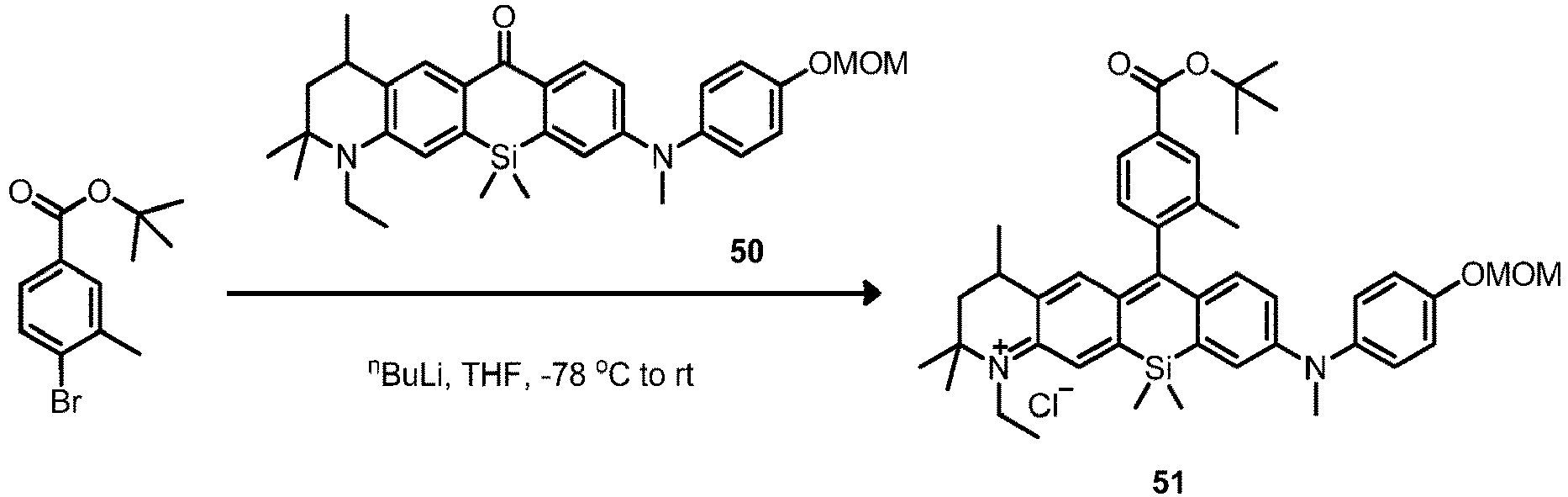
- To a solution of t-butyl 4-bromo-3-methylbenzoate (585 mg, 2.16 mmol) in dry THF (10 mL) at -78 °C, was added n-BuLi (1.46 mL, 2.38 mmol) dropwise under argon atmosphere. Then HMPA (73 µL, 0.431 mmol) was added after 30 min. And a solution of 50 (226 mg, 0.431 mmol) in dry THF (2 mL) was added 5 min later. The resulting mixture was stirred at -78 °C to room temperature for 12 h. The reaction was quenched with 3N HCl for 10 min and extracted with DCM for 3 times. The extracts was dried over anhydrous sodium sulfate, concentrated and purified by silica gel column chromatography to give the product 51 (307 mg, 96% yield). 1H NMR (400 MHz, CDCl3) δ 7.84 (s, 1H), 7.81 (d, J = 7.8 Hz, 1H), 7.07 - 7.03 (m, 4H), 7.01 - 6.99 (m, 3H), 6.75 (s, 1H), 6.72 (d, J = 9.5 Hz, 1H), 6.38 (dd, J = 9.5, 2.6 Hz, 1H), 5.08 (s, 2H), 3.80 - 3.72 (m, 2H), 3.52 (s, 3H), 3.37 (s, 3H), 3.31 - 3.28 (m, 1H), 2.57 - 2.50 (m, 1H), 1.99 (s, 3H), 1.73 (dd, J = 13.6, 4.3 Hz, 1H), 1.51 (s, 9H), 1.48 - 1.43 (m, 2H), 1.40 (s, 3H), 1.31 - 1.26 (m, 6H), 1.03 - 1.01 (m, 3H), 0.83 - 0.81 (m, 3H), 0.46 (d, J= 2.2 Hz, 3H), 0.45 (d, J = 2.4 Hz, 3H) ; 13C NMR (101 MHz, CDCl3) δ 167.11, 164.99, 156.49, 153.20, 153.16, 151.91, 151.86, 148.19, 148.06, 146.14, 146.34, 142.61, 139.48, 139.39, 138.02, 136.53, 136.43, 135.92, 135.77, 132.17, 132.14, 130.91, 130.70, 130.54, 130.47, 128.91, 128.76, 127.81, 127.78, 127.46, 127.01, 126.90, 126.49, 126.32, 122.31, 121.12, 121.06, 117.61, 115.02, 94.29, 81.39, 59.12, 59.03, 56.00, 44.30, 41.36, 41.16, 29.43, 28.67, 27.98, 26.23, 26.17, 26.11, 26.06, 19.35, 19.28, 18.53, 18.33, 14.81, -0.85, -1.13, -1.43, -1.76.

- To a solution of 51 (306 mg, 2.16 mmol) in DCM at 0 °C was added TFA dropwise. The resulting mixture was stirred at room temperature for 3 h. The reaction mixture was then concentrated and azeotroped with toluene for 3 times, and purified by silica gel column chromatography to give the product 25 (236 mg, 80% yield). 1H NMR (400 MHz, CDCl3) δ 8.06 (s, 1H), 7.97 (d, J = 7.9 Hz, 1H), 7.30 (s, 1H), 7.21 - 7.19 (m, 2H), 7.11 - 7.08 (m, 2H), 6.92 - 6.87 (m, 4H), 6.58 (dd, J= 9.5, 2.4 Hz, 1H), 3.92 (br, 1H), 3.90 (br, 1H), 3.52 (s, 3H), 2.75 (br, 1H), 2.09 (s, 3H), 1.87 (dd, J = 13.5, 4.2 Hz, 1H), 1.50 (s, 3H), 1.54 - 1.48 (m, 1H), 1.40 - 1.37 (m, 6H), 0.90 (m, 6H), 0.53 (d, J = 2.9 Hz, 3H), 0.51 (t, J = 3.8 Hz, 3H); 13C NMR (101 MHz, CDCl3) δ 168.98, 168.13, 168.09, 158.63, 155.21, 155.18, 153.41, 153.35, 149.09, 148.98, 147.65, 147.56, 144.76, 140.81, 140.75, 137.73, 137.55, 137.31, 132.51, 132.45, 132.30, 132.26, 130.59, 130.35, 128.82, 128.75, 128.27, 128.18, 127.95, 123.75, 122.85, 122.80, 117.86, 116.09, 60.52, 60.44, 45.55, 41.78, 41.68, 28.91, 28.86, 27.47, 27.43, 26.25, 19.51, 19.47, 18.83, 18.66, 15.15, -1.13, -1.37, -1.63, -1.89.

- To a solution of 25 (116 mg, 0.162 mmol) and dimethyl 3,3'-iminodipropanoate (52 mg, 0.324 mmol) in anhydrous DMF (2 mL) at room temperature was added 1-hydroxy-7-azabenzotriazole (HOAt) (27 mg, 0.194 mmol), and N-(3-dimethylaminopropyl)-N'-ethylcarbodiimide hydrochloride (EDC•HCl) (44 mg, 0.227 mmol) successively under argon atmosphere. The reaction mixture was stirred overnight and then diluted with ethyl acetate. The organic layer was washed with saturated NaHCO3, H2O and brine. The extracts was dried over anhydrous sodium sulfate, concentrated and purified by silica gel column chromatography to give the product 27 (122 mg, 88% yield). 1H NMR (400 MHz, CDCl3) δ 10.25 (br, 1H), 7.49 (d, J = 10.2 Hz, 1H), 7.42 (dd, J = 8.1, 3.9 Hz, 1H), 7.31 (d, J = 8.4 Hz, 1H), 7.16 (dd, J = 7.2, 5.7 Hz, 1H), 7.07 - 7.05 (m, 2H), 6.99 - 6.97 (m, 3H), 6.81 (d, J = 6.9 Hz, 1H), 6.61 (d, J = 8.4 Hz, 1H), 4.45 (s, 2H), 4.40 (s, 2H), 3.85 - 3.65 (m, 1H), 3.82 (s, 3H), 3.79 (s, 3H), 3.55 (s, 3H), 3.70 - 3.50 (m, 1H), 2.10 - 2.09 (m, 3H), 1.85 (dd, J = 13.5, 3.8 Hz, 1H), 1.61 - 1.58 (m, 1H), 1.56 (s, 3H), 1.43 - 1.38 (m, 6H), 0.94 (t, J = 5.4 Hz, 3H), 0.50 (s, 6H); 13C NMR (101 MHz, CDCl3) δ 171.57, 169.52, 169.32, 166.83, 158.61, 154.05, 154.02, 151.45, 151.41, 147.59, 147.46, 146.59, 140.82, 140.54, 136.74, 136.22, 136.17, 135.14, 135.12, 134.66, 130.33, 130.22, 129.27, 128.88, 128.57, 127.64, 127.58, 127.10, 126.98, 126.62, 124.15, 123.74, 122.41, 121.58, 117.85, 114.84, 58.84, 58.78, 52.69, 52.36, 51.68, 47.56, 44.55, 41.65, 40.84, 28.88, 26.36, 26.31, 26.25, 19.51, 19.40, 18.56, 18.35, 14.84, -0.81, -1.04, -1.39, -1.65.
- This Example shows that deep red fluorogenic Compound 25 sensitively and selectively detects peroxynitrite. Specifically, Compound 25 is dissolved in 0.1 M phosphate buffer at pH 7.4 to form a 5 µM solution, with excitation and emission spectra at 650 nm and 665 nm, respectively. The 5 µM solution of Compound 25 is treated with peroxynitrite at various concentrations.
Figure 4A shows that the florescence intensity of Compound 25 increases with increasing concentration of peroxynitrite. - The reactivity of Compound 25 is compared with different reactive oxygen species (ROS) and reactive nitrogen species (RNS). Specifically, the 5 µM solution of compound 25 is treated with various ROS and RNS. The concentration of highly reactive oxygen species (hydroxyl radical (·OH), hypochlorous acid (-OCl), and peroxynitrite (ONOO-)) is 5 µM. The concentration of 1O2, O2 •-, NO, ROO· and H2O2 is 50 µM.
Figure 4B shows that treatment with peroxynitrite results in a much higher increase in fluorescence intensity of Compound 25 than treatment with other ROS and RNS. - Human SH-SY5Y neuroblastoma cells (ATCC, USA) were maintained in high glucose Dulbecco's Modified Eagle Medium (DMEM, Hyclone) supplemented with 10% fetal bovine serum (FBS, Gibco), 1% penicillin/streptomycin (PS, Gibco) and 1% L-glutamine (Gibco). Mouse C17.2 neural progenitor cells (ATCC, USA) were maintained in high glucose Dulbecco's Modified Eagle Medium supplemented with 8% fetal bovine serum (Gibco), 4% horse serum (Gibco), 1% penicillin/streptomycin and 1% L-glutamine. Mouse RAW264.7 macrophage cells (ATCC, USA) were maintained in high glucose Dulbecco's Modified Eagle Medium (DMEM, Hyclone) supplemented with 10% fetal bovine serum (Gibco), 1% penicillin/streptomycin (Gibco) and 1% L-glutamine.
- Generally, cells were grown to confluence prior to experiment. Cells were incubated with corresponding compounds (see
Figure 10 ) for 1 hr and then washed three times with PBS buffer. Only very weak fluorescence was observed in the absence of stimulants, such as SIN-1 or LPS (lipopolysaccharide)/IFN-γ (Interferon-γ). The fluorescence of compounds was strongly induced after treatment with stimulants, such as SIN-1 or LPS/ IFN-γ. The results are shown inFigure 10 , which strongly suggest that the subject compounds are suitable for the detection of peroxynitrite in living cells. - The terms "a" and "an" and "the" and similar referents as used in the context of describing the invention are to be construed to cover both the singular and the plural, unless otherwise indicated herein or clearly contradicted by context.
- Recitation of ranges of values herein are merely intended to serve as a shorthand method of referring individually to each separate value falling within the range, unless otherwise indicated herein, and each separate value is incorporated into the specification as if it were individually recited herein. Unless otherwise stated, all exact values provided herein are representative of corresponding approximate values (e.g., all exact exemplary values provided with respect to a particular factor or measurement can be considered to also provide a corresponding approximate measurement, modified by "about," where appropriate).
- The use of any and all examples, or exemplary language (e.g., "such as") provided herein, is intended merely to better illuminate the invention and does not pose a limitation on the scope of the invention unless otherwise indicated. No language in the specification should be construed as indicating any element is essential to the practice of the invention unless as much is explicitly stated.
- The description herein of any aspect or embodiment of the invention using terms such as "comprising", "having", "including" or "containing" with reference to an element or elements is intended to provide support for a similar aspect or embodiment of the invention that "consists of", "consists essentially of", or "substantially comprises" that particular element or elements, unless otherwise stated or clearly contradicted by context (e.g., a composition described herein as comprising a particular element should be understood as also describing a composition consisting of that element, unless otherwise stated or clearly contradicted by context).
Claims (5)
- A compound of formula (XV) or (XVI)
 or a tautomer thereof;wherein N is a nitrogen atom, and is linked to Q and R1 throughsingle covalent bonds;R1 is CH3;
2 3 5 6 7 each of R , R, R , R and R is independently H;wherein R12 is a C1-C10 alkyl or alkene; for example wherein R12 is ethyl;wherein Y is Si;wherein each of R13 and R14 is independently H, alkyl, halogenated alkyl, heteroalkyl, aryl, or alkaryl;wherein each of R17 , R18 and R20 is independently H;R19 is H, F, Cl, Br, I, CN, nitro, a carboxylic acid, a salt of carboxylic acid, sulfonic acid (-SO3H), sulfonate ester (-SO3R15), sulfonamide (-SO2NR15R16), hydroxy, azide, alkyl, acyl, alkylcarbonylalkyl, halogenated alkylcarbonylalkyl such as trifluoromethylcarbonylalkyl, aminoalkyl, carboxyalkyl, thiol, alkylthio, amino, alkylamino, dialkylamino, alkoxycarbonyl, alkoxycarbonylalkyl, aminocarbonyl, alkylaminocarbonyl, dialkylaminocarbonyl, or arylcarboxamido; , the alkyl or aryl of which is optionally substituted by one or more F, Cl, Br, I, a carboxylic acid, a salt of carboxylic acid, a carboxylic acid ester of an alcohol, amino, alkylamino, dialkylamino, alkoxy, alkyltriphenylphosphonium, sulfonic acid (SO3H), sulfonate ester (-SO3R15), or sulfonamide (-SO2NR15R16);wherein R21 is selected from COOH, H, CH3 or OMe;wherein each of R15 and R16 represents a saturated or unsaturated, cyclic or acyclic alkyl that is optionally substituted by one or more of F, Cl, Br, I, a carboxylic acid, a salt of carboxylic acid, a carboxylic acid ester of an alcohol, amino, alkylamino, dialkylamino, alkoxy, or alkyltriphenylphosphonium;Q is a substituted phenyl represented by formula (IV): wherein each of R22, R23, R24, R25, and R26 is independently H, hydroxy, alkyl, alkenyl, alkynyl, heteroalkyl, cycloalkyl, cycloalkenyl, cycloalkynyl, aryl, alkylaryl, arylalkyl, heterocyclyl, alkoxy, alkoxyalkyl, alkoxyalkoxy, acyl, alkylcarbonylalkyl, halogentaed alkylcarbonylalkyl such as trifluoromethylcarbonylalkyl, aminoalkyl, carboxyalkyl, thiol, alkylthio, amino, alkylamino, dialkylamino, alkoxycarbonyl, alkoxycarbonylalkyl, aminocarbonyl, alkylaminocarbonyl, dialkylaminocarbonyl, or arylcarboxamido, the alkyl or aryl of which is optionally substituted by one or more F, Cl, Br, I, a carboxylic acid, a salt of carboxylic acid, a carboxylic acid ester of an alcohol, amino, alkylamino, dialkylamino, alkoxy, alkyltriphenylphosphonium, sulfonic acid (-SO3H), sulfonate ester (-SO3R15), or sulfonamide (-SO2NR15R16); or R22 and R23 together, R23 and R24 together, R24 and R25 together, or R25 and R26 together form a part of a 5- or 6-membered cycloalkyl, heterocyclyl, aryl or heteroaryl ring fused with the phenyl ring of formula (IV) that is optionally further substituted by one or more F, Cl, Br, I, a carboxylic acid, a salt of carboxylic acid, a carboxylic acid ester of an alcohol, amino, alkylamino, dialkylamino, alkoxy, thiol, alkylthio, alkyltriphenylphosphonium, sulfonic acid (SO3H), sulfonate ester (-SO3R15), or sulfonamide (-SO2NR15R16); and wherein R24 is OR27, CH2CH2COR28, orNR29 R30, wherein R is hydrogen or a group selected from alkyl, alkoxyalkyl, alkanoyl, or polyether; R28 is an electron-withdrawing group selected from CF3, halogen-substituted lower alkyl, or (C=O)-O-W1, wherein W1 is a group selected from alkyl, alkenyl, alkynyl, cycloalkyl, cycloalkenyl, cycloalkynyl, aryl, alkaryl or arylalkyl; R29 and R30 are independently hydrogen or a group selected from hydrogen or a group selected from alkyl, alkenyl, alkynyl, alkoxyalkyl, alkanoyl, alkenoyl, alkynoyl, cycloalkyl, cycloalkenyl, cycloalkynyl, aryl, alkaryl, arylalkyl, aryloyl, or polyether.
 - The compound of claim 1, wherein R12 is ethyl, carboxylmethyl, carboxyethyl, or carboxypropyl.
- The compound of any preceding claim, wherein R17, R18, R19 and R20 are independently H.
- The compound of claim 1, wherein the compound has one of the formulae 25-29:


- A fluorogenic probe composition comprising the compound of claim 1, and optionally, a carrier.
Applications Claiming Priority (3)
| Application Number | Priority Date | Filing Date | Title |
|---|---|---|---|
| US201261592122P | 2012-01-30 | 2012-01-30 | |
| EP13742931.2A EP2809666B1 (en) | 2012-01-30 | 2013-01-30 | Diarylamine-based fluorogenic probes for detection of peroxynitrite |
| PCT/CN2013/071155 WO2013113279A1 (en) | 2012-01-30 | 2013-01-30 | Diarylamine-based fluorogenic probes for detection of peroxynitrite |
Related Parent Applications (2)
| Application Number | Title | Priority Date | Filing Date |
|---|---|---|---|
| EP13742931.2A Division EP2809666B1 (en) | 2012-01-30 | 2013-01-30 | Diarylamine-based fluorogenic probes for detection of peroxynitrite |
| EP13742931.2A Division-Into EP2809666B1 (en) | 2012-01-30 | 2013-01-30 | Diarylamine-based fluorogenic probes for detection of peroxynitrite |
Publications (2)
| Publication Number | Publication Date |
|---|---|
| EP3431480A1 EP3431480A1 (en) | 2019-01-23 |
| EP3431480B1 true EP3431480B1 (en) | 2024-07-03 |
Family
ID=48870552
Family Applications (2)
| Application Number | Title | Priority Date | Filing Date |
|---|---|---|---|
| EP13742931.2A Active EP2809666B1 (en) | 2012-01-30 | 2013-01-30 | Diarylamine-based fluorogenic probes for detection of peroxynitrite |
| EP18191398.9A Active EP3431480B1 (en) | 2012-01-30 | 2013-01-30 | Diarylamine-based fluorogenic probes for detection of peroxynitrite |
Family Applications Before (1)
| Application Number | Title | Priority Date | Filing Date |
|---|---|---|---|
| EP13742931.2A Active EP2809666B1 (en) | 2012-01-30 | 2013-01-30 | Diarylamine-based fluorogenic probes for detection of peroxynitrite |
Country Status (4)
| Country | Link |
|---|---|
| US (1) | US9651528B2 (en) |
| EP (2) | EP2809666B1 (en) |
| CN (1) | CN104220438B (en) |
| WO (1) | WO2013113279A1 (en) |
Families Citing this family (20)
| Publication number | Priority date | Publication date | Assignee | Title |
|---|---|---|---|---|
| EP3636653A1 (en) | 2013-01-07 | 2020-04-15 | The University of Tokyo | Asymmetrical si rhodamine and rhodol synthesis |
| US10877051B2 (en) | 2014-01-31 | 2020-12-29 | The University Of Hong Kong | Bistrifilate-based fluorogenic probes for detection of superoxide anion radical |
| CN105439948B (en) * | 2014-09-26 | 2018-07-03 | 华东理工大学 | Quantitatively detect the small-molecule fluorescent probe of nitrite and nitrosation mercaptan |
| US10675364B2 (en) | 2015-06-23 | 2020-06-09 | The Board Of Trustees Of The Leland Stanford Junior University | Rhodol fluorophores for near-infrared imaging |
| WO2017122799A1 (en) * | 2016-01-15 | 2017-07-20 | 国立大学法人 東京大学 | Taggable fluorescent probe for calcium ion detection |
| KR101928489B1 (en) * | 2017-05-02 | 2018-12-12 | 주식회사 엘지화학 | Coloring agent compound and coloring composition comprising the same |
| CA3124333A1 (en) * | 2018-12-20 | 2020-06-25 | Life Technologies Corporation | Modified rhodamine dye and use thereof in biological assays |
| CN109608414B (en) * | 2018-12-26 | 2020-09-29 | 山东师范大学 | Fluorescent probe for detecting peroxynitrite and preparation method and application thereof |
| CN111057085B (en) * | 2020-01-09 | 2022-09-06 | 南开大学 | Preparation and application of a peroxynitrite anion fluorescent probe targeting mitochondria |
| CN111362900A (en) * | 2020-02-12 | 2020-07-03 | 曲阜师范大学 | Responding to ONOO-Ratio type small molecule fluorescent probe and preparation method and application thereof |
| CN111285833A (en) * | 2020-02-12 | 2020-06-16 | 曲阜师范大学 | Detection ONOO-Ratiometric fluorescent molecular probe and preparation method and application thereof |
| CN111349071A (en) * | 2020-02-12 | 2020-06-30 | 曲阜师范大学 | A kind of xanthene derivative for detecting ONOO- and its synthesis method and application |
| CN111777603B (en) * | 2020-06-15 | 2021-10-01 | 山东师范大学 | A fluorescent probe capable of simultaneously detecting beta amyloid deposition plaques and peroxynitrite, and preparation method and application thereof |
| CN111815907B (en) * | 2020-06-28 | 2021-07-09 | 合肥工业大学 | Landslide multistage monitoring and early warning device and application method thereof |
| CN114656441B (en) * | 2022-04-02 | 2024-05-24 | 中国科学院苏州纳米技术与纳米仿生研究所 | A class of asymmetric near-infrared organic fluorescent probes and their synthesis methods and applications |
| CN115011141A (en) * | 2022-06-01 | 2022-09-06 | 华东理工大学 | Chlorine-substituted-silicon-rhodamine-based near-infrared dye matrix, and preparation method and application thereof |
| WO2024240051A1 (en) * | 2023-05-19 | 2024-11-28 | 深圳华大智造科技股份有限公司 | Fluorescent dye, synthesis therefor and use thereof |
| CN116675623B (en) * | 2023-06-05 | 2025-03-07 | 浙江理工大学 | Fluorescent probe for detecting peroxynitrite and preparation method and use method thereof |
| CN118440090A (en) * | 2024-04-30 | 2024-08-06 | 南京工业大学 | Fluorescent probe of targeted lysosome and preparation method and application thereof |
| EP4711422A1 (en) * | 2024-09-17 | 2026-03-18 | ATTO-TEC Gmbh | Dyes with ph-dependent absorption and fluorescence |
Family Cites Families (17)
| Publication number | Priority date | Publication date | Assignee | Title |
|---|---|---|---|---|
| US3022316A (en) * | 1951-12-31 | 1962-02-20 | Hoechst Ag | 3, 6 bis-para-substituted-phenyl-amino-9-(2'sulfo-phenyl) xanthene |
| BE758461A (en) * | 1969-11-06 | 1971-05-04 | Hoechst Ag | WATER-SOLUBLE XANTHENE-DERIVED REACTIVE DYES AND THEIR PREPARATION |
| EP0591106B1 (en) * | 1992-09-30 | 1998-01-14 | Ciba SC Holding AG | Concentrated aqueous liquid compositions of colour formers |
| JP3374382B2 (en) * | 1993-06-18 | 2003-02-04 | 日本曹達株式会社 | Novel fluoran compound and coloring material using the same |
| JPH09241558A (en) * | 1996-03-14 | 1997-09-16 | Konica Corp | Ink jet recording liquid |
| US5916910A (en) * | 1997-06-04 | 1999-06-29 | Medinox, Inc. | Conjugates of dithiocarbamates with pharmacologically active agents and uses therefore |
| EP1090073B1 (en) | 1999-04-23 | 2003-03-05 | Molecular Probes Inc. | Xanthene dyes and their application as luminescence quenching compounds |
| US8372782B2 (en) * | 2003-02-28 | 2013-02-12 | Zink Imaging, Inc. | Imaging system |
| US7008759B2 (en) * | 2003-02-28 | 2006-03-07 | Polaroid Corporation | Dyes and use thereof in imaging members and methods |
| US7829497B2 (en) * | 2005-05-12 | 2010-11-09 | Zink Imaging, Inc. | Thermal imaging members and methods |
| CN101495322B (en) * | 2005-05-12 | 2012-06-20 | 津克成像有限责任公司 | Thermal imaging components and methods |
| JP2009047814A (en) * | 2007-08-17 | 2009-03-05 | Konica Minolta Business Technologies Inc | Electrostatic charge image developing magenta toner |
| US20090082495A1 (en) * | 2007-09-20 | 2009-03-26 | Rene Jean Zimmer | Pneumatic Tire |
| WO2009110487A1 (en) * | 2008-03-04 | 2009-09-11 | 国立大学法人東京大学 | Fluorescent probe specific to hydrogen peroxide |
| WO2009121244A1 (en) | 2008-04-03 | 2009-10-08 | Versitech Limited | Fluorophore compounds |
| US8114904B2 (en) * | 2008-04-05 | 2012-02-14 | Versitech Limited & Morningside Ventures Limited | Luminescence quenchers and fluorogenic probes for detection of reactive species |
| JP5526124B2 (en) * | 2009-04-30 | 2014-06-18 | 国立大学法人 東京大学 | Near-infrared fluorescent compound |
-
2013
- 2013-01-30 EP EP13742931.2A patent/EP2809666B1/en active Active
- 2013-01-30 WO PCT/CN2013/071155 patent/WO2013113279A1/en not_active Ceased
- 2013-01-30 US US13/754,499 patent/US9651528B2/en active Active
- 2013-01-30 EP EP18191398.9A patent/EP3431480B1/en active Active
- 2013-01-30 CN CN201380007241.2A patent/CN104220438B/en active Active
Also Published As
| Publication number | Publication date |
|---|---|
| CN104220438B (en) | 2017-03-08 |
| EP2809666A4 (en) | 2015-09-16 |
| US20130196362A1 (en) | 2013-08-01 |
| EP3431480A1 (en) | 2019-01-23 |
| CN104220438A (en) | 2014-12-17 |
| EP2809666B1 (en) | 2018-10-10 |
| WO2013113279A1 (en) | 2013-08-08 |
| US9651528B2 (en) | 2017-05-16 |
| EP2809666A1 (en) | 2014-12-10 |
Similar Documents
| Publication | Publication Date | Title |
|---|---|---|
| EP2809666B1 (en) | Diarylamine-based fluorogenic probes for detection of peroxynitrite | |
| Liu et al. | The ESIPT fluorescent probes for N2H4 based on benzothiazol and their applications for gas sensing and bioimaging | |
| CN101883775B (en) | Reagent for detecting hypochlorous acid | |
| CN104357044B (en) | A kind of fluorescent probe and its preparation method and application | |
| CN111072699B (en) | Hydroxyl radical ratio type fluorescent probe and preparation method and application thereof | |
| WO2009121247A1 (en) | Luminescence quenchers and fluorogenic probes for detection of reactive species | |
| US20090253143A1 (en) | Fluorophore compounds | |
| JP6081152B2 (en) | Fluorescent compounds comprising tetraphenylethene derivatives | |
| CN116178349B (en) | Golgi targeting near infrared fluorescent probe for detecting cysteine, preparation method and application thereof | |
| JP5228190B2 (en) | Peroxynitrite fluorescent probe | |
| Wang et al. | A fluorescent and colorimetric chemosensor for nitric oxide based on 1, 8-naphthalimide | |
| Hou et al. | A colorimetric and red emissive fluorescent probe for cysteine and its application in bioimaging | |
| CN104418874A (en) | Fluorescent molecular probe for detecting fluoride ions in aqueous solutions as well as synthesis method and application thereof | |
| Song et al. | A turn-on fluorescent probe for Au3+ based on rodamine derivative and its bioimaging application | |
| EP3099680B1 (en) | Bistrifilate-based fluorogenic probes for detection of superoxide anion radical | |
| Nemati et al. | Colorimetric and fluorimetric chemosensor based on upper rim-functionalized calix [4] arene for selective detection of fluoride ion | |
| Cao et al. | A ratiometric fluorescent probe for hydrazine imaging in biological and environmental samples | |
| CN107843578B (en) | A kind of fluorescent probe based on coumarin copper ion complex, preparation method and its application in selective identification of pyrophosphate | |
| CN115436333A (en) | Application of a tetrazine-based fluorescence-enhanced probe in the detection of superoxide anion | |
| CN112794847B (en) | Novel fluorescent probe for sequentially detecting hydrazine hydrate and bisulfite and synthesis and application thereof | |
| CN108863961A (en) | A kind of triazole anthraquinone derivative silver ion fluorescence probe and its preparation method and application | |
| US20030119195A1 (en) | Potassium fluoroionophore | |
| KR100752577B1 (en) | Trifluoroacetophenone derivatives for detecting cyan anions | |
| CN117659067A (en) | An amphiphilic compound and its preparation method and application | |
| CN114014892A (en) | A BODIPY-type fluorescent probe that specifically recognizes superoxide anion and its preparation method and application |
Legal Events
| Date | Code | Title | Description |
|---|---|---|---|
| PUAI | Public reference made under article 153(3) epc to a published international application that has entered the european phase |
Free format text: ORIGINAL CODE: 0009012 |
|
| STAA | Information on the status of an ep patent application or granted ep patent |
Free format text: STATUS: THE APPLICATION HAS BEEN PUBLISHED |
|
| AC | Divisional application: reference to earlier application |
Ref document number: 2809666 Country of ref document: EP Kind code of ref document: P |
|
| AK | Designated contracting states |
Kind code of ref document: A1 Designated state(s): AL AT BE BG CH CY CZ DE DK EE ES FI FR GB GR HR HU IE IS IT LI LT LU LV MC MK MT NL NO PL PT RO RS SE SI SK SM TR |
|
| RIN1 | Information on inventor provided before grant (corrected) |
Inventor name: CHEN, XINGMIAO Inventor name: SHEN, JIAN-GANG Inventor name: PENG, TAO Inventor name: YANG, DAN |
|
| STAA | Information on the status of an ep patent application or granted ep patent |
Free format text: STATUS: REQUEST FOR EXAMINATION WAS MADE |
|
| 17P | Request for examination filed |
Effective date: 20190718 |
|
| RBV | Designated contracting states (corrected) |
Designated state(s): AL AT BE BG CH CY CZ DE DK EE ES FI FR GB GR HR HU IE IS IT LI LT LU LV MC MK MT NL NO PL PT RO RS SE SI SK SM TR |
|
| STAA | Information on the status of an ep patent application or granted ep patent |
Free format text: STATUS: EXAMINATION IS IN PROGRESS |
|
| 17Q | First examination report despatched |
Effective date: 20191210 |
|
| GRAP | Despatch of communication of intention to grant a patent |
Free format text: ORIGINAL CODE: EPIDOSNIGR1 |
|
| STAA | Information on the status of an ep patent application or granted ep patent |
Free format text: STATUS: GRANT OF PATENT IS INTENDED |
|
| INTG | Intention to grant announced |
Effective date: 20240130 |
|
| GRAS | Grant fee paid |
Free format text: ORIGINAL CODE: EPIDOSNIGR3 |
|
| GRAA | (expected) grant |
Free format text: ORIGINAL CODE: 0009210 |
|
| STAA | Information on the status of an ep patent application or granted ep patent |
Free format text: STATUS: THE PATENT HAS BEEN GRANTED |
|
| AC | Divisional application: reference to earlier application |
Ref document number: 2809666 Country of ref document: EP Kind code of ref document: P |
|
| AK | Designated contracting states |
Kind code of ref document: B1 Designated state(s): AL AT BE BG CH CY CZ DE DK EE ES FI FR GB GR HR HU IE IS IT LI LT LU LV MC MK MT NL NO PL PT RO RS SE SI SK SM TR |
|
| REG | Reference to a national code |
Ref country code: CH Ref legal event code: EP |
|
| REG | Reference to a national code |
Ref country code: DE Ref legal event code: R096 Ref document number: 602013085860 Country of ref document: DE |
|
| REG | Reference to a national code |
Ref country code: DE Ref legal event code: R081 Ref document number: 602013085860 Country of ref document: DE Owner name: VERSITECH LTD., HK Free format text: FORMER OWNER: THE UNIVERSITY OF HONG KONG, HONG KONG, HK |
|
| RAP2 | Party data changed (patent owner data changed or rights of a patent transferred) |
Owner name: VERSITECH LIMITED |
|
| REG | Reference to a national code |
Ref country code: LT Ref legal event code: MG9D |
|
| REG | Reference to a national code |
Ref country code: NL Ref legal event code: MP Effective date: 20240703 |
|
| PG25 | Lapsed in a contracting state [announced via postgrant information from national office to epo] |
Ref country code: PT Free format text: LAPSE BECAUSE OF FAILURE TO SUBMIT A TRANSLATION OF THE DESCRIPTION OR TO PAY THE FEE WITHIN THE PRESCRIBED TIME-LIMIT Effective date: 20241104 |
|
| REG | Reference to a national code |
Ref country code: AT Ref legal event code: MK05 Ref document number: 1699741 Country of ref document: AT Kind code of ref document: T Effective date: 20240703 |
|
| PG25 | Lapsed in a contracting state [announced via postgrant information from national office to epo] |
Ref country code: NL Free format text: LAPSE BECAUSE OF FAILURE TO SUBMIT A TRANSLATION OF THE DESCRIPTION OR TO PAY THE FEE WITHIN THE PRESCRIBED TIME-LIMIT Effective date: 20240703 |
|
| PG25 | Lapsed in a contracting state [announced via postgrant information from national office to epo] |
Ref country code: PT Free format text: LAPSE BECAUSE OF FAILURE TO SUBMIT A TRANSLATION OF THE DESCRIPTION OR TO PAY THE FEE WITHIN THE PRESCRIBED TIME-LIMIT Effective date: 20241104 Ref country code: NL Free format text: LAPSE BECAUSE OF FAILURE TO SUBMIT A TRANSLATION OF THE DESCRIPTION OR TO PAY THE FEE WITHIN THE PRESCRIBED TIME-LIMIT Effective date: 20240703 |
|
| PG25 | Lapsed in a contracting state [announced via postgrant information from national office to epo] |
Ref country code: NO Free format text: LAPSE BECAUSE OF FAILURE TO SUBMIT A TRANSLATION OF THE DESCRIPTION OR TO PAY THE FEE WITHIN THE PRESCRIBED TIME-LIMIT Effective date: 20241003 |
|
| PG25 | Lapsed in a contracting state [announced via postgrant information from national office to epo] |
Ref country code: GR Free format text: LAPSE BECAUSE OF FAILURE TO SUBMIT A TRANSLATION OF THE DESCRIPTION OR TO PAY THE FEE WITHIN THE PRESCRIBED TIME-LIMIT Effective date: 20241004 Ref country code: FI Free format text: LAPSE BECAUSE OF FAILURE TO SUBMIT A TRANSLATION OF THE DESCRIPTION OR TO PAY THE FEE WITHIN THE PRESCRIBED TIME-LIMIT Effective date: 20240703 Ref country code: PL Free format text: LAPSE BECAUSE OF FAILURE TO SUBMIT A TRANSLATION OF THE DESCRIPTION OR TO PAY THE FEE WITHIN THE PRESCRIBED TIME-LIMIT Effective date: 20240703 |
|
| PG25 | Lapsed in a contracting state [announced via postgrant information from national office to epo] |
Ref country code: BG Free format text: LAPSE BECAUSE OF FAILURE TO SUBMIT A TRANSLATION OF THE DESCRIPTION OR TO PAY THE FEE WITHIN THE PRESCRIBED TIME-LIMIT Effective date: 20240703 |
|
| PG25 | Lapsed in a contracting state [announced via postgrant information from national office to epo] |
Ref country code: LV Free format text: LAPSE BECAUSE OF FAILURE TO SUBMIT A TRANSLATION OF THE DESCRIPTION OR TO PAY THE FEE WITHIN THE PRESCRIBED TIME-LIMIT Effective date: 20240703 |
|
| PG25 | Lapsed in a contracting state [announced via postgrant information from national office to epo] |
Ref country code: IS Free format text: LAPSE BECAUSE OF FAILURE TO SUBMIT A TRANSLATION OF THE DESCRIPTION OR TO PAY THE FEE WITHIN THE PRESCRIBED TIME-LIMIT Effective date: 20241103 Ref country code: AT Free format text: LAPSE BECAUSE OF FAILURE TO SUBMIT A TRANSLATION OF THE DESCRIPTION OR TO PAY THE FEE WITHIN THE PRESCRIBED TIME-LIMIT Effective date: 20240703 |
|
| PG25 | Lapsed in a contracting state [announced via postgrant information from national office to epo] |
Ref country code: HR Free format text: LAPSE BECAUSE OF FAILURE TO SUBMIT A TRANSLATION OF THE DESCRIPTION OR TO PAY THE FEE WITHIN THE PRESCRIBED TIME-LIMIT Effective date: 20240703 Ref country code: CZ Free format text: LAPSE BECAUSE OF FAILURE TO SUBMIT A TRANSLATION OF THE DESCRIPTION OR TO PAY THE FEE WITHIN THE PRESCRIBED TIME-LIMIT Effective date: 20240703 |
|
| PG25 | Lapsed in a contracting state [announced via postgrant information from national office to epo] |
Ref country code: RS Free format text: LAPSE BECAUSE OF FAILURE TO SUBMIT A TRANSLATION OF THE DESCRIPTION OR TO PAY THE FEE WITHIN THE PRESCRIBED TIME-LIMIT Effective date: 20241003 Ref country code: ES Free format text: LAPSE BECAUSE OF FAILURE TO SUBMIT A TRANSLATION OF THE DESCRIPTION OR TO PAY THE FEE WITHIN THE PRESCRIBED TIME-LIMIT Effective date: 20240703 |
|
| PG25 | Lapsed in a contracting state [announced via postgrant information from national office to epo] |
Ref country code: RS Free format text: LAPSE BECAUSE OF FAILURE TO SUBMIT A TRANSLATION OF THE DESCRIPTION OR TO PAY THE FEE WITHIN THE PRESCRIBED TIME-LIMIT Effective date: 20241003 Ref country code: PL Free format text: LAPSE BECAUSE OF FAILURE TO SUBMIT A TRANSLATION OF THE DESCRIPTION OR TO PAY THE FEE WITHIN THE PRESCRIBED TIME-LIMIT Effective date: 20240703 Ref country code: NO Free format text: LAPSE BECAUSE OF FAILURE TO SUBMIT A TRANSLATION OF THE DESCRIPTION OR TO PAY THE FEE WITHIN THE PRESCRIBED TIME-LIMIT Effective date: 20241003 Ref country code: LV Free format text: LAPSE BECAUSE OF FAILURE TO SUBMIT A TRANSLATION OF THE DESCRIPTION OR TO PAY THE FEE WITHIN THE PRESCRIBED TIME-LIMIT Effective date: 20240703 Ref country code: IS Free format text: LAPSE BECAUSE OF FAILURE TO SUBMIT A TRANSLATION OF THE DESCRIPTION OR TO PAY THE FEE WITHIN THE PRESCRIBED TIME-LIMIT Effective date: 20241103 Ref country code: HR Free format text: LAPSE BECAUSE OF FAILURE TO SUBMIT A TRANSLATION OF THE DESCRIPTION OR TO PAY THE FEE WITHIN THE PRESCRIBED TIME-LIMIT Effective date: 20240703 Ref country code: GR Free format text: LAPSE BECAUSE OF FAILURE TO SUBMIT A TRANSLATION OF THE DESCRIPTION OR TO PAY THE FEE WITHIN THE PRESCRIBED TIME-LIMIT Effective date: 20241004 Ref country code: FI Free format text: LAPSE BECAUSE OF FAILURE TO SUBMIT A TRANSLATION OF THE DESCRIPTION OR TO PAY THE FEE WITHIN THE PRESCRIBED TIME-LIMIT Effective date: 20240703 Ref country code: ES Free format text: LAPSE BECAUSE OF FAILURE TO SUBMIT A TRANSLATION OF THE DESCRIPTION OR TO PAY THE FEE WITHIN THE PRESCRIBED TIME-LIMIT Effective date: 20240703 Ref country code: CZ Free format text: LAPSE BECAUSE OF FAILURE TO SUBMIT A TRANSLATION OF THE DESCRIPTION OR TO PAY THE FEE WITHIN THE PRESCRIBED TIME-LIMIT Effective date: 20240703 Ref country code: BG Free format text: LAPSE BECAUSE OF FAILURE TO SUBMIT A TRANSLATION OF THE DESCRIPTION OR TO PAY THE FEE WITHIN THE PRESCRIBED TIME-LIMIT Effective date: 20240703 Ref country code: AT Free format text: LAPSE BECAUSE OF FAILURE TO SUBMIT A TRANSLATION OF THE DESCRIPTION OR TO PAY THE FEE WITHIN THE PRESCRIBED TIME-LIMIT Effective date: 20240703 |
|
| REG | Reference to a national code |
Ref country code: DE Ref legal event code: R097 Ref document number: 602013085860 Country of ref document: DE |
|
| PG25 | Lapsed in a contracting state [announced via postgrant information from national office to epo] |
Ref country code: SM Free format text: LAPSE BECAUSE OF FAILURE TO SUBMIT A TRANSLATION OF THE DESCRIPTION OR TO PAY THE FEE WITHIN THE PRESCRIBED TIME-LIMIT Effective date: 20240703 Ref country code: RO Free format text: LAPSE BECAUSE OF FAILURE TO SUBMIT A TRANSLATION OF THE DESCRIPTION OR TO PAY THE FEE WITHIN THE PRESCRIBED TIME-LIMIT Effective date: 20240703 Ref country code: DK Free format text: LAPSE BECAUSE OF FAILURE TO SUBMIT A TRANSLATION OF THE DESCRIPTION OR TO PAY THE FEE WITHIN THE PRESCRIBED TIME-LIMIT Effective date: 20240703 |
|
| PG25 | Lapsed in a contracting state [announced via postgrant information from national office to epo] |
Ref country code: EE Free format text: LAPSE BECAUSE OF FAILURE TO SUBMIT A TRANSLATION OF THE DESCRIPTION OR TO PAY THE FEE WITHIN THE PRESCRIBED TIME-LIMIT Effective date: 20240703 |
|
| PG25 | Lapsed in a contracting state [announced via postgrant information from national office to epo] |
Ref country code: IT Free format text: LAPSE BECAUSE OF FAILURE TO SUBMIT A TRANSLATION OF THE DESCRIPTION OR TO PAY THE FEE WITHIN THE PRESCRIBED TIME-LIMIT Effective date: 20240703 Ref country code: SK Free format text: LAPSE BECAUSE OF FAILURE TO SUBMIT A TRANSLATION OF THE DESCRIPTION OR TO PAY THE FEE WITHIN THE PRESCRIBED TIME-LIMIT Effective date: 20240703 |
|
| PLBE | No opposition filed within time limit |
Free format text: ORIGINAL CODE: 0009261 |
|
| STAA | Information on the status of an ep patent application or granted ep patent |
Free format text: STATUS: NO OPPOSITION FILED WITHIN TIME LIMIT |
|
| 26N | No opposition filed |
Effective date: 20250404 |
|
| REG | Reference to a national code |
Ref country code: CH Ref legal event code: PL |
|
| PG25 | Lapsed in a contracting state [announced via postgrant information from national office to epo] |
Ref country code: SE Free format text: LAPSE BECAUSE OF FAILURE TO SUBMIT A TRANSLATION OF THE DESCRIPTION OR TO PAY THE FEE WITHIN THE PRESCRIBED TIME-LIMIT Effective date: 20240703 |
|
| PG25 | Lapsed in a contracting state [announced via postgrant information from national office to epo] |
Ref country code: MC Free format text: LAPSE BECAUSE OF FAILURE TO SUBMIT A TRANSLATION OF THE DESCRIPTION OR TO PAY THE FEE WITHIN THE PRESCRIBED TIME-LIMIT Effective date: 20240703 Ref country code: LU Free format text: LAPSE BECAUSE OF NON-PAYMENT OF DUE FEES Effective date: 20250130 |
|
| GBPC | Gb: european patent ceased through non-payment of renewal fee |
Effective date: 20250130 |
|
| PG25 | Lapsed in a contracting state [announced via postgrant information from national office to epo] |
Ref country code: GB Free format text: LAPSE BECAUSE OF NON-PAYMENT OF DUE FEES Effective date: 20250130 Ref country code: BE Free format text: LAPSE BECAUSE OF NON-PAYMENT OF DUE FEES Effective date: 20250131 |
|
| PG25 | Lapsed in a contracting state [announced via postgrant information from national office to epo] |
Ref country code: FR Free format text: LAPSE BECAUSE OF NON-PAYMENT OF DUE FEES Effective date: 20250131 |
|
| PG25 | Lapsed in a contracting state [announced via postgrant information from national office to epo] |
Ref country code: CH Free format text: LAPSE BECAUSE OF NON-PAYMENT OF DUE FEES Effective date: 20250131 |
|
| REG | Reference to a national code |
Ref country code: BE Ref legal event code: MM Effective date: 20250131 |
|
| PG25 | Lapsed in a contracting state [announced via postgrant information from national office to epo] |
Ref country code: IE Free format text: LAPSE BECAUSE OF NON-PAYMENT OF DUE FEES Effective date: 20250130 |
|
| PGFP | Annual fee paid to national office [announced via postgrant information from national office to epo] |
Ref country code: DE Payment date: 20251203 Year of fee payment: 14 |