EP3430185B1 - Highly reflecting anodised al surfaces with tailored diffuse and specular content - Google Patents
Highly reflecting anodised al surfaces with tailored diffuse and specular content Download PDFInfo
- Publication number
- EP3430185B1 EP3430185B1 EP16727968.6A EP16727968A EP3430185B1 EP 3430185 B1 EP3430185 B1 EP 3430185B1 EP 16727968 A EP16727968 A EP 16727968A EP 3430185 B1 EP3430185 B1 EP 3430185B1
- Authority
- EP
- European Patent Office
- Prior art keywords
- aluminium
- acid
- anodising
- titanium
- embedded
- Prior art date
- Legal status (The legal status is an assumption and is not a legal conclusion. Google has not performed a legal analysis and makes no representation as to the accuracy of the status listed.)
- Active
Links
Images


Classifications
-
- C—CHEMISTRY; METALLURGY
- C25—ELECTROLYTIC OR ELECTROPHORETIC PROCESSES; APPARATUS THEREFOR
- C25D—PROCESSES FOR THE ELECTROLYTIC OR ELECTROPHORETIC PRODUCTION OF COATINGS; ELECTROFORMING; APPARATUS THEREFOR
- C25D11/00—Electrolytic coating by surface reaction, i.e. forming conversion layers
- C25D11/02—Anodisation
- C25D11/04—Anodisation of aluminium or alloys based thereon
- C25D11/06—Anodisation of aluminium or alloys based thereon characterised by the electrolytes used
- C25D11/10—Anodisation of aluminium or alloys based thereon characterised by the electrolytes used containing organic acids
-
- C—CHEMISTRY; METALLURGY
- C25—ELECTROLYTIC OR ELECTROPHORETIC PROCESSES; APPARATUS THEREFOR
- C25D—PROCESSES FOR THE ELECTROLYTIC OR ELECTROPHORETIC PRODUCTION OF COATINGS; ELECTROFORMING; APPARATUS THEREFOR
- C25D11/00—Electrolytic coating by surface reaction, i.e. forming conversion layers
- C25D11/02—Anodisation
- C25D11/024—Anodisation under pulsed or modulated current or potential
-
- C—CHEMISTRY; METALLURGY
- C25—ELECTROLYTIC OR ELECTROPHORETIC PROCESSES; APPARATUS THEREFOR
- C25D—PROCESSES FOR THE ELECTROLYTIC OR ELECTROPHORETIC PRODUCTION OF COATINGS; ELECTROFORMING; APPARATUS THEREFOR
- C25D11/00—Electrolytic coating by surface reaction, i.e. forming conversion layers
- C25D11/02—Anodisation
- C25D11/04—Anodisation of aluminium or alloys based thereon
-
- C—CHEMISTRY; METALLURGY
- C25—ELECTROLYTIC OR ELECTROPHORETIC PROCESSES; APPARATUS THEREFOR
- C25D—PROCESSES FOR THE ELECTROLYTIC OR ELECTROPHORETIC PRODUCTION OF COATINGS; ELECTROFORMING; APPARATUS THEREFOR
- C25D11/00—Electrolytic coating by surface reaction, i.e. forming conversion layers
- C25D11/02—Anodisation
- C25D11/04—Anodisation of aluminium or alloys based thereon
- C25D11/14—Producing integrally coloured layers
-
- C—CHEMISTRY; METALLURGY
- C25—ELECTROLYTIC OR ELECTROPHORETIC PROCESSES; APPARATUS THEREFOR
- C25D—PROCESSES FOR THE ELECTROLYTIC OR ELECTROPHORETIC PRODUCTION OF COATINGS; ELECTROFORMING; APPARATUS THEREFOR
- C25D15/00—Electrolytic or electrophoretic production of coatings containing embedded materials, e.g. particles, whiskers, wires
Definitions
- the present invention relates to a method to obtain a reflective anodised aluminium surface on an object.
- the present invention relates in particular to a method to obtain a reflective, anodised aluminium surface having a white appearance.
- White surfaces are ubiquitous in a huge number of applications (window frames, panels, doors, lamps, etc.), and while a white surface can be achieved using paint or even white plastics, a white wear-resistant aluminium surface would often be the number one choice if such a surface would be available.
- White aluminium surfaces can be produced by embedding titanium dioxide (TiO 2 ) or other white pigments into an anodic film.
- the white pigments opacify the films primarily by diffusely reflecting light. This reflection occurs because the white pigment scatters or bends light strongly. If there is enough white pigment in an anodic film almost all visible light striking it will be reflected, and the anodic film will appear opaque, white, and bright.
- anodised surface is significantly higher than that of a traditional painted surface.
- anodised surfaces are usually preferred to painted surfaces when it comes to both practical applications and long-lasting decorative purposes. Therefore white anodized surfaces are preferred and have high value compared to the white painted aluminium.
- Embedding white pigments into an anodic film is not a straight-forward operation, considering that the pigments are typically magnitudes larger than the nanoscaled pores that are created in an anodizing process. It is known from EP 2 649 224 B1 to obtain a radiation scattering surface finish on an object by providing the object with a top layer, comprising aluminium or an aluminium alloy, the top layer comprising added discrete inclusions of a second material being different from aluminium and the first alloy, and subsequently anodising said top layer to form an anodic oxide layer and to generate from the inclusions discrete radiation scattering elements.
- said radiation scattering elements are selected from particles of titanium, tin, zirconium, iron, titanium oxide, tin oxide, zirconium oxide, and iron oxide.
- An anodising method using high-frequency switching anodising is disclosed in " Anodizing method for aluminum alloy by using high-frequency switching electrolysis" H.Tanaka, M.Fujita, T.Yamamoto, H.Muramatsu Suzuki Motor Corporation; H.Asoh, S.Ono, Kogakuin University .
- Multi-pass friction stir processing to impregnate TiOz particles into the surface of an aluminium alloy and subsequent anodising in a sulphuric acid electrolyte is disclosed by V.C. Gudla, F. Jensen, A. Simar, R. Shabadi, R. Ambat,: Friction stir processed Al-TiO2 surface composites: Anodising behaviour and optical appearance, Appl. Surf. Sci. 324 (2015) 554-562 .
- High frequency anodising of friction stir processed Al-TiO2 surface composites using a high frequency pulse and pulse reverse pulse technique at a fixed frequency in a sulfuric acid bath is disclosed by V. C. Gudla, F. Jensen, K. Bordo, A. Simar, R. Ambat, Effect of High Frequency Pulsing on the Interfacial Structure of Anodized Aluminium-TiO2, Journal of The Electrochemical Society, 162 (7) C303-C310 (2015 ).
- Anodizing of aluminium-TiO2 may also be seen in "High frequency anodising of aluminium-TiO2 composites: Anodising behaviour and optical appearance" by Gudla et al, Surface and coatings tech. Vol. 277, pp 67-73, September 2015 .
- Multi-pass friction stir processing to impregnate metal oxide (TiOz, Y 2 O 3 and CeOz) particles into the surface of an aluminium alloy and subsequent anodising in a sulphuric acid electrolyte is disclosed by V. C. Gudla, F. Jensen, S. Canulescu, A. Simar, R. Ambat, Friction stir processed Al - metal oxide surface composites: anodization and optical appearance, 28th international conference on surface modification technologies, June 16th - 18th, 2014, Tampere University of Technology, Tampere, Finl and.
- FSP Multi-pass friction stir processing
- US 2009/0236228 A1 relates to an anodizing method and apparatus.
- US 2006/0037866 relates to an anodic oxide film and anodizing method.
- US 2008/0087551 relates to a method for anodizing aluminum alloy and power supply for anodizing aluminum alloy.
- JP2004-035930 relates to an aluminum alloy material and anodization treatment method therefor.
- JP2008-0085574 relates to a method for anodizing an aluminum member.
- JP2007-154301 relates to an aluminum alloy anodic oxidation method and power source for aluminum alloy anodic oxidation.
- the present invention relates to a method according to claim 1.
- the embedded discrete particles are titanium oxide particles.
- Titanium dioxide exhibits a light refractive index much different than sealed anodic alumina, making it an ideal pigment for obtaining good light scattering.
- pigments with other chemical compositions can be used, if they possess properties similar to those of titanium dioxide.
- the particle size of the embedded discrete particles is in the range 100-500 nm, preferably in the range 150-400 nm, such as 200-300 nm.
- the size of TiOz particles should preferably be 200-300 nm to secure light scattering of all visible wavelengths, making the surface perceived as white.
- the aluminium or aluminium alloy comprises at least 95% by weight of aluminium, preferably at least 96% by weight of aluminium, such as at least 97% by weight of aluminium, such as at least 98% by weight of aluminium, more preferably at least 99% by weight of aluminium.
- a pure aluminium alloy is required for the anodic film to become as optically transparent as possible. Alloying elements such as Fe, Mn and Cu must be kept to an absolute minimum, knowing that these elements will give rise to a certain degree of light absorption, which will compromise the anodic film whiteness. Using an alloy with a composition equivalent to a 6060 (or even purer), has proven to give good results.
- the discrete particles of a metal or metal oxide are embedded by a solid state process.
- Non-limiting examples of solid state processes include a solid state process selected from the group consisting of friction stir processing (FSP), additive friction stir processing (AFSP), and powder metallurgy.
- FSP friction stir processing
- AFSP additive friction stir processing
- powder metallurgy powder metallurgy
- Friction stir processing is a solid state process known for its ability to modify microstructures and provide improved properties over conventional processing technologies.
- the development of friction stir processing (FSP) is based on the friction stir welding (FSW) technology.
- FSW works by plunging a spinning tool into the joint of two materials and then traversing the rotating tool along the interface. The friction caused by the tool heats up the materials around the pin to a temperature below the melting point. The rotation of the tool "stirs" the material together and results in a mixture of the two materials.
- FSW friction stir welding
- FSW and FSP share the same mechanism, however, have completely different purposes in practical applications.
- the goal of FSW is to join two plates together, whereas FSP aims at modifying the microstructure of a single or multiple workpieces.
- FSP has emerged as an advanced tool to produce surface composites by embedding second phase particles into the matrix. It is exactly this feature that is utilized in this patent application as to embed white pigments into the aluminium bulk, considering that the FSP process has the required advantages of:
- Friction Stir Processing is a very time-consuming batch process
- AFSP Additive Friction Stir Processing
- AFSP is the preferred technique for embedding white pigments into an aluminium matrix
- Other techniques are also available.
- An further example of solid state processing (route 2) is powder metallurgy, where pigments are mechanically alloyed into the aluminium powder.
- the composite powder is subsequently compressed and shaped in a normal powder metal route such as forging, cold isostatic pressing (CIP), hot isostatic pressing (HIP), direct profile extrusion, direct rolling of sheets, cold spraying, thermal spraying etc.
- the discrete particles of a metal or metal oxide are embedded by a liquid state process, such as e.g. Stir Casting or Investment Casting.
- the discrete particles of a metal or metal oxide are embedded by a vapour state process such as e.g. Physical Vapour Deposition (PVD) or Chemical Vapour Deposition (CVD).
- PVD Physical Vapour Deposition
- CVD Chemical Vapour Deposition
- any of the above major processing routes can be used, as long as they fulfil the considerations mentioned above.
- Anodizing secures the conversion of aluminium into aluminium oxide.
- the pigments which were embedded into the top aluminium layer will become embedded into the aluminium oxide after anodizing.
- the difference in refractive index between the anodic oxide and the white pigments secures scattering of all visible wavelengths that finally makes the anodized surface appear white.
- Anodic films are traditionally formed by passing a direct current (DC) through an electrolyte, with the aluminium part working as the anode and a suitable material serving as the cathode.
- DC anodizing has proven problematic in anodizing the aforementioned composite alloy, due to the regions that are underneath each individual pigment. Anodic pores formed through a DC process are almost completely parallel and do not reach the regions underneath the pigments. This leaves an anodic film with embedded pigments that have a small area of non-anodized aluminium underneath them. In turn this is a very unfortunate situation, considering the light absorption properties of metallic aluminium, which finally makes the entire anodic film be perceived as dark rather than white.
- the white anodizing must be carried out at low temperature and in low-aggressive electrolyte to decrease the degree of pore wall attack.
- the electrolyte used in an anodising process is traditionally water based and has an active content of acid. Almost all weak and strong organic acids can function as an electrolyte in the anodizing step of the process according to the invention.
- the anodising of step b. takes place in an aqueous solution of an organic acid selected from the group consisting of oxalic acid, succinic acid, tartaric acid, malic acid, maleic acid, formic acid, citric acid and acetic acid.
- the anodising of step b. takes place in an aqueous solution of an organic acid selected from the group consisting of oxalic acid, formic acid and citric acid, preferably oxalic acid.
- the high frequency signal which is a time varying signal, may comprise a square wave signal having pulses with amplitudes between -5 V and +5 V in the low period and between +15 V and 100 V in the high period. Moreover, the voltage ramp up/down times of the pulses may be in the range between 0 and 15% of the ideal square wave pulse duration.
- the frequency of the square wave signal may typically be around 1 kHz.
- the thickness of the anodized film determines how white the surface appears. To secure a total white light scattering effect in the visible spectrum - normally about 100 ⁇ m oxide is necessary. Thus in an embodiment of the invention the thickness of the anodized film is in the range 50-300 ⁇ m, such as about 75-200 ⁇ m, preferably in the range 100-150 ⁇ m, such as in the range 80-130 ⁇ m.
- the pigment concentration determines how white the surface appears.
- the pigment concentration is in the range 2-25 wt%, such as about 5-20 wt%, preferably in the range 10-15 wt%.
- optical properties can be characterized by a standard spectrophotometer, where the degree of reflected light is measured.
- Hardness can be measured with a standard microhardness testing unit, where a diamond indenter is pressed into the surface. The diagonal (in case of Vickers hardness testing) of the resulting indentation gives a figure for the surface hardness.
- Tribological properties can be found by a standardised wear tester such as a ball-on-disc setup.
- the thick anodic film obtained above may be slightly dissolved in the upper part because of the prolonged exposure to the acid electrolyte, a phenomenon known as "pore wall attack".
- the porous oxide can be stabilized by impregnating it with an agent that fills the anodic pores.
- the method comprises a further step of impregnating the anodised aluminium oxide layer.
- said impregnation is performed by means of an impregnating substance selected from the group consisting of a silicate, a lacquer, and a sol-gel substance.
- an impregnating substance selected from the group consisting of a silicate, a lacquer, and a sol-gel substance.
- lacquers and sol-gel substances include acrylics, silanes and silane based sol-gels.
- Aluminium plates with dimensions 200 mm ⁇ 60 mm ⁇ 6 mm were used for the FSP trials.
- Commercial TiOz powder in rutile phase was used.
- the median diameter of the powder particles was 210 nm.
- Processing the FSP process was performed using a hermle milling machine equipped with a steel tool having 20 mm shoulder diameter, 1.5 mm pin length with a m6 thread.
- the backwards tilt angle of the tool was maintained at 1°.
- a groove 0.5 mm deep, 10 mm wide, and 180 mm long in the Al plates which was compactly filled with TiOz powder.
- the filled plates were then covered by the same Al sheet rolled down to a thickness of 0.25mm to prevent loss of TiOz powder during the initial FSP pass.
- Rotational speed of the tool was 1000 rpm and the advancing speed was 200 mm/min for the first pass to insure correct closure of the groove and 1000 mm/min for the next six passes.
- a surface of 175 mm long ⁇ 20 mm wide was processed for each pass with a total processing time of roughly 2 min. All seven passes were performed one over the other without any shift.
- the samples were then mechanically polished, buffed to a mirror finish and then degreased in a mild alkaline solution at 60°C.
- the samples were subsequently desmutted by immersing in diluted HNOs followed by demineralized water rinsing. Anodising was carried out in a saturated oxalic acid bath maintained at 10°C.
- a square wave high frequency signal of 1 kHz from 0 to 40V was applied, with a controlled ramp up/down duration which corresponds to 10% of the pulse duration.
- the process continues until the film thickness has grown to approximately 100 ⁇ m. After anodising the surface appears white, with both specular and diffuse reflections.
- the sample is rinsed and transferred to a hot water sealing tank for closing the open-pored anodic structure. The process is illustrated in Fig. 2 .
Landscapes
- Chemical & Material Sciences (AREA)
- Engineering & Computer Science (AREA)
- Chemical Kinetics & Catalysis (AREA)
- Electrochemistry (AREA)
- Materials Engineering (AREA)
- Metallurgy (AREA)
- Organic Chemistry (AREA)
- Other Surface Treatments For Metallic Materials (AREA)
- Optical Elements Other Than Lenses (AREA)
Description
- The present invention relates to a method to obtain a reflective anodised aluminium surface on an object. The present invention relates in particular to a method to obtain a reflective, anodised aluminium surface having a white appearance.
- Whereas most colours can be produced by absorption, this is not the case for white, since it is a combination of all visible wavelengths of light. White appearance of aluminium cannot be seen analogous to the coloured appearance of dyed aluminium, as it conceptually is very different.
- White surfaces are ubiquitous in a huge number of applications (window frames, panels, doors, lamps, etc.), and while a white surface can be achieved using paint or even white plastics, a white wear-resistant aluminium surface would often be the number one choice if such a surface would be available.
- White aluminium surfaces can be produced by embedding titanium dioxide (TiO2) or other white pigments into an anodic film. The white pigments opacify the films primarily by diffusely reflecting light. This reflection occurs because the white pigment scatters or bends light strongly. If there is enough white pigment in an anodic film almost all visible light striking it will be reflected, and the anodic film will appear opaque, white, and bright.
- The scratch and UV-resistance of an anodised surface is significantly higher than that of a traditional painted surface. Hence, anodised surfaces are usually preferred to painted surfaces when it comes to both practical applications and long-lasting decorative purposes. Therefore white anodized surfaces are preferred and have high value compared to the white painted aluminium.
- Embedding white pigments into an anodic film is not a straight-forward operation, considering that the pigments are typically magnitudes larger than the nanoscaled pores that are created in an anodizing process. It is known from
EP 2 649 224 B1 to obtain a radiation scattering surface finish on an object by providing the object with a top layer, comprising aluminium or an aluminium alloy, the top layer comprising added discrete inclusions of a second material being different from aluminium and the first alloy, and subsequently anodising said top layer to form an anodic oxide layer and to generate from the inclusions discrete radiation scattering elements. In an embodiment said radiation scattering elements are selected from particles of titanium, tin, zirconium, iron, titanium oxide, tin oxide, zirconium oxide, and iron oxide. The process described will secure that pigments, such as white pigments, are embedded into an anodic alumina film, which together will provide the scattering mechanism that finally generates a surface that is being perceived as white. - An anodising method using high-frequency switching anodising (HSA) is disclosed in "Anodizing method for aluminum alloy by using high-frequency switching electrolysis" H.Tanaka, M.Fujita, T.Yamamoto, H.Muramatsu Suzuki Motor Corporation; H.Asoh, S.Ono, Kogakuin University.
- Multi-pass friction stir processing (FSP) to impregnate TiOz particles into the surface of an aluminium alloy and subsequent anodising in a sulphuric acid electrolyte is disclosed by V.C. Gudla, F. Jensen, A. Simar, R. Shabadi, R. Ambat,: Friction stir processed Al-TiO2 surface composites: Anodising behaviour and optical appearance, Appl. Surf. Sci. 324 (2015) 554-562.
- High frequency anodising of friction stir processed Al-TiO2 surface composites using a high frequency pulse and pulse reverse pulse technique at a fixed frequency in a sulfuric acid bath is disclosed by V. C. Gudla, F. Jensen, K. Bordo, A. Simar, R. Ambat, Effect of High Frequency Pulsing on the Interfacial Structure of Anodized Aluminium-TiO2, Journal of The Electrochemical Society, 162 (7) C303-C310 (2015).
- Anodizing of aluminium-TiO2 may also be seen in "High frequency anodising of aluminium-TiO2 composites: Anodising behaviour and optical appearance" by Gudla et al, Surface and coatings tech. Vol. 277, pp 67-73, September 2015.
- Multi-pass friction stir processing (FSP) to impregnate metal oxide (TiOz, Y2O3 and CeOz) particles into the surface of an aluminium alloy and subsequent anodising in a sulphuric acid electrolyte is disclosed by V. C. Gudla, F. Jensen, S. Canulescu, A. Simar, R. Ambat, Friction stir processed Al - metal oxide surface composites: anodization and optical appearance, 28th international conference on surface modification technologies, June 16th - 18th, 2014, Tampere University of Technology, Tampere, Finland.
-
US 2009/0236228 A1 relates to an anodizing method and apparatus. -
US 2006/0037866 relates to an anodic oxide film and anodizing method. -
US 2008/0087551 relates to a method for anodizing aluminum alloy and power supply for anodizing aluminum alloy. -
JP2004-035930 -
JP2008-0085574 -
JP2007-154301 - Other technology may be seen in
US20150118512 . - Existing technologies for creating a white anodic film are mainly limited to matt surfaces. Furthermore, existing technologies rely on a fundamentally different light scattering mechanism provided by a structured surface that scatters light diffusely and that does not provide the same degree of whiteness as obtained through the present invention.
- Thus, there is a need for developing a process technology capable of processing aluminium generating visually appealing, wear-resistant, white alumina surfaces.
- It is an object of embodiments of the invention to provide beautiful, wear-resistant anodised aluminium (Al) surfaces with novel optical appearances through a white anodized alumina surface layer (Al2O3). Furthermore, the appearance of the surfaces can be tuned the entire way from matt-etched white to a very bright glossy white.
- It has been found by the present inventor(s) that by providing an object with a top layer comprising aluminium or an aluminium alloy, the top layer comprising embedded discrete particles of titanium or titanium oxide, and anodising said top layer in an aqueous solution of an organic acid applying a time varying signal comprising a high frequency signal in the form of a square wave signal having a frequency between 500 Hz and 5 kHz, a decoratively appealing, wear-resistant white alumina surface is obtained.
- So, in a first aspect the present invention relates to a method according to claim 1.
-
-
Fig. 1 (a) shows almost parallel growth of DC formed anodic pores, making it hard to reach the regions underneath particles; -
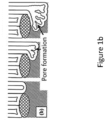
Fig. 1 (b) shows branched pores formed during high frequency anodising; and -
Fig. 2 illustrates the process disclosed in example 1. - In an embodiment of the invention the embedded discrete particles are titanium oxide particles.
- Titanium dioxide (TiO2) exhibits a light refractive index much different than sealed anodic alumina, making it an ideal pigment for obtaining good light scattering. As such, pigments with other chemical compositions can be used, if they possess properties similar to those of titanium dioxide.
- In an embodiment of the invention the particle size of the embedded discrete particles is in the range 100-500 nm, preferably in the range 150-400 nm, such as 200-300 nm. The size of TiOz particles should preferably be 200-300 nm to secure light scattering of all visible wavelengths, making the surface perceived as white.
- In an embodiment of the invention the aluminium or aluminium alloy comprises at least 95% by weight of aluminium, preferably at least 96% by weight of aluminium, such as at least 97% by weight of aluminium, such as at least 98% by weight of aluminium, more preferably at least 99% by weight of aluminium.
- A pure aluminium alloy is required for the anodic film to become as optically transparent as possible. Alloying elements such as Fe, Mn and Cu must be kept to an absolute minimum, knowing that these elements will give rise to a certain degree of light absorption, which will compromise the anodic film whiteness. Using an alloy with a composition equivalent to a 6060 (or even purer), has proven to give good results.
- In an embodiment of the invention the discrete particles of a metal or metal oxide are embedded by a solid state process.
- Non-limiting examples of solid state processes include a solid state process selected from the group consisting of friction stir processing (FSP), additive friction stir processing (AFSP), and powder metallurgy.
- Friction stir processing (FSP) is a solid state process known for its ability to modify microstructures and provide improved properties over conventional processing technologies. The development of friction stir processing (FSP) is based on the friction stir welding (FSW) technology. FSW works by plunging a spinning tool into the joint of two materials and then traversing the rotating tool along the interface. The friction caused by the tool heats up the materials around the pin to a temperature below the melting point. The rotation of the tool "stirs" the material together and results in a mixture of the two materials. In FSP a specially designed rotating pin is first inserted into the material to be processed with a proper tool tilt angle and then moved along the programmed paths. The pin produces frictional and plastic deformation heating within the processing zone. As the tool pin moves, materials are forced to flow around the pin. Material flows to the back of the pin, where it is extruded and forged behind the tool. It is evident that FSW and FSP share the same mechanism, however, have completely different purposes in practical applications. The goal of FSW is to join two plates together, whereas FSP aims at modifying the microstructure of a single or multiple workpieces.
- Additionally, FSP has emerged as an advanced tool to produce surface composites by embedding second phase particles into the matrix. It is exactly this feature that is utilized in this patent application as to embed white pigments into the aluminium bulk, considering that the FSP process has the required advantages of:
- i) Maintaining a sufficiently low temperature to avoid a critical reaction between pigment and aluminium;
- ii) Being able to remove excess heat via a Heat Sink, again to avoid a reaction between pigment and aluminium;
- iii) Securing a homogenous and individual distribution of pigments within the aluminium matrix; and
- iv) Leaving the pigments in a functional state.
- Whereas Friction Stir Processing (FSP) is a very time-consuming batch process, Additive Friction Stir Processing (AFSP) has emerged to create a continuous process, where particles are fed to the material through a hollow spinning tool. Not only is this a much faster (and non-batch) process, it also allows for much higher particle loadings.
- Even though AFSP is the preferred technique for embedding white pigments into an aluminium matrix, other techniques are also available. An further example of solid state processing (route 2) is powder metallurgy, where pigments are mechanically alloyed into the aluminium powder. The composite powder is subsequently compressed and shaped in a normal powder metal route such as forging, cold isostatic pressing (CIP), hot isostatic pressing (HIP), direct profile extrusion, direct rolling of sheets, cold spraying, thermal spraying etc.
- In another embodiment of the invention the discrete particles of a metal or metal oxide are embedded by a liquid state process, such as e.g. Stir Casting or Investment Casting.
- In another embodiment of the invention the discrete particles of a metal or metal oxide are embedded by a vapour state process such as e.g. Physical Vapour Deposition (PVD) or Chemical Vapour Deposition (CVD).
- As such, any of the above major processing routes can be used, as long as they fulfil the considerations mentioned above. Anodizing secures the conversion of aluminium into aluminium oxide. The pigments which were embedded into the top aluminium layer will become embedded into the aluminium oxide after anodizing.
- The difference in refractive index between the anodic oxide and the white pigments secures scattering of all visible wavelengths that finally makes the anodized surface appear white.
- Anodic films are traditionally formed by passing a direct current (DC) through an electrolyte, with the aluminium part working as the anode and a suitable material serving as the cathode. However, DC anodizing has proven problematic in anodizing the aforementioned composite alloy, due to the regions that are underneath each individual pigment. Anodic pores formed through a DC process are almost completely parallel and do not reach the regions underneath the pigments. This leaves an anodic film with embedded pigments that have a small area of non-anodized aluminium underneath them. In turn this is a very unfortunate situation, considering the light absorption properties of metallic aluminium, which finally makes the entire anodic film be perceived as dark rather than white.
- High Frequency Anodizing has proven much more advantageous compared to traditional DC anodizing, due to the branching nature of the pores, which extend all the way underneath each individual pigment. This will secure an anodic film entirely depleted of non-anodized aluminium, as shown in
Figure 1 . - Like traditional hard anodizing the white anodizing must be carried out at low temperature and in low-aggressive electrolyte to decrease the degree of pore wall attack.
- The electrolyte used in an anodising process is traditionally water based and has an active content of acid. Almost all weak and strong organic acids can function as an electrolyte in the anodizing step of the process according to the invention.
- In an embodiment of the invention the anodising of step b. takes place in an aqueous solution of an organic acid selected from the group consisting of oxalic acid, succinic acid, tartaric acid, malic acid, maleic acid, formic acid, citric acid and acetic acid. In a preferred embodiment of the invention the anodising of step b. takes place in an aqueous solution of an organic acid selected from the group consisting of oxalic acid, formic acid and citric acid, preferably oxalic acid.
- The high frequency signal, which is a time varying signal, may comprise a square wave signal having pulses with amplitudes between -5 V and +5 V in the low period and between +15 V and 100 V in the high period. Moreover, the voltage ramp up/down times of the pulses may be in the range between 0 and 15% of the ideal square wave pulse duration. The frequency of the square wave signal may typically be around 1 kHz.
- The thickness of the anodized film determines how white the surface appears. To secure a total white light scattering effect in the visible spectrum - normally about 100µm oxide is necessary. Thus in an embodiment of the invention the thickness of the anodized film is in the range 50-300 µm, such as about 75-200 µm, preferably in the range 100-150 µm, such as in the range 80-130 µm.
- The pigment concentration determines how white the surface appears. Thus in an embodiment of the invention the pigment concentration is in the range 2-25 wt%, such as about 5-20 wt%, preferably in the range 10-15 wt%.
- The anodizing parameters will determine the quality of the anodized film. Thus. optical properties can be characterized by a standard spectrophotometer, where the degree of reflected light is measured.
- Hardness can be measured with a standard microhardness testing unit, where a diamond indenter is pressed into the surface. The diagonal (in case of Vickers hardness testing) of the resulting indentation gives a figure for the surface hardness.
- Tribological properties can be found by a standardised wear tester such as a ball-on-disc setup.
- The thick anodic film obtained above may be slightly dissolved in the upper part because of the prolonged exposure to the acid electrolyte, a phenomenon known as "pore wall attack".
- The porous oxide can be stabilized by impregnating it with an agent that fills the anodic pores.
- Thus, in an embodiment of the method according to the invention the method comprises a further step of impregnating the anodised aluminium oxide layer.
- In an embodiment of the invention said impregnation is performed by means of an impregnating substance selected from the group consisting of a silicate, a lacquer, and a sol-gel substance. Non-limiting examples of lacquers and sol-gel substances include acrylics, silanes and silane based sol-gels.
- Aluminium plates with dimensions 200 mm × 60 mm× 6 mm were used for the FSP trials. Commercial TiOz powder in rutile phase was used. The median diameter of the powder particles was 210 nm. Processing the FSP process was performed using a hermle milling machine equipped with a steel tool having 20 mm shoulder diameter, 1.5 mm pin length with a m6 thread. The backwards tilt angle of the tool was maintained at 1°. A groove 0.5 mm deep, 10 mm wide, and 180 mm long in the Al plates which was compactly filled with TiOz powder. The filled plates were then covered by the same Al sheet rolled down to a thickness of 0.25mm to prevent loss of TiOz powder during the initial FSP pass. Rotational speed of the tool was 1000 rpm and the advancing speed was 200 mm/min for the first pass to insure correct closure of the groove and 1000 mm/min for the next six passes. A surface of 175 mm long × 20 mm wide was processed for each pass with a total processing time of roughly 2 min. All seven passes were performed one over the other without any shift. The samples were then mechanically polished, buffed to a mirror finish and then degreased in a mild alkaline solution at 60°C. The samples were subsequently desmutted by immersing in diluted HNOs followed by demineralized water rinsing. Anodising was carried out in a saturated oxalic acid bath maintained at 10°C. A square wave high frequency signal of 1 kHz from 0 to 40V was applied, with a controlled ramp up/down duration which corresponds to 10% of the pulse duration. The process continues until the film thickness has grown to approximately 100µm. After anodising the surface appears white, with both specular and diffuse reflections. The sample is rinsed and transferred to a hot water sealing tank for closing the open-pored anodic structure. The process is illustrated in
Fig. 2 .
Claims (13)
- A method to obtain a reflective anodised aluminium surface on an object, comprising the steps:a. Providing the object with a top layer comprising aluminium or an aluminium alloy, the top layer comprising embedded discrete particles of titanium or titanium oxide,b. Subsequently anodising said top layer to form an anodic oxide layer, wherein said anodising of step b. takes place by applying a time varying signal comprising a high frequency signal in the form of a square wave signal having a frequency between 500 Hz and 5 kHz, such as around 1 kHz;characterized in that said anodising of step b. takes place in an aqueous solution of an organic acid.
- The method according to any one of the preceding claims, wherein the particle size of the embedded discrete particles is in the range 100-500 nm, preferably in the range 150-400 nm, such as 200-300 nm.
- The method according to any one of the preceding claims, wherein the aluminium or aluminium alloy comprises at least 95% by weight of aluminium, preferably at least 96% by weight of aluminium, such as at least 97% by weight of aluminium, such as at least 98% by weight of aluminium, more preferably at least 99% by weight of aluminium.
- The method according to any one of the preceding claims, wherein the discrete particles of titanium or titanium oxide are embedded by a solid state process.
- The method according to claim 4, wherein said solid state process is a process selected from the group consisting of friction stir processing (FSP), additive friction stir processing (AFSP), and powder metallurgy.
- The method according to any one of claims 1-4, wherein the discrete particles of titanium or titanium oxide are embedded by a liquid state process.
- The method according to any one of claims 1-4, wherein the discrete particles of titanium or titanium oxide are embedded by a vapour state process.
- The method according to any one of the preceding claims, wherein the anodising of step b. takes place in an aqueous solution of an organic acid selected from the group consisting of oxalic acid, succinic acid, tartaric acid, malic acid, maleic acid, formic acid, citric acid and acetic acid.
- The method according to claim 8, wherein the organic acid is selected from the group consisting of oxalic acid, succinic acid, tartaric acid, malic acid, maleic acid, and citric acid.
- The method according to claim 1, wherein the square wave signal has an amplitude between - 5 V and 100 V, such as between 0 V and 40 V.
- The method according to claim 1 or 10, wherein the square wave signal comprises ramp up and/or ramp down times between 0 and 15 % of a pulse duration.
- The method according to any one of the preceding claims, further comprising a further step of impregnating the anodised aluminium oxide layer.
- The method according to claim 12, wherein said impregnation is performed by means of an impregnating substance selected from the group consisting of a silicate, a lacquer, and a sol-gel substance.
Applications Claiming Priority (2)
| Application Number | Priority Date | Filing Date | Title |
|---|---|---|---|
| DKPA201600250 | 2016-04-27 | ||
| PCT/EP2016/061383 WO2017186315A1 (en) | 2016-04-27 | 2016-05-20 | Highly reflecting anodised al surfaces with tailored diffuse and specular content |
Publications (2)
| Publication Number | Publication Date |
|---|---|
| EP3430185A1 EP3430185A1 (en) | 2019-01-23 |
| EP3430185B1 true EP3430185B1 (en) | 2023-02-22 |
Family
ID=56116398
Family Applications (1)
| Application Number | Title | Priority Date | Filing Date |
|---|---|---|---|
| EP16727968.6A Active EP3430185B1 (en) | 2016-04-27 | 2016-05-20 | Highly reflecting anodised al surfaces with tailored diffuse and specular content |
Country Status (6)
| Country | Link |
|---|---|
| US (1) | US20190136399A1 (en) |
| EP (1) | EP3430185B1 (en) |
| CN (1) | CN109072473B (en) |
| DK (1) | DK3430185T3 (en) |
| HK (1) | HK1259273A1 (en) |
| WO (1) | WO2017186315A1 (en) |
Families Citing this family (1)
| Publication number | Priority date | Publication date | Assignee | Title |
|---|---|---|---|---|
| CN113943960B (en) * | 2020-07-16 | 2023-05-16 | 北京小米移动软件有限公司 | Metal shell, manufacturing method thereof and electronic equipment |
Family Cites Families (16)
| Publication number | Priority date | Publication date | Assignee | Title |
|---|---|---|---|---|
| JPS4916636A (en) * | 1972-06-07 | 1974-02-14 | ||
| DE69010531T2 (en) * | 1989-03-22 | 1995-02-23 | Alcan Int Ltd | Optical interference structures that contain porous films. |
| JP2004035930A (en) | 2002-07-02 | 2004-02-05 | Suzuki Motor Corp | Aluminum alloy material and its anodic oxidation method |
| US7838120B2 (en) | 2004-08-20 | 2010-11-23 | Suzuki Motor Corporation | Anodic oxide film |
| CN100383292C (en) * | 2004-12-29 | 2008-04-23 | 湖南大学 | An anodizing treatment method for generating ceramic film on the surface of aluminum and its alloy materials |
| JP2007154301A (en) | 2005-11-30 | 2007-06-21 | Idx Corp | Aluminum alloy anodic oxidation method and power source for aluminum alloy anodic oxidation |
| TW200804629A (en) | 2006-07-05 | 2008-01-16 | Idx Corp | Power supply for anodizing |
| JP5207124B2 (en) | 2008-03-24 | 2013-06-12 | スズキ株式会社 | Anodizing method |
| CN101392397B (en) * | 2008-10-21 | 2011-04-20 | 湖南大学 | Electrochemistry processing method for generating oxide film on surface of aluminium or aluminium alloy material |
| EP2649224B1 (en) | 2010-12-06 | 2016-03-23 | Bang & Olufsen A/S | A method to obtain a radiation scattering surface finish on an object |
| CN102834551B (en) * | 2011-03-08 | 2015-07-01 | 纳米及先进材料研发院有限公司 | Method for producing white anodized aluminum |
| WO2013192579A1 (en) * | 2012-06-22 | 2013-12-27 | Apple Inc. | White appearing anodized films and methods for forming the same |
| CN103014808B (en) * | 2012-12-14 | 2015-07-29 | 中国计量学院 | The method of aluminium alloy anode oxide film is prepared with tartrate anodic oxidation |
| US9512536B2 (en) * | 2013-09-27 | 2016-12-06 | Apple Inc. | Methods for forming white anodized films by metal complex infusion |
| EP3063314B1 (en) * | 2013-10-30 | 2023-06-14 | Apple Inc. | Methods for producing white appearing metal oxide films by positioning reflective particles prior to or during anodizing processes |
| US9181629B2 (en) * | 2013-10-30 | 2015-11-10 | Apple Inc. | Methods for producing white appearing metal oxide films by positioning reflective particles prior to or during anodizing processes |
-
2016
- 2016-05-20 US US16/096,167 patent/US20190136399A1/en not_active Abandoned
- 2016-05-20 CN CN201680084961.2A patent/CN109072473B/en active Active
- 2016-05-20 HK HK19101634.9A patent/HK1259273A1/en unknown
- 2016-05-20 DK DK16727968.6T patent/DK3430185T3/en active
- 2016-05-20 WO PCT/EP2016/061383 patent/WO2017186315A1/en not_active Ceased
- 2016-05-20 EP EP16727968.6A patent/EP3430185B1/en active Active
Also Published As
| Publication number | Publication date |
|---|---|
| EP3430185A1 (en) | 2019-01-23 |
| CN109072473B (en) | 2021-03-30 |
| WO2017186315A1 (en) | 2017-11-02 |
| HK1259273A1 (en) | 2019-11-29 |
| US20190136399A1 (en) | 2019-05-09 |
| CN109072473A (en) | 2018-12-21 |
| DK3430185T3 (en) | 2023-04-24 |
Similar Documents
| Publication | Publication Date | Title |
|---|---|---|
| EP2649224B1 (en) | A method to obtain a radiation scattering surface finish on an object | |
| CN105492662B (en) | Method for forming a white anodized film by metal complex implantation | |
| JP6491623B2 (en) | White-like anodic oxide film and method for forming the same | |
| EP0824154B1 (en) | Reflector with resistant surface | |
| US4066816A (en) | Electrolytic coloring of anodized aluminium by means of optical interference effects | |
| US7122107B2 (en) | Color stabilization of anodized aluminum alloys | |
| US7166205B2 (en) | Method for producing hard surface, colored, anodized aluminum parts | |
| EP0902105B1 (en) | Multilayer antisticking coating of improved hardness for aluminium support, articles and kitchen utensils having this coating | |
| CN115917053B (en) | Methods of applying coloring coatings to alloys | |
| Liu et al. | Particle size influences on the coating microstructure through green chromia inclusion in plasma electrolytic oxidation | |
| US20150118512A1 (en) | Methods for producing white appearing metal oxide films by positioning reflective particles prior to or during anodizing processes | |
| CN106191564B (en) | House ornamentation dark DE Specular Lighting pool aluminium alloy and its preparation process | |
| CH689065A5 (en) | Aluminiumoberflaechen for lighting purposes. | |
| US20190136399A1 (en) | Highly reflecting anodised al surfaces with tailored diffuse and specular content | |
| EP0823496A1 (en) | Process for producing ceramic layer by plasma enhanced electrolysis and product thereof | |
| Gudla et al. | High frequency anodising of aluminium–TiO2 surface composites: Anodising behaviour and optical appearance | |
| US20030057100A1 (en) | Method of producing bright anodized finishes for high magnesium, aluminum alloys | |
| EP3063314B1 (en) | Methods for producing white appearing metal oxide films by positioning reflective particles prior to or during anodizing processes | |
| Stevenson Jr | Anodizing | |
| WO2025222795A1 (en) | Rare earth-based electrolytic coloring method and alloy product | |
| CN216585268U (en) | Anodized aluminum alloy rim | |
| FR2465801A1 (en) | PROCESS FOR PRODUCING ANODIZED ALUMINUM OBJECTS IN COLOR | |
| WO2020165319A1 (en) | Method for producing a corrosion-resistant aluminum-silicon alloy casting, such corrosion-resistant aluminum-silicon alloy casting and its use | |
| EP2798098B1 (en) | A composition for pre-treatment of an aluminum surface, a method for preparing and applying the composition, use of the composition and a product | |
| FR3150213A3 (en) | Process for treating an aluminum or aluminum alloy part, part obtained by implementing such a process, and anodizing bath for implementing such a process |
Legal Events
| Date | Code | Title | Description |
|---|---|---|---|
| STAA | Information on the status of an ep patent application or granted ep patent |
Free format text: STATUS: THE INTERNATIONAL PUBLICATION HAS BEEN MADE |
|
| PUAI | Public reference made under article 153(3) epc to a published international application that has entered the european phase |
Free format text: ORIGINAL CODE: 0009012 |
|
| STAA | Information on the status of an ep patent application or granted ep patent |
Free format text: STATUS: REQUEST FOR EXAMINATION WAS MADE |
|
| 17P | Request for examination filed |
Effective date: 20181015 |
|
| AK | Designated contracting states |
Kind code of ref document: A1 Designated state(s): AL AT BE BG CH CY CZ DE DK EE ES FI FR GB GR HR HU IE IS IT LI LT LU LV MC MK MT NL NO PL PT RO RS SE SI SK SM TR |
|
| AX | Request for extension of the european patent |
Extension state: BA ME |
|
| DAV | Request for validation of the european patent (deleted) | ||
| DAX | Request for extension of the european patent (deleted) | ||
| REG | Reference to a national code |
Ref country code: HK Ref legal event code: DE Ref document number: 1259273 Country of ref document: HK |
|
| RAP1 | Party data changed (applicant data changed or rights of an application transferred) |
Owner name: BANG & OLUFSEN A/S |
|
| STAA | Information on the status of an ep patent application or granted ep patent |
Free format text: STATUS: EXAMINATION IS IN PROGRESS |
|
| 17Q | First examination report despatched |
Effective date: 20210909 |
|
| GRAP | Despatch of communication of intention to grant a patent |
Free format text: ORIGINAL CODE: EPIDOSNIGR1 |
|
| STAA | Information on the status of an ep patent application or granted ep patent |
Free format text: STATUS: GRANT OF PATENT IS INTENDED |
|
| RIC1 | Information provided on ipc code assigned before grant |
Ipc: C25D 11/04 20060101ALI20220824BHEP Ipc: C25D 11/14 20060101ALI20220824BHEP Ipc: C25D 11/10 20060101ALI20220824BHEP Ipc: C25D 11/02 20060101AFI20220824BHEP |
|
| INTG | Intention to grant announced |
Effective date: 20220912 |
|
| GRAS | Grant fee paid |
Free format text: ORIGINAL CODE: EPIDOSNIGR3 |
|
| GRAA | (expected) grant |
Free format text: ORIGINAL CODE: 0009210 |
|
| STAA | Information on the status of an ep patent application or granted ep patent |
Free format text: STATUS: THE PATENT HAS BEEN GRANTED |
|
| AK | Designated contracting states |
Kind code of ref document: B1 Designated state(s): AL AT BE BG CH CY CZ DE DK EE ES FI FR GB GR HR HU IE IS IT LI LT LU LV MC MK MT NL NO PL PT RO RS SE SI SK SM TR |
|
| REG | Reference to a national code |
Ref country code: GB Ref legal event code: FG4D |
|
| REG | Reference to a national code |
Ref country code: CH Ref legal event code: EP |
|
| REG | Reference to a national code |
Ref country code: DE Ref legal event code: R096 Ref document number: 602016077927 Country of ref document: DE |
|
| REG | Reference to a national code |
Ref country code: AT Ref legal event code: REF Ref document number: 1549572 Country of ref document: AT Kind code of ref document: T Effective date: 20230315 Ref country code: IE Ref legal event code: FG4D |
|
| REG | Reference to a national code |
Ref country code: DK Ref legal event code: T3 Effective date: 20230421 |
|
| REG | Reference to a national code |
Ref country code: LT Ref legal event code: MG9D |
|
| REG | Reference to a national code |
Ref country code: NL Ref legal event code: MP Effective date: 20230222 |
|
| REG | Reference to a national code |
Ref country code: AT Ref legal event code: MK05 Ref document number: 1549572 Country of ref document: AT Kind code of ref document: T Effective date: 20230222 |
|
| PG25 | Lapsed in a contracting state [announced via postgrant information from national office to epo] |
Ref country code: RS Free format text: LAPSE BECAUSE OF FAILURE TO SUBMIT A TRANSLATION OF THE DESCRIPTION OR TO PAY THE FEE WITHIN THE PRESCRIBED TIME-LIMIT Effective date: 20230222 Ref country code: PT Free format text: LAPSE BECAUSE OF FAILURE TO SUBMIT A TRANSLATION OF THE DESCRIPTION OR TO PAY THE FEE WITHIN THE PRESCRIBED TIME-LIMIT Effective date: 20230622 Ref country code: NO Free format text: LAPSE BECAUSE OF FAILURE TO SUBMIT A TRANSLATION OF THE DESCRIPTION OR TO PAY THE FEE WITHIN THE PRESCRIBED TIME-LIMIT Effective date: 20230522 Ref country code: NL Free format text: LAPSE BECAUSE OF FAILURE TO SUBMIT A TRANSLATION OF THE DESCRIPTION OR TO PAY THE FEE WITHIN THE PRESCRIBED TIME-LIMIT Effective date: 20230222 Ref country code: LV Free format text: LAPSE BECAUSE OF FAILURE TO SUBMIT A TRANSLATION OF THE DESCRIPTION OR TO PAY THE FEE WITHIN THE PRESCRIBED TIME-LIMIT Effective date: 20230222 Ref country code: LT Free format text: LAPSE BECAUSE OF FAILURE TO SUBMIT A TRANSLATION OF THE DESCRIPTION OR TO PAY THE FEE WITHIN THE PRESCRIBED TIME-LIMIT Effective date: 20230222 Ref country code: HR Free format text: LAPSE BECAUSE OF FAILURE TO SUBMIT A TRANSLATION OF THE DESCRIPTION OR TO PAY THE FEE WITHIN THE PRESCRIBED TIME-LIMIT Effective date: 20230222 Ref country code: ES Free format text: LAPSE BECAUSE OF FAILURE TO SUBMIT A TRANSLATION OF THE DESCRIPTION OR TO PAY THE FEE WITHIN THE PRESCRIBED TIME-LIMIT Effective date: 20230222 Ref country code: AT Free format text: LAPSE BECAUSE OF FAILURE TO SUBMIT A TRANSLATION OF THE DESCRIPTION OR TO PAY THE FEE WITHIN THE PRESCRIBED TIME-LIMIT Effective date: 20230222 |
|
| P01 | Opt-out of the competence of the unified patent court (upc) registered |
Effective date: 20230703 |
|
| PG25 | Lapsed in a contracting state [announced via postgrant information from national office to epo] |
Ref country code: SE Free format text: LAPSE BECAUSE OF FAILURE TO SUBMIT A TRANSLATION OF THE DESCRIPTION OR TO PAY THE FEE WITHIN THE PRESCRIBED TIME-LIMIT Effective date: 20230222 Ref country code: PL Free format text: LAPSE BECAUSE OF FAILURE TO SUBMIT A TRANSLATION OF THE DESCRIPTION OR TO PAY THE FEE WITHIN THE PRESCRIBED TIME-LIMIT Effective date: 20230222 Ref country code: IS Free format text: LAPSE BECAUSE OF FAILURE TO SUBMIT A TRANSLATION OF THE DESCRIPTION OR TO PAY THE FEE WITHIN THE PRESCRIBED TIME-LIMIT Effective date: 20230622 Ref country code: GR Free format text: LAPSE BECAUSE OF FAILURE TO SUBMIT A TRANSLATION OF THE DESCRIPTION OR TO PAY THE FEE WITHIN THE PRESCRIBED TIME-LIMIT Effective date: 20230523 Ref country code: FI Free format text: LAPSE BECAUSE OF FAILURE TO SUBMIT A TRANSLATION OF THE DESCRIPTION OR TO PAY THE FEE WITHIN THE PRESCRIBED TIME-LIMIT Effective date: 20230222 |
|
| PG25 | Lapsed in a contracting state [announced via postgrant information from national office to epo] |
Ref country code: SM Free format text: LAPSE BECAUSE OF FAILURE TO SUBMIT A TRANSLATION OF THE DESCRIPTION OR TO PAY THE FEE WITHIN THE PRESCRIBED TIME-LIMIT Effective date: 20230222 Ref country code: RO Free format text: LAPSE BECAUSE OF FAILURE TO SUBMIT A TRANSLATION OF THE DESCRIPTION OR TO PAY THE FEE WITHIN THE PRESCRIBED TIME-LIMIT Effective date: 20230222 Ref country code: EE Free format text: LAPSE BECAUSE OF FAILURE TO SUBMIT A TRANSLATION OF THE DESCRIPTION OR TO PAY THE FEE WITHIN THE PRESCRIBED TIME-LIMIT Effective date: 20230222 Ref country code: CZ Free format text: LAPSE BECAUSE OF FAILURE TO SUBMIT A TRANSLATION OF THE DESCRIPTION OR TO PAY THE FEE WITHIN THE PRESCRIBED TIME-LIMIT Effective date: 20230222 |
|
| REG | Reference to a national code |
Ref country code: DE Ref legal event code: R097 Ref document number: 602016077927 Country of ref document: DE |
|
| PG25 | Lapsed in a contracting state [announced via postgrant information from national office to epo] |
Ref country code: SK Free format text: LAPSE BECAUSE OF FAILURE TO SUBMIT A TRANSLATION OF THE DESCRIPTION OR TO PAY THE FEE WITHIN THE PRESCRIBED TIME-LIMIT Effective date: 20230222 |
|
| PLBE | No opposition filed within time limit |
Free format text: ORIGINAL CODE: 0009261 |
|
| REG | Reference to a national code |
Ref country code: CH Ref legal event code: PL |
|
| STAA | Information on the status of an ep patent application or granted ep patent |
Free format text: STATUS: NO OPPOSITION FILED WITHIN TIME LIMIT |
|
| PG25 | Lapsed in a contracting state [announced via postgrant information from national office to epo] |
Ref country code: MC Free format text: LAPSE BECAUSE OF FAILURE TO SUBMIT A TRANSLATION OF THE DESCRIPTION OR TO PAY THE FEE WITHIN THE PRESCRIBED TIME-LIMIT Effective date: 20230222 |
|
| REG | Reference to a national code |
Ref country code: BE Ref legal event code: MM Effective date: 20230531 |
|
| 26N | No opposition filed |
Effective date: 20231123 |
|
| PG25 | Lapsed in a contracting state [announced via postgrant information from national office to epo] |
Ref country code: SI Free format text: LAPSE BECAUSE OF FAILURE TO SUBMIT A TRANSLATION OF THE DESCRIPTION OR TO PAY THE FEE WITHIN THE PRESCRIBED TIME-LIMIT Effective date: 20230222 Ref country code: MC Free format text: LAPSE BECAUSE OF FAILURE TO SUBMIT A TRANSLATION OF THE DESCRIPTION OR TO PAY THE FEE WITHIN THE PRESCRIBED TIME-LIMIT Effective date: 20230222 Ref country code: LU Free format text: LAPSE BECAUSE OF NON-PAYMENT OF DUE FEES Effective date: 20230520 Ref country code: LI Free format text: LAPSE BECAUSE OF NON-PAYMENT OF DUE FEES Effective date: 20230531 Ref country code: CH Free format text: LAPSE BECAUSE OF NON-PAYMENT OF DUE FEES Effective date: 20230531 |
|
| REG | Reference to a national code |
Ref country code: IE Ref legal event code: MM4A |
|
| PG25 | Lapsed in a contracting state [announced via postgrant information from national office to epo] |
Ref country code: IE Free format text: LAPSE BECAUSE OF NON-PAYMENT OF DUE FEES Effective date: 20230520 |
|
| PG25 | Lapsed in a contracting state [announced via postgrant information from national office to epo] |
Ref country code: IE Free format text: LAPSE BECAUSE OF NON-PAYMENT OF DUE FEES Effective date: 20230520 |
|
| PG25 | Lapsed in a contracting state [announced via postgrant information from national office to epo] |
Ref country code: IT Free format text: LAPSE BECAUSE OF FAILURE TO SUBMIT A TRANSLATION OF THE DESCRIPTION OR TO PAY THE FEE WITHIN THE PRESCRIBED TIME-LIMIT Effective date: 20230222 Ref country code: FR Free format text: LAPSE BECAUSE OF NON-PAYMENT OF DUE FEES Effective date: 20230531 Ref country code: BE Free format text: LAPSE BECAUSE OF NON-PAYMENT OF DUE FEES Effective date: 20230531 |
|
| PG25 | Lapsed in a contracting state [announced via postgrant information from national office to epo] |
Ref country code: BG Free format text: LAPSE BECAUSE OF FAILURE TO SUBMIT A TRANSLATION OF THE DESCRIPTION OR TO PAY THE FEE WITHIN THE PRESCRIBED TIME-LIMIT Effective date: 20230222 |
|
| PG25 | Lapsed in a contracting state [announced via postgrant information from national office to epo] |
Ref country code: BG Free format text: LAPSE BECAUSE OF FAILURE TO SUBMIT A TRANSLATION OF THE DESCRIPTION OR TO PAY THE FEE WITHIN THE PRESCRIBED TIME-LIMIT Effective date: 20230222 |
|
| PGFP | Annual fee paid to national office [announced via postgrant information from national office to epo] |
Ref country code: DE Payment date: 20250520 Year of fee payment: 10 |
|
| PGFP | Annual fee paid to national office [announced via postgrant information from national office to epo] |
Ref country code: GB Payment date: 20250519 Year of fee payment: 10 Ref country code: DK Payment date: 20250522 Year of fee payment: 10 |
|
| PG25 | Lapsed in a contracting state [announced via postgrant information from national office to epo] |
Ref country code: CY Free format text: LAPSE BECAUSE OF FAILURE TO SUBMIT A TRANSLATION OF THE DESCRIPTION OR TO PAY THE FEE WITHIN THE PRESCRIBED TIME-LIMIT; INVALID AB INITIO Effective date: 20160520 |
|
| PG25 | Lapsed in a contracting state [announced via postgrant information from national office to epo] |
Ref country code: HU Free format text: LAPSE BECAUSE OF FAILURE TO SUBMIT A TRANSLATION OF THE DESCRIPTION OR TO PAY THE FEE WITHIN THE PRESCRIBED TIME-LIMIT; INVALID AB INITIO Effective date: 20160520 |
|
| PG25 | Lapsed in a contracting state [announced via postgrant information from national office to epo] |
Ref country code: TR Free format text: LAPSE BECAUSE OF FAILURE TO SUBMIT A TRANSLATION OF THE DESCRIPTION OR TO PAY THE FEE WITHIN THE PRESCRIBED TIME-LIMIT Effective date: 20230222 |
|
| REG | Reference to a national code |
Ref country code: HK Ref legal event code: WD Ref document number: 1259273 Country of ref document: HK |