EP3428297A1 - Ni-BASED UNIDIRECTIONALLY SOLIDIFIED ALLOY - Google Patents
Ni-BASED UNIDIRECTIONALLY SOLIDIFIED ALLOY Download PDFInfo
- Publication number
- EP3428297A1 EP3428297A1 EP17763149.6A EP17763149A EP3428297A1 EP 3428297 A1 EP3428297 A1 EP 3428297A1 EP 17763149 A EP17763149 A EP 17763149A EP 3428297 A1 EP3428297 A1 EP 3428297A1
- Authority
- EP
- European Patent Office
- Prior art keywords
- mass
- less
- directionally solidified
- solidified alloy
- temperature
- Prior art date
- Legal status (The legal status is an assumption and is not a legal conclusion. Google has not performed a legal analysis and makes no representation as to the accuracy of the status listed.)
- Granted
Links
Images


Classifications
-
- C—CHEMISTRY; METALLURGY
- C22—METALLURGY; FERROUS OR NON-FERROUS ALLOYS; TREATMENT OF ALLOYS OR NON-FERROUS METALS
- C22C—ALLOYS
- C22C19/00—Alloys based on nickel or cobalt
- C22C19/03—Alloys based on nickel or cobalt based on nickel
- C22C19/05—Alloys based on nickel or cobalt based on nickel with chromium
- C22C19/051—Alloys based on nickel or cobalt based on nickel with chromium and Mo or W
- C22C19/056—Alloys based on nickel or cobalt based on nickel with chromium and Mo or W with the maximum Cr content being at least 10% but less than 20%
-
- C—CHEMISTRY; METALLURGY
- C22—METALLURGY; FERROUS OR NON-FERROUS ALLOYS; TREATMENT OF ALLOYS OR NON-FERROUS METALS
- C22C—ALLOYS
- C22C19/00—Alloys based on nickel or cobalt
- C22C19/03—Alloys based on nickel or cobalt based on nickel
- C22C19/05—Alloys based on nickel or cobalt based on nickel with chromium
-
- C—CHEMISTRY; METALLURGY
- C22—METALLURGY; FERROUS OR NON-FERROUS ALLOYS; TREATMENT OF ALLOYS OR NON-FERROUS METALS
- C22C—ALLOYS
- C22C19/00—Alloys based on nickel or cobalt
- C22C19/03—Alloys based on nickel or cobalt based on nickel
- C22C19/05—Alloys based on nickel or cobalt based on nickel with chromium
- C22C19/051—Alloys based on nickel or cobalt based on nickel with chromium and Mo or W
- C22C19/057—Alloys based on nickel or cobalt based on nickel with chromium and Mo or W with the maximum Cr content being less 10%
-
- C—CHEMISTRY; METALLURGY
- C30—CRYSTAL GROWTH
- C30B—SINGLE-CRYSTAL GROWTH; UNIDIRECTIONAL SOLIDIFICATION OF EUTECTIC MATERIAL OR UNIDIRECTIONAL DEMIXING OF EUTECTOID MATERIAL; REFINING BY ZONE-MELTING OF MATERIAL; PRODUCTION OF A HOMOGENEOUS POLYCRYSTALLINE MATERIAL WITH DEFINED STRUCTURE; SINGLE CRYSTALS OR HOMOGENEOUS POLYCRYSTALLINE MATERIAL WITH DEFINED STRUCTURE; AFTER-TREATMENT OF SINGLE CRYSTALS OR A HOMOGENEOUS POLYCRYSTALLINE MATERIAL WITH DEFINED STRUCTURE; APPARATUS THEREFOR
- C30B29/00—Single crystals or homogeneous polycrystalline material with defined structure characterised by the material or by their shape
- C30B29/10—Inorganic compounds or compositions
- C30B29/52—Alloys
-
- F—MECHANICAL ENGINEERING; LIGHTING; HEATING; WEAPONS; BLASTING
- F01—MACHINES OR ENGINES IN GENERAL; ENGINE PLANTS IN GENERAL; STEAM ENGINES
- F01D—NON-POSITIVE DISPLACEMENT MACHINES OR ENGINES, e.g. STEAM TURBINES
- F01D25/00—Component parts, details, or accessories, not provided for in, or of interest apart from, other groups
-
- F—MECHANICAL ENGINEERING; LIGHTING; HEATING; WEAPONS; BLASTING
- F01—MACHINES OR ENGINES IN GENERAL; ENGINE PLANTS IN GENERAL; STEAM ENGINES
- F01D—NON-POSITIVE DISPLACEMENT MACHINES OR ENGINES, e.g. STEAM TURBINES
- F01D5/00—Blades; Blade-carrying members; Heating, heat-insulating, cooling or antivibration means on the blades or the members
- F01D5/12—Blades
- F01D5/28—Selecting particular materials; Particular measures relating thereto; Measures against erosion or corrosion
-
- F—MECHANICAL ENGINEERING; LIGHTING; HEATING; WEAPONS; BLASTING
- F02—COMBUSTION ENGINES; HOT-GAS OR COMBUSTION-PRODUCT ENGINE PLANTS
- F02C—GAS-TURBINE PLANTS; AIR INTAKES FOR JET-PROPULSION PLANTS; CONTROLLING FUEL SUPPLY IN AIR-BREATHING JET-PROPULSION PLANTS
- F02C7/00—Features, components parts, details or accessories, not provided for in, or of interest apart form groups F02C1/00 - F02C6/00; Air intakes for jet-propulsion plants
-
- C—CHEMISTRY; METALLURGY
- C22—METALLURGY; FERROUS OR NON-FERROUS ALLOYS; TREATMENT OF ALLOYS OR NON-FERROUS METALS
- C22F—CHANGING THE PHYSICAL STRUCTURE OF NON-FERROUS METALS AND NON-FERROUS ALLOYS
- C22F1/00—Changing the physical structure of non-ferrous metals or alloys by heat treatment or by hot or cold working
-
- C—CHEMISTRY; METALLURGY
- C22—METALLURGY; FERROUS OR NON-FERROUS ALLOYS; TREATMENT OF ALLOYS OR NON-FERROUS METALS
- C22F—CHANGING THE PHYSICAL STRUCTURE OF NON-FERROUS METALS AND NON-FERROUS ALLOYS
- C22F1/00—Changing the physical structure of non-ferrous metals or alloys by heat treatment or by hot or cold working
- C22F1/10—Changing the physical structure of non-ferrous metals or alloys by heat treatment or by hot or cold working of nickel or cobalt or alloys based thereon
-
- C—CHEMISTRY; METALLURGY
- C30—CRYSTAL GROWTH
- C30B—SINGLE-CRYSTAL GROWTH; UNIDIRECTIONAL SOLIDIFICATION OF EUTECTIC MATERIAL OR UNIDIRECTIONAL DEMIXING OF EUTECTOID MATERIAL; REFINING BY ZONE-MELTING OF MATERIAL; PRODUCTION OF A HOMOGENEOUS POLYCRYSTALLINE MATERIAL WITH DEFINED STRUCTURE; SINGLE CRYSTALS OR HOMOGENEOUS POLYCRYSTALLINE MATERIAL WITH DEFINED STRUCTURE; AFTER-TREATMENT OF SINGLE CRYSTALS OR A HOMOGENEOUS POLYCRYSTALLINE MATERIAL WITH DEFINED STRUCTURE; APPARATUS THEREFOR
- C30B11/00—Single-crystal growth by normal freezing or freezing under temperature gradient, e.g. Bridgman-Stockbarger method
Definitions
- the present invention relates to Ni-based directionally solidified alloy that can be used preferably for a member such as a turbine blade and a turbine vane in a jet engine and a gas turbine, which is used at a high temperature and high stress, and particularly relates to Ni-based directionally solidified alloy that does not contain Co or Re as a main element.
- Ni-based alloy has been developed as forging alloy, casting alloy, directionally solidified alloy and single crystal alloy, and its durable temperature has been improved accordingly.
- Ni-based single crystal alloy has superior high temperature strength to that of Ni-based directionally solidified alloy, but has problems of generating longitudinal cracks and anisotropic crystals during casting.
- a larger-sized member of Ni-based single crystal alloy is more likely to be effected by these problems, and its production yield tends to be lower, so that Ni-based directionally solidified alloy is superior in cost performance for the production.
- thermo-mechanical fatigue property commonly have problems in creep property, thermo-mechanical fatigue property and environment-resistant characteristics. Since a rotating member in a turbine blade or the like is rotated at a high speed while being exposed to combustion gas at a high temperature, and centrifugal force is applied to the member, the member is required to endure creep at high stress. Such a high temperature member used for a turbine blade or a turbine vane in a jet engine or a gas turbine also has a problem of material deterioration due to thermos-mechanical fatigue (TMF), because it is often started and stopped. Further, since the high temperature member is exposed to combustion gas at a high temperature, it is expected to find a material having excellent environment-resistant characteristics.
- TMF thermos-mechanical fatigue
- Ni-based directionally solidified alloy As the Ni-based directionally solidified alloy, IN792 (Trade Mark) and Rene80 (Trade Mark) have been known, but both of IN792 and Rene80 contain Co in the alloys. Also, Ni-based alloys described in below-listed Patent Literatures 1, 2, 3, 4, 5, 6 and 7 have been known, but each of the alloys described in these Patent Literatures contains either or both elements of Co and Re in its component. Since Co is produced as a byproduct during the production of copper or nickel, a production amount of Co depends on a price situation of copper or nickel, and supply of Co is accordingly unstable. Re is a metal that is extremely scarce on the earth, and is the most rare and expensive metal among rare metals.
- Ni-based directionally solidified alloy with Re added is difficult to be treated by heat after the casting, and a TCP phase is likely to be deposited and may affect high temperature strength, while it is used as a high temperature member. From these drawbacks, the use of Co or Re is not preferable because of their high temperature properties and cost performance as a large number, in particular.
- Ni-based alloy disclosed in Patent Literature 8 does not contain Co or Re, but is not preferable in the light of cost performance, because it is Ni-based single crystal alloy.
- the present invention has following characteristics.
- Ni-based directionally solidified alloy of the present invention consists of
- Ni-based directionally solidified alloy of the present invention consists of
- Ni-based directionally solidified alloy of the present invention consists of
- the Ni-based directionally solidified alloy of the present invention preferably has a creep life at a temperature of 900°C and stress of 392 MPa that is 65 hours or more, and a number of cycles in a thermo-mechanical fatigue (TMF) property test in predetermined operating conditions that is 155 cycles or more.
- TMF thermo-mechanical fatigue
- the thermo-mechanical fatigue (TMF) property test is performed by simulating operating conditions of a gas turbine, in which a temperature of a surface of a turbine blade is assumed to be 900°C in a steady state and 400°C when the turbine blade stops, and a number of cycles until breaking a test piece that has a predetermined shape is evaluated. Details of the thermo-mechanical fatigue (TMF) property test will be specified in the specification.
- a creep life at the temperature of 900°C and the stress of 392MPa is 65 hours or more and 115 hours or less, and the number of cycles in the TMF property test is 155 cycles or more and 215 cycles or less.
- the creep life at the temperature of 900°C and the stress of 392MPa is 75 hours or more and 105 hours or less, and the number of cycles in the TMF property test is 170 cycles or more and 195 cycles or less.
- the creep life is less than 65 hours, the creep life is not improved compared with those in the conventional examples.
- the creep life exceeding 115 hours is beyond an upper limit of the creep life of the Ni-based directionally solidified alloy of the present invention, even considering the variation of the results of the creep life test.
- thermo-mechanical fatigue (TMF) property test If the number of cycles in the thermo-mechanical fatigue (TMF) property test is less than 155 cycles, the TMF characteristic is not improved compared with those in the conventional examples.
- the number of cycles in the thermo-mechanical fatigue (TMF) property test exceeding 215 cycles is beyond an upper limit of the TMF characteristic of the Ni-based directionally solidified alloy of the present invention, even considering the variation of the results of the thermo-mechanical fatigue (TMF) property test.
- the Ni-based directionally solidified alloy of the present invention preferably has a value of a Larson-Miller parameter at a temperature of 900°C and stress of 392 MPa which is 25.6 or more and 25.9 or less, and a value of a Larson-Miller parameter at a temperature of 1100°C and stress of 137 MPa which is 28.8 or more and 29.3 or less.
- the creep life is not improved compared with those in the conventional examples.
- the value of the Larson-Miller parameter exceeding 25.9 is beyond an upper limit of the Larson-Miller parameter of the Ni-based directionally solidified alloy of the present invention, even considering the variation of the results of the creep life test for obtaining the Larson-Miller parameters.
- the creep life is not improved compared with those in the conventional examples.
- the value of the Larson-Miller parameter exceeding 29.3 is beyond an upper limit of the Larson-Miller parameter of the Ni-based directionally solidified alloy of the present invention, even considering the variation of the results of the creep life test for obtaining the Larson-Miller parameters.
- the Ni-based directionally solidified alloy of the present invention preferably has a durable temperature of 960°C or more and 1010°C or less for a 1000-hour life, which is a creep life obtained from the value of the Larson-Miller parameter at the stress of 137 MPa.
- the 1000-hour life more preferably provides the durable temperature of 970°C or more and 1000°C or less, and most preferably provides the durable temperature of 980°C or more and 990°C or less.
- the durable temperature of the 1000-hour life as the creep life is less than 960°C, the creep life is not improved compared with those in the conventional examples.
- the durable temperature exceeding 1010°C is beyond an upper limit of the creep life of the Ni-based directionally solidified alloy of the present invention, even considering a testing error of the creep life test.
- the change of the weight of the sample is -0.1 [mg/cm 2 ] or more and 0.3 [mg/cm 2 ] or less, and the surface of the sample has metallic luster. More preferably, the change of the weight during the high temperature oxidation test is 0.0 [mg/cm 2 ] or more and 0.2 [mg/cm 2 ] or less.
- the Ni-based directionally solidified alloy of the present invention has excellent TMF characteristics, creep property and environment-resistant characteristics such as high temperature oxidation resistance, and is superior in cost performance in practical use.
- a component and a composition ratio of the Ni-based directionally solidified alloy having the above-described characteristics are based on following points of view.
- Cr chromium improves a high temperature corrosion resistance property and a high temperature oxidation resistance property of Ni-based directionally solidified alloy.
- a composition ratio of Cr is 6% by mass or more and 12% by mass or less. If the composition ratio is less than 6% by mass, it is difficult to secure its high temperature corrosion resistance property and high temperature oxidation resistance property, and if the composition ratio is more than 12% by mass, a toxic phase such as a ⁇ phase and a ⁇ phase is generated so as to decrease its high temperature strength.
- the composition ratio of Cr is preferably 7% by mass or more and 12% by mass or less, and is more preferably 8% by mass or more and 10% by mass or less.
- Mo molybdenum
- a composition ratio of Mo is 0.4% by mass or more and 3.0% by mass or less. If the composition ratio is less than 0.4% by mass, the high temperature strength is decreased, and if the composition ratio is more than 3.0% by mass, a toxic phase is generated so as to decrease the high temperature strength.
- the composition ratio of Mo is preferably 0.4% by mass or more and 2.5% by mass or less, and is more preferably 0.4% by mass or more and 2.0% by mass or less.
- W tungsten
- a composition ratio of W is 6% by mass or more and 10% by mass or less. If the composition ratio is less than 6% by mass, a TMF characteristic and a creep property are deteriorated, and if the composition ratio is more than 10% by mass, a toxic phase is generated so as to deteriorate the TMF characteristic and the creep property.
- the composition ratio of W is preferably 7% by mass or more and 10% by mass or less, and is more preferably 7% by mass or more and 9% by mass or less.
- Al (aluminum) is combined with Ni so as to form an intermetallic compound represented as Ni 3 Al, which constitutes a gamma prime phase to be deposited in a gamma parent phase, thereby improving a TMF characteristic and a creep property particularly at a lower temperature of 1000°C or lower.
- a composition ratio of Al is 4.0% by mass or more and 6.5% by mass or less. If the composition ratio is less than 4% by mass, an amount of the gamma prime phase is small, and the required TMF characteristic and creep property cannot be obtained. On the other hand, if the composition ratio is more than 6.5% by mass, the required TMF characteristic and creep property cannot be obtained.
- a composition ratio of Nb (niobium) is 0% by mass or more and 1% by mass or less. If the composition ratio is more than 1% by mass, a toxic phase is generated at a high temperature so as to deteriorate a TMF characteristic and a creep property.
- Ta (tantalum) strengthens a gamma prime phase and improves a creep property.
- a composition ratio of Ta is 8% by mass or more and 12% by mass or less. If the composition ratio is less than 8% by mass, the required TMF characteristic and creep property cannot be obtained, and if the composition ratio is more than 12% by mass, generation of a eutectic gamma prime phase is promoted, and solution heat treatment becomes difficult.
- the composition ratio of Ta is preferably 9% by mass or more and 11% by mass or less, and is more preferably 10% by mass or more and 11% by mass or less.
- Hf (hafnium) contributes to grain boundary strengthening during columnar crystallization due to directional solidification, enhances oxidation resistance, and may improve a TMF characteristic.
- a composition ratio of Hf is 0% by mass or more and 0.15% by mass or less. If the composition ratio is more than 0.15% by mass, generation of a toxic phase is promoted, and the TMF characteristic and a creep property are deteriorated.
- Si (silicon) generates SiO 2 film on an alloy surface so as to enhance oxidation resistance as protection coating film, and can suppress generation of very small cracks on the alloy surface so as to improve an TMF characteristic.
- a composition ratio of Si is 0.01% by mass or more and 0.2% by mass or less. If the composition is less than 0.01% by mass, effects for enhancing the oxidation resistance and improving the TMF characteristic cannot be obtained. Further, if the composition ratio is more than 0.2% by mass, a solid solubility limit of other element is deteriorated, so that the required TMF characteristic and creep property cannot be obtained.
- Zr zirconium
- a composition ratio of Zr is 0% by mass or more and less than 0.04% by mass.
- B (boron) can improve a creep property, a mechanical fatigue property and the like of Ni-based directionally solidified alloy at a high temperature.
- a composition ratio of B is 0.01% by mass or more and 0.03% by mass or less.
- C carbon
- a composition ratio of C is 0.01% by mass or more and 0. 3% by mass or less.
- the Ni-based directionally solidified alloy can be manufactured by treating a cast product having a predetermined composition by heat as follows. That is, the heat treatment includes: solution treatment for holding the cast product at 1280°C to 1300°C for 2 hours to 40 hours and subsequently cooling it at 200 °C/min to 400 °C/min by air or in inert gas atmosphere; primary aging treatment for holding the cast product at 1000°C to 1150°C for 2 hours to 5 hours and subsequently cooling it by air or in inert gas atmosphere; and secondary aging treatment for holding the cast product at 850°C to 950°C for 10 hours to 30 hours and subsequently cooling it by air or in inert gas atmosphere, which are carried out sequentially.
- Ni-based directionally solidified alloys having compositions (% by mass) listed in Table 1 was melted by a vacuum melting furnace, and was casted in a lost wax mold that was heated and held, and then, the mold was lowered at a solidification rate of 200 mm/h, thereby obtaining a directionally solidified cast product. Thereafter, the obtained directionally solidified cast product was subjected to solution treatment, in which the cast product was held at 1280°C in vacuum for 5 hours and was subsequently cooled at about 300 °C/min by air.
- a temperature range of solution treatment of the Ni-based directionally solidified alloys of Examples 1 and 2 were from 1260°C to 1300°C, and a temperature range of the primary aging treatment was from 1000°C to 1150°C.
- a temperature of the cast product was held at 1280°C for one hour, was increased to 1300°C, and was held for 5 hours, and then, the cast product was cooled by air.
- Heat treatment in Reference Example 3 included: holding a temperature of the cast product at 1130°C for 1 hours, increasing it to 1180°C, holding for 2 hours and cooling it by air; thereafter holding at 1050°C for 4 hours and cooling it by air; and then, holding at 870°C for 20 hours and cooling it by air.
- Heat treatment in Reference Example 4 included: holding a temperature of the cast product at 1147°C for one hour, increasing to 1197°C, holding for 2 hours and cooling by air; subsequently holding at 1050°C for 4 hours and cooling by air; and then, holding at 870°C for 20 hours and cooling it by air.
- the cast product was directly subjected to the test.
- the cast product of the directionally solidified alloy after the heat treatment was processed into a creep test piece with a diameter of a parallel part of 4 mm and a length of 20 mm, and was subjected to a creep test under conditions at 900°C and 392 MPa and at 1100°C and 137 MPa. Further, a TMF test was conducted with respect to a test piece with a diameter of a parallel part of 5 mm and a length of 15 mm, while heating the test piece by high frequency waves. In the TMF test, a temperature range was changed from 400°C that was a lower limit to 900°C that was a higher limit, and ⁇ 0.64% of stress was applied to the test piece according to this temperature change.
- a frequency was 66 min per one cycle, a wave form was a triangular wave, and the test piece was held for 60 min during its compression.
- These test conditions simulated operating conditions of a gas turbine, and were based on an assumption that a surface temperature of a turbine blade was 900°C in a steady state and was 400°C at the time of stopping. Further, an increasing/decreasing rate of the temperature was 166.7 °C/min.
- the TMF characteristic was evaluated by the number of cycles until the test piece was broken.
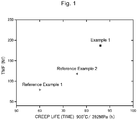
- Fig. 1 shows results of the creep tests at 900°C and 392 MPa and the TMF test, which were conducted with respect to the Ni-based directionally solidified alloys of Example 1, Reference Examples 1 and 2. From Fig. 1 , it can be confirmed that the Ni-based directionally solidified alloy of Example 1 had an excellent creep property and TMF characteristic.
- LMP in a horizontal axis in Fig. 2 represents a Larson-Miller parameter, which is known as a parameter for standardizing breaking times in different temperature conditions.
- T represents a temperature (K)
- tr represents a breaking time (h). It means that, as the LMP is larger, the Ni-based directionally solidified alloy can endure the creep at a higher temperature or for a longer time period.
- Fig. 3 shows results of durable temperatures (°C) of 1000-hour lives in the creep conditions at 137 MPa, which are obtained from the LMP diagram in Fig. 2 . From the result that the durable temperature in Example 1 was 983°C, in contrast to the durable temperature (922°C) in Reference Example 3 and the durable temperature (895°C) in Reference Example 4, it can be confirmed that the Ni-based directionally solidified alloy of Example 1 was able to endure the creep at a higher temperature or for a longer time period.
- a high temperature oxidation test was conducted for examining environment-resistant characteristics.
- each mirror-finished sample was heated at 1100°C in an electric furnace in the atmosphere and was held for 12 hours, and characteristics of each sample were evaluated from its weight change before and after heating and by observing a surface of each sample.
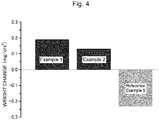
- Results of the oxidation test were as shown in Fig. 4 , and the Ni-based directionally solidified alloys of Examples 1 and 2 did not lost weight or metallic luster even after 12 hours, and thus can be evaluated to have excellent oxidation resistance properties.
- the Ni-based directionally solidified alloy of Reference Example 5 shown in the figure is known as the alloy having a favorable high temperature oxidation resistance property.
- the Ni-based directionally solidified alloy of the present invention has excellent TMF characteristics, creep property and environment-resistant characteristics such as high temperature oxidation resistance, and is superior in cost performance in practical use. Therefore, the Ni-based directionally solidified alloy of the present invention is effectively used for a member such as a turbine blade and a turbine vane in a jet engine and a gas turbine, which is used at a high temperature and high stress.
Landscapes
- Engineering & Computer Science (AREA)
- Chemical & Material Sciences (AREA)
- Mechanical Engineering (AREA)
- Materials Engineering (AREA)
- Metallurgy (AREA)
- Organic Chemistry (AREA)
- General Engineering & Computer Science (AREA)
- Combustion & Propulsion (AREA)
- Inorganic Chemistry (AREA)
- Crystallography & Structural Chemistry (AREA)
- Turbine Rotor Nozzle Sealing (AREA)
Abstract
Description
- The present invention relates to Ni-based directionally solidified alloy that can be used preferably for a member such as a turbine blade and a turbine vane in a jet engine and a gas turbine, which is used at a high temperature and high stress, and particularly relates to Ni-based directionally solidified alloy that does not contain Co or Re as a main element.
- Ni-based alloy has been developed as forging alloy, casting alloy, directionally solidified alloy and single crystal alloy, and its durable temperature has been improved accordingly. Ni-based single crystal alloy has superior high temperature strength to that of Ni-based directionally solidified alloy, but has problems of generating longitudinal cracks and anisotropic crystals during casting. In particular, a larger-sized member of Ni-based single crystal alloy is more likely to be effected by these problems, and its production yield tends to be lower, so that Ni-based directionally solidified alloy is superior in cost performance for the production.
- Further, super alloys commonly have problems in creep property, thermo-mechanical fatigue property and environment-resistant characteristics. Since a rotating member in a turbine blade or the like is rotated at a high speed while being exposed to combustion gas at a high temperature, and centrifugal force is applied to the member, the member is required to endure creep at high stress. Such a high temperature member used for a turbine blade or a turbine vane in a jet engine or a gas turbine also has a problem of material deterioration due to thermos-mechanical fatigue (TMF), because it is often started and stopped. Further, since the high temperature member is exposed to combustion gas at a high temperature, it is expected to find a material having excellent environment-resistant characteristics.
- As the Ni-based directionally solidified alloy, IN792 (Trade Mark) and Rene80 (Trade Mark) have been known, but both of IN792 and Rene80 contain Co in the alloys. Also, Ni-based alloys described in below-listed
Patent Literatures - Further, the Ni-based directionally solidified alloy with Re added is difficult to be treated by heat after the casting, and a TCP phase is likely to be deposited and may affect high temperature strength, while it is used as a high temperature member. From these drawbacks, the use of Co or Re is not preferable because of their high temperature properties and cost performance as a large number, in particular. Ni-based alloy disclosed in Patent Literature 8 does not contain Co or Re, but is not preferable in the light of cost performance, because it is Ni-based single crystal alloy.
-
- Patent Literature 1: Japanese Patent No.
2905473 - Patent Literature 2:
JP 2006-45654 A - Patent Literature 3:
JP 2011-74493 A - Patent Literature 4:
JP 2004-197131 A - Patent Literature 5:
JP 2000-63969 A - Patent Literature 6:
JP H10-273748 A - Patent Literature 7:
JP H9-272933 A - Patent Literature 8:
JP 2014-34720 A - It is an object of the present invention to provide first generation Ni-based directionally solidified alloy containing none of Co and Re, which has excellent TMF characteristics, creep property and environment-resistant characteristics, and is superior in cost performance in practical use.
- In order to solve the above-described problems, the present invention has following characteristics.
- That is, the Ni-based directionally solidified alloy of the present invention consists of
- Cr: 6% by mass or more and 12% by mass or less;
- Mo: 0.4% by mass or more and 3.0% by mass or less;
- W: 6% by mass or more and 10% by mass or less;
- Al: 4.0% by mass or more and 6.5% by mass or less;
- Nb: 0% by mass or more and 1% by mass or less;
- Ta: 8% by mass or more and 12% by mass or less;
- Hf: 0% by mass or more and 0.15% by mass or less;
- Si: 0.01% by mass or more and 0.2% by mass or less;
- Zr: 0% by mass or more and 0.04% by mass or less;
- B: 0.01% by mass or more and 0.03% by mass or less; and
- C: 0.01% by mass or more and 0.3% by mass or less, and a balance of Ni and inevitable impurities.
- Further, the Ni-based directionally solidified alloy of the present invention consists of
- Cr: 7% by mass or more and 12% by mass or less;
- Mo: 0.4% by mass or more and 2.5% by mass or less;
- W: 7% by mass or more and 10% by mass or less;
- Al: 4.0% by mass or more and 6.5% by mass or less;
- Nb: 0% by mass or more and 1% by mass or less;
- Ta: 9% by mass or more and 11% by mass or less;
- Hf: 0% by mass or more and 0.15% by mass or less;
- Si: 0.01% by mass or more and 0.2% by mass or less;
- Zr: 0% by mass or more and 0.04% by mass or less;
- B: 0.01% by mass or more and 0.03% by mass or less; and
- C: 0.01% by mass or more and 0.3% by mass or less, and
- a balance of Ni and inevitable impurities.
- Moreover, the Ni-based directionally solidified alloy of the present invention consists of
- Cr: 8% by mass or more and 10% by mass or less;
- Mo: 0.4% by mass or more and 2.0% by mass or less;
- W: 7% by mass or more and 9% by mass or less;
- Al: 4.0% by mass or more and 6.5% by mass or less;
- Nb: 0% by mass or more and 1% by mass or less;
- Ta: 10% by mass or more and 11% by mass or less;
- Hf: 0% by mass or more and 0.15% by mass or less;
- Si: 0.01% by mass or more and 0.2% by mass or less;
- Zr: 0% by mass or more and 0.04% by mass or less;
- B: 0.01% by mass or more and 0.03% by mass or less; and
- C: 0.01% by mass or more and 0.3% by mass or less, and
- a balance of Ni and inevitable impurities.
- The Ni-based directionally solidified alloy of the present invention preferably has a creep life at a temperature of 900°C and stress of 392 MPa that is 65 hours or more, and a number of cycles in a thermo-mechanical fatigue (TMF) property test in predetermined operating conditions that is 155 cycles or more. Herein, the thermo-mechanical fatigue (TMF) property test is performed by simulating operating conditions of a gas turbine, in which a temperature of a surface of a turbine blade is assumed to be 900°C in a steady state and 400°C when the turbine blade stops, and a number of cycles until breaking a test piece that has a predetermined shape is evaluated. Details of the thermo-mechanical fatigue (TMF) property test will be specified in the specification.
- Further preferably, a creep life at the temperature of 900°C and the stress of 392MPa is 65 hours or more and 115 hours or less, and the number of cycles in the TMF property test is 155 cycles or more and 215 cycles or less. Most preferably, the creep life at the temperature of 900°C and the stress of 392MPa is 75 hours or more and 105 hours or less, and the number of cycles in the TMF property test is 170 cycles or more and 195 cycles or less.
- If the creep life is less than 65 hours, the creep life is not improved compared with those in the conventional examples. The creep life exceeding 115 hours is beyond an upper limit of the creep life of the Ni-based directionally solidified alloy of the present invention, even considering the variation of the results of the creep life test.
- If the number of cycles in the thermo-mechanical fatigue (TMF) property test is less than 155 cycles, the TMF characteristic is not improved compared with those in the conventional examples. The number of cycles in the thermo-mechanical fatigue (TMF) property test exceeding 215 cycles is beyond an upper limit of the TMF characteristic of the Ni-based directionally solidified alloy of the present invention, even considering the variation of the results of the thermo-mechanical fatigue (TMF) property test.
- The Ni-based directionally solidified alloy of the present invention preferably has a value of a Larson-Miller parameter at a temperature of 900°C and stress of 392 MPa which is 25.6 or more and 25.9 or less, and a value of a Larson-Miller parameter at a temperature of 1100°C and stress of 137 MPa which is 28.8 or more and 29.3 or less.
- If the value of the Larson-Miller parameter at the temperature of 900°C and the stress of 392 MPa is less than 25.6, the creep life is not improved compared with those in the conventional examples. The value of the Larson-Miller parameter exceeding 25.9 is beyond an upper limit of the Larson-Miller parameter of the Ni-based directionally solidified alloy of the present invention, even considering the variation of the results of the creep life test for obtaining the Larson-Miller parameters.
- If the value of the Larson-Miller parameter at the temperature of 1100°C and the stress of 137 MPa is less than 28.8, the creep life is not improved compared with those in the conventional examples. The value of the Larson-Miller parameter exceeding 29.3 is beyond an upper limit of the Larson-Miller parameter of the Ni-based directionally solidified alloy of the present invention, even considering the variation of the results of the creep life test for obtaining the Larson-Miller parameters.
- The Ni-based directionally solidified alloy of the present invention preferably has a durable temperature of 960°C or more and 1010°C or less for a 1000-hour life, which is a creep life obtained from the value of the Larson-Miller parameter at the stress of 137 MPa. The 1000-hour life more preferably provides the durable temperature of 970°C or more and 1000°C or less, and most preferably provides the durable temperature of 980°C or more and 990°C or less.
- If the durable temperature of the 1000-hour life as the creep life is less than 960°C, the creep life is not improved compared with those in the conventional examples. The durable temperature exceeding 1010°C is beyond an upper limit of the creep life of the Ni-based directionally solidified alloy of the present invention, even considering a testing error of the creep life test.
- Regarding the Ni-based directionally solidified alloy of the present invention, it is preferable that, in a high temperature oxidation test for judging characteristics of a sample made of the Ni-based directionally solidified alloy from: a change of a weight of the sample during the high temperature oxidation test from just after being mirror-finished to after being subsequently heated at 1100°C in an electric furnace in the atmosphere and held for 12 hours; and observation of a surface of the sample, the change of the weight of the sample is -0.1 [mg/cm2] or more and 0.3 [mg/cm2] or less, and the surface of the sample has metallic luster. More preferably, the change of the weight during the high temperature oxidation test is 0.0 [mg/cm2] or more and 0.2 [mg/cm2] or less.
- If the change of the weight during the high temperature oxidation test is less than -0.1 [mg/cm2], an oxidation resistance property is not improved compared with those in conventional examples. If the change during the high temperature oxidation test of the weight exceeds 0.3 [mg/cm2], the improvement of the oxidation resistance property of the Ni-based directionally solidified alloy in the present invention is not sufficient, even considering a testing error of the high temperature oxidation test.
- The Ni-based directionally solidified alloy of the present invention has excellent TMF characteristics, creep property and environment-resistant characteristics such as high temperature oxidation resistance, and is superior in cost performance in practical use.
-
-
Fig. 1 is a graph that shows a result of a creep test at 900°C and 392 MPa and a result of a TMF test, which were conducted with respect to samples of Example 1 and Reference Examples 1 and 2. -
Fig. 2 is a graph showing results of creep tests conducted at 900°C and 392 MPa and at 1100°C and 137 MPa with respect to samples of Example 1 and Reference Examples 3 and 4, which represents a relation between LMP (Larson-Miller parameter) and stress. -
Fig. 3 is a graph showing durable temperatures (°C) of 1000-hour lives in creep conditions at 137 MPa, which are obtained fromFig. 2 . -
Fig. 4 is a view that illustrates changes of weights of samples of Examples 1 and 2 and Reference Example 5 before and after being heated at 1100°C in an electric furnace in the atmosphere and held for 12 hours. - A component and a composition ratio of the Ni-based directionally solidified alloy having the above-described characteristics are based on following points of view.
- Cr (chromium) improves a high temperature corrosion resistance property and a high temperature oxidation resistance property of Ni-based directionally solidified alloy. A composition ratio of Cr is 6% by mass or more and 12% by mass or less. If the composition ratio is less than 6% by mass, it is difficult to secure its high temperature corrosion resistance property and high temperature oxidation resistance property, and if the composition ratio is more than 12% by mass, a toxic phase such as a σ phase and a µ phase is generated so as to decrease its high temperature strength. The composition ratio of Cr is preferably 7% by mass or more and 12% by mass or less, and is more preferably 8% by mass or more and 10% by mass or less.
- Mo (molybdenum) is solved into a base, and contributes to increase the high temperature strength by precipitation hardening. A composition ratio of Mo is 0.4% by mass or more and 3.0% by mass or less. If the composition ratio is less than 0.4% by mass, the high temperature strength is decreased, and if the composition ratio is more than 3.0% by mass, a toxic phase is generated so as to decrease the high temperature strength. The composition ratio of Mo is preferably 0.4% by mass or more and 2.5% by mass or less, and is more preferably 0.4% by mass or more and 2.0% by mass or less.
- W (tungsten) has effects of solid solution strengthening and precipitation hardening as well as Mo, and increases the high temperature strength of Ni-based directionally solidified alloy. A composition ratio of W is 6% by mass or more and 10% by mass or less. If the composition ratio is less than 6% by mass, a TMF characteristic and a creep property are deteriorated, and if the composition ratio is more than 10% by mass, a toxic phase is generated so as to deteriorate the TMF characteristic and the creep property. The composition ratio of W is preferably 7% by mass or more and 10% by mass or less, and is more preferably 7% by mass or more and 9% by mass or less.
- Al (aluminum) is combined with Ni so as to form an intermetallic compound represented as Ni3Al, which constitutes a gamma prime phase to be deposited in a gamma parent phase, thereby improving a TMF characteristic and a creep property particularly at a lower temperature of 1000°C or lower. A composition ratio of Al is 4.0% by mass or more and 6.5% by mass or less. If the composition ratio is less than 4% by mass, an amount of the gamma prime phase is small, and the required TMF characteristic and creep property cannot be obtained. On the other hand, if the composition ratio is more than 6.5% by mass, the required TMF characteristic and creep property cannot be obtained.
- A composition ratio of Nb (niobium) is 0% by mass or more and 1% by mass or less. If the composition ratio is more than 1% by mass, a toxic phase is generated at a high temperature so as to deteriorate a TMF characteristic and a creep property.
- Ta (tantalum) strengthens a gamma prime phase and improves a creep property. A composition ratio of Ta is 8% by mass or more and 12% by mass or less. If the composition ratio is less than 8% by mass, the required TMF characteristic and creep property cannot be obtained, and if the composition ratio is more than 12% by mass, generation of a eutectic gamma prime phase is promoted, and solution heat treatment becomes difficult. The composition ratio of Ta is preferably 9% by mass or more and 11% by mass or less, and is more preferably 10% by mass or more and 11% by mass or less.
- Hf (hafnium) contributes to grain boundary strengthening during columnar crystallization due to directional solidification, enhances oxidation resistance, and may improve a TMF characteristic. A composition ratio of Hf is 0% by mass or more and 0.15% by mass or less. If the composition ratio is more than 0.15% by mass, generation of a toxic phase is promoted, and the TMF characteristic and a creep property are deteriorated.
- Si (silicon) generates SiO2 film on an alloy surface so as to enhance oxidation resistance as protection coating film, and can suppress generation of very small cracks on the alloy surface so as to improve an TMF characteristic. A composition ratio of Si is 0.01% by mass or more and 0.2% by mass or less. If the composition is less than 0.01% by mass, effects for enhancing the oxidation resistance and improving the TMF characteristic cannot be obtained. Further, if the composition ratio is more than 0.2% by mass, a solid solubility limit of other element is deteriorated, so that the required TMF characteristic and creep property cannot be obtained.
- Zr (zirconium) is added for the purpose of strengthening crystal grain boundary of Ni-based directionally solidified alloy, and can particularly improve a TMF characteristic. A composition ratio of Zr is 0% by mass or more and less than 0.04% by mass.
- B (boron) can improve a creep property, a mechanical fatigue property and the like of Ni-based directionally solidified alloy at a high temperature. A composition ratio of B is 0.01% by mass or more and 0.03% by mass or less.
- C (carbon) can improve ductility, a creep property and the like of Ni-based directionally solidified alloy at a high temperature. A composition ratio of C is 0.01% by mass or more and 0. 3% by mass or less.
- Further, the Ni-based directionally solidified alloy can be manufactured by treating a cast product having a predetermined composition by heat as follows. That is, the heat treatment includes: solution treatment for holding the cast product at 1280°C to 1300°C for 2 hours to 40 hours and subsequently cooling it at 200 °C/min to 400 °C/min by air or in inert gas atmosphere; primary aging treatment for holding the cast product at 1000°C to 1150°C for 2 hours to 5 hours and subsequently cooling it by air or in inert gas atmosphere; and secondary aging treatment for holding the cast product at 850°C to 950°C for 10 hours to 30 hours and subsequently cooling it by air or in inert gas atmosphere, which are carried out sequentially.
- It is preferable that all of such sequential holding at the predetermined temperatures for the predetermined time periods is carried out in vacuum or inert gas atmosphere, also for not receiving the influence of the high temperature oxidation.
- Each of Ni-based directionally solidified alloys having compositions (% by mass) listed in Table 1 was melted by a vacuum melting furnace, and was casted in a lost wax mold that was heated and held, and then, the mold was lowered at a solidification rate of 200 mm/h, thereby obtaining a directionally solidified cast product. Thereafter, the obtained directionally solidified cast product was subjected to solution treatment, in which the cast product was held at 1280°C in vacuum for 5 hours and was subsequently cooled at about 300 °C/min by air. Thereafter, primary aging treatment for holding the cast product at 1100°C in vacuum for 2 hours and subsequently cooling it by air; and secondary aging treatment for holding the cast product at 870°C in vacuum for 24 hours and subsequently cooling it by air were carried out. A temperature range of solution treatment of the Ni-based directionally solidified alloys of Examples 1 and 2 were from 1260°C to 1300°C, and a temperature range of the primary aging treatment was from 1000°C to 1150°C. In Reference Examples 1 and 2, a temperature of the cast product was held at 1280°C for one hour, was increased to 1300°C, and was held for 5 hours, and then, the cast product was cooled by air. Subsequently, after holding at 1100°C for 4 hours, the cast product was cooled by air and was thereafter subjected to heat treatment, in which the temperature was held at 870°C for 20 hours and the cast product was cooled by air. Heat treatment in Reference Example 3 included: holding a temperature of the cast product at 1130°C for 1 hours, increasing it to 1180°C, holding for 2 hours and cooling it by air; thereafter holding at 1050°C for 4 hours and cooling it by air; and then, holding at 870°C for 20 hours and cooling it by air. Heat treatment in Reference Example 4 included: holding a temperature of the cast product at 1147°C for one hour, increasing to 1197°C, holding for 2 hours and cooling by air; subsequently holding at 1050°C for 4 hours and cooling by air; and then, holding at 870°C for 20 hours and cooling it by air. In Reference Example 5, the cast product was directly subjected to the test.
[Table 1] Sample Constituent Element (% by mass) Co Cr Mo W Al Ti Nb Hf Zr Ta Si C B Example 1 - 9.0 0.6 7.6 5.4 - - 0.05 0.03 10.0 0.04 0.08 0.015 Example 2 - 8.7 1.2 8.1 5.3 - 0.05 0.08 0.01 10.2 0.02 0.08 0.015 Reference Example 1 - 9.2 - 8.7 5.3 - - 0.1 - 10.4 - 0.07 0.015 Reference Example 2 - 6.6 - 12.8 5.2 - - - - 7.7 - 0.07 0.015 Reference Example 3 9.0 12.7 2.0 3.9 3.2 4.2 - - 0.1 3.9 - 0.21 0.02 Reference Example 4 9.5 14.0 4.0 4.0 13.0 5.0 - - 0.03 - - 0.17 0.015 Reference Example 5 10 8.2 0.6 10 5,5 1.0 - - - 3.0 - 0.16 0.02 - The cast product of the directionally solidified alloy after the heat treatment was processed into a creep test piece with a diameter of a parallel part of 4 mm and a length of 20 mm, and was subjected to a creep test under conditions at 900°C and 392 MPa and at 1100°C and 137 MPa. Further, a TMF test was conducted with respect to a test piece with a diameter of a parallel part of 5 mm and a length of 15 mm, while heating the test piece by high frequency waves. In the TMF test, a temperature range was changed from 400°C that was a lower limit to 900°C that was a higher limit, and ± 0.64% of stress was applied to the test piece according to this temperature change. A frequency was 66 min per one cycle, a wave form was a triangular wave, and the test piece was held for 60 min during its compression. These test conditions simulated operating conditions of a gas turbine, and were based on an assumption that a surface temperature of a turbine blade was 900°C in a steady state and was 400°C at the time of stopping. Further, an increasing/decreasing rate of the temperature was 166.7 °C/min. The TMF characteristic was evaluated by the number of cycles until the test piece was broken.
-
Fig. 1 shows results of the creep tests at 900°C and 392 MPa and the TMF test, which were conducted with respect to the Ni-based directionally solidified alloys of Example 1, Reference Examples 1 and 2. FromFig. 1 , it can be confirmed that the Ni-based directionally solidified alloy of Example 1 had an excellent creep property and TMF characteristic. - The Ni-based directionally solidified alloys of Example 1, Reference Examples 3 and 4 were subjected to the creep test under the conditions at 900°C and 392 MPa and at 1100°C and 137 MPa. Results thereof are shown in
Fig. 2 . LMP in a horizontal axis inFig. 2 represents a Larson-Miller parameter, which is known as a parameter for standardizing breaking times in different temperature conditions. InFig. 2 , in a formula that defines the LMP, T represents a temperature (K), and tr represents a breaking time (h). It means that, as the LMP is larger, the Ni-based directionally solidified alloy can endure the creep at a higher temperature or for a longer time period. - Also from
Figs. 1 and2 , it can be confirmed that the Ni-based directionally solidified alloy of Example 1 had a superior creep property to those of Reference Examples 1 to 4. -
Fig. 3 shows results of durable temperatures (°C) of 1000-hour lives in the creep conditions at 137 MPa, which are obtained from the LMP diagram inFig. 2 . From the result that the durable temperature in Example 1 was 983°C, in contrast to the durable temperature (922°C) in Reference Example 3 and the durable temperature (895°C) in Reference Example 4, it can be confirmed that the Ni-based directionally solidified alloy of Example 1 was able to endure the creep at a higher temperature or for a longer time period. - Further, a high temperature oxidation test was conducted for examining environment-resistant characteristics. In the oxidation test, each mirror-finished sample was heated at 1100°C in an electric furnace in the atmosphere and was held for 12 hours, and characteristics of each sample were evaluated from its weight change before and after heating and by observing a surface of each sample. Results of the oxidation test were as shown in
Fig. 4 , and the Ni-based directionally solidified alloys of Examples 1 and 2 did not lost weight or metallic luster even after 12 hours, and thus can be evaluated to have excellent oxidation resistance properties. Incidentally, the Ni-based directionally solidified alloy of Reference Example 5 shown in the figure is known as the alloy having a favorable high temperature oxidation resistance property. - The Ni-based directionally solidified alloy of the present invention has excellent TMF characteristics, creep property and environment-resistant characteristics such as high temperature oxidation resistance, and is superior in cost performance in practical use. Therefore, the Ni-based directionally solidified alloy of the present invention is effectively used for a member such as a turbine blade and a turbine vane in a jet engine and a gas turbine, which is used at a high temperature and high stress.
Claims (7)
- Ni-based directionally solidified alloy consisting of:Cr: 6% by mass or more and 12% by mass or less;Mo: 0.4% by mass or more and 3.0% by mass or less;W: 6% by mass or more and 10% by mass or less;Al: 4.0% by mass or more and 6.5% by mass or less;Nb: 0% by mass or more and 1% by mass or less;Ta: 8% by mass or more and 12% by mass or less;Hf: 0% by mass or more and 0.15% by mass or less;Si: 0.01% by mass or more and 0.2% by mass or less;Zr: 0% by mass or more and 0.04% by mass or less;B: 0.01% by mass or more and 0.03% by mass or less; andC: 0.01% by mass or more and 0.3% by mass or less, and a balance of Ni and inevitable impurities.
- Ni-based directionally solidified alloy consisting of:Cr: 7% by mass or more and 12% by mass or less;Mo: 0.4% by mass or more and 2.5% by mass or less;W: 7% by mass or more and 10% by mass or less;Al: 4.0% by mass or more and 6.5% by mass or less;Nb: 0% by mass or more and 1% by mass or less;Ta: 9% by mass or more and 11% by mass or less;Hf: 0% by mass or more and 0.15% by mass or less;Si: 0.01% by mass or more and 0.2% by mass or less;Zr: 0% by mass or more and 0.04% by mass or less;B: 0.01% by mass or more and 0.03% by mass or less; andC: 0.01% by mass or more and 0.3% by mass or less, and a balance of Ni and inevitable impurities.
- Ni-based directionally solidified alloy consisting of:Cr: 8% by mass or more and 10% by mass or less;Mo: 0.4% by mass or more and 2.0% by mass or less;W: 7% by mass or more and 9% by mass or less;Al: 4.0% by mass or more and 6.5% by mass or less;Nb: 0% by mass or more and 1% by mass or less;Ta: 10% by mass or more and 11% by mass or less;Hf: 0% by mass or more and 0.15% by mass or less;Si: 0.01% by mass or more and 0.2% by mass or less;Zr: 0% by mass or more and 0.04% by mass or less;B: 0.01% by mass or more and 0.03% by mass or less; andC: 0.01% by mass or more and 0.3% by mass or less, and a balance of Ni and inevitable impurities.
- The Ni-based directionally solidified alloy according to any one of claims 1 to 3, wherein
a creep life at a temperature of 900°C and stress of 392 MPa is 65 hours or more, and
a number of cycles in a thermo-mechanical fatigue (TMF) property test in predetermined operating conditions is 155 cycles or more. - The Ni-based directionally solidified alloy according to any one of claims 1 to 3, wherein
a value of a Larson-Miller parameter at a temperature of 900°C and stress of 392 MPa is 25.6 or more and 25.9 or less, and
a value of a Larson-Miller parameter at a temperature of 1100°C and stress of 137 MPa is 28.8 or more and 29.3 or less. - The Ni-based directionally solidified alloy according to claim 5, wherein a durable temperature is 960°C or more and 1010°C or less for a 1000-hour life, which is a creep life obtained from the value of the Larson-Miller parameter at the stress of 137 MPa.
- A sample made of the Ni-based directionally solidified alloy according to any one of claims 1 to 3, wherein
in a high temperature oxidation test for judging characteristics of the sample from: a change of a weight of the sample from just after being mirror-finished to after being subsequently heated at 1100°C in an electric furnace in the atmosphere and held for 12 hours; and observation of a surface of the sample,
the change of the weight of the sample is -0.1 [mg/cm2] or more and 0.3 [mg/cm2] or less, and
the surface of the sample has metallic luster.
Applications Claiming Priority (2)
| Application Number | Priority Date | Filing Date | Title |
|---|---|---|---|
| JP2016043875 | 2016-03-07 | ||
| PCT/JP2017/008676 WO2017154809A1 (en) | 2016-03-07 | 2017-03-06 | Ni-BASED UNIDIRECTIONALLY SOLIDIFIED ALLOY |
Publications (3)
| Publication Number | Publication Date |
|---|---|
| EP3428297A1 true EP3428297A1 (en) | 2019-01-16 |
| EP3428297A4 EP3428297A4 (en) | 2019-09-18 |
| EP3428297B1 EP3428297B1 (en) | 2020-09-23 |
Family
ID=59790315
Family Applications (1)
| Application Number | Title | Priority Date | Filing Date |
|---|---|---|---|
| EP17763149.6A Active EP3428297B1 (en) | 2016-03-07 | 2017-03-06 | Ni-BASED UNIDIRECTIONALLY SOLIDIFIED ALLOY |
Country Status (4)
| Country | Link |
|---|---|
| US (1) | US20190093196A1 (en) |
| EP (1) | EP3428297B1 (en) |
| JP (1) | JP6803573B2 (en) |
| WO (1) | WO2017154809A1 (en) |
Families Citing this family (2)
| Publication number | Priority date | Publication date | Assignee | Title |
|---|---|---|---|---|
| EP4105443A1 (en) * | 2021-06-18 | 2022-12-21 | Raytheon Technologies Corporation | Hybrid superalloy article and method of manufacture thereof |
| EP4105449A1 (en) | 2021-06-18 | 2022-12-21 | Raytheon Technologies Corporation | Hybrid bonded configuration for blade outer airseal (boas) |
Family Cites Families (7)
| Publication number | Priority date | Publication date | Assignee | Title |
|---|---|---|---|---|
| JPS62116748A (en) * | 1985-11-18 | 1987-05-28 | Hitachi Metals Ltd | Superheat resistant single crystalline ni alloy |
| JP2905473B1 (en) * | 1998-03-02 | 1999-06-14 | 科学技術庁金属材料技術研究所長 | Method for producing Ni-based directionally solidified alloy |
| JP2003529677A (en) * | 1999-07-29 | 2003-10-07 | シーメンス アクチエンゲゼルシヤフト | Heat resistant structural member and method of manufacturing the same |
| JP4115369B2 (en) * | 2003-09-22 | 2008-07-09 | 独立行政法人物質・材料研究機構 | Ni-base superalloy |
| US20080240926A1 (en) * | 2005-03-28 | 2008-10-02 | Toshiharu Kobayashi | Cobalt-Free Ni-Base Superalloy |
| JP4719583B2 (en) * | 2006-02-08 | 2011-07-06 | 株式会社日立製作所 | Unidirectional solidification nickel-base superalloy excellent in strength, corrosion resistance and oxidation resistance and method for producing unidirectional solidification nickel-base superalloy |
| JP6016016B2 (en) * | 2012-08-09 | 2016-10-26 | 国立研究開発法人物質・材料研究機構 | Ni-based single crystal superalloy |
-
2017
- 2017-03-06 EP EP17763149.6A patent/EP3428297B1/en active Active
- 2017-03-06 WO PCT/JP2017/008676 patent/WO2017154809A1/en not_active Ceased
- 2017-03-06 JP JP2018504465A patent/JP6803573B2/en active Active
- 2017-03-06 US US16/082,333 patent/US20190093196A1/en not_active Abandoned
Also Published As
| Publication number | Publication date |
|---|---|
| US20190093196A1 (en) | 2019-03-28 |
| JPWO2017154809A1 (en) | 2018-12-27 |
| JP6803573B2 (en) | 2020-12-23 |
| EP3428297A4 (en) | 2019-09-18 |
| WO2017154809A1 (en) | 2017-09-14 |
| EP3428297B1 (en) | 2020-09-23 |
Similar Documents
| Publication | Publication Date | Title |
|---|---|---|
| EP2826877B1 (en) | Hot-forgeable Nickel-based superalloy excellent in high temperature strength | |
| CN104520457B (en) | Ni-based single crystal superalloy | |
| US11718897B2 (en) | Precipitation hardenable cobalt-nickel base superalloy and article made therefrom | |
| EP2503013B1 (en) | Heat-resistant superalloy | |
| CN102002612B (en) | Nickel based super alloy and goods thereof | |
| JP3814662B2 (en) | Ni-based single crystal superalloy | |
| EP1930455B1 (en) | Nickel-base superalloy with excellent unsusceptibility to oxidation | |
| EP3257963A1 (en) | METHOD FOR MANUFACTURING Ni-BASED SUPER-HEAT-RESISTANT ALLOY | |
| US20130206287A1 (en) | Co-based alloy | |
| CN102471833B (en) | Ni-based monocrystalline superalloy and turbine blade | |
| EP3299481B1 (en) | High-strength, heat-resistant ni-base alloy member, method for producing same, and gas turbine | |
| EP1717326A2 (en) | Ni-based alloy member, method of producing the alloy member, turbine engine part, welding material, and method of producing the welding material | |
| CA2901259A1 (en) | Nickel-cobalt alloy | |
| JP3840555B2 (en) | Ni-based single crystal superalloy | |
| JP6315319B2 (en) | Method for producing Fe-Ni base superalloy | |
| EP2420584B1 (en) | Nickel-based single crystal superalloy and turbine blade incorporating this superalloy | |
| WO2017204286A1 (en) | HOT DIE Ni-BASED ALLOY, HOT FORGING DIE USING SAME, AND FORGED PRODUCT MANUFACTURING METHOD | |
| EP3428297B1 (en) | Ni-BASED UNIDIRECTIONALLY SOLIDIFIED ALLOY | |
| JP6970438B2 (en) | Ni-based superalloy | |
| EP3366794B1 (en) | Ni-based superalloy | |
| JP6213185B2 (en) | Nickel base alloy | |
| EP4616976A1 (en) | Nickel-cobalt-based alloy, nickel-cobalt-based alloy member using same, and method for manufacturing same | |
| JP6425274B2 (en) | Ni-based heat-resistant alloy | |
| JPH0920600A (en) | Ni-based single crystal superalloy, method for producing the same, and gas turbine component | |
| JP2019085594A (en) | Fe-Ni base alloy |
Legal Events
| Date | Code | Title | Description |
|---|---|---|---|
| STAA | Information on the status of an ep patent application or granted ep patent |
Free format text: STATUS: THE INTERNATIONAL PUBLICATION HAS BEEN MADE |
|
| PUAI | Public reference made under article 153(3) epc to a published international application that has entered the european phase |
Free format text: ORIGINAL CODE: 0009012 |
|
| STAA | Information on the status of an ep patent application or granted ep patent |
Free format text: STATUS: REQUEST FOR EXAMINATION WAS MADE |
|
| 17P | Request for examination filed |
Effective date: 20180906 |
|
| AK | Designated contracting states |
Kind code of ref document: A1 Designated state(s): AL AT BE BG CH CY CZ DE DK EE ES FI FR GB GR HR HU IE IS IT LI LT LU LV MC MK MT NL NO PL PT RO RS SE SI SK SM TR |
|
| AX | Request for extension of the european patent |
Extension state: BA ME |
|
| DAV | Request for validation of the european patent (deleted) | ||
| DAX | Request for extension of the european patent (deleted) | ||
| A4 | Supplementary search report drawn up and despatched |
Effective date: 20190819 |
|
| RIC1 | Information provided on ipc code assigned before grant |
Ipc: F01D 5/28 20060101ALI20190812BHEP Ipc: C22F 1/10 20060101ALI20190812BHEP Ipc: C22F 1/00 20060101ALI20190812BHEP Ipc: C22C 19/05 20060101AFI20190812BHEP Ipc: F01D 25/00 20060101ALI20190812BHEP Ipc: F02C 7/00 20060101ALI20190812BHEP Ipc: C30B 29/52 20060101ALI20190812BHEP |
|
| GRAP | Despatch of communication of intention to grant a patent |
Free format text: ORIGINAL CODE: EPIDOSNIGR1 |
|
| STAA | Information on the status of an ep patent application or granted ep patent |
Free format text: STATUS: GRANT OF PATENT IS INTENDED |
|
| INTG | Intention to grant announced |
Effective date: 20200420 |
|
| RIC1 | Information provided on ipc code assigned before grant |
Ipc: F02C 7/00 20060101ALI20200406BHEP Ipc: C30B 29/52 20060101ALI20200406BHEP Ipc: C22F 1/10 20060101ALI20200406BHEP Ipc: F01D 25/00 20060101ALI20200406BHEP Ipc: C22C 19/05 20060101AFI20200406BHEP Ipc: C22F 1/00 20060101ALI20200406BHEP Ipc: F01D 5/28 20060101ALI20200406BHEP |
|
| GRAS | Grant fee paid |
Free format text: ORIGINAL CODE: EPIDOSNIGR3 |
|
| GRAA | (expected) grant |
Free format text: ORIGINAL CODE: 0009210 |
|
| STAA | Information on the status of an ep patent application or granted ep patent |
Free format text: STATUS: THE PATENT HAS BEEN GRANTED |
|
| AK | Designated contracting states |
Kind code of ref document: B1 Designated state(s): AL AT BE BG CH CY CZ DE DK EE ES FI FR GB GR HR HU IE IS IT LI LT LU LV MC MK MT NL NO PL PT RO RS SE SI SK SM TR |
|
| REG | Reference to a national code |
Ref country code: GB Ref legal event code: FG4D |
|
| REG | Reference to a national code |
Ref country code: CH Ref legal event code: EP |
|
| REG | Reference to a national code |
Ref country code: IE Ref legal event code: FG4D |
|
| REG | Reference to a national code |
Ref country code: DE Ref legal event code: R096 Ref document number: 602017024235 Country of ref document: DE Ref country code: AT Ref legal event code: REF Ref document number: 1316449 Country of ref document: AT Kind code of ref document: T Effective date: 20201015 |
|
| PG25 | Lapsed in a contracting state [announced via postgrant information from national office to epo] |
Ref country code: SE Free format text: LAPSE BECAUSE OF FAILURE TO SUBMIT A TRANSLATION OF THE DESCRIPTION OR TO PAY THE FEE WITHIN THE PRESCRIBED TIME-LIMIT Effective date: 20200923 Ref country code: BG Free format text: LAPSE BECAUSE OF FAILURE TO SUBMIT A TRANSLATION OF THE DESCRIPTION OR TO PAY THE FEE WITHIN THE PRESCRIBED TIME-LIMIT Effective date: 20201223 Ref country code: HR Free format text: LAPSE BECAUSE OF FAILURE TO SUBMIT A TRANSLATION OF THE DESCRIPTION OR TO PAY THE FEE WITHIN THE PRESCRIBED TIME-LIMIT Effective date: 20200923 Ref country code: NO Free format text: LAPSE BECAUSE OF FAILURE TO SUBMIT A TRANSLATION OF THE DESCRIPTION OR TO PAY THE FEE WITHIN THE PRESCRIBED TIME-LIMIT Effective date: 20201223 Ref country code: GR Free format text: LAPSE BECAUSE OF FAILURE TO SUBMIT A TRANSLATION OF THE DESCRIPTION OR TO PAY THE FEE WITHIN THE PRESCRIBED TIME-LIMIT Effective date: 20201224 Ref country code: FI Free format text: LAPSE BECAUSE OF FAILURE TO SUBMIT A TRANSLATION OF THE DESCRIPTION OR TO PAY THE FEE WITHIN THE PRESCRIBED TIME-LIMIT Effective date: 20200923 |
|
| REG | Reference to a national code |
Ref country code: AT Ref legal event code: MK05 Ref document number: 1316449 Country of ref document: AT Kind code of ref document: T Effective date: 20200923 |
|
| PG25 | Lapsed in a contracting state [announced via postgrant information from national office to epo] |
Ref country code: LV Free format text: LAPSE BECAUSE OF FAILURE TO SUBMIT A TRANSLATION OF THE DESCRIPTION OR TO PAY THE FEE WITHIN THE PRESCRIBED TIME-LIMIT Effective date: 20200923 Ref country code: RS Free format text: LAPSE BECAUSE OF FAILURE TO SUBMIT A TRANSLATION OF THE DESCRIPTION OR TO PAY THE FEE WITHIN THE PRESCRIBED TIME-LIMIT Effective date: 20200923 |
|
| REG | Reference to a national code |
Ref country code: NL Ref legal event code: MP Effective date: 20200923 |
|
| REG | Reference to a national code |
Ref country code: LT Ref legal event code: MG4D |
|
| PG25 | Lapsed in a contracting state [announced via postgrant information from national office to epo] |
Ref country code: EE Free format text: LAPSE BECAUSE OF FAILURE TO SUBMIT A TRANSLATION OF THE DESCRIPTION OR TO PAY THE FEE WITHIN THE PRESCRIBED TIME-LIMIT Effective date: 20200923 Ref country code: SM Free format text: LAPSE BECAUSE OF FAILURE TO SUBMIT A TRANSLATION OF THE DESCRIPTION OR TO PAY THE FEE WITHIN THE PRESCRIBED TIME-LIMIT Effective date: 20200923 Ref country code: PT Free format text: LAPSE BECAUSE OF FAILURE TO SUBMIT A TRANSLATION OF THE DESCRIPTION OR TO PAY THE FEE WITHIN THE PRESCRIBED TIME-LIMIT Effective date: 20210125 Ref country code: RO Free format text: LAPSE BECAUSE OF FAILURE TO SUBMIT A TRANSLATION OF THE DESCRIPTION OR TO PAY THE FEE WITHIN THE PRESCRIBED TIME-LIMIT Effective date: 20200923 Ref country code: CZ Free format text: LAPSE BECAUSE OF FAILURE TO SUBMIT A TRANSLATION OF THE DESCRIPTION OR TO PAY THE FEE WITHIN THE PRESCRIBED TIME-LIMIT Effective date: 20200923 Ref country code: LT Free format text: LAPSE BECAUSE OF FAILURE TO SUBMIT A TRANSLATION OF THE DESCRIPTION OR TO PAY THE FEE WITHIN THE PRESCRIBED TIME-LIMIT Effective date: 20200923 |
|
| PG25 | Lapsed in a contracting state [announced via postgrant information from national office to epo] |
Ref country code: PL Free format text: LAPSE BECAUSE OF FAILURE TO SUBMIT A TRANSLATION OF THE DESCRIPTION OR TO PAY THE FEE WITHIN THE PRESCRIBED TIME-LIMIT Effective date: 20200923 Ref country code: IS Free format text: LAPSE BECAUSE OF FAILURE TO SUBMIT A TRANSLATION OF THE DESCRIPTION OR TO PAY THE FEE WITHIN THE PRESCRIBED TIME-LIMIT Effective date: 20210123 Ref country code: AT Free format text: LAPSE BECAUSE OF FAILURE TO SUBMIT A TRANSLATION OF THE DESCRIPTION OR TO PAY THE FEE WITHIN THE PRESCRIBED TIME-LIMIT Effective date: 20200923 Ref country code: AL Free format text: LAPSE BECAUSE OF FAILURE TO SUBMIT A TRANSLATION OF THE DESCRIPTION OR TO PAY THE FEE WITHIN THE PRESCRIBED TIME-LIMIT Effective date: 20200923 Ref country code: ES Free format text: LAPSE BECAUSE OF FAILURE TO SUBMIT A TRANSLATION OF THE DESCRIPTION OR TO PAY THE FEE WITHIN THE PRESCRIBED TIME-LIMIT Effective date: 20200923 |
|
| REG | Reference to a national code |
Ref country code: DE Ref legal event code: R097 Ref document number: 602017024235 Country of ref document: DE |
|
| PG25 | Lapsed in a contracting state [announced via postgrant information from national office to epo] |
Ref country code: SK Free format text: LAPSE BECAUSE OF FAILURE TO SUBMIT A TRANSLATION OF THE DESCRIPTION OR TO PAY THE FEE WITHIN THE PRESCRIBED TIME-LIMIT Effective date: 20200923 |
|
| PLBE | No opposition filed within time limit |
Free format text: ORIGINAL CODE: 0009261 |
|
| STAA | Information on the status of an ep patent application or granted ep patent |
Free format text: STATUS: NO OPPOSITION FILED WITHIN TIME LIMIT |
|
| PG25 | Lapsed in a contracting state [announced via postgrant information from national office to epo] |
Ref country code: SI Free format text: LAPSE BECAUSE OF FAILURE TO SUBMIT A TRANSLATION OF THE DESCRIPTION OR TO PAY THE FEE WITHIN THE PRESCRIBED TIME-LIMIT Effective date: 20200923 Ref country code: DK Free format text: LAPSE BECAUSE OF FAILURE TO SUBMIT A TRANSLATION OF THE DESCRIPTION OR TO PAY THE FEE WITHIN THE PRESCRIBED TIME-LIMIT Effective date: 20200923 |
|
| 26N | No opposition filed |
Effective date: 20210624 |
|
| PG25 | Lapsed in a contracting state [announced via postgrant information from national office to epo] |
Ref country code: MC Free format text: LAPSE BECAUSE OF FAILURE TO SUBMIT A TRANSLATION OF THE DESCRIPTION OR TO PAY THE FEE WITHIN THE PRESCRIBED TIME-LIMIT Effective date: 20200923 Ref country code: IT Free format text: LAPSE BECAUSE OF FAILURE TO SUBMIT A TRANSLATION OF THE DESCRIPTION OR TO PAY THE FEE WITHIN THE PRESCRIBED TIME-LIMIT Effective date: 20200923 |
|
| REG | Reference to a national code |
Ref country code: CH Ref legal event code: PL |
|
| GBPC | Gb: european patent ceased through non-payment of renewal fee |
Effective date: 20210306 |
|
| REG | Reference to a national code |
Ref country code: BE Ref legal event code: MM Effective date: 20210331 |
|
| PG25 | Lapsed in a contracting state [announced via postgrant information from national office to epo] |
Ref country code: IE Free format text: LAPSE BECAUSE OF NON-PAYMENT OF DUE FEES Effective date: 20210306 Ref country code: GB Free format text: LAPSE BECAUSE OF NON-PAYMENT OF DUE FEES Effective date: 20210306 Ref country code: CH Free format text: LAPSE BECAUSE OF NON-PAYMENT OF DUE FEES Effective date: 20210331 Ref country code: LI Free format text: LAPSE BECAUSE OF NON-PAYMENT OF DUE FEES Effective date: 20210331 Ref country code: LU Free format text: LAPSE BECAUSE OF NON-PAYMENT OF DUE FEES Effective date: 20210306 |
|
| PG25 | Lapsed in a contracting state [announced via postgrant information from national office to epo] |
Ref country code: BE Free format text: LAPSE BECAUSE OF NON-PAYMENT OF DUE FEES Effective date: 20210331 |
|
| PG25 | Lapsed in a contracting state [announced via postgrant information from national office to epo] |
Ref country code: NL Free format text: LAPSE BECAUSE OF NON-PAYMENT OF DUE FEES Effective date: 20200923 Ref country code: CY Free format text: LAPSE BECAUSE OF FAILURE TO SUBMIT A TRANSLATION OF THE DESCRIPTION OR TO PAY THE FEE WITHIN THE PRESCRIBED TIME-LIMIT Effective date: 20200923 |
|
| PG25 | Lapsed in a contracting state [announced via postgrant information from national office to epo] |
Ref country code: HU Free format text: LAPSE BECAUSE OF FAILURE TO SUBMIT A TRANSLATION OF THE DESCRIPTION OR TO PAY THE FEE WITHIN THE PRESCRIBED TIME-LIMIT; INVALID AB INITIO Effective date: 20170306 |
|
| PG25 | Lapsed in a contracting state [announced via postgrant information from national office to epo] |
Ref country code: MK Free format text: LAPSE BECAUSE OF FAILURE TO SUBMIT A TRANSLATION OF THE DESCRIPTION OR TO PAY THE FEE WITHIN THE PRESCRIBED TIME-LIMIT Effective date: 20200923 |
|
| PG25 | Lapsed in a contracting state [announced via postgrant information from national office to epo] |
Ref country code: MT Free format text: LAPSE BECAUSE OF FAILURE TO SUBMIT A TRANSLATION OF THE DESCRIPTION OR TO PAY THE FEE WITHIN THE PRESCRIBED TIME-LIMIT Effective date: 20200923 |
|
| PG25 | Lapsed in a contracting state [announced via postgrant information from national office to epo] |
Ref country code: TR Free format text: LAPSE BECAUSE OF FAILURE TO SUBMIT A TRANSLATION OF THE DESCRIPTION OR TO PAY THE FEE WITHIN THE PRESCRIBED TIME-LIMIT Effective date: 20200923 |
|
| PGFP | Annual fee paid to national office [announced via postgrant information from national office to epo] |
Ref country code: DE Payment date: 20260319 Year of fee payment: 10 |
|
| PGFP | Annual fee paid to national office [announced via postgrant information from national office to epo] |
Ref country code: FR Payment date: 20260320 Year of fee payment: 10 |