EP3426428B1 - Vorrichtung und verfahren zur kontrolle der laserverarbeitung eines materials - Google Patents
Vorrichtung und verfahren zur kontrolle der laserverarbeitung eines materials Download PDFInfo
- Publication number
- EP3426428B1 EP3426428B1 EP17711254.7A EP17711254A EP3426428B1 EP 3426428 B1 EP3426428 B1 EP 3426428B1 EP 17711254 A EP17711254 A EP 17711254A EP 3426428 B1 EP3426428 B1 EP 3426428B1
- Authority
- EP
- European Patent Office
- Prior art keywords
- laser
- signal
- radiation
- filter
- optical
- Prior art date
- Legal status (The legal status is an assumption and is not a legal conclusion. Google has not performed a legal analysis and makes no representation as to the accuracy of the status listed.)
- Active
Links
Images



Classifications
-
- B—PERFORMING OPERATIONS; TRANSPORTING
- B23—MACHINE TOOLS; METAL-WORKING NOT OTHERWISE PROVIDED FOR
- B23K—SOLDERING OR UNSOLDERING; WELDING; CLADDING OR PLATING BY SOLDERING OR WELDING; CUTTING BY APPLYING HEAT LOCALLY, e.g. FLAME CUTTING; WORKING BY LASER BEAM
- B23K26/00—Working by laser beam, e.g. welding, cutting or boring
- B23K26/02—Positioning or observing the workpiece, e.g. with respect to the point of impact; Aligning, aiming or focusing the laser beam
- B23K26/03—Observing, e.g. monitoring, the workpiece
- B23K26/032—Observing, e.g. monitoring, the workpiece using optical means
-
- B—PERFORMING OPERATIONS; TRANSPORTING
- B23—MACHINE TOOLS; METAL-WORKING NOT OTHERWISE PROVIDED FOR
- B23K—SOLDERING OR UNSOLDERING; WELDING; CLADDING OR PLATING BY SOLDERING OR WELDING; CUTTING BY APPLYING HEAT LOCALLY, e.g. FLAME CUTTING; WORKING BY LASER BEAM
- B23K26/00—Working by laser beam, e.g. welding, cutting or boring
- B23K26/36—Removing material
- B23K26/38—Removing material by boring or cutting
-
- B—PERFORMING OPERATIONS; TRANSPORTING
- B23—MACHINE TOOLS; METAL-WORKING NOT OTHERWISE PROVIDED FOR
- B23K—SOLDERING OR UNSOLDERING; WELDING; CLADDING OR PLATING BY SOLDERING OR WELDING; CUTTING BY APPLYING HEAT LOCALLY, e.g. FLAME CUTTING; WORKING BY LASER BEAM
- B23K31/00—Processes relevant to this subclass, specially adapted for particular articles or purposes, but not covered by only one of the preceding main groups
- B23K31/12—Processes relevant to this subclass, specially adapted for particular articles or purposes, but not covered by only one of the preceding main groups relating to investigating the properties, e.g. the weldability, of materials
- B23K31/125—Weld quality monitoring
Definitions
- This invention relates to an apparatus and a method for controlling laser processing of a material. More especially, this invention relates to an apparatus and a method for controlling laser processing of a material by obtaining an indication of the piercing of the material by detecting and analysing optical radiation emitted from the material while it is being pierced by the laser.
- High power lasers have important applications in the laser processing of industrial materials. Pulsed lasers, with peak powers exceeding 10kW, are used in marking, engraving, cutting, welding, and drilling applications. Continuous wave lasers with powers exceeding 500W are used in cutting and welding applications. These high power lasers advantageously have optical fibre beam delivery systems for delivering the laser radiation from the laser to a work piece, which work piece can be located tens or hundreds of metres from the laser.
- Laser cutting of materials typically commences with piercing through the material in order to form at least one hole. There can be many holes required and so the piercing can contribute a significant amount of time to the cutting process.
- the ability to know accurately when the material is pierced allows the apparatus to start the cut or move on to another pierce, hence improving reliability and productivity as dwell times for piercing are kept to a minimum.
- the beam delivery cable contains optical fibre, which can be tens or even hundreds of metres long, allowing the laser to be located in a location remote from the work piece. There is thus a continuous optical path through the optical fibre from the laser to the work piece through which optical radiation emitted from the work piece can propagate back to the laser itself. Backward travelling optical radiation is generally considered a nuisance and needs to be removed in a controlled manner to prevent damage to the laser.
- US2012 /188365 disclose apparatus for controlling laser processing of a material.
- apparatus for controlling laser processing of a material as claimed in claim 1.
- the apparatus of the invention is advantageous in that significant time is often devoted to piercing material. Detecting and analyzing the optical radiation that is emitted by the material enables the apparatus to commence another piercing or a cutting operation more quickly after piercing the material.
- the optical radiation emitted from the material may be laser radiation that is reflected from the material together with optical radiation that is emitted by the material as a consequence of it being heated by the laser radiation.
- the apparatus may be one wherein the means for directing the laser radiation onto the material includes an optical fibre and a laser processing head, and wherein the optical fibre is configured to propagate the laser radiation from the laser to the laser processing head.
- the optical fibre enables the laser to be located tens or hundreds of metres from the material being processed. This can reduce constraints on factory layouts, for example in the provisioning of services such as cooling and electrical power for the laser.
- the apparatus may include a coupler configured to couple the optical radiation from the optical fibre to the detector. Guiding the optical radiation from the material along the optical fibre towards the laser, and coupling the optical radiation from the optical fibre to the detector helps to prevent damage to the laser caused by the backward travelling optical radiation. In addition, it enables the detector, the electronic filter, and the discriminator to be located within or near to the laser. This has the advantage for the end user that no equipment for detecting laser piercing is needed around the machining area, saving on cost and complexity. This is particularly advantageous for machining installations where it is difficult or impractical to include sensors at the material for detecting laser piercing.
- the detector may be located in or on the laser processing head. This can be advantageous if other sensors are used for process control as signals from the detector and these other sensors can be combined together.
- the electronic filter may comprise a peak detector.
- Peak detectors can be designed simply and reliably using analogue or digital electronics.
- the peak detector can, for example, output the maximum value, or maximum minus the minimum value of the electronic signal over pre-determined time intervals. Such maximum or maximum minus minimum values can then be low pass filtered and level detected by the discriminator.
- the electronic filter may comprise a root mean square filter. Root mean square filters can provide a better signal to noise ratio than peak detection if there is interference in the signal, caused for example by electrical interference from machinery.
- the electronic filter may comprise a bandpass filter.
- a bandpass filter can be used to analyze particular frequency components present in the electronic signal that are indicative of certain dynamics of the laser processing of the material. Such analysis can provide better process control and improve quality.
- the electronic filter may comprise a high pass filter.
- High pass filters are useful for removing the direct current component of an electronic signal.
- the electronic filter may comprise an integrator.
- the electronic signal is typically very noisy while piercing the material, and the noise reduces after the material has been pierced. Integrating the electronic signal, preferably after high pass or band pass filtering, can provide a signature that enables the laser processing to be better understood.
- the electronic filter may comprise a band stop filter configured to reject interference. This can be advantageous in factory environments where signal interference and pick up can interfere with signal processing.
- the discriminator may include a level detector for detecting a predetermined amplitude.
- the predetermined amplitude may be selected to correspond to the material being pierced.
- the discriminator may include a slope detector for detecting a predetermined slope.
- the slope detector is useful for analyzing an electronic signal that has been integrated. Once the material has been pierced, the slope of the integrated electronic signal typically reduces.
- the electronic filter and the discriminator may be configured in a digital electronic circuit.
- Digital electronic implementation enables a wide variety of filter and discriminator settings to be implemented, each optimized for different materials and material thicknesses.
- the electronic filter and the discriminator may be implemented with fuzzy logic. Fuzzy logic is useful for analyzing complex waveforms and processes.
- At least one of the electronic filter and the discriminator may comprise a neural network.
- Neural networks can provide self learning functions that can be used to optimize the laser piercing process. Use of neural networks can avoid having to consult laser experts when materials are changed, or if the thickness or surface finish of a material is altered.
- the neural network can train the apparatus to adjust the filter and discriminator parameters.
- the electronic filter may comprise an analogue electronic filter.
- digital electronic implementation offers many advantages, analogue electronics are simple to implement and may be a lower cost option if the apparatus is only used to machine a single component.
- the apparatus may comprise an optical filter. This can be advantageous in order to monitor and control other parameters associated with laser cutting, such as the temperature of the material while piercing and while cutting the material. The higher the temperature of the material, the more wavelengths in the optical spectrum that are emitted by the material. More than one optical filter can be provided each connected to a different detector. The filter detector combinations can be configured to analyse the optical spectral content at different wavelengths.
- Melting or vaporization of the material during the piercing process is believed to cause fluctuations in the power and direction of the optical radiation emitted by the material, which can be observed as noise in the electronic signal.
- the characteristic feature may provide an indication that the material has been pierced. Alternatively or additionally, the characteristic feature may provide an indication as to when the optics requires cleaning or replacing in part.
- the characteristic feature that provides an indication as to when the optics requires cleaning or replacing in whole or in part may be different from the characteristic feature that provides an indication that the material has been pierced.
- the inventor has observed an increase in the amplitude of the electronic signal after the material has been pierced. This increase is associated with optics that require cleaning or replacing in whole or in part. The increase can be removed by replacing contaminated or defect cover slides that protect the lens from spatter from the work piece.
- the material may comprise a test piece.
- This aspect of the invention is particularly useful in cutting machines.
- a test piece such as a 0.1mm to 2mm thick sheet of copper can be provided to one side of a cutting bed and the test piece can be pierced periodically for quality control purposes.
- the optics becomes dirty through spatter ejected from the material in a work piece such as steel or other materials, the state of the optics can be detected and the optics cleaned or cover slides replaced.
- Other features of the invention, such as pierce detection can be utilized to control the piercing of the work piece.
- copper has a thermal conductivity of approximately 400 W/m/K which causes heat absorbed by the material during piercing to be conducted away from the hole more rapidly than with material such as iron that has a thermal conductivity of approximately 83W/m/K. Consequently the hole formed in the piercing process has a similar diameter to the spot size of the laser radiation on the surface of the material.
- Contaminated or dirty optics can cause scatter or thermal lensing, which causes interaction of the laser radiation with the copper after piercing, and which can cause additional reflection or emission of the laser radiation from the surface.
- monitoring the amplitude of the electronic signal or the rate of change in amplitude of the electronic signal after the material or a test piece has been pierced provides a useful and valuable indication that the optics needs cleaning or replacing in whole or in part.
- the material may have a thermal conductivity greater than 150 W/m/K, preferably greater than 200 W/m/K and more preferably greater than 300 W/m/K.
- the material may comprise copper.
- the apparatus may be for controlling the laser piercing of the material.
- Alternative or additional control purposes include controlling the cutting speed of materials in order to optimize the quality of the cut. If the cutting speed is too fast, then this can lead to poor edge quality of the cut. If the cutting speed is too slow, then this can lead to excessive dross on the underside of the cut.
- the optimal cutting speed can also vary across a material, particularly at the edges of a sheet of metal owing to a change in the local heat sinking provided by the remainder of the sheet. Being able to control the cutting speed by monitoring and analyzing the optical radiation emitted from the material is therefore advantageous. In particular, an increase in the noise of the electronic signal indicates that the cut quality is diminishing.
- the apparatus may be for controlling the quality of a laser weld process.
- the laser is focussed on to the material and forms a melt.
- the nature of the melt can vary and is classified as either being in a conduction mode or keyhole mode.
- instabilities can lead to porosity and varying penetration depth and ultimately weak weld joints.
- Being able to detect and adjust the welding parameters by monitoring of the optical radiation emitted from the material is therefore desirable.
- Other features of the invention such as optical integrity monitoring described above can also be provided, either with a test piece or without.
- the apparatus may be for actively monitoring the quality of a melt produced in an additive manufacturing process (also known as 3D printing).
- additive manufacturing process also known as 3D printing
- layers of powder are successively laid down and selectively melted using a laser to form complex 3D structures. This is known as powder bed fusion.
- powder bed fusion It is key to the structural integrity of the process that the quality of the fusion is maintained throughout the structure. Owing to the complex structures, the thermal properties can alter during the build leading to variations in the fusion process. Monitoring and analysing of the optical emission from the melt is therefore desirable.
- Other features of the invention such as optical integrity monitoring described above can also be provided, either with a test piece or without.
- the invention may comprise a method as claimed in claim 4.
- the method may comprise providing an optical fibre and a laser processing head, and propagating the laser radiation from the laser through the optical fibre to the laser processing head.
- the method may comprise providing a coupler, and coupling the optical radiation from the optical fibre to the detector.
- the detector may be located in or on the laser processing head.
- the electronic filter may comprise a peak detector.
- the electronic filter may comprise a root mean square filter.
- the electronic filter may comprise a bandpass filter.
- the electronic filter may comprise a high pass filter.
- the electronic filter may comprise an integrator.
- the electronic filter may comprise a band stop filter configured to reject interference.
- the discriminator may include a level detector for detecting a predetermined amplitude.
- the discriminator may include a slope detector for detecting a predetermined slope.
- the electronic filter and the discriminator may be configured in a digital electronic circuit.
- the electronic filter may utilize spectral frequency analysis.
- the electronic filter and the discriminator may be implemented with fuzzy logic.
- At least one of the electronic filter and the discriminator may comprise a neural network.
- the electronic filter may be an analogue electronic filter.
- the method may comprise providing an optical filter. This can be advantageous in order to monitor and control other parameters associated with laser cutting, such as the temperature of the material while piercing and while cutting the material. The higher the temperature of the material, the more wavelengths in the optical spectrum that are emitted by the material. More than one optical filter can be provided each connected to a different detector. The filter detector combinations can be configured to analyse the optical spectral content at different wavelengths.
- the characteristic feature may provide an indication that the material has been pierced.
- the characteristic feature may provide an indication as to when the optics requires cleaning or replacing in part.
- the characteristic feature that provides an indication as to when the optics requires cleaning or replacing in whole or in part may be different from the characteristic feature that provides an indication that the material has been pierced.
- the inventor has observed an increase in the amplitude of the electronic signal after the material has been pierced. This increase is associated with optics that require cleaning or replacing in whole or in part. The increase can be removed by replacing contaminated or defect cover slides that protect the lens from spatter from the work piece.
- the material may comprise a test piece.
- This aspect of the invention is particularly useful in cutting machines.
- a test piece such as a 0.1mm to 2mm thick sheet of copper can be provided to one side of a cutting bed and the test piece can be pierced periodically for quality control purposes.
- the optics becomes dirty through spatter ejected from the material in a work piece such as steel or other materials, the state of the optics can be detected and the optics cleaned or cover slides replaced.
- Other features of the invention, such as pierce detection can be utilized to control the piercing of the work piece.
- copper has a thermal conductivity of approximately 400 W/m/K which causes heat absorbed by the material during piercing to be conducted away from the hole more rapidly than with material such as iron that has a thermal conductivity of approximately 83W/m/K. Consequently the hole formed in the piercing process has a similar diameter to the spot size of the laser radiation on the surface of the material.
- Contaminated or dirty optics can cause scatter or thermal lensing, which causes interaction of the laser radiation with the copper after piercing, and which can cause additional reflection or emission of the laser radiation from the surface.
- monitoring the amplitude of the electronic signal or the rate of change in amplitude of the electronic signal after the material or a test piece has been pierced provides a useful and valuable indication that the optics needs cleaning or replacing in whole or in part.
- the material may have a thermal conductivity greater than 150 W/m/K, preferably greater than 200 W/m/K and more preferably greater than 300 W/m/K.
- the material may comprise copper.
- the method may be for controlling the laser piercing of the material.
- Alternative or additional control purposes include controlling the cutting speed of materials in order to optimize the quality of the cut. If the cutting speed is too fast, then this can lead to poor edge quality of the cut. If the cutting speed is too slow, then this can lead to excessive dross on the underside of the cut.
- the optimal cutting speed can also vary across a material, particularly at the edges of a sheet of metal owing to a change in the local heat sinking provided by the remainder of the sheet. Being able to control the cutting speed by monitoring and analyzing the optical radiation emitted from the material is therefore advantageous. In particular, an increase in the noise of the electronic signal indicates that the cut quality is diminishing.
- the method may be for controlling the quality of a laser weld process.
- the laser is focussed on to the material and forms a melt.
- the nature of the melt can vary and is classified as either being in a conduction mode or keyhole mode.
- instabilities can lead to porosity and varying penetration depth and ultimately weak weld joints.
- Being able to detect and adjust the welding parameters by monitoring of the optical radiation emitted from the material is therefore desirable.
- the method may also include monitoring the optical integrity of the optics as described previously, either with a test piece, or without.
- the method may be for actively monitoring the quality of a melt produced in an additive manufacturing process (also known as 3D printing).
- additive manufacturing process also known as 3D printing
- layers of powder are successively laid down and selectively melted using a laser to form complex 3D structures. This is known as powder bed fusion.
- powder bed fusion It is key to the structural integrity of the process that the quality of the fusion is maintained throughout the structure. Owing to the complex structures, the thermal properties can alter during the build leading to variations in the fusion process. Monitoring and analysing of the optical emission from the melt is therefore desirable.
- the method may also include monitoring the optical integrity of the optics as described previously, either with a test piece or without.
- Figure 1 shows an apparatus for controlling laser processing of a material 10, which apparatus comprises a laser 1 for emitting laser radiation 2; means 3 for directing the laser radiation 2 onto the material 10; at least one detector 4 for detecting optical radiation 5 that is emitted by the material 10; an electronic filter 6 for filtering an electronic signal 7 emitted by the detector 4 in response to the detector 4 detecting the optical radiation 5; and a discriminator 8 for analysing the output 9 from the electronic filter 6.
- the apparatus is characterised in that the electronic filter 6 and the discriminator 8 are configured to determine at least one characteristic feature 11 of the electronic signal 7 that is indicative of the processing of the material 10 by the laser radiation 2.
- the apparatus of the invention is advantageous in that significant time is often devoted to piercing material. Detecting and analyzing the optical radiation 5 that is emitted by the material 10 enables the apparatus to commence another piercing or a cutting operation more quickly after piercing the material 10.
- the optical radiation 5 emitted from the material 10 may be laser radiation that is reflected from the material 10 together with optical radiation that is emitted by the material 10 as a consequence of it being heated by the laser radiation 2.
- metals often emit white light during laser processing, and analysing the optical spectral content of such light can be useful for ensuring that the correct laser processing temperature has been achieved.
- Such analysis can be at one or more of visible, infra-red and ultraviolet wavelengths.
- the characteristic feature 11 can be a reduction in the noise of the electronic signal 7. Such reductions are observed to occur when the laser radiation 2 pierces the material 10.
- the characteristic feature 11 can be a rise in the noise of the electronic signal 7 that occurs with some materials when the laser radiation 2 starts to pierce the material 10, followed by a reduction in the noise amplitude or power of the electronic signal 7 that occurs when the laser radiation 2 has pierced the material 10.
- the characteristic feature 11 can be a reduction in the amplitude or power of at least one frequency component of the electronic signal 7 when the laser radiation pierces the material 10. Such frequency components are thought to be present because of the interaction of the laser radiation 2 with the material 10 during the piercing process. It is believed that molten metal may oscillate, reflecting the laser radiation 2 at angles that vary with a characteristic frequency.
- the laser 1 can be a fibre laser, a disk laser, or a rod laser. Other types of laser may also be used.
- the means 3 for directing the laser radiation 2 onto the material 10 includes an optical fibre 12 and a laser processing head 13.
- the optical fibre 12 is configured to propagate the laser radiation 2 from the laser 1 to the laser processing head 13.
- Optics 14 focuses the laser radiation 2 onto the material 10.
- the optics 14 can be or can comprise a single or a multi-element lens.
- the optics 14 can include a plurality of lenses, including collimation and beam expanding optics.
- the optics 14 would preferably include a cover slide (not shown) to protect the lens from spatter from the work piece.
- the laser radiation 2 may be used to cut a hole 17 in the material 10.
- Use of the optical fibre 12 enables the laser 1 to be located tens or hundreds of metres from the material 10 being processed. This can reduce constraints on factory layouts, for example in the provisioning of services such as cooling and electrical power for the laser 1.
- a controller 15 receives a signal 16 from the discriminator 8. The controller 15 is used to control the laser 1 and the processing head 13.
- the detector 4 can be on or in the processing head 13, as shown with reference to Figure 1 .
- the apparatus can include a coupler 21 as shown in Figure 2 .
- the optical radiation 5 is coupled into the optical fibre 12, and routed back towards the coupler 21, which directs the optical radiation 5 to the detector 4.
- An optical fibre 22 can transmit the optical radiation 5 from the coupler 21 to the detector 4.
- the coupler 21 separates the laser radiation 2 from the optical radiation 5. Guiding the optical radiation 5 from the material 10 along the optical fibre 12 towards the laser 1, and coupling the optical radiation 5 from the optical fibre 12 to the detector 4 helps to prevent damage to the laser 1 caused by the backward travelling optical radiation 5.
- it enables the detector 4, the electronic filter 6, and the discriminator 8 to be located within or near to the laser 1.
- Figure 14 shows a variety of alternative couplers 21, each directing the optical radiation 5 to a different one of the detectors 4.
- the laser 1 can comprise a plurality of lasers 140 which are combined together with a laser signal combiner 141 and coupled into the optical fibre 12.
- the optical fibre 12 can be terminated with an optical connector 143.
- the laser signal combiner 141 is typically a fused optical fibre component that combines a plurality of input fibres 144 into a single laser output fibre 145.
- the coupler 21 can be the laser signal combiner 141.
- the laser signal combiner 141 can be configured to act as a cladding mode stripper, directing the optical radiation 4 to a detector 1410 which may be placed adjacent to the laser signal combiner 141.
- an input fibre 149 can direct the optical radiation 5 from the laser signal combiner 141 to a detector 1411.
- the optical fibre 12 comprises a core 146, a cladding 147, and a coating 148.
- the laser radiation 2 propagates along the core 146 of the fibre.
- the optical radiation 5 typically propagates along both the core 146 and the cladding 147 of the optical fibre 12.
- the cladding 147 is typically significantly larger than the core 146 in fibres that are used for cutting applications, and consequently most of the optical radiation 5 typically propagates in the cladding 147, and can be removed by an optional cladding mode stripper 142 as shown in Figure 14 .
- the coupler 21 can be the cladding mode stripper 142, which can be configured to direct the backward travelling optical radiation 5 to a detector 1412.
- the detector 1412 can be placed adjacent to the cladding mode stripper 142.
- the cladding mode stripper 142 and its configuration within the laser 1 is such that the cladding mode stripper 142 directs the backward travelling optical radiation 5 to the detector 1412 more effectively than guiding any forward going laser radiation 2 that is removed by the cladding mode stripper 142 to the detector 1412.
- backward travelling it is meant in a direction that is opposite to the forward going laser radiation 2, which laser radiation 2 is directed from the laser 1 to the material 10 as shown with reference to Figures 1 and 2 .
- the coupler 21 can be the laser 140 or in the case of a single laser, the laser 1 of Figures 1 and 2 .
- the optical radiation 5 can comprise light at different wavelengths from the wavelength of the laser radiation 2 emitted by the laser 1. At least a portion of the optical radiation 5 can pass through the laser 140 to a detector 1413.
- the coupler 21 can comprise a beam splitter, a dichroic mirror, an optical fibre coupler, a pump and signal beam combiner, or a laser signal combiner. Other forms of coupler 21 are also possible.
- the coupler 21 shown in Figures 2 and 14 can be in the laser 1, or external to the laser 1.
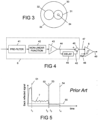
- the coupler 21 can be formed from a composite optical fibre 30 comprising a first fibre 31 and a second fibre 32 as shown with reference to Figure 3 .
- the first fibre 31 and the second fibre 32 are in optical contact with each other and are surrounded by a common coating material 33.
- the first fibre 31 preferably comprises a core 34 for guiding the laser radiation 2.
- the refractive index of the coating 33 is preferably lower than a refractive index of both the first and the second fibres 31, 32 in order that the optical radiation 5 can be guided along the second fibre 32.
- the second fibre 32 can be separated from the first fibre 31 by removing a portion of the coating 33, and the second fibre 32 can be directed to the detector 4.
- the first fibre 31 can be the optical fibre 12 in Figures 1 and 2 .
- the apparatus shown in Figure 2 can comprise at least one optical filter 25.
- the optical filter 25 is useful for transmitting certain optical wavelengths in the optical radiation 5 that are indicative of certain processing conditions, such as temperature.
- the optical filter 25 is shown located between the material 10 and the coupler 21. Alternatively or additionally the optical filter 25 can be located between the coupler 21 and the detector 4.
- the apparatus may comprise more than one optical filter 25 and detector 4, each filter detector combination configured to analyse the optical spectral content at different wavelengths.
- the apparatus of Figure 1 may also comprise at least one optical filter 25.
- the electronic filter 6 shown in Figure 2 comprises a band stop filter 23 and a peak level detector 24.
- the band stop filter 23 is useful for removing interference signals that are sometimes present in large factory settings.
- the peak level detector 24 removes high frequency content from the signal 7 and emits a signal 9 that is indicative of the peak amplitude 11 of the signal 7 over a time constant (not shown) selected to be short enough to reduce latency, and long enough to reduce false triggering of the discriminator 8.
- the peak level detector 24 can comprise a rectifier.
- the reduction in the amplitude (peak value) 11 of the signal 7 is indicative of the laser beam 2 piercing through the material 10.
- the apparatus of Figure 1 can also include one or more of the band stop filter 23 and the peak level detector 24.
- the electronic filter 6 shown in Figures 1 and 2 can comprise a pre-filter 41 shown with reference to Figure 4 .
- the pre-filter 41 is configured to improve the signal to noise ratio of the discriminator process.
- the pre-filter 41 can comprise a bandpass filter.
- a bandpass filter is advantageous for improving signal to noise ratio if the characteristic feature 11 in the electronic signal 7 occurs at a characteristic frequency.
- the centre frequency of the bandpass filter would be set at the characteristic frequency.
- a bandpass filter is also advantageous if the characteristic feature 11 is noise.
- the pre-filter 41 can comprise a high pass filter.
- a high pass filter is useful for removing the direct current value from the detector signal 7.
- a high pass filter can be used if the characteristic feature 11 is noise amplitude or noise power.
- the pre-filter 41 can be configured to reject such interference by, for example, selecting the centre frequency of a bandpass filter such that the filter rejects the interference. If the laser 1 is operated as a pulsed laser, then the centre frequency of the bandpass filter can be selected to be either higher or lower than the pulse repetition frequency of the pulsed laser in order to reject "noise" at the pulse repetition frequency arising from, for example, unwanted reflections within the laser apparatus.
- Other pre-filters for example band stop filters, are also possible.
- the electronic filter 6 of Figures 1 and 2 can comprise a non-linear function 42 shown with reference to Figure 4 .
- the non-linear function 42 can comprise a demodulator, a peak level detector, a half wave rectifier, a full wave rectifier, or a root mean square filter.
- the non-linear function 42 can include a low pass filtering function such that the characteristic feature 11 is output as a baseband signal such as the signal 9 shown with reference to Figures 1 and 2 .
- Other non-linear functions are also possible.
- the discriminator 8 of Figures 1 and 2 can comprise a level detector or a comparator for detecting a predetermined amplitude of the signal output by the filter 6.
- the level detector or comparator preferably comprises hysteresis to improve the signal to noise ratio or reliability of the pierce detection process.
- the electronic filter 6 of Figures 1 and 2 can comprise an integrator 43 as shown with reference to Figure 4 .
- the integrator 43 is for integrating the output of the non-linear function 42.
- the discriminator of Figures 1 and 2 may include a slope detector (not shown) for detecting a predetermined slope of the signal output from the integrator 43.
- the output 44 of the integrator 43 can be delayed by a time delay 45 to provide a time delayed integrator output 40, which output 40 is subtracted from the output 44 of the integrator in subtracting means 46.
- the output 47 of the subtracting means 46 is compared to a reference value 48 in the discriminator 8 to produce the discriminator signal 49.
- the electronic filter 6 and the discriminator 8 of Figures 1 and 2 may be configured in a digital electronic circuit.
- the digital electronic circuit may comprise a computer such as a microprocessor.
- the microprocessor may utilize spectral frequency analysis such as fast Fourier transforms to perform at least a portion of the filtering.
- the microprocessor may use fuzzy logic or a neural network in order to analyze the electronic signal 7 in order to provide the signal 16 that is indicative of the laser beam 2 piercing the material 10.
- the electronic filter 6 may comprise an analogue electronic filter.
- Figure 5 shows the electronic signal 7 emitted by the detector 4 when the optical radiation 5 is emitted from the material 10 in a typical pierce process.
- the process commences when the laser radiation 2 first interacts with the material 10, resulting in the laser radiation 2 being reflected.
- the reflection can be 10% to 90% of the incident power, and can be higher for copper or gold.
- the amplitude of the signal 7 typically falls at a time 51, indicating that the laser radiation 2 has initiated a phase change in the material 10.
- the phase change can correspond to the material 10 melting, or to gases or particulates being emitted by the material 10. Once the phase change occurs, the material 10 absorbs a greater proportion of the incident laser radiation 2, allowing the hole 17 to be drilled.
- the optical radiation 5 that is coupled into the optical fibre 12 represents only about 0.05% of the incident laser radiation 2.
- the signal 7 can be very small and hard to detect.
- the hole 17 pierces through the material 10 at a time 52 and the optical radiation 5 reduces to near zero.
- the signal 7 reduces to near zero, with much of the signal being caused by other optical reflections or imperfections with the laser system.
- a level detector that monitors the signal 7 can be set with a threshold 55 corresponding to the time 53 when it is safe to conclude that the material 10 has been pierced.
- the laser 1 can then be turned off at a time 54, whereupon the signal 7 falls to zero.
- the apparatus and method of the present invention improve the reliability of the pierce detection by analysing at least one characteristic feature 11 of the electronic signal 7.
- the characteristic feature 11 can be the amplitude or power of the noise content of the electronic signal 7.
- the characteristic feature 11 can be the amplitude or power of a particular frequency component of the electronic signal 7.
- the method is preferably independent of the power level of the incident laser radiation 2. As will be described with reference to Figures 15 to 18 , this can be achieved by deriving reference signals such as the reference 48 shown with reference to Figure 4 from the signals that are related to the power level of the incident laser radiation 2.
- the apparatus shown in Figure 2 was used in the following Examples.
- the laser 1 was a 2kW ytterbium-doped fibre laser, model number JK2000FL manufactured by SPI Lasers UK Limited of Victoria, England, that was modified by placing the detector 4 in close proximity to an internal cladding mode stripper that removes the optical radiation 5 that propagates in the cladding 147 of the optical fibre 12 back towards the laser 1.
- the detector 4 was an Indium Gallium Arsenide photodiode which is sensitive to the infrared one micron laser radiation emitted by the fibre laser.
- the output of the detector 4 was amplified by an electronic amplifier.
- the material 10 was 3mm thick mild steel, and the laser radiation 2 was focussed to a diameter of 100 ⁇ m onto the surface of the material 10.
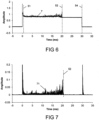
- Figure 6 shows the signal 7 that was output by the detector 4 while piercing the material 10.
- the laser 1 took approximately 20ms to pierce the material 10.
- the signal 7 was noisy between times 51 and 52, indicating that the pierce process is inherently unstable.
- the effective reflectivity of the material 10 is oscillating, resulting in the signal 7 being heavily modulated over a wide frequency range (0-50kHz for a typical detector system).
- the signal 7 was amplified, digitized with an analogue to digital converter sampling at 600 kHz, and filtered using the filter 6 shown in Figure 4 .
- the pre-filter 41 was a second order bandpass filter having a centre frequency of 5kHz and a quality factor Q of 10.
- the non-linear function 42 was a digital rectifier characterized by an output equal to the modulus of the input to the digital rectifier.
- the integrator 43 was digital integration by which the output at a particular sample time was equal to the output at the preceding sample time plus the input to the integrator 43.
- the delay 45 corresponded to 100 samples.
- the reference 48 was set to provide a reliable indication of pierce detection of the material 10 by the laser radiation 2.
- the output 71 of the digital rectifier is shown in Figure 7 .
- the signal 71 reduces in amplitude to near zero after the time 52.
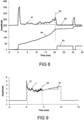
- the output 44 of the integrator 43 is shown in Figure 8 .
- the slope of the output 44 reduces to near zero after the time 52.
- Figure 8 also shows the output 47 of the subtracting means 46 and the discriminator signal 49.
- the output 47 has been level shifted by 200 units for clarity.
- the discriminator signal 49 was obtained by comparing the output 47 of the subtracting means 46 to a reference value 48. When the output 47 fell below the value of the reference value 48, the discriminator signal 49 rises to provide a positive indication of the piercing of the material 10.
- the discriminator 8 in Figure 2 can analyze the slope of the output 44 to determine the time 52, or can analyze the signal 71, for example by performing a rolling variance of the signal 71 shown with reference to Figure 7 , and looking for the variance to reduce significantly in amplitude.
- Other non-linear functions and discrimination methods can also be used in isolation or in addition.
- the signals 71 and 44 shown with reference to Figures 7 and 8 illustrate how the method of the invention can be used to detect piercing of the material 10 when the slope of the output 44 of the integrator 43 of the selected high frequency band falls to near zero.
- 5kHz has been chosen as the centre frequency of the band pass filter, but the algorithm works equally well with centre frequencies between 500Hz and 50kHz and a quality factor Q of 10. Other quality factors also work well.
- latency is reduced as the ratio of centre frequency to quality factor Q is increased. Reducing latency allows the discriminator decision within the discriminator to be made more rapidly.
- the laser radiation 2 emitted by the laser 1 is stable.
- the "noise" within the bandpass of the 5kHz filter without the presence of the optical radiation 5 being emitted by the material 10 was 0.25% peak to peak, whereas the “noise” in the presence of the optical radiation 5 was approximately 2.5% peak to peak.
- the centre frequency of the bandpass filter is preferably selected to increase the signal to noise ratio of the piercing detection process, and may vary from laser type to laser type. The optimum centre frequency can be found by experimentation.
- the characteristic feature 11 was the amplitude or power of a particular frequency component of the electronic signal 7.
- the material 10 was 2mm thick copper, and the laser radiation 2 was focussed to a diameter of 100 ⁇ m onto the surface of the material 10.
- Figure 9 shows the signal 7 that was output by the detector 4 while piercing the material 10.
- the laser 1 took approximately 4.5ms to pierce the material 10.
- the signal 7 is very noisy between times 51 and 52, indicating that the pierce process is inherently unstable.
- the signal 7 increases in amplitude after the time 52 which would make a purely amplitude discrimination process, such as described with reference to Figure 5 , difficult.
- the signal 7 was passed through the same filter 6 as used in Example 1.
- the output 44 of the integrator 43 is shown in Figure 10 , together with the output 47 of the subtracting means 46 and the discriminator signal 49.
- the output 47 has been level shifted by 200 units for clarity.
- the discriminator signal 49 provides a positive indication of the piercing of the material 10.
- the increase of the amplitude of the signal 7 was indicative that the optics 14 needs cleaning or replacing in whole or in part.
- replacing the cover slide that formed part of the optics 14 with a new and clean cover slide eliminated the increase in the amplitude of the signal 7 after the time 52.
- Steel has a lower thermal conductivity than copper, and the hole 17 can have a diameter that is twice or more then the diameter of the laser radiation 2 on surface of the material 10. Once the material 10 is pierced, there will therefore be less interaction of the laser radiation 2 with steel than there is with copper.
- the ability to detect damaged or contaminated optics, that is optical integrity monitoring, provides important advantages in the laser processing of materials.
- the material 10 can have a thermal conductivity greater than 150 W/m/K, preferably greater than 200 W/m/K and more preferably greater than 300 W/m/K.
- the material 10 can be a test piece that can be pierced periodically by the laser radiation 2 in order to validate the integrity of the optics 14. Including a test piece such as copper is particularly useful when laser processing material such as steel that has a lower thermal conductivity.
- the electrical signal 7 can be stored and analyzed each time it is pierced for quality control purposes including monitoring the cleanliness and integrity of the optics 14.
- the material 10 was 3mm thick aluminium, and the laser radiation 2 was focussed to a diameter of 100 ⁇ m onto the surface of the material 10.
- Figure 11 shows the signal 7 that was output by the detector 4 while piercing the material 10.
- the laser 1 took approximately 10.5ms to pierce the material 10.
- the signal 7 becomes increasingly noisy as the hole 17 is pierced through the material 10, and is especially noisy between a time 111 and the time 52 that the piercing was achieved.
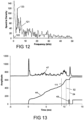
- Figure 12 shows the frequency spectrum 121 of the signal 7 shown in Figure 11 between times of 7 to 10ms.
- the frequency spectrum 121 was obtained using fast Fourier transforms.
- the frequency spectrum 122 obtained without the optical radiation 5 being emitted by the work piece.
- the frequency spectrum 121 is larger than the frequency spectrum 122, illustrating the amount of noise or information that is contained in the signal 7 during the piercing process.
- the frequency spectrum 121 is relatively broad, it contains certain frequency components that are stronger than others.
- One of the most prominent frequency components 123 is at 3kHz.
- the digital filter used in Examples 1 and 2 was therefore modified such that the central frequency of the digital band pass filter was equal to 3kHz.
- the quality factor Q was reduced from 10 to 5.
- the output 44 of the integrator 43 is shown in Figure 13 .
- the slope of the output 44 reduces at the time 52 at which the piercing of the material 10 was complete. There is then another increase in slope at time 54 when the laser 1 was turned off. This increase in slope occurs because the step change in the signal 7 at time 54 shown with reference to Figure 11 has a large frequency content, including at the centre frequency of the digital band pass filter.
- the output 47 of the subtracting means 46 and the discriminator signal 49 As before, the output 47 has been level shifted for clarity.
- the discriminator signal 49 provides a positive indication of the piercing of the material 10.
- This Example illustrates an optional feature of the invention, namely that additional information can be gathered about the dynamics of the melt within the hole 17 as the material 10 is being pierced by analysing specific frequency bands of the signal 7.
- FIG 15 shows an implementation of the filter 6 shown in Figures 1 and 2 .
- the filter 6 comprises a high pass filter 151, and rectifier 152, a first low pass filter 153, and a second low pass filter 154.
- the high pass filter 151 was configured to have a bandwidth of 3kHz.
- the rectifier 152 was configured to invert negative going signals and pass positive going signals.
- the first low pass filter 153 was configured to have a bandwidth of 1kHz and a gain of unity.
- the second low pass filter 154 was configured to have a bandwidth of 100Hz and a gain of 1/3.
- the discriminator 8 was configured to output a positive going signal when the signal 158 was larger than the signal 157.
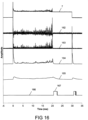
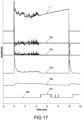
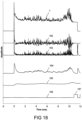
- the signals 7 shown with reference to Figures 6 , 9 and 11 were analysed using the filter 6 and discriminator 8 shown in Figure 15 .
- the results are shown in Figures 16 , 17 and 18 respectively.
- the signal 7 was at the input 150 to the high pass filter 151.
- the waveform 162 was at the output 155 of the high pass filter 151.
- the waveform 163 was at the output 156 of the rectifier 152.
- the waveform 164 was at the output 157 of the first low pass filter 153.
- the waveform 165 was at the output 158 of the second low pass filter 154.
- the waveform 166 was at the output 159 of the discriminator 8.
- the same numbering convention was used for Figures 17 and 18 .
- the waveform 166 provides a robust measure of laser piercing, which piercing is indicated by the first positive going signal 167.
- the characteristic feature 11 in the analysis shown in Figures 16 to 18 is the noise amplitude or power of the electronic signal 7.
- the bandwidths, gains, and configuration of the filters shown in Figure 15 can be adapted and modified, and different types of analogue or digital filters can be used.
- the second low pass filter 154 can be replaced with a simple threshold value (voltage for analogue electronics, number for digital filtering), which can be selected by the user through experimentation or via a look up table.
- a simple threshold value voltage for analogue electronics, number for digital filtering
- the second low pass filter 154 as described has advantages in that the waveform 165 scales with the waveform 164, and thus the pierce detection process is independent of the amplitude of the signal 7.
- Optical integrity monitoring that is, the apparatus for the detection of, and the method for detecting, damaged or contaminated optics described above, can be used with any of the other control purposes.
- the characteristic feature that is indicative of damaged or contaminated optics can be the same or different from the characteristic feature that is used to control piercing, cutting, welding or additive manufacturing.
- a test piece can be provided for the optical integrity monitoring as was described with reference to Example 2.
Landscapes
- Engineering & Computer Science (AREA)
- Mechanical Engineering (AREA)
- Physics & Mathematics (AREA)
- Optics & Photonics (AREA)
- Plasma & Fusion (AREA)
- Quality & Reliability (AREA)
- Laser Beam Processing (AREA)
Claims (9)
- Einrichtung zum Steuern der Laserbearbeitung eines Materials, wobei die Einrichtung umfasst:• einen Laser zum Emittieren von Laserstrahlung;• ein Mittel zum Richten der Laserstrahlung auf das Material;• wenigstens einen Detektor zum Erkennen von optischer Strahlung, die von dem Material emittiert wird;• ein elektronisches Filter zum Filtern eines elektronischen Signals, das von dem Detektor als Reaktion darauf, dass der Detektor die optische Strahlung erkennt, emittiert wird; und• einen Diskriminator zum Analysieren der Ausgabe von dem elektronischen Filter;und die Einrichtung dadurch gekennzeichnet ist, dass• das elektronische Filter und der Diskriminator dazu konfiguriert sind, wenigstens ein kennzeichnendes Merkmal des elektronischen Signals zu bestimmen, das die Bearbeitung des Materials durch die Laserstrahlung anzeigt; und• das kennzeichnende Merkmal wenigstens eines von Rauschen des elektronischen Signals, um dadurch eine Anzeige dafür bereitzustellen, wann das Material durchdrungen wurde, und einer zunehmenden Amplitude des elektronischen Signals umfasst, nachdem das Material durchdrungen wurde, um dadurch eine Anzeige dafür bereitzustellen, wann Optiken in der Einrichtung ganz oder teilweise gereinigt oder ausgetauscht werden müssen.
- Einrichtung nach Anspruch 1, wobei das Mittel zum Richten der Laserstrahlung auf das Material eine optische Faser und einen Laserbearbeitungskopf beinhaltet, wobei die optische Faser dazu konfiguriert ist, die Laserstrahlung von dem Laser zu dem Laserbearbeitungskopf zu leiten, und wobei die Einrichtung einen Koppler beinhaltet, der dazu konfiguriert ist, die optische Strahlung, die von dem Material emittiert wird, von der optischen Faser an den Detektor zu koppeln.
- Einrichtung nach Anspruch 1 oder 2, wobei das kennzeichnende Merkmal, das eine Anzeige dafür bereitstellt, wann die Optik ganz oder teilweise gereinigt oder ausgetauscht werden muss, nach dem Zeitpunkt, zu dem das Material durchdrungen wurde, auftritt.
- Verfahren zum Steuern der Laserbearbeitung eines Materials, wobei das Verfahren umfasst:• Bereitstellen eines Lasers zum Emittieren von Laserstrahlung;• Richten der Laserstrahlung auf das Material;• Erkennen von optischer Strahlung, die von dem Material emittiert wird, mit einem Detektor;• Filtern eines elektronischen Signals, das von dem Detektor als Reaktion auf die optische Strahlung emittiert wird, mit einem elektronischen Filter; und• Analysieren der Ausgabe von dem elektronischen Filter mit einem Diskriminator;und das Verfahren dadurch gekennzeichnet ist, dass• das elektronische Filter und der Diskriminator dazu konfiguriert sind, wenigstens ein kennzeichnendes Merkmal des elektronischen Signals zu bestimmen, das das Durchdringen des Materials durch die Laserstrahlung anzeigt; und• das kennzeichnende Merkmal wenigstens eines von Rauschen des elektronischen Signals, um dadurch eine Anzeige dafür bereitzustellen, wann das Material durchdrungen wurde, und einer zunehmenden Amplitude des elektronischen Signals umfasst, nachdem das Material durchdrungen wurde, um dadurch eine Anzeige dafür bereitzustellen, wann Optiken in der Einrichtung ganz oder teilweise gereinigt oder ausgetauscht werden müssen.
- Verfahren nach Anspruch 4, umfassend das Bereitstellen einer optischen Faser, eines Laserbearbeitungskopfes und eines Kopplers, das Ausbreiten der Laserstrahlung von dem Laser durch die optische Faser zu dem Laserbearbeitungskopf, und das Koppeln der optischen Strahlung, die von dem Material emittiert wird, von der optischen Faser an den Detektor.
- Verfahren nach Anspruch 4 oder 5, wobei das kennzeichnende Merkmal, das eine Anzeige dafür bereitstellt, wann die Optik ganz oder teilweise gereinigt oder ausgetauscht werden muss, nach dem Zeitpunkt, zu dem das Material durchdrungen wurde, auftritt.
- Verfahren nach einem der Ansprüche 4 bis 6, wobei die Zunahme der Amplitude des Signals durch eine Änderungsrate des elektrischen Signals gekennzeichnet ist und das Verfahren den Schritt des Erzeugens eines Alarms beinhaltet, wenn die Änderungsrate des elektrischen Signals größer als ein vorbestimmter Wert ist.
- Verfahren nach einem der Ansprüche 4 bis 7, wobei das Material ein Teststück umfasst.
- Verfahren nach einem der Ansprüche 4 bis 8, wobei das Material eine Wärmeleitfähigkeit von mehr als 150 W/m/K aufweist.
Applications Claiming Priority (2)
| Application Number | Priority Date | Filing Date | Title |
|---|---|---|---|
| GBGB1604097.4A GB201604097D0 (en) | 2016-03-09 | 2016-03-09 | Apparatus and method for controlling laser processing of a material |
| PCT/GB2017/000031 WO2017153707A1 (en) | 2016-03-09 | 2017-03-08 | Apparatus and method for controlling laser processing of a material |
Publications (3)
| Publication Number | Publication Date |
|---|---|
| EP3426428A1 EP3426428A1 (de) | 2019-01-16 |
| EP3426428B1 true EP3426428B1 (de) | 2025-06-18 |
| EP3426428C0 EP3426428C0 (de) | 2025-06-18 |
Family
ID=55859264
Family Applications (1)
| Application Number | Title | Priority Date | Filing Date |
|---|---|---|---|
| EP17711254.7A Active EP3426428B1 (de) | 2016-03-09 | 2017-03-08 | Vorrichtung und verfahren zur kontrolle der laserverarbeitung eines materials |
Country Status (4)
| Country | Link |
|---|---|
| US (1) | US20190099833A1 (de) |
| EP (1) | EP3426428B1 (de) |
| GB (1) | GB201604097D0 (de) |
| WO (1) | WO2017153707A1 (de) |
Families Citing this family (11)
| Publication number | Priority date | Publication date | Assignee | Title |
|---|---|---|---|---|
| US11285563B2 (en) | 2017-10-20 | 2022-03-29 | Branson Ultrasonics Corporation | Fiber feedback |
| GB201818070D0 (en) * | 2018-04-30 | 2018-12-19 | Spi Lasers Uk Ltd | Apparatus and method for controlling laser processing of a remote material |
| JP7332144B2 (ja) * | 2019-06-13 | 2023-08-23 | 株式会社ブイ・テクノロジー | レーザ修正方法、レーザ修正装置 |
| CN110989334B (zh) * | 2019-11-03 | 2023-07-14 | 武汉光谷航天三江激光产业技术研究院有限公司 | 一种激光切割晶圆控制参数动态调节装置 |
| DE102020104462A1 (de) * | 2020-02-20 | 2021-08-26 | Precitec Gmbh & Co. Kg | Verfahren zum Analysieren einer Schweißverbindung beim Laserschweißen von Werkstücken |
| DE102020112116A1 (de) | 2020-05-05 | 2021-11-11 | Precitec Gmbh & Co. Kg | Verfahren zum Analysieren eines Laserbearbeitungsprozesses, System zum Analysieren eines Laserbearbeitungsprozesses und Laserbearbeitungssystem mit einem solchen System |
| GB202010315D0 (en) * | 2020-07-06 | 2020-08-19 | Renishaw Plc | Improvements in or relating to an optical scanner for directing electromagnetic radiation to different locations within a sacn field |
| DE102020209589A1 (de) | 2020-07-30 | 2022-02-03 | Trumpf Werkzeugmaschinen Gmbh + Co. Kg | Verfahren und Vorrichtung zum Erkennen eines Fehlschnitts beim trennenden Bearbeiten eines Werkstücks |
| CN112525922A (zh) * | 2020-12-18 | 2021-03-19 | 广州德擎光学科技有限公司 | 检测激光加工质量的光学检测模块和系统 |
| CZ2021186A3 (cs) * | 2021-04-14 | 2022-10-26 | Západočeská Univerzita V Plzni | Způsob kontroly a řízení pulzního laserového mikro-zpracování a zařízení pro provádění tohoto způsobu |
| CN113624626B (zh) * | 2021-07-22 | 2024-05-07 | 四川省机械研究设计院(集团)有限公司 | 石膏胶凝材料凝结硬化检测系统及方法 |
Family Cites Families (7)
| Publication number | Priority date | Publication date | Assignee | Title |
|---|---|---|---|---|
| US5045669A (en) * | 1990-03-02 | 1991-09-03 | General Electric Company | Method and apparatus for optically/acoustically monitoring laser materials processing |
| US5286947A (en) * | 1992-09-08 | 1994-02-15 | General Electric Company | Apparatus and method for monitoring material removal from a workpiece |
| US6670574B1 (en) * | 2002-07-31 | 2003-12-30 | Unitek Miyachi Corporation | Laser weld monitor |
| CN102497952B (zh) * | 2009-07-20 | 2014-12-24 | 普雷茨特两合公司 | 激光处理头以及用于补偿激光处理头的聚焦位置的改变的方法 |
| ITTO20110352A1 (it) * | 2011-04-21 | 2012-10-22 | Adige Spa | Metodo per il controllo di un processo di taglio laser e sistema di taglio laser implementante tale metodo |
| KR20150015254A (ko) * | 2013-07-31 | 2015-02-10 | 삼성디스플레이 주식회사 | 레이저 빔의 모니터링 방법 및 이를 이용한 레이저 조사 장치 |
| WO2017164819A1 (en) * | 2016-03-23 | 2017-09-28 | Heptagon Micro Optics Pte. Ltd. | Optoelectronic module assembly and manufacturing method |
-
2016
- 2016-03-09 GB GBGB1604097.4A patent/GB201604097D0/en not_active Ceased
-
2017
- 2017-03-08 EP EP17711254.7A patent/EP3426428B1/de active Active
- 2017-03-08 US US16/082,374 patent/US20190099833A1/en not_active Abandoned
- 2017-03-08 WO PCT/GB2017/000031 patent/WO2017153707A1/en not_active Ceased
Also Published As
| Publication number | Publication date |
|---|---|
| WO2017153707A1 (en) | 2017-09-14 |
| US20190099833A1 (en) | 2019-04-04 |
| EP3426428A1 (de) | 2019-01-16 |
| GB201604097D0 (en) | 2016-04-20 |
| EP3426428C0 (de) | 2025-06-18 |
Similar Documents
| Publication | Publication Date | Title |
|---|---|---|
| EP3426428B1 (de) | Vorrichtung und verfahren zur kontrolle der laserverarbeitung eines materials | |
| US11491583B2 (en) | Methods and apparatuses for controlling cutting processes | |
| US7863544B2 (en) | Arrangement and method for the on-line monitoring of the quality of a laser process exerted on a workpiece | |
| US6329635B1 (en) | Methods for weld monitoring and laser heat treatment monitoring | |
| US20130327194A1 (en) | Method for Monitoring Cutting Processing on a Workpiece | |
| Levichev et al. | Real-time monitoring of fiber laser cutting of thick plates by means of photodiodes | |
| CN113365774B (zh) | 用于自动化地求取激光加工参数对激光加工的影响的方法以及激光加工机和计算机程序产品 | |
| JPH08192283A (ja) | レーザ加工装置 | |
| JP2000271768A (ja) | Yagレーザ溶接部の品質モニタリング方法 | |
| EP1371443B1 (de) | Vorrichtung und Verfahren zur Überwachung des Laserschweissens und zum Geben eines Schweissqualitätsstatutes | |
| Sanders et al. | Real-time monitoring of laser beam welding using infrared weld emissions | |
| JP4349075B2 (ja) | レーザ加工方法及び加工状態判断方法 | |
| JP2022534573A (ja) | レーザによる自動材料認識 | |
| JP2014113597A (ja) | レーザ加工装置 | |
| JP6725572B2 (ja) | レーザ加工機及びレーザ加工方法 | |
| CN101267910A (zh) | 控制激光焊接过程的质量的方法、控制系统及其程序产品 | |
| Fox et al. | Applications of optical sensing for laser cutting and drilling | |
| EP2921250B1 (de) | Laserschweissprüfvorrichtung und laserschweissprüfverfahren | |
| JP2020069518A (ja) | 溶接モニタリング装置および溶接モニタリング方法 | |
| JP2017024046A (ja) | レーザ溶接監視装置とレーザ溶接監視方法 | |
| JPH04361889A (ja) | レーザ溶接モニタリング方法及びその装置 | |
| Sichani et al. | Monitoring and adaptive control of CO2 laser flame cutting | |
| JP3169354B2 (ja) | レーザ溶接加工モニタリング装置 | |
| JP2001071164A (ja) | 被加工部のモニタリング方法及びその装置 | |
| Garmendia et al. | Optical monitoring of fiber laser based cutting processes for in-situ quality assurance |
Legal Events
| Date | Code | Title | Description |
|---|---|---|---|
| STAA | Information on the status of an ep patent application or granted ep patent |
Free format text: STATUS: UNKNOWN |
|
| STAA | Information on the status of an ep patent application or granted ep patent |
Free format text: STATUS: THE INTERNATIONAL PUBLICATION HAS BEEN MADE |
|
| PUAI | Public reference made under article 153(3) epc to a published international application that has entered the european phase |
Free format text: ORIGINAL CODE: 0009012 |
|
| STAA | Information on the status of an ep patent application or granted ep patent |
Free format text: STATUS: REQUEST FOR EXAMINATION WAS MADE |
|
| 17P | Request for examination filed |
Effective date: 20180905 |
|
| AK | Designated contracting states |
Kind code of ref document: A1 Designated state(s): AL AT BE BG CH CY CZ DE DK EE ES FI FR GB GR HR HU IE IS IT LI LT LU LV MC MK MT NL NO PL PT RO RS SE SI SK SM TR |
|
| AX | Request for extension of the european patent |
Extension state: BA ME |
|
| DAV | Request for validation of the european patent (deleted) | ||
| DAX | Request for extension of the european patent (deleted) | ||
| STAA | Information on the status of an ep patent application or granted ep patent |
Free format text: STATUS: EXAMINATION IS IN PROGRESS |
|
| 17Q | First examination report despatched |
Effective date: 20210422 |
|
| RAP3 | Party data changed (applicant data changed or rights of an application transferred) |
Owner name: TRUMPF LASER UK LIMITED |
|
| GRAP | Despatch of communication of intention to grant a patent |
Free format text: ORIGINAL CODE: EPIDOSNIGR1 |
|
| STAA | Information on the status of an ep patent application or granted ep patent |
Free format text: STATUS: GRANT OF PATENT IS INTENDED |
|
| INTG | Intention to grant announced |
Effective date: 20250321 |
|
| GRAS | Grant fee paid |
Free format text: ORIGINAL CODE: EPIDOSNIGR3 |
|
| GRAA | (expected) grant |
Free format text: ORIGINAL CODE: 0009210 |
|
| STAA | Information on the status of an ep patent application or granted ep patent |
Free format text: STATUS: THE PATENT HAS BEEN GRANTED |
|
| AK | Designated contracting states |
Kind code of ref document: B1 Designated state(s): AL AT BE BG CH CY CZ DE DK EE ES FI FR GB GR HR HU IE IS IT LI LT LU LV MC MK MT NL NO PL PT RO RS SE SI SK SM TR |
|
| REG | Reference to a national code |
Ref country code: GB Ref legal event code: FG4D |
|
| REG | Reference to a national code |
Ref country code: CH Ref legal event code: EP |
|
| REG | Reference to a national code |
Ref country code: DE Ref legal event code: R096 Ref document number: 602017089979 Country of ref document: DE |
|
| REG | Reference to a national code |
Ref country code: CH Ref legal event code: EP |
|
| REG | Reference to a national code |
Ref country code: IE Ref legal event code: FG4D |
|
| U01 | Request for unitary effect filed |
Effective date: 20250704 |
|
| U07 | Unitary effect registered |
Designated state(s): AT BE BG DE DK EE FI FR IT LT LU LV MT NL PT RO SE SI Effective date: 20250710 |
|
| PG25 | Lapsed in a contracting state [announced via postgrant information from national office to epo] |
Ref country code: NO Free format text: LAPSE BECAUSE OF FAILURE TO SUBMIT A TRANSLATION OF THE DESCRIPTION OR TO PAY THE FEE WITHIN THE PRESCRIBED TIME-LIMIT Effective date: 20250918 Ref country code: GR Free format text: LAPSE BECAUSE OF FAILURE TO SUBMIT A TRANSLATION OF THE DESCRIPTION OR TO PAY THE FEE WITHIN THE PRESCRIBED TIME-LIMIT Effective date: 20250919 |
|
| PG25 | Lapsed in a contracting state [announced via postgrant information from national office to epo] |
Ref country code: HR Free format text: LAPSE BECAUSE OF FAILURE TO SUBMIT A TRANSLATION OF THE DESCRIPTION OR TO PAY THE FEE WITHIN THE PRESCRIBED TIME-LIMIT Effective date: 20250618 |
|
| PG25 | Lapsed in a contracting state [announced via postgrant information from national office to epo] |
Ref country code: RS Free format text: LAPSE BECAUSE OF FAILURE TO SUBMIT A TRANSLATION OF THE DESCRIPTION OR TO PAY THE FEE WITHIN THE PRESCRIBED TIME-LIMIT Effective date: 20250918 |