EP3422936B1 - Device for sampling one or more analytes - Google Patents
Device for sampling one or more analytes Download PDFInfo
- Publication number
- EP3422936B1 EP3422936B1 EP17818598.9A EP17818598A EP3422936B1 EP 3422936 B1 EP3422936 B1 EP 3422936B1 EP 17818598 A EP17818598 A EP 17818598A EP 3422936 B1 EP3422936 B1 EP 3422936B1
- Authority
- EP
- European Patent Office
- Prior art keywords
- electrode
- skin
- magnetic field
- skin surface
- analytes
- Prior art date
- Legal status (The legal status is an assumption and is not a legal conclusion. Google has not performed a legal analysis and makes no representation as to the accuracy of the status listed.)
- Active
Links
Images

Classifications
-
- A—HUMAN NECESSITIES
- A61—MEDICAL OR VETERINARY SCIENCE; HYGIENE
- A61B—DIAGNOSIS; SURGERY; IDENTIFICATION
- A61B5/00—Measuring for diagnostic purposes; Identification of persons
- A61B5/145—Measuring characteristics of blood in vivo, e.g. gas concentration or pH-value ; Measuring characteristics of body fluids or tissues, e.g. interstitial fluid or cerebral tissue
- A61B5/14507—Measuring characteristics of blood in vivo, e.g. gas concentration or pH-value ; Measuring characteristics of body fluids or tissues, e.g. interstitial fluid or cerebral tissue specially adapted for measuring characteristics of body fluids other than blood
- A61B5/1451—Measuring characteristics of blood in vivo, e.g. gas concentration or pH-value ; Measuring characteristics of body fluids or tissues, e.g. interstitial fluid or cerebral tissue specially adapted for measuring characteristics of body fluids other than blood for interstitial fluid
- A61B5/14514—Measuring characteristics of blood in vivo, e.g. gas concentration or pH-value ; Measuring characteristics of body fluids or tissues, e.g. interstitial fluid or cerebral tissue specially adapted for measuring characteristics of body fluids other than blood for interstitial fluid using means for aiding extraction of interstitial fluid, e.g. microneedles or suction
-
- A—HUMAN NECESSITIES
- A61—MEDICAL OR VETERINARY SCIENCE; HYGIENE
- A61B—DIAGNOSIS; SURGERY; IDENTIFICATION
- A61B5/00—Measuring for diagnostic purposes; Identification of persons
- A61B5/15—Devices for taking samples of blood
-
- A—HUMAN NECESSITIES
- A61—MEDICAL OR VETERINARY SCIENCE; HYGIENE
- A61B—DIAGNOSIS; SURGERY; IDENTIFICATION
- A61B5/00—Measuring for diagnostic purposes; Identification of persons
- A61B5/0002—Remote monitoring of patients using telemetry, e.g. transmission of vital signals via a communication network
-
- A—HUMAN NECESSITIES
- A61—MEDICAL OR VETERINARY SCIENCE; HYGIENE
- A61B—DIAGNOSIS; SURGERY; IDENTIFICATION
- A61B5/00—Measuring for diagnostic purposes; Identification of persons
- A61B5/145—Measuring characteristics of blood in vivo, e.g. gas concentration or pH-value ; Measuring characteristics of body fluids or tissues, e.g. interstitial fluid or cerebral tissue
- A61B5/14532—Measuring characteristics of blood in vivo, e.g. gas concentration or pH-value ; Measuring characteristics of body fluids or tissues, e.g. interstitial fluid or cerebral tissue for measuring glucose, e.g. by tissue impedance measurement
-
- A—HUMAN NECESSITIES
- A61—MEDICAL OR VETERINARY SCIENCE; HYGIENE
- A61B—DIAGNOSIS; SURGERY; IDENTIFICATION
- A61B5/00—Measuring for diagnostic purposes; Identification of persons
- A61B5/145—Measuring characteristics of blood in vivo, e.g. gas concentration or pH-value ; Measuring characteristics of body fluids or tissues, e.g. interstitial fluid or cerebral tissue
- A61B5/14546—Measuring characteristics of blood in vivo, e.g. gas concentration or pH-value ; Measuring characteristics of body fluids or tissues, e.g. interstitial fluid or cerebral tissue for measuring analytes not otherwise provided for, e.g. ions, cytochromes
-
- A—HUMAN NECESSITIES
- A61—MEDICAL OR VETERINARY SCIENCE; HYGIENE
- A61B—DIAGNOSIS; SURGERY; IDENTIFICATION
- A61B5/00—Measuring for diagnostic purposes; Identification of persons
- A61B5/145—Measuring characteristics of blood in vivo, e.g. gas concentration or pH-value ; Measuring characteristics of body fluids or tissues, e.g. interstitial fluid or cerebral tissue
- A61B5/1468—Measuring characteristics of blood in vivo, e.g. gas concentration or pH-value ; Measuring characteristics of body fluids or tissues, e.g. interstitial fluid or cerebral tissue using chemical or electrochemical methods, e.g. by polarographic means
- A61B5/1477—Measuring characteristics of blood in vivo, e.g. gas concentration or pH-value ; Measuring characteristics of body fluids or tissues, e.g. interstitial fluid or cerebral tissue using chemical or electrochemical methods, e.g. by polarographic means non-invasive
-
- A—HUMAN NECESSITIES
- A61—MEDICAL OR VETERINARY SCIENCE; HYGIENE
- A61B—DIAGNOSIS; SURGERY; IDENTIFICATION
- A61B5/00—Measuring for diagnostic purposes; Identification of persons
- A61B5/145—Measuring characteristics of blood in vivo, e.g. gas concentration or pH-value ; Measuring characteristics of body fluids or tissues, e.g. interstitial fluid or cerebral tissue
- A61B5/1468—Measuring characteristics of blood in vivo, e.g. gas concentration or pH-value ; Measuring characteristics of body fluids or tissues, e.g. interstitial fluid or cerebral tissue using chemical or electrochemical methods, e.g. by polarographic means
- A61B5/1486—Measuring characteristics of blood in vivo, e.g. gas concentration or pH-value ; Measuring characteristics of body fluids or tissues, e.g. interstitial fluid or cerebral tissue using chemical or electrochemical methods, e.g. by polarographic means using enzyme electrodes, e.g. with immobilised oxidase
-
- A—HUMAN NECESSITIES
- A61—MEDICAL OR VETERINARY SCIENCE; HYGIENE
- A61B—DIAGNOSIS; SURGERY; IDENTIFICATION
- A61B5/00—Measuring for diagnostic purposes; Identification of persons
- A61B5/15—Devices for taking samples of blood
- A61B5/150007—Details
- A61B5/150015—Source of blood
- A61B5/150022—Source of blood for capillary blood or interstitial fluid
-
- A—HUMAN NECESSITIES
- A61—MEDICAL OR VETERINARY SCIENCE; HYGIENE
- A61B—DIAGNOSIS; SURGERY; IDENTIFICATION
- A61B5/00—Measuring for diagnostic purposes; Identification of persons
- A61B5/15—Devices for taking samples of blood
- A61B5/150007—Details
- A61B5/150053—Details for enhanced collection of blood or interstitial fluid at the sample site, e.g. by applying compression, heat, vibration, ultrasound, suction or vacuum to tissue; for reduction of pain or discomfort; Skin piercing elements, e.g. blades, needles, lancets or canulas, with adjustable piercing speed
- A61B5/150061—Means for enhancing collection
- A61B5/150091—Means for enhancing collection by electricity
-
- A—HUMAN NECESSITIES
- A61—MEDICAL OR VETERINARY SCIENCE; HYGIENE
- A61B—DIAGNOSIS; SURGERY; IDENTIFICATION
- A61B5/00—Measuring for diagnostic purposes; Identification of persons
- A61B5/15—Devices for taking samples of blood
- A61B5/151—Devices specially adapted for taking samples of capillary blood, e.g. by lancets, needles or blades
- A61B5/15134—Bladeless capillary blood sampling devices, i.e. devices for perforating the skin in order to obtain a blood sample but not using a blade, needle, canula, or lancet, e.g. by laser perforation, suction or pressurized fluids
-
- A—HUMAN NECESSITIES
- A61—MEDICAL OR VETERINARY SCIENCE; HYGIENE
- A61B—DIAGNOSIS; SURGERY; IDENTIFICATION
- A61B5/00—Measuring for diagnostic purposes; Identification of persons
- A61B5/68—Arrangements of detecting, measuring or recording means, e.g. sensors, in relation to patient
- A61B5/6801—Arrangements of detecting, measuring or recording means, e.g. sensors, in relation to patient specially adapted to be attached to or worn on the body surface
- A61B5/6802—Sensor mounted on worn items
- A61B5/681—Wristwatch-type devices
-
- A—HUMAN NECESSITIES
- A61—MEDICAL OR VETERINARY SCIENCE; HYGIENE
- A61B—DIAGNOSIS; SURGERY; IDENTIFICATION
- A61B5/00—Measuring for diagnostic purposes; Identification of persons
- A61B5/74—Details of notification to user or communication with user or patient; User input means
- A61B5/7475—User input or interface means, e.g. keyboard, pointing device, joystick
-
- G—PHYSICS
- G01—MEASURING; TESTING
- G01N—INVESTIGATING OR ANALYSING MATERIALS BY DETERMINING THEIR CHEMICAL OR PHYSICAL PROPERTIES
- G01N33/00—Investigating or analysing materials by specific methods not covered by groups G01N1/00 - G01N31/00
- G01N33/48—Biological material, e.g. blood, urine; Haemocytometers
- G01N33/50—Chemical analysis of biological material, e.g. blood, urine; Testing involving biospecific ligand binding methods; Immunological testing
- G01N33/66—Chemical analysis of biological material, e.g. blood, urine; Testing involving biospecific ligand binding methods; Immunological testing involving blood sugars, e.g. galactose
-
- A—HUMAN NECESSITIES
- A61—MEDICAL OR VETERINARY SCIENCE; HYGIENE
- A61B—DIAGNOSIS; SURGERY; IDENTIFICATION
- A61B2560/00—Constructional details of operational features of apparatus; Accessories for medical measuring apparatus
- A61B2560/02—Operational features
- A61B2560/0204—Operational features of power management
- A61B2560/0214—Operational features of power management of power generation or supply
-
- A—HUMAN NECESSITIES
- A61—MEDICAL OR VETERINARY SCIENCE; HYGIENE
- A61B—DIAGNOSIS; SURGERY; IDENTIFICATION
- A61B2560/00—Constructional details of operational features of apparatus; Accessories for medical measuring apparatus
- A61B2560/04—Constructional details of apparatus
- A61B2560/0475—Special features of memory means, e.g. removable memory cards
-
- A—HUMAN NECESSITIES
- A61—MEDICAL OR VETERINARY SCIENCE; HYGIENE
- A61B—DIAGNOSIS; SURGERY; IDENTIFICATION
- A61B5/00—Measuring for diagnostic purposes; Identification of persons
- A61B5/15—Devices for taking samples of blood
- A61B5/150007—Details
- A61B5/150343—Collection vessels for collecting blood samples from the skin surface, e.g. test tubes, cuvettes
-
- A—HUMAN NECESSITIES
- A61—MEDICAL OR VETERINARY SCIENCE; HYGIENE
- A61B—DIAGNOSIS; SURGERY; IDENTIFICATION
- A61B5/00—Measuring for diagnostic purposes; Identification of persons
- A61B5/15—Devices for taking samples of blood
- A61B5/157—Devices characterised by integrated means for measuring characteristics of blood
-
- A—HUMAN NECESSITIES
- A61—MEDICAL OR VETERINARY SCIENCE; HYGIENE
- A61B—DIAGNOSIS; SURGERY; IDENTIFICATION
- A61B5/00—Measuring for diagnostic purposes; Identification of persons
- A61B5/68—Arrangements of detecting, measuring or recording means, e.g. sensors, in relation to patient
- A61B5/6801—Arrangements of detecting, measuring or recording means, e.g. sensors, in relation to patient specially adapted to be attached to or worn on the body surface
- A61B5/683—Means for maintaining contact with the body
- A61B5/6832—Means for maintaining contact with the body using adhesives
Definitions
- This invention relates to devices based on magneto-hydrodynamics (MHD) to extract fluid comprising one or more analytes from a target, in particular, interstitial fluid from skin.
- MHD magneto-hydrodynamics
- Interstitial fluid is an aqueous solution that serves as a transport medium for e.g. glucose and electrolytes between the cells and the circulatory system. Therefore, the concentration of different solutes, such as glucose and lactic acid, in IF and in blood exhibits a substantial correlation. This makes the analysis of IF relevant to many developing fields, including, medical diagnosis, early disease detection, pharmacokinetics, and smart wearable technologies. Furthermore, a strong commercial and scientific interest promotes research on painless and non-invasive IF sampling methods.
- US2002/0002328A1 discloses a noninvasive IF device and method for sampling substances such as glucose through skin by reverse iontophoresis.
- the device is designed to monitor blood glucose levels in people with diabetes.
- the device is not considered a replacement, but an addition to conventional invasive blood glucose monitoring.
- WO2010001122A2 discloses a patch for sampling one or more analytes through the skin of a patient.
- the patch comprises an electrode layer that is positioned adjacent to the skin of a patient, and means for actuating an electrode layer to induce the withdrawal of analyte through the skin by reverse iontophoresis.
- the patch comprises reservoir chambers containing an electrically conducting medium to induce the process of iontophoresis.
- the presence of an electrolyte in liquid form ensures good conductivity between the electrodes and the skin, which enhances the effectiveness of the reverse iontophoresis process.
- the state-of-the-art devices discussed above for noninvasive glucose monitoring are based on the harnessing of osmotic flow or electrophoresis. In these devices, the extraction occurs locally at the electrode-skin interface. Accordingly, a limited volume of fluid can be extracted and analyzed, which in turn requires sensitive detection and analysis techniques.
- the present invention is based on the observation that at least some of the state-of-the-art problems related to sampling of one or more analytes from skin can be solved or at least alleviated by exploiting the magneto-hydrodynamic (MHD) phenomenon.
- MHD magneto-hydrodynamic
- direction of the magnetic field produced by the one or more magnets, and direction of the electric current produced by the power source is adapted to be such that Lorentz force produced by the magnetic field and the electric current is adapted to drive the interstitial fluid from the dermis substantially towards the skin surface.
- the IF can be sampled from the skin not only locally at the electrode-skin interface as in the state of the art, but also between the electrodes, where a further volume of IF is available. Furthermore, MHD adds a force component that increases the extraction rate under a negative electrode.
- the present invention concerns a device for sampling IF in a non-invasive manner.
- the IF comprises one or more analytes to be analyzed.
- the IF is extracted from the skin by exploiting the MHD phenomenon.
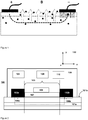
- Figure 1 shows the working principle of the present invention.
- the device serves to extract IF from skin. Accordingly, an electric current produced by a power source is established through a pair of electrodes (marked with + and -) and the skin.
- the magnetic field (B) is produced by a magnet.
- the current density in the middle skin layer (dermis) is substantially higher than in the inner (hypodermis) or outer (epidermis) skin layers because the higher content of IF in the dermis offers a lower impedance electric path.
- the direction of the magnetic field is substantially perpendicular to the skin surface, particularly within the distance and at the location of the electrodes, and substantially perpendicular to desired direction of fluid displacement from the dermis to the skin surface.
- the current-carrying fluid in the magnetic field experiences a Lorentz force towards the skin surface.
- This force serves to drive IF out of the skin.
- the vectors of Lorentz force, electric current, and magnetic field are all perpendicular to each other.
- the force distribution is defined by the distribution of the electric current and the magnetic field.
- the distribution of Lorentz force in the current carrying fluid permits directional driving of the IF out of the skin along the whole/entire current path i.e. along the distance between the electrodes.
- the fluid displacement in the direction of the Lorentz force is indicated with white big arrows.
- the IF containing relevant analytes, such as glucose, shown as black dots in the figure, is extracted also along the distance between the electrodes and not only under the negative electrode wherein also electrophoresis (black small arrows) promotes movement of fluid towards the electrode-skin interface.
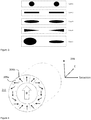
- a device 100 for sampling IF comprising one or more analytes from dermis 101a to skin surface 101b comprises
- the electric current flows substantially in three different directions as described by the dotted arrow in figure 2 : initially from the first electrode towards the skin, in particular towards the dermis comprising the IF, then within the distance between the electrodes, substantially parallel to the skin surface, and finally from the dermis towards the second electrode ( i.e. the (-)-electrode), i.e. in -y-, x- and y-directions, respectively of the coordinate system 199 of figure 2 . Accordingly, the electric current contributes to driving a certain volume of IF towards the second electrode.
- the magnet In order to produce a Lorentz force in the current-carrying IF in the skin towards the skin surface, the magnet should produce a magnetic field that is substantially in z-direction of the coordinate system 199. Accordingly, the MHD effect produced by the magnetic field and the electric current drives the IF comprising the one or more analytes from the dermis substantially towards the skin surface within the distance and below the (-)-electrode 102b. Accordingly, the direction of the flow of the IF is substantially in y-direction of the coordinate system 199.
- the first electrode, and the second electrode is a silver-silver chloride (Ag-AgCI) electrode to avoid electrolysis of water and pH drifts.
- Ag-AgCI silver-silver chloride
- other inert and non-ferromagnetic materials are also suitable.
- Exemplary further materials are carbon, gold, and platinum.
- the electrodes can be coated with different materials, for instance, enzymes and catalysts such as glucose oxidase, dehydrogenase and Prussian blue. Furthermore, different materials or combination of materials can be used as an interface between the electrodes and the skin for instance to reduce the electric impedance, to protect the electrode coating and to facilitate the analysis of the extracted IF samples. Suitable materials for this purpose include biocompatible membranes ( i.e. permeable or semipermeable) made of regenerated cellulose, silicone and monofilament fabric of polyamide.
- biocompatible membranes i.e. permeable or semipermeable
- the interface serves to maintain a low electric impedance between the electrodes and the skin, to facilitate the transport of analytes towards the device, to preserve electrochemical conditions (e.g. pH) and activity of the enzyme.
- the electrode skin interface is preferable a gel or hydrogel.
- the electrode skin interface is a membrane which is permeable or semipermeable, electrically conductive, and hypoallergenic.
- Exemplary materials suitable for this purpose include biocompatible membranes (i.e. permeable or semipermeable) made of regenerated cellulose, silicone and monofilament fabric of polyamide. These membranes can be treated with agents that work as humectants (i.e.
- the membranes can also be loaded with agents, such as corticosteroids and other drugs, to prevent or reduce potential skin reactions induced by the extraction procedure.
- the first electrode 102a is acting as a positive electrode and the second electrode 102b is acting as a negative electrode. It is to be understood that the polarity of the electrodes can be flipped and that other configurations are possible.
- the first electrode and the second electrode are preferably substantially parallel to each other.
- the device may include plurality of first electrodes and plurality of second electrodes. The electrodes can be same of different.
- the first electrode and the second electrode comprise a contact surface.
- the contact surfaces are shown in figure 2 with reference numbers 106a and 106b for the first electrode and the second electrode, respectively.
- the contact surface of the electrodes is flat and either circular e.g. disk-shaped, rectangular, elliptical or pyramidal.
- the contact surface is adapted to the shape of the skin surface. For example, if the skin is in a finger or in the wrist, the contact surface may be substantially curved to allow maximal mechanical and electric contact with the skin.
- the contact surface may comprise extrusions and/or protrusions to facilitate maximal adherence to the skin surface.
- the area of the contact surface of each electrode is preferably between 0.01 cm 2 and 9 cm 2 , and most preferably between 0.15 cm 2 and 1 cm 2 .
- the distance between the first electrode and the second electrode is preferably between 1 mm and 5 cm, and most preferably between 5 mm and 3 cm. According to an exemplary embodiment the distance is 1 cm.
- the shape of the contact surface of the electrodes is elliptical, and the major axis of the ellipsis is substantially larger than the minor axis. This allows to set a larger current density through the dermis without increasing the current density at the electrode-skin interface.
- Exemplary electrode shapes are shown in figure 3 . This figure depicts five cases illustrating different electrode configurations (first electrode to the left, and second electrode to the right). The current density through the target such as skin can be different in all cases even if the contact area of the electrodes is the same. The electrode shape can alter the distribution of electric current in the skin, and therefore, the local current density to increase the Lorentz force and the extraction rate of IF. For this reason, the elliptical electrode shapes illustrated in case 3 are preferable.
- the power source 104 can be a direct current (DC) power source and/or an alternating current (AC) power source that limits and regulates the energy i.e. the intensity of the electric current and/or voltage delivered through the electrodes.
- the power source is a floating current source that provides means to establish a direct electric current preferably in the range of 10 ⁇ A to 10 mA, and more preferably in the range 0.1 mA to 1 mA.
- the current density at the electrode-target, such as skin interface is preferably between 1 ⁇ A/cm 2 and 10 mA/cm 2 , and most preferably between 0.1 mA/cm 2 and 1 mA/ cm 2 .
- the voltage provided by the current source is preferable between 1 and 100 V.
- the electric current established by the floating current source exhibits a unipolar (unidirectional) or bipolar (e.g. bidirectional or alternating) waveform.
- the frequency of the electric signal is preferably between 0.1 Hz and 100 kHz, and more preferably between 10 Hz and 10 kHz.
- the electric signal can be modulated in amplitude and/or frequency, and can have different waveforms, for instance, sine, square, pulsed (e.g. rectangular), triangle, and saw tooth. Also, the signal can be burst- and/or duty-cycle-modulated.
- the magnet 105 can be a permanent magnet or an electromagnet.
- the intensity of the magnetic field at the surface of the magnet is preferably between 0.01 mT and 2 T, and most preferably between 0.1 mT and 500 mT.
- the distance between the magnet and the electrodes is preferably less than 5 cm, more preferably less than 3 cm, and most preferably less than 1 cm.
- the magnetic field is provided by a neodymium magnet located 0.5 cm apart from the skin surface when the device is at its operational position. Also, when the device is at its operational position, the direction of the magnetic field is substantially perpendicular to the skin surface within the distance and substantially perpendicular to desired direction of fluid displacement from the dermis to the skin surface. Consequently, the dermal IF is driven towards the surface of the skin.
- the device comprises plurality of magnets.
- the magnetic field is provided by an array of magnets or electromagnets.
- An exemplary array is a Halbach array 211 shown in Figure 4 . Two of the magnets are shown with the reference numbers 205a and 205b. The overlapping magnetic fields of the magnets in the array combine to produce a resultant magnetic field acting in one direction marked with the letter B.
- the electrodes (not shown) are positioned inside the array so that the electric field E is as shown in the coordinate system 299. Accordingly, the direction of IF extraction can be adapted to be towards the skin surface.
- arrays of magnets allows to modulate (i.e. to augment, decrease or cancel) the magnetic field directionally or locally.
- a circular Halbach array consisting on a cylinder composed of neodymium magnets can be used to produce an intense magnetic field confined within the cylinder.
- the array of magnets can be positioned wrapping the electrode and the extraction site, for instance in a ring or wristband, where the electrodes are arranged inside the cylinder. This allows having a strong magnetic field at the extraction site while keeping a week magnetic field elsewhere.
- the device comprises means 107 adapted to store (e.g. to collect) and/or means 108 adapted to analyze the IF comprising one or more analytes extracted from the skin.
- the storing means comprises one or more capillaries located within the distance 103.
- the one or more capillaries are preferably coaxial with the electrodes, and one end of the capillaries is located so that the IF extracted from the skin moves into the one or more capillaries.
- the means adapted to store the fluid such as the one or more capillaries or a reservoir, act also as means adapted to transfer the fluid to means 108 adapted to analyze the one or more analytes.
- the means 108 is adapted to record one or more signals derived from the one or more analytes and to send the one or more signals to means adapted to analyze them.
- the means 107 and/or 108 comprises medium such as gel or liquid comprising glucose oxidase adapted to form hydrogen peroxide, the concentration of which is determined electrochemically and/or optically.
- the means 107 and 108 are preferably located within the distance and/or under one or more electrodes.
- the device comprises means for storing and analyzing interstitial fluid.
- the analyzing means is separated from the device.
- the device comprises a frame 109 adapted to position the electrodes, the power source, and the magnet, and any further means of the device such as the energy storing means (such as a battery), the IF storing means and the IF analyzing means.
- the energy storing means such as a battery
- the IF storing means and the IF analyzing means.
- the contact surface of the first electrode, the contact surface of the second electrode, and preferably also the means adapted to store and/or analyze the one or more analytes are on the surface of the frame adapted to be in direct or indirect contact with the skin surface.
- the frame of the device is of pocket size.
- the MHD device of the present invention is combined with other approaches, such as sonoporation, laserporation, electroporation and hydraulic pressure, to increase the permeability of the skin.
- the different permeability-enhancing approaches can be used to disrupt the mechanical properties of the upper layer of the skin (e.g. the stratum corneum) temporarily or permanently. This can facilitate the IF extraction.
- sonoporation can be applied before or during IF extraction with the device of the present invention ( e.g. constantly or recurrently).
- the device of the present invention may comprise one or more means 110 selected from ultrasound generating means, laser light generating means, electroporation generating means, hydraulic pressure generating means.
- FIG. 5 Another exemplary non-limiting device 300 according to the present invention is shown in figure 5 .
- Frame of the device is in form of a wristband 309.
- the device shown therein comprises a first electrode 302a and a second electrode 302b adapted to be positioned adjacent to skin surface.
- the first electrode and the second electrode are separated by a distance 303.
- the device comprises also a power source 304 adapted to induce an electric current through the first electrode, interstitial fluid and the second electrode when the device is at its operational position.
- the device comprises also a magnet 305 adapted to induce a magnetic field to the IF.
- Direction of the magnetic field and direction of the electric current is such that Lorentz force is adapted to drive the IF from dermis substantially towards the skin surface.
- the magnetic field can also be produced by a plurality of magnets, such as an array of magnets as shown in figure 4 .
- the magnet 305 In order to produce Lorentz force in the current-carrying IF in the skin within the distance and below the negative electrode towards the skin surface, the magnet 305 should produce a magnetic field that is substantially in z-direction of the coordinate system 399. Accordingly, the MHD effect generated by the magnetic field produced by the magnet 305 or plurality of magnets and the electric current established by the power source 304 drives the IF comprising the one or more analytes from dermis substantially towards the skin surface. Accordingly, the direction of the flow of the IF is substantially in y-direction of the coordinate system 399.
- the location of the power source and the magnet in figure 5 are only illustrative.
- the wristband can offer means to position the first electrode and the second electrode in contact with the skin, for instance, by using adhesive materials, pneumatic force and/or mechanical pressure.
- a permanent magnet is arranged in the wristband close to target site of interstitial fluid extraction, so that the magnetic field is substantially perpendicular to the skin surface within the distance and substantially perpendicular to the direction of fluid from the dermis to the skin surface.
- the wristband may have movable parts such as a retractable magnet holder.
- the wristband can offer means to collect, transport, store and/or analyze the interstitial fluid sample (not shown in figure 5 ).
- the wristband can be provided with an electronic or electro mechanical user interface comprising, for instance, a display 310, such as a touch screen display, push buttons, and mechanical, visual and/or audio indicators (e.g. light emitting diodes, loudspeaker and vibrating alarms).
- the wristband may have means to store data such as an electronic circuit and means to send data, preferably wirelessly, to another electronic device such as a cellphone, a tablet, a computer or an insulin pump.
- the device may have means to connect to Internet.
- An electronic circuit in the wristband can also serve to monitor the electric current and/or voltage applied to the skin to assess the electrode-skin electric contact.
- the wristband encompasses one or more capillaries made of organic or inorganic materials (e.g. polyfluorocarbon, polyethylene, polyvinyl chloride, and borosilicate glass) to collect the interstitial fluid sample.
- the tip of the capillaries is arranged close to, or in contact with, the extraction site. For instance, they can be arranged in the electrode gap and/or integrated in the first electrode and/or in the second electrode.
- Other suitable elements to collect the extracted IF samples or compounds in the IF samples include electrically and/or magnetically charged materials, hydrophobic and/or hydrophilic materials, and absorbent materials.
- the electrodes are coated with a substance or mixture that reacts ( e.g. chemically or physically) or that binds to one or more constitutes of the IF sample.
- exemplary electrode coatings include gels, such as hydrogels and polymeric gels, where the gels can be further loaded with reagents such as enzymes, for instance, glucose oxidase.
- the electrode coating can serve to collect the sample of interstitial fluid or particular components of the sample and to allow further sample analysis, for instance, to measure the content of glucose, lactic acid or other compounds in the IF sample by applying current technologies or technologies developed in the future.
- this invention can also be implemented in different parts of the body, including (but not limiting to) the head, earlobe, eyes, neck, nose, mouth, chest, abdomen, arms, forearms, legs, fingers ( e.g. as in a ring), feet, and toes.
- the invention can be used in any living or dead biological organism, including but not limiting humans and animals ( e.g. in the ears, legs, or in the tail of dogs or rats).
- the device of the present invention is suitable for sampling one or more analytes that can be withdrawn from skin by using the MHD phenomenon.
- exemplary non-limiting analytes comprise amino acids, sugars, fatty acids, co-enzymes, hormones, neurotransmitters, lactic acid, and drugs.
- a particular analyte is glucose.
- Another particular analyte is lactic acid.
- the efficacy of the device according to the present invention to extract dermal IF was compared to electrophoresis.
- Postmortem abdominal porcine skin samples (3 cm ⁇ 3 cm) dissected from adjacent tissue were treated with 1) the device according to the present invention and 2) the device according to the present invention but omitting the magnetic field. Accordingly, in experiment 1) and experiment 2) the sampling was performed by MHD and electrophoresis, respectively.
- the two experiments were run simultaneously and applying the same parametrization and electrode configuration.
- the first electrode and the second electrode were made of graphite.
- a single current source was used to establish a 0.4 mA direct electric current serially in the two treatments.
- the estimated current density at the electrode-skin interface was 1 mA/cm 2 .
- the separation between the first electrode and the second electrode in both experiments was 1 cm.
- a permanent neodymium magnet with a 0.8 T magnetic field at its surface was arranged at distance of 1 cm from the extraction site.
- the magnet was arranged in such a way that the magnetic field was established in a direction substantially perpendicular to the skin surface within the distance and substantially perpendicular to desired direction of fluid displacement from the dermis to the skin surface. Consequently, a Lorentz force was generated towards the skin surface in the current-carrying fluid in the skin.
- An exposure-to-treatment time of 1 hour revealed a clear difference in the volume of dermal IF extracted by the two methods.
- the fluid extracted with the device according to the present invention forms a drop (marked with an arrow in figure 6 , left) that can be seen by the naked eye and whose volume is substantially larger than the volume of fluid extracted by electrophoresis, which is not sufficiently large to be distinguished by the naked eye.
- the accumulation of fluid observed in the sample treated with the device according to the present invention is a strong indicator that this method is substantially faster than electrophoresis.
- paired samples of interstitial fluid and blood were concurrently obtained using either the device according to the present invention or conventional fingertip pricking instrument (CareSensTMN; model GM505PAD, i-SENSm inc, Seoul, Korea), respectively.
- the concentration of glucose in the samples of interstitial fluid was measured using a commercial assay kit (AB65333, Abcam Cambridge, UK).
- the results showed a direct relationship between the concentration of glucose in the samples of interstitial fluid and blood.
- the results confirm that the concentration of glucose in the samples extracted with a device according to the present invention can be used to estimate blood glucose. Furthermore, no pain, skin reactions, or evident sample disruption was induced by the extraction procedure.
- the concentration of glucose in interstitial fluid correlates with the concentration of glucose in blood.
- a mathematical algorithm or mathematical model can be used to estimate the corresponding level of blood glucose. This mathematical algorithm can consist of arithmetic operations, statistical functions and even artificial intelligence algorithms.
Landscapes
- Health & Medical Sciences (AREA)
- Life Sciences & Earth Sciences (AREA)
- Physics & Mathematics (AREA)
- Engineering & Computer Science (AREA)
- Biomedical Technology (AREA)
- Molecular Biology (AREA)
- General Health & Medical Sciences (AREA)
- Pathology (AREA)
- Veterinary Medicine (AREA)
- Heart & Thoracic Surgery (AREA)
- Medical Informatics (AREA)
- Biophysics (AREA)
- Surgery (AREA)
- Animal Behavior & Ethology (AREA)
- Public Health (AREA)
- Hematology (AREA)
- Optics & Photonics (AREA)
- Chemical & Material Sciences (AREA)
- Dermatology (AREA)
- Chemical Kinetics & Catalysis (AREA)
- General Chemical & Material Sciences (AREA)
- Emergency Medicine (AREA)
- Immunology (AREA)
- Pain & Pain Management (AREA)
- Urology & Nephrology (AREA)
- Computer Networks & Wireless Communication (AREA)
- Microbiology (AREA)
- Biochemistry (AREA)
- Biotechnology (AREA)
- Diabetes (AREA)
- Food Science & Technology (AREA)
- Medicinal Chemistry (AREA)
- Analytical Chemistry (AREA)
- Cell Biology (AREA)
- General Physics & Mathematics (AREA)
- Measurement Of The Respiration, Hearing Ability, Form, And Blood Characteristics Of Living Organisms (AREA)
- Investigating Or Analysing Biological Materials (AREA)
- Measuring And Recording Apparatus For Diagnosis (AREA)
- Sampling And Sample Adjustment (AREA)
- Electrotherapy Devices (AREA)
Priority Applications (1)
| Application Number | Priority Date | Filing Date | Title |
|---|---|---|---|
| PL17818598T PL3422936T3 (pl) | 2016-11-21 | 2017-11-08 | Urządzenie do pobierania próbek jednego lub większej liczby analitów |
Applications Claiming Priority (2)
| Application Number | Priority Date | Filing Date | Title |
|---|---|---|---|
| FI20165876A FI127811B (en) | 2016-11-21 | 2016-11-21 | Device for sampling one or more analytes |
| PCT/FI2017/050767 WO2018091771A1 (en) | 2016-11-21 | 2017-11-08 | Device for sampling one or more analytes |
Publications (2)
| Publication Number | Publication Date |
|---|---|
| EP3422936A1 EP3422936A1 (en) | 2019-01-09 |
| EP3422936B1 true EP3422936B1 (en) | 2019-04-03 |
Family
ID=60788623
Family Applications (1)
| Application Number | Title | Priority Date | Filing Date |
|---|---|---|---|
| EP17818598.9A Active EP3422936B1 (en) | 2016-11-21 | 2017-11-08 | Device for sampling one or more analytes |
Country Status (17)
| Country | Link |
|---|---|
| US (1) | US10945645B2 (pl) |
| EP (1) | EP3422936B1 (pl) |
| JP (1) | JP7004674B2 (pl) |
| KR (1) | KR102414156B1 (pl) |
| CN (1) | CN109414230B (pl) |
| AU (1) | AU2017361905B9 (pl) |
| DK (1) | DK3422936T3 (pl) |
| ES (1) | ES2733315T3 (pl) |
| FI (1) | FI127811B (pl) |
| IL (1) | IL262397B (pl) |
| MX (1) | MX386362B (pl) |
| PL (1) | PL3422936T3 (pl) |
| PT (1) | PT3422936T (pl) |
| RU (1) | RU2743145C2 (pl) |
| SG (1) | SG11201808672TA (pl) |
| TR (1) | TR201906599T4 (pl) |
| WO (1) | WO2018091771A1 (pl) |
Families Citing this family (10)
| Publication number | Priority date | Publication date | Assignee | Title |
|---|---|---|---|---|
| CN108926351A (zh) * | 2018-08-17 | 2018-12-04 | 安徽健朗医疗器械有限公司 | 一种糖尿病无创智能检测仪 |
| CN109044368A (zh) * | 2018-08-17 | 2018-12-21 | 安徽国科生物科技有限公司 | 一种糖尿病无创智能检测系统 |
| CN109044367A (zh) * | 2018-08-17 | 2018-12-21 | 安徽健朗医疗器械有限公司 | 一种糖尿病穿戴医疗组合系统 |
| CN109222995A (zh) * | 2018-08-17 | 2019-01-18 | 安徽国科生物科技有限公司 | 糖尿病穿戴医疗组合设备 |
| FI129463B (en) | 2019-03-19 | 2022-02-28 | Glucomodicum Oy | Device for sampling one or more analytes |
| WO2021102178A1 (en) * | 2019-11-22 | 2021-05-27 | The Regents Of The University Of California | Potentiometric mechanical sensors and temperature sensors |
| EP4179611A1 (fr) * | 2020-07-07 | 2023-05-17 | Bien-Air Holding SA | Micromoteur chirurgical |
| US12484818B2 (en) * | 2021-06-14 | 2025-12-02 | Arizona Board Of Regents On Behalf Of Arizona State University | Wearable, continuous biological fluid monitoring system |
| CN114931378B (zh) * | 2022-04-28 | 2025-11-21 | 中国科学院大学 | 一种无创血糖检测方法 |
| WO2024030580A1 (en) * | 2022-08-05 | 2024-02-08 | University Of Oregon | Fixation device with electromagnetic pump |
Family Cites Families (16)
| Publication number | Priority date | Publication date | Assignee | Title |
|---|---|---|---|---|
| JPS6190676A (ja) * | 1984-10-09 | 1986-05-08 | 株式会社ポリトロニクス | 皮接具 |
| US5771890A (en) * | 1994-06-24 | 1998-06-30 | Cygnus, Inc. | Device and method for sampling of substances using alternating polarity |
| AU707065B2 (en) * | 1995-08-29 | 1999-07-01 | Nitto Denko Corporation | Microporation of human skin for drug delivery and monitoring applications |
| US7066884B2 (en) | 1998-01-08 | 2006-06-27 | Sontra Medical, Inc. | System, method, and device for non-invasive body fluid sampling and analysis |
| US20060258986A1 (en) | 2005-02-11 | 2006-11-16 | Hunter Ian W | Controlled needle-free transport |
| EP2012657A2 (en) * | 2006-04-21 | 2009-01-14 | Philips Intellectual Property & Standards GmbH | Non-invasive glucose sensor |
| US8268638B2 (en) | 2007-07-18 | 2012-09-18 | Advantageous Systems, Llc | Methods and apparatuses for detecting analytes in biological fluid of an animal |
| GB0811874D0 (en) | 2008-06-30 | 2008-07-30 | Nemaura Pharma Ltd | Patches for reverse iontophoresis |
| EP2236077A1 (en) * | 2009-03-31 | 2010-10-06 | Sensile Pat AG | Medical device for measuring an analyte concentration |
| US8480377B2 (en) * | 2009-08-11 | 2013-07-09 | Arizona Board Of Regents, Acting For And On Behalf Of Northern Arizona University | Integrated electro-magnetohydrodynamic micropumps and methods for pumping fluids |
| JP2015177916A (ja) | 2014-03-19 | 2015-10-08 | テルモ株式会社 | モニタリング装置 |
| CA2957932A1 (en) | 2014-08-11 | 2016-02-18 | The Board Of Trustees Of The University Of Illinois | Devices and related methods for epidermal characterization of biofluids |
| US9989452B2 (en) * | 2014-11-25 | 2018-06-05 | Board Of Trustees Of The University Of Arkansas | Magnetohydrodynamic microfluidic systems including modified electrodes and methods of using the same |
| RU164483U1 (ru) * | 2015-05-06 | 2016-09-10 | Общество с ограниченной ответственностью "Медицинские системы" | Наконечник для удаления татуировочного пигмента |
| US10197086B2 (en) * | 2015-07-31 | 2019-02-05 | Infastech Intellectual Properties Pte. Ltd | Threaded fastener |
| US11052245B2 (en) * | 2015-08-04 | 2021-07-06 | Helsingin Yliopisto | Device and method for localized delivery and extraction of material |
-
2016
- 2016-11-21 FI FI20165876A patent/FI127811B/en active IP Right Grant
-
2017
- 2017-11-08 CN CN201780029914.2A patent/CN109414230B/zh active Active
- 2017-11-08 TR TR2019/06599T patent/TR201906599T4/tr unknown
- 2017-11-08 DK DK17818598.9T patent/DK3422936T3/da active
- 2017-11-08 PT PT17818598T patent/PT3422936T/pt unknown
- 2017-11-08 WO PCT/FI2017/050767 patent/WO2018091771A1/en not_active Ceased
- 2017-11-08 SG SG11201808672TA patent/SG11201808672TA/en unknown
- 2017-11-08 AU AU2017361905A patent/AU2017361905B9/en active Active
- 2017-11-08 PL PL17818598T patent/PL3422936T3/pl unknown
- 2017-11-08 MX MX2019005866A patent/MX386362B/es unknown
- 2017-11-08 US US16/324,570 patent/US10945645B2/en active Active
- 2017-11-08 ES ES17818598T patent/ES2733315T3/es active Active
- 2017-11-08 IL IL262397A patent/IL262397B/en unknown
- 2017-11-08 JP JP2018559757A patent/JP7004674B2/ja active Active
- 2017-11-08 RU RU2018134709A patent/RU2743145C2/ru active
- 2017-11-08 EP EP17818598.9A patent/EP3422936B1/en active Active
- 2017-11-08 KR KR1020187031179A patent/KR102414156B1/ko active Active
Non-Patent Citations (1)
| Title |
|---|
| None * |
Also Published As
| Publication number | Publication date |
|---|---|
| BR112019009625A2 (pt) | 2019-10-08 |
| SG11201808672TA (en) | 2018-11-29 |
| RU2743145C2 (ru) | 2021-02-15 |
| BR112019009625A8 (pt) | 2023-03-21 |
| FI20165876L (fi) | 2018-05-22 |
| AU2017361905A1 (en) | 2018-10-25 |
| IL262397B (en) | 2022-07-01 |
| ES2733315T3 (es) | 2019-11-28 |
| KR20190085478A (ko) | 2019-07-18 |
| CA3019678A1 (en) | 2018-05-24 |
| CN109414230A (zh) | 2019-03-01 |
| NZ751339A (en) | 2024-02-23 |
| PT3422936T (pt) | 2019-07-11 |
| US20190175081A1 (en) | 2019-06-13 |
| RU2018134709A3 (pl) | 2020-12-15 |
| JP2020500038A (ja) | 2020-01-09 |
| TR201906599T4 (tr) | 2019-06-21 |
| FI20165876A7 (fi) | 2018-05-22 |
| US10945645B2 (en) | 2021-03-16 |
| IL262397A (en) | 2018-12-31 |
| EP3422936A1 (en) | 2019-01-09 |
| AU2017361905B9 (en) | 2022-09-08 |
| MX386362B (es) | 2025-03-18 |
| DK3422936T3 (da) | 2019-07-15 |
| WO2018091771A1 (en) | 2018-05-24 |
| MX2019005866A (es) | 2019-07-08 |
| JP7004674B2 (ja) | 2022-01-21 |
| RU2018134709A (ru) | 2020-07-27 |
| PL3422936T3 (pl) | 2019-09-30 |
| KR102414156B1 (ko) | 2022-06-29 |
| FI127811B (en) | 2019-03-15 |
| AU2017361905B2 (en) | 2022-06-30 |
| CN109414230B (zh) | 2021-09-21 |
Similar Documents
| Publication | Publication Date | Title |
|---|---|---|
| EP3422936B1 (en) | Device for sampling one or more analytes | |
| US7066884B2 (en) | System, method, and device for non-invasive body fluid sampling and analysis | |
| US7315758B2 (en) | Transdermal delivery of therapeutic agent | |
| US20060015058A1 (en) | Agents and methods for enhancement of transdermal transport | |
| JP2012068263A (ja) | 体液の非侵襲性のサンプリングおよび分析のためのシステム、方法およびデバイス | |
| Han et al. | Synergistic strategies of biomolecular transport technologies in transdermal healthcare systems | |
| CA3019678C (en) | Device for sampling one or more analytes | |
| US12102304B2 (en) | Device for sampling one or more analytes | |
| HK1258496A1 (en) | Device for sampling one or more analytes | |
| HK1258496B (en) | Device for sampling one or more analytes | |
| BR112019009625B1 (pt) | Dispositivo para amostragem de fluido intersticial | |
| Knoll et al. | Minimally invasive suction sampling unit for interstitial fluid enhanced by electroosmotic mass transport | |
| Kwiatkowski et al. | Transdermal delivery of therapeutic agent | |
| AU2012213974A1 (en) | Agents and methods for enhancement of transdermal transport |
Legal Events
| Date | Code | Title | Description |
|---|---|---|---|
| STAA | Information on the status of an ep patent application or granted ep patent |
Free format text: STATUS: UNKNOWN |
|
| STAA | Information on the status of an ep patent application or granted ep patent |
Free format text: STATUS: THE INTERNATIONAL PUBLICATION HAS BEEN MADE |
|
| GRAP | Despatch of communication of intention to grant a patent |
Free format text: ORIGINAL CODE: EPIDOSNIGR1 |
|
| STAA | Information on the status of an ep patent application or granted ep patent |
Free format text: STATUS: GRANT OF PATENT IS INTENDED |
|
| PUAI | Public reference made under article 153(3) epc to a published international application that has entered the european phase |
Free format text: ORIGINAL CODE: 0009012 |
|
| 17P | Request for examination filed |
Effective date: 20181005 |
|
| AK | Designated contracting states |
Kind code of ref document: A1 Designated state(s): AL AT BE BG CH CY CZ DE DK EE ES FI FR GB GR HR HU IE IS IT LI LT LU LV MC MK MT NL NO PL PT RO RS SE SI SK SM TR |
|
| AX | Request for extension of the european patent |
Extension state: BA ME |
|
| GRAS | Grant fee paid |
Free format text: ORIGINAL CODE: EPIDOSNIGR3 |
|
| GRAA | (expected) grant |
Free format text: ORIGINAL CODE: 0009210 |
|
| STAA | Information on the status of an ep patent application or granted ep patent |
Free format text: STATUS: THE PATENT HAS BEEN GRANTED |
|
| AK | Designated contracting states |
Kind code of ref document: B1 Designated state(s): AL AT BE BG CH CY CZ DE DK EE ES FI FR GB GR HR HU IE IS IT LI LT LU LV MC MK MT NL NO PL PT RO RS SE SI SK SM TR |
|
| DAV | Request for validation of the european patent (deleted) | ||
| DAX | Request for extension of the european patent (deleted) | ||
| REG | Reference to a national code |
Ref country code: GB Ref legal event code: FG4D |
|
| REG | Reference to a national code |
Ref country code: CH Ref legal event code: EP Ref country code: AT Ref legal event code: REF Ref document number: 1114733 Country of ref document: AT Kind code of ref document: T Effective date: 20190415 |
|
| REG | Reference to a national code |
Ref country code: DE Ref legal event code: R096 Ref document number: 602017003100 Country of ref document: DE |
|
| REG | Reference to a national code |
Ref country code: IE Ref legal event code: FG4D |
|
| REG | Reference to a national code |
Ref country code: NL Ref legal event code: FP |
|
| REG | Reference to a national code |
Ref country code: SE Ref legal event code: TRGR |
|
| REG | Reference to a national code |
Ref country code: NO Ref legal event code: T2 Effective date: 20190403 |
|
| REG | Reference to a national code |
Ref country code: PT Ref legal event code: SC4A Ref document number: 3422936 Country of ref document: PT Date of ref document: 20190711 Kind code of ref document: T Free format text: AVAILABILITY OF NATIONAL TRANSLATION Effective date: 20190628 |
|
| REG | Reference to a national code |
Ref country code: DK Ref legal event code: T3 Effective date: 20190708 |
|
| REG | Reference to a national code |
Ref country code: LT Ref legal event code: MG4D |
|
| PG25 | Lapsed in a contracting state [announced via postgrant information from national office to epo] |
Ref country code: HR Free format text: LAPSE BECAUSE OF FAILURE TO SUBMIT A TRANSLATION OF THE DESCRIPTION OR TO PAY THE FEE WITHIN THE PRESCRIBED TIME-LIMIT Effective date: 20190403 Ref country code: FI Free format text: LAPSE BECAUSE OF FAILURE TO SUBMIT A TRANSLATION OF THE DESCRIPTION OR TO PAY THE FEE WITHIN THE PRESCRIBED TIME-LIMIT Effective date: 20190403 Ref country code: AL Free format text: LAPSE BECAUSE OF FAILURE TO SUBMIT A TRANSLATION OF THE DESCRIPTION OR TO PAY THE FEE WITHIN THE PRESCRIBED TIME-LIMIT Effective date: 20190403 Ref country code: LT Free format text: LAPSE BECAUSE OF FAILURE TO SUBMIT A TRANSLATION OF THE DESCRIPTION OR TO PAY THE FEE WITHIN THE PRESCRIBED TIME-LIMIT Effective date: 20190403 Ref country code: CZ Free format text: LAPSE BECAUSE OF FAILURE TO SUBMIT A TRANSLATION OF THE DESCRIPTION OR TO PAY THE FEE WITHIN THE PRESCRIBED TIME-LIMIT Effective date: 20190403 |
|
| REG | Reference to a national code |
Ref country code: HK Ref legal event code: DE Ref document number: 1258496 Country of ref document: HK |
|
| REG | Reference to a national code |
Ref country code: ES Ref legal event code: FG2A Ref document number: 2733315 Country of ref document: ES Kind code of ref document: T3 Effective date: 20191128 |
|
| PG25 | Lapsed in a contracting state [announced via postgrant information from national office to epo] |
Ref country code: GR Free format text: LAPSE BECAUSE OF FAILURE TO SUBMIT A TRANSLATION OF THE DESCRIPTION OR TO PAY THE FEE WITHIN THE PRESCRIBED TIME-LIMIT Effective date: 20190704 Ref country code: RS Free format text: LAPSE BECAUSE OF FAILURE TO SUBMIT A TRANSLATION OF THE DESCRIPTION OR TO PAY THE FEE WITHIN THE PRESCRIBED TIME-LIMIT Effective date: 20190403 Ref country code: BG Free format text: LAPSE BECAUSE OF FAILURE TO SUBMIT A TRANSLATION OF THE DESCRIPTION OR TO PAY THE FEE WITHIN THE PRESCRIBED TIME-LIMIT Effective date: 20190703 Ref country code: LV Free format text: LAPSE BECAUSE OF FAILURE TO SUBMIT A TRANSLATION OF THE DESCRIPTION OR TO PAY THE FEE WITHIN THE PRESCRIBED TIME-LIMIT Effective date: 20190403 |
|
| PG25 | Lapsed in a contracting state [announced via postgrant information from national office to epo] |
Ref country code: IS Free format text: LAPSE BECAUSE OF FAILURE TO SUBMIT A TRANSLATION OF THE DESCRIPTION OR TO PAY THE FEE WITHIN THE PRESCRIBED TIME-LIMIT Effective date: 20190803 |
|
| REG | Reference to a national code |
Ref country code: DE Ref legal event code: R097 Ref document number: 602017003100 Country of ref document: DE |
|
| PG25 | Lapsed in a contracting state [announced via postgrant information from national office to epo] |
Ref country code: EE Free format text: LAPSE BECAUSE OF FAILURE TO SUBMIT A TRANSLATION OF THE DESCRIPTION OR TO PAY THE FEE WITHIN THE PRESCRIBED TIME-LIMIT Effective date: 20190403 Ref country code: RO Free format text: LAPSE BECAUSE OF FAILURE TO SUBMIT A TRANSLATION OF THE DESCRIPTION OR TO PAY THE FEE WITHIN THE PRESCRIBED TIME-LIMIT Effective date: 20190403 Ref country code: SK Free format text: LAPSE BECAUSE OF FAILURE TO SUBMIT A TRANSLATION OF THE DESCRIPTION OR TO PAY THE FEE WITHIN THE PRESCRIBED TIME-LIMIT Effective date: 20190403 |
|
| PLBE | No opposition filed within time limit |
Free format text: ORIGINAL CODE: 0009261 |
|
| STAA | Information on the status of an ep patent application or granted ep patent |
Free format text: STATUS: NO OPPOSITION FILED WITHIN TIME LIMIT |
|
| PG25 | Lapsed in a contracting state [announced via postgrant information from national office to epo] |
Ref country code: SM Free format text: LAPSE BECAUSE OF FAILURE TO SUBMIT A TRANSLATION OF THE DESCRIPTION OR TO PAY THE FEE WITHIN THE PRESCRIBED TIME-LIMIT Effective date: 20190403 |
|
| 26N | No opposition filed |
Effective date: 20200106 |
|
| REG | Reference to a national code |
Ref country code: AT Ref legal event code: UEP Ref document number: 1114733 Country of ref document: AT Kind code of ref document: T Effective date: 20190403 |
|
| PG25 | Lapsed in a contracting state [announced via postgrant information from national office to epo] |
Ref country code: MC Free format text: LAPSE BECAUSE OF FAILURE TO SUBMIT A TRANSLATION OF THE DESCRIPTION OR TO PAY THE FEE WITHIN THE PRESCRIBED TIME-LIMIT Effective date: 20190403 Ref country code: LU Free format text: LAPSE BECAUSE OF NON-PAYMENT OF DUE FEES Effective date: 20191108 |
|
| PG25 | Lapsed in a contracting state [announced via postgrant information from national office to epo] |
Ref country code: CY Free format text: LAPSE BECAUSE OF FAILURE TO SUBMIT A TRANSLATION OF THE DESCRIPTION OR TO PAY THE FEE WITHIN THE PRESCRIBED TIME-LIMIT Effective date: 20190403 |
|
| PG25 | Lapsed in a contracting state [announced via postgrant information from national office to epo] |
Ref country code: HU Free format text: LAPSE BECAUSE OF FAILURE TO SUBMIT A TRANSLATION OF THE DESCRIPTION OR TO PAY THE FEE WITHIN THE PRESCRIBED TIME-LIMIT; INVALID AB INITIO Effective date: 20171108 Ref country code: MT Free format text: LAPSE BECAUSE OF FAILURE TO SUBMIT A TRANSLATION OF THE DESCRIPTION OR TO PAY THE FEE WITHIN THE PRESCRIBED TIME-LIMIT Effective date: 20190403 |
|
| PG25 | Lapsed in a contracting state [announced via postgrant information from national office to epo] |
Ref country code: SI Free format text: LAPSE BECAUSE OF FAILURE TO SUBMIT A TRANSLATION OF THE DESCRIPTION OR TO PAY THE FEE WITHIN THE PRESCRIBED TIME-LIMIT Effective date: 20190403 |
|
| PG25 | Lapsed in a contracting state [announced via postgrant information from national office to epo] |
Ref country code: MK Free format text: LAPSE BECAUSE OF FAILURE TO SUBMIT A TRANSLATION OF THE DESCRIPTION OR TO PAY THE FEE WITHIN THE PRESCRIBED TIME-LIMIT Effective date: 20190403 |
|
| REG | Reference to a national code |
Ref country code: CH Ref legal event code: U11 Free format text: ST27 STATUS EVENT CODE: U-0-0-U10-U11 (AS PROVIDED BY THE NATIONAL OFFICE) Effective date: 20251201 |
|
| PGFP | Annual fee paid to national office [announced via postgrant information from national office to epo] |
Ref country code: PT Payment date: 20251030 Year of fee payment: 9 |
|
| PGFP | Annual fee paid to national office [announced via postgrant information from national office to epo] |
Ref country code: NL Payment date: 20251119 Year of fee payment: 9 |
|
| PGFP | Annual fee paid to national office [announced via postgrant information from national office to epo] |
Ref country code: DE Payment date: 20251119 Year of fee payment: 9 |
|
| PGFP | Annual fee paid to national office [announced via postgrant information from national office to epo] |
Ref country code: GB Payment date: 20251121 Year of fee payment: 9 |
|
| PGFP | Annual fee paid to national office [announced via postgrant information from national office to epo] |
Ref country code: NO Payment date: 20251125 Year of fee payment: 9 |
|
| PGFP | Annual fee paid to national office [announced via postgrant information from national office to epo] |
Ref country code: AT Payment date: 20251120 Year of fee payment: 9 |
|
| PGFP | Annual fee paid to national office [announced via postgrant information from national office to epo] |
Ref country code: DK Payment date: 20251125 Year of fee payment: 9 Ref country code: IT Payment date: 20251125 Year of fee payment: 9 |
|
| PGFP | Annual fee paid to national office [announced via postgrant information from national office to epo] |
Ref country code: FR Payment date: 20251126 Year of fee payment: 9 |
|
| PGFP | Annual fee paid to national office [announced via postgrant information from national office to epo] |
Ref country code: BE Payment date: 20251119 Year of fee payment: 9 Ref country code: TR Payment date: 20251103 Year of fee payment: 9 |
|
| PGFP | Annual fee paid to national office [announced via postgrant information from national office to epo] |
Ref country code: CH Payment date: 20251201 Year of fee payment: 9 Ref country code: SE Payment date: 20251119 Year of fee payment: 9 |
|
| PGFP | Annual fee paid to national office [announced via postgrant information from national office to epo] |
Ref country code: IE Payment date: 20251121 Year of fee payment: 9 |
|
| PGFP | Annual fee paid to national office [announced via postgrant information from national office to epo] |
Ref country code: PL Payment date: 20251031 Year of fee payment: 9 |
|
| PGFP | Annual fee paid to national office [announced via postgrant information from national office to epo] |
Ref country code: ES Payment date: 20251229 Year of fee payment: 9 |