EP3416548B1 - Body state classification - Google Patents
Body state classification Download PDFInfo
- Publication number
- EP3416548B1 EP3416548B1 EP17752563.1A EP17752563A EP3416548B1 EP 3416548 B1 EP3416548 B1 EP 3416548B1 EP 17752563 A EP17752563 A EP 17752563A EP 3416548 B1 EP3416548 B1 EP 3416548B1
- Authority
- EP
- European Patent Office
- Prior art keywords
- impedance
- subject
- data
- indicator
- user
- Prior art date
- Legal status (The legal status is an assumption and is not a legal conclusion. Google has not performed a legal analysis and makes no representation as to the accuracy of the status listed.)
- Active
Links
Images






Classifications
-
- A—HUMAN NECESSITIES
- A61—MEDICAL OR VETERINARY SCIENCE; HYGIENE
- A61B—DIAGNOSIS; SURGERY; IDENTIFICATION
- A61B5/00—Measuring for diagnostic purposes; Identification of persons
- A61B5/02—Detecting, measuring or recording for evaluating the cardiovascular system, e.g. pulse, heart rate, blood pressure or blood flow
- A61B5/0205—Simultaneously evaluating both cardiovascular conditions and different types of body conditions, e.g. heart and respiratory condition
- A61B5/02055—Simultaneously evaluating both cardiovascular condition and temperature
-
- A—HUMAN NECESSITIES
- A61—MEDICAL OR VETERINARY SCIENCE; HYGIENE
- A61B—DIAGNOSIS; SURGERY; IDENTIFICATION
- A61B5/00—Measuring for diagnostic purposes; Identification of persons
- A61B5/72—Signal processing specially adapted for physiological signals or for diagnostic purposes
- A61B5/7271—Specific aspects of physiological measurement analysis
- A61B5/7275—Determining trends in physiological measurement data; Predicting development of a medical condition based on physiological measurements, e.g. determining a risk factor
-
- A—HUMAN NECESSITIES
- A61—MEDICAL OR VETERINARY SCIENCE; HYGIENE
- A61B—DIAGNOSIS; SURGERY; IDENTIFICATION
- A61B5/00—Measuring for diagnostic purposes; Identification of persons
- A61B5/0002—Remote monitoring of patients using telemetry, e.g. transmission of vital signals via a communication network
- A61B5/0015—Remote monitoring of patients using telemetry, e.g. transmission of vital signals via a communication network characterised by features of the telemetry system
- A61B5/0022—Monitoring a patient using a global network, e.g. telephone networks, internet
-
- A—HUMAN NECESSITIES
- A61—MEDICAL OR VETERINARY SCIENCE; HYGIENE
- A61B—DIAGNOSIS; SURGERY; IDENTIFICATION
- A61B5/00—Measuring for diagnostic purposes; Identification of persons
- A61B5/01—Measuring temperature of body parts ; Diagnostic temperature sensing, e.g. for malignant or inflamed tissue
-
- A—HUMAN NECESSITIES
- A61—MEDICAL OR VETERINARY SCIENCE; HYGIENE
- A61B—DIAGNOSIS; SURGERY; IDENTIFICATION
- A61B5/00—Measuring for diagnostic purposes; Identification of persons
- A61B5/05—Detecting, measuring or recording for diagnosis by means of electric currents or magnetic fields; Measuring using microwaves or radio waves
- A61B5/053—Measuring electrical impedance or conductance of a portion of the body
- A61B5/0537—Measuring body composition by impedance, e.g. tissue hydration or fat content
-
- A—HUMAN NECESSITIES
- A61—MEDICAL OR VETERINARY SCIENCE; HYGIENE
- A61B—DIAGNOSIS; SURGERY; IDENTIFICATION
- A61B5/00—Measuring for diagnostic purposes; Identification of persons
- A61B5/117—Identification of persons
-
- A—HUMAN NECESSITIES
- A61—MEDICAL OR VETERINARY SCIENCE; HYGIENE
- A61B—DIAGNOSIS; SURGERY; IDENTIFICATION
- A61B5/00—Measuring for diagnostic purposes; Identification of persons
- A61B5/48—Other medical applications
- A61B5/4869—Determining body composition
- A61B5/4875—Hydration status, fluid retention of the body
-
- G—PHYSICS
- G16—INFORMATION AND COMMUNICATION TECHNOLOGY [ICT] SPECIALLY ADAPTED FOR SPECIFIC APPLICATION FIELDS
- G16H—HEALTHCARE INFORMATICS, i.e. INFORMATION AND COMMUNICATION TECHNOLOGY [ICT] SPECIALLY ADAPTED FOR THE HANDLING OR PROCESSING OF MEDICAL OR HEALTHCARE DATA
- G16H10/00—ICT specially adapted for the handling or processing of patient-related medical or healthcare data
- G16H10/60—ICT specially adapted for the handling or processing of patient-related medical or healthcare data for patient-specific data, e.g. for electronic patient records
-
- G—PHYSICS
- G16—INFORMATION AND COMMUNICATION TECHNOLOGY [ICT] SPECIALLY ADAPTED FOR SPECIFIC APPLICATION FIELDS
- G16H—HEALTHCARE INFORMATICS, i.e. INFORMATION AND COMMUNICATION TECHNOLOGY [ICT] SPECIALLY ADAPTED FOR THE HANDLING OR PROCESSING OF MEDICAL OR HEALTHCARE DATA
- G16H20/00—ICT specially adapted for therapies or health-improving plans, e.g. for handling prescriptions, for steering therapy or for monitoring patient compliance
- G16H20/30—ICT specially adapted for therapies or health-improving plans, e.g. for handling prescriptions, for steering therapy or for monitoring patient compliance relating to physical therapies or activities, e.g. physiotherapy, acupressure or exercising
-
- G—PHYSICS
- G16—INFORMATION AND COMMUNICATION TECHNOLOGY [ICT] SPECIALLY ADAPTED FOR SPECIFIC APPLICATION FIELDS
- G16H—HEALTHCARE INFORMATICS, i.e. INFORMATION AND COMMUNICATION TECHNOLOGY [ICT] SPECIALLY ADAPTED FOR THE HANDLING OR PROCESSING OF MEDICAL OR HEALTHCARE DATA
- G16H20/00—ICT specially adapted for therapies or health-improving plans, e.g. for handling prescriptions, for steering therapy or for monitoring patient compliance
- G16H20/60—ICT specially adapted for therapies or health-improving plans, e.g. for handling prescriptions, for steering therapy or for monitoring patient compliance relating to nutrition control, e.g. diets
-
- G—PHYSICS
- G16—INFORMATION AND COMMUNICATION TECHNOLOGY [ICT] SPECIALLY ADAPTED FOR SPECIFIC APPLICATION FIELDS
- G16H—HEALTHCARE INFORMATICS, i.e. INFORMATION AND COMMUNICATION TECHNOLOGY [ICT] SPECIALLY ADAPTED FOR THE HANDLING OR PROCESSING OF MEDICAL OR HEALTHCARE DATA
- G16H50/00—ICT specially adapted for medical diagnosis, medical simulation or medical data mining; ICT specially adapted for detecting, monitoring or modelling epidemics or pandemics
- G16H50/30—ICT specially adapted for medical diagnosis, medical simulation or medical data mining; ICT specially adapted for detecting, monitoring or modelling epidemics or pandemics for calculating health indices; for individual health risk assessment
-
- G—PHYSICS
- G16—INFORMATION AND COMMUNICATION TECHNOLOGY [ICT] SPECIALLY ADAPTED FOR SPECIFIC APPLICATION FIELDS
- G16H—HEALTHCARE INFORMATICS, i.e. INFORMATION AND COMMUNICATION TECHNOLOGY [ICT] SPECIALLY ADAPTED FOR THE HANDLING OR PROCESSING OF MEDICAL OR HEALTHCARE DATA
- G16H50/00—ICT specially adapted for medical diagnosis, medical simulation or medical data mining; ICT specially adapted for detecting, monitoring or modelling epidemics or pandemics
- G16H50/70—ICT specially adapted for medical diagnosis, medical simulation or medical data mining; ICT specially adapted for detecting, monitoring or modelling epidemics or pandemics for mining of medical data, e.g. analysing previous cases of other patients
-
- G—PHYSICS
- G16—INFORMATION AND COMMUNICATION TECHNOLOGY [ICT] SPECIALLY ADAPTED FOR SPECIFIC APPLICATION FIELDS
- G16H—HEALTHCARE INFORMATICS, i.e. INFORMATION AND COMMUNICATION TECHNOLOGY [ICT] SPECIALLY ADAPTED FOR THE HANDLING OR PROCESSING OF MEDICAL OR HEALTHCARE DATA
- G16H80/00—ICT specially adapted for facilitating communication between medical practitioners or patients, e.g. for collaborative diagnosis, therapy or health monitoring
-
- A—HUMAN NECESSITIES
- A61—MEDICAL OR VETERINARY SCIENCE; HYGIENE
- A61B—DIAGNOSIS; SURGERY; IDENTIFICATION
- A61B5/00—Measuring for diagnostic purposes; Identification of persons
- A61B5/02—Detecting, measuring or recording for evaluating the cardiovascular system, e.g. pulse, heart rate, blood pressure or blood flow
- A61B5/021—Measuring pressure in heart or blood vessels
-
- A—HUMAN NECESSITIES
- A61—MEDICAL OR VETERINARY SCIENCE; HYGIENE
- A61B—DIAGNOSIS; SURGERY; IDENTIFICATION
- A61B5/00—Measuring for diagnostic purposes; Identification of persons
- A61B5/02—Detecting, measuring or recording for evaluating the cardiovascular system, e.g. pulse, heart rate, blood pressure or blood flow
- A61B5/024—Measuring pulse rate or heart rate
-
- A—HUMAN NECESSITIES
- A61—MEDICAL OR VETERINARY SCIENCE; HYGIENE
- A61B—DIAGNOSIS; SURGERY; IDENTIFICATION
- A61B5/00—Measuring for diagnostic purposes; Identification of persons
- A61B5/08—Measuring devices for evaluating the respiratory organs
- A61B5/0816—Measuring devices for examining respiratory frequency
-
- A—HUMAN NECESSITIES
- A61—MEDICAL OR VETERINARY SCIENCE; HYGIENE
- A61B—DIAGNOSIS; SURGERY; IDENTIFICATION
- A61B5/00—Measuring for diagnostic purposes; Identification of persons
- A61B5/145—Measuring characteristics of blood in vivo, e.g. gas concentration or pH-value ; Measuring characteristics of body fluids or tissues, e.g. interstitial fluid or cerebral tissue
- A61B5/14542—Measuring characteristics of blood in vivo, e.g. gas concentration or pH-value ; Measuring characteristics of body fluids or tissues, e.g. interstitial fluid or cerebral tissue for measuring blood gases
-
- A—HUMAN NECESSITIES
- A61—MEDICAL OR VETERINARY SCIENCE; HYGIENE
- A61B—DIAGNOSIS; SURGERY; IDENTIFICATION
- A61B5/00—Measuring for diagnostic purposes; Identification of persons
- A61B5/145—Measuring characteristics of blood in vivo, e.g. gas concentration or pH-value ; Measuring characteristics of body fluids or tissues, e.g. interstitial fluid or cerebral tissue
- A61B5/14546—Measuring characteristics of blood in vivo, e.g. gas concentration or pH-value ; Measuring characteristics of body fluids or tissues, e.g. interstitial fluid or cerebral tissue for measuring analytes not otherwise provided for, e.g. ions, cytochromes
-
- A—HUMAN NECESSITIES
- A61—MEDICAL OR VETERINARY SCIENCE; HYGIENE
- A61B—DIAGNOSIS; SURGERY; IDENTIFICATION
- A61B5/00—Measuring for diagnostic purposes; Identification of persons
- A61B5/48—Other medical applications
- A61B5/4869—Determining body composition
- A61B5/4875—Hydration status, fluid retention of the body
- A61B5/4878—Evaluating oedema
Definitions
- the present invention relates to a system for use in determining reference ranges for use in assisting diagnosis of a body state in a biological subject, as well as a method and system for use in assisting diagnosis of a body state in a biological subject.
- Vital signs are often used as a measure of the general physical health of an individual, with deviation from understood normal values being indicative of adverse health.
- the normal ranges for a person's vital signs typically vary depending on physical characteristics, such as age, weight, and sex.
- the use of the four vital signs is typically of only limited use as it is generally only broadly indicative of health issues, without providing much guidance regarding particular body states. Additionally, there tends to be significant natural variation in these signs depending on factors such as general fitness and recent exercise. Consequently, measurement of vital signs is typically only broadly useful as a general guide of general health status.
- WO2008/138062 describes a method for use in analysing impedance measurements performed on a subject, the method including, in a processing system determining at least one impedance value, representing the impedance of at least a segment of the subject, determining an indicator indicative of a subject parameter using the at least one impedance value and a reference and displaying a representation of the indicator.
- US20110054343 relates to a method of performing impedance measurements on a subject.
- the method includes using a processing system to determine at least one impedance measurement to be performed, and at one electrode arrangement associated with the determined measurement. A representation of the arrangement is displayed so the impedance measurement can be performed once the electrodes have been arranged in accordance with the displayed representation.
- US 20050171451 relates to a system and method for managing growth and development of a user, e.g., a child
- the system includes a biological information measuring module for acquiring at least two biological signals to be used for analyzing growth and development of the user, and for identifying the user by analyzing at least one biological signal of the at least two acquired biological signals and a biological information processing module for evaluating a development state and a growth level of the user according to the biological signals, for storing and managing personal data and the results of the evaluation of the user.
- impedance measurements are typically only used in specific contexts, such as performing body composition measurements, or performing targeted assessment of specific health conditions, such as lymphedema. Part of the reason for this is due to a high degree of variability in impedance measurements between individuals, meaning measurements are often specific to individuals.
- an aspect of the present invention seeks to provide a system for determining a body state indicator for a biological subject, as recited in claim 1.
- the process is performed at least in part using one or more electronic processing devices forming part of one or more processing systems, such as servers, which are in turn connected to one or more measuring systems, such as impedance measuring systems or the like, via a network architecture.
- this is performed at least using a cloud based architecture that interfaces with measuring systems or other client devices located at multiple locations, as will be described in more detail below.
- reference individual is used to refer to one or more individuals in a sample population, with “reference data” being used to refer to data collected from the reference individuals.
- subject refers to any individual that is being assessed for the purpose of identifying a body state, with “subject data” being used to refer to data collected from the subject.
- the reference individuals and subjects are animals, and more particularly humans, although this is not intended to be limiting and the techniques could be applied more broadly to other vertebrates and mammals.
- body state will be understood to include a disease state and/or wellness state of a subject.
- a disease state is typically, a presence, absence, degree, severity or prognosis associated with a respective medical condition
- a wellness state could include an indication of a general level of health and/or fitness, as well as specific indicators of heath and/or fitness.
- reference data is obtained for each of a plurality of reference individuals.
- the reference data includes at least one reference impedance indicator obtained by performing at least one impedance measurement on a reference individual, a body state indication indicative of any body state associated with the reference individual and characteristic data indicative of one or more physical characteristics of the reference individual and/or environmental characteristics relevant to the individual.
- impedance indicators could be determined by performing impedance measurements, receiving data from an impedance measuring device, retrieving details of previously performed impedance measurements or the like.
- the indicators could be values of measured impedances and/or could be values derived therefrom, such as impedance parameter values, fluid level indicators, or the like.
- the impedance indicators are used in a manner akin to a vital sign to be indicative of the individual's health status and could be determined in conjunction with body parameter values, such as other vital sign indicators or values, as will be described in more detail below.
- the indication of a body state could be an indication of any disease or condition suffered by the individual, including a healthy state or specific medical condition, and could be determined in any appropriate manner. For example, this could be achieved by having a healthcare professional, such as a medical practitioner, perform a diagnosis of the individual and manually provide the information, by examining results of medical tests, retrieving details of a medical history, from a health record, or the like.
- the indication could simply identify a presence or absence of a body state, but more typically would include an indication of a degree or severity of the body state, such as a classification, a prognosis for the body state, or the like.
- the body state indicator could be indicative of a specific condition, or could be a general indication of a measured body parameter value that is in turn indicative of a condition, such as one or more of Body Composition, Dry Lean Mass, Lean Body Mass, Skeletal Muscle Mass, Segmental Lean Analysis, Body Fat Mass, Segmental Fat Analysis, BMI (Body Mass Index), (Percent Body Fat), Visceral Fat Area, Visceral Fat Level, Total Body Water, Intracellular Water, Extracellular Water, ECW/TBW, Segmental Body Water, Segmental ECW/TBW, Segmental ICW Analysis, Segmental ECW Analysis, Body-Fat-LBM Control, BMR (Basal Metabolic Rate), Leg Lean Mass, TBW/LBM, Whole Body Phase Angle, Segmental Phase Angle, Reactance, Impedance of Each Segment per frequency, or Body Water Composition History.
- the body state could also be indicative of a general level of athletic fitness, such as whether the individual is fit or unfit.
- the characteristic data is typically indicative of physical characteristics, such as the individual's age, weight, height, sex, ethnicity, or physical dimensions of one or more body segments, or any other relevant information and could be measured, either manually or using appropriate measuring devices, or provided to the processing device or retrieved from records of previous measurements. Additionally, characteristic data could include any other attribute associated with the individuals that could potentially have an impact on impedance measurements, such as details of any medication currently being taken by the individual or the like.
- the reference data may also include other sensed data, include but not limited to other measured body parameter values, such as values of cardiac or respiratory parameters, body parameter values, fitness parameters, environmental characteristics relevant to the individual, or the measurement environment, or the like, as will be described in more detail below.
- the at least one processing device analyses the reference data to establish one or more reference signatures at step 120.
- Each reference signature is indicative of at least impedance indicators, and optionally other body parameter values, associated with respective body states for respective physical characteristics.
- each reference signature represents a distribution of impedance and optionally other body parameter values, such as body parameter values, which can be used to indicate the likelihood of a subject having a respective condition.
- body parameter values such as body parameter values
- a respective signature can be developed for a respective body state, or combination of multiple body states, for a respective set of characteristics.
- Reference signatures can also be derived for combinations of multiple conditions for example in the event that the individual is co-morbid or poly-morbid, as well as to take into account other sensed parameters, such as environmental characteristics, or the like, as will be described in more detail below.
- a signature could be developed for people with heart failure, and a different signature developed for people with both heart failure and cancer.
- the processing device determines subject data for the subject, the subject data including at least one subject impedance indicator obtained by performing at least one impedance measurement on the subject and subject characteristic data indicative of one or more physical characteristics of the subject and/or environmental characteristics relevant to the subject.
- the subject data may also optionally include other body parameter values, as will be described in more detail below.
- impedance indicator and subject data can be obtained in any suitable manner and could be measured, input manually, received from a remote source, retrieved from previously performed measurements stored in a database, or the like.
- the subject data and the reference signatures are used to determine a body state indicator. This is typically achieved by comparing the subject data to the reference signatures, and in particular reference signatures established for individuals having similar physical characteristics to the subject, and then assessing the likelihood of the subject having a body state based on the similarity of the impedance indicators to those associated with each reference signature. This allow a body state indicator to be generated, the body state indicator being at least partially indicative of the likelihood of the subject having a respective body state.
- the above described process utilises impedance measurements to determine body state indicators, which can be used in identifying body states in subjects.
- This allows impedance indicators obtained from impedance measurements to be used in a manner akin to other vital signs measurement, allowing these to be used as a first point of reference for clinicians when making a diagnosis.
- the above approach involves collecting reference data from a number of reference individuals, and then using this to establish reference signatures.
- establishing reference signatures, such as reference ranges, for different physical characteristics allows these to be taken into account when measurements are analysed so that the impedance measurements can be interpreted in a meaningful manner.
- this allows the natural variations between members of a population that arise due to different physical characteristics to be taken into account, so that the assessment is relevant to the particular subject under consideration.
- this approach can be used to allow reference signatures to be derived corresponding to healthy individuals, so that as a coarse measure, this can be used to identify whether a subject is healthy or unhealthy.
- reference signatures can be derived for specific body states, such as heart failure, cancer, or the like, allowing specific medical conditions to be more easily identifier.
- impedance measurements could be used independently of other body parameters, they could also be used in conjunction with other body parameters, such as other vital signs, to further improve diagnostic ability. For example, considering fluid levels in conjunction with pulse, breathing rate, temperature and/or blood pressure, can assist in distinguishing heart failure from other conditions that might also lead to pooling of blood, such as venous insufficiency. Thus, using impedance measurements as a further vital sign in addition to other vital signs can further assist clinicians in distinguishing between different body states.
- impedance measurements can be used to serve a variety of purposes, allowing reference data to be collected during common day-to-day procedures, such as general health checks, body composition measurements, fitness assessments, or the like. Additionally, by virtue of their inherent nature, impedance measurements are typically performed electronically in a reasonably standardised manner. Thus, measurements may be performed on individuals in scenarios absent of any particular clinical significance, and without medical training, for example in a manner similar to daily weight measurements. This in turn allows a sufficiently large volume of reference data to be statistically significant, in particular allowing impedance indicators to be measured for a wide range of physical characteristics, so that respective signatures can be derived for multiple defined sets of characteristics, making the assessment more accurate than wold otherwise be the case.
- such measurements can be performed readily on any individual using straightforward body composition measuring devices, and without requiring specialist medical intervention.
- This enables a large volume of reference data to be readily collected, allowing this to be leveraged to establish reference signatures which can be used in diagnosing body states for which collection of data might otherwise be problematic.
- the impedance measurements can be provided allowing in depth reference signatures to be established which are both indicative of healthy individuals, but which are also indicative of other body states some of the individuals may have including, but not limited to healthy, unhealthy, a hydration state, such as normal hydration, abnormal hydration, over hydration or dehydration, a fitness state, such as fit, very fit, unfit, very unfit, a disease state such as a presence, absence or degree of cancer, heart failure, congestive heart failure, oedema, lymph oedema or any other diagnosable condition.
- reference data could also be collected by having individuals perform body composition analysis outside of a clinical setting, for example in the home, and then using information collected from medical records
- the impedance indicators, body state indicator(s) and physical characteristic information could be established separately or otherwise obtained from multiple independent sources, and then combined as required in order to create the reference data. For example, this allows information from electronic medical records or other similar sources to be retrieved and combined with data derived from measurements performed using an impedance measuring device.
- the above approach allows reference data to be collected from multiple different sources, and processed centrally, for example in a cloud based environment.
- This approach to reference data collection ensures generated reference signatures are based on reference data collected for a wider subset of the population than would otherwise be possible if measurements were performed in respect of targeted conditions.
- this allows reference data to be collected from individuals having a wide range of different physical characteristics and for a wide variety of different body states. Collecting, aggregating and then processing the reference data centrally in this manner allows signatures to be derived that are unique to particular conditions for a respective set of physical and/or environmental characteristics, making such reference signatures more reliable and thereby improving the diagnostic ability associated with impedance measurement processes for a range of different body states.
- the above described approach leverages the use of impedance indicators as a potential biomarker for different body states, as well as indicators of body composition, to allow a high volume of impedance data to be collected. Aggregating and then mining this data, together with information regarding physical and/or environmental characteristics and known body states, allows correlations or other relationships to be determined between particular impedance indicators, and optionally other body parameters, and certain body states. These relationships are embodied as reference signatures, allowing for impedance measurements to be analysed together with other pertinent information in a substantially automated fashion to generate body state indicators indicative of one or more body states for a subject. It will therefore be appreciated that this can lead to a significant improvement in the ability to perform rapid and quantified body state identification.
- ongoing monitoring can be performed to track ongoing progression of a body state, in a manner similar to ongoing monitoring of other vital signs, such as blood pressure or the like.
- impedance indications measured initially can be used to establish a subject specific baseline reference signature, with changes relative to the subject specific baseline acting as an indicator of changes in the body state.
- the reference signature is established for the subject to define a baseline.
- fluid level changes often occur in advance of other physical symptoms, such as changes in pulse or breathing rate, allowing the onset and progression of conditions to be more easily and more accurately tracked, even before changes in other physical symptoms are noticeable.
- different reference signatures could be developed to cover different states or degrees of severity of a single condition, allowing the process to be used in performing risk stratification, allowing subjects to be more easily categorised, in turn allowing ongoing patient monitoring and management to be more effectively performed. This can include identify and potential managing conditions at a pre-clinical stage, often avoiding or reducing the burden of involved long term intervention.
- impedance measuring devices are typically capable of being used in the home environment, without medical expertise, meaning tracking of body state progression can be performed more reliably in a home environment. This can increase the frequency with which measurements are collected, resulting in intervention being sought in a more timely fashion. Additionally, this allows subjects to be presented with the result of the analysis and hence become more conscious of the current level of progression or severity of any condition. This can help the subject understand the impact of lifestyle, in turn helping ensure improved management outcomes.
- the reference impedance indicators include at least one impedance value measured for at least one body segment of the reference individual, at least one impedance parameter value derived from at least one impedance value measured for the at least one body segment of the reference individual or a fluid level indicator indicative of fluid levels in at least one body segment of the reference individual, the fluid level indicator being derived from at least one impedance value measured for at least one body segment of the reference individual.
- reference signatures can be established directly based on impedance values, or based on impedance parameter values or fluid level indications derived from impedance values.
- the impedance values could be measurements of impedance at one or more specific frequencies, with derived impedance parameter values corresponding to measurement of impedance at other frequencies, such as zero or infinite frequencies as will be appreciated by persons skilled in the art.
- the reference signatures could be based on fluid levels derived from impedance measurements, such as indications of extracellular fluid levels, intracellular fluid levels, or a ratio of the two.
- the process of determining the reference signatures could include assess the effectiveness of different impedance indicators to distinguish between different body states.
- the impedance measurements could be single frequency impedance measurements or could be performed at multiple frequencies as will be described in more detail below.
- the impedance measurements could be performed at any suitable frequency, but would typically include at least one low frequency measurement performed at less than 100 kHz and more typically about 30 kHz, and may also include one or more measurements at higher frequencies.
- reference impedance indicators could be obtained for each of a plurality of body segments, at a number of different times and repeatedly over a time period. This allows the reference signatures to be based not only on measurements for individual body segments, such as particular limbs, taken in isolation but allows these to take into account relative fluid levels in different parts of the body. For example, an increase in torso fluid levels only might be indicative of a different body state to an increase in fluid levels in the torso and other body segments. Accordingly, the reference signatures could be based on ratios of impedance indicators in different body segments, instead of or as well as absolute impedance indicators.
- the reference signatures could also be based on changes in impedance indicators over time, so that impedance indicators increasing/decreasing in value could be indicative of different body states and/or severities of body state.
- fluid levels and hence impedance indicators are typically subject to variations based on a wide range of factors, such as diet and fluid intake, exercise, menstrual cycle or the like. Accordingly, impedance indicators could be measured at specific times, such as prior to or post exercise or eating, or the like. Thus, different signatures could be derived for measurements performed at different times of the week, or pre or post certain activities.
- the impedance indicator could be used in conjunction with measures of other body parameters.
- the impedance indicator could be one of a number of reference body parameter values, with the reference data further including at least one other reference body parameter value obtained by performing at least one measurement on one or more other body parameters of the reference individual.
- each reference signature can be indicative of at least one reference impedance indicator and at least one other reference body parameter indicator associated with a respective body state for respective physical and/or environmental characteristics.
- the reference signature for a first condition could be a defined impedance value and high heart rate, whilst a different second condition could be characterised by the same impedance value with a lower heart rate.
- the reference signatures can be based on indicator values for other body parameters.
- the other body parameters could be any body parameters, including but not limited to vital signs indicators, a cardiac parameter value, a respiratory parameter value, a blood potassium level, a fitness parameter, such as a number of steps walked, a temperature, a blood pressure, a respiratory rate, a heart rate and a blood oxygenation level.
- the signature could also be based on environmental characteristics. For example, an ambient temperature, humidity or location could be used to further classify reference signatures, with subject signatures then being compared to reference signatures determined with similar environmental characteristics. This can take into account the fact that some conditions could be specific to certain environmental characteristics, so that certain medical conditions may not be prevalent in certain climates or certain locations. This can be useful in tracking disease outbreaks, as well as taking into climate, exposure to toxins or pollutants, or the like.
- the processing device In generating the reference signatures, the processing device typically determines at least one body state group, the body state group being a group of reference individuals having a respective body state, and then determines at least one reference signature for each body state group using the impedance indicators of the reference individuals within the body state group. Accordingly, this process operates to segment the reference individuals into groups of individuals having certain body states, then establishing a respective reference signature for individuals within that group.
- the reference signature could therefore be a reference range based on a distribution of impedance indicators established for individuals within that group. In this way, if an impedance indicator is measured for a subject that falls outside the reference range, it is unlikely that that individual suffers from that particular body state.
- the processing device typically determines a plurality of characteristic groups, each characteristic group being a group of reference individuals having common physical characteristics.
- the processing device determines at least one reference signature for each characteristic group using the impedance indicators of the reference individuals within the characteristic group.
- the characteristic groups are typically established as subgroups of the body state groups, so that each body state group is further divided into subgroups of individuals having respective physical characteristics. This allows the body state to be identified by comparing the subject data measured for a particular subject to reference signatures established for individuals having similar physical characteristics thereby increasing the reliability of this process.
- the processing device can determine a reference signature for a group based on a distribution of impedance indicators of the reference individuals within the group.
- the distribution would typically follow a distribution curve, such as a Bell Curve or the like, with a comparison of a subject impedance indicator to the distribution allowing an indication of the likelihood of a subject suffering from a particular body state. Thus, this could be indicative of a probability of the subject having a respective condition.
- signature includes reference ranges having multiple different impedance indicators and/or other vital signs distributions
- equivalent measured values for the subject be compared to each of the distributions, which the result of each comparison being combined to provide an overall indication of the likelihood the subject has a particular body state.
- the reference signature can include defined values for absolute and/or relative values of impedance indicators obtained from one or more body segments.
- each reference signature could be based on at least one of reference impedance indicators measured for respective body segments of the reference individuals, differences between reference impedance indicators measured for respective body segments of the reference individuals and changes in reference impedance indicators measured over time.
- the reference signature could also include threshold values of impedance indicators or ranges or thresholds of changes in absolute or relative impedance indicators measured over defined time periods.
- each reference signature could therefore include a plurality of reference ranges, each reference range being based on at least one of a distribution of reference impedance indicators measured for a respective body segment, a distribution of differences in reference impedance indicators measured for different respective body segments and a distribution of impedance indicators measured at a specific times.
- the reference signatures could be in the form of a multi-dimensional vector, with each row in the vector being indicative of a value or range of values for a respective body parameter.
- a reference vector is generated for each reference individual, with clustering being performed to group reference vectors relating to common body states and physical characteristics, and thereby identify reference signatures. For example, this could be performed using iterative global partitioning clustering algorithms and Bayesian evidence classification, support vector machines, K-means classification, or the like, which can be used to effectively define decision boundaries in the multi-dimensional vector space, such that if a corresponding vector derived from the subject data falls within the decision boundary, this indicates that the subject has the respective condition.
- impedance measurements for the reference individuals can be performed as part of a body composition measurement process, or general health check and accordingly at least some of the reference data is generally established at least in respect of healthy individuals.
- the reference data can still be used to establish reference signatures for a body state. For example, if an individual falls outside a healthy reference signature, this is indicative that the individual has at least one potentially unknown body state.
- reference data is collected from individuals with respective body states, this can then be further used to sub-classify a generally unknown body state into particular body states.
- initial coarse ranges might be established with the ranges being refined over time as more reference data is collected.
- the collected subject data can be used as reference data, once any body states have been clinically confirmed. For example, if a subject is analysed and the body state indicator is indicative of heart failure, the subject can be examined by a medical practitioner to confirm if they have heart failure. In the event heart failure is confirmed, the subject impedance indicators can be added to the reference signature associated with heart failure.
- subject data can then be collected from subjects in a similar manner, and used to perform body state identification.
- subject data including subject impedance indicators and optional other subject body parameter values, together with physical characteristics, can be obtained and used in conjunction with the reference signatures determine a body state indicator.
- the processing device can use the subject data to determine a body state indicator indicative of a likely body state by using the subject data to identify one or more of the reference signatures, generating the body state indicator at least partially in accordance with the identified one or more reference signatures.
- This process typically includes determining selected reference signatures using the subject characteristic data, allowing the subject data to be compared to reference signatures established for reference individuals having similar characteristics to the subject. This accounts for variations in measured impedance or other vital sign values that might be inherent for individuals with different sets of physical characteristics.
- the subject data and in particular the impedance indicator is compared at least the subject impedance indicators to the selected reference signatures and generating the body state indicator at least partially in accordance with results of the comparison.
- the comparison can be performed in any manner, and will for example depend on the nature of the reference.
- this process involves generating at least one subject signature indicative of the at least one subject impedance indicator and at least one other subject body parameter value and comparing the at least one subject signature to the selected reference ranges.
- the reference signature is a multidimensional vector
- a similar subject signature vector can be created and compared using a suitable analysis technique, such as a Bayesian classification scheme or the like.
- the processing device can then generate the body state indicator based on a degree of similarity between the subject signature and the selected reference signatures, with the body state indicator being indicative of a likelihood of the subject having at least one body state, for example based on the relative proximity of the subject signature and the reference signatures.
- the body state indicator could be of any appropriate form, and could be indicative of a degree of similarity of the subject and reference signatures.
- the body state indicator could include for example, determining a probability of the subject signature being a match to one or more of the reference signatures, and hence a probability of the subject having one or more different body states. Alternatively, this could simply select a most likely match and provide an indication of a body state on that basis.
- the above described process can be performed on an ongoing basis, in order to monitor progression of a body state. For example, performing repeated measurements for the subject, for example on a day-to-day or weekly basis, allows progression of body states to be monitored. This in turn can significantly assist with long term management of chronic diseases.
- a subject might repeat the measurement process in a home setting.
- centralised analysis of the results can be used to identify if the subject's condition is worsening, in turn used to ensure early intervention is performed.
- multiple different signatures can be established for different stages of progression of heart failure, allowing an assessment to be made as to a severity of the condition in the subject and/or a likely prognosis. This can also be used to track whether treatment is improving the condition.
- initial readings for the subject can be used as a baseline, effectively acting as a personalised reference baseline signature, with variations from the baseline signature being used to assess changes in the condition.
- ongoing comparison to the reference signatures can be used to understand the impact of variations from the baseline, in particular understanding the degree to which the condition or body state is worsening or improving, and whether any secondary body states are arising, which can in turn be used to guide ongoing treatment.
- each measuring system can be configured to determine at least part of the reference data for at least one reference individual and provide the at least part of the reference data to the at least one processing device via a communications network.
- the measuring devices could be used to measure subject data when used in performing identification, as will be described in more detail below.
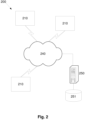
- the system 200 includes a number of measuring systems 210 coupled via a communications network 240 to one or more other measuring systems 210 and/or one or more processing devices, such as a server 250, which may in turn be coupled to a database 251.
- a server 250 which may in turn be coupled to a database 251.
- This arrangement allows reference data and/or subject data to be collected by the measurement systems 210 and provided to the server 250 for analysis. Collected data may also be stored in the database 251 together with resulting reference signatures and/or body state indicators, allowing this information to be remotely accessed and viewed by third parties, such as clinicians, or the like.
- the communications network 240 can be of any appropriate form, such as the Internet and/or a number of local area networks (LANs) and provides connectivity between the measuring systems 210 and the server 250. It will however be appreciated that this configuration is for the purpose of example only, and in practice the measuring systems 210 and server 250 can communicate via any appropriate mechanism, such as via wired or wireless connections, including, but not limited to mobile networks, private networks, such as an 802.11 networks, the Internet, LANs, WANs, or the like, as well as via direct or point-to-point connections, such as Bluetooth, or the like.
- LANs local area networks
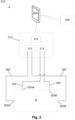
- the measuring system includes an impedance measuring unit having an impedance measuring device 310, which is in turn in communication with a processing system in the form of a client device 330, such as a portable computer system, mobile phone, tablet or the like.
- a processing system in the form of a client device 330, such as a portable computer system, mobile phone, tablet or the like.
- One or more optional sensors can be provided for capturing other relevant information. These could include physical characteristic sensors 320, which can also be provided for capturing information regarding physical characteristics of an individual/subject.
- the nature of the physical characteristic sensors 320 will vary depending on the characteristics to be measured, and could include for example scales for measuring an individual/subject's weight and/or an image capture device, such as a camera, body scanner, DEXA (Dual-Energy X-ray Absorptiometry), 3D laser or optical scanning, or the like, for measuring a height and/or body segment dimensions, as will be described in more detail below. Additionally or alternatively, this could include electronic scales for measuring a weight, and other monitoring equipment, for example for measuring heart rate, blood pressure or other characteristics.
- DEXA Direct-Energy X-ray Absorptiometry
- 3D laser or optical scanning or the like
- this could include electronic scales for measuring a weight, and other monitoring equipment, for example for measuring heart rate, blood pressure or other characteristics.
- additional sensors could also include sensors for detecting other relevant information.
- this could include sensors for detecting environmental characteristics, such as a temperature and/or humidity, location sensors for tracking a location, or fitness sensors for sensing fitness data, such as a number of steps taken, distance traversed, or the like.
- the sensors can be part of separate sensing devices, or could form part of the client device 330.
- the impedance measuring device 310 typically includes a measuring device processor 312 coupled to at least one signal generator 313 and at least one sensor 314, which are in turn coupled to respective drive and sense electrodes 323A, 323B and 324A, 324B, via leads 322.
- the signal generator 313 generates a drive signal, which is applied to the individual/subject S via the drive electrodes 323A, 323B, whilst the sensor 314 measures a response signal via the sense electrodes 324A, 324B.
- the measuring device processor 312 controls the at least one signal generator 313 and the at least one sensor 314, allowing the impedance measurements to be performed.
- the measuring device processor 312 is adapted to generate control signals, which cause the signal generator 313 to generate one or more alternating signals, such as voltage or current signals of an appropriate waveform, which can be applied to a subject S, via the first electrodes 323A, 323B and processing received signals from the sensor 314.
- control signals which cause the signal generator 313 to generate one or more alternating signals, such as voltage or current signals of an appropriate waveform, which can be applied to a subject S, via the first electrodes 323A, 323B and processing received signals from the sensor 314.
- the measuring device processor 312 may be any form of electronic processing device capable of performing appropriate control, and could include an FPGA (field programmable gate array), or a combination of a programmed computer system and specialised hardware, or the like.
- the signal generator 313 could be of any appropriate form, but will typically include digital to analogue converters (DACs) for converting digital signals from the processing device to analogue signals, which are amplified to generate the required drive signals, whilst the sensor 314 typically includes one or more amplifiers for amplifying sensed response signals and analogue to digital converters (ADCs) to digitise the analogue response signals and providing digitised response signals to the processing device.
- DACs digital to analogue converters
- ADCs analogue to digital converters
- the system can use Bioimpedance Analysis (BIA) in which a single low frequency signal is injected into the subject S , with the measured impedance being used directly in the determination of biological parameters.
- the applied signal has a relatively low frequency, such as below 100 kHz, more typically below 50 kHz and more preferably below 10 kHz.
- such low frequency signals can be used as an estimate of the impedance at zero applied frequency, commonly referred to as the impedance parameter value R 0 , which is in turn indicative of extracellular fluid levels.
- the applied signal can have a relatively high frequency, such as above 200 kHz, and more typically above 500 kHz, or 1000 kHz.
- a relatively high frequency such as above 200 kHz, and more typically above 500 kHz, or 1000 kHz.
- such high frequency signals can be used as an estimate of the impedance at infinite applied frequency, commonly referred to as the impedance parameter value R ⁇ , which is in turn indicative of a combination of the extracellular and intracellular fluid levels, as will be described in more detail below.
- the system can use Bioimpedance Spectroscopy (BIS) in which impedance measurements are performed at each of a number of frequencies ranging from very low frequencies (1 kHz and more typically 3 kHz) to higher frequencies (1000 kHz), and can use as many as 256 or more different frequencies within this range.
- BIOS Bioimpedance Spectroscopy
- Such measurements can be performed by applying a signal which is a superposition of plurality of frequencies simultaneously, or a number of alternating signals at different frequencies sequentially, depending on the preferred implementation.
- the frequency or frequency range of the applied signals may also depend on the analysis being performed.
- impedance parameter values such as values of R 0 , Z c , R ⁇ , which correspond to the impedance at zero, characteristic and infinite frequencies. These can in turn be used to determine information regarding both intracellular and extracellular fluid levels, as will be described in more detail below.
- a further alternative is for the system to use Multiple Frequency Bioimpedance Analysis (MFBIA) in which multiple signals, each having a respective frequency are injected into the subject S, with the measured impedances being used in the assessment of fluid levels.
- MFBIA Multiple Frequency Bioimpedance Analysis
- four frequencies can be used, with the resulting impedance measurements at each frequency being used to derive impedance parameter values, for example by fitting the measured impedance values to a Cole model, as will be described in more detail below.
- the impedance measurements at each frequency may be used individually or in combination.
- the measuring device 310 may either apply an alternating signal at a single frequency, at a plurality of frequencies simultaneously, or a number of alternating signals at different frequencies sequentially, depending on the preferred implementation.
- the frequency or frequency range of the applied signals may also depend on the analysis being performed.
- the applied signal is generated by a voltage generator, which applies an alternating voltage to the subject S , although alternatively current signals may be applied.
- the voltage source is typically symmetrically arranged, with two signal generators 313 being independently controllable, to allow the signal voltage across the subject to be varied, for example to minimise a common mode signal and hence substantially eliminate any imbalance as described in copending patent application number WO2009059351 .
- the sensor 314 determines the response signal in the form of the voltage across or current through the subject S , using second electrodes 324A, 324B.
- a voltage difference and/or current is measured between the second electrodes 324.
- a voltage is measured differentially, meaning that two sensors 314 are used, with each sensor 314 being used to measure the voltage at each second electrode 324 and therefore need only measure half of the voltage as compared to a single ended system.
- Digitised response signals are then provided to the measuring device processor 312, which determines an indication of the applied drive signal and measured response signals, and optionally uses this information to determine measured impedances.
- the client device 330 is coupled to the measuring device processor 312, allowing operation of the impedance measuring device to be controlled.
- the client device 330 can be used to instruct the measuring device processor 312 on a particular sequence of impedance measurements that need to be performed, further receiving either an indication of the drive/sense signals and/or measured impedance values.
- the client device 330 can then optionally perform further processing, for example to determine the impedance indicators, although alternatively this may not be required and raw impedance data could be provided to the server 250 for analysis.
- the client device 330 can also combine impedance values or indicators with information regarding indications of body states and physical characteristics determined either by manual user input or based on signals from one or more physical characteristic sensors. This allows the client device to generate the reference data, which is then transferred via the communications network 240 to the server 250. However, alternatively, the server 250 could obtain the indication of body states and/or physical characteristic from other data sources, depending on the preferred implementation.
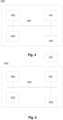
- the client device 330 can be of any appropriate form and one example is shown in Figure 4 .
- the client device 330 includes at least one microprocessor 400, a memory 401, an input/output device 402, such as a keyboard and/or display, and an external interface 403, interconnected via a bus 404 as shown.
- the external interface 403 can be utilised for connecting the client device 330 to peripheral devices, such as the communications networks 240, databases, other storage devices, or the like.
- peripheral devices such as the communications networks 240, databases, other storage devices, or the like.
- a single external interface 403 is shown, this is for the purpose of example only, and in practice multiple interfaces using various methods (eg. Ethernet, serial, USB, wireless or the like) may be provided.
- the microprocessor 400 executes instructions in the form of applications software stored in the memory 401 to allow communication with the server 250, for example to allow reference data to be provided to the sever, or the like.
- the client device 330 may be formed from any suitable processing system, such as a suitably programmed PC, Internet terminal, lap-top, or hand-held PC, and in one preferred example is either a tablet, or smart phone, or the like.
- the client device 330 is a standard processing system such as an Intel Architecture based processing system, which executes software applications stored on non-volatile (e.g., hard disk) storage, although this is not essential.
- the client devices 330 can be any electronic processing device such as a microprocessor, microchip processor, logic gate configuration, firmware optionally associated with implementing logic such as an FPGA (Field Programmable Gate Array), or any other electronic device, system or arrangement.
- the server includes at least one microprocessor 500, a memory 501, an optional input/output device 502, such as a keyboard and/or display, and an external interface 503, interconnected via a bus 504 as shown.
- the external interface 503 can be utilised for connecting the server 250 to peripheral devices, such as the communications networks 240, databases 251, other storage devices, or the like.
- peripheral devices such as the communications networks 240, databases 251, other storage devices, or the like.
- a single external interface 503 is shown, this is for the purpose of example only, and in practice multiple interfaces using various methods (eg. Ethernet, serial, USB, wireless or the like) may be provided.
- the microprocessor 500 executes instructions in the form of applications software stored in the memory 501 to allow the required processes to be performed, including communicating with the client devices 330, and optionally receiving, analysing and/or displaying results of impedance measurements.
- the applications software may include one or more software modules, and may be executed in a suitable execution environment, such as an operating system environment, or the like.
- the server 250 may be formed from any suitable processing system, such as a suitably programmed client device, PC, web server, network server, or the like.
- the server 250 is a standard processing system such as an Intel Architecture based processing system, which executes software applications stored on non-volatile (e.g., hard disk) storage, although this is not essential.
- the processing system could be any electronic processing device such as a microprocessor, microchip processor, logic gate configuration, firmware optionally associated with implementing logic such as an FPGA (Field Programmable Gate Array), or any other electronic device, system or arrangement.
- FPGA Field Programmable Gate Array
- server 250 Whilst the server 250 is a shown as a single entity, it will be appreciated that the server 250 can be distributed over a number of geographically separate locations, for example by using processing systems and/or databases 251 that are provided as part of a cloud based environment. For example, different servers might be provided that perform different functionality, such as analysing data to generate reference signatures, analysing subject signatures, hosting medical records, or the like. Thus, the above described arrangement is not essential and other suitable configurations could be used.
- users use the client devices 330 to control the measuring device 310 and any characteristic or other sensors, allowing impedance or other measurements to be performed and allowing information regarding physical characteristics or other sensed attributes to be collected.
- This is typically achieved by having the user interact with the system via a GUI (Graphical User Interface), or the like presented on the client device 330, which may be generated by a local application, or hosted by the server 250, which is typically part of a cloud based environment, and displayed via a suitable application, such as a browser or the like, executed by the client device 330.
- GUI Graphic User Interface
- Actions performed by the client device 330 are typically performed by the processor 400 in accordance with instructions stored as applications software in the memory 401 and/or input commands received from a user via the I/O device 402.
- actions performed by the server 250 are performed by the processor 500 in accordance with instructions stored as applications software in the memory 501 and/or input commands received from a user via the I/O device 502, or commands received from the client device 330.
- the system utilises multiple measuring and client devices 310, 330, which interact with one or more central servers 250, typically forming part of a cloud based environment. This allows reference and subject data to be collected from a number of different sources, and then aggregated and analysed centrally.
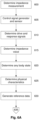
- the measuring device processor 312 determines the impedance measurement to be performed. This can be achieved in any suitable manner, but would typically include having the user selecting one of a number of available measuring procedures presented on the client device 330, with the client device 330 generating instructions which are provided to the measuring device processor 312.
- the first and second electrodes 323, 324 are positioned on the subject to allow one or more signals to be injected into the subject S, and allowing a response signal to be measured.
- the location of the electrodes 323, 324 will depend on the segment of the subject S under study.
- the electrodes 323, 324 can be placed on the thoracic and neck region of the subject S to allow the impedance of the chest cavity to be determined.
- positioning electrodes on the wrist and ankles of a subject, or in contact with the hands and feet allows the impedance of limbs, torso and/or the entire body to be determined.
- the measuring device processor 312 controls the signal generator and sensor, causing the drive signals to be applied to the individual/subject and causing the corresponding response signals to be measured, allowing the measuring device processor 312 to determine both the drive and response signals at step 610.
- the response signal will be a superposition of voltages generated by the human body, such as the ECG (electrocardiogram), voltages generated by the applied signal, and other signals caused by environmental electromagnetic interference. Accordingly, filtering or other suitable analysis may be employed to remove unwanted components.
- the acquired signal is typically demodulated to obtain the impedance of the system at the applied frequencies.
- One suitable method for demodulation of superposed frequencies is to use a Fast Fourier Transform (FFT) algorithm to transform the time domain data to the frequency domain. This is typically used when the applied current signal is a superposition of applied frequencies.
- FFT Fast Fourier Transform
- Another technique not requiring windowing of the measured signal is a sliding window FFT.
- the applied current signals are formed from a sweep of different frequencies
- a signal processing technique such as multiplying the measured signal with a reference sine wave and cosine wave derived from the signal generator, or with measured sine and cosine waves, and integrating over a whole number of cycles.
- This process known variously as quadrature demodulation or synchronous detection, rejects all uncorrelated or asynchronous signals and significantly reduces random noise.
- the drive and response signals are used to determine an impedance indicator, such as an impedance value, or impedance parameter value.
- an impedance indicator such as an impedance value, or impedance parameter value. This can be performed by the measuring device 310 alone, but more typically is performed in conjunction with the client device 330, with the measuring device providing an indication of measured impedance values to the client device 330, which then analyses these to determine the impedance indicators.
- impedance or admittance measurements are determined from the signals at each frequency by comparing the recorded voltage and the current through the subject.
- the demodulation algorithm can then produce amplitude and phase signals at each frequency, allowing an impedance value at each frequency to be determined.
- the measured impedance Whilst the measured impedance can be used directly, in one example, the measured impedance is used to derive an impedance parameter, and in particular an impedance (resistance) at zero frequency, R 0 , equals the extracellular resistance R e .
- Figure 7A is an example of an equivalent circuit that effectively models the electrical behaviour of biological tissue.
- the equivalent circuit has two branches that represent current flow through extracellular fluid and intracellular fluid, respectively.
- the extracellular fluid component of biological impedance is represented by an extracellular resistance R e
- the intracellular fluid component is represented by an intracellular resistance R i and a capacitance C representative of the cell membranes.
- FIG. 7B An example of the typical multi-frequency impedance response is shown in Figure 7B .
- the reactance increases to a peak at the characteristic frequency and then decreases while the resistance continually decreases. This results in a circular locus with the centre of the circle below the x axis, as shown.
- impedance parameters X c , R 0 , R ⁇ , Z c or ⁇ may be determined in any one of a number of manners such as by:
- the Wessel plot is often used in BIS devices, which perform multiple measurements over a range of frequencies, such as from 1 kHz to 1000 kHz, using 256 or more different frequencies within this range.
- a regression procedure is then used to fit the measured data to the theoretical semi-circular locus, allowing values for X c , R 0 , R ⁇ , Z c or ⁇ to be calculated.
- a circle fitting technique can be used in which three simultaneous equations representing the geometric relationships between points on a circle are solved to allow calculation of the radius (r) and the co-ordinates of the centre of the circle (i, j) as the three parameters which define the circle.
- the frequencies used are in the range 0 kHz to 1000 kHz, and in one specific example, four measurements are recorded at frequencies of 25 kHz, 50 kHz, 100 kHz, and 200 kHz, although any suitable measurement frequencies can be used.
- a further alternative for determining impedance parameter values such as X c , R 0 , R ⁇ , Z c or ⁇ is to perform impedance measurements at a single frequency, and use these as an estimate of the parameter values.
- measurements performed at a single low frequency typically less than 50 kHz
- measurements at a single high frequency typically more than 100 kHz
- R ⁇ can be used to estimate R ⁇ , allowing a value of R i to be determined using equation (2) above.
- the above described equivalent circuit models the resistivity as a constant value and does not therefore accurately reflect the impedance response of a subject, and in particular does not accurately model the change in orientation of the erythrocytes in the subject's blood stream, or other relaxation effects.
- an improved CPE based model may alternatively be used.
- the apparatus could be used to determine other body parameters. In one example, this can be achieved by using the apparatus passively to record body signals using the sense electrodes and sensors 324, 314 to monitor voltage signals within the body, such as ECG signals.
- the detected signals are a superposition of voltages generated by the human body, and will include cardiac and respiratory components, which can typically be isolated through suitable filtering, for example 1-40 Hz for cardiac signals and below 1 Hz for respiratory signals.
- the client device 330 determines one or more body states, such as disease and/or wellness states. This can be performed by having the client device display a suitable user interface, allowing a user, such as a medical practitioner, to enter the information manually, for example by selecting from a drop down list, categories or the like. Alternatively, the user could use the client device 330 to retrieve the information from a database, such as an electronic medical record or the like, or alternatively provide information allowing an indication of the body states to be retrieved by the server 250, for example by providing an identifier associated with the individual, allowing the server 250 to retrieve the individual's medical records.
- a suitable user interface allowing a user, such as a medical practitioner, to enter the information manually, for example by selecting from a drop down list, categories or the like.
- the user could use the client device 330 to retrieve the information from a database, such as an electronic medical record or the like, or alternatively provide information allowing an indication of the body states to be retrieved by the server 250, for example by providing an identifie
- the client device 330 determines physical characteristics of the individual. Again, this could be achieved by manual input via a user interface and/or by receiving data from the sensing device 320, as will be described in more detail below. At this time, additional data can be collected, such as environmental characteristics, allowing this to be used to further stratify the reference signatures.
- the client device 330 generates the reference data, which is then transferred to the server 250 at step 635 for analysis.
- the reference data can be indicative of, or include measured raw signal and/or indicators or body parameter values derived therefrom, including but not limited to impedance values, impedance parameter values, vital signs indicators, a cardiac parameter value, a respiratory parameter value, a blood potassium level, a fitness parameter, a temperature, a blood pressure, a respiratory rate, a heart rate or the like. This will also include details of any other characteristics measured, including environmental characteristics, such as a temperature, location, humidity or the like.
- the server 250 retrieves any required information. For example, if information regarding a body state and/or physical or other characteristics have not been provided, and this is available from another source, such as medical records or the like, this information can be retrieved before analysis of the reference data is performed in order to generate reference signatures for each of a plurality of different body states.
- the server 250 allocates each individual to a respective group based on any body states identified for the individual.
- a group of individuals is formed for each of a plurality of different body states.
- each group is further divided into sub-groups based on physical characteristics of the individuals and optionally for each of a plurality of environmental characteristics relevant to the individual.
- the server examines the physical characteristics for each individual and then allocates the individual to a respective sub-group so that each individual within the sub-group has respective physical characteristics in common.
- the server can examine the environmental characteristics, and allocate the individual to a respective sub-group of individuals having environmental characteristics in common.
- this division occurs can vary depending on a number of factors, including the preferred implementation, the particular physical characteristics, the body state or the like. For example, individuals could be allocated to different groups based on one or more of the individual's sex, ethnicity, age, weight or height. Thus, for example, a number of sub-groups could be defined for particular ranges of age, weight and height, with the individual being allocated to the group as appropriate according to their physical and/or environmental characteristics.
- a respective group could be formed for all male and all female individuals, with separate additional groups being formed for male/female individuals of particular age ranges, meaning that individuals can be allocated to multiple sub-groups.
- the groups formed may differ depending on the respective body state. For example, a low prevalence of some body states in young people may mean that groups for that body state will span a larger age range than for other body states. Similarly, when taking into account environmental characteristics, such as the individual's location, groups could be established which are national, with separate groups being established which are local, such as town and/or city based.
- the server 250 analyses the impedance indicators, and optionally other body parameters, for each group to generate the reference signatures. In one example, this involves determining a distribution of impedance indicators for each group. This can involve simply using measured impedance values, or alternatively could involve analysing impedance values to determine impedance parameter values, such as R 0 , R ⁇ , or the like, or could involve determining fluid level indicators, for example indicative of levels of extracellular fluid, intracellular fluid, or a ratio of the two.
- the reference signature for heart failure may be based solely on an extracellular fluid level indicator, which is sufficiently capable of identifying if an individual has heart failure, whereas other body states may require an extracellular to intracellular fluid level ratio.
- mere identification of the presence or absence of a disease may be achieved using a basic impedance indicator, whereas distinguishing the severity of the disease may require more complex indicators.
- multiple different indicators can be used in parallel in a multi-dimensional approach, for example examining multiple different impedance indicators for multiple different body segments, both individual and relatively, such as examining relative values of intracellular and extracellular fluids for different body segments, such as limbs and the torso.
- the server 250 uses the analysed impedance indicators, and in particular the distribution(s) to form a respective reference signature for each group.
- the reference signature could be a simple threshold range of extreme indicator values (typically upper and lower end) associated with a particular group, allowing direct comparison to the range.
- the reference signature is representative of a range of values and frequency of occurrence of each value. For example, this can involve performing a statistical analysis to extrapolate a likely distribution curve based on the relative frequency of impedance indicators of the individuals within the respective group, optionally taking into account exclusion of outlier values or the like.
- the signature could be expressed in any form, and could be a simple range or multi-dimensional vector including dimensions corresponding to each of a number of different impedance indicators.
- the above described process leads to the generation of reference signatures that can then be used in the identification of a range of different body states. It will also be appreciated that as additional reference data is collected, the reference signatures can be continuously or periodically updated, meaning the reference signatures will be refined as additional reference data is collected.
- the reference signatures can be used to generate a body state indicator for use in diagnosing a subject with one or more body states and an example of this will now be described.
- subject data is collected and provided to the server 250.
- the subject data typically includes impedance values and/or impedance indicators measured for the subject, as well as details of the subject's physical characteristics or environmental characteristics. Accordingly, it will be appreciated that the subject data can be collected by a measuring system using the client device 330 in a similar manner to that described above with respect to collection of the reference data in steps 600 to 630, albeit optionally without any indication of a body state. Collection of subject data will not therefore be described in further detail. It will also be appreciated that as part of this step, any required data which is not collected by measurement could be retrieved from a suitable source, such as a medical record of the subject.
- the server 250 selects reference signatures for each of a plurality of body states based on the physical characteristics of the subject and/or the environmental characteristics associated with the user. Thus, the server 250 will identify reference signatures corresponding to the sub-groups of individuals having physical characteristics and/or environmental characteristics in common with the subject. The server 250 will then determine or calculate subject impedance indicators from the received subject data, based on the type of impedance indicator required for each reference signature at step 675. A similar approach could also be used for other body parameters, such as other vital signs indicator or the like.
- the server 250 compares the impedance indicators to the respective reference signatures to determine a likelihood of the subject having one or more respective body states at step 685. An example of this will now be illustrated with reference to Figure 8 .
- Figure 8 shows reference signatures for three respective body states, identified as DS 1 , DS 2 , DS 3 .
- the body states could correspond to different diseases and/or a healthy state. Additionally or alternatively these different states could correspond to respective severities of a single body state, for example indicating whether a single disease is mild, moderate or severe.
- the distributions representing the respective reference signatures overlap. Accordingly, for an impedance indicator represented by the dotted line, this suggests the likelihood of the subject having the respective body states is minimal for DS 1 , high for DS 2 , and low for DS 3 .
- the above described example is a simplistic example based on a single indicator value and that in practice a multi-dimensional approach would be used including a reference signature including one or more reference impedance indicator values/ranges and optionally one or more other body parameter or vital sign indicator values/ranges would be used.
- the signatures could be expressed as vectors, with a subject vector being compared to the reference signature vectors by performing a proximity assessment in a multi-dimensional vector space, with a likelihood of a body state being based on the relative proximity of the subject vector to the reference signature vectors. It will be appreciated that a likelihood could be calculated for multiple different body state, based on a relative similarity of the subject signature to multiple reference signatures.
- an indication of this can be generated at step 690 and then provided either to the subject, or more likely a medical practitioner, for example by providing this to the client device 330 of one of the measuring systems 210.
- the body state indicator could be of any appropriate form and could include for example, a percentage likelihood or body state score indicative of the likelihood of the subject having each of one or more body states.
- this could be a numeric value scaled between 1 and 10, with 1 indicative of a low likelihood and 10 a high likelihood or vice versa.
- this could be presented as a graphical representation, for example using a pointer and scale to indicate the likelihood of the subject having a condition, or could include information regarding results of the comparison, for example showing graphs similar to those shown in Figure 8 , allowing a medical practitioner to understand the outcome of the analysis and how any indicator has been determined, which can facilitate a identification process.
- the collection of reference data can be performed during a body composition measurement process, which may in turn utilise physical characteristic information, and in particular information regarding dimensions of an individual or segments of an individual. This is particularly advantageous as it means that physical characteristics required in order to segment the reference individuals into groups and hence generate accurate reference signatures, will automatically be collected as part of the impedance measurement and analysis process.
- measured voltage and current signals are used by either the measuring device processor 312 or the client device 330 to determine at least one impedance value at at least one frequency, the at least one impedance value representing an impedance measured for the subject.
- the impedance could be of one or more segments of the subject and/or of the whole body, depending on the preferred implementation, and as will be described in more detail below. Whilst the measured impedance can be used directly, in one example, the measured impedance is used to derive an impedance parameter value, as previously described.
- step 910 physical dimensions for at least part of at least one segment of the subject are determined.
- the manner in which this is achieved will vary depending on the preferred implementation and could include physically measuring the dimensions of the segments of the subject, and then inputting this information into the client device 330.
- the dimensions could be derived from other more easily measured physical characteristics, such as the height, weight, sex and age of a subject.
- the dimensions could be determined using a characteristic sensor 320 capable of detecting the physical characteristics. This could include for example an imaging system capable of performing 2D or 3D imaging of an individual/subject, for example using a camera and/or laser scanner, to image the based on dimensions measured from images of a subject, as will be described in more detail below.
- the client device 330 uses the dimensions to calculate a shape factor.
- the shape factor is used to scale the impedance measurements in order to take into account the shape of the segments of a subject, before a fluid indicator indicative of the levels of extracellular fluid is calculated at step 930.
- the shape factor K B accounts for the facts that the human body is not a simple cylinder and that the measurement region sampled by the electrical signal includes one arm, one leg and the trunk, but the remaining limbs and head are additional unmeasured mass.
- this is equally applicable to segmental analysis in which the shape factor K S represents deviation in volume of the segment from a cylindrical shape.
- the impedance used is often that of the impedance at zero applied frequency R 0 , or an impedance value measured at a single low frequency, such as 30 kHz, as an estimate of R 0 , in which case the resistivity in equation (6) will not be the actual resistivity of the extracellular fluid, but an apparent higher resistivity value.
- the extracellular fluid contains a large number of non-conductive elements (cells) distributed through it. Cell walls are non-conductive at low frequencies.
- the apparent resistivity is given by a special case of Hanai's theory where a conductive medium contains a dispersion of particles whose resistivity is very much higher than that of the conductive medium itself.
- ⁇ apparent ⁇ ecf 1 ⁇ c 3 / 2
- c is the volume concentration of the non-conductive elements in the conductive medium.
- the apparent resistivity will therefore depend on the relative concentrations of extracellular fluid and cellular material containing intracellular fluid. These are values which are not expected to be constant, so an expression which uses the true ECF resistivity is needed.
- V ecf K ⁇ ecf H 2 R 0 2 / 3 ⁇ V WB 1 / 3
- V K ⁇ H 2 R 2 / 3 ⁇ V WB 1 / 3
- Equation (8) is written here in a slightly different form to that generally published to make clearer how it is a development of (6).
- V K B ⁇ H 2 R 1 ⁇ x ⁇ V S x
- the dimensionless shape factor K B accounts for the facts that the human body is not a simple cylinder and that the measurement includes one arm, one leg and the trunk, but the remaining limbs and head are additional unmeasured mass.
- a provisional value for a whole body shape factor K B has been previously determined by to be around 4.3, and this is generally treated as a constant. However, this value was determined from army personnel data and is not representative of the general population. In addition, not all people will necessarily have the same shape, whilst differences are likely between ethnic groups, sexes and ages. The relative body proportions also vary for subjects of different height and weight.
- the above described process operates by determining a personalised shape factor based on dimensions of segments of the subject.
- this is achieved by determining physical characteristics including a height, a weight, an age and a sex and determining the physical dimensions using physical characteristics.
- the shape factor is estimated using previously determined anthropometric relationships, and each subject's height and weight, which are already measured.
- this is achieved by determining a whole of body impedance measurement, determining physical dimensions for segments including at least a torso, an arm and a leg, using the physical dimensions to determine a whole body shape factor and calculating the extracellular fluid indicator at least in part using the whole of body impedance measurement and the whole body shape factor.
- impedance measurements are performed at a number of different frequencies.
- an operator typically positions the electrodes 323, 324 on the subject S, and connects the leads 322, to allow the impedance measurements to be performed.
- the general arrangement is to provide electrodes on the hand at the base of the knuckles and between the bony protuberances of the wrist, and on the feet at the base of the toes and at the front of the ankle.
- the configuration shown in Figure 10B can then be used to allow whole of body measurements to be performed, whilst the configurations shown in Figures 10C, 10D and 10E can be used to allow the right arm, the right leg and torso to be measured respectively.
- the operator activates the impedance measurement process, causing a sequence of drive signals to be applied to the subject at multiple frequencies.
- Corresponding sense signals are measured, allowing a value to be derived for the impedance parameter value R 0 at step 1010, using the techniques previously described.
- a single low frequency measurement can be performed and used to approximate the value of the impedance parameter value R 0 , thereby reducing the complexity of the measurement process.
- the height and weight of the subject are measured, and provided to the client device 330, for example using manual input techniques.
- Segment dimensions are then determined for the arm, torso and leg and a first example of this process will now be described with reference to Figure 11A .
- segment lengths for each of the arm, torso and leg are predicted using known anthropometric ratios, which relate the respective segment lengths to the height of the subject.
- V/H is the ratio of volume to height.
- Table 1 Arm Waist Hip Thigh Calf Male k V / H 0.61 0.62 0.42 0.5 0.38 k Age -0.052 0.1 0 -0.1 -0.04 k 0 4.2 4.63 4.96 4.8 4.1 Female k V / H 0.62 0.61 0.49 0.54 0.33 k Age 0.024 0.064 0 -0.032 -0.046 k 0 3.88 4.68 5.06 4.65 4.07
- correction factors are applied at step 1120, to convert the segmental circumference to an equivalent cylindrical circumference. This is the circumference of a cylinder the same length as the body segment, and which has the same volume as the body segment.
- the correction factor will typically depend on factors such as sex, age or other parameters, and can be determined through analysis of a sample reference population.
- volumes for the segments can be determined at step 1130, with these optionally being validated at step 1140 by calculating a volume error, using the subject weight and allowing for the head, hands and feet which are not included in the segments.
- a further test at this stage is to plot volume error against the shape factor K B . If the prediction algorithms apply the wrong proportion of weight or volume to the different body segments, this is likely to lead to a K B error which is correlated with a volume error.
- one or more images of the subject can be acquired at step 1150. This can be achieved by taking a photograph of the subject, or alternatively could be performed using other imaging modalities, such as DEXA (Dual-Energy X-ray Absorptiometry), 3D laser or optical scanning, or the like.
- DEXA Device-Energy X-ray Absorptiometry
- 3D laser or optical scanning or the like.
- a silhouette is generated from the image(s), with edge detection and/or pattern recognition to be used to identify one or more landmarks, at step 1170.
- the landmarks correspond to defined locations on the body, which are used to derive 2D dimensions, which can then be extrapolated to 3D dimensions, including circumferences.
- the circumferences are then used to determine volumes, as in the previous example, allowing shape factors to be determined.
- multiple circumferences could be determined, for example by making multiple measurements along each body segment, allowing the volume to be more accurately determined, for example by integrating the circumferences along the length of the body segment.
- the process could involve generating a 3D model following laser scanning and then measuring the values directly from the 3D model.
- the approach typically includes determining a segmental impedance measurement for at least one segment, determining physical dimensions for the at least one segment, using the physical dimensions to determine a segmental shape factor and calculating the extracellular fluid indicator at least in part using the segmental impedance measurement and the segmental shape factor.
- the measuring unit is similar to that described above with respect to Figure 3 , and similar features will not therefore be described in detail.
- the measuring unit includes a measuring device 1210 including a first connector 1211 electrically connected to at least the at least one sensor 1214 and the at least one signal generator 1213, and a separate connectivity module 1220, including a connectivity module housing and a second connector 1221 electrically connected to the electrodes 1223, 1224.
- the measuring device 1210 is connected to the connectivity module 1220 by interconnecting the first and second connectors 1211, 1221 so first electrodes 1223 are electrically connected to the at least one signal generator and second electrodes 1224 are electrically connected to the at least one sensor, thereby allowing a drive signal to be applied to the subject via the first electrodes 1223 (referred to generally as drive electrodes) and allowing the response signal to be measured via the second electrodes 1224 (referred to generally as sense electrodes) so that the at least one impedance measurement can be performed.
- drive electrodes referred to generally as drive electrodes
- sense electrodes the response signal to be measured via the second electrodes 1224
- a separate measuring device 1210 and connectivity module 1220 are used, allowing a single type of measuring device 1210 to be configured for use with multiple different types of connectivity module 1220.
- This in turn enables a range of different impedance measurements to be performed using different configurations of connectivity module.
- different electrode arrangements 1223, 1224 may be required for performing different types of impedance measurement, and so the provision of a common measuring device, and different types of connectivity module allows a single measuring device to be used in a wider range of circumstances than would be possible for a single integrated device.
- the connectivity module 1220 could include stand-on plates and hand grip electrodes for use in measuring aspects of a subject's body composition, whilst adhesive electrodes positioned on the wrist and ankles might be preferred for oedema detection, or the like.
- a common measuring device to be selectively connected to different connectivity modules, this allows the most suitable electrode configuration to be used, whilst allowing a common measuring device design to be used, which can reduce overall hardware requirements and allow for greater efficiencies in manufacture.
- the measuring device 1210 can be adapted to sense the type of connectivity module 1220 to which it is connected, thereby at least partially controlling the impedance measurement process based on the connectivity module currently being used.
- the measuring device processor 1212 determines a connectivity module type. This can be achieved in any suitable manner, depending on the preferred implementation and could be based on a configuration of connections between the connectors 1211, 1221, electrical characteristics or properties of components within the connectivity module, stored identifiers, or the like.
- the connectivity module type is used to determine the impedance measurements that can be performed using the respective connectivity module 1220. This can be performed by the measuring device processor 1212, or alternatively could be performed by a client device 1230 in communication with the measuring device processor 1212. In any event, different connectivity module types could be associated with respective types of impedance measurement, for example based on the configuration of electrodes and/or any other components provided therein, such as voltage/current buffers or the like. Thus, information regarding the connectivity module type can be used to determine the impedance measurements that can be performed, allowing operation of the system to be controlled accordingly.
- the first and second electrodes 1223, 1224 are positioned on the subject to allow one or more signals to be injected into the subject S , and allowing a response signal to be measured.
- the measuring device processor 1212 controls the at least one signal generator 1213 and the at least one sensor 1214, allowing the impedance measurements to be performed at step 1330, with impedance values being determined at step 1340.
- the measuring device processor determines a connectivity module type of the connected connectivity module and in accordance with the determined connectivity module type, causes the at least one impedance measurement to be performed or processes a measured response signal to determine at least one impedance value indicative of a measured impedance. Accordingly, this allows the impedance measurement or analysis processes to be controlled based on the connectivity module type.
- the connectivity module type can be determined in any suitable manner. In one example, this is determined using one or more of a configuration of connections between the first and second connectors or a configuration of the second connector.
- the first and second connectors can include a plurality of individual connections, with the connectivity module type being determined based at least in part on connections between individual connections of the second connector, created for example using jumpers or other similar arrangements.
- this could be based on a property of an electrical component electrically connected to the second connector, such as the resistance of a resistor coupled between respective connections on the second connector.
- the connectors could be configured, either based on respective interconnections, or through components coupled thereto, so that the connectivity module type can be determined automatically based on the configuration of the connectors.
- connection module type such as by having the measuring device include a contact switch that is selectively actuated by the connectivity module housing when the measuring device and connectivity module are connected, so that a different switch position or different switch is actuated for different connectivity module types.
- the measuring device processor could determine an identifier associated with the connectivity module and determine the connectivity module type using the identifier.
- the connectivity module could include a memory, with the measuring device processor retrieving the identifier from the memory via a wireless connection or via the first and second connectors.
- the identifier could be in the form of a unique alphanumeric code or the like, and could include a portion that is indicative of a connectivity module type, and an additional serial number or the like, allowing not only the module type to be determined, but also allowing each module of a given type to be distinguished, which can be useful for calibration or tracking individual modules.
- the measuring device processor could retrieve instructions from a memory in the connectivity module, via a wireless connection or the first and second connectors and then cause impedance measurements to be performed in accordance with the instructions.
- instructions corresponding to measurements that can be performed are stored on the connectivity module itself, allowing these to be simply accessed and used as required.
- the measuring device processor may determine the connectivity module type and then pass this information to a remote processing system, such as a client device, allowing the client device to determine the impedance measurements that can be performed in a similar manner.
- a remote processing system such as a client device
- the measuring device processor typically determines at least one impedance value indicative of at least one measured impedance using an indication of at least one drive signal applied to the subject and an indication of at least one measured response signal. Additionally however, the measuring device processor can also take into account calibration data stored in a memory.
- the inherent electrical properties of the measuring device 1210 and/or the connectivity module 1220 can have an impact on the magnitude and/or phase of signals that are measured for a given impedance. For example, longer leads 1222 between the electrodes 1223, 1224 and the second connector 1221, can introduce additional resistances, leading to different voltages being recorded for the same impedance. Accordingly, calibration of the measuring device 1210 and/or connectivity module 1220 may be required in order to ensure that signals are accurately interpreted.
- Such calibration data can be established through measurement of reference impedances during a calibration process, and is taken into account when calculating the impedance, for example by modifying the resulting impedance or the phase and/or magnitude of measured signals prior to the impedance being measured.
- the calibration data includes first calibration data specific to the measuring device and second calibration data specific to the connectivity module.
- the measuring device processor 1212 might determine the calibration data to be used based on a connectivity module type and/or a connectivity module identifier, so that the calibration data is specific to the type and/or particular connectivity module being used.
- the measuring device processor 1212 selects one of a number of calibration data sets stored in a memory, allowing the measuring device processor 1212 to select and use the most appropriate calibration data, depending on the connected connectivity module and/or the impedance measurement being performed. In this regard, it will be appreciated that different calibration data might be required for example for high versus low frequency measurements.
- the first and second connectors can be of any appropriate form but typically include multi-pin plug and a corresponding multi-pin socket connectors. In one example further physically separate connectors could also be provided, for example to allow for connection of different components. Thus, the first and second connectors could be used to connect the signal generator and/or sensor to the electrodes, with connections for indicators, such as LEDs, speakers or the like, being via different connectors, which can help avoid interference or the like.
- the measuring device housing and connectivity module housing are typically configured to physically interconnect when the measuring device is connected to the connectivity module, for example using a clip-fit, friction-fit, interference-fit, magnetic coupling or the like.
- the electrodes can be mounted on the connectivity module housing and/or coupled to leads extending from the connectivity module housing. It will be appreciated that this will depend on the intended usage, and specific examples will be described in more detail below.
- the electrodes form part of at least one electrode sheet, which can include a substrate and conductive material defining each electrode, the conductive material being either impregnated in the substrate and/or printed on a surface of the substrate.
- the electrode sheet can include a connection tab extending from the substrate that allows a lead connector to be electrically coupled to the electrodes.
- the tab can have electrical surface tracks provided thereon, allowing the tracks to electrically connect to contacts on the lead connector allowing for ease of connection.
- the connectivity module 1220 can include little more than the connector 1221 and connections, such as leads 1222, to the electrodes.
- the connectivity module can include additional components, such as at least one buffer circuit coupled to each electrode, which is particularly important for high frequency operation.
- the signal generator and sensor provided in the measuring device could be in the form of an DAC and ADC respectively, with respective amplifiers being provided in the connectivity module.
- power may be required by the connectivity module in which case a power supply such as a battery could be provided in the connectivity module. This could be a separate power supply to that used in the measuring device, or alternatively a common power supply could be used with power being transferred between the measuring device and connectivity module via the first and second connectors as required.
- the measuring device includes a respective signal generator and/or sensor for each electrode.
- the measuring device can include four signal generators, each being electrically connected to a respective drive electrode and four sensors, each being electrically connected to a respective sense electrode and wherein the measuring device processor selectively activates the at least one signal generators and sensors to thereby allow a respective impedance measurement to be performed.
- the measuring device 1210 includes a switching unit, such as a multiplexer, for selectively electrically connecting the at least one signal generator and the at least one sensor to the first connector thereby allowing the at least one signal generator and the at least one sensor to be selectively connected to different electrodes.
- the measuring device processor 1212 controls the switching unit to thereby selectively electrically connect the at least one signal generator and the at least one sensor to respective electrodes thereby allowing a respective impedance measurement to be performed.
- a switching unit could alternatively be provided in the connectivity module, although this is generally undesirable as it leads to additional complexity of the connectivity module 1220.
- the measuring device 1210 can be controlled remotely using a processing system, such as the client device 1230. Nevertheless, the measuring device 1210 typically includes at least some form of minimal input/output device, to allow for user interaction. In one example, this includes an input button that activates the measuring device and/or causes at least one impedance measurement to be performed.
- the measuring device can also include an indicator, such as an optical indicator, a multi-colour LED, speaker or the like, which can be used to indicate completion of an impedance measurement, performing of an impedance measurement or connection to a connectivity module and/or processing system.
- the measuring device 1210 typically includes an interface, such as a wireless interface, for example Bluetooth or the like, that allows the measuring device processor to communicate with a processing system using at least one of wired and wireless communications.
- an interface such as a wireless interface, for example Bluetooth or the like, that allows the measuring device processor to communicate with a processing system using at least one of wired and wireless communications.
- the system 1200 can include a processing system 1230 that determines at least one impedance measurement to be performed, causes the measuring device 1210 to perform the at least one impedance measurement and receives an indication of at least one impedance value from the measuring device, the at least one impedance value being indicative of a measured impedance.
- the measuring device processor 1212 can communicate with the processing system 1230 to determine the at least one impedance measurement to be performed and/or provide the indication of at least one impedance value to the processing system 1230.
- the processing system 1230 which can be in the form of a client device such as a computer system, smartphone, tablet or the like, to act as a user interface, allowing the measuring device to be controlled and allowing results of the impedance measurement process to be reviewed. This in turn reduces the hardware requirements of the measuring device 1210, whilst still allowing a range of different functionality to be implemented.
- the processing system 1230 could be remote from the measuring device and connectivity module, or alternatively could be integrated into the connectivity module, depending on the preferred implementation.
- the processing system 1230 can determine an impedance measurement process to be performed, the impedance measurement process including a sequence of impedance measurements and cause the measuring device processor to perform the sequence of impedance measurements.
- the processing system can be used to cause a complex sequences of impedance measurements to be performed, based for example on sequences stored locally on the processing system. This allows the system to be configured for particular circumstances, whilst allowing the measuring device 1210 to be generic in terms of functionality, thereby minimising hardware requirements.
- the processing system can also process the at least one impedance measurement to determine at least one indicator indicative of a biological state of the subject. This can be used for example to create an indicator that is indicative of a status of the subject, such as a fluid level, body composition parameter, or the like, making results of the impedance measurement easier for users, such as clinicians, to understand.
- the processing system displays a user interface allowing a user to select at least one impedance measurement to be performed, select an impedance measurement process to be performed, the impedance measurement process including a sequence of impedance measurements, view at least one impedance measurement and view at least one indicator indicative of a biological state of the subject.
- the impedance measurement process including a sequence of impedance measurements, view at least one impedance measurement and view at least one indicator indicative of a biological state of the subject.
- this is not essential, and any suitable approach can be used.
- the measuring device processor 1212 can determine at least one performable impedance measurement based on a connectivity module type of a connected connectivity module and provide an indication of this to the processing system, which then displays an indication of the at least one performable impedance measurement to a user, determines a selected performable impedance measurement in accordance with user input commands and causes the measuring device to perform the selected performable impedance measurement.
- the measuring device 1210 can determine the impedance measurements that can be performed based on the connected connectivity module, with this information being used by the processing system 1230 to display available impedance measurement processes, so that one of these can be selected by the user. It will also be appreciated that a similar technique can be used to select the type of analysis that can be performed allowing indicators indicative of a biological status, such as body composition, fluid levels or the like, to be determined.
- a specific example connectivity module is shown in Figures 14A and 14B .
- the connectivity module 1420 includes first and second housings 1420.1, 1420.2.
- the first housing 1420.1 has a form factor similar to a set of scales, and includes two spaced pairs of foot drive and sense electrodes 1423.1, 1424.1 forming footplates, or laminar electrode sheets, on which a user can stand.
- the second housing 1420.2 is an elongate housing having three portions along its length, with a central rectangular portion 1402.21 positioned between two outer semicylindrical portions 1420.22.
- the outer semicylindrical portions 1420.22 support curved electrode plates 1423.2, 1424.2 or electrode sheets, mounted on opposing sides of the body allowing the user to place their palms and fingers on the plates 1423.2, 1424.2.
- the curvature of the surface assists with comfort and ensures good physical and hence electrical contact between the user's hands and the electrodes.
- the central portion can be used to support the measuring device 1410, and also optionally a client device 1430, such as a tablet or the like, which can be used to control the measurement process as will be described in more detail below.
- the measuring device 1210 is initially connected to a connectivity module 1220, and activated, causing the measuring device processor 1212 to determine a connectivity module type of the connectivity module 1220 at step 1505.
- This is typically performed by having the measuring device processor determine a connectivity module identifier or the like, allowing the measuring device processor to determine performable impedance measurements at step 1510.
- the measuring device 1210 can store a list of performable impedance measurements that can be performed for each type of module in onboard memory, allowing an indication of performable impedance measurements to be retrieved based on the connectivity module type.
- the connectivity module type could be provided to the client device 1230, allowing this to be performed by the client device 1230.
- the client device 1230 is activated, with relevant software being activated, allowing the client device 1230 to commence communicating with the measuring device 1210 at step 1520.
- the measuring device and client device may need to be paired, for example undergoing a Bluetooth pairing process, or the like, depending on the manner in which the client device 1230 and measuring device communicate.
- a particular client device 1210 previously paired with the client device 1230 may need to be identified from a list of available devices, as will be appreciated by persons skilled in the art.
- the client device 1230 determines the performable impedance measurements from the measuring device 1210, or receives an indication of the connectivity module type, allowing the performable impedance measurements to be determined locally. In any event, an indication of the performable impedance measurements is then displayed to a user at step 1530, for example in the form of a list of impedance measurement processes.
- the user selects a performable impedance measurement at step 1535, causing the client device 1230 to instruct the measuring device 1210 to perform the impedance measurements at step 1540.
- This can include providing the measuring device 1210 with an indication of particular impedance measurements to be performed, or could include providing instructions regarding the control of or settings for the signal generator, sensor and any switches. Additionally and/or alternatively, this could include uploading soft or firmware to the measuring device, allowing the measuring device 1210 to operate as required.
- the measuring device processor 1212 controls the signal generator/sensor 1213, 1214, determining corresponding drive and response signals, applied or measured via respective drive and sense electrodes 1223, 1224, at step 1550.
- the measuring device processor 1212 determines calibration data at step 1555, with this typically being stored locally and accessed based on either the connectivity module type and/or connectivity module identifier.
- each type of connectivity module will typically have different electrical properties and these will need to be taken into account when performing impedance measurements. This is achieved by measuring drive and response signals for standardised electrical components with this then being used to generate calibration data which can be used in calculating impedance measurements. This could be performed for each type of module, and/or for each individual connectivity module, depending for example of the level of accuracy required for the calculated impedance values.
- the calibration data is used together with the indication of the drive and corresponding response signals to calculate impedance values at step 1560, for example by modifying the measured drive and response signals to take into account device characteristics, and then using the modified signals to calculate the impedance.
- an indication of the impedance values being provided to the client device 1230 at step 1565 allowing these to be used by the client device to determine one or more indicators at step 1570.
- This process can involve calculating impedance parameter values, such as R 0 , R ⁇ , or the like and then using these values to determine indicators, such as fluids levels including levels of extracellular and intracellular fluid, body composition parameters, such as fat free mass, or the like.
- the determined indicator(s) and/or impedance values can then be displayed to the user at step 1575, via a suitable user interface with the indicators and impedance values being optionally stored at step 1580, for example by transferring these to the server 250 for storage in the database 251.
- the above described arrangement allows the impedance measurement procedure to be controlled via a client device, such as a smartphone or tablet.
- a client device such as a smartphone or tablet.
- This allows general processing of impedance measurements and control of the system to be performed using generic hardware, without unduly adding to the cost of the impedance measuring system.
- a single configuration of measuring device is adapted to be used with connectivity modules that provide onward connectivity to the subject.
- Different types of connectivity module can be used with the same measuring device, with the nature of the connectivity module being used to control the impedance measuring processes that can be performed.
- This allows a user to obtain a single measuring device and then use this with different connectivity modules, allowing different measurements to be performed.
- the measuring device is provided in a measuring device housing that is separate to the connectivity module housing. This is beneficial in terms of facilitating use of a single measuring device with multiple different connectivity modules, particularly in terms of allowing for measuring device handling to be performed when attaching or detaching the measuring device and connectivity modules, without potential to damage components of the measuring device.
- the measuring device could be provided within the connectivity module housing, and hence not require a separate measuring device housing.
- the connectivity module housing could include a door, cover, lid or other opening, that provides access to the inside of the connectivity module, and the second connector provided therein. This allows the measuring device to be inserted into the connectivity module housing and coupled to the second connector, in a manner substantially similar to that described above, albeit with the measuring device contained entirely within the connectivity module housing.
- the measuring device could include a circuit board, having the relevant components and first connector mounted thereon. This could be supported internally within the connectivity module, either through physical engagement between the first and second connectors, or through cooperation with a separate bracket or other mounting.
- this arrangement could be analogous to the manner in which a card, such as a graphics card or RAM is installed in a computer system housing through attachment to a motherboard, with the measuring device corresponding to the card, and the connectivity module the computer system and motherboard.
- FIG. 16 An further example of a physical construction of the measuring device is shown in Figure 16 .
- the measuring device includes first and second housings 1620.1, 1620.2.
- the first housing 1620.1 has a form factor similar to a set of scales, and includes a generally rectangular body having two spaced pairs of foot drive and sense electrodes 1623.1, 1624.1 formed from spaced apart metal plates provided on an upper surface, thereby forming footplates on which a user can stand.
- the second housing 1620.2 has a generally rectangular body having two spaced pairs of hand drive and sense electrodes 1623.2, 1624.2 formed from spaced apart metal plates provided on an upper surface, thereby forming handplates on which a user can rest their hands.
- the first housing 1620.1 includes a raised section 1625, defining a lip 1625.1 extending at least partially around each pair of foot drive and sense electrodes to thereby guide positioning of a subject's foot relative to the foot drive and sense electrodes in use.
- the raised lip 1625.1 includes a rear portion 1625.2 configured to engage at least a heel of the user.
- a similar effect is achieved for the second housing by having a raised portion 1626 positioned between each pair of hand drive and sense electrodes, the raised portion defining thumb recesses 1626.1 to thereby guide positioning of a subject's thumbs, with the crook of the thumb engaging the raised portion, and hence hands relative to each pair of hand drive and sense electrodes in use.
- This arrangement allows the unit to be used by having the user stand on the first housing, or alternatively sit on a chair, with their feet resting on the foot drive and sense electrodes. The user can then place their hands on the hand drive and sense electrodes on second housing, which can be supported by a desk or table in a seated arrangement, or by a stand or other support for a standing arrangement.
- the use of two housing containing separate electrodes therefore allows impedance measurements to be performed in a variety of circumstances, and in particular allows measurements to be performed in either seated or standing arrangements, which is important in ensuring the system can be used by individuals having restricted physical capabilities. Additionally, the use of metal plate electrodes provided in a housing allows the system to be readily used, and avoids the need for preparation, such as cleaning of tissue surfaces or removal of hair, to allow wet electrodes to be applied to the skin.
- impedance measurements can be used in a manner akin to other vital signs.
- impedance measurements can be used to enable or facilitate diagnosis of a wide range of different body states.
- impedance indicators Whilst this could be performed in an ad-hoc manner, more preferably this is achieved using a standardised approach performed in a range of different locations and circumstances, allowing impedance indicators to be measured for a wide variety of physical characteristics and body states.
- the data can then be aggregated centrally and mined in order to derive reference signatures, each of which defines a combination of impedance and/or other body parameter indicators that are unique to a particular body state for a given set of physical characteristics.
- impedance and optionally other body parameter indicators can be measured for subjects, and then compared to the reference signatures, allowing a likelihood of the subject having a respective body state to be quantified in the form of a body state indicator, which can be an indication of the likelihood of the subject having one or more body states.
- This information can then be used by clinicians, in order to assist clinicians in making a clinical diagnosis of body states.
- a system can be provided for determining a body state indicator for a biological subject.
- the system includes a number of measuring systems, each measuring system being capable of performing impedance measurements on a user and having a measuring device and a client device.
- the measuring device includes at least one signal generator electrically connected to drive electrodes to apply a drive signal to a user, at least one sensor electrically connected to sense electrodes to measure a response signal in the user and a measuring device processor, which controls the at least one signal generator, receives an indication of a measured response signal from the at least one sensor and generates measurement data indicative of at least one measured impedance value.
- the client device is in communication with the measuring device and receives the measurement data, generates user data indicative of the measurement data and a user identifier associated with the user and communicates the user data via a communication network to one or more one processing devices.
- the one or more processing devices use the user data to generate reference signatures based on measurements from reference individuals and then subsequently analyse user data from a subject to generate an indicator indicative of a body state.
- the reference signatures are generated by obtaining user data for a plurality of reference individuals from one or more of the number of measuring systems, via the communications network.
- the user data is used to determine reference data including at least one reference impedance indicator obtained from user data by performing at least one impedance measurement on the reference individual, a reference body state indication indicative of any body states associated with the reference individual and reference characteristic data indicative of one or more physical characteristics of the reference individual. This can be based on the user data, and/or retrieved from previously stored data using the user identity.
- the reference data is then analysed for the plurality of reference individuals to establish the one or more reference signatures, each reference signature being indicative of at least one reference impedance indicator associated with a respective body state for respective physical characteristics.
- the subject data includes subject characteristic data indicative of one or more physical characteristics of the subject and at least one subject impedance indicator derived from at least one measured impedance value for the subject.
- the subject data is then analysed using the reference signatures and the subject characteristic data, with at least one body state indicator being generated in accordance with the analysis.
- this allows measurements from a plurality of reference individuals to be used to establish reference signatures, which are then used to analyse measurements of a subject.
- the reference/subject impedance indicators can include at least one impedance value measured for at least one body segment of the reference individual/subject, at least one impedance parameter value derived from at least one impedance value measured for at least one body segment of the reference individual/subject, or a fluid level indicator indicative of fluid levels in at least one body segment of the reference individual/subject, the fluid level indicator being derived from at least one impedance value measured for at least one body segment of the reference individual.
- Each reference signature can include a reference range based on a distribution of reference impedance indicators associated with reference individuals having a respective body state and respective physical characteristics, so that measured values can be compared to the range to determine a degree of similarity between the subject impedance indicator and the reference signature.
- the processing devices typically analyse the at least one subject impedance indicator by selecting one or more of the reference signatures using the subject characteristic data, generating at least one subject signature indicative of the at least one subject impedance indicator and then comparing the at least one subject signature to the selected reference signatures.
- the reference and subject signatures by can also include other body parameter values obtained by performing at least one measurement on one or more other body parameters of the reference individual or subject.
- the other body parameters can include any one or more of a body parameter value; a weight; a cardiac parameter value; a respiratory parameter value; a blood potassium level; a temperature; a blood pressure; a respiratory rate; a heart rate; and, a blood oxygenation level.
- the processing devices can retrieve medical record data from one or more electronic medical records, the medical record data including any one or more of subject characteristic data, subject body parameter values, reference characteristic data, reference body parameter values or reference body state indications. If this is performed, the processing devices typically retrieve the medical record data using a user identifier of the reference individual or subject, or a medical record identifier related to a user identifier. Thus, in one example, the processing devices determine a user identifier from the user data, retrieve a medical record identifier from an index using the user identifier, generate a query using the medical record identifier, transfer the query to an electronic medical record system and receive medical record data in response to the query.
- the processing devices can receive from the measuring device one or more of the subject characteristic data, subject body parameter values, reference characteristic data, reference body parameter values and reference body state indications.
- these can be measured by the same apparatus used to perform the impedance measurement or can be measured via alternative mechanisms, such as part of a separate health check and retrieved from stored data such as a medical record.
- the body state indicator Having generated the body state indicator, this can be stored, stored as part of an electronic medical record, provided to the client device of a respective measuring system for display to the user or another individual or provided to a client device of a nominated party for display.
- the body state indicator could be provided to a medical practitioner, allowing them to review this and take appropriate action such as diagnosing a condition and/or administering treatment.
- the measuring device includes a first housing including spaced pairs of foot drive and sense electrodes provided in electrical contact with feet of the subject in use and a second housing including spaced pairs of hand drive and sense electrodes provided in electrical contact with hands of the subject in use.
- the client device is at least one of a smart phone and a tablet.
- the measuring device and techniques described above can be used with any animal, including but not limited to, primates, livestock, performance animals, such race horses, or the like.
- the above described processes can be used for diagnosing the presence, absence or degree of a range of body states, including, but not limited to abnormal hydration, cancer, heart failure, congestive heart failure, oedema, lymphoedema, or the like, and reference to specific indicators is not intended to be limiting.
Landscapes
- Health & Medical Sciences (AREA)
- Life Sciences & Earth Sciences (AREA)
- Engineering & Computer Science (AREA)
- Medical Informatics (AREA)
- Public Health (AREA)
- General Health & Medical Sciences (AREA)
- Biomedical Technology (AREA)
- Pathology (AREA)
- Biophysics (AREA)
- Animal Behavior & Ethology (AREA)
- Veterinary Medicine (AREA)
- Heart & Thoracic Surgery (AREA)
- Molecular Biology (AREA)
- Surgery (AREA)
- Physics & Mathematics (AREA)
- Primary Health Care (AREA)
- Epidemiology (AREA)
- Data Mining & Analysis (AREA)
- Cardiology (AREA)
- Physiology (AREA)
- Databases & Information Systems (AREA)
- Nuclear Medicine, Radiotherapy & Molecular Imaging (AREA)
- Radiology & Medical Imaging (AREA)
- Computer Networks & Wireless Communication (AREA)
- Pulmonology (AREA)
- Artificial Intelligence (AREA)
- Computer Vision & Pattern Recognition (AREA)
- Psychiatry (AREA)
- Signal Processing (AREA)
- Physical Education & Sports Medicine (AREA)
- Nutrition Science (AREA)
- Measurement And Recording Of Electrical Phenomena And Electrical Characteristics Of The Living Body (AREA)
- Measuring And Recording Apparatus For Diagnosis (AREA)
Applications Claiming Priority (3)
| Application Number | Priority Date | Filing Date | Title |
|---|---|---|---|
| US201662295971P | 2016-02-16 | 2016-02-16 | |
| US201662380236P | 2016-08-26 | 2016-08-26 | |
| PCT/AU2017/050127 WO2017139838A1 (en) | 2016-02-16 | 2017-02-15 | Body state classification |
Publications (3)
| Publication Number | Publication Date |
|---|---|
| EP3416548A1 EP3416548A1 (en) | 2018-12-26 |
| EP3416548A4 EP3416548A4 (en) | 2019-10-02 |
| EP3416548B1 true EP3416548B1 (en) | 2025-06-04 |
Family
ID=59624656
Family Applications (1)
| Application Number | Title | Priority Date | Filing Date |
|---|---|---|---|
| EP17752563.1A Active EP3416548B1 (en) | 2016-02-16 | 2017-02-15 | Body state classification |
Country Status (6)
| Country | Link |
|---|---|
| US (2) | US11304610B2 (enExample) |
| EP (1) | EP3416548B1 (enExample) |
| JP (1) | JP7015795B2 (enExample) |
| CN (1) | CN109069055A (enExample) |
| AU (2) | AU2017220381B2 (enExample) |
| WO (1) | WO2017139838A1 (enExample) |
Families Citing this family (10)
| Publication number | Priority date | Publication date | Assignee | Title |
|---|---|---|---|---|
| US11395628B2 (en) * | 2017-02-16 | 2022-07-26 | Samsung Electronics Co., Ltd. | Method of providing service based on biometric information and wearable electronic device |
| US11036779B2 (en) * | 2018-04-23 | 2021-06-15 | Verso Biosciences, Inc. | Data analytics systems and methods |
| WO2019246113A1 (en) * | 2018-06-20 | 2019-12-26 | Ice Holdings, Llc | System and method for processing information related to event participants |
| GB2576770B (en) * | 2018-08-31 | 2020-09-23 | Heartfelt Tech Limited | System and method for identifying fluid retention in a body part |
| CN113558598B (zh) * | 2020-04-23 | 2026-06-19 | 华为技术有限公司 | 人体成分检测方法和设备 |
| US11197634B2 (en) | 2020-04-28 | 2021-12-14 | Wayne C. A. Wright | Geospatial bioimpedance biosurveillance tool |
| WO2021250687A1 (en) * | 2020-06-10 | 2021-12-16 | Aditya Engineering College | Nutritional health assessment and diet plan prediction system for children |
| US12303455B2 (en) * | 2020-08-03 | 2025-05-20 | Hill-Rom Services, Inc. | Therapeutic technique using electrical impedance spectroscopy |
| CN112598033B (zh) * | 2020-12-09 | 2022-08-30 | 兰州大学 | 生理信号处理方法、装置、设备及存储介质 |
| CN121958987B (zh) * | 2026-04-01 | 2026-06-30 | 上海慧云班网络科技有限公司 | 一种组合建模的阻抗预测方法及系统 |
Family Cites Families (24)
| Publication number | Priority date | Publication date | Assignee | Title |
|---|---|---|---|---|
| US5788643A (en) | 1997-04-22 | 1998-08-04 | Zymed Medical Instrumentation, Inc. | Process for monitoring patients with chronic congestive heart failure |
| AU2002312565A1 (en) * | 2001-06-19 | 2003-01-02 | University Of Southern California | Therapeutic decisions systems and method using stochastic techniques |
| JP2003265427A (ja) * | 2002-03-15 | 2003-09-24 | Yamato Scale Co Ltd | 健康管理装置 |
| US20050069853A1 (en) * | 2003-09-26 | 2005-03-31 | Tyson William Randal | Performance tracking systems and methods |
| KR20050079235A (ko) * | 2004-02-04 | 2005-08-09 | 삼성전자주식회사 | 아동성장발육 관리시스템 및 방법 |
| JP2008544777A (ja) * | 2005-07-01 | 2008-12-11 | インぺディメッド リミテッド | 監視システム |
| US7733224B2 (en) * | 2006-06-30 | 2010-06-08 | Bao Tran | Mesh network personal emergency response appliance |
| US20070270707A1 (en) | 2006-05-18 | 2007-11-22 | Andres Belalcazar | Monitoring fluid in a subject using a weight scale |
| JP4970925B2 (ja) * | 2006-12-25 | 2012-07-11 | 株式会社タニタ | 健康データ生成方法、健康データ生成装置、ユーザ端末およびユーザ端末プログラム。 |
| US7629889B2 (en) * | 2006-12-27 | 2009-12-08 | Cardiac Pacemakers, Inc. | Within-patient algorithm to predict heart failure decompensation |
| US7907994B2 (en) * | 2007-01-11 | 2011-03-15 | Biosense Webster, Inc. | Automated pace-mapping for identification of cardiac arrhythmic conductive pathways and foci |
| WO2008128281A1 (en) * | 2007-04-20 | 2008-10-30 | Impedimed Limited | Monitoring system and probe |
| JP5529009B2 (ja) * | 2007-05-14 | 2014-06-25 | インぺディメッド リミテッド | インジケータを用いるインピーダンス分析方法と分析装置 |
| ES2615128T3 (es) | 2007-11-05 | 2017-06-05 | Impedimed Limited | Determinación de impedancia |
| US20100191141A1 (en) * | 2009-01-27 | 2010-07-29 | Peter Aberg | Method and apparatus for diagnosing a diseased condition in tissue of a subject |
| US9400872B2 (en) * | 2009-03-05 | 2016-07-26 | Fat Statz Llc | Metrics assessment system for health, fitness and lifestyle behavioral management |
| US9974463B2 (en) * | 2009-08-21 | 2018-05-22 | Beth Israel Deaconess Medical Center, Inc. | Hand-held device for electrical impedance myography |
| US20110129129A1 (en) * | 2009-11-30 | 2011-06-02 | General Electric Company | System and method for integrated quantifiable detection, diagnosis and monitoring of disease using population related data for determining a disease signature |
| EP2533694A1 (en) * | 2010-02-10 | 2012-12-19 | Baylor University | Ultra-wide band non-invasive biological sensor and method |
| WO2012054560A1 (en) * | 2010-10-21 | 2012-04-26 | Highland Instruments, Inc. | Methods for detecting a condition |
| EP2895622A4 (en) * | 2012-09-11 | 2016-05-18 | Theranos Inc | INFORMATION MANAGEMENT SYSTEMS AND METHODS WITH A BIOLOGICAL SIGNATURE |
| US20150025352A1 (en) * | 2013-07-22 | 2015-01-22 | NorDocs Technologies Inc. | Method and device for determining brain and scalp state |
| CN106470598B (zh) * | 2014-07-01 | 2020-03-10 | 心脏起搏器股份公司 | 用于检测医疗治疗的系统 |
| US9918678B2 (en) * | 2016-01-05 | 2018-03-20 | Tosense, Inc. | Physiological monitoring system featuring floormat and wired handheld sensor |
-
2017
- 2017-02-15 CN CN201780023187.9A patent/CN109069055A/zh active Pending
- 2017-02-15 AU AU2017220381A patent/AU2017220381B2/en active Active
- 2017-02-15 JP JP2018561295A patent/JP7015795B2/ja active Active
- 2017-02-15 EP EP17752563.1A patent/EP3416548B1/en active Active
- 2017-02-15 WO PCT/AU2017/050127 patent/WO2017139838A1/en not_active Ceased
- 2017-02-15 US US15/999,047 patent/US11304610B2/en active Active
-
2022
- 2022-03-11 US US17/692,719 patent/US20220265154A1/en active Pending
- 2022-04-19 AU AU2022202574A patent/AU2022202574B2/en active Active
Also Published As
| Publication number | Publication date |
|---|---|
| AU2017220381B2 (en) | 2022-01-20 |
| AU2022202574B2 (en) | 2024-01-18 |
| JP2019504747A (ja) | 2019-02-21 |
| WO2017139838A1 (en) | 2017-08-24 |
| US20190357776A1 (en) | 2019-11-28 |
| EP3416548A4 (en) | 2019-10-02 |
| EP3416548A1 (en) | 2018-12-26 |
| AU2022202574A1 (en) | 2022-05-12 |
| CN109069055A (zh) | 2018-12-21 |
| US20220265154A1 (en) | 2022-08-25 |
| AU2017220381A1 (en) | 2018-09-06 |
| US11304610B2 (en) | 2022-04-19 |
| JP7015795B2 (ja) | 2022-02-03 |
Similar Documents
| Publication | Publication Date | Title |
|---|---|---|
| AU2022202574B2 (en) | Body state classification | |
| US20240172952A1 (en) | Heart failure indicator | |
| US12629047B2 (en) | Impedance measurement system | |
| CA2686883C (en) | Indicator | |
| EP3856024B1 (en) | Evaluating impedance measurements | |
| CN101247759A (zh) | 电生理分析系统和方法 | |
| US20080287823A1 (en) | Index Determination | |
| JP2023171493A (ja) | 指標の決定 | |
| JP2019504747A5 (enExample) | ||
| US20230346239A1 (en) | Impedance measurement device | |
| Patil et al. | Embedded healthcare system for day-to-day fitness, chronic kidney disease, and congestive heart failure | |
| AU2006272457A1 (en) | Index determination |
Legal Events
| Date | Code | Title | Description |
|---|---|---|---|
| STAA | Information on the status of an ep patent application or granted ep patent |
Free format text: STATUS: THE INTERNATIONAL PUBLICATION HAS BEEN MADE |
|
| PUAI | Public reference made under article 153(3) epc to a published international application that has entered the european phase |
Free format text: ORIGINAL CODE: 0009012 |
|
| STAA | Information on the status of an ep patent application or granted ep patent |
Free format text: STATUS: REQUEST FOR EXAMINATION WAS MADE |
|
| 17P | Request for examination filed |
Effective date: 20180816 |
|
| AK | Designated contracting states |
Kind code of ref document: A1 Designated state(s): AL AT BE BG CH CY CZ DE DK EE ES FI FR GB GR HR HU IE IS IT LI LT LU LV MC MK MT NL NO PL PT RO RS SE SI SK SM TR |
|
| AX | Request for extension of the european patent |
Extension state: BA ME |
|
| DAV | Request for validation of the european patent (deleted) | ||
| DAX | Request for extension of the european patent (deleted) | ||
| A4 | Supplementary search report drawn up and despatched |
Effective date: 20190904 |
|
| RIC1 | Information provided on ipc code assigned before grant |
Ipc: G16H 10/60 20180101ALI20190829BHEP Ipc: G16H 20/30 20180101ALI20190829BHEP Ipc: G16H 50/30 20180101ALI20190829BHEP Ipc: A61B 5/00 20060101ALI20190829BHEP Ipc: G16H 20/60 20180101ALI20190829BHEP Ipc: G16H 50/70 20180101ALI20190829BHEP Ipc: A61B 5/053 20060101AFI20190829BHEP |
|
| STAA | Information on the status of an ep patent application or granted ep patent |
Free format text: STATUS: EXAMINATION IS IN PROGRESS |
|
| 17Q | First examination report despatched |
Effective date: 20230113 |
|
| P01 | Opt-out of the competence of the unified patent court (upc) registered |
Effective date: 20230517 |
|
| REG | Reference to a national code |
Ref legal event code: R079 Free format text: PREVIOUS MAIN CLASS: A61B0005053000 Ref country code: DE Ref document number: 602017089767 Country of ref document: DE Ipc: A61B0005053700 |
|
| GRAP | Despatch of communication of intention to grant a patent |
Free format text: ORIGINAL CODE: EPIDOSNIGR1 |
|
| RIC1 | Information provided on ipc code assigned before grant |
Ipc: G16H 50/70 20180101ALI20241126BHEP Ipc: G16H 50/30 20180101ALI20241126BHEP Ipc: G16H 20/60 20180101ALI20241126BHEP Ipc: G16H 20/30 20180101ALI20241126BHEP Ipc: G16H 10/60 20180101ALI20241126BHEP Ipc: A61B 5/00 20060101ALI20241126BHEP Ipc: A61B 5/0537 20210101AFI20241126BHEP |
|
| STAA | Information on the status of an ep patent application or granted ep patent |
Free format text: STATUS: GRANT OF PATENT IS INTENDED |
|
| INTG | Intention to grant announced |
Effective date: 20250102 |
|
| GRAS | Grant fee paid |
Free format text: ORIGINAL CODE: EPIDOSNIGR3 |
|
| GRAA | (expected) grant |
Free format text: ORIGINAL CODE: 0009210 |
|
| STAA | Information on the status of an ep patent application or granted ep patent |
Free format text: STATUS: THE PATENT HAS BEEN GRANTED |
|
| AK | Designated contracting states |
Kind code of ref document: B1 Designated state(s): AL AT BE BG CH CY CZ DE DK EE ES FI FR GB GR HR HU IE IS IT LI LT LU LV MC MK MT NL NO PL PT RO RS SE SI SK SM TR |
|
| REG | Reference to a national code |
Ref country code: GB Ref legal event code: FG4D |
|
| REG | Reference to a national code |
Ref country code: CH Ref legal event code: EP |
|
| REG | Reference to a national code |
Ref country code: DE Ref legal event code: R096 Ref document number: 602017089767 Country of ref document: DE |
|
| REG | Reference to a national code |
Ref country code: IE Ref legal event code: FG4D |
|
| REG | Reference to a national code |
Ref country code: NL Ref legal event code: MP Effective date: 20250604 |
|
| PG25 | Lapsed in a contracting state [announced via postgrant information from national office to epo] |
Ref country code: ES Free format text: LAPSE BECAUSE OF FAILURE TO SUBMIT A TRANSLATION OF THE DESCRIPTION OR TO PAY THE FEE WITHIN THE PRESCRIBED TIME-LIMIT Effective date: 20250604 Ref country code: FI Free format text: LAPSE BECAUSE OF FAILURE TO SUBMIT A TRANSLATION OF THE DESCRIPTION OR TO PAY THE FEE WITHIN THE PRESCRIBED TIME-LIMIT Effective date: 20250604 |
|
| REG | Reference to a national code |
Ref country code: LT Ref legal event code: MG9D |
|
| PG25 | Lapsed in a contracting state [announced via postgrant information from national office to epo] |
Ref country code: NO Free format text: LAPSE BECAUSE OF FAILURE TO SUBMIT A TRANSLATION OF THE DESCRIPTION OR TO PAY THE FEE WITHIN THE PRESCRIBED TIME-LIMIT Effective date: 20250904 Ref country code: GR Free format text: LAPSE BECAUSE OF FAILURE TO SUBMIT A TRANSLATION OF THE DESCRIPTION OR TO PAY THE FEE WITHIN THE PRESCRIBED TIME-LIMIT Effective date: 20250905 |
|
| PG25 | Lapsed in a contracting state [announced via postgrant information from national office to epo] |
Ref country code: PL Free format text: LAPSE BECAUSE OF FAILURE TO SUBMIT A TRANSLATION OF THE DESCRIPTION OR TO PAY THE FEE WITHIN THE PRESCRIBED TIME-LIMIT Effective date: 20250604 |
|
| PG25 | Lapsed in a contracting state [announced via postgrant information from national office to epo] |
Ref country code: BG Free format text: LAPSE BECAUSE OF FAILURE TO SUBMIT A TRANSLATION OF THE DESCRIPTION OR TO PAY THE FEE WITHIN THE PRESCRIBED TIME-LIMIT Effective date: 20250604 |
|
| PG25 | Lapsed in a contracting state [announced via postgrant information from national office to epo] |
Ref country code: HR Free format text: LAPSE BECAUSE OF FAILURE TO SUBMIT A TRANSLATION OF THE DESCRIPTION OR TO PAY THE FEE WITHIN THE PRESCRIBED TIME-LIMIT Effective date: 20250604 |
|
| PG25 | Lapsed in a contracting state [announced via postgrant information from national office to epo] |
Ref country code: RS Free format text: LAPSE BECAUSE OF FAILURE TO SUBMIT A TRANSLATION OF THE DESCRIPTION OR TO PAY THE FEE WITHIN THE PRESCRIBED TIME-LIMIT Effective date: 20250904 |
|
| PG25 | Lapsed in a contracting state [announced via postgrant information from national office to epo] |
Ref country code: LV Free format text: LAPSE BECAUSE OF FAILURE TO SUBMIT A TRANSLATION OF THE DESCRIPTION OR TO PAY THE FEE WITHIN THE PRESCRIBED TIME-LIMIT Effective date: 20250604 |
|
| PG25 | Lapsed in a contracting state [announced via postgrant information from national office to epo] |
Ref country code: NL Free format text: LAPSE BECAUSE OF FAILURE TO SUBMIT A TRANSLATION OF THE DESCRIPTION OR TO PAY THE FEE WITHIN THE PRESCRIBED TIME-LIMIT Effective date: 20250604 |
|
| PG25 | Lapsed in a contracting state [announced via postgrant information from national office to epo] |
Ref country code: PT Free format text: LAPSE BECAUSE OF FAILURE TO SUBMIT A TRANSLATION OF THE DESCRIPTION OR TO PAY THE FEE WITHIN THE PRESCRIBED TIME-LIMIT Effective date: 20251006 |
|
| REG | Reference to a national code |
Ref country code: AT Ref legal event code: MK05 Ref document number: 1799549 Country of ref document: AT Kind code of ref document: T Effective date: 20250604 |
|
| PG25 | Lapsed in a contracting state [announced via postgrant information from national office to epo] |
Ref country code: IS Free format text: LAPSE BECAUSE OF FAILURE TO SUBMIT A TRANSLATION OF THE DESCRIPTION OR TO PAY THE FEE WITHIN THE PRESCRIBED TIME-LIMIT Effective date: 20251004 |
|
| PG25 | Lapsed in a contracting state [announced via postgrant information from national office to epo] |
Ref country code: AT Free format text: LAPSE BECAUSE OF FAILURE TO SUBMIT A TRANSLATION OF THE DESCRIPTION OR TO PAY THE FEE WITHIN THE PRESCRIBED TIME-LIMIT Effective date: 20250604 Ref country code: SM Free format text: LAPSE BECAUSE OF FAILURE TO SUBMIT A TRANSLATION OF THE DESCRIPTION OR TO PAY THE FEE WITHIN THE PRESCRIBED TIME-LIMIT Effective date: 20250604 |
|
| PG25 | Lapsed in a contracting state [announced via postgrant information from national office to epo] |
Ref country code: CZ Free format text: LAPSE BECAUSE OF FAILURE TO SUBMIT A TRANSLATION OF THE DESCRIPTION OR TO PAY THE FEE WITHIN THE PRESCRIBED TIME-LIMIT Effective date: 20250604 |
|
| PG25 | Lapsed in a contracting state [announced via postgrant information from national office to epo] |
Ref country code: EE Free format text: LAPSE BECAUSE OF FAILURE TO SUBMIT A TRANSLATION OF THE DESCRIPTION OR TO PAY THE FEE WITHIN THE PRESCRIBED TIME-LIMIT Effective date: 20250604 |
|
| PG25 | Lapsed in a contracting state [announced via postgrant information from national office to epo] |
Ref country code: SK Free format text: LAPSE BECAUSE OF FAILURE TO SUBMIT A TRANSLATION OF THE DESCRIPTION OR TO PAY THE FEE WITHIN THE PRESCRIBED TIME-LIMIT Effective date: 20250604 Ref country code: RO Free format text: LAPSE BECAUSE OF FAILURE TO SUBMIT A TRANSLATION OF THE DESCRIPTION OR TO PAY THE FEE WITHIN THE PRESCRIBED TIME-LIMIT Effective date: 20250604 |
|
| PG25 | Lapsed in a contracting state [announced via postgrant information from national office to epo] |
Ref country code: IT Free format text: LAPSE BECAUSE OF FAILURE TO SUBMIT A TRANSLATION OF THE DESCRIPTION OR TO PAY THE FEE WITHIN THE PRESCRIBED TIME-LIMIT Effective date: 20250604 |
|
| REG | Reference to a national code |
Ref country code: DE Ref legal event code: R097 Ref document number: 602017089767 Country of ref document: DE |
|
| PGFP | Annual fee paid to national office [announced via postgrant information from national office to epo] |
Ref country code: GB Payment date: 20260219 Year of fee payment: 10 |
|
| PLBE | No opposition filed within time limit |
Free format text: ORIGINAL CODE: 0009261 |
|
| STAA | Information on the status of an ep patent application or granted ep patent |
Free format text: STATUS: NO OPPOSITION FILED WITHIN TIME LIMIT |
|
| PG25 | Lapsed in a contracting state [announced via postgrant information from national office to epo] |
Ref country code: DK Free format text: LAPSE BECAUSE OF FAILURE TO SUBMIT A TRANSLATION OF THE DESCRIPTION OR TO PAY THE FEE WITHIN THE PRESCRIBED TIME-LIMIT Effective date: 20250604 |
|
| PGFP | Annual fee paid to national office [announced via postgrant information from national office to epo] |
Ref country code: DE Payment date: 20260218 Year of fee payment: 10 |
|
| REG | Reference to a national code |
Ref country code: CH Ref legal event code: L10 Free format text: ST27 STATUS EVENT CODE: U-0-0-L10-L00 (AS PROVIDED BY THE NATIONAL OFFICE) Effective date: 20260416 |
|
| PGFP | Annual fee paid to national office [announced via postgrant information from national office to epo] |
Ref country code: FR Payment date: 20260218 Year of fee payment: 10 |
|
| 26N | No opposition filed |
Effective date: 20260305 |
|
| PG25 | Lapsed in a contracting state [announced via postgrant information from national office to epo] |
Ref country code: LT Free format text: LAPSE BECAUSE OF FAILURE TO SUBMIT A TRANSLATION OF THE DESCRIPTION OR TO PAY THE FEE WITHIN THE PRESCRIBED TIME-LIMIT Effective date: 20250604 |
|
| PG25 | Lapsed in a contracting state [announced via postgrant information from national office to epo] |
Ref country code: SE Free format text: LAPSE BECAUSE OF FAILURE TO SUBMIT A TRANSLATION OF THE DESCRIPTION OR TO PAY THE FEE WITHIN THE PRESCRIBED TIME-LIMIT Effective date: 20250604 |