EP3413601B1 - Feststellen, dass eine kundenvorrichtung präsent an einem ort ist mittels häufigen kunden-mobilitätsmustern - Google Patents
Feststellen, dass eine kundenvorrichtung präsent an einem ort ist mittels häufigen kunden-mobilitätsmustern Download PDFInfo
- Publication number
- EP3413601B1 EP3413601B1 EP18175828.5A EP18175828A EP3413601B1 EP 3413601 B1 EP3413601 B1 EP 3413601B1 EP 18175828 A EP18175828 A EP 18175828A EP 3413601 B1 EP3413601 B1 EP 3413601B1
- Authority
- EP
- European Patent Office
- Prior art keywords
- client device
- frequent
- client
- mobility patterns
- network device
- Prior art date
- Legal status (The legal status is an assumption and is not a legal conclusion. Google has not performed a legal analysis and makes no representation as to the accuracy of the status listed.)
- Active
Links
Images



Classifications
-
- H—ELECTRICITY
- H04—ELECTRIC COMMUNICATION TECHNIQUE
- H04W—WIRELESS COMMUNICATION NETWORKS
- H04W4/00—Services specially adapted for wireless communication networks; Facilities therefor
- H04W4/02—Services making use of location information
- H04W4/029—Location-based management or tracking services
-
- H—ELECTRICITY
- H04—ELECTRIC COMMUNICATION TECHNIQUE
- H04W—WIRELESS COMMUNICATION NETWORKS
- H04W4/00—Services specially adapted for wireless communication networks; Facilities therefor
- H04W4/02—Services making use of location information
- H04W4/021—Services related to particular areas, e.g. point of interest [POI] services, venue services or geofences
-
- G—PHYSICS
- G01—MEASURING; TESTING
- G01S—RADIO DIRECTION-FINDING; RADIO NAVIGATION; DETERMINING DISTANCE OR VELOCITY BY USE OF RADIO WAVES; LOCATING OR PRESENCE-DETECTING BY USE OF THE REFLECTION OR RERADIATION OF RADIO WAVES; ANALOGOUS ARRANGEMENTS USING OTHER WAVES
- G01S5/00—Position-fixing by co-ordinating two or more direction or position line determinations; Position-fixing by co-ordinating two or more distance determinations
- G01S5/02—Position-fixing by co-ordinating two or more direction or position line determinations; Position-fixing by co-ordinating two or more distance determinations using radio waves
-
- H—ELECTRICITY
- H04—ELECTRIC COMMUNICATION TECHNIQUE
- H04B—TRANSMISSION
- H04B17/00—Monitoring; Testing
- H04B17/30—Monitoring; Testing of propagation channels
- H04B17/309—Measuring or estimating channel quality parameters
- H04B17/318—Received signal strength
-
- H—ELECTRICITY
- H04—ELECTRIC COMMUNICATION TECHNIQUE
- H04B—TRANSMISSION
- H04B17/00—Monitoring; Testing
- H04B17/30—Monitoring; Testing of propagation channels
- H04B17/309—Measuring or estimating channel quality parameters
- H04B17/336—Signal-to-interference ratio [SIR] or carrier-to-interference ratio [CIR]
-
- H—ELECTRICITY
- H04—ELECTRIC COMMUNICATION TECHNIQUE
- H04W—WIRELESS COMMUNICATION NETWORKS
- H04W24/00—Supervisory, monitoring or testing arrangements
- H04W24/10—Scheduling measurement reports ; Arrangements for measurement reports
-
- H—ELECTRICITY
- H04—ELECTRIC COMMUNICATION TECHNIQUE
- H04W—WIRELESS COMMUNICATION NETWORKS
- H04W64/00—Locating users or terminals or network equipment for network management purposes, e.g. mobility management
- H04W64/003—Locating users or terminals or network equipment for network management purposes, e.g. mobility management locating network equipment
-
- H—ELECTRICITY
- H04—ELECTRIC COMMUNICATION TECHNIQUE
- H04W—WIRELESS COMMUNICATION NETWORKS
- H04W64/00—Locating users or terminals or network equipment for network management purposes, e.g. mobility management
- H04W64/006—Locating users or terminals or network equipment for network management purposes, e.g. mobility management with additional information processing, e.g. for direction or speed determination
-
- H—ELECTRICITY
- H04—ELECTRIC COMMUNICATION TECHNIQUE
- H04W—WIRELESS COMMUNICATION NETWORKS
- H04W8/00—Network data management
- H04W8/005—Discovery of network devices, e.g. terminals
-
- G—PHYSICS
- G01—MEASURING; TESTING
- G01S—RADIO DIRECTION-FINDING; RADIO NAVIGATION; DETERMINING DISTANCE OR VELOCITY BY USE OF RADIO WAVES; LOCATING OR PRESENCE-DETECTING BY USE OF THE REFLECTION OR RERADIATION OF RADIO WAVES; ANALOGOUS ARRANGEMENTS USING OTHER WAVES
- G01S5/00—Position-fixing by co-ordinating two or more direction or position line determinations; Position-fixing by co-ordinating two or more distance determinations
- G01S5/02—Position-fixing by co-ordinating two or more direction or position line determinations; Position-fixing by co-ordinating two or more distance determinations using radio waves
- G01S5/0284—Relative positioning
-
- H—ELECTRICITY
- H04—ELECTRIC COMMUNICATION TECHNIQUE
- H04W—WIRELESS COMMUNICATION NETWORKS
- H04W4/00—Services specially adapted for wireless communication networks; Facilities therefor
- H04W4/02—Services making use of location information
Definitions
- Presence analytics generally refers to a mechanism for analyzing user traffic patterns in public venues and enterprise environments. Based on the analysis, businesses can develop or improve strategies for customer engagement, maximizing revenue opportunities, optimizing workspace, and increasing market presence.
- Document US2016269984 discloses a proximity recognition system.
- Document WO2017043746 discloses a service method for providing content information using beacon and a method for determining whether or not a user enters and leaves a store.
- Presence analytics may be implemented in a network application executed by a network device that can periodically gather signal strength values of client devices from access points in a wireless network, and provide client devices' presence information as relative to a geographical site (e.g., whether a particular presence information as relative to a geographical site (e.g., whether a particular client device is a pass-by device or a visitor of the site).
- the site may refer to a geographical coverage area that a group of access points collectively provide wireless network service for.
- a pass-by client device may refer to a client device that is detected within the vicinity of an access point in the wireless network, but whose signal strength is not strong enough to be classified as presented within the site.
- the network device running the presence analytics classifies a client device's presence information statically based on signal strength of the signals received from the client device by an access point in the wireless network. Such static classification may be inaccurate to determine the actual presence information of the client devices.
- Examples described herein include a method for determining that a client device is present in a site using frequent client mobility patterns.
- the method can determine whether a particular client device is inside or outside of a site based on frequent mobility patterns exhibited by client devices in the site, if the particular client device has been detected within the vicinity of an access point in a wireless network for a period of time.
- the site may refer to a geographical coverage area that is serviced by a group of access points (APs) in the wireless network, e.g., a store, a conference room, a lobby area, etc.
- APs access points
- the access points can report the signal strength values of the wireless signals that each access point receives from client devices, as well as the association status of each client device.
- the network device running the presence analytics can build a model, which includes the mobility patterns (or trails) of associated client devices.
- an example mobility pattern may be the received signal strength indicator (RSSI) values of a client device reported by single AP or multiple APs with a given timestamp.
- the network device running the presence analytics can analyze and select a set of most frequent mobility patterns exhibited by associated client devices using closed frequent set mining technique.
- the network device running the network device running the presence analytics can match a new client device's mobility patterns with the patterns in the model. If the new client device shows at least two patterns from the model for a predetermined amount of dwell time, the network device running the presence analytics can determine that the new client device presents in the site.
- embodiments of the invention provide a method, network device and non-transitory machine-readable storage medium in accordance with the appended claims.
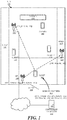
- FIG. 1 is a block diagram of an example system environment for determining that a client device presents in a site using frequent client mobility patterns.
- FIG. 1 includes an example site 100 deployed with a plurality of access points (APs), such as, AP1 120, AP2 125, and AP3 130.
- the plurality of APs may be connected to a controller or server 170.
- the controller or server 170 may be located remotely and connected to the plurality of APs via a cloud infrastructure.
- the controller or server 170 may be located locally and connected to the APs via wired and/or wireless connections.
- FIG. 1 includes a plurality of client devices, such as, Client1 140, Client2 145, Client3 150, and Client4 155.
- Some of these client devices may be associated with the wireless network serviced by the APs (e.g., AP1 120 to AP3 130). Some of these client devices may not be associated with any of the APs in site 100.
- some of the client devices 140-155 may be presented within the site, whereas some of the client devices 140-155 may be presented within the vicinity of the site but outside the site (e.g., outside entry 105 but closely located to AP1 120). Also, some of the client devices 140-155 may be moving from time to time, whereas some of the client devices 140-155 may be immobile.
- FIG. 1 includes an example floor plan layout of site 100.
- site 100 includes two separate shelves (e.g., shelf 110) on each side of the site after a respective client device moves through entry 105 into site 100. Shelf 110 may be used to display goods to customers of site 100.
- site 100 may include a cashier counter 115, where customers can check out the goods that they want to purchase.
- each access point in site 100 can periodically report the signal strength values of the wireless signals received from a client device, as well as the association status of each client device.
- wireless signals from Client1 140 may be received by all three APs in site 100 at the same time.
- the first radio of AP1 120 may detect a RSSI value of -63 from Client1 140
- the second radio of AP1 120 may detect a RSSI value of -83 from Client1 140.
- AP1 120 will determine a signal strength value band that corresponds to the detected RSSI value. For example, the RSSI value of -63 falls within the [-60, -65] band, whereas the RSSI value of -83 falls within [-80, -85] band.
- AP1 120 can report a mobility pattern of Client1 120 as detected by its two radios.
- RSSI signal-to-noise ratio
- EIRP Effective Isotropic Radiated Power
- the network device running the presence analytics can determine that Client1 140 is presented within site 100. If a respective client device is determined to be presented within site 100, the network device running the presence analytics can add the collected mobility patterns of the respective client device as input data to build and/or update a model. In some examples, the respective client device is determined to be located within a site if the dwell time corresponding to the respective client device is greater than a threshold amount of time (e.g., 5 minutes).
- the dwell time may refer to the time difference between when the respective client device is detected for the first time and the last time by any AP in a site.
- FIG. 2A is a block diagram of an example input data received by presence analytics at a network device for determining that a client device presents in a site using frequent client mobility patterns.
- input data 200 includes data received from AP1 210, AP2 220, and AP3 230, and each AP has two different radios (e.g., AP1 210 has R1 212 and R2 214; AP2 220 has R1 222 and R2 224; AP3 230 has R1 232 and R2 234).
- client ID 240 identifies a client device whose wireless signal strength values are reported by the APs in the wireless network.
- timestamp 250 indicates the time when the APs in the wireless network report the signal strength values of the wireless signals received from the client device.
- associated 260 is a field that indicates whether the client device is currently associated with the wireless network.
- input data 200 can be processed to filter the dataset. For example, if a particular record has missing values from all three APs, the record can be removed from input data 200. As another example, input data 200 may be filtered based on whether the client device is associated or unassociated with the wireless network to create different input datasets.
- input data 200 can be processed to remove outliers.
- the system can remove any single radio records, or two radio records seen on the same AP. Removal of single radio records help avoid the outlier patterns to be considered in the model, because APs located in the corners or near doorway can hear client devices that may be outside the site.
- the example input data 200 in FIG. 2A includes three records.
- the first record shows that client device with ID #4, which was associated with the wireless network, was detected at the timestamp 1478564238 by R1 212 and R2 214 of AP1 210, R2 224 of AP2 220, and R1 232 of AP3 230.
- the second record shows that client device with ID #4, which was associated with the wireless network, was detected at the timestamp 1478564298 by R2 214 of AP1 210, R1 222 and R2 224 of AP2 220, and R2 234 of AP3 230.
- the third record shows that client device with ID #5, which was associated with the wireless network, was detected at the timestamp 1478564298 by R1 212 of AP1 210, R2 224 of AP2 220, and R1 232 of AP3 230.
- Each radio reports a RSSI value band based on the RSSI value of the signals received from the client device. For example, if the RSSI of the signal from the client device is -63, then the band [-60, -65] is reported and included in input data 200. The band [-60, -65] represents that the reported RSSI value falls between -60 and -65.
- the interval of 5 in each band allows for accurate determination of the distance between the client device and the AP. Meanwhile, it also allows for recognition of frequent common mobility patterns exhibited by client devices in the wireless network. When client devices move along with the same trail in a site, their signals as detected by the APs may exhibit the same mobility patterns using signal strength band having an interval of 5.
- FIG. 2B is a block diagram of an example mobility patterns 270 extracted from input data 200 for determining that a client device presents in a site using frequent client mobility patterns.
- FIG. 2B lists example client devices 280 and their mobility patterns 290.
- Client 1 shows four different mobility patterns at different timestamps.
- signals from Client 1 were received at a first timestamp and reported by R1 of AP1 as [-60, -65], R2 of AP1 as [-80, -85], R1 of AP2 as [-80, -85], and R1 of AP3 as [-70, -75].
- signals from Client 1 were received at a second timestamp and reported by R1 of AP3 as [-80, -85] and R2 of AP3 as [-70, -75].
- signals from Client 1 were received at a third timestamp and reported by R1 of AP2 as [-65, -70], R2 of AP2 as [-95, -100], and R1 of AP3 as [-75, -80].
- signals from Client 1 were received at a fourth timestamp and reported by R1 of AP1 as [-65, -70], R1 of AP2 as [-55, -60], R2 of AP2 as [-90, -95], R1 of AP3 as [-70, -75], and R2 of AP3 as [-90, -95].
- Client 2 shows two different mobility patterns at two different timestamps;
- Client 3 shows three different mobility patterns at three different timestamps; and
- Client 4 shows six different mobility patterns at six different timestamps.
- the system can determine a subset of mobility patterns that occur more than once among all mobility patterns 290.
- pattern 1 of Client 1 and pattern 1 of Client 3 are the same mobility pattern.
- pattern 3 of Client 1, pattern 2 of Client 3, and pattern 4 of Client 4 are the same mobility patterns.
- pattern 4 of Client 1 and pattern 2 of Client 4 are the same mobility patterns.
- pattern 1 of Client 2, pattern 1 and pattern 5 of Client 4 are the same mobility patterns.
- the frequent mobility patterns for example, can include the client devices' mobility pattern trails whose counts are more than a predetermined count (e.g., occurring more than once).
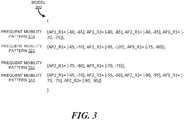
- FIG. 3 is a block diagram of an example model used to determine that a client device presents in a site using frequent client mobility patterns.
- Model 300 includes the four frequent mobility patterns 310-340 generated by analyzing input data 200 in FIG. 2 .
- frequent mobility pattern 310 is exhibited as pattern 1 of Client 1 and pattern 1 of Client 3.
- frequent mobility pattern 320 is exhibited as pattern 3 of Client 1, pattern 2 of Client 3, and pattern 4 of Client 4.
- frequent mobility pattern 330 is exhibited as pattern 1 of Client 2, pattern 1 and pattern 5 of Client 4.
- frequent mobility pattern 340 is exhibited as pattern 4 of Client 1 and pattern 2 of Client 4.
- the system use data collected from moving client devices to build the model.
- the system can remove static client devices that may skew the distribution of frequent mobility patterns.
- static client devices may be desktop computers at the cashier or security devices.
- moving client devices may be determined based on which radio detected the maximum RSSI value from the client device at a given timestamp. For example, with mobility patterns 290 in FIG.
- R1 of AP1 was the radio detecting the maximum RSSI value [-60, -65] at the first timestamp
- R2 of AP3 was the radio detecting the maximum RSSI value [-70, -75] at the second timestamp
- R1 of AP2 was the radio detecting the maximum RSSI value [-65, -70] at the third timestamp
- R1 of AP2 was the radio detecting the maximum RSSI value [-55, -60] at the fourth timestamp. Therefore, during the periods when these mobility patterns were reported, the radio that detected the maximum signal strength from Client 1 has changed from R1 of AP1 to R2 of AP3, then to R1 of AP2.
- Such continuous change in the radio that detects the maximum signal strength from a particular client device indicates that the particular client device is a moving client device.
- the system can determine that a particular client device is moving if the radio detecting the maximum signal strength has changed for a threshold number of times during a predetermined time period. For example, if the radio detecting the maximum RSSI from a client device changes more than 3 times in 10 consecutive records in the input data, then the respective client device is determined to be a moving client device. As a result, the records of the respective client device in the input data are used for closed frequent mobility pattern data mining.
- the system can look for a maximum RSSI value from each row in the input data (e.g., input data 200 in FIG. 2 ) and determine a radio name corresponding to the maximum RSSI value. Then, the system can add the maximum RSSI value and the maximum RSSI detecting radio to input data as new metrics. Next, the system can filter records of each client device and compute its dwell time. For example, if signals from that client device are detected continuously for at least 10 minutes and the client device is determined to be a moving client device, then the system can add the records of that client device to the moving client device's record dataset. After filtering client devices' records, the resulting moving client devices' record dataset can be used to build the model.
- a maximum RSSI value from each row in the input data (e.g., input data 200 in FIG. 2 ) and determine a radio name corresponding to the maximum RSSI value. Then, the system can add the maximum RSSI value and the maximum RSSI detecting radio to input data as new metrics. Next, the system can filter records of each client device and
- the input data is divided into two separate sets, e.g., a training dataset and a validation dataset, according to a predetermined ratio (e.g., 80% of input data belong to the training dataset, whereas 20% of input dataset belong to the validation dataset).
- the training dataset may be used for model training purposes.
- the validation dataset may be used for validating the model after the model is built.
- the system can convert the moving client devices' record dataset from the training dataset into transactions to compute most common mobility patterns using FP-Close dataset mining.
- FP-Close dataset mining mines frequent patterns that are both closed and have support greater than or equal to the minimum support.
- the minimum support may be determined by domain expert as per requirement.
- a pattern may be referred to as "closed" in a set of patterns if no superset of patterns has the same support count as this original pattern.
- the FP-Close dataset mining can efficiently find the closed frequent set.
- the closed frequent set can remove redundant mobility patterns from the frequent mobility patterns set. Thus, frequent mobility patterns obtained in the model are unique.
- frequent mobility patterns 310-34 can be obtained using closed frequent set mining.
- the closed frequent set is defined as a frequent item set that is both closed and its support is greater than or equal to the minimum support (also known as "minsup").
- An item set is closed in a dataset if there exists no superset that has the same support count as this original item set.
- the system first can identify all frequent item sets. Then, from this group of frequent item sets, the system can find those that are closed by checking to see if there exists a superset that has the same support as the frequent item set. If there is, the item set is disqualified. However, if no superset can be found, then the item set is determined to be closed. In some examples, the system can first identify the closed item sets, and then use the minsup to determine which ones are frequent.
- Closed frequent item sets and maximal frequent item sets may be subsets of frequent item sets, whereas maximal frequent item sets are a more compact representation because it is a subset of closed frequent item sets. Closed frequent item sets are used herein for illustration purposes, but other alternatives (e.g., maximal frequent item sets) may be used in the data mining as well.
- the system can match a new client device's mobility patterns with the existing frequent mobility patterns in the model. If at least two patterns get matched, then the system can determine a dwell time for the new client device during which the matched mobility pattern is exhibited. Dwell time may refer to the time difference between when a client device is detected for the first time and the last time by any AP in a network. If the dwell time is greater than a predetermined threshold (e.g., 5 minutes), then the system can determine that the new client device is located inside the site.
- a predetermined threshold e.g., 5 minutes
- the system can further verify the validity of the built model. As mentioned previously, a certain ratio of the input data are used for validation purposes. To validate the model, the system can first find the moving client devices in the validation dataset using the same mechanism as described above (e.g., by determining whether the radio that detects the maximum RSSI of signals from a client device changes over time). Then, the system can match the mobility patterns of each moving client device with frequent mobility patterns in the model. If at least two mobility patterns exhibited by the moving client device match with the frequent mobility patterns in the model and if the moving client device's dwell time is more than a predetermined period of time (e.g., 5 minutes), then that moving client device can be classified as inside the site. If a threshold percentage (e.g., 60 %) of client devices' mobility patterns in the validation set match the frequent mobility patterns in the model, then the built model is deemed to have been validated.
- a threshold percentage e.g. 60 %
- Table 1 below shows an example validation results.
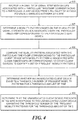
- FIG. 4 is a flowchart of an example method (e.g., process) of determining that a client device presents in a site using frequent client mobility patterns.
- a network device e.g., a server or controller
- the network device can determine a mobility pattern based on the plurality of signal strength values associated with the particular timestamp corresponding to the particular client device (operation 420).
- the network device can compare the mobility pattern associated with the particular timestamp corresponding to the particular client device with mobility patterns associated with other timestamps or corresponding to other client devices to identify a set of frequent mobility patterns (operation 430). Further, the network device can determine whether an unassociated client device exhibits a threshold number of frequent mobility patterns for a threshold amount of time (operation 440). Moreover, the network device can determine that the unassociated client device presents in the site in response to the unassociated client device exhibiting the threshold number of the frequent mobility patterns for the threshold amount of time (operation 450).
- a network device may refer to a network controller that comprises a hardware or a combination of hardware and software that enables connection between client devices and computer networks.
- a network device may refer to a server computing device (e.g., on-premise server, private, public, or hybrid cloud server)that comprises a hardware or a combination of hardware and software that can process and/or display network-related information.
- signal strength values corresponding to client devices that are sent from access points can be received at a network controller. The network controller may then analyze the received information to determine whether a client device is present in a site.
- signal strength values corresponding to client devices that are sent from access points can be received at a server computing device, which may then analyze the received information to determine whether a client device is present in a site.
- the mobility pattern includes the plurality of signal strength values, whereas each signal strength value can be reported by a particular radio of a particular access point in the wireless network at the particular timestamp.
- each signal strength value comprises a non-overlapping range of received signal strength indicator (RSSI) values.
- the set of frequent mobility patterns occur more than a predetermined number of times among mobility patterns associated with different timestamps corresponding to different client devices in the wireless network.
- the threshold amount of time includes a dwell time, which indicates a time difference between when the particular client device is detected for the first time and the last time by any access point in the wireless network.
- the network device can further determine that the unassociated client device is moving in response to a threshold number of changes within a predetermined period of time in an access point radio that detects a maximum signal strength value corresponding to the unassociated client device.
- the network device can use closed frequent set mining to build a model that includes the set of frequent mobility patterns. Thereafter, the network device can validate the model in response to a majority of moving client devices matching at least two frequent mobility patterns during a predetermined dwell time.
- a network device may be implemented, at least in part, by a combination of hardware and programming.
- the hardware may comprise at least one processor (e.g., processor 510) and the programming may comprise instructions, executable by the processor(s), stored on at least one machine-readable storage medium (e.g., 520).
- a network device may also include embedded memory and a software that can be executed in a host system and serve as a driver of the embedded memory.
- a "processor” may be at least one of a central processing unit (CPU), a semiconductor-based microprocessor, a graphics processing unit (GPU), a field-programmable gate array (FPGA) configured to retrieve and execute instructions, other electronic circuitry suitable for the retrieval and execution instructions stored on a machine-readable storage medium, or a combination thereof.
- CPU central processing unit
- GPU graphics processing unit
- FPGA field-programmable gate array
- the at least one processor 510 may fetch, decode, and execute instructions stored on storage medium 520 to perform the functionalities described below in relation to instructions 530-580.
- the functionalities of any of the instructions of storage medium 520 may be implemented in the form of electronic circuitry, in the form of executable instructions encoded on a machine-readable storage medium, or a combination thereof.
- the storage medium may be located either in the computing device executing the machine-readable instructions, or remote from but accessible to the computing device (e.g., via a computer network) for execution.
- storage medium 520 may be implemented by one machine-readable storage medium, or multiple machine-readable storage media.
- network device 500 includes at least one processor 510 and machine-readable storage medium 520, it may also include other suitable components, such as additional processing component(s) (e.g., processor(s), ASIC(s), etc.), storage (e.g., storage drive(s), etc.), or a combination thereof.
- additional processing component(s) e.g., processor(s), ASIC(s), etc.
- storage e.g., storage drive(s), etc.
- a "machine-readable storage medium” may be any electronic, magnetic, optical, or other physical storage apparatus to contain or store information such as executable instructions, data, and the like.
- any machine-readable storage medium described herein may be any of Random Access Memory (RAM), volatile memory, non-volatile memory, flash memory, a storage drive (e.g., a hard drive), a solid state drive, any type of storage disc (e.g., a compact disc, a DVD, etc.), and the like, or a combination thereof.
- RAM Random Access Memory
- volatile memory volatile memory
- non-volatile memory flash memory
- a storage drive e.g., a hard drive
- solid state drive any type of storage disc (e.g., a compact disc, a DVD, etc.)
- any machine-readable storage medium described herein may be non-transitory.
- a machine-readable storage medium or media may be part of an article (or article of manufacture). An article or article of manufacture may refer to any manufactured single component or multiple components.
- instructions 530-580 may be executed by processor 510 to: receive a plurality of signal strength values associated with a particular timestamp corresponding to a particular client device from a plurality of access points in a wireless network at a site; determine a mobility pattern based on the plurality of signal strength values associated with the particular timestamp corresponding to the particular client device; compare the mobility pattern associated with the particular timestamp corresponding to the particular client device with mobility patterns associated with other timestamps or corresponding to other client devices to identify a set of frequent mobility patterns; determine whether an unassociated client device exhibits a threshold number of frequent mobility patterns for a threshold amount of time; determine that the unassociated client device presents in the site in response to the unassociated client device exhibiting the threshold number of the frequent mobility patterns for the threshold amount of time; determine that the unassociated client device is moving in response to a threshold number of changes within a predetermined period of time in an access point radio that detects a maximum signal strength value corresponding to the unassociated client device; use closed frequent set mining to build a model
Landscapes
- Engineering & Computer Science (AREA)
- Computer Networks & Wireless Communication (AREA)
- Signal Processing (AREA)
- Physics & Mathematics (AREA)
- General Physics & Mathematics (AREA)
- Radar, Positioning & Navigation (AREA)
- Remote Sensing (AREA)
- Databases & Information Systems (AREA)
- Quality & Reliability (AREA)
- Electromagnetism (AREA)
- Mobile Radio Communication Systems (AREA)
Claims (6)
- Verfahren, Folgendes umfassend:Empfangen (410), durch eine Netzwerkvorrichtung, eine Vielzahl von Signalstärkewerten, die einem bestimmten Zeitstempel zugehörig sind, der einer bestimmten Client-Vorrichtung von mehreren Zugriffspunkten in einem drahtlosen Netzwerk an einem Standort entspricht;Bestimmen (420), durch die Netzwerkvorrichtung, eines Bewegungsmusters basierend auf der Vielzahl von Signalstärkewerten, die dem bestimmten Zeitstempel, der der bestimmten Client-Vorrichtung entspricht, zugehörig sind; wobei das Bewegungsmuster die Vielzahl von Signalstärkewerte umfasst, wobei jeder Signalstärkewert von einem bestimmten Funkgerät eines bestimmten ZP in dem drahtlosen Netzwerk zu dem bestimmten Zeitstempel gemeldet wird;Vergleichen (430), durch die Netzwerkvorrichtung, des Bewegungsmusters, das dem bestimmten Zeitstempel zugehörig ist, der der bestimmten Client-Vorrichtung entspricht, mit Bewegungsmustern, die anderen Zeitstempeln zugehörig sind oder anderen Client-Vorrichtungen entsprechen, um einen Satz von häufigen Bewegungsmustern zu identifizieren;wobei das Verfahren dadurch gekennzeichnet ist, dass es ferner Folgendes umfasst:Bestimmen (440), durch die Netzwerkvorrichtung, ob eine nicht zugehörige Client-Vorrichtung eine bestimmte Schwellenwertanzahl an häufigen Bewegungsmustern für eine bestimmte Schwellenwertdauer vorweist; undBestimmen (450), durch die Netzwerkvorrichtung, dass die nicht zugehörige Client-Vorrichtung als Reaktion darauf, dass die nicht zugehörige Client-Vorrichtung die Schwellenwertanzahl der häufigen Bewegungsmuster für die Schwellenwertdauer vorweist, in dem Standort präsentiert wird;wobei das Vergleichen, durch die Netzwerkvorrichtung, des Bewegungsmusters, das dem bestimmten Zeitstempel, der der bestimmten Client-Vorrichtung entspricht, zugehörig ist, mit Bewegungsmustern, die anderen Zeitstempeln zugehörig sind oder anderen Client-Vorrichtungen entsprechen, um einen Satz von häufigen Bewegungsmustern zu identifizieren, das Bestimmen, durch die Netzwerkvorrichtung, umfasst, dass sich die nicht zugehörigen Client-Vorrichtung als Reaktion auf eine Schwellenwertanzahl von Änderungen innerhalb eines vorgegebenen Zeitraums in einem Zugriffspunktfunkgerät bewegt, das einen maximalen Signalstärkewert erfasst, der der nicht zugehörigen Client-Vorrichtung entspricht; undVerwenden, durch die Netzwerkvorrichtung, von geschlossenem häufigem Satz-Mining, um ein Modell zu erstellen, das den Satz von häufigen Bewegungsmustern umfasst, wobei die Eingabe in das geschlossene häufige Satz-Mining die Bewegungsmuster sind, die den nicht zugehörigen Client-Vorrichtungen entsprechen, die als sich bewegend bestimmt wurden.
- Verfahren nach Anspruch 1, wobei jeder Signalstärkewert einen nicht überlappenden Bereich von Empfangssignalstärkeindikatorwerten (received signal strength indicator- RSSI) umfasst.
- Verfahren nach Anspruch 1, wobei die Schwellenwertdauer die Verweilzeit umfasst, die einen Zeitunterschied zwischen dem Zeitpunkt, zu dem die bestimmte Client-Vorrichtung zum ersten Mal und dem letzten Mal von einem beliebigen Zugriffspunkt in dem drahtlosen Netzwerk erkannt wird, anzeigt.
- Verfahren nach Anspruch 1, ferner Folgendes umfassend:
Validieren, durch die Netzwerkvorrichtung, des Modells als Reaktion auf eine Mehrheit von sich bewegenden Client-Vorrichtungen, die mit wenigstens zwei häufigen Bewegungsmustern während einer vorgegebenen Verweildauer übereinstimmen. - Netzwerkvorrichtung, mindestens Folgendes umfassend:einen Speicher;einen Prozessor (510),
wobei die Netzwerkvorrichtung angepasst ist, um die Schritte des Verfahrens nach einem der Ansprüche 1 bis 4 auszuführen. - Nichtflüchtiges maschinenlesbares Speichermedium (520), das mit Anweisungen codiert ist, die von wenigstens einem Prozessor einer Netzwerkvorrichtung ausgeführt werden können, wobei das maschinenlesbare Speichermedium Anweisungen umfasst, die, wenn sie von einem Prozessor einer Netzwerkvorrichtung ausgeführt werden, den Prozessor veranlassen, nach einem der Ansprüche 1 bis 4 des Verfahrens zu arbeiten.
Applications Claiming Priority (1)
| Application Number | Priority Date | Filing Date | Title |
|---|---|---|---|
| US15/614,129 US10327107B2 (en) | 2017-06-05 | 2017-06-05 | Determining that a client device presents in a site using frequent client mobility patterns |
Publications (2)
| Publication Number | Publication Date |
|---|---|
| EP3413601A1 EP3413601A1 (de) | 2018-12-12 |
| EP3413601B1 true EP3413601B1 (de) | 2020-04-29 |
Family
ID=62684584
Family Applications (1)
| Application Number | Title | Priority Date | Filing Date |
|---|---|---|---|
| EP18175828.5A Active EP3413601B1 (de) | 2017-06-05 | 2018-06-04 | Feststellen, dass eine kundenvorrichtung präsent an einem ort ist mittels häufigen kunden-mobilitätsmustern |
Country Status (3)
| Country | Link |
|---|---|
| US (2) | US10327107B2 (de) |
| EP (1) | EP3413601B1 (de) |
| CN (1) | CN108989987B (de) |
Families Citing this family (12)
| Publication number | Priority date | Publication date | Assignee | Title |
|---|---|---|---|---|
| US11570578B2 (en) * | 2017-12-14 | 2023-01-31 | Abl Solutions Gmbh | Location analytics techniques |
| US11023352B2 (en) * | 2018-01-19 | 2021-06-01 | Seagate Technology Llc | Wear mitigation in a data storage system through data migration |
| US10667235B1 (en) * | 2019-03-22 | 2020-05-26 | Eric Yellin | Server and plurality of access points for locating and identifying a mobile device |
| US11337091B2 (en) * | 2020-04-30 | 2022-05-17 | Google Llc | Determination of user presence and absence using WiFi connections |
| CN113873441B (zh) * | 2020-06-30 | 2024-02-09 | 香港科技大学 | 接触者追踪的方法及相应的处理方法、系统、设备和介质 |
| CN111935778B (zh) * | 2020-07-09 | 2022-09-16 | RealMe重庆移动通信有限公司 | 一种功率调节方法、装置、存储介质及网络设备 |
| US12273784B2 (en) * | 2021-02-01 | 2025-04-08 | Adentro, Inc. | Machine-learning model for detecting a device within a venue |
| US11381962B1 (en) | 2021-02-01 | 2022-07-05 | Adentro, Inc. | Integration of content distribution systems with device detection systems in physical venues |
| US12051054B2 (en) * | 2021-07-08 | 2024-07-30 | Zenreach, Inc. | Machine learning model for combining device presence data with physical venue transaction data |
| US12127073B2 (en) * | 2021-09-08 | 2024-10-22 | Zenreach, Inc. | Integration of digital history with visits to physical venues |
| CN117440311A (zh) * | 2022-07-14 | 2024-01-23 | 北京三星通信技术研究有限公司 | 由第一节点执行的方法及相关设备 |
| US20250105899A1 (en) * | 2023-09-25 | 2025-03-27 | Samsung Electronics Co., Ltd. | Csi prediction using machine learning |
Family Cites Families (29)
| Publication number | Priority date | Publication date | Assignee | Title |
|---|---|---|---|---|
| US8600674B1 (en) * | 2007-08-15 | 2013-12-03 | University Of South Florida | Using pattern recognition in real-time LBS applications |
| US8478290B2 (en) | 2009-09-21 | 2013-07-02 | Aeroscout, Ltd. | Method to reduce database load in real time location systems |
| US8989789B2 (en) * | 2011-06-29 | 2015-03-24 | Broadcom Corporation | Terminal mobility state detection |
| US20130226655A1 (en) * | 2012-02-29 | 2013-08-29 | BVI Networks, Inc. | Method and system for statistical analysis of customer movement and integration with other data |
| US20130262184A1 (en) | 2012-03-30 | 2013-10-03 | Arbitron Inc. | Systems and Methods for Presence Detection and Linking to Media Exposure Data |
| CN107832615A (zh) * | 2012-10-19 | 2018-03-23 | 迈克菲公司 | 场所感知安全 |
| US9674655B2 (en) | 2013-01-03 | 2017-06-06 | Cinarra Systems | Methods and systems for dynamic detection of consumer venue walk-ins |
| US9882955B2 (en) * | 2013-01-09 | 2018-01-30 | RetailNext, Inc. | Wireless analytics in physical spaces |
| CN103970805B (zh) * | 2013-02-05 | 2018-01-09 | 日电(中国)有限公司 | 移动模式挖掘设备和方法 |
| US9456302B2 (en) * | 2013-06-03 | 2016-09-27 | Temeda Llc | Geospatial asset tracking systems, methods and apparatus for acquiring, manipulating and presenting telematic metadata |
| US20160269984A1 (en) | 2013-12-12 | 2016-09-15 | Locality Systems Inc. | Proximity recognition system |
| US9465746B2 (en) | 2014-01-24 | 2016-10-11 | International Business Machines Corporation | Diagnostics for transactional execution errors in reliable transactions |
| US9456433B2 (en) * | 2014-04-25 | 2016-09-27 | Aruba Networks, Inc. | Method and system for client device localization |
| US10698073B2 (en) | 2014-05-30 | 2020-06-30 | Apple Inc. | Wireless access point location estimation using collocated harvest data |
| US9485746B2 (en) | 2014-06-03 | 2016-11-01 | Cisco Technology, Inc. | Location classification accuracy for devices inside and outside of a deployment area |
| CN105320709A (zh) * | 2014-08-05 | 2016-02-10 | 阿里巴巴集团控股有限公司 | 终端设备上的信息提示方法及装置 |
| US20160189170A1 (en) * | 2014-12-29 | 2016-06-30 | International Business Machines Corporation | Recognizing Customers Requiring Assistance |
| US9426627B1 (en) | 2015-04-21 | 2016-08-23 | Twin Harbor Labs, LLC | Queue information and prediction system |
| US10476972B2 (en) * | 2015-04-23 | 2019-11-12 | Google Llc | User presence determination |
| US9955359B2 (en) | 2015-05-19 | 2018-04-24 | Cisco Technology, Inc. | Location services with multiple devices |
| US9747735B1 (en) * | 2015-06-05 | 2017-08-29 | Brivo Systems Llc | Pattern analytics and physical access control system method of operation |
| CN108141708A (zh) | 2015-09-07 | 2018-06-08 | Sk普兰尼特有限公司 | 使用信标提供内容信息的服务方法以及确定用户是否进入和离开商店的方法 |
| US9699603B2 (en) | 2015-10-14 | 2017-07-04 | Cisco Technology, Inc. | Utilizing mobile wireless devices to analyze movement of crowds |
| US10417648B2 (en) * | 2015-11-09 | 2019-09-17 | Industrial Technology Research Institute | System and computer readable medium for finding crowd movements |
| US10140832B2 (en) * | 2016-01-26 | 2018-11-27 | Flir Systems, Inc. | Systems and methods for behavioral based alarms |
| KR102496681B1 (ko) * | 2016-02-03 | 2023-02-07 | 한국전자통신연구원 | 선박 위치 검사 방법 및 장치 |
| CN106028391B (zh) * | 2016-05-19 | 2020-12-01 | 腾讯科技(深圳)有限公司 | 人流量统计方法及装置 |
| US10573144B2 (en) * | 2016-10-10 | 2020-02-25 | Netgear, Inc. | Changing topology in a wireless network |
| US10255791B2 (en) * | 2016-10-14 | 2019-04-09 | Walmart Apollo, Llc | Apparatus and method for providing reminders |
-
2017
- 2017-06-05 US US15/614,129 patent/US10327107B2/en active Active
-
2018
- 2018-06-04 CN CN201810586552.3A patent/CN108989987B/zh active Active
- 2018-06-04 EP EP18175828.5A patent/EP3413601B1/de active Active
-
2019
- 2019-05-14 US US16/412,314 patent/US11082804B2/en active Active
Non-Patent Citations (1)
| Title |
|---|
| None * |
Also Published As
| Publication number | Publication date |
|---|---|
| CN108989987B (zh) | 2021-09-07 |
| US20190268727A1 (en) | 2019-08-29 |
| US10327107B2 (en) | 2019-06-18 |
| US20180352384A1 (en) | 2018-12-06 |
| US11082804B2 (en) | 2021-08-03 |
| EP3413601A1 (de) | 2018-12-12 |
| CN108989987A (zh) | 2018-12-11 |
Similar Documents
| Publication | Publication Date | Title |
|---|---|---|
| EP3413601B1 (de) | Feststellen, dass eine kundenvorrichtung präsent an einem ort ist mittels häufigen kunden-mobilitätsmustern | |
| EP3242236B1 (de) | Verfahren und vorrichtung zur erkennung von transaktionsrisiken | |
| US9628937B2 (en) | Detection of unauthorized wireless personal area network low energy devices | |
| US9438677B2 (en) | Method and apparatus for analysis of user traffic within a predefined area | |
| CN109246685B (zh) | 基于mac地址的客流量统计方法、设备及存储介质 | |
| US20200026635A1 (en) | System Operational Analytics Using Additional Features for Health Score Computation | |
| US20140201048A1 (en) | Method and apparatus of identifying a website user | |
| US20180144476A1 (en) | Cascaded-time-scale background modeling | |
| US9872188B2 (en) | Adaptive filtering based network anomaly detection | |
| US20140249887A1 (en) | System for monitoring customers within retail premises | |
| US10383039B2 (en) | Best next access point list | |
| US10382882B2 (en) | Systems and methods for identifying merchant locations based on transaction records | |
| US11223668B2 (en) | Anomaly detection of media event sequences | |
| US20230232187A1 (en) | Machine learning localization methods and systems | |
| US20170111760A1 (en) | Utilizing mobile wireless devices to analyze movement of crowds | |
| US9473901B1 (en) | Precise location and projection by radio beacon signals | |
| US20200179760A1 (en) | Equipment use tracking and availability prediction | |
| US10614436B1 (en) | Association of mobile device to retail transaction | |
| KR20180009563A (ko) | 공장 모니터링 시스템 및 방법 | |
| EP2947910B1 (de) | Leistungsoptimierungen für drahtlose zugangspunkte | |
| WO2022076665A1 (en) | Resource consumption systems | |
| CN110909262B (zh) | 一种身份信息的伴随关系确定方法及装置 | |
| CN110765221A (zh) | 时空轨迹数据的管理方法和装置 | |
| US11297593B2 (en) | Identifying fixed WLAN devices using mobility patterns | |
| US10944534B2 (en) | Identifying doorway access points |
Legal Events
| Date | Code | Title | Description |
|---|---|---|---|
| PUAI | Public reference made under article 153(3) epc to a published international application that has entered the european phase |
Free format text: ORIGINAL CODE: 0009012 |
|
| STAA | Information on the status of an ep patent application or granted ep patent |
Free format text: STATUS: THE APPLICATION HAS BEEN PUBLISHED |
|
| AK | Designated contracting states |
Kind code of ref document: A1 Designated state(s): AL AT BE BG CH CY CZ DE DK EE ES FI FR GB GR HR HU IE IS IT LI LT LU LV MC MK MT NL NO PL PT RO RS SE SI SK SM TR |
|
| AX | Request for extension of the european patent |
Extension state: BA ME |
|
| RAP1 | Party data changed (applicant data changed or rights of an application transferred) |
Owner name: HEWLETT PACKARD ENTERPRISE DEVELOPMENT LP |
|
| STAA | Information on the status of an ep patent application or granted ep patent |
Free format text: STATUS: REQUEST FOR EXAMINATION WAS MADE |
|
| 17P | Request for examination filed |
Effective date: 20190604 |
|
| RBV | Designated contracting states (corrected) |
Designated state(s): AL AT BE BG CH CY CZ DE DK EE ES FI FR GB GR HR HU IE IS IT LI LT LU LV MC MK MT NL NO PL PT RO RS SE SI SK SM TR |
|
| STAA | Information on the status of an ep patent application or granted ep patent |
Free format text: STATUS: EXAMINATION IS IN PROGRESS |
|
| 17Q | First examination report despatched |
Effective date: 20190806 |
|
| RIC1 | Information provided on ipc code assigned before grant |
Ipc: H04W 4/02 20180101ALN20191127BHEP Ipc: H04W 8/00 20090101AFI20191127BHEP |
|
| GRAP | Despatch of communication of intention to grant a patent |
Free format text: ORIGINAL CODE: EPIDOSNIGR1 |
|
| STAA | Information on the status of an ep patent application or granted ep patent |
Free format text: STATUS: GRANT OF PATENT IS INTENDED |
|
| RIC1 | Information provided on ipc code assigned before grant |
Ipc: H04W 4/02 20180101ALN20191212BHEP Ipc: H04W 8/00 20090101AFI20191212BHEP |
|
| INTG | Intention to grant announced |
Effective date: 20200103 |
|
| GRAS | Grant fee paid |
Free format text: ORIGINAL CODE: EPIDOSNIGR3 |
|
| GRAA | (expected) grant |
Free format text: ORIGINAL CODE: 0009210 |
|
| STAA | Information on the status of an ep patent application or granted ep patent |
Free format text: STATUS: THE PATENT HAS BEEN GRANTED |
|
| AK | Designated contracting states |
Kind code of ref document: B1 Designated state(s): AL AT BE BG CH CY CZ DE DK EE ES FI FR GB GR HR HU IE IS IT LI LT LU LV MC MK MT NL NO PL PT RO RS SE SI SK SM TR |
|
| REG | Reference to a national code |
Ref country code: GB Ref legal event code: FG4D |
|
| REG | Reference to a national code |
Ref country code: CH Ref legal event code: EP |
|
| REG | Reference to a national code |
Ref country code: DE Ref legal event code: R096 Ref document number: 602018004112 Country of ref document: DE |
|
| REG | Reference to a national code |
Ref country code: AT Ref legal event code: REF Ref document number: 1265148 Country of ref document: AT Kind code of ref document: T Effective date: 20200515 |
|
| REG | Reference to a national code |
Ref country code: IE Ref legal event code: FG4D |
|
| REG | Reference to a national code |
Ref country code: NL Ref legal event code: MP Effective date: 20200429 |
|
| REG | Reference to a national code |
Ref country code: LT Ref legal event code: MG4D |
|
| PG25 | Lapsed in a contracting state [announced via postgrant information from national office to epo] |
Ref country code: PT Free format text: LAPSE BECAUSE OF FAILURE TO SUBMIT A TRANSLATION OF THE DESCRIPTION OR TO PAY THE FEE WITHIN THE PRESCRIBED TIME-LIMIT Effective date: 20200831 Ref country code: GR Free format text: LAPSE BECAUSE OF FAILURE TO SUBMIT A TRANSLATION OF THE DESCRIPTION OR TO PAY THE FEE WITHIN THE PRESCRIBED TIME-LIMIT Effective date: 20200730 Ref country code: IS Free format text: LAPSE BECAUSE OF FAILURE TO SUBMIT A TRANSLATION OF THE DESCRIPTION OR TO PAY THE FEE WITHIN THE PRESCRIBED TIME-LIMIT Effective date: 20200829 Ref country code: SE Free format text: LAPSE BECAUSE OF FAILURE TO SUBMIT A TRANSLATION OF THE DESCRIPTION OR TO PAY THE FEE WITHIN THE PRESCRIBED TIME-LIMIT Effective date: 20200429 Ref country code: FI Free format text: LAPSE BECAUSE OF FAILURE TO SUBMIT A TRANSLATION OF THE DESCRIPTION OR TO PAY THE FEE WITHIN THE PRESCRIBED TIME-LIMIT Effective date: 20200429 Ref country code: NO Free format text: LAPSE BECAUSE OF FAILURE TO SUBMIT A TRANSLATION OF THE DESCRIPTION OR TO PAY THE FEE WITHIN THE PRESCRIBED TIME-LIMIT Effective date: 20200729 Ref country code: LT Free format text: LAPSE BECAUSE OF FAILURE TO SUBMIT A TRANSLATION OF THE DESCRIPTION OR TO PAY THE FEE WITHIN THE PRESCRIBED TIME-LIMIT Effective date: 20200429 |
|
| REG | Reference to a national code |
Ref country code: AT Ref legal event code: MK05 Ref document number: 1265148 Country of ref document: AT Kind code of ref document: T Effective date: 20200429 |
|
| PG25 | Lapsed in a contracting state [announced via postgrant information from national office to epo] |
Ref country code: BG Free format text: LAPSE BECAUSE OF FAILURE TO SUBMIT A TRANSLATION OF THE DESCRIPTION OR TO PAY THE FEE WITHIN THE PRESCRIBED TIME-LIMIT Effective date: 20200729 Ref country code: LV Free format text: LAPSE BECAUSE OF FAILURE TO SUBMIT A TRANSLATION OF THE DESCRIPTION OR TO PAY THE FEE WITHIN THE PRESCRIBED TIME-LIMIT Effective date: 20200429 Ref country code: RS Free format text: LAPSE BECAUSE OF FAILURE TO SUBMIT A TRANSLATION OF THE DESCRIPTION OR TO PAY THE FEE WITHIN THE PRESCRIBED TIME-LIMIT Effective date: 20200429 Ref country code: HR Free format text: LAPSE BECAUSE OF FAILURE TO SUBMIT A TRANSLATION OF THE DESCRIPTION OR TO PAY THE FEE WITHIN THE PRESCRIBED TIME-LIMIT Effective date: 20200429 |
|
| PG25 | Lapsed in a contracting state [announced via postgrant information from national office to epo] |
Ref country code: NL Free format text: LAPSE BECAUSE OF FAILURE TO SUBMIT A TRANSLATION OF THE DESCRIPTION OR TO PAY THE FEE WITHIN THE PRESCRIBED TIME-LIMIT Effective date: 20200429 Ref country code: AL Free format text: LAPSE BECAUSE OF FAILURE TO SUBMIT A TRANSLATION OF THE DESCRIPTION OR TO PAY THE FEE WITHIN THE PRESCRIBED TIME-LIMIT Effective date: 20200429 |
|
| PG25 | Lapsed in a contracting state [announced via postgrant information from national office to epo] |
Ref country code: SM Free format text: LAPSE BECAUSE OF FAILURE TO SUBMIT A TRANSLATION OF THE DESCRIPTION OR TO PAY THE FEE WITHIN THE PRESCRIBED TIME-LIMIT Effective date: 20200429 Ref country code: EE Free format text: LAPSE BECAUSE OF FAILURE TO SUBMIT A TRANSLATION OF THE DESCRIPTION OR TO PAY THE FEE WITHIN THE PRESCRIBED TIME-LIMIT Effective date: 20200429 Ref country code: AT Free format text: LAPSE BECAUSE OF FAILURE TO SUBMIT A TRANSLATION OF THE DESCRIPTION OR TO PAY THE FEE WITHIN THE PRESCRIBED TIME-LIMIT Effective date: 20200429 Ref country code: DK Free format text: LAPSE BECAUSE OF FAILURE TO SUBMIT A TRANSLATION OF THE DESCRIPTION OR TO PAY THE FEE WITHIN THE PRESCRIBED TIME-LIMIT Effective date: 20200429 Ref country code: IT Free format text: LAPSE BECAUSE OF FAILURE TO SUBMIT A TRANSLATION OF THE DESCRIPTION OR TO PAY THE FEE WITHIN THE PRESCRIBED TIME-LIMIT Effective date: 20200429 Ref country code: MC Free format text: LAPSE BECAUSE OF FAILURE TO SUBMIT A TRANSLATION OF THE DESCRIPTION OR TO PAY THE FEE WITHIN THE PRESCRIBED TIME-LIMIT Effective date: 20200429 Ref country code: RO Free format text: LAPSE BECAUSE OF FAILURE TO SUBMIT A TRANSLATION OF THE DESCRIPTION OR TO PAY THE FEE WITHIN THE PRESCRIBED TIME-LIMIT Effective date: 20200429 Ref country code: CZ Free format text: LAPSE BECAUSE OF FAILURE TO SUBMIT A TRANSLATION OF THE DESCRIPTION OR TO PAY THE FEE WITHIN THE PRESCRIBED TIME-LIMIT Effective date: 20200429 Ref country code: ES Free format text: LAPSE BECAUSE OF FAILURE TO SUBMIT A TRANSLATION OF THE DESCRIPTION OR TO PAY THE FEE WITHIN THE PRESCRIBED TIME-LIMIT Effective date: 20200429 |
|
| REG | Reference to a national code |
Ref country code: DE Ref legal event code: R097 Ref document number: 602018004112 Country of ref document: DE |
|
| PG25 | Lapsed in a contracting state [announced via postgrant information from national office to epo] |
Ref country code: SK Free format text: LAPSE BECAUSE OF FAILURE TO SUBMIT A TRANSLATION OF THE DESCRIPTION OR TO PAY THE FEE WITHIN THE PRESCRIBED TIME-LIMIT Effective date: 20200429 Ref country code: PL Free format text: LAPSE BECAUSE OF FAILURE TO SUBMIT A TRANSLATION OF THE DESCRIPTION OR TO PAY THE FEE WITHIN THE PRESCRIBED TIME-LIMIT Effective date: 20200429 |
|
| PLBE | No opposition filed within time limit |
Free format text: ORIGINAL CODE: 0009261 |
|
| STAA | Information on the status of an ep patent application or granted ep patent |
Free format text: STATUS: NO OPPOSITION FILED WITHIN TIME LIMIT |
|
| PG25 | Lapsed in a contracting state [announced via postgrant information from national office to epo] |
Ref country code: LU Free format text: LAPSE BECAUSE OF NON-PAYMENT OF DUE FEES Effective date: 20200604 |
|
| 26N | No opposition filed |
Effective date: 20210201 |
|
| REG | Reference to a national code |
Ref country code: BE Ref legal event code: MM Effective date: 20200630 |
|
| PG25 | Lapsed in a contracting state [announced via postgrant information from national office to epo] |
Ref country code: IE Free format text: LAPSE BECAUSE OF NON-PAYMENT OF DUE FEES Effective date: 20200604 Ref country code: FR Free format text: LAPSE BECAUSE OF NON-PAYMENT OF DUE FEES Effective date: 20200629 |
|
| PG25 | Lapsed in a contracting state [announced via postgrant information from national office to epo] |
Ref country code: BE Free format text: LAPSE BECAUSE OF NON-PAYMENT OF DUE FEES Effective date: 20200630 Ref country code: SI Free format text: LAPSE BECAUSE OF FAILURE TO SUBMIT A TRANSLATION OF THE DESCRIPTION OR TO PAY THE FEE WITHIN THE PRESCRIBED TIME-LIMIT Effective date: 20200429 |
|
| REG | Reference to a national code |
Ref country code: CH Ref legal event code: PL |
|
| PG25 | Lapsed in a contracting state [announced via postgrant information from national office to epo] |
Ref country code: LI Free format text: LAPSE BECAUSE OF NON-PAYMENT OF DUE FEES Effective date: 20210630 Ref country code: CH Free format text: LAPSE BECAUSE OF NON-PAYMENT OF DUE FEES Effective date: 20210630 |
|
| PG25 | Lapsed in a contracting state [announced via postgrant information from national office to epo] |
Ref country code: TR Free format text: LAPSE BECAUSE OF FAILURE TO SUBMIT A TRANSLATION OF THE DESCRIPTION OR TO PAY THE FEE WITHIN THE PRESCRIBED TIME-LIMIT Effective date: 20200429 Ref country code: MT Free format text: LAPSE BECAUSE OF FAILURE TO SUBMIT A TRANSLATION OF THE DESCRIPTION OR TO PAY THE FEE WITHIN THE PRESCRIBED TIME-LIMIT Effective date: 20200429 Ref country code: CY Free format text: LAPSE BECAUSE OF FAILURE TO SUBMIT A TRANSLATION OF THE DESCRIPTION OR TO PAY THE FEE WITHIN THE PRESCRIBED TIME-LIMIT Effective date: 20200429 |
|
| PG25 | Lapsed in a contracting state [announced via postgrant information from national office to epo] |
Ref country code: MK Free format text: LAPSE BECAUSE OF FAILURE TO SUBMIT A TRANSLATION OF THE DESCRIPTION OR TO PAY THE FEE WITHIN THE PRESCRIBED TIME-LIMIT Effective date: 20200429 |
|
| REG | Reference to a national code |
Ref country code: DE Ref legal event code: R082 Ref document number: 602018004112 Country of ref document: DE Representative=s name: PROCK, THOMAS, DR., GB |
|
| REG | Reference to a national code |
Ref country code: DE Ref legal event code: R081 Ref document number: 602018004112 Country of ref document: DE Owner name: HEWLETT PACKARD ENTERPRISE DEVELOPMENT LP, SPR, US Free format text: FORMER OWNER: HEWLETT PACKARD ENTERPRISE DEVELOPMENT LP, HOUSTON, TEX., US |
|
| PGFP | Annual fee paid to national office [announced via postgrant information from national office to epo] |
Ref country code: DE Payment date: 20250626 Year of fee payment: 8 |
|
| PGFP | Annual fee paid to national office [announced via postgrant information from national office to epo] |
Ref country code: GB Payment date: 20250617 Year of fee payment: 8 |