EP3412655A1 - Processes for the manufacture of haloalkyl pyrimidyl compounds, and compounds useful in their manufacture - Google Patents
Processes for the manufacture of haloalkyl pyrimidyl compounds, and compounds useful in their manufacture Download PDFInfo
- Publication number
- EP3412655A1 EP3412655A1 EP17174580.5A EP17174580A EP3412655A1 EP 3412655 A1 EP3412655 A1 EP 3412655A1 EP 17174580 A EP17174580 A EP 17174580A EP 3412655 A1 EP3412655 A1 EP 3412655A1
- Authority
- EP
- European Patent Office
- Prior art keywords
- group
- optionally substituted
- compound
- formula
- manufacture
- Prior art date
- Legal status (The legal status is an assumption and is not a legal conclusion. Google has not performed a legal analysis and makes no representation as to the accuracy of the status listed.)
- Withdrawn
Links
- 150000001875 compounds Chemical class 0.000 title claims abstract description 101
- 238000000034 method Methods 0.000 title claims abstract description 67
- 238000004519 manufacturing process Methods 0.000 title claims abstract description 41
- 125000004400 (C1-C12) alkyl group Chemical group 0.000 claims description 26
- 125000006552 (C3-C8) cycloalkyl group Chemical group 0.000 claims description 23
- 125000003107 substituted aryl group Chemical group 0.000 claims description 22
- 239000000203 mixture Substances 0.000 claims description 20
- 125000000217 alkyl group Chemical group 0.000 claims description 17
- -1 CCl2H Chemical compound 0.000 claims description 15
- 229910052739 hydrogen Inorganic materials 0.000 claims description 15
- 229910052794 bromium Inorganic materials 0.000 claims description 13
- 229910052801 chlorine Inorganic materials 0.000 claims description 13
- 229910052731 fluorine Inorganic materials 0.000 claims description 13
- 125000004178 (C1-C4) alkyl group Chemical group 0.000 claims description 11
- QGZKDVFQNNGYKY-UHFFFAOYSA-N Ammonia Chemical compound N QGZKDVFQNNGYKY-UHFFFAOYSA-N 0.000 claims description 11
- 239000003795 chemical substances by application Substances 0.000 claims description 11
- 125000005843 halogen group Chemical group 0.000 claims description 11
- BKVFOAJKAAHXEZ-UHFFFAOYSA-N 3-o,5-o-dimethyl 2-(difluoromethyl)-4-(2-methylpropyl)-6-(trifluoromethyl)pyridine-3,5-dicarbothioate Chemical compound COC(=S)C1=C(C(F)F)N=C(C(F)(F)F)C(C(=S)OC)=C1CC(C)C BKVFOAJKAAHXEZ-UHFFFAOYSA-N 0.000 claims description 6
- 230000018044 dehydration Effects 0.000 claims description 6
- 238000006297 dehydration reaction Methods 0.000 claims description 6
- 125000001495 ethyl group Chemical group [H]C([H])([H])C([H])([H])* 0.000 claims description 6
- 229910021529 ammonia Inorganic materials 0.000 claims description 5
- 230000002140 halogenating effect Effects 0.000 claims description 5
- 125000002496 methyl group Chemical group [H]C([H])([H])* 0.000 claims description 5
- 239000007800 oxidant agent Substances 0.000 claims description 5
- 229910052760 oxygen Inorganic materials 0.000 claims description 5
- 239000002243 precursor Substances 0.000 claims description 5
- 229910052717 sulfur Inorganic materials 0.000 claims description 5
- 150000003573 thiols Chemical class 0.000 claims description 5
- ROWMQJJMCWDJDT-UHFFFAOYSA-N tribromomethane Chemical compound Br[C](Br)Br ROWMQJJMCWDJDT-UHFFFAOYSA-N 0.000 claims description 3
- ZBZJXHCVGLJWFG-UHFFFAOYSA-N trichloromethyl(.) Chemical compound Cl[C](Cl)Cl ZBZJXHCVGLJWFG-UHFFFAOYSA-N 0.000 claims description 3
- QPAXMPYBNSHKAK-UHFFFAOYSA-N chloro(difluoro)methane Chemical compound F[C](F)Cl QPAXMPYBNSHKAK-UHFFFAOYSA-N 0.000 claims description 2
- YMWUJEATGCHHMB-UHFFFAOYSA-N Dichloromethane Chemical compound ClCCl YMWUJEATGCHHMB-UHFFFAOYSA-N 0.000 description 20
- 125000002023 trifluoromethyl group Chemical group FC(F)(F)* 0.000 description 18
- 125000001449 isopropyl group Chemical group [H]C([H])([H])C([H])(*)C([H])([H])[H] 0.000 description 12
- RTZKZFJDLAIYFH-UHFFFAOYSA-N Diethyl ether Chemical compound CCOCC RTZKZFJDLAIYFH-UHFFFAOYSA-N 0.000 description 9
- KWYUFKZDYYNOTN-UHFFFAOYSA-M Potassium hydroxide Chemical compound [OH-].[K+] KWYUFKZDYYNOTN-UHFFFAOYSA-M 0.000 description 6
- 125000004432 carbon atom Chemical group C* 0.000 description 6
- 239000002904 solvent Substances 0.000 description 6
- 125000001188 haloalkyl group Chemical group 0.000 description 5
- 239000011541 reaction mixture Substances 0.000 description 5
- 125000004209 (C1-C8) alkyl group Chemical group 0.000 description 4
- YUBJPYNSGLJZPQ-UHFFFAOYSA-N Dithiopyr Chemical compound CSC(=O)C1=C(C(F)F)N=C(C(F)(F)F)C(C(=O)SC)=C1CC(C)C YUBJPYNSGLJZPQ-UHFFFAOYSA-N 0.000 description 4
- LFQSCWFLJHTTHZ-UHFFFAOYSA-N Ethanol Chemical compound CCO LFQSCWFLJHTTHZ-UHFFFAOYSA-N 0.000 description 4
- VEXZGXHMUGYJMC-UHFFFAOYSA-N Hydrochloric acid Chemical compound Cl VEXZGXHMUGYJMC-UHFFFAOYSA-N 0.000 description 4
- CSNNHWWHGAXBCP-UHFFFAOYSA-L Magnesium sulfate Chemical compound [Mg+2].[O-][S+2]([O-])([O-])[O-] CSNNHWWHGAXBCP-UHFFFAOYSA-L 0.000 description 4
- 238000006243 chemical reaction Methods 0.000 description 4
- KPWKRRQOYOUNCT-UHFFFAOYSA-N diethyl 2-(difluoromethyl)-4-(2-methylpropyl)-6-(trifluoromethyl)pyridine-3,5-dicarboxylate Chemical compound CCOC(=O)C1=C(C(F)F)N=C(C(F)(F)F)C(C(=O)OCC)=C1CC(C)C KPWKRRQOYOUNCT-UHFFFAOYSA-N 0.000 description 4
- OCJKUQIPRNZDTK-UHFFFAOYSA-N ethyl 4,4,4-trifluoro-3-oxobutanoate Chemical compound CCOC(=O)CC(=O)C(F)(F)F OCJKUQIPRNZDTK-UHFFFAOYSA-N 0.000 description 4
- CBDPWKVOPADMJC-UHFFFAOYSA-N ethyl 4,4-difluoro-3-oxobutanoate Chemical compound CCOC(=O)CC(=O)C(F)F CBDPWKVOPADMJC-UHFFFAOYSA-N 0.000 description 4
- 239000002808 molecular sieve Substances 0.000 description 4
- URGAHOPLAPQHLN-UHFFFAOYSA-N sodium aluminosilicate Chemical compound [Na+].[Al+3].[O-][Si]([O-])=O.[O-][Si]([O-])=O URGAHOPLAPQHLN-UHFFFAOYSA-N 0.000 description 4
- 239000007858 starting material Substances 0.000 description 4
- FYSNRJHAOHDILO-UHFFFAOYSA-N thionyl chloride Chemical compound ClS(Cl)=O FYSNRJHAOHDILO-UHFFFAOYSA-N 0.000 description 4
- KZQDNWPBLXMQJL-UHFFFAOYSA-N 2-(difluoromethyl)-4-(2-methylpropyl)-6-(trifluoromethyl)pyridine-3,5-dicarbonyl chloride Chemical compound CC(C)CC1=C(C(Cl)=O)C(C(F)F)=NC(C(F)(F)F)=C1C(Cl)=O KZQDNWPBLXMQJL-UHFFFAOYSA-N 0.000 description 3
- DLFVYFSXVXDBRV-UHFFFAOYSA-N 2-(difluoromethyl)-4-(2-methylpropyl)-6-(trifluoromethyl)pyridine-3,5-dicarboxylic acid Chemical compound CC(C)CC1=C(C(O)=O)C(C(F)F)=NC(C(F)(F)F)=C1C(O)=O DLFVYFSXVXDBRV-UHFFFAOYSA-N 0.000 description 3
- QTBSBXVTEAMEQO-UHFFFAOYSA-N Acetic acid Chemical compound CC(O)=O QTBSBXVTEAMEQO-UHFFFAOYSA-N 0.000 description 3
- 0 CC(C(C(*)C(C(*)(N1)O)C(*)=O)C1(*)O)=O Chemical compound CC(C(C(*)C(C(*)(N1)O)C(*)=O)C1(*)O)=O 0.000 description 3
- XEKOWRVHYACXOJ-UHFFFAOYSA-N Ethyl acetate Chemical compound CCOC(C)=O XEKOWRVHYACXOJ-UHFFFAOYSA-N 0.000 description 3
- HQQGSOZJTKRDEA-UHFFFAOYSA-N FC(C1(NC(C(C(C1C(=O)OCC)CC(C)C)C(=O)OCC)(C(F)(F)F)O)O)F Chemical compound FC(C1(NC(C(C(C1C(=O)OCC)CC(C)C)C(=O)OCC)(C(F)(F)F)O)O)F HQQGSOZJTKRDEA-UHFFFAOYSA-N 0.000 description 3
- OKKJLVBELUTLKV-UHFFFAOYSA-N Methanol Chemical compound OC OKKJLVBELUTLKV-UHFFFAOYSA-N 0.000 description 3
- QAOWNCQODCNURD-UHFFFAOYSA-N Sulfuric acid Chemical compound OS(O)(=O)=O QAOWNCQODCNURD-UHFFFAOYSA-N 0.000 description 3
- WYURNTSHIVDZCO-UHFFFAOYSA-N Tetrahydrofuran Chemical compound C1CCOC1 WYURNTSHIVDZCO-UHFFFAOYSA-N 0.000 description 3
- 150000002430 hydrocarbons Chemical group 0.000 description 3
- 239000010410 layer Substances 0.000 description 3
- 238000010992 reflux Methods 0.000 description 3
- XLYOFNOQVPJJNP-UHFFFAOYSA-N water Substances O XLYOFNOQVPJJNP-UHFFFAOYSA-N 0.000 description 3
- YGHRJJRRZDOVPD-UHFFFAOYSA-N 3-methylbutanal Chemical compound CC(C)CC=O YGHRJJRRZDOVPD-UHFFFAOYSA-N 0.000 description 2
- USFZMSVCRYTOJT-UHFFFAOYSA-N Ammonium acetate Chemical compound N.CC(O)=O USFZMSVCRYTOJT-UHFFFAOYSA-N 0.000 description 2
- VHUUQVKOLVNVRT-UHFFFAOYSA-N Ammonium hydroxide Chemical compound [NH4+].[OH-] VHUUQVKOLVNVRT-UHFFFAOYSA-N 0.000 description 2
- IJGRMHOSHXDMSA-UHFFFAOYSA-N Atomic nitrogen Chemical compound N#N IJGRMHOSHXDMSA-UHFFFAOYSA-N 0.000 description 2
- ZTQSAGDEMFDKMZ-UHFFFAOYSA-N Butyraldehyde Chemical compound CCCC=O ZTQSAGDEMFDKMZ-UHFFFAOYSA-N 0.000 description 2
- YEDBCJONIWDMEE-UHFFFAOYSA-N FC(C1(OC(C(C(C1C(=O)OCC)CC(C)C)C(=O)OCC)(C(F)(F)F)O)O)F Chemical compound FC(C1(OC(C(C(C1C(=O)OCC)CC(C)C)C(=O)OCC)(C(F)(F)F)O)O)F YEDBCJONIWDMEE-UHFFFAOYSA-N 0.000 description 2
- NBIIXXVUZAFLBC-UHFFFAOYSA-N Phosphoric acid Chemical compound OP(O)(O)=O NBIIXXVUZAFLBC-UHFFFAOYSA-N 0.000 description 2
- VYPSYNLAJGMNEJ-UHFFFAOYSA-N Silicium dioxide Chemical compound O=[Si]=O VYPSYNLAJGMNEJ-UHFFFAOYSA-N 0.000 description 2
- 239000004480 active ingredient Substances 0.000 description 2
- 150000004945 aromatic hydrocarbons Chemical class 0.000 description 2
- 125000003118 aryl group Chemical group 0.000 description 2
- 239000003054 catalyst Substances 0.000 description 2
- 125000004122 cyclic group Chemical group 0.000 description 2
- 150000008282 halocarbons Chemical class 0.000 description 2
- 125000000623 heterocyclic group Chemical group 0.000 description 2
- 229930195733 hydrocarbon Natural products 0.000 description 2
- 239000005457 ice water Substances 0.000 description 2
- 125000000959 isobutyl group Chemical group [H]C([H])([H])C([H])(C([H])([H])[H])C([H])([H])* 0.000 description 2
- 229910052943 magnesium sulfate Inorganic materials 0.000 description 2
- 235000019341 magnesium sulphate Nutrition 0.000 description 2
- 239000000463 material Substances 0.000 description 2
- 125000002950 monocyclic group Chemical group 0.000 description 2
- 125000004108 n-butyl group Chemical group [H]C([H])([H])C([H])([H])C([H])([H])C([H])([H])* 0.000 description 2
- 125000004123 n-propyl group Chemical group [H]C([H])([H])C([H])([H])C([H])([H])* 0.000 description 2
- CTSLXHKWHWQRSH-UHFFFAOYSA-N oxalyl chloride Chemical compound ClC(=O)C(Cl)=O CTSLXHKWHWQRSH-UHFFFAOYSA-N 0.000 description 2
- NROKBHXJSPEDAR-UHFFFAOYSA-M potassium fluoride Chemical compound [F-].[K+] NROKBHXJSPEDAR-UHFFFAOYSA-M 0.000 description 2
- 125000000714 pyrimidinyl group Chemical group 0.000 description 2
- 150000003839 salts Chemical class 0.000 description 2
- 125000002914 sec-butyl group Chemical group [H]C([H])([H])C([H])([H])C([H])(*)C([H])([H])[H] 0.000 description 2
- 239000000741 silica gel Substances 0.000 description 2
- 229910002027 silica gel Inorganic materials 0.000 description 2
- LPXPTNMVRIOKMN-UHFFFAOYSA-M sodium nitrite Chemical compound [Na+].[O-]N=O LPXPTNMVRIOKMN-UHFFFAOYSA-M 0.000 description 2
- 239000007787 solid Substances 0.000 description 2
- 125000000999 tert-butyl group Chemical group [H]C([H])([H])C(*)(C([H])([H])[H])C([H])([H])[H] 0.000 description 2
- 150000003613 toluenes Chemical class 0.000 description 2
- QAEDZJGFFMLHHQ-UHFFFAOYSA-N trifluoroacetic anhydride Chemical compound FC(F)(F)C(=O)OC(=O)C(F)(F)F QAEDZJGFFMLHHQ-UHFFFAOYSA-N 0.000 description 2
- 239000010457 zeolite Substances 0.000 description 2
- DYLIWHYUXAJDOJ-OWOJBTEDSA-N (e)-4-(6-aminopurin-9-yl)but-2-en-1-ol Chemical compound NC1=NC=NC2=C1N=CN2C\C=C\CO DYLIWHYUXAJDOJ-OWOJBTEDSA-N 0.000 description 1
- RYHBNJHYFVUHQT-UHFFFAOYSA-N 1,4-Dioxane Chemical compound C1COCCO1 RYHBNJHYFVUHQT-UHFFFAOYSA-N 0.000 description 1
- KURKJXZWCPWPFX-UHFFFAOYSA-N 2,2-difluoroacetyl chloride Chemical compound FC(F)C(Cl)=O KURKJXZWCPWPFX-UHFFFAOYSA-N 0.000 description 1
- LBLYYCQCTBFVLH-UHFFFAOYSA-N 2-Methylbenzenesulfonic acid Chemical compound CC1=CC=CC=C1S(O)(=O)=O LBLYYCQCTBFVLH-UHFFFAOYSA-N 0.000 description 1
- FKXGARYMOYWHQF-UHFFFAOYSA-N 3-O,5-O-diethyl 2-(difluoromethyl)-4-(2-methylpropyl)-6-(trifluoromethyl)-1,2-dihydropyridine-3,5-dicarbothioate Chemical compound FC(C1NC(=C(C(=C1C(OCC)=S)CC(C)C)C(OCC)=S)C(F)(F)F)F FKXGARYMOYWHQF-UHFFFAOYSA-N 0.000 description 1
- NLXLAEXVIDQMFP-UHFFFAOYSA-N Ammonia chloride Chemical compound [NH4+].[Cl-] NLXLAEXVIDQMFP-UHFFFAOYSA-N 0.000 description 1
- OFTDQSGIPAEBGO-UHFFFAOYSA-N COC(CC(C(F)F)=O)=S Chemical compound COC(CC(C(F)F)=O)=S OFTDQSGIPAEBGO-UHFFFAOYSA-N 0.000 description 1
- 241000196324 Embryophyta Species 0.000 description 1
- DCBZFSVEHULHTF-UHFFFAOYSA-N FC(C(CC(SC)=O)=O)F Chemical compound FC(C(CC(SC)=O)=O)F DCBZFSVEHULHTF-UHFFFAOYSA-N 0.000 description 1
- DUFHWDOQJNZWNU-UHFFFAOYSA-N FC(C1NC(=C(C(=C1C(=O)OCC)CC(C)C)C(=O)OCC)C(F)(F)F)F Chemical compound FC(C1NC(=C(C(=C1C(=O)OCC)CC(C)C)C(=O)OCC)C(F)(F)F)F DUFHWDOQJNZWNU-UHFFFAOYSA-N 0.000 description 1
- UFHFLCQGNIYNRP-UHFFFAOYSA-N Hydrogen Chemical compound [H][H] UFHFLCQGNIYNRP-UHFFFAOYSA-N 0.000 description 1
- VQTUBCCKSQIDNK-UHFFFAOYSA-N Isobutene Chemical group CC(C)=C VQTUBCCKSQIDNK-UHFFFAOYSA-N 0.000 description 1
- LSDPWZHWYPCBBB-UHFFFAOYSA-N Methanethiol Chemical compound SC LSDPWZHWYPCBBB-UHFFFAOYSA-N 0.000 description 1
- 241000209504 Poaceae Species 0.000 description 1
- 229910006124 SOCl2 Inorganic materials 0.000 description 1
- UIIMBOGNXHQVGW-DEQYMQKBSA-M Sodium bicarbonate-14C Chemical class [Na+].O[14C]([O-])=O UIIMBOGNXHQVGW-DEQYMQKBSA-M 0.000 description 1
- 125000005073 adamantyl group Chemical group C12(CC3CC(CC(C1)C3)C2)* 0.000 description 1
- 229910000147 aluminium phosphate Inorganic materials 0.000 description 1
- 239000000908 ammonium hydroxide Substances 0.000 description 1
- 125000002178 anthracenyl group Chemical group C1(=CC=CC2=CC3=CC=CC=C3C=C12)* 0.000 description 1
- PYKYMHQGRFAEBM-UHFFFAOYSA-N anthraquinone Natural products CCC(=O)c1c(O)c2C(=O)C3C(C=CC=C3O)C(=O)c2cc1CC(=O)OC PYKYMHQGRFAEBM-UHFFFAOYSA-N 0.000 description 1
- 150000004056 anthraquinones Chemical class 0.000 description 1
- 125000004429 atom Chemical group 0.000 description 1
- 150000004054 benzoquinones Chemical class 0.000 description 1
- 125000002619 bicyclic group Chemical group 0.000 description 1
- 125000002843 carboxylic acid group Chemical group 0.000 description 1
- 150000001735 carboxylic acids Chemical class 0.000 description 1
- 238000001311 chemical methods and process Methods 0.000 description 1
- 239000012043 crude product Substances 0.000 description 1
- 125000001995 cyclobutyl group Chemical group [H]C1([H])C([H])([H])C([H])(*)C1([H])[H] 0.000 description 1
- 125000002188 cycloheptatrienyl group Chemical group C1(=CC=CC=CC1)* 0.000 description 1
- 125000000582 cycloheptyl group Chemical group [H]C1([H])C([H])([H])C([H])([H])C([H])([H])C([H])(*)C([H])([H])C1([H])[H] 0.000 description 1
- 125000000113 cyclohexyl group Chemical group [H]C1([H])C([H])([H])C([H])([H])C([H])(*)C([H])([H])C1([H])[H] 0.000 description 1
- 125000000640 cyclooctyl group Chemical group [H]C1([H])C([H])([H])C([H])([H])C([H])([H])C([H])(*)C([H])([H])C([H])([H])C1([H])[H] 0.000 description 1
- 125000000058 cyclopentadienyl group Chemical group C1(=CC=CC1)* 0.000 description 1
- 125000001511 cyclopentyl group Chemical group [H]C1([H])C([H])([H])C([H])([H])C([H])(*)C1([H])[H] 0.000 description 1
- 125000001559 cyclopropyl group Chemical group [H]C1([H])C([H])([H])C1([H])* 0.000 description 1
- 239000012024 dehydrating agents Substances 0.000 description 1
- 229960004132 diethyl ether Drugs 0.000 description 1
- 125000004177 diethyl group Chemical group [H]C([H])([H])C([H])([H])* 0.000 description 1
- WJJMNDUMQPNECX-UHFFFAOYSA-N dipicolinic acid Chemical compound OC(=O)C1=CC=CC(C(O)=O)=N1 WJJMNDUMQPNECX-UHFFFAOYSA-N 0.000 description 1
- ZSWFCLXCOIISFI-UHFFFAOYSA-N endo-cyclopentadiene Natural products C1C=CC=C1 ZSWFCLXCOIISFI-UHFFFAOYSA-N 0.000 description 1
- TXPGILXNRJFMRJ-UHFFFAOYSA-N ethane;thiophene Chemical compound CC.C=1C=CSC=1 TXPGILXNRJFMRJ-UHFFFAOYSA-N 0.000 description 1
- QPUSANCBJDDXSA-UHFFFAOYSA-N ethanethiol;sodium Chemical compound [Na].CCS QPUSANCBJDDXSA-UHFFFAOYSA-N 0.000 description 1
- 229940052303 ethers for general anesthesia Drugs 0.000 description 1
- 239000004744 fabric Substances 0.000 description 1
- 239000000706 filtrate Substances 0.000 description 1
- 238000001914 filtration Methods 0.000 description 1
- 125000001153 fluoro group Chemical group F* 0.000 description 1
- 230000026030 halogenation Effects 0.000 description 1
- 238000005658 halogenation reaction Methods 0.000 description 1
- 239000004009 herbicide Substances 0.000 description 1
- 239000001257 hydrogen Substances 0.000 description 1
- 239000000543 intermediate Substances 0.000 description 1
- 239000012528 membrane Substances 0.000 description 1
- XHXXWWGGXFUMAJ-UHFFFAOYSA-N methanethiol;sodium Chemical compound [Na].SC XHXXWWGGXFUMAJ-UHFFFAOYSA-N 0.000 description 1
- 125000003136 n-heptyl group Chemical group [H]C([H])([H])C([H])([H])C([H])([H])C([H])([H])C([H])([H])C([H])([H])C([H])([H])* 0.000 description 1
- 125000001280 n-hexyl group Chemical group C(CCCCC)* 0.000 description 1
- 125000000740 n-pentyl group Chemical group [H]C([H])([H])C([H])([H])C([H])([H])C([H])([H])C([H])([H])* 0.000 description 1
- 125000001624 naphthyl group Chemical group 0.000 description 1
- 229910052757 nitrogen Inorganic materials 0.000 description 1
- 229910000069 nitrogen hydride Inorganic materials 0.000 description 1
- VNTQCORXJPTZDR-UHFFFAOYSA-N o-methyl 4,4,4-trifluoro-3-oxobutanethioate Chemical compound COC(=S)CC(=O)C(F)(F)F VNTQCORXJPTZDR-UHFFFAOYSA-N 0.000 description 1
- 239000012044 organic layer Substances 0.000 description 1
- 239000011368 organic material Substances 0.000 description 1
- 238000012856 packing Methods 0.000 description 1
- 125000001997 phenyl group Chemical group [H]C1=C([H])C([H])=C(*)C([H])=C1[H] 0.000 description 1
- 125000005575 polycyclic aromatic hydrocarbon group Chemical group 0.000 description 1
- 235000003270 potassium fluoride Nutrition 0.000 description 1
- 239000011698 potassium fluoride Substances 0.000 description 1
- 239000002244 precipitate Substances 0.000 description 1
- 238000002360 preparation method Methods 0.000 description 1
- 239000000047 product Substances 0.000 description 1
- 150000004059 quinone derivatives Chemical class 0.000 description 1
- 239000012429 reaction media Substances 0.000 description 1
- 230000002786 root growth Effects 0.000 description 1
- KAIWRFAUEDCFSZ-UHFFFAOYSA-N s-methyl 4,4,4-trifluoro-3-oxobutanethioate Chemical compound CSC(=O)CC(=O)C(F)(F)F KAIWRFAUEDCFSZ-UHFFFAOYSA-N 0.000 description 1
- 238000007127 saponification reaction Methods 0.000 description 1
- RMBAVIFYHOYIFM-UHFFFAOYSA-M sodium methanethiolate Chemical compound [Na+].[S-]C RMBAVIFYHOYIFM-UHFFFAOYSA-M 0.000 description 1
- 235000010288 sodium nitrite Nutrition 0.000 description 1
- 238000003746 solid phase reaction Methods 0.000 description 1
- 239000000126 substance Substances 0.000 description 1
- 125000001424 substituent group Chemical group 0.000 description 1
- UGNWTBMOAKPKBL-UHFFFAOYSA-N tetrachloro-1,4-benzoquinone Chemical compound ClC1=C(Cl)C(=O)C(Cl)=C(Cl)C1=O UGNWTBMOAKPKBL-UHFFFAOYSA-N 0.000 description 1
- YLQBMQCUIZJEEH-UHFFFAOYSA-N tetrahydrofuran Natural products C=1C=COC=1 YLQBMQCUIZJEEH-UHFFFAOYSA-N 0.000 description 1
- 230000001131 transforming effect Effects 0.000 description 1
- IMFACGCPASFAPR-UHFFFAOYSA-N tributylamine Chemical compound CCCCN(CCCC)CCCC IMFACGCPASFAPR-UHFFFAOYSA-N 0.000 description 1
- 125000006168 tricyclic group Chemical group 0.000 description 1
- GKASDNZWUGIAMG-UHFFFAOYSA-N triethyl orthoformate Chemical compound CCOC(OCC)OCC GKASDNZWUGIAMG-UHFFFAOYSA-N 0.000 description 1
- HGBOYTHUEUWSSQ-UHFFFAOYSA-N valeric aldehyde Natural products CCCCC=O HGBOYTHUEUWSSQ-UHFFFAOYSA-N 0.000 description 1
Classifications
-
- C—CHEMISTRY; METALLURGY
- C07—ORGANIC CHEMISTRY
- C07D—HETEROCYCLIC COMPOUNDS
- C07D211/00—Heterocyclic compounds containing hydrogenated pyridine rings, not condensed with other rings
- C07D211/04—Heterocyclic compounds containing hydrogenated pyridine rings, not condensed with other rings with only hydrogen or carbon atoms directly attached to the ring nitrogen atom
- C07D211/06—Heterocyclic compounds containing hydrogenated pyridine rings, not condensed with other rings with only hydrogen or carbon atoms directly attached to the ring nitrogen atom having no double bonds between ring members or between ring members and non-ring members
- C07D211/36—Heterocyclic compounds containing hydrogenated pyridine rings, not condensed with other rings with only hydrogen or carbon atoms directly attached to the ring nitrogen atom having no double bonds between ring members or between ring members and non-ring members with hetero atoms or with carbon atoms having three bonds to hetero atoms with at the most one bond to halogen, e.g. ester or nitrile radicals, directly attached to ring carbon atoms
- C07D211/60—Carbon atoms having three bonds to hetero atoms with at the most one bond to halogen, e.g. ester or nitrile radicals
-
- C—CHEMISTRY; METALLURGY
- C07—ORGANIC CHEMISTRY
- C07D—HETEROCYCLIC COMPOUNDS
- C07D213/00—Heterocyclic compounds containing six-membered rings, not condensed with other rings, with one nitrogen atom as the only ring hetero atom and three or more double bonds between ring members or between ring members and non-ring members
- C07D213/02—Heterocyclic compounds containing six-membered rings, not condensed with other rings, with one nitrogen atom as the only ring hetero atom and three or more double bonds between ring members or between ring members and non-ring members having three double bonds between ring members or between ring members and non-ring members
- C07D213/04—Heterocyclic compounds containing six-membered rings, not condensed with other rings, with one nitrogen atom as the only ring hetero atom and three or more double bonds between ring members or between ring members and non-ring members having three double bonds between ring members or between ring members and non-ring members having no bond between the ring nitrogen atom and a non-ring member or having only hydrogen or carbon atoms directly attached to the ring nitrogen atom
- C07D213/60—Heterocyclic compounds containing six-membered rings, not condensed with other rings, with one nitrogen atom as the only ring hetero atom and three or more double bonds between ring members or between ring members and non-ring members having three double bonds between ring members or between ring members and non-ring members having no bond between the ring nitrogen atom and a non-ring member or having only hydrogen or carbon atoms directly attached to the ring nitrogen atom with hetero atoms or with carbon atoms having three bonds to hetero atoms with at the most one bond to halogen, e.g. ester or nitrile radicals, directly attached to ring carbon atoms
- C07D213/78—Carbon atoms having three bonds to hetero atoms, with at the most one bond to halogen, e.g. ester or nitrile radicals
- C07D213/79—Acids; Esters
- C07D213/803—Processes of preparation
-
- C—CHEMISTRY; METALLURGY
- C07—ORGANIC CHEMISTRY
- C07D—HETEROCYCLIC COMPOUNDS
- C07D213/00—Heterocyclic compounds containing six-membered rings, not condensed with other rings, with one nitrogen atom as the only ring hetero atom and three or more double bonds between ring members or between ring members and non-ring members
- C07D213/02—Heterocyclic compounds containing six-membered rings, not condensed with other rings, with one nitrogen atom as the only ring hetero atom and three or more double bonds between ring members or between ring members and non-ring members having three double bonds between ring members or between ring members and non-ring members
- C07D213/04—Heterocyclic compounds containing six-membered rings, not condensed with other rings, with one nitrogen atom as the only ring hetero atom and three or more double bonds between ring members or between ring members and non-ring members having three double bonds between ring members or between ring members and non-ring members having no bond between the ring nitrogen atom and a non-ring member or having only hydrogen or carbon atoms directly attached to the ring nitrogen atom
- C07D213/60—Heterocyclic compounds containing six-membered rings, not condensed with other rings, with one nitrogen atom as the only ring hetero atom and three or more double bonds between ring members or between ring members and non-ring members having three double bonds between ring members or between ring members and non-ring members having no bond between the ring nitrogen atom and a non-ring member or having only hydrogen or carbon atoms directly attached to the ring nitrogen atom with hetero atoms or with carbon atoms having three bonds to hetero atoms with at the most one bond to halogen, e.g. ester or nitrile radicals, directly attached to ring carbon atoms
- C07D213/78—Carbon atoms having three bonds to hetero atoms, with at the most one bond to halogen, e.g. ester or nitrile radicals
- C07D213/83—Thioacids; Thioesters; Thioamides; Thioimides
-
- C—CHEMISTRY; METALLURGY
- C07—ORGANIC CHEMISTRY
- C07D—HETEROCYCLIC COMPOUNDS
- C07D309/00—Heterocyclic compounds containing six-membered rings having one oxygen atom as the only ring hetero atom, not condensed with other rings
- C07D309/02—Heterocyclic compounds containing six-membered rings having one oxygen atom as the only ring hetero atom, not condensed with other rings having no double bonds between ring members or between ring members and non-ring members
- C07D309/08—Heterocyclic compounds containing six-membered rings having one oxygen atom as the only ring hetero atom, not condensed with other rings having no double bonds between ring members or between ring members and non-ring members with hetero atoms or with carbon atoms having three bonds to hetero atoms with at the most one bond to halogen, e.g. ester or nitrile radicals, directly attached to ring carbon atoms
- C07D309/10—Oxygen atoms
Definitions
- the present invention concerns processes for the manufacture of haloalkyl pyrimidyl compounds, and compounds useful in their manufacture.
- Dimethyl 2-(difluoromethyl)-4-(2-methylpropyl)-6-(trifluoromethyl)pyridine-3,5-dicarbothioate also known as Dithiopyr
- Dithiopyr is a representative of a class of haloalkyl substituted pyrimidyl compounds which has been found to inhibit root growth, by which emergence of weeds, in particular in turf and ornamental grasses, can be prevented or largely suppressed.
- Only few processes for the manufacture of Dithiopyr and related substances have been developed, for example as published in EP133612 . Most processes rely on simultaneous introduction of two CF 3 groups, whereafter one CF 3 group has to be dehalogenated into a CF 2 H group.
- the present invention allows for new processes for the manufacture of haloalkyl substituted pyrimidyl compounds which allow for the asymmetric introduction of different haloalkyl groups onto a heterocyclic structure which can be converted into a haloalkyl substituted pridinyl compound. This eliminates, for example, the necessity for later removal of one or more halogen atoms from one of the haloalkyl groups.
- the processes according to the present invention start from generally well accessible starting materials, and often show good yields over several steps.
- the processes according to the present invention can have improved sustainability, for example, in selected cases, improved atom efficiency as halogen atoms, in particular fluorine atoms, need not to be removed later in the process.
- the compounds of the present invention are valuable starting materials and intermediates for chemical processes, for example in the processes according to the present invention.
- the invention thus concerns a process for the manufacture of a compound of formula (I), which comprises a step of reacting a compound of formula (II), (III) and (IV) wherein R 1 , R 2 , R 3 , R 4 , R 5 and Y are defined as below, and wherein R 2 or R 3 are different.
- the invention further concerns a process for the manufacture of a compound of formula (V), which comprises the process according to anyone of claim 1 to 7, and which comprises a step wherein compound (I) is contacted with an ammonia source, and wherein R 1 , R 2 , R 3 , R 4 , R 5 and Y are defined as below, and wherein R 2 or R 3 are different.
- the invention further concerns a process for the manufacture of a compound of formula (VI), which comprises the process for the manufacture of a compound (I) and/or (V), and which comprises a step wherein compound (V) is contacted with a dehydration agent, and wherein R 1 , R 2 , R 3 , R 4 , R 5 and Y are defined as below
- Another object of the present invention is a process for the manufacture of a compound of formula (VII), which comprises a process for the manufacture of a compound of formula (VI) according to the present invention, which comprises a step wherein a compound of formula (VI) is contacted with an oxidizing agent to obtain a compound of formula (VII), and wherein R 1 , R 2 , R 3 , R 4 , R 5 and Y are defined as below
- a further object of the present invention is a process for the manufacture of a compound of the formula of (I), (V), (VI) or (VII), which further comprises a step wherein a compound of formula (I), (V), (VI) or (VII), wherein Y is O and the other residues are defined below is converted into a compound wherein Y is S and the other residues are defined below, wherein the process comprises the step of saponifying a compound of (I), (V), (VI) or (VII), wherein Y is O and the other residues are defined below, to obtain a compound wherein Y is O and R 1 is H, contacting the obtained compound with a halogenating agent such that the group -OH is replaced with the group -X, wherein -X is F, Cl or Br, and contacting the obtained compound with at least one thiol HS-R 6 , wherein R 6 is R 1 and R 4 , to obtain a compound of formula (I), (V), (VI) or (VII),
- Another object of the present invention concerns compounds of formula (I), wherein Y is S or O, wherein R 1 , R 2 , R 3 , R 4 , R 5 and Y are defined as below, wherein R and R 3 are different.
- the invention concerns further a process for the manufacturing of an agriculturally or pharmaceutically active compound or a composition comprising an agriculturally or pharmaceutically active compound, which comprises at least one of the processes according to the present invention for the manufacture of a compound of formula (I), (V), (VI) and (VII) wherein the agriculturally active compound is preferably dimethyl 2-(difluoromethyl)-4-(2-methylpropyl)-6-(trifluoromethyl)pyridine-3,5-dicarbothioate or a precursor thereof.
- C 1 -C 4 -alkyl group is intended to denote straight or branched alkyl groups having one to four carbon atoms. This group comprises methyl, ethyl, n-propyl, isopropyl, n-, iso-, sec- and t-butyl.
- C 1 -C 8 alkyl group intends to denote straight or branched alkyl groups having one to eight carbon atoms.
- This group comprises methyl, ethyl, n-propyl, isopropyl, n-, iso-, sec- and t-butyl, n-pentyl and its isomers, n-hexyl and its isomers, 1,3-dimethylbutyl, 3,3-dimethylbutyl, n-heptyl and its isomers and n-octyl and its isomers.
- the C 1 to C 4 alkyl groups are the most preferred groups of the C 1 -C 8 alkyl group.
- the term "C 1 -C 12 -alkyl groups" is intended to denote straight or branched alkyl groups having one to twelve carbon atoms.
- the group comprises, for example, n-nonyl and its isomers, n-decyl and its isomers, n-undecyl and its isomers and n-dodecyl and its isomers.
- the C 1 to C 4 alkyl groups are the most preferred groups of the C 1 -C 12 alkyl group.
- C 3 -C 8 cycloalkyl group intends to denote mono-, bi- or tricyclic hydrocarbon groups comprising 3 to 10 carbon atoms, especially 3 to 6 carbon atoms.
- monocyclic groups include cyclopropyl, cyclobutyl, cyclopentyl, cyclohexyl, cycloheptyl or cyclooctyl.
- bicyclic groups include bicyclo[2.2.1]heptyl, bicyclo[3.1.1]heptyl, bicyclo[2.2.2]octyl and bicyclo[3.2.1]octyl.
- tricyclic groups are adamantyl and homoadamantyl.
- aryl group intends to denote C 5 -C 18 monocyclic and polycyclic aromatic hydrocarbons with 5 to 18 carbon atoms in the cyclic system. Specifically, this definition comprises, for example, the meanings cyclopentadienyl, phenyl, cycloheptatrienyl, cyclooctatetraenyl, naphthyl and anthracenyl.
- a C 1 -C 4 alkyl group, C 1 -C 8 alkyl group, C 1 -C 12 alkyl group and aryl group each can be optionally substituted by one or more substituents of the following group consisting of R', -X', -OR', -SR', -NR' 2 ,-SiR' 3 , -COOR', -(C-O)R', -CN and -CONR' 2 , wherein R' is selected independently, from the group consisting of hydrogen or C 1 -C 12 -alkyl group and X' is selected from the group consisting of F, Cl, Br, or I.
- the present invention concerns in one aspect a process for the manufacture of a compound of formula (I), which comprises a step of reacting a compound of formula (II), (III) and (IV)
- R 2 and R 3 independently selected from the group consisting of C 1 -C 4 -alkyl groups which is substituted by at least one halogen atom independently selected from the group consisting of F, Cl and Br or by a CF 3 group.
- R 2 and R 3 are independently selected from the group consisting of CF 3 , CF 2 H, CCl 3 , CCl 2 H, CClF 2 , CF 2 Cl, CBr 3 and CBr 2 H.
- R 3 is CF 2 H and R 2 is CF 3 .
- R 5 is a straight or branched C 1 to C 4 alkyl group, which is optionally substituted.
- R 5 more preferably is the group -CH 2 -CH(CH 3 ) 2 .
- R 5 is H.
- Y is S.
- Y is O.
- R 1 and R 4 In the process for the manufacture of a compound of formula (I), R 1 and R 4 often are independently a straight or branched C 1 to C 4 alkyl group, which is optionally substituted, and wherein R 1 and R 4 preferably are independently a methyl or an ethyl group. In one preferred aspect, R 1 and R 4 are the same, and selected from methyl and ethyl, wherein ethyl is preferred.
- the invention concerns father a process for the manufacture of a compound of formula (V), which comprises the process for the manufacture of a compound of formula (I) as described above, and which comprises a step wherein compound (I) is contacted with an ammonia source, and wherein R 1 , R 2 , R 3 , R 4 , R 5 and Y are defined as above
- the ammonia source often is selected from NH 3 and a salt thereof, for example NH 4 Cl, NH 4 OAc or NH 4 OH.
- the process for the manufacture of a compound of formula (I) and the process for the manufacture of a compound of formula (V) is performed in a one-pot-procedure, wherein the ammonia source is already present when the compound of formula (II), (III) and (IV) are reacted.
- the compound of formula (V) is obtained directly when compounds of formula (II) and (III) are reacted.
- the compound of formula (V) can be present in a mixture of its cis and trans isomer, as well as the cis and trans isomers only.
- the invention further concerns a process for the manufacture of a compound of formula (VI), which comprises the process for the manufacture of a compound of formula (V), and which further comprises a step wherein compound (V) is contacted with a dehydration and wherein R 1 , R 2 , R 3 , R 4 , R 5 and Y are defined as above:
- dehydration agent intends to denote an agent which is capable of eliminating water molecules from compound (V).
- Suitable dehydration agents are, for example, but not limited to, sulfuric acid, toluenesulfonic acid, orthoformates such as triethylorthoformate, zeolites, silica gel, NH 4 OAc, molecular sieves and trifluoroacetic anhydride.
- the molecular sieves can be, in one aspect, packed into suitable packing materials, such as permeable membranes or fabrics, in order to allow for a steady flow of the reaction mixture while keeping the molecular sieves intact.
- At least one solid dehydrating agent such as zeolites, silica gel, or molecular sieves
- a permeable container such as a packed column
- the reaction mixture is looped through the container comprising the dehydration agent.
- the term "compound of formula (VI)” denotes any mixture of any isomer of (VI), but also denotes (VI) in only one isomeric form.
- Suitable reaction media for the reaction to obtain (VI) from (V) are, for example, halogenated hydrocarbons, such as methylene chloride, hydrocarbons, or optionally substituted aromatic hydrocarbons, such as toluenes.
- Another object of the present invention is a process for the manufacture of a compound of formula (VII), which comprises the process for the manufacture of compound (VI) as described above, which comprises a step wherein a compound of formula (VI) is contacted with an oxidizing agent to obtain a compound of formula (VII), and wherein R 1 , R 2 , R 3 , R 4 , R 5 and Y are defined as above
- oxidizing agents include, for example, 1, 8-diazabicyclo-[5. 4. 0]- undec-5-ene (DBU), tributylamine, O 2 , optionally in the presence of a catalyst, quinone derivatives such as chloranil, benzoquinones or anthraquinone or sodium nitrite.
- DBU 1, 8-diazabicyclo-[5. 4. 0]- undec-5-ene
- tributylamine O 2
- quinone derivatives such as chloranil, benzoquinones or anthraquinone or sodium nitrite.
- the step of contacting the compound of formula (VI) with an oxidizing agent can be performed in at least one solvent or without a solvent.
- Suitable solvents include, for example, cyclic and acyclic ethers, for example, tetrahydrofurane, diethylether and dioxane, carboxylic acids, such as acetic acid, halogenated hydrocarbons, such as methylene chloride, hydrocarbons, or optionally substituted aromatic hydrocarbons, such as toluenes.
- the invention concerns also a process for the manufacture of a compound of formula (I), (V), (VI) or (VII) as described above, which further comprises a step wherein a compound of formula (I), (V), (VI) or (VII), wherein R 2 and R 3 are defined as before 10, wherein Y is O and R 4 and R 1 is selected from the group consisting an optionally substituted C 1 -C 12 alkyl group, an optionally substituted C 3 -C 8 cycloalkyl group and an optionally substituted aryl group, wherein R 1 and R 4 preferably are an optionally substituted C 1 to C 4 alkyl group, is converted into a compound wherein Y is S and R 4 and R 1 is selected from the group consisting an optionally substituted C 1 -C 12 alkyl group, an optionally substituted C 3 -C 8 cycloalkyl group and an optionally substituted aryl group, wherein R 1 and R 4 preferably are an optionally substituted C 1 to C 4 alky
- the halogenating agent is a halogenating agent which is capable of transforming a carboxylic acid group into a carboxylic acid halide group, such as SOCl 2 and oxalyl chloride.
- the thiol HS-R 6 is preferably selected from methane thiole or ethane thiole, which is preferably added to the reaction in a salt form, such as methanethiol sodium salt or ethanethiol sodium salt.
- the present invention further concerns compounds of formula (I), wherein Y is S or O, wherein R 1 is selected from the group consisting of H, an optionally substituted C 1 -C 12 alkyl group, an optionally substituted C 3 -C 8 cycloalkyl group, an optionally substituted aryl group, wherein R 2 is selected from the group consisting of C 1 -C 4 -alkyl groups which is substituted by at least one halogen atom independently selected from the group consisting of F, Cl and Br or by a CF 3 group, wherein R 3 is selected from the group consisting of C 1 -C 4 -alkyl groups which is substituted by at least one halogen atom independently selected from the group consisting of F, Cl and Br or by a CF 3 group, R 4 is selected from the group consisting of H, an optionally substituted C 1 -C 12 alkyl group, an optionally substituted C 3 -C 8 cycloalkyl group, an optionally substituted aryl group,
- the invention further concerns a process for the manufacture of a compound of formula (VII) wherein R 5 is -CH(CH 3 ) 2 , which comprise any of the processes according to the present invention, and which further comprises a step wherein a compound of formula (VII) wherein R 5 is H is converted into a compound of formula (VII) wherein R 5 is -CH(CH 3 ) 2 by reaction with isobutylene in the presence of a Friedel Crafts catalyst, such as, for example, CuI, or a solid phase reaction catalysed, for example, by solid phosphoric acid as described in M. Cowley, Ind. Eng. Chem. Res. 2006, 45, 7399-7408 .
- a Friedel Crafts catalyst such as, for example, CuI
- solid phase reaction catalysed for example, by solid phosphoric acid as described in M. Cowley, Ind. Eng. Chem. Res. 2006, 45, 7399-7408 .
- the invention concerns further a process for the manufacturing of an agriculturally or pharmaceutically active compound or a composition comprising an agriculturally or pharmaceutically active compound, which comprises at least one of the processes according to the present invention for the manufacture of a compound of formula (I), (V), (VI) or (VII) wherein the agriculturally active compound is preferably dimethyl 2-(difluoromethyl)-4-(2-methylpropyl)-6-(trifluoromethyl)pyridine-3,5-dicarbothioate or a precursor thereof.
- the invention also concerns a compound of formula (III), wherein R 3 is selected from the group consisting of CF 2 H, CBr 2 H and CCl 2 H, Y is S and R 4 is selected from the group consisting an optionally substituted C 1 -C 12 alkyl group, an optionally substituted C 3 -C 8 cycloalkyl group and an optionally substituted aryl group, wherein R 4 preferably is Me or Et.
- Another object of the present invention is the use of a compound according to the present invention in a process for the manufacturing of an agriculturally or pharmaceutically active compound or a composition comprising an agriculturally or pharmaceutically active compound, preferably dimethyl 2-(difluoromethyl)-4-(2-methylpropyl)-6-(trifluoromethyl)pyridine-3,5-dicarbothioate or a precursor thereof.
- the starting materials for the processes and steps according to the present invention can be obtained from commercial sources or can be manufactured according to procedures known from the public domain.
- Butanoic acid, 4,4,4-trifluoro-3-oxo-, ethyl ester (Ethyl 4,4,4-trifluoroacetoacetate) is for example known from EP206953 .
- Butanoic acid, 4,4-difluoro-3-oxo-, ethyl ester (Ethyl 4, 4-difluoroacetoacetate) is for example known from IT1401696 .
- the respective carbothioates can be obtained, for example, by saponification, halogenation and reaction with thiols starting from Ethyl 4,4-difluoroacetoacetate or Ethyl 4,4,4-trifluoroacetoacetate.
- the preparation of methyl-4,4,4-trifluoro-3-oxo-butanethioate is known from US4785129 .
- Methyl-4,4-difluoro-3-oxo-butanethioate can be prepared according to a similar procedure starting from difluoroacetyl chloride.
- a 500 ml single necked flask is charged with 0. 278 mole of isovaleraldehyde, 0.278 mole of ethyl 4,4,4-trifluoro-3-oxobutanoate , 0.278 mole of ethyl 4,4-difluoro-3-oxobutanoate and approximately 150 ml of ethanol.
- To this is added 3 g (0. 0156 mole) of potassium fluoride. The mixture is stirred at room temperature for 18 hours. The material is concentrated and diluted with ethyl ether.
- a 500 ml round bottomed flask was charged with 150 - 200 mL of ethanol and 0. 0909 mole diethyl 2-(difluoromethyl)-2,6-dihydroxy-4-isobutyl-6-(trifluoromethyl)-tetrahydro-2H-pyran-3,5-dicarboxylate. The mixture is stirred by a magnetic stirrer while 8. 23 g (0. 136 mole) of 58% aqueous ammonium hydroxide is added slowly to the flask. The mixture is stirred for 18 hours under nitrogen.
- a 500-mL flask is charged with 0.082 mole of diethyl 2-(difluoromethyl)-4-isobutyl-6-(trifluoromethyl)pyridine-3,5-dicarboxylate and 100 ml of methyl alcohol.
- 75 ml of water and 10,76 g (0.163 mole) of potassium hydroxide are combined.
- the aqueous KOH is poured into the 500-mL flask and the mixture is heated to reflux overnight.
- the reaction mixture is cooled and extracted once with ethyl ether.
- the aqueous layer is acidified with concentrated hydrochloric acid and extracted with ethyl ether.
- the organics are dried on anhydrous magnesium sulphate, filtered, and concentrated to yield the crude 2-(difluoromethyl)-4-isobutyl-6-(trifluoromethyl)pyridine-3,5-dicarboxylic acid.
Landscapes
- Chemical & Material Sciences (AREA)
- Organic Chemistry (AREA)
- Plural Heterocyclic Compounds (AREA)
Abstract
The present invention concerns processes for the manufacture of haloalkyl pyrimidyl compounds, and compounds useful in their manufacture.
Description
- The present invention concerns processes for the manufacture of haloalkyl pyrimidyl compounds, and compounds useful in their manufacture.
- Herbicides have attracted great attention over the past decades. Dimethyl 2-(difluoromethyl)-4-(2-methylpropyl)-6-(trifluoromethyl)pyridine-3,5-dicarbothioate, also known as Dithiopyr, is a representative of a class of haloalkyl substituted pyrimidyl compounds which has been found to inhibit root growth, by which emergence of weeds, in particular in turf and ornamental grasses, can be prevented or largely suppressed. Only few processes for the manufacture of Dithiopyr and related substances have been developed, for example as published in
EP133612 - The present invention allows for new processes for the manufacture of haloalkyl substituted pyrimidyl compounds which allow for the asymmetric introduction of different haloalkyl groups onto a heterocyclic structure which can be converted into a haloalkyl substituted pridinyl compound. This eliminates, for example, the necessity for later removal of one or more halogen atoms from one of the haloalkyl groups. The processes according to the present invention start from generally well accessible starting materials, and often show good yields over several steps. The processes according to the present invention can have improved sustainability, for example, in selected cases, improved atom efficiency as halogen atoms, in particular fluorine atoms, need not to be removed later in the process. The compounds of the present invention are valuable starting materials and intermediates for chemical processes, for example in the processes according to the present invention.
- The invention thus concerns a process for the manufacture of a compound of formula (I), which comprises a step of reacting a compound of formula (II), (III) and (IV)

- The invention further concerns a process for the manufacture of a compound of formula (V), which comprises the process according to anyone of claim 1 to 7, and which comprises a step wherein compound (I) is contacted with an ammonia source, and wherein R1, R2, R3, R4, R5 and Y are defined as below, and wherein R2 or R3 are different.

- The invention further concerns a process for the manufacture of a compound of formula (VI), which comprises the process for the manufacture of a compound (I) and/or (V), and which comprises a step wherein compound (V) is contacted with a dehydration agent, and wherein R1, R2, R3, R4, R5 and Y are defined as below

- Another object of the present invention is a process for the manufacture of a compound of formula (VII), which comprises a process for the manufacture of a compound of formula (VI) according to the present invention, which comprises a step wherein a compound of formula (VI) is contacted with an oxidizing agent to obtain a compound of formula (VII), and wherein R1, R2, R3, R4, R5 and Y are defined as below

- A further object of the present invention is a process for the manufacture of a compound of the formula of (I), (V), (VI) or (VII), which further comprises a step wherein a compound of formula (I), (V), (VI) or (VII), wherein Y is O and the other residues are defined below is converted into a compound wherein Y is S and the other residues are defined below, wherein the process comprises the step of saponifying a compound of (I), (V), (VI) or (VII), wherein Y is O and the other residues are defined below, to obtain a compound wherein Y is O and R1 is H, contacting the obtained compound with a halogenating agent such that the group -OH is replaced with the group -X, wherein -X is F, Cl or Br, and contacting the obtained compound with at least one thiol HS-R6, wherein R6 is R1 and R4, to obtain a compound of formula (I), (V), (VI) or (VII), wherein Y is S and the other residues are defined below.
- Another object of the present invention concerns compounds of formula (I), wherein Y is S or O, wherein R1, R2, R3, R4, R5 and Y are defined as below, wherein R and R3 are different.
- The invention concerns further a process for the manufacturing of an agriculturally or pharmaceutically active compound or a composition comprising an agriculturally or pharmaceutically active compound, which comprises at least one of the processes according to the present invention for the manufacture of a compound of formula (I), (V), (VI) and (VII) wherein the agriculturally active compound is preferably dimethyl 2-(difluoromethyl)-4-(2-methylpropyl)-6-(trifluoromethyl)pyridine-3,5-dicarbothioate or a precursor thereof.
- In the present invention, designations in singular are in intended to include the plural; for example, "a solvent" is intended to denote also "more than one solvent" or "a plurality of solvents".
All aspects and embodiments of the present invention are combinable. - In the context of the present invention, the term "comprising" is intended to include the meaning of "consisting of'.
- When a double bond is depicted in a particular E/Z geometry, this is intended to also denote the other geometric form as well as mixtures thereof.
- In the context of the present invention, the term "C1-C4-alkyl group" is intended to denote straight or branched alkyl groups having one to four carbon atoms. This group comprises methyl, ethyl, n-propyl, isopropyl, n-, iso-, sec- and t-butyl. "C1-C8 alkyl group" intends to denote straight or branched alkyl groups having one to eight carbon atoms. This group comprises methyl, ethyl, n-propyl, isopropyl, n-, iso-, sec- and t-butyl, n-pentyl and its isomers, n-hexyl and its isomers, 1,3-dimethylbutyl, 3,3-dimethylbutyl, n-heptyl and its isomers and n-octyl and its isomers. Often, the C1 to C4 alkyl groups are the most preferred groups of the C1-C8 alkyl group. Similarly, the term "C1-C12-alkyl groups" is intended to denote straight or branched alkyl groups having one to twelve carbon atoms. Additionally to the groups comprised in the "C1-C8 alkyl group", the group comprises, for example, n-nonyl and its isomers, n-decyl and its isomers, n-undecyl and its isomers and n-dodecyl and its isomers. Often, the C1 to C4 alkyl groups are the most preferred groups of the C1-C12 alkyl group.
- The term "C3-C8 cycloalkyl group" intends to denote mono-, bi- or tricyclic hydrocarbon groups comprising 3 to 10 carbon atoms, especially 3 to 6 carbon atoms. Examples of monocyclic groups include cyclopropyl, cyclobutyl, cyclopentyl, cyclohexyl, cycloheptyl or cyclooctyl. Examples of bicyclic groups include bicyclo[2.2.1]heptyl, bicyclo[3.1.1]heptyl, bicyclo[2.2.2]octyl and bicyclo[3.2.1]octyl. Examples of tricyclic groups are adamantyl and homoadamantyl.
- The term "aryl group" intends to denote C5-C18 monocyclic and polycyclic aromatic hydrocarbons with 5 to 18 carbon atoms in the cyclic system. Specifically, this definition comprises, for example, the meanings cyclopentadienyl, phenyl, cycloheptatrienyl, cyclooctatetraenyl, naphthyl and anthracenyl.
- Where indicated, a C1-C4 alkyl group, C1-C8 alkyl group, C1-C12 alkyl group and aryl group each can be optionally substituted by one or more substituents of the following group consisting of R', -X', -OR', -SR', -NR'2,-SiR'3, -COOR', -(C-O)R', -CN and -CONR'2, wherein R' is selected independently, from the group consisting of hydrogen or C1-C12-alkyl group and X' is selected from the group consisting of F, Cl, Br, or I.
- The present invention concerns in one aspect a process for the manufacture of a compound of formula (I), which comprises a step of reacting a compound of formula (II), (III) and (IV)

- wherein R1 is selected from the group consisting of H, an optionally substituted C1-C12 alkyl group, an optionally substituted C3-C8 cycloalkyl group, an optionally substituted aryl group,
- wherein R2 is selected from the group consisting of C1-C4-alkyl groups which is substituted by at least one halogen atom independently selected from the group consisting of F, Cl and Br or by a CF3 group;
- wherein R3 is selected from the group consisting of C1-C4-alkyl groups which is substituted by at least one halogen atom independently selected from the group consisting of F, Cl and Br or by a CF3 group
- wherein R4 is selected from the group consisting of H, an optionally substituted C1-C12 alkyl group, an optionally substituted C3-C8 cycloalkyl group, an optionally substituted aryl group
- wherein R5 is selected from the group consisting of H, an optionally substituted C1-C12 alkyl group, an optionally substituted C3-C8 cycloalkyl group, an optionally substituted aryl group
- wherein Y is S or O,
- and wherein R2 or R3 are different.
- Generally, R2 and R3 independently selected from the group consisting of C1-C4-alkyl groups which is substituted by at least one halogen atom independently selected from the group consisting of F, Cl and Br or by a CF3 group. Preferably, R2 and R3 are independently selected from the group consisting of CF3, CF2H, CCl3, CCl2H, CClF2, CF2Cl, CBr3 and CBr2H.
- In a preferred aspect of the present invention, R3 is CF2H and R2 is CF3.
- In the process for the manufacture of a compound of formula (I), preferably R5 is a straight or branched C1 to C4 alkyl group, which is optionally substituted. R5 more preferably is the group -CH2-CH(CH3)2. In another preferred aspect of the present invention, R5 is H.
- In one aspect according to the process for the manufacture of (I), Y is S.
- In another aspect according to the process for the manufacture of (I), Y is O.
- In the process for the manufacture of a compound of formula (I), R1 and R4 often are independently a straight or branched C1 to C4 alkyl group, which is optionally substituted, and wherein R1 and R4 preferably are independently a methyl or an ethyl group. In one preferred aspect, R1 and R4 are the same, and selected from methyl and ethyl, wherein ethyl is preferred.
- The invention concerns father a process for the manufacture of a compound of formula (V), which comprises the process for the manufacture of a compound of formula (I) as described above, and which comprises a step wherein compound (I) is contacted with an ammonia source, and wherein R1, R2, R3, R4, R5 and Y are defined as above

- The ammonia source often is selected from NH3 and a salt thereof, for example NH4Cl, NH4OAc or NH4OH.
- In one aspect according to the present invention, the process for the manufacture of a compound of formula (I) and the process for the manufacture of a compound of formula (V) is performed in a one-pot-procedure, wherein the ammonia source is already present when the compound of formula (II), (III) and (IV) are reacted. In this procedure, the compound of formula (V) is obtained directly when compounds of formula (II) and (III) are reacted.
- The compound of formula (V) can be present in a mixture of its cis and trans isomer, as well as the cis and trans isomers only.
- The invention further concerns a process for the manufacture of a compound of formula (VI), which comprises the process for the manufacture of a compound of formula (V), and which further comprises a step wherein compound (V) is contacted with a dehydration and wherein R1, R2, R3, R4, R5 and Y are defined as above:

- The dotted bonds in (VI) denote that more than isomers can be present in the compound of formula (VI), for example (VIa) and (VIb).

- The term "dehydration agent" intends to denote an agent which is capable of eliminating water molecules from compound (V). Suitable dehydration agents are, for example, but not limited to, sulfuric acid, toluenesulfonic acid, orthoformates such as triethylorthoformate, zeolites, silica gel, NH4OAc, molecular sieves and trifluoroacetic anhydride. The molecular sieves can be, in one aspect, packed into suitable packing materials, such as permeable membranes or fabrics, in order to allow for a steady flow of the reaction mixture while keeping the molecular sieves intact. In another aspect, at least one solid dehydrating agent, such as zeolites, silica gel, or molecular sieves, can be packed into a permeable container, such as a packed column, and the reaction mixture is looped through the container comprising the dehydration agent. The term "compound of formula (VI)" denotes any mixture of any isomer of (VI), but also denotes (VI) in only one isomeric form. Suitable reaction media for the reaction to obtain (VI) from (V) are, for example, halogenated hydrocarbons, such as methylene chloride, hydrocarbons, or optionally substituted aromatic hydrocarbons, such as toluenes.
- Another object of the present invention is a process for the manufacture of a compound of formula (VII), which comprises the process for the manufacture of compound (VI) as described above, which comprises a step wherein a compound of formula (VI) is contacted with an oxidizing agent to obtain a compound of formula (VII), and wherein R1, R2, R3, R4, R5 and Y are defined as above

- Again, the dotted lines in compound (VI) denote that two double bonds are present in the heterocyclic ring of (VI), which allow for two isomeric forms of (VI) to be present. Appropriate oxidizing agents include, for example, 1, 8-diazabicyclo-[5. 4. 0]- undec-5-ene (DBU), tributylamine, O2, optionally in the presence of a catalyst, quinone derivatives such as chloranil, benzoquinones or anthraquinone or sodium nitrite. The step of contacting the compound of formula (VI) with an oxidizing agent can be performed in at least one solvent or without a solvent. Suitable solvents include, for example, cyclic and acyclic ethers, for example, tetrahydrofurane, diethylether and dioxane, carboxylic acids, such as acetic acid, halogenated hydrocarbons, such as methylene chloride, hydrocarbons, or optionally substituted aromatic hydrocarbons, such as toluenes.
- The invention concerns also a process for the manufacture of a compound of formula (I), (V), (VI) or (VII) as described above, which further comprises a step wherein a compound of formula (I), (V), (VI) or (VII), wherein R2 and R3 are defined as before 10, wherein Y is O and R4 and R1 is selected from the group consisting an optionally substituted C1-C12 alkyl group, an optionally substituted C3-C8 cycloalkyl group and an optionally substituted aryl group, wherein R1 and R4 preferably are an optionally substituted C1 to C4 alkyl group, is converted into a compound wherein Y is S and R4 and R1 is selected from the group consisting an optionally substituted C1-C12 alkyl group, an optionally substituted C3-C8 cycloalkyl group and an optionally substituted aryl group, wherein R1 and R4 preferably are an optionally substituted C1 to C4 alkyl group, wherein the process comprises the step of saponifying a compound of formula (I), (V), (VI) or (VII), wherein Y is O and R1 is selected from the group consisting an optionally substituted C1-C12 alkyl group, an optionally substituted C3-C8 cycloalkyl group and an optionally substituted aryl group, wherein R1 and R4 preferably are an optionally substituted C1 to C4 alkyl group, to obtain a compound wherein Y is O and R1 is H,
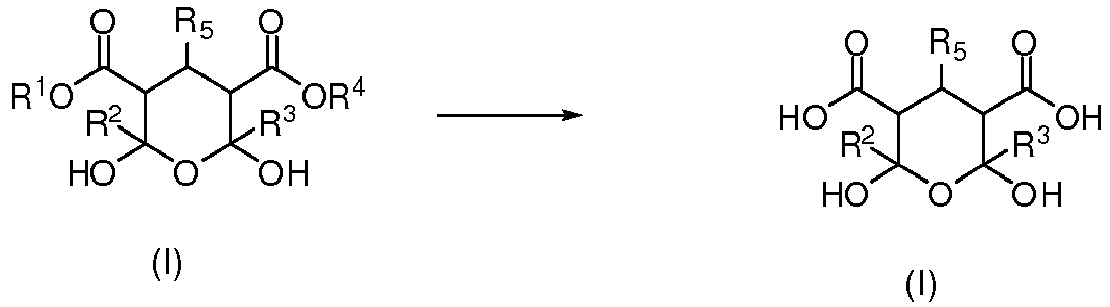


- The halogenating agent is a halogenating agent which is capable of transforming a carboxylic acid group into a carboxylic acid halide group, such as SOCl2 and oxalyl chloride. The thiol HS-R6 is preferably selected from methane thiole or ethane thiole, which is preferably added to the reaction in a salt form, such as methanethiol sodium salt or ethanethiol sodium salt.
- The present invention further concerns compounds of formula (I), wherein Y is S or O, wherein R1 is selected from the group consisting of H, an optionally substituted C1-C12 alkyl group, an optionally substituted C3-C8 cycloalkyl group, an optionally substituted aryl group, wherein R2 is selected from the group consisting of C1-C4-alkyl groups which is substituted by at least one halogen atom independently selected from the group consisting of F, Cl and Br or by a CF3 group, wherein R3 is selected from the group consisting of C1-C4-alkyl groups which is substituted by at least one halogen atom independently selected from the group consisting of F, Cl and Br or by a CF3 group, R4 is selected from the group consisting of H, an optionally substituted C1-C12 alkyl group, an optionally substituted C3-C8 cycloalkyl group, an optionally substituted aryl group, and R5 is selected from the group consisting of H, an optionally substituted C1-C12 alkyl group, an optionally substituted C3-C8 cycloalkyl group, an optionally substituted aryl group, and wherein R2 and R3 are different. Most preferably in compounds of formula (I), R2 is selected from the group consisting of CF3, CBr3 and CCl3 and R3 is selected from the group consisting of CF2H, CBr2H and CCl2H.
- The following non-restrictive list indicates the most preferable compounds of formula (I):
formula R1 R2 R3 R4 R5 Y I Me CF2H CF3 Me CH(CH3)2 S I Me CF3 CF2H Me CH(CH3)2 S I Et CF2H CF3 Et CH(CH3)2 S I Et CF3 CF2H Et CH(CH3)2 S I Me CF2H CF3 Me CH(CH3)2 O I Me CF3 CF2H Me CH(CH3)2 O I Et CF2H CF3 Et CH(CH3)2 O I Et CF3 CF2H Et CH(CH3)2 O - These compounds of formula (I) as described above are useful as starting materials for compounds of formula (V), (VI) and (VII) which are pharmaceutically or agrochemically active ingredients such as dimethyl 2-(difluoromethyl)-4-(2-methylpropyl)-6-(trifluoromethyl)pyridine-3,5-dicarbothioate, or for precursors of such pharmaceutically or agrochemically active ingredients.
- When R5 is H, the invention further concerns a process for the manufacture of a compound of formula (VII) wherein R5 is -CH(CH3)2, which comprise any of the processes according to the present invention, and which further comprises a step wherein a compound of formula (VII) wherein R5 is H is converted into a compound of formula (VII) wherein R5 is -CH(CH3)2 by reaction with isobutylene in the presence of a Friedel Crafts catalyst, such as, for example, CuI, or a solid phase reaction catalysed, for example, by solid phosphoric acid as described in M. Cowley, Ind. Eng. Chem. Res. 2006, 45, 7399-7408.

- The invention concerns further a process for the manufacturing of an agriculturally or pharmaceutically active compound or a composition comprising an agriculturally or pharmaceutically active compound, which comprises at least one of the processes according to the present invention for the manufacture of a compound of formula (I), (V), (VI) or (VII) wherein the agriculturally active compound is preferably dimethyl 2-(difluoromethyl)-4-(2-methylpropyl)-6-(trifluoromethyl)pyridine-3,5-dicarbothioate or a precursor thereof.
- The invention also concerns a compound of formula (III), wherein R3 is selected from the group consisting of CF2H, CBr2H and CCl2H, Y is S and R4 is selected from the group consisting an optionally substituted C1-C12 alkyl group, an optionally substituted C3-C8 cycloalkyl group and an optionally substituted aryl group, wherein R4 preferably is Me or Et.
- Another object of the present invention is the use of a compound according to the present invention in a process for the manufacturing of an agriculturally or pharmaceutically active compound or a composition comprising an agriculturally or pharmaceutically active compound, preferably dimethyl 2-(difluoromethyl)-4-(2-methylpropyl)-6-(trifluoromethyl)pyridine-3,5-dicarbothioate or a precursor thereof.
- Should the disclosure of any patents, patent applications, and publications which are incorporated herein by reference conflict with the description of the present application to the extent that it may render a term unclear, the present description shall take precedence.
- The following examples are intended to further explain the invention without limiting it.
- The starting materials for the processes and steps according to the present invention can be obtained from commercial sources or can be manufactured according to procedures known from the public domain. Butanoic acid, 4,4,4-trifluoro-3-oxo-, ethyl ester (Ethyl 4,4,4-trifluoroacetoacetate) is for example known from
EP206953 IT1401696 US4785129 . Methyl-4,4-difluoro-3-oxo-butanethioate can be prepared according to a similar procedure starting from difluoroacetyl chloride. -

- A 500 ml single necked flask is charged with 0. 278 mole of isovaleraldehyde, 0.278 mole of ethyl 4,4,4-trifluoro-3-oxobutanoate , 0.278 mole of ethyl 4,4-difluoro-3-oxobutanoate and approximately 150 ml of ethanol. To this is added 3 g (0. 0156 mole) of potassium fluoride. The mixture is stirred at room temperature for 18 hours. The material is concentrated and diluted with ethyl ether. The organics are washed with water, dried and concentrated to give crude diethyl 2-(difluoromethyl)-2,6-dihydroxy-4-isobutyl-6-(trifluorome-thyl)-tetrahydro-2H-pyran-3,5-dicarboxylate.
- S,S-dimethyl 2-(difluoromethyl)-2,6-dihydroxy-4-isobutyl-6-(trifluoromethyl)tetrahydro-2H-pyran-3,5-bis(carbothioate) is obtained according to a comparable procedure starting from S-methyl 4,4,4-trifluoro-3-oxobutanethioate, S-methyl 4,4-difluoro-3-oxobutanethioate and butyraldehyde.
-

- A 500 ml round bottomed flask was charged with 150 - 200 mL of ethanol and 0. 0909 mole diethyl 2-(difluoromethyl)-2,6-dihydroxy-4-isobutyl-6-(trifluoromethyl)-tetrahydro-2H-pyran-3,5-dicarboxylate. The mixture is stirred by a magnetic stirrer while 8. 23 g (0. 136 mole) of 58% aqueous ammonium hydroxide is added slowly to the flask. The mixture is stirred for 18 hours under nitrogen. The precipitate is filtered, washed and dried to obtain crude diethyl 2-(difluoromethyl)-2,6-dihydroxy-4-isobutyl-6-(trifluoromethyl)-piperidine-3,5-dicarboxylate.
-

- To an ice water cooled mixture of 20 ml of concentrated sulfuric acid and 20 ml of methylene chloride is added 0.058 mole Diethyl 2-(difluoromethyl)-2,6-dihydroxy-4-isobutyl-6-(trifluoromethyl)-piperidine-3,5-dicarboxylate. The reaction mixture is stirred for 20 minutes and poured into 300 mL of ice water. The methylene chloride layer is separated and washed once with 30 ml of saturated sodium bicarbonate, dried and concentrated to give the crude product as an isomeric mixture, one of which is shown above.
- Diethyl 2-(difluoromethyl)-4-isobutyl-6-(trifluoromethyl)-dihydropyridine-3,5-bis(carbothioate) is obtained according to a comparable procedure.
-

- An isomeric mixture of 0.4 moles of diethyl 2-(difluoromethyl)-4-isobutyl-6-(trifluoromethyl)pyridine-3,5-dicarboxylate, 0.4 moles of 1, 8-diazabicyclo-[5. 4. 0]- undec-5-ene (DBU), and 50 ml of tetrahydrofuran is held at reflux for 19 hours, cooled and poured into a mixture of 300 g of ice and 25 ml of concentrated hydrochloric acid. The organic layer is separated and the aqueous layer extracted with 50 ml of CH2Cl2 twice. The combined organic materials are dried (MgSO4) and concentrated.
- Diethyl 2-(difluoromethyl)-4-isobutyl-6-(trifluoromethyl)pyridine-3,5-dicarboxylate is obtained according to a comparable procedure.
-

- A 500-mL flask is charged with 0.082 mole of diethyl 2-(difluoromethyl)-4-isobutyl-6-(trifluoromethyl)pyridine-3,5-dicarboxylate and 100 ml of methyl alcohol. In another flask, 75 ml of water and 10,76 g (0.163 mole) of potassium hydroxide are combined. The aqueous KOH is poured into the 500-mL flask and the mixture is heated to reflux overnight. The reaction mixture is cooled and extracted once with ethyl ether. The aqueous layer is acidified with concentrated hydrochloric acid and extracted with ethyl ether. The organics are dried on anhydrous magnesium sulphate, filtered, and concentrated to yield the crude 2-(difluoromethyl)-4-isobutyl-6-(trifluoromethyl)pyridine-3,5-dicarboxylic acid.
-

- A mixture of 0.105 mole of the product of 2-(difluoromethyl)-4-isobutyl-6-(trifluoromethyl)pyridine-3,5-dicarboxylic acid and 50 ml of thionyl chloride is held at reflux for 18 hours and concentrated in vacuo to give the crude 2-(difluoromethyl)-4-isobutyl-6-(trifluoromethyl)pyridine-3,5-dicarbonyl dichloride.
-

- A mixture of 1,23 mmole of 2-(difluoromethyl)-4-isobutyl-6-(trifluoromethyl)pyridine-3,5-dicarbonyl dichloride and 2 ml of dichloromethane was added drop wise to a mixture of 106 mg of sodium methyl mercaptan and 1 ml of dichloromethane at 0 degrees centigrade The reaction mixture was stirred for 3.5 hours at 0 degrees centigrade. The mixture was concentrated under reduced pressure, ethyl acetate was added to the obtained residues, and insoluble matter was separated by filtration. The filtrate was concentrated to yield the crude S,S-dimethyl 2-(difluoromethyl)-4-isobutyl-6-(trifluoromethyl)-pyridine-3,5-bis(carbothioate).
Claims (15)
- Process for the manufacture of a compound of formula (I), which comprises a step of reacting a compound of formula (II), (III) and (IV)
 wherein R1 is selected from the group consisting of H, an optionally substituted C1-C12 alkyl group, an optionally substituted C3-C8 cycloalkyl group, an optionally substituted aryl groupwherein R2 is selected from the group consisting of C1-C4-alkyl groups which is substituted by at least one halogen atom independently selected from the group consisting of F, Cl and Br or by a CF3 groupwherein R3 is selected from the group consisting of C1-C4-alkyl groups which is substituted by at least one halogen atom independently selected from the group consisting of F, Cl and Br or by a CF3 groupwherein R4 is selected from the group consisting of H, an optionally substituted C1-C12 alkyl group, an optionally substituted C3-C8 cycloalkyl group, an optionally substituted aryl groupwherein R5 is selected from the group consisting of H, an optionally substituted C1-C12 alkyl group, an optionally substituted C3-C8 cycloalkyl group, an optionally substituted aryl groupwherein Y is S or O,and wherein R2 or R3 are different.
 - Process according to claim 1, wherein R2 and R3 are selected from the group consisting of CF3, CF2H, CCl3, CCl2H, CClF2, CF2Cl, CBr3 and CBr2H.
- Process according to claim 2, wherein R2 is CF3 and R3 is CF2H.
- Process according to anyone of claims 1 to 3, wherein Y is S.
- Process according to anyone of claims 1 to 3, wherein Y is O.
- Process according to anyone of claims 1 to 5, wherein R5 is a straight or branched C1 to C4 alkyl group, which is optionally substituted, wherein R5 preferably is the group -CH2-CH(CH3)2.
- Process according to anyone of claims 1 to 6, wherein R1 and R4 independently are a straight or branched C1 to C4 alkyl group, which is optionally substituted, and wherein R1 and R4 preferably are independently a methyl or an ethyl group.
- Process for the manufacture of a compound of formula (V), which comprises the process according to anyone of claim 1 to 7, and which comprises a step wherein compound (I) is contacted with an ammonia source, and wherein R1, R2, R3, R4, R5 and Y are defined as in anyone of claim 1 to 7

- Process for the manufacture of a compound of formula (VI), which comprises the process according to anyone of claim 1 to 8, and which comprises a step wherein compound (V) is contacted with a dehydration agent, and wherein R1, R2, R3, R4, R5 and Y are defined as in anyone of claim 1 to 8

- Process for the manufacture of a compound of formula (VII), which comprises the process according to claim 9, which comprises a step wherein a compound of formula (VI) is contacted with an oxidizing agent to obtain a compound of formula (VII), and wherein R1, R2, R3, R4, R5 and Y are defined as in anyone of claim 1 to 9

- Process according to anyone of claims 1 to 10, which further comprises a step wherein a compound of formula (I), (V), (VI) or (VII), wherein R2 and R3 are defined as in anyone of claims 1 to 10, wherein Y is O and R4 and R1 is selected from the group consisting an optionally substituted C1-C12 alkyl group, an optionally substituted C3-C8 cycloalkyl group and an optionally substituted aryl group, wherein R1 and R4 preferably are an optionally substituted C1 to C4 alkyl group, is converted into a compound wherein Y is S and R4 and R1 is selected from the group consisting an optionally substituted C1-C12 alkyl group, an optionally substituted C3-C8 cycloalkyl group and an optionally substituted aryl group, wherein R1 and R4 preferably are an optionally substituted C1 to C4 alkyl group, wherein the process comprises the step of saponifying a compound of formula (I), (V), (VI) or (VII), wherein Y is O and R1 is selected from the group consisting an optionally substituted C1-C12 alkyl group, an optionally substituted C3-C8 cycloalkyl group and an optionally substituted aryl group, wherein R1 and R4 preferably are an optionally substituted C1 to C4 alkyl group, to obtain a compound wherein Y is O and R1 is H, contacting the obtained compound with a halogenating agent such that the group -OH is replaced with the group -X, wherein -X is F, Cl or Br, and contacting the obtained compound with at least one thiol HS-R6, wherein R6 is R1 and R4, to obtain a compound of formula (I), (V), (VI) or (VII), wherein Y is S and R4 and R1 is selected from the group consisting an optionally substituted C1-C12 alkyl group, an optionally substituted C3-C8 cycloalkyl group and an optionally substituted aryl group, wherein R1 and R4 preferably are an optionally substituted C1 to C4 alkyl group.
- Compound of formula (I), wherein Y is S or O,
wherein R1 is selected from the group consisting of H, an optionally substituted C1-C12 alkyl group, an optionally substituted C3-C8 cycloalkyl group, an optionally substituted aryl group, wherein R2 is selected from the group consisting of C1-C4-alkyl groups which is substituted by at least one halogen atom independently selected from the group consisting of F, Cl and Br or by a CF3 group, wherein R3 is selected from the group consisting of C1-C4-alkyl groups which is substituted by at least one halogen atom independently selected from the group consisting of F, Cl and Br or by a CF3 group, R4 is selected from the group consisting of H, an optionally substituted C1-C12 alkyl group, an optionally substituted C3-C8 cycloalkyl group, an optionally substituted aryl group, and R5 is selected from the group consisting of H, an optionally substituted C1-C12 alkyl group, an optionally substituted C3-C8 cycloalkyl group, an optionally substituted aryl group, and wherein R2 and R3 are different. - Process for the manufacturing of an agriculturally or pharmaceutically active compound or a composition comprising an agriculturally or pharmaceutically active compound, which comprises at least one of the process according to anyone of claims 1 to 11.
- Compound of formula (III), wherein R3 is selected from the group consisting of CF2H, CBr2H and CCl2H, Y is S and R4 is selected from the group consisting an optionally substituted C1-C12 alkyl group, an optionally substituted C3-C8 cycloalkyl group and an optionally substituted aryl group, wherein R4 preferably is Me or Et.
- Use of a compound according to claim 12 or 13 in a process for the manufacturing of an agriculturally or pharmaceutically active compound or a composition comprising an agriculturally or pharmaceutically active compound, preferably dimethyl 2-(difluoromethyl)-4-(2-methylpropyl)-6-(trifluoromethyl)pyridine-3,5-dicarbothioate or a precursor thereof.
Priority Applications (1)
| Application Number | Priority Date | Filing Date | Title |
|---|---|---|---|
| EP17174580.5A EP3412655A1 (en) | 2017-06-06 | 2017-06-06 | Processes for the manufacture of haloalkyl pyrimidyl compounds, and compounds useful in their manufacture |
Applications Claiming Priority (1)
| Application Number | Priority Date | Filing Date | Title |
|---|---|---|---|
| EP17174580.5A EP3412655A1 (en) | 2017-06-06 | 2017-06-06 | Processes for the manufacture of haloalkyl pyrimidyl compounds, and compounds useful in their manufacture |
Publications (1)
| Publication Number | Publication Date |
|---|---|
| EP3412655A1 true EP3412655A1 (en) | 2018-12-12 |
Family
ID=59014524
Family Applications (1)
| Application Number | Title | Priority Date | Filing Date |
|---|---|---|---|
| EP17174580.5A Withdrawn EP3412655A1 (en) | 2017-06-06 | 2017-06-06 | Processes for the manufacture of haloalkyl pyrimidyl compounds, and compounds useful in their manufacture |
Country Status (1)
| Country | Link |
|---|---|
| EP (1) | EP3412655A1 (en) |
Citations (5)
| Publication number | Priority date | Publication date | Assignee | Title |
|---|---|---|---|---|
| EP0133612A2 (en) | 1983-08-11 | 1985-02-27 | Monsanto Company | Substituted 2,6-substituted pyridine compounds |
| EP0206953A1 (en) | 1985-06-14 | 1986-12-30 | Rhone-Poulenc Chimie | Process for the preparation of ethyl trifluoroacetoacetate |
| US4785129A (en) | 1988-02-16 | 1988-11-15 | Monsanto Company | Methyl 4,4,4-trifluoro-3-oxo-butanethioate |
| EP0448543A2 (en) * | 1990-03-19 | 1991-09-25 | Rohm And Haas Company | Process for preparation of fluoromethyl-substituted pyridine carbodithioates |
| IT1401696B1 (en) | 2010-09-10 | 2013-08-02 | Miteni Spa | PROCEDURE FOR THE PREPARATION OF ESTERS OF 4,4-DIFLUORO ACETHYLACETIC ACID |
-
2017
- 2017-06-06 EP EP17174580.5A patent/EP3412655A1/en not_active Withdrawn
Patent Citations (5)
| Publication number | Priority date | Publication date | Assignee | Title |
|---|---|---|---|---|
| EP0133612A2 (en) | 1983-08-11 | 1985-02-27 | Monsanto Company | Substituted 2,6-substituted pyridine compounds |
| EP0206953A1 (en) | 1985-06-14 | 1986-12-30 | Rhone-Poulenc Chimie | Process for the preparation of ethyl trifluoroacetoacetate |
| US4785129A (en) | 1988-02-16 | 1988-11-15 | Monsanto Company | Methyl 4,4,4-trifluoro-3-oxo-butanethioate |
| EP0448543A2 (en) * | 1990-03-19 | 1991-09-25 | Rohm And Haas Company | Process for preparation of fluoromethyl-substituted pyridine carbodithioates |
| IT1401696B1 (en) | 2010-09-10 | 2013-08-02 | Miteni Spa | PROCEDURE FOR THE PREPARATION OF ESTERS OF 4,4-DIFLUORO ACETHYLACETIC ACID |
Non-Patent Citations (1)
| Title |
|---|
| M. COWLEY, IND. ENG. CHEM. RES., vol. 45, 2006, pages 7399 - 7408 |
Similar Documents
| Publication | Publication Date | Title |
|---|---|---|
| JP5889299B2 (en) | Process for the preparation of esters of 1-substituted-3-fluoroalkyl-pyrazole-4-carboxylic acids | |
| IL175024A (en) | 2-dihaloacyl-3-amino-acrylic acid esters, a process for their preparation, their use for producing 3-dihalomethyl-1h-pyrazole-4-carboxylic acid esters and 3-dichloromethylpyrazole-4-carboxylic acid esters | |
| JP2004530636A (en) | Novel intermediates for retinoid synthesis | |
| DK142765B (en) | Process for the preparation of optically active esters of chrysanthemic acid. | |
| CH627432A5 (en) | Process for the preparation of vinylcyclopropanecarboxylates | |
| JP2022184396A (en) | Method for producing 1-alkyl-5-hydroxypyrazole | |
| EP3412654A1 (en) | Processes for the manufacture of haloalkyl pyrimidyl compounds, and compounds useful in their manufacture | |
| CN1984865A (en) | Process for the preparation of 4,4-difluoro-3-oxobutanoic acid esters | |
| TW201731807A (en) | Method for preparing substituted 2-arylethanol | |
| CN118561738A (en) | A kind of synthetic method of 3-indole ketone | |
| US4322374A (en) | 2,4,4,4-Tetrahalobutanoic acid halide | |
| NO781112L (en) | PROCEDURES FOR THE PREPARATION OF 2- (2`, 2`, 2`-TRIHALOGENETHYL) -4-HALOGENCYCLOBUTAN-1-ONERS | |
| JPH0759562B2 (en) | Process for producing 1,3-dialkylpyrazole-5-carboxylic acid esters | |
| US20040171863A1 (en) | Process for poducing beta-oxonitrile compound or alkali metal salt thereof | |
| CN101410386B (en) | 2-alkenyl-3-aminothiophene derivative and its preparation method | |
| JPH0361664B2 (en) | ||
| KR20210093922A (en) | Direct alpha-methyleneation process of ketones | |
| EP2671874B1 (en) | Preparation of esters of 1-substituted-3-fluoroalkyl-pyrazole-4-carboxylic acids | |
| US4255351A (en) | Sulfonic acid esters of 2,2,2-trichloroethylhydroxycyclobutanones | |
| HU182691B (en) | Process for preparing 3-/2,2-dichloro-vinyl/-2,2-dimethyl-cyclopropane-carboxylic acid and esters thereof | |
| WO2008009674A1 (en) | Process for the synthesis of olefinically unsaturated carboxylic acid esters | |
| KR100449310B1 (en) | preparation method of 2-deoxy-L-ribose | |
| MXPA02002146A (en) | Production of dibenzosuberenone derivatives by catalytic dehydrogenation. | |
| JP2013043831A (en) | TERTIARY α-TRIFLUOROMETHYL KETONE DERIVATIVE, AND METHOD FOR PRODUCING THE SAME | |
| HU183165B (en) | Process for producing dihalogeno-vinyl compounds |
Legal Events
| Date | Code | Title | Description |
|---|---|---|---|
| PUAI | Public reference made under article 153(3) epc to a published international application that has entered the european phase |
Free format text: ORIGINAL CODE: 0009012 |
|
| AK | Designated contracting states |
Kind code of ref document: A1 Designated state(s): AL AT BE BG CH CY CZ DE DK EE ES FI FR GB GR HR HU IE IS IT LI LT LU LV MC MK MT NL NO PL PT RO RS SE SI SK SM TR |
|
| AX | Request for extension of the european patent |
Extension state: BA ME |
|
| STAA | Information on the status of an ep patent application or granted ep patent |
Free format text: STATUS: THE APPLICATION HAS BEEN WITHDRAWN |
|
| 18W | Application withdrawn |
Effective date: 20181214 |