EP3411420B1 - Method for the reduction of aldehyde emission in polyurethane foam - Google Patents
Method for the reduction of aldehyde emission in polyurethane foam Download PDFInfo
- Publication number
- EP3411420B1 EP3411420B1 EP17704201.7A EP17704201A EP3411420B1 EP 3411420 B1 EP3411420 B1 EP 3411420B1 EP 17704201 A EP17704201 A EP 17704201A EP 3411420 B1 EP3411420 B1 EP 3411420B1
- Authority
- EP
- European Patent Office
- Prior art keywords
- group
- reaction mixture
- isocyanate
- acid
- foam
- Prior art date
- Legal status (The legal status is an assumption and is not a legal conclusion. Google has not performed a legal analysis and makes no representation as to the accuracy of the status listed.)
- Active
Links
- 0 **(*)c1cc(*=[O+])cc(C([*+])(*)*)c1O Chemical compound **(*)c1cc(*=[O+])cc(C([*+])(*)*)c1O 0.000 description 1
Classifications
-
- C—CHEMISTRY; METALLURGY
- C08—ORGANIC MACROMOLECULAR COMPOUNDS; THEIR PREPARATION OR CHEMICAL WORKING-UP; COMPOSITIONS BASED THEREON
- C08K—Use of inorganic or non-macromolecular organic substances as compounding ingredients
- C08K5/00—Use of organic ingredients
- C08K5/16—Nitrogen-containing compounds
- C08K5/315—Compounds containing carbon-to-nitrogen triple bonds
-
- C—CHEMISTRY; METALLURGY
- C08—ORGANIC MACROMOLECULAR COMPOUNDS; THEIR PREPARATION OR CHEMICAL WORKING-UP; COMPOSITIONS BASED THEREON
- C08G—MACROMOLECULAR COMPOUNDS OBTAINED OTHERWISE THAN BY REACTIONS ONLY INVOLVING UNSATURATED CARBON-TO-CARBON BONDS
- C08G18/00—Polymeric products of isocyanates or isothiocyanates
- C08G18/06—Polymeric products of isocyanates or isothiocyanates with compounds having active hydrogen
- C08G18/28—Polymeric products of isocyanates or isothiocyanates with compounds having active hydrogen characterised by the compounds used containing active hydrogen
- C08G18/40—High-molecular-weight compounds
- C08G18/48—Polyethers
- C08G18/4833—Polyethers containing oxyethylene units
- C08G18/4837—Polyethers containing oxyethylene units and other oxyalkylene units
- C08G18/4841—Polyethers containing oxyethylene units and other oxyalkylene units containing oxyethylene end groups
-
- C—CHEMISTRY; METALLURGY
- C08—ORGANIC MACROMOLECULAR COMPOUNDS; THEIR PREPARATION OR CHEMICAL WORKING-UP; COMPOSITIONS BASED THEREON
- C08G—MACROMOLECULAR COMPOUNDS OBTAINED OTHERWISE THAN BY REACTIONS ONLY INVOLVING UNSATURATED CARBON-TO-CARBON BONDS
- C08G18/00—Polymeric products of isocyanates or isothiocyanates
- C08G18/06—Polymeric products of isocyanates or isothiocyanates with compounds having active hydrogen
- C08G18/28—Polymeric products of isocyanates or isothiocyanates with compounds having active hydrogen characterised by the compounds used containing active hydrogen
- C08G18/30—Low-molecular-weight compounds
- C08G18/32—Polyhydroxy compounds; Polyamines; Hydroxyamines
- C08G18/3271—Hydroxyamines
- C08G18/3275—Hydroxyamines containing two hydroxy groups
-
- C—CHEMISTRY; METALLURGY
- C08—ORGANIC MACROMOLECULAR COMPOUNDS; THEIR PREPARATION OR CHEMICAL WORKING-UP; COMPOSITIONS BASED THEREON
- C08G—MACROMOLECULAR COMPOUNDS OBTAINED OTHERWISE THAN BY REACTIONS ONLY INVOLVING UNSATURATED CARBON-TO-CARBON BONDS
- C08G18/00—Polymeric products of isocyanates or isothiocyanates
- C08G18/06—Polymeric products of isocyanates or isothiocyanates with compounds having active hydrogen
- C08G18/08—Processes
- C08G18/16—Catalysts
- C08G18/18—Catalysts containing secondary or tertiary amines or salts thereof
- C08G18/1825—Catalysts containing secondary or tertiary amines or salts thereof having hydroxy or primary amino groups
-
- C—CHEMISTRY; METALLURGY
- C08—ORGANIC MACROMOLECULAR COMPOUNDS; THEIR PREPARATION OR CHEMICAL WORKING-UP; COMPOSITIONS BASED THEREON
- C08G—MACROMOLECULAR COMPOUNDS OBTAINED OTHERWISE THAN BY REACTIONS ONLY INVOLVING UNSATURATED CARBON-TO-CARBON BONDS
- C08G18/00—Polymeric products of isocyanates or isothiocyanates
- C08G18/06—Polymeric products of isocyanates or isothiocyanates with compounds having active hydrogen
- C08G18/28—Polymeric products of isocyanates or isothiocyanates with compounds having active hydrogen characterised by the compounds used containing active hydrogen
- C08G18/40—High-molecular-weight compounds
- C08G18/48—Polyethers
- C08G18/4804—Two or more polyethers of different physical or chemical nature
- C08G18/4816—Two or more polyethers of different physical or chemical nature mixtures of two or more polyetherpolyols having at least three hydroxy groups
-
- C—CHEMISTRY; METALLURGY
- C08—ORGANIC MACROMOLECULAR COMPOUNDS; THEIR PREPARATION OR CHEMICAL WORKING-UP; COMPOSITIONS BASED THEREON
- C08G—MACROMOLECULAR COMPOUNDS OBTAINED OTHERWISE THAN BY REACTIONS ONLY INVOLVING UNSATURATED CARBON-TO-CARBON BONDS
- C08G18/00—Polymeric products of isocyanates or isothiocyanates
- C08G18/06—Polymeric products of isocyanates or isothiocyanates with compounds having active hydrogen
- C08G18/28—Polymeric products of isocyanates or isothiocyanates with compounds having active hydrogen characterised by the compounds used containing active hydrogen
- C08G18/65—Low-molecular-weight compounds having active hydrogen with high-molecular-weight compounds having active hydrogen
- C08G18/66—Compounds of groups C08G18/42, C08G18/48, or C08G18/52
- C08G18/6666—Compounds of group C08G18/48 or C08G18/52
- C08G18/667—Compounds of group C08G18/48 or C08G18/52 with compounds of group C08G18/32 or polyamines of C08G18/38
- C08G18/6681—Compounds of group C08G18/48 or C08G18/52 with compounds of group C08G18/32 or polyamines of C08G18/38 with compounds of group C08G18/32 or C08G18/3271 and/or polyamines of C08G18/38
-
- C—CHEMISTRY; METALLURGY
- C08—ORGANIC MACROMOLECULAR COMPOUNDS; THEIR PREPARATION OR CHEMICAL WORKING-UP; COMPOSITIONS BASED THEREON
- C08G—MACROMOLECULAR COMPOUNDS OBTAINED OTHERWISE THAN BY REACTIONS ONLY INVOLVING UNSATURATED CARBON-TO-CARBON BONDS
- C08G18/00—Polymeric products of isocyanates or isothiocyanates
- C08G18/06—Polymeric products of isocyanates or isothiocyanates with compounds having active hydrogen
- C08G18/70—Polymeric products of isocyanates or isothiocyanates with compounds having active hydrogen characterised by the isocyanates or isothiocyanates used
- C08G18/72—Polyisocyanates or polyisothiocyanates
- C08G18/74—Polyisocyanates or polyisothiocyanates cyclic
- C08G18/76—Polyisocyanates or polyisothiocyanates cyclic aromatic
- C08G18/7657—Polyisocyanates or polyisothiocyanates cyclic aromatic containing two or more aromatic rings
- C08G18/7664—Polyisocyanates or polyisothiocyanates cyclic aromatic containing two or more aromatic rings containing alkylene polyphenyl groups
- C08G18/7671—Polyisocyanates or polyisothiocyanates cyclic aromatic containing two or more aromatic rings containing alkylene polyphenyl groups containing only one alkylene bisphenyl group
-
- C—CHEMISTRY; METALLURGY
- C08—ORGANIC MACROMOLECULAR COMPOUNDS; THEIR PREPARATION OR CHEMICAL WORKING-UP; COMPOSITIONS BASED THEREON
- C08G—MACROMOLECULAR COMPOUNDS OBTAINED OTHERWISE THAN BY REACTIONS ONLY INVOLVING UNSATURATED CARBON-TO-CARBON BONDS
- C08G2110/00—Foam properties
- C08G2110/0008—Foam properties flexible
Definitions
- the present invention is related to a method for reducing the emission of acetaldehyde or reducing the emission of formaldehyde and acetaldehyde from a polyurethane or polyurea foam.
- Polyurethane and polyurea materials are well known in the art.
- Polyurethane and polyurea foams in particular so-called flexible polyurethane and polyurea foams, are used in a multitude of applications.
- DE10003157A1 discloses polymeric polyethylene imines being dissolved in a solvent, after which the solution is sucked into the foam structure. After drying or evaporation of the solvent, the polymeric molecules remain in the foam structure and act as aldehyde scavengers.
- WO2009/117479 discloses a method comprising adding a primary amine containing compound to a tertiary amine catalyst and thereby reducing the quantity of formaldehyde in said tertiary amine catalyst by at least 50%.
- the aim of WO2009/117479 is to reduce the aldehyde formation within the catalyst and from that using the CERTIPUR standard test method to quantify the formaldehyde in foams.
- TVOC Total VOC
- One aspect of the invention is a method for reducing the emission of acetaldehyde from a polyurethane or polyurea foam, by using a reaction mixture comprising:
- cyanoacetamide is able to decrease the acetaldehyde emission and/or priopionaldehyde in polyurethane or polyurea foam.
- the decrease of the acetaldehyde emission due to the addition of cyanoacetamide is surprisingly, because it has been found that many compounds that are able to decrease formaldehyde emission in polyurethane are not able to decrease, but rather increase the emission of the acetaldehyde. This is e.g. shown in table 1 of WO2014/026802 where the addition of certain ethylene amines such as TEPA provided an increase of acetaldehyde, while the formaldehyde emission was sufficiently decreased.
- cyanoacetamide may provide a foam wherein the TVOC emissions are low, which emissions are measured according to the VDA 278 test.
- a second aspect of the invention is related to a method for reducing the emission of formaldehyde and acetaldehyde from a polyurethane or polyurea foam, by using a reaction mixture comprising:
- the emission of acetaldehyde in polyurethane is reduced with at least 25%, preferably with at least 40% compared with the emission in polyurethane or polyurea foam if no cyanoacetamide is added to the reaction mixture used for making the polyurethane or polyurea foam.
- the emission of acetaldehyde in polyurethane is reduced with at least 25%, preferably with at least 40% compared with the emission in polyurethane or polyurea foam if no cyanoacetamide is added to the reaction mixture used for making the polyurethane or polyurea foam and the formaldehyde emission is reduced with at least 50%, preferably at least 75% compared with the emission in polyurethane or polyurea foam if no cyanoacetamide is added to the reaction mixture used for making the polyurethane or polyurea foam.
- the emission of propionaldehyde in polyurethane is reduced with at least 10%, preferably with at least 30% compared with the emission in polyurethane or polyurea foam if no cyanoacetamide is added to the reaction mixture used for making the polyurethane or polyurea foam.
- cyanoacetamide is able to reduce the propionaldehyde. Without being bound to a theory, it is believed that the reactivity of formaldehyde with aldehyde scavengers is different than acetaldehyde and propionaldehyde. It seems that the reactivity of acetaldehyde and priopionaldehyde with cyanoacetamide is similar. It is likely that also the emission of higher aldehydes, such as butyraldehyde, can be reduced.
- the acetaldehyde and propionaldehyde have a particular smell
- the reduction of the emission of these compounds has as additional effect that the smell of places where polyurethane or polyurethane foams are used, such as cars and/or matrasses, is much less.
- the two aspects of the invention are thus also related to the reduction of smell of the polyurethane or polyurethane foam.
- the polyisocyanate reactive component is selected from the group consisting of a polyether polyol, a polyester polyol, a polyether polyamine, polycarbonate polyol and a polyester polyamine.
- polyether polyols are polyethylene glycol, polypropylene glycol, polypropylene glycol-ethylene glycol copolymer, polytetramethylene glycol, polyhexamethylene glycol, polyheptamethylene glycol, polydecamethylene glycol, and polyether polyols obtained by ring-opening copolymerisation of alkylene oxides, such as ethylene oxide and/or propylene oxide, with isocyanate-reactive initiators of functionality 2 to 8.
- alkylene oxides such as ethylene oxide and/or propylene oxide
- the polyether polyols are based on propylene oxide, optionally in combination with up to 20 wt% (based on total alkylene oxides) of ethylene oxide.
- Polyester diols obtained by reacting a polyhydric alcohol and a polybasic acid are given as examples of the polyester polyols.
- the polyhydric alcohol ethylene glycol, polyethylene glycol, tetramethylene glycol, polytetramethylene glycol, 1,6-hexanediol, 3-methyl-1,5-pentanediol, 1,9-nonanediol, 2-methyl-1,8-octanediol, and the like can be given.
- the polybasic acid phthalic acid, dimer acid, isophthalic acid, terephthalic acid, maleic acid, fumaric acid, adipic acid, sebacic acid, and the like can be given.
- isocyanate reactive component or “polyisocyanate reactive component” as used herein includes any component with a “isocyanate reactive group(s)” or “isocyanate reactive moiety or moieties”.
- isocyanate reactive group as use herein includes any group or moiety containing an active hydrogen group or moiety.
- an active hydrogen containing group refers to a group containing a hydrogen atom which, because of its position in the molecule, displays significant activity according to the Zerewitnoff test described by Wohler in the Journal of the American Chemical Society, Vol. 49, page 3181 (1927 ).
- active hydrogen groups are -COOH, -OH, -NH2, and -NH.
- the isocyanate component is preferably a polyisocyanate and may comprise any number of polyisocyanates, including but not limited to, toluene diisocyanates (TDI), diphenylmethane diisocyanate (MDI) - type isocyanates, and prepolymers of these isocyanates.
- TDI toluene diisocyanates
- MDI diphenylmethane diisocyanate
- prepolymers of these isocyanates prepolymers of these isocyanates.
- the diphenylmethane diisocyanate (MDI) used in the present invention can be in the form of its 2,4', 2,2' and 4,4' isomers and mixtures thereof, the mixtures of diphenylmethane diisocyanates (MDI) and oligomers thereof known in the art as "crude” or polymeric MDI (polymethylene polyphenylene polyisocyanates) having an isocyanate functionality of greater than 2, or any of their derivatives having a urethane, isocyanurate, allophonate, biuret, uretonimine, uretdione and/or iminooxadiazinedione groups and mixtures of the same.
- polyisocyanates examples include tolylene diisocyanate (TDI), hexamethylene diisocyanate (HDI), isophorone diisocyanate (IPDI), butylene diisocyanate, trimethylhexamethylene diisocyanate, dicyclohexylmethane diisocyanate (H12MDI), di(isocyanatocyclohexyl)methane, isocyanatomethyl-1,8-octane diisocyanate and tetramethylxylene diisocyanate (TMXDI).
- TDI tolylene diisocyanate
- HDI hexamethylene diisocyanate
- IPDI isophorone diisocyanate
- H12MDI dicyclohexylmethane diisocyanate
- TMXDI tetramethylxylene diisocyanate
- Semi-prepolymers and prepolymers which may be obtained by reacting polyisocyanates with compounds containing isocyanate-reactive hydrogen atoms are also isocyanate components.
- compounds containing isocyanate-reactive hydrogen atoms include alcohols, glycols or even relatively high molecular weight polyether polyols and polyester polyols, mercaptans, carboxylic acids, amines, urea and amides.
- suitable prepolymers are reaction products of polyisocyanates with monohydric or polyhydric alcohols.
- the prepolymers are prepared by conventional methods, e.g. by reacting polyhydroxyl compounds which have a molecular weight of from 400 to 5000, in particular mono- or polyhydroxyl polyethers, optionally mixed with polyhydric alcohols which have a molecular weight below 400, with excess quantities of polyisocyanates, for example aliphatic, cycloaliphatic, araliphatic, aromatic or heterocyclic polyisocyanates.
- the method according to the invention is used to provide polyurethane or polyurea (PU) foams such as flexible PU foam, semirigid PU foam, rigid PU foam, viscoelastic PU foam, integral skin PU foam, hydroponic PU foam and alike.
- PU foam applications such as mattresses, bedding foam and automotive PU foam, in particular conventional flex foam, HR flex foam, visco elastic flex foam, but also semi rigid and rigid foam.
- the amount of cyanoacetamide is from 0.01 pbw to 2 pbw, preferably from 0.05 pbw to 1.0 pbw, even more preferably between 0.05 pbw and 0.5 pbw calculated on the total weight of the reaction mixture.
- the amount can vary depending on the type of polyurethane that is made and the isocyanate component and the isocyanate reactive component that is used.
- the amount of cyanoacetamide is an effective amount that is able to reduce the emission of acetaldehyde or acetaldehyde and formaldehyde.
- reaction mixture further comprises at least a catalyst selected from blowing and/or gelling catalysts, and optionally fire retardants, antioxidants, surfactants, physical or chemical blowing agents, fillers, pigments, or any other typical additives used in polyurethane materials.
- a catalyst selected from blowing and/or gelling catalysts, and optionally fire retardants, antioxidants, surfactants, physical or chemical blowing agents, fillers, pigments, or any other typical additives used in polyurethane materials.
- the cyanoacetamide is provided to the reaction mixture as part of the isocyanate reactive component. In this case the cyanoacetamide is first mixed with the isocyanate reactive component before the isocyanate compound is added. In yet another embodiment, the cyanoacetamide is provided to the reaction mixture as part of the isocyanate compound. In this case, the cyanoacetamide is first mixed with the isocyanate compound and is added to that isocyanate reactive compound. It has been found that for both embodiments it is possible to reduce the emission of the formaldehyde and acetaldehyde in the formed polyurethane or polyurea foam.
- the reaction mixture further comprises a formaldehyde reducing agent which comprises one or more amine components having a structure according to one of the formulae each of Ra and Rb independently being a random sequence of units R1, R2 and/or R3, for which
- the amine component can have a sequence of R1, R2 and/ or R3 wherein each of the formulas R1, R2 and/or R3 appears several times in the amine component, and wherein the amine component may comprise at least one of the formula R1, R2 or R3 or a combination of R1, R2, and/or R3.
- the sequence of units of R1, R2 or R3 in the amine component is preferably between 1-10 times, more preferably between 1-5 times.
- the amine component comprises a sequence of units of R1, R2 or R3.
- the amine component comprises a sequence of units of R1 and R2, R1 and R3 or R2 and R3.
- the average number of nitrogen atoms of said one or more amine components is in the range of 5 to 10.
- the average number of nitrogen atoms of said one or more amine components may be in the range 5 to 8.
- a typical average is between 6.5 and 7.5, e.g. about 7.
- One or more amine components may comprise at least two, and preferably more than two amines according to said formulae. This may add up to 10 or more different amines, all having a structure according to one of said formulae. These at least two, and preferably more than two amines may be referred to as amine mixture.
- the reaction mixture further comprises a treating agent selected from the group consisting of a cyclic urea substituted with at least one isocyanate reactive group, a free radical scavenger, a polymer acid, wherein the polymer acid contains at least three of the same repeating monomers, of either an unsaturated carboxylic acid or an anhydride; or wherein the polymer acid contains at least two repeating monomers, wherein the first monomer is an unsaturated carboxylic acid or an anhydride, and the second monomer is different from the first monomer or a mixture thereof.
- a treating agent selected from the group consisting of a cyclic urea substituted with at least one isocyanate reactive group, a free radical scavenger, a polymer acid, wherein the polymer acid contains at least three of the same repeating monomers, of either an unsaturated carboxylic acid or an anhydride; or wherein the polymer acid contains at least two repeating monomers, wherein the first monomer is an unsaturated carb
- the one or more amine components with formulae as set out above and cyanoacetamide, preferably together with a treating agent for making PU foam by reacting an isocyanate reactive composition, with a polyisocyanate component, these compounds act as a scavenger for formaldehyde and acetaldehyde and/or propionaldehyde.
- the one or more amine components with formulae as set out above itself can easily be included in the chemical structure of the polyurethane, as the primary and secondary amines are significantly reactive to the isocyanate groups of the polyisocyanate.
- the one or more amine components with formulae set out above are bond in the foam, while they influence little or even not the chemical and physical properties of the foam, seen its low molecular weight and the little amount that might be used.
- the one or more amine components with formulae as set out above have at least one primary amine group and at least one secondary amine group. More preferable the one or more amine components has at least one component which has at least two primary amine groups and at least one secondary amine group
- the one or more amine components with formulae as set out above have at least two secondary amine groups.
- the amount of the one or more amine components in the composition is between 0.01 %w to 2.5 %w calculated on the total weight of the composition. More preferably, the amount of the one or more amine components all together may provide 0.05 %w to 1 %w, 0.1 to 1 %w or even 0.2 to 0.7 %w of said composition according to the invention.
- all R4-, R5-, R6- and R7-groups in the amine component may be hydrogen.
- a composition which composition comprises
- the amount of the one or more amine components in the composition is between 0.05 wt% to 1.0 wt% calculated on the total weight of the composition.
- the one or more amine components may be a mixture comprising triethylene tetramines (TETA) and/or tetraethylene pentamines (TEPA) and/or pentaethylene hexamines (PEHA) and/or hexaethylene heptamines (HEHA) and/or heptaethylene octamines (HEOA) and/or octaethylene nonamines (OENO) and/or higher polyethylene amines.
- This mixture typically further comprises amine components with in total 9 to 18 nitrogen atoms in its structure.
- the mixture may be obtained by reacting ethylene dichloride (EDC) with ammonia at elevated pressure and temperatures.
- EDC ethylene dichloride
- TETA, TEPA, PEHA, HEHA, HEOA, and OENA each comprise a mixture of ethylene amines with close boiling points.
- TEPA comprises besides N-(2-aminoethyl)-N'- ⁇ 2- ⁇ (2-aminoethyl)amino ⁇ ethyl ⁇ -1,2-ethanediamine), also AETETA (4-(2-aminoethyl)-N-(2-aminoethyl)-N'- ⁇ 2- ⁇ (2-aminoethyl)amino ⁇ ethyl ⁇ -1,2-ethanediamine), APEEDA (1-(2-aminoethyl)-4-[(2-aminoethyl)amino]ethyl]-piperazine) and PEDETA (1-[2-[[2-[(2-aminoethyl)amino]ethyl]-amino] ethyl]-piperazine).
- TETA may comprise a mixture of TETA (N,N'-bis(2-aminoethyl)-1,2-ethanediamine), Bis AEP (N,N'-bis-(2-aminoethyl)piperazine), PEEDA (N-[(2-aminoethyl)2-aminoethyl]piperazine) Branched TETA (tris-(2-aminoethyl)amine).
- the one or more amine components may be triethylene tetramines (TETA) and/or tetraethylene pentamines (TEPA).
- TETA triethylene tetramines
- TEPA tetraethylene pentamines
- the one amine components may provide 0.1 to 1 %w or even 0.2 to 0.7 %w of said composition according to the invention.
- this embodiment may further comprise amine components with in total 9 to 18 nitrogen atoms in its structure.
- composition according to the invention has the further advantage that it is provided as a liquid under ambient conditions, facilitating the addition of this composition into a reactive mixture suitable to provide polyurethane or polyurea foam.
- the cyclic urea contains at least one isocyanate reactive group and has the formula (I) or (II):
- the cyclic urea containing at least one isocyanate reactive group added to the reaction mixture is selected from the group consisting of 4,5-dihydroxy-2-imidazolidinone, 4,5-dimethoxy-2-imidazolidinone, 4-hydroxyethyl ethylene urea, 4-hydroxy-5-methyl propylene urea, 4-methoxy-5-methyl propylene urea, 4-hydroxy-5,5-dimethyl propylene urea, 1-(2-hydroxyethyl)-2-imidazolidinone or a mixture thereof.
- the free radical scavenger comprises a sterically hindered phenol having the formula (III): wherein R 7' , R 8' and R 9' are independently selected from H or a C 1 -C 10 alkyl group, preferably wherein R 7' , R 8' and R 9' are independently selected from H or a CH 3 group and R 10' is H or a C 1 -C 12 alkyl group, preferably R 10' is H or a C 1 -C 4 alkyl group.
- the free radical scavenger is a phosphite.
- the one or more amine components that is added to the reaction mixture is triethyltetramines (TETA), tetraethyl pentamines (TEPA), pentaethylhexamines (PEHA), hexaethylheptamines (HEHA), heptaethyloctamines (HEOA) and/or octaethylenenonamines (OENO), or a mixture thereof.
- TETA triethyltetramines
- TEPA tetraethyl pentamines
- PEHA pentaethylhexamines
- HEHA hexaethylheptamines
- HEOA heptaethyloctamines
- OENO octaethylenenonamines
- composition according to the invention may further comprise a treating agent.
- the treating agent can be a cyclic urea substituted with at least one isocyanate reactive group.
- the treating agent can also be a free radical scavenger.
- the treating agent can also be a polymer acid.
- the treating agent can be a mixture of a cyclic urea substituted with at least one isocyanate reactive group and a free radical scavenger.
- the treating agent can be the polymer acid alone, or a mixture of the polymer acid and the free radical scavenger or the cyclic urea, or a mixture of the polymer acid, the free radical scavenger and the cyclic urea.
- the treating agent is a cyclic urea substituted with at least one isocyanate reactive group.
- the cyclic urea may be a cycloaliphatic or bicycloaliphatic compound having an element of the structure -NH-CO-NH- within a ring structure.
- the cyclic urea has a total number of ring atoms ranging from 5 to 7.
- Such cyclic urea is substituted with at least one isocyanate reactive group on either the -N or -C atoms or both.
- the cyclic urea substituted with at least one isocyanate reactive group has the formula (I):
- the treating agent is a cyclic urea substituted with at least isocyanate reactive group having the formula (II):
- Examples of such compounds of formula (II) include, but are not limited to, tetrahydro-5-(2-hydroxyethyl)-1,3,5-triazin-2-one, tetrahydro-5-(ethyl)-1,3,5-triazin-2-one, tetrahydro-5-(propyl)-1,3,5-triazin-2-one, tetrahydro-5-(butyl)-1,3,5-triazin-2-one or mixtures thereof.
- the treating agent is a free radical scavenger.
- the free radical scavenger includes compounds such as, but not limited to, methimazole, phenyl methimazole, and derivatives thereof; allupurinol, propyl thiouracil, glutamine, diaminobenzylamine; nicotinamide; hindered phenols or hindered aliphatic or aromatic amines; phosphites; ditridecylthiodipropionate; and natural antioxidants such as Vitamin C, Vitamin E and/or glutathione.
- Especially preferred free radical scavengers are methimazole, sterically hindered phenols, sterically hindered aromatic amines, or phosphites.
- the free radical scavenger is a hindered phenol.
- the hindered phenol is a sterically hindered phenol.
- the term "sterically hindered phenol" as used herein means that the phenol in positions 2 and 6 of the aromatic ring has substituents which, on the basis of their three-dimensional size, shield the OH group of the phenolic ring and result in an attenuated reactivity.
- the sterically hindered phenol is a compound having the formula (III): where R 7' , R 8' and R 9' are independently selected from H or a C 1 -C 10 alkyl group and R 10' is H or a C 1 -C 12 alkyl group.
- R 7' , R 8' and R 9' are independently selected from H or a CH 3 group and R 10' is H or a C 1 -C 4 alkyl group. In still another embodiment, R 7' , R 8' and R 9' are each a CH 3 group and R 10' is H, a methyl group, an ethyl group, a propyl group or an isopropyl group.
- Examples of such compounds having formula (III), include, but are not limited to, 2,6-di-t-butyl-4-methyl phenol, 2,6-di-t-butyl-4-isopropyl phenol, 2,6-di-t-butyl-4-ethyl phenol, 2,4-dimethyl-6-octyl phenol, 2,6-di-t-butyl-4-n-butyl phenol and 2,4-dimethyl-6-t-butyl phenol, 3,5-bis(1,1-dimethylethyl)-4-hydroxy-benzenepropanoic acid branched C13-15 alkyl esters.
- the free radical scavenger is a phosphite.
- phosphites include, but are not limited to, triphenyl phosphite, trisnonlyphenyl phosphite, tris(p-cresyl) phosphite, triethyl phosphite, tris(2-ethylhexyl) phosphite, tridecyl phosphite, trilauryl phosphite, tris(tridecyl) phosphite, trioleyl phosphite, tris(dipropylene glycol) phosphite, diphenyl mono(2ethylhexyl) phosphite, diphenyl monodecyl phosphite, diphenyl mono(tridecyl) phosphite, trilauryl trithiophosphite, diisodecylene glycol
- the free radical scavenger is a sterically hindered amine.
- a "sterically hindered amine” is a secondary amine having two substituted phenyl groups which, on the basis of their three-dimensional size, shield the amine group and result in an attenuated reactivity.
- the sterically hindered amine is a substituted diphenyl amine aromatic amine compound having the formula (IV): wherein R11 and R11' are independently selected from H or a C1-C12 alkyl or aryl group and R 12 and R12'are H or a C1-C4 alkyl group in case R11 or are not positioned at that place.
- hindered aromatic amines are 4,4'-bis( ⁇ , ⁇ -dimethylbenzyl)diphenylamine; benzenamine,4-octyl-N-(4-octylphenyl); Benzenamine,4-(1-methyl-1-phenlyethyl)-N-4[4-91-methyl-1-phenylethyle]phenyl]; Benzeneamine, ar-nonyl-N-nonylphenyl; Benzenamine, N-phenyl-reaction products with 2,4,4-trimethylpentene; Benzenamine, N-phenyl-,styrenated; Benzenamine,2 -ethyl-N-(2-ethylphenyl)-(tripropenyl) derivatives.
- the treating agent is a mixture of the cyclic urea substituted with at least one isocyanate reactive group described above and sterically hindered phenol described above.
- the treating agent is a mixture of the cyclic urea substituted with at least one isocyanate reactive group described above and a phosphite described above.
- the treating agent is a "polymer acid".
- polymer acid is defined in two ways. First, the “polymer acid” is any material containing three or more of the same repeating monomers of either an unsaturated carboxylic acid or an anhydride. Second, the “polymer acid” is any material containing at least two repeating monomers, wherein the first monomer is either an unsaturated carboxylic acid or an anhydride, and the second monomer is different from the first monomer. Thus, in an embodiment where the first monomer is an unsaturated carboxylic acid, the second monomer may be a different unsaturated carboxylic acid, an anhydride, or an alternative monomer.
- the second monomer may be an unsaturated carboxylic acid, a different anhydride or an alternative monomer.
- the alternative monomer to the unsaturated carboxylic acid and anhydride is a vinyl monomer, such as, but not limited to, styrene, ethylene, propylene, butylene, acrylonitrile, and vinyl chloride.
- the unsaturated carboxylic acid and anhydride of the polymer acid may be any acid containing at least one double bond, which is capable of being polymerized with either itself or another acid or anhydride monomer, or any non-acid containing monomer.
- unsaturated carboxylic acids and anhydrides include, but are not limited to, acrylic acid, methacrylic acid, maleic acid, maleic anhydride, succinic acid, succinic anhydride, furoic acid, fumaric acid, sorbic acid, tiglic acid, linoleic acid, linolenic acid, licanic acid, and other acids containing double bonds which are capable of reacting with ethylenic unsaturated monomers or dimers.
- the polymer acid contains at least three or more of the same repeating monomers selected from the group consisting of acrylic acid, methacrylic acid, maleic acid, maleic anhydride, furoic acid, fumaric acid, sorbic acid, tiglic acid, linoleic acid, linolenic aid and licanic acid.
- the polymer acid contains at least two repeating monomers where the first monomer is an unsaturated carboxylic acid and the second monomer is a different unsaturated carboxylic acid, an anhydride or an alternative monomer.
- the unsaturated carboxylic acid may be selected from the group consisting of acrylic acid, methacrylic acid, maleic acid, furoic acid, fumaric acid, sorbic acid, tiglic acid, linoleic acid, linolenic aid and licanic acid.
- the anhydride and the alternative monomer when present may be selected from the group consisting of maleic anhydride, styrene, ethylene, propylene, butylene, acrylonitrile and vinyl chloride.
- the polymer acid contains at least two repeating monomers where the first monomer is an anhydride and the second monomer is a different anhydride, an unsaturated carboxylic acid or an alternative monomer.
- the anhydride may be maleic anhydride.
- the unsaturated carboxylic acid or alternative monomer when present may be selected from the group consisting of acrylic acid, methacrylic acid, maleic acid, furoic acid, fumaric acid, sorbic acid, tiglic acid, linoleic acid, linolenic aid, licanic acid, styrene, ethylene, propylene, butylene, acrylonitrile and vinyl chloride.
- the addition of the polymer acid to the composition according to the invention has as advantage that the foam made from the composition can be more homogenous and stable compared when no polymer acid is added to the composition. This is because the reactivity of the amine in the composition is reduced by the polymer acid.
- reaction mixture further comprises a formaldehyde reducing agent which comprises a CH-acidic compound of the formula R 1 -CH 2 -R 2 , wherein R 1 and R 2 independently represent an electron-withdrawing radical of the formula -C(O)-R 3 or -CN, wherein R 3 is selected from the group consisting of -NH 2 , -NH-R 4 , -NR 5 R 6 , OR 7 or R 8 , wherein R 4 , R 5 , R 6 , R 7 and R 8 are independently selected from the group consisting of aliphatic, araliphatic or aromatic hydrocarbons which may be substituted with one or more isocyanate-reactive groups.
- a formaldehyde reducing agent which comprises a CH-acidic compound of the formula R 1 -CH 2 -R 2 , wherein R 1 and R 2 independently represent an electron-withdrawing radical of the formula -C(O)-R 3 or -CN, wherein R 3 is selected from the group consisting of
- the inventors found that when using the formaldehyde reducing agent in combination with cyanoacetamide for making polyurethane and polyurethane foam, both the formaldehyde and the acetaldehyde emission reduced significantly. Also a combination of cyanoacetamide and a formaldehyde reducing agent which comprises a CH-acidic compound and an amine component together with a treating agent seems to reduce the formaldehyde emission even more.
- the radicals R 4 , R 5 , R 6 , R 7 and R 8 of the CH-acidic compound are each independently selected from the group consisting of aliphatic hydrocarbons having 1 to 15 carbon atoms, which may be substituted.
- R 4 , R 5 , R 6 , R 7 and R 8 are independently selected from the group consisting of aliphatic, araliphatic or aromatic hydrocarbons which are substituted with one or more isocyanate-reactive groups selected from -OH, -NH- or -NH 2 groups.
- the NCO-index expresses the percentage of isocyanate actually used in a formulation with respect to the amount of isocyanate theoretically required for reacting with the amount of isocyanate-reactive hydrogen used in a formulation.
- the following table 1 and 2 show the PU formulations used (table 1) and results of the VDA-276 test (Table 2).
- the polyisocyanate compound Suprasec 2447 (from Huntsman) is added at an index of 80 to make the polyurea foam.
- For each formulation about 1 kg foam was made via hand mix foam procedure for the VDA -276 emission test (air sampling after 4 h, at 65°C/5% Rel humidity and 0.4 EA/hour). It is indicated how much of the aldehyde scavenger is added. Cyanoacetamide is able to reduce the acetaldehyde.
- a combination of cyanoacetamide with an ethylene amine and a polymeric acid reduces the emission of formaldehyde and acetaldehyde. Also the propionaldehyde emission is reduced when using a combination of cyanoacetamide with an ethylene amine and a polymeric acid.
- Table 1 Polyol formulation. All the components are available from Huntsman International LLC except for Tegostab B 8734 LF-2 which is available from Evonik and Cyanoacetamide available from Sigma Aldrich.
- Isocyanate pure MDI 2,4' MDI/4,4' MDI: 50/50 /Suprasec 2185: 80/20
- VDA -276 emission test air sampling after 4 h, at 65°C/5% Rel humidity and 0.4 EA/hour.
- the following tables show the results of the VDA-276 test of the above described foam. It is indicated how much of the aldehyde scavengers are added. All the aldehyde scavengers were first added to the polyol formulation and then the isocyanate is added.
- Table 4 Example not according to the invention. Addition of formaldehyde scavenger 2-cyano-N-methyl-acetamide. REF 3 Exp 5 Acetaldehyde added to polyol (ppm) 0.8 0.8 2-cyano-N-methyl-acetamide (wt%) 0.25 VDA276 aldehyde emissions from foam (in ⁇ g/m 3 /kg foam) Formaldehyde 162 63 Acetaldehyde 54 55 Propionaldehyde 182 198 Table 5: Example not according to the invention.
- Exp 5 and 6 show that the scavenging of formaldehyde does not mean that acetaldehyde and propionaldehyde are scavenged. Indeed, ethyl cyanoacetate and 2-cyano-N-methyl-acetamide are able to reduce the emission of formaldehyde, but do not have an effect on the emission of acetaldehyde and propionaldehyde. This suggests that the mechanism of scavenging of these 3 different aldehydes is different.
Landscapes
- Chemical & Material Sciences (AREA)
- Health & Medical Sciences (AREA)
- Chemical Kinetics & Catalysis (AREA)
- Medicinal Chemistry (AREA)
- Polymers & Plastics (AREA)
- Organic Chemistry (AREA)
- Polyurethanes Or Polyureas (AREA)
Description
- The present invention is related to a method for reducing the emission of acetaldehyde or reducing the emission of formaldehyde and acetaldehyde from a polyurethane or polyurea foam.
- Polyurethane and polyurea materials are well known in the art. Polyurethane and polyurea foams, in particular so-called flexible polyurethane and polyurea foams, are used in a multitude of applications.
- More and more, the emission of components, such as in particular aldehyde components, is seen as a disadvantage.
- Various attempts have been made to integrate so-called scavengers in the polyurethane foam. As an example
DE10003157A1 discloses polymeric polyethylene imines being dissolved in a solvent, after which the solution is sucked into the foam structure. After drying or evaporation of the solvent, the polymeric molecules remain in the foam structure and act as aldehyde scavengers. - The process applying these polymers is cost and labor intensive, a significant amount of scavenging polymer is needed and the polymers are not necessarily all bonded to the chemical polyurethane or polyurea structure.
-
WO2009/117479 discloses a method comprising adding a primary amine containing compound to a tertiary amine catalyst and thereby reducing the quantity of formaldehyde in said tertiary amine catalyst by at least 50%. The aim ofWO2009/117479 is to reduce the aldehyde formation within the catalyst and from that using the CERTIPUR standard test method to quantify the formaldehyde in foams. - Nowadays, the standards and regulations for emissions from polyurethane foam have become more stringent, especially within the automotive industry. The requirements within the automotive industry only allow very low emissions or almost no emissions of aldehydes, such as formaldehyde, from these polyurethane foams. A stringent test method is used, namely the VDA 276 test method. Patent application
WO2014/026802 describes a foam where the emission of formaldehyde is decreased, when using the VDA 276 test and where the foam was made using a composition comprising an amine component.EP2 138 520 andWO 2015 082316 disclose that several compounds, such as cyanoacetamide are able to reduce the formaldehyde emission in polyurethane. However, also the emission of acetaldehyde needs to be decreased to comply with standards that are applicable in several industries. - It is therefore an object of current invention to provide a method that is able to reduce acetaldehyde emissions in a way that the properties of the polyurethane remain similar and where the composition has substantially no influence on the making of the polyurethane foam and the properties of the polyurethane foam.
- It is further an object of the present invention to provide a method that is able to keep the Total VOC (TVOC) emissions low in the foams, which emissions can be measured according to the VDA 278 test.
- These objects, amongst other objects, are met, at least partially, by a method according to claim 1.
- One aspect of the invention is a method for reducing the emission of acetaldehyde from a polyurethane or polyurea foam, by using a reaction mixture comprising:
- at least one isocyanate reactive component selected from the group consisting of a polyether polyol, a polyester polyol, a polyether polyamine and a polyester polyamine;
- an isocyanate component; and
- cyanoacetamide.
- It has been found that cyanoacetamide is able to decrease the acetaldehyde emission and/or priopionaldehyde in polyurethane or polyurea foam. The decrease of the acetaldehyde emission due to the addition of cyanoacetamide is surprisingly, because it has been found that many compounds that are able to decrease formaldehyde emission in polyurethane are not able to decrease, but rather increase the emission of the acetaldehyde. This is e.g. shown in table 1 of
WO2014/026802 where the addition of certain ethylene amines such as TEPA provided an increase of acetaldehyde, while the formaldehyde emission was sufficiently decreased. In addition, it has been found that cyanoacetamide may provide a foam wherein the TVOC emissions are low, which emissions are measured according to the VDA 278 test. - It has also been found that cyanoacetamide is able to reduce the emission of formaldehyde and acetaldehyde and/or priopionaldehyde. A second aspect of the invention is related to a method for reducing the emission of formaldehyde and acetaldehyde from a polyurethane or polyurea foam, by using a reaction mixture comprising:
- at least one isocyanate reactive component selected from the group consisting of a polyether polyol, a polyester polyol, a polyether polyamine and a polyester polyamine;
- an isocyanate component; and
- cyanoacetamide.
- According to this invention, with reducing the emission of acetaldehyde it is understood that the emission of acetaldehyde in polyurethane is reduced with at least 25%, preferably with at least 40% compared with the emission in polyurethane or polyurea foam if no cyanoacetamide is added to the reaction mixture used for making the polyurethane or polyurea foam.
- According to this invention, with reducing the emission of acetaldehyde and formaldehyde it is understood that the emission of acetaldehyde in polyurethane is reduced with at least 25%, preferably with at least 40% compared with the emission in polyurethane or polyurea foam if no cyanoacetamide is added to the reaction mixture used for making the polyurethane or polyurea foam and the formaldehyde emission is reduced with at least 50%, preferably at least 75% compared with the emission in polyurethane or polyurea foam if no cyanoacetamide is added to the reaction mixture used for making the polyurethane or polyurea foam.
- According to this invention, with reducing the emission of propionaldehyde, it is understood that the emission of propionaldehyde in polyurethane is reduced with at least 10%, preferably with at least 30% compared with the emission in polyurethane or polyurea foam if no cyanoacetamide is added to the reaction mixture used for making the polyurethane or polyurea foam.
- The inventors surprisingly found that cyanoacetamide is able to reduce the propionaldehyde. Without being bound to a theory, it is believed that the reactivity of formaldehyde with aldehyde scavengers is different than acetaldehyde and propionaldehyde. It seems that the reactivity of acetaldehyde and priopionaldehyde with cyanoacetamide is similar. It is likely that also the emission of higher aldehydes, such as butyraldehyde, can be reduced.
- Furthermore, since the acetaldehyde and propionaldehyde have a particular smell, the reduction of the emission of these compounds has as additional effect that the smell of places where polyurethane or polyurethane foams are used, such as cars and/or matrasses, is much less. The two aspects of the invention are thus also related to the reduction of smell of the polyurethane or polyurethane foam.
- The polyisocyanate reactive component is selected from the group consisting of a polyether polyol, a polyester polyol, a polyether polyamine, polycarbonate polyol and a polyester polyamine.
- Given as examples of the polyether polyols are polyethylene glycol, polypropylene glycol, polypropylene glycol-ethylene glycol copolymer, polytetramethylene glycol, polyhexamethylene glycol, polyheptamethylene glycol, polydecamethylene glycol, and polyether polyols obtained by ring-opening copolymerisation of alkylene oxides, such as ethylene oxide and/or propylene oxide, with isocyanate-reactive initiators of functionality 2 to 8. Preferably the polyether polyols are based on propylene oxide, optionally in combination with up to 20 wt% (based on total alkylene oxides) of ethylene oxide.
- Polyester diols obtained by reacting a polyhydric alcohol and a polybasic acid are given as examples of the polyester polyols. As examples of the polyhydric alcohol, ethylene glycol, polyethylene glycol, tetramethylene glycol, polytetramethylene glycol, 1,6-hexanediol, 3-methyl-1,5-pentanediol, 1,9-nonanediol, 2-methyl-1,8-octanediol, and the like can be given. As examples of the polybasic acid, phthalic acid, dimer acid, isophthalic acid, terephthalic acid, maleic acid, fumaric acid, adipic acid, sebacic acid, and the like can be given.
- The term "isocyanate reactive component" or "polyisocyanate reactive component" as used herein includes any component with a "isocyanate reactive group(s)" or "isocyanate reactive moiety or moieties". The term "isocyanate reactive group" as use herein includes any group or moiety containing an active hydrogen group or moiety. For the purposes of this disclosure, an active hydrogen containing group refers to a group containing a hydrogen atom which, because of its position in the molecule, displays significant activity according to the Zerewitnoff test described by Wohler in the Journal of the American Chemical Society, Vol. 49, page 3181 (1927). Illustrative of such active hydrogen groups are -COOH, -OH, -NH2, and -NH.
- The isocyanate component, according to this invention, is preferably a polyisocyanate and may comprise any number of polyisocyanates, including but not limited to, toluene diisocyanates (TDI), diphenylmethane diisocyanate (MDI) - type isocyanates, and prepolymers of these isocyanates.
- The diphenylmethane diisocyanate (MDI) used in the present invention can be in the form of its 2,4', 2,2' and 4,4' isomers and mixtures thereof, the mixtures of diphenylmethane diisocyanates (MDI) and oligomers thereof known in the art as "crude" or polymeric MDI (polymethylene polyphenylene polyisocyanates) having an isocyanate functionality of greater than 2, or any of their derivatives having a urethane, isocyanurate, allophonate, biuret, uretonimine, uretdione and/or iminooxadiazinedione groups and mixtures of the same.
- Examples of other suitable polyisocyanates are tolylene diisocyanate (TDI), hexamethylene diisocyanate (HDI), isophorone diisocyanate (IPDI), butylene diisocyanate, trimethylhexamethylene diisocyanate, dicyclohexylmethane diisocyanate (H12MDI), di(isocyanatocyclohexyl)methane, isocyanatomethyl-1,8-octane diisocyanate and tetramethylxylene diisocyanate (TMXDI).
- Semi-prepolymers and prepolymers which may be obtained by reacting polyisocyanates with compounds containing isocyanate-reactive hydrogen atoms are also isocyanate components. Examples of compounds containing isocyanate-reactive hydrogen atoms include alcohols, glycols or even relatively high molecular weight polyether polyols and polyester polyols, mercaptans, carboxylic acids, amines, urea and amides. Examples of suitable prepolymers are reaction products of polyisocyanates with monohydric or polyhydric alcohols.
- The prepolymers are prepared by conventional methods, e.g. by reacting polyhydroxyl compounds which have a molecular weight of from 400 to 5000, in particular mono- or polyhydroxyl polyethers, optionally mixed with polyhydric alcohols which have a molecular weight below 400, with excess quantities of polyisocyanates, for example aliphatic, cycloaliphatic, araliphatic, aromatic or heterocyclic polyisocyanates.
- The method according to the invention is used to provide polyurethane or polyurea (PU) foams such as flexible PU foam, semirigid PU foam, rigid PU foam, viscoelastic PU foam, integral skin PU foam, hydroponic PU foam and alike. In particular it is useful in PU foam applications such as mattresses, bedding foam and automotive PU foam, in particular conventional flex foam, HR flex foam, visco elastic flex foam, but also semi rigid and rigid foam.
- The embodiments described below are embodiments of the first and second aspect of the invention described above.
- In one embodiment of the above aspects, the amount of cyanoacetamide is from 0.01 pbw to 2 pbw, preferably from 0.05 pbw to 1.0 pbw, even more preferably between 0.05 pbw and 0.5 pbw calculated on the total weight of the reaction mixture. The amount can vary depending on the type of polyurethane that is made and the isocyanate component and the isocyanate reactive component that is used. Preferably the amount of cyanoacetamide is an effective amount that is able to reduce the emission of acetaldehyde or acetaldehyde and formaldehyde.
- In another embodiment, the reaction mixture further comprises at least a catalyst selected from blowing and/or gelling catalysts, and optionally fire retardants, antioxidants, surfactants, physical or chemical blowing agents, fillers, pigments, or any other typical additives used in polyurethane materials.
- In yet another embodiment, the cyanoacetamide is provided to the reaction mixture as part of the isocyanate reactive component. In this case the cyanoacetamide is first mixed with the isocyanate reactive component before the isocyanate compound is added. In yet another embodiment, the cyanoacetamide is provided to the reaction mixture as part of the isocyanate compound. In this case, the cyanoacetamide is first mixed with the isocyanate compound and is added to that isocyanate reactive compound. It has been found that for both embodiments it is possible to reduce the emission of the formaldehyde and acetaldehyde in the formed polyurethane or polyurea foam.
- According to another embodiment of the invention, the reaction mixture further comprises a formaldehyde reducing agent which comprises
one or more amine components having a structure according to one of the formulae
- ∘ R1 being

- ∘ R2 being

- ∘ R3 being

- o each of said R4, R5, R6 and R7 individually are -H or -CH3;
wherein Ra comprises 3 to 17 nitrogen atoms, Rb comprises 2 to 16 nitrogen atoms. - With random sequence of units R1, R2 and/or R3 is meant that the amine component can have a sequence of R1, R2 and/ or R3 wherein each of the formulas R1, R2 and/or R3 appears several times in the amine component, and wherein the amine component may comprise at least one of the formula R1, R2 or R3 or a combination of R1, R2, and/or R3. The sequence of units of R1, R2 or R3 in the amine component is preferably between 1-10 times, more preferably between 1-5 times. In one embodiment, the amine component comprises a sequence of units of R1, R2 or R3. In another embodiment, the amine component comprises a sequence of units of R1 and R2, R1 and R3 or R2 and R3.
- According to some embodiments, the average number of nitrogen atoms of said one or more amine components is in the range of 5 to 10.
- The average number of nitrogen atoms is calculated according to the following definition:

- Vi = volume fraction of component i ;
- fi = nitrogen atoms in component i.
- According to some embodiments, the average number of nitrogen atoms of said one or more amine components may be in the range 5 to 8.
- A typical average is between 6.5 and 7.5, e.g. about 7.
- One or more amine components may comprise at least two, and preferably more than two amines according to said formulae. This may add up to 10 or more different amines, all having a structure according to one of said formulae. These at least two, and preferably more than two amines may be referred to as amine mixture.
- In yet another embodiment the reaction mixture further comprises a treating agent selected from the group consisting of a cyclic urea substituted with at least one isocyanate reactive group, a free radical scavenger, a polymer acid, wherein the polymer acid contains at least three of the same repeating monomers, of either an unsaturated carboxylic acid or an anhydride; or wherein the polymer acid contains at least two repeating monomers, wherein the first monomer is an unsaturated carboxylic acid or an anhydride, and the second monomer is different from the first monomer or a mixture thereof.
- It was found that of the one or more amine components with formulae as set out above, and cyanoacetamide, preferably together with a treating agent for making PU foam by reacting an isocyanate reactive composition, with a polyisocyanate component, these compounds act as a scavenger for formaldehyde and acetaldehyde and/or propionaldehyde. The one or more amine components with formulae as set out above itself can easily be included in the chemical structure of the polyurethane, as the primary and secondary amines are significantly reactive to the isocyanate groups of the polyisocyanate. As such the one or more amine components with formulae set out above are bond in the foam, while they influence little or even not the chemical and physical properties of the foam, seen its low molecular weight and the little amount that might be used.
- According to preferred embodiments, the one or more amine components with formulae as set out above have at least one primary amine group and at least one secondary amine group. More preferable the one or more amine components has at least one component which has at least two primary amine groups and at least one secondary amine group
- According to alternative embodiments, the one or more amine components with formulae as set out above have at least two secondary amine groups.
- In preferred embodiments, the amount of the one or more amine components in the composition is between 0.01 %w to 2.5 %w calculated on the total weight of the composition. More preferably, the amount of the one or more amine components all together may provide 0.05 %w to 1 %w, 0.1 to 1 %w or even 0.2 to 0.7 %w of said composition according to the invention.
- According to some embodiments, all R4-, R5-, R6- and R7-groups in the amine component may be hydrogen. As such a composition is provided, which composition comprises
- at least one component selected from the group consisting of a polyether polyol, a polyester polyol, a polyether polyamine and a polyester polyamine;
- one or more amine components, each of said amine components having a structure according to one of the formulae

- ∘ R1 is

- ∘ R2 is

- ∘ R3 is

- ∘ R1 is
- The amount of the one or more amine components in the composition is between 0.05 wt% to 1.0 wt% calculated on the total weight of the composition.
- According to some embodiments, the one or more amine components may be a mixture comprising triethylene tetramines (TETA) and/or tetraethylene pentamines (TEPA) and/or pentaethylene hexamines (PEHA) and/or hexaethylene heptamines (HEHA) and/or heptaethylene octamines (HEOA) and/or octaethylene nonamines (OENO) and/or higher polyethylene amines. This mixture typically further comprises amine components with in total 9 to 18 nitrogen atoms in its structure. The mixture may be obtained by reacting ethylene dichloride (EDC) with ammonia at elevated pressure and temperatures. This mixture is than neutralized with caustic after which a distillation can separate the various amine components from the mixture. As a person skilled in the art knows, TETA, TEPA, PEHA, HEHA, HEOA, and OENA each comprise a mixture of ethylene amines with close boiling points. For example, TEPA comprises besides N-(2-aminoethyl)-N'-{2-{(2-aminoethyl)amino}ethyl}-1,2-ethanediamine), also AETETA (4-(2-aminoethyl)-N-(2-aminoethyl)-N'-{2-{(2-aminoethyl)amino}ethyl}-1,2-ethanediamine), APEEDA (1-(2-aminoethyl)-4-[(2-aminoethyl)amino]ethyl]-piperazine) and PEDETA (1-[2-[[2-[(2-aminoethyl)amino]ethyl]-amino] ethyl]-piperazine). As another example, TETA may comprise a mixture of TETA (N,N'-bis(2-aminoethyl)-1,2-ethanediamine), Bis AEP (N,N'-bis-(2-aminoethyl)piperazine), PEEDA (N-[(2-aminoethyl)2-aminoethyl]piperazine) Branched TETA (tris-(2-aminoethyl)amine).
- According to some embodiments, the one or more amine components may be triethylene tetramines (TETA) and/or tetraethylene pentamines (TEPA). In these embodiments, and in particular where only triethylene tetramines (TETA) or only tetraethylene pentamines (TEPA) are included in the composition according to the invention, the one amine components may provide 0.1 to 1 %w or even 0.2 to 0.7 %w of said composition according to the invention. Also this embodiment may further comprise amine components with in total 9 to 18 nitrogen atoms in its structure.
- The composition according to the invention has the further advantage that it is provided as a liquid under ambient conditions, facilitating the addition of this composition into a reactive mixture suitable to provide polyurethane or polyurea foam.
- In one embodiment the cyclic urea contains at least one isocyanate reactive group and has the formula (I) or (II):
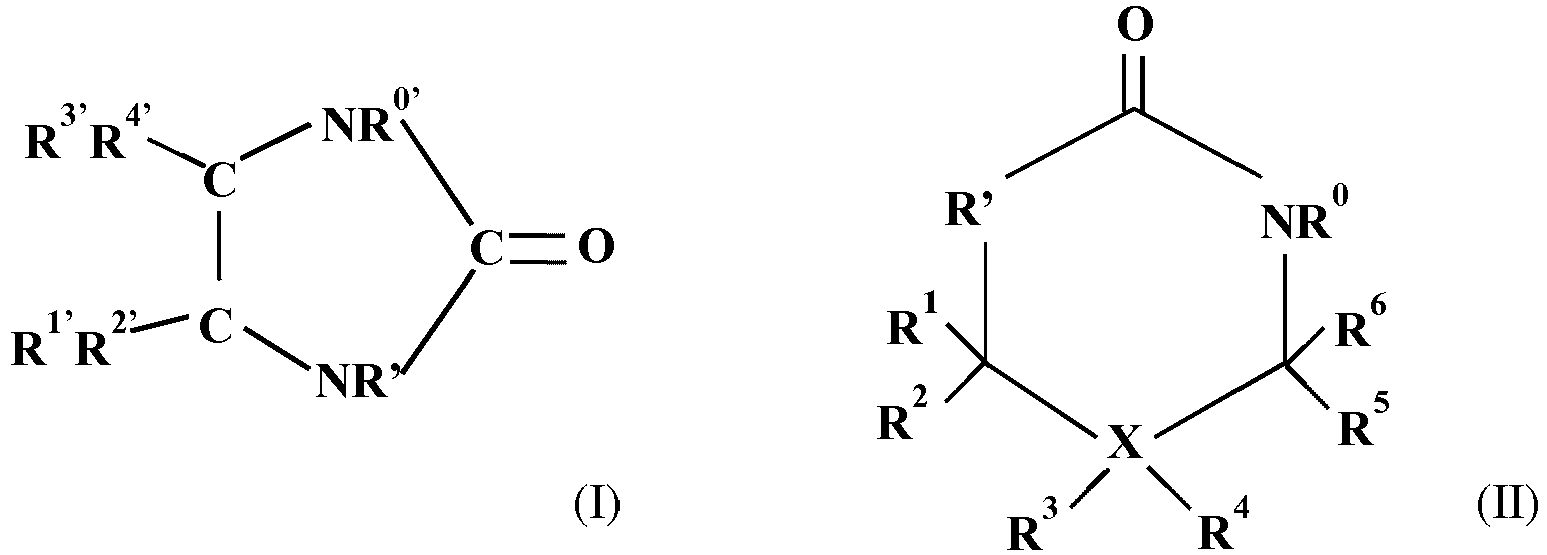
- where R', R0', R1', R2', R3', R4', R5' and R6' are independently selected from H, OH, R11' OH, NH or COOH, and R11' is a C1-C4 alkyl group,
- X is C, O or N with the proviso that when X is O, R3' and R4' are each zero and when X is N, one of R3' or R4' is zero,
- and further with the proviso at least one of R' or R0' is H and that at least: one of R0', R1', R2', R3', R4', R5', R6' is OH, COOH, R11' OH, or NH; or R1'R2' or R5'R6' are NH2.
- In yet another embodiment, the cyclic urea containing at least one isocyanate reactive group added to the reaction mixture is selected from the group consisting of 4,5-dihydroxy-2-imidazolidinone, 4,5-dimethoxy-2-imidazolidinone, 4-hydroxyethyl ethylene urea, 4-hydroxy-5-methyl propylene urea, 4-methoxy-5-methyl propylene urea, 4-hydroxy-5,5-dimethyl propylene urea, 1-(2-hydroxyethyl)-2-imidazolidinone or a mixture thereof.
- In yet another embodiment, the free radical scavenger comprises a sterically hindered phenol having the formula (III):

- In yet another embodiment the free radical scavenger is a phosphite.
- In yet another embodiment, the one or more amine components that is added to the reaction mixture is triethyltetramines (TETA), tetraethyl pentamines (TEPA), pentaethylhexamines (PEHA), hexaethylheptamines (HEHA), heptaethyloctamines (HEOA) and/or octaethylenenonamines (OENO), or a mixture thereof.
- As described the composition according to the invention may further comprise a treating agent. The treating agent can be a cyclic urea substituted with at least one isocyanate reactive group. The treating agent can also be a free radical scavenger. The treating agent can also be a polymer acid. The treating agent can be a mixture of a cyclic urea substituted with at least one isocyanate reactive group and a free radical scavenger. The treating agent can be the polymer acid alone, or a mixture of the polymer acid and the free radical scavenger or the cyclic urea, or a mixture of the polymer acid, the free radical scavenger and the cyclic urea.
- According to one particular embodiment, the treating agent is a cyclic urea substituted with at least one isocyanate reactive group. The cyclic urea may be a cycloaliphatic or bicycloaliphatic compound having an element of the structure -NH-CO-NH- within a ring structure. In one embodiment, the cyclic urea has a total number of ring atoms ranging from 5 to 7. Such cyclic urea is substituted with at least one isocyanate reactive group on either the -N or -C atoms or both. In one particular embodiment, the cyclic urea substituted with at least one isocyanate reactive group has the formula (I):

- where R', R0', R1', R2', R3', and R4' are independently selected from H, OH, R11'OH, NH or COOH, and
- R11' is a C1-C4 alkyl group,
- with the proviso that at least one of R' or R0' is H, and further with the proviso that at least: one of R', R0', R1', R2', R3', and R4' is OH, COOH, R11'OH, or NH; or R1'R2' or R3'R4' is NH2.
- Examples of such compounds of formula (I) include, but are not limited to, 4,5-dihydroxy-2-imidazolidinone, 4,5-dimethoxy-2-imidazolidinone, 4-hydroxyethyl ethylene urea, 4-hydroxy-5-methyl propylene urea, 4-methoxy-5-methyl propylene urea, 4-hydroxy-5,5-dimethyl propylene urea, 1-(2-hydroxyethyl)-2-imidazolidinone or a mixture thereof.
According to another embodiment, the treating agent is a cyclic urea substituted with at least isocyanate reactive group having the formula (II):
- where R', R0', R1', R2', R3', R4', R5' and R6' are independently selected from H, OH, R11'OH, NH or COOH, and
- R11' is a C1-C4 alkyl group,
- X is C, O or N with the proviso that when X is O, R3' and R4' are each zero and when X is N, one of R3' or R4' is zero,
- and further with the proviso at least one of R' or R0' is H and that at least: one of R0', R1', R2', R3', R4', R5', R6' is OH, COOH, R11'OH, or NH; or R1'R2' or R5'R6' are NH2.
- Examples of such compounds of formula (II) include, but are not limited to, tetrahydro-5-(2-hydroxyethyl)-1,3,5-triazin-2-one, tetrahydro-5-(ethyl)-1,3,5-triazin-2-one, tetrahydro-5-(propyl)-1,3,5-triazin-2-one, tetrahydro-5-(butyl)-1,3,5-triazin-2-one or mixtures thereof.
- According to another embodiment, the treating agent is a free radical scavenger. The free radical scavenger includes compounds such as, but not limited to, methimazole, phenyl methimazole, and derivatives thereof; allupurinol, propyl thiouracil, glutamine, diaminobenzylamine; nicotinamide; hindered phenols or hindered aliphatic or aromatic amines; phosphites; ditridecylthiodipropionate; and natural antioxidants such as Vitamin C, Vitamin E and/or glutathione. Especially preferred free radical scavengers are methimazole, sterically hindered phenols, sterically hindered aromatic amines, or phosphites.
- According to one embodiment, the free radical scavenger is a hindered phenol. In another embodiment, the hindered phenol is a sterically hindered phenol. The term "sterically hindered phenol" as used herein means that the phenol in positions 2 and 6 of the aromatic ring has substituents which, on the basis of their three-dimensional size, shield the OH group of the phenolic ring and result in an attenuated reactivity. Thus, in one particular embodiment, the sterically hindered phenol is a compound having the formula (III):

- In one embodiment, R7', R8' and R9' are independently selected from H or a CH3 group and R10' is H or a C1-C4 alkyl group. In still another embodiment, R7', R8' and R9' are each a CH3 group and R10' is H, a methyl group, an ethyl group, a propyl group or an isopropyl group.
- Examples of such compounds having formula (III), include, but are not limited to, 2,6-di-t-butyl-4-methyl phenol, 2,6-di-t-butyl-4-isopropyl phenol, 2,6-di-t-butyl-4-ethyl phenol, 2,4-dimethyl-6-octyl phenol, 2,6-di-t-butyl-4-n-butyl phenol and 2,4-dimethyl-6-t-butyl phenol, 3,5-bis(1,1-dimethylethyl)-4-hydroxy-benzenepropanoic acid branched C13-15 alkyl esters.
- In another embodiment, the free radical scavenger is a phosphite. Examples of phosphites include, but are not limited to, triphenyl phosphite, trisnonlyphenyl phosphite, tris(p-cresyl) phosphite, triethyl phosphite, tris(2-ethylhexyl) phosphite, tridecyl phosphite, trilauryl phosphite, tris(tridecyl) phosphite, trioleyl phosphite, tris(dipropylene glycol) phosphite, diphenyl mono(2ethylhexyl) phosphite, diphenyl monodecyl phosphite, diphenyl mono(tridecyl) phosphite, trilauryl trithiophosphite, diisodecyl(phenyl) phosphite, diethyl hydrogen phosphite, bis(2-ethylhexyl) hydrogen phosphite; dilauryl hydrogen phosphite, dioleyl hydrogen phosphite, diphenyl hydrogen phosphite, tetraphenyl dipropyleneglycol diphosphite, tetraphenyl tetra(tridecyl) pentaerythritol tetraphosphite/bis(2-ethylhexyl)phthalate, tetra(C12-C15 alkyl)-4,4'-isopropylidene diphenyl diphosphite, bis(tridecyl)pentaerythritol diphosphite/bis(nonylphenyl) pentaerythritol diphosphite, bis(decyl) pentraerythritol diphosphite, bis(tridecyl) pentaerythritol diphosphite, tristearyl phosphite, distearyl pentaerythritol diphosphite, tris(2,4-di-tert-butylphenyl) phosphite, hydrogenated bisphenol A pentaerythritol phosphite polymer, hydrogenated bisphenol A phosphite polymer, and mixtures thereof.
- In another embodiment, the free radical scavenger is a sterically hindered amine. According to this invention a "sterically hindered amine" is a secondary amine having two substituted phenyl groups which, on the basis of their three-dimensional size, shield the amine group and result in an attenuated reactivity.
- In one particular embodiment, the sterically hindered amine, is a substituted diphenyl amine aromatic amine compound having the formula (IV):

- Examples of hindered aromatic amines are 4,4'-bis(α,α-dimethylbenzyl)diphenylamine; benzenamine,4-octyl-N-(4-octylphenyl); Benzenamine,4-(1-methyl-1-phenlyethyl)-N-4[4-91-methyl-1-phenylethyle]phenyl]; Benzeneamine, ar-nonyl-N-nonylphenyl; Benzenamine, N-phenyl-reaction products with 2,4,4-trimethylpentene; Benzenamine, N-phenyl-,styrenated; Benzenamine,2 -ethyl-N-(2-ethylphenyl)-(tripropenyl) derivatives.
- In yet another embodiment, the treating agent is a mixture of the cyclic urea substituted with at least one isocyanate reactive group described above and sterically hindered phenol described above.
- In still another embodiment, the treating agent is a mixture of the cyclic urea substituted with at least one isocyanate reactive group described above and a phosphite described above.
- In still another preferred embodiment, the treating agent is a "polymer acid". For the purpose of this disclosure, "polymer acid" is defined in two ways. First, the "polymer acid" is any material containing three or more of the same repeating monomers of either an unsaturated carboxylic acid or an anhydride. Second, the "polymer acid" is any material containing at least two repeating monomers, wherein the first monomer is either an unsaturated carboxylic acid or an anhydride, and the second monomer is different from the first monomer. Thus, in an embodiment where the first monomer is an unsaturated carboxylic acid, the second monomer may be a different unsaturated carboxylic acid, an anhydride, or an alternative monomer. Alternatively, in an embodiment where the first monomer is an anhydride, the second monomer may be an unsaturated carboxylic acid, a different anhydride or an alternative monomer. In one embodiment, the alternative monomer to the unsaturated carboxylic acid and anhydride is a vinyl monomer, such as, but not limited to, styrene, ethylene, propylene, butylene, acrylonitrile, and vinyl chloride.
- The unsaturated carboxylic acid and anhydride of the polymer acid may be any acid containing at least one double bond, which is capable of being polymerized with either itself or another acid or anhydride monomer, or any non-acid containing monomer. Examples of unsaturated carboxylic acids and anhydrides include, but are not limited to, acrylic acid, methacrylic acid, maleic acid, maleic anhydride, succinic acid, succinic anhydride, furoic acid, fumaric acid, sorbic acid, tiglic acid, linoleic acid, linolenic acid, licanic acid, and other acids containing double bonds which are capable of reacting with ethylenic unsaturated monomers or dimers.
- In one embodiment, the polymer acid contains at least three or more of the same repeating monomers selected from the group consisting of acrylic acid, methacrylic acid, maleic acid, maleic anhydride, furoic acid, fumaric acid, sorbic acid, tiglic acid, linoleic acid, linolenic aid and licanic acid.
- In another embodiment, the polymer acid contains at least two repeating monomers where the first monomer is an unsaturated carboxylic acid and the second monomer is a different unsaturated carboxylic acid, an anhydride or an alternative monomer. In one particular embodiment, the unsaturated carboxylic acid may be selected from the group consisting of acrylic acid, methacrylic acid, maleic acid, furoic acid, fumaric acid, sorbic acid, tiglic acid, linoleic acid, linolenic aid and licanic acid. In yet another embodiment, the anhydride and the alternative monomer when present may be selected from the group consisting of maleic anhydride, styrene, ethylene, propylene, butylene, acrylonitrile and vinyl chloride.
- In still another embodiment, the polymer acid contains at least two repeating monomers where the first monomer is an anhydride and the second monomer is a different anhydride, an unsaturated carboxylic acid or an alternative monomer. In one particular embodiment, the anhydride may be maleic anhydride. In another embodiment, the unsaturated carboxylic acid or alternative monomer when present may be selected from the group consisting of acrylic acid, methacrylic acid, maleic acid, furoic acid, fumaric acid, sorbic acid, tiglic acid, linoleic acid, linolenic aid, licanic acid, styrene, ethylene, propylene, butylene, acrylonitrile and vinyl chloride.
- The addition of the polymer acid to the composition according to the invention has as advantage that the foam made from the composition can be more homogenous and stable compared when no polymer acid is added to the composition. This is because the reactivity of the amine in the composition is reduced by the polymer acid.
- In yet another embodiment the reaction mixture further comprises a formaldehyde reducing agent which comprises a CH-acidic compound of the formula R1-CH2-R2, wherein R1 and R2 independently represent an electron-withdrawing radical of the formula -C(O)-R3 or -CN, wherein R3 is selected from the group consisting of -NH2, -NH-R4, -NR5R6, OR7 or R8, wherein R4, R5, R6, R7 and R8 are independently selected from the group consisting of aliphatic, araliphatic or aromatic hydrocarbons which may be substituted with one or more isocyanate-reactive groups.
- The inventors found that when using the formaldehyde reducing agent in combination with cyanoacetamide for making polyurethane and polyurethane foam, both the formaldehyde and the acetaldehyde emission reduced significantly. Also a combination of cyanoacetamide and a formaldehyde reducing agent which comprises a CH-acidic compound and an amine component together with a treating agent seems to reduce the formaldehyde emission even more.
- In one embodiment, the radicals R4, R5, R6, R7 and R8 of the CH-acidic compound are each independently selected from the group consisting of aliphatic hydrocarbons having 1 to 15 carbon atoms, which may be substituted.
- In yet another embodiment, R4, R5, R6, R7 and R8 are independently selected from the group consisting of aliphatic, araliphatic or aromatic hydrocarbons which are substituted with one or more isocyanate-reactive groups selected from -OH, -NH- or -NH2 groups.
- In the context of the present invention the following terms have the following meaning:
- 1) Unless otherwise indicated, reference to %w, w%, wt% or percentage by weight of a given component refers to the weight of said component, expressed as percentage, over the total weight of the composition in which said component is present at that moment in time.
- 2) The VDA 276 test method (also called VOC chamber test) is an emission measurement method to measure the emissions from a foam sample done in a 1m3 chamber where the foam is exposed to 65°C and 5%RH (relative humidity) for several hours. VDA 276 (Verband Der Automobil industrie) is a specific automotive emission method used by a host of automotive OEM's (original equipment manufacturers) to specify the permissible emission levels coming from automotive interior parts.
- 3) isocyanate index or NCO index or index: the ratio of NCO-groups over isocyanate-reactive hydrogen atoms present in a formulation, given as a percentage:
- In other words the NCO-index expresses the percentage of isocyanate actually used in a formulation with respect to the amount of isocyanate theoretically required for reacting with the amount of isocyanate-reactive hydrogen used in a formulation.
- The following table 1 and 2 show the PU formulations used (table 1) and results of the VDA-276 test (Table 2). To the polyol formulation the polyisocyanate compound Suprasec 2447 (from Huntsman) is added at an index of 80 to make the polyurea foam. For each formulation about 1 kg foam was made via hand mix foam procedure for the VDA -276 emission test (air sampling after 4 h, at 65°C/5% Rel humidity and 0.4 EA/hour).
It is indicated how much of the aldehyde scavenger is added. Cyanoacetamide is able to reduce the acetaldehyde. Further, it is shown a combination of cyanoacetamide with an ethylene amine and a polymeric acid reduces the emission of formaldehyde and acetaldehyde. Also the propionaldehyde emission is reduced when using a combination of cyanoacetamide with an ethylene amine and a polymeric acid.Table 1: Polyol formulation. All the components are available from Huntsman International LLC except for Tegostab B 8734 LF-2 which is available from Evonik and Cyanoacetamide available from Sigma Aldrich. REF 1* REF 2 Exp 1 Exp 2 Exp 3 Exp 4 Daltocel F 428 (wt% in view of polyol formulation) 90 90 89.8 89.85 89.75 89.5 Daltocel F526 (wt% in view of polyol formulation) 4 4 4 4 4 4 DELA (wt% in view of polyol formulation) 0.25 0.25 0.25 0.25 0.25 0.25 Tegostab B 8734 LF-2 (wt% in view of polyol formulation) 0.9 0.9 0.9 0.9 0.9 0.9 Water (wt% in view of polyol formulation) 3.7 3.7 3.7 3.7 3.7 3.7 JEFFCAT LED-103 (wt% in view of polyol formulation) 0.15 0.15 0.15 0.15 0.15 0.15 JEFFCAT DPA (wt% in view of polyol formulation) 1 1 1 1 1 1 Acetaldehyde content added in polyol (ppm) ** 1.5 1.5 1.5 1.5 1.5 TEPA in wt % (available from Huntsman) 0.2 0.17 0.34 Polyacrylic acid Mw 5000 in wt% 0.1 0.08 0.17 Cyanoacetamide in wt% 0.15 0.075 0.15 Table 2: Results of VDA-276 chamber emission. * In REF 1 there is no extra acetaldehyde added to the polyol composition. **The acetaldehyde is added by mixing the polyol with 4.2 parts of polyol to which 36.4ppm acetaldehyde was added. VDA276 aldehyde emissions from foam (in µg/m3/kg foam) REF 1 REF 2 Exp 1 Exp 2 Exp 3 Exp 4 Formaldehyde 224 231 9 25 4 1 Acetaldehyde 33 154 178 88 108 84 Propionaldehyde 407 454 502 302 265 244 Total aldehydes 664 839 689 415 377 329 - The following formulation was used to make polyurethane foam.
Table 3: Polyol formulation. Daltocel F428 (wt% in view of the polyol formulation) 94 Water (wt% in view of the polyol formulation) 3.8 Jeffcat ZF10 (wt% in view of the polyol formulation) 0.1 Jeffcat DPA (wt% in view of the polyol formulation) 1 Diethanolamine (wt% in view of the polyol formulation) 0.2 Tegostab B8734LF2 (wt% in view of the polyol formulation) 0.9 Subtotal of polyol formulation 100 - To this formulation, Isocyanate (pure MDI 2,4' MDI/4,4' MDI: 50/50 /Suprasec 2185: 80/20) (in pbw) is added at an index of 91 to make the polyurethane foam. For each formulation about 1 kg foam was made via hand mix foam procedure for the VDA -276 emission test (air sampling after 4 h, at 65°C/5% Rel humidity and 0.4 EA/hour).
The following tables show the results of the VDA-276 test of the above described foam. It is indicated how much of the aldehyde scavengers are added. All the aldehyde scavengers were first added to the polyol formulation and then the isocyanate is added.Table 4: Example not according to the invention. Addition of formaldehyde scavenger 2-cyano-N-methyl-acetamide. REF 3 Exp 5 Acetaldehyde added to polyol (ppm) 0.8 0.8 2-cyano-N-methyl-acetamide (wt%) 0.25 VDA276 aldehyde emissions from foam (in µg/m3/kg foam) Formaldehyde 162 63 Acetaldehyde 54 55 Propionaldehyde 182 198 Table 5: Example not according to the invention. Addition of formaldehyde scavenger ethyl cyanoacetate REF 4 Exp 6 Acetaldehyde added to polyol (ppm) 0.8 0.8 Ethyl cyanoacetate (wt%) 0.25 VDA276 aldehyde emissions from foam (in µg/m3/kg foam) Formaldehyde 153 56 Acetaldehyde 43 58 Propionaldehyde 187 212 - Exp 5 and 6 show that the scavenging of formaldehyde does not mean that acetaldehyde and propionaldehyde are scavenged. Indeed, ethyl cyanoacetate and 2-cyano-N-methyl-acetamide are able to reduce the emission of formaldehyde, but do not have an effect on the emission of acetaldehyde and propionaldehyde. This suggests that the mechanism of scavenging of these 3 different aldehydes is different.
Claims (13)
- A method for reducing the emission of formaldehyde, acetaldehyde and propionaldehyde from a polyurethane or polyurea foam, by using a reaction mixture comprising:• at least one isocyanate reactive component selected from the group consisting of a polyether polyol, a polyester polyol, a polyether polyamine and a polyester polyamine;• an isocyanate component; and• cyanoacetamide,
characterised in that said reaction mixture further comprises:• a formaldehyde reducing agent, which comprises:- one or more amine components having a structure according to one of the formulae


wherein Ra comprises 3 to 17 nitrogen atoms, Rb comprises 2 to 16 nitrogen atoms, and:• a treating agent selected from the group consisting of a cyclic urea substituted with at least one isocyanate reactive group, a free radical scavenger, a polymer acid, wherein the polymer acid contains at least three of the same repeating monomers, of either an unsaturated carboxylic acid or an anhydride; or wherein the polymer acid contains at least two repeating monomers, wherein the first monomer is an unsaturated carboxylic acid or an anhydride, and the second monomer is different from the first monomer or a mixture thereof. - The method according to claim 1, wherein the amount of cyanoacetamide is from 0.01 pbw to 2.0 pbw, preferably from 0.05 pbw to 1.0 pbw, even more preferably between 0.05 pbw and 0.5 pbw calculated on the total weight of the reaction mixture.
- The method according to claim 1 or 2, wherein said reaction mixture further comprises at least a catalyst selected from blowing and/or gelling catalysts, and optionally fire retardants, antioxidants, surfactants, physical or chemical blowing agents, fillers, pigments, or any other typical additives used in polyurethane materials.
- The method according to any one of claims 1 to 3, wherein cyanoacetamide is provided to the reaction mixture as part of the isocyanate reactive component.
- The method according to claim 1, wherein the cyclic urea containing at least one isocyanate reactive group has the formula (I) or (II):
 where R', R0', R1', R2', R3', R4', R5' and R6' are independently selected from H, OH, R11'OH, NH or COOH, andR11' is a C1-C4 alkyl group,X is C, O or N with the proviso that when X is O, R3' and R4' are each zero and when X is N, one of R3' or R4' is zero,and further with the proviso at least one of R' or R0' is H and that at least: one of R0', R1', R2', R3', R4', R5', R6' is OH, COOH, R11'OH, or NH; or R1'R2' or R5'R6' are NH2.
 - The method according to claim 1 or 5, wherein the cyclic urea containing at least one isocyanate reactive group is selected from the group consisting of 4,5-dihydroxy-2-imidazolidinone, 4,5-dimethoxy-2-imidazolidinone, 4-hydroxyethyl ethylene urea, 4-hydroxy-5-methyl propylene urea, 4-methoxy-5-methyl propylene urea, 4-hydroxy-5,5-dimethyl propylene urea, 1-(2-hydroxyethyl)-2-imidazolidinone or a mixture thereof.
- The method according to any one of the claims 1,5 and 6, wherein the free radical scavenger comprises a sterically hindered phenol is having the formula (III):

- The method according to any one of the claims 1 and 5-7, wherein said one or more amine components is a mixture comprising triethyltetramines (TETA), tetraethyl pentamines (TEPA), pentaethylhexamines (PEHA), hexaethylheptamines (HEHA), heptaethyloctamines (HEOA) and/or octaethylenenonamines (OENO).
- The method according to any one of the claims 1 and 5-8, wherein the treating agent is added in amount from 0.01 %w to 2.5 %w, more preferably from 0.05 %w to 1.0 %w, more preferably from 0.1 to 1 %w or even more preferably from 0.2 to 0.7 %w calculated on the total weight of the reaction mixture.
- The method according to any one of the claims 1 and 5-9, wherein the amount of the one or more amine components is from 0.01 %w to 2.5 %w, more preferably from 0.05 %w to 1.0 %w, more preferably from 0.1 to 1 %w or even more preferably from 0.2 to 0.7 %w calculated on the total weight of the reaction mixture.
- The method according to any one of the claims 1 to 4, wherein the reaction mixture further comprises a formaldehyde reducing agent which comprises a CH-acidic compound of the formula R1-CH2-R2, wherein R1 and R2 independently represent an electron-withdrawing radical of the formula -C(O)-R3 or -CN, wherein R3 is selected from the group consisting of -NH2, -NH-R4, -NR5R6, OR7 or R8, wherein R4, R5, R6, R7 and R8 are independently selected from the group consisting of aliphatic, araliphatic or aromatic hydrocarbons which may be substituted with one or more isocyanate-reactive groups.
- The method of claim 11, characterized in that the radicals R4, R5, R6, R7 and R8 are each independently selected from the group consisting of aliphatic hydrocarbons having 1 to 15 carbon atoms, which may be substituted.
- The method according to claim 11 or 12, characterized in that the isocyanate-reactive groups are -OH, -NH- or -NH2 groups.
Priority Applications (1)
| Application Number | Priority Date | Filing Date | Title |
|---|---|---|---|
| PL17704201T PL3411420T3 (en) | 2016-02-05 | 2017-02-06 | Method for the reduction of aldehyde emission in polyurethane foam |
Applications Claiming Priority (2)
| Application Number | Priority Date | Filing Date | Title |
|---|---|---|---|
| EP16154445 | 2016-02-05 | ||
| PCT/EP2017/052517 WO2017134296A1 (en) | 2016-02-05 | 2017-02-06 | Method for the reduction of aldehyde emission in polyurethane foam |
Publications (2)
| Publication Number | Publication Date |
|---|---|
| EP3411420A1 EP3411420A1 (en) | 2018-12-12 |
| EP3411420B1 true EP3411420B1 (en) | 2020-06-17 |
Family
ID=55353017
Family Applications (1)
| Application Number | Title | Priority Date | Filing Date |
|---|---|---|---|
| EP17704201.7A Active EP3411420B1 (en) | 2016-02-05 | 2017-02-06 | Method for the reduction of aldehyde emission in polyurethane foam |
Country Status (9)
| Country | Link |
|---|---|
| US (1) | US11548997B2 (en) |
| EP (1) | EP3411420B1 (en) |
| CN (1) | CN108884206B (en) |
| BR (1) | BR112018015556B1 (en) |
| CA (1) | CA3010864C (en) |
| MX (1) | MX2018009401A (en) |
| PL (1) | PL3411420T3 (en) |
| RU (1) | RU2738375C2 (en) |
| WO (1) | WO2017134296A1 (en) |
Families Citing this family (12)
| Publication number | Priority date | Publication date | Assignee | Title |
|---|---|---|---|---|
| WO2019119196A1 (en) | 2017-12-18 | 2019-06-27 | Huntsman International Llc | A composition with reduced aldehyde emission |
| CN110407998B (en) * | 2018-04-28 | 2022-04-08 | 奥斯佳材料科技(上海)有限公司 | Composition for reducing aldehyde release, polyol product, polyurethane system, preparation method and application thereof |
| FR3081469B1 (en) * | 2018-05-28 | 2021-09-03 | Groupe Fp Bois | USE OF CYCLIC UREA DERIVATIVES TO DECREASE THE CONTENT OF VOLATILE ORGANIC COMPOUNDS IN ROOM AIR |
| EP3898750A4 (en) | 2018-12-21 | 2022-08-10 | Huntsman International LLC | REACTION MIX SUITABLE FOR THE MANUFACTURE OF FOAM WITH REDUCED EMISSION OF ALDEHYDES |
| CN111748070A (en) * | 2019-03-26 | 2020-10-09 | 黑龙江大学 | Low-aldehyde content slow-rebound polyurethane foam and preparation method thereof |
| EP3932968A1 (en) | 2020-07-02 | 2022-01-05 | Covestro Deutschland AG | Method for reducing emissions of polyurethanes |
| CN112552476A (en) * | 2020-12-07 | 2021-03-26 | 上海宏璞化工科技有限公司 | Polyurethane foam material and preparation method thereof |
| US20230102722A1 (en) * | 2021-09-01 | 2023-03-30 | Covestro Llc | Processes for producing filled polyol compositions |
| CA3256294A1 (en) * | 2022-04-14 | 2023-10-19 | Huntsman Petrochemical Llc | Mixture for inhibiting the emission of aldehydes from polyurethane foam for an extended period of time |
| GB202209527D0 (en) * | 2022-06-29 | 2022-08-10 | Colormatrix Holdings Inc | Polymeric materials and additives therefor |
| GB202209526D0 (en) * | 2022-06-29 | 2022-08-10 | Colormatrix Holdings Inc | Polymeric materials and additives therefor |
| EP4541830A1 (en) | 2023-10-19 | 2025-04-23 | Covestro Deutschland AG | Process for producing polyurethane foam |
Family Cites Families (18)
| Publication number | Priority date | Publication date | Assignee | Title |
|---|---|---|---|---|
| DE3829958A1 (en) * | 1988-09-03 | 1990-03-08 | Bayer Ag | METHOD FOR PRODUCING POLYURETHANE FOAMS |
| US5373028A (en) * | 1991-08-20 | 1994-12-13 | The Dow Chemical Company | Polyurethane foams having reduced visible emissions during curing |
| US5714565A (en) * | 1995-03-07 | 1998-02-03 | Bayer Corporation | Heat resistant structural rim product |
| US6037440A (en) * | 1997-07-31 | 2000-03-14 | Eastman Kodak Company | Cross-linked linear (2-cyanoacetamido) reactive polyurethanes |
| US5929190A (en) * | 1997-07-31 | 1999-07-27 | Eastman Kodak Company | (2-Cyanoacetamido) reactive polyurethanes |
| DE10003157B4 (en) | 2000-01-26 | 2006-10-26 | Basf Ag | Process for the preparation of functionalized polyurethane foams |
| US8293808B2 (en) * | 2003-09-30 | 2012-10-23 | Cargill, Incorporated | Flexible polyurethane foams prepared using modified vegetable oil-based polyols |
| PL2106415T3 (en) * | 2007-01-19 | 2016-10-31 | Tertiary amines blocked with polymer acids | |
| US20110009512A1 (en) | 2008-03-20 | 2011-01-13 | Huntsman Petrochemical Llc | Reduction of aldehydes in amines |
| DE102008030763A1 (en) * | 2008-06-28 | 2009-12-31 | Bayer Materialscience Ag | Process for reducing emissions of a polyurethane foam |
| DE102009047846A1 (en) * | 2009-09-30 | 2011-03-31 | Bayer Materialscience Ag | Process for reducing emissions of a polyurethane foam |
| FR2952067B1 (en) * | 2009-11-03 | 2012-05-25 | Saint Gobain Technical Fabrics | FILMOGENIC COMPOSITION COMPRISING AN AGENT SUITABLE FOR TRAPPING FORMALDEHYDE |
| MX342085B (en) * | 2010-07-09 | 2016-09-13 | Air Products And Chemicals Inc * | Process for producing flexible polyurethane foam. |
| US9145466B2 (en) * | 2011-07-07 | 2015-09-29 | Air Products And Chemicals, Inc. | Process for producing flexible polyurethane foam using natural oil polyols |
| EP2703421A1 (en) | 2012-08-28 | 2014-03-05 | Huntsman Petrochemical LLC | A composition for making foams with reduced aldehyde emission |
| US10196493B2 (en) | 2013-12-02 | 2019-02-05 | Basf Se | Polyurethanes having reduced aldehyde emission |
| WO2016005479A1 (en) * | 2014-07-10 | 2016-01-14 | Huntsman Petrochemical Llc | A composition to reduce the amount of aldehydes emitted from polyurethane foams |
| US10696777B2 (en) * | 2015-06-16 | 2020-06-30 | Evonik Operations Gmbh | Aldehyde scavengers mixtures for polyurethane foams |
-
2017
- 2017-02-06 CA CA3010864A patent/CA3010864C/en active Active
- 2017-02-06 US US16/070,132 patent/US11548997B2/en active Active
- 2017-02-06 RU RU2018131252A patent/RU2738375C2/en active
- 2017-02-06 PL PL17704201T patent/PL3411420T3/en unknown
- 2017-02-06 BR BR112018015556-0A patent/BR112018015556B1/en active IP Right Grant
- 2017-02-06 EP EP17704201.7A patent/EP3411420B1/en active Active
- 2017-02-06 MX MX2018009401A patent/MX2018009401A/en unknown
- 2017-02-06 WO PCT/EP2017/052517 patent/WO2017134296A1/en not_active Ceased
- 2017-02-06 CN CN201780009944.7A patent/CN108884206B/en active Active
Non-Patent Citations (1)
| Title |
|---|
| None * |
Also Published As
| Publication number | Publication date |
|---|---|
| CA3010864C (en) | 2024-01-16 |
| CA3010864A1 (en) | 2017-08-10 |
| RU2018131252A (en) | 2020-03-06 |
| US11548997B2 (en) | 2023-01-10 |
| RU2018131252A3 (en) | 2020-03-06 |
| BR112018015556A2 (en) | 2018-12-26 |
| WO2017134296A1 (en) | 2017-08-10 |
| RU2738375C2 (en) | 2020-12-11 |
| PL3411420T3 (en) | 2020-11-16 |
| CN108884206B (en) | 2021-08-03 |
| US20190023871A1 (en) | 2019-01-24 |
| MX2018009401A (en) | 2018-12-19 |
| EP3411420A1 (en) | 2018-12-12 |
| CN108884206A (en) | 2018-11-23 |
| BR112018015556B1 (en) | 2022-05-31 |
Similar Documents
| Publication | Publication Date | Title |
|---|---|---|
| US11548997B2 (en) | Method for the reduction of aldehyde emission in polyurethane foam | |
| US10472456B2 (en) | Composition to reduce the amount of aldehydes emitted from polyurethane foams | |
| JP6807994B2 (en) | Composition | |
| JP5881615B2 (en) | Inhibition of amine oxidation | |
| JP7469495B2 (en) | Catalyst composition for polyurethane | |
| CN115210283A (en) | Catalysts for polyurethane formation | |
| JP2025516788A (en) | Polyurethane foam manufacturing | |
| JP5365481B2 (en) | Method for producing rigid polyurethane foam |
Legal Events
| Date | Code | Title | Description |
|---|---|---|---|
| STAA | Information on the status of an ep patent application or granted ep patent |
Free format text: STATUS: UNKNOWN |
|
| STAA | Information on the status of an ep patent application or granted ep patent |
Free format text: STATUS: THE INTERNATIONAL PUBLICATION HAS BEEN MADE |
|
| PUAI | Public reference made under article 153(3) epc to a published international application that has entered the european phase |
Free format text: ORIGINAL CODE: 0009012 |
|
| STAA | Information on the status of an ep patent application or granted ep patent |
Free format text: STATUS: REQUEST FOR EXAMINATION WAS MADE |
|
| 17P | Request for examination filed |
Effective date: 20180905 |
|
| AK | Designated contracting states |
Kind code of ref document: A1 Designated state(s): AL AT BE BG CH CY CZ DE DK EE ES FI FR GB GR HR HU IE IS IT LI LT LU LV MC MK MT NL NO PL PT RO RS SE SI SK SM TR |
|
| AX | Request for extension of the european patent |
Extension state: BA ME |
|
| DAV | Request for validation of the european patent (deleted) | ||
| DAX | Request for extension of the european patent (deleted) | ||
| STAA | Information on the status of an ep patent application or granted ep patent |
Free format text: STATUS: EXAMINATION IS IN PROGRESS |
|
| 17Q | First examination report despatched |
Effective date: 20191127 |
|
| GRAP | Despatch of communication of intention to grant a patent |
Free format text: ORIGINAL CODE: EPIDOSNIGR1 |
|
| STAA | Information on the status of an ep patent application or granted ep patent |
Free format text: STATUS: GRANT OF PATENT IS INTENDED |
|
| INTG | Intention to grant announced |
Effective date: 20200114 |
|
| GRAS | Grant fee paid |
Free format text: ORIGINAL CODE: EPIDOSNIGR3 |
|
| GRAA | (expected) grant |
Free format text: ORIGINAL CODE: 0009210 |
|
| STAA | Information on the status of an ep patent application or granted ep patent |
Free format text: STATUS: THE PATENT HAS BEEN GRANTED |
|
| AK | Designated contracting states |
Kind code of ref document: B1 Designated state(s): AL AT BE BG CH CY CZ DE DK EE ES FI FR GB GR HR HU IE IS IT LI LT LU LV MC MK MT NL NO PL PT RO RS SE SI SK SM TR |
|
| REG | Reference to a national code |
Ref country code: GB Ref legal event code: FG4D |
|
| REG | Reference to a national code |
Ref country code: CH Ref legal event code: EP |
|
| REG | Reference to a national code |
Ref country code: DE Ref legal event code: R096 Ref document number: 602017018291 Country of ref document: DE |
|
| REG | Reference to a national code |
Ref country code: IE Ref legal event code: FG4D |
|
| REG | Reference to a national code |
Ref country code: AT Ref legal event code: REF Ref document number: 1281214 Country of ref document: AT Kind code of ref document: T Effective date: 20200715 |
|
| PG25 | Lapsed in a contracting state [announced via postgrant information from national office to epo] |
Ref country code: SE Free format text: LAPSE BECAUSE OF FAILURE TO SUBMIT A TRANSLATION OF THE DESCRIPTION OR TO PAY THE FEE WITHIN THE PRESCRIBED TIME-LIMIT Effective date: 20200617 Ref country code: NO Free format text: LAPSE BECAUSE OF FAILURE TO SUBMIT A TRANSLATION OF THE DESCRIPTION OR TO PAY THE FEE WITHIN THE PRESCRIBED TIME-LIMIT Effective date: 20200917 Ref country code: GR Free format text: LAPSE BECAUSE OF FAILURE TO SUBMIT A TRANSLATION OF THE DESCRIPTION OR TO PAY THE FEE WITHIN THE PRESCRIBED TIME-LIMIT Effective date: 20200918 Ref country code: FI Free format text: LAPSE BECAUSE OF FAILURE TO SUBMIT A TRANSLATION OF THE DESCRIPTION OR TO PAY THE FEE WITHIN THE PRESCRIBED TIME-LIMIT Effective date: 20200617 Ref country code: LT Free format text: LAPSE BECAUSE OF FAILURE TO SUBMIT A TRANSLATION OF THE DESCRIPTION OR TO PAY THE FEE WITHIN THE PRESCRIBED TIME-LIMIT Effective date: 20200617 |
|
| REG | Reference to a national code |
Ref country code: LT Ref legal event code: MG4D |
|
| REG | Reference to a national code |
Ref country code: NL Ref legal event code: MP Effective date: 20200617 |
|
| PG25 | Lapsed in a contracting state [announced via postgrant information from national office to epo] |
Ref country code: BG Free format text: LAPSE BECAUSE OF FAILURE TO SUBMIT A TRANSLATION OF THE DESCRIPTION OR TO PAY THE FEE WITHIN THE PRESCRIBED TIME-LIMIT Effective date: 20200917 Ref country code: HR Free format text: LAPSE BECAUSE OF FAILURE TO SUBMIT A TRANSLATION OF THE DESCRIPTION OR TO PAY THE FEE WITHIN THE PRESCRIBED TIME-LIMIT Effective date: 20200617 Ref country code: LV Free format text: LAPSE BECAUSE OF FAILURE TO SUBMIT A TRANSLATION OF THE DESCRIPTION OR TO PAY THE FEE WITHIN THE PRESCRIBED TIME-LIMIT Effective date: 20200617 Ref country code: RS Free format text: LAPSE BECAUSE OF FAILURE TO SUBMIT A TRANSLATION OF THE DESCRIPTION OR TO PAY THE FEE WITHIN THE PRESCRIBED TIME-LIMIT Effective date: 20200617 |
|
| REG | Reference to a national code |
Ref country code: AT Ref legal event code: MK05 Ref document number: 1281214 Country of ref document: AT Kind code of ref document: T Effective date: 20200617 |
|
| PG25 | Lapsed in a contracting state [announced via postgrant information from national office to epo] |
Ref country code: NL Free format text: LAPSE BECAUSE OF FAILURE TO SUBMIT A TRANSLATION OF THE DESCRIPTION OR TO PAY THE FEE WITHIN THE PRESCRIBED TIME-LIMIT Effective date: 20200617 Ref country code: AL Free format text: LAPSE BECAUSE OF FAILURE TO SUBMIT A TRANSLATION OF THE DESCRIPTION OR TO PAY THE FEE WITHIN THE PRESCRIBED TIME-LIMIT Effective date: 20200617 |
|
| PG25 | Lapsed in a contracting state [announced via postgrant information from national office to epo] |
Ref country code: EE Free format text: LAPSE BECAUSE OF FAILURE TO SUBMIT A TRANSLATION OF THE DESCRIPTION OR TO PAY THE FEE WITHIN THE PRESCRIBED TIME-LIMIT Effective date: 20200617 Ref country code: AT Free format text: LAPSE BECAUSE OF FAILURE TO SUBMIT A TRANSLATION OF THE DESCRIPTION OR TO PAY THE FEE WITHIN THE PRESCRIBED TIME-LIMIT Effective date: 20200617 Ref country code: SM Free format text: LAPSE BECAUSE OF FAILURE TO SUBMIT A TRANSLATION OF THE DESCRIPTION OR TO PAY THE FEE WITHIN THE PRESCRIBED TIME-LIMIT Effective date: 20200617 Ref country code: ES Free format text: LAPSE BECAUSE OF FAILURE TO SUBMIT A TRANSLATION OF THE DESCRIPTION OR TO PAY THE FEE WITHIN THE PRESCRIBED TIME-LIMIT Effective date: 20200617 Ref country code: RO Free format text: LAPSE BECAUSE OF FAILURE TO SUBMIT A TRANSLATION OF THE DESCRIPTION OR TO PAY THE FEE WITHIN THE PRESCRIBED TIME-LIMIT Effective date: 20200617 Ref country code: PT Free format text: LAPSE BECAUSE OF FAILURE TO SUBMIT A TRANSLATION OF THE DESCRIPTION OR TO PAY THE FEE WITHIN THE PRESCRIBED TIME-LIMIT Effective date: 20201019 Ref country code: CZ Free format text: LAPSE BECAUSE OF FAILURE TO SUBMIT A TRANSLATION OF THE DESCRIPTION OR TO PAY THE FEE WITHIN THE PRESCRIBED TIME-LIMIT Effective date: 20200617 |
|
| PG25 | Lapsed in a contracting state [announced via postgrant information from national office to epo] |
Ref country code: IS Free format text: LAPSE BECAUSE OF FAILURE TO SUBMIT A TRANSLATION OF THE DESCRIPTION OR TO PAY THE FEE WITHIN THE PRESCRIBED TIME-LIMIT Effective date: 20201017 Ref country code: SK Free format text: LAPSE BECAUSE OF FAILURE TO SUBMIT A TRANSLATION OF THE DESCRIPTION OR TO PAY THE FEE WITHIN THE PRESCRIBED TIME-LIMIT Effective date: 20200617 |
|
| REG | Reference to a national code |
Ref country code: DE Ref legal event code: R097 Ref document number: 602017018291 Country of ref document: DE |
|
| PLBE | No opposition filed within time limit |
Free format text: ORIGINAL CODE: 0009261 |
|
| STAA | Information on the status of an ep patent application or granted ep patent |
Free format text: STATUS: NO OPPOSITION FILED WITHIN TIME LIMIT |
|
| PG25 | Lapsed in a contracting state [announced via postgrant information from national office to epo] |
Ref country code: DK Free format text: LAPSE BECAUSE OF FAILURE TO SUBMIT A TRANSLATION OF THE DESCRIPTION OR TO PAY THE FEE WITHIN THE PRESCRIBED TIME-LIMIT Effective date: 20200617 |
|
| 26N | No opposition filed |
Effective date: 20210318 |
|
| PG25 | Lapsed in a contracting state [announced via postgrant information from national office to epo] |
Ref country code: SI Free format text: LAPSE BECAUSE OF FAILURE TO SUBMIT A TRANSLATION OF THE DESCRIPTION OR TO PAY THE FEE WITHIN THE PRESCRIBED TIME-LIMIT Effective date: 20200617 |
|
| PG25 | Lapsed in a contracting state [announced via postgrant information from national office to epo] |
Ref country code: MC Free format text: LAPSE BECAUSE OF FAILURE TO SUBMIT A TRANSLATION OF THE DESCRIPTION OR TO PAY THE FEE WITHIN THE PRESCRIBED TIME-LIMIT Effective date: 20200617 |
|
| REG | Reference to a national code |
Ref country code: BE Ref legal event code: MM Effective date: 20210228 |
|
| PG25 | Lapsed in a contracting state [announced via postgrant information from national office to epo] |
Ref country code: LI Free format text: LAPSE BECAUSE OF NON-PAYMENT OF DUE FEES Effective date: 20210228 Ref country code: LU Free format text: LAPSE BECAUSE OF NON-PAYMENT OF DUE FEES Effective date: 20210206 Ref country code: CH Free format text: LAPSE BECAUSE OF NON-PAYMENT OF DUE FEES Effective date: 20210228 |
|
| PG25 | Lapsed in a contracting state [announced via postgrant information from national office to epo] |
Ref country code: IE Free format text: LAPSE BECAUSE OF NON-PAYMENT OF DUE FEES Effective date: 20210206 |
|
| PG25 | Lapsed in a contracting state [announced via postgrant information from national office to epo] |
Ref country code: BE Free format text: LAPSE BECAUSE OF NON-PAYMENT OF DUE FEES Effective date: 20210228 |
|
| PG25 | Lapsed in a contracting state [announced via postgrant information from national office to epo] |
Ref country code: CY Free format text: LAPSE BECAUSE OF FAILURE TO SUBMIT A TRANSLATION OF THE DESCRIPTION OR TO PAY THE FEE WITHIN THE PRESCRIBED TIME-LIMIT Effective date: 20200617 |
|
| PG25 | Lapsed in a contracting state [announced via postgrant information from national office to epo] |
Ref country code: HU Free format text: LAPSE BECAUSE OF FAILURE TO SUBMIT A TRANSLATION OF THE DESCRIPTION OR TO PAY THE FEE WITHIN THE PRESCRIBED TIME-LIMIT; INVALID AB INITIO Effective date: 20170206 |
|
| P01 | Opt-out of the competence of the unified patent court (upc) registered |
Effective date: 20230926 |
|
| PG25 | Lapsed in a contracting state [announced via postgrant information from national office to epo] |
Ref country code: MK Free format text: LAPSE BECAUSE OF FAILURE TO SUBMIT A TRANSLATION OF THE DESCRIPTION OR TO PAY THE FEE WITHIN THE PRESCRIBED TIME-LIMIT Effective date: 20200617 |
|
| PG25 | Lapsed in a contracting state [announced via postgrant information from national office to epo] |
Ref country code: MT Free format text: LAPSE BECAUSE OF FAILURE TO SUBMIT A TRANSLATION OF THE DESCRIPTION OR TO PAY THE FEE WITHIN THE PRESCRIBED TIME-LIMIT Effective date: 20200617 |
|
| PGFP | Annual fee paid to national office [announced via postgrant information from national office to epo] |
Ref country code: GB Payment date: 20260223 Year of fee payment: 10 |
|
| PGFP | Annual fee paid to national office [announced via postgrant information from national office to epo] |
Ref country code: DE Payment date: 20260220 Year of fee payment: 10 |
|
| PGFP | Annual fee paid to national office [announced via postgrant information from national office to epo] |
Ref country code: IT Payment date: 20260220 Year of fee payment: 10 |
|
| PGFP | Annual fee paid to national office [announced via postgrant information from national office to epo] |
Ref country code: FR Payment date: 20260224 Year of fee payment: 10 |
|
| PGFP | Annual fee paid to national office [announced via postgrant information from national office to epo] |
Ref country code: TR Payment date: 20260126 Year of fee payment: 10 |
|
| PGFP | Annual fee paid to national office [announced via postgrant information from national office to epo] |
Ref country code: PL Payment date: 20260128 Year of fee payment: 10 |