EP3408317B1 - Foam of a copolymer of polyamide blocks and polyether blocks - Google Patents
Foam of a copolymer of polyamide blocks and polyether blocks Download PDFInfo
- Publication number
- EP3408317B1 EP3408317B1 EP17706847.5A EP17706847A EP3408317B1 EP 3408317 B1 EP3408317 B1 EP 3408317B1 EP 17706847 A EP17706847 A EP 17706847A EP 3408317 B1 EP3408317 B1 EP 3408317B1
- Authority
- EP
- European Patent Office
- Prior art keywords
- mol
- blocks
- copolymer
- polyamide
- foam
- Prior art date
- Legal status (The legal status is an assumption and is not a legal conclusion. Google has not performed a legal analysis and makes no representation as to the accuracy of the status listed.)
- Active
Links
Images

Classifications
-
- C—CHEMISTRY; METALLURGY
- C08—ORGANIC MACROMOLECULAR COMPOUNDS; THEIR PREPARATION OR CHEMICAL WORKING-UP; COMPOSITIONS BASED THEREON
- C08G—MACROMOLECULAR COMPOUNDS OBTAINED OTHERWISE THAN BY REACTIONS ONLY INVOLVING UNSATURATED CARBON-TO-CARBON BONDS
- C08G69/00—Macromolecular compounds obtained by reactions forming a carboxylic amide link in the main chain of the macromolecule
- C08G69/40—Polyamides containing oxygen in the form of ether groups
-
- C—CHEMISTRY; METALLURGY
- C08—ORGANIC MACROMOLECULAR COMPOUNDS; THEIR PREPARATION OR CHEMICAL WORKING-UP; COMPOSITIONS BASED THEREON
- C08L—COMPOSITIONS OF MACROMOLECULAR COMPOUNDS
- C08L87/00—Compositions of unspecified macromolecular compounds, obtained otherwise than by polymerisation reactions only involving unsaturated carbon-to-carbon bonds
- C08L87/005—Block or graft polymers not provided for in groups C08L1/00 - C08L85/04
-
- C—CHEMISTRY; METALLURGY
- C08—ORGANIC MACROMOLECULAR COMPOUNDS; THEIR PREPARATION OR CHEMICAL WORKING-UP; COMPOSITIONS BASED THEREON
- C08J—WORKING-UP; GENERAL PROCESSES OF COMPOUNDING; AFTER-TREATMENT NOT COVERED BY SUBCLASSES C08B, C08C, C08F, C08G or C08H
- C08J9/00—Working-up of macromolecular substances to porous or cellular articles or materials; After-treatment thereof
- C08J9/0061—Working-up of macromolecular substances to porous or cellular articles or materials; After-treatment thereof characterized by the use of several polymeric components
-
- C—CHEMISTRY; METALLURGY
- C08—ORGANIC MACROMOLECULAR COMPOUNDS; THEIR PREPARATION OR CHEMICAL WORKING-UP; COMPOSITIONS BASED THEREON
- C08J—WORKING-UP; GENERAL PROCESSES OF COMPOUNDING; AFTER-TREATMENT NOT COVERED BY SUBCLASSES C08B, C08C, C08F, C08G or C08H
- C08J9/00—Working-up of macromolecular substances to porous or cellular articles or materials; After-treatment thereof
- C08J9/04—Working-up of macromolecular substances to porous or cellular articles or materials; After-treatment thereof using blowing gases generated by a previously added blowing agent
- C08J9/12—Working-up of macromolecular substances to porous or cellular articles or materials; After-treatment thereof using blowing gases generated by a previously added blowing agent by a physical blowing agent
- C08J9/122—Hydrogen, oxygen, CO2, nitrogen or noble gases
-
- C—CHEMISTRY; METALLURGY
- C08—ORGANIC MACROMOLECULAR COMPOUNDS; THEIR PREPARATION OR CHEMICAL WORKING-UP; COMPOSITIONS BASED THEREON
- C08J—WORKING-UP; GENERAL PROCESSES OF COMPOUNDING; AFTER-TREATMENT NOT COVERED BY SUBCLASSES C08B, C08C, C08F, C08G or C08H
- C08J9/00—Working-up of macromolecular substances to porous or cellular articles or materials; After-treatment thereof
- C08J9/04—Working-up of macromolecular substances to porous or cellular articles or materials; After-treatment thereof using blowing gases generated by a previously added blowing agent
- C08J9/12—Working-up of macromolecular substances to porous or cellular articles or materials; After-treatment thereof using blowing gases generated by a previously added blowing agent by a physical blowing agent
- C08J9/14—Working-up of macromolecular substances to porous or cellular articles or materials; After-treatment thereof using blowing gases generated by a previously added blowing agent by a physical blowing agent organic
- C08J9/141—Hydrocarbons
-
- C—CHEMISTRY; METALLURGY
- C08—ORGANIC MACROMOLECULAR COMPOUNDS; THEIR PREPARATION OR CHEMICAL WORKING-UP; COMPOSITIONS BASED THEREON
- C08J—WORKING-UP; GENERAL PROCESSES OF COMPOUNDING; AFTER-TREATMENT NOT COVERED BY SUBCLASSES C08B, C08C, C08F, C08G or C08H
- C08J9/00—Working-up of macromolecular substances to porous or cellular articles or materials; After-treatment thereof
- C08J9/04—Working-up of macromolecular substances to porous or cellular articles or materials; After-treatment thereof using blowing gases generated by a previously added blowing agent
- C08J9/12—Working-up of macromolecular substances to porous or cellular articles or materials; After-treatment thereof using blowing gases generated by a previously added blowing agent by a physical blowing agent
- C08J9/14—Working-up of macromolecular substances to porous or cellular articles or materials; After-treatment thereof using blowing gases generated by a previously added blowing agent by a physical blowing agent organic
- C08J9/143—Halogen containing compounds
- C08J9/144—Halogen containing compounds containing carbon, halogen and hydrogen only
-
- C—CHEMISTRY; METALLURGY
- C08—ORGANIC MACROMOLECULAR COMPOUNDS; THEIR PREPARATION OR CHEMICAL WORKING-UP; COMPOSITIONS BASED THEREON
- C08J—WORKING-UP; GENERAL PROCESSES OF COMPOUNDING; AFTER-TREATMENT NOT COVERED BY SUBCLASSES C08B, C08C, C08F, C08G or C08H
- C08J9/00—Working-up of macromolecular substances to porous or cellular articles or materials; After-treatment thereof
- C08J9/04—Working-up of macromolecular substances to porous or cellular articles or materials; After-treatment thereof using blowing gases generated by a previously added blowing agent
- C08J9/12—Working-up of macromolecular substances to porous or cellular articles or materials; After-treatment thereof using blowing gases generated by a previously added blowing agent by a physical blowing agent
- C08J9/14—Working-up of macromolecular substances to porous or cellular articles or materials; After-treatment thereof using blowing gases generated by a previously added blowing agent by a physical blowing agent organic
- C08J9/143—Halogen containing compounds
- C08J9/144—Halogen containing compounds containing carbon, halogen and hydrogen only
- C08J9/145—Halogen containing compounds containing carbon, halogen and hydrogen only only chlorine as halogen atoms
-
- C—CHEMISTRY; METALLURGY
- C08—ORGANIC MACROMOLECULAR COMPOUNDS; THEIR PREPARATION OR CHEMICAL WORKING-UP; COMPOSITIONS BASED THEREON
- C08J—WORKING-UP; GENERAL PROCESSES OF COMPOUNDING; AFTER-TREATMENT NOT COVERED BY SUBCLASSES C08B, C08C, C08F, C08G or C08H
- C08J9/00—Working-up of macromolecular substances to porous or cellular articles or materials; After-treatment thereof
- C08J9/04—Working-up of macromolecular substances to porous or cellular articles or materials; After-treatment thereof using blowing gases generated by a previously added blowing agent
- C08J9/12—Working-up of macromolecular substances to porous or cellular articles or materials; After-treatment thereof using blowing gases generated by a previously added blowing agent by a physical blowing agent
- C08J9/14—Working-up of macromolecular substances to porous or cellular articles or materials; After-treatment thereof using blowing gases generated by a previously added blowing agent by a physical blowing agent organic
- C08J9/143—Halogen containing compounds
- C08J9/144—Halogen containing compounds containing carbon, halogen and hydrogen only
- C08J9/146—Halogen containing compounds containing carbon, halogen and hydrogen only only fluorine as halogen atoms
-
- C—CHEMISTRY; METALLURGY
- C08—ORGANIC MACROMOLECULAR COMPOUNDS; THEIR PREPARATION OR CHEMICAL WORKING-UP; COMPOSITIONS BASED THEREON
- C08J—WORKING-UP; GENERAL PROCESSES OF COMPOUNDING; AFTER-TREATMENT NOT COVERED BY SUBCLASSES C08B, C08C, C08F, C08G or C08H
- C08J9/00—Working-up of macromolecular substances to porous or cellular articles or materials; After-treatment thereof
- C08J9/04—Working-up of macromolecular substances to porous or cellular articles or materials; After-treatment thereof using blowing gases generated by a previously added blowing agent
- C08J9/12—Working-up of macromolecular substances to porous or cellular articles or materials; After-treatment thereof using blowing gases generated by a previously added blowing agent by a physical blowing agent
- C08J9/14—Working-up of macromolecular substances to porous or cellular articles or materials; After-treatment thereof using blowing gases generated by a previously added blowing agent by a physical blowing agent organic
- C08J9/143—Halogen containing compounds
- C08J9/147—Halogen containing compounds containing carbon and halogen atoms only
-
- C—CHEMISTRY; METALLURGY
- C08—ORGANIC MACROMOLECULAR COMPOUNDS; THEIR PREPARATION OR CHEMICAL WORKING-UP; COMPOSITIONS BASED THEREON
- C08G—MACROMOLECULAR COMPOUNDS OBTAINED OTHERWISE THAN BY REACTIONS ONLY INVOLVING UNSATURATED CARBON-TO-CARBON BONDS
- C08G2110/00—Foam properties
- C08G2110/0041—Foam properties having specified density
- C08G2110/0066—≥ 150kg/m3
-
- C—CHEMISTRY; METALLURGY
- C08—ORGANIC MACROMOLECULAR COMPOUNDS; THEIR PREPARATION OR CHEMICAL WORKING-UP; COMPOSITIONS BASED THEREON
- C08J—WORKING-UP; GENERAL PROCESSES OF COMPOUNDING; AFTER-TREATMENT NOT COVERED BY SUBCLASSES C08B, C08C, C08F, C08G or C08H
- C08J2203/00—Foams characterized by the expanding agent
- C08J2203/06—CO2, N2 or noble gases
-
- C—CHEMISTRY; METALLURGY
- C08—ORGANIC MACROMOLECULAR COMPOUNDS; THEIR PREPARATION OR CHEMICAL WORKING-UP; COMPOSITIONS BASED THEREON
- C08J—WORKING-UP; GENERAL PROCESSES OF COMPOUNDING; AFTER-TREATMENT NOT COVERED BY SUBCLASSES C08B, C08C, C08F, C08G or C08H
- C08J2203/00—Foams characterized by the expanding agent
- C08J2203/08—Supercritical fluid
-
- C—CHEMISTRY; METALLURGY
- C08—ORGANIC MACROMOLECULAR COMPOUNDS; THEIR PREPARATION OR CHEMICAL WORKING-UP; COMPOSITIONS BASED THEREON
- C08J—WORKING-UP; GENERAL PROCESSES OF COMPOUNDING; AFTER-TREATMENT NOT COVERED BY SUBCLASSES C08B, C08C, C08F, C08G or C08H
- C08J2203/00—Foams characterized by the expanding agent
- C08J2203/14—Saturated hydrocarbons, e.g. butane; Unspecified hydrocarbons
-
- C—CHEMISTRY; METALLURGY
- C08—ORGANIC MACROMOLECULAR COMPOUNDS; THEIR PREPARATION OR CHEMICAL WORKING-UP; COMPOSITIONS BASED THEREON
- C08J—WORKING-UP; GENERAL PROCESSES OF COMPOUNDING; AFTER-TREATMENT NOT COVERED BY SUBCLASSES C08B, C08C, C08F, C08G or C08H
- C08J2203/00—Foams characterized by the expanding agent
- C08J2203/14—Saturated hydrocarbons, e.g. butane; Unspecified hydrocarbons
- C08J2203/142—Halogenated saturated hydrocarbons, e.g. H3C-CF3
-
- C—CHEMISTRY; METALLURGY
- C08—ORGANIC MACROMOLECULAR COMPOUNDS; THEIR PREPARATION OR CHEMICAL WORKING-UP; COMPOSITIONS BASED THEREON
- C08J—WORKING-UP; GENERAL PROCESSES OF COMPOUNDING; AFTER-TREATMENT NOT COVERED BY SUBCLASSES C08B, C08C, C08F, C08G or C08H
- C08J2203/00—Foams characterized by the expanding agent
- C08J2203/16—Unsaturated hydrocarbons
-
- C—CHEMISTRY; METALLURGY
- C08—ORGANIC MACROMOLECULAR COMPOUNDS; THEIR PREPARATION OR CHEMICAL WORKING-UP; COMPOSITIONS BASED THEREON
- C08J—WORKING-UP; GENERAL PROCESSES OF COMPOUNDING; AFTER-TREATMENT NOT COVERED BY SUBCLASSES C08B, C08C, C08F, C08G or C08H
- C08J2203/00—Foams characterized by the expanding agent
- C08J2203/16—Unsaturated hydrocarbons
- C08J2203/162—Halogenated unsaturated hydrocarbons, e.g. H2C=CF2
-
- C—CHEMISTRY; METALLURGY
- C08—ORGANIC MACROMOLECULAR COMPOUNDS; THEIR PREPARATION OR CHEMICAL WORKING-UP; COMPOSITIONS BASED THEREON
- C08J—WORKING-UP; GENERAL PROCESSES OF COMPOUNDING; AFTER-TREATMENT NOT COVERED BY SUBCLASSES C08B, C08C, C08F, C08G or C08H
- C08J2371/00—Characterised by the use of polyethers obtained by reactions forming an ether link in the main chain; Derivatives of such polymers
- C08J2371/02—Polyalkylene oxides
-
- C—CHEMISTRY; METALLURGY
- C08—ORGANIC MACROMOLECULAR COMPOUNDS; THEIR PREPARATION OR CHEMICAL WORKING-UP; COMPOSITIONS BASED THEREON
- C08J—WORKING-UP; GENERAL PROCESSES OF COMPOUNDING; AFTER-TREATMENT NOT COVERED BY SUBCLASSES C08B, C08C, C08F, C08G or C08H
- C08J2377/00—Characterised by the use of polyamides obtained by reactions forming a carboxylic amide link in the main chain; Derivatives of such polymers
-
- C—CHEMISTRY; METALLURGY
- C08—ORGANIC MACROMOLECULAR COMPOUNDS; THEIR PREPARATION OR CHEMICAL WORKING-UP; COMPOSITIONS BASED THEREON
- C08J—WORKING-UP; GENERAL PROCESSES OF COMPOUNDING; AFTER-TREATMENT NOT COVERED BY SUBCLASSES C08B, C08C, C08F, C08G or C08H
- C08J2377/00—Characterised by the use of polyamides obtained by reactions forming a carboxylic amide link in the main chain; Derivatives of such polymers
- C08J2377/06—Polyamides derived from polyamines and polycarboxylic acids
-
- C—CHEMISTRY; METALLURGY
- C08—ORGANIC MACROMOLECULAR COMPOUNDS; THEIR PREPARATION OR CHEMICAL WORKING-UP; COMPOSITIONS BASED THEREON
- C08J—WORKING-UP; GENERAL PROCESSES OF COMPOUNDING; AFTER-TREATMENT NOT COVERED BY SUBCLASSES C08B, C08C, C08F, C08G or C08H
- C08J2423/00—Characterised by the use of homopolymers or copolymers of unsaturated aliphatic hydrocarbons having only one carbon-to-carbon double bond; Derivatives of such polymers
- C08J2423/02—Characterised by the use of homopolymers or copolymers of unsaturated aliphatic hydrocarbons having only one carbon-to-carbon double bond; Derivatives of such polymers not modified by chemical after treatment
- C08J2423/04—Homopolymers or copolymers of ethene
- C08J2423/08—Copolymers of ethene
-
- C—CHEMISTRY; METALLURGY
- C08—ORGANIC MACROMOLECULAR COMPOUNDS; THEIR PREPARATION OR CHEMICAL WORKING-UP; COMPOSITIONS BASED THEREON
- C08J—WORKING-UP; GENERAL PROCESSES OF COMPOUNDING; AFTER-TREATMENT NOT COVERED BY SUBCLASSES C08B, C08C, C08F, C08G or C08H
- C08J2431/00—Characterised by the use of copolymers of compounds having one or more unsaturated aliphatic radicals, each having only one carbon-to-carbon double bond, and at least one being terminated by an acyloxy radical of a saturated carboxylic acid, or carbonic acid, or of a haloformic acid
- C08J2431/02—Characterised by the use of omopolymers or copolymers of esters of monocarboxylic acids
- C08J2431/04—Homopolymers or copolymers of vinyl acetate
-
- C—CHEMISTRY; METALLURGY
- C08—ORGANIC MACROMOLECULAR COMPOUNDS; THEIR PREPARATION OR CHEMICAL WORKING-UP; COMPOSITIONS BASED THEREON
- C08J—WORKING-UP; GENERAL PROCESSES OF COMPOUNDING; AFTER-TREATMENT NOT COVERED BY SUBCLASSES C08B, C08C, C08F, C08G or C08H
- C08J2433/00—Characterised by the use of homopolymers or copolymers of compounds having one or more unsaturated aliphatic radicals, each having only one carbon-to-carbon double bond, and only one being terminated by only one carboxyl radical, or of salts, anhydrides, esters, amides, imides, or nitriles thereof; Derivatives of such polymers
-
- C—CHEMISTRY; METALLURGY
- C08—ORGANIC MACROMOLECULAR COMPOUNDS; THEIR PREPARATION OR CHEMICAL WORKING-UP; COMPOSITIONS BASED THEREON
- C08J—WORKING-UP; GENERAL PROCESSES OF COMPOUNDING; AFTER-TREATMENT NOT COVERED BY SUBCLASSES C08B, C08C, C08F, C08G or C08H
- C08J2433/00—Characterised by the use of homopolymers or copolymers of compounds having one or more unsaturated aliphatic radicals, each having only one carbon-to-carbon double bond, and only one being terminated by only one carboxyl radical, or of salts, anhydrides, esters, amides, imides, or nitriles thereof; Derivatives of such polymers
- C08J2433/04—Characterised by the use of homopolymers or copolymers of compounds having one or more unsaturated aliphatic radicals, each having only one carbon-to-carbon double bond, and only one being terminated by only one carboxyl radical, or of salts, anhydrides, esters, amides, imides, or nitriles thereof; Derivatives of such polymers esters
- C08J2433/06—Characterised by the use of homopolymers or copolymers of compounds having one or more unsaturated aliphatic radicals, each having only one carbon-to-carbon double bond, and only one being terminated by only one carboxyl radical, or of salts, anhydrides, esters, amides, imides, or nitriles thereof; Derivatives of such polymers esters of esters containing only carbon, hydrogen, and oxygen, the oxygen atom being present only as part of the carboxyl radical
- C08J2433/08—Homopolymers or copolymers of acrylic acid esters
-
- C—CHEMISTRY; METALLURGY
- C08—ORGANIC MACROMOLECULAR COMPOUNDS; THEIR PREPARATION OR CHEMICAL WORKING-UP; COMPOSITIONS BASED THEREON
- C08J—WORKING-UP; GENERAL PROCESSES OF COMPOUNDING; AFTER-TREATMENT NOT COVERED BY SUBCLASSES C08B, C08C, C08F, C08G or C08H
- C08J2433/00—Characterised by the use of homopolymers or copolymers of compounds having one or more unsaturated aliphatic radicals, each having only one carbon-to-carbon double bond, and only one being terminated by only one carboxyl radical, or of salts, anhydrides, esters, amides, imides, or nitriles thereof; Derivatives of such polymers
- C08J2433/04—Characterised by the use of homopolymers or copolymers of compounds having one or more unsaturated aliphatic radicals, each having only one carbon-to-carbon double bond, and only one being terminated by only one carboxyl radical, or of salts, anhydrides, esters, amides, imides, or nitriles thereof; Derivatives of such polymers esters
- C08J2433/06—Characterised by the use of homopolymers or copolymers of compounds having one or more unsaturated aliphatic radicals, each having only one carbon-to-carbon double bond, and only one being terminated by only one carboxyl radical, or of salts, anhydrides, esters, amides, imides, or nitriles thereof; Derivatives of such polymers esters of esters containing only carbon, hydrogen, and oxygen, the oxygen atom being present only as part of the carboxyl radical
- C08J2433/10—Homopolymers or copolymers of methacrylic acid esters
Definitions
- the present invention relates to a foam formed from a copolymer with polyamide blocks and polyether blocks as well as a method of manufacturing the same.
- Various polymer foams are used in particular in the field of sports equipment, such as soles or sole components, gloves, rackets or golf balls, individual protection elements in particular for the practice of sport (vests, interior parts of helmets , shells).
- Such applications require a set of particular physical properties ensuring ability to rebound, low permanent deformation in compression and an ability to withstand repeated impacts without deforming and returning to the initial shape.
- EP 0405227 And EP 0402883 describe foams made from various polymers and their use in shoe soles.
- the document EP 1650255 describes crosslinked foams obtained from copolymers with polyamide blocks and polyether blocks.
- Reticulated foams have the disadvantage of presenting significant constraints from the point of view of the manufacturing process: the manufacturing time is generally long, manufacturing is generally necessarily in batch mode only, and undesirable chemicals must be manipulated.
- reticulated foams are difficult to recycle after use.
- the document WO 2015/052265 describes a process for manufacturing expanded thermoplastic particles from any elastomeric thermoplastic polymer.
- TPU thermoplastic polyurethane
- EVA ethylene vinyl acetate
- the polyamide blocks of the copolymer are blocks of polyamide 11, or polyamide 12, or polyamide 6, or polyamide 6.10.
- the polyether blocks of the copolymer are blocks of polyethylene glycol or polytetrahydrofuran.
- the foam has a density less than or equal to 800 kg/m 3 , preferably less than or equal to 600 kg/m 3 , more particularly preferably less than or equal to 400 kg/m 3 , or even less or equal to 300 kg/m 3 .
- the foam also contains one or more additives, preferably chosen from copolymers of ethylene and vinyl acetate, copolymers of ethylene and acrylate, and copolymers of ethylene and alkyl ( meth)acrylate.
- additives preferably chosen from copolymers of ethylene and vinyl acetate, copolymers of ethylene and acrylate, and copolymers of ethylene and alkyl ( meth)acrylate.
- the invention also relates to a process for manufacturing this foam, comprising a step of mixing the copolymer in the molten state, optionally with one or more additives, and with an expanding agent, and a step of foaming the copolymer mixture and expanding agent.
- the blowing agent is a physical blowing agent, preferably chosen from dinitrogen, carbon dioxide, hydrocarbons, chlorofluorocarbons, hydrochlorocarbons, hydrofluorocarbons and hydrochlorofluorocarbons.
- the method comprises a step of injecting the mixture of copolymer and expanding agent into a mold, the foaming of the mixture being carried out by the opening of the mold.
- the invention also relates to an article made of the above foam.
- the invention also relates to an article comprising at least one element consisting of the above foam.
- the article of the invention is chosen from sports shoe soles, balls, gloves, individual protective equipment, soles for rails, automobile parts, construction parts and parts of electrical and electronic equipment.
- the present invention makes it possible to overcome the disadvantages of the state of the art. It more particularly provides low density polymer foams, having one or more advantageous properties including: a high capacity to restore elastic energy during loading under low stress; low residual compression deformation; and high resistance to compressive fatigue.
- these properties are obtained over a wide temperature range, preferably from -20°C to 50°C, or even from -30°C to 80°C.
- non-crosslinked polyamide block and polyether block copolymer characterized by particular molar mass ranges for the polyamide blocks and polyether blocks, as well as a particular range of mass ratio between the polyamide blocks and polyether blocks.
- FIG 1 represents the results of residual deformation measurements after a fatigue test carried out on a foam according to the invention and on a control foam (see Example 2).
- the relaxation time (in hours) appears on the abscissa, and the percentage of residual strain is indicated on the ordinate.
- the invention uses a copolymer with polyamide blocks and polyether blocks, or “PEBA”.
- Polyamide blocks with dicarboxylic chain ends come, for example, from the condensation of polyamide precursors in the presence of a chain-limiting dicarboxylic acid.
- Polyamide blocks with diamine chain ends come, for example, from the condensation of polyamide precursors in the presence of a chain-limiting diamine.
- Three types of polyamide blocks can advantageously be used.
- the polyamide blocks come from the condensation of a dicarboxylic acid, in particular those having from 4 to 20 carbon atoms, preferably those having from 6 to 18 carbon atoms, and an aliphatic or aromatic diamine , in particular those having from 2 to 20 carbon atoms, preferably those having from 6 to 14 carbon atoms.
- dicarboxylic acids mention may be made of 1,4-cyclohexyldicarboxylic acid, butanedioic, adipic, azelaic, suberic, sebacic, dodecanedicarboxylic, octadecanedicarboxylic acids and terephthalic and isophthalic acids, but also dimerized fatty acids. .
- diamines examples include tetramethylene diamine, hexamethylenediamine, 1,10-decamethylenediamine, dodecamethylenediamine, trimethylhexamethylenediamine, isomers of bis-(4-aminocyclohexyl)-methane (BACM), bis -(3-methyl-4-aminocyclohexyl)methane (BMACM), and 2-2-bis-(3-methyl-4-aminocyclohexyl)-propane (BMACP), para-amino-di-cyclohexyl-methane ( PACM), isophoronediamine (IPDA), 2,6-bis-(aminomethyl)-norbornane (BAMN) and piperazine (Pip).
- BCM bis-(4-aminocyclohexyl)-methane
- BMACM bis -(3-methyl-4-aminocyclohexyl)methane
- polyamide blocks PA 4.12, PA 4.14, PA 4.18, PA 6.10, PA 6.12, PA 6.14, PA 6.18, PA 9.12, PA 10.10, PA 10.12, PA 10.14 and PA 10.18 are used.
- the polyamide blocks result from the condensation of one or more ⁇ , ⁇ -aminocarboxylic acids and/or one or more lactams having from 6 to 12 carbon atoms in the presence of a dicarboxylic acid having 4 with 12 carbon atoms or a diamine.
- lactams we can cite caprolactam, oenantholactam and lauryllactam.
- ⁇ , ⁇ -amino carboxylic acid we can cite aminocaproic, amino-7-heptanoic, amino-11-undecanoic and amino-12-dodecanoic acids.
- the polyamide blocks of the second type are blocks of PA 11 (polyundecanamide), PA 12 (polydodecanamide) or PA 6 (polycaprolactam).
- PA 11 polyundecanamide
- PA 12 polydodecanamide
- PA 6 polycaprolactam
- PA X represents the number of carbon atoms from amino acid residues.
- the polyamide blocks result from the condensation of at least one ⁇ , ⁇ -aminocarboxylic acid (or a lactam), at least one diamine and at least one dicarboxylic acid.
- the dicarboxylic acid having Y carbon atoms is used as chain limiter, which is introduced in excess relative to the stoichiometry of the diamine(s).
- the polyamide blocks result from the condensation of at least two ⁇ , ⁇ -aminocarboxylic acids or at least two lactams having 6 to 12 carbon atoms or of a lactam and a aminocarboxylic acid not having the same number of carbon atoms in the possible presence of a chain limiter.
- aliphatic ⁇ , ⁇ -aminocarboxylic acid mention may be made of aminocaproic, amino-7-heptanoic, amino-11-undecanoic and amino-12-dodecanoic acids.
- lactam we can cite caprolactam, oenantholactam and lauryllactam.
- aliphatic diamines mention may be made of hexamethylenediamine, dodecamethylenediamine and trimethylhexamethylenediamine.
- cycloaliphatic diacids mention may be made of 1,4-cyclohexyldicarboxylic acid.
- aliphatic diacids mention may be made of butane-dioic, adipic, azelaic, suberic, sebacic, dodecanedicarboxylic acids and dimerized fatty acids.
- dimerized fatty acids preferably have a dimer content of at least 98%; preferably they are hydrogenated; these are for example products marketed under the brand "PRIPOL” by the company “CRODA”, or under the brand EMPOL by the company BASF, or under the brand Radiacid by the company OLEON, and polyoxyalkylenes ⁇ , ⁇ -diacids .
- aromatic diacids we can cite terephthalic (T) and isophthalic (I) acids.
- cycloaliphatic diamines examples include the isomers of bis-(4-aminocyclohexyl)-methane (BACM), bis-(3-methyl-4-aminocyclohexyl)methane (BMACM) and 2-2-bis- (3-methyl-4-aminocyclohexyl)-propane (BMACP), and para-amino-di-cyclohexyl-methane (PACM).
- BMACM bis-(4-aminocyclohexyl)-methane
- BMACM bis-(3-methyl-4-aminocyclohexyl)methane
- BMACP 2-2-bis- (3-methyl-4-aminocyclohexyl)-propane
- PAM para-amino-di-cyclohexyl-methane
- IPDA isophoronediamine
- BAMN 2,6-bis-(aminomethyl)-norbornane
- PA X/Y, PA X/Y/Z, etc. relate to copolyamides in which X, Y, Z, etc. represent homopolyamide units as described above.
- the polyamide blocks of the copolymer used in the invention comprise blocks of polyamide PA 6, PA 11, PA 12, PA 5.4, PA 5.9, PA 5.10, PA 5.12, PA 5.13, PA 5.14, PA 5.16, PA 5.18, PA 5.36, PA 6.4, PA 6.9, PA 6.10, PA 6.12, PA 6.13, PA 6.14, PA 6.16, PA 6.18, PA 6.36, PA 10.4, PA 10.9, PA 10.10, PA 10.12, PA 10.13, PA 10.14, PA 10.16 , PA 10.18, PA 10.36, PA 10.T, PA 12.4, PA 12.9, PA 12.10, PA 12.12, PA 12.13, PA 12.14, PA 12.16, PA 12.18, PA 12.36, PA 12.T, or mixtures or copolymers thereof; and preferably comprise blocks of polyamide PA 6, PA 11, PA 12, PA 6.10, PA 10.10, PA 10.12, or mixtures or copolymers thereof.
- the polyether blocks are made up of alkylene oxide units.
- the polyether blocks may in particular be PEG (polyethylene glycol) blocks, i.e. made up of ethylene oxide units, and/or PPG (propylene glycol) blocks, i.e. made up of propylene oxide units, and/or or PO3G (polytrimethylene glycol) blocks, that is to say made up of polytrimethylene ether glycol units, and/or PTMG blocks, that is to say made up of tetramethylene glycol units also called polytetrahydrofuran.
- PEBA copolymers can include several types of polyethers in their chain, the copolyethers being able to be block or random.
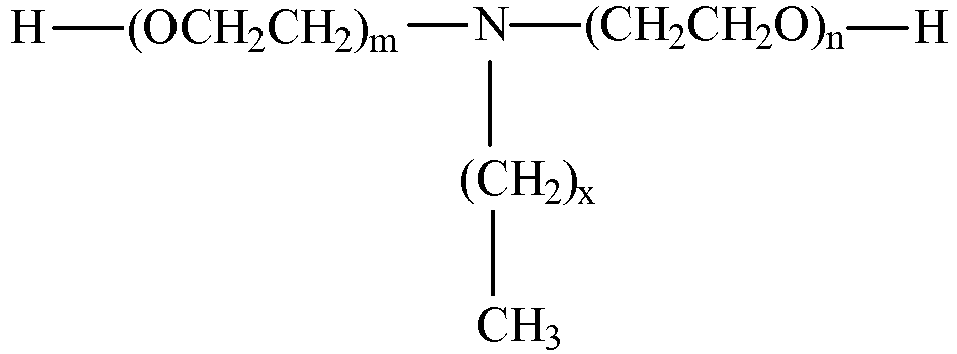
- the polyether blocks can also be made up of ethoxylated primary amines.
- ethoxylated primary amines we can cite the products of formula: in which m and n are integers between 1 and 20 and x an integer between 8 and 18. These products are for example commercially available under the brand NORAMOX ® from the company CECA and under the brand GENAMIN ® from the company CLARIANT.
- the flexible polyether blocks may comprise polyoxyalkylene blocks with NH 2 chain ends, such blocks being obtainable by cyanoacetylation of aliphatic polyoxyalkylene ⁇ , ⁇ -dihydroxylated blocks called polyetherdiols.
- the commercial products Jefifamine or Elastamine can be used (for example Jeffamine ® D400, D2000, ED 2003, XTJ 542, commercial products from the company Huntsman, also described in the documents JP 2004346274 , JP 2004352794 And EP 1482011 ).
- the polyetherdiol blocks are either used as is and copolycondensed with polyamide blocks with carboxylic ends, or aminated to be transformed into polyether diamines and condensed with polyamide blocks with carboxylic ends.
- the general method for the two-step preparation of PEBA copolymers having ester bonds between the PA blocks and the PE blocks is known and is described, for example, in the document FR 2846332 .
- the general method for preparing the PEBA copolymers of the invention having amide bonds between the PA blocks and the PE blocks is known and described, for example in the document EP 1482011 .
- the polyether blocks can also be mixed with polyamide precursors and a diacid chain limiter to prepare polyamide block and polyether block polymers having statistically distributed units (one-step process).
- PEBA in the present description of the invention relates both to PEBAX ® marketed by Arkema, to Vestamid ® marketed by Evonik ® , to Grilamid ® marketed by EMS, and to Pelestat ® type PEBA marketed by Sanyo or to any other PEBA from other suppliers.
- block copolymers described above generally comprise at least one polyamide block and at least one polyether block
- the present invention also covers all copolymer alloys comprising two, three, four (or even more) different blocks chosen from those described in the present description, since these blocks comprise at least polyamide and polyether blocks.
- the copolymer alloy according to the invention may comprise a segmented block copolymer comprising three different types of blocks (or “triblock”), which results from the condensation of several of the blocks described above.
- Said triblock is preferably chosen from copolyetheresteramides and copolyetheramideurethanes.
- the foam of the invention comprises a PEBA copolymer as described above: preferably only one such copolymer is used. It is however possible to use a mixture of two or more PEBA copolymers as described above.
- the number average molar mass of the polyamide blocks in the PEBA copolymer is from 200 to 1500 g/mol; the number average molar mass of the polyether blocks is from 800 to 2500 g/mol; and the mass ratio of the polyamide blocks relative to the polyether blocks of the copolymer is 0.1 to 0.7.
- n monomer represents the number of moles of monomer
- n diacid represents the number of moles of excess diacid limiter
- MW repeat unit represents the molar mass of the repeat unit
- MW diacid represents the molar mass of the diacid in excess.
- the copolymers are defined by the following ranges of number average molar masses M n : M n polyamide blocks M n polyether blocks No. 1 200 to 300 g/mol 800 to 1000 g/mol No. 2 300 to 400 g/mol 800 to 1000 g/mol No. 3 400 to 500 g/mol 800 to 1000 g/mol No. 4 500 to 600 g/mol 800 to 1000 g/mol No.5 600 to 700 g/mol 800 to 1000 g/mol No. 6 700 to 800 g/mol 800 to 1000 g/mol No.7 800 to 900 g/mol 800 to 1000 g/mol No.8 900 to 1000 g/mol 800 to 1000 g/mol No.
- the mass ratio of the polyamide blocks relative to the polyether blocks of the copolymer is 0.1 to 0.7. This mass ratio can be calculated by dividing the number average molar mass of the polyamide blocks by the shade average molar mass of the polyether blocks.
- this ratio is from 0.1 to 0.2; or from 0.2 to 0.3; or from 0.3 to 0.4; or from 0.4 to 0.5; or from 0.5 to 0.6; or from 0.6 to 0.7.
- the copolymer used in the invention has an instantaneous hardness less than or equal to 40 Shore D, more preferably less than or equal to 35 Shore D. Hardness measurements can be carried out according to the ISO 868 standard.
- the copolymer with polyamide blocks and polyether blocks is used to form a foam, without a crosslinking step.
- the foam is formed by mixing the molten copolymer with a blowing agent and then performing a foaming step.
- the foam thus formed consists essentially, or even consists, of the copolymer described above (or the copolymers, if a mixture of copolymers is used) and optionally the expanding agent, if the latter remains present in the pores of the foam, especially if it is a closed-pore foam.
- the copolymer with polyamide blocks and polyether blocks can be combined with various additives, for example copolymers of ethylene and vinyl acetate or EVA (for example those marketed under the name Evatane ® by Arkema), or copolymers of ethylene and acrylate, or copolymers of ethylene and alkyl (meth) acrylate, for example those marketed under the name Lotryl ® by Arkema.
- EVA for example those marketed under the name Evatane ® by Arkema
- copolymers of ethylene and acrylate or copolymers of ethylene and alkyl (meth) acrylate, for example those marketed under the name Lotryl ® by Arkema.
- These additives can allow you to adjust the hardness of the foamed part, its appearance and its comfort.
- the additives can be added in a content of 0 to 50% by weight, preferably 5 to 30% by weight, relative to the copolymer with polyamide blocks and polyether blocks.
- the blowing agent can be a chemical or physical agent.
- it is a physical agent, such as for example dinitrogen or carbon dioxide, or a hydrocarbon, chlorofluorocarbon, hydrochlorocarbon, hydrofluorocarbon or hydrochlorofluorocarbon (saturated or unsaturated).
- a physical agent such as for example dinitrogen or carbon dioxide, or a hydrocarbon, chlorofluorocarbon, hydrochlorocarbon, hydrofluorocarbon or hydrochlorofluorocarbon (saturated or unsaturated).
- butane or pentane can be used.
- a physical blowing agent is mixed with the copolymer in liquid or supercritical form and then converted to the gas phase during the foaming step.
- the mixture of the copolymer and the expanding agent is injected into a mold, and foaming is produced by opening the mold.
- foaming techniques that can be used include “batch” foaming and extrusion foaming.
- the foam produced according to the invention preferably has a density of 50 to 800 kg/m 3 , and more particularly preferably 100 to 600 kg/m 3 . Density control can be achieved by adapting the parameters of the manufacturing process.
- this foam has a rebound resilience, according to the ISO 8307 standard, greater than or equal to 55%.
- this foam has a residual deformation in compression, according to the ISO 7214 standard, less than or equal to 10%, and more particularly preferably less than or equal to 8%.
- this foam also has excellent fatigue resistance and damping properties.
- the foam according to the invention can be used to manufacture sports equipment, such as soles of sports shoes, ski boots, midsoles, insoles, or also functional sole components, in the form of inserts in different parts of the sole (heel or arch for example), or even components of shoe uppers in the form of reinforcements or inserts in the structure of the shoe upper , in the form of protections.
- sports equipment such as soles of sports shoes, ski boots, midsoles, insoles, or also functional sole components, in the form of inserts in different parts of the sole (heel or arch for example), or even components of shoe uppers in the form of reinforcements or inserts in the structure of the shoe upper , in the form of protections.
- balls can also be used to manufacture balls, sports gloves (for example football gloves), golf ball components, rackets, protective elements (vests, interior elements of helmets, shells, etc.).
- sports gloves for example football gloves
- golf ball components for example, golf ball components
- rackets for example, rackets
- protective elements vests, interior elements of helmets, shells, etc.).
- the foam according to the invention has interesting anti-shock, anti-vibration and anti-noise properties, combined with haptic properties adapted to capital goods. It can therefore also be used for the manufacture of railway rail bases, or various parts in the automobile industry, in transport, in electrical and electronic equipment, in construction or in the manufacturing industry.
- An advantage of the foam objects according to the invention is that they can be easily recycled, for example by melting them in an extruder equipped with a degassing outlet (optionally after having cut them into pieces).
- Tf designates the melting temperature of the copolymer
- Tc designates its crystallization temperature.
- the polyether blocks are PTMG blocks for all of these copolymers.
- Copolymers A to D are according to the invention, and copolymers E and F correspond to comparative examples.
- the foaming agent used is dinitrogen introduced at 0.6% by weight.
- thermoplastic polyurethane foam from the Infinergy brand (BASF) is also used as controls, as well as a crosslinked EVA foam.
- - density according to ISO 845 standard
- - rebound resilience according to the ISO 8307 standard (a steel ball weighing 16.8 g and 16 mm in diameter is dropped from a height of 500 mm onto a foam sample, the rebound resilience then corresponds to the percentage of energy returned to the ball, or percentage of the initial height reached by the ball on rebound);
- - residual deformation in compression a measurement is carried out consisting of compressing a sample at a given deformation rate and for a given time, then releasing the released stress, and note residual deformation after a recovery time; the measurement is adapted from the ISO 7214 standard, with a deformation of 50%, a holding time of 22 h, a temperature of 23°C, and by carrying out a measurement after 30 min and another measurement after 24 h of recovery.
- a compressive fatigue test is carried out on the foam manufactured with PEBA n°B at 200 kg/m 3 as well as on a control TPU foam.
- the fatigue test is carried out at a frequency of 1.5 Hz on a sample of 50 mm in diameter and approximately 15 mm in thickness.
- a stress is applied which varies according to a sinusoidal signal between 0 and 360 kPa or between 0 and 720 kPa, using a hydraulic dynamometer (MTS810).
- MTS810 hydraulic dynamometer
- the results are illustrated on the figure 1 .
- the curve marked with white squares corresponds to the control foam tested at 720 kPa.
- the curve marked with the white circles corresponds to the foam according to the invention tested at 720 kPa.
- the curve marked with black circles corresponds to the control foam tested at 360 kPa.
- the curve marked with the gray crosses corresponds to the foam according to the invention tested at 360 kPa.
- the foam according to the invention regains its initial shape (minimum residual deformation level) more quickly than the control foam.
Landscapes
- Chemical & Material Sciences (AREA)
- Health & Medical Sciences (AREA)
- Chemical Kinetics & Catalysis (AREA)
- Medicinal Chemistry (AREA)
- Polymers & Plastics (AREA)
- Organic Chemistry (AREA)
- Engineering & Computer Science (AREA)
- Materials Engineering (AREA)
- Compositions Of Macromolecular Compounds (AREA)
- Manufacture Of Porous Articles, And Recovery And Treatment Of Waste Products (AREA)
- Polyamides (AREA)
- Injection Moulding Of Plastics Or The Like (AREA)
- Molding Of Porous Articles (AREA)
Description
La présente invention concerne une mousse formée à partir d'un copolymère à blocs polyamides et à blocs polyéthers ainsi qu'un procédé de fabrication de celle-ci.The present invention relates to a foam formed from a copolymer with polyamide blocks and polyether blocks as well as a method of manufacturing the same.
Diverses mousses polymères sont utilisées notamment dans le domaine des équipements sportifs, tels que des semelles ou composants de semelles, des gants, raquettes ou balles de golf, des éléments de protection individuelle en particulier pour la pratique du sport (gilets, pièces intérieures de casques, de coques...).Various polymer foams are used in particular in the field of sports equipment, such as soles or sole components, gloves, rackets or golf balls, individual protection elements in particular for the practice of sport (vests, interior parts of helmets , shells...).
De telles applications nécessitent un ensemble de propriétés physiques particulières assurant une aptitude au rebond, une faible déformation permanente en compression et une aptitude à endurer des impacts répétés sans se déformer et à revenir à la forme initiale.Such applications require a set of particular physical properties ensuring ability to rebound, low permanent deformation in compression and an ability to withstand repeated impacts without deforming and returning to the initial shape.
Les documents
Le document
Les mousses réticulées ont pour inconvénient de présenter des contraintes importantes d'un point de vue du procédé de fabrication : la durée de fabrication est généralement élevée, la fabrication est généralement nécessairement en mode discontinu (batch) uniquement, et des produits chimiques indésirables doivent être manipulés.Reticulated foams have the disadvantage of presenting significant constraints from the point of view of the manufacturing process: the manufacturing time is generally long, manufacturing is generally necessarily in batch mode only, and undesirable chemicals must be manipulated.
En outre, des mousses réticulées sont difficilement recyclables après utilisation.In addition, reticulated foams are difficult to recycle after use.
Le document
Le document
Par ailleurs, la société Zotefoams commercialise des mousses réticulées fabriquées à partir de copolymères à blocs polyamides et blocs polyéthers, sous le nom ZOTEK®PEBA. Les inconvénients de la réticulation ont été rappelés ci-dessus. De plus, la durabilité des produits est imparfaite.Furthermore, the company Zotefoams markets reticulated foams made from polyamide block and polyether block copolymers, under the name ZOTEK ® PEBA. The disadvantages of crosslinking have been recalled above. Additionally, product durability is imperfect.
Il existe également de nombreuses mousses fabriquées à partir de polyuréthane thermoplastique (TPU) ou d'éthylène-acétate de vinyle (EVA). Ces mousses présentent une gamme de température d'utilisation relativement restreinte, ainsi qu'une déformation rémanente en compression aux temps courts qui est relativement faible, et une durabilité imparfaite. Leurs procédés de fabrication sont en outre contraignants.There are also many foams made from thermoplastic polyurethane (TPU) or ethylene vinyl acetate (EVA). These foams have a relatively narrow range of use temperatures, as well as a residual deformation in compression over short periods of time which is relatively low, and imperfect durability. Their manufacturing processes are also restrictive.
Il existe donc un besoin de fournir des mousses polymères de faible densité, ayant une ou plusieurs propriétés avantageuses parmi : une capacité élevée à restituer de l'énergie élastique lors de sollicitations sous faible contrainte ; une faible déformation rémanente en compression ; et une résistance élevée à la fatigue en compression.There is therefore a need to provide low density polymer foams, having one or more advantageous properties including: a high capacity to restore elastic energy during loading under low stress; low residual deformation in compression; and high resistance to compressive fatigue.
L'invention concerne en premier lieu une mousse de copolymère à blocs polyamides et à blocs polyéthers non réticulé, dans laquelle :
- les blocs polyamides du copolymère ont une masse molaire moyenne en nombre de 200 à 1500 g/mol ;
- les blocs polyéthers du copolymère ont une masse molaire moyenne en nombre de 800 à 2500 g/mol ; et
- le rapport massique des blocs polyamides par rapport aux blocs polyéthers du copolymère est de 0,1 à 0,7, le rapport massique étant calculé en divisant la masse molaire moyenne en nombre des blocs polyamides par la masse molaire moyenne en nombre des blocs polyéthers.
- the polyamide blocks of the copolymer have a number average molar mass of 200 to 1500 g/mol;
- the polyether blocks of the copolymer have a number average molar mass of 800 to 2500 g/mol; And
- the mass ratio of the polyamide blocks relative to the polyether blocks of the copolymer is 0.1 to 0.7, the mass ratio being calculated by dividing the number-average molar mass of the polyamide blocks by the number-average molar mass of the polyether blocks.
Selon un mode de réalisation :
- les blocs polyamides du copolymère ont une masse molaire moyenne en nombre de 400 à 1000 g/mol, de préférence de 600 à 850 g/mol ;
- les blocs polyéthers du copolymère ont une masse molaire moyenne en nombre de 1000 à 2000 g/mol ; et
- le rapport massique des blocs polyamides par rapport aux blocs polyéthers du copolymère est de 0,3 à 0,6.
- the polyamide blocks of the copolymer have a number average molar mass of 400 to 1000 g/mol, preferably of 600 to 850 g/mol;
- the polyether blocks of the copolymer have a number average molar mass of 1000 to 2000 g/mol; And
- the mass ratio of the polyamide blocks relative to the polyether blocks of the copolymer is 0.3 to 0.6.
Selon un mode de réalisation, les blocs polyamides du copolymère sont des blocs de polyamide 11, ou de polyamide 12, ou de polyamide 6, ou de polyamide 6.10.According to one embodiment, the polyamide blocks of the copolymer are blocks of polyamide 11, or polyamide 12, or polyamide 6, or polyamide 6.10.
Selon un mode de réalisation, les blocs polyéthers du copolymère sont des blocs de polyéthylène glycol ou de polytétrahydrofurane.According to one embodiment, the polyether blocks of the copolymer are blocks of polyethylene glycol or polytetrahydrofuran.
Selon un mode de réalisation, la mousse présente une densité inférieure ou égale à 800 kg/m3, de préférence inférieure ou égale à 600 kg/m3, de manière plus particulièrement préférée inférieure ou égale à 400 kg/m3, voire inférieure ou égale à 300 kg/m3.According to one embodiment, the foam has a density less than or equal to 800 kg/m 3 , preferably less than or equal to 600 kg/m 3 , more particularly preferably less than or equal to 400 kg/m 3 , or even less or equal to 300 kg/m 3 .
Selon un mode de réalisation, la mousse contient également un ou plusieurs additifs, de préférence choisis parmi les copolymères d'éthylène et acétate de vinyle, les copolymères d'éthylène et d'acrylate, et les copolymères d'éthylène et d'alkyl(méth)acrylate.According to one embodiment, the foam also contains one or more additives, preferably chosen from copolymers of ethylene and vinyl acetate, copolymers of ethylene and acrylate, and copolymers of ethylene and alkyl ( meth)acrylate.
L'invention concerne aussi un procédé de fabrication de cette mousse, comprenant une étape de mélange du copolymère à l'état fondu, éventuellement avec un ou des additifs, et avec un agent d'expansion, et une étape de moussage du mélange de copolymère et d'agent d'expansion.The invention also relates to a process for manufacturing this foam, comprising a step of mixing the copolymer in the molten state, optionally with one or more additives, and with an expanding agent, and a step of foaming the copolymer mixture and expanding agent.
Selon un mode de réalisation, l'agent d'expansion est un agent d'expansion physique, de préférence choisi parmi le diazote, le dioxyde de carbone, les hydrocarbures, les chloroflurocarbures, les hydrochlorocarbures, les hydrofluorocarbures et les hydrochlorofluorocarbures.According to one embodiment, the blowing agent is a physical blowing agent, preferably chosen from dinitrogen, carbon dioxide, hydrocarbons, chlorofluorocarbons, hydrochlorocarbons, hydrofluorocarbons and hydrochlorofluorocarbons.
Selon un mode de réalisation, le procédé comprend une étape d'injection du mélange de copolymère et d'agent d'expansion dans un moule, le moussage du mélange étant effectué par l'ouverture du moule.According to one embodiment, the method comprises a step of injecting the mixture of copolymer and expanding agent into a mold, the foaming of the mixture being carried out by the opening of the mold.
L'invention concerne également un article constitué de la mousse ci-dessus.The invention also relates to an article made of the above foam.
L'invention concerne également un article comprenant au moins un élément constitué de la mousse ci-dessus.The invention also relates to an article comprising at least one element consisting of the above foam.
Selon un mode de réalisation, l'article de l'invention est choisi parmi les semelles de chaussures de sport, les ballons ou balles, les gants, les équipements de protection individuels, les semelles pour rails, les pièces automobiles, les pièces de construction et les pièces d'équipements électriques et électroniques.According to one embodiment, the article of the invention is chosen from sports shoe soles, balls, gloves, individual protective equipment, soles for rails, automobile parts, construction parts and parts of electrical and electronic equipment.
La présente invention permet de surmonter les inconvénients de l'état de la technique. Elle fournit plus particulièrement des mousses polymères de faible densité, ayant une ou plusieurs propriétés avantageuses parmi : une capacité élevée à restituer de l'énergie élastique lors de sollicitations sous faible contrainte ; une faible déformation rémanente en compression ; et une résistance élevée à la fatigue en compression.The present invention makes it possible to overcome the disadvantages of the state of the art. It more particularly provides low density polymer foams, having one or more advantageous properties including: a high capacity to restore elastic energy during loading under low stress; low residual compression deformation; and high resistance to compressive fatigue.
De manière avantageuse, ces propriétés sont obtenues sur une large gamme de température, de préférence de -20°C à 50°C, voire de -30°C à 80°C.Advantageously, these properties are obtained over a wide temperature range, preferably from -20°C to 50°C, or even from -30°C to 80°C.
Cela est accompli grâce à l'utilisation d'un copolymère à blocs polyamides et à blocs polyéthers non réticulé, caractérisé par des gammes particulières de masse molaire pour les blocs polyamides et les blocs polyéthers, ainsi qu'une gamme particulière de rapport massique entre les blocs polyamides et les blocs polyéthers.This is accomplished through the use of a non-crosslinked polyamide block and polyether block copolymer, characterized by particular molar mass ranges for the polyamide blocks and polyether blocks, as well as a particular range of mass ratio between the polyamide blocks and polyether blocks.
La
L'invention est maintenant décrite plus en détail et de façon non limitative dans la description qui suit.The invention is now described in more detail and in a non-limiting manner in the description which follows.
L'invention utilise un copolymère à blocs polyamides et à blocs polyéthers, ou « PEBA ».The invention uses a copolymer with polyamide blocks and polyether blocks, or “PEBA”.
Les PEBA résultent de la polycondensation de blocs polyamides à extrémités réactives avec des blocs polyéthers à extrémités réactives, telle que, entre autres la polycondensation :
- 1) de blocs polyamides à bouts de chaîne diamines avec des blocs polyoxyalkylènes à bouts de chaînes dicarboxyliques ;
- 2) de blocs polyamides à bouts de chaînes dicarboxyliques avec des blocs polyoxyalkylènes à bouts de chaînes diamines, obtenues par exemple par cyanoéthylation et hydrogénation de blocs polyoxyalkylène α,ω-dihydroxylées aliphatiques appelés polyétherdiols ;
- 3) de blocs polyamides à bouts de chaînes dicarboxyliques avec des polyétherdiols, les produits obtenus étant, dans ce cas particulier, des polyétheresteramides.
- 1) polyamide blocks with diamine chain ends with polyoxyalkylene blocks with dicarboxylic chain ends;
- 2) polyamide blocks with dicarboxylic chain ends with polyoxyalkylene blocks with diamine chain ends, obtained for example by cyanoethylation and hydrogenation of aliphatic α,ω-dihydroxylated polyoxyalkylene blocks called polyetherdiols;
- 3) polyamide blocks with dicarboxylic chain ends with polyetherdiols, the products obtained being, in this particular case, polyetheresteramides.
Les blocs polyamides à bouts de chaînes dicarboxyliques proviennent, par exemple, de la condensation de précurseurs de polyamides en présence d'un diacide carboxylique limiteur de chaîne. Les blocs polyamides à bouts de chaînes diamines proviennent par exemple de la condensation de précurseurs de polyamides en présence d'une diamine limiteur de chaîne.Polyamide blocks with dicarboxylic chain ends come, for example, from the condensation of polyamide precursors in the presence of a chain-limiting dicarboxylic acid. Polyamide blocks with diamine chain ends come, for example, from the condensation of polyamide precursors in the presence of a chain-limiting diamine.
On peut utiliser avantageusement trois types de blocs polyamides.Three types of polyamide blocks can advantageously be used.
Selon un premier type, les blocs polyamides proviennent de la condensation d'un diacide carboxylique, en particulier ceux ayant de 4 à 20 atomes de carbone, de préférence ceux ayant de 6 à 18 atomes de carbone, et d'une diamine aliphatique ou aromatique, en particulier celles ayant de 2 à 20 atomes de carbone, de préférence celles ayant de 6 à 14 atomes de carbone.According to a first type, the polyamide blocks come from the condensation of a dicarboxylic acid, in particular those having from 4 to 20 carbon atoms, preferably those having from 6 to 18 carbon atoms, and an aliphatic or aromatic diamine , in particular those having from 2 to 20 carbon atoms, preferably those having from 6 to 14 carbon atoms.
A titre d'exemples d'acides dicarboxyliques, on peut citer l'acide 1,4-cyclohexyldicarboxylique, les acides butanedioïque, adipique, azélaïque, subérique, sébacique, dodécanedicarboxylique, octadécanedicarboxylique et les acides téréphtalique et isophtalique, mais aussi les acides gras dimérisés.As examples of dicarboxylic acids, mention may be made of 1,4-cyclohexyldicarboxylic acid, butanedioic, adipic, azelaic, suberic, sebacic, dodecanedicarboxylic, octadecanedicarboxylic acids and terephthalic and isophthalic acids, but also dimerized fatty acids. .
A titre d'exemples de diamines, on peut citer la tétraméthylène diamine, l'hexaméthylènediamine, la 1,10-décaméthylènediamine, la dodécaméthylènediamine, la triméthylhexaméthylène diamine, les isomères des bis-(4-aminocyclohexyl)-méthane (BACM), bis-(3-méthyl-4-aminocyclohexyl)méthane (BMACM), et 2-2-bis-(3-méthyl-4-aminocyclohexyl)-propane (BMACP), le para-amino-di-cyclo-hexyl-méthane (PACM), l'isophoronediamine (IPDA), la 2,6-bis-(aminométhyl)-norbornane (BAMN) et la pipérazine (Pip).As examples of diamines, mention may be made of tetramethylene diamine, hexamethylenediamine, 1,10-decamethylenediamine, dodecamethylenediamine, trimethylhexamethylenediamine, isomers of bis-(4-aminocyclohexyl)-methane (BACM), bis -(3-methyl-4-aminocyclohexyl)methane (BMACM), and 2-2-bis-(3-methyl-4-aminocyclohexyl)-propane (BMACP), para-amino-di-cyclohexyl-methane ( PACM), isophoronediamine (IPDA), 2,6-bis-(aminomethyl)-norbornane (BAMN) and piperazine (Pip).
Avantageusement, des blocs polyamides PA 4.12, PA 4.14, PA 4.18, PA 6.10, PA 6.12, PA 6.14, PA 6.18, PA 9.12, PA 10.10, PA 10.12, PA 10.14 et PA 10.18 sont utilisés. Dans la notation PA X.Y, X représente le nombre d'atomes de carbone issu des résidus de diamine, et Y représente le nombre d'atomes de carbone issu des résidus de diacide, de façon conventionnelle.Advantageously, polyamide blocks PA 4.12, PA 4.14, PA 4.18, PA 6.10, PA 6.12, PA 6.14, PA 6.18, PA 9.12, PA 10.10, PA 10.12, PA 10.14 and PA 10.18 are used. In the PA notation X.Y,
Selon un deuxième type, les blocs polyamides résultent de la condensation d'un ou plusieurs acides α,ω-aminocarboxyliques et/ou d'un ou plusieurs lactames ayant de 6 à 12 atomes de carbone en présence d'un diacide carboxylique ayant de 4 à 12 atomes de carbone ou d'une diamine. A titre d'exemples de lactames, on peut citer le caprolactame, l'oenantholactame et le lauryllactame. A titre d'exemples d'acide α,ω-amino carboxylique, on peut citer les acides aminocaproïque, amino-7-heptanoïque, amino-11-undécanoïque et amino-12-dodécanoïque.According to a second type, the polyamide blocks result from the condensation of one or more α,ω-aminocarboxylic acids and/or one or more lactams having from 6 to 12 carbon atoms in the presence of a dicarboxylic acid having 4 with 12 carbon atoms or a diamine. As examples of lactams, we can cite caprolactam, oenantholactam and lauryllactam. As examples of α,ω-amino carboxylic acid, we can cite aminocaproic, amino-7-heptanoic, amino-11-undecanoic and amino-12-dodecanoic acids.
Avantageusement les blocs polyamides du deuxième type sont des blocs de PA 11 (polyundécanamide), de PA 12 (polydodécanamide) ou de PA 6 (polycaprolactame). Dans la notation PA X, X représente le nombre d'atomes de carbone issus des résidus d'aminoacide.Advantageously, the polyamide blocks of the second type are blocks of PA 11 (polyundecanamide), PA 12 (polydodecanamide) or PA 6 (polycaprolactam). In PA X notation, X represents the number of carbon atoms from amino acid residues.
Selon un troisième type, les blocs polyamides résultent de la condensation d'au moins un acide α,ω-aminocarboxylique (ou un lactame), au moins une diamine et au moins un diacide carboxylique.According to a third type, the polyamide blocks result from the condensation of at least one α,ω-aminocarboxylic acid (or a lactam), at least one diamine and at least one dicarboxylic acid.
Dans ce cas, on prépare les blocs polyamide PA par polycondensation :
- de la ou des diamines aliphatiques linéaires ou aromatiques ayant X atomes de carbone ;
- du ou des diacides carboxyliques ayant Y atomes de carbone ; et
- du ou des comonomères {Z}, choisis parmi les lactames et les acides α,ω-aminocarboxyliques ayant Z atomes de carbone et les mélanges équimolaires d'au moins une diamine ayant X1 atomes de carbone et d'au moins un diacide carboxylique ayant Y1 atomes de carbones, (X1, Y1) étant différent de (X, Y),
- ledit ou lesdits comonomères {Z} étant introduits dans une proportion pondérale allant avantageusement jusqu'à 50%, de préférence jusqu'à 20%, encore plus avantageusement jusqu'à 10% par rapport à l'ensemble des monomères précurseurs de polyamide ;
- en présence d'un limiteur de chaîne choisi parmi les diacides carboxyliques.
- linear or aromatic aliphatic diamine(s) having X carbon atoms;
- dicarboxylic acid(s) having Y carbon atoms; And
- of the comonomer(s) {Z}, chosen from lactams and α,ω-aminocarboxylic acids having Z carbon atoms and equimolar mixtures of at least one diamine having X1 carbon atoms and at least one dicarboxylic acid having Y1 carbon atoms, (X1, Y1) being different from (X, Y),
- said comonomer(s) {Z} being introduced in a weight proportion advantageously up to 50%, preferably up to 20%, even more advantageously up to 10% relative to all of the polyamide precursor monomers;
- in the presence of a chain limiter chosen from dicarboxylic acids.
Avantageusement, on utilise comme limiteur de chaîne le diacide carboxylique ayant Y atomes de carbone, que l'on introduit en excès par rapport à la stoechiométrie de la ou des diamines.Advantageously, the dicarboxylic acid having Y carbon atoms is used as chain limiter, which is introduced in excess relative to the stoichiometry of the diamine(s).
Selon une variante de ce troisième type, les blocs polyamides résultent de la condensation d'au moins deux acides α,ω-aminocarboxyliques ou d'au moins deux lactames ayant de 6 à 12 atomes de carbone ou d'un lactame et d'un acide aminocarboxylique n'ayant pas le même nombre d'atomes de carbone en présence éventuelle d'un limiteur de chaîne. A titre d'exemples d'acide α,ω-aminocarboxylique aliphatique, on peut citer les acides aminocaproïques, amino-7-heptanoïque, amino-11-undécanoïque et amino-12-dodécanoïque. A titre d'exemples de lactame, on peut citer le caprolactame, l'oenantholactame et le lauryllactame. A titre d'exemples de diamines aliphatiques, on peut citer l'hexaméthylènediamine, la dodécaméthylènediamine et la triméthylhexaméthylène diamine. A titre d'exemples de diacides cycloaliphatiques, on peut citer l'acide 1,4-cyclohexyldicarboxylique. A titre d'exemples de diacides aliphatiques, on peut citer les acides butane-dioïque, adipique, azélaïque, subérique, sébacique, dodécanedicarboxylique, les acides gras dimérisés. Ces acides gras dimérisés ont de préférence une teneur en dimère d'au moins 98% ; de préférence ils sont hydrogénés ; il s'agit par exemple des produits commercialisés sous la marque "PRIPOL" par la société "CRODA", ou sous la marque EMPOL par la société BASF, ou sous la marque Radiacid par la société OLEON, et des polyoxyalkylènes α,ω-diacides. A titre d'exemples de diacides aromatiques, on peut citer les acides téréphtalique (T) et isophtalique (I). A titre d'exemples de diamines cycloaliphatiques, on peut citer les isomères des bis-(4-aminocyclohexyl)-méthane (BACM), bis-(3-méthyl-4-aminocyclohexyl)méthane (BMACM) et 2-2-bis-(3-méthyl-4-aminocyclohexyl)-propane(BMACP), et le para-amino-di-cyclo-hexyl-méthane (PACM). Les autres diamines couramment utilisées peuvent être l'isophoronediamine (IPDA), la 2,6-bis-(aminométhyl)-norbornane (BAMN) et la pipérazine.According to a variant of this third type, the polyamide blocks result from the condensation of at least two α, ω-aminocarboxylic acids or at least two lactams having 6 to 12 carbon atoms or of a lactam and a aminocarboxylic acid not having the same number of carbon atoms in the possible presence of a chain limiter. As examples of aliphatic α,ω-aminocarboxylic acid, mention may be made of aminocaproic, amino-7-heptanoic, amino-11-undecanoic and amino-12-dodecanoic acids. As examples of lactam, we can cite caprolactam, oenantholactam and lauryllactam. As examples of aliphatic diamines, mention may be made of hexamethylenediamine, dodecamethylenediamine and trimethylhexamethylenediamine. As examples of cycloaliphatic diacids, mention may be made of 1,4-cyclohexyldicarboxylic acid. As examples of aliphatic diacids, mention may be made of butane-dioic, adipic, azelaic, suberic, sebacic, dodecanedicarboxylic acids and dimerized fatty acids. These dimerized fatty acids preferably have a dimer content of at least 98%; preferably they are hydrogenated; these are for example products marketed under the brand "PRIPOL" by the company "CRODA", or under the brand EMPOL by the company BASF, or under the brand Radiacid by the company OLEON, and polyoxyalkylenes α,ω-diacids . As examples of aromatic diacids, we can cite terephthalic (T) and isophthalic (I) acids. As examples of cycloaliphatic diamines, mention may be made of the isomers of bis-(4-aminocyclohexyl)-methane (BACM), bis-(3-methyl-4-aminocyclohexyl)methane (BMACM) and 2-2-bis- (3-methyl-4-aminocyclohexyl)-propane (BMACP), and para-amino-di-cyclohexyl-methane (PACM). Other commonly used diamines may be isophoronediamine (IPDA), 2,6-bis-(aminomethyl)-norbornane (BAMN), and piperazine.
A titre d'exemples de blocs polyamides du troisième type, on peut citer les suivants :
- le PA 6.6/6, où 6.6 désigne des motifs hexaméthylènediamine condensée avec l'acide adipique et 6 désigne des motifs résultant de la condensation du caprolactame ;
- le PA 6.6/6.10/11/12, où 6.6 désigne l'hexaméthylènediamine condensée avec l'acide adipique, 6.10 désigne l'hexaméthylènediamine condensée avec l'acide sébacique, 11 désigne des motifs résultant de la condensation de l'acide aminoundécanoïque et 12 désigne des motifs résultant de la condensation du lauryllactame.
- PA 6.6/6, where 6.6 designates hexamethylenediamine units condensed with adipic acid and 6 designates units resulting from the condensation of caprolactam;
- PA 6.6/6.10/11/12, where 6.6 designates hexamethylenediamine condensed with adipic acid, 6.10 designates hexamethylenediamine condensed with sebacic acid, 11 designates units resulting from the condensation of aminoundecanoic acid and 12 designates patterns resulting from the condensation of lauryllactam.
Les notations PA X/Y, PA X/Y/Z, etc. se rapportent à des copolyamides dans lesquels X, Y, Z, etc. représentent des unités homopolyamides telles que décrites ci-dessus.The notations PA X/Y, PA X/Y/Z, etc. relate to copolyamides in which X, Y, Z, etc. represent homopolyamide units as described above.
Avantageusement, les blocs polyamides du copolymère utilisé dans l'invention comprennent des blocs de polyamide PA 6, PA 11, PA 12, PA 5.4, PA 5.9, PA 5.10, PA 5.12, PA 5.13, PA 5.14, PA 5.16, PA 5.18, PA 5.36, PA 6.4, PA 6.9, PA 6.10, PA 6.12, PA 6.13, PA 6.14, PA 6.16, PA 6.18, PA 6.36, PA 10.4, PA 10.9, PA 10.10, PA 10.12, PA 10.13, PA 10.14, PA 10.16, PA 10.18, PA 10.36, PA 10.T, PA 12.4, PA 12.9, PA 12.10, PA 12.12, PA 12.13, PA 12.14, PA 12.16, PA 12.18, PA 12.36, PA 12.T, ou des mélanges ou copolymères de ceux-ci ; et de préférence comprennent des blocs de polyamide PA 6, PA 11, PA 12, PA 6.10, PA 10.10, PA 10.12, ou des mélanges ou copolymères de ceux-ci.Advantageously, the polyamide blocks of the copolymer used in the invention comprise blocks of polyamide PA 6, PA 11, PA 12, PA 5.4, PA 5.9, PA 5.10, PA 5.12, PA 5.13, PA 5.14, PA 5.16, PA 5.18, PA 5.36, PA 6.4, PA 6.9, PA 6.10, PA 6.12, PA 6.13, PA 6.14, PA 6.16, PA 6.18, PA 6.36, PA 10.4, PA 10.9, PA 10.10, PA 10.12, PA 10.13, PA 10.14, PA 10.16 , PA 10.18, PA 10.36, PA 10.T, PA 12.4, PA 12.9, PA 12.10, PA 12.12, PA 12.13, PA 12.14, PA 12.16, PA 12.18, PA 12.36, PA 12.T, or mixtures or copolymers thereof; and preferably comprise blocks of polyamide PA 6, PA 11, PA 12, PA 6.10, PA 10.10, PA 10.12, or mixtures or copolymers thereof.
Les blocs polyéthers sont constitués de motifs d'oxyde d'alkylène.The polyether blocks are made up of alkylene oxide units.
Les blocs polyéthers peuvent notamment être des blocs PEG (polyéthylène glycol) c'est à dire constitués de motifs oxyde d'éthylène, et/ou des blocs PPG (propylène glycol) c'est à dire constitués de motifs oxyde de propylène, et/ou des blocs PO3G (polytriméthylène glycol) c'est-à-dire constitués de motifs polytriméthylène ether de glycol, et/ou des blocs PTMG c'est à dire constitués de motifs tetraméthylène de glycol appelés aussi polytétrahydrofurane. Les copolymères PEBA peuvent comprendre dans leur chaîne plusieurs types de polyéthers, les copolyéthers pouvant être à blocs ou statistiques.The polyether blocks may in particular be PEG (polyethylene glycol) blocks, i.e. made up of ethylene oxide units, and/or PPG (propylene glycol) blocks, i.e. made up of propylene oxide units, and/or or PO3G (polytrimethylene glycol) blocks, that is to say made up of polytrimethylene ether glycol units, and/or PTMG blocks, that is to say made up of tetramethylene glycol units also called polytetrahydrofuran. PEBA copolymers can include several types of polyethers in their chain, the copolyethers being able to be block or random.
On peut également utiliser des blocs obtenus par oxyéthylation de bisphénols, tels que par exemple le bisphénol A. Ces derniers produits sont décrits notamment dans le document
Les blocs polyéthers peuvent aussi être constitués d'amines primaires éthoxylées. A titre d'exemple d'amines primaires éthoxylées on peut citer les produits de formule :
Les blocs souples polyéthers peuvent comprendre des blocs polyoxyalkylènes à bouts de chaînes NH2, de tels blocs pouvant être obtenus par cyanoacétylation de blocs polyoxyalkylène α,ω-dihydroxylés aliphatiques appelées polyétherdiols. Plus particulièrement, les produits commerciaux Jefifamine ou Elastamine peuvent être utilisés (par exemple Jeffamine® D400, D2000, ED 2003, XTJ 542, produits commerciaux de la société Huntsman, également décrits dans les documents
Les blocs polyétherdiols sont soit utilisés tels quels et copolycondensés avec des blocs polyamides à extrémités carboxyliques, soit aminés pour être transformés en polyéthers diamines et condensés avec des blocs polyamides à extrémités carboxyliques. La méthode générale de préparation en deux étapes des copolymères PEBA ayant des liaisons esters entre les blocs PA et les blocs PE est connue et est décrite, par exemple, dans le document
Bien entendu, la désignation PEBA dans la présente description de l'invention se rapporte aussi bien aux PEBAX® commercialisés par Arkema, aux Vestamid® commercialisés par Evonik®, aux Grilamid® commercialisés par EMS, qu'aux Pelestat® type PEBA commercialisés par Sanyo ou à tout autre PEBA d'autres fournisseurs.Of course, the designation PEBA in the present description of the invention relates both to PEBAX ® marketed by Arkema, to Vestamid ® marketed by Evonik ® , to Grilamid ® marketed by EMS, and to Pelestat ® type PEBA marketed by Sanyo or to any other PEBA from other suppliers.
Si les copolymères à blocs décrits ci-dessus comprennent généralement au moins un bloc polyamide et au moins un bloc polyéther, la présente invention couvre également tous les alliages de copolymères comprenant deux, trois, quatre (voire plus) blocs différents choisis parmi ceux décrits dans la présente description, dès lors que ces blocs comportent au moins des blocs polyamides et polyéthers.If the block copolymers described above generally comprise at least one polyamide block and at least one polyether block, the present invention also covers all copolymer alloys comprising two, three, four (or even more) different blocks chosen from those described in the present description, since these blocks comprise at least polyamide and polyether blocks.
Par exemple, l'alliage de copolymère selon l'invention peut comprendre un copolymère segmenté à blocs comprenant trois types de blocs différents (ou « tribloc »), qui résulte de la condensation de plusieurs des blocs décrits ci-dessus. Ledit tribloc est de préférence choisi parmi les copolyétheresteramides et les copolyétheramideuréthanes.For example, the copolymer alloy according to the invention may comprise a segmented block copolymer comprising three different types of blocks (or “triblock”), which results from the condensation of several of the blocks described above. Said triblock is preferably chosen from copolyetheresteramides and copolyetheramideurethanes.
Des copolymères PEBA particulièrement préférés dans le cadre de l'invention sont les copolymères comportant des blocs :
- PA 11 et PEG ;
- PA 11 et PTMG ;
- PA 12 et PEG;
- PA 12 et PTMG ;
- PA 6.10 et PEG;
- PA 6.10 et PTMG ;
- PA 6 et PEG;
- PA 6 et PTMG.
- PA 11 and PEG;
- PA 11 and PTMG;
- PA 12 and PEG;
- PA 12 and PTMG;
- PA 6.10 and PEG;
- PA 6.10 and PTMG;
- PA 6 and PEG;
- PA 6 and PTMG.
La mousse de l'invention comporte un copolymère PEBA tel que décrit ci-dessus : de préférence un seul tel copolymère est utilisé. Il est toutefois possible d'utiliser un mélange de deux ou plus de deux copolymères PEBA tels que décrits ci-dessus.The foam of the invention comprises a PEBA copolymer as described above: preferably only one such copolymer is used. It is however possible to use a mixture of two or more PEBA copolymers as described above.
Selon l'invention, la masse molaire moyenne en nombre des blocs polyamides dans le copolymère PEBA vaut de 200 à 1500 g/mol ; la masse molaire moyenne en nombre des blocs polyéthers vaut de 800 à 2500 g/mol ; et le rapport massique des blocs polyamides par rapport aux blocs polyéthers du copolymère est de 0,1 à 0,7.According to the invention, the number average molar mass of the polyamide blocks in the PEBA copolymer is from 200 to 1500 g/mol; the number average molar mass of the polyether blocks is from 800 to 2500 g/mol; and the mass ratio of the polyamide blocks relative to the polyether blocks of the copolymer is 0.1 to 0.7.
La masse molaire moyenne en nombre est fixée par la teneur en limiteur de chaine. Elle peut être calculée selon la relation : 
Dans cette formule, nmonomère représente le nombre de moles de monomère, ndiacide représente le nombre de moles de limiteur diacide en excès, MWmotif de répétition représente la masse molaire du motif de répétition, et MWdiacide représente la masse molaire du diacide en excès.In this formula, n monomer represents the number of moles of monomer, n diacid represents the number of moles of excess diacid limiter, MW repeat unit represents the molar mass of the repeat unit, and MW diacid represents the molar mass of the diacid in excess.
Selon des modes de réalisation particuliers, les copolymères sont définis par les gammes de masses molaires moyennes en nombre Mn suivantes :
En outre, selon l'invention, le rapport massique des blocs polyamides par rapport aux blocs polyéthers du copolymère est de 0,1 à 0,7. Ce rapport massique peut être calculé en divisant la masse molaire moyenne en nombre des blocs polyamides par la masse molaire moyenne en ombre des blocs polyéthers.Furthermore, according to the invention, the mass ratio of the polyamide blocks relative to the polyether blocks of the copolymer is 0.1 to 0.7. This mass ratio can be calculated by dividing the number average molar mass of the polyamide blocks by the shade average molar mass of the polyether blocks.
Selon des modes de réalisation particuliers, ce rapport vaut de 0,1 à 0,2 ; ou de 0,2 à 0,3 ; ou de 0,3 à 0,4 ; ou de 0,4 à 0,5 ; ou de 0,5 à 0,6 ; ou de 0,6 à 0,7.According to particular embodiments, this ratio is from 0.1 to 0.2; or from 0.2 to 0.3; or from 0.3 to 0.4; or from 0.4 to 0.5; or from 0.5 to 0.6; or from 0.6 to 0.7.
De préférence, le copolymère utilisé dans l'invention présente une dureté instantanée inférieure ou égale à 40 Shore D, de préférence encore inférieure ou égale à 35 Shore D. Les mesures de dureté peuvent être effectuées selon la norme ISO 868.Preferably, the copolymer used in the invention has an instantaneous hardness less than or equal to 40 Shore D, more preferably less than or equal to 35 Shore D. Hardness measurements can be carried out according to the ISO 868 standard.
Le copolymère à blocs polyamides et à blocs polyéthers est utilisé pour former une mousse, sans étape de réticulation. La mousse est formée en mélangeant le copolymère à l'état fondu avec un agent d'expansion, puis en réalisant une étape de moussage.The copolymer with polyamide blocks and polyether blocks is used to form a foam, without a crosslinking step. The foam is formed by mixing the molten copolymer with a blowing agent and then performing a foaming step.
Selon un mode de réalisation, la mousse ainsi formée consiste essentiellement, voire consiste, en le copolymère décrit ci-dessus (ou les copolymères, si un mélange de copolymères est utilisé) et optionnellement l'agent d'expansion, si celui-ci demeure présent dans les pores de la mousse, notamment s'il s'agit d'une mousse à pores fermés.According to one embodiment, the foam thus formed consists essentially, or even consists, of the copolymer described above (or the copolymers, if a mixture of copolymers is used) and optionally the expanding agent, if the latter remains present in the pores of the foam, especially if it is a closed-pore foam.
Le copolymère à blocs polyamides et à blocs polyéthers peut être combiné à divers additifs, par exemple des copolymères d'éthylène et acétate de vinyle ou EVA (par exemple ceux commercialisés sous le nom d'Evatane® par Arkema), ou des copolymères d'éthylène et d'acrylate, ou des copolymères d'éthylène et d'alkyl(méth)acrylate, par exemple ceux commercialisé sous le nom de Lotryl® par Arkema. Ces additifs peuvent permettre d'ajuster la dureté de la pièce moussée, son aspect et son confort. Les additifs peuvent être ajoutés dans une teneur de 0 à 50 % en masse, préférentiellement de 5 à 30 % en masse, par rapport au copolymère à blocs polyamides et à blocs polyéthers.The copolymer with polyamide blocks and polyether blocks can be combined with various additives, for example copolymers of ethylene and vinyl acetate or EVA (for example those marketed under the name Evatane ® by Arkema), or copolymers of ethylene and acrylate, or copolymers of ethylene and alkyl (meth) acrylate, for example those marketed under the name Lotryl ® by Arkema. These additives can allow you to adjust the hardness of the foamed part, its appearance and its comfort. The additives can be added in a content of 0 to 50% by weight, preferably 5 to 30% by weight, relative to the copolymer with polyamide blocks and polyether blocks.
L'agent d'expansion peut être un agent chimique ou physique. De préférence, il s'agit d'un agent physique, tel que par exemple le diazote ou le dioxyde de carbone, ou un hydrocarbure, chloroflurocarbure, hydrochlorocarbure, hydrofluorocarbure ou hydrochlorofluorocarbure (saturé ou insaturé). Par exemple le butane ou le pentane peuvent être utilisés.The blowing agent can be a chemical or physical agent. Preferably, it is a physical agent, such as for example dinitrogen or carbon dioxide, or a hydrocarbon, chlorofluorocarbon, hydrochlorocarbon, hydrofluorocarbon or hydrochlorofluorocarbon (saturated or unsaturated). For example butane or pentane can be used.
Un agent d'expansion physique est mélangé avec le copolymère sous forme liquide ou supercritique, puis converti en phase gazeuse lors de l'étape de moussage.A physical blowing agent is mixed with the copolymer in liquid or supercritical form and then converted to the gas phase during the foaming step.
Selon un mode de réalisation préféré, le mélange du copolymère et de l'agent d'expansion est injecté dans un moule, et le moussage est produit par l'ouverture du moule. Cette technique permet de produire directement des objets moussés tridimensionnels aux géométries complexes.According to a preferred embodiment, the mixture of the copolymer and the expanding agent is injected into a mold, and foaming is produced by opening the mold. This technique makes it possible to directly produce three-dimensional foamed objects with complex geometries.
Il s'agit également d'une technique relativement simple à mettre en oeuvre, notamment par rapport à certains procédés de fusion de particules moussées tels que décrits dans l'art antérieur : en effet, le remplissage du moule par des granulés moussés de polymère puis la fusion des particules pour assurer une tenue mécanique des pièces sans détruire la structure de la mousse sont des opérations complexes.It is also a relatively simple technique to implement, particularly compared to certain foamed particle fusion processes such as described in the prior art: in fact, filling the mold with foamed polymer granules then the fusion of particles to ensure mechanical strength of the parts without destroying the structure of the foam are complex operations.
D'autres techniques de moussage utilisables sont notamment le moussage en « batch » et le moussage en extrusion.Other foaming techniques that can be used include “batch” foaming and extrusion foaming.
La mousse produite selon l'invention présente de préférence une densité de 50 à 800 kg/m3, et de manière plus particulièrement préférée de 100 à 600 kg/m3. Le contrôle de la densité peut être réalisé par une adaptation des paramètres du procédé de fabrication.The foam produced according to the invention preferably has a density of 50 to 800 kg/m 3 , and more particularly preferably 100 to 600 kg/m 3 . Density control can be achieved by adapting the parameters of the manufacturing process.
De préférence, cette mousse présente une résilience de rebondissement, selon la norme ISO 8307, supérieure ou égale à 55 %.Preferably, this foam has a rebound resilience, according to the ISO 8307 standard, greater than or equal to 55%.
De préférence, cette mousse présente une déformation rémanente en compression, selon la norme ISO 7214, inférieure ou égale à 10 %, et de manière plus particulièrement préférée inférieure ou égale à 8 %.Preferably, this foam has a residual deformation in compression, according to the ISO 7214 standard, less than or equal to 10%, and more particularly preferably less than or equal to 8%.
De préférence, cette mousse présente également d'excellentes propriétés de tenue en fatigue et d'amortissement.Preferably, this foam also has excellent fatigue resistance and damping properties.
La mousse selon l'invention peut être utilisée pour fabriquer des équipements de sport, tels que des semelles de chaussures de sport, de chaussures de ski, des semelles intermédiaires, des semelles intérieures, ou encore des composants fonctionnels de semelles, sous forme d'inserts dans différentes parties de la semelle (talon ou voûte plantaire par exemple), ou encore des composants des dessus de chaussures sous forme de renforts ou d'inserts dans la structure du dessus de chaussure, sous forme de protections.The foam according to the invention can be used to manufacture sports equipment, such as soles of sports shoes, ski boots, midsoles, insoles, or also functional sole components, in the form of inserts in different parts of the sole (heel or arch for example), or even components of shoe uppers in the form of reinforcements or inserts in the structure of the shoe upper , in the form of protections.
Elle peut également être utilisée pour fabriquer des ballons, des gants de sport (par exemple des gants de football), des composants de balles de golf, des raquettes, des éléments de protection (gilets, éléments intérieurs de casques, de coques...).It can also be used to manufacture balls, sports gloves (for example football gloves), golf ball components, rackets, protective elements (vests, interior elements of helmets, shells, etc.). ).
La mousse selon l'invention présente des propriétés anti-chocs, anti-vibrations et anti-bruit intéressantes, combinés avec des propriétés haptiques adaptées aux biens d'équipements. Elle peut donc aussi être utilisée pour la fabrication de semelles de rails de chemin de fer, ou de diverses pièces dans l'industrie automobile, dans les transports, dans les équipements électriques et électroniques, dans la construction ou dans l'industrie manufacturière.The foam according to the invention has interesting anti-shock, anti-vibration and anti-noise properties, combined with haptic properties adapted to capital goods. It can therefore also be used for the manufacture of railway rail bases, or various parts in the automobile industry, in transport, in electrical and electronic equipment, in construction or in the manufacturing industry.
Un avantage des objets en mousse selon l'invention est qu'ils peuvent être aisément recyclés, par exemple en les fondant dans une extrudeuse équipée d'une sortie de dégazage (optionnellement après les avoir découpés en morceaux).An advantage of the foam objects according to the invention is that they can be easily recycled, for example by melting them in an extruder equipped with a degassing outlet (optionally after having cut them into pieces).
Les exemples suivants illustrent l'invention sans la limiter.The following examples illustrate the invention without limiting it.
Différents copolymères PEBA ont été testés, dont les caractéristiques sont résumées dans le tableau ci-dessous :
Tf désigne la température de fusion du copolymère, et Tc désigne sa température de cristallisation. Les blocs polyéthers sont des blocs de PTMG pour l'ensemble de ces copolymères.Tf designates the melting temperature of the copolymer, and Tc designates its crystallization temperature. The polyether blocks are PTMG blocks for all of these copolymers.
Les copolymères A à D sont selon l'invention, et les copolymères E et F correspondent à des exemples comparatifs.Copolymers A to D are according to the invention, and copolymers E and F correspond to comparative examples.
Des mousses sont fabriquées à partir des copolymères A à F au moyen d'une presse à injecter Arburg Allrounder 270C, avec un système d'injection d'un agent d'expansion physique de type Trexel series II. Les paramètres opératoires sont les suivants :
- Température du fourreau : 160 à 210°C.
- Vitesse d'injection : 112 cm/s.
- Temps de maintien avant ouverture du moule : 25 à 40 s.
- Temps de refroidissement : 120 à 180 s.
- Température du moule : 60 à 80°C.
- Longueur d'ouverture du moule : jusqu'à 12 mm.
- Vitesse d'ouverture du moule. 50 mm/s.
- Temps de cycle total : 145 à 220 s.
- Sheath temperature: 160 to 210°C.
- Injection speed: 112 cm/s.
- Holding time before opening the mold: 25 to 40 s.
- Cooling time: 120 to 180 s.
- Mold temperature: 60 to 80°C.
- Mold opening length: up to 12mm.
- Mold opening speed. 50mm/s.
- Total cycle time: 145 to 220 s.
L'agent moussant utilisé est du diazote introduit à hauteur de 0,6 % en poids.The foaming agent used is dinitrogen introduced at 0.6% by weight.
On utilise également en tant que témoins une mousse en polyuréthane thermoplastique de la marque Infinergy (BASF), ainsi qu'une mousse d'EVA réticulée.A thermoplastic polyurethane foam from the Infinergy brand (BASF) is also used as controls, as well as a crosslinked EVA foam.
Différentes propriétés des mousses obtenues sont évaluées :
- densité : selon la norme ISO 845 ;
- résilience de rebondissement : selon la norme ISO 8307 (une bille d'acier de 16,8 g et de diamètre 16 mm est lâchée d'une hauteur de 500 mm sur un échantillon de mousse, la résilience de rebondissement correspond alors au pourcentage d'énergie restituée à la bille, ou pourcentage de la hauteur initiale atteinte par la bille au rebond) ;
- déformation rémanente en compression : on effectue une mesure consistant à comprimer un échantillon à un taux de déformation et pendant un temps donnés, puis à relâcher la contrainte relâchée, et à noter déformation résiduelle après un temps de recouvrance ; la mesure est adaptée à partir de la norme ISO 7214, avec une déformation de 50 %, un temps de maintien de 22 h, une température de 23°C, et en effectuant une mesure après 30 min et une autre mesure après 24 h de recouvrance.
- density: according to ISO 845 standard;
- rebound resilience: according to the ISO 8307 standard (a steel ball weighing 16.8 g and 16 mm in diameter is dropped from a height of 500 mm onto a foam sample, the rebound resilience then corresponds to the percentage of energy returned to the ball, or percentage of the initial height reached by the ball on rebound);
- residual deformation in compression: a measurement is carried out consisting of compressing a sample at a given deformation rate and for a given time, then releasing the released stress, and note residual deformation after a recovery time; the measurement is adapted from the ISO 7214 standard, with a deformation of 50%, a holding time of 22 h, a temperature of 23°C, and by carrying out a measurement after 30 min and another measurement after 24 h of recovery.
Dans cet exemple, on réalise un test de fatigue en compression sur la mousse fabriquée avec le PEBA n°B à 200 kg/m3 ainsi que sur une mousse TPU témoin.In this example, a compressive fatigue test is carried out on the foam manufactured with PEBA n°B at 200 kg/m 3 as well as on a control TPU foam.
Le test de fatigue est effectué à une fréquence de 1,5 Hz sur un échantillon de 50 mm de diamètre et d'environ 15 mm d'épaisseur. On applique une contrainte qui varie selon un signal sinusoïdal entre 0 et 360 kPa ou entre 0 et 720 kPa, au moyen d'un dynamomètre hydraulique (MTS810). Après 350 000 cycles, on mesure l'évolution de l'épaisseur de l'échantillon qui reprend sa forme initiale au cours du temps. Un matériau idéal reviendrait instantanément à sa forme initiale. Les mousses actuellement utilisées ont une déformation résiduelle de l'ordre de 10 % après plusieurs jours de relaxation.The fatigue test is carried out at a frequency of 1.5 Hz on a sample of 50 mm in diameter and approximately 15 mm in thickness. A stress is applied which varies according to a sinusoidal signal between 0 and 360 kPa or between 0 and 720 kPa, using a hydraulic dynamometer (MTS810). After 350,000 cycles, we measure the change in the thickness of the sample which returns to its initial shape over time. An ideal material would instantly return to its original shape. The foams currently used have a residual deformation of around 10% after several days of relaxation.
Ce test de fatigue reproduit bien les sollicitations mécaniques auxquelles est confronté un échantillon de mousse, en particulier dans des applications telles que les semelles de chaussures de sport.This fatigue test well reproduces the mechanical stresses faced by a foam sample, particularly in applications such as sports shoe soles.
Les résultats sont illustrés sur la
On constate que la mousse selon l'invention retrouve sa forme initiale (niveau de déformation résiduel minimum) plus rapidement que la mousse témoin.It can be seen that the foam according to the invention regains its initial shape (minimum residual deformation level) more quickly than the control foam.
Claims (12)
- A foam of non-crosslinked polyamide polyether block copolymer, wherein:- the polyamide blocks of the copolymer have a number average molecular weight of from 200 to 1500 g/mol;- the polyether blocks of the copolymer have a number average molecular weight of from 800 to 2500 g/mol; and- the mass ratio of the polyamide blocks relative to the polyether blocks of the copolymer is from 0.1 to 0.7, the mass ratio being calculated by dividing the number average molecular weight of the polyamide blocks by the number average molecular weight of the polyether blocks.
- The foam according to claim 1, wherein:- the polyamide blocks of the copolymer have a number average molecular weight of from 400 to 1000 g/mol, preferably from 600 to 850 g/mol;- the polyether blocks of the copolymer have a number average molecular weight of from 1000 to 2000 g/mol; and- the mass ratio of the polyamide blocks relative to the polyether blocks of the copolymer is from 0.3 to 0.6.
- The foam according to claim 1 or 2, wherein the polyamide blocks of the copolymer are blocks of polyamide 11, or of polyamide 12, or of polyamide 6, or of polyamide 6.10.
- The foam according to one of claims 1 to 3, wherein the polyether blocks of the copolymer are blocks of polyethylene glycol or of polytetrahydrofuran.
- The foam according to one of claims 1 to 4, which has a density less than or equal to 800 kg/m3, preferably less than or equal to 600 kg/m3, more particularly preferably less than or equal to 400 kg/m3, or even less than or equal to 300 kg/m3.
- The foam according to one of claims 1 to 5, which also contains one or more additives, preferably selected from copolymers of ethylene and vinyl acetate and copolymers of ethylene and of alkyl(meth)acrylate.
- A method for manufacturing a foam according to one of claims 1 to 6, comprising a step of mixing the copolymer in the molten state, optionally with one or more additives, and with an expansion agent, and a step of foaming the copolymer and expansion agent mixture.
- The method according to claim 7, wherein the expansion agent is a physical expansion agent, preferably selected from dinitrogen, carbon dioxide, hydrocarbons, chlorofluorocarbons, hydrochlorocarbons, hydrofluorocarbons and hydrochlorofluorocarbons.
- The method according to one of claims 7 or 8, comprising a step of injecting the mixture of copolymer and expansion agent in a mold, wherein the foaming of the mixture is carried out by the opening of the mold.
- An article consisting of a foam according to one of claims 1 to 6.
- An article comprising at least one element consisting of a foam according to one of claims 1 to 6.
- The article according to one of claims 10 or 11, which is selected from soles of sports shoes, balls, gloves, personal protective equipment, pads for rails, automobile parts, construction parts and parts of electrical and electronic equipment.
Priority Applications (1)
| Application Number | Priority Date | Filing Date | Title |
|---|---|---|---|
| EP24169719.2A EP4397696A3 (en) | 2016-01-29 | 2017-01-27 | Foam of a copolymer of polyamide blocks and polyether blocks |
Applications Claiming Priority (2)
| Application Number | Priority Date | Filing Date | Title |
|---|---|---|---|
| FR1650719A FR3047245B1 (en) | 2016-01-29 | 2016-01-29 | COPOLYMER FOAM WITH POLYAMIDE BLOCKS AND POLYETHERS BLOCKS |
| PCT/FR2017/050187 WO2017129913A1 (en) | 2016-01-29 | 2017-01-27 | Copolymer foam with polyamide blocks and polyether blocks |
Related Child Applications (1)
| Application Number | Title | Priority Date | Filing Date |
|---|---|---|---|
| EP24169719.2A Division EP4397696A3 (en) | 2016-01-29 | 2017-01-27 | Foam of a copolymer of polyamide blocks and polyether blocks |
Publications (2)
| Publication Number | Publication Date |
|---|---|
| EP3408317A1 EP3408317A1 (en) | 2018-12-05 |
| EP3408317B1 true EP3408317B1 (en) | 2024-04-24 |
Family
ID=55650548
Family Applications (2)
| Application Number | Title | Priority Date | Filing Date |
|---|---|---|---|
| EP24169719.2A Pending EP4397696A3 (en) | 2016-01-29 | 2017-01-27 | Foam of a copolymer of polyamide blocks and polyether blocks |
| EP17706847.5A Active EP3408317B1 (en) | 2016-01-29 | 2017-01-27 | Foam of a copolymer of polyamide blocks and polyether blocks |
Family Applications Before (1)
| Application Number | Title | Priority Date | Filing Date |
|---|---|---|---|
| EP24169719.2A Pending EP4397696A3 (en) | 2016-01-29 | 2017-01-27 | Foam of a copolymer of polyamide blocks and polyether blocks |
Country Status (7)
| Country | Link |
|---|---|
| US (2) | US11008464B2 (en) |
| EP (2) | EP4397696A3 (en) |
| JP (2) | JP6962922B2 (en) |
| CN (2) | CN118834429A (en) |
| FR (1) | FR3047245B1 (en) |
| PT (1) | PT3408317T (en) |
| WO (1) | WO2017129913A1 (en) |
Cited By (1)
| Publication number | Priority date | Publication date | Assignee | Title |
|---|---|---|---|---|
| EP4397696A2 (en) | 2016-01-29 | 2024-07-10 | Arkema France | Foam of a copolymer of polyamide blocks and polyether blocks |
Families Citing this family (20)
| Publication number | Priority date | Publication date | Assignee | Title |
|---|---|---|---|---|
| FR3073852B1 (en) * | 2017-11-17 | 2019-10-11 | Arkema France | BLOCK COPOLYMER FOAM |
| FR3083540B1 (en) | 2018-07-03 | 2021-01-08 | Arkema France | USE OF PEBA FOAMS FOR VIBRATION FILTERING |
| FR3083541B1 (en) * | 2018-07-03 | 2021-01-08 | Arkema France | PROCESS FOR MANUFACTURING A COPOLYMER FOAM WITH POLYAMIDE BLOCKS AND POLYETHER BLOCKS |
| EP3640287A1 (en) * | 2018-10-16 | 2020-04-22 | Röhm GmbH | Polyether blockamide poly(meth)acrylate foams |
| CN113755017B (en) * | 2018-10-23 | 2023-04-07 | 安踏(中国)有限公司 | Foam material for shoes, preparation method and application thereof |
| ES2906430T3 (en) * | 2018-12-19 | 2022-04-18 | Evonik Operations Gmbh | Molding compound containing polyether block amide (PEBA) |
| FR3093726B1 (en) * | 2019-03-15 | 2021-10-01 | Arkema France | Process for manufacturing a polyamide block and polyether block copolymer foam |
| FR3093725B1 (en) | 2019-03-15 | 2021-10-01 | Arkema France | Rigid block and branched soft block copolymers |
| CN109943079A (en) * | 2019-03-18 | 2019-06-28 | 军事科学院系统工程研究院军需工程技术研究所 | A kind of polyamide elastomer foamed material and preparation method thereof |
| CN110003644B (en) * | 2019-03-18 | 2021-08-31 | 军事科学院系统工程研究院军需工程技术研究所 | Thermoplastic polyamide elastomer physical and chemical combined foaming material and preparation method thereof |
| WO2020196020A1 (en) * | 2019-03-28 | 2020-10-01 | 積水化成品工業株式会社 | Plant-derived polyamide-based elastomer foam molded body, method for manufacturing same, and foam particles thereof |
| FR3096053B1 (en) * | 2019-05-16 | 2021-11-19 | Arkema France | Polyamide block and polyether block copolymer powder |
| CN111117215A (en) * | 2020-01-02 | 2020-05-08 | 李宁(中国)体育用品有限公司 | Thermoplastic elastomer foamed shoe material and preparation method thereof |
| FR3114098B1 (en) * | 2020-09-15 | 2023-07-14 | Arkema France | Composition comprising a copolymer with polyamide blocks and with polyether blocks |
| FR3114096B1 (en) * | 2020-09-15 | 2023-08-25 | Arkema France | Polymer foam comprising a copolymer with polyamide blocks and polyether blocks |
| FR3119396B1 (en) * | 2021-02-01 | 2024-04-19 | Arkema France | Copolymer with polyamide blocks and polyether blocks for the manufacture of a foamed article |
| GB202104089D0 (en) * | 2021-03-24 | 2021-05-05 | Croda Int Plc | Elastomeric polymer compositions and rail track structures and systems comprimising the same |
| TWI795339B (en) * | 2022-10-13 | 2023-03-01 | 國立臺北科技大學 | Polyamide foam molded body and method for manufacturing the same |
| CN115975385B (en) * | 2022-12-12 | 2024-03-08 | 万华化学集团股份有限公司 | A kind of nylon elastomer foam material and its preparation method and application |
| DE102024210859A1 (en) | 2024-11-12 | 2026-05-13 | Benecke-Kaliko GmbH | Cross-linked TPU foams with excellent feel, flexibility and resilience. |
Citations (1)
| Publication number | Priority date | Publication date | Assignee | Title |
|---|---|---|---|---|
| US4331786A (en) * | 1979-10-02 | 1982-05-25 | Ato Chimie | Moldable and/or extrudable polyether-ester-amide block copolymers |
Family Cites Families (18)
| Publication number | Priority date | Publication date | Assignee | Title |
|---|---|---|---|---|
| EP0221188B1 (en) * | 1985-04-26 | 1992-04-01 | Asahi Kasei Kogyo Kabushiki Kaisha | Transparent polyamide elastomer |
| US4984376A (en) * | 1989-06-15 | 1991-01-15 | E. I. Du Pont De Nemours And Company | Midsole for footwear |
| US4988740A (en) * | 1989-06-15 | 1991-01-29 | E. I. Du Pont De Nemours And Company | Low density foamed thermoplastic elastomers |
| EP0459862B1 (en) * | 1990-06-01 | 1997-07-30 | Elf Atochem S.A. | Compositions of thermoplastic elastomers based on polyamides and modified polyolefins, moulded or extruded articles, films and composite materials produced therefrom |
| US5652326A (en) | 1993-03-03 | 1997-07-29 | Sanyo Chemical Industries, Ltd. | Polyetheresteramide and antistatic resin composition |
| JPH08505333A (en) * | 1993-11-05 | 1996-06-11 | エルフ アトケム ソシエテ アノニム | Molding of lightweight polyetheramides onto thermoplastic elastomers |
| JP4660016B2 (en) * | 2001-05-29 | 2011-03-30 | 株式会社プライムポリマー | Method for producing lightweight molded body |
| FR2846332B1 (en) | 2002-10-23 | 2004-12-03 | Atofina | TRANSPARENT COPOLYMERS WITH POLYAMIDE BLOCKS AND POLYETHER BLOCKS |
| JP4193588B2 (en) | 2003-05-26 | 2008-12-10 | 宇部興産株式会社 | Polyamide elastomer |
| JP4161802B2 (en) | 2003-05-27 | 2008-10-08 | 宇部興産株式会社 | Polyamide composition |
| US7056975B2 (en) | 2003-05-27 | 2006-06-06 | Ube Industries, Ltd. | Thermoplastic resin composition having improved resistance to hydrolysis |
| EP1650255A1 (en) * | 2004-10-19 | 2006-04-26 | Arkema | Polyether block amide foam |
| CN101959942B (en) | 2007-12-28 | 2013-05-08 | 陶氏环球技术有限责任公司 | PE-based crosslinked elastomeric foam with high filler loadings for making shockpads and articles used in footwear and flooring applications |
| US11292163B2 (en) | 2012-03-30 | 2022-04-05 | Mucell Extrusion, Llc | Method of forming polymeric foam and related foam articles |
| US9975317B2 (en) | 2013-08-12 | 2018-05-22 | Ube Industries, Ltd. | Composite body of metal and thermoplastic resin |
| TWI656153B (en) | 2013-10-11 | 2019-04-11 | 巴斯夫歐洲公司 | Manufacture of expanded thermoplastic elastomer beads |
| JP6081674B2 (en) | 2014-09-30 | 2017-02-15 | 積水化成品工業株式会社 | Amide-based elastomer expanded particles, method for producing the same, foamed molded article, and method for producing the same |
| FR3047245B1 (en) | 2016-01-29 | 2018-02-23 | Arkema France | COPOLYMER FOAM WITH POLYAMIDE BLOCKS AND POLYETHERS BLOCKS |
-
2016
- 2016-01-29 FR FR1650719A patent/FR3047245B1/en active Active
-
2017
- 2017-01-27 CN CN202411089518.7A patent/CN118834429A/en active Pending
- 2017-01-27 EP EP24169719.2A patent/EP4397696A3/en active Pending
- 2017-01-27 PT PT177068475T patent/PT3408317T/en unknown
- 2017-01-27 CN CN201780008391.3A patent/CN108884253B/en active Active
- 2017-01-27 WO PCT/FR2017/050187 patent/WO2017129913A1/en not_active Ceased
- 2017-01-27 JP JP2018539277A patent/JP6962922B2/en active Active
- 2017-01-27 US US16/071,351 patent/US11008464B2/en active Active
- 2017-01-27 EP EP17706847.5A patent/EP3408317B1/en active Active
-
2021
- 2021-04-26 US US17/240,904 patent/US20210324196A1/en not_active Abandoned
- 2021-10-14 JP JP2021169180A patent/JP7309804B2/en active Active
Patent Citations (1)
| Publication number | Priority date | Publication date | Assignee | Title |
|---|---|---|---|---|
| US4331786A (en) * | 1979-10-02 | 1982-05-25 | Ato Chimie | Moldable and/or extrudable polyether-ester-amide block copolymers |
Cited By (1)
| Publication number | Priority date | Publication date | Assignee | Title |
|---|---|---|---|---|
| EP4397696A2 (en) | 2016-01-29 | 2024-07-10 | Arkema France | Foam of a copolymer of polyamide blocks and polyether blocks |
Also Published As
| Publication number | Publication date |
|---|---|
| EP4397696A3 (en) | 2024-10-02 |
| JP6962922B2 (en) | 2021-11-05 |
| FR3047245A1 (en) | 2017-08-04 |
| PT3408317T (en) | 2024-07-24 |
| CN118834429A (en) | 2024-10-25 |
| US20210324196A1 (en) | 2021-10-21 |
| FR3047245B1 (en) | 2018-02-23 |
| WO2017129913A1 (en) | 2017-08-03 |
| JP7309804B2 (en) | 2023-07-18 |
| EP3408317A1 (en) | 2018-12-05 |
| US11008464B2 (en) | 2021-05-18 |
| EP4397696A2 (en) | 2024-07-10 |
| CN108884253A (en) | 2018-11-23 |
| JP2022009161A (en) | 2022-01-14 |
| US20190071570A1 (en) | 2019-03-07 |
| CN108884253B (en) | 2024-09-03 |
| JP2019510840A (en) | 2019-04-18 |
Similar Documents
| Publication | Publication Date | Title |
|---|---|---|
| EP4397696A2 (en) | Foam of a copolymer of polyamide blocks and polyether blocks | |
| EP3580266B1 (en) | Non-crosslinked copolymer foam with polyamide blocks and polyether blocks | |
| WO2022058680A1 (en) | Composition comprising a copolymer containing polyamide blocks and polyether blocks | |
| JP2026053369A (en) | Method for producing copolymer foams containing polyamide blocks and polyether blocks | |
| JP2025121943A (en) | Branched hard copolymers and soft block copolymers | |
| FR3073852B1 (en) | BLOCK COPOLYMER FOAM | |
| EP3818100A1 (en) | Method for producing a copolymer foam with polyamide blocks and polyether blocks | |
| EP4608899A1 (en) | Thermoplastic polyurethane and polyamide foam | |
| WO2024089365A1 (en) | Foam comprising a thermoplastic polyurethane and a copolymer with polyamide blocks and polyether blocks | |
| WO2024089364A1 (en) | Foam comprising a thermoplastic polyurethane and a copolymer having polyamide blocks and polyether blocks with amine end groups | |
| EP3818096A1 (en) | Use of peba foams for vibration filtering | |
| EP4284620A1 (en) | Copolymer comprising polyamide blocks and polyether blocks for producing a foamed article | |
| FR3165266A1 (en) | Thermoplastic polymer usable for manufacturing foam |
Legal Events
| Date | Code | Title | Description |
|---|---|---|---|
| STAA | Information on the status of an ep patent application or granted ep patent |
Free format text: STATUS: UNKNOWN |
|
| STAA | Information on the status of an ep patent application or granted ep patent |
Free format text: STATUS: THE INTERNATIONAL PUBLICATION HAS BEEN MADE |
|
| PUAI | Public reference made under article 153(3) epc to a published international application that has entered the european phase |
Free format text: ORIGINAL CODE: 0009012 |
|
| STAA | Information on the status of an ep patent application or granted ep patent |
Free format text: STATUS: REQUEST FOR EXAMINATION WAS MADE |
|
| 17P | Request for examination filed |
Effective date: 20180807 |
|
| AK | Designated contracting states |
Kind code of ref document: A1 Designated state(s): AL AT BE BG CH CY CZ DE DK EE ES FI FR GB GR HR HU IE IS IT LI LT LU LV MC MK MT NL NO PL PT RO RS SE SI SK SM TR |
|
| AX | Request for extension of the european patent |
Extension state: BA ME |
|
| DAV | Request for validation of the european patent (deleted) | ||
| DAX | Request for extension of the european patent (deleted) | ||
| STAA | Information on the status of an ep patent application or granted ep patent |
Free format text: STATUS: EXAMINATION IS IN PROGRESS |
|
| 17Q | First examination report despatched |
Effective date: 20200403 |
|
| TPAC | Observations filed by third parties |
Free format text: ORIGINAL CODE: EPIDOSNTIPA |
|
| GRAP | Despatch of communication of intention to grant a patent |
Free format text: ORIGINAL CODE: EPIDOSNIGR1 |
|
| STAA | Information on the status of an ep patent application or granted ep patent |
Free format text: STATUS: GRANT OF PATENT IS INTENDED |
|
| INTG | Intention to grant announced |
Effective date: 20231116 |
|
| RIN1 | Information on inventor provided before grant (corrected) |
Inventor name: CHEMINET, HELENA Inventor name: FERNAGUT, FRANCOIS Inventor name: LOYEN, KARINE Inventor name: PINEAU, QUENTIN Inventor name: COCQUET, CLIO |
|
| GRAS | Grant fee paid |
Free format text: ORIGINAL CODE: EPIDOSNIGR3 |
|
| GRAA | (expected) grant |
Free format text: ORIGINAL CODE: 0009210 |
|
| STAA | Information on the status of an ep patent application or granted ep patent |
Free format text: STATUS: THE PATENT HAS BEEN GRANTED |
|
| AK | Designated contracting states |
Kind code of ref document: B1 Designated state(s): AL AT BE BG CH CY CZ DE DK EE ES FI FR GB GR HR HU IE IS IT LI LT LU LV MC MK MT NL NO PL PT RO RS SE SI SK SM TR |
|
| REG | Reference to a national code |
Ref country code: GB Ref legal event code: FG4D Free format text: NOT ENGLISH |
|
| REG | Reference to a national code |
Ref country code: CH Ref legal event code: EP |
|
| REG | Reference to a national code |
Ref country code: DE Ref legal event code: R096 Ref document number: 602017081244 Country of ref document: DE |
|
| REG | Reference to a national code |
Ref country code: IE Ref legal event code: FG4D Free format text: LANGUAGE OF EP DOCUMENT: FRENCH |
|
| REG | Reference to a national code |
Ref country code: PT Ref legal event code: SC4A Ref document number: 3408317 Country of ref document: PT Date of ref document: 20240724 Kind code of ref document: T Free format text: AVAILABILITY OF NATIONAL TRANSLATION Effective date: 20240718 |
|
| REG | Reference to a national code |
Ref country code: LT Ref legal event code: MG9D |
|
| P01 | Opt-out of the competence of the unified patent court (upc) registered |
Free format text: CASE NUMBER: APP_41782/2024 Effective date: 20240716 |
|
| REG | Reference to a national code |
Ref country code: NL Ref legal event code: MP Effective date: 20240424 |
|
| REG | Reference to a national code |
Ref country code: AT Ref legal event code: MK05 Ref document number: 1679544 Country of ref document: AT Kind code of ref document: T Effective date: 20240424 |
|
| PG25 | Lapsed in a contracting state [announced via postgrant information from national office to epo] |
Ref country code: NL Free format text: LAPSE BECAUSE OF FAILURE TO SUBMIT A TRANSLATION OF THE DESCRIPTION OR TO PAY THE FEE WITHIN THE PRESCRIBED TIME-LIMIT Effective date: 20240424 |
|
| PG25 | Lapsed in a contracting state [announced via postgrant information from national office to epo] |
Ref country code: NL Free format text: LAPSE BECAUSE OF FAILURE TO SUBMIT A TRANSLATION OF THE DESCRIPTION OR TO PAY THE FEE WITHIN THE PRESCRIBED TIME-LIMIT Effective date: 20240424 |
|
| PG25 | Lapsed in a contracting state [announced via postgrant information from national office to epo] |
Ref country code: IS Free format text: LAPSE BECAUSE OF FAILURE TO SUBMIT A TRANSLATION OF THE DESCRIPTION OR TO PAY THE FEE WITHIN THE PRESCRIBED TIME-LIMIT Effective date: 20240824 |
|
| PG25 | Lapsed in a contracting state [announced via postgrant information from national office to epo] |
Ref country code: BG Free format text: LAPSE BECAUSE OF FAILURE TO SUBMIT A TRANSLATION OF THE DESCRIPTION OR TO PAY THE FEE WITHIN THE PRESCRIBED TIME-LIMIT Effective date: 20240424 |
|
| PG25 | Lapsed in a contracting state [announced via postgrant information from national office to epo] |
Ref country code: FI Free format text: LAPSE BECAUSE OF FAILURE TO SUBMIT A TRANSLATION OF THE DESCRIPTION OR TO PAY THE FEE WITHIN THE PRESCRIBED TIME-LIMIT Effective date: 20240424 Ref country code: HR Free format text: LAPSE BECAUSE OF FAILURE TO SUBMIT A TRANSLATION OF THE DESCRIPTION OR TO PAY THE FEE WITHIN THE PRESCRIBED TIME-LIMIT Effective date: 20240424 |
|
| PG25 | Lapsed in a contracting state [announced via postgrant information from national office to epo] |
Ref country code: GR Free format text: LAPSE BECAUSE OF FAILURE TO SUBMIT A TRANSLATION OF THE DESCRIPTION OR TO PAY THE FEE WITHIN THE PRESCRIBED TIME-LIMIT Effective date: 20240725 |
|
| PG25 | Lapsed in a contracting state [announced via postgrant information from national office to epo] |
Ref country code: ES Free format text: LAPSE BECAUSE OF FAILURE TO SUBMIT A TRANSLATION OF THE DESCRIPTION OR TO PAY THE FEE WITHIN THE PRESCRIBED TIME-LIMIT Effective date: 20240424 |
|
| PG25 | Lapsed in a contracting state [announced via postgrant information from national office to epo] |
Ref country code: AT Free format text: LAPSE BECAUSE OF FAILURE TO SUBMIT A TRANSLATION OF THE DESCRIPTION OR TO PAY THE FEE WITHIN THE PRESCRIBED TIME-LIMIT Effective date: 20240424 |
|
| PG25 | Lapsed in a contracting state [announced via postgrant information from national office to epo] |
Ref country code: PL Free format text: LAPSE BECAUSE OF FAILURE TO SUBMIT A TRANSLATION OF THE DESCRIPTION OR TO PAY THE FEE WITHIN THE PRESCRIBED TIME-LIMIT Effective date: 20240424 |
|
| PG25 | Lapsed in a contracting state [announced via postgrant information from national office to epo] |
Ref country code: LV Free format text: LAPSE BECAUSE OF FAILURE TO SUBMIT A TRANSLATION OF THE DESCRIPTION OR TO PAY THE FEE WITHIN THE PRESCRIBED TIME-LIMIT Effective date: 20240424 |
|
| PG25 | Lapsed in a contracting state [announced via postgrant information from national office to epo] |
Ref country code: PL Free format text: LAPSE BECAUSE OF FAILURE TO SUBMIT A TRANSLATION OF THE DESCRIPTION OR TO PAY THE FEE WITHIN THE PRESCRIBED TIME-LIMIT Effective date: 20240424 Ref country code: NO Free format text: LAPSE BECAUSE OF FAILURE TO SUBMIT A TRANSLATION OF THE DESCRIPTION OR TO PAY THE FEE WITHIN THE PRESCRIBED TIME-LIMIT Effective date: 20240724 Ref country code: LV Free format text: LAPSE BECAUSE OF FAILURE TO SUBMIT A TRANSLATION OF THE DESCRIPTION OR TO PAY THE FEE WITHIN THE PRESCRIBED TIME-LIMIT Effective date: 20240424 Ref country code: IS Free format text: LAPSE BECAUSE OF FAILURE TO SUBMIT A TRANSLATION OF THE DESCRIPTION OR TO PAY THE FEE WITHIN THE PRESCRIBED TIME-LIMIT Effective date: 20240824 Ref country code: HR Free format text: LAPSE BECAUSE OF FAILURE TO SUBMIT A TRANSLATION OF THE DESCRIPTION OR TO PAY THE FEE WITHIN THE PRESCRIBED TIME-LIMIT Effective date: 20240424 Ref country code: GR Free format text: LAPSE BECAUSE OF FAILURE TO SUBMIT A TRANSLATION OF THE DESCRIPTION OR TO PAY THE FEE WITHIN THE PRESCRIBED TIME-LIMIT Effective date: 20240725 Ref country code: FI Free format text: LAPSE BECAUSE OF FAILURE TO SUBMIT A TRANSLATION OF THE DESCRIPTION OR TO PAY THE FEE WITHIN THE PRESCRIBED TIME-LIMIT Effective date: 20240424 Ref country code: ES Free format text: LAPSE BECAUSE OF FAILURE TO SUBMIT A TRANSLATION OF THE DESCRIPTION OR TO PAY THE FEE WITHIN THE PRESCRIBED TIME-LIMIT Effective date: 20240424 Ref country code: BG Free format text: LAPSE BECAUSE OF FAILURE TO SUBMIT A TRANSLATION OF THE DESCRIPTION OR TO PAY THE FEE WITHIN THE PRESCRIBED TIME-LIMIT Effective date: 20240424 Ref country code: AT Free format text: LAPSE BECAUSE OF FAILURE TO SUBMIT A TRANSLATION OF THE DESCRIPTION OR TO PAY THE FEE WITHIN THE PRESCRIBED TIME-LIMIT Effective date: 20240424 Ref country code: RS Free format text: LAPSE BECAUSE OF FAILURE TO SUBMIT A TRANSLATION OF THE DESCRIPTION OR TO PAY THE FEE WITHIN THE PRESCRIBED TIME-LIMIT Effective date: 20240724 |
|
| PG25 | Lapsed in a contracting state [announced via postgrant information from national office to epo] |
Ref country code: DK Free format text: LAPSE BECAUSE OF FAILURE TO SUBMIT A TRANSLATION OF THE DESCRIPTION OR TO PAY THE FEE WITHIN THE PRESCRIBED TIME-LIMIT Effective date: 20240424 |
|
| PG25 | Lapsed in a contracting state [announced via postgrant information from national office to epo] |
Ref country code: EE Free format text: LAPSE BECAUSE OF FAILURE TO SUBMIT A TRANSLATION OF THE DESCRIPTION OR TO PAY THE FEE WITHIN THE PRESCRIBED TIME-LIMIT Effective date: 20240424 |
|
| REG | Reference to a national code |
Ref country code: DE Ref legal event code: R026 Ref document number: 602017081244 Country of ref document: DE |
|
| PG25 | Lapsed in a contracting state [announced via postgrant information from national office to epo] |
Ref country code: CZ Free format text: LAPSE BECAUSE OF FAILURE TO SUBMIT A TRANSLATION OF THE DESCRIPTION OR TO PAY THE FEE WITHIN THE PRESCRIBED TIME-LIMIT Effective date: 20240424 |
|
| PLBI | Opposition filed |
Free format text: ORIGINAL CODE: 0009260 |
|
| PG25 | Lapsed in a contracting state [announced via postgrant information from national office to epo] |
Ref country code: RO Free format text: LAPSE BECAUSE OF FAILURE TO SUBMIT A TRANSLATION OF THE DESCRIPTION OR TO PAY THE FEE WITHIN THE PRESCRIBED TIME-LIMIT Effective date: 20240424 Ref country code: SK Free format text: LAPSE BECAUSE OF FAILURE TO SUBMIT A TRANSLATION OF THE DESCRIPTION OR TO PAY THE FEE WITHIN THE PRESCRIBED TIME-LIMIT Effective date: 20240424 |
|
| PG25 | Lapsed in a contracting state [announced via postgrant information from national office to epo] |
Ref country code: SM Free format text: LAPSE BECAUSE OF FAILURE TO SUBMIT A TRANSLATION OF THE DESCRIPTION OR TO PAY THE FEE WITHIN THE PRESCRIBED TIME-LIMIT Effective date: 20240424 |
|
| PG25 | Lapsed in a contracting state [announced via postgrant information from national office to epo] |
Ref country code: SM Free format text: LAPSE BECAUSE OF FAILURE TO SUBMIT A TRANSLATION OF THE DESCRIPTION OR TO PAY THE FEE WITHIN THE PRESCRIBED TIME-LIMIT Effective date: 20240424 Ref country code: SK Free format text: LAPSE BECAUSE OF FAILURE TO SUBMIT A TRANSLATION OF THE DESCRIPTION OR TO PAY THE FEE WITHIN THE PRESCRIBED TIME-LIMIT Effective date: 20240424 Ref country code: RO Free format text: LAPSE BECAUSE OF FAILURE TO SUBMIT A TRANSLATION OF THE DESCRIPTION OR TO PAY THE FEE WITHIN THE PRESCRIBED TIME-LIMIT Effective date: 20240424 Ref country code: EE Free format text: LAPSE BECAUSE OF FAILURE TO SUBMIT A TRANSLATION OF THE DESCRIPTION OR TO PAY THE FEE WITHIN THE PRESCRIBED TIME-LIMIT Effective date: 20240424 Ref country code: DK Free format text: LAPSE BECAUSE OF FAILURE TO SUBMIT A TRANSLATION OF THE DESCRIPTION OR TO PAY THE FEE WITHIN THE PRESCRIBED TIME-LIMIT Effective date: 20240424 Ref country code: CZ Free format text: LAPSE BECAUSE OF FAILURE TO SUBMIT A TRANSLATION OF THE DESCRIPTION OR TO PAY THE FEE WITHIN THE PRESCRIBED TIME-LIMIT Effective date: 20240424 |
|
| PLAB | Opposition data, opponent's data or that of the opponent's representative modified |
Free format text: ORIGINAL CODE: 0009299OPPO |
|
| PLAX | Notice of opposition and request to file observation + time limit sent |
Free format text: ORIGINAL CODE: EPIDOSNOBS2 |
|
| 26 | Opposition filed |
Opponent name: EVONIK OPERATIONS GMBH Effective date: 20250123 |
|
| R26 | Opposition filed (corrected) |
Opponent name: EVONIK OPERATIONS GMBH Effective date: 20250123 |
|
| PG25 | Lapsed in a contracting state [announced via postgrant information from national office to epo] |
Ref country code: SI Free format text: LAPSE BECAUSE OF FAILURE TO SUBMIT A TRANSLATION OF THE DESCRIPTION OR TO PAY THE FEE WITHIN THE PRESCRIBED TIME-LIMIT Effective date: 20240424 |
|
| RAP4 | Party data changed (patent owner data changed or rights of a patent transferred) |
Owner name: ARKEMA FRANCE |
|
| PLBB | Reply of patent proprietor to notice(s) of opposition received |
Free format text: ORIGINAL CODE: EPIDOSNOBS3 |
|
| PG25 | Lapsed in a contracting state [announced via postgrant information from national office to epo] |
Ref country code: SE Free format text: LAPSE BECAUSE OF FAILURE TO SUBMIT A TRANSLATION OF THE DESCRIPTION OR TO PAY THE FEE WITHIN THE PRESCRIBED TIME-LIMIT Effective date: 20240424 |
|
| PG25 | Lapsed in a contracting state [announced via postgrant information from national office to epo] |
Ref country code: MC Free format text: LAPSE BECAUSE OF FAILURE TO SUBMIT A TRANSLATION OF THE DESCRIPTION OR TO PAY THE FEE WITHIN THE PRESCRIBED TIME-LIMIT Effective date: 20240424 Ref country code: LU Free format text: LAPSE BECAUSE OF NON-PAYMENT OF DUE FEES Effective date: 20250127 |
|
| REG | Reference to a national code |
Ref country code: CH Ref legal event code: R18 Free format text: ST27 STATUS EVENT CODE: U-0-0-R10-R18 (AS PROVIDED BY THE NATIONAL OFFICE) Effective date: 20251008 |
|
| PG25 | Lapsed in a contracting state [announced via postgrant information from national office to epo] |
Ref country code: BE Free format text: LAPSE BECAUSE OF NON-PAYMENT OF DUE FEES Effective date: 20250131 |
|
| REG | Reference to a national code |
Ref country code: BE Ref legal event code: MM Effective date: 20250131 |
|
| REG | Reference to a national code |
Ref country code: DE Ref legal event code: R081 Ref document number: 602017081244 Country of ref document: DE Owner name: ARKEMA FRANCE, FR Free format text: FORMER OWNER: ARKEMA FRANCE, COLOMBES, FR |
|
| PGFP | Annual fee paid to national office [announced via postgrant information from national office to epo] |
Ref country code: GB Payment date: 20251204 Year of fee payment: 10 |
|
| PG25 | Lapsed in a contracting state [announced via postgrant information from national office to epo] |
Ref country code: IT Free format text: LAPSE BECAUSE OF NON-PAYMENT OF DUE FEES Effective date: 20250127 |
|
| PGFP | Annual fee paid to national office [announced via postgrant information from national office to epo] |
Ref country code: FR Payment date: 20251128 Year of fee payment: 10 |
|
| PG25 | Lapsed in a contracting state [announced via postgrant information from national office to epo] |
Ref country code: IE Free format text: LAPSE BECAUSE OF NON-PAYMENT OF DUE FEES Effective date: 20250127 |
|
| REG | Reference to a national code |
Ref country code: CH Ref legal event code: U11 Free format text: ST27 STATUS EVENT CODE: U-0-0-U10-U11 (AS PROVIDED BY THE NATIONAL OFFICE) Effective date: 20260201 |
|
| PGFP | Annual fee paid to national office [announced via postgrant information from national office to epo] |
Ref country code: DE Payment date: 20251203 Year of fee payment: 10 |
|
| PG25 | Lapsed in a contracting state [announced via postgrant information from national office to epo] |
Ref country code: IT Free format text: LAPSE BECAUSE OF NON-PAYMENT OF DUE FEES Effective date: 20250127 |
|
| PGFP | Annual fee paid to national office [announced via postgrant information from national office to epo] |
Ref country code: IT Payment date: 20251219 Year of fee payment: 10 |
|
| PGRI | Patent reinstated in contracting state [announced from national office to epo] |
Ref country code: IT Effective date: 20250603 |
|
| PGFP | Annual fee paid to national office [announced via postgrant information from national office to epo] |
Ref country code: PT Payment date: 20260126 Year of fee payment: 10 Ref country code: CH Payment date: 20260201 Year of fee payment: 10 |
|
| PG25 | Lapsed in a contracting state [announced via postgrant information from national office to epo] |
Ref country code: CY Free format text: LAPSE BECAUSE OF FAILURE TO SUBMIT A TRANSLATION OF THE DESCRIPTION OR TO PAY THE FEE WITHIN THE PRESCRIBED TIME-LIMIT Effective date: 20240424 |
|
| PG25 | Lapsed in a contracting state [announced via postgrant information from national office to epo] |
Ref country code: TR Free format text: LAPSE BECAUSE OF FAILURE TO SUBMIT A TRANSLATION OF THE DESCRIPTION OR TO PAY THE FEE WITHIN THE PRESCRIBED TIME-LIMIT Effective date: 20240424 |
|
| PG25 | Lapsed in a contracting state [announced via postgrant information from national office to epo] |
Ref country code: LT Free format text: LAPSE BECAUSE OF FAILURE TO SUBMIT A TRANSLATION OF THE DESCRIPTION OR TO PAY THE FEE WITHIN THE PRESCRIBED TIME-LIMIT Effective date: 20240424 |