EP3407553A1 - Pppoe-nachrichtenübertragungsverfahren und pppoe-server - Google Patents
Pppoe-nachrichtenübertragungsverfahren und pppoe-server Download PDFInfo
- Publication number
- EP3407553A1 EP3407553A1 EP17849864.8A EP17849864A EP3407553A1 EP 3407553 A1 EP3407553 A1 EP 3407553A1 EP 17849864 A EP17849864 A EP 17849864A EP 3407553 A1 EP3407553 A1 EP 3407553A1
- Authority
- EP
- European Patent Office
- Prior art keywords
- packet
- pppoe
- user
- sniffer
- information
- Prior art date
- Legal status (The legal status is an assumption and is not a legal conclusion. Google has not performed a legal analysis and makes no representation as to the accuracy of the status listed.)
- Granted
Links
- 238000000034 method Methods 0.000 title claims abstract description 63
- 230000005540 biological transmission Effects 0.000 title description 9
- 238000012545 processing Methods 0.000 claims description 23
- 238000012217 deletion Methods 0.000 abstract description 11
- 230000037430 deletion Effects 0.000 abstract description 11
- 230000000694 effects Effects 0.000 description 8
- 238000005516 engineering process Methods 0.000 description 4
- 230000006378 damage Effects 0.000 description 3
- 238000013475 authorization Methods 0.000 description 2
- 238000003672 processing method Methods 0.000 description 2
- 230000004075 alteration Effects 0.000 description 1
- 230000009286 beneficial effect Effects 0.000 description 1
- 238000011161 development Methods 0.000 description 1
- 238000010586 diagram Methods 0.000 description 1
- 230000006870 function Effects 0.000 description 1
- 238000013507 mapping Methods 0.000 description 1
- 230000003287 optical effect Effects 0.000 description 1
Images


Classifications
-
- H—ELECTRICITY
- H04—ELECTRIC COMMUNICATION TECHNIQUE
- H04L—TRANSMISSION OF DIGITAL INFORMATION, e.g. TELEGRAPHIC COMMUNICATION
- H04L12/00—Data switching networks
- H04L12/28—Data switching networks characterised by path configuration, e.g. LAN [Local Area Networks] or WAN [Wide Area Networks]
- H04L12/2854—Wide area networks, e.g. public data networks
- H04L12/2856—Access arrangements, e.g. Internet access
- H04L12/2858—Access network architectures
- H04L12/2859—Point-to-point connection between the data network and the subscribers
-
- H—ELECTRICITY
- H04—ELECTRIC COMMUNICATION TECHNIQUE
- H04L—TRANSMISSION OF DIGITAL INFORMATION, e.g. TELEGRAPHIC COMMUNICATION
- H04L63/00—Network architectures or network communication protocols for network security
- H04L63/08—Network architectures or network communication protocols for network security for authentication of entities
- H04L63/0876—Network architectures or network communication protocols for network security for authentication of entities based on the identity of the terminal or configuration, e.g. MAC address, hardware or software configuration or device fingerprint
-
- H—ELECTRICITY
- H04—ELECTRIC COMMUNICATION TECHNIQUE
- H04L—TRANSMISSION OF DIGITAL INFORMATION, e.g. TELEGRAPHIC COMMUNICATION
- H04L45/00—Routing or path finding of packets in data switching networks
- H04L45/74—Address processing for routing
-
- H—ELECTRICITY
- H04—ELECTRIC COMMUNICATION TECHNIQUE
- H04L—TRANSMISSION OF DIGITAL INFORMATION, e.g. TELEGRAPHIC COMMUNICATION
- H04L61/00—Network arrangements, protocols or services for addressing or naming
- H04L61/50—Address allocation
- H04L61/5007—Internet protocol [IP] addresses
-
- H—ELECTRICITY
- H04—ELECTRIC COMMUNICATION TECHNIQUE
- H04L—TRANSMISSION OF DIGITAL INFORMATION, e.g. TELEGRAPHIC COMMUNICATION
- H04L63/00—Network architectures or network communication protocols for network security
- H04L63/02—Network architectures or network communication protocols for network security for separating internal from external traffic, e.g. firewalls
- H04L63/0227—Filtering policies
- H04L63/0236—Filtering by address, protocol, port number or service, e.g. IP-address or URL
-
- H—ELECTRICITY
- H04—ELECTRIC COMMUNICATION TECHNIQUE
- H04L—TRANSMISSION OF DIGITAL INFORMATION, e.g. TELEGRAPHIC COMMUNICATION
- H04L63/00—Network architectures or network communication protocols for network security
- H04L63/08—Network architectures or network communication protocols for network security for authentication of entities
-
- H—ELECTRICITY
- H04—ELECTRIC COMMUNICATION TECHNIQUE
- H04L—TRANSMISSION OF DIGITAL INFORMATION, e.g. TELEGRAPHIC COMMUNICATION
- H04L69/00—Network arrangements, protocols or services independent of the application payload and not provided for in the other groups of this subclass
- H04L69/30—Definitions, standards or architectural aspects of layered protocol stacks
- H04L69/32—Architecture of open systems interconnection [OSI] 7-layer type protocol stacks, e.g. the interfaces between the data link level and the physical level
- H04L69/322—Intralayer communication protocols among peer entities or protocol data unit [PDU] definitions
- H04L69/324—Intralayer communication protocols among peer entities or protocol data unit [PDU] definitions in the data link layer [OSI layer 2], e.g. HDLC
-
- H—ELECTRICITY
- H04—ELECTRIC COMMUNICATION TECHNIQUE
- H04L—TRANSMISSION OF DIGITAL INFORMATION, e.g. TELEGRAPHIC COMMUNICATION
- H04L2101/00—Indexing scheme associated with group H04L61/00
- H04L2101/60—Types of network addresses
- H04L2101/618—Details of network addresses
- H04L2101/622—Layer-2 addresses, e.g. medium access control [MAC] addresses
Definitions
- the present disclosure generally relates to network transmission technology and, more particularly, to a method for transmitting PPPoE packets and a PPPoE server thereof.
- the performance indicators of a PPPoE Broadband Remote Access Server generally include the logon and logoff speedsof the dial-up and authentication.
- the existing solution for implementing a PPPoE Broadband Remote Access Server on the Linux platform is to create a virtual network interface (e.g., ppp0) for each dial-up user and delete the virtual network interface when the user logs off.
- the objectives of creating the virtual network interface is to realize the termination of PPPoE packets and the forwarding of data packets.
- the creation and deletion of a virtual network interface involves a lot of time-consuming tasksin the bottom layer, for example, memory request and release, system call, central processing unit (CPU) privilege level switch.
- the creation and deletion of the above virtual network interface can lead to a slow dial-up logon and logoff.
- the present disclosure provides a PPPoE packets transmitting method and a PPPoE server.
- the technical solutions are as follows.
- One aspect of the present disclosure provides a method for PPPoE packets transmitting comprising: registering, by a PPPoE server, a PPPoE protocol packet sniffer with a Linux kernel and an Internet Protocol Version 4 (IPV4) protocol packet sniffer with a Netfilter framework, and adding a user's Internet Protocol (IP) address and media access control (MAC) address to authenticated user information, receiving, by the PPPoE server, a packet; and calling, by the PPPoE server, the PPPoE protocol packet sniffer or the IPV4 protocol packet sniffer to process and transmit the packet according to the authenticated user information.
- IP Internet Protocol
- MAC media access control
- calling, by the PPPoE server, the PPPoE protocol packet sniffer or the IPV4 protocol packet sniffer to process and transmit the packet according to the authenticated user information includes:determining, by the PPPoE server, whether the packet is a user's uplink packet or a user's downlink packet, when the packet is the user's uplink packet, calling, by the PPPoE server, the PPPoE protocol packet sniffer, and determining, by the PPPoE protocol packet sniffer, whether the packet is a PPPoE data packet and, when the packet is the PPPoE data packet, according to the authenticated user information, striping off header information of the PPPoE data packet, and forwarding the processed PPPoE data packet to the Internet-side, and when the packet is the user's downlink packet, calling, by the PPPoE server, the IPV4 protocol packet sniffer, and adding, by the IPV4 protocol packet sniffer, according to the authenticated user information, header information to the user's downlink packet and forward
- calling, by the PPPoE server, the PPPoE protocol packet sniffer, and determining, by the PPPoE protocol packet sniffer, whether the packet is the PPPoE data packet and, when the packet is the PPPoE data packet, according to the authenticated user information, striping off the header information of the PPPoE data packet, and forwarding the processed PPPoE data packet to the Internet-side includes: determining, by the PPPoE protocol packet sniffer, according to a value of an Ethernet packet protocol field, that the PPPoE is currently in a PPP Session Stage, determining, by the PPPoE protocol packet sniffer, according to a PPP packet header protocol field, that the packet is the PPPoE data packet, obtaining, by the PPPoE protocol packet sniffer, the MAC address from an Ethernet packet header and the IP address from an IPV4 packet header, comparing, by the PPPoE protocol packet sniffer, the MAC address and IP address with information in the authenticated user information, when the MAC address
- calling, by the PPPoE server, the IPV4 protocol packet sniffer, and adding, by the IPV4 protocol packet sniffer, according to the authenticated user information, header information to the user's downlink packet and forwarding the processed PPPoE data packet to the user includes: obtaining, by the IPV4 protocol packet sniffer, the user's IP address from the IPV4 packet header, comparing, by the IPV4 protocol packet sniffer, the IP address with the information in the authenticated user information, when the IP address matches with the information in the authenticated user information, determining that the user belongs to the authenticated users and adds the header information to the user's downlink packet to forward the processed packet to the user, and when the IP address does not match with the information in the authenticated user information, determining that the user does not belong to the authenticated users and throwing away the downlink packet.
- the PPPoE protocol packet sniffer registers with the Linux kernel and the IPV4 protocol packet sniffer registers with the Netfilter framework by the PPPoE server, and every time after the user successfully logs off, the PPPoE server removes the PPPoE protocol packet sniffer from the Linux kernel and the IPV4 protocol packet sniffer from the Netfilter framework, and deletes corresponding information of the user who successfully logs off from the authenticated user information.
- the PPPoE protocol packet sniffer registers with the Linux kernel and the IPV4 protocol packet sniffer registers with the Netfilter framework, and after the user successfully logs off, deletes the user's corresponding information from the authenticated user information
- the PPPoE server registers the IPV4 protocol packet sniffer with a POSTROUTING chain of the Netfilter framework.
- PPPoE Point-to-Point Protocol over Ethernet
- a registration unit configured to register a PPPoE protocol packet sniffer with a Linux kernel and an IPV4 protocol packet sniffer with a Netfilter framework, and add a user's IP address and MAC address to authenticated user information
- a receiving unit configured to receive a packet
- a processing unit configured to call the PPPoE protocol packet sniffer or the IPV4 protocol packet sniffer and, according to the authenticated user information, process and transmit the packet.
- a determination module is configured to determine whether the packet is a user's uplink packet or a user's downlink packet.
- a first call module is configured, when the packet is the user's uplink packet, to call the PPPoE protocol packet sniffer, the PPPoE protocol packet sniffer determines whether the packet is a PPPoE data packet and, when the received packet is the PPPoE data packet, according to the authenticated user information, strips offheader information of the PPPoE data packet, and forwards the processed PPPoE data packet to the Internet-side.
- a second call module is configured, when the packet is the user's downlink packet, to call the IPV4 protocol packet sniffer, the IPV4 protocol packet sniffer, according to the authenticated user information, adds header information to the user's downlink packet and forwards the processed PPPoE data packet to the user.
- the PPPoE protocol packet sniffer includes:
- the IPV4 protocol packet sniffer includes: a second acquisition module configured to obtain the user's IP address from the IPV4 packet header, a second comparison module configured to compare the IP address with the information in the authenticated user information, a second forwarding module configured, when the IP address matches with information in the authenticated user information, to determine that the user belongs to the authenticated users and add the header information to the user's downlink packet to forward the processed packet to the user, and a second throw-awaymodule configured, when the IP address does not match with information in the authenticated user information, to determine that the user does not belong to the authenticated users and throw away the downlink packet.
- a second acquisition module configured to obtain the user's IP address from the IPV4 packet header
- a second comparison module configured to compare the IP address with the information in the authenticated user information
- a second forwarding module configured, when the IP address matches with information in the authenticated user information, to determine that the user belongs to the authenticated users and add the header information to the user's downlink packet to forward the processed packet
- the PPPoE server also includes a removing unit configured, after the user successfully logs off, to remove the PPPoE protocol packet sniffer from the Linux kernel and the IPV4 protocol packet sniffer from the Netfilter framework, and to delete the user's corresponding information from the authenticated user information.
- the beneficial effect of the technical solutions according to embodiments of the present disclosure is as the following.
- the registration and deletion of a IPV4protocol packet sniffer in the Netfilter framework and a PPPoE protocol packet sniffer in the Linux kernel are used to replace the creation and deletion of a virtual network interface , and the authenticated user information is stored.
- the PPPoE server After receiving the packet, the PPPoE server calls the corresponding protocol packet sniffer and according to the authenticated user information to process the packet header and transmit the processed packet. As such, the correct processing and the normal transmission of the user's uplink data packets and downlink data packets can be ensured.
- the proposed method reduces the time cost for the creation of the network interface during the logon process and the time cost for the destruction of the network interface during the logoff process, such that the logon and logoff speeds for user dial-up during the process of a PPPoE broadband access on the Linux platform can be effectively increased.
- the virtual network interface can be replaced to increase the logon and logoff speeds.
- the following problems caused by the absence of the virtual network interface need to be considered for solving.
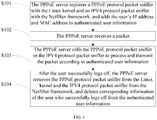
- embodiments of the present disclosure provide a method for transmitting PPPoE packets. As shown in FIG. 1 , the method includes the following steps S101 to S104.
- the PPPoE server registers a PPPoE protocol packet sniffer with the Linux kernel and an Internet Protocol Version 4 (IPV4) protocol packetsniffer with the Netfilter framework, and adds the user's Internet Protocol(IP) address and media access control(MAC) address to authenticated user information.
- IPV4 Internet Protocol Version 4
- the PPPoE server starts to register the PPPoE protocol packet sniffer and the IPV4 protocol packet sniffer.
- the user dial-up authentication refers to the process that the userenters the user name and password for dial-up Internet connectionon the client-side, and the server-sidedetermines whether the received user name and password are correct. If correct, a message is returned to the client-side and the dial-up authentication succeeds.
- the PPPoE server registers the PPPoE protocol packet sniffer with the Linux kernel and the IPV4 protocol packet sniffer with the POSTROUTING chain of the Netfilter framework.
- the PPPoE protocol packet sniffer is mainly used for terminating the user's uplink PPPoE packet, and the IPV4 protocol packet snifferis mainly used to add thePPPoE packet header to the user's downlink data packet.
- the authenticated user information can be stored in the form of a list, which is easy for query and comparison.
- the PPPoE protocol packet sniffer and the IPV4 protocol packet sniffer may be registeredevery time that the user logs on the Internet.
- the PPPoE protocol packet sniffer and the IPV4 protocol packet sniffer may also be registered, when the user logs on the Internet for a first time after user initialization or restart.
- the present disclosure is not limited thereto.
- the PPPoE server receives a packet.
- the PPPoE data packet belongs to the Layer 2 packet and is carried in the data field of the Ethernet packet for transmission.
- the value of the Ethernet packet's protocol field is 0x8863, which indicates that the PPPoE is in the Activity Discovery Phase.
- the value of the Ethernet packet's protocol field is 0x8864, which indicates that the PPPoE is in the PPP Session Stage.
- the Layer 3 packet corresponding to the PPPoE data packet are the IPV4 packet.
- the PPPoE data packet carries the Point-to-Point Protocol (PPP) packet.
- the PPP packetheader protocol field is used to distinguish the contents of the data packets carried by the PPPoE packets. For example, 0021 represents the IP protocol, and C021 represents the Link Control Protocol (LCP).
- LCP Link Control Protocol
- the PPPoE server calls the PPPoE protocol packet sniffer or the IPV4 protocol packet sniffer to process and transmit the packet according to the authenticated user information.
- the PPPoE server removes the PPPoE protocol packet sniffer from the Linux kernel and the IPV4 protocol packet sniffer from the Netfilter framework, and deletes corresponding information of the user who successfully logs offfrom the authenticated user information.
- Step 104 is not a necessary step, which corresponds to the situationwhen the PPPoE protocol packet sniffer and the IPV4 protocol packet sniffer are registered every time that the user logs on the Internet. That is, if the PPPoE server removes the PPPoE protocol packet sniffer from the Linux kernel and the IPV4 protocol packet sniffer from the Netfilter framework, and deletes the user's corresponding information from the authenticated user information, then the PPPoE protocol packet sniffer and the IPV4 protocol packet sniffer need to be registered every time that the user logs on the Internet.
- the PPPoE protocol packet sniffer and the IPV4 protocol packet sniffer may also be registered,when the user logs on the Internet for a first time after user initialization or restart.After the user successfully logs off, only the user's corresponding information is deleted from the authenticated user information, and step 104 is not necessary. Therefore, the user's logon time can be further shorten.
- the registration and deletion of a IPV4protocol packet sniffer in the Netfilter framework and a PPPoE protocol packet sniffer in the Linux kernel are used to replace the creation and deletion of a virtual network interface,and the authenticated user information is stored.
- the PPPoE server After receiving the packet, the PPPoE server calls the corresponding protocol packet sniffer and according to the authenticated user information to process the packet header and transmit the processed packet. As such, the correct processing and the normal transmission of the user's uplink data packets and downlink data packets can be ensured.
- the proposed method reduces the time cost for the creation of the network interface during the logon process and the time cost for the destruction of the network interface during the logoff process, such that the logon and logoff speeds for user dial-up during the process of a PPPoE broadband access on the Linux platform can be effectively increased.
- step S103 includes the followings.
- the PPPoE server determines whether the received packet is the user's uplink packet or the user's downlinkpacket. If the received packet is the user'suplink packet, the PPPoE server calls the PPPoE protocol packet sniffer.
- the PPPoE protocol packet sniffer determines whether the received packet is a PPPoE data packet and, if the received packet is a PPPoE data packet, according to the authenticated user information, strips off header information of the PPPoE data packet, and forwards the processed PPPoE data packet to the Internet-side. If the received packet is the user's downlink packet, the PPPoE server calls the IPV4 protocol packet sniffer.
- the IPV4 protocol packet sniffer adds header information to the user's downlink packet and forwards the processed PPPoE data packet to the user.
- the Internet-side is relative to the client-side. After obtaining dial-up Internet access, the user may send data to the Internet-side or receive data from the Internet-side.
- the sniffers used are different and the processing of the header information is also different. Therefore, the packet needs to be determined to further determine the subsequent processing procedure and realize the normal forwarding of the user's uplink data packets and downlink data packets. At the same time, it is also necessary to determine,according to the authenticated user information stored in advance,whether the current user has authenticated. If the user is not authenticated, the unnecessary packet isdirectly thrown awayto avoid the occupation of resources. If the user is authenticated, the packet is forwarded to the corresponding user or the Internet-side to ensure the smooth transmission of the packet.
- the PPPoE protocol packet sniffer performs the following operations.
- the PPPoE protocol packet sniffer determines that the PPPoE is currently in the PPP Session Stage(as described above, the value of the protocol fieldis 0x8864 indicating that the PPPoE is in the PPP Session Stage.)
- the PPPoE protocol packet sniffer according to the PPP packet header protocol field, determines that the packet is a PPPoE packet (as described above, the PPP packet header protocol field is 0021 indicating the IP protocol, and the corresponding Layer 2 packet is a PPPoE packet.)
- the PPPoE protocol packet sniffer obtains the MAC address from the Ethernet packet header and the IP address from the IPV4 packet header.
- the PPPoE protocol packet sniffer compares the MAC address and IP address with information in the authenticated user information and, if match, determines that the user belongs to the authenticated users and strips off header of the PPPoE data packet to forward the processed PPPoE data packet to the Internet-side and, if not match, determines that the user does not belong to the authenticated users and throws away the PPPoE data packet. If the intercepted packet is not a PPPoE data packet, the processing of the PPPoE control packet is entered, and the control packet processing method will not be discussed in the present disclosure.
- the IPV4 protocol packet sniffer performs the following operations.
- the IPV4 protocol packet sniffer obtains the user's IP address from the IPV4 packet header.
- the IPV4 protocol packet sniffer compares the IP address with information in the authenticated user information and, if match, determines that the user belongs to the authenticated users and adds the header information to the user's downlink packetto forward the processed packet to the user and, if not match, determines that the user does not belong to the authenticated users and throws away the downlink packet.
- FIG. 2 is flow chart of processing of the user's uplink data packet according to embodiments of the present disclosure. As shown in FIG.2 , the processing procedure of the user's uplink data packetincludes the following steps.
- a network card arranged at the client-side receives a packet.
- the PPPoE server calls the PPPoE protocol packet sniffer to determine whether the received packet is a PPPoE data packet and, if yes, the process proceeds to step S203 and, if no, the process proceeds to step S206.
- step S203 according to anauthorized userinformation list, whether the user has been authorized is determined and, if yes, the process proceeds to step S204 and, if no, the packet is directly thrown away, and the process proceeds to step S213.
- the PPPoE protocol packet sniffer strips off the headerof the PPPoE data packet.
- the PPPoE protocol packet sniffer forwards the processed PPPoE data packet to the Internet-side, and the process proceeds to step S213.
- the PPPoE server determines whether the user dial-up authentication is successful and, if yes, the process proceeds to step S207 and, if not, the process proceeds to step S209.
- the PPPoE server registers the PPPoE protocol packet sniffer with the Linux kernel and the IPV4 protocol packet sniffer with the Netfilter framework.
- the PPPoE server adds user information (IP address and MAC address) to the authorized user information list, and then proceeds to step S213.
- step S209 the PPPoE server determines whether the user logs off successfully and, if yes, the process proceeds to step S210; if not, the process proceeds to step S212.
- the PPPoE server removes the PPPoE protocol packet sniffer from the Linux kernel and the IPV4 protocol packet sniffer from the Netfilter framework.
- step S211 the PPPoE server deletes information corresponding to the user from the authorized user information list, and thenthe process proceeds to step S213.
- step S212 the other processing of PPPoE control packet is performed and then the process proceeds to step S213.
- Step S213 the process completes.
- FIG. 3 is flow chart of processing of the user's downlink data packet according to embodiments of the present disclosure. As shown in FIG. 3 , the processing procedure of the user's downlink data packet includes the following steps.
- a network card arranged at the Internet-side receives a packet.
- the PPPoE server calls the IPV4 protocol packet sniffer and the IPV4 protocol packet sniffer receives the packet.
- the IPV4 protocol packet sniffer determines whether the target user is anauthorized user and, if yes, the process proceeds to step S304 and, if not, the packet is directly thrown away and the process proceeds to step S306.
- the IPV4 protocol packet sniffer adds the header of the PPPoE data packet to the packet.
- the IPV4 protocol packet sniffer performs the forwarding and forwards the packet to the network card arranged at the client-side.
- Step S306 the process completes.
- the PPPoE protocol includes the Activity Discovery Phase and the PPP Session Stage.
- an Activity Discovery Phase needs to be firstly implemented to identify the MAC address of the opposite party and establish a unique PPP Session ID (identification) .
- the client-host discovers all the servers and chooses one of them to establish a point-to-point connection.
- the PPP Session Stage is entered.
- PPP Session Stage between the host and the server, according to the PPP protocol, PPP data is transmitted, and various PPP negotiations and the PPP data transmission are performed.
- the transmitted packet contains the PPP Session ID determined at the Activity Discovery Phase and the PPP Session ID remains unchanged.
- the user first goes through the Activity Discovery Phase and, after the completion of the Activity Discovery Phase, enters thePPP Session Stage.
- the PPPoE server does not create the virtual network interface corresponding to the user, but registers the PPPoE protocol packet sniffer with the Linux kernel and the IPV4 protocol packet sniffer with the Netfilter framework, and adds the user IP and the MAC mapping the authorized user information list.
- the PPPoE protocol packet sniffer is called when the user's uplink packet passes through the PPPoE server.
- the PPPoE protocol packet sniffer determines whether the user who sent the packet has successfully authenticated. If the user's uplink packet is the authenticateduser's uplink packet, the PPPoE packet sniffer strips off the PPPoE packet header and performs the forwarding to forward the packet to the network card arranged at the Internet-side. As such, the problem of normal forwarding of the user's uplink data packet is solved.
- the PPPoE protocol packet sniffer obtains the value of the Ethernet protocol field firstly and, if the PPPoE is in the PPP Session Stage (0x8864), obtains the PPP packet header protocol field and, if the value is 0021, the packet type is considered as a PPPoE data packet.
- the PPPoE protocol packet sniffer obtains the MAC address from the Ethernet packet header and the IP address from the IPV4 packet header, and compares the MAC address and the IP address with the entries in the authentication address table and, if match, forwards the packet to the Internet-side, otherwise, throws away the packet. If the packet type is not a PPPoE data packet, the other processing of the PPPoE control packet is performed.
- the IPV4 protocol packet sniffer is called when the user's downlink packet passes through the PPPoE server.
- the IPV4 protocol packet sniffer determines whether the target user of the packet has successfully authenticated. If the target user is an authenticated user, the IPV4 protocol packet snifferadds the PPPoE packet header and performs the forwarding to forward the packet to the network card arranged at the client-side. As such, the problem of normal forwarding of the user's downlink data packet is solved.
- the embodiments of the present disclosure also provide a PPPoE server, which can be used to implement the above-described method for transmitting PPPoE packets.
- the specific implementation thereof may refer to the above-described method according to embodiment of the present disclosure.
- the PPPoE server includes a registration unit 41, a receiving unit 42, a processing unit 43, and a removing unit 44. The function of each unit is described in detail below.
- the registration unit 41 is configured, after the user dial-up authorization succeeds,to register a PPPoE protocol packet sniffer with the Linux kernel and an IPV4 protocol packet sniffer with the Netfilter framework, and add the user's IP address and MAC address to authenticated user information.
- the receiving unit 42 is communicated with the registration unit 41 and is configured to receive a packet.
- the processing unit 43 is communicated with the receiving unit 42and is configured to call the PPPoE protocol packet sniffer or the IPV4 protocol packet sniffer and, according to the authenticated user information, process and transmit the received packet.
- the removing unit 44 communicated with the processing unit 43 is configured,after the user successfully logs off, to remove the PPPoE protocol packet sniffer from the Linux kernel and the IPV4 protocol packet sniffer from the Netfilter framework, and delete user's corresponding information from the authenticated user information.
- the removing unit 44 is not a necessary unit,which corresponds to the situation when the PPPoE protocol packet sniffer and the IPV4 protocol packet sniffer are registered every time that the user logs on the Internet.
- the PPPoE server removes the PPPoE protocol packet sniffer from the Linux kernel and the IPV4 protocol packet sniffer from the Netfilter framework, and deletes the user's corresponding information from the authenticated user information, then the PPPoE protocol packet sniffer and the IPV4 protocol packet sniffer need to be registered every time that the user logs on the Internet.
- the registration and deletion of a IPV4 protocol packet sniffer in the Netfilter framework and a PPPoE protocol packet sniffer in the Linux kernel are used to replace the creation and deletion of a virtual network interface, and the authenticated user information is stored.
- the PPPoE server After receiving the packet, the PPPoE server calls the corresponding protocol packet sniffer and according to the authenticated user information to process the packet header and transmit the processed packet. As such, the correct processing and the normal transmission of the user's uplink data packets and downlink data packets can be ensured.
- the time cost for the creation of the network interface during the logon process and the time cost for the destruction of the network interface during the logoff process are reduced, such that the logon and logoff speeds for user dial-up during the process of a PPPoE broadband access on the Linux platform can be effectively increased.
- the registration unit 41 is specifically used to register the PPPoE protocol packet sniffer with the Linux kernel and the IPV4 protocol packet sniffer with the POSTROUTING chain of the Netfilter framework.
- the processing unit 43 includes a determination module, a first call module, and a second call module.
- the determination module is configured to determine whether the packet is a user's uplink packet or a user's downlink packet.
- the first call modulecommunicated with the determination module is configured, when the packet is the user's uplink packet, to call the PPPoE protocol packet sniffer.
- the PPPoE protocol packet sniffer determines whether the received packet is a PPPoE data packet and, if the received packet is a PPPoE data packet, according to the authenticated user information, stripsoffheader information of the PPPoE data packet, and forwards the processed PPPoE data packet to the Internet-side.
- the second call module communicated with the determination module is configured, when the packet is the user's downlink packet, to call the IPV4 protocol packet sniffer.
- the IPV4 protocol packet sniffer according to the authenticated user information, adds header information to the user's downlink packet and forwards the processed PPPoE data packet to the user.
- the sniffers used are different and the processing of the header information is also different. Therefore, the packet needs to be determined to further determine the subsequent processing procedure and realize the normal forwarding of the user's uplink data packets and downlink data packets. At the same time, it is also necessary to determine, according to the authenticated user information stored in advance, whether the current user has authenticated. If the user is not authenticated, the unnecessary packet is directly thrown away to avoid the occupation of resources. If the user is authenticated, the packet is forwarded to the corresponding user or the Internet-side to ensure the smooth transmission of the packet.
- the PPPoE protocol packet sniffer includes: a first determination module configured, according to the value of the Ethernet packet protocol field, to determine that the PPPoE is currently in the PPP Session Stage; a second determination module that is communicated with the first determination module, configured, according to the PPP packet header protocol field, to determine that the packet is a PPPoE data packet; a first acquisition module that is communicated with the second determination module, configured to obtain the MAC address from the Ethernet packet header and the IP address from the IPV4 packet header; a first comparison module that is communicated with the first acquisition module, configured to compare the MAC address and IP address with information in the authenticated user information; a first forwarding module that is communicated with the first comparison module, configured, under the matching situation, to determine that the user belongs to the authenticated users andstrip off header of the PPPoE data packet to forward the processed PPPoE data packet to the Internet-side; a first throw-away module that is communicated with the first comparison module, configured, under the non-matching situation, to
- the IPV4 protocol packet sniffer includes: a second acquisition module is configured to obtain the user's IP address from the IPV4 packet header; a second comparison module that is communicated with the second acquisition module, configured to compare the IP address with information in the authenticated user information; a second forwarding module that is communicated with the second comparison module, configured, under the matching situation, to determine that the user belongs to the authenticated users and add the header information to the user's downlink packet to forward the processed packet to the user; a second throw-awaymodule that is communicated with the second comparison module, configured, under the non-matching situation, to determine that the user does not belong to the authenticated users and throw away the downlink packet.
- the parallel logon speed increases from 300 per sec to 1000 per sec
- the parallel logoffspeed increases from 200 per sec to 800 per sec. Therefore, the user's logon and logoff speeds can be greatly improved according to the solution of the present disclosure.
- the computer software product may be stored on a computer-readable media, such as a ROM/RAM, a magnetic disk, or an optical disk, and the like.
- the computer software product may include a certain number of computer-executable instructions that make a computer device (such as a personal computer, a server, or a network equipment) to execute the methods described in each embodiment, or certain portions of the embodiments, of the present disclosure.
Landscapes
- Engineering & Computer Science (AREA)
- Computer Networks & Wireless Communication (AREA)
- Signal Processing (AREA)
- Computer Security & Cryptography (AREA)
- Computer Hardware Design (AREA)
- Computing Systems (AREA)
- General Engineering & Computer Science (AREA)
- Power Engineering (AREA)
- Data Exchanges In Wide-Area Networks (AREA)
- Telephonic Communication Services (AREA)
Applications Claiming Priority (2)
| Application Number | Priority Date | Filing Date | Title |
|---|---|---|---|
| CN201710203829.5A CN106936718B (zh) | 2017-03-30 | 2017-03-30 | PPPoE报文传输方法和PPPoE服务器 |
| PCT/CN2017/080245 WO2018176510A1 (zh) | 2017-03-30 | 2017-04-12 | PPPoE报文传输方法和PPPoE服务器 |
Publications (3)
| Publication Number | Publication Date |
|---|---|
| EP3407553A1 true EP3407553A1 (de) | 2018-11-28 |
| EP3407553A4 EP3407553A4 (de) | 2018-12-19 |
| EP3407553B1 EP3407553B1 (de) | 2019-12-18 |
Family
ID=59425386
Family Applications (1)
| Application Number | Title | Priority Date | Filing Date |
|---|---|---|---|
| EP17849864.8A Active EP3407553B1 (de) | 2017-03-30 | 2017-04-12 | Pppoe-nachrichtenübertragungsverfahren und pppoe-server |
Country Status (4)
| Country | Link |
|---|---|
| US (1) | US10630684B2 (de) |
| EP (1) | EP3407553B1 (de) |
| CN (1) | CN106936718B (de) |
| WO (1) | WO2018176510A1 (de) |
Cited By (1)
| Publication number | Priority date | Publication date | Assignee | Title |
|---|---|---|---|---|
| CN110943896A (zh) * | 2019-10-08 | 2020-03-31 | 中移(杭州)信息技术有限公司 | PPPoE数据报文传输方法、装置、设备及存储介质 |
Families Citing this family (1)
| Publication number | Priority date | Publication date | Assignee | Title |
|---|---|---|---|---|
| CN114553831B (zh) * | 2020-11-25 | 2023-09-08 | 华为技术有限公司 | 一种与发送管理ip地址相关的方法及系统 |
Family Cites Families (14)
| Publication number | Priority date | Publication date | Assignee | Title |
|---|---|---|---|---|
| US6754744B2 (en) * | 2002-09-10 | 2004-06-22 | Broadcom Corporation | Balanced linked lists for high performance data buffers in a network device |
| CN1270532C (zh) * | 2002-09-13 | 2006-08-16 | 中兴通讯股份有限公司 | 在嵌入式操作系统中支持非对称数字用户线路接入的方法 |
| US9596240B2 (en) * | 2004-08-30 | 2017-03-14 | Arris Enterprises, Inc. | Method and system for layer-3 subscriber login in a cable data network |
| KR100667333B1 (ko) * | 2004-12-16 | 2007-01-12 | 삼성전자주식회사 | 홈 네트워크에서 디바이스 및 사용자 인증 시스템 및 방법 |
| JP3920305B1 (ja) | 2005-12-12 | 2007-05-30 | 株式会社日立コミュニケーションテクノロジー | パケット転送装置 |
| JP4791252B2 (ja) * | 2006-05-22 | 2011-10-12 | 株式会社日立製作所 | パケット転送装置、パケット転送システム、ユーザ端末装置およびパケット転送方法 |
| JP4343189B2 (ja) * | 2006-05-29 | 2009-10-14 | 株式会社東芝 | サーバ装置 |
| CN102394815B (zh) * | 2011-10-28 | 2014-03-05 | 深圳市共进电子股份有限公司 | Linux下实现网络加速的方法 |
| CN102664833B (zh) * | 2012-05-03 | 2015-01-14 | 烽火通信科技股份有限公司 | 家庭网关及分析用户上网行为和监控网络质量的方法 |
| CN102932458B (zh) * | 2012-11-02 | 2015-05-20 | 上海电机学院 | 一种ppp协议的硬件加速系统及其实现方法 |
| WO2014105650A1 (en) * | 2012-12-26 | 2014-07-03 | Cortina Systems, Inc. | Communication traffic processing architectures and methods |
| CN104243417A (zh) * | 2013-06-18 | 2014-12-24 | 上海博达数据通信有限公司 | 基于多核的pppoe实现方法 |
| CN104243454A (zh) * | 2014-08-28 | 2014-12-24 | 杭州华三通信技术有限公司 | 一种IPv6报文过滤方法和设备 |
| GB2539003B (en) * | 2015-06-03 | 2018-05-09 | Openwave Mobility Inc | A method and apparatus for managing connections in a communication network |
-
2017
- 2017-03-30 CN CN201710203829.5A patent/CN106936718B/zh not_active Expired - Fee Related
- 2017-04-12 US US15/735,909 patent/US10630684B2/en not_active Expired - Fee Related
- 2017-04-12 EP EP17849864.8A patent/EP3407553B1/de active Active
- 2017-04-12 WO PCT/CN2017/080245 patent/WO2018176510A1/zh not_active Ceased
Cited By (1)
| Publication number | Priority date | Publication date | Assignee | Title |
|---|---|---|---|---|
| CN110943896A (zh) * | 2019-10-08 | 2020-03-31 | 中移(杭州)信息技术有限公司 | PPPoE数据报文传输方法、装置、设备及存储介质 |
Also Published As
| Publication number | Publication date |
|---|---|
| CN106936718A (zh) | 2017-07-07 |
| WO2018176510A1 (zh) | 2018-10-04 |
| CN106936718B (zh) | 2019-12-13 |
| EP3407553A4 (de) | 2018-12-19 |
| US10630684B2 (en) | 2020-04-21 |
| US20190007403A1 (en) | 2019-01-03 |
| EP3407553B1 (de) | 2019-12-18 |
Similar Documents
| Publication | Publication Date | Title |
|---|---|---|
| CN110611723B (zh) | 一种服务资源的调度方法及装置 | |
| CN108270722B (zh) | 一种攻击行为检测方法和装置 | |
| CN105634956B (zh) | 一种报文转发方法、装置和系统 | |
| US9883010B2 (en) | Method, apparatus, device and system for generating DHCP snooping binding table | |
| CN102438028B (zh) | 一种防止dhcp服务器欺骗的方法、装置及系统 | |
| CN110958272B (zh) | 身份认证方法、身份认证系统和相关设备 | |
| CN112217771B (zh) | 基于租户信息的数据转发方法及数据转发装置 | |
| CN101621525B (zh) | 合法表项的处理方法和设备 | |
| CN107707435B (zh) | 一种报文处理方法和装置 | |
| CN107690004B (zh) | 地址解析协议报文的处理方法及装置 | |
| CN111641733A (zh) | 一种网桥设备管理方法、装置和可读存储介质 | |
| CN101980496A (zh) | 报文处理方法和系统、交换机和接入服务器设备 | |
| CN104270325A (zh) | CPE设备基于Linux实现公网接入用户数限制的系统及方法 | |
| CN103414641B (zh) | 邻居表项释放方法、装置和网络设备 | |
| EP3407553B1 (de) | Pppoe-nachrichtenübertragungsverfahren und pppoe-server | |
| CN109905352B (zh) | 一种基于加密协议审计数据的方法、装置和存储介质 | |
| EP3618396A1 (de) | Schutzverfahren und system für http-überflutungsangriff | |
| CN103873431A (zh) | 动态主机配置协议服务器的识别方法和装置 | |
| CN110113243B (zh) | 一种基于容器技术的用户无感vpn接入方法 | |
| CN111064650A (zh) | 一种动态变更隧道连接服务端口号的方法及装置 | |
| CN113162922B (zh) | 客户端数据的获取方法及装置、存储介质、电子设备 | |
| CN107395641A (zh) | 基于sslvpn服务器的认证管理方法及装置 | |
| CN116193421B (zh) | 网络连接信息的验证方法、装置、系统及电子设备 | |
| CN112714133A (zh) | 一种适用于DHCPv6服务端的防ND攻击方法与装置 | |
| US9992164B2 (en) | User based stateless IPv6 RA-guard |
Legal Events
| Date | Code | Title | Description |
|---|---|---|---|
| STAA | Information on the status of an ep patent application or granted ep patent |
Free format text: STATUS: UNKNOWN |
|
| STAA | Information on the status of an ep patent application or granted ep patent |
Free format text: STATUS: THE INTERNATIONAL PUBLICATION HAS BEEN MADE |
|
| PUAI | Public reference made under article 153(3) epc to a published international application that has entered the european phase |
Free format text: ORIGINAL CODE: 0009012 |
|
| STAA | Information on the status of an ep patent application or granted ep patent |
Free format text: STATUS: REQUEST FOR EXAMINATION WAS MADE |
|
| 17P | Request for examination filed |
Effective date: 20180322 |
|
| AK | Designated contracting states |
Kind code of ref document: A1 Designated state(s): AL AT BE BG CH CY CZ DE DK EE ES FI FR GB GR HR HU IE IS IT LI LT LU LV MC MK MT NL NO PL PT RO RS SE SI SK SM TR |
|
| AX | Request for extension of the european patent |
Extension state: BA ME |
|
| A4 | Supplementary search report drawn up and despatched |
Effective date: 20181119 |
|
| RIC1 | Information provided on ipc code assigned before grant |
Ipc: H04L 29/06 20060101ALI20181113BHEP Ipc: H04W 12/06 20090101ALI20181113BHEP Ipc: H04L 12/28 20060101ALI20181113BHEP Ipc: H04L 12/741 20130101AFI20181113BHEP |
|
| RIC1 | Information provided on ipc code assigned before grant |
Ipc: H04W 12/06 20090101ALI20190802BHEP Ipc: H04L 12/28 20060101ALI20190802BHEP Ipc: H04L 12/741 20130101AFI20190802BHEP Ipc: H04L 29/06 20060101ALI20190802BHEP |
|
| GRAP | Despatch of communication of intention to grant a patent |
Free format text: ORIGINAL CODE: EPIDOSNIGR1 |
|
| STAA | Information on the status of an ep patent application or granted ep patent |
Free format text: STATUS: GRANT OF PATENT IS INTENDED |
|
| DAV | Request for validation of the european patent (deleted) | ||
| DAX | Request for extension of the european patent (deleted) | ||
| INTG | Intention to grant announced |
Effective date: 20190923 |
|
| GRAS | Grant fee paid |
Free format text: ORIGINAL CODE: EPIDOSNIGR3 |
|
| GRAA | (expected) grant |
Free format text: ORIGINAL CODE: 0009210 |
|
| STAA | Information on the status of an ep patent application or granted ep patent |
Free format text: STATUS: THE PATENT HAS BEEN GRANTED |
|
| AK | Designated contracting states |
Kind code of ref document: B1 Designated state(s): AL AT BE BG CH CY CZ DE DK EE ES FI FR GB GR HR HU IE IS IT LI LT LU LV MC MK MT NL NO PL PT RO RS SE SI SK SM TR |
|
| REG | Reference to a national code |
Ref country code: CH Ref legal event code: EP |
|
| REG | Reference to a national code |
Ref country code: IE Ref legal event code: FG4D |
|
| REG | Reference to a national code |
Ref country code: DE Ref legal event code: R096 Ref document number: 602017009954 Country of ref document: DE |
|
| REG | Reference to a national code |
Ref country code: AT Ref legal event code: REF Ref document number: 1215800 Country of ref document: AT Kind code of ref document: T Effective date: 20200115 |
|
| REG | Reference to a national code |
Ref country code: NL Ref legal event code: MP Effective date: 20191218 |
|
| PG25 | Lapsed in a contracting state [announced via postgrant information from national office to epo] |
Ref country code: LV Free format text: LAPSE BECAUSE OF FAILURE TO SUBMIT A TRANSLATION OF THE DESCRIPTION OR TO PAY THE FEE WITHIN THE PRESCRIBED TIME-LIMIT Effective date: 20191218 Ref country code: SE Free format text: LAPSE BECAUSE OF FAILURE TO SUBMIT A TRANSLATION OF THE DESCRIPTION OR TO PAY THE FEE WITHIN THE PRESCRIBED TIME-LIMIT Effective date: 20191218 Ref country code: FI Free format text: LAPSE BECAUSE OF FAILURE TO SUBMIT A TRANSLATION OF THE DESCRIPTION OR TO PAY THE FEE WITHIN THE PRESCRIBED TIME-LIMIT Effective date: 20191218 Ref country code: BG Free format text: LAPSE BECAUSE OF FAILURE TO SUBMIT A TRANSLATION OF THE DESCRIPTION OR TO PAY THE FEE WITHIN THE PRESCRIBED TIME-LIMIT Effective date: 20200318 Ref country code: NO Free format text: LAPSE BECAUSE OF FAILURE TO SUBMIT A TRANSLATION OF THE DESCRIPTION OR TO PAY THE FEE WITHIN THE PRESCRIBED TIME-LIMIT Effective date: 20200318 Ref country code: GR Free format text: LAPSE BECAUSE OF FAILURE TO SUBMIT A TRANSLATION OF THE DESCRIPTION OR TO PAY THE FEE WITHIN THE PRESCRIBED TIME-LIMIT Effective date: 20200319 Ref country code: LT Free format text: LAPSE BECAUSE OF FAILURE TO SUBMIT A TRANSLATION OF THE DESCRIPTION OR TO PAY THE FEE WITHIN THE PRESCRIBED TIME-LIMIT Effective date: 20191218 |
|
| REG | Reference to a national code |
Ref country code: LT Ref legal event code: MG4D |
|
| PG25 | Lapsed in a contracting state [announced via postgrant information from national office to epo] |
Ref country code: HR Free format text: LAPSE BECAUSE OF FAILURE TO SUBMIT A TRANSLATION OF THE DESCRIPTION OR TO PAY THE FEE WITHIN THE PRESCRIBED TIME-LIMIT Effective date: 20191218 Ref country code: RS Free format text: LAPSE BECAUSE OF FAILURE TO SUBMIT A TRANSLATION OF THE DESCRIPTION OR TO PAY THE FEE WITHIN THE PRESCRIBED TIME-LIMIT Effective date: 20191218 |
|
| PG25 | Lapsed in a contracting state [announced via postgrant information from national office to epo] |
Ref country code: AL Free format text: LAPSE BECAUSE OF FAILURE TO SUBMIT A TRANSLATION OF THE DESCRIPTION OR TO PAY THE FEE WITHIN THE PRESCRIBED TIME-LIMIT Effective date: 20191218 |
|
| PG25 | Lapsed in a contracting state [announced via postgrant information from national office to epo] |
Ref country code: EE Free format text: LAPSE BECAUSE OF FAILURE TO SUBMIT A TRANSLATION OF THE DESCRIPTION OR TO PAY THE FEE WITHIN THE PRESCRIBED TIME-LIMIT Effective date: 20191218 Ref country code: CZ Free format text: LAPSE BECAUSE OF FAILURE TO SUBMIT A TRANSLATION OF THE DESCRIPTION OR TO PAY THE FEE WITHIN THE PRESCRIBED TIME-LIMIT Effective date: 20191218 Ref country code: RO Free format text: LAPSE BECAUSE OF FAILURE TO SUBMIT A TRANSLATION OF THE DESCRIPTION OR TO PAY THE FEE WITHIN THE PRESCRIBED TIME-LIMIT Effective date: 20191218 Ref country code: NL Free format text: LAPSE BECAUSE OF FAILURE TO SUBMIT A TRANSLATION OF THE DESCRIPTION OR TO PAY THE FEE WITHIN THE PRESCRIBED TIME-LIMIT Effective date: 20191218 Ref country code: PT Free format text: LAPSE BECAUSE OF FAILURE TO SUBMIT A TRANSLATION OF THE DESCRIPTION OR TO PAY THE FEE WITHIN THE PRESCRIBED TIME-LIMIT Effective date: 20200513 |
|
| PG25 | Lapsed in a contracting state [announced via postgrant information from national office to epo] |
Ref country code: SM Free format text: LAPSE BECAUSE OF FAILURE TO SUBMIT A TRANSLATION OF THE DESCRIPTION OR TO PAY THE FEE WITHIN THE PRESCRIBED TIME-LIMIT Effective date: 20191218 Ref country code: IS Free format text: LAPSE BECAUSE OF FAILURE TO SUBMIT A TRANSLATION OF THE DESCRIPTION OR TO PAY THE FEE WITHIN THE PRESCRIBED TIME-LIMIT Effective date: 20200418 Ref country code: SK Free format text: LAPSE BECAUSE OF FAILURE TO SUBMIT A TRANSLATION OF THE DESCRIPTION OR TO PAY THE FEE WITHIN THE PRESCRIBED TIME-LIMIT Effective date: 20191218 |
|
| REG | Reference to a national code |
Ref country code: DE Ref legal event code: R097 Ref document number: 602017009954 Country of ref document: DE |
|
| REG | Reference to a national code |
Ref country code: AT Ref legal event code: MK05 Ref document number: 1215800 Country of ref document: AT Kind code of ref document: T Effective date: 20191218 |
|
| PLBE | No opposition filed within time limit |
Free format text: ORIGINAL CODE: 0009261 |
|
| STAA | Information on the status of an ep patent application or granted ep patent |
Free format text: STATUS: NO OPPOSITION FILED WITHIN TIME LIMIT |
|
| PG25 | Lapsed in a contracting state [announced via postgrant information from national office to epo] |
Ref country code: ES Free format text: LAPSE BECAUSE OF FAILURE TO SUBMIT A TRANSLATION OF THE DESCRIPTION OR TO PAY THE FEE WITHIN THE PRESCRIBED TIME-LIMIT Effective date: 20191218 Ref country code: DK Free format text: LAPSE BECAUSE OF FAILURE TO SUBMIT A TRANSLATION OF THE DESCRIPTION OR TO PAY THE FEE WITHIN THE PRESCRIBED TIME-LIMIT Effective date: 20191218 |
|
| 26N | No opposition filed |
Effective date: 20200921 |
|
| PG25 | Lapsed in a contracting state [announced via postgrant information from national office to epo] |
Ref country code: SI Free format text: LAPSE BECAUSE OF FAILURE TO SUBMIT A TRANSLATION OF THE DESCRIPTION OR TO PAY THE FEE WITHIN THE PRESCRIBED TIME-LIMIT Effective date: 20191218 Ref country code: AT Free format text: LAPSE BECAUSE OF FAILURE TO SUBMIT A TRANSLATION OF THE DESCRIPTION OR TO PAY THE FEE WITHIN THE PRESCRIBED TIME-LIMIT Effective date: 20191218 Ref country code: MC Free format text: LAPSE BECAUSE OF FAILURE TO SUBMIT A TRANSLATION OF THE DESCRIPTION OR TO PAY THE FEE WITHIN THE PRESCRIBED TIME-LIMIT Effective date: 20191218 |
|
| REG | Reference to a national code |
Ref country code: CH Ref legal event code: PL |
|
| PG25 | Lapsed in a contracting state [announced via postgrant information from national office to epo] |
Ref country code: CH Free format text: LAPSE BECAUSE OF NON-PAYMENT OF DUE FEES Effective date: 20200430 Ref country code: IT Free format text: LAPSE BECAUSE OF FAILURE TO SUBMIT A TRANSLATION OF THE DESCRIPTION OR TO PAY THE FEE WITHIN THE PRESCRIBED TIME-LIMIT Effective date: 20191218 Ref country code: LU Free format text: LAPSE BECAUSE OF NON-PAYMENT OF DUE FEES Effective date: 20200412 Ref country code: LI Free format text: LAPSE BECAUSE OF NON-PAYMENT OF DUE FEES Effective date: 20200430 |
|
| REG | Reference to a national code |
Ref country code: BE Ref legal event code: MM Effective date: 20200430 |
|
| PG25 | Lapsed in a contracting state [announced via postgrant information from national office to epo] |
Ref country code: PL Free format text: LAPSE BECAUSE OF FAILURE TO SUBMIT A TRANSLATION OF THE DESCRIPTION OR TO PAY THE FEE WITHIN THE PRESCRIBED TIME-LIMIT Effective date: 20191218 Ref country code: BE Free format text: LAPSE BECAUSE OF NON-PAYMENT OF DUE FEES Effective date: 20200430 |
|
| PG25 | Lapsed in a contracting state [announced via postgrant information from national office to epo] |
Ref country code: IE Free format text: LAPSE BECAUSE OF NON-PAYMENT OF DUE FEES Effective date: 20200412 |
|
| PGFP | Annual fee paid to national office [announced via postgrant information from national office to epo] |
Ref country code: FR Payment date: 20210429 Year of fee payment: 5 Ref country code: DE Payment date: 20210408 Year of fee payment: 5 |
|
| PGFP | Annual fee paid to national office [announced via postgrant information from national office to epo] |
Ref country code: GB Payment date: 20210415 Year of fee payment: 5 |
|
| REG | Reference to a national code |
Ref country code: DE Ref legal event code: R079 Ref document number: 602017009954 Country of ref document: DE Free format text: PREVIOUS MAIN CLASS: H04L0012741000 Ipc: H04L0045740000 |
|
| PG25 | Lapsed in a contracting state [announced via postgrant information from national office to epo] |
Ref country code: TR Free format text: LAPSE BECAUSE OF FAILURE TO SUBMIT A TRANSLATION OF THE DESCRIPTION OR TO PAY THE FEE WITHIN THE PRESCRIBED TIME-LIMIT Effective date: 20191218 Ref country code: MT Free format text: LAPSE BECAUSE OF FAILURE TO SUBMIT A TRANSLATION OF THE DESCRIPTION OR TO PAY THE FEE WITHIN THE PRESCRIBED TIME-LIMIT Effective date: 20191218 Ref country code: CY Free format text: LAPSE BECAUSE OF FAILURE TO SUBMIT A TRANSLATION OF THE DESCRIPTION OR TO PAY THE FEE WITHIN THE PRESCRIBED TIME-LIMIT Effective date: 20191218 |
|
| PG25 | Lapsed in a contracting state [announced via postgrant information from national office to epo] |
Ref country code: MK Free format text: LAPSE BECAUSE OF FAILURE TO SUBMIT A TRANSLATION OF THE DESCRIPTION OR TO PAY THE FEE WITHIN THE PRESCRIBED TIME-LIMIT Effective date: 20191218 |
|
| REG | Reference to a national code |
Ref country code: DE Ref legal event code: R119 Ref document number: 602017009954 Country of ref document: DE |
|
| GBPC | Gb: european patent ceased through non-payment of renewal fee |
Effective date: 20220412 |
|
| PG25 | Lapsed in a contracting state [announced via postgrant information from national office to epo] |
Ref country code: GB Free format text: LAPSE BECAUSE OF NON-PAYMENT OF DUE FEES Effective date: 20220412 Ref country code: FR Free format text: LAPSE BECAUSE OF NON-PAYMENT OF DUE FEES Effective date: 20220430 Ref country code: DE Free format text: LAPSE BECAUSE OF NON-PAYMENT OF DUE FEES Effective date: 20221103 |