EP3406554A1 - Interactive touch-based car operating panel systems for elevator cars - Google Patents
Interactive touch-based car operating panel systems for elevator cars Download PDFInfo
- Publication number
- EP3406554A1 EP3406554A1 EP17305608.6A EP17305608A EP3406554A1 EP 3406554 A1 EP3406554 A1 EP 3406554A1 EP 17305608 A EP17305608 A EP 17305608A EP 3406554 A1 EP3406554 A1 EP 3406554A1
- Authority
- EP
- European Patent Office
- Prior art keywords
- elevator car
- interactive
- input
- car
- elevator
- Prior art date
- Legal status (The legal status is an assumption and is not a legal conclusion. Google has not performed a legal analysis and makes no representation as to the accuracy of the status listed.)
- Granted
Links
Images





Classifications
-
- B—PERFORMING OPERATIONS; TRANSPORTING
- B66—HOISTING; LIFTING; HAULING
- B66B—ELEVATORS; ESCALATORS OR MOVING WALKWAYS
- B66B1/00—Control systems of elevators in general
- B66B1/34—Details, e.g. call counting devices, data transmission from car to control system, devices giving information to the control system
- B66B1/46—Adaptations of switches or switchgear
- B66B1/50—Adaptations of switches or switchgear with operating or control mechanisms mounted in the car or cage or in the lift well or hoistway
-
- B—PERFORMING OPERATIONS; TRANSPORTING
- B66—HOISTING; LIFTING; HAULING
- B66B—ELEVATORS; ESCALATORS OR MOVING WALKWAYS
- B66B11/00—Main component parts of lifts in, or associated with, buildings or other structures
- B66B11/02—Cages, i.e. cars
- B66B11/0226—Constructional features, e.g. walls assembly, decorative panels, comfort equipment, thermal or sound insulation
-
- B—PERFORMING OPERATIONS; TRANSPORTING
- B66—HOISTING; LIFTING; HAULING
- B66B—ELEVATORS; ESCALATORS OR MOVING WALKWAYS
- B66B1/00—Control systems of elevators in general
- B66B1/34—Details, e.g. call counting devices, data transmission from car to control system, devices giving information to the control system
- B66B1/46—Adaptations of switches or switchgear
- B66B1/461—Adaptations of switches or switchgear characterised by their shape or profile
- B66B1/463—Touch sensitive input devices
-
- B—PERFORMING OPERATIONS; TRANSPORTING
- B66—HOISTING; LIFTING; HAULING
- B66B—ELEVATORS; ESCALATORS OR MOVING WALKWAYS
- B66B1/00—Control systems of elevators in general
- B66B1/34—Details, e.g. call counting devices, data transmission from car to control system, devices giving information to the control system
-
- B—PERFORMING OPERATIONS; TRANSPORTING
- B66—HOISTING; LIFTING; HAULING
- B66B—ELEVATORS; ESCALATORS OR MOVING WALKWAYS
- B66B1/00—Control systems of elevators in general
- B66B1/34—Details, e.g. call counting devices, data transmission from car to control system, devices giving information to the control system
- B66B1/3415—Control system configuration and the data transmission or communication within the control system
-
- B—PERFORMING OPERATIONS; TRANSPORTING
- B66—HOISTING; LIFTING; HAULING
- B66B—ELEVATORS; ESCALATORS OR MOVING WALKWAYS
- B66B1/00—Control systems of elevators in general
- B66B1/34—Details, e.g. call counting devices, data transmission from car to control system, devices giving information to the control system
- B66B1/46—Adaptations of switches or switchgear
- B66B1/467—Adaptations of switches or switchgear characterised by their mounting position
-
- B—PERFORMING OPERATIONS; TRANSPORTING
- B66—HOISTING; LIFTING; HAULING
- B66B—ELEVATORS; ESCALATORS OR MOVING WALKWAYS
- B66B1/00—Control systems of elevators in general
- B66B1/34—Details, e.g. call counting devices, data transmission from car to control system, devices giving information to the control system
- B66B1/46—Adaptations of switches or switchgear
- B66B1/52—Floor selectors
-
- B—PERFORMING OPERATIONS; TRANSPORTING
- B66—HOISTING; LIFTING; HAULING
- B66B—ELEVATORS; ESCALATORS OR MOVING WALKWAYS
- B66B13/00—Doors, gates, or other apparatus controlling access to, or exit from, cages or lift well landings
- B66B13/30—Constructional features of doors or gates
- B66B13/303—Details of door panels
-
- B—PERFORMING OPERATIONS; TRANSPORTING
- B66—HOISTING; LIFTING; HAULING
- B66B—ELEVATORS; ESCALATORS OR MOVING WALKWAYS
- B66B2201/00—Aspects of control systems of elevators
- B66B2201/40—Details of the change of control mode
- B66B2201/46—Switches or switchgear
- B66B2201/4607—Call registering systems
- B66B2201/4623—Wherein the destination is registered after boarding
Definitions
- the subject matter disclosed herein generally relates to car operating panels of elevator systems and, more particularly, to easy-access car operating panels for elevator systems.
- Elevator systems and particularly elevator cars, include car operating panels that are accessible by passengers to indicate a desired destination.
- the passenger In order for a passenger to indicate a desired floor, the passenger must access the car operating panel and interact with various buttons, inputs, or other device or functions.
- access to the car operating panel may be difficult or hampered, and thus a passenger may not be able to input a desired destination after entering the elevator car. Accordingly, it may be advantageous to provide easier access for passengers to input desired destination information into an elevator system.
- elevator cars include a plurality of elevator car panels defining a passenger compartment of the elevator car and an interactive touch-based car operating panel system.
- the interactive touch-based car operating panel system has an interactive element extending around at least a portion of a periphery of the passenger compartment and located on at least one of the plurality of elevator car panels, the interactive element having an interactive surface facing the passenger compartment and a controller arranged to receive passenger input at the interactive surface and control an elevator car in response to the passenger input.
- further embodiments of the elevator car may include that the interactive surface is divided into a plurality of input regions, wherein each input region provides a different function.
- further embodiments of the elevator car may include that the plurality of input regions comprise a first input region and a second input region, wherein the first input region is located relative higher in the elevator car than the second input region and the first input region provides a functionality to request a destination floor above a current floor of the elevator car and the second input region provides a functionality to request a destination floor below a current floor of the elevator car.
- further embodiments of the elevator car may include that the plurality of input regions includes a confirmation region enabling confirmation or cancelation of the passenger input.
- further embodiments of the elevator car may include that the interactive surface is a display arranged to display interactive elements thereon.
- further embodiments of the elevator car may include that the interactive surface includes a quick access element to enable selection of a predetermined destination.
- further embodiments of the elevator car may include that the elevator car further includes an elevator car door in at least one elevator car panel, wherein the interactive element extends about an entire periphery of the passenger compartment except for where the elevator car door is located.
- further embodiments of the elevator car may include that the interactive touch-based car operating panel system further includes an information panel located within the elevator car and controllable to display information related to the passenger input.
- further embodiments of the elevator car may include a primary car operating panel installed in one of the elevator car panels.
- FIG. 1 is a schematic illustration of an elevator system that may employ various embodiments of the present disclosure.
- FIG. 1 is a perspective view of an elevator system 101 including an elevator car 103, a counterweight 105, a roping 107, a guide rail 109, a machine 111, a position encoder 113, and a controller 115.
- the elevator car 103 and counterweight 105 are connected to each other by the roping 107.
- the roping 107 may include or be configured as, for example, ropes, steel cables, and/or coated-steel belts.
- the counterweight 105 is configured to balance a load of the elevator car 103 and is configured to facilitate movement of the elevator car 103 concurrently and in an opposite direction with respect to the counterweight 105 within an elevator shaft 117 and along the guide rail 109.
- the roping 107 engages the machine 111, which is part of an overhead structure of the elevator system 101.
- the machine 111 is configured to control movement between the elevator car 103 and the counterweight 105.
- the position encoder 113 may be mounted on an upper sheave of a speed-governor system 119 and may be configured to provide position signals related to a position of the elevator car 103 within the elevator shaft 117. In other embodiments, the position encoder 113 may be directly mounted to a moving component of the machine 111, or may be located in other positions and/or configurations as known in the art.
- the controller 115 is located, as shown, in a controller room 121 of the elevator shaft 117 and is configured to control the operation of the elevator system 101, and particularly the elevator car 103.
- the controller 115 may provide drive signals to the machine 111 to control the acceleration, deceleration, leveling, stopping, etc. of the elevator car 103.
- the controller 115 may also be configured to receive position signals from the position encoder 113.
- the elevator car 103 may stop at one or more landings 125 as controlled by the controller 115.
- the controller 115 can be located and/or configured in other locations or positions within the elevator system 101.
- the machine 111 may include a motor or similar driving mechanism.
- the machine 111 is configured to include an electrically driven motor.
- the power supply for the motor may be any power source, including a power grid, which, in combination with other components, is supplied to the motor.
- FIG. 1 is merely a non-limiting example presented for illustrative and explanatory purposes.
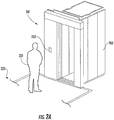
- FIGS. 2A-2C schematic illustrations of an elevator system 201 having an elevator car 203 with elevator car panels 227, 229 that can employ embodiments described herein are shown.
- FIG. 2A is a schematic illustration of the elevator system 201 and elevator car 203 as viewed from a landing 225.
- FIG. 2B shows a front elevation schematic view of a first elevator car panel 227 of the elevator car 203.
- FIG. 2C shows a front elevation schematic view of a second elevator car panel 229 of the elevator car 203.
- a passenger 231 may call the elevator car using a hall call panel 233.
- Elevator cars typically include one or maybe two car operating panels 235 depending on the configuration of the elevator car 203.
- the first elevator car panel 227 may represent a portion of the elevator car 203 that is next to an elevator door, and thus one car operating panel 235 may be located on either side of the elevator door.
- the second elevator car panel 229 which may represent all elevator car panels that do not include the elevator car door, does not include a car operating panel.
- the passenger 231 when the passenger 231 enters the elevator car 203, the passenger 231 may have to interfere with other passengers in order to reach the car operating panel 235. This is particularly true in a full or busy elevator car with a high number of occupants. Accordingly, it may be advantageous to provide a car operating panel that is accessible in multiple locations and/or from any location within the elevator car.
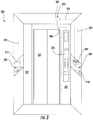
- FIG. 3 a perspective view of the inside of an elevator car 303 equipped with an interactive touch-based car operating panel system 300 in accordance with a non-limiting embodiment of the present disclosure is shown.
- the elevator car 303 includes a first elevator car panel 327 having a car operating panel 335, the first elevator car panel 327 defining a portion of a frame about an elevator car door 337.
- the elevator car 303 also includes multiple second elevator car panels 329.
- the elevator car panels 327, 329 define interior walls of the elevator car 303 and enclose a passenger compartment of the elevator car 303.
- the car operating panel 335 is located on the first elevator car panel 327 near the elevator doors 337.
- the car operating panel 335 is an electromechanical operating panel that includes buttons, touch-sensors, key pads, locks, displays, etc. as will be appreciated by those of skill in the art.
- the car operating panel 335 is fixed in place and physically located at a specific location within the elevator car 303. However, as noted above, the location of the car operating panel 335 may be difficult to reach for some passengers, particularly when the elevator car 303 is crowded.
- the elevator car 303 is configured with an interactive touch-based car operating panel system 300 in accordance with an embodiment of the present disclosure.
- the interactive touch-based car operating panel system 300 is a touch and/or interactive system that enables passengers to perform car operating panel functions from most locations within the elevator car. That is, the interactive touch-based car operating panel system 300 is configured to provide a car operating panel in proximity to any and/or all passengers such that the passenger(s) have easy access to a car operating panel and thus can conveniently control the elevator car 303 without the need to interfere with other passengers.
- the interactive touch-based car operating panel system 300 includes a first controller 302 and a second controller 304, as schematically shown.
- the first controller 302 is operably connected to the car operating panel 335 by a communication connection 306, and the first controller 302 and the second controller 304 are operably connected by the communication connection 306.
- the communication connection 306 may be a wired and/or wireless communication connection.
- first and second controllers 302, 304 those of skill in the art will appreciate that in some embodiments, the first and second controllers 302, 304 can be a single controller unit.
- the first and second controllers 302, 304 include various electronic components including processors, memory, buses, communication elements, input/output elements, etc. to enable embodiments of the present disclosure, as will be apparent to those of skill in the art.
- the interactive touch-based car operating panel system 300 further includes an interactive element 308.
- the interactive element 308 is a touch-based element (e.g., passenger interactive element) that is installed on one or more of the elevator car panels 327, 329.
- the interactive element 308 includes an interactive surface 310 that faces an interior of the elevator car 303 to enable passengers to see the interactive surface 310 and any information displayed thereon.
- the interactive element 308, as shown in FIG. 3 is installed on the second elevator car panels 329 and the car operating panel 335 is installed on the first elevator car panel 327.
- the interactive element 308 is controlled by the second controller 304, with input received at the interactive element 308 (e.g., on interactive surface 310) being processed by the second controller 304 and transmitted to the first controller 302 over the communication connection 306 and the second controller 304 configured to control the interactive element 308 to display various images and/or light up elements to provide output on the interactive element 308.
- the car operating panel 335 may be referred to as a "primary car operating panel” and the interactive element 308 is a "secondary car operating panel” with both car operating panels enabling similar functionality to control the elevator car 303.
- the interactive element 308 is installed to the second elevator car panels 329 or may be integrally formed therewith.
- the interactive element 308 can be a retroactive applied element to existing elevator car panels, and in other embodiments, the interactive element 308 may be manufactured along with the construction and/or assembly of the elevator car panels. Further, in other embodiments, the interactive element 308 can be installed as a structural element between upper and lower portions of the elevator car panel, as described herein.
- the interactive surface 310 is a touch or pressure sensitive element (e.g., band, ribbon, etc.) that is able to receive input by a passenger pressing against the interactive surface 310.
- the interactive surface 310 can include display features such as screens, images, light-up elements, etc.
- the interactive surface 310 can include various labeling to provide information to passengers within the elevator car. Alternatively, or in combination therewith, various instructions and/or information and labeling can be provided on the elevator car panels 327, 329, such as proximate the interactive surface 310.
- Input from a passenger on the interactive surface 310 is processed by the second controller 304.
- the second controller 304 will then transmit a control signal to the first controller 302 and/or an elevator controller (e.g., elevator controller 115 shown in FIG. 1 ).
- the second controller 304 can send a signal to the first controller 302, which can then control elements of the car operating panel 335 to light up or otherwise indicate input that has been received at the interactive surface 310.
- the car operating panel 335 is configured to interpret input received at the interactive surface 310 as an input at the car operating panel 335 (e.g., similar to an input at a physical or mechanical button) such that an appropriate floor button lights up as "selected” to indicate to other passengers that a particular floor has been selected and the elevator car will travel to and stop at the indicated floor.
- the interactive surface 310 is a tactile screen, divided into one or more input regions/screens.
- the interactive surface 310 can be divided into a plurality of input regions having a predefined vertical height that is a portion of a vertical extent of the entire interactive surface 310.
- an interactive element may be arranged with two input regions that define the interactive surface, with each input region having a vertical extent of about 100 mm (about 4 inches) and the interactive surface having a total vertical extent of about 200 mm (about 8 inches).
- the vertical extent of the interactive element 308 and/or the input regions could be any size and may be adjusted based on a size of a passenger area within an elevator car and/or based on a height of the elevator car.
- the interactive surface may be a screen that is flush with the upper and lower panels (e.g., elevator car panels 327, 329).
- the controller for the interactive element 308 e.g., first and/or second controllers 302, 304
- the interactive element 308 is located on the second elevator car panels 329 but is not located on the first elevator car panel 327.
- the smart headband can be located on all panels of an elevator car.
- FIG. 4 a perspective view of the inside of an elevator car 403 equipped with an interactive touch-based car operating panel system 400 in accordance with a non-limiting embodiment of the present disclosure is shown.
- the interactive touch-based car operating panel system 400 is substantially similar to that shown and described above with respect to the embodiment of FIG. 3 .
- the interactive touch-based car operating panel system 400 includes a single controller 412 that is positioned behind a portion of an interactive element 408, or can be installed behind a portion of a first or second panel 427, 429.
- the interactive touch-based car operating panel system 400 has an interactive element 408 that is divided into a first input region 414 and a second input region 416.
- the first input region 414 is positioned above the second input region 416, and the first and second input regions are part of an interactive surface of the interactive touch-based car operating panel system 400.
- the interactive element 408 can extend around an entire periphery of the elevator car 403 (e.g., located on all panels defining a passenger compartment) or may be located on some subportion of the entire periphery, e.g., one or more panels or portions of panels.
- the first input region 414 can provide a different functionality than the second input region 416.
- interacting with the first input region 414 can enable a passenger to request the elevator car 403 to travel upward to floors above the current landing.
- the second input region 416 can enable a passenger to request downward movement of the elevator car 403.
- the first and second input regions 414, 416 can be discrete or separate structures and in other embodiments the first and second input regions 414, 416 can be electronically separate sections of a continuous element.
- the first and second input regions 414, 416 can be defined by software that is part of the controller 412. That is, the controller 412 can receive input information at any location on the interactive element 408 and convert that input information into an input at one of the first or second input regions 414, 416 (e.g., by mapping, etc.).
- the traditional, primary car operating panel has been eliminated and is no longer positioned on the first elevator car panel 427 next to an elevator door 437.
- the interactive touch-based car operating panel system 400 provides all functionality of the traditional car operating panel.
- various elements may remain on an elevator car panel 427, 429. Such elements may include emergency and/or maintenance buttons, switches, locks, etc.
- an optional information panel 418 is located at the position of the traditional car operating panel.
- the information panel 418 can be operably connected to the controller 412.
- the information panel 418 can be a display or screen that can provide information to a passenger within the elevator car 403.
- the information panel 418 can be a static or permanent element, such as a plaque, sign, etc.
- the information panel 418 when a passenger enters the elevator car, the information panel 418 can switch on and provide instructions.
- buttons/features may be included on the information panel 418 and/or otherwise located on elevator car panels, as will be appreciated by those of skill in the art.
- the interactive surfaces e.g., input regions 414, 416) can display various instructions, such as "Touch the band" scrolled all around the periphery of the interior of the elevator car 403.
- the display process can take any format and is not limited to scrolling embodiments and the displayed text and/or images can be customized to the particular desired application.
- the controller of the interactive touch-based car operating panel systems of the present disclosure can be customizable and/or programmable.
- the information panel 418 can be a display that indicates the current floor and any requested destinations that have been made so that passengers can visually see what floors have been requested.
- the information panel 418 may provide other information such as weather, news, etc. as will be appreciated by those of skill in the art.
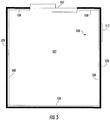
- FIG. 5 a top down plan illustration of an elevator car 503 equipped with an interactive touch-based car operating panel system 500 in accordance with an embodiment of the present disclosure is shown.
- the interactive touch-based car operating panel system 500 is similar to the systems shown and described above and thus similar features will not be described again.
- the elevator car 503 has walls 520 that define the structure and shape of the elevator car 503.
- the walls 520 can be frame elements or a structure to which elevator car panels and portions of the interactive touch-based car operating panel system 500 may be installed or otherwise attached.
- the interactive touch-based car operating panel system 500 of FIG. 5 includes an interactive element 508 that is installed about a periphery of the elevator car 503 on an interior of the walls 520.
- a controller 512 can be mounted to or attached to an opposing side of the walls 520 (e.g., an exterior of the elevator car 503) or may be installed between the interactive element 508/ elevator car panels and the walls 520.
- the interactive element 508 is installed on the entire periphery of the interior of the elevator car 503, except for where an elevator door 537 is located. In other embodiments, the interactive element may be installed over less than the entire periphery (e.g., as shown in FIG. 3 ).
- FIG. 6 a schematic illustration of a display on an interactive surface of an interactive touch-based car operating panel system in accordance with an embodiment of the present disclosure is shown.
- the interactive touch-based car operating panel system of FIG. 6 includes an interactive element 608 having an interactive surface 610.
- the interactive element 608 is installed between an upper portion 629a and a lower portion 629b of an elevator car panel, such as that shown and described above.
- the interactive surface 610 in the present illustration, includes a displayed entry element 622, such as a keypad or other alphanumeric image that is displayed at one or more locations on the interactive surface 610.
- the interactive surface 610 further includes validation, confirmation, and/or cancellation input elements (collectively "confirmation elements 624").
- the interactive surface 610 can be a touch-based system that can register input by passengers that touch the interactive surface 610.
- Various touch-based technologies can be employed without departing from the scope of the present disclosure.
- the interactive surface 610 can be a capacitive touch (e.g., surface capacitance, projected capacitance, etc.), infrared grid, infrared acrylic projection, optical imaging, dispersive signal technology, acoustic pulse recognition, and/or other type of touch-based technology.
- an associated controller can be programmed to map various locations, regions, and/or portions of the interactive surface with specific inputs, and in some embodiments an output (e.g., display image or text) can be overlaid or displayed at the specific location, region, and/or portion having a related input features (e.g., each of the numbers of the displayed entry element 622 is an output).
- an output e.g., display image or text
- a related input features e.g., each of the numbers of the displayed entry element 622 is an output.
- FIG. 7 a schematic illustration of a display on an interactive surface 710 of an interactive touch-based car operating panel system in accordance with an embodiment of the present disclosure is shown.
- the interactive surface 710 of this embodiment is divided into input regions having a first input region 726, a second input region 728, and a third input region 730.
- the input regions 726, 728, 730 are portions of the interactive surface 710 and can be bands, strips, or ribbons that extend an entire length of the interactive element 708 about a periphery of an elevator car.
- the various input regions 726, 728, 730 can include various input elements.
- the first input region 726 includes first region input elements 726', 726".
- the first region input elements 726', 726" can be used by passengers to indicate an upward travel of the elevator car.
- the elevator car may be currently at the 6 th floor, and the first input region 726 indicates travel upward from the 6 th floor.
- one first region input element 726' displays the number "7" to indicate travel up one floor to the 7 th floor.
- the other first region input element 726" is an upward facing arrow that can be interacted with to travel upward. For example, a single push on the first region input element 726" can indicate upward travel by one floor, and pushing the first region input element 726" twice can indicate upward travel by two floors, etc.
- the input can be duration based instead, such that a preset time period of time indicates upward movement by one floor and double the preset time period indicates upward movement by two floors, etc.
- Other types of input duration and number may be employed without departing from the scope of the present disclosure.
- the first region input element 726" can be used to select a destination floor and the other first region input element 726' is a displayed element that indicates that floor being requested.
- the second input region 728 includes confirmation elements 724, which can optionally be provided to enable a passenger to confirm and/or cancel an input request.
- the third input region 730 includes second region input elements 730', 730" that are similar to the first region input elements 726', 726" but are used for downward movement of the elevator car (e.g., request for a destination floor that is below the current floor).
- FIG. 8 a schematic illustration of a display on an interactive surface 810 of an interactive touch-based car operating panel system in accordance with an embodiment of the present disclosure is shown.
- the interactive surface 810, of an interactive element 808, of this embodiment is divided into additional input regions having a first input region 826 (which is separated into multiple sub regions), a second input region 828 (having confirmation elements 824), and a third input region 830 (which is separated into multiple sub regions).
- the input regions 826, 828, 830 are portions of the interactive surface 810 and can include various input elements and/or display elements.
- the first input region 826 and the third input region 830 are each separated into multiple sub regions, with each sub region having associated labels, display elements, and/or input elements.
- the first and third input regions 826, 830 can be used by passengers to make destination requests that are above the current floor (first input region) or below the current floor (third input region).
- the second input region 828 can include various confirmation/cancellation input features.
- a fourth input region 832 is shown.
- the fourth input region 832 provides quick access destination selection, such as the "Lobby" regardless or independent from a current floor at which the elevator car is located. Thus, a passenger may be able to always and easily select specific, pre-labeled floors as destinations (e.g., lobby, cafeteria, etc.).
- the fourth input region 832 may be a "quick access element" of the interactive surface 810.
- any number of input regions and/or sub regions can be employed in interactive touch-based car operating panel systems in accordance with embodiments of the present disclosure.
- the regions/sub regions can be defined by physical or digital separation, as noted above. In the case of digital separation, the regions/sub regions can be programmed and updated and/or changed as needed/desired through a controller or other control unit.
- FIG. 9 a cross-sectional side view of an interactive touch-based car operating panel system 900 in accordance with an embodiment of the present disclosure is shown.
- the interactive touch-based car operating panel system 900 is similar to that shown and described above.
- the interactive touch-based car operating panel system 900 includes an interactive element 908 installed in an elevator car panel between an upper portion 929a and a lower portion 929b of the elevator car panel.
- the interactive element 908 has an interactive surface 910 similar to that shown and described above and can extend around a periphery of a passenger compartment of an elevator car.
- the upper and lower portions 929a, 929b of the elevator car panel are mounted to an elevator car wall 920 (e.g., a frame) by one or more panel fasteners 934 (e.g., screws, bolts, etc.) which fixedly retain the upper and lower portions 929a, 929b to the wall 920.
- the interactive element 908 is installed between the upper and lower portions 929a, 929b and can be retained to the wall 920 by interactive element fasteners 936.
- certain fasteners are shown in FIG. 9 , various other types of retention, mounting, and/or attaching means or mechanisms may be employed without departing from the scope of the present disclosure.
- adhesives, mounting between the interactive element 908 and the upper and/or lower portions 929a, 929b directly, etc. may be employed.
- the controller 912 is arranged to control operation (e.g., inputs/outputs) of the interactive element 908.
- the controller 912 can be configured to divide the interactive surface 910 into various input regions as described above.
- a single or unitary display may be used for the interactive surface 910 and the various input regions can be defined by software.
- a first input region 926 can be assigned a first height H 1
- a second input region 928 can be assigned a second height H 2
- a third input region 930 can be assigned a third height H 3 .
- the interactive touch-based car operating panel system 900 includes an optional information panel 918 that is in communication with the controller 912 over or through a communication connection 906.
- the information panel 918 can be mounted to or part of the upper portion 929a of the elevator car panel and include a display or screen to output an image or information for use by passengers within an elevator car.
- an image or other screen may be activated (e.g., touch activates the system).
- the screen can display arrows (e.g., indicating upward or downward travel) and/or an alphanumeric display (e.g., keyboard, keypad, etc.) to enable a passenger to make an input for a destination for travel.
- display arrows may be employed for a small building (e.g., less than six floors) and the alphanumeric display can be used for higher buildings (e.g., six floors or greater).
- the passenger can choose a destination floor and (optionally) validate such selection with a validation button.
- the inputs from the passengers can be done simultaneously (e.g., simultaneous processes by one or more controllers). If the requested destination that is input in the interactive touch-based car operating panel system is incorrect, a passenger may be able to use a "cancel" button/input to cancel the improper request.
- embodiments of the present disclosure enable an operable car operating panel on each elevator car panel around the interior of an elevator car.
- passengers in elevator cars so equipped can choose and enter a destination selection from everywhere in the passenger compartment of the elevator car, even if the elevator car is crowded.
- the traditional car operating panel can be suppressed, minimized, or even eliminated entirely.
- the interactive touch-based car operating panel system in accordance with various embodiments is customizable, the interactive touch-based car operating panel system can be configured to provide decoration or other aesthetics within elevator cars. Additionally, such interactive touch-based car operating panel systems can be used to convey information to passengers within an elevator car.
- embodiments described herein provide easily accessible car operating panels such that passengers are not inconvenienced in crowded elevators.
Landscapes
- Engineering & Computer Science (AREA)
- Automation & Control Theory (AREA)
- Computer Networks & Wireless Communication (AREA)
- Civil Engineering (AREA)
- Mechanical Engineering (AREA)
- Structural Engineering (AREA)
- Elevator Control (AREA)
- Indicating And Signalling Devices For Elevators (AREA)
Abstract
Description
- The subject matter disclosed herein generally relates to car operating panels of elevator systems and, more particularly, to easy-access car operating panels for elevator systems.
- Elevator systems, and particularly elevator cars, include car operating panels that are accessible by passengers to indicate a desired destination. In order for a passenger to indicate a desired floor, the passenger must access the car operating panel and interact with various buttons, inputs, or other device or functions. However, when the elevator car is crowded, access to the car operating panel may be difficult or hampered, and thus a passenger may not be able to input a desired destination after entering the elevator car. Accordingly, it may be advantageous to provide easier access for passengers to input desired destination information into an elevator system.
- According to some embodiments, elevator cars are provided. The elevator cars include a plurality of elevator car panels defining a passenger compartment of the elevator car and an interactive touch-based car operating panel system. The interactive touch-based car operating panel system has an interactive element extending around at least a portion of a periphery of the passenger compartment and located on at least one of the plurality of elevator car panels, the interactive element having an interactive surface facing the passenger compartment and a controller arranged to receive passenger input at the interactive surface and control an elevator car in response to the passenger input.
- In addition to one or more of the features described above, or as an alternative, further embodiments of the elevator car may include that the interactive surface is divided into a plurality of input regions, wherein each input region provides a different function.
- In addition to one or more of the features described above, or as an alternative, further embodiments of the elevator car may include that the plurality of input regions comprise a first input region and a second input region, wherein the first input region is located relative higher in the elevator car than the second input region and the first input region provides a functionality to request a destination floor above a current floor of the elevator car and the second input region provides a functionality to request a destination floor below a current floor of the elevator car.
- In addition to one or more of the features described above, or as an alternative, further embodiments of the elevator car may include that the plurality of input regions includes a confirmation region enabling confirmation or cancelation of the passenger input.
- In addition to one or more of the features described above, or as an alternative, further embodiments of the elevator car may include that the interactive surface is a display arranged to display interactive elements thereon.
- In addition to one or more of the features described above, or as an alternative, further embodiments of the elevator car may include that the interactive surface includes a quick access element to enable selection of a predetermined destination.
- In addition to one or more of the features described above, or as an alternative, further embodiments of the elevator car may include that the elevator car further includes an elevator car door in at least one elevator car panel, wherein the interactive element extends about an entire periphery of the passenger compartment except for where the elevator car door is located.
- In addition to one or more of the features described above, or as an alternative, further embodiments of the elevator car may include that the interactive touch-based car operating panel system further includes an information panel located within the elevator car and controllable to display information related to the passenger input.
- In addition to one or more of the features described above, or as an alternative, further embodiments of the elevator car may include a primary car operating panel installed in one of the elevator car panels.
- The foregoing features and elements may be combined in various combinations without exclusivity, unless expressly indicated otherwise. These features and elements as well as the operation thereof will become more apparent in light of the following description and the accompanying drawings. It should be understood, however, that the following description and drawings are intended to be illustrative and explanatory in nature and non-limiting.
- The subject matter is particularly pointed out and distinctly claimed at the conclusion of the specification. The foregoing and other features, and advantages of the present disclosure are apparent from the following detailed description taken in conjunction with the accompanying drawings in which:
-
FIG. 1 is a schematic illustration of an elevator system that may employ various embodiments of the present disclosure; -
FIG. 2A is a schematic illustration of an elevator system having an elevator car that may incorporate features of the present disclosure; -
FIG. 2B is a front elevation schematic view of a first elevator car panel of the elevator car ofFIG. 2A ; -
FIG. 2C is a front elevation schematic view of a second elevator car panel of the elevator car ofFIG. 2A ; -
FIG. 3 is a perspective view of the inside of an elevator car equipped with an interactive touch-based car operating panel system in accordance with an embodiment of the present disclosure; -
FIG. 4 is a perspective view of the inside of an elevator car equipped with an interactive touch-based car operating panel system in accordance with an embodiment of the present disclosure; -
FIG. 5 is a top down plan illustration of an elevator car equipped with an interactive touch-based car operating panel system in accordance with an embodiment of the present disclosure; -
FIG. 6 is a schematic illustration of a display on an interactive surface of an interactive touch-based car operating panel system in accordance with an embodiment of the present disclosure; -
FIG. 7 is a schematic illustration of a display on an interactive surface of an interactive touch-based car operating panel system in accordance with an embodiment of the present disclosure; -
FIG. 8 is a schematic illustration of a display on an interactive surface of an interactive touch-based car operating panel system in accordance with an embodiment of the present disclosure; and -
FIG. 9 is a cross-sectional side view of an interactive touch-based car operating panel system in accordance with an embodiment of the present disclosure. -
FIG. 1 is a schematic illustration of an elevator system that may employ various embodiments of the present disclosure.FIG. 1 is a perspective view of anelevator system 101 including anelevator car 103, acounterweight 105, aroping 107, aguide rail 109, amachine 111, aposition encoder 113, and acontroller 115. Theelevator car 103 andcounterweight 105 are connected to each other by theroping 107. Theroping 107 may include or be configured as, for example, ropes, steel cables, and/or coated-steel belts. Thecounterweight 105 is configured to balance a load of theelevator car 103 and is configured to facilitate movement of theelevator car 103 concurrently and in an opposite direction with respect to thecounterweight 105 within anelevator shaft 117 and along theguide rail 109. - The
roping 107 engages themachine 111, which is part of an overhead structure of theelevator system 101. Themachine 111 is configured to control movement between theelevator car 103 and thecounterweight 105. Theposition encoder 113 may be mounted on an upper sheave of a speed-governor system 119 and may be configured to provide position signals related to a position of theelevator car 103 within theelevator shaft 117. In other embodiments, theposition encoder 113 may be directly mounted to a moving component of themachine 111, or may be located in other positions and/or configurations as known in the art. - The
controller 115 is located, as shown, in acontroller room 121 of theelevator shaft 117 and is configured to control the operation of theelevator system 101, and particularly theelevator car 103. For example, thecontroller 115 may provide drive signals to themachine 111 to control the acceleration, deceleration, leveling, stopping, etc. of theelevator car 103. Thecontroller 115 may also be configured to receive position signals from theposition encoder 113. When moving up or down within theelevator shaft 117 alongguide rail 109, theelevator car 103 may stop at one ormore landings 125 as controlled by thecontroller 115. Although shown in acontroller room 121, those of skill in the art will appreciate that thecontroller 115 can be located and/or configured in other locations or positions within theelevator system 101. - The
machine 111 may include a motor or similar driving mechanism. In accordance with embodiments of the disclosure, themachine 111 is configured to include an electrically driven motor. The power supply for the motor may be any power source, including a power grid, which, in combination with other components, is supplied to the motor. - Although shown and described with a roping system, elevator systems that employ other methods and mechanisms of moving an elevator car within an elevator shaft may employ embodiments of the present disclosure.
FIG. 1 is merely a non-limiting example presented for illustrative and explanatory purposes. - Turning to
FIGS. 2A-2C , schematic illustrations of anelevator system 201 having anelevator car 203 withelevator car panels FIG. 2A is a schematic illustration of theelevator system 201 andelevator car 203 as viewed from alanding 225.FIG. 2B shows a front elevation schematic view of a firstelevator car panel 227 of theelevator car 203.FIG. 2C shows a front elevation schematic view of a secondelevator car panel 229 of theelevator car 203. Apassenger 231 may call the elevator car using ahall call panel 233. Upon arrival of theelevator car 203 at thelanding 225, thepassenger 231 may enter theelevator car 203 and attempt to access or reach acar operating panel 235 to select a desired destination floor. Elevator cars typically include one or maybe twocar operating panels 235 depending on the configuration of theelevator car 203. For example, in some configurations, the firstelevator car panel 227 may represent a portion of theelevator car 203 that is next to an elevator door, and thus onecar operating panel 235 may be located on either side of the elevator door. However, as shown, the secondelevator car panel 229, which may represent all elevator car panels that do not include the elevator car door, does not include a car operating panel. As such, when thepassenger 231 enters theelevator car 203, thepassenger 231 may have to interfere with other passengers in order to reach thecar operating panel 235. This is particularly true in a full or busy elevator car with a high number of occupants. Accordingly, it may be advantageous to provide a car operating panel that is accessible in multiple locations and/or from any location within the elevator car. - Turning now to
FIG. 3 , a perspective view of the inside of anelevator car 303 equipped with an interactive touch-based caroperating panel system 300 in accordance with a non-limiting embodiment of the present disclosure is shown. As shown inFIG. 3 , theelevator car 303 includes a firstelevator car panel 327 having acar operating panel 335, the firstelevator car panel 327 defining a portion of a frame about anelevator car door 337. Theelevator car 303 also includes multiple secondelevator car panels 329. Theelevator car panels elevator car 303 and enclose a passenger compartment of theelevator car 303. - As shown, the
car operating panel 335 is located on the firstelevator car panel 327 near theelevator doors 337. Thecar operating panel 335 is an electromechanical operating panel that includes buttons, touch-sensors, key pads, locks, displays, etc. as will be appreciated by those of skill in the art. Thecar operating panel 335 is fixed in place and physically located at a specific location within theelevator car 303. However, as noted above, the location of thecar operating panel 335 may be difficult to reach for some passengers, particularly when theelevator car 303 is crowded. - In the embodiment of
FIG. 3 , theelevator car 303 is configured with an interactive touch-based caroperating panel system 300 in accordance with an embodiment of the present disclosure. The interactive touch-based caroperating panel system 300 is a touch and/or interactive system that enables passengers to perform car operating panel functions from most locations within the elevator car. That is, the interactive touch-based caroperating panel system 300 is configured to provide a car operating panel in proximity to any and/or all passengers such that the passenger(s) have easy access to a car operating panel and thus can conveniently control theelevator car 303 without the need to interfere with other passengers. - The interactive touch-based car
operating panel system 300 includes afirst controller 302 and asecond controller 304, as schematically shown. Thefirst controller 302 is operably connected to thecar operating panel 335 by acommunication connection 306, and thefirst controller 302 and thesecond controller 304 are operably connected by thecommunication connection 306. Thecommunication connection 306 may be a wired and/or wireless communication connection. Further, although shown and described with first andsecond controllers second controllers second controllers - The interactive touch-based car
operating panel system 300 further includes aninteractive element 308. Theinteractive element 308 is a touch-based element (e.g., passenger interactive element) that is installed on one or more of theelevator car panels interactive element 308 includes aninteractive surface 310 that faces an interior of theelevator car 303 to enable passengers to see theinteractive surface 310 and any information displayed thereon. Theinteractive element 308, as shown inFIG. 3 , is installed on the secondelevator car panels 329 and thecar operating panel 335 is installed on the firstelevator car panel 327. Theinteractive element 308 is controlled by thesecond controller 304, with input received at the interactive element 308 (e.g., on interactive surface 310) being processed by thesecond controller 304 and transmitted to thefirst controller 302 over thecommunication connection 306 and thesecond controller 304 configured to control theinteractive element 308 to display various images and/or light up elements to provide output on theinteractive element 308. In the present embodiment thecar operating panel 335 may be referred to as a "primary car operating panel" and theinteractive element 308 is a "secondary car operating panel" with both car operating panels enabling similar functionality to control theelevator car 303. - The
interactive element 308 is installed to the secondelevator car panels 329 or may be integrally formed therewith. For example, in some embodiments, theinteractive element 308 can be a retroactive applied element to existing elevator car panels, and in other embodiments, theinteractive element 308 may be manufactured along with the construction and/or assembly of the elevator car panels. Further, in other embodiments, theinteractive element 308 can be installed as a structural element between upper and lower portions of the elevator car panel, as described herein. - The
interactive surface 310 is a touch or pressure sensitive element (e.g., band, ribbon, etc.) that is able to receive input by a passenger pressing against theinteractive surface 310. In some embodiments, as described herein, theinteractive surface 310 can include display features such as screens, images, light-up elements, etc. Further, theinteractive surface 310 can include various labeling to provide information to passengers within the elevator car. Alternatively, or in combination therewith, various instructions and/or information and labeling can be provided on theelevator car panels interactive surface 310. - Input from a passenger on the
interactive surface 310 is processed by thesecond controller 304. Thesecond controller 304 will then transmit a control signal to thefirst controller 302 and/or an elevator controller (e.g.,elevator controller 115 shown inFIG. 1 ). In some embodiments, thesecond controller 304 can send a signal to thefirst controller 302, which can then control elements of thecar operating panel 335 to light up or otherwise indicate input that has been received at theinteractive surface 310. In some embodiments, thecar operating panel 335 is configured to interpret input received at theinteractive surface 310 as an input at the car operating panel 335 (e.g., similar to an input at a physical or mechanical button) such that an appropriate floor button lights up as "selected" to indicate to other passengers that a particular floor has been selected and the elevator car will travel to and stop at the indicated floor. - In accordance with some embodiments of the present disclosure, the
interactive surface 310 is a tactile screen, divided into one or more input regions/screens. In one illustrative example, theinteractive surface 310 can be divided into a plurality of input regions having a predefined vertical height that is a portion of a vertical extent of the entireinteractive surface 310. In one non-limiting example, an interactive element may be arranged with two input regions that define the interactive surface, with each input region having a vertical extent of about 100 mm (about 4 inches) and the interactive surface having a total vertical extent of about 200 mm (about 8 inches). Those of skill in the art will appreciate that the vertical extent of theinteractive element 308 and/or the input regions could be any size and may be adjusted based on a size of a passenger area within an elevator car and/or based on a height of the elevator car. - In various embodiments, such as that described herein, the interactive surface may be a screen that is flush with the upper and lower panels (e.g.,
elevator car panels 327, 329). Further, the controller for the interactive element 308 (e.g., first and/orsecond controllers 302, 304) may be located behind the interactive surface. As shown inFIG. 3 , theinteractive element 308 is located on the secondelevator car panels 329 but is not located on the firstelevator car panel 327. However, in some embodiments, the smart headband can be located on all panels of an elevator car. - Turning now to
FIG. 4 , a perspective view of the inside of anelevator car 403 equipped with an interactive touch-based caroperating panel system 400 in accordance with a non-limiting embodiment of the present disclosure is shown. In functionality, the interactive touch-based caroperating panel system 400 is substantially similar to that shown and described above with respect to the embodiment ofFIG. 3 . The interactive touch-based caroperating panel system 400 includes asingle controller 412 that is positioned behind a portion of aninteractive element 408, or can be installed behind a portion of a first orsecond panel operating panel system 400 has aninteractive element 408 that is divided into afirst input region 414 and asecond input region 416. In this embodiment, thefirst input region 414 is positioned above thesecond input region 416, and the first and second input regions are part of an interactive surface of the interactive touch-based caroperating panel system 400. Theinteractive element 408 can extend around an entire periphery of the elevator car 403 (e.g., located on all panels defining a passenger compartment) or may be located on some subportion of the entire periphery, e.g., one or more panels or portions of panels. - In this embodiment, the
first input region 414 can provide a different functionality than thesecond input region 416. For example, interacting with thefirst input region 414 can enable a passenger to request theelevator car 403 to travel upward to floors above the current landing. In contrast, thesecond input region 416 can enable a passenger to request downward movement of theelevator car 403. In some embodiments, the first andsecond input regions second input regions second input regions controller 412. That is, thecontroller 412 can receive input information at any location on theinteractive element 408 and convert that input information into an input at one of the first orsecond input regions 414, 416 (e.g., by mapping, etc.). - Also shown in
FIG. 4 , the traditional, primary car operating panel has been eliminated and is no longer positioned on the firstelevator car panel 427 next to anelevator door 437. In this embodiment, the interactive touch-based caroperating panel system 400 provides all functionality of the traditional car operating panel. However, in some such embodiments, various elements may remain on anelevator car panel - Further, in the embodiment of
FIG. 4 , anoptional information panel 418 is located at the position of the traditional car operating panel. Theinformation panel 418 can be operably connected to thecontroller 412. Theinformation panel 418 can be a display or screen that can provide information to a passenger within theelevator car 403. In other embodiments, theinformation panel 418 can be a static or permanent element, such as a plaque, sign, etc. In systems including theinformation panel 418, when a passenger enters the elevator car, theinformation panel 418 can switch on and provide instructions. In some embodiments, various compulsory and/or required buttons/features (e.g., alarm button(s), door open button(s), emergency call/intercom features, etc.) may be included on theinformation panel 418 and/or otherwise located on elevator car panels, as will be appreciated by those of skill in the art. At the same time, the interactive surfaces (e.g.,input regions 414, 416) can display various instructions, such as "Touch the band" scrolled all around the periphery of the interior of theelevator car 403. The display process can take any format and is not limited to scrolling embodiments and the displayed text and/or images can be customized to the particular desired application. Those of skill in the art will appreciate that the controller of the interactive touch-based car operating panel systems of the present disclosure can be customizable and/or programmable. - In some embodiments, the
information panel 418 can be a display that indicates the current floor and any requested destinations that have been made so that passengers can visually see what floors have been requested. Theinformation panel 418 may provide other information such as weather, news, etc. as will be appreciated by those of skill in the art. - Turning now to
FIG. 5 , a top down plan illustration of anelevator car 503 equipped with an interactive touch-based caroperating panel system 500 in accordance with an embodiment of the present disclosure is shown. The interactive touch-based caroperating panel system 500 is similar to the systems shown and described above and thus similar features will not be described again. As shown inFIG. 5 , theelevator car 503 haswalls 520 that define the structure and shape of theelevator car 503. Thewalls 520 can be frame elements or a structure to which elevator car panels and portions of the interactive touch-based caroperating panel system 500 may be installed or otherwise attached. The interactive touch-based caroperating panel system 500 ofFIG. 5 includes aninteractive element 508 that is installed about a periphery of theelevator car 503 on an interior of thewalls 520. Further, as shown, acontroller 512 can be mounted to or attached to an opposing side of the walls 520 (e.g., an exterior of the elevator car 503) or may be installed between theinteractive element 508/ elevator car panels and thewalls 520. In the embodiment ofFIG. 5 , theinteractive element 508 is installed on the entire periphery of the interior of theelevator car 503, except for where anelevator door 537 is located. In other embodiments, the interactive element may be installed over less than the entire periphery (e.g., as shown inFIG. 3 ). - Turning now to
FIG. 6 , a schematic illustration of a display on an interactive surface of an interactive touch-based car operating panel system in accordance with an embodiment of the present disclosure is shown. The interactive touch-based car operating panel system ofFIG. 6 includes aninteractive element 608 having aninteractive surface 610. Theinteractive element 608 is installed between anupper portion 629a and alower portion 629b of an elevator car panel, such as that shown and described above. Theinteractive surface 610, in the present illustration, includes a displayedentry element 622, such as a keypad or other alphanumeric image that is displayed at one or more locations on theinteractive surface 610. As shown, theinteractive surface 610 further includes validation, confirmation, and/or cancellation input elements (collectively "confirmation elements 624"). - The
interactive surface 610, and/or any interactive surface employed in embodiments of the present disclosure, can be a touch-based system that can register input by passengers that touch theinteractive surface 610. Various touch-based technologies can be employed without departing from the scope of the present disclosure. For example, theinteractive surface 610 can be a capacitive touch (e.g., surface capacitance, projected capacitance, etc.), infrared grid, infrared acrylic projection, optical imaging, dispersive signal technology, acoustic pulse recognition, and/or other type of touch-based technology. In some embodiments, an associated controller can be programmed to map various locations, regions, and/or portions of the interactive surface with specific inputs, and in some embodiments an output (e.g., display image or text) can be overlaid or displayed at the specific location, region, and/or portion having a related input features (e.g., each of the numbers of the displayedentry element 622 is an output). - Turning now to
FIG. 7 , a schematic illustration of a display on aninteractive surface 710 of an interactive touch-based car operating panel system in accordance with an embodiment of the present disclosure is shown. Theinteractive surface 710 of this embodiment is divided into input regions having afirst input region 726, asecond input region 728, and athird input region 730. Theinput regions interactive surface 710 and can be bands, strips, or ribbons that extend an entire length of theinteractive element 708 about a periphery of an elevator car. As shown, thevarious input regions first input region 726 includes firstregion input elements 726', 726". The firstregion input elements 726', 726" can be used by passengers to indicate an upward travel of the elevator car. For example, in the illustration ofFIG. 7 , the elevator car may be currently at the 6th floor, and thefirst input region 726 indicates travel upward from the 6th floor. Thus, one first region input element 726' displays the number "7" to indicate travel up one floor to the 7th floor. The other firstregion input element 726" is an upward facing arrow that can be interacted with to travel upward. For example, a single push on the firstregion input element 726" can indicate upward travel by one floor, and pushing the firstregion input element 726" twice can indicate upward travel by two floors, etc. The input can be duration based instead, such that a preset time period of time indicates upward movement by one floor and double the preset time period indicates upward movement by two floors, etc. Other types of input duration and number may be employed without departing from the scope of the present disclosure. Further, in some embodiments, the firstregion input element 726" can be used to select a destination floor and the other first region input element 726' is a displayed element that indicates that floor being requested. - The
second input region 728 includesconfirmation elements 724, which can optionally be provided to enable a passenger to confirm and/or cancel an input request. Thethird input region 730 includes secondregion input elements 730', 730" that are similar to the firstregion input elements 726', 726" but are used for downward movement of the elevator car (e.g., request for a destination floor that is below the current floor). - Turning now to
FIG. 8 , a schematic illustration of a display on aninteractive surface 810 of an interactive touch-based car operating panel system in accordance with an embodiment of the present disclosure is shown. As shown, theinteractive surface 810, of aninteractive element 808, of this embodiment is divided into additional input regions having a first input region 826 (which is separated into multiple sub regions), a second input region 828 (having confirmation elements 824), and a third input region 830 (which is separated into multiple sub regions). Theinput regions interactive surface 810 and can include various input elements and/or display elements. For example, as schematically shown, thefirst input region 826 and thethird input region 830 are each separated into multiple sub regions, with each sub region having associated labels, display elements, and/or input elements. The first andthird input regions second input region 828 can include various confirmation/cancellation input features. - Also shown in the embodiment of
FIG. 8 , afourth input region 832 is shown. Thefourth input region 832 provides quick access destination selection, such as the "Lobby" regardless or independent from a current floor at which the elevator car is located. Thus, a passenger may be able to always and easily select specific, pre-labeled floors as destinations (e.g., lobby, cafeteria, etc.). Thefourth input region 832 may be a "quick access element" of theinteractive surface 810. - As will be appreciated by those of skill in the art, any number of input regions and/or sub regions can be employed in interactive touch-based car operating panel systems in accordance with embodiments of the present disclosure. The regions/sub regions can be defined by physical or digital separation, as noted above. In the case of digital separation, the regions/sub regions can be programmed and updated and/or changed as needed/desired through a controller or other control unit.
- Turning now to
FIG. 9 , a cross-sectional side view of an interactive touch-based caroperating panel system 900 in accordance with an embodiment of the present disclosure is shown. The interactive touch-based caroperating panel system 900 is similar to that shown and described above. For example, the interactive touch-based caroperating panel system 900 includes aninteractive element 908 installed in an elevator car panel between anupper portion 929a and alower portion 929b of the elevator car panel. Theinteractive element 908 has aninteractive surface 910 similar to that shown and described above and can extend around a periphery of a passenger compartment of an elevator car. As shown, the upper andlower portions lower portions wall 920. Theinteractive element 908 is installed between the upper andlower portions wall 920 byinteractive element fasteners 936. Although certain fasteners are shown inFIG. 9 , various other types of retention, mounting, and/or attaching means or mechanisms may be employed without departing from the scope of the present disclosure. For example, adhesives, mounting between theinteractive element 908 and the upper and/orlower portions - The
interactive element 908, as shown, includes acontroller 912, which may be electronics or other components as described above. Thecontroller 912 is arranged to control operation (e.g., inputs/outputs) of theinteractive element 908. Thecontroller 912 can be configured to divide theinteractive surface 910 into various input regions as described above. A single or unitary display may be used for theinteractive surface 910 and the various input regions can be defined by software. As shown, afirst input region 926 can be assigned a first height H1, asecond input region 928 can be assigned a second height H2, and athird input region 930 can be assigned a third height H3. The various heights of the regions can be different from each other, based in part on the functionality assigned or provided by each reference, and as will be appreciated by those of skill in the art in view of the present disclosure. In the embodiment ofFIG. 9 , the interactive touch-based caroperating panel system 900 includes anoptional information panel 918 that is in communication with thecontroller 912 over or through acommunication connection 906. Theinformation panel 918 can be mounted to or part of theupper portion 929a of the elevator car panel and include a display or screen to output an image or information for use by passengers within an elevator car. - In operation, when an interactive surface of an interactive element is touched by a passenger, an image or other screen may be activated (e.g., touch activates the system). The screen can display arrows (e.g., indicating upward or downward travel) and/or an alphanumeric display (e.g., keyboard, keypad, etc.) to enable a passenger to make an input for a destination for travel. As an example, display arrows may be employed for a small building (e.g., less than six floors) and the alphanumeric display can be used for higher buildings (e.g., six floors or greater). In either arrangement, the passenger can choose a destination floor and (optionally) validate such selection with a validation button.
- In some embodiments, if there are several passengers within an elevator car at the same time, the inputs from the passengers can be done simultaneously (e.g., simultaneous processes by one or more controllers). If the requested destination that is input in the interactive touch-based car operating panel system is incorrect, a passenger may be able to use a "cancel" button/input to cancel the improper request.
- Advantageously, embodiments of the present disclosure enable an operable car operating panel on each elevator car panel around the interior of an elevator car. Thus, advantageously, passengers in elevator cars so equipped can choose and enter a destination selection from everywhere in the passenger compartment of the elevator car, even if the elevator car is crowded. Further, advantageously, the traditional car operating panel can be suppressed, minimized, or even eliminated entirely. Moreover, advantageously, those of skill in the art will appreciate that because the interactive touch-based car operating panel system in accordance with various embodiments is customizable, the interactive touch-based car operating panel system can be configured to provide decoration or other aesthetics within elevator cars. Additionally, such interactive touch-based car operating panel systems can be used to convey information to passengers within an elevator car.
- The use of the terms "a", "an", "the", and similar references in the context of description (especially in the context of the following claims) are to be construed to cover both the singular and the plural, unless otherwise indicated herein or specifically contradicted by context. The modifier "about" used in connection with a quantity is inclusive of the stated value and has the meaning dictated by the context (e.g., it includes the degree of error associated with measurement of the particular quantity). All ranges disclosed herein are inclusive of the endpoints, and the endpoints are independently combinable with each other.
- Those of skill in the art will appreciate that various example embodiments are shown and described herein, each having certain features in the particular embodiments, but the present disclosure is not thus limited. That is, features of the various embodiments can be exchanged, altered, or otherwise combined in different combinations without departing from the scope of the present disclosure. Further, additional features and/or components can be incorporated into the easily accessible car operating panels described herein without departing from the scope of the present disclosure.
- Advantageously, embodiments described herein provide easily accessible car operating panels such that passengers are not inconvenienced in crowded elevators.
- While the present disclosure has been described in detail in connection with only a limited number of embodiments, it should be readily understood that the present disclosure is not limited to such disclosed embodiments. Rather, the present disclosure can be modified to incorporate any number of variations, alterations, substitutions, combinations, sub-combinations, or equivalent arrangements not heretofore described, but which are commensurate with the scope of the present disclosure. Additionally, while various embodiments of the present disclosure have been described, it is to be understood that aspects of the present disclosure may include only some of the described embodiments.
- Accordingly, the present disclosure is not to be seen as limited by the foregoing description, but is only limited by the scope of the appended claims.
Claims (9)
- An elevator car comprising:a plurality of elevator car panels defining a passenger compartment of the elevator car; andan interactive touch-based car operating panel system comprising:an interactive element extending around at least a portion of a periphery of the passenger compartment and located on at least one of the plurality of elevator car panels, the interactive element having an interactive surface facing the passenger compartment; anda controller arranged to receive passenger input at the interactive surface and control an elevator car in response to the passenger input.
- The elevator car of claim 1, wherein the interactive surface is divided into a plurality of input regions, wherein each input region provides a different function.
- The elevator car of claim 2, wherein the plurality of input regions comprise a first input region and a second input region, wherein the first input region is located relative higher in the elevator car than the second input region and the first input region provides a functionality to request a destination floor above a current floor of the elevator car and the second input region provides a functionality to request a destination floor below a current floor of the elevator car.
- The elevator car of any of claims 2-3, wherein the plurality of input regions includes a confirmation region enabling confirmation or cancelation of the passenger input.
- The elevator car of any of the preceding claims, wherein the interactive surface is a display arranged to display interactive elements thereon.
- The elevator car of any of the preceding claims, wherein the interactive surface includes a quick access element to enable selection of a predetermined destination.
- The elevator car of any of the preceding claims, the elevator car further comprising an elevator car door in at least one elevator car panel, wherein the interactive element extends about an entire periphery of the passenger compartment except for where the elevator car door is located.
- The elevator car of any of the preceding claims, the interactive touch-based car operating panel system further comprising an information panel located within the elevator car and controllable to display information related to the passenger input.
- The elevator car of any of the preceding claims, further comprising a primary car operating panel installed in one of the elevator car panels.
Priority Applications (3)
| Application Number | Priority Date | Filing Date | Title |
|---|---|---|---|
| EP17305608.6A EP3406554B1 (en) | 2017-05-23 | 2017-05-23 | Interactive touch-based car operating panel systems for elevator cars |
| US15/975,933 US10994967B2 (en) | 2017-05-23 | 2018-05-10 | Interactive touch-based car operating panel systems for elevator cars |
| CN201810488058.3A CN108928720A (en) | 2017-05-23 | 2018-05-21 | The interactive operation panel system based on touch for lift car |
Applications Claiming Priority (1)
| Application Number | Priority Date | Filing Date | Title |
|---|---|---|---|
| EP17305608.6A EP3406554B1 (en) | 2017-05-23 | 2017-05-23 | Interactive touch-based car operating panel systems for elevator cars |
Publications (2)
| Publication Number | Publication Date |
|---|---|
| EP3406554A1 true EP3406554A1 (en) | 2018-11-28 |
| EP3406554B1 EP3406554B1 (en) | 2021-04-21 |
Family
ID=59034670
Family Applications (1)
| Application Number | Title | Priority Date | Filing Date |
|---|---|---|---|
| EP17305608.6A Active EP3406554B1 (en) | 2017-05-23 | 2017-05-23 | Interactive touch-based car operating panel systems for elevator cars |
Country Status (3)
| Country | Link |
|---|---|
| US (1) | US10994967B2 (en) |
| EP (1) | EP3406554B1 (en) |
| CN (1) | CN108928720A (en) |
Cited By (1)
| Publication number | Priority date | Publication date | Assignee | Title |
|---|---|---|---|---|
| US20210206598A1 (en) * | 2020-01-07 | 2021-07-08 | Thyssenkrupp Elevator Innovation And Operations Gmbh | Systems and methods for displaying cabin operating panels in elevator cabs based on positions of passengers |
Families Citing this family (9)
| Publication number | Priority date | Publication date | Assignee | Title |
|---|---|---|---|---|
| US10519003B2 (en) * | 2015-03-13 | 2019-12-31 | Mitsubishi Electric Corporation | Elevator operation panel |
| EP3406554B1 (en) * | 2017-05-23 | 2021-04-21 | Otis Elevator Company | Interactive touch-based car operating panel systems for elevator cars |
| US11242226B2 (en) * | 2018-05-14 | 2022-02-08 | Otis Elevator Company | Elevator door safety control |
| WO2020058348A1 (en) * | 2018-09-18 | 2020-03-26 | Inventio Ag | Call input device for an elevator |
| CN110294374B (en) * | 2019-07-12 | 2025-03-07 | 通力电梯有限公司 | Elevator touch panel and elevator car |
| CN115427337B (en) * | 2020-04-20 | 2025-04-01 | 因温特奥股份公司 | Interface for operating an elevator car, elevator car and method for producing an elevator car |
| USD1046671S1 (en) * | 2020-04-30 | 2024-10-15 | Inventio Ag | Operating panel |
| KR102217759B1 (en) * | 2020-08-12 | 2021-02-22 | 주식회사 다지트 | Display device, elevator assembly including the same and method for image processing |
| USD1021918S1 (en) * | 2021-04-13 | 2024-04-09 | Inventio Ag | Display screen panel with graphical user interface |
Citations (3)
| Publication number | Priority date | Publication date | Assignee | Title |
|---|---|---|---|---|
| JPS61263576A (en) * | 1985-05-16 | 1986-11-21 | 三菱電機株式会社 | Calling register device for elevator |
| JPH06171851A (en) * | 1992-12-03 | 1994-06-21 | Mitsubishi Denki Bill Techno Service Kk | Car call registration device for elevator and landing call registration device for elevator |
| JP2011051719A (en) * | 2009-09-01 | 2011-03-17 | Toshiba Elevator Co Ltd | Elevator device |
Family Cites Families (32)
| Publication number | Priority date | Publication date | Assignee | Title |
|---|---|---|---|---|
| US4678062A (en) | 1986-04-08 | 1987-07-07 | Westinghouse Electric Corp. | Elevator car |
| JP2000226162A (en) | 1999-02-04 | 2000-08-15 | Hitachi Ltd | Elevator call operation device and elevator system having the same |
| US6902041B2 (en) * | 2002-06-27 | 2005-06-07 | Jon E. Eccleston | Method and system to select elevator floors using a single control |
| JP2004277119A (en) | 2003-03-17 | 2004-10-07 | Toshiba Elevator Co Ltd | Call registering device of elevator |
| KR20060072880A (en) | 2004-12-24 | 2006-06-28 | 이재호 | Elevator button device |
| CN201201835Y (en) | 2008-03-06 | 2009-03-04 | 康力电梯股份有限公司 | Handrail of elevator car |
| JP2010208775A (en) | 2009-03-09 | 2010-09-24 | Toshiba Elevator Co Ltd | Control device for elevator |
| JP2010208754A (en) | 2009-03-09 | 2010-09-24 | Toshiba Elevator Co Ltd | Elevator system |
| JP5159723B2 (en) | 2009-08-10 | 2013-03-13 | 株式会社日立製作所 | Elevator landing control device |
| KR101045842B1 (en) | 2010-06-30 | 2011-07-01 | 유재혁 | Speech recognition device of elevator and control method thereof |
| CN201793299U (en) | 2010-09-09 | 2011-04-13 | 昆山京都电梯有限公司 | Elevator car handle |
| FI122844B (en) | 2011-04-21 | 2012-07-31 | Kone Corp | INVITATION EQUIPMENT AND METHOD FOR GIVING A LIFT CALL |
| CN102285562A (en) | 2011-07-28 | 2011-12-21 | 马传辉 | Foot-stepping and hand-pressing dual-input device for elevator |
| CN202744124U (en) | 2012-06-19 | 2013-02-20 | 浙江西子工业技术研究院有限公司 | Elevator with blind people guiding device |
| CN202729491U (en) | 2012-08-03 | 2013-02-13 | 苏州富士电梯有限公司 | Double-tube disabled person operation box in elevator car |
| SG2013082250A (en) | 2012-11-12 | 2014-06-27 | Kone Corp | Method, call-giving device, elevator system and computer program product |
| CN203345870U (en) | 2013-05-15 | 2013-12-18 | 肖桂林 | Elevator lift car control panel with intelligent reminding function |
| WO2015034191A1 (en) | 2013-09-05 | 2015-03-12 | Yoon Il Shik | Emergency call device for elevator, and emergency operating method of same |
| JP6270633B2 (en) | 2014-06-04 | 2018-01-31 | 三菱電機株式会社 | Elevator call registration device and call registration method |
| CN104444662A (en) | 2014-12-05 | 2015-03-25 | 瑞电士(常熟)传感器有限公司 | Inductive elevator operating panel |
| WO2016124810A1 (en) | 2015-02-04 | 2016-08-11 | Kone Corporation | Elevator operating panel comprising touch screen |
| CN104925599A (en) | 2015-07-06 | 2015-09-23 | 康力电梯股份有限公司 | Floor-sliding-selecting touch screen elevator operation box |
| CN204873361U (en) | 2015-08-12 | 2015-12-16 | 上海舒上电梯装潢有限公司 | Elevator car with button handrail |
| EP3231755B1 (en) * | 2016-04-15 | 2019-03-13 | Otis Elevator Company | Issue reporting for elevator systems |
| US10155639B2 (en) * | 2016-06-08 | 2018-12-18 | Otis Elevator Company | Elevator notice system |
| US10087046B2 (en) * | 2016-10-12 | 2018-10-02 | Otis Elevator Company | Intelligent building system for altering elevator operation based upon passenger identification |
| US11498802B2 (en) * | 2016-10-17 | 2022-11-15 | Otis Elevator Company | Elevator systems and methods of controlling elevators responsive to detected passenger states |
| US20180282113A1 (en) * | 2017-03-31 | 2018-10-04 | Otis Elevator Company | Elevator service request using user device with transfer floor |
| US10412027B2 (en) * | 2017-03-31 | 2019-09-10 | Otis Elevator Company | System for building community posting |
| EP3406554B1 (en) * | 2017-05-23 | 2021-04-21 | Otis Elevator Company | Interactive touch-based car operating panel systems for elevator cars |
| US10640329B2 (en) * | 2017-06-05 | 2020-05-05 | Otis Elevator Company | Reassignment of elevators for mobile device users |
| EP3412613B1 (en) * | 2017-06-07 | 2024-03-13 | Otis Elevator Company | Hand detection for elevator operation |
-
2017
- 2017-05-23 EP EP17305608.6A patent/EP3406554B1/en active Active
-
2018
- 2018-05-10 US US15/975,933 patent/US10994967B2/en active Active
- 2018-05-21 CN CN201810488058.3A patent/CN108928720A/en active Pending
Patent Citations (3)
| Publication number | Priority date | Publication date | Assignee | Title |
|---|---|---|---|---|
| JPS61263576A (en) * | 1985-05-16 | 1986-11-21 | 三菱電機株式会社 | Calling register device for elevator |
| JPH06171851A (en) * | 1992-12-03 | 1994-06-21 | Mitsubishi Denki Bill Techno Service Kk | Car call registration device for elevator and landing call registration device for elevator |
| JP2011051719A (en) * | 2009-09-01 | 2011-03-17 | Toshiba Elevator Co Ltd | Elevator device |
Cited By (2)
| Publication number | Priority date | Publication date | Assignee | Title |
|---|---|---|---|---|
| US20210206598A1 (en) * | 2020-01-07 | 2021-07-08 | Thyssenkrupp Elevator Innovation And Operations Gmbh | Systems and methods for displaying cabin operating panels in elevator cabs based on positions of passengers |
| US12162724B2 (en) * | 2020-01-07 | 2024-12-10 | Tk Elevator Innovation And Operations Gmbh | Systems and methods for displaying cabin operating panels in elevator cabs based on positions of passengers |
Also Published As
| Publication number | Publication date |
|---|---|
| US10994967B2 (en) | 2021-05-04 |
| EP3406554B1 (en) | 2021-04-21 |
| US20180339878A1 (en) | 2018-11-29 |
| CN108928720A (en) | 2018-12-04 |
Similar Documents
| Publication | Publication Date | Title |
|---|---|---|
| US10994967B2 (en) | Interactive touch-based car operating panel systems for elevator cars | |
| EP3299323B1 (en) | Secondary car operating panel for elevator cars | |
| EP3315443B1 (en) | Elevator virtual hall call panel systems and methods of operation | |
| EP2396263B1 (en) | Call panel | |
| CN110407067B (en) | Elevator display system | |
| EP1910206B1 (en) | Communication of elevator reassignment information in a group elevator system | |
| US20180111796A1 (en) | Support assembly for elevator car operating panel | |
| EP3296854A1 (en) | Common platform user touch interface | |
| US20220177268A1 (en) | Elevator control input device | |
| EP1620334B1 (en) | Traffic flow indicator for a passenger conveyor | |
| US12617653B2 (en) | Elevator operating device with waiting time and occupancy symbolizations | |
| JP2016003109A (en) | In-car operation display device, landing operation display device and elevator device | |
| AU2019373294B2 (en) | Lift operation terminal having situation-specific floor display | |
| US8141693B2 (en) | Combined traffic flow and maintenance information display for a passenger conveyor | |
| EP3492418A1 (en) | Elevator car separator for divided use | |
| EP4107105B1 (en) | Notification device and method for elevator operation mode | |
| JP2025065675A (en) | Elevator system and elevator equipped with said elevator system | |
| HK40080554A (en) | Elevator operating device with waiting time and occupancy symbolization mechanism | |
| JP2023125516A (en) | Elevator platform display device | |
| JP2019119593A (en) | Two-way door elevator | |
| HK1090903B (en) | Combined traffic flow and maintenance information display for a passenger conveyor |
Legal Events
| Date | Code | Title | Description |
|---|---|---|---|
| PUAI | Public reference made under article 153(3) epc to a published international application that has entered the european phase |
Free format text: ORIGINAL CODE: 0009012 |
|
| STAA | Information on the status of an ep patent application or granted ep patent |
Free format text: STATUS: THE APPLICATION HAS BEEN PUBLISHED |
|
| AK | Designated contracting states |
Kind code of ref document: A1 Designated state(s): AL AT BE BG CH CY CZ DE DK EE ES FI FR GB GR HR HU IE IS IT LI LT LU LV MC MK MT NL NO PL PT RO RS SE SI SK SM TR |
|
| AX | Request for extension of the european patent |
Extension state: BA ME |
|
| STAA | Information on the status of an ep patent application or granted ep patent |
Free format text: STATUS: REQUEST FOR EXAMINATION WAS MADE |
|
| 17P | Request for examination filed |
Effective date: 20190520 |
|
| RBV | Designated contracting states (corrected) |
Designated state(s): AL AT BE BG CH CY CZ DE DK EE ES FI FR GB GR HR HU IE IS IT LI LT LU LV MC MK MT NL NO PL PT RO RS SE SI SK SM TR |
|
| GRAP | Despatch of communication of intention to grant a patent |
Free format text: ORIGINAL CODE: EPIDOSNIGR1 |
|
| STAA | Information on the status of an ep patent application or granted ep patent |
Free format text: STATUS: GRANT OF PATENT IS INTENDED |
|
| INTG | Intention to grant announced |
Effective date: 20201118 |
|
| GRAS | Grant fee paid |
Free format text: ORIGINAL CODE: EPIDOSNIGR3 |
|
| GRAA | (expected) grant |
Free format text: ORIGINAL CODE: 0009210 |
|
| STAA | Information on the status of an ep patent application or granted ep patent |
Free format text: STATUS: THE PATENT HAS BEEN GRANTED |
|
| AK | Designated contracting states |
Kind code of ref document: B1 Designated state(s): AL AT BE BG CH CY CZ DE DK EE ES FI FR GB GR HR HU IE IS IT LI LT LU LV MC MK MT NL NO PL PT RO RS SE SI SK SM TR |
|
| REG | Reference to a national code |
Ref country code: GB Ref legal event code: FG4D |
|
| REG | Reference to a national code |
Ref country code: CH Ref legal event code: EP |
|
| REG | Reference to a national code |
Ref country code: DE Ref legal event code: R096 Ref document number: 602017037026 Country of ref document: DE |
|
| REG | Reference to a national code |
Ref country code: IE Ref legal event code: FG4D |
|
| REG | Reference to a national code |
Ref country code: AT Ref legal event code: REF Ref document number: 1384432 Country of ref document: AT Kind code of ref document: T Effective date: 20210515 |
|
| REG | Reference to a national code |
Ref country code: LT Ref legal event code: MG9D |
|
| REG | Reference to a national code |
Ref country code: AT Ref legal event code: MK05 Ref document number: 1384432 Country of ref document: AT Kind code of ref document: T Effective date: 20210421 |
|
| REG | Reference to a national code |
Ref country code: NL Ref legal event code: MP Effective date: 20210421 |
|
| PG25 | Lapsed in a contracting state [announced via postgrant information from national office to epo] |
Ref country code: LT Free format text: LAPSE BECAUSE OF FAILURE TO SUBMIT A TRANSLATION OF THE DESCRIPTION OR TO PAY THE FEE WITHIN THE PRESCRIBED TIME-LIMIT Effective date: 20210421 Ref country code: FI Free format text: LAPSE BECAUSE OF FAILURE TO SUBMIT A TRANSLATION OF THE DESCRIPTION OR TO PAY THE FEE WITHIN THE PRESCRIBED TIME-LIMIT Effective date: 20210421 Ref country code: HR Free format text: LAPSE BECAUSE OF FAILURE TO SUBMIT A TRANSLATION OF THE DESCRIPTION OR TO PAY THE FEE WITHIN THE PRESCRIBED TIME-LIMIT Effective date: 20210421 Ref country code: AT Free format text: LAPSE BECAUSE OF FAILURE TO SUBMIT A TRANSLATION OF THE DESCRIPTION OR TO PAY THE FEE WITHIN THE PRESCRIBED TIME-LIMIT Effective date: 20210421 Ref country code: BG Free format text: LAPSE BECAUSE OF FAILURE TO SUBMIT A TRANSLATION OF THE DESCRIPTION OR TO PAY THE FEE WITHIN THE PRESCRIBED TIME-LIMIT Effective date: 20210721 Ref country code: NL Free format text: LAPSE BECAUSE OF FAILURE TO SUBMIT A TRANSLATION OF THE DESCRIPTION OR TO PAY THE FEE WITHIN THE PRESCRIBED TIME-LIMIT Effective date: 20210421 |
|
| PG25 | Lapsed in a contracting state [announced via postgrant information from national office to epo] |
Ref country code: NO Free format text: LAPSE BECAUSE OF FAILURE TO SUBMIT A TRANSLATION OF THE DESCRIPTION OR TO PAY THE FEE WITHIN THE PRESCRIBED TIME-LIMIT Effective date: 20210721 Ref country code: PL Free format text: LAPSE BECAUSE OF FAILURE TO SUBMIT A TRANSLATION OF THE DESCRIPTION OR TO PAY THE FEE WITHIN THE PRESCRIBED TIME-LIMIT Effective date: 20210421 Ref country code: PT Free format text: LAPSE BECAUSE OF FAILURE TO SUBMIT A TRANSLATION OF THE DESCRIPTION OR TO PAY THE FEE WITHIN THE PRESCRIBED TIME-LIMIT Effective date: 20210823 Ref country code: SE Free format text: LAPSE BECAUSE OF FAILURE TO SUBMIT A TRANSLATION OF THE DESCRIPTION OR TO PAY THE FEE WITHIN THE PRESCRIBED TIME-LIMIT Effective date: 20210421 Ref country code: RS Free format text: LAPSE BECAUSE OF FAILURE TO SUBMIT A TRANSLATION OF THE DESCRIPTION OR TO PAY THE FEE WITHIN THE PRESCRIBED TIME-LIMIT Effective date: 20210421 Ref country code: GR Free format text: LAPSE BECAUSE OF FAILURE TO SUBMIT A TRANSLATION OF THE DESCRIPTION OR TO PAY THE FEE WITHIN THE PRESCRIBED TIME-LIMIT Effective date: 20210722 Ref country code: LV Free format text: LAPSE BECAUSE OF FAILURE TO SUBMIT A TRANSLATION OF THE DESCRIPTION OR TO PAY THE FEE WITHIN THE PRESCRIBED TIME-LIMIT Effective date: 20210421 Ref country code: IS Free format text: LAPSE BECAUSE OF FAILURE TO SUBMIT A TRANSLATION OF THE DESCRIPTION OR TO PAY THE FEE WITHIN THE PRESCRIBED TIME-LIMIT Effective date: 20210821 |
|
| REG | Reference to a national code |
Ref country code: CH Ref legal event code: PL |
|
| REG | Reference to a national code |
Ref country code: DE Ref legal event code: R097 Ref document number: 602017037026 Country of ref document: DE |
|
| PG25 | Lapsed in a contracting state [announced via postgrant information from national office to epo] |
Ref country code: DK Free format text: LAPSE BECAUSE OF FAILURE TO SUBMIT A TRANSLATION OF THE DESCRIPTION OR TO PAY THE FEE WITHIN THE PRESCRIBED TIME-LIMIT Effective date: 20210421 Ref country code: CZ Free format text: LAPSE BECAUSE OF FAILURE TO SUBMIT A TRANSLATION OF THE DESCRIPTION OR TO PAY THE FEE WITHIN THE PRESCRIBED TIME-LIMIT Effective date: 20210421 Ref country code: EE Free format text: LAPSE BECAUSE OF FAILURE TO SUBMIT A TRANSLATION OF THE DESCRIPTION OR TO PAY THE FEE WITHIN THE PRESCRIBED TIME-LIMIT Effective date: 20210421 Ref country code: CH Free format text: LAPSE BECAUSE OF NON-PAYMENT OF DUE FEES Effective date: 20210531 Ref country code: LI Free format text: LAPSE BECAUSE OF NON-PAYMENT OF DUE FEES Effective date: 20210531 Ref country code: LU Free format text: LAPSE BECAUSE OF NON-PAYMENT OF DUE FEES Effective date: 20210523 Ref country code: MC Free format text: LAPSE BECAUSE OF FAILURE TO SUBMIT A TRANSLATION OF THE DESCRIPTION OR TO PAY THE FEE WITHIN THE PRESCRIBED TIME-LIMIT Effective date: 20210421 Ref country code: RO Free format text: LAPSE BECAUSE OF FAILURE TO SUBMIT A TRANSLATION OF THE DESCRIPTION OR TO PAY THE FEE WITHIN THE PRESCRIBED TIME-LIMIT Effective date: 20210421 Ref country code: ES Free format text: LAPSE BECAUSE OF FAILURE TO SUBMIT A TRANSLATION OF THE DESCRIPTION OR TO PAY THE FEE WITHIN THE PRESCRIBED TIME-LIMIT Effective date: 20210421 Ref country code: SK Free format text: LAPSE BECAUSE OF FAILURE TO SUBMIT A TRANSLATION OF THE DESCRIPTION OR TO PAY THE FEE WITHIN THE PRESCRIBED TIME-LIMIT Effective date: 20210421 Ref country code: SM Free format text: LAPSE BECAUSE OF FAILURE TO SUBMIT A TRANSLATION OF THE DESCRIPTION OR TO PAY THE FEE WITHIN THE PRESCRIBED TIME-LIMIT Effective date: 20210421 |
|
| REG | Reference to a national code |
Ref country code: BE Ref legal event code: MM Effective date: 20210531 |
|
| PLBE | No opposition filed within time limit |
Free format text: ORIGINAL CODE: 0009261 |
|
| STAA | Information on the status of an ep patent application or granted ep patent |
Free format text: STATUS: NO OPPOSITION FILED WITHIN TIME LIMIT |
|
| GBPC | Gb: european patent ceased through non-payment of renewal fee |
Effective date: 20210721 |
|
| 26N | No opposition filed |
Effective date: 20220124 |
|
| PG25 | Lapsed in a contracting state [announced via postgrant information from national office to epo] |
Ref country code: IE Free format text: LAPSE BECAUSE OF NON-PAYMENT OF DUE FEES Effective date: 20210523 Ref country code: GB Free format text: LAPSE BECAUSE OF NON-PAYMENT OF DUE FEES Effective date: 20210721 |
|
| PG25 | Lapsed in a contracting state [announced via postgrant information from national office to epo] |
Ref country code: IS Free format text: LAPSE BECAUSE OF FAILURE TO SUBMIT A TRANSLATION OF THE DESCRIPTION OR TO PAY THE FEE WITHIN THE PRESCRIBED TIME-LIMIT Effective date: 20210821 Ref country code: AL Free format text: LAPSE BECAUSE OF FAILURE TO SUBMIT A TRANSLATION OF THE DESCRIPTION OR TO PAY THE FEE WITHIN THE PRESCRIBED TIME-LIMIT Effective date: 20210421 |
|
| PG25 | Lapsed in a contracting state [announced via postgrant information from national office to epo] |
Ref country code: IT Free format text: LAPSE BECAUSE OF FAILURE TO SUBMIT A TRANSLATION OF THE DESCRIPTION OR TO PAY THE FEE WITHIN THE PRESCRIBED TIME-LIMIT Effective date: 20210421 Ref country code: BE Free format text: LAPSE BECAUSE OF NON-PAYMENT OF DUE FEES Effective date: 20210531 |
|
| PG25 | Lapsed in a contracting state [announced via postgrant information from national office to epo] |
Ref country code: CY Free format text: LAPSE BECAUSE OF FAILURE TO SUBMIT A TRANSLATION OF THE DESCRIPTION OR TO PAY THE FEE WITHIN THE PRESCRIBED TIME-LIMIT Effective date: 20210421 |
|
| PG25 | Lapsed in a contracting state [announced via postgrant information from national office to epo] |
Ref country code: HU Free format text: LAPSE BECAUSE OF FAILURE TO SUBMIT A TRANSLATION OF THE DESCRIPTION OR TO PAY THE FEE WITHIN THE PRESCRIBED TIME-LIMIT; INVALID AB INITIO Effective date: 20170523 |
|
| PG25 | Lapsed in a contracting state [announced via postgrant information from national office to epo] |
Ref country code: MK Free format text: LAPSE BECAUSE OF FAILURE TO SUBMIT A TRANSLATION OF THE DESCRIPTION OR TO PAY THE FEE WITHIN THE PRESCRIBED TIME-LIMIT Effective date: 20210421 |
|
| PG25 | Lapsed in a contracting state [announced via postgrant information from national office to epo] |
Ref country code: TR Free format text: LAPSE BECAUSE OF FAILURE TO SUBMIT A TRANSLATION OF THE DESCRIPTION OR TO PAY THE FEE WITHIN THE PRESCRIBED TIME-LIMIT Effective date: 20210421 |
|
| PG25 | Lapsed in a contracting state [announced via postgrant information from national office to epo] |
Ref country code: MT Free format text: LAPSE BECAUSE OF FAILURE TO SUBMIT A TRANSLATION OF THE DESCRIPTION OR TO PAY THE FEE WITHIN THE PRESCRIBED TIME-LIMIT Effective date: 20210421 |
|
| PGFP | Annual fee paid to national office [announced via postgrant information from national office to epo] |
Ref country code: DE Payment date: 20250423 Year of fee payment: 9 |
|
| PGFP | Annual fee paid to national office [announced via postgrant information from national office to epo] |
Ref country code: FR Payment date: 20250423 Year of fee payment: 9 |