EP3401777A1 - Sound system for vehicle, method of controlling sound system in vehicle and computer program product - Google Patents
Sound system for vehicle, method of controlling sound system in vehicle and computer program product Download PDFInfo
- Publication number
- EP3401777A1 EP3401777A1 EP18000411.1A EP18000411A EP3401777A1 EP 3401777 A1 EP3401777 A1 EP 3401777A1 EP 18000411 A EP18000411 A EP 18000411A EP 3401777 A1 EP3401777 A1 EP 3401777A1
- Authority
- EP
- European Patent Office
- Prior art keywords
- sound
- vehicle
- quality
- traveling state
- reproduced
- Prior art date
- Legal status (The legal status is an assumption and is not a legal conclusion. Google has not performed a legal analysis and makes no representation as to the accuracy of the status listed.)
- Withdrawn
Links
Images


Classifications
-
- B—PERFORMING OPERATIONS; TRANSPORTING
- B60—VEHICLES IN GENERAL
- B60R—VEHICLES, VEHICLE FITTINGS, OR VEHICLE PARTS, NOT OTHERWISE PROVIDED FOR
- B60R11/00—Arrangements for holding or mounting articles, not otherwise provided for
- B60R11/02—Arrangements for holding or mounting articles, not otherwise provided for for radio sets, television sets, telephones, or the like; Arrangement of controls thereof
- B60R11/0217—Arrangements for holding or mounting articles, not otherwise provided for for radio sets, television sets, telephones, or the like; Arrangement of controls thereof for loud-speakers
-
- G—PHYSICS
- G06—COMPUTING OR CALCULATING; COUNTING
- G06F—ELECTRIC DIGITAL DATA PROCESSING
- G06F3/00—Input arrangements for transferring data to be processed into a form capable of being handled by the computer; Output arrangements for transferring data from processing unit to output unit, e.g. interface arrangements
- G06F3/16—Sound input; Sound output
- G06F3/165—Management of the audio stream, e.g. setting of volume, audio stream path
-
- H—ELECTRICITY
- H04—ELECTRIC COMMUNICATION TECHNIQUE
- H04S—STEREOPHONIC SYSTEMS
- H04S7/00—Indicating arrangements; Control arrangements, e.g. balance control
- H04S7/30—Control circuits for electronic adaptation of the sound field
-
- H—ELECTRICITY
- H04—ELECTRIC COMMUNICATION TECHNIQUE
- H04S—STEREOPHONIC SYSTEMS
- H04S7/00—Indicating arrangements; Control arrangements, e.g. balance control
- H04S7/30—Control circuits for electronic adaptation of the sound field
- H04S7/302—Electronic adaptation of stereophonic sound system to listener position or orientation
-
- H—ELECTRICITY
- H03—ELECTRONIC CIRCUITRY
- H03G—CONTROL OF AMPLIFICATION
- H03G3/00—Gain control in amplifiers or frequency changers
- H03G3/20—Automatic control
- H03G3/30—Automatic control in amplifiers having semiconductor devices
- H03G3/3005—Automatic control in amplifiers having semiconductor devices in amplifiers suitable for low-frequencies, e.g. audio amplifiers
-
- H—ELECTRICITY
- H03—ELECTRONIC CIRCUITRY
- H03G—CONTROL OF AMPLIFICATION
- H03G3/00—Gain control in amplifiers or frequency changers
- H03G3/20—Automatic control
- H03G3/30—Automatic control in amplifiers having semiconductor devices
- H03G3/32—Automatic control in amplifiers having semiconductor devices the control being dependent upon ambient noise level or sound level
-
- H—ELECTRICITY
- H04—ELECTRIC COMMUNICATION TECHNIQUE
- H04R—LOUDSPEAKERS, MICROPHONES, GRAMOPHONE PICK-UPS OR LIKE ACOUSTIC ELECTROMECHANICAL TRANSDUCERS; ELECTRIC HEARING AIDS; PUBLIC ADDRESS SYSTEMS
- H04R2420/00—Details of connection covered by H04R, not provided for in its groups
- H04R2420/01—Input selection or mixing for amplifiers or loudspeakers
-
- H—ELECTRICITY
- H04—ELECTRIC COMMUNICATION TECHNIQUE
- H04R—LOUDSPEAKERS, MICROPHONES, GRAMOPHONE PICK-UPS OR LIKE ACOUSTIC ELECTROMECHANICAL TRANSDUCERS; ELECTRIC HEARING AIDS; PUBLIC ADDRESS SYSTEMS
- H04R2430/00—Signal processing covered by H04R, not provided for in its groups
-
- H—ELECTRICITY
- H04—ELECTRIC COMMUNICATION TECHNIQUE
- H04R—LOUDSPEAKERS, MICROPHONES, GRAMOPHONE PICK-UPS OR LIKE ACOUSTIC ELECTROMECHANICAL TRANSDUCERS; ELECTRIC HEARING AIDS; PUBLIC ADDRESS SYSTEMS
- H04R2499/00—Aspects covered by H04R or H04S not otherwise provided for in their subgroups
- H04R2499/10—General applications
- H04R2499/13—Acoustic transducers and sound field adaptation in vehicles
-
- H—ELECTRICITY
- H04—ELECTRIC COMMUNICATION TECHNIQUE
- H04R—LOUDSPEAKERS, MICROPHONES, GRAMOPHONE PICK-UPS OR LIKE ACOUSTIC ELECTROMECHANICAL TRANSDUCERS; ELECTRIC HEARING AIDS; PUBLIC ADDRESS SYSTEMS
- H04R3/00—Circuits for transducers
- H04R3/12—Circuits for transducers for distributing signals to two or more loudspeakers
-
- H—ELECTRICITY
- H04—ELECTRIC COMMUNICATION TECHNIQUE
- H04R—LOUDSPEAKERS, MICROPHONES, GRAMOPHONE PICK-UPS OR LIKE ACOUSTIC ELECTROMECHANICAL TRANSDUCERS; ELECTRIC HEARING AIDS; PUBLIC ADDRESS SYSTEMS
- H04R5/00—Stereophonic arrangements
- H04R5/02—Spatial or constructional arrangements of loudspeakers
Definitions
- the present disclosure relates to sound systems for vehicles, to a method of controlling a sound system in a vehicle and to a computer program product.
- Vehicles are generally equipped with audio devices that play an audio sound in a cabin.
- JP 2 776 092 B and JP 1993 - 085 288 A disclose audio devices that perform localization of an audio sound so that a person(s) on board is able to hear the audio sound from a given position in a cabin.
- the audio device When the audio device is operated to play an audio sound in the cabin, the engine sound may be disturbed by the audio sound and becomes hard to hear from time to time. If the operation of the audio device is stopped to facilitate the hearing of the engine sound, the audio sound cannot be enjoyed at all and this is not suitable.
- the present disclosure is made in view of the above situations and aims to provide a sound system for a vehicle, with which, even in a state where an audio sound is played in a cabin, an engine sound is more clearly recognizable as needed.
- This object is achieved by the features of the independent claims. Further developments are defined in the dependent claims.
- a sound system for a vehicle driven by an engine which includes an audio device for an internal space of a cabin of the vehicle, and a traveling state determiner configured to determine a traveling state of the vehicle.
- the audio device is configured to change a quality of a sound reproduced by a sound source and, when the traveling state determined by the traveling state determiner is a given traveling state, degrade the quality of the reproduced sound.
- an engine sound is recognized more clearly. More specifically, since the recognizability of the audio sound improves as the sound quality is higher, the recognizability of the engine sound is raised by degrading the sound quality to lower the recognizability of the audio sound.
- the person(s) on board is able to clearly recognize a state of the vehicle based on (a change of) the engine sound recognized clearly while enjoying the audio sound, and this is preferable for enjoying driving and safe driving.
- the vehicle may be configured to selectably perform an automatic operation. While the automatic operation is performed, the audio device may not degrade the quality of the reproduced sound regardless of the traveling state of the vehicle. This is because, during the automatic operation, the driver is relaxing and he/she is allowed to fully enjoy the audio sound.
- the degradation of the quality of the reproduced sound may be performed without notification to a person in the vehicle. Thus, a situation in which the person(s) on board is irritated by the notification for the change in sound quality, is prevented.
- the degradation of the quality of the reproduced sound may be performed gradually. Thus, a sharp change in sound quality is avoided and this is preferable for preventing the person(s) on board from feeling a sense of discomfort, etc. due to the change in sound quality, and also preventing the person(s) on board from noticing the sound quality change.
- Speakers configured to play the reproduced sound inside the cabin may be individually provided for a vehicle driver and for a front passenger.
- the degradation of the quality of the reproduced sound may only be performed for the speaker for the driver, between the speaker for the driver and the speaker for the front passenger. It is preferable for allowing the front passenger to enjoy high quality audio sound normally.
- the given traveling state may be a state where an operation load is high.
- the driver is able to recognize the engine sound more clearly when the operation load is high and focus on the vehicle state based on the engine sound, and it is preferable for enhancing safety.
- a method of controlling a sound system in a vehicle comprising the steps of:
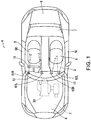
- a vehicle V of this embodiment is a two-door convertible.
- the reference character “1” is a dashboard dividing an engine bay 2 from a cabin 3.
- the reference character “4" is a hood covering the engine bay 2 from the top thereof
- the reference characters “5R” and “5L” are a pair of left and right side-doors
- the reference character “6” is a trunk lid
- the reference character “7” is a retractable roof.
- the reference character “8” is a driver seat
- the reference character “9” is a front passenger's seat
- the reference character “10” is a steering wheel.
- the reference character “11” is an instrument panel
- the reference character “12” is a front windshield
- the reference characters “13L” and “13R” are a pair of left and right front pillars.
- the engine bay 2 is provided with an engine 30.
- the engine 30 of this embodiment is substantially longitudinally placed and drives rear wheels.
- the engine 30 has auxiliary equipment, such as an alternator and an air-conditioning compressor which are driven by the engine, and an engine sound is a mixture of a sound generated when a crankshaft the engine rotates or performs combustion, an intake sound, an exhaust sound, and also a sound of the auxiliary equipment being driven.
- speakers 61L and 61R for a vehicle driver preferably speakers 61L and 61R for a vehicle driver
- speakers 62L and 62R for a front passenger speakers 62L and 62R are provided.
- the driver speakers 61L and 61R are preferably disposed with a space interval from each other in width directions of the vehicle, preferably on the instrument panel 11 provided forward of the driver seat 8.
- the driver speakers 61L and 61R have strong directivities and their orientations and ranges are indicated by one-dotted chain lines in Fig. 1 .
- the front passenger speakers 62L and 62R are preferably disposed with a small space interval from each other in the width directions, preferably on the instrument panel 11 provided forward of the front passenger seat 9.
- the front passenger speakers 62L and 62R have preferably weaker directivities than the driver speakers 61L and 61R, and their orientations and ranges are indicated by one-dotted chain lines in Fig. 1 . Since the directivities of the front passenger speakers 62L and 62R are weak, the front passenger is able to enjoy the audio sound even when not properly seated on the front passenger seat 9.
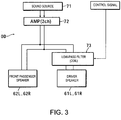
- Fig. 3 illustrates one example of an audio device OD.
- reproduced signals for 2CH from an audio sound source 71 are amplified by an amplifier 72 and supplied to each of the speakers 61L, 61R, 62L, and 62R, thus the audio sound is played in the cabin 3.
- the speakers 61L, 61R, 62L, and 62R, and the audio sound source 71 are used for high resolution and are capable of playing an extremely high-quality audio sound in the cabin 3.
- the driver speakers 61L and 61R are preferably supplied with the amplified signals by the amplifier 72, preferably via a low-pass filter 73 which is a sound quality degrader.
- the low-pass filter 73 is preferably switched on and off based on a control signal (described later) so that the quality of the audio sound from the driver speakers 61L and 61R is switchable (selectable) between a high quality (high resolution) and a low quality (e.g., equivalent to a CD level).
- the audio sound from the front passenger speakers 62L and 62R normally has a high sound quality (high resolution).
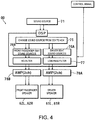
- Fig. 4 illustrates one modification of the audio device OD.
- the quality of the audio sound from the driver speakers 61L and 61R is changed by a digital sound processor (DSP) in the audio device OD. That is, the reproduced signals for 2CH (two channel) from the sound source 71 are changed to 4CH (four channel) by a CH number changer 75.
- a pair of 2CH signals outputted from the CH number changer 75 is supplied, as sound sources 76A for the driver seat, to the driver speakers 61L and 61R preferably via a low-pass filter 77 and an amplifier 78A.
- Another pair of 2CH signals outputted from the CH number changer 75 is supplied, as sound sources 76B for the front passenger seat, to the front passenger speakers 62L and 62R preferably via an amplifier 78B preferably without being filtered.
- the low-pass filter 77 is preferably switched on and off based on a control signal so that the quality of the audio sound from the driver speakers 61L and 61R is switchable (selectable) between a high quality (high resolution) and a low quality (equivalent to the CD level).
- Fig. 5 illustrates an example of a control system regarding generation of the control signals illustrated in Figs. 3 and 4 .
- the reference character "U" is a controller configured by using a microcomputer. This controller U receives signals preferably from sensors or switches S1 to S4.
- S1 is a G sensor (i.e., an accelerometer) which detects a G (g-force) which acts on the vehicle body (accelerations and decelerations in the longitudinal and lateral directions).
- G g-force
- S2 is an engine speed sensor which detects the engine speed.
- “S3” is an ignition switch.
- “S4" is a switch which is preferably manually controlled by the driver to select whether to perform an automatic operation. Any one or more of the sensors and/or switches S1 to S4 may be referred to as the traveling state determiner.
- the controller U controls the audio device OD (outputs the control signals illustrated in Figs. 3 and 4 ).
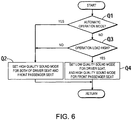
- the reference character "Q" indicates steps. First at Q1, whether to perform the automatic operation (whether the automatic operation is selected) is determined according to a control state of the switch S4. If the result of Q1 is YES, at Q2, the driver and front passenger speakers 61L, 61R, 62L, and 62R are made to be in a state for playing the high quality (high resolution) audio sound. Thus, both the driver and front passenger are able to enjoy the high-quality audio sound. Moreover, due to a sampling frequency being high and the number of quantization bits being large for the high resolution, it is relatively easy for the driver to distinguish the engine sound and the audio sound from each other.
- the state where the operation load becomes high is also considered to be a situation where driving (running) is actively performed, for example, when an engine speed is above a given speed, when the g-force which acts on a vehicle body (one or both of lateral acceleration and longitudinal acceleration) is higher than a given value, when traveling on a winding road, when acceleration/deceleration is frequently performed, when a steering operation is frequently performed, when traveling on a mountain road, when traveling on a circuit road, when a vehicle speed is high (e.g., above 80 km/h), etc.
- the process proceeds to Q2.
- the front passenger speakers 62L and 62R are made to be in a state for playing the high-quality audio sound
- the driver speakers 61 L and 61R are made to be in a state for playing the low-quality audio sound.
- the driver is able to recognize the engine sound more clearly than the case where the audio sound is high quality, and able to enjoy driving by clearly recognizing the vehicle state based on the engine sound, which is also preferable for safe driving.
- the present disclosure is capable of causing, even in the state where the audio sound is played in the cabin, the engine sound be recognizable more clearly as needed and extremely suitable for an audio device for a vehicle.
Landscapes
- Engineering & Computer Science (AREA)
- Physics & Mathematics (AREA)
- Acoustics & Sound (AREA)
- Signal Processing (AREA)
- Theoretical Computer Science (AREA)
- Health & Medical Sciences (AREA)
- General Health & Medical Sciences (AREA)
- General Physics & Mathematics (AREA)
- Multimedia (AREA)
- Audiology, Speech & Language Pathology (AREA)
- Human Computer Interaction (AREA)
- General Engineering & Computer Science (AREA)
- Mechanical Engineering (AREA)
- Otolaryngology (AREA)
- Fittings On The Vehicle Exterior For Carrying Loads, And Devices For Holding Or Mounting Articles (AREA)
- Circuit For Audible Band Transducer (AREA)
Abstract
Description
- The present disclosure relates to sound systems for vehicles, to a method of controlling a sound system in a vehicle and to a computer program product.
- Vehicles are generally equipped with audio devices that play an audio sound in a cabin.
JP 2 776 092 B JP 1993 - 085 288 A - Meanwhile, vehicles which are focused on that enjoyment of traveling, such as sports cars, are required to actively cause person(s) on board, especially a vehicle driver, to hear (listen to) an engine sound. That is, since the engine sound is a good indication of a vehicle state, it becomes an extremely important element in the enjoyment of traveling.
- When the audio device is operated to play an audio sound in the cabin, the engine sound may be disturbed by the audio sound and becomes hard to hear from time to time. If the operation of the audio device is stopped to facilitate the hearing of the engine sound, the audio sound cannot be enjoyed at all and this is not suitable.
- The present disclosure is made in view of the above situations and aims to provide a sound system for a vehicle, with which, even in a state where an audio sound is played in a cabin, an engine sound is more clearly recognizable as needed. This object is achieved by the features of the independent claims. Further developments are defined in the dependent claims.
- In order to achieve the above aim, according to one aspect of the present disclosure, a sound system for a vehicle driven by an engine is provided, which includes an audio device for an internal space of a cabin of the vehicle, and a traveling state determiner configured to determine a traveling state of the vehicle. The audio device is configured to change a quality of a sound reproduced by a sound source and, when the traveling state determined by the traveling state determiner is a given traveling state, degrade the quality of the reproduced sound.
- According to this structure, in the given traveling state, an engine sound is recognized more clearly. More specifically, since the recognizability of the audio sound improves as the sound quality is higher, the recognizability of the engine sound is raised by degrading the sound quality to lower the recognizability of the audio sound. Thus, the person(s) on board is able to clearly recognize a state of the vehicle based on (a change of) the engine sound recognized clearly while enjoying the audio sound, and this is preferable for enjoying driving and safe driving.
- The vehicle may be configured to selectably perform an automatic operation. While the automatic operation is performed, the audio device may not degrade the quality of the reproduced sound regardless of the traveling state of the vehicle. This is because, during the automatic operation, the driver is relaxing and he/she is allowed to fully enjoy the audio sound.
- The degradation of the quality of the reproduced sound may be performed without notification to a person in the vehicle. Thus, a situation in which the person(s) on board is irritated by the notification for the change in sound quality, is prevented.
- The degradation of the quality of the reproduced sound may be performed gradually. Thus, a sharp change in sound quality is avoided and this is preferable for preventing the person(s) on board from feeling a sense of discomfort, etc. due to the change in sound quality, and also preventing the person(s) on board from noticing the sound quality change.
- Speakers configured to play the reproduced sound inside the cabin may be individually provided for a vehicle driver and for a front passenger. The degradation of the quality of the reproduced sound may only be performed for the speaker for the driver, between the speaker for the driver and the speaker for the front passenger. It is preferable for allowing the front passenger to enjoy high quality audio sound normally.
- The given traveling state may be a state where an operation load is high. Thus, the driver is able to recognize the engine sound more clearly when the operation load is high and focus on the vehicle state based on the engine sound, and it is preferable for enhancing safety.
According to a further aspect, there is provided a method of controlling a sound system in a vehicle, comprising the steps of: - determining a traveling state of the vehicle,
- changing a quality of a sound reproduced by a sound source such that when the determined traveling state is a given traveling state, the quality of the reproduced sound is degraded.
-
-
Fig. 1 is a plan view illustrating one example of a vehicle to which the present disclosure is applied. -
Fig. 2 is an elevational view of a cabin seen forward from a rear part thereof, illustrating a state near an instrument panel. -
Fig. 3 is a diagram illustrating an example of a control system for degrading quality of a sound-source reproducing sound. -
Fig. 4 is a diagram illustrating an example of another control system for degrading the quality of the sound-source reproducing sound. -
Fig. 5 is a block diagram illustrating one example of a control system for changing the sound quality of the sound-source reproducing sound. -
Fig. 6 is a flowchart illustrating a control example of the present disclosure. - In
Figs. 1 and2 , a vehicle V of this embodiment is a two-door convertible. Here, the reference character "1" is a dashboard dividing anengine bay 2 from acabin 3. The reference character "4" is a hood covering theengine bay 2 from the top thereof, the reference characters "5R" and "5L" are a pair of left and right side-doors, the reference character "6" is a trunk lid, and the reference character "7" is a retractable roof. Further, the reference character "8" is a driver seat, the reference character "9" is a front passenger's seat, and the reference character "10" is a steering wheel. Additionally, the reference character "11" is an instrument panel, the reference character "12" is a front windshield, and the reference characters "13L" and "13R" are a pair of left and right front pillars. - The
engine bay 2 is provided with anengine 30. Theengine 30 of this embodiment is substantially longitudinally placed and drives rear wheels. Theengine 30 has auxiliary equipment, such as an alternator and an air-conditioning compressor which are driven by the engine, and an engine sound is a mixture of a sound generated when a crankshaft the engine rotates or performs combustion, an intake sound, an exhaust sound, and also a sound of the auxiliary equipment being driven. - As audio sound speakers, preferably
speakers driver speakers speakers front passenger speakers driver speakers instrument panel 11 provided forward of thedriver seat 8. Thedriver speakers Fig. 1 . - The
front passenger speakers instrument panel 11 provided forward of thefront passenger seat 9. Thefront passenger speakers driver speakers Fig. 1 . Since the directivities of thefront passenger speakers front passenger seat 9. -
Fig. 3 illustrates one example of an audio device OD. InFig. 3 , reproduced signals for 2CH from anaudio sound source 71 are amplified by anamplifier 72 and supplied to each of thespeakers cabin 3. In this embodiment, thespeakers audio sound source 71 are used for high resolution and are capable of playing an extremely high-quality audio sound in thecabin 3. - The
driver speakers amplifier 72, preferably via a low-pass filter 73 which is a sound quality degrader. The low-pass filter 73 is preferably switched on and off based on a control signal (described later) so that the quality of the audio sound from thedriver speakers front passenger speakers -
Fig. 4 illustrates one modification of the audio device OD. In this example, the quality of the audio sound from thedriver speakers sound source 71 are changed to 4CH (four channel) by aCH number changer 75. A pair of 2CH signals outputted from theCH number changer 75 is supplied, as sound sources 76A for the driver seat, to thedriver speakers pass filter 77 and anamplifier 78A. Another pair of 2CH signals outputted from theCH number changer 75 is supplied, assound sources 76B for the front passenger seat, to thefront passenger speakers amplifier 78B preferably without being filtered. The low-pass filter 77 is preferably switched on and off based on a control signal so that the quality of the audio sound from thedriver speakers -
Fig. 5 illustrates an example of a control system regarding generation of the control signals illustrated inFigs. 3 and4 . InFig. 5 , the reference character "U" is a controller configured by using a microcomputer. This controller U receives signals preferably from sensors or switches S1 to S4. "S1" is a G sensor (i.e., an accelerometer) which detects a G (g-force) which acts on the vehicle body (accelerations and decelerations in the longitudinal and lateral directions). "S2" is an engine speed sensor which detects the engine speed. "S3" is an ignition switch. "S4" is a switch which is preferably manually controlled by the driver to select whether to perform an automatic operation. Any one or more of the sensors and/or switches S1 to S4 may be referred to as the traveling state determiner. Further, the controller U controls the audio device OD (outputs the control signals illustrated inFigs. 3 and4 ). - Next, a control example of the controller U is described while referring to the flowchart of
Fig. 6 . Below, the reference character "Q" indicates steps. First at Q1, whether to perform the automatic operation (whether the automatic operation is selected) is determined according to a control state of the switch S4. If the result of Q1 is YES, at Q2, the driver andfront passenger speakers - If the result of Q1 is NO, at Q3, whether an operation load as a given traveling state is high is determined. The state where the operation load becomes high is also considered to be a situation where driving (running) is actively performed, for example, when an engine speed is above a given speed, when the g-force which acts on a vehicle body (one or both of lateral acceleration and longitudinal acceleration) is higher than a given value, when traveling on a winding road, when acceleration/deceleration is frequently performed, when a steering operation is frequently performed, when traveling on a mountain road, when traveling on a circuit road, when a vehicle speed is high (e.g., above 80 km/h), etc.
- If the result of Q3 is NO, the process proceeds to Q2. On the other hand, if the result of Q3 is YES, at Q4, the
front passenger speakers driver speakers - Although the embodiment is described above, the present disclosure is not limited to the embodiment, and suitable changes are possible within the range described in the claims, for example as follows.
- (1) The
driver speakers driver seat 8. Similarly, thefront passenger speakers front passenger seat 9. - (2) In the given traveling state (in this embodiment, when the operation load is high), the quality of the audio sound from the
front passenger speakers - (3) The speakers may not be differentiated for the driver speakers and the front passenger speakers, but be shared therebetween.
- (4) The adjustment of the sound quality may be performed by a suitable known method, such as adjusting the frequency resolution (changing the sampling frequency) or adjusting the amplitude resolution (changing the number of quantization bits), or cutting high frequencies over a given frequency or cutting low frequencies lower than a given frequency.
- (5) A mode switch which is preferably manually controlled by the driver may be provided so that the audio sound quality is changed according to the control of the mode switch.
- (6) The change of the sound quality is preferably performed gradually (e.g., over about 3 to 5 seconds) in view of preventing the person(s) on board from feeling a sense of discomfort, etc. due to the change in sound quality, and also preventing the person(s) on board from noticing the sound quality change.
- (7) When changing the sound quality, the driver may be notified, but it is preferable not to notify in view of preventing irritation by the notification.
- (8) By making the sound quality changeable in three levels, for example, the sound quality may be highest (e.g., high resolution) during the automatic operation or a steady travel at a low vehicle speed, lowest (e.g., equivalent to MP3 level) when the operation load is high, or otherwise medium (e.g., equivalent to the CD level).
- (9) The present disclosure is not limited to be applied to the two-door convertible but is also applicable to various types of vehicles, such as a sedan type, a sport utility vehicle (SUV) type, and a four-wheel drive vehicle. The application may also be to a vehicle in which a transmission is disposed in the rear part of the vehicle (at the position of a differential), a front-wheel drive vehicle having no propeller shaft (i.e., a front-engine, front-wheel-drive (FF) vehicle), or a vehicle where the
engine 30 is disposed rearward of the cabin. It is needless to say that the purpose of the present disclosure is not limited to what is explicitly described, but also implicitly includes providing what is expressed as substantially preferable or advantageous. - The present disclosure is capable of causing, even in the state where the audio sound is played in the cabin, the engine sound be recognizable more clearly as needed and extremely suitable for an audio device for a vehicle.
-
- OD:
- Audio Device
- U:
- Controller
- S1:
- G Sensor (accelerometer)
- S2:
- Engine Speed Sensor
- S3:
- Ignition Switch
- 2:
- Engine Bay
- 3:
- Cabin
- 8:
- Driver Seat
- 9:
- Front Passenger Seat
- 11:
- Instrument Panel
- 12:
- Front Windshield
- 30:
- Engine
- 61L, 61R:
- Speaker (For Driver)
- 62L, 62R:
- Speaker (For Front Passenger)
- 71:
- Sound Source (For Audio)
- 73, 77:
- Low-pass Filter (For Low Sound Quality)
while the automatic operation is performed, the sound system does not degrade the quality of the reproduced sound regardless of the traveling state of the vehicle.
According to a still further aspect, there is provided a computer program product comprising computer-readable instructions, which when loaded and executed on a suitable system, can perform the steps of any of the above-mentioned methods.
Claims (10)
- A sound system for a vehicle driven by an engine (30), comprising:an audio device (OD) for an internal space of a cabin of the vehicle; andtraveling state determining means to determine a traveling state of the vehicle,wherein the audio device (OD) is configured to change a quality of a sound reproduced by a sound source (71) and, when the traveling state determined by the traveling state determining means is a given traveling state, degrade the quality of the reproduced sound.
- The sound system of claim 1, wherein
the vehicle is configured to selectably perform an automatic operation, and
while the automatic operation is performed, the audio device (OD) does not degrade the quality of the reproduced sound regardless of the traveling state of the vehicle. - The sound system of claims 1 or 2, wherein the degradation of the quality of the reproduced sound is performed without notification to a person in the vehicle.
- The sound system of any one of the preceding claims, wherein the degradation of the quality of the reproduced sound is performed gradually.
- The sound system of any one of the preceding claims, wherein
speakers (61L, 6R, 62L, 62R) configured to play the reproduced sound inside the cabin are individually provided for a vehicle driver and for a front passenger, and
the degradation of the quality of the reproduced sound is only performed for the speaker for the driver (61L, 61R), between the speaker for the driver (61L, 61R) and the speaker for the front passenger (62L, 62R). - The sound system of any one of the preceding claims, wherein the given traveling state is a state where an operation load is high.
- The sound system of any one of the preceding claims, wherein the traveling state determiner is a one or more of an accelerometer, an engine speed sensor, a manual switch, and an ignition switch.
- A method of controlling a sound system in a vehicle, comprising the steps of:determining a traveling state of the vehicle,changing a quality of a sound reproduced by a sound source (71) such that when the determined traveling state is a given traveling state, the quality of the reproduced sound is degraded.
- The method of claim 8, wherein the vehicle is configured to selectably perform an automatic operation, and
while the automatic operation is performed, the sound system does not degrade the quality of the reproduced sound regardless of the traveling state of the vehicle. - A computer program product comprising computer-readable instructions, which when loaded and executed on a suitable system, can perform the steps of any method of claims 8 or 9.
Applications Claiming Priority (1)
| Application Number | Priority Date | Filing Date | Title |
|---|---|---|---|
| JP2017094624A JP6579157B2 (en) | 2017-05-11 | 2017-05-11 | Vehicle sound system |
Publications (1)
| Publication Number | Publication Date |
|---|---|
| EP3401777A1 true EP3401777A1 (en) | 2018-11-14 |
Family
ID=62134031
Family Applications (1)
| Application Number | Title | Priority Date | Filing Date |
|---|---|---|---|
| EP18000411.1A Withdrawn EP3401777A1 (en) | 2017-05-11 | 2018-04-30 | Sound system for vehicle, method of controlling sound system in vehicle and computer program product |
Country Status (4)
| Country | Link |
|---|---|
| US (1) | US10583788B2 (en) |
| EP (1) | EP3401777A1 (en) |
| JP (1) | JP6579157B2 (en) |
| CN (1) | CN108882117A (en) |
Families Citing this family (4)
| Publication number | Priority date | Publication date | Assignee | Title |
|---|---|---|---|---|
| KR102663217B1 (en) * | 2019-10-17 | 2024-05-03 | 현대자동차주식회사 | Indoor sound control method and system of vehicle |
| CN112078498B (en) * | 2020-09-11 | 2022-03-18 | 广州小鹏汽车科技有限公司 | Sound output control method for intelligent vehicle cabin and intelligent cabin |
| CN113173132B (en) * | 2021-03-12 | 2023-09-19 | 武汉路特斯汽车有限公司 | Speaker device for vehicles and vehicle |
| JP2023064506A (en) * | 2021-10-26 | 2023-05-11 | ローランド株式会社 | Audio processing device, amplifier device, and audio processing method |
Citations (6)
| Publication number | Priority date | Publication date | Assignee | Title |
|---|---|---|---|---|
| JP2776092B2 (en) | 1991-09-27 | 1998-07-16 | 日産自動車株式会社 | Vehicle alarm device |
| JP2002135900A (en) * | 2000-10-23 | 2002-05-10 | Alpine Electronics Inc | Recording / reproducing method of compressed audio signal and in-vehicle audio device |
| US20050190935A1 (en) * | 2003-11-27 | 2005-09-01 | Sony Corporation | Car audio equipment |
| JP2008141524A (en) * | 2006-12-01 | 2008-06-19 | Fujitsu Ten Ltd | Acoustic processor |
| DE102009026589A1 (en) * | 2008-05-29 | 2009-12-03 | Ford Global Technologies, LLC, Dearborn | Audio source e.g. car radio, sound volume adjustment method for hybrid vehicle, involves differentiating running and stop operating conditions of internal combustion engine so that high sound volume is adjusted when engine is running |
| US20120269358A1 (en) * | 2011-04-21 | 2012-10-25 | Continental Automotive Systems, Inc. | Active sound control |
Family Cites Families (12)
| Publication number | Priority date | Publication date | Assignee | Title |
|---|---|---|---|---|
| US5034984A (en) * | 1983-02-14 | 1991-07-23 | Bose Corporation | Speed-controlled amplifying |
| JPH0766652A (en) * | 1993-08-25 | 1995-03-10 | Shiyoutarou Kashiyuu | Car audio volume control method |
| JP3379656B2 (en) * | 1993-11-04 | 2003-02-24 | 三菱電機株式会社 | In-car audio equipment |
| US5677960A (en) * | 1995-05-11 | 1997-10-14 | Victor Company Of Japan, Ltd. | On-vehicle sound control apparatus |
| JP3826976B2 (en) * | 1997-08-27 | 2006-09-27 | 富士通テン株式会社 | In-vehicle sound playback device |
| US7077595B2 (en) * | 2003-07-25 | 2006-07-18 | General Binding Corporation | Spine binder |
| JP4134989B2 (en) * | 2004-03-10 | 2008-08-20 | ヤマハ株式会社 | Automotive audio equipment |
| US20100014691A1 (en) * | 2008-07-15 | 2010-01-21 | Braon Moseley | Autonomous volume control |
| JP5522653B2 (en) * | 2009-07-07 | 2014-06-18 | アルパイン株式会社 | In-vehicle AV equipment |
| JP2012148657A (en) * | 2011-01-18 | 2012-08-09 | Denso Corp | Vehicle approach notification system |
| EP2530835B1 (en) * | 2011-05-30 | 2015-07-22 | Harman Becker Automotive Systems GmbH | Automatic adjustment of a speed dependent equalizing control system |
| KR101745154B1 (en) * | 2015-10-19 | 2017-06-08 | 현대자동차주식회사 | Enclosure Expansion type Virtual Engine Sound System and Vehicle thereby |
-
2017
- 2017-05-11 JP JP2017094624A patent/JP6579157B2/en active Active
-
2018
- 2018-04-30 EP EP18000411.1A patent/EP3401777A1/en not_active Withdrawn
- 2018-05-08 US US15/974,404 patent/US10583788B2/en active Active
- 2018-05-08 CN CN201810434284.3A patent/CN108882117A/en active Pending
Patent Citations (6)
| Publication number | Priority date | Publication date | Assignee | Title |
|---|---|---|---|---|
| JP2776092B2 (en) | 1991-09-27 | 1998-07-16 | 日産自動車株式会社 | Vehicle alarm device |
| JP2002135900A (en) * | 2000-10-23 | 2002-05-10 | Alpine Electronics Inc | Recording / reproducing method of compressed audio signal and in-vehicle audio device |
| US20050190935A1 (en) * | 2003-11-27 | 2005-09-01 | Sony Corporation | Car audio equipment |
| JP2008141524A (en) * | 2006-12-01 | 2008-06-19 | Fujitsu Ten Ltd | Acoustic processor |
| DE102009026589A1 (en) * | 2008-05-29 | 2009-12-03 | Ford Global Technologies, LLC, Dearborn | Audio source e.g. car radio, sound volume adjustment method for hybrid vehicle, involves differentiating running and stop operating conditions of internal combustion engine so that high sound volume is adjusted when engine is running |
| US20120269358A1 (en) * | 2011-04-21 | 2012-10-25 | Continental Automotive Systems, Inc. | Active sound control |
Also Published As
| Publication number | Publication date |
|---|---|
| US10583788B2 (en) | 2020-03-10 |
| JP6579157B2 (en) | 2019-09-25 |
| US20180326919A1 (en) | 2018-11-15 |
| JP2018188092A (en) | 2018-11-29 |
| CN108882117A (en) | 2018-11-23 |
Similar Documents
| Publication | Publication Date | Title |
|---|---|---|
| US10583788B2 (en) | Sound system for vehicle | |
| US10165354B1 (en) | Sound system for vehicle | |
| EP3401903A1 (en) | Sound system for vehicle and method of arranging sound position in a vehicle | |
| US7549649B2 (en) | Vehicle with a vehicle dynamic performance selection switch on the steering wheel | |
| EP4159516B1 (en) | Method for the performance-enhancing driver assistance of a road vehicle and related road vehicle | |
| US10425722B2 (en) | Sound system for vehicle | |
| US10645489B2 (en) | Sound system for vehicle | |
| JP2009262734A (en) | Device for suppressing vehicle body drifting | |
| JP4432872B2 (en) | Vehicle travel control device | |
| KR101851144B1 (en) | Sound receiving apparatus, vehicle having the same and method for controlling the same | |
| JP6579156B2 (en) | Vehicle sound system | |
| JP2018188093A (en) | Vehicle sound system | |
| JP2003095032A (en) | Exhaust sound output device | |
| US20040207762A1 (en) | Audio interrupt system for an automobile | |
| JP2007022161A (en) | Front and rear wheel independent drive control device | |
| JP2005112255A (en) | On-vehicle device and display method for on-vehicle device | |
| JPH1049176A (en) | Vehicle sound system | |
| KR20060054765A (en) | Automotive AVN system with vehicle speed-sensitive operation mode | |
| JP2007259184A (en) | On-board automatic volume control system and on-board automatic volume control method |
Legal Events
| Date | Code | Title | Description |
|---|---|---|---|
| PUAI | Public reference made under article 153(3) epc to a published international application that has entered the european phase |
Free format text: ORIGINAL CODE: 0009012 |
|
| STAA | Information on the status of an ep patent application or granted ep patent |
Free format text: STATUS: THE APPLICATION HAS BEEN PUBLISHED |
|
| AK | Designated contracting states |
Kind code of ref document: A1 Designated state(s): AL AT BE BG CH CY CZ DE DK EE ES FI FR GB GR HR HU IE IS IT LI LT LU LV MC MK MT NL NO PL PT RO RS SE SI SK SM TR |
|
| AX | Request for extension of the european patent |
Extension state: BA ME |
|
| STAA | Information on the status of an ep patent application or granted ep patent |
Free format text: STATUS: REQUEST FOR EXAMINATION WAS MADE |
|
| 17P | Request for examination filed |
Effective date: 20190513 |
|
| RBV | Designated contracting states (corrected) |
Designated state(s): AL AT BE BG CH CY CZ DE DK EE ES FI FR GB GR HR HU IE IS IT LI LT LU LV MC MK MT NL NO PL PT RO RS SE SI SK SM TR |
|
| STAA | Information on the status of an ep patent application or granted ep patent |
Free format text: STATUS: EXAMINATION IS IN PROGRESS |
|
| 17Q | First examination report despatched |
Effective date: 20201023 |
|
| STAA | Information on the status of an ep patent application or granted ep patent |
Free format text: STATUS: THE APPLICATION IS DEEMED TO BE WITHDRAWN |
|
| 18D | Application deemed to be withdrawn |
Effective date: 20210303 |