EP3401365A1 - Composition for resin surface roughening - Google Patents
Composition for resin surface roughening Download PDFInfo
- Publication number
- EP3401365A1 EP3401365A1 EP16883829.0A EP16883829A EP3401365A1 EP 3401365 A1 EP3401365 A1 EP 3401365A1 EP 16883829 A EP16883829 A EP 16883829A EP 3401365 A1 EP3401365 A1 EP 3401365A1
- Authority
- EP
- European Patent Office
- Prior art keywords
- resin
- composition
- alkali metal
- aliphatic polycarbonate
- surface roughening
- Prior art date
- Legal status (The legal status is an assumption and is not a legal conclusion. Google has not performed a legal analysis and makes no representation as to the accuracy of the status listed.)
- Granted
Links
Images

Classifications
-
- C—CHEMISTRY; METALLURGY
- C08—ORGANIC MACROMOLECULAR COMPOUNDS; THEIR PREPARATION OR CHEMICAL WORKING-UP; COMPOSITIONS BASED THEREON
- C08J—WORKING-UP; GENERAL PROCESSES OF COMPOUNDING; AFTER-TREATMENT NOT COVERED BY SUBCLASSES C08B, C08C, C08F, C08G or C08H
- C08J7/00—Chemical treatment or coating of shaped articles made of macromolecular substances
- C08J7/08—Heat treatment
-
- C—CHEMISTRY; METALLURGY
- C08—ORGANIC MACROMOLECULAR COMPOUNDS; THEIR PREPARATION OR CHEMICAL WORKING-UP; COMPOSITIONS BASED THEREON
- C08L—COMPOSITIONS OF MACROMOLECULAR COMPOUNDS
- C08L69/00—Compositions of polycarbonates; Compositions of derivatives of polycarbonates
-
- C—CHEMISTRY; METALLURGY
- C08—ORGANIC MACROMOLECULAR COMPOUNDS; THEIR PREPARATION OR CHEMICAL WORKING-UP; COMPOSITIONS BASED THEREON
- C08G—MACROMOLECULAR COMPOUNDS OBTAINED OTHERWISE THAN BY REACTIONS ONLY INVOLVING UNSATURATED CARBON-TO-CARBON BONDS
- C08G59/00—Polycondensates containing more than one epoxy group per molecule; Macromolecules obtained by polymerising compounds containing more than one epoxy group per molecule using curing agents or catalysts which react with the epoxy groups
- C08G59/18—Macromolecules obtained by polymerising compounds containing more than one epoxy group per molecule using curing agents or catalysts which react with the epoxy groups ; e.g. general methods of curing
- C08G59/40—Macromolecules obtained by polymerising compounds containing more than one epoxy group per molecule using curing agents or catalysts which react with the epoxy groups ; e.g. general methods of curing characterised by the curing agents used
- C08G59/42—Polycarboxylic acids; Anhydrides, halides or low molecular weight esters thereof
- C08G59/4215—Polycarboxylic acids; Anhydrides, halides or low molecular weight esters thereof cycloaliphatic
-
- C—CHEMISTRY; METALLURGY
- C08—ORGANIC MACROMOLECULAR COMPOUNDS; THEIR PREPARATION OR CHEMICAL WORKING-UP; COMPOSITIONS BASED THEREON
- C08G—MACROMOLECULAR COMPOUNDS OBTAINED OTHERWISE THAN BY REACTIONS ONLY INVOLVING UNSATURATED CARBON-TO-CARBON BONDS
- C08G64/00—Macromolecular compounds obtained by reactions forming a carbonic ester link in the main chain of the macromolecule
- C08G64/02—Aliphatic polycarbonates
-
- C—CHEMISTRY; METALLURGY
- C08—ORGANIC MACROMOLECULAR COMPOUNDS; THEIR PREPARATION OR CHEMICAL WORKING-UP; COMPOSITIONS BASED THEREON
- C08G—MACROMOLECULAR COMPOUNDS OBTAINED OTHERWISE THAN BY REACTIONS ONLY INVOLVING UNSATURATED CARBON-TO-CARBON BONDS
- C08G64/00—Macromolecular compounds obtained by reactions forming a carbonic ester link in the main chain of the macromolecule
- C08G64/20—General preparatory processes
- C08G64/32—General preparatory processes using carbon dioxide
- C08G64/34—General preparatory processes using carbon dioxide and cyclic ethers
-
- C—CHEMISTRY; METALLURGY
- C08—ORGANIC MACROMOLECULAR COMPOUNDS; THEIR PREPARATION OR CHEMICAL WORKING-UP; COMPOSITIONS BASED THEREON
- C08J—WORKING-UP; GENERAL PROCESSES OF COMPOUNDING; AFTER-TREATMENT NOT COVERED BY SUBCLASSES C08B, C08C, C08F, C08G or C08H
- C08J7/00—Chemical treatment or coating of shaped articles made of macromolecular substances
-
- C—CHEMISTRY; METALLURGY
- C08—ORGANIC MACROMOLECULAR COMPOUNDS; THEIR PREPARATION OR CHEMICAL WORKING-UP; COMPOSITIONS BASED THEREON
- C08J—WORKING-UP; GENERAL PROCESSES OF COMPOUNDING; AFTER-TREATMENT NOT COVERED BY SUBCLASSES C08B, C08C, C08F, C08G or C08H
- C08J7/00—Chemical treatment or coating of shaped articles made of macromolecular substances
- C08J7/12—Chemical modification
- C08J7/14—Chemical modification with acids, their salts or anhydrides
-
- C—CHEMISTRY; METALLURGY
- C08—ORGANIC MACROMOLECULAR COMPOUNDS; THEIR PREPARATION OR CHEMICAL WORKING-UP; COMPOSITIONS BASED THEREON
- C08K—Use of inorganic or non-macromolecular organic substances as compounding ingredients
- C08K3/00—Use of inorganic substances as compounding ingredients
- C08K3/18—Oxygen-containing compounds, e.g. metal carbonyls
- C08K3/20—Oxides; Hydroxides
- C08K3/22—Oxides; Hydroxides of metals
-
- C—CHEMISTRY; METALLURGY
- C08—ORGANIC MACROMOLECULAR COMPOUNDS; THEIR PREPARATION OR CHEMICAL WORKING-UP; COMPOSITIONS BASED THEREON
- C08K—Use of inorganic or non-macromolecular organic substances as compounding ingredients
- C08K3/00—Use of inorganic substances as compounding ingredients
- C08K3/18—Oxygen-containing compounds, e.g. metal carbonyls
- C08K3/24—Acids; Salts thereof
- C08K3/26—Carbonates; Bicarbonates
-
- C—CHEMISTRY; METALLURGY
- C08—ORGANIC MACROMOLECULAR COMPOUNDS; THEIR PREPARATION OR CHEMICAL WORKING-UP; COMPOSITIONS BASED THEREON
- C08K—Use of inorganic or non-macromolecular organic substances as compounding ingredients
- C08K5/00—Use of organic ingredients
- C08K5/04—Oxygen-containing compounds
- C08K5/09—Carboxylic acids; Metal salts thereof; Anhydrides thereof
- C08K5/098—Metal salts of carboxylic acids
-
- C—CHEMISTRY; METALLURGY
- C08—ORGANIC MACROMOLECULAR COMPOUNDS; THEIR PREPARATION OR CHEMICAL WORKING-UP; COMPOSITIONS BASED THEREON
- C08L—COMPOSITIONS OF MACROMOLECULAR COMPOUNDS
- C08L63/00—Compositions of epoxy resins; Compositions of derivatives of epoxy resins
-
- C—CHEMISTRY; METALLURGY
- C08—ORGANIC MACROMOLECULAR COMPOUNDS; THEIR PREPARATION OR CHEMICAL WORKING-UP; COMPOSITIONS BASED THEREON
- C08J—WORKING-UP; GENERAL PROCESSES OF COMPOUNDING; AFTER-TREATMENT NOT COVERED BY SUBCLASSES C08B, C08C, C08F, C08G or C08H
- C08J2369/00—Characterised by the use of polycarbonates; Derivatives of polycarbonates
-
- C—CHEMISTRY; METALLURGY
- C08—ORGANIC MACROMOLECULAR COMPOUNDS; THEIR PREPARATION OR CHEMICAL WORKING-UP; COMPOSITIONS BASED THEREON
- C08K—Use of inorganic or non-macromolecular organic substances as compounding ingredients
- C08K3/00—Use of inorganic substances as compounding ingredients
- C08K3/18—Oxygen-containing compounds, e.g. metal carbonyls
- C08K3/20—Oxides; Hydroxides
- C08K3/22—Oxides; Hydroxides of metals
- C08K2003/2203—Oxides; Hydroxides of metals of lithium
-
- C—CHEMISTRY; METALLURGY
- C08—ORGANIC MACROMOLECULAR COMPOUNDS; THEIR PREPARATION OR CHEMICAL WORKING-UP; COMPOSITIONS BASED THEREON
- C08K—Use of inorganic or non-macromolecular organic substances as compounding ingredients
- C08K3/00—Use of inorganic substances as compounding ingredients
- C08K3/18—Oxygen-containing compounds, e.g. metal carbonyls
- C08K3/24—Acids; Salts thereof
- C08K3/26—Carbonates; Bicarbonates
- C08K2003/262—Alkali metal carbonates
Definitions
- the present invention relates to a composition for resin surface roughening.
- the present invention further relates to a method for roughening a resin surface using the composition for resin surface roughening; a surface-roughened resin molded article produced using the composition for resin surface roughening; and a method for producing a surface-roughened resin molded article using the composition for resin surface roughening.
- Patent Literature 1 discloses a film having an anti-reflection function imparted by forming a fine rugged pattern on a resin surface layer by imprinting.
- PTL 2 discloses a film hydrophilized by an atmospheric pressure plasma treatment. Further, functions are imparted by using a modified resin surface layer as a base and plating the layer with a metal or applying an organic substance to the layer.
- PLT 3 discloses a conductor-coating film produced by mechanically roughening a resin surface with a sandblast, dipping it in a silane coupling agent, and then performing electroless plating.
- PLT 4 discloses that adhesion and coatability can be improved by applying an oxygen plasma to a resin surface and then adhering water molecules in the air to the resin surface.
- Aliphatic polycarbonates are known to easily decompose in response to various stimuli. For example, aliphatic polycarbonates, in contact with an aqueous alkaline solution or upon heating at about 250°C, easily decompose. By utilizing this property, the resin surface can be expected to be roughened by removing only an aliphatic polycarbonate from the resin surface of a molded article obtained using a resin composition comprising an aliphatic polycarbonate.
- Common thermoplastic resins have a softening temperature of less than 200°C. Therefore, when an aliphatic polycarbonate is thermally decomposed, a thermoplastic resin is also softened, so that the shape of a molded article comprising the thermoplastic resin cannot be maintained.
- An object of the present invention is to provide a method for roughening a resin surface by removing only an aliphatic polycarbonate from the resin surface of a resin composition comprising the aliphatic polycarbonate by simpler and easier means.
- the present inventors conducted extensive research. As a result, the inventors found that a composition for resin surface roughening can be obtained by adding an alkali metal compound to an aliphatic polycarbonate. The inventors conducted further research based on this finding and have accomplished the present invention.
- the present invention includes, for example, the subject matter described in the following items.
- the composition for resin surface roughening of the present invention comprises an aliphatic polycarbonate and an alkali metal compound.
- the aliphatic polycarbonate in contact with an alkali metal compound, which would usually decompose immediately in that state, does not decompose and can be stored over a long period of time. Furthermore, the thermal decomposition temperature can be significantly reduced. Therefore, the aliphatic polycarbonate resin can be thermally decomposed at a temperature at which a base resin is not affected by heat.
- the surface of various resins can be roughened merely by heating, and functions can be imparted to a resin molded article merely by a simple and easy operation.
- composition for resin surface roughening of the present invention contains an aliphatic polycarbonate and an alkali metal compound.
- aliphatic polycarbonates include, but are not limited to, aliphatic polycarbonates obtained by alternating copolymerization of an epoxide and carbon dioxide, aliphatic polycarbonates obtained by polycondensation of a diol and a carbonic acid ester, and aliphatic polycarbonates obtained by ring opening polymerization of a cyclic carbonate. From the viewpoint of the ease of polymerization reaction, aliphatic polycarbonates obtained by alternating copolymerization of an epoxide and carbon dioxide are preferably used.
- the aliphatic polycarbonates obtained by alternating copolymerization of an epoxide and carbon dioxide refer to aliphatic polycarbonates having a structure in which an epoxide and carbon dioxide are alternatively polymerized as monomer structural units.
- the aliphatic polycarbonates have a structure obtained by polycondensation of a diol and a carbonic acid ester refer to aliphatic polycarbonates having a diol and a carbonic acid ester as monomer structural units.
- the aliphatic polycarbonates obtained by ring opening polymerization of a cyclic carbonate refer to aliphatic polycarbonates having a cyclic carbonate as monomer structural unit.
- the epoxide is not particularly limited as long as it is an epoxide that can undergo a polymerization reaction with carbon dioxide to form an aliphatic polycarbonate having a structure in which an aliphatic group is present on the main chain.
- Examples include ethylene oxide, propylene oxide, 1-butene oxide, 2-butene oxide, isobutylene oxide, 1-pentene oxide, 2-pentene oxide, 1-hexene oxide, 1-octene oxide, 1-decene oxide, cyclopentene oxide, cyclohexene oxide, styrene oxide, vinylcyclohexene oxide, 3-phenylpropylene oxide, 3,3,3-trifluoropropylene oxide, 3-naphthylpropylene oxide, 3-phenoxypropylene oxide, 3-naphthoxypropylene oxide, butadiene monoxide, 3-vinyloxypropylene oxide, 3-trimethylsilyloxypropylene oxide, and the like.
- preferable aliphatic polycarbonates include polypropylene carbonate, polyethylene carbonate, polycyclohexene carbonate, and the like.
- the lower limit of the mass average molecular weight of the aliphatic polycarbonate is preferably 5000, more preferably 10000, and particularly preferably 100000.
- the upper limit is preferably 1000000, more preferably 750000, and particularly preferably 500000. That is, the aliphatic polycarbonate preferably has a mass average molecular weight in the range of 5000 to 1000000.
- the viscosity of the resin is excessively low, and uniformly mixing the aliphatic polycarbonate with a base resin may be difficult.
- the aliphatic polycarbonate has a mass average molecular weight of more than 1000000, the aliphatic polycarbonate and base resin may be less compatible with each other and an appropriately dispersed state may not be achieved.
- the mass average molecular weight is a value determined in a 30 mmol N,N-dimethylformamide lithium bromide solution at 40°C by gel permeation chromatography (Waters 2695 separation module, produced by Nihon Waters K.K.) and calculated (on a standard polystyrene basis).
- Aliphatic polycarbonates can be used singly or in a combination of two or more.
- the method for producing an aliphatic polycarbonate includes, for example, a method comprising subjecting the epoxide and carbon dioxide to a polymerization reaction in the presence of a metal catalyst.
- the metal catalyst includes, for example, zinc-based catalysts, aluminum-based catalysts, chromium-based catalysts, cobalt-based catalysts, and the like. Among them, zinc-based catalysts and cobalt-based catalysts are preferable because of having high polymerization activities in the polymerization reaction of an epoxide and carbon dioxide. Zinc-based catalysts, in particular, organozinc-based catalysts are preferably used in view of obtaining a high-molecular-weight product.
- the organozinc-based catalyst includes, for example, organozinc catalysts, such as zinc acetate, diethyl zinc, and dibutyl zinc; organozinc catalysts obtained by reacting a zinc compound with a compound, such as a primary amine, a dihydric phenol, a dihydric aromatic carboxylic acid, an aromatic hydroxy acid, an aliphatic dicarboxylic acid, or an aliphatic monocarboxylic acid; and the like.
- organozinc catalysts such as zinc acetate, diethyl zinc, and dibutyl zinc
- organozinc catalysts obtained by reacting a zinc compound with a compound, such as a primary amine, a dihydric phenol, a dihydric aromatic carboxylic acid, an aromatic hydroxy acid, an aliphatic dicarboxylic acid, or an aliphatic monocarboxylic acid; and the like.
- organozinc catalysts because of having higher polymerization activities, organozinc catalysts obtained by reacting a zinc compound, an aliphatic dicarboxylic acid, and an aliphatic monocarboxylic acid are preferable, and organozinc catalysts obtained by reacting zinc oxide, glutaric acid, and acetic acid are more preferable.
- the amount of the metal catalyst used in the polymerization reaction is such that the lower limit of the amount of the metal catalyst is preferably 0.0001 moles, and more preferably 0.001 moles, per mole of epoxide, and the upper limit thereof is preferably 0.2 moles, and more preferably 0.05 moles, per mole of epoxide.
- the amount of the metal catalyst used is less than 0.0001 moles, the polymerization reaction may not proceed smoothly.
- the amount of the metal catalyst used is more than 0.2 moles, effects commensurate with the amount used may not be obtained and thus may be uneconomical.
- the reaction solvent optionally used in the polymerization reaction is not particularly limited. Various organic solvents can be used.
- organic solvents include aliphatic hydrocarbon solvents, such as pentane, hexane, octane, decane, and cyclohexane; aromatic hydrocarbon solvents, such as benzene, toluene, and xylene; halogenated hydrocarbon solvents, such as methylene chloride, chloroform, carbon tetrachloride, 1,1-dichloroethane, 1,2-dichloroethane, ethyl chloride, trichloroethane, 1-chloropropane, 2-chloropropane, 1-chlorobutane, 2-chlorobutane, 1-chloro-2-methylpropane, chlorobenzene, and bromobenzene; ether solvents, such as dimethoxyethane, tetrahydrofuran, 2-methyltetrahydrofuran, 1,4-dioxane, and 1,3-dioxolane; ester
- the amount of the reaction solvent used is preferably 100 to 10000 parts by mass per 100 parts by mass of epoxide.
- the method of reacting an epoxide and carbon dioxide in the presence of a metal catalyst is not particularly limited.
- the following method can be used. After an epoxide and catalyst are placed optionally with a reaction solvent in an autoclave and mixed, carbon dioxide is compressed into the autoclave and a reaction is allowed to proceed.
- the pressure of carbon dioxide used in the polymerization reaction is not particularly limited.
- the lower limit of the pressure is preferably 0.1 MPa, more preferably 0.2 MPa, and particularly preferably 0.5 MPa.
- the upper limit of the pressure is preferably 20 MPa, more preferably 10 MPa, and particularly preferably 5 MPa.
- the pressure of the carbon dioxide used is lower than 0.1 MPa, the polymerization may not proceed.
- the pressure of the carbon dioxide used is more than 20 MPa, effects commensurate with the pressure used may not be obtained and thus may be uneconomical.
- the polymerization reaction temperature in the polymerization reaction is not particularly limited.
- the lower limit of the polymerization reaction temperature is preferably 0°C, more preferably 20°C, particularly preferably 30°C.
- the upper limit is preferably 100°C, more preferably 95°C, even more preferably 90°C, still even more preferably 80°C, and particularly preferably 60°C.
- the polymerization reaction temperature is less than 0°C, the polymerization reaction may take a long time.
- the polymerization reaction temperature is higher than 100°C, a side reaction may occur and lead to a lower yield.
- the polymerization reaction time cannot be generalized because it depends on the polymerization reaction conditions. It is usually preferable that the polymerization reaction time be 1 to 40 hours.
- alkali metal compound used in the present invention examples include alkali metal salts (such as alkali metal carbonates, alkali metal carboxylates, and alkali metal inorganic acid salts), alkali metal hydroxides, alkali metal hydrides, alkali metal amides, alkali metal alkoxides, alkali metal phenoxides, alkali metal alkyls, and the like. Alkali metal salts and alkali metal hydroxides are preferable. Examples of alkali metal compounds include lithium compounds, sodium compounds, potassium compounds, rubidium compounds, cesium compounds, and the like.
- alkali metal carbonates include sodium carbonate, potassium carbonate, cesium carbonate, and the like.
- alkali metal carboxylates include alkali metal acetates. Specific examples include sodium acetate, potassium acetate, cesium acetate, and the like.
- alkali metal inorganic acid salts include sodium chloride, potassium chloride, sodium phosphate, potassium phosphate, sodium nitrate, potassium nitrate, sodium borate, and the like.
- alkali metal hydroxide include lithium hydroxide, sodium hydroxide, potassium hydroxide, cesium hydroxide, and the like.
- alkali metal hydride include lithium hydride, sodium hydride, potassium hydride, and the like.
- alkali metal amides include sodium amide, potassium amide, lithium diisopropylamide, sodium bis(trimethylsilyl)amide, potassium hexamethyldisilazide, and the like.
- alkali metal alkoxides include sodium methoxide, potassium methoxide, potassium tert-butoxide, and the like.
- alkali metal phenoxides include lithium phenoxide, sodium phenoxide, potassium phenoxide, and the like.
- alkali metal alkyls include methyllithium, butyl lithium, and the like. Among these, from the viewpoint of ease of availability and high effect of reducing the decomposition temperature, alkali metal carbonates, alkali metal carboxylates, and alkali metal hydroxides are preferable.
- alkali metal compounds can be used singly or in a combination of two or more.
- the aliphatic polycarbonate and alkali metal compound can be used in a suitable combination. That is, the desired one or more aliphatic polycarbonates and one or more alkali metal compounds can be appropriately used in combination.
- the lower limit of the alkali metal compound content is preferably 10 ppm, more preferably 30 ppm, still more preferably 40 ppm, and particularly preferably 50 ppm, relative to aliphatic polycarbonate.
- the upper limit of the alkali metal compound content is preferably 5000 ppm, more preferably 3000 ppm, still more preferably 2500 ppm, and particularly preferably 2000 ppm, relative to aliphatic polycarbonate. If the alkali metal compound content is within this range (10 to 5000 ppm), a sufficient effect of reduction in the thermal decomposition initiation temperature can be achieved while the storage stability of the composition for resin surface roughening is maintained.
- the ppm figures here are based on the mass ratio.
- the alkali metal compound can be added, for example, in the form of a solid, an aqueous solution, or a solution in an organic solvent, a suspension in an organic solvent so as to be in a dispersed state, etc.
- the alkali metal compound is preferably used in the form of an aqueous solution or a solution in an organic solvent. That is, an aqueous solution of an alkali metal compound or a solution of an alkali metal compound in an organic solvent is preferably mixed with an aliphatic polycarbonate.
- the organic solvent used to form a solution in an organic solvent is preferably a solvent that is miscible with a solvent capable of dissolving an aliphatic polycarbonate described below.
- the method for mixing an aliphatic polycarbonate and an alkali metal compound includes, for example, a method comprising once dissolving an aliphatic polycarbonate and an alkali metal compound in a solvent and then removing the solvent; melt-kneading methods using a roller, extruder, Banbury mixer, Plastomill, Brabender, or the like. From the viewpoint of mixing without decomposing aliphatic polycarbonate, a method comprising dissolving these components in a solvent and mixing is preferable.
- the solvent used for mixing is not particularly limited as long as it can dissolve aliphatic polycarbonate.
- examples include ketone solvents, such as acetone and methyl ethyl ketone; halogenated hydrocarbon solvents, such as methylene chloride and chloroform; ether solvents, such as dimethoxyethane, tetrahydrofuran, and 1,4-dioxane; ester solvents, such as methyl acetate and ethyl acetate; amide solvents, such as N,N-dimethylformamide and N,N-dimethylacetamide; carbonate solvents, such as dimethyl carbonate and propylene carbonate; and the like.
- composition for resin surface roughening containing an aliphatic polycarbonate and an alkyl metal compound may contain additives other than the aliphatic polycarbonate and the alkali metal compound.
- additives examples include flavoring agents, colorants, pigments, antifungal agents, antimicrobial agents, antioxidants, ultraviolet absorbers, antistatic agents, and the like. These additives remain in a base resin and exhibit their effects even after an aliphatic polycarbonate has been lost by the heat-treatment of a molded article described later.
- the amount of the additives is preferably 0.1 parts by mass to 10 parts by mass per 100 parts by mass of the aliphatic polycarbonate.
- composition obtained by mixing in this manner can be used as the composition for resin surface roughening.
- a composition obtained by further removing the solvent can be preferably used as a composition for resin surface roughening.
- the present invention also provides a resin composition comprising the composition for resin surface roughening and a base resin.
- the base resin examples include polyolefin resins, such as polyethylene and polypropylene; (meth)acrylic resins, such as polymethyl (meth)acrylate and polybutyl (meth)acrylate; polystyrene; polyester resins, such as polyethylene terephthalate, polybutylene terephthalate, and polylactic acid; polyamide resins, such as 6-nylon and 6,6-nylon; polycarbonate resins, such as polybisphenol A carbonate; fluororesins, such as polytetrafluoroethylene; polyacetal resins; polyether resins, such as polyethylene oxide, polypropylene oxide, and polyphenylene oxide; cellulose resins, such as cellulose triacetate and ethyl cellulose; vinyl resins, such as polyvinyl chloride, polyvinyl acetate, and polybutadiene; polyimide resins, silicone resins, phenolic resins, epoxy resins, urea resins, melamine resins, unsaturated polyester
- the method for producing the resin composition comprising a composition for resin surface roughening and a base resin may vary depending on the type of base resin used. For example, a method comprising dissolving and mixing a composition for resin surface roughening and a base resin in a solvent and then removing the solvent; a method comprising dissolving a composition for resin surface roughening in a base resin monomer and then subjecting the base resin to a polymerization reaction; a method comprising applying a solution containing the composition for resin surface roughening to the surface of a base resin; a method comprising melt-kneading a composition for resin surface roughening and a base resin using a roller, extruder, Banbury mixer, Plastomill, Brabender, or the like.
- the amount of the resin composition for surface roughening used is preferably, on a dry mass basis, 1 part by mass to 20 parts by mass, more preferably 5 parts by mass to 10 parts by mass, per 100 parts by mass of the base resin.
- the composition for resin surface roughening is used in this range, the surface can be roughened without damaging the original physical properties of the base resin.
- additives include antioxidants, ultraviolet absorbers, light stabilizers, flame retardants, antistatic agents, antimicrobial agents, nucleating agents, lubricants, anti-blocking agents, colorants, fillers, photosensitizers, photopolymerization initiators, curing accelerators, curing catalysts, and the like.
- the amount of the additive(s) is preferably 0.1 parts by mass to 20 parts by mass, and more preferably 1 part by mass to 10 parts by mass, based on 100 parts by mass of the base resin. When the amount of additive used is within this range, the additives can exert their functions without damaging the original physical properties of the base resin.
- the present invention further provides a resin surface -roughening method comprising decomposing aliphatic polycarbonate contained in a resin composition comprising the composition for resin surface roughening and a base resin (preferably a molded article of the composition). Further, the present invention provides a resin surface-roughening method comprising molding a resin composition comprising the composition for resin surface roughening and a base resin and decomposing aliphatic polycarbonate in the composition for resin surface roughening.
- the present invention provides a method for producing a resin molded article having a surface-roughened surface layer, comprising decomposing aliphatic polycarbonate contained in a molded article of a resin composition comprising the composition for resin surface roughening and a base resin. Further, the present invention provides a method for producing a resin molded article having a surface-roughened surface layer, comprising heating a molded article of a resin composition comprising the composition for resin surface roughening and a base resin.
- the surface of a molded article produced by molding a resin composition comprising the composition for resin surface roughening and a base resin can be easily roughened because the aliphatic polycarbonate contained therein is decomposed by heating.
- the aliphatic polycarbonate has a decomposition initiation temperature lower than that of the prior art and is thus preferable.
- the aliphatic polycarbonate is preferably decomposed by heating, for example, at 200°C or less, or 195°C or less.
- the lower limit of the heating temperature is not particularly limited as long as the aliphatic polycarbonate contained can decompose at that temperature.
- the lower limit of the temperature may be, for example, about 80°C or more, about 90°C or more, about 100°C or more, about 110°C or more, about 120°C or more, about 130°C or more, about 140°C or more, and about 150°C or more.
- the shape of the molded article is not particularly limited.
- the molded article may be in any shape, such as a stranded, film, sheet, planar, pellet, or fibrous shape.
- the molding method in the molding step is not particularly limited. Examples include injection molding, compression molding, injection compression molding, gas injection molding, foam injection molding, inflation molding, T-die molding, calendar molding, blow molding, vacuum molding, compressed air molding, rotational molding, FRP molding, lamination molding, melt flow molding, melt casting, transfer molding, pre-preg lamination press molding, pre-preg autoclave molding, matched-die molding, hand lay-up molding, SMC (sheet molding compound) press molding, BMC (bulk molding compound) molding, resin infusion molding, filament winding molding, pultrusion molding, pin winding molding, and the like.
- SMC sheet molding compound
- BMC bulk molding compound
- a multi-layered film or sheet can be formed by forming a film as at least one layer of a multi-layered structure with different resins by inflation molding, T-die molding, or calendaring molding, or forming a film by extrusion lamination, thermal lamination, dry lamination, or the like.
- the obtained film or sheet can be mono- or biaxially stretched by roll stretching, tenter stretching, tubular stretching, or the like and used.
- the surface of the molded article can be roughened by decomposing an aliphatic polycarbonate in the composition for resin surface roughening as described above.
- the method of decomposing an aliphatic polycarbonate is preferably thermal decomposition by heating.
- heating methods include, but are not limited to hot blast heating, resistance heating, infrared heating, microwave heating, dielectric heating, induction heating, arc heating, electron beam heating, plasma heating, laser heating, and the like.
- the mass average molecular weight (Mw) and the molecular weight distribution (Mw/Mn) of the polycarbonates obtained in the Production Examples were determined by the following methods.
- the mass average molecular weight (Mw) and the molecular weight distribution (Mw/Mn) were determined in 30 mmol of a N,N-dimethylformamide lithium bromide solution at 40°C by gel permeation chromatography (Waters 2695 Separations Modules, produced by Nihon Waters K.K.) and calculated on a standard polystyrene basis.
- Thermal decomposition behaviors of the polycarbonate-containing resins obtained in the Examples etc. were determined while raising the temperature from room temperature to 300°C at a heating rate of 10°C/min in an ambient atmosphere using a TG/DTA7220 produced by SII NanoTechnology Inc.
- the initial thermal decomposition temperature is defined as an intersection of a line drawn parallel to the abscissas axis in such a manner as to pass through the mass before starting the test heating and a tangent line drawn so that the slope between the inflection points of the decomposition curve is at its maximum.
- the mixture was further stirred at the same temperature for 2 hours for azeotropic removal of water. After the water removal, the resulting mixture was cooled to room temperature to obtain a slurry containing an organozinc catalyst.
- polypropylene carbonate 95.0 g was obtained in the same manner as in Production Example 2 except that 59.4 g (1.35 mol) of ethylene oxide was used in place of 78.3 g (1.35 mol) of propylene oxide.
- polycyclohexene carbonate 65.3 g was obtained in the same manner as in Production Example 2 except that 120 g (1.35 mol) of cyclohexane oxide was used in place of 78.3 g (1.35 mol) of propylene oxide and the reaction temperature was changed from 60°C to 80°C.
- the obtained composition for resin surface roughening was allowed to stand in an 80°C oven for 24 hours and the occurrence of any decomposition was investigated. No decomposition occurred.
- compositions for resin surface roughening were prepared by using various kinds and amounts of additives (alkali metal compounds) and various types of aliphatic polycarbonates as shown in Table 1 and the thermal decomposition temperature of each composition was measured. Table 1 shows the results.
- compositions for resin surface roughening were prepared by using various kinds and amounts of additives and various types of aliphatic polycarbonates as shown in Table 1 and the thermal decomposition temperature of each composition was measured. Table 1 shows the results. Table 1 Polycarbonate Alkali metal compound Form ppm Thermal decomposition initiation temperature (° C) Example 1 PPC KOH Aqueous solution 110 156 Example 2 PPC LiOH Methanol solution 47 188 Example 3 PPC NaOH Methanol solution 79 178 Example 4 PPC KOH Methanol solution 110 151 Example 5 PPC CsOH Methanol solution 294 145 Example 6 PPC Na 2 CO 3 Aqueous solution 2006 186 Example 7 PPC K 2 CO 3 Aqueous solution 267 161 Example 8 PPC Cs 2 CO 3 Aqueous solution 619 149 Example 9 PPC NaOAc Aqueous solution 500 195 Example 10 PPC CsOAc Aqueous solution 500 149 Example 11 PEC KOH Methanol solution 110 131 Example 12 PCHC KOH Methanol solution 110 270 Comp.
- PPC represents polypropylene carbonate
- PEC represents polyethylene carbonate
- PCHC represents polycyclohexene carbonate.
- the form of each alkali metal compound used is shown in the "Form” column.
- the mass ratio of the alkali metal compound to the aliphatic polycarbonate is shown in the "ppm” column.
- a comparison between Examples 1 to 10 and Comparative Example 1 in Table 1 shows that the addition of an alkali metal compound significantly reduces the decomposition initiation temperature as compared with no addition of an alkali metal compound. Further, the results of Comparative Examples 2 and 3 show that the addition of a hydroxide other than alkali metal hydroxides does not reduce the decomposition temperature. Further, focusing on the types of alkali metals, the effect of reducing the decomposition temperature increases in the ascending order of Li ⁇ Na ⁇ K ⁇ Cs. The results of Examples 11 and 12 show that similar effects can be obtained regardless of the type of aliphatic polycarbonate.
- Example 2 2.0 g of aromatic polycarbonate (Panlite, produced by Teijin Ltd.) was dissolved in 18.0 g of tetrahydrofuran, and 0.2 g of the composition for resin surface roughening obtained in Example 1 was added and stirred. The obtained solution was applied to a glass substrate with a bar coater and dried at 80°C for 30 minutes to prepare a film with a thickness of 100 ⁇ m. The obtained film was heated at 180°C for 30 minutes within an electric furnace and then the surface was evaluated using a surface roughness meter (Surftest SJ-411, produced by Mitutoyo Corporation). Fig. 2 shows the results.
- a film was produced in the same manner as in Example 13 except that the composition for resin surface roughening obtained in Example 1 was not used. The surface roughness was evaluated. Fig. 2 shows the results.
- a film was produced in the same manner as in Example 13 except that the polypropylene carbonate obtained in Production Example 2 was used in place of the composition for resin surface roughening obtained in Example 1. The surface roughness was evaluated. Fig. 2 shows the results.
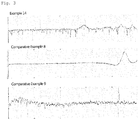
- a film was produced in the same manner as in Example 14 except that the composition for resin surface roughening obtained in Example 1 was not added. The surface roughness was evaluated. Fig. 3 shows the results.
- a film was produced in the same manner as in Example 14 except that the polypropylene carbonate obtained in Production Example 2 was used in place of the resin composition for surface roughening obtained in Example 1. The surface roughness was evaluated. Fig. 3 shows the results.
- the present invention can modify various resin surfaces merely by relatively moderate heating, enhance coating and plating efficiency, and impart functions derived from the surface configuration.
Landscapes
- Chemical & Material Sciences (AREA)
- Chemical Kinetics & Catalysis (AREA)
- Medicinal Chemistry (AREA)
- Polymers & Plastics (AREA)
- Organic Chemistry (AREA)
- Health & Medical Sciences (AREA)
- Thermal Sciences (AREA)
- Physics & Mathematics (AREA)
- General Chemical & Material Sciences (AREA)
- Compositions Of Macromolecular Compounds (AREA)
- Treatments Of Macromolecular Shaped Articles (AREA)
- Polyesters Or Polycarbonates (AREA)
- Chemically Coating (AREA)
Abstract
Description
- The present invention relates to a composition for resin surface roughening. The present invention further relates to a method for roughening a resin surface using the composition for resin surface roughening; a surface-roughened resin molded article produced using the composition for resin surface roughening; and a method for producing a surface-roughened resin molded article using the composition for resin surface roughening.
- In recent years, various resins have been developed and physical properties of resins are being improved. In addition to the improvement of the resin itself, attempts have been made to impart functions to resin molded articles by physically and chemically modifying the resin surface layer. For example, Patent Literature (PTL) 1 discloses a film having an anti-reflection function imparted by forming a fine rugged pattern on a resin surface layer by imprinting. PTL 2 discloses a film hydrophilized by an atmospheric pressure plasma treatment. Further, functions are imparted by using a modified resin surface layer as a base and plating the layer with a metal or applying an organic substance to the layer. For example, PLT 3 discloses a conductor-coating film produced by mechanically roughening a resin surface with a sandblast, dipping it in a silane coupling agent, and then performing electroless plating. PLT 4 discloses that adhesion and coatability can be improved by applying an oxygen plasma to a resin surface and then adhering water molecules in the air to the resin surface.
-
- PTL 1:
JP2004-205990A - PTL 2:
JP2006-169475A - PTL 3:
JP2005-116745A - PTL 4:
JP2010-274158A - Aliphatic polycarbonates are known to easily decompose in response to various stimuli. For example, aliphatic polycarbonates, in contact with an aqueous alkaline solution or upon heating at about 250°C, easily decompose. By utilizing this property, the resin surface can be expected to be roughened by removing only an aliphatic polycarbonate from the resin surface of a molded article obtained using a resin composition comprising an aliphatic polycarbonate. However, for example, when heating is performed to remove only an aliphatic polycarbonate, the following problem arises. Common thermoplastic resins have a softening temperature of less than 200°C. Therefore, when an aliphatic polycarbonate is thermally decomposed, a thermoplastic resin is also softened, so that the shape of a molded article comprising the thermoplastic resin cannot be maintained.
- An attempt has been made to lower the thermal decomposition temperature of an aliphatic polycarbonate by adding a salt containing an organic onium cation to the aliphatic polycarbonate. However, among the additives disclosed, only limited types of additives can lower the initial thermal decomposition temperature to less than 200°C. Such additives are industrially difficult to obtain and highly expensive.
- An object of the present invention is to provide a method for roughening a resin surface by removing only an aliphatic polycarbonate from the resin surface of a resin composition comprising the aliphatic polycarbonate by simpler and easier means.
- To solve the above problem, the present inventors conducted extensive research. As a result, the inventors found that a composition for resin surface roughening can be obtained by adding an alkali metal compound to an aliphatic polycarbonate. The inventors conducted further research based on this finding and have accomplished the present invention.
- Specifically, the present invention includes, for example, the subject matter described in the following items.
- Item 1. A composition for resin surface roughening comprising an aliphatic polycarbonate and an alkali metal compound.
- Item 2. The composition for resin surface roughening according to Item 1, wherein the alkali metal compound is at least one member selected from the group consisting of alkali metal hydroxides and alkali metal salts.
- Item 3. The composition for resin surface roughening according to Item 2, wherein the alkali metal salt is at least one member selected from the group consisting of alkali metal carbonates and alkali metal acetates.
- Item 4. The composition for resin surface roughening according to any one of Items 1 to 3, which contains the alkali metal compound in an amount of 10 ppm or more and 5000 ppm or less, relative to the aliphatic polycarbonate.
- Item 5. The composition for resin surface roughening according to any one of Items 1 to 4, wherein the aliphatic polycarbonate is an alternating copolymer of an epoxide and carbon dioxide.
-
Item 6. A resin composition comprising the composition for resin surface roughening according to any one of Items 1 to 5 and a base resin. -
Item 7. A method for producing a resin molded article having a surface-roughened surface layer, comprising decomposing the aliphatic polycarbonate contained in a molded article of the resin composition according toItem 6. -
Item 8. A method for producing a resin molded article having a surface-roughened surface layer, comprising heating a molded article of the resin composition according toItem 6. - The composition for resin surface roughening of the present invention comprises an aliphatic polycarbonate and an alkali metal compound. The aliphatic polycarbonate in contact with an alkali metal compound, which would usually decompose immediately in that state, does not decompose and can be stored over a long period of time. Furthermore, the thermal decomposition temperature can be significantly reduced. Therefore, the aliphatic polycarbonate resin can be thermally decomposed at a temperature at which a base resin is not affected by heat.
- Thus, according to the present invention, the surface of various resins can be roughened merely by heating, and functions can be imparted to a resin molded article merely by a simple and easy operation.
-
-
Fig. 1 is a thermal decomposition curve of the resin composition obtained in Example 1. -
Fig. 2 shows the results of measuring the surface roughness of the resin molded articles obtained in Example 13 and Comparative Examples 6 and 7 using a surface roughness meter. -
Fig. 3 is the results of measuring the surface roughness of the resin molded articles obtained in Example 14 and Comparative Examples 8 and 9. - The composition for resin surface roughening of the present invention contains an aliphatic polycarbonate and an alkali metal compound.
- Examples of aliphatic polycarbonates include, but are not limited to, aliphatic polycarbonates obtained by alternating copolymerization of an epoxide and carbon dioxide, aliphatic polycarbonates obtained by polycondensation of a diol and a carbonic acid ester, and aliphatic polycarbonates obtained by ring opening polymerization of a cyclic carbonate. From the viewpoint of the ease of polymerization reaction, aliphatic polycarbonates obtained by alternating copolymerization of an epoxide and carbon dioxide are preferably used. The aliphatic polycarbonates obtained by alternating copolymerization of an epoxide and carbon dioxide refer to aliphatic polycarbonates having a structure in which an epoxide and carbon dioxide are alternatively polymerized as monomer structural units. The aliphatic polycarbonates have a structure obtained by polycondensation of a diol and a carbonic acid ester refer to aliphatic polycarbonates having a diol and a carbonic acid ester as monomer structural units. The aliphatic polycarbonates obtained by ring opening polymerization of a cyclic carbonate refer to aliphatic polycarbonates having a cyclic carbonate as monomer structural unit.
- The epoxide is not particularly limited as long as it is an epoxide that can undergo a polymerization reaction with carbon dioxide to form an aliphatic polycarbonate having a structure in which an aliphatic group is present on the main chain. Examples include ethylene oxide, propylene oxide, 1-butene oxide, 2-butene oxide, isobutylene oxide, 1-pentene oxide, 2-pentene oxide, 1-hexene oxide, 1-octene oxide, 1-decene oxide, cyclopentene oxide, cyclohexene oxide, styrene oxide, vinylcyclohexene oxide, 3-phenylpropylene oxide, 3,3,3-trifluoropropylene oxide, 3-naphthylpropylene oxide, 3-phenoxypropylene oxide, 3-naphthoxypropylene oxide, butadiene monoxide, 3-vinyloxypropylene oxide, 3-trimethylsilyloxypropylene oxide, and the like. Of these epoxides, from the viewpoint of having a high polymerization reactivity with carbon dioxide, ethylene oxide and propylene oxide are preferable. These epoxides can be used singly or in a combination of two or more.
- Specific examples of preferable aliphatic polycarbonates include polypropylene carbonate, polyethylene carbonate, polycyclohexene carbonate, and the like.
- The lower limit of the mass average molecular weight of the aliphatic polycarbonate is preferably 5000, more preferably 10000, and particularly preferably 100000. The upper limit is preferably 1000000, more preferably 750000, and particularly preferably 500000. That is, the aliphatic polycarbonate preferably has a mass average molecular weight in the range of 5000 to 1000000. When the aliphatic polycarbonate has a mass average molecular weight of less than 5000, the viscosity of the resin is excessively low, and uniformly mixing the aliphatic polycarbonate with a base resin may be difficult. When the aliphatic polycarbonate has a mass average molecular weight of more than 1000000, the aliphatic polycarbonate and base resin may be less compatible with each other and an appropriately dispersed state may not be achieved. The mass average molecular weight is a value determined in a 30 mmol N,N-dimethylformamide lithium bromide solution at 40°C by gel permeation chromatography (Waters 2695 separation module, produced by Nihon Waters K.K.) and calculated (on a standard polystyrene basis).
- Aliphatic polycarbonates can be used singly or in a combination of two or more.
- The method for producing an aliphatic polycarbonate includes, for example, a method comprising subjecting the epoxide and carbon dioxide to a polymerization reaction in the presence of a metal catalyst.
- The metal catalyst includes, for example, zinc-based catalysts, aluminum-based catalysts, chromium-based catalysts, cobalt-based catalysts, and the like. Among them, zinc-based catalysts and cobalt-based catalysts are preferable because of having high polymerization activities in the polymerization reaction of an epoxide and carbon dioxide. Zinc-based catalysts, in particular, organozinc-based catalysts are preferably used in view of obtaining a high-molecular-weight product.
- The organozinc-based catalyst includes, for example, organozinc catalysts, such as zinc acetate, diethyl zinc, and dibutyl zinc; organozinc catalysts obtained by reacting a zinc compound with a compound, such as a primary amine, a dihydric phenol, a dihydric aromatic carboxylic acid, an aromatic hydroxy acid, an aliphatic dicarboxylic acid, or an aliphatic monocarboxylic acid; and the like. Among these organozinc catalysts, because of having higher polymerization activities, organozinc catalysts obtained by reacting a zinc compound, an aliphatic dicarboxylic acid, and an aliphatic monocarboxylic acid are preferable, and organozinc catalysts obtained by reacting zinc oxide, glutaric acid, and acetic acid are more preferable.
- The amount of the metal catalyst used in the polymerization reaction is such that the lower limit of the amount of the metal catalyst is preferably 0.0001 moles, and more preferably 0.001 moles, per mole of epoxide, and the upper limit thereof is preferably 0.2 moles, and more preferably 0.05 moles, per mole of epoxide. When the amount of the metal catalyst used is less than 0.0001 moles, the polymerization reaction may not proceed smoothly. When the amount of the metal catalyst used is more than 0.2 moles, effects commensurate with the amount used may not be obtained and thus may be uneconomical.
- The reaction solvent optionally used in the polymerization reaction is not particularly limited. Various organic solvents can be used.
- Examples of organic solvents include aliphatic hydrocarbon solvents, such as pentane, hexane, octane, decane, and cyclohexane; aromatic hydrocarbon solvents, such as benzene, toluene, and xylene; halogenated hydrocarbon solvents, such as methylene chloride, chloroform, carbon tetrachloride, 1,1-dichloroethane, 1,2-dichloroethane, ethyl chloride, trichloroethane, 1-chloropropane, 2-chloropropane, 1-chlorobutane, 2-chlorobutane, 1-chloro-2-methylpropane, chlorobenzene, and bromobenzene; ether solvents, such as dimethoxyethane, tetrahydrofuran, 2-methyltetrahydrofuran, 1,4-dioxane, and 1,3-dioxolane; ester solvents, such as ethyl acetate, n-propyl acetate, and isopropyl acetate; amide solvents, such as N,N-dimethylformamide and N,N-dimethylacetamide; carbonate solvents, such as dimethyl carbonate, ethylmethyl carbonate, diethyl carbonate, and propylene carbonate; and the like.
- From the viewpoint of achieving a smooth reaction, the amount of the reaction solvent used is preferably 100 to 10000 parts by mass per 100 parts by mass of epoxide.
- In the polymerization reaction, the method of reacting an epoxide and carbon dioxide in the presence of a metal catalyst is not particularly limited. For example, the following method can be used. After an epoxide and catalyst are placed optionally with a reaction solvent in an autoclave and mixed, carbon dioxide is compressed into the autoclave and a reaction is allowed to proceed.
- The pressure of carbon dioxide used in the polymerization reaction is not particularly limited. The lower limit of the pressure is preferably 0.1 MPa, more preferably 0.2 MPa, and particularly preferably 0.5 MPa. The upper limit of the pressure is preferably 20 MPa, more preferably 10 MPa, and particularly preferably 5 MPa. When the pressure of the carbon dioxide used is lower than 0.1 MPa, the polymerization may not proceed. When the pressure of the carbon dioxide used is more than 20 MPa, effects commensurate with the pressure used may not be obtained and thus may be uneconomical.
- The polymerization reaction temperature in the polymerization reaction is not particularly limited. The lower limit of the polymerization reaction temperature is preferably 0°C, more preferably 20°C, particularly preferably 30°C. The upper limit is preferably 100°C, more preferably 95°C, even more preferably 90°C, still even more preferably 80°C, and particularly preferably 60°C. When the polymerization reaction temperature is less than 0°C, the polymerization reaction may take a long time. When the polymerization reaction temperature is higher than 100°C, a side reaction may occur and lead to a lower yield.
- The polymerization reaction time cannot be generalized because it depends on the polymerization reaction conditions. It is usually preferable that the polymerization reaction time be 1 to 40 hours.
- Examples of the alkali metal compound used in the present invention include alkali metal salts (such as alkali metal carbonates, alkali metal carboxylates, and alkali metal inorganic acid salts), alkali metal hydroxides, alkali metal hydrides, alkali metal amides, alkali metal alkoxides, alkali metal phenoxides, alkali metal alkyls, and the like. Alkali metal salts and alkali metal hydroxides are preferable. Examples of alkali metal compounds include lithium compounds, sodium compounds, potassium compounds, rubidium compounds, cesium compounds, and the like.
- Examples of alkali metal carbonates include sodium carbonate, potassium carbonate, cesium carbonate, and the like. Examples of alkali metal carboxylates include alkali metal acetates. Specific examples include sodium acetate, potassium acetate, cesium acetate, and the like. Examples of alkali metal inorganic acid salts include sodium chloride, potassium chloride, sodium phosphate, potassium phosphate, sodium nitrate, potassium nitrate, sodium borate, and the like. Examples of alkali metal hydroxide include lithium hydroxide, sodium hydroxide, potassium hydroxide, cesium hydroxide, and the like. Examples of alkali metal hydride include lithium hydride, sodium hydride, potassium hydride, and the like. Examples of alkali metal amides include sodium amide, potassium amide, lithium diisopropylamide, sodium bis(trimethylsilyl)amide, potassium hexamethyldisilazide, and the like. Examples of alkali metal alkoxides include sodium methoxide, potassium methoxide, potassium tert-butoxide, and the like. Examples of alkali metal phenoxides include lithium phenoxide, sodium phenoxide, potassium phenoxide, and the like. Examples of alkali metal alkyls include methyllithium, butyl lithium, and the like. Among these, from the viewpoint of ease of availability and high effect of reducing the decomposition temperature, alkali metal carbonates, alkali metal carboxylates, and alkali metal hydroxides are preferable.
- Such alkali metal compounds can be used singly or in a combination of two or more. The aliphatic polycarbonate and alkali metal compound can be used in a suitable combination. That is, the desired one or more aliphatic polycarbonates and one or more alkali metal compounds can be appropriately used in combination.
- The lower limit of the alkali metal compound content is preferably 10 ppm, more preferably 30 ppm, still more preferably 40 ppm, and particularly preferably 50 ppm, relative to aliphatic polycarbonate. The upper limit of the alkali metal compound content is preferably 5000 ppm, more preferably 3000 ppm, still more preferably 2500 ppm, and particularly preferably 2000 ppm, relative to aliphatic polycarbonate. If the alkali metal compound content is within this range (10 to 5000 ppm), a sufficient effect of reduction in the thermal decomposition initiation temperature can be achieved while the storage stability of the composition for resin surface roughening is maintained. The ppm figures here are based on the mass ratio.
- The alkali metal compound can be added, for example, in the form of a solid, an aqueous solution, or a solution in an organic solvent, a suspension in an organic solvent so as to be in a dispersed state, etc. From the viewpoint of uniformly mixing an alkali metal compound with an aliphatic polycarbonate, the alkali metal compound is preferably used in the form of an aqueous solution or a solution in an organic solvent. That is, an aqueous solution of an alkali metal compound or a solution of an alkali metal compound in an organic solvent is preferably mixed with an aliphatic polycarbonate. The organic solvent used to form a solution in an organic solvent is preferably a solvent that is miscible with a solvent capable of dissolving an aliphatic polycarbonate described below. The method for mixing an aliphatic polycarbonate and an alkali metal compound includes, for example, a method comprising once dissolving an aliphatic polycarbonate and an alkali metal compound in a solvent and then removing the solvent; melt-kneading methods using a roller, extruder, Banbury mixer, Plastomill, Brabender, or the like. From the viewpoint of mixing without decomposing aliphatic polycarbonate, a method comprising dissolving these components in a solvent and mixing is preferable.
- The solvent used for mixing is not particularly limited as long as it can dissolve aliphatic polycarbonate. Examples include ketone solvents, such as acetone and methyl ethyl ketone; halogenated hydrocarbon solvents, such as methylene chloride and chloroform; ether solvents, such as dimethoxyethane, tetrahydrofuran, and 1,4-dioxane; ester solvents, such as methyl acetate and ethyl acetate; amide solvents, such as N,N-dimethylformamide and N,N-dimethylacetamide; carbonate solvents, such as dimethyl carbonate and propylene carbonate; and the like.
- The composition for resin surface roughening containing an aliphatic polycarbonate and an alkyl metal compound may contain additives other than the aliphatic polycarbonate and the alkali metal compound.
- Examples of usable additives include flavoring agents, colorants, pigments, antifungal agents, antimicrobial agents, antioxidants, ultraviolet absorbers, antistatic agents, and the like. These additives remain in a base resin and exhibit their effects even after an aliphatic polycarbonate has been lost by the heat-treatment of a molded article described later.
- When one or more additives are used, the amount of the additives is preferably 0.1 parts by mass to 10 parts by mass per 100 parts by mass of the aliphatic polycarbonate.
- The composition obtained by mixing in this manner can be used as the composition for resin surface roughening. When the composition obtained by mixing contains a solvent, a composition obtained by further removing the solvent can be preferably used as a composition for resin surface roughening.
- The present invention also provides a resin composition comprising the composition for resin surface roughening and a base resin.
- Examples of the base resin include polyolefin resins, such as polyethylene and polypropylene; (meth)acrylic resins, such as polymethyl (meth)acrylate and polybutyl (meth)acrylate; polystyrene; polyester resins, such as polyethylene terephthalate, polybutylene terephthalate, and polylactic acid; polyamide resins, such as 6-nylon and 6,6-nylon; polycarbonate resins, such as polybisphenol A carbonate; fluororesins, such as polytetrafluoroethylene; polyacetal resins; polyether resins, such as polyethylene oxide, polypropylene oxide, and polyphenylene oxide; cellulose resins, such as cellulose triacetate and ethyl cellulose; vinyl resins, such as polyvinyl chloride, polyvinyl acetate, and polybutadiene; polyimide resins, silicone resins, phenolic resins, epoxy resins, urea resins, melamine resins, unsaturated polyester resins, alkyd resins, urethane resins, and the like. Among these, resins or thermosetting (photo-curable) resins having a softening temperature of 160°C or more, which are less likely to be influenced by heat at the decomposition temperature of aliphatic polycarbonate, are preferable.
- The method for producing the resin composition comprising a composition for resin surface roughening and a base resin may vary depending on the type of base resin used. For example, a method comprising dissolving and mixing a composition for resin surface roughening and a base resin in a solvent and then removing the solvent; a method comprising dissolving a composition for resin surface roughening in a base resin monomer and then subjecting the base resin to a polymerization reaction; a method comprising applying a solution containing the composition for resin surface roughening to the surface of a base resin; a method comprising melt-kneading a composition for resin surface roughening and a base resin using a roller, extruder, Banbury mixer, Plastomill, Brabender, or the like.
- The amount of the resin composition for surface roughening used is preferably, on a dry mass basis, 1 part by mass to 20 parts by mass, more preferably 5 parts by mass to 10 parts by mass, per 100 parts by mass of the base resin. When the composition for resin surface roughening is used in this range, the surface can be roughened without damaging the original physical properties of the base resin.
- When the resin composition comprising the composition for resin surface roughening and a base resin is produced, one or more other additives may be added. Examples of additives include antioxidants, ultraviolet absorbers, light stabilizers, flame retardants, antistatic agents, antimicrobial agents, nucleating agents, lubricants, anti-blocking agents, colorants, fillers, photosensitizers, photopolymerization initiators, curing accelerators, curing catalysts, and the like.
- The amount of the additive(s) is preferably 0.1 parts by mass to 20 parts by mass, and more preferably 1 part by mass to 10 parts by mass, based on 100 parts by mass of the base resin. When the amount of additive used is within this range, the additives can exert their functions without damaging the original physical properties of the base resin.
- The present invention further provides a resin surface -roughening method comprising decomposing aliphatic polycarbonate contained in a resin composition comprising the composition for resin surface roughening and a base resin (preferably a molded article of the composition). Further, the present invention provides a resin surface-roughening method comprising molding a resin composition comprising the composition for resin surface roughening and a base resin and decomposing aliphatic polycarbonate in the composition for resin surface roughening.
- Further, the present invention provides a method for producing a resin molded article having a surface-roughened surface layer, comprising decomposing aliphatic polycarbonate contained in a molded article of a resin composition comprising the composition for resin surface roughening and a base resin. Further, the present invention provides a method for producing a resin molded article having a surface-roughened surface layer, comprising heating a molded article of a resin composition comprising the composition for resin surface roughening and a base resin.
- The surface of a molded article produced by molding a resin composition comprising the composition for resin surface roughening and a base resin can be easily roughened because the aliphatic polycarbonate contained therein is decomposed by heating. Furthermore, the aliphatic polycarbonate has a decomposition initiation temperature lower than that of the prior art and is thus preferable. The aliphatic polycarbonate is preferably decomposed by heating, for example, at 200°C or less, or 195°C or less. The lower limit of the heating temperature is not particularly limited as long as the aliphatic polycarbonate contained can decompose at that temperature. The lower limit of the temperature may be, for example, about 80°C or more, about 90°C or more, about 100°C or more, about 110°C or more, about 120°C or more, about 130°C or more, about 140°C or more, and about 150°C or more.
- The shape of the molded article is not particularly limited. The molded article may be in any shape, such as a stranded, film, sheet, planar, pellet, or fibrous shape.
- The molding method in the molding step is not particularly limited. Examples include injection molding, compression molding, injection compression molding, gas injection molding, foam injection molding, inflation molding, T-die molding, calendar molding, blow molding, vacuum molding, compressed air molding, rotational molding, FRP molding, lamination molding, melt flow molding, melt casting, transfer molding, pre-preg lamination press molding, pre-preg autoclave molding, matched-die molding, hand lay-up molding, SMC (sheet molding compound) press molding, BMC (bulk molding compound) molding, resin infusion molding, filament winding molding, pultrusion molding, pin winding molding, and the like.
- When the molded article of the present invention is in the form of a film or sheet, a multi-layered film or sheet can be formed by forming a film as at least one layer of a multi-layered structure with different resins by inflation molding, T-die molding, or calendaring molding, or forming a film by extrusion lamination, thermal lamination, dry lamination, or the like. The obtained film or sheet can be mono- or biaxially stretched by roll stretching, tenter stretching, tubular stretching, or the like and used.
- The surface of the molded article can be roughened by decomposing an aliphatic polycarbonate in the composition for resin surface roughening as described above.
- The method of decomposing an aliphatic polycarbonate is preferably thermal decomposition by heating. Examples of heating methods include, but are not limited to hot blast heating, resistance heating, infrared heating, microwave heating, dielectric heating, induction heating, arc heating, electron beam heating, plasma heating, laser heating, and the like.
- The present invention is described below in more detail with reference to Production Examples and Examples. However, the present invention is not limited to these Examples.
- The mass average molecular weight (Mw) and the molecular weight distribution (Mw/Mn) of the polycarbonates obtained in the Production Examples were determined by the following methods.
- The mass average molecular weight (Mw) and the molecular weight distribution (Mw/Mn) were determined in 30 mmol of a N,N-dimethylformamide lithium bromide solution at 40°C by gel permeation chromatography (Waters 2695 Separations Modules, produced by Nihon Waters K.K.) and calculated on a standard polystyrene basis. Thermal decomposition behaviors of the polycarbonate-containing resins obtained in the Examples etc. were determined while raising the temperature from room temperature to 300°C at a heating rate of 10°C/min in an ambient atmosphere using a TG/DTA7220 produced by SII NanoTechnology Inc. The initial thermal decomposition temperature is defined as an intersection of a line drawn parallel to the abscissas axis in such a manner as to pass through the mass before starting the test heating and a tangent line drawn so that the slope between the inflection points of the decomposition curve is at its maximum.
- 38.6 g (0.5 mol) of zinc oxide, 61.5 g (0.5 mol) of glutaric acid, 0.57 g (0.01 mol) of acetic acid, and 350 g of toluene were placed in a 500-mL four-necked flask equipped with a stirrer, a nitrogen gas inlet tube, a thermometer, a Dean-Stark tube, and a reflux condenser. Subsequently, while nitrogen was introduced into the reaction system at a flow rate of 100 mL/min, the temperature was raised to 55°C and stirring was performed at the same temperature for 4 hours to allow a reaction to proceed. After the temperature was then raised to 110°C, the mixture was further stirred at the same temperature for 2 hours for azeotropic removal of water. After the water removal, the resulting mixture was cooled to room temperature to obtain a slurry containing an organozinc catalyst.
- After a 1-L autoclave equipped with a stirrer, a gas inlet tube, and a thermometer was purged with a nitrogen atmosphere beforehand, 117.3 g of a slurry containing an organozinc catalyst (containing 135 mmol of an organozinc catalyst) obtained in Production Example 1, 500 g of dimethyl carbonate, and 78.3 g (1.35 mmol) of propylene oxide were placed in the autoclave. Subsequently, while stirring, carbon dioxide was added until the pressure in the reaction system had reached 1 MPa. The temperature was then raised to 60°C, and a polymerization reaction was allowed to proceed for 8 hours while carbon dioxide consumed by the reaction was replenished. After completion of the reaction, the autoclave was cooled and depressurized, and the reaction mixture was then filtered and dried under reduced pressure to obtain 120 g of polypropylene carbonate. The obtained polypropylene carbonate had a mass average molecular weight of 236000 (Mw/Mn = 10.0).
- 95.0 g of polypropylene carbonate was obtained in the same manner as in Production Example 2 except that 59.4 g (1.35 mol) of ethylene oxide was used in place of 78.3 g (1.35 mol) of propylene oxide. The obtained polyethylene carbonate had a mass average molecular weight of 197000 (Mw/Mn = 3.60).
- 65.3 g of polycyclohexene carbonate was obtained in the same manner as in Production Example 2 except that 120 g (1.35 mol) of cyclohexane oxide was used in place of 78.3 g (1.35 mol) of propylene oxide and the reaction temperature was changed from 60°C to 80°C. The obtained polycyclohexene carbonate had a mass average molecular weight of 274000 (Mw/Mn = 7.12).
- 2.0 g of polypropylene carbonate obtained in Production Example 2 was placed in a 20-mL glass vial and 8.0 g of methyl ethyl ketone was added and dissolved to prepare a uniform solution. 40 µg of a 0.1 mol% aqueous potassium hydroxide solution (110 ppm relative to polypropylene carbonate, in terms of potassium hydroxide added) was added and stirred. The obtained solution was heated at 80°C for 15 minutes and the solvent was removed. The thermal decomposition initiation temperature of the composition for resin surface roughening was determined.
Fig. 1 shows that the thermal decomposition initiation temperature is 156°C. - The obtained composition for resin surface roughening was allowed to stand in an 80°C oven for 24 hours and the occurrence of any decomposition was investigated. No decomposition occurred.
- Compositions for resin surface roughening were prepared by using various kinds and amounts of additives (alkali metal compounds) and various types of aliphatic polycarbonates as shown in Table 1 and the thermal decomposition temperature of each composition was measured. Table 1 shows the results.
- Compositions for resin surface roughening were prepared by using various kinds and amounts of additives and various types of aliphatic polycarbonates as shown in Table 1 and the thermal decomposition temperature of each composition was measured. Table 1 shows the results.
Table 1 Polycarbonate Alkali metal compound Form ppm Thermal decomposition initiation temperature (° C) Example 1 PPC KOH Aqueous solution 110 156 Example 2 PPC LiOH Methanol solution 47 188 Example 3 PPC NaOH Methanol solution 79 178 Example 4 PPC KOH Methanol solution 110 151 Example 5 PPC CsOH Methanol solution 294 145 Example 6 PPC Na2CO3 Aqueous solution 2006 186 Example 7 PPC K2CO3 Aqueous solution 267 161 Example 8 PPC Cs2CO3 Aqueous solution 619 149 Example 9 PPC NaOAc Aqueous solution 500 195 Example 10 PPC CsOAc Aqueous solution 500 149 Example 11 PEC KOH Methanol solution 110 131 Example 12 PCHC KOH Methanol solution 110 270 Comp. Ex. 1 PPC - - - 243 Comp. Ex. 2 PPC Ba(OH)2 Aqueous solution 3300 249 Comp. Ex. 3 PPC Al(OH)3 Solid 100000 254 Comp. Ex. 4 PEC - - - 253 Comp. Ex. 5 PCHC - - - 300 - In Table 1, PPC represents polypropylene carbonate, PEC represents polyethylene carbonate, and PCHC represents polycyclohexene carbonate. The form of each alkali metal compound used is shown in the "Form" column. The mass ratio of the alkali metal compound to the aliphatic polycarbonate is shown in the "ppm" column.
- A comparison between Examples 1 to 10 and Comparative Example 1 in Table 1 shows that the addition of an alkali metal compound significantly reduces the decomposition initiation temperature as compared with no addition of an alkali metal compound. Further, the results of Comparative Examples 2 and 3 show that the addition of a hydroxide other than alkali metal hydroxides does not reduce the decomposition temperature. Further, focusing on the types of alkali metals, the effect of reducing the decomposition temperature increases in the ascending order of Li<Na<K<Cs. The results of Examples 11 and 12 show that similar effects can be obtained regardless of the type of aliphatic polycarbonate.
- 2.0 g of aromatic polycarbonate (Panlite, produced by Teijin Ltd.) was dissolved in 18.0 g of tetrahydrofuran, and 0.2 g of the composition for resin surface roughening obtained in Example 1 was added and stirred. The obtained solution was applied to a glass substrate with a bar coater and dried at 80°C for 30 minutes to prepare a film with a thickness of 100 µm. The obtained film was heated at 180°C for 30 minutes within an electric furnace and then the surface was evaluated using a surface roughness meter (Surftest SJ-411, produced by Mitutoyo Corporation).
Fig. 2 shows the results. - A film was produced in the same manner as in Example 13 except that the composition for resin surface roughening obtained in Example 1 was not used. The surface roughness was evaluated.
Fig. 2 shows the results. - A film was produced in the same manner as in Example 13 except that the polypropylene carbonate obtained in Production Example 2 was used in place of the composition for resin surface roughening obtained in Example 1. The surface roughness was evaluated.
Fig. 2 shows the results. - Since the aromatic polycarbonate of a base material and the composition for resin surface roughening comprising the aliphatic polycarbonate obtained in Example 1 are incompatible with each other, a film formed by molding these materials has a sea-island structure. Accordingly, if the composition for resin surface roughening containing the aliphatic polycarbonate completely decomposes, the sites occupied by the aliphatic polycarbonate become void, and many downward convex signals are observed, as is clear from the results of Example 13 (
Fig. 2 ). In contrast, in Comparative Example 7, the surface was roughened more than that in Comparative Example 6 in which nothing was added, but many upward convex signals are observed. This result indicates that the aliphatic polycarbonate does not decompose but remains (Fig. 2 ). - One gram of the resin composition obtained in Example 1 was added to 6.75 g of 3',4'-epoxycyclohexylmethyl 3,4-epoxycyclohexanecarboxylate (Celloxide 2021P, produced by Daicel Corporation) and stirred. The insoluble matter was removed and 2.25 g of acid anhydrides ("Rikacid MH-700," produced by New Japan Chemical Co., Ltd.) was added. After the resulting mixture was stirred for 2 hours, 0.3 g of triphenylphosphine was added and stirred for 1 hour. After the obtained solution was applied to a glass substrate with a bar coater, heating was performed at 120°C for 5 hours for thermal curing to form a film with a thickness of 100 µm. The obtained film was heated at 180°C for 30 minutes and the surface was then evaluated using a surface roughness meter (Surftest SJ-411, produced by Mitutoyo Corporation).
Fig. 3 shows the results. - A film was produced in the same manner as in Example 14 except that the composition for resin surface roughening obtained in Example 1 was not added. The surface roughness was evaluated.
Fig. 3 shows the results. - A film was produced in the same manner as in Example 14 except that the polypropylene carbonate obtained in Production Example 2 was used in place of the resin composition for surface roughening obtained in Example 1. The surface roughness was evaluated.
Fig. 3 shows the results. - These results show that when a composition prepared by adding an alkali metal compound to an aliphatic polycarbonate is used as a composition for resin surface roughening, the resin surface layer can be very finely roughened merely by relatively moderate heating.
- The present invention can modify various resin surfaces merely by relatively moderate heating, enhance coating and plating efficiency, and impart functions derived from the surface configuration.
Claims (8)
- A composition for resin surface roughening comprising an aliphatic polycarbonate and an alkali metal compound.
- The composition for resin surface roughening according to claim 1, wherein the alkali metal compound is at least one member selected from the group consisting of alkali metal hydroxides and alkali metal salts.
- The composition for resin surface roughening according to claim 2, wherein the alkali metal salt is at least one member selected from the group consisting of alkali metal carbonates and alkali metal acetates.
- The composition for resin surface roughening according to any one of claims 1 to 3, which contains the alkali metal compound in an amount of 10 ppm or more and 5000 ppm or less, relative to the aliphatic polycarbonate.
- The composition for resin surface roughening according to any one of claims 1 to 4, wherein the aliphatic polycarbonate is an alternating copolymer of an epoxide and carbon dioxide.
- A resin composition comprising the composition for resin surface roughening according to any one of claims 1 to 5 and a base resin.
- A method for producing a resin molded article having a surface-roughened surface layer, comprising decomposing the aliphatic polycarbonate contained in a molded article of the resin composition according to claim 6.
- A method for producing a resin molded article having a surface-roughened surface layer, comprising heating a molded article of the resin composition according to claim 6.
Applications Claiming Priority (2)
| Application Number | Priority Date | Filing Date | Title |
|---|---|---|---|
| JP2016000163 | 2016-01-04 | ||
| PCT/JP2016/088652 WO2017119330A1 (en) | 2016-01-04 | 2016-12-26 | Composition for resin surface roughening |
Publications (4)
| Publication Number | Publication Date |
|---|---|
| EP3401365A1 true EP3401365A1 (en) | 2018-11-14 |
| EP3401365A8 EP3401365A8 (en) | 2019-03-13 |
| EP3401365A4 EP3401365A4 (en) | 2019-09-11 |
| EP3401365B1 EP3401365B1 (en) | 2021-02-17 |
Family
ID=59274241
Family Applications (1)
| Application Number | Title | Priority Date | Filing Date |
|---|---|---|---|
| EP16883829.0A Not-in-force EP3401365B1 (en) | 2016-01-04 | 2016-12-26 | Use of a composition for resin surface roughening |
Country Status (8)
| Country | Link |
|---|---|
| US (1) | US11084915B2 (en) |
| EP (1) | EP3401365B1 (en) |
| JP (1) | JP6845508B2 (en) |
| KR (1) | KR20180100328A (en) |
| CN (1) | CN108473755B (en) |
| ES (1) | ES2870042T3 (en) |
| TW (1) | TWI714694B (en) |
| WO (1) | WO2017119330A1 (en) |
Families Citing this family (3)
| Publication number | Priority date | Publication date | Assignee | Title |
|---|---|---|---|---|
| KR20180107132A (en) * | 2016-02-16 | 2018-10-01 | 스미토모 세이카 가부시키가이샤 | Polyolefin-based resin composition and polyolefin-based resin film |
| US10782200B2 (en) * | 2018-06-27 | 2020-09-22 | Mks Instruments, Inc. | Apparatus and method for thermal insulation of high-temperature pressure sensors |
| JPWO2022209775A1 (en) * | 2021-03-29 | 2022-10-06 |
Family Cites Families (26)
| Publication number | Priority date | Publication date | Assignee | Title |
|---|---|---|---|---|
| JP2718957B2 (en) | 1988-10-05 | 1998-02-25 | ポリプラスチックス株式会社 | Electrostatic coating method of crystalline thermoplastic resin molded product and painted plastics molded product |
| JPH051217A (en) * | 1991-06-27 | 1993-01-08 | Toray Ind Inc | Polyester composition |
| KR20010079634A (en) * | 1998-08-13 | 2001-08-22 | 빌프리더 하이더 | Highly Pure Polycarbonates and Method for Producing Same |
| JP2000355690A (en) * | 1999-06-15 | 2000-12-26 | Victor Co Of Japan Ltd | Thermal decomposition method for polycarbonate resin |
| JP2001146591A (en) * | 1999-11-19 | 2001-05-29 | Victor Co Of Japan Ltd | Thermal decomposition method for polycarbonate resin |
| JP2002121321A (en) * | 2000-10-12 | 2002-04-23 | National Institute Of Advanced Industrial & Technology | Method of oiling polycarbonate resin |
| JP4142908B2 (en) * | 2002-07-05 | 2008-09-03 | 日本パーカライジング株式会社 | Roughening method of resin surface |
| JP4467235B2 (en) * | 2002-12-25 | 2010-05-26 | 旭化成株式会社 | Method for manufacturing a semiconductor device |
| JP2004205990A (en) | 2002-12-26 | 2004-07-22 | Dainippon Printing Co Ltd | Method for producing fine uneven pattern having antireflection performance and antireflection article |
| JP2005116745A (en) | 2003-10-07 | 2005-04-28 | Matsushita Electric Works Ltd | Conductor coating polyimide film and manufacturing method thereof |
| JP2005146234A (en) * | 2003-10-24 | 2005-06-09 | Sekisui Chem Co Ltd | Manufacturing method of resin sheet and resin sheet for insulating substrate |
| US20050186404A1 (en) | 2004-02-23 | 2005-08-25 | Guoping Mao | Etched polycarbonate films |
| JP2005281348A (en) * | 2004-03-26 | 2005-10-13 | Fuji Photo Film Co Ltd | Alkali saponification method of polymer film |
| JP4558435B2 (en) * | 2004-10-07 | 2010-10-06 | 帝人化成株式会社 | Method for obtaining alkaline aqueous solution of aromatic dihydroxy compound and method for recovering organic solvent |
| JP4603348B2 (en) | 2004-12-20 | 2010-12-22 | エア・ウォーター株式会社 | Method for hydrophilic treatment of polymer film surface, polymer film obtained thereby, and polarizing plate using the same |
| JP4679577B2 (en) * | 2005-04-20 | 2011-04-27 | 帝人化成株式会社 | Method for obtaining an aqueous alkali metal salt solution of an aromatic dihydroxy compound from waste aromatic polycarbonate |
| US8779087B2 (en) | 2009-05-22 | 2014-07-15 | Sumitomo Seika Chemicals Co., Ltd. | Method for producing aliphatic polycarbonate |
| JP5222786B2 (en) | 2009-05-26 | 2013-06-26 | 株式会社トーシン | Surface treatment method for resin molded product, and method for producing resin molded product having a surface layer formed after the surface treatment |
| JP2011162783A (en) * | 2010-01-18 | 2011-08-25 | Mitsubishi Chemicals Corp | Flame-retardant resin composition and method for producing the same |
| CN102933656B (en) * | 2010-06-09 | 2014-10-29 | 胜技高分子株式会社 | Polybutylene terephthalate resin composition, metal composite component, and method for producing metal composite component |
| JP6000771B2 (en) * | 2012-09-12 | 2016-10-05 | 住友精化株式会社 | Metal paste composition |
| PE20142190A1 (en) * | 2013-05-15 | 2015-01-11 | Univ Pontificia Catolica Peru | METHOD FOR OBTAINING BISPHENOL-A FROM POLYCARBONATE WASTE USING MICROWAVE RADIATION |
| CN103360709A (en) * | 2013-06-25 | 2013-10-23 | 辅讯光电工业(苏州)有限公司 | Multifunctional optical film and composite thereof, as well as multifunctional optical plate and manufacturing method thereof |
| EP3112423B1 (en) * | 2014-02-24 | 2018-04-04 | Teijin Limited | Resin composition |
| JP6211442B2 (en) * | 2014-03-12 | 2017-10-11 | 株式会社ジェイエスピー | Method for producing extruded polystyrene resin foam |
| CN104761878B (en) * | 2015-04-08 | 2016-08-17 | 中国科学院化学研究所 | A kind of polycarbonate composite material and preparation method thereof |
-
2016
- 2016-12-26 WO PCT/JP2016/088652 patent/WO2017119330A1/en not_active Ceased
- 2016-12-26 KR KR1020187019232A patent/KR20180100328A/en not_active Ceased
- 2016-12-26 US US16/062,741 patent/US11084915B2/en not_active Expired - Fee Related
- 2016-12-26 JP JP2017560111A patent/JP6845508B2/en not_active Expired - Fee Related
- 2016-12-26 TW TW105143189A patent/TWI714694B/en not_active IP Right Cessation
- 2016-12-26 ES ES16883829T patent/ES2870042T3/en active Active
- 2016-12-26 EP EP16883829.0A patent/EP3401365B1/en not_active Not-in-force
- 2016-12-26 CN CN201680077897.5A patent/CN108473755B/en not_active Expired - Fee Related
Also Published As
| Publication number | Publication date |
|---|---|
| EP3401365A4 (en) | 2019-09-11 |
| JP6845508B2 (en) | 2021-03-17 |
| CN108473755B (en) | 2021-03-19 |
| EP3401365B1 (en) | 2021-02-17 |
| JPWO2017119330A1 (en) | 2018-10-18 |
| KR20180100328A (en) | 2018-09-10 |
| ES2870042T3 (en) | 2021-10-26 |
| US11084915B2 (en) | 2021-08-10 |
| TWI714694B (en) | 2021-01-01 |
| CN108473755A (en) | 2018-08-31 |
| TW201736500A (en) | 2017-10-16 |
| EP3401365A8 (en) | 2019-03-13 |
| US20180371197A1 (en) | 2018-12-27 |
| WO2017119330A1 (en) | 2017-07-13 |
Similar Documents
| Publication | Publication Date | Title |
|---|---|---|
| US10829635B2 (en) | Economical method of preparing a resin composition including polyalkylene carbonate with improved thermal stability and processability | |
| US20090018303A1 (en) | Process for Producing Low-Molecular Polyphenylene Ether | |
| EP3401365B1 (en) | Use of a composition for resin surface roughening | |
| WO2011125896A1 (en) | Polycarbonate resin composition, method for producing same and molded article of this resin composition | |
| WO2010116963A1 (en) | Polycarbonate resin composition, process for producing molded article therefrom, and optical lens | |
| KR20180077165A (en) | Polyarylate resin, process for producing the same, and polyarylate resin composition | |
| JP6100416B2 (en) | Polycarbonate resin and method for producing polycarbonate resin composition | |
| JP2012067287A (en) | Resin molded product | |
| CN113544193B (en) | Polyorganosilsesquioxane and composition for forming a hard coat layer | |
| JP5903904B2 (en) | Polycarbonate resin molded body and method for producing the same | |
| JP2015203058A (en) | Method for producing continuous fiber reinforced thermoplastic resin | |
| JP2014148672A (en) | Method of manufacturing polycarbonate resin | |
| JP6213025B2 (en) | Polycarbonate resin and polycarbonate resin composition | |
| JP6248509B2 (en) | Polycarbonate resin composition, and polycarbonate resin and method for producing polycarbonate resin composition | |
| JP5652056B2 (en) | Resin composition and resin molded body | |
| JP2015025139A (en) | Polycarbonate resin | |
| EP4480986A1 (en) | Curable resin, cured product of same, and resin composition | |
| CN114349949B (en) | Scratch-resistant copolycarbonate and preparation method and application thereof | |
| US20250122320A1 (en) | Curable resin, curable resin composition, and cured article | |
| CN104513389A (en) | Container for precision member and method for preparing the same | |
| EP4480985A1 (en) | Curable resin, cured product thereof, resin composition, and production method for curable resin | |
| CN108884218A (en) | Next door is formed with aliphatic polycarbonate resin, next door material, substrate and its manufacturing method, the manufacturing method of circuit board and Wiring method | |
| CN121175289A (en) | Amine group-containing compound, curable resin composition, cured product, and laminate | |
| EP4480987A1 (en) | Curable resin production method |
Legal Events
| Date | Code | Title | Description |
|---|---|---|---|
| STAA | Information on the status of an ep patent application or granted ep patent |
Free format text: STATUS: THE INTERNATIONAL PUBLICATION HAS BEEN MADE |
|
| PUAI | Public reference made under article 153(3) epc to a published international application that has entered the european phase |
Free format text: ORIGINAL CODE: 0009012 |
|
| STAA | Information on the status of an ep patent application or granted ep patent |
Free format text: STATUS: REQUEST FOR EXAMINATION WAS MADE |
|
| 17P | Request for examination filed |
Effective date: 20180806 |
|
| AK | Designated contracting states |
Kind code of ref document: A1 Designated state(s): AL AT BE BG CH CY CZ DE DK EE ES FI FR GB GR HR HU IE IS IT LI LT LU LV MC MK MT NL NO PL PT RO RS SE SI SK SM TR |
|
| AX | Request for extension of the european patent |
Extension state: BA ME |
|
| RAP1 | Party data changed (applicant data changed or rights of an application transferred) |
Owner name: OSAKA RESEARCH INSTITUTE OF INDUSTRIAL SCIENCE AND Owner name: SUMITOMO SEIKA CHEMICALS CO., LTD. |
|
| DAV | Request for validation of the european patent (deleted) | ||
| DAX | Request for extension of the european patent (deleted) | ||
| A4 | Supplementary search report drawn up and despatched |
Effective date: 20190813 |
|
| RIC1 | Information provided on ipc code assigned before grant |
Ipc: C08K 3/26 20060101ALI20190807BHEP Ipc: C08L 63/00 20060101ALI20190807BHEP Ipc: C08J 7/00 20060101ALI20190807BHEP Ipc: C08K 5/098 20060101ALI20190807BHEP Ipc: C08K 3/22 20060101ALI20190807BHEP Ipc: C08L 69/00 20060101AFI20190807BHEP |
|
| REG | Reference to a national code |
Ref country code: DE Ref legal event code: R079 Ref document number: 602016052876 Country of ref document: DE Free format text: PREVIOUS MAIN CLASS: C08L0069000000 Ipc: C08K0003220000 |
|
| GRAP | Despatch of communication of intention to grant a patent |
Free format text: ORIGINAL CODE: EPIDOSNIGR1 |
|
| STAA | Information on the status of an ep patent application or granted ep patent |
Free format text: STATUS: GRANT OF PATENT IS INTENDED |
|
| GRAJ | Information related to disapproval of communication of intention to grant by the applicant or resumption of examination proceedings by the epo deleted |
Free format text: ORIGINAL CODE: EPIDOSDIGR1 |
|
| STAA | Information on the status of an ep patent application or granted ep patent |
Free format text: STATUS: REQUEST FOR EXAMINATION WAS MADE |
|
| RIC1 | Information provided on ipc code assigned before grant |
Ipc: C08L 63/00 20060101ALI20200206BHEP Ipc: C08K 3/22 20060101AFI20200206BHEP Ipc: C08K 5/098 20060101ALI20200206BHEP Ipc: C08K 3/26 20060101ALI20200206BHEP Ipc: C08J 7/00 20060101ALI20200206BHEP Ipc: C08L 69/00 20060101ALI20200206BHEP Ipc: C08G 59/42 20060101ALI20200206BHEP |
|
| INTG | Intention to grant announced |
Effective date: 20200226 |
|
| GRAP | Despatch of communication of intention to grant a patent |
Free format text: ORIGINAL CODE: EPIDOSNIGR1 |
|
| STAA | Information on the status of an ep patent application or granted ep patent |
Free format text: STATUS: GRANT OF PATENT IS INTENDED |
|
| INTC | Intention to grant announced (deleted) | ||
| INTG | Intention to grant announced |
Effective date: 20200330 |
|
| GRAJ | Information related to disapproval of communication of intention to grant by the applicant or resumption of examination proceedings by the epo deleted |
Free format text: ORIGINAL CODE: EPIDOSDIGR1 |
|
| STAA | Information on the status of an ep patent application or granted ep patent |
Free format text: STATUS: REQUEST FOR EXAMINATION WAS MADE |
|
| GRAS | Grant fee paid |
Free format text: ORIGINAL CODE: EPIDOSNIGR3 |
|
| STAA | Information on the status of an ep patent application or granted ep patent |
Free format text: STATUS: GRANT OF PATENT IS INTENDED |
|
| INTC | Intention to grant announced (deleted) | ||
| GRAP | Despatch of communication of intention to grant a patent |
Free format text: ORIGINAL CODE: EPIDOSNIGR1 |
|
| INTG | Intention to grant announced |
Effective date: 20200923 |
|
| GRAA | (expected) grant |
Free format text: ORIGINAL CODE: 0009210 |
|
| STAA | Information on the status of an ep patent application or granted ep patent |
Free format text: STATUS: THE PATENT HAS BEEN GRANTED |
|
| AK | Designated contracting states |
Kind code of ref document: B1 Designated state(s): AL AT BE BG CH CY CZ DE DK EE ES FI FR GB GR HR HU IE IS IT LI LT LU LV MC MK MT NL NO PL PT RO RS SE SI SK SM TR |
|
| REG | Reference to a national code |
Ref country code: GB Ref legal event code: FG4D |
|
| REG | Reference to a national code |
Ref country code: CH Ref legal event code: EP |
|
| REG | Reference to a national code |
Ref country code: DE Ref legal event code: R096 Ref document number: 602016052876 Country of ref document: DE |
|
| REG | Reference to a national code |
Ref country code: AT Ref legal event code: REF Ref document number: 1361409 Country of ref document: AT Kind code of ref document: T Effective date: 20210315 |
|
| REG | Reference to a national code |
Ref country code: NL Ref legal event code: FP Ref country code: IE Ref legal event code: FG4D |
|
| REG | Reference to a national code |
Ref country code: LT Ref legal event code: MG9D |
|
| PG25 | Lapsed in a contracting state [announced via postgrant information from national office to epo] |
Ref country code: GR Free format text: LAPSE BECAUSE OF FAILURE TO SUBMIT A TRANSLATION OF THE DESCRIPTION OR TO PAY THE FEE WITHIN THE PRESCRIBED TIME-LIMIT Effective date: 20210518 Ref country code: FI Free format text: LAPSE BECAUSE OF FAILURE TO SUBMIT A TRANSLATION OF THE DESCRIPTION OR TO PAY THE FEE WITHIN THE PRESCRIBED TIME-LIMIT Effective date: 20210217 Ref country code: HR Free format text: LAPSE BECAUSE OF FAILURE TO SUBMIT A TRANSLATION OF THE DESCRIPTION OR TO PAY THE FEE WITHIN THE PRESCRIBED TIME-LIMIT Effective date: 20210217 Ref country code: PT Free format text: LAPSE BECAUSE OF FAILURE TO SUBMIT A TRANSLATION OF THE DESCRIPTION OR TO PAY THE FEE WITHIN THE PRESCRIBED TIME-LIMIT Effective date: 20210617 Ref country code: NO Free format text: LAPSE BECAUSE OF FAILURE TO SUBMIT A TRANSLATION OF THE DESCRIPTION OR TO PAY THE FEE WITHIN THE PRESCRIBED TIME-LIMIT Effective date: 20210517 Ref country code: BG Free format text: LAPSE BECAUSE OF FAILURE TO SUBMIT A TRANSLATION OF THE DESCRIPTION OR TO PAY THE FEE WITHIN THE PRESCRIBED TIME-LIMIT Effective date: 20210517 Ref country code: LT Free format text: LAPSE BECAUSE OF FAILURE TO SUBMIT A TRANSLATION OF THE DESCRIPTION OR TO PAY THE FEE WITHIN THE PRESCRIBED TIME-LIMIT Effective date: 20210217 |
|
| PG25 | Lapsed in a contracting state [announced via postgrant information from national office to epo] |
Ref country code: LV Free format text: LAPSE BECAUSE OF FAILURE TO SUBMIT A TRANSLATION OF THE DESCRIPTION OR TO PAY THE FEE WITHIN THE PRESCRIBED TIME-LIMIT Effective date: 20210217 Ref country code: RS Free format text: LAPSE BECAUSE OF FAILURE TO SUBMIT A TRANSLATION OF THE DESCRIPTION OR TO PAY THE FEE WITHIN THE PRESCRIBED TIME-LIMIT Effective date: 20210217 Ref country code: PL Free format text: LAPSE BECAUSE OF FAILURE TO SUBMIT A TRANSLATION OF THE DESCRIPTION OR TO PAY THE FEE WITHIN THE PRESCRIBED TIME-LIMIT Effective date: 20210217 Ref country code: SE Free format text: LAPSE BECAUSE OF FAILURE TO SUBMIT A TRANSLATION OF THE DESCRIPTION OR TO PAY THE FEE WITHIN THE PRESCRIBED TIME-LIMIT Effective date: 20210217 |
|
| PG25 | Lapsed in a contracting state [announced via postgrant information from national office to epo] |
Ref country code: IS Free format text: LAPSE BECAUSE OF FAILURE TO SUBMIT A TRANSLATION OF THE DESCRIPTION OR TO PAY THE FEE WITHIN THE PRESCRIBED TIME-LIMIT Effective date: 20210617 |
|
| REG | Reference to a national code |
Ref country code: ES Ref legal event code: FG2A Ref document number: 2870042 Country of ref document: ES Kind code of ref document: T3 Effective date: 20211026 |
|
| PG25 | Lapsed in a contracting state [announced via postgrant information from national office to epo] |
Ref country code: CZ Free format text: LAPSE BECAUSE OF FAILURE TO SUBMIT A TRANSLATION OF THE DESCRIPTION OR TO PAY THE FEE WITHIN THE PRESCRIBED TIME-LIMIT Effective date: 20210217 Ref country code: EE Free format text: LAPSE BECAUSE OF FAILURE TO SUBMIT A TRANSLATION OF THE DESCRIPTION OR TO PAY THE FEE WITHIN THE PRESCRIBED TIME-LIMIT Effective date: 20210217 Ref country code: SM Free format text: LAPSE BECAUSE OF FAILURE TO SUBMIT A TRANSLATION OF THE DESCRIPTION OR TO PAY THE FEE WITHIN THE PRESCRIBED TIME-LIMIT Effective date: 20210217 |
|
| REG | Reference to a national code |
Ref country code: AT Ref legal event code: UEP Ref document number: 1361409 Country of ref document: AT Kind code of ref document: T Effective date: 20210217 |
|
| REG | Reference to a national code |
Ref country code: DE Ref legal event code: R097 Ref document number: 602016052876 Country of ref document: DE |
|
| PG25 | Lapsed in a contracting state [announced via postgrant information from national office to epo] |
Ref country code: DK Free format text: LAPSE BECAUSE OF FAILURE TO SUBMIT A TRANSLATION OF THE DESCRIPTION OR TO PAY THE FEE WITHIN THE PRESCRIBED TIME-LIMIT Effective date: 20210217 Ref country code: RO Free format text: LAPSE BECAUSE OF FAILURE TO SUBMIT A TRANSLATION OF THE DESCRIPTION OR TO PAY THE FEE WITHIN THE PRESCRIBED TIME-LIMIT Effective date: 20210217 Ref country code: SK Free format text: LAPSE BECAUSE OF FAILURE TO SUBMIT A TRANSLATION OF THE DESCRIPTION OR TO PAY THE FEE WITHIN THE PRESCRIBED TIME-LIMIT Effective date: 20210217 |
|
| PLBE | No opposition filed within time limit |
Free format text: ORIGINAL CODE: 0009261 |
|
| STAA | Information on the status of an ep patent application or granted ep patent |
Free format text: STATUS: NO OPPOSITION FILED WITHIN TIME LIMIT |
|
| 26N | No opposition filed |
Effective date: 20211118 |
|
| PG25 | Lapsed in a contracting state [announced via postgrant information from national office to epo] |
Ref country code: AL Free format text: LAPSE BECAUSE OF FAILURE TO SUBMIT A TRANSLATION OF THE DESCRIPTION OR TO PAY THE FEE WITHIN THE PRESCRIBED TIME-LIMIT Effective date: 20210217 |
|
| PG25 | Lapsed in a contracting state [announced via postgrant information from national office to epo] |
Ref country code: SI Free format text: LAPSE BECAUSE OF FAILURE TO SUBMIT A TRANSLATION OF THE DESCRIPTION OR TO PAY THE FEE WITHIN THE PRESCRIBED TIME-LIMIT Effective date: 20210217 |
|
| PG25 | Lapsed in a contracting state [announced via postgrant information from national office to epo] |
Ref country code: IT Free format text: LAPSE BECAUSE OF FAILURE TO SUBMIT A TRANSLATION OF THE DESCRIPTION OR TO PAY THE FEE WITHIN THE PRESCRIBED TIME-LIMIT Effective date: 20210217 |
|
| PG25 | Lapsed in a contracting state [announced via postgrant information from national office to epo] |
Ref country code: IS Free format text: LAPSE BECAUSE OF FAILURE TO SUBMIT A TRANSLATION OF THE DESCRIPTION OR TO PAY THE FEE WITHIN THE PRESCRIBED TIME-LIMIT Effective date: 20210617 |
|
| PG25 | Lapsed in a contracting state [announced via postgrant information from national office to epo] |
Ref country code: MC Free format text: LAPSE BECAUSE OF FAILURE TO SUBMIT A TRANSLATION OF THE DESCRIPTION OR TO PAY THE FEE WITHIN THE PRESCRIBED TIME-LIMIT Effective date: 20210217 |
|
| REG | Reference to a national code |
Ref country code: CH Ref legal event code: PL |
|
| REG | Reference to a national code |
Ref country code: BE Ref legal event code: MM Effective date: 20211231 |
|
| PG25 | Lapsed in a contracting state [announced via postgrant information from national office to epo] |
Ref country code: LU Free format text: LAPSE BECAUSE OF NON-PAYMENT OF DUE FEES Effective date: 20211226 Ref country code: IE Free format text: LAPSE BECAUSE OF NON-PAYMENT OF DUE FEES Effective date: 20211226 |
|
| PG25 | Lapsed in a contracting state [announced via postgrant information from national office to epo] |
Ref country code: BE Free format text: LAPSE BECAUSE OF NON-PAYMENT OF DUE FEES Effective date: 20211231 |
|
| PG25 | Lapsed in a contracting state [announced via postgrant information from national office to epo] |
Ref country code: LI Free format text: LAPSE BECAUSE OF NON-PAYMENT OF DUE FEES Effective date: 20211231 Ref country code: CH Free format text: LAPSE BECAUSE OF NON-PAYMENT OF DUE FEES Effective date: 20211231 |
|
| PGFP | Annual fee paid to national office [announced via postgrant information from national office to epo] |
Ref country code: NL Payment date: 20221114 Year of fee payment: 7 Ref country code: GB Payment date: 20221103 Year of fee payment: 7 Ref country code: FR Payment date: 20221110 Year of fee payment: 7 Ref country code: DE Payment date: 20221102 Year of fee payment: 7 Ref country code: AT Payment date: 20221125 Year of fee payment: 7 |
|
| PGFP | Annual fee paid to national office [announced via postgrant information from national office to epo] |
Ref country code: ES Payment date: 20230112 Year of fee payment: 7 |
|
| PG25 | Lapsed in a contracting state [announced via postgrant information from national office to epo] |
Ref country code: CY Free format text: LAPSE BECAUSE OF FAILURE TO SUBMIT A TRANSLATION OF THE DESCRIPTION OR TO PAY THE FEE WITHIN THE PRESCRIBED TIME-LIMIT Effective date: 20210217 |
|
| PG25 | Lapsed in a contracting state [announced via postgrant information from national office to epo] |
Ref country code: HU Free format text: LAPSE BECAUSE OF FAILURE TO SUBMIT A TRANSLATION OF THE DESCRIPTION OR TO PAY THE FEE WITHIN THE PRESCRIBED TIME-LIMIT; INVALID AB INITIO Effective date: 20161226 |
|
| PG25 | Lapsed in a contracting state [announced via postgrant information from national office to epo] |
Ref country code: MK Free format text: LAPSE BECAUSE OF FAILURE TO SUBMIT A TRANSLATION OF THE DESCRIPTION OR TO PAY THE FEE WITHIN THE PRESCRIBED TIME-LIMIT Effective date: 20210217 |
|
| PG25 | Lapsed in a contracting state [announced via postgrant information from national office to epo] |
Ref country code: TR Free format text: LAPSE BECAUSE OF FAILURE TO SUBMIT A TRANSLATION OF THE DESCRIPTION OR TO PAY THE FEE WITHIN THE PRESCRIBED TIME-LIMIT Effective date: 20210217 |
|
| REG | Reference to a national code |
Ref country code: DE Ref legal event code: R119 Ref document number: 602016052876 Country of ref document: DE |
|
| REG | Reference to a national code |
Ref country code: NL Ref legal event code: MM Effective date: 20240101 |
|
| REG | Reference to a national code |
Ref country code: AT Ref legal event code: MM01 Ref document number: 1361409 Country of ref document: AT Kind code of ref document: T Effective date: 20231226 |
|
| GBPC | Gb: european patent ceased through non-payment of renewal fee |
Effective date: 20231226 |
|
| PG25 | Lapsed in a contracting state [announced via postgrant information from national office to epo] |
Ref country code: NL Free format text: LAPSE BECAUSE OF NON-PAYMENT OF DUE FEES Effective date: 20240101 |
|
| PG25 | Lapsed in a contracting state [announced via postgrant information from national office to epo] |
Ref country code: NL Free format text: LAPSE BECAUSE OF NON-PAYMENT OF DUE FEES Effective date: 20240101 Ref country code: MT Free format text: LAPSE BECAUSE OF FAILURE TO SUBMIT A TRANSLATION OF THE DESCRIPTION OR TO PAY THE FEE WITHIN THE PRESCRIBED TIME-LIMIT Effective date: 20210217 |
|
| PG25 | Lapsed in a contracting state [announced via postgrant information from national office to epo] |
Ref country code: DE Free format text: LAPSE BECAUSE OF NON-PAYMENT OF DUE FEES Effective date: 20240702 |
|
| PG25 | Lapsed in a contracting state [announced via postgrant information from national office to epo] |
Ref country code: GB Free format text: LAPSE BECAUSE OF NON-PAYMENT OF DUE FEES Effective date: 20231226 |
|
| PG25 | Lapsed in a contracting state [announced via postgrant information from national office to epo] |
Ref country code: FR Free format text: LAPSE BECAUSE OF NON-PAYMENT OF DUE FEES Effective date: 20231231 |
|
| PG25 | Lapsed in a contracting state [announced via postgrant information from national office to epo] |
Ref country code: AT Free format text: LAPSE BECAUSE OF NON-PAYMENT OF DUE FEES Effective date: 20231226 |
|
| PG25 | Lapsed in a contracting state [announced via postgrant information from national office to epo] |
Ref country code: GB Free format text: LAPSE BECAUSE OF NON-PAYMENT OF DUE FEES Effective date: 20231226 Ref country code: FR Free format text: LAPSE BECAUSE OF NON-PAYMENT OF DUE FEES Effective date: 20231231 Ref country code: DE Free format text: LAPSE BECAUSE OF NON-PAYMENT OF DUE FEES Effective date: 20240702 Ref country code: AT Free format text: LAPSE BECAUSE OF NON-PAYMENT OF DUE FEES Effective date: 20231226 |
|
| REG | Reference to a national code |
Ref country code: ES Ref legal event code: FD2A Effective date: 20250204 |
|
| PG25 | Lapsed in a contracting state [announced via postgrant information from national office to epo] |
Ref country code: ES Free format text: LAPSE BECAUSE OF NON-PAYMENT OF DUE FEES Effective date: 20231227 |