EP3399467B1 - Emotionserkennung in videokonferenz - Google Patents
Emotionserkennung in videokonferenz Download PDFInfo
- Publication number
- EP3399467B1 EP3399467B1 EP18179336.5A EP18179336A EP3399467B1 EP 3399467 B1 EP3399467 B1 EP 3399467B1 EP 18179336 A EP18179336 A EP 18179336A EP 3399467 B1 EP3399467 B1 EP 3399467B1
- Authority
- EP
- European Patent Office
- Prior art keywords
- video
- emotion
- interest
- individual
- facial
- Prior art date
- Legal status (The legal status is an assumption and is not a legal conclusion. Google has not performed a legal analysis and makes no representation as to the accuracy of the status listed.)
- Active
Links
Images







Classifications
-
- G—PHYSICS
- G06—COMPUTING OR CALCULATING; COUNTING
- G06V—IMAGE OR VIDEO RECOGNITION OR UNDERSTANDING
- G06V10/00—Arrangements for image or video recognition or understanding
- G06V10/70—Arrangements for image or video recognition or understanding using pattern recognition or machine learning
- G06V10/77—Processing image or video features in feature spaces; using data integration or data reduction, e.g. principal component analysis [PCA] or independent component analysis [ICA] or self-organising maps [SOM]; Blind source separation
- G06V10/80—Fusion, i.e. combining data from various sources at the sensor level, preprocessing level, feature extraction level or classification level
- G06V10/803—Fusion, i.e. combining data from various sources at the sensor level, preprocessing level, feature extraction level or classification level of input or preprocessed data
-
- H—ELECTRICITY
- H04—ELECTRIC COMMUNICATION TECHNIQUE
- H04N—PICTORIAL COMMUNICATION, e.g. TELEVISION
- H04N7/00—Television systems
- H04N7/14—Systems for two-way working
- H04N7/141—Systems for two-way working between two video terminals, e.g. videophone
- H04N7/147—Communication arrangements, e.g. identifying the communication as a video-communication, intermediate storage of the signals
-
- G—PHYSICS
- G06—COMPUTING OR CALCULATING; COUNTING
- G06Q—INFORMATION AND COMMUNICATION TECHNOLOGY [ICT] SPECIALLY ADAPTED FOR ADMINISTRATIVE, COMMERCIAL, FINANCIAL, MANAGERIAL OR SUPERVISORY PURPOSES; SYSTEMS OR METHODS SPECIALLY ADAPTED FOR ADMINISTRATIVE, COMMERCIAL, FINANCIAL, MANAGERIAL OR SUPERVISORY PURPOSES, NOT OTHERWISE PROVIDED FOR
- G06Q30/00—Commerce
- G06Q30/02—Marketing; Price estimation or determination; Fundraising
- G06Q30/0281—Customer communication at a business location, e.g. providing product or service information, consulting
-
- G—PHYSICS
- G06—COMPUTING OR CALCULATING; COUNTING
- G06T—IMAGE DATA PROCESSING OR GENERATION, IN GENERAL
- G06T7/00—Image analysis
- G06T7/30—Determination of transform parameters for the alignment of images, i.e. image registration
- G06T7/33—Determination of transform parameters for the alignment of images, i.e. image registration using feature-based methods
- G06T7/337—Determination of transform parameters for the alignment of images, i.e. image registration using feature-based methods involving reference images or patches
-
- G—PHYSICS
- G06—COMPUTING OR CALCULATING; COUNTING
- G06T—IMAGE DATA PROCESSING OR GENERATION, IN GENERAL
- G06T7/00—Image analysis
- G06T7/30—Determination of transform parameters for the alignment of images, i.e. image registration
- G06T7/33—Determination of transform parameters for the alignment of images, i.e. image registration using feature-based methods
- G06T7/344—Determination of transform parameters for the alignment of images, i.e. image registration using feature-based methods involving models
-
- G—PHYSICS
- G06—COMPUTING OR CALCULATING; COUNTING
- G06V—IMAGE OR VIDEO RECOGNITION OR UNDERSTANDING
- G06V10/00—Arrangements for image or video recognition or understanding
- G06V10/70—Arrangements for image or video recognition or understanding using pattern recognition or machine learning
- G06V10/74—Image or video pattern matching; Proximity measures in feature spaces
- G06V10/75—Organisation of the matching processes, e.g. simultaneous or sequential comparisons of image or video features; Coarse-fine approaches, e.g. multi-scale approaches; using context analysis; Selection of dictionaries
- G06V10/755—Deformable models or variational models, e.g. snakes or active contours
- G06V10/7553—Deformable models or variational models, e.g. snakes or active contours based on shape, e.g. active shape models [ASM]
-
- G—PHYSICS
- G06—COMPUTING OR CALCULATING; COUNTING
- G06V—IMAGE OR VIDEO RECOGNITION OR UNDERSTANDING
- G06V20/00—Scenes; Scene-specific elements
- G06V20/60—Type of objects
- G06V20/64—Three-dimensional [3D] objects
-
- G—PHYSICS
- G06—COMPUTING OR CALCULATING; COUNTING
- G06V—IMAGE OR VIDEO RECOGNITION OR UNDERSTANDING
- G06V40/00—Recognition of biometric, human-related or animal-related patterns in image or video data
- G06V40/10—Human or animal bodies, e.g. vehicle occupants or pedestrians; Body parts, e.g. hands
- G06V40/16—Human faces, e.g. facial parts, sketches or expressions
- G06V40/161—Detection; Localisation; Normalisation
- G06V40/165—Detection; Localisation; Normalisation using facial parts and geometric relationships
-
- G—PHYSICS
- G06—COMPUTING OR CALCULATING; COUNTING
- G06V—IMAGE OR VIDEO RECOGNITION OR UNDERSTANDING
- G06V40/00—Recognition of biometric, human-related or animal-related patterns in image or video data
- G06V40/10—Human or animal bodies, e.g. vehicle occupants or pedestrians; Body parts, e.g. hands
- G06V40/16—Human faces, e.g. facial parts, sketches or expressions
- G06V40/161—Detection; Localisation; Normalisation
- G06V40/167—Detection; Localisation; Normalisation using comparisons between temporally consecutive images
-
- G—PHYSICS
- G06—COMPUTING OR CALCULATING; COUNTING
- G06V—IMAGE OR VIDEO RECOGNITION OR UNDERSTANDING
- G06V40/00—Recognition of biometric, human-related or animal-related patterns in image or video data
- G06V40/10—Human or animal bodies, e.g. vehicle occupants or pedestrians; Body parts, e.g. hands
- G06V40/16—Human faces, e.g. facial parts, sketches or expressions
- G06V40/168—Feature extraction; Face representation
- G06V40/171—Local features and components; Facial parts ; Occluding parts, e.g. glasses; Geometrical relationships
-
- G—PHYSICS
- G06—COMPUTING OR CALCULATING; COUNTING
- G06V—IMAGE OR VIDEO RECOGNITION OR UNDERSTANDING
- G06V40/00—Recognition of biometric, human-related or animal-related patterns in image or video data
- G06V40/10—Human or animal bodies, e.g. vehicle occupants or pedestrians; Body parts, e.g. hands
- G06V40/16—Human faces, e.g. facial parts, sketches or expressions
- G06V40/174—Facial expression recognition
- G06V40/176—Dynamic expression
-
- G—PHYSICS
- G10—MUSICAL INSTRUMENTS; ACOUSTICS
- G10L—SPEECH ANALYSIS TECHNIQUES OR SPEECH SYNTHESIS; SPEECH RECOGNITION; SPEECH OR VOICE PROCESSING TECHNIQUES; SPEECH OR AUDIO CODING OR DECODING
- G10L25/00—Speech or voice analysis techniques not restricted to a single one of groups G10L15/00 - G10L21/00
- G10L25/48—Speech or voice analysis techniques not restricted to a single one of groups G10L15/00 - G10L21/00 specially adapted for particular use
- G10L25/51—Speech or voice analysis techniques not restricted to a single one of groups G10L15/00 - G10L21/00 specially adapted for particular use for comparison or discrimination
- G10L25/63—Speech or voice analysis techniques not restricted to a single one of groups G10L15/00 - G10L21/00 specially adapted for particular use for comparison or discrimination for estimating an emotional state
-
- H—ELECTRICITY
- H04—ELECTRIC COMMUNICATION TECHNIQUE
- H04N—PICTORIAL COMMUNICATION, e.g. TELEVISION
- H04N7/00—Television systems
- H04N7/14—Systems for two-way working
- H04N7/15—Conference systems
-
- G—PHYSICS
- G06—COMPUTING OR CALCULATING; COUNTING
- G06T—IMAGE DATA PROCESSING OR GENERATION, IN GENERAL
- G06T2207/00—Indexing scheme for image analysis or image enhancement
- G06T2207/10—Image acquisition modality
- G06T2207/10016—Video; Image sequence
-
- G—PHYSICS
- G06—COMPUTING OR CALCULATING; COUNTING
- G06T—IMAGE DATA PROCESSING OR GENERATION, IN GENERAL
- G06T2207/00—Indexing scheme for image analysis or image enhancement
- G06T2207/30—Subject of image; Context of image processing
- G06T2207/30196—Human being; Person
- G06T2207/30201—Face
-
- G—PHYSICS
- G10—MUSICAL INSTRUMENTS; ACOUSTICS
- G10L—SPEECH ANALYSIS TECHNIQUES OR SPEECH SYNTHESIS; SPEECH RECOGNITION; SPEECH OR VOICE PROCESSING TECHNIQUES; SPEECH OR AUDIO CODING OR DECODING
- G10L25/00—Speech or voice analysis techniques not restricted to a single one of groups G10L15/00 - G10L21/00
- G10L25/48—Speech or voice analysis techniques not restricted to a single one of groups G10L15/00 - G10L21/00 specially adapted for particular use
- G10L25/51—Speech or voice analysis techniques not restricted to a single one of groups G10L15/00 - G10L21/00 specially adapted for particular use for comparison or discrimination
- G10L25/57—Speech or voice analysis techniques not restricted to a single one of groups G10L15/00 - G10L21/00 specially adapted for particular use for comparison or discrimination for processing of video signals
Definitions
- This disclosure relates generally to video conferencing and, more particularly, to systems and methods for recognizing emotions of participants in video conferencing.
- Video conferencing and videophone calls are popular tools for conducting two-way video and audio communications over long distances. This technology has been developing rapidly due to the emergence of high speed networking solutions, inexpensive hardware components, and deployment of cellular networks.
- video conferencing allows two or more individuals to communicate with each other using a variety of software applications, such as video chat applications, where the participants can view each other while talking.
- Video chats can be available on general-purpose computers, mobile devices, and television systems as downloadable software applications or web services.
- Traditional hardware requirements for video conferencing include, on each side, an input audio module (e.g., a microphone), input video module (e.g., a video camera), output audio module (e.g., speakers), output video module (e.g., a display or projector), and a computing device that ties together input and output modules, compresses and decompresses audio and video streams, and initiates and maintains the data linkage via a communications network.
- an input audio module e.g., a microphone
- input video module e.g., a video camera
- output audio module e.g., speakers
- output video module e.g., a display or projector
- a computing device that ties together input and output modules, compresses and decompresses audio and video streams, and initiates and maintains the data linkage via a communications network.
- Videoconferencing has become popular in the customer service and support industry by providing direct communication with customers regardless of their location.
- video chat can enable face-to-face interactions between customer service representatives and customers.
- chat sessions can be initiated from kiosks, mobile devices, and web and social media channels. This allows companies to provide personalized attention to each customer and conduct video interviews, sales, promotions, services, support, and other video collaboration.
- videoconferencing creates a useful channel to provide services to customers
- one challenging issue is to deal with irate, annoyed and distressed customers.
- Customer anger is not always easy to spot even to professional service providers or sale representatives.
- One of the important strategies in sales and customer service is to detect when a customer is angry or annoyed and prevent difficult situations at a very early stage. Unfortunately, it is a very difficult task even to experienced professionals.
- US 2005/0131744 A1 discloses an apparatus, system and method of automatically identifying participants at a videoconference who exhibit a particular expression during a speech.
- a participant e.g., the person who calls the meeting or any one of the participants
- the person may request that the computing system flag any participant who is disinterested, bored, excited, happy, sad etc. during the conference.
- This disclosure relates generally to the technology for video conferencing, in which an emotional status of participating individuals can be recognized.
- the videoconferencing includes two or more participants including, for example, a customer and a customer service representative. If the recognized emotional status relates to a negative emotion, such as anger, stress, irritation, and annoyance, the emotional status can be reported to one of the videoconference participants and/or a third party such as a supervisor, administrator, or manager. The third party enters into the videoconference between the individuals to resolve any issues.
- the technology allows determining the emotional status by analyzing a video channel to detect facial emotions and an audio channel to detect speech emotions.
- the present technology can recognize facial emotions by locating feature reference points (e.g., facial landmarks) on the video, aligning a virtual face mesh to the feature reference points, and finding mesh deformations that reflect face mimics. Speech emotions can be recognized by extracting voice features and determining changes thereof.
- feature reference points e.g., facial landmarks
- a computer-implemented method for videoconferencing is provided as defined in appended claim 1.
- the recognizing of the speech emotion can comprise recognizing a speech in the audio stream.
- the method may further comprise detecting one or more gestures, determining that the one or more gestures refer to a predetermined emotion, and generating an emotional status of an individual based on the facial emotion and determination that the one or more gestures refer to the predetermined emotion.
- the comparing of the at least one deformation of the mesh to reference facial parameters can comprise applying a convolution neural network. In certain embodiments, the comparing of the at least one deformation of the mesh to reference facial parameters can comprise applying a state vector machine.
- the method may further comprise transmitting and presenting the communication to a customer service representative or a service provider.
- the feature reference points can include facial landmarks.
- the feature reference points can include one or more facial landmarks indicating at least one of the following: an eyebrows vertical position, an eyes vertical position, an eyes width, an eyes height, an eye separation distance, a nose vertical position, nose pointing up, a mouth vertical position, a mouth width, a chin width, a upper lip raiser, a jaw drop, a lip stretcher, a left brow lowerer, a right brow lowerer, a lip corner depressor, and an outer brow raiser.
- the method may further comprise receiving a request to determine facial emotions of a video conferencing participant.
- the detecting of the at least one object of interest can include applying a Viola-Jones algorithm to the images.
- the locating of the feature reference points can include applying an Active Shape Model algorithm to areas of the images associated with the at least one object of interest.
- the aligning of the mesh can be based on shape units (SUs) associated with a face shape of the at least one object of interest.
- the step of aligning the mesh can comprise estimating intensities of the SUs associated with the face shape, estimating intensities of action units (AUs) associated with the at least one face mimic, and estimating of rotations of the virtual face mesh around three orthogonal axes and its translations along the axes.
- the step of detecting the at least one object of interest can be based on a user input.
- the plurality of facial emotions can include at least a neutral facial emotion, a positive facial emotion, and a negative facial emotion.
- the negative facial emotion can include at least one of anger, stress, frustration, embarrassment, irritation, and annoyance.
- a computing system is provided, as defined in appended claim 4.
- An example system comprises a computing device including at least one processor and a memory storing processor-executable codes, which, when implemented by the least one processor, cause the device to perform the method steps described in claim 1.
- a non-transitory processor-readable medium having instructions stored thereon, which when executed by one or more processors, cause the one or more processors to implement the method steps described above.
- Present teachings may be implemented using a variety of technologies.
- the methods described herein may be implemented in software executing on a computer system or in hardware utilizing either a combination of microprocessors or other specially designed application-specific integrated circuits (ASICs), programmable logic devices, or various combinations thereof.
- the methods described herein may be implemented by a series of computer-executable instructions residing on a transitory or non-transitory storage medium such as a disk drive or computer-readable medium.
- a server network device
- general-purpose computer e.g., a desktop computer, tablet computer, laptop computer
- mobile device e.g., cellular phone, smart phone
- game console handheld gaming device
- television system set-top box
- in-vehicle computing device kiosk, and so forth.
- the present technology provides for methods and systems for videoconferencing, which allow for determining an emotional status of at least one videoconference participant by analyzing video images and audio associated with the videoconference participant.
- the videoconferencing includes two or more participants including, for example, a customer and a customer service representative. Emotional status can be determined by identifying facial emotions and speech emotions.
- the present technology allows for tracking changes in facial expressions and voice features over time. Facial emotions are identified by locating feature reference points of the videoconference participant, aligning a virtual face mesh (also referred to as "mesh" for simplicity) based at least in part on the feature reference points, finding or determining mesh changes that reflect one or more face mimics, and comparing the mesh changes with reference facial parameters of a plurality of reference emotions stored in a database.
- a virtual face mesh also referred to as "mesh” for simplicity
- Speech emotions are identified by detecting and analyzing voice features and comparing voice features to a plurality of reference voice features stored in a database. Once the emotional status is identified, it can be reported to one of the videoconference participants and/or a third party such as a supervisor, manager, moderator, or administrator. For example, when the emotional status of one videoconference participant is identified and reported to relating to a negative emotion, such as anger, stress, irritation, and annoyance, another videoconference participant can start adjusting his speech, initiate managing of customer anger, and the like. In addition, a supervisor may be enabled to start watching the process of communicating between these participants and enter into the videoconference to resolve negative emotion issues.
- a supervisor may be enabled to start watching the process of communicating between these participants and enter into the videoconference to resolve negative emotion issues.
- videoconferencing refers to a telecommunication technology, which allows two or more people to communicate by simultaneous two-way video and audio transmissions.
- the video transmissions include communicating a plurality of video images.
- video conferencing incorporates similar terms including, for example, “videophone calling,” “videotelephony,” “video teleconferencing,” and “video chat,” among others.
- facial expressions can be detected and tracked using a variety of video processing algorithms.
- individual faces can be detected using the combination of Viola-Jones algorithm, which is targeted to detect a face in video images, and an Active Shape Model (ASM) algorithm, which is designed to locate feature reference points associated with the face.
- ASM Active Shape Model
- changes and deformations of the mesh that reflect and associated with face mimics, can be compared to reference facial parameters and based on the comparison, it can be determined that the mesh deformation refers to a facial emotion selected from a plurality of reference facial emotions.
- the emotional status of an individual can be based at least in part on the facial emotion.
- the emotional status is transmitted to one or more videoconference participants or third parties.
- the video processing algorithm can be applied to a video stream in real time or it can be applied to a stored video file (including progressive download solutions). Moreover, in some embodiments, the video processing is applied to each video images individually, while in other embodiments, the video processing can be applied to a video as a whole. It should be also noted that the video processing steps can be implemented on either a client side, a server side, or both, depending on a particular system's architecture.
- video conferencing can be implemented using one or more software applications running on a client side, server side, or both.
- the video conferencing can be implemented as a web service or as a "cloud" solution, meaning it is available to videoconference participants via a website or web interface.
- FIG. 1A shows a high-level block diagram of a first peer-to-peer (P2P) example system environment 100A suitable for practicing the present technology.
- P2P peer-to-peer
- client devices 110 there are at least two client devices 110, each belonging to separate individuals in different locations.
- one user may refer to a customer, while another one may refer to a customer service representative.
- Client devices 110 refer to, but are not limited, a user device, terminal, computing device (e.g., laptop computer, tablet computer, desktop computer), cellular phone, smart phone, personal digital assistant (PDA), gaming console, remote control, multimedia system, television system, set-top box, infotainment system, in-vehicle computing device, informational kiosk, and so forth.
- Each of client devices 110 has a video chat application 120.
- the video chat applications 120 are generally configured to enable video conferencing between two or more users.
- Video chat applications 120 can be implemented as software, middleware or firmware, and can be separate application or constitute a part of larger software applications.
- At least one of client devices 110 further includes emotion recognition module 130, which is configured to detect a particular emotional status of at least one user (e.g., the customer) and report it to at least one other user (e.g., the customer service representative and/or supervisor).
- emotion recognition module 130 is a separate software application, while in other embodiments emotion recognition module 130 is a part of another software application such as video chat application 120, web service, and so forth.
- client devices 110 are connected into a peer-to-peer (P2P) network allowing their direct video teleconferencing with each other.
- P2P peer-to-peer
- Data between nodes can be exchanged directly using, for example, TCP/IP (Transmission Control Protocol/Internet Protocol) network communication standards.
- TCP/IP Transmission Control Protocol/Internet Protocol
- the P2P network can include more than three client devices 110.
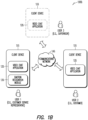
- FIG. 1B shows a high-level block diagram of a second example system environment 100B suitable for practicing the present technology.
- the communication between client devices 110 is performed via a communications network 140.
- communications network 140 may include one or more of the Internet, intranet, cellular network, local area network, wide area network, Institute of Electrical and Electronics Engineers (IEEE) 802.11 based network, Bluetooth radio, and so forth.
- IEEE Institute of Electrical and Electronics Engineers
- video teleconferencing between client devices 110 can be implemented using, for example, TCP/IP network communication standards.
- FIG. 2 shows a high-level block diagram of a third example system environment 200 suitable for practicing the present technology.
- server 210 that includes emotion recognition module 130, while client devices 110 do not implement emotion recognition processes. Accordingly, emotion recognition, as well as other audio and video processing processes as described herein are implemented on server 210.
- the communication between video chat applications 120 and emotion recognition module 130 can include the use of application programming interface (API) codes.
- API application programming interface
- video streaming between client devices 110 can occur via server 210 such that client devices 110 are responsible for audio and video capture, audio and video delivery, and data transfer.
- server 210 provides emotion recognition processes only, while client devices 110 implement the remaining communication tasks.
- FIG. 3 shows a high-level block diagram of a fourth example system environment 300 suitable for practicing the present technology.
- client devices 110 include web browsers allowing the users to access a predetermined website or web service hosted by web-hosting server 310.
- Video chat application 120 in this embodiment, is located at server 210 and implemented as a web service associated with the website hosted by web-hosting server 310. Therefore, the video processing and emotion recognition processes, as described herein, are performed completely on the server side.
- FIG. 4 is a high-level block diagram illustrating an example system 400 suitable for implementing the methods for video conferencing described herein.
- system 400 may include logic elements, hardware components, software (firmware) components, virtual components, or a combination thereof.
- System 400 may include or relate to an integral part of one or more of a variety of types of devices and systems such as a general-purpose computer, network device, server, web service, Apache server, cloud-computing service, and so forth.
- system 400 refers to exemplary client device 110.
- all modules shown in FIG. 4 may be operatively coupled using any suitable wired, wireless, radio, electrical, or optical standards.
- system 400 includes the following hardware components: at least one processor 402, at least one memory 404, at least one storage device 406, at least one input module 408, at least one output module 410, and at least one network interface 412.
- System 400 also includes optional operating system 414, video chat application 416 and optional emotion recognition module 418.
- processor 402 implements functionality and/or processes instructions for execution within the system 400.
- processor 402 may process instructions stored in memory 404 and/or instructions stored on storage devices 406. Such instructions may include components of operating system 414 and video chat application 416.
- System 400 may include multiple processors 402 such as a central processing unit (CPU) and graphic processing unit (GPU), which can share operational tasks with each other.
- CPU central processing unit
- GPU graphic processing unit
- Memory 404 is configured to store information within system 400 during operation.
- Memory 404 refers to a non-transitory computer-readable storage medium or a computer-readable storage device.
- memory 404 is a temporary memory, meaning that a primary purpose of memory 404 may not be long-term storage.
- Memory 404 may also refer to a volatile memory, meaning that memory 404 does not maintain stored contents when memory 404 is not receiving power. Examples of volatile memories include random access memories (RAM), dynamic random access memories (DRAM), static random access memories (SRAM), and other forms of volatile memories known in the art.
- RAM random access memories
- DRAM dynamic random access memories
- SRAM static random access memories
- memory 404 is used to store program instructions for execution by the processor 402. Memory 404 may be also used to temporarily store information during program execution.
- Storage device 406 can include one or more transitory or non-transitory computer-readable storage media and/or computer-readable storage devices. In some embodiments, storage device 406 may be configured to store greater amounts of information than memory 404. Storage device 406 can be further configured for long-term storage of information. In some examples, storage device 406 includes non-volatile storage elements. Examples of such non-volatile storage elements include magnetic hard discs, optical discs, solid-state discs, flash memories, forms of electrically programmable memories (EPROM) or electrically erasable and programmable memories (EEPROM), and other forms of non-volatile memories known in the art.
- EPROM electrically programmable memories
- EEPROM electrically erasable and programmable memories
- system 400 includes one or more input modules 408 for receiving user inputs and one or more output modules 410 for delivering data to a user.
- Input modules 408 may include keyboard, trackball, touchscreen, microphone, video camera, web camera, and the like.
- Output modules 410 may include any appropriate device to deliver data through visual or audio channels, including displays, monitors, printers, touchscreens, speakers, and so forth.
- System 400 further includes network interface 412 which is configured to communicate with external devices, servers, and network systems via one or more communications networks 140.
- Network interface 412 may be a network interface card, such as an Ethernet card, optical transceiver, radio frequency transceiver, or any other device that can send and receive information.
- Other examples of such network interfaces may include Bluetooth ® , 3G (Third Generation), 4G (Fourth Generation), LTE (Long-Term Evolution), and WiFi ® radios.
- Operating system 414 may control one or more functionalities of system 400 or components thereof. For example, operating system 414 may interact with video chat application 416 and may further facilitate interactions between video chat application 416 and processor 402, memory 404, storage device 406, input modules 408, output modules 410, and/or network interface 412.
- Video chat application 416 is configured to provide video conferencing services by implementing two-way audio and video communications with another system.
- System 400 may also include emotion recognition module 418 for recognizing emotional statuses of video conference participants, generating reports or notices associated with particular recognized emotional statuses, and allowing third parties to enter (invoke) into a videoconference process. As described below, emotion recognition module 418 can determine emotional statuses by analyzing particular features in video and/or audio streams.
- system 400 may include additional software applications including, for example, web browsers, encoders, codecs, encryption application, and so forth.
- Video chat application 416 provides an interface, including a graphical user interface, enabling to initiate and conduct a videoconference between two or more individuals.
- a camera i.e., within input module 408 captures a first video stream, which may include a first individual (e.g., a customer service representative).
- a microphone i.e., same input module 408) captures a first audio stream, which may include a speech of the first individual.
- the first audio and video streams are then transmitted to another system for video processing, client device or a server via network interface 412.
- the first audio stream and/or the first video stream can be modified by system 400 such as by making visual or acoustic adjustments, compression, encryption, and the like.
- System 400 may also receive videoconference communications from another system for videoconferencing, client device, or server, which communications may include second audio stream and/or second video stream. These streams include video and audio content associated with a second individual (e.g., a customer).
- the second audio and/or video streams may be optionally modified, for example, by making visual or acoustic adjustments, decompression, decryption, and the like.
- the second audio stream can be presented to the first individual via speakers (output module 410).
- the second video stream can be played back on a display (same output module 410).
- emotion recognition module 418 may determine an emotional status of the second individual (i.e., the customer).
- emotion recognition module 418 If it is determined that the emotional status refers to customer's anger, stress, irritation, or annoyance, emotion recognition module 418 generates an alert or any other suitable communication and sends it to attention of the first individual (customer service representative) and/or optionally to a remote device for attention of a third individual such as a manager, supervisor, administrator, or moderator.
- the alert or communication regarding the emotional status of the second individual can be displayed via the graphical user interface of video chat application 416.
- Emotion recognition module 418 enter the third individual into the videoconference between the first individual and second individual.
- the videoconferencing between the second individual and first individual can be switched to videoconferencing between the second individual (i.e., the customer) and third individual (e.g., the supervisor).
- the instant technology allows for recognizing emotional statuses of video conference participants. To these ends, this technology detects individuals, and more specifically, individual faces presented in a video stream, and tracks facial emotions over time. This section is focused on example processes for face detection as can be used in the present technology.
- a face in an image can be detected by application of a Viola-Jones algorithm and an ASM algorithm.
- a Viola-Jones algorithm is a fast and quite accurate method for detecting a face region on an image.
- An ASM algorithm is applied to the face region to locate reference feature points associated with the face. These feature reference points can include one or more facial landmarks such as ala, philtrum, vermilion zonem, vermilion border, nasolabial sulcus, labial commissures, lip tubercle, nasion, outer canthos of eye, inner canthos of eye, and tragus of ear.
- the feature reference points can include one or more of the following facial points indicating: eyebrows' vertical position, eyes' vertical position, eyes' width, eyes' height, eye separation distance, nose's vertical position, nose's pointing up, mouth's vertical position, mouth's width, chin's width, upper lip raiser, jaw drop, lip stretcher, left brow lowerer, right brow lowerer, lip corner depressor, and outer brow raiser.
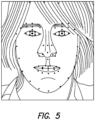
- FIG. 5 shows an example image of a face where some of reference feature points are illustrated.
- an ASM algorithm starts searching for feature reference points of a mean facial shape which is aligned to the position and size of the face presented in the input video image.
- An ASM algorithm then repeats the following two steps until convergence: (i) suggest a tentative shape by adjusting the locations of shape points by template matching of image texture around each point, and (ii) conform the tentative shape to a global shape model.
- the shape model pools the results of weak template matchers to form a stronger overall classifier.
- the entire search is repeated at each level in an image pyramid, from coarse to fine resolution.
- two sub-model types make up ASM: a profile model and a shape model.
- the profile models are used to locate an approximate position of each feature reference point by template matching.
- Any template matcher can be used, but the classical ASM forms a fixed-length normalized gradient vector (also known as a profile) by sampling the image along a line (also known as a whisker) orthogonal to the shape boundary at a landmark. While training on manually landmarked faces, at each landmark (feature reference point) the mean profile vector It and the profile covariance matrix S g are calculated.
- the shape model specifies allowable constellations of landmarks.
- the model has as many variations as is desired by ordering the eigenvalues ⁇ i and keeping an appropriate number of corresponding eigenvectors in ⁇ . In this process, a single shape model for the entire ASM is used but it may be scaled for each pyramid level.
- Equation 2 is used to generate various shapes by varying the vector parameter b. By keeping the elements of b within limits (determined during model building), it is possible to ensure that generated face shapes are lifelike.
- the method can calculate the parameter b that allows Equation 2 to better approximate x with a model shape x ⁇ .
- the method can further use an iterative algorithm to minimize distance x , T x ⁇ + ⁇ b where T is a similarity transform that maps the model space into the image space.
- CANDIDE-3 shape and initial state can be estimated based on a mapping of CANDIDE-3 vertices to weighted combinations of reference feature points located by ASM.
- CANDIDE-3 is a parameterized three-dimensional face mesh specifically developed for model-based coding of human faces. It includes a small number of polygons (approximately 100) and allows fast reconstruction.
- CANDIDE-3 is controlled by SUs, AUs, and a position vector.
- the SUs control mesh shape so that different face shapes can be obtained.
- the AUs control facial mimics so that different expressions can be obtained.
- the position vector corresponds to rotations around three (orthogonal) axes and translations along the axes.
- a Viola-Jones algorithm and ASM algorithm can be used to improve tracking quality. Face tracking processes can lose face position under some circumstances, such as fast movements and/or illumination variations. In order to re-initialize the tracking algorithm, a Viola-Jones algorithm and ASM algorithm are applied in such cases.
- Face tracking is needed not only to detect facial expressions, but also for monitoring a disposition of a face within a field of view of a camera. Because individuals can move in each video image (frame), make gestures, and rotate or move their heads, face tracking is required to accurately determine facial expressions.
- FIG. 6 shows an exemplary mesh corresponding to CANDIDE-3 model aligned to the face shown in FIG. 5 .
- a state of CANDIDE-3 model can be described by an intensity vector of SUs, intensity vector of AUs and a position vector.
- SUs refer to various parameters of head and face.
- the following SUs can be used: vertical position of eyebrows, vertical position of eyes, eyes' width, eyes' height, eye separation distance, nose vertical position, nose pointing up, mouth vertical position, mouth width, and chin width.
- AUs refer to face parameters that correspond to various face mimics.
- the following AUs can be used: upper lip raiser, jaw drop, lip stretcher, left brow lowerer, right brow lowerer, lip corner depressor, and outer brow raiser.
- the position of mesh can be described using six coordinates: yaw, pitch, roll, x, y, and z (scale).
- a mesh state can be determined by observing the region most likely to be a face. See Domaika F. & Davoine F., On appearance based face and facial action tracking. IEEE Trans. Circuits Syst. Video Technol. 16(9):1107-1124 (2006 ).
- observation errors can be calculated. Observation errors refer to a value indicating the difference between an image under a current mesh state and a mean face.
- FIG. 7A shows an example mean face.
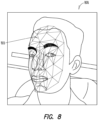
- FIG. 7B shows an example warped towards initial CANDIDE-3 state observation under a current state of the mesh illustrated in FIG. 8 . More specifically, FIG. 8 shows an exemplary image 800 having a face and a mesh 810 aligned to the face.
- Gaussian distribution proposed in original algorithms has shown worse results compared to a static image.
- Logarithm function can make the tracking more stable and reliable.
- a Taylor series can be used to minimize error.
- g ij is an element of matrix G.
- matrix A has the same size as G.
- This transformation allows making n 3 divisions instead of m * n + n 3 .
- face tracking in the video comprises CANDIDE-3 shape and initial state estimating that is based on located reference feature points associated with a particular face and aligning the mesh to the face in each video image.
- this process can be applied not only to a face, but also to other individual parts.
- this process of localization and tracking of a video conferencing participant may include localization and tracking of one or more of the participant's face, and his body, limbs, and/or other parts.
- gesture detection and tracking processes can be also applied. In that case, the method may create a virtual skeleton and a mesh aligned to these body parts.
- ARM advanced SIMD Single Instruction Multiple Data
- NEON Single Instruction Multiple Data
- GPU Graphics Processing Unit
- CPU Central Processing Unit
- the face tracking process can include the following features.
- First, a logarithm can be applied to grayscale the value of each pixel to track it. This transformation has a great impact to tracking performance.
- failure criterion ⁇ W y t b t ⁇ W y t ⁇ 1 b t ⁇ 1 ⁇ 2 > M
- ⁇ • ⁇ 2 is Euclidean norm
- y t , b t are indexed by an image number t.
- the present technology determines an emotional status of video conference participants. This may include identification of facial expressions or changes in facial expressions over time. The emotional status is also partly based on speech recognition or voice analysis. If it is determined that the emotional status is negative, an alert communication can be generated and transmitted to one of a video conference participant or a third party.
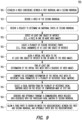
- FIG. 9 is a process flow diagram showing an example method 900 for video conferencing which involves emotion recognition.
- the method may be performed by processing logic that may comprise hardware (e.g., decision-making logic, dedicated logic, programmable logic, and microcode), software (such as software run on a general-purpose computer system or a dedicated machine), or a combination of both.
- the processing logic refers to one or more components of system 400. Note that below recited steps of method 900 may be implemented in an order different than described and shown in FIG. 9 . Moreover, method 900 may have additional steps not shown herein, but which can be evident for those skilled in the art from the present disclosure. Method 900 may also have fewer steps than outlined below and shown in FIG. 9 .
- Method 900 for video conferencing commences at step 905 with establishing a video conference between a first individual, such as a customer service representative or service provider, and a second individual, such as a customer.
- a first individual such as a customer service representative or service provider
- video chat applications 120 can be used on each side.
- the establishment of a video conference means that video and audio streams are captured on each side and transmitted to another side, and vice versa.
- a computing device receives a video of the second individual.
- the video includes a sequence of video images (also known as video frames) and the video can be received as a video stream meaning it can be continually supplied to the computing device (e.g., as progressive downloading) or it can be stored in a memory of the computing device.
- the video can be captured for video conferencing purposes, but not necessarily.
- the computing device receives a request to determine an emotional status (e.g., a facial emotion) of at least one video conference participant (e.g., second individual).
- the request can be generated manually by a first individual such as customer service representative or service provider.
- the request may optionally include metadata associated with the video conference participant of interest. For example, metadata may include a portion of the video where this individual appears.
- the computing device detects (localizes) at least one object of interest in one or more video images.
- the object of interest may refer to a human face or other parts of the body, including limbs, neck, arms, chest, and so forth, all related to a second individual (i.e., customer).
- the detection can be based on a Viola-Jones algorithm, although other algorithms can be also used.
- the detection of the at least one object of interest in one or more of the video images can be based on a user input.
- the user input can include data associated with an image area related to the at least one object of interest.
- the computing device locates a plurality of feature reference points of at least one object of interest (e.g., a face).
- the feature reference points can include one or more facial landmarks such as ala, philtrum, vermilion zonem vermilion border, nasolabial sulcus, labial commissures, lip tubercle, nasion, outer canthos of eye, inner canthos of eye, and tragus of ear.
- the feature reference points can include one or more of the following facial points indicating: eyebrows' vertical position, eyes' vertical position, eyes' width, eyes' height, eye separation distance, nose vertical position, nose pointing up, mouth vertical position, mouth width, chin width, upper lip raiser, jaw drop, lip stretcher, left brow lowerer, right brow lowerer, lip corner depressor, and outer brow raiser.
- the feature reference points can be located using ASM or extended ASM algorithms as explained above. However, other procedures of facial landmark localization can be also used including, but not limited to, exemplar-based graph matching (EGM) algorithm, consensus-of-exemplars algorithm, and so forth.
- EMM exemplar-based graph matching
- the computing device aligns a virtual face mesh to the at least one object of interest (e.g., aligns the mesh to an image of the customer face) based at least in part on the reference feature points.
- This procedure can be performed with respect to just some of the video images or all video images.
- a parameterized face mesh such as CANDIDE-3 model can be aligned to the object of interest.
- CANDIDE-3 is a parameterized three-dimensional face mesh that can be aligned to an individual face shape based on calculation of intensities of SUs.
- the aligning of the virtual face mesh can be further based on estimating intensities of SUs associated with the face shape, intensities of AUs, and rotations of the virtual face mesh around three orthogonal axes and its translations along the axes.
- the computing device finds over a sequence of video images at least one deformation of the mesh that is associated and reflects at least one face mimic.
- Mesh deformation can include relative disposition of one or more mesh vertices because of a change in emotional expression by the second individual.
- the computing device can find modification of the mesh that replicate moving the labial commissure landmarks as well as the movement of eyebrows.
- the computing device can find modification of the mesh that replicate moving the outer and inner canthus of the eyes, as well as moving mouth landmarks.
- mesh can be deformed in a variety of different ways. In any case, the computing device can track changes in position of each mesh point, as well as a distance between each of the mesh points to determine changes in facial emotions.
- the computing device compares the determined deformation of the mesh to reference facial parameters of a plurality of reference facial emotions.
- the reference facial parameters and the reference facial emotions can be stored in one or more databases located, for example, in a memory of computing device.
- the reference facial emotions may include, for example, neutral facial emotions, positive facial emotions, and negative facial emotions.
- the negative facial emotions may include anger, indignation, dissatisfaction, vexation, frustration, embarrassment, irritation, stress, and annoyance.
- the step 940 of comparing may include applying at least one machine-learning algorithm such as a convolution neural network (CNN) and/or a state vector machine (SVM).
- CNN is a type of feed-forward artificial neural network where the individual neurons are tiled in such a way that they respond to overlapping regions in the visual field.
- CNNs consist of multiple layers of small neuron collections, which look at small portions of the input image, called receptive fields. The results of these collections are then tiled so that they overlap to obtain a better representation of the original image; this is repeated for every such layer.
- Convolutional networks may include local or global pooling layers, which combine the outputs of neuron clusters.
- convolutional networks consist of various combinations of convolutional layers and fully connected layers, with pointwise nonlinearity applied at the end of or after each layer. To avoid the situation that there exist billions of parameters if all layers are fully connected, the idea of using a convolution operation on small regions, has been introduced.
- One major advantage of convolutional networks is the use of shared weight in convolutional layers, which means that the same filter (weights bank) is used for each pixel in the layer; this both reduces required memory size and improves performance.
- SVMs are supervised learning models with associated learning algorithms that are configured to recognize patterns. Given a set of training examples, with each marked as belonging to one of two categories, an SVM training algorithm builds a model that assigns new examples into one category or the other, making it a non-probabilistic binary linear classifier.
- An SVM model is a representation of the examples as points in space, mapped so that the examples of the separate categories are divided by a clear gap that is as wide as possible. New examples are then mapped into that same space and predicted to belong to a category based on which side of the gap they fall on.
- the computing device selects a facial emotion from the plurality of reference facial emotions.
- the computing device determines that the at least one deformation of the mesh refers to a particular facial emotion.
- FIGs. 10A and 10B show two video images 1000A and 1000B, respectively, which illustrate example facial emotions that can be identified by this method 900.
- FIG. 10A shows an example positive facial emotion with a mesh 1000 aligned to a face area
- FIG. 10B shows an example negative facial emotion (e.g. anger) with the mesh 1000 aligned to a corresponding face area.
- the computing device generates a communication, which includes data associated with the particular facial emotion.
- the communication is generated only if the particular facial emotion determined refers to a negative emotion such as anger, stress, annoyance, irritation, and the like.
- the communication can be also referred to as a notification, alert, indication, or message. Accordingly, the communication can be presented to the first individual (customer service representative or service provider) as a displayable message or audio message.
- the computing transmits the communication containing data related to the facial emotion over a communications network to a third party such as a supervisor, manager, administrator, or moderator.
- a third party such as a supervisor, manager, administrator, or moderator.
- the computing device allows the third party to review or watch the videoconference between the first individual (customer service representative or service provider) and second individual (customer), and enter into the videoconference between the first individual and second individual.
- the third party may handle a difficult situation and attempt to resolve those angry customer issues that could not be resolved by the first individual.
- Entering into the videoconference between the first individual and second individual may optionally mean that the first individual is suspended from continuing the videoconferencing.
- the computing device may determine an emotional status of the second individual (customer) by combining data related to the determined facial emotion with other data.
- the emotional status can be determined based on facial emotions and gestures of the customer.
- the computing device may track individual motions on the video, identify one or more gestures, and determine that at least one of the gestures relates to a predetermined emotion, such as a negative emotion. Further, the computing device may combine data associated with the determined facial emotion and data associated with the identified gesture, and generate an emotional status of second individual. Similar to above, the emotional status can be transmitted and presented to the first individual and/or third party.
- FIG. 11 is a process flow diagram showing an example process 1100 for audio emotion recognition which can be used in method 900 for videoconferencing shown in FIG. 9 .
- Process 1100 may be performed by processing logic that may comprise hardware (e.g., decision-making logic, dedicated logic, programmable logic, and microcode), software (such as software run on a general-purpose computer system or a dedicated machine), or a combination of both.
- the processing logic refers to one or more components of system 400. Note that below recited steps of process 1100 may be implemented in an order different than described and shown in FIG. 11 . Moreover, process 1100 may have additional steps not shown herein, but which can be evident for those skilled in the art from the present disclosure. Process 1100 may also have fewer steps than outlined below and shown in FIG. 11 .
- a computing device receives an audio stream associated with the video received at step 910.
- the computing device receives the audio stream of a videoconferencing session between a first individual, such as a customer service representative or service provider, and a second individual, such as a customer.
- the computing device extracts at least one voice feature from the audio stream.
- voice features there can be one or more of the following: a maximum value of fundamental frequency, standard deviation of fundamental frequency, range of fundamental frequency, mean value of fundamental frequency, mean of bandwidth of first formant, mean of bandwidth of second formant, standard deviation of energy, speaking rate, slope of fundamental frequency, maximum value of first formant, maximum value of second formant, maximum value of energy, range of energy, range of second formant, and range of first formant.
- the computing device compares the extracted at least one voice feature to a plurality of reference voice features. Similar to method 900, this step can be performed with the help of a machine-learning algorithm such as SVM, CNN, and a statistical or heuristic algorithm.
- a machine-learning algorithm such as SVM, CNN, and a statistical or heuristic algorithm.
- the computing device selects the speech emotion based on the comparison of the extracted at least one voice feature to the plurality of reference voice features.
- the computing device can identify and recognize a speech of the second individual (i.e., transform speech input into text input for further processing). For example, one or more natural language processing processes can be applied at step 1125 to detect speech and transform it into text.
- a speech of the second individual i.e., transform speech input into text input for further processing.
- one or more natural language processing processes can be applied at step 1125 to detect speech and transform it into text.
- the computing device may select or facilitate selection of a particular speech emotion as the result of the presence of certain keywords or phrases in the recognized speech. For example, when recognized speech includes vulgar, offensive, or vile slang words, a negative emotion can be selected and attributed to the audio stream.
- the computing device combines the speech emotion and facial emotion as determined in method 900 into a single emotional status of the second individual (customer). Further, the emotional status is transmitted and presented to the first individual (service provider) and/or third party (supervisor) for further action as discussed above.
Landscapes
- Engineering & Computer Science (AREA)
- Physics & Mathematics (AREA)
- Health & Medical Sciences (AREA)
- Theoretical Computer Science (AREA)
- Multimedia (AREA)
- General Physics & Mathematics (AREA)
- General Health & Medical Sciences (AREA)
- Oral & Maxillofacial Surgery (AREA)
- Human Computer Interaction (AREA)
- Computer Vision & Pattern Recognition (AREA)
- Signal Processing (AREA)
- Business, Economics & Management (AREA)
- Software Systems (AREA)
- Development Economics (AREA)
- Finance (AREA)
- Accounting & Taxation (AREA)
- Strategic Management (AREA)
- Computational Linguistics (AREA)
- Acoustics & Sound (AREA)
- Audiology, Speech & Language Pathology (AREA)
- Evolutionary Computation (AREA)
- Artificial Intelligence (AREA)
- Medical Informatics (AREA)
- Databases & Information Systems (AREA)
- Computing Systems (AREA)
- Hospice & Palliative Care (AREA)
- Psychiatry (AREA)
- Child & Adolescent Psychology (AREA)
- Marketing (AREA)
- Game Theory and Decision Science (AREA)
- Economics (AREA)
- Entrepreneurship & Innovation (AREA)
- General Business, Economics & Management (AREA)
- Geometry (AREA)
- Two-Way Televisions, Distribution Of Moving Picture Or The Like (AREA)
- Information Transfer Between Computers (AREA)
- Telephonic Communication Services (AREA)
- User Interface Of Digital Computer (AREA)
- Image Analysis (AREA)
Claims (6)
- Ein rechnerimplementiertes Verfahren für Videokonferenzen, wobei das Verfahren Folgendes umfasst:Aufbauen einer Einweg- oder Zweiweg-Videokonferenz zwischen einem ersten Individuum an einer ersten Clientvorrichtung als Serviceanbieter und einem zweiten Individuum an einer zweiten Clientvorrichtung als Kunde, wobei ein Video, das eine Sequenz von Bildern und einen Audiostream einschließt, auf einer Kundenseite erfasst wird;Empfangen (910, 1105) des Videos;Detektieren (920) von mindestens einem Objekt von Interesse in einem oder mehreren Bildern, wobei das Objekt von Interesse ein Gesicht des zweiten Individuums einschließt;Lokalisieren (925) von Merkmalsreferenzpunkten des mindestens einen Objekts von Interesse;Ausrichten (930) eines virtuellen Gesichtsnetzes auf das mindestens eine Objekt von Interesse in einem oder mehreren Bildern mindestens teilweise basierend auf den Merkmalsreferenzpunkten;Finden (935) in der Sequenz von Bildern von mindestens einer Deformation des virtuellen Gesichtsnetzes, wobei die mindestens eine Deformation mit mindestens einer Gesichtsmimik assoziiert ist;Bestimmen (940-945), dass sich die mindestens eine Deformation auf eine Gesichtsemotion bezieht, die aus einer Vielzahl von Referenzgesichtsemotionen ausgewählt ist;Erkennen einer Sprachemotion in dem Audiostream des mindestens einen Objekts von Interesse.Vereinen (1130) der Gesichtsemotion und der Sprachemotion, um einen emotionalen Zustand eines Individuums, der mit dem mindestens einen Objekt von Interesse assoziiert ist, zu generieren; undfalls der emotionale Status ein negativer emotionaler Status ist:Generieren (950) und Übertragen einer Kommunikation über ein Kommunikationsnetzwerk an eine dritte Partei an einer dritten Clientvorrichtung, wobei die Kommunikation Daten, die mit der Gesichtsemotion assoziiert sind, und Daten, die mit der Sprachemotion assoziiert sind, enthält; undZuschalten der dritten Partei an der dritten Clientvorrichtung zu der Videokonferenz zwischen dem Kunden an der zweiten Clientvorrichtung und dem Serviceanbieter an der ersten Clientvorrichtung;wobei das Erkennen der Sprachemotion Folgendes umfasst:Extrahieren (1110) von mindestens einem Stimmmerkmal aus dem Audiostream;Vergleichen (1115) des extrahierten mindestens einen Stimmmerkmals mit einer Vielzahl von Referenzstimmmerkmalen; undAuswählen (1120) der Sprachemotion basierend auf dem Vergleich des extrahierten mindestens einen Stimmmerkmals mit der Vielzahl von Referenzstimmmerkmalen.
- Das Verfahren nach Anspruch 1, wobei das Erkennen der Sprachemotion das Erkennen (1125) einer Sprache in dem Audiostream umfasst.
- Das Verfahren nach Anspruch 1, wobei das Detektieren des mindestens einen Objekts von Interesse in einem oder mehreren der Bilder auf einer Benutzereingabe basiert.
- Ein System, das Folgendes umfasst:eine Rechenvorrichtung, einschließlich mindestens eines Prozessors und eines Speichers, der prozessorausführbare Codes speichert, die, wenn sie durch den mindestens einen Prozessor implementiert werden, veranlassen, die folgenden Schritte durchzuführen:Aufbauen einer Einweg- oder Zweiweg-Videokonferenz zwischen einem ersten Individuum an einer ersten Clientvorrichtung als Serviceanbieter und einem zweiten Individuum an einer zweiten Clientvorrichtung als Kunde, wobei ein Video, das eine Sequenz von Bildern und einen Audiostream einschließt, auf einer Kundenseite erfasst wird;Empfangen des Videos;Detektieren von mindestens einem Objekt von Interesse in einem oder mehreren Bildern, wobei das Objekt von Interesse ein Gesicht des Kunden einschließt;Lokalisieren von Merkmalsreferenzpunkten des mindestens einen Objekts von Interesse;Ausrichten eines virtuellen Gesichtsnetzes auf das mindestens eine Objekt von Interesse in einem oder mehreren Bildern mindestens teilweise basierend auf den Merkmalsreferenzpunkten;Finden in der Sequenz von Bildern von mindestens einer Deformation des virtuellen Gesichtsnetzes, wobei die mindestens eine Deformation mit mindestens einer Gesichtsmimik assoziiert ist;Bestimmen, dass sich die mindestens eine Deformation auf eine Gesichtsemotion bezieht, die aus einer Vielzahl von Referenzgesichtsemotionen ausgewählt ist; undErkennen einer Sprachemotion in dem Audiostream des mindestens einen Objekts von Interesse.Vereinen (1130) der Gesichtsemotion und der Sprachemotion, um einen emotionalen Zustand eines Individuums, der mit dem mindestens einen Objekt von Interesse assoziiert ist, zu generieren; undfalls der emotionale Status ein negativer emotionaler Status ist:Generieren und Übertragen einer Kommunikation über ein Kommunikationsnetzwerk an eine dritte Partei an einer dritten Clientvorrichtung, wobei die Kommunikation Daten, die mit der Gesichtsemotion assoziiert sind, und Daten, die mit der Sprachemotion assoziiert sind, enthält; undZuschalten der dritten Partei an der dritten Clientvorrichtung zu der Videokonferenz zwischen dem ersten Individuum an der ersten Clientvorrichtung und dem zweiten Individuum an der zweiten Clientvorrichtung;wobei das Erkennen der Sprachemotion Folgendes umfasst:Extrahieren von mindestens einem Stimmmerkmal aus dem Audiostream;Vergleichen des extrahierten mindestens einen Stimmmerkmals mit einer Vielzahl von Referenzstimmmerkmalen; undAuswählen der Sprachemotion basierend auf dem Vergleich des extrahierten mindestens einen Stimmmerkmals mit der Vielzahl von Referenzstimmmerkmalen.
- Das System nach Anspruch 4, wobei das Erkennen der Sprachemotion das Erkennen einer Sprache in dem Audiostream umfasst.
- Ein nicht transitorisches prozessorlesbares Medium, das darauf gespeicherte Anweisungen aufweist, die, wenn durch einen oder mehrere Prozessoren ausgeführt, den einen oder die mehreren Prozessoren veranlassen, ein Verfahren gemäß einem der Schritte 1 bis 3 zu implementieren.
Applications Claiming Priority (3)
| Application Number | Priority Date | Filing Date | Title |
|---|---|---|---|
| US14/661,539 US9576190B2 (en) | 2015-03-18 | 2015-03-18 | Emotion recognition in video conferencing |
| PCT/US2016/023063 WO2016149579A1 (en) | 2015-03-18 | 2016-03-18 | Emotion recognition in video conferencing |
| EP16726678.2A EP3271870B1 (de) | 2015-03-18 | 2016-03-18 | Emotionserkennung bei videokonferenzen |
Related Parent Applications (2)
| Application Number | Title | Priority Date | Filing Date |
|---|---|---|---|
| EP16726678.2A Division-Into EP3271870B1 (de) | 2015-03-18 | 2016-03-18 | Emotionserkennung bei videokonferenzen |
| EP16726678.2A Division EP3271870B1 (de) | 2015-03-18 | 2016-03-18 | Emotionserkennung bei videokonferenzen |
Publications (2)
| Publication Number | Publication Date |
|---|---|
| EP3399467A1 EP3399467A1 (de) | 2018-11-07 |
| EP3399467B1 true EP3399467B1 (de) | 2023-06-21 |
Family
ID=54210027
Family Applications (2)
| Application Number | Title | Priority Date | Filing Date |
|---|---|---|---|
| EP16726678.2A Active EP3271870B1 (de) | 2015-03-18 | 2016-03-18 | Emotionserkennung bei videokonferenzen |
| EP18179336.5A Active EP3399467B1 (de) | 2015-03-18 | 2016-03-18 | Emotionserkennung in videokonferenz |
Family Applications Before (1)
| Application Number | Title | Priority Date | Filing Date |
|---|---|---|---|
| EP16726678.2A Active EP3271870B1 (de) | 2015-03-18 | 2016-03-18 | Emotionserkennung bei videokonferenzen |
Country Status (5)
| Country | Link |
|---|---|
| US (8) | US9576190B2 (de) |
| EP (2) | EP3271870B1 (de) |
| KR (4) | KR102509398B1 (de) |
| CN (1) | CN107636684A (de) |
| WO (1) | WO2016149579A1 (de) |
Families Citing this family (154)
| Publication number | Priority date | Publication date | Assignee | Title |
|---|---|---|---|---|
| CN107257403A (zh) | 2012-04-09 | 2017-10-17 | 英特尔公司 | 使用交互化身的通信 |
| US9918017B2 (en) | 2012-09-04 | 2018-03-13 | Duelight Llc | Image sensor apparatus and method for obtaining multiple exposures with zero interframe time |
| US10708545B2 (en) | 2018-01-17 | 2020-07-07 | Duelight Llc | System, method, and computer program for transmitting face models based on face data points |
| US9531998B1 (en) * | 2015-07-02 | 2016-12-27 | Krush Technologies, Llc | Facial gesture recognition and video analysis tool |
| US12401911B2 (en) | 2014-11-07 | 2025-08-26 | Duelight Llc | Systems and methods for generating a high-dynamic range (HDR) pixel stream |
| US12401912B2 (en) | 2014-11-17 | 2025-08-26 | Duelight Llc | System and method for generating a digital image |
| WO2016101131A1 (en) | 2014-12-23 | 2016-06-30 | Intel Corporation | Augmented facial animation |
| US9576190B2 (en) * | 2015-03-18 | 2017-02-21 | Snap Inc. | Emotion recognition in video conferencing |
| US9747573B2 (en) | 2015-03-23 | 2017-08-29 | Avatar Merger Sub II, LLC | Emotion recognition for workforce analytics |
| US10061977B1 (en) | 2015-04-20 | 2018-08-28 | Snap Inc. | Determining a mood for a group |
| US12445736B2 (en) | 2015-05-01 | 2025-10-14 | Duelight Llc | Systems and methods for generating a digital image |
| JP6798707B2 (ja) * | 2015-07-30 | 2020-12-09 | インテル・コーポレーション | 感情拡張アバターアニメーション |
| KR20170027589A (ko) * | 2015-09-02 | 2017-03-10 | 삼성전자주식회사 | 기능 제어 방법 및 그 방법을 처리하는 전자 장치 |
| EP3365724B1 (de) | 2015-10-20 | 2021-05-05 | Magic Leap, Inc. | Auswählen von virtuellen objekten in einem dreidimensionalen raum |
| WO2017083875A1 (en) * | 2015-11-13 | 2017-05-18 | Reaction Stream Llc | A system and method for recording and displaying a reaction to a focus |
| CN105893444A (zh) * | 2015-12-15 | 2016-08-24 | 乐视网信息技术(北京)股份有限公司 | 情感分类方法及装置 |
| WO2017101094A1 (en) | 2015-12-18 | 2017-06-22 | Intel Corporation | Avatar animation system |
| US10223581B2 (en) * | 2015-12-27 | 2019-03-05 | Interactive Intelligence Group, Inc. | System and method for video analysis |
| JP2017151517A (ja) * | 2016-02-22 | 2017-08-31 | 富士ゼロックス株式会社 | ロボット制御システム |
| CA3018758A1 (en) | 2016-03-31 | 2017-10-05 | Magic Leap, Inc. | Interactions with 3d virtual objects using poses and multiple-dof controllers |
| US11404170B2 (en) * | 2016-04-18 | 2022-08-02 | Soap, Inc. | Method and system for patients data collection and analysis |
| EP4060462B1 (de) | 2016-05-20 | 2025-07-30 | Magic Leap, Inc. | Kontextbewusstheit eines benutzeroberflächenmenüs |
| US10062216B2 (en) * | 2016-09-13 | 2018-08-28 | Aleksey Konoplev | Applying facial masks to faces in live video |
| JP6855737B2 (ja) * | 2016-10-05 | 2021-04-07 | 富士ゼロックス株式会社 | 情報処理装置、評価システムおよびプログラム |
| US11553157B2 (en) | 2016-10-10 | 2023-01-10 | Hyperconnect Inc. | Device and method of displaying images |
| KR20180039402A (ko) * | 2016-10-10 | 2018-04-18 | 주식회사 하이퍼커넥트 | 영상 표시 장치 및 영상 표시 방법 |
| KR20180057096A (ko) * | 2016-11-21 | 2018-05-30 | 삼성전자주식회사 | 표정 인식과 트레이닝을 수행하는 방법 및 장치 |
| US10636175B2 (en) * | 2016-12-22 | 2020-04-28 | Facebook, Inc. | Dynamic mask application |
| US10148910B2 (en) * | 2016-12-30 | 2018-12-04 | Facebook, Inc. | Group video session |
| WO2018168427A1 (ja) * | 2017-03-13 | 2018-09-20 | ソニー株式会社 | 学習装置、学習方法、音声合成装置、音声合成方法 |
| KR101932844B1 (ko) | 2017-04-17 | 2018-12-27 | 주식회사 하이퍼커넥트 | 영상 통화 장치, 영상 통화 방법 및 영상 통화 중개 방법 |
| US10768693B2 (en) | 2017-04-19 | 2020-09-08 | Magic Leap, Inc. | Multimodal task execution and text editing for a wearable system |
| CN107463488B (zh) * | 2017-08-09 | 2020-12-08 | 合肥联宝信息技术有限公司 | 一种数据处理方法及电子设备 |
| CN107633207B (zh) * | 2017-08-17 | 2018-10-12 | 平安科技(深圳)有限公司 | Au特征识别方法、装置及存储介质 |
| WO2019040524A1 (en) * | 2017-08-21 | 2019-02-28 | Muvik Labs, Llc | METHOD AND SYSTEM FOR MUSIC COMMUNICATION |
| US11185254B2 (en) | 2017-08-21 | 2021-11-30 | Muvik Labs, Llc | Entrainment sonification techniques |
| GB201713829D0 (en) * | 2017-08-29 | 2017-10-11 | We Are Human Ltd | Image data processing system and method |
| WO2019050508A1 (en) * | 2017-09-06 | 2019-03-14 | Hitachi Data Systems Corporation | EMOTION DETECTION ACTIVATED VIDEO CUSHIONING |
| US11785180B2 (en) * | 2017-09-11 | 2023-10-10 | Reelay Meetings, Inc. | Management and analysis of related concurrent communication sessions |
| US11122240B2 (en) | 2017-09-11 | 2021-09-14 | Michael H Peters | Enhanced video conference management |
| US11290686B2 (en) | 2017-09-11 | 2022-03-29 | Michael H Peters | Architecture for scalable video conference management |
| US10382722B1 (en) | 2017-09-11 | 2019-08-13 | Michael H. Peters | Enhanced video conference management |
| WO2019079489A1 (en) * | 2017-10-17 | 2019-04-25 | Beneufit, Inc. | MEASUREMENT OF BODY MOVEMENT IN A DISEASE OF MOVEMENT DISORDERS |
| CN107704921A (zh) * | 2017-10-19 | 2018-02-16 | 北京智芯原动科技有限公司 | 基于Neon指令的卷积神经网络的算法优化方法及装置 |
| US10586368B2 (en) * | 2017-10-26 | 2020-03-10 | Snap Inc. | Joint audio-video facial animation system |
| US10956831B2 (en) * | 2017-11-13 | 2021-03-23 | International Business Machines Corporation | Detecting interaction during meetings |
| US10250851B1 (en) | 2017-11-16 | 2019-04-02 | International Business Machines Corporation | Video feeds in collaboration environments |
| CN108052889B (zh) * | 2017-12-08 | 2020-07-24 | 深圳壹账通智能科技有限公司 | 情绪识别方法、装置及存储介质 |
| CN108491764B (zh) * | 2018-03-05 | 2020-03-17 | 竹间智能科技(上海)有限公司 | 一种视频人脸情绪识别方法、介质及设备 |
| US11106898B2 (en) * | 2018-03-19 | 2021-08-31 | Buglife, Inc. | Lossy facial expression training data pipeline |
| KR102128158B1 (ko) * | 2018-05-09 | 2020-06-29 | 연세대학교 산학협력단 | 시공간 주의 기반 감정 인식 장치 및 방법 |
| CN110555346A (zh) * | 2018-06-01 | 2019-12-10 | 杭州海康威视数字技术股份有限公司 | 驾驶员情绪检测方法、装置、电子设备及存储介质 |
| CN109002778A (zh) * | 2018-06-29 | 2018-12-14 | 上海小蚁科技有限公司 | 关注量确定方法及装置、存储介质、终端 |
| US10897647B1 (en) * | 2018-07-25 | 2021-01-19 | Imdb.Com, Inc. | Ascertaining audience reactions for a media item |
| CN109087670B (zh) * | 2018-08-30 | 2021-04-20 | 西安闻泰电子科技有限公司 | 情绪分析方法、系统、服务器及存储介质 |
| JP7225631B2 (ja) * | 2018-09-21 | 2023-02-21 | ヤマハ株式会社 | 画像処理装置、カメラ装置、および画像処理方法 |
| CN109508638B (zh) * | 2018-10-11 | 2024-09-17 | 平安科技(深圳)有限公司 | 人脸情绪识别方法、装置、计算机设备及存储介质 |
| CN109360130A (zh) * | 2018-10-29 | 2019-02-19 | 四川文轩教育科技有限公司 | 一种基于人工智能的学生情绪监测方法 |
| USD896254S1 (en) * | 2018-10-30 | 2020-09-15 | Perfect Mobile Corp. | Display screen with graphical user interface |
| US11222199B2 (en) * | 2018-12-05 | 2022-01-11 | International Business Machines Corporation | Automatically suggesting behavioral adjustments during video conferences |
| JP7278307B2 (ja) * | 2018-12-18 | 2023-05-19 | グリー株式会社 | コンピュータプログラム、サーバ装置、端末装置及び表示方法 |
| CN109829364A (zh) * | 2018-12-18 | 2019-05-31 | 深圳云天励飞技术有限公司 | 一种表情识别方法、装置和推荐方法、装置 |
| US11017001B2 (en) * | 2018-12-31 | 2021-05-25 | Dish Network L.L.C. | Apparatus, systems and methods for providing conversational assistance |
| CN109800687A (zh) * | 2019-01-02 | 2019-05-24 | 深圳壹账通智能科技有限公司 | 会议效果反馈方法、装置、计算机设备和可读存储介质 |
| CN113632458A (zh) * | 2019-02-05 | 2021-11-09 | 视见科技(杭州)有限公司 | 广角相机透视体验的系统、算法和设计 |
| CN109886223B (zh) * | 2019-02-26 | 2022-05-17 | 北京旷视科技有限公司 | 人脸识别方法、底库录入方法、装置及电子设备 |
| KR20200112647A (ko) * | 2019-03-21 | 2020-10-05 | 삼성전자주식회사 | 전자 장치 및 전자 장치의 제어 방법 |
| US11568645B2 (en) * | 2019-03-21 | 2023-01-31 | Samsung Electronics Co., Ltd. | Electronic device and controlling method thereof |
| US10834456B2 (en) | 2019-03-28 | 2020-11-10 | International Business Machines Corporation | Intelligent masking of non-verbal cues during a video communication |
| JP7185072B2 (ja) * | 2019-04-05 | 2022-12-06 | ホアウェイ・テクノロジーズ・カンパニー・リミテッド | ビデオチャット中に感情の修正を提供する方法およびシステム |
| JP7501524B2 (ja) * | 2019-04-17 | 2024-06-18 | ソニーグループ株式会社 | 情報処理装置、情報処理方法、およびプログラム |
| WO2020222785A1 (en) * | 2019-04-30 | 2020-11-05 | Hewlett-Packard Development Company, L.P. | Facial action unit detection |
| US11102353B2 (en) * | 2019-05-07 | 2021-08-24 | Avaya Inc. | Video call routing and management based on artificial intelligence determined facial emotion |
| KR102282963B1 (ko) * | 2019-05-10 | 2021-07-29 | 주식회사 하이퍼커넥트 | 단말기, 서버 및 그것의 동작 방법 |
| US11038933B1 (en) | 2019-06-25 | 2021-06-15 | Amazon Technologies, Inc. | Hybrid videoconferencing architecture for telemedicine |
| US11194995B1 (en) * | 2019-06-25 | 2021-12-07 | Amazon Technologies, Inc. | Video composition management system |
| US11348368B2 (en) * | 2019-06-27 | 2022-05-31 | Nextiva, Inc. | Measuring and transmitting emotional feedback in group teleconferences |
| WO2021021760A1 (en) * | 2019-07-26 | 2021-02-04 | Warner Bros. Entertainment Inc. | Heterogenous geometry caching for real-time simulated fluids |
| CN110650306B (zh) * | 2019-09-03 | 2022-04-15 | 平安科技(深圳)有限公司 | 视频聊天中添加表情的方法、装置、计算机设备及存储介质 |
| KR102311603B1 (ko) | 2019-10-01 | 2021-10-13 | 주식회사 하이퍼커넥트 | 단말기 및 그것의 동작 방법 |
| KR102375447B1 (ko) * | 2019-10-16 | 2022-03-17 | 임대열 | 머신 러닝을 이용한 사람의 감정 및 신체 상태 정보 획득 방법 및 장치 |
| US11113890B2 (en) * | 2019-11-04 | 2021-09-07 | Cognizant Technology Solutions India Pvt. Ltd. | Artificial intelligence enabled mixed reality system and method |
| USD954076S1 (en) * | 2019-11-25 | 2022-06-07 | LINE Plus Corporation | Display panel with a graphical user interface |
| US11249883B2 (en) * | 2020-01-02 | 2022-02-15 | Bank Of America Corporation | Error repair tool using sentiment analysis |
| US11687778B2 (en) | 2020-01-06 | 2023-06-27 | The Research Foundation For The State University Of New York | Fakecatcher: detection of synthetic portrait videos using biological signals |
| CN115023738A (zh) | 2020-01-27 | 2022-09-06 | 奇跃公司 | 中性化身 |
| USD948562S1 (en) | 2020-01-27 | 2022-04-12 | Magic Leap, Inc. | Portion of a display screen with avatar |
| USD949200S1 (en) * | 2020-01-27 | 2022-04-19 | Magic Leap, Inc. | Portion of a display screen with a set of avatars |
| USD948574S1 (en) * | 2020-01-27 | 2022-04-12 | Magic Leap, Inc. | Portion of a display screen with a set of avatars |
| KR102293422B1 (ko) | 2020-01-31 | 2021-08-26 | 주식회사 하이퍼커넥트 | 단말기 및 그것의 동작 방법 |
| US11663851B2 (en) * | 2020-02-13 | 2023-05-30 | International Business Machines Corporation | Detecting and notifying for potential biases in artificial intelligence applications |
| WO2021163108A1 (en) * | 2020-02-14 | 2021-08-19 | Aistreet | Systems and methods to produce customer analytics |
| CN111325161B (zh) * | 2020-02-25 | 2023-04-18 | 四川翼飞视科技有限公司 | 一种基于注意力机制的人脸检测神经网络的构建方法 |
| KR20210115442A (ko) | 2020-03-13 | 2021-09-27 | 주식회사 하이퍼커넥트 | 신고 평가 장치 및 그것의 동작 방법 |
| WO2021182982A1 (ru) * | 2020-03-13 | 2021-09-16 | Ооо "Нв-Эмоции" | Систем социально-психологического мониторинга человека |
| JP7248615B2 (ja) * | 2020-03-19 | 2023-03-29 | ヤフー株式会社 | 出力装置、出力方法及び出力プログラム |
| US20210327423A1 (en) * | 2020-04-15 | 2021-10-21 | Centurylink Intellectual Property Llc | Method and system for monitoring content of a communication session over a network |
| CN111641798A (zh) * | 2020-06-15 | 2020-09-08 | 黑龙江科技大学 | 一种视频通信方法及装置 |
| US11816678B2 (en) * | 2020-06-26 | 2023-11-14 | Capital One Services, Llc | Systems and methods for providing user emotion information to a customer service provider |
| CN111818290B (zh) * | 2020-06-29 | 2021-07-09 | 广州快决测信息科技有限公司 | 一种在线访谈的方法及系统 |
| CN115668314A (zh) * | 2020-06-30 | 2023-01-31 | 富士通株式会社 | 判定程序、判定装置以及判定方法 |
| CN111885343B (zh) * | 2020-07-31 | 2022-06-14 | 中国工商银行股份有限公司 | 特征处理方法及装置、电子设备和可读存储介质 |
| US11570307B2 (en) * | 2020-08-03 | 2023-01-31 | Microsoft Technology Licensing, Llc | Automatic reaction-triggering for live presentations |
| CN111986703B (zh) * | 2020-08-20 | 2023-05-26 | 随锐科技集团股份有限公司 | 视频会议方法及系统、计算机可读存储介质 |
| CN112312203B (zh) * | 2020-08-25 | 2023-04-07 | 北京沃东天骏信息技术有限公司 | 视频播放方法、装置和存储介质 |
| GB202017750D0 (en) | 2020-11-10 | 2020-12-23 | Mead Johnson Nutrition Co | Systems and methods for recognising children suffering cows' milk allergy |
| CN112465935A (zh) * | 2020-11-19 | 2021-03-09 | 科大讯飞股份有限公司 | 虚拟形象合成方法、装置、电子设备和存储介质 |
| CN112437247B (zh) * | 2020-11-24 | 2022-10-14 | 随锐科技集团股份有限公司 | 视频会议方法及系统、计算机可读存储介质 |
| KR102275741B1 (ko) * | 2020-11-27 | 2021-07-09 | 주식회사 지미션 | 영상 정보를 활용한 맞춤형 컨텐츠 서비스 제공 시스템 및 방법 |
| CN112364828B (zh) * | 2020-11-30 | 2022-01-04 | 天津金城银行股份有限公司 | 人脸识别方法及金融系统 |
| CN112669876B (zh) * | 2020-12-18 | 2024-07-02 | 平安科技(深圳)有限公司 | 情绪识别方法、装置、计算机设备及存储介质 |
| US11240469B1 (en) * | 2020-12-18 | 2022-02-01 | Frqncy, Inc. | Systems and methods for audience interactions in real-time multimedia applications |
| CN112560756A (zh) * | 2020-12-24 | 2021-03-26 | 北京嘀嘀无限科技发展有限公司 | 识别人脸的方法、装置、电子设备和存储介质 |
| US11366583B1 (en) | 2021-02-02 | 2022-06-21 | Bank Of America Corporation | Computer-to-computer users# edit and event transfer and synchronization |
| USD962290S1 (en) * | 2021-03-03 | 2022-08-30 | Johnson & Johnson Consumer Inc. | Display screen or portion thereof with icon |
| US11652960B2 (en) | 2021-05-14 | 2023-05-16 | Qualcomm Incorporated | Presenting a facial expression in a virtual meeting |
| WO2021226607A1 (en) * | 2021-06-09 | 2021-11-11 | Innopeak Technology, Inc. | Systems and methods for video recognition |
| WO2023009659A1 (en) * | 2021-07-28 | 2023-02-02 | Kevin Carr | Handsfree communication system and method |
| CN117795551A (zh) * | 2021-08-11 | 2024-03-29 | 三星电子株式会社 | 用于自动捕捉和处理用户图像的方法和系统 |
| KR102482924B1 (ko) * | 2021-08-26 | 2022-12-29 | 주식회사 모노랩스 | 리펄시브 포스를 통한 얼굴 중심 비대면 커뮤니케이션 시스템 |
| KR102777764B1 (ko) * | 2021-09-02 | 2025-03-11 | 주식회사 구루미 | 비대면 보험 계약을 지원하는 화상 상담 시스템 |
| US12053702B2 (en) | 2021-09-13 | 2024-08-06 | Vignav Ramesh | Systems and methods for evaluating game elements |
| WO2023042403A1 (ja) * | 2021-09-17 | 2023-03-23 | 株式会社Tomody | コンテンツ配信サーバ |
| WO2023052187A1 (en) | 2021-10-01 | 2023-04-06 | Telefonaktiebolaget Lm Ericsson (Publ) | Methods and apparatuses for teleconferencing systems |
| KR102642001B1 (ko) * | 2021-12-03 | 2024-02-27 | 한예은 | 메타버스 기반 화상 채팅 서비스 시스템 및 방법 |
| US12315495B2 (en) | 2021-12-17 | 2025-05-27 | Snap Inc. | Speech to entity |
| CN114419694A (zh) * | 2021-12-21 | 2022-04-29 | 珠海视熙科技有限公司 | 一种多人视频会议头像的处理方法及处理装置 |
| US12555360B2 (en) | 2021-12-30 | 2026-02-17 | Industrial Technology Research Institute | Image recognition method and electronic apparatus thereof |
| CN114420162B (zh) * | 2021-12-31 | 2025-11-28 | 中科海微(北京)科技有限公司 | 一种移动设备的语音处理方法、装置、设备及存储介质 |
| US12142257B2 (en) | 2022-02-08 | 2024-11-12 | Snap Inc. | Emotion-based text to speech |
| US12136160B2 (en) | 2022-04-27 | 2024-11-05 | Snap Inc. | Augmented reality experience power usage prediction |
| US20230368794A1 (en) * | 2022-05-13 | 2023-11-16 | Sony Interactive Entertainment Inc. | Vocal recording and re-creation |
| US11916688B2 (en) | 2022-06-29 | 2024-02-27 | Zoom Video Communications, Inc. | Custom conference recording |
| US12057955B2 (en) | 2022-06-29 | 2024-08-06 | Zoom Video Communications, Inc. | Searching a repository of conference recordings |
| US12614329B2 (en) | 2022-07-07 | 2026-04-28 | Nvidia Corporation | Audio-driven facial animation with emotion support using machine learning |
| WO2024010484A1 (en) * | 2022-07-07 | 2024-01-11 | Nvidia Corporation | Audio-driven facial animation with emotion support using machine learning |
| US20240022682A1 (en) * | 2022-07-13 | 2024-01-18 | Sony Interactive Entertainment LLC | Systems and methods for communicating audio data |
| US12361934B2 (en) | 2022-07-14 | 2025-07-15 | Snap Inc. | Boosting words in automated speech recognition |
| US12216519B2 (en) | 2022-08-17 | 2025-02-04 | Snap Inc. | Detecting wear status of wearable device |
| US20240119861A1 (en) * | 2022-10-10 | 2024-04-11 | Your Speech Factory Ab | Electronic device and method for training executive presence |
| US12614557B1 (en) | 2022-11-02 | 2026-04-28 | Ttm Technologies, Inc. | System for detecting microphone communications made under stress, and for mitigating propagation of stressed voice communications |
| WO2024116378A1 (ja) * | 2022-12-01 | 2024-06-06 | 日本電信電話株式会社 | 情報提示装置、情報提示方法、及びプログラム |
| KR102837559B1 (ko) | 2022-12-23 | 2025-07-22 | 전남대학교산학협력단 | 멀티모달 데이터 융합 기반의 감정인식 시스템 및 방법 |
| US12432079B2 (en) | 2023-03-13 | 2025-09-30 | Hewlet-Packard Development Company, L.P. | Participant sorting in video conferencing |
| KR102640762B1 (ko) * | 2023-05-15 | 2024-02-28 | 주식회사 상화 | 화자 기반 영상 오토 스위칭 방법 |
| KR102648226B1 (ko) * | 2023-06-08 | 2024-03-15 | 주식회사 메디마인드 | 상대방의 부정적 감정을 예측하여 줄이도록 하기 위한 특정 컨텐츠를 제공하는 방법 및 이를 이용한 컴퓨팅 장치 |
| CN116844208A (zh) * | 2023-07-03 | 2023-10-03 | 北京捷通华声科技股份有限公司 | 基于图像分析的情绪预测方法及装置 |
| JP7879911B2 (ja) * | 2023-09-21 | 2026-06-24 | ソフトバンクグループ株式会社 | システム |
| KR102687198B1 (ko) * | 2023-10-30 | 2024-07-22 | 주식회사 야타브엔터 | 사용자의 음성 감정 인식을 위한 전자 장치 및 동작 방법 |
| KR102717071B1 (ko) * | 2023-10-30 | 2024-10-15 | 주식회사 야타브엔터 | 다중 정보를 이용하여 사용자의 감정을 인식하는 전자 장치 및 동작 방법 |
| CN117235306A (zh) * | 2023-11-13 | 2023-12-15 | 北京师范大学 | 基于人工智能的人机交互式教育视频精准推送方法及系统 |
| CN117557421A (zh) * | 2023-11-23 | 2024-02-13 | 湖南应用技术学院 | 一种多媒体远程管理方法及管理系统 |
| CN117523051B (zh) * | 2024-01-08 | 2024-05-07 | 南京硅基智能科技有限公司 | 基于音频生成动态图像的方法、装置、设备及存储介质 |
| CN118841014B (zh) * | 2024-09-20 | 2024-12-20 | 卓世智星(青田)元宇宙科技有限公司 | 基于情感的数字人交互方法、装置及电子设备 |
Family Cites Families (41)
| Publication number | Priority date | Publication date | Assignee | Title |
|---|---|---|---|---|
| US5978773A (en) | 1995-06-20 | 1999-11-02 | Neomedia Technologies, Inc. | System and method for using an ordinary article of commerce to access a remote computer |
| EP0814611B1 (de) | 1996-06-17 | 2002-08-28 | Siemens Aktiengesellschaft | Kommunikationssystem und Verfahren zur Aufnahme und Verwaltung digitaler Bilder |
| US7173651B1 (en) | 1998-06-02 | 2007-02-06 | Knowles Andrew T | Apparatus and system for prompt digital photo delivery and archival |
| US6480826B2 (en) * | 1999-08-31 | 2002-11-12 | Accenture Llp | System and method for a telephonic emotion detection that provides operator feedback |
| US6505123B1 (en) | 2000-07-24 | 2003-01-07 | Weatherbank, Inc. | Interactive weather advisory system |
| US6850872B1 (en) * | 2000-08-30 | 2005-02-01 | Microsoft Corporation | Facial image processing methods and systems |
| US6950104B1 (en) * | 2000-08-30 | 2005-09-27 | Microsoft Corporation | Methods and systems for animating facial features, and methods and systems for expression transformation |
| US20020107820A1 (en) | 2000-12-01 | 2002-08-08 | Stephen Huxter | Single courier model for the delivery of goods ordered by the internet |
| US20100098702A1 (en) | 2008-09-16 | 2010-04-22 | Longgui Wang | Method of treating androgen independent prostate cancer |
| US6879709B2 (en) * | 2002-01-17 | 2005-04-12 | International Business Machines Corporation | System and method for automatically detecting neutral expressionless faces in digital images |
| US6883672B2 (en) | 2002-05-03 | 2005-04-26 | Munchkin, Inc. | Variable flow infant feeding assembly |
| US20040001616A1 (en) * | 2002-06-27 | 2004-01-01 | Srinivas Gutta | Measurement of content ratings through vision and speech recognition |
| US7411493B2 (en) | 2003-03-01 | 2008-08-12 | User-Centric Ip, L.P. | User-centric event reporting |
| KR100682889B1 (ko) * | 2003-08-29 | 2007-02-15 | 삼성전자주식회사 | 영상에 기반한 사실감 있는 3차원 얼굴 모델링 방법 및 장치 |
| EP1632083A4 (de) * | 2003-11-05 | 2007-05-02 | Nice Systems Ltd | Vorrichtung und verfahren zur ereignisgesteuerter inhaltsanalyse |
| US20050131744A1 (en) | 2003-12-10 | 2005-06-16 | International Business Machines Corporation | Apparatus, system and method of automatically identifying participants at a videoconference who exhibit a particular expression |
| US7535890B2 (en) | 2003-12-18 | 2009-05-19 | Ayalogic, Inc. | System and method for instant VoIP messaging |
| US8332475B2 (en) | 2005-08-22 | 2012-12-11 | Triplay Communications Ltd. | Messaging system and method |
| US7606392B2 (en) * | 2005-08-26 | 2009-10-20 | Sony Corporation | Capturing and processing facial motion data |
| US20080260212A1 (en) * | 2007-01-12 | 2008-10-23 | Moskal Michael D | System for indicating deceit and verity |
| US8965762B2 (en) * | 2007-02-16 | 2015-02-24 | Industrial Technology Research Institute | Bimodal emotion recognition method and system utilizing a support vector machine |
| EP2045798B1 (de) * | 2007-03-29 | 2014-12-03 | Panasonic Intellectual Property Corporation of America | Schlüsselwortextraktionsvorrichtung |
| EP2147397A4 (de) | 2007-04-23 | 2013-08-21 | Univ Ramot | System, verfahren und computerlesbares medium zur bereitstellung eines ausgangsbildes |
| EP2140341B1 (de) * | 2007-04-26 | 2012-04-25 | Ford Global Technologies, LLC | Emotives beratungssystem und verfahren |
| JP5099488B2 (ja) * | 2007-08-31 | 2012-12-19 | カシオ計算機株式会社 | 撮像装置、顔認識方法およびそのプログラム |
| JP4914398B2 (ja) * | 2008-04-09 | 2012-04-11 | キヤノン株式会社 | 表情認識装置、撮像装置、方法及びプログラム |
| US8462996B2 (en) * | 2008-05-19 | 2013-06-11 | Videomining Corporation | Method and system for measuring human response to visual stimulus based on changes in facial expression |
| KR101558553B1 (ko) * | 2009-02-18 | 2015-10-08 | 삼성전자 주식회사 | 아바타 얼굴 표정 제어장치 |
| CN101777116B (zh) * | 2009-12-23 | 2012-07-25 | 中国科学院自动化研究所 | 一种基于动作跟踪的脸部表情分析方法 |
| US9443227B2 (en) | 2010-02-16 | 2016-09-13 | Tigertext, Inc. | Messaging system apparatuses circuits and methods of operation thereof |
| US8412530B2 (en) * | 2010-02-21 | 2013-04-02 | Nice Systems Ltd. | Method and apparatus for detection of sentiment in automated transcriptions |
| US20110263946A1 (en) * | 2010-04-22 | 2011-10-27 | Mit Media Lab | Method and system for real-time and offline analysis, inference, tagging of and responding to person(s) experiences |
| TWI430185B (zh) * | 2010-06-17 | 2014-03-11 | Inst Information Industry | 臉部表情辨識系統及其辨識方法及其電腦程式產品 |
| US8698872B2 (en) | 2011-03-02 | 2014-04-15 | At&T Intellectual Property I, Lp | System and method for notification of events of interest during a video conference |
| US9330483B2 (en) * | 2011-04-11 | 2016-05-03 | Intel Corporation | Avatar facial expression techniques |
| US20130166274A1 (en) * | 2011-12-21 | 2013-06-27 | Avaya Inc. | System and method for managing avatars |
| CN103177269B (zh) * | 2011-12-23 | 2017-12-15 | 北京三星通信技术研究有限公司 | 用于估计对象姿态的设备和方法 |
| CN102930298B (zh) * | 2012-09-02 | 2015-04-29 | 北京理工大学 | 基于多层增强hmm的语音-视觉融合的情感识别方法 |
| US9105042B2 (en) * | 2013-02-07 | 2015-08-11 | Verizon Patent And Licensing Inc. | Customer sentiment analysis using recorded conversation |
| CA2863124A1 (en) | 2014-01-03 | 2015-07-03 | Investel Capital Corporation | User content sharing system and method with automated external content integration |
| US9576190B2 (en) | 2015-03-18 | 2017-02-21 | Snap Inc. | Emotion recognition in video conferencing |
-
2015
- 2015-03-18 US US14/661,539 patent/US9576190B2/en active Active
-
2016
- 2016-03-18 WO PCT/US2016/023063 patent/WO2016149579A1/en not_active Ceased
- 2016-03-18 KR KR1020227009954A patent/KR102509398B1/ko active Active
- 2016-03-18 CN CN201680028848.2A patent/CN107636684A/zh active Pending
- 2016-03-18 EP EP16726678.2A patent/EP3271870B1/de active Active
- 2016-03-18 EP EP18179336.5A patent/EP3399467B1/de active Active
- 2016-03-18 KR KR1020217007806A patent/KR102380222B1/ko active Active
- 2016-03-18 KR KR1020207002738A patent/KR102230473B1/ko active Active
- 2016-03-18 KR KR1020177030003A patent/KR102073168B1/ko active Active
-
2017
- 2017-02-10 US US15/430,133 patent/US9852328B2/en active Active
- 2017-11-17 US US15/816,776 patent/US10235562B2/en active Active
- 2017-12-01 US US15/829,543 patent/US10599917B1/en active Active
- 2017-12-01 US US15/829,510 patent/US10255488B1/en active Active
-
2019
- 2019-01-29 US US16/260,813 patent/US10949655B2/en active Active
- 2019-03-12 US US16/299,472 patent/US10963679B1/en active Active
-
2021
- 2021-02-10 US US17/172,552 patent/US11652956B2/en active Active
Non-Patent Citations (1)
| Title |
|---|
| EL AYADI M ET AL: "Survey on speech emotion recognition: Features, classification schemes, and databases", PATTERN RECOGNITION, ELSEVIER, GB, vol. 44, no. 3, 1 March 2011 (2011-03-01), pages 572 - 587, XP027503083, ISSN: 0031-3203, [retrieved on 20101013], DOI: 10.1016/J.PATCOG.2010.09.020 * |
Also Published As
| Publication number | Publication date |
|---|---|
| EP3271870B1 (de) | 2023-06-28 |
| US10255488B1 (en) | 2019-04-09 |
| US20150286858A1 (en) | 2015-10-08 |
| US20180075292A1 (en) | 2018-03-15 |
| EP3399467A1 (de) | 2018-11-07 |
| KR102073168B1 (ko) | 2020-02-05 |
| KR20220044610A (ko) | 2022-04-08 |
| KR102380222B1 (ko) | 2022-03-30 |
| US10599917B1 (en) | 2020-03-24 |
| KR102509398B1 (ko) | 2023-03-15 |
| KR20210032550A (ko) | 2021-03-24 |
| WO2016149579A1 (en) | 2016-09-22 |
| CN107636684A (zh) | 2018-01-26 |
| KR20200013267A (ko) | 2020-02-06 |
| US9576190B2 (en) | 2017-02-21 |
| US10949655B2 (en) | 2021-03-16 |
| US11652956B2 (en) | 2023-05-16 |
| US20170154211A1 (en) | 2017-06-01 |
| EP3271870A1 (de) | 2018-01-24 |
| US10963679B1 (en) | 2021-03-30 |
| KR102230473B1 (ko) | 2021-03-23 |
| US20190156112A1 (en) | 2019-05-23 |
| US10235562B2 (en) | 2019-03-19 |
| US20210192193A1 (en) | 2021-06-24 |
| KR20170136538A (ko) | 2017-12-11 |
| US9852328B2 (en) | 2017-12-26 |
Similar Documents
| Publication | Publication Date | Title |
|---|---|---|
| US11652956B2 (en) | Emotion recognition in video conferencing | |
| US11922356B1 (en) | Emotion recognition for workforce analytics | |
| US11290682B1 (en) | Background modification in video conferencing | |
| US9232189B2 (en) | Background modification in video conferencing | |
| Le et al. | Live speech driven head-and-eye motion generators | |
| US20230146178A1 (en) | Attention based audio adjustment in virtual environments | |
| CN107578017A (zh) | 用于生成图像的方法和装置 | |
| US20230036338A1 (en) | Method and apparatus for generating image restoration model, medium and program product | |
| WO2021184754A1 (zh) | 视频对比方法、装置、计算机设备和存储介质 | |
| Ali et al. | Privacy enhanced speech emotion communication using deep learning aided edge computing | |
| US20250254269A1 (en) | Virtual meeting background freeze | |
| US20260082017A1 (en) | Improved isolation of in-room participants in a virtual meeting | |
| Kumar et al. | ENHANCED SHARED EXPERIENCES IN HETEROGENEOUS NETWORK WITH GENERATIVE AI |
Legal Events
| Date | Code | Title | Description |
|---|---|---|---|
| PUAI | Public reference made under article 153(3) epc to a published international application that has entered the european phase |
Free format text: ORIGINAL CODE: 0009012 |
|
| STAA | Information on the status of an ep patent application or granted ep patent |
Free format text: STATUS: REQUEST FOR EXAMINATION WAS MADE |
|
| 17P | Request for examination filed |
Effective date: 20180622 |
|
| AC | Divisional application: reference to earlier application |
Ref document number: 3271870 Country of ref document: EP Kind code of ref document: P |
|
| AK | Designated contracting states |
Kind code of ref document: A1 Designated state(s): AL AT BE BG CH CY CZ DE DK EE ES FI FR GB GR HR HU IE IS IT LI LT LU LV MC MK MT NL NO PL PT RO RS SE SI SK SM TR |
|
| STAA | Information on the status of an ep patent application or granted ep patent |
Free format text: STATUS: EXAMINATION IS IN PROGRESS |
|
| 17Q | First examination report despatched |
Effective date: 20191106 |
|
| RAP1 | Party data changed (applicant data changed or rights of an application transferred) |
Owner name: SNAP INC. |
|
| RAP3 | Party data changed (applicant data changed or rights of an application transferred) |
Owner name: SNAP INC. |
|
| REG | Reference to a national code |
Ref country code: DE Ref legal event code: R079 Free format text: PREVIOUS MAIN CLASS: G06K0009620000 Ipc: G06V0040160000 Ref country code: DE Ref legal event code: R079 Ref document number: 602016080551 Country of ref document: DE Free format text: PREVIOUS MAIN CLASS: G06K0009620000 Ipc: G06V0040160000 |
|
| GRAP | Despatch of communication of intention to grant a patent |
Free format text: ORIGINAL CODE: EPIDOSNIGR1 |
|
| RIC1 | Information provided on ipc code assigned before grant |
Ipc: G10L 25/57 20130101ALN20221212BHEP Ipc: G06Q 30/02 20120101ALI20221212BHEP Ipc: G06V 10/75 20220101ALI20221212BHEP Ipc: H04N 7/14 20060101ALI20221212BHEP Ipc: G10L 25/63 20130101ALI20221212BHEP Ipc: G06V 40/16 20220101ALI20221212BHEP Ipc: G06K 9/62 20060101AFI20221212BHEP |
|
| STAA | Information on the status of an ep patent application or granted ep patent |
Free format text: STATUS: GRANT OF PATENT IS INTENDED |
|
| INTG | Intention to grant announced |
Effective date: 20230119 |
|
| RIC1 | Information provided on ipc code assigned before grant |
Ipc: G10L 25/57 20130101ALN20230109BHEP Ipc: G06Q 30/02 20120101ALI20230109BHEP Ipc: G06V 10/75 20220101ALI20230109BHEP Ipc: H04N 7/14 19680901ALI20230109BHEP Ipc: G10L 25/63 20130101ALI20230109BHEP Ipc: G06V 40/16 20220101AFI20230109BHEP |
|
| GRAS | Grant fee paid |
Free format text: ORIGINAL CODE: EPIDOSNIGR3 |
|
| GRAA | (expected) grant |
Free format text: ORIGINAL CODE: 0009210 |
|
| STAA | Information on the status of an ep patent application or granted ep patent |
Free format text: STATUS: THE PATENT HAS BEEN GRANTED |
|
| AC | Divisional application: reference to earlier application |
Ref document number: 3271870 Country of ref document: EP Kind code of ref document: P |
|
| AK | Designated contracting states |
Kind code of ref document: B1 Designated state(s): AL AT BE BG CH CY CZ DE DK EE ES FI FR GB GR HR HU IE IS IT LI LT LU LV MC MK MT NL NO PL PT RO RS SE SI SK SM TR |
|
| REG | Reference to a national code |
Ref country code: CH Ref legal event code: EP |
|
| P01 | Opt-out of the competence of the unified patent court (upc) registered |
Effective date: 20230528 |
|
| REG | Reference to a national code |
Ref country code: DE Ref legal event code: R096 Ref document number: 602016080551 Country of ref document: DE |
|
| REG | Reference to a national code |
Ref country code: AT Ref legal event code: REF Ref document number: 1581462 Country of ref document: AT Kind code of ref document: T Effective date: 20230715 |
|
| REG | Reference to a national code |
Ref country code: IE Ref legal event code: FG4D |
|
| REG | Reference to a national code |
Ref country code: NL Ref legal event code: FP |
|
| REG | Reference to a national code |
Ref country code: LT Ref legal event code: MG9D |
|
| PG25 | Lapsed in a contracting state [announced via postgrant information from national office to epo] |
Ref country code: SE Free format text: LAPSE BECAUSE OF FAILURE TO SUBMIT A TRANSLATION OF THE DESCRIPTION OR TO PAY THE FEE WITHIN THE PRESCRIBED TIME-LIMIT Effective date: 20230621 Ref country code: NO Free format text: LAPSE BECAUSE OF FAILURE TO SUBMIT A TRANSLATION OF THE DESCRIPTION OR TO PAY THE FEE WITHIN THE PRESCRIBED TIME-LIMIT Effective date: 20230921 |
|
| REG | Reference to a national code |
Ref country code: AT Ref legal event code: MK05 Ref document number: 1581462 Country of ref document: AT Kind code of ref document: T Effective date: 20230621 |
|
| PG25 | Lapsed in a contracting state [announced via postgrant information from national office to epo] |
Ref country code: RS Free format text: LAPSE BECAUSE OF FAILURE TO SUBMIT A TRANSLATION OF THE DESCRIPTION OR TO PAY THE FEE WITHIN THE PRESCRIBED TIME-LIMIT Effective date: 20230621 Ref country code: LV Free format text: LAPSE BECAUSE OF FAILURE TO SUBMIT A TRANSLATION OF THE DESCRIPTION OR TO PAY THE FEE WITHIN THE PRESCRIBED TIME-LIMIT Effective date: 20230621 Ref country code: LT Free format text: LAPSE BECAUSE OF FAILURE TO SUBMIT A TRANSLATION OF THE DESCRIPTION OR TO PAY THE FEE WITHIN THE PRESCRIBED TIME-LIMIT Effective date: 20230621 Ref country code: HR Free format text: LAPSE BECAUSE OF FAILURE TO SUBMIT A TRANSLATION OF THE DESCRIPTION OR TO PAY THE FEE WITHIN THE PRESCRIBED TIME-LIMIT Effective date: 20230621 Ref country code: GR Free format text: LAPSE BECAUSE OF FAILURE TO SUBMIT A TRANSLATION OF THE DESCRIPTION OR TO PAY THE FEE WITHIN THE PRESCRIBED TIME-LIMIT Effective date: 20230922 |
|
| PG25 | Lapsed in a contracting state [announced via postgrant information from national office to epo] |
Ref country code: FI Free format text: LAPSE BECAUSE OF FAILURE TO SUBMIT A TRANSLATION OF THE DESCRIPTION OR TO PAY THE FEE WITHIN THE PRESCRIBED TIME-LIMIT Effective date: 20230621 |
|
| PG25 | Lapsed in a contracting state [announced via postgrant information from national office to epo] |
Ref country code: SK Free format text: LAPSE BECAUSE OF FAILURE TO SUBMIT A TRANSLATION OF THE DESCRIPTION OR TO PAY THE FEE WITHIN THE PRESCRIBED TIME-LIMIT Effective date: 20230621 |
|
| PG25 | Lapsed in a contracting state [announced via postgrant information from national office to epo] |
Ref country code: ES Free format text: LAPSE BECAUSE OF FAILURE TO SUBMIT A TRANSLATION OF THE DESCRIPTION OR TO PAY THE FEE WITHIN THE PRESCRIBED TIME-LIMIT Effective date: 20230621 |
|
| PG25 | Lapsed in a contracting state [announced via postgrant information from national office to epo] |
Ref country code: IS Free format text: LAPSE BECAUSE OF FAILURE TO SUBMIT A TRANSLATION OF THE DESCRIPTION OR TO PAY THE FEE WITHIN THE PRESCRIBED TIME-LIMIT Effective date: 20231021 |
|
| PG25 | Lapsed in a contracting state [announced via postgrant information from national office to epo] |
Ref country code: SM Free format text: LAPSE BECAUSE OF FAILURE TO SUBMIT A TRANSLATION OF THE DESCRIPTION OR TO PAY THE FEE WITHIN THE PRESCRIBED TIME-LIMIT Effective date: 20230621 Ref country code: SK Free format text: LAPSE BECAUSE OF FAILURE TO SUBMIT A TRANSLATION OF THE DESCRIPTION OR TO PAY THE FEE WITHIN THE PRESCRIBED TIME-LIMIT Effective date: 20230621 Ref country code: RO Free format text: LAPSE BECAUSE OF FAILURE TO SUBMIT A TRANSLATION OF THE DESCRIPTION OR TO PAY THE FEE WITHIN THE PRESCRIBED TIME-LIMIT Effective date: 20230621 Ref country code: PT Free format text: LAPSE BECAUSE OF FAILURE TO SUBMIT A TRANSLATION OF THE DESCRIPTION OR TO PAY THE FEE WITHIN THE PRESCRIBED TIME-LIMIT Effective date: 20231023 Ref country code: IS Free format text: LAPSE BECAUSE OF FAILURE TO SUBMIT A TRANSLATION OF THE DESCRIPTION OR TO PAY THE FEE WITHIN THE PRESCRIBED TIME-LIMIT Effective date: 20231021 Ref country code: ES Free format text: LAPSE BECAUSE OF FAILURE TO SUBMIT A TRANSLATION OF THE DESCRIPTION OR TO PAY THE FEE WITHIN THE PRESCRIBED TIME-LIMIT Effective date: 20230621 Ref country code: EE Free format text: LAPSE BECAUSE OF FAILURE TO SUBMIT A TRANSLATION OF THE DESCRIPTION OR TO PAY THE FEE WITHIN THE PRESCRIBED TIME-LIMIT Effective date: 20230621 Ref country code: CZ Free format text: LAPSE BECAUSE OF FAILURE TO SUBMIT A TRANSLATION OF THE DESCRIPTION OR TO PAY THE FEE WITHIN THE PRESCRIBED TIME-LIMIT Effective date: 20230621 Ref country code: AT Free format text: LAPSE BECAUSE OF FAILURE TO SUBMIT A TRANSLATION OF THE DESCRIPTION OR TO PAY THE FEE WITHIN THE PRESCRIBED TIME-LIMIT Effective date: 20230621 |
|
| PG25 | Lapsed in a contracting state [announced via postgrant information from national office to epo] |
Ref country code: PL Free format text: LAPSE BECAUSE OF FAILURE TO SUBMIT A TRANSLATION OF THE DESCRIPTION OR TO PAY THE FEE WITHIN THE PRESCRIBED TIME-LIMIT Effective date: 20230621 |
|
| REG | Reference to a national code |
Ref country code: DE Ref legal event code: R097 Ref document number: 602016080551 Country of ref document: DE |
|
| PLBE | No opposition filed within time limit |
Free format text: ORIGINAL CODE: 0009261 |
|
| STAA | Information on the status of an ep patent application or granted ep patent |
Free format text: STATUS: NO OPPOSITION FILED WITHIN TIME LIMIT |
|
| PG25 | Lapsed in a contracting state [announced via postgrant information from national office to epo] |
Ref country code: DK Free format text: LAPSE BECAUSE OF FAILURE TO SUBMIT A TRANSLATION OF THE DESCRIPTION OR TO PAY THE FEE WITHIN THE PRESCRIBED TIME-LIMIT Effective date: 20230621 |
|
| PG25 | Lapsed in a contracting state [announced via postgrant information from national office to epo] |
Ref country code: SI Free format text: LAPSE BECAUSE OF FAILURE TO SUBMIT A TRANSLATION OF THE DESCRIPTION OR TO PAY THE FEE WITHIN THE PRESCRIBED TIME-LIMIT Effective date: 20230621 |
|
| 26N | No opposition filed |
Effective date: 20240322 |
|
| PG25 | Lapsed in a contracting state [announced via postgrant information from national office to epo] |
Ref country code: SI Free format text: LAPSE BECAUSE OF FAILURE TO SUBMIT A TRANSLATION OF THE DESCRIPTION OR TO PAY THE FEE WITHIN THE PRESCRIBED TIME-LIMIT Effective date: 20230621 Ref country code: IT Free format text: LAPSE BECAUSE OF FAILURE TO SUBMIT A TRANSLATION OF THE DESCRIPTION OR TO PAY THE FEE WITHIN THE PRESCRIBED TIME-LIMIT Effective date: 20230621 |
|
| REG | Reference to a national code |
Ref country code: CH Ref legal event code: PL |
|
| PG25 | Lapsed in a contracting state [announced via postgrant information from national office to epo] |
Ref country code: BG Free format text: LAPSE BECAUSE OF FAILURE TO SUBMIT A TRANSLATION OF THE DESCRIPTION OR TO PAY THE FEE WITHIN THE PRESCRIBED TIME-LIMIT Effective date: 20230621 |
|
| PG25 | Lapsed in a contracting state [announced via postgrant information from national office to epo] |
Ref country code: LU Free format text: LAPSE BECAUSE OF NON-PAYMENT OF DUE FEES Effective date: 20240318 |
|
| PG25 | Lapsed in a contracting state [announced via postgrant information from national office to epo] |
Ref country code: MC Free format text: LAPSE BECAUSE OF FAILURE TO SUBMIT A TRANSLATION OF THE DESCRIPTION OR TO PAY THE FEE WITHIN THE PRESCRIBED TIME-LIMIT Effective date: 20230621 |
|
| PG25 | Lapsed in a contracting state [announced via postgrant information from national office to epo] |
Ref country code: MC Free format text: LAPSE BECAUSE OF FAILURE TO SUBMIT A TRANSLATION OF THE DESCRIPTION OR TO PAY THE FEE WITHIN THE PRESCRIBED TIME-LIMIT Effective date: 20230621 Ref country code: LU Free format text: LAPSE BECAUSE OF NON-PAYMENT OF DUE FEES Effective date: 20240318 Ref country code: BG Free format text: LAPSE BECAUSE OF FAILURE TO SUBMIT A TRANSLATION OF THE DESCRIPTION OR TO PAY THE FEE WITHIN THE PRESCRIBED TIME-LIMIT Effective date: 20230621 |
|
| REG | Reference to a national code |
Ref country code: BE Ref legal event code: MM Effective date: 20240331 |
|
| PG25 | Lapsed in a contracting state [announced via postgrant information from national office to epo] |
Ref country code: BE Free format text: LAPSE BECAUSE OF NON-PAYMENT OF DUE FEES Effective date: 20240331 |
|
| PG25 | Lapsed in a contracting state [announced via postgrant information from national office to epo] |
Ref country code: IE Free format text: LAPSE BECAUSE OF NON-PAYMENT OF DUE FEES Effective date: 20240318 |
|
| PG25 | Lapsed in a contracting state [announced via postgrant information from national office to epo] |
Ref country code: IE Free format text: LAPSE BECAUSE OF NON-PAYMENT OF DUE FEES Effective date: 20240318 Ref country code: BE Free format text: LAPSE BECAUSE OF NON-PAYMENT OF DUE FEES Effective date: 20240331 Ref country code: CH Free format text: LAPSE BECAUSE OF NON-PAYMENT OF DUE FEES Effective date: 20240331 |
|
| PG25 | Lapsed in a contracting state [announced via postgrant information from national office to epo] |
Ref country code: CY Free format text: LAPSE BECAUSE OF FAILURE TO SUBMIT A TRANSLATION OF THE DESCRIPTION OR TO PAY THE FEE WITHIN THE PRESCRIBED TIME-LIMIT; INVALID AB INITIO Effective date: 20160318 |
|
| PG25 | Lapsed in a contracting state [announced via postgrant information from national office to epo] |
Ref country code: HU Free format text: LAPSE BECAUSE OF FAILURE TO SUBMIT A TRANSLATION OF THE DESCRIPTION OR TO PAY THE FEE WITHIN THE PRESCRIBED TIME-LIMIT; INVALID AB INITIO Effective date: 20160318 |
|
| PG25 | Lapsed in a contracting state [announced via postgrant information from national office to epo] |
Ref country code: TR Free format text: LAPSE BECAUSE OF FAILURE TO SUBMIT A TRANSLATION OF THE DESCRIPTION OR TO PAY THE FEE WITHIN THE PRESCRIBED TIME-LIMIT Effective date: 20230621 |
|
| PGFP | Annual fee paid to national office [announced via postgrant information from national office to epo] |
Ref country code: NL Payment date: 20260219 Year of fee payment: 11 |
|
| PGFP | Annual fee paid to national office [announced via postgrant information from national office to epo] |
Ref country code: GB Payment date: 20260213 Year of fee payment: 11 |
|
| PGFP | Annual fee paid to national office [announced via postgrant information from national office to epo] |
Ref country code: DE Payment date: 20260216 Year of fee payment: 11 |
|
| PGFP | Annual fee paid to national office [announced via postgrant information from national office to epo] |
Ref country code: FR Payment date: 20260212 Year of fee payment: 11 |