EP3397352B1 - Antiperspirant compositions - Google Patents
Antiperspirant compositions Download PDFInfo
- Publication number
- EP3397352B1 EP3397352B1 EP16881393.9A EP16881393A EP3397352B1 EP 3397352 B1 EP3397352 B1 EP 3397352B1 EP 16881393 A EP16881393 A EP 16881393A EP 3397352 B1 EP3397352 B1 EP 3397352B1
- Authority
- EP
- European Patent Office
- Prior art keywords
- perspiration
- magnesium hydroxide
- cosmetic
- formulation
- pcmh
- Prior art date
- Legal status (The legal status is an assumption and is not a legal conclusion. Google has not performed a legal analysis and makes no representation as to the accuracy of the status listed.)
- Active
Links
Images




Classifications
-
- A—HUMAN NECESSITIES
- A61—MEDICAL OR VETERINARY SCIENCE; HYGIENE
- A61K—PREPARATIONS FOR MEDICAL, DENTAL OR TOILETRY PURPOSES
- A61K8/00—Cosmetics or similar toiletry preparations
- A61K8/18—Cosmetics or similar toiletry preparations characterised by the composition
- A61K8/19—Cosmetics or similar toiletry preparations characterised by the composition containing inorganic ingredients
-
- A—HUMAN NECESSITIES
- A61—MEDICAL OR VETERINARY SCIENCE; HYGIENE
- A61Q—SPECIFIC USE OF COSMETICS OR SIMILAR TOILETRY PREPARATIONS
- A61Q15/00—Anti-perspirants or body deodorants
-
- C—CHEMISTRY; METALLURGY
- C01—INORGANIC CHEMISTRY
- C01F—COMPOUNDS OF THE METALS BERYLLIUM, MAGNESIUM, ALUMINIUM, CALCIUM, STRONTIUM, BARIUM, RADIUM, THORIUM, OR OF THE RARE-EARTH METALS
- C01F5/00—Compounds of magnesium
- C01F5/14—Magnesium hydroxide
-
- C—CHEMISTRY; METALLURGY
- C01—INORGANIC CHEMISTRY
- C01F—COMPOUNDS OF THE METALS BERYLLIUM, MAGNESIUM, ALUMINIUM, CALCIUM, STRONTIUM, BARIUM, RADIUM, THORIUM, OR OF THE RARE-EARTH METALS
- C01F5/00—Compounds of magnesium
- C01F5/24—Magnesium carbonates
-
- A—HUMAN NECESSITIES
- A61—MEDICAL OR VETERINARY SCIENCE; HYGIENE
- A61K—PREPARATIONS FOR MEDICAL, DENTAL OR TOILETRY PURPOSES
- A61K2800/00—Properties of cosmetic compositions or active ingredients thereof or formulation aids used therein and process related aspects
- A61K2800/20—Chemical, physico-chemical or functional or structural properties of the composition as a whole
- A61K2800/30—Characterized by the absence of a particular group of ingredients
Definitions
- the present invention relates to a dermatologically safe agent comprising partially carbonated magnesium hydroxide, and further to methods and compositions employing it. Particularly, the invention relates to perspiration-reducing or deodorant formulations.
- Perspiration is a physiological response to thermal or emotional stimuli during occupational, sporting, or other social events, often resulting in discomforting or even embarrassing experience.
- Treatments typically include topical deodorants, which usually contain aluminum and zirconium salts.
- topical deodorants usually contain aluminum and zirconium salts.
- US 2008/0207737 related to antiperspirant compositions comprising anti-cholinergic or anti-muscarinic antagonists, but such agents are too invasive for general use. It is therefore an object of the invention to provide a generally applicable and safe perspiration-reducing agent or deodorant.
- US 6,605,288 relates to deodorant compositions comprising metal salts such as aluminum but also naturally occurring biometals such as calcium, magnesium, and potassium.
- US 4,659,560 relates to deodorant compositions in which the deodorant active ingredient is an oxide, hydroxide or carbonate of magnesium or lanthanum or a mixture thereof.
- US 2005/0129606 relates to basic magnesium carbonate that is a tubular aggregated particle of flaky fine crystals.
- the present invention provides a cosmetic formulation comprising a partially carbonated magnesium hydroxide (PCMH) of formula (1): [Mg(OH) 2 ] 10-x .[MgCO 3 ] x .[H 2 O] x (1) wherein x is a real number between about 1 and 7 and wherein said cosmetic formulation is a perspiration-reducing formulation.
- the lower and upper limits correspond to the carbonization extent of about 10% and 70%, respectively.
- the invention provides a safe cosmetic perspiration-reducing formulation and a deodorant formulation.
- the safe cosmetic perspiration-reducing formulation according to the invention may comprise PCMH in an amount of from 5 to 30 wt%.
- Said PCMH for use in cosmetics preferably consists of from about 20 to about 85 wt% magnesium hydroxide, from about 12 to about 65 wt% magnesium carbonate, and from about 2 to about 15 wt% water.
- the perspiration-reducing formulation provided by the invention comprises up to 10 wt% aluminum or zirconium salts, such as up to 8 wt%, for example up to 5 wt%.
- the invention obviates the use of aluminum or zirconium salts and provides cosmetic perspiration-reducing formulations entirely lacking said salts.
- the invention is directed to a safe cosmetic perspiration-reducing formulation comprising said partially carbonated magnesium hydroxide, solvents, surfactants, bulking agents, and fragrance components, wherein said formulation exhibits antimicrobial activity.
- the invention relates to a dermatologically safe agent, essentially consisting of a partially carbonated magnesium hydroxide (PCMH) of formula (1): [Mg(OH) 2 ] 10-x .[MgCO 3 ] x .[H 2 O] x (1) wherein x is a real number between about 1 and 7.
- PCMH partially carbonated magnesium hydroxide
- the invention relates to a dermatologically safe cosmetically active agent or perspiration-reducing agent.
- Said agent advantageously used in cosmetic perspiration-reducing or deodorant formulations, enables to reduce the use of aluminum-based salts in the formulations, and it even enables to obviate the use of such salts.
- the invention relates to a method for reducing the amount of aluminum-based salts in deodorant and perspiration-reducing formulations or for replacing said salts, comprising providing i) cosmetically acceptable magnesium hydroxide and partially reacting it with carbon dioxide, wherein converting between about 10 and 70% of said hydroxide to carbonate, to provide a partially carbonated magnesium hydroxide (PCMH) essentially consisting of magnesium carbonate and water homogeneously dispersed in magnesium hydroxide; ii) mixing said PCMH with cosmetically acceptable solvents and/or surfactants, and optionally with additional components selected from emollients, buffers, bulking agents, thickening agents, moisturizers, fragrance components, and preservatives, thereby obtaining a deodorant or perspiration-reducing formulation free of aluminum and zirconium salts, wherein said PCMH constitutes between 5 and 25 wt% of the formulation; and optionally iii) admixing to said formulation of step ii) up to 10 wt% of aluminum or
- the invention relates to a method for reducing usual antimicrobial ingredients in cosmetic formulations or for replacing said ingredients, comprising providing i) cosmetically acceptable magnesium hydroxide and partially reacting it with carbon dioxide, wherein converting between about 10 and 70% of said hydroxide to carbonate, to provide a partially carbonated magnesium hydroxide (PCMH) essentially consisting of magnesium carbonate and water homogeneously dispersed in magnesium hydroxide; and ii) mixing said PCMH with cosmetically acceptable solvents and/or surfactants, and optionally with additional components selected from surfactants, emollients, buffers, bulking agents, thickening agents, moisturizers, fragrance components, and preservatives, thereby obtaining a deodorant or perspiration-reducing formulation free of aluminum and zirconium salts, wherein said PCMH constitutes between 5 and 25 wt% of the formulation.
- the invention relates to a method for eliminating usually employed commercial antimicrobial ingredients in deodorant formulations or perspiration-reducing formulations
- the invention provides a method of manufacturing a cosmetic perspiration-reducing or deodorant formulation comprising steps of i) providing cosmetically acceptable magnesium hydroxide and partially reacting it with carbon dioxide, the extent of carbonation, or shortly carbonation, being from about 5% to 75%, preferably from about 10% to about 70%, to provide PCMH essentially consisting of magnesium carbonate and water homogeneously dispersed in magnesium hydroxide; ii) mixing said PCMH with cosmetically acceptable solvents and/or surfactants; and optionally iii) mixing with additional components selected from emollients, buffers, bulking agents, thickening agents, moisturizers, fragrance components, propellants, and preservatives; thereby obtaining a safe perspiration-reducing or deodorant formulation, free of aluminum and zirconium salts.
- the method comprises steps of i) preparing an aqueous 10-40% slurry of magnesium hydroxide in a reactor; ii) heating the slurry to 30-80°C and stirring; iii) injecting to the bottom of the reactor carbon dioxide for the time needed to the desired carbonation; iv) removing the partially carbonated magnesium hydroxide from the slurry and drying it to a moisture level of less than 2%, when measured as loss of drying at 105oC for 60 minutes.
- said cosmetically acceptable magnesium hydroxide is a product of Dead Sea Periclase (DSP), Israel.
- the invention aims at providing safe agents to be used in the preparation of cosmetic formulations for reducing perspiration and the resulting malodor, which agents being easily obtained and being generally acknowledged as safe.
- Partially carbonated magnesium hydroxide compositions provided by the invention advantageously serve as deodorant agents in cosmetic formulations.
- PCMH partially carbonated magnesium hydroxide
- the PCMH was prepared from an aqueous slurry of magnesium hydroxide, which was injected with carbon dioxide under controlled conditions, so that a defined portion of the magnesium hydroxide (MH) reacted to provide magnesium carbonate (MC); the slurry was dried to a moisture level of 2% or less, when measured, for example, as loss on drying at 105oC for 60 minutes, and the powder was milled.
- the right side of the equation shows the product which is a homogeneous mixture of magnesium hydroxide (about 83.5 wt%), magnesium carbonate (about 13.5 wt%) and water (about 3 wt%) - constituting a PCMH product.
- a mixture of about 12 wt% BMC and about 88 wt% of MH has an overall composition similar as PCMH shown in the above equation, but it exhibited higher bulk density (pour density) and also higher tapping density, the carbonated magnesium hydroxide being more fluffy than a physical mixture of components, and it kept this feature even after intensive tapping (see Fig.1 and Fig. 2 ).
- Carbonated magnesium hydroxide exhibited higher tapping compressibility ( Fig.3 ).
- between 0 % and 80% hydroxide was converted to carbonate (the extent of carbonation 0-80%).
- Partially carbonated magnesium hydroxide comprising the carbonation extent of between about 10% and about 70% is used for preparing cosmetic perspiration-reducing and deodorant compositions of the invention.
- Partially carbonated magnesium hydroxide products comprising the carbonation extent of, for example, about 10% or about 70% are abbreviated here as PCMH10 and PCMH70, respectively.
- a cosmetic formulation in accordance with the invention usually comprises between 5 and 25 wt% PCMH, and the rest cosmetically acceptable surfactants and solvents, the formulation being, for example a stick, spray, roll-on, etc.
- the formulation usually exhibits antimicrobial activity, particularly antibacterial activity; for example, the formulation reduces the concentration of Staphylococcus species in vitro.
- Perspiration-reducing and deodorant formulations in accordance with the invention were prepared and tested; the tests showed a good perspiration-reducing and deodorant activity ( Fig.4 , Fig.5 , Fig.6 ).
- the perspiration-reducing cosmetic formulation of the invention comprising a PCMH composition reduces the sweat formation, as measured by the back perspiration-reducing efficacy test, by at least about 10%, such as by at least 20%.
- a composition containing PCMH may advantageously serve in safe cosmetic perspiration-reducing or deodorant formulations.
- a composition containing PCMH in accordance with the invention may substitute for a part of aluminum or aluminum-zirconium salts usually used in perspiration-reducing or deodorant formulations, or it may entirely replace the salts.
- the perspiration-reducing or deodorant formulations contain 10 wt% or less of aluminum or zirconium salts, for example less than 9 wt% or less than 8 wt% or less than 7 wt% or less than 6 wt% or less than 5 wt% aluminum or zirconium salts. In one embodiment of the invention, the perspiration-reducing or deodorant formulation contains up to 10 wt% aluminum or zirconium salts, for example up to 7 wt% or up to 6 wt% or up to 5 wt%. In another aspect of the invention, the perspiration-reducing or deodorant formulation is free of aluminum or zirconium salts.
- the PCMH product for cosmetic compositions in accordance with the invention preferably comprises partially carbonated magnesium hydroxide, in which carbon dioxide converts from about 10% to about 70%, and more preferably from about 10% to about 50% magnesium hydroxide to magnesium carbonate.
- the PCMH product in accordance with the invention comprises between about 20 and 85 wt% magnesium hydroxide, between about 12 and 65 magnesium carbonate, and between 2 and 15 wt% water.
- the PCMH in accordance with the invention will typically comprise magnesium carbonate (MC) being formed from magnesium hydroxide and carbon dioxide and being dispersed in magnesium hydroxide, MC being in an amount of about 5, about 10, about 20, about 30, about 40, about 50, about 60, or about 70 wt%, based on the total PCMH weight.
- the PCMH in accordance with the invention will typically comprise water being formed from magnesium hydroxide and carbon dioxide in an amount of about of up to 5, up to 10, or up to 15 wt% based on the total PCMH weight.
- Partially carbonated magnesium hydroxide (PCMH) according to the invention was prepared, in one embodiment, from MH aqueous slurry, 10-40%, in a mixing tank.
- the slurry was heated to 30-80°C, and carbon dioxide was injected to the bottom of mixing shaft at an overpressure of 0.3-0.9 bar.
- the flow rate was adjusted, so that bubbles of gas appear on the mixture surface (excess of carbon dioxide).
- the process is stopped.
- the slurry was filtered and dried either in spray dryer or by another type of drying technology where exhausted gas temp is not less than 130-160oC.
- the moisture level of the dried material was less than 2%, when measured as loss of drying at 105oC for 60 minutes.
- the dry powder was milled, and its content of magnesium hydroxide and water was determined, employing thermogravimetric analysis.
- the reaction time for a desired carbonation extent was assessed from a calibration curve, reaction time versus achieved carbonization, found for the relevant reaction arrangement.
- a calibration curve for a specific arrangement is shown in Fig. 7 .
- Comparative samples comprising magnesium hydroxide and magnesium carbonate of various ratios were prepared.
- basic magnesium carbonate [(MgCO3) 4 .Mg(OH) 2 .4H2O] was mixed with magnesium hydroxide, whereby simulating compositions obtained in accordance with the invention and having the same hydroxide/carbonate/water ratios.
- the content of free water was determined by loss on drying at 105oC for 60 minutes.
- the content of bound water was determined by loss of drying at 180 oC for 30 minutes.
- the bulk density and tapped density were measured by pouring 50 g of powder into a volumetric cylinder; the bulk volume in ml was read immediately after pouring (V 0 ), followed by 1000 tapping using a pharma test instrument and repeated reading of the volume (V 1000 ).
- the bulk density and the tapped density were calculated (50N). Compressibility was calculated: 100*(1-V 1000 /V 0 ).
- Deodorant formulations in accordance with the invention were prepared by mixing PCMH10 prepared according to the invention with cosmetically acceptable components according to the following tables: 20% PCMH roll-on Component wt% Water 58.62 xanthan gum 0.08 steareth-2 2.00 steareth-21 1.00 PPG 15-stearylether 3.00 fumed silica 0.50 cyclopentasiloxane 10.00 C12-15 alkylbenzoate 3.00 PCMH10 20.00 phenoxyethanol+ethylhexylglycerin 0.80 Perfume 1.00 20% PCMH stick Component wt% cyclopentasiloxane 38.45 phenyltrimethicone 2.00 C12-15 alkylbenzoate 14.00 Petrolatum 1.50 Stearylalcohol 19.00 Trihydroxystearin 2.00 talc 1.00 PCMH10 20.00 BHT 0.05 Perfume 2.00 25% PCMH spray Component wt% cyclopentasiloxane 42.10 pheny
- Perspiration-reducing efficacy of the roll-on deodorant according to the invention was measured in the The Institute for Skin Research, Tel Aviv, Israel, on 10 volunteers. Gravimetrical assessment of the sweat quantity on the back of the subjects showed a reduction of 23% ( Fig. 6 ).
- Odor-reducing efficacy of the roll-on deodorant according to the invention comprising 20% PCMH (as described in Example 3) was compared with a roll-on aluminum based deodorant containing 20% active material based on aluminum with otherwise same components.
- Six subjects (4 males, 2 females) used both deodorants in two armpits in parallel. Sniffers assessed both armpits every three hours from the time 0 to the time 24 hours, and scored the odor from 1 to 5, wherein 1 is no odor, 2 is weak, 3 is medium, 4 is strong, and 5 very strong.
- the average score for Al-based roll-on was 1.2 and for PCMH roll-on was 1.4.
- formulation "20% PCMH roll-on" as described in Example 3 was assessed according to a time-kill procedure ASTM E2315-03 in the Institute for Food Microbiology and Consumer Goods Ltd., Nesher, Israel. Two medically relevant types of bacteria which are a part of human skin flora, Staphylococcus epidermidis and Staphylococcus aureus, were exposed for two hours to the formulation and the reduction of their concentration was measured. As for S. epidermidis, formulation 20% PCMH roll-on according to the invention reduced its concentration by 99%, as for S. aureus, it could not be detected.
Landscapes
- Life Sciences & Earth Sciences (AREA)
- Chemical & Material Sciences (AREA)
- Organic Chemistry (AREA)
- Health & Medical Sciences (AREA)
- Inorganic Chemistry (AREA)
- Animal Behavior & Ethology (AREA)
- General Health & Medical Sciences (AREA)
- Public Health (AREA)
- Veterinary Medicine (AREA)
- Geology (AREA)
- Birds (AREA)
- Epidemiology (AREA)
- Cosmetics (AREA)
- Pharmaceuticals Containing Other Organic And Inorganic Compounds (AREA)
Description
- The present invention relates to a dermatologically safe agent comprising partially carbonated magnesium hydroxide, and further to methods and compositions employing it. Particularly, the invention relates to perspiration-reducing or deodorant formulations.
- Perspiration is a physiological response to thermal or emotional stimuli during occupational, sporting, or other social events, often resulting in discomforting or even embarrassing experience. Treatments typically include topical deodorants, which usually contain aluminum and zirconium salts. In view of the ever growing number of sensitivities and allergies in the human population, and since still stricter regulations are introduced into cosmetic practice, new antiperspirant and deodorant means are needed on the cosmetic market. For example,
US 2008/0207737 related to antiperspirant compositions comprising anti-cholinergic or anti-muscarinic antagonists, but such agents are too invasive for general use. It is therefore an object of the invention to provide a generally applicable and safe perspiration-reducing agent or deodorant.US 6,605,288 relates to deodorant compositions comprising metal salts such as aluminum but also naturally occurring biometals such as calcium, magnesium, and potassium. -
US 4,659,560 relates to deodorant compositions in which the deodorant active ingredient is an oxide, hydroxide or carbonate of magnesium or lanthanum or a mixture thereof.US 2005/0129606 relates to basic magnesium carbonate that is a tubular aggregated particle of flaky fine crystals. - It is therefore another object of this invention to provide a perspiration-reducing or deodorant composition containing a naturally occurring biometal, the biometal being magnesium.
- It is a further object of the invention to provide a method of manufacturing a perspiration-reducing or deodorant composition, enabling to reduce or obviate the use of aluminum-based agents.
- Other objects and advantages of present invention will appear as description proceeds.
- The present invention provides a cosmetic formulation comprising a partially carbonated magnesium hydroxide (PCMH) of formula (1):
[Mg(OH)2]10-x.[MgCO3]x.[H2O]x (1)
wherein x is a real number between about 1 and 7 and wherein said cosmetic formulation is a perspiration-reducing formulation. The lower and upper limits correspond to the carbonization extent of about 10% and 70%, respectively. In a preferred embodiment, the invention provides a safe cosmetic perspiration-reducing formulation and a deodorant formulation. The safe cosmetic perspiration-reducing formulation according to the invention may comprise PCMH in an amount of from 5 to 30 wt%. Said PCMH for use in cosmetics preferably consists of from about 20 to about 85 wt% magnesium hydroxide, from about 12 to about 65 wt% magnesium carbonate, and from about 2 to about 15 wt% water. In one embodiment of the invention, the perspiration-reducing formulation provided by the invention comprises up to 10 wt% aluminum or zirconium salts, such as up to 8 wt%, for example up to 5 wt%. In other embodiment, the invention obviates the use of aluminum or zirconium salts and provides cosmetic perspiration-reducing formulations entirely lacking said salts. In a preferred embodiment, the invention is directed to a safe cosmetic perspiration-reducing formulation comprising said partially carbonated magnesium hydroxide, solvents, surfactants, bulking agents, and fragrance components, wherein said formulation exhibits antimicrobial activity. - The invention relates to a dermatologically safe agent, essentially consisting of a partially carbonated magnesium hydroxide (PCMH) of formula (1):
[Mg(OH)2]10-x.[MgCO3]x.[H2O]x (1)
wherein x is a real number between about 1 and 7. In an important aspect, the invention relates to a dermatologically safe cosmetically active agent or perspiration-reducing agent. - Said agent, advantageously used in cosmetic perspiration-reducing or deodorant formulations, enables to reduce the use of aluminum-based salts in the formulations, and it even enables to obviate the use of such salts.
- The invention relates to a method for reducing the amount of aluminum-based salts in deodorant and perspiration-reducing formulations or for replacing said salts, comprising providing i) cosmetically acceptable magnesium hydroxide and partially reacting it with carbon dioxide, wherein converting between about 10 and 70% of said hydroxide to carbonate, to provide a partially carbonated magnesium hydroxide (PCMH) essentially consisting of magnesium carbonate and water homogeneously dispersed in magnesium hydroxide; ii) mixing said PCMH with cosmetically acceptable solvents and/or surfactants, and optionally with additional components selected from emollients, buffers, bulking agents, thickening agents, moisturizers, fragrance components, and preservatives, thereby obtaining a deodorant or perspiration-reducing formulation free of aluminum and zirconium salts, wherein said PCMH constitutes between 5 and 25 wt% of the formulation; and optionally iii) admixing to said formulation of step ii) up to 10 wt% of aluminum or zirconium salts, such as up to 8 wt% or up to 5 wt%, based on the weight of said formulation.
- In one aspect, the invention relates to a method for reducing usual antimicrobial ingredients in cosmetic formulations or for replacing said ingredients, comprising providing i) cosmetically acceptable magnesium hydroxide and partially reacting it with carbon dioxide, wherein converting between about 10 and 70% of said hydroxide to carbonate, to provide a partially carbonated magnesium hydroxide (PCMH) essentially consisting of magnesium carbonate and water homogeneously dispersed in magnesium hydroxide; and ii) mixing said PCMH with cosmetically acceptable solvents and/or surfactants, and optionally with additional components selected from surfactants, emollients, buffers, bulking agents, thickening agents, moisturizers, fragrance components, and preservatives, thereby obtaining a deodorant or perspiration-reducing formulation free of aluminum and zirconium salts, wherein said PCMH constitutes between 5 and 25 wt% of the formulation. In one embodiment, the invention relates to a method for eliminating usually employed commercial antimicrobial ingredients in deodorant formulations or perspiration-reducing formulations.
- The invention provides a method of manufacturing a cosmetic perspiration-reducing or deodorant formulation comprising steps of i) providing cosmetically acceptable magnesium hydroxide and partially reacting it with carbon dioxide, the extent of carbonation, or shortly carbonation, being from about 5% to 75%, preferably from about 10% to about 70%, to provide PCMH essentially consisting of magnesium carbonate and water homogeneously dispersed in magnesium hydroxide; ii) mixing said PCMH with cosmetically acceptable solvents and/or surfactants; and optionally iii) mixing with additional components selected from emollients, buffers, bulking agents, thickening agents, moisturizers, fragrance components, propellants, and preservatives; thereby obtaining a safe perspiration-reducing or deodorant formulation, free of aluminum and zirconium salts.
- Said PCMH is formed according to the following reaction:
10 Mg(OH)2 + x CO2 = [Mg(OH)2]10-x.[MgCO3]x.[H2O]x
wherein x is a real number between about 1 and 7. The method, in one embodiment of the invention, comprises steps of i) preparing an aqueous 10-40% slurry of magnesium hydroxide in a reactor; ii) heating the slurry to 30-80°C and stirring; iii) injecting to the bottom of the reactor carbon dioxide for the time needed to the desired carbonation; iv) removing the partially carbonated magnesium hydroxide from the slurry and drying it to a moisture level of less than 2%, when measured as loss of drying at 105ºC for 60 minutes. In one preferred embodiment, said cosmetically acceptable magnesium hydroxide is a product of Dead Sea Periclase (DSP), Israel. - The invention aims at providing safe agents to be used in the preparation of cosmetic formulations for reducing perspiration and the resulting malodor, which agents being easily obtained and being generally acknowledged as safe. Partially carbonated magnesium hydroxide compositions provided by the invention advantageously serve as deodorant agents in cosmetic formulations.
- The above and other characteristics and advantages of the invention will be more readily apparent through the following examples, and with reference to the appended drawings, wherein
- Fig. 1.
- shows the bulk density measurements for partially carbonized magnesium hydroxide (PCMH) in accordance with the invention (diamonds) and for comparative mixtures of magnesium hydroxide and carbonate (squares);
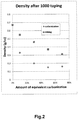
- Fig. 2.
- shows the tapped density measurements for partially carbonized magnesium hydroxide (PCMH) in accordance with the invention (diamonds) and for comparative mixtures of magnesium hydroxide and carbonate (squares);
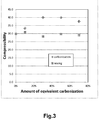
- Fig. 3.
- shows the compressibility values calculated from the bulk densities and tapped densities, as a relative density increase, for partially carbonized magnesium hydroxide (PCMH) in accordance with the invention (diamonds) and for comparative mixtures of magnesium hydroxide and carbonate (squares);
- Fig. 4.
- shows the results of the sniffing test; left for untreated and right for treated group (with the deodorant based on PCMH), the first column being a comparative baseline;
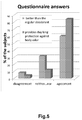
- Fig. 5.
- shows the questionnaire answers;
- Fig. 6.
- shows the results of the perspiration-reducing efficacy test on the back;
- Fig. 7.
- is the relation between the carbonation time and the carbonation extent (in %) in one experimental arrangement according to the invention; and
- Fig. 8.
- shows SEM images, 10000 magnification, the abscissa corresponding to 5µm, of a PCMH10 sample according to the invention and a comparative example; 8A shows PCMH, 10% carbonization, according to the invention; 8B shows an artificial mixture of magnesium hydroxide and basic magnesium hydroxide tetrahydrate simulating 10% carbonization.
- It has now been found that partially carbonated magnesium hydroxide (PCMH) is a suitable agent for use in cosmetic deodorant compositions. In one embodiment of the invention, the PCMH was prepared from an aqueous slurry of magnesium hydroxide, which was injected with carbon dioxide under controlled conditions, so that a defined portion of the magnesium hydroxide (MH) reacted to provide magnesium carbonate (MC); the slurry was dried to a moisture level of 2% or less, when measured, for example, as loss on drying at 105ºC for 60 minutes, and the powder was milled. For 10% carbonation for example, the reaction ran according to the following equation:
10 Mg(OH)2 + 1 CO2 = [Mg(OH)2]9.[MgCO3].[H2O]
- The right side of the equation shows the product which is a homogeneous mixture of magnesium hydroxide (about 83.5 wt%), magnesium carbonate (about 13.5 wt%) and water (about 3 wt%) - constituting a PCMH product. The PCMH products were characterized by several parameters relevant for their use in cosmetic compositions, including their bulk density, tap density, etc. It was found that similar compositions obtained without carbonization, for example by mixing magnesium hydroxide (MH) with magnesium carbonate (MC) or by employing basic magnesium carbonate [BMC = (MgCO3)4.Mg(OH)2.4H2O], differed in their physical properties. For example, a mixture of about 12 wt% BMC and about 88 wt% of MH has an overall composition similar as PCMH shown in the above equation, but it exhibited higher bulk density (pour density) and also higher tapping density, the carbonated magnesium hydroxide being more fluffy than a physical mixture of components, and it kept this feature even after intensive tapping (see
Fig.1 andFig. 2 ). Carbonated magnesium hydroxide exhibited higher tapping compressibility (Fig.3 ). In various experiments, between 0 % and 80% hydroxide was converted to carbonate (the extent of carbonation 0-80%). Partially carbonated magnesium hydroxide comprising the carbonation extent of between about 10% and about 70% is used for preparing cosmetic perspiration-reducing and deodorant compositions of the invention. Partially carbonated magnesium hydroxide products comprising the carbonation extent of, for example, about 10% or about 70% are abbreviated here as PCMH10 and PCMH70, respectively. - A cosmetic formulation in accordance with the invention usually comprises between 5 and 25 wt% PCMH, and the rest cosmetically acceptable surfactants and solvents, the formulation being, for example a stick, spray, roll-on, etc. The formulation usually exhibits antimicrobial activity, particularly antibacterial activity; for example, the formulation reduces the concentration of Staphylococcus species in vitro. Perspiration-reducing and deodorant formulations in accordance with the invention were prepared and tested; the tests showed a good perspiration-reducing and deodorant activity (
Fig.4 ,Fig.5 ,Fig.6 ). In some embodiments, the perspiration-reducing cosmetic formulation of the invention comprising a PCMH composition reduces the sweat formation, as measured by the back perspiration-reducing efficacy test, by at least about 10%, such as by at least 20%. The results of the sniffing test, as well as the questionnaire answers of volunteer users, confirm excellent potential of the PCMH composition for use in reducing perspiration and/or malodors. No irritation or sensitization was noticed in any one of the volunteer subjects. A composition containing PCMH may advantageously serve in safe cosmetic perspiration-reducing or deodorant formulations. - Many perspiration-reducing or deodorant formulations contain at least 15 wt% of aluminum or aluminum-zirconium salts, and often up to 25 wt%. However, the majority of breast cancers occur close to the armpit where deodorants are applied, and aluminum is suspected, among other harmful effects, of being able to cause DNA alterations. A composition containing PCMH in accordance with the invention may substitute for a part of aluminum or aluminum-zirconium salts usually used in perspiration-reducing or deodorant formulations, or it may entirely replace the salts. In one aspect of the invention, the perspiration-reducing or deodorant formulations contain 10 wt% or less of aluminum or zirconium salts, for example less than 9 wt% or less than 8 wt% or less than 7 wt% or less than 6 wt% or less than 5 wt% aluminum or zirconium salts. In one embodiment of the invention, the perspiration-reducing or deodorant formulation contains up to 10 wt% aluminum or zirconium salts, for example up to 7 wt% or up to 6 wt% or up to 5 wt%. In another aspect of the invention, the perspiration-reducing or deodorant formulation is free of aluminum or zirconium salts.
- The PCMH product for cosmetic compositions in accordance with the invention preferably comprises partially carbonated magnesium hydroxide, in which carbon dioxide converts from about 10% to about 70%, and more preferably from about 10% to about 50% magnesium hydroxide to magnesium carbonate.
- In preferred embodiments, the PCMH product in accordance with the invention comprises between about 20 and 85 wt% magnesium hydroxide, between about 12 and 65 magnesium carbonate, and between 2 and 15 wt% water. The PCMH in accordance with the invention will typically comprise magnesium carbonate (MC) being formed from magnesium hydroxide and carbon dioxide and being dispersed in magnesium hydroxide, MC being in an amount of about 5, about 10, about 20, about 30, about 40, about 50, about 60, or about 70 wt%, based on the total PCMH weight. The PCMH in accordance with the invention will typically comprise water being formed from magnesium hydroxide and carbon dioxide in an amount of about of up to 5, up to 10, or up to 15 wt% based on the total PCMH weight. When employing the term "about" before a value X, intended is the range of X+X/5.
- The invention will be further described and illustrated in the following examples.
- Partially carbonated magnesium hydroxide (PCMH) according to the invention was prepared, in one embodiment, from MH aqueous slurry, 10-40%, in a mixing tank. The slurry was heated to 30-80°C, and carbon dioxide was injected to the bottom of mixing shaft at an overpressure of 0.3-0.9 bar. The flow rate was adjusted, so that bubbles of gas appear on the mixture surface (excess of carbon dioxide). After certain reaction time, according to required carbonation extent, the process is stopped. The slurry was filtered and dried either in spray dryer or by another type of drying technology where exhausted gas temp is not less than 130-160ºC. The moisture level of the dried material was less than 2%, when measured as loss of drying at 105ºC for 60 minutes. The dry powder was milled, and its content of magnesium hydroxide and water was determined, employing thermogravimetric analysis. The reaction time for a desired carbonation extent was assessed from a calibration curve, reaction time versus achieved carbonization, found for the relevant reaction arrangement. A calibration curve for a specific arrangement is shown in
Fig. 7 . - Comparative samples comprising magnesium hydroxide and magnesium carbonate of various ratios were prepared. In one series of experiments, basic magnesium carbonate [(MgCO3)4.Mg(OH)2.4H2O] was mixed with magnesium hydroxide, whereby simulating compositions obtained in accordance with the invention and having the same hydroxide/carbonate/water ratios.
- The content of free water was determined by loss on drying at 105ºC for 60 minutes. The content of bound water was determined by loss of drying at 180 ºC for 30 minutes. The bulk density and tapped density were measured by pouring 50 g of powder into a volumetric cylinder; the bulk volume in ml was read immediately after pouring (V0), followed by 1000 tapping using a pharma test instrument and repeated reading of the volume (V1000). The bulk density and the tapped density were calculated (50N). Compressibility was calculated: 100*(1-V1000/V0).
- Both types of materials, partially carbonated magnesium hydroxide in accordance with the invention and the simulating physical mixtures, were further characterized (not shown) by measuring nitrogen adsorption/desorption on the powders, BET, total pore volumes, average pore diameters, particle size distributions, XRD patterns and TGA profiles. The two types of powders, even though having similar chemical compositions, exhibited different physical properties (see, for example, the compressibility differences in
Fig. 3 ) and microstructure features (see, for example, SEM images inFig. 8 ). - Deodorant formulations in accordance with the invention were prepared by mixing PCMH10 prepared according to the invention with cosmetically acceptable components according to the following tables:
20% PCMH roll-on Component wt% Water 58.62 xanthan gum 0.08 steareth-2 2.00 steareth-21 1.00 PPG 15-stearylether 3.00 fumed silica 0.50 cyclopentasiloxane 10.00 C12-15 alkylbenzoate 3.00 PCMH10 20.00 phenoxyethanol+ethylhexylglycerin 0.80 Perfume 1.00 20% PCMH stick Component wt% cyclopentasiloxane 38.45 phenyltrimethicone 2.00 C12-15 alkylbenzoate 14.00 Petrolatum 1.50 Stearylalcohol 19.00 Trihydroxystearin 2.00 talc 1.00 PCMH10 20.00 BHT 0.05 Perfume 2.00 25% PCMH spray Component wt% cyclopentasiloxane 42.10 phenyltrimethicone 5.00 C12-15 alkylbenzoate 15.00 Bisabolol 0.20 Farnesol 0.30 ethylhexylglycerin 0.30 stearalkonium hectorite+propylene carbonate+capryl ic/capric triglyceride 6.00 PCMH10 25.00 BHT 0.10 Perfume 6.00 Liquid / gas 15/85 10% PCMH + 10% AI/Zr roll-on Component wt% water 40.05 xanthan gum 0.08 steareth-2 2.00 steareth-21 1.00 PPG 15-stearyl ether 3.00 fumed silica 0.50 cyclopentasiloxane 10.00 C12-15 alkyl benzoate 3.00 PCMH10 10.00 aluminum zirconium tetrachlor-hydrex GLY-35% aq. solution 28.57 phenoxyethanol+ethylhexyl glycerin 0.80 perfume 1.00 - Sniff test was performed in Institute for Applied Dermatological Research, pro-DERM Hamburg, Germany, in June 2015, by experts (sniffers) trained for evaluating the efficacy of cosmetic products against axillary malodor. Twenty five subjects used the roll-on deodorant according to the invention. According to the results of the study, a significant difference in sweat odor rating was documented between the test product and the
untreated control 24 hours after product application in favor of the test product (Fig. 4 ). The subjects filled in a questionnaire and expressed their subjective experience, mostly positive (Fig. 5 ); the subjects notices no sticky feel or unpleasant residues on the skin, no stains on clothes, and found the test product easy to spread. - Sensitizing properties of the roll-on deodorant according to the invention, was examined in the The Institute for Skin Reseach, Tel Aviv, Israel, on 50 volunteers. The hypoallergic test showed no allergic reaction for the deodorant of the invention.
- Perspiration-reducing efficacy of the roll-on deodorant according to the invention was measured in the The Institute for Skin Research, Tel Aviv, Israel, on 10 volunteers. Gravimetrical assessment of the sweat quantity on the back of the subjects showed a reduction of 23% (
Fig. 6 ). - Odor-reducing efficacy of the roll-on deodorant according to the invention, comprising 20% PCMH (as described in Example 3) was compared with a roll-on aluminum based deodorant containing 20% active material based on aluminum with otherwise same components. Six subjects (4 males, 2 females) used both deodorants in two armpits in parallel. Sniffers assessed both armpits every three hours from the
time 0 to thetime 24 hours, and scored the odor from 1 to 5, wherein 1 is no odor, 2 is weak, 3 is medium, 4 is strong, and 5 very strong. The average score for Al-based roll-on was 1.2 and for PCMH roll-on was 1.4. - The antimicrobial activity of formulation "20% PCMH roll-on" as described in Example 3 was assessed according to a time-kill procedure ASTM E2315-03 in the Institute for Food Microbiology and Consumer Goods Ltd., Nesher, Israel. Two medically relevant types of bacteria which are a part of human skin flora, Staphylococcus epidermidis and Staphylococcus aureus, were exposed for two hours to the formulation and the reduction of their concentration was measured. As for S. epidermidis,
formulation 20% PCMH roll-on according to the invention reduced its concentration by 99%, as for S. aureus, it could not be detected. - While the invention has been described using some specific examples, many modifications and variations are possible. It is therefore understood that the invention is not intended to be limited in any way, other than by the scope of the appended claims.
Claims (10)
- A cosmetic formulation comprising, a partially carbonated magnesium hydroxide (PCMH) of formula (1):
[Mg(OH)2]10-x.[MgCO3]x.[H2O]x (1)
wherein x is a real number between about 1 and 7, and
wherein said cosmetic formulation is a perspiration-reducing formulation. - A safe cosmetic formulation according to claim 1 being perspiration-reducing formulation and deodorant formulation.
- The cosmetic perspiration-reducing formulation according to claim 1, comprising PCMH in an amount of from 5 to 30 wt%.
- The cosmetic perspiration-reducing formulation according to claim 1, comprising up to 10 wt% aluminum or zirconium salts.
- The cosmetic perspiration-reducing formulation according to claim 1, lacking aluminum or zirconium salts.
- The cosmetic perspiration-reducing formulation according to claim 1, comprising said partially carbonated magnesium hydroxide, solvents, surfactants, bulking agents, and fragrance components, said formulation exhibiting antimicrobial activity.
- A dermatologically safe agent for use in cosmetic formulations, essentially consisting of a partially carbonated magnesium hydroxide (PCMH) of formula (1):
[Mg(OH)2]10-x.[MgCO3]x.[H2O]x (1)
wherein x is a real number between about 1 and 7. - The dermatologically safe agent according to claim 7 being cosmetically active agent or perspiration-reducing agent or deodorant agent.
- A method of manufacturing a cosmetic deodorant or perspiration-reducing formulation comprising steps of:i) providing cosmetically acceptable magnesium hydroxide and partially reacting it with carbon dioxide, wherein converting between about 10 and 70% of said hydroxide to carbonate, to provide a partially carbonated magnesium hydroxide (PCMH) essentially consisting of magnesium carbonate and water homogeneously dispersed in magnesium hydroxide;ii) mixing said PCMH with cosmetically acceptable solvents and/or surfactants; and optionallyiii) mixing with additional components selected from emollients, buffers, bulking agents, thickening agents, moisturizers, fragrance components, and preservatives;
thereby obtaining a safe deodorant or perspiration-reducing formulation, free of aluminum and zirconium salts. - The method of claim 9, comprising steps ofi) preparing an aqueous 10-40% slurry of magnesium hydroxide in a reactor;ii) heating the slurry to 30-80°C and stirring;iii) injecting to the bottom of the reactor carbon dioxide for the time needed to the desired carbonation; andiv) removing the partially carbonated magnesium hydroxide from the slurry and drying it to a moisture level of less than 2%, when measured as loss of drying at 105°C for 60 minutes.
Applications Claiming Priority (2)
| Application Number | Priority Date | Filing Date | Title |
|---|---|---|---|
| US201562271541P | 2015-12-28 | 2015-12-28 | |
| PCT/IL2016/051214 WO2017115346A1 (en) | 2015-12-28 | 2016-11-10 | Deodorant compositions |
Publications (3)
| Publication Number | Publication Date |
|---|---|
| EP3397352A1 EP3397352A1 (en) | 2018-11-07 |
| EP3397352A4 EP3397352A4 (en) | 2019-05-22 |
| EP3397352B1 true EP3397352B1 (en) | 2021-07-28 |
Family
ID=59224689
Family Applications (1)
| Application Number | Title | Priority Date | Filing Date |
|---|---|---|---|
| EP16881393.9A Active EP3397352B1 (en) | 2015-12-28 | 2016-11-10 | Antiperspirant compositions |
Country Status (6)
| Country | Link |
|---|---|
| US (1) | US10413490B2 (en) |
| EP (1) | EP3397352B1 (en) |
| BR (1) | BR112018013170B1 (en) |
| DK (1) | DK3397352T3 (en) |
| ES (1) | ES2883257T3 (en) |
| WO (1) | WO2017115346A1 (en) |
Cited By (1)
| Publication number | Priority date | Publication date | Assignee | Title |
|---|---|---|---|---|
| EP4447903A4 (en) * | 2022-01-27 | 2026-01-28 | Dead Sea Bromine Co Ltd | MAGNESIUM HYDROXIDE FACE MASK AND METHOD FOR ITS MANUFACTURE AND USE |
Families Citing this family (6)
| Publication number | Priority date | Publication date | Assignee | Title |
|---|---|---|---|---|
| US10543164B2 (en) | 2017-06-30 | 2020-01-28 | The Procter & Gamble Company | Deodorant compositions |
| EP3644950A2 (en) | 2017-06-30 | 2020-05-06 | The Procter and Gamble Company | Deodorant and antiperspirant compositions |
| CN110831567B (en) | 2017-06-30 | 2023-01-24 | 宝洁公司 | Hair care composition comprising 2-pyridylphenol-N-oxide material and an iron chelating agent |
| US10905647B2 (en) | 2017-06-30 | 2021-02-02 | The Procter & Gamble Company | Antiperspirant and deodorant compositions |
| MX2021011736A (en) * | 2019-04-01 | 2021-10-22 | Procter & Gamble | DEODORANT COMPOSITIONS. |
| CN110478276A (en) * | 2019-08-30 | 2019-11-22 | 明辉实业(深圳)有限公司 | A kind of deodorant stick and preparation method thereof |
Family Cites Families (8)
| Publication number | Priority date | Publication date | Assignee | Title |
|---|---|---|---|---|
| GR69691B (en) | 1979-08-10 | 1982-07-08 | Unilever Nv | |
| RO101125B1 (en) * | 1988-05-12 | 1992-11-25 | Magnesium carbonate production method for sportive use | |
| US5512274A (en) * | 1992-02-10 | 1996-04-30 | Phinney; Robin L. | Metal hydroxide deodorant formulation |
| US5922309A (en) * | 1997-12-23 | 1999-07-13 | Cheesebrough-Pond's Usa Co. | Non-whitening underarm compositions |
| JP3449533B2 (en) | 1998-12-18 | 2003-09-22 | 花王株式会社 | Deodorant composition |
| US7922991B2 (en) * | 2002-02-13 | 2011-04-12 | Nittetsu Mining Co., Ltd. | Basic magnesium carbonate, production method and use of the same |
| CN101340884A (en) | 2005-10-19 | 2009-01-07 | 曼尼·马纳舍·辛格尔 | Method for treating hyperhidrosis |
| EP3253206B1 (en) * | 2015-02-02 | 2019-11-13 | Merck Patent GmbH | Powder formulation comprising an insect repellent |
-
2016
- 2016-11-10 DK DK16881393.9T patent/DK3397352T3/en active
- 2016-11-10 ES ES16881393T patent/ES2883257T3/en active Active
- 2016-11-10 US US16/064,081 patent/US10413490B2/en active Active
- 2016-11-10 BR BR112018013170-9A patent/BR112018013170B1/en active IP Right Grant
- 2016-11-10 EP EP16881393.9A patent/EP3397352B1/en active Active
- 2016-11-10 WO PCT/IL2016/051214 patent/WO2017115346A1/en not_active Ceased
Cited By (1)
| Publication number | Priority date | Publication date | Assignee | Title |
|---|---|---|---|---|
| EP4447903A4 (en) * | 2022-01-27 | 2026-01-28 | Dead Sea Bromine Co Ltd | MAGNESIUM HYDROXIDE FACE MASK AND METHOD FOR ITS MANUFACTURE AND USE |
Also Published As
| Publication number | Publication date |
|---|---|
| BR112018013170A2 (en) | 2018-12-11 |
| DK3397352T3 (en) | 2021-08-23 |
| BR112018013170B1 (en) | 2021-07-20 |
| ES2883257T3 (en) | 2021-12-07 |
| US10413490B2 (en) | 2019-09-17 |
| EP3397352A4 (en) | 2019-05-22 |
| EP3397352A1 (en) | 2018-11-07 |
| US20190000730A1 (en) | 2019-01-03 |
| WO2017115346A1 (en) | 2017-07-06 |
Similar Documents
| Publication | Publication Date | Title |
|---|---|---|
| US10413490B2 (en) | Deodorant compositions | |
| EP3300771B1 (en) | Use of isosorbide caprylate/caprate in deodorants and antiperspirants | |
| EP2654679B1 (en) | Anhydrous soft solid composition comprising hydrophobic silica aerogel particles | |
| JP6629849B2 (en) | Anhydrous composition comprising a lipophilic gelling agent, at least two different fillers and an oil phase | |
| US10117816B2 (en) | Cosmetic process for treating human body odor using a 4-(3-ethoxy-4-hydroxyphenyl)alkyl ketone or 2-ethoxy-4-hydroxyalkylphenol compound | |
| DE112014001299T5 (en) | Cosmetic composition | |
| WO2014128058A2 (en) | Soft solid oil-in-water emulsion comprising a mixture of nonionic surfactants, a water-soluble polysaccharide and a wax comprising at least one ester | |
| EP3548144B1 (en) | Powdery cosmetic composition comprising nanocrystalline cellulose | |
| DE69806778T2 (en) | SOLID ANTI-WELDING AGENT WITH LOW RESIDUE | |
| EA028161B1 (en) | Antiperspirant compositions and method for reducing perspiration | |
| US20040005340A1 (en) | Aqueous cosmetic composition comprising porous silica particles and at least one humectant | |
| DE10163242A1 (en) | Deodorants and antiperspirants | |
| KR20100065832A (en) | Powder makeup cosmetic compositions containing micronized scoria particles | |
| WO2012084520A2 (en) | Use of hydrophobic aerogel particles as deodorant active agent; method for the treatment of human body odours | |
| KR101692769B1 (en) | Cosmetic composition for skin cooing and make-up comprising phase transition wax | |
| JP2005002076A (en) | Oily cosmetic | |
| AU2003235034A1 (en) | Skin friendly antiperspirant composition and method of making | |
| EP3930661B1 (en) | Particulate amorphous mesoporous magnesium carbonate material | |
| JP2009079019A (en) | Sunscreen cosmetics | |
| JP2006022047A (en) | Skin care cosmetic high in closing effect | |
| JP5156182B2 (en) | Cosmetic composition | |
| JP2005002077A (en) | Powder cosmetic | |
| JP2001279129A (en) | Compounded powder and cosmetic | |
| JPH04356415A (en) | Cosmetic | |
| WO2020127760A1 (en) | Cosmetic treatment process comprising the generation of a foam from two anhydrous compositions |
Legal Events
| Date | Code | Title | Description |
|---|---|---|---|
| STAA | Information on the status of an ep patent application or granted ep patent |
Free format text: STATUS: THE INTERNATIONAL PUBLICATION HAS BEEN MADE |
|
| PUAI | Public reference made under article 153(3) epc to a published international application that has entered the european phase |
Free format text: ORIGINAL CODE: 0009012 |
|
| STAA | Information on the status of an ep patent application or granted ep patent |
Free format text: STATUS: REQUEST FOR EXAMINATION WAS MADE |
|
| 17P | Request for examination filed |
Effective date: 20180622 |
|
| AK | Designated contracting states |
Kind code of ref document: A1 Designated state(s): AL AT BE BG CH CY CZ DE DK EE ES FI FR GB GR HR HU IE IS IT LI LT LU LV MC MK MT NL NO PL PT RO RS SE SI SK SM TR |
|
| AX | Request for extension of the european patent |
Extension state: BA ME |
|
| DAV | Request for validation of the european patent (deleted) | ||
| DAX | Request for extension of the european patent (deleted) | ||
| A4 | Supplementary search report drawn up and despatched |
Effective date: 20190424 |
|
| RIC1 | Information provided on ipc code assigned before grant |
Ipc: C01F 5/14 20060101ALI20190416BHEP Ipc: A61Q 15/00 20060101AFI20190416BHEP Ipc: A61K 8/19 20060101ALI20190416BHEP Ipc: C01F 5/24 20060101ALI20190416BHEP |
|
| RIC1 | Information provided on ipc code assigned before grant |
Ipc: A61K 8/19 20060101ALI20210224BHEP Ipc: A61Q 15/00 20060101AFI20210224BHEP Ipc: C01F 5/14 20060101ALI20210224BHEP Ipc: C01F 5/24 20060101ALI20210224BHEP |
|
| GRAP | Despatch of communication of intention to grant a patent |
Free format text: ORIGINAL CODE: EPIDOSNIGR1 |
|
| STAA | Information on the status of an ep patent application or granted ep patent |
Free format text: STATUS: GRANT OF PATENT IS INTENDED |
|
| INTG | Intention to grant announced |
Effective date: 20210503 |
|
| GRAS | Grant fee paid |
Free format text: ORIGINAL CODE: EPIDOSNIGR3 |
|
| GRAA | (expected) grant |
Free format text: ORIGINAL CODE: 0009210 |
|
| STAA | Information on the status of an ep patent application or granted ep patent |
Free format text: STATUS: THE PATENT HAS BEEN GRANTED |
|
| AK | Designated contracting states |
Kind code of ref document: B1 Designated state(s): AL AT BE BG CH CY CZ DE DK EE ES FI FR GB GR HR HU IE IS IT LI LT LU LV MC MK MT NL NO PL PT RO RS SE SI SK SM TR |
|
| REG | Reference to a national code |
Ref country code: GB Ref legal event code: FG4D |
|
| REG | Reference to a national code |
Ref country code: CH Ref legal event code: EP |
|
| REG | Reference to a national code |
Ref country code: AT Ref legal event code: REF Ref document number: 1414167 Country of ref document: AT Kind code of ref document: T Effective date: 20210815 |
|
| REG | Reference to a national code |
Ref country code: IE Ref legal event code: FG4D |
|
| REG | Reference to a national code |
Ref country code: DE Ref legal event code: R096 Ref document number: 602016061402 Country of ref document: DE |
|
| REG | Reference to a national code |
Ref country code: DK Ref legal event code: T3 Effective date: 20210820 |
|
| REG | Reference to a national code |
Ref country code: NL Ref legal event code: FP |
|
| REG | Reference to a national code |
Ref country code: FI Ref legal event code: FGE |
|
| REG | Reference to a national code |
Ref country code: SE Ref legal event code: TRGR |
|
| REG | Reference to a national code |
Ref country code: NO Ref legal event code: T2 Effective date: 20210728 |
|
| REG | Reference to a national code |
Ref country code: LT Ref legal event code: MG9D |
|
| REG | Reference to a national code |
Ref country code: ES Ref legal event code: FG2A Ref document number: 2883257 Country of ref document: ES Kind code of ref document: T3 Effective date: 20211207 |
|
| REG | Reference to a national code |
Ref country code: AT Ref legal event code: MK05 Ref document number: 1414167 Country of ref document: AT Kind code of ref document: T Effective date: 20210728 |
|
| PG25 | Lapsed in a contracting state [announced via postgrant information from national office to epo] |
Ref country code: PT Free format text: LAPSE BECAUSE OF FAILURE TO SUBMIT A TRANSLATION OF THE DESCRIPTION OR TO PAY THE FEE WITHIN THE PRESCRIBED TIME-LIMIT Effective date: 20211129 Ref country code: HR Free format text: LAPSE BECAUSE OF FAILURE TO SUBMIT A TRANSLATION OF THE DESCRIPTION OR TO PAY THE FEE WITHIN THE PRESCRIBED TIME-LIMIT Effective date: 20210728 Ref country code: AT Free format text: LAPSE BECAUSE OF FAILURE TO SUBMIT A TRANSLATION OF THE DESCRIPTION OR TO PAY THE FEE WITHIN THE PRESCRIBED TIME-LIMIT Effective date: 20210728 Ref country code: BG Free format text: LAPSE BECAUSE OF FAILURE TO SUBMIT A TRANSLATION OF THE DESCRIPTION OR TO PAY THE FEE WITHIN THE PRESCRIBED TIME-LIMIT Effective date: 20211028 Ref country code: LT Free format text: LAPSE BECAUSE OF FAILURE TO SUBMIT A TRANSLATION OF THE DESCRIPTION OR TO PAY THE FEE WITHIN THE PRESCRIBED TIME-LIMIT Effective date: 20210728 Ref country code: RS Free format text: LAPSE BECAUSE OF FAILURE TO SUBMIT A TRANSLATION OF THE DESCRIPTION OR TO PAY THE FEE WITHIN THE PRESCRIBED TIME-LIMIT Effective date: 20210728 |
|
| PG25 | Lapsed in a contracting state [announced via postgrant information from national office to epo] |
Ref country code: PL Free format text: LAPSE BECAUSE OF FAILURE TO SUBMIT A TRANSLATION OF THE DESCRIPTION OR TO PAY THE FEE WITHIN THE PRESCRIBED TIME-LIMIT Effective date: 20210728 Ref country code: LV Free format text: LAPSE BECAUSE OF FAILURE TO SUBMIT A TRANSLATION OF THE DESCRIPTION OR TO PAY THE FEE WITHIN THE PRESCRIBED TIME-LIMIT Effective date: 20210728 Ref country code: GR Free format text: LAPSE BECAUSE OF FAILURE TO SUBMIT A TRANSLATION OF THE DESCRIPTION OR TO PAY THE FEE WITHIN THE PRESCRIBED TIME-LIMIT Effective date: 20211029 |
|
| REG | Reference to a national code |
Ref country code: DE Ref legal event code: R097 Ref document number: 602016061402 Country of ref document: DE |
|
| PG25 | Lapsed in a contracting state [announced via postgrant information from national office to epo] |
Ref country code: SM Free format text: LAPSE BECAUSE OF FAILURE TO SUBMIT A TRANSLATION OF THE DESCRIPTION OR TO PAY THE FEE WITHIN THE PRESCRIBED TIME-LIMIT Effective date: 20210728 Ref country code: SK Free format text: LAPSE BECAUSE OF FAILURE TO SUBMIT A TRANSLATION OF THE DESCRIPTION OR TO PAY THE FEE WITHIN THE PRESCRIBED TIME-LIMIT Effective date: 20210728 Ref country code: RO Free format text: LAPSE BECAUSE OF FAILURE TO SUBMIT A TRANSLATION OF THE DESCRIPTION OR TO PAY THE FEE WITHIN THE PRESCRIBED TIME-LIMIT Effective date: 20210728 Ref country code: EE Free format text: LAPSE BECAUSE OF FAILURE TO SUBMIT A TRANSLATION OF THE DESCRIPTION OR TO PAY THE FEE WITHIN THE PRESCRIBED TIME-LIMIT Effective date: 20210728 Ref country code: CZ Free format text: LAPSE BECAUSE OF FAILURE TO SUBMIT A TRANSLATION OF THE DESCRIPTION OR TO PAY THE FEE WITHIN THE PRESCRIBED TIME-LIMIT Effective date: 20210728 Ref country code: AL Free format text: LAPSE BECAUSE OF FAILURE TO SUBMIT A TRANSLATION OF THE DESCRIPTION OR TO PAY THE FEE WITHIN THE PRESCRIBED TIME-LIMIT Effective date: 20210728 |
|
| PLBE | No opposition filed within time limit |
Free format text: ORIGINAL CODE: 0009261 |
|
| STAA | Information on the status of an ep patent application or granted ep patent |
Free format text: STATUS: NO OPPOSITION FILED WITHIN TIME LIMIT |
|
| PG25 | Lapsed in a contracting state [announced via postgrant information from national office to epo] |
Ref country code: MC Free format text: LAPSE BECAUSE OF FAILURE TO SUBMIT A TRANSLATION OF THE DESCRIPTION OR TO PAY THE FEE WITHIN THE PRESCRIBED TIME-LIMIT Effective date: 20210728 |
|
| REG | Reference to a national code |
Ref country code: CH Ref legal event code: PL |
|
| 26N | No opposition filed |
Effective date: 20220429 |
|
| PG25 | Lapsed in a contracting state [announced via postgrant information from national office to epo] |
Ref country code: LU Free format text: LAPSE BECAUSE OF NON-PAYMENT OF DUE FEES Effective date: 20211110 |
|
| PG25 | Lapsed in a contracting state [announced via postgrant information from national office to epo] |
Ref country code: LI Free format text: LAPSE BECAUSE OF NON-PAYMENT OF DUE FEES Effective date: 20211130 Ref country code: CH Free format text: LAPSE BECAUSE OF NON-PAYMENT OF DUE FEES Effective date: 20211130 |
|
| PG25 | Lapsed in a contracting state [announced via postgrant information from national office to epo] |
Ref country code: IE Free format text: LAPSE BECAUSE OF NON-PAYMENT OF DUE FEES Effective date: 20211110 |
|
| PG25 | Lapsed in a contracting state [announced via postgrant information from national office to epo] |
Ref country code: CY Free format text: LAPSE BECAUSE OF FAILURE TO SUBMIT A TRANSLATION OF THE DESCRIPTION OR TO PAY THE FEE WITHIN THE PRESCRIBED TIME-LIMIT Effective date: 20210728 |
|
| P01 | Opt-out of the competence of the unified patent court (upc) registered |
Effective date: 20230529 |
|
| PG25 | Lapsed in a contracting state [announced via postgrant information from national office to epo] |
Ref country code: HU Free format text: LAPSE BECAUSE OF FAILURE TO SUBMIT A TRANSLATION OF THE DESCRIPTION OR TO PAY THE FEE WITHIN THE PRESCRIBED TIME-LIMIT; INVALID AB INITIO Effective date: 20161110 |
|
| PG25 | Lapsed in a contracting state [announced via postgrant information from national office to epo] |
Ref country code: MK Free format text: LAPSE BECAUSE OF FAILURE TO SUBMIT A TRANSLATION OF THE DESCRIPTION OR TO PAY THE FEE WITHIN THE PRESCRIBED TIME-LIMIT Effective date: 20210728 |
|
| PG25 | Lapsed in a contracting state [announced via postgrant information from national office to epo] |
Ref country code: TR Free format text: LAPSE BECAUSE OF FAILURE TO SUBMIT A TRANSLATION OF THE DESCRIPTION OR TO PAY THE FEE WITHIN THE PRESCRIBED TIME-LIMIT Effective date: 20210728 |
|
| PG25 | Lapsed in a contracting state [announced via postgrant information from national office to epo] |
Ref country code: MT Free format text: LAPSE BECAUSE OF FAILURE TO SUBMIT A TRANSLATION OF THE DESCRIPTION OR TO PAY THE FEE WITHIN THE PRESCRIBED TIME-LIMIT Effective date: 20210728 |
|
| PGFP | Annual fee paid to national office [announced via postgrant information from national office to epo] |
Ref country code: NL Payment date: 20251126 Year of fee payment: 10 |
|
| PGFP | Annual fee paid to national office [announced via postgrant information from national office to epo] |
Ref country code: DE Payment date: 20251128 Year of fee payment: 10 |
|
| PGFP | Annual fee paid to national office [announced via postgrant information from national office to epo] |
Ref country code: GB Payment date: 20251127 Year of fee payment: 10 |
|
| PGFP | Annual fee paid to national office [announced via postgrant information from national office to epo] |
Ref country code: NO Payment date: 20251128 Year of fee payment: 10 |
|
| PGFP | Annual fee paid to national office [announced via postgrant information from national office to epo] |
Ref country code: IT Payment date: 20251119 Year of fee payment: 10 Ref country code: FI Payment date: 20251125 Year of fee payment: 10 Ref country code: DK Payment date: 20251125 Year of fee payment: 10 |
|
| PGFP | Annual fee paid to national office [announced via postgrant information from national office to epo] |
Ref country code: FR Payment date: 20251125 Year of fee payment: 10 |
|
| PGFP | Annual fee paid to national office [announced via postgrant information from national office to epo] |
Ref country code: BE Payment date: 20251127 Year of fee payment: 10 |
|
| PGFP | Annual fee paid to national office [announced via postgrant information from national office to epo] |
Ref country code: SE Payment date: 20251127 Year of fee payment: 10 |
|
| PGFP | Annual fee paid to national office [announced via postgrant information from national office to epo] |
Ref country code: ES Payment date: 20251201 Year of fee payment: 10 |