EP3396680B1 - Conductive paste for solar cell, solar cell and manufacturing method thereof, and solar cell module - Google Patents
Conductive paste for solar cell, solar cell and manufacturing method thereof, and solar cell module Download PDFInfo
- Publication number
- EP3396680B1 EP3396680B1 EP18168445.7A EP18168445A EP3396680B1 EP 3396680 B1 EP3396680 B1 EP 3396680B1 EP 18168445 A EP18168445 A EP 18168445A EP 3396680 B1 EP3396680 B1 EP 3396680B1
- Authority
- EP
- European Patent Office
- Prior art keywords
- solar cell
- conductive paste
- oxide
- glass
- telluride
- Prior art date
- Legal status (The legal status is an assumption and is not a legal conclusion. Google has not performed a legal analysis and makes no representation as to the accuracy of the status listed.)
- Active
Links
Images

Classifications
-
- H—ELECTRICITY
- H10—SEMICONDUCTOR DEVICES; ELECTRIC SOLID-STATE DEVICES NOT OTHERWISE PROVIDED FOR
- H10F—INORGANIC SEMICONDUCTOR DEVICES SENSITIVE TO INFRARED RADIATION, LIGHT, ELECTROMAGNETIC RADIATION OF SHORTER WAVELENGTH OR CORPUSCULAR RADIATION
- H10F77/00—Constructional details of devices covered by this subclass
- H10F77/20—Electrodes
- H10F77/206—Electrodes for devices having potential barriers
- H10F77/211—Electrodes for devices having potential barriers for photovoltaic cells
-
- C—CHEMISTRY; METALLURGY
- C03—GLASS; MINERAL OR SLAG WOOL
- C03C—CHEMICAL COMPOSITION OF GLASSES, GLAZES OR VITREOUS ENAMELS; SURFACE TREATMENT OF GLASS; SURFACE TREATMENT OF FIBRES OR FILAMENTS MADE FROM GLASS, MINERALS OR SLAGS; JOINING GLASS TO GLASS OR OTHER MATERIALS
- C03C4/00—Compositions for glass with special properties
- C03C4/14—Compositions for glass with special properties for electro-conductive glass
-
- C—CHEMISTRY; METALLURGY
- C03—GLASS; MINERAL OR SLAG WOOL
- C03C—CHEMICAL COMPOSITION OF GLASSES, GLAZES OR VITREOUS ENAMELS; SURFACE TREATMENT OF GLASS; SURFACE TREATMENT OF FIBRES OR FILAMENTS MADE FROM GLASS, MINERALS OR SLAGS; JOINING GLASS TO GLASS OR OTHER MATERIALS
- C03C8/00—Enamels; Glazes; Fusion seal compositions being frit compositions having non-frit additions
- C03C8/02—Frit compositions, i.e. in a powdered or comminuted form
-
- C—CHEMISTRY; METALLURGY
- C03—GLASS; MINERAL OR SLAG WOOL
- C03C—CHEMICAL COMPOSITION OF GLASSES, GLAZES OR VITREOUS ENAMELS; SURFACE TREATMENT OF GLASS; SURFACE TREATMENT OF FIBRES OR FILAMENTS MADE FROM GLASS, MINERALS OR SLAGS; JOINING GLASS TO GLASS OR OTHER MATERIALS
- C03C8/00—Enamels; Glazes; Fusion seal compositions being frit compositions having non-frit additions
- C03C8/02—Frit compositions, i.e. in a powdered or comminuted form
- C03C8/04—Frit compositions, i.e. in a powdered or comminuted form containing zinc
-
- C—CHEMISTRY; METALLURGY
- C03—GLASS; MINERAL OR SLAG WOOL
- C03C—CHEMICAL COMPOSITION OF GLASSES, GLAZES OR VITREOUS ENAMELS; SURFACE TREATMENT OF GLASS; SURFACE TREATMENT OF FIBRES OR FILAMENTS MADE FROM GLASS, MINERALS OR SLAGS; JOINING GLASS TO GLASS OR OTHER MATERIALS
- C03C8/00—Enamels; Glazes; Fusion seal compositions being frit compositions having non-frit additions
- C03C8/02—Frit compositions, i.e. in a powdered or comminuted form
- C03C8/10—Frit compositions, i.e. in a powdered or comminuted form containing lead
-
- C—CHEMISTRY; METALLURGY
- C03—GLASS; MINERAL OR SLAG WOOL
- C03C—CHEMICAL COMPOSITION OF GLASSES, GLAZES OR VITREOUS ENAMELS; SURFACE TREATMENT OF GLASS; SURFACE TREATMENT OF FIBRES OR FILAMENTS MADE FROM GLASS, MINERALS OR SLAGS; JOINING GLASS TO GLASS OR OTHER MATERIALS
- C03C8/00—Enamels; Glazes; Fusion seal compositions being frit compositions having non-frit additions
- C03C8/14—Glass frit mixtures having non-frit additions, e.g. opacifiers, colorants, mill-additions
- C03C8/18—Glass frit mixtures having non-frit additions, e.g. opacifiers, colorants, mill-additions containing free metals
-
- H—ELECTRICITY
- H01—ELECTRIC ELEMENTS
- H01B—CABLES; CONDUCTORS; INSULATORS; SELECTION OF MATERIALS FOR THEIR CONDUCTIVE, INSULATING OR DIELECTRIC PROPERTIES
- H01B1/00—Conductors or conductive bodies characterised by the conductive materials; Selection of materials as conductors
- H01B1/14—Conductive material dispersed in non-conductive inorganic material
- H01B1/16—Conductive material dispersed in non-conductive inorganic material the conductive material comprising metals or alloys
-
- H—ELECTRICITY
- H01—ELECTRIC ELEMENTS
- H01B—CABLES; CONDUCTORS; INSULATORS; SELECTION OF MATERIALS FOR THEIR CONDUCTIVE, INSULATING OR DIELECTRIC PROPERTIES
- H01B1/00—Conductors or conductive bodies characterised by the conductive materials; Selection of materials as conductors
- H01B1/20—Conductive material dispersed in non-conductive organic material
- H01B1/22—Conductive material dispersed in non-conductive organic material the conductive material comprising metals or alloys
-
- H—ELECTRICITY
- H10—SEMICONDUCTOR DEVICES; ELECTRIC SOLID-STATE DEVICES NOT OTHERWISE PROVIDED FOR
- H10F—INORGANIC SEMICONDUCTOR DEVICES SENSITIVE TO INFRARED RADIATION, LIGHT, ELECTROMAGNETIC RADIATION OF SHORTER WAVELENGTH OR CORPUSCULAR RADIATION
- H10F71/00—Manufacture or treatment of devices covered by this subclass
- H10F71/138—Manufacture of transparent electrodes, e.g. transparent conductive oxides [TCO] or indium tin oxide [ITO] electrodes
-
- H—ELECTRICITY
- H10—SEMICONDUCTOR DEVICES; ELECTRIC SOLID-STATE DEVICES NOT OTHERWISE PROVIDED FOR
- H10F—INORGANIC SEMICONDUCTOR DEVICES SENSITIVE TO INFRARED RADIATION, LIGHT, ELECTROMAGNETIC RADIATION OF SHORTER WAVELENGTH OR CORPUSCULAR RADIATION
- H10F77/00—Constructional details of devices covered by this subclass
- H10F77/20—Electrodes
- H10F77/244—Electrodes made of transparent conductive layers, e.g. transparent conductive oxide [TCO] layers
-
- C—CHEMISTRY; METALLURGY
- C03—GLASS; MINERAL OR SLAG WOOL
- C03C—CHEMICAL COMPOSITION OF GLASSES, GLAZES OR VITREOUS ENAMELS; SURFACE TREATMENT OF GLASS; SURFACE TREATMENT OF FIBRES OR FILAMENTS MADE FROM GLASS, MINERALS OR SLAGS; JOINING GLASS TO GLASS OR OTHER MATERIALS
- C03C2204/00—Glasses, glazes or enamels with special properties
-
- C—CHEMISTRY; METALLURGY
- C03—GLASS; MINERAL OR SLAG WOOL
- C03C—CHEMICAL COMPOSITION OF GLASSES, GLAZES OR VITREOUS ENAMELS; SURFACE TREATMENT OF GLASS; SURFACE TREATMENT OF FIBRES OR FILAMENTS MADE FROM GLASS, MINERALS OR SLAGS; JOINING GLASS TO GLASS OR OTHER MATERIALS
- C03C2205/00—Compositions applicable for the manufacture of vitreous enamels or glazes
-
- Y—GENERAL TAGGING OF NEW TECHNOLOGICAL DEVELOPMENTS; GENERAL TAGGING OF CROSS-SECTIONAL TECHNOLOGIES SPANNING OVER SEVERAL SECTIONS OF THE IPC; TECHNICAL SUBJECTS COVERED BY FORMER USPC CROSS-REFERENCE ART COLLECTIONS [XRACs] AND DIGESTS
- Y02—TECHNOLOGIES OR APPLICATIONS FOR MITIGATION OR ADAPTATION AGAINST CLIMATE CHANGE
- Y02E—REDUCTION OF GREENHOUSE GAS [GHG] EMISSIONS, RELATED TO ENERGY GENERATION, TRANSMISSION OR DISTRIBUTION
- Y02E10/00—Energy generation through renewable energy sources
- Y02E10/50—Photovoltaic [PV] energy
Definitions
- the invention relates to a conductive paste for a solar cell, a solar cell and a manufacturing method thereof, and a solar cell module, and more particularly, to a conductive paste for a solar cell, a solar cell and a manufacturing method thereof, and a solar cell module that can improve electrical connection and increase cell efficiency.
- the solar cell is a device converting sunlight into electric energy that generates electrons and electron holes via the irradiation of visible light on a substrate, and the electrons and electron holes are guided by a front electrode (light-receiving surface) and a back electrode (non-light-receiving surface) located at two sides of the substrate to form a current.
- These two electrodes can be formed by adhering a conductive paste on the substrate using a screen printing or coating method and then performing sintering in a specific temperature range.
- the main material is the conductive paste
- the components, amounts, and sintering conditions of the conductive paste all may affect the electrical performance of the solar cell after the paste is sintered. More specifically, when molten glass is excessively fired through, cell efficiency may be reduced.
- US 2014/0290735 A1 discloses a composition for solar cell electrodes that includes silver powder.
- US 2014/0021417 A1 discloses a paste composition capable of forming a silver electrode having a high bond strength and a low contact resistance.
- the invention provides a conductive paste for a solar cell containing a high-melting point tellurium alloy compound that can inhibit glass fire-through to control the degree of fire-through, so as to improve electrical connection and increase cell efficiency.
- the invention provides a solar cell and a manufacturing method thereof and a solar cell module.
- the conductive paste for a solar cell of the invention comprises a silver powder, a glass, an organic vehicle, and a tellurium alloy compound, wherein the tellurium alloy compound has a melting point at least 300 °C higher than the softening point of the glass; and wherein the melting point of the tellurium alloy compound is 900°C or more; the tellurium alloy compound comprises lead telluride, zinc telluride, silver telluride, or a combination thereof; and a material of the glass comprises tellurium oxide, bismuth oxide, zinc oxide, lead oxide, silicon oxide, or a combination thereof.
- the amount of the glass is 0.01 wt% to 7 wt%, and the amount of the tellurium alloy compound is 0.01 wt% to 5 wt%.
- the material of the glass includes tellurium oxide, bismuth oxide, and zinc oxide, and based on the total weight of the conductive paste for a solar cell, the amount of the tellurium alloy compound is 0.01 wt% to 3.5 wt%.
- the material of the glass includes lead oxide and tellurium oxide, and based on the total weight of the conductive paste for a solar cell, the amount of the tellurium alloy compound is 0.25 wt% to 4 wt%.
- the material of the glass includes tellurium oxide, bismuth oxide, and silicon oxide, and based on the total weight of the conductive paste for a solar cell, the amount of the tellurium alloy compound is 0.25 wt% to 3.5 wt%.
- the material of the glass includes lead oxide and bismuth oxide, and based on the total weight of the conductive paste for a solar cell, the amount of the tellurium alloy compound is 0.5 wt% to 3 wt%.
- the solar cell of the invention includes an electrode made by the aforementioned conductive paste for a solar cell.
- the manufacturing method of a solar cell of the invention forms an electrode for a solar cell using the aforementioned conductive paste for a solar cell.
- the solar cell module of the invention includes the aforementioned solar cell or a solar cell made by the aforementioned manufacturing method of a solar cell.
- the conductive paste for a solar cell of the invention contains a high-melting point tellurium alloy compound having a melting point (such as 900°C or more) at least 300°C higher than the softening point of glass. Therefore, the fire-through of the glass can be inhibited to control the degree of fire-through so as to improve electrical connection and increase cell efficiency. As a result, the issue of reduced cell efficiency caused by glass firing through the PN junction in the prior art can be solved.
- the invention provides the conductive paste for a solar cell according to claim 1.
- each component in the conductive paste for a solar cell of the invention is described in detail.
- the high-melting point tellurium alloy compound has a melting point at least 300°C higher than the softening point of glass, and the melting point thereof is 900°C or more.
- the softening point of the glass of the invention is, for instance, 317°C to 465°C
- the tellurium alloy compound has a melting point at least 300°C higher than the softening point of the glass.
- the melting point of the tellurium alloy compound is 900 °C or more.
- the tellurium alloy compound includes lead telluride, zinc telluride, or a combination thereof, wherein the melting point of lead telluride is about 924°C, the melting point of silver telluride is about 955°C, and the melting point of zinc telluride is about 1238°C.
- tellurium alloy compounds having a melting point of 900°C or more can also be used, such as copper telluride, manganese telluride, cadmium telluride, or iron telluride, wherein the melting point of copper telluride is about 1125°C, the melting point of manganese telluride is about 1150 °C, the melting point of cadmium telluride is about 1090°C, and the melting point of iron telluride is about 914°C.
- copper telluride is about 1125°C
- the melting point of manganese telluride is about 1150 °C
- the melting point of cadmium telluride is about 1090°C
- iron telluride is about 914°C.
- FIG. 1 is the thermogravimetric analysis (TGA) result of a tellurium alloy compound.
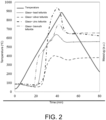
- FIG. 2 is the TGA analysis result of a mixture of a tellurium alloy compound and a glass.
- the weight gain rate curve shows bismuth telluride rapidly increases in weight at low temperature, followed by lead telluride, zinc telluride, and silver telluride in that order. Therefore, it can be known that, in comparison to lead telluride, zinc telluride, and silver telluride having a high-melting point, it is easier for bismuth telluride having lower melting point (585°C) to be oxidized. This phenomenon similarly occurs in FIG.
- the conductive paste of the invention contains the aforementioned high-melting point tellurium alloy compound and can inhibit the occurrence of glass fire-through to control the degree of fire-through, so as to improve electrical connection and increase cell efficiency.
- the material of the glass includes tellurium oxide, bismuth oxide, zinc oxide, lead oxide, silicon oxide, or a combination thereof.
- the present disclosure is not limited thereto, and the material of the glass can also contain one or a plurality of the elements in the group consisting of the following or oxides thereof: phosphorous (P), boron (B), barium (Ba), sodium (Na), magnesium (Mg), zinc (Zn), calcium (Ca), copper (Cu), strontium (Sr), tungsten (W), aluminum (Al), lithium (Li), potassium (K), zirconium (Zr), vanadium (V), selenium (Se), iron (Fe), indium (In), manganese (Mn), tin (Sn), nickel (Ni), antimony (Sb), silver (Ag), silicon (Si), erbium (Er), germanium (Ge), titanium (Ti), thallium (Tl), gallium (Ga), cerium (Ce), niobi
- the total amount of the glass and the tellurium alloy compound is, for instance, 0.02 wt% to 12 wt%, preferably is, for instance, 0.02 wt% to 10 wt%, the amount of the glass is, for instance, 0.01 wt% to 7 wt%, and the amount of the tellurium alloy compound is, for instance, 0.01 wt% to 5 wt%.
- the amount of the glass is, for instance, 0.01 wt% to 2 wt%, and the amount of the tellurium alloy compound is, for instance, 0.5 wt% to 3 wt%.
- the amount of the glass is, for instance, 0.01 wt% to 5 wt%, and the amount of the tellurium alloy compound is, for instance, 0.01 wt% to 3.5 wt%.
- the amount of the glass is, for instance, 0.01 wt% to 6 wt%, and the amount of the tellurium alloy compound is, for instance, 0.25 wt% to 4 wt%.
- the material of the glass includes bismuth oxide, tellurium oxide, and silicon oxide, based on the total weight of the conductive paste for a solar cell, the amount of the glass is, for instance, 0.01 wt% to 3 wt%, and the amount of the tellurium alloy compound is, for instance, 0.25 wt% to 3.5 wt%.
- the amount of the silver powder is, for instance, 60 wt% to 95 wt%, and the particle size of the silver powder is, for instance, 0.05 ⁇ m to 10 ⁇ m.
- the shape of the particle may include flaky, spherical, columnar, blocky, or unspecified shapes that fit the size.
- the organic vehicle can include a solvent, an adhesive, and an additive, and the organic vehicle can be removed during the sintering process performed on the conductive paste.
- the amount of the organic vehicle is, for instance, 5 wt% to 40 wt%.
- the function of the solvent is to dissolve the adhesive to provide viscosity, and can include diethylene glycol monobutyl ether, diethylene glycol monobutyl ether, Texanol, ⁇ -terpineol, or a combination thereof.
- the function of the adhesive is to provide viscosity in the solvent and can include ethylcellulose, methylcellulose, hydroxypropylcellulose, cellulose acetate, nitrocellulose, or a combination thereof.
- the function of the additive is to improve the properties of the conductive paste, and examples thereof can be, but not limited to, a co-initiator, sensitizing agent, coupling agent, dispersant, moisturizing agent, thickener, defoamer, or thixotropic agent; or examples thereof can also be, but are not limited to, zirconium oxide (ZrO 2 ), vanadium pentoxide (V 2 O 5 ), silver oxide (Ag 2 O), erbium oxide (Er 2 O 3 ), tin oxide (SnO), magnesium oxide (MgO), neodymium oxide (Nd 2 O 3 ), selenium dioxide (SeO 2 ), lead oxide (PbO), chrome trioxide (Cr 2 O 3 ), potassium oxide (K 2 O),
- the conductive paste for a solar cell was prepared based on the amount of each component listed in Table 1 to Table 5 below, and the solar cell performance thereof was measured, including fill-factor (FF) and conversion efficiency (NCell).
- FF fill-factor
- NCell conversion efficiency
- the amount of the tellurium alloy compound and the glass is based on the total weight of the conductive paste and is in units of weight percentage.
- a silver powder about 0.01 g to about 7 g of a glass, about 5 g to about 40 g of an organic vehicle, and about 0.01 g to about 5 g of a tellurium alloy compound were uniformly mixed and dispersed in a three-roll mill to form a conductive paste.
- the conductive paste was printed on the front of a solar cell substrate via screen printing, wherein the surface of the solar cell substrate was pre-treated by an anti-reflective printing (silicon nitride), and the back electrode of the solar cell substrate was pre-treated with aluminum adhesive.
- the drying temperature was about 100°C to about 400°C, and the drying time was about 5 seconds to about 30 minutes (different based on the type of the organic vehicle and printing weight).
- the screen printing step was complete at this point.
- a fire-through step was performed on the conductive paste after drying using an infrared conveyor belt sintering furnace, and the sintering temperature was set to about 800°C to about 980°C. Solid electrodes were formed on both the front and back of the solar cell substrate after fire-through.
- the measurement method of solar cell performance included placing the solar cell on a solar test machine (Berger Corporation, Pulsed Solar Load PSL-SCD) and measuring electrical characteristics such as fill-factor (FF, unit%) and conversion efficiency (NCell, unit%) of the solar cell at a solar state of AM1.5G.
- a solar test machine Billerger Corporation, Pulsed Solar Load PSL-SCD
- electrical characteristics such as fill-factor (FF, unit%) and conversion efficiency (NCell, unit%) of the solar cell at a solar state of AM1.5G.
- a glass A mainly contained tellurium oxide, bismuth oxide, and zinc oxide and had a softening point of 365°C, and the conductive paste made by the glass A was printed on a monocrystalline substrate to form a solar cell.
- a high-melting point tellurium alloy compound such as lead telluride, zinc telluride, or silver telluride
- Comparative example 1 in which a low-melting point bismuth telluride was used has significantly lower conversion efficiency NCell.
- Example 11 and 12 are not according to the present invention
- Example 1 4.5 Lead telluride 0.02 55.0 13.13%
- Example 2 3.8 0.05 68.6 16.91%
- Example 3 2.6 0.1 78.4 19.19%
- Example 4 2 0.5 79.2 19.58%
- Example 5 0.1 2.6 72.0 17.63%
- Example 6 0.1 2.96 56.0 13.55%
- Example 7 2.6 Zinc telluride 0.1 78.2 13.13%
- Example 8 2 0.5 78.1 16.91%
- Example 9 1.6 1.1 76.7 19.19%
- Example 10 1.1 1.6 66.4 19.58%
- Example 11 2.6 Silver telluride 0.1 78.5 19.33%
- Example 12 2 0.5 55.3 13.53% Comparative example 1 0.8 Bismuth telluride 1.8 42.2 9.83%
- a glass B mainly contained lead oxide and tellurium oxide and had a softening point of 317°C, and the conductive paste made by the glass B was printed on a monocrystalline substrate to form a solar cell.
- a high-melting point tellurium alloy compound such as lead telluride, zinc telluride, or silver telluride
- Comparative example 2 in which a low-melting point bismuth telluride was used has significantly lower conversion efficiency NCell.
- Example 13-16 are not according to the present invention
- Glass B wt%) Tellurium alloy compound (wt%)
- FF NCell Example 13
- Silver telluride 0.5 79.2 19.75%
- Example 14 1.6 0.9 77.6 19.16%
- Example 15 1.4 1.1 75.1 18.57%
- Example 16 1.2 1.3 64.5 15.61%
- Example 17 5
- Lead telluride 0.1 70.3 17.01%
- Example 18 2
- Example 19 0.1 3.5 62.2 15.03%
- Example 20 Zinc telluride 0.5 62.4 15.45%
- Example 21 1.5 1 57 13.93% Comparative example 2 0.6 Bismuth telluride 1.9 21.6 2.73%
- a glass C mainly contained bismuth oxide, tellurium oxide, and silicon oxide and had a softening point of 465°C, and the conductive paste made by the glass C was printed on a monocrystalline substrate to form a solar cell.
- a high-melting point tellurium alloy compound such as lead telluride or silver telluride
- Comparative example 3 in which a low-melting point bismuth telluride was used has significantly lower conversion efficiency NCell.
- Example 31 is not according to the present invention
- Example 22 2.5 Lead telluride 0.5 60.2 14.36%
- Example 23 1.45 1.05 80 19.15%
- Example 24 2.04 1.06 64.7 15.76%
- Example 25 0.7 1.3 79 19.54%
- Example 26 1.2 1.3 79.6 19.39%
- Example 27 0.7 1.55 80.7 19.32%
- Example 29 0.7 1.8 79.6 19.41%
- Example 30 0.1 3 72.5 18.2%
- Example 31 2
- Silver telluride 0.5 51.5 12.87% Comparative example 3 0.7 Bismuth telluride 1.3 25.4 4.13%
- Example 34 and 35 are not according to the present invention. Glass D (wt%) Tellurium alloy compound (wt%) FF NCell Example 32 1.8 Lead telluride 0.75 47.6 11.08% Example 33 0.1 2.5 78.3 19.01% Example 34 1.5 Silver telluride 1 61.4 14.65% Example 35 0.5 2 49.3 11.9% Comparative example 4 1.5 Bismuth telluride 1 35.9 7.89%
- Example 39 is not according to the present application
- Example 36 0.5 Lead telluride 1.5 76.74 17.2%
- Example 37 1.0 1.5 73.59 16.34%
- Example 38 1.5 1.5 70.31 15.45%
- Example 39 1.5
- Silver telluride 1.5 49.3 15.03%
- Example 40 1.5
- Zinc telluride 1.5 61.74 13.72% Comparative example 5 1.5 Bismuth telluride 1.25 35.73 6.87%
- the conductive paste contains a low-melting point tellurium alloy compound, regardless of whether a monocrystalline or polycrystalline substrate is used, molten glass fire through earlier, such that the PN junction is fired through and cell efficiency is reduced as a result.
- the conductive paste contains a high-melting point tellurium alloy compound having a melting point of 900°C or more, fire-through of the glass can be inhibited to control the degree of fire-through. Therefore, the electrical connection of the solar cell can be improved and cell efficiency can be increased.
Landscapes
- Chemical & Material Sciences (AREA)
- Life Sciences & Earth Sciences (AREA)
- Engineering & Computer Science (AREA)
- Geochemistry & Mineralogy (AREA)
- Organic Chemistry (AREA)
- Materials Engineering (AREA)
- Chemical Kinetics & Catalysis (AREA)
- General Chemical & Material Sciences (AREA)
- Dispersion Chemistry (AREA)
- Spectroscopy & Molecular Physics (AREA)
- Physics & Mathematics (AREA)
- Inorganic Chemistry (AREA)
- Conductive Materials (AREA)
- Photovoltaic Devices (AREA)
- Sustainable Development (AREA)
- Sustainable Energy (AREA)
Description
- The invention relates to a conductive paste for a solar cell, a solar cell and a manufacturing method thereof, and a solar cell module, and more particularly, to a conductive paste for a solar cell, a solar cell and a manufacturing method thereof, and a solar cell module that can improve electrical connection and increase cell efficiency.
- The solar cell is a device converting sunlight into electric energy that generates electrons and electron holes via the irradiation of visible light on a substrate, and the electrons and electron holes are guided by a front electrode (light-receiving surface) and a back electrode (non-light-receiving surface) located at two sides of the substrate to form a current. These two electrodes can be formed by adhering a conductive paste on the substrate using a screen printing or coating method and then performing sintering in a specific temperature range.
- In the manufacturing process of a solar cell, the main material is the conductive paste, and the components, amounts, and sintering conditions of the conductive paste all may affect the electrical performance of the solar cell after the paste is sintered. More specifically, when molten glass is excessively fired through, cell efficiency may be reduced.
- Based on the above, the development of a front electrode silver paste that can inhibit glass fire-through to control the degree of fire-through so as to improve electrical connection of the solar cell and increase cell efficiency is an important topic requiring research.
US 2014/0290735 A1 discloses a composition for solar cell electrodes that includes silver powder.US 2014/0021417 A1 discloses a paste composition capable of forming a silver electrode having a high bond strength and a low contact resistance. - The invention provides a conductive paste for a solar cell containing a high-melting point tellurium alloy compound that can inhibit glass fire-through to control the degree of fire-through, so as to improve electrical connection and increase cell efficiency. At the same time, the invention provides a solar cell and a manufacturing method thereof and a solar cell module.
- The conductive paste for a solar cell of the invention comprises a silver powder, a glass, an organic vehicle, and a tellurium alloy compound, wherein the tellurium alloy compound has a melting point at least 300 °C higher than the softening point of the glass; and wherein the melting point of the tellurium alloy compound is 900°C or more; the tellurium alloy compound comprises lead telluride, zinc telluride, silver telluride, or a combination thereof; and a material of the glass comprises tellurium oxide, bismuth oxide, zinc oxide, lead oxide, silicon oxide, or a combination thereof.
- In an embodiment of the invention, based on the total weight of the conductive paste for a solar cell, the amount of the glass is 0.01 wt% to 7 wt%, and the amount of the tellurium alloy compound is 0.01 wt% to 5 wt%.
- In an embodiment of the invention, the material of the glass includes tellurium oxide, bismuth oxide, and zinc oxide, and based on the total weight of the conductive paste for a solar cell, the amount of the tellurium alloy compound is 0.01 wt% to 3.5 wt%.
- In an embodiment of the invention, the material of the glass includes lead oxide and tellurium oxide, and based on the total weight of the conductive paste for a solar cell, the amount of the tellurium alloy compound is 0.25 wt% to 4 wt%.
- In an embodiment of the invention, the material of the glass includes tellurium oxide, bismuth oxide, and silicon oxide, and based on the total weight of the conductive paste for a solar cell, the amount of the tellurium alloy compound is 0.25 wt% to 3.5 wt%.
- In an embodiment of the invention, the material of the glass includes lead oxide and bismuth oxide, and based on the total weight of the conductive paste for a solar cell, the amount of the tellurium alloy compound is 0.5 wt% to 3 wt%.
- The solar cell of the invention includes an electrode made by the aforementioned conductive paste for a solar cell.
- The manufacturing method of a solar cell of the invention forms an electrode for a solar cell using the aforementioned conductive paste for a solar cell.
- The solar cell module of the invention includes the aforementioned solar cell or a solar cell made by the aforementioned manufacturing method of a solar cell.
- Based on the above, the conductive paste for a solar cell of the invention contains a high-melting point tellurium alloy compound having a melting point (such as 900°C or more) at least 300°C higher than the softening point of glass. Therefore, the fire-through of the glass can be inhibited to control the degree of fire-through so as to improve electrical connection and increase cell efficiency. As a result, the issue of reduced cell efficiency caused by glass firing through the PN junction in the prior art can be solved.
- In order to make the aforementioned features and advantages of the invention more comprehensible, embodiments are described in detail below.
- The accompanying drawings are included to provide a further understanding of the invention, and are incorporated in and constitute a part of this specification. The drawings illustrate embodiments of the invention and, together with the description, serve to explain the principles of the invention.
-
FIG. 1 is the TGA analysis result of a tellurium alloy compound. -
FIG. 2 is the TGA analysis result of a mixture of a tellurium alloy compound and a glass. - The invention provides the conductive paste for a solar cell according to claim 1. Hereinafter, each component in the conductive paste for a solar cell of the invention is described in detail.
- In the present embodiment, the high-melting point tellurium alloy compound has a melting point at least 300°C higher than the softening point of glass, and the melting point thereof is 900°C or more. The softening point of the glass of the invention is, for instance, 317°C to 465°C, and the tellurium alloy compound has a melting point at least 300°C higher than the softening point of the glass. The melting point of the tellurium alloy compound is 900 °C or more. The tellurium alloy compound includes lead telluride, zinc telluride, or a combination thereof, wherein the melting point of lead telluride is about 924°C, the melting point of silver telluride is about 955°C, and the melting point of zinc telluride is about 1238°C. However, the present disclosure is not limited thereto, and other tellurium alloy compounds having a melting point of 900°C or more can also be used, such as copper telluride, manganese telluride, cadmium telluride, or iron telluride, wherein the melting point of copper telluride is about 1125°C, the melting point of manganese telluride is about 1150 °C, the melting point of cadmium telluride is about 1090°C, and the melting point of iron telluride is about 914°C.
-
FIG. 1 is the thermogravimetric analysis (TGA) result of a tellurium alloy compound.FIG. 2 is the TGA analysis result of a mixture of a tellurium alloy compound and a glass. When temperature rise in TGA is controlled, the occurrence of material oxidization can be speculated from the material weight gain rate curve, especially when the material weight gain rate is increased rapidly. - As shown in
FIG. 1 , among the four kinds of tellurium alloy compounds of bismuth telluride, lead telluride, zinc telluride, and silver telluride, the weight gain rate curve shows bismuth telluride rapidly increases in weight at low temperature, followed by lead telluride, zinc telluride, and silver telluride in that order. Therefore, it can be known that, in comparison to lead telluride, zinc telluride, and silver telluride having a high-melting point, it is easier for bismuth telluride having lower melting point (585°C) to be oxidized. This phenomenon similarly occurs inFIG. 2 , and even in the case in which the tellurium alloy compound and glass are mixed, the order in which mass starts to increase is a mixture containing bismuth telluride followed by mixtures of lead telluride, zinc telluride, and silver telluride. Therefore, in the case that glass is mixed, in comparison to bismuth telluride having a lower melting point, lead telluride, zinc telluride, and silver telluride having a high melting point still have the characteristic of not readily oxidized. Based on the aforementioned TGA result, the conductive paste of the invention contains the aforementioned high-melting point tellurium alloy compound and can inhibit the occurrence of glass fire-through to control the degree of fire-through, so as to improve electrical connection and increase cell efficiency. - In the present embodiment, the material of the glass includes tellurium oxide, bismuth oxide, zinc oxide, lead oxide, silicon oxide, or a combination thereof. However, the present disclosure is not limited thereto, and the material of the glass can also contain one or a plurality of the elements in the group consisting of the following or oxides thereof: phosphorous (P), boron (B), barium (Ba), sodium (Na), magnesium (Mg), zinc (Zn), calcium (Ca), copper (Cu), strontium (Sr), tungsten (W), aluminum (Al), lithium (Li), potassium (K), zirconium (Zr), vanadium (V), selenium (Se), iron (Fe), indium (In), manganese (Mn), tin (Sn), nickel (Ni), antimony (Sb), silver (Ag), silicon (Si), erbium (Er), germanium (Ge), titanium (Ti), thallium (Tl), gallium (Ga), cerium (Ce), niobium (Nb), samarium (Sm), and lanthanum (La).
- More specifically, based on the total weight of the conductive paste for a solar cell, the total amount of the glass and the tellurium alloy compound is, for instance, 0.02 wt% to 12 wt%, preferably is, for instance, 0.02 wt% to 10 wt%, the amount of the glass is, for instance, 0.01 wt% to 7 wt%, and the amount of the tellurium alloy compound is, for instance, 0.01 wt% to 5 wt%.
- For instance, when the material of the glass includes lead oxide and bismuth oxide, based on the total weight of the conductive paste for a solar cell, the amount of the glass is, for instance, 0.01 wt% to 2 wt%, and the amount of the tellurium alloy compound is, for instance, 0.5 wt% to 3 wt%. When the material of the glass includes tellurium oxide, bismuth oxide, and zinc oxide, based on the total weight of the conductive paste for a solar cell, the amount of the glass is, for instance, 0.01 wt% to 5 wt%, and the amount of the tellurium alloy compound is, for instance, 0.01 wt% to 3.5 wt%. Alternatively, when the material of the glass includes lead oxide and tellurium oxide, based on the total weight of the conductive paste for a solar cell, the amount of the glass is, for instance, 0.01 wt% to 6 wt%, and the amount of the tellurium alloy compound is, for instance, 0.25 wt% to 4 wt%. Alternatively, when the material of the glass includes bismuth oxide, tellurium oxide, and silicon oxide, based on the total weight of the conductive paste for a solar cell, the amount of the glass is, for instance, 0.01 wt% to 3 wt%, and the amount of the tellurium alloy compound is, for instance, 0.25 wt% to 3.5 wt%.
- In the present embodiment, based on the total weight of the conductive paste for a solar cell, the amount of the silver powder is, for instance, 60 wt% to 95 wt%, and the particle size of the silver powder is, for instance, 0.05 µm to 10 µm. The shape of the particle may include flaky, spherical, columnar, blocky, or unspecified shapes that fit the size.
- In the present embodiment, the organic vehicle can include a solvent, an adhesive, and an additive, and the organic vehicle can be removed during the sintering process performed on the conductive paste. Based on the total weight of the conductive paste for a solar cell, the amount of the organic vehicle is, for instance, 5 wt% to 40 wt%. More specifically, the function of the solvent is to dissolve the adhesive to provide viscosity, and can include diethylene glycol monobutyl ether, diethylene glycol monobutyl ether, Texanol, α-terpineol, or a combination thereof. The function of the adhesive is to provide viscosity in the solvent and can include ethylcellulose, methylcellulose, hydroxypropylcellulose, cellulose acetate, nitrocellulose, or a combination thereof. The function of the additive is to improve the properties of the conductive paste, and examples thereof can be, but not limited to, a co-initiator, sensitizing agent, coupling agent, dispersant, moisturizing agent, thickener, defoamer, or thixotropic agent; or examples thereof can also be, but are not limited to, zirconium oxide (ZrO2), vanadium pentoxide (V2O5), silver oxide (Ag2O), erbium oxide (Er2O3), tin oxide (SnO), magnesium oxide (MgO), neodymium oxide (Nd2O3), selenium dioxide (SeO2), lead oxide (PbO), chrome trioxide (Cr2O3), potassium oxide (K2O), phosphorus pentoxide (P2O5), manganese dioxide (MnO2), nickel oxide (NiO), samarium trioxide (Sm2O3), germanium dioxide (GeO2), zinc fluoride (ZnF2), indium trioxide (In2O3), or gallium oxide (Ga2O3).
- In the following, the conductive paste for a solar cell provided in the invention is described in detail via an experimental example. However, the following experimental example is not intended to limit the invention.
- To prove that the conductive paste of the invention can improve electrical connection and increase cell efficiency, the following experimental examples are provided.
- The conductive paste for a solar cell was prepared based on the amount of each component listed in Table 1 to Table 5 below, and the solar cell performance thereof was measured, including fill-factor (FF) and conversion efficiency (NCell). In Table 1 to Table 5, the amount of the tellurium alloy compound and the glass is based on the total weight of the conductive paste and is in units of weight percentage.
- In the preparation method, about 60 g to about 90 g of a silver powder, about 0.01 g to about 7 g of a glass, about 5 g to about 40 g of an organic vehicle, and about 0.01 g to about 5 g of a tellurium alloy compound were uniformly mixed and dispersed in a three-roll mill to form a conductive paste. The conductive paste was printed on the front of a solar cell substrate via screen printing, wherein the surface of the solar cell substrate was pre-treated by an anti-reflective printing (silicon nitride), and the back electrode of the solar cell substrate was pre-treated with aluminum adhesive. After screen printing, the drying temperature was about 100°C to about 400°C, and the drying time was about 5 seconds to about 30 minutes (different based on the type of the organic vehicle and printing weight). The screen printing step was complete at this point. A fire-through step was performed on the conductive paste after drying using an infrared conveyor belt sintering furnace, and the sintering temperature was set to about 800°C to about 980°C. Solid electrodes were formed on both the front and back of the solar cell substrate after fire-through.
- The measurement method of solar cell performance included placing the solar cell on a solar test machine (Berger Corporation, Pulsed Solar Load PSL-SCD) and measuring electrical characteristics such as fill-factor (FF, unit%) and conversion efficiency (NCell, unit%) of the solar cell at a solar state of AM1.5G.
- In Table 1, a glass A mainly contained tellurium oxide, bismuth oxide, and zinc oxide and had a softening point of 365°C, and the conductive paste made by the glass A was printed on a monocrystalline substrate to form a solar cell. As shown in Table 1, in comparison to Example 1 to Example 12 in which a high-melting point tellurium alloy compound (such as lead telluride, zinc telluride, or silver telluride) was used, Comparative example 1 in which a low-melting point bismuth telluride was used has significantly lower conversion efficiency NCell.
Table 1 (Examples 11 and 12 are not according to the present invention) Glass A (wt%) Tellurium alloy compound (wt%) FF NCell Example 1 4.5 Lead telluride 0.02 55.0 13.13% Example 2 3.8 0.05 68.6 16.91% Example 3 2.6 0.1 78.4 19.19% Example 4 2 0.5 79.2 19.58% Example 5 0.1 2.6 72.0 17.63% Example 6 0.1 2.96 56.0 13.55% Example 7 2.6 Zinc telluride 0.1 78.2 13.13% Example 8 2 0.5 78.1 16.91% Example 9 1.6 1.1 76.7 19.19% Example 10 1.1 1.6 66.4 19.58% Example 11 2.6 Silver telluride 0.1 78.5 19.33% Example 12 2 0.5 55.3 13.53% Comparative example 1 0.8 Bismuth telluride 1.8 42.2 9.83% - In Table 2, a glass B mainly contained lead oxide and tellurium oxide and had a softening point of 317°C, and the conductive paste made by the glass B was printed on a monocrystalline substrate to form a solar cell. As shown in Table 2, in comparison to Example 13 to Example 21 in which a high-melting point tellurium alloy compound (such as lead telluride, zinc telluride, or silver telluride) was used, Comparative example 2 in which a low-melting point bismuth telluride was used has significantly lower conversion efficiency NCell.
Table 2 (Examples 13-16 are not according to the present invention) Glass B (wt%) Tellurium alloy compound (wt%) FF NCell Example 13 2 Silver telluride 0.5 79.2 19.75% Example 14 1.6 0.9 77.6 19.16% Example 15 1.4 1.1 75.1 18.57% Example 16 1.2 1.3 64.5 15.61% Example 17 5 Lead telluride 0.1 70.3 17.01% Example 18 2 0.5 79.0 19.72% Example 19 0.1 3.5 62.2 15.03% Example 20 2 Zinc telluride 0.5 62.4 15.45% Example 21 1.5 1 57 13.93% Comparative example 2 0.6 Bismuth telluride 1.9 21.6 2.73% - In Table 3, a glass C mainly contained bismuth oxide, tellurium oxide, and silicon oxide and had a softening point of 465°C, and the conductive paste made by the glass C was printed on a monocrystalline substrate to form a solar cell. As shown in Table 3, in comparison to Example 22 to Example 31 in which a high-melting point tellurium alloy compound (such as lead telluride or silver telluride) was used, Comparative example 3 in which a low-melting point bismuth telluride was used has significantly lower conversion efficiency NCell.
Table 3 (Example 31 is not according to the present invention) Glass C (wt%) Tellurium alloy compound (wt%) FF NCell Example 22 2.5 Lead telluride 0.5 60.2 14.36% Example 23 1.45 1.05 80 19.15% Example 24 2.04 1.06 64.7 15.76% Example 25 0.7 1.3 79 19.54% Example 26 1.2 1.3 79.6 19.39% Example 27 0.7 1.55 80.7 19.32% Example 28 0.95 1.55 79.6 19.39% Example 29 0.7 1.8 79.6 19.41% Example 30 0.1 3 72.5 18.2% Example 31 2 Silver telluride 0.5 51.5 12.87% Comparative example 3 0.7 Bismuth telluride 1.3 25.4 4.13% - In Table 4, a glass D mainly contained lead oxide and bismuth oxide and had a softening point of 440°C, and the conductive paste made by the glass D was printed on a monocrystalline substrate to form a solar cell. As shown in Table 4, in comparison to Example 32 to Example 35 in which a high-melting point tellurium alloy compound (such as lead telluride or silver telluride) was used, Comparative example 4 in which a low-melting point bismuth telluride was used has significantly lower conversion efficiency NCell.
Table 4 (Example 34 and 35 are not according to the present invention) Glass D (wt%) Tellurium alloy compound (wt%) FF NCell Example 32 1.8 Lead telluride 0.75 47.6 11.08% Example 33 0.1 2.5 78.3 19.01% Example 34 1.5 Silver telluride 1 61.4 14.65% Example 35 0.5 2 49.3 11.9% Comparative example 4 1.5 Bismuth telluride 1 35.9 7.89% - In Table 5, the conductive paste made by a glass D was printed on a polycrystalline substrate to form a solar cell. As shown in Table 5, in comparison to Example 36 to Example 40 in which a high-melting point tellurium alloy compound (such as lead telluride, zinc telluride, or silver telluride) was used, Comparative example 5 in which a low-melting point bismuth telluride was used has significantly lower conversion efficiency NCell.
Table 5 (Example 39 is not according to the present application) Glass D (wt%) Tellurium alloy compound (wt%) FF NCell Example 36 0.5 Lead telluride 1.5 76.74 17.2% Example 37 1.0 1.5 73.59 16.34% Example 38 1.5 1.5 70.31 15.45% Example 39 1.5 Silver telluride 1.5 49.3 15.03% Example 40 1.5 Zinc telluride 1.5 61.74 13.72% Comparative example 5 1.5 Bismuth telluride 1.25 35.73 6.87% - Based on the experimental results of Table 1 to Table 5 above, when the conductive paste contains a low-melting point tellurium alloy compound, regardless of whether a monocrystalline or polycrystalline substrate is used, molten glass fire through earlier, such that the PN junction is fired through and cell efficiency is reduced as a result. In comparison, when the conductive paste contains a high-melting point tellurium alloy compound having a melting point of 900°C or more, fire-through of the glass can be inhibited to control the degree of fire-through. Therefore, the electrical connection of the solar cell can be improved and cell efficiency can be increased.
- Based on the above, the invention provides a conductive paste for a solar cell that can be used to form a positive electrode of the solar cell and contains a high-melting point tellurium alloy compound having a melting point (900°C or more) at least 300°C higher than the softening point of glass. Therefore, fire-through of the glass can be inhibited to control the degree of fire-through, so as to improve electrical connection and increase cell efficiency. As a result, the issue of reduced cell efficiency caused by excessive fire-through of molten glass in the prior art can be solved.
Claims (9)
- A conductive paste for a solar cell, comprising:a silver powder;a glass;an organic vehicle; anda tellurium alloy compound, wherein the tellurium alloy compound has a melting point at least 300°C higher than a softening point of the glass; andwherein- the melting point of the tellurium alloy compound is 900°C or more;- the tellurium alloy compound comprises lead telluride, zinc telluride or a combination thereof; and- a material of the glass comprises tellurium oxide, bismuth oxide, zinc oxide, lead oxide, silicon oxide, or a combination thereof.
- The conductive paste for the solar cell of claim 1, wherein based on a total weight of the conductive paste for the solar cell, an amount of the glass is 0.01 wt% to 7 wt%, and an amount of the tellurium alloy compound is 0.01 wt% to 5 wt%.
- The conductive paste for the solar cell of claim 1, wherein the material of the glass comprises tellurium oxide, bismuth oxide, and zinc oxide, and based on a total weight of the conductive paste for the solar cell, an amount of the tellurium alloy compound is 0.01 wt% to 3.5 wt%.
- The conductive paste for the solar cell of claim 1, wherein the material of the glass comprises lead oxide and tellurium oxide, and based on a total weight of the conductive paste for the solar cell, an amount of the tellurium alloy compound is 0.25 wt% to 4 wt%.
- The conductive paste for the solar cell of claim 1, wherein the material of the glass comprises tellurium oxide, bismuth oxide, and silicon oxide, and based on a total weight of the conductive paste for the solar cell, an amount of the tellurium alloy compound is 0.25 wt% to 3.5 wt%.
- The conductive paste for the solar cell of claim 1, wherein the material of the glass comprises lead oxide and bismuth oxide, and based on a total weight of the conductive paste for the solar cell, an amount of the tellurium alloy compound is 0.5 wt% to 3 wt%.
- A solar cell comprising an electrode made by the conductive paste for the solar cell of any of claims 1 to 6.
- A manufacturing method of a solar cell, wherein the conductive paste for the solar cell of any of claims 1 to 6 is used to form an electrode of the solar cell.
- A solar cell module comprising the solar cell of claim 7 or the solar cell made by the manufacturing method of the solar cell of claim 8.
Applications Claiming Priority (1)
| Application Number | Priority Date | Filing Date | Title |
|---|---|---|---|
| TW106114170A TWI638793B (en) | 2017-04-28 | 2017-04-28 | Conductive paste for solar battery, solar battery, manufacturing method thereof and solar battery module |
Publications (2)
| Publication Number | Publication Date |
|---|---|
| EP3396680A1 EP3396680A1 (en) | 2018-10-31 |
| EP3396680B1 true EP3396680B1 (en) | 2023-12-27 |
Family
ID=62044545
Family Applications (1)
| Application Number | Title | Priority Date | Filing Date |
|---|---|---|---|
| EP18168445.7A Active EP3396680B1 (en) | 2017-04-28 | 2018-04-20 | Conductive paste for solar cell, solar cell and manufacturing method thereof, and solar cell module |
Country Status (4)
| Country | Link |
|---|---|
| US (1) | US10923608B2 (en) |
| EP (1) | EP3396680B1 (en) |
| JP (1) | JP2018190967A (en) |
| TW (1) | TWI638793B (en) |
Families Citing this family (3)
| Publication number | Priority date | Publication date | Assignee | Title |
|---|---|---|---|---|
| KR102238252B1 (en) * | 2019-10-24 | 2021-04-09 | 주식회사 베이스 | Glass frit and electrode paste composition for solar cell comprising the same |
| US12238870B2 (en) * | 2020-01-15 | 2025-02-25 | Liquid Wire Inc. | Deposition with solid feedstock |
| KR20220153572A (en) | 2020-03-26 | 2022-11-18 | 도와 일렉트로닉스 가부시키가이샤 | Silver powder, manufacturing method thereof, and conductive paste |
Family Cites Families (22)
| Publication number | Priority date | Publication date | Assignee | Title |
|---|---|---|---|---|
| US5183784A (en) * | 1990-02-21 | 1993-02-02 | Johnson Matthey Inc. | Silver-glass pastes |
| JP2002141520A (en) | 2000-10-31 | 2002-05-17 | Kyocera Corp | Solar cell element and method of manufacturing the same |
| WO2010016186A1 (en) | 2008-08-07 | 2010-02-11 | 京都エレックス株式会社 | Conductive paste for formation of a solar cell element electrode, solar cell element, and manufacturing method for said solar cell element |
| CN103038186B (en) | 2010-05-04 | 2018-11-09 | E·I·内穆尔杜邦公司 | Thick film pastes comprising lead oxide and tellurium oxide and their use in the manufacture of semiconductor devices |
| JP5690780B2 (en) | 2012-07-18 | 2015-03-25 | 株式会社ノリタケカンパニーリミテド | Ag electrode forming paste composition, method for producing the same, and solar cell |
| KR20140017052A (en) | 2012-07-27 | 2014-02-11 | 주식회사 휘닉스소재 | Paste composition, and electrode for solar cell and solar cell including the same |
| CN103596648B (en) | 2013-02-04 | 2017-03-15 | 深圳市首骋新材料科技有限公司 | Conductive paste for front electrode of crystalline silicon solar cell and preparation method thereof |
| KR101648242B1 (en) | 2013-03-27 | 2016-08-12 | 제일모직주식회사 | Composition for forming solar cell electrode and electrode prepared using the same |
| JP2014207312A (en) | 2013-04-12 | 2014-10-30 | 株式会社村田製作所 | Conductive paste for solar cell, process of manufacturing solar cell, and solar cell module |
| WO2015076157A1 (en) | 2013-11-20 | 2015-05-28 | 株式会社ノリタケカンパニーリミテド | Method for producing conductive composition |
| JP6242198B2 (en) * | 2013-12-10 | 2017-12-06 | 京都エレックス株式会社 | Conductive paste for forming conductive film of semiconductor device, semiconductor device, and method for manufacturing semiconductor device |
| JP5903424B2 (en) | 2013-12-21 | 2016-04-13 | 株式会社ノリタケカンパニーリミテド | Conductive paste composition for solar cell and method for producing the same |
| KR101452966B1 (en) | 2014-04-15 | 2014-10-23 | 덕산하이메탈(주) | Conductive paste composition and semiconductor devices comprising the same |
| KR20150121603A (en) | 2014-04-21 | 2015-10-29 | 덕산하이메탈(주) | Metal Particles |
| US9209323B2 (en) | 2014-05-05 | 2015-12-08 | E I Du Pont De Nemours And Company | Conductive paste used for solar cell electrodes and method of manufacturing the solar cell electrodes |
| JP5998178B2 (en) | 2014-06-05 | 2016-09-28 | 株式会社ノリタケカンパニーリミテド | Photovoltaic surface electrode paste for solar cell, method for producing the same, and method for producing solar cell |
| TWI521546B (en) | 2014-12-08 | 2016-02-11 | 碩禾電子材料股份有限公司 | Conductive paste containing lead-free glass frit (3) |
| KR101696985B1 (en) | 2014-12-30 | 2017-01-17 | 삼성에스디아이 주식회사 | Composition for forming solar cell electrode and electrode prepared using the same |
| CN104575669A (en) | 2015-01-21 | 2015-04-29 | 浙江中希电子科技有限公司 | Solar cell back face silver paste and preparing method thereof |
| JP6580383B2 (en) | 2015-06-17 | 2019-09-25 | ナミックス株式会社 | Conductive paste, solar cell, and method for manufacturing solar cell |
| EP3387653A4 (en) | 2015-12-10 | 2019-07-17 | Sun Chemical Corporation | SILVER CONDUCTIVE PASTE COMPOSITION |
| GB201601034D0 (en) | 2016-01-20 | 2016-03-02 | Johnson Matthey Plc | Conductive paste,electrode and solar cell |
-
2017
- 2017-04-28 TW TW106114170A patent/TWI638793B/en active
-
2018
- 2018-03-30 US US15/940,976 patent/US10923608B2/en active Active
- 2018-04-16 JP JP2018078588A patent/JP2018190967A/en active Pending
- 2018-04-20 EP EP18168445.7A patent/EP3396680B1/en active Active
Also Published As
| Publication number | Publication date |
|---|---|
| JP2018190967A (en) | 2018-11-29 |
| TW201838946A (en) | 2018-11-01 |
| US20180315868A1 (en) | 2018-11-01 |
| TWI638793B (en) | 2018-10-21 |
| US10923608B2 (en) | 2021-02-16 |
| EP3396680A1 (en) | 2018-10-31 |
Similar Documents
| Publication | Publication Date | Title |
|---|---|---|
| CN109065215B (en) | Conductive paste and solar cell | |
| JP6084249B2 (en) | Conductive paste containing lead-free glass frit | |
| KR101736773B1 (en) | Rear electrode paste for solar cell | |
| KR101659131B1 (en) | Composition for forming solar cell electrode and electrode prepared using the same | |
| EP2654087A1 (en) | Tellurium inorganic reaction systems for conductive thick film paste for solar cell contacts | |
| WO2013046903A1 (en) | Lead-free conductive paste composition for solar cells | |
| KR102004490B1 (en) | Rear electrode paste for solar cell | |
| KR101780531B1 (en) | Composition for forming solar cell electrode and electrode prepared using the same | |
| US20130186463A1 (en) | Conductive silver paste for a metal-wrap-through silicon solar cell | |
| CN102652118A (en) | Glass compositions used in conductors for photovoltaic cells | |
| JP2015525181A (en) | Glass compositions and their use in conductive silver pastes | |
| KR20160014503A (en) | Composition for forming solar cell electrode, electrode prepared using the same, and solar cell having the electrode | |
| US10923608B2 (en) | Conductive paste for solar cell, solar cell and manufacturing method thereof, and solar cell module | |
| KR101731674B1 (en) | Composition for forming solar cell electrode and electrode prepared using the same | |
| KR20190073210A (en) | Composition for forming solar cell electrode and electrode prepared using the same | |
| KR101737172B1 (en) | Composition for forming solar cell electrode and electrode prepared using the same | |
| KR102171405B1 (en) | Composition for forming solar cell electrode and electrode prepared using the same | |
| CN108806828B (en) | Conductive paste for solar cell, solar cell and method for manufacturing same, and solar cell module | |
| KR101582374B1 (en) | Composition for forming solar cell electrode and electrode prepared using the same | |
| KR102018364B1 (en) | Composition for forming solar cell electrode and electrode prepared using the same | |
| US20190035951A1 (en) | Composition for solar cell electrode and electrode prepared using the same | |
| KR102761733B1 (en) | Solar cell electrode and method for forming the same | |
| KR20190066158A (en) | Composition for forming solar cell electrode and electrode prepared using the same | |
| KR101845102B1 (en) | Composition for forming solar cell electrode and electrode prepared using the same | |
| KR101961946B1 (en) | Glass frit, paste for forming perc solar cell electrode comprising the same and perc solar cell electrode |
Legal Events
| Date | Code | Title | Description |
|---|---|---|---|
| PUAI | Public reference made under article 153(3) epc to a published international application that has entered the european phase |
Free format text: ORIGINAL CODE: 0009012 |
|
| STAA | Information on the status of an ep patent application or granted ep patent |
Free format text: STATUS: REQUEST FOR EXAMINATION WAS MADE |
|
| 17P | Request for examination filed |
Effective date: 20180420 |
|
| AK | Designated contracting states |
Kind code of ref document: A1 Designated state(s): AL AT BE BG CH CY CZ DE DK EE ES FI FR GB GR HR HU IE IS IT LI LT LU LV MC MK MT NL NO PL PT RO RS SE SI SK SM TR |
|
| AX | Request for extension of the european patent |
Extension state: BA ME |
|
| RBV | Designated contracting states (corrected) |
Designated state(s): AL AT BE BG CH CY CZ DE DK EE ES FI FR GB GR HR HU IE IS IT LI LT LU LV MC MK MT NL NO PL PT RO RS SE SI SK SM TR |
|
| STAA | Information on the status of an ep patent application or granted ep patent |
Free format text: STATUS: EXAMINATION IS IN PROGRESS |
|
| 17Q | First examination report despatched |
Effective date: 20210208 |
|
| GRAP | Despatch of communication of intention to grant a patent |
Free format text: ORIGINAL CODE: EPIDOSNIGR1 |
|
| STAA | Information on the status of an ep patent application or granted ep patent |
Free format text: STATUS: GRANT OF PATENT IS INTENDED |
|
| INTG | Intention to grant announced |
Effective date: 20230831 |
|
| GRAS | Grant fee paid |
Free format text: ORIGINAL CODE: EPIDOSNIGR3 |
|
| GRAA | (expected) grant |
Free format text: ORIGINAL CODE: 0009210 |
|
| STAA | Information on the status of an ep patent application or granted ep patent |
Free format text: STATUS: THE PATENT HAS BEEN GRANTED |
|
| AK | Designated contracting states |
Kind code of ref document: B1 Designated state(s): AL AT BE BG CH CY CZ DE DK EE ES FI FR GB GR HR HU IE IS IT LI LT LU LV MC MK MT NL NO PL PT RO RS SE SI SK SM TR |
|
| P01 | Opt-out of the competence of the unified patent court (upc) registered |
Effective date: 20231116 |
|
| REG | Reference to a national code |
Ref country code: GB Ref legal event code: FG4D |
|
| REG | Reference to a national code |
Ref country code: CH Ref legal event code: EP |
|
| REG | Reference to a national code |
Ref country code: DE Ref legal event code: R096 Ref document number: 602018063120 Country of ref document: DE |
|
| REG | Reference to a national code |
Ref country code: IE Ref legal event code: FG4D |
|
| PG25 | Lapsed in a contracting state [announced via postgrant information from national office to epo] |
Ref country code: GR Free format text: LAPSE BECAUSE OF FAILURE TO SUBMIT A TRANSLATION OF THE DESCRIPTION OR TO PAY THE FEE WITHIN THE PRESCRIBED TIME-LIMIT Effective date: 20240328 |
|
| REG | Reference to a national code |
Ref country code: LT Ref legal event code: MG9D |
|
| PG25 | Lapsed in a contracting state [announced via postgrant information from national office to epo] |
Ref country code: LT Free format text: LAPSE BECAUSE OF FAILURE TO SUBMIT A TRANSLATION OF THE DESCRIPTION OR TO PAY THE FEE WITHIN THE PRESCRIBED TIME-LIMIT Effective date: 20231227 |
|
| PG25 | Lapsed in a contracting state [announced via postgrant information from national office to epo] |
Ref country code: ES Free format text: LAPSE BECAUSE OF FAILURE TO SUBMIT A TRANSLATION OF THE DESCRIPTION OR TO PAY THE FEE WITHIN THE PRESCRIBED TIME-LIMIT Effective date: 20231227 |
|
| PG25 | Lapsed in a contracting state [announced via postgrant information from national office to epo] |
Ref country code: LT Free format text: LAPSE BECAUSE OF FAILURE TO SUBMIT A TRANSLATION OF THE DESCRIPTION OR TO PAY THE FEE WITHIN THE PRESCRIBED TIME-LIMIT Effective date: 20231227 Ref country code: GR Free format text: LAPSE BECAUSE OF FAILURE TO SUBMIT A TRANSLATION OF THE DESCRIPTION OR TO PAY THE FEE WITHIN THE PRESCRIBED TIME-LIMIT Effective date: 20240328 Ref country code: FI Free format text: LAPSE BECAUSE OF FAILURE TO SUBMIT A TRANSLATION OF THE DESCRIPTION OR TO PAY THE FEE WITHIN THE PRESCRIBED TIME-LIMIT Effective date: 20231227 Ref country code: ES Free format text: LAPSE BECAUSE OF FAILURE TO SUBMIT A TRANSLATION OF THE DESCRIPTION OR TO PAY THE FEE WITHIN THE PRESCRIBED TIME-LIMIT Effective date: 20231227 Ref country code: BG Free format text: LAPSE BECAUSE OF FAILURE TO SUBMIT A TRANSLATION OF THE DESCRIPTION OR TO PAY THE FEE WITHIN THE PRESCRIBED TIME-LIMIT Effective date: 20240327 |
|
| REG | Reference to a national code |
Ref country code: NL Ref legal event code: MP Effective date: 20231227 |
|
| REG | Reference to a national code |
Ref country code: AT Ref legal event code: MK05 Ref document number: 1645330 Country of ref document: AT Kind code of ref document: T Effective date: 20231227 |
|
| PG25 | Lapsed in a contracting state [announced via postgrant information from national office to epo] |
Ref country code: NL Free format text: LAPSE BECAUSE OF FAILURE TO SUBMIT A TRANSLATION OF THE DESCRIPTION OR TO PAY THE FEE WITHIN THE PRESCRIBED TIME-LIMIT Effective date: 20231227 |
|
| PG25 | Lapsed in a contracting state [announced via postgrant information from national office to epo] |
Ref country code: SE Free format text: LAPSE BECAUSE OF FAILURE TO SUBMIT A TRANSLATION OF THE DESCRIPTION OR TO PAY THE FEE WITHIN THE PRESCRIBED TIME-LIMIT Effective date: 20231227 Ref country code: RS Free format text: LAPSE BECAUSE OF FAILURE TO SUBMIT A TRANSLATION OF THE DESCRIPTION OR TO PAY THE FEE WITHIN THE PRESCRIBED TIME-LIMIT Effective date: 20231227 Ref country code: NO Free format text: LAPSE BECAUSE OF FAILURE TO SUBMIT A TRANSLATION OF THE DESCRIPTION OR TO PAY THE FEE WITHIN THE PRESCRIBED TIME-LIMIT Effective date: 20240327 Ref country code: NL Free format text: LAPSE BECAUSE OF FAILURE TO SUBMIT A TRANSLATION OF THE DESCRIPTION OR TO PAY THE FEE WITHIN THE PRESCRIBED TIME-LIMIT Effective date: 20231227 Ref country code: LV Free format text: LAPSE BECAUSE OF FAILURE TO SUBMIT A TRANSLATION OF THE DESCRIPTION OR TO PAY THE FEE WITHIN THE PRESCRIBED TIME-LIMIT Effective date: 20231227 Ref country code: HR Free format text: LAPSE BECAUSE OF FAILURE TO SUBMIT A TRANSLATION OF THE DESCRIPTION OR TO PAY THE FEE WITHIN THE PRESCRIBED TIME-LIMIT Effective date: 20231227 |
|
| PG25 | Lapsed in a contracting state [announced via postgrant information from national office to epo] |
Ref country code: IS Free format text: LAPSE BECAUSE OF FAILURE TO SUBMIT A TRANSLATION OF THE DESCRIPTION OR TO PAY THE FEE WITHIN THE PRESCRIBED TIME-LIMIT Effective date: 20240427 |
|
| PG25 | Lapsed in a contracting state [announced via postgrant information from national office to epo] |
Ref country code: CZ Free format text: LAPSE BECAUSE OF FAILURE TO SUBMIT A TRANSLATION OF THE DESCRIPTION OR TO PAY THE FEE WITHIN THE PRESCRIBED TIME-LIMIT Effective date: 20231227 Ref country code: AT Free format text: LAPSE BECAUSE OF FAILURE TO SUBMIT A TRANSLATION OF THE DESCRIPTION OR TO PAY THE FEE WITHIN THE PRESCRIBED TIME-LIMIT Effective date: 20231227 |
|
| PG25 | Lapsed in a contracting state [announced via postgrant information from national office to epo] |
Ref country code: SK Free format text: LAPSE BECAUSE OF FAILURE TO SUBMIT A TRANSLATION OF THE DESCRIPTION OR TO PAY THE FEE WITHIN THE PRESCRIBED TIME-LIMIT Effective date: 20231227 |
|
| PG25 | Lapsed in a contracting state [announced via postgrant information from national office to epo] |
Ref country code: SM Free format text: LAPSE BECAUSE OF FAILURE TO SUBMIT A TRANSLATION OF THE DESCRIPTION OR TO PAY THE FEE WITHIN THE PRESCRIBED TIME-LIMIT Effective date: 20231227 Ref country code: SK Free format text: LAPSE BECAUSE OF FAILURE TO SUBMIT A TRANSLATION OF THE DESCRIPTION OR TO PAY THE FEE WITHIN THE PRESCRIBED TIME-LIMIT Effective date: 20231227 Ref country code: RO Free format text: LAPSE BECAUSE OF FAILURE TO SUBMIT A TRANSLATION OF THE DESCRIPTION OR TO PAY THE FEE WITHIN THE PRESCRIBED TIME-LIMIT Effective date: 20231227 Ref country code: IT Free format text: LAPSE BECAUSE OF FAILURE TO SUBMIT A TRANSLATION OF THE DESCRIPTION OR TO PAY THE FEE WITHIN THE PRESCRIBED TIME-LIMIT Effective date: 20231227 Ref country code: IS Free format text: LAPSE BECAUSE OF FAILURE TO SUBMIT A TRANSLATION OF THE DESCRIPTION OR TO PAY THE FEE WITHIN THE PRESCRIBED TIME-LIMIT Effective date: 20240427 Ref country code: EE Free format text: LAPSE BECAUSE OF FAILURE TO SUBMIT A TRANSLATION OF THE DESCRIPTION OR TO PAY THE FEE WITHIN THE PRESCRIBED TIME-LIMIT Effective date: 20231227 Ref country code: CZ Free format text: LAPSE BECAUSE OF FAILURE TO SUBMIT A TRANSLATION OF THE DESCRIPTION OR TO PAY THE FEE WITHIN THE PRESCRIBED TIME-LIMIT Effective date: 20231227 Ref country code: AT Free format text: LAPSE BECAUSE OF FAILURE TO SUBMIT A TRANSLATION OF THE DESCRIPTION OR TO PAY THE FEE WITHIN THE PRESCRIBED TIME-LIMIT Effective date: 20231227 |
|
| PG25 | Lapsed in a contracting state [announced via postgrant information from national office to epo] |
Ref country code: PL Free format text: LAPSE BECAUSE OF FAILURE TO SUBMIT A TRANSLATION OF THE DESCRIPTION OR TO PAY THE FEE WITHIN THE PRESCRIBED TIME-LIMIT Effective date: 20231227 Ref country code: PT Free format text: LAPSE BECAUSE OF FAILURE TO SUBMIT A TRANSLATION OF THE DESCRIPTION OR TO PAY THE FEE WITHIN THE PRESCRIBED TIME-LIMIT Effective date: 20240429 |
|
| PG25 | Lapsed in a contracting state [announced via postgrant information from national office to epo] |
Ref country code: PT Free format text: LAPSE BECAUSE OF FAILURE TO SUBMIT A TRANSLATION OF THE DESCRIPTION OR TO PAY THE FEE WITHIN THE PRESCRIBED TIME-LIMIT Effective date: 20240429 Ref country code: PL Free format text: LAPSE BECAUSE OF FAILURE TO SUBMIT A TRANSLATION OF THE DESCRIPTION OR TO PAY THE FEE WITHIN THE PRESCRIBED TIME-LIMIT Effective date: 20231227 |
|
| REG | Reference to a national code |
Ref country code: DE Ref legal event code: R097 Ref document number: 602018063120 Country of ref document: DE |
|
| PG25 | Lapsed in a contracting state [announced via postgrant information from national office to epo] |
Ref country code: DK Free format text: LAPSE BECAUSE OF FAILURE TO SUBMIT A TRANSLATION OF THE DESCRIPTION OR TO PAY THE FEE WITHIN THE PRESCRIBED TIME-LIMIT Effective date: 20231227 |
|
| PG25 | Lapsed in a contracting state [announced via postgrant information from national office to epo] |
Ref country code: DK Free format text: LAPSE BECAUSE OF FAILURE TO SUBMIT A TRANSLATION OF THE DESCRIPTION OR TO PAY THE FEE WITHIN THE PRESCRIBED TIME-LIMIT Effective date: 20231227 |
|
| PLBE | No opposition filed within time limit |
Free format text: ORIGINAL CODE: 0009261 |
|
| STAA | Information on the status of an ep patent application or granted ep patent |
Free format text: STATUS: NO OPPOSITION FILED WITHIN TIME LIMIT |
|
| PG25 | Lapsed in a contracting state [announced via postgrant information from national office to epo] |
Ref country code: MC Free format text: LAPSE BECAUSE OF FAILURE TO SUBMIT A TRANSLATION OF THE DESCRIPTION OR TO PAY THE FEE WITHIN THE PRESCRIBED TIME-LIMIT Effective date: 20231227 |
|
| PG25 | Lapsed in a contracting state [announced via postgrant information from national office to epo] |
Ref country code: MC Free format text: LAPSE BECAUSE OF FAILURE TO SUBMIT A TRANSLATION OF THE DESCRIPTION OR TO PAY THE FEE WITHIN THE PRESCRIBED TIME-LIMIT Effective date: 20231227 |
|
| REG | Reference to a national code |
Ref country code: CH Ref legal event code: PL |
|
| 26N | No opposition filed |
Effective date: 20240930 |
|
| PG25 | Lapsed in a contracting state [announced via postgrant information from national office to epo] |
Ref country code: LU Free format text: LAPSE BECAUSE OF NON-PAYMENT OF DUE FEES Effective date: 20240420 |
|
| PG25 | Lapsed in a contracting state [announced via postgrant information from national office to epo] |
Ref country code: LU Free format text: LAPSE BECAUSE OF NON-PAYMENT OF DUE FEES Effective date: 20240420 |
|
| PG25 | Lapsed in a contracting state [announced via postgrant information from national office to epo] |
Ref country code: CH Free format text: LAPSE BECAUSE OF NON-PAYMENT OF DUE FEES Effective date: 20240430 |
|
| PG25 | Lapsed in a contracting state [announced via postgrant information from national office to epo] |
Ref country code: IE Free format text: LAPSE BECAUSE OF NON-PAYMENT OF DUE FEES Effective date: 20240420 |
|
| PG25 | Lapsed in a contracting state [announced via postgrant information from national office to epo] |
Ref country code: SI Free format text: LAPSE BECAUSE OF FAILURE TO SUBMIT A TRANSLATION OF THE DESCRIPTION OR TO PAY THE FEE WITHIN THE PRESCRIBED TIME-LIMIT Effective date: 20231227 |
|
| PGFP | Annual fee paid to national office [announced via postgrant information from national office to epo] |
Ref country code: DE Payment date: 20250401 Year of fee payment: 8 |
|
| PGFP | Annual fee paid to national office [announced via postgrant information from national office to epo] |
Ref country code: BE Payment date: 20250424 Year of fee payment: 8 |
|
| PGFP | Annual fee paid to national office [announced via postgrant information from national office to epo] |
Ref country code: FR Payment date: 20250401 Year of fee payment: 8 |
|
| PGFP | Annual fee paid to national office [announced via postgrant information from national office to epo] |
Ref country code: TR Payment date: 20250404 Year of fee payment: 8 |
|
| PG25 | Lapsed in a contracting state [announced via postgrant information from national office to epo] |
Ref country code: CY Free format text: LAPSE BECAUSE OF FAILURE TO SUBMIT A TRANSLATION OF THE DESCRIPTION OR TO PAY THE FEE WITHIN THE PRESCRIBED TIME-LIMIT; INVALID AB INITIO Effective date: 20180420 |
|
| PG25 | Lapsed in a contracting state [announced via postgrant information from national office to epo] |
Ref country code: HU Free format text: LAPSE BECAUSE OF FAILURE TO SUBMIT A TRANSLATION OF THE DESCRIPTION OR TO PAY THE FEE WITHIN THE PRESCRIBED TIME-LIMIT; INVALID AB INITIO Effective date: 20180420 |
|
| PGFP | Annual fee paid to national office [announced via postgrant information from national office to epo] |
Ref country code: GB Payment date: 20260226 Year of fee payment: 9 |