EP3395777A1 - Laminate - Google Patents
Laminate Download PDFInfo
- Publication number
- EP3395777A1 EP3395777A1 EP16878451.0A EP16878451A EP3395777A1 EP 3395777 A1 EP3395777 A1 EP 3395777A1 EP 16878451 A EP16878451 A EP 16878451A EP 3395777 A1 EP3395777 A1 EP 3395777A1
- Authority
- EP
- European Patent Office
- Prior art keywords
- plate
- main surface
- cross
- region
- chamfered
- Prior art date
- Legal status (The legal status is an assumption and is not a legal conclusion. Google has not performed a legal analysis and makes no representation as to the accuracy of the status listed.)
- Granted
Links
Images


Classifications
-
- B—PERFORMING OPERATIONS; TRANSPORTING
- B32—LAYERED PRODUCTS
- B32B—LAYERED PRODUCTS, i.e. PRODUCTS BUILT-UP OF STRATA OF FLAT OR NON-FLAT, e.g. CELLULAR OR HONEYCOMB, FORM
- B32B17/00—Layered products essentially comprising sheet glass, or glass, slag, or like fibres
- B32B17/06—Layered products essentially comprising sheet glass, or glass, slag, or like fibres comprising glass as the main or only constituent of a layer, next to another layer of a specific material
- B32B17/10—Layered products essentially comprising sheet glass, or glass, slag, or like fibres comprising glass as the main or only constituent of a layer, next to another layer of a specific material of synthetic resin
- B32B17/10005—Layered products essentially comprising sheet glass, or glass, slag, or like fibres comprising glass as the main or only constituent of a layer, next to another layer of a specific material of synthetic resin laminated safety glass or glazing
- B32B17/10165—Functional features of the laminated safety glass or glazing
- B32B17/10293—Edge features, e.g. inserts or holes
-
- B—PERFORMING OPERATIONS; TRANSPORTING
- B32—LAYERED PRODUCTS
- B32B—LAYERED PRODUCTS, i.e. PRODUCTS BUILT-UP OF STRATA OF FLAT OR NON-FLAT, e.g. CELLULAR OR HONEYCOMB, FORM
- B32B17/00—Layered products essentially comprising sheet glass, or glass, slag, or like fibres
- B32B17/06—Layered products essentially comprising sheet glass, or glass, slag, or like fibres comprising glass as the main or only constituent of a layer, next to another layer of a specific material
- B32B17/10—Layered products essentially comprising sheet glass, or glass, slag, or like fibres comprising glass as the main or only constituent of a layer, next to another layer of a specific material of synthetic resin
- B32B17/10005—Layered products essentially comprising sheet glass, or glass, slag, or like fibres comprising glass as the main or only constituent of a layer, next to another layer of a specific material of synthetic resin laminated safety glass or glazing
- B32B17/10009—Layered products essentially comprising sheet glass, or glass, slag, or like fibres comprising glass as the main or only constituent of a layer, next to another layer of a specific material of synthetic resin laminated safety glass or glazing characterized by the number, the constitution or treatment of glass sheets
- B32B17/10036—Layered products essentially comprising sheet glass, or glass, slag, or like fibres comprising glass as the main or only constituent of a layer, next to another layer of a specific material of synthetic resin laminated safety glass or glazing characterized by the number, the constitution or treatment of glass sheets comprising two outer glass sheets
-
- B—PERFORMING OPERATIONS; TRANSPORTING
- B32—LAYERED PRODUCTS
- B32B—LAYERED PRODUCTS, i.e. PRODUCTS BUILT-UP OF STRATA OF FLAT OR NON-FLAT, e.g. CELLULAR OR HONEYCOMB, FORM
- B32B17/00—Layered products essentially comprising sheet glass, or glass, slag, or like fibres
- B32B17/06—Layered products essentially comprising sheet glass, or glass, slag, or like fibres comprising glass as the main or only constituent of a layer, next to another layer of a specific material
- B32B17/10—Layered products essentially comprising sheet glass, or glass, slag, or like fibres comprising glass as the main or only constituent of a layer, next to another layer of a specific material of synthetic resin
- B32B17/10005—Layered products essentially comprising sheet glass, or glass, slag, or like fibres comprising glass as the main or only constituent of a layer, next to another layer of a specific material of synthetic resin laminated safety glass or glazing
- B32B17/10009—Layered products essentially comprising sheet glass, or glass, slag, or like fibres comprising glass as the main or only constituent of a layer, next to another layer of a specific material of synthetic resin laminated safety glass or glazing characterized by the number, the constitution or treatment of glass sheets
- B32B17/10128—Treatment of at least one glass sheet
- B32B17/10155—Edge treatment or chamfering
-
- B—PERFORMING OPERATIONS; TRANSPORTING
- B32—LAYERED PRODUCTS
- B32B—LAYERED PRODUCTS, i.e. PRODUCTS BUILT-UP OF STRATA OF FLAT OR NON-FLAT, e.g. CELLULAR OR HONEYCOMB, FORM
- B32B3/00—Layered products comprising a layer with external or internal discontinuities or unevennesses, or a layer of non-planar shape; Layered products comprising a layer having particular features of form
- B32B3/02—Layered products comprising a layer with external or internal discontinuities or unevennesses, or a layer of non-planar shape; Layered products comprising a layer having particular features of form characterised by features of form at particular places, e.g. in edge regions
-
- B—PERFORMING OPERATIONS; TRANSPORTING
- B60—VEHICLES IN GENERAL
- B60J—WINDOWS, WINDSCREENS, NON-FIXED ROOFS, DOORS, OR SIMILAR DEVICES FOR VEHICLES; REMOVABLE EXTERNAL PROTECTIVE COVERINGS SPECIALLY ADAPTED FOR VEHICLES
- B60J1/00—Windows; Windscreens; Accessories therefor
- B60J1/008—Windows; Windscreens; Accessories therefor of special shape, e.g. beveled edges, holes for attachment, bent windows, peculiar curvatures such as when being integrally formed with roof, door, etc.
-
- B—PERFORMING OPERATIONS; TRANSPORTING
- B32—LAYERED PRODUCTS
- B32B—LAYERED PRODUCTS, i.e. PRODUCTS BUILT-UP OF STRATA OF FLAT OR NON-FLAT, e.g. CELLULAR OR HONEYCOMB, FORM
- B32B2307/00—Properties of the layers or laminate
- B32B2307/50—Properties of the layers or laminate having particular mechanical properties
- B32B2307/54—Yield strength; Tensile strength
-
- B—PERFORMING OPERATIONS; TRANSPORTING
- B32—LAYERED PRODUCTS
- B32B—LAYERED PRODUCTS, i.e. PRODUCTS BUILT-UP OF STRATA OF FLAT OR NON-FLAT, e.g. CELLULAR OR HONEYCOMB, FORM
- B32B2307/00—Properties of the layers or laminate
- B32B2307/70—Other properties
- B32B2307/732—Dimensional properties
-
- B—PERFORMING OPERATIONS; TRANSPORTING
- B32—LAYERED PRODUCTS
- B32B—LAYERED PRODUCTS, i.e. PRODUCTS BUILT-UP OF STRATA OF FLAT OR NON-FLAT, e.g. CELLULAR OR HONEYCOMB, FORM
- B32B2605/00—Vehicles
-
- B—PERFORMING OPERATIONS; TRANSPORTING
- B60—VEHICLES IN GENERAL
- B60J—WINDOWS, WINDSCREENS, NON-FIXED ROOFS, DOORS, OR SIMILAR DEVICES FOR VEHICLES; REMOVABLE EXTERNAL PROTECTIVE COVERINGS SPECIALLY ADAPTED FOR VEHICLES
- B60J1/00—Windows; Windscreens; Accessories therefor
- B60J1/001—Double glazing for vehicles
-
- B—PERFORMING OPERATIONS; TRANSPORTING
- B60—VEHICLES IN GENERAL
- B60J—WINDOWS, WINDSCREENS, NON-FIXED ROOFS, DOORS, OR SIMILAR DEVICES FOR VEHICLES; REMOVABLE EXTERNAL PROTECTIVE COVERINGS SPECIALLY ADAPTED FOR VEHICLES
- B60J1/00—Windows; Windscreens; Accessories therefor
- B60J1/02—Windows; Windscreens; Accessories therefor arranged at the vehicle front, e.g. structure of the glazing, mounting of the glazing
Definitions
- the disclosure herein generally relates to a laminated plate.
- Patent document 1 discloses a laminated glass in which an irregular reflection of light incident to the laminated glass at a periphery portion of the laminated glass is controlled. In the periphery portion of the laminated glass, in which outer peripheries of two glass plates are overlaid, a part where the two glass plates and an intermediate film are not bonded was removed.
- the aforementioned problem may occur also in a laminated plate.
- the laminated plate includes a first plate, a second plate, and an intermediate film that bonds the first and second plates.
- the present invention mainly aims at providing a laminated plate in which a foam formation in the periphery portion is controlled.
- the present invention provides a laminated plate provided with a first plate and a second plate bonded to the first plate via an intermediate layer.
- the laminated plated includes a first main surface of the first plate opposite to the intermediate layer; a second main surface of the first plate being in contact with the intermediate layer; a third main surface of the second plate being in contact with the intermediate layer; and a fourth main surface of the second plate opposite to the intermediate layer.
- a thickness of the first plate is thicker than a thickness of the second plate.
- the laminated plate includes a peripheral region and an in-plane region.
- a distance from an outermost periphery of the second plate to the first plate in a thickness direction with respect to the outermost periphery is three times or less a distance between the first plate and the second plate in the in-plane region.
- a laminated plate in which a foam formation in a periphery portion is controlled, can be provided.
- the laminated plate may be a window glass for building, a plastic glazing, a plastic plate, a plastic decorative board used for an interior or an exterior of a vehicle, and the like.
- the X-direction and the Y-direction are also referred to as planar directions, and the Z-direction is also referred to as a plate thickness direction.
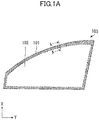
- FIG. 1A is a plan view of a laminated glass that is a laminated plate according to an embodiment of the present invention.
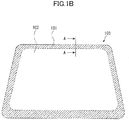
- FIG. 1B is a plan view depicting an example of the laminated glass according to the embodiment applied to a front windshield of a vehicle.
- FIG. 2 is a cross section orthogonal to an outer periphery of the laminated plate according to a first embodiment of the present invention in at least a part of the outer periphery (A-A cross section).
- a laminated glass 103 includes, in a planar view, a periphery region 101 and an in-plane region 102. Moreover, the laminated glass 103 includes a first glass plate 201, and a second glass plate 202 bonded to the first glass plate 201 via an intermediate film 203.
- the first glass plate 201 includes a first chamfering region 207 that is chamfered in a periphery. Moreover, the first glass plate 201 includes a first non-chamfering region 208 in an in-plane region adjacent to the first chamfering region 207.
- the second glass plate 202 includes a second chamfering region 209 that is chamfered in a periphery. Moreover, the second glass plate 202 includes a second non-chamfering region 210 in an in-plane region adjacent to the second chamfering region 209.
- the periphery region 101 indicates a region from an outer periphery of the laminated glass 103 to an inner boundary that is a boundary between the first chamfering region 207 and the first non-chamfering region 208 and that is also a boundary between the second chamfering region 209 and the second non-chamfering region 210.
- the in-plane region 102 indicates a region that occupies the inside of the periphery region 101.
- the first glass plate 201 is provided with a first main surface 211 arranged on a side opposite to the intermediate film 203 and a second main surface 212 arranged so as to contact with the intermediate film 203.
- the second glass plate 202 is provided with a third main surface 213 arranged so as to contact with the intermediate film 203 and a fourth main surface 214 arranged on a side opposite to the intermediate film 203.
- the intermediate film 203 is not particularly limited.
- the intermediate film 203 may be a single layered intermediate film, or may be a multilayered film.
- the intermediate film 203 may be a film having a plate thickness depending on a site, so that a cross section has a shape of a wedge, for example.
- the embodiment of the present invention is not limited to a laminated glass, in which two glass plates are laminated.
- the embodiment of the present invention may be a laminated glass obtained by bonding two or more glass plates via an intermediate film.
- a plate thickness of the first glass plate 201 is thicker than a plate thickness of the second glass plate 202.
- the plate thickness of the second glass plate 202 is preferably 0.2 mm or more and 1.0 mm or less, more preferably 0.3 mm or more and 0.8 mm or less, and further preferably 0.4 mm or more and 0.7 mm or less.
- the laminated glass 103 can be made lighter. Moreover, by making the thickness of the second glass plate 202 thicker than to equal to 0.2 mm, a bending rigidity increases, and thereby an operator can easily handle the second glass plate 202, when conveying the second glass plate 202.
- the thickness of the second glass plate 202 is preferably 0.4 mm or more and 1.8 mm or less, more preferably 0.5 mm or more and 1.6 mm or less, further preferably 0.7 mm or more and 1.6 mm or less, and further preferably 0.8 mm or more and 1.3 mm or less.
- the thickness of the first glass plate 201 is preferably 1.7 mm or more and 4.0 mm or less, more preferably 2.0 mm or more and 3.7 mm or less, and further preferably 2.5 mm or more and 3.5 mm or less.
- the laminated glass 103 can be made lighter. Moreover, by making the thickness of the first glass plate 201 thicker than or equal to 1.5 mm, bending rigidity that is sufficient for the laminated glass 103 can be obtained.
- the thickness of the first glass plate 201 is preferably 1.5 mm or more and 3.5 mm or less, more preferably 1.5 mm or more and 2.8 mm or less, and further preferably 1.5 mm or more and 2.5 mm or less.
- a value obtained by dividing the thickness of the second glass plate 202 by the thickness of the first glass plate 201 is preferably 0.1 or more and 0.5 or less, more preferably 0.13 or more and 0.48 or less, and further preferably 0.15 or more and 0.45 or less.
- the laminated glass 103 is obtained with a high bending rigidity and a low weight.
- the value obtained by dividing the thickness of the second glass plate 202 by the thickness of the first glass plate 201 is preferably 0.5 or more and 0.9 or less, more preferably 0.55 or more and 0.85 or less, and further preferably 0.6 or more and 0.8 or less.
- the laminated glass 103 is obtained with a lower weight and with prevention against degradation of sound insulation property.
- a resin frame body may be attached on the outer periphery of the laminated glass 103.
- a distance C from an outermost periphery 205 of the second glass plate 202 to the first glass plate 201 in the thickness direction with respect to the outermost periphery 205 is less than or equal to three times a distance B between the first glass plate 201 and the second glass plate 202 in the in-plane region 102.
- the distance C is 2.5 times the distance B or less; more preferably, the distance C is 2.3 times the distance B or less; further preferably, the distance C is twice the distance B or less; further preferably 1.8 times the distance B or less; and further preferably, the distance C is 1.5 times the distance B or less.
- the peripheral portion of the laminated glass 103 can be further prevented from foaming.
- the above-described effect is considered for the following two reasons.
- the first reason is suppression of foaming by delamination of the laminated glass 103 from the outer periphery.
- delamination of the first glass plate 201 and the second glass plate 202 occurs from the outer periphery. Therefore, when the value of the distance C falls within the above-described range on the outer periphery, entry of air through a gap between the intermediate film 203 and the first glass plate 201 and/or the second glass plate 202 can be controlled.
- the second reason is suppression of foaming from the peripheral region 101 and/or a part in the in-plane region 102 adjacent to the peripheral region 101.
- a stiffness of the second glass plate 202 is less than a stiffness of the first glass plate 201. Therefore, for example, when a force for compressing in the thickness direction is applied around the outer periphery of the laminated glass 103, in the related art, as illustrated in FIG. 8 , the second glass plate 202 deflects so that the outermost periphery 205 of the second glass plate 202 moves toward the first glass plate 201.
- a force is applied in a direction for delaminating the second glass plate 202 from the first glass plate 201 and the intermediate film 203 (upward direction in FIG. 8 ).
- the deflection of the second glass plate 202 is small. Therefore, a location E where such a delamination force is generated can be prevented from foaming.
- the location E where the delamination force is generated is illustrated in FIG. 8 emphasizing the phenomenon. That is, in practice, the second glass plate 202 at the location E where the delamination force is generated does not deform by expanding in the thickness direction.
- peripheral portion refers to a portion including the outer periphery and the location E where the delamination force is generated.
- the force for compressing near the outer periphery of the laminated glass 103 in the thickness direction includes, for example, a force applied upon performing vacuum pressure-bonding in the process of preparing the laminated glass, and a force applied upon being held by a window frame in between.
- the outermost periphery 205 of the second glass plate 202 is on the in-plane side of the outermost periphery 204 of the first glass plate 201 in the laminated glass 103.
- the peripheral portion of the laminated glass 103 can be prevented from foaming. Moreover, the outermost periphery 205 of the second glass plate 202 that is thinner becomes less likely to be broken off by an external force.
- the outermost periphery 205 of the second glass plate 202 is inside the first chamfered region 207 in the planar view.
- the peripheral portion of the laminated glass 103 can be prevented from foaming. Moreover, the outermost periphery 205 of the second glass plate 202 that is thinner becomes less likely to be broken off by an external force.
- the outermost periphery 205 of the second glass plate 202 when the outermost periphery 205 of the second glass plate 202 is in the first chamfered region 207 in the planar view, the outermost periphery 205 of the second glass plate 202 becomes less likely to be identifiable by a person as a line, in the planar view. Therefore, degradation of appearance can be controlled. Moreover, because a difference in level between the first glass plate 201 and the second glass plate 202 is provided on the outer periphery side, an occurrence of a problem such as an object becoming stuck due to the level difference upon performing wiping cleaning of a window, or an interference with other members, can be controlled.
- the distance D is not particularly limited.
- the distance D is preferably 1 mm or less, more preferably, 0.8 mm or less, and further preferably 0.6 mm or less.
- the first glass plate 201 and the second glass plate 202 may be subjected to bending forming by a conventionally known bending method.
- the first glass plate 201 and the second glass plate 202 are overlaid and placed on a metallic mold having a shape of a ring.
- the first and second glass plates 201, 202 may be bent by heating above the softening point temperature, and causing the first and second glass plates to bend by their own weights.
- the first glass plate 201 and the second glass plate 202 may be subjected to press forming, individually or overlaid in a state of being heated.
- the first glass plate 201 bent in a first bending shape and the second glass plate having a second shape different from the first bending shape may be bonded to each other via the intermediate film 203 to form the laminated glass 103.
- a laminated glass 103 two glass plates are bonded to each other in a state where any of or both the two glass plates are elastically bent (in the following, a manufacturing method of laminated glass by elastically bending any of or both the two glass plates and bonding the two glass plates will be referred to as a "cold bend").
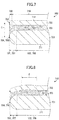
- FIG. 3 is a diagram depicting a state of the first glass plate 201 and the second glass plate 202 before being bonded to each other via the intermediate film 203.
- FIG. 4 is a diagram depicting the laminated glass 103 after the bonding via the intermediate film 203 from the state illustrated in FIG. 3 .
- the laminated glass 103 has a bending shape of a single curve (cylindrical shape), among cross sections including a normal line at a center of gravity of the laminated glass 103, a cross section having the greatest curvature radius of the first main surface 211 will be referred to as a transverse section.
- a cross section corresponding to the transverse section when the bonding via the intermediate film 203 is removed, the second main surface 212 has a curvature radius less than the third main surface 213.
- the laminated glass 103 has a bending shape of a plurality of curves, among cross sections including a normal line at a center of gravity of the laminated glass 103, a cross section having the greatest curvature radius of the first main surface 211 will be referred to as a transverse section, and a cross section orthogonal to the transverse section will be referred to as a vertical section.
- the second main surface 212 has a curvature radius less than the third main surface 213.
- the laminated glass 103 in which the first glass plate 201 bent in the first bending shape and the second glass plate 202 having the second shape different from the first bending shape are bonded to each other via the intermediate film 203, has a bending stress by elastic deformation.
- the thickness of the second glass plate 202 is less than that of the first glass plate 201, because two glass plates are bonded to each other in a state where mainly the second glass plate 202 is elastically deformed, the bending stress is generated in the second glass plate 202.
- a bending compressive stress is generated, and around the center of the in-plane region 102 of the second glass plate 202 a bending tensile stress is generated.
- the bending compressive stress and the bending tensile stress can be measured by a commercially supplied surface stress meter.
- the second glass plate 202 is a strengthened glass
- both a residual stress and a bending stress occur.
- the residual stress is caused by strengthening, and occurs before being bonded.
- the bending stress can be obtained by measuring a stress value after bonding and by subtracting a stress value of the second glass plate 202 in a natural state from the measured value.
- the chemically strengthened second glass plate 202 having a shape of a flat plate may be bonded to the first glass plate 201 via the intermediate film.
- the first glass plate 201 may have a shape with a plurality of curves bent in two orthogonal directions
- the second glass plate 202 may have a shape of a flat plate.
- the functional film is formed on the second glass plate 202 having a shape of a flat plate, and by using the cold bend and bonding to the first glass plate 201 that is bent and formed in a desired shape, the curved laminated glass 103 is obtained without heating the functional film at around the softening point temperature of the glass plate. Therefore, the function of the functional film can be achieved sufficiently.
- a method of forming the functional film on a surface of a glass plate after performing the bending forming for the glass plate in a desired bending shape is known.
- this method is more difficult than the method of forming the functional film on a glass plate having a shape of a flat plate, and the process and apparatus become complicated.
- the process and apparatus can be made simplified.
- the process of heating the second glass plate 202 at around the softening point temperature of the glass plate and performing bending forming can be omitted.
- the thickness of the second glass plate 202 is 1 mm or less, because it becomes difficult to maintain accuracy in bending forming due to heating, the cold bend method has a great effect.
- the second glass plate 202 used in the cold bend may have a second bending shape different from the first bending shape.
- the curvature radius of the second bending shape is greater than the curvature radius of the first bending shape.
- the second glass plate 202 may be bent and formed into the second bending shape by heating or may be bent and formed during the process of chemically strengthening.
- Performing bending forming during the process of chemically strengthening refers specifically to increasing penetration of the chemical strengthening for the third main surface 213 relative to the fourth main surface 214, and thereby the second glass plate 202 can be bent and formed so that the third main surface 213 is a convex surface and the fourth main surface 214 is a concave surface.
- the process of heating the second glass plate 202 at around the softening point temperature of the glass plate and performing bending forming can be omitted.
- the second glass plate 202 has a bending shape, difference of curvature radii between the first and second bending shapes becomes smaller, and thereby the bending stress occurring on the cold bend can be reduced.
- the degree of penetration of the chemical strengthening can be detected, for example, by comparing a quantity Na of the third main surface 213 and a quantity Na of the fourth main surface 214.
- the quantity Na of the third main surface 213 indicates strength of the K ⁇ -orbit measured by the X-ray fluorescence (XRF), and represents a quantity Na from the surface to the depth of 3 ⁇ m of the third main surface 213. The same applies to the fourth main surface 214.
- the cold bend is enabled by using a first glass plate 201 fixed by a temporary joining means, such as a tape, a laminated body of a second glass plate 202 and an intermediate film, publicly known preliminary crimping equipment such as a nip roller or a rubber glove, and an autoclave.
- a temporary joining means such as a tape
- a laminated body of a second glass plate 202 and an intermediate film publicly known preliminary crimping equipment such as a nip roller or a rubber glove, and an autoclave.
- a first cross sectional shape of the first chamfered region 207 and a second cross sectional shape of the second chamfered region 209, in a cross sectional view, are formed by arch-shaped chamfered parts that are chamfered in arch-shaped shapes.
- the first cross sectional shape of the first chamfered region 207 and the second cross sectional shape of the second chamfered region 209 are different from each other. Specifically, a curvature radius of the arch-shaped chamfered part of the first glass plate 201 is greater than a curvature radius of the arch-shaped chamfered part of the second glass plate 202.
- each chamfer of the first glass plate 201 or the second glass plate 202 can be designed uniquely.
- the first cross sectional shape and the second cross sectional shape may be chamfered with the same curvature radius.
- chamfering is performed with the same curvature radius, upon manufacturing the first glass plate 201 and the second glass plate 202, a grind stone need not be changed. Therefore, management of the manufacturing and the grind stone become easier.
- the first cross sectional shape and the second cross sectional shape may be similar to each other, or different from each other.
- chamfering in order to improve quality of appearance or strength of the outer periphery, chamfering may be performed using a highly meshed diamond wheel, or a mirror finishing may be performed.
- FIG. 5 is a cross-sectional diagram depicting a cross sectional surface cut along A-A of a laminated glass according to a second embodiment.
- the same reference numeral will be used as in FIGS. 1A to 2 , and an explanation thereof will be omitted.
- the chamfering shape of the first glass plate is different from that in the first embodiment.
- the first glass plate 501 has an arch-shaped chamfered part 503 that is chamfered in an arch-shaped shape, and a linear chamfered part 504 that is chamfered in a linear shape.
- the linear chamfered part 504 is formed so as to connect the arch-shaped chamfered part 503 and the first non-chamfered region 208.
- a first tangent line 502 (linear chamfered part 504) with respect to a boundary between the first chamfered region 207 and the first non-chamfered region 208 in the second main surface 212 intersects with the second main surface 212 at a first angle ⁇ .
- the first angle ⁇ is preferably greater than 0° and 40° or less.
- the first angle ⁇ is more preferably 5° or more and 35° or less. Further preferably the first angle ⁇ is 8° or more and 30° or less.
- the first angle ⁇ is 5° or more, because an end part of glass is ground stably against an end surface shape of a grind stone, a breakage of a glass plate during the manufacturing process can be controlled.
- a length of the linear chamfered part 504 is preferably 0.05 mm or more, more preferably 0.1 mm or more, and further preferably 0.15 mm or more.
- the distance C can be reduced and at the same time the distance D can also be reduced. That is, the peripheral portion of the laminated glass 103 can be prevented from foaming, and degradation of appearance, an object becoming stuck with another member, and interference with another member, can be controlled.
- the first angle ⁇ is 0°.
- the linear chamfered part 504 is assumed to include a shape of not only a line in a strict sense but also an arch-shaped form that can be approximated to a line.
- the arch-shaped form that can be approximated to a line is not particularly limited; however, an example is a camber on the order of 1 ⁇ 10 -1 mm or less.
- the first cross sectional shape is depicted to be symmetric with respect to a line that passes through the center of the thickness of the first glass plate 501 and is parallel to the first and second main surfaces 211, 212.
- the first cross sectional shape may be asymmetric.
- an angle between the tangent line with respect to the boundary between the first chamfered region 207 and the first non-chamfered region 208, and the first main surface may be the same as the first angle ⁇ , or may be different from the first angle ⁇ .
- the second glass plate 202 may have the same chamfered shape as in the embodiment. 0080
- FIG. 6 is a cross-sectional diagram depicting a laminated glass cut along A-A according to a third embodiment.
- FIG. 6 to a member having the same configuration as the configuration illustrated in the first embodiment the same reference numeral as in FIGS. 1A to 2 is assigned, and an explanation thereof will be omitted.
- the chamfered shape of the first glass plate is different from that in the first embodiment.
- the first cross sectional shape is asymmetric with respect to a line that passes through the center of the thickness of the first glass plate 601 and is parallel to the first and second main surfaces 211, 212.
- a position G at a boundary between the first chamfered region 207 and the first non-chamfered region 208 on the first main surface 211 side, is located on the in-plane region 102 side with respect to a position F, at a boundary between the first chamfered region 207 and the first non-chamfered region 208 on the second main surface 212 side.
- the distance C can be reduced and at the same time the distance D also can be reduced. That is, the peripheral region of the laminated glass 103 can be prevented from foaming, and degradation of appearance, an object becoming stuck with another member, and interference with another member, can be controlled.
- the outermost periphery 204 of the first glass plate 601 is located on the second main surface 212 side. Because on the first main surface 211 side sliding or interference with other members is likely to occur, by arranging the outermost periphery 204 of the first glass plate 601 on the second main surface 212 side, breakage due to an extra load on the outermost periphery 204 of the first glass plate 601 can be controlled.
- the laminated glass 103 is not
- the laminated glass 103 may be provided with the feature in any of the edges or may be only in a part of the edge. Even then, the effect of preventing the peripheral portion from foaming can be obtained.
- the respective embodiments described in the specification are preferably applied to an exposure part of the peripheral portion of the laminated glass 103 that is not covered with the other member such as the resin frame body or the like.
- the resin frame body is attached to the peripheral portion of the laminated glass 103, because the end surface is covered, inherently foaming is not likely to occur. Even if foaming occurs, the foaming is hidden, and a problem of quality of appearance will not appear.
- foaming is likely to occur.
- the problem of quality of appearance becomes easily apparent. Therefore, preventing the peripheral portion from foaming exhibits a great effect.
- the "exposure part” refers to a part where at least any one of a front surface and a back surface in the peripheral portion of the laminated glass 103 and the end surface of the intermediate film are exposed externally. Even when the front surface and the rear surface and a black shielding film are provided in the peripheral portion, if the part is not covered by the other member such as the resin frame body or the like, the part will be referred to as the exposure part.
- the present invention relates to a laminated body, and particularly can be preferably used for a laminated glass in which glass plates are bonded to each other via an intermediate layer.
Landscapes
- Engineering & Computer Science (AREA)
- Mechanical Engineering (AREA)
- Joining Of Glass To Other Materials (AREA)
- Laminated Bodies (AREA)
Abstract
Description
- 0001 The disclosure herein generally relates to a laminated plate.
- 0002 Conventionally, for example, for a window glass of a vehicle, a laminated glass obtained by bonding a first glass plate and a second glass plate via an intermediate film has been used.
- 0003 Patent document 1 discloses a laminated glass in which an irregular reflection of light incident to the laminated glass at a periphery portion of the laminated glass is controlled. In the periphery portion of the laminated glass, in which outer peripheries of two glass plates are overlaid, a part where the two glass plates and an intermediate film are not bonded was removed.
- 0004 [PTL 1] Japanese Unexamined Patent Application Publication No.
2013-129552 - 0005 In recent years, from a standpoint of compatibility between reduction of a vehicle weight and a stiffness of a window, a laminated glass of differing thicknesses, in which a first glass plate used for the laminated glass is thick and a second glass plate is thin, has been required.
- 0006 In this case, when two glass plates are bonded so that the outer peripheries of the two glass plates are overlaid, as illustrated in
FIG. 7 , a distance C in a plate thickness direction with respect to anoutermost periphery 705 of the second plate, from theoutermost periphery 705 of the second plate to the first plate, becomes large. Thus, the laminated glass becomes easily foamed from the periphery portion. The foam causes an exfoliation of the laminated glass, a decrease in strength, or a degradation of aesthetic appearance. - 0007 The aforementioned problem may occur also in a laminated plate. The laminated plate includes a first plate, a second plate, and an intermediate film that bonds the first and second plates.
- 0008 In view of the aforementioned background, the present invention mainly aims at providing a laminated plate in which a foam formation in the periphery portion is controlled.
- In order to achieve the aim, the present invention provides
a laminated plate provided with a first plate and a second plate bonded to the first plate via an intermediate layer. The laminated plated includes
a first main surface of the first plate opposite to the intermediate layer;
a second main surface of the first plate being in contact with the intermediate layer;
a third main surface of the second plate being in contact with the intermediate layer; and
a fourth main surface of the second plate opposite to the intermediate layer. - A thickness of the first plate is thicker than a thickness of the second plate.
- In a planar view, the laminated plate includes a peripheral region and an in-plane region.
- In at least a part of an outer periphery of the laminated plate, in a cross section orthogonal to the outer periphery, a distance from an outermost periphery of the second plate to the first plate in a thickness direction with respect to the outermost periphery is three times or less a distance between the first plate and the second plate in the in-plane region.
- According to an aspect of the present invention, a laminated plate, in which a foam formation in a periphery portion is controlled, can be provided.
-
- [
FIGURE 1A ]
FIG. 1A is a plan view of a laminated plate according to an embodiment of the present invention. - [
FIGURE 1B ]
FIG. 1B is a plan view depicting an example of a laminated glass according to the embodiment of the present invention applied to a front windshield of a vehicle. - [
FIGURE 2 ]
FIG. 2 is a cross section of the laminated plate according to a first embodiment of the present invention cut along a line "A-A" inFIG. 1A . - [
FIGURE 3 ]
FIG. 3 is a diagram depicting a state of a first glass plate and a second glass plate before being bonded by an intermediate film according to a variation of the first embodiment. - [
FIGURE 4 ]
FIG. 4 is a diagram depicting the laminated glass after bonding by the intermediate film from the state illustrated inFIG. 3 . - [
FIGURE 5 ]
FIG. 5 is a cross section depicting a laminated plate according to a second embodiment of the present invention cut along the line "A-A". - [
FIGURE 6 ]
FIG. 6 is a cross section depicting a laminated plate according to a third embodiment of the present invention cut along the line "A-A". - [
FIGURE 7 ]
FIG. 7 is a diagram schematically depicting a configuration of a laminated plate according to the related art. - [
FIGURE 8 ]
FIG. 8 is a conceptual diagram depicting a state in which an external force for compressing in the plate thickness direction is applied to the laminated plate according to the related art illustrated inFIG. 7 . - 0012 In the following, with reference to drawings, a laminated plate according to an embodiment of the present invention will be described. Note that in the following descriptions, as an example, a laminated glass used for a vehicle window will be described. However, the present invention is not limited to this. For example, the laminated plate may be a window glass for building, a plastic glazing, a plastic plate, a plastic decorative board used for an interior or an exterior of a vehicle, and the like.
- 0013 Moreover, in the drawings for explaining configurations, coordinates are defined by arrows in the lower left part in each drawing. An explanation will be provided by using the coordinates as necessary. Moreover, in the specification, "X-direction" is assumed to indicate not only a direction from the tail of the arrow representing X-coordinates to the tip, but also a direction inverted by 180 degrees, from the tip to the tail. "Y-direction" and "Z-direction" are also assumed to indicate not only directions from the tails of the arrow representing Y-coordinates and Z-coordinates, respectively, to the tips, but also the respective directions inverted by 180 degrees from the tips to the tails.
- 0014 In the specification, the X-direction and the Y-direction are also referred to as planar directions, and the Z-direction is also referred to as a plate thickness direction.
- 0015 Moreover, in the specification, terms such as "parallel" or "orthogonal" allow deviations keeping with the effect of the present invention. For example, errors of about ±5° are allowed from parallel or orthogonal positional relationships in a strict sense. 0016
-
FIG. 1A is a plan view of a laminated glass that is a laminated plate according to an embodiment of the present invention. Moreover,FIG. 1B is a plan view depicting an example of the laminated glass according to the embodiment applied to a front windshield of a vehicle. -
FIG. 2 is a cross section orthogonal to an outer periphery of the laminated plate according to a first embodiment of the present invention in at least a part of the outer periphery (A-A cross section). - 0017 A
laminated glass 103 includes, in a planar view, aperiphery region 101 and an in-plane region 102. Moreover, thelaminated glass 103 includes afirst glass plate 201, and asecond glass plate 202 bonded to thefirst glass plate 201 via anintermediate film 203. - 0018 The
first glass plate 201 includes a first chamfering region 207 that is chamfered in a periphery. Moreover, thefirst glass plate 201 includes a first non-chamfering region 208 in an in-plane region adjacent to the first chamfering region 207. - 0019 The
second glass plate 202 includes asecond chamfering region 209 that is chamfered in a periphery. Moreover, thesecond glass plate 202 includes a secondnon-chamfering region 210 in an in-plane region adjacent to thesecond chamfering region 209. - 0020 The
periphery region 101 indicates a region from an outer periphery of thelaminated glass 103 to an inner boundary that is a boundary between the first chamfering region 207 and the first non-chamfering region 208 and that is also a boundary between thesecond chamfering region 209 and the secondnon-chamfering region 210. The in-plane region 102 indicates a region that occupies the inside of theperiphery region 101. - 0021 The
first glass plate 201 is provided with a firstmain surface 211 arranged on a side opposite to theintermediate film 203 and a secondmain surface 212 arranged so as to contact with theintermediate film 203. - 0022 The
second glass plate 202 is provided with a thirdmain surface 213 arranged so as to contact with theintermediate film 203 and a fourthmain surface 214 arranged on a side opposite to theintermediate film 203. - 0023 Note that the
intermediate film 203 is not particularly limited. Theintermediate film 203 may be a single layered intermediate film, or may be a multilayered film. Moreover, theintermediate film 203 may be a film having a plate thickness depending on a site, so that a cross section has a shape of a wedge, for example. - 0024 Note that the embodiment of the present invention is not limited to a laminated glass, in which two glass plates are laminated. The embodiment of the present invention may be a laminated glass obtained by bonding two or more glass plates via an intermediate film. 0025
- A plate thickness of the
first glass plate 201 is thicker than a plate thickness of thesecond glass plate 202. The plate thickness of thesecond glass plate 202 is preferably 0.2 mm or more and 1.0 mm or less, more preferably 0.3 mm or more and 0.8 mm or less, and further preferably 0.4 mm or more and 0.7 mm or less. - 0026 By making the thickness of the
second glass plate 202 less than or equal to 1.0 mm, thelaminated glass 103 can be made lighter. Moreover, by making the thickness of thesecond glass plate 202 thicker than to equal to 0.2 mm, a bending rigidity increases, and thereby an operator can easily handle thesecond glass plate 202, when conveying thesecond glass plate 202. - 0027 Moreover, in terms of sound insulating property, the thickness of the
second glass plate 202 is preferably 0.4 mm or more and 1.8 mm or less, more preferably 0.5 mm or more and 1.6 mm or less, further preferably 0.7 mm or more and 1.6 mm or less, and further preferably 0.8 mm or more and 1.3 mm or less. By making the thickness of thesecond glass plate 202 fall within the ranges, thelaminated glass 103 can be made lighter and the sound insulating property can be prevented from degrading. - 0028 Moreover, the thickness of the
first glass plate 201 is preferably 1.7 mm or more and 4.0 mm or less, more preferably 2.0 mm or more and 3.7 mm or less, and further preferably 2.5 mm or more and 3.5 mm or less. - 0029 By making the thickness of the
first glass plate 201 less than or equal to 4.0 mm, thelaminated glass 103 can be made lighter. Moreover, by making the thickness of thefirst glass plate 201 thicker than or equal to 1.5 mm, bending rigidity that is sufficient for thelaminated glass 103 can be obtained. - 0030 Moreover, in terms of the sound insulating property, the thickness of the
first glass plate 201 is preferably 1.5 mm or more and 3.5 mm or less, more preferably 1.5 mm or more and 2.8 mm or less, and further preferably 1.5 mm or more and 2.5 mm or less. By making the thickness of thefirst glass plate 201 fall within the ranges, thelaminated glass 103 can be made lighter and the sound insulating property can be prevented from degrading. - 0031 Moreover, a value obtained by dividing the thickness of the
second glass plate 202 by the thickness of thefirst glass plate 201 is preferably 0.1 or more and 0.5 or less, more preferably 0.13 or more and 0.48 or less, and further preferably 0.15 or more and 0.45 or less. By making the value, obtained by dividing the thickness of the second glass plate by the thickness of the first glass plate, thicker than or equal to 0.1 and less than or equal to 0.5, thelaminated glass 103 is obtained with a high bending rigidity and a low weight. - 0032 Moreover, in terms of the sound insulating property, the value obtained by dividing the thickness of the
second glass plate 202 by the thickness of thefirst glass plate 201 is preferably 0.5 or more and 0.9 or less, more preferably 0.55 or more and 0.85 or less, and further preferably 0.6 or more and 0.8 or less. By making the value, obtained by dividing the thickness of thesecond glass plate 202 by the thickness of thefirst glass plate 201, 0.5 or more and 0.9 or less, thelaminated glass 103 is obtained with a lower weight and with prevention against degradation of sound insulation property. - 0033 Moreover, on the outer periphery of the
laminated glass 103, a resin frame body may be attached. - 0034 In a cross section orthogonal to the outer periphery (A-A cross section) on at least a part of the outer periphery of the
laminated glass 103, a distance C from anoutermost periphery 205 of thesecond glass plate 202 to thefirst glass plate 201 in the thickness direction with respect to theoutermost periphery 205 is less than or equal to three times a distance B between thefirst glass plate 201 and thesecond glass plate 202 in the in-plane region 102. Preferably, the distance C is 2.5 times the distance B or less; more preferably, the distance C is 2.3 times the distance B or less; further preferably, the distance C is twice the distance B or less; further preferably 1.8 times the distance B or less; and further preferably, the distance C is 1.5 times the distance B or less. - 0035 As the value of the distance C becomes closer to the value of the distance B, the peripheral portion of the
laminated glass 103 can be further prevented from foaming. The above-described effect is considered for the following two reasons. - 0036 That is, the first reason is suppression of foaming by delamination of the
laminated glass 103 from the outer periphery. Typically, delamination of thefirst glass plate 201 and thesecond glass plate 202 occurs from the outer periphery. Therefore, when the value of the distance C falls within the above-described range on the outer periphery, entry of air through a gap between theintermediate film 203 and thefirst glass plate 201 and/or thesecond glass plate 202 can be controlled. - 0037 The second reason is suppression of foaming from the
peripheral region 101 and/or a part in the in-plane region 102 adjacent to theperipheral region 101. When thesecond glass plate 202 is thinner than thefirst glass plate 201, a stiffness of thesecond glass plate 202 is less than a stiffness of thefirst glass plate 201. Therefore, for example, when a force for compressing in the thickness direction is applied around the outer periphery of thelaminated glass 103, in the related art, as illustrated inFIG. 8 , thesecond glass plate 202 deflects so that theoutermost periphery 205 of thesecond glass plate 202 moves toward thefirst glass plate 201. Due to a recoil of the deflection, in theperipheral region 101 and/or the part in the in-plane region 102 adjacent to theperipheral region 101, a force is applied in a direction for delaminating thesecond glass plate 202 from thefirst glass plate 201 and the intermediate film 203 (upward direction inFIG. 8 ). When the value of the distance C falls within the above-described range, the deflection of thesecond glass plate 202 is small. Therefore, a location E where such a delamination force is generated can be prevented from foaming. - 0038 The location E where the delamination force is generated easily occurs in the
peripheral region 101 and/or the part in the in-plane region 102 adjacent to theperipheral region 101, rather than the outer periphery. - 0039 Moreover, the location E where the delamination force is generated is illustrated in
FIG. 8 emphasizing the phenomenon. That is, in practice, thesecond glass plate 202 at the location E where the delamination force is generated does not deform by expanding in the thickness direction. - 0040 In the specification, the "peripheral portion" refers to a portion including the outer periphery and the location E where the delamination force is generated.
- 0041 Note that the force for compressing near the outer periphery of the
laminated glass 103 in the thickness direction includes, for example, a force applied upon performing vacuum pressure-bonding in the process of preparing the laminated glass, and a force applied upon being held by a window frame in between. - 0042 Moreover, the
outermost periphery 205 of thesecond glass plate 202 is on the in-plane side of theoutermost periphery 204 of thefirst glass plate 201 in thelaminated glass 103. - 0043 By arranging the members in the above-described positional relationship, the peripheral portion of the
laminated glass 103 can be prevented from foaming. Moreover, theoutermost periphery 205 of thesecond glass plate 202 that is thinner becomes less likely to be broken off by an external force. - 0044 Moreover, the
outermost periphery 205 of thesecond glass plate 202 is inside the first chamfered region 207 in the planar view. - 0045 By arranging the members in the above-described positional relationship, the peripheral portion of the
laminated glass 103 can be prevented from foaming. Moreover, theoutermost periphery 205 of thesecond glass plate 202 that is thinner becomes less likely to be broken off by an external force. - 0046 Moreover, when the
outermost periphery 205 of thesecond glass plate 202 is in the first chamfered region 207 in the planar view, theoutermost periphery 205 of thesecond glass plate 202 becomes less likely to be identifiable by a person as a line, in the planar view. Therefore, degradation of appearance can be controlled. Moreover, because a difference in level between thefirst glass plate 201 and thesecond glass plate 202 is provided on the outer periphery side, an occurrence of a problem such as an object becoming stuck due to the level difference upon performing wiping cleaning of a window, or an interference with other members, can be controlled. - 0047 Because the distance D is determined depending on a difference between the thicknesses of the
first glass plate 201 and thesecond glass plate 202, and how close the distance C is to the distance B, the distance D is not particularly limited. The distance D is preferably 1 mm or less, more preferably, 0.8 mm or less, and further preferably 0.6 mm or less. By making the distance D fall within the above-described range, the peripheral portion of thelaminated glass 103 can be prevented from foaming. Moreover, theoutermost periphery 205 of thesecond glass plate 202 that is thinner becomes less likely to be broken off by an external force. Furthermore, an occurrence of a problem such as an object becoming stuck upon performing wiping cleaning of a window, or an interference with other members, can be controlled. - 0048 Moreover, when the
laminated glass 103 has a curved shape, thefirst glass plate 201 and thesecond glass plate 202 may be subjected to bending forming by a conventionally known bending method. For example, thefirst glass plate 201 and thesecond glass plate 202 are overlaid and placed on a metallic mold having a shape of a ring. The first andsecond glass plates first glass plate 201 and thesecond glass plate 202 may be subjected to press forming, individually or overlaid in a state of being heated. - 0049 Moreover, the
first glass plate 201 bent in a first bending shape and the second glass plate having a second shape different from the first bending shape may be bonded to each other via theintermediate film 203 to form thelaminated glass 103. In such alaminated glass 103, two glass plates are bonded to each other in a state where any of or both the two glass plates are elastically bent (in the following, a manufacturing method of laminated glass by elastically bending any of or both the two glass plates and bonding the two glass plates will be referred to as a "cold bend"). - 0050
FIG. 3 is a diagram depicting a state of thefirst glass plate 201 and thesecond glass plate 202 before being bonded to each other via theintermediate film 203. Moreover,FIG. 4 is a diagram depicting thelaminated glass 103 after the bonding via theintermediate film 203 from the state illustrated inFIG. 3 . - 0051 When the
laminated glass 103 has a bending shape of a single curve (cylindrical shape), among cross sections including a normal line at a center of gravity of thelaminated glass 103, a cross section having the greatest curvature radius of the firstmain surface 211 will be referred to as a transverse section. In a cross section corresponding to the transverse section, when the bonding via theintermediate film 203 is removed, the secondmain surface 212 has a curvature radius less than the thirdmain surface 213. - 0052 When the
laminated glass 103 has a bending shape of a plurality of curves, among cross sections including a normal line at a center of gravity of thelaminated glass 103, a cross section having the greatest curvature radius of the firstmain surface 211 will be referred to as a transverse section, and a cross section orthogonal to the transverse section will be referred to as a vertical section. On both a cross section corresponding to the transverse section and a cross section corresponding to the vertical section, when the bonding via theintermediate film 203 is removed, the secondmain surface 212 has a curvature radius less than the thirdmain surface 213. - 0053 In this way, the
laminated glass 103, in which thefirst glass plate 201 bent in the first bending shape and thesecond glass plate 202 having the second shape different from the first bending shape are bonded to each other via theintermediate film 203, has a bending stress by elastic deformation. Especially, when the thickness of thesecond glass plate 202 is less than that of thefirst glass plate 201, because two glass plates are bonded to each other in a state where mainly thesecond glass plate 202 is elastically deformed, the bending stress is generated in thesecond glass plate 202. In theperipheral region 101 of thesecond glass plate 202, a bending compressive stress is generated, and around the center of the in-plane region 102 of the second glass plate 202 a bending tensile stress is generated. - 0054 The bending compressive stress and the bending tensile stress can be measured by a commercially supplied surface stress meter. When the
second glass plate 202 is a strengthened glass, on the fourthmain surface 214 of thesecond glass plate 202, both a residual stress and a bending stress occur. The residual stress is caused by strengthening, and occurs before being bonded. In this case, the bending stress can be obtained by measuring a stress value after bonding and by subtracting a stress value of thesecond glass plate 202 in a natural state from the measured value. - 0055 For example, after the
first glass plate 201 is subjected to the bending forming by heat, to form a desired bending shape, the chemically strengthenedsecond glass plate 202 having a shape of a flat plate may be bonded to thefirst glass plate 201 via the intermediate film. For example, thefirst glass plate 201 may have a shape with a plurality of curves bent in two orthogonal directions, and thesecond glass plate 202 may have a shape of a flat plate. By making the first bending shape a shape having a plurality of curves, a window glass for vehicle excellent in design effect can be prepared, and it becomes possible to accommodate a variety of needs for vehicle designs. By making the second shape a shape of a flat plate, a functional film can be easily formed. Furthermore, the bending forming process for thesecond glass plate 202 can be omitted. - 0056 In this way, by using a manufacturing method of laminated glass for elastically deforming any one of two glass plates and bonding the two glass plates, the following advantage is obtained. That is, conventionally, in order to obtain a
laminated glass 103 having a bending shape in which a functional film is formed, a method is known for forming the functional film on any of or both glass plates having a shape of a flat plate before forming, heating the two glass plates at around softening point temperature to perform bending forming, and bonding the two glass plates. However, in this method, because the functional film is heated at around the softening point temperature of the glass plates, the function thereof may be degraded. - 0057 On the other hand, when the functional film is formed on the
second glass plate 202 having a shape of a flat plate, and by using the cold bend and bonding to thefirst glass plate 201 that is bent and formed in a desired shape, the curvedlaminated glass 103 is obtained without heating the functional film at around the softening point temperature of the glass plate. Therefore, the function of the functional film can be achieved sufficiently. - 0058 Moreover, as another method of obtaining a laminated glass having a bending shape in which a functional film is formed, a method of forming the functional film on a surface of a glass plate after performing the bending forming for the glass plate in a desired bending shape is known. However, this method is more difficult than the method of forming the functional film on a glass plate having a shape of a flat plate, and the process and apparatus become complicated. By using the cold bend, because a functional film can be formed on the
second glass plate 202 having a shape of a flat plate, the process and apparatus can be made simplified. - 0059 Moreover, by using the cold bend, the process of heating the
second glass plate 202 at around the softening point temperature of the glass plate and performing bending forming can be omitted. Especially, when the thickness of thesecond glass plate 202 is 1 mm or less, because it becomes difficult to maintain accuracy in bending forming due to heating, the cold bend method has a great effect. - 0060 Moreover, the
second glass plate 202 used in the cold bend may have a second bending shape different from the first bending shape. In the embodiment, the curvature radius of the second bending shape is greater than the curvature radius of the first bending shape. Thesecond glass plate 202 may be bent and formed into the second bending shape by heating or may be bent and formed during the process of chemically strengthening. - 0061 Performing bending forming during the process of chemically strengthening refers specifically to increasing penetration of the chemical strengthening for the third
main surface 213 relative to the fourthmain surface 214, and thereby thesecond glass plate 202 can be bent and formed so that the thirdmain surface 213 is a convex surface and the fourthmain surface 214 is a concave surface. By performing bending forming for thesecond glass plate 202 during the chemical strengthening, the process of heating thesecond glass plate 202 at around the softening point temperature of the glass plate and performing bending forming can be omitted. Moreover, when thesecond glass plate 202 has a bending shape, difference of curvature radii between the first and second bending shapes becomes smaller, and thereby the bending stress occurring on the cold bend can be reduced. - 0062 The degree of penetration of the chemical strengthening can be detected, for example, by comparing a quantity Na of the third
main surface 213 and a quantity Na of the fourthmain surface 214. The quantity Na of the thirdmain surface 213 indicates strength of the Kα-orbit measured by the X-ray fluorescence (XRF), and represents a quantity Na from the surface to the depth of 3 µm of the thirdmain surface 213. The same applies to the fourthmain surface 214. - 0063 The cold bend is enabled by using a
first glass plate 201 fixed by a temporary joining means, such as a tape, a laminated body of asecond glass plate 202 and an intermediate film, publicly known preliminary crimping equipment such as a nip roller or a rubber glove, and an autoclave. - 0064 In the embodiment, a first cross sectional shape of the first chamfered region 207 and a second cross sectional shape of the second
chamfered region 209, in a cross sectional view, are formed by arch-shaped chamfered parts that are chamfered in arch-shaped shapes. However, the first cross sectional shape of the first chamfered region 207 and the second cross sectional shape of the secondchamfered region 209 are different from each other. Specifically, a curvature radius of the arch-shaped chamfered part of thefirst glass plate 201 is greater than a curvature radius of the arch-shaped chamfered part of thesecond glass plate 202. In this way, because the first cross sectional shape of the first chamfered region 207 and the second cross sectional shape of the secondchamfered region 209 are different from each other, each chamfer of thefirst glass plate 201 or thesecond glass plate 202 can be designed uniquely. - 0065 However, the present invention is not limited to this. The first cross sectional shape and the second cross sectional shape may be chamfered with the same curvature radius. When chamfering is performed with the same curvature radius, upon manufacturing the
first glass plate 201 and thesecond glass plate 202, a grind stone need not be changed. Therefore, management of the manufacturing and the grind stone become easier. Moreover, the first cross sectional shape and the second cross sectional shape may be similar to each other, or different from each other. - 0066 In addition, regarding the chamfering method, in order to improve quality of appearance or strength of the outer periphery, chamfering may be performed using a highly meshed diamond wheel, or a mirror finishing may be performed.
- 0067 In the embodiment, an example where the
intermediate film 203 exists to theoutermost periphery 205 of thesecond glass plate 202 is depicted. However, the edge of theintermediate film 203 may be trimmed therefrom. That is, theintermediate film 203 is only required to be present on the in-plane region 102 side of theoutermost periphery 205 of thesecond glass plate 202. 0068 -
FIG. 5 is a cross-sectional diagram depicting a cross sectional surface cut along A-A of a laminated glass according to a second embodiment. InFIG. 5 , for the member having the same configuration as the configuration illustrated in the first embodiment, the same reference numeral will be used as inFIGS. 1A to 2 , and an explanation thereof will be omitted. - 0069 In the second embodiment, the chamfering shape of the first glass plate is different from that in the first embodiment. In the second embodiment, the
first glass plate 501 has an arch-shapedchamfered part 503 that is chamfered in an arch-shaped shape, and a linearchamfered part 504 that is chamfered in a linear shape. - 0070 The linear
chamfered part 504 is formed so as to connect the arch-shapedchamfered part 503 and the first non-chamfered region 208. - 0071 A first tangent line 502 (linear chamfered part 504) with respect to a boundary between the first chamfered region 207 and the first non-chamfered region 208 in the second
main surface 212 intersects with the secondmain surface 212 at a first angle α. The first angle α is preferably greater than 0° and 40° or less. The first angle α is more preferably 5° or more and 35° or less. Further preferably the first angle α is 8° or more and 30° or less. - 0072 In a case where the first angle α is 40° or less, even when the
outermost periphery 205 of thesecond glass plate 202 is moved close to theoutermost periphery 204 of thefirst glass plate 501 in order to reduce the distance D, a rapid increase in the distance C is controlled. - 0073 Moreover, when the first angle α is 5° or more, because an end part of glass is ground stably against an end surface shape of a grind stone, a breakage of a glass plate during the manufacturing process can be controlled.
- 0074 Moreover, a length of the linear
chamfered part 504 is preferably 0.05 mm or more, more preferably 0.1 mm or more, and further preferably 0.15 mm or more. By making the length as above, the distance C can be reduced and the distance D can also be reduced. - 0075 When the first angle α and the linear
chamfered part 504 have the above-described values, the distance C can be reduced and at the same time the distance D can also be reduced. That is, the peripheral portion of thelaminated glass 103 can be prevented from foaming, and degradation of appearance, an object becoming stuck with another member, and interference with another member, can be controlled. - 0076 In the case of the first embodiment, because the chamfered part is composed only of an arch-shaped chamfered part, the first angle α, if defined, is 0°.
- 0077 Moreover, in the specification, the linear
chamfered part 504 is assumed to include a shape of not only a line in a strict sense but also an arch-shaped form that can be approximated to a line. The arch-shaped form that can be approximated to a line is not particularly limited; however, an example is a camber on the order of 1×10⁻¹ mm or less. - 0078 In the embodiment, the first cross sectional shape is depicted to be symmetric with respect to a line that passes through the center of the thickness of the
first glass plate 501 and is parallel to the first and secondmain surfaces - 0079 Moreover, the
second glass plate 202 may have the same chamfered shape as in the embodiment. 0080 -
FIG. 6 is a cross-sectional diagram depicting a laminated glass cut along A-A according to a third embodiment. InFIG. 6 , to a member having the same configuration as the configuration illustrated in the first embodiment the same reference numeral as inFIGS. 1A to 2 is assigned, and an explanation thereof will be omitted. - 0081 In the third embodiment, the chamfered shape of the first glass plate is different from that in the first embodiment. In the third embodiment, the first cross sectional shape is asymmetric with respect to a line that passes through the center of the thickness of the
first glass plate 601 and is parallel to the first and secondmain surfaces - 0082 That is, in the cross sectional view, a position G, at a boundary between the first chamfered region 207 and the first non-chamfered region 208 on the first
main surface 211 side, is located on the in-plane region 102 side with respect to a position F, at a boundary between the first chamfered region 207 and the first non-chamfered region 208 on the secondmain surface 212 side. - 0083 According to the above-described configuration, the distance C can be reduced and at the same time the distance D also can be reduced. That is, the peripheral region of the
laminated glass 103 can be prevented from foaming, and degradation of appearance, an object becoming stuck with another member, and interference with another member, can be controlled. - 0084 Moreover, in the cross sectional view, the
outermost periphery 204 of thefirst glass plate 601 is located on the secondmain surface 212 side. Because on the firstmain surface 211 side sliding or interference with other members is likely to occur, by arranging theoutermost periphery 204 of thefirst glass plate 601 on the secondmain surface 212 side, breakage due to an extra load on theoutermost periphery 204 of thefirst glass plate 601 can be controlled. - 0085 In addition, the
laminated glass 103 is not - necessarily provided with the features illustrated in the respective embodiments described in the specification over the whole periphery. For example, the
laminated glass 103 may be provided with the feature in any of the edges or may be only in a part of the edge. Even then, the effect of preventing the peripheral portion from foaming can be obtained. - 0086 Moreover, in particular, the respective embodiments described in the specification are preferably applied to an exposure part of the peripheral portion of the
laminated glass 103 that is not covered with the other member such as the resin frame body or the like. For example, when the resin frame body is attached to the peripheral portion of thelaminated glass 103, because the end surface is covered, inherently foaming is not likely to occur. Even if foaming occurs, the foaming is hidden, and a problem of quality of appearance will not appear. However, for the exposure part, because the end surface is exposed, foaming is likely to occur. Furthermore, when the foaming occurs, the problem of quality of appearance becomes easily apparent. Therefore, preventing the peripheral portion from foaming exhibits a great effect. - 0087 In the specification, the "exposure part" refers to a part where at least any one of a front surface and a back surface in the peripheral portion of the
laminated glass 103 and the end surface of the intermediate film are exposed externally. Even when the front surface and the rear surface and a black shielding film are provided in the peripheral portion, if the part is not covered by the other member such as the resin frame body or the like, the part will be referred to as the exposure part. - 0088 The present invention relates to a laminated body, and particularly can be preferably used for a laminated glass in which glass plates are bonded to each other via an intermediate layer.
- 0089 The present application is based on and claims the benefit of priority of Japanese Priority Application No.
2015-248204 filed on December 21, 2015 - 0090
- 101 peripheral region
- 102 in-plane region
- 103 laminated glass
- 201, 701 first glass plate
- 202, 702 second glass plate
- 203, 703 intermediate film
- 204, 704 outermost periphery of first plate
- 205, 705 outermost periphery of second plate
- 206, 706 intersection point of tangent line at outermost
- periphery of second plate with first plate
- 207, 707 first chamfered region
- 208, 708 first non-chamfered region
- 209, 709 second chamfered region
- 210, 710 second non-chamfered region
- 211, 711 first main surface
- 212, 712 second main surface
- 213, 713 third main surface
- 214, 714 fourth main surface
- B distance between first plate and second plate in in-plane region
- C distance from outermost periphery of second plate to first plate in thickness direction at outermost periphery
- D distance between outermost periphery of first plate and outermost periphery of second plate in planar direction
- E location of delamination force
- F position of boundary between first chamfered region and first non-chamfered region on second main surface side
- G position of boundary between first chamfered region and first non-chamfered region on first main surface side
- α first angle
Claims (15)
- A laminated plate provided with a first plate and a second plate bonded to the first plate via an intermediate layer, comprising:a first main surface of the first plate opposite to the intermediate layer;a second main surface of the first plate being in contact with the intermediate layer;a third main surface of the second plate being in contact with the intermediate layer; anda fourth main surface of the second plate opposite to the intermediate layer,wherein a thickness of the first plate is thicker than a thickness of the second plate,wherein, in a planar view, the laminated plate includes a peripheral region and an in-plane region,wherein, in at least a part of an outer periphery of the laminated plate, in a cross section orthogonal to the outer periphery, a distance from an outermost periphery of the second plate to the first plate in a thickness direction with respect to the outermost periphery is three times or less a distance between the first plate and the second plate in the in-plane region.
- The laminated plate according to claim 1, wherein the outermost periphery of the second plate is on an in-plane side of an outermost periphery of the first plate in the laminated plate.
- The laminated plate according to claim 1 or 2,
wherein the first plate includes a first chamfered region that is chamfered on a periphery of the first plate,
wherein the first plate includes a first non-chamfered region adjacent to the first chamfered region on the in-plane side, and
wherein, in the planar view, the outermost periphery of the second plate is located in the first chamfered region. - The laminated plate according to claim 3,
wherein the second plate is provided with a second chamfered region that is chamfered on a periphery of the second plate,
wherein the second plate is provided with a second non-chamfered region adjacent to the second chamfered region and on the in-plane side of the second chamfered region, and
wherein in the cross section orthogonal to the outer periphery, a first cross-sectional shape of the first chamfered region is different from a second cross-sectional shape of the second chamfered region. - The laminated plate according to claim 3 or 4,
wherein in the cross section orthogonal to the outer periphery, the first chamfered region includes a linear chamfered part. - The laminated plate according to claim 5,
wherein in the cross section orthogonal to the outer periphery, the first chamfered region includes an arch-shaped chamfered part, and
wherein the linear chamfered part is formed so as to connect the arch-shaped chamfered part and the first non-chamfered region. - The laminated plate according to any one of claims 3 to 6,
wherein in the cross section orthogonal to the outer periphery, a first tangent line at a boundary between the first chamfered region and the first non-chamfered region on a second main surface side intersects with the second main surface at a first angle, the first angle being greater than 0 degrees and less than or equal to 40 degrees. - The laminated plate according to any one of claims 3 to 7,
wherein in the cross section orthogonal to the outer periphery, a boundary between the first chamfered region and the first non-chamfered region on a first main surface side is located on an in-plane side of a boundary between the first chamfered region and the first non-chamfered region on a second main surface side. - The laminated plate according to any one of claims 3 to 8,
wherein in the cross section orthogonal to the outer periphery, the outermost periphery of the first plate is located on a second main surface side. - The laminated plate according to any one of claims 1 to 3,
wherein in the cross section orthogonal to the outer periphery, a distance between the outermost periphery of the first plate and the outermost periphery of the second plate in a planar direction is less than or equal to 1 mm. - The laminated plate according to any one of claims 1 to 10,
wherein a ratio of the thickness of the second plate to the thickness of the first plate is thicker than or equal to 0.1 and less than or equal to 0.5. - The laminated plate according to any one of claims 1 to 11,
wherein a transverse section is a cross section, among cross sections each including a normal line at a center of gravity of the laminated plate, which has the greatest curvature radius of the first main surface, and when the bonding via the intermediate layer is removed, in a cross section corresponding to the transverse section, the second main surface has a curvature radius less than a curvature radius of the third main surface. - The laminated plate according to any one of claims 1 to 12,
wherein a transverse section is a cross section, among cross sections each including a normal line at a center of gravity of the laminated plate, which has the greatest curvature radius of the first main surface, a vertical section is a cross section orthogonal to the transverse section, and in both a cross section corresponding to the transverse section and a cross section corresponding to the vertical section, when the bonding via the intermediate layer is removed, the second main surface has a curvature radius less than a curvature radius of the third main surface. - The laminated plate according to any one of claims 1 to 13,
wherein the laminated plate has a bending compressive stress in the peripheral region, and a bending tensile stress in the in-plane region. - The laminated plate according to any one of claims 1 to 14 further comprising an exposure part,
wherein in the exposure part, in the cross section orthogonal to the outer periphery of the laminated plate, the distance from the outermost periphery of the second plate to the first plate in the thickness direction with respect to the outermost periphery is three times or less the distance between the first plate and the second plate in the in-plane region.
Applications Claiming Priority (2)
| Application Number | Priority Date | Filing Date | Title |
|---|---|---|---|
| JP2015248204 | 2015-12-21 | ||
| PCT/JP2016/086925 WO2017110560A1 (en) | 2015-12-21 | 2016-12-12 | Laminate |
Publications (3)
| Publication Number | Publication Date |
|---|---|
| EP3395777A1 true EP3395777A1 (en) | 2018-10-31 |
| EP3395777A4 EP3395777A4 (en) | 2019-07-31 |
| EP3395777B1 EP3395777B1 (en) | 2021-04-07 |
Family
ID=59090249
Family Applications (1)
| Application Number | Title | Priority Date | Filing Date |
|---|---|---|---|
| EP16878451.0A Active EP3395777B1 (en) | 2015-12-21 | 2016-12-12 | Laminate |
Country Status (5)
| Country | Link |
|---|---|
| US (1) | US10953636B2 (en) |
| EP (1) | EP3395777B1 (en) |
| JP (1) | JP6834983B2 (en) |
| CN (1) | CN108367981B (en) |
| WO (1) | WO2017110560A1 (en) |
Cited By (2)
| Publication number | Priority date | Publication date | Assignee | Title |
|---|---|---|---|---|
| EP3712119A4 (en) * | 2018-05-21 | 2021-04-07 | Lg Chem, Ltd. | PROCESS FOR MANUFACTURING CURVED LAMINATED GLASS AND CURVED LAMINATED GLASS SO MANUFACTURED |
| FR3119112A1 (en) | 2021-01-27 | 2022-07-29 | Saint-Gobain Glass France | SLIDING LAMINATED GLAZING WITH INTERNAL REMOVAL AND METHOD FOR MANUFACTURING THIS GLAZING |
Families Citing this family (20)
| Publication number | Priority date | Publication date | Assignee | Title |
|---|---|---|---|---|
| KR102544091B1 (en) | 2016-06-28 | 2023-06-16 | 코닝 인코포레이티드 | Laminating thin strengthened glass to curved molded plastic surface for decorative and display cover application |
| CN115327805A (en) | 2016-07-05 | 2022-11-11 | 康宁公司 | Fixing device and automotive interior system |
| JP7066704B2 (en) | 2016-10-25 | 2022-05-13 | コーニング インコーポレイテッド | Cold-formed glass lamination for displays |
| MX2019004737A (en) | 2017-01-03 | 2019-06-17 | Corning Inc | Vehicle interior systems having a curved cover glass and a display or touch panel and methods for forming the same. |
| CN111094050B (en) | 2017-07-18 | 2023-11-07 | 康宁公司 | Cold forming of complex curved glass products |
| WO2019055469A1 (en) | 2017-09-12 | 2019-03-21 | Corning Incorporated | Deadfront for displays including a touch panel on decorative glass and related methods |
| US11065960B2 (en) | 2017-09-13 | 2021-07-20 | Corning Incorporated | Curved vehicle displays |
| TWI844520B (en) | 2017-10-10 | 2024-06-11 | 美商康寧公司 | Vehicle interior systems having a curved cover glass with improved reliability and methods for forming the same |
| WO2019103469A1 (en) * | 2017-11-21 | 2019-05-31 | Corning Precision Materials Co., Ltd. | Aspheric mirror for head-up display system and methods for forming the same |
| JP6938366B2 (en) * | 2017-12-28 | 2021-09-22 | 日本板硝子株式会社 | Windshield |
| EP3823825A1 (en) | 2018-07-16 | 2021-05-26 | Corning Incorporated | Vehicle interior systems having a cold-bent glass substrate and methods for forming the same |
| US11772367B2 (en) * | 2018-08-31 | 2023-10-03 | Pilkington Group Limited | Laminated glazing |
| US11772361B2 (en) | 2020-04-02 | 2023-10-03 | Corning Incorporated | Curved glass constructions and methods for forming same |
| WO2022140991A1 (en) * | 2020-12-28 | 2022-07-07 | Zhejiang Geely Holding Group Co., Ltd. | Side door window structure of motor vehicle |
| CN113320358B (en) * | 2021-06-25 | 2022-07-01 | 长春工程学院 | A smart car safety driving device |
| CN114193876B (en) * | 2021-10-25 | 2022-08-09 | 福耀玻璃工业集团股份有限公司 | Light-transmitting component, laminated glass structure, vehicle and processing method |
| CN121224248A (en) * | 2023-01-13 | 2025-12-30 | 福耀玻璃工业集团股份有限公司 | Laminated glass, car window glass and vehicles |
| CN116100879A (en) * | 2023-01-13 | 2023-05-12 | 福耀玻璃工业集团股份有限公司 | Laminated glass, window glass and vehicles |
| CN117656612B (en) * | 2023-10-31 | 2026-05-12 | 福建省万达汽车玻璃工业有限公司 | Glass plate stacking structure for glass forming, forming method thereof and bulletproof glass |
| CN118024685B (en) * | 2024-02-06 | 2026-02-10 | 福耀玻璃工业集团股份有限公司 | Laminated glass and vehicles |
Family Cites Families (29)
| Publication number | Priority date | Publication date | Assignee | Title |
|---|---|---|---|---|
| US2092789A (en) * | 1934-09-13 | 1937-09-14 | American Optical Corp | Glass treatment |
| US3282772A (en) * | 1965-06-28 | 1966-11-01 | Libbey Owens Ford Glass Co | Laminated glass |
| JPS5854316A (en) | 1981-09-25 | 1983-03-31 | Sharp Corp | Production for liquid crystal display device |
| JP2000252342A (en) | 1999-03-01 | 2000-09-14 | Seiko Epson Corp | Method of transporting thin plate and method of manufacturing liquid crystal panel |
| FR2793106B1 (en) * | 1999-04-28 | 2001-06-22 | Saint Gobain Vitrage | MULTIPLE INSULATING WINDOWS, ESPECIALLY AIRPLANE WINDOWS, WITH ELECTROMAGNETIC SHIELDING |
| US6325704B1 (en) | 1999-06-14 | 2001-12-04 | Corning Incorporated | Method for finishing edges of glass sheets |
| JP2002154321A (en) | 2000-11-17 | 2002-05-28 | Asahi Glass Co Ltd | Automotive glass plate and method for manufacturing automotive glass plate |
| US6733872B2 (en) * | 2001-03-01 | 2004-05-11 | Asahi Glass Company, Limited | Laminated glass |
| JP3983017B2 (en) * | 2001-08-01 | 2007-09-26 | 日本板硝子株式会社 | Security glass panel |
| JP5109228B2 (en) | 2005-02-08 | 2012-12-26 | 旭硝子株式会社 | Thin glass laminate and method for manufacturing display device using thin glass laminate |
| JP5200538B2 (en) | 2005-08-09 | 2013-06-05 | 旭硝子株式会社 | Thin glass laminate and method for manufacturing display device using thin glass laminate |
| JP2007223883A (en) | 2005-12-26 | 2007-09-06 | Asahi Glass Co Ltd | Laminated glass for vehicles |
| JP2007197288A (en) * | 2006-01-30 | 2007-08-09 | Nippon Sheet Glass Co Ltd | Laminated glass and glass window structure using the same |
| JP5024087B2 (en) | 2008-02-05 | 2012-09-12 | 旭硝子株式会社 | GLASS LAMINATE, PANEL FOR DISPLAY DEVICE WITH SUPPORT AND METHOD FOR PRODUCING THEM |
| CN102007524B (en) | 2008-04-17 | 2013-07-31 | 旭硝子株式会社 | Glass laminate, panel for display device with support, and manufacturing method thereof |
| JP5251336B2 (en) * | 2008-07-30 | 2013-07-31 | セントラル硝子株式会社 | Method and apparatus for pre-bonding laminated glass using curved roll |
| JP5616907B2 (en) * | 2009-03-02 | 2014-10-29 | アップル インコーポレイテッド | Technology to strengthen the glass cover of portable electronic devices |
| EP2427330A4 (en) * | 2009-05-08 | 2013-08-28 | Corning Inc | Glass articles with polymer overmolds and methods for forming the same |
| JP5637140B2 (en) * | 2009-10-20 | 2014-12-10 | 旭硝子株式会社 | GLASS LAMINATE, PANEL FOR DISPLAY DEVICE WITH SUPPORT, PANEL FOR DISPLAY DEVICE, DISPLAY DEVICE, AND MANUFACTURING METHOD THEREOF |
| KR101538835B1 (en) * | 2010-01-25 | 2015-07-22 | 아사히 가라스 가부시키가이샤 | Method for manufacturing laminate, and laminate |
| EP3006205A1 (en) * | 2011-05-13 | 2016-04-13 | Nippon Electric Glass Co., Ltd | Method for cutting laminate, method for processing laminate, and device and method for cutting brittle plate-like object |
| JP2013129552A (en) | 2011-12-20 | 2013-07-04 | Central Glass Co Ltd | Vehicle laminated glass and method for producing the same |
| US20140014260A1 (en) * | 2012-07-12 | 2014-01-16 | Dipakbin Qasem Chowdhury | Laminated structures and methods of manufacturing laminated structures |
| EP2738512B1 (en) * | 2012-11-29 | 2019-02-20 | ISOCLIMA S.p.A. | Armoured window construction |
| WO2014098160A1 (en) * | 2012-12-19 | 2014-06-26 | 旭硝子株式会社 | Laminated glass |
| US11077607B2 (en) | 2013-10-21 | 2021-08-03 | Made In Space, Inc. | Manufacturing in microgravity and varying external force environments |
| JP2015096313A (en) * | 2013-11-15 | 2015-05-21 | 日本電気硝子株式会社 | Glass film laminate and method of producing liquid crystal panel |
| CN106414065B (en) * | 2014-05-06 | 2019-04-09 | 法国圣戈班玻璃厂 | Composite glass panel with boundary seal and method of making the same |
| JP6787066B2 (en) * | 2016-01-05 | 2020-11-18 | Agc株式会社 | Laminated board |
-
2016
- 2016-12-12 EP EP16878451.0A patent/EP3395777B1/en active Active
- 2016-12-12 JP JP2017557884A patent/JP6834983B2/en active Active
- 2016-12-12 WO PCT/JP2016/086925 patent/WO2017110560A1/en not_active Ceased
- 2016-12-12 CN CN201680074494.5A patent/CN108367981B/en active Active
-
2018
- 2018-06-13 US US16/007,525 patent/US10953636B2/en active Active
Cited By (4)
| Publication number | Priority date | Publication date | Assignee | Title |
|---|---|---|---|---|
| EP3712119A4 (en) * | 2018-05-21 | 2021-04-07 | Lg Chem, Ltd. | PROCESS FOR MANUFACTURING CURVED LAMINATED GLASS AND CURVED LAMINATED GLASS SO MANUFACTURED |
| US11242285B2 (en) | 2018-05-21 | 2022-02-08 | Lg Chem, Ltd. | Method of manufacturing curved joined glass sheet and curved joined glass sheet manufactured by the same |
| FR3119112A1 (en) | 2021-01-27 | 2022-07-29 | Saint-Gobain Glass France | SLIDING LAMINATED GLAZING WITH INTERNAL REMOVAL AND METHOD FOR MANUFACTURING THIS GLAZING |
| WO2022162309A1 (en) | 2021-01-27 | 2022-08-04 | Saint-Gobain Glass France | Interior recessed sliding laminated glazing unit and method for manufacturing said glazing unit |
Also Published As
| Publication number | Publication date |
|---|---|
| EP3395777B1 (en) | 2021-04-07 |
| JP6834983B2 (en) | 2021-02-24 |
| US20180290438A1 (en) | 2018-10-11 |
| WO2017110560A1 (en) | 2017-06-29 |
| US10953636B2 (en) | 2021-03-23 |
| EP3395777A4 (en) | 2019-07-31 |
| CN108367981B (en) | 2021-01-15 |
| CN108367981A (en) | 2018-08-03 |
| JPWO2017110560A1 (en) | 2018-10-04 |
Similar Documents
| Publication | Publication Date | Title |
|---|---|---|
| EP3395777B1 (en) | Laminate | |
| EP3189965B1 (en) | Laminated plate | |
| US8980402B2 (en) | Glazing with very little double imaging | |
| KR102174931B1 (en) | Laminated Structures and Methods of manufacturing Laminated Structures | |
| KR102111138B1 (en) | Manufacturing Method of Flexible Cover Window | |
| JP6069213B2 (en) | Laminated window glass | |
| TWI671266B (en) | Interior assembly for transportation equipment and interior assembly for transportation equipment | |
| KR102088678B1 (en) | Curved lamination glass and manufacturing method for curved lamination glass | |
| CN115304250B (en) | Cold formability analysis of glass laminate products using stress prediction and related methods | |
| CN111727149A (en) | Skeleton Parts | |
| KR20190086019A (en) | Methods for reducing warpage in tempered glass-based products and tempered glass-based products | |
| CN102341237A (en) | Whole glass roof for motor vehicle | |
| CN111565948A (en) | Vehicle glass with improved stiffness | |
| CN104853914A (en) | Laminated glazing for head-up displays | |
| JP2017035880A (en) | Laminates and interlayers | |
| US20250214318A1 (en) | Glass articles having adhesive bead with high aspect ratio and method of preparing same | |
| CN110023263A (en) | Glass plate, laminated glass and windshield | |
| JP2022522224A (en) | Improved edge strength using CTE mismatch | |
| JP6642660B2 (en) | Laminated glass | |
| JP6816759B2 (en) | Glass plate and glass structure | |
| US20140072773A1 (en) | Trim structure for a vehicle | |
| TW202335886A (en) | Glass, glass structures, and vehicle-mounted display devices | |
| US20190010086A1 (en) | Glass plate and glass structure | |
| US20260014778A1 (en) | Glass articles having adhesive bead with controlled angle at glass-adhesive interface and associated methods | |
| RU2145285C1 (en) | Laminated glass |
Legal Events
| Date | Code | Title | Description |
|---|---|---|---|
| STAA | Information on the status of an ep patent application or granted ep patent |
Free format text: STATUS: THE INTERNATIONAL PUBLICATION HAS BEEN MADE |
|
| PUAI | Public reference made under article 153(3) epc to a published international application that has entered the european phase |
Free format text: ORIGINAL CODE: 0009012 |
|
| STAA | Information on the status of an ep patent application or granted ep patent |
Free format text: STATUS: REQUEST FOR EXAMINATION WAS MADE |
|
| 17P | Request for examination filed |
Effective date: 20180621 |
|
| AK | Designated contracting states |
Kind code of ref document: A1 Designated state(s): AL AT BE BG CH CY CZ DE DK EE ES FI FR GB GR HR HU IE IS IT LI LT LU LV MC MK MT NL NO PL PT RO RS SE SI SK SM TR |
|
| AX | Request for extension of the european patent |
Extension state: BA ME |
|
| DAV | Request for validation of the european patent (deleted) | ||
| DAX | Request for extension of the european patent (deleted) | ||
| A4 | Supplementary search report drawn up and despatched |
Effective date: 20190703 |
|
| RIC1 | Information provided on ipc code assigned before grant |
Ipc: B32B 17/10 20060101ALI20190627BHEP Ipc: B32B 3/02 20060101AFI20190627BHEP |
|
| REG | Reference to a national code |
Ref country code: DE Ref legal event code: R079 Ref document number: 602016055874 Country of ref document: DE Free format text: PREVIOUS MAIN CLASS: C03C0027120000 Ipc: B32B0003020000 |
|
| GRAP | Despatch of communication of intention to grant a patent |
Free format text: ORIGINAL CODE: EPIDOSNIGR1 |
|
| RIC1 | Information provided on ipc code assigned before grant |
Ipc: B32B 17/10 20060101ALI20201007BHEP Ipc: B32B 3/02 20060101AFI20201007BHEP Ipc: B60J 1/00 20060101ALI20201007BHEP |
|
| STAA | Information on the status of an ep patent application or granted ep patent |
Free format text: STATUS: GRANT OF PATENT IS INTENDED |
|
| INTG | Intention to grant announced |
Effective date: 20201112 |
|
| GRAS | Grant fee paid |
Free format text: ORIGINAL CODE: EPIDOSNIGR3 |
|
| GRAA | (expected) grant |
Free format text: ORIGINAL CODE: 0009210 |
|
| STAA | Information on the status of an ep patent application or granted ep patent |
Free format text: STATUS: THE PATENT HAS BEEN GRANTED |
|
| RIN1 | Information on inventor provided before grant (corrected) |
Inventor name: NOTSU, KEIJI Inventor name: NAKANO, ATSUSHI |
|
| AK | Designated contracting states |
Kind code of ref document: B1 Designated state(s): AL AT BE BG CH CY CZ DE DK EE ES FI FR GB GR HR HU IE IS IT LI LT LU LV MC MK MT NL NO PL PT RO RS SE SI SK SM TR |
|
| REG | Reference to a national code |
Ref country code: GB Ref legal event code: FG4D |
|
| REG | Reference to a national code |
Ref country code: AT Ref legal event code: REF Ref document number: 1379142 Country of ref document: AT Kind code of ref document: T Effective date: 20210415 Ref country code: CH Ref legal event code: EP |
|
| REG | Reference to a national code |
Ref country code: DE Ref legal event code: R096 Ref document number: 602016055874 Country of ref document: DE |
|
| REG | Reference to a national code |
Ref country code: IE Ref legal event code: FG4D |
|
| REG | Reference to a national code |
Ref country code: LT Ref legal event code: MG9D |
|
| REG | Reference to a national code |
Ref country code: NL Ref legal event code: MP Effective date: 20210407 Ref country code: AT Ref legal event code: MK05 Ref document number: 1379142 Country of ref document: AT Kind code of ref document: T Effective date: 20210407 |
|
| PG25 | Lapsed in a contracting state [announced via postgrant information from national office to epo] |
Ref country code: HR Free format text: LAPSE BECAUSE OF FAILURE TO SUBMIT A TRANSLATION OF THE DESCRIPTION OR TO PAY THE FEE WITHIN THE PRESCRIBED TIME-LIMIT Effective date: 20210407 Ref country code: AT Free format text: LAPSE BECAUSE OF FAILURE TO SUBMIT A TRANSLATION OF THE DESCRIPTION OR TO PAY THE FEE WITHIN THE PRESCRIBED TIME-LIMIT Effective date: 20210407 Ref country code: BG Free format text: LAPSE BECAUSE OF FAILURE TO SUBMIT A TRANSLATION OF THE DESCRIPTION OR TO PAY THE FEE WITHIN THE PRESCRIBED TIME-LIMIT Effective date: 20210707 Ref country code: NL Free format text: LAPSE BECAUSE OF FAILURE TO SUBMIT A TRANSLATION OF THE DESCRIPTION OR TO PAY THE FEE WITHIN THE PRESCRIBED TIME-LIMIT Effective date: 20210407 Ref country code: LT Free format text: LAPSE BECAUSE OF FAILURE TO SUBMIT A TRANSLATION OF THE DESCRIPTION OR TO PAY THE FEE WITHIN THE PRESCRIBED TIME-LIMIT Effective date: 20210407 Ref country code: FI Free format text: LAPSE BECAUSE OF FAILURE TO SUBMIT A TRANSLATION OF THE DESCRIPTION OR TO PAY THE FEE WITHIN THE PRESCRIBED TIME-LIMIT Effective date: 20210407 |
|
| PG25 | Lapsed in a contracting state [announced via postgrant information from national office to epo] |
Ref country code: IS Free format text: LAPSE BECAUSE OF FAILURE TO SUBMIT A TRANSLATION OF THE DESCRIPTION OR TO PAY THE FEE WITHIN THE PRESCRIBED TIME-LIMIT Effective date: 20210807 Ref country code: GR Free format text: LAPSE BECAUSE OF FAILURE TO SUBMIT A TRANSLATION OF THE DESCRIPTION OR TO PAY THE FEE WITHIN THE PRESCRIBED TIME-LIMIT Effective date: 20210708 Ref country code: LV Free format text: LAPSE BECAUSE OF FAILURE TO SUBMIT A TRANSLATION OF THE DESCRIPTION OR TO PAY THE FEE WITHIN THE PRESCRIBED TIME-LIMIT Effective date: 20210407 Ref country code: PL Free format text: LAPSE BECAUSE OF FAILURE TO SUBMIT A TRANSLATION OF THE DESCRIPTION OR TO PAY THE FEE WITHIN THE PRESCRIBED TIME-LIMIT Effective date: 20210407 Ref country code: PT Free format text: LAPSE BECAUSE OF FAILURE TO SUBMIT A TRANSLATION OF THE DESCRIPTION OR TO PAY THE FEE WITHIN THE PRESCRIBED TIME-LIMIT Effective date: 20210809 Ref country code: NO Free format text: LAPSE BECAUSE OF FAILURE TO SUBMIT A TRANSLATION OF THE DESCRIPTION OR TO PAY THE FEE WITHIN THE PRESCRIBED TIME-LIMIT Effective date: 20210707 Ref country code: RS Free format text: LAPSE BECAUSE OF FAILURE TO SUBMIT A TRANSLATION OF THE DESCRIPTION OR TO PAY THE FEE WITHIN THE PRESCRIBED TIME-LIMIT Effective date: 20210407 Ref country code: SE Free format text: LAPSE BECAUSE OF FAILURE TO SUBMIT A TRANSLATION OF THE DESCRIPTION OR TO PAY THE FEE WITHIN THE PRESCRIBED TIME-LIMIT Effective date: 20210407 |
|
| REG | Reference to a national code |
Ref country code: DE Ref legal event code: R097 Ref document number: 602016055874 Country of ref document: DE |
|
| PG25 | Lapsed in a contracting state [announced via postgrant information from national office to epo] |
Ref country code: RO Free format text: LAPSE BECAUSE OF FAILURE TO SUBMIT A TRANSLATION OF THE DESCRIPTION OR TO PAY THE FEE WITHIN THE PRESCRIBED TIME-LIMIT Effective date: 20210407 Ref country code: ES Free format text: LAPSE BECAUSE OF FAILURE TO SUBMIT A TRANSLATION OF THE DESCRIPTION OR TO PAY THE FEE WITHIN THE PRESCRIBED TIME-LIMIT Effective date: 20210407 Ref country code: CZ Free format text: LAPSE BECAUSE OF FAILURE TO SUBMIT A TRANSLATION OF THE DESCRIPTION OR TO PAY THE FEE WITHIN THE PRESCRIBED TIME-LIMIT Effective date: 20210407 Ref country code: DK Free format text: LAPSE BECAUSE OF FAILURE TO SUBMIT A TRANSLATION OF THE DESCRIPTION OR TO PAY THE FEE WITHIN THE PRESCRIBED TIME-LIMIT Effective date: 20210407 Ref country code: EE Free format text: LAPSE BECAUSE OF FAILURE TO SUBMIT A TRANSLATION OF THE DESCRIPTION OR TO PAY THE FEE WITHIN THE PRESCRIBED TIME-LIMIT Effective date: 20210407 Ref country code: SK Free format text: LAPSE BECAUSE OF FAILURE TO SUBMIT A TRANSLATION OF THE DESCRIPTION OR TO PAY THE FEE WITHIN THE PRESCRIBED TIME-LIMIT Effective date: 20210407 Ref country code: SM Free format text: LAPSE BECAUSE OF FAILURE TO SUBMIT A TRANSLATION OF THE DESCRIPTION OR TO PAY THE FEE WITHIN THE PRESCRIBED TIME-LIMIT Effective date: 20210407 |
|
| PLBE | No opposition filed within time limit |
Free format text: ORIGINAL CODE: 0009261 |
|
| STAA | Information on the status of an ep patent application or granted ep patent |
Free format text: STATUS: NO OPPOSITION FILED WITHIN TIME LIMIT |
|
| 26N | No opposition filed |
Effective date: 20220110 |
|
| PG25 | Lapsed in a contracting state [announced via postgrant information from national office to epo] |
Ref country code: IS Free format text: LAPSE BECAUSE OF FAILURE TO SUBMIT A TRANSLATION OF THE DESCRIPTION OR TO PAY THE FEE WITHIN THE PRESCRIBED TIME-LIMIT Effective date: 20210807 Ref country code: AL Free format text: LAPSE BECAUSE OF FAILURE TO SUBMIT A TRANSLATION OF THE DESCRIPTION OR TO PAY THE FEE WITHIN THE PRESCRIBED TIME-LIMIT Effective date: 20210407 |
|
| PG25 | Lapsed in a contracting state [announced via postgrant information from national office to epo] |
Ref country code: MC Free format text: LAPSE BECAUSE OF FAILURE TO SUBMIT A TRANSLATION OF THE DESCRIPTION OR TO PAY THE FEE WITHIN THE PRESCRIBED TIME-LIMIT Effective date: 20210407 Ref country code: IT Free format text: LAPSE BECAUSE OF FAILURE TO SUBMIT A TRANSLATION OF THE DESCRIPTION OR TO PAY THE FEE WITHIN THE PRESCRIBED TIME-LIMIT Effective date: 20210407 |
|
| REG | Reference to a national code |
Ref country code: CH Ref legal event code: PL |
|
| GBPC | Gb: european patent ceased through non-payment of renewal fee |
Effective date: 20211212 |
|
| REG | Reference to a national code |
Ref country code: BE Ref legal event code: MM Effective date: 20211231 |
|
| PG25 | Lapsed in a contracting state [announced via postgrant information from national office to epo] |
Ref country code: LU Free format text: LAPSE BECAUSE OF NON-PAYMENT OF DUE FEES Effective date: 20211212 Ref country code: IE Free format text: LAPSE BECAUSE OF NON-PAYMENT OF DUE FEES Effective date: 20211212 Ref country code: GB Free format text: LAPSE BECAUSE OF NON-PAYMENT OF DUE FEES Effective date: 20211212 |
|
| PG25 | Lapsed in a contracting state [announced via postgrant information from national office to epo] |
Ref country code: FR Free format text: LAPSE BECAUSE OF NON-PAYMENT OF DUE FEES Effective date: 20211231 Ref country code: BE Free format text: LAPSE BECAUSE OF NON-PAYMENT OF DUE FEES Effective date: 20211231 |
|
| PG25 | Lapsed in a contracting state [announced via postgrant information from national office to epo] |
Ref country code: LI Free format text: LAPSE BECAUSE OF NON-PAYMENT OF DUE FEES Effective date: 20211231 Ref country code: CH Free format text: LAPSE BECAUSE OF NON-PAYMENT OF DUE FEES Effective date: 20211231 |
|
| PG25 | Lapsed in a contracting state [announced via postgrant information from national office to epo] |
Ref country code: CY Free format text: LAPSE BECAUSE OF FAILURE TO SUBMIT A TRANSLATION OF THE DESCRIPTION OR TO PAY THE FEE WITHIN THE PRESCRIBED TIME-LIMIT Effective date: 20210407 |
|
| PG25 | Lapsed in a contracting state [announced via postgrant information from national office to epo] |
Ref country code: HU Free format text: LAPSE BECAUSE OF FAILURE TO SUBMIT A TRANSLATION OF THE DESCRIPTION OR TO PAY THE FEE WITHIN THE PRESCRIBED TIME-LIMIT; INVALID AB INITIO Effective date: 20161212 |
|
| PG25 | Lapsed in a contracting state [announced via postgrant information from national office to epo] |
Ref country code: MK Free format text: LAPSE BECAUSE OF FAILURE TO SUBMIT A TRANSLATION OF THE DESCRIPTION OR TO PAY THE FEE WITHIN THE PRESCRIBED TIME-LIMIT Effective date: 20210407 |
|
| PG25 | Lapsed in a contracting state [announced via postgrant information from national office to epo] |
Ref country code: MT Free format text: LAPSE BECAUSE OF FAILURE TO SUBMIT A TRANSLATION OF THE DESCRIPTION OR TO PAY THE FEE WITHIN THE PRESCRIBED TIME-LIMIT Effective date: 20210407 |
|
| PG25 | Lapsed in a contracting state [announced via postgrant information from national office to epo] |
Ref country code: TR Free format text: LAPSE BECAUSE OF FAILURE TO SUBMIT A TRANSLATION OF THE DESCRIPTION OR TO PAY THE FEE WITHIN THE PRESCRIBED TIME-LIMIT Effective date: 20210407 |
|
| PGFP | Annual fee paid to national office [announced via postgrant information from national office to epo] |
Ref country code: DE Payment date: 20251211 Year of fee payment: 10 |