EP3395322A1 - Composite particles in which titanium dioxide microparticles are dispersed, and cosmetic - Google Patents
Composite particles in which titanium dioxide microparticles are dispersed, and cosmetic Download PDFInfo
- Publication number
- EP3395322A1 EP3395322A1 EP16877958.5A EP16877958A EP3395322A1 EP 3395322 A1 EP3395322 A1 EP 3395322A1 EP 16877958 A EP16877958 A EP 16877958A EP 3395322 A1 EP3395322 A1 EP 3395322A1
- Authority
- EP
- European Patent Office
- Prior art keywords
- titanium dioxide
- particles
- fine
- composite particles
- dispersed
- Prior art date
- Legal status (The legal status is an assumption and is not a legal conclusion. Google has not performed a legal analysis and makes no representation as to the accuracy of the status listed.)
- Withdrawn
Links
Images



Classifications
-
- A—HUMAN NECESSITIES
- A61—MEDICAL OR VETERINARY SCIENCE; HYGIENE
- A61K—PREPARATIONS FOR MEDICAL, DENTAL OR TOILETRY PURPOSES
- A61K8/00—Cosmetics or similar toiletry preparations
- A61K8/02—Cosmetics or similar toiletry preparations characterised by special physical form
- A61K8/0241—Containing particulates characterized by their shape and/or structure
- A61K8/0283—Matrix particles
- A61K8/0287—Matrix particles the particulate containing a solid-in-solid dispersion
-
- A—HUMAN NECESSITIES
- A61—MEDICAL OR VETERINARY SCIENCE; HYGIENE
- A61K—PREPARATIONS FOR MEDICAL, DENTAL OR TOILETRY PURPOSES
- A61K8/00—Cosmetics or similar toiletry preparations
- A61K8/02—Cosmetics or similar toiletry preparations characterised by special physical form
- A61K8/0241—Containing particulates characterized by their shape and/or structure
- A61K8/0254—Platelets; Flakes
-
- A—HUMAN NECESSITIES
- A61—MEDICAL OR VETERINARY SCIENCE; HYGIENE
- A61K—PREPARATIONS FOR MEDICAL, DENTAL OR TOILETRY PURPOSES
- A61K8/00—Cosmetics or similar toiletry preparations
- A61K8/18—Cosmetics or similar toiletry preparations characterised by the composition
- A61K8/19—Cosmetics or similar toiletry preparations characterised by the composition containing inorganic ingredients
- A61K8/25—Silicon; Compounds thereof
-
- A—HUMAN NECESSITIES
- A61—MEDICAL OR VETERINARY SCIENCE; HYGIENE
- A61K—PREPARATIONS FOR MEDICAL, DENTAL OR TOILETRY PURPOSES
- A61K8/00—Cosmetics or similar toiletry preparations
- A61K8/18—Cosmetics or similar toiletry preparations characterised by the composition
- A61K8/19—Cosmetics or similar toiletry preparations characterised by the composition containing inorganic ingredients
- A61K8/29—Titanium; Compounds thereof
-
- A—HUMAN NECESSITIES
- A61—MEDICAL OR VETERINARY SCIENCE; HYGIENE
- A61Q—SPECIFIC USE OF COSMETICS OR SIMILAR TOILETRY PREPARATIONS
- A61Q17/00—Barrier preparations; Preparations brought into direct contact with the skin for affording protection against external influences, e.g. sunlight, X-rays or other harmful rays, corrosive materials, bacteria or insect stings
- A61Q17/04—Topical preparations for affording protection against sunlight or other radiation; Topical sun tanning preparations
-
- C—CHEMISTRY; METALLURGY
- C01—INORGANIC CHEMISTRY
- C01B—NON-METALLIC ELEMENTS; COMPOUNDS THEREOF; METALLOIDS OR COMPOUNDS THEREOF NOT COVERED BY SUBCLASS C01C
- C01B33/00—Silicon; Compounds thereof
- C01B33/113—Silicon oxides; Hydrates thereof
-
- C—CHEMISTRY; METALLURGY
- C09—DYES; PAINTS; POLISHES; NATURAL RESINS; ADHESIVES; COMPOSITIONS NOT OTHERWISE PROVIDED FOR; APPLICATIONS OF MATERIALS NOT OTHERWISE PROVIDED FOR
- C09C—TREATMENT OF INORGANIC MATERIALS, OTHER THAN FIBROUS FILLERS, TO ENHANCE THEIR PIGMENTING OR FILLING PROPERTIES ; PREPARATION OF CARBON BLACK ; PREPARATION OF INORGANIC MATERIALS WHICH ARE NO SINGLE CHEMICAL COMPOUNDS AND WHICH ARE MAINLY USED AS PIGMENTS OR FILLERS
- C09C1/00—Treatment of specific inorganic materials other than fibrous fillers; Preparation of carbon black
- C09C1/0081—Composite particulate pigments or fillers, i.e. containing at least two solid phases, except those consisting of coated particles of one compound
- C09C1/0084—Composite particulate pigments or fillers, i.e. containing at least two solid phases, except those consisting of coated particles of one compound containing titanium dioxide
- C09C1/0087—Composite particulate pigments or fillers, i.e. containing at least two solid phases, except those consisting of coated particles of one compound containing titanium dioxide only containing titanium dioxide and silica or silicate
-
- C—CHEMISTRY; METALLURGY
- C09—DYES; PAINTS; POLISHES; NATURAL RESINS; ADHESIVES; COMPOSITIONS NOT OTHERWISE PROVIDED FOR; APPLICATIONS OF MATERIALS NOT OTHERWISE PROVIDED FOR
- C09C—TREATMENT OF INORGANIC MATERIALS, OTHER THAN FIBROUS FILLERS, TO ENHANCE THEIR PIGMENTING OR FILLING PROPERTIES ; PREPARATION OF CARBON BLACK ; PREPARATION OF INORGANIC MATERIALS WHICH ARE NO SINGLE CHEMICAL COMPOUNDS AND WHICH ARE MAINLY USED AS PIGMENTS OR FILLERS
- C09C3/00—Treatment in general of inorganic materials, other than fibrous fillers, to enhance their pigmenting or filling properties
-
- A—HUMAN NECESSITIES
- A61—MEDICAL OR VETERINARY SCIENCE; HYGIENE
- A61K—PREPARATIONS FOR MEDICAL, DENTAL OR TOILETRY PURPOSES
- A61K2800/00—Properties of cosmetic compositions or active ingredients thereof or formulation aids used therein and process related aspects
- A61K2800/40—Chemical, physico-chemical or functional or structural properties of particular ingredients
- A61K2800/41—Particular ingredients further characterized by their size
- A61K2800/413—Nanosized, i.e. having sizes below 100 nm
-
- A—HUMAN NECESSITIES
- A61—MEDICAL OR VETERINARY SCIENCE; HYGIENE
- A61K—PREPARATIONS FOR MEDICAL, DENTAL OR TOILETRY PURPOSES
- A61K2800/00—Properties of cosmetic compositions or active ingredients thereof or formulation aids used therein and process related aspects
- A61K2800/40—Chemical, physico-chemical or functional or structural properties of particular ingredients
- A61K2800/42—Colour properties
- A61K2800/43—Pigments; Dyes
-
- A—HUMAN NECESSITIES
- A61—MEDICAL OR VETERINARY SCIENCE; HYGIENE
- A61K—PREPARATIONS FOR MEDICAL, DENTAL OR TOILETRY PURPOSES
- A61K2800/00—Properties of cosmetic compositions or active ingredients thereof or formulation aids used therein and process related aspects
- A61K2800/40—Chemical, physico-chemical or functional or structural properties of particular ingredients
- A61K2800/60—Particulates further characterized by their structure or composition
- A61K2800/65—Characterized by the composition of the particulate/core
- A61K2800/651—The particulate/core comprising inorganic material
-
- B—PERFORMING OPERATIONS; TRANSPORTING
- B82—NANOTECHNOLOGY
- B82Y—SPECIFIC USES OR APPLICATIONS OF NANOSTRUCTURES; MEASUREMENT OR ANALYSIS OF NANOSTRUCTURES; MANUFACTURE OR TREATMENT OF NANOSTRUCTURES
- B82Y30/00—Nanotechnology for materials or surface science, e.g. nanocomposites
-
- C—CHEMISTRY; METALLURGY
- C01—INORGANIC CHEMISTRY
- C01P—INDEXING SCHEME RELATING TO STRUCTURAL AND PHYSICAL ASPECTS OF SOLID INORGANIC COMPOUNDS
- C01P2004/00—Particle morphology
- C01P2004/20—Particle morphology extending in two dimensions, e.g. plate-like
-
- C—CHEMISTRY; METALLURGY
- C01—INORGANIC CHEMISTRY
- C01P—INDEXING SCHEME RELATING TO STRUCTURAL AND PHYSICAL ASPECTS OF SOLID INORGANIC COMPOUNDS
- C01P2004/00—Particle morphology
- C01P2004/20—Particle morphology extending in two dimensions, e.g. plate-like
- C01P2004/22—Particle morphology extending in two dimensions, e.g. plate-like with a polygonal circumferential shape
-
- C—CHEMISTRY; METALLURGY
- C01—INORGANIC CHEMISTRY
- C01P—INDEXING SCHEME RELATING TO STRUCTURAL AND PHYSICAL ASPECTS OF SOLID INORGANIC COMPOUNDS
- C01P2004/00—Particle morphology
- C01P2004/60—Particles characterised by their size
- C01P2004/64—Nanometer sized, i.e. from 1-100 nanometer
-
- C—CHEMISTRY; METALLURGY
- C01—INORGANIC CHEMISTRY
- C01P—INDEXING SCHEME RELATING TO STRUCTURAL AND PHYSICAL ASPECTS OF SOLID INORGANIC COMPOUNDS
- C01P2004/00—Particle morphology
- C01P2004/80—Particles consisting of a mixture of two or more inorganic phases
- C01P2004/82—Particles consisting of a mixture of two or more inorganic phases two phases having the same anion, e.g. both oxidic phases
-
- C—CHEMISTRY; METALLURGY
- C09—DYES; PAINTS; POLISHES; NATURAL RESINS; ADHESIVES; COMPOSITIONS NOT OTHERWISE PROVIDED FOR; APPLICATIONS OF MATERIALS NOT OTHERWISE PROVIDED FOR
- C09C—TREATMENT OF INORGANIC MATERIALS, OTHER THAN FIBROUS FILLERS, TO ENHANCE THEIR PIGMENTING OR FILLING PROPERTIES ; PREPARATION OF CARBON BLACK ; PREPARATION OF INORGANIC MATERIALS WHICH ARE NO SINGLE CHEMICAL COMPOUNDS AND WHICH ARE MAINLY USED AS PIGMENTS OR FILLERS
- C09C1/00—Treatment of specific inorganic materials other than fibrous fillers; Preparation of carbon black
- C09C1/28—Compounds of silicon
- C09C1/30—Silicic acid
- C09C1/3045—Treatment with inorganic compounds
-
- C—CHEMISTRY; METALLURGY
- C09—DYES; PAINTS; POLISHES; NATURAL RESINS; ADHESIVES; COMPOSITIONS NOT OTHERWISE PROVIDED FOR; APPLICATIONS OF MATERIALS NOT OTHERWISE PROVIDED FOR
- C09C—TREATMENT OF INORGANIC MATERIALS, OTHER THAN FIBROUS FILLERS, TO ENHANCE THEIR PIGMENTING OR FILLING PROPERTIES ; PREPARATION OF CARBON BLACK ; PREPARATION OF INORGANIC MATERIALS WHICH ARE NO SINGLE CHEMICAL COMPOUNDS AND WHICH ARE MAINLY USED AS PIGMENTS OR FILLERS
- C09C1/00—Treatment of specific inorganic materials other than fibrous fillers; Preparation of carbon black
- C09C1/36—Compounds of titanium
- C09C1/3607—Titanium dioxide
- C09C1/3653—Treatment with inorganic compounds
- C09C1/3661—Coating
Definitions
- the present invention relates to titanium dioxide fine particle-dispersed composite particles and a cosmetic containing the titanium dioxide fine particle-dispersed composite particles.
- Glass flakes inside of which fine titanium dioxide particles are dispersed are conventionally known. Since titanium dioxide has ultraviolet-shielding ability, such glass flakes are contained in, for example, cosmetics.
- Patent Literature 1 describes glass flakes inside of which fine metal oxide particles are dispersed.
- the fine metal oxide particles which are derived from colloidal particles having a hydroxy group, have a particle diameter of 1 to 300 nm and are dispersed substantially in the form of single particles without aggregating in the glass flakes.
- Patent Literature 1 describes glass flakes produced using titanium hydroxide oxide (TiO(OH) 2 ) containing colloid or hydroxide colloid (refer to Examples 1 to 3). In this case, only anatase titanium dioxide is detected in the glass flakes obtained.
- Patent Literature 1 also describes glass flakes produced using fine rutile titanium dioxide particles (refer to Comparative Example 1). In the glass flakes, however, ten thousand to several tens of thousands of fine titanium dioxide particles are aggregated to form an aggregate having a diameter of about several microns. Moreover, the glass flakes have a low visible light transmittance.
- Patent Literature 1 JP 07-315859 A
- Patent Literature 1 it is difficult to produce glass flakes having high transparency to visible light using fine rutile titanium dioxide particles.
- the present invention therefore aims to provide composite particles having high transparency to visible light and containing fine rutile titanium dioxide particles dispersed in silica particles.
- the present invention provides titanium dioxide fine particle-dispersed composite particles including:
- the present invention also provides a cosmetic including the titanium dioxide fine particle-dispersed composite particles.
- the fine rutile titanium dioxide particles are dispersed inside the silica particles, the above titanium dioxide fine particle-dispersed composite particles have high transparency to visible light.
- ultraviolet-shielding ability is exhibited owing to the titanium dioxide fine particle-dispersed composite particles and impairment of the transparency to visible light is prevented by the titanium dioxide fine particle-dispersed composite particles.
- a titanium dioxide fine particle-dispersed composite particle 1 includes a silica particle 10 and fine rutile titanium dioxide particles 20.
- the silica particle 10 is a matrix for binding the fine titanium dioxide particles 20.
- the fine titanium dioxide particles 20 are dispersed inside the silica particle 10.
- the fine titanium dioxide particles 20 have an average primary particle diameter of 2 nm to 8 nm.
- the average primary particle diameter of the fine titanium dioxide particles 20 can be determined by taking images of 1000 or more fine titanium dioxide particles 20 with a TEM, performing image processing on the obtained TEM images of the particles using an image-analyzing particle size distribution analyzer to determine unidirectional particle diameters (distance between two lines being parallel to a specified direction and sandwiching a projection image) of the particles, and calculating the arithmetic mean of the unidirectional particle diameters.
- Patent Literature 1 In fact, in glass flakes described in Patent Literature 1 produced by use of fine rutile titanium dioxide particles having a primary particle diameter of 20 nm to 50 nm, there are few fine titanium dioxide particles monodispersed in a silica glass matrix, and ten thousand to several tens of thousands of the fine titanium dioxide particles are aggregated to form an aggregate having a diameter of about several microns.
- a resin film in which the glass flakes are dispersed has a low visible light transmittance at a wavelength ranging from 400 to 800 nm.
- the present inventors investigated materials and production conditions of the titanium dioxide fine particle-dispersed composite particles 1 through much trial and error. As a result, the present inventors successfully dispersed fine rutile titanium dioxide particles having an average primary particle diameter of 2 nm to 8 nm in silica particles as a matrix and obtained composite particles having a high visible light transmittance. The present inventors thus completed the present invention.
- the fine titanium dioxide particles 20 are dispersed inside the silica particle 10 appropriately.
- the fine titanium dioxide particles 20 form aggregates 20A having a secondary particle diameter of 10 nm to 100 nm inside the silica particles 10. This inhibits the fine titanium dioxide particles 20 from scattering the light passing through the titanium dioxide fine particle-dispersed composite particles 1. Consequently, the titanium dioxide fine particle-dispersed composite particles 1 have a high visible light transmittance.
- the particle diameter (secondary particle diameter) of the aggregates 20A is desirably 10 nm to 50 nm, and more desirably 10 nm to 20 nm.
- some of the fine titanium dioxide particles 20 may exist as single particles without aggregating. Within a limited region of the titanium dioxide fine particle-dispersed composite particles 1, the fine titanium dioxide particles 20 may form aggregates larger than 100 nm. Desirably, on a number basis, 30% or more of the fine titanium dioxide particles 20 form a plurality of aggregates 20A. This can be confirmed by, for example, TEM observation of the dispersion state of 100 or more fine titanium dioxide particles 20 in the titanium dioxide fine particle-dispersed composite particles 1.
- the content of the fine titanium dioxide particles 20 in the titanium dioxide fine particle-dispersed composite particles 1 is, for example, 0.1 mass% to 80 mass%, and desirably 20 mass% to 50 mass%. This makes it easy to appropriately disperse the fine titanium dioxide particles 20 in the titanium dioxide fine particle-dispersed composite particles 1. Therefore, the titanium dioxide fine particle-dispersed composite particles 1 are likely to have a high visible light transmittance and desired ultraviolet-shielding ability.
- the titanium dioxide fine particle-dispersed composite particles 1 have a high visible light transmittance.
- the titanium dioxide fine particle-dispersed composite particles 1 are dispersed in ion-exchange water so that the concentration of the fine titanium dioxide particles will be 0.1 mass%, and the resultant dispersion is subjected to a 5-minute sonication to prepare a specimen.
- the light transmittance at a wavelength ranging from 400 nm to 700 nm was 80% or higher.
- the light transmittance at a wavelength of 350 nm was 50% or lower.
- the titanium dioxide fine particle-dispersed composite particles 1 have ultraviolet-shielding ability and also have a high visible light transmittance.
- the shape of the titanium dioxide fine particle-dispersed composite particles 1 is, for example, but not particularly limited to, flaky as shown in FIG. 1 .
- the term "flaky” as used herein means the shape of a plate whose principal surfaces can be regarded as flat or curved surfaces and in which the ratio of the average diameter of each principal surface to the thickness is 3 or more.
- the average diameter of the titanium dioxide fine particle-dispersed composite particles 1 is the diameter of a circle having an area equal to the area of the principal surface of the titanium dioxide fine particle-dispersed composite particles 1.
- the thickness thereof is, for example, 0.1 ⁇ m to 5 ⁇ m, and desirably 0.1 ⁇ m to 2 ⁇ m.
- the average particle diameter of the titanium dioxide fine particle-dispersed composite particles 1 is, for example, 1 ⁇ m to 80 ⁇ m, and desirably 3 ⁇ m to 40 ⁇ m.
- the average particle diameter of the titanium dioxide fine particle-dispersed composite particles 1 means the median particle diameter (D50) in the volume-based particle size distribution measured using a laser diffraction granulometer.
- a cosmetic including the titanium dioxide fine particle-dispersed composite particles 1 can be provided using the titanium dioxide fine particle-dispersed composite particles 1.
- this cosmetic has ultraviolet-shielding ability.
- the titanium dioxide fine particle-dispersed composite particles 1 have a high visible light transmittance, impairment of the transparency to visible light is prevented by the titanium dioxide fine particle-dispersed composite particles 1.
- the content of the titanium dioxide fine particle-dispersed composite particles 1 in the cosmetic is, for example, but not particularly limited to, 0.1 mass% to 50 mass%. This makes it likely that the cosmetic has desired ultraviolet-shielding ability. This can also inhibit excessive reduction of the fluidity of the cosmetic.
- a silica sol containing colloidal silica particles as a dispersoid and water as a dispersion medium is prepared.
- the pH of the silica sol is, for example, 7 or higher.
- the particle diameter of the colloidal silica particles in the silica sol is, for example, 7 nm to 20 nm.
- a titania sol containing colloidal particles of rutile titanium dioxide as a dispersoid and water as a dispersion medium is also prepared.
- the pH of the titania sol is, for example, 6 to 7.
- the particle diameter of the colloidal particles of titanium dioxide in the titania sol is, for example, 2 nm to 8 nm.
- the silica sol and titania sol are mixed to obtain a mixed sol.
- the mixing ratio of the silica sol and titania sol is not particularly limited.
- the silica sol and titania sol are mixed so that the mass of the solids of the titania sol in the mixed sol will be 0.1% to 60% of the mass of the total solids in the mixed sol.
- the mixed sol is introduced into a liquid containing an organic solvent.
- the organic solvent for example, a protic solvent having a relative permittivity of 30 or less at 20°C and being miscible with water or an aprotic solvent having a relative permittivity of 40 or less at 20°C and being miscible with water can be used.
- the mixed sol is introduced, for example, dropwise into the liquid containing the predetermined organic solvent. At this time, it is desirable that the mixed sol be introduced into the liquid containing the predetermined organic solvent under stirring. Flaky aggregates of the colloidal silica particles are thus yielded in the liquid containing the predetermined organic solvent. At this time, the fine rutile titanium dioxide particles are included and dispersed inside the aggregates. In this manner, a slurry in which the flaky aggregates of the colloidal particles are formed can be obtained.
- the solvent is removed from the slurry in which the flaky aggregates of the colloidal particles are formed.
- the removal of the solvent can be performed, for example, by vacuum-drying the slurry in a vacuum drying oven.
- the drying also turns the aggregates to a gel. This gelation increases the binding force between the colloidal silica particles composing the yielded flaky aggregates.
- the gel aggregates are baked as needed to remove an unnecessary organic substance. The baking is carried out, for example, at a temperature ranging from 400°C to 1100°C, and desirably at a temperature ranging from 500°C to 900°C.
- the titanium dioxide fine particle-dispersed composite particles 1 being flaky can thus be obtained.
- Example 1 a method for evaluating the light transmittance of composite particles according to Example 1, Comparative Example 1, and Comparative Example 2 is described.
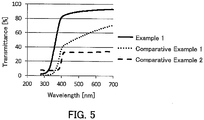
- the composite particles according to Example 1, Comparative Example 1, and Comparative Example 2 were individually dispersed in ion-exchange water so that the concentration of the fine titanium dioxide particles would be 0.1 mass%, and the resultant dispersions were subjected to a 5-minute sonication to prepare specimens. These specimens were each put in a cell having an optical path length of 2 mm to measure the light transmittance at a wavelength ranging from 280 nm to 700 nm using a spectrophotometer (manufactured by Shimadzu Corporation, product name: UV-3600). The measurement results are shown in FIG. 5 .
- Cosmetics according to Example 1, Comparative Example 1, and Comparative Example 2 were each used to form a uniform coating having a film thickness of about 10 ⁇ m on a polypropylene film.
- a transmittance curve of each obtained coating was determined using a spectrophotometer (manufactured by Hitachi High-Technologies Corporation, product name: U-4100). The measurement results are shown in FIG. 6 . From the transmittance curve of each coating, an integral of the transmittance over wavelengths in the visible light range (400 nm to 700 nm) was also determined. The results are shown in Table 2.
- a mixed sol was obtained by mixing an alkaline silica sol (manufactured by Nippon Chemical Industrial Co., Ltd., product name: SILICADOL 30S) and titania sol (manufactured by Tayca Corporation, product name: TS-226) in such a manner that the mass of the solids of the titania sol was about 25% of the mass of the total solids.
- SILICADOL 30S is a colloidal silica containing water as a dispersion medium and having a pH of 9.0 to 10.5, and the particle diameter of the colloidal particles contained therein is 7 nm to 10 nm.
- TS-226 is a sol containing fine rutile titanium dioxide particles as a dispersoid and water as a dispersion medium. The content of the fine titanium dioxide particles in TS-226 is 17.9%.
- the pH of TS-226 is 6 to 7, and the particle diameter of the fine titanium dioxide particles, which are colloidal particles in TS-226, is 2 to 8 nm
- a mixture containing the components shown in Table 1 was heated to dissolve the components, and thus a phase A was obtained.
- a mixture containing the components shown in Table 1 was heated to dissolve the components, and thus a phase B was obtained.
- the composite particles according to Example 1 were added to the phase B in an amount shown in Table 1 and uniformly dispersed in the phase B using a dispersion mixer. Subsequently, the phase A was added to the dispersion in which the composite particles according to Example 1 were uniformly dispersed in the phase B.
- the resultant mixture was emulsified with a homomixer under heating, and then cooled down to 30°C to obtain a cosmetic according to Example 1.
- the cosmetic according to Example 1 was an oil-in-water cosmetic.
- the composite particles according to Example 1 were composite particles in which fine rutile titanium dioxide particles having an average primary particle diameter of 6 nm were dispersed inside the silica particles. Fine titanium dioxide particles are present at the circled spots in FIG. 2 .
- the average particle diameter of the composite particles according to Example 1 was about 20 ⁇ m, and the average thickness thereof was about 1 ⁇ m.
- the content of the fine titanium dioxide particles in the composite particles according to Example 1 was about 20 mass%. From the TEM image of the composite particles according to Example 1, it was confirmed that, inside the silica particles, most of the fine titanium dioxide particles formed aggregates having a secondary particle diameter of 10 nm to 20 nm.
- a cosmetic according to Comparative Example 1 was obtained in the same manner as in Example 1, except for using the composite particles according to Comparative Example 1 instead of the composite particles according to Example 1.
- the cosmetic according to Comparative Example 1 was an oil-in-water cosmetic.
- the average particle diameter of the composite particles according to Comparative Example 1 was about 17 ⁇ m, and the average thickness thereof was about 1 ⁇ m.
- the content of the fine titanium dioxide particles in the composite particles according to Comparative Example 1 was 30 mass%. From the TEM image of the composite particles according to Comparative Example 1, it was confirmed that, inside the silica particles, many of the fine titanium dioxide particles formed aggregates having a secondary particle diameter of 100 nm to 200 nm.
- the mixture was circulated and stirred (stirring speed: a circumferential speed of 8 m/sec, flow rate: 1 L/min) for 2 hours together with 4 kg of zirconia beads of 0.65 mm diameter using a horizontal continuous wet-type bead mill (manufactured by Shinmaru Enterprises Corporation, product name: DYNO-MILL KDL-PILOT A).
- a dispersion B1 of the fine titania dioxide particles was obtained.
- a cosmetic according to Comparative Example 2 was obtained in the same manner as in Example 1, except for using the composite particles according to Comparative Example 2 instead of the composite particles according to Example 1.
- the cosmetic according to Comparative Example 2 was an oil-in-water cosmetic.
- the average particle diameter of the composite particles according to Composite Example 2 was about 17 ⁇ m, and the average thickness thereof was about 1 ⁇ m.
- the content of the fine titanium dioxide particles in the composite particles according to Comparative Example 2 was 30 mass%. From the TEM image of the composite particles according to Comparative Example 2, it was confirmed that, inside the silica particles, many of the fine titanium dioxide particles formed aggregates having a secondary particle diameter of 300 nm to 500 nm.
- the composite particles according to Example 1 had a high visible light transmittance. It was also indicated that the composite particles according to Example 1 had ultraviolet-shielding ability. Both the composite particles according to Comparative Examples 1 and 2 could hardly be said to have a high visible light transmittance.
- the cosmetic according to Example 1 showed a high SPF. Both of the cosmetics according to Comparative Examples 1 and 2 could hardly be said to show SPFs as high as that of the cosmetic according to Example 1.
Landscapes
- Health & Medical Sciences (AREA)
- Life Sciences & Earth Sciences (AREA)
- Chemical & Material Sciences (AREA)
- Animal Behavior & Ethology (AREA)
- General Health & Medical Sciences (AREA)
- Veterinary Medicine (AREA)
- Public Health (AREA)
- Epidemiology (AREA)
- Birds (AREA)
- Organic Chemistry (AREA)
- Inorganic Chemistry (AREA)
- Dermatology (AREA)
- Dispersion Chemistry (AREA)
- Physics & Mathematics (AREA)
- Mathematical Physics (AREA)
- Composite Materials (AREA)
- Cosmetics (AREA)
- Inorganic Compounds Of Heavy Metals (AREA)
- Silicon Compounds (AREA)
Abstract
Description
- The present invention relates to titanium dioxide fine particle-dispersed composite particles and a cosmetic containing the titanium dioxide fine particle-dispersed composite particles.
- Glass flakes inside of which fine titanium dioxide particles are dispersed are conventionally known. Since titanium dioxide has ultraviolet-shielding ability, such glass flakes are contained in, for example, cosmetics.
-
Patent Literature 1 describes glass flakes inside of which fine metal oxide particles are dispersed. The fine metal oxide particles, which are derived from colloidal particles having a hydroxy group, have a particle diameter of 1 to 300 nm and are dispersed substantially in the form of single particles without aggregating in the glass flakes. As glass flakes whose fine metal oxide particles are fine titanium dioxide particles,Patent Literature 1 describes glass flakes produced using titanium hydroxide oxide (TiO(OH)2) containing colloid or hydroxide colloid (refer to Examples 1 to 3). In this case, only anatase titanium dioxide is detected in the glass flakes obtained. -
Patent Literature 1 also describes glass flakes produced using fine rutile titanium dioxide particles (refer to Comparative Example 1). In the glass flakes, however, ten thousand to several tens of thousands of fine titanium dioxide particles are aggregated to form an aggregate having a diameter of about several microns. Moreover, the glass flakes have a low visible light transmittance. - Patent Literature 1:
JP 07-315859 A - According to the technique described in
Patent Literature 1, it is difficult to produce glass flakes having high transparency to visible light using fine rutile titanium dioxide particles. - The present invention therefore aims to provide composite particles having high transparency to visible light and containing fine rutile titanium dioxide particles dispersed in silica particles.
- The present invention provides titanium dioxide fine particle-dispersed composite particles including:
- silica particles; and
- fine rutile titanium dioxide particles dispersed inside the silica particles and having an average primary particle diameter of 2 nm to 8 nm.
- The present invention also provides a cosmetic including the titanium dioxide fine particle-dispersed composite particles.
- Although the fine rutile titanium dioxide particles are dispersed inside the silica particles, the above titanium dioxide fine particle-dispersed composite particles have high transparency to visible light. In the above cosmetic, ultraviolet-shielding ability is exhibited owing to the titanium dioxide fine particle-dispersed composite particles and impairment of the transparency to visible light is prevented by the titanium dioxide fine particle-dispersed composite particles.
-
-
FIG. 1 schematically shows a titanium dioxide fine particle-dispersed composite particle according to the present invention. -
FIG. 2 is a transmission electron microscope (TEM) image of composite particles according to Example 1. -
FIG. 3 is a TEM image of composite particles according to Comparative Example 1. -
FIG. 4 is a TEM image of composite particles according to Comparative Example 2. -
FIG. 5 is a graph showing a relation between the transmittance of the composite particles according to Example and Comparative Examples and the wavelength of transmitted light. -
FIG. 6 is a graph showing transmittance curves of cosmetics according to Example and Comparative Examples. - As shown in
FIG. 1 , a titanium dioxide fine particle-dispersedcomposite particle 1 includes asilica particle 10 and fine rutiletitanium dioxide particles 20. Thesilica particle 10 is a matrix for binding the finetitanium dioxide particles 20. The finetitanium dioxide particles 20 are dispersed inside thesilica particle 10. The finetitanium dioxide particles 20 have an average primary particle diameter of 2 nm to 8 nm. The average primary particle diameter of the finetitanium dioxide particles 20 can be determined by taking images of 1000 or more finetitanium dioxide particles 20 with a TEM, performing image processing on the obtained TEM images of the particles using an image-analyzing particle size distribution analyzer to determine unidirectional particle diameters (distance between two lines being parallel to a specified direction and sandwiching a projection image) of the particles, and calculating the arithmetic mean of the unidirectional particle diameters. - According to conventional techniques, it has been thought that if fine rutile titanium dioxide particles have such a small average primary particle diameter, the dioxide fine particles are aggregated together inside silica particle serving as a matrix and thus formed aggregates larger than 100 nm. The aggregates of fine titanium dioxide particles which are larger than 100 nm are likely to scatter visible light. Therefore, it has been thought difficult to obtain composite particles having silica particles as a matrix and showing a high transmittance to visible light (wavelength: 400 nm to 800 nm) by use of fine rutile titanium dioxide particles having a small primary particle diameter.
- In fact, in glass flakes described in
Patent Literature 1 produced by use of fine rutile titanium dioxide particles having a primary particle diameter of 20 nm to 50 nm, there are few fine titanium dioxide particles monodispersed in a silica glass matrix, and ten thousand to several tens of thousands of the fine titanium dioxide particles are aggregated to form an aggregate having a diameter of about several microns. A resin film in which the glass flakes are dispersed has a low visible light transmittance at a wavelength ranging from 400 to 800 nm. - The present inventors investigated materials and production conditions of the titanium dioxide fine particle-dispersed
composite particles 1 through much trial and error. As a result, the present inventors successfully dispersed fine rutile titanium dioxide particles having an average primary particle diameter of 2 nm to 8 nm in silica particles as a matrix and obtained composite particles having a high visible light transmittance. The present inventors thus completed the present invention. - As shown in
FIG. 1 , the finetitanium dioxide particles 20 are dispersed inside thesilica particle 10 appropriately. For example, the finetitanium dioxide particles 20form aggregates 20A having a secondary particle diameter of 10 nm to 100 nm inside thesilica particles 10. This inhibits the finetitanium dioxide particles 20 from scattering the light passing through the titanium dioxide fine particle-dispersedcomposite particles 1. Consequently, the titanium dioxide fine particle-dispersedcomposite particles 1 have a high visible light transmittance. The particle diameter (secondary particle diameter) of theaggregates 20A is desirably 10 nm to 50 nm, and more desirably 10 nm to 20 nm. - In the titanium dioxide fine particle-dispersed
composite particles 1, some of the finetitanium dioxide particles 20 may exist as single particles without aggregating. Within a limited region of the titanium dioxide fine particle-dispersedcomposite particles 1, the finetitanium dioxide particles 20 may form aggregates larger than 100 nm. Desirably, on a number basis, 30% or more of the finetitanium dioxide particles 20 form a plurality ofaggregates 20A. This can be confirmed by, for example, TEM observation of the dispersion state of 100 or more finetitanium dioxide particles 20 in the titanium dioxide fine particle-dispersedcomposite particles 1. - The content of the fine
titanium dioxide particles 20 in the titanium dioxide fine particle-dispersedcomposite particles 1 is, for example, 0.1 mass% to 80 mass%, and desirably 20 mass% to 50 mass%. This makes it easy to appropriately disperse the finetitanium dioxide particles 20 in the titanium dioxide fine particle-dispersedcomposite particles 1. Therefore, the titanium dioxide fine particle-dispersedcomposite particles 1 are likely to have a high visible light transmittance and desired ultraviolet-shielding ability. - The titanium dioxide fine particle-dispersed
composite particles 1 have a high visible light transmittance. For example, the titanium dioxide fine particle-dispersedcomposite particles 1 are dispersed in ion-exchange water so that the concentration of the fine titanium dioxide particles will be 0.1 mass%, and the resultant dispersion is subjected to a 5-minute sonication to prepare a specimen. When this specimen is put in a cell having an optical path length of 2 mm and measured with a spectrophotometer, the light transmittance at a wavelength ranging from 400 nm to 700 nm was 80% or higher. When this specimen is put in a cell having an optical path length of 2 mm and measured with a spectrophotometer, the light transmittance at a wavelength of 350 nm was 50% or lower. As demonstrated above, the titanium dioxide fine particle-dispersedcomposite particles 1 have ultraviolet-shielding ability and also have a high visible light transmittance. - The shape of the titanium dioxide fine particle-dispersed
composite particles 1 is, for example, but not particularly limited to, flaky as shown inFIG. 1 . The term "flaky" as used herein means the shape of a plate whose principal surfaces can be regarded as flat or curved surfaces and in which the ratio of the average diameter of each principal surface to the thickness is 3 or more. The average diameter of the titanium dioxide fine particle-dispersedcomposite particles 1 is the diameter of a circle having an area equal to the area of the principal surface of the titanium dioxide fine particle-dispersedcomposite particles 1. In the case where the titanium dioxide fine particle-dispersedcomposite particles 1 are flaky, the thickness thereof is, for example, 0.1 µm to 5 µm, and desirably 0.1 µm to 2 µm. The average particle diameter of the titanium dioxide fine particle-dispersedcomposite particles 1 is, for example, 1 µm to 80 µm, and desirably 3 µm to 40 µm. The average particle diameter of the titanium dioxide fine particle-dispersedcomposite particles 1 means the median particle diameter (D50) in the volume-based particle size distribution measured using a laser diffraction granulometer. - A cosmetic including the titanium dioxide fine particle-dispersed
composite particles 1 can be provided using the titanium dioxide fine particle-dispersedcomposite particles 1. By virtue of including the titanium dioxide fine particle-dispersedcomposite particles 1, this cosmetic has ultraviolet-shielding ability. Furthermore, since the titanium dioxide fine particle-dispersedcomposite particles 1 have a high visible light transmittance, impairment of the transparency to visible light is prevented by the titanium dioxide fine particle-dispersedcomposite particles 1. The content of the titanium dioxide fine particle-dispersedcomposite particles 1 in the cosmetic is, for example, but not particularly limited to, 0.1 mass% to 50 mass%. This makes it likely that the cosmetic has desired ultraviolet-shielding ability. This can also inhibit excessive reduction of the fluidity of the cosmetic. - Hereinafter, an example of a method for producing the titanium dioxide fine particle-dispersed
composite particles 1 will be described. A silica sol containing colloidal silica particles as a dispersoid and water as a dispersion medium is prepared. The pH of the silica sol is, for example, 7 or higher. The particle diameter of the colloidal silica particles in the silica sol is, for example, 7 nm to 20 nm. A titania sol containing colloidal particles of rutile titanium dioxide as a dispersoid and water as a dispersion medium is also prepared. The pH of the titania sol is, for example, 6 to 7. The particle diameter of the colloidal particles of titanium dioxide in the titania sol is, for example, 2 nm to 8 nm. The silica sol and titania sol are mixed to obtain a mixed sol. The mixing ratio of the silica sol and titania sol is not particularly limited. For example, the silica sol and titania sol are mixed so that the mass of the solids of the titania sol in the mixed sol will be 0.1% to 60% of the mass of the total solids in the mixed sol. - Next, the mixed sol is introduced into a liquid containing an organic solvent. As the organic solvent, for example, a protic solvent having a relative permittivity of 30 or less at 20°C and being miscible with water or an aprotic solvent having a relative permittivity of 40 or less at 20°C and being miscible with water can be used. The mixed sol is introduced, for example, dropwise into the liquid containing the predetermined organic solvent. At this time, it is desirable that the mixed sol be introduced into the liquid containing the predetermined organic solvent under stirring. Flaky aggregates of the colloidal silica particles are thus yielded in the liquid containing the predetermined organic solvent. At this time, the fine rutile titanium dioxide particles are included and dispersed inside the aggregates. In this manner, a slurry in which the flaky aggregates of the colloidal particles are formed can be obtained.
- Next, the solvent is removed from the slurry in which the flaky aggregates of the colloidal particles are formed. The removal of the solvent can be performed, for example, by vacuum-drying the slurry in a vacuum drying oven. The drying also turns the aggregates to a gel. This gelation increases the binding force between the colloidal silica particles composing the yielded flaky aggregates. The gel aggregates are baked as needed to remove an unnecessary organic substance. The baking is carried out, for example, at a temperature ranging from 400°C to 1100°C, and desirably at a temperature ranging from 500°C to 900°C. The titanium dioxide fine particle-dispersed
composite particles 1 being flaky can thus be obtained. - The present invention will be described in more detail by way of examples. It should be noted that the present invention is not limited to examples given below.
- First, a method for evaluating the light transmittance of composite particles according to Example 1, Comparative Example 1, and Comparative Example 2 is described. The composite particles according to Example 1, Comparative Example 1, and Comparative Example 2 were individually dispersed in ion-exchange water so that the concentration of the fine titanium dioxide particles would be 0.1 mass%, and the resultant dispersions were subjected to a 5-minute sonication to prepare specimens. These specimens were each put in a cell having an optical path length of 2 mm to measure the light transmittance at a wavelength ranging from 280 nm to 700 nm using a spectrophotometer (manufactured by Shimadzu Corporation, product name: UV-3600). The measurement results are shown in
FIG. 5 . - Cosmetics according to Example 1, Comparative Example 1, and Comparative Example 2 were each used to form a uniform coating having a film thickness of about 10 µm on a polypropylene film. A transmittance curve of each obtained coating was determined using a spectrophotometer (manufactured by Hitachi High-Technologies Corporation, product name: U-4100). The measurement results are shown in
FIG. 6 . From the transmittance curve of each coating, an integral of the transmittance over wavelengths in the visible light range (400 nm to 700 nm) was also determined. The results are shown in Table 2. - An amount of 2 mg/cm2 of each of the cosmetics according to Example 1, Comparative Example 1, and Comparative Example 2 was applied to a polymethyl methacrylate (PMMA) plate to form a coating, which was measured for a sun protection factor (SPF) using a SPF analyzer (manufactured by Labsphere, Inc., product name: UV-2000S). In this manner, the ultraviolet-shielding property was measured for the cosmetics according to Example 1, Comparative Example 1, and Comparative Example 2. The measurement results are shown in Table 2.
- A mixed sol was obtained by mixing an alkaline silica sol (manufactured by Nippon Chemical Industrial Co., Ltd., product name: SILICADOL 30S) and titania sol (manufactured by Tayca Corporation, product name: TS-226) in such a manner that the mass of the solids of the titania sol was about 25% of the mass of the total solids. SILICADOL 30S is a colloidal silica containing water as a dispersion medium and having a pH of 9.0 to 10.5, and the particle diameter of the colloidal particles contained therein is 7 nm to 10 nm. TS-226 is a sol containing fine rutile titanium dioxide particles as a dispersoid and water as a dispersion medium. The content of the fine titanium dioxide particles in TS-226 is 17.9%. The pH of TS-226 is 6 to 7, and the particle diameter of the fine titanium dioxide particles, which are colloidal particles in TS-226, is 2 to 8 nm.
- Next, 50 ml of 2-propanol was put in a beaker, and a total amount of 1 g of the mixed sol was added in drops of 0.01 g to the 2-propanol. During the dropping of the mixed sol, the 2-propanol was stirred with a magnetic stirrer at a rotational speed of 800 ppm. In this manner, a slurry in which flaky aggregates of the colloidal particles were formed was obtained. This slurry was put in a vacuum drying oven set at 120°C to remove the solvent, and thus dry aggregates were obtained. This was followed by baking the dried aggregates at 600°C for 5 hours. Composite particles according to Example 1 were obtained in this manner.
- A mixture containing the components shown in Table 1 was heated to dissolve the components, and thus a phase A was obtained. A mixture containing the components shown in Table 1 was heated to dissolve the components, and thus a phase B was obtained. The composite particles according to Example 1 were added to the phase B in an amount shown in Table 1 and uniformly dispersed in the phase B using a dispersion mixer. Subsequently, the phase A was added to the dispersion in which the composite particles according to Example 1 were uniformly dispersed in the phase B. The resultant mixture was emulsified with a homomixer under heating, and then cooled down to 30°C to obtain a cosmetic according to Example 1. The cosmetic according to Example 1 was an oil-in-water cosmetic.
- As shown in
FIG. 2 , the composite particles according to Example 1 were composite particles in which fine rutile titanium dioxide particles having an average primary particle diameter of 6 nm were dispersed inside the silica particles. Fine titanium dioxide particles are present at the circled spots inFIG. 2 . The average particle diameter of the composite particles according to Example 1 was about 20 µm, and the average thickness thereof was about 1 µm. The content of the fine titanium dioxide particles in the composite particles according to Example 1 was about 20 mass%. From the TEM image of the composite particles according to Example 1, it was confirmed that, inside the silica particles, most of the fine titanium dioxide particles formed aggregates having a secondary particle diameter of 10 nm to 20 nm. - An amount of 500 g of fine titanium dioxide particles (manufactured by Tayca Corporation, product name: MT-100 AQ, average primary particle diameter: 15 nm) and 42 g of an ammonium polyacrylate surfactant (manufactured by Cognis Corporation, product name: HYDROPALAT 5050) were added to 1125 g of pure water. The mixture was circulated and stirred (stirring speed: a circumferential speed of 8 m/sec, flow rate: 1 L/min) for 2 hours together with 4 kg of zirconia beads of 0.65 mm diameter using a horizontal continuous wet-type bead mill (manufactured by Shinmaru Enterprises Corporation, product name: DYNO-MILL KDL-PILOT A). Thus, a dispersion A1 of the fine titania dioxide particles was obtained.
- Next, 4.29 parts by mass of the dispersion A1 of the fine titanium dioxide particles was mixed with 10.0 parts by mass of a silica sol (manufactured by Nippon Chemical Industrial Co., Ltd., product name: SILICADOL 30S) to obtain a sol solution A2. The content of the fine titanium dioxide particles in the solids of the sol solution A2 was 30 mass%. Subsequently, composite particles according to Comparative Example 1 were obtained in the same manner as in Example 1, except for using the sol solution A2 instead of the mixed sol.
- A cosmetic according to Comparative Example 1 was obtained in the same manner as in Example 1, except for using the composite particles according to Comparative Example 1 instead of the composite particles according to Example 1. The cosmetic according to Comparative Example 1 was an oil-in-water cosmetic.
- The average particle diameter of the composite particles according to Comparative Example 1 was about 17 µm, and the average thickness thereof was about 1 µm. The content of the fine titanium dioxide particles in the composite particles according to Comparative Example 1 was 30 mass%. From the TEM image of the composite particles according to Comparative Example 1, it was confirmed that, inside the silica particles, many of the fine titanium dioxide particles formed aggregates having a secondary particle diameter of 100 nm to 200 nm.
- An amount of 500 g of fine titanium dioxide particles (manufactured by ISHIHARA SANGYO KAISHA, LTD., product name: CR-50, average primary particle diameter: 250 nm) and 42 g of an ammonium polyacrylate surfactant (manufactured by Cognis Corporation, product name: HYDROPALAT 5050) were added to 1125 g of pure water. The mixture was circulated and stirred (stirring speed: a circumferential speed of 8 m/sec, flow rate: 1 L/min) for 2 hours together with 4 kg of zirconia beads of 0.65 mm diameter using a horizontal continuous wet-type bead mill (manufactured by Shinmaru Enterprises Corporation, product name: DYNO-MILL KDL-PILOT A). Thus, a dispersion B1 of the fine titania dioxide particles was obtained.
- Next, 4.29 parts by mass of the dispersion B1 of the fine titanium dioxide particles was mixed with 10.0 parts by mass of a silica sol (manufactured by Nippon Chemical Industrial Co., Ltd., product name: SILICADOL 30S) to obtain a sol solution B2. The content of the fine titanium dioxide particles in the solids of the sol solution B2 was 30 mass%. Subsequently, composite particles according to Comparative Example 2 were obtained in the same manner as in Example 1, except for using the sol solution B2 instead of the mixed sol.
- A cosmetic according to Comparative Example 2 was obtained in the same manner as in Example 1, except for using the composite particles according to Comparative Example 2 instead of the composite particles according to Example 1. The cosmetic according to Comparative Example 2 was an oil-in-water cosmetic.
- The average particle diameter of the composite particles according to Composite Example 2 was about 17 µm, and the average thickness thereof was about 1 µm. The content of the fine titanium dioxide particles in the composite particles according to Comparative Example 2 was 30 mass%. From the TEM image of the composite particles according to Comparative Example 2, it was confirmed that, inside the silica particles, many of the fine titanium dioxide particles formed aggregates having a secondary particle diameter of 300 nm to 500 nm.
- As shown in
FIG. 5 , it was indicated that the composite particles according to Example 1 had a high visible light transmittance. It was also indicated that the composite particles according to Example 1 had ultraviolet-shielding ability. Both the composite particles according to Comparative Examples 1 and 2 could hardly be said to have a high visible light transmittance. - As shown in
FIG. 6 and Table 2, it was indicated that the cosmetic according to Example 1 had a high visible light transmittance. The cosmetics according to Comparative Examples 1 and 2 could hardly be said to have a visible light transmittance as high as that of the cosmetic according to Example 1. - As shown in Table 2, the cosmetic according to Example 1 showed a high SPF. Both of the cosmetics according to Comparative Examples 1 and 2 could hardly be said to show SPFs as high as that of the cosmetic according to Example 1.
-
[Table 1] Component Content [mass%] Phase A Mineral oil 9.0 Glyceryl caprylate/caprate 8.0 Vaseline 2.0 Cetyl palmitate 4.0 Glyceryl stearate-6 0.9 Glyceryl stearate SE 2.5 Behenyl alcohol 0.9 Propylparaben 0.1 Phase B Water Adjusted according to content of other components 1,-butylene glycol (BG) 6.5 Methylparaben 0.2 Glyceryl stearate-10 0.8 Composite particles according to Example 1 13.3 Total 100.0 -
[Table 2] Integral transmittance from 400 nm to 700 nm [%• nm] SPF Example 1 27,620 9 Example 2 25,968 7 Example 3 22,757 2
Claims (4)
- Titanium dioxide fine particle-dispersed composite particles comprising:silica particles; andfine rutile titanium dioxide particles dispersed inside the silica particles and having an average primary particle diameter of 2 nm to 8 nm.
- The titanium dioxide fine particle-dispersed composite particles according to claim 1, wherein the fine titanium dioxide particles form an aggregate having a secondary particle diameter of 10 nm to 100 nm inside the silica particles.
- The titanium dioxide fine particle-dispersed composite particles according to claim 1 or 2, being flaky.
- A cosmetic comprising the titanium dioxide fine particle-dispersed composite particles according to any one of claims 1 to 3.
Applications Claiming Priority (2)
| Application Number | Priority Date | Filing Date | Title |
|---|---|---|---|
| JP2015253568A JP2017114826A (en) | 2015-12-25 | 2015-12-25 | Titanium dioxide fine particle dispersed composite particles and cosmetics |
| PCT/JP2016/005066 WO2017110053A1 (en) | 2015-12-25 | 2016-12-06 | Composite particles in which titanium dioxide microparticles are dispersed, and cosmetic |
Publications (2)
| Publication Number | Publication Date |
|---|---|
| EP3395322A1 true EP3395322A1 (en) | 2018-10-31 |
| EP3395322A4 EP3395322A4 (en) | 2019-08-07 |
Family
ID=59089930
Family Applications (1)
| Application Number | Title | Priority Date | Filing Date |
|---|---|---|---|
| EP16877958.5A Withdrawn EP3395322A4 (en) | 2015-12-25 | 2016-12-06 | Composite particles in which titanium dioxide microparticles are dispersed, and cosmetic |
Country Status (5)
| Country | Link |
|---|---|
| US (1) | US20190000726A1 (en) |
| EP (1) | EP3395322A4 (en) |
| JP (1) | JP2017114826A (en) |
| CN (1) | CN108430437A (en) |
| WO (1) | WO2017110053A1 (en) |
Cited By (1)
| Publication number | Priority date | Publication date | Assignee | Title |
|---|---|---|---|---|
| EP4729043A1 (en) * | 2024-10-15 | 2026-04-22 | Nexdot | Personal care composition comprising composite particles |
Family Cites Families (18)
| Publication number | Priority date | Publication date | Assignee | Title |
|---|---|---|---|---|
| JP2593296B2 (en) * | 1985-10-08 | 1997-03-26 | 岡村製油株式会社 | Cosmetic composition and method for producing the same |
| JP2591946B2 (en) * | 1986-11-17 | 1997-03-19 | 住友化学工業株式会社 | Flaky metal compounds and cosmetics containing the same |
| AU687883B2 (en) * | 1993-10-01 | 1998-03-05 | Kao Corporation | Ultraviolet shielding composite fine particles, method for producing the same, and cosmetics |
| JP2631963B2 (en) * | 1993-10-01 | 1997-07-16 | 花王株式会社 | Ultraviolet ray shielding composite fine particles, method for producing the same, and cosmetics |
| US5902569A (en) * | 1995-03-10 | 1999-05-11 | Kao Corporation | Ultraviolet shielding composite fine particles, method for producing the same, and cosmetics |
| US6197282B1 (en) * | 1996-05-30 | 2001-03-06 | Kao Corporation | Fine ultraviolet screening particles, process for preparing the same, and cosmetic preparation |
| JP4201880B2 (en) * | 1998-05-21 | 2008-12-24 | チタン工業株式会社 | Butterfly-like rutile titanium oxide, method for producing the same, and use thereof |
| JP3795671B2 (en) * | 1998-05-29 | 2006-07-12 | 旭硝子エスアイテック株式会社 | Cosmetics containing silica-metal oxide fine particle composite |
| JP4220020B2 (en) * | 1998-07-16 | 2009-02-04 | チタン工業株式会社 | Ultrafine titanium oxide, its production method and its application |
| TWI292322B (en) * | 2000-09-25 | 2008-01-11 | Shiseido Co Ltd | Metal oxide/silica complex and cosmetics containing the same |
| ATE280203T1 (en) * | 2001-08-08 | 2004-11-15 | Degussa | METAL OXIDE PARTICLES COVERED WITH SILICON DIOXIDE |
| JP2004043291A (en) * | 2002-05-24 | 2004-02-12 | Nippon Sheet Glass Co Ltd | Flaky particles, and cosmetic, coating material composition, resin composition and ink composition each blended with the same |
| US20050113485A1 (en) * | 2002-05-24 | 2005-05-26 | Nippon Sheet Glass Co., Ltd. | Flaky particles, and cosmetic, coating material composition, resin composition and ink composition ezch containing the same |
| EP1930297B1 (en) * | 2005-09-30 | 2014-09-17 | Sakai Chemical Industry Co., Ltd. | Process for producing fine particle of rutile-form titanium oxide |
| JP5782650B2 (en) * | 2009-11-18 | 2015-09-24 | ディーエスエム アイピー アセッツ ビー.ブイ. | Topical composition |
| US9001418B2 (en) * | 2010-07-24 | 2015-04-07 | Konica Minolta Holdings, Inc. | Near-infrared reflecting film and near-infrared reflecting body provided with same |
| JP2013249229A (en) * | 2012-05-31 | 2013-12-12 | Sakai Chem Ind Co Ltd | Titanium dioxide coated with silica |
| JP6068927B2 (en) * | 2012-10-24 | 2017-01-25 | チタン工業株式会社 | Rutile titanium oxide and cosmetics using the same |
-
2015
- 2015-12-25 JP JP2015253568A patent/JP2017114826A/en active Pending
-
2016
- 2016-12-06 CN CN201680074797.7A patent/CN108430437A/en active Pending
- 2016-12-06 US US16/062,476 patent/US20190000726A1/en not_active Abandoned
- 2016-12-06 WO PCT/JP2016/005066 patent/WO2017110053A1/en not_active Ceased
- 2016-12-06 EP EP16877958.5A patent/EP3395322A4/en not_active Withdrawn
Cited By (2)
| Publication number | Priority date | Publication date | Assignee | Title |
|---|---|---|---|---|
| EP4729043A1 (en) * | 2024-10-15 | 2026-04-22 | Nexdot | Personal care composition comprising composite particles |
| WO2026082808A1 (en) * | 2024-10-15 | 2026-04-23 | Nexdot | Personal care composition comprising composite particles |
Also Published As
| Publication number | Publication date |
|---|---|
| US20190000726A1 (en) | 2019-01-03 |
| JP2017114826A (en) | 2017-06-29 |
| CN108430437A (en) | 2018-08-21 |
| WO2017110053A1 (en) | 2017-06-29 |
| EP3395322A4 (en) | 2019-08-07 |
Similar Documents
| Publication | Publication Date | Title |
|---|---|---|
| US8647679B2 (en) | Core-shell type zinc oxide microparticle or dispersion containing the microparticle, and production process and use of the microparticle or the dispersion | |
| US9138704B2 (en) | Suspension of nanoparticles | |
| EP3747965B1 (en) | Titanium dioxide aqueous dispersion and method for producing same | |
| CN101522560B (en) | Process for producing dispersion of fine metal compound particles and the dispersion | |
| JP4635217B2 (en) | Surface treatment agent and material, and surface treatment method | |
| EP2072466A1 (en) | Core-shell-type cerium oxide microparticle, dispersion solution comprising the microparticle, and process for production of the microparticle or dispersion solution | |
| KR101311636B1 (en) | Titania fine-particle composite and compositons coantining the titania fine-particle composite | |
| EP3546426B1 (en) | Black-film-forming mixed powder and production method therefor | |
| JP2002087817A (en) | Composite zinc oxide dispersion | |
| US20190000726A1 (en) | Titanium dioxide fine particle-dispersed composite particles and cosmetic | |
| TWI832929B (en) | Surface-treated infrared absorbing fine particle dispersion liquid and method for producing the same | |
| Barth et al. | Influence of TiO2 nanoparticle synthesis on the properties of thin coatings | |
| Suma et al. | Studies on the effect of nano-TiO2 on vinyl acetate–butyl acrylate latex-based surface coating | |
| Hasan et al. | Dispersion of submicron-sized SiO2/Al2O3-coated TiO2 particles and efficient encapsulation via the emulsion copolymerization of methacrylates using a thermoresponsive polymerizable nonionic surfactant | |
| Takeda et al. | Importance of dispersibility of TiO2 in preparation of TiO2-dispersed microspheres by Shirasu porous glass (SPG) membrane emulsification | |
| WO2021025144A1 (en) | Niobic acid compound sol, sol coating film, and film-holding substrate | |
| JP2008273759A (en) | Zinc oxide and method for producing the same and ultraviolet shielding composition using the same | |
| JPH09132409A (en) | Method for producing ultrafine particle dispersion | |
| JP7630423B2 (en) | Highly opaque white pigment for low viscosity dispersion medium and method for producing same | |
| EP3533763A1 (en) | Barium sulfate powder and resin composition comprising same | |
| JP2024055556A (en) | Bismuth oxide dispersion and ultraviolet ray shielding coating agent | |
| Li et al. | Surface Treatment of Broad-Spectrum Ultraviolet Light Shielding Titania/Zinc Oxide Composites and Their Applications in Sunscreens | |
| DE102018103526A1 (en) | Stabilized suspension and process for the preparation of a stabilized suspension |
Legal Events
| Date | Code | Title | Description |
|---|---|---|---|
| STAA | Information on the status of an ep patent application or granted ep patent |
Free format text: STATUS: THE INTERNATIONAL PUBLICATION HAS BEEN MADE |
|
| PUAI | Public reference made under article 153(3) epc to a published international application that has entered the european phase |
Free format text: ORIGINAL CODE: 0009012 |
|
| STAA | Information on the status of an ep patent application or granted ep patent |
Free format text: STATUS: REQUEST FOR EXAMINATION WAS MADE |
|
| 17P | Request for examination filed |
Effective date: 20180723 |
|
| AK | Designated contracting states |
Kind code of ref document: A1 Designated state(s): AL AT BE BG CH CY CZ DE DK EE ES FI FR GB GR HR HU IE IS IT LI LT LU LV MC MK MT NL NO PL PT RO RS SE SI SK SM TR |
|
| AX | Request for extension of the european patent |
Extension state: BA ME |
|
| DAV | Request for validation of the european patent (deleted) | ||
| DAX | Request for extension of the european patent (deleted) | ||
| A4 | Supplementary search report drawn up and despatched |
Effective date: 20190710 |
|
| RIC1 | Information provided on ipc code assigned before grant |
Ipc: A61K 8/02 20060101ALI20190704BHEP Ipc: A61Q 17/04 20060101ALI20190704BHEP Ipc: A61K 8/29 20060101AFI20190704BHEP Ipc: C01B 33/18 20060101ALI20190704BHEP Ipc: B82Y 30/00 20110101ALI20190704BHEP Ipc: A61K 8/25 20060101ALI20190704BHEP |
|
| STAA | Information on the status of an ep patent application or granted ep patent |
Free format text: STATUS: THE APPLICATION HAS BEEN WITHDRAWN |
|
| 18W | Application withdrawn |
Effective date: 20191219 |