EP3392358A1 - Low-cost high-heat-conduction die-casting magnesium alloy and manufacturing method therefor - Google Patents
Low-cost high-heat-conduction die-casting magnesium alloy and manufacturing method therefor Download PDFInfo
- Publication number
- EP3392358A1 EP3392358A1 EP16874766.5A EP16874766A EP3392358A1 EP 3392358 A1 EP3392358 A1 EP 3392358A1 EP 16874766 A EP16874766 A EP 16874766A EP 3392358 A1 EP3392358 A1 EP 3392358A1
- Authority
- EP
- European Patent Office
- Prior art keywords
- magnesium alloy
- casting
- heat
- die
- low
- Prior art date
- Legal status (The legal status is an assumption and is not a legal conclusion. Google has not performed a legal analysis and makes no representation as to the accuracy of the status listed.)
- Granted
Links
Images
Classifications
-
- C—CHEMISTRY; METALLURGY
- C22—METALLURGY; FERROUS OR NON-FERROUS ALLOYS; TREATMENT OF ALLOYS OR NON-FERROUS METALS
- C22C—ALLOYS
- C22C23/00—Alloys based on magnesium
-
- C—CHEMISTRY; METALLURGY
- C22—METALLURGY; FERROUS OR NON-FERROUS ALLOYS; TREATMENT OF ALLOYS OR NON-FERROUS METALS
- C22C—ALLOYS
- C22C23/00—Alloys based on magnesium
- C22C23/06—Alloys based on magnesium with a rare earth metal as the next major constituent
-
- B—PERFORMING OPERATIONS; TRANSPORTING
- B22—CASTING; POWDER METALLURGY
- B22D—CASTING OF METALS; CASTING OF OTHER SUBSTANCES BY THE SAME PROCESSES OR DEVICES
- B22D17/00—Pressure die casting or injection die casting, i.e. casting in which the metal is forced into a mould under high pressure
-
- B—PERFORMING OPERATIONS; TRANSPORTING
- B22—CASTING; POWDER METALLURGY
- B22D—CASTING OF METALS; CASTING OF OTHER SUBSTANCES BY THE SAME PROCESSES OR DEVICES
- B22D27/00—Treating the metal in the mould while it is molten or ductile ; Pressure or vacuum casting
- B22D27/003—Treating the metal in the mould while it is molten or ductile ; Pressure or vacuum casting by using inert gases
-
- C—CHEMISTRY; METALLURGY
- C22—METALLURGY; FERROUS OR NON-FERROUS ALLOYS; TREATMENT OF ALLOYS OR NON-FERROUS METALS
- C22C—ALLOYS
- C22C1/00—Making non-ferrous alloys
- C22C1/02—Making non-ferrous alloys by melting
-
- C—CHEMISTRY; METALLURGY
- C22—METALLURGY; FERROUS OR NON-FERROUS ALLOYS; TREATMENT OF ALLOYS OR NON-FERROUS METALS
- C22C—ALLOYS
- C22C23/00—Alloys based on magnesium
- C22C23/04—Alloys based on magnesium with zinc or cadmium as the next major constituent
Definitions
- the invention relates to an alloy material and a manufacturing method therefor, in particular to a magnesium-containing alloy material and a manufacturing method therefor.
- Magnesium and its alloys are the lightest metal structure materials with a density of only 1/4 of that of steel and 2/3 of that of aluminum. Magnesium and its alloys have many advantages such as high specific strength and specific rigidity, excellent electromagnetic shielding performance, good heat dissipation property, and good vibration-reducing performance. Because pure magnesium has an extremely low strength (the tensile yield strength in the as-cast condition is only about 21 MPa) and a poor castability, and alloying is the most effective method to improve the mechanical properties and castability, magnesium alloys are used instead of pure magnesium in practical applications.
- magnesium alloy processing method since the die-casting process has many advantages such as high production efficiency, low cost and high dimensional precision of the prepared parts, most of present magnesium alloy parts are prepared by die-casting process, i.e. 90% or more of magnesium alloy parts are die-castings pieces.
- shells of many 3C products i.e. the general term for computers, communications, and consumer electronics
- 3C products such as mobile phones, laptops, digital cameras, video cameras, etc.
- the magnesium alloy has excellent thin-wall casting properties and anti-collision ability, and therefore can meet the requirements of highly integrated, lightening and thinning anti-falling, electromagnetic shielding, heat dissipation and environmental protection of 3C products.
- 3C products With the rapid improvement of the performance of semiconductor transistors, 3C products have become the worldwide fastest growing industries and are moving in the direction of lighter, thinner, shorter and smaller. High performance, miniaturization and integration have become the trend of development.
- the volumetric power density of electronic components and devices is also increasing, resulting in a significant increase in the total power density and heat generation in electronic devices such as personal computers, new high-power LED lighting systems, and high-density computer server systems. If the heat generated during the operation of the electronic devices cannot dissipate through the shell in time, the ambient temperature will rise. Meanwhile, the operating efficiency of electronic devices is highly sensitive to the temperature, i.e. the operating efficiency of some electronic devices decreases exponentially with increasing temperature. Therefore, the shells of these products and the substrates on which electronic devices such as chips are mounted need to have excellent heat dissipation performance. Hence, the low-cost magnesium alloys having thermal conductivity, die-castability, and mechanical properties can be applied in a wide range of fields.
- the thermal conductivity of pure magnesium is high (about 157 W/m•K at room temperature), the thermal conductivity of alloyed magnesium alloys is usually significantly reduced.
- the thermal conductivity of present commercial die-casting magnesium alloy Mg-9Al-1Zn-0.2Mn (AZ91) is only 51 W/m•K, and the thermal conductivities of Mg-5Al-0.5Mn (AM50) and Mg-6Al-0.5Mn (AM60) are 65 W/m•K and 61 W/m•K, respectively, which are much lower than that of pure Mg.
- the above-mentioned several magnesium alloys have excellent die-casting performance and good mechanical properties, they cannot meet the demand for high thermal conductivity due to their poor heat-conducting property.
- magnesium alloy AE44 has excellent mechanical properties and a relatively high thermal conductivity (85 W/m•K), it tends to die sticking easily and has poor die-casting properties.
- magnesium alloys having high thermal conductivity have also been developed successively in the prior art.
- Chinese Patent No. CN102719716A (published on October 10, 2012 ) entitled "Heat conduction magnesium alloy and preparation method thereof' discloses a magnesium alloy and a preparation method thereof.
- the weight percentage of the chemical elements of the magnesium alloy is: Zn: 1-7%, Ca: 0.1-3%, La: 0.1-3%, Ce: 0.1-3%, and the balance is magnesium.
- the thermal conductivity of the magnesium alloy is not less than 125 W/m ⁇ K, the yield strength is greater than 300 MPa at room temperature, and the tensile strength is greater than 340 MPa.
- the magnesium alloy is a magnesium alloy deformed by extrusion and in which two kinds of rare earth metals are added.
- the patent does not involve the die-casting properties of the magnesium alloy.
- Cipheral Patent No. CN102251161A (published on November 23, 2011 ) entitled "Heat conductive magnesium alloy” discloses a heat conductive magnesium alloy, comprising the components of: 0.5-5.5 wt% of Zn, 0.2-5 wt% of Sn and the balance of Mg.
- the magnesium alloy has a thermal conductivity of more than 110 W/m ⁇ K, a tensile strength of 180-230 MPa, and an elongation of 18-22%.
- the magnesium alloy is produced by gravity casting followed by a heat treatment process, and the patent also does not involve the die-casting properties of the magnesium alloy.
- the purpose of the present invention is to provide a low-cost high-heat-conduction die-casting magnesium alloy.
- the magnesium alloy material has high thermal conductivity, good die-casting properties and excellent mechanical properties.
- the magnesium alloy of the present invention has an economical production cost and can be extended to large-scale industrial production suitably.
- present invention provides a low-cost high-heat-conduction die-casting magnesium alloy comprising, as a chemical element percentage by mass,
- rare earth element can purify the alloy melting, and can effectively improve the mechanical properties and corrosion resistance of magnesium alloy at room temperature and high temperature.
- rare earth elements can narrow the solidification temperature range of the alloy, thereby improving the casting performance of the alloy, and can reduce the cracking during welding and improve the compactness of the casting.
- Rare earth elements used for strengthening magnesium alloys commonly include gadolinium (Gd), yttrium (Y), neodymium (Nd), samarium (Sm), praseodymium (Pr), lanthanum (La), cerium (Ce) and the like.
- La is a relatively easily available rare earth element among the three economical rare earth elements, therefore La is selected as an additive element in the alloy.
- the additive amount of La must not be too high in order to keep the production costs at a low level.
- the La content in the low-cost high-heat-conduction die-casting magnesium alloy of the present invention should be in a range of 1-5%.
- Zinc is one of the commonly used alloying elements in magnesium alloys. It has the dual functions of solution strengthening and aging strengthening. The addition of a proper amount of Zn can increase the strength and plasticity of the magnesium alloy, improve the melt fluidity, and improve the casting performance. The addition of 0.5% or more of Zn can improve the fluidity of the magnesium alloy and strengthen the mechanical properties of the alloy. However, if the additive amount of Zn is too high, the fluidity of Zn alloy will be greatly reduced and the microporosity or hot tearing of the magnesium alloy tends to occur. Therefore, based on the above technical solution, the content of Zn is controlled in the range of 0.5-3%.
- Ca since the addition of alkaline earth element Ca can advantageously improve the metallurgical quality of magnesium alloys and the cost of adding Ca is relatively low, Ca is often added in the production process of magnesium alloys.
- Reasons for adding Ca are: 1) to increase the ignition temperature of magnesium alloy melts and reduce the oxidation of the melt in the smelting process and the alloy during the heat treatment, in particular, a small amount of Ca (for example, 0.1 wt.% of Ca) can improve the oxidation resistance and heat resistance of magnesium alloys; 2) Ca can refine the magnesium alloy grains and improve the corrosion resistance and creep resistance of magnesium alloys.
- the content of Ca in the low-cost high-heat-conduction die-casting magnesium alloy of the present invention needs to be designed to be 0.1-2%.
- magnesium alloys are chemically active, they are easily corroded. Furthermore, since most of the tools used for smelting, such as crucible and mixing tools, are ferruginous, magnesium alloys often contain impurities such as Fe and Cu in a relatively large amount. These impurities will further severely deteriorate the corrosion resistance of magnesium alloys.
- the corrosion resistance of magnesium alloy can be improved by adding Mn element. A small amount of Mn forms Fe-Mn compounds with the impurity element Fe, thereby reducing the toxicity of impurity elements and improving the corrosion resistance of the alloy.
- Mn can slightly increase the yield strength and weldability of magnesium alloys, and has the effect of refining the alloy grains.
- the Mn content in the low-cost high-heat-conduction die-casting magnesium alloy of the present invention should be set to 0.1-1%.
- the Al alloy element is not added in the magnesium alloy of the present invention, which is different from the prior art magnesium alloy material using Al for alloy addition, to improve the thermal conductivity of the magnesium alloy material.
- the low-cost high-heat-conduction die-casting magnesium alloy has a microstructure comprising ⁇ -magnesium matrix and precipitation phase, and wherein the ⁇ -magnesium matrix comprises fine grains and a small amount of relatively larger grains, and the relatively larger grains have a volume ratio of 20% or less.
- the fine grains have a size of 3-15 ⁇ m and the relatively larger grains have a size of 40-100 ⁇ m.
- the fine ⁇ -magnesium matrix effectively improves the mechanical properties of die-casting magnesium alloys.
- the precipitation phases comprise a Mg-Zn-La-Ca quaternary phase that is continuously distributed around grain boundaries and a Mg-Zn phase precipitated inside the grains.
- the Mg-Zn phase has a width of 1-20 nm and a length of 10-1000 nm.
- the Mg-Zn-La-Ca quaternary phase effectively improves the mechanical properties and creep resistance of the alloys, and the Mg-Zn phase reduces the content of Zn solid solution in ⁇ -magnesium matrix, weakens the effect of alloying elements on heat-conducting property, and improves the mechanical properties of the alloys.
- a die-casting magnesium alloy with above microstructures has better mechanical properties and heat-conducting property.
- the low-cost high-heat-conduction die-casting magnesium alloy of the present invention has a thermal conductivity of 110 W/m•K or more, a tensile strength of 200-270 MPa, a yield strength of 150-190 MPa, and an elongation of 2-10%.
- Another purpose of the present invention is to provide a manufacturing method for low-cost high-heat-conduction die-casting magnesium alloys. According to such manufacturing method, a magnesium alloy with good die-casting properties, excellent comprehensive mechanical properties, and high thermal conductivity can be obtained. In addition, the manufacturing method uses a die-casting process, which has simple production process and economical production costs.
- present invention provides a manufacturing method for low-cost high-heat-conduction die-casting magnesium alloys, comprising the following steps:
- the manufacturing method for the low-cost high-heat-conduction die-casting magnesium alloy of the present invention is characterized in that die-casting process is used in the production process to obtain the magnesium alloy of the invention.
- the flux may be a commercially available RJ-5 magnesium alloy flux (RJ-5, a standard product in magnesium alloy industry, main components are 24-30 wt.% of MgCl 2 , 20-26 wt.% of KCl, 28-31 wt.% of BaCl 2 , 13-15 wt.% of CaF 2 ), and may also be other magnesium alloy flux commonly used in the art.
- RJ-5 a commercially available RJ-5 magnesium alloy flux
- main components are 24-30 wt.% of MgCl 2 , 20-26 wt.% of KCl, 28-31 wt.% of BaCl 2 , 13-15 wt.% of CaF 2
- RJ-5 magnesium alloy flux
- smelting temperature is controlled to 700-760 °C, and the smelting is performed under the protection of SF 6 gas.
- step (2) smelting temperature is controlled to 700-760 °C, and the smelting is performed under the protection of SF 6 gas.
- step (3) smelting temperature is controlled to 700-760 °C, and the smelting is performed under the protection of SF 6 gas.
- step (4) smelting temperature is controlled to 730-780 °C, and Ar gas is introduced into the melt or the melt is manually stirred, while RJ-5 flux is simultaneously added for refining for 5-15 minutes to obtain a refined melt; and then the refined melt is kept standing at 730-760°C for 80-120 minutes.
- the die-casting is controlled such that an injection speed is 2-50 m/s, a die temperature is 220-400 °C, and a casting pressure is 10-90 MPa.
- the low-cost high-heat-conduction die-casting magnesium alloy of the present invention has a reasonable and economical composition design, i.e. avoids the addition of relatively expensive rare earth alloy elements but a relatively economical rare earth alloy element La.
- the die-casting process in a production process is optimized to improve comprehensive mechanical properties, die-casting properties and thermal conductivity of magnesium alloys.
- the low-cost high-heat-conduction die-casting magnesium alloy of the present invention has a high tensile strength (i.e. 200-270 MPa) and high yield strength (i.e. 150-190 MPa).
- the magnesium alloy of the present invention has a good heat-conducting property with a thermal conductivity of 110 W/m ⁇ K or more.
- the magnesium alloy of the present invention has a good elongation with an elongation of 2%-10%.
- the magnesium alloy of the present invention has good fluidity and good die-casting property.
- the magnesium alloy of the present invention has an economical cost in alloy addition and a low production cost.
- Table 1 shows the mass percentages of the chemical elements of magnesium alloys of the above Examples and Comparative Example. Table 1 (wt%, the balance are Mg and other inevitable impurities) Number La Zn Ca Mn Die-casting size A 5 0.5 2 0.1 150mm ⁇ 50mm ⁇ 2mm B 1 3 0.1 0.5 100mm ⁇ 40mm ⁇ 1mm C 4 2 1 1 100mm ⁇ 40mm ⁇ 1mm D 2 2.5 1 0.5 1000mm ⁇ 50mm ⁇ 0.6mm E 5 0.5 0.5 0.9 1200mm ⁇ 50mm ⁇ 0.6mm F 5 0.5 - 0.9 1200mm ⁇ 50mm ⁇ 0.6mm
- Table 2 shows specific process parameters of the manufacturing method for magnesium alloys of the above Examples and Comparative Example.
- Table 2 Number Step (1) Step (2) Step (3) Step (4) Step (5) Step (6) smelting temperat -ure (°C) smelting temperat -ure (°C) smelting temperat -ure (°C) furnace temperat -ure (°C) refining time(mi n) standing temperatu -re (°C) standing time(min) temperature after cooling (°C) shot speed(m /s) die temper -ature (°C) casting pressure (MPa)
- Comparative Example F As can be seen from the combination of Table 1, Table 2 and Table 3, although same manufacturing process parameters were used for Example E and Comparative Example F, the thermal conductivity of Comparative Example F (i.e. 110W/(m ⁇ K)) was lower than that of Example E, the ignition point (the ignition point characterizes the degree of difficulty of oxidation and combustion of the alloy in the smelting process, i.e. the higher ignition point an alloy has, the less likely it is oxidized and combusted during the smelting process, while the lower ignition point an alloy has, the more likely it is oxidized and combusted) of Comparative Example F (i.e.
- Example 764 (°C)) was also lower than that of Example E, while the steady creep rate at 200°C/60MPa (the steady creep rate characterizes the deformation rate of the alloy when subjected to external loads for a long time at high temperature, i.e. the lower creep rate an alloy has, the less likely the alloy deforms at high temperature and the better the stability of the alloy become, otherwise, the alloy tends to deform at high temperature have a poor stability) of Comparative Example F (i.e. 2.5 ⁇ 10 -6 S -1 ) was higher than that of Example E, since Comparative Example F did not include Ca. Thus, the above demonstrates that the addition of Ca can effectively improve the ignition point and creep resistance of the alloy.
- the steady creep rate at 200°C/60MPa the steady creep rate characterizes the deformation rate of the alloy when subjected to external loads for a long time at high temperature, i.e. the lower creep rate an alloy has, the less likely the alloy deforms at high temperature and the better the stability of the alloy become, otherwise
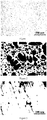
- Figures 1, 2 and 3 show the optical micrograph, the scanning electron micrograph and the transmission electron micrograph of the low-cost high-heat-conduction die-casting magnesium alloy of Example E, respectively.
- the ⁇ -Mg matrix of the low-cost high-heat-conduction die-casting magnesium alloy mostly forms fine grains with grain sizes of 3-15 ⁇ m, while only a small amount of large crystal grains having sizes of 40-100 ⁇ m are present.
- the energy spectrum analysis results show that these second phases are Mg-Zn-La-Ca quaternary phase. As can be seen from Figure 3 , there are also precipitated phases inside the grains, which have a width of 1-20 nm and a length ranging from 10-1000 nm. The energy spectrum analysis shows that these phases are Mg-Zn phase, which reduces the Zn content in the Mg matrix, weakens the effect of alloying elements on the thermal conductivity, and improves the mechanical properties of the alloy.
Landscapes
- Chemical & Material Sciences (AREA)
- Engineering & Computer Science (AREA)
- Mechanical Engineering (AREA)
- Materials Engineering (AREA)
- Metallurgy (AREA)
- Organic Chemistry (AREA)
- Manufacture And Refinement Of Metals (AREA)
- Continuous Casting (AREA)
Abstract
Description
- The invention relates to an alloy material and a manufacturing method therefor, in particular to a magnesium-containing alloy material and a manufacturing method therefor.
- Magnesium and its alloys are the lightest metal structure materials with a density of only 1/4 of that of steel and 2/3 of that of aluminum. Magnesium and its alloys have many advantages such as high specific strength and specific rigidity, excellent electromagnetic shielding performance, good heat dissipation property, and good vibration-reducing performance. Because pure magnesium has an extremely low strength (the tensile yield strength in the as-cast condition is only about 21 MPa) and a poor castability, and alloying is the most effective method to improve the mechanical properties and castability, magnesium alloys are used instead of pure magnesium in practical applications. In present magnesium alloy processing method, since the die-casting process has many advantages such as high production efficiency, low cost and high dimensional precision of the prepared parts, most of present magnesium alloy parts are prepared by die-casting process, i.e. 90% or more of magnesium alloy parts are die-castings pieces.
- At present, shells of many 3C products (i.e. the general term for computers, communications, and consumer electronics), such as mobile phones, laptops, digital cameras, video cameras, etc. are often made of magnesium alloy die-casting. This is because the magnesium alloy has excellent thin-wall casting properties and anti-collision ability, and therefore can meet the requirements of highly integrated, lightening and thinning anti-falling, electromagnetic shielding, heat dissipation and environmental protection of 3C products. With the rapid improvement of the performance of semiconductor transistors, 3C products have become the worldwide fastest growing industries and are moving in the direction of lighter, thinner, shorter and smaller. High performance, miniaturization and integration have become the trend of development. The volumetric power density of electronic components and devices is also increasing, resulting in a significant increase in the total power density and heat generation in electronic devices such as personal computers, new high-power LED lighting systems, and high-density computer server systems. If the heat generated during the operation of the electronic devices cannot dissipate through the shell in time, the ambient temperature will rise. Meanwhile, the operating efficiency of electronic devices is highly sensitive to the temperature, i.e. the operating efficiency of some electronic devices decreases exponentially with increasing temperature. Therefore, the shells of these products and the substrates on which electronic devices such as chips are mounted need to have excellent heat dissipation performance. Hence, the low-cost magnesium alloys having thermal conductivity, die-castability, and mechanical properties can be applied in a wide range of fields.
- Although the thermal conductivity of pure magnesium is high (about 157 W/m•K at room temperature), the thermal conductivity of alloyed magnesium alloys is usually significantly reduced. For example, the thermal conductivity of present commercial die-casting magnesium alloy Mg-9Al-1Zn-0.2Mn (AZ91) is only 51 W/m•K, and the thermal conductivities of Mg-5Al-0.5Mn (AM50) and Mg-6Al-0.5Mn (AM60) are 65 W/m•K and 61 W/m•K, respectively, which are much lower than that of pure Mg. Although the above-mentioned several magnesium alloys have excellent die-casting performance and good mechanical properties, they cannot meet the demand for high thermal conductivity due to their poor heat-conducting property. In addition, although magnesium alloy AE44 has excellent mechanical properties and a relatively high thermal conductivity (85 W/m•K), it tends to die sticking easily and has poor die-casting properties.
- In order to meet the requirement of high thermal conductivity for magnesium alloys in the 3C manufacturing field, magnesium alloys having high thermal conductivity have also been developed successively in the prior art.
- For example, Chinese Patent No.
CN102719716A (published on October 10, 2012 ) entitled "Heat conduction magnesium alloy and preparation method thereof' discloses a magnesium alloy and a preparation method thereof. The weight percentage of the chemical elements of the magnesium alloy is: Zn: 1-7%, Ca: 0.1-3%, La: 0.1-3%, Ce: 0.1-3%, and the balance is magnesium. The thermal conductivity of the magnesium alloy is not less than 125 W/m·K, the yield strength is greater than 300 MPa at room temperature, and the tensile strength is greater than 340 MPa. However, the magnesium alloy is a magnesium alloy deformed by extrusion and in which two kinds of rare earth metals are added. In addition, the patent does not involve the die-casting properties of the magnesium alloy. - For another example, Chinese Patent No.
CN102251161A (published on November 23, 2011 ) entitled "Heat conductive magnesium alloy" discloses a heat conductive magnesium alloy, comprising the components of: 0.5-5.5 wt% of Zn, 0.2-5 wt% of Sn and the balance of Mg. The magnesium alloy has a thermal conductivity of more than 110 W/m·K, a tensile strength of 180-230 MPa, and an elongation of 18-22%. However, the magnesium alloy is produced by gravity casting followed by a heat treatment process, and the patent also does not involve the die-casting properties of the magnesium alloy. - In addition, Chinese Patent No.
CN102586662A (published on July 18, 2012 ) entitled "Magnesium alloy with high thermal conductivity for die-casting" discloses a magnesium alloy with a high thermal conductivity for die-casting. The weight percentage of the chemical elements of the magnesium alloy is: 1.5-3% of lanthanides, 0.5-1.5 % of one or two elements selected from aluminum and zincic, and 0.2-0.6 % of one or two elements selected from manganese and zirconium, and residuals composed by the magnesium and inevitable impurities. Although the thermal conductivity of the magnesium alloy is 102-122 W/m·K, the above-mentioned patent does not involve the die-casting properties and the mechanical properties of the magnesium alloy. - Therefore, the requirements for magnesium alloy products becomes higher with the vigorous development of 3C products, resulting in an urgent need to develop a low-cost magnesium alloy that has good die-casting properties, excellent mechanical properties, and heat-conducting property.
- The purpose of the present invention is to provide a low-cost high-heat-conduction die-casting magnesium alloy. The magnesium alloy material has high thermal conductivity, good die-casting properties and excellent mechanical properties. In addition, the magnesium alloy of the present invention has an economical production cost and can be extended to large-scale industrial production suitably.
- In order to achieve the above purpose, present invention provides a low-cost high-heat-conduction die-casting magnesium alloy comprising, as a chemical element percentage by mass,
- La: 1∼5%;
- Zn: 0.5∼3%;
- Ca: 0.1∼2%;
- Mn: 0.1∼1%;
- the balance of Mg and other inevitable impurities.
- The design principle of each chemical element in the low-cost high-heat-conduction die-casting magnesium alloy of the present invention is as follows:
La: rare earth element (RE) can purify the alloy melting, and can effectively improve the mechanical properties and corrosion resistance of magnesium alloy at room temperature and high temperature. In addition, rare earth elements can narrow the solidification temperature range of the alloy, thereby improving the casting performance of the alloy, and can reduce the cracking during welding and improve the compactness of the casting. Rare earth elements used for strengthening magnesium alloys commonly include gadolinium (Gd), yttrium (Y), neodymium (Nd), samarium (Sm), praseodymium (Pr), lanthanum (La), cerium (Ce) and the like. However, elements such as Gd, Y, Nd and Sm are expensive, and therefore the use of these rare earth elements will significantly increase the production costs of magnesium alloys. In contrast, Pr, La, and Ce are relatively economical rare earth elements, and La is a relatively easily available rare earth element among the three economical rare earth elements, therefore La is selected as an additive element in the alloy. When La is less than 1 wt.%, the effect on improving corrosion resistance and fluidity in the magnesium alloy is limited. Meanwhile, the additive amount of La must not be too high in order to keep the production costs at a low level. Considering the performance improvement effect and the production cost of the magnesium alloy, the La content in the low-cost high-heat-conduction die-casting magnesium alloy of the present invention should be in a range of 1-5%. - Zinc: Zn is one of the commonly used alloying elements in magnesium alloys. It has the dual functions of solution strengthening and aging strengthening. The addition of a proper amount of Zn can increase the strength and plasticity of the magnesium alloy, improve the melt fluidity, and improve the casting performance. The addition of 0.5% or more of Zn can improve the fluidity of the magnesium alloy and strengthen the mechanical properties of the alloy. However, if the additive amount of Zn is too high, the fluidity of Zn alloy will be greatly reduced and the microporosity or hot tearing of the magnesium alloy tends to occur. Therefore, based on the above technical solution, the content of Zn is controlled in the range of 0.5-3%.
- Calcium: since the addition of alkaline earth element Ca can advantageously improve the metallurgical quality of magnesium alloys and the cost of adding Ca is relatively low, Ca is often added in the production process of magnesium alloys. Reasons for adding Ca are: 1) to increase the ignition temperature of magnesium alloy melts and reduce the oxidation of the melt in the smelting process and the alloy during the heat treatment, in particular, a small amount of Ca (for example, 0.1 wt.% of Ca) can improve the oxidation resistance and heat resistance of magnesium alloys; 2) Ca can refine the magnesium alloy grains and improve the corrosion resistance and creep resistance of magnesium alloys. In view of this, the content of Ca in the low-cost high-heat-conduction die-casting magnesium alloy of the present invention needs to be designed to be 0.1-2%.
- Manganese: Since magnesium alloys are chemically active, they are easily corroded. Furthermore, since most of the tools used for smelting, such as crucible and mixing tools, are ferruginous, magnesium alloys often contain impurities such as Fe and Cu in a relatively large amount. These impurities will further severely deteriorate the corrosion resistance of magnesium alloys. The corrosion resistance of magnesium alloy can be improved by adding Mn element. A small amount of Mn forms Fe-Mn compounds with the impurity element Fe, thereby reducing the toxicity of impurity elements and improving the corrosion resistance of the alloy. In addition, Mn can slightly increase the yield strength and weldability of magnesium alloys, and has the effect of refining the alloy grains. The Mn content in the low-cost high-heat-conduction die-casting magnesium alloy of the present invention should be set to 0.1-1%.
- Because Al greatly reduces the thermal conductivity of magnesium alloys, the Al alloy element is not added in the magnesium alloy of the present invention, which is different from the prior art magnesium alloy material using Al for alloy addition, to improve the thermal conductivity of the magnesium alloy material.
- Further, the low-cost high-heat-conduction die-casting magnesium alloy has a microstructure comprising α-magnesium matrix and precipitation phase, and wherein the α-magnesium matrix comprises fine grains and a small amount of relatively larger grains, and the relatively larger grains have a volume ratio of 20% or less.
- Further, the fine grains have a size of 3-15 µm and the relatively larger grains have a size of 40-100 µm.
- In present technical solution, the fine α-magnesium matrix effectively improves the mechanical properties of die-casting magnesium alloys.
- Further, the precipitation phases comprise a Mg-Zn-La-Ca quaternary phase that is continuously distributed around grain boundaries and a Mg-Zn phase precipitated inside the grains.
- Further, the Mg-Zn phase has a width of 1-20 nm and a length of 10-1000 nm.
- In present technical solution, the Mg-Zn-La-Ca quaternary phase effectively improves the mechanical properties and creep resistance of the alloys, and the Mg-Zn phase reduces the content of Zn solid solution in α-magnesium matrix, weakens the effect of alloying elements on heat-conducting property, and improves the mechanical properties of the alloys.
- Therefore, a die-casting magnesium alloy with above microstructures has better mechanical properties and heat-conducting property.
- Further, the low-cost high-heat-conduction die-casting magnesium alloy of the present invention has a thermal conductivity of 110 W/m•K or more, a tensile strength of 200-270 MPa, a yield strength of 150-190 MPa, and an elongation of 2-10%.
- Another purpose of the present invention is to provide a manufacturing method for low-cost high-heat-conduction die-casting magnesium alloys. According to such manufacturing method, a magnesium alloy with good die-casting properties, excellent comprehensive mechanical properties, and high thermal conductivity can be obtained. In addition, the manufacturing method uses a die-casting process, which has simple production process and economical production costs.
- In order to achieve the above purpose, present invention provides a manufacturing method for low-cost high-heat-conduction die-casting magnesium alloys, comprising the following steps:
- (1) melting pure Mg ingots and pure Zn ingots in a smelting furnace;
- (2) adding Mg-Ca and Mg-Mn master alloys to the smelting furnace and melting them completely;
- (3) adding Mg-La master alloy to the smelting furnace and melting it completely, and adding flux at the same time to cover the surface of a resulting melt;
- (4) refining the melt with the flux;
- (5) cooling the refined melt to 630-750 °C;
- (6) die-casting the melt to obtain a low-cost high-heat-conduction die-casting magnesium alloy.
- As can be seen from the above process steps, the manufacturing method for the low-cost high-heat-conduction die-casting magnesium alloy of the present invention is characterized in that die-casting process is used in the production process to obtain the magnesium alloy of the invention.
- In present technical solution, the flux may be a commercially available RJ-5 magnesium alloy flux (RJ-5, a standard product in magnesium alloy industry, main components are 24-30 wt.% of MgCl2, 20-26 wt.% of KCl, 28-31 wt.% of BaCl2, 13-15 wt.% of CaF2), and may also be other magnesium alloy flux commonly used in the art.
- Further, in above step (1), smelting temperature is controlled to 700-760 °C, and the smelting is performed under the protection of SF6 gas.
- Further, in above step (2), smelting temperature is controlled to 700-760 °C, and the smelting is performed under the protection of SF6 gas.
- Further, in above step (3), smelting temperature is controlled to 700-760 °C, and the smelting is performed under the protection of SF6 gas.
- Further, in above step (4) smelting temperature is controlled to 730-780 °C, and Ar gas is introduced into the melt or the melt is manually stirred, while RJ-5 flux is simultaneously added for refining for 5-15 minutes to obtain a refined melt; and then the refined melt is kept standing at 730-760°C for 80-120 minutes.
- In above technical solutions, the introduction of Ar gas into the melt and the manual stirring of the melt both aim to stir the melt.
- Further, in the step (6), the die-casting is controlled such that an injection speed is 2-50 m/s, a die temperature is 220-400 °C, and a casting pressure is 10-90 MPa.
- The low-cost high-heat-conduction die-casting magnesium alloy of the present invention has a reasonable and economical composition design, i.e. avoids the addition of relatively expensive rare earth alloy elements but a relatively economical rare earth alloy element La. Besides, the die-casting process in a production process is optimized to improve comprehensive mechanical properties, die-casting properties and thermal conductivity of magnesium alloys.
- The low-cost high-heat-conduction die-casting magnesium alloy of the present invention has a high tensile strength (i.e. 200-270 MPa) and high yield strength (i.e. 150-190 MPa).
- In addition, the magnesium alloy of the present invention has a good heat-conducting property with a thermal conductivity of 110 W/m·K or more.
- In addition, the magnesium alloy of the present invention has a good elongation with an elongation of 2%-10%.
- Besides, the magnesium alloy of the present invention has good fluidity and good die-casting property.
- The magnesium alloy of the present invention has an economical cost in alloy addition and a low production cost.
- Through the manufacturing method for the low-cost high-heat-conduction die-casting magnesium alloy of the present invention, a magnesium alloy with high strength, good heat-conducting property, good tensile elongation property and good die-casting property can be obtained.
-
-
Figure 1 is a figure shows the optical microstructure of the low-cost high-heat-conduction die-casting magnesium alloy of Example E. -
Figure 2 is a scanning electron micrograph of the microstructure of the low-cost high-heat-conduction die-casting magnesium alloy of Example E. -
Figure 3 is a transmission electron micrograph of the microstructure of the low-cost high-heat-conduction die-casting magnesium alloy of Example E. - The low-cost high-heat-conduction die-casting magnesium alloy of the present invention and the manufacturing method therefor will be further explained with reference to the accompanying drawings and specific Examples, while the technical solutions of the present invention are not limited by the explanations.
- The above Examples and Comparative Example are obtained by the manufacturing method for the low-cost high-heat-conduction die-casting magnesium alloy of the present invention, including the steps of:
- 1) melting pure Mg ingots and pure Zn ingots in a smelting furnace under the protection of SF6 gas, wherein smelting temperature is controlled to 700-760 °C;
- 2) adding Mg-Ca and Mg-Mn master alloys to the smelting furnace and melting completely under the protection of SF6 gas, wherein smelting temperature is controlled to 700-760 °C;
- 3) adding Mg-La master alloy to the smelting furnace and melting completely under the protection of SF6 gas, wherein smelting temperature is controlled to 700-760 °C, and adding flux RJ-5 at the same time to cover melt surface;
- 4) refining the melt, wherein smelting temperature is controlled to 730-780 °C, introducing Ar gas into the melt while adding RJ-5 flux for refining for 5-15 minutes to obtain a refined melt; then standing at 730-760°C for 80-120 minutes and controlling the mass percentage of chemical elements in the melt to the values as shown in Table 1;
- 5) cooling the refined melt to 630-750 °C to obtain a melt for die-casting.
- 6) die-casting the melt by a 300-ton cold chamber die casting machine to obtain low-cost high-heat-conduction die-casting magnesium alloys of different sizes, wherein the die-casting parameters are controlled as: the shot speed for injecting the melt for die-casting in step (5) into the die-casting machine is 2-50 m/s, die temperature is 220-400 °C, and casting pressure is 10-90 MPa.
- Table 1 shows the mass percentages of the chemical elements of magnesium alloys of the above Examples and Comparative Example.
Table 1 (wt%, the balance are Mg and other inevitable impurities) Number La Zn Ca Mn Die-casting size A 5 0.5 2 0.1 150mm×50mm×2mm B 1 3 0.1 0.5 100mm×40mm×1mm C 4 2 1 1 100mm×40mm×1mm D 2 2.5 1 0.5 1000mm×50mm×0.6mm E 5 0.5 0.5 0.9 1200mm×50mm×0.6mm F 5 0.5 - 0.9 1200mm×50mm×0.6mm - Table 2 shows specific process parameters of the manufacturing method for magnesium alloys of the above Examples and Comparative Example.
Table 2 Number Step (1) Step (2) Step (3) Step (4) Step (5) Step (6) smelting temperat -ure (°C) smelting temperat -ure (°C) smelting temperat -ure (°C) furnace temperat -ure (°C) refining time(mi n) standing temperatu -re (°C) standing time(min) temperature after cooling (°C) shot speed(m /s) die temper -ature (°C) casting pressure (MPa) A 720 740 740 780 5 750 80 630 50 230 12 B 740 760 720 760 10 740 80 650 15 400 80 C 740 760 720 760 10 740 100 750 3 300 50 D 750 750 730 760 15 740 120 700 10 260 20 E 760 760 740 750 15 750 120 720 6 240 10 F 760 760 740 750 15 750 120 720 6 240 10 - Magnesium alloy samples of Examples A-E and Comparative Example F were tested. In addition, the ignition point and creep performance tests were also conducted for Example E and Comparative Example F. The test results are shown in Table 3.
Table 3 shows the overall performance parameters of the magnesium alloys of the above Examples and Comparative Example.Table 3 Number Thermal conductivity W/(m·K) Tensile strength (MPa) Yield strength (MPa) Elongation (%) Die casting surface with or without defects Ignition point (°C) Steady creep rate at 200°C/60MPa A 130 260 185 4% without defects - - B 115 280 195 10% without defects - - C 120 270 170 2% without defects - - D 115 275 174 5% without defects - - E 115 280 170 6% without defects 847 1.4×10⁻⁷ s-1 F 110 274 162 7.6% without defects 764 2.5×10⁻⁶ s-1 - As can be seen from Table 3, all magnesium alloys of Examples A to E of the present invention have a tensile strength of 260 MPa or more, a yield strength of 170 MPa or more and an elongation of 2% or more. Therefore, the magnesium alloys of Examples have comprehensive mechanical properties such as high strength and good tensile elongation property. In addition, thermal conductivities of all the magnesium alloys of Examples A to E of the present invention are 115 W/(m·K) or more, indicating the excellent thermal conductivity of the magnesium alloys of the above Examples.
- As can be seen from the combination of Table 1, Table 2 and Table 3, although same manufacturing process parameters were used for Example E and Comparative Example F, the thermal conductivity of Comparative Example F (i.e. 110W/(m·K)) was lower than that of Example E, the ignition point (the ignition point characterizes the degree of difficulty of oxidation and combustion of the alloy in the smelting process, i.e. the higher ignition point an alloy has, the less likely it is oxidized and combusted during the smelting process, while the lower ignition point an alloy has, the more likely it is oxidized and combusted) of Comparative Example F (i.e. 764 (°C)) was also lower than that of Example E, while the steady creep rate at 200°C/60MPa (the steady creep rate characterizes the deformation rate of the alloy when subjected to external loads for a long time at high temperature, i.e. the lower creep rate an alloy has, the less likely the alloy deforms at high temperature and the better the stability of the alloy become, otherwise, the alloy tends to deform at high temperature have a poor stability) of Comparative Example F (i.e. 2.5×10⁻⁶ S-1) was higher than that of Example E, since Comparative Example F did not include Ca. Thus, the above demonstrates that the addition of Ca can effectively improve the ignition point and creep resistance of the alloy.
-
Figures 1, 2 and 3 show the optical micrograph, the scanning electron micrograph and the transmission electron micrograph of the low-cost high-heat-conduction die-casting magnesium alloy of Example E, respectively. It can be seen fromFigure 1 that the α-Mg matrix of the low-cost high-heat-conduction die-casting magnesium alloy mostly forms fine grains with grain sizes of 3-15 µm, while only a small amount of large crystal grains having sizes of 40-100 µm are present. As can be seen fromFigure 2 , there are many second phases (precipitate phase) distributed at the grain boundary. These phases can also effectively improve the mechanical properties and creep resistance of the alloy. These phases are distributed in a continuous manner around the grain boundary. The energy spectrum analysis results show that these second phases are Mg-Zn-La-Ca quaternary phase. As can be seen fromFigure 3 , there are also precipitated phases inside the grains, which have a width of 1-20 nm and a length ranging from 10-1000 nm. The energy spectrum analysis shows that these phases are Mg-Zn phase, which reduces the Zn content in the Mg matrix, weakens the effect of alloying elements on the thermal conductivity, and improves the mechanical properties of the alloy. - It should be noted that the above is only specific Examples of the present invention. It is obvious that present invention is not limited to the above Examples, and there are many similar changes. All variations that a person skilled in the art derives or associates directly from the disclosure of the present invention shall fall within the protection scope of the present invention.
Claims (12)
- A low-cost high-heat-conduction die-casting magnesium alloy comprising, as a chemical element percentage by mass,La: 1∼5%;Zn: 0.5∼3%;Ca: 0.1∼2%;Mn: 0.1∼1%;the balance of Mg and other inevitable impurities.
- The low-cost high-heat-conduction die-casting magnesium alloy of claim 1, wherein the magnesium alloy has a microstructure comprising α-magnesium matrix and precipitation phases, and wherein the α-magnesium matrix comprises fine grains and a small amount of relatively larger grains, and the relatively larger grains have a volume ratio of 20% or less.
- The low-cost high-heat-conduction die-casting magnesium alloy of claim 2, wherein the fine grains have a size of 3-15 µm and the relatively larger grains have a size of 40-100 µm.
- The low-cost high-heat-conduction die-casting magnesium alloy of claim 2, wherein the precipitation phases comprises a Mg-Zn-La-Ca quaternary phase that is continuously distributed around grain boundaries and a Mg-Zn phase precipitated inside the grains.
- The low-cost high-heat-conduction die-casting magnesium alloy of claim 4, wherein the Mg-Zn phase has a width of 1-20 nm and a length of 10-1000 nm.
- The low-cost high-heat-conduction die-casting magnesium alloy of claim 1, wherein the magnesium alloy has a thermal conductivity of 110 W/m•K or more, a tensile strength of 200-270 MPa, a yield strength of 150-190 MPa, and an elongation of 2-10%.
- A manufacturing method for the low-cost high-heat-conduction die-casting magnesium alloy according to any of claims 1-6, comprising the following steps:(1) melting pure Mg ingots and pure Zn ingots in a smelting furnace;(2) adding Mg-Ca and Mg-Mn master alloys to the smelting furnace and melting them completely;(3) adding Mg-La master alloy to the smelting furnace and melting it completely, and adding flux at the same time to cover the surface of a resulting melt;(4) refining the melt;(5) cooling the refined melt to 630-750 °C;(6) die-casting the melt to obtain a low-cost high-heat-conduction die-casting magnesium alloy.
- The manufacturing method for the low-cost high-heat-conduction die-casting magnesium alloy of claim 7, wherein in the step (1), smelting temperature is controlled to 700-760 °C, and the melting is performed under the protection of SF6 gas.
- The manufacturing method for the low-cost high-heat-conduction die-casting magnesium alloy of claim 7, wherein in the step (2), smelting temperature is controlled to 700-760 °C, and the melting is performed under the protection of SF6 gas.
- The manufacturing method for the low-cost high-heat-conduction die-casting magnesium alloy of claim 7, wherein in the step (3), smelting temperature is controlled to 700-760 °C, and the smelting is performed under the protection of SF6 gas.
- The manufacturing method for the low-cost high-heat-conduction die-casting magnesium alloy of claim 7, wherein in the step (4) smelting temperature is controlled to 730-780 °C, and Ar gas is introduced into the melt or the melt is manually stirred, while RJ-5 flux is simultaneously added for refining for 5-15 minutes to obtain a refined melt; and then the refined melt is kept standing at 730-760°C for 80-120 minutes.
- The manufacturing method for the low-cost high-heat-conduction die-casting magnesium alloy of claim 7, wherein in the step (6), the die-casting is controlled such that an injection speed is 2-50 m/s, a die temperature is 220-400 °C, and a casting pressure is 10-90 MPa.
Applications Claiming Priority (2)
| Application Number | Priority Date | Filing Date | Title |
|---|---|---|---|
| CN201510926273.3A CN105401032B (en) | 2015-12-14 | 2015-12-14 | A kind of inexpensive high heat conduction diecast magnesium alloy and its manufacture method |
| PCT/CN2016/108673 WO2017101709A1 (en) | 2015-12-14 | 2016-12-06 | Low-cost high-heat-conduction die-casting magnesium alloy and manufacturing method therefor |
Publications (3)
| Publication Number | Publication Date |
|---|---|
| EP3392358A1 true EP3392358A1 (en) | 2018-10-24 |
| EP3392358A4 EP3392358A4 (en) | 2019-06-12 |
| EP3392358B1 EP3392358B1 (en) | 2021-06-09 |
Family
ID=55466783
Family Applications (1)
| Application Number | Title | Priority Date | Filing Date |
|---|---|---|---|
| EP16874766.5A Active EP3392358B1 (en) | 2015-12-14 | 2016-12-06 | Low-cost high-heat-conduction die-casting magnesium alloy and manufacturing method therefor |
Country Status (7)
| Country | Link |
|---|---|
| US (1) | US10870905B2 (en) |
| EP (1) | EP3392358B1 (en) |
| JP (1) | JP6771032B2 (en) |
| KR (1) | KR102172483B1 (en) |
| CN (1) | CN105401032B (en) |
| AU (1) | AU2016372755B2 (en) |
| WO (1) | WO2017101709A1 (en) |
Cited By (1)
| Publication number | Priority date | Publication date | Assignee | Title |
|---|---|---|---|---|
| WO2020221752A1 (en) * | 2019-04-29 | 2020-11-05 | Brunel University London | A casting magnesium alloy for providing improved thermal conductivity |
Families Citing this family (17)
| Publication number | Priority date | Publication date | Assignee | Title |
|---|---|---|---|---|
| CN105401032B (en) | 2015-12-14 | 2017-08-25 | 宝山钢铁股份有限公司 | A kind of inexpensive high heat conduction diecast magnesium alloy and its manufacture method |
| CN108118226B (en) * | 2016-11-30 | 2020-04-28 | 宝钢集团有限公司 | A kind of high thermal conductivity, corrosion resistance, heat resistance die-casting magnesium alloy and its manufacturing method |
| CN110195181B (en) * | 2018-02-26 | 2021-10-22 | 中国宝武钢铁集团有限公司 | A kind of die-casting magnesium alloy with high temperature and heat resistance and its manufacturing method |
| CN110195180B (en) * | 2018-02-26 | 2021-10-19 | 中国宝武钢铁集团有限公司 | A kind of high thermal conductivity die-casting magnesium alloy and its manufacturing method |
| CN108994479B (en) * | 2018-08-24 | 2020-08-07 | 温州市星峰新材料有限公司 | Corrosion-resistant high-strength welding material and manufacturing method thereof |
| CN111378882B (en) * | 2018-12-29 | 2021-09-17 | 嘉丰工业科技(惠州)有限公司 | High-heat-conductivity die-casting magnesium alloy material and preparation method thereof |
| CN112048650A (en) * | 2020-07-22 | 2020-12-08 | 东华大学 | High-strength magnesium alloy with high electromagnetic shielding and thermal conductivity and preparation method thereof |
| CN113308614A (en) * | 2021-05-21 | 2021-08-27 | 贵州安吉航空精密铸造有限责任公司 | ZM6 alloy refining method |
| CN113337765A (en) * | 2021-05-27 | 2021-09-03 | 长春理工大学 | High-temperature and high-pressure creep-resistant die-casting magnesium alloy and preparation method thereof |
| CN113308632A (en) * | 2021-05-27 | 2021-08-27 | 长春理工大学 | High-temperature creep-resistant die-casting magnesium alloy and preparation method thereof |
| CN113621858B (en) * | 2021-07-14 | 2022-05-20 | 西安理工大学 | Antibacterial and tumor proliferation inhibiting degradable magnesium alloy bone nail and preparation method thereof |
| CN116657008A (en) * | 2022-02-18 | 2023-08-29 | 宝钢金属有限公司 | A kind of high strength and toughness high heat resistance die casting magnesium alloy and its preparation method |
| CN116770143A (en) * | 2022-03-11 | 2023-09-19 | 宝钢金属有限公司 | Magnesium rare earth alloy hub capable of being subjected to rapid high-temperature solution treatment and preparation method thereof |
| CN116219244B (en) * | 2023-03-10 | 2024-12-17 | 中国科学院长春应用化学研究所 | High-strength high-heat-conductivity die-casting rare earth magnesium alloy and preparation method thereof |
| CN116837262A (en) * | 2023-07-05 | 2023-10-03 | 重庆大学 | Low-cost high-performance Mg-Al-Mn series die-casting magnesium alloy and preparation method thereof |
| CN116770115B (en) * | 2023-07-20 | 2025-10-14 | 西安交通大学 | A superplastic high thermal conductivity magnesium alloy suitable for forging and preparation method thereof |
| CN117701976A (en) * | 2023-12-13 | 2024-03-15 | 广东富盛达智能科技有限公司 | Low-expansion die-casting aluminum alloy and preparation method thereof |
Family Cites Families (15)
| Publication number | Priority date | Publication date | Assignee | Title |
|---|---|---|---|---|
| JP2604670B2 (en) | 1992-05-22 | 1997-04-30 | 三井金属鉱業株式会社 | High strength magnesium alloy |
| GB9502238D0 (en) * | 1995-02-06 | 1995-03-29 | Alcan Int Ltd | Magnesium alloys |
| JP2002212662A (en) * | 2001-01-19 | 2002-07-31 | Aisin Takaoka Ltd | Magnesium alloy |
| JP2006002184A (en) * | 2004-06-15 | 2006-01-05 | Toudai Tlo Ltd | High toughness magnesium-based alloy, drive system parts using the same, and method for producing high-toughness magnesium-based alloy material |
| EP1761652A4 (en) | 2004-06-24 | 2009-02-18 | Cast Centre Pty Ltd | Die cast magnesium alloy |
| CN101961779B (en) * | 2004-06-30 | 2014-01-29 | 住友电气工业株式会社 | Manufacturing method of magnesium alloy material |
| CN102312144A (en) | 2010-07-07 | 2012-01-11 | 乐普(北京)医疗器械股份有限公司 | Ultrafine-grain medical magnesium alloy and preparation method thereof |
| JP5674136B2 (en) * | 2011-01-14 | 2015-02-25 | 三井金属ダイカスト株式会社 | High thermal conductivity magnesium alloy for die casting |
| CN102251161A (en) * | 2011-07-14 | 2011-11-23 | 四川大学 | Heat conductive magnesium alloy |
| CN102719716B (en) * | 2012-05-28 | 2014-10-15 | 哈尔滨工业大学 | Preparation method of heat conduction magnesium alloy |
| CN105755340B (en) * | 2014-12-17 | 2017-12-26 | 宝山钢铁股份有限公司 | High strength and low cost high-ductility high heat conduction wrought magnesium alloy and preparation method thereof |
| CN104846250A (en) * | 2015-05-29 | 2015-08-19 | 苏州慧驰轻合金精密成型科技有限公司 | High-heat-conductivity die-casting corrosion-resistant magnesium alloy and preparation method thereof |
| CN105088037A (en) * | 2015-08-28 | 2015-11-25 | 上海交通大学 | Mg-RE-Mn-series multi-element magnesium alloy and preparation method thereof |
| KR20170049083A (en) * | 2015-10-28 | 2017-05-10 | 한국생산기술연구원 | Mg casting alloy having High thermal conductivity and method of manufacturing the same |
| CN105401032B (en) * | 2015-12-14 | 2017-08-25 | 宝山钢铁股份有限公司 | A kind of inexpensive high heat conduction diecast magnesium alloy and its manufacture method |
-
2015
- 2015-12-14 CN CN201510926273.3A patent/CN105401032B/en active Active
-
2016
- 2016-12-06 US US15/780,161 patent/US10870905B2/en active Active
- 2016-12-06 EP EP16874766.5A patent/EP3392358B1/en active Active
- 2016-12-06 WO PCT/CN2016/108673 patent/WO2017101709A1/en not_active Ceased
- 2016-12-06 AU AU2016372755A patent/AU2016372755B2/en active Active
- 2016-12-06 KR KR1020187014936A patent/KR102172483B1/en active Active
- 2016-12-06 JP JP2018528309A patent/JP6771032B2/en active Active
Cited By (1)
| Publication number | Priority date | Publication date | Assignee | Title |
|---|---|---|---|---|
| WO2020221752A1 (en) * | 2019-04-29 | 2020-11-05 | Brunel University London | A casting magnesium alloy for providing improved thermal conductivity |
Also Published As
| Publication number | Publication date |
|---|---|
| KR102172483B1 (en) | 2020-10-30 |
| JP2019504186A (en) | 2019-02-14 |
| CN105401032A (en) | 2016-03-16 |
| AU2016372755A1 (en) | 2018-06-07 |
| JP6771032B2 (en) | 2020-10-21 |
| KR20180071361A (en) | 2018-06-27 |
| EP3392358B1 (en) | 2021-06-09 |
| WO2017101709A1 (en) | 2017-06-22 |
| CN105401032B (en) | 2017-08-25 |
| US20180347010A1 (en) | 2018-12-06 |
| US10870905B2 (en) | 2020-12-22 |
| EP3392358A4 (en) | 2019-06-12 |
| AU2016372755B2 (en) | 2019-10-03 |
Similar Documents
| Publication | Publication Date | Title |
|---|---|---|
| EP3392358B1 (en) | Low-cost high-heat-conduction die-casting magnesium alloy and manufacturing method therefor | |
| CN102230118B (en) | Magnesium alloy of high intensity and high yield ratio and preparation method thereof | |
| CN109652685B (en) | A high thermal conductivity and high corrosion resistance cast aluminum alloy and its preparation method | |
| KR101931672B1 (en) | High speed extrudable non-flammability magnesium alloys and method for manufacturing magnesium alloy extrusion using the same | |
| CN101823190B (en) | Aluminum-silicon alloy welding wire and preparation method thereof | |
| CN109518041A (en) | It is a kind of while improving that pack alloy is thermally conductive and the compounding method of mechanical property | |
| EP2369025A1 (en) | Magnesium alloy and magnesium alloy casting | |
| KR20120074037A (en) | Magnesium alloy for high temperature and manufacturing method thereof | |
| JP2008536005A (en) | Magnesium alloy added with misch metal, magnesium alloy processed material added with misch metal, and magnesium alloy processed material manufactured thereby | |
| KR20170049083A (en) | Mg casting alloy having High thermal conductivity and method of manufacturing the same | |
| CN107937768B (en) | Extrusion casting aluminum alloy material and preparation method thereof | |
| CN103290280B (en) | A kind of low density, low-quenching sensitive Al-Zn-Mg-Cu series alloys | |
| CN108118226B (en) | A kind of high thermal conductivity, corrosion resistance, heat resistance die-casting magnesium alloy and its manufacturing method | |
| CN102226244A (en) | High-strength magnesium-zinc-manganese-yttrium magnesium alloy material | |
| JP2001316745A (en) | Boron-containing Al-based alloy and method for producing the same | |
| KR101581461B1 (en) | Magnesium alloy having heat radiation property and its manufacturing method | |
| JP2008001921A (en) | Magnesium alloy, and oa equipment parts | |
| CN115491558B (en) | Die-casting magnesium alloy and preparation method and application thereof | |
| CN101191167A (en) | A kind of magnesium alloy containing rare earth and preparation method thereof | |
| CN116411208A (en) | A kind of die casting aluminum alloy and preparation method thereof | |
| CN110656270A (en) | Die-casting magnesium alloy and its preparation method and application | |
| CN106676355A (en) | High-plasticity and heat-resistant AZ system magnesium alloy extruded material and preparation method thereof | |
| CN111394632A (en) | Gadolinium samarium rare earth magnesium alloy and preparation method thereof | |
| KR101732595B1 (en) | Mg alloy having high thermal conductivity and extrusion method using the same | |
| KR20170049082A (en) | Mg casting alloy having High thermal conductivity and method of manufacturing the same |
Legal Events
| Date | Code | Title | Description |
|---|---|---|---|
| STAA | Information on the status of an ep patent application or granted ep patent |
Free format text: STATUS: THE INTERNATIONAL PUBLICATION HAS BEEN MADE |
|
| PUAI | Public reference made under article 153(3) epc to a published international application that has entered the european phase |
Free format text: ORIGINAL CODE: 0009012 |
|
| STAA | Information on the status of an ep patent application or granted ep patent |
Free format text: STATUS: REQUEST FOR EXAMINATION WAS MADE |
|
| 17P | Request for examination filed |
Effective date: 20180529 |
|
| AK | Designated contracting states |
Kind code of ref document: A1 Designated state(s): AL AT BE BG CH CY CZ DE DK EE ES FI FR GB GR HR HU IE IS IT LI LT LU LV MC MK MT NL NO PL PT RO RS SE SI SK SM TR |
|
| AX | Request for extension of the european patent |
Extension state: BA ME |
|
| DAV | Request for validation of the european patent (deleted) | ||
| DAX | Request for extension of the european patent (deleted) | ||
| A4 | Supplementary search report drawn up and despatched |
Effective date: 20190515 |
|
| RIC1 | Information provided on ipc code assigned before grant |
Ipc: B22D 27/00 20060101ALI20190509BHEP Ipc: C22C 23/00 20060101AFI20190509BHEP Ipc: B22D 17/00 20060101ALI20190509BHEP Ipc: C22C 23/04 20060101ALI20190509BHEP Ipc: C22C 23/06 20060101ALI20190509BHEP Ipc: C22C 1/02 20060101ALI20190509BHEP |
|
| STAA | Information on the status of an ep patent application or granted ep patent |
Free format text: STATUS: EXAMINATION IS IN PROGRESS |
|
| 17Q | First examination report despatched |
Effective date: 20201002 |
|
| GRAP | Despatch of communication of intention to grant a patent |
Free format text: ORIGINAL CODE: EPIDOSNIGR1 |
|
| STAA | Information on the status of an ep patent application or granted ep patent |
Free format text: STATUS: GRANT OF PATENT IS INTENDED |
|
| INTG | Intention to grant announced |
Effective date: 20210125 |
|
| GRAS | Grant fee paid |
Free format text: ORIGINAL CODE: EPIDOSNIGR3 |
|
| GRAA | (expected) grant |
Free format text: ORIGINAL CODE: 0009210 |
|
| STAA | Information on the status of an ep patent application or granted ep patent |
Free format text: STATUS: THE PATENT HAS BEEN GRANTED |
|
| AK | Designated contracting states |
Kind code of ref document: B1 Designated state(s): AL AT BE BG CH CY CZ DE DK EE ES FI FR GB GR HR HU IE IS IT LI LT LU LV MC MK MT NL NO PL PT RO RS SE SI SK SM TR |
|
| REG | Reference to a national code |
Ref country code: GB Ref legal event code: FG4D |
|
| REG | Reference to a national code |
Ref country code: CH Ref legal event code: EP Ref country code: AT Ref legal event code: REF Ref document number: 1400554 Country of ref document: AT Kind code of ref document: T Effective date: 20210615 |
|
| REG | Reference to a national code |
Ref country code: DE Ref legal event code: R096 Ref document number: 602016059234 Country of ref document: DE |
|
| REG | Reference to a national code |
Ref country code: IE Ref legal event code: FG4D |
|
| REG | Reference to a national code |
Ref country code: LT Ref legal event code: MG9D |
|
| PG25 | Lapsed in a contracting state [announced via postgrant information from national office to epo] |
Ref country code: LT Free format text: LAPSE BECAUSE OF FAILURE TO SUBMIT A TRANSLATION OF THE DESCRIPTION OR TO PAY THE FEE WITHIN THE PRESCRIBED TIME-LIMIT Effective date: 20210609 Ref country code: FI Free format text: LAPSE BECAUSE OF FAILURE TO SUBMIT A TRANSLATION OF THE DESCRIPTION OR TO PAY THE FEE WITHIN THE PRESCRIBED TIME-LIMIT Effective date: 20210609 Ref country code: HR Free format text: LAPSE BECAUSE OF FAILURE TO SUBMIT A TRANSLATION OF THE DESCRIPTION OR TO PAY THE FEE WITHIN THE PRESCRIBED TIME-LIMIT Effective date: 20210609 Ref country code: BG Free format text: LAPSE BECAUSE OF FAILURE TO SUBMIT A TRANSLATION OF THE DESCRIPTION OR TO PAY THE FEE WITHIN THE PRESCRIBED TIME-LIMIT Effective date: 20210909 |
|
| REG | Reference to a national code |
Ref country code: AT Ref legal event code: MK05 Ref document number: 1400554 Country of ref document: AT Kind code of ref document: T Effective date: 20210609 |
|
| REG | Reference to a national code |
Ref country code: NL Ref legal event code: MP Effective date: 20210609 |
|
| PG25 | Lapsed in a contracting state [announced via postgrant information from national office to epo] |
Ref country code: GR Free format text: LAPSE BECAUSE OF FAILURE TO SUBMIT A TRANSLATION OF THE DESCRIPTION OR TO PAY THE FEE WITHIN THE PRESCRIBED TIME-LIMIT Effective date: 20210910 Ref country code: LV Free format text: LAPSE BECAUSE OF FAILURE TO SUBMIT A TRANSLATION OF THE DESCRIPTION OR TO PAY THE FEE WITHIN THE PRESCRIBED TIME-LIMIT Effective date: 20210609 Ref country code: NO Free format text: LAPSE BECAUSE OF FAILURE TO SUBMIT A TRANSLATION OF THE DESCRIPTION OR TO PAY THE FEE WITHIN THE PRESCRIBED TIME-LIMIT Effective date: 20210909 Ref country code: RS Free format text: LAPSE BECAUSE OF FAILURE TO SUBMIT A TRANSLATION OF THE DESCRIPTION OR TO PAY THE FEE WITHIN THE PRESCRIBED TIME-LIMIT Effective date: 20210609 Ref country code: SE Free format text: LAPSE BECAUSE OF FAILURE TO SUBMIT A TRANSLATION OF THE DESCRIPTION OR TO PAY THE FEE WITHIN THE PRESCRIBED TIME-LIMIT Effective date: 20210609 |
|
| PG25 | Lapsed in a contracting state [announced via postgrant information from national office to epo] |
Ref country code: CZ Free format text: LAPSE BECAUSE OF FAILURE TO SUBMIT A TRANSLATION OF THE DESCRIPTION OR TO PAY THE FEE WITHIN THE PRESCRIBED TIME-LIMIT Effective date: 20210609 Ref country code: EE Free format text: LAPSE BECAUSE OF FAILURE TO SUBMIT A TRANSLATION OF THE DESCRIPTION OR TO PAY THE FEE WITHIN THE PRESCRIBED TIME-LIMIT Effective date: 20210609 Ref country code: AT Free format text: LAPSE BECAUSE OF FAILURE TO SUBMIT A TRANSLATION OF THE DESCRIPTION OR TO PAY THE FEE WITHIN THE PRESCRIBED TIME-LIMIT Effective date: 20210609 Ref country code: PT Free format text: LAPSE BECAUSE OF FAILURE TO SUBMIT A TRANSLATION OF THE DESCRIPTION OR TO PAY THE FEE WITHIN THE PRESCRIBED TIME-LIMIT Effective date: 20211011 Ref country code: NL Free format text: LAPSE BECAUSE OF FAILURE TO SUBMIT A TRANSLATION OF THE DESCRIPTION OR TO PAY THE FEE WITHIN THE PRESCRIBED TIME-LIMIT Effective date: 20210609 Ref country code: RO Free format text: LAPSE BECAUSE OF FAILURE TO SUBMIT A TRANSLATION OF THE DESCRIPTION OR TO PAY THE FEE WITHIN THE PRESCRIBED TIME-LIMIT Effective date: 20210609 Ref country code: ES Free format text: LAPSE BECAUSE OF FAILURE TO SUBMIT A TRANSLATION OF THE DESCRIPTION OR TO PAY THE FEE WITHIN THE PRESCRIBED TIME-LIMIT Effective date: 20210609 Ref country code: SK Free format text: LAPSE BECAUSE OF FAILURE TO SUBMIT A TRANSLATION OF THE DESCRIPTION OR TO PAY THE FEE WITHIN THE PRESCRIBED TIME-LIMIT Effective date: 20210609 Ref country code: SM Free format text: LAPSE BECAUSE OF FAILURE TO SUBMIT A TRANSLATION OF THE DESCRIPTION OR TO PAY THE FEE WITHIN THE PRESCRIBED TIME-LIMIT Effective date: 20210609 |
|
| PG25 | Lapsed in a contracting state [announced via postgrant information from national office to epo] |
Ref country code: PL Free format text: LAPSE BECAUSE OF FAILURE TO SUBMIT A TRANSLATION OF THE DESCRIPTION OR TO PAY THE FEE WITHIN THE PRESCRIBED TIME-LIMIT Effective date: 20210609 |
|
| REG | Reference to a national code |
Ref country code: DE Ref legal event code: R097 Ref document number: 602016059234 Country of ref document: DE |
|
| PLBE | No opposition filed within time limit |
Free format text: ORIGINAL CODE: 0009261 |
|
| STAA | Information on the status of an ep patent application or granted ep patent |
Free format text: STATUS: NO OPPOSITION FILED WITHIN TIME LIMIT |
|
| PG25 | Lapsed in a contracting state [announced via postgrant information from national office to epo] |
Ref country code: DK Free format text: LAPSE BECAUSE OF FAILURE TO SUBMIT A TRANSLATION OF THE DESCRIPTION OR TO PAY THE FEE WITHIN THE PRESCRIBED TIME-LIMIT Effective date: 20210609 |
|
| 26N | No opposition filed |
Effective date: 20220310 |
|
| PG25 | Lapsed in a contracting state [announced via postgrant information from national office to epo] |
Ref country code: AL Free format text: LAPSE BECAUSE OF FAILURE TO SUBMIT A TRANSLATION OF THE DESCRIPTION OR TO PAY THE FEE WITHIN THE PRESCRIBED TIME-LIMIT Effective date: 20210609 |
|
| PG25 | Lapsed in a contracting state [announced via postgrant information from national office to epo] |
Ref country code: MC Free format text: LAPSE BECAUSE OF FAILURE TO SUBMIT A TRANSLATION OF THE DESCRIPTION OR TO PAY THE FEE WITHIN THE PRESCRIBED TIME-LIMIT Effective date: 20210609 Ref country code: IT Free format text: LAPSE BECAUSE OF FAILURE TO SUBMIT A TRANSLATION OF THE DESCRIPTION OR TO PAY THE FEE WITHIN THE PRESCRIBED TIME-LIMIT Effective date: 20210609 |
|
| REG | Reference to a national code |
Ref country code: CH Ref legal event code: PL |
|
| REG | Reference to a national code |
Ref country code: BE Ref legal event code: MM Effective date: 20211231 |
|
| PG25 | Lapsed in a contracting state [announced via postgrant information from national office to epo] |
Ref country code: LU Free format text: LAPSE BECAUSE OF NON-PAYMENT OF DUE FEES Effective date: 20211206 Ref country code: IE Free format text: LAPSE BECAUSE OF NON-PAYMENT OF DUE FEES Effective date: 20211206 |
|
| PG25 | Lapsed in a contracting state [announced via postgrant information from national office to epo] |
Ref country code: FR Free format text: LAPSE BECAUSE OF NON-PAYMENT OF DUE FEES Effective date: 20211231 Ref country code: BE Free format text: LAPSE BECAUSE OF NON-PAYMENT OF DUE FEES Effective date: 20211231 |
|
| PG25 | Lapsed in a contracting state [announced via postgrant information from national office to epo] |
Ref country code: LI Free format text: LAPSE BECAUSE OF NON-PAYMENT OF DUE FEES Effective date: 20211231 Ref country code: CH Free format text: LAPSE BECAUSE OF NON-PAYMENT OF DUE FEES Effective date: 20211231 |
|
| P01 | Opt-out of the competence of the unified patent court (upc) registered |
Effective date: 20230508 |
|
| PG25 | Lapsed in a contracting state [announced via postgrant information from national office to epo] |
Ref country code: CY Free format text: LAPSE BECAUSE OF FAILURE TO SUBMIT A TRANSLATION OF THE DESCRIPTION OR TO PAY THE FEE WITHIN THE PRESCRIBED TIME-LIMIT Effective date: 20210609 |
|
| PG25 | Lapsed in a contracting state [announced via postgrant information from national office to epo] |
Ref country code: HU Free format text: LAPSE BECAUSE OF FAILURE TO SUBMIT A TRANSLATION OF THE DESCRIPTION OR TO PAY THE FEE WITHIN THE PRESCRIBED TIME-LIMIT; INVALID AB INITIO Effective date: 20161206 |
|
| PG25 | Lapsed in a contracting state [announced via postgrant information from national office to epo] |
Ref country code: MK Free format text: LAPSE BECAUSE OF FAILURE TO SUBMIT A TRANSLATION OF THE DESCRIPTION OR TO PAY THE FEE WITHIN THE PRESCRIBED TIME-LIMIT Effective date: 20210609 |
|
| PG25 | Lapsed in a contracting state [announced via postgrant information from national office to epo] |
Ref country code: TR Free format text: LAPSE BECAUSE OF FAILURE TO SUBMIT A TRANSLATION OF THE DESCRIPTION OR TO PAY THE FEE WITHIN THE PRESCRIBED TIME-LIMIT Effective date: 20210609 |
|
| PG25 | Lapsed in a contracting state [announced via postgrant information from national office to epo] |
Ref country code: MT Free format text: LAPSE BECAUSE OF FAILURE TO SUBMIT A TRANSLATION OF THE DESCRIPTION OR TO PAY THE FEE WITHIN THE PRESCRIBED TIME-LIMIT Effective date: 20210609 |
|
| PGFP | Annual fee paid to national office [announced via postgrant information from national office to epo] |
Ref country code: GB Payment date: 20251229 Year of fee payment: 10 |
|
| PGFP | Annual fee paid to national office [announced via postgrant information from national office to epo] |
Ref country code: DE Payment date: 20251231 Year of fee payment: 10 |