EP3389478B1 - Systeme und verfahren zum linearen zeitlichen clustering für begrenzte, wiederholbare, seltene ereignisse in physiologischen signalen - Google Patents
Systeme und verfahren zum linearen zeitlichen clustering für begrenzte, wiederholbare, seltene ereignisse in physiologischen signalen Download PDFInfo
- Publication number
- EP3389478B1 EP3389478B1 EP16876675.6A EP16876675A EP3389478B1 EP 3389478 B1 EP3389478 B1 EP 3389478B1 EP 16876675 A EP16876675 A EP 16876675A EP 3389478 B1 EP3389478 B1 EP 3389478B1
- Authority
- EP
- European Patent Office
- Prior art keywords
- data
- waveforms
- signal
- physiological
- signal data
- Prior art date
- Legal status (The legal status is an assumption and is not a legal conclusion. Google has not performed a legal analysis and makes no representation as to the accuracy of the status listed.)
- Active
Links
Images



Classifications
-
- A—HUMAN NECESSITIES
- A61—MEDICAL OR VETERINARY SCIENCE; HYGIENE
- A61B—DIAGNOSIS; SURGERY; IDENTIFICATION
- A61B5/00—Measuring for diagnostic purposes; Identification of persons
- A61B5/72—Signal processing specially adapted for physiological signals or for diagnostic purposes
- A61B5/7225—Details of analogue processing, e.g. isolation amplifier, gain or sensitivity adjustment, filtering, baseline or drift compensation
-
- A—HUMAN NECESSITIES
- A61—MEDICAL OR VETERINARY SCIENCE; HYGIENE
- A61B—DIAGNOSIS; SURGERY; IDENTIFICATION
- A61B5/00—Measuring for diagnostic purposes; Identification of persons
- A61B5/72—Signal processing specially adapted for physiological signals or for diagnostic purposes
- A61B5/7203—Signal processing specially adapted for physiological signals or for diagnostic purposes for noise prevention, reduction or removal
-
- A—HUMAN NECESSITIES
- A61—MEDICAL OR VETERINARY SCIENCE; HYGIENE
- A61B—DIAGNOSIS; SURGERY; IDENTIFICATION
- A61B5/00—Measuring for diagnostic purposes; Identification of persons
- A61B5/24—Detecting, measuring or recording bioelectric or biomagnetic signals of the body or parts thereof
-
- A—HUMAN NECESSITIES
- A61—MEDICAL OR VETERINARY SCIENCE; HYGIENE
- A61B—DIAGNOSIS; SURGERY; IDENTIFICATION
- A61B5/00—Measuring for diagnostic purposes; Identification of persons
- A61B5/72—Signal processing specially adapted for physiological signals or for diagnostic purposes
- A61B5/7235—Details of waveform analysis
- A61B5/7264—Classification of physiological signals or data, e.g. using neural networks, statistical classifiers, expert systems or fuzzy systems
-
- A—HUMAN NECESSITIES
- A61—MEDICAL OR VETERINARY SCIENCE; HYGIENE
- A61B—DIAGNOSIS; SURGERY; IDENTIFICATION
- A61B5/00—Measuring for diagnostic purposes; Identification of persons
- A61B5/48—Other medical applications
- A61B5/4806—Sleep evaluation
-
- G—PHYSICS
- G16—INFORMATION AND COMMUNICATION TECHNOLOGY [ICT] SPECIALLY ADAPTED FOR SPECIFIC APPLICATION FIELDS
- G16H—HEALTHCARE INFORMATICS, i.e. INFORMATION AND COMMUNICATION TECHNOLOGY [ICT] SPECIALLY ADAPTED FOR THE HANDLING OR PROCESSING OF MEDICAL OR HEALTHCARE DATA
- G16H50/00—ICT specially adapted for medical diagnosis, medical simulation or medical data mining; ICT specially adapted for detecting, monitoring or modelling epidemics or pandemics
- G16H50/20—ICT specially adapted for medical diagnosis, medical simulation or medical data mining; ICT specially adapted for detecting, monitoring or modelling epidemics or pandemics for computer-aided diagnosis, e.g. based on medical expert systems
Definitions
- a method for identifying events of interest from noisy physiological signal data comprising: (a) receiving, by a computing system, physiological signal data; (b) generating filtered signal data by filtering the physiological signal data using a filter defined by a spectral band associated with a particular physiological event; (c) generating signal peak data with the computer system by identifying, for each of a plurality of time windows in the filtered data, a signal peak in the filtered data; (d) grouping waveforms from the physiological signal data corresponding to each of the plurality of time windows based on the signal peak data to generate clustered event data; (e) determining parameters for a noise beta distribution based at least in part on the signal peak data; (f) identifying at least one cluster of waveforms from the clustered event data that does not fall within the noise beta distribution, wherein each waveform in the at least one cluster represents a physiological events of interest in the physiological signal data; (g) generating a graphical representation
- the physiologic signal data represents an extracellular recording of electrical activity of a signal neuron.
- the physiologic signal data is received from a single microwire.
- the graphical representation shows a plurality of the waveforms in the at least one cluster of waveforms.
- the graphical representation shows an average waveform that represents a plurality of the waveforms in the at least one cluster of waveforms.
- the physiologic signal data represents at least twenty four hours of signals.
- the spectral band is from about 600 Hertz to about 6,000 Hertz.
- the time window is about one millisecond.
- the method further comprises repeating (a) through (h) for second physiologic signal data that represents an extracellular recording of electrical activity of a second signal neuron.
- generating signal peak data further comprises generating an N ⁇ 1 vector, where N is the number of time windows in the plurality of time windows.
- each value in the N ⁇ 1 vector represents the peak value of the physiologic signal in a particular time window.
- grouping the waveforms from the physiological signal data further comprises grouping waveforms corresponding to time windows having similar values in the N ⁇ 1 vector.
- the method further comprises: using probabilities associated with the at least one cluster as an input to a Bayesian Estimator; and identifying, based on the output of the Bayesian estimator, a second cluster of waveforms from the clustered event data that does fall within the noise beta distribution as likely representing physiological events of interest in the physiological signal data.
- a system for identifying events of interest from noisy physiological signal data comprising: a display; and a hardware processor that is programmed to: (a) receive physiological signal data; (b) generate filtered signal data by filtering the physiological signal data using a filter defined by a spectral band associated with a particular physiological event; (c) generate signal peak data with the computer system by identifying, for each of a plurality of time windows in the filtered data, a signal peak in the filtered data; (d) group waveforms from the physiological signal data corresponding to each of the plurality of time windows based on the signal peak data to generate clustered event data; (e) determine parameters for a noise beta distribution based at least in part on the signal peak data; (f) identify at least one cluster of waveforms from the clustered event data that does not fall within the noise beta distribution, wherein each waveform in the at least one cluster represents a physiological events of interest in the physiological signal data; (g) generate a
- Described herein are methods and systems for clustering events in temporal signals, such as electrophysiological signals.
- the techniques described herein characterize the probability distribution of all waveforms and identify clusters in the outliers. Accordingly, the processes described herein can be referred to as the "Noise Outlier Algorithm,” or "NOA.”
- NOA Noise Outlier Algorithm
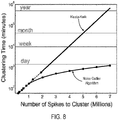
- the techniques described herein improve on existing clustering algorithms in at least three ways. First, the techniques described herein can run in linear time, rather than exponential time, providing savings in the amount of computational time required to analyze large data sets (e.g., as described below in connection with FIG. 8 ).
- the techniques described herein do not require users to set a priori parameters (e.g., voltage thresholds, expected number of clusters) that are required by other clustering techniques.
- the techniques described herein can be run adaptively, for example, by updating the noise distribution and/or the probability that data belongs in an identified cluster based on new data.
- the techniques described herein can identify signals that are compact or bounded, in the mathematical sense; repeatable; and relatively improbable. Examples include a number of biological phenomena, including, but not limited to extracellular recordings of neuronal action potentials and electroencephalography ("EEG") events, such as sharp waves and inter-ictal spikes. Potential applications of the techniques described herein include analyzing biological, physical, and chemical processes. In some embodiments, the techniques described herein can be adapted for internet or software utilization measures, such as identifying "bursts" of activity that have some regularity as a function of time.
- a flowchart is illustrated as setting forth the steps of an example process for clustering events in a temporal signal, such as a physiological signal.
- electrophysiological signals include those recorded with an EEG system, an electrocardiography (“ECG”) system, an electromyography (“EMG”) system, and so on.
- EEG electrocardiography
- EMG electromyography
- the process thus can begin with providing signal data to a computer system for processing, as indicated at step 102, which can receive the signal data from any suitable source.
- providing the signal data can include retrieving previously acquired electrophysiological signals from data storage (e.g., memory), or acquiring such signals in real-time (e.g., from one or more sensors).
- a time window is defined by selecting a maximum duration for the signal of interest, as indicated at step 104.
- the duration may be 1 millisecond when the goal is to cluster action potential in EEG signals. Other possible durations will be appreciated by those skilled in the art depending on the clinical application, the input electrophysiological signal, and the event to be clustered from the electrophysiological signal.
- the time window can be defined based on a user input.
- a computing device e.g., the computing device described below in connection with FIG. 9 executing at least a portion of the process described in FIG.
- a user can prompt a user to select a time window and/or what type of signal data is being analyzed (which may be associated with a time window) prior to performing any analysis on the signal data.
- a user can input a default value of a time window to be used, which can be a default value based on the type of signal data to be analyzed and/or a universal default value to be used.
- a spectral band is also defined by selecting a range of frequencies to be filtered, as indicated at step 106.
- the spectral band may be 600-6000 Hz when the goal is to cluster action potential in EEG signals.
- Other possible spectral bands will be appreciated by those skilled in the art depending on the clinical application, the input electrophysiological signal, and the event to be clustered from the electrophysiological signal.
- the spectral band can be defined based on user input.
- a computing device e.g., the computing device described below in connection with FIG. 9 executing at least a portion of the process described in FIG.
- a user can prompt a user to select a spectral band and/or what type of signal data is being analyzed (which may be associated with a spectral band) prior to performing any analysis on the signal data.
- a user can input a default value of a spectral band to be used, which can be a default value based on the type of signal data to be analyzed and/or a universal default value to be used.
- the provided signal data is filtered, as indicated at step 108.
- a bandpass filter is designed based on the selected spectral band and those frequencies outside of the spectral band are removed by applying the bandpass filter to the signal data.
- peaks in the signal data that fall within the time window are identified, as indicated at step 110.
- the time window is used as a sliding window to process the signal data and identify those signal peaks that can be contained within the time window.
- the time-bounded signals associated with the identified peaks are then encoded, as indicated at step 112.
- the time-bounded signals can be encoded by binning values at each time point in the signal (e.g., at each window), thereby creating an N ⁇ 1 vector, where N is the number of time points.
- the value at each position N can represent the peak value within a particular time window.
- the frequencies of all waveforms are then accumulated to generate counts, as indicated at step 114.
- the N ⁇ 1 vector can be used as a key when accumulating the frequencies of all waveforms at 114.
- waveforms in time windows having similar peak values can be grouped together based on the values corresponding to those time windows in the N ⁇ 1 vector.
- other parameters and/or additional parameters can be used when grouping the waveforms, such as the period of a signal in the waveform, the amplitude of a signal in the waveform, the signal energy of a signal in the waveform, the signal power of a signal in the waveform, the average value of the waveform, etc.
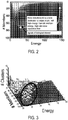
- An example two-dimensional histogram computed by encoding a plurality of time-bounded signals and accumulating the frequencies of waveforms in the encoded signals is illustrated in FIG. 2 . The histogram shows the distribution of noise around the edges and outliers near the middle. These regions are analyzed to provide clustering of the input physiological signal data, as described now in detail.
- the parameters for a beta distribution representative of the noise in the provided signal data are next computed, as indicated at step 116. Using the counts of each cluster, those clusters that lie outside of the noise probability distribution are identified, as indicated at step 118. These outlier clusters are associated with observable, repeatable, but improbable (or rare) events. If desired, the probabilities associated with the outlier clusters can be used as prior inputs to a Bayesian Estimator to further refine the clusters, such as determining whether multiple clusters exist, as indicated at step 120. A report can then be generated based on the clusters, as indicated at step 122. As one example, the report can include data plots and other information depicting the clusters or analyses based on the clusters.
- the report can include data plots computed based on the clusters, such as a distribution of inter-spike intervals or other physiological parameters.
- the report can include an electronic display of such data or information, for example, by generating a display of the data or information on a suitable electronic display.
- a report can be generated based on aggregated data across different channels (e.g., across different neurons) and/or comparing different channels.
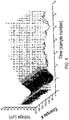
- the outlier region identified in the example histogram of FIG. 2 is shown in detail in FIG. 3 , and waveforms associated with the region noted by the ellipse in FIG. 3 are shown in FIG. 4 .
- the average waveform of the outlier waveforms shown in FIG. 4 is shown in FIG. 5 , where the error bars depict one standard deviation.
- the average waveform is depicted in FIG. 6 with error bars associated with one standard deviation for manual cutting of the same data.
- the inter-spike interval ("ISI") distribution of the waveforms in FIG. 4 is shown in FIG. 7 . This distribution shows less than 0.1 percent of detections within a two millisecond "refractory period.”
- Using the techniques described herein can eliminate the need for at least three a priori assumptions required by currently available bounded time-signal clustering algorithms including those algorithms' assumption of fixed time-voltage detection thresholds, requirement for a guess at the number of initial clusters, and assumption that the waveform voltages are normally distributed.
- Potential users of the techniques described herein can include the following groups of users: those who currently use identified, physiological signals, and those who would use such signals, if an automated, reliable solution existed.
- the former group includes clinicians, who use identifiable physiological signals for patient diagnosis. Examples include neurologists who identify sleep spindles in sleep studies or inter-ictal spikes in epilepsy studies.
- the latter group would include the neuroprosthetics field, where current technology emphasizes multi-unit, neuronal activity, because no automated, reliable methods exist to generate single-neuron activity.
- FIG. 8 illustrates (log scale) computational times for this comparison and depicts the actual time (dots and lines) and projection (dotted line) showing the increase in clustering time with increasing spike count.
- computational time for the Klusta-Kwik algorithm increased exponentially with spike number.
- Clustering time for the techniques described herein utilize waveform probabilities, instead of waveform features, and as a result are capable of computational time that scales linearly with increasing data points.
- the computer system 900 generally includes an input 902, at least one processor 904, a memory 906, and an output 908.
- the computer system 900 can also include any suitable device for reading computer-readable storage media.
- the computer system 900 may be, for example, a workstation, a notebook computer, a tablet device, a mobile device, a multimedia device, a network server, a mainframe, or any other general-purpose or application-specific computing device.
- the computer system 900 may operate autonomously or semi-autonomously, or may read executable software instructions from the memory 906 or a computer-readable medium (e.g., a hard drive, a CD-ROM, flash memory), or may receive instructions via the input 902 from a user, or any another source logically connected to a computer or device, such as another networked computer or server.
- a computer-readable medium e.g., a hard drive, a CD-ROM, flash memory
- the computer system 900 is programmed or otherwise configured to implement the processes described above.
- the input 902 may take any suitable shape or form, as desired, for operation of the computer system 900, including the ability for selecting, entering, or otherwise specifying parameters consistent with performing tasks, processing data, or operating the computer system 900.
- the input 902 may be configured to receive data, such as physiological signals, or associated data. Such data may be processed as described above.
- the input 902 may also be configured to receive any other data or information considered useful for clustering events in physiological signal data.
- the at least one processor 904 may also be configured to receive data, such as physiological signals, or associated data. In some configurations, the at least one processor 904 may also be configured to carry out any number of post-processing steps on data received by way of the input 902. In addition, the at least one processor 904 may be capable of clustering events in physiological signal data as described above.
- the memory 906 may contain software 910 and data 912, and may be configured for storage and retrieval of processed information, instructions, and data to be processed by the at least one processor 904.
- the software 910 may contain instructions directed to clustering events in physiological signal data.
- the data 912 may include any data necessary for operating the computer system 900, and may include any suitable physiological signal data as described above.
- the output 908 may take any shape or form, as desired, and may be configured for displaying, in addition to other desired information, clustered physiological signal data or reports generated based on clustering of physiological signal data.
- any suitable number of computing systems can be used to perform different portions of the processes described herein.
- a first computing system can be used to capture physiologic signal data, and provide that physiologic signal data to a second computing system (e.g., a server).
- the second computing system can be used to analyze the physiologic signal data using the techniques described herein to determine which waveforms represent action potentials and which are likely to be noise.
- the second computing system can be used to generate one or more reports, graphics, etc., based on the analysis to and/or can send the results of the analysis to a third computing system (e.g., a personal computer, a tablet computer, a smartphone, another server, etc.).
- the third computing device can be used to display the results of the analysis, generate one or more reports, graphics, etc., based on the analysis, display one or more reports, graphics, etc. received from the second computer, etc.
Landscapes
- Health & Medical Sciences (AREA)
- Life Sciences & Earth Sciences (AREA)
- Engineering & Computer Science (AREA)
- Physics & Mathematics (AREA)
- Signal Processing (AREA)
- Artificial Intelligence (AREA)
- Biophysics (AREA)
- Animal Behavior & Ethology (AREA)
- Veterinary Medicine (AREA)
- Public Health (AREA)
- General Health & Medical Sciences (AREA)
- Surgery (AREA)
- Molecular Biology (AREA)
- Pathology (AREA)
- Biomedical Technology (AREA)
- Heart & Thoracic Surgery (AREA)
- Medical Informatics (AREA)
- Computer Vision & Pattern Recognition (AREA)
- Psychiatry (AREA)
- Physiology (AREA)
- Evolutionary Computation (AREA)
- Fuzzy Systems (AREA)
- Mathematical Physics (AREA)
- Power Engineering (AREA)
- Measurement And Recording Of Electrical Phenomena And Electrical Characteristics Of The Living Body (AREA)
- Neurology (AREA)
Claims (15)
- Verfahren zum Identifizieren von Ereignissen von Interesse aus verrauschten physiologischen Signaldaten, wobei das Verfahren umfasst:(a) Empfangen physiologischer Signaldaten durch ein Computersystem (900);(b) Erzeugen gefilterter Signaldaten durch Filtern der physiologischen Signaldaten unter Verwendung eines Filters, der durch ein Spektralband definiert ist, das mit einem bestimmten physiologischen Ereignis zugeordnet ist (108);(c) Erzeugen von Signalspitzen-Daten mit dem Computersystem durch Identifizieren einer Signalspitze in den gefilterten Daten (110) für jedes einer Vielzahl von Zeitfenstern in den gefilterten Daten;(d) Gruppieren von Wellenformen aus den physiologischen Signaldaten, die jedem der mehreren Zeitfenster entsprechen, auf der Grundlage der Signalspitzen-Daten, um geclusterte Ereignisdaten zu erzeugen;(e) Bestimmen von Parametern für eine Rausch-Betaverteilung, die zumindest teilweise auf den Signalspitzen-Daten basiert (116);(f) Identifizieren mindestens eines Clusters von Wellenformen aus den geclusterten Ereignisdaten, der nicht in die Rausch-Betaverteilung fällt, wobei jede Wellenform in dem mindestens einen Cluster ein physiologisches Ereignis von Interesse in den physiologischen Signaldaten darstellt (118);(g) Erzeugen einer grafischen Darstellung auf der Grundlage der Wellenformen in dem mindestens einen Cluster von Wellenformen (122); und(h) Bewirken, dass die grafische Darstellung angezeigt wird (908).
- Verfahren nach Anspruch 1, wobei die physiologischen Signaldaten eine extrazelluläre Aufzeichnung der elektrischen Aktivität eines Signalneurons darstellen.
- Verfahren nach Anspruch 1, bei dem die physiologischen Signaldaten von einem einzigen Mikrodraht empfangen werden.
- Verfahren nach Anspruch 1, wobei die graphische Darstellung eine Vielzahl der Wellenformen in dem mindestens einen Cluster von Wellenformen zeigt.
- Verfahren nach Anspruch 1, wobei die graphische Darstellung eine Durchschnittswellenform zeigt, die eine Vielzahl der Wellenformen in dem mindestens einen Cluster von Wellenformen repräsentiert.
- Verfahren nach Anspruch 1, wobei mindestens eines der folgenden gilt:die physiologischen Signaldaten repräsentieren mindestens vierundzwanzig Stunden Signale;das Spektralband reicht von etwa 600 Hertz bis etwa 6000 Hertz; oderdas Zeitfenster beträgt etwa eine Millisekunde.
- Verfahren nach Anspruch 1, wobei das Verfahren ferner das Wiederholen von (a) bis (h) für zweite physiologische Signaldaten umfasst, die eine extrazelluläre Aufzeichnung der elektrischen Aktivität eines zweiten Signalneurons darstellen.
- Verfahren nach Anspruch 1, wobei die Erzeugung von Signalspitzenwerten ferner die Erzeugung eines Nx1-Vektors umfasst, wobei N die Anzahl der Zeitfenster in der Vielzahl von Zeitfenstern ist.
- Verfahren nach Anspruch 8, wobei jeder Wert in dem Nx1-Vektor den Spitzenwert des physiologischen Signals in einem bestimmten Zeitfenster repräsentiert.
- Verfahren nach Anspruch 9, wobei die Gruppierung der Wellenformen aus den physiologischen Signaldaten ferner die Gruppierung von Wellenformen umfasst, die Zeitfenstern mit ähnlichen Werten im Nx1-Vektor entsprechen.
- Verfahren nach Anspruch 1, weiter umfassend:Verwenden von Wahrscheinlichkeiten, die dem mindestens einen Cluster zugeordnet sind, als Input für einen Bayesschen Schätzer; und,basierend auf der Ausgabe des Bayesschen Schätzers, Identifizieren eines zweiten Clusters von Wellenformen aus den geclusterten Ereignisdaten, der in die Rausch-Betaverteilung fällt, als wahrscheinlich physiologische Ereignisse repräsentierend, die in den physiologischen Signaldaten von Interesse sind.
- System zum Identifizieren von Ereignissen von Interesse aus verrauschten physiologischen Signaldaten, wobei das System umfasst:eine Anzeige (908); undeinen Hardware-Prozessor (904), der programmiert ist:(a) physiologische Signaldaten zu empfangen;(b) gefilterte Signaldaten durch Filtern der physiologischen Signaldaten zu erzeugen, unter Verwendung eines Filters, der durch ein Spektralband definiert ist, das einem bestimmten physiologischen Ereignis zugeordnet ist;(c) Signalspitzen-Daten mit dem Computersystem zu erzeugen, indem für jedes einer Vielzahl von Zeitfenstern in den gefilterten Daten eine Signalspitze in den gefilterten Daten identifiziert wird;(d) auf Grundlage der Signalspitzen-Daten, Wellenformen aus den physiologischen Signaldaten zu gruppieren, die jedem der mehreren Zeitfenster entsprechen, um geclusterte Ereignisdaten zu erzeugen;(e) Parameter für eine Rausch-Betaverteilung zu bestimmen, die zumindest teilweise auf den Signalspitzen-Daten basieren;(f) mindestens einen Cluster von Wellenformen aus den geclusterten Ereignisdaten zu identifizieren, der nicht in die Rausch-Betaverteilung fällt, wobei jede Wellenform in dem mindestens einen Cluster ein physiologisches Ereignis von Interesse in den physiologischen Signaldaten darstellt;(g) eine grafische Darstellung auf der Grundlage der Wellenformen in dem mindestens einen Cluster von Wellenformen zu erzeugen; und(h) zu bewirken, dass die grafische Darstellung über die Anzeige angezeigt wird.
- System nach Anspruch 12, wobei die physiologischen Signaldaten eine extrazelluläre Aufzeichnung der elektrischen Aktivität eines Signalneurons darstellen.
- System nach Anspruch 12, wobei das System an einen Mikrodraht gekoppelt ist, der die elektrische Aktivität des Signalneurons erfasst, und wobei der Prozessor ferner so programmiert ist, dass er die physiologischen Signaldaten von dem Mikrodraht empfängt.
- System des Anspruchs 12, wobei mindestens eines der folgenden gilt:die physiologischen Signaldaten repräsentieren mindestens vierundzwanzig Stunden an Signalen;das Spektralband reicht von etwa 600 Hertz bis etwa 6000 Hertz; oderdas Zeitfenster beträgt etwa eine Millisekunde.
Applications Claiming Priority (2)
| Application Number | Priority Date | Filing Date | Title |
|---|---|---|---|
| US201562267597P | 2015-12-15 | 2015-12-15 | |
| PCT/US2016/066914 WO2017106490A1 (en) | 2015-12-15 | 2016-12-15 | Systems and methods for linear-time clustering for bounded, repeatable, rare events in physiological signals |
Publications (3)
| Publication Number | Publication Date |
|---|---|
| EP3389478A1 EP3389478A1 (de) | 2018-10-24 |
| EP3389478A4 EP3389478A4 (de) | 2019-08-07 |
| EP3389478B1 true EP3389478B1 (de) | 2021-03-31 |
Family
ID=59057565
Family Applications (1)
| Application Number | Title | Priority Date | Filing Date |
|---|---|---|---|
| EP16876675.6A Active EP3389478B1 (de) | 2015-12-15 | 2016-12-15 | Systeme und verfahren zum linearen zeitlichen clustering für begrenzte, wiederholbare, seltene ereignisse in physiologischen signalen |
Country Status (3)
| Country | Link |
|---|---|
| US (1) | US11291413B2 (de) |
| EP (1) | EP3389478B1 (de) |
| WO (1) | WO2017106490A1 (de) |
Families Citing this family (7)
| Publication number | Priority date | Publication date | Assignee | Title |
|---|---|---|---|---|
| US10359335B2 (en) | 2017-03-03 | 2019-07-23 | Itron, Inc. | Methods and apparatus to analyze recordings in leak detection |
| US10551274B2 (en) * | 2017-11-09 | 2020-02-04 | Itron, Inc. | Methods and apparatus to detect leaks |
| US11248981B2 (en) | 2017-11-21 | 2022-02-15 | Itron, Inc. | Methods and apparatus to detect leaks based on temperature data |
| US10686715B2 (en) | 2018-05-09 | 2020-06-16 | Biosig Technologies, Inc. | Apparatus and methods for removing a large-signal voltage offset from a biomedical signal |
| JP7571791B2 (ja) * | 2020-08-27 | 2024-10-23 | 株式会社島津製作所 | ピーク形状推定装置およびピーク形状推定方法 |
| US11788919B2 (en) | 2021-10-08 | 2023-10-17 | Itron, Inc. | Coordinated acoustic leak detection sensor sampling |
| CN116269429B (zh) * | 2023-03-16 | 2025-06-17 | 众阳健康科技集团有限公司 | 一种自监督的心电信噪比评估方法及系统 |
Family Cites Families (15)
| Publication number | Priority date | Publication date | Assignee | Title |
|---|---|---|---|---|
| US5311876A (en) | 1992-11-18 | 1994-05-17 | The Johns Hopkins University | Automatic detection of seizures using electroencephalographic signals |
| US5853364A (en) * | 1995-08-07 | 1998-12-29 | Nellcor Puritan Bennett, Inc. | Method and apparatus for estimating physiological parameters using model-based adaptive filtering |
| ITMI20011708A1 (it) | 2001-08-03 | 2003-02-03 | Bracco Imaging Spa | Coniugati di peptidi, loro derivati con complessi metallici e utilizzo per i'indagine diagnostica tramite imaging per risonanza magnetica(m |
| WO2003079891A2 (en) * | 2002-03-18 | 2003-10-02 | Sonomedica, Llc | Method and system for generating a likelihood of cardiovascular disease from analyzing cardiovascular sound signals. |
| US6735467B2 (en) | 2002-04-15 | 2004-05-11 | Persyst Development Corporation | Method and system for detecting seizures using electroencephalograms |
| NZ527751A (en) | 2003-08-22 | 2006-09-29 | Brainz Instr Ltd | EEG seizure analysis |
| US8095210B2 (en) * | 2007-01-19 | 2012-01-10 | California Institute Of Technology | Prosthetic devices and methods and systems related thereto |
| US20140007395A1 (en) | 2011-02-03 | 2014-01-09 | A. Raymond Et Cie | Clamp forming apparatus and method |
| CN104067487B (zh) | 2012-01-31 | 2017-02-22 | Kodenshi株式会社 | 编码器用传感器安装件、圆盘型编码器和带编码器电动机 |
| US20140073958A1 (en) * | 2012-09-11 | 2014-03-13 | Nellcor Puritan Bennett Llc | Methods and systems for determining physiological information using initialization values |
| US20140073951A1 (en) * | 2012-09-11 | 2014-03-13 | Nellcor Puritan Bennett Llc | Methods and systems for determining physiological information based on an algorithm setting |
| US9343431B2 (en) | 2013-07-10 | 2016-05-17 | Taiwan Semiconductor Manufacturing Company, Ltd. | Dam structure for enhancing joint yield in bonding processes |
| US20150088020A1 (en) * | 2013-09-25 | 2015-03-26 | Bardy Diagnostics, Inc. | System and Method For Interactive Processing Of ECG Data |
| US20150148632A1 (en) * | 2013-11-26 | 2015-05-28 | David Alan Benaron | Calorie Monitoring Sensor And Method For Cell Phones, Smart Watches, Occupancy Sensors, And Wearables |
| US20160045120A1 (en) * | 2014-08-15 | 2016-02-18 | Massachusetts Institute Of Technology | Systems and methods for spike sorting |
-
2016
- 2016-12-15 EP EP16876675.6A patent/EP3389478B1/de active Active
- 2016-12-15 WO PCT/US2016/066914 patent/WO2017106490A1/en not_active Ceased
- 2016-12-15 US US16/062,220 patent/US11291413B2/en active Active
Non-Patent Citations (1)
| Title |
|---|
| None * |
Also Published As
| Publication number | Publication date |
|---|---|
| WO2017106490A1 (en) | 2017-06-22 |
| US11291413B2 (en) | 2022-04-05 |
| EP3389478A4 (de) | 2019-08-07 |
| US20180368778A1 (en) | 2018-12-27 |
| EP3389478A1 (de) | 2018-10-24 |
Similar Documents
| Publication | Publication Date | Title |
|---|---|---|
| EP3389478B1 (de) | Systeme und verfahren zum linearen zeitlichen clustering für begrenzte, wiederholbare, seltene ereignisse in physiologischen signalen | |
| AU2020349425B2 (en) | Systems and methods for seizure prediction and detection | |
| CN114615924B (zh) | 基于脑电图(eeg)非线性变化的用于癫痫发作检测的系统和方法 | |
| Giannakakis et al. | Methods for seizure detection and prediction: an overview | |
| Raghu et al. | A novel approach for real-time recognition of epileptic seizures using minimum variance modified fuzzy entropy | |
| Alotaibi et al. | Ensemble Machine Learning Based Identification of Pediatric Epilepsy. | |
| KR102141185B1 (ko) | 확률모델 및 기계학습과 함께 특징추출을 이용한 뇌전도 신호의 멀티 주파수 대역 계수 기반 간질 발작파 검출 시스템 | |
| CN107095669B (zh) | 一种癫痫患者脑电信号的处理方法及系统 | |
| JP7562745B2 (ja) | 脳波(eeg)の非線形性の変化に基づく発作検出システム及び方法 | |
| Takahashi et al. | Convolutional neural network with autoencoder-assisted multiclass labelling for seizure detection based on scalp electroencephalography | |
| US20160106331A1 (en) | Fractal index analysis of human electroencephalogram signals | |
| Shen et al. | A physiology-based seizure detection system for multichannel EEG | |
| KR102256313B1 (ko) | 뇌전도 신호 기반 멀티 주파수 대역 계수를 이용한 특징추출 및 확률모델과 기계학습에 의한 간질 발작파 자동 검출 방법 및 장치 | |
| Rajaguru et al. | KNN classifier and K-Means clustering for robust classification of epilepsy from EEG signals. A detailed analysis | |
| CN113974653B (zh) | 基于约登指数优化棘波检测方法和装置、存储介质和终端 | |
| Balasubramanian et al. | Aging and cardiovascular complexity: effect of the length of RR tachograms | |
| US8805484B2 (en) | System, apparatus and method for diagnosing seizures | |
| Zanetti et al. | Approximate zero-crossing: a new interpretable, highly discriminative and low-complexity feature for EEG and iEEG seizure detection | |
| US20230190204A1 (en) | Statistical dependence-aware biological predictive system | |
| Abbaszadeh et al. | Optimum window size and overlap for robust probabilistic prediction of seizures with ieeg | |
| Chandel et al. | Epileptic eeg signal classification using machine learning based model | |
| Khan et al. | Autoregressive features based classification for seizure detection using neural network in scalp Electroencephalogram | |
| Rudas et al. | On activity identification pipelines for a low-accuracy EEG device | |
| Anastasiadou et al. | Automatic detection and removal of muscle artifacts from scalp EEG recordings in patients with epilepsy | |
| Begum et al. | An initiative to classify different neurological disorder in children using multichannel EEG signals |
Legal Events
| Date | Code | Title | Description |
|---|---|---|---|
| STAA | Information on the status of an ep patent application or granted ep patent |
Free format text: STATUS: THE INTERNATIONAL PUBLICATION HAS BEEN MADE |
|
| PUAI | Public reference made under article 153(3) epc to a published international application that has entered the european phase |
Free format text: ORIGINAL CODE: 0009012 |
|
| STAA | Information on the status of an ep patent application or granted ep patent |
Free format text: STATUS: REQUEST FOR EXAMINATION WAS MADE |
|
| 17P | Request for examination filed |
Effective date: 20180615 |
|
| AK | Designated contracting states |
Kind code of ref document: A1 Designated state(s): AL AT BE BG CH CY CZ DE DK EE ES FI FR GB GR HR HU IE IS IT LI LT LU LV MC MK MT NL NO PL PT RO RS SE SI SK SM TR |
|
| AX | Request for extension of the european patent |
Extension state: BA ME |
|
| RIN1 | Information on inventor provided before grant (corrected) |
Inventor name: BOWER, MARK, R. Inventor name: BOWER, REGINA, S. Inventor name: KUCEWICZ, MICHAEL, T. Inventor name: WORRELL, GREGORY, A. |
|
| DAV | Request for validation of the european patent (deleted) | ||
| DAX | Request for extension of the european patent (deleted) | ||
| A4 | Supplementary search report drawn up and despatched |
Effective date: 20190709 |
|
| RIC1 | Information provided on ipc code assigned before grant |
Ipc: A61B 5/04 20060101ALI20190703BHEP Ipc: A61B 5/00 20060101AFI20190703BHEP Ipc: A61B 5/1455 20060101ALI20190703BHEP Ipc: A61B 5/08 20060101ALI20190703BHEP Ipc: A61B 5/0408 20060101ALI20190703BHEP Ipc: A61B 5/024 20060101ALI20190703BHEP Ipc: A61B 6/00 20060101ALI20190703BHEP |
|
| GRAP | Despatch of communication of intention to grant a patent |
Free format text: ORIGINAL CODE: EPIDOSNIGR1 |
|
| STAA | Information on the status of an ep patent application or granted ep patent |
Free format text: STATUS: GRANT OF PATENT IS INTENDED |
|
| INTG | Intention to grant announced |
Effective date: 20200330 |
|
| GRAS | Grant fee paid |
Free format text: ORIGINAL CODE: EPIDOSNIGR3 |
|
| GRAJ | Information related to disapproval of communication of intention to grant by the applicant or resumption of examination proceedings by the epo deleted |
Free format text: ORIGINAL CODE: EPIDOSDIGR1 |
|
| GRAL | Information related to payment of fee for publishing/printing deleted |
Free format text: ORIGINAL CODE: EPIDOSDIGR3 |
|
| STAA | Information on the status of an ep patent application or granted ep patent |
Free format text: STATUS: REQUEST FOR EXAMINATION WAS MADE |
|
| INTC | Intention to grant announced (deleted) | ||
| GRAP | Despatch of communication of intention to grant a patent |
Free format text: ORIGINAL CODE: EPIDOSNIGR1 |
|
| STAA | Information on the status of an ep patent application or granted ep patent |
Free format text: STATUS: GRANT OF PATENT IS INTENDED |
|
| INTG | Intention to grant announced |
Effective date: 20200921 |
|
| GRAA | (expected) grant |
Free format text: ORIGINAL CODE: 0009210 |
|
| STAA | Information on the status of an ep patent application or granted ep patent |
Free format text: STATUS: THE PATENT HAS BEEN GRANTED |
|
| AK | Designated contracting states |
Kind code of ref document: B1 Designated state(s): AL AT BE BG CH CY CZ DE DK EE ES FI FR GB GR HR HU IE IS IT LI LT LU LV MC MK MT NL NO PL PT RO RS SE SI SK SM TR |
|
| REG | Reference to a national code |
Ref country code: GB Ref legal event code: FG4D Ref country code: CH Ref legal event code: EP |
|
| REG | Reference to a national code |
Ref country code: AT Ref legal event code: REF Ref document number: 1376003 Country of ref document: AT Kind code of ref document: T Effective date: 20210415 |
|
| REG | Reference to a national code |
Ref country code: DE Ref legal event code: R096 Ref document number: 602016055439 Country of ref document: DE |
|
| REG | Reference to a national code |
Ref country code: IE Ref legal event code: FG4D |
|
| REG | Reference to a national code |
Ref country code: LT Ref legal event code: MG9D |
|
| PG25 | Lapsed in a contracting state [announced via postgrant information from national office to epo] |
Ref country code: NO Free format text: LAPSE BECAUSE OF FAILURE TO SUBMIT A TRANSLATION OF THE DESCRIPTION OR TO PAY THE FEE WITHIN THE PRESCRIBED TIME-LIMIT Effective date: 20210630 Ref country code: FI Free format text: LAPSE BECAUSE OF FAILURE TO SUBMIT A TRANSLATION OF THE DESCRIPTION OR TO PAY THE FEE WITHIN THE PRESCRIBED TIME-LIMIT Effective date: 20210331 Ref country code: HR Free format text: LAPSE BECAUSE OF FAILURE TO SUBMIT A TRANSLATION OF THE DESCRIPTION OR TO PAY THE FEE WITHIN THE PRESCRIBED TIME-LIMIT Effective date: 20210331 Ref country code: BG Free format text: LAPSE BECAUSE OF FAILURE TO SUBMIT A TRANSLATION OF THE DESCRIPTION OR TO PAY THE FEE WITHIN THE PRESCRIBED TIME-LIMIT Effective date: 20210630 |
|
| PG25 | Lapsed in a contracting state [announced via postgrant information from national office to epo] |
Ref country code: SE Free format text: LAPSE BECAUSE OF FAILURE TO SUBMIT A TRANSLATION OF THE DESCRIPTION OR TO PAY THE FEE WITHIN THE PRESCRIBED TIME-LIMIT Effective date: 20210331 Ref country code: LV Free format text: LAPSE BECAUSE OF FAILURE TO SUBMIT A TRANSLATION OF THE DESCRIPTION OR TO PAY THE FEE WITHIN THE PRESCRIBED TIME-LIMIT Effective date: 20210331 Ref country code: RS Free format text: LAPSE BECAUSE OF FAILURE TO SUBMIT A TRANSLATION OF THE DESCRIPTION OR TO PAY THE FEE WITHIN THE PRESCRIBED TIME-LIMIT Effective date: 20210331 |
|
| REG | Reference to a national code |
Ref country code: NL Ref legal event code: MP Effective date: 20210331 |
|
| REG | Reference to a national code |
Ref country code: AT Ref legal event code: MK05 Ref document number: 1376003 Country of ref document: AT Kind code of ref document: T Effective date: 20210331 |
|
| PG25 | Lapsed in a contracting state [announced via postgrant information from national office to epo] |
Ref country code: LT Free format text: LAPSE BECAUSE OF FAILURE TO SUBMIT A TRANSLATION OF THE DESCRIPTION OR TO PAY THE FEE WITHIN THE PRESCRIBED TIME-LIMIT Effective date: 20210331 Ref country code: CZ Free format text: LAPSE BECAUSE OF FAILURE TO SUBMIT A TRANSLATION OF THE DESCRIPTION OR TO PAY THE FEE WITHIN THE PRESCRIBED TIME-LIMIT Effective date: 20210331 Ref country code: EE Free format text: LAPSE BECAUSE OF FAILURE TO SUBMIT A TRANSLATION OF THE DESCRIPTION OR TO PAY THE FEE WITHIN THE PRESCRIBED TIME-LIMIT Effective date: 20210331 Ref country code: AT Free format text: LAPSE BECAUSE OF FAILURE TO SUBMIT A TRANSLATION OF THE DESCRIPTION OR TO PAY THE FEE WITHIN THE PRESCRIBED TIME-LIMIT Effective date: 20210331 Ref country code: NL Free format text: LAPSE BECAUSE OF FAILURE TO SUBMIT A TRANSLATION OF THE DESCRIPTION OR TO PAY THE FEE WITHIN THE PRESCRIBED TIME-LIMIT Effective date: 20210331 Ref country code: SM Free format text: LAPSE BECAUSE OF FAILURE TO SUBMIT A TRANSLATION OF THE DESCRIPTION OR TO PAY THE FEE WITHIN THE PRESCRIBED TIME-LIMIT Effective date: 20210331 |
|
| PG25 | Lapsed in a contracting state [announced via postgrant information from national office to epo] |
Ref country code: IS Free format text: LAPSE BECAUSE OF FAILURE TO SUBMIT A TRANSLATION OF THE DESCRIPTION OR TO PAY THE FEE WITHIN THE PRESCRIBED TIME-LIMIT Effective date: 20210731 Ref country code: PL Free format text: LAPSE BECAUSE OF FAILURE TO SUBMIT A TRANSLATION OF THE DESCRIPTION OR TO PAY THE FEE WITHIN THE PRESCRIBED TIME-LIMIT Effective date: 20210331 Ref country code: PT Free format text: LAPSE BECAUSE OF FAILURE TO SUBMIT A TRANSLATION OF THE DESCRIPTION OR TO PAY THE FEE WITHIN THE PRESCRIBED TIME-LIMIT Effective date: 20210802 Ref country code: RO Free format text: LAPSE BECAUSE OF FAILURE TO SUBMIT A TRANSLATION OF THE DESCRIPTION OR TO PAY THE FEE WITHIN THE PRESCRIBED TIME-LIMIT Effective date: 20210331 Ref country code: SK Free format text: LAPSE BECAUSE OF FAILURE TO SUBMIT A TRANSLATION OF THE DESCRIPTION OR TO PAY THE FEE WITHIN THE PRESCRIBED TIME-LIMIT Effective date: 20210331 |
|
| REG | Reference to a national code |
Ref country code: DE Ref legal event code: R097 Ref document number: 602016055439 Country of ref document: DE |
|
| PG25 | Lapsed in a contracting state [announced via postgrant information from national office to epo] |
Ref country code: DK Free format text: LAPSE BECAUSE OF FAILURE TO SUBMIT A TRANSLATION OF THE DESCRIPTION OR TO PAY THE FEE WITHIN THE PRESCRIBED TIME-LIMIT Effective date: 20210331 Ref country code: AL Free format text: LAPSE BECAUSE OF FAILURE TO SUBMIT A TRANSLATION OF THE DESCRIPTION OR TO PAY THE FEE WITHIN THE PRESCRIBED TIME-LIMIT Effective date: 20210331 Ref country code: ES Free format text: LAPSE BECAUSE OF FAILURE TO SUBMIT A TRANSLATION OF THE DESCRIPTION OR TO PAY THE FEE WITHIN THE PRESCRIBED TIME-LIMIT Effective date: 20210331 |
|
| PLBE | No opposition filed within time limit |
Free format text: ORIGINAL CODE: 0009261 |
|
| STAA | Information on the status of an ep patent application or granted ep patent |
Free format text: STATUS: NO OPPOSITION FILED WITHIN TIME LIMIT |
|
| 26N | No opposition filed |
Effective date: 20220104 |
|
| PG25 | Lapsed in a contracting state [announced via postgrant information from national office to epo] |
Ref country code: IS Free format text: LAPSE BECAUSE OF FAILURE TO SUBMIT A TRANSLATION OF THE DESCRIPTION OR TO PAY THE FEE WITHIN THE PRESCRIBED TIME-LIMIT Effective date: 20210731 |
|
| PG25 | Lapsed in a contracting state [announced via postgrant information from national office to epo] |
Ref country code: MC Free format text: LAPSE BECAUSE OF FAILURE TO SUBMIT A TRANSLATION OF THE DESCRIPTION OR TO PAY THE FEE WITHIN THE PRESCRIBED TIME-LIMIT Effective date: 20210331 Ref country code: IT Free format text: LAPSE BECAUSE OF FAILURE TO SUBMIT A TRANSLATION OF THE DESCRIPTION OR TO PAY THE FEE WITHIN THE PRESCRIBED TIME-LIMIT Effective date: 20210331 |
|
| REG | Reference to a national code |
Ref country code: CH Ref legal event code: PL |
|
| REG | Reference to a national code |
Ref country code: BE Ref legal event code: MM Effective date: 20211231 |
|
| PG25 | Lapsed in a contracting state [announced via postgrant information from national office to epo] |
Ref country code: LU Free format text: LAPSE BECAUSE OF NON-PAYMENT OF DUE FEES Effective date: 20211215 Ref country code: IE Free format text: LAPSE BECAUSE OF NON-PAYMENT OF DUE FEES Effective date: 20211215 |
|
| PG25 | Lapsed in a contracting state [announced via postgrant information from national office to epo] |
Ref country code: BE Free format text: LAPSE BECAUSE OF NON-PAYMENT OF DUE FEES Effective date: 20211231 |
|
| PG25 | Lapsed in a contracting state [announced via postgrant information from national office to epo] |
Ref country code: LI Free format text: LAPSE BECAUSE OF NON-PAYMENT OF DUE FEES Effective date: 20211231 Ref country code: CH Free format text: LAPSE BECAUSE OF NON-PAYMENT OF DUE FEES Effective date: 20211231 |
|
| PG25 | Lapsed in a contracting state [announced via postgrant information from national office to epo] |
Ref country code: HU Free format text: LAPSE BECAUSE OF FAILURE TO SUBMIT A TRANSLATION OF THE DESCRIPTION OR TO PAY THE FEE WITHIN THE PRESCRIBED TIME-LIMIT; INVALID AB INITIO Effective date: 20161215 |
|
| PG25 | Lapsed in a contracting state [announced via postgrant information from national office to epo] |
Ref country code: CY Free format text: LAPSE BECAUSE OF FAILURE TO SUBMIT A TRANSLATION OF THE DESCRIPTION OR TO PAY THE FEE WITHIN THE PRESCRIBED TIME-LIMIT Effective date: 20210331 |
|
| P01 | Opt-out of the competence of the unified patent court (upc) registered |
Effective date: 20230528 |
|
| PG25 | Lapsed in a contracting state [announced via postgrant information from national office to epo] |
Ref country code: GR Free format text: LAPSE BECAUSE OF FAILURE TO SUBMIT A TRANSLATION OF THE DESCRIPTION OR TO PAY THE FEE WITHIN THE PRESCRIBED TIME-LIMIT Effective date: 20210331 |
|
| PG25 | Lapsed in a contracting state [announced via postgrant information from national office to epo] |
Ref country code: MK Free format text: LAPSE BECAUSE OF FAILURE TO SUBMIT A TRANSLATION OF THE DESCRIPTION OR TO PAY THE FEE WITHIN THE PRESCRIBED TIME-LIMIT Effective date: 20210331 |
|
| PG25 | Lapsed in a contracting state [announced via postgrant information from national office to epo] |
Ref country code: TR Free format text: LAPSE BECAUSE OF FAILURE TO SUBMIT A TRANSLATION OF THE DESCRIPTION OR TO PAY THE FEE WITHIN THE PRESCRIBED TIME-LIMIT Effective date: 20210331 |
|
| PG25 | Lapsed in a contracting state [announced via postgrant information from national office to epo] |
Ref country code: MT Free format text: LAPSE BECAUSE OF FAILURE TO SUBMIT A TRANSLATION OF THE DESCRIPTION OR TO PAY THE FEE WITHIN THE PRESCRIBED TIME-LIMIT Effective date: 20210331 |
|
| PGFP | Annual fee paid to national office [announced via postgrant information from national office to epo] |
Ref country code: DE Payment date: 20241227 Year of fee payment: 9 |
|
| PGFP | Annual fee paid to national office [announced via postgrant information from national office to epo] |
Ref country code: GB Payment date: 20251229 Year of fee payment: 10 |
|
| PGFP | Annual fee paid to national office [announced via postgrant information from national office to epo] |
Ref country code: FR Payment date: 20251226 Year of fee payment: 10 |