EP3388489A1 - Optical apparatus, film to be provided on surface of optical apparatus, paint to be used for optical apparatus - Google Patents
Optical apparatus, film to be provided on surface of optical apparatus, paint to be used for optical apparatus Download PDFInfo
- Publication number
- EP3388489A1 EP3388489A1 EP18166850.0A EP18166850A EP3388489A1 EP 3388489 A1 EP3388489 A1 EP 3388489A1 EP 18166850 A EP18166850 A EP 18166850A EP 3388489 A1 EP3388489 A1 EP 3388489A1
- Authority
- EP
- European Patent Office
- Prior art keywords
- film
- silica
- titanium oxide
- less
- optical apparatus
- Prior art date
- Legal status (The legal status is an assumption and is not a legal conclusion. Google has not performed a legal analysis and makes no representation as to the accuracy of the status listed.)
- Withdrawn
Links
Images




Classifications
-
- G—PHYSICS
- G02—OPTICS
- G02B—OPTICAL ELEMENTS, SYSTEMS OR APPARATUS
- G02B1/00—Optical elements characterised by the material of which they are made; Optical coatings for optical elements
- G02B1/10—Optical coatings produced by application to, or surface treatment of, optical elements
-
- C—CHEMISTRY; METALLURGY
- C08—ORGANIC MACROMOLECULAR COMPOUNDS; THEIR PREPARATION OR CHEMICAL WORKING-UP; COMPOSITIONS BASED THEREON
- C08K—Use of inorganic or non-macromolecular organic substances as compounding ingredients
- C08K3/00—Use of inorganic substances as compounding ingredients
- C08K3/34—Silicon-containing compounds
- C08K3/36—Silica
-
- C—CHEMISTRY; METALLURGY
- C08—ORGANIC MACROMOLECULAR COMPOUNDS; THEIR PREPARATION OR CHEMICAL WORKING-UP; COMPOSITIONS BASED THEREON
- C08K—Use of inorganic or non-macromolecular organic substances as compounding ingredients
- C08K9/00—Use of pretreated ingredients
- C08K9/02—Ingredients treated with inorganic substances
-
- C—CHEMISTRY; METALLURGY
- C09—DYES; PAINTS; POLISHES; NATURAL RESINS; ADHESIVES; COMPOSITIONS NOT OTHERWISE PROVIDED FOR; APPLICATIONS OF MATERIALS NOT OTHERWISE PROVIDED FOR
- C09D—COATING COMPOSITIONS, e.g. PAINTS, VARNISHES OR LACQUERS; FILLING PASTES; CHEMICAL PAINT OR INK REMOVERS; INKS; CORRECTING FLUIDS; WOODSTAINS; PASTES OR SOLIDS FOR COLOURING OR PRINTING; USE OF MATERIALS THEREFOR
- C09D133/00—Coating compositions based on homopolymers or copolymers of compounds having one or more unsaturated aliphatic radicals, each having only one carbon-to-carbon double bond, and at least one being terminated by only one carboxyl radical, or of salts, anhydrides, esters, amides, imides, or nitriles thereof; Coating compositions based on derivatives of such polymers
- C09D133/04—Homopolymers or copolymers of esters
- C09D133/14—Homopolymers or copolymers of esters of esters containing halogen, nitrogen, sulfur or oxygen atoms in addition to the carboxy oxygen
-
- C—CHEMISTRY; METALLURGY
- C09—DYES; PAINTS; POLISHES; NATURAL RESINS; ADHESIVES; COMPOSITIONS NOT OTHERWISE PROVIDED FOR; APPLICATIONS OF MATERIALS NOT OTHERWISE PROVIDED FOR
- C09D—COATING COMPOSITIONS, e.g. PAINTS, VARNISHES OR LACQUERS; FILLING PASTES; CHEMICAL PAINT OR INK REMOVERS; INKS; CORRECTING FLUIDS; WOODSTAINS; PASTES OR SOLIDS FOR COLOURING OR PRINTING; USE OF MATERIALS THEREFOR
- C09D5/00—Coating compositions, e.g. paints, varnishes or lacquers, characterised by their physical nature or the effects produced; Filling pastes
- C09D5/004—Reflecting paints; Signal paints
-
- C—CHEMISTRY; METALLURGY
- C09—DYES; PAINTS; POLISHES; NATURAL RESINS; ADHESIVES; COMPOSITIONS NOT OTHERWISE PROVIDED FOR; APPLICATIONS OF MATERIALS NOT OTHERWISE PROVIDED FOR
- C09D—COATING COMPOSITIONS, e.g. PAINTS, VARNISHES OR LACQUERS; FILLING PASTES; CHEMICAL PAINT OR INK REMOVERS; INKS; CORRECTING FLUIDS; WOODSTAINS; PASTES OR SOLIDS FOR COLOURING OR PRINTING; USE OF MATERIALS THEREFOR
- C09D7/00—Features of coating compositions, not provided for in group C09D5/00; Processes for incorporating ingredients in coating compositions
- C09D7/40—Additives
- C09D7/60—Additives non-macromolecular
- C09D7/61—Additives non-macromolecular inorganic
-
- C—CHEMISTRY; METALLURGY
- C09—DYES; PAINTS; POLISHES; NATURAL RESINS; ADHESIVES; COMPOSITIONS NOT OTHERWISE PROVIDED FOR; APPLICATIONS OF MATERIALS NOT OTHERWISE PROVIDED FOR
- C09D—COATING COMPOSITIONS, e.g. PAINTS, VARNISHES OR LACQUERS; FILLING PASTES; CHEMICAL PAINT OR INK REMOVERS; INKS; CORRECTING FLUIDS; WOODSTAINS; PASTES OR SOLIDS FOR COLOURING OR PRINTING; USE OF MATERIALS THEREFOR
- C09D7/00—Features of coating compositions, not provided for in group C09D5/00; Processes for incorporating ingredients in coating compositions
- C09D7/40—Additives
- C09D7/60—Additives non-macromolecular
- C09D7/61—Additives non-macromolecular inorganic
- C09D7/62—Additives non-macromolecular inorganic modified by treatment with other compounds
-
- C—CHEMISTRY; METALLURGY
- C09—DYES; PAINTS; POLISHES; NATURAL RESINS; ADHESIVES; COMPOSITIONS NOT OTHERWISE PROVIDED FOR; APPLICATIONS OF MATERIALS NOT OTHERWISE PROVIDED FOR
- C09D—COATING COMPOSITIONS, e.g. PAINTS, VARNISHES OR LACQUERS; FILLING PASTES; CHEMICAL PAINT OR INK REMOVERS; INKS; CORRECTING FLUIDS; WOODSTAINS; PASTES OR SOLIDS FOR COLOURING OR PRINTING; USE OF MATERIALS THEREFOR
- C09D7/00—Features of coating compositions, not provided for in group C09D5/00; Processes for incorporating ingredients in coating compositions
- C09D7/40—Additives
- C09D7/66—Additives characterised by particle size
- C09D7/67—Particle size smaller than 100 nm
-
- C—CHEMISTRY; METALLURGY
- C09—DYES; PAINTS; POLISHES; NATURAL RESINS; ADHESIVES; COMPOSITIONS NOT OTHERWISE PROVIDED FOR; APPLICATIONS OF MATERIALS NOT OTHERWISE PROVIDED FOR
- C09D—COATING COMPOSITIONS, e.g. PAINTS, VARNISHES OR LACQUERS; FILLING PASTES; CHEMICAL PAINT OR INK REMOVERS; INKS; CORRECTING FLUIDS; WOODSTAINS; PASTES OR SOLIDS FOR COLOURING OR PRINTING; USE OF MATERIALS THEREFOR
- C09D7/00—Features of coating compositions, not provided for in group C09D5/00; Processes for incorporating ingredients in coating compositions
- C09D7/40—Additives
- C09D7/66—Additives characterised by particle size
- C09D7/68—Particle size between 100-1000 nm
-
- G—PHYSICS
- G02—OPTICS
- G02B—OPTICAL ELEMENTS, SYSTEMS OR APPARATUS
- G02B1/00—Optical elements characterised by the material of which they are made; Optical coatings for optical elements
- G02B1/10—Optical coatings produced by application to, or surface treatment of, optical elements
- G02B1/14—Protective coatings, e.g. hard coatings
-
- G—PHYSICS
- G02—OPTICS
- G02B—OPTICAL ELEMENTS, SYSTEMS OR APPARATUS
- G02B5/00—Optical elements other than lenses
- G02B5/08—Mirrors
- G02B5/0808—Mirrors having a single reflecting layer
-
- G—PHYSICS
- G02—OPTICS
- G02B—OPTICAL ELEMENTS, SYSTEMS OR APPARATUS
- G02B7/00—Mountings, adjusting means, or light-tight connections, for optical elements
- G02B7/02—Mountings, adjusting means, or light-tight connections, for optical elements for lenses
- G02B7/028—Mountings, adjusting means, or light-tight connections, for optical elements for lenses with means for compensating for changes in temperature or for controlling the temperature; thermal stabilisation
-
- G—PHYSICS
- G03—PHOTOGRAPHY; CINEMATOGRAPHY; ANALOGOUS TECHNIQUES USING WAVES OTHER THAN OPTICAL WAVES; ELECTROGRAPHY; HOLOGRAPHY
- G03B—APPARATUS OR ARRANGEMENTS FOR TAKING PHOTOGRAPHS OR FOR PROJECTING OR VIEWING THEM; APPARATUS OR ARRANGEMENTS EMPLOYING ANALOGOUS TECHNIQUES USING WAVES OTHER THAN OPTICAL WAVES; ACCESSORIES THEREFOR
- G03B11/00—Filters or other obturators specially adapted for photographic purposes
-
- C—CHEMISTRY; METALLURGY
- C08—ORGANIC MACROMOLECULAR COMPOUNDS; THEIR PREPARATION OR CHEMICAL WORKING-UP; COMPOSITIONS BASED THEREON
- C08K—Use of inorganic or non-macromolecular organic substances as compounding ingredients
- C08K3/00—Use of inorganic substances as compounding ingredients
- C08K3/18—Oxygen-containing compounds, e.g. metal carbonyls
- C08K3/20—Oxides; Hydroxides
- C08K3/22—Oxides; Hydroxides of metals
- C08K2003/2237—Oxides; Hydroxides of metals of titanium
-
- C—CHEMISTRY; METALLURGY
- C08—ORGANIC MACROMOLECULAR COMPOUNDS; THEIR PREPARATION OR CHEMICAL WORKING-UP; COMPOSITIONS BASED THEREON
- C08K—Use of inorganic or non-macromolecular organic substances as compounding ingredients
- C08K3/00—Use of inorganic substances as compounding ingredients
- C08K3/18—Oxygen-containing compounds, e.g. metal carbonyls
- C08K3/20—Oxides; Hydroxides
- C08K3/22—Oxides; Hydroxides of metals
- C08K2003/2237—Oxides; Hydroxides of metals of titanium
- C08K2003/2241—Titanium dioxide
-
- C—CHEMISTRY; METALLURGY
- C08—ORGANIC MACROMOLECULAR COMPOUNDS; THEIR PREPARATION OR CHEMICAL WORKING-UP; COMPOSITIONS BASED THEREON
- C08K—Use of inorganic or non-macromolecular organic substances as compounding ingredients
- C08K2201/00—Specific properties of additives
- C08K2201/001—Conductive additives
-
- C—CHEMISTRY; METALLURGY
- C08—ORGANIC MACROMOLECULAR COMPOUNDS; THEIR PREPARATION OR CHEMICAL WORKING-UP; COMPOSITIONS BASED THEREON
- C08K—Use of inorganic or non-macromolecular organic substances as compounding ingredients
- C08K2201/00—Specific properties of additives
- C08K2201/002—Physical properties
- C08K2201/005—Additives being defined by their particle size in general
-
- C—CHEMISTRY; METALLURGY
- C08—ORGANIC MACROMOLECULAR COMPOUNDS; THEIR PREPARATION OR CHEMICAL WORKING-UP; COMPOSITIONS BASED THEREON
- C08K—Use of inorganic or non-macromolecular organic substances as compounding ingredients
- C08K9/00—Use of pretreated ingredients
- C08K9/10—Encapsulated ingredients
Definitions
- the present invention relates to a film and paint to be provided on a lens barrel of an optical apparatus such as a camera, a video camera, a broadcasting device or the like, and on the surface of an optical apparatus such as a camera main body, a video camera main body, a surveillance camera, a weather camera or the like to be possibly used outdoors, and to an optical apparatus.
- an optical apparatus such as a camera, a video camera, a broadcasting device or the like
- an optical apparatus such as a camera main body, a video camera main body, a surveillance camera, a weather camera or the like to be possibly used outdoors, and to an optical apparatus.
- a film to be provided on the surface of an optical apparatus is a film which has a function of suppressing a temperature rise of a member due to sunlight when it is used outdoors.
- a method of suppressing the temperature rise of the member due to sunlight as illustrated in FIG. 1 , there has been known a method of reflecting incident light 1 by the sun as reflected light 2 by an infrared reflection film 4 on a base material 5'. In this method, heat generation due to transmitted light 3 can be suppressed by increasing a ratio of the reflected light 2 to the incident light 1.
- titanium oxide having a high reflectance from a visible light region to an infrared region is often used.
- a solar energy distribution is 47% in the visible light region and 50% in the infrared region, so that a high reflectance in a wide range from the visible light region to the infrared region is required.
- the optical apparatus since the optical apparatus is often used outdoors, in addition to heat-shielding performance, also lightfastness (light resistance) under a severe sunlight condition such as a midsummer condition, an equatorial condition or the like is required.
- a tape such as a cellophane adhesive tape, a masking tape, a gummed tape, a TepraTM tape or the like may be stuck to a part of the surface of the film provided on the surface of the optical apparatus.
- the lightfastness is required also when oxygen is no longer supplied from the outside because the tape has been stuck and thus it becomes an anoxic state.
- Japanese Patent Application Laid-Open No. 2010-38957 discloses a coating film which is used for a lens barrel.
- lightness L is 70 or more so that color is thin
- reflectance of light having a wavelength of 900nm or more and less than 1700nm is as high as 70% or more
- Ti may be contained.
- the reflectance is high even in the visible light region because the lightness is high, and also the reflectance of light in the infrared region, that is, the wavelength of 900nm or more and less than 1700nm, is high, so that a relatively high heat-shielding effect can be given.
- titanium oxide which is an oxide of Ti is indispensable in order to set the reflectance of light having the wavelength of 900nm or more and less than 1700nm to 70%.
- Japanese Patent Application Laid-Open No. 2013-24229 discloses titanium oxide of which the surface is coated with silica to improve lightfastness.
- the titanium oxide has a property of being excited by sunlight and thus deteriorating a resin.
- Japanese Patent Application Laid-Open No. 2010-38957 even if the titanium oxide of which the surface is coated with the silica is excited by the sunlight, the lightfastness under an ordinary sunlight condition is good because the surface of the titanium oxide has been coated with the silica.
- Japanese Patent Application Laid-Open No. 2010-38957 having the high lightness and necessarily containing the titanium oxide is exposed to sunlight on an anoxic condition, discoloration of the film occurs due to the excitation of the titanium oxide, an external appearance deteriorates, and a reflectance of visible light also deteriorates.
- Japanese Patent Application Laid-open No. 2010-38957 also discloses a coating film which is used for the lens barrel and has lightness of less than 70. When the lightness becomes less than 70, the color of the film becomes black and the pigment or the like absorbs the sunlight.
- an object of the present invention is to provide a film and paint which are provided on the surface of the optical apparatus, which have less discoloration by sunlight and less reflectance deterioration in an anoxic atmosphere even when color is thin, and which have a high solar reflectance, and is to also provide the optical apparatus which has the above film and/or paint.
- the present invention relates to an optical apparatus which comprises a lens, and a lens barrel holding the lens, and is characterized in that a film is formed on a surface of the lens barrel, the film contains a resin, titanium oxide coated with silica, and an inorganic particle, an average particle size of the inorganic particle is 10nm or more and 110nm or less, and an average particle size of the titanium oxide coated with the silica is 0.2 ⁇ m or more.
- the present invention relates to a film which contains a resin, titanium oxide coated with silica, and an inorganic particle, and is characterized in that an average particle size of the inorganic particle is 10nm or more and 110nm or less, and an average particle size of the titanium oxide coated with the silica is 0.2 ⁇ m or more.
- the present invention relates to paint which contains a resin, titanium oxide coated with silica, and an inorganic particle, and is characterized in that a content of the titanium oxide coated with the silica is 20% by mass or more and 60% by mass or less with respect to a nonvolatile component in the paint, a content of the inorganic particles is 0.6% by mass or more and 14% by mass or less with respect to the nonvolatile component in the paint, an average particle size of the titanium oxide coated with the silica is 0.2 ⁇ m or more, and an average particle size of the inorganic particle is 10nm or more and 110nm or less.
- titanium oxide 5 has the property of being excited by irradiation with sunlight 6 and being divided into an electron (e-) 7 and a hole (h+) 8.
- a cation M+ 10 such as water contained in the resin 9 is attracted to the excited electron 7 and bonded to Ti, so that TiO 2 is reduced (deoxidized) to TiO, and thus discoloration occurs.
- the titanium oxide 5 usually Ti and O are regularly arranged, but the structure of the titanium oxide has some oxygen defects 13.
- the sunlight 6 is irradiated in an anoxic state made by, for example, sticking a tape 15 to the upper surface of a film 14, the titanium oxide 5 is excited and divided into the electron (e-) 7 and the hole (h+) 8, so that the titanium oxide has the property that the electron 7 is attracted to the oxygen defect 13.
- a cation 16 such as a hydrogen ion (H+) 8
- Ti 4+ is reduced to TiO 3+ , so that the white titanium oxide turns into bluish titanium oxide and thus a solar reflectance deteriorates.
- the inventors of the present invention conducted intensive studies on a method of further suppressing the discoloration in the anoxic atmosphere.
- the discoloration in the anoxic atmosphere can be further suppressed by adding, in the film, inorganic particles each having a particle size (diameter) smaller than that of the titanium oxide coated with silica (the second silica).
- silica minute defects 18 exist in the titanium oxide 5 coated with the second silica 12, the cation 16 infiltrates into the titanium oxide 5 through the silica minute defect 18, the reduction of the titanium oxide 5 is caused, and thus the discoloration is occurring.
- particles have the property that a small particle is attracted to a large particle due to a difference in electric charge. Therefore, as illustrated in FIG. 6 , inorganic particles 17 each having a smaller particle size than the titanium oxide 5 coated with the second silica 12 is allowed to exist in the film 15, and the inorganic particles 17 are attracted around the titanium oxide 5 coated with the second silica 12, so that the silica minute defects 18 are filled.
- the infiltration of the cation 16 can be suppressed by filling the silica minute defect 18 of the titanium oxide 5 coated with the second silica 12, so that the discoloration can be suppressed even in the anoxic atmosphere.
- the coating film formed on the surface of the titanium oxide 5 is the silica (second silica 12), the same kind of silica is preferable for the inorganic particles 17.
- silica second silica 12
- the same kind of silica is preferable for the inorganic particles 17.
- the silica particle is typically used as the inorganic particle 17 and is called a "first silica 17".
- FIG. 7 is an appearance diagram of a camera interchangeable lens for a camera having a lens barrel which is one embodiment of the optical apparatus of the present invention.
- the interchangeable lens has a lens barrel 30 and a tripod mount 33, and the lens barrel 30 is constituted by a lens, a fixed barrel 31, an annular member 32 and the like.
- the feature of the optical apparatus of the present invention lies in the film which is formed on the surfaces of the fixed barrel 31, the annular member 32 and the like of the lens barrel 30.
- titanium oxide of the present invention rutile type titanium oxide and anatase type titanium oxide can be used.
- the titanium oxide is coated with at least the second silica. In a case where the titanium oxide is not coated with the second silica, the discoloration of the titanium oxide in the anoxic atmosphere increases, and the reflectance deteriorates.
- the titanium oxide may be coated with a plurality of materials such as zirconium oxide, aluminum oxide, an organic matter and the like in addition to the silica.
- the titanium oxide coated with the second silica of the present invention has an average particle size of 0.2 ⁇ m or more.
- the average particle size of the titanium oxide coated with the second silica is less than 0.2 ⁇ m, the electric charge of the particle becomes low, so that it becomes difficult to attract the first silica and thus there is fear that the discoloration in the anoxic atmosphere increases.
- the average particle size of the titanium oxide coated with the second silica exceeds 5 ⁇ m, unevenness of the coating film becomes large and film thickness accuracy deteriorates, so that there is fear that accuracy of focusing or the like deteriorates. Therefore, it is preferable that the average particle size of the titanium oxide coated with the second silica is 5 ⁇ m or less.
- the content (contained amount) of the titanium oxide coated with the second silica of the present invention is 20% by mass or more and 60% by mass or less with respect to a nonvolatile component in the paint.
- the content of the titanium oxide coated with the second silica is less than 20% by mass, sunlight is transmitted through the coating film, so that there is fear that the reflectance deteriorates.
- the content of the titanium oxide coated with the second silica exceeds 60% by mass, there is fear that brittleness of the film deteriorates.
- An arbitrary resin may be used as the resin of the present invention as long as adhesion to the base material can be secured.
- the resin an epoxy resin, a urethane resin, an acrylic resin, a urethane acrylic resin, a fluorine resin, a silicone resin, a phenolic resin, an alkyd resin or the like is given.
- the above resin may be used alone or in combination of two or more.
- the content of the resin of the present invention is preferably 20% by mass or more and 60% by mass or less, more preferably 30% by mass or more and 55% by mass or less.
- the content of the resin of the present invention is less than 20% by mass, there is fear that the adhesion to the base material deteriorates.
- the content of the resin of the present invention exceeds 60% by mass, there is fear that the solar reflectance of sunlight deteriorates.
- the silica of the present invention has an average particle size of 10nm or more and 110nm or less.
- the average particle size of the silica of the present invention is less than 10nm, force of filling the minute defect of the second silica decreases, so that there is fear that an effect of suppressing the discoloration in the anoxic atmosphere deteriorates.
- the average particle size of the silica of the present invention exceeds 110nm, adsorptivity to the titanium oxide decreases, so that there is fear that a discoloration reducing effect in the anoxic atmosphere deteriorates.
- the shape of the first silica of the present invention can be arbitrary.
- a spherical shape, an amorphous shape, a starlike shape, a chainlike shape, a hollow shape or a porous shape is given.
- the silica like this may be used alone or in combination of two or more.
- the content of the first silica of the present invention is 0.6% by mass or more and 14% by mass or less, preferably 1% by mass or more and 10% by mass or less with respect to a nonvolatile component in the paint.
- the content of the first silica of the present invention is less than 0.6% by mass, the second silica minute defects cannot be filled completely, so that there is fear that the discoloration in the anoxic atmosphere deteriorates.
- the content of the first silica of the present invention exceeds 14% by mass, there is fear that the reflectance deteriorates due to haze of the coating film.
- the pigment of the present invention can be adjusted so that the coating film has lightness of 71 or more, more preferably the lightness of 71 or more and 85 or less.
- the pigment of the present invention has the lightness of less than 71, the solar reflectance deteriorates, so that a temperature reduction effect deteriorates.
- the lightness of the film of the present invention exceeds 85, the absorption of sunlight by the pigment is reduced, so that the discoloration in the anoxic atmosphere occurs to some extent.
- the pigment of the present invention reflects or transmits infrared rays.
- the pigment of the present invention is a coloring agent, and the coloring agent may be an organic pigment, an inorganic pigment or a combination thereof.
- an azomethine black pigment, a perylene pigment or the like is given.
- a pigment of arbitrary color can be used.
- black, brown, yellow, red, blue, purple, pink, green and orange is given.
- the pigment may be used alone or in combination of two or more.
- the average particle size of the pigment of the present invention is 10nm or more and 5000nm or less, more preferably 100nm or more and 3000nm or less.
- the average particle size of the pigment of the present invention is less than 10nm, the absorption of sunlight is reduced, so that there is fear that the discoloration suppressing effect in the anoxic atmosphere deteriorates.
- the average particle size of the pigment of the present invention exceeds 5000nm, the unevenness of the coating film becomes large and the film thickness accuracy deteriorates, so that there is fear that accuracy of focusing or the like deteriorates.
- the content of the pigment of the present invention is 15% by mass or less.
- the content of the pigment of the present invention exceeds 15% by mass, a color tint of the coating film becomes darker, so that there is fear that the lightness decreases.
- the content of the pigment of the present invention may be 0% by mass.
- a solvent an arbitrary material may be used.
- the solvent water, thinner, ethanol, isopropyl alcohol, n-butyl alcohol, ethyl acetate, propyl acetate, isobutyl acetate, butyl acetate, methyl ethyl ketone, methyl isobutyl ketone, propylene glycol monomethyl ether, toluene, xylene, acetone, cellosolves, glycol ethers or ethers is given.
- the above solvent may be used alone or in combination of two or more.
- a preferable viscosity of the paint of the present invention is 10mPa ⁇ s or more and 10000mPa ⁇ s or less, more preferably 50mPa ⁇ s or more and 5000mPa ⁇ s or less, in particular 50mPa ⁇ s or more and 500mPa ⁇ s or less.
- the viscosity of the paint is less than 10mPa ⁇ s, there may be a case where a portion in which the film thickness of a heat-shielding film after coating is thinned occurs.
- the viscosity of the paint exceeds 10000mPa ⁇ s, there is fear that coatability of the paint deteriorates.
- the heat-shielding paint of the present invention may contain another arbitrary additive as a part of the resin.
- a dispersant a curing agent, a curing catalyst, a plasticizer, a thixotropy imparting agent, a leveling agent, a delustering agent, a preservative, an ultraviolet absorber, an antioxidant, a coupling agent, inorganic fine particles, organic fine particles or the like is given.
- An arbitrary method can be used as the method of manufacturing the paint to be formed on the upper surface of the optical apparatus of the present invention as long as the titanium oxide coated with the second silica of the present invention and the second silica of the present invention can be dispersed in the painting.
- a device to be used in the above method a bead mill, a ball mill, a jet mill, a three-roll mill, a planetary rotating device, a mixer, an ultrasonic disperser, a homogenizer or the like is given.
- the film to be formed on the upper surface of the optical apparatus of the present invention contains at least the resin, the titanium oxide and the first silica.
- the content of the titanium oxide coated with the second silica of the present invention is preferably 10% by volume or more and 60% by volume or less with respect to the film, more preferably 15% by volume or more and 50% by volume or less.
- the content of the titanium oxide coated with the second silica of the present invention is less than 10% by volume, light reaching the based material increases, so that there is fear that the solar reflectance of sunlight deteriorates.
- the content of the titanium oxide coated with the second silica of the present invention exceeds 60% by volume, there is fear that the brittleness of the coating film deteriorates.
- the content of the resin of the present invention is 10% by volume or more and 80% by volume or less, more preferably 15% by volume or more and 70% by volume or less.
- the content of the resin of the present invention is less than 10% by volume, there is fear that the adhesion to the base material deteriorates.
- the content of the resin of the present invention exceeds 80% by volume, there is fear that the solar reflectance of sunlight deteriorates.
- the content of the first silica of the present invention is 1% by volume or more and 10% by volume or less.
- the content of the first silica of the present invention is less than 1% by volume, the second silica minute defects cannot be filled completely, so that there is fear that the discoloration in the anoxic atmosphere deteriorates.
- the content of the first silica of the present invention exceeds 10% by volume, there is fear that the reflectance deteriorates due to the haze of the coating film.
- the content of the pigment of the present invention is 10% by volume or less, more preferably 5% by volume or less.
- the content of the pigment of the present invention exceeds 10% by volume, the color tint of the coating film becomes darker, so that there is fear that the lightness decreases.
- the heat-shielding paint of the present invention may contain another arbitrary additive as a part of the resin.
- a dispersant a curing agent, a curing catalyst, a plasticizer, a thixotropy imparting agent, a leveling agent, a delustering agent, a preservative, an ultraviolet absorber, an antioxidant, a coupling agent, inorganic fine particles, organic fine particles or the like is given.
- the film to be formed on the upper surface of the optical apparatus of the present invention is formed at least outside the base material.
- the form may be in close contact with the base material, or a primer layer for improving the adhesion may be provided between the based material and the film formed on the upper surface of the optical apparatus.
- the base material an arbitrary material can be used, but metal or plastic is preferable.
- metal material an aluminum alloy, a titanium alloy, a stainless alloy, a magnesium alloy or the like is given.
- plastic a polycarbonate resin, an acrylic resin, an ABS resin, a fluorine resin or the like is given.
- the film thickness of the base material can be an arbitrary thickness, but it is preferably 0.5mm or more and 5mm or less, and more preferably 0.5mm or more and 2mm or less. When the film thickness is less than 0.5mm, it is difficult to maintain the shape of the lens barrel. When the film thickness exceeds 5mm, the cost of the member increases.
- the primer may be used for the purpose of improving the adhesion between the base material and the film.
- the primer an arbitrary material can be used. More specifically, as an example of the primer, an epoxy resin, a urethane resin, an acrylic resin, a silicone resin, a fluorine resin or the like is given. Besides, the primer may contain the particles of the present invention, particles other than the present invention, and the residues of the coloring agent, the dispersant, the curing agent, the curing catalyst, the plasticizer, the thixotropy imparting agent, the leveling agent, an organic coloring agent, an inorganic coloring agent, the preservative, the ultraviolet absorber, the antioxidant, the coupling agent and a solvent.
- the film thickness of the primer is 2 ⁇ m or more and 30 ⁇ m or less, and more preferably 5 ⁇ m or more and 20 ⁇ m or less.
- the film thickness is less than 2 ⁇ m, the adhesion of the film may deteriorate. Further, when the film thickness exceeds 30 ⁇ m, positional accuracy may be adversely affected.
- the film of the present invention preferably has a thickness of 10 ⁇ m or more and 70 ⁇ m or less.
- the film thickness is less than 10 ⁇ m, there is fear that the solar reflectance deteriorates.
- the film thickness exceeds 70 ⁇ m, positional accuracy of the optical apparatus may be adversely affected.
- the heat-shielding film for the optical apparatus of the present invention
- a brush coating method, a spray coating method, a dip coating method, a transferring method or the like is given.
- the heat-shielding film may be made by a single layer coating or by a multilayer coating, and an emboss process may be performed to the film to elaborate a design.
- the method of curing the heat-shielding film for the optical apparatus of the present invention may be allowed to stand the film at room temperature, to promote curing by arbitrary heat, or to apply ultraviolet rays to the film.
- a method using a heating furnace, a method using a heater, a method using infrared heating, or the like is given.
- the curing temperature is preferably from the room temperature to 400°C., more preferably from the room temperature to 200°C.
- the solar reflectance of the film to be formed on the upper surface of the optical apparatus of the present invention is 65% or more and 98% or less.
- the temperature reduction effect deteriorates.
- the lightness of the film to be formed on the upper surface of the optical apparatus of the present invention is 71 or more.
- the reflectance deteriorates so that the temperature reduction effect deteriorates.
- L*, a* and b* were measured using a color-difference meter (SE-7700; NIPPON DENSHOKU INDUSTRIES Co., Ltd.) for the discoloration evaluation in the anoxic atmosphere.
- SE-7700 NIPPON DENSHOKU INDUSTRIES Co., Ltd.
- the film of the present invention was formed on the metal plate having the size of 30mm square and the thickness of 1mm and used.
- the metal plate any one of the stainless alloy, the aluminum alloy, the titanium alloy and the magnesium alloy was used.
- the film of the present invention was applied to the metal plate of the magnesium alloy so as to have the film thickness of 50 ⁇ m with a spin coater and then burned.
- the values of L*, a* and b* of the film of the present invention were measured using the color-difference meter.
- a cellophane adhesive tape (CT-12M; Nichiban Co., Ltd.) was stuck to the upper surface of the film of the present invention, and the obtained film was placed in a lightfast tester (SUNTEST XXL+; ATLAS) for 200 hours under the conditions of the direct irradiation 300nm to 400nm, the radiation intensity 50W/m 2 ⁇ 2W/m 2 and the black panel temperature 63°C ⁇ 3°C.
- ⁇ E* When ⁇ E* is less than 0.6, it can be said that the film is a good film with a very little color tint change. When ⁇ E* is 0.6 or more and less than 1.0, it can be said that the film is a good film. When ⁇ E* is 1.0 or more and less than 1.5, it can be said that the film is a film within an allowable range although the color tint change slightly increases. When ⁇ E* is 1.5 or more, it cannot be said that the film is a good film because the color tint change is large.
- the solar reflectance evaluation after the lightfast test in the anoxic atmosphere will be described.
- the reflectance of incident light was measured using a spectrophotometer (U-4000; Hitachi High-Tech Science Corporation), and the measured reflectance was converted into the solar reflectance.
- the film of the present invention was formed on the metal plate having the size of 30mm square and the thickness of 1mm and used.
- the metal plate any one of the stainless alloy, the aluminum alloy, the titanium alloy and the magnesium alloy was used.
- the film of the present invention was applied to the metal plate of the magnesium alloy so as to have the film thickness of 50 ⁇ m with the spin coater and then burned.
- the cellophane adhesive tape (CT-12M; Nichiban Co., Ltd.) was stuck to the upper surface of the film of the present invention, and the obtained film was placed in the lightfast tester (SUNTEST XXL+; ATLAS) for 200 hours under the conditions of the direct irradiation 300nm to 400nm, the radiation intensity 50W/m 2 ⁇ 2W/m 2 and the black panel temperature 63°C ⁇ 3°C. After the lightfast test, the cellophane adhesive tape was peeled from the film and washed with acetone. Then, within 24 hours, the reflectance at the wavelength of 300nm to 2500nm was measured with the spectrophotometer, and the solar reflectance was calculated the basis of the Japanese Industrial Standards JIS-K 560.
- the film is a very good film because the temperature reduction effect is high.
- the solar reflectance is 65% or more and less than 74%, it can be said that the film is a good film because the temperature reduction effect is relatively high.
- the solar reflectance is less than 65%, it cannot be said that the film is a good film because the temperature reduction effect deteriorates.
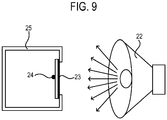
- FIG. 9 is a schematic diagram for illustrating a temperature evaluating method.
- a lamp 22, a temperature measuring jig 25 and a temperature evaluation test piece 23 were used for temperature measurement.
- the film of the present invention was formed on the metal plate having the size of 100mm square and the thickness of 1mm and used.
- the metal plate any one of the stainless alloy, the aluminum alloy, the titanium alloy and the magnesium alloy was used.
- the film of the present invention was applied to the metal plate so as to have the film thickness of 50 ⁇ m with the spin coater and then burned.
- the containerboard having the own-color surface of 120mm ⁇ 120mm ⁇ 120mm was used, and the window portion of 90mm ⁇ 90mm was provided at the attaching portion of the temperature evaluation test piece 23.
- the color-rendering HID (High-Intensity Discharge) lamp HILUXTM MT150FD 6500K; IWASAKI ELECTRIC Co., Ltd.
- the temperature evaluation test piece 23 was attached to the temperature measurement jig 25, and a thermocouple 24 was attached to the back surface of the temperature evaluation test piece 23.
- the temperature measurement jig 25 to which the temperature evaluation test piece 23 was attached was installed so that the distance of the lamp 22 was 100mm.
- the temperature evaluation test piece was irradiated by the lamp 22 for 60 minutes, and the temperature after 60 minutes was measured.
- the temperature reduction effect was given by forming the black blank on the surface of the temperature evaluation test piece 23, measuring the temperature, and calculating the difference from the temperature measurement result of the film of the example.
- the paint which was prepared by mixing 20g of the carbon black (MA100; Mitsubishi Chemical Corporation), 100g of the epoxy resin (jERTM 828; Mitsubishi Chemical Corporation), 70g of the amine curing agent (STll; Mitsubishi Chemical Corporation) and 20g of the thinner with others, is coated on the surface of the temperature evaluation test piece 23 by the planetary rotating device, and the obtained test piece is burned, thereby making the black blank.
- the film is a very good film when the temperature reduction effect is 10°C or higher. It can be said that the film is a relatively good film when the temperature reduction effect is 5°C or higher and lower than 10°C. Besides, when the temperature reduction effect is lower than 5°C, it cannot be said that the film has the good temperature reduction effect.
- Example 1 the paint was made by the following method. That is, 15g of the titanium oxide (converted into 20% by volume of the coating film), 13g of the resin (converted into 57.5% by volume of the coating film), 0.75g of the first silica (converted into 1.8% by volume of the coating film), 1g of the pigment (converted into 3.5% by volume of the coating film), 3.9g of the curing agent (converted into 17.2% by volume of the coating film) and 10g of the thinner were weighed and stirred for 10 minutes by the planetary rotating device (AR-100; THINKY CORPORATION), and the paint of Example 1 was obtained.
- the planetary rotating device AR-100; THINKY CORPORATION
- D-970 SAKAI CHEMICAL INDUSTRY Co., Ltd.; average particle size 0.26 ⁇ m, silica surface coating
- OLESTERTM Q-691 Mitsubishi Chemicals, Inc.
- AEROSIL® R-972 (NIPPON AEROSIL Co., Ltd.; average primary particle size 16nm, and average particle size after cohesion 100nm) was used as the first silica
- CHROMOFINE BLACK A1103 (Dainichiseika Color & Chemicals Mfg. Co., Ltd.) was used as the pigment
- TAKENATETM D-120N (Mitsui Chemicals, Inc.) was used as the curing agent.
- Example 1 the film was made by the following method.
- the above paint was applied to the test piece for the discoloration evaluation in the anoxic atmosphere, the test piece for the solar reflectance evaluation after the lightfast test in the anoxic atmosphere, and the test piece for the temperature reduction effect after the lightfast test, so as to have the film thickness of 50 ⁇ m, the obtained test pieces were dried at room temperature overnight, and then the dried test pieces were burned at 130°C for 30 minutes, thereby obtaining the film of Example 1.
- Example 2 to 13 the paints and the films were made in the same manner as in Example 1 except that the materials and the conditions in Tables 1 and 2 were used.
- the titanium oxide As the titanium oxide, the following materials were used. That is, FTR-700 (SAKAI CHEMICAL INDUSTRY Co., Ltd.; silica surface coating) was used for the titanium oxide having the average particle size of 0.26 ⁇ m, and ET0210 (TOHO TITANIUM CO., LTD.) was used for the titanium oxide having the average particle size of 2 ⁇ m.
- the titanium oxides respectively having the average particle sizes of 5 ⁇ m and 7 ⁇ m were made by drying the titanium oxide having the particle size of 80nm at a low temperature with a rotary kiln and then burning the dried titanium oxide at the temperature of 1100°C for 2 hours.
- the solution was obtained by immersing the titanium oxide in tetraethyl orthosilicate, isopropyl alcohol and 1% hydrochloric acid solution at 50°C for 3 hours and coating the titanium oxide with silica gel.
- the obtained silica gel coating solution was washed with isopropyl alcohol and dried at a low temperature with the rotary kiln. After drying, the obtained substance was burned at 400°C for 2 hours, so that the titanium oxide coated with the silica was obtained.
- AEROSIL® R-805 (NIPPON AEROSIL Co., Ltd.) was used for the first silica having the average particle size of 10nm
- QSC-100 (Denka Company Limited) was used for the first silica having the average particle size of 110nm.
- the discoloration in the anoxic atmosphere is less than 1.0 in ⁇ E*, more preferably ⁇ E* is less than 0.6. Further, it is preferable that the solar reflectance after the lightfast test in the anoxic atmosphere is 65% or more, more preferably 74% or more. Furthermore, it is preferable that the temperature reduction effect after the lightfast test is 5°C or higher with respect to the black blank, more preferably 10°C or higher.
- Example 3 the discoloration ( ⁇ E*) after the lightfast test, the solar reflectance (R) after the lightfast test and the temperature reduction effect after the lightfast test in Example 1 in which acrylic polyol, the silica-coated titanium oxide having the average particle size of 0.26 ⁇ m, the first silica having the average particle size of 100nm, the azomethine black pigment and isocyanate were used were evaluated. More specifically, ⁇ E* was less than 0.6 and was very good, R after the lightfast test was 74% or more and was very good, and the temperature reduction effect was 5°C or higher and lower than 10°C and was good.
- Example 3 the reflectance, the temperature reduction effect and the film thickness accuracy of the heat-shielding film of Example 2 using titanium oxide having the large average particle size of 5 ⁇ m as compared with Example 1 were evaluated. More specifically, ⁇ E* was less than 0.6 and was very good, R after the lightfast test was 74% or more and was very good, and the temperature reduction effect was 10°C or higher and was very good.
- Example 3 the reflectance and the temperature reduction effect of the film of Example 3 using the titanium oxide having the slightly small average particle size of 0.2 ⁇ m as compared with Example 1 were evaluated. More specifically, ⁇ E* was less than 0.6 and was very good, R after the lightfast test was 74% or more and was very good, and the temperature reduction effect was 5°C or higher and lower than 10°C and was good.
- Example 3 the reflectance and the temperature reduction effect of the film of Example 4 using the titanium oxide having the large average particle size of 7 ⁇ m as compared with Example 1 were evaluated. More specifically, ⁇ E* was less than 0.6 and was very good, R after the lightfast test was 74% or more and was very good, and the temperature reduction effect was 10°C or higher and was very good.
- Example 3 the reflectance and the temperature reduction effect of the film of Example 5 using the silica having the small average particle size of 10nm as compared with Example 1 were evaluated. More specifically, ⁇ E* was 0.6 or more and less than 1.0 and was good, R after the lightfast test was 65% or more and less than 74% and was good, and the temperature reduction effect was 5°C or higher and lower than 10°C and was good.
- Example 3 the reflectance and the temperature reduction effect of the film of Example 6 using the silica having the large average particle size of 110nm as compared with Example 1 were evaluated. More specifically, ⁇ E* was less than 0.6 and was very good, R after the lightfast test was 74% or more and was very good, and the temperature reduction effect was 5°C or higher and lower than 10°C and was good.
- Example 4 the reflectance and the temperature reduction effect of the film of Example 7 were evaluated.
- the silicone resin having a low refractive index and the titanium oxide having the large average particle size of 2 ⁇ m as compared with Example 1 were used, and the lightness and the solar reflectance were respectively adjusted to 94 and 98% by eliminating the pigment. More specifically, ⁇ E* was 1.0 or more and less than 1.5 and was slightly inferior, but there was no problem. Besides, R after the lightfast test was 74% or more and was very good, and the temperature reduction effect was 10°C or higher and was very good.
- Example 4 the reflectance and the temperature reduction effect of the film of Example 8, in which the additive amount of the first silica was adjusted to be small 1% by volume as compared with Example 1, were evaluated. More specifically, ⁇ E* was 0.6 or more and less than 1.0 and was good, R after the lightfast test was 65% or more and less than 74% and was good, and the temperature reduction effect was 5°C or higher and lower than 10°C and was good.
- Example 4 the reflectance and the temperature reduction effect of the film of Example 9, in which the additive amount of the first silica was adjusted to be large 10% by volume as compared with Example 1, were evaluated. More specifically, ⁇ E* was 0.6 or more and less than 1.0 and was good, R after the lightfast test was 65% or more and less than 74% and was good, and the temperature reduction effect was 5°C or higher and lower than 10°C and was good.
- Example 4 the reflectance and the temperature reduction effect of the film of Example 10, in which the additive amount of the first silica was adjusted to be small 0.5% by volume as compared with Example 1, were evaluated. More specifically, ⁇ E* was 1.0 or more and less than 1.5 and was slightly inferior, but there was no problem. Besides, R after the lightfast test was 65% or more and less than 74% and was good, and the temperature reduction effect was 5°C or higher and lower than 10°C and was good.
- Example 4 the reflectance and the temperature reduction effect of the film of Example 11, in which the additive amount of the first silica was adjusted to be large 15% by volume as compared with Example 1, were evaluated. More specifically, ⁇ E* was 0.6 or more and less than 1.0 and was good, R after the lightfast test was 65% or more and less than 74% and was good, and the temperature reduction effect was 5°C or higher and lower than 10°C and was good.
- Example 4 the reflectance and the temperature reduction effect of the film of Example 12, in which the additive amount of the first titanium oxide was adjusted to be small 20% by mass as compared with Example 1, were evaluated. More specifically, ⁇ E* was less than 0.6 and was very good, R after the lightfast test was 65% or more and less than 74% and was good, and the temperature reduction effect was 5°C or higher and lower than 10°C and was good.
- Example 4 the reflectance and the temperature reduction effect of the film of Example 13, in which the additive amount of the first titanium oxide was adjusted to be large 60% by mass as compared with Example 1, were evaluated. More specifically, ⁇ E* was less than 0.6 and was very good, R after the lightfast test was 65% or more and less than 74% and was good, and the temperature reduction effect was 5°C or higher and lower than 10°C and was good.
- Table 5 shows the materials constituting the heat-shielding films of Comparative Examples 1 to 8 and the additive amounts thereof.
- Table 6 shows the results of evaluation using the heat-shielding films of Comparative Examples 1 to 8, respectively.
- Example 5 the reflectance and the temperature reduction effect of the heat-shielding film of Comparative Example 5 in which the first silica was not contained as compared with Example 1 were evaluated. More specifically, ⁇ E* was 1.0 or more and less than 1.5 and was bad, R before and after the lightfast test were both less than 65% and were bad, and the temperature reduction effect was lower than 5°C and was bad.
- Example 5 the reflectance and the temperature reduction effect of the heat-shielding film of Comparative Example 8 in which 70% by mass of the titanium oxide was contained as compared with Example 1 were evaluated. More specifically, ⁇ E* was less than 0.6 and was good, R before and after the lightfast test were both less than 74% and were good, and the temperature reduction effect was 10°C or higher and was good. However, since the film was cracked after the lightfast test, the durability of the coating film was low.
- the film to be formed on the upper surface of the optical apparatus of the present invention can be used for the lens barrels of the optical apparatuses such as the camera, the video camera, the broadcasting device and the like, and can be used for the camera main body, the video camera main body, the surveillance camera, the weather camera and the like which are possibly used outdoors.
- Embodiment(s) of the present invention can also be realized by a computer of a system or apparatus that reads out and executes computer executable instructions (e.g., one or more programs) recorded on a storage medium (which may also be referred to more fully as a 'non-transitory computer-readable storage medium') to perform the functions of one or more of the above-described embodiment(s) and/or that includes one or more circuits (e.g., application specific integrated circuit (ASIC)) for performing the functions of one or more of the above-described embodiment(s), and by a method performed by the computer of the system or apparatus by, for example, reading out and executing the computer executable instructions from the storage medium to perform the functions of one or more of the above-described embodiment(s) and/or controlling the one or more circuits to perform the functions of one or more of the above-described embodiment(s).
- computer executable instructions e.g., one or more programs
- a storage medium which may also be referred to more fully as
- the computer may comprise one or more processors (e.g., central processing unit (CPU), micro processing unit (MPU)) and may include a network of separate computers or separate processors to read out and execute the computer executable instructions.
- the computer executable instructions may be provided to the computer, for example, from a network or the storage medium.
- the storage medium may include, for example, one or more of a hard disk, a random-access memory (RAM), a read only memory (ROM), a storage of distributed computing systems, an optical disk (such as a compact disc (CD), digital versatile disc (DVD), or Blu-ray Disc (BD)TM), a flash memory device, a memory card, and the like.
Landscapes
- Chemical & Material Sciences (AREA)
- Engineering & Computer Science (AREA)
- Organic Chemistry (AREA)
- Life Sciences & Earth Sciences (AREA)
- Materials Engineering (AREA)
- Wood Science & Technology (AREA)
- Physics & Mathematics (AREA)
- General Physics & Mathematics (AREA)
- Optics & Photonics (AREA)
- Nanotechnology (AREA)
- Inorganic Chemistry (AREA)
- Health & Medical Sciences (AREA)
- Chemical Kinetics & Catalysis (AREA)
- Medicinal Chemistry (AREA)
- Polymers & Plastics (AREA)
- Paints Or Removers (AREA)
- Laminated Bodies (AREA)
- Lens Barrels (AREA)
- Camera Bodies And Camera Details Or Accessories (AREA)
- Optical Filters (AREA)
- Compositions Of Macromolecular Compounds (AREA)
Abstract
Description
- The present invention relates to a film and paint to be provided on a lens barrel of an optical apparatus such as a camera, a video camera, a broadcasting device or the like, and on the surface of an optical apparatus such as a camera main body, a video camera main body, a surveillance camera, a weather camera or the like to be possibly used outdoors, and to an optical apparatus.
- A film to be provided on the surface of an optical apparatus is a film which has a function of suppressing a temperature rise of a member due to sunlight when it is used outdoors. Conventionally, as a method of suppressing the temperature rise of the member due to sunlight, as illustrated in
FIG. 1 , there has been known a method of reflectingincident light 1 by the sun as reflectedlight 2 by aninfrared reflection film 4 on a base material 5'. In this method, heat generation due to transmittedlight 3 can be suppressed by increasing a ratio of thereflected light 2 to theincident light 1. As a material to be used for increasing a reflectance, titanium oxide having a high reflectance from a visible light region to an infrared region is often used. In addition, a solar energy distribution is 47% in the visible light region and 50% in the infrared region, so that a high reflectance in a wide range from the visible light region to the infrared region is required. - Besides, since the optical apparatus is often used outdoors, in addition to heat-shielding performance, also lightfastness (light resistance) under a severe sunlight condition such as a midsummer condition, an equatorial condition or the like is required. Moreover, there is a case where a tape such as a cellophane adhesive tape, a masking tape, a gummed tape, a Tepra™ tape or the like may be stuck to a part of the surface of the film provided on the surface of the optical apparatus. On this account, in some cases, the lightfastness is required also when oxygen is no longer supplied from the outside because the tape has been stuck and thus it becomes an anoxic state.
- Japanese Patent Application Laid-Open No.
2010-38957 2010-38957 2010-38957 - Japanese Patent Application Laid-Open No.
2013-24229 2010-38957 - However, in a case where the film as disclosed in Japanese Patent Application Laid-Open No.
2010-38957 2010-38957 - Besides, the titanium oxide described in Japanese Patent Application Laid-Open No.
2013-24229
The present invention has been made in view of the related background arts as described above. And, an object of the present invention is to provide a film and paint which are provided on the surface of the optical apparatus, which have less discoloration by sunlight and less reflectance deterioration in an anoxic atmosphere even when color is thin, and which have a high solar reflectance, and is to also provide the optical apparatus which has the above film and/or paint. - The present invention relates to an optical apparatus which comprises a lens, and a lens barrel holding the lens, and is characterized in that a film is formed on a surface of the lens barrel, the film contains a resin, titanium oxide coated with silica, and an inorganic particle, an average particle size of the inorganic particle is 10nm or more and 110nm or less, and an average particle size of the titanium oxide coated with the silica is 0.2µm or more.
- Further, the present invention relates to a film which contains a resin, titanium oxide coated with silica, and an inorganic particle, and is characterized in that an average particle size of the inorganic particle is 10nm or more and 110nm or less, and an average particle size of the titanium oxide coated with the silica is 0.2µm or more.
- Furthermore, the present invention relates to paint which contains a resin, titanium oxide coated with silica, and an inorganic particle, and is characterized in that a content of the titanium oxide coated with the silica is 20% by mass or more and 60% by mass or less with respect to a nonvolatile component in the paint, a content of the inorganic particles is 0.6% by mass or more and 14% by mass or less with respect to the nonvolatile component in the paint, an average particle size of the titanium oxide coated with the silica is 0.2µm or more, and an average particle size of the inorganic particle is 10nm or more and 110nm or less.
- Further features of the present invention will become apparent from the following description of exemplary embodiments with reference to the attached drawings.
-
-
FIG. 1 is a cross-section schematic diagram for illustrating a state of reflection and absorption of sunlight when a film to be provided on the surface of an optical apparatus is formed on an upper surface of a base material. -
FIG. 2 is a cross-section schematic diagram for illustrating a state that sunlight is irradiated to a film made of titanium oxide and a resin. -
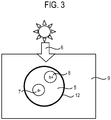
FIG. 3 is a cross-section schematic diagram for illustrating a state that sunlight is irradiated to a film made of titanium oxide coated with second silica, and a resin. -
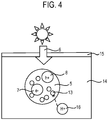
FIG. 4 is a cross-section schematic diagram for illustrating a state that a film containing titanium oxide is coated with a tape and irradiated with sunlight. -
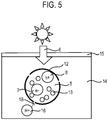
FIG. 5 is a cross-section schematic diagram for illustrating a state that a film containing titanium oxide coated with the second silica is coated with a tape and irradiated with sunlight. -
FIG. 6 is a cross-section schematic diagram for illustrating a state that a film containing titanium oxide coated with the second silica and first silica is coated with a tape and irradiated with sunlight. -
FIG. 7 is an appearance diagram for illustrating an example of a camera interchangeable lens which has a lens barrel being one embodiment of the optical apparatus of the present invention. -
FIG. 8 is a schematic diagram for illustrating a measurement form of reflectance by a spectrophotometer. -
FIG. 9 is a schematic diagram for describing a temperature evaluating method. - Preferred embodiments of the present invention will now be described in detail in accordance with the accompanying drawings.
- First, a method of suppressing discoloration and reflectance deterioration in an anoxic atmosphere will be described. Then, paint (coating material) to be formed on the upper surface of an optical apparatus for suppressing the discoloration and the reflectance deterioration in the anoxic atmosphere, a film to be formed on the upper surface of the optical apparatus for the same purpose, and the optical apparatus will be described.
- As illustrated in
FIG. 2 ,titanium oxide 5 has the property of being excited by irradiation withsunlight 6 and being divided into an electron (e-) 7 and a hole (h+) 8. In a case where there is no film coated on the surface of thetitanium oxide 5, acation M+ 10 such as water contained in theresin 9 is attracted to theexcited electron 7 and bonded to Ti, so that TiO2 is reduced (deoxidized) to TiO, and thus discoloration occurs. As illustrated inFIG. 3 , in a case where a film ofsecond silica 12 or the like is coated on the surface of thetitanium oxide 5, even if theelectron 7 is generated by excitation by thesunlight 6, the coating film of thesecond silica 12 becomes a barrier so that theelectron 7 and thehole 8 are re-bonded to each other, and thus discoloration can be suppressed. - As illustrated in
FIG. 4 , in thetitanium oxide 5, usually Ti and O are regularly arranged, but the structure of the titanium oxide has someoxygen defects 13. When thesunlight 6 is irradiated in an anoxic state made by, for example, sticking atape 15 to the upper surface of afilm 14, thetitanium oxide 5 is excited and divided into the electron (e-) 7 and the hole (h+) 8, so that the titanium oxide has the property that theelectron 7 is attracted to theoxygen defect 13. When theelectron 7 entering theoxygen defect 13 is attracted to acation 16 such as a hydrogen ion (H+) 8, Ti4+ is reduced to TiO3+, so that the white titanium oxide turns into bluish titanium oxide and thus a solar reflectance deteriorates. - In order to suppress the discoloration of the titanium oxide in the anoxic state, it has been found that it is effective to prevent infiltration of the cation from the resin side by forming an inorganic film such as silica or the like on the surface of the titanium oxide. However, it has been found that the discoloration in the anoxic atmosphere cannot be completely suppressed even when the surface of the titanium oxide is coated with the inorganic film such as the silica or the like.
- The inventors of the present invention conducted intensive studies on a method of further suppressing the discoloration in the anoxic atmosphere. Thus, it has been found the discoloration in the anoxic atmosphere can be further suppressed by adding, in the film, inorganic particles each having a particle size (diameter) smaller than that of the titanium oxide coated with silica (the second silica).
- As illustrated in
FIG. 5 , it is supposed thatsilica minute defects 18 exist in thetitanium oxide 5 coated with thesecond silica 12, thecation 16 infiltrates into thetitanium oxide 5 through thesilica minute defect 18, the reduction of thetitanium oxide 5 is caused, and thus the discoloration is occurring. Here, particles have the property that a small particle is attracted to a large particle due to a difference in electric charge. Therefore, as illustrated inFIG. 6 ,inorganic particles 17 each having a smaller particle size than thetitanium oxide 5 coated with thesecond silica 12 is allowed to exist in thefilm 15, and theinorganic particles 17 are attracted around thetitanium oxide 5 coated with thesecond silica 12, so that thesilica minute defects 18 are filled. In the film of the present invention, since theinorganic particle 17 is allowed to exist in thefilm 15, the infiltration of thecation 16 can be suppressed by filling thesilica minute defect 18 of thetitanium oxide 5 coated with thesecond silica 12, so that the discoloration can be suppressed even in the anoxic atmosphere. - Since the coating film formed on the surface of the
titanium oxide 5 is the silica (second silica 12), the same kind of silica is preferable for theinorganic particles 17. However, since it is only necessary to prevent the infiltration of thecation 16 from thesilica minute defect 18 into thetitanium oxide 5, it is possible to use alumina and zirconia in addition to the silica. - Incidentally, in the following description, the silica particle is typically used as the
inorganic particle 17 and is called a "first silica 17". - The optical apparatus of the present invention is constituted such that a film is formed on at least a lens and the surface of a lens barrel.
FIG. 7 is an appearance diagram of a camera interchangeable lens for a camera having a lens barrel which is one embodiment of the optical apparatus of the present invention. The interchangeable lens has alens barrel 30 and atripod mount 33, and thelens barrel 30 is constituted by a lens, a fixedbarrel 31, anannular member 32 and the like. Among them, the feature of the optical apparatus of the present invention lies in the film which is formed on the surfaces of the fixedbarrel 31, theannular member 32 and the like of thelens barrel 30. - Hereinafter, a material constitution of the paint for the optical apparatus of the present invention and a method of manufacturing the paint for the optical apparatus of the present invention will be described.
- The titanium oxide which is coated with the second silica contained in the paint of the present invention will be described.
- As the titanium oxide of the present invention, rutile type titanium oxide and anatase type titanium oxide can be used. Besides, the titanium oxide is coated with at least the second silica. In a case where the titanium oxide is not coated with the second silica, the discoloration of the titanium oxide in the anoxic atmosphere increases, and the reflectance deteriorates. Besides, the titanium oxide may be coated with a plurality of materials such as zirconium oxide, aluminum oxide, an organic matter and the like in addition to the silica.
- The titanium oxide coated with the second silica of the present invention has an average particle size of 0.2µm or more. When the average particle size of the titanium oxide coated with the second silica is less than 0.2µm, the electric charge of the particle becomes low, so that it becomes difficult to attract the first silica and thus there is fear that the discoloration in the anoxic atmosphere increases. On the other hand, when the average particle size of the titanium oxide coated with the second silica exceeds 5µm, unevenness of the coating film becomes large and film thickness accuracy deteriorates, so that there is fear that accuracy of focusing or the like deteriorates. Therefore, it is preferable that the average particle size of the titanium oxide coated with the second silica is 5µm or less.
- The content (contained amount) of the titanium oxide coated with the second silica of the present invention is 20% by mass or more and 60% by mass or less with respect to a nonvolatile component in the paint. When the content of the titanium oxide coated with the second silica is less than 20% by mass, sunlight is transmitted through the coating film, so that there is fear that the reflectance deteriorates. Besides, when the content of the titanium oxide coated with the second silica exceeds 60% by mass, there is fear that brittleness of the film deteriorates.
- Next, the resin contained in the paint of the present invention will be described.
- An arbitrary resin may be used as the resin of the present invention as long as adhesion to the base material can be secured. As an example of the resin, an epoxy resin, a urethane resin, an acrylic resin, a urethane acrylic resin, a fluorine resin, a silicone resin, a phenolic resin, an alkyd resin or the like is given. The above resin may be used alone or in combination of two or more.
- The content of the resin of the present invention is preferably 20% by mass or more and 60% by mass or less, more preferably 30% by mass or more and 55% by mass or less. When the content of the resin of the present invention is less than 20% by mass, there is fear that the adhesion to the base material deteriorates. On the other hand, when the content of the resin of the present invention exceeds 60% by mass, there is fear that the solar reflectance of sunlight deteriorates.
- Next, the first silica contained in the paint of the present invention will be described.
- The silica of the present invention has an average particle size of 10nm or more and 110nm or less. When the average particle size of the silica of the present invention is less than 10nm, force of filling the minute defect of the second silica decreases, so that there is fear that an effect of suppressing the discoloration in the anoxic atmosphere deteriorates. On the other hand, when the average particle size of the silica of the present invention exceeds 110nm, adsorptivity to the titanium oxide decreases, so that there is fear that a discoloration reducing effect in the anoxic atmosphere deteriorates.
- The shape of the first silica of the present invention can be arbitrary. As an example of the shape of the silica of the present invention, a spherical shape, an amorphous shape, a starlike shape, a chainlike shape, a hollow shape or a porous shape is given. The silica like this may be used alone or in combination of two or more.
- The content of the first silica of the present invention is 0.6% by mass or more and 14% by mass or less, preferably 1% by mass or more and 10% by mass or less with respect to a nonvolatile component in the paint. When the content of the first silica of the present invention is less than 0.6% by mass, the second silica minute defects cannot be filled completely, so that there is fear that the discoloration in the anoxic atmosphere deteriorates. On the other hand, when the content of the first silica of the present invention exceeds 14% by mass, there is fear that the reflectance deteriorates due to haze of the coating film.
- Next, a pigment contained in the paint of the present invention will be described.
- It is preferable that the pigment of the present invention can be adjusted so that the coating film has lightness of 71 or more, more preferably the lightness of 71 or more and 85 or less. When the pigment of the present invention has the lightness of less than 71, the solar reflectance deteriorates, so that a temperature reduction effect deteriorates. When the lightness of the film of the present invention exceeds 85, the absorption of sunlight by the pigment is reduced, so that the discoloration in the anoxic atmosphere occurs to some extent. Besides, it is preferable that the pigment of the present invention reflects or transmits infrared rays.
- The pigment of the present invention is a coloring agent, and the coloring agent may be an organic pigment, an inorganic pigment or a combination thereof.
- As an example of the organic pigment, an azomethine black pigment, a perylene pigment or the like is given. As an example of the inorganic pigment, a Co-Zn-Si system pigment, a Co-Al system pigment, a Co-Al-Cr system pigment, a Co-Al-Cr-Zn system pigment, a Co-Al-Zn-Ti system pigment, a Co-Ni-Zn-Ti system pigment, a Ti-Cr-Sb system pigment, a Ti-Fe-Zn system pigment, an Fe-Zn system pigment, an Fe-Cr system pigment, an Mn-Bi system pigment, a Co-Cr-Zn-Sb system pigment, a Cu-Cr system pigment, a Cu-Cr-Mn system pigment, a Cu-Fe-Mn system pigment, an Mn-Y system pigment, an Mn-Sr system pigment, a Co-Cr-Zn-Al-Ti system pigment, a Co-Cr-Zn-Ti system pigment, a Ti-Cr-Sb system pigment, a P-Ba-Sr system pigment or the like is given.
- As the pigment of the present invention, a pigment of arbitrary color can be used. As an example of the color, black, brown, yellow, red, blue, purple, pink, green and orange is given. The pigment may be used alone or in combination of two or more.
- It is preferable that the average particle size of the pigment of the present invention is 10nm or more and 5000nm or less, more preferably 100nm or more and 3000nm or less. When the average particle size of the pigment of the present invention is less than 10nm, the absorption of sunlight is reduced, so that there is fear that the discoloration suppressing effect in the anoxic atmosphere deteriorates. When the average particle size of the pigment of the present invention exceeds 5000nm, the unevenness of the coating film becomes large and the film thickness accuracy deteriorates, so that there is fear that accuracy of focusing or the like deteriorates.
- It is preferable that the content of the pigment of the present invention is 15% by mass or less. When the content of the pigment of the present invention exceeds 15% by mass, a color tint of the coating film becomes darker, so that there is fear that the lightness decreases. The content of the pigment of the present invention may be 0% by mass.
- Next, a solvent contained in the paint will be described.
- As a solvent, an arbitrary material may be used. As an example of the solvent, water, thinner, ethanol, isopropyl alcohol, n-butyl alcohol, ethyl acetate, propyl acetate, isobutyl acetate, butyl acetate, methyl ethyl ketone, methyl isobutyl ketone, propylene glycol monomethyl ether, toluene, xylene, acetone, cellosolves, glycol ethers or ethers is given. The above solvent may be used alone or in combination of two or more.
- A preferable viscosity of the paint of the present invention is 10mPa·s or more and 10000mPa·s or less, more preferably 50mPa·s or more and 5000mPa·s or less, in particular 50mPa·s or more and 500mPa·s or less. When the viscosity of the paint is less than 10mPa·s, there may be a case where a portion in which the film thickness of a heat-shielding film after coating is thinned occurs. On the other hand, when the viscosity of the paint exceeds 10000mPa·s, there is fear that coatability of the paint deteriorates.
- The heat-shielding paint of the present invention may contain another arbitrary additive as a part of the resin. As an example of the additive, a dispersant, a curing agent, a curing catalyst, a plasticizer, a thixotropy imparting agent, a leveling agent, a delustering agent, a preservative, an ultraviolet absorber, an antioxidant, a coupling agent, inorganic fine particles, organic fine particles or the like is given.
- Hereinafter, a method of manufacturing the paint of the present invention will be described.
- An arbitrary method can be used as the method of manufacturing the paint to be formed on the upper surface of the optical apparatus of the present invention as long as the titanium oxide coated with the second silica of the present invention and the second silica of the present invention can be dispersed in the painting. As an example of a device to be used in the above method, a bead mill, a ball mill, a jet mill, a three-roll mill, a planetary rotating device, a mixer, an ultrasonic disperser, a homogenizer or the like is given.
- Hereinafter, the material constitution of the film to be formed on the upper surface of the optical apparatus of the present invention will be described. The film to be formed on the upper surface of the optical apparatus of the present invention contains at least the resin, the titanium oxide and the first silica.
- The content of the titanium oxide coated with the second silica of the present invention is preferably 10% by volume or more and 60% by volume or less with respect to the film, more preferably 15% by volume or more and 50% by volume or less. When the content of the titanium oxide coated with the second silica of the present invention is less than 10% by volume, light reaching the based material increases, so that there is fear that the solar reflectance of sunlight deteriorates. When the content of the titanium oxide coated with the second silica of the present invention exceeds 60% by volume, there is fear that the brittleness of the coating film deteriorates.
- It is preferable that the content of the resin of the present invention is 10% by volume or more and 80% by volume or less, more preferably 15% by volume or more and 70% by volume or less. When the content of the resin of the present invention is less than 10% by volume, there is fear that the adhesion to the base material deteriorates. When the content of the resin of the present invention exceeds 80% by volume, there is fear that the solar reflectance of sunlight deteriorates.
- It is preferable that the content of the first silica of the present invention is 1% by volume or more and 10% by volume or less. When the content of the first silica of the present invention is less than 1% by volume, the second silica minute defects cannot be filled completely, so that there is fear that the discoloration in the anoxic atmosphere deteriorates. When the content of the first silica of the present invention exceeds 10% by volume, there is fear that the reflectance deteriorates due to the haze of the coating film.
- It is preferable that the content of the pigment of the present invention is 10% by volume or less, more preferably 5% by volume or less. When the content of the pigment of the present invention exceeds 10% by volume, the color tint of the coating film becomes darker, so that there is fear that the lightness decreases.
- The heat-shielding paint of the present invention may contain another arbitrary additive as a part of the resin. As an example of the additive, a dispersant, a curing agent, a curing catalyst, a plasticizer, a thixotropy imparting agent, a leveling agent, a delustering agent, a preservative, an ultraviolet absorber, an antioxidant, a coupling agent, inorganic fine particles, organic fine particles or the like is given.
- The film to be formed on the upper surface of the optical apparatus of the present invention is formed at least outside the base material. The form may be in close contact with the base material, or a primer layer for improving the adhesion may be provided between the based material and the film formed on the upper surface of the optical apparatus.
- As the base material, an arbitrary material can be used, but metal or plastic is preferable. As an example of the metal material, an aluminum alloy, a titanium alloy, a stainless alloy, a magnesium alloy or the like is given. Besides, as an example of the plastic, a polycarbonate resin, an acrylic resin, an ABS resin, a fluorine resin or the like is given.
- The film thickness of the base material can be an arbitrary thickness, but it is preferably 0.5mm or more and 5mm or less, and more preferably 0.5mm or more and 2mm or less. When the film thickness is less than 0.5mm, it is difficult to maintain the shape of the lens barrel. When the film thickness exceeds 5mm, the cost of the member increases.
- The primer may be used for the purpose of improving the adhesion between the base material and the film.
- As the primer, an arbitrary material can be used. More specifically, as an example of the primer, an epoxy resin, a urethane resin, an acrylic resin, a silicone resin, a fluorine resin or the like is given. Besides, the primer may contain the particles of the present invention, particles other than the present invention, and the residues of the coloring agent, the dispersant, the curing agent, the curing catalyst, the plasticizer, the thixotropy imparting agent, the leveling agent, an organic coloring agent, an inorganic coloring agent, the preservative, the ultraviolet absorber, the antioxidant, the coupling agent and a solvent.
- It is preferable that the film thickness of the primer is 2µm or more and 30µm or less, and more preferably 5µm or more and 20µm or less. When the film thickness is less than 2µm, the adhesion of the film may deteriorate. Further, when the film thickness exceeds 30µm, positional accuracy may be adversely affected.
- It is preferable that the film of the present invention preferably has a thickness of 10µm or more and 70µm or less. When the film thickness is less than 10µm, there is fear that the solar reflectance deteriorates. When the film thickness exceeds 70µm, positional accuracy of the optical apparatus may be adversely affected.
- It is possible to use an arbitrary coating method and an arbitrary curing method for the film of the present invention, as long as it is possible to uniformly coat the heat-shielding paint of the present invention at 10µm or more and 70µm or less.
- As an example of the method of coating the heat-shielding film for the optical apparatus of the present invention, a brush coating method, a spray coating method, a dip coating method, a transferring method or the like is given. Besides, the heat-shielding film may be made by a single layer coating or by a multilayer coating, and an emboss process may be performed to the film to elaborate a design.
- As the method of curing the heat-shielding film for the optical apparatus of the present invention, it may be allowed to stand the film at room temperature, to promote curing by arbitrary heat, or to apply ultraviolet rays to the film. As an example of the method of applying heat to cure, a method using a heating furnace, a method using a heater, a method using infrared heating, or the like is given. The curing temperature is preferably from the room temperature to 400°C., more preferably from the room temperature to 200°C.
- The solar reflectance of the film to be formed on the upper surface of the optical apparatus of the present invention is 65% or more and 98% or less. When the solar reflectance is less than 65%, the temperature reduction effect deteriorates. Incidentally, in order to make the solar reflectance exceed 98%, it is necessary to cause a large amount of the titanium oxide to be contained, so that the brittleness of the film deteriorates.
- The lightness of the film to be formed on the upper surface of the optical apparatus of the present invention is 71 or more. When the lightness is less than 71, the reflectance deteriorates so that the temperature reduction effect deteriorates.
- Hereinafter, preferred examples of the present invention will be described.
- In Examples 1 to 11, preparation of the paint, making of the film, discoloration evaluation in the anoxic atmosphere, solar reflectance evaluation after a lightfast (light resistance) test in the anoxic atmosphere, and temperature reduction effect evaluation after the lightfast test were performed by the following methods.
- First, L*, a* and b* were measured using a color-difference meter (SE-7700; NIPPON DENSHOKU INDUSTRIES Co., Ltd.) for the discoloration evaluation in the anoxic atmosphere. For the sample for the measurement, the film of the present invention was formed on the metal plate having the size of 30mm square and the thickness of 1mm and used. As the metal plate, any one of the stainless alloy, the aluminum alloy, the titanium alloy and the magnesium alloy was used. The film of the present invention was applied to the metal plate of the magnesium alloy so as to have the film thickness of 50µm with a spin coater and then burned. After the burning, the values of L*, a* and b* of the film of the present invention were measured using the color-difference meter. A cellophane adhesive tape (CT-12M; Nichiban Co., Ltd.) was stuck to the upper surface of the film of the present invention, and the obtained film was placed in a lightfast tester (SUNTEST XXL+; ATLAS) for 200 hours under the conditions of the direct irradiation 300nm to 400nm, the radiation intensity 50W/m2 ± 2W/m2 and the black panel temperature 63°C ± 3°C. After the lightfast test, the cellophane adhesive tape was peeled from the film and washed with acetone, and the values of L*, a* and b* of the film of the present invention were measured using the color-difference meter within 24 hours. The discoloration (ΔE*) in the anoxic atmosphere was calculated by using the following expression (1).

- When ΔE* is less than 0.6, it can be said that the film is a good film with a very little color tint change. When ΔE* is 0.6 or more and less than 1.0, it can be said that the film is a good film. When ΔE* is 1.0 or more and less than 1.5, it can be said that the film is a film within an allowable range although the color tint change slightly increases. When ΔE* is 1.5 or more, it cannot be said that the film is a good film because the color tint change is large.
-
- A: ΔE± is less than 0.6
- B: ΔE± is 0.6 or more and less than 1.0
- C: ΔE± is 1.0 or more and less than 1.5
- D: ΔE± is 1.5 or more
- Hereinafter, the solar reflectance evaluation after the lightfast test in the anoxic atmosphere will be described. As illustrated in
FIG. 8 , the reflectance of incident light was measured using a spectrophotometer (U-4000; Hitachi High-Tech Science Corporation), and the measured reflectance was converted into the solar reflectance. - First, a method of measuring the reflectance will be described. As illustrated in
FIG. 8 ,incident light 1 having the wavelength of 300nm to 2500nm was made incident on an integratingsphere 19. Then, a blank of an alumina sintered body which causes 100% reflection was set to a testpiece attaching portion 20 inclined at 5° to theincident light 1, and baseline measurement was performed. Subsequently, a test piece having the film of the present invention formed in place of the blank was set to the testpiece attaching portion 20, light having the wavelength of 300nm to 2500nm was made incident, the incident light was detected by adetector 21, and the reflectance was measured. Next, the measured reflectance was multiplied by a weighting numerical value (weighting coefficient) on the basis of the Japanese Industrial Standards JIS-K 560 (how to obtain solar reflectance of coating film) and then integrated, and the solar reflectance was calculated from the integrated value. - For the sample to be measured, the film of the present invention was formed on the metal plate having the size of 30mm square and the thickness of 1mm and used. As the metal plate, any one of the stainless alloy, the aluminum alloy, the titanium alloy and the magnesium alloy was used. The film of the present invention was applied to the metal plate of the magnesium alloy so as to have the film thickness of 50µm with the spin coater and then burned. The cellophane adhesive tape (CT-12M; Nichiban Co., Ltd.) was stuck to the upper surface of the film of the present invention, and the obtained film was placed in the lightfast tester (SUNTEST XXL+; ATLAS) for 200 hours under the conditions of the direct irradiation 300nm to 400nm, the radiation intensity 50W/m2 ± 2W/m2 and the black panel temperature 63°C ± 3°C. After the lightfast test, the cellophane adhesive tape was peeled from the film and washed with acetone. Then, within 24 hours, the reflectance at the wavelength of 300nm to 2500nm was measured with the spectrophotometer, and the solar reflectance was calculated the basis of the Japanese Industrial Standards JIS-K 560.
- When the solar reflectance after the lightfast test in the anoxic atmosphere is 74% or more, it can be said that the film is a very good film because the temperature reduction effect is high. When the solar reflectance is 65% or more and less than 74%, it can be said that the film is a good film because the temperature reduction effect is relatively high. When the solar reflectance is less than 65%, it cannot be said that the film is a good film because the temperature reduction effect deteriorates.
-
- A: the solar reflectance after the lightfast test in the anoxic atmosphere is 74% or more
- B: the solar reflectance after the lightfast test in the anoxic atmosphere is 65% or more and less than 74%
- C: the solar reflectance after the lightfast test in the anoxic atmosphere is less than 65%
-
FIG. 9 is a schematic diagram for illustrating a temperature evaluating method. As illustrated inFIG. 9 , alamp 22, atemperature measuring jig 25 and a temperatureevaluation test piece 23 were used for temperature measurement. As the temperatureevaluation test piece 23, the film of the present invention was formed on the metal plate having the size of 100mm square and the thickness of 1mm and used. As the metal plate, any one of the stainless alloy, the aluminum alloy, the titanium alloy and the magnesium alloy was used. The film of the present invention was applied to the metal plate so as to have the film thickness of 50µm with the spin coater and then burned. As thetemperature measuring jig 25, the containerboard having the own-color surface of 120mm × 120mm × 120mm was used, and the window portion of 90mm × 90mm was provided at the attaching portion of the temperatureevaluation test piece 23. As thelamp 22, the color-rendering HID (High-Intensity Discharge) lamp (HILUX™ MT150FD 6500K; IWASAKI ELECTRIC Co., Ltd.) was used. - Next, the temperature
evaluation test piece 23 was attached to thetemperature measurement jig 25, and athermocouple 24 was attached to the back surface of the temperatureevaluation test piece 23. Thetemperature measurement jig 25 to which the temperatureevaluation test piece 23 was attached was installed so that the distance of thelamp 22 was 100mm. Next, the temperature evaluation test piece was irradiated by thelamp 22 for 60 minutes, and the temperature after 60 minutes was measured. - The temperature reduction effect was given by forming the black blank on the surface of the temperature
evaluation test piece 23, measuring the temperature, and calculating the difference from the temperature measurement result of the film of the example. - The paint, which was prepared by mixing 20g of the carbon black (MA100; Mitsubishi Chemical Corporation), 100g of the epoxy resin (jER™ 828; Mitsubishi Chemical Corporation), 70g of the amine curing agent (STll; Mitsubishi Chemical Corporation) and 20g of the thinner with others, is coated on the surface of the temperature
evaluation test piece 23 by the planetary rotating device, and the obtained test piece is burned, thereby making the black blank. - It can be said that the film is a very good film when the temperature reduction effect is 10°C or higher. It can be said that the film is a relatively good film when the temperature reduction effect is 5°C or higher and lower than 10°C. Besides, when the temperature reduction effect is lower than 5°C, it cannot be said that the film has the good temperature reduction effect.
-
- A: the temperature reduction effect is 10°C or higher
- B: the temperature reduction effect is 5°C or higher and lower than 10°C
- C: the temperature reduction effect is lower than 5°C
- In Example 1, the paint was made by the following method. That is, 15g of the titanium oxide (converted into 20% by volume of the coating film), 13g of the resin (converted into 57.5% by volume of the coating film), 0.75g of the first silica (converted into 1.8% by volume of the coating film), 1g of the pigment (converted into 3.5% by volume of the coating film), 3.9g of the curing agent (converted into 17.2% by volume of the coating film) and 10g of the thinner were weighed and stirred for 10 minutes by the planetary rotating device (AR-100; THINKY CORPORATION), and the paint of Example 1 was obtained. Besides, D-970 (SAKAI CHEMICAL INDUSTRY Co., Ltd.; average particle size 0.26µm, silica surface coating) was used as the titanium oxide, and OLESTER™ Q-691 (Mitsui Chemicals, Inc.) was used as the resin.
- Besides, AEROSIL® R-972 (NIPPON AEROSIL Co., Ltd.; average primary particle size 16nm, and average particle size after cohesion 100nm) was used as the first silica, CHROMOFINE BLACK A1103 (Dainichiseika Color & Chemicals Mfg. Co., Ltd.) was used as the pigment, and TAKENATE™ D-120N (Mitsui Chemicals, Inc.) was used as the curing agent.
- In Example 1, the film was made by the following method. The above paint was applied to the test piece for the discoloration evaluation in the anoxic atmosphere, the test piece for the solar reflectance evaluation after the lightfast test in the anoxic atmosphere, and the test piece for the temperature reduction effect after the lightfast test, so as to have the film thickness of 50µm, the obtained test pieces were dried at room temperature overnight, and then the dried test pieces were burned at 130°C for 30 minutes, thereby obtaining the film of Example 1.
- In Examples 2 to 13, the paints and the films were made in the same manner as in Example 1 except that the materials and the conditions in Tables 1 and 2 were used.
- As the titanium oxide, the following materials were used. That is, FTR-700 (SAKAI CHEMICAL INDUSTRY Co., Ltd.; silica surface coating) was used for the titanium oxide having the average particle size of 0.26µm, and ET0210 (TOHO TITANIUM CO., LTD.) was used for the titanium oxide having the average particle size of 2µm. The titanium oxides respectively having the average particle sizes of 5µm and 7µm were made by drying the titanium oxide having the particle size of 80nm at a low temperature with a rotary kiln and then burning the dried titanium oxide at the temperature of 1100°C for 2 hours. For each of the titanium oxides respectively having the average particle sizes of 2µm, 5µm and 7µm, the solution was obtained by immersing the titanium oxide in tetraethyl orthosilicate, isopropyl alcohol and 1% hydrochloric acid solution at 50°C for 3 hours and coating the titanium oxide with silica gel. Next, the obtained silica gel coating solution was washed with isopropyl alcohol and dried at a low temperature with the rotary kiln. After drying, the obtained substance was burned at 400°C for 2 hours, so that the titanium oxide coated with the silica was obtained.
- Besides, AEROSIL® R-805 (NIPPON AEROSIL Co., Ltd.) was used for the first silica having the average particle size of 10nm, and QSC-100 (Denka Company Limited) was used for the first silica having the average particle size of 110nm.
Table 1 Film of Example 1 Film of Example 2 Film of Example 3 Film of Example 4 Film of Example 5 Film of Example 6 Film Resin Material Acrylic polyol Acrylic polyol Acrylic polyol Acrylic polyol Acrylic polyol Acrylic polyol Additive amount (% by volume) 57.5 57.5 57.5 57.5 57.5 57.5 Titanium oxide Material Titanium oxide Titanium oxide Titanium oxide Titanium oxide Titanium oxide Titanium oxide Coat Silica Silica Silica Silica Silica Silica Particle size 0.26 5 0.2 7 0.26 0.26 Additive amount (% by volume) 20 20 20 20 20 20 % by mass of nonvolatile component in paint 45 45 45 45 45 45 First silica Average particle size (nm) 16 16 16 16 10 110 Additive amount (% by volume) 1.8 1.8 1.8 1.8 1.8 1.8 % by mass of nonvolatile component in paint 2 2 2 2 2 2 Pigment Kind Azomethine black Azomethine black Azomethine black Azomethine black Azomethine black Azomethine black Additive amount (% by volume) 3.5 3.5 3.5 3.5 3.5 3.5 Curing agent Kind Isocyanate Isocyanate Isocyanate Isocyanate Isocyanate Isocyanate Additive amount (% by volume) 17.2 17.2 17.2 17.2 17.2 17.2 Characteristic of film Solar reflectance (before lightfast test) 74 80 74 78 74 74 Lightness 80 71 81 71 80 80 Table 2 Film of Example 7 Film of Example 8 Film of Example 9 Film of Example 10 Film of Example 11 Film of Example 12 Film of Example 13 Film Resin Material Silicone resin Acrylic polyol Acrylic polyol Acrylic polyol Acrylic polyol Acrylic polyol Acrylic polyol Additive amount (% by volume) 77.4 58.3 49.3 58.8 47.3 67 52 Titanium oxide Material Titanium oxide Titanium oxide Titanium oxide Titanium oxide Titanium oxide Titanium oxide Titanium oxide Coat Silica Silica Silica Silica Silica Silica Silica Particle size 2 0.26 0.26 0.26 0.26 0.26 0.26 Additive amount (% by volume) 20.7 20 20 20 20 5 31 % by mass of nonvolatile component in paint 45 45 40 45 39 20 60 First silica Average particle size (nm) 16 16 16 16 16 16 16 Additive amount (% by volume) 1.9 1 10 0.5 15 1.8 1.6 % by mass of nonvolatile component in paint 2 1.2 12 0.6 14 2 1.7 Pigment Kind - Azomethine black Azomethine black Azomethine black Azomethine black Azomethine black Azomethine black Additive amount (% by volume) 0 3.5 3.5 3.5 3.5 3.5 3.5 Curing agent Kind Isocyanate Isocyanate Isocyanate Isocyanate Isocyanate Isocyanate Isocyanate Additive amount (% by volume) - 17.2 17.2 17.2 17.2 19 16 Characteristic of film Solar reflectance (before lightfast test) 98 74 70 74 65 74 88 Lightness 94 80 80 80 90 92 94 - The results of the evaluation of the discoloration (ΔE*) after the lightfast test, the solar reflectance (R) after the lightfast test and the temperature reduction effect after the lightfast test of the films of Examples 1 to 13 are shown in Tables 3 and 4.
- As the measurement result, it is preferable that the discoloration in the anoxic atmosphere is less than 1.0 in ΔE*, more preferably ΔE* is less than 0.6. Further, it is preferable that the solar reflectance after the lightfast test in the anoxic atmosphere is 65% or more, more preferably 74% or more. Furthermore, it is preferable that the temperature reduction effect after the lightfast test is 5°C or higher with respect to the black blank, more preferably 10°C or higher.
- As shown in Table 3, the discoloration (ΔE*) after the lightfast test, the solar reflectance (R) after the lightfast test and the temperature reduction effect after the lightfast test in Example 1 in which acrylic polyol, the silica-coated titanium oxide having the average particle size of 0.26µm, the first silica having the average particle size of 100nm, the azomethine black pigment and isocyanate were used were evaluated. More specifically, ΔE* was less than 0.6 and was very good, R after the lightfast test was 74% or more and was very good, and the temperature reduction effect was 5°C or higher and lower than 10°C and was good.
- In Table 3, the reflectance, the temperature reduction effect and the film thickness accuracy of the heat-shielding film of Example 2 using titanium oxide having the large average particle size of 5µm as compared with Example 1 were evaluated. More specifically, ΔE* was less than 0.6 and was very good, R after the lightfast test was 74% or more and was very good, and the temperature reduction effect was 10°C or higher and was very good.
- In Table 3, the reflectance and the temperature reduction effect of the film of Example 3 using the titanium oxide having the slightly small average particle size of 0.2µm as compared with Example 1 were evaluated. More specifically, ΔE* was less than 0.6 and was very good, R after the lightfast test was 74% or more and was very good, and the temperature reduction effect was 5°C or higher and lower than 10°C and was good.
- In Table 3, the reflectance and the temperature reduction effect of the film of Example 4 using the titanium oxide having the large average particle size of 7µm as compared with Example 1 were evaluated. More specifically, ΔE* was less than 0.6 and was very good, R after the lightfast test was 74% or more and was very good, and the temperature reduction effect was 10°C or higher and was very good.
- In Table 3, the reflectance and the temperature reduction effect of the film of Example 5 using the silica having the small average particle size of 10nm as compared with Example 1 were evaluated. More specifically, ΔE* was 0.6 or more and less than 1.0 and was good, R after the lightfast test was 65% or more and less than 74% and was good, and the temperature reduction effect was 5°C or higher and lower than 10°C and was good.
- In Table 3, the reflectance and the temperature reduction effect of the film of Example 6 using the silica having the large average particle size of 110nm as compared with Example 1 were evaluated. More specifically, ΔE* was less than 0.6 and was very good, R after the lightfast test was 74% or more and was very good, and the temperature reduction effect was 5°C or higher and lower than 10°C and was good.
- In Table 4, the reflectance and the temperature reduction effect of the film of Example 7 were evaluated. In this example, the silicone resin having a low refractive index and the titanium oxide having the large average particle size of 2µm as compared with Example 1 were used, and the lightness and the solar reflectance were respectively adjusted to 94 and 98% by eliminating the pigment. More specifically, ΔE* was 1.0 or more and less than 1.5 and was slightly inferior, but there was no problem. Besides, R after the lightfast test was 74% or more and was very good, and the temperature reduction effect was 10°C or higher and was very good.
- In Table 4, the reflectance and the temperature reduction effect of the film of Example 8, in which the additive amount of the first silica was adjusted to be small 1% by volume as compared with Example 1, were evaluated. More specifically, ΔE* was 0.6 or more and less than 1.0 and was good, R after the lightfast test was 65% or more and less than 74% and was good, and the temperature reduction effect was 5°C or higher and lower than 10°C and was good.
- In Table 4, the reflectance and the temperature reduction effect of the film of Example 9, in which the additive amount of the first silica was adjusted to be large 10% by volume as compared with Example 1, were evaluated. More specifically, ΔE* was 0.6 or more and less than 1.0 and was good, R after the lightfast test was 65% or more and less than 74% and was good, and the temperature reduction effect was 5°C or higher and lower than 10°C and was good.
- In Table 4, the reflectance and the temperature reduction effect of the film of Example 10, in which the additive amount of the first silica was adjusted to be small 0.5% by volume as compared with Example 1, were evaluated. More specifically, ΔE* was 1.0 or more and less than 1.5 and was slightly inferior, but there was no problem. Besides, R after the lightfast test was 65% or more and less than 74% and was good, and the temperature reduction effect was 5°C or higher and lower than 10°C and was good.
- In Table 4, the reflectance and the temperature reduction effect of the film of Example 11, in which the additive amount of the first silica was adjusted to be large 15% by volume as compared with Example 1, were evaluated. More specifically, ΔE* was 0.6 or more and less than 1.0 and was good, R after the lightfast test was 65% or more and less than 74% and was good, and the temperature reduction effect was 5°C or higher and lower than 10°C and was good.
- In Table 4, the reflectance and the temperature reduction effect of the film of Example 12, in which the additive amount of the first titanium oxide was adjusted to be small 20% by mass as compared with Example 1, were evaluated. More specifically, ΔE* was less than 0.6 and was very good, R after the lightfast test was 65% or more and less than 74% and was good, and the temperature reduction effect was 5°C or higher and lower than 10°C and was good.
- In Table 4, the reflectance and the temperature reduction effect of the film of Example 13, in which the additive amount of the first titanium oxide was adjusted to be large 60% by mass as compared with Example 1, were evaluated. More specifically, ΔE* was less than 0.6 and was very good, R after the lightfast test was 65% or more and less than 74% and was good, and the temperature reduction effect was 5°C or higher and lower than 10°C and was good.
Table 3 Film of Example 1 Film of Example 2 Film of Example 3 Film of Example 4 Film of Example 5 Film of Example 6 Discoloration (ΔE*) in anoxic atmosphere A A A A B A Reflectance (R; %) after lightfast test in anoxic atmosphere A A A A B A Temperature reduction effect after light fast test B A B A B B Table 4 Film of Example 7 Film of Example 8 Film of Example 9 Film of Example 10 Film of Example 11 Film of Example 12 Film of Example 13 Discoloration (ΔE*) in anoxic atmosphere C B B C B A A Reflectance (R; %) after lightfast test in anoxic atmosphere A B B B B B B Temperature reduction effect after lightfast test A B B B B B B - Preparation of the heat-shielding paint, making of the heat-shielding film, evaluation of the discoloration (ΔE*) after the lightfast test, evaluation of the solar reflectance (R) after the lightfast test, and evaluation of the temperature reduction effect after the lightfast test were performed for the purpose of comparison, respectively in the same manners as those in Examples 1 to 13 described above. Hereinafter, the points different from Examples 1 to 13 will be described.
- Table 5 shows the materials constituting the heat-shielding films of Comparative Examples 1 to 8 and the additive amounts thereof. Table 6 shows the results of evaluation using the heat-shielding films of Comparative Examples 1 to 8, respectively.
- In Table 5, the reflectance and the temperature reduction effect of the heat-shielding film of Comparative Example 1 using the titanium oxide (JR-1000; TAYCA CORPORATION) coated with alumina and having the average particle size of 1µm as compared with Example 1 were evaluated. More specifically, ΔE* was 1.5 or more and was bad, R after the lightfast test was less than 65% and was bad, and the temperature reduction effect was lower than 5°C and was bad.
- In Table 5, the reflectance and the temperature reduction effect of the heat-shielding film of Comparative Example 2 using the first silica (AEROSIL® R-812 (NIPPON AEROSIL Co., Ltd.) having the small average particle size of 7nm as compared with Example 1 were evaluated. More specifically, ΔE* was 1.5 or more and was bad, R after the lightfast test was less than 65% and was bad, and the temperature reduction effect was lower than 5°C and was bad.
- In Table 5, the reflectance and the temperature reduction effect of the heat-shielding film of Comparative Example 3 using the first silica (SFP-20M; Denka Company Limited) having the large average particle size of 300nm as compared with Example 1 were evaluated. More specifically, ΔE* was 1.5 or more and was bad, R after the lightfast test was less than 65% and was bad, and the temperature reduction effect was lower than 5°C and was bad.
- In Table 5, the reflectance and the temperature reduction effect of the heat-shielding film of Comparative Example 4 using the titanium oxide (A-190; SAKAI CHEMICAL INDUSTRY Co., Ltd.) having the small average particle size of 0.15µm as compared with Example 1 were evaluated. More specifically, ΔE* was 1.0 or more and less than 1.5 and was bad, R before and after the lightfast test were both less than 65% and were bad, and the temperature reduction effect was lower than 5°C and was bad.
- In Table 5, the reflectance and the temperature reduction effect of the heat-shielding film of Comparative Example 5 in which the first silica was not contained as compared with Example 1 were evaluated. More specifically, ΔE* was 1.0 or more and less than 1.5 and was bad, R before and after the lightfast test were both less than 65% and were bad, and the temperature reduction effect was lower than 5°C and was bad.
- In Table 5, the reflectance and the temperature reduction effect of the heat-shielding film of Comparative Example 6 in which 20% by mass of the first silica was contained as compared with Example 1 were evaluated. More specifically, ΔE* was less than 0.6 and was good, R before and after the lightfast test were both less than 65% and were bad, and the temperature reduction effect was lower than 5°C and was bad.
- In Table 5, the reflectance and the temperature reduction effect of the heat-shielding film of Comparative Example 7 in which 15% by mass of the titanium oxide was contained as compared with Example 1 were evaluated. More specifically, ΔE* was less than 0.6 and was good, R before and after the lightfast test were both less than 65% and were bad, and the temperature reduction effect was lower than 5°C and was bad.
- In Table 5, the reflectance and the temperature reduction effect of the heat-shielding film of Comparative Example 8 in which 70% by mass of the titanium oxide was contained as compared with Example 1 were evaluated. More specifically, ΔE* was less than 0.6 and was good, R before and after the lightfast test were both less than 74% and were good, and the temperature reduction effect was 10°C or higher and was good. However, since the film was cracked after the lightfast test, the durability of the coating film was low.
Table 5 Film of Comparative Example 1 Film of Comparative Example 2 Film of Comparative Example 3 Film of Comparative Example 4 Film of Comparative Example 5 Film of Comparative Example 6 Film of Comparative Example 7 Film of Comparative Example 8 Film Resin Material Acrylic polyol Acrylic polyol Acrylic polyol Acrylic polyol Acrylic polyol Acrylic polyol Acrylic polyol Acrylic polyol Additive amount (% by volume) 57.5 57.5 57.5 57.5 59 49 68 43 Titanium oxide Material Titanium oxide Titanium oxide Titanium oxide Titanium oxide Titanium oxide Titanium oxide Titanium oxide Titanium oxide Coat Alumina Silica Silica Silica Silica Silica Silica Silica Particle size 1.0 0.26 0.26 0.15 0.26 0.26 0.26 0.26 Additive amount (% by volume) 20 20 20 20 20 17 4.8 40 % by mass of nonvolatile component in paint 45 45 45 45 47 38 15 70 First silica Average particle size (nm) 100 7 300 100 100 100 100 100 Additive amount (% by volume) 1.8 1.8 1.8 1.8 0 16 2.1 1.3 % by mass of nonvolatile component in paint 2 2 2 2 0 20 3.6 3.6 Pigment Kind Azomethine black Azomethine black Azomethine black Azomethine black Azomethine black Azomethine black Azomethine black Azomethine black Additive amount (% by volume) 3.5 3.5 3.5 3.5 3.5 3 3 2.6 Curing agent Kind Isocvanate Isocvanate Isocvanate Isocvanate Isocvanate Isocvanate Isocvanate Isocvanate Additive amount (% by volume) 17.2 17.2 17.2 17.2 17.6 15 20 13 Characteristic of film Solar reflectance (before lightfast test) 74 74 74 67 74 64 64 90 Lightness 80 80 80 75 80 81 74 80 Table 6 Film of Comparative Example 1 Film of Comparative Example 2 Film of Comparative Example 3 Film of Comparative Example 4 Film of Comparative Example 5 Film of Comparative Example 6 Film of Comparative Example 7 Film of Comparative Example 8 Discoloration (ΔE*) in anoxic atmosphere D D D C C A A A Reflectance (R; %) after lightfast test in anoxic atmosphere C C C C C C C A Temperature reduction effect after lightfast test C C C C C C C A - The film to be formed on the upper surface of the optical apparatus of the present invention can be used for the lens barrels of the optical apparatuses such as the camera, the video camera, the broadcasting device and the like, and can be used for the camera main body, the video camera main body, the surveillance camera, the weather camera and the like which are possibly used outdoors.
- Embodiment(s) of the present invention can also be realized by a computer of a system or apparatus that reads out and executes computer executable instructions (e.g., one or more programs) recorded on a storage medium (which may also be referred to more fully as a 'non-transitory computer-readable storage medium') to perform the functions of one or more of the above-described embodiment(s) and/or that includes one or more circuits (e.g., application specific integrated circuit (ASIC)) for performing the functions of one or more of the above-described embodiment(s), and by a method performed by the computer of the system or apparatus by, for example, reading out and executing the computer executable instructions from the storage medium to perform the functions of one or more of the above-described embodiment(s) and/or controlling the one or more circuits to perform the functions of one or more of the above-described embodiment(s). The computer may comprise one or more processors (e.g., central processing unit (CPU), micro processing unit (MPU)) and may include a network of separate computers or separate processors to read out and execute the computer executable instructions. The computer executable instructions may be provided to the computer, for example, from a network or the storage medium. The storage medium may include, for example, one or more of a hard disk, a random-access memory (RAM), a read only memory (ROM), a storage of distributed computing systems, an optical disk (such as a compact disc (CD), digital versatile disc (DVD), or Blu-ray Disc (BD)™), a flash memory device, a memory card, and the like.
- While the present invention has been described with reference to exemplary embodiments, it is to be understood that the invention is not limited to the disclosed exemplary embodiments. The scope of the following claims is to be accorded the broadest interpretation so as to encompass all such modifications and equivalent structures and functions.
Claims (14)
- An optical apparatus which comprises a lens, and a lens barrel holding the lens, wherein
a film is formed on a surface of the lens barrel,
the film contains a resin, titanium oxide coated with silica, and an inorganic particle,
an average particle size of the inorganic particle is 10nm or more and 110nm or less, and
an average particle size of the titanium oxide coated with the silica is 0.2µm or more. - The optical apparatus according to Claim 1, wherein a solar reflectance of the surface on which the film is formed is 65% or more and 98% or less, and lightness of the surface on which the film is formed is 71 or more.
- The optical apparatus according to Claim 1 or 2, wherein the inorganic particle is a silica particle.
- The optical apparatus according to any one of Claims 1 to 3, wherein an amount of the inorganic particles contained in the film is 1% by volume or more and 10% by volume or less when volume of an arbitrary region of the film is set to 1.
- The optical apparatus according to any one of Claims 1 to 4, wherein the film includes a pigment.
- A film which contains a resin, titanium oxide coated with silica, and an inorganic particle, wherein
an average particle size of the inorganic particle is 10nm or more and 110nm or less, and
an average particle size of the titanium oxide coated with the silica is 0.2µm or more. - The film according to Claim 6, wherein a solar reflectance is 65% or more and 98% or less, and lightness is 71 or more.
- The film according to Claim 6 or 7, wherein the inorganic particle is a silica particle.
- The film according to any one of Claims 6 to 8, wherein an amount of the inorganic particles contained in the film is 1% by volume or more and 10% by volume or less when volume of an arbitrary region of the film is set to 1.
- The film according to any one of Claims 6 to 9, wherein the film includes a pigment.
- An article wherein the film described in any one of Claims 6 to 10 is formed on a surface of the article.
- Paint which contains a resin, titanium oxide coated with silica, and an inorganic particle, wherein
a content of the titanium oxide coated with the silica is 20% by mass or more and 60% by mass or less with respect to a nonvolatile component in the paint,
a content of the inorganic particles is 0.6% by mass or more and 14% by mass or less with respect to the nonvolatile component in the paint,
an average particle size of the titanium oxide coated with the silica is 0.2µm or more, and
an average particle size of the inorganic particle is 10nm or more and 110nm or less. - The paint according to Claim 12, wherein the inorganic particle is a silica particle.
- The paint according to Claim 12 or 13, wherein the paint includes a pigment.
Applications Claiming Priority (1)
| Application Number | Priority Date | Filing Date | Title |
|---|---|---|---|
| JP2017078707A JP6891029B2 (en) | 2017-04-12 | 2017-04-12 | Optical equipment, films provided on the surface of optical equipment, and paints used for optical equipment |
Publications (1)
| Publication Number | Publication Date |
|---|---|
| EP3388489A1 true EP3388489A1 (en) | 2018-10-17 |
Family
ID=61971974
Family Applications (1)
| Application Number | Title | Priority Date | Filing Date |
|---|---|---|---|
| EP18166850.0A Withdrawn EP3388489A1 (en) | 2017-04-12 | 2018-04-11 | Optical apparatus, film to be provided on surface of optical apparatus, paint to be used for optical apparatus |
Country Status (4)
| Country | Link |
|---|---|
| US (1) | US10947397B2 (en) |
| EP (1) | EP3388489A1 (en) |
| JP (1) | JP6891029B2 (en) |
| CN (1) | CN108710162B (en) |
Cited By (2)
| Publication number | Priority date | Publication date | Assignee | Title |
|---|---|---|---|---|
| EP3578613A3 (en) * | 2018-05-17 | 2020-04-08 | Canon Kabushiki Kaisha | Article including film, optical apparatus, coating material, and method for producing article |
| EP3747958A1 (en) * | 2019-06-06 | 2020-12-09 | Canon Kabushiki Kaisha | Article, optical apparatus, and coating material |
Families Citing this family (3)
| Publication number | Priority date | Publication date | Assignee | Title |
|---|---|---|---|---|
| JP2021091107A (en) * | 2019-12-06 | 2021-06-17 | キヤノン株式会社 | Articles with membranes, paints, and methods of manufacturing articles |
| JP2022095097A (en) * | 2020-12-16 | 2022-06-28 | キヤノン株式会社 | Articles with films, optical instruments, paints, and methods of manufacturing articles |
| JP7651294B2 (en) * | 2020-12-16 | 2025-03-26 | キヤノン株式会社 | Films applied to the surface of optical equipment, optical equipment, paint |
Citations (5)
| Publication number | Priority date | Publication date | Assignee | Title |
|---|---|---|---|---|
| EP0730168A2 (en) * | 1995-03-03 | 1996-09-04 | Seiko Epson Corporation | Film-forming coating solution and synthetic resin lens |
| WO2009136141A1 (en) * | 2008-05-07 | 2009-11-12 | Tioxide Europe Limited | Titanium dioxide |
| JP2010038957A (en) | 2008-07-31 | 2010-02-18 | Nikon Corp | Optical device and method for manufacturing the optical device |
| JP2013024229A (en) | 2011-07-26 | 2013-02-04 | Aisan Industry Co Ltd | Resin intake manifold |
| US20150361270A1 (en) * | 2013-02-27 | 2015-12-17 | Asahi Rubber Inc. | Ink for White Reflective Film, Powder Coating Material for White Reflective Film, Production Method of White Reflective Film, White Reflective Film, Light Source Mount, and Lighting Device Shade |
Family Cites Families (6)
| Publication number | Priority date | Publication date | Assignee | Title |
|---|---|---|---|---|
| JP4791490B2 (en) * | 2006-02-02 | 2011-10-12 | 三菱樹脂株式会社 | Solar cell backsheet |
| AU2009296281A1 (en) * | 2008-09-29 | 2010-04-01 | E. I. Du Pont De Nemours And Company | Coating compositions having improved solar reflectivity and UV protection |
| JP5434241B2 (en) * | 2009-05-08 | 2014-03-05 | 株式会社ニコン | Optical device |
| US20130148205A1 (en) | 2011-12-12 | 2013-06-13 | Canon Kabushiki Kaisha | Method of producing antireflection film |
| JP6269439B2 (en) * | 2013-11-01 | 2018-01-31 | 信越化学工業株式会社 | Titanium oxide-containing coating composition and coated article |
| US11163132B2 (en) | 2016-04-18 | 2021-11-02 | Canon Kabushiki Kaisha | Thermal barrier film, thermal barrier paint, and optical instrument |
-
2017
- 2017-04-12 JP JP2017078707A patent/JP6891029B2/en active Active
-
2018
- 2018-04-02 US US15/942,839 patent/US10947397B2/en active Active
- 2018-04-11 EP EP18166850.0A patent/EP3388489A1/en not_active Withdrawn
- 2018-04-12 CN CN201810323174.XA patent/CN108710162B/en active Active
Patent Citations (5)
| Publication number | Priority date | Publication date | Assignee | Title |
|---|---|---|---|---|
| EP0730168A2 (en) * | 1995-03-03 | 1996-09-04 | Seiko Epson Corporation | Film-forming coating solution and synthetic resin lens |
| WO2009136141A1 (en) * | 2008-05-07 | 2009-11-12 | Tioxide Europe Limited | Titanium dioxide |
| JP2010038957A (en) | 2008-07-31 | 2010-02-18 | Nikon Corp | Optical device and method for manufacturing the optical device |
| JP2013024229A (en) | 2011-07-26 | 2013-02-04 | Aisan Industry Co Ltd | Resin intake manifold |
| US20150361270A1 (en) * | 2013-02-27 | 2015-12-17 | Asahi Rubber Inc. | Ink for White Reflective Film, Powder Coating Material for White Reflective Film, Production Method of White Reflective Film, White Reflective Film, Light Source Mount, and Lighting Device Shade |
Cited By (3)
| Publication number | Priority date | Publication date | Assignee | Title |
|---|---|---|---|---|
| EP3578613A3 (en) * | 2018-05-17 | 2020-04-08 | Canon Kabushiki Kaisha | Article including film, optical apparatus, coating material, and method for producing article |
| US11815656B2 (en) | 2018-05-17 | 2023-11-14 | Canon Kabushiki Kaisha | Article including film, optical apparatus, coating material, and method for producing article |
| EP3747958A1 (en) * | 2019-06-06 | 2020-12-09 | Canon Kabushiki Kaisha | Article, optical apparatus, and coating material |
Also Published As
| Publication number | Publication date |
|---|---|
| CN108710162A (en) | 2018-10-26 |
| US20180298210A1 (en) | 2018-10-18 |
| US10947397B2 (en) | 2021-03-16 |
| JP2018180236A (en) | 2018-11-15 |
| JP6891029B2 (en) | 2021-06-18 |
| CN108710162B (en) | 2021-09-28 |
Similar Documents
| Publication | Publication Date | Title |
|---|---|---|
| EP3388489A1 (en) | Optical apparatus, film to be provided on surface of optical apparatus, paint to be used for optical apparatus | |
| EP2534209B1 (en) | Antireflection coating film and antireflection coating material for optical element and optical element | |
| US20110244219A1 (en) | Antireflection Film for Optical Element, Antireflection Paint, and Optical Element | |
| WO2005022971A1 (en) | Electromagnetic shielding film for plasma display | |
| US20240045103A1 (en) | Article including film, optical apparatus, coating material, and method for producing article | |
| JP6797548B2 (en) | Heat shield film, heat shield paint, and optical equipment | |
| EP2980168B1 (en) | Light-shielding paint, light-shielding paint set, light-shielding film, optical element, and method for producing optical element | |
| JP7851067B2 (en) | Articles having a film, optical instruments, paints, and methods for manufacturing articles. | |
| JP2025172202A (en) | Article with heat-shielding film, optical device, paint, and method for manufacturing article | |
| JP2016109943A (en) | Optical element, light shielding film and light shielding coating | |
| US11163132B2 (en) | Thermal barrier film, thermal barrier paint, and optical instrument | |
| JP2024125316A (en) | Article having film, coating material, and method for manufacturing article | |
| JP6896492B2 (en) | Optical equipment, films provided on the surface of optical equipment, and paints used for optical equipment | |
| JP7651294B2 (en) | Films applied to the surface of optical equipment, optical equipment, paint | |
| JP6744751B2 (en) | Thermal barrier film for optical equipment, thermal barrier coating for optical equipment, and optical equipment using them | |
| JP7154921B2 (en) | Optical device, lens hood, method for manufacturing optical device, and method for manufacturing lens hood | |
| EP3747958B1 (en) | Article, optical apparatus, and coating material | |
| JP7071481B2 (en) | Heat shield film, heat shield paint, and optical equipment | |
| JP2022095097A (en) | Articles with films, optical instruments, paints, and methods of manufacturing articles |
Legal Events
| Date | Code | Title | Description |
|---|---|---|---|
| PUAI | Public reference made under article 153(3) epc to a published international application that has entered the european phase |
Free format text: ORIGINAL CODE: 0009012 |
|
| STAA | Information on the status of an ep patent application or granted ep patent |
Free format text: STATUS: THE APPLICATION HAS BEEN PUBLISHED |
|
| AK | Designated contracting states |
Kind code of ref document: A1 Designated state(s): AL AT BE BG CH CY CZ DE DK EE ES FI FR GB GR HR HU IE IS IT LI LT LU LV MC MK MT NL NO PL PT RO RS SE SI SK SM TR |
|
| AX | Request for extension of the european patent |
Extension state: BA ME |
|
| STAA | Information on the status of an ep patent application or granted ep patent |
Free format text: STATUS: REQUEST FOR EXAMINATION WAS MADE |
|
| 17P | Request for examination filed |
Effective date: 20190417 |
|
| RBV | Designated contracting states (corrected) |
Designated state(s): AL AT BE BG CH CY CZ DE DK EE ES FI FR GB GR HR HU IE IS IT LI LT LU LV MC MK MT NL NO PL PT RO RS SE SI SK SM TR |
|
| GRAP | Despatch of communication of intention to grant a patent |
Free format text: ORIGINAL CODE: EPIDOSNIGR1 |
|
| GRAJ | Information related to disapproval of communication of intention to grant by the applicant or resumption of examination proceedings by the epo deleted |
Free format text: ORIGINAL CODE: EPIDOSDIGR1 |
|
| RIC1 | Information provided on ipc code assigned before grant |
Ipc: C08K 9/02 20060101ALI20200303BHEP Ipc: G02B 1/14 20150101ALI20200303BHEP Ipc: C09D 7/40 20180101ALI20200303BHEP Ipc: C08K 3/36 20060101AFI20200303BHEP Ipc: C08K 3/22 20060101ALN20200303BHEP Ipc: C09D 7/61 20180101ALI20200303BHEP Ipc: C09D 5/33 20060101ALI20200303BHEP |
|
| GRAP | Despatch of communication of intention to grant a patent |
Free format text: ORIGINAL CODE: EPIDOSNIGR1 |
|
| STAA | Information on the status of an ep patent application or granted ep patent |
Free format text: STATUS: GRANT OF PATENT IS INTENDED |
|
| GRAJ | Information related to disapproval of communication of intention to grant by the applicant or resumption of examination proceedings by the epo deleted |
Free format text: ORIGINAL CODE: EPIDOSDIGR1 |
|
| GRAJ | Information related to disapproval of communication of intention to grant by the applicant or resumption of examination proceedings by the epo deleted |
Free format text: ORIGINAL CODE: EPIDOSDIGR1 |
|
| GRAP | Despatch of communication of intention to grant a patent |
Free format text: ORIGINAL CODE: EPIDOSNIGR1 |
|
| GRAP | Despatch of communication of intention to grant a patent |
Free format text: ORIGINAL CODE: EPIDOSNIGR1 |
|
| GRAJ | Information related to disapproval of communication of intention to grant by the applicant or resumption of examination proceedings by the epo deleted |
Free format text: ORIGINAL CODE: EPIDOSDIGR1 |
|
| GRAJ | Information related to disapproval of communication of intention to grant by the applicant or resumption of examination proceedings by the epo deleted |
Free format text: ORIGINAL CODE: EPIDOSDIGR1 |
|
| GRAP | Despatch of communication of intention to grant a patent |
Free format text: ORIGINAL CODE: EPIDOSNIGR1 |
|
| GRAP | Despatch of communication of intention to grant a patent |
Free format text: ORIGINAL CODE: EPIDOSNIGR1 |
|
| GRAJ | Information related to disapproval of communication of intention to grant by the applicant or resumption of examination proceedings by the epo deleted |
Free format text: ORIGINAL CODE: EPIDOSDIGR1 |
|
| INTG | Intention to grant announced |
Effective date: 20200429 |
|
| INTG | Intention to grant announced |
Effective date: 20200512 |
|
| GRAP | Despatch of communication of intention to grant a patent |
Free format text: ORIGINAL CODE: EPIDOSNIGR1 |
|
| GRAJ | Information related to disapproval of communication of intention to grant by the applicant or resumption of examination proceedings by the epo deleted |
Free format text: ORIGINAL CODE: EPIDOSDIGR1 |
|
| INTG | Intention to grant announced |
Effective date: 20200512 |
|
| GRAP | Despatch of communication of intention to grant a patent |
Free format text: ORIGINAL CODE: EPIDOSNIGR1 |
|
| GRAJ | Information related to disapproval of communication of intention to grant by the applicant or resumption of examination proceedings by the epo deleted |
Free format text: ORIGINAL CODE: EPIDOSDIGR1 |
|
| GRAP | Despatch of communication of intention to grant a patent |
Free format text: ORIGINAL CODE: EPIDOSNIGR1 |
|
| INTG | Intention to grant announced |
Effective date: 20200526 |
|
| GRAJ | Information related to disapproval of communication of intention to grant by the applicant or resumption of examination proceedings by the epo deleted |
Free format text: ORIGINAL CODE: EPIDOSDIGR1 |
|
| INTG | Intention to grant announced |
Effective date: 20200526 |
|
| GRAP | Despatch of communication of intention to grant a patent |
Free format text: ORIGINAL CODE: EPIDOSNIGR1 |
|
| GRAJ | Information related to disapproval of communication of intention to grant by the applicant or resumption of examination proceedings by the epo deleted |
Free format text: ORIGINAL CODE: EPIDOSDIGR1 |
|
| GRAP | Despatch of communication of intention to grant a patent |
Free format text: ORIGINAL CODE: EPIDOSNIGR1 |
|
| GRAJ | Information related to disapproval of communication of intention to grant by the applicant or resumption of examination proceedings by the epo deleted |
Free format text: ORIGINAL CODE: EPIDOSDIGR1 |
|
| INTG | Intention to grant announced |
Effective date: 20200605 |
|
| GRAJ | Information related to disapproval of communication of intention to grant by the applicant or resumption of examination proceedings by the epo deleted |
Free format text: ORIGINAL CODE: EPIDOSDIGR1 |
|
| GRAP | Despatch of communication of intention to grant a patent |
Free format text: ORIGINAL CODE: EPIDOSNIGR1 |
|
| GRAP | Despatch of communication of intention to grant a patent |
Free format text: ORIGINAL CODE: EPIDOSNIGR1 |
|
| GRAJ | Information related to disapproval of communication of intention to grant by the applicant or resumption of examination proceedings by the epo deleted |
Free format text: ORIGINAL CODE: EPIDOSDIGR1 |
|
| INTG | Intention to grant announced |
Effective date: 20200605 |
|
| GRAP | Despatch of communication of intention to grant a patent |
Free format text: ORIGINAL CODE: EPIDOSNIGR1 |
|
| INTG | Intention to grant announced |
Effective date: 20200617 |
|
| GRAJ | Information related to disapproval of communication of intention to grant by the applicant or resumption of examination proceedings by the epo deleted |
Free format text: ORIGINAL CODE: EPIDOSDIGR1 |
|
| INTG | Intention to grant announced |
Effective date: 20200626 |
|
| GRAJ | Information related to disapproval of communication of intention to grant by the applicant or resumption of examination proceedings by the epo deleted |
Free format text: ORIGINAL CODE: EPIDOSDIGR1 |
|
| GRAP | Despatch of communication of intention to grant a patent |
Free format text: ORIGINAL CODE: EPIDOSNIGR1 |
|
| GRAP | Despatch of communication of intention to grant a patent |
Free format text: ORIGINAL CODE: EPIDOSNIGR1 |
|
| INTG | Intention to grant announced |
Effective date: 20200626 |
|
| GRAJ | Information related to disapproval of communication of intention to grant by the applicant or resumption of examination proceedings by the epo deleted |
Free format text: ORIGINAL CODE: EPIDOSDIGR1 |
|
| GRAP | Despatch of communication of intention to grant a patent |
Free format text: ORIGINAL CODE: EPIDOSNIGR1 |
|
| INTG | Intention to grant announced |
Effective date: 20200707 |
|
| GRAJ | Information related to disapproval of communication of intention to grant by the applicant or resumption of examination proceedings by the epo deleted |
Free format text: ORIGINAL CODE: EPIDOSDIGR1 |
|
| INTG | Intention to grant announced |
Effective date: 20200716 |
|
| GRAP | Despatch of communication of intention to grant a patent |
Free format text: ORIGINAL CODE: EPIDOSNIGR1 |
|
| GRAJ | Information related to disapproval of communication of intention to grant by the applicant or resumption of examination proceedings by the epo deleted |
Free format text: ORIGINAL CODE: EPIDOSDIGR1 |
|
| GRAP | Despatch of communication of intention to grant a patent |
Free format text: ORIGINAL CODE: EPIDOSNIGR1 |
|
| INTG | Intention to grant announced |
Effective date: 20200716 |
|
| STAA | Information on the status of an ep patent application or granted ep patent |
Free format text: STATUS: REQUEST FOR EXAMINATION WAS MADE |
|
| GRAJ | Information related to disapproval of communication of intention to grant by the applicant or resumption of examination proceedings by the epo deleted |
Free format text: ORIGINAL CODE: EPIDOSDIGR1 |
|
| INTG | Intention to grant announced |
Effective date: 20200728 |
|
| INTG | Intention to grant announced |
Effective date: 20200806 |
|
| INTG | Intention to grant announced |
Effective date: 20200806 |
|
| INTG | Intention to grant announced |
Effective date: 20200817 |
|
| STAA | Information on the status of an ep patent application or granted ep patent |
Free format text: STATUS: EXAMINATION IS IN PROGRESS |
|
| INTC | Intention to grant announced (deleted) | ||
| RIC1 | Information provided on ipc code assigned before grant |
Ipc: C09D 7/40 20180101ALI20200818BHEP Ipc: C08K 3/36 20060101AFI20200818BHEP Ipc: G02B 1/14 20150101ALI20200818BHEP Ipc: C09D 5/33 20060101ALI20200818BHEP Ipc: C09D 7/61 20180101ALI20200818BHEP Ipc: C08K 9/02 20060101ALI20200818BHEP Ipc: C08K 3/22 20060101ALN20200818BHEP |
|
| 17Q | First examination report despatched |
Effective date: 20200921 |
|
| STAA | Information on the status of an ep patent application or granted ep patent |
Free format text: STATUS: THE APPLICATION HAS BEEN WITHDRAWN |
|
| 18W | Application withdrawn |
Effective date: 20220913 |