EP3388454A1 - Method of producing (meth)acryloyl-terminated polyisobutylene polymer - Google Patents
Method of producing (meth)acryloyl-terminated polyisobutylene polymer Download PDFInfo
- Publication number
- EP3388454A1 EP3388454A1 EP16872941.6A EP16872941A EP3388454A1 EP 3388454 A1 EP3388454 A1 EP 3388454A1 EP 16872941 A EP16872941 A EP 16872941A EP 3388454 A1 EP3388454 A1 EP 3388454A1
- Authority
- EP
- European Patent Office
- Prior art keywords
- group
- polymer
- terminated polyisobutylene
- polyisobutylene polymer
- acryloyl
- Prior art date
- Legal status (The legal status is an assumption and is not a legal conclusion. Google has not performed a legal analysis and makes no representation as to the accuracy of the status listed.)
- Withdrawn
Links
- 229920000642 polymer Polymers 0.000 title claims abstract description 230
- 229920002367 Polyisobutene Polymers 0.000 title claims abstract description 151
- 238000000034 method Methods 0.000 title claims description 40
- 238000004519 manufacturing process Methods 0.000 claims abstract description 55
- 239000011968 lewis acid catalyst Substances 0.000 claims abstract description 48
- VQTUBCCKSQIDNK-UHFFFAOYSA-N Isobutene Chemical group CC(C)=C VQTUBCCKSQIDNK-UHFFFAOYSA-N 0.000 claims abstract description 43
- -1 acrylic acid compound Chemical class 0.000 claims abstract description 40
- 150000001875 compounds Chemical class 0.000 claims abstract description 38
- NIXOWILDQLNWCW-UHFFFAOYSA-N 2-Propenoic acid Natural products OC(=O)C=C NIXOWILDQLNWCW-UHFFFAOYSA-N 0.000 claims abstract description 24
- 125000005843 halogen group Chemical group 0.000 claims abstract description 23
- 239000000178 monomer Substances 0.000 claims abstract description 21
- 125000000951 phenoxy group Chemical group [H]C1=C([H])C([H])=C(O*)C([H])=C1[H] 0.000 claims abstract description 21
- 230000000379 polymerizing effect Effects 0.000 claims abstract description 5
- 239000002904 solvent Substances 0.000 claims description 76
- XLYOFNOQVPJJNP-UHFFFAOYSA-N water Substances O XLYOFNOQVPJJNP-UHFFFAOYSA-N 0.000 claims description 39
- 229930195734 saturated hydrocarbon Natural products 0.000 claims description 30
- 125000002496 methyl group Chemical group [H]C([H])([H])* 0.000 claims description 23
- 239000012046 mixed solvent Substances 0.000 claims description 19
- 229910052757 nitrogen Inorganic materials 0.000 claims description 19
- 150000004945 aromatic hydrocarbons Chemical class 0.000 claims description 18
- 150000008282 halocarbons Chemical class 0.000 claims description 16
- 239000001257 hydrogen Substances 0.000 claims description 16
- 229910052739 hydrogen Inorganic materials 0.000 claims description 16
- 150000003863 ammonium salts Chemical class 0.000 claims description 15
- 239000000460 chlorine Substances 0.000 claims description 13
- 125000004122 cyclic group Chemical group 0.000 claims description 10
- 150000002430 hydrocarbons Chemical group 0.000 claims description 10
- 229910052801 chlorine Inorganic materials 0.000 claims description 8
- 125000004435 hydrogen atom Chemical group [H]* 0.000 claims description 8
- 125000004433 nitrogen atom Chemical group N* 0.000 claims description 8
- 150000004714 phosphonium salts Chemical class 0.000 claims description 8
- WKBOTKDWSSQWDR-UHFFFAOYSA-N Bromine atom Chemical compound [Br] WKBOTKDWSSQWDR-UHFFFAOYSA-N 0.000 claims description 7
- GDTBXPJZTBHREO-UHFFFAOYSA-N bromine Substances BrBr GDTBXPJZTBHREO-UHFFFAOYSA-N 0.000 claims description 7
- 229910052794 bromium Inorganic materials 0.000 claims description 7
- 150000003983 crown ethers Chemical class 0.000 claims description 7
- PNDPGZBMCMUPRI-UHFFFAOYSA-N iodine Chemical compound II PNDPGZBMCMUPRI-UHFFFAOYSA-N 0.000 claims description 7
- 125000001424 substituent group Chemical group 0.000 claims description 7
- 229930195733 hydrocarbon Natural products 0.000 claims description 6
- 239000004215 Carbon black (E152) Substances 0.000 claims description 5
- ZAMOUSCENKQFHK-UHFFFAOYSA-N Chlorine atom Chemical compound [Cl] ZAMOUSCENKQFHK-UHFFFAOYSA-N 0.000 claims description 5
- 125000001309 chloro group Chemical group Cl* 0.000 claims description 5
- 125000000956 methoxy group Chemical group [H]C([H])([H])O* 0.000 claims description 5
- WHXSMMKQMYFTQS-UHFFFAOYSA-N Lithium Chemical compound [Li] WHXSMMKQMYFTQS-UHFFFAOYSA-N 0.000 claims description 4
- 125000003668 acetyloxy group Chemical group [H]C([H])([H])C(=O)O[*] 0.000 claims description 4
- 125000003545 alkoxy group Chemical group 0.000 claims description 4
- 125000002029 aromatic hydrocarbon group Chemical group 0.000 claims description 4
- 125000005842 heteroatom Chemical group 0.000 claims description 4
- DGAQECJNVWCQMB-PUAWFVPOSA-M Ilexoside XXIX Chemical compound C[C@@H]1CC[C@@]2(CC[C@@]3(C(=CC[C@H]4[C@]3(CC[C@@H]5[C@@]4(CC[C@@H](C5(C)C)OS(=O)(=O)[O-])C)C)[C@@H]2[C@]1(C)O)C)C(=O)O[C@H]6[C@@H]([C@H]([C@@H]([C@H](O6)CO)O)O)O.[Na+] DGAQECJNVWCQMB-PUAWFVPOSA-M 0.000 claims description 3
- ZLMJMSJWJFRBEC-UHFFFAOYSA-N Potassium Chemical compound [K] ZLMJMSJWJFRBEC-UHFFFAOYSA-N 0.000 claims description 3
- 125000001931 aliphatic group Chemical group 0.000 claims description 3
- 229910052792 caesium Inorganic materials 0.000 claims description 3
- TVFDJXOCXUVLDH-UHFFFAOYSA-N caesium atom Chemical compound [Cs] TVFDJXOCXUVLDH-UHFFFAOYSA-N 0.000 claims description 3
- 229910052744 lithium Inorganic materials 0.000 claims description 3
- 229910052700 potassium Inorganic materials 0.000 claims description 3
- 239000011591 potassium Substances 0.000 claims description 3
- 229910052701 rubidium Inorganic materials 0.000 claims description 3
- IGLNJRXAVVLDKE-UHFFFAOYSA-N rubidium atom Chemical compound [Rb] IGLNJRXAVVLDKE-UHFFFAOYSA-N 0.000 claims description 3
- 239000011734 sodium Substances 0.000 claims description 3
- 229910052708 sodium Inorganic materials 0.000 claims description 3
- 238000000746 purification Methods 0.000 abstract description 7
- 230000003247 decreasing effect Effects 0.000 abstract description 6
- 239000002699 waste material Substances 0.000 abstract description 6
- 239000000463 material Substances 0.000 abstract description 5
- 238000006243 chemical reaction Methods 0.000 description 74
- VLKZOEOYAKHREP-UHFFFAOYSA-N n-Hexane Chemical compound CCCCCC VLKZOEOYAKHREP-UHFFFAOYSA-N 0.000 description 66
- 125000003647 acryloyl group Chemical group O=C([*])C([H])=C([H])[H] 0.000 description 54
- 239000012074 organic phase Substances 0.000 description 52
- OKKJLVBELUTLKV-UHFFFAOYSA-N Methanol Chemical compound OC OKKJLVBELUTLKV-UHFFFAOYSA-N 0.000 description 48
- 239000000203 mixture Substances 0.000 description 44
- ZMANZCXQSJIPKH-UHFFFAOYSA-N Triethylamine Chemical compound CCN(CC)CC ZMANZCXQSJIPKH-UHFFFAOYSA-N 0.000 description 39
- 239000000243 solution Substances 0.000 description 39
- 238000003756 stirring Methods 0.000 description 34
- VFWCMGCRMGJXDK-UHFFFAOYSA-N 1-chlorobutane Chemical compound CCCCCl VFWCMGCRMGJXDK-UHFFFAOYSA-N 0.000 description 29
- 238000006116 polymerization reaction Methods 0.000 description 28
- YXFVVABEGXRONW-UHFFFAOYSA-N Toluene Chemical compound CC1=CC=CC=C1 YXFVVABEGXRONW-UHFFFAOYSA-N 0.000 description 27
- 239000008346 aqueous phase Substances 0.000 description 26
- XJDNKRIXUMDJCW-UHFFFAOYSA-J titanium tetrachloride Chemical compound Cl[Ti](Cl)(Cl)Cl XJDNKRIXUMDJCW-UHFFFAOYSA-J 0.000 description 26
- CSCPPACGZOOCGX-UHFFFAOYSA-N Acetone Chemical compound CC(C)=O CSCPPACGZOOCGX-UHFFFAOYSA-N 0.000 description 24
- 229940038926 butyl chloride Drugs 0.000 description 24
- 239000011541 reaction mixture Substances 0.000 description 24
- 239000003444 phase transfer catalyst Substances 0.000 description 23
- IJGRMHOSHXDMSA-UHFFFAOYSA-N Atomic nitrogen Chemical compound N#N IJGRMHOSHXDMSA-UHFFFAOYSA-N 0.000 description 22
- 239000003054 catalyst Substances 0.000 description 21
- 239000002808 molecular sieve Substances 0.000 description 19
- URGAHOPLAPQHLN-UHFFFAOYSA-N sodium aluminosilicate Chemical compound [Na+].[Al+3].[O-][Si]([O-])=O.[O-][Si]([O-])=O URGAHOPLAPQHLN-UHFFFAOYSA-N 0.000 description 19
- 230000000052 comparative effect Effects 0.000 description 17
- IIEWJVIFRVWJOD-UHFFFAOYSA-N ethylcyclohexane Chemical compound CCC1CCCCC1 IIEWJVIFRVWJOD-UHFFFAOYSA-N 0.000 description 17
- 238000009826 distribution Methods 0.000 description 13
- 230000009257 reactivity Effects 0.000 description 13
- VAPQAGMSICPBKJ-UHFFFAOYSA-N 2-nitroacridine Chemical compound C1=CC=CC2=CC3=CC([N+](=O)[O-])=CC=C3N=C21 VAPQAGMSICPBKJ-UHFFFAOYSA-N 0.000 description 12
- ZMXDDKWLCZADIW-UHFFFAOYSA-N N,N-Dimethylformamide Chemical compound CN(C)C=O ZMXDDKWLCZADIW-UHFFFAOYSA-N 0.000 description 12
- 230000000694 effects Effects 0.000 description 12
- UAEPNZWRGJTJPN-UHFFFAOYSA-N methylcyclohexane Chemical compound CC1CCCCC1 UAEPNZWRGJTJPN-UHFFFAOYSA-N 0.000 description 12
- NWVVVBRKAWDGAB-UHFFFAOYSA-N p-methoxyphenol Chemical compound COC1=CC=C(O)C=C1 NWVVVBRKAWDGAB-UHFFFAOYSA-N 0.000 description 12
- 239000004793 Polystyrene Substances 0.000 description 11
- 238000002156 mixing Methods 0.000 description 11
- OFBQJSOFQDEBGM-UHFFFAOYSA-N n-pentane Natural products CCCCC OFBQJSOFQDEBGM-UHFFFAOYSA-N 0.000 description 11
- 229920002223 polystyrene Polymers 0.000 description 11
- PMZURENOXWZQFD-UHFFFAOYSA-L Sodium Sulfate Chemical compound [Na+].[Na+].[O-]S([O-])(=O)=O PMZURENOXWZQFD-UHFFFAOYSA-L 0.000 description 10
- 238000004817 gas chromatography Methods 0.000 description 10
- 238000005259 measurement Methods 0.000 description 10
- 229910052938 sodium sulfate Inorganic materials 0.000 description 10
- 235000011152 sodium sulphate Nutrition 0.000 description 10
- OISVCGZHLKNMSJ-UHFFFAOYSA-N 2,6-dimethylpyridine Chemical compound CC1=CC=CC(C)=N1 OISVCGZHLKNMSJ-UHFFFAOYSA-N 0.000 description 9
- YMWUJEATGCHHMB-UHFFFAOYSA-N Dichloromethane Chemical compound ClCCl YMWUJEATGCHHMB-UHFFFAOYSA-N 0.000 description 9
- 230000000977 initiatory effect Effects 0.000 description 9
- 239000012299 nitrogen atmosphere Substances 0.000 description 9
- 239000003505 polymerization initiator Substances 0.000 description 9
- 229920005989 resin Polymers 0.000 description 9
- 239000011347 resin Substances 0.000 description 9
- VNDYJBBGRKZCSX-UHFFFAOYSA-L zinc bromide Chemical compound Br[Zn]Br VNDYJBBGRKZCSX-UHFFFAOYSA-L 0.000 description 9
- SMZOUWXMTYCWNB-UHFFFAOYSA-N 2-(2-methoxy-5-methylphenyl)ethanamine Chemical compound COC1=CC=C(C)C=C1CCN SMZOUWXMTYCWNB-UHFFFAOYSA-N 0.000 description 8
- BSKHPKMHTQYZBB-UHFFFAOYSA-N 2-methylpyridine Chemical compound CC1=CC=CC=N1 BSKHPKMHTQYZBB-UHFFFAOYSA-N 0.000 description 8
- HEDRZPFGACZZDS-UHFFFAOYSA-N Chloroform Chemical compound ClC(Cl)Cl HEDRZPFGACZZDS-UHFFFAOYSA-N 0.000 description 8
- IAZDPXIOMUYVGZ-UHFFFAOYSA-N Dimethylsulphoxide Chemical compound CS(C)=O IAZDPXIOMUYVGZ-UHFFFAOYSA-N 0.000 description 8
- FXHOOIRPVKKKFG-UHFFFAOYSA-N N,N-Dimethylacetamide Chemical compound CN(C)C(C)=O FXHOOIRPVKKKFG-UHFFFAOYSA-N 0.000 description 8
- IMNFDUFMRHMDMM-UHFFFAOYSA-N N-Heptane Chemical compound CCCCCCC IMNFDUFMRHMDMM-UHFFFAOYSA-N 0.000 description 8
- JUJWROOIHBZHMG-UHFFFAOYSA-N Pyridine Chemical compound C1=CC=NC=C1 JUJWROOIHBZHMG-UHFFFAOYSA-N 0.000 description 8
- 238000010538 cationic polymerization reaction Methods 0.000 description 8
- 125000005359 phenoxyalkyl group Chemical group 0.000 description 8
- JRMUNVKIHCOMHV-UHFFFAOYSA-M tetrabutylammonium bromide Chemical compound [Br-].CCCC[N+](CCCC)(CCCC)CCCC JRMUNVKIHCOMHV-UHFFFAOYSA-M 0.000 description 8
- NHGXDBSUJJNIRV-UHFFFAOYSA-M tetrabutylammonium chloride Chemical compound [Cl-].CCCC[N+](CCCC)(CCCC)CCCC NHGXDBSUJJNIRV-UHFFFAOYSA-M 0.000 description 8
- NIDWUZTTXGJFNN-UHFFFAOYSA-N 3-bromopropoxybenzene Chemical compound BrCCCOC1=CC=CC=C1 NIDWUZTTXGJFNN-UHFFFAOYSA-N 0.000 description 7
- RTAQQCXQSZGOHL-UHFFFAOYSA-N Titanium Chemical compound [Ti] RTAQQCXQSZGOHL-UHFFFAOYSA-N 0.000 description 7
- 230000003197 catalytic effect Effects 0.000 description 7
- 239000008367 deionised water Substances 0.000 description 7
- 229910021641 deionized water Inorganic materials 0.000 description 7
- WEVYAHXRMPXWCK-UHFFFAOYSA-N Acetonitrile Chemical compound CC#N WEVYAHXRMPXWCK-UHFFFAOYSA-N 0.000 description 6
- UHOVQNZJYSORNB-UHFFFAOYSA-N Benzene Chemical compound C1=CC=CC=C1 UHOVQNZJYSORNB-UHFFFAOYSA-N 0.000 description 6
- RTZKZFJDLAIYFH-UHFFFAOYSA-N Diethyl ether Chemical compound CCOCC RTZKZFJDLAIYFH-UHFFFAOYSA-N 0.000 description 6
- YNQLUTRBYVCPMQ-UHFFFAOYSA-N Ethylbenzene Chemical compound CCC1=CC=CC=C1 YNQLUTRBYVCPMQ-UHFFFAOYSA-N 0.000 description 6
- CSNNHWWHGAXBCP-UHFFFAOYSA-L Magnesium sulfate Chemical compound [Mg+2].[O-][S+2]([O-])([O-])[O-] CSNNHWWHGAXBCP-UHFFFAOYSA-L 0.000 description 6
- CERQOIWHTDAKMF-UHFFFAOYSA-N Methacrylic acid Chemical compound CC(=C)C(O)=O CERQOIWHTDAKMF-UHFFFAOYSA-N 0.000 description 6
- HEMHJVSKTPXQMS-UHFFFAOYSA-M Sodium hydroxide Chemical compound [OH-].[Na+] HEMHJVSKTPXQMS-UHFFFAOYSA-M 0.000 description 6
- 150000001338 aliphatic hydrocarbons Chemical class 0.000 description 6
- VSCWAEJMTAWNJL-UHFFFAOYSA-K aluminium trichloride Chemical compound Cl[Al](Cl)Cl VSCWAEJMTAWNJL-UHFFFAOYSA-K 0.000 description 6
- DIOQZVSQGTUSAI-UHFFFAOYSA-N decane Chemical compound CCCCCCCCCC DIOQZVSQGTUSAI-UHFFFAOYSA-N 0.000 description 6
- GYNNXHKOJHMOHS-UHFFFAOYSA-N methyl-cycloheptane Natural products CC1CCCCCC1 GYNNXHKOJHMOHS-UHFFFAOYSA-N 0.000 description 6
- BKIMMITUMNQMOS-UHFFFAOYSA-N nonane Chemical compound CCCCCCCCC BKIMMITUMNQMOS-UHFFFAOYSA-N 0.000 description 6
- 239000010936 titanium Substances 0.000 description 6
- 229910052719 titanium Inorganic materials 0.000 description 6
- KPJKMUJJFXZGAX-UHFFFAOYSA-N 2-chloropropan-2-ylbenzene Chemical compound CC(C)(Cl)C1=CC=CC=C1 KPJKMUJJFXZGAX-UHFFFAOYSA-N 0.000 description 5
- LFQSCWFLJHTTHZ-UHFFFAOYSA-N Ethanol Chemical compound CCO LFQSCWFLJHTTHZ-UHFFFAOYSA-N 0.000 description 5
- JLTDJTHDQAWBAV-UHFFFAOYSA-N N,N-dimethylaniline Chemical compound CN(C)C1=CC=CC=C1 JLTDJTHDQAWBAV-UHFFFAOYSA-N 0.000 description 5
- 229910003074 TiCl4 Inorganic materials 0.000 description 5
- 125000002091 cationic group Chemical group 0.000 description 5
- 238000001914 filtration Methods 0.000 description 5
- 150000002431 hydrogen Chemical group 0.000 description 5
- 229910052751 metal Inorganic materials 0.000 description 5
- 239000002184 metal Substances 0.000 description 5
- 239000003021 water soluble solvent Substances 0.000 description 5
- SRNQAQUOOIZPJL-UHFFFAOYSA-N 1,3,5-tris(2-chloropropan-2-yl)benzene Chemical compound CC(C)(Cl)C1=CC(C(C)(C)Cl)=CC(C(C)(C)Cl)=C1 SRNQAQUOOIZPJL-UHFFFAOYSA-N 0.000 description 4
- QBLISOIWPZSVIK-UHFFFAOYSA-N 4-bromobutoxybenzene Chemical compound BrCCCCOC1=CC=CC=C1 QBLISOIWPZSVIK-UHFFFAOYSA-N 0.000 description 4
- 229910015844 BCl3 Inorganic materials 0.000 description 4
- XDTMQSROBMDMFD-UHFFFAOYSA-N Cyclohexane Chemical compound C1CCCCC1 XDTMQSROBMDMFD-UHFFFAOYSA-N 0.000 description 4
- 238000005481 NMR spectroscopy Methods 0.000 description 4
- ATUOYWHBWRKTHZ-UHFFFAOYSA-N Propane Chemical compound CCC ATUOYWHBWRKTHZ-UHFFFAOYSA-N 0.000 description 4
- WYURNTSHIVDZCO-UHFFFAOYSA-N Tetrahydrofuran Chemical compound C1CCOC1 WYURNTSHIVDZCO-UHFFFAOYSA-N 0.000 description 4
- 229910021627 Tin(IV) chloride Inorganic materials 0.000 description 4
- OCKPCBLVNKHBMX-UHFFFAOYSA-N butylbenzene Chemical compound CCCCC1=CC=CC=C1 OCKPCBLVNKHBMX-UHFFFAOYSA-N 0.000 description 4
- MVPPADPHJFYWMZ-UHFFFAOYSA-N chlorobenzene Chemical compound ClC1=CC=CC=C1 MVPPADPHJFYWMZ-UHFFFAOYSA-N 0.000 description 4
- 238000004132 cross linking Methods 0.000 description 4
- NNPPMTNAJDCUHE-UHFFFAOYSA-N isobutane Chemical compound CC(C)C NNPPMTNAJDCUHE-UHFFFAOYSA-N 0.000 description 4
- QWTDNUCVQCZILF-UHFFFAOYSA-N isopentane Chemical compound CCC(C)C QWTDNUCVQCZILF-UHFFFAOYSA-N 0.000 description 4
- 239000011259 mixed solution Substances 0.000 description 4
- 230000001737 promoting effect Effects 0.000 description 4
- ODLMAHJVESYWTB-UHFFFAOYSA-N propylbenzene Chemical compound CCCC1=CC=CC=C1 ODLMAHJVESYWTB-UHFFFAOYSA-N 0.000 description 4
- UMJSCPRVCHMLSP-UHFFFAOYSA-N pyridine Natural products COC1=CC=CN=C1 UMJSCPRVCHMLSP-UHFFFAOYSA-N 0.000 description 4
- 150000003839 salts Chemical class 0.000 description 4
- 238000001542 size-exclusion chromatography Methods 0.000 description 4
- HPGGPRDJHPYFRM-UHFFFAOYSA-J tin(iv) chloride Chemical compound Cl[Sn](Cl)(Cl)Cl HPGGPRDJHPYFRM-UHFFFAOYSA-J 0.000 description 4
- VXUYXOFXAQZZMF-UHFFFAOYSA-N titanium(IV) isopropoxide Chemical compound CC(C)O[Ti](OC(C)C)(OC(C)C)OC(C)C VXUYXOFXAQZZMF-UHFFFAOYSA-N 0.000 description 4
- FAQYAMRNWDIXMY-UHFFFAOYSA-N trichloroborane Chemical compound ClB(Cl)Cl FAQYAMRNWDIXMY-UHFFFAOYSA-N 0.000 description 4
- GETQZCLCWQTVFV-UHFFFAOYSA-N trimethylamine Chemical compound CN(C)C GETQZCLCWQTVFV-UHFFFAOYSA-N 0.000 description 4
- SCYULBFZEHDVBN-UHFFFAOYSA-N 1,1-Dichloroethane Chemical compound CC(Cl)Cl SCYULBFZEHDVBN-UHFFFAOYSA-N 0.000 description 3
- MLMSLISKKHDEOV-UHFFFAOYSA-N 1,2,3-tris(2-chloropropan-2-yl)benzene Chemical compound CC(C)(Cl)C1=CC=CC(C(C)(C)Cl)=C1C(C)(C)Cl MLMSLISKKHDEOV-UHFFFAOYSA-N 0.000 description 3
- PIOPMKDWXJORAY-UHFFFAOYSA-N 1,2-bis(2-chloropropan-2-yl)benzene Chemical compound CC(C)(Cl)C1=CC=CC=C1C(C)(C)Cl PIOPMKDWXJORAY-UHFFFAOYSA-N 0.000 description 3
- GWRGEEAABGHXBR-UHFFFAOYSA-N 1,4-bis(2-chloropropan-2-yl)benzene Chemical compound CC(C)(Cl)C1=CC=C(C(C)(C)Cl)C=C1 GWRGEEAABGHXBR-UHFFFAOYSA-N 0.000 description 3
- MLRVZFYXUZQSRU-UHFFFAOYSA-N 1-chlorohexane Chemical compound CCCCCCCl MLRVZFYXUZQSRU-UHFFFAOYSA-N 0.000 description 3
- SQCZQTSHSZLZIQ-UHFFFAOYSA-N 1-chloropentane Chemical compound CCCCCCl SQCZQTSHSZLZIQ-UHFFFAOYSA-N 0.000 description 3
- JJFOBACUIRKUPN-UHFFFAOYSA-N 2-bromoethoxybenzene Chemical compound BrCCOC1=CC=CC=C1 JJFOBACUIRKUPN-UHFFFAOYSA-N 0.000 description 3
- RZVINYQDSSQUKO-UHFFFAOYSA-N 2-phenoxyethyl prop-2-enoate Chemical compound C=CC(=O)OCCOC1=CC=CC=C1 RZVINYQDSSQUKO-UHFFFAOYSA-N 0.000 description 3
- WNGRHTGNGQSCTL-UHFFFAOYSA-N 5-bromopentoxybenzene Chemical compound BrCCCCCOC1=CC=CC=C1 WNGRHTGNGQSCTL-UHFFFAOYSA-N 0.000 description 3
- QOLSAZPSEJXYSH-UHFFFAOYSA-N 6-bromohexoxybenzene Chemical compound BrCCCCCCOC1=CC=CC=C1 QOLSAZPSEJXYSH-UHFFFAOYSA-N 0.000 description 3
- PNEYBMLMFCGWSK-UHFFFAOYSA-N Alumina Chemical compound [O-2].[O-2].[O-2].[Al+3].[Al+3] PNEYBMLMFCGWSK-UHFFFAOYSA-N 0.000 description 3
- GZZIQMNUVDWELO-UHFFFAOYSA-N BrCCOC1=CC=CC=C1.BrCCOC1=CC=CC=C1 Chemical compound BrCCOC1=CC=CC=C1.BrCCOC1=CC=CC=C1 GZZIQMNUVDWELO-UHFFFAOYSA-N 0.000 description 3
- CPELXLSAUQHCOX-UHFFFAOYSA-M Bromide Chemical compound [Br-] CPELXLSAUQHCOX-UHFFFAOYSA-M 0.000 description 3
- VEXZGXHMUGYJMC-UHFFFAOYSA-M Chloride anion Chemical compound [Cl-] VEXZGXHMUGYJMC-UHFFFAOYSA-M 0.000 description 3
- XEKOWRVHYACXOJ-UHFFFAOYSA-N Ethyl acetate Chemical compound CCOC(C)=O XEKOWRVHYACXOJ-UHFFFAOYSA-N 0.000 description 3
- UFHFLCQGNIYNRP-UHFFFAOYSA-N Hydrogen Chemical compound [H][H] UFHFLCQGNIYNRP-UHFFFAOYSA-N 0.000 description 3
- 229910021576 Iron(III) bromide Inorganic materials 0.000 description 3
- 229910021578 Iron(III) chloride Inorganic materials 0.000 description 3
- WMFOQBRAJBCJND-UHFFFAOYSA-M Lithium hydroxide Chemical compound [Li+].[OH-] WMFOQBRAJBCJND-UHFFFAOYSA-M 0.000 description 3
- CTQNGGLPUBDAKN-UHFFFAOYSA-N O-Xylene Chemical compound CC1=CC=CC=C1C CTQNGGLPUBDAKN-UHFFFAOYSA-N 0.000 description 3
- KWYUFKZDYYNOTN-UHFFFAOYSA-M Potassium hydroxide Chemical compound [OH-].[K+] KWYUFKZDYYNOTN-UHFFFAOYSA-M 0.000 description 3
- 150000001335 aliphatic alkanes Chemical class 0.000 description 3
- PQLAYKMGZDUDLQ-UHFFFAOYSA-K aluminium bromide Chemical compound Br[Al](Br)Br PQLAYKMGZDUDLQ-UHFFFAOYSA-K 0.000 description 3
- 150000007514 bases Chemical class 0.000 description 3
- 239000001273 butane Substances 0.000 description 3
- 230000007423 decrease Effects 0.000 description 3
- YNLAOSYQHBDIKW-UHFFFAOYSA-M diethylaluminium chloride Chemical compound CC[Al](Cl)CC YNLAOSYQHBDIKW-UHFFFAOYSA-M 0.000 description 3
- HPNMFZURTQLUMO-UHFFFAOYSA-N diethylamine Chemical compound CCNCC HPNMFZURTQLUMO-UHFFFAOYSA-N 0.000 description 3
- 125000000524 functional group Chemical group 0.000 description 3
- 238000007306 functionalization reaction Methods 0.000 description 3
- 230000007062 hydrolysis Effects 0.000 description 3
- 238000006460 hydrolysis reaction Methods 0.000 description 3
- RBTARNINKXHZNM-UHFFFAOYSA-K iron trichloride Chemical compound Cl[Fe](Cl)Cl RBTARNINKXHZNM-UHFFFAOYSA-K 0.000 description 3
- 229910052943 magnesium sulfate Inorganic materials 0.000 description 3
- 235000019341 magnesium sulphate Nutrition 0.000 description 3
- QLPMKRZYJPNIRP-UHFFFAOYSA-M methyl(trioctyl)azanium;bromide Chemical compound [Br-].CCCCCCCC[N+](C)(CCCCCCCC)CCCCCCCC QLPMKRZYJPNIRP-UHFFFAOYSA-M 0.000 description 3
- IJDNQMDRQITEOD-UHFFFAOYSA-N n-butane Chemical compound CCCC IJDNQMDRQITEOD-UHFFFAOYSA-N 0.000 description 3
- SNMVRZFUUCLYTO-UHFFFAOYSA-N n-propyl chloride Chemical compound CCCCl SNMVRZFUUCLYTO-UHFFFAOYSA-N 0.000 description 3
- TVMXDCGIABBOFY-UHFFFAOYSA-N octane Chemical compound CCCCCCCC TVMXDCGIABBOFY-UHFFFAOYSA-N 0.000 description 3
- 239000003960 organic solvent Substances 0.000 description 3
- 125000004437 phosphorous atom Chemical group 0.000 description 3
- 229910052698 phosphorus Inorganic materials 0.000 description 3
- 230000000704 physical effect Effects 0.000 description 3
- 239000000376 reactant Substances 0.000 description 3
- QBVXKDJEZKEASM-UHFFFAOYSA-M tetraoctylammonium bromide Chemical compound [Br-].CCCCCCCC[N+](CCCCCCCC)(CCCCCCCC)CCCCCCCC QBVXKDJEZKEASM-UHFFFAOYSA-M 0.000 description 3
- UBZYKBZMAMTNKW-UHFFFAOYSA-J titanium tetrabromide Chemical compound Br[Ti](Br)(Br)Br UBZYKBZMAMTNKW-UHFFFAOYSA-J 0.000 description 3
- FEONEKOZSGPOFN-UHFFFAOYSA-K tribromoiron Chemical compound Br[Fe](Br)Br FEONEKOZSGPOFN-UHFFFAOYSA-K 0.000 description 3
- 238000010626 work up procedure Methods 0.000 description 3
- 239000008096 xylene Substances 0.000 description 3
- 239000011592 zinc chloride Substances 0.000 description 3
- JIAARYAFYJHUJI-UHFFFAOYSA-L zinc dichloride Chemical compound [Cl-].[Cl-].[Zn+2] JIAARYAFYJHUJI-UHFFFAOYSA-L 0.000 description 3
- GRWFGVWFFZKLTI-IUCAKERBSA-N (-)-α-pinene Chemical compound CC1=CC[C@@H]2C(C)(C)[C@H]1C2 GRWFGVWFFZKLTI-IUCAKERBSA-N 0.000 description 2
- 0 *C(C(O*Oc1ccccc1)=O)=C Chemical compound *C(C(O*Oc1ccccc1)=O)=C 0.000 description 2
- HTUQFKHDPMPTQG-UHFFFAOYSA-N 1,3-bis(2-chloropropan-2-yl)benzene Chemical compound CC(C)(Cl)C1=CC=CC(C(C)(C)Cl)=C1 HTUQFKHDPMPTQG-UHFFFAOYSA-N 0.000 description 2
- PQUXFUBNSYCQAL-UHFFFAOYSA-N 1-(2,3-difluorophenyl)ethanone Chemical compound CC(=O)C1=CC=CC(F)=C1F PQUXFUBNSYCQAL-UHFFFAOYSA-N 0.000 description 2
- DZMDPHNGKBEVRE-UHFFFAOYSA-N 1-chloroheptane Chemical compound CCCCCCCCl DZMDPHNGKBEVRE-UHFFFAOYSA-N 0.000 description 2
- CNDHHGUSRIZDSL-UHFFFAOYSA-N 1-chlorooctane Chemical compound CCCCCCCCCl CNDHHGUSRIZDSL-UHFFFAOYSA-N 0.000 description 2
- YPHWIAIHNIRRHU-UHFFFAOYSA-N 1-tert-butyl-3,5-bis(2-chloropropan-2-yl)benzene Chemical compound CC(C)(C)C1=CC(C(C)(C)Cl)=CC(C(C)(C)Cl)=C1 YPHWIAIHNIRRHU-UHFFFAOYSA-N 0.000 description 2
- XEZNGIUYQVAUSS-UHFFFAOYSA-N 18-crown-6 Chemical compound C1COCCOCCOCCOCCOCCO1 XEZNGIUYQVAUSS-UHFFFAOYSA-N 0.000 description 2
- 238000005160 1H NMR spectroscopy Methods 0.000 description 2
- YBYIRNPNPLQARY-UHFFFAOYSA-N 1H-indene Chemical compound C1=CC=C2CC=CC2=C1 YBYIRNPNPLQARY-UHFFFAOYSA-N 0.000 description 2
- HHOSMYBYIHNXNO-UHFFFAOYSA-N 2,2,5-trimethylhexane Chemical compound CC(C)CCC(C)(C)C HHOSMYBYIHNXNO-UHFFFAOYSA-N 0.000 description 2
- BWZVCCNYKMEVEX-UHFFFAOYSA-N 2,4,6-Trimethylpyridine Chemical compound CC1=CC(C)=NC(C)=C1 BWZVCCNYKMEVEX-UHFFFAOYSA-N 0.000 description 2
- UWKQJZCTQGMHKD-UHFFFAOYSA-N 2,6-di-tert-butylpyridine Chemical compound CC(C)(C)C1=CC=CC(C(C)(C)C)=N1 UWKQJZCTQGMHKD-UHFFFAOYSA-N 0.000 description 2
- VQUYNUJARXBNPK-UHFFFAOYSA-N 2-chloroethoxybenzene Chemical compound ClCCOC1=CC=CC=C1 VQUYNUJARXBNPK-UHFFFAOYSA-N 0.000 description 2
- AZXLOLRTEJEZHJ-UHFFFAOYSA-N 3-chloropropoxybenzene Chemical compound ClCCCOC1=CC=CC=C1 AZXLOLRTEJEZHJ-UHFFFAOYSA-N 0.000 description 2
- JKXCPAVECBFBOC-UHFFFAOYSA-N 4-chlorobutoxybenzene Chemical compound ClCCCCOC1=CC=CC=C1 JKXCPAVECBFBOC-UHFFFAOYSA-N 0.000 description 2
- WSSSPWUEQFSQQG-UHFFFAOYSA-N 4-methyl-1-pentene Chemical compound CC(C)CC=C WSSSPWUEQFSQQG-UHFFFAOYSA-N 0.000 description 2
- SXFFGDCBQRSFIK-UHFFFAOYSA-N 5-chloropentoxybenzene Chemical compound ClCCCCCOC1=CC=CC=C1 SXFFGDCBQRSFIK-UHFFFAOYSA-N 0.000 description 2
- PAWDGNGDJVDMMM-UHFFFAOYSA-N 6-chlorohexoxybenzene Chemical compound ClCCCCCCOC1=CC=CC=C1 PAWDGNGDJVDMMM-UHFFFAOYSA-N 0.000 description 2
- PAYRUJLWNCNPSJ-UHFFFAOYSA-N Aniline Chemical compound NC1=CC=CC=C1 PAYRUJLWNCNPSJ-UHFFFAOYSA-N 0.000 description 2
- 229910021630 Antimony pentafluoride Inorganic materials 0.000 description 2
- BVKZGUZCCUSVTD-UHFFFAOYSA-M Bicarbonate Chemical class OC([O-])=O BVKZGUZCCUSVTD-UHFFFAOYSA-M 0.000 description 2
- KAKZBPTYRLMSJV-UHFFFAOYSA-N Butadiene Chemical compound C=CC=C KAKZBPTYRLMSJV-UHFFFAOYSA-N 0.000 description 2
- XTHFKEDIFFGKHM-UHFFFAOYSA-N Dimethoxyethane Chemical compound COCCOC XTHFKEDIFFGKHM-UHFFFAOYSA-N 0.000 description 2
- OTMSDBZUPAUEDD-UHFFFAOYSA-N Ethane Chemical compound CC OTMSDBZUPAUEDD-UHFFFAOYSA-N 0.000 description 2
- 229910005267 GaCl3 Inorganic materials 0.000 description 2
- RRHGJUQNOFWUDK-UHFFFAOYSA-N Isoprene Chemical compound CC(=C)C=C RRHGJUQNOFWUDK-UHFFFAOYSA-N 0.000 description 2
- 239000002841 Lewis acid Substances 0.000 description 2
- MZRVEZGGRBJDDB-UHFFFAOYSA-N N-Butyllithium Chemical compound [Li]CCCC MZRVEZGGRBJDDB-UHFFFAOYSA-N 0.000 description 2
- CDBYLPFSWZWCQE-UHFFFAOYSA-L Sodium Carbonate Chemical compound [Na+].[Na+].[O-]C([O-])=O CDBYLPFSWZWCQE-UHFFFAOYSA-L 0.000 description 2
- VBIIFPGSPJYLRR-UHFFFAOYSA-M Stearyltrimethylammonium chloride Chemical compound [Cl-].CCCCCCCCCCCCCCCCCC[N+](C)(C)C VBIIFPGSPJYLRR-UHFFFAOYSA-M 0.000 description 2
- PPBRXRYQALVLMV-UHFFFAOYSA-N Styrene Chemical compound C=CC1=CC=CC=C1 PPBRXRYQALVLMV-UHFFFAOYSA-N 0.000 description 2
- 229910004537 TaCl5 Inorganic materials 0.000 description 2
- 229910021623 Tin(IV) bromide Inorganic materials 0.000 description 2
- GWEVSGVZZGPLCZ-UHFFFAOYSA-N Titan oxide Chemical compound O=[Ti]=O GWEVSGVZZGPLCZ-UHFFFAOYSA-N 0.000 description 2
- 229910021553 Vanadium(V) chloride Inorganic materials 0.000 description 2
- 229910003091 WCl6 Inorganic materials 0.000 description 2
- 150000004996 alkyl benzenes Chemical class 0.000 description 2
- 239000004411 aluminium Substances 0.000 description 2
- 229910052782 aluminium Inorganic materials 0.000 description 2
- 150000001408 amides Chemical class 0.000 description 2
- 150000001412 amines Chemical class 0.000 description 2
- VBVBHWZYQGJZLR-UHFFFAOYSA-I antimony pentafluoride Chemical compound F[Sb](F)(F)(F)F VBVBHWZYQGJZLR-UHFFFAOYSA-I 0.000 description 2
- VMPVEPPRYRXYNP-UHFFFAOYSA-I antimony(5+);pentachloride Chemical compound Cl[Sb](Cl)(Cl)(Cl)Cl VMPVEPPRYRXYNP-UHFFFAOYSA-I 0.000 description 2
- WTEOIRVLGSZEPR-UHFFFAOYSA-N boron trifluoride Chemical compound FB(F)F WTEOIRVLGSZEPR-UHFFFAOYSA-N 0.000 description 2
- FPCJKVGGYOAWIZ-UHFFFAOYSA-N butan-1-ol;titanium Chemical compound [Ti].CCCCO.CCCCO.CCCCO.CCCCO FPCJKVGGYOAWIZ-UHFFFAOYSA-N 0.000 description 2
- 239000007810 chemical reaction solvent Substances 0.000 description 2
- NEHMKBQYUWJMIP-NJFSPNSNSA-N chloro(114C)methane Chemical compound [14CH3]Cl NEHMKBQYUWJMIP-NJFSPNSNSA-N 0.000 description 2
- HRYZWHHZPQKTII-UHFFFAOYSA-N chloroethane Chemical compound CCCl HRYZWHHZPQKTII-UHFFFAOYSA-N 0.000 description 2
- PLMFYJJFUUUCRZ-UHFFFAOYSA-M decyltrimethylammonium bromide Chemical compound [Br-].CCCCCCCCCC[N+](C)(C)C PLMFYJJFUUUCRZ-UHFFFAOYSA-M 0.000 description 2
- JQVDAXLFBXTEQA-UHFFFAOYSA-N dibutylamine Chemical compound CCCCNCCCC JQVDAXLFBXTEQA-UHFFFAOYSA-N 0.000 description 2
- PSLWZOIUBRXAQW-UHFFFAOYSA-M dimethyl(dioctadecyl)azanium;bromide Chemical compound [Br-].CCCCCCCCCCCCCCCCCC[N+](C)(C)CCCCCCCCCCCCCCCCCC PSLWZOIUBRXAQW-UHFFFAOYSA-M 0.000 description 2
- HNPSIPDUKPIQMN-UHFFFAOYSA-N dioxosilane;oxo(oxoalumanyloxy)alumane Chemical compound O=[Si]=O.O=[Al]O[Al]=O HNPSIPDUKPIQMN-UHFFFAOYSA-N 0.000 description 2
- FJKIXWOMBXYWOQ-UHFFFAOYSA-N ethenoxyethane Chemical compound CCOC=C FJKIXWOMBXYWOQ-UHFFFAOYSA-N 0.000 description 2
- 229960003750 ethyl chloride Drugs 0.000 description 2
- 238000011156 evaluation Methods 0.000 description 2
- 238000002474 experimental method Methods 0.000 description 2
- 239000004744 fabric Substances 0.000 description 2
- UPWPDUACHOATKO-UHFFFAOYSA-K gallium trichloride Chemical compound Cl[Ga](Cl)Cl UPWPDUACHOATKO-UHFFFAOYSA-K 0.000 description 2
- 229910052736 halogen Inorganic materials 0.000 description 2
- 150000002367 halogens Chemical group 0.000 description 2
- GNOIPBMMFNIUFM-UHFFFAOYSA-N hexamethylphosphoric triamide Chemical compound CN(C)P(=O)(N(C)C)N(C)C GNOIPBMMFNIUFM-UHFFFAOYSA-N 0.000 description 2
- 235000013847 iso-butane Nutrition 0.000 description 2
- 150000007517 lewis acids Chemical class 0.000 description 2
- XMGQYMWWDOXHJM-UHFFFAOYSA-N limonene Chemical compound CC(=C)C1CCC(C)=CC1 XMGQYMWWDOXHJM-UHFFFAOYSA-N 0.000 description 2
- ZCSHNCUQKCANBX-UHFFFAOYSA-N lithium diisopropylamide Chemical compound [Li+].CC(C)[N-]C(C)C ZCSHNCUQKCANBX-UHFFFAOYSA-N 0.000 description 2
- RLQOUIUVEQXDPW-UHFFFAOYSA-M lithium;2-methylprop-2-enoate Chemical compound [Li+].CC(=C)C([O-])=O RLQOUIUVEQXDPW-UHFFFAOYSA-M 0.000 description 2
- XSAOIFHNXYIRGG-UHFFFAOYSA-M lithium;prop-2-enoate Chemical compound [Li+].[O-]C(=O)C=C XSAOIFHNXYIRGG-UHFFFAOYSA-M 0.000 description 2
- 238000010552 living cationic polymerization reaction Methods 0.000 description 2
- 230000007246 mechanism Effects 0.000 description 2
- XKBGEWXEAPTVCK-UHFFFAOYSA-M methyltrioctylammonium chloride Chemical compound [Cl-].CCCCCCCC[N+](C)(CCCCCCCC)CCCCCCCC XKBGEWXEAPTVCK-UHFFFAOYSA-M 0.000 description 2
- 125000004430 oxygen atom Chemical group O* 0.000 description 2
- 239000012071 phase Substances 0.000 description 2
- BWHMMNNQKKPAPP-UHFFFAOYSA-L potassium carbonate Chemical compound [K+].[K+].[O-]C([O-])=O BWHMMNNQKKPAPP-UHFFFAOYSA-L 0.000 description 2
- LLLCSBYSPJHDJX-UHFFFAOYSA-M potassium;2-methylprop-2-enoate Chemical compound [K+].CC(=C)C([O-])=O LLLCSBYSPJHDJX-UHFFFAOYSA-M 0.000 description 2
- 238000011085 pressure filtration Methods 0.000 description 2
- 230000008569 process Effects 0.000 description 2
- 239000000047 product Substances 0.000 description 2
- 239000001294 propane Substances 0.000 description 2
- 230000035484 reaction time Effects 0.000 description 2
- CPRMKOQKXYSDML-UHFFFAOYSA-M rubidium hydroxide Chemical compound [OH-].[Rb+] CPRMKOQKXYSDML-UHFFFAOYSA-M 0.000 description 2
- 229940047670 sodium acrylate Drugs 0.000 description 2
- SONHXMAHPHADTF-UHFFFAOYSA-M sodium;2-methylprop-2-enoate Chemical compound [Na+].CC(=C)C([O-])=O SONHXMAHPHADTF-UHFFFAOYSA-M 0.000 description 2
- 239000000126 substance Substances 0.000 description 2
- 239000000758 substrate Substances 0.000 description 2
- 150000003462 sulfoxides Chemical class 0.000 description 2
- OEIMLTQPLAGXMX-UHFFFAOYSA-I tantalum(v) chloride Chemical compound Cl[Ta](Cl)(Cl)(Cl)Cl OEIMLTQPLAGXMX-UHFFFAOYSA-I 0.000 description 2
- DPKBAXPHAYBPRL-UHFFFAOYSA-M tetrabutylazanium;iodide Chemical compound [I-].CCCC[N+](CCCC)(CCCC)CCCC DPKBAXPHAYBPRL-UHFFFAOYSA-M 0.000 description 2
- RKHXQBLJXBGEKF-UHFFFAOYSA-M tetrabutylphosphanium;bromide Chemical compound [Br-].CCCC[P+](CCCC)(CCCC)CCCC RKHXQBLJXBGEKF-UHFFFAOYSA-M 0.000 description 2
- SYZCZDCAEVUSPM-UHFFFAOYSA-M tetrahexylazanium;bromide Chemical compound [Br-].CCCCCC[N+](CCCCCC)(CCCCCC)CCCCCC SYZCZDCAEVUSPM-UHFFFAOYSA-M 0.000 description 2
- ODTSDWCGLRVBHJ-UHFFFAOYSA-M tetrahexylazanium;chloride Chemical compound [Cl-].CCCCCC[N+](CCCCCC)(CCCCCC)CCCCCC ODTSDWCGLRVBHJ-UHFFFAOYSA-M 0.000 description 2
- YLQBMQCUIZJEEH-UHFFFAOYSA-N tetrahydrofuran Natural products C=1C=COC=1 YLQBMQCUIZJEEH-UHFFFAOYSA-N 0.000 description 2
- SNNIPOQLGBPXPS-UHFFFAOYSA-M tetraoctylazanium;chloride Chemical compound [Cl-].CCCCCCCC[N+](CCCCCCCC)(CCCCCCCC)CCCCCCCC SNNIPOQLGBPXPS-UHFFFAOYSA-M 0.000 description 2
- SPALIFXDWQTXKS-UHFFFAOYSA-M tetrapentylazanium;bromide Chemical compound [Br-].CCCCC[N+](CCCCC)(CCCCC)CCCCC SPALIFXDWQTXKS-UHFFFAOYSA-M 0.000 description 2
- SXAWRMKQZKPHNJ-UHFFFAOYSA-M tetrapentylazanium;chloride Chemical compound [Cl-].CCCCC[N+](CCCCC)(CCCCC)CCCCC SXAWRMKQZKPHNJ-UHFFFAOYSA-M 0.000 description 2
- LTSUHJWLSNQKIP-UHFFFAOYSA-J tin(iv) bromide Chemical compound Br[Sn](Br)(Br)Br LTSUHJWLSNQKIP-UHFFFAOYSA-J 0.000 description 2
- ABJGUZZWSKMTEI-UHFFFAOYSA-M tributyl(dodecyl)phosphanium;bromide Chemical compound [Br-].CCCCCCCCCCCC[P+](CCCC)(CCCC)CCCC ABJGUZZWSKMTEI-UHFFFAOYSA-M 0.000 description 2
- IMFACGCPASFAPR-UHFFFAOYSA-N tributylamine Chemical compound CCCCN(CCCC)CCCC IMFACGCPASFAPR-UHFFFAOYSA-N 0.000 description 2
- KPGXUAIFQMJJFB-UHFFFAOYSA-H tungsten hexachloride Chemical compound Cl[W](Cl)(Cl)(Cl)(Cl)Cl KPGXUAIFQMJJFB-UHFFFAOYSA-H 0.000 description 2
- WTARULDDTDQWMU-RKDXNWHRSA-N (+)-β-pinene Chemical compound C1[C@H]2C(C)(C)[C@@H]1CCC2=C WTARULDDTDQWMU-RKDXNWHRSA-N 0.000 description 1
- WTARULDDTDQWMU-IUCAKERBSA-N (-)-Nopinene Natural products C1[C@@H]2C(C)(C)[C@H]1CCC2=C WTARULDDTDQWMU-IUCAKERBSA-N 0.000 description 1
- KYVBNYUBXIEUFW-UHFFFAOYSA-N 1,1,3,3-tetramethylguanidine Chemical compound CN(C)C(=N)N(C)C KYVBNYUBXIEUFW-UHFFFAOYSA-N 0.000 description 1
- WSLDOOZREJYCGB-UHFFFAOYSA-N 1,2-Dichloroethane Chemical compound ClCCCl WSLDOOZREJYCGB-UHFFFAOYSA-N 0.000 description 1
- FSSPGSAQUIYDCN-UHFFFAOYSA-N 1,3-Propane sultone Chemical compound O=S1(=O)CCCO1 FSSPGSAQUIYDCN-UHFFFAOYSA-N 0.000 description 1
- VDFVNEFVBPFDSB-UHFFFAOYSA-N 1,3-dioxane Chemical compound C1COCOC1 VDFVNEFVBPFDSB-UHFFFAOYSA-N 0.000 description 1
- BGYBONWLWSMGNV-UHFFFAOYSA-N 1,4,7,10,13,16,19,22-octaoxacyclotetracosane Chemical compound C1COCCOCCOCCOCCOCCOCCOCCO1 BGYBONWLWSMGNV-UHFFFAOYSA-N 0.000 description 1
- NBXKUSNBCPPKRA-UHFFFAOYSA-N 1,4,7,10,13-pentaoxa-16-azacyclooctadecane Chemical compound C1COCCOCCOCCOCCOCCN1 NBXKUSNBCPPKRA-UHFFFAOYSA-N 0.000 description 1
- BJUOQSZSDIHZNP-UHFFFAOYSA-N 1,4,7,10-tetraoxa-13-azacyclopentadecane Chemical compound C1COCCOCCOCCOCCN1 BJUOQSZSDIHZNP-UHFFFAOYSA-N 0.000 description 1
- QNSRHBOZQLXYNV-UHFFFAOYSA-N 1,4,7-trioxa-10-azacyclododecane Chemical compound C1COCCOCCOCCN1 QNSRHBOZQLXYNV-UHFFFAOYSA-N 0.000 description 1
- RYHBNJHYFVUHQT-UHFFFAOYSA-N 1,4-Dioxane Chemical compound C1COCCO1 RYHBNJHYFVUHQT-UHFFFAOYSA-N 0.000 description 1
- SGUVLZREKBPKCE-UHFFFAOYSA-N 1,5-diazabicyclo[4.3.0]-non-5-ene Chemical compound C1CCN=C2CCCN21 SGUVLZREKBPKCE-UHFFFAOYSA-N 0.000 description 1
- ABXRTJHEVCZIAG-UHFFFAOYSA-N 1-(2-bromoethoxy)-2-methylbenzene Chemical compound CC1=CC=CC=C1OCCBr ABXRTJHEVCZIAG-UHFFFAOYSA-N 0.000 description 1
- QWTWDWKIMDVQDF-UHFFFAOYSA-N 1-(2-bromoethoxy)-3-methylbenzene Chemical compound CC1=CC=CC(OCCBr)=C1 QWTWDWKIMDVQDF-UHFFFAOYSA-N 0.000 description 1
- VCYNKCKSPFGUSA-UHFFFAOYSA-N 1-(2-bromoethoxy)-4-methylbenzene Chemical compound CC1=CC=C(OCCBr)C=C1 VCYNKCKSPFGUSA-UHFFFAOYSA-N 0.000 description 1
- VULUPRKDRIRLLH-UHFFFAOYSA-N 1-(2-chloroethoxy)-2-methylbenzene Chemical compound CC1=CC=CC=C1OCCCl VULUPRKDRIRLLH-UHFFFAOYSA-N 0.000 description 1
- OIZMZUUFHOZQIT-UHFFFAOYSA-N 1-(2-chloroethoxy)-3-methylbenzene Chemical compound CC1=CC=CC(OCCCl)=C1 OIZMZUUFHOZQIT-UHFFFAOYSA-N 0.000 description 1
- KBYIVQGBGSZJRP-UHFFFAOYSA-N 1-(2-chloroethoxy)-4-methylbenzene Chemical compound CC1=CC=C(OCCCl)C=C1 KBYIVQGBGSZJRP-UHFFFAOYSA-N 0.000 description 1
- KZZRSCSVGUOXKY-UHFFFAOYSA-N 1-(3-bromopropoxy)-2-methylbenzene Chemical compound CC1=CC=CC=C1OCCCBr KZZRSCSVGUOXKY-UHFFFAOYSA-N 0.000 description 1
- FANHQLQOKQMXSI-UHFFFAOYSA-N 1-(3-bromopropoxy)-3-methylbenzene Chemical compound CC1=CC=CC(OCCCBr)=C1 FANHQLQOKQMXSI-UHFFFAOYSA-N 0.000 description 1
- QEBSDQBQKRVQHJ-UHFFFAOYSA-N 1-(3-bromopropoxy)-4-methylbenzene Chemical compound CC1=CC=C(OCCCBr)C=C1 QEBSDQBQKRVQHJ-UHFFFAOYSA-N 0.000 description 1
- DEINSMQOQVXPJA-UHFFFAOYSA-N 1-(3-chloropropoxy)-2-methylbenzene Chemical compound CC1=CC=CC=C1OCCCCl DEINSMQOQVXPJA-UHFFFAOYSA-N 0.000 description 1
- YHHSOJRBOXOGFK-UHFFFAOYSA-N 1-(3-chloropropoxy)-3-methylbenzene Chemical compound CC1=CC=CC(OCCCCl)=C1 YHHSOJRBOXOGFK-UHFFFAOYSA-N 0.000 description 1
- YQJAXEQLKNIDSU-UHFFFAOYSA-N 1-(3-chloropropoxy)-4-methylbenzene Chemical compound CC1=CC=C(OCCCCl)C=C1 YQJAXEQLKNIDSU-UHFFFAOYSA-N 0.000 description 1
- CHHNKCNFDJFXSP-UHFFFAOYSA-N 1-(4-bromobutoxy)-2-methylbenzene Chemical compound CC1=CC=CC=C1OCCCCBr CHHNKCNFDJFXSP-UHFFFAOYSA-N 0.000 description 1
- XCNIRIPYHZCPPA-UHFFFAOYSA-N 1-(4-bromobutoxy)-3-methylbenzene Chemical compound CC1=CC=CC(OCCCCBr)=C1 XCNIRIPYHZCPPA-UHFFFAOYSA-N 0.000 description 1
- WKFSNKTYOQGTBN-UHFFFAOYSA-N 1-(4-bromobutoxy)-4-methylbenzene Chemical compound CC1=CC=C(OCCCCBr)C=C1 WKFSNKTYOQGTBN-UHFFFAOYSA-N 0.000 description 1
- GADHSOUSWKQCEU-UHFFFAOYSA-N 1-(4-chlorobutoxy)-2-methylbenzene Chemical compound CC1=CC=CC=C1OCCCCCl GADHSOUSWKQCEU-UHFFFAOYSA-N 0.000 description 1
- FVBUVUOPHWUVCR-UHFFFAOYSA-N 1-(4-chlorobutoxy)-3-methylbenzene Chemical compound CC1=CC=CC(OCCCCCl)=C1 FVBUVUOPHWUVCR-UHFFFAOYSA-N 0.000 description 1
- VWDLBAQKWPLCJR-UHFFFAOYSA-N 1-(4-chlorobutoxy)-4-methylbenzene Chemical compound CC1=CC=C(OCCCCCl)C=C1 VWDLBAQKWPLCJR-UHFFFAOYSA-N 0.000 description 1
- VISZKYKRBYLOQA-UHFFFAOYSA-N 1-(5-bromopentoxy)-2-methylbenzene Chemical compound CC1=CC=CC=C1OCCCCCBr VISZKYKRBYLOQA-UHFFFAOYSA-N 0.000 description 1
- MWIFLXZLMJZMNZ-UHFFFAOYSA-N 1-(5-bromopentoxy)-3-methylbenzene Chemical compound CC1=CC=CC(OCCCCCBr)=C1 MWIFLXZLMJZMNZ-UHFFFAOYSA-N 0.000 description 1
- LHYNMTUJSGGSRK-UHFFFAOYSA-N 1-(5-bromopentoxy)-4-methylbenzene Chemical compound CC1=CC=C(OCCCCCBr)C=C1 LHYNMTUJSGGSRK-UHFFFAOYSA-N 0.000 description 1
- BVVNEVJQODDREA-UHFFFAOYSA-N 1-(5-chloropentoxy)-2-methylbenzene Chemical compound CC1=CC=CC=C1OCCCCCCl BVVNEVJQODDREA-UHFFFAOYSA-N 0.000 description 1
- MHWMYULBUKMNHI-UHFFFAOYSA-N 1-(5-chloropentoxy)-3-methylbenzene Chemical compound CC1=CC=CC(OCCCCCCl)=C1 MHWMYULBUKMNHI-UHFFFAOYSA-N 0.000 description 1
- BRIZLWFUVKQBKA-UHFFFAOYSA-N 1-(5-chloropentoxy)-4-methylbenzene Chemical compound CC1=CC=C(OCCCCCCl)C=C1 BRIZLWFUVKQBKA-UHFFFAOYSA-N 0.000 description 1
- GGDLJCFNSKHAIP-UHFFFAOYSA-N 1-(6-bromohexoxy)-2-methylbenzene Chemical compound CC1=CC=CC=C1OCCCCCCBr GGDLJCFNSKHAIP-UHFFFAOYSA-N 0.000 description 1
- KPWNIRPQPOAWNW-UHFFFAOYSA-N 1-(6-bromohexoxy)-3-methylbenzene Chemical compound CC1=CC=CC(OCCCCCCBr)=C1 KPWNIRPQPOAWNW-UHFFFAOYSA-N 0.000 description 1
- GMVHBWSPUFFBCM-UHFFFAOYSA-N 1-(6-bromohexoxy)-4-methylbenzene Chemical compound CC1=CC=C(OCCCCCCBr)C=C1 GMVHBWSPUFFBCM-UHFFFAOYSA-N 0.000 description 1
- KWFPNSVVPMCDCB-UHFFFAOYSA-N 1-(6-chlorohexoxy)-2-methylbenzene Chemical compound CC1=CC=CC=C1OCCCCCCCl KWFPNSVVPMCDCB-UHFFFAOYSA-N 0.000 description 1
- YHWNLBLQOGLTRP-UHFFFAOYSA-N 1-(6-chlorohexoxy)-3-methylbenzene Chemical compound CC1=CC=CC(OCCCCCCCl)=C1 YHWNLBLQOGLTRP-UHFFFAOYSA-N 0.000 description 1
- ATXREIVHKVPVEJ-UHFFFAOYSA-N 1-(6-chlorohexoxy)-4-methylbenzene Chemical compound CC1=CC=C(OCCCCCCCl)C=C1 ATXREIVHKVPVEJ-UHFFFAOYSA-N 0.000 description 1
- VXNZUUAINFGPBY-UHFFFAOYSA-N 1-Butene Chemical compound CCC=C VXNZUUAINFGPBY-UHFFFAOYSA-N 0.000 description 1
- OZCMOJQQLBXBKI-UHFFFAOYSA-N 1-ethenoxy-2-methylpropane Chemical compound CC(C)COC=C OZCMOJQQLBXBKI-UHFFFAOYSA-N 0.000 description 1
- SDRZFSPCVYEJTP-UHFFFAOYSA-N 1-ethenylcyclohexene Chemical compound C=CC1=CCCCC1 SDRZFSPCVYEJTP-UHFFFAOYSA-N 0.000 description 1
- LIKMAJRDDDTEIG-UHFFFAOYSA-N 1-hexene Chemical compound CCCCC=C LIKMAJRDDDTEIG-UHFFFAOYSA-N 0.000 description 1
- XQQZRZQVBFHBHL-UHFFFAOYSA-N 12-crown-4 Chemical compound C1COCCOCCOCCO1 XQQZRZQVBFHBHL-UHFFFAOYSA-N 0.000 description 1
- VFTFKUDGYRBSAL-UHFFFAOYSA-N 15-crown-5 Chemical compound C1COCCOCCOCCOCCO1 VFTFKUDGYRBSAL-UHFFFAOYSA-N 0.000 description 1
- CISIJYCKDJSTMX-UHFFFAOYSA-N 2,2-dichloroethenylbenzene Chemical compound ClC(Cl)=CC1=CC=CC=C1 CISIJYCKDJSTMX-UHFFFAOYSA-N 0.000 description 1
- OKVWYBALHQFVFP-UHFFFAOYSA-N 2,3,3-trimethylpentane Chemical compound CCC(C)(C)C(C)C OKVWYBALHQFVFP-UHFFFAOYSA-N 0.000 description 1
- GQHTUMJGOHRCHB-UHFFFAOYSA-N 2,3,4,6,7,8,9,10-octahydropyrimido[1,2-a]azepine Chemical compound C1CCCCN2CCCN=C21 GQHTUMJGOHRCHB-UHFFFAOYSA-N 0.000 description 1
- DSFHXKRFDFROER-UHFFFAOYSA-N 2,5,8,11,14,17-hexaoxabicyclo[16.4.0]docosa-1(22),18,20-triene Chemical compound O1CCOCCOCCOCCOCCOC2=CC=CC=C21 DSFHXKRFDFROER-UHFFFAOYSA-N 0.000 description 1
- OAJNZFCPJVBYHB-UHFFFAOYSA-N 2,5,8,11-tetraoxabicyclo[10.4.0]hexadeca-1(16),12,14-triene Chemical compound O1CCOCCOCCOC2=CC=CC=C21 OAJNZFCPJVBYHB-UHFFFAOYSA-N 0.000 description 1
- VVFVRTNNLLZXAL-UHFFFAOYSA-N 2-(2-methylphenyl)guanidine Chemical compound CC1=CC=CC=C1N=C(N)N VVFVRTNNLLZXAL-UHFFFAOYSA-N 0.000 description 1
- ZWEHNKRNPOVVGH-UHFFFAOYSA-N 2-Butanone Chemical compound CCC(C)=O ZWEHNKRNPOVVGH-UHFFFAOYSA-N 0.000 description 1
- MFGOFGRYDNHJTA-UHFFFAOYSA-N 2-amino-1-(2-fluorophenyl)ethanol Chemical compound NCC(O)C1=CC=CC=C1F MFGOFGRYDNHJTA-UHFFFAOYSA-N 0.000 description 1
- SBYMUDUGTIKLCR-UHFFFAOYSA-N 2-chloroethenylbenzene Chemical compound ClC=CC1=CC=CC=C1 SBYMUDUGTIKLCR-UHFFFAOYSA-N 0.000 description 1
- HITDQIDBXIGRBU-UHFFFAOYSA-N 2-iodoethoxybenzene Chemical compound ICCOC1=CC=CC=C1 HITDQIDBXIGRBU-UHFFFAOYSA-N 0.000 description 1
- CTHJQRHPNQEPAB-UHFFFAOYSA-N 2-methoxyethenylbenzene Chemical compound COC=CC1=CC=CC=C1 CTHJQRHPNQEPAB-UHFFFAOYSA-N 0.000 description 1
- NJBCRXCAPCODGX-UHFFFAOYSA-N 2-methyl-n-(2-methylpropyl)propan-1-amine Chemical compound CC(C)CNCC(C)C NJBCRXCAPCODGX-UHFFFAOYSA-N 0.000 description 1
- MHNNAWXXUZQSNM-UHFFFAOYSA-N 2-methylbut-1-ene Chemical compound CCC(C)=C MHNNAWXXUZQSNM-UHFFFAOYSA-N 0.000 description 1
- BKOOMYPCSUNDGP-UHFFFAOYSA-N 2-methylbut-2-ene Chemical group CC=C(C)C BKOOMYPCSUNDGP-UHFFFAOYSA-N 0.000 description 1
- NPYNJDIRMMFDCP-UHFFFAOYSA-M 2-methylprop-2-enoate;rubidium(1+) Chemical compound [Rb+].CC(=C)C([O-])=O NPYNJDIRMMFDCP-UHFFFAOYSA-M 0.000 description 1
- QRJZGVVKGFIGLI-UHFFFAOYSA-N 2-phenylguanidine Chemical compound NC(=N)NC1=CC=CC=C1 QRJZGVVKGFIGLI-UHFFFAOYSA-N 0.000 description 1
- UUIMDJFBHNDZOW-UHFFFAOYSA-N 2-tert-butylpyridine Chemical compound CC(C)(C)C1=CC=CC=N1 UUIMDJFBHNDZOW-UHFFFAOYSA-N 0.000 description 1
- LIXKPRCDXDWDTA-UHFFFAOYSA-N 3-iodopropoxybenzene Chemical compound ICCCOC1=CC=CC=C1 LIXKPRCDXDWDTA-UHFFFAOYSA-N 0.000 description 1
- YHQXBTXEYZIYOV-UHFFFAOYSA-N 3-methylbut-1-ene Chemical compound CC(C)C=C YHQXBTXEYZIYOV-UHFFFAOYSA-N 0.000 description 1
- ZTHJQCDAHYOPIK-UHFFFAOYSA-N 3-methylbut-2-en-2-ylbenzene Chemical compound CC(C)=C(C)C1=CC=CC=C1 ZTHJQCDAHYOPIK-UHFFFAOYSA-N 0.000 description 1
- ITQTTZVARXURQS-UHFFFAOYSA-N 3-methylpyridine Chemical compound CC1=CC=CN=C1 ITQTTZVARXURQS-UHFFFAOYSA-N 0.000 description 1
- JLBJTVDPSNHSKJ-UHFFFAOYSA-N 4-Methylstyrene Chemical compound CC1=CC=C(C=C)C=C1 JLBJTVDPSNHSKJ-UHFFFAOYSA-N 0.000 description 1
- CEJDPSORWDSKOB-UHFFFAOYSA-N 4-iodobutoxybenzene Chemical compound ICCCCOC1=CC=CC=C1 CEJDPSORWDSKOB-UHFFFAOYSA-N 0.000 description 1
- LPCOTIKMTXFPHL-UHFFFAOYSA-N 5-iodopentoxybenzene Chemical compound ICCCCCOC1=CC=CC=C1 LPCOTIKMTXFPHL-UHFFFAOYSA-N 0.000 description 1
- MCGFYSGUNWFMHU-UHFFFAOYSA-N 6-iodohexoxybenzene Chemical compound ICCCCCCOC1=CC=CC=C1 MCGFYSGUNWFMHU-UHFFFAOYSA-N 0.000 description 1
- QTBSBXVTEAMEQO-UHFFFAOYSA-M Acetate Chemical compound CC([O-])=O QTBSBXVTEAMEQO-UHFFFAOYSA-M 0.000 description 1
- 239000005047 Allyltrichlorosilane Substances 0.000 description 1
- QGZKDVFQNNGYKY-UHFFFAOYSA-O Ammonium Chemical compound [NH4+] QGZKDVFQNNGYKY-UHFFFAOYSA-O 0.000 description 1
- 241001120493 Arene Species 0.000 description 1
- UXVMQQNJUSDDNG-UHFFFAOYSA-L Calcium chloride Chemical compound [Cl-].[Cl-].[Ca+2] UXVMQQNJUSDDNG-UHFFFAOYSA-L 0.000 description 1
- OKTJSMMVPCPJKN-UHFFFAOYSA-N Carbon Chemical group [C] OKTJSMMVPCPJKN-UHFFFAOYSA-N 0.000 description 1
- KRHYYFGTRYWZRS-UHFFFAOYSA-M Fluoride anion Chemical compound [F-] KRHYYFGTRYWZRS-UHFFFAOYSA-M 0.000 description 1
- 230000005526 G1 to G0 transition Effects 0.000 description 1
- GWESVXSMPKAFAS-UHFFFAOYSA-N Isopropylcyclohexane Natural products CC(C)C1CCCCC1 GWESVXSMPKAFAS-UHFFFAOYSA-N 0.000 description 1
- AFBPFSWMIHJQDM-UHFFFAOYSA-N N-methylaniline Chemical compound CNC1=CC=CC=C1 AFBPFSWMIHJQDM-UHFFFAOYSA-N 0.000 description 1
- NHNBFGGVMKEFGY-UHFFFAOYSA-N Nitrate Chemical compound [O-][N+]([O-])=O NHNBFGGVMKEFGY-UHFFFAOYSA-N 0.000 description 1
- 239000005662 Paraffin oil Substances 0.000 description 1
- NBIIXXVUZAFLBC-UHFFFAOYSA-L Phosphate ion(2-) Chemical compound OP([O-])([O-])=O NBIIXXVUZAFLBC-UHFFFAOYSA-L 0.000 description 1
- XBDQKXXYIPTUBI-UHFFFAOYSA-M Propionate Chemical compound CCC([O-])=O XBDQKXXYIPTUBI-UHFFFAOYSA-M 0.000 description 1
- WTARULDDTDQWMU-UHFFFAOYSA-N Pseudopinene Natural products C1C2C(C)(C)C1CCC2=C WTARULDDTDQWMU-UHFFFAOYSA-N 0.000 description 1
- VYPSYNLAJGMNEJ-UHFFFAOYSA-N Silicium dioxide Chemical compound O=[Si]=O VYPSYNLAJGMNEJ-UHFFFAOYSA-N 0.000 description 1
- KEAYESYHFKHZAL-UHFFFAOYSA-N Sodium Chemical compound [Na] KEAYESYHFKHZAL-UHFFFAOYSA-N 0.000 description 1
- UIIMBOGNXHQVGW-DEQYMQKBSA-M Sodium bicarbonate-14C Chemical compound [Na+].O[14C]([O-])=O UIIMBOGNXHQVGW-DEQYMQKBSA-M 0.000 description 1
- LINDOXZENKYESA-UHFFFAOYSA-N TMG Natural products CNC(N)=NC LINDOXZENKYESA-UHFFFAOYSA-N 0.000 description 1
- QYKIQEUNHZKYBP-UHFFFAOYSA-N Vinyl ether Chemical class C=COC=C QYKIQEUNHZKYBP-UHFFFAOYSA-N 0.000 description 1
- KXKVLQRXCPHEJC-UHFFFAOYSA-N acetic acid trimethyl ester Natural products COC(C)=O KXKVLQRXCPHEJC-UHFFFAOYSA-N 0.000 description 1
- 239000000853 adhesive Substances 0.000 description 1
- 230000001070 adhesive effect Effects 0.000 description 1
- 150000007824 aliphatic compounds Chemical class 0.000 description 1
- 150000001336 alkenes Chemical class 0.000 description 1
- 125000000217 alkyl group Chemical group 0.000 description 1
- 125000002947 alkylene group Chemical group 0.000 description 1
- XCPQUQHBVVXMRQ-UHFFFAOYSA-N alpha-Fenchene Natural products C1CC2C(=C)CC1C2(C)C XCPQUQHBVVXMRQ-UHFFFAOYSA-N 0.000 description 1
- XYLMUPLGERFSHI-UHFFFAOYSA-N alpha-Methylstyrene Chemical compound CC(=C)C1=CC=CC=C1 XYLMUPLGERFSHI-UHFFFAOYSA-N 0.000 description 1
- MVNCAPSFBDBCGF-UHFFFAOYSA-N alpha-pinene Natural products CC1=CCC23C1CC2C3(C)C MVNCAPSFBDBCGF-UHFFFAOYSA-N 0.000 description 1
- XAGFODPZIPBFFR-UHFFFAOYSA-N aluminium Chemical compound [Al] XAGFODPZIPBFFR-UHFFFAOYSA-N 0.000 description 1
- JPUHCPXFQIXLMW-UHFFFAOYSA-N aluminium triethoxide Chemical compound CCO[Al](OCC)OCC JPUHCPXFQIXLMW-UHFFFAOYSA-N 0.000 description 1
- 229940095564 anhydrous calcium sulfate Drugs 0.000 description 1
- 238000013459 approach Methods 0.000 description 1
- 239000007864 aqueous solution Substances 0.000 description 1
- 150000001491 aromatic compounds Chemical class 0.000 description 1
- 125000004429 atom Chemical group 0.000 description 1
- 230000008901 benefit Effects 0.000 description 1
- FNEPSTUXZLEUCK-UHFFFAOYSA-N benzo-15-crown-5 Chemical compound O1CCOCCOCCOCCOC2=CC=CC=C21 FNEPSTUXZLEUCK-UHFFFAOYSA-N 0.000 description 1
- 125000001797 benzyl group Chemical group [H]C1=C([H])C([H])=C(C([H])=C1[H])C([H])([H])* 0.000 description 1
- 229930006722 beta-pinene Natural products 0.000 description 1
- ZPECUSGQPIKHLT-UHFFFAOYSA-N bis(ethenyl)-dimethoxysilane Chemical compound CO[Si](OC)(C=C)C=C ZPECUSGQPIKHLT-UHFFFAOYSA-N 0.000 description 1
- QRHCILLLMDEFSD-UHFFFAOYSA-N bis(ethenyl)-dimethylsilane Chemical compound C=C[Si](C)(C)C=C QRHCILLLMDEFSD-UHFFFAOYSA-N 0.000 description 1
- 229940006460 bromide ion Drugs 0.000 description 1
- 125000004106 butoxy group Chemical group [*]OC([H])([H])C([H])([H])C(C([H])([H])[H])([H])[H] 0.000 description 1
- 125000000484 butyl group Chemical group [H]C([*])([H])C([H])([H])C([H])([H])C([H])([H])[H] 0.000 description 1
- 239000006227 byproduct Substances 0.000 description 1
- ZMCUDHNSHCRDBT-UHFFFAOYSA-M caesium bicarbonate Chemical compound [Cs+].OC([O-])=O ZMCUDHNSHCRDBT-UHFFFAOYSA-M 0.000 description 1
- FJDQFPXHSGXQBY-UHFFFAOYSA-L caesium carbonate Chemical compound [Cs+].[Cs+].[O-]C([O-])=O FJDQFPXHSGXQBY-UHFFFAOYSA-L 0.000 description 1
- 229910000024 caesium carbonate Inorganic materials 0.000 description 1
- HUCVOHYBFXVBRW-UHFFFAOYSA-M caesium hydroxide Inorganic materials [OH-].[Cs+] HUCVOHYBFXVBRW-UHFFFAOYSA-M 0.000 description 1
- 239000001110 calcium chloride Substances 0.000 description 1
- 229910001628 calcium chloride Inorganic materials 0.000 description 1
- 235000013877 carbamide Nutrition 0.000 description 1
- 229910052799 carbon Inorganic materials 0.000 description 1
- 125000004432 carbon atom Chemical group C* 0.000 description 1
- 150000004649 carbonic acid derivatives Chemical class 0.000 description 1
- WNPXCFLOXIFOCI-UHFFFAOYSA-M cesium;2-methylprop-2-enoate Chemical compound [Cs+].CC(=C)C([O-])=O WNPXCFLOXIFOCI-UHFFFAOYSA-M 0.000 description 1
- ORSDQUOMVWYHAE-UHFFFAOYSA-M cesium;prop-2-enoate Chemical compound [Cs+].[O-]C(=O)C=C ORSDQUOMVWYHAE-UHFFFAOYSA-M 0.000 description 1
- 239000003795 chemical substances by application Substances 0.000 description 1
- KMVZWUQHMJAWSY-UHFFFAOYSA-N chloro-dimethyl-prop-2-enylsilane Chemical compound C[Si](C)(Cl)CC=C KMVZWUQHMJAWSY-UHFFFAOYSA-N 0.000 description 1
- XSDCTSITJJJDPY-UHFFFAOYSA-N chloro-ethenyl-dimethylsilane Chemical compound C[Si](C)(Cl)C=C XSDCTSITJJJDPY-UHFFFAOYSA-N 0.000 description 1
- 238000004587 chromatography analysis Methods 0.000 description 1
- 238000004040 coloring Methods 0.000 description 1
- 238000001816 cooling Methods 0.000 description 1
- 230000009849 deactivation Effects 0.000 description 1
- 125000002704 decyl group Chemical group [H]C([H])([H])C([H])([H])C([H])([H])C([H])([H])C([H])([H])C([H])([H])C([H])([H])C([H])([H])C([H])([H])C([H])([H])* 0.000 description 1
- 230000002939 deleterious effect Effects 0.000 description 1
- 239000002274 desiccant Substances 0.000 description 1
- 238000004807 desolvation Methods 0.000 description 1
- 238000011161 development Methods 0.000 description 1
- QSBFECWPKSRWNM-UHFFFAOYSA-N dibenzo-15-crown-5 Chemical compound O1CCOCCOC2=CC=CC=C2OCCOC2=CC=CC=C21 QSBFECWPKSRWNM-UHFFFAOYSA-N 0.000 description 1
- YSSSPARMOAYJTE-UHFFFAOYSA-N dibenzo-18-crown-6 Chemical compound O1CCOCCOC2=CC=CC=C2OCCOCCOC2=CC=CC=C21 YSSSPARMOAYJTE-UHFFFAOYSA-N 0.000 description 1
- JKCQOMAQPUYHPL-UHFFFAOYSA-N dibenzo-21-crown-7 Chemical compound O1CCOCCOCCOC2=CC=CC=C2OCCOCCOC2=CC=CC=C21 JKCQOMAQPUYHPL-UHFFFAOYSA-N 0.000 description 1
- UNTITLLXXOKDTB-UHFFFAOYSA-N dibenzo-24-crown-8 Chemical compound O1CCOCCOCCOC2=CC=CC=C2OCCOCCOCCOC2=CC=CC=C21 UNTITLLXXOKDTB-UHFFFAOYSA-N 0.000 description 1
- MXCSCGGRLMRZMF-UHFFFAOYSA-N dibenzo-30-crown-10 Chemical compound O1CCOCCOCCOCCOC2=CC=CC=C2OCCOCCOCCOCCOC2=CC=CC=C21 MXCSCGGRLMRZMF-UHFFFAOYSA-N 0.000 description 1
- MAYIDWCWWMOISO-UHFFFAOYSA-N dichloro-bis(ethenyl)silane Chemical compound C=C[Si](Cl)(Cl)C=C MAYIDWCWWMOISO-UHFFFAOYSA-N 0.000 description 1
- VTEHVUWHCBXMPI-UHFFFAOYSA-N dichloro-bis(prop-2-enyl)silane Chemical compound C=CC[Si](Cl)(Cl)CC=C VTEHVUWHCBXMPI-UHFFFAOYSA-N 0.000 description 1
- YLJJAVFOBDSYAN-UHFFFAOYSA-N dichloro-ethenyl-methylsilane Chemical compound C[Si](Cl)(Cl)C=C YLJJAVFOBDSYAN-UHFFFAOYSA-N 0.000 description 1
- YCEQUKAYVABWTE-UHFFFAOYSA-N dichloro-methyl-prop-2-enylsilane Chemical compound C[Si](Cl)(Cl)CC=C YCEQUKAYVABWTE-UHFFFAOYSA-N 0.000 description 1
- BBGKDYHZQOSNMU-UHFFFAOYSA-N dicyclohexano-18-crown-6 Chemical compound O1CCOCCOC2CCCCC2OCCOCCOC2CCCCC21 BBGKDYHZQOSNMU-UHFFFAOYSA-N 0.000 description 1
- UMGXUWVIJIQANV-UHFFFAOYSA-M didecyl(dimethyl)azanium;bromide Chemical compound [Br-].CCCCCCCCCC[N+](C)(C)CCCCCCCCCC UMGXUWVIJIQANV-UHFFFAOYSA-M 0.000 description 1
- MTHGNUJZMIVGLC-UHFFFAOYSA-N didecyl(dimethyl)phosphanium Chemical compound CCCCCCCCCC[P+](C)(C)CCCCCCCCCC MTHGNUJZMIVGLC-UHFFFAOYSA-N 0.000 description 1
- 229960004132 diethyl ether Drugs 0.000 description 1
- UAOMVDZJSHZZME-UHFFFAOYSA-N diisopropylamine Chemical compound CC(C)NC(C)C UAOMVDZJSHZZME-UHFFFAOYSA-N 0.000 description 1
- WERMRYHPOOABQT-UHFFFAOYSA-N dimethoxy-bis(prop-2-enyl)silane Chemical compound C=CC[Si](OC)(CC=C)OC WERMRYHPOOABQT-UHFFFAOYSA-N 0.000 description 1
- NFJMQHQMUNKPJG-UHFFFAOYSA-M dimethyl(dioctadecyl)phosphanium;bromide Chemical compound [Br-].CCCCCCCCCCCCCCCCCC[P+](C)(C)CCCCCCCCCCCCCCCCCC NFJMQHQMUNKPJG-UHFFFAOYSA-M 0.000 description 1
- ZDSFBVVBFMKMRF-UHFFFAOYSA-N dimethyl-bis(prop-2-enyl)silane Chemical compound C=CC[Si](C)(C)CC=C ZDSFBVVBFMKMRF-UHFFFAOYSA-N 0.000 description 1
- WEHWNAOGRSTTBQ-UHFFFAOYSA-N dipropylamine Chemical compound CCCNCCC WEHWNAOGRSTTBQ-UHFFFAOYSA-N 0.000 description 1
- 238000004090 dissolution Methods 0.000 description 1
- 238000004821 distillation Methods 0.000 description 1
- 238000010894 electron beam technology Methods 0.000 description 1
- 230000007613 environmental effect Effects 0.000 description 1
- 150000002148 esters Chemical class 0.000 description 1
- GCSJLQSCSDMKTP-UHFFFAOYSA-N ethenyl(trimethyl)silane Chemical compound C[Si](C)(C)C=C GCSJLQSCSDMKTP-UHFFFAOYSA-N 0.000 description 1
- BITPLIXHRASDQB-UHFFFAOYSA-N ethenyl-[ethenyl(dimethyl)silyl]oxy-dimethylsilane Chemical compound C=C[Si](C)(C)O[Si](C)(C)C=C BITPLIXHRASDQB-UHFFFAOYSA-N 0.000 description 1
- NUFVQEIPPHHQCK-UHFFFAOYSA-N ethenyl-methoxy-dimethylsilane Chemical compound CO[Si](C)(C)C=C NUFVQEIPPHHQCK-UHFFFAOYSA-N 0.000 description 1
- 150000002170 ethers Chemical class 0.000 description 1
- 229940052303 ethers for general anesthesia Drugs 0.000 description 1
- 125000001301 ethoxy group Chemical group [H]C([H])([H])C([H])([H])O* 0.000 description 1
- 125000001495 ethyl group Chemical group [H]C([H])([H])C([H])([H])* 0.000 description 1
- 238000000605 extraction Methods 0.000 description 1
- 239000000706 filtrate Substances 0.000 description 1
- LCWMKIHBLJLORW-UHFFFAOYSA-N gamma-carene Natural products C1CC(=C)CC2C(C)(C)C21 LCWMKIHBLJLORW-UHFFFAOYSA-N 0.000 description 1
- 239000000499 gel Substances 0.000 description 1
- 238000001879 gelation Methods 0.000 description 1
- 238000007429 general method Methods 0.000 description 1
- 150000004820 halides Chemical class 0.000 description 1
- 238000010438 heat treatment Methods 0.000 description 1
- 125000003187 heptyl group Chemical group [H]C([*])([H])C([H])([H])C([H])([H])C([H])([H])C([H])([H])C([H])([H])C([H])([H])[H] 0.000 description 1
- 125000005446 heptyloxy group Chemical group [H]C([H])([H])C([H])([H])C([H])([H])C([H])([H])C([H])([H])C([H])([H])C([H])([H])O* 0.000 description 1
- 125000004051 hexyl group Chemical group [H]C([H])([H])C([H])([H])C([H])([H])C([H])([H])C([H])([H])C([H])([H])* 0.000 description 1
- 125000003707 hexyloxy group Chemical group [H]C([H])([H])C([H])([H])C([H])([H])C([H])([H])C([H])([H])C([H])([H])O* 0.000 description 1
- 231100000086 high toxicity Toxicity 0.000 description 1
- 230000036571 hydration Effects 0.000 description 1
- 238000006703 hydration reaction Methods 0.000 description 1
- PUCIMLIWMDXLLO-UHFFFAOYSA-M hydrogen sulfate;methyl(trioctyl)phosphanium Chemical compound [H+].[O-]S([O-])(=O)=O.CCCCCCCC[P+](C)(CCCCCCCC)CCCCCCCC PUCIMLIWMDXLLO-UHFFFAOYSA-M 0.000 description 1
- YXBZWFCHTPBJEK-UHFFFAOYSA-M hydrogen sulfate;tetrabutylphosphanium Chemical compound OS([O-])(=O)=O.CCCC[P+](CCCC)(CCCC)CCCC YXBZWFCHTPBJEK-UHFFFAOYSA-M 0.000 description 1
- QAOWNCQODCNURD-UHFFFAOYSA-M hydrogensulfate Chemical compound OS([O-])(=O)=O QAOWNCQODCNURD-UHFFFAOYSA-M 0.000 description 1
- MWSPFHZPVVWJCO-UHFFFAOYSA-M hydron;methyl(trioctyl)azanium;sulfate Chemical compound OS([O-])(=O)=O.CCCCCCCC[N+](C)(CCCCCCCC)CCCCCCCC MWSPFHZPVVWJCO-UHFFFAOYSA-M 0.000 description 1
- KEDRKJFXBSLXSI-UHFFFAOYSA-M hydron;rubidium(1+);carbonate Chemical compound [Rb+].OC([O-])=O KEDRKJFXBSLXSI-UHFFFAOYSA-M 0.000 description 1
- SHFJWMWCIHQNCP-UHFFFAOYSA-M hydron;tetrabutylazanium;sulfate Chemical compound OS([O-])(=O)=O.CCCC[N+](CCCC)(CCCC)CCCC SHFJWMWCIHQNCP-UHFFFAOYSA-M 0.000 description 1
- KKWUACQXLWHLCX-UHFFFAOYSA-N hydron;tetradecan-1-amine;chloride Chemical compound Cl.CCCCCCCCCCCCCCN KKWUACQXLWHLCX-UHFFFAOYSA-N 0.000 description 1
- 230000002209 hydrophobic effect Effects 0.000 description 1
- XLYOFNOQVPJJNP-UHFFFAOYSA-M hydroxide Chemical compound [OH-] XLYOFNOQVPJJNP-UHFFFAOYSA-M 0.000 description 1
- 150000004679 hydroxides Chemical class 0.000 description 1
- 239000000976 ink Substances 0.000 description 1
- 238000011835 investigation Methods 0.000 description 1
- XMBWDFGMSWQBCA-UHFFFAOYSA-M iodide Chemical compound [I-] XMBWDFGMSWQBCA-UHFFFAOYSA-M 0.000 description 1
- 229940006461 iodide ion Drugs 0.000 description 1
- 150000002500 ions Chemical class 0.000 description 1
- 125000004491 isohexyl group Chemical group C(CCC(C)C)* 0.000 description 1
- 238000002955 isolation Methods 0.000 description 1
- 125000005921 isopentoxy group Chemical group 0.000 description 1
- 125000001972 isopentyl group Chemical group [H]C([H])([H])C([H])(C([H])([H])[H])C([H])([H])C([H])([H])* 0.000 description 1
- 125000003253 isopropoxy group Chemical group [H]C([H])([H])C([H])(O*)C([H])([H])[H] 0.000 description 1
- 125000001449 isopropyl group Chemical group [H]C([H])([H])C([H])(*)C([H])([H])[H] 0.000 description 1
- 150000002576 ketones Chemical class 0.000 description 1
- 229940087305 limonene Drugs 0.000 description 1
- 235000001510 limonene Nutrition 0.000 description 1
- XGZVUEUWXADBQD-UHFFFAOYSA-L lithium carbonate Chemical compound [Li+].[Li+].[O-]C([O-])=O XGZVUEUWXADBQD-UHFFFAOYSA-L 0.000 description 1
- 229910052808 lithium carbonate Inorganic materials 0.000 description 1
- 150000002642 lithium compounds Chemical class 0.000 description 1
- 229910000103 lithium hydride Inorganic materials 0.000 description 1
- HQRPHMAXFVUBJX-UHFFFAOYSA-M lithium;hydrogen carbonate Chemical compound [Li+].OC([O-])=O HQRPHMAXFVUBJX-UHFFFAOYSA-M 0.000 description 1
- 238000010550 living polymerization reaction Methods 0.000 description 1
- 238000000691 measurement method Methods 0.000 description 1
- 150000002736 metal compounds Chemical class 0.000 description 1
- 229910001507 metal halide Inorganic materials 0.000 description 1
- 150000005309 metal halides Chemical class 0.000 description 1
- 229910052987 metal hydride Inorganic materials 0.000 description 1
- 150000004681 metal hydrides Chemical class 0.000 description 1
- YQXQWFASZYSARF-UHFFFAOYSA-N methanol;titanium Chemical compound [Ti].OC YQXQWFASZYSARF-UHFFFAOYSA-N 0.000 description 1
- JDQLUYWHCUWSJE-UHFFFAOYSA-N methanolate;titanium(3+) Chemical compound [Ti+3].[O-]C.[O-]C.[O-]C JDQLUYWHCUWSJE-UHFFFAOYSA-N 0.000 description 1
- XJRBAMWJDBPFIM-UHFFFAOYSA-N methyl vinyl ether Chemical compound COC=C XJRBAMWJDBPFIM-UHFFFAOYSA-N 0.000 description 1
- DOEZETCYMMEBHD-UHFFFAOYSA-M methyl(trioctyl)phosphanium;bromide Chemical compound [Br-].CCCCCCCC[P+](C)(CCCCCCCC)CCCCCCCC DOEZETCYMMEBHD-UHFFFAOYSA-M 0.000 description 1
- HMWWZNGANFYVPX-UHFFFAOYSA-M methyl(trioctyl)phosphanium;chloride Chemical compound [Cl-].CCCCCCCC[P+](C)(CCCCCCCC)CCCCCCCC HMWWZNGANFYVPX-UHFFFAOYSA-M 0.000 description 1
- AJFDBNQQDYLMJN-UHFFFAOYSA-N n,n-diethylacetamide Chemical compound CCN(CC)C(C)=O AJFDBNQQDYLMJN-UHFFFAOYSA-N 0.000 description 1
- 125000005244 neohexyl group Chemical group [H]C([H])([H])C(C([H])([H])[H])(C([H])([H])[H])C([H])([H])C([H])([H])* 0.000 description 1
- 125000005484 neopentoxy group Chemical group 0.000 description 1
- 125000001971 neopentyl group Chemical group [H]C([*])([H])C(C([H])([H])[H])(C([H])([H])[H])C([H])([H])[H] 0.000 description 1
- 150000002825 nitriles Chemical class 0.000 description 1
- QJGQUHMNIGDVPM-UHFFFAOYSA-N nitrogen group Chemical group [N] QJGQUHMNIGDVPM-UHFFFAOYSA-N 0.000 description 1
- 125000001400 nonyl group Chemical group [H]C([*])([H])C([H])([H])C([H])([H])C([H])([H])C([H])([H])C([H])([H])C([H])([H])C([H])([H])C([H])([H])[H] 0.000 description 1
- 125000006611 nonyloxy group Chemical group 0.000 description 1
- 125000002347 octyl group Chemical group [H]C([*])([H])C([H])([H])C([H])([H])C([H])([H])C([H])([H])C([H])([H])C([H])([H])C([H])([H])[H] 0.000 description 1
- 125000005447 octyloxy group Chemical group [H]C([H])([H])C([H])([H])C([H])([H])C([H])([H])C([H])([H])C([H])([H])C([H])([H])C([H])([H])O* 0.000 description 1
- 238000005580 one pot reaction Methods 0.000 description 1
- 150000002896 organic halogen compounds Chemical class 0.000 description 1
- 239000003973 paint Substances 0.000 description 1
- YWAKXRMUMFPDSH-UHFFFAOYSA-N pentene Chemical compound CCCC=C YWAKXRMUMFPDSH-UHFFFAOYSA-N 0.000 description 1
- 125000004115 pentoxy group Chemical group [*]OC([H])([H])C([H])([H])C([H])([H])C(C([H])([H])[H])([H])[H] 0.000 description 1
- 125000001147 pentyl group Chemical group C(CCCC)* 0.000 description 1
- 239000003208 petroleum Substances 0.000 description 1
- 150000003013 phosphoric acid derivatives Chemical class 0.000 description 1
- 229910000028 potassium bicarbonate Inorganic materials 0.000 description 1
- 235000015497 potassium bicarbonate Nutrition 0.000 description 1
- 239000011736 potassium bicarbonate Substances 0.000 description 1
- 229910000027 potassium carbonate Inorganic materials 0.000 description 1
- 235000011181 potassium carbonates Nutrition 0.000 description 1
- TYJJADVDDVDEDZ-UHFFFAOYSA-M potassium hydrogencarbonate Chemical compound [K+].OC([O-])=O TYJJADVDDVDEDZ-UHFFFAOYSA-M 0.000 description 1
- 238000001556 precipitation Methods 0.000 description 1
- 238000002360 preparation method Methods 0.000 description 1
- 238000012545 processing Methods 0.000 description 1
- OJFFFGGTNMFGIH-UHFFFAOYSA-M prop-2-enoate;rubidium(1+) Chemical compound [Rb+].[O-]C(=O)C=C OJFFFGGTNMFGIH-UHFFFAOYSA-M 0.000 description 1
- 125000002572 propoxy group Chemical group [*]OC([H])([H])C(C([H])([H])[H])([H])[H] 0.000 description 1
- 125000001436 propyl group Chemical group [H]C([*])([H])C([H])([H])C([H])([H])[H] 0.000 description 1
- 150000003222 pyridines Chemical class 0.000 description 1
- GRWFGVWFFZKLTI-UHFFFAOYSA-N rac-alpha-Pinene Natural products CC1=CCC2C(C)(C)C1C2 GRWFGVWFFZKLTI-UHFFFAOYSA-N 0.000 description 1
- 238000007670 refining Methods 0.000 description 1
- 238000001226 reprecipitation Methods 0.000 description 1
- 239000011342 resin composition Substances 0.000 description 1
- WPFGFHJALYCVMO-UHFFFAOYSA-L rubidium carbonate Chemical compound [Rb+].[Rb+].[O-]C([O-])=O WPFGFHJALYCVMO-UHFFFAOYSA-L 0.000 description 1
- 229910000026 rubidium carbonate Inorganic materials 0.000 description 1
- 238000007789 sealing Methods 0.000 description 1
- 125000005920 sec-butoxy group Chemical group 0.000 description 1
- 125000002914 sec-butyl group Chemical group [H]C([H])([H])C([H])([H])C([H])(*)C([H])([H])[H] 0.000 description 1
- 239000000741 silica gel Substances 0.000 description 1
- 229910002027 silica gel Inorganic materials 0.000 description 1
- 229910000029 sodium carbonate Inorganic materials 0.000 description 1
- 239000012312 sodium hydride Substances 0.000 description 1
- 229910000104 sodium hydride Inorganic materials 0.000 description 1
- 239000007787 solid Substances 0.000 description 1
- 241000894007 species Species 0.000 description 1
- 230000000087 stabilizing effect Effects 0.000 description 1
- 239000004094 surface-active agent Substances 0.000 description 1
- 125000004213 tert-butoxy group Chemical group [H]C([H])([H])C(O*)(C([H])([H])[H])C([H])([H])[H] 0.000 description 1
- 125000000999 tert-butyl group Chemical group [H]C([H])([H])C(*)(C([H])([H])[H])C([H])([H])[H] 0.000 description 1
- 238000012360 testing method Methods 0.000 description 1
- MCZDHTKJGDCTAE-UHFFFAOYSA-M tetrabutylazanium;acetate Chemical compound CC([O-])=O.CCCC[N+](CCCC)(CCCC)CCCC MCZDHTKJGDCTAE-UHFFFAOYSA-M 0.000 description 1
- ZXUCBXRTRRIBSO-UHFFFAOYSA-L tetrabutylazanium;sulfate Chemical compound [O-]S([O-])(=O)=O.CCCC[N+](CCCC)(CCCC)CCCC.CCCC[N+](CCCC)(CCCC)CCCC ZXUCBXRTRRIBSO-UHFFFAOYSA-L 0.000 description 1
- GFZMLBWMGBLIDI-UHFFFAOYSA-M tetrabutylphosphanium;acetate Chemical compound CC([O-])=O.CCCC[P+](CCCC)(CCCC)CCCC GFZMLBWMGBLIDI-UHFFFAOYSA-M 0.000 description 1
- IBWGNZVCJVLSHB-UHFFFAOYSA-M tetrabutylphosphanium;chloride Chemical compound [Cl-].CCCC[P+](CCCC)(CCCC)CCCC IBWGNZVCJVLSHB-UHFFFAOYSA-M 0.000 description 1
- CCIYPTIBRAUPLQ-UHFFFAOYSA-M tetrabutylphosphanium;iodide Chemical compound [I-].CCCC[P+](CCCC)(CCCC)CCCC CCIYPTIBRAUPLQ-UHFFFAOYSA-M 0.000 description 1
- KPWQJFSQMHRNDE-UHFFFAOYSA-L tetrabutylphosphanium;sulfate Chemical compound [O-]S([O-])(=O)=O.CCCC[P+](CCCC)(CCCC)CCCC.CCCC[P+](CCCC)(CCCC)CCCC KPWQJFSQMHRNDE-UHFFFAOYSA-L 0.000 description 1
- CUXKZYSCZCNPNX-UHFFFAOYSA-N tetradecan-1-amine;hydrobromide Chemical compound [Br-].CCCCCCCCCCCCCC[NH3+] CUXKZYSCZCNPNX-UHFFFAOYSA-N 0.000 description 1
- HVCNMFURAJFOGO-UHFFFAOYSA-N tetradecylphosphanium;bromide Chemical compound [Br-].CCCCCCCCCCCCCC[PH3+] HVCNMFURAJFOGO-UHFFFAOYSA-N 0.000 description 1
- SEJMVYAYDWPQBJ-UHFFFAOYSA-N tetradecylphosphanium;chloride Chemical compound [Cl-].CCCCCCCCCCCCCC[PH3+] SEJMVYAYDWPQBJ-UHFFFAOYSA-N 0.000 description 1
- SMEFTBPJZGVAPK-UHFFFAOYSA-M tetradodecylazanium;bromide Chemical compound [Br-].CCCCCCCCCCCC[N+](CCCCCCCCCCCC)(CCCCCCCCCCCC)CCCCCCCCCCCC SMEFTBPJZGVAPK-UHFFFAOYSA-M 0.000 description 1
- KEVJUENWYCMNET-UHFFFAOYSA-M tetradodecylazanium;chloride Chemical compound [Cl-].CCCCCCCCCCCC[N+](CCCCCCCCCCCC)(CCCCCCCCCCCC)CCCCCCCCCCCC KEVJUENWYCMNET-UHFFFAOYSA-M 0.000 description 1
- RYXOVYDOXLKVLD-UHFFFAOYSA-M tetradodecylphosphanium;bromide Chemical compound [Br-].CCCCCCCCCCCC[P+](CCCCCCCCCCCC)(CCCCCCCCCCCC)CCCCCCCCCCCC RYXOVYDOXLKVLD-UHFFFAOYSA-M 0.000 description 1
- YXCBKUDSVPLQMI-UHFFFAOYSA-M tetradodecylphosphanium;chloride Chemical compound [Cl-].CCCCCCCCCCCC[P+](CCCCCCCCCCCC)(CCCCCCCCCCCC)CCCCCCCCCCCC YXCBKUDSVPLQMI-UHFFFAOYSA-M 0.000 description 1
- ZDPBCYYDJHTNKC-UHFFFAOYSA-M tetrahexylphosphanium;bromide Chemical compound [Br-].CCCCCC[P+](CCCCCC)(CCCCCC)CCCCCC ZDPBCYYDJHTNKC-UHFFFAOYSA-M 0.000 description 1
- PJSMIDZMHMDOSX-UHFFFAOYSA-M tetrahexylphosphanium;chloride Chemical compound [Cl-].CCCCCC[P+](CCCCCC)(CCCCCC)CCCCCC PJSMIDZMHMDOSX-UHFFFAOYSA-M 0.000 description 1
- UFHILTCGAOPTOV-UHFFFAOYSA-N tetrakis(ethenyl)silane Chemical compound C=C[Si](C=C)(C=C)C=C UFHILTCGAOPTOV-UHFFFAOYSA-N 0.000 description 1
- QVBRLOSUBRKEJW-UHFFFAOYSA-M tetraoctylphosphanium;bromide Chemical compound [Br-].CCCCCCCC[P+](CCCCCCCC)(CCCCCCCC)CCCCCCCC QVBRLOSUBRKEJW-UHFFFAOYSA-M 0.000 description 1
- AXTXARBFPWQUQA-UHFFFAOYSA-M tetraoctylphosphanium;chloride Chemical compound [Cl-].CCCCCCCC[P+](CCCCCCCC)(CCCCCCCC)CCCCCCCC AXTXARBFPWQUQA-UHFFFAOYSA-M 0.000 description 1
- HTPDUAACGAICOJ-UHFFFAOYSA-M tetrapentylphosphanium;bromide Chemical compound [Br-].CCCCC[P+](CCCCC)(CCCCC)CCCCC HTPDUAACGAICOJ-UHFFFAOYSA-M 0.000 description 1
- YOMWDBDZHXAGRV-UHFFFAOYSA-M tetrapentylphosphanium;chloride Chemical compound [Cl-].CCCCC[P+](CCCCC)(CCCCC)CCCCC YOMWDBDZHXAGRV-UHFFFAOYSA-M 0.000 description 1
- 229920001187 thermosetting polymer Polymers 0.000 description 1
- LLZRNZOLAXHGLL-UHFFFAOYSA-J titanic acid Chemical compound O[Ti](O)(O)O LLZRNZOLAXHGLL-UHFFFAOYSA-J 0.000 description 1
- 239000004408 titanium dioxide Substances 0.000 description 1
- IAQRGUVFOMOMEM-ONEGZZNKSA-N trans-but-2-ene Chemical compound C\C=C\C IAQRGUVFOMOMEM-ONEGZZNKSA-N 0.000 description 1
- 238000013519 translation Methods 0.000 description 1
- GQIUQDDJKHLHTB-UHFFFAOYSA-N trichloro(ethenyl)silane Chemical compound Cl[Si](Cl)(Cl)C=C GQIUQDDJKHLHTB-UHFFFAOYSA-N 0.000 description 1
- HKFSBKQQYCMCKO-UHFFFAOYSA-N trichloro(prop-2-enyl)silane Chemical compound Cl[Si](Cl)(Cl)CC=C HKFSBKQQYCMCKO-UHFFFAOYSA-N 0.000 description 1
- WVLBCYQITXONBZ-UHFFFAOYSA-N trimethyl phosphate Chemical compound COP(=O)(OC)OC WVLBCYQITXONBZ-UHFFFAOYSA-N 0.000 description 1
- HYWCXWRMUZYRPH-UHFFFAOYSA-N trimethyl(prop-2-enyl)silane Chemical compound C[Si](C)(C)CC=C HYWCXWRMUZYRPH-UHFFFAOYSA-N 0.000 description 1
- YFTHZRPMJXBUME-UHFFFAOYSA-N tripropylamine Chemical compound CCCN(CCC)CCC YFTHZRPMJXBUME-UHFFFAOYSA-N 0.000 description 1
- PKRKCDBTXBGLKV-UHFFFAOYSA-N tris(ethenyl)-methylsilane Chemical compound C=C[Si](C)(C=C)C=C PKRKCDBTXBGLKV-UHFFFAOYSA-N 0.000 description 1
- 150000003672 ureas Chemical class 0.000 description 1
- 125000000391 vinyl group Chemical group [H]C([*])=C([H])[H] 0.000 description 1
- 239000005050 vinyl trichlorosilane Substances 0.000 description 1
- UKRDPEFKFJNXQM-UHFFFAOYSA-N vinylsilane Chemical class [SiH3]C=C UKRDPEFKFJNXQM-UHFFFAOYSA-N 0.000 description 1
- 238000005406 washing Methods 0.000 description 1
- 239000002351 wastewater Substances 0.000 description 1
- 239000003643 water by type Substances 0.000 description 1
Classifications
-
- C—CHEMISTRY; METALLURGY
- C08—ORGANIC MACROMOLECULAR COMPOUNDS; THEIR PREPARATION OR CHEMICAL WORKING-UP; COMPOSITIONS BASED THEREON
- C08F—MACROMOLECULAR COMPOUNDS OBTAINED BY REACTIONS ONLY INVOLVING CARBON-TO-CARBON UNSATURATED BONDS
- C08F8/00—Chemical modification by after-treatment
- C08F8/14—Esterification
-
- C—CHEMISTRY; METALLURGY
- C08—ORGANIC MACROMOLECULAR COMPOUNDS; THEIR PREPARATION OR CHEMICAL WORKING-UP; COMPOSITIONS BASED THEREON
- C08F—MACROMOLECULAR COMPOUNDS OBTAINED BY REACTIONS ONLY INVOLVING CARBON-TO-CARBON UNSATURATED BONDS
- C08F10/00—Homopolymers and copolymers of unsaturated aliphatic hydrocarbons having only one carbon-to-carbon double bond
- C08F10/04—Monomers containing three or four carbon atoms
- C08F10/08—Butenes
- C08F10/10—Isobutene
-
- C—CHEMISTRY; METALLURGY
- C08—ORGANIC MACROMOLECULAR COMPOUNDS; THEIR PREPARATION OR CHEMICAL WORKING-UP; COMPOSITIONS BASED THEREON
- C08F—MACROMOLECULAR COMPOUNDS OBTAINED BY REACTIONS ONLY INVOLVING CARBON-TO-CARBON UNSATURATED BONDS
- C08F110/00—Homopolymers of unsaturated aliphatic hydrocarbons having only one carbon-to-carbon double bond
- C08F110/04—Monomers containing three or four carbon atoms
- C08F110/08—Butenes
- C08F110/10—Isobutene
-
- C—CHEMISTRY; METALLURGY
- C08—ORGANIC MACROMOLECULAR COMPOUNDS; THEIR PREPARATION OR CHEMICAL WORKING-UP; COMPOSITIONS BASED THEREON
- C08F—MACROMOLECULAR COMPOUNDS OBTAINED BY REACTIONS ONLY INVOLVING CARBON-TO-CARBON UNSATURATED BONDS
- C08F8/00—Chemical modification by after-treatment
- C08F8/18—Introducing halogen atoms or halogen-containing groups
-
- C—CHEMISTRY; METALLURGY
- C08—ORGANIC MACROMOLECULAR COMPOUNDS; THEIR PREPARATION OR CHEMICAL WORKING-UP; COMPOSITIONS BASED THEREON
- C08F—MACROMOLECULAR COMPOUNDS OBTAINED BY REACTIONS ONLY INVOLVING CARBON-TO-CARBON UNSATURATED BONDS
- C08F2810/00—Chemical modification of a polymer
- C08F2810/30—Chemical modification of a polymer leading to the formation or introduction of aliphatic or alicyclic unsaturated groups
-
- C—CHEMISTRY; METALLURGY
- C08—ORGANIC MACROMOLECULAR COMPOUNDS; THEIR PREPARATION OR CHEMICAL WORKING-UP; COMPOSITIONS BASED THEREON
- C08F—MACROMOLECULAR COMPOUNDS OBTAINED BY REACTIONS ONLY INVOLVING CARBON-TO-CARBON UNSATURATED BONDS
- C08F2810/00—Chemical modification of a polymer
- C08F2810/40—Chemical modification of a polymer taking place solely at one end or both ends of the polymer backbone, i.e. not in the side or lateral chains
Definitions
- the present invention relates to a method for producing a (meth)acryloyl-terminated polyisobutylene polymer using a Lewis acid catalyst. More specifically, the present invention relates to a method for producing a (meth)acryloyl-terminated polyisobutylene polymer having excellent transparency.
- the techniques for curing a resin using the active energy lays can realize desolvation of the curing process, energy saving, and space saving, comparing with a thermosetting technique. Further, in the techniques, there are merits that productivity can be improved due to the completion of a reaction in a short time, and a device can be easily prepared in high performance because a light can be radiated in a uniform direction even on a substrate having a complicated shape. Therefore, the techniques have been used in applications such as ink, paint, adhesive, agent for sealing, precision part for electrical and electron applications, and modeled objects.
- Resins used in the above field mainly have been required for properties such as durability, heat resistance, weather resistance, water-proof, moisture permeation resistance, and an example of the resins having the above features includes a polyisobutylene polymer having a (meth)acryloyl group at a terminal as a light cross-linking group.
- patent documents 1 and 2 have disclosed techniques relating to polyisobutylene polymer having a (meth)acryloyl group.
- Patent documents 1 and 2 disclose that a (meth)acryloyl-terminated polyisobutylene can be easily obtained not only in one pot, but also in multi-steps that a halogen group-terminated polyisobutylene is once produced and then reacted with acrylic acid or methacrylic acid to introduce (meth)acryloyl group(s).
- patent documents 1 and 2 only disclose a general method for producing a polyisobutylene polymer, and do not disclose a concrete manufacture example required for industrially producing an isobutylene polymer and a manufacture method using a compound other than an acrylic acid or a methacrylic acid. Therefore, these patent documents need more consideration for development of the polyisobutylene polymer.
- the polyisobutylene polymer has the colorless and the transparency, and the residue of the Lewis acid catalyst used in the manufacture remains in the polyisobutylene polymer to cause coloring and muddiness, so that the curing of a photocurable composition becomes insufficient in some cases. Therefore, it is necessary to sufficiently remove an auxiliary material used in the manufacture and by-products from the polyisobutylene polymer, and it is desirable that the polyisobutylene polymer is colorless and transparent.
- the polyisobutylene polymer having the colorless and the transparency can be prepared by repeating purification with reprecipitation using methanol.
- the handling of methanol becomes difficult due to high toxicity and deleterious property of methanol, so that use of methanol is hardly simple in industrial productivity.
- the object of the present invention is to provide a method for producing a (meth)acryloyl-terminated polyisobutylene polymer in which the auxiliary material used in the manufacture is easily removed, the burden of purification step and waste amount are decreased, and the transparency of the polymer is excellent.
- the present inventors have found to solve the problem by preparing a halogen-terminated polyisobutylene under the presence of the Lewis acid catalyst in a given amount, and changing a halogen group into a (meth)acryloyl group at a terminal, to complete the present invention.
- the present invention is as follows:
- the (meth)acryloyl-terminated polyisobutylene polymer of the present invention the (meth)acryloyl-terminated polyisobutylene polymer in which the auxiliary material used in the manufacture is easily removed, the burden of the purification step and the waste amount are decreased, and the transparency of the polymer is excellent can be obtained.
- the (meth)acryloyl-terminated polyisobutylene polymer (A) of the present invention is represented by the following general formula (1).
- R 1 represents a monovalent or multivalent aromatic hydrocarbon group, or a monovalent or multivalent aliphatic hydrocarbon group
- A represents a polyisobutylene polymer
- R 2 represents a divalent saturated hydrocarbon group having 2 to 6 carbons and having no heteroatom
- each of R 3 and R 4 represents a hydrogen, a monovalent hydrocarbon having 1 to 20 carbons, or an alkoxy group
- R 5 represents a hydrogen or a methyl group
- n represents natural number.
- A is a polyisobutylene polymer
- a monomer constituting the polyisobutylene polymer includes an isobutylene as a main monomer
- the isobutylene may be copolymerized with other cationic polymerizable monomer as long as effects of the present invention are exhibited.
- the cationic polymerizable monomer includes olefins of 4 to 12 carbons, vinyl ethers, aromatic vinyl compounds, vinyl silanes, allyl silanes and the like.
- Concrete cationic polymerizable monomer includes isoprene, amylene, 1,3-butadiene, 1-buten, 2-buten, 2-methyl-1-buten, 3-methyl-1-buten, pentene, 4-methyl-1-pentene, hexene, vinyl cyclohexene, ⁇ -pinene, ⁇ -pinene, limonene, styrene, indene, ⁇ -methyl styrene, methoxy styrene, methyl styrene, trimethyl styrene, chlorostyrene, dichlorostyrene, methyl vinyl ether, ethyl vinyl ether, isobutyl vinyl ether, vinyl trichlorosilane, vinyl methyl dichlorosilane
- the other cationic polymerizable monomer may be contained in an amount of preferably 50 % by weight or less, more preferably 30 % by weight or less, and even preferably 10 % by weight or less, per 100 % by weight of a monomer constituting the isobutylene polymer.
- R 1 of the general formula (1) is a monovalent or multivalent aromatic hydrocarbon group, or a monovalent or multivalent aliphatic hydrocarbon.
- aromatic hydrocarbon includes alkyl-substituted benzene having free valency (hereinafter, this may be referred to as a bond) at a position of benzyl, such as cumyl group, m-dicumyl group, p-dicumyl group, 5-tert-butyl-1,3-dicumyl group, 5-methyl-1,3-dicumyl group, 1,3,5-tricumyl group. These are shown in the following formula.
- a concrete example of the aliphatic hydrocarbon includes an alkyl group or an alkylene group having 4 to 20 carbons and free valency on tertiary carbon such as CH 3 (CH 3 ) 2 CCH 2 (CH 3 ) 2 C-,-(CH 3 ) 2 CCH 2 (CH 3 ) 2 CCH 2 (CH 3 ) 2 C-.
- R 2 of the genral formula (1) is a divalent saturated hydrocarbon having 2 to 6 carbons and no heteroatom.
- a concrete example of R 2 includes a linear saturated hydrocarbon group having free valency at both terminals such as -CH 2 CH 2 -, -CH 2 CH 2 CH 2 -, -CH 2 CH 2 CH 2 CH 2 -, - CH 2 CH 2 CH 2 CH 2 -, -CH 2 CH 2 CH 2 CH 2 CH 2 -.
- -CH 2 CH 2 -, -CH 2 CH 2 CH 2 -, -CH 2 CH 2 CH 2 CH 2 CH 2 - are preferable in the viewpoint of the availability.
- R 3 and R 4 of the general formula (1) is a hydrogen, a monovalent hydrocarbon having 1 to 20 carbons, or an alkoxy group.
- a concrete example of R 3 and R 4 includes methyl group, ethyl group, propyl group, isopropyl group, butyl group, sec-butyl group, tert-butyl group, pentyl group, isopentyl group, neopentyl group, hexyl group, isohexyl group, neohexyl group, heptyl group, octyl group, isooctyl group, sec-octyl group, tert-octyl group, 2-ethylhexyl group, nonyl group, decanyl group, methoxy group, ethoxy group, propoxy group, isopropoxy group, butoxy group, sec-butoxy group, tert-butoxy group, pentyloxy group, isopenty
- R 5 of the general formula (1) is a hydrogen or a methyl group.
- R 5 is preferably the hydrogen in the availability and the reactivity.
- n of the general formula (1) is natural number, and n is preferably 1 to 4 in the viewpoint of the attainment of sufficient strength, durability, and gelation rate in the case of the preparation of the crosslinking polymer from the crosslinking reaction. In the case where n is 5 or more, the corresponding polymerization initiator is hardly available in some cases. n is more preferably 1 to 3, even preferably 2 to 3, and especially preferably 2.
- a molecular weight of the (meth)acryloyl-terminated polyisobutylene polymer (A) of the present invention is not limited particularly.
- the (meth)acryloyl-terminated polyisobutylene polymer (A) has a number average molecular weight measured by SEC (Size Exclusion Chromatography) of preferably 400 to 500,000, more preferably 1000 to 500000, even preferably 1000 to 300000, even more preferably 5000 to 30000, and most preferably 8000 to 15000 in the viewpoint of the fluidity, and physical property of cured polymer.
- the (meth)acryloyl-terminated polyisobutylene polymer (A) has a number average molecular weight of less than 400, the hardness of the product obtained by curing a curable resin composition by the active energy ray is too much high, and the physical property of the cured product is hardly controlled.
- the (meth)acryloyl-terminated polyisobutylene polymer (A) has a number average molecular weight of more than 500000, the fluidity and the workability are deteriorated in some cases.
- the (meth)acryloyl-terminated polyisobutylene polymer (A) has a molecular weight distribution, that is, weight average molecular weight Mw/number average molecular weight Mn of preferably 2.0 or less, more preferably 1.8 or less, and even preferably 1.5 or less, in the viewpoint of processing stability.
- the lower limit of the molecular weight distribution may be 1.1.
- a method for producing a (meth)acryloyl-terminated polyisobutylene polymer (A) represented by the following general formula (1) contains:a step 1 of polymerizing an isobutylene monomer under the presence of a Lewis acid catalyst to prepare a halogen-terminated polyisobutylene polymer (B) represented by the following general formula (2), wherein R 1 , A, and n are the same as in the general formula (1), Z represents a chlorine, a bromine, an iodine, an acetoxy group, or a methoxy group, a step 2 of reacting the halogen-terminated polyisobutylene polymer (B) with a compound (C) having a halogen group and a phenoxy group as represented by the following general formula (3) under the presence of a Lewis acid catalyst to prepare a halogenated phenoxyalkyl-terminated polyisobutylene polymer (D) represented by the following general formula (4), wherein a ratio
- an isobutylene monomer or the isobutylene monomer and the other cationic polymerizable monomer as mentioned above is polymerized under the presence of a Lewis acid catalyst to prepare a halogen-terminated polyisobutylene polymer (B) represented by the above general formula (2).
- Z of the general formula (2) represents a chlorine, a bromine, an iodine, an acetoxy group, or a methoxy group.
- Z is the chlorine in the viewpoint of the availability and the stability of the compound.
- the method of producing the halogen-terminated polyisobutylene polymer (B) is preferably cationic polymerization, and more preferably living cationic polymerization.
- the halogen-terminated polyisobutylene polymer (B) is polymerized with a monomer component containing an isobutylene as a main monomer under the presence of a compound represented by the following general formula (6) as a polymerization initiator.
- a compound represented by the following general formula (6) as a polymerization initiator.
- R 1 , Z, and n are the same as in the general formula (2)
- the compound represented by the general formula (6) serves as the polymerization initiator to produce a carbocation under the presence of the Lewis acid and the like, and the carbocation works as an initial point of cationic polymerization.
- Examples of the compounds represented by the general formula (6) used in the present invention include the following compounds.
- Aromatic compounds include (1-chloro-1-methylethyl)benzene [C 6 H 5 C(CH 3 ) 2 Cl], 1,4-bis(1-chloro-1-methylethyl)benzene[1,4-Cl(CH 3 ) 2 CC 6 H 4 C(CH 3 ) 2 Cl], 1,3-bis(1-chloro-1-methylethyl)benzene [1,3-Cl (CH 3 ) 2 CC 6 H 4 C(CH 3 ) 2 Cl], 1,3,5-tris (1-chloro-1-methylethyl) benzene [1,3,5-(ClC(CH 3 ) 2 ) 3 C 6 H 3 ], 1,3-bis(1-chloro-1-methylethyl)-5-(tert-butyl) benzene [1,3-(C(CH 3 ) 2 Cl) 2 -5-(C(CH 3 ) 3 )C 6 H 3 ].
- Aliphatic compounds include CH 3 (CH 3 ) 2 CCH 2 (CH 3 ) 2 CCl, Cl(CH 3 ) 2 CCH 2 (CH 3 ) 2 CCH 2 (CH 3 ) 2 CCl.
- 1,4-bis(1-chloro-1-methylethyl)benzene, and 1,3,5-tris(1-chloro-1-methylethyl)benzene are particularly preferably.
- (1-chloro-1-methylethyl)benzene is referred to as cumylchloride
- bis(1-chloro-1-methylethyl)benzene is referred to as bis ( ⁇ -chloroisopropyl)benzene, bis(2-chloro-2-propyl)benzene, or, dicumylchloride
- tris (1-chloro-1-methylethyl)benzene is referred to as tris( ⁇ -chloroisopropyl)benzene, tris(2-chloro-2-propyl)benzene, or tricumylchloride.
- Lewis acid catalyst coexists in the case of the manufacture of the halogen-terminated polyisobutylene polymer (B).
- the Lewis acid catalyst may be those usable in cationic polymerization.
- Metal halides such as TiCl 4 , TiBr 4 , BCl 3 , BF 3 , BF 3 •OEt 2 , SnCl 4 , SnBr 4 , SbCl 5 , SbBr 5 , SbF 5 , WCl 6 , TaCl 5 , VCl 5 , FeCl 3 , FeBr 3 , ZnCl 2 , ZnBr 2 , AlCl 3 , AlBr 3 , organometal halides such as Et 2 AlCl, Me 2 AlCl, EtAlCl 2 , MeAlCl 2 , Et 2 AlBr, Me 2 AlBr, EtAlBr 2 , MeAlBr 2 , Et 1.5 AlCl 1.5 , Me 1.5 Al
- An amount of the Lewis acid catalyst is not limited particularly, and can be set according to the reactivity of the monomer and the concentration of the polymerization.
- molar equivalents indicating a rate of a molar amount of the Lewis acid catalyst to 1 molar amount of polymerization initiator represented by the general formula (6)
- the Lewis acid catalyst can be used in an amount of more preferably 100 molar equivalents or less, even preferably 50 molar equivalents or less, even more preferably 10 molar equivalents or less, and particularly preferably 5 molar equivalents or less per 1 molar of the polymerization initiator.
- an electron donor can coexist in the manufacture of the halogen-terminated polyisobutylene polymer (B).
- the electron donor has effect of stabilizing carbocation during cationic polymerization, so that a polymer having narrowed molecular weight distribution and controlled structure can be produced by the addition of the electron donor.
- the usable electron donor is not limited particularly, and includes pyridines, amines, amides, sulfoxides, esters, or metal compounds having oxygen atom bonded to metal atom.
- the electron donor may be those having donor number of 15 to 60 and the donor number is defined as a parameter indicating strength of electron donor of various compounds.
- the electron donor includes 2,6-di-t-butylpyridine, 2-t-butylpyridine, 2,4,6-trimethylpyridine, 2,6-dimethylpyridine, 2-methylpyridine, pyridine, diethylamine, trimethylamine, triethylamine, tributylamine, N,N-dimethylaniline, N,N-dimethylformamide, N,N-dimethylacetamide, N.N-diethylacetamide, dimethylsulfoxide, diethylether, methyl acetate, ethyl acetate, trimethyl phosphate, hexamethyl phosphoric triamide, titanium alkoxides such as titanium (III) methoxide, titanium (IV) methoxide, titanium (IV) isopropoxide, titanium (IV) butoxide; aluminium alkoxides such as aluminiu
- the electron donor is preferably 2,6-di-t-butylpyridine, 2,6-dimethylpyridine, 2-methylpyridine, pyridine, diethylamine, trimethylamine, triethylamine, N,N-dimethylformamide, N,N-dimethylacetanide, dimethylsulfoxide, titanium (IV) isopropoxide, titanium (IV) butoxide and the like.
- the donor number of various materials is disclosed in " Donor and Acceptor” by V. Gutman (Otaki, Okada translation), Gakkai Shuppan Center (Ltd.), 1983 .
- the electron donor is particularly preferably 2-methyl pyridine, 2,6-dimethylpyridine, and triethylamine in the viewpoint of remarkable addition effects.
- the electron donor is used in an amount of, for example, 0.01 to 50 times molar, preferably 0.1 to 30 times molar, more preferably 0.10 to 10 times molar, and most preferably 0.10 to 1 time molar per 1 molar of the polymerization initiator.
- the halogen-terminated polyisobutylene polymer (B) can be polymerized in an organic solvent, if necessary.
- the organic solvent which does not essentially inhibit cationic polymerization can be used without limitation.
- the concrete organic solvent includes halogenated hydrocarbons such as halogenated alkanes such as methyl chloride, dichloromethane, chloroform, ethyl chloride, dichloroethane, n-propylchloride, n-butylchloride, n-pentylchloride, n-hexylchloride, n-heptylchloride, n-octylchloride, halogenated arenes such as chlorobenzene; aromatic hydrocarbons such as alkylbenzenes such as benzene, toluene, xylene, ethylbenzene, propylbenzene, butylbenzene; linear saturated hydrocarbons such as linear ali
- solvents can be used individually or in the combination of two or more solvents according to balance between the reactivity of a monomer constituting the isobutylene polymer and the solubility of a produced polymer.
- a solvent used in the step 1 is non-water soluble, or the solvent is not water soluble or not amphiphilic, many solvents may be used in the step 2 and the step 3. Therefore, among preferred solvents of the step 2 and the step 3 as set forth below, the non-water soluble solvent is used as a preferred solvent in the step 1.
- the same non-water soluble solvent may be used in the step 1, the step 2, and the step 3.
- an amount of the solvent is determined such that a concentration of a polymer is, for example, 1 to 50 wt%, and preferably 5 to 35 wt% in the viewpoint of the viscosity of a solution containing a polymer and ease of the heat removal.
- each of components is mixed under cooling, for example, at a temperature of from -100 °C or more to less than 0 °C.
- the temperature of the polymerization is particularly preferably -30 °C to -80 °C.
- the above temperature means a temperature of a reaction solution.
- the halogen-terminated polyisobutylene polymer (B) obtained in the step 1 is reacted with a compound (C) having a halogen group and a phenoxy group as represented by the general formula (3) under the presence of the Lewis acid catalyst, to prepare a halogenated phenoxyalkyl-terminated polyisobutylene polymer (D) represented by the general formula (4).
- a concrete example of a compound (C) having a halogen group and a phenoxy group as used in the present invention includes 2-phenoxyethyl chloride, 3-phenoxypropyl chloride, 4-phenoxybutyl chloride, 5-phenoxypentyl chloride, 6-phenoxyhexyl chloride, 2-phenoxyethyl bromide, 3-phenoxypropyl bromide, 4-phenoxybutyl bromide, 5-phenoxypentyl bromide, 6-phenoxyhexyl bromide, 2-phenoxyethyl iodide, 3-phenoxypropyl iodide, 4-phenoxybutyl iodide, 5-phenoxypentyl iodide, 6-phenoxyhexyl iodide, 2-(2-methylphenoxy)ethyl chloride, 3-(2-methylphenoxy)propyl chloride, 4-(2-methylphenoxy)butyl chloride, 5-(2-methylphenoxy)pentyl chloride, 6-(2-methylphen
- 2-phenoxyethyl chloride, 3-phenoxypropyl chloride, 4-phenoxybutyl chloride, 5-phenoxypentyl chloride, 6-phenoxyhexyl chloride, 2-phenoxyethyl bromide, 3-phenoxypropyl bromide, 4-phenoxybutyl bromide, 5-phenoxypentyl bromide, and 6-phenoxyhexyl bromide are preferable in the viewpoint of the availability and the reactivity
- 2-phenoxyethyl bromide, 3-phenoxypropyl bromide, 4-phenoxybutyl bromide, 5-phenoxypentyl bromide, and 6-phenoxyhexyl bromide are more preferable in the viewpoint of the reactivity of introducing an acryloyl group.
- the compound (C) having a halogen group and a phenoxy group can be used in an optional amount such that an acryloyl group is introduced in a desirable number ("introduced number of acryloyl group").
- the compound (C) is used in preferably 0.01 to 100 times molar, more preferably 0.1 to 30 times molar, and even preferably 0.5 to 10 times molar, per 1 molar of polymerization initiator.
- the Lewis acid catalyst is used as a catalyst.
- the Lewis acid catalyst is not limited particularly as long as the Lewis acid catalyst is a general Lewis acid.
- the preferred Lewis acid catalyst is exemplified by TiCl 4 , Ti(OiPr) 4 , TiBr 4 , AlCl 3 , AlBr 3 , Et 2 AlCl, Me 2 AlCl, EtAlCl 2 , MeAlCl 2 , Et 2 AlBr, Me 2 AlBr, EtAlBr 2 , MeAlBr 2 , Et 1.5 AlCl 1.5 , Me 1.5 AlCl 1.5 , Et 1.5 AlBr 1.5 , Me 1.5 AlBr 1.5 , BCl 3 , BF 3 , BF 3 (OEt 2 ), GaCl 3 , FeCl 3 , FeBr 3 , SnCl 4 , SnBr 4 , SbCl 5 , SbBr 5 , SbF 5 , WCl 6 , TaCl 5 , VCl 5 , ZnCl 2 ,
- a Lewis acid catalyst used in the step 1 and a Lewis acid catalyst used in the step 2 are same in the viewpoint of the ease of the operation and the treatment of waste.
- a ratio of a total molar amount of the Lewis acid catalyst of the steps 1 and 2 to a molar amount of the compound (C) is 3.3 or less, and preferably 1.0 or more and 3.0 or less.
- Some water added for deactivating the Lewis acid catalyst is incorporated in an organic phase.
- the Lewis acid catalyst is partly hydrolyzed and may turn to be amphiphilic.
- the Lewis acid catalyst becomes hard to extract into aqueous phase and may work as a surfactant to cover the surface of water droplets, resulting in the stable hydration state in even the organic phase.
- an amount of aqueous phase to be removed is 100 % by weight or less in many cases, and an amount of aqueous phase to be removed is 50 to 90 % by weight per 100 % by weight of pure water to be added in the work-up step.
- 10 to 50 % by weight of water added is incorporated in the organic phase, and indicates results supporting the above theory.
- the organic phase becomes clouded at that time, the hydrolysis of the Lewis acid catalyst is proceeded to some degree and is not totally completed. The results also support the above theory.
- a mixture composed of the halogen-terminated polyisobutylene polymer (B) and the compound (C) having a halogen group and a phenoxy group has a sufficiently low viscosity and can be effectively stirred and mixed to proceed the reaction, so that the mixture can be reacted under the condition that the solvent is not used.
- a solvent can be used in the reaction, and a solvent optionally selected from the halogenated hydrocarbon, the aromatic hydrocarbon, and the aliphatic hydrocarbon can be used individually or in the mixture of two or more solvents.
- the solvent for reaction can be selected from the same solvent as classified and exemplified in the step 1.
- the halogenated hydrocarbon includes a halogenated alkane, and particularly, one or more solvents selected from methylene chloride, chloroform, 1,1-dichloroethane, 1,2-dichloroethane, n-propyl chloride, n-butyl chloride are preferable in the viewpoint of the solubility and the reactivity under the conditions of polymerizing a polymer.
- the aromatic hydrocarbon is preferably toluene
- the aliphatic hydrocarbon is preferably one or more hydrocarbons selected from butane, pentane, hexane, heptane, octane, nonane, decane, cyclohexane, methyl cyclohexane, ethyl cyclohexane.
- the solvent used in the step 2 is non-water soluble, that is, the solvent is not water soluble or amphiphilic
- many solvents may be used as a solvent of the step 3 as set forth below.
- a non-water soluble solvent is used as a preferred solvent in the step 2.
- the same non-water soluble solvents may be used in the steps 2 and 3.
- toluene, hexane, methyl cyclohexane, ethyl cyclohexane, or a mixture thereof is used to easily accomplish the manufacture of the halogenated phenoxyalkyl-terminated polyisobutylene polymer (D).
- a temperature is preferably 100 °C or less, and more preferably 0 °C or less.
- the rate of introducing the compound (C) having a halogen group and a phenoxy group is decreased in some cases.
- the lower limit of the temperature for the reaction is about -100 °C.
- the halogen-terminated polyisobutylene polymer (B) When the halogen-terminated polyisobutylene polymer (B) is reacted with the compound (C) having a halogen group and a phenoxy group, the halogen-terminated polyisobutylene polymer (B) obtained by isolation may be reacted with the compound (C) having a halogen group and a phenoxy group, or during the polymerization of the halogen-terminated polyisobutylene polymer (B) or after substantially completing the polymerization of the halogen-terminated polyisobutylene polymer (B), the compound (C) having a halogen group and a phenoxy group can be added to a polymerization system to react with the halogen-terminated polyisobutylene polymer (B).
- the timing for adding the compound (C) having a halogen group and a phenoxy group is determined by the conversion rate of the isobutylene monomer as measured by gas chromatography.
- the timing for adding the compound (C) is preferably 50 % or more of the conversion rate, more preferably 80 % or more of the conversion rate, and 95 % or more of the conversion rate.
- step 3 the halogenated phenoxyalkyl-terminated polyisobutylene polymer (D) obtained in the step 2 is reacted with an acrylic acid compound (E) represented by the general formula (5) to prepare the (meth)acryloyl-terminated polyisobutylene polymer (A).
- a concrete example of the acrylic acid compound (E) used in the present invention includes acrylic acid; acrylic acid alkaline metal salts such as lithium acrylate, sodium acrylate, potassium acrylate, rubidium acrylate, and cesium acrylate; methacrylic acid; methacrylic acid alkaline metal salts such as lithium methacrylate, sodium methacrylate, potassium methacrylate, rubidium methacrylate, and cesium methacrylate. These can be used individually or in the combination of two or more acrylic acid compounds.
- lithium acrylate, sodium acrylate, potassium acrylate, lithium methacrylate, sodium methacrylate, potassium methacrylate are preferably in the viewpoint of the availability, cost, and the reactivity.
- the acrylic acid compound (E) can be used in an optionally amount in order to introduce a desired number of an acryloyl group.
- the acrylic acid compound (E) is used in an amount of 0.01 to 500 times molar, preferably 0.1 to 300 times molar, more preferably 0.5 to 100 times molar, and most preferably 1.5 to 30 times molar per 1 molar of the polymerization initiator.
- the (meth)acryloyl-terminated polyisobutylene polymer (A) is prepared by reacting the halogenated phenoxyalkyl-terminated polyisobutylene polymer (D) and the acrylic acid compound (E) such as acrylic acid, methacrylic acid, and a mixture thereof, a various basic compound may be added in order to promote a reaction.
- the basic compound to be added includes amines such as ammonium, diethylamine, triethylamine, di-n-propyl amine, tri-n-propylamine, di-i-propyl amine, tri-i-propyl amine, di-n-butyl amine, tri-n-butyl amine, di-i-butyl amine, tri-i-butyl amine, nitrogen-containing compounds such as pyridine, ⁇ -picoline, ⁇ -picoline, aniline, methylaniline, dimethylaniline, N,N-dimethylaniline, 1,8-diazabicyclo[5.4.0]-7-undecene, 1,5-diazabicyclo[4.3.0]-5-nonene, 1,1,3,3-tetramethylguanidine, 1-phenylguanidine, o-tolylguanidine; hydroxides such as lithium hydroxide, sodium hydroxide, potassium hydroxide, rubidium hydroxide,
- the (meth)acryloyl-terminated polyisobutylene polymer (A) is prepared by reacting the halogenated phenoxyalkyl-terminated polyisobutylene polymer (D) and the acrylic acid compound (E) such as the acrylic acid metal salts, the methacrylic acid metal salts, and a mixture thereof, the addition of the basic compound is not needed particularly.
- the solvent includes a halogenated hydrocarbon, a linear saturated hydrocarbon, a cyclic saturated hydrocarbon, and an aromatic hydrocarbon.
- halogenated hydrocarbon includes halogenated alkanes such as methyl chloride, dichloromethane, chloroform, ethyl chloride, dichloroethane, n-propy chloride, n-butyl chloride, n-pentyl chloride, n-hexyl chloride, n-heptyl chloride, n-octyl chloride, and chlorobenzene.
- alkanes such as methyl chloride, dichloromethane, chloroform, ethyl chloride, dichloroethane, n-propy chloride, n-butyl chloride, n-pentyl chloride, n-hexyl chloride, n-heptyl chloride, n-octyl chloride, and chlorobenzene.
- linear saturated hydrocarbon includes ethane, propane, butane, pentane, hexane, heptane, octane, nonane, decane, 2-methylpropane, 2-methylbutane, 2,3,3-trimethylpantane, 2,2,5-trimethylhexane, and the like.
- a concrete example of the cyclic saturated hydrocarbon includes cyclohexane, methylcyclohexane, ethylcyclohexane, and the like.
- a concrete example of the aromatic hydrocarbon includes benzene, toluene, xylene, ethylbenzene, propylbenzene, butylbenzene, and the like.
- solvents can be used individually or in the combination of two or more solvents by considering the balance between the polymerization property of a monomer constituting the isobutylene polymer and the solubility of the polymer produced.
- the halogenated hydrocarbon or the mixed solvents of the halogenated hydrocarbon and the linear saturated hydrocarbon is preferable in the viewpoint of the solubility and the reactivity of the reactant.
- the aromatic hydrocarbon or the mixed solvents of the aromatic hydrocarbon and the linear saturated hydrocarbon or the cyclic saturated hydrocarbon is preferable in the viewpoint of the solubility and the reactivity of the reactant and the decreased burden to environment of the non-halogen solvent.
- n-butyl chloride, hexane, methylcyclohexane, ethylcyclohexane, toluene, and the combination of two or more solvents of these solvents are more preferable in the viewpoint of control of the solubility and the reactivity of the resin.
- a used amount of the solvent is preferably selected such that the concentration of the polymer is, for example, 1 to 50 wt%, and preferably 5 to 35 wt %, by considering the viscosity of the polymer solution, the solubility of the substrate, and the ease of the heat removal.
- the reaction is carried out at the temperature of preferably - 100 °C to 150 °C, more preferably 0 °C to 150 °C in the viewpoint of energy cost, and even preferably 10 °C to 100 °C in the viewpoint of the productivity.
- the temperature means a temperature of a reaction solution.
- a compound referred to as a phase transfer catalyst such as an ammonium salt, a phosphonium salt, a crown ether is preferably made to coexist in the system.
- the phase transfer catalyst having an ammonium salt and one or less of a methyl group or no methyl group as a substituent on nitrogen atom is more preferable in the viewpoint of high solubility to the organic phase and high catalytic activity.
- the ammonium salt in which Q is a nitrogen atom and the phosphonium salt in which Q is a phosphorus atom are a compound represented by the following general formula (7).
- Q represents a nitrogen atom or a phosphorus atom.
- the general formula (7) means an ammonium salt.
- the general formula (7) means a phosphonium salt.
- R 6 , R 7 , R 8 , and R 9 represents a monovalent hydrocarbon having 1 to 20 carbons.
- R 6 , R 7 , R 8 , and R 9 may be different each other, or two or more groups may be the same group.
- n represents natural number.
- W n- represents fluoride ion, chloride ion, bromide ion, iodide ion, hydroxide ion, hydrogen sulfate ion, hydrogen phosphate ion, hydrogen carbonate ion, nitrate ion, tetrafluoroborate ion, hexafluoroborate ion, acetic acid ion, trifluoromethane sulfonate ion, p-toluene sulfonate ion, or methane sulfonate ion.
- ammonium salt and the phosphonium salt contain very numerous examples, all examples cannot be described, and one example contains the following compounds and the like.
- ammonium salt examples include organic ammonium halides such as tetrabutylammmonium chloride, tetrabutylammmonium bromide, tetrabutylammonium iodide, tetrapentylammonium chloride, tetrapentylammonium bromide, tetrahexylammonium chloride, tetrahexylammonium bromide, tetraoctylammonium chloride, tetraoctylammonium bromide, tetradecylammonium chloride, tetradecylammonium bromide, tetradodecylammonium chloride, tetradodecylammonium bromide, methyltrioctylammonium chloride, didecyldimethylammonium bromide, distearyldimethylammonium bromide, methyltrioctyl
- the phosphonium salt include organic halogen compounds such as tetrabutylphosphonium chloride, tetrabutylphosphonium bromide, tetrabutylphosphonium iodide, tetrapentylphosphonium chloride, tetrapentylphosphonium bromide, tetrahexylphosphonium chloride, tetrahexylphosphonium bromide, tetraoctylphosphonium chloride, tetraoctylphosphonium bromide, tetradecylphosphonium chloride, tetradecylphosphonium bromide, tetradodecylphosphonium chloride, tetradodecylphosphonium bromide, tributyldodecylphosphonium bromide, methyltrioctylphosphonium chloride, didecyldimethylphosphonium bromide, disteary
- crown ether used in the present invention examples include 1-aza-15-crown 5-ether, 1-aza-18-crown 6-ether, 1-aza-12-crown 4-ether, benzo-15-crown 5-ether, benzo-18-crown 6-ether, benzo-12-crown 4-ether, 12-crown 4-ether, 15-crown 5-ether, 18-crown 6-ether, 24-crown 8-ether, dibenzo-18-crown 6-ether, dibenzo-24-crown 8-ether, dibenzo-30-crown 10-ether, dibenzo-21-crown 7-ether, dibenzo-15-crown 5-ether, dicyclohexyl-18-crown 6-ether, dicyclohexyl-24-crown 8-ether, and the like.
- tetrabutylammonium chloride, tetrabutylammonium bromide, tetrapentylammonium chloride, tetrapentylammonium bromide, tetrahexylammonium chloride, tetrahexylammonium bromide, tetraoctylammonium chloride, tetraoctylammonium bromide, methyltrioctylammonium chloride, and methyltrioctylammonium bromide are preferable in the viewpoint of the availability, ease of handling, cost, and effects of promoting reaction.
- An amount added of the phase transfer catalyst such as the ammonium salt, the phosphonium salt, and the crown ether is preferably 0.001 to 100 parts by weight, more preferably 0.01 to 50 parts by weight, and even preferably 0.1 to 30 parts by weight, per a molar amount of polymerization initiator residue contained in the halogenated phenoxyalkyl-terminated polyisobutylene polymer (D), or, a molar amount of a resin obtained by living polymerization.
- D halogenated phenoxyalkyl-terminated polyisobutylene polymer
- step 3 in which the (meth)acryloyl-terminated polyisobutylene polymer (A) is prepared by reacting the halogenated phenoxyalkyl-terminated polyisobutylene polymer (D) and the acrylic acid compound (E), it is preferable to add an aprotic amphiphilic solvent to the non-water soluble solvent such as the halogenated hydrocarbon, the linear saturated hydrocarbon, the cyclic saturated hydrocarbon, and the aromatic hydrocarbon as mentioned above.
- an aprotic amphiphilic solvent such as the halogenated hydrocarbon, the linear saturated hydrocarbon, the cyclic saturated hydrocarbon, and the aromatic hydrocarbon as mentioned above.
- aprotic amphiphilic solvent contains very numerous examples, all examples cannot be described, and one example of the industrially available compound includes amides such as N,N-dimethylformamide, N,N-dimethylacetamide; ureas such as 1,3-dimethyl-2-imidaxolidinone; sulfoxides such as dimethylsulfoxide, 1,3-propanesultone; ketones such as acetone, 2-butanone; ethers such as tetrahydrofuran, 1,2-dimethoxyethane, 1,3-dioxane, 1,4-dioxane; nitriles such as acetonitrile; phosphate derivatives such as hexamethylphosphoric triamide; nitrogen-containing aromatic compound such as pyridine, and the like.
- amides such as N,N-dimethylformamide, N,N-dimethylacetamide
- ureas such as 1,3-dimethyl-2-imidaxolidinone
- An amount added of the aprotic amphiphilic solvent is preferably 0.01 to 1000 parts by weight, more preferably 0.01 to 500 parts by weight, and even preferably 0.1 to 300 parts by weight, per 100 parts by weight of the halogenated phenoxyalkyl-terminated polyisobutylene polymer (D).
- D halogenated phenoxyalkyl-terminated polyisobutylene polymer
- the present inventors have found that a content of water affects a rate of reaction in the step 3 in which the (meth)acryloyl-terminated polyisobutylene polymer (A) is prepared by reacting the halogenated phenoxyalkyl-terminated polyisobutylene polymer (D) and the acrylic acid compound (D) in the present invention.
- reaction of multiphases the reaction is carried out in two phase containing the organic phase and the aqueous phase in order to improve the collision frequency of reactants in many cases.
- the present inventors have found that the smaller an amount of water, the faster the reaction proceeds in the acryloylated reaction of the present invention.
- the reason is not definite at all and is as follows.
- the acrylic acid compound (E) is hydrated and the nucleophilicity thereof is lowered, thereby lowering the reaction rate and the phase transfer catalyst is hydrated to lower the catalytic activity of the reaction, so that the reaction rate is decreased.
- a content of water is preferably 10 % by weight or less, more preferably 1% by weight or less, and even preferably 1000 ppm or less, per 100 % by weight of the solvent.
- the content of water is more than 10 % by weight in the system, the reaction is not completed within the time appropriate to the industrial productivity, and the reaction may be inhibited based on the above mechanism and the like.
- the means to decrease the content of water includes purification of distillation, the addition of desiccants such as molecular sieve, calcium chloride, aluminium oxide, anhydrous calcium sulfate, magnesium sulfate, silica gel, and sodium sulfate.
- desiccants such as molecular sieve, calcium chloride, aluminium oxide, anhydrous calcium sulfate, magnesium sulfate, silica gel, and sodium sulfate.
- the Hazen color number was measured according to ISO 6721-2: 2004 to obtain the APHA value.
- a SC-P spectrophotometer manufactured by Suga Test Instruments Co., Ltd. was used.
- the number of (meth)acryloyl groups introduced at the end of the (meth) acryloyl-terminated polyisobutylene polymer was determined in the following manner. First, from the number average molecular weight Mn of the polymer determined by the above molecular weight measurement (GPC measurement), the number of protons derived from the methyl group in the polyisobutylene contained in one molecule of the polymer was determined. Next, 1 H NMR measurement was carried out, and the peak integral value of the proton was determined from the NMR chart.
- the number of (meth)acryloyl groups introduced in one molecule of the polymer was determined by using the number and the peak integral value of protons and the peak integral value of the vinyl proton derived from the (meth)acryloyl group obtained from the NMR chart.
- the number of halogenated phenoxyalkyl groups introduced at the end of the halogenated phenoxyalkyl-terminated polyisobutylene polymer was determined in the following manner. First, from the number average molecular weight Mn of the polymer determined by the above molecular weight measurement (GPC measurement), the number of protons derived from the methyl group in the polyisobutylene contained in one molecule of the polymer was determined. Next, 1 H NMR measurement was carried out, and the peak integral value of the proton was determined from the NMR chart.
- the number of halogenated phenoxyalkyl groups in one molecule of the polymer was determined.
- the molecular weight (standard polystyrene) of P-1 was found to be number average molecular weight Mn of 11,998, molecular weight distribution Mw/Mn of 1.23, introduction number of acryloyl groups of 1.6, and APHA of 10.
- the molecular weight (standard polystyrene) of P-3 was found to be number average molecular weight Mn of 12,877, molecular weight distribution Mw/Mn of 1.21, introduction number of acryloyl group of 1.5, and APHA of 10.
- the reaction mixture was kept stirred at 50 °C for 1 hour to deactivate the catalyst. After standing still for 30 minutes, the aqueous phase was discharged. Next, the organic phase was washed with a mixture of 530 g of deionized water and 34.7 g of a 48 wt% sodium hydroxide solution at 50 °C for 1 hour. Then, the mixture was allowed to stand for 30 minutes, and the aqueous phase was discharged. Next, the organic phase was washed with 478 g of a 0.2 wt% sodium sulfate solution for 1 hour at 50 °C and then the mixture was stood still for next 30 minutes. Thereafter, the aqueous phase was taken out. The same procedure was repeated again to obtain the purified organic phase.
- acryloyl-terminated polyisobutylene polymer Q-1 To 400 g of the organic phase subjected to filtration, 0.100 g of 4-methoxyphenol was added and the solvent was evaporated under reduced pressure to obtain an acryloyl-terminated polyisobutylene polymer Q-1.
- the molecular weight (standard polystyrene) of Q-1 was found to be number average molecular weight Mn of 13,433, molecular weight distribution Mw/Mn of 1.36, introduction number of acryloyl groups of 1.40, and APHA of 100.
- Comparative Example 2 was carried out in the same manner as in Comparative Example 1 except that 2.98 g (15.5 mmol) of phenoxyethyl acrylate and 2.42 mL (22.1 mmol) of titanium tetrachloride were used in the functionalization reaction, to prepare an acryloyl-terminated polyisobutylene polymer Q-2.
- the introduction number of acryloyl group of Q-2 was 0.1, and this value was not practical and was very low.
- Comparative Example 3 was carried out in the same manner as in Comparative Example 1 except that 4.49 mL (40.9 mmol) of titanium tetrachloride was used in the functionalization reaction to prepare an acryloyl-terminated polyisobutylene polymer Q-3.
- the introduction number of the acryloyl group of Q-3 was 0.3, and this value was not practical and was a very low.
- the extracted organic phase was subjected to pressure filtration (filter cloth: PE-1-P01H-202 manufactured by EATON Co., Ltd. filtration aid: Radiolite R100S manufactured by Showa Chemical Industry Co., Ltd., filter aid amount: 4 g per 200 g of organic phase, nitrogen pressure: 0.04 MPa), and the organic phase was purified.
- pressure filtration filter cloth: PE-1-P01H-202 manufactured by EATON Co., Ltd.
- filtration aid Radiolite R100S manufactured by Showa Chemical Industry Co., Ltd., filter aid amount: 4 g per 200 g of organic phase, nitrogen pressure: 0.04 MPa
- acryloyl-terminated polyisobutylene polymer P-4 The molecular weight (standard polystyrene) of P-4 was found to be number average molecular weight Mn of 11,965, molecular weight distribution Mw/Mn of 1.41, introduction number of acryloyl groups of 1.80, and APHA of 30.
- the "amount of Lewis acid catalyst required to produce 1 g of polymer” was 0.0877 g in Example 1
- the "amount of Lewis acid catalyst required to produce 1 g of polymer” was 0.0707 g in Example 2
- the “amount of Lewis acid catalyst required to produce 1 g of polymer” was 0.0705 g in Example 3.
- Example 1 the amount of the Lewis acid catalyst used in the production of the (meth) acryloyl-terminated polyisobutylene polymer was 35% in Example 1, and 28% in Examples 2 and 3, compared with that in Comparative Example 1, indicating that the amount of Lewis acid catalyst required is very small.
- titanium catalysts undergo hydrolysis in the catalyst deactivation step and become titanium residues including titanium dioxide, titanium hydroxide and the like.
- titanium residues including titanium dioxide, titanium hydroxide and the like.
- these titanium species are insoluble in water and generally are separated from wastewater and discarded as solids.
- productivity decreases in the case where the treatment takes time and the environmental burden also increases.
- these concerns can be greatly reduced according to the present invention.
- Comparative Example 1 a filtration step is necessary for removing the catalyst residue, whereas in the present invention, as shown in Examples 1 to 3, a polymer excellent in transparency can be obtained by merely washing the polymer solution with water. Thus, according to the present invention, it is possible to simplify the post-treatment process.
- Comparative Example 1 it was difficult to remove the titanium catalyst used in a large amount, so that the obtained resin had a high APHA value of 100, whereas the polymers in Examples 1 to 3 have a relatively low APHA value of 10 to 20. Therefore, according to the present invention, a polymer excellent in transparency can be obtained.
- Comparative Examples 2 to 3 when the amount of the titanium catalyst to be used is reduced in the conventionally known production method, the number of the acryloyl group introduced at a terminal of the polymer is drastically reduced. In these cases, the curing rate and mechanical properties of the curable composition may not be practical.
- Example 4 when a mixed solvent of an aromatic hydrocarbon and a linear saturated hydrocarbon or a cyclic saturated hydrocarbon is used as a reaction solvent, an acryloyl-terminated polyisobutylene polymer having a high introduction number of an acryloyl group can be obtained while maintaining excellent transparency (APHA) .
- APHA excellent transparency
- an acryloyl-terminated polyisobutylene polymer having introduction number of a functional group of 1.5 to 1.6 is obtained.
- the number of introduced functional groups is sufficiently high to such an extent that there is no problem in practical use, and in order to obtain higher cured physical properties (for example, modulus) and higher curing rate, it is desired that acryloyl-terminated polyisobutylene polymers have more high introduction number of a functional group.
- the introduction number of the acryloyl group was 1.5.
- the acryloylation reaction rates were compared by reacting at 60 °C for 4 hours using various phase transfer catalysts, and stopping a reaction after 4 hours. After completion of the reaction for 4 hours, the phase transfer catalyst giving a high introduction number of acryloyl group is highly active and can be suitably used in the present invention.
- the introduction number of acryloyl groups was 0.66.
- the catalyst having one methyl group or no methyl group as the substituent on the nitrogen atom of the ammonium salt has high catalytic activity in the acryloylation reaction.
- those containing two or more methyl groups as substituents on the nitrogen atom of the ammonium salt have catalytic activity. However, these are relatively lower activity than other ammonium salts.
- phase transfer catalyst has more hydrophobicity and lower hydrophilicity, the dissolution into the organic phase and the approach to the halogenated phenoxyalkyl terminated polyisobutylene polymer become advantageous.
- those having a substituent that makes the phase transfer catalyst more hydrophobic are effective in the present invention, and for example, those having a large number of carbon atoms can be suitably used as a substituent on the ammonium salt.
- reaction mixture was kept stirred at 50 °C for 1 hour to deactivate the catalyst. After standing still for 30 minutes, the aqueous phase was discharged. Next, the organic phase was washed with 478 g of a 0.5 wt% sodium sulfate solution for 1 hour at 50 °C and then the mixture was stood still for next 30 minutes. Thereafter, the aqueous phase was taken out. The same procedure was repeated again to obtain the organic phase containing the reaction mixture.
- the introduction number of acryloyl groups was 0.79.
- the introduction number of the acryloyl group was 1.51.
- the molecular weight (standard polystyrene) of P-26 was found to be number average molecular weight Mn of 12,938, molecular weight distribution Mw/Mn of 1.19, introduction number of acryloyl group of 1.6, and APHA of 50.
- Example 29 the crown ether can also be suitably used as the phase transfer catalyst of the present invention.
- the introduction number of the acryloyl group was 1.33.
Landscapes
- Chemical & Material Sciences (AREA)
- Health & Medical Sciences (AREA)
- Chemical Kinetics & Catalysis (AREA)
- Medicinal Chemistry (AREA)
- Polymers & Plastics (AREA)
- Organic Chemistry (AREA)
- General Chemical & Material Sciences (AREA)
- Addition Polymer Or Copolymer, Post-Treatments, Or Chemical Modifications (AREA)
- Engineering & Computer Science (AREA)
- Materials Engineering (AREA)
Abstract
Description
- The present invention relates to a method for producing a (meth)acryloyl-terminated polyisobutylene polymer using a Lewis acid catalyst. More specifically, the present invention relates to a method for producing a (meth)acryloyl-terminated polyisobutylene polymer having excellent transparency.
- There is widely known techniques for crosslinking a resin with active energy rays such as ultraviolet or electron beam, and these techniques have been increasingly utilized in place of a conventional curing reaction using heating as a trigger.
- The techniques for curing a resin using the active energy lays can realize desolvation of the curing process, energy saving, and space saving, comparing with a thermosetting technique. Further, in the techniques, there are merits that productivity can be improved due to the completion of a reaction in a short time, and a device can be easily prepared in high performance because a light can be radiated in a uniform direction even on a substrate having a complicated shape. Therefore, the techniques have been used in applications such as ink, paint, adhesive, agent for sealing, precision part for electrical and electron applications, and modeled objects.
- Resins used in the above field mainly have been required for properties such as durability, heat resistance, weather resistance, water-proof, moisture permeation resistance, and an example of the resins having the above features includes a polyisobutylene polymer having a (meth)acryloyl group at a terminal as a light cross-linking group.
- For example, patent documents 1 and 2 have disclosed techniques relating to polyisobutylene polymer having a (meth)acryloyl group. Patent documents 1 and 2 disclose that a (meth)acryloyl-terminated polyisobutylene can be easily obtained not only in one pot, but also in multi-steps that a halogen group-terminated polyisobutylene is once produced and then reacted with acrylic acid or methacrylic acid to introduce (meth)acryloyl group(s).
- However, patent documents 1 and 2 only disclose a general method for producing a polyisobutylene polymer, and do not disclose a concrete manufacture example required for industrially producing an isobutylene polymer and a manufacture method using a compound other than an acrylic acid or a methacrylic acid. Therefore, these patent documents need more consideration for development of the polyisobutylene polymer.
-
- Patent Document 1:
WO2013/047314 - Patent Document 2: Japanese unexamined patent application publication No.
2013-216782 - Generally, the polyisobutylene polymer has the colorless and the transparency, and the residue of the Lewis acid catalyst used in the manufacture remains in the polyisobutylene polymer to cause coloring and muddiness, so that the curing of a photocurable composition becomes insufficient in some cases. Therefore, it is necessary to sufficiently remove an auxiliary material used in the manufacture and by-products from the polyisobutylene polymer, and it is desirable that the polyisobutylene polymer is colorless and transparent.
- On the other hand, as described in the patent documents, the polyisobutylene polymer having the colorless and the transparency can be prepared by repeating purification with reprecipitation using methanol. However, the handling of methanol becomes difficult due to high toxicity and deleterious property of methanol, so that use of methanol is hardly simple in industrial productivity.
- That is, there is a strong demand to develop a method for producing a resin having excellent transparency under conditions of simple operation, high productivity, safety, low environment burden, small waste, in the manufacture of the polyisobutylene polymer having a (meth)acryloyl group.
- The object of the present invention is to provide a method for producing a (meth)acryloyl-terminated polyisobutylene polymer in which the auxiliary material used in the manufacture is easily removed, the burden of purification step and waste amount are decreased, and the transparency of the polymer is excellent.
- The present inventors have found to solve the problem by preparing a halogen-terminated polyisobutylene under the presence of the Lewis acid catalyst in a given amount, and changing a halogen group into a (meth)acryloyl group at a terminal, to complete the present invention.
- That is, the present invention is as follows:
- (1) A method for producing a (meth)acryloyl-terminated polyisobutylene polymer (A) represented by the following general formula (1)

the method contains:
a step 1 of polymerizing an isobutylene monomer under the presence of a Lewis acid catalyst to prepare a halogen-terminated polyisobutylene polymer (B) represented by the following general formula (2),

a step 2 of reacting the halogen-terminated polyisobutylene polymer (B) with a compound (C) having a halogen group and a phenoxy group as represented by the following general formula (3) under the presence of a Lewis acid catalyst to prepare a halogenated phenoxyalkyl-terminated polyisobutylene polymer (D) represented by the following general formula (4), wherein a ratio of a total molar amount of the Lewis acid catalyst to a molar amount of the compound (C) having a halogen group and a phenoxy group is 3.3 or less,


a step 3 of reacting the halogenated phenoxyalkyl-terminated polyisobutylene polymer (D) with an acrylic acid compound (E) represented by the following general formula (5) to prepare the (meth)acryloyl-terminated polyisobutylene polymer (A),
- (2) The method according to (1), wherein a solvent used in the step 3 is at least one solvent selected from the group consisting of a halogenated hydrocarbon, a linear saturated hydrocarbon, a cyclic saturated hydrocarbon, and an aromatic hydrocarbon.
- (3) The method according to (1) or (2), wherein the solvent used in the step 3 is the halogenated hydrocarbon, or a mixed solvent of the halogenated hydrocarbon and the linear saturated hydrocarbon.
- (4) The method according to (1) or (2), wherein the solvent used in the step 3 is the aromatic hydrocarbon, or a mixed solvent of the aromatic hydrocarbon and the linear saturated hydrocarbon or the cyclic saturated hydrocarbon.
- (5) The method according to any one of (1) to (4), wherein the step 3 is carried out under the presence of at least one compound selected from the group consisting of an ammonium salt, a phosphonium salt, and a crown ether.
- (6) The method according to (5), wherein the ammonium salt comprises one or less of a methyl group as a substituent on a nitrogen atom.
- (7) The method according to any one of (1) to (6), further adding an aprotic amphiphilic solvent in the step 3.
- (8) The method according to any one of (1) to (7), wherein a content of water is 1000 ppm or less in the step 3.
- According to the method for producing the (meth)acryloyl-terminated polyisobutylene polymer of the present invention, the (meth)acryloyl-terminated polyisobutylene polymer in which the auxiliary material used in the manufacture is easily removed, the burden of the purification step and the waste amount are decreased, and the transparency of the polymer is excellent can be obtained.
- The (meth)acryloyl-terminated polyisobutylene polymer (A) of the present invention is represented by the following general formula (1).

- In the (meth)acryloyl-terminated polyisobutylene polymer (A) of the present invention represented by the general formula (1), A is a polyisobutylene polymer, a monomer constituting the polyisobutylene polymer includes an isobutylene as a main monomer, and the isobutylene may be copolymerized with other cationic polymerizable monomer as long as effects of the present invention are exhibited.
- The cationic polymerizable monomer includes olefins of 4 to 12 carbons, vinyl ethers, aromatic vinyl compounds, vinyl silanes, allyl silanes and the like. Concrete cationic polymerizable monomer includes isoprene, amylene, 1,3-butadiene, 1-buten, 2-buten, 2-methyl-1-buten, 3-methyl-1-buten, pentene, 4-methyl-1-pentene, hexene, vinyl cyclohexene, α-pinene, β-pinene, limonene, styrene, indene, α-methyl styrene, methoxy styrene, methyl styrene, trimethyl styrene, chlorostyrene, dichlorostyrene, methyl vinyl ether, ethyl vinyl ether, isobutyl vinyl ether, vinyl trichlorosilane, vinyl methyl dichlorosilane, vinyl dimethylchlorosilane, vinyldimethylmethoxysilane, vinyltrimethylsilane, divinyldichlorosilane, divinyldimethoxysilane, divinyldimethylsilane, 1,3-divinyl-1,1,3,3-tetramethyldisiloxane, trivinylmethylsilane, tetravinylsilane, allyltrichlorosilane, allylmethyldichlorosilane, allyldimethylchlorosilane, allyldimethylmethoxysilane, allyltrimethylsilane, diallyldichlorosilane, diallyldimethoxysilane, diallyldimethylsilane, and the like.
- In the case where the other monomer copolymerizable with isobutylene is used, the other cationic polymerizable monomer may be contained in an amount of preferably 50 % by weight or less, more preferably 30 % by weight or less, and even preferably 10 % by weight or less, per 100 % by weight of a monomer constituting the isobutylene polymer.
- R1 of the general formula (1) is a monovalent or multivalent aromatic hydrocarbon group, or a monovalent or multivalent aliphatic hydrocarbon. A concrete example of the aromatic hydrocarbon includes alkyl-substituted benzene having free valency (hereinafter, this may be referred to as a bond) at a position of benzyl, such as cumyl group, m-dicumyl group, p-dicumyl group, 5-tert-butyl-1,3-dicumyl group, 5-methyl-1,3-dicumyl group, 1,3,5-tricumyl group. These are shown in the following formula.


- A concrete example of the aliphatic hydrocarbon includes an alkyl group or an alkylene group having 4 to 20 carbons and free valency on tertiary carbon such as CH3(CH3)2CCH2(CH3)2C-,-(CH3)2CCH2(CH3)2CCH2(CH3)2C-.
- Among these, cumyl group, m-dicumyl group, p-dicumyl group, 5-tert-butyl-1,3-dicumyl group, 1, 3, 5-tricumyl group, CH3(CH3)2CCH2(CH3)2C-, -(CH3)2CCH2(CH3)2CCH2(CH3)2C- are particularly preferable in the viewpoint of the availability.
- R2 of the genral formula (1) is a divalent saturated hydrocarbon having 2 to 6 carbons and no heteroatom. A concrete example of R2 includes a linear saturated hydrocarbon group having free valency at both terminals such as -CH2CH2-, -CH2CH2CH2-, -CH2CH2CH2CH2-, - CH2CH2CH2CH2CH2-, -CH2CH2CH2CH2CH2CH2-. Among these, -CH2CH2-, -CH2CH2CH2-, -CH2CH2CH2CH2- are preferable in the viewpoint of the availability.
- Each of R3 and R4 of the general formula (1) is a hydrogen, a monovalent hydrocarbon having 1 to 20 carbons, or an alkoxy group. A concrete example of R3 and R4 includes methyl group, ethyl group, propyl group, isopropyl group, butyl group, sec-butyl group, tert-butyl group, pentyl group, isopentyl group, neopentyl group, hexyl group, isohexyl group, neohexyl group, heptyl group, octyl group, isooctyl group, sec-octyl group, tert-octyl group, 2-ethylhexyl group, nonyl group, decanyl group, methoxy group, ethoxy group, propoxy group, isopropoxy group, butoxy group, sec-butoxy group, tert-butoxy group, pentyloxy group, isopentyloxy group, neopentyloxy group, hexyloxy group, isohexyloxy group, neohexyloxy group, heptyloxy group, octyloxy group, isooctyloxy group, sec-octyloxy group, tert-octyloxy group, 2-ethylhexyloxy group, nonyloxy group, decanyloxy group, and the like. Among these, the hydrogen is preferable in the viewpoint of the availability and the reactivity.
- R5 of the general formula (1) is a hydrogen or a methyl group. R5 is preferably the hydrogen in the availability and the reactivity.
- n of the general formula (1) is natural number, and n is preferably 1 to 4 in the viewpoint of the attainment of sufficient strength, durability, and gelation rate in the case of the preparation of the crosslinking polymer from the crosslinking reaction. In the case where n is 5 or more, the corresponding polymerization initiator is hardly available in some cases. n is more preferably 1 to 3, even preferably 2 to 3, and especially preferably 2.
- A molecular weight of the (meth)acryloyl-terminated polyisobutylene polymer (A) of the present invention is not limited particularly. The (meth)acryloyl-terminated polyisobutylene polymer (A) has a number average molecular weight measured by SEC (Size Exclusion Chromatography) of preferably 400 to 500,000, more preferably 1000 to 500000, even preferably 1000 to 300000, even more preferably 5000 to 30000, and most preferably 8000 to 15000 in the viewpoint of the fluidity, and physical property of cured polymer.
- When the (meth)acryloyl-terminated polyisobutylene polymer (A) has a number average molecular weight of less than 400, the hardness of the product obtained by curing a curable resin composition by the active energy ray is too much high, and the physical property of the cured product is hardly controlled. On the other hand, when the (meth)acryloyl-terminated polyisobutylene polymer (A) has a number average molecular weight of more than 500000, the fluidity and the workability are deteriorated in some cases.
- The (meth)acryloyl-terminated polyisobutylene polymer (A) has a molecular weight distribution, that is, weight average molecular weight Mw/number average molecular weight Mn of preferably 2.0 or less, more preferably 1.8 or less, and even preferably 1.5 or less, in the viewpoint of processing stability. The lower limit of the molecular weight distribution may be 1.1.
- In the present invention, a method for producing a (meth)acryloyl-terminated polyisobutylene polymer (A) represented by the following general formula (1) contains:a step 1 of polymerizing an isobutylene monomer under the presence of a Lewis acid catalyst to prepare a halogen-terminated polyisobutylene polymer (B) represented by the following general formula (2),

a step 2 of reacting the halogen-terminated polyisobutylene polymer (B) with a compound (C) having a halogen group and a phenoxy group as represented by the following general formula (3) under the presence of a Lewis acid catalyst to prepare a halogenated phenoxyalkyl-terminated polyisobutylene polymer (D) represented by the following general formula (4), wherein a ratio of a total molar amount of the Lewis acid catalyst of the steps 1 and 2 to a molar amount of the compound (C) having a halogen group and a phenoxy group is 3.3 or less,


a step 3 of reacting the halogenated phenoxyalkyl-terminated polyisobutylene polymer (D) with an acrylic acid compound (E) represented by the following general formula (5) to prepare the (meth)acryloyl-terminated polyisobutylene polymer (A),
- The method of producing the (meth)acryloyl-terminated polyisobutylene polymer of the present invention is explained in the order of steps 1 to 3.
- In the step 1, an isobutylene monomer or the isobutylene monomer and the other cationic polymerizable monomer as mentioned above is polymerized under the presence of a Lewis acid catalyst to prepare a halogen-terminated polyisobutylene polymer (B) represented by the above general formula (2). Z of the general formula (2) represents a chlorine, a bromine, an iodine, an acetoxy group, or a methoxy group. Preferably, Z is the chlorine in the viewpoint of the availability and the stability of the compound.
- The method of producing the halogen-terminated polyisobutylene polymer (B) is preferably cationic polymerization, and more preferably living cationic polymerization.
- The detail of the living cationic polymerization applicable to the present invention is described as the synthetic reactions in a book edited by J.P.Kennedy et al., such as "Carbocationic Polymerization, John Wiley & Sons, 1982" and a book edited by K. Matyjaszewski et al., such as "Cationic Polymerizations, MarcelDekker, 1996".
- Concretely, the halogen-terminated polyisobutylene polymer (B) is polymerized with a monomer component containing an isobutylene as a main monomer under the presence of a compound represented by the following general formula (6) as a polymerization initiator.

the compound represented by the general formula (6) serves as the polymerization initiator to produce a carbocation under the presence of the Lewis acid and the like, and the carbocation works as an initial point of cationic polymerization. Examples of the compounds represented by the general formula (6) used in the present invention include the following compounds. - Aromatic compounds include (1-chloro-1-methylethyl)benzene [C6H5C(CH3)2Cl], 1,4-bis(1-chloro-1-methylethyl)benzene[1,4-Cl(CH3)2CC6H4C(CH3) 2Cl], 1,3-bis(1-chloro-1-methylethyl)benzene [1,3-Cl (CH3)2CC6H4C(CH3)2Cl], 1,3,5-tris (1-chloro-1-methylethyl) benzene [1,3,5-(ClC(CH3)2)3C6H3], 1,3-bis(1-chloro-1-methylethyl)-5-(tert-butyl) benzene [1,3-(C(CH3)2Cl)2-5-(C(CH3)3)C6H3].
- Aliphatic compounds include CH3(CH3)2CCH2(CH3)2CCl, Cl(CH3)2CCH2(CH3)2CCH2(CH3)2CCl. Among these, (1-chloro-1-methylethyl)benzene, 1,3-bis(1-chloro-1-methylethyl)benzene, 1,4-bis(1-chloro-1-methylethyl)benzene, 1,3-bis(1-chloro-1-methylethyl)-5-(tert-butyl)benzene, 1,3,5-tris (1-chloro-1-methylethyl)benzene, CH3(CH3)2CCH2(CH3)2CCl, Cl(CH3)2CCH2(CH3)2CCH2(CH3)2CCl are preferably used.
- Among these, 1,4-bis(1-chloro-1-methylethyl)benzene, and 1,3,5-tris(1-chloro-1-methylethyl)benzene are particularly preferably.
- (1-chloro-1-methylethyl)benzene is referred to as cumylchloride, bis(1-chloro-1-methylethyl)benzene is referred to as bis (α-chloroisopropyl)benzene, bis(2-chloro-2-propyl)benzene, or, dicumylchloride, and tris (1-chloro-1-methylethyl)benzene is referred to as tris(α-chloroisopropyl)benzene, tris(2-chloro-2-propyl)benzene, or tricumylchloride.
- Lewis acid catalyst coexists in the case of the manufacture of the halogen-terminated polyisobutylene polymer (B). The Lewis acid catalyst may be those usable in cationic polymerization. Metal halides such as TiCl4, TiBr4, BCl3, BF3, BF3•OEt2, SnCl4, SnBr4, SbCl5, SbBr5, SbF5, WCl6, TaCl5, VCl5, FeCl3, FeBr3, ZnCl2, ZnBr2, AlCl3, AlBr3, organometal halides such as Et2AlCl, Me2AlCl, EtAlCl2, MeAlCl2, Et2AlBr, Me2AlBr, EtAlBr2, MeAlBr2, Et1.5AlCl1.5, Me1.5AlCl1.5, Et1.5AlBr1.5, Me1.5AlBr1.5 can be used suitably. Among these, TiCl4, BCl3, and SnCl4 are preferable in the viewpoint of the capability of the catalyst and ease of industrial availability, and TiCl4 is particularly preferable in the viewpoint of the catalyst activity and the availability.
- An amount of the Lewis acid catalyst is not limited particularly, and can be set according to the reactivity of the monomer and the concentration of the polymerization. As molar equivalents indicating a rate of a molar amount of the Lewis acid catalyst to 1 molar amount of polymerization initiator represented by the general formula (6), for example, 0.01 to 300 molar equivalents, preferably 0.05 to 200 molar equivalents can be used. In the present invention, the Lewis acid catalyst can be used in an amount of more preferably 100 molar equivalents or less, even preferably 50 molar equivalents or less, even more preferably 10 molar equivalents or less, and particularly preferably 5 molar equivalents or less per 1 molar of the polymerization initiator.
- If necessary, an electron donor can coexist in the manufacture of the halogen-terminated polyisobutylene polymer (B). The electron donor has effect of stabilizing carbocation during cationic polymerization, so that a polymer having narrowed molecular weight distribution and controlled structure can be produced by the addition of the electron donor. The usable electron donor is not limited particularly, and includes pyridines, amines, amides, sulfoxides, esters, or metal compounds having oxygen atom bonded to metal atom.
- The electron donor may be those having donor number of 15 to 60 and the donor number is defined as a parameter indicating strength of electron donor of various compounds. The electron donor includes 2,6-di-t-butylpyridine, 2-t-butylpyridine, 2,4,6-trimethylpyridine, 2,6-dimethylpyridine, 2-methylpyridine, pyridine, diethylamine, trimethylamine, triethylamine, tributylamine, N,N-dimethylaniline, N,N-dimethylformamide, N,N-dimethylacetamide, N.N-diethylacetamide, dimethylsulfoxide, diethylether, methyl acetate, ethyl acetate, trimethyl phosphate, hexamethyl phosphoric triamide, titanium alkoxides such as titanium (III) methoxide, titanium (IV) methoxide, titanium (IV) isopropoxide, titanium (IV) butoxide; aluminium alkoxides such as aluminium triethoxide, and aluminium tributhoxide. The electron donor is preferably 2,6-di-t-butylpyridine, 2,6-dimethylpyridine, 2-methylpyridine, pyridine, diethylamine, trimethylamine, triethylamine, N,N-dimethylformamide, N,N-dimethylacetanide, dimethylsulfoxide, titanium (IV) isopropoxide, titanium (IV) butoxide and the like. The donor number of various materials is disclosed in "Donor and Acceptor" by V. Gutman (Otaki, Okada translation), Gakkai Shuppan Center (Ltd.), 1983. Among these, the electron donor is particularly preferably 2-methyl pyridine, 2,6-dimethylpyridine, and triethylamine in the viewpoint of remarkable addition effects.
- The electron donor is used in an amount of, for example, 0.01 to 50 times molar, preferably 0.1 to 30 times molar, more preferably 0.10 to 10 times molar, and most preferably 0.10 to 1 time molar per 1 molar of the polymerization initiator.
- The halogen-terminated polyisobutylene polymer (B) can be polymerized in an organic solvent, if necessary. The organic solvent which does not essentially inhibit cationic polymerization can be used without limitation. The concrete organic solvent includes halogenated hydrocarbons such as halogenated alkanes such as methyl chloride, dichloromethane, chloroform, ethyl chloride, dichloroethane, n-propylchloride, n-butylchloride, n-pentylchloride, n-hexylchloride, n-heptylchloride, n-octylchloride, halogenated arenes such as chlorobenzene; aromatic hydrocarbons such as alkylbenzenes such as benzene, toluene, xylene, ethylbenzene, propylbenzene, butylbenzene; linear saturated hydrocarbons such as linear aliphatic hydrocarbons such as ethane, propane, butane, pentane, hexane, heptane, octane, nonane, decane, branched aliphatic hydrocarbons such as 2-methylpropane, 2-methylbutane, 2,3,3-trimethylpentane, 2,2,5-trimethylhexane; cyclic aliphatic hydrocarbons such as cyclohexane, methylcyclohexane, ethylcyclohexane; paraffin oil obtained by hydrogenated-refining petroleum fractions.
- These solvents can be used individually or in the combination of two or more solvents according to balance between the reactivity of a monomer constituting the isobutylene polymer and the solubility of a produced polymer. In addition, when a solvent used in the step 1 is non-water soluble, or the solvent is not water soluble or not amphiphilic, many solvents may be used in the step 2 and the step 3. Therefore, among preferred solvents of the step 2 and the step 3 as set forth below, the non-water soluble solvent is used as a preferred solvent in the step 1. In addition, the same non-water soluble solvent may be used in the step 1, the step 2, and the step 3. In the step 1, an amount of the solvent is determined such that a concentration of a polymer is, for example, 1 to 50 wt%, and preferably 5 to 35 wt% in the viewpoint of the viscosity of a solution containing a polymer and ease of the heat removal.
- In the polymerization, each of components is mixed under cooling, for example, at a temperature of from -100 °C or more to less than 0 °C. In order to balance energy cost and the stability of polymerization, the temperature of the polymerization is particularly preferably -30 °C to -80 °C. The above temperature means a temperature of a reaction solution.
- In the step 2, the halogen-terminated polyisobutylene polymer (B) obtained in the step 1 is reacted with a compound (C) having a halogen group and a phenoxy group as represented by the general formula (3) under the presence of the Lewis acid catalyst, to prepare a halogenated phenoxyalkyl-terminated polyisobutylene polymer (D) represented by the general formula (4).
- A concrete example of a compound (C) having a halogen group and a phenoxy group as used in the present invention includes 2-phenoxyethyl chloride, 3-phenoxypropyl chloride, 4-phenoxybutyl chloride, 5-phenoxypentyl chloride, 6-phenoxyhexyl chloride, 2-phenoxyethyl bromide, 3-phenoxypropyl bromide, 4-phenoxybutyl bromide, 5-phenoxypentyl bromide, 6-phenoxyhexyl bromide, 2-phenoxyethyl iodide, 3-phenoxypropyl iodide, 4-phenoxybutyl iodide, 5-phenoxypentyl iodide, 6-phenoxyhexyl iodide, 2-(2-methylphenoxy)ethyl chloride, 3-(2-methylphenoxy)propyl chloride, 4-(2-methylphenoxy)butyl chloride, 5-(2-methylphenoxy)pentyl chloride, 6-(2-methylphenoxy)hexyl chloride, 2-(2-methylphenoxy)ethyl bromide, 3-(2-methylphenoxy)propyl bromide, 4-(2-methylphenoxy)butyl bromide, 5-(2-methylphenoxy)pentyl bromide, 6-(2-methylphenoxy)hexyl bromide, 2-(3-methylphenoxy)ethyl chloride, 3-(3-methylphenoxy)propyl chloride, 4-(3-methylphenoxy)butyl chloride, 5-(3-methylphenoxy)pentyl chloride, 6-(3-methylphenoxy)hexyl chloride, 2-(3-methylphenoxy)ethyl bromide, 3-(3-methylphenoxy)propyl bromide, 4-(3-methylphenoxy)butyl bromide, 5-(3-methylphenoxy)pentyl bromide, 6-(3-methylphenoxy)hexyl bromide, 2-(4-methylphenoxy)ethyl chloride, 3-(4-methylphenoxy)propyl chloride, 4-(4-methylphenoxy)butyl chloride, 5-(4-methylphenoxy)pentyl chloride, 6-(4-methylphenoxy)hexyl chloride, 2-(4-methylphenoxy)ethyl bromide, 3-(4-methylphenoxy)propyl bromide, 4-(4-methylphenoxy)butyl bromide, 5-(4-methylphenoxy)pentyl bromide, 6-(4-methylphenoxy)hexyl bromide and the like.
- Among these, 2-phenoxyethyl chloride, 3-phenoxypropyl chloride, 4-phenoxybutyl chloride, 5-phenoxypentyl chloride, 6-phenoxyhexyl chloride, 2-phenoxyethyl bromide, 3-phenoxypropyl bromide, 4-phenoxybutyl bromide, 5-phenoxypentyl bromide, and 6-phenoxyhexyl bromide are preferable in the viewpoint of the availability and the reactivity, and 2-phenoxyethyl bromide, 3-phenoxypropyl bromide, 4-phenoxybutyl bromide, 5-phenoxypentyl bromide, and 6-phenoxyhexyl bromide are more preferable in the viewpoint of the reactivity of introducing an acryloyl group.
- The compound (C) having a halogen group and a phenoxy group can be used in an optional amount such that an acryloyl group is introduced in a desirable number ("introduced number of acryloyl group"). For example, the compound (C) is used in preferably 0.01 to 100 times molar, more preferably 0.1 to 30 times molar, and even preferably 0.5 to 10 times molar, per 1 molar of polymerization initiator.
- In the case where the halogen-terminated polyisobutylene polymer (B) represented by the general formula (2) and obtained by cationic polymerization is reacted with the compound (C) having a halogen group and a phenoxy group as represented by the general formula (3), the Lewis acid catalyst is used as a catalyst.
- The Lewis acid catalyst is not limited particularly as long as the Lewis acid catalyst is a general Lewis acid. The preferred Lewis acid catalyst is exemplified by TiCl4, Ti(OiPr)4, TiBr4, AlCl3, AlBr3, Et2AlCl, Me2AlCl, EtAlCl2, MeAlCl2, Et2AlBr, Me2AlBr, EtAlBr2, MeAlBr2, Et1.5AlCl1.5, Me1.5AlCl1.5, Et1.5AlBr1.5, Me1.5AlBr1.5, BCl3, BF3, BF3(OEt2), GaCl3, FeCl3, FeBr3, SnCl4, SnBr4, SbCl5, SbBr5, SbF5, WCl6, TaCl5, VCl5, ZnCl2, ZnBr2 in the viewpoint of high reactive activity and good selectivity.
- TiCl4, Ti(OiPr)4, TiBr4, AlCl3, AlBr3, Et2AlCl, Me2AlCl, EtAlCl2, MeAlCl2, Et2AlBr, Me2AlBr, EtAlBr2, MeAlBr2, Et1.5AlCl1.5, Me1.5AlCl1.5, Et1.5AlBr1.5, Me1.5AlBr1.5, BCl3, BF3, BF3(OEt2), GaCl3, FeCl3, FeBr3, SnCl4, ZnCl2, ZnBr2 are particularly preferable in the viewpoint of the industrial availability and the reactivity. In addition, it is preferable that a Lewis acid catalyst used in the step 1 and a Lewis acid catalyst used in the step 2 are same in the viewpoint of the ease of the operation and the treatment of waste.
- In the step 2 in which the halogenated phenoxyalkyl-terminated polyisobutylene polymer (D) represented by the general formula (4) is prepared from the halogen-terminated polyisobutylene polymer (B) represented by the general formula (2) and the compound (C) having a halogen group and a phenoxy group as represented by the general formula (3), a ratio of a total molar amount of the Lewis acid catalyst of the steps 1 and 2 to a molar amount of the compound (C) is 3.3 or less, and preferably 1.0 or more and 3.0 or less.
- When the ratio is over 3.3, it is hard to effectively remove the Lewis acid catalyst due to high concentration of the Lewis acid catalyst in the reaction system even if purification such as hydrolysis is carried out in work-up step, so that the obtained polymer becomes colored and/or clouded.
- This reason is that the remove of the catalyst is easily inhibited in the work-up step in the case where the Lewis acid catalyst is used in a large amount.
- Some water added for deactivating the Lewis acid catalyst is incorporated in an organic phase. In the case where a large amount of the Lewis acid catalyst is used, the Lewis acid catalyst is partly hydrolyzed and may turn to be amphiphilic. As a result, the Lewis acid catalyst becomes hard to extract into aqueous phase and may work as a surfactant to cover the surface of water droplets, resulting in the stable hydration state in even the organic phase. These mechanisms are thought to retard extraction of the Lewis acid catalyst from organic phase to aqueous phase.
- In the case where the Lewis acid catalyst is used in a large amount like Comparative Example 1, an amount of aqueous phase to be removed is 100 % by weight or less in many cases, and an amount of aqueous phase to be removed is 50 to 90 % by weight per 100 % by weight of pure water to be added in the work-up step. This means that 10 to 50 % by weight of water added is incorporated in the organic phase, and indicates results supporting the above theory. In addition, the organic phase becomes clouded at that time, the hydrolysis of the Lewis acid catalyst is proceeded to some degree and is not totally completed. The results also support the above theory.
- When the halogen-terminated polyisobutylene polymer (B) obtained by cationic polymerization is reacted with the compound (C) having a halogen group and a phenoxy group, a mixture composed of the halogen-terminated polyisobutylene polymer (B) and the compound (C) having a halogen group and a phenoxy group has a sufficiently low viscosity and can be effectively stirred and mixed to proceed the reaction, so that the mixture can be reacted under the condition that the solvent is not used.
- On the other hand, a solvent can be used in the reaction, and a solvent optionally selected from the halogenated hydrocarbon, the aromatic hydrocarbon, and the aliphatic hydrocarbon can be used individually or in the mixture of two or more solvents. The solvent for reaction can be selected from the same solvent as classified and exemplified in the step 1. With regard to the selection of solvents, the halogenated hydrocarbon includes a halogenated alkane, and particularly, one or more solvents selected from methylene chloride, chloroform, 1,1-dichloroethane, 1,2-dichloroethane, n-propyl chloride, n-butyl chloride are preferable in the viewpoint of the solubility and the reactivity under the conditions of polymerizing a polymer. Similarly, the aromatic hydrocarbon is preferably toluene, and the aliphatic hydrocarbon is preferably one or more hydrocarbons selected from butane, pentane, hexane, heptane, octane, nonane, decane, cyclohexane, methyl cyclohexane, ethyl cyclohexane. In addition, when the solvent used in the step 2 is non-water soluble, that is, the solvent is not water soluble or amphiphilic, many solvents may be used as a solvent of the step 3 as set forth below. Among preferred solvents in the step 3 as set forth below, a non-water soluble solvent is used as a preferred solvent in the step 2. The same non-water soluble solvents may be used in the steps 2 and 3.
- As the solvent for reaction in which the halogenated hydrocarbon concerning bad influence for environment is not used, toluene, hexane, methyl cyclohexane, ethyl cyclohexane, or a mixture thereof is used to easily accomplish the manufacture of the halogenated phenoxyalkyl-terminated polyisobutylene polymer (D).
- When the halogen-terminated polyisobutylene polymer (B) is reacted with the compound (C) having a halogen group and a phenoxy group, a temperature is preferably 100 °C or less, and more preferably 0 °C or less. When the temperature for the reaction is more than 100 °C, the rate of introducing the compound (C) having a halogen group and a phenoxy group is decreased in some cases. The lower limit of the temperature for the reaction is about -100 °C.
- When the halogen-terminated polyisobutylene polymer (B) is reacted with the compound (C) having a halogen group and a phenoxy group, the halogen-terminated polyisobutylene polymer (B) obtained by isolation may be reacted with the compound (C) having a halogen group and a phenoxy group, or during the polymerization of the halogen-terminated polyisobutylene polymer (B) or after substantially completing the polymerization of the halogen-terminated polyisobutylene polymer (B), the compound (C) having a halogen group and a phenoxy group can be added to a polymerization system to react with the halogen-terminated polyisobutylene polymer (B).
- In the cased of the latter, the timing for adding the compound (C) having a halogen group and a phenoxy group is determined by the conversion rate of the isobutylene monomer as measured by gas chromatography. The timing for adding the compound (C) is preferably 50 % or more of the conversion rate, more preferably 80 % or more of the conversion rate, and 95 % or more of the conversion rate.
- In the step 3, the halogenated phenoxyalkyl-terminated polyisobutylene polymer (D) obtained in the step 2 is reacted with an acrylic acid compound (E) represented by the general formula (5) to prepare the (meth)acryloyl-terminated polyisobutylene polymer (A).
- A concrete example of the acrylic acid compound (E) used in the present invention includes acrylic acid; acrylic acid alkaline metal salts such as lithium acrylate, sodium acrylate, potassium acrylate, rubidium acrylate, and cesium acrylate; methacrylic acid; methacrylic acid alkaline metal salts such as lithium methacrylate, sodium methacrylate, potassium methacrylate, rubidium methacrylate, and cesium methacrylate. These can be used individually or in the combination of two or more acrylic acid compounds.
- Among these, lithium acrylate, sodium acrylate, potassium acrylate, lithium methacrylate, sodium methacrylate, potassium methacrylate are preferably in the viewpoint of the availability, cost, and the reactivity.
- The acrylic acid compound (E) can be used in an optionally amount in order to introduce a desired number of an acryloyl group. For example, the acrylic acid compound (E) is used in an amount of 0.01 to 500 times molar, preferably 0.1 to 300 times molar, more preferably 0.5 to 100 times molar, and most preferably 1.5 to 30 times molar per 1 molar of the polymerization initiator.
- In the present invention, when the (meth)acryloyl-terminated polyisobutylene polymer (A) is prepared by reacting the halogenated phenoxyalkyl-terminated polyisobutylene polymer (D) and the acrylic acid compound (E) such as acrylic acid, methacrylic acid, and a mixture thereof, a various basic compound may be added in order to promote a reaction.
- The basic compound to be added includes amines such as ammonium, diethylamine, triethylamine, di-n-propyl amine, tri-n-propylamine, di-i-propyl amine, tri-i-propyl amine, di-n-butyl amine, tri-n-butyl amine, di-i-butyl amine, tri-i-butyl amine, nitrogen-containing compounds such as pyridine, α-picoline, β-picoline, aniline, methylaniline, dimethylaniline, N,N-dimethylaniline, 1,8-diazabicyclo[5.4.0]-7-undecene, 1,5-diazabicyclo[4.3.0]-5-nonene, 1,1,3,3-tetramethylguanidine, 1-phenylguanidine, o-tolylguanidine; hydroxides such as lithium hydroxide, sodium hydroxide, potassium hydroxide, rubidium hydroxide, cesium hydroxide; carbonates such as lithium carbonate, sodium carbonate, potassium carbonate, rubidium carbonate, cesium carbonate; bicarbonates such as lithium bicarbonate, sodium bicarbonate, potassium bicarbonate, rubidium bicarbonate, cesium bicarbonate; alkaline metal hydrides such as lithium hydride, sodium hydride; organic lithium compounds such as butyl lithium, lithium diisopropylamide and the like.
- On the other hand, when the (meth)acryloyl-terminated polyisobutylene polymer (A) is prepared by reacting the halogenated phenoxyalkyl-terminated polyisobutylene polymer (D) and the acrylic acid compound (E) such as the acrylic acid metal salts, the methacrylic acid metal salts, and a mixture thereof, the addition of the basic compound is not needed particularly.
- In the step 3 in which the (meth)acryloyl-terminated polyisobutylene polymer (A) is prepared by reacting the halogenated phenoxyalkyl-terminated polyisobutylene polymer (D) and the acrylic acid compound (E), it is preferable to use the solvent for reaction. An example of the solvent includes a halogenated hydrocarbon, a linear saturated hydrocarbon, a cyclic saturated hydrocarbon, and an aromatic hydrocarbon.
- A concrete example of the halogenated hydrocarbon includes halogenated alkanes such as methyl chloride, dichloromethane, chloroform, ethyl chloride, dichloroethane, n-propy chloride, n-butyl chloride, n-pentyl chloride, n-hexyl chloride, n-heptyl chloride, n-octyl chloride, and chlorobenzene.
- A concrete example of the linear saturated hydrocarbon includes ethane, propane, butane, pentane, hexane, heptane, octane, nonane, decane, 2-methylpropane, 2-methylbutane, 2,3,3-trimethylpantane, 2,2,5-trimethylhexane, and the like.
- A concrete example of the cyclic saturated hydrocarbon includes cyclohexane, methylcyclohexane, ethylcyclohexane, and the like.
- A concrete example of the aromatic hydrocarbon includes benzene, toluene, xylene, ethylbenzene, propylbenzene, butylbenzene, and the like.
- These solvents can be used individually or in the combination of two or more solvents by considering the balance between the polymerization property of a monomer constituting the isobutylene polymer and the solubility of the polymer produced.
- The halogenated hydrocarbon or the mixed solvents of the halogenated hydrocarbon and the linear saturated hydrocarbon is preferable in the viewpoint of the solubility and the reactivity of the reactant. In addition, the aromatic hydrocarbon or the mixed solvents of the aromatic hydrocarbon and the linear saturated hydrocarbon or the cyclic saturated hydrocarbon is preferable in the viewpoint of the solubility and the reactivity of the reactant and the decreased burden to environment of the non-halogen solvent.
- n-propyl chloride, n-butyl chloride, n-pentyl chloride, n-hexyl chloride, pentane, hexane, heptane, cyclohexane, methylcyclohexane, ethylcyclohexane, toluene, xylene, ethylbenzene, and the combination of two or more solvents of these solvents are preferable in the viewpoint of the availability, the reactivity, and the ease of the handling. n-butyl chloride, hexane, methylcyclohexane, ethylcyclohexane, toluene, and the combination of two or more solvents of these solvents are more preferable in the viewpoint of control of the solubility and the reactivity of the resin.
- A used amount of the solvent is preferably selected such that the concentration of the polymer is, for example, 1 to 50 wt%, and preferably 5 to 35 wt %, by considering the viscosity of the polymer solution, the solubility of the substrate, and the ease of the heat removal.
- The reaction is carried out at the temperature of preferably - 100 °C to 150 °C, more preferably 0 °C to 150 °C in the viewpoint of energy cost, and even preferably 10 °C to 100 °C in the viewpoint of the productivity. The temperature means a temperature of a reaction solution.
- In the step 3 in which the (meth)acryloyl-terminated polyisobutylene polymer (A) is prepared by reacting the halogenated phenoxyalkyl-terminated polyisobutylene polymer (D) and the acrylic acid compound (E), a compound referred to as a phase transfer catalyst such as an ammonium salt, a phosphonium salt, a crown ether is preferably made to coexist in the system. Among these, the phase transfer catalyst having an ammonium salt and one or less of a methyl group or no methyl group as a substituent on nitrogen atom is more preferable in the viewpoint of high solubility to the organic phase and high catalytic activity.
- In the present invention, the ammonium salt in which Q is a nitrogen atom and the phosphonium salt in which Q is a phosphorus atom are a compound represented by the following general formula (7).

- Concrete examples of the ammonium salt and the phosphonium salt contain very numerous examples, all examples cannot be described, and one example contains the following compounds and the like.
- Concrete examples of the ammonium salt include organic ammonium halides such as tetrabutylammmonium chloride, tetrabutylammmonium bromide, tetrabutylammonium iodide, tetrapentylammonium chloride, tetrapentylammonium bromide, tetrahexylammonium chloride, tetrahexylammonium bromide, tetraoctylammonium chloride, tetraoctylammonium bromide, tetradecylammonium chloride, tetradecylammonium bromide, tetradodecylammonium chloride, tetradodecylammonium bromide, methyltrioctylammonium chloride, didecyldimethylammonium bromide, distearyldimethylammonium bromide, methyltrioctylammonium bromide, trimethyloctadecylammonium chloride, decyltrimethylammonium bromide; tetrabutylammonium hydrogen sulfate salt, methyltrioctylammonium hydrogen sulfate salt, tetrabutylammonium acetate, bis(tetrabutylammonium)sulfate, and the like.
- Concrete examples of the phosphonium salt include organic halogen compounds such as tetrabutylphosphonium chloride, tetrabutylphosphonium bromide, tetrabutylphosphonium iodide, tetrapentylphosphonium chloride, tetrapentylphosphonium bromide, tetrahexylphosphonium chloride, tetrahexylphosphonium bromide, tetraoctylphosphonium chloride, tetraoctylphosphonium bromide, tetradecylphosphonium chloride, tetradecylphosphonium bromide, tetradodecylphosphonium chloride, tetradodecylphosphonium bromide, tributyldodecylphosphonium bromide, methyltrioctylphosphonium chloride, didecyldimethylphosphonium bromide, distearyldimethylphosphonium bromide, methyltrioctylphosphonium bromide, tetrabutylphosphonium hydrogen sulfate salt, methyltrioctylphosphonium hydrogen sulfate salt, tetrabutylphosphonium acetate, bis (tetrabutylphosphonium) sulfate, and the like.
- Examples of the crown ether used in the present invention include 1-aza-15-crown 5-ether, 1-aza-18-crown 6-ether, 1-aza-12-crown 4-ether, benzo-15-crown 5-ether, benzo-18-crown 6-ether, benzo-12-crown 4-ether, 12-crown 4-ether, 15-crown 5-ether, 18-crown 6-ether, 24-crown 8-ether, dibenzo-18-crown 6-ether, dibenzo-24-crown 8-ether, dibenzo-30-crown 10-ether, dibenzo-21-crown 7-ether, dibenzo-15-crown 5-ether, dicyclohexyl-18-crown 6-ether, dicyclohexyl-24-crown 8-ether, and the like.
- Among these, tetrabutylammonium chloride, tetrabutylammonium bromide, tetrapentylammonium chloride, tetrapentylammonium bromide, tetrahexylammonium chloride, tetrahexylammonium bromide, tetraoctylammonium chloride, tetraoctylammonium bromide, methyltrioctylammonium chloride, and methyltrioctylammonium bromide are preferable in the viewpoint of the availability, ease of handling, cost, and effects of promoting reaction.
- An amount added of the phase transfer catalyst such as the ammonium salt, the phosphonium salt, and the crown ether is preferably 0.001 to 100 parts by weight, more preferably 0.01 to 50 parts by weight, and even preferably 0.1 to 30 parts by weight, per a molar amount of polymerization initiator residue contained in the halogenated phenoxyalkyl-terminated polyisobutylene polymer (D), or, a molar amount of a resin obtained by living polymerization. In the case of less than 0.001 parts by weight, effects of promoting reaction are insufficient in some cases. On the other hand, in the case of more than 100 parts by weight, the cost for the manufacture becomes higher, and the removal of the phase transfer catalyst after the manufacture becomes difficult in some cases.
- In the step 3 in which the (meth)acryloyl-terminated polyisobutylene polymer (A) is prepared by reacting the halogenated phenoxyalkyl-terminated polyisobutylene polymer (D) and the acrylic acid compound (E), it is preferable to add an aprotic amphiphilic solvent to the non-water soluble solvent such as the halogenated hydrocarbon, the linear saturated hydrocarbon, the cyclic saturated hydrocarbon, and the aromatic hydrocarbon as mentioned above.
- Concrete examples of the aprotic amphiphilic solvent contain very numerous examples, all examples cannot be described, and one example of the industrially available compound includes amides such as N,N-dimethylformamide, N,N-dimethylacetamide; ureas such as 1,3-dimethyl-2-imidaxolidinone; sulfoxides such as dimethylsulfoxide, 1,3-propanesultone; ketones such as acetone, 2-butanone; ethers such as tetrahydrofuran, 1,2-dimethoxyethane, 1,3-dioxane, 1,4-dioxane; nitriles such as acetonitrile; phosphate derivatives such as hexamethylphosphoric triamide; nitrogen-containing aromatic compound such as pyridine, and the like.
- An amount added of the aprotic amphiphilic solvent is preferably 0.01 to 1000 parts by weight, more preferably 0.01 to 500 parts by weight, and even preferably 0.1 to 300 parts by weight, per 100 parts by weight of the halogenated phenoxyalkyl-terminated polyisobutylene polymer (D). In the case of less than 0.01 parts by weight, effects of promoting reaction are insufficient in some cases. On the other hand, in the case of more than 1000 parts by weight, the cost for the manufacture becomes higher, effects of promoting reaction are not obtained due to precipitation of the polymer during reaction, and the removal of the solvent after the manufacture becomes difficult in some cases.
- The present inventors have found that a content of water affects a rate of reaction in the step 3 in which the (meth)acryloyl-terminated polyisobutylene polymer (A) is prepared by reacting the halogenated phenoxyalkyl-terminated polyisobutylene polymer (D) and the acrylic acid compound (D) in the present invention.
- In general, in reaction of multiphases, the reaction is carried out in two phase containing the organic phase and the aqueous phase in order to improve the collision frequency of reactants in many cases. The present inventors have found that the smaller an amount of water, the faster the reaction proceeds in the acryloylated reaction of the present invention.
- The reason is not definite at all and is as follows. When the water molecule is present in the system, the acrylic acid compound (E) is hydrated and the nucleophilicity thereof is lowered, thereby lowering the reaction rate and the phase transfer catalyst is hydrated to lower the catalytic activity of the reaction, so that the reaction rate is decreased.
- In the present invention, a content of water is preferably 10 % by weight or less, more preferably 1% by weight or less, and even preferably 1000 ppm or less, per 100 % by weight of the solvent. When the content of water is more than 10 % by weight in the system, the reaction is not completed within the time appropriate to the industrial productivity, and the reaction may be inhibited based on the above mechanism and the like.
- The means to decrease the content of water includes purification of distillation, the addition of desiccants such as molecular sieve, calcium chloride, aluminium oxide, anhydrous calcium sulfate, magnesium sulfate, silica gel, and sodium sulfate.
- The present application claims the benefit of priority to Japanese Patent Application Number
2015-242462 filed on December 11, 2015 2015-242462 filed on December 11, 2015 - Next, the present invention will be described in detail with reference to Examples, but the present invention is not limited thereto. In addition, each of measurement method and evaluation method is explained before describing Example.
- In the following Examples, "number average molecular weight", "weight average molecular weight" and "molecular weight distribution (ratio of weight average molecular weight to number average molecular weight)" were calculated by standard polystyrene conversion method using size permeation chromatography (SEC). In this measurement, LCModule 1 manufactured by Waters was used as an SEC system, a column filled with a polystyrene crosslinked gel (Shodex GPCK-804; manufactured by Showa Denko K.K.) was used as a GPC column (stationary phase), and chloroform was used as a mobile phase.
- The Hazen color number was measured according to ISO 6721-2: 2004 to obtain the APHA value. For the measurement, a SC-P spectrophotometer manufactured by Suga Test Instruments Co., Ltd. was used.
- The number of (meth)acryloyl groups introduced at the end of the (meth) acryloyl-terminated polyisobutylene polymer was determined in the following manner. First, from the number average molecular weight Mn of the polymer determined by the above molecular weight measurement (GPC measurement), the number of protons derived from the methyl group in the polyisobutylene contained in one molecule of the polymer was determined. Next, 1H NMR measurement was carried out, and the peak integral value of the proton was determined from the NMR chart. The number of (meth)acryloyl groups introduced in one molecule of the polymer was determined by using the number and the peak integral value of protons and the peak integral value of the vinyl proton derived from the (meth)acryloyl group obtained from the NMR chart.
- The number of halogenated phenoxyalkyl groups introduced at the end of the halogenated phenoxyalkyl-terminated polyisobutylene polymer was determined in the following manner. First, from the number average molecular weight Mn of the polymer determined by the above molecular weight measurement (GPC measurement), the number of protons derived from the methyl group in the polyisobutylene contained in one molecule of the polymer was determined. Next, 1H NMR measurement was carried out, and the peak integral value of the proton was determined from the NMR chart. Using the number and the peak integral value of protons and the peak integral value of the proton at the α position of the halogen group and the oxygen atom in the halogenated phenoxyalkyl group determined from the NMR chart, the number of halogenated phenoxyalkyl groups in one molecule of the polymer was determined.
- After replacing the inside of a 500 mL separable flask with nitrogen, 17 g of n-hexane (dried with molecular sieves) and 209 g of butyl chloride (dried with molecular sieves) were added, and a mixture was cooled to -70 °C while stirring under a nitrogen atmosphere. Subsequently, 140 mL (1.48 mol) of isobutylene, 2.00 g (8.65 mmol) of p-dicumyl chloride and 0.201 g (1.99 mmol) of triethylamine were added. After the reaction mixture was cooled to -70 °C, 0.66 mL (6.06 mmol) of titanium tetrachloride was added to initiate polymerization. After the initiation of polymerization, the residual isobutylene concentration was measured by gas chromatography, and when the residual amount of isobutylene was less than 0.5%, 3.65 g (18.2 mmol) of 2-phenoxyethyl bromide (β-bromophenetole) and 3.79 mL (34.6 mmol) of titanium tetrachloride were added. After stirring at -75 °C for 3 hours, the reaction solution was poured into another separable flask that contains a mixture of 478 g of water and 265 g of a mixed solvent of n-hexane and butyl chloride (mixture ratio of n-hexane:butyl chloride = 9:1, v/v) at 50 °C while stirring. Thereafter, the reaction mixture was kept stirred at 50 °C for 1 hour to deactivate the catalyst. After standing still for 30 minutes, the aqueous phase was discharged. Next, the organic phase was washed with 478 g of a 0.5 wt% sodium sulfate solution for 1 hour at 50 °C and then the mixture was stood still for next 30 minutes. Thereafter, the aqueous phase was taken out. The same procedure was repeated again to obtain the purified organic phase.
- To this organic phase, 9.52 g (86.5 mmol) of potassium acrylate and 0.88 g (2.73 mmol) of tetrabutylammonium bromide were added and stirring was continued at 50 °C for 24 hours. Thereafter, the organic phase was washed with 478 g of deionized water at 50 °C three times to take out the purified organic phase.
- To the organic phase, 0.18 g of 4-methoxyphenol was added, and the solvent was evaporated under reduced pressure to obtain an acryloyl-terminated polyisobutylene polymer P-1. The molecular weight (standard polystyrene) of P-1 was found to be number average molecular weight Mn of 11,998, molecular weight distribution Mw/Mn of 1.23, introduction number of acryloyl groups of 1.6, and APHA of 10.
- After replacing the inside of a 500 mL separable flask with nitrogen, 17 g of n-hexane (dried with molecular sieves) and 209 g of butyl chloride (dried with molecular sieves) were added, and a mixture was cooled to -70 °C while stirring under a nitrogen atmosphere. Subsequently, 140 mL (1.48 mol) of isobutylene, 2.00 g (8.65 mmol) of p-dicumyl chloride and 0.201 g (1.99 mmol) of triethylamine were added. After the reaction mixture was cooled to -70 °C, 0.76 mL (6.92 mmol) of titanium tetrachloride was added to initiate polymerization. After the initiation of polymerization, the residual isobutylene concentration was measured by gas chromatography, and when the residual amount of isobutylene was less than 0.5%, 3.15 ml (19.9 mmol) of 3-phenoxypropyl bromide and 2.85 ml (26.0 mmol) of titanium tetrachloride were added. After stirring at -75 °C for 3 hours, the reaction solution was poured into another separable flask that contains a mixture of 478 g of water and 265 g of a mixed solvent of n-hexane and butyl chloride (mixture ratio of n-hexane:butyl chloride = 9:1, v/v) at 50 °C while stirring. Thereafter, the reaction mixture was kept stirred at 50 °C for 1 hour to deactivate the catalyst. After standing still for 30 minutes, the aqueous phase was discharged. Next, the organic phase was washed with 478 g of a 0.5 wt% sodium sulfate solution for 1 hour at 50 °C and then the mixture was stood still for next 30 minutes. Thereafter, the aqueous phase was taken out. The same procedure was repeated again to obtain the purified organic phase.
- To this organic phase, 9.52 g (86.5 mmol) of potassium acrylate and 0.88 g (2.73 mmol) of tetrabutylammonium bromide were added and stirring was continued at 50 °C for 24 hours. Thereafter, the organic phase was washed with 478 g of deionized water at 50 °C three times to take out the purified organic phase.
- To this organic phase, 0.18 g of 4-methoxyphenol was added, and the solvent was evaporated under reduced pressure to obtain an acryloyl-terminated polyisobutylene polymer P-2. The molecular weight (standard polystyrene) of P-2 was found to be number average molecular weight Mn of 12,370, molecular weight distribution Mw/Mn of 1.26, introduction number of acryloyl groups of 1.6, and APHA of 20.
- After replacing the inside of a 500 mL separable flask with nitrogen, 17 g of n-hexane (dried with molecular sieves) and 209 g of butyl chloride (dried with molecular sieves) were added, and a mixture was cooled to -70 °C while stirring under a nitrogen atmosphere. Subsequently, 140 mL (1.48 mol) of isobutylene, 2.00 g (8.65 mmol) of p-dicumyl chloride and 0.201 g (1.99 mmol) of triethylamine were added. After the reaction mixture was cooled to -70 °C, 0.76 mL (6.92 mmol) of titanium tetrachloride was added to initiate polymerization. After the initiation of polymerization, the residual isobutylene concentration was measured by gas chromatography, and when the residual amount of isobutylene was less than 0.5%, 4.56 g (19.9 mmol) of 4-phenoxybutyl bromide and 2.85 mL (26.0 mmol) of titanium tetrachloride were added. After stirring at -75 °C for 3 hours, the reaction solution was poured into another separable flask that contains a mixture of 478 g of water and 265 g of a mixed solvent of n-hexane and butyl chloride (mixture ratio of n-hexane:butyl chloride = 9:1, v/v) at 50 °C while stirring. Thereafter, the reaction mixture was kept stirred at 50 °C for 1 hour to deactivate the catalyst. After standing still for 30 minutes, the aqueous phase was discharged. Next, the organic phase was washed with 478 g of a 0.5 wt% sodium sulfate solution for 1 hour at 50 °C and then the mixture was stood still for next 30 minutes. Thereafter, the aqueous phase was taken out. The same procedure was repeated again to obtain the purified organic phase.
- To this organic phase, 9.52 g (86.5 mmol) of potassium acrylate and 0.88 g (2.73 mmol) of tetrabutylammonium bromide were added and stirring was continued at 50 °C for 24 hours. Thereafter, the organic phase was washed with 478 g of deionized water at 50 °C three times to take out the purified organic phase.
- To the organic phase, 0.18 g of 4-methoxyphenol was added, and the solvent was evaporated under reduced pressure to obtain an acryloyl-terminated polyisobutylene polymer P-3. The molecular weight (standard polystyrene) of P-3 was found to be number average molecular weight Mn of 12,877, molecular weight distribution Mw/Mn of 1.21, introduction number of acryloyl group of 1.5, and APHA of 10.
- After replacing the inside of a 500 mL separable flask with nitrogen, 14 g of n-hexane (dried with molecular sieves) and 163 g of butyl chloride (dried with molecular sieves) were added, and a mixture was cooled to -70 °C while stirring under a nitrogen atmosphere. Next, 109 mL (1.16 mol) of isobutylene, 1.56 g (6.75 mmol) of p-dicumyl chloride and 0.157 g (1.55 mmol) of triethylamine were added. After the reaction mixture was cooled to -70 °C, 0.39 mL (3.58 mmol) of titanium tetrachloride was added to initiate polymerization. After the initiation of polymerization, the residual isobutylene concentration was measured by gas chromatography, and when the residual amount of isobutylene was less than 0.5%, 5.19 g (27.0 mmol) of phenoxyethyl acrylate and 9.62 mL (87.7 mmol) of titanium tetrachloride were added.
- After stirring at -75 °C for 3 hours, the reaction solution was poured into another separable flask that contains a mixture of 530 g of a 0.2 wt% sodium sulfate aqueous solution 194 g of a mixed solution of n-hexane and butyl chloride (mixing ratio of n-hexane:butyl chloride = 1:9, v/v) at 50 °C while stirring.
- Thereafter, the reaction mixture was kept stirred at 50 °C for 1 hour to deactivate the catalyst. After standing still for 30 minutes, the aqueous phase was discharged. Next, the organic phase was washed with a mixture of 530 g of deionized water and 34.7 g of a 48 wt% sodium hydroxide solution at 50 °C for 1 hour. Then, the mixture was allowed to stand for 30 minutes, and the aqueous phase was discharged. Next, the organic phase was washed with 478 g of a 0.2 wt% sodium sulfate solution for 1 hour at 50 °C and then the mixture was stood still for next 30 minutes. Thereafter, the aqueous phase was taken out. The same procedure was repeated again to obtain the purified organic phase.
- Since the organic phase taken out was cloudy, purification with pressure filtration (filter cloth: PE-1-P01 H-202 manufactured by EATON Co., Ltd, filtering aid: Radiolite R100S manufactured by Showa Chemical Industry Co., Ltd., filter aid amount: 8 g per 200 g of organic phase, nitrogen pressure: 0.04 MPa) was repeated three times.
- To 400 g of the organic phase subjected to filtration, 0.100 g of 4-methoxyphenol was added and the solvent was evaporated under reduced pressure to obtain an acryloyl-terminated polyisobutylene polymer Q-1. The molecular weight (standard polystyrene) of Q-1 was found to be number average molecular weight Mn of 13,433, molecular weight distribution Mw/Mn of 1.36, introduction number of acryloyl groups of 1.40, and APHA of 100.
- Comparative Example 2 was carried out in the same manner as in Comparative Example 1 except that 2.98 g (15.5 mmol) of phenoxyethyl acrylate and 2.42 mL (22.1 mmol) of titanium tetrachloride were used in the functionalization reaction, to prepare an acryloyl-terminated polyisobutylene polymer Q-2. The introduction number of acryloyl group of Q-2 was 0.1, and this value was not practical and was very low.
- Comparative Example 3 was carried out in the same manner as in Comparative Example 1 except that 4.49 mL (40.9 mmol) of titanium tetrachloride was used in the functionalization reaction to prepare an acryloyl-terminated polyisobutylene polymer Q-3. The introduction number of the acryloyl group of Q-3 was 0.3, and this value was not practical and was a very low.
[Table 1] Table 1 Example 1 Example 2 Example 3 Example 4 Comparative Example 1 Comparative Example 2 Comparative Example 3 Molar amount of Lewis acid catalyst used (mmol) (A) polymerization 6.06 6.92 6.92 15.5 3.58 3.58 3.58 functionalization reaction 34.6 26.0 26.0 38.8 87.7 15.5 40.9 Molar amount of compound (C) having halogen group and phenoxy group (mmol) (B) [1] 18.2 19.9 19.9 23.2 27.0 15.5 27.0 Ratio of total molar amount of Lewis acid catalyst to molar amount of compound (C) (A)/(B) 2.23 1.65 1.65 2.34 3.38 1.23 1.65 Amount (g) of Lewis acid catalyst used in production of 1g of polymer 0.0877 0.0707 0.0705 0.103 0.253 0.071 0.123 Introduction number of acryloyl group 1.6 1.6 1.5 1.8 1.4 0.1 0.3 [1] Comparative Examples 1 to 3 indicates an amount of phenoxyethyl acrylate - After replacing the inside of a 500 mL separable flask with nitrogen, 49 g of ethylcyclohexane (dried with molecular sieves) and 155 g of toluene (dried with molecular sieves) were added, and a mixture was cooled to 70 °C while stirring under a nitrogen atmosphere. Then 125 mL (1.33 mol) of isobutylene, 1.79 g (7.74 mmol) of p-dicumyl chloride and 0.248 mL (1.78 mmol) of triethylamine were added. After the reaction mixture was cooled to -70 °C, 1.70 mL (15.5 mmol) of titanium tetrachloride was added to initiate polymerization. After the initiation of polymerization, the residual isobutylene concentration was measured by gas chromatography, and when the residual amount of isobutylene was less than 0.5%, 3.68 mL (23.2 mmol) of 3-phenoxypropyl bromide and 4.25 mL (38.8 mmol) of titanium tetrachloride were added. After stirring at -75 °C for 3 hours, the reaction solution was poured into another separable flask that contains a mixture of 242 g of water and 350 g of a mixed solvent of ethylcyclohexane and toluene (toluene:ethylcyclohexane = 7.4:2.6, v/v mixing ratio) at 50 °C while stirring. Thereafter, the reaction mixture was kept stirred at 50 °C for 1 hour to deactivate the catalyst. After standing still for 30 minutes, the aqueous phase was discharged. Next, the organic phase was washed with 242 g of deionized water for 1 hour at 50 °C and then the mixture was stood still for next 30 minutes. Thereafter, the aqueous phase was taken out. The same procedure was repeated another three times to obtain the purified organic phase.
- To this organic phase, 8.52 g (77.4 mmol) of potassium acrylate and 1.00 g (3.10 mmol) of tetrabutylammonium bromide were added and stirring was continued at 50 °C for 24 hours. Thereafter, the organic phase was washed with 500 g of deionized water at 50 °C three times to obtain the purified organic phase.
- The extracted organic phase was subjected to pressure filtration (filter cloth: PE-1-P01H-202 manufactured by EATON Co., Ltd. filtration aid: Radiolite R100S manufactured by Showa Chemical Industry Co., Ltd., filter aid amount: 4 g per 200 g of organic phase, nitrogen pressure: 0.04 MPa), and the organic phase was purified.
- To 200 g of the organic phase subjected to filtration, 0.050 g of 4-methoxyphenol was added and the solvent was evaporated under reduced pressure to obtain an acryloyl-terminated polyisobutylene polymer P-4. The molecular weight (standard polystyrene) of P-4 was found to be number average molecular weight Mn of 11,965, molecular weight distribution Mw/Mn of 1.41, introduction number of acryloyl groups of 1.80, and APHA of 30.
- The experiments described in the patent documents 1 and 2 were carried out in Comparative Example 1. In this case, the "amount of Lewis acid catalyst required to produce 1 g of polymer" as defined by (the weight of the titanium tetrachloride catalyst used in the manufacture)/(theoretical yield of the resin) was 0.253 g.
- In contrast, in the methods described in Examples 1 to 3 of the present invention, the "amount of Lewis acid catalyst required to produce 1 g of polymer" was 0.0877 g in Example 1, the "amount of Lewis acid catalyst required to produce 1 g of polymer" was 0.0707 g in Example 2, and the "amount of Lewis acid catalyst required to produce 1 g of polymer" was 0.0705 g in Example 3.
- In Examples 1 to 3, the amount of the Lewis acid catalyst used in the production of the (meth) acryloyl-terminated polyisobutylene polymer was 35% in Example 1, and 28% in Examples 2 and 3, compared with that in Comparative Example 1, indicating that the amount of Lewis acid catalyst required is very small.
- In addition, these titanium catalysts undergo hydrolysis in the catalyst deactivation step and become titanium residues including titanium dioxide, titanium hydroxide and the like. However, these are removed from the polymer as aqueous phase is dispensed. These titanium species are insoluble in water and generally are separated from wastewater and discarded as solids. When a large amount of titanium catalyst is used at the time of production, the amount of waste from titanium residues also increases. Therefore, there are concerns that productivity decreases in the case where the treatment takes time and the environmental burden also increases. However, these concerns can be greatly reduced according to the present invention.
- In Comparative Example 1, a filtration step is necessary for removing the catalyst residue, whereas in the present invention, as shown in Examples 1 to 3, a polymer excellent in transparency can be obtained by merely washing the polymer solution with water. Thus, according to the present invention, it is possible to simplify the post-treatment process.
- Furthermore, in Comparative Example 1, it was difficult to remove the titanium catalyst used in a large amount, so that the obtained resin had a high APHA value of 100, whereas the polymers in Examples 1 to 3 have a relatively low APHA value of 10 to 20. Therefore, according to the present invention, a polymer excellent in transparency can be obtained.
- On the other hand, as shown in Comparative Examples 2 to 3, when the amount of the titanium catalyst to be used is reduced in the conventionally known production method, the number of the acryloyl group introduced at a terminal of the polymer is drastically reduced. In these cases, the curing rate and mechanical properties of the curable composition may not be practical.
- As shown in Example 4, when a mixed solvent of an aromatic hydrocarbon and a linear saturated hydrocarbon or a cyclic saturated hydrocarbon is used as a reaction solvent, an acryloyl-terminated polyisobutylene polymer having a high introduction number of an acryloyl group can be obtained while maintaining excellent transparency (APHA) .
- In the mixed solvent of the halogenated hydrocarbon and the linear saturated hydrocarbon used in Examples 1 to 3, an acryloyl-terminated polyisobutylene polymer having introduction number of a functional group of 1.5 to 1.6 is obtained. Although the number of introduced functional groups is sufficiently high to such an extent that there is no problem in practical use, and in order to obtain higher cured physical properties (for example, modulus) and higher curing rate, it is desired that acryloyl-terminated polyisobutylene polymers have more high introduction number of a functional group. In order to meet the requirement, it is useful to use a mixed solvent of the aromatic hydrocarbon and the linear saturated hydrocarbon or the cyclic saturated hydrocarbon as a reaction solvent as shown in Example 4.
- After replacing the inside of a 500 mL separable flask with nitrogen, 12 g of n-hexane (dried with molecular sieves) and 150 g of butyl chloride (dried with molecular sieves) were added, and a mixture was cooled to -70 °C while stirring under a nitrogen atmosphere. Subsequently, 100 mL (1.06 mol) of isobutylene, 1.43 g (6.19 mmol) of p-dicumyl chloride and 0.144 g (1.42 mmol) of triethylamine were added. After the reaction mixture was cooled to -70 °C, 0.47 mL (4.33 mmol) of titanium tetrachloride was added to initiate polymerization. After the initiation of polymerization, the residual isobutylene concentration was measured by gas chromatography, and 3.11 g (15.5 mmol) of 2-phenoxyethyl bromide (β-bromophenetole) and 1.70 mL (15.5 mmol) of titanium tetrachloride were added when the residual amount of isobutylene was less than 0.5%. After stirring at -75 °C for 3 hours, the reaction solution was poured into another separable flask that contains a mixture of 500 g of water, and 180 g of a mixed solution of n-hexane and butyl chloride (mixing ratio of butyl chloride:n-hexane = 9:1, v/v) at 50 °C while stirring. Thereafter, the reaction mixture was kept stirred at 50 °C for 1 hour to deactivate the catalyst. After standing still for 30 minutes, the aqueous phase was discharged. Next, the organic phase was washed with 478 g of a 0.5 wt% sodium sulfate solution for 1 hour at 50 °C and then the mixture was stood still for next 30 minutes. Thereafter, the aqueous phase was taken out. The same procedure was repeated again to obtain the organic phase containing the reaction mixture.
- In order to analyze the polymer obtained in Production Example 1, 20 ml of the reaction mixture was weighed, and the solvent was evaporated under reduced pressure to obtain a halogenated phenoxyalkyl-terminated polyisobutylene polymer R-1. The molecular weight (standard polystyrene) of R-1 was found to have number average molecular weight Mn of 12,724, molecular weight distribution Mw/Mn of 1.49, and introduction number of a halogenated phenoxyalkyl group of 1.7.
- Next, an experiment was conducted to evaluate the catalytic ability of various phase transfer catalysts using the polymer solution obtained in Production Example 1. Here, the reaction temperature was 60 °C and the reaction time was 24 hours, respectively, and the catalytic ability of each phase transfer catalyst was examined by comparing introduction numbers of acryloyl group of the polymer obtained under the conditions.
- Next, to 6 g of the solution of the polymer R-1 obtained in Production Example 1 (measured value: polymer concentration of 17.7 wt%), 0.0919 g (8.35×10⁻⁴ mol) of potassium acrylate, and 0.0163 g (5.86×10⁻⁵ mol, 1.53 parts by weight based on 100 parts by weight of the polymer) of tetrabutylammonium chloride were added and reacted at 60 °C for 24 hours. After the reaction, about 5 ml of the reaction solution was reprecipitated by adding it to a mixed solvent of acetone and methanol (mixing ratio of acetone/methanol = 20 ml/20 ml) to isolate an acryloyl-terminated polyisobutylene polymer P-5. The introduction number of the acryloyl group was 1.5.
- Acryloylation was carried out in the same manner as in Example 5 except that 0.0189 g (5.86×10⁻⁵ mol, 1.78 parts by weight relative to 100 parts by weight of the polymer) of tetrabutylammonium bromide was used as a phase transfer catalyst to obtain an acryloyl-terminated polyisobutylene polymer P-6. The introduction number of acryloyl groups was 1.6.
- Acryloylation was carried out in the same manner as in Example 5 except that 0.0216 g (5.86×10⁻⁵ mol, 2.04 parts by weight relative to 100 parts by weight of the polymer) of tetrabutylammonium iodide was used as a phase transfer catalyst to obtain an acryloyl-terminated polyisobutylene polymer P-7. The introduction number of the acryloyl group was 1.4.
- Acryloylation was carried out in the same manner as in Example 5 except that 0.0320 g (5.86×10⁻⁵ mol, 3.02 parts by weight relative to 100 parts by weight of the polymer) of tetraoctylammonium bromide was used as a phase transfer catalyst to obtain an acryloyl-terminated polyisobutylene polymer P-8. The introduction number of acryloyl groups was 1.6.
- Acryloylation was carried out in the same manner as in Example 5 except that 0.0265 g (5.86×10⁻⁵ mol, 2.49 parts by weight relative to 100 parts by weight of the polymer) of tributyldodecylphosphonium bromide was used as a phase transfer catalyst to obtain an acryloyl-terminated polyisobutylene polymer P-9. The introduction number of acryloyl groups was 1.6.
- Acryloylation was carried out in the same manner as in Example 5 except that 0.0199 g (5.86×10⁻⁵ mol, 1.87 parts by weight relative to 100 parts by weight of the polymer) of tetrabutylphosphonium bromide was used as the phase transfer catalyst to obtain an acryloyl-terminated polyisobutylene polymer P-10. The introduction number of acryloyl groups was 1.6.
- Next, in order to further investigate the catalytic ability of the phase transfer catalyst, the acryloylation reaction rates were compared by reacting at 60 °C for 4 hours using various phase transfer catalysts, and stopping a reaction after 4 hours. After completion of the reaction for 4 hours, the phase transfer catalyst giving a high introduction number of acryloyl group is highly active and can be suitably used in the present invention.
- After replacing the inside of a 500 mL separable flask with nitrogen, 17 g of n-hexane (dried with molecular sieves) and 209 g of butyl chloride (dried with molecular sieves) were added, and a mixture was cooled to -70 °C while stirring under a nitrogen atmosphere. Subsequently, 140 mL (1.48 mol) of isobutylene, 2.00 g (8.65 mmol) of p-dicumyl chloride and 0.201 g (1.99 mmol) of triethylamine were added. After the reaction mixture was cooled to -70 °C, 0.66 mL (6.06 mmol) of titanium tetrachloride was added to initiate polymerization. After the initiation of polymerization, the residual isobutylene concentration was measured by gas chromatography, and when the residual amount of isobutylene was less than 0.5%, 4.35 g (21.6 mmol) of 2-phenoxyethyl bromide (β-bromophenetole) and 1.90 mL (17.3 mmol) of titanium tetrachloride were added. After stirring at -75 °C for 3 hours, the reaction solution was poured into another separable flask that contains a mixture of 478 g of water and 265 g of a mixed solution of n-hexane and butyl chloride (mixing ratio of butyl chloride:n-hexane = 9:1, v/v) at 50 °C while stirring. Thereafter, the reaction mixture was kept stirred at 50 °C for 1 hour to deactivate the catalyst. After standing still for 30 minutes, the aqueous phase was discharged. Next, the organic phase was washed with 478 g of a 0.5 wt% sodium sulfate solution for 1 hour at 50 °C and then the mixture was stood still for next 30 minutes. Thereafter, the aqueous phase was taken out. The same procedure was repeated again to obtain the organic phase containing the reaction mixture.
- In order to analyze the polymer obtained in Production Example 2, 20 ml of the reaction mixture was weighed and the solvent was evaporated under reduced pressure to obtain a halogenated phenoxyalkyl-terminated polyisobutylene polymer R-2. The molecular weight of R-2 (standard polystyrene) had number average molecular weight Mn of 11,360, molecular weight distribution Mw/Mn of 1.28, and introduction number of halogenated phenoxyalkyl terminal was 1.6.
- Next, to 10 g of the solution of the polymer R-2 obtained in Production Example 2 (measured value: polymer concentration of 15.0 wt%), 0.145 g (1.32×10⁻³ mol) of potassium acrylate, and 0.0150 g (4.65×10⁻⁵ mol, 1.00 part by weight based on 100 parts by weight of the polymer) of tetrabutylammonium chloride were added, and the mixture was reacted at 60 °C for 4 hours. After the reaction, about 5 ml of the reaction solution was reprecipitated by adding it to a mixed solvent of acetone and methanol (mixing ratio of acetone/methanol = 20 ml/20 ml) to isolate an acryloyl-terminated polyisobutylene polymer P-11. The introduction number of acryloyl groups was 0.66.
- Acryloylation was carried out in the same manner as in Example 11 except that 0.0188 g (4.65×10⁻⁵ mol, 1.25 parts by weight relative to 100 parts by weight of the polymer) of methyltrioctylammonium bromide was used as the phase transfer catalyst to obtain an acryloyl-terminated isobutylene polymer P-12. The introduction number of the acryloyl group was 0.54.
- Acryloylation was carried out in the same manner as in Example 11 except that 0.0294 g (4.65×10⁻⁵ mol, 1.96 parts by weight relative to 100 parts by weight of the polymer) of dimethyldioctadecylammonium bromide was used as the phase transfer catalyst to obtain an acryloyl-terminated polyisobutylene polymer P-13. The introduction number of acryloyl groups was 0.41.
- Acryloylation was carried out in the same manner as in Example 11 except that 0.0162 g (4.65×10⁻⁵ mol, 1.08 parts by weight based on 100 parts by weight of the polymer) of trimethyloctadecylammonium chloride was used as the phase transfer catalyst to obtain an acryloyl-terminated polyisobutylene polymer P-14. The introduction number of acryloyl groups was 0.41.
- Acryloylation was carried out in the same manner as in Example 11 except that 0.0130 g (4.65×10⁻⁵ mol, 0.87 parts by weight relative to 100 parts by weight of the polymer) of decyltrimethylammonium bromide was used as a phase transfer catalyst to obtain an acryloyl-terminated polyisobutylene polymer P-15. The introduction number of acryloyl groups was 0.10.
- As results of the above Examples 11 to 12, the catalyst having one methyl group or no methyl group as the substituent on the nitrogen atom of the ammonium salt has high catalytic activity in the acryloylation reaction. On the other hand, as shown in Examples 13 to 15, those containing two or more methyl groups as substituents on the nitrogen atom of the ammonium salt have catalytic activity. However, these are relatively lower activity than other ammonium salts.
- Although this reason is not necessarily clarified, when the phase transfer catalyst has more hydrophobicity and lower hydrophilicity, the dissolution into the organic phase and the approach to the halogenated phenoxyalkyl terminated polyisobutylene polymer become advantageous.
- Therefore, those having a substituent that makes the phase transfer catalyst more hydrophobic are effective in the present invention, and for example, those having a large number of carbon atoms can be suitably used as a substituent on the ammonium salt.
- Next, in order to investigate the effect of adding the aprotic amphiphilic solvent, various aprotic amphiphilic solvents were added and the reaction was carried out. Here, the reaction was terminated at 60 °C for 4 hours, and the evaluation was carried out by comparing the number of acryloyl groups introduced into the polymer at that time.
- After replacing the inside of a 500 mL separable flask with nitrogen, 17 g of n-hexane (dried with molecular sieves) and 209 g of butyl chloride (dried with molecular sieves) were added, and a mixture was cooled to -70 °C while stirring under a nitrogen atmosphere. Subsequently, 140 mL (1.48 mol) of isobutylene, 2.00 g (8.65 mmol) of p-dicumyl chloride and 0.201 g (1.99 mmol) of triethylamine were added. After the reaction mixture was cooled to -70 °C, 0.76 mL (6.92 mmol) of titanium tetrachloride was added to initiate polymerization.
- After the initiation of polymerization, the residual isobutylene concentration was measured by gas chromatography, and when the residual amount of isobutylene was less than 0.5%, 3.15 ml (19.9 mmol) of 3-phenoxypropyl bromide and 2.85 ml (26.0 mmol) of titanium tetrachloride were added. After stirring at -75 °C for 3 hours, the reaction solution was poured into another separable flask that contains a mixture of 478 g of water and 265 g of a mixed solution of n-hexane and butyl chloride (mixing ratio of butyl chloride:n-hexane = 9:1, v/v) at 50 °C while stirring. Thereafter, the reaction mixture was kept stirred at 50 °C for 1 hour to deactivate the catalyst. After standing still for 30 minutes, the aqueous phase was discharged. Next, the organic phase was washed with 478 g of a 0.5 wt% sodium sulfate solution for 1 hour at 50 °C and then the mixture was stood still for next 30 minutes. Thereafter, the aqueous phase was taken out. The same procedure was repeated again to obtain the organic phase containing the reaction mixture.
- In order to analyze the polymer obtained in Production Example 3, 20 ml of the reaction mixture was weighed, and the solvent was evaporated under reduced pressure to obtain a halogenated phenoxyalkyl-terminated polyisobutylene polymer R-3. The molecular weight (standard polystyrene) of R-3 had number average molecular weight Mn of 13,036, molecular weight distribution Mw/Mn of 1.20, and introduction number of halogenated phenoxyalkyl groups of 1.8.
- Next, to 10 g of the solution of the polymer R-3 obtained in Production Example 3 (measured value: polymer concentration of 15.0 wt%), 0.127 g (1.15×10⁻³ mol) of potassium acrylate, and 0.0150 g (4.65×10⁻⁵mol, 1.00 parts by weight based on 100 parts by weight of the polymer) of tetrabutylammonium bromide were added, and the mixture was reacted at 60 °C for 4 hours. After the reaction, about 5 ml of the reaction solution was reprecipitated by adding it to a mixed solvent of acetone and methanol (mixing ratio of acetone/methanol = 20 ml/20 ml) to isolate an acryloyl-terminated polyisobutylene polymer P-16. The introduction number of acryloyl groups was 0.79.
- Further, to 10 g of a solution of the polymer R-3 obtained in Production Example 3 (measured value : polymer concentration of 15.0 wt%), 0.127 g (1.15×10⁻³ mol) of potassium acrylate, and 0.0150 g (4.65×10⁻⁵ mol, 1.00 parts by weight based on 100 parts by weight of the polymer) of tetrabutylammonium chloride, 0.5 g (33.3 parts by weight based on 100 parts by weight of the polymer) of N,N-dimethylacetamide were added, and the mixture was reacted at 60 °C for 4 hours. After the reaction, about 5 ml of the reaction solution was reprecipitated by adding it to a mixed solvent of acetone and methanol (mixing ratio of acetone/methanol = 20 ml/20 ml) to isolate an acryloyl-terminated polyisobutylene polymer P-17. The introduction number of the acryloyl group was 1.51.
- Acryloylation was carried out in the same manner as in Example 17 except that 0.5 g of N,N-dimethylformamide (33.3 parts by weight based on 100 parts by weight of the polymer) was used as the aprotic amphiphilic solvent to obtain an acryloyl-terminated polyisobutylene polymer P-18. The introduction number of the acryloyl group was 1.26.
- Acryloylation was carried out in the same manner as in Example 17 except that 0.5 g of dimethylsulfoxide (33.3 parts by weight based on 100 parts by weight of the polymer) was used as the aprotic amphiphilic solvent to obtain an acryloyl-terminated polyisobutylene polymer P-19. The introduction number of the acryloyl group was 1.46.
- Acryloylation was carried out in the same manner as in Example 17 except that 0.5 g of acetone (33.3 parts by weight based on 100 parts by weight of the polymer) was used as the aprotic amphiphilic solvent to obtain an acryloyl-terminated polyisobutylene polymer P-20. The introduction number of the acryloyl group was 0.81.
- Acryloylation was carried out in the same manner as in Example 17 except that 0.5 g of tetrahydrofuran (33.3 parts by weight based on 100 parts by weight of the polymer) was used as the aprotic amphiphilic solvent to obtain an acryloyl-terminated polyisobutylene polymer P-21. The introduction number of acryloyl groups was 1.40.
- Acryloylation was carried out in the same manner as in Example 17 except that 0.5 g of acetonitrile (33.3 parts by weight based on 100 parts by weight of the polymer) was used as the aprotic amphiphilic solvent to obtain an acryloyl-terminated polyisobutylene polymer P-22. The introduction number of acryloyl groups was 1.49.
- Acryloylation was carried out in the same manner as in Example 17 except that 0.3 g of dimethylacetamide (20 parts by weight based on 100 parts by weight of the polymer) was used as the aprotic amphiphilic solvent to obtain an acryloyl-terminated polyisobutylene polymer P-23. The introduction number of the acryloyl group was 1.52.
- Acryloylation was carried out in the same manner as in Example 17 except that 0.1 g of dimethylacetamide (6.7 parts by weight based on 100 parts by weight of the polymer) was used as the aprotic amphiphilic solvent to obtain an acryloyl-terminated polyisobutylene polymer P-24. The introduction number of the acryloyl group was 1.52.
- Acryloylation was carried out in the same manner as in Example 17 except that 0.025 g of dimethylacetamide (1.67 parts by weight based on 100 parts by weight of the polymer) was used as the aprotic amphiphilic solvent to obtain an acryloyl-terminated polyisobutylene polymer P-25. The introduction number of the acryloyl group was 1.51.
- Acryloylation was carried out in the same manner as in Example 17 except that 0.5 g of methanol (33.3 parts by weight based on 100 parts by weight of the polymer) was used as the protic amphiphilic solvent instead of the aprotic amphiphilic solvent to obtain an acryloyl-terminated polyisobutylene polymer S-1. The introduction number of acryloyl groups was 0.01, and the acryloylation reaction was very slow.
- Acryloylation was carried out in the same manner as in Example 17 except that 0.5 g of ethanol (33.3 parts by weight based on 100 parts by weight of the polymer) was used as the protic amphiphilic solvent instead of the aprotic amphiphilic solvent to obtain an acryloyl-terminated polyisobutylene polymer S-2. The introduction number of the acryloyl group was 0.02, and the progress of the acryloylation reaction was very slow.
- Acryloylation was carried out in the same manner as in Example 17 except that 0.027 g of acrylic acid (1.8 parts by weight based on 100 parts by weight of the polymer) was used as the protic amphiphilic solvent instead of the aprotic amphiphilic solvent to obtain an acryloyl-terminated polyisobutylene polymer S-3. The introduction number of the acryloyl group was 0.01, and the progress of the acryloylation reaction was very slow.
- After replacing the inside of a 500 mL separable flask with nitrogen, 17 g of n-hexane (dried with molecular sieves) and 209 g of butyl chloride (dried with molecular sieves) were added, and a mixture was cooled to -70 °C while stirring under a nitrogen atmosphere. Subsequently, 140 mL (1.48 mol) of isobutylene, 2.00 g (8.65 mmol) of p-dicumyl chloride and 0.201 g (1.99 mmol) of triethylamine were added. After the reaction mixture was cooled to -70 °C, 0.76 mL (6.92 mmol) of titanium tetrachloride was added to initiate polymerization. After the initiation of polymerization, the residual isobutylene concentration was measured by gas chromatography, and when the residual amount of isobutylene was less than 0.5%, 3.15 g (19.9 mmol) of 3-phenoxypropyl bromide and 2.85 mL (26.0 mmol) of titanium tetrachloride were added. After stirring at -75 °C for 3 hours, the reaction solution was poured into another separable flask that contains a mixture of 478 g of water and 265 g of a mixed solvent of n-hexane and butyl chloride (mixing ratio: n-hexane:butyl chloride = 1:9, v/v) at 50 °C while stirring. Thereafter, the reaction mixture was kept stirred at 50 °C for 1 hour to deactivate the catalyst. After standing still for 30 minutes, the aqueous phase was discharged. Next, the organic phase was washed with 478 g of a 0.5 wt% sodium sulfate solution for 1 hour at 50 °C and then the mixture was stood still for next 30 minutes. Thereafter, the aqueous phase was taken out. The same procedure was repeated again to obtain the organic phase.
- To this organic phase, 9.52 g (86.5 mmol) of potassium acrylate, 0.88 g (2.73 mmol) of tetrabutylammonium bromide, and 1.50 g of N,N-dimethylacetamide (1.70 parts by weight based on the theoretical yield of the polymer) were added and stirring was continued at 50 °C for 13 hours. Thereafter, 478 g of deionized water was added to the solution and the mixture was kept stirring at 50 °C for 1 hour. After standing for 30 minutes, the aqueous phase was discharged and the organic phase was washed with 478 g of water twice and separated.
- To the organic phase, 0.18 g of 4-methoxyphenol was added, and the solvent was evaporated under reduced pressure to obtain an acryloyl-terminated polyisobutylene polymer P-26. The molecular weight (standard polystyrene) of P-26 was found to be number average molecular weight Mn of 12,938, molecular weight distribution Mw/Mn of 1.19, introduction number of acryloyl group of 1.6, and APHA of 50.
- From the results of Examples 16 to 26 and Reference Examples 1 to 3 as described above, by allowing an aprotic amphiphilic solvent to coexist, the acryloylation reaction can be remarkably promoted and the productivity of the (meth) acryloyl-terminated polyisobutylene polymer can be increased. On the other hand, a protic amphiphilic solvent such as methanol, ethanol or acrylic acid inhibits the acryloylation reaction, indicating that the progress of the reaction is very slow.
- Next, the influence of water in the system on the acryloylation reaction was investigated.
- Acryloylation was carried out in the same manner as in Example 17 except that 0.025 g of dimethylacetamide (1.67 parts by weight based on 100 parts by weight of the polymer) was used as the aprotic amphiphilic solvent and the reaction time was 2 hours to obtain an acryloyl-terminated polyisobutylene polymer P-27. The introduction number of the acryloyl group was 1.19. The polymer solution used in this example was obtained in Production Example 3 and its water content was 530 ppm.
- To 50 g of the polymer solution obtained in Production Example 3 was added about 10 of magnesium sulfate, and stirring was continued at room temperature for 1 hour. Thereafter, the magnesium sulfate was filtered off and the water content of the obtained filtrate was measured to be 153 ppm.
- Acryloylation reaction was carried out for 2 hours in the same manner as in Example 26 except that the polymer solution thus obtained was used to obtain an acryloyl-terminated polyisobutylene polymer P-28. The introduction number of acryloyl groups was 1.44.
- From the results of Examples 27 and 28 as described above, in the acryloylation reaction of the present invention, the reaction proceeds more rapidly as the water content decreases in the system. Therefore, when high productivity is desired, it is preferable as the content of water in the reaction system is small.
- Next, investigation was carried out using crown ether as a phase transfer catalyst. From Example 29 below, the crown ether can also be suitably used as the phase transfer catalyst of the present invention.
- To a reaction system, 10 g of the solution of the polymer R-3 obtained in Production Example 3 (measured value: polymer concentration of 15.0 wt%), 0.127 g (1.15×10⁻³ mol) of potassium acrylate, and 0.123 g of 18-crown-6-ether (4.65×10⁻⁴ mol, 8.2 parts by weight based on 100 parts by weight of the polymer) were added and reacted at 60 °C for 4 hours. After the reaction, about 5 ml of the reaction solution was reprecipitated by adding it to a mixed solvent of acetone and methanol (mixing ratio of acetone/methanol = 20 ml/20 ml) to isolate an acryloyl-terminated polyisobutylene polymer P-29. The introduction number of the acryloyl group was 1.33.
Claims (8)
- A method for producing a (meth)acryloyl-terminated polyisobutylene polymer (A) represented by the following general formula (1),

the method comprises:a step 1 of polymerizing an isobutylene monomer under the presence of a Lewis acid catalyst to prepare a halogen-terminated polyisobutylene polymer (B) represented by the following general formula (2), wherein R1, A, and n are the same as in the general formula (1), and Z represents a chlorine, a bromine, an iodine, an acetoxy group, or a methoxy group,a step 2 of reacting the halogen-terminated polyisobutylene polymer (B) with a compound (C) having a halogen group and a phenoxy group as represented by the following general formula (3) under the presence of a Lewis acid catalyst to prepare a halogenated phenoxyalkyl-terminated polyisobutylene polymer (D) represented by the following general formula (4), wherein a ratio of a total molar amount of the Lewis acid catalyst to a molar amount of the compound (C) having a halogen group and a phenoxy group is 3.3 or less,
 wherein R2, R3, and R4 are the same as in the general formula (1), and X represents a chlorine, a bromine, or an iodine,
 wherein R1, R2, R3, R4, A, and n are the same as in the general formula (1), and X is the same as in the general formula (3),a step 3 of reacting the halogenated phenoxyalkyl-terminated polyisobutylene polymer (D) with an acrylic acid compound (E) represented by the following general formula (5) to prepare the (meth)acryloyl-terminated polyisobutylene polymer (A),
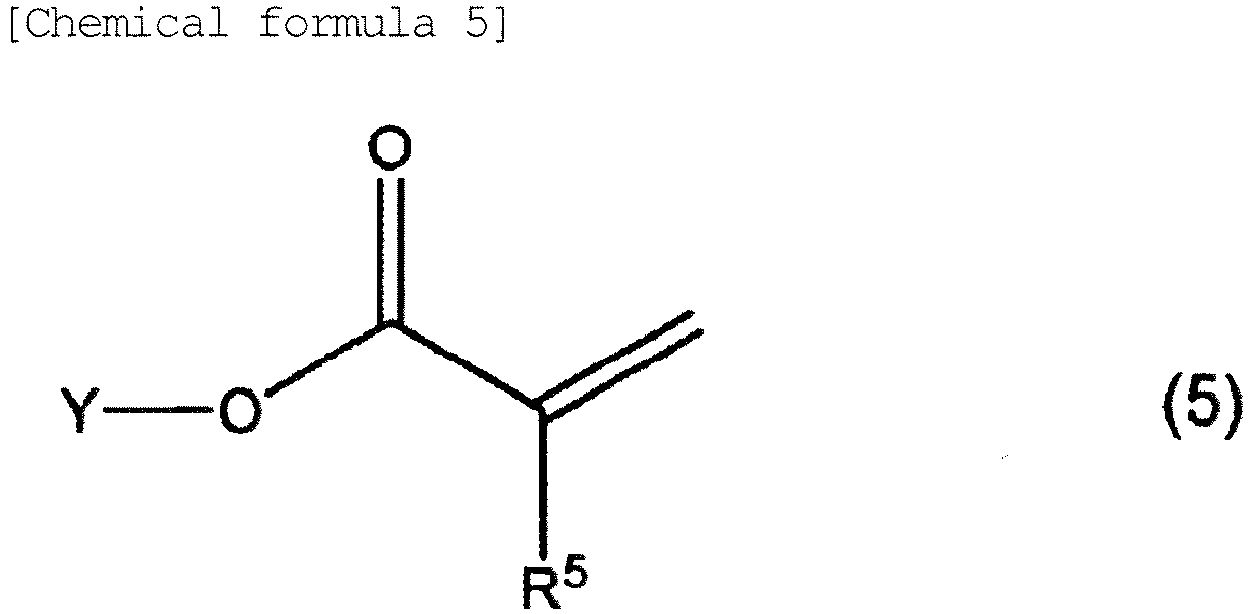 wherein R5 represents a hydrogen or a methyl group, and Y represents a hydrogen, a lithium, a sodium, a potassium, a rubidium, or a cesium.
 - The method according to claim 1, wherein a solvent used in the step 3 is at least one solvent selected from the group consisting of a halogenated hydrocarbon, a linear saturated hydrocarbon, a cyclic saturated hydrocarbon, and an aromatic hydrocarbon.
- The method according to claim 1 or 2, wherein the solvent used in the step 3 is the halogenated hydrocarbon, or a mixed solvent of the halogenated hydrocarbon and the linear saturated hydrocarbon.
- The method according to claim 1 or 2, wherein the solvent used in the step 3 is the aromatic hydrocarbon, or a mixed solvent of the aromatic hydrocarbon and the linear saturated hydrocarbon or the cyclic saturated hydrocarbon.
- The method according to any one of claims 1 to 4, wherein the step 3 is carried out under the presence of at least one compound selected from the group consisting of an ammonium salt, a phosphonium salt, and a crown ether.
- The method according to claim 5, wherein the ammonium salt comprises one or less of a methyl group as a substituent on a nitrogen atom.
- The method according to any one of claims 1 to 6, further adding an aprotic amphiphilic solvent in the step 3.
- The method according to any one of claims 1 to 7, wherein a content of water is 1000 ppm or less in the step 3.
Applications Claiming Priority (2)
| Application Number | Priority Date | Filing Date | Title |
|---|---|---|---|
| JP2015242462 | 2015-12-11 | ||
| PCT/JP2016/086126 WO2017099043A1 (en) | 2015-12-11 | 2016-12-06 | Method of producing (meth)acryloyl-terminated polyisobutylene polymer |
Publications (2)
| Publication Number | Publication Date |
|---|---|
| EP3388454A1 true EP3388454A1 (en) | 2018-10-17 |
| EP3388454A4 EP3388454A4 (en) | 2019-06-19 |
Family
ID=59014148
Family Applications (1)
| Application Number | Title | Priority Date | Filing Date |
|---|---|---|---|
| EP16872941.6A Withdrawn EP3388454A4 (en) | 2015-12-11 | 2016-12-06 | Method of producing (meth)acryloyl-terminated polyisobutylene polymer |
Country Status (5)
| Country | Link |
|---|---|
| US (1) | US10604598B2 (en) |
| EP (1) | EP3388454A4 (en) |
| JP (1) | JP6857615B2 (en) |
| CN (1) | CN108368194B (en) |
| WO (1) | WO2017099043A1 (en) |
Cited By (1)
| Publication number | Priority date | Publication date | Assignee | Title |
|---|---|---|---|---|
| US10968413B2 (en) | 2017-03-16 | 2021-04-06 | Kaneka Corporation | Vinyl-based comb polymer |
Families Citing this family (5)
| Publication number | Priority date | Publication date | Assignee | Title |
|---|---|---|---|---|
| WO2018024563A1 (en) * | 2016-08-05 | 2018-02-08 | Basf Se | Macromonomers containing polyisobutene groups, and homopolymers or copolymers thereof |
| WO2018155401A1 (en) * | 2017-02-22 | 2018-08-30 | 株式会社カネカ | Curable composition |
| JP7757066B2 (en) * | 2021-07-09 | 2025-10-21 | 株式会社カネカ | Curable composition, sealant, and adhesive |
| WO2025211097A1 (en) * | 2024-04-04 | 2025-10-09 | 東亞合成株式会社 | Photocurable resin composition and method for producing seal member |
| WO2026028846A1 (en) * | 2024-07-29 | 2026-02-05 | 株式会社カネカ | Method for producing (meth)acryloyl-terminated polyisobutylene |
Family Cites Families (9)
| Publication number | Priority date | Publication date | Assignee | Title |
|---|---|---|---|---|
| CN100516120C (en) * | 2000-01-21 | 2009-07-22 | 三井化学株式会社 | Olefin block copolymers, production processes of same and use thereof |
| JP5661285B2 (en) * | 2006-11-30 | 2015-01-28 | ザ ユニバーシティ オブ アクロンThe University of Akron | Polyisobutylene and process for producing the same |
| WO2008156806A1 (en) * | 2007-06-19 | 2008-12-24 | The University Of Akron | Singly-terminated polyisobutylenes and process for making same |
| US8592527B2 (en) * | 2010-06-14 | 2013-11-26 | University Of Southern Mississippi | Vinyl ether end-functionalized polyolefins |
| US9708424B2 (en) | 2011-09-27 | 2017-07-18 | Kaneka Corporation | (Meth)acryloyl-terminated polyisobutylene polymer, method for producing the same, and active energy ray-curable composition |
| EP2762506B1 (en) * | 2011-09-27 | 2022-09-07 | Kaneka Corporation | (meth)acryloyl-terminated polyisobutylene polymer, method for producing same, and active energy ray-curable composition |
| JP6010322B2 (en) * | 2012-04-09 | 2016-10-19 | 株式会社カネカ | Curable composition and use thereof |
| EP2928928B1 (en) * | 2012-12-10 | 2017-06-21 | Basf Se | Method for producing functionalized polyisobutylenes and derivatives thereof |
| KR102253845B1 (en) * | 2013-05-10 | 2021-05-21 | 헨켈 아이피 앤드 홀딩 게엠베하 | Functional polyisobutylene-containing oligomers and polymers |
-
2016
- 2016-12-06 US US16/061,284 patent/US10604598B2/en active Active
- 2016-12-06 JP JP2017555060A patent/JP6857615B2/en active Active
- 2016-12-06 CN CN201680072214.7A patent/CN108368194B/en active Active
- 2016-12-06 WO PCT/JP2016/086126 patent/WO2017099043A1/en not_active Ceased
- 2016-12-06 EP EP16872941.6A patent/EP3388454A4/en not_active Withdrawn
Cited By (1)
| Publication number | Priority date | Publication date | Assignee | Title |
|---|---|---|---|---|
| US10968413B2 (en) | 2017-03-16 | 2021-04-06 | Kaneka Corporation | Vinyl-based comb polymer |
Also Published As
| Publication number | Publication date |
|---|---|
| JP6857615B2 (en) | 2021-04-14 |
| US10604598B2 (en) | 2020-03-31 |
| JPWO2017099043A1 (en) | 2018-10-04 |
| US20180362676A1 (en) | 2018-12-20 |
| EP3388454A4 (en) | 2019-06-19 |
| CN108368194A (en) | 2018-08-03 |
| WO2017099043A1 (en) | 2017-06-15 |
| CN108368194B (en) | 2021-03-19 |
Similar Documents
| Publication | Publication Date | Title |
|---|---|---|
| US10604598B2 (en) | Method of producing (meth)acryloyl-terminated polyisobutylene polymer | |
| Misaka et al. | Synthesis of high molecular weight and end-functionalized poly (styrene oxide) by living ring-opening polymerization of styrene oxide using the alcohol/phosphazene base initiating system | |
| von Seggern et al. | Dual catalytic ring-opening polymerization of ethylene carbonate for the preparation of degradable PEG | |
| JPS62174229A (en) | Polyether macromer and its production | |
| Toshikazu et al. | Ionic polymerization of oxygencontaining bicyclic, spirocyclic, and related expandable monomers | |
| Fuchise et al. | Group transfer polymerization of N, N-dimethylacrylamide using nobel efficient system consisting of dialkylamino silyl enol ether as an initiator and strong brønsted acid as an organocatalyst | |
| CN115960355A (en) | Method for preparing sulfur-containing polymer based on isomerization-driven irreversible ring-opening polymerization | |
| JPH02247220A (en) | Isobutylene oxide polyol | |
| Brocas et al. | Combination of phosphazene base and triisobutylaluminum for the rapid synthesis of polyhydroxy telechelic poly (propylene oxide) | |
| McLeod et al. | Well‐defined epoxide‐containing styrenic polymers and their functionalization with alcohols | |
| JP4799755B2 (en) | Method for producing liquid polybutadiene (meth) acrylate | |
| WO2012166889A2 (en) | Polyethers, methods of making same, and uses thereof | |
| JP4837820B2 (en) | Propylene oxide polymerization catalyst composition and method for producing propylene oxide polymer | |
| Rejsek et al. | Polymerization of ethylene oxide initiated by lithium derivatives via the monomer-activated approach: Application to the direct synthesis of PS-b-PEO and PI-b-PEO diblock copolymers | |
| JP5767524B2 (en) | Method for producing isobutylene polymer | |
| Wang et al. | Tetrabutylammonium fluoride initiated anionic ring-opening polymerizations of N–sulfonyl aziridines | |
| Baskaran et al. | Anionic polymerization of methyl methacrylate using tetrakis [tris (dimethylamino) phosphoranylidenamino] phosphonium (P5+) as counterion in tetrahydrofuran | |
| JP4932576B2 (en) | Method for producing isobutylene polymer | |
| Bouchekif et al. | Triblock and pentablock terpolymers by sequential base-assisted living cationic copolymerization of functionalized vinyl ethers | |
| CA1303286C (en) | Process for the preparation of aliphatic polycarbonates | |
| Richard et al. | Influence of rare earth compounds on the anionic ring-opening polymerization of cyclosiloxanes | |
| JP2004244535A (en) | Method for producing vinyl ether polymer | |
| JP2003510374A (en) | Copolymerization of formaldehyde and cyclic ethers by using an initiator based on tetraphenylborate | |
| Roos et al. | Dialkylmagnesium‐Promoted Deprotonation of Protic Precursors for the Activated Anionic Ring‐Opening Polymerization of Epoxides | |
| Martinez et al. | Stereospecificity of substitution on PVC: Kinetic results at low temperatures |
Legal Events
| Date | Code | Title | Description |
|---|---|---|---|
| STAA | Information on the status of an ep patent application or granted ep patent |
Free format text: STATUS: THE INTERNATIONAL PUBLICATION HAS BEEN MADE |
|
| PUAI | Public reference made under article 153(3) epc to a published international application that has entered the european phase |
Free format text: ORIGINAL CODE: 0009012 |
|
| STAA | Information on the status of an ep patent application or granted ep patent |
Free format text: STATUS: REQUEST FOR EXAMINATION WAS MADE |
|
| 17P | Request for examination filed |
Effective date: 20180711 |
|
| AK | Designated contracting states |
Kind code of ref document: A1 Designated state(s): AL AT BE BG CH CY CZ DE DK EE ES FI FR GB GR HR HU IE IS IT LI LT LU LV MC MK MT NL NO PL PT RO RS SE SI SK SM TR |
|
| AX | Request for extension of the european patent |
Extension state: BA ME |
|
| DAV | Request for validation of the european patent (deleted) | ||
| DAX | Request for extension of the european patent (deleted) | ||
| A4 | Supplementary search report drawn up and despatched |
Effective date: 20190521 |
|
| RIC1 | Information provided on ipc code assigned before grant |
Ipc: C08F 8/26 20060101ALN20190515BHEP Ipc: C08F 110/10 20060101ALN20190515BHEP Ipc: C08F 8/14 20060101AFI20190515BHEP Ipc: C08F 10/10 20060101ALI20190515BHEP Ipc: C08F 4/16 20060101ALN20190515BHEP Ipc: C08F 4/06 20060101ALI20190515BHEP Ipc: C08F 8/18 20060101ALI20190515BHEP |
|
| GRAP | Despatch of communication of intention to grant a patent |
Free format text: ORIGINAL CODE: EPIDOSNIGR1 |
|
| STAA | Information on the status of an ep patent application or granted ep patent |
Free format text: STATUS: GRANT OF PATENT IS INTENDED |
|
| RIC1 | Information provided on ipc code assigned before grant |
Ipc: C08F 4/16 20060101ALN20220628BHEP Ipc: C08F 110/10 20060101ALN20220628BHEP Ipc: C08F 8/26 20060101ALN20220628BHEP Ipc: C08F 4/06 20060101ALI20220628BHEP Ipc: C08F 8/18 20060101ALI20220628BHEP Ipc: C08F 10/10 20060101ALI20220628BHEP Ipc: C08F 8/14 20060101AFI20220628BHEP |
|
| INTG | Intention to grant announced |
Effective date: 20220728 |
|
| STAA | Information on the status of an ep patent application or granted ep patent |
Free format text: STATUS: THE APPLICATION IS DEEMED TO BE WITHDRAWN |
|
| 18D | Application deemed to be withdrawn |
Effective date: 20221208 |