EP3388450A1 - Hiv vaccine based on targeting maximized gag and nef to dendritic cells - Google Patents
Hiv vaccine based on targeting maximized gag and nef to dendritic cells Download PDFInfo
- Publication number
- EP3388450A1 EP3388450A1 EP18173658.8A EP18173658A EP3388450A1 EP 3388450 A1 EP3388450 A1 EP 3388450A1 EP 18173658 A EP18173658 A EP 18173658A EP 3388450 A1 EP3388450 A1 EP 3388450A1
- Authority
- EP
- European Patent Office
- Prior art keywords
- antigen
- antibody
- gag
- nef
- vaccine
- Prior art date
- Legal status (The legal status is an assumption and is not a legal conclusion. Google has not performed a legal analysis and makes no representation as to the accuracy of the status listed.)
- Granted
Links
Images


Classifications
-
- C—CHEMISTRY; METALLURGY
- C07—ORGANIC CHEMISTRY
- C07K—PEPTIDES
- C07K14/00—Peptides having more than 20 amino acids; Gastrins; Somatostatins; Melanotropins; Derivatives thereof
- C07K14/005—Peptides having more than 20 amino acids; Gastrins; Somatostatins; Melanotropins; Derivatives thereof from viruses
-
- A—HUMAN NECESSITIES
- A61—MEDICAL OR VETERINARY SCIENCE; HYGIENE
- A61K—PREPARATIONS FOR MEDICAL, DENTAL OR TOILETRY PURPOSES
- A61K38/00—Medicinal preparations containing peptides
- A61K38/16—Peptides having more than 20 amino acids; Gastrins; Somatostatins; Melanotropins; Derivatives thereof
-
- A—HUMAN NECESSITIES
- A61—MEDICAL OR VETERINARY SCIENCE; HYGIENE
- A61K—PREPARATIONS FOR MEDICAL, DENTAL OR TOILETRY PURPOSES
- A61K39/00—Medicinal preparations containing antigens or antibodies
- A61K39/12—Viral antigens
-
- A—HUMAN NECESSITIES
- A61—MEDICAL OR VETERINARY SCIENCE; HYGIENE
- A61K—PREPARATIONS FOR MEDICAL, DENTAL OR TOILETRY PURPOSES
- A61K39/00—Medicinal preparations containing antigens or antibodies
- A61K39/12—Viral antigens
- A61K39/21—Retroviridae, e.g. equine infectious anemia virus
-
- A—HUMAN NECESSITIES
- A61—MEDICAL OR VETERINARY SCIENCE; HYGIENE
- A61K—PREPARATIONS FOR MEDICAL, DENTAL OR TOILETRY PURPOSES
- A61K39/00—Medicinal preparations containing antigens or antibodies
- A61K39/395—Antibodies; Immunoglobulins; Immune serum, e.g. antilymphocytic serum
-
- A—HUMAN NECESSITIES
- A61—MEDICAL OR VETERINARY SCIENCE; HYGIENE
- A61K—PREPARATIONS FOR MEDICAL, DENTAL OR TOILETRY PURPOSES
- A61K47/00—Medicinal preparations characterised by the non-active ingredients used, e.g. carriers or inert additives; Targeting or modifying agents chemically bound to the active ingredient
- A61K47/50—Medicinal preparations characterised by the non-active ingredients used, e.g. carriers or inert additives; Targeting or modifying agents chemically bound to the active ingredient the non-active ingredient being chemically bound to the active ingredient, e.g. polymer-drug conjugates
- A61K47/51—Medicinal preparations characterised by the non-active ingredients used, e.g. carriers or inert additives; Targeting or modifying agents chemically bound to the active ingredient the non-active ingredient being chemically bound to the active ingredient, e.g. polymer-drug conjugates the non-active ingredient being a modifying agent
- A61K47/62—Medicinal preparations characterised by the non-active ingredients used, e.g. carriers or inert additives; Targeting or modifying agents chemically bound to the active ingredient the non-active ingredient being chemically bound to the active ingredient, e.g. polymer-drug conjugates the non-active ingredient being a modifying agent the modifying agent being a protein, peptide or polyamino acid
- A61K47/64—Drug-peptide, drug-protein or drug-polyamino acid conjugates, i.e. the modifying agent being a peptide, protein or polyamino acid which is covalently bonded or complexed to a therapeutically active agent
- A61K47/646—Drug-peptide, drug-protein or drug-polyamino acid conjugates, i.e. the modifying agent being a peptide, protein or polyamino acid which is covalently bonded or complexed to a therapeutically active agent the entire peptide or protein drug conjugate elicits an immune response, e.g. conjugate vaccines
-
- A—HUMAN NECESSITIES
- A61—MEDICAL OR VETERINARY SCIENCE; HYGIENE
- A61K—PREPARATIONS FOR MEDICAL, DENTAL OR TOILETRY PURPOSES
- A61K47/00—Medicinal preparations characterised by the non-active ingredients used, e.g. carriers or inert additives; Targeting or modifying agents chemically bound to the active ingredient
- A61K47/50—Medicinal preparations characterised by the non-active ingredients used, e.g. carriers or inert additives; Targeting or modifying agents chemically bound to the active ingredient the non-active ingredient being chemically bound to the active ingredient, e.g. polymer-drug conjugates
- A61K47/51—Medicinal preparations characterised by the non-active ingredients used, e.g. carriers or inert additives; Targeting or modifying agents chemically bound to the active ingredient the non-active ingredient being chemically bound to the active ingredient, e.g. polymer-drug conjugates the non-active ingredient being a modifying agent
- A61K47/68—Medicinal preparations characterised by the non-active ingredients used, e.g. carriers or inert additives; Targeting or modifying agents chemically bound to the active ingredient the non-active ingredient being chemically bound to the active ingredient, e.g. polymer-drug conjugates the non-active ingredient being a modifying agent the modifying agent being an antibody, an immunoglobulin or a fragment thereof, e.g. an Fc-fragment
- A61K47/6835—Medicinal preparations characterised by the non-active ingredients used, e.g. carriers or inert additives; Targeting or modifying agents chemically bound to the active ingredient the non-active ingredient being chemically bound to the active ingredient, e.g. polymer-drug conjugates the non-active ingredient being a modifying agent the modifying agent being an antibody, an immunoglobulin or a fragment thereof, e.g. an Fc-fragment the modifying agent being an antibody or an immunoglobulin bearing at least one antigen-binding site
- A61K47/6843—Medicinal preparations characterised by the non-active ingredients used, e.g. carriers or inert additives; Targeting or modifying agents chemically bound to the active ingredient the non-active ingredient being chemically bound to the active ingredient, e.g. polymer-drug conjugates the non-active ingredient being a modifying agent the modifying agent being an antibody, an immunoglobulin or a fragment thereof, e.g. an Fc-fragment the modifying agent being an antibody or an immunoglobulin bearing at least one antigen-binding site the antibody targeting a material from animals or humans
-
- A—HUMAN NECESSITIES
- A61—MEDICAL OR VETERINARY SCIENCE; HYGIENE
- A61K—PREPARATIONS FOR MEDICAL, DENTAL OR TOILETRY PURPOSES
- A61K47/00—Medicinal preparations characterised by the non-active ingredients used, e.g. carriers or inert additives; Targeting or modifying agents chemically bound to the active ingredient
- A61K47/50—Medicinal preparations characterised by the non-active ingredients used, e.g. carriers or inert additives; Targeting or modifying agents chemically bound to the active ingredient the non-active ingredient being chemically bound to the active ingredient, e.g. polymer-drug conjugates
- A61K47/51—Medicinal preparations characterised by the non-active ingredients used, e.g. carriers or inert additives; Targeting or modifying agents chemically bound to the active ingredient the non-active ingredient being chemically bound to the active ingredient, e.g. polymer-drug conjugates the non-active ingredient being a modifying agent
- A61K47/68—Medicinal preparations characterised by the non-active ingredients used, e.g. carriers or inert additives; Targeting or modifying agents chemically bound to the active ingredient the non-active ingredient being chemically bound to the active ingredient, e.g. polymer-drug conjugates the non-active ingredient being a modifying agent the modifying agent being an antibody, an immunoglobulin or a fragment thereof, e.g. an Fc-fragment
- A61K47/6835—Medicinal preparations characterised by the non-active ingredients used, e.g. carriers or inert additives; Targeting or modifying agents chemically bound to the active ingredient the non-active ingredient being chemically bound to the active ingredient, e.g. polymer-drug conjugates the non-active ingredient being a modifying agent the modifying agent being an antibody, an immunoglobulin or a fragment thereof, e.g. an Fc-fragment the modifying agent being an antibody or an immunoglobulin bearing at least one antigen-binding site
- A61K47/6849—Medicinal preparations characterised by the non-active ingredients used, e.g. carriers or inert additives; Targeting or modifying agents chemically bound to the active ingredient the non-active ingredient being chemically bound to the active ingredient, e.g. polymer-drug conjugates the non-active ingredient being a modifying agent the modifying agent being an antibody, an immunoglobulin or a fragment thereof, e.g. an Fc-fragment the modifying agent being an antibody or an immunoglobulin bearing at least one antigen-binding site the antibody targeting a receptor, a cell surface antigen or a cell surface determinant
-
- A—HUMAN NECESSITIES
- A61—MEDICAL OR VETERINARY SCIENCE; HYGIENE
- A61P—SPECIFIC THERAPEUTIC ACTIVITY OF CHEMICAL COMPOUNDS OR MEDICINAL PREPARATIONS
- A61P31/00—Antiinfectives, i.e. antibiotics, antiseptics, chemotherapeutics
- A61P31/12—Antivirals
- A61P31/14—Antivirals for RNA viruses
- A61P31/18—Antivirals for RNA viruses for HIV
-
- A—HUMAN NECESSITIES
- A61—MEDICAL OR VETERINARY SCIENCE; HYGIENE
- A61P—SPECIFIC THERAPEUTIC ACTIVITY OF CHEMICAL COMPOUNDS OR MEDICINAL PREPARATIONS
- A61P37/00—Drugs for immunological or allergic disorders
- A61P37/02—Immunomodulators
-
- A—HUMAN NECESSITIES
- A61—MEDICAL OR VETERINARY SCIENCE; HYGIENE
- A61P—SPECIFIC THERAPEUTIC ACTIVITY OF CHEMICAL COMPOUNDS OR MEDICINAL PREPARATIONS
- A61P37/00—Drugs for immunological or allergic disorders
- A61P37/02—Immunomodulators
- A61P37/04—Immunostimulants
-
- C—CHEMISTRY; METALLURGY
- C07—ORGANIC CHEMISTRY
- C07K—PEPTIDES
- C07K16/00—Immunoglobulins [IG], e.g. monoclonal or polyclonal antibodies
- C07K16/18—Immunoglobulins [IG], e.g. monoclonal or polyclonal antibodies against material from animals or humans
- C07K16/28—Immunoglobulins [IG], e.g. monoclonal or polyclonal antibodies against material from animals or humans against receptors, cell surface antigens or cell surface determinants
- C07K16/2878—Immunoglobulins [IG], e.g. monoclonal or polyclonal antibodies against material from animals or humans against receptors, cell surface antigens or cell surface determinants against the NGF-receptor/TNF-receptor superfamily, e.g. CD27, CD30, CD40, CD95
-
- C—CHEMISTRY; METALLURGY
- C07—ORGANIC CHEMISTRY
- C07K—PEPTIDES
- C07K2319/00—Fusion polypeptide
- C07K2319/01—Fusion polypeptide containing a localisation/targetting motif
-
- C—CHEMISTRY; METALLURGY
- C07—ORGANIC CHEMISTRY
- C07K—PEPTIDES
- C07K2319/00—Fusion polypeptide
- C07K2319/01—Fusion polypeptide containing a localisation/targetting motif
- C07K2319/035—Fusion polypeptide containing a localisation/targetting motif containing a signal for targeting to the external surface of a cell, e.g. to the outer membrane of Gram negative bacteria, GPI- anchored eukaryote proteins
-
- C—CHEMISTRY; METALLURGY
- C07—ORGANIC CHEMISTRY
- C07K—PEPTIDES
- C07K2319/00—Fusion polypeptide
- C07K2319/30—Non-immunoglobulin-derived peptide or protein having an immunoglobulin constant or Fc region, or a fragment thereof, attached thereto
-
- C—CHEMISTRY; METALLURGY
- C07—ORGANIC CHEMISTRY
- C07K—PEPTIDES
- C07K2319/00—Fusion polypeptide
- C07K2319/33—Fusion polypeptide fusions for targeting to specific cell types, e.g. tissue specific targeting, targeting of a bacterial subspecies
-
- C—CHEMISTRY; METALLURGY
- C12—BIOCHEMISTRY; BEER; SPIRITS; WINE; VINEGAR; MICROBIOLOGY; ENZYMOLOGY; MUTATION OR GENETIC ENGINEERING
- C12N—MICROORGANISMS OR ENZYMES; COMPOSITIONS THEREOF; PROPAGATING, PRESERVING, OR MAINTAINING MICROORGANISMS; MUTATION OR GENETIC ENGINEERING; CULTURE MEDIA
- C12N2740/00—Reverse transcribing RNA viruses
- C12N2740/00011—Details
- C12N2740/10011—Retroviridae
- C12N2740/16011—Human Immunodeficiency Virus, HIV
- C12N2740/16211—Human Immunodeficiency Virus, HIV concerning HIV gagpol
- C12N2740/16222—New viral proteins or individual genes, new structural or functional aspects of known viral proteins or genes
-
- C—CHEMISTRY; METALLURGY
- C12—BIOCHEMISTRY; BEER; SPIRITS; WINE; VINEGAR; MICROBIOLOGY; ENZYMOLOGY; MUTATION OR GENETIC ENGINEERING
- C12N—MICROORGANISMS OR ENZYMES; COMPOSITIONS THEREOF; PROPAGATING, PRESERVING, OR MAINTAINING MICROORGANISMS; MUTATION OR GENETIC ENGINEERING; CULTURE MEDIA
- C12N2740/00—Reverse transcribing RNA viruses
- C12N2740/00011—Details
- C12N2740/10011—Retroviridae
- C12N2740/16011—Human Immunodeficiency Virus, HIV
- C12N2740/16211—Human Immunodeficiency Virus, HIV concerning HIV gagpol
- C12N2740/16234—Use of virus or viral component as vaccine, e.g. live-attenuated or inactivated virus, VLP, viral protein
-
- C—CHEMISTRY; METALLURGY
- C12—BIOCHEMISTRY; BEER; SPIRITS; WINE; VINEGAR; MICROBIOLOGY; ENZYMOLOGY; MUTATION OR GENETIC ENGINEERING
- C12N—MICROORGANISMS OR ENZYMES; COMPOSITIONS THEREOF; PROPAGATING, PRESERVING, OR MAINTAINING MICROORGANISMS; MUTATION OR GENETIC ENGINEERING; CULTURE MEDIA
- C12N2740/00—Reverse transcribing RNA viruses
- C12N2740/00011—Details
- C12N2740/10011—Retroviridae
- C12N2740/16011—Human Immunodeficiency Virus, HIV
- C12N2740/16311—Human Immunodeficiency Virus, HIV concerning HIV regulatory proteins
- C12N2740/16322—New viral proteins or individual genes, new structural or functional aspects of known viral proteins or genes
-
- C—CHEMISTRY; METALLURGY
- C12—BIOCHEMISTRY; BEER; SPIRITS; WINE; VINEGAR; MICROBIOLOGY; ENZYMOLOGY; MUTATION OR GENETIC ENGINEERING
- C12N—MICROORGANISMS OR ENZYMES; COMPOSITIONS THEREOF; PROPAGATING, PRESERVING, OR MAINTAINING MICROORGANISMS; MUTATION OR GENETIC ENGINEERING; CULTURE MEDIA
- C12N2740/00—Reverse transcribing RNA viruses
- C12N2740/00011—Details
- C12N2740/10011—Retroviridae
- C12N2740/16011—Human Immunodeficiency Virus, HIV
- C12N2740/16311—Human Immunodeficiency Virus, HIV concerning HIV regulatory proteins
- C12N2740/16334—Use of virus or viral component as vaccine, e.g. live-attenuated or inactivated virus, VLP, viral protein
Definitions
- the present invention relates in general to the field of agents that target viral proteins to dendritic cells.
- Dendritic Cells play a pivotal role in controlling the interface of innate and acquired immunity by providing soluble and intercellular signals, followed by recognition of pathogens. These functions of DCs are largely dependent on the expression of specialized surface receptors, 'pattern recognition receptors' (PRRs), represented, most notably, by toll-like receptors (TLRs) and C-type lectins or lectin-like receptors (LLRs).
- PRRs 'pattern recognition receptors'
- TLRs toll-like receptors
- LLRs C-type lectins or lectin-like receptors
- TLRs interleukin 12
- IL-12 interleukin 12
- C-type LLRs operate as constituents of the powerful antigen capture and uptake mechanism of macrophages and DCs.
- LLRs might have broader ranges of biological functions that include cell migrations, intercellular interactions. These multiple functions of LLRs might be due to the facts that LLRs, unlike TLRs, can recognize both self and nonself.
- the complexity of LLRs including the redundancy of a number of LLRs expressed in immune cells, has been one of the major obstacles to understand the detailed functions of individual LLRs.
- natural ligands for most of these receptors remain unidentified. Nonetheless, evidence from recent studies suggests that LLRs, in collaboration with TLRs, may contribute to the activation of immune cells during microbial infections.
- the present invention includes compositions and methods for increasing the effectiveness of antigen presentation by an antigen presenting cell by isolating and purifying a DC-specific antibody or fragment thereof to which an engineered Gag antigen is attached to form an antibody-antigen complex, wherein the Gag antigen is less susceptible to proteolytic degradation by eliminating one or more proteolytic sites; and contacting the antigen presenting cell under conditions wherein the antibody-antigen complex is processed and presented for T cell recognition.
- the antigen presenting cell comprises a dendritic cell.
- the DC-specific antibody or fragment thereof is bound to one half of a Coherin/Dockerin pair or the DC-specific antibody or fragment thereof is bound to one half of a Coherin/Dockerin pair and the engineered Gag antigen is bound to the complementary half of the Coherin/Dockerin pair to form a complex.
- the antibody-antigen complex further comprises a flexible linker between the DC-specific antibody or fragment thereof and the Gag antigen.
- the antibody-antigen complex further comprises one or more new glycosylation sites, or the antibody-antigen complex further comprises a flexible linker between the DC-specific antibody or fragment thereof and the Gag antigen that comprises one or more glycosylation sites that provide increased flexibility between the antibody and the antigen, decreased proteolysis at the linker and increased secretion.
- the antibody-antigen complex further comprises a flexible linker between the DC-specific antibody or fragment thereof and the Gag antigen that comprises one or more linkers selected from SEQ ID NOS. 4 and 6.
- the antibody-antigen complex further comprises a flexible linker between the DC-specific antibody or fragment thereof and the Gag antigen that comprises one or more glycosylation sites selected from a linker sequence derived from a cellulose degrading organism.
- the DC-specific antibody or fragment thereof is humanized.
- the antibody-antigen complex is selected from SEQ ID NOS: 1, 2, 3, 4, 5, 7, 8, 9, 10, 11, 12, 13, 14, 15, 16, 17, 18, 19, 20, 21, 22, 23, 31 or 32.
- the antibody-antigen complex further comprises a sequence tag used for purification or identification of the complex.
- the DC-specific antibody or fragment binds is selected from an antibody that specifically binds to MHC class I, MHC class II, CD1, CD2, CD3, CD4, CD8, CD11b, CD14, CD15, CD16, CD19, CD20, CD29, CD31, CD40, CD43, CD44, CD45, CD54, CD56, CD57, CD58, CD83, CD86, CMRF-44, CMRF-56, DCIR, DC-ASPGR, CLEC-6, CD40, BDCA-2, MARCO, DEC-205, mannose receptor, Langerin, DECTIN-1, B7-1, B7-2, IFN- ⁇ receptor and IL-2 receptor, ICAM-1, Fc ⁇ receptor, LOX-1, and ASPGR.
- compositions and methods for increasing the effectiveness of antigen presentation by an antigen presenting cell by: isolating and purifying a DC-specific antibody or fragment thereof to which an engineered Nef antigen is attached to form an antibody-antigen complex, wherein the Nef antigen comprises one or more codon usage optimization that increase antibody-antigen complex secretion; and contacting the antigen presenting cell under conditions wherein the antibody-antigen complex is processed and presented for T cell recognition.
- the antigen presenting cell comprises a dendritic cell.
- the DC-specific antibody or fragment thereof is bound to one half of a Coherin/Dockerin pair or the DC-specific antibody or fragment thereof is bound to one half of a Coherin/Dockerin pair and the engineered Nef antigen is bound to the complementary half of the Coherin/Dockerin pair to form a complex.
- the antibody-antigen complex further comprises a flexible linker between the DC-specific antibody or fragment thereof and the Nef antigen.
- the antibody-antigen complex further comprises one or more new glycosylation sites, or the antibody-antigen complex further comprises a flexible linker between the DC-specific antibody or fragment thereof and the Nef antigen that comprises one or more glycosylation sites that provide increased flexibility between the antibody and the antigen, decreased proteolysis at the linker and increased secretion.
- the antibody-antigen complex further comprises a flexible linker between the DC-specific antibody or fragment thereof and the Nef antigen that comprises one or more linkers selected from SEQ ID NOS. 4 and 6.
- the antibody-antigen complex further comprises a flexible linker between the DC-specific antibody or fragment thereof and the Nef antigen that comprises one or more glycosylation sites selected from a linker sequence derived from a cellulose degrading organism.
- the DC-specific antibody or fragment thereof is humanized.
- the antibody-antigen complex comprises SEQ ID NOS: 11, 12, 13, 14, 15, 16, and 17.
- the antibody-antigen complex further comprises a sequence tag used for purification or identification of the complex.
- the DC-specific antibody or fragment binds is selected from an antibody that specifically binds to MHC class I, MHC class II, CD1, CD2, CD3, CD4, CD8, CD11b, CD14, CD15, CD16, CD19, CD20, CD29, CD31, CD40, CD43, CD44, CD45, CD54, CD56, CD57, CD58, CD83, CD86, CMRF-44, CMRF-56, DCIR, DC-ASPGR, CLEC-6, CD40, BDCA-2, MARCO, DEC-205, mannose receptor, Langerin, DECTIN-1, B7-1, B7-2, IFN- ⁇ receptor and IL-2 receptor, ICAM-1, Fc ⁇ receptor, LOX-1, and ASPGR.
- Yet another embodiment of the present invention is a vaccine comprising a DC-specific antibody or fragment thereof to which an engineered Gag antigen is attached to form an antibody-antigen complex, wherein the Gag antigen is less susceptible to proteolytic degradation by eliminating one or more proteolytic sites.
- the antibody-antigen complex further comprises a flexible linker between the DC-specific antibody or fragment thereof and the Gag antigen.
- the antibody-antigen complex further comprises one or more new glycosylation sites.
- the antibody-antigen complex further comprises a flexible linker between the DC-specific antibody or fragment thereof and the Gag antigen that comprises one or more glycosylation sites that provide increased flexibility between the antibody and the antigen, decreased proteolysis at the linker and increased secretion.
- the antibody-antigen complex further comprises a flexible linker between the DC-specific antibody or fragment thereof and the Gag antigen that comprises one or more linkers selected from SEQ ID NOS. 4 and 6.
- the antibody-antigen complex further comprises a flexible linker between the DC-specific antibody or fragment thereof and the Gag antigen that comprises one or more glycosylation sites selected from a linker sequence derived from a cellulose degrading organism.
- the DC-specific antibody or fragment thereof is humanized.
- the antibody-antigen complex is selected from SEQ ID NOS: 1, 2, 3, 4, 5, 7, 8, 9, 10, 11, 12, 13, 14, 15, 16, 17, 18, 19, 20, 21, 22, 23, 31 or 32.
- antibody-antigen complex further comprises a sequence tag used for purification of the complex.
- sequence tag used for purification of the complex.
- the antibody-antigen complex may be formed by covalent or non-covalent association between the DC-specific antibody or fragment and the antigen or in the form of a fusion protein, with either of the portions at the amino or carboxy-terminus or even as contactamers or one or more of either portion.
- the DC-specific antibody or fragment binds is selected from an antibody that specifically binds to MHC class I, MHC class II, CD1, CD2, CD3, CD4, CD8, CD11b, CD14, CD15, CD16, CD19, CD20, CD29, CD31, CD40, CD43, CD44, CD45, CD54, CD56, CD57, CD58, CD83, CD86, CMRF-44, CMRF-56, DCIR, DC-ASPGR, CLEC-6, CD40, BDCA-2, MARCO, DEC-205, mannose receptor, Langerin, DECTIN-1, B7-1, B7-2, IFN- ⁇ receptor and IL-2 receptor, ICAM-1, Fc ⁇ receptor, LOX-1, and ASPGR.
- Yet another embodiment of the present invention is a vaccine comprising a DC-specific antibody or fragment thereof to which an engineered Nef antigen is attached to form an antibody-antigen complex, wherein the Nef antigen comprises one or more codon usage optimization that increase antibody-antigen complex secretion.
- the antibody-antigen complex further comprises a flexible linker between the DC-specific antibody or fragment thereof and the Nef antigen.
- the antibody-antigen complex further comprises one or more new glycosylation sites.
- the antibody-antigen complex further comprises a flexible linker between the DC-specific antibody or fragment thereof and the Nef antigen that comprises one or more glycosylation sites that provide increased flexibility between the antibody and the antigen, decreased proteolysis at the linker and increased secretion.
- the antibody-antigen complex further comprises a flexible linker between the DC-specific antibody or fragment thereof and the Nef antigen that comprises one or more linkers selected from SEQ ID NOS. 4 and 6.
- the antibody-antigen complex further comprises a flexible linker between the DC-specific antibody or fragment thereof and the Nef antigen that comprises one or more glycosylation sites selected from a linker sequence derived from a cellulose degrading organism.
- the DC-specific antibody or fragment thereof is humanized.
- the antibody-antigen complex comprises SEQ ID NOS: 1, 2, 3, 4, 5, 7, 8, 9, 10, 11, 12, 13, 14, 15, 16, 17, 18, 19, 20, 21, 22, 23, 31 or 32.
- the antibody-antigen complex further comprises a sequence tag used for purification of the complex.
- the antibody-antigen complex may be formed by covalent or non-covalent association between the DC-specific antibody or fragment and the antigen or in the form of a fusion protein, with either of the portions at the amino or carboxy-terminus or even as contactamers or one or more of either portion.
- the DC-specific antibody or fragment binds is selected from an antibody that specifically binds to MHC class I, MHC class II, CD1, CD2, CD3, CD4, CD8, CD11b, CD14, CD15, CD16, CD19, CD20, CD29, CD31, CD40, CD43, CD44, CD45, CD54, CD56, CD57, CD58, CD83, CD86, CMRF-44, CMRF-56, DCIR, DC-ASPGR, CLEC-6, CD40, BDCA-2, MARCO, DEC-205, mannose receptor, Langerin, DECTIN-1, B7-1, B7-2, IFN- ⁇ receptor and IL-2 receptor, ICAM-1, Fc ⁇ receptor, LOX-1, and ASPGR.
- Yet another embodiment of the present invention is a vaccine comprising: a DC-specific antibody or fragment thereof to which an engineered Gag antigen is attached to form an antibody-antigen complex, wherein the Gag antigen is less susceptible to proteolytic degradation by eliminating one or more proteolytic sites; and a DC-specific antibody or fragment thereof to which an engineered Nef antigen is attached to form an antibody-antigen complex, wherein the Nef antigen comprises one or more codon usage optimization that increase antibody-antigen complex secretion, wherein the vaccine is able to elicit an HIV-specific T cell immune response to Gag p17, Gag p24 and Nef.
- the Gag and Nef antigens comprise a fusion protein.
- the Gag and Nef antigens comprise a fusion protein separated by one or more flexible linkers.
- the antibody-antigen complex further comprises a flexible linker between the DC-specific antibody or fragment thereof and the Gag or Nef antigen that comprises one or more linkers selected from SEQ ID NOS. 4 and 6.
- the antibody-antigen complex further comprises a flexible linker between the DC-specific antibody or fragment thereof and the Gag antigen that comprises one or more glycosylation sites selected from a linker sequence derived from a cellulose degrading organism.
- the DC-specific antibody or fragment thereof is humanized.
- the vaccine is selected from SEQ ID NOS: 1, 2, 3, 4, 5, 7, 8, 9, 10, 11, 12, 13, 14, 15, 16, 17, 18, 19, 20, 21, 22, 23, 31 or 32.
- the antibody-antigen complex further comprises a sequence tag used for purification of the complex.
- the present invention is a vaccine comprising a DC-specific antibody or fragment thereof to which an engineered Gag antigen is attached to form an antibody-antigen complex, wherein the Gag antigen is less susceptible to proteolytic degradation by eliminating one or more proteolytic sites; and an engineered Nef antigen that is attached to the DC-specific antibody or fragment thereof or to the engineered Gag antigen form an antibody-antigen complex, wherein the Nef antigen comprises one or more codon usage optimization that increase antibody-antigen complex secretion, wherein the vaccine is able to elicit an HIV-specific T cell immune response to Gag p17, Gag p24 and Nef.
- DC-specific antibody or fragment thereof the Gag and Nef antigens comprise a fusion protein.
- the Gag and Nef antigens comprise a fusion protein separated by one or more flexible linkers.
- Yet another embodiment of the present invention includes a method for increasing the effectiveness of dendritic cells by isolating patient dendritic cells; exposing the dendritic cells to activating amounts of a vaccine comprising: a DC-specific antibody or fragment thereof to which an engineered Gag antigen is attached to form an antibody-antigen complex, wherein the Gag antigen is less susceptible to proteolytic degradation by eliminating one or more proteolytic sites; and an engineered Nef antigen that is attached to the DC-specific antibody or fragment thereof or to the engineered Gag antigen form an antibody-antigen complex, wherein the Nef antigen comprises one or more codon usage optimization that increase antibody-antigen complex secretion, wherein the vaccine is able to elicit an HIV-specific T cell immune response to Gag p17, Gag p24 and Nef; and reintroducing the antigen-loaded, activated dendritic cells into the patient.
- a vaccine comprising: a DC-specific antibody or fragment thereof to which an engineered Gag antigen is attached to
- Yet another embodiment of the present invention includes a vaccine comprising a DC-specific antibody or fragment thereof to which an engineered antigen comprising Cyclin D1 or fragments attached to form an antibody-antigen complex, wherein the Cyclin D1 antigen is less susceptible to proteolytic degradation by eliminating one or more proteolytic sites.
- the antibody-antigen complex further comprises a flexible linker between the DC-specific antibody or fragment thereof and the Cyclin D1 antigen.
- the antibody-antigen complex further comprises one or more new glycosylation sites.
- the antibody-antigen complex further comprises a flexible linker between the DC-specific antibody or fragment thereof and the Cyclin D1 antigen that comprises one or more glycosylation sites that provide increased flexibility between the antibody and the antigen, decreased proteolysis at the linker and increased secretion.
- the antibody-antigen complex may further comprise a flexible linker between the DC-specific antibody or fragment thereof and the Cyclin D1 antigen that comprises one or more glycosylation sites selected from a linker sequence derived from a cellulose degrading organism.
- the DC-specific antibody or fragment thereof is humanized.
- the DC-specific antibody or fragment thereof is bound to one half of a Coherin/Dockerin pair and the engineered Cyclin D1 antigen is bound to the complementary half of the Coherin/Dockerin pair to form a complex.
- the present invention also includes a method for increasing the effectiveness of dendritic cells comprising: isolating patient dendritic cells; exposing the dendritic cells to activating amounts of a vaccine comprising: a DC-specific antibody or fragment thereof to which an engineered antigen comprising Cyclin D1 or fragment(s) thereof attached to form an antibody-antigen complex, wherein the Cyclin D1 antigen is less susceptible to proteolytic degradation by eliminating one or more proteolytic sites or introducing glycosylation sites or improving the expression by selecting one or more codons that improve expression; and reintroducing the antigen-loaded, activated dendritic cells into the patient.
- Yet another embodiment of the present invention includes an isolated and purified nucleic acid that encodes a polypeptide selected from SEQ ID NO.: 1, 2, 3, 4, 5, 7, 8, 9, 10, 11, 12, 13, 14, 15, 16, 17, 18, 19, 20, 21, 22, 23, 31 or 32. Yet another embodiment of the present invention includes an isolated and purified polypeptide selected from SEQ ID NO.: 1, 2, 3, 4, 5, 7, 8, 9, 10, 11, 12, 13, 14, 15, 16, 17, 18, 19, 20, 21, 22, 23, 31 or 32.
- DCs Dendritic cells
- Mellman and Steinman 2001 (Banchereau, Briere et al. 2000), (Cella, Sallusto et al. 1997).
- DCs capture antigens, process them into peptides, and present these to T cells. Therefore delivering antigens directly to DC is a focus area for improving vaccines.
- One such example is the development of DC-based vaccines using ex-vivo antigen-loading of autologous DCs that are then re-administrated to patients (Banchereau, Schuler-Thurner et al. 2001), (Steinman and Dhodapkar 2001).
- Another strategy to improve vaccine efficacy is specific targeting to DC of antigen conjugated to antibodies against internalizing DC-specific receptors.
- the potential of targeting DC for vaccination is highlighted by key mouse studies.
- targeting with an anti-LOX-1 mAb coupled to ovalbumin (OVA) induced a protective CD8+ T cell response, via exogenous antigen cross-presentation toward the MHC class I pathway (Delneste, Magistrelli et al. 2002).
- OVA conjugated to anti-DEC205 mAb in combination with a CD40L maturation stimulus enhanced the MHC class I-restricted presentation by DCs in vivo and led to the durable formation of effector memory CD8+ T cells (Bonifaz, Bonnyay et al. 2004).
- the present invention provides for the complexing of multiple antigens or proteins (engineered, expressed, and purified independently from the primary mAb) in a controlled, multivariable fashion, to one single primary recombinant mAb.
- multiple antigens or proteins engineered, expressed, and purified independently from the primary mAb
- present invention provides for addition to the primary mAb of multiple combinations, in fixed equimolar ratios and locations, of separately engineered proteins.
- the term "antibody or fragment thereof' is used to describe a recombinant antibody system that has been engineered to provide a target specific antibody.
- the monoclonal antibody made using standard hybridoma techniques, recombinant antibody display, humanized monoclonal antibodies and the like.
- the antibody can be used to, e.g., target (via one primary recombinant antibody against an internalizing receptor, e.g., a human dendritic cell receptor) multiple antigens and/or antigens and an activating cytokine to dendritic cells (DC).
- target via one primary recombinant antibody against an internalizing receptor, e.g., a human dendritic cell receptor
- DC dendritic cells
- the antigen binding portion of the antibody includes on or more fragments (i.e., the fragments thereof) that may include one or more variable domains, one or more variable and the first constant domain, an Fab fragment, a Fab' fragment, an F(ab) 2 fragment, and Fv fragment, and Fabc fragment and/or a Fab fragment with portions of the Fc domain to which the cognate modular binding portions are added to the amino acid sequence and/or bound.
- the antibody for use can be of any isotype or class, subclass or from any source (animal and/or recombinant).
- the antigen binding sites are derived from non-human monoclonal antibodies that are grafted, using techniques well known in the art, onto a human antibody backbone thereby "humanizing" the antibody.
- antigen refers to a molecule that can initiate a humoral and/or cellular immune response in a recipient of the antigen.
- Antigen may be used in two different contexts with the present invention: as a target for the antibody or other antigen recognition domain of the engineered or recombinant antibody (rAb) or as the molecule that is carried to and/or into a cell or target by the rAb as a conjugate (bound covalent or non-covalently) or a fusion protein.
- the antigen is usually an agent that causes a disease for which a vaccination would be advantageous treatment. When the antigen is presented on MHC, the peptide is often about 8 to about 25 amino acids.
- Antigens include any type of biologic molecule, including, for example, simple intermediary metabolites, sugars, lipids and hormones as well as macromolecules such as complex carbohydrates, phospholipids, nucleic acids and proteins.
- Common categories of antigens include, but are not limited to, viral antigens, bacterial antigens, fungal antigens, protozoal and other parasitic antigens, tumor antigens, antigens involved in autoimmune disease, allergy and graft rejection, and other miscellaneous antigens.
- the present invention uses antigens from viruses that have improved characteristics (e.g., decreased proteolysis, enhanced secretion, enhanced expression or stability) and that are targeted to antigen presenting cells using the antibody or fragments thereof.
- viral antigens include, but are not limited to, e.g., retroviral antigens such as retroviral antigens from the human immunodeficiency virus (HIV) antigens such as gene products of the gag, pol, and env genes, the Nef protein, reverse transcriptase, and other HIV components; hepatitis viral antigens such as the S, M, and L proteins of hepatitis B virus, the pre-S antigen of hepatitis B virus, and other hepatitis, e.g., hepatitis A, B, and C, viral components such as hepatitis C viral RNA; influenza viral antigens such as hemagglutinin and neuraminidase and other influenza viral components; measles viral antigens such as the measles virus fusion protein and other measles virus components; rubella viral antigens such as proteins E1 and E2 and other rubella virus components; rotaviral antigens such as VP7
- Antigenic targets that may be delivered using the rAb-DC/DC-antigen vaccines of the present invention include genes encoding antigens such as viral antigens, bacterial antigens, fungal antigens or parasitic antigens.
- Viruses include picornavirus, coronavirus, togavirus, flavirvirus, rhabdovirus, paramyxovirus, orthomyxovirus, bunyavirus, arenavirus, reovirus, retrovirus, papilomavirus, parvovirus, herpesvirus, poxvirus, hepadnavirus, and spongiform virus.
- Other viral targets include influenza, herpes simplex virus 1 and 2, measles, dengue, smallpox, polio or HIV.
- Pathogens include trypanosomes, tapeworms, roundworms, helminthes, malaria.
- Tumor markers such as fetal antigen or prostate specific antigen, may be targeted in this manner.
- Other examples include: HIV env proteins and hepatitis B surface antigen.
- Administration of a vector according to the present invention for vaccination purposes would require that the vector-associated antigens be sufficiently non-immunogenic to enable long term expression of the transgene, for which a strong immune response would be desired. In some cases, vaccination of an individual may only be required infrequently, such as yearly or biennially, and provide long term immunologic protection against the infectious agent.
- Antigens on the surface of immune cells e.g., antigen presenting cells or dendritic cells, which can be targeted using the rAb of the present invention will generally be selected based on a number of factors, including: likelihood of internalization, level of immune cell specificity, type of immune cell targeted, level of immune cell maturity and/or activation and the like.
- cell surface markers for dendritic cells include, but are not limited to, MHC class I, MHC Class II, B7-2, CD18, CD29, CD31, CD43, CD44, CD45, CD54, CD58, CD83, CD86, CMRF-44, CMRF-56, DCIR and/or ASPGR and the like; while in some cases also having the absence of CD2, CD3, CD4, CD8, CD14, CD15, CD16, CD 19, CD20, CD56, and/or CD57.
- cell surface markers for antigen presenting cells include, but are not limited to, MHC class I, MHC Class II, CD40, CD45, B7-1, B7-2, IFN- ⁇ receptor and IL-2 receptor, ICAM-1, Fc ⁇ receptor. LOX-1 or ASPGR.
- cell surface markers for T cells include, but are not limited to, CD3, CD4, CD8, CD 14, CD20, CD11b, CD16, CD45 and HLA-DR.
- epitope(s) refer to a peptide or protein antigen that includes a primary, secondary or tertiary structure similar to an epitope located within any of a number of pathogen polypeptides encoded by the pathogen DNA or RNA.
- the level of similarity will generally be to such a degree that monoclonal or polyclonal antibodies directed against such polypeptides will also bind to, react with, or otherwise recognize, the peptide or protein antigen.
- Various immunoassay methods may be employed in conjunction with such antibodies, such as, for example, Western blotting, ELISA, RIA, and the like, all of which are known to those of skill in the art.
- pathogen epitopes and/or their functional equivalents, suitable for use in vaccines is part of the present invention. Once isolated and identified, one may readily obtain functional equivalents. For example, one may employ the methods of Hopp, as taught in U.S. Pat. No. 4,554,101 , incorporated herein by reference, which teaches the identification and preparation of epitopes from amino acid sequences on the basis of hydrophilicity. The methods described in several other papers, and software programs based thereon, can also be used to identify epitopic core sequences (see, for example, Jameson and Wolf, 1988; Wolf et al., 1988; U.S. Pat. No. 4,554,101 ). The amino acid sequence of these "epitopic core sequences" may then be readily incorporated into peptides, either through the application of peptide synthesis or recombinant technology.
- the term "monoclonal antibody” refers to an antibody composition having a homogeneous antibody population. The term is not limited regarding the species or source of the antibody, nor is it intended to be limited by the manner in which it is made. The term encompasses whole immunoglobulins as well as fragments such as Fab, F(ab') 2 , Fv, and other fragments that exhibit immunological binding properties of the parent monoclonal antibody molecule.
- the term "antigen-binding site” or “binding portion” refers to the part of the immunoglobulin molecule that participates in antigen binding.
- the antigen binding site is formed by amino acid residues of the N-terminal variable ("V") regions of the heavy ("H") and light (“L”) chains.
- V N-terminal variable
- H heavy
- L light
- Three highly divergent stretches within the V regions of the heavy and light chains are referred to as “hypervariable regions” which are interposed between more conserved flanking stretches known as “framework regions” (FRs).
- FR refers to amino acid sequences which are found naturally between and adjacent to hypervariable regions in immunoglobulins.
- the three hypervariable regions of a light chain and the three hypervariable regions of a heavy chain are disposed relative to each other in three dimensional space to form an antigen-binding surface.
- the antigen-binding surface is complementary to the three-dimensional surface of a bound antigen, and the three hypervariable regions of each of the heavy and light chains are referred to as "complementarity-determining regions,” or "CDRs.”
- humanized antibody refers to those molecules comprising an antigen-binding site derived from a non-human immunoglobulin have been described, including chimeric antibodies having rodent V regions and their associated CDRs fused to human constant domains, rodent CDRs grafted into a human supporting FR prior to fusion with an appropriate human antibody constant domain, and rodent CDRs supported by recombinantly veneered rodent FRs.
- These "humanized” molecules are designed to minimize unwanted immunological response toward rodent antihuman antibody molecules, which limits the duration and effectiveness of therapeutic applications of those moieties in human recipients.
- the preparation of vaccine compositions that includes the nucleic acids that encode antigens of the invention as the active ingredient, may be prepared as injectables, either as liquid solutions or suspensions; solid forms suitable for solution in, or suspension in, liquid prior to infection can also be prepared.
- the preparation may be emulsified, encapsulated in liposomes.
- the active immunogenic ingredients are often mixed with carriers which are pharmaceutically acceptable and compatible with the active ingredient.
- pharmaceutically acceptable carrier refers to a carrier that does not cause an allergic reaction or other untoward effect in subjects to whom it is administered.
- suitable pharmaceutically acceptable carriers include, for example, one or more of water, saline, phosphate buffered saline, dextrose, glycerol, ethanol, or the like and combinations thereof.
- the vaccine can contain minor amounts of auxiliary substances such as wetting or emulsifying agents, pH buffering agents, and/or adjuvants which enhance the effectiveness of the vaccine.
- adjuvants examples include but are not limited to: aluminum hydroxide, N-acetyl-muramyl-L-threonyl-D-isoglutamine (thr-MDP), N-acetyl-nor-muramyl-L-alanyl-D-isoglutamine, MTP-PE and RIBI, which contains three components extracted from bacteria, monophosporyl lipid A, trehalose dimycolate and cell wall skeleton (MPL+TDM+CWS) in a 2% squalene/Tween 80 emulsion.
- thr-MDP N-acetyl-muramyl-L-threonyl-D-isoglutamine
- MTP-PE N-acetyl-nor-muramyl-L-alanyl-D-isoglutamine
- MTP-PE N-acetyl-nor-muramyl-L-alanyl-D-isoglutamine
- adjuvants include DDA (dimethyldioctadecylammonium bromide), Freund's complete and incomplete adjuvants and QuilA.
- immune modulating substances such as lymphokines (e.g., IFN- ⁇ , IL-2 and IL-12) or synthetic IFN- ⁇ inducers such as poly I:C can be used in combination with adjuvants described herein.
- compositions may include a naked polynucleotide with a single or multiple copies of the specific nucleotide sequences that bind to specific DNA-binding sites of the apolipoproteins present on plasma lipoproteins as described in the current invention.
- the polynucleotide may encode a biologically active peptide, antisense RNA, or ribozyme and will be provided in a physiologically acceptable administrable form.
- Another pharmaceutical product that may spring from the current invention may include a highly purified plasma lipoprotein fraction, isolated according to the methodology, described herein from either the patients blood or other source, and a polynucleotide containing single or multiple copies of the specific nucleotide sequences that bind to specific DNA-binding sites of the apolipoproteins present on plasma lipoproteins, prebound to the purified lipoprotein fraction in a physiologically acceptable, administrable form.
- Yet another pharmaceutical product may include a highly purified plasma lipoprotein fraction which contains recombinant apolipoprotein fragments containing single or multiple copies of specific DNA-binding motifs, prebound to a polynucleotide containing single or multiple copies of the specific nucleotide sequences, in a physiologically acceptable administrable form.
- Yet another pharmaceutical product may include a highly purified plasma lipoprotein fraction which contains recombinant apolipoprotein fragments containing single or multiple copies of specific DNA-binding motifs, prebound to a polynucleotide containing single or multiple copies of the specific nucleotide sequences, in a physiologically acceptable administrable form.
- the dosage to be administered depends to a great extent on the body weight and physical condition of the subject being treated as well as the route of administration and frequency of treatment.
- a pharmaceutical composition that includes the naked polynucleotide prebound to a highly purified lipoprotein fraction may be administered in amounts ranging from 1 ⁇ g to 1 mg polynucleotide and 1 ⁇ g to 100 mg protein.
- Aqueous compositions of the present invention may include an effective amount of the compound, dissolved or dispersed in a pharmaceutically acceptable carrier or aqueous medium. Such compositions can also be referred to as inocula.
- a pharmaceutically acceptable carrier or aqueous medium Such compositions can also be referred to as inocula.
- the use of such media and agents for pharmaceutical active substances is well known in the art. Except insofar as any conventional media or agent is incompatible with the active ingredient, its use in the therapeutic compositions is contemplated. Supplementary active ingredients also can be incorporated into the compositions.
- the compositions of the present invention may include classic pharmaceutical preparations. Dispersions also can be prepared in glycerol, liquid polyethylene glycols, and mixtures thereof and in oils. Under ordinary conditions of storage and use, these preparations contain a preservative to prevent the growth of microorganisms.
- compositions according to the present invention will be via any common route so long as the target tissue is available via that route in order to maximize the delivery of antigen to a site for maximum (or in some cases minimum) immune response.
- Administration will generally be by orthotopic, intradermal, subcutaneous, intramuscular, intraperitoneal or intravenous injection. Other areas for delivery include: oral, nasal, buccal, rectal, vaginal or topical. Topical administration would be particularly advantageous for treatment of skin cancers.
- Such compositions would normally be administered as pharmaceutically acceptable compositions that include physiologically acceptable carriers, buffers or other excipients.
- Vaccine or treatment compositions of the invention may be administered parenterally, by injection, for example, either subcutaneously or intramuscularly. Additional formulations which are suitable for other modes of administration include suppositories, and in some cases, oral formulations or formulations suitable for distribution as aerosols. In the case of the oral formulations, the manipulation of T-cell subsets employing adjuvants, antigen packaging, or the addition of individual cytokines to various formulation that result in improved oral vaccines with optimized immune responses.
- binders and carriers may include, for example, polyalkylene glycols or triglycerides; such suppositories may be formed from mixtures containing the active ingredient in the range of 0.5% to 10%, preferably 1%-2%.
- Oral formulations include such normally employed excipients as, for example, pharmaceutical grades of mannitol, lactose, starch magnesium stearate, sodium saccharine, cellulose, magnesium carbonate, and the like. These compositions take the form of solutions, suspensions, tablets, pills, capsules, sustained release formulations or powders and contain 10%-95% of active ingredient, preferably 25-70%.
- the antigen encoding nucleic acids of the invention may be formulated into the vaccine or treatment compositions as neutral or salt forms.
- Pharmaceutically acceptable salts include the acid addition salts (formed with free amino groups of the peptide) and which are formed with inorganic acids such as, for example, hydrochloric or phosphoric acids, or with organic acids such as acetic, oxalic, tartaric, maleic, and the like. Salts formed with the free carboxyl groups can also be derived from inorganic bases such as, for example, sodium, potassium, ammonium, calcium, or ferric hydroides, and such organic bases as isopropylamine, trimethylamine, 2-ethylamino ethanol, histidine, procaine, and the like.
- Vaccine or treatment compositions are administered in a manner compatible with the dosage formulation, and in such amount as will be prophylactically and/or therapeutically effective.
- the quantity to be administered depends on the subject to be treated, including, e.g., capacity of the subject's immune system to synthesize antibodies, and the degree of protection or treatment desired.
- Suitable dosage ranges are of the order of several hundred micrograms active ingredient per vaccination with a range from about 0.1 mg to 1000 mg, such as in the range from about 1 mg to 300 mg, and preferably in the range from about 10 mg to 50 mg.
- Suitable regiments for initial administration and booster shots are also variable but are typified by an initial administration followed by subsequent inoculations or other administrations.
- nucleic acid molecule or fusion polypeptides of this invention will depend, inter alia, upon the administration schedule, the unit dose of antigen administered, whether the nucleic acid molecule or fusion polypeptide is administered in combination with other therapeutic agents, the immune status and health of the recipient, and the therapeutic activity of the particular nucleic acid molecule or fusion polypeptide.
- compositions can be given in a single dose schedule or in a multiple dose schedule.
- a multiple dose schedule is one in which a primary course of vaccination may include, e.g., 1-10 separate doses, followed by other doses given at subsequent time intervals required to maintain and or reinforce the immune response, for example, at 1-4 months for a second dose, and if needed, a subsequent dose(s) after several months.
- Periodic boosters at intervals of 1-5 years, usually 3 years, are desirable to maintain the desired levels of protective immunity.
- the course of the immunization can be followed by in vitro proliferation assays of peripheral blood lymphocytes (PBLs) co-cultured with ESAT6 or ST-CF, and by measuring the levels of IFN- ⁇ released from the primed lymphocytes.
- PBLs peripheral blood lymphocytes
- the assays may be performed using conventional labels, such as radionucleotides, enzymes, fluorescent labels and the like. These techniques are known to one skilled in the art and can be found in U.S. Pat. Nos. 3,791,932 , 4,174,384 and 3,949,064 , relevant portions incorporated by reference.
- the vaccine of the present invention may be provided in one or more "unit doses" depending on whether the nucleic acid vectors are used, the final purified proteins, or the final vaccine form is used.
- Unit dose is defined as containing a predetermined-quantity of the therapeutic composition calculated to produce the desired responses in association with its administration, i.e., the appropriate route and treatment regimen.
- the quantity to be administered, and the particular route and formulation, are within the skill of those in the clinical arts.
- the subject to be treated may also be evaluated, in particular, the state of the subject's immune system and the protection desired.
- a unit dose need not be administered as a single injection but may include continuous infusion over a set period of time.
- Unit dose of the present invention may conveniently may be described in terms of DNA/kg (or protein/Kg) body weight, with ranges between about 0.05, 0.10, 0.15, 0.20, 0.25, 0.5, 1, 10, 50, 100, 1,000 or more mg/DNA or protein/kg body weight are administered.
- the amount of rAb-DC/DC-antigen vaccine delivered can vary from about 0.2 to about 8.0 mg/kg body weight.
- 0.4 mg, 0.5 mg, 0.8 mg, 1.0 mg, 1.5 mg, 2.0 mg, 2.5 mg, 3.0 mg, 4.0 mg, 5.0 mg, 5.5 mg, 6.0 mg, 6.5 mg, 7.0 mg and 7.5 mg of the vaccine may be delivered to an individual in vivo.
- a pharmaceutical composition that includes a naked polynucleotide prebound to a liposomal or viral delivery vector may be administered in amounts ranging from 1 ⁇ g to 1 mg polynucleotide to 1 ⁇ g to 100 mg protein.
- compositions may include between about 1 ⁇ g, 5 ⁇ g, 10 ⁇ g, 20 ⁇ g, 30 ⁇ g, 40 ⁇ g, 50 ⁇ g, 60 ⁇ g, 70 ⁇ g, 80 ⁇ g, 100 ⁇ g, 150 ⁇ g, 200 ⁇ g, 250 ⁇ g, 500 ⁇ g, 600 ⁇ g, 700 ⁇ g, 800 ⁇ g, 900 ⁇ g or 1,000 ⁇ g polynucleotide or protein that is bound independently to 1 ⁇ g, 5 ⁇ g, 10 ⁇ g, 20 ⁇ g, 3.0 ⁇ g, 40 ⁇ g 50 ⁇ g, 60 ⁇ g, 70 ⁇ g, 80 ⁇ g, 100 ⁇ g, 150 ⁇ g, 200 ⁇ g, 250 ⁇ g, 500 ⁇ g, 600 ⁇ g, 700 ⁇ g, 800 ⁇ g, 900 ⁇ g, 1 mg, 1.5 mg, 5 mg, 10 mg, 20 mg, 30 mg, 40 mg, 50 mg, 60 mg, 70 mg, 80 mg, 90 mg or
- the present invention may also be used to make a modular rAb carrier that is, e.g., a recombinant humanized mAb (directed to a specific human dendritic cell receptor) complexed with protective antigens from Ricin, Anthrax toxin, and Staphylococcus B enterotoxin.
- a modular rAb carrier that is, e.g., a recombinant humanized mAb (directed to a specific human dendritic cell receptor) complexed with protective antigens from Ricin, Anthrax toxin, and Staphylococcus B enterotoxin.
- the potential market for this entity is vaccination of all military personnel and stored vaccine held in reserve to administer to large population centers in response to any biothreat related to these agents.
- the invention has broad application to the design of vaccines in general, both for human and animal use. Industries of interest include the pharmaceutical and biotechnology industries.
- the present invention includes compositions and methods, including vaccines, that specifically target (deliver) antigens to antigen-presenting cells (APCs) for the purpose of eliciting potent and broad immune responses directed against the antigen.
- APCs antigen-presenting cells
- These compositions evoke protective or therapeutic immune responses against the agent (pathogen or cancer) from which the antigen was derived.
- the invention creates agents that are directly, or in concert with other agents, therapeutic through their specific engagement with antigen-presenting cells.
- Gag-Nef vaccine The sequence shown below is a heavy chain (H) - HIV gag p24 fusion protein where the p24 region [italicized] is linked to the C-terminus of hIgG4H via a short spacer [bold] derived from a flexible loop of human major histocompatibility complex, class II, DR alpha precursor. Underlined AS residues are encoded by restriction sites used for construction purposes [in this case Nhe I].
- This type of antibody-p24 fusion protein has been described in the scientific literature [e.g., Antigen targeting to dendritic cells elicits long-lived T cell help for antibody responses (2006) Boscardin et al., JEM, Volume 203, Number 3, 599-606 ].
- Figure 1 lanes 1 and 2 show Coomassie Blue stained reduced SDS PAGE analysis of protein A affinity chromatography purified gag p24-antibody fusion proteins obtained from CHO-S or 293F cells transiently transfected with expression vectors encoding the H chain - gag p24 fusion [encoding e.g., C241 above preceded by a native signal sequence] and a corresponding light chain [L] expression plasmid.
- the co-transfection culture proceeds for up to several days before harvesting culture supernatant for subsequent purification.
- the full length [ ⁇ 77 kDa] H chain- gag p24 fusion chain is indicated by the upper arrow.
- H chain - p24 linker sequence is susceptible to proteolytic cleavage, thus compromising the integrity of the produced secreted antibody-antigen fusion protein.
- Figure 2 lane 3 shows Coomassie Blue stained reduced SDS PAGE analysis of protein A affinity chromatography purified gag p24 antibody fusion protein obtained from CHO-S or 293F cells transiently transfected with expression vectors encoding a H chain - gag p24 fusion with a H chain - gag p24 linker derived from cellulosomal anchoring scaffoldin B precursor [Bacteroides cellulosolvens] and a corresponding light [L] chain expression plasmid.
- the above antibody-gag p24 fusion protein is produced intact with no detectable cleavage between the H chain C-terminus and the gag p24 domain.
- the QTPTNTISVTPTNNSTPTNNSNPKPNP (SEQ ID NO.: 4) linker sequence is superior for gag p24 vaccine production purposes.
- Preferred linker sequences derived from Scaffoldins and related proteins The sequence below is CipA - a scaffoldin from a cellulose-degrading bacterium. This protein contains multiple Cohesin domains interspersed with linker sequences [italicized] apparently evolved to be flexible - reflecting the role of this protein to: (i) anchor to cellulose matrix via the carbohydrate-binding domain [CBM-3, figure 3 ]; and (ii) bind cellulose-degrading enzymes such as Endoglucanase D via enzyme-linked dockerin domains.
- Cellulosomal scaffolding protein A precursor Cellulosomal glycoprotein S1/SL
- Cellulose integrating protein A Cellulose integrating protein A
- Cohesin Cellulosomal scaffolding protein A precursor
- Bold residues are the linker sequence used in the above C114 construct.
- FIGURES 3A to 3C show the structural domain schema for cipA.
- FIGURE 3A shows the structural domain schema are NetOGlyc 1.0 Server and NetNGlyc 1.0 Server analyses for cipA showing highly predicted O-linked ( FIGURE 3C ) and N-linked glycosylation sites FIGURE 3C .
- the O-linked sites are largely within the linker sequences.
- linker sequence shown above in C560 [QTPTNTISVTPTNNSTPTNTSTPKPNP] (SEQ ID NO.: 6) is derived from this sequence [shown below in bold italicized, except for an N to T substitution] and contains two potential N-linked glycosylation sites [underlined].
- Other linker sequences used in constructs described below and/or in the HIV peptide disclosure are shown in bold.
- FIGURES 4A to 4C show the structural domain scheme for cellulosomal anchoring scaffoldin B precursor [Bacteroides cellulosolvens].
- FIGURE 4A shows the structural domain schema are NetOGlyc 1.0 Server and NetNGlyc 1.0 Server analyses for cipA showing highly predicted O-linked ( FIGURE 4B ) and N-linked glycosylation sites ( FIGURE 4C ). In particular, the O-linked sites are largely within the linker sequences.
- the present invention includes compositions and methods for the use of inter-structural domain linker sequences derived from cellulose-degrading organisms for as preferred inter-domain linker sequences in protein engineering - particularly those with highly predicted glycosylation sites for use in engineering proteins produced in eukaryotic expression hosts. It has been found that among the improved properties obtained using these sequences are: i) inherent flexibility, thereby facilitating separation of linked domains which should greatly help correct folding of linked domains during synthesis and maintaining unobscured access by matching B cell receptors of antigen conformational epitopes; ii) glycosylation, thereby helping secretion and solubility of the product fusion protein, and shielding of the linker sequences from proteases.
- FIG. 5 lane 1 shows the purified product of expression of [mAnti-DCIR_9E8_H-LV-hIgG4H-C-Viralgag-p40] C535 co-transfected with the appropriate L chain expression plasmid.
- the mature H chain sequence of C535 [gag residues are italicized and linking restriction site-encoded residues underlined] is:
- the upper arrow in Figure 5 shows the approximate position expected for the C535-encoded H chain - only a small portion of the product has a band at this position.
- the bulk of the product, indicated by the lower arrow, is a shorter H chain of a size suggesting the existence of a protease-sensitive site roughly at the gag p17-p24 boundary.
- Figure 6 lane 3 [below] shows the partially purified product of expression of [mAnti-DCIR_9E8_H-LV-hIgG4H-C-Flex-var1-Viralgag-p40-var1-6xHis] C601 co-transfected with the appropriate L chain expression plasmid.
- the mature H chain sequence of C535 [gag residues are italicized, linking restriction site-encoded residues are underlined, and flexible linker residues are in bold] is:
- gag sequence has a KKK to VDESF sequence change [shown above underlined] removing a potential protease-sensitive site towards the C-terminus of gag p17 and Figure 6 shows that this variant form is produced with a H chain that is largely undegraded [the lower molecular weight bands in lane 3 are 'background contaminants' - see Figure 7 ].
- the present invention includes variants of gag p40 [p17 + p24] with changes about the KKK sequence defined above that prevent proteolytic cleavage of secreted linked gag p17 + p24 proteins.
- Antibodies linked to preferred HIV nef antigen includes, but is not limited to, one preferred vaccine targeting HIV antigens to dendritic cells would have a maximal amount of gag antigen linked with a maximal amount of nef antigen.
- Figure 7 lane 4 [below] shows the partially purified product of expression of [mAnti-DCIR_9E8_H-LV-hIgG4H-C-Flex-v1-ViralNef] C757 cotransfected with the appropriate L chain expression plasmid.
- the mature H chain sequence of C757 [nef Consensus Clade B residues are italicized, linking restriction site-encoded residues are underlined, and flexible linker are in bold] is:
- the antibody-antigen product analysis shown in Figure 7 shows various H chain-antigen constructs transiently co-transfected into 293F cells with identical appropriate L chain expression constructs.
- Each lane represents product from a 5 ml transfection cell supernatant [3 days production] bound to excess Protein A beads, washed 2x with PBS + 1M NaCl, the eluted with 20 mM HCl, dried, dissolved in reducing SDS PAGE sample buffer, and analyzed by reduced SDS PAGE with Coomassie Blue staining.
- This technique permits appraisal not only of the integrity of the expected H chain product, but allows estimation of relative production levels of the antibody-antigen products.
- Figure 7 lane 4 shows very efficient production of [mAnti-DCIR_9E8_H-LV-hIgG4H-C-Flex-v1-ViralNef], showing that this configuration of antibody fused to nef Consensus Clade B antigen linked via QTPTNTISVTPTNNSTPTNNSNPKPNP is very favorable.
- Antibodies linked to certain preferred HIV gag and nef antigens are linked to certain preferred HIV gag and nef antigens.
- C758 has nef Consensus Clade B antigen appended directly proximal to the variant gag p40 antigen described above [joining residues are underlined and flexible linker sequence is in bold]:
- Figure 7 lane 5 shows that this expression plasmid directs the synthesis of this H chain-antigen fusion when cotransfected with the appropriate L chain is expressed very poorly as a secreted product.
- Lanes 6-9 show the secreted products from 293F cells co-transfected with L chain expression plasmid and H chain-gag expression constructs having nef Consensus Clade B antigen coding sequence insertions associated with proximal and/or distal flexible linker sequences. Addition of the flexible linker sequences facilitates secretion of intact antibody-gag/nef fusion vaccine.
- One preferred construct for production of the highest levels of vaccine is [mAnti-DCIR_9E8_H-LV-hIgG4H-C-Flex-v1-p17-f3-nef-f4-p24-6xHis] C791 [see lane 9]. Since the relative levels of antibody-antigen fusions in such mammalian expression systems is largely independent of the antibody V-region, antibody-gag/nef antigen vaccines targeting different DC receptors should have similar advantage in production if [-Flex-v1-p17-f3-nef-f4-p24-6xHis] is appended to their H chain C-terminus.
- Lane 6 H chain is [mAnti-DCIR_9E8_H-LV-hIgG4H-C-Flex-v1-Viralgag-p40-f4-nef] C767 [joining residues are underlined, flexible linker residues are in bold, and antigen residues are italicized]:
- Lane 7 H chain is [mAnti-DCIR_9E8_H-LV-hIgG4H-C-Flex-v1-p17-nef-f4-p24-6xHis] C790 C767 [joining residues are underlined, flexible linker residues are in bold, and antigen residues are italicized]:
- Lane 8 H chain is [mAnti-DCIR_9E8_H-LV-hIgG4H-C-Flex-v1-p17-f3-nef-p24-6xHis] C797 C767 [joining residues are underlined, flexible linker residues are in bold, and antigen residues are italicized]:
- Lane 9 H chain is [mAnti-DCIR_9E8_H-LV-hIgG4H-C-Flex-v1-p17-f3-nef-f4-p24-6xHis] C791 C767 [joining residues are underlined, flexible linker residues are in bold, and antigen residues are italicized]:
- gag-nef antigen fusions with maximal antigen epitopes were found to have efficient secretion/production properties.
- Variants of gag p40 with inserts or appendages of nef antigen flanked by preferred flexible linker sequences were found to be particularly well produced and secreted. It was found that the flexible linker sequences disclosed herein and obtainable from cellulose degrading organisms were able to facilitate the secretion of intact antigens and/or linked antigens as antibody-antigen fusion proteins.
- DNA sequences of antigen coding sequence:C757 antigen region is [bold sequences are joining sites or a stop codon]:
- C791 linker and antigen coding sequence is [bold sequences are joining sites or a stop codon]:
- Variants of C230 were engineered to encode CD4012E12 H chains with antigens fused to the human IgG4 C-terminus e.g., C291 rAB-pIRES2[manti-CD40_12E12.3F3_H-V-hIgG4H-C-Flex-FluHA1-1-6xHis] encodes an H chain with the sequence shown below with the Influenza HA1-1 antigen region shown italicized and a flexible linker sequence and C-terminal poly-histidine tag shown in bold:
- C450 rAB-pIRES2[manti-CD40_12E12.3F3_H-LV-hIgG4H-C-Dockerin-var1] encodes an H chain with the sequence shown below with a C-terminal Dockerin domain antigen region shown italicized:
- expression vectors encoding the above and similar variant H chains can be co-transfected into 293F or CHO-S cells resulting in the secretion of anti-CD4012E12-hIgG4 antibody fusion proteins, which can be readily purified by protein A affinity chromatography.
- Such antibody-antigen proteins can be used as vaccines to deliver antigen with high efficiency to human dendritic cells in vitro or in vivo.
- the anti-CD4012E12-hIgG4 Dockerin protein can be used likewise to deliver cohesin-antigen fusion proteins.
- C32 Ecoli-pET28[Cohesin-FluM1-6xHis] encodes the sequence shown below where the Influenza M1 protein is shown italicized:
- the above protein can be expressed as a soluble protein in E. coli and prepared as a pure product by ion exchange and metal affinity chromatographies.
- Highly stable complexes or conjugates between anti-CD4012E12-hIgG4 Dockerin fusion protein and Cohesin Flu M1 fusion protein can be assembled via the high affinity Dockerin-Cohesin interaction.
- a dose range of such anti-CD4012E12-hIgG4 Dockerin - Cohesin Flu M1 conjugates were incubated with human dendritic cells for one day, then syngeneic CD8+ T cells were added and incubation was continued for several more days. Cells were then stained with anti-CD8 antibody and a HLA-A2 tetramer reagent specific for T cells bearing TCR corresponding to the immunodominant Flu M1 epitope 58-66. Tetramer positive cells are shown in the boxed gate.
- Figure 9 shows FACS analysis of CD8+ staining [horizontal axis] versus Flu M1-tetramer staining [vertical axis] as elicited by a dose range from 10 ug/ml to no anti-CD4012E12-hIgG4 Dockerin - Cohesin Flu M1 conjugate.
- Figure 10 shows FACS analysis of CD8+ staining [horizontal axis] versus Flu M1-tetramer staining [vertical axis] as elicited by a dose range from 10 ug/ml to no control hIgG4 Dockerin - Cohesin Flu M1 conjugate.
- Figure 11 depicts the protocol used to assay in vitro the potency of anti-DC receptor - antigen targeting molecules [TM] to elicit the expansion of antigen-specific T cells in the context of a PBMC culture.
- 2E6 PBMC from apheresis of HIV patients are incubated with a dose range of the targeting vaccine and 100 U/ml IL-2. Media is changed every two days.
- clusters of peptides corresponding to the antigen are added to induce IFN ⁇ production by T cells with TCR specificities for peptide sequences within each cluster.
- After 4 hours incubation with the peptide cluster and an agent that blocks cytokine secretion cells are stained with anti-CD4, anti-CD8, anti-IL-13, and anti-IFN ⁇ reagents and analyzed by FACS.
- Figures 12 and 13 show the effects of targeting DC [within the PBMC] with an anti-CD4012E12 gag p17 nef gag p24 vaccine - the H chain composition is shown below: C818 rAB-cetHS-puro[manti-CD40_12E12.3F3_H-LV-hIgG4H-C-Flex-v1-Viralgag-p17-f3-nef-f4-p24-6xHis] joining residues are underlined, flexible linker residues are in bold, and antigen residues are italicized]:
- Figure 12 shows that the vaccine elicits the expansion of CD4+ T cells with specificities to all the gag p24 peptide clusters - even at the lowest vaccine does tested the percentage of IFNy-producing CD4+T cells was significantly greater than when the cells were not treated with peptides.
- Figure 13 [upper panel] shows this data in graph form - the vertical axis shows percent (%) IFNy-producing cells. The lower panel shows similar data for CD8+ T cells within the PBMC culture, and this data also shows that all peptide clusters covering the gag p24 sequence elicited significantly greater production of IFN ⁇ -producing T cells than the non-peptide control. Thus, the vaccine elicited a potent and responses against multiple epitopes within HIV gag p24.
- Figure 14 shows that the vaccine elicits the expansion of CD4+ T cells with specificities to all the gag p17 peptide clusters - even at the lowest vaccine does tested the percentage of IFNy-producing CD4+T cells was significantly greater than when the cells were not treated with peptides.
- Figure 15 shows this data in graph form - the vertical axis shows percentage IFNy-producing cells [upper panel]. The lower panel shows similar data for CD8+ T cells within the PBMC culture, and this data also shows that all peptide clusters covering the gag p17 sequence elicited significantly greater production of IFN ⁇ -producing T cells than the non-peptide control.
- the vaccine elicited a potent and responses against multiple epitopes within HIV gag p17.
- Figure 16 shows that the vaccine elicits the expansion of CD4+ T cells with specificities to most of the HIV nef peptide clusters - even at the lowest vaccine does tested the percentage of IFN ⁇ -producing CD4+T cells was significantly greater than when the cells were not treated with peptides.
- Figure 17 shows this data in graph form - the vertical axis shows percentage IFN ⁇ -producing cells [upper panel]. The lower panel shows similar data for CD8+ T cells within the PBMC culture, and this data also shows that all peptide clusters covering the nef sequence elicited significantly greater production of IFN ⁇ -producing T cells than the non-peptide control. Thus the vaccine elicited a potent and response against multiple epitopes within HIV nef.
- the vaccine [anti-CD4012E12 - linked to the specially engineered gag p17 nef gag p24 fusion protein] can, even at low doses, elicit broad immune responses - i.e., wide representation of epitopes in both the CD4+ and CD8+ T cell compartments.
- This data further demonstrate that each of the two vaccine parts [anti-CD4012E12 and other antibodies with similar special properties, and the gag-nef antigen engineered for maximal epitope representation consistent with efficient production] - i.e., the anti-CD40 component can be a vehicle for delivery of other antigens, and the antigen component can be delivered by other anti-DC receptor vehicles.
- the results also demonstrate the ability of the CD40-based targeting to expand a wide array of antigen-specific CD4+ and CD8+ T cells from both memory [HIV patients given HIV vaccine] and naive [normal donors given PSA antigen] T cell populations.
- FIG. 18 shows the outline of a protocol to test the ability a vaccine composed of anti-CD40-12E12 linked to PSA [prostate-specific antigen] to elicit the expansion from a naive T cell population PSA-specific CD4+ T cells corresponding to a broad array of PSA epitopes.
- DCs derived by culture with IFN ⁇ and GM-CSF of monocytes from a normal donor are incubated with the vaccine. The next day, cells are placed in fresh medium and pure CD4+ T cells from the same donor are added. Several days later, PSA peptides are added and, after four hours, secreted IFN ⁇ levels in the culture supernatants are determined.
- Figure 19 shows that many PSA peptides elicit potent IFN ⁇ -production responses indicating that anti-CD4012E12 and similar antiCD40 agents can effectively deliver antigen to DC, resulting in the priming of immune responses against multiple epitopes of the antigen.
- FIG. 20 shows that DCs targeted with anti-CD40-PSA targeted to DCs induce PSA-specific CD8+ T cell responses.
- IFNDCs were targeted with 1 ⁇ g mAb fusion protein with PSA.
- Purified autologous CD8+ T cells were co-cultured for 10 days. Cells were stained with anti-CD8 and PSA (KLQCVDLHV)-tetramer. Cells are from a HLA-A*0201 positive healthy donor.
- KLQCVDLHV anti-CD8 and PSA
- Figure 21 outlines the DC targeting protocol for testing anti-DC receptor targeting vaccines for their ability to direct the expansion of antigen-specific T cells resulting from targeted uptake by the DC and presentation of antigen epitopes on their cell surface.
- HIV patient monocytes are differentiated into DC by culture for 3 days in IFN ⁇ and GM-CSF.
- Vaccine [FP] is then added at 10 ug/ml along with autologous T cells. After 10 days in culture, antigen peptide clusters are added to the expanded T cells and after 4 hours intracellular IFN ⁇ is measured.
- Figure 22 shows comparison of the efficacy of anti-CD4012E12 nef, anti-CD4012E12 gag p24, and anti-CD4012E12 gag p17 nef gag p24 vaccines [patient Aph002].
- Anti-CD4012E12 nef vaccine [green bars] stimulated the expansion of IFNa-producing CD4+ T cells responsive only to nef peptide epitopes
- anti-CD4012E12 gag p24 [blue bars] stimulated the expansion of IFN ⁇ -producing CD4+ T cells responsive to only p24 peptide epitopes
- the anti-CD4012E12 gag p17 nef gag p24 stimulated the expansion of IFN ⁇ -producing CD8+ T cells responsive to gag p17, nef, and p24 peptide epitopes.
- Figure 22 shows comparison of the efficacy of anti-CD4012E12 nef, anti-CD4012E12 gag p24, and anti-CD4012E12 gag p17 nef gag p24 vaccines [patient Aph002].
- Anti-CD4012E12 nef vaccine [green bars] stimulated the expansion of IFNa-producing CD8+ T cells responsive only to nef peptide epitopes, while anti-CD4012E12 gag p17 nef gag p24 [orange bars] stimulated the expansion of IFN ⁇ -producing CD8+ T cells responsive to both gag p17 and nef peptide epitopes.
- Figure 23 shows comparison of the efficacy of anti-CD4012E12 nef, anti-CD4012E12 gag p24, and anti-CD4012E12 gag p17 nef gag p24 vaccines [patient Aph010].
- Anti-CD4012E12 nef vaccine [green bars] stimulated the expansion of IFNa-producing CD4+ T cells responsive only to nef peptide epitopes
- anti-CD4012E12 gag p24 [blue bars] stimulated the expansion of IFNa-producing CD4+ T cells responsive to only p24 peptide epitopes
- the anti-CD4012E12 gag p17 nef gag p24 stimulated the expansion of IFN ⁇ -producing CD8+ T cells responsive to gag p17, nef, and p24 peptide epitopes.
- Figure 23 shows comparison of the efficacy of anti-CD4012E12 nef, anti-CD4012E12 gag p24, and anti-CD4012E12 gag p17 nef gag p24 vaccines [patient Aph002].
- Anti-CD4012E12 nef vaccine [green bars] stimulated the expansion of IFNa-producing CD8+ T cells responsive only to nef peptide epitopes
- anti-CD4012E12 gag p24 [blue bars] stimulated the expansion of IFN ⁇ -producing CD8+ T cells responsive to only p24 peptide epitopes
- anti-CD4012E12 gag p17 nef gag p24 [orange bars] stimulated the expansion of IFNa-producing CD8+ T cells responsive to both gag p17 and nef peptide epitopes.
- Coh.Cyclin D1 was expressed in E . coli strain T7 Express (NEB) grown in Luria broth (Difco) at 37°C with selection for kanamycin resistance (40 ⁇ g/ml) and shaking at 200 rounds/min to mid-log growth phase. Then 120 mg/L IPTG (Bioline) was added and after a further 3 hrs, the cells were harvested by centrifugation and stored at -80°C. E . coli cells from each 1 L fermentation were resuspended in 50 ml ice-cold 50 mM Tris, 1 mM EDTA pH 8.0 with 0.2 ml of protease inhibitor Cocktail II (Calbiochem).
- the cells were sonicated twice on ice for 4 min at setting 18 (Fisher Sonic Dismembrator 60) with a 5 min rest period and then spun at 17,000 r.p.m. (Sorvall SA-600) for 20 min at 4°C.
- the 50 ml cell lysate supernatant was passed through 10 ml of ANX Sepharose beads (GE Healthcare), then the flow-through was adjusted to binding buffer with 7.5 ml 160 mM Tris, 40 mM imidazole, 4 M NaCl pH 7.9 and loaded onto a 5 ml HiTrap chelating HP column (GE Healthcare) charged with Ni ++ .
- the bound protein was washed with 20 mM NaPO 4 , 300 mM NaCl, 10 mM imidazole pH 7.6 (buffer A) and eluted with a 10-500 mM imidazole gradient in buffer A.
- the peak fractions were analyzed by SDS-PAGE gel, pooled. Approximately 15 milligrams of the pooled eluted Cohesin-Cyclin D1 fusion protein was reacted overnight at room temperature with 10 milligrams of mPEG-MAL 20k reagent (Nektar), which attaches a 20 kDa pegyl group to free cysteine residues [of which there are several within the Cyclin D1 domain].
- mPEG-MAL 20k reagent Nektar
- FIG 24 Analysis of the interaction of Cohesin-Cyclin D1 fusion protein with anti-DC receptor-Dockerin recombinant antibody.
- Antibody-Dockerin or antibody-HIV nef fusion protein [20 ⁇ g] was incubated with 100 ⁇ l protein A-Sepharose beads [GE Biosciences] then washed twice with DPBS.
- Pegylated [peg] or pegylated and alkylated [peg alk] Cohesin-Cyclin D1 [Coh.Cyclin D1] were added [20 ⁇ g] and, after 30 minutes at room temperature, the supernatant was separated from the beads by centrifugation.
- the beads were eluted with 20 mM HCl and the eluate and supernatant were dried, resuspended in SDS.PAGE loading buffer and run on reducing SDS.PAGE and visualized by Coomasssie Blue staining.
- Lane 1 shows the supernatant from beads loaded with antibody-Dockerin + peg Coh.Cyclin D1 and Lane 2 is the corresponding bead eluate.
- Lane 3 shows the supernatant from beads loaded with antibody-HIV nef + peg Coh.Cyclin D1 and Lane 4 is the corresponding bead eluate.
- Lane 5 shows the supernatant from beads loaded with antibody-Dockerin + peg alk Coh.Cyclin D1 and Lane 6 is the corresponding bead eluate.
- Lane 7 shows the supernatant from beads loaded with antibody-HIV nef + peg alk Coh.Cyclin D1 and Lane 8 is the corresponding bead eluate.
- Lane 9 shows antibody-Dockerin alone, lane 10 shows antibody-HIV nef alone, Lane 11 shows peg Coh.Cyclin D1 alone, and Lane 12 shows shows peg alk Coh.Cyclin D1 alone.
- the arrows [top to bottom] show: 1) high molecular weight pegylated forms of Coh.Cyclin D1, 2) the position of antibody heavy chain, 3) the position of non-pegylated Coh.Cyclin D1 [which is about 50% of the preparations], 4) the position of the antibody light chain.
- Mantle Cell Lymphoma is a B-cell non-Hodgkin's lymphoma which represents 5-10% of all non-Hodgkin's lymphoma, predominantly in males with advanced age. It is a very aggressive cancer with the worst prognosis after conventional treatment, frequent relapses, and relatively short survival. It has a genetic hallmark: t (11;14) (q13; q32) translocation ---- leading to the over expression of Cyclin D1.
- G1/S-specific cyclin-Dl - alternatively named PRAD1 functions in cell cycle control of G1 progression and G1/S transition via forming complexes with CDK4 and 6.
- Bcl-1 functions in cell cycle control of G1 progression and G1/S transition via forming complexes with CDK4 and 6.
- CDK4 and 6 There is no normal expression in mature lymphocytes since expression is cell cycle dependent with maximal expression in G1, minimal in S.
- raising cytotoxic T cell responses specifically directed to cells over expressing Cyclin D1 is an attractive MCL vaccination strategy.
- Figure 25 shows a schema of overlapping peptides from Cyclin D1. These are added to T cell cultures, either as individual peptides or as pools of peptides, where they can be presented on MHC and thereby stimulate proliferation of peptide specific T cells.
- Figure 26 shows a schema [left panel] of the study design for testing the ability of anti-CD40-Cyclin D1 complexes to elicit expansion in vitro of Cyclin D1-specific CD4+ T cells.
- autologous CD4+ T cells [i.e., from the same donor] labeled with the dye CFSC are added and culture continues for an additional 8 days with IL-2, then 2 days rest without IL-2.
- the culture is divided and stimulated with individual Cyclin D peptides, or no peptide, for 8 hours followed by staining for intracellular IFNg and IL-2 [indicators of T cell activation] and analysis by FACS.
- Cyclin D peptides P8, P16, and P54 stimulate significantly greater production of proliferating [i.e., marked by CFSC dilution] CD4+ T cells than cells incubated without peptide [or other Cyclin D1 peptides [not shown].
- the anti-CD40-Cyclin D1 complex functions to elicit the expansion from T cells of a normal donor of Cyclin D1-specific T cells with effector function phenotype.
- Figure 27 shows a study and analysis similar to that detailed in Figure 26 , except that a different normal donor was used - in this case the anti-CD40-Cyclin D1 complex elicited the expansion of IFNg positive proliferating CD4+ T cells specific for Cyclin D1 peptides P4, P43, and P70.
- Figure 28 shows a schema and analysis similar to those described above in Figure 26 , except that CD8+ T cells were used.
- anti-CD40-Cyclin D1 complex elicited the expansion of Cyclin D1-specific CD8+ T cells, in particular those with specificities corresponding to peptides contained within pool I and pool II.
- Figure 29 shows similar data from the same donor, but analyzed with individual peptides from these pools.
- these T cells show specificity for peptides P7, P8, and P10.
- compositions of the invention can be used to achieve methods of the invention.
- the words “comprising” (and any form of comprising, such as “comprise” and “comprises”), “having” (and any form of having, such as “have” and “has”), "including” (and any form of including, such as “includes” and “include”) or “containing” (and any form of containing, such as “contains” and “contain”) are inclusive or open-ended and do not exclude additional, unrecited elements or method steps.
- compositions and/or methods disclosed and claimed herein can be made and executed without undue experimentation in light of the present disclosure. While the compositions and methods of this invention have been described in terms of preferred embodiments, it will be apparent to those of skill in the art that variations may be applied to the compositions and/or methods and in the steps or in the sequence of steps of the method described herein without departing from the concept, spirit and scope of the invention. All such similar substitutes and modifications apparent to those skilled in the art are deemed to be within the spirit, scope and concept of the invention as defined by the appended claims.
Landscapes
- Health & Medical Sciences (AREA)
- Life Sciences & Earth Sciences (AREA)
- Chemical & Material Sciences (AREA)
- Immunology (AREA)
- Medicinal Chemistry (AREA)
- General Health & Medical Sciences (AREA)
- Animal Behavior & Ethology (AREA)
- Public Health (AREA)
- Veterinary Medicine (AREA)
- Pharmacology & Pharmacy (AREA)
- Engineering & Computer Science (AREA)
- Bioinformatics & Cheminformatics (AREA)
- Virology (AREA)
- Epidemiology (AREA)
- Organic Chemistry (AREA)
- Molecular Biology (AREA)
- Proteomics, Peptides & Aminoacids (AREA)
- Microbiology (AREA)
- Mycology (AREA)
- Biochemistry (AREA)
- Biophysics (AREA)
- Genetics & Genomics (AREA)
- Gastroenterology & Hepatology (AREA)
- Communicable Diseases (AREA)
- Chemical Kinetics & Catalysis (AREA)
- Nuclear Medicine, Radiotherapy & Molecular Imaging (AREA)
- General Chemical & Material Sciences (AREA)
- Hematology (AREA)
- Cell Biology (AREA)
- Zoology (AREA)
- Oncology (AREA)
- Tropical Medicine & Parasitology (AREA)
- AIDS & HIV (AREA)
- Peptides Or Proteins (AREA)
- Medicines Containing Antibodies Or Antigens For Use As Internal Diagnostic Agents (AREA)
- Medicines Containing Material From Animals Or Micro-Organisms (AREA)
- Medicinal Preparation (AREA)
- Preparation Of Compounds By Using Micro-Organisms (AREA)
Abstract
Description
- The present invention relates in general to the field of agents that target viral proteins to dendritic cells.
- Without limiting the scope of the invention, its background is described in connection with antigen presentation.
- Dendritic Cells play a pivotal role in controlling the interface of innate and acquired immunity by providing soluble and intercellular signals, followed by recognition of pathogens. These functions of DCs are largely dependent on the expression of specialized surface receptors, 'pattern recognition receptors' (PRRs), represented, most notably, by toll-like receptors (TLRs) and C-type lectins or lectin-like receptors (LLRs).
- In the current paradigm, a major role of TLRs is to alert DCs to produce interleukin 12 (IL-12) and other inflammatory cytokines for initiating immune responses. C-type LLRs operate as constituents of the powerful antigen capture and uptake mechanism of macrophages and DCs. Compared to TLRs, however, LLRs might have broader ranges of biological functions that include cell migrations, intercellular interactions. These multiple functions of LLRs might be due to the facts that LLRs, unlike TLRs, can recognize both self and nonself. However, the complexity of LLRs, including the redundancy of a number of LLRs expressed in immune cells, has been one of the major obstacles to understand the detailed functions of individual LLRs. In addition, natural ligands for most of these receptors remain unidentified. Nonetheless, evidence from recent studies suggests that LLRs, in collaboration with TLRs, may contribute to the activation of immune cells during microbial infections.
- In one embodiment, the present invention includes compositions and methods for increasing the effectiveness of antigen presentation by an antigen presenting cell by isolating and purifying a DC-specific antibody or fragment thereof to which an engineered Gag antigen is attached to form an antibody-antigen complex, wherein the Gag antigen is less susceptible to proteolytic degradation by eliminating one or more proteolytic sites; and contacting the antigen presenting cell under conditions wherein the antibody-antigen complex is processed and presented for T cell recognition. In one aspect, the antigen presenting cell comprises a dendritic cell. In another aspect the DC-specific antibody or fragment thereof is bound to one half of a Coherin/Dockerin pair or the DC-specific antibody or fragment thereof is bound to one half of a Coherin/Dockerin pair and the engineered Gag antigen is bound to the complementary half of the Coherin/Dockerin pair to form a complex. In another aspect, the antibody-antigen complex further comprises a flexible linker between the DC-specific antibody or fragment thereof and the Gag antigen. In one aspect, the antibody-antigen complex further comprises one or more new glycosylation sites, or the antibody-antigen complex further comprises a flexible linker between the DC-specific antibody or fragment thereof and the Gag antigen that comprises one or more glycosylation sites that provide increased flexibility between the antibody and the antigen, decreased proteolysis at the linker and increased secretion. In yet another aspect, the antibody-antigen complex further comprises a flexible linker between the DC-specific antibody or fragment thereof and the Gag antigen that comprises one or more linkers selected from SEQ ID NOS. 4 and 6.
- In another aspect of the present invention, the antibody-antigen complex further comprises a flexible linker between the DC-specific antibody or fragment thereof and the Gag antigen that comprises one or more glycosylation sites selected from a linker sequence derived from a cellulose degrading organism. In one aspect, the DC-specific antibody or fragment thereof is humanized. In one specific aspect, the antibody-antigen complex is selected from SEQ ID NOS: 1, 2, 3, 4, 5, 7, 8, 9, 10, 11, 12, 13, 14, 15, 16, 17, 18, 19, 20, 21, 22, 23, 31 or 32. In another aspect, the antibody-antigen complex further comprises a sequence tag used for purification or identification of the complex. In yet another aspect, the DC-specific antibody or fragment binds is selected from an antibody that specifically binds to MHC class I, MHC class II, CD1, CD2, CD3, CD4, CD8, CD11b, CD14, CD15, CD16, CD19, CD20, CD29, CD31, CD40, CD43, CD44, CD45, CD54, CD56, CD57, CD58, CD83, CD86, CMRF-44, CMRF-56, DCIR, DC-ASPGR, CLEC-6, CD40, BDCA-2, MARCO, DEC-205, mannose receptor, Langerin, DECTIN-1, B7-1, B7-2, IFN-γ receptor and IL-2 receptor, ICAM-1, Fcγ receptor, LOX-1, and ASPGR.
- Another embodiment of the present invention includes compositions and methods for increasing the effectiveness of antigen presentation by an antigen presenting cell by: isolating and purifying a DC-specific antibody or fragment thereof to which an engineered Nef antigen is attached to form an antibody-antigen complex, wherein the Nef antigen comprises one or more codon usage optimization that increase antibody-antigen complex secretion; and contacting the antigen presenting cell under conditions wherein the antibody-antigen complex is processed and presented for T cell recognition. In one aspect, the antigen presenting cell comprises a dendritic cell. In another aspect the DC-specific antibody or fragment thereof is bound to one half of a Coherin/Dockerin pair or the DC-specific antibody or fragment thereof is bound to one half of a Coherin/Dockerin pair and the engineered Nef antigen is bound to the complementary half of the Coherin/Dockerin pair to form a complex. In another aspect, the antibody-antigen complex further comprises a flexible linker between the DC-specific antibody or fragment thereof and the Nef antigen. In one aspect, the antibody-antigen complex further comprises one or more new glycosylation sites, or the antibody-antigen complex further comprises a flexible linker between the DC-specific antibody or fragment thereof and the Nef antigen that comprises one or more glycosylation sites that provide increased flexibility between the antibody and the antigen, decreased proteolysis at the linker and increased secretion. In one aspect, the antibody-antigen complex further comprises a flexible linker between the DC-specific antibody or fragment thereof and the Nef antigen that comprises one or more linkers selected from SEQ ID NOS. 4 and 6. In one aspect, the antibody-antigen complex further comprises a flexible linker between the DC-specific antibody or fragment thereof and the Nef antigen that comprises one or more glycosylation sites selected from a linker sequence derived from a cellulose degrading organism. In one aspect, the DC-specific antibody or fragment thereof is humanized. In yet another aspect, the antibody-antigen complex comprises SEQ ID NOS: 11, 12, 13, 14, 15, 16, and 17. In another aspect, the antibody-antigen complex further comprises a sequence tag used for purification or identification of the complex. In one aspect, the DC-specific antibody or fragment binds is selected from an antibody that specifically binds to MHC class I, MHC class II, CD1, CD2, CD3, CD4, CD8, CD11b, CD14, CD15, CD16, CD19, CD20, CD29, CD31, CD40, CD43, CD44, CD45, CD54, CD56, CD57, CD58, CD83, CD86, CMRF-44, CMRF-56, DCIR, DC-ASPGR, CLEC-6, CD40, BDCA-2, MARCO, DEC-205, mannose receptor, Langerin, DECTIN-1, B7-1, B7-2, IFN-γ receptor and IL-2 receptor, ICAM-1, Fcγ receptor, LOX-1, and ASPGR.
- Yet another embodiment of the present invention is a vaccine comprising a DC-specific antibody or fragment thereof to which an engineered Gag antigen is attached to form an antibody-antigen complex, wherein the Gag antigen is less susceptible to proteolytic degradation by eliminating one or more proteolytic sites. In one aspect, the antibody-antigen complex further comprises a flexible linker between the DC-specific antibody or fragment thereof and the Gag antigen. In yet another aspect, the antibody-antigen complex further comprises one or more new glycosylation sites. In yet another aspect, the antibody-antigen complex further comprises a flexible linker between the DC-specific antibody or fragment thereof and the Gag antigen that comprises one or more glycosylation sites that provide increased flexibility between the antibody and the antigen, decreased proteolysis at the linker and increased secretion. In another aspect, the antibody-antigen complex further comprises a flexible linker between the DC-specific antibody or fragment thereof and the Gag antigen that comprises one or more linkers selected from SEQ ID NOS. 4 and 6. In another aspect, the antibody-antigen complex further comprises a flexible linker between the DC-specific antibody or fragment thereof and the Gag antigen that comprises one or more glycosylation sites selected from a linker sequence derived from a cellulose degrading organism. In one aspect, the DC-specific antibody or fragment thereof is humanized. In one specific aspect, the antibody-antigen complex is selected from SEQ ID NOS: 1, 2, 3, 4, 5, 7, 8, 9, 10, 11, 12, 13, 14, 15, 16, 17, 18, 19, 20, 21, 22, 23, 31 or 32. In another aspect, antibody-antigen complex further comprises a sequence tag used for purification of the complex. The skilled artisan will recognize that the antibody-antigen complex may be formed by covalent or non-covalent association between the DC-specific antibody or fragment and the antigen or in the form of a fusion protein, with either of the portions at the amino or carboxy-terminus or even as contactamers or one or more of either portion. In one aspect, the DC-specific antibody or fragment binds is selected from an antibody that specifically binds to MHC class I, MHC class II, CD1, CD2, CD3, CD4, CD8, CD11b, CD14, CD15, CD16, CD19, CD20, CD29, CD31, CD40, CD43, CD44, CD45, CD54, CD56, CD57, CD58, CD83, CD86, CMRF-44, CMRF-56, DCIR, DC-ASPGR, CLEC-6, CD40, BDCA-2, MARCO, DEC-205, mannose receptor, Langerin, DECTIN-1, B7-1, B7-2, IFN-γ receptor and IL-2 receptor, ICAM-1, Fcγ receptor, LOX-1, and ASPGR.
- Yet another embodiment of the present invention is a vaccine comprising a DC-specific antibody or fragment thereof to which an engineered Nef antigen is attached to form an antibody-antigen complex, wherein the Nef antigen comprises one or more codon usage optimization that increase antibody-antigen complex secretion. In one aspect, the antibody-antigen complex further comprises a flexible linker between the DC-specific antibody or fragment thereof and the Nef antigen. In another aspect, the antibody-antigen complex further comprises one or more new glycosylation sites. In yet another aspect, the antibody-antigen complex further comprises a flexible linker between the DC-specific antibody or fragment thereof and the Nef antigen that comprises one or more glycosylation sites that provide increased flexibility between the antibody and the antigen, decreased proteolysis at the linker and increased secretion. In another aspect, the antibody-antigen complex further comprises a flexible linker between the DC-specific antibody or fragment thereof and the Nef antigen that comprises one or more linkers selected from SEQ ID NOS. 4 and 6. In yet another aspect, the antibody-antigen complex further comprises a flexible linker between the DC-specific antibody or fragment thereof and the Nef antigen that comprises one or more glycosylation sites selected from a linker sequence derived from a cellulose degrading organism. In one specific aspect, the DC-specific antibody or fragment thereof is humanized. In another specific aspect, the antibody-antigen complex comprises SEQ ID NOS: 1, 2, 3, 4, 5, 7, 8, 9, 10, 11, 12, 13, 14, 15, 16, 17, 18, 19, 20, 21, 22, 23, 31 or 32. In yet another aspect, the antibody-antigen complex further comprises a sequence tag used for purification of the complex. The skilled artisan will recognize that the antibody-antigen complex may be formed by covalent or non-covalent association between the DC-specific antibody or fragment and the antigen or in the form of a fusion protein, with either of the portions at the amino or carboxy-terminus or even as contactamers or one or more of either portion. In another aspect, the DC-specific antibody or fragment binds is selected from an antibody that specifically binds to MHC class I, MHC class II, CD1, CD2, CD3, CD4, CD8, CD11b, CD14, CD15, CD16, CD19, CD20, CD29, CD31, CD40, CD43, CD44, CD45, CD54, CD56, CD57, CD58, CD83, CD86, CMRF-44, CMRF-56, DCIR, DC-ASPGR, CLEC-6, CD40, BDCA-2, MARCO, DEC-205, mannose receptor, Langerin, DECTIN-1, B7-1, B7-2, IFN-γ receptor and IL-2 receptor, ICAM-1, Fcγ receptor, LOX-1, and ASPGR.
- Yet another embodiment of the present invention is a vaccine comprising: a DC-specific antibody or fragment thereof to which an engineered Gag antigen is attached to form an antibody-antigen complex, wherein the Gag antigen is less susceptible to proteolytic degradation by eliminating one or more proteolytic sites; and a DC-specific antibody or fragment thereof to which an engineered Nef antigen is attached to form an antibody-antigen complex, wherein the Nef antigen comprises one or more codon usage optimization that increase antibody-antigen complex secretion, wherein the vaccine is able to elicit an HIV-specific T cell immune response to Gag p17, Gag p24 and Nef. In one aspect, the Gag and Nef antigens comprise a fusion protein. In another aspect, the Gag and Nef antigens comprise a fusion protein separated by one or more flexible linkers. In one aspect, the antibody-antigen complex further comprises a flexible linker between the DC-specific antibody or fragment thereof and the Gag or Nef antigen that comprises one or more linkers selected from SEQ ID NOS. 4 and 6. In one aspect, the antibody-antigen complex further comprises a flexible linker between the DC-specific antibody or fragment thereof and the Gag antigen that comprises one or more glycosylation sites selected from a linker sequence derived from a cellulose degrading organism. In one aspect, the DC-specific antibody or fragment thereof is humanized. In one specific aspect, the vaccine is selected from SEQ ID NOS: 1, 2, 3, 4, 5, 7, 8, 9, 10, 11, 12, 13, 14, 15, 16, 17, 18, 19, 20, 21, 22, 23, 31 or 32. In another aspect, the antibody-antigen complex further comprises a sequence tag used for purification of the complex.
- In yet another embodiment, the present invention is a vaccine comprising a DC-specific antibody or fragment thereof to which an engineered Gag antigen is attached to form an antibody-antigen complex, wherein the Gag antigen is less susceptible to proteolytic degradation by eliminating one or more proteolytic sites; and an engineered Nef antigen that is attached to the DC-specific antibody or fragment thereof or to the engineered Gag antigen form an antibody-antigen complex, wherein the Nef antigen comprises one or more codon usage optimization that increase antibody-antigen complex secretion, wherein the vaccine is able to elicit an HIV-specific T cell immune response to Gag p17, Gag p24 and Nef.. In one aspect, DC-specific antibody or fragment thereof the Gag and Nef antigens comprise a fusion protein. In one aspect, the Gag and Nef antigens comprise a fusion protein separated by one or more flexible linkers.
- Yet another embodiment of the present invention includes a method for increasing the effectiveness of dendritic cells by isolating patient dendritic cells; exposing the dendritic cells to activating amounts of a vaccine comprising: a DC-specific antibody or fragment thereof to which an engineered Gag antigen is attached to form an antibody-antigen complex, wherein the Gag antigen is less susceptible to proteolytic degradation by eliminating one or more proteolytic sites; and an engineered Nef antigen that is attached to the DC-specific antibody or fragment thereof or to the engineered Gag antigen form an antibody-antigen complex, wherein the Nef antigen comprises one or more codon usage optimization that increase antibody-antigen complex secretion, wherein the vaccine is able to elicit an HIV-specific T cell immune response to Gag p17, Gag p24 and Nef; and reintroducing the antigen-loaded, activated dendritic cells into the patient.
- Yet another embodiment of the present invention includes a vaccine comprising a DC-specific antibody or fragment thereof to which an engineered antigen comprising Cyclin D1 or fragments attached to form an antibody-antigen complex, wherein the Cyclin D1 antigen is less susceptible to proteolytic degradation by eliminating one or more proteolytic sites. In one aspect, the antibody-antigen complex further comprises a flexible linker between the DC-specific antibody or fragment thereof and the Cyclin D1 antigen. In another aspect, the antibody-antigen complex further comprises one or more new glycosylation sites. In yet another aspect, the antibody-antigen complex further comprises a flexible linker between the DC-specific antibody or fragment thereof and the Cyclin D1 antigen that comprises one or more glycosylation sites that provide increased flexibility between the antibody and the antigen, decreased proteolysis at the linker and increased secretion. For example, the antibody-antigen complex may further comprise a flexible linker between the DC-specific antibody or fragment thereof and the Cyclin D1 antigen that comprises one or more glycosylation sites selected from a linker sequence derived from a cellulose degrading organism. In one aspect, the DC-specific antibody or fragment thereof is humanized. In another aspect, the DC-specific antibody or fragment thereof is bound to one half of a Coherin/Dockerin pair and the engineered Cyclin D1 antigen is bound to the complementary half of the Coherin/Dockerin pair to form a complex. The present invention also includes a method for increasing the effectiveness of dendritic cells comprising: isolating patient dendritic cells; exposing the dendritic cells to activating amounts of a vaccine comprising: a DC-specific antibody or fragment thereof to which an engineered antigen comprising Cyclin D1 or fragment(s) thereof attached to form an antibody-antigen complex, wherein the Cyclin D1 antigen is less susceptible to proteolytic degradation by eliminating one or more proteolytic sites or introducing glycosylation sites or improving the expression by selecting one or more codons that improve expression; and reintroducing the antigen-loaded, activated dendritic cells into the patient.
- Yet another embodiment of the present invention includes an isolated and purified nucleic acid that encodes a polypeptide selected from SEQ ID NO.: 1, 2, 3, 4, 5, 7, 8, 9, 10, 11, 12, 13, 14, 15, 16, 17, 18, 19, 20, 21, 22, 23, 31 or 32. Yet another embodiment of the present invention includes an isolated and purified polypeptide selected from SEQ ID NO.: 1, 2, 3, 4, 5, 7, 8, 9, 10, 11, 12, 13, 14, 15, 16, 17, 18, 19, 20, 21, 22, 23, 31 or 32.
- For a more complete understanding of the features and advantages of the present invention, reference is now made to the detailed description of the invention along with the accompanying figures and in which:
-
Figure 1 shows a Coomassie Blue stained reduced SDS PAGE analysis of protein A affinity chromatography purified gag p24-antibody fusion proteins obtained from CHO-S or 293F cells transiently transfected with expression vectors encoding the H chain - gag p24 fusion, with diagrams of the constructs and expected molecular weights. -
Figure 2 shows a Coomassie Blue stained reduced SDS PAGE analysis of protein A affinity chromatography purified gag p24 antibody fusion protein obtained from CHO-S or 293F cells transiently transfected with expression vectors encoding a H chain - gag p24 fusion with a H chain - gag p24 linker derived from cellulosomal anchoring scaffoldin B precursor [Bacteroides cellulosolvens] and a corresponding light [L] chain expression plasmid, with diagrams of the constructs and expected glycosylation sites and molecular weights. -
Figures 3A to 3C show the structural domain schema for cipA. -
Figures 4A to 4C show the structural domain scheme for cellulosomal anchoring scaffoldin B precursor [Bacteroides cellulosolvens]. -
Figure 5 shows a gel with the approximate position expected for the C535-encoded H chain, with diagrams of the constructs and expected molecular weights. -
Figure 6 shows a gel of the partially purified product of expression of [mAnti-DCIR_9E8_H-LV-hIgG4H-C-Flex-var1-Viralgag-p40-var1-6xHis] C601 co-transfected with the appropriate L chain expression plasmid, with diagrams of the constructs and expected glycosylation sites and molecular weights. -
Figure 7 shows various H chain-antigen constructs transiently co-transfected into 293F cells with identical appropriate L chain expression constructs, with diagrams of the constructs and expected glycosylation sites and molecular weights. -
Figure 8 is a graph from a screen to detect the subset of anti-CD40 antibodies that can bind and activate CD40. -
Figure 9 shows FACS analysis of CD8+ staining [horizontal axis] versus Flu M1-tetramer staining [vertical axis] as elicited by a dose range from 10 ug/ml to no anti-CD4012E12-hIgG4 Dockerin - Cohesin Flu M1 conjugate. -
Figure 10 shows FACS analysis of CD8+ staining [horizontal axis] versus Flu M1-tetramer staining [vertical axis] as elicited by a dose range from 10 ug/ml to no control hIgG4 Dockerin - Cohesin Flu M1 conjugate. -
Figure 11 depicts the protocol used to assay in vitro the potency of anti-DC receptor - antigen Targeting Molecules (TM) to elicit the expansion of antigen-specific T cells in the context of a PBMC culture. -
Figure 12 shows the effects of targeting DC [within the PBMC] with an anti-CD4012E12 gag p17 nef gag p24 vaccine. -
Figure 13 shows that the vaccine elicits the expansion of CD4+ T cells with specificities to all the gag p24 peptide clusters. -
Figure 14 are FACS data - the vertical axis shows percentage IFNγ-producing cells [upper panel]. The lower panel shows similar data for CD8+ T cells within the PBMC culture, and this data also shows that all peptide clusters covering the gag p17 sequence elicited significantly greater production of IFNγ-producing T cells than the non-peptide control. -
Figure 15 shows that data in graph form that the vaccine elicits the expansion of CD4+ T cells with specificities to most of the HIV nef peptide clusters - even at the lowest vaccine does tested the percentage of IFNγ-producing CD4+T cells was significantly greater than when the cells were not treated with peptides. -
Figure 16 are FACS data that show that the vaccine elicits the expansion of CD4+ T cells with specificities to most of the HIV nef peptide clusters - even at the lowest vaccine does tested the percentage of IFNγ-producing CD4+T cells was significantly greater than when the cells were not treated with peptides. -
Figure 17 shows the data in graph form - the vertical axis shows percentage IFNγ-producing cells [upper panel]. The lower panel shows similar data for CD8+ T cells within the PBMC culture, and this data also shows that all peptide clusters covering the nef sequence elicited significantly greater production of IFNγ-producing T cells than the non-peptide control. -
Figure 18 shows the outline of a protocol to test the ability a vaccine composed of anti-CD40-12E12 linked to PSA [prostate-specific antigen] to elicit the expansion from a naive T cell population PSA-specific CD4+ T cells corresponding to a broad array of PSA epitopes. -
Figure 19 shows that many PSA peptides elicit potent IFNγ-production responses indicating that anti-CD4012E12 and similar antiCD40 agents can effectively deliver antigen to DC, resulting in the priming of immune responses against multiple epitopes of the antigen. -
Figure 20 shows that DCs targeted with anti-CD40-PSA targeted to DCs induce PSA-specific CD8+ T cell responses. IFNDCs were targeted with 1 µg mAb fusion protein with PSA. Purified autologous CD8+ T cells were co-cultured for 10 days. Cells were stained with anti-CD8 and PSA (KLQCVDLHV)-tetramer. Cells are from a HLA-A*0201 positive healthy donor. The results demonstrate that anti-CD40 effectively delivers PSA to the DC, which in turn elicit the expansion of PSA-specific CD8+ T cells. -
Figure 21 outlines the DC targeting protocol for testing anti-DC receptor targeting vaccines for their ability to direct the expansion of antigen-specific T cells resulting from targeted uptake by the DC and presentation of antigen epitopes on their cell surface. -
Figure 22 [upper panel] shows comparison of the efficacy of anti-CD4012E12 nef, anti-CD4012E12 gag p24, and anti-CD4012E12 gag p17 nef gag p24 vaccines [patient Aph002]. -
Figure 22 [lower panel] shows comparison of the efficacy of anti-CD4012E12 nef, anti-CD4012E12 gag p24, and anti-CD4012E12 gag p17 nef gag p24 vaccines [patient Aph002]. -
Figure 23 [upper panel] shows comparison of the efficacy of anti-CD4012E12 nef, anti-CD4012E12 gag p24, and anti-CD4012E12 gag p17 nef gag p24 vaccines [patient Aph010]. -
Figure 23 [lower panel] shows comparison of the efficacy of anti-CD4012E12 nef, anti-CD4012E12 gag p24, and anti-CD4012E12 gag p17 nef gag p24 vaccines [patient Aph002]. -
Figure 24 is a gel that shows an analysis of the interaction of Cohesin-Cyclin D1 fusion protein with anti-DC receptor-Dockerin recombinant antibody. -
Figure 25 shows schema of overlapping peptides from Cyclin D1. -
Figure 26 shows a schema (left) of the study design for testing the ability of anti-CD40-Cyclin D1 complexes to elicit expansion in vitro of Cyclin D1-specific CD4+ T cells, and the FACS results obtained thereby (right). -
Figure 27 is a FACS analysis similar to that detailed inFigure 26 , with a different normal donor- in this case the anti-CD40-Cyclin D1 complex elicited the expansion of IFNg positive proliferating CD4+ T cells specific for Cyclin D1 peptides P4, P43, and P70. -
Figure 28 shows a schema (left) and analysis (right) similar to that shown inFigure 26 , except that CD8+ T cells were used. -
Figure 29 shows similar data from the same donor asFigure 28 , but analyzed with individual peptides from pools of peptides. - While the making and using of various embodiments of the present invention are discussed in detail below, it should be appreciated that the present invention provides many applicable inventive concepts that can be embodied in a wide variety of specific contexts. The specific embodiments discussed herein are merely illustrative of specific ways to make and use the invention and do not delimit the scope of the invention.
- To facilitate the understanding of this invention, a number of terms are defined below. Terms defined herein have meanings as commonly understood by a person of ordinary skill in the areas relevant to the present invention. Terms such as "a", "an" and "the" are not intended to refer to only a singular entity, but include the general class of which a specific example may be used for illustration. The terminology herein is used to describe specific embodiments of the invention, but their usage does not delimit the invention, except as outlined in the claims.
- Dendritic cells (DCs) are antigen-presenting cells that play a key role in regulating antigen-specific immunity (Mellman and Steinman 2001), (Banchereau, Briere et al. 2000), (Cella, Sallusto et al. 1997). DCs capture antigens, process them into peptides, and present these to T cells. Therefore delivering antigens directly to DC is a focus area for improving vaccines. One such example is the development of DC-based vaccines using ex-vivo antigen-loading of autologous DCs that are then re-administrated to patients (Banchereau, Schuler-Thurner et al. 2001), (Steinman and Dhodapkar 2001). Another strategy to improve vaccine efficacy is specific targeting to DC of antigen conjugated to antibodies against internalizing DC-specific receptors. The potential of targeting DC for vaccination is highlighted by key mouse studies. In vivo, targeting with an anti-LOX-1 mAb coupled to ovalbumin (OVA) induced a protective CD8+ T cell response, via exogenous antigen cross-presentation toward the MHC class I pathway (Delneste, Magistrelli et al. 2002). Also, OVA conjugated to anti-DEC205 mAb in combination with a CD40L maturation stimulus enhanced the MHC class I-restricted presentation by DCs in vivo and led to the durable formation of effector memory CD8+ T cells (Bonifaz, Bonnyay et al. 2004). Both these studies showed dramatic dose-sparing (i.e., strong immune-responses at very low antigen doses) and suggested broader responses than normally seen with other types of OVA immunization. Recent work with targeting of HIV gag antigen to DC via DEC205 has extended these concepts to a clinically relevant antigen and confirmed the tenents of targeting antigen to DC - dramatic dose-sparing, protective responses from a single vaccination, and expansion of antigen-specific T cells in both the CD8 and CD4 compartments (Trumpfheller, Finke et al. 2006).
- The present invention provides for the complexing of multiple antigens or proteins (engineered, expressed, and purified independently from the primary mAb) in a controlled, multivariable fashion, to one single primary recombinant mAb. Presently, there are methods for engineering site-specific biotinylation sites that provide for the addition of different proteins (each engineered separately linked to streptavidin) to the one primary mAb. However, the present invention provides for addition to the primary mAb of multiple combinations, in fixed equimolar ratios and locations, of separately engineered proteins.
- As used herein, the term "antibody or fragment thereof' is used to describe a recombinant antibody system that has been engineered to provide a target specific antibody. The monoclonal antibody made using standard hybridoma techniques, recombinant antibody display, humanized monoclonal antibodies and the like. The antibody can be used to, e.g., target (via one primary recombinant antibody against an internalizing receptor, e.g., a human dendritic cell receptor) multiple antigens and/or antigens and an activating cytokine to dendritic cells (DC).
- The antigen binding portion of the antibody includes on or more fragments (i.e., the fragments thereof) that may include one or more variable domains, one or more variable and the first constant domain, an Fab fragment, a Fab' fragment, an F(ab)2 fragment, and Fv fragment, and Fabc fragment and/or a Fab fragment with portions of the Fc domain to which the cognate modular binding portions are added to the amino acid sequence and/or bound. The antibody for use can be of any isotype or class, subclass or from any source (animal and/or recombinant). In certain aspects, the antigen binding sites are derived from non-human monoclonal antibodies that are grafted, using techniques well known in the art, onto a human antibody backbone thereby "humanizing" the antibody.
- The term "antigen" as used herein refers to a molecule that can initiate a humoral and/or cellular immune response in a recipient of the antigen. Antigen may be used in two different contexts with the present invention: as a target for the antibody or other antigen recognition domain of the engineered or recombinant antibody (rAb) or as the molecule that is carried to and/or into a cell or target by the rAb as a conjugate (bound covalent or non-covalently) or a fusion protein. The antigen is usually an agent that causes a disease for which a vaccination would be advantageous treatment. When the antigen is presented on MHC, the peptide is often about 8 to about 25 amino acids. Antigens include any type of biologic molecule, including, for example, simple intermediary metabolites, sugars, lipids and hormones as well as macromolecules such as complex carbohydrates, phospholipids, nucleic acids and proteins. Common categories of antigens include, but are not limited to, viral antigens, bacterial antigens, fungal antigens, protozoal and other parasitic antigens, tumor antigens, antigens involved in autoimmune disease, allergy and graft rejection, and other miscellaneous antigens. The present invention uses antigens from viruses that have improved characteristics (e.g., decreased proteolysis, enhanced secretion, enhanced expression or stability) and that are targeted to antigen presenting cells using the antibody or fragments thereof.
- Examples of viral antigens include, but are not limited to, e.g., retroviral antigens such as retroviral antigens from the human immunodeficiency virus (HIV) antigens such as gene products of the gag, pol, and env genes, the Nef protein, reverse transcriptase, and other HIV components; hepatitis viral antigens such as the S, M, and L proteins of hepatitis B virus, the pre-S antigen of hepatitis B virus, and other hepatitis, e.g., hepatitis A, B, and C, viral components such as hepatitis C viral RNA; influenza viral antigens such as hemagglutinin and neuraminidase and other influenza viral components; measles viral antigens such as the measles virus fusion protein and other measles virus components; rubella viral antigens such as proteins E1 and E2 and other rubella virus components; rotaviral antigens such as VP7sc and other rotaviral components; cytomegaloviral antigens such as envelope glycoprotein B and other cytomegaloviral antigen components; respiratory syncytial viral antigens such as the RSV fusion protein, the M2 protein and other respiratory syncytial viral antigen components; herpes simplex viral antigens such as immediate early proteins, glycoprotein D, and other herpes simplex viral antigen components; varicella zoster viral antigens such as gpI, gpII, and other varicella zoster viral antigen components; Japanese encephalitis viral antigens such as proteins E, M-E, M-E-NS1, NS1, NS1-NS2A, 80% E, and other Japanese encephalitis viral antigen components; rabies viral antigens such as rabies glycoprotein, rabies nucleoprotein and other rabies viral antigen components. See Fundamental Virology, Second Edition, eds. Fields, B. N. and Knipe, D. M. (Raven Press, New York, 1991) for additional examples of viral antigens.
- Antigenic targets that may be delivered using the rAb-DC/DC-antigen vaccines of the present invention include genes encoding antigens such as viral antigens, bacterial antigens, fungal antigens or parasitic antigens. Viruses include picornavirus, coronavirus, togavirus, flavirvirus, rhabdovirus, paramyxovirus, orthomyxovirus, bunyavirus, arenavirus, reovirus, retrovirus, papilomavirus, parvovirus, herpesvirus, poxvirus, hepadnavirus, and spongiform virus. Other viral targets include influenza,
herpes simplex virus U.S. Patent No. 6,541,011 , relevant portions incorporated herein by reference, in particular, the tables that match organisms and specific sequences that may be used with the present invention. - Antigens on the surface of immune cells, e.g., antigen presenting cells or dendritic cells, which can be targeted using the rAb of the present invention will generally be selected based on a number of factors, including: likelihood of internalization, level of immune cell specificity, type of immune cell targeted, level of immune cell maturity and/or activation and the like. Examples of cell surface markers for dendritic cells include, but are not limited to, MHC class I, MHC Class II, B7-2, CD18, CD29, CD31, CD43, CD44, CD45, CD54, CD58, CD83, CD86, CMRF-44, CMRF-56, DCIR and/or ASPGR and the like; while in some cases also having the absence of CD2, CD3, CD4, CD8, CD14, CD15, CD16, CD 19, CD20, CD56, and/or CD57. Examples of cell surface markers for antigen presenting cells include, but are not limited to, MHC class I, MHC Class II, CD40, CD45, B7-1, B7-2, IFN-γ receptor and IL-2 receptor, ICAM-1, Fcγ receptor. LOX-1 or ASPGR. Examples of cell surface markers for T cells include, but are not limited to, CD3, CD4, CD8, CD 14, CD20, CD11b, CD16, CD45 and HLA-DR.
- As used herein, the term "epitope(s)" refer to a peptide or protein antigen that includes a primary, secondary or tertiary structure similar to an epitope located within any of a number of pathogen polypeptides encoded by the pathogen DNA or RNA. The level of similarity will generally be to such a degree that monoclonal or polyclonal antibodies directed against such polypeptides will also bind to, react with, or otherwise recognize, the peptide or protein antigen. Various immunoassay methods may be employed in conjunction with such antibodies, such as, for example, Western blotting, ELISA, RIA, and the like, all of which are known to those of skill in the art. The identification of pathogen epitopes, and/or their functional equivalents, suitable for use in vaccines is part of the present invention. Once isolated and identified, one may readily obtain functional equivalents. For example, one may employ the methods of Hopp, as taught in
U.S. Pat. No. 4,554,101 , incorporated herein by reference, which teaches the identification and preparation of epitopes from amino acid sequences on the basis of hydrophilicity. The methods described in several other papers, and software programs based thereon, can also be used to identify epitopic core sequences (see, for example, Jameson and Wolf, 1988; Wolf et al., 1988;U.S. Pat. No. 4,554,101 ). The amino acid sequence of these "epitopic core sequences" may then be readily incorporated into peptides, either through the application of peptide synthesis or recombinant technology. - As used herein, the term "monoclonal antibody" refers to an antibody composition having a homogeneous antibody population. The term is not limited regarding the species or source of the antibody, nor is it intended to be limited by the manner in which it is made. The term encompasses whole immunoglobulins as well as fragments such as Fab, F(ab')2, Fv, and other fragments that exhibit immunological binding properties of the parent monoclonal antibody molecule.
- As used herein, the term "antigen-binding site" or "binding portion" refers to the part of the immunoglobulin molecule that participates in antigen binding. The antigen binding site is formed by amino acid residues of the N-terminal variable ("V") regions of the heavy ("H") and light ("L") chains. Three highly divergent stretches within the V regions of the heavy and light chains are referred to as "hypervariable regions" which are interposed between more conserved flanking stretches known as "framework regions" (FRs). As used herein, the term "FR" refers to amino acid sequences which are found naturally between and adjacent to hypervariable regions in immunoglobulins. In an antibody molecule, the three hypervariable regions of a light chain and the three hypervariable regions of a heavy chain are disposed relative to each other in three dimensional space to form an antigen-binding surface. The antigen-binding surface is complementary to the three-dimensional surface of a bound antigen, and the three hypervariable regions of each of the heavy and light chains are referred to as "complementarity-determining regions," or "CDRs."
- As used herein, the term "humanized" antibody refers to those molecules comprising an antigen-binding site derived from a non-human immunoglobulin have been described, including chimeric antibodies having rodent V regions and their associated CDRs fused to human constant domains, rodent CDRs grafted into a human supporting FR prior to fusion with an appropriate human antibody constant domain, and rodent CDRs supported by recombinantly veneered rodent FRs. These "humanized" molecules are designed to minimize unwanted immunological response toward rodent antihuman antibody molecules, which limits the duration and effectiveness of therapeutic applications of those moieties in human recipients.
- The preparation of vaccine compositions that includes the nucleic acids that encode antigens of the invention as the active ingredient, may be prepared as injectables, either as liquid solutions or suspensions; solid forms suitable for solution in, or suspension in, liquid prior to infection can also be prepared. The preparation may be emulsified, encapsulated in liposomes. The active immunogenic ingredients are often mixed with carriers which are pharmaceutically acceptable and compatible with the active ingredient.
- The term "pharmaceutically acceptable carrier" refers to a carrier that does not cause an allergic reaction or other untoward effect in subjects to whom it is administered. Suitable pharmaceutically acceptable carriers include, for example, one or more of water, saline, phosphate buffered saline, dextrose, glycerol, ethanol, or the like and combinations thereof. In addition, if desired, the vaccine can contain minor amounts of auxiliary substances such as wetting or emulsifying agents, pH buffering agents, and/or adjuvants which enhance the effectiveness of the vaccine. Examples of adjuvants that may be effective include but are not limited to: aluminum hydroxide, N-acetyl-muramyl-L-threonyl-D-isoglutamine (thr-MDP), N-acetyl-nor-muramyl-L-alanyl-D-isoglutamine, MTP-PE and RIBI, which contains three components extracted from bacteria, monophosporyl lipid A, trehalose dimycolate and cell wall skeleton (MPL+TDM+CWS) in a 2% squalene/
Tween 80 emulsion. Other examples of adjuvants include DDA (dimethyldioctadecylammonium bromide), Freund's complete and incomplete adjuvants and QuilA. In addition, immune modulating substances such as lymphokines (e.g., IFN-γ, IL-2 and IL-12) or synthetic IFN-γ inducers such as poly I:C can be used in combination with adjuvants described herein. - Pharmaceutical products that may include a naked polynucleotide with a single or multiple copies of the specific nucleotide sequences that bind to specific DNA-binding sites of the apolipoproteins present on plasma lipoproteins as described in the current invention. The polynucleotide may encode a biologically active peptide, antisense RNA, or ribozyme and will be provided in a physiologically acceptable administrable form. Another pharmaceutical product that may spring from the current invention may include a highly purified plasma lipoprotein fraction, isolated according to the methodology, described herein from either the patients blood or other source, and a polynucleotide containing single or multiple copies of the specific nucleotide sequences that bind to specific DNA-binding sites of the apolipoproteins present on plasma lipoproteins, prebound to the purified lipoprotein fraction in a physiologically acceptable, administrable form.
- Yet another pharmaceutical product may include a highly purified plasma lipoprotein fraction which contains recombinant apolipoprotein fragments containing single or multiple copies of specific DNA-binding motifs, prebound to a polynucleotide containing single or multiple copies of the specific nucleotide sequences, in a physiologically acceptable administrable form. Yet another pharmaceutical product may include a highly purified plasma lipoprotein fraction which contains recombinant apolipoprotein fragments containing single or multiple copies of specific DNA-binding motifs, prebound to a polynucleotide containing single or multiple copies of the specific nucleotide sequences, in a physiologically acceptable administrable form.
- The dosage to be administered depends to a great extent on the body weight and physical condition of the subject being treated as well as the route of administration and frequency of treatment. A pharmaceutical composition that includes the naked polynucleotide prebound to a highly purified lipoprotein fraction may be administered in amounts ranging from 1 µg to 1 mg polynucleotide and 1 µg to 100 mg protein.
- Administration of vaccine to a patient will follow general protocols for the administration of chemotherapeutics, taking into account the toxicity, if any, of the vector. It is anticipated that the treatment cycles would be repeated as necessary. It also is contemplated that various standard therapies, as well as surgical intervention, may be applied in combination with the described gene therapy.
- Where clinical application of a gene therapy is contemplated, it will be necessary to prepare the complex as a pharmaceutical composition appropriate for the intended application. Generally this will entail preparing a pharmaceutical composition that is essentially free of pyrogens, as well as any other impurities that could be harmful to humans or animals. One also will generally desire to employ appropriate salts and buffers to render the complex stable and allow for complex uptake by target cells.
- Aqueous compositions of the present invention may include an effective amount of the compound, dissolved or dispersed in a pharmaceutically acceptable carrier or aqueous medium. Such compositions can also be referred to as inocula. The use of such media and agents for pharmaceutical active substances is well known in the art. Except insofar as any conventional media or agent is incompatible with the active ingredient, its use in the therapeutic compositions is contemplated. Supplementary active ingredients also can be incorporated into the compositions. The compositions of the present invention may include classic pharmaceutical preparations. Dispersions also can be prepared in glycerol, liquid polyethylene glycols, and mixtures thereof and in oils. Under ordinary conditions of storage and use, these preparations contain a preservative to prevent the growth of microorganisms.
- Disease States. Depending on the particular disease to be treated, administration of therapeutic compositions according to the present invention will be via any common route so long as the target tissue is available via that route in order to maximize the delivery of antigen to a site for maximum (or in some cases minimum) immune response. Administration will generally be by orthotopic, intradermal, subcutaneous, intramuscular, intraperitoneal or intravenous injection. Other areas for delivery include: oral, nasal, buccal, rectal, vaginal or topical. Topical administration would be particularly advantageous for treatment of skin cancers. Such compositions would normally be administered as pharmaceutically acceptable compositions that include physiologically acceptable carriers, buffers or other excipients.
- Vaccine or treatment compositions of the invention may be administered parenterally, by injection, for example, either subcutaneously or intramuscularly. Additional formulations which are suitable for other modes of administration include suppositories, and in some cases, oral formulations or formulations suitable for distribution as aerosols. In the case of the oral formulations, the manipulation of T-cell subsets employing adjuvants, antigen packaging, or the addition of individual cytokines to various formulation that result in improved oral vaccines with optimized immune responses. For suppositories, traditional binders and carriers may include, for example, polyalkylene glycols or triglycerides; such suppositories may be formed from mixtures containing the active ingredient in the range of 0.5% to 10%, preferably 1%-2%. Oral formulations include such normally employed excipients as, for example, pharmaceutical grades of mannitol, lactose, starch magnesium stearate, sodium saccharine, cellulose, magnesium carbonate, and the like. These compositions take the form of solutions, suspensions, tablets, pills, capsules, sustained release formulations or powders and contain 10%-95% of active ingredient, preferably 25-70%.
- The antigen encoding nucleic acids of the invention may be formulated into the vaccine or treatment compositions as neutral or salt forms. Pharmaceutically acceptable salts include the acid addition salts (formed with free amino groups of the peptide) and which are formed with inorganic acids such as, for example, hydrochloric or phosphoric acids, or with organic acids such as acetic, oxalic, tartaric, maleic, and the like. Salts formed with the free carboxyl groups can also be derived from inorganic bases such as, for example, sodium, potassium, ammonium, calcium, or ferric hydroides, and such organic bases as isopropylamine, trimethylamine, 2-ethylamino ethanol, histidine, procaine, and the like.
- Vaccine or treatment compositions are administered in a manner compatible with the dosage formulation, and in such amount as will be prophylactically and/or therapeutically effective. The quantity to be administered depends on the subject to be treated, including, e.g., capacity of the subject's immune system to synthesize antibodies, and the degree of protection or treatment desired. Suitable dosage ranges are of the order of several hundred micrograms active ingredient per vaccination with a range from about 0.1 mg to 1000 mg, such as in the range from about 1 mg to 300 mg, and preferably in the range from about 10 mg to 50 mg. Suitable regiments for initial administration and booster shots are also variable but are typified by an initial administration followed by subsequent inoculations or other administrations. Precise amounts of active ingredient required to be administered depend on the judgment of the practitioner and may be peculiar to each subject. It will be apparent to those of skill in the art that the therapeutically effective amount of nucleic acid molecule or fusion polypeptides of this invention will depend, inter alia, upon the administration schedule, the unit dose of antigen administered, whether the nucleic acid molecule or fusion polypeptide is administered in combination with other therapeutic agents, the immune status and health of the recipient, and the therapeutic activity of the particular nucleic acid molecule or fusion polypeptide.
- The compositions can be given in a single dose schedule or in a multiple dose schedule. A multiple dose schedule is one in which a primary course of vaccination may include, e.g., 1-10 separate doses, followed by other doses given at subsequent time intervals required to maintain and or reinforce the immune response, for example, at 1-4 months for a second dose, and if needed, a subsequent dose(s) after several months. Periodic boosters at intervals of 1-5 years, usually 3 years, are desirable to maintain the desired levels of protective immunity. The course of the immunization can be followed by in vitro proliferation assays of peripheral blood lymphocytes (PBLs) co-cultured with ESAT6 or ST-CF, and by measuring the levels of IFN-γ released from the primed lymphocytes. The assays may be performed using conventional labels, such as radionucleotides, enzymes, fluorescent labels and the like. These techniques are known to one skilled in the art and can be found in
U.S. Pat. Nos. 3,791,932 ,4,174,384 and3,949,064 , relevant portions incorporated by reference. - The vaccine of the present invention may be provided in one or more "unit doses" depending on whether the nucleic acid vectors are used, the final purified proteins, or the final vaccine form is used. Unit dose is defined as containing a predetermined-quantity of the therapeutic composition calculated to produce the desired responses in association with its administration, i.e., the appropriate route and treatment regimen. The quantity to be administered, and the particular route and formulation, are within the skill of those in the clinical arts. The subject to be treated may also be evaluated, in particular, the state of the subject's immune system and the protection desired. A unit dose need not be administered as a single injection but may include continuous infusion over a set period of time. Unit dose of the present invention may conveniently may be described in terms of DNA/kg (or protein/Kg) body weight, with ranges between about 0.05, 0.10, 0.15, 0.20, 0.25, 0.5, 1, 10, 50, 100, 1,000 or more mg/DNA or protein/kg body weight are administered. Likewise the amount of rAb-DC/DC-antigen vaccine delivered can vary from about 0.2 to about 8.0 mg/kg body weight. Thus, in particular embodiments, 0.4 mg, 0.5 mg, 0.8 mg, 1.0 mg, 1.5 mg, 2.0 mg, 2.5 mg, 3.0 mg, 4.0 mg, 5.0 mg, 5.5 mg, 6.0 mg, 6.5 mg, 7.0 mg and 7.5 mg of the vaccine may be delivered to an individual in vivo. The dosage of vaccine to be administered depends to a great extent on the weight and physical condition of the subject being treated as well as the route of administration and the frequency of treatment. A pharmaceutical composition that includes a naked polynucleotide prebound to a liposomal or viral delivery vector may be administered in amounts ranging from 1 µg to 1 mg polynucleotide to 1 µg to 100 mg protein. Thus, particular compositions may include between about 1 µg, 5 µg, 10 µg, 20 µg, 30 µg, 40 µg, 50 µg, 60 µg, 70 µg, 80 µg, 100 µg, 150 µg, 200 µg, 250 µg, 500 µg, 600 µg, 700 µg, 800 µg, 900 µg or 1,000 µg polynucleotide or protein that is bound independently to 1 µg, 5 µg, 10 µg, 20 µg, 3.0 µg, 40
µg 50 µg, 60 µg, 70 µg, 80 µg, 100 µg, 150 µg, 200 µg, 250 µg, 500 µg, 600 µg, 700 µg, 800 µg, 900 µg, 1 mg, 1.5 mg, 5 mg, 10 mg, 20 mg, 30 mg, 40 mg, 50 mg, 60 mg, 70 mg, 80 mg, 90 mg or 100 mg vector. - The present invention may also be used to make a modular rAb carrier that is, e.g., a recombinant humanized mAb (directed to a specific human dendritic cell receptor) complexed with protective antigens from Ricin, Anthrax toxin, and Staphylococcus B enterotoxin. The potential market for this entity is vaccination of all military personnel and stored vaccine held in reserve to administer to large population centers in response to any biothreat related to these agents. The invention has broad application to the design of vaccines in general, both for human and animal use. Industries of interest include the pharmaceutical and biotechnology industries.
- The present invention includes compositions and methods, including vaccines, that specifically target (deliver) antigens to antigen-presenting cells (APCs) for the purpose of eliciting potent and broad immune responses directed against the antigen. These compositions evoke protective or therapeutic immune responses against the agent (pathogen or cancer) from which the antigen was derived. In addition the invention creates agents that are directly, or in concert with other agents, therapeutic through their specific engagement with antigen-presenting cells.
- Gag-Nef vaccine. The sequence shown below is a heavy chain (H) - HIV gag p24 fusion protein where the p24 region [italicized] is linked to the C-terminus of hIgG4H via a short spacer [bold] derived from a flexible loop of human major histocompatibility complex, class II, DR alpha precursor. Underlined AS residues are encoded by restriction sites used for construction purposes [in this case Nhe I]. This type of antibody-p24 fusion protein has been described in the scientific literature [e.g., Antigen targeting to dendritic cells elicits long-lived T cell help for antibody responses (2006) Boscardin et al., JEM, Volume 203, ].
- Improved antibody-antigen linker sequences. [mAnti-DCIR_9E8_H-LV-hIgG4H-Viralgag] C241 is:


-
Figure 1 ,lanes lane 4 as a ∼50 kDa band]. This result suggests that the H chain - p24 linker sequence is susceptible to proteolytic cleavage, thus compromising the integrity of the produced secreted antibody-antigen fusion protein. - In contrast, an antibody - Influenza HA1-1 fusion protein can be secreted and recovered without significant observed cleavage between the H chain C-terminus and the HA1-1 domain. [mAnti-LOX-115C4H-LV-hIgG4H-C-Flex-FluHA1-1-6xHis] C114 is:

- In this case, a short linker [bold] derived from cellulosomal anchoring scaffoldin B precursor [CipA from Clostridium thermocellum ATCC 27405]] was inserted between the H chain C-terminus [via a joining sequence shown underlined] and the influenza HA1-1 domain [italicized]. There is no obvious proteolytic cleavage between the H chain C-terminus and the HA1-1 domain [
Figure 1 lane 3]. -
Figure 2 lane 3 shows Coomassie Blue stained reduced SDS PAGE analysis of protein A affinity chromatography purified gag p24 antibody fusion protein obtained from CHO-S or 293F cells transiently transfected with expression vectors encoding a H chain - gag p24 fusion with a H chain - gag p24 linker derived from cellulosomal anchoring scaffoldin B precursor [Bacteroides cellulosolvens] and a corresponding light [L] chain expression plasmid. - [mAnti-DCIR_9E8_H-LV-hIgG4H-C-Flex-var1-Viralgag-var1-6xHis] C560 is shown below [underlined residues are from restriction site joining sequences and in bold are the flexible linker residues]:

- The above antibody-gag p24 fusion protein is produced intact with no detectable cleavage between the H chain C-terminus and the gag p24 domain. Thus, the QTPTNTISVTPTNNSTPTNNSNPKPNP (SEQ ID NO.: 4) linker sequence is superior for gag p24 vaccine production purposes.
- Preferred linker sequences derived from Scaffoldins and related proteins. The sequence below is CipA - a scaffoldin from a cellulose-degrading bacterium. This protein contains multiple Cohesin domains interspersed with linker sequences [italicized] apparently evolved to be flexible - reflecting the role of this protein to: (i) anchor to cellulose matrix via the carbohydrate-binding domain [CBM-3,
figure 3 ]; and (ii) bind cellulose-degrading enzymes such as Endoglucanase D via enzyme-linked dockerin domains. - >gi|2506991|sp|Q06851|CIPA_CLOTM Cellulosomal scaffolding protein A precursor (Cellulosomal glycoprotein S1/SL) (Cellulose integrating protein A) (Cohesin) [Clostridium thermocellum ATCC 27405]. Bold residues are the linker sequence used in the above C114 construct.


-
FIGURES 3A to 3C show the structural domain schema for cipA.FIGURE 3A shows the structural domain schema are NetOGlyc 1.0 Server and NetNGlyc 1.0 Server analyses for cipA showing highly predicted O-linked (FIGURE 3C ) and N-linked glycosylation sitesFIGURE 3C . In particular, the O-linked sites are largely within the linker sequences. - Another example similar to cipA A is shown below. The linker sequence shown above in C560 [QTPTNTISVTPTNNSTPTNTSTPKPNP] (SEQ ID NO.: 6) is derived from this sequence [shown below in bold italicized, except for an N to T substitution] and contains two potential N-linked glycosylation sites [underlined]. Other linker sequences used in constructs described below and/or in the HIV peptide disclosure are shown in bold.
- >gi|50656899|gb|AAT79550.1| cellulosomal anchoring scaffoldin B precursor [Bacteroides cellulosolvens]

-
FIGURES 4A to 4C show the structural domain scheme for cellulosomal anchoring scaffoldin B precursor [Bacteroides cellulosolvens].FIGURE 4A shows the structural domain schema are NetOGlyc 1.0 Server and NetNGlyc 1.0 Server analyses for cipA showing highly predicted O-linked (FIGURE 4B ) and N-linked glycosylation sites (FIGURE 4C ). In particular, the O-linked sites are largely within the linker sequences. - The present invention includes compositions and methods for the use of inter-structural domain linker sequences derived from cellulose-degrading organisms for as preferred inter-domain linker sequences in protein engineering - particularly those with highly predicted glycosylation sites for use in engineering proteins produced in eukaryotic expression hosts. It has been found that among the improved properties obtained using these sequences are: i) inherent flexibility, thereby facilitating separation of linked domains which should greatly help correct folding of linked domains during synthesis and maintaining unobscured access by matching B cell receptors of antigen conformational epitopes; ii) glycosylation, thereby helping secretion and solubility of the product fusion protein, and shielding of the linker sequences from proteases.
- Removing proteolytic cleavage sites with the gag sequence.
Figure 5 lane 1 [below] shows the purified product of expression of [mAnti-DCIR_9E8_H-LV-hIgG4H-C-Viralgag-p40] C535 co-transfected with the appropriate L chain expression plasmid. The mature H chain sequence of C535 [gag residues are italicized and linking restriction site-encoded residues underlined] is:
- The upper arrow in
Figure 5 shows the approximate position expected for the C535-encoded H chain - only a small portion of the product has a band at this position. The bulk of the product, indicated by the lower arrow, is a shorter H chain of a size suggesting the existence of a protease-sensitive site roughly at the gag p17-p24 boundary. -
Figure 6 lane 3 [below] shows the partially purified product of expression of [mAnti-DCIR_9E8_H-LV-hIgG4H-C-Flex-var1-Viralgag-p40-var1-6xHis] C601 co-transfected with the appropriate L chain expression plasmid. The mature H chain sequence of C535 [gag residues are italicized, linking restriction site-encoded residues are underlined, and flexible linker residues are in bold] is:

- The above gag sequence has a KKK to VDESF sequence change [shown above underlined] removing a potential protease-sensitive site towards the C-terminus of gag p17 and
Figure 6 shows that this variant form is produced with a H chain that is largely undegraded [the lower molecular weight bands inlane 3 are 'background contaminants' - seeFigure 7 ]. - In one specific embodiment, the present invention includes variants of gag p40 [p17 + p24] with changes about the KKK sequence defined above that prevent proteolytic cleavage of secreted linked gag p17 + p24 proteins.
- Antibodies linked to preferred HIV nef antigen. The present invention includes, but is not limited to, one preferred vaccine targeting HIV antigens to dendritic cells would have a maximal amount of gag antigen linked with a maximal amount of nef antigen.
Figure 7 lane 4 [below] shows the partially purified product of expression of [mAnti-DCIR_9E8_H-LV-hIgG4H-C-Flex-v1-ViralNef] C757 cotransfected with the appropriate L chain expression plasmid. The mature H chain sequence of C757 [nef Consensus Clade B residues are italicized, linking restriction site-encoded residues are underlined, and flexible linker are in bold] is:
- The antibody-antigen product analysis shown in
Figure 7 shows various H chain-antigen constructs transiently co-transfected into 293F cells with identical appropriate L chain expression constructs. Each lane represents product from a 5 ml transfection cell supernatant [3 days production] bound to excess Protein A beads, washed 2x with PBS + 1M NaCl, the eluted with 20 mM HCl, dried, dissolved in reducing SDS PAGE sample buffer, and analyzed by reduced SDS PAGE with Coomassie Blue staining. This technique permits appraisal not only of the integrity of the expected H chain product, but allows estimation of relative production levels of the antibody-antigen products. The issue of relative production level is very important since vaccine production costs will depend heavily on the yield of intact secreted vaccine in large-scale mammalian cell fermentation systems. While expression levels can be greatly increased via alternate vectors systems - particularly carrying DNA elements favoring enhanced transcription when integrated into a mammalian cell genome and selection of high production transfected cell clones, these approaches are greatly aided by starting constructs that express intact secreted product in good yield without applying these additional approaches. The huge variation in production of secreted antibody-antigen fusions from transfected mammalian cells has been well documented in previous patent applications [cohesin-dockerin and DCIR] and these data show that the production level is largely independent of the antibody vehicle [variable and constant regions], but is rather an intrinsic property of the antigen itself. ThusFigure 7 lane 4 shows very efficient production of [mAnti-DCIR_9E8_H-LV-hIgG4H-C-Flex-v1-ViralNef], showing that this configuration of antibody fused to nef Consensus Clade B antigen linked via QTPTNTISVTPTNNSTPTNNSNPKPNP is very favorable. - Antibodies linked to certain preferred HIV gag and nef antigens. [mAnti-DCIR_9E8_H-LV-hIgG4H-C-Flex-v1-Viralgag-p40-ViralNef] C758 has nef Consensus Clade B antigen appended directly proximal to the variant gag p40 antigen described above [joining residues are underlined and flexible linker sequence is in bold]:

-
Figure 7 lane 5 shows that this expression plasmid directs the synthesis of this H chain-antigen fusion when cotransfected with the appropriate L chain is expressed very poorly as a secreted product. Lanes 6-9 show the secreted products from 293F cells co-transfected with L chain expression plasmid and H chain-gag expression constructs having nef Consensus Clade B antigen coding sequence insertions associated with proximal and/or distal flexible linker sequences. Addition of the flexible linker sequences facilitates secretion of intact antibody-gag/nef fusion vaccine. One preferred construct for production of the highest levels of vaccine is [mAnti-DCIR_9E8_H-LV-hIgG4H-C-Flex-v1-p17-f3-nef-f4-p24-6xHis] C791 [see lane 9]. Since the relative levels of antibody-antigen fusions in such mammalian expression systems is largely independent of the antibody V-region, antibody-gag/nef antigen vaccines targeting different DC receptors should have similar advantage in production if [-Flex-v1-p17-f3-nef-f4-p24-6xHis] is appended to their H chain C-terminus. - Lane 6 H chain is [mAnti-DCIR_9E8_H-LV-hIgG4H-C-Flex-v1-Viralgag-p40-f4-nef] C767 [joining residues are underlined, flexible linker residues are in bold, and antigen residues are italicized]:

- Lane 7 H chain is [mAnti-DCIR_9E8_H-LV-hIgG4H-C-Flex-v1-p17-nef-f4-p24-6xHis] C790 C767 [joining residues are underlined, flexible linker residues are in bold, and antigen residues are italicized]:

- Lane 8 H chain is [mAnti-DCIR_9E8_H-LV-hIgG4H-C-Flex-v1-p17-f3-nef-p24-6xHis] C797 C767 [joining residues are underlined, flexible linker residues are in bold, and antigen residues are italicized]:


- Lane 9 H chain is [mAnti-DCIR_9E8_H-LV-hIgG4H-C-Flex-v1-p17-f3-nef-f4-p24-6xHis] C791 C767 [joining residues are underlined, flexible linker residues are in bold, and antigen residues are italicized]:

- A further modification being tested to remove residual degradation detected under severe fermentation conditions in CHO-S cell production of the above protein is shown below with a KKK to NKQ change shown highlighted in underlined, bold, italics:
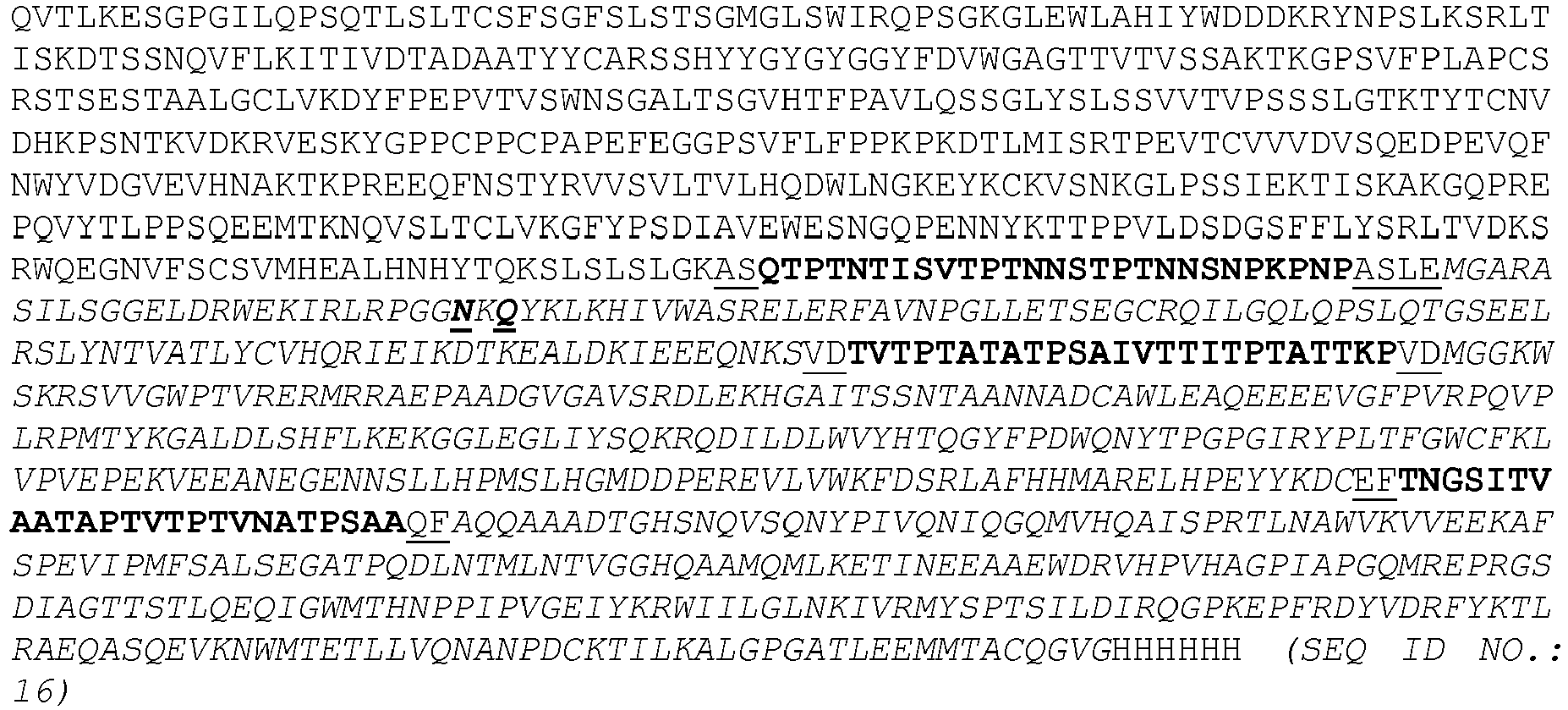
- Certain gag-nef antigen fusions with maximal antigen epitopes were found to have efficient secretion/production properties. Variants of gag p40 with inserts or appendages of nef antigen flanked by preferred flexible linker sequences were found to be particularly well produced and secreted. It was found that the flexible linker sequences disclosed herein and obtainable from cellulose degrading organisms were able to facilitate the secretion of intact antigens and/or linked antigens as antibody-antigen fusion proteins.
- DNA sequences of antigen coding sequence:C757 antigen region is [bold sequences are joining sites or a stop codon]:

- C791 linker and antigen coding sequence is [bold sequences are joining sites or a stop codon]:

- The following examples show that the present invention was able to target the HIV and other antigens to human DC via CD40. Generation of potent activating anti-CD40 monoclonal antibodies. Mice were immunized with a mouse IgG2b- human CD40 fusion protein and B cells from lymph nodes draining the injection site were subsequently immortalized as hybridomas. Supernatants from 35 hybridomas secreting anti-CD40 reactive antibodies as detected by FACS versus 293F cells transfected with CD40 CDNA were tested in overnight cultures of human dendritic cells for induction of cytokine secretion.
Figure 8 shows an example of this type of screen designed to detect the subset of anti-CD40 antibodies that can bind and activate CD40. This data set shows that two hybridomas 12E12 and 9A11 were especially potent in directing DC to secreted IL-12p40. cDNAs encoding the 12E12 heavy and light chains were derived using standard cloning and sequencing technologies and the variable regions were engineered into vectors expressing mouse 12E12 variable regions grafted onto human IgG4 constant regions. - C269 rAB-pIRES2[manti-CD40_12E12.3F3_K-V-hIgGK-C] The DNA sequence below shows the chimeric light chain coding region and the amino acid sequence the expected secreted mature light chain with the mouse variable region italicized.

- C230 rAB-pIRES2[manti-CD40_12E12.3F3_H-V-hIgG4H-C] The DNA sequence below shows the chimeric heavy chain coding region and the amino acid sequence the expected secreted mature light chain with the mouse variable region italicized.


- Variants of C230 were engineered to encode CD4012E12 H chains with antigens fused to the human IgG4 C-terminus e.g., C291 rAB-pIRES2[manti-CD40_12E12.3F3_H-V-hIgG4H-C-Flex-FluHA1-1-6xHis] encodes an H chain with the sequence shown below with the Influenza HA1-1 antigen region shown italicized and a flexible linker sequence and C-terminal poly-histidine tag shown in bold:

- Another type of variant H chain construct is C450 rAB-pIRES2[manti-CD40_12E12.3F3_H-LV-hIgG4H-C-Dockerin-var1] encodes an H chain with the sequence shown below with a C-terminal Dockerin domain antigen region shown italicized:

- Thus, expression vectors encoding the above and similar variant H chains can be co-transfected into 293F or CHO-S cells resulting in the secretion of anti-CD4012E12-hIgG4 antibody fusion proteins, which can be readily purified by protein A affinity chromatography.
- Such antibody-antigen proteins can be used as vaccines to deliver antigen with high efficiency to human dendritic cells in vitro or in vivo. The anti-CD4012E12-hIgG4 Dockerin protein can be used likewise to deliver cohesin-antigen fusion proteins. For example: C32 Ecoli-pET28[Cohesin-FluM1-6xHis] encodes the sequence shown below where the Influenza M1 protein is shown italicized:

- The above protein can be expressed as a soluble protein in E. coli and prepared as a pure product by ion exchange and metal affinity chromatographies. Highly stable complexes or conjugates between anti-CD4012E12-hIgG4 Dockerin fusion protein and Cohesin Flu M1 fusion protein can be assembled via the high affinity Dockerin-Cohesin interaction.
- A dose range of such anti-CD4012E12-hIgG4 Dockerin - Cohesin Flu M1 conjugates were incubated with human dendritic cells for one day, then syngeneic CD8+ T cells were added and incubation was continued for several more days. Cells were then stained with anti-CD8 antibody and a HLA-A2 tetramer reagent specific for T cells bearing TCR corresponding to the immunodominant Flu M1 epitope 58-66. Tetramer positive cells are shown in the boxed gate. This data shows that concentrations of anti-CD4012E12-hIgG4 Dockerin Cohesin Flu M1 conjugates as low as 0.001 ug/ml elicit the proliferation of Flu M1-specific CD8+ T cells at levels significantly higher than either no conjugate added or [next figure panel] than a parallel dose range series of control IgG4 Dockerin Cohesin Flu M1 conjugates. These data demonstrate that anti-CD4012E12 antibody is remarkably proficient at delivering antigen to DC resulting in processing and presentation of the antigen as seen by the proliferation of antigen specific T cells.
-
Figure 9 shows FACS analysis of CD8+ staining [horizontal axis] versus Flu M1-tetramer staining [vertical axis] as elicited by a dose range from 10 ug/ml to no anti-CD4012E12-hIgG4 Dockerin - Cohesin Flu M1 conjugate. -
Figure 10 shows FACS analysis of CD8+ staining [horizontal axis] versus Flu M1-tetramer staining [vertical axis] as elicited by a dose range from 10 ug/ml to no control hIgG4 Dockerin - Cohesin Flu M1 conjugate. - Alignment of C269 (seqA) anti-CD4012E12 light chain sequence with variants engineered to retain CD40 binding and to enhance similarity with human light chain variable sequences - and by including preferred codons to enhance expression of secreted product.


- Alignment of C268 (seqA) anti-CD4012E12 heavy chain sequence with a variant engineered to retain CD40 binding and to enhance similarity with human light chain variable sequences - and by including preferred codons to enhance expression of secreted product.

-
Figure 11 depicts the protocol used to assay in vitro the potency of anti-DC receptor - antigen targeting molecules [TM] to elicit the expansion of antigen-specific T cells in the context of a PBMC culture. Briefly, 2E6 PBMC from apheresis of HIV patients are incubated with a dose range of the targeting vaccine and 100 U/ml IL-2. Media is changed every two days. Onday 7 clusters of peptides corresponding to the antigen are added to induce IFNγ production by T cells with TCR specificities for peptide sequences within each cluster. After 4 hours incubation with the peptide cluster and an agent that blocks cytokine secretion, cells are stained with anti-CD4, anti-CD8, anti-IL-13, and anti-IFNγ reagents and analyzed by FACS. -
Figures 12 and13 show the effects of targeting DC [within the PBMC] with an anti-CD4012E12 gag p17 nef gag p24 vaccine - the H chain composition is shown below: C818 rAB-cetHS-puro[manti-CD40_12E12.3F3_H-LV-hIgG4H-C-Flex-v1-Viralgag-p17-f3-nef-f4-p24-6xHis] joining residues are underlined, flexible linker residues are in bold, and antigen residues are italicized]:

-
Figure 12 shows that the vaccine elicits the expansion of CD4+ T cells with specificities to all the gag p24 peptide clusters - even at the lowest vaccine does tested the percentage of IFNy-producing CD4+T cells was significantly greater than when the cells were not treated with peptides.Figure 13 [upper panel] shows this data in graph form - the vertical axis shows percent (%) IFNy-producing cells. The lower panel shows similar data for CD8+ T cells within the PBMC culture, and this data also shows that all peptide clusters covering the gag p24 sequence elicited significantly greater production of IFNγ-producing T cells than the non-peptide control. Thus, the vaccine elicited a potent and responses against multiple epitopes within HIV gag p24. -
Figure 14 shows that the vaccine elicits the expansion of CD4+ T cells with specificities to all the gag p17 peptide clusters - even at the lowest vaccine does tested the percentage of IFNy-producing CD4+T cells was significantly greater than when the cells were not treated with peptides.Figure 15 shows this data in graph form - the vertical axis shows percentage IFNy-producing cells [upper panel]. The lower panel shows similar data for CD8+ T cells within the PBMC culture, and this data also shows that all peptide clusters covering the gag p17 sequence elicited significantly greater production of IFNγ-producing T cells than the non-peptide control. Thus, the vaccine elicited a potent and responses against multiple epitopes within HIV gag p17. -
Figure 16 shows that the vaccine elicits the expansion of CD4+ T cells with specificities to most of the HIV nef peptide clusters - even at the lowest vaccine does tested the percentage of IFNγ-producing CD4+T cells was significantly greater than when the cells were not treated with peptides.Figure 17 shows this data in graph form - the vertical axis shows percentage IFNγ-producing cells [upper panel]. The lower panel shows similar data for CD8+ T cells within the PBMC culture, and this data also shows that all peptide clusters covering the nef sequence elicited significantly greater production of IFNγ-producing T cells than the non-peptide control. Thus the vaccine elicited a potent and response against multiple epitopes within HIV nef. - It was found that the data show the vaccine [anti-CD4012E12 - linked to the specially engineered gag p17 nef gag p24 fusion protein] can, even at low doses, elicit broad immune responses - i.e., wide representation of epitopes in both the CD4+ and CD8+ T cell compartments. This data further demonstrate that each of the two vaccine parts [anti-CD4012E12 and other antibodies with similar special properties, and the gag-nef antigen engineered for maximal epitope representation consistent with efficient production] - i.e., the anti-CD40 component can be a vehicle for delivery of other antigens, and the antigen component can be delivered by other anti-DC receptor vehicles. The results also demonstrate the ability of the CD40-based targeting to expand a wide array of antigen-specific CD4+ and CD8+ T cells from both memory [HIV patients given HIV vaccine] and naive [normal donors given PSA antigen] T cell populations.
- DCs targeted with anti-CD40-PSA induce PSA-specific CD4+ T cell responses.
Figure 18 shows the outline of a protocol to test the ability a vaccine composed of anti-CD40-12E12 linked to PSA [prostate-specific antigen] to elicit the expansion from a naive T cell population PSA-specific CD4+ T cells corresponding to a broad array of PSA epitopes. Briefly, DCs derived by culture with IFNα and GM-CSF of monocytes from a normal donor are incubated with the vaccine. The next day, cells are placed in fresh medium and pure CD4+ T cells from the same donor are added. Several days later, PSA peptides are added and, after four hours, secreted IFNγ levels in the culture supernatants are determined. -
Figure 19 shows that many PSA peptides elicit potent IFNγ-production responses indicating that anti-CD4012E12 and similar antiCD40 agents can effectively deliver antigen to DC, resulting in the priming of immune responses against multiple epitopes of the antigen. -
Figure 20 shows that DCs targeted with anti-CD40-PSA targeted to DCs induce PSA-specific CD8+ T cell responses. IFNDCs were targeted with 1 µg mAb fusion protein with PSA. Purified autologous CD8+ T cells were co-cultured for 10 days. Cells were stained with anti-CD8 and PSA (KLQCVDLHV)-tetramer. Cells are from a HLA-A*0201 positive healthy donor. The results demonstrate that anti-CD40 effectively delivers PSA to the DC, which in turn elicit the expansion of PSA-specific CD8+ T cells. -
Figure 21 outlines the DC targeting protocol for testing anti-DC receptor targeting vaccines for their ability to direct the expansion of antigen-specific T cells resulting from targeted uptake by the DC and presentation of antigen epitopes on their cell surface. Briefly, HIV patient monocytes are differentiated into DC by culture for 3 days in IFNα and GM-CSF. Vaccine [FP] is then added at 10 ug/ml along with autologous T cells. After 10 days in culture, antigen peptide clusters are added to the expanded T cells and after 4 hours intracellular IFNα is measured. -
Figure 22 [upper panel] shows comparison of the efficacy of anti-CD4012E12 nef, anti-CD4012E12 gag p24, and anti-CD4012E12 gag p17 nef gag p24 vaccines [patient Aph002]. Anti-CD4012E12 nef vaccine [green bars] stimulated the expansion of IFNa-producing CD4+ T cells responsive only to nef peptide epitopes, anti-CD4012E12 gag p24 [blue bars] stimulated the expansion of IFNα-producing CD4+ T cells responsive to only p24 peptide epitopes, while the anti-CD4012E12 gag p17 nef gag p24 stimulated the expansion of IFNα-producing CD8+ T cells responsive to gag p17, nef, and p24 peptide epitopes. -
Figure 22 [lower panel] shows comparison of the efficacy of anti-CD4012E12 nef, anti-CD4012E12 gag p24, and anti-CD4012E12 gag p17 nef gag p24 vaccines [patient Aph002]. Anti-CD4012E12 nef vaccine [green bars] stimulated the expansion of IFNa-producing CD8+ T cells responsive only to nef peptide epitopes, while anti-CD4012E12 gag p17 nef gag p24 [orange bars] stimulated the expansion of IFNα-producing CD8+ T cells responsive to both gag p17 and nef peptide epitopes. -
Figure 23 [upper panel] shows comparison of the efficacy of anti-CD4012E12 nef, anti-CD4012E12 gag p24, and anti-CD4012E12 gag p17 nef gag p24 vaccines [patient Aph010]. Anti-CD4012E12 nef vaccine [green bars] stimulated the expansion of IFNa-producing CD4+ T cells responsive only to nef peptide epitopes, anti-CD4012E12 gag p24 [blue bars] stimulated the expansion of IFNa-producing CD4+ T cells responsive to only p24 peptide epitopes, while the anti-CD4012E12 gag p17 nef gag p24 stimulated the expansion of IFNα-producing CD8+ T cells responsive to gag p17, nef, and p24 peptide epitopes. -
Figure 23 [lower panel] shows comparison of the efficacy of anti-CD4012E12 nef, anti-CD4012E12 gag p24, and anti-CD4012E12 gag p17 nef gag p24 vaccines [patient Aph002]. Anti-CD4012E12 nef vaccine [green bars] stimulated the expansion of IFNa-producing CD8+ T cells responsive only to nef peptide epitopes, anti-CD4012E12 gag p24 [blue bars] stimulated the expansion of IFNα-producing CD8+ T cells responsive to only p24 peptide epitopes, while anti-CD4012E12 gag p17 nef gag p24 [orange bars] stimulated the expansion of IFNa-producing CD8+ T cells responsive to both gag p17 and nef peptide epitopes. - These data demonstrate that the anti-CD4012E12 gag p17 nef gag p24 vaccine can elicit a broad array of T cell responses covering multiple epitopes within all three antigen elements of the vaccine - HIV gag p17, HIV gag p24, and HIV nef.
- The sequence below is the amino acid sequence of the Cohesin [bold residues] - Cyclin D1 [underlined residues] fusion protein expressed by the C515 vector.
C515 E. coli-pET28 [Cohesin-hCyclinD1-6xHis]
- Expression and purification of Coh.Cyclin D1 protein produced in E. coli.
- Coh.Cyclin D1 was expressed in E. coli strain T7 Express (NEB) grown in Luria broth (Difco) at 37°C with selection for kanamycin resistance (40 µg/ml) and shaking at 200 rounds/min to mid-log growth phase. Then 120 mg/L IPTG (Bioline) was added and after a further 3 hrs, the cells were harvested by centrifugation and stored at -80°C. E. coli cells from each 1 L fermentation were resuspended in 50 ml ice-cold 50 mM Tris, 1 mM EDTA pH 8.0 with 0.2 ml of protease inhibitor Cocktail II (Calbiochem). The cells were sonicated twice on ice for 4 min at setting 18 (Fisher Sonic Dismembrator 60) with a 5 min rest period and then spun at 17,000 r.p.m. (Sorvall SA-600) for 20 min at 4°C. The 50 ml cell lysate supernatant was passed through 10 ml of ANX Sepharose beads (GE Healthcare), then the flow-through was adjusted to binding buffer with 7.5 ml 160 mM Tris, 40 mM imidazole, 4 M NaCl pH 7.9 and loaded onto a 5 ml HiTrap chelating HP column (GE Healthcare) charged with Ni++. The bound protein was washed with 20 mM NaPO4, 300 mM NaCl, 10 mM imidazole pH 7.6 (buffer A) and eluted with a 10-500 mM imidazole gradient in buffer A. The peak fractions were analyzed by SDS-PAGE gel, pooled. Approximately 15 milligrams of the pooled eluted Cohesin-Cyclin D1 fusion protein was reacted overnight at room temperature with 10 milligrams of mPEG-MAL 20k reagent (Nektar), which attaches a 20 kDa pegyl group to free cysteine residues [of which there are several within the Cyclin D1 domain]. A part of this reaction was dialyzed versus DPBS [Gibco] and part was adjusted to pH 7.5, then DTT was added to 10 mM for 1.5 hours at room temperature to reduce any disulphide bonds, followed by addition of 25 mM iodoacetamide for 1.5 hours at room temperature to alkylate the free cysteine residues, followed by addition of 20 mM DTT for 1.5 hours at room temperature, followed by dialysis versus DPBS. The pegylation was required to ensure the protein remained soluble in DPBS and the alkylation [which was not necessary for the activity of the protein in the context of in vitro anti-CD40 targeting] served to ensure that the product was free of intermolecular disulphide cross-linked forms.
-
Figure 24 . Analysis of the interaction of Cohesin-Cyclin D1 fusion protein with anti-DC receptor-Dockerin recombinant antibody. Antibody-Dockerin or antibody-HIV nef fusion protein [20 µg] was incubated with 100 µl protein A-Sepharose beads [GE Biosciences] then washed twice with DPBS. Pegylated [peg] or pegylated and alkylated [peg alk] Cohesin-Cyclin D1 [Coh.Cyclin D1] were added [20 µg] and, after 30 minutes at room temperature, the supernatant was separated from the beads by centrifugation. The beads were eluted with 20 mM HCl and the eluate and supernatant were dried, resuspended in SDS.PAGE loading buffer and run on reducing SDS.PAGE and visualized by Coomasssie Blue staining.Lane 1 shows the supernatant from beads loaded with antibody-Dockerin + peg Coh.Cyclin D1 andLane 2 is the corresponding bead eluate.Lane 3 shows the supernatant from beads loaded with antibody-HIV nef + peg Coh.Cyclin D1 andLane 4 is the corresponding bead eluate.Lane 5 shows the supernatant from beads loaded with antibody-Dockerin + peg alk Coh.Cyclin D1 andLane 6 is the corresponding bead eluate.Lane 7 shows the supernatant from beads loaded with antibody-HIV nef + peg alk Coh.Cyclin D1 andLane 8 is the corresponding bead eluate.Lane 9 shows antibody-Dockerin alone,lane 10 shows antibody-HIV nef alone,Lane 11 shows peg Coh.Cyclin D1 alone, andLane 12 shows shows peg alk Coh.Cyclin D1 alone. The arrows [top to bottom] show: 1) high molecular weight pegylated forms of Coh.Cyclin D1, 2) the position of antibody heavy chain, 3) the position of non-pegylated Coh.Cyclin D1 [which is about 50% of the preparations], 4) the position of the antibody light chain. - The above analysis shows that antibody-Dockerin, but not antibody-HIV nef, effectively captures most of the Coh.Cyclin D1. This demonstrates that the Coh.Cyclin D1 preparations can assemble a complex with anti-DC receptor-Dockerin targeting vehicles.
- Mantle Cell Lymphoma (MCL) is a B-cell non-Hodgkin's lymphoma which represents 5-10% of all non-Hodgkin's lymphoma, predominantly in males with advanced age. It is a very aggressive cancer with the worst prognosis after conventional treatment, frequent relapses, and relatively short survival. It has a genetic hallmark: t (11;14) (q13; q32) translocation ---- leading to the over expression of Cyclin D1.
- G1/S-specific cyclin-Dl - alternatively named PRAD1, Bcl-1 functions in cell cycle control of G1 progression and G1/S transition via forming complexes with CDK4 and 6. There is no normal expression in mature lymphocytes since expression is cell cycle dependent with maximal expression in G1, minimal in S. Thus, raising cytotoxic T cell responses specifically directed to cells over expressing Cyclin D1 is an attractive MCL vaccination strategy.
-
Figure 25 shows a schema of overlapping peptides from Cyclin D1. These are added to T cell cultures, either as individual peptides or as pools of peptides, where they can be presented on MHC and thereby stimulate proliferation of peptide specific T cells. -
Figure 26 shows a schema [left panel] of the study design for testing the ability of anti-CD40-Cyclin D1 complexes to elicit expansion in vitro of Cyclin D1-specific CD4+ T cells. After incubation of DCs with the targeting complex, autologous CD4+ T cells [i.e., from the same donor] labeled with the dye CFSC are added and culture continues for an additional 8 days with IL-2, then 2 days rest without IL-2. Next, the culture is divided and stimulated with individual Cyclin D peptides, or no peptide, for 8 hours followed by staining for intracellular IFNg and IL-2 [indicators of T cell activation] and analysis by FACS. - The analysis shows that Cyclin D peptides P8, P16, and P54 stimulate significantly greater production of proliferating [i.e., marked by CFSC dilution] CD4+ T cells than cells incubated without peptide [or other Cyclin D1 peptides [not shown]. Thus, the anti-CD40-Cyclin D1 complex functions to elicit the expansion from T cells of a normal donor of Cyclin D1-specific T cells with effector function phenotype.
-
Figure 27 shows a study and analysis similar to that detailed inFigure 26 , except that a different normal donor was used - in this case the anti-CD40-Cyclin D1 complex elicited the expansion of IFNg positive proliferating CD4+ T cells specific for Cyclin D1 peptides P4, P43, and P70. -
Figure 28 shows a schema and analysis similar to those described above inFigure 26 , except that CD8+ T cells were used. In this donor, anti-CD40-Cyclin D1 complex elicited the expansion of Cyclin D1-specific CD8+ T cells, in particular those with specificities corresponding to peptides contained within pool I and pool II. -
Figure 29 shows similar data from the same donor, but analyzed with individual peptides from these pools. In particular, these T cells show specificity for peptides P7, P8, and P10. - It is contemplated that any embodiment discussed in this specification can be implemented with respect to any method, kit, reagent, or composition of the invention, and vice versa. Furthermore, compositions of the invention can be used to achieve methods of the invention.
- It will be understood that particular embodiments described herein are shown by way of illustration and not as limitations of the invention. The principal features of this invention can be employed in various embodiments without departing from the scope of the invention. Those skilled in the art will recognize, or be able to ascertain using no more than routine experimentation, numerous equivalents to the specific procedures described herein. Such equivalents are considered to be within the scope of this invention and are covered by the claims.
- All publications and patent applications mentioned in the specification are indicative of the level of skill of those skilled in the art to which this invention pertains. All publications and patent applications are herein incorporated by reference to the same extent as if each individual publication or patent application was specifically and individually indicated to be incorporated by reference.
- The use of the word "a" or "an" when used in conjunction with the term "comprising" in the claims and/or the specification may mean "one," but it is also consistent with the meaning of "one or more," "at least one," and "one or more than one." The use of the term "or" in the claims is used to mean "and/or" unless explicitly indicated to refer to alternatives only or the alternatives are mutually exclusive, although the disclosure supports a definition that refers to only alternatives and "and/or." Throughout this application, the term "about" is used to indicate that a value includes the inherent variation of error for the device, the method being employed to determine the value, or the variation that exists among the study subjects.
- As used in this specification and claim(s), the words "comprising" (and any form of comprising, such as "comprise" and "comprises"), "having" (and any form of having, such as "have" and "has"), "including" (and any form of including, such as "includes" and "include") or "containing" (and any form of containing, such as "contains" and "contain") are inclusive or open-ended and do not exclude additional, unrecited elements or method steps.
- The term "or combinations thereof" as used herein refers to all permutations and combinations of the listed items preceding the term. For example, "A, B, C, or combinations thereof' is intended to include at least one of: A, B, C, AB, AC, BC, or ABC, and if order is important in a particular context, also BA, CA, CB, CBA, BCA, ACB, BAC, or CAB. Continuing with this example, expressly included are combinations that contain repeats of one or more item or term, such as BB, AAA, MB, BBC, AAABCCCC, CBBAAA, CABABB, and so forth. The skilled artisan will understand that typically there is no limit on the number of items or terms in any combination, unless otherwise apparent from the context.
- All of the compositions and/or methods disclosed and claimed herein can be made and executed without undue experimentation in light of the present disclosure. While the compositions and methods of this invention have been described in terms of preferred embodiments, it will be apparent to those of skill in the art that variations may be applied to the compositions and/or methods and in the steps or in the sequence of steps of the method described herein without departing from the concept, spirit and scope of the invention. All such similar substitutes and modifications apparent to those skilled in the art are deemed to be within the spirit, scope and concept of the invention as defined by the appended claims.
-
- 1. A method for increasing the effectiveness of antigen presentation by an antigen presenting cell comprising:
- isolating and purifying a dendritic cell (DC)-specific antibody or fragment thereof to which an engineered Gag antigen is attached to form an antibody-antigen complex,
- wherein the Gag antigen is less susceptible to proteolytic degradation by eliminating one or more proteolytic sites; and contacting the antigen presenting cell under conditions wherein the antibody-antigen complex is processed and presented for T cell recognition.
- 2. The method of
aspect 1, wherein the antigen presenting cell comprises a dendritic cell. - 3. The method of
aspect 1, wherein the DC-specific antibody or fragment thereof is bound to one half of a Coherin/Dockerin pair. - 4. The method of
aspect 1, wherein the DC-specific antibody or fragment thereof is bound to one half of a Coherin/Dockerin pair and the engineered Gag antigen is bound to the complementary half of the Coherin/Dockerin pair to form a complex. - 5. The method of
aspect 1, wherein the antibody-antigen complex further comprises a flexible linker between the DC-specific antibody or fragment thereof and the Gag antigen. - 6. The method of
aspect 1, wherein the antibody-antigen complex further comprises one or more new glycosylation sites. - 7. The method of
aspect 1, wherein the antibody-antigen complex further comprises a flexible linker between the DC-specific antibody or fragment thereof and the Gag antigen that comprises one or more glycosylation sites that provide increased flexibility between the antibody and the antigen, decreased proteolysis at the linker and increased secretion. - 8. The method of
aspect 1, wherein the antibody-antigen complex further comprises a flexible linker between the DC-specific antibody or fragment thereof and the Gag antigen. - 9. The method of
aspect 1, wherein the antibody-antigen complex further comprises a flexible linker between the DC-specific antibody or fragment thereof and the Gag antigen that comprises one or more glycosylation sites selected from a linker sequence derived from a cellulose degrading organism. - 10. The method of
aspect 1, wherein the DC-specific antibody or fragment thereof is humanized. - 11. The method of
aspect 1, wherein the antibody-antigen complex is selected from SEQ ID NOS: 1, 2, 3, 4, 5, 7, 8, 9, 10, 11, 12, 13, 14, 15, 16, 17, 18, 19, 20, 21, 22, 23, 31 or 32. - 12. The method of
aspect 1, wherein the DC-specific antibody or fragment binds is selected from an antibody that specifically binds to MHC class I, MHC class II, CD1, CD2, CD3, CD4, CD8, CD11b, CD14, CD15, CD16, CD19, CD20, CD29, CD31, CD40, CD43, CD44, CD45, CD54, CD56, CD57, CD58, CD83, CD86, CMRF-44, CMRF-56, DCIR, DC-ASPGR, CLEC-6, CD40, BDCA-2, MARCO, DEC-205, mannose receptor, Langerin, DECTIN-1, B7-1, B7-2, IFN-γ receptor and IL-2 receptor, ICAM-1, Fcγ receptor, LOX-1, and ASPGR. - 13. A method for increasing the effectiveness of antigen presentation by an antigen presenting cell comprising:
- isolating and purifying a DC-specific antibody or fragment thereof to which an engineered Nef antigen is attached to form an antibody-antigen complex, wherein the Nef antigen comprises one or more codon usage optimization that increase antibody-antigen complex secretion; and
- contacting the antigen presenting cell under conditions wherein the antibody-antigen complex is processed and presented for T cell recognition.
- 14. The method of
aspect 13, wherein the antigen presenting cell comprises a dendritic cell. - 15. The method of
aspect 13, wherein the DC-specific antibody or fragment thereof is bound to one half of a Coherin/Dockerin pair and the engineered Nef antigen is bound to the complementary half of the Coherin/Dockerin pair to form a complex. - 16. The method of
aspect 13, wherein the antibody-antigen complex further comprises a flexible linker between the DC-specific antibody or fragment thereof and the Nef antigen. - 17. The method of
aspect 13, wherein the antibody-antigen complex further comprises a flexible linker between the DC-specific antibody or fragment thereof and the Nef antigen that comprises one or more glycosylation sites that provide increased flexibility between the antibody and the antigen, decreased proteolysis at the linker and increased secretion. - 18. The method of
aspect 13, wherein the antibody-antigen complex further comprises a flexible linker between the DC-specific antibody or fragment thereof and the Nef antigen. - 19. The method of
aspect 13, wherein the antibody-antigen complex further comprises a flexible linker between the DC-specific antibody or fragment thereof and the Gag antigen that comprises one or more glycosylation sites selected from a linker sequence derived from a cellulose degrading organism. - 20. The method of
aspect 13, wherein the DC-specific antibody or fragment thereof is humanized. - 21. The method of
aspect 13, wherein the antibody-antigen complex is selected from SEQ ID NOS: 1, 2, 3, 4, 5, 7, 8, 9, 10, 11, 12, 13, 14, 15, 16, 17, 18, 19, 20, 21, 22, 23, 31 or 32. - 22. The method of
aspect 13, wherein the DC-specific antibody or fragment binds is selected from an antibody that specifically binds to MHC class I, MHC class II, CD1, CD2, CD3, CD4, CD8, CD11b, CD14, CD15, CD16, CD19, CD20, CD29, CD31, CD40, CD43, CD44, CD45, CD54, CD56, CD57, CD58, CD83, CD86, CMRF-44, CMRF-56, DCIR, DC-ASPGR, CLEC-6, CD40, BDCA-2, MARCO, DEC-205, mannose receptor, Langerin, DECTIN-1, B7-1, B7-2, IFN-γ receptor and IL-2 receptor, ICAM-1, Fcγ receptor, LOX-1, and ASPGR. - 23. A vaccine comprising a DC-specific antibody or fragment thereof to which an engineered Gag antigen is attached to form an antibody-antigen complex, wherein the Gag antigen is less susceptible to proteolytic degradation by eliminating one or more proteolytic sites.
- 24. The vaccine of aspect 23, wherein the antibody-antigen complex further comprises a flexible linker between the DC-specific antibody or fragment thereof and the Gag antigen.
- 25. The vaccine of aspect 23, wherein the antibody-antigen complex further comprises one or more new glycosylation sites.
- 26. The vaccine of aspect 23, wherein the antibody-antigen complex further comprises a flexible linker between the DC-specific antibody or fragment thereof and the Gag antigen that comprises one or more glycosylation sites that provide increased flexibility between the antibody and the antigen, decreased proteolysis at the linker and increased secretion.
- 27. The vaccine of aspect 23, wherein the antibody-antigen complex further comprises a flexible linker between the DC-specific antibody or fragment thereof and the Gag antigen.
- 28. The vaccine of aspect 23, wherein the antibody-antigen complex further comprises a flexible linker between the DC-specific antibody or fragment thereof and the Gag antigen that comprises one or more glycosylation sites selected from a linker sequence derived from a cellulose degrading organism.
- 29. The vaccine of aspect 23, wherein the DC-specific antibody or fragment thereof is humanized.
- 30. The vaccine of aspect 23, wherein the antibody-antigen complex is selected from SEQ ID NOS: 1, 2, 3, 4, 5, 7, 8, 9, 10, 11, 12, 13, 14, 15, 16, 17, 18, 19, 20, 21, 22, 23, 31 or 32.
- 31. The vaccine of aspect 23, wherein the DC-specific antibody or fragment binds is selected from an antibody that specifically binds to MHC class I, MHC class II, CD1, CD2, CD3, CD4, CD8, CD11b, CD14, CD15, CD16, CD19, CD20, CD29, CD31, CD40, CD43, CD44, CD45, CD54, CD56, CD57, CD58, CD83, CD86, CMRF-44, CMRF-56, DCIR, DC-ASPGR, CLEC-6, CD40, BDCA-2, MARCO, DEC-205, mannose receptor, Langerin, DECTIN-1, B7-1, B7-2, IFN-γ receptor and IL-2 receptor, ICAM-1, Fcγ receptor, LOX-1, and ASPGR.
- 32. A vaccine comprising a DC-specific antibody or fragment thereof to which an engineered Nef antigen is attached to form an antibody-antigen complex, wherein the Nef antigen comprises one or more codon usage optimization that increase antibody-antigen complex secretion.
- 33. The vaccine of aspect 32, wherein the antibody-antigen complex further comprises a flexible linker between the DC-specific antibody or fragment thereof and the Nef antigen.
- 34. The vaccine of aspect 32, wherein the antibody-antigen complex further comprises one or more new glycosylation sites.
- 35. The vaccine of aspect 32, wherein the antibody-antigen complex further comprises a flexible linker between the DC-specific antibody or fragment thereof and the Nef antigen that comprises one or more glycosylation sites that provide increased flexibility between the antibody and the antigen, decreased proteolysis at the linker and increased secretion.
- 36. The vaccine of aspect 32, wherein the antibody-antigen complex further comprises a flexible linker between the DC-specific antibody or fragment thereof and the Nef antigen.
- 37. The vaccine of aspect 32, wherein the antibody-antigen complex further comprises a flexible linker between the DC-specific antibody or fragment thereof and the Gag antigen that comprises one or more glycosylation sites selected from a linker sequence derived from a cellulose degrading organism.
- 38. The vaccine of aspect 32, wherein the DC-specific antibody or fragment thereof is humanized.
- 39. The vaccine of aspect 32, wherein the antibody-antigen complex is selected from SEQ ID NOS: 1, 2, 3, 4, 5, 7, 8, 9, 10, 11, 12, 13, 14, 15, 16, 17, 18, 19, 20, 21, 22, 23, 31 or 32.
- 40. The vaccine of aspect 32, wherein the DC-specific antibody or fragment binds is selected from an antibody that specifically binds to MHC class I, MHC class II, CD1, CD2, CD3, CD4, CD8, CD11b, CD14, CD15, CD16, CD19, CD20, CD29, CD31, CD40, CD43, CD44, CD45, CD54, CD56, CD57, CD58, CD83, CD86, CMRF-44, CMRF-56, DCIR, DC-ASPGR, CLEC-6, CD40, BDCA-2, MARCO, DEC-205, mannose receptor, Langerin, DECTIN-1, B7-1, B7-2, IFN-γ receptor and IL-2 receptor, ICAM-1, Fcγ receptor, LOX-1, and ASPGR.
- 41. A vaccine comprising:
- a DC-specific antibody or fragment thereof to which an engineered Gag antigen is attached to form an antibody-antigen complex, wherein the Gag antigen is less susceptible to proteolytic degradation by eliminating one or more proteolytic sites; and
- a DC-specific antibody or fragment thereof to which an engineered Nef antigen is attached to form an antibody-antigen complex, wherein the Nef antigen comprises one or more codon usage optimization that increase antibody-antigen complex secretion, wherein the vaccine is able to elicit an HIV-specific T cell immune response to Gag p17, Gag p24 and Nef.
- 42. The vaccine of aspect 41, wherein the Gag and Nef antigens comprise a fusion protein.
- 43. The vaccine of aspect 41, wherein the Gag and Nef antigens comprise a fusion protein separated by one or more flexible linkers.
- 44. The vaccine of aspect 41, wherein the antibody-antigen complex further comprises a flexible linker between the DC-specific antibody or fragment thereof and the Gag or Nef antigen.
- 45. The vaccine of aspect 41, wherein the antibody-antigen complex further comprises a flexible linker between the DC-specific antibody or fragment thereof and the Gag antigen that comprises one or more glycosylation sites selected from a linker sequence derived from a cellulose degrading organism.
- 46. The vaccine of aspect 41, wherein the DC-specific antibody or fragment thereof is humanized.
- 47. The vaccine of aspect 41, wherein the vaccine is selected from SEQ ID NOS: 1, 2, 3, 4, 5, 7, 8, 9, 10, 11, 12, 13, 14, 15,16, 17, 18, 19, 20, 21, 22, 23, 31 or 32.
- 48. A vaccine comprising:
- a DC-specific antibody or fragment thereof to which an engineered Gag antigen is attached to form an antibody-antigen complex, wherein the Gag antigen is less susceptible to proteolytic degradation by eliminating one or more proteolytic sites; and
- an engineered Nef antigen that is attached to the DC-specific antibody or fragment thereof or to the engineered Gag antigen form an antibody-antigen complex, wherein the Nef antigen comprises one or more codon usage optimization that increase antibody-antigen complex secretion, wherein the vaccine is able to elicit an HIV-specific T cell immune response to Gag p17, Gag p24 and Nef.
- 49. The vaccine of aspect 48, wherein the DC-specific antibody or fragment thereof Gag and Nef antigens comprise a fusion protein.
- 50. The vaccine of aspect 48, wherein the Gag and Nef antigens comprise a fusion protein separated by one or more flexible linkers.
- 51. The vaccine of aspect 48, wherein the protein is selected from SEQ ID NOS.: 1, 2, 3, 4, 5, 7, 8, 9, 10, 11, 12, 13, 14, 15, 16, 17, 18, 19, 20, 21, 22, 23, 31 or 32.
- 52. A method for increasing the effectiveness of dendritic cells comprising:
- isolating patient dendritic cells;
- exposing the dendritic cells to activating amounts of a vaccine comprising:
- a DC-specific antibody or fragment thereof to which an engineered Gag antigen is attached to form an antibody-antigen complex, wherein the Gag antigen is less susceptible to proteolytic degradation by eliminating one or more proteolytic sites; and
- an engineered Nef antigen that is attached to the DC-specific antibody or fragment thereof or to the engineered Gag antigen form an antibody-antigen complex, wherein the Nef antigen comprises one or more codon usage optimization that increase antibody-antigen complex secretion, wherein the vaccine is able to elicit an HIV-specific T cell immune response to Gag p17, Gag p24 and Nef; and
- reintroducing the antigen-loaded, activated dendritic cells into the patient.
- 53. A vaccine comprising a DC-specific antibody or fragment thereof to which an engineered antigen comprising Cyclin D1 or fragments attached to form an antibody-antigen complex, wherein the Cyclin D1 antigen is less susceptible to proteolytic degradation by eliminating one or more proteolytic sites.
- 54. The vaccine of aspect 53, wherein the antibody-antigen complex further comprises a flexible linker between the DC-specific antibody or fragment thereof and the Cyclin D1 antigen.
- 55. The vaccine of aspect 53, wherein the antibody-antigen complex further comprises one or more new glycosylation sites.
- 56. The vaccine of aspect 53, wherein the antibody-antigen complex further comprises a flexible linker between the DC-specific antibody or fragment thereof and the Cyclin D1 antigen that comprises one or more glycosylation sites that provide increased flexibility between the antibody and the antigen, decreased proteolysis at the linker and increased secretion.
- 57. The vaccine of aspect 53, wherein the antibody-antigen complex further comprises a flexible linker between the DC-specific antibody or fragment thereof and the Cyclin D1 antigen that comprises one or more glycosylation sites selected from a linker sequence derived from a cellulose degrading organism.
- 58. The vaccine of aspect 53, wherein the DC-specific antibody or fragment thereof is humanized.
- 59. The vaccine of aspect 53, wherein the DC-specific antibody or fragment thereof is bound to one half of a Coherin/Dockerin pair and the engineered Cyclin D1 antigen is bound to the complementary half of the Coherin/Dockerin pair to form a complex.
- 60. A method for increasing the effectiveness of dendritic cells comprising:
- isolating patient dendritic cells;
- exposing the dendritic cells to activating amounts of a vaccine comprising:
- a DC-specific antibody or fragment thereof to which an engineered antigen comprising Cyclin D1 or fragment(s) thereof attached to form an antibody-antigen complex, wherein the Cyclin D1 antigen is less susceptible to proteolytic degradation by eliminating one or more proteolytic sites; and
- reintroducing the antigen-loaded, activated dendritic cells into the patient.
- 61. An isolated and purified nucleic acid that encodes a polypeptide selected from SEQ ID NO.: 1, 2, 3, 4, 5, 7, 8, 9, 10, 11, 12, 13, 14, 15, 16, 17, 18, 19, 20, 21, 22, 23, 31 or 32.
- 62. An isolated and purified polypeptide selected from SEQ ID NO.: 1, 2, 3, 4, 5, 7, 8, 9, 10, 11, 12, 13, 14, 15, 16, 17, 18, 19, 20, 21, 22, 23, 31 or 32.
Claims (13)
- An antibody-antigen complex, comprising:a dendritic cell (DC)-specific antibody or antigen binding fragment thereof to which a Gag or Nef antigen is attached;wherein the antibody-antigen complex comprisesa flexible linker between the DC-specific antibody or antigen binding fragment thereof and the Gag or Nef antigen.
- The antibody-antigen complex of claim 1, wherein the flexible linker comprises one or more glycosylation sites.
- The antibody-antigen complex of claim 1 or 2, wherein the flexible linker comprises a polypeptide with an amino acid sequence selected from SEQ ID NOs: 4 and 6.
- The antibody-antigen complex of claims 1 to 3, wherein the DC specific antibody or antigen binding fragment is selected from an antibody or antigen binding fragment that specifically binds to MHC class I, MHC class II, CD1, CD2, CD3, CD4, CD8, CD11b, CD14, CD15, CD16, CD19, CD20, CD29, CD31, CD40, CD43, CD44, CD45, CD54, CD56, CD57, CD58, CD83, CD86, CMRF-44, CMRF-56, DCIR, CLEC-6, CD40, BDCA-2, MARCO, DEC-205, mannose receptor, Langerin, DECTIN-1, B7-1, B7-2, IFN-γ receptor and IL-2 receptor, ICAM-1, Fcγ receptor, LOX-1, or ASGPR.
- The antibody-antigen complex of claim 4, wherein the DC specific antibody or antigen binding fragment, specifically binds to CD40.
- The antibody-antigen complex of any one of claims 1-4, wherein the DC-specific antibody or fragment thereof is humanized.
- The fusion protein of claim 6, wherein the CD40 antibody comprises:(i). a light chain sequence of SEQ ID NO: 24, 25, 26, 27 or 28;(ii) a heavy chain sequence of SEQ ID NO: 29 or 30; or(iii) a light chain sequence of SEQ ID NO: 24, 25, 26, 27 or 28 and a heavy chain sequence of SEQ ID NO: 29 or 30.
- A vaccine comprising the antibody-antigen complex of any one of claims 1 to 7.
- The vaccine of claim 8, for use in the treatment or prevention of HIV.
- The vaccine for use according to claim 9, wherein the vaccine is able to elicit an HIV-specific T cell immune response.
- An engineered protein for expression in eukaryotic hosts, comprising SEQ ID NO: 4 as an interstructural domain linker.
- An engineered protein of claim 11, wherein said engineered protein is a fusion protein comprising SEQ ID NO: 4 as an interstructural domain linker.
- Use of SEQ ID NO: 4 for engineering proteins for improving expression in eukaryotic hosts.
Applications Claiming Priority (3)
| Application Number | Priority Date | Filing Date | Title |
|---|---|---|---|
| US8123408P | 2008-07-16 | 2008-07-16 | |
| PCT/US2009/050903 WO2010009346A2 (en) | 2008-07-16 | 2009-07-16 | Hiv vaccine based on targeting maximized gag and nef to dendritic cells |
| EP09798772A EP2307048A4 (en) | 2008-07-16 | 2009-07-16 | HIV VACCINE BASED ON MAXIMIZED TARGETING OF GAG AND NEF IN RELATION TO DENDRITIC CELLS |
Related Parent Applications (1)
| Application Number | Title | Priority Date | Filing Date |
|---|---|---|---|
| EP09798772A Division EP2307048A4 (en) | 2008-07-16 | 2009-07-16 | HIV VACCINE BASED ON MAXIMIZED TARGETING OF GAG AND NEF IN RELATION TO DENDRITIC CELLS |
Publications (2)
| Publication Number | Publication Date |
|---|---|
| EP3388450A1 true EP3388450A1 (en) | 2018-10-17 |
| EP3388450B1 EP3388450B1 (en) | 2021-07-07 |
Family
ID=41551022
Family Applications (3)
| Application Number | Title | Priority Date | Filing Date |
|---|---|---|---|
| EP09798772A Withdrawn EP2307048A4 (en) | 2008-07-16 | 2009-07-16 | HIV VACCINE BASED ON MAXIMIZED TARGETING OF GAG AND NEF IN RELATION TO DENDRITIC CELLS |
| EP15182056.0A Active EP2966091B1 (en) | 2008-07-16 | 2009-07-16 | Agonistic anti-cd40 antibodies |
| EP18173658.8A Active EP3388450B1 (en) | 2008-07-16 | 2009-07-16 | Hiv vaccine based on targeting maximized gag and nef to dendritic cells |
Family Applications Before (2)
| Application Number | Title | Priority Date | Filing Date |
|---|---|---|---|
| EP09798772A Withdrawn EP2307048A4 (en) | 2008-07-16 | 2009-07-16 | HIV VACCINE BASED ON MAXIMIZED TARGETING OF GAG AND NEF IN RELATION TO DENDRITIC CELLS |
| EP15182056.0A Active EP2966091B1 (en) | 2008-07-16 | 2009-07-16 | Agonistic anti-cd40 antibodies |
Country Status (19)
| Country | Link |
|---|---|
| US (1) | US9109011B2 (en) |
| EP (3) | EP2307048A4 (en) |
| JP (2) | JP5984388B2 (en) |
| KR (2) | KR20110036618A (en) |
| CN (1) | CN102625714B (en) |
| AP (1) | AP2011005541A0 (en) |
| AU (1) | AU2009270771B2 (en) |
| BR (1) | BRPI0915915A2 (en) |
| CA (1) | CA2730742C (en) |
| DK (1) | DK2966091T3 (en) |
| ES (2) | ES2890230T3 (en) |
| IL (1) | IL210646A0 (en) |
| MX (1) | MX2011000507A (en) |
| MY (1) | MY155377A (en) |
| NZ (3) | NZ594540A (en) |
| PT (1) | PT2966091T (en) |
| RU (2) | RU2539765C2 (en) |
| WO (1) | WO2010009346A2 (en) |
| ZA (1) | ZA201100398B (en) |
Families Citing this family (45)
| Publication number | Priority date | Publication date | Assignee | Title |
|---|---|---|---|---|
| WO2010009346A2 (en) | 2008-07-16 | 2010-01-21 | Baylor Research Institute | Hiv vaccine based on targeting maximized gag and nef to dendritic cells |
| JP2012501323A (en) * | 2008-08-29 | 2012-01-19 | アカデミシュ ジーケンハウス ライデン ハー.オー.デー.エン. ルムク | Delivery of a CD40 agonist to a subject's tumor draining lymph nodes |
| CN108373509A (en) * | 2009-03-10 | 2018-08-07 | 贝勒研究院 | The antiviral vaccine of target antigen presenting cells |
| BRPI1009454A2 (en) * | 2009-03-10 | 2019-09-24 | Baylor Res Institute | cancer vaccines targeted at antigen presenting cells |
| BRPI1009455A2 (en) | 2009-03-10 | 2016-03-01 | Baylor Res Inst | anti-c40 antibodies and uses thereof |
| WO2011032161A2 (en) * | 2009-09-14 | 2011-03-17 | Baylor Research Institute | Vaccines directed to langerhans cells |
| JP5628544B2 (en) * | 2010-04-07 | 2014-11-19 | 株式会社豊田中央研究所 | Protein for constructing a protein complex derived from clostridium thermocellum and use thereof |
| CA2798616A1 (en) | 2010-05-07 | 2011-11-10 | Baylor Research Institute | Dendritic cell immunoreceptors (dcir)-mediated crosspriming of human cd8+ t cells |
| KR20130108295A (en) * | 2010-08-13 | 2013-10-02 | 베일러 리서치 인스티튜트 | Novel vaccine adjuvants based on targeting adjuvants to antibodies directly to antigen-presenting cells |
| US20120128710A1 (en) * | 2010-11-02 | 2012-05-24 | Baylor Research Institute | Enhancement of Pathogen-Specific Memory Th17 Cell Responses |
| WO2012122396A1 (en) * | 2011-03-08 | 2012-09-13 | Baylor Research Institute | Novel vaccine adjuvants based on targeting adjuvants to antibodies directly to antigen-presenting cells |
| US20120301465A1 (en) * | 2011-03-25 | 2012-11-29 | Institut National De La Sante Et De La Recherche Medicale (Inserm) | Compositions and methods to immunize against hepatitis c virus |
| KR102037432B1 (en) | 2011-04-29 | 2019-11-27 | 아펙시젠, 인코포레이티드 | Anti-cd40 antibodies and methods of use |
| EP2620446A1 (en) | 2012-01-27 | 2013-07-31 | Laboratorios Del Dr. Esteve, S.A. | Immunogens for HIV vaccination |
| WO2014031984A1 (en) * | 2012-08-24 | 2014-02-27 | Baylor Research Institute | Immunological detection methods and compositions |
| WO2014039840A1 (en) * | 2012-09-07 | 2014-03-13 | Baylor Research Institute | Hiv vaccine compositions and methods |
| CA2888763A1 (en) | 2012-10-30 | 2014-05-08 | Apexigen, Inc. | Anti-cd40 antibodies and methods of use |
| WO2014210540A1 (en) | 2013-06-28 | 2014-12-31 | Baylor Research Institute | Dendritic cell asgpr targeting immunotherapeutics for multiple sclerosis |
| WO2015106281A1 (en) | 2014-01-13 | 2015-07-16 | Baylor Research Institute | Novel vaccines against hpv and hpv-related diseases |
| SI3166607T1 (en) | 2014-07-11 | 2023-01-31 | Gilead Sciences, Inc. | Modulators of toll-like receptors for the treatment of hiv |
| CN105821030A (en) * | 2015-01-04 | 2016-08-03 | 彭霞 | Cancer cell/dendritic cell fusion tumor vaccine for expression of alpha1,3 galactosyl transferase and preparation method thereof |
| CN105821029A (en) * | 2015-01-04 | 2016-08-03 | 彭霞 | Heterologous fusion gene modified cancer cell/dendritic cell fusion tumor vaccine and preparation method thereof |
| US20180356398A1 (en) | 2017-06-09 | 2018-12-13 | Fujifilm Corporation | Living tissue model device, vascular wall model, vascular wall model device and method of evaluating test substance |
| WO2019031938A2 (en) | 2017-08-10 | 2019-02-14 | 주식회사 굳티셀 | Method for activating t cells for cancer treatment |
| US10610585B2 (en) | 2017-09-26 | 2020-04-07 | Inserm (Institut National De La Sante Et De La Recherche Medicale) | Methods and compositions for treating and preventing HIV |
| WO2019241730A2 (en) | 2018-06-15 | 2019-12-19 | Flagship Pioneering Innovations V, Inc. | Increasing immune activity through modulation of postcellular signaling factors |
| WO2020162696A1 (en) | 2019-02-08 | 2020-08-13 | 주식회사 굳티셀 | Method for t cell activation for cancer treatment |
| WO2020193718A1 (en) | 2019-03-27 | 2020-10-01 | INSERM (Institut National de la Santé et de la Recherche Médicale) | Recombinant proteins with cd40 activating properties |
| MA55805A (en) | 2019-05-03 | 2022-03-09 | Flagship Pioneering Innovations V Inc | METHODS OF MODULATING IMMUNE ACTIVITY |
| CN113924114A (en) | 2019-05-22 | 2022-01-11 | 吉利德科学公司 | Combination of a TLR7 modulatory compound and an HIV vaccine |
| AU2020384323A1 (en) | 2019-11-14 | 2022-06-02 | Aelix Therapeutics, S.L. | Dosage regimens for vaccines |
| KR20220131895A (en) * | 2019-11-21 | 2022-09-29 | 인쎄름 (엥스띠뛰 나씨오날 드 라 쌍떼 에 드 라 흐쉐르슈 메디깔) | Novel immunotherapy targeting PD-1 using anti-PD-1/IL-15 immunocytokines |
| JP2023509359A (en) | 2019-12-17 | 2023-03-08 | フラグシップ パイオニアリング イノベーションズ ブイ,インコーポレーテッド | Combination anticancer therapy with inducers of iron-dependent cell degradation |
| CA3184802A1 (en) | 2020-05-26 | 2021-12-02 | Inserm (Institut National De La Sante Et De La Recherche Medicale) | Severe acute respiratory syndrome coronavirus 2 (sars-cov-2) polypeptides and uses thereof for vaccine purposes |
| CN116096906A (en) | 2020-06-29 | 2023-05-09 | 旗舰创业创新五公司 | Virus engineered to promote saenox delivery and use thereof in treating cancer |
| JP2023554587A (en) | 2020-11-12 | 2023-12-28 | アンセルム(アンスティチュート・ナシオナル・ドゥ・ラ・サンテ・エ・ドゥ・ラ・ルシェルシュ・メディカル) | Antibodies conjugated or fused to the receptor binding domain of the SARS-COV-2 spike protein and their use for vaccine purposes |
| GB202019879D0 (en) * | 2020-12-16 | 2021-01-27 | Ucl Business Ltd | Polypeptide |
| US20240131138A1 (en) | 2020-12-23 | 2024-04-25 | Institut National De La Santé Et De La Recherche Médicale (Inserm) | Chlamydia vaccine based on targeting momp vs4 antigen to antigen presenting cells |
| MX2023008986A (en) | 2021-01-29 | 2023-08-15 | Inst Nat Sante Rech Med | Chlamydia trachomatis antigenic polypeptides and uses thereof for vaccine purposes. |
| EP4313109A1 (en) | 2021-03-31 | 2024-02-07 | Flagship Pioneering Innovations V, Inc. | Thanotransmission polypeptides and their use in treating cancer |
| US20240316104A1 (en) | 2021-06-29 | 2024-09-26 | Flagship Pioneering Innovations V, Inc. | Immune cells engineered to promote thanotransmission and uses thereof |
| JP2024540505A (en) | 2021-11-17 | 2024-10-31 | アンスティチュート、ナシオナル、ドゥ、ラ、サンテ、エ、ドゥ、ラ、ルシェルシュ、メディカル | Universal Sarbecovirus Vaccine |
| WO2024077191A1 (en) | 2022-10-05 | 2024-04-11 | Flagship Pioneering Innovations V, Inc. | Nucleic acid molecules encoding trif and additionalpolypeptides and their use in treating cancer |
| CN119948059A (en) | 2022-10-05 | 2025-05-06 | 法国国家健康医学研究院 | DC-targeted vaccine against Nipah virus infection |
| WO2024151687A1 (en) | 2023-01-09 | 2024-07-18 | Flagship Pioneering Innovations V, Inc. | Genetic switches and their use in treating cancer |
Citations (5)
| Publication number | Priority date | Publication date | Assignee | Title |
|---|---|---|---|---|
| US3791932A (en) | 1971-02-10 | 1974-02-12 | Akzona Inc | Process for the demonstration and determination of reaction components having specific binding affinity for each other |
| US3949064A (en) | 1973-10-26 | 1976-04-06 | Baxter Laboratories, Inc. | Method of detecting antigens or antibodies |
| US4174384A (en) | 1975-06-30 | 1979-11-13 | Syva Company | Fluorescence quenching with immunological pairs in immunoassays |
| US4554101A (en) | 1981-01-09 | 1985-11-19 | New York Blood Center, Inc. | Identification and preparation of epitopes on antigens and allergens on the basis of hydrophilicity |
| US6541011B2 (en) | 1998-02-11 | 2003-04-01 | Maxygen, Inc. | Antigen library immunization |
Family Cites Families (22)
| Publication number | Priority date | Publication date | Assignee | Title |
|---|---|---|---|---|
| DK8189A (en) * | 1988-01-12 | 1989-07-13 | Bunge Australia | ANTIGEN-ANTIBODY CONJUGATES, THEIR PREPARATION AND USE |
| US6054312A (en) * | 1997-08-29 | 2000-04-25 | Selective Genetics, Inc. | Receptor-mediated gene delivery using bacteriophage vectors |
| AU7275698A (en) * | 1998-05-01 | 1999-11-23 | Procter & Gamble Company, The | Laundry detergent and/or fabric care compositions comprising a modified antimicrobial protein |
| WO2000000156A2 (en) | 1998-06-26 | 2000-01-06 | Trustees Of Dartmouth College | Methods for modulating immunological responses by targeting antigen to apcs in conjuction with anti-cd40 ligands |
| JP2000157282A (en) * | 1998-11-30 | 2000-06-13 | Toyota Central Res & Dev Lab Inc | Enzyme sequence complex and immobilized enzyme sequence complex, their production method, carrier molecule and enzyme |
| HUP0300997A2 (en) * | 2000-03-23 | 2003-07-28 | Akzo Nobel N.V. | Use of mia-protein in immunotherapy |
| US20030059427A1 (en) * | 2000-04-28 | 2003-03-27 | Force Walker R. | Isolation and characterization of highly active anti-CD40 antibody |
| WO2002090510A2 (en) | 2001-05-08 | 2002-11-14 | Emory University | Regulating immine responses using dendritic cells |
| GB0118367D0 (en) | 2001-07-27 | 2001-09-19 | Glaxosmithkline Biolog Sa | Novel use |
| RU2312896C2 (en) * | 2001-09-20 | 2007-12-20 | Глаксо Груп Лимитед | Nucleic acid sequence encoding hiv-1 gag protein, method for its preparing, vector containing thereof, protein encoded by its, pharmaceutical composition and their using in prophylaxis and/or treatment of hiv-infection and aids |
| EP1441030A4 (en) | 2001-10-11 | 2007-08-15 | Katakura Ind Co Ltd | METHOD OF PURIFYING RECOMBINANT FUSED PROTEIN AND PROTEIN PRODUCTION PROCESS USING THE PURIFICATION PROCESS |
| CA2468878A1 (en) * | 2001-11-30 | 2003-06-05 | Crucell Holland B.V. | Antigen presenting cell targeting conjugate, an antigen presenting cell contacted with such conjugate, their use for vaccination or as medicament, and methods for their productionor generation |
| EP2258712A3 (en) | 2002-03-15 | 2011-05-04 | Multicell Immunotherapeutics, Inc. | Compositions and Methods to Initiate or Enhance Antibody and Major-histocompatibility Class I or Class II-restricted T Cell Responses by Using Immunomodulatory, Non-coding RNA Motifs |
| JP2004236504A (en) | 2003-02-03 | 2004-08-26 | Toyota Central Res & Dev Lab Inc | Enzyme sequence complex and immobilized enzyme sequence complex and their production method, carrier molecule and enzyme |
| JP2005143444A (en) | 2003-11-19 | 2005-06-09 | Lion Corp | Chimeric enzyme and detergent composition |
| SI1771474T1 (en) * | 2004-07-20 | 2010-06-30 | Genentech Inc | Inhibitors of angiopoietin-like 4 protein, combinations, and their use |
| GB0417494D0 (en) * | 2004-08-05 | 2004-09-08 | Glaxosmithkline Biolog Sa | Vaccine |
| CA2575163A1 (en) | 2004-08-09 | 2006-02-23 | Merck & Co., Inc. | Adenoviral vector compositions |
| BRPI0518933A2 (en) * | 2004-11-16 | 2008-12-16 | Crucell Holland B V E Aeras Gl | replication defective recombinant adenovirus, recombinant polynucleotide vector, multivalent tuberculosis vaccine, and use of mycobacterium antigen tb10.4 |
| EP1752533A1 (en) | 2005-08-12 | 2007-02-14 | Institut National de la Recherche Agronomique | Fusion proteins between plant cell-wall degrading enzymes, and their uses |
| WO2007103048A2 (en) | 2006-03-01 | 2007-09-13 | Regents Of The University Of Colorado | Tlr agonist (flagellin)/cd40 agonist/antigen protein and dna conjugates and use thereof for inducing synergistic enhancement in immunity |
| WO2010009346A2 (en) * | 2008-07-16 | 2010-01-21 | Baylor Research Institute | Hiv vaccine based on targeting maximized gag and nef to dendritic cells |
-
2009
- 2009-07-16 WO PCT/US2009/050903 patent/WO2010009346A2/en not_active Ceased
- 2009-07-16 EP EP09798772A patent/EP2307048A4/en not_active Withdrawn
- 2009-07-16 NZ NZ594540A patent/NZ594540A/en not_active IP Right Cessation
- 2009-07-16 DK DK15182056.0T patent/DK2966091T3/en active
- 2009-07-16 PT PT151820560T patent/PT2966091T/en unknown
- 2009-07-16 US US12/504,463 patent/US9109011B2/en active Active
- 2009-07-16 CA CA2730742A patent/CA2730742C/en active Active
- 2009-07-16 KR KR1020117003562A patent/KR20110036618A/en not_active Ceased
- 2009-07-16 MY MYPI2011000174A patent/MY155377A/en unknown
- 2009-07-16 EP EP15182056.0A patent/EP2966091B1/en active Active
- 2009-07-16 NZ NZ590628A patent/NZ590628A/en not_active IP Right Cessation
- 2009-07-16 MX MX2011000507A patent/MX2011000507A/en active IP Right Grant
- 2009-07-16 KR KR1020137016705A patent/KR101548143B1/en not_active Expired - Fee Related
- 2009-07-16 NZ NZ596171A patent/NZ596171A/en not_active IP Right Cessation
- 2009-07-16 CN CN200980136014.3A patent/CN102625714B/en not_active Expired - Fee Related
- 2009-07-16 ES ES18173658T patent/ES2890230T3/en active Active
- 2009-07-16 BR BRPI0915915A patent/BRPI0915915A2/en not_active IP Right Cessation
- 2009-07-16 RU RU2011105119/10A patent/RU2539765C2/en not_active IP Right Cessation
- 2009-07-16 AP AP2011005541A patent/AP2011005541A0/en unknown
- 2009-07-16 AU AU2009270771A patent/AU2009270771B2/en not_active Ceased
- 2009-07-16 JP JP2011518925A patent/JP5984388B2/en not_active Expired - Fee Related
- 2009-07-16 ES ES15182056.0T patent/ES2685823T3/en active Active
- 2009-07-16 EP EP18173658.8A patent/EP3388450B1/en active Active
-
2011
- 2011-01-13 IL IL210646A patent/IL210646A0/en unknown
- 2011-01-14 ZA ZA2011/00398A patent/ZA201100398B/en unknown
-
2012
- 2012-12-10 RU RU2012153053/10A patent/RU2012153053A/en not_active Application Discontinuation
-
2014
- 2014-10-06 JP JP2014205331A patent/JP6109800B2/en not_active Expired - Fee Related
Patent Citations (5)
| Publication number | Priority date | Publication date | Assignee | Title |
|---|---|---|---|---|
| US3791932A (en) | 1971-02-10 | 1974-02-12 | Akzona Inc | Process for the demonstration and determination of reaction components having specific binding affinity for each other |
| US3949064A (en) | 1973-10-26 | 1976-04-06 | Baxter Laboratories, Inc. | Method of detecting antigens or antibodies |
| US4174384A (en) | 1975-06-30 | 1979-11-13 | Syva Company | Fluorescence quenching with immunological pairs in immunoassays |
| US4554101A (en) | 1981-01-09 | 1985-11-19 | New York Blood Center, Inc. | Identification and preparation of epitopes on antigens and allergens on the basis of hydrophilicity |
| US6541011B2 (en) | 1998-02-11 | 2003-04-01 | Maxygen, Inc. | Antigen library immunization |
Non-Patent Citations (10)
| Title |
|---|
| "Fundamental Virology", 1991, RAVEN PRESS |
| A. CHARALAMBOUS ET AL: "Dendritic Cell Targeting of Survivin Protein in a Xenogeneic Form Elicits Strong CD4+ T Cell Immunity to Mouse Survivin", THE JOURNAL OF IMMUNOLOGY, vol. 177, no. 12, 1 December 2006 (2006-12-01), US, pages 8410 - 8421, XP055498837, ISSN: 0022-1767, DOI: 10.4049/jimmunol.177.12.8410 * |
| BOSCARDIN ET AL.: "Antigen targeting to dendritic cells elicits long-lived T cell help for antibody responses", JEM, vol. 203, no. 3, 2006, pages 599 - 606 |
| C. TRUMPFHELLER ET AL: "The microbial mimic poly IC induces durable and protective CD4+ T cell immunity together with a dendritic cell targeted vaccine", PROCEEDINGS OF THE NATIONAL ACADEMY OF SCIENCES, vol. 105, no. 7, 19 February 2008 (2008-02-19), pages 2574 - 2579, XP055068889, ISSN: 0027-8424, DOI: 10.1073/pnas.0711976105 * |
| DAVID K. Y. POON ET AL: "Direct Demonstration of the Flexibility of the Glycosylated Proline-Threonine Linker in the Cellulomonas fimi Xylanase Cex through NMR Spectroscopic Analysis", JOURNAL OF BIOLOGICAL CHEMISTRY, vol. 282, no. 3, 19 January 2007 (2007-01-19), US, pages 2091 - 2100, XP055498821, ISSN: 0021-9258, DOI: 10.1074/jbc.M609670200 * |
| MALIN GUSTAVSSON ET AL: "Stable linker peptides for a cellulose-binding domain-lipase fusion protein expressed in Pichia pastoris", PROTEIN ENGINEERING, DESIGN AND SELECTION, vol. 14, no. 9, 1 September 2001 (2001-09-01), GB, pages 711 - 715, XP055498818, ISSN: 1741-0126, DOI: 10.1093/protein/14.9.711 * |
| NCHINDA GODWIN ET AL: "The efficacy of DNA vaccination is enhanced in mice by targeting the encoded protein to dendritic cells", JOURNAL OF CLINICAL INVESTIGATION,, vol. 118, no. 4, 1 April 2008 (2008-04-01), pages 1427 - 1436, XP002593723 * |
| SILVIA B. BOSCARDIN ET AL: "Antigen targeting to dendritic cells elicits long-lived T cell help for antibody responses", THE JOURNAL OF EXPERIMENTAL MEDICINE, vol. 203, no. 3, 20 March 2006 (2006-03-20), US, pages 599 - 606, XP055498842, ISSN: 0022-1007, DOI: 10.1084/jem.20051639 * |
| TACKEN PAUL J ET AL: "Dendritic-cell immunotherapy: from ex vivo loading to in vivo targeting", NATURE REVIEWS IMMUNOLOGY, NATURE PUB. GROUP, GB, vol. 7, no. 10, 1 October 2007 (2007-10-01), pages 790 - 802, XP002667342, ISSN: 1474-1733, [retrieved on 20070917], DOI: 10.1038/NRI2173 * |
| TRUMPFHELLER CHRISTINE ET AL: "Intensified and protective CD4+ T cell immunity in mice with anti-dendritic cell HIV Gag fusion antibody vaccine", THE JOURNAL OF EXPERIMENTAL MEDICINE, ROCKEFELLER UNIVERSITY PRESS, US, vol. 203, no. 3, 1 March 2006 (2006-03-01), pages 607 - 617, XP009077925, ISSN: 0022-1007, DOI: 10.1084/JEM.20052005 * |
Also Published As
Similar Documents
| Publication | Publication Date | Title |
|---|---|---|
| EP2966091B1 (en) | Agonistic anti-cd40 antibodies | |
| AU2008214032B2 (en) | Vaccines based on targeting antigen to DCIR expressed on antigen-presenting cells | |
| EP2114985B1 (en) | Multivariable antigens complexed with targeting humanized monoclonal antibody | |
| TWI542358B (en) | Anti-viral vaccines for enhancing immune response | |
| CN102448989B (en) | Anti-CD 40 antibodies and uses thereof | |
| AU2012202953B2 (en) | HIV vaccine based on targeting maximized Gag and Nef to dendritic cells | |
| CN101010341A (en) | Vaccine composition comprising a class ii cmh ligand coupledwith an antigen, method for the preparation and the use thereof | |
| HK1193830A (en) | Multivariable antigens complexed with targeting humanized monoclonal antibody | |
| HK1178546A (en) | Antigen presenting cell targeted vaccines |
Legal Events
| Date | Code | Title | Description |
|---|---|---|---|
| PUAI | Public reference made under article 153(3) epc to a published international application that has entered the european phase |
Free format text: ORIGINAL CODE: 0009012 |
|
| STAA | Information on the status of an ep patent application or granted ep patent |
Free format text: STATUS: THE APPLICATION HAS BEEN PUBLISHED |
|
| AC | Divisional application: reference to earlier application |
Ref document number: 2307048 Country of ref document: EP Kind code of ref document: P |
|
| AK | Designated contracting states |
Kind code of ref document: A1 Designated state(s): AT BE BG CH CY CZ DE DK EE ES FI FR GB GR HR HU IE IS IT LI LT LU LV MC MK MT NL NO PL PT RO SE SI SK SM TR |
|
| AX | Request for extension of the european patent |
Extension state: AL BA RS |
|
| RAP1 | Party data changed (applicant data changed or rights of an application transferred) |
Owner name: BAYLOR RESEARCH INSTITUTE |
|
| RIN1 | Information on inventor provided before grant (corrected) |
Inventor name: FLAMAR, ANNE-LAURE Inventor name: COBB, AMANDA Inventor name: MONTES, MONICA Inventor name: MEAD, HOLLY Inventor name: ZURAWSKI, GERARD Inventor name: BANCHEREAU, JACQUES F. |
|
| STAA | Information on the status of an ep patent application or granted ep patent |
Free format text: STATUS: REQUEST FOR EXAMINATION WAS MADE |
|
| RAP1 | Party data changed (applicant data changed or rights of an application transferred) |
Owner name: INSTITUT NATIONAL DE LA SANTE ET DE LA RECHERCHE M |
|
| 17P | Request for examination filed |
Effective date: 20190703 |
|
| RBV | Designated contracting states (corrected) |
Designated state(s): AT BE BG CH CY CZ DE DK EE ES FI FR GB GR HR HU IE IS IT LI LT LU LV MC MK MT NL NO PL PT RO SE SI SK SM TR |
|
| RAP1 | Party data changed (applicant data changed or rights of an application transferred) |
Owner name: BAYLOR RESEARCH INSTITUTE Owner name: INSTITUT NATIONAL DE LA SANTE ET DE LA RECHERCHE M |
|
| STAA | Information on the status of an ep patent application or granted ep patent |
Free format text: STATUS: EXAMINATION IS IN PROGRESS |
|
| 17Q | First examination report despatched |
Effective date: 20200514 |
|
| REG | Reference to a national code |
Ref country code: DE Ref legal event code: R079 Ref document number: 602009063866 Country of ref document: DE Free format text: PREVIOUS MAIN CLASS: C07K0016280000 Ipc: C07K0014195000 |
|
| GRAP | Despatch of communication of intention to grant a patent |
Free format text: ORIGINAL CODE: EPIDOSNIGR1 |
|
| STAA | Information on the status of an ep patent application or granted ep patent |
Free format text: STATUS: GRANT OF PATENT IS INTENDED |
|
| RIC1 | Information provided on ipc code assigned before grant |
Ipc: A61K 39/12 20060101ALI20210128BHEP Ipc: A61K 39/21 20060101ALI20210128BHEP Ipc: C12N 15/62 20060101ALI20210128BHEP Ipc: A61P 31/18 20060101ALI20210128BHEP Ipc: A61P 37/04 20060101ALI20210128BHEP Ipc: A61K 47/68 20170101ALI20210128BHEP Ipc: C07K 16/28 20060101ALI20210128BHEP Ipc: A61K 47/64 20170101ALI20210128BHEP Ipc: C07K 14/195 20060101AFI20210128BHEP Ipc: A61P 37/02 20060101ALI20210128BHEP |
|
| INTG | Intention to grant announced |
Effective date: 20210212 |
|
| GRAS | Grant fee paid |
Free format text: ORIGINAL CODE: EPIDOSNIGR3 |
|
| GRAA | (expected) grant |
Free format text: ORIGINAL CODE: 0009210 |
|
| STAA | Information on the status of an ep patent application or granted ep patent |
Free format text: STATUS: THE PATENT HAS BEEN GRANTED |
|
| AC | Divisional application: reference to earlier application |
Ref document number: 2307048 Country of ref document: EP Kind code of ref document: P |
|
| AK | Designated contracting states |
Kind code of ref document: B1 Designated state(s): AT BE BG CH CY CZ DE DK EE ES FI FR GB GR HR HU IE IS IT LI LT LU LV MC MK MT NL NO PL PT RO SE SI SK SM TR |
|
| REG | Reference to a national code |
Ref country code: GB Ref legal event code: FG4D |
|
| REG | Reference to a national code |
Ref country code: AT Ref legal event code: REF Ref document number: 1408536 Country of ref document: AT Kind code of ref document: T Effective date: 20210715 |
|
| REG | Reference to a national code |
Ref country code: DE Ref legal event code: R096 Ref document number: 602009063866 Country of ref document: DE |
|
| REG | Reference to a national code |
Ref country code: IE Ref legal event code: FG4D |
|
| REG | Reference to a national code |
Ref country code: LT Ref legal event code: MG9D |
|
| REG | Reference to a national code |
Ref country code: AT Ref legal event code: MK05 Ref document number: 1408536 Country of ref document: AT Kind code of ref document: T Effective date: 20210707 |
|
| REG | Reference to a national code |
Ref country code: NL Ref legal event code: FP |
|
| REG | Reference to a national code |
Ref country code: ES Ref legal event code: FG2A Ref document number: 2890230 Country of ref document: ES Kind code of ref document: T3 Effective date: 20220118 |
|
| RAP4 | Party data changed (patent owner data changed or rights of a patent transferred) |
Owner name: INSTITUT NATIONAL DE LA SANTE ET DE LA RECHERCHE MEDICALE Owner name: BAYLOR RESEARCH INSTITUTE |
|
| PG25 | Lapsed in a contracting state [announced via postgrant information from national office to epo] |
Ref country code: AT Free format text: LAPSE BECAUSE OF FAILURE TO SUBMIT A TRANSLATION OF THE DESCRIPTION OR TO PAY THE FEE WITHIN THE PRESCRIBED TIME-LIMIT Effective date: 20210707 Ref country code: BG Free format text: LAPSE BECAUSE OF FAILURE TO SUBMIT A TRANSLATION OF THE DESCRIPTION OR TO PAY THE FEE WITHIN THE PRESCRIBED TIME-LIMIT Effective date: 20211007 Ref country code: LT Free format text: LAPSE BECAUSE OF FAILURE TO SUBMIT A TRANSLATION OF THE DESCRIPTION OR TO PAY THE FEE WITHIN THE PRESCRIBED TIME-LIMIT Effective date: 20210707 Ref country code: PT Free format text: LAPSE BECAUSE OF FAILURE TO SUBMIT A TRANSLATION OF THE DESCRIPTION OR TO PAY THE FEE WITHIN THE PRESCRIBED TIME-LIMIT Effective date: 20211108 Ref country code: NO Free format text: LAPSE BECAUSE OF FAILURE TO SUBMIT A TRANSLATION OF THE DESCRIPTION OR TO PAY THE FEE WITHIN THE PRESCRIBED TIME-LIMIT Effective date: 20211007 Ref country code: SE Free format text: LAPSE BECAUSE OF FAILURE TO SUBMIT A TRANSLATION OF THE DESCRIPTION OR TO PAY THE FEE WITHIN THE PRESCRIBED TIME-LIMIT Effective date: 20210707 Ref country code: HR Free format text: LAPSE BECAUSE OF FAILURE TO SUBMIT A TRANSLATION OF THE DESCRIPTION OR TO PAY THE FEE WITHIN THE PRESCRIBED TIME-LIMIT Effective date: 20210707 Ref country code: FI Free format text: LAPSE BECAUSE OF FAILURE TO SUBMIT A TRANSLATION OF THE DESCRIPTION OR TO PAY THE FEE WITHIN THE PRESCRIBED TIME-LIMIT Effective date: 20210707 |
|
| PG25 | Lapsed in a contracting state [announced via postgrant information from national office to epo] |
Ref country code: PL Free format text: LAPSE BECAUSE OF FAILURE TO SUBMIT A TRANSLATION OF THE DESCRIPTION OR TO PAY THE FEE WITHIN THE PRESCRIBED TIME-LIMIT Effective date: 20210707 Ref country code: LV Free format text: LAPSE BECAUSE OF FAILURE TO SUBMIT A TRANSLATION OF THE DESCRIPTION OR TO PAY THE FEE WITHIN THE PRESCRIBED TIME-LIMIT Effective date: 20210707 Ref country code: GR Free format text: LAPSE BECAUSE OF FAILURE TO SUBMIT A TRANSLATION OF THE DESCRIPTION OR TO PAY THE FEE WITHIN THE PRESCRIBED TIME-LIMIT Effective date: 20211008 |
|
| REG | Reference to a national code |
Ref country code: DE Ref legal event code: R097 Ref document number: 602009063866 Country of ref document: DE |
|
| PG25 | Lapsed in a contracting state [announced via postgrant information from national office to epo] |
Ref country code: DK Free format text: LAPSE BECAUSE OF FAILURE TO SUBMIT A TRANSLATION OF THE DESCRIPTION OR TO PAY THE FEE WITHIN THE PRESCRIBED TIME-LIMIT Effective date: 20210707 |
|
| PLBE | No opposition filed within time limit |
Free format text: ORIGINAL CODE: 0009261 |
|
| STAA | Information on the status of an ep patent application or granted ep patent |
Free format text: STATUS: NO OPPOSITION FILED WITHIN TIME LIMIT |
|
| PG25 | Lapsed in a contracting state [announced via postgrant information from national office to epo] |
Ref country code: SM Free format text: LAPSE BECAUSE OF FAILURE TO SUBMIT A TRANSLATION OF THE DESCRIPTION OR TO PAY THE FEE WITHIN THE PRESCRIBED TIME-LIMIT Effective date: 20210707 Ref country code: SK Free format text: LAPSE BECAUSE OF FAILURE TO SUBMIT A TRANSLATION OF THE DESCRIPTION OR TO PAY THE FEE WITHIN THE PRESCRIBED TIME-LIMIT Effective date: 20210707 Ref country code: RO Free format text: LAPSE BECAUSE OF FAILURE TO SUBMIT A TRANSLATION OF THE DESCRIPTION OR TO PAY THE FEE WITHIN THE PRESCRIBED TIME-LIMIT Effective date: 20210707 Ref country code: MC Free format text: LAPSE BECAUSE OF FAILURE TO SUBMIT A TRANSLATION OF THE DESCRIPTION OR TO PAY THE FEE WITHIN THE PRESCRIBED TIME-LIMIT Effective date: 20210707 Ref country code: EE Free format text: LAPSE BECAUSE OF FAILURE TO SUBMIT A TRANSLATION OF THE DESCRIPTION OR TO PAY THE FEE WITHIN THE PRESCRIBED TIME-LIMIT Effective date: 20210707 Ref country code: CZ Free format text: LAPSE BECAUSE OF FAILURE TO SUBMIT A TRANSLATION OF THE DESCRIPTION OR TO PAY THE FEE WITHIN THE PRESCRIBED TIME-LIMIT Effective date: 20210707 |
|
| 26N | No opposition filed |
Effective date: 20220408 |
|
| PG25 | Lapsed in a contracting state [announced via postgrant information from national office to epo] |
Ref country code: IE Free format text: LAPSE BECAUSE OF NON-PAYMENT OF DUE FEES Effective date: 20210716 |
|
| PG25 | Lapsed in a contracting state [announced via postgrant information from national office to epo] |
Ref country code: CY Free format text: LAPSE BECAUSE OF FAILURE TO SUBMIT A TRANSLATION OF THE DESCRIPTION OR TO PAY THE FEE WITHIN THE PRESCRIBED TIME-LIMIT Effective date: 20210707 |
|
| PG25 | Lapsed in a contracting state [announced via postgrant information from national office to epo] |
Ref country code: HU Free format text: LAPSE BECAUSE OF FAILURE TO SUBMIT A TRANSLATION OF THE DESCRIPTION OR TO PAY THE FEE WITHIN THE PRESCRIBED TIME-LIMIT; INVALID AB INITIO Effective date: 20090716 |
|
| P01 | Opt-out of the competence of the unified patent court (upc) registered |
Effective date: 20230707 |
|
| PG25 | Lapsed in a contracting state [announced via postgrant information from national office to epo] |
Ref country code: MK Free format text: LAPSE BECAUSE OF FAILURE TO SUBMIT A TRANSLATION OF THE DESCRIPTION OR TO PAY THE FEE WITHIN THE PRESCRIBED TIME-LIMIT Effective date: 20210707 |
|
| PG25 | Lapsed in a contracting state [announced via postgrant information from national office to epo] |
Ref country code: TR Free format text: LAPSE BECAUSE OF FAILURE TO SUBMIT A TRANSLATION OF THE DESCRIPTION OR TO PAY THE FEE WITHIN THE PRESCRIBED TIME-LIMIT Effective date: 20210707 |
|
| PG25 | Lapsed in a contracting state [announced via postgrant information from national office to epo] |
Ref country code: MT Free format text: LAPSE BECAUSE OF FAILURE TO SUBMIT A TRANSLATION OF THE DESCRIPTION OR TO PAY THE FEE WITHIN THE PRESCRIBED TIME-LIMIT Effective date: 20210707 |
|
| PGFP | Annual fee paid to national office [announced via postgrant information from national office to epo] |
Ref country code: FR Payment date: 20250625 Year of fee payment: 17 |
|
| PGFP | Annual fee paid to national office [announced via postgrant information from national office to epo] |
Ref country code: NL Payment date: 20250724 Year of fee payment: 17 Ref country code: LU Payment date: 20250724 Year of fee payment: 17 |
|
| PGFP | Annual fee paid to national office [announced via postgrant information from national office to epo] |
Ref country code: ES Payment date: 20250811 Year of fee payment: 17 |
|
| PGFP | Annual fee paid to national office [announced via postgrant information from national office to epo] |
Ref country code: DE Payment date: 20250711 Year of fee payment: 17 |
|
| PGFP | Annual fee paid to national office [announced via postgrant information from national office to epo] |
Ref country code: IT Payment date: 20250708 Year of fee payment: 17 |
|
| PGFP | Annual fee paid to national office [announced via postgrant information from national office to epo] |
Ref country code: GB Payment date: 20250723 Year of fee payment: 17 Ref country code: BE Payment date: 20250724 Year of fee payment: 17 |
|
| PGFP | Annual fee paid to national office [announced via postgrant information from national office to epo] |
Ref country code: CH Payment date: 20250801 Year of fee payment: 17 |