EP3388413A1 - Verfahren zur hydroformylierung von cyclooctadien unter einsatz von 2-(anthracen-9-yloxy)-4,4,5,5-tetramethyl-1,3,2-dioxaphospholan - Google Patents
Verfahren zur hydroformylierung von cyclooctadien unter einsatz von 2-(anthracen-9-yloxy)-4,4,5,5-tetramethyl-1,3,2-dioxaphospholan Download PDFInfo
- Publication number
- EP3388413A1 EP3388413A1 EP17165992.3A EP17165992A EP3388413A1 EP 3388413 A1 EP3388413 A1 EP 3388413A1 EP 17165992 A EP17165992 A EP 17165992A EP 3388413 A1 EP3388413 A1 EP 3388413A1
- Authority
- EP
- European Patent Office
- Prior art keywords
- cyclooctadiene
- hydroformylation
- yloxy
- nmr
- dioxaphospholane
- Prior art date
- Legal status (The legal status is an assumption and is not a legal conclusion. Google has not performed a legal analysis and makes no representation as to the accuracy of the status listed.)
- Withdrawn
Links
- 238000000034 method Methods 0.000 title claims abstract description 24
- RRKODOZNUZCUBN-CCAGOZQPSA-N (1z,3z)-cycloocta-1,3-diene Chemical compound C1CC\C=C/C=C\C1 RRKODOZNUZCUBN-CCAGOZQPSA-N 0.000 title claims abstract description 19
- 238000007037 hydroformylation reaction Methods 0.000 title claims abstract description 13
- CQJVAQRFMSVDNW-UHFFFAOYSA-N 2-anthracen-9-yloxy-4,4,5,5-tetramethyl-1,3,2-dioxaphospholane Chemical compound C1=CC=CC2=CC3=CC=CC=C3C(=C12)OP1OC(C(O1)(C)C)(C)C CQJVAQRFMSVDNW-UHFFFAOYSA-N 0.000 title abstract description 5
- 239000003446 ligand Substances 0.000 claims description 12
- 239000002243 precursor Substances 0.000 claims description 9
- 229910052703 rhodium Inorganic materials 0.000 claims description 7
- 150000001875 compounds Chemical class 0.000 claims description 6
- 229910052741 iridium Inorganic materials 0.000 claims description 6
- 229910052751 metal Inorganic materials 0.000 claims description 6
- 239000002184 metal Substances 0.000 claims description 6
- 229910052707 ruthenium Inorganic materials 0.000 claims description 6
- CUJRVFIICFDLGR-UHFFFAOYSA-N acetylacetonate Chemical compound CC(=O)[CH-]C(C)=O CUJRVFIICFDLGR-UHFFFAOYSA-N 0.000 claims description 5
- 239000011541 reaction mixture Substances 0.000 claims description 5
- 238000010438 heat treatment Methods 0.000 claims description 4
- 125000002485 formyl group Chemical class [H]C(*)=O 0.000 claims description 3
- 238000002360 preparation method Methods 0.000 claims description 2
- YXFVVABEGXRONW-UHFFFAOYSA-N Toluene Chemical compound CC1=CC=CC=C1 YXFVVABEGXRONW-UHFFFAOYSA-N 0.000 description 28
- XKRFYHLGVUSROY-UHFFFAOYSA-N Argon Chemical compound [Ar] XKRFYHLGVUSROY-UHFFFAOYSA-N 0.000 description 12
- ZMANZCXQSJIPKH-UHFFFAOYSA-N Triethylamine Chemical compound CCN(CC)CC ZMANZCXQSJIPKH-UHFFFAOYSA-N 0.000 description 12
- VLKZOEOYAKHREP-UHFFFAOYSA-N n-Hexane Chemical compound CCCCCC VLKZOEOYAKHREP-UHFFFAOYSA-N 0.000 description 12
- 238000005481 NMR spectroscopy Methods 0.000 description 11
- 239000010948 rhodium Substances 0.000 description 11
- WYURNTSHIVDZCO-UHFFFAOYSA-N Tetrahydrofuran Chemical compound C1CCOC1 WYURNTSHIVDZCO-UHFFFAOYSA-N 0.000 description 10
- 238000006243 chemical reaction Methods 0.000 description 7
- 239000013256 coordination polymer Substances 0.000 description 7
- 239000007789 gas Substances 0.000 description 7
- 229910052739 hydrogen Inorganic materials 0.000 description 7
- 239000000203 mixture Substances 0.000 description 7
- VYPSYNLAJGMNEJ-UHFFFAOYSA-N Silicium dioxide Chemical compound O=[Si]=O VYPSYNLAJGMNEJ-UHFFFAOYSA-N 0.000 description 6
- 229910052786 argon Inorganic materials 0.000 description 6
- 238000000921 elemental analysis Methods 0.000 description 5
- 239000000706 filtrate Substances 0.000 description 5
- 239000002904 solvent Substances 0.000 description 5
- IMNFDUFMRHMDMM-UHFFFAOYSA-N N-Heptane Chemical compound CCCCCCC IMNFDUFMRHMDMM-UHFFFAOYSA-N 0.000 description 4
- -1 olefin compounds Chemical class 0.000 description 4
- IVDFJHOHABJVEH-UHFFFAOYSA-N pinacol Chemical compound CC(C)(O)C(C)(C)O IVDFJHOHABJVEH-UHFFFAOYSA-N 0.000 description 4
- 238000001644 13C nuclear magnetic resonance spectroscopy Methods 0.000 description 3
- XEKOWRVHYACXOJ-UHFFFAOYSA-N Ethyl acetate Chemical compound CCOC(C)=O XEKOWRVHYACXOJ-UHFFFAOYSA-N 0.000 description 3
- OAICVXFJPJFONN-UHFFFAOYSA-N Phosphorus Chemical compound [P] OAICVXFJPJFONN-UHFFFAOYSA-N 0.000 description 3
- 125000004429 atom Chemical group 0.000 description 3
- 238000002474 experimental method Methods 0.000 description 3
- 239000001257 hydrogen Substances 0.000 description 3
- 238000002844 melting Methods 0.000 description 3
- 230000008018 melting Effects 0.000 description 3
- 229910052698 phosphorus Inorganic materials 0.000 description 3
- 239000011574 phosphorus Substances 0.000 description 3
- 239000000047 product Substances 0.000 description 3
- 239000000741 silica gel Substances 0.000 description 3
- 229910002027 silica gel Inorganic materials 0.000 description 3
- 239000007787 solid Substances 0.000 description 3
- 238000001228 spectrum Methods 0.000 description 3
- 239000000126 substance Substances 0.000 description 3
- 238000004809 thin layer chromatography Methods 0.000 description 3
- POILWHVDKZOXJZ-ONEGZZNKSA-M (E)-4-oxopent-2-en-2-olate Chemical compound C\C([O-])=C/C(C)=O POILWHVDKZOXJZ-ONEGZZNKSA-M 0.000 description 2
- 230000005526 G1 to G0 transition Effects 0.000 description 2
- MZRVEZGGRBJDDB-UHFFFAOYSA-N N-Butyllithium Chemical compound [Li]CCCC MZRVEZGGRBJDDB-UHFFFAOYSA-N 0.000 description 2
- OFBQJSOFQDEBGM-UHFFFAOYSA-N Pentane Chemical compound CCCCC OFBQJSOFQDEBGM-UHFFFAOYSA-N 0.000 description 2
- 239000002253 acid Substances 0.000 description 2
- ATCZEXMBDMWINW-UHFFFAOYSA-N anthracen-9-yloxy(dichloro)phosphane Chemical compound C1=CC=CC2=CC3=CC=CC=C3C(=C12)OP(Cl)Cl ATCZEXMBDMWINW-UHFFFAOYSA-N 0.000 description 2
- RJGDLRCDCYRQOQ-UHFFFAOYSA-N anthrone Chemical compound C1=CC=C2C(=O)C3=CC=CC=C3CC2=C1 RJGDLRCDCYRQOQ-UHFFFAOYSA-N 0.000 description 2
- 239000012159 carrier gas Substances 0.000 description 2
- 239000003054 catalyst Substances 0.000 description 2
- 238000004587 chromatography analysis Methods 0.000 description 2
- RRKODOZNUZCUBN-UHFFFAOYSA-N cycloocta-1,3-diene Chemical compound C1CCC=CC=CC1 RRKODOZNUZCUBN-UHFFFAOYSA-N 0.000 description 2
- 239000003480 eluent Substances 0.000 description 2
- 238000005516 engineering process Methods 0.000 description 2
- 238000004817 gas chromatography Methods 0.000 description 2
- 125000004435 hydrogen atom Chemical class [H]* 0.000 description 2
- 238000004949 mass spectrometry Methods 0.000 description 2
- 238000001819 mass spectrum Methods 0.000 description 2
- 238000005259 measurement Methods 0.000 description 2
- 239000010453 quartz Substances 0.000 description 2
- 238000003756 stirring Methods 0.000 description 2
- 238000003786 synthesis reaction Methods 0.000 description 2
- RRTJOAHJZQVSSE-UHFFFAOYSA-N 1,3,2-dioxaphosphepine Chemical compound C=1C=COPOC=1 RRTJOAHJZQVSSE-UHFFFAOYSA-N 0.000 description 1
- VYXHVRARDIDEHS-UHFFFAOYSA-N 1,5-cyclooctadiene Chemical compound C1CC=CCCC=C1 VYXHVRARDIDEHS-UHFFFAOYSA-N 0.000 description 1
- 239000004912 1,5-cyclooctadiene Substances 0.000 description 1
- OVSINNBCLPSKAZ-UHFFFAOYSA-N 155613-52-8 Chemical compound C1=CC2=CC=CC=C2C2=C1OP(Cl)OC1=C2C2=CC=CC=C2C=C1 OVSINNBCLPSKAZ-UHFFFAOYSA-N 0.000 description 1
- UGFAIRIUMAVXCW-UHFFFAOYSA-N Carbon monoxide Chemical compound [O+]#[C-] UGFAIRIUMAVXCW-UHFFFAOYSA-N 0.000 description 1
- 229910052684 Cerium Inorganic materials 0.000 description 1
- XDTMQSROBMDMFD-UHFFFAOYSA-N Cyclohexane Chemical compound C1CCCCC1 XDTMQSROBMDMFD-UHFFFAOYSA-N 0.000 description 1
- 208000033962 Fontaine progeroid syndrome Diseases 0.000 description 1
- UFHFLCQGNIYNRP-UHFFFAOYSA-N Hydrogen Chemical compound [H][H] UFHFLCQGNIYNRP-UHFFFAOYSA-N 0.000 description 1
- DGAQECJNVWCQMB-PUAWFVPOSA-M Ilexoside XXIX Chemical compound C[C@@H]1CC[C@@]2(CC[C@@]3(C(=CC[C@H]4[C@]3(CC[C@@H]5[C@@]4(CC[C@@H](C5(C)C)OS(=O)(=O)[O-])C)C)[C@@H]2[C@]1(C)O)C)C(=O)O[C@H]6[C@@H]([C@H]([C@@H]([C@H](O6)CO)O)O)O.[Na+] DGAQECJNVWCQMB-PUAWFVPOSA-M 0.000 description 1
- 238000004639 Schlenk technique Methods 0.000 description 1
- XUIMIQQOPSSXEZ-UHFFFAOYSA-N Silicon Chemical compound [Si] XUIMIQQOPSSXEZ-UHFFFAOYSA-N 0.000 description 1
- NINIDFKCEFEMDL-UHFFFAOYSA-N Sulfur Chemical compound [S] NINIDFKCEFEMDL-UHFFFAOYSA-N 0.000 description 1
- 239000012445 acidic reagent Substances 0.000 description 1
- 150000001336 alkenes Chemical class 0.000 description 1
- 239000012300 argon atmosphere Substances 0.000 description 1
- 230000015572 biosynthetic process Effects 0.000 description 1
- 125000004432 carbon atom Chemical group C* 0.000 description 1
- 229910002091 carbon monoxide Inorganic materials 0.000 description 1
- 239000012018 catalyst precursor Substances 0.000 description 1
- GWXLDORMOJMVQZ-UHFFFAOYSA-N cerium Chemical compound [Ce] GWXLDORMOJMVQZ-UHFFFAOYSA-N 0.000 description 1
- MEXSQFDSPVYJOM-UHFFFAOYSA-J cerium(4+);disulfate;tetrahydrate Chemical compound O.O.O.O.[Ce+4].[O-]S([O-])(=O)=O.[O-]S([O-])(=O)=O MEXSQFDSPVYJOM-UHFFFAOYSA-J 0.000 description 1
- 239000003153 chemical reaction reagent Substances 0.000 description 1
- 239000003795 chemical substances by application Substances 0.000 description 1
- 238000013375 chromatographic separation Methods 0.000 description 1
- 238000004440 column chromatography Methods 0.000 description 1
- 239000000470 constituent Substances 0.000 description 1
- 230000008878 coupling Effects 0.000 description 1
- 238000010168 coupling process Methods 0.000 description 1
- 238000005859 coupling reaction Methods 0.000 description 1
- 239000011903 deuterated solvents Substances 0.000 description 1
- 238000010586 diagram Methods 0.000 description 1
- 150000001993 dienes Chemical class 0.000 description 1
- IJKVHSBPTUYDLN-UHFFFAOYSA-N dihydroxy(oxo)silane Chemical compound O[Si](O)=O IJKVHSBPTUYDLN-UHFFFAOYSA-N 0.000 description 1
- 238000007598 dipping method Methods 0.000 description 1
- 238000004821 distillation Methods 0.000 description 1
- 238000000132 electrospray ionisation Methods 0.000 description 1
- 239000012065 filter cake Substances 0.000 description 1
- 238000003818 flash chromatography Methods 0.000 description 1
- 238000001052 heteronuclear multiple bond coherence spectrum Methods 0.000 description 1
- 238000005570 heteronuclear single quantum coherence Methods 0.000 description 1
- 238000005669 hydrocyanation reaction Methods 0.000 description 1
- 238000005984 hydrogenation reaction Methods 0.000 description 1
- 238000002354 inductively-coupled plasma atomic emission spectroscopy Methods 0.000 description 1
- 239000011261 inert gas Substances 0.000 description 1
- 238000011835 investigation Methods 0.000 description 1
- 150000002500 ions Chemical class 0.000 description 1
- 239000007788 liquid Substances 0.000 description 1
- 238000012423 maintenance Methods 0.000 description 1
- JRZJOMJEPLMPRA-UHFFFAOYSA-N olefin Natural products CCCCCCCC=C JRZJOMJEPLMPRA-UHFFFAOYSA-N 0.000 description 1
- 230000000737 periodic effect Effects 0.000 description 1
- 150000003003 phosphines Chemical class 0.000 description 1
- AQSJGOWTSHOLKH-UHFFFAOYSA-N phosphite(3-) Chemical class [O-]P([O-])[O-] AQSJGOWTSHOLKH-UHFFFAOYSA-N 0.000 description 1
- XRBCRPZXSCBRTK-UHFFFAOYSA-N phosphonous acid Chemical class OPO XRBCRPZXSCBRTK-UHFFFAOYSA-N 0.000 description 1
- OJMIONKXNSYLSR-UHFFFAOYSA-N phosphorous acid Chemical compound OP(O)O OJMIONKXNSYLSR-UHFFFAOYSA-N 0.000 description 1
- FAIAAWCVCHQXDN-UHFFFAOYSA-N phosphorus trichloride Chemical compound ClP(Cl)Cl FAIAAWCVCHQXDN-UHFFFAOYSA-N 0.000 description 1
- 230000035484 reaction time Effects 0.000 description 1
- 238000000926 separation method Methods 0.000 description 1
- 229910052710 silicon Inorganic materials 0.000 description 1
- 239000010703 silicon Substances 0.000 description 1
- 239000011734 sodium Substances 0.000 description 1
- 229910052708 sodium Inorganic materials 0.000 description 1
- 239000011877 solvent mixture Substances 0.000 description 1
- 238000010186 staining Methods 0.000 description 1
- 229910052717 sulfur Inorganic materials 0.000 description 1
- 239000011593 sulfur Substances 0.000 description 1
- QAOWNCQODCNURD-UHFFFAOYSA-N sulfuric acid Substances OS(O)(=O)=O QAOWNCQODCNURD-UHFFFAOYSA-N 0.000 description 1
- 239000000725 suspension Substances 0.000 description 1
- 238000012360 testing method Methods 0.000 description 1
- YLQBMQCUIZJEEH-UHFFFAOYSA-N tetrahydrofuran Natural products C=1C=COC=1 YLQBMQCUIZJEEH-UHFFFAOYSA-N 0.000 description 1
- 229910052723 transition metal Inorganic materials 0.000 description 1
- 150000003624 transition metals Chemical class 0.000 description 1
- XLYOFNOQVPJJNP-UHFFFAOYSA-N water Substances O XLYOFNOQVPJJNP-UHFFFAOYSA-N 0.000 description 1
- 239000003643 water by type Substances 0.000 description 1
- 238000010626 work up procedure Methods 0.000 description 1
Classifications
-
- C—CHEMISTRY; METALLURGY
- C07—ORGANIC CHEMISTRY
- C07C—ACYCLIC OR CARBOCYCLIC COMPOUNDS
- C07C45/00—Preparation of compounds having >C = O groups bound only to carbon or hydrogen atoms; Preparation of chelates of such compounds
- C07C45/49—Preparation of compounds having >C = O groups bound only to carbon or hydrogen atoms; Preparation of chelates of such compounds by reaction with carbon monoxide
- C07C45/50—Preparation of compounds having >C = O groups bound only to carbon or hydrogen atoms; Preparation of chelates of such compounds by reaction with carbon monoxide by oxo-reactions
- C07C45/505—Asymmetric hydroformylation
-
- C—CHEMISTRY; METALLURGY
- C07—ORGANIC CHEMISTRY
- C07C—ACYCLIC OR CARBOCYCLIC COMPOUNDS
- C07C45/00—Preparation of compounds having >C = O groups bound only to carbon or hydrogen atoms; Preparation of chelates of such compounds
- C07C45/49—Preparation of compounds having >C = O groups bound only to carbon or hydrogen atoms; Preparation of chelates of such compounds by reaction with carbon monoxide
- C07C45/50—Preparation of compounds having >C = O groups bound only to carbon or hydrogen atoms; Preparation of chelates of such compounds by reaction with carbon monoxide by oxo-reactions
-
- B—PERFORMING OPERATIONS; TRANSPORTING
- B01—PHYSICAL OR CHEMICAL PROCESSES OR APPARATUS IN GENERAL
- B01J—CHEMICAL OR PHYSICAL PROCESSES, e.g. CATALYSIS OR COLLOID CHEMISTRY; THEIR RELEVANT APPARATUS
- B01J31/00—Catalysts comprising hydrides, coordination complexes or organic compounds
- B01J31/16—Catalysts comprising hydrides, coordination complexes or organic compounds containing coordination complexes
- B01J31/18—Catalysts comprising hydrides, coordination complexes or organic compounds containing coordination complexes containing nitrogen, phosphorus, arsenic or antimony as complexing atoms, e.g. in pyridine ligands, or in resonance therewith, e.g. in isocyanide ligands C=N-R or as complexed central atoms
- B01J31/1845—Catalysts comprising hydrides, coordination complexes or organic compounds containing coordination complexes containing nitrogen, phosphorus, arsenic or antimony as complexing atoms, e.g. in pyridine ligands, or in resonance therewith, e.g. in isocyanide ligands C=N-R or as complexed central atoms the ligands containing phosphorus
- B01J31/185—Phosphites ((RO)3P), their isomeric phosphonates (R(RO)2P=O) and RO-substitution derivatives thereof
-
- C—CHEMISTRY; METALLURGY
- C07—ORGANIC CHEMISTRY
- C07C—ACYCLIC OR CARBOCYCLIC COMPOUNDS
- C07C47/00—Compounds having —CHO groups
- C07C47/28—Saturated compounds having —CHO groups bound to carbon atoms of rings other than six—membered aromatic rings
- C07C47/33—Saturated compounds having —CHO groups bound to carbon atoms of rings other than six—membered aromatic rings with a seven- to twelve-membered ring
-
- C—CHEMISTRY; METALLURGY
- C07—ORGANIC CHEMISTRY
- C07C—ACYCLIC OR CARBOCYCLIC COMPOUNDS
- C07C47/00—Compounds having —CHO groups
- C07C47/38—Unsaturated compounds having —CHO groups bound to carbon atoms of rings other than six—membered aromatic rings
- C07C47/43—Unsaturated compounds having —CHO groups bound to carbon atoms of rings other than six—membered aromatic rings with a seven- to twelve-membered ring
-
- B—PERFORMING OPERATIONS; TRANSPORTING
- B01—PHYSICAL OR CHEMICAL PROCESSES OR APPARATUS IN GENERAL
- B01J—CHEMICAL OR PHYSICAL PROCESSES, e.g. CATALYSIS OR COLLOID CHEMISTRY; THEIR RELEVANT APPARATUS
- B01J2231/00—Catalytic reactions performed with catalysts classified in B01J31/00
- B01J2231/30—Addition reactions at carbon centres, i.e. to either C-C or C-X multiple bonds
- B01J2231/32—Addition reactions to C=C or C-C triple bonds
- B01J2231/321—Hydroformylation, metalformylation, carbonylation or hydroaminomethylation
-
- B—PERFORMING OPERATIONS; TRANSPORTING
- B01—PHYSICAL OR CHEMICAL PROCESSES OR APPARATUS IN GENERAL
- B01J—CHEMICAL OR PHYSICAL PROCESSES, e.g. CATALYSIS OR COLLOID CHEMISTRY; THEIR RELEVANT APPARATUS
- B01J2531/00—Additional information regarding catalytic systems classified in B01J31/00
- B01J2531/80—Complexes comprising metals of Group VIII as the central metal
- B01J2531/82—Metals of the platinum group
- B01J2531/822—Rhodium
-
- C—CHEMISTRY; METALLURGY
- C07—ORGANIC CHEMISTRY
- C07C—ACYCLIC OR CARBOCYCLIC COMPOUNDS
- C07C2601/00—Systems containing only non-condensed rings
- C07C2601/18—Systems containing only non-condensed rings with a ring being at least seven-membered
Definitions
- the invention relates to a process for the hydroformylation of cyclooctadiene (COD) using 2- (anthracene-9-yloxy) -4,4,5,5-tetramethyl-1,3,2-dioxaphospholane.
- Phosphorus-containing compounds play a crucial role as ligands in a variety of reactions. These include phosphite ligands, ie compounds containing P-O bonds, which find application in hydrogenation, hydrocyanation and especially in hydroformylation.
- the invention had the object of providing a process for the hydroformylation of cyclooctadiene, which provides a good conversion of cyclooctadiene.
- the object is achieved by a method according to claim 1.
- process steps a) to d) can be carried out in any order.
- the metal atom is Rh.
- the complex precursor comprises cyclooctadiene.
- the complex precursor is [(acac) Rh (COD)].
- COD cyclooctadiene.
- reaction mixture in process step d) is heated to a temperature in the range of 50 ° C to 70 ° C.
- TLC thin-layer chromatography
- PSC precast plates Kieselgel 60 F254 from Merck KGaA, Darmstadt were used. The Rf values are given as a function of the solvent mixture used.
- a cerium-molybdophosphoric acid solution was used as the dipping reagent.
- Cerium molybdophosphoric acid reagent 5.6 g molybdophosphoric acid, 2.2 g cerium (IV) sulfate tetrahydrate and 13.3 g concentrated sulfuric acid to 200 mL water.
- GCMS Gas chromatographic mass spectra
- gas chromatograph GC-2010 combined with the mass detector GCMS-QP2010 from Shimadzu, Japan. It is attached to a quartz capillary column HP-1 from Agilent Technologies, USA (length: 30 m, internal diameter: 0.25 mm, film thickness of the covalently bonded stationary phase: 0.25 ⁇ m, carrier gas: hydrogen, injector temperature: 250 ° C, detector temperature: 310 ° C
- Melting points were measured using the melting point determination device SG 2000 from HW5, Mainz and are uncorrected.
- the elemental analyzes were prepared in the analytical department of the Institute of Organic Chemistry of the Johannes Gutenberg University Mainz on a Vario EL Cube of the company Foss-Heraeus, Haunau.
- EI + electrospray ionization
- the NMR spectroscopic investigations were carried out on multicore resonance spectrometers of the type AC 300 or AV II 400 from Bruker, Analytical Messtechnik, Düsseldorf.
- the solvent used was CDCl 3.
- the 1 H and 13 C spectra were calibrated according to the residual content of non-deuterated solvent according to the NMR Solvent Data Chart from Cambridge Isotopes Laboratories, USA.
- the assignment of the 1 H and 13 C signals was carried out in part by means of H, H-COZY, H, H-NOESY, H, C-HSQC and H, C-HMBC spectra.
- the chemical shifts are given as ⁇ values in ppm.
- Nuclear resonance spectra were recorded on Bruker Avance 300 and Bruker Avance 400, gas chromatographic analysis on Agilent GC 7890A, elemental analysis on Leco TruSpec CHNS and Varian ICP-OES 715, and ESI-TOF mass spectrometry on Thermo Electron Finnigan MAT 95-XP and Agilent 6890 N / 5973 equipment, the semi-automatic column chromatography on a Teledyne Isco Combiflash RF +.
- the hydroformylation reactions were carried out in a 200 ml autoclave equipped with pressure maintenance, gas flow measurement, gassing stirrer and pressure pipette from Premex Reactor AG, Lengau, Switzerland.
- the toluene solvent was purified with a Pure Solv MD-7 system and stored under argon.
- the reaction was carried out at a constant pressure of 50 bar (pressure regulator from Bronkhorst, NL).
- the autoclave was cooled to room temperature at the end of the reaction time, expanded with stirring and purged with argon.
- Each 1 ml of the reaction mixtures were removed immediately after switching off the stirrer, diluted with 5 ml of pentane and analyzed by gas chromatography: HP 5890 Series II plus, PONA, 50 mx 0.2 mm x 0.5 microns.
Landscapes
- Chemical & Material Sciences (AREA)
- Organic Chemistry (AREA)
- Chemical Kinetics & Catalysis (AREA)
- Inorganic Chemistry (AREA)
- Engineering & Computer Science (AREA)
- Materials Engineering (AREA)
- Organic Low-Molecular-Weight Compounds And Preparation Thereof (AREA)
- Catalysts (AREA)
- Low-Molecular Organic Synthesis Reactions Using Catalysts (AREA)
Abstract
Description
- Die Erfindung betrifft ein Verfahren zur Hydroformylierung von Cyclooctadien (COD) unter Einsatz von 2-(Anthracen-9-yloxy)-4,4,5,5-tetramethyl-1,3,2-dioxaphospholan.
- Phosphorhaltige Verbindungen spielen als Liganden in einer Vielzahl von Reaktionen eine entscheidende Rolle. Hierzu zählen Phosphitliganden, also Verbindungen, die P-O-Bindungen enthalten, die in der Hydrierung, Hydrocyanierung und vor allem in der Hydroformylierung Anwendung finden.
- Die Reaktionen zwischen Olefinverbindungen, Kohlenmonoxid und Wasserstoff in Gegenwart eines Katalysators zu den um ein C-Atom reicheren Aldehyden ist als Hydroformylierung bzw. Oxierung bekannt. Als Katalysatoren in diesen Reaktionen werden häufig Verbindungen der Übergangsmetalle der VIII. Gruppe des Periodensystems der Elemente verwendet. Bekannte Liganden sind beispielsweise Verbindungen aus den Klassen der Phosphine, Phosphite und Phosphonite mit jeweils dreiwertigen Phosphor PIII. Eine gute Übersicht über den Stand der Hydroformylierung von Olefinen findet sich in R. Franke, D. Selent, A. Börner, "Applied Hydroformylation", Chem. Rev., 2012, DOI:10.1021/cr3001803.
- Der Erfindung lag die Aufgabe zugrunde, ein Verfahren zur Hydroformylierung von Cyclooctadien bereitzustellen, welches einen guten Umsatz an Cyclooctadien liefert.
- Die Aufgabe wird gelöst durch ein Verfahren nach Anspruch 1.
- Verfahren zur Hydroformylierung von Cyclooctadien umfassend die Verfahrensschritte:
- a) Vorlegen von Cyclooctadien;
- b) Zugabe eines Komplexes umfassend:
- ein Metallatom ausgewählt aus: Rh, Ru, Co, Ir, und
- einen Liganden, welcher die Struktur (1) aufweist:

Zugabe einer Komplexvorstufe umfassend ein Metallatom ausgewählt aus: Rh, Ru, Co, Ir, und einer Verbindung welche die Struktur (1) aufweist:
- c) Zuführen von H2 und CO,
- d) Erwärmen des Reaktionsgemisches, wobei das Cyclooctadien zu einem Aldehyd umgesetzt wird.
- Hierbei können die Verfahrensschritte a) bis d) in beliebiger Reihenfolge erfolgen.
- In einer Variante des Verfahrens ist das Metallatom Rh.
- In einer Variante des Verfahrens umfasst die Komplexvorstufe Cyclooctadien.
- In einer Variante des Verfahrens handelt es sich bei der Komplexvorstufe um [(acac)Rh(COD)]. Hierbei stehen "acac" für Acetylacetonat-Anion und "COD" für Cyclooctadien.
- In einer Variante des Verfahrens wird das Reaktionsgemisch im Verfahrensschritt d) auf eine Temperatur im Bereich von 50 °C bis 70 °C erwärmt.
- Im Folgenden wird die Erfindung anhand von Ausführungsbeispielen näher erläutert.
- Die präparativen flüssigkeitschromatographischen Trennungen via "Flashchromatographie" wurden mit einem Maximaldruck von 1.6 bar an Kieselgel 60 M (0.040-0.063 mm) der Firma Macherey-Nagel GmbH & Co, Düren durchgeführt. Die Trennungen ohne Druckbeaufschlagung wurden an Kieselgel Geduran Si 60 (0.063-0.200 mm) der Firma Merck KGaA, Darmstadt durchgeführt. Die als Eluentien verwendeten Lösungsmittel (Essigsäureethylester (technisch), Cyclohexan (technisch)) wurden zuvor destillativ am Rotationsverdampfer gereinigt.
Zur Dünnschichtchromatographie (DC) wurden PSC-Fertigplatten Kieselgel 60 F254 der Firma Merck KGaA, Darmstadt verwendet. Die Rf-Werte sind in Abhängigkeit vom verwendeten Laufmittelgemisch angegeben. Zur Anfärbung der DC-Platten wurde eine Cer-Molybdatophosphorsäure-Lösung als Tauchreagenz verwendet. Cer-Molybdatophosphorsäure-Reagenz: 5.6 g Molybdatophosphorsäure, 2.2 g Cer(IV)-sulfat-Tetrahydrat und 13.3 g konzentrierte Schwefelsäure auf 200 mL Wasser. - Die gaschromatographischen Untersuchungen (GC) von Produktgemischen und Reinsubstanzen erfolgte mit Hilfe des Gaschromatographen GC-2010 der Firma Shimadzu, Japan. Es wird an einer Quarzkapillarsäule HP-5 der Firma Agilent Technologies, USA (Länge: 30 m; Innendurchmesser: 0.25 mm; Filmdicke der kovalent gebundenen stationären Phase: 0.25 µm; Trägergas: Wasserstoff; Injektortemperatur: 250 °C; Detektortemperatur: 310 °C; Programm: Methode "hart": 50 °C Starttemperatur für 1 min, Heizrate: 15 °C/min, 290 °C Endtemperatur für 8 min) gemessen. Gaschromatographische Massenspektren (GCMS) von Produktgemischen und Reinsubstanzen wurden mit Hilfe des Gaschromatographen GC-2010 kombiniert mit dem Massendetektor GCMS-QP2010 der Firma Shimadzu, Japan aufgenommen. Es wird an einer Quarzkapillarsäule HP-1 der Firma Agilent Technologies, USA (Länge: 30 m; Innendurchmesser: 0.25 mm; Filmdicke der kovalent gebundenen stationären Phase: 0.25 µm; Trägergas: Wasserstoff; Injektortemperatur: 250 °C; Detektortemperatur: 310 °C; Programm: Methode "hart": 50 °C Starttemperatur für 1 min, Heizrate: 15 °C/min, 290 °C Endtemperatur für 8 min; GCMS: Temperatur der lonenquelle: 200 °C) gemessen.
- Schmelzpunkte wurden mit Hilfe des Schmelzpunktbestimmungsgerätes SG 2000 der Firma HW5, Mainz gemessen und sind unkorrigiert.
- Die Elementaranalysen wurden in der analytischen Abteilung des Institutes für Organische Chemie der Johannes Gutenberg-Universität Mainz an einem Vario EL Cube der Firma Foss-Heraeus, Haunau angefertigt.
- Alle Elektrosprayionisation-Messungen (ESI+) wurden an einem QTof Ultima 3 der Firma Waters Micromasses, Milford, Massachusetts durchgeführt. EI-Massenspektren sowie die hochaufgelösten EI-Spektren wurden an einem Gerät des Typs MAT 95 XL Sektorfeldgerät der Firma ThermoFinnigan, Bremen, gemessen.
- Die NMR-spektroskopischen Untersuchungen wurden an Multikernresonanzspektrometern des Typs AC 300 oder AV II 400 der Firma Bruker, Analytische Messtechnik, Karlsruhe, durchgeführt. Als Lösungsmittel wurde CDCI3 verwendet. Die 1 H- und 13C-Spektren wurden gemäß dem Restgehalt an nicht deuteriertem Lösungsmittel nach der NMR Solvent Data Chart der Fa. Cambridge Isotopes Laboratories, USA, kalibriert. Die Zuordnung der 1 H- und 13C-Signale erfolgte teilweise mit Hilfe von H,H-COSY, H,H-NOESY, H,C-HSQC und H,C-HMBC-Spektren. Die chemischen Verschiebungen sind als δ-Werte in ppm angegeben. Für die Multiplizitäten der NMR-Signale wurden folgende Abkürzungen verwendet: s (Singulett), bs (breites Singulett), d (Dublett), t (Triplett), q (Quartett), m (Multiplett), dd (Dublett von Dublett), dt (Dublett von Triplett), tq (Triplett von Quartett). Alle Kopplungskonstanten J wurden mit der Anzahl der eingeschlossenen Bindungen in Hertz (Hz) angegeben. Die bei der Signalzuordnung angegebene Nummerierung entspricht der in den Formelschemata angegebenen Bezifferung, die nicht mit der IUPAC-Nomenklatur übereinstimmen muss.
- Alle präparativen Arbeiten erfolgten unter Anwendung der Schlenk-Technik mit Argon als Schutzgas. Toluol und Tetrahydrofuran wurden mit einem Pure Solv MD-7 System gereinigt und bis zur Verwendung unter Argon aufbewahrt. Triethylamin wurde vor dem Einsatz unter Argon von Natriumketyl destilliert. Phosphortrichlorid (Aldrich) wurde vor dem Einsatz unter Argon destilliert. Alle präparativen Arbeiten erfolgten in ausgeheizten Gefäßen. Die Aufnahme von Kernresonanzspektren erfolgte an Bruker Avance 300 bzw. Bruker Avance 400, die gaschromatografische Analyse an Agilent GC 7890A, die Elementaranalyse an Leco TruSpec CHNS und Varian ICP-OES 715, und die ESI-TOF Massenspektrometrie an Thermo Electron Finnigan MAT 95-XP und Agilent 6890 N/5973 Geräten, die halbautomatische Säulenchromatografie an einem Teledyne Isco Combiflash Rf+.
-

- Zu einer gerührten Lösung von PCl3 (5,16 g; 37,6 mmol) in THF (25 ml) wird bei 10 °C tropfenweise innerhalb von 90 min eine Mischung aus Anthron (2,03 g; 10,44 mmol) und Triethylamin (2 ml) in THF (80 ml) gegeben. Nach Stehenlassen über Nacht wird filtriert, das Filtrat im Vakuum zur Trockne gebracht und der erhaltene Rückstand in Toluol (50 ml) aufgenommen. Man filtriert erneut, entfernt das Lösungsmittel im Vakuum und trocknet den gelben Rückstand bei 50°C/ 0,1 mbar. Anschließend wird der erhaltene Feststoff mit Hexan (30 ml) bei Raumtemperatur über Nacht verrührt. Man filtriert und wäscht den Filterkuchen nochmals mit Hexan (3x20 ml) und trocknet. Ausbeute: 2,27 g (73%). 31P-NMR (CD2Cl2): 202,5 (s) ppm.
-
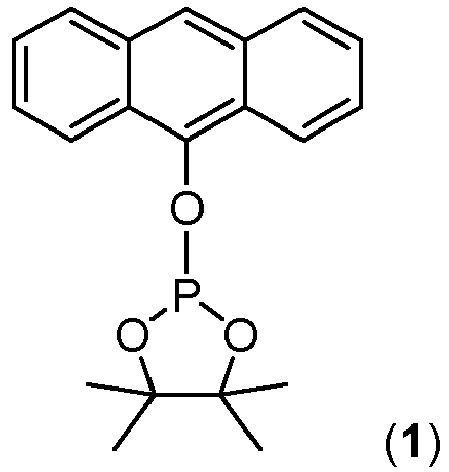
- Zu einer bei 0 °C gerührten Mischung von Pinacol (0,426 g; 3,606 mmol), Triethylamin (4,6 ml) und Toluol (14 ml) wird tropfenweise eine Lösung von (Anthracen-9-yloxy)dichlorophosphan (1,117 g; 3,787 mmol) in Toluol (17 ml) gegeben. Man lässt auf Raumtemperatur kommen, rührt über Nacht und filtriert über eine mit Kieselgel beschichtete G4-Fritte. Das Filtrat wird im Vakuum zur Trockne eingeengt der verbleibende Rückstand 5 h bei 50°C/ 0,1 mbar getrocknet. Elementaranalyse (ber. für C20H21O3P= 340,35 g/mol): C 70,35 (70,58); H 6,19 (6,22); P 8,97 (9,10)%. ESI-TOF/HRMS: m/e 341,13075 (M+H)+.
31P-NMR (CD2Cl2): 145,3 (s) ppm.
1H-NMR (CD2Cl2): 1,27 (s, 6H); 1,55 (s, 6H); 7,32-7,43 (m, 4H); 7,85 (d, J HH= 8,6 Hz, 2H); 8,09 (s, 1 H); 8,27 (d, J HH= 8,6 Hz, 2H) ppm.
13C-NMR (CD2Cl2): 24,9; 25,2; 86,5 (d, J CP= 7,5 Hz); 122,1; 123,0; 124,9; 125,6; 125,7; 128,1; 132,2; 144,1 (d, J CP= 6,2 Hz) ppm. -

- Eine bei -20 °C gerührte Suspension von Anthron (0,447 g; 2,30 mmol) in THF (5 ml) wird tropfenweise mit einer 0,32 M Lösung von n-Butyllithium in Heptan (7,2 ml; 2,30 mmol) versetzt. Man lässt auf Raumtemperatur kommen und tropft dann unter Rühren eine Lösung von 4-ChlorS-dinaphtho[2,1-d:1',2'-f][1,3,2]dioxaphosphepin (0,807 g; 2,30 mmol) in THF (6 ml) zu. Es wird über Nacht gerührt und filtriert. Man entfernt die flüchtigen Bestandteile des Filtrates im Vakuum, nimmt den erhaltenen gelben Feststoff in Toluol (10 ml) auf, filtriert über eine mit Kieselgel beschichtete G4-Fritte und engt das Filtrat im Vakuum ein. Der erhaltene Feststoff wird 3 h bei 50°C/0,1 mbar getrocknet. Die säulenchromatografische Aufarbeitung (Hexan/CH2Cl2, Gradient Hexan 100 → 0 %; R f = 0,5 für das 1:1-Gemisch der Eluenten) ergibt 0,55 g (1,08 mmol; 47%) an reinem Produkt. Elementaranalyse (ber. für C34H21O3P= 508,511 g/mol): C 80,80 (80,31); H 3,89 (4,16); P 6,02 (6,09)%. ESI-TOF/HRMS: m/e 509,12979 (M+H)+.
31P-NMR (CD2Cl2): 149,7 (s) ppm.
1H-NMR (CD2Cl2): 7,37-7,42 (m, 2H); 7,51-7,65 (m, 9H); 7,87 (d, J HH= 8,9 Hz, 1H); 8,02-8,14 (m, 6H); 8,40 (s, 1 H); 8,57 (d, J HH= 8,9 Hz, 2H) ppm.
13C-NMR (CD2Cl2): 122,1; 122,4; 123,0; 123,6; 123,8; 124,7; 125,0; 125,7; 126,1; 126,5; 127,0; 127,3; 128,6; 128,9; 130,6; 131,1; 131,9; 132,3; 132,6; 133,1; 133,4; 143,5 (d, J CP=6,1 Hz); 147,4 (d, J CP= 2,7 Hz); 148,3 (d, J CP= 5,2 Hz) ppm. -

- Das benötigte 2,6-Diphenylphen-l-oxydichlorphosphin wurde hergestellt wie beschrieben in W. Maringgele, A. Meller, Phosphorus, Sulfur and Silicon 1994, 90, 235-241.
- Eine bei 0 °C gerührte Lösung von 2,6-Diphenylphen-l-oxydichlorphosphin (1,048 g; 3,018 mmol) in Toluol (18 ml) wird tropfenweise mit einer Mischung aus Pinacol (0,3405 g; 2,881 mmol) und Triethylamin (3,65 ml) in Toluol (12 ml) versetzt. Man lässt auf Raumtemperatur kommen, rührt über Nacht und filtriert. Das Filtrat wird eingeengt und der erhaltene Rückstand mehrfach aus heißem Heptan kristallisiert. Ausbeute: 0,295 g (0,752 mmol; 26%). Elementaranalyse (ber. für C24H25O3P= 392,41 g/mol): C 73,31 (73,45); H 6,42 (6,42); P 7,53 (7,89) %. ESI-TOF/HRMS: m/e 393,16143, (M+H)+.
31P-NMR (CD2Cl2): 142,9 (s) ppm.
1H-NMR (CD2Cl2): 1,17 (s, 6H), 1,31(s, 6H), 7,34-7,72 (m, 13H) ppm.
13C-NMR (CD2Cl2) δ 147,4 (d, J CP= 6,5 Hz); 139,4; 136,6; 130,9; 130,8; 128,5; 127,6; 124,7; 85,3 (d, J CP= 8,0 Hz); 25,5; 24,8 ppm. - Die Hydroformylierungsreaktionen wurden in einem mit Druckkonstanthaltung, Gasflussmessung, Begasungsrührer und Druckpipette ausgestatteten 200 ml-Autoklaven der Fa. Premex Reactor AG, Lengau, Schweiz, durchgeführt. Das als Lösungsmittel verwendete Toluol wurde mit einem Pure Solv MD-7 System gereinigt und unter Argon aufbewahrt.
Für die Versuche wurden im Autoklaven unter Argonatmosphäre Lösungen der Komplexvorstufe (= Katalysatorvorstufe) und des Liganden gemischt. Als Komplexvorstufe kam [(acac)Rh(COD)] (Umicore, acac = Acetylacetonat-Anion; COD= 1,5-Cyclooctadien) zum Einsatz. Für Versuche mit einer Konzentration von 100 ppm-m Rhodium wurden 5 ml einer 4,32 millimolaren Lösung in den Autoklaven gegeben. Anschließend wurde die einem Verhältnis L/Rh = 5:1 entsprechende Masse des Liganden in 20 ml Toluol gelöst und zugemischt. In eine druckfeste Pipette wurde eingefüllt: 2,69 g (24,86 mmol) COD-1,5. Der Autoklav wurde mit Synthesegas (Linde; H2 (Qualität 5.0) : CO (Qualität 4.7) = 1:1) auf einen Druck von 42 bar gebracht und auf 60 °C aufgeheizt. Nach Erreichen der Reaktionstemperatur wurde das Diolefin in den Autoklaven gepresst. Die Reaktion wurde bei konstantem Druck von 50 bar (Nachdruckregler der Fa. Bronkhorst, NL) ausgeführt. Der Autoklav wurde nach Ablauf der Reaktionszeit auf Zimmertemperatur abgekühlt, unter Rühren entspannt und mit Argon gespült. Jeweils 1 ml der Reaktionsmischungen wurden unmittelbar nach Abschalten des Rührers entnommen, mit 5 ml Pentan verdünnt und gaschromatographisch analysiert: HP 5890 Series II plus, PONA, 50 m x 0,2 mm x 0,5 µm. - Die Ergebnisse der Hydroformylierungsversuche sind in der nachfolgenden Tabelle zusammengestellt. Der angegeben Umsatz umfasst hierbei sowohl Monoaldehyde wie auch Dialdehyde.
Standard-Versuchsbedingungen: [Rh] = 0,717 x 10-4 M, Rh/Ligand/COD-1,5 = 1:5:1151, Lösungsmittel Toluol.Tabelle 1: Ligand p [bar] T [°C] t [h] Umsatz COD-1,5 [%] 1* 50 60 4 91 2 50 60 4 54 3 50 60 4 76 *) erfindungsgemäßes Verfahren - Wie die Versuchsergebnisse zeigen, wird die Aufgabe durch das erfindungsgemäße Verfahren gelöst.
Claims (5)
- Verfahren zur Hydroformylierung von Cyclooctadien umfassend die Verfahrensschritte:a) Vorlegen von Cyclooctadien;b) Zugabe eines Komplexes umfassend:- ein Metallatom ausgewählt aus: Rh, Ru, Co, Ir, und- einen Liganden, welcher die Struktur (1) aufweist:

Zugabe einer Komplexvorstufe umfassend ein Metallatom ausgewählt aus: Rh, Ru, Co, Ir, und einer Verbindung welche die Struktur (1) aufweist: c) Zuführen von H2 und CO,d) Erwärmen des Reaktionsgemisches, wobei das Cyclooctadien zu einem Aldehyd umgesetzt wird.
 - Verfahren nach Anspruch 1,
wobei das Metallatom Rh ist. - Verfahren nach einem der Ansprüche 1 oder 2,
wobei die Komplexvorstufe Cyclooctadien umfasst. - Verfahren nach einem der Ansprüche 1 bis 3,
wobei es sich bei der Komplexvorstufe um [(acac)Rh(COD)] handelt. - Verfahren nach einem der Ansprüche 1 bis 4,
wobei das Reaktionsgemisch im Verfahrensschritt d) auf eine Temperatur im Bereich von 50° C bis 70 °C erwärmt wird.
Priority Applications (6)
| Application Number | Priority Date | Filing Date | Title |
|---|---|---|---|
| EP17165992.3A EP3388413A1 (de) | 2017-04-11 | 2017-04-11 | Verfahren zur hydroformylierung von cyclooctadien unter einsatz von 2-(anthracen-9-yloxy)-4,4,5,5-tetramethyl-1,3,2-dioxaphospholan |
| US15/939,373 US10167244B2 (en) | 2017-04-11 | 2018-03-29 | Method for hydroformylating cyclooctadiene using 2-(anthracen-9-yloxy)-4,4,5,5-tetramethyl-1,3,2-dioxaphospholane |
| JP2018073551A JP2018177777A (ja) | 2017-04-11 | 2018-04-06 | 2−(アントラセン−9−イルオキシ)−4,4,5,5−テトラメチル−1,3,2−ジオキサホスホランを用いるシクロオクタジエンのヒドロホルミル化方法 |
| TW107112061A TW201902865A (zh) | 2017-04-11 | 2018-04-09 | 使用2-(蒽-9-基氧基)-4,4,5,5-四甲基-1,3,2-二氧磷雜環戊烷將環辛二烯氫甲醯化的方法 |
| CN201810315835.4A CN108689822A (zh) | 2017-04-11 | 2018-04-10 | 使用蒽-9-基氧基-四甲基-二氧磷杂环戊烷将环辛二烯加氢甲酰化的方法 |
| KR1020180041369A KR20180114847A (ko) | 2017-04-11 | 2018-04-10 | 2-(안트라센-9-일옥시)-4,4,5,5-테트라메틸-1,3,2-디옥사포스폴란을 사용하여 시클로옥타디엔을 히드로포르밀화하는 방법 |
Applications Claiming Priority (1)
| Application Number | Priority Date | Filing Date | Title |
|---|---|---|---|
| EP17165992.3A EP3388413A1 (de) | 2017-04-11 | 2017-04-11 | Verfahren zur hydroformylierung von cyclooctadien unter einsatz von 2-(anthracen-9-yloxy)-4,4,5,5-tetramethyl-1,3,2-dioxaphospholan |
Publications (1)
| Publication Number | Publication Date |
|---|---|
| EP3388413A1 true EP3388413A1 (de) | 2018-10-17 |
Family
ID=58536875
Family Applications (1)
| Application Number | Title | Priority Date | Filing Date |
|---|---|---|---|
| EP17165992.3A Withdrawn EP3388413A1 (de) | 2017-04-11 | 2017-04-11 | Verfahren zur hydroformylierung von cyclooctadien unter einsatz von 2-(anthracen-9-yloxy)-4,4,5,5-tetramethyl-1,3,2-dioxaphospholan |
Country Status (6)
| Country | Link |
|---|---|
| US (1) | US10167244B2 (de) |
| EP (1) | EP3388413A1 (de) |
| JP (1) | JP2018177777A (de) |
| KR (1) | KR20180114847A (de) |
| CN (1) | CN108689822A (de) |
| TW (1) | TW201902865A (de) |
Citations (2)
| Publication number | Priority date | Publication date | Assignee | Title |
|---|---|---|---|---|
| EP0472071A1 (de) * | 1990-08-21 | 1992-02-26 | BASF Aktiengesellschaft | Rhodiumhydroformylierungskatalysatoren mit Bis-phosphit-Liganden |
| EP3029013A1 (de) * | 2014-12-04 | 2016-06-08 | Evonik Degussa GmbH | Monophosphite mit Struktureinheit 4,4,5,5-Tetraphenyl-1,3,2-dioxaphospholan als Liganden für Hydroformylierungskatalysatoren |
Family Cites Families (6)
| Publication number | Priority date | Publication date | Assignee | Title |
|---|---|---|---|---|
| US3509221A (en) * | 1965-07-09 | 1970-04-28 | Shell Oil Co | Production of cyclooctanemethanol |
| US5138101A (en) * | 1991-07-19 | 1992-08-11 | Eastman Kodak Company | Recovery of high-boiling aldehydes from rhodium-catalyzed hydroformylation processes |
| DE19814913A1 (de) * | 1998-04-03 | 1999-10-07 | Henkel Kgaa | Verwendung von Aldehyden als Riechstoffe |
| DE102011085883A1 (de) | 2011-11-08 | 2013-05-08 | Evonik Oxeno Gmbh | Neue Organophosphorverbindungen auf Basis von Anthracentriol |
| ES2670512T3 (es) | 2014-12-04 | 2018-05-30 | Evonik Degussa Gmbh | Ésteres monofosfitos de 9-antrol como ligandos para catalizadores de hidroformilación |
| EP3147290A1 (de) * | 2015-09-22 | 2017-03-29 | Evonik Degussa GmbH | Monophosphite, die ein binol-derivat aufweisen |
-
2017
- 2017-04-11 EP EP17165992.3A patent/EP3388413A1/de not_active Withdrawn
-
2018
- 2018-03-29 US US15/939,373 patent/US10167244B2/en not_active Expired - Fee Related
- 2018-04-06 JP JP2018073551A patent/JP2018177777A/ja not_active Withdrawn
- 2018-04-09 TW TW107112061A patent/TW201902865A/zh unknown
- 2018-04-10 CN CN201810315835.4A patent/CN108689822A/zh active Pending
- 2018-04-10 KR KR1020180041369A patent/KR20180114847A/ko not_active Ceased
Patent Citations (2)
| Publication number | Priority date | Publication date | Assignee | Title |
|---|---|---|---|---|
| EP0472071A1 (de) * | 1990-08-21 | 1992-02-26 | BASF Aktiengesellschaft | Rhodiumhydroformylierungskatalysatoren mit Bis-phosphit-Liganden |
| EP3029013A1 (de) * | 2014-12-04 | 2016-06-08 | Evonik Degussa GmbH | Monophosphite mit Struktureinheit 4,4,5,5-Tetraphenyl-1,3,2-dioxaphospholan als Liganden für Hydroformylierungskatalysatoren |
Non-Patent Citations (4)
| Title |
|---|
| ANNA M. TRZECIAK ET AL: "Rhodium complex catalyzed hydroformylation reactions of linear and cyclic mono- and diolefins", JOURNAL OF ORGANOMETALLIC CHEMISTRY., vol. 479, no. 1-2, 4 October 1994 (1994-10-04), CH, pages 213 - 216, XP055273367, ISSN: 0022-328X, DOI: 10.1016/0022-328X(94)84111-X * |
| PIERO SALVADORI ET AL: "SELECTIVE IIYDROFORMYLATION OF CYCLODIENES TO CYCLOALKENECARBOXALDEI-IYDES USING CATALYSTS DERIVED DIRECTLY FROM Rh VAPOUR AND CYCLODIENES", JOURNAL OF ORGANOMETALLIC CHEMISTRY ELSEVIER SEQUOIA .%A, vol. 258, no. 3, 6 December 1983 (1983-12-06), pages 351 - 355, XP055375131 * |
| R. FRANKE; D. SELENT; A. BÖRNER: "Applied Hydroformylation", CHEM. REV., 2012 |
| W. MARINGGELE; A. MEILER, PHOSPHORUS, SULFUR AND SILICON, vol. 90, 1994, pages 235 - 241 |
Also Published As
| Publication number | Publication date |
|---|---|
| JP2018177777A (ja) | 2018-11-15 |
| US10167244B2 (en) | 2019-01-01 |
| CN108689822A (zh) | 2018-10-23 |
| US20180290956A1 (en) | 2018-10-11 |
| KR20180114847A (ko) | 2018-10-19 |
| TW201902865A (zh) | 2019-01-16 |
Similar Documents
| Publication | Publication Date | Title |
|---|---|---|
| EP2748174B1 (de) | Neue organophosphorverbindungen auf basis von anthracentriol | |
| EP3029057B1 (de) | Bisphosphite die einen unsymmetrischen biaryl-zentral-baustein aufweisen | |
| EP3029048B1 (de) | Bisphosphite die einen unsymmetrischen Biphenol-Flügel-Baustein aufweisen | |
| EP3029045B1 (de) | Bisphosphite die eine 2,3 -Biphenol-Einheit als Zentral-Baustein aufweisen | |
| WO2014169975A1 (de) | Immobilisierte katalytisch aktive zusammensetzung zur hydroformylierung von olefinhaltigen gemischen | |
| EP3037427B1 (de) | Monophosphite die ein naphthol aufweisen | |
| EP3388414A1 (de) | Verfahren zur hydroformylierung von cyclooctadien unter einsatz von 4-([1,1':3',1''-terphenyl]-2'-yloxy)-s-dinaphtho[2,1-d:1',2'-f][1,3,2]dioxaphosphepin | |
| EP3388413A1 (de) | Verfahren zur hydroformylierung von cyclooctadien unter einsatz von 2-(anthracen-9-yloxy)-4,4,5,5-tetramethyl-1,3,2-dioxaphospholan | |
| EP3101022B1 (de) | Monophosphite die einen unsymmetrischen biaryl-baustein aufweisen | |
| EP3147290A1 (de) | Monophosphite, die ein binol-derivat aufweisen | |
| EP3388146B1 (de) | Liganden und verfahren zur hydroformylierung unter einsatz eines 5-methyl-4,4-diphenyl-1,3,2-dioxaphospholans | |
| EP3293190A1 (de) | Phosphite mit einem silyloxyphenol | |
| EP3293192B1 (de) | Phosphite mit einem dihydroxyterphenyl mit einem tetraphenyl-dioxaphospholan | |
| EP3293189B1 (de) | Phosphite mit einem dihydroxyterphenyl und zwei phenolen | |
| EP3438111B1 (de) | Phosphonite mit einer direkt am phosphor gebundenen tert.-butyl-gruppe | |
| EP3031813B1 (de) | Monophosphite die ein menthol aufweisen | |
| EP3029054B1 (de) | Phosphoramidite welche eine Phenyl-Phenyl-Einheit oder eine Phenyl-Naphthyl-Einheit aufweisen | |
| EP3957642A1 (de) | 6,6'-([1,1'-biphenyl]-2,3'-diylbis(oxy))didibenzo[d,f][1,3,2]dioxaphosphepine | |
| EP3816174A1 (de) | Benzopinacolphosphite | |
| EP3459959A1 (de) | Bisphosphitliganden mit butanoat-zentralbaustein | |
| EP3459960A1 (de) | Bisphosphitliganden mit dioxaphosphepin-flügelbausteinen | |
| EP3293194A1 (de) | Phosphite mit einem silyloxyphenol und einem biphenol | |
| EP3388415A1 (de) | Verfahren zur hydroformylierung von cyclooctadien unter einsatz eines tetraphosphits | |
| EP3293191A1 (de) | Phosphite mit einem dihydroxyterphenyl | |
| EP3296303A1 (de) | Monophosphite mit methylenverbrücktem diphenol und diphenylphenylrest |
Legal Events
| Date | Code | Title | Description |
|---|---|---|---|
| PUAI | Public reference made under article 153(3) epc to a published international application that has entered the european phase |
Free format text: ORIGINAL CODE: 0009012 |
|
| STAA | Information on the status of an ep patent application or granted ep patent |
Free format text: STATUS: THE APPLICATION HAS BEEN PUBLISHED |
|
| AK | Designated contracting states |
Kind code of ref document: A1 Designated state(s): AL AT BE BG CH CY CZ DE DK EE ES FI FR GB GR HR HU IE IS IT LI LT LU LV MC MK MT NL NO PL PT RO RS SE SI SK SM TR |
|
| AX | Request for extension of the european patent |
Extension state: BA ME |
|
| STAA | Information on the status of an ep patent application or granted ep patent |
Free format text: STATUS: REQUEST FOR EXAMINATION WAS MADE |
|
| 17P | Request for examination filed |
Effective date: 20181030 |
|
| RBV | Designated contracting states (corrected) |
Designated state(s): AL AT BE BG CH CY CZ DE DK EE ES FI FR GB GR HR HU IE IS IT LI LT LU LV MC MK MT NL NO PL PT RO RS SE SI SK SM TR |
|
| GRAP | Despatch of communication of intention to grant a patent |
Free format text: ORIGINAL CODE: EPIDOSNIGR1 |
|
| STAA | Information on the status of an ep patent application or granted ep patent |
Free format text: STATUS: GRANT OF PATENT IS INTENDED |
|
| INTG | Intention to grant announced |
Effective date: 20190122 |
|
| STAA | Information on the status of an ep patent application or granted ep patent |
Free format text: STATUS: THE APPLICATION IS DEEMED TO BE WITHDRAWN |
|
| 18D | Application deemed to be withdrawn |
Effective date: 20190604 |