EP3382733A1 - High- and medium-voltage gas-insulated substation presenting an electrically conductive polyaniline coating - Google Patents
High- and medium-voltage gas-insulated substation presenting an electrically conductive polyaniline coating Download PDFInfo
- Publication number
- EP3382733A1 EP3382733A1 EP17290047.4A EP17290047A EP3382733A1 EP 3382733 A1 EP3382733 A1 EP 3382733A1 EP 17290047 A EP17290047 A EP 17290047A EP 3382733 A1 EP3382733 A1 EP 3382733A1
- Authority
- EP
- European Patent Office
- Prior art keywords
- coating
- medium
- electrically conductive
- substation
- conductive polyaniline
- Prior art date
- Legal status (The legal status is an assumption and is not a legal conclusion. Google has not performed a legal analysis and makes no representation as to the accuracy of the status listed.)
- Withdrawn
Links
Images
Classifications
-
- H—ELECTRICITY
- H02—GENERATION; CONVERSION OR DISTRIBUTION OF ELECTRIC POWER
- H02B—BOARDS, SUBSTATIONS OR SWITCHING ARRANGEMENTS FOR THE SUPPLY OR DISTRIBUTION OF ELECTRIC POWER
- H02B13/00—Arrangement of switchgear in which switches are enclosed in, or structurally associated with, a casing, e.g. cubicle
- H02B13/02—Arrangement of switchgear in which switches are enclosed in, or structurally associated with, a casing, e.g. cubicle with metal casing
- H02B13/035—Gas-insulated switchgear
- H02B13/045—Details of casing, e.g. gas tightness
-
- C—CHEMISTRY; METALLURGY
- C09—DYES; PAINTS; POLISHES; NATURAL RESINS; ADHESIVES; COMPOSITIONS NOT OTHERWISE PROVIDED FOR; APPLICATIONS OF MATERIALS NOT OTHERWISE PROVIDED FOR
- C09D—COATING COMPOSITIONS, e.g. PAINTS, VARNISHES OR LACQUERS; FILLING PASTES; CHEMICAL PAINT OR INK REMOVERS; INKS; CORRECTING FLUIDS; WOODSTAINS; PASTES OR SOLIDS FOR COLOURING OR PRINTING; USE OF MATERIALS THEREFOR
- C09D179/00—Coating compositions based on macromolecular compounds obtained by reactions forming in the main chain of the macromolecule a linkage containing nitrogen, with or without oxygen, or carbon only, not provided for in groups C09D161/00 - C09D177/00
- C09D179/02—Polyamines
-
- H—ELECTRICITY
- H01—ELECTRIC ELEMENTS
- H01B—CABLES; CONDUCTORS; INSULATORS; SELECTION OF MATERIALS FOR THEIR CONDUCTIVE, INSULATING OR DIELECTRIC PROPERTIES
- H01B3/00—Insulators or insulating bodies characterised by the insulating materials; Selection of materials for their insulating or dielectric properties
- H01B3/002—Inhomogeneous material in general
- H01B3/004—Inhomogeneous material in general with conductive additives or conductive layers
-
- H—ELECTRICITY
- H01—ELECTRIC ELEMENTS
- H01B—CABLES; CONDUCTORS; INSULATORS; SELECTION OF MATERIALS FOR THEIR CONDUCTIVE, INSULATING OR DIELECTRIC PROPERTIES
- H01B3/00—Insulators or insulating bodies characterised by the insulating materials; Selection of materials for their insulating or dielectric properties
- H01B3/02—Insulators or insulating bodies characterised by the insulating materials; Selection of materials for their insulating or dielectric properties mainly consisting of inorganic substances
- H01B3/16—Insulators or insulating bodies characterised by the insulating materials; Selection of materials for their insulating or dielectric properties mainly consisting of inorganic substances gases
-
- H—ELECTRICITY
- H01—ELECTRIC ELEMENTS
- H01B—CABLES; CONDUCTORS; INSULATORS; SELECTION OF MATERIALS FOR THEIR CONDUCTIVE, INSULATING OR DIELECTRIC PROPERTIES
- H01B3/00—Insulators or insulating bodies characterised by the insulating materials; Selection of materials for their insulating or dielectric properties
- H01B3/18—Insulators or insulating bodies characterised by the insulating materials; Selection of materials for their insulating or dielectric properties mainly consisting of organic substances
- H01B3/56—Insulators or insulating bodies characterised by the insulating materials; Selection of materials for their insulating or dielectric properties mainly consisting of organic substances gases
-
- C—CHEMISTRY; METALLURGY
- C08—ORGANIC MACROMOLECULAR COMPOUNDS; THEIR PREPARATION OR CHEMICAL WORKING-UP; COMPOSITIONS BASED THEREON
- C08G—MACROMOLECULAR COMPOUNDS OBTAINED OTHERWISE THAN BY REACTIONS ONLY INVOLVING UNSATURATED CARBON-TO-CARBON BONDS
- C08G73/00—Macromolecular compounds obtained by reactions forming a linkage containing nitrogen with or without oxygen or carbon in the main chain of the macromolecule, not provided for in groups C08G12/00 - C08G71/00
- C08G73/02—Polyamines
- C08G73/026—Wholly aromatic polyamines
- C08G73/0266—Polyanilines or derivatives thereof
-
- H—ELECTRICITY
- H01—ELECTRIC ELEMENTS
- H01H—ELECTRIC SWITCHES; RELAYS; SELECTORS; EMERGENCY PROTECTIVE DEVICES
- H01H33/00—High-tension or heavy-current switches with arc-extinguishing or arc-preventing means
- H01H33/02—Details
- H01H33/53—Cases; Reservoirs, tanks, piping or valves, for arc-extinguishing fluid; Accessories therefor, e.g. safety arrangements, pressure relief devices
- H01H33/56—Gas reservoirs
-
- H—ELECTRICITY
- H02—GENERATION; CONVERSION OR DISTRIBUTION OF ELECTRIC POWER
- H02B—BOARDS, SUBSTATIONS OR SWITCHING ARRANGEMENTS FOR THE SUPPLY OR DISTRIBUTION OF ELECTRIC POWER
- H02B1/00—Frameworks, boards, panels, desks, casings; Details of substations or switching arrangements
- H02B1/56—Cooling; Ventilation
-
- H—ELECTRICITY
- H02—GENERATION; CONVERSION OR DISTRIBUTION OF ELECTRIC POWER
- H02B—BOARDS, SUBSTATIONS OR SWITCHING ARRANGEMENTS FOR THE SUPPLY OR DISTRIBUTION OF ELECTRIC POWER
- H02B13/00—Arrangement of switchgear in which switches are enclosed in, or structurally associated with, a casing, e.g. cubicle
- H02B13/02—Arrangement of switchgear in which switches are enclosed in, or structurally associated with, a casing, e.g. cubicle with metal casing
- H02B13/035—Gas-insulated switchgear
- H02B13/065—Means for detecting or reacting to mechanical or electrical defects
- H02B13/0655—Means for detecting or reacting to mechanical or electrical defects through monitoring changes of gas properties
-
- H—ELECTRICITY
- H02—GENERATION; CONVERSION OR DISTRIBUTION OF ELECTRIC POWER
- H02G—INSTALLATION OF ELECTRIC CABLES OR LINES, OR OF COMBINED OPTICAL AND ELECTRIC CABLES OR LINES
- H02G5/00—Installations of bus-bars
- H02G5/06—Totally-enclosed installations, e.g. in metal casings
- H02G5/063—Totally-enclosed installations, e.g. in metal casings filled with oil or gas
-
- H—ELECTRICITY
- H02—GENERATION; CONVERSION OR DISTRIBUTION OF ELECTRIC POWER
- H02G—INSTALLATION OF ELECTRIC CABLES OR LINES, OR OF COMBINED OPTICAL AND ELECTRIC CABLES OR LINES
- H02G5/00—Installations of bus-bars
- H02G5/10—Cooling
Definitions
- the invention relates to the field of high- or medium-voltage gas-insulated substations, commonly referred to as Gas-Insulated Substations (GISs).
- Substations of this type comprise switchgear, in particular busbar disconnectors, circuit-breakers, or grounding switches.
- the electrical active part is arranged in a gas-tight housing which defines an insulating space. The latter is filled with a dielectric gaseous fluid under pressure which performs the functions of the electrical insulation and electric arc extinction.
- the present invention proposes a high- or medium-voltage gas-insulated substation in which the liquefaction of the dielectric gaseous fluid is avoided thanks to a heating coating.
- This heating coating comprises an inherently conductive polymer which is polyaniline.
- the present invention also proposes a system for avoiding liquefaction of dielectric gaseous medium in a high- or medium-voltage gas-insulated substation.
- SF 6 sulfur hexafluoride
- the insulation gas or the insulation gaseous mixture implemented can be in a two-phase system comprising a liquid and a gaseous phase. This applies to medium-voltage or high-voltage equipment in which having some of the insulation gas or the insulation gaseous mixture in the liquid state does not reduce insulation.
- the equipment are medium- or high-voltage equipment in which insulation can be affected by the presence of a liquid phase.
- the International application WO 2014/037566 [1] proposes a hybrid insulation system for medium- or high-voltage equipment.
- This system implements a gaseous medium comprising heptafluoroisobutyronitrile in a mixture with a neutral gas for use as a gas for electrical insulation and/or for electric arc extinction in medium- or high-voltage equipment, in combination with solid insulation.
- This application recommends the heptafluoroisobutyronitrile to be present in the mixture at a molar percentage (M he ) that does not exceed 100% of the molar percentage M so that it does not present a liquefaction phase at the minimum utilization temperature.
- P he SVP the ⁇ 293 / T min + 273 in which SVP he represents the saturated vapor pressure of heptafluoroisobutyronitrile as defined above at the minimum utilization temperature T min of the equipment, expressed in degrees Celsius.
- the inventors have therefore generally sought to find an alternative for avoiding the liquefaction of part of the insulation gas or of the insulation gaseous mixture in use without affecting the characteristics of the equipment, from the point of view of its insulating and breaking abilities and without significantly increasing the size of this equipment or the pressure of the gas or the gaseous mixture inside it.
- polyaniline belongs to the inherently conductive polymers (ICPs).
- ICPs inherently conductive polymers
- polyaniline is of particular industrial and economical importance since the latter has a good conductivity, environmental stability and ease of synthesis.
- the inventors have thus proposed to use the property of polyaniline concerning the thermal conductivity [3] . Indeed when an electric voltage is applied to polyaniline, its temperature increases due to the Joule effect.
- the electrically conductive polyaniline coating applied to the medium- or high-voltage gas-insulated substation acts as a heating coating.
- the control of the heating is based on parameters easily measurable such as the temperature of the environment surrounding the substation.
- the coating implemented does not depend on the dielectric gaseous medium present inside the enclosure.
- the present invention also concerns a system for avoiding liquefaction of dielectric gaseous medium in a high- or medium-voltage gas-insulated substation, this system comprising such a substation and a control unit.
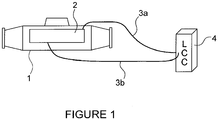
- Figure 1 is a schematic representation of a gas-insulated substation such a gas-insulated switchgear according to the present invention i.e. presenting an electrically conductive polyaniline patch.
- the present invention concerns a medium- or high-voltage gas-insulated substation.
- the terms “medium voltage” and “high voltage” are used in the conventionally accepted manner, i.e. the term “medium voltage” refers to a voltage that is greater than 1000 volts (V) for AC and 1500 V for DC, but that does not exceed 52,000 V for AC or 75,000 V for DC, whereas the term “high voltage” refers to a voltage that is strictly greater than 52,000 V for AC and than 75,000 V for DC.
- the present invention concerns a medium- or high-voltage gas-insulated substation including a leaktight enclosure in which there are located one or more electrical component(s) and a gaseous medium for ensuring electrical insulation and/or for extinguishing electric arcs that are likely to occur in said enclosure, wherein at least part of the outer surface of said enclosure presents an electrically conductive polyaniline coating.
- the gaseous medium present in the medium- or high-voltage gas-insulated substation can be any dielectric gas or dielectric gaseous mixture typically used for ensuring electrical insulation and/or for extinguishing electric arcs in such substations.
- the dielectric gas or dielectric gaseous mixture is present in the substation enclosure under pressure.
- a gaseous medium one can cite SF 6 alone or in combination with a dilution gas, heptafluoroisobutyronitrile as disclosed in [1] and one or more fluoroketone(s) as disclosed in [2] .
- the medium- or high-voltage gas-insulated substation according to the present invention comprises an enclosure defining a hollow volume and one or more electrical component(s) arranged in said enclosure, with a gaseous medium as the insulating medium.
- the enclosure of the medium- or high-voltage gas-insulated substation according to the present invention is a metal envelope.
- the outer surface of the enclosure corresponds to the enclosure surface in contact with the environment surrounding the enclosure and in particular with the environment surrounding the medium- or high-voltage gas-insulated substation.
- the inner surface of the enclosure corresponds to the enclosure surface in contact with the dielectric gaseous medium ensuring electrical insulation and/or extinguishing electric arcs that are likely to occur in said enclosure.
- polyaniline is obtained thanks to the polymerization of the monomer aniline (C 6 H 5 -NH 2 ).
- the leucoemeraldine and the pernigraniline states present a poor conductivity even when doped, while doped emeraldine state has a good conductivity. Indeed, doping the polyaniline generates or eliminates charge carriers such as electrons therein.
- the electrically conductive polyaniline implemented in the present invention is advantageously a doped emeraldine state polyaniline.
- electrically conductive polyaniline encompasses electrically conductive polyaniline obtained from unsubstituted anilines and/or from substituted anilines, in particular as defined in the patent application US 2008/197326 [4] .
- an electrically conductive polyaniline see, for example, [3] and [4] ).
- this polymer can be synthesized by polymerization technique from aniline monomers using a chemical oxidant such as, for example, hydrochloric acid or ammonium persulfate and by doping the polymer thus obtained using well-known acidic or oxidant dopants such as iodine, chlorine, hydrochloric acid or also any dopant as disclosed in the patent application FR 2 880 350 [5] .
- the synthesis can implement an electrochemical oxidation instead of a chemical oxidation.
- the coating of electrically conductive polyaniline implemented in the present invention can present a thickness comprised between 10 ⁇ m and 30 mm.
- the thickness will depend on the nature of the coating and/or on the process implemented to apply it on the outer surface of the enclosure.
- the coating of electrically conductive polyaniline implemented in the present invention is in the form of a film, a resin or a paint.
- This coating can be obtained applying onto the outer surface of the substation a coating composition containing the electrically conductive polyaniline and a binder.
- the coating thus obtained presents a polymer matrix containing the electrically conductive polyaniline in which the polymer matrix is formed from the binder.
- the polyaniline can be in the form of particles, of fibers such as nanofibers or of mixture of particles and fibers.
- compositions containing the electrically conductive polyaniline and a binder can be made.
- the binder may be a polymer such as, for example, polypropylene, polyethylene, acrylic polymer, acrylic copolymer, vinyl acetate polymer, vinyl/acrylic copolymer, polystyrene, styrene/acrylic copolymer, polyurethane, polyvinyl chloride, styrene/butadiene polymer, phenol-formaldehyde resin, a thermoplastic elastomer, an unsaturated polyester resin and any mixture thereof.
- the polymer may be provided in a liquid medium such as a solution polymer, an emulsion polymer or a suspension polymer.
- the polymer may contain reactive groups which upon formation of a film, crosslink to provide a crosslinked coating.
- the coating composition may contain a crosslinking agent which reacts with complementary reactive groups of the binder. Such crosslinking agents are well-known to those skilled in the art.
- the binder may also be at least one prepolymeric material which is cured to form a polymer matrix.
- the coating composition containing the polyaniline and at least one prepolymeric material as the binder is applied onto the outer substrate and then the at least one prepolymeric material is polymerized or is crosslinked to form a polymer matrix.
- the resulting coating is a polymer matrix that contains the electrically conductive polyaniline.
- the electrically conductive polyaniline coating and more particularly the coating composition can be deposited on the outer surface of the medium- or high-voltage substation thanks to different processes.
- spin coating methods by centrifugation
- dip coating methods by immersion
- spraying by brushing or by rolling
- Such a coating and more particularly the coating composition can be applied on the outer surface of a substation when building it. It can also be applied on already existing substations.
- the coating of electrically conductive polyaniline implemented in the present invention can be in the form of a tissue or a patch and, more particularly, in the form of an adhesive tissue or an adhesive patch.
- a coating is advantageously a flexible and soft coating that is easily manipulated.
- the coating implemented in the present invention can be multilayer with at least one of these layers comprising electrically conductive polyaniline as already defined.
- the coating is advantageously a multilayer coating with at least one layer consisting of a carrier substrate onto which is deposited or applied a coating composition as previously defined.
- This coating can present an adhesive layer thanks to which it is applied and maintained applied to the outer surface of the enclosure.
- the carrier substrate is advantageously a flexible plastic film such as for example a film of polyimide, polypropylene, monoaxially oriented polypropylene, polyethylene, polyphenylene sulfide, polyether ether ketone, polyether ketone, polyethylenimine, polysulfone, liquid-crystal polymers, polybutylene terephthalate or polyoxymethylene.
- a flexible plastic film such as for example a film of polyimide, polypropylene, monoaxially oriented polypropylene, polyethylene, polyphenylene sulfide, polyether ether ketone, polyether ketone, polyethylenimine, polysulfone, liquid-crystal polymers, polybutylene terephthalate or polyoxymethylene.
- this multilayer coating can also present a web which is advantageously formed by natural fibers, synthetic fibers or combinations thereof onto which is applied or deposited a coating composition as previously defined or an electrically conductive polyaniline.
- fibers one can cite the cellulosic or lignocellulosic fibers or Kevlar fibers.
- Such a coating can be prepared by mixing the electrically conductive polyaniline or the coating composition with the fibers or by polymerizing and doping the electrically conductive polyaniline onto the surface of the fibers.
- the coating of electrically conductive polyaniline can comprise electrically conductive polyaniline composites, the latter presenting particular interest. Indeed such composites present interesting properties such as properties of electromagnetic shielding.
- electrically conductive polyaniline composites the latter presenting particular interest.
- composites present interesting properties such as properties of electromagnetic shielding.
- Araujo et al , 2005, [6] discloses a process to prepare poly(methyl methacrylate) (PMMA)/electrically conductive polyaniline nanofibers composite films.
- the coating of the electrically conductive polyaniline is applied on at least part of the outer surface of the leaktight enclosure included in the high- or medium-voltage gas-insulated substation according to the present invention.
- only a part of the outer surface of the leaktight enclosure is coated or covered by the coating of the electrically conductive polyaniline as previously defined. This part can present a surface representing from 5% to 90% of the total surface of the outer surface of the leaktight enclosure.
- the only Figure presents this particular embodiment.
- the switchgear presents a longitudinal leaktight enclosure (1) and a rectangular coating of electrically conductive polyaniline (2) is applied on the lateral outer surface of this enclosure.
- At least two different parts isolated from one another are coated or covered by the coating of the electrically conductive polyaniline as previously defined.
- the coating applied to one part can be identical or different to the coating applied to another part.
- the surface of all these parts can present a surface representing from 5% to 90% of the total surface of the outer surface of the leaktight enclosure.
- all the outer surface of the leaktight enclosure is coated or covered by the coating of the electrically conductive polyaniline as previously defined.
- Advantageously high- or medium-voltage gas-insulated substation according to the present invention is selected from the group consisting of switchgears, busbars, busducts, busbar disconnectors, circuit-breakers, voltage transformers, current transformers, and grounding switches.
- the high- or medium-voltage gas-insulated substation according to the present invention can also comprise means for applying electrical power to the coating of electrically conductive polyaniline.
- any means allowing a material to be subjected to an electrical power or current can be used in the present invention.
- the means used in the present invention are chosen from among electrical contacts, at least two electrodes and a voltage source.
- the means used in the present invention are at least two electrodes in electric contact with the coating of electrically conductive polyaniline and configured to apply an electrical power to the coating, and at least one voltage source electrically connected to these at least two electrodes.
- the references (3a) and (3b) correspond to the electrical contacts electrically connecting the electrodes (not represented) present at the level of the coating (2) and the voltage source (not represented) present inside the LCC for "Layout Command Center” (4).
- the electrodes may be in any material commonly used for an electrode.
- the at least two electrodes can be inside the coating of electrically conductive polymer i.e. in the thickness of this coating.
- the at least two electrodes can be on the coating or under the coating i.e. between the coating and the outer surface of the enclosure.
- the only condition to this particular spatial organization is the presence of an electric contact between each electrode and the coating of electrically conductive polyaniline.
- any electric voltage generator known to those skilled in the art can be used in the present invention, as voltage source.
- the voltage generated by the voltage source used in the device of the invention may be pulsed, alternating or direct. Therefore the current to which the coating covering of the substation of the invention is subjected may be continuous or variable.
- the present invention also concerns a system for avoiding liquefaction of dielectric gaseous medium in a high- or medium-voltage gas-insulated substation.
- This system comprises a high- or medium-voltage gas-insulated substation as previously defined and a control unit.
- control unit may comprise at least two units selected from the above-listed units.
- control unit can comprise either the measuring unit + the electric power controlling unit as previously defined or the temperature-detecting unit + the electric power controlling unit as previously defined.
- control unit may comprise the three above-listed units.
- control unit is also present in the LCC (4).
Landscapes
- Chemical & Material Sciences (AREA)
- Engineering & Computer Science (AREA)
- Chemical Kinetics & Catalysis (AREA)
- Life Sciences & Earth Sciences (AREA)
- Materials Engineering (AREA)
- Wood Science & Technology (AREA)
- Organic Chemistry (AREA)
- Power Engineering (AREA)
- Inorganic Chemistry (AREA)
- Physics & Mathematics (AREA)
- Spectroscopy & Molecular Physics (AREA)
- Organic Insulating Materials (AREA)
Abstract
The present invention concerns a medium- or high-voltage gas-insulated substation including a leaktight enclosure in which there are located one or more electrical component(s) and a gaseous medium for ensuring electrical insulation and/or for extinguishing electric arcs that are likely to occur in said enclosure, wherein at least part of the outer surface of said enclosure presents an electrically conductive polyaniline coating. The present invention also concerns a system for avoiding liquefaction of the dielectric gaseous medium in a high- or medium-voltage gas-insulated substation, which comprises the high- or medium-voltage gas-insulated substation as previously defined and a control unit.
Description
- The invention relates to the field of high- or medium-voltage gas-insulated substations, commonly referred to as Gas-Insulated Substations (GISs). Substations of this type comprise switchgear, in particular busbar disconnectors, circuit-breakers, or grounding switches. In these substations, the electrical active part is arranged in a gas-tight housing which defines an insulating space. The latter is filled with a dielectric gaseous fluid under pressure which performs the functions of the electrical insulation and electric arc extinction.
- More particularly the present invention proposes a high- or medium-voltage gas-insulated substation in which the liquefaction of the dielectric gaseous fluid is avoided thanks to a heating coating. This heating coating comprises an inherently conductive polymer which is polyaniline.
- The present invention also proposes a system for avoiding liquefaction of dielectric gaseous medium in a high- or medium-voltage gas-insulated substation.
- In equipment for a transmission line carrying high- or medium-voltage electricity such as high- or medium-voltage gas-insulated substations, the functions of the electrical insulation and electric arc extinction are typically performed by a gas that is confined to the inside of the equipment.
- Currently, sulfur hexafluoride (SF6) is the gas used most frequently. That gas presents dielectric strength that is relative high, good thermal conductivity and low dielectric losses. It is chemically inert, nontoxic for humans and animals and, after being dissociated by an electric arc, it recombines quickly and almost completely. Nevertheless, because of its high global warning potential, manufacturers have proposed to use other gases or gaseous mixtures as suitable alternatives to SF6.
- In use, the insulation gas or the insulation gaseous mixture implemented can be in a two-phase system comprising a liquid and a gaseous phase. This applies to medium-voltage or high-voltage equipment in which having some of the insulation gas or the insulation gaseous mixture in the liquid state does not reduce insulation.
- Alternatively, the equipment are medium- or high-voltage equipment in which insulation can be affected by the presence of a liquid phase. In this embodiment, it is desirable for the insulation gas or the insulation gaseous mixture to be exclusively or almost exclusively in the gaseous state across the entire range of utilization temperatures for the equipment.
- In other words, it is necessary to avoid the liquefaction of part of the insulation gas or of the insulation gaseous mixture even at the minimum utilization temperatures of the equipment. As a reminder such a minimum utilization temperature can reach -35°C, -40°C, -45°C, and -50°C.
- Several strategies have already been proposed to solve such a technical problem.
- For example, the International application
WO 2014/037566 , [1], proposes a hybrid insulation system for medium- or high-voltage equipment. This system implements a gaseous medium comprising heptafluoroisobutyronitrile in a mixture with a neutral gas for use as a gas for electrical insulation and/or for electric arc extinction in medium- or high-voltage equipment, in combination with solid insulation. This application recommends the heptafluoroisobutyronitrile to be present in the mixture at a molar percentage (Mhe) that does not exceed 100% of the molar percentage M so that it does not present a liquefaction phase at the minimum utilization temperature. This molar percentage M is determined by the following formula:
- As for the pressure Phe, it is approximated by the following formula:

- Nevertheless this solution cannot be used with any insulation gas or any insulation gaseous mixture without affecting the characteristics of the equipment, from the point of view of its insulating and breaking abilities. In addition liquefaction can occur if the temperature to which the equipment is subjected is lower than the standard minimum utilization temperature used for the calculation.
- International application
WO 2012/080246 , [2], describes the use of one or more fluoroketone(s) in a mixture with air as electrical insulation and/or electric arc extinction means having low environmental impact. Because of the high boiling points for the fluids proposed, i.e. 49°C for fluoroketone C6 and 23°C for fluoroketone C5, those fluids are found in the liquid state at the usual minimum pressures and service temperatures for medium- and high-voltage equipment, thus obliging the inventors to add systems for vaporizing the liquid phase or for heating the outside of the equipment so as to maintain the temperature of the equipment above the liquefaction temperature for fluoroketones. Nevertheless that outside vaporizing system and heating system complicate the design of the equipment. - In view of the above, the inventors have therefore generally sought to find an alternative for avoiding the liquefaction of part of the insulation gas or of the insulation gaseous mixture in use without affecting the characteristics of the equipment, from the point of view of its insulating and breaking abilities and without significantly increasing the size of this equipment or the pressure of the gas or the gaseous mixture inside it.
- These objects and others are achieved by the invention that proposes the use of a particular heating coating to obtain medium- or high-voltage gas-insulated substation in which the insulation gas or the insulation gaseous mixture remains gaseous even at the minimum utilization temperatures of the substation.
- More particularly, the present inventors have proposed to use an electrically conductive polyaniline coating to solve the above technical problem. Indeed polyaniline belongs to the inherently conductive polymers (ICPs). Amongst these polymers, polyaniline is of particular industrial and economical importance since the latter has a good conductivity, environmental stability and ease of synthesis. The inventors have thus proposed to use the property of polyaniline concerning the thermal conductivity [3]. Indeed when an electric voltage is applied to polyaniline, its temperature increases due to the Joule effect. In other words the electrically conductive polyaniline coating applied to the medium- or high-voltage gas-insulated substation acts as a heating coating.
- Implementing such a heating coating is a simpler way to avoid the liquefaction of the dielectric gas medium present in the substation enclosure, when compared with the vaporizing system and heating system disclosed in [2]. In the present invention, the control of the heating is based on parameters easily measurable such as the temperature of the environment surrounding the substation. In addition, the coating implemented does not depend on the dielectric gaseous medium present inside the enclosure.
- The present invention also concerns a system for avoiding liquefaction of dielectric gaseous medium in a high- or medium-voltage gas-insulated substation, this system comprising such a substation and a control unit.
-
Figure 1 is a schematic representation of a gas-insulated substation such a gas-insulated switchgear according to the present invention i.e. presenting an electrically conductive polyaniline patch. - The present invention concerns a medium- or high-voltage gas-insulated substation.
- Above and below, the terms "medium voltage" and "high voltage" are used in the conventionally accepted manner, i.e. the term "medium voltage" refers to a voltage that is greater than 1000 volts (V) for AC and 1500 V for DC, but that does not exceed 52,000 V for AC or 75,000 V for DC, whereas the term "high voltage" refers to a voltage that is strictly greater than 52,000 V for AC and than 75,000 V for DC.
- More particularly, the present invention concerns a medium- or high-voltage gas-insulated substation including a leaktight enclosure in which there are located one or more electrical component(s) and a gaseous medium for ensuring electrical insulation and/or for extinguishing electric arcs that are likely to occur in said enclosure, wherein at least part of the outer surface of said enclosure presents an electrically conductive polyaniline coating.
- The gaseous medium present in the medium- or high-voltage gas-insulated substation according to the present invention can be any dielectric gas or dielectric gaseous mixture typically used for ensuring electrical insulation and/or for extinguishing electric arcs in such substations. The dielectric gas or dielectric gaseous mixture is present in the substation enclosure under pressure. As particular examples of such a gaseous medium, one can cite SF6 alone or in combination with a dilution gas, heptafluoroisobutyronitrile as disclosed in [1] and one or more fluoroketone(s) as disclosed in [2].
- In the present invention, the terms and expressions "enclosure", "casing", "housing", "leaktight enclosure", "leaktight casing" and "leaktight housing" are equivalent and can be used interchangeably. The medium- or high-voltage gas-insulated substation according to the present invention comprises an enclosure defining a hollow volume and one or more electrical component(s) arranged in said enclosure, with a gaseous medium as the insulating medium. Advantageously, the enclosure of the medium- or high-voltage gas-insulated substation according to the present invention is a metal envelope.
- The outer surface of the enclosure corresponds to the enclosure surface in contact with the environment surrounding the enclosure and in particular with the environment surrounding the medium- or high-voltage gas-insulated substation. On the contrary the inner surface of the enclosure corresponds to the enclosure surface in contact with the dielectric gaseous medium ensuring electrical insulation and/or extinguishing electric arcs that are likely to occur in said enclosure.
- As a reminder, polyaniline is obtained thanks to the polymerization of the monomer aniline (C6H5-NH2). The structure of polyaniline is given by the formula (I) below:

- In the formula (I), the fully reduced state in which n=1 and m=0 is called the "leucoemeraldine" state, while the fully oxidized "pernigraniline" state corresponds to n=0 and m=l. When n=m=0.5, polyaniline is said to be in its "emeraldine" oxidation state also called the emeraldine base (EB).
- The leucoemeraldine and the pernigraniline states present a poor conductivity even when doped, while doped emeraldine state has a good conductivity. Indeed, doping the polyaniline generates or eliminates charge carriers such as electrons therein.
- As a consequence, the electrically conductive polyaniline implemented in the present invention is advantageously a doped emeraldine state polyaniline.
- The expression "electrically conductive polyaniline" as used in the present invention encompasses electrically conductive polyaniline obtained from unsubstituted anilines and/or from substituted anilines, in particular as defined in the patent application
US 2008/197326 [4]. - The one skilled in the art knowns different protocols to prepare an electrically conductive polyaniline (see, for example, [3] and [4]). As an example, this polymer can be synthesized by polymerization technique from aniline monomers using a chemical oxidant such as, for example, hydrochloric acid or ammonium persulfate and by doping the polymer thus obtained using well-known acidic or oxidant dopants such as iodine, chlorine, hydrochloric acid or also any dopant as disclosed in the
patent application FR 2 880 350 - The coating of electrically conductive polyaniline implemented in the present invention can present a thickness comprised between 10 µm and 30 mm. The thickness will depend on the nature of the coating and/or on the process implemented to apply it on the outer surface of the enclosure.
- In a first embodiment, the coating of electrically conductive polyaniline implemented in the present invention is in the form of a film, a resin or a paint.
- This coating can be obtained applying onto the outer surface of the substation a coating composition containing the electrically conductive polyaniline and a binder. Advantageously the coating thus obtained presents a polymer matrix containing the electrically conductive polyaniline in which the polymer matrix is formed from the binder. In this coating the polyaniline can be in the form of particles, of fibers such as nanofibers or of mixture of particles and fibers.
- Using common solution and melt processing techniques electrically coating compositions containing the electrically conductive polyaniline and a binder can be made.
- The binder may be a polymer such as, for example, polypropylene, polyethylene, acrylic polymer, acrylic copolymer, vinyl acetate polymer, vinyl/acrylic copolymer, polystyrene, styrene/acrylic copolymer, polyurethane, polyvinyl chloride, styrene/butadiene polymer, phenol-formaldehyde resin, a thermoplastic elastomer, an unsaturated polyester resin and any mixture thereof. The polymer may be provided in a liquid medium such as a solution polymer, an emulsion polymer or a suspension polymer. The polymer may contain reactive groups which upon formation of a film, crosslink to provide a crosslinked coating. Alternatively, the coating composition may contain a crosslinking agent which reacts with complementary reactive groups of the binder. Such crosslinking agents are well-known to those skilled in the art.
- The binder may also be at least one prepolymeric material which is cured to form a polymer matrix. The coating composition containing the polyaniline and at least one prepolymeric material as the binder is applied onto the outer substrate and then the at least one prepolymeric material is polymerized or is crosslinked to form a polymer matrix. The resulting coating is a polymer matrix that contains the electrically conductive polyaniline.
- The electrically conductive polyaniline coating and more particularly the coating composition can be deposited on the outer surface of the medium- or high-voltage substation thanks to different processes.
- Among these techniques, methods by centrifugation ("spin coating"), by immersion ("dip coating"), by spraying, by brushing or by rolling may be mentioned.
- Such a coating and more particularly the coating composition can be applied on the outer surface of a substation when building it. It can also be applied on already existing substations.
- In a second embodiment, the coating of electrically conductive polyaniline implemented in the present invention can be in the form of a tissue or a patch and, more particularly, in the form of an adhesive tissue or an adhesive patch. Such a coating is advantageously a flexible and soft coating that is easily manipulated.
- In this embodiment, the coating implemented in the present invention can be multilayer with at least one of these layers comprising electrically conductive polyaniline as already defined.
- More particularly, the coating is advantageously a multilayer coating with at least one layer consisting of a carrier substrate onto which is deposited or applied a coating composition as previously defined. This coating can present an adhesive layer thanks to which it is applied and maintained applied to the outer surface of the enclosure.
- The carrier substrate is advantageously a flexible plastic film such as for example a film of polyimide, polypropylene, monoaxially oriented polypropylene, polyethylene, polyphenylene sulfide, polyether ether ketone, polyether ketone, polyethylenimine, polysulfone, liquid-crystal polymers, polybutylene terephthalate or polyoxymethylene.
- Alternatively, this multilayer coating can also present a web which is advantageously formed by natural fibers, synthetic fibers or combinations thereof onto which is applied or deposited a coating composition as previously defined or an electrically conductive polyaniline. As particular examples of fibers, one can cite the cellulosic or lignocellulosic fibers or Kevlar fibers.
- Such a coating can be prepared by mixing the electrically conductive polyaniline or the coating composition with the fibers or by polymerizing and doping the electrically conductive polyaniline onto the surface of the fibers.
- It should be noted that in particular embodiments of the present invention, the coating of electrically conductive polyaniline can comprise electrically conductive polyaniline composites, the latter presenting particular interest. Indeed such composites present interesting properties such as properties of electromagnetic shielding. As examples of such composites of interest, one can cite the composites comprising fibers of electrically conductive polyaniline and Kevlar and the composites comprising electrically conductive polyaniline and poly(methyl methacrylate). Araujo et al, 2005, [6], discloses a process to prepare poly(methyl methacrylate) (PMMA)/electrically conductive polyaniline nanofibers composite films.
- The coating of the electrically conductive polyaniline is applied on at least part of the outer surface of the leaktight enclosure included in the high- or medium-voltage gas-insulated substation according to the present invention.
- In a particular embodiment, only a part of the outer surface of the leaktight enclosure is coated or covered by the coating of the electrically conductive polyaniline as previously defined. This part can present a surface representing from 5% to 90% of the total surface of the outer surface of the leaktight enclosure. The only Figure presents this particular embodiment. In the only Figure, the switchgear presents a longitudinal leaktight enclosure (1) and a rectangular coating of electrically conductive polyaniline (2) is applied on the lateral outer surface of this enclosure.
- In another embodiment, at least two different parts isolated from one another are coated or covered by the coating of the electrically conductive polyaniline as previously defined. The coating applied to one part can be identical or different to the coating applied to another part. The surface of all these parts can present a surface representing from 5% to 90% of the total surface of the outer surface of the leaktight enclosure.
- In yet another embodiment, all the outer surface of the leaktight enclosure is coated or covered by the coating of the electrically conductive polyaniline as previously defined.
- The one skilled in the art can select the parts to be covered by the electrically polyaniline coating without undue experiments.
- Selecting particular parts of the outer surface of the leaktight enclosure to be covered by the electrically conductive coating can improve the detection of partial discharges. Indeed it is known that the electromagnetic disturbances of the monitoring units of the partial discharge detection systems pass through the unshielded elements of the leaktight enclosure such as, for example, cone slices or portholes. Covering these unshielded elements with the coating of electrically conductive polyaniline and in particular with the coating comprising electrically conductive polyaniline composites as previously defined would limit external disturbances and improve the quality and reliability of the detection.
- Advantageously high- or medium-voltage gas-insulated substation according to the present invention is selected from the group consisting of switchgears, busbars, busducts, busbar disconnectors, circuit-breakers, voltage transformers, current transformers, and grounding switches.
- The high- or medium-voltage gas-insulated substation according to the present invention can also comprise means for applying electrical power to the coating of electrically conductive polyaniline.
- Any means allowing a material to be subjected to an electrical power or current can be used in the present invention. Advantageously, the means used in the present invention are chosen from among electrical contacts, at least two electrodes and a voltage source.
- More particularly the means used in the present invention are at least two electrodes in electric contact with the coating of electrically conductive polyaniline and configured to apply an electrical power to the coating, and at least one voltage source electrically connected to these at least two electrodes. In the only Figure, the references (3a) and (3b) correspond to the electrical contacts electrically connecting the electrodes (not represented) present at the level of the coating (2) and the voltage source (not represented) present inside the LCC for "Layout Command Center" (4).
- The electrodes may be in any material commonly used for an electrode. As non-limiting examples, mention can be made of electrodes comprising one or more layers in a metal material chosen from among copper, silver, platinum, cobalt, gold, titanium, palladium, chromium, aluminum and alloys thereof.
- The at least two electrodes can be inside the coating of electrically conductive polymer i.e. in the thickness of this coating.
- Alternatively, the at least two electrodes can be on the coating or under the coating i.e. between the coating and the outer surface of the enclosure. The only condition to this particular spatial organization is the presence of an electric contact between each electrode and the coating of electrically conductive polyaniline.
- Any electric voltage generator known to those skilled in the art can be used in the present invention, as voltage source. The voltage generated by the voltage source used in the device of the invention may be pulsed, alternating or direct. Therefore the current to which the coating covering of the substation of the invention is subjected may be continuous or variable.
- The present invention also concerns a system for avoiding liquefaction of dielectric gaseous medium in a high- or medium-voltage gas-insulated substation. This system comprises a high- or medium-voltage gas-insulated substation as previously defined and a control unit.
- Advantageously the control unit may comprise at least one unit selected from the group consisting of:
- a measuring unit for measuring a parameter such as the external temperature, i.e. the temperature of the environment surrounding the high- or medium-voltage gas-insulated substation, or the liquid phase level in the dielectric gaseous medium ensuring electrical insulation and/or extinguishing electric arcs in the enclosure of the high- or medium-voltage gas-insulated substation;
- a temperature-detecting unit for detecting the temperature of the electrically conductive polyaniline coating; and
- an electric power controlling unit for controlling the generation of heat at the electrically conductive polyaniline coating according to the parameter measured by the measuring unit and/or the temperature detected by the temperature-detecting unit. According to the measured parameter, the electric power controlling unit can switch on or off the voltage source, for example, if the measured parameter is above or below a predetermined value.
- In particular, the control unit may comprise at least two units selected from the above-listed units. As advantageous examples, the control unit can comprise either the measuring unit + the electric power controlling unit as previously defined or the temperature-detecting unit + the electric power controlling unit as previously defined.
- More particularly, the control unit may comprise the three above-listed units.
- In the only Figure, the control unit is also present in the LCC (4).
-
- [1] International application
WO 2014/037566 - [2] International application
WO 2012/080246 - [3] Nath et al, 2013, "Heat conduction in conducting polyaniline nanofibers", Applied Physics Letters, vol. 103, pages 121905.1-121905.5
- [4] Patent application
US 2008/197326 - [5]
Patent application FR 2 880 350 - [6] Araujo et al, 2005, "Synthesis and morphological characterization of PMMA/polyaniline nanofiber composites", Microelectronics Journal, vol. 36, pages 1055-1057
Claims (10)
- A medium- or high-voltage gas-insulated substation including a leaktight enclosure in which there are located one or more electrical component(s) and a gaseous medium for ensuring electrical insulation and/or for extinguishing electric arcs that are likely to occur in said enclosure, wherein at least part of the outer surface of said enclosure presents an electrically conductive polyaniline coating.
- The substation according to claim 1, wherein said coating is in the form of a film, a resin or a paint.
- The substation according to claim 1, wherein said coating is in the form of a tissue or a patch.
- The substation according to any one of claims 1 to 3, wherein said coating comprises electrically conductive polyaniline composites.
- The substation according to claim 4, wherein said composites comprises either fibers of electrically conductive polyaniline and Kevlar, or electrically conductive polyaniline and poly(methyl methacrylate).
- The substation according to any one of claims 1 to 5, wherein said substation is selected from the group consisting of switchgears, busbars, busducts, busbar disconnectors, circuit-breakers, voltage transformers, current transformers, and grounding switches.
- The substation according to any one of claims 1 to 6, wherein said substation comprises means for applying electrical power to said coating of electrically conductive polyaniline.
- The substation according to claim 7, wherein said means are at least two electrodes in electric contact with said coating of electrically conductive polyaniline and configured to apply an electrical power to the coating, and at least one voltage source electrically connected to these at least two electrodes.
- A system for avoiding liquefaction of the dielectric gaseous medium in a high- or medium-voltage gas-insulated substation, which comprises a high- or medium-voltage gas-insulated substation as defined in any one of claims 1 to 8 and a control unit.
- The system according to claim 9, wherein the control unit comprises at least one unit selected from the group consisting of:- a measuring unit for measuring a parameter such as the external temperature, i.e. the temperature of the environment surrounding the high- or medium-voltage gas-insulated substation, or the liquid phase level in the dielectric gaseous medium ensuring electrical insulation and/or extinguishing electric arcs in the enclosure of the high- or medium-voltage gas-insulated substation;- a temperature-detecting unit for detecting the temperature of the electrically conductive polyaniline coating; and- an electric power controlling unit for controlling the generation of heat at the electrically conductive polyaniline coating according to the parameter measured by the measuring unit and/or the temperature detected by the temperature-detecting unit.
Priority Applications (1)
| Application Number | Priority Date | Filing Date | Title |
|---|---|---|---|
| EP17290047.4A EP3382733A1 (en) | 2017-03-31 | 2017-03-31 | High- and medium-voltage gas-insulated substation presenting an electrically conductive polyaniline coating |
Applications Claiming Priority (1)
| Application Number | Priority Date | Filing Date | Title |
|---|---|---|---|
| EP17290047.4A EP3382733A1 (en) | 2017-03-31 | 2017-03-31 | High- and medium-voltage gas-insulated substation presenting an electrically conductive polyaniline coating |
Publications (1)
| Publication Number | Publication Date |
|---|---|
| EP3382733A1 true EP3382733A1 (en) | 2018-10-03 |
Family
ID=58606206
Family Applications (1)
| Application Number | Title | Priority Date | Filing Date |
|---|---|---|---|
| EP17290047.4A Withdrawn EP3382733A1 (en) | 2017-03-31 | 2017-03-31 | High- and medium-voltage gas-insulated substation presenting an electrically conductive polyaniline coating |
Country Status (1)
| Country | Link |
|---|---|
| EP (1) | EP3382733A1 (en) |
Cited By (1)
| Publication number | Priority date | Publication date | Assignee | Title |
|---|---|---|---|---|
| CN111509608A (en) * | 2020-04-23 | 2020-08-07 | 广东电网有限责任公司东莞供电局 | a GIS device |
Citations (9)
| Publication number | Priority date | Publication date | Assignee | Title |
|---|---|---|---|---|
| US5422462A (en) * | 1993-04-12 | 1995-06-06 | Matsushita Electric Industrial Co., Ltd. | Electric heating sheet |
| JPH11135338A (en) * | 1997-10-31 | 1999-05-21 | Toshiba Corp | Stationary guidance equipment |
| KR20030010826A (en) * | 2001-07-27 | 2003-02-06 | 김영호 | Heating element using conducting polymer film |
| WO2004051672A2 (en) * | 2002-12-02 | 2004-06-17 | Santa Fe Science And Technology, Inc. | Resistive heating using polyaniline fiber |
| FR2880350A1 (en) | 2005-01-05 | 2006-07-07 | Paniplast Sarl | New doping macromonomer agent, for the preparation of conductive polyaniline, useful in e.g. conductive coatings and films and for the manufacture of glues, hairsprays and inks or paints applicable as absorbent of electromagnetic waves |
| US20080197326A1 (en) | 2004-06-28 | 2008-08-21 | Epstein Arthur J | Synthesis of nanofibers of polyaniline and substituted derivatives |
| KR20120041531A (en) * | 2010-10-21 | 2012-05-02 | 박명숙 | Thermal conductive ink composition and the heating sheet using the same |
| WO2012080246A1 (en) | 2010-12-14 | 2012-06-21 | Abb Technology Ag | Dielectric insulation medium |
| WO2014037566A1 (en) | 2012-09-10 | 2014-03-13 | Alstom Technology Ltd | Medium- or high-voltage electrical appliance having a low environmental impact and hybrid insulation |
-
2017
- 2017-03-31 EP EP17290047.4A patent/EP3382733A1/en not_active Withdrawn
Patent Citations (10)
| Publication number | Priority date | Publication date | Assignee | Title |
|---|---|---|---|---|
| US5422462A (en) * | 1993-04-12 | 1995-06-06 | Matsushita Electric Industrial Co., Ltd. | Electric heating sheet |
| JPH11135338A (en) * | 1997-10-31 | 1999-05-21 | Toshiba Corp | Stationary guidance equipment |
| KR20030010826A (en) * | 2001-07-27 | 2003-02-06 | 김영호 | Heating element using conducting polymer film |
| WO2004051672A2 (en) * | 2002-12-02 | 2004-06-17 | Santa Fe Science And Technology, Inc. | Resistive heating using polyaniline fiber |
| US20080197326A1 (en) | 2004-06-28 | 2008-08-21 | Epstein Arthur J | Synthesis of nanofibers of polyaniline and substituted derivatives |
| FR2880350A1 (en) | 2005-01-05 | 2006-07-07 | Paniplast Sarl | New doping macromonomer agent, for the preparation of conductive polyaniline, useful in e.g. conductive coatings and films and for the manufacture of glues, hairsprays and inks or paints applicable as absorbent of electromagnetic waves |
| KR20120041531A (en) * | 2010-10-21 | 2012-05-02 | 박명숙 | Thermal conductive ink composition and the heating sheet using the same |
| WO2012080246A1 (en) | 2010-12-14 | 2012-06-21 | Abb Technology Ag | Dielectric insulation medium |
| WO2014037566A1 (en) | 2012-09-10 | 2014-03-13 | Alstom Technology Ltd | Medium- or high-voltage electrical appliance having a low environmental impact and hybrid insulation |
| US20150228375A1 (en) * | 2012-09-10 | 2015-08-13 | Alstom Technology Ltd. | Medium-or high-voltage electrical appliance having a low environmental impact and hybrid insulation |
Non-Patent Citations (2)
| Title |
|---|
| ARAUJO ET AL.: "Synthesis and morphological characterization of PMMA/polyaniline nanofiber composites", MICROELECTRONICS JOURNAL, vol. 36, 2005, pages 1055 - 1057, XP005082569, DOI: doi:10.1016/j.mejo.2005.04.024 |
| NATH ET AL.: "Heat conduction in conducting polyaniline nanofibers", APPLIED PHYSICS LETTERS, vol. 103, 2013 |
Cited By (2)
| Publication number | Priority date | Publication date | Assignee | Title |
|---|---|---|---|---|
| CN111509608A (en) * | 2020-04-23 | 2020-08-07 | 广东电网有限责任公司东莞供电局 | a GIS device |
| CN111509608B (en) * | 2020-04-23 | 2021-11-16 | 广东电网有限责任公司东莞供电局 | GIS equipment |
Similar Documents
| Publication | Publication Date | Title |
|---|---|---|
| US5581192A (en) | Conductive liquid compositions and electrical circuit protection devices comprising conductive liquid compositions | |
| KR101433436B1 (en) | Dielectric insulation medium | |
| CA2976018C (en) | Gas-insulated medium- or high-voltage electrical apparatus including heptafluoroisobutyronitrile and tetrafluoromethane | |
| US5471185A (en) | Electrical circuit protection devices comprising conductive liquid compositions | |
| CN104798274B (en) | Medium or high voltage electrical equipment with low environmental impact and hybrid insulation | |
| CN103597565B (en) | Mixture of decafluoro-2-methylbutan-3-one and a vector gas as a medium for the electric insulation and/or quenching of medium-voltage electric arcs | |
| US9466955B2 (en) | Knife switch, a switching device comprising a knife switch and a switchgear | |
| KR20160056939A (en) | Gas-insulated medium or high voltage electrical apparatus including carbon dioxide, oxygen and heptafluoroisobutyronitrile | |
| EP3230987B1 (en) | Apparatus for the generation, distribution and/or usage of electrical energy and component for such an apparatus | |
| Lee et al. | Interruption capability of gases and gas mixtures in a puffer-type interrupter | |
| EP1933432A1 (en) | Gas-insulated switching device and gas circuit breaker | |
| Douar et al. | Assessment of the resistance to tracking of polymers in clean and salt fogs due to flashover arcs and partial discharges degrading conditions on one insulator model | |
| EP3382733A1 (en) | High- and medium-voltage gas-insulated substation presenting an electrically conductive polyaniline coating | |
| Jabarullah et al. | Modelling and simulation analysis for the prediction of the performance of intrinsic conducting polymer current limiting device | |
| CN103515139A (en) | Vacuum arc-extinguishing chamber composite contact structure and arc-extinguishing chamber suitable for capacity current connecting and disconnecting | |
| Rokunohe et al. | Development of 72‐kV high‐pressure air‐insulated GIS with vacuum circuit breaker | |
| CN106602292B (en) | A method of inhibiting power equipment surface charge accumulation | |
| JP2588256B2 (en) | Gas insulation device | |
| Schoch et al. | Assessment of applications of conducting polymers in power equipment | |
| Qiu et al. | Factors affecting partial discharges in SF/sub 6/gas impregnated polymer film insulation | |
| EP4024638A1 (en) | Apparatus for the generation, the distribution and/or the usage of electrical energy and method for coating at least one part of the same | |
| CN107947009A (en) | A kind of fluorinated mix insulation gas and its application | |
| KR20250011682A (en) | Coated active components in high voltage devices, and method for increasing dielectric strength | |
| Zhang et al. | 40.5 kV non SF 6 C-GIS research | |
| Fulper | The effects of switching impulses on the partial discharge activity and breakdown voltage of 15 kV XLPE and EPR cables |
Legal Events
| Date | Code | Title | Description |
|---|---|---|---|
| PUAI | Public reference made under article 153(3) epc to a published international application that has entered the european phase |
Free format text: ORIGINAL CODE: 0009012 |
|
| AK | Designated contracting states |
Kind code of ref document: A1 Designated state(s): AL AT BE BG CH CY CZ DE DK EE ES FI FR GB GR HR HU IE IS IT LI LT LU LV MC MK MT NL NO PL PT RO RS SE SI SK SM TR |
|
| AX | Request for extension of the european patent |
Extension state: BA ME |
|
| STAA | Information on the status of an ep patent application or granted ep patent |
Free format text: STATUS: THE APPLICATION IS DEEMED TO BE WITHDRAWN |
|
| 18D | Application deemed to be withdrawn |
Effective date: 20190404 |