EP3377486B1 - Method of controlling insect pests - Google Patents
Method of controlling insect pests Download PDFInfo
- Publication number
- EP3377486B1 EP3377486B1 EP16866863.0A EP16866863A EP3377486B1 EP 3377486 B1 EP3377486 B1 EP 3377486B1 EP 16866863 A EP16866863 A EP 16866863A EP 3377486 B1 EP3377486 B1 EP 3377486B1
- Authority
- EP
- European Patent Office
- Prior art keywords
- group
- formula
- spp
- alkyl
- phenyl
- Prior art date
- Legal status (The legal status is an assumption and is not a legal conclusion. Google has not performed a legal analysis and makes no representation as to the accuracy of the status listed.)
- Active
Links
Classifications
-
- A—HUMAN NECESSITIES
- A01—AGRICULTURE; FORESTRY; ANIMAL HUSBANDRY; HUNTING; TRAPPING; FISHING
- A01N—PRESERVATION OF BODIES OF HUMANS OR ANIMALS OR PLANTS OR PARTS THEREOF; BIOCIDES, e.g. AS DISINFECTANTS, AS PESTICIDES OR AS HERBICIDES; PEST REPELLANTS OR ATTRACTANTS; PLANT GROWTH REGULATORS
- A01N43/00—Biocides, pest repellants or attractants, or plant growth regulators containing heterocyclic compounds
- A01N43/48—Biocides, pest repellants or attractants, or plant growth regulators containing heterocyclic compounds having rings with two nitrogen atoms as the only ring hetero atoms
- A01N43/50—1,3-Diazoles; Hydrogenated 1,3-diazoles
-
- A—HUMAN NECESSITIES
- A01—AGRICULTURE; FORESTRY; ANIMAL HUSBANDRY; HUNTING; TRAPPING; FISHING
- A01N—PRESERVATION OF BODIES OF HUMANS OR ANIMALS OR PLANTS OR PARTS THEREOF; BIOCIDES, e.g. AS DISINFECTANTS, AS PESTICIDES OR AS HERBICIDES; PEST REPELLANTS OR ATTRACTANTS; PLANT GROWTH REGULATORS
- A01N25/00—Biocides, pest repellants or attractants, or plant growth regulators, characterised by their forms, or by their non-active ingredients or by their methods of application, e.g. seed treatment or sequential application; Substances for reducing the noxious effect of the active ingredients to organisms other than pests
-
- A—HUMAN NECESSITIES
- A01—AGRICULTURE; FORESTRY; ANIMAL HUSBANDRY; HUNTING; TRAPPING; FISHING
- A01N—PRESERVATION OF BODIES OF HUMANS OR ANIMALS OR PLANTS OR PARTS THEREOF; BIOCIDES, e.g. AS DISINFECTANTS, AS PESTICIDES OR AS HERBICIDES; PEST REPELLANTS OR ATTRACTANTS; PLANT GROWTH REGULATORS
- A01N43/00—Biocides, pest repellants or attractants, or plant growth regulators containing heterocyclic compounds
- A01N43/48—Biocides, pest repellants or attractants, or plant growth regulators containing heterocyclic compounds having rings with two nitrogen atoms as the only ring hetero atoms
- A01N43/56—1,2-Diazoles; Hydrogenated 1,2-diazoles
-
- C—CHEMISTRY; METALLURGY
- C07—ORGANIC CHEMISTRY
- C07D—HETEROCYCLIC COMPOUNDS
- C07D233/00—Heterocyclic compounds containing 1,3-diazole or hydrogenated 1,3-diazole rings, not condensed with other rings
- C07D233/54—Heterocyclic compounds containing 1,3-diazole or hydrogenated 1,3-diazole rings, not condensed with other rings having two double bonds between ring members or between ring members and non-ring members
- C07D233/56—Heterocyclic compounds containing 1,3-diazole or hydrogenated 1,3-diazole rings, not condensed with other rings having two double bonds between ring members or between ring members and non-ring members with only hydrogen atoms or radicals containing only hydrogen and carbon atoms, attached to ring carbon atoms
- C07D233/58—Heterocyclic compounds containing 1,3-diazole or hydrogenated 1,3-diazole rings, not condensed with other rings having two double bonds between ring members or between ring members and non-ring members with only hydrogen atoms or radicals containing only hydrogen and carbon atoms, attached to ring carbon atoms with only hydrogen atoms or radicals containing only hydrogen and carbon atoms, attached to ring nitrogen atoms
-
- C—CHEMISTRY; METALLURGY
- C07—ORGANIC CHEMISTRY
- C07D—HETEROCYCLIC COMPOUNDS
- C07D233/00—Heterocyclic compounds containing 1,3-diazole or hydrogenated 1,3-diazole rings, not condensed with other rings
- C07D233/54—Heterocyclic compounds containing 1,3-diazole or hydrogenated 1,3-diazole rings, not condensed with other rings having two double bonds between ring members or between ring members and non-ring members
- C07D233/64—Heterocyclic compounds containing 1,3-diazole or hydrogenated 1,3-diazole rings, not condensed with other rings having two double bonds between ring members or between ring members and non-ring members with substituted hydrocarbon radicals attached to ring carbon atoms, e.g. histidine
-
- C—CHEMISTRY; METALLURGY
- C07—ORGANIC CHEMISTRY
- C07D—HETEROCYCLIC COMPOUNDS
- C07D233/00—Heterocyclic compounds containing 1,3-diazole or hydrogenated 1,3-diazole rings, not condensed with other rings
- C07D233/54—Heterocyclic compounds containing 1,3-diazole or hydrogenated 1,3-diazole rings, not condensed with other rings having two double bonds between ring members or between ring members and non-ring members
- C07D233/66—Heterocyclic compounds containing 1,3-diazole or hydrogenated 1,3-diazole rings, not condensed with other rings having two double bonds between ring members or between ring members and non-ring members with hetero atoms or with carbon atoms having three bonds to hetero atoms with at the most one bond to halogen, e.g. ester or nitrile radicals, directly attached to ring carbon atoms
- C07D233/90—Carbon atoms having three bonds to hetero atoms with at the most one bond to halogen, e.g. ester or nitrile radicals
-
- C—CHEMISTRY; METALLURGY
- C07—ORGANIC CHEMISTRY
- C07D—HETEROCYCLIC COMPOUNDS
- C07D405/00—Heterocyclic compounds containing both one or more hetero rings having oxygen atoms as the only ring hetero atoms, and one or more rings having nitrogen as the only ring hetero atom
- C07D405/02—Heterocyclic compounds containing both one or more hetero rings having oxygen atoms as the only ring hetero atoms, and one or more rings having nitrogen as the only ring hetero atom containing two hetero rings
- C07D405/12—Heterocyclic compounds containing both one or more hetero rings having oxygen atoms as the only ring hetero atoms, and one or more rings having nitrogen as the only ring hetero atom containing two hetero rings linked by a chain containing hetero atoms as chain links
-
- C—CHEMISTRY; METALLURGY
- C07—ORGANIC CHEMISTRY
- C07D—HETEROCYCLIC COMPOUNDS
- C07D409/00—Heterocyclic compounds containing two or more hetero rings, at least one ring having sulfur atoms as the only ring hetero atoms
- C07D409/02—Heterocyclic compounds containing two or more hetero rings, at least one ring having sulfur atoms as the only ring hetero atoms containing two hetero rings
- C07D409/04—Heterocyclic compounds containing two or more hetero rings, at least one ring having sulfur atoms as the only ring hetero atoms containing two hetero rings directly linked by a ring-member-to-ring-member bond
-
- C—CHEMISTRY; METALLURGY
- C07—ORGANIC CHEMISTRY
- C07D—HETEROCYCLIC COMPOUNDS
- C07D409/00—Heterocyclic compounds containing two or more hetero rings, at least one ring having sulfur atoms as the only ring hetero atoms
- C07D409/02—Heterocyclic compounds containing two or more hetero rings, at least one ring having sulfur atoms as the only ring hetero atoms containing two hetero rings
- C07D409/12—Heterocyclic compounds containing two or more hetero rings, at least one ring having sulfur atoms as the only ring hetero atoms containing two hetero rings linked by a chain containing hetero atoms as chain links
Definitions
- the present application generally relates to insect control and, more specifically, to methods employing substituted pyrazole compounds for use in controlling insect pests.
- Insect pests can cause significant losses in agriculture, which can impact food production yields and result in increased costs to the consumer. Effective control of invertebrate pests can contribute to more efficient crop production.
- insect pests that are particularly undesirable are those that can significantly impact the yield of important row crops including, for example, corn, soybeans, cotton and certain other types of vegetables.
- insect pests that can have a destructive impact on these crops include, but are not limited to, fall armyworm, Western corn rootworm, diamondback moth, Western tarnished plantbug and soybean looper.
- Ornamental plants or other types of plants not being cultivated as a food source can be similarly impacted by a range of insect pests. Different insect pests may impact these types of plants.
- Insect pests can also represent a nuisance or health hazard to both humans and animals. Because of their proximity to insect-targeted agricultural products, agricultural workers can oftentimes be particularly affected. Mosquitoes are one of many examples of insect pests that can be a nuisance or health hazard to humans and animals.
- compositions and methods employing substituted imidazole and substituted pyrazole compounds for use in controlling insect pests are described herein.
- methods of the present disclosure comprise administering to a plant, seed, soil or insect, a composition comprising a compound of Formula I, a tautomer thereof or a salt thereof
- R 1 , R 2 and R 3 are independently selected from the group consisting of hydrogen, halogen, alkyl, alkoxy, thioalkyl, alkenyloxy, alkynyloxy, haloalkyl and haloalkoxy.
- R 4 and R 5 are independently selected from the group consisting of hydrogen, halogen, alkyl, alkoxy, alkenoxy and alkynoxy. At least one of R 1 -R 5 is not hydrogen.
- R 6 and R 7 are independently selected from the group consisting of hydrogen, halogen and alkyl.
- R 8 is selected from the group consisting of hydrogen, alkyl and optionally substituted acylphenyl.
- Treatment compositions comprising the compound of Formula I, a tautometer thereof or a salt thereof are also described but not part of the scope of protection.
- Treated seeds can be prepared by administering the compound of Formula I, a tautomer thereof or a salt thereof to a seed, in which the treated seed comprises the compound of Formula I. This subject-matter is not covered by the scope of protection.
- Methods of the present invention comprise administering to a plant, seed, soil or insect, a composition comprising a compound of Formula II or a salt thereof wherein R 10 is selected from the group consisting of phenyl, tolyl, naphtyl, phenanthrenyl, anthracentyl, indenyl, azulenyl, biphenyl, biphenylenyl, and fluorenyl and C 1 -C 10 alkyl; wherein R 11 is selected from the group consisting of phenyl, halophenyl, tolyl, napthyl, phenanthrenyl, anthracentyl, indenyl, azulenyl, biphenyl, biphenylenyl, and fluorenyl and 5- to 14-membered heteroaryl; wherein R 12 is selected from the group consisting of alkyl, alkenyl, alkynyl, C 1 -C 10 alkoxy, cyclopropyl
- Treatment compositions comprising the compound of Formula II or a salt thereof are also described but are not part of the scope of protection.
- Treated seeds can be prepared by administering the compound of Formula II or a salt thereof to a seed, in which the treated seed comprises the compound of Formula II or a salt thereof.
- compositions and methods employing substituted imidazole and substituted pyrazole compounds for use in controlling insect pests are described herein.
- insect pest refers to any insect that infests a plant or a planting site, or that is a nuisance insect toward a human or an animal. More specific examples of insect pests are provided hereinbelow.
- the present disclosure provides a number of compounds that have beneficial activity toward controlling insect pests, but are not covered by the scope of protection.
- Substituted imidazole and substituted pyrazole compounds of the types discussed herein can be used for this purpose. These compounds can be used alone or in combination with one another for controlling insect pests. Depending upon the substituents present in the compounds, some insect pests can be targeted in preference to others.
- compounds suitable for controlling insect pests can be a compound of Formula I, a tautomer thereof, or a salt thereof
- R 1 , R 2 and R 3 are independently selected from the group consisting of hydrogen, halogen, alkyl, alkoxy, thioalkyl, alkenyloxy, alkynyloxy, haloalkyl and haloalkoxy.
- R 4 and R 5 are independently selected from the group consisting of hydrogen, halogen, alkyl, alkoxy, alkenoxy and alkynoxy. At least one of R 1 -R 5 is not hydrogen.
- R 6 and R 7 are independently selected from the group consisting of hydrogen, halogen and alkyl.
- R 8 is selected from the group consisting of hydrogen, alkyl and optionally substituted acylphenyl.
- R 9 is selected from the group consisting of hydrogen and alkyl.
- compounds suitable for controlling insect pests can be a compound of Formula II or a salt thereof.
- R10 is selected from the group consisting of phenyl, tolyl, naphtyl, phenanthrenyl, anthracentyl, indenyl, azulenyl, biphenyl, biphenylenyl, and fluorenyl and C1-C10 alkyl;
- R11 is selected from the group consisting of phenyl, halophenyl, tolyl, napthyl, phenanthrenyl, anthracentyl, indenyl, azulenyl, biphenyl, biphenylenyl, and fluorenyl and 5- to 14-membered heteroaryl;
- R12 is selected from the group consisting of alkyl, alkenyl, alkynyl, C1-C10 alkoxy, cyclopropyl, cyclobuty
- tautomer refers to any compound existing in a least two forms that readily interconvert, with a state of equilibrium being established between the at least two forms.
- halogen refers to any radical of fluorine, chlorine, bromine or iodine.
- alkyl refers to, by itself or as part of another group, both straight and branched chain radicals of up to ten carbons, which may be optionally independently substituted.
- C 1 -C 10 alkyl groups include methyl, ethyl, propyl, isopropyl, butyl, sec-butyl, t-butyl, pentyl, isopentyl, hexyl, heptyl, and octyl groups.
- alkyl refers to, by itself or as part of another group, a straight or branched chain radical comprising from one to six carbon atoms, or from one to three carbon atoms.
- haloalkyl refers to, by itself or as part of another group, an alkyl group substituted with at least one halogen.
- Non-limiting examples of haloalkyl groups include trifluoromethyl and 2,2,2-trifluoroethyl.
- alkoxy refers to, by itself or as part of another group, an alkyl group appended to a parent molecular entity through an oxygen atom.
- alkoxy groups include methoxy, ethoxy, propoxy, 2-propoxy, 1-butoxy, 2-butoxy, tert-butoxy, 1-pentoxy, 2-pentoxy, 3-pentoxy, 1-hexoxy, 2-hexoxy, and 3-hexoxy.
- thioalkyl refers to the sulfur analogue of an alkoxy group, in which, by itself or as part of another group, an alkyl group is appended to a parent molecular entity through a sulfur atom.
- haloalkoxy refers to, by itself or as part of another group, an alkoxy group in which the appended alkyl group is further substituted with at least one halogen.
- Non-limiting examples of haloalkoxy groups include trifluoromethoxy, 2,2-dichloroethoxy, and 2,2,2-trifluoroethoxy.
- cycloalkyl refers to an alkyl group forming a closed ring comprising from 3 to 8 carbon atoms or from 6 to 10 carbon atoms.
- Non-limiting examples of cycloalkyl groups include cyclopropyl, cyclobutyl, cyclopentyl, cyclohexyl, methylcyclohexyl, and cycloheptyl.
- cycloalkyl further refers to any of monocyclic, bicyclic and polycyclic carbon-containing rings.
- the term “optionally substituted” refers to a moiety that may be present as a pendant group attached to a carbon-containing ring or chain. In some embodiments, an optional substitution may be a pendant group comprising at least one heteroatom. As used herein, the term “heteroatom” refers to oxygen, nitrogen, sulfur or halogen atoms.
- heterocycloalkyl refers to a saturated or partially saturated monocyclic or bicyclic hydrocarbon containing one or more heteroatoms selected from O, S, and N, which replace one or more carbon atoms within the carbon-containing ring.
- a heterocycloalkyl group may be attached to a parent molecular entity via any of the carbon atoms or, if present, a nitrogen atom.
- heterocycloalkyl groups include, but are not limited to, 4-membered rings, such as an azetidinyl, and oxetanyl; 5-membered rings, such as tetrahydrofuranyl, dioxolinyl, pyrrolidinyl, pyrrolidinonyl, imidazolidinyl, pyrazolidinyl, and pyrrolinyl; 6-membered rings, such as tetrahydropyranyl, tetrahydrothiopyranyl, piperidinyl, morpholinyl, dithianyl, thiomorpholinyl, piperazinyl, and trithianyl; or 7-membered rings, such as a diazepanyl ring, for example.
- 4-membered rings such as an azetidinyl, and oxetanyl
- 5-membered rings such as tetrahydrofuranyl, dioxolinyl, pyr
- aryl refers to, by itself or as part of another group, a monocyclic, bicyclic or tricyclic aromatic group containing from 6 to 14 carbon atoms.
- Common aryl groups include C 6 -C 14 aryl, particularly C 6 -C 10 aryl.
- Non-limiting examples of C 6 -C 14 aryl groups include phenyl, naphthyl, phenanthrenyl, anthracenyl, indenyl, azulenyl, biphenyl, biphenylenyl and fluorenyl groups.
- heteroaryl refers to, by itself or as part of another group, a cyclic moiety having 5 to 14 ring atoms and 6, 10 or 14 ⁇ electrons shared in a cyclic array, in which 1, 2 or 3 of the ring atoms are oxygen, nitrogen, and/or sulfur atoms and the remaining ring atoms are carbon atoms.
- heteroaryl groups include thienyl (thiophenyl), benzo[b]thienyl, naphtho[2,3-b]thienyl, thianthrenyl, furyl (furanyl), pyranyl, isobenzofuranyl, chromenyl, xanthenyl, phenoxanthinyl, pyrrolyl, including without limitation 2H pyrrolyl, imidazolyl, pyrazolyl, pyridyl (pyridinyl), including without limitation 2-pyridyl, 3-pyridyl, and 4-pyridyl, pyrazinyl, pyrimidinyl, pyridazinyl, indolizinyl, isoindolyl, 3H-indolyl, indolyl, indazolyl, purinyl, 4H-quinolizinyl, isoquinolyl, quinolyl, phthalazinyl, naph
- the nitrogen atom may optionally be in the form of an N-oxide, such as pyridyl N-oxide, pyrazinyl N-oxide or pyrimidinyl N-oxide, for example.
- alkenyl refers to a straight- or branched-chain alkyl group in which at least one carbon-carbon double bond has replaced a carbon-carbon single bond.
- the at least one carbon-carbon double bond can be in any location and in either the E or Z configuration.
- alkenyl radicals include ethenyl, E- and Z-propenyl, 2-propenyl (allyl), E- and Z-butenyl, E- and Z-isobutenyl, E- and Z-pentenyl, E- and Z-hexenyl, E,E-, E,Z-, Z,E-, Z,Z-hexadienyl, and the like.
- alkynyl refers to a straight- or branched-chain alkyl group in which at least one carbon-carbon triple bond has replaced a carbon-carbon single bond.
- alkynyl groups include CH 2 -CH ⁇ CH (propargyl), CH 2 -C ⁇ C-CH 3 , and CH 2 -C ⁇ C-CH(CH 3 )-CH 2 -CH 3
- alkenyloxy and “alkynyloxy” refer to an alkenyl group or an alkynyl group, respectively, which are appended to a parent molecular entity through an oxygen atom.
- acylphenyl refers to a phenyl group appended to a parent molecular entity through a carbonyl moiety.
- N-unsubstituted imidazole compounds are tautomeric and interconvert between the 1H and 3H forms.
- the equilibrium distribution between the 1H and the 3H forms can depend upon a number of factors including, for example, pH, temperature and the type of substituents that are present on the imidazole group. Accordingly, it is to be understood that any reference herein to a compound having the structure of Formula I also equivalently refers to the tautomeric 3H structure of Formula I', or an equilibrium mixture of compounds having the structures of Formulas I and 1'.
- compositions comprise a compound, tautomer or salt of Formula I, in which R 1 , R 2 and R 3 are independently selected from the group consisting of hydrogen, halogen, alkyl, alkoxy, thioalkyl, and alkynyloxy.
- the compositions comprise a compound, tautomer or salt of Formula I, in which R 1 , R 2 and R 3 are independently selected from the group consisting of hydrogen, halogen, alkyl, alkoxy, and alkynyloxy.
- compositions comprise a compound, tautomer or salt of Formula I, in which R 1 , R 2 and R 3 are each alkyl, and in more particular embodiments, R 1 , R 2 and R 3 are each methyl. In still more particular aspects, R 1 , R 2 and R 3 are each methyl and R 4 -R 9 are each hydrogen.
- compositions comprise a compound, tautomer or salt of Formula I, in which R 1 and R 2 are each alkyl, and in more particular embodiments, R 1 and R 2 are each methyl.
- compositions comprise a compound, tautomer or salt of Formula I, in which R 1 and R 3 are each halogen, or R 1 and R 2 are each halogen.
- R 1 and R 3 are each chlorine, or R 1 is chlorine and R 3 is fluorine, or R 1 and R 2 are each chlorine.
- R 1 and R 3 are each chlorine, R 6 and R 7 are each methyl, and R 2 , R 4 , R 5 , R 8 and R 9 are each hydrogen; or R 1 is chlorine, R 3 is fluorine, R 6 and R 7 are each methyl, and R 2 , R 4 , R 5 , R 8 and R 9 are each hydrogen; or R 1 and R 2 are each chlorine, R 6 is chlorine, and R 3 , R 4 , R 5 , R 7 , R 8 and R 9 are each hydrogen.
- compositions comprise a compound, tautomer or salt of Formula I, in which one or both of R 4 and R 5 is/are halogen, and in more particular embodiments, R 4 and/or R 5 is chlorine or fluorine.
- R 4 is fluorine
- R 9 is acylphenyl or acyl(4-fluorophenyl)
- R 1 -R 3 and R 5 -R 8 are hydrogen.
- compositions comprise a compound, tautomer or salt of Formula I, in which at least one of R 1 and R 2 is alkoxy, and in more particular embodiments R 1 and R 2 are each methoxy, or R 1 is ethoxy, or R 2 is methoxy.
- R 1 and R 2 are each methoxy, and R 3 -R 9 are hydrogen; or R 1 is ethoxy and R 2 -R 9 are hydrogen; or R 2 is methoxy, R 4 and R 5 are each methoxy, and R 1 , R 3 and R 6 -R 9 are hydrogen.
- compositions comprise a compound, tautomer or salt of Formula I, in which R 1 is alkynyloxy, and in more specific embodiments, R 1 is propargyloxy. In still more particular aspects, R 1 is propargyloxy and R 2 -R 9 are hydrogen.
- compositions comprise a compound, tautomer or salt of Formula I, in which R 2 is thioalkyl, and in more specific embodiments, R 2 is thiomethyl. In still more specific aspects, R 2 is thiomethyl, R 8 is methyl, and R 1 , R 3 -R 7 , and R 9 are hydrogen.
- compositions comprise a compound, tautomer or salt of Formula I, in which R 1 is hydrogen, or R 2 is hydrogen, or R 3 is hydrogen. In some aspects, R 2 and R 3 are each hydrogen.
- compositions comprise a compound, tautomer or salt of Formula I, in which R 4 and R 5 are alkoxy, and in more specific aspects, R 4 and R 5 are methoxy.
- compositions comprise a compound, tautomer or salt of Formula I, in which R 1 , R 2 and R 4 are alkoxy, and in more specific embodiments, R 1 , R 2 and R 4 are methoxy.
- compositions comprise a compound, tautomer or salt of Formula I, in which R 6 and R 7 are alkyl, and in more specific embodiments R 6 and R 7 are each methyl. In still more specific aspects, R 6 and R 7 are each methyl and R 8 is hydrogen.
- compositions comprise a compound, tautomer or salt of Formula I, in which R 6 is halogen and R 7 is hydrogen, and in more specific aspects, R 6 is chlorine and R 7 is hydrogen. In still more specific aspects, R 6 is chlorine and R 7 and R 8 are hydrogen.
- compositions comprise a compound, tautomer or salt of Formula I, in which R 9 is alkyl, and in more specific aspects, R 9 is methyl.
- compositions comprise a compound, tautomer or salt of Formula I, in which R 9 is optionally substituted acylphenyl, and in more specific aspects, R 9 is acylphenyl or acyl(4-fluorophenyl).
- the compositions comprise a compound or salt of Formula II, in which R 10 is phenyl, or R 10 is tolyl
- R 10 is p-tolyl.
- R 10 is p-tolyl, R 11 is phenyl, R 12 is allyl, and Z is a bond; or R 10 is phenyl, R 11 is 2-thienyl, R 12 is 2-methylcyclohexyl, and Z is a bond.
- compositions comprise a compound or salt of Formula II, in which R 10 is alkyl or alkyl, and in more specific aspects, , R 10 is methyl. In still more specific aspects, R 10 is methyl and R 11 is 2-chlorophenyl.
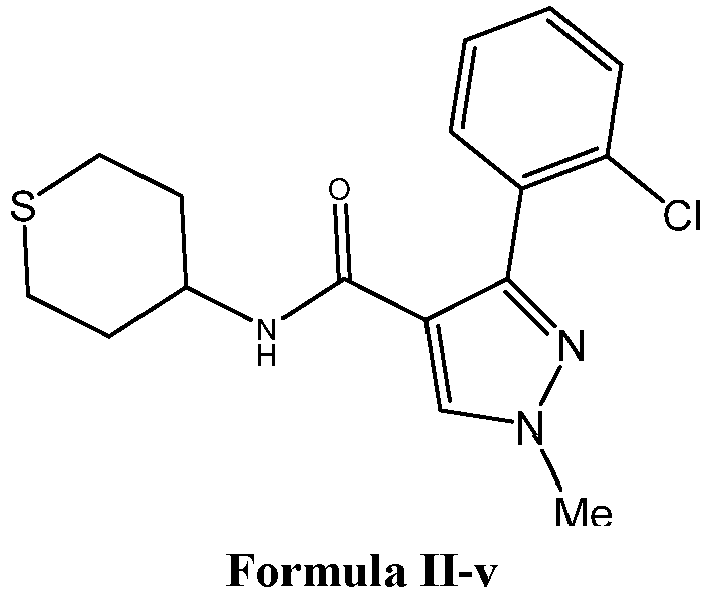
- R 10 is methyl, R 11 is 2-chlorophenyl, R 12 is ethoxy, and Z is C 2 alkyl; or R 10 is methyl, R 11 is 2-chlorophenyl, R 12 is tetrahydrofuran-2-yl, and Z is C 2 alkyl; or R 10 is methyl, R 11 is 2-chlorophenyl, R 12 is tetrahydrothiopyran-4-yl, and Z is a bond.
- compositions comprise a compound or salt of Formula II, in which R 11 is phenyl or halophenyl In more specific aspects, R 11 is chlorophenyl, and in yet still more specific aspects, R 11 is 2-chlorophenyl.
- compositions comprise a compound or salt of Formula II, in which R 11 is R 11 is thienyl. In still more specific aspects, R 11 is 2-thienyl.
- compositions comprise a compound or salt of Formula II, in which R 12 is R 12 is 2-methylcyclohexyl, and in yet still more specific aspects, R 12 is 2-methylcyclohexyl and Z is a bond.
- the compositions comprise a compound or salt of Formula II, in which R 12 is tetrahydrofuranyl or tetrahydrothiopyranyl.
- R 12 is tetrahydrofuran-2-yl, and Z is C 2 alkyl; or R 12 is tetrahydro-2H-thiopyran-4-yl and Z is a bond.
- compositions comprise a compound or salt of Formula II, in which R 12 is alkenyl, and in more specific aspects, R 12 is allyl. In still more specific aspects, R 12 is allyl and Z is a bond.
- compositions comprise a compound or salt of Formula II, in which R 12 is is ethoxy.
- R 12 is ethoxy and Z is C 2 alkyl.
- the compositions comprise a compound or salt of Formula II, in which Z is C 1 -C 6 alkyl, and in some aspects, , Z is C 1 -C 3 alkyl.
- Z is a straight-chain, saturated alkylene moiety, specifically a divalent methylene, ethylene, propylene, butylene, pentylene, or hexylene moiety.
- the compositions comprise a compound or salt of Formula II in which Z is a bond.
- bond refers to a direct attachment between the amide nitrogen atom of Formula II and the moiety comprising R 12 . That is, in aspects, , wherein a bond exists between the amide nitrogen atom and R 12 , there is/are no intervening bridging atom(s).
- compositions comprising an effective amount of a compound of Formula I, Formula II or a mixture thereof for administration to a plant, a seed, soil or an insect to control insect pests.
- Methods employing a composition containing an effective amount of such compounds are also expressly described herein. It is to be recognized that an effective amount of a compound of Formula I and/or Formula II may differ depending upon how the compositions are being applied. For example, applying the compositions to a plant may entail a different effective amount than when the compositions are applied directly to an insect. In another aspect, effective amounts of a compound of Formula I or Formula II may vary for different types of insects.
- an effective amount of the compound of Formula I and/or Formula II may represent a quantity that is sufficient to kill a certain type of insect pest.
- an effective amount may represent a quantity that is sufficient to drive an insect pest away from a target area and/or prevent the insect pest from reproducing, for example.
- compositions of the present disclosure include, for example, compounds of Formulas I-i through I-x and II-i through II-v.
- compositions of the present disclosure and not falling within the scope of protection may be chosen from a number of formulation types including but not limited to, soluble concentrates, suspension concentrates, oil miscible liquids, ultra-low volume liquids, emulsifiable concentrates, dispersible concentrates, microemulsions, emulsions (both oil-in-water and water-in-oil), oil dispersions, capsule suspensions, and microencapsulated particles.
- Other examples include dry compositions, including but not limited to, dustable powders, soluble powders, water-soluble granules, wettable powders, water-dispersible granules, spreadable granules and seed treatments.
- compositions described herein can comprise any adjuvants, excipients, or other desirable component known in the art.
- additional ingredients include surfactants, co-surfactants, permeation enhancers, dispersants, wetting agents and cosolvents.
- compositions described herein may but not covered by the scope of protection further comprise a surfactant in some aspects.
- Suitable surfactants can include those that promote dispersion of the compound of Formula I or Formula II in a liquid phase.
- Surfactants can be chosen for compatibility with a particular application and compound.
- Suitable surfactants can be chosen from cationic surfactants, anionic surfactants, zwitterionic surfactants, and neutral surfactants, and illustrative examples of each category will be familiar to one having ordinary skill in the art.
- compositions described herein may further comprise an additional co-active.
- the co-active may be, for example, an insecticide, a fungicide, an herbicide, a nematicide, a biocontrol agent, a microorganism, or any mixture thereof. Suitable examples of these additional co-actives are provided hereinafter.
- a liquid seed treatment composition may comprise one or more insecticides and nematicides selected from abamectin, aldicarb, aldoxycarb, bifenthrin, carbofuran, chlorantraniliprole, clothianidin, cyantraniliprole, cyfluthrin, cyhalothrin, cypermethrin, deltamethrin, dinotefuran, emamectin, ethiprole, fenamiphos, fipronil, flubendiamide, fosthiazate, imidacloprid, ivermectin, lambda-cyhalothrin, milbemectin, tioxazafen, nitenpyram, oxamyl, permethrin, spinetoram, spinosad, spirodichlofen, spirotetramat, tefluthrin, thiacloprid,
- Non-limiting examples of useful fungicides include aromatic hydrocarbons, benzimidazoles, benzothiadiazole, carboxamides, carboxylic acid amides, morpholines, phenylamides, phosphonates, quinone outside inhibitors ( e . g ., strobilurins), thiazolidines, thiophanates, thiophene carboxamides, and triazoles.
- Non-limiting examples of fungicides include acibenzolar-S-methyl, azoxystrobin, benalaxyl, bixafen, boscalid, carbendazim, chlorothalonil, cyproconazole, dimethomorph, epoxiconazole, fludioxonil, fluopyram, fluxapyroxad, fluoxastrobin, flutianil, flutolanil, fluxapyroxad, fosetyl-Al, ipconazole, isopyrazam, kresoxim-methyl, mefenoxam, metalaxyl, metconazole, myclobutanil, orysastrobin, penflufen, penthiopyrad, picoxystrobin, propiconazole, prothiconazole, pyraclostrobin, sedaxane, silthiofam, tebuconazole, thiabendazole, thifluzamide,
- Non-limiting examples of herbicides include ACCase inhibitors, acetanilides, AHAS inhibitors, carotenoid biosynthesis inhibitors, EPSPS inhibitors, glutamine synthetase inhibitors, PPO inhibitors, PS II inhibitors, and synthetic auxins.
- herbicides include acetochlor, clethodim, dicamba, flumioxazin, fomesafen, glyphosate, glufosinate, mesotrione, quizalofop, saflufenacil, sulcotrione, and 2,4-D (2,4-dichlorophenoxyacetic acid).
- Additional co-actives may also comprise substances such as, biological control agents, microbial extracts, natural products, plant growth activators or plant defense agents.
- biological control agents include bacteria, fungi, beneficial nematodes, and viruses.
- the biological control agent can comprise a bacterium of the genus Actinomycetes, Agrobacterium, Arthrobacter, Alcaligenes, Aureobacterium, Azobacter, Bacillus, Beijerinckia, Bradyrhizobium, Brevibacillus, Burkholderia, Chromobacterium, Clostridium, Clavibacter, Comamonas, Corynebacterium, Curtobacterium, Enterobacter, Flavobacterium, Gluconobacter, Hydrogenophaga, Klebsiella, Metarhizium, Methylobacterium, Paenibacillus, Pasteuria, Photorhabdus, Phyllobacterium, Pseudomonas, Rhizobium, Serratia, Sphingobacterium, Stenotrophomonas, Streptomyces, Variovorax, and Xenorhabdus.
- the bacteria is selected from the group consisting of Bacillus amyloliquefaciens, Bacillus cereus, Bacillus firmus, Bacillus, lichenformis, Bacillus pumilus, Bacillus sphaericus, Bacillus subtilis, Bacillus thuringiensis, Bradyrhizobiumjaponicum, Chromobacterium subtsugae, Metarhizium anisopliae, Pasteuria nishizawae, Pasteuria penetrans, Pasteuria usage, Pseudomonas fluorescens, and Streptomyces lydicus.
- the biological control agent can comprise a fungus of the genus Alternaria, Ampelomyces, Aspergillus, Aureobasidium, Beauveria, Colletotrichum, Coniothyrium, Gliocladium, Metarhizium, Muscodor, Paecilomyces, Penicillium, Trichoderma, Typhula, Ulocladium, and Verticillium.
- the fungus is Beauveria bassiana, Coniothyrium minitans, Gliocladium virens, Muscodor albus, Paecilomyces lilacinus, Penicillium bilaiae, Trichoderma asperellum, Trichoderma polysporum, or Trichoderma virens.
- the biological control agent can comprise harpin, Reynoutria sachalinensis, jasmonate, lipochitooligosaccharides, salicylic acid and/or isoflavones.
- the biological control agent may comprise Bacillus firmus.
- compositions described herein not covered by the scope of protection can be administered to seeds, plants or the growth medium of plants (e.g., soil), wherein the control of insects is desired.
- the compounds and compositions can likewise be administered directly to insects for similar purposes.
- the present disclosure provides methods of controlling insect pests, in which the methods comprise administering to a plant, seed, soil or insect, a composition comprising an effective amount of a compound described herein.
- methods described herein may comprise administering to a plant, seed, soil or insect, a composition comprising a compound of Formula I, a tautomer thereof, or a salt thereof, where the variables in Formula I are defined as above.
- methods described herein may comprise administering to a plant, seed, soil or insect, a composition comprising a compound of Formula II or a salt thereof, where the variables in Formula II are defined as above.
- compositions are administered to a plant, seed, soil and/or insect are not believed to be particularly limited. Particular techniques can be chosen depending upon the target to which the compositions are to be administered. Suitable techniques can include, for example, spreading a solid formulation or spraying a liquid formulation of the compositions in the case of administration to a plant or insect. In the case of administration to a seed, the compositions may be blended with a plurality of seeds in a hopper, or a liquid formulation may be sprayed upon a plurality of seeds, for example.
- the compositions can be administered to a seed. In other embodiments, the compositions can be administered to a plant. In more particular embodiments, the compositions can be administered to foliage of a plant or to soil surrounding a root zone of the plant. In still other embodiments, the compositions can be administered directly to an insect. Choice of administration in a given manner can be dictated whether the insects are primarily surface insects or sub-surface insects, for example.
- Non-limiting examples of plants that may be protected from insect pests in accordance with the methods described herein include monocotyledon crops such as corn, wheat, barley, rye, sugar cane, rice, sorghum, oat; dicotyledon crops such as cotton, sugar beet, peanut, potato, sweet potato, yam sunflower, soybean, alfalfa, flax, canola, grapes, tobacco; vegetables including Solanaceae vegetables such as eggplant, tomato, green pepper and pepper; Cucurbitaceae vegetables such as cucumber, pumpkin, zucchini, watermelon, melon, and squash; Brassicaceae vegetables such as radish, turnip, horseradish, Chinese cabbage, cabbage, leaf mustard, broccoli and cauliflower; Asteraceae vegetables such as artichoke and lettuce; Liliaceae vegetables such as leek, onion, garlic, and asparagus; Apiaceae vegetables such as carrot, parsley, celery and parsnip; Chenopodiaceae vegetables such as spinach and chard; Lamiaceae vegetables
- stone fruits e.g. , peach, plum, nectarine, cherry, apricot, and prune
- citrus e.g. , orange, lemon, lime and grapefruit
- tree nuts e . g ., chestnut, pecan, walnut, hazel, almond, pistachio, cashew, and macadamia
- berries such as blueberry, cranberry, blackberry, strawberry, and raspberry; persimmon; olive; loquat; banana; coffee; palm; cocoa; the other trees such as tea, mulberry, flower trees, and landscape trees ( e .
- Non-limiting examples of insect pests that may be controlled by the methods described herein include members of the orders Coleoptera, Diptera, Hemiptera, and Lepidoptera.
- Non-limiting examples of the members of the order Coleoptera include Acalymma, Acanthoscelides, Adoretus, Agelastica, Agriotes, Alphitobius, Amphimallon, Anobium, Anoplophora, Anthonomus, Anthrenus, Apion, Apogonia, Atomaria, Attagenus, Bruchidius, Bruchus, Cassida, Cerotoma, Ceutorrhynchus, Chaetocnema, Cleonus, Conoderus, Cosmopolites, Costelytra, Ctenicera, Curculio, Cryptorhynchus, Cylindrocopturus, Dermestes, Diabrotica, Dichocrocis, Diloboderus, Epilachna, Epitrix, Faustinus, Gibbium, Hellula, Heteronychus, Heteronyx, Hylamorpha, Hylotrupes, Hypera, Hypothenemus, Lachnosterna, Lema
- Non-limiting examples of the members of the order Diptera include Aedes, Agromyza, Anastrepha, Anopheles, Asphondylia, Bactrocera, Bibio, Calliphora, Ceratitis, Chironomus, Chrysomyia, CHrysops, Cochliomyia, Contarinia, Cordylobia, Culex, Culicoides, Culiseta, Cuterebra, Dacus, Dasyneura, Delia, Dermatobia, Drosophila, Echinocnemus, Fannia, Gasterophilus, Glossina, Haematopota, Hydrellia, Hylemyia, Hyppobosca, Hypoderma, Liriomyza, Lucilia, Lutzomia, Mansonia, Musca, Nezara, Oestrus, Oscinella, Pegomyia, Phlebotomus, Phorbia, Phormia, Prodiplosis, Psila, Rh
- Non-limiting examples of the members of the order Hemiptera include Anasa tristis, Antestiopsis spp., Boisea spp., Blissus spp., Calocoris spp., Campylomma livida, Cavelerius spp., Cimex spp., Cimex lectularius, Cimex hemipterus, Collaria spp., Creontiades dilutus, Dasynus piperis, Dichelops furcatus, Diconocoris hewetti, Dysdercus spp., Euschistus spp., Eurygaster spp., Heliopeltis spp., Horcias nobilellus, Leptocorisa spp., Leptoglossus phyllopus, Lygus spp., Macropes excavatus, Miridae, Monal
- Non-limiting examples of the members of the order Homoptera include Acyrthosipon spp., Acrogonia spp., Aeneolamia spp., Agonoscena spp., Aleurodes spp., Aleurolobus barodensis, Aleurothrixus spp., Amrasca spp., Anuraphis cardui, Aonidiella spp., Aphanostigma piri, Aphis spp., Arboridia apicalis, Aspidiella spp., Aspidiotus spp., Atanus spp., Aulacorthum solani, Bemisia spp., Brachycaudus helichrysii, Brachycolus spp., Brevicoryne brassicae, Calligypona marginata, Carneocephala fulgida, Ceratovacuna lanigera, Cercopid
- Non-limiting examples of the members of the order Lepidoptera include Acronicta major, Adoxophyes, Aedia leucomelas, Agrotis, Alabama, Amyelois transitclla, Anarsia, Anticarsia, Argyroploce, Barathra brassicae, Borbo cinnara, Bucculatrix thurberiella, Bupalus piniarius, Busseola, Cacoecia, Caloptilia theivora, Capua reticulana, Carpocapsa pomonella, Carposina niponensis, Chematobia brumata, Chilo, Choristoneura, Clysia ambiguella, Cnaphalocerus, Cnephasia, Conopomorpha, Conotrachelus, Copitarsia, Cydia, Dalaca noctuides, Diaphania, Diatraea saccharalis, Earias, Ecd
- illustrative insect pests that can be controlled by practicing the disclosure herein include, for example, diamondback moth, fall armyworm, soybean looper, Western corn rootworm, Western tarnished plantbug and yellow fever mosquito.
- Non-limiting examples of plants that can be protected from insect pests according to the disclosure herein include crop plants.
- Illustrative crop plants that can be protected according to the disclosure herein include, for example, corn, cotton, soybeans, cereals, peanuts, sunflower, dry beans, peas, legume vegetables, sugarcane, alfalfa, and canola. Ornamental plants can be protected in a similar manner.
- the disclosure is related to a seed that has been treated with a composition as described herein comprising a compound or salt of Formula II.
- the compound of Formula II becomes associated with the resulting treated seed.
- the treated seed can promote distribution of the compound Formula II into the root zone surrounding the plant upon being planted.
- the compositions can be administered to a seed using a seed treatment such as, for example, solid matrix priming, imbibition, coating, and spraying.
- the treated seed may be for any plant species as described herein.
- a seed can be treated with a composition as described herein, including formulating, mixing in a seed treater tank, or combining on a seed by overcoating one or more additional active ingredients.
- the active ingredient(s) may be, for example, an insecticide, a fungicide, an herbicide, a nematicide, a biological control agent or a microorganism.
- the seed may also be a transgenic seed in some embodiments.
- a method for controlling insect pests comprise: administering to a plant, seed, soil or insect, a composition comprising a compound of Formula I, a tautomer thereof or a salt thereof wherein R 1 , R 2 and R 3 are independently selected from the group consisting of hydrogen, halogen, alkyl, alkoxy, thioalkyl, alkenyloxy, alkynyloxy, haloalkyl and haloalkoxy; wherein R 4 and R 5 are independently selected from the group consisting of hydrogen, halogen, alkyl, alkoxy, alkenyloxy and alkynyloxy; wherein at least one of R 1 - R 5 is not hydrogen; wherein R 6 and R 7 are independently selected from the group consisting of hydrogen, halogen and alkyl; wherein R 8 is selected from the group consisting of hydrogen, alkyl and optionally substituted acylphenyl; and wherein R 9 is selected from the group consisting of hydrogen
- Embodiment B A method for controlling insect pests.
- the methods comprise: administering to a plant, seed, soil or insect, a composition comprising a compound of Formula II or a salt thereof wherein R10 is selected from the group consisting of phenyl, tolyl, naphtyl, phenanthrenyl, anthracentyl, indenyl, azulenyl, biphenyl, biphenylenyl, and fluorenyl and C1-C10 alkyl; wherein R11 is selected from the group consisting of phenyl, halophenyl, tolyl, napthyl, phenanthrenyl, anthracentyl, indenyl, azulenyl, biphenyl, biphenylenyl, and fluorenyl and 5- to 14-membered heteroaryl; wherein R12 is selected from the group consisting of alkyl, alkenyl, alkynyl, C1-C10
- the treatment compositions comprise: a compound of Formula I, a tautomer thereof or a salt thereof wherein R 1 , R 2 and R 3 are independently selected from the group consisting of hydrogen, halogen, alkyl, alkoxy, thioalkyl, alkenyloxy, alkynyloxy, haloalkyl and haloalkoxy; wherein R 4 and R 5 are independently selected from the group consisting of hydrogen, halogen, alkyl, alkoxy, alkenyloxy and alkynyloxy; wherein at least one of R 1 - R 5 is not hydrogen; wherein R 6 and R 7 are independently selected from the group consisting of hydrogen, halogen and alkyl; wherein R 8 is selected from the group consisting of hydrogen, alkyl and optionally substituted acylphenyl; and wherein R 9 is selected from the group consisting of hydrogen and alkyl.
- a treated seed comprising the compound of Formula I, a tautomer thereof, or a salt thereof.
- the treatment compositions comprise: a compound of Formula II or a salt thereof wherein R10 is selected from the group consisting of phenyl, tolyl, naphtyl, phenanthrenyl, anthracentyl, indenyl, azulenyl, biphenyl, biphenylenyl, and fluorenyl and C1-C10 alkyl; wherein R11 is selected from the group consisting of phenyl, halophenyl, tolyl, napthyl, phenanthrenyl, anthracentyl, indenyl, azulenyl, biphenyl, biphenylenyl, and fluorenyl and 5- to 14-membered heteroaryl; wherein R12 is selected from the group consisting of alkyl, alkenyl, alkynyl, C1-C10 alkoxy, cyclopropyl,
- Embodiment F A treated seed.
- the treated seeds comprise the compound of Formula II or a salt thereof.
- compounds of Formula I and II may be prepared using an extension of methods known to those having ordinary skill in the art.
- 2-aryl-4,5-dibromo imidazole 8 can be prepared via reaction of aryl aldehyde 6 with 1,2-ethanediamine followed by bromination of intermediate 7 with N-bromosuccinimide.
- the compounds of Formula I can be prepared from 4,5-dibromoimidazole 8 via Suzuki-Miyaura cross-coupling with arylboronic acid 9 as described in Scheme 2.
- Asymmetrical compounds of Formula I can be prepared by using differentially substituted arylboronic acids 9 (i.e., one arylboronic acid bearing the full range of R 6 , R 7 and R 8 substitution and one arylboronic acid bearing R 9 substitution).
- differentially substituted regioisomers resulting from statistical reaction of arylboronic acids 9 with 4,5-dibromoimidazole 8 can result, which may need to be separated further.
- Example 2 Synthesis of Compounds of Formula II.
- Compounds of Formula II can be prepared as illustrated by the exemplary reactions in Scheme 3.
- Intermediate pyrazole carbaldehyde 14 can be prepared by the reaction of aryl hydrazone 12 with Vilsmeier-Haack reagent (DMF/POCl 3 ). Oxidation of intermediate pyrazole carbaldehyde 14 with NaOCl 2 at 0°C in the presence of a sulfamic acid scavenger furnished the corresponding acid 15 .
- Aryl hydrazone 12 was prepared from the corresponding acetophenone, benzophenone or acylheteroaromatic derivative 10 and hydrazine 11 in ethanol in the presence of acetic acid.
- Compounds of Formula II can be prepared from the corresponding acid 15 and amine 16 using standard coupling reagents such as, for example, CDI or EDCI/HOBt in the presence of base ( e.g, triethyl
- the test unit consisted of a 96-well bioassay plate filled with a species-specific artificial diet. Compounds were dissolved in DMSO and added as diet overlay to the indicated concentration, and dried/maintained overnight before infestation. Once dry, the bioassay plates were infested with a single neonate larva (nymph for lygus) per well. The bioassay plates were then held for 6 days in an incubator at 27°C and 50% relative humidity. Sample response was then visually assessed based on mortality and stunting of the insect. A "+” score was given to samples which showed any level of stunting and/or mortality higher than that of the untreated controls. A "-” score was given to samples which showed no activity.
- Table 1A Insect Feeding Assay - Western Corn Root Worm (WCR) Formula WCR (0.1 mg/mL) I-i + I-ii + I-iv + I-v + Untreated control (DMSO) - Table 1B: Insect Feeding Assay - Diamondback Moth (DBM) Formula DBM (0.1 mg/mL) II-i + II-ii + Untreated control (DMSO) - Table 1C: Insect Feeding Assay - Yellow Fever Mosquito (YFM) Formula YFM (0.1 mg/mL) I-i + I-ii + I-iv + II-i + II-iv + II-v + Untreated control (DMSO) -
- the test unit consisted of a 96-well bioassay plate filled with species-specific artificial diet. Compounds were dissolved in DMSO and added as diet overlay to the indicated concentration and dried/maintained overnight before infestation. Once dry, the bioassay plates were infested with a single neonate larva (nymph for lygus) per well. The bioassay plates were held for 6 days in an incubator at 27°C and 50% relative humidity. Each well was assessed for infestation and contamination. Wells that were contaminated or not infested were not included in the stunting and mortality assessment.
- a stunting score was reported based on the relative size of the survivors within the 8-well column with averaging across a 3 column replicate. Untreated control insects were used as a reference. Percent mortality was determined as the percentage of insects that did not survive the treatment with the compound divided by the total insect count within an 8-well column and averaged across a 3 column replicate. Under these assay conditions, "+” represents mortality or stunting significantly different compared to the untreated control and "-" represents no significant difference in mortality or stunting compared to the untreated control.
- Table 2A Insect Feeding Assay - Diamondback Moth (DBM) Formula DBM (0.05 mg/mL) I-i + I-ii + I-iii not tested I-iv + I-v - I-vi + I-vii + I-viii + I-ix + I-x + II-i + II-ii - II-iii - II-iv - II-v not tested
- Table 2B Insect Feeding Assay - Fall Armyworm (FAW) Formula FAW (0.05 mg/mL) I-i - I-ii + I-iii not tested I-iv - I-v - I-vi - I-vii + I-viii - I-ix + I-x + II-i - II-ii - II-iv - II-v not tested
- Table 2C Insect Feeding Assay - Soybean Looper (SL) Formula SL (0.05 mg/mL) I-i -i + I-
Landscapes
- Organic Chemistry (AREA)
- Chemical & Material Sciences (AREA)
- Life Sciences & Earth Sciences (AREA)
- Health & Medical Sciences (AREA)
- General Health & Medical Sciences (AREA)
- Plant Pathology (AREA)
- Engineering & Computer Science (AREA)
- Dentistry (AREA)
- Wood Science & Technology (AREA)
- Zoology (AREA)
- Environmental Sciences (AREA)
- Pest Control & Pesticides (AREA)
- Agronomy & Crop Science (AREA)
- Toxicology (AREA)
- Agricultural Chemicals And Associated Chemicals (AREA)
- Plural Heterocyclic Compounds (AREA)
Description
- The present application claims the benefit of priority under 35 U.S.C. 9 119 from
U.S. Provisional Patent Application 62/256,867, filed on November 18, 2015 - Not applicable.
- The present application generally relates to insect control and, more specifically, to methods employing substituted pyrazole compounds for use in controlling insect pests.
- Insect pests can cause significant losses in agriculture, which can impact food production yields and result in increased costs to the consumer. Effective control of invertebrate pests can contribute to more efficient crop production.
- Among the insect pests that are particularly undesirable are those that can significantly impact the yield of important row crops including, for example, corn, soybeans, cotton and certain other types of vegetables. Examples of insect pests that can have a destructive impact on these crops include, but are not limited to, fall armyworm, Western corn rootworm, diamondback moth, Western tarnished plantbug and soybean looper.
- Ornamental plants or other types of plants not being cultivated as a food source can be similarly impacted by a range of insect pests. Different insect pests may impact these types of plants.
- Insect pests can also represent a nuisance or health hazard to both humans and animals. Because of their proximity to insect-targeted agricultural products, agricultural workers can oftentimes be particularly affected. Mosquitoes are one of many examples of insect pests that can be a nuisance or health hazard to humans and animals.
- Methods for controlling insect pests comprising administering to a plant, seed, soil or insect compositions comprising pyrazole compounds have been previously described by Li, Lin et al. (Gaodeng Xuexiao Huaxue Xuebao (2016), 37(9), 1649-1654),
Fischer Ruediger et al. (US2011/312953 A1 ),Natsuhara Katsuya et al. (US2010/099692 A1 ),Finkelstein Bruce Lawrence et al. (US 2009/269300 A1 ),Lahm George P et al. (US 2006/052343 A1 ),Lahm George P et al. (US 2006/167060 A1 ),Clark David Alan (US 2004/259913 A1 ) andLahm George P et al. (US 2004/142984 A1 ). Although products for controlling insect pests are commercially available, the need continues for new formulations that are more effective, less costly, environmentally safer, and/or exhibit new modes of action. Identifying new compounds that have improved activity against insect pests can be a driving factor in the search for formulations having improved insecticidal activity. - Compounds that exhibit insecticidal activity are described herein. The compounds described herein may be used, for example, in the preparation of compositions and in accordance with methods for control of insect pests, as set forth in detail below. More particularly, compositions and methods employing substituted imidazole and substituted pyrazole compounds for use in controlling insect pests are described herein.
- In some aspects not being part of the claimed invention, methods of the present disclosure comprise administering to a plant, seed, soil or insect, a composition comprising a compound of Formula I, a tautomer thereof or a salt thereof

- Treatment compositions comprising the compound of Formula I, a tautometer thereof or a salt thereof are also described but not part of the scope of protection.
- Treated seeds can be prepared by administering the compound of Formula I, a tautomer thereof or a salt thereof to a seed, in which the treated seed comprises the compound of Formula I. This subject-matter is not covered by the scope of protection.
- Methods of the present invention comprise administering to a plant, seed, soil or insect, a composition comprising a compound of Formula II or a salt thereof

- Treatment compositions comprising the compound of Formula II or a salt thereof are also described but are not part of the scope of protection.
- Treated seeds can be prepared by administering the compound of Formula II or a salt thereof to a seed, in which the treated seed comprises the compound of Formula II or a salt thereof.
- Not applicable.
- Compounds that exhibit insecticidal activity are described herein but are not covered by the scope of protection. The compounds described herein may be used, for example, in the preparation of compositions and in accordance with methods for control of insect pests, as set forth in detail below. More particularly, compositions and methods employing substituted imidazole and substituted pyrazole compounds for use in controlling insect pests are described herein.
- As used herein, the term "insect pest" refers to any insect that infests a plant or a planting site, or that is a nuisance insect toward a human or an animal. More specific examples of insect pests are provided hereinbelow.
- The present disclosure provides a number of compounds that have beneficial activity toward controlling insect pests, but are not covered by the scope of protection. Substituted imidazole and substituted pyrazole compounds of the types discussed herein can be used for this purpose. These compounds can be used alone or in combination with one another for controlling insect pests. Depending upon the substituents present in the compounds, some insect pests can be targeted in preference to others.
- In some aspects not being part of the claimed invention, compounds suitable for controlling insect pests can be a compound of Formula I, a tautomer thereof, or a salt thereof

- R1, R2 and R3 are independently selected from the group consisting of hydrogen, halogen, alkyl, alkoxy, thioalkyl, alkenyloxy, alkynyloxy, haloalkyl and haloalkoxy. R4 and R5 are independently selected from the group consisting of hydrogen, halogen, alkyl, alkoxy, alkenoxy and alkynoxy. At least one of R1-R5 is not hydrogen. R6 and R7 are independently selected from the group consisting of hydrogen, halogen and alkyl. R8 is selected from the group consisting of hydrogen, alkyl and optionally substituted acylphenyl. R9 is selected from the group consisting of hydrogen and alkyl.
- In some or aspects not covered by the scope of protection, compounds suitable for controlling insect pests can be a compound of Formula II or a salt thereof.

- As used herein, the term "tautomer" refers to any compound existing in a least two forms that readily interconvert, with a state of equilibrium being established between the at least two forms.
- As used herein, the term "halogen" refers to any radical of fluorine, chlorine, bromine or iodine.
- As used herein, the term "alkyl" refers to, by itself or as part of another group, both straight and branched chain radicals of up to ten carbons, which may be optionally independently substituted. Non-limiting examples of C1-C10 alkyl groups include methyl, ethyl, propyl, isopropyl, butyl, sec-butyl, t-butyl, pentyl, isopentyl, hexyl, heptyl, and octyl groups. In some embodiments of the present disclosure, the term "alkyl" refers to, by itself or as part of another group, a straight or branched chain radical comprising from one to six carbon atoms, or from one to three carbon atoms.
- As used herein, the term "haloalkyl" refers to, by itself or as part of another group, an alkyl group substituted with at least one halogen. Non-limiting examples of haloalkyl groups include trifluoromethyl and 2,2,2-trifluoroethyl.
- As used herein, the term "alkoxy" refers to, by itself or as part of another group, an alkyl group appended to a parent molecular entity through an oxygen atom. Non-limiting examples of alkoxy groups include methoxy, ethoxy, propoxy, 2-propoxy, 1-butoxy, 2-butoxy, tert-butoxy, 1-pentoxy, 2-pentoxy, 3-pentoxy, 1-hexoxy, 2-hexoxy, and 3-hexoxy.
- As used herein, the term "thioalkyl" refers to the sulfur analogue of an alkoxy group, in which, by itself or as part of another group, an alkyl group is appended to a parent molecular entity through a sulfur atom.
- As used herein, the term "haloalkoxy" refers to, by itself or as part of another group, an alkoxy group in which the appended alkyl group is further substituted with at least one halogen. Non-limiting examples of haloalkoxy groups include trifluoromethoxy, 2,2-dichloroethoxy, and 2,2,2-trifluoroethoxy.
- As used herein, the term "cycloalkyl" refers to an alkyl group forming a closed ring comprising from 3 to 8 carbon atoms or from 6 to 10 carbon atoms. Non-limiting examples of cycloalkyl groups include cyclopropyl, cyclobutyl, cyclopentyl, cyclohexyl, methylcyclohexyl, and cycloheptyl. The term "cycloalkyl" further refers to any of monocyclic, bicyclic and polycyclic carbon-containing rings.
- As used herein, the term "optionally substituted" refers to a moiety that may be present as a pendant group attached to a carbon-containing ring or chain. In some embodiments, an optional substitution may be a pendant group comprising at least one heteroatom. As used herein, the term "heteroatom" refers to oxygen, nitrogen, sulfur or halogen atoms.
- As used herein, the term "heterocycloalkyl" refers to a saturated or partially saturated monocyclic or bicyclic hydrocarbon containing one or more heteroatoms selected from O, S, and N, which replace one or more carbon atoms within the carbon-containing ring. A heterocycloalkyl group may be attached to a parent molecular entity via any of the carbon atoms or, if present, a nitrogen atom. Non-limiting examples of heterocycloalkyl groups include, but are not limited to, 4-membered rings, such as an azetidinyl, and oxetanyl; 5-membered rings, such as tetrahydrofuranyl, dioxolinyl, pyrrolidinyl, pyrrolidinonyl, imidazolidinyl, pyrazolidinyl, and pyrrolinyl; 6-membered rings, such as tetrahydropyranyl, tetrahydrothiopyranyl, piperidinyl, morpholinyl, dithianyl, thiomorpholinyl, piperazinyl, and trithianyl; or 7-membered rings, such as a diazepanyl ring, for example.
- As used herein, the term "aryl" refers to, by itself or as part of another group, a monocyclic, bicyclic or tricyclic aromatic group containing from 6 to 14 carbon atoms. Common aryl groups include C6-C14 aryl, particularly C6-C10 aryl. Non-limiting examples of C6-C14 aryl groups include phenyl, naphthyl, phenanthrenyl, anthracenyl, indenyl, azulenyl, biphenyl, biphenylenyl and fluorenyl groups.
- As used herein, the term "heteroaryl" refers to, by itself or as part of another group, a cyclic moiety having 5 to 14 ring atoms and 6, 10 or 14 π electrons shared in a cyclic array, in which 1, 2 or 3 of the ring atoms are oxygen, nitrogen, and/or sulfur atoms and the remaining ring atoms are carbon atoms. Non-limiting examples of heteroaryl groups include thienyl (thiophenyl), benzo[b]thienyl, naphtho[2,3-b]thienyl, thianthrenyl, furyl (furanyl), pyranyl, isobenzofuranyl, chromenyl, xanthenyl, phenoxanthinyl, pyrrolyl, including without limitation 2H pyrrolyl, imidazolyl, pyrazolyl, pyridyl (pyridinyl), including without limitation 2-pyridyl, 3-pyridyl, and 4-pyridyl, pyrazinyl, pyrimidinyl, pyridazinyl, indolizinyl, isoindolyl, 3H-indolyl, indolyl, indazolyl, purinyl, 4H-quinolizinyl, isoquinolyl, quinolyl, phthalazinyl, naphthyridinyl, quinazolinyl, cinnolinyl, pteridinyl, carbazolyl, β-carbolinyl, phenanthridinyl, acrindinyl, pyrimidinyl, phenanthrolinyl, phenazinyl, isothiazolyl, phenothiazinyl, isoxazolyl, furazanyl, phenoxazinyl, 1,4-dihydroquinoxaline-2,3-dione, 7-aminoisocoumarin, pyrido[1,2-α]pyrimidin-4-one, pyrazolo[1,5-α]pyrimidinyl, including without limitation pyrazolo[1,5-α]pyrimidin-3-yl, 1,2-benzoisoxazol-3-yl, benzimidazolyl, 2-oxindolyl and 2-oxobenzimidazolyl. In instances where a heteroaryl group contains a nitrogen atom in a ring, the nitrogen atom may optionally be in the form of an N-oxide, such as pyridyl N-oxide, pyrazinyl N-oxide or pyrimidinyl N-oxide, for example.
- As used herein, the term "alkenyl" refers to a straight- or branched-chain alkyl group in which at least one carbon-carbon double bond has replaced a carbon-carbon single bond. The at least one carbon-carbon double bond can be in any location and in either the E or Z configuration. Non-limiting examples of alkenyl radicals include ethenyl, E- and Z-propenyl, 2-propenyl (allyl), E- and Z-butenyl, E- and Z-isobutenyl, E- and Z-pentenyl, E- and Z-hexenyl, E,E-, E,Z-, Z,E-, Z,Z-hexadienyl, and the like.
- As used herein, the term "alkynyl" refers to a straight- or branched-chain alkyl group in which at least one carbon-carbon triple bond has replaced a carbon-carbon single bond. Non-limiting examples of alkynyl groups include CH2-CH≡CH (propargyl), CH2-C≡C-CH3, and CH2-C≡C-CH(CH3)-CH2-CH3
- As used herein, the terms "alkenyloxy" and "alkynyloxy" refer to an alkenyl group or an alkynyl group, respectively, which are appended to a parent molecular entity through an oxygen atom.
- As used herein, the term "acylphenyl" refers to a phenyl group appended to a parent molecular entity through a carbonyl moiety.
- As one having ordinary skill in the art will understand, N-unsubstituted imidazole compounds are tautomeric and interconvert between the 1H and 3H forms. The equilibrium distribution between the 1H and the 3H forms can depend upon a number of factors including, for example, pH, temperature and the type of substituents that are present on the imidazole group. Accordingly, it is to be understood that any reference herein to a compound having the structure of Formula I also equivalently refers to the tautomeric 3H structure of Formula I', or an equilibrium mixture of compounds having the structures of Formulas I and 1'.

- Compounds having the structure of Formula II are believed to be substantially non-tautomeric.
- In some aspects not being part of the claimed invention, the compositions comprise a compound, tautomer or salt of Formula I, in which R1, R2 and R3 are independently selected from the group consisting of hydrogen, halogen, alkyl, alkoxy, thioalkyl, and alkynyloxy. In some or other aspects, the compositions comprise a compound, tautomer or salt of Formula I, in which R1, R2 and R3 are independently selected from the group consisting of hydrogen, halogen, alkyl, alkoxy, and alkynyloxy.
- In some aspects also not being part of the claimed invention, the compositions comprise a compound, tautomer or salt of Formula I, in which R1, R2 and R3 are each alkyl, and in more particular embodiments, R1, R2 and R3 are each methyl. In still more particular aspects, R1, R2 and R3 are each methyl and R4-R9 are each hydrogen.
- In some aspects also not being part of the claimed invention, the compositions comprise a compound, tautomer or salt of Formula I, in which R1 and R2 are each alkyl, and in more particular embodiments, R1 and R2 are each methyl.
- In some aspects also not being part of the claimed invention, the compositions comprise a compound, tautomer or salt of Formula I, in which R1 and R3 are each halogen, or R1 and R2 are each halogen. In more particular aspects, R1 and R3 are each chlorine, or R1 is chlorine and R3 is fluorine, or R1 and R2 are each chlorine. In still more particular aspects, R1 and R3 are each chlorine, R6 and R7 are each methyl, and R2, R4, R5, R8 and R9 are each hydrogen; or R1 is chlorine, R3 is fluorine, R6 and R7 are each methyl, and R2, R4, R5, R8 and R9 are each hydrogen; or R1 and R2 are each chlorine, R6 is chlorine, and R3, R4, R5, R7, R8 and R9 are each hydrogen.
- In some aspects also not being part of the claimed invention, the compositions comprise a compound, tautomer or salt of Formula I, in which one or both of R4 and R5 is/are halogen, and in more particular embodiments, R4 and/or R5 is chlorine or fluorine. In still more particular aspects, R4 is fluorine, R9 is acylphenyl or acyl(4-fluorophenyl), and R1-R3 and R5-R8 are hydrogen.
- In some aspects also not being part of the claimed invention, the compositions comprise a compound, tautomer or salt of Formula I, in which at least one of R1 and R2 is alkoxy, and in more particular embodiments R1 and R2 are each methoxy, or R1 is ethoxy, or R2 is methoxy. In still more particular aspects, R1 and R2 are each methoxy, and R3-R9 are hydrogen; or R1 is ethoxy and R2-R9 are hydrogen; or R2 is methoxy, R4 and R5 are each methoxy, and R1, R3 and R6-R9 are hydrogen.
- In some aspects also not being part of the claimed invention, the compositions comprise a compound, tautomer or salt of Formula I, in which R1 is alkynyloxy, and in more specific embodiments, R1 is propargyloxy. In still more particular aspects, R1 is propargyloxy and R2-R9 are hydrogen.
- In some aspects also not being part of the claimed invention, the compositions comprise a compound, tautomer or salt of Formula I, in which R2 is thioalkyl, and in more specific embodiments, R2 is thiomethyl. In still more specific aspects, R2 is thiomethyl, R8 is methyl, and R1, R3 -R7, and R9 are hydrogen.
- In some aspects also not being part of the claimed invention, the compositions comprise a compound, tautomer or salt of Formula I, in which R1 is hydrogen, or R2 is hydrogen, or R3 is hydrogen. In some aspects, R2 and R3 are each hydrogen.
- In some aspects also not being part of the claimed invention, the compositions comprise a compound, tautomer or salt of Formula I, in which R4 and R5 are alkoxy, and in more specific aspects, R4 and R5 are methoxy. In other aspects, the compositions comprise a compound, tautomer or salt of Formula I, in which R1, R2 and R4 are alkoxy, and in more specific embodiments, R1, R2 and R4 are methoxy.
- In some aspects also not being part of the claimed invention, the compositions comprise a compound, tautomer or salt of Formula I, in which R6 and R7 are alkyl, and in more specific embodiments R6 and R7 are each methyl. In still more specific aspects, R6 and R7 are each methyl and R8 is hydrogen.
- In some aspects also not being part of the claimed invention, the compositions comprise a compound, tautomer or salt of Formula I, in which R6 is halogen and R7 is hydrogen, and in more specific aspects, R6 is chlorine and R7 is hydrogen. In still more specific aspects, R6 is chlorine and R7 and R8 are hydrogen.
- In some aspects also not being part of the claimed invention, the compositions comprise a compound, tautomer or salt of Formula I, in which R9 is alkyl, and in more specific aspects, R9 is methyl.
- In some aspects also not being part of the claimed invention, the compositions comprise a compound, tautomer or salt of Formula I, in which R9 is optionally substituted acylphenyl, and in more specific aspects, R9 is acylphenyl or acyl(4-fluorophenyl).
- In some aspects not covered by the scope of protection with respect to the compositions, the compositions comprise a compound or salt of Formula II, in which R10 is phenyl, or R10 is tolyl In more specific aspects, R10 is p-tolyl. In still more specific aspects, R10 is p-tolyl, R11 is phenyl, R12 is allyl, and Z is a bond; or R10 is phenyl, R11 is 2-thienyl, R12 is 2-methylcyclohexyl, and Z is a bond.
- In some aspects not covered by the scope of protection with respect to the compositions, the compositions comprise a compound or salt of Formula II, in which R10 is alkyl or alkyl, and in more specific aspects, , R10 is methyl. In still more specific aspects, R10 is methyl and R11 is 2-chlorophenyl. In yet still more specific aspects, R10 is methyl, R11 is 2-chlorophenyl, R12 is ethoxy, and Z is C2 alkyl; or R10 is methyl, R11 is 2-chlorophenyl, R12 is tetrahydrofuran-2-yl, and Z is C2 alkyl; or R10 is methyl, R11 is 2-chlorophenyl, R12 is tetrahydrothiopyran-4-yl, and Z is a bond.
- In some aspects not covered by the scope of protection with respect to the compositions, the compositions comprise a compound or salt of Formula II, in which R11 is phenyl or halophenyl In more specific aspects, R11 is chlorophenyl, and in yet still more specific aspects, R11 is 2-chlorophenyl.
- In some aspects not covered by the scope of protection with respect to the compositions, the compositions comprise a compound or salt of Formula II, in which R11 is R11 is thienyl. In still more specific aspects, R11 is 2-thienyl.
- In some aspects not covered by the scope of protection with respect to the compositions, the compositions comprise a compound or salt of Formula II, in which R12 is R12 is 2-methylcyclohexyl, and in yet still more specific aspects, R12 is 2-methylcyclohexyl and Z is a bond.
- In some aspects not covered by the scope of protection with respect to the compositions, the compositions comprise a compound or salt of Formula II, in which R12 is tetrahydrofuranyl or tetrahydrothiopyranyl. In still more specific aspects, R12 is tetrahydrofuran-2-yl, and Z is C2 alkyl; or R12 is tetrahydro-2H-thiopyran-4-yl and Z is a bond.
- In some aspects not covered by the scope of protection with respect to the compositions, the compositions comprise a compound or salt of Formula II, in which R12 is alkenyl, and in more specific aspects, R12 is allyl. In still more specific aspects, R12 is allyl and Z is a bond.
- In some aspects not covered by the scope of protection with respect to the compositions, the compositions comprise a compound or salt of Formula II, in which R12 is is ethoxy. In still more specific aspects, R12 is ethoxy and Z is C2 alkyl.
- In some aspects not covered by the scope of protection with respect to the compositions, the compositions comprise a compound or salt of Formula II, in which Z is C1-C6 alkyl, and in some aspects, , Z is C1-C3 alkyl. In more specific aspects, , Z is a straight-chain, saturated alkylene moiety, specifically a divalent methylene, ethylene, propylene, butylene, pentylene, or hexylene moiety.
- In some aspects not covered by the scope of protection with respect to the compositions, the compositions comprise a compound or salt of Formula II in which Z is a bond. As used herein, the term "bond" refers to a direct attachment between the amide nitrogen atom of Formula II and the moiety comprising R12. That is, in aspects, , wherein a bond exists between the amide nitrogen atom and R12, there is/are no intervening bridging atom(s).
- In non-limiting aspects not covered by the scope of protection with respect to the compounds, and with respect to compounds of formulae I and II-i, as well not covered by the scope of protection when using in a method of controlling insect pests, , examples of specific compounds meeting the structural requirements of Formulas I and II that can be suitable for use in the various aspects of the present disclosure include:
- Formula I-i: 2-mesityl-4,5-diphenyl-1H-imidazole,

- Formula I-ii: 2-(2,6-dichlorophenyl)-4-(2,5-dimethylphenyl)-5-phenyl-1H-imidazole,

- Formula I-iii: 2-(2-chloro-6-fluorophenyl)-4-(2,5-dimethylphenyl)-5-phenyl-1H-imidazole,

- Formula 1-iv: 2-(2,4-dimethoxyphenyl)-4,5-diphenyl-1H-imidazole,

- Formula 1-v: 2-(2-ethoxyphenyl)-4,5-diphenyl-1H-imidazole,

- Formula 1-vi: 4,5-diphenyl-2-(2-(prop-2-yn-1-yloxy)phenyl)-1H-imidazole,

- Formula I-vii: 5-(3-chlorophenyl)-2-(2,4-dichlorophenyl)-4-phenyl-1H-imidazole,

- Formula I-viii: 4,5-diphenyl-2-(2,3,4-trimethoxyphenyl)-1H-imidazole,

- Formula I-ix: 2-(4-(methylthio)phenyl)-4,5-di-p-tolyl-1H-imidazole,

- Formula 1-x: (4-fluorophenyl)(4-(2-(3-fluorophenyl)-5-phenyl-1H-imidazol-4-yl)phenyl)methanone,

- Formula II-i: N-allyl-3-phenyl-1-(p-tolyl)-1H-pyrazole-4-carboxamide,

- Formula II-ii: N-(2-methylcyclohexyl)-1-phenyl-3-(thiophen-2-yl)-1H-pyrazole-4-carboxamide,

- Formula II-iii: 3-(2-chlorophenyl)-N-(2-ethoxyethyl)-1-methyl-1H-pyrazole-4-carboxamide,

- Formula II-iv: 3-(2-chlorophenyl)-1-methyl-N-(2-(tetrahydrofuran-2-yl)ethyl)-1H-pyrazole-4-carboxamide, and

- Formula II-v: 3-(2-chlorophenyl)-1-methyl-N-(tetrahydro-2H-thiopyran-4-yl)-1H-pyrazole-4-carboxamide,
- Also presented herein but not covered by the scope of protection are compositions comprising an effective amount of a compound of Formula I, Formula II or a mixture thereof for administration to a plant, a seed, soil or an insect to control insect pests. Methods employing a composition containing an effective amount of such compounds are also expressly described herein. It is to be recognized that an effective amount of a compound of Formula I and/or Formula II may differ depending upon how the compositions are being applied. For example, applying the compositions to a plant may entail a different effective amount than when the compositions are applied directly to an insect. In another aspect, effective amounts of a compound of Formula I or Formula II may vary for different types of insects. Furthermore, it is to be recognized that an effective amount of the compound of Formula I and/or Formula II may represent a quantity that is sufficient to kill a certain type of insect pest. However, it is to be recognized that in some alternative aspects an effective amount may represent a quantity that is sufficient to drive an insect pest away from a target area and/or prevent the insect pest from reproducing, for example.
- Particular compounds, tautomers or salts that may be present in an effective amount within compositions of the present disclosure and not covered by the scope of protection include, for example, compounds of Formulas I-i through I-x and II-i through II-v.
- Compositions of the present disclosure and not falling within the scope of protection may be chosen from a number of formulation types including but not limited to, soluble concentrates, suspension concentrates, oil miscible liquids, ultra-low volume liquids, emulsifiable concentrates, dispersible concentrates, microemulsions, emulsions (both oil-in-water and water-in-oil), oil dispersions, capsule suspensions, and microencapsulated particles. Other examples include dry compositions, including but not limited to, dustable powders, soluble powders, water-soluble granules, wettable powders, water-dispersible granules, spreadable granules and seed treatments.
- The compositions described herein can comprise any adjuvants, excipients, or other desirable component known in the art. Non-limiting examples of additional ingredients include surfactants, co-surfactants, permeation enhancers, dispersants, wetting agents and cosolvents.
- Compositions described herein may but not covered by the scope of protection further comprise a surfactant in some aspects. Suitable surfactants can include those that promote dispersion of the compound of Formula I or Formula II in a liquid phase. Surfactants can be chosen for compatibility with a particular application and compound. Suitable surfactants can be chosen from cationic surfactants, anionic surfactants, zwitterionic surfactants, and neutral surfactants, and illustrative examples of each category will be familiar to one having ordinary skill in the art.
- In additional aspects not covered by the scope of protection, the compositions described herein may further comprise an additional co-active. The co-active may be, for example, an insecticide, a fungicide, an herbicide, a nematicide, a biocontrol agent, a microorganism, or any mixture thereof. Suitable examples of these additional co-actives are provided hereinafter.
- Non-limiting examples of insecticides and nematicides include carbamates, diamides, macrocyclic lactones, neonicotinoids, organophosphates, phenylpyrazoles, pyrethrins, spinosyns, synthetic pyrethroids, tetronic and tetramic acids. For example, a liquid seed treatment composition may comprise one or more insecticides and nematicides selected from abamectin, aldicarb, aldoxycarb, bifenthrin, carbofuran, chlorantraniliprole, clothianidin, cyantraniliprole, cyfluthrin, cyhalothrin, cypermethrin, deltamethrin, dinotefuran, emamectin, ethiprole, fenamiphos, fipronil, flubendiamide, fosthiazate, imidacloprid, ivermectin, lambda-cyhalothrin, milbemectin, tioxazafen, nitenpyram, oxamyl, permethrin, spinetoram, spinosad, spirodichlofen, spirotetramat, tefluthrin, thiacloprid, thiamethoxam, tioxazafen, and thiodicarb.
- Non-limiting examples of useful fungicides include aromatic hydrocarbons, benzimidazoles, benzothiadiazole, carboxamides, carboxylic acid amides, morpholines, phenylamides, phosphonates, quinone outside inhibitors (e.g., strobilurins), thiazolidines, thiophanates, thiophene carboxamides, and triazoles. Non-limiting examples of fungicides include acibenzolar-S-methyl, azoxystrobin, benalaxyl, bixafen, boscalid, carbendazim, chlorothalonil, cyproconazole, dimethomorph, epoxiconazole, fludioxonil, fluopyram, fluxapyroxad, fluoxastrobin, flutianil, flutolanil, fluxapyroxad, fosetyl-Al, ipconazole, isopyrazam, kresoxim-methyl, mefenoxam, metalaxyl, metconazole, myclobutanil, orysastrobin, penflufen, penthiopyrad, picoxystrobin, propiconazole, prothiconazole, pyraclostrobin, sedaxane, silthiofam, tebuconazole, thiabendazole, thifluzamide, thiophanate, tolclofos-methyl, trifloxystrobin, and triticonazole.
- Non-limiting examples of herbicides include ACCase inhibitors, acetanilides, AHAS inhibitors, carotenoid biosynthesis inhibitors, EPSPS inhibitors, glutamine synthetase inhibitors, PPO inhibitors, PS II inhibitors, and synthetic auxins. Particular examples of herbicides include acetochlor, clethodim, dicamba, flumioxazin, fomesafen, glyphosate, glufosinate, mesotrione, quizalofop, saflufenacil, sulcotrione, and 2,4-D (2,4-dichlorophenoxyacetic acid).
- Additional co-actives may also comprise substances such as, biological control agents, microbial extracts, natural products, plant growth activators or plant defense agents. Non-limiting examples of biological control agents include bacteria, fungi, beneficial nematodes, and viruses.
- In certain aspects, the biological control agent can comprise a bacterium of the genus Actinomycetes, Agrobacterium, Arthrobacter, Alcaligenes, Aureobacterium, Azobacter, Bacillus, Beijerinckia, Bradyrhizobium, Brevibacillus, Burkholderia, Chromobacterium, Clostridium, Clavibacter, Comamonas, Corynebacterium, Curtobacterium, Enterobacter, Flavobacterium, Gluconobacter, Hydrogenophaga, Klebsiella, Metarhizium, Methylobacterium, Paenibacillus, Pasteuria, Photorhabdus, Phyllobacterium, Pseudomonas, Rhizobium, Serratia, Sphingobacterium, Stenotrophomonas, Streptomyces, Variovorax, and Xenorhabdus. In particular embodiments the bacteria is selected from the group consisting of Bacillus amyloliquefaciens, Bacillus cereus, Bacillus firmus, Bacillus, lichenformis, Bacillus pumilus, Bacillus sphaericus, Bacillus subtilis, Bacillus thuringiensis, Bradyrhizobiumjaponicum, Chromobacterium subtsugae, Metarhizium anisopliae, Pasteuria nishizawae, Pasteuria penetrans, Pasteuria usage, Pseudomonas fluorescens, and Streptomyces lydicus.
- In certain aspects, the biological control agent can comprise a fungus of the genus Alternaria, Ampelomyces, Aspergillus, Aureobasidium, Beauveria, Colletotrichum, Coniothyrium, Gliocladium, Metarhizium, Muscodor, Paecilomyces, Penicillium, Trichoderma, Typhula, Ulocladium, and Verticillium. In another embodiment, the fungus is Beauveria bassiana, Coniothyrium minitans, Gliocladium virens, Muscodor albus, Paecilomyces lilacinus, Penicillium bilaiae, Trichoderma asperellum, Trichoderma polysporum, or Trichoderma virens.
- In certain aspects, , the biological control agent can comprise harpin, Reynoutria sachalinensis, jasmonate, lipochitooligosaccharides, salicylic acid and/or isoflavones. In another embodiment, the biological control agent may comprise Bacillus firmus.
- Compounds and compositions described herein not covered by the scope of protection can be administered to seeds, plants or the growth medium of plants (e.g., soil), wherein the control of insects is desired. The compounds and compositions can likewise be administered directly to insects for similar purposes. For example, in various embodiments, the present disclosure provides methods of controlling insect pests, in which the methods comprise administering to a plant, seed, soil or insect, a composition comprising an effective amount of a compound described herein.
- More specifically, in some embodiments not being part of the claimed invention, methods described herein may comprise administering to a plant, seed, soil or insect, a composition comprising a compound of Formula I, a tautomer thereof, or a salt thereof, where the variables in Formula I are defined as above. In some or other embodiments, methods described herein may comprise administering to a plant, seed, soil or insect, a composition comprising a compound of Formula II or a salt thereof, where the variables in Formula II are defined as above.
- The techniques by which the compositions are administered to a plant, seed, soil and/or insect are not believed to be particularly limited. Particular techniques can be chosen depending upon the target to which the compositions are to be administered. Suitable techniques can include, for example, spreading a solid formulation or spraying a liquid formulation of the compositions in the case of administration to a plant or insect. In the case of administration to a seed, the compositions may be blended with a plurality of seeds in a hopper, or a liquid formulation may be sprayed upon a plurality of seeds, for example.
- In some aspects, , the compositions can be administered to a seed. In other embodiments, the compositions can be administered to a plant. In more particular embodiments, the compositions can be administered to foliage of a plant or to soil surrounding a root zone of the plant. In still other embodiments, the compositions can be administered directly to an insect. Choice of administration in a given manner can be dictated whether the insects are primarily surface insects or sub-surface insects, for example.
- Non-limiting examples of plants that may be protected from insect pests in accordance with the methods described herein include monocotyledon crops such as corn, wheat, barley, rye, sugar cane, rice, sorghum, oat; dicotyledon crops such as cotton, sugar beet, peanut, potato, sweet potato, yam sunflower, soybean, alfalfa, flax, canola, grapes, tobacco; vegetables including Solanaceae vegetables such as eggplant, tomato, green pepper and pepper; Cucurbitaceae vegetables such as cucumber, pumpkin, zucchini, watermelon, melon, and squash; Brassicaceae vegetables such as radish, turnip, horseradish, Chinese cabbage, cabbage, leaf mustard, broccoli and cauliflower; Asteraceae vegetables such as artichoke and lettuce; Liliaceae vegetables such as leek, onion, garlic, and asparagus; Apiaceae vegetables such as carrot, parsley, celery and parsnip; Chenopodiaceae vegetables such as spinach and chard; Lamiaceae vegetables such as mint and basil; flowers such as petunia, morning glory, carnation, chrysanthemum and rose; foliage plants; fruit trees such as pome fruits (e.g., apple, pear and Japanese pear), stone fruits (e.g., peach, plum, nectarine, cherry, apricot, and prune), citrus (e.g., orange, lemon, lime and grapefruit), tree nuts (e.g., chestnut, pecan, walnut, hazel, almond, pistachio, cashew, and macadamia), berries such as blueberry, cranberry, blackberry, strawberry, and raspberry; persimmon; olive; loquat; banana; coffee; palm; cocoa; the other trees such as tea, mulberry, flower trees, and landscape trees (e.g., ash, birch, dogwood, eucalyptus, ginkgo, lilac, maple, oak, poplar, Formosa sweet gum, sycamore, fir, hemlock fir, needle juniper, pine, spruce, and yew); and turf.
- Non-limiting examples of insect pests that may be controlled by the methods described herein include members of the orders Coleoptera, Diptera, Hemiptera, and Lepidoptera.
- Non-limiting examples of the members of the order Coleoptera include Acalymma, Acanthoscelides, Adoretus, Agelastica, Agriotes, Alphitobius, Amphimallon, Anobium, Anoplophora, Anthonomus, Anthrenus, Apion, Apogonia, Atomaria, Attagenus, Bruchidius, Bruchus, Cassida, Cerotoma, Ceutorrhynchus, Chaetocnema, Cleonus, Conoderus, Cosmopolites, Costelytra, Ctenicera, Curculio, Cryptorhynchus, Cylindrocopturus, Dermestes, Diabrotica, Dichocrocis, Diloboderus, Epilachna, Epitrix, Faustinus, Gibbium, Hellula, Heteronychus, Heteronyx, Hylamorpha, Hylotrupes, Hypera, Hypothenemus, Lachnosterna, Lema, Leptinotarsa, Leucoptera, Lissorhoptrus, Lixus, Luperodes, Lyctus, Megascelis, Melanotus, Meligethes, Melolontha, Migdolus, Monochanus, Naupactus, Niptus, Oryctes, Oryzaephilus, Oryzaphagus, Otiorrhynchus, Oxycetonia, Phaedon, Phyllophaga, Phyllotreta, Popillia, Premnotrypes, Prostephanus, Psylliodes, Ptinus, Rhizobius, Rhizopertha, Sitophilus, Sphenophorus, Stegobium, Sternechus, Symphyletes, Tanymecus, Tenebrio, Tribolium, Trogoderma, Tychius, Xylotrechus, and Zabrus.
- Non-limiting examples of the members of the order Diptera include Aedes, Agromyza, Anastrepha, Anopheles, Asphondylia, Bactrocera, Bibio, Calliphora, Ceratitis, Chironomus, Chrysomyia, CHrysops, Cochliomyia, Contarinia, Cordylobia, Culex, Culicoides, Culiseta, Cuterebra, Dacus, Dasyneura, Delia, Dermatobia, Drosophila, Echinocnemus, Fannia, Gasterophilus, Glossina, Haematopota, Hydrellia, Hylemyia, Hyppobosca, Hypoderma, Liriomyza, Lucilia, Lutzomia, Mansonia, Musca, Nezara, Oestrus, Oscinella, Pegomyia, Phlebotomus, Phorbia, Phormia, Prodiplosis, Psila, Rhagoletis, Sarcophaga, Simulium, Stomoxys, Tabanus, Tannia, Tetanops, and Tipula.
- Non-limiting examples of the members of the order Hemiptera (sub-order Heteroptera) include Anasa tristis, Antestiopsis spp., Boisea spp., Blissus spp., Calocoris spp., Campylomma livida, Cavelerius spp., Cimex spp., Cimex lectularius, Cimex hemipterus, Collaria spp., Creontiades dilutus, Dasynus piperis, Dichelops furcatus, Diconocoris hewetti, Dysdercus spp., Euschistus spp., Eurygaster spp., Heliopeltis spp., Horcias nobilellus, Leptocorisa spp., Leptoglossus phyllopus, Lygus spp., Macropes excavatus, Miridae, Monalonion atratum, Nezara spp., Oebalus spp., Pentomidae, Piesma quadrata, Piezodorus spp., Psallus spp., Pseudacysta persea, Rhodnius spp., Sahlbergella singularis, Scaptocoris castanea, Scotinophora spp., Stephanitis nashi, Tibraca spp., Triatoma spp.
- Non-limiting examples of the members of the order Homoptera include Acyrthosipon spp., Acrogonia spp., Aeneolamia spp., Agonoscena spp., Aleurodes spp., Aleurolobus barodensis, Aleurothrixus spp., Amrasca spp., Anuraphis cardui, Aonidiella spp., Aphanostigma piri, Aphis spp., Arboridia apicalis, Aspidiella spp., Aspidiotus spp., Atanus spp., Aulacorthum solani, Bemisia spp., Brachycaudus helichrysii, Brachycolus spp., Brevicoryne brassicae, Calligypona marginata, Carneocephala fulgida, Ceratovacuna lanigera, Cercopidae, Ceroplastes spp., Chaetosiphon fragaefolii, Chionaspis tegalensis, Chlorita onukii, Chromaphis juglandicola, Chrysomphalus ficus, Cicadulina mbila, Coccomytilus halli, Coccus spp., Cryptomyzus ribis, Dalbulus spp., Dialeurodes spp., Diaphorina spp., Diaspis spp., Drosicha spp., Dysaphis spp., Dysmicoccus spp., Empoasca spp., Eriosoma spp., Erythroneura spp., Euscelis bilobatus, Ferrisia spp., Geococcus coffeae, Hieroglyphus spp., Homalodisca coagulata, Hyalopterus arundinis, Icerya spp., Idiocerus spp., Idioscopus spp., Laodelphax striatellus, Lecanium spp., Lepidosaphes spp., Lipaphis erysimi, Macrosiphum spp., Mahanarva spp., Melanaphis sacchari, Metcalfiella spp., Metopolophium dirhodum, Monellia costalis, Monelliopsis pecanis, Myzus spp., Nasonovia ribisnigri, Nephotettix spp., Nilaparvata lugens, Oncometopia spp., Orthezia praelonga, Parabemisia myricae, Paratrioza spp., Parlatoria spp., Pemphigus spp., Peregrinus maidis, Phenacoccus spp., Phloeomyzus passerinii, Phorodon humuli, Phylloxera spp., Pinnaspis aspidistrae, Planococcus spp., Protopulvinaria pyriformis, Pseudaulacaspis pentagona, Pseudococcus spp., Psylla spp., Pteromalus spp., Pyrilla spp., Quadraspidiotus spp., Quesada gigas, Rastrococcus spp., Rhopalosiphum spp., Saissetia spp., Scaphoides titanus, Schizaphis graminum, Selenaspidus articulatus, Sogata spp., Sogatella furcifera, Sogatodes spp., Stictocephala festina, Tenalaphara malayensis, Tinocallis caryaefoliae, Tomaspis spp., Toxoptera spp., Trialeurodes spp., Trioza spp., Typhlocyba spp., Unaspis spp., Viteus vitifolii, Zygina spp.
- Non-limiting examples of the members of the order Lepidoptera include Acronicta major, Adoxophyes, Aedia leucomelas, Agrotis, Alabama, Amyelois transitclla, Anarsia, Anticarsia, Argyroploce, Barathra brassicae, Borbo cinnara, Bucculatrix thurberiella, Bupalus piniarius, Busseola, Cacoecia, Caloptilia theivora, Capua reticulana, Carpocapsa pomonella, Carposina niponensis, Chematobia brumata, Chilo, Choristoneura, Clysia ambiguella, Cnaphalocerus, Cnephasia, Conopomorpha, Conotrachelus, Copitarsia, Cydia, Dalaca noctuides, Diaphania, Diatraea saccharalis, Earias, Ecdytolopha aurantium, Elasmopalpus lignosellus, Eldana saccharin a, Ephestia, Epinotia, Epiphyas postvittana, Etiella, Eulia, Eupoecilia ambiguella, Euproctis, Euxoa, Feltia, Galleria mellonella, Gracillaria, Grapholitha, Hedylepta, Helicoverpa, Heliothis, Hofmannophila pseudospretella, Homoeosoma, Homona, Hyponomeuta padella, Kakivoria flavofasciata, Laphygma, Laspeyresia molesta, Leucinodes orbonalis, Leucoptera, Lithocolletis, Lithophane antennata, Lobesia, Loxagrotis albicosta, Lymantria, Lyonetia, Malacosoma neustria, Maruca testulalis, Mamestra brassicae, Mods, Mythimna separata, Nymphula, Oiketicus, Oria, Orthaga, Ostrinia, Oulema oryzae, Panolis flammea, Parnara, Pectinophora, Perileucoptera, Phthorimaea, Phyllocnistis citrella, Phyllonorycter, Pieris, Platynota stultana, Plodia interpunctella, Plusia, Plutella xylostella, Prays, Prodenia, Protoparce, Pseudaletia, Pseudoplusia includens, Pyrausta nubilalis, Rachiplusia nu, Schoenobius, Scirpophaga, Scotia segetum, Sesamia, Sparganothis, Spodoptera, Stathmopoda, Stomopteryx subsecivella, Synanthedon, Tecia solanivora, Thermesia gemmatalis, Tinea pellionella, Tineola bisselliella, Tortrix, Trichophaga tapetzella, Trichoplusia, Tuta absoluta, and Virachola.
- In more specific aspects, illustrative insect pests that can be controlled by practicing the disclosure herein include, for example, diamondback moth, fall armyworm, soybean looper, Western corn rootworm, Western tarnished plantbug and yellow fever mosquito.
- Non-limiting examples of plants that can be protected from insect pests according to the disclosure herein include crop plants. Illustrative crop plants that can be protected according to the disclosure herein include, for example, corn, cotton, soybeans, cereals, peanuts, sunflower, dry beans, peas, legume vegetables, sugarcane, alfalfa, and canola. Ornamental plants can be protected in a similar manner.
- In some embodiments, the disclosure is related to a seed that has been treated with a composition as described herein comprising a compound or salt of Formula II. The compound of Formula II becomes associated with the resulting treated seed. The treated seed can promote distribution of the compound Formula II into the root zone surrounding the plant upon being planted. In some embodiments, the compositions can be administered to a seed using a seed treatment such as, for example, solid matrix priming, imbibition, coating, and spraying. The treated seed may be for any plant species as described herein. In some aspects, a seed can be treated with a composition as described herein, including formulating, mixing in a seed treater tank, or combining on a seed by overcoating one or more additional active ingredients. The active ingredient(s) may be, for example, an insecticide, a fungicide, an herbicide, a nematicide, a biological control agent or a microorganism. The seed may also be a transgenic seed in some embodiments.
- Aspects disclosed herein include:
- A, not being part of the present invention. A method for controlling insect pests. The methods comprise: administering to a plant, seed, soil or insect, a composition comprising a compound of Formula I, a tautomer thereof or a salt thereof

- Embodiment B. A method for controlling insect pests. The methods comprise: administering to a plant, seed, soil or insect, a composition comprising a compound of Formula II or a salt thereof

- Aspect C, not being part of the present invention. An insecticidal treatment composition. The treatment compositions comprise: a compound of Formula I, a tautomer thereof or a salt thereof

- Aspect D, not being part of the present invention. A treated seed. The treated seeds comprise the compound of Formula I, a tautomer thereof, or a salt thereof.
- Aspect E, not covered by the scope of protection. An insecticidal treatment composition. The treatment compositions comprise: a compound of Formula II or a salt thereof


- Embodiment F. A treated seed. The treated seeds comprise the compound of Formula II or a salt thereof.
- Each of aspects A, C and D, not covered by the scope of protection, may have one or more of the following additional elements in any combination:
- Element 1: wherein R1, R2 and R3 are independently selected from the group consisting of hydrogen, halogen, alkyl, alkoxy, thioalkyl and alkynyloxy.
- Element 2: wherein an effective amount of a compound selected from the group consisting of 2-mesityl-4,5-diphenyl-1H-imidazole, 2-(2,6-dichlorophenyl)-4-(2,5-dimethylphenyl)-5-phenyl-1H-imidazole, 2-(2-chloro-6-fluorophenyl)-4-(2,5-dimethylphenyl)-5-phenyl-1H-imidazole, 2-(2,4-dimethoxyphenyl)-4,5-diphenyl-1H-imidazole, 2-(2-ethoxyphenyl)-4,5-diphenyl-1H-imidazole, 4,5-diphenyl-2-(2-(prop-2-yn-1-yloxy)phenyl)-1H-imidazole, 5-(3-chlorophenyl)-2-(2,4-dichlorophenyl)-4-phenyl-1H-imidazole, 4,5-diphenyl-2-(2,3,4-trimethoxyphenyl)-1H-imidazole, 2-(4-(methylthio)phenyl)-4,5-di-p-tolyl-1H-imidazole, (4-fluorophenyl)(4-(2-(3-fluorophenyl)-5-phenyl-1H-imidazol-4-yl)phenyl) methanone, a tautomer thereof and a salt thereof is administered to the plant, seed, soil or insect.
- Element 3: wherein the composition is administered to a seed.
- Element 4: wherein the composition is administered to a plant.
- Element 5: wherein the composition is applied to foliage of the plant.
- Element 6: wherein the composition is applied to soil surrounding a root zone of the plant.
- Element 7: wherein the plant is a crop plant selected from the group consisting of corn, cotton, soybeans, cereals, peanuts, sunflower, dry beans, peas, legume vegetables, sugarcane, alfalfa and canola.
- Element 8: wherein the insect pest is a member of an order selected from the group consisting of Coleoptera, Diptera, Hemiptera and Lepidoptera.
- Element 9: wherein the insect pest is a member of a genus selected from the group consisting Aedes, Diabrotica, Lygus, Plutella, Pseudoplusia and Spodoptera.
- Element 10: wherein the insect pest is selected from the group consisting of diamondback moth, fall armyworm, soybean looper, Western corn rootworm and yellow fever mosquito.
- Element 11: wherein the treatment composition further comprises a surfactant.
- Element 12: wherein the treatment composition further comprises a fungicide, an insecticide, a nematicide, an herbicide, a microorganism or mixtures thereof.
- Element 13: wherein R10 is selected from the group consisting of phenyl and tolyl, and R11 is selected from the group consisting of phenyl, thienyl and chlorophenyl.
- Element 14: wherein R12 is selected from the group consisting of allyl, 2-methylcyclohexyl, ethoxy, tetrahydrofuran-2-yl, tetrahydro-2H-thiopyran-4-yl, and Z is C1-C3 alkyl or a bond.
- Element 15: wherein an effective amount of a compound selected from the group consisting of N-allyl-3-phenyl-1-(p-tolyl)-1H-pyrazole-4-carboxamide, N-(2-methylcyclohexyl)-1-phenyl-3-(thiophen-2-yl)-1H-pyrazole-4-carboxamide, 3-(2-chlorophenyl)-N-(2-ethoxyethyl)-1-methyl-1H-pyrazole-4-carboxamide, 3-(2-chlorophenyl)-1-methyl-N-(2-(tetrahydrofuran-2-yl)ethyl)-1H-pyrazole-4- carboxamide, 3-(2-chlorophenyl)-1-methyl-N-(tetrahydro-2H-thiopyran-4-yl)-1H-pyrazole-4-carboxamide, and a salt thereof is administered to the plant, seed, soil or insect.
- Generally, compounds of Formula I and II may be prepared using an extension of methods known to those having ordinary skill in the art.
- Synthesis of Compounds of Formula I. Compounds of Formula I may be prepared as illustrated by the exemplary synthetic route shown in Scheme 1 below. 5-Bromoimidazoles 3 with a diverse set of substitutions can be prepared via a copper-catalyzed cycloamination reaction of 1,1-dibromoalkenes 1 with corresponding amidines 2. Trisubstituted imidazoles 5 can be prepared from corresponding 5-bromo imidazoles 3 via Suzuki-Miyaura cross-coupling with appropriate arylboronic acids 4 under the conditions described in Scheme 1. Following deprotection, compounds of Formula I result.

- Additionally, certain compounds of Formula I may also be prepared as generally set forth in Scheme 2 below. 2-aryl-4,5-dibromo imidazole 8 can be prepared via reaction of aryl aldehyde 6 with 1,2-ethanediamine followed by bromination of intermediate 7 with N-bromosuccinimide. The compounds of Formula I can be prepared from 4,5-dibromoimidazole 8 via Suzuki-Miyaura cross-coupling with arylboronic acid 9 as described in Scheme 2. As depicted in Scheme 2, arylboronic acid 9 is chosen such that compounds of Formula I with symmetrical substitution are formed (i.e., R8=R9 and R6=R7=H). Asymmetrical compounds of Formula I can be prepared by using differentially substituted arylboronic acids 9 (i.e., one arylboronic acid bearing the full range of R6, R7 and R8 substitution and one arylboronic acid bearing R9 substitution). When employing different arylboronic acids 9, differentially substituted regioisomers resulting from statistical reaction of arylboronic acids 9 with 4,5-dibromoimidazole 8 can result, which may need to be separated further.

- Example 2: Synthesis of Compounds of Formula II. Compounds of Formula II can be prepared as illustrated by the exemplary reactions in Scheme 3. Intermediate pyrazole carbaldehyde 14 can be prepared by the reaction of aryl hydrazone 12 with Vilsmeier-Haack reagent (DMF/POCl3). Oxidation of intermediate pyrazole carbaldehyde 14 with NaOCl2 at 0°C in the presence of a sulfamic acid scavenger furnished the corresponding acid 15. Aryl hydrazone 12 was prepared from the corresponding acetophenone, benzophenone or acylheteroaromatic derivative 10 and hydrazine 11 in ethanol in the presence of acetic acid. Compounds of Formula II can be prepared from the corresponding acid 15 and amine 16 using standard coupling reagents such as, for example, CDI or EDCI/HOBt in the presence of base (e.g, triethylamine).

- Insect Feeding Assays. For evaluating control of insect species, the test unit consisted of a 96-well bioassay plate filled with a species-specific artificial diet. Compounds were dissolved in DMSO and added as diet overlay to the indicated concentration, and dried/maintained overnight before infestation. Once dry, the bioassay plates were infested with a single neonate larva (nymph for lygus) per well. The bioassay plates were then held for 6 days in an incubator at 27°C and 50% relative humidity. Sample response was then visually assessed based on mortality and stunting of the insect. A "+" score was given to samples which showed any level of stunting and/or mortality higher than that of the untreated controls. A "-" score was given to samples which showed no activity. Western corn rootworm data represents a summary of three replicates. Data for all other insect species represents a summary of two replicates. Summarized results are presented in the Tables below.
Table 1A: Insect Feeding Assay - Western Corn Root Worm (WCR) Formula WCR (0.1 mg/mL) I-i + I-ii + I-iv + I-v + Untreated control (DMSO) - Table 1B: Insect Feeding Assay - Diamondback Moth (DBM) Formula DBM (0.1 mg/mL) II-i + II-ii + Untreated control (DMSO) - Table 1C: Insect Feeding Assay - Yellow Fever Mosquito (YFM) Formula YFM (0.1 mg/mL) I-i + I-ii + I-iii + I-iv + II-i + II-iii + II-iv + II-v + Untreated control (DMSO) - - Insect Feeding Assays. For evaluating control of insect species in this example, the test unit consisted of a 96-well bioassay plate filled with species-specific artificial diet. Compounds were dissolved in DMSO and added as diet overlay to the indicated concentration and dried/maintained overnight before infestation. Once dry, the bioassay plates were infested with a single neonate larva (nymph for lygus) per well. The bioassay plates were held for 6 days in an incubator at 27°C and 50% relative humidity. Each well was assessed for infestation and contamination. Wells that were contaminated or not infested were not included in the stunting and mortality assessment. A stunting score was reported based on the relative size of the survivors within the 8-well column with averaging across a 3 column replicate. Untreated control insects were used as a reference. Percent mortality was determined as the percentage of insects that did not survive the treatment with the compound divided by the total insect count within an 8-well column and averaged across a 3 column replicate. Under these assay conditions, "+" represents mortality or stunting significantly different compared to the untreated control and "-" represents no significant difference in mortality or stunting compared to the untreated control.
Table 2A: Insect Feeding Assay - Diamondback Moth (DBM) Formula DBM (0.05 mg/mL) I-i + I-ii + I-iii not tested I-iv + I-v - I-vi + I-vii + I-viii + I-ix + I-x + II-i + II-ii - II-iii - II-iv - II-v not tested Table 2B: Insect Feeding Assay - Fall Armyworm (FAW) Formula FAW (0.05 mg/mL) I-i - I-ii + I-iii not tested I-iv - I-v - I-vi - I-vii + I-viii - I-ix + I-x + II-i - II-ii - II-iii - II-iv - II-v not tested Table 2C: Insect Feeding Assay - Soybean Looper (SL) Formula SL (0.05 mg/mL) I-i - I-ii + I-iii not tested I-iv - I-v - I-vi - I-vii + I-viii - I-ix + I-x + II-i - II-ii - II-iii - II-iv - II-v not tested Table 2D: Insect Feeding Assay - Western Corn Rootworm (WCR) Formula WCR (0.05 mg/mL) I-i not tested I-ii not tested I-iii not tested I-iv not tested I-v not tested I-vi not tested I-vii not tested I-viii + I-ix + I-x + II-i not tested II-ii not tested II-iii not tested II-iv not tested II-v not tested Table 2E: Insect Feeding Assay - Western Tarnished Plantbug Formula WTP (0.05 mg/mL) I-i - I-ii + I-iii not tested I-iv - I-v - I-vi + I-vii - I-viii - I-ix - I-x + II-i - II-ii - II-iii - II-iv - II-v not tested Table 2F: Insect Feeding Assay - Yellow Fever Mosquito (YFM) Formula YFM (0.05 mg/mL) I-i - I-ii + I-iii not tested I-iv + I-v - I-vi + I-vii + I-viii + I-ix - I-x - II-i - II-ii - II-iii - II-iv - II-v not tested - When introducing elements of the present invention or the preferred embodiments(s) thereof, the articles "a", "an", "the" and "said" are intended to mean that there are one or more of the elements. The terms "comprising", "including" and "having" are intended to be inclusive and mean that there may be additional elements other than the listed elements.
Claims (7)
- A method of controlling insect pests, the method comprising:administering to a plant, seed, or soil a composition comprising a compound of Formula II or a salt thereof
 wherein R10 is selected from the group consisting of phenyl, tolyl, naphtyl, phenanthrenyl, anthracentyl, indenyl, azulenyl,
biphenyl, biphenylenyl, and fluorenyl and C1-C10 alkyl;wherein R11 is selected from the group consisting of phenyl, halophenyl, tolyl, napthyl, phenanthrenyl, anthracentyl, indenyl, azulenyl, biphenyl, biphenylenyl, and fluorenyl and 5- to 14-membered heteroaryl;wherein R12 is selected from the group consisting of alkyl, alkenyl, alkynyl, C1-C10 alkoxy, cyclopropyl, cyclobutyl, cyclopentyl,
cyclohexyl, methylcyclohexyl, cycloheptyl, azetidinyl, oxetanyl, tetrahydrofuranyl, dioxolinyl, pyrrolidinyl, pyrrolidinonyl, imidazolidinyl, pyrazolidinyl, pyrrolinyl tetrahydropyranyl, tetrahydrothiopyranyl, piperidinyl, morpholinyl, dithianyl, thiomorpholinyl, piperazinyl, trithianyl, and diazepanyl; andwherein Z is C1-C6 alkyl or a bond. - The method of claim 1, wherein R10 is selected from the group consisting of phenyl and tolyl, and R11 is selected from the group consisting of phenyl, thienyl and chlorophenyl.
- The method of claim 1 or claim 2, wherein R12 is selected from the group consisting of allyl, 2-methylcyclohexyl, ethoxy, tetrahydrofuran-2-yl, tetrahydro-2H-thiopyran-4-yl, and Z is C1-C3 alkyl or a bond.
- The method of claim 1, wherein an effective amount of a compound selected from the group consisting of N-allyl-3-phenyl-1-(p-tolyl)-1H-pyrazole-4-carboxamide, N-(2-methylcyclohexyl)-1-phenyl-3-(thiophen-2-yl)-1H-pyrazole-4-carboxamide, 3-(2-chlorophenyl)-N-(2-ethoxyethyl)-1-methyl-1H-pyrazole-4-carboxamide, 3-(2-chlorophenyl)-1-methyl-N-(2-(tetrahydrofuran-2-yl)ethyl)-1H-pyrazole-4-carboxamide, 3-(2-chlorophenyl)-1-methyl-N-(tetrahydro-2H-thiopyran-4-yl)-1H-pyrazole-4-carboxamide, and a salt thereof is administered to the plant, seed, or soil.
- The method of any one of claims 1-4, wherein the composition is administered to a seed or a plant.
- The method of any one of claims 1-5, wherein the insect pest is selected from the group consisting of diamondback moth, fall armyworm, soybean looper, Western corn rootworm, Western tarnished plantbug and yellow fever mosquito.
- A treated seed prepared according to the method of claim 5, the treated seed comprising the compound of Formula II or a salt thereof.
Applications Claiming Priority (2)
| Application Number | Priority Date | Filing Date | Title |
|---|---|---|---|
| US201562256867P | 2015-11-18 | 2015-11-18 | |
| PCT/US2016/061033 WO2017087218A1 (en) | 2015-11-18 | 2016-11-09 | Insecticidal compositions and methods |
Publications (3)
| Publication Number | Publication Date |
|---|---|
| EP3377486A1 EP3377486A1 (en) | 2018-09-26 |
| EP3377486A4 EP3377486A4 (en) | 2019-09-04 |
| EP3377486B1 true EP3377486B1 (en) | 2024-09-18 |
Family
ID=58717697
Family Applications (1)
| Application Number | Title | Priority Date | Filing Date |
|---|---|---|---|
| EP16866863.0A Active EP3377486B1 (en) | 2015-11-18 | 2016-11-09 | Method of controlling insect pests |
Country Status (9)
| Country | Link |
|---|---|
| US (2) | US10827755B2 (en) |
| EP (1) | EP3377486B1 (en) |
| CN (1) | CN108349953B (en) |
| AR (1) | AR106735A1 (en) |
| BR (1) | BR112018009906B1 (en) |
| ES (1) | ES2996890T3 (en) |
| MX (1) | MX2018005549A (en) |
| PL (1) | PL3377486T3 (en) |
| WO (1) | WO2017087218A1 (en) |
Families Citing this family (19)
| Publication number | Priority date | Publication date | Assignee | Title |
|---|---|---|---|---|
| ES2996890T3 (en) * | 2015-11-18 | 2025-02-13 | Monsanto Technology Llc | Method of controlling insect pests |
| CN110149929A (en) * | 2019-07-01 | 2019-08-23 | 遂宁市安居区坤元种植专业合作社 | A kind of peach high-yield planting method |
| CN110357820A (en) * | 2019-08-14 | 2019-10-22 | 南通大学 | A kind of pyrazoles oxime ether compound of -3- of methyl containing 1- substituted phenyl pyrazole structure and its preparation method and application |
| CN110754484B (en) * | 2019-09-27 | 2021-05-25 | 贵州省果树科学研究所 | Mulberry scale control method for reducing pesticide residues in dragon orchard |
| CN114716409B (en) * | 2021-01-05 | 2024-01-12 | 西北农林科技大学 | Diphenyl pyrazole compounds and their preparation methods and uses |
| EP4314281A1 (en) | 2021-03-26 | 2024-02-07 | Flagship Pioneering Innovations VII, LLC | Production of circular polyribonucleotides in a eukaryotic system |
| US20240263206A1 (en) | 2021-03-26 | 2024-08-08 | Flagship Pioneering Innovations Vii, Llc | Compositions and methods for producing circular polyribonucleotides |
| TW202305130A (en) | 2021-03-26 | 2023-02-01 | 美商旗艦先鋒創新有限責任(Vii)公司 | Production of circular polyribonucleotides in a prokaryotic system |
| UY39997A (en) | 2021-11-01 | 2023-05-15 | Flagship Pioneering Innovations Vii Llc | POLYNUCLEOTIDES FOR MODIFYING ORGANISMS |
| AU2023209447A1 (en) | 2022-01-20 | 2024-07-18 | Flagship Pioneering Innovations Vii, Llc | Polynucleotides for modifying organisms |
| WO2024229385A1 (en) | 2023-05-03 | 2024-11-07 | Flagship Pioneering Innovations Vii, Llc | Artificial ghabrivirales satellite rnas |
| WO2024229347A1 (en) | 2023-05-03 | 2024-11-07 | Flagship Pioneering Innovations Vii, Llc | Artificial tombusviridae satellite rnas |
| EP4705478A1 (en) | 2023-05-03 | 2026-03-11 | Flagship Pioneering Innovations VII, LLC | Artificial martellivirales satellite rnas |
| WO2024229356A2 (en) | 2023-05-03 | 2024-11-07 | Flagship Pioneering Innovations Vii, Llc | Artificial solemoviridae satellite rnas |
| EP4705474A2 (en) | 2023-05-03 | 2026-03-11 | Flagship Pioneering Innovations VII, LLC | Artificial tymovirales satellite rnas |
| CN121712897A (en) | 2023-05-03 | 2026-03-20 | 旗舰创业创新第七有限责任公司 | Split Virus Satellite RNA Amplification System for Plants |
| CN121712898A (en) | 2023-05-03 | 2026-03-20 | 旗舰创业创新第七有限责任公司 | Endogenous ribovirus satellite RNA amplification system for plants |
| CN121816422A (en) | 2023-05-03 | 2026-04-07 | 旗舰创业创新第七有限责任公司 | Artificially synthesized viral satellite RNA |
| AR132591A1 (en) | 2023-05-03 | 2025-07-16 | Flagship Pioneering Innovations Vii Llc | SATELLITE RNA OF ARTIFICIAL SECOVIRIDAE |
Citations (1)
| Publication number | Priority date | Publication date | Assignee | Title |
|---|---|---|---|---|
| WO2003062221A1 (en) * | 2002-01-22 | 2003-07-31 | E.I. Du Pont De Nemours And Company | Diamide invertebrate pest control agents |
Family Cites Families (25)
| Publication number | Priority date | Publication date | Assignee | Title |
|---|---|---|---|---|
| NL296772A (en) * | 1962-03-21 | |||
| US3212966A (en) | 1963-03-07 | 1965-10-19 | Air Prod & Chem | 2, 4, 5-triphenyl- and 2-naphthyl imidazole as nematocides |
| US3707475A (en) * | 1970-11-16 | 1972-12-26 | Pfizer | Antiinflammatory imidazoles |
| EP0190203B1 (en) | 1984-07-27 | 1992-09-16 | The Board Of Trustees Of The University Of Illinois | Photodynamic herbicides |
| JP3052364B2 (en) | 1989-12-19 | 2000-06-12 | 栗田工業株式会社 | Host compounds and clathrates |
| JPH09176614A (en) | 1995-12-25 | 1997-07-08 | Japan Carlit Co Ltd:The | UV absorber |
| MY138097A (en) * | 2000-03-22 | 2009-04-30 | Du Pont | Insecticidal anthranilamides |
| US6558880B1 (en) * | 2001-06-06 | 2003-05-06 | Eastman Kodak Company | Thermally developable imaging materials containing heat-bleachable antihalation composition |
| JP4287816B2 (en) | 2002-06-13 | 2009-07-01 | イー・アイ・デュポン・ドウ・ヌムール・アンド・カンパニー | Pyrazole carboxamide insecticide |
| BRPI0313763B8 (en) * | 2002-08-19 | 2021-05-25 | 4325231 Canada Inc | 2,4,5-trisubstituted imidazoles, their uses, and pharmaceutical and antimicrobial compositions |
| US7211270B2 (en) | 2002-10-04 | 2007-05-01 | E. I. Du Pont De Nemours And Company | Anthranilamide insecticides |
| CN101243067A (en) | 2005-08-24 | 2008-08-13 | 杜邦公司 | New anthranilamides for the control of invertebrate pests |
| US7592362B2 (en) | 2006-01-19 | 2009-09-22 | Pfizer Limited | Substituted imidazoles |
| JP2008280342A (en) | 2007-04-13 | 2008-11-20 | Sumitomo Chemical Co Ltd | Pest control composition |
| BR112012032247A2 (en) * | 2010-06-15 | 2015-09-15 | Bayer Ip Gmbh | anthranilic acid derivatives |
| CN102464592B (en) | 2010-11-03 | 2014-09-03 | 中国中化股份有限公司 | Acyl benzylamine compound and use thereof |
| TW201321367A (en) | 2011-10-25 | 2013-06-01 | Du Pont | Heterocyclic insecticide substituted by 1,3-diaryl |
| MX379639B (en) * | 2011-12-19 | 2025-03-11 | Corteva Agriscience Llc | ANTHRANIL DIAMIDE/POLYMER COMPOSITIONS FOR PROPAGULE COATING. |
| CN103254133A (en) * | 2012-02-20 | 2013-08-21 | 南京大学 | Preparation method of diarylpyrazolylaniline compounds, and application of compounds in colorectal cancer treatment |
| JP6231479B2 (en) | 2012-08-10 | 2017-11-15 | 株式会社ダイセル | Crystal containing unsaturated carboxylic acid amide compound and method for producing the same |
| AR093772A1 (en) * | 2012-10-01 | 2015-06-24 | Basf Se | METHOD FOR CONTROLLING INSECTICIDES INSECTICIDES MODULADORES DE RIANODINA |
| EP2984083B1 (en) * | 2013-04-10 | 2017-01-25 | Syngenta Participations AG | Pesticidally active substituted pyridyl carboxamides |
| US9497966B2 (en) * | 2013-10-22 | 2016-11-22 | Dow Agrosciences Llc | Pesticidal compositions and related methods |
| CN104945326B (en) * | 2015-06-24 | 2017-03-01 | 安徽农业大学 | A kind of double pyrazole amide derivatives and preparation method thereof and the application in preventing and treating diamondback moth |
| ES2996890T3 (en) * | 2015-11-18 | 2025-02-13 | Monsanto Technology Llc | Method of controlling insect pests |
-
2016
- 2016-11-09 ES ES16866863T patent/ES2996890T3/en active Active
- 2016-11-09 US US15/777,124 patent/US10827755B2/en not_active Expired - Fee Related
- 2016-11-09 BR BR112018009906-6A patent/BR112018009906B1/en active IP Right Grant
- 2016-11-09 PL PL16866863.0T patent/PL3377486T3/en unknown
- 2016-11-09 EP EP16866863.0A patent/EP3377486B1/en active Active
- 2016-11-09 WO PCT/US2016/061033 patent/WO2017087218A1/en not_active Ceased
- 2016-11-09 MX MX2018005549A patent/MX2018005549A/en unknown
- 2016-11-09 CN CN201680067009.1A patent/CN108349953B/en active Active
- 2016-11-17 AR ARP160103521A patent/AR106735A1/en active IP Right Grant
-
2020
- 2020-10-21 US US17/075,819 patent/US11771088B2/en active Active
Patent Citations (1)
| Publication number | Priority date | Publication date | Assignee | Title |
|---|---|---|---|---|
| WO2003062221A1 (en) * | 2002-01-22 | 2003-07-31 | E.I. Du Pont De Nemours And Company | Diamide invertebrate pest control agents |
Also Published As
| Publication number | Publication date |
|---|---|
| US11771088B2 (en) | 2023-10-03 |
| US10827755B2 (en) | 2020-11-10 |
| CN108349953B (en) | 2022-06-17 |
| ES2996890T3 (en) | 2025-02-13 |
| PL3377486T3 (en) | 2025-02-24 |
| US20180325112A1 (en) | 2018-11-15 |
| EP3377486A4 (en) | 2019-09-04 |
| AR106735A1 (en) | 2018-02-14 |
| CN108349953A (en) | 2018-07-31 |
| MX2018005549A (en) | 2018-11-09 |
| BR112018009906B1 (en) | 2022-05-31 |
| US20210030001A1 (en) | 2021-02-04 |
| WO2017087218A1 (en) | 2017-05-26 |
| BR112018009906A2 (en) | 2018-11-13 |
| CA3002451A1 (en) | 2017-05-26 |
| EP3377486A1 (en) | 2018-09-26 |
Similar Documents
| Publication | Publication Date | Title |
|---|---|---|
| US11771088B2 (en) | Insecticidal compositions and methods | |
| KR101808079B1 (en) | Active substance combinations with insecticide and acaricide properties | |
| US10757939B2 (en) | Insecticidal and nematocidal active ingredient combinations | |
| ES2837396T3 (en) | Derivatives of 2- [3- (alkylsulfonyl) -2H-indazol-2-yl] -3H-imidazo [4,5-b] pyridine and similar compounds as pesticides | |
| EP2604118A1 (en) | Active ingredient combinations having insecticidal and acaricidal properties | |
| KR20130126893A (en) | Use of anthranilic acid amide derivatives for controlling insects and spider mires by watering, mixing with soil, drench treatment, droplet application, injection into the soil, stems or blossoms, in hydroponic systems, by treating the planting hole or immersion application, floating or seed box application or by the treatment of seeds, and for increasing the stress tolerance in plants to abioric stress | |
| ES2874674T3 (en) | Substituted Imidazolyl Carboxamides as Pesticides | |
| KR20200066631A (en) | Active compound combination with insecticidal/mite properties | |
| BR112013027107B1 (en) | active combination, composition for controlling insects, method for controlling insects, process for producing compositions and uses of an active combination | |
| AU2017298972A1 (en) | Condensed bicyclic heterocycle derivatives as pest control agents | |
| KR20200066632A (en) | Active compound combination with insecticidal/mite properties | |
| KR20200066633A (en) | Active compound combination with insecticidal/mite properties | |
| KR20130039331A (en) | Improved insecticidal compositions comprising cyclic carbonylamidines | |
| CA3002451C (en) | Insecticidal compositions and methods | |
| AU2015224451B2 (en) | Active substance combinations with insecticide and acaricide properties | |
| WO2020078839A1 (en) | Active substance combinations | |
| ES2857806T3 (en) | 2-Alkylimidazolyl-substituted carboxamides as pesticides | |
| WO2025261261A1 (en) | Substituted arylamide compound or salt thereof, method for preparing same, composition comprising same, and use of same | |
| WO2020216695A1 (en) | Methods and compositions for the control of insects in crop plants |
Legal Events
| Date | Code | Title | Description |
|---|---|---|---|
| STAA | Information on the status of an ep patent application or granted ep patent |
Free format text: STATUS: THE INTERNATIONAL PUBLICATION HAS BEEN MADE |
|
| PUAI | Public reference made under article 153(3) epc to a published international application that has entered the european phase |
Free format text: ORIGINAL CODE: 0009012 |
|
| STAA | Information on the status of an ep patent application or granted ep patent |
Free format text: STATUS: REQUEST FOR EXAMINATION WAS MADE |
|
| 17P | Request for examination filed |
Effective date: 20180605 |
|
| AK | Designated contracting states |
Kind code of ref document: A1 Designated state(s): AL AT BE BG CH CY CZ DE DK EE ES FI FR GB GR HR HU IE IS IT LI LT LU LV MC MK MT NL NO PL PT RO RS SE SI SK SM TR |
|
| AX | Request for extension of the european patent |
Extension state: BA ME |
|
| DAV | Request for validation of the european patent (deleted) | ||
| DAX | Request for extension of the european patent (deleted) | ||
| RIC1 | Information provided on ipc code assigned before grant |
Ipc: C07D 405/12 20060101AFI20190315BHEP Ipc: A01N 43/50 20060101ALI20190315BHEP |
|
| RIC1 | Information provided on ipc code assigned before grant |
Ipc: C07D 405/12 20060101AFI20190322BHEP Ipc: A01N 43/50 20060101ALI20190322BHEP |
|
| RIC1 | Information provided on ipc code assigned before grant |
Ipc: C07D 405/12 20060101AFI20190503BHEP Ipc: A01N 43/50 20060101ALI20190503BHEP |
|
| RIC1 | Information provided on ipc code assigned before grant |
Ipc: A01N 43/50 20060101ALI20190718BHEP Ipc: C07D 405/12 20060101AFI20190718BHEP |
|
| A4 | Supplementary search report drawn up and despatched |
Effective date: 20190802 |
|
| STAA | Information on the status of an ep patent application or granted ep patent |
Free format text: STATUS: EXAMINATION IS IN PROGRESS |
|
| 17Q | First examination report despatched |
Effective date: 20200923 |
|
| P01 | Opt-out of the competence of the unified patent court (upc) registered |
Effective date: 20230507 |
|
| REG | Reference to a national code |
Ref country code: DE Ref legal event code: R079 Ref document number: 602016089486 Country of ref document: DE Free format text: PREVIOUS MAIN CLASS: C07D0405120000 Ipc: A01N0043560000 |
|
| RIC1 | Information provided on ipc code assigned before grant |
Ipc: A01P 7/04 20060101ALI20240214BHEP Ipc: C07D 409/12 20060101ALI20240214BHEP Ipc: C07D 409/04 20060101ALI20240214BHEP Ipc: C07D 405/12 20060101ALI20240214BHEP Ipc: A01N 43/56 20060101AFI20240214BHEP |
|
| GRAP | Despatch of communication of intention to grant a patent |
Free format text: ORIGINAL CODE: EPIDOSNIGR1 |
|
| STAA | Information on the status of an ep patent application or granted ep patent |
Free format text: STATUS: GRANT OF PATENT IS INTENDED |
|
| INTG | Intention to grant announced |
Effective date: 20240408 |
|
| GRAS | Grant fee paid |
Free format text: ORIGINAL CODE: EPIDOSNIGR3 |
|
| GRAA | (expected) grant |
Free format text: ORIGINAL CODE: 0009210 |
|
| STAA | Information on the status of an ep patent application or granted ep patent |
Free format text: STATUS: THE PATENT HAS BEEN GRANTED |
|
| AK | Designated contracting states |
Kind code of ref document: B1 Designated state(s): AL AT BE BG CH CY CZ DE DK EE ES FI FR GB GR HR HU IE IS IT LI LT LU LV MC MK MT NL NO PL PT RO RS SE SI SK SM TR |
|
| REG | Reference to a national code |
Ref country code: GB Ref legal event code: FG4D |
|
| REG | Reference to a national code |
Ref country code: CH Ref legal event code: EP |
|
| REG | Reference to a national code |
Ref country code: IE Ref legal event code: FG4D |
|
| REG | Reference to a national code |
Ref country code: DE Ref legal event code: R096 Ref document number: 602016089486 Country of ref document: DE |
|
| REG | Reference to a national code |
Ref country code: LT Ref legal event code: MG9D |
|
| PG25 | Lapsed in a contracting state [announced via postgrant information from national office to epo] |
Ref country code: NO Free format text: LAPSE BECAUSE OF FAILURE TO SUBMIT A TRANSLATION OF THE DESCRIPTION OR TO PAY THE FEE WITHIN THE PRESCRIBED TIME-LIMIT Effective date: 20241218 |
|
| PG25 | Lapsed in a contracting state [announced via postgrant information from national office to epo] |
Ref country code: GR Free format text: LAPSE BECAUSE OF FAILURE TO SUBMIT A TRANSLATION OF THE DESCRIPTION OR TO PAY THE FEE WITHIN THE PRESCRIBED TIME-LIMIT Effective date: 20241219 Ref country code: FI Free format text: LAPSE BECAUSE OF FAILURE TO SUBMIT A TRANSLATION OF THE DESCRIPTION OR TO PAY THE FEE WITHIN THE PRESCRIBED TIME-LIMIT Effective date: 20240918 |
|
| PG25 | Lapsed in a contracting state [announced via postgrant information from national office to epo] |
Ref country code: BG Free format text: LAPSE BECAUSE OF FAILURE TO SUBMIT A TRANSLATION OF THE DESCRIPTION OR TO PAY THE FEE WITHIN THE PRESCRIBED TIME-LIMIT Effective date: 20240918 |
|
| PG25 | Lapsed in a contracting state [announced via postgrant information from national office to epo] |
Ref country code: LV Free format text: LAPSE BECAUSE OF FAILURE TO SUBMIT A TRANSLATION OF THE DESCRIPTION OR TO PAY THE FEE WITHIN THE PRESCRIBED TIME-LIMIT Effective date: 20240918 |
|
| PG25 | Lapsed in a contracting state [announced via postgrant information from national office to epo] |
Ref country code: HR Free format text: LAPSE BECAUSE OF FAILURE TO SUBMIT A TRANSLATION OF THE DESCRIPTION OR TO PAY THE FEE WITHIN THE PRESCRIBED TIME-LIMIT Effective date: 20240918 |
|
| REG | Reference to a national code |
Ref country code: NL Ref legal event code: MP Effective date: 20240918 |
|
| PG25 | Lapsed in a contracting state [announced via postgrant information from national office to epo] |
Ref country code: RS Free format text: LAPSE BECAUSE OF FAILURE TO SUBMIT A TRANSLATION OF THE DESCRIPTION OR TO PAY THE FEE WITHIN THE PRESCRIBED TIME-LIMIT Effective date: 20241218 |
|
| PG25 | Lapsed in a contracting state [announced via postgrant information from national office to epo] |
Ref country code: RS Free format text: LAPSE BECAUSE OF FAILURE TO SUBMIT A TRANSLATION OF THE DESCRIPTION OR TO PAY THE FEE WITHIN THE PRESCRIBED TIME-LIMIT Effective date: 20241218 Ref country code: NO Free format text: LAPSE BECAUSE OF FAILURE TO SUBMIT A TRANSLATION OF THE DESCRIPTION OR TO PAY THE FEE WITHIN THE PRESCRIBED TIME-LIMIT Effective date: 20241218 Ref country code: LV Free format text: LAPSE BECAUSE OF FAILURE TO SUBMIT A TRANSLATION OF THE DESCRIPTION OR TO PAY THE FEE WITHIN THE PRESCRIBED TIME-LIMIT Effective date: 20240918 Ref country code: HR Free format text: LAPSE BECAUSE OF FAILURE TO SUBMIT A TRANSLATION OF THE DESCRIPTION OR TO PAY THE FEE WITHIN THE PRESCRIBED TIME-LIMIT Effective date: 20240918 Ref country code: GR Free format text: LAPSE BECAUSE OF FAILURE TO SUBMIT A TRANSLATION OF THE DESCRIPTION OR TO PAY THE FEE WITHIN THE PRESCRIBED TIME-LIMIT Effective date: 20241219 Ref country code: FI Free format text: LAPSE BECAUSE OF FAILURE TO SUBMIT A TRANSLATION OF THE DESCRIPTION OR TO PAY THE FEE WITHIN THE PRESCRIBED TIME-LIMIT Effective date: 20240918 Ref country code: BG Free format text: LAPSE BECAUSE OF FAILURE TO SUBMIT A TRANSLATION OF THE DESCRIPTION OR TO PAY THE FEE WITHIN THE PRESCRIBED TIME-LIMIT Effective date: 20240918 |
|
| REG | Reference to a national code |
Ref country code: ES Ref legal event code: FG2A Ref document number: 2996890 Country of ref document: ES Kind code of ref document: T3 Effective date: 20250213 |
|
| REG | Reference to a national code |
Ref country code: AT Ref legal event code: MK05 Ref document number: 1723881 Country of ref document: AT Kind code of ref document: T Effective date: 20240918 |
|
| PG25 | Lapsed in a contracting state [announced via postgrant information from national office to epo] |
Ref country code: NL Free format text: LAPSE BECAUSE OF FAILURE TO SUBMIT A TRANSLATION OF THE DESCRIPTION OR TO PAY THE FEE WITHIN THE PRESCRIBED TIME-LIMIT Effective date: 20240918 |
|
| PG25 | Lapsed in a contracting state [announced via postgrant information from national office to epo] |
Ref country code: IS Free format text: LAPSE BECAUSE OF FAILURE TO SUBMIT A TRANSLATION OF THE DESCRIPTION OR TO PAY THE FEE WITHIN THE PRESCRIBED TIME-LIMIT Effective date: 20250118 Ref country code: PT Free format text: LAPSE BECAUSE OF FAILURE TO SUBMIT A TRANSLATION OF THE DESCRIPTION OR TO PAY THE FEE WITHIN THE PRESCRIBED TIME-LIMIT Effective date: 20250120 |
|
| PG25 | Lapsed in a contracting state [announced via postgrant information from national office to epo] |
Ref country code: RO Free format text: LAPSE BECAUSE OF FAILURE TO SUBMIT A TRANSLATION OF THE DESCRIPTION OR TO PAY THE FEE WITHIN THE PRESCRIBED TIME-LIMIT Effective date: 20240918 Ref country code: SM Free format text: LAPSE BECAUSE OF FAILURE TO SUBMIT A TRANSLATION OF THE DESCRIPTION OR TO PAY THE FEE WITHIN THE PRESCRIBED TIME-LIMIT Effective date: 20240918 |
|
| PG25 | Lapsed in a contracting state [announced via postgrant information from national office to epo] |
Ref country code: AT Free format text: LAPSE BECAUSE OF FAILURE TO SUBMIT A TRANSLATION OF THE DESCRIPTION OR TO PAY THE FEE WITHIN THE PRESCRIBED TIME-LIMIT Effective date: 20240918 Ref country code: EE Free format text: LAPSE BECAUSE OF FAILURE TO SUBMIT A TRANSLATION OF THE DESCRIPTION OR TO PAY THE FEE WITHIN THE PRESCRIBED TIME-LIMIT Effective date: 20240918 |
|
| PG25 | Lapsed in a contracting state [announced via postgrant information from national office to epo] |
Ref country code: CZ Free format text: LAPSE BECAUSE OF FAILURE TO SUBMIT A TRANSLATION OF THE DESCRIPTION OR TO PAY THE FEE WITHIN THE PRESCRIBED TIME-LIMIT Effective date: 20240918 |
|
| PG25 | Lapsed in a contracting state [announced via postgrant information from national office to epo] |
Ref country code: SK Free format text: LAPSE BECAUSE OF FAILURE TO SUBMIT A TRANSLATION OF THE DESCRIPTION OR TO PAY THE FEE WITHIN THE PRESCRIBED TIME-LIMIT Effective date: 20240918 |
|
| REG | Reference to a national code |
Ref country code: DE Ref legal event code: R097 Ref document number: 602016089486 Country of ref document: DE |
|
| REG | Reference to a national code |
Ref country code: CH Ref legal event code: PL |
|
| PG25 | Lapsed in a contracting state [announced via postgrant information from national office to epo] |
Ref country code: MC Free format text: LAPSE BECAUSE OF FAILURE TO SUBMIT A TRANSLATION OF THE DESCRIPTION OR TO PAY THE FEE WITHIN THE PRESCRIBED TIME-LIMIT Effective date: 20240918 |
|
| PG25 | Lapsed in a contracting state [announced via postgrant information from national office to epo] |
Ref country code: DK Free format text: LAPSE BECAUSE OF FAILURE TO SUBMIT A TRANSLATION OF THE DESCRIPTION OR TO PAY THE FEE WITHIN THE PRESCRIBED TIME-LIMIT Effective date: 20240918 |
|
| PG25 | Lapsed in a contracting state [announced via postgrant information from national office to epo] |
Ref country code: LU Free format text: LAPSE BECAUSE OF NON-PAYMENT OF DUE FEES Effective date: 20241109 |
|
| REG | Reference to a national code |
Ref country code: CH Ref legal event code: PL |
|
| PG25 | Lapsed in a contracting state [announced via postgrant information from national office to epo] |
Ref country code: CH Free format text: LAPSE BECAUSE OF NON-PAYMENT OF DUE FEES Effective date: 20241130 |
|
| PLBE | No opposition filed within time limit |
Free format text: ORIGINAL CODE: 0009261 |
|
| STAA | Information on the status of an ep patent application or granted ep patent |
Free format text: STATUS: NO OPPOSITION FILED WITHIN TIME LIMIT |
|
| 26N | No opposition filed |
Effective date: 20250619 |
|
| REG | Reference to a national code |
Ref country code: BE Ref legal event code: MM Effective date: 20241130 |
|
| PG25 | Lapsed in a contracting state [announced via postgrant information from national office to epo] |
Ref country code: SE Free format text: LAPSE BECAUSE OF FAILURE TO SUBMIT A TRANSLATION OF THE DESCRIPTION OR TO PAY THE FEE WITHIN THE PRESCRIBED TIME-LIMIT Effective date: 20240918 |
|
| PG25 | Lapsed in a contracting state [announced via postgrant information from national office to epo] |
Ref country code: BE Free format text: LAPSE BECAUSE OF NON-PAYMENT OF DUE FEES Effective date: 20241130 |
|
| PG25 | Lapsed in a contracting state [announced via postgrant information from national office to epo] |
Ref country code: IE Free format text: LAPSE BECAUSE OF NON-PAYMENT OF DUE FEES Effective date: 20241109 |
|
| PGFP | Annual fee paid to national office [announced via postgrant information from national office to epo] |
Ref country code: DE Payment date: 20251022 Year of fee payment: 10 |
|
| PGFP | Annual fee paid to national office [announced via postgrant information from national office to epo] |
Ref country code: GB Payment date: 20251016 Year of fee payment: 10 |
|
| PGFP | Annual fee paid to national office [announced via postgrant information from national office to epo] |
Ref country code: IT Payment date: 20251030 Year of fee payment: 10 |
|
| PGFP | Annual fee paid to national office [announced via postgrant information from national office to epo] |
Ref country code: FR Payment date: 20251023 Year of fee payment: 10 |
|
| PGFP | Annual fee paid to national office [announced via postgrant information from national office to epo] |
Ref country code: TR Payment date: 20251031 Year of fee payment: 10 |
|
| PGFP | Annual fee paid to national office [announced via postgrant information from national office to epo] |
Ref country code: PL Payment date: 20251029 Year of fee payment: 10 |
|
| PGFP | Annual fee paid to national office [announced via postgrant information from national office to epo] |
Ref country code: ES Payment date: 20251210 Year of fee payment: 10 |
|
| PG25 | Lapsed in a contracting state [announced via postgrant information from national office to epo] |
Ref country code: HU Free format text: LAPSE BECAUSE OF FAILURE TO SUBMIT A TRANSLATION OF THE DESCRIPTION OR TO PAY THE FEE WITHIN THE PRESCRIBED TIME-LIMIT; INVALID AB INITIO Effective date: 20161109 |
|
| PG25 | Lapsed in a contracting state [announced via postgrant information from national office to epo] |
Ref country code: CY Free format text: LAPSE BECAUSE OF FAILURE TO SUBMIT A TRANSLATION OF THE DESCRIPTION OR TO PAY THE FEE WITHIN THE PRESCRIBED TIME-LIMIT; INVALID AB INITIO Effective date: 20161109 |