EP3377049B1 - Crystalline forms of tapentadol salts and process for preparation thereof - Google Patents
Crystalline forms of tapentadol salts and process for preparation thereof Download PDFInfo
- Publication number
- EP3377049B1 EP3377049B1 EP16865892.0A EP16865892A EP3377049B1 EP 3377049 B1 EP3377049 B1 EP 3377049B1 EP 16865892 A EP16865892 A EP 16865892A EP 3377049 B1 EP3377049 B1 EP 3377049B1
- Authority
- EP
- European Patent Office
- Prior art keywords
- tapentadol
- tartrate
- crystalline
- acid
- reaction mixture
- Prior art date
- Legal status (The legal status is an assumption and is not a legal conclusion. Google has not performed a legal analysis and makes no representation as to the accuracy of the status listed.)
- Revoked
Links
- 0 CC[C@]([C@@](*)C*(C)C)c1cccc(O)c1 Chemical compound CC[C@]([C@@](*)C*(C)C)c1cccc(O)c1 0.000 description 1
Images


Classifications
-
- A—HUMAN NECESSITIES
- A61—MEDICAL OR VETERINARY SCIENCE; HYGIENE
- A61K—PREPARATIONS FOR MEDICAL, DENTAL OR TOILETRY PURPOSES
- A61K31/00—Medicinal preparations containing organic active ingredients
- A61K31/13—Amines
- A61K31/135—Amines having aromatic rings, e.g. ketamine, nortriptyline
- A61K31/137—Arylalkylamines, e.g. amphetamine, epinephrine, salbutamol, ephedrine or methadone
-
- A—HUMAN NECESSITIES
- A61—MEDICAL OR VETERINARY SCIENCE; HYGIENE
- A61P—SPECIFIC THERAPEUTIC ACTIVITY OF CHEMICAL COMPOUNDS OR MEDICINAL PREPARATIONS
- A61P25/00—Drugs for disorders of the nervous system
- A61P25/04—Centrally acting analgesics, e.g. opioids
-
- C—CHEMISTRY; METALLURGY
- C07—ORGANIC CHEMISTRY
- C07C—ACYCLIC OR CARBOCYCLIC COMPOUNDS
- C07C215/00—Compounds containing amino and hydroxy groups bound to the same carbon skeleton
- C07C215/46—Compounds containing amino and hydroxy groups bound to the same carbon skeleton having hydroxy groups bound to carbon atoms of at least one six-membered aromatic ring and amino groups bound to acyclic carbon atoms or to carbon atoms of rings other than six-membered aromatic rings of the same carbon skeleton
- C07C215/48—Compounds containing amino and hydroxy groups bound to the same carbon skeleton having hydroxy groups bound to carbon atoms of at least one six-membered aromatic ring and amino groups bound to acyclic carbon atoms or to carbon atoms of rings other than six-membered aromatic rings of the same carbon skeleton with amino groups linked to the six-membered aromatic ring, or to the condensed ring system containing that ring, by carbon chains not further substituted by hydroxy groups
- C07C215/54—Compounds containing amino and hydroxy groups bound to the same carbon skeleton having hydroxy groups bound to carbon atoms of at least one six-membered aromatic ring and amino groups bound to acyclic carbon atoms or to carbon atoms of rings other than six-membered aromatic rings of the same carbon skeleton with amino groups linked to the six-membered aromatic ring, or to the condensed ring system containing that ring, by carbon chains not further substituted by hydroxy groups linked by carbon chains having at least three carbon atoms between the amino groups and the six-membered aromatic ring or the condensed ring system containing that ring
Definitions
- the present invention relates to crystalline Tapentadol tartrate, a process for the preparation thereof, a pharmaceutical composition comprising said crystelline Tapentadol tartrate and said compound for use in the treatment of pain.
- the structural formula of Tapentadol salts is represented as follows:
- Tapentadol HCl is chemically known as 3-[(1R,2R)-3-(dimethylamino)-1-ethyl-2-methylpropyl]phenol hydrochloride and is represented as the following structural formula.
- Tapentadol HCl is a centrally acting analgesic which is used in the management of pain. It has a dual mode of action, as an agonist at the ⁇ -opioid receptor and as a norepinephrine reuptake inhibitor. Due to the dual mechanism of action as an opioid agonist and norepinephrine reuptake inhibitor, there is potential for off label use in chronic pain.
- 3-[(1R,2R)-3-(dimethylamino)-1-ethyl-2-methylpropyl]phenol hydrochloride is approved by FDA for the treatment of moderate to severe acute pain.
- Tapentadol hydrochloride is commercially available as, immediate release dosage forms and as extended release dosage forms in the form of film coated tablets. These are currently marketed by Grunenthal under the brand name of Palexia® film coated tablets and Palexia® SR prolonged release tablets in Europe. In USA, Ortho McNeil Janssen markets it under the brand name of Nucynta® tablets and Nucynta® ER tablets.
- Tapentadol hydrochloride, its synthesis, and its use as an analgesic are disclosed in European patent EP0693475 B1 .
- Various processes for the preparation of tapentadol, its enantiomers and related compounds, and their pharmaceutically acceptable salts are disclosed in EP0693475 B1 ; US 6,248,737 , US 6,344,558 and PCT patent publications WO 2004/108658 , WO 2005/000788 , WO 2008/012046 , WO 2008/01.2047 , WO2008/012283 , WO2011080736 , WO2011157390 , WO20111026314 , WO2013105109 , WO2012089177 and also in a number of others.
- the basic patent for tapentadol discloses processes for the preparation of tapentadol or a pharmaceutically acceptable salt thereof. While it mentions that some of the disclosed compounds can Form salts with physiologically acceptable acids, for example, hydrochloric acid, hydrobromic acid, sulfuric acid, methanesulfonic acid, formic acid, acetic acid, oxalic acid, succinic acid, tartaric acid, mandelic acid, fumaric acid, lactic acid, citric acid, glutamic acid and/or aspartic acid, only the hydrochloride salt. However, out of the entire range of proposed salts it was only the crystalline hydrochloride that was prepared, isolated and sufficiently described. The polymorph of tapentadol hydrochloride isolated this way was identified as Form B.
- EP1612203 and EP 1799633 disclose polymorphic Forms A and B of tapentadol hydrochloride, and characterize them by powder X-ray diffraction (P-XR.D), Infra-Red spectroscopy (IR), Raman spectroscopy and crystal structure analysis.
- EP1612203 further teaches that the procedure described in example 25 of U.S. Pat. No. 6,248,737 and U.S. Pat. No. 6,344,558 as well as EP 0693475 B 1 produces crystalline Form B of tapentadol hydrochloride.
- US2011071120 claims novel solid state Forms of tapentadol salts, process for their preparation, pharmaceutical compositions, and method of treating thereof.
- the tapentadol salts include an L-(-)-camphorsulfonate salt, a dibenzoyl-(L)-tartrate salt, a dibenzoyl-(D)-tartrate salt, a malate salt, a maleate salt, or a salicylate salt.
- salts with high molecular weight acids e.g. camphor sulfonic, dibenzoyl tartaric acids and the like
- This problem must be taken into account especially in the case of tapentadol as commercially available dosage forms contain 50 to 250 mg of tapentadol (as the hydrochloride).
- tapentadol hydrobromide was also described in WO2012051246 .
- a wide range of salts and co-crystals is described in the application WO2012010316 ; however, most of the forms were not physically characterized in any way and no particular process of their preparation was mentioned.
- Only the preparation and isolation of tapentadol salts/co-crystals with (2S,3S)-dibenzoyl tartaric acid, sebacic acid, 1-hydroxy-2-naphthoic acid, embonic acid, nitric acid, nicotinic acid, hydrobromic acid, sulfuric acid, fumaric and malonic acid is disclosed in the examples.
- the said patent also discloses the PXRD of Tapentadol hemi-fumarate.
- Polymorphs are distinct solids having the same molecular formula yet having distinct advantageous physical properties compared to other polymorphic forms of the same compound.
- the difference in the physical properties of different polymorphic forms results from the orientation and intermolecular interactions of adjacent molecules in the bulk solid.
- Polymorphism occurrence of different crystalline forms, is the property of some molecules and molecular complexes. It is generally known that various salts or polymorphs of pharmaceutically active substances may have different physico-chemical, and consequently pharmacological properties. Then; such salts and their polymorphs can be used to obtain an ideal composition of pharmaceutical formulations containing the given active substance or its salt. This means that it is very important to keep looking for suitable salts or polymorphic forms of pharmaceutically active substances. Discovering new salts and polymorphic forms of tapentadol may provide new methods of improving the characteristics of tapentadol as the active pharmaceutical component of formulations.
- suitable solvent refers to "hydrocarbon solvents" such as n-hexane, n-heptane, cyclohexane, pet ether, benzene, toluene, pentane, cycloheptane, methyl cyclohexane, ethylbenzene, m-, o-, or p-xylene, or naphthalene and the like; "ether solvents” such as dimethoxymethane, tetrahydrofuran, 1,3-dioxane, 1,4-dioxane, furan, diethyl ether, ethylene glycol dimethyl ether, ethylene glycol diethyl ether, diethylene glycol dimethyl ether, diethylene glycol diethyl ether, triethylene glycol dimethyl ether, anisole, t-butyl methyl ether, 1,2-dimethoxy ethane and the
- the term "acid” used in the present invention refers to inorganic acids selected from hydrochloric acid, hydrobromic acid, sulfuric acid, nitric acid, phosphoric acid; organic acids such as acetic acid, maleic acid, malic acid, tartaric acid, oxalic acid, trifluoroacetic acid, methane sulfonic acid, p-toluene sulfonic acid; chiral acids such as S-(+) mandelic acid, R-(-) mandelic acid, L-(+)tartaric acid, D-(-)tartaric acid, L-malic acid, D-malic acid, D-maleic acid, (-)-naproxen, (+)-naproxen, (1R)-(-)-camphor sulfonic acid, (IS)- (+)-camphor sulfonic acid (1R)-(+)-bromocamphor-10-sulfonic acid, (IS)-(-)-bromocam
- salts used in the present invention refers to acid addition salts selected from inorganic acids such as hydrochloric acid, hydrobromic acid, sulfuric acid, nitric acid, phosphoric acid; organic acids such as acetic acid, maleic acid, malic acid, oxalic acid, trifluoroacetic acid, methane sulfonic acid, p-toluene sulfonic acid; chiral acids such as S-(+) mandelic acid, R-(-) mandelic acid, L-(+)tartaric acid, D-(-)tartaric acid, L-malic acid, D-malic acid, D-maleic acid, (-)-naproxen, (+)-naproxen, (IR)-(-)-camphor sulfonic acid, (IS)-(+)-camphor sulfonic acid (1R)-(+)-bromocamphor-10-sulfonic acid, (IS)-(-)-brom
- the first aspect of the present invention provides crystalline form-M of Tapentadol tartrate compound of formula-lb.
- the crystalline form-M of the present invention is characterized by its powder X-Ray diffraction pattern having peaks at about 12.7, 14.1, 18.6, 20.0, 21.1, 21.6, 22.1, 23.7, 25.6 & 28.5 ⁇ 0.2 degrees of 2-theta.
- the crystalline form-M is further characterized by the PXRD pattern as illustrated in figure-1, its differential scanning calorimetric (DSC) thermogram having an endotherm at 132.76°C ⁇ 3°C as illustrated in figure-4 and is further characterized by absorption peaks at 3319, 3237, 2960, 1731, 1597, 1305, 1263, 1213, 791, 679 and 485 cm -1 in its infrared spectrum as illustrated in figure-7.
- DSC differential scanning calorimetric
- the second aspect of the present invention provides a process for the preparation of Tapentadol tartrate comprising:
- Preferred embodiment of the present invention provides a process for the preparation of crystalline form-M of Tapentadol tartrate compound of formula-1b comprising:
- FIG. 1 For embodiment of the present invention, provides a process for the preparation of Tapentadol tartrate comprising; treating tapentadol free base with tartaric acid in a suitable solvent to provide Tapentadol tartrate; wherein the suitable solvent is selected from alcohol solvents, ketone solvents, ester solvents, hydrocarbon solvents, ether solvents, chloro solvents and mixture thereof or optionally in combination with water; preferably ketone solvents and most preferably acetone.
- the suitable solvent is selected from alcohol solvents, ketone solvents, ester solvents, hydrocarbon solvents, ether solvents, chloro solvents and mixture thereof or optionally in combination with water; preferably ketone solvents and most preferably acetone.
- Preferred embodiment of the present invention provides a process for the preparation of crystalline form-M of Tapentadol tartrate comprising of; treating tapentadol free base with L-(+)tartaric acid in acetone to provide crystalline Tapentadol tartrate.
- the crystalline Tapentadol tartrate of the present invention may have a purity of > 99 % by HPLC.
- the present invention also relates to a pharmaceutical composition comprising crystalline Tapentadol tartrate and a pharmaceutically acceptable carrier.
- the present invention also relates to crystalline Tapentadol tartarte in a pharmaceutical composition for use in the treatment of pain.
- An aspect of the present disclosure provides crystalline form-S of Tapentadol fumarate.
- the crystalline form-S of the present invention is characterized by its powder X-Ray diffraction pattern having peaks at about 9.3, 11.7, 12.5, 13.5, 15.0, 18.1, 20.4, 20.5, 22.2, 22.7, & 29.0 ⁇ 0.2 degrees of 2-theta.
- the crystalline form-S is further characterized by its PXRD pattern as illustrated in figure-2, its differential scanning calorimetric (DSC) thermogram having two endotherms at 130.05°C ⁇ 3°C & 140.9°C ⁇ 3°C as illustrated in figure-5 and is further characterized by its IR absorption spectrum having absorption peaks at 3050, 2965, 1698, 1644, 1573, 1506, 1453, 1379, 1239, 1206, 998, 977, 789, 652 and 573 cm -1 as illustrated in figure-8.
- DSC differential scanning calorimetric
- a further aspect of the present disclosure provides crystalline form-N of Tapentadol fumarate.
- the crystalline form-N of the present invention is characterized by its powder X-Ray diffraction pattern having peaks at about 9.3, 12.5, 13.5, 15.0, 18.1, 20.4, 20.5, 22.7, & 29.0 ⁇ 0.2 degrees of 2-theta.
- the crystalline form-N is further characterized by its PXRD pattern as illustrated in figure-3 and its differential scanning calorimetric (DSC) thermogram having an endotherm at 142.50°C ⁇ 3°C as illustrated in figure-6.
- An aspect of the present disclosure is a process for the preparation of Tapentadol fumarate compound of formula-1c comprising of:
- a process for the preparation of Tapentadol fumarate comprising of; treating Tapentadol free base with fumaric acid in a suitable solvent to provide Tapentadol fumarate; wherein the suitable solvent is selected from alcohol solvents, ketone solvents, ester solvents, hydrocarbon solvents, ether solvents, chloro solvents and mixture thereof or optionally in combination with water; preferably ketone solvents and most preferably acetone.
- Another aspect of the description is a process for the preparation of crystalline Tapentadol fumarate comprising; treating Tapentadol free base with fumaric acid in acetone to provide crystalline Tapentadol fumarate.
- crystalline form-L of Tapentadol bisulfate is characterized by its powder X-Ray diffraction pattern having peaks at about 6.3,11.6, 15.3, 16.7, 18.8, 20.9, 23.6, 24.2, 25.3 and 26.7 ⁇ 0.2 degrees of 2-theta and is further characterized by its PXRD pattern as illustrated in figure-11.
- Disclosed is also a process for the preparation of crystalline Tapentadol bisulfate comprising; treating Tapentadol free base with sulfuric acid in a suitable solvent to provide crystalline Tapentadol bisulfate; wherein the suitable solvent is selected from alcohol solvents, ketone solvents, ester solvents, hydrocarbon solvents, ether solvents, chloro solvents and mixture thereof or optionally in combination with water.
- the suitable solvent is selected from alcohol solvents, ketone solvents, ester solvents, hydrocarbon solvents, ether solvents, chloro solvents and mixture thereof or optionally in combination with water.
- Another aspect of the description is a process for the preparation of crystalline form-L of Tapentadol bisulfate compound of formula-1d comprising: treating Tapentadol free base with sulfuric acid in ethanol to provide crystalline form-L of Tapentadol bisulfate.
- Crystalline forms of Tapentadol tartrate of the present invention can be utilized in the preparation of pharmaceutical composition useful for the treatment of pain.
- Crystalline Tapentadol tartrate produced by the present invention as well as its bisulfate and fumarate salts can be further micronized or milled using conventional techniques to get the desired particle size to achieve desired solubility profile based on different forms of pharmaceutical composition requirements.
- Techniques that may be used for particle size reduction include, but not limited to ball, roller and hammer mills, and jet mills. Milling or micronization may be performed before drying, or after the completion of drying of the product.
- Example-1 Preparation of crystalline form-M of Tapentadol tartrate
- Step-a Aqueous hydrogen bromide (400 ml) was added to (2 R ,3 R )-3-(3-methoxyphenyl)-N,N,2-tri methylpentan-1-amine hydrochloride (100 gm) at 25-30°C. Heated the reaction mixture to reflux temperature and stirred for 1 1 ⁇ 2 hour at the same temperature. Cooled the reaction mixture to 40-45°C and water was added to it. Further cooled the reaction mixture to 0-5°C. Basified the reaction mixture using aqueous ammonia at the same temperature. Ethyl acetate was added to the reaction mixture at the same temperature and raised the temperature of the reaction mixture to 25-30°C.
- Step-b L(+)-tartarlc acid (52.87 gm) was dissolved in 780 ml of acetone at 50-55°C, filtered the obtained solution and washed with acetone. To the obtained reaction mixture added filtrate obtained in step-a) at 25-30°C. Stirred the reaction mixture for 1 1 ⁇ 2 hour at 25-30°C. Filtered the precipitated solid, washed with acetone and dried to get the title compound. Yield: 100 gm; Purity by RS/ HPLC: 99.94% and chiral purity by HPLC: 99.01%. The PXRD of the obtained compound was shown in figure-1 and it's DSC in figure-4.
- Example-2 Preparation of crystalline form-S of Tapentadol fumarate (not according to the present invention) invention)
- Step-a Aqueous hydrogen bromide (400 ml) was added to (2 R ,3 R )-3-(3-methoxyphenyl)- N , N ,2-trimethylpentan-1-amine hydrochloride (100 gm) at 25-30°C. Heated the reaction mixture to reflux temperature and stirred for 1 1 ⁇ 2 hour at the same temperature. Cooled the reaction mixture to 40-45°C and water was added to it. Further cooled the reaction mixture to 0-5°C. Basified the reaction mixture using aqueous ammonia at the same temperature. Ethyl acetate was added to the reaction mixture at the same temperature and raised the temperature of the reaction mixture to 25-30°C.
- Step-b Fumaric acid (40.90 gm) was dissolved in 2886 ml of acetone at 50-55°C, filtered the obtained solution and washed with acetone. Distilled off the solvent completely under reduced pressure and acetone (546 ml) was added to it at 25-30°C. To the obtained reaction mixture added the filtrate obtained in step-a) at 25-30°C. Stirred the reaction mixture for 45 minutes at 25-30°C.
- Example-3 Preparation of crystalline form-M of Tapentadol tartrate
- Tartaric acid (67.82 gm) was dissolved in 1000 ml of acetone at 50-55°C, filtered the obtained solution and washed with acetone.
- a solution of Tapentadol free base 100 gm
- acetone 300 ml
- 0.1 gm of crystalline tapentadol tartrate was added to the reaction mixture at 25-30°C and stirred the reaction mixture for 1 1 ⁇ 2 hour at the same temperature, Filtered the precipitated solid, washed with acetone and dried to get the title compound. Yield: 150 gm.
- the PXRD pattern of the obtained compound is similar to figure-1.
- Fumaric acid (52.44 gm) was dissolved in 3500 ml of acetone at 50-55°C, filtered the obtained solution and washed with acetone. Distilled off the solvent completely under reduced pressure and acetone (700 ml) was added to it at 25-30°C.
- acetone 700 ml was added to it at 25-30°C.
- To the obtained reaction mixture added a solution of tapentadol free base (100 gm) in acetone (300 ml) at 25-30°C and stirred for 10 minutes.
- 0.1 gm of crystalline tapentadol fumarate was added to the reaction mixture at 25-30°C and stirred for 45 minutes at the same temperature. Cooled the reaction mixture to 0-5°C and stirred for 1 hour at the same temperature. Filtered the precipitated solid, washed with acetone and dried to get the title compound. Yield: 142 gm.
- the PXRD of the obtained compound is shown in figure-3 and
- Example-5 Preparation of crystalline form-M of Tapentadol tartrate
- Step-a Aqueous hydrogen bromide (400 ml) was added to (2 R ,3 R )-3-(3-methoxyphenyl)-N,N,2-tri methylpentan-1-amine hydrochloride (200 gm) at 25-30°C. Heated the reaction mixture to 115-120°C and stirred for 1 1 ⁇ 2 hour at the same temperature. Cooled the reaction mixture to 40-45°C and water was added to it. Further cooled the reaction mixture to 0-5°C. Basified the reaction mixture using aqueous ammonia at the same temperature. Ethyl acetate was added to the reaction mixture at the same temperature and raised the temperature of the reaction mixture to 25-30°C.
- Step-b L(+)-tartaric acid (108.5 gm) was dissolved in 2400 ml of acetone at 50-55°C, filtered the obtained solution and washed with acetone. To the obtained reaction mixture added filtrate obtained in step-a) at 25-30°C and stirred the reaction mixture for 15 minutes at the same temperature. The reaction mixture was seeded with crystalline form-M of Tapentadol tartrate at 25-30°C and stirred the reaction mixture for 6 hours at the same temperature. Cooled the reaction mixture to 0-5°C and stirred it for 2 hours at the same temperature. Filtered the precipitated solid, washed with acetone and dried to get the title compound.
- Step-a Aqueous hydrogen bromide (400 ml) was added to (2 R ,3 R )-3-(3-methoxyphenyl)- N,N ,2-tri methylpentan-1-amine hydrochloride (200 gm) at 25-30°C. Heated the reaction mixture to 115-120°C and stirred for 1 1 ⁇ 2 hour at the same temperature. Cooled the reaction mixture to 40-45°C and water was added to it. Further cooled the reaction mixture to 0-5°C. Basified the reaction mixture using aqueous ammonia at the same temperature. Ethyl acetate was added to the reaction mixture at the same temperature and raised the temperature of the reaction mixture to 25-30°C.
- Step-b Fumaric acid (83.88 gm) was.dissolved in 5920 ml of acetone at 50-55°C, filtered the obtained solution and washed with acetone. Distilled off the solvent completely from the filtrate under reduced pressure. 1120 ml of acetone was added to the obtained compound at 25-30°C and stirred for 5 minutes at the same temperature. To the obtained reaction mixture added filtrate obtained in step-a) at 25-30°C and stirred the reaction mixture for 15 minutes at the same temperature. The reaction mixture was seeded with crystalline form-S of Tapentadol fumarate at 25-30°C and stirred the reaction mixture for 35 minutes at the same temperature.
- Example-7 Preparation of crystalline form-L of Tapentadol bisulfate (not according to the present invention)
- Step-a Aqueous hydrogen bromide (200 ml) was added to (2 R ,3 R )-3-(3-methoxyphenyl)- N , N ,2-trimethylpentan-1-amine hydrochloride (100 gm) at 25-30°C. Heated the reaction mixture to 115-120°C and stirred for 1 1 ⁇ 2 hour at the same temperature. Cooled the reaction mixture to 40-45°C and water was added to it. Further cooled the reaction mixture to 0-5°C. Basified the reaction mixture using aqueous ammonia at the same temperature. Ethyl acetate was added to the reaction mixture at the same temperature and raised the temperature of the reaction mixture to 25-30°C.
- Step-b L(+)-tartaric acid (52.87 gm) was dissolved in 390 ml of isopropyl alcohol at 43-48°C, filtered the obtained solution and washed with isopropyl alcohol. Heated the obtained filtrate to 43-48°C and slowly added filtrate obtained in step-a) at the same temperature stirred the reaction mixture for 15 minutes at the same temperature. The reaction mixture was seeded with crystalline Tapentadol tartrate at 40-43°C. Cooled the reaction mixture to 25-30°C and stirred for 45 minutes at the same temperature. Further cooled the reaction mixture to -10 to -5°C and stirred it for 2 hours at the same temperature. Filtered the precipitated solid, washed with the mixture of isopropanol & methyl tertiarybutyl ether and dried to get the title compound. Yield: 105 gm.
Landscapes
- Health & Medical Sciences (AREA)
- Chemical & Material Sciences (AREA)
- Organic Chemistry (AREA)
- Animal Behavior & Ethology (AREA)
- Medicinal Chemistry (AREA)
- Veterinary Medicine (AREA)
- Public Health (AREA)
- General Health & Medical Sciences (AREA)
- Life Sciences & Earth Sciences (AREA)
- Pharmacology & Pharmacy (AREA)
- Chemical Kinetics & Catalysis (AREA)
- Nuclear Medicine, Radiotherapy & Molecular Imaging (AREA)
- Engineering & Computer Science (AREA)
- General Chemical & Material Sciences (AREA)
- Biomedical Technology (AREA)
- Pain & Pain Management (AREA)
- Bioinformatics & Cheminformatics (AREA)
- Neurosurgery (AREA)
- Neurology (AREA)
- Emergency Medicine (AREA)
- Epidemiology (AREA)
- Organic Low-Molecular-Weight Compounds And Preparation Thereof (AREA)
- Acyclic And Carbocyclic Compounds In Medicinal Compositions (AREA)
Description
- The present invention relates to crystalline Tapentadol tartrate, a process for the preparation thereof, a pharmaceutical composition comprising said crystelline Tapentadol tartrate and said compound for use in the treatment of pain. The structural formula of Tapentadol salts is represented as follows:

- Tapentadol HCl is chemically known as 3-[(1R,2R)-3-(dimethylamino)-1-ethyl-2-methylpropyl]phenol hydrochloride and is represented as the following structural formula.

- Tapentadol HCl is a centrally acting analgesic which is used in the management of pain. It has a dual mode of action, as an agonist at the µ-opioid receptor and as a norepinephrine reuptake inhibitor. Due to the dual mechanism of action as an opioid agonist and norepinephrine reuptake inhibitor, there is potential for off label use in chronic pain. In the US, 3-[(1R,2R)-3-(dimethylamino)-1-ethyl-2-methylpropyl]phenol hydrochloride is approved by FDA for the treatment of moderate to severe acute pain.
- Tapentadol hydrochloride is commercially available as, immediate release dosage forms and as extended release dosage forms in the form of film coated tablets. These are currently marketed by Grunenthal under the brand name of Palexia® film coated tablets and Palexia® SR prolonged release tablets in Europe. In USA, Ortho McNeil Janssen markets it under the brand name of Nucynta® tablets and Nucynta® ER tablets.
- Tapentadol hydrochloride, its synthesis, and its use as an analgesic are disclosed in European patent
EP0693475 B1 . Various processes for the preparation of tapentadol, its enantiomers and related compounds, and their pharmaceutically acceptable salts are disclosed inEP0693475 B1 ;US 6,248,737 ,US 6,344,558 andPCT patent publications WO 2004/108658 ,WO 2005/000788 ,WO 2008/012046 ,WO 2008/01.2047 ,WO2008/012283 ,WO2011080736 ,WO2011157390 ,WO20111026314 WO2013105109 ,WO2012089177 and also in a number of others. - The basic patent for tapentadol,
EP0693475B1 , discloses processes for the preparation of tapentadol or a pharmaceutically acceptable salt thereof. While it mentions that some of the disclosed compounds can Form salts with physiologically acceptable acids, for example, hydrochloric acid, hydrobromic acid, sulfuric acid, methanesulfonic acid, formic acid, acetic acid, oxalic acid, succinic acid, tartaric acid, mandelic acid, fumaric acid, lactic acid, citric acid, glutamic acid and/or aspartic acid, only the hydrochloride salt. However, out of the entire range of proposed salts it was only the crystalline hydrochloride that was prepared, isolated and sufficiently described. The polymorph of tapentadol hydrochloride isolated this way was identified as Form B. -
European patents EP1612203 andEP 1799633 disclose polymorphic Forms A and B of tapentadol hydrochloride, and characterize them by powder X-ray diffraction (P-XR.D), Infra-Red spectroscopy (IR), Raman spectroscopy and crystal structure analysis.EP1612203 further teaches that the procedure described in example 25 ofU.S. Pat. No. 6,248,737 andU.S. Pat. No. 6,344,558 as well asEP 0693475 B 1 produces crystalline Form B of tapentadol hydrochloride. -
US2011071120 claims novel solid state Forms of tapentadol salts, process for their preparation, pharmaceutical compositions, and method of treating thereof. The tapentadol salts include an L-(-)-camphorsulfonate salt, a dibenzoyl-(L)-tartrate salt, a dibenzoyl-(D)-tartrate salt, a malate salt, a maleate salt, or a salicylate salt. However, salts with high molecular weight acids (e.g. camphor sulfonic, dibenzoyl tartaric acids and the like) are not suitable for pharmaceutical use as they may unacceptably increase the size of the dosage form (Handbook of Pharmaceutical Salts, Wiley, 2011, Chapter 7). This problem must be taken into account especially in the case of tapentadol as commercially available dosage forms contain 50 to 250 mg of tapentadol (as the hydrochloride). - A specific form of tapentadol hydrobromide was also described in
WO2012051246 . A wide range of salts and co-crystals is described in the applicationWO2012010316 ; however, most of the forms were not physically characterized in any way and no particular process of their preparation was mentioned. Only the preparation and isolation of tapentadol salts/co-crystals with (2S,3S)-dibenzoyl tartaric acid, sebacic acid, 1-hydroxy-2-naphthoic acid, embonic acid, nitric acid, nicotinic acid, hydrobromic acid, sulfuric acid, fumaric and malonic acid is disclosed in the examples. The said patent also discloses the PXRD of Tapentadol hemi-fumarate. - Polymorphs are distinct solids having the same molecular formula yet having distinct advantageous physical properties compared to other polymorphic forms of the same compound. The difference in the physical properties of different polymorphic forms results from the orientation and intermolecular interactions of adjacent molecules in the bulk solid.
- Polymorphism, occurrence of different crystalline forms, is the property of some molecules and molecular complexes. It is generally known that various salts or polymorphs of pharmaceutically active substances may have different physico-chemical, and consequently pharmacological properties. Then; such salts and their polymorphs can be used to obtain an ideal composition of pharmaceutical formulations containing the given active substance or its salt. This means that it is very important to keep looking for suitable salts or polymorphic forms of pharmaceutically active substances. Discovering new salts and polymorphic forms of tapentadol may provide new methods of improving the characteristics of tapentadol as the active pharmaceutical component of formulations.
- There remains a need for novel salts and novel solid state forms of tapentadol salts. The discovery of new polymorphic form of a pharmaceutically useful compound provides a new opportunity to improve the performance characteristics of a pharmaceutical product.
- The present invention and its preferred embodiments are apparent from the appendant set of claims.
-
-
Figure 1 : Illustrates the PXRD pattern of crystalline form-M of Tapentadol tartrate -
Figure 2 : Illustrates the PXRD pattern of crystalline form-S of Tapentadol fumarate. -
Figure 3 : Illustrates the PXRD pattern of crystalline form-N of Tapentadol fumarate -
Figure 4 : Illustrates the DSC thermogram of crystalline form-M of Tapentadol tartrate. -
Figure 5 : Illustrates the DSC thermogram of crystalline form-S of Tapentadol fumarate. -
Figure 6 : Illustrates the DSC thermogram of crystalline form-N of Tapentadol fumarate. -
Figure 7 : Illustrates the IR spectrum of crystalline form-M of Tapentadol tartrate. -
Figure 8 : Illustrates the IR spectrum of crystalline form-S of Tapentadol fumarate. -
Figure 9 : Illustrates the TGA of crystalline form-M of Tapentadol tartrate. -
Figure 10 : Illustrates the TGA of crystalline form-S of Tapentadol fumarate. -
Figure 11 : Illustrates the PXRD pattern of crystalline form-L of Tapentadol bisulfate. - As used herein the term "suitable solvent" used in the present invention refers to "hydrocarbon solvents" such as n-hexane, n-heptane, cyclohexane, pet ether, benzene, toluene, pentane, cycloheptane, methyl cyclohexane, ethylbenzene, m-, o-, or p-xylene, or naphthalene and the like; "ether solvents" such as dimethoxymethane, tetrahydrofuran, 1,3-dioxane, 1,4-dioxane, furan, diethyl ether, ethylene glycol dimethyl ether, ethylene glycol diethyl ether, diethylene glycol dimethyl ether, diethylene glycol diethyl ether, triethylene glycol dimethyl ether, anisole, t-butyl methyl ether, 1,2-dimethoxy ethane and the like; "ester solvents" such as methyl acetate, ethyl acetate, isopropyl acetate, n-butyl acetate and the like; "polar-aprotic solvents such as dimethylacetamide (DMA), dimethylformamide (DMF), dimethylsulfoxide (DMSO), N-methylpyrrolidone (NMP) and the like; "chloro solvents" such as dichloromethane, dichloroethane, chloroform, carbon tetrachloride and the like; "ketone solvents" such as acetone, methyl ethyl ketone, methyl isobutylketone and the like; "nitrile solvents" such as acetonitrile, propionitrile, isobutyronitrile and the like; "alcoholic solvents" such as methanol, ethanol, n-propanol, isopropanol, n-butanol, isobutanol, t-butanol, 2-nitroethanol, 2-fluoroethanol, 2,2,2-trifluoroethanol, ethylene glycol, 1,2-propanediol (propylene glycol), 2-methoxyethanol, 1,2-ethoxyethanol, diethylene glycol, 1, 2, or 3-pentanol, neo-pentyl alcohol, t-pentyl alcohol, diethylene glycol monoethyl ether, cyclohexanol, benzyl alcohol, phenol, or glycerol and the like; "polar solvents" such as water or mixtures thereof.
- The term "acid" used in the present invention refers to inorganic acids selected from hydrochloric acid, hydrobromic acid, sulfuric acid, nitric acid, phosphoric acid; organic acids such as acetic acid, maleic acid, malic acid, tartaric acid, oxalic acid, trifluoroacetic acid, methane sulfonic acid, p-toluene sulfonic acid; chiral acids such as S-(+) mandelic acid, R-(-) mandelic acid, L-(+)tartaric acid, D-(-)tartaric acid, L-malic acid, D-malic acid, D-maleic acid, (-)-naproxen, (+)-naproxen, (1R)-(-)-camphor sulfonic acid, (IS)- (+)-camphor sulfonic acid (1R)-(+)-bromocamphor-10-sulfonic acid, (IS)-(-)-bromocamphor-10-sulfonic acid, (-)-Dibenzoyl-L-tartaric acid, (-)-Dibenzoyl-L- tartaricacid monohydrate, (+)-Dibenzoyl-D - tartaric acid, (+)-Dibenzoyl-D -tartaric acid monohydrate, (+)-dipara-tolyl-D-tataric acid, (-)-dipara-tolyl-L-tataricacid, L(-)- pyroglutamic acid, L(+)-pyroglutamic acid, (-)-lactic acid, L-lysine, D-lysine etc., and like.
- The term "salts" used in the present invention refers to acid addition salts selected from inorganic acids such as hydrochloric acid, hydrobromic acid, sulfuric acid, nitric acid, phosphoric acid; organic acids such as acetic acid, maleic acid, malic acid, oxalic acid, trifluoroacetic acid, methane sulfonic acid, p-toluene sulfonic acid; chiral acids such as S-(+) mandelic acid, R-(-) mandelic acid, L-(+)tartaric acid, D-(-)tartaric acid, L-malic acid, D-malic acid, D-maleic acid, (-)-naproxen, (+)-naproxen, (IR)-(-)-camphor sulfonic acid, (IS)-(+)-camphor sulfonic acid (1R)-(+)-bromocamphor-10-sulfonic acid, (IS)-(-)-bromocamphor-10-sulfonic acid, (-)-Dibenzoyl-L-tartaric acid, (-)-Dibenzoyl-L- tartaricacid monohydrate, (+)-Dibenzoyl-D -tartaric acid, (+)-Dibenzoyl-D-tartaric acid monohydrate, (+)-dipara-tolyl-D-tataric acid, (-)-dipara-tolyl-L-tataricacid, L(-)- pyroglutamic acid, L(+)-pyroglutamic acid, (-)-lactic acid, L-lysine, D-lysine etc., and like.
- The first aspect of the present invention provides crystalline form-M of Tapentadol tartrate compound of formula-lb. The crystalline form-M of the present invention is characterized by its powder X-Ray diffraction pattern having peaks at about 12.7, 14.1, 18.6, 20.0, 21.1, 21.6, 22.1, 23.7, 25.6 & 28.5± 0.2 degrees of 2-theta. The crystalline form-M is further characterized by the PXRD pattern as illustrated in figure-1, its differential scanning calorimetric (DSC) thermogram having an endotherm at 132.76°C±3°C as illustrated in figure-4 and is further characterized by absorption peaks at 3319, 3237, 2960, 1731, 1597, 1305, 1263, 1213, 791, 679 and 485 cm-1 in its infrared spectrum as illustrated in figure-7.
- The second aspect of the present invention provides a process for the preparation of Tapentadol tartrate comprising:
- a) Treating the (2R, 3R)-3-(3-methoxyphenyl)-N,N,2-trimethylpentan-1-amine hydrochloride with aqueous hydrogen bromide solution to provide tapentadol free base,
- b) optionally isolating tapentadol free base,
- c) treating tapentadol free base obtained in step-a) or step-b) with tartaric acid in a suitable solvent to provide Tapentadol tartrate,
- d) optionally purifying the obtained compound.
- Preferred embodiment of the present invention provides a process for the preparation of crystalline form-M of Tapentadol tartrate compound of formula-1b comprising:

- a) Treating the (2R, 3R)-3-(3-methoxyphenyl)-N,N,2-trimethylpentan-1-amine hydrochloride with aqueous hydrogen bromide solution to provide tapentadol free base,
- b) treating tapentadol free base in-situ with L-(+)tartaric acid in acetone to produce crystalline form-M of Tapentadol tartrate.
- Further embodiment of the present invention provides a process for the preparation of Tapentadol tartrate comprising; treating tapentadol free base with tartaric acid in a suitable solvent to provide Tapentadol tartrate; wherein the suitable solvent is selected from alcohol solvents, ketone solvents, ester solvents, hydrocarbon solvents, ether solvents, chloro solvents and mixture thereof or optionally in combination with water; preferably ketone solvents and most preferably acetone.
- Preferred embodiment of the present invention provides a process for the preparation of crystalline form-M of Tapentadol tartrate comprising of; treating tapentadol free base with L-(+)tartaric acid in acetone to provide crystalline Tapentadol tartrate.
- The crystalline Tapentadol tartrate of the present invention may have a purity of > 99 % by HPLC.
The present invention also relates to a pharmaceutical composition comprising crystalline Tapentadol tartrate and a pharmaceutically acceptable carrier.
The present invention also relates to crystalline Tapentadol tartarte in a pharmaceutical composition for use in the treatment of pain. - An aspect of the present disclosure provides crystalline form-S of Tapentadol fumarate. The crystalline form-S of the present invention is characterized by its powder X-Ray diffraction pattern having peaks at about 9.3, 11.7, 12.5, 13.5, 15.0, 18.1, 20.4, 20.5, 22.2, 22.7, & 29.0± 0.2 degrees of 2-theta. The crystalline form-S is further characterized by its PXRD pattern as illustrated in figure-2, its differential scanning calorimetric (DSC) thermogram having two endotherms at 130.05°C±3°C & 140.9°C±3°C as illustrated in figure-5 and is further characterized by its IR absorption spectrum having absorption peaks at 3050, 2965, 1698, 1644, 1573, 1506, 1453, 1379, 1239, 1206, 998, 977, 789, 652 and 573 cm-1 as illustrated in figure-8.
- A further aspect of the present disclosure provides crystalline form-N of Tapentadol fumarate. The crystalline form-N of the present invention is characterized by its powder X-Ray diffraction pattern having peaks at about 9.3, 12.5, 13.5, 15.0, 18.1, 20.4, 20.5, 22.7, & 29.0± 0.2 degrees of 2-theta. The crystalline form-N is further characterized by its PXRD pattern as illustrated in figure-3 and its differential scanning calorimetric (DSC) thermogram having an endotherm at 142.50°C±3°C as illustrated in figure-6.
- An aspect of the present disclosure is a process for the preparation of Tapentadol fumarate compound of formula-1c comprising of:

- a) Treating the (2R, 3R)-3-(3-methoxyphenyl)-N,N,2-trimethylpentan-1-amine hydrochloride with aqueous hydrogen bromide solution to provide tapentadol free base,
- b) optionally isolating tapentadol free base,
- c) treating tapentadol free base obtained in step-a) or step-b) with fumaric acid in a suitable solvent to provide Tapentadol fumarate,
- d) optionally purifying the obtained compound.
- A preferred embodiment of the above-disclosed process for the preparation of crystalline Tapentadol fumarate comprises:
- a) Treating the (2R,3R)-3-(3-methoxyphenyl)-N,N,2-trimethylpentan-1-amine hydrochloride with aqueous hydrogen bromide to provide tapentadol free base,
- b) treating tapentadol free base in-situ with fumaric acid in acetone to provide crystalline Tapentadol fumarate.
- Further disclosed is a process for the preparation of Tapentadol fumarate comprising of; treating Tapentadol free base with fumaric acid in a suitable solvent to provide Tapentadol fumarate; wherein the suitable solvent is selected from alcohol solvents, ketone solvents, ester solvents, hydrocarbon solvents, ether solvents, chloro solvents and mixture thereof or optionally in combination with water; preferably ketone solvents and most preferably acetone.
- Another aspect of the description is a process for the preparation of crystalline Tapentadol fumarate comprising; treating Tapentadol free base with fumaric acid in acetone to provide crystalline Tapentadol fumarate.
- Another aspect of the description provides crystalline form-L of Tapentadol bisulfate. The crystalline form-L is characterized by its powder X-Ray diffraction pattern having peaks at about 6.3,11.6, 15.3, 16.7, 18.8, 20.9, 23.6, 24.2, 25.3 and 26.7± 0.2 degrees of 2-theta and is further characterized by its PXRD pattern as illustrated in figure-11.
- Disclosed is also a process for the preparation of crystalline Tapentadol bisulfate comprising; treating Tapentadol free base with sulfuric acid in a suitable solvent to provide crystalline Tapentadol bisulfate; wherein the suitable solvent is selected from alcohol solvents, ketone solvents, ester solvents, hydrocarbon solvents, ether solvents, chloro solvents and mixture thereof or optionally in combination with water.
- Another aspect of the description is a process for the preparation of crystalline form-L of Tapentadol bisulfate compound of formula-1d comprising:

- The (2R,3R)-3-(3-methoxyphenyl)-N,N,2-trimethylpentan-1-amine hydrochloride and Tapentadol free base are prepared by the known prior art processes.
- Crystalline forms of Tapentadol tartrate of the present invention can be utilized in the preparation of pharmaceutical composition useful for the treatment of pain.
- PXRD analysis of crystalline forms of Tapentadol tartrate, tapentadol bisulfate & tapentadol fumarate were carried out using Bruker-AXS/ D8 advance X-Ray diffractometer using Cu Kα1, radiation of wavelength 1.5406 A° and continuous scan speed of 0.03°/min.
- IR spectra were recorded on a Perkin-Elmer FTIR spectrometer.
- Crystalline Tapentadol tartrate produced by the present invention as well as its bisulfate and fumarate salts can be further micronized or milled using conventional techniques to get the desired particle size to achieve desired solubility profile based on different forms of pharmaceutical composition requirements. Techniques that may be used for particle size reduction include, but not limited to ball, roller and hammer mills, and jet mills. Milling or micronization may be performed before drying, or after the completion of drying of the product.
- The best mode of carrying out the present invention was illustrated by the below mentioned examples. These examples are provided as illustration only.
- Step-a: Aqueous hydrogen bromide (400 ml) was added to (2R,3R)-3-(3-methoxyphenyl)-N,N,2-tri methylpentan-1-amine hydrochloride (100 gm) at 25-30°C. Heated the reaction mixture to reflux temperature and stirred for 1 ½ hour at the same temperature. Cooled the reaction mixture to 40-45°C and water was added to it. Further cooled the reaction mixture to 0-5°C. Basified the reaction mixture using aqueous ammonia at the same temperature. Ethyl acetate was added to the reaction mixture at the same temperature and raised the temperature of the reaction mixture to 25-30°C. Stirred the reaction mixture for 10 minutes and separated the both organic and aqueous layers. Distilled off the solvent from the organic layer under reduced pressure. Acetone (234 ml) was added to the obtained compound at 25-30°C and stirred for 10 minutes. Filtered the reaction mixture and washed with acetone.
- Step-b: L(+)-tartarlc acid (52.87 gm) was dissolved in 780 ml of acetone at 50-55°C, filtered the obtained solution and washed with acetone. To the obtained reaction mixture added filtrate obtained in step-a) at 25-30°C. Stirred the reaction mixture for 1 ½ hour at 25-30°C. Filtered the precipitated solid, washed with acetone and dried to get the title compound.
Yield: 100 gm; Purity by RS/ HPLC: 99.94% and chiral purity by HPLC: 99.01%.
The PXRD of the obtained compound was shown in figure-1 and it's DSC in figure-4. - Step-a: Aqueous hydrogen bromide (400 ml) was added to (2R,3R)-3-(3-methoxyphenyl)-N,N,2-trimethylpentan-1-amine hydrochloride (100 gm) at 25-30°C. Heated the reaction mixture to reflux temperature and stirred for 1 ½ hour at the same temperature. Cooled the reaction mixture to 40-45°C and water was added to it. Further cooled the reaction mixture to 0-5°C. Basified the reaction mixture using aqueous ammonia at the same temperature. Ethyl acetate was added to the reaction mixture at the same temperature and raised the temperature of the reaction mixture to 25-30°C. Stirred the reaction mixture for 10 minutes and separated the both organic and aqueous layers. Distilled off the solvent from the organic layer under reduced pressure. Acetone (234 ml) was added to the obtained compound at 25-30°C and stirred for 10 minutes. Filtered the reaction mixture and washed with acetone.
Step-b: Fumaric acid (40.90 gm) was dissolved in 2886 ml of acetone at 50-55°C, filtered the obtained solution and washed with acetone. Distilled off the solvent completely under reduced pressure and acetone (546 ml) was added to it at 25-30°C. To the obtained reaction mixture added the filtrate obtained in step-a) at 25-30°C. Stirred the reaction mixture for 45 minutes at 25-30°C. Cooled the reaction mixture to 0-5°C and stirred for 1 hour at the same temperature. Filtered the precipitated solid, washed with acetone and dried to get the title compound. Yield: 110 gm; Purity by HPLC: 99.97% and chiral purity by HPLC: 99.02%. The PXRD of the obtained compound is shown in figure-2 and it's DSC in figure-5. - Tartaric acid (67.82 gm) was dissolved in 1000 ml of acetone at 50-55°C, filtered the obtained solution and washed with acetone. To the obtained reaction mixture added a solution of Tapentadol free base (100 gm) in acetone (300 ml) at 25-30°C. 0.1 gm of crystalline tapentadol tartrate was added to the reaction mixture at 25-30°C and stirred the reaction mixture for 1 ½ hour at the same temperature, Filtered the precipitated solid, washed with acetone and dried to get the title compound. Yield: 150 gm.
The PXRD pattern of the obtained compound is similar to figure-1. - Fumaric acid (52.44 gm) was dissolved in 3500 ml of acetone at 50-55°C, filtered the obtained solution and washed with acetone. Distilled off the solvent completely under reduced pressure and acetone (700 ml) was added to it at 25-30°C. To the obtained reaction mixture added a solution of tapentadol free base (100 gm) in acetone (300 ml) at 25-30°C and stirred for 10 minutes. 0.1 gm of crystalline tapentadol fumarate was added to the reaction mixture at 25-30°C and stirred for 45 minutes at the same temperature. Cooled the reaction mixture to 0-5°C and stirred for 1 hour at the same temperature. Filtered the precipitated solid, washed with acetone and dried to get the title compound. Yield: 142 gm. The PXRD of the obtained compound is shown in figure-3 and it's DSC in figure-6.
- Step-a: Aqueous hydrogen bromide (400 ml) was added to (2R,3R)-3-(3-methoxyphenyl)-N,N,2-tri methylpentan-1-amine hydrochloride (200 gm) at 25-30°C. Heated the reaction mixture to 115-120°C and stirred for 1 ½ hour at the same temperature. Cooled the reaction mixture to 40-45°C and water was added to it. Further cooled the reaction mixture to 0-5°C. Basified the reaction mixture using aqueous ammonia at the same temperature. Ethyl acetate was added to the reaction mixture at the same temperature and raised the temperature of the reaction mixture to 25-30°C. Stirred the reaction mixture for 10 minutes and separated both the organic and aqueous layers. The aqueous layer was extracted with ethyl acetate. Combined the organic layers and washed with aqueous sodium chloride solution followed by water. The organic was dried over sodium sulfate and carbon was added to the organic layer at 25-30°C. Stirred the reaction mixture for 45 minutes and filtered the reaction mixture. Distilled off the solvent completely from the filtrate under reduced pressure and co-distilled with acetone. Acetone (480 ml) was added to the obtained compound at 25-30°C and stirred for 10 minutes. Filtered the reaction mixture and washed with acetone.
- Step-b: L(+)-tartaric acid (108.5 gm) was dissolved in 2400 ml of acetone at 50-55°C, filtered the obtained solution and washed with acetone. To the obtained reaction mixture added filtrate obtained in step-a) at 25-30°C and stirred the reaction mixture for 15 minutes at the same temperature. The reaction mixture was seeded with crystalline form-M of Tapentadol tartrate at 25-30°C and stirred the reaction mixture for 6 hours at the same temperature. Cooled the reaction mixture to 0-5°C and stirred it for 2 hours at the same temperature. Filtered the precipitated solid, washed with acetone and dried to get the title compound. Yield: 210 gm; Purity by RS/HPLC: 99.96%; PXRD of the obtained compound is shown to the figure-1. Tartaric acid content by Potentiometry is 40.14% w/w.
Particle size:- D(0.1): 3.822 µm, D(0.5): 25.472 µm, D(0.9): 95.404 µm. - Step-a: Aqueous hydrogen bromide (400 ml) was added to (2R,3R)-3-(3-methoxyphenyl)-N,N,2-tri methylpentan-1-amine hydrochloride (200 gm) at 25-30°C. Heated the reaction mixture to 115-120°C and stirred for 1 ½ hour at the same temperature. Cooled the reaction mixture to 40-45°C and water was added to it. Further cooled the reaction mixture to 0-5°C. Basified the reaction mixture using aqueous ammonia at the same temperature. Ethyl acetate was added to the reaction mixture at the same temperature and raised the temperature of the reaction mixture to 25-30°C. Stirred the reaction mixture for 10 minutes and separated both the organic and aqueous layers. The aqueous layer was extracted with ethyl acetate. Combined the organic layers and washed with aqueous sodium chloride solution followed by water. The organic was dried over sodium sulfate and carbon was added to the organic layer at 25-30°C. Stirred the reaction mixture for 45 minutes and filtered the reaction mixture. Distilled off the solvent completely from the filtrate under reduced pressure and co-distilled with acetone. Acetone (480 ml) was added to the obtained compound at 25-30°C and stirred for 10 minutes. Filtered the reaction mixture and washed with acetone.
- Step-b: Fumaric acid (83.88 gm) was.dissolved in 5920 ml of acetone at 50-55°C, filtered the obtained solution and washed with acetone. Distilled off the solvent completely from the filtrate under reduced pressure. 1120 ml of acetone was added to the obtained compound at 25-30°C and stirred for 5 minutes at the same temperature. To the obtained reaction mixture added filtrate obtained in step-a) at 25-30°C and stirred the reaction mixture for 15 minutes at the same temperature. The reaction mixture was seeded with crystalline form-S of Tapentadol fumarate at 25-30°C and stirred the reaction mixture for 35 minutes at the same temperature. Cooled the reaction mixture to 0-5°C and stirred it for 1 hour at the same temperature. Filtered the precipitated solid, washed with acetone and dried to get the title compound.
Yield: 220 gm; Purity by RS/HPLC: 99.92%. Fumaric acid content by Potentiometry is 37.66% w/w. PXRD of the obtained compound is shown in figure-2. - Dissolved 5 gms of tapentadol free base in 15 ml of ethanol at 25-30°C. Sulfuric acid (2.2 gm) was slowly added to the reaction mixture at 25-30° and stirred the reaction mixture for 45 minutes at the same temperature. Distilled off the solvent from the reaction mixture completely under reduced pressure and co-distilled with n-heptane. The obtained compound was kept a side for 3 days at 25-30°C, collected the solidified compound and dried to get the title compound.
Yield: 4 gm; PXRD of the obtained compound is shown in figure-11. - Step-a: Aqueous hydrogen bromide (200 ml) was added to (2R,3R)-3-(3-methoxyphenyl)-N,N,2-trimethylpentan-1-amine hydrochloride (100 gm) at 25-30°C. Heated the reaction mixture to 115-120°C and stirred for 1 ½ hour at the same temperature. Cooled the reaction mixture to 40-45°C and water was added to it. Further cooled the reaction mixture to 0-5°C. Basified the reaction mixture using aqueous ammonia at the same temperature. Ethyl acetate was added to the reaction mixture at the same temperature and raised the temperature of the reaction mixture to 25-30°C. Stirred the reaction mixture for 10 minutes and separated both the organic and aqueous layers. The aqueous layer was extracted with ethyl acetate. Combined the organic layers and washed with water. The organic was dried over sodium sulfate. Distilled off the solvent completely from the filtrate under reduced pressure. Methyl tertiarybutyl ether (390 ml) was added to the obtained compound at 25-30°C and stirred for 10 minutes. Filtered the reaction mixture and washed with methyl tertiarybutyl ether. Step-b: L(+)-tartaric acid (52.87 gm) was dissolved in 390 ml of isopropyl alcohol at 43-48°C, filtered the obtained solution and washed with isopropyl alcohol. Heated the obtained filtrate to 43-48°C and slowly added filtrate obtained in step-a) at the same temperature stirred the reaction mixture for 15 minutes at the same temperature. The reaction mixture was seeded with crystalline Tapentadol tartrate at 40-43°C. Cooled the reaction mixture to 25-30°C and stirred for 45 minutes at the same temperature. Further cooled the reaction mixture to -10 to -5°C and stirred it for 2 hours at the same temperature. Filtered the precipitated solid, washed with the mixture of isopropanol & methyl tertiarybutyl ether and dried to get the title compound. Yield: 105 gm.
Claims (12)
- Crystalline Tapentadol tartrate compound of formula-1b
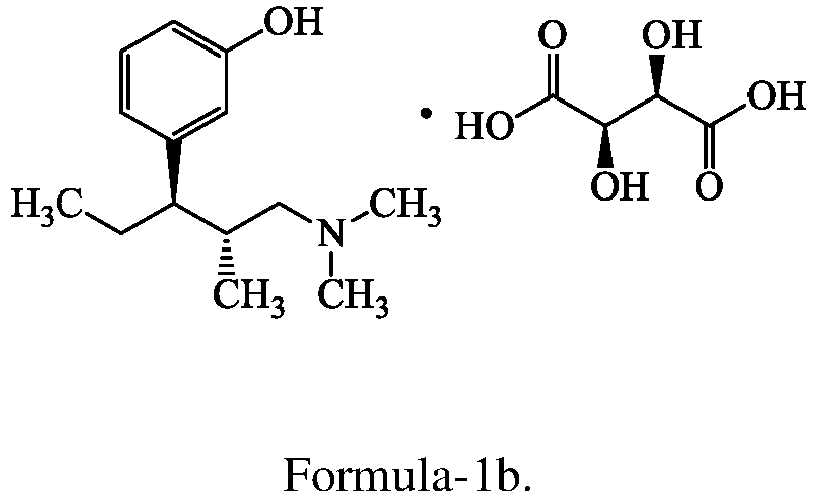
- The crystalline Tapentadol tartrate according to claim 1, wherein said crystalline form is characterized by its powder X-Ray diffraction pattern having peaks at 12.7, 14.1, 18.6, 20.0, 21.1, 21.6, 22.1, 23.7, 25.6 and 28.5± 0.2 degrees of 2-theta.
- The crystalline Tapentadol tartrate according to claim 2, is having the endotherm at 132°C±3°C in its differential scanning calorimetric (DSC) thermogram.
- The crystalline Tapentadol tartrate according to claim 2 or 3, characterized by absorption peaks at 3319, 3237, 2960, 1731, 1597, 1305, 1263, 1213, 791, 679 and 485 cm-1 in its infrared spectrum.
- The crystalline Tapentadol tartrate according to any one of claims 1 to 4, wherein the crystalline Tapentadol tartrate has a purity of >99 % by HPLC.
- A process for the preparation of the crystalline Tapentadol tartrate as defined in claim 1, said process comprising the step of: treating tapentadol free base with tartaric acid in a suitable solvent to provide Tapentadol tartrate of formula-1b.
- The process according to claim 6, said process comprising the steps of:a) treating the (2R,3R)-3-(3-methoxyphenyl)-N,N,2-trimethylpentan-1-amine hydrochloride with aqueous hydrogen bromide solution to provide tapentadol free base,b) optionally isolating tapentadol free base,c) treating tapentadol free base obtained in step-a) or step-b) with tartaric acid in a suitable solvent to provide Tapentadol tartrate of formula-1b,d) optionally purifying the compound obtained in step-c) from a suitable solvent.
- A process for the preparation of crystalline Tapentadol tartrate as defined in claim 2, said process comprising the step of: treating tapentadol free base with L-(+)tartaric acid in acetone to provide the crystalline Tapentadol tartrate of formula-1b.
- The process for the preparation of crystalline Tapentadol tartrate according to claim 8, said process comprising the steps of:a) treating the (2R,3R)-3-(3-methoxyphenyl)-N,N,2-trimethylpentan-1-amine hydrochloride with aqueous hydrogen bromide solution to provide tapentadol free base,b) treating tapentadol free base in-situ with L-(+)tartaric acid in acetone to provide the crystalline Tapentadol tartrate compound of formula-1b.
- The process according to any one of claims 6 and 7, wherein the suitable solvent is selected from alcohol solvents, ketone solvents, ester solvents, hydrocarbon solvents, ether solvents, chloro solvents and mixtures thereof or optionally in combination with water.
- The crystalline Tapentadol tartrate as defined in any one of claims 2 to 5, in a pharmaceutical composition for use in the treatment of pain.
- A pharmaceutical composition comprising the crystalline Tapentadol tartrate as defined in any one of claims 2 to 5, and a pharmaceutically acceptable carrier.
Priority Applications (2)
| Application Number | Priority Date | Filing Date | Title |
|---|---|---|---|
| HRP20210503TT HRP20210503T1 (en) | 2015-11-17 | 2016-11-16 | CRYSTAL FORMS OF TAPENTADOL SALT AND PROCEDURES FOR THEIR PREPARATION |
| PL16865892T PL3377049T3 (en) | 2015-11-17 | 2016-11-16 | Crystalline forms of tapentadol salts and process for preparation thereof |
Applications Claiming Priority (2)
| Application Number | Priority Date | Filing Date | Title |
|---|---|---|---|
| IN6191CH2015 | 2015-11-17 | ||
| PCT/IN2016/000270 WO2017085734A1 (en) | 2015-11-17 | 2016-11-16 | Crystalline forms of tapentadol salts and process for preparation thereof |
Publications (3)
| Publication Number | Publication Date |
|---|---|
| EP3377049A1 EP3377049A1 (en) | 2018-09-26 |
| EP3377049A4 EP3377049A4 (en) | 2019-06-12 |
| EP3377049B1 true EP3377049B1 (en) | 2021-01-06 |
Family
ID=58718521
Family Applications (1)
| Application Number | Title | Priority Date | Filing Date |
|---|---|---|---|
| EP16865892.0A Revoked EP3377049B1 (en) | 2015-11-17 | 2016-11-16 | Crystalline forms of tapentadol salts and process for preparation thereof |
Country Status (7)
| Country | Link |
|---|---|
| EP (1) | EP3377049B1 (en) |
| DK (1) | DK3377049T3 (en) |
| ES (1) | ES2860907T3 (en) |
| HR (1) | HRP20210503T1 (en) |
| HU (1) | HUE054338T2 (en) |
| PL (1) | PL3377049T3 (en) |
| WO (1) | WO2017085734A1 (en) |
Cited By (1)
| Publication number | Priority date | Publication date | Assignee | Title |
|---|---|---|---|---|
| EP3656765B1 (en) | 2010-07-23 | 2021-04-14 | Grünenthal GmbH | Salts or co-crystals of 3-(3-dimethylamino-1-ethyl-2-methyl-propyl)-phenol |
Families Citing this family (4)
| Publication number | Priority date | Publication date | Assignee | Title |
|---|---|---|---|---|
| MX2023005472A (en) | 2020-11-10 | 2023-05-22 | Gruenenthal Gmbh | Sustained release dosage forms of a salt of tapentadol with l-(+)-tartaric acid. |
| DE202020005470U1 (en) | 2020-11-10 | 2022-01-25 | Grünenthal GmbH | Extended-release dosage forms of a salt of tapentadol with L-(+)-tartaric acid |
| DK3995135T3 (en) | 2020-11-10 | 2022-08-22 | Gruenenthal Gmbh | EXTENDED RELEASE DOSAGE FORM OF A SALT OF TAPENTADOL WITH L-(+)-TARTARIC ACID |
| EP4011369A1 (en) | 2020-12-14 | 2022-06-15 | G.L. Pharma GmbH | Aqueous pharmaceutical composition comprising tapentadol tartrate |
Citations (8)
| Publication number | Priority date | Publication date | Assignee | Title |
|---|---|---|---|---|
| EP0693475A1 (en) | 1994-07-23 | 1996-01-24 | Grünenthal GmbH | 1-Phenyl-3-dimethylamino-propane derivatives having pharmacological activity |
| WO2006002886A1 (en) | 2004-07-01 | 2006-01-12 | Grünenthal GmbH | Oral dosage form safeguarded against abuse containing (1r, 2r)-3-(3-dimethylamino-1-ethyl-2-methyl-propyl)-phenol |
| WO2008012047A1 (en) | 2006-07-24 | 2008-01-31 | Grünenthal GmbH | Process for the preparation of (1r,2r)-3-(3-dimethylamino-1-ethyl-2-methyl-propyl)-phenol |
| WO2008128739A1 (en) | 2007-04-23 | 2008-10-30 | Grünenthal GmbH | Tapentadol for treating pain from arthritis |
| US20110071120A1 (en) | 2009-09-22 | 2011-03-24 | Actavis Group Ptc Ehf | Solid state forms of tapentadol salts |
| WO2012010316A1 (en) | 2010-07-23 | 2012-01-26 | Grünenthal GmbH | Salts or co-crystals of 3-(3-dimethylamino-1-ethyl-2-methyl-propyl)-phenol |
| WO2012051246A1 (en) | 2010-10-12 | 2012-04-19 | Ratiopharm Gmbh | Tapentadol hydrobromide and crystalline forms thereof |
| WO2014108514A1 (en) | 2013-01-10 | 2014-07-17 | Farma Grs, D. O. O. | Tapentadol maleate and crystalline forms thereof |
Family Cites Families (1)
| Publication number | Priority date | Publication date | Assignee | Title |
|---|---|---|---|---|
| CN103553940A (en) * | 2013-11-07 | 2014-02-05 | 南京艾德凯腾生物医药有限责任公司 | Preparation method of new crystal form tapentadol hydrochloride |
-
2016
- 2016-11-16 EP EP16865892.0A patent/EP3377049B1/en not_active Revoked
- 2016-11-16 DK DK16865892.0T patent/DK3377049T3/en active
- 2016-11-16 PL PL16865892T patent/PL3377049T3/en unknown
- 2016-11-16 WO PCT/IN2016/000270 patent/WO2017085734A1/en not_active Ceased
- 2016-11-16 HU HUE16865892A patent/HUE054338T2/en unknown
- 2016-11-16 ES ES16865892T patent/ES2860907T3/en active Active
- 2016-11-16 HR HRP20210503TT patent/HRP20210503T1/en unknown
Patent Citations (9)
| Publication number | Priority date | Publication date | Assignee | Title |
|---|---|---|---|---|
| EP0693475A1 (en) | 1994-07-23 | 1996-01-24 | Grünenthal GmbH | 1-Phenyl-3-dimethylamino-propane derivatives having pharmacological activity |
| WO2006002886A1 (en) | 2004-07-01 | 2006-01-12 | Grünenthal GmbH | Oral dosage form safeguarded against abuse containing (1r, 2r)-3-(3-dimethylamino-1-ethyl-2-methyl-propyl)-phenol |
| WO2008012047A1 (en) | 2006-07-24 | 2008-01-31 | Grünenthal GmbH | Process for the preparation of (1r,2r)-3-(3-dimethylamino-1-ethyl-2-methyl-propyl)-phenol |
| WO2008128739A1 (en) | 2007-04-23 | 2008-10-30 | Grünenthal GmbH | Tapentadol for treating pain from arthritis |
| US20110071120A1 (en) | 2009-09-22 | 2011-03-24 | Actavis Group Ptc Ehf | Solid state forms of tapentadol salts |
| WO2012010316A1 (en) | 2010-07-23 | 2012-01-26 | Grünenthal GmbH | Salts or co-crystals of 3-(3-dimethylamino-1-ethyl-2-methyl-propyl)-phenol |
| EP3656765B1 (en) | 2010-07-23 | 2021-04-14 | Grünenthal GmbH | Salts or co-crystals of 3-(3-dimethylamino-1-ethyl-2-methyl-propyl)-phenol |
| WO2012051246A1 (en) | 2010-10-12 | 2012-04-19 | Ratiopharm Gmbh | Tapentadol hydrobromide and crystalline forms thereof |
| WO2014108514A1 (en) | 2013-01-10 | 2014-07-17 | Farma Grs, D. O. O. | Tapentadol maleate and crystalline forms thereof |
Non-Patent Citations (1)
| Title |
|---|
| STAHL ET AL.: "Handbook of Pharmaceutical Salts: Properties, Selection and Use", 2002, Weinheim, Germany, article "Chapter 12: Monographs on acids and bases", pages: 265 - 327, XP008145189 |
Cited By (1)
| Publication number | Priority date | Publication date | Assignee | Title |
|---|---|---|---|---|
| EP3656765B1 (en) | 2010-07-23 | 2021-04-14 | Grünenthal GmbH | Salts or co-crystals of 3-(3-dimethylamino-1-ethyl-2-methyl-propyl)-phenol |
Also Published As
| Publication number | Publication date |
|---|---|
| HRP20210503T1 (en) | 2021-10-15 |
| EP3377049A4 (en) | 2019-06-12 |
| DK3377049T3 (en) | 2021-04-12 |
| ES2860907T3 (en) | 2021-10-05 |
| WO2017085734A1 (en) | 2017-05-26 |
| EP3377049A1 (en) | 2018-09-26 |
| PL3377049T3 (en) | 2021-06-28 |
| HUE054338T2 (en) | 2021-08-30 |
Similar Documents
| Publication | Publication Date | Title |
|---|---|---|
| EP3377049B1 (en) | Crystalline forms of tapentadol salts and process for preparation thereof | |
| JP6916969B1 (en) | 3-((1R, 3R) -1- (2,6-difluoro-4-((1- (3-fluoropropyl) azetidine-3-yl) amino) phenyl) -3-methyl-1,3,4 , 9-Tetrahydro-2H-pyrido [3,4-b] indol-2-yl) -2,2-difluoropropan-1-ol condensed tricyclic compound containing solid form and substituted phenyl or pyridinyl moiety Methods for preparing and how to use them | |
| US8969558B2 (en) | Processes for the preparation of sitagliptin and pharmaceutically acceptable salts thereof | |
| JP4083431B2 (en) | Stable salts of new derivatives of 3,3-diphenylpropylamines | |
| WO2011161690A1 (en) | Processes for the preparation of (+)-n,n-dimethyl-2-[1-(naphthalenyloxy) ethyl] benzene methanamine and intermediates thereof | |
| US8198485B2 (en) | Resolution of 4,5-dimethoxy-1-(methylaminomenthyl)-benzocyclobutane | |
| TW201206948A (en) | Production method for a salt-form of optically active diamine | |
| US20080132579A1 (en) | Preparation of levalbuterol hydrochloride | |
| JP2015063529A (en) | Synthesis method of arformoterol | |
| EP2958894B1 (en) | Process for the preparation of enantiomerically enriched 3-aminopiperidine | |
| EP2899194A1 (en) | Amorphous besylate salt of a dpp-iv inhibitor | |
| KR20080034921A (en) | Highly Selective Serotonin and Norepinephrine Double Reuptake Inhibitors and Uses thereof | |
| WO2019167085A1 (en) | Process for the preparation of (s)-2-[[4-[(3-fluorophenyl)methoxy]phenyl]methyl]amino propanamide methanesulfonate | |
| US20120289744A1 (en) | Process for preparing optically pure milnacipran and its pharmaceutically acceptable salts | |
| CN101277929A (en) | How to obtain phenylcarbamate | |
| JP2013018776A (en) | Hci polymorphs of 3-((2-(dimethylamino)methyl (cyclohex-1-yl))phenol | |
| WO2015001568A2 (en) | Sitagliptin lipoate salt, process for the preparation and pharmaceutical composition thereof | |
| ZA200605947B (en) | Preparation of levalbuterol hydrochloride | |
| FR3067711A1 (en) | INHIBITORS OF CATECHOL-O-METHYL-TRANSFERASE (COMT) | |
| EP2300473B1 (en) | Fumarate salt of 4-bromophenyl 1,4-diazabicyclo[3.2.2]nonane-4-carboxylate, crystalline forms thereof, preparation thereof and therapeutic use thereof | |
| US9994523B2 (en) | Salts of Saxagliptin with organic acids | |
| CZ200969A3 (en) | Novel salts of desvenlafaxine and process of their preparation | |
| WO2017158615A1 (en) | An improved process for the preparation of [[2(s)-[[4(r)-(3-hydroxy phenyl)-3(r), 4-dimethyl-1 -piperidinyl]methyl]-1 -oxo-3-phenylpropyl] amino]acetic acid dihydrate |
Legal Events
| Date | Code | Title | Description |
|---|---|---|---|
| STAA | Information on the status of an ep patent application or granted ep patent |
Free format text: STATUS: THE INTERNATIONAL PUBLICATION HAS BEEN MADE |
|
| PUAI | Public reference made under article 153(3) epc to a published international application that has entered the european phase |
Free format text: ORIGINAL CODE: 0009012 |
|
| STAA | Information on the status of an ep patent application or granted ep patent |
Free format text: STATUS: REQUEST FOR EXAMINATION WAS MADE |
|
| 17P | Request for examination filed |
Effective date: 20180618 |
|
| AK | Designated contracting states |
Kind code of ref document: A1 Designated state(s): AL AT BE BG CH CY CZ DE DK EE ES FI FR GB GR HR HU IE IS IT LI LT LU LV MC MK MT NL NO PL PT RO RS SE SI SK SM TR |
|
| AX | Request for extension of the european patent |
Extension state: BA ME |
|
| DAV | Request for validation of the european patent (deleted) | ||
| DAX | Request for extension of the european patent (deleted) | ||
| A4 | Supplementary search report drawn up and despatched |
Effective date: 20190514 |
|
| RAP1 | Party data changed (applicant data changed or rights of an application transferred) |
Owner name: MSN LABORATORIES PRIVATE LIMITED |
|
| RIC1 | Information provided on ipc code assigned before grant |
Ipc: A61P 25/04 20060101ALI20190508BHEP Ipc: A61K 31/00 20060101AFI20190508BHEP Ipc: C07C 215/54 20060101ALI20190508BHEP |
|
| GRAP | Despatch of communication of intention to grant a patent |
Free format text: ORIGINAL CODE: EPIDOSNIGR1 |
|
| STAA | Information on the status of an ep patent application or granted ep patent |
Free format text: STATUS: GRANT OF PATENT IS INTENDED |
|
| INTG | Intention to grant announced |
Effective date: 20200803 |
|
| RIN1 | Information on inventor provided before grant (corrected) |
Inventor name: PRANEETH KUMAR, ANUGU Inventor name: KISHORE KUMAR, MUPPA Inventor name: VENKATESH, MUMMADI Inventor name: THIRUMALAI RAJAN, SRINIVASAN |
|
| GRAS | Grant fee paid |
Free format text: ORIGINAL CODE: EPIDOSNIGR3 |
|
| GRAA | (expected) grant |
Free format text: ORIGINAL CODE: 0009210 |
|
| STAA | Information on the status of an ep patent application or granted ep patent |
Free format text: STATUS: THE PATENT HAS BEEN GRANTED |
|
| AK | Designated contracting states |
Kind code of ref document: B1 Designated state(s): AL AT BE BG CH CY CZ DE DK EE ES FI FR GB GR HR HU IE IS IT LI LT LU LV MC MK MT NL NO PL PT RO RS SE SI SK SM TR |
|
| REG | Reference to a national code |
Ref country code: GB Ref legal event code: FG4D |
|
| REG | Reference to a national code |
Ref country code: AT Ref legal event code: REF Ref document number: 1351582 Country of ref document: AT Kind code of ref document: T Effective date: 20210115 Ref country code: CH Ref legal event code: EP |
|
| REG | Reference to a national code |
Ref country code: DE Ref legal event code: R096 Ref document number: 602016051210 Country of ref document: DE |
|
| REG | Reference to a national code |
Ref country code: IE Ref legal event code: FG4D |
|
| REG | Reference to a national code |
Ref country code: HR Ref legal event code: TUEP Ref document number: P20210503T Country of ref document: HR |
|
| REG | Reference to a national code |
Ref country code: CH Ref legal event code: NV Representative=s name: KATZAROV SA, CH |
|
| REG | Reference to a national code |
Ref country code: DK Ref legal event code: T3 Effective date: 20210406 |
|
| REG | Reference to a national code |
Ref country code: NL Ref legal event code: FP |
|
| REG | Reference to a national code |
Ref country code: SE Ref legal event code: TRGR |
|
| REG | Reference to a national code |
Ref country code: NO Ref legal event code: T2 Effective date: 20210106 |
|
| REG | Reference to a national code |
Ref country code: LT Ref legal event code: MG9D |
|
| REG | Reference to a national code |
Ref country code: SK Ref legal event code: T3 Ref document number: E 37341 Country of ref document: SK |
|
| PG25 | Lapsed in a contracting state [announced via postgrant information from national office to epo] |
Ref country code: GR Free format text: LAPSE BECAUSE OF FAILURE TO SUBMIT A TRANSLATION OF THE DESCRIPTION OR TO PAY THE FEE WITHIN THE PRESCRIBED TIME-LIMIT Effective date: 20210407 Ref country code: FI Free format text: LAPSE BECAUSE OF FAILURE TO SUBMIT A TRANSLATION OF THE DESCRIPTION OR TO PAY THE FEE WITHIN THE PRESCRIBED TIME-LIMIT Effective date: 20210106 Ref country code: PT Free format text: LAPSE BECAUSE OF FAILURE TO SUBMIT A TRANSLATION OF THE DESCRIPTION OR TO PAY THE FEE WITHIN THE PRESCRIBED TIME-LIMIT Effective date: 20210506 Ref country code: BG Free format text: LAPSE BECAUSE OF FAILURE TO SUBMIT A TRANSLATION OF THE DESCRIPTION OR TO PAY THE FEE WITHIN THE PRESCRIBED TIME-LIMIT Effective date: 20210406 Ref country code: LT Free format text: LAPSE BECAUSE OF FAILURE TO SUBMIT A TRANSLATION OF THE DESCRIPTION OR TO PAY THE FEE WITHIN THE PRESCRIBED TIME-LIMIT Effective date: 20210106 |
|
| REG | Reference to a national code |
Ref country code: HU Ref legal event code: AG4A Ref document number: E054338 Country of ref document: HU |
|
| PG25 | Lapsed in a contracting state [announced via postgrant information from national office to epo] |
Ref country code: RS Free format text: LAPSE BECAUSE OF FAILURE TO SUBMIT A TRANSLATION OF THE DESCRIPTION OR TO PAY THE FEE WITHIN THE PRESCRIBED TIME-LIMIT Effective date: 20210106 Ref country code: LV Free format text: LAPSE BECAUSE OF FAILURE TO SUBMIT A TRANSLATION OF THE DESCRIPTION OR TO PAY THE FEE WITHIN THE PRESCRIBED TIME-LIMIT Effective date: 20210106 |
|
| PG25 | Lapsed in a contracting state [announced via postgrant information from national office to epo] |
Ref country code: IS Free format text: LAPSE BECAUSE OF FAILURE TO SUBMIT A TRANSLATION OF THE DESCRIPTION OR TO PAY THE FEE WITHIN THE PRESCRIBED TIME-LIMIT Effective date: 20210506 |
|
| REG | Reference to a national code |
Ref country code: DE Ref legal event code: R026 Ref document number: 602016051210 Country of ref document: DE |
|
| PLBI | Opposition filed |
Free format text: ORIGINAL CODE: 0009260 |
|
| REG | Reference to a national code |
Ref country code: HR Ref legal event code: T1PR Ref document number: P20210503 Country of ref document: HR |
|
| PLAX | Notice of opposition and request to file observation + time limit sent |
Free format text: ORIGINAL CODE: EPIDOSNOBS2 |
|
| PG25 | Lapsed in a contracting state [announced via postgrant information from national office to epo] |
Ref country code: SM Free format text: LAPSE BECAUSE OF FAILURE TO SUBMIT A TRANSLATION OF THE DESCRIPTION OR TO PAY THE FEE WITHIN THE PRESCRIBED TIME-LIMIT Effective date: 20210106 Ref country code: EE Free format text: LAPSE BECAUSE OF FAILURE TO SUBMIT A TRANSLATION OF THE DESCRIPTION OR TO PAY THE FEE WITHIN THE PRESCRIBED TIME-LIMIT Effective date: 20210106 |
|
| 26 | Opposition filed |
Opponent name: URQUHART-DYKES & LORD LLP Effective date: 20211006 |
|
| PG25 | Lapsed in a contracting state [announced via postgrant information from national office to epo] |
Ref country code: RO Free format text: LAPSE BECAUSE OF FAILURE TO SUBMIT A TRANSLATION OF THE DESCRIPTION OR TO PAY THE FEE WITHIN THE PRESCRIBED TIME-LIMIT Effective date: 20210106 |
|
| REG | Reference to a national code |
Ref country code: HR Ref legal event code: ODRP Ref document number: P20210503 Country of ref document: HR Payment date: 20211112 Year of fee payment: 6 |
|
| PG25 | Lapsed in a contracting state [announced via postgrant information from national office to epo] |
Ref country code: AL Free format text: LAPSE BECAUSE OF FAILURE TO SUBMIT A TRANSLATION OF THE DESCRIPTION OR TO PAY THE FEE WITHIN THE PRESCRIBED TIME-LIMIT Effective date: 20210106 |
|
| PLAF | Information modified related to communication of a notice of opposition and request to file observations + time limit |
Free format text: ORIGINAL CODE: EPIDOSCOBS2 |
|
| PG25 | Lapsed in a contracting state [announced via postgrant information from national office to epo] |
Ref country code: SI Free format text: LAPSE BECAUSE OF FAILURE TO SUBMIT A TRANSLATION OF THE DESCRIPTION OR TO PAY THE FEE WITHIN THE PRESCRIBED TIME-LIMIT Effective date: 20210106 |
|
| PLBB | Reply of patent proprietor to notice(s) of opposition received |
Free format text: ORIGINAL CODE: EPIDOSNOBS3 |
|
| PLAB | Opposition data, opponent's data or that of the opponent's representative modified |
Free format text: ORIGINAL CODE: 0009299OPPO |
|
| PG25 | Lapsed in a contracting state [announced via postgrant information from national office to epo] |
Ref country code: IS Free format text: LAPSE BECAUSE OF FAILURE TO SUBMIT A TRANSLATION OF THE DESCRIPTION OR TO PAY THE FEE WITHIN THE PRESCRIBED TIME-LIMIT Effective date: 20210506 |
|
| R26 | Opposition filed (corrected) |
Opponent name: MURGITROYD & COMPANY LIMITED Effective date: 20211006 |
|
| PG25 | Lapsed in a contracting state [announced via postgrant information from national office to epo] |
Ref country code: MC Free format text: LAPSE BECAUSE OF FAILURE TO SUBMIT A TRANSLATION OF THE DESCRIPTION OR TO PAY THE FEE WITHIN THE PRESCRIBED TIME-LIMIT Effective date: 20210106 |
|
| PG25 | Lapsed in a contracting state [announced via postgrant information from national office to epo] |
Ref country code: LU Free format text: LAPSE BECAUSE OF NON-PAYMENT OF DUE FEES Effective date: 20211116 Ref country code: BE Free format text: LAPSE BECAUSE OF NON-PAYMENT OF DUE FEES Effective date: 20211130 |
|
| REG | Reference to a national code |
Ref country code: BE Ref legal event code: MM Effective date: 20211130 |
|
| REG | Reference to a national code |
Ref country code: HR Ref legal event code: ODRP Ref document number: P20210503 Country of ref document: HR Payment date: 20221109 Year of fee payment: 7 |
|
| PLAB | Opposition data, opponent's data or that of the opponent's representative modified |
Free format text: ORIGINAL CODE: 0009299OPPO |
|
| R26 | Opposition filed (corrected) |
Opponent name: MURGITROYD & COMPANY LIMITED Effective date: 20211006 |
|
| PGFP | Annual fee paid to national office [announced via postgrant information from national office to epo] |
Ref country code: SK Payment date: 20221103 Year of fee payment: 7 Ref country code: SE Payment date: 20221116 Year of fee payment: 7 Ref country code: NO Payment date: 20221121 Year of fee payment: 7 Ref country code: NL Payment date: 20221109 Year of fee payment: 7 Ref country code: IT Payment date: 20221129 Year of fee payment: 7 Ref country code: IE Payment date: 20221125 Year of fee payment: 7 Ref country code: GB Payment date: 20221117 Year of fee payment: 7 Ref country code: FR Payment date: 20221103 Year of fee payment: 7 Ref country code: ES Payment date: 20221201 Year of fee payment: 7 Ref country code: DK Payment date: 20221122 Year of fee payment: 7 Ref country code: DE Payment date: 20221125 Year of fee payment: 7 Ref country code: CZ Payment date: 20221107 Year of fee payment: 7 Ref country code: AT Payment date: 20221117 Year of fee payment: 7 |
|
| RDAF | Communication despatched that patent is revoked |
Free format text: ORIGINAL CODE: EPIDOSNREV1 |
|
| PGFP | Annual fee paid to national office [announced via postgrant information from national office to epo] |
Ref country code: PL Payment date: 20221108 Year of fee payment: 7 Ref country code: HU Payment date: 20221109 Year of fee payment: 7 Ref country code: HR Payment date: 20221109 Year of fee payment: 7 Ref country code: CH Payment date: 20221108 Year of fee payment: 7 |
|
| REG | Reference to a national code |
Ref country code: DE Ref legal event code: R103 Ref document number: 602016051210 Country of ref document: DE Ref country code: DE Ref legal event code: R064 Ref document number: 602016051210 Country of ref document: DE |
|
| RDAG | Patent revoked |
Free format text: ORIGINAL CODE: 0009271 |
|
| STAA | Information on the status of an ep patent application or granted ep patent |
Free format text: STATUS: PATENT REVOKED |
|
| REG | Reference to a national code |
Ref country code: CH Ref legal event code: PL |
|
| REG | Reference to a national code |
Ref country code: SK Ref legal event code: MC4A Ref document number: E 37341 Country of ref document: SK Effective date: 20230304 |
|
| PG25 | Lapsed in a contracting state [announced via postgrant information from national office to epo] |
Ref country code: CY Free format text: LAPSE BECAUSE OF FAILURE TO SUBMIT A TRANSLATION OF THE DESCRIPTION OR TO PAY THE FEE WITHIN THE PRESCRIBED TIME-LIMIT Effective date: 20210106 |
|
| 27W | Patent revoked |
Effective date: 20230304 |
|
| GBPR | Gb: patent revoked under art. 102 of the ep convention designating the uk as contracting state |
Effective date: 20230304 |
|
| P01 | Opt-out of the competence of the unified patent court (upc) registered |
Effective date: 20230530 |
|
| REG | Reference to a national code |
Ref country code: NO Ref legal event code: MMEP |
|
| REG | Reference to a national code |
Ref country code: HR Ref legal event code: PNEV Ref document number: P20210503 Country of ref document: HR Ref country code: AT Ref legal event code: MA03 Ref document number: 1351582 Country of ref document: AT Kind code of ref document: T Effective date: 20230304 |
|
| REG | Reference to a national code |
Ref country code: SE Ref legal event code: ECNC |
|
| PG25 | Lapsed in a contracting state [announced via postgrant information from national office to epo] |
Ref country code: MK Free format text: LAPSE BECAUSE OF FAILURE TO SUBMIT A TRANSLATION OF THE DESCRIPTION OR TO PAY THE FEE WITHIN THE PRESCRIBED TIME-LIMIT Effective date: 20210106 |
|
| PG25 | Lapsed in a contracting state [announced via postgrant information from national office to epo] |
Ref country code: MT Free format text: LAPSE BECAUSE OF FAILURE TO SUBMIT A TRANSLATION OF THE DESCRIPTION OR TO PAY THE FEE WITHIN THE PRESCRIBED TIME-LIMIT Effective date: 20210106 |
|
| REG | Reference to a national code |
Ref country code: ES Ref legal event code: FD2A Effective date: 20250103 |
|
| PG25 | Lapsed in a contracting state [announced via postgrant information from national office to epo] |
Ref country code: ES Free format text: LAPSE BECAUSE OF NON-PAYMENT OF DUE FEES Effective date: 20231117 |
|
| PG25 | Lapsed in a contracting state [announced via postgrant information from national office to epo] |
Ref country code: ES Free format text: LAPSE BECAUSE OF NON-PAYMENT OF DUE FEES Effective date: 20231117 |
|
| REG | Reference to a national code |
Ref country code: AT Ref legal event code: UEP Ref document number: 1351582 Country of ref document: AT Kind code of ref document: T Effective date: 20210106 |
|
| PG25 | Lapsed in a contracting state [announced via postgrant information from national office to epo] |
Ref country code: TR Free format text: LAPSE BECAUSE OF FAILURE TO SUBMIT A TRANSLATION OF THE DESCRIPTION OR TO PAY THE FEE WITHIN THE PRESCRIBED TIME-LIMIT Effective date: 20210106 |