EP3374975B1 - Verfahren zur authentifizierung einer 3d-struktur - Google Patents
Verfahren zur authentifizierung einer 3d-struktur Download PDFInfo
- Publication number
- EP3374975B1 EP3374975B1 EP16791601.4A EP16791601A EP3374975B1 EP 3374975 B1 EP3374975 B1 EP 3374975B1 EP 16791601 A EP16791601 A EP 16791601A EP 3374975 B1 EP3374975 B1 EP 3374975B1
- Authority
- EP
- European Patent Office
- Prior art keywords
- imaging device
- pattern
- image
- correlation
- cross
- Prior art date
- Legal status (The legal status is an assumption and is not a legal conclusion. Google has not performed a legal analysis and makes no representation as to the accuracy of the status listed.)
- Active
Links
Images





Classifications
-
- G—PHYSICS
- G07—CHECKING-DEVICES
- G07D—HANDLING OF COINS OR VALUABLE PAPERS, e.g. TESTING, SORTING BY DENOMINATIONS, COUNTING, DISPENSING, CHANGING OR DEPOSITING
- G07D7/00—Testing specially adapted to determine the identity or genuineness of valuable papers or for segregating those which are unacceptable, e.g. banknotes that are alien to a currency
- G07D7/20—Testing patterns thereon
- G07D7/202—Testing patterns thereon using pattern matching
- G07D7/2033—Matching unique patterns, i.e. patterns that are unique to each individual paper
-
- G—PHYSICS
- G06—COMPUTING OR CALCULATING; COUNTING
- G06Q—INFORMATION AND COMMUNICATION TECHNOLOGY [ICT] SPECIALLY ADAPTED FOR ADMINISTRATIVE, COMMERCIAL, FINANCIAL, MANAGERIAL OR SUPERVISORY PURPOSES; SYSTEMS OR METHODS SPECIALLY ADAPTED FOR ADMINISTRATIVE, COMMERCIAL, FINANCIAL, MANAGERIAL OR SUPERVISORY PURPOSES, NOT OTHERWISE PROVIDED FOR
- G06Q30/00—Commerce
- G06Q30/018—Certifying business or products
- G06Q30/0185—Product, service or business identity fraud
-
- G—PHYSICS
- G06—COMPUTING OR CALCULATING; COUNTING
- G06V—IMAGE OR VIDEO RECOGNITION OR UNDERSTANDING
- G06V20/00—Scenes; Scene-specific elements
- G06V20/80—Recognising image objects characterised by unique random patterns
-
- G—PHYSICS
- G06—COMPUTING OR CALCULATING; COUNTING
- G06K—GRAPHICAL DATA READING; PRESENTATION OF DATA; RECORD CARRIERS; HANDLING RECORD CARRIERS
- G06K17/00—Methods or arrangements for effecting co-operative working between equipments covered by two or more of main groups G06K1/00 - G06K15/00, e.g. automatic card files incorporating conveying and reading operations
-
- G—PHYSICS
- G06—COMPUTING OR CALCULATING; COUNTING
- G06K—GRAPHICAL DATA READING; PRESENTATION OF DATA; RECORD CARRIERS; HANDLING RECORD CARRIERS
- G06K19/00—Record carriers for use with machines and with at least a part designed to carry digital markings
- G06K19/06—Record carriers for use with machines and with at least a part designed to carry digital markings characterised by the kind of the digital marking, e.g. shape, nature, code
- G06K19/06009—Record carriers for use with machines and with at least a part designed to carry digital markings characterised by the kind of the digital marking, e.g. shape, nature, code with optically detectable marking
- G06K19/06046—Constructional details
- G06K19/06159—Constructional details the marking being relief type, e.g. three-dimensional bar codes engraved in a support
-
- G—PHYSICS
- G06—COMPUTING OR CALCULATING; COUNTING
- G06K—GRAPHICAL DATA READING; PRESENTATION OF DATA; RECORD CARRIERS; HANDLING RECORD CARRIERS
- G06K7/00—Methods or arrangements for sensing record carriers, e.g. for reading patterns
- G06K7/10—Methods or arrangements for sensing record carriers, e.g. for reading patterns by electromagnetic radiation, e.g. optical sensing; by corpuscular radiation
- G06K7/14—Methods or arrangements for sensing record carriers, e.g. for reading patterns by electromagnetic radiation, e.g. optical sensing; by corpuscular radiation using light without selection of wavelength, e.g. sensing reflected white light
- G06K7/1404—Methods for optical code recognition
- G06K7/1408—Methods for optical code recognition the method being specifically adapted for the type of code
- G06K7/1417—2D bar codes
-
- G—PHYSICS
- G06—COMPUTING OR CALCULATING; COUNTING
- G06T—IMAGE DATA PROCESSING OR GENERATION, IN GENERAL
- G06T7/00—Image analysis
- G06T7/0002—Inspection of images, e.g. flaw detection
- G06T7/0004—Industrial image inspection
-
- G—PHYSICS
- G07—CHECKING-DEVICES
- G07D—HANDLING OF COINS OR VALUABLE PAPERS, e.g. TESTING, SORTING BY DENOMINATIONS, COUNTING, DISPENSING, CHANGING OR DEPOSITING
- G07D7/00—Testing specially adapted to determine the identity or genuineness of valuable papers or for segregating those which are unacceptable, e.g. banknotes that are alien to a currency
- G07D7/003—Testing specially adapted to determine the identity or genuineness of valuable papers or for segregating those which are unacceptable, e.g. banknotes that are alien to a currency using security elements
-
- G—PHYSICS
- G07—CHECKING-DEVICES
- G07D—HANDLING OF COINS OR VALUABLE PAPERS, e.g. TESTING, SORTING BY DENOMINATIONS, COUNTING, DISPENSING, CHANGING OR DEPOSITING
- G07D7/00—Testing specially adapted to determine the identity or genuineness of valuable papers or for segregating those which are unacceptable, e.g. banknotes that are alien to a currency
- G07D7/20—Testing patterns thereon
- G07D7/202—Testing patterns thereon using pattern matching
-
- G—PHYSICS
- G06—COMPUTING OR CALCULATING; COUNTING
- G06T—IMAGE DATA PROCESSING OR GENERATION, IN GENERAL
- G06T2207/00—Indexing scheme for image analysis or image enhancement
- G06T2207/10—Image acquisition modality
- G06T2207/10004—Still image; Photographic image
-
- G—PHYSICS
- G06—COMPUTING OR CALCULATING; COUNTING
- G06T—IMAGE DATA PROCESSING OR GENERATION, IN GENERAL
- G06T2207/00—Indexing scheme for image analysis or image enhancement
- G06T2207/10—Image acquisition modality
- G06T2207/10032—Satellite or aerial image; Remote sensing
-
- G—PHYSICS
- G06—COMPUTING OR CALCULATING; COUNTING
- G06T—IMAGE DATA PROCESSING OR GENERATION, IN GENERAL
- G06T2207/00—Indexing scheme for image analysis or image enhancement
- G06T2207/30—Subject of image; Context of image processing
- G06T2207/30108—Industrial image inspection
- G06T2207/30164—Workpiece; Machine component
-
- G—PHYSICS
- G06—COMPUTING OR CALCULATING; COUNTING
- G06V—IMAGE OR VIDEO RECOGNITION OR UNDERSTANDING
- G06V20/00—Scenes; Scene-specific elements
- G06V20/95—Pattern authentication; Markers therefor; Forgery detection
Definitions
- This disclosure relates to anti-counterfeiting, anti-tampering and traceability for valuable items.
- Each of these three security issues is generally addressed using a specific approach.
- Redundant security is based on a double encoding of critical information (like the name on a passport which is also encoded in the attached magnetic strip, or the hash of a text which is printed on a document which should not be modified).
- Tamper evidence can also be achieved using various physical or chemical means, which enable to detect modifications performed to a document or to a package. Such means include special paper treatments that enable it to be immediately colored by solvents or ultrasonic detection systems, which are capable of detecting an overlay of a thin piece of paper.
- Traceability is achieved using a unique identification of each item.
- Traceability systems typically require a central database to maintain a record of information for each numbered item.
- the unique identification can be added to the item for instance by printing a barcode encoding a unique number, or by using unique item properties and storing them in the database, similar to the human fingerprint. It should be noted that unique identification potentially enables addressing all security issues like counterfeiting, tampering and diversion in a joint approach.
- unique identification is often performed by ink-jet printing (DOD or continuous), laser printing, or engraving of an alphanumeric identifier or an information carrying code, such as a barcode, 2D matrix code, or QR code.
- DOD ink-jet printing
- laser printing or engraving of an alphanumeric identifier or an information carrying code, such as a barcode, 2D matrix code, or QR code.
- a major goal of the anti-tampering method is to guarantee that data printed in clear text on a document has not been illegally modified (for instance to increase of the face value of a check).
- one simple way to reach this objective is to uniquely identify the document with an identification number printed on it (for instance using a barcode or hexadecimal string). This number gives access through a look-up table to all the data printed in clear text on the document. It is then possible to check if the data printed on the document matches with the data stored in the look-up table.
- Optical Character Recognition / OCR may be used for automating the comparison process.
- An exemplary solution for integrity check of identity documents is described in US6920437 , while another for passport documents is detailed in US6565000 .
- Traceability is particularly important for monitoring the supply chain of valuable items and tracking parallel import of goods (diversion - gray market goods).
- unique identifiers for each package may be recorded in a database along with the target country and other supply chain related data.
- the good may re-imported (diverted) into a country different from the original target country.
- retrieve the unique code identifier it is then possible to trace back the origin of the good and the original target country.
- Exemplary system architectures of such an approach comprising a central server, a central database and client applications, are described for instance in US6922687 and US6547137 , where the identifier is printed on a label attached to the product.
- this solution may also be implemented by marking the identifier directly on a label or a pill as described in US6776341 .
- US6629061 describes a solution where the identifier is printed on the circuit board and embedded in the memory device; another approach for fighting gray market in the power supply industry is given in US6459175 .
- US6461987 describes a solution where a unique identification is obtained by the means of micro label strips.
- a different approach enabling unique identification without applying a unique code may be used.
- the fundamental approach consists in precisely measuring/identifying/characterizing some intrinsic features of the document or product material or surface and use it in order to identify the product uniquely. Features can for instance be color fluctuation, surface roughness, material structures, etc.
- Ingenia Technology proposed to measure the micro topology of carton and paper with a coherent light source (typically produced by a laser) for unique identification purposes in patent applications GB0418138.4 , GB0418173.1 , GB0418178.0 and GB0509635.9 .
- This technology may be directly embedded in printer device, as described in PCT/GB2005/000903 .
- This technology can basically be used on any chaotic surface, using an array of laser sources enabling to probe the material surface at various incidences, as described in PCT/GB2005/000922 .
- a similar approach was described in application GB2221870 from De La Rue Company Pic , where the scattering of a coherent light was used for detection.
- Another solution is described in US6584214 by MIT where the whole 3D chaotic structure of a material is used to generate a unique identifier. The 3D structure is acquired using devices based on coherent light (for non-transparent material) or ultrasound and X-rays (for transparent materials).
- Another approach using ultrasonic measurement is described in US5454045 , where features (either macroscopic or microscopic) are measured inside a material, stored and subsequently compared with new measurements for matching controls.
- embossing that is deforming, the 3D surface of a packaging foil (for instance for cigarette packets) or package for authentication purposes.
- a packaging foil for instance for cigarette packets
- package for authentication purposes As described for instance by Boegli Gravures in EP1867470 , an array of identification marks such as signs, dots or patterns may be embossed on-line with the staining and the embossing of logos, possibly in the satined and/or the logo areas.
- EP1867470 The method described in EP1867470 is however limited to weak authentication, as the embossing pattern is detectable by a simple template matching image or video camera processing technique with minimal noise level thresholding, which means a counterfeiter can easily detect the embossing pattern and reproduce it by similar imaging techniques; the whole security relies upon the challenge of embossing counterfeit packets, or as suggested in EP1867470 , the combination with alternative 2D authentication methods used in automatic image processing, such as gray scale correlation and methods developed by applicants as described in US7492920 , US7684088 , or US7965862 . These solutions however only exploit the 2D space, while it is desirable in certain applications to also take advantage of the 3D dimension associated with the embossing process.
- the printing includes a tiled watermark pattern that conveys plural-bit payload data that may be suitable for authentication purposes
- the embossing includes a tiled watermark pattern that conveys spatial calibration information to facilitate the retrieval of the plural-bit payload data, in accordance with Digimarc digital watermarking technology, as known to those skilled in the art of steganography and watermarking.
- Digimarc digital watermarking technology as known to those skilled in the art of steganography and watermarking.
- embossing may also embed the marking payload, yet the Digimarc solution requires some exhaustive search steps for detection of the marking that may not be applicable real-time in such a scenario - or if it is feasible, counterfeiters may also apply exhaustive search to reverse and reproduce the embedded marking.
- WO2012136902A1 discloses an authentication method to verify the authenticity of goods making use of a coded entity that comprises light-disrupting elements.
- a method for authenticating a 3D pattern of a 3D pattern surface with an imaging device is provided in accordance with independent claim 1.
- the difference between the first and second cross-correlation signals may be measured as the angle between a first vector joining a first point of highest correlation value in a pre-defined area of the first cross-correlation image signal to a second point of the lowest correlation value in a pre-defined neighborhood area of the first point in the first cross-correlation image signal and a second vector joining a third point of highest correlation value in a pre-defined area of the second cross-correlation image signal to a fourth point of the lowest correlation value in a pre-defined neighborhood area of the third point in the second cross-correlation image signal.
- the 3D pattern may be authenticated as genuine.
- the imaging device may indicate a success signal to the end user by displaying a message onto the imaging device display screen, and/or by emitting a sound onto an imaging device display speaker, and/or by producing a vibration of the imaging device, for instance when a smartphone is used as the imaging device.
- the 3D pattern may be generated by various manufacturing means such as embossing and hot stamping from a 3D pattern reference image designed to represent random or pseudo random dot locations, and/or random or pseudo random dot sizes, and/or random or pseudo random dot greyscale values.
- the 3D pattern structure may be filled with a transparent material resistant to solvents.
- the 3D pattern structure may filled with a transparent material sensitive to the same solvents as the 3D item surface material.
- Robust authentication features may be engineered in such a way that they are simple to check during the authentication process without requiring significant user expertise, while remaining difficult to counterfeit/copy.
- three dimensional (3D) surface structures are used as robust authentication features as they are difficult to reproduce in an accurate way. These structures are first associated with the product in an embedding stage, for instance at the time of manufacturing the product, and later detected in a detection stage, for instance at the customs.
- the authentication process relies on the comparison of the 3D structure with a reference.
- the imagine device stores the 3D reference image from which the 3D structure was created.
- the comparison uses at least two image captures from different viewpoints of the 3D structure. By using different viewpoints, the 3D surface may be uniquely characterized.
- the counterfeit challenge therefore consists in producing an accurate replicate of the 3D structure.
- the counterfeit would be successful if simple copies or low quality 3D reproductions of the surface may be recognized as non-genuine.
- the capture of the 2D images may be done with any imaging devices.
- a mobile/smart phone such as the Apple iPhone or the Samsung Galaxy series may be used.
- different viewpoint images may be captured by moving the smart phone from left to right. Different viewpoint images may also be extracted from a video capture.
- the imaging device may be purpose-built device that includes circuits for performing the techniques described herein.
- the device may include one or more processors (which can be microprocessors or digital signal processors), application-specific integrated circuits, field programmable gate arrays, and/or discrete logic, or any combination of the foregoing.
- the device may also include or be connectable to a camera or other imaging system, one or more memories (including both non-volatile and volatile memories), and a display screen.
- pattern In the remainder of this application, the terminology “pattern”, “item”, “feature” or “structure” will be used interchangeably regardless of the actual underlying geometrical shape, support material, and manufacturing process.
- designing the 3D authentication structure may rely on different approaches.
- the most sophisticated and robust way consists in fully designing a 3D model of the desired surface structure.
- computer graphics tools such as 3D Studio Max may be used.
- 3D modeling is complex, requires highly skilled personnel, and is not necessarily worth the effort and cost for all types of items.
- a 3D model may rather be used for the production of item manufacturing tools, such as stamps, using for instance, laser technology, instead of the item surface 3D model itself.
- embossing may be used to embed the 3D authentication features onto the item at manufacturing stage, but other technologies than embossing may be used for other production technologies, such as molding or printing for instance with technologies able to deposit large amounts of ink, such as silk screen printing, as known to those skilled in the art.
- the basis pattern may be designed using a digital process. This pattern may then be used to define the embossing pattern, for instance to produce an embossing tool or plate which may then be used in the item manufacturing process.
- the pattern may be a binary bitmap, and a convention may be defined to identify if embossed areas are defined by white or black pixels.
- the white color pixels of the bitmap may represent areas which are embossed (therefore recessed) and black represent non-embossed areas.
- 2D or 3D file formats describing a 2D or 3D shape, such as a .STL file for additive manufacturing, a .STEP file for machining, or a DXF vector file format, may be used to describe the 3D surface structure.
- the design of the pattern must inherently feature a certain complexity level. For instance, a 3D structure with a limited number of flat surfaces may not reach the required complexity level, as it is easy to reverse engineer and to duplicate with simple equipment. On the other extreme, a white noise surface with frequencies going so high that they cannot be read anymore without highly specialized and costly technology such as laser micrometry.
- decorative patterns, patterns resembling natural surfaces such as snake skin texture, or random structures without any visual association, may be used.
- a combination of different design elements is also possible.
- the 3D authentication structures may be combined with branding elements, such as logos, brand designs, brand colors, etc. The same is true for the global shape, where anything from a single line, to a rectangle, square, round ellipse, freeform, or even multiple distinct connected zones, may be used.
- random/pseudo random looking patterns may be used.
- the generation of random/pseudo random looking patterns may comprise the steps of:
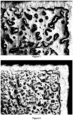
- the above possible embedding steps may also be combined, for instance to produce a basis pattern image comprising both variable dot locations and variable dot greyscale values. Exemplary resulting 3D patterns are shown on Figure 2 .
- the embedding steps may be selected specifically to match the requirements of the embossing production process used for manufacturing the item.
- the embedding steps may be adapted such that the resulting pattern exhibits specific mathematical properties, which can later be used to ease the automatic authentication process.
- a further post-processing step may be applied on the resulting basis pattern image.
- the image may be adapted specifically to the embossing production process used for manufacturing the item.
- One example of post-processing consists in blurring the generated image.
- Other approaches include adding to the blurring (i.e. low-pass filtering) a subsequent threshold in order to define more rounded areas as shown in Figure 3 .
- the post-processing operations such that may be selected such that the resulting pattern exhibits specific mathematical properties, which can later be used to ease the automatic authentication process.
- the 3D pattern or 3D model may then be used to create a tool for producing the desired 3D surface.
- the reflectivity of the material may also have an impact on the effectiveness of the feature.
- the rigid plate used for embossing, as well as the matching negative shape plate as relevant, may be created in such a way that their surface replicates in 3D the digital image basis pattern design, where the grayscale of each pixel specifies the height of the surface embossing.
- Such a plate may be obtained by chemical etching, or machining, or laser structuring.
- machining and laser structuring enable one to specifically define the height of the plate in each location (therefore each grayscale value will have a specific height on the plate) while chemical etching is more a binary process (where the digital image pattern design has typically 2 colors representing etched or non-etched areas).
- step a) Yet another approach consists of combining step a) and step b) into one single operation.
- the hot-stamping process (or foil-stamping or any equivalent process) is performed with a tool surface which is not flat but rather features the pattern to be embossed.
- a further step c) may be applied, with reference to Figure 6 :
- the additional varnish layer may also include some color tint in order to give a different visual appearance.
- the additional varnish layer when printed by flexography, offset or rotogravure, it is also possible to print a non-uniform layer of varnish, for instance by including small holes in the varnish layer in order to hide an invisible pattern.
- the methods of US7684088 or WO2006087351 may be applied to this end, but other approaches are also possible.
- Such a pattern can include for instance the Alpvision Cryptoglyph covert authentication feature which can be detected with a smartphone. Correlation between the detectability of the 3D pattern and of the varnish layer can also be used to ease detection, increase the security or add/improve other functionality.
- stamping to produce the desired 3D surface.
- other methods such as die casting, thermoforming, blow molding, and metal rolling to name a few.
- the illumination can also have an impact and even enhance the effectiveness if the illumination is different for the two viewpoints.
- the mode of operation for two viewpoints. However, in can be extended to any number. The extreme case would be a "continuous" viewpoint, for instance through moving a smartphone while running it in a video mode. In practice the video itself is not fully continuous but rather capturing 25 or 30 frames per second.
- the detection is based on the capture of two different images taken with different illuminations and positions.
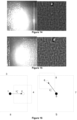
- Figure 10 shows the smartphone (0) at 2 different positions (namely the first imaging device position and the second imaging device position) and the smartphone camera (3) used to take the pictures that are analyzed in the authentication step to detect the presence or absence of the 3D authentication pattern feature. It can be seen that depending on the incident light direction (1) or (2) of the light source (4), a different side of the embossed pattern (5) is seen by the camera and lit up by the light source (e.g. a flash), as shown on Figure 14 and Figure 15 .
- the light source e.g. a flash
- a digital overlay (1) corresponding to an imaging device position may be displayed on the smartphone screen (0), and the operator may be instructed to align the overlay with the embossed pattern view (2) respectively at the first and the second positions (a) and (b) of the smartphone and the corresponding overlays prior to the embossed pattern image capture.
- Other embodiments are also possible, where the user may take any two images from any position, with or without overlay.
- the capturing of the first or second image is made when the light source 4 of the imaging device is active.
- the first imaging device position corresponds to a first angle 1 between the light source 4 and the 3D surface 5
- the second imaging device position corresponds to a second angle 2 between the light source 4 and the 3D surface 5 (see figure 10 ).
- the pattern detection and image analysis authentication steps may be performed in real-time directly on each image of the video stream coming from the camera using a dedicated application running on the smartphone, with the flash light continuously on and with the application digitally cropping the area corresponding to the overlay (or at a known position from the overlay).
- the smartphone application may automatically replace the overlay of position (a) by the overlay of position (b), which guides the operator to move the smartphone to position (b), then the real-time image analysis of the video stream goes on until the success of the second detection.
- flash or any other light source
- the aforementioned application can be downloaded from the Internet directly into the imaging device.
- the download link (or URL) can be communicated to the operator in various ways such as email, phone call, SMS, printed in clear text (for instance on a label or the product packaging itself) or encoded into a machine readable code (for instance 1D barcode, 2D code, datamatrix, QR code, etc.).
- a machine readable code for instance 1D barcode, 2D code, datamatrix, QR code, etc.
- One motivation to embed the URL in a machine readable code on the product is that many code reading applications are already deployed on devices such as smartphones and enable to access to download links. Similarly, many applications are also capable of decoding human readable text URL (for instance using optical character recognition technologies) and accessing them in order to download an application.
- the 3D pattern itself may be used to encode the information necessary to download the application.
- the embossed pattern may be further modified such that it includes a text or machine-readable download code as shown in Figure 17 . More precisely this modification can be applied to the hot stamped or to the embossing pattern, therefore modifying locally the reflectivity or the 3D surface in order to convey the download information.
- the download code may also be partially overprinted over the embossed pattern, as represented on Figure 18 . The only basic requirements is that it is still possible to authenticate and to retrieve the URL from the modified pattern.
- Boolean composition of the pattern and of the QR code in such a way that all black pixels of the QR code result in a flat surface (and possibly also not hot stamped) while the white pixels of the QR code result in an embossed and hot stamped surface (3D smart embossing).
- Other examples of Boolean operations may include to negate the grayscale value of the pattern in areas where QR code has black pixels (and possibly changing back the digital pattern used during the comparison step of the authentication process in order to invert those modifications).
- Another example is to follow one of the manufacturing processes described above applied on P and followed by an overprinting of ⁇ ().
- the image analysis authentication step enables the automatic determination if a product under inspection is an authentic product, by analyzing whether the acquired images represent with sufficient accuracy the 3D authentication pattern, while in a counterfeit product, the 3D authentication pattern copy is typically of much lower quality than the original.
- the image analysis authentication step checks, in a fast and reliable way, if a series of pictures, for instance from a couple of image captures or from a video stream, verifies the two following specific conditions:
- 3D surfaces may be reconstructed using multiple 2D images.
- "shape from shading" methods enable to reconstruct the 3D shape of a surface from one or several images taken with different lighting conditions.
- those solutions are generally complex, slow and very sensitive to lightning conditions, and therefore not appropriate for real-time detection using a smartphone with unknown orientations relative to the observed sample and in uncontrolled lightning conditions.
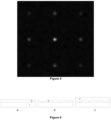
- One approach to assess the two authentication conditions simultaneously using at least two dimensional images from a series of picture captures, for instance obtained with a smart phone camera, is by computing the cross-correlation image C between the 3D pattern image D (as shown on Figure 1 for instance) and the acquired authentication pattern image I , the cross-correlation producing a characteristic signal between I and D .
- cross-correlation introduced above is of course only one possible embodiment to measure the similarity between 3D pattern image, which may be pre- and/or post-processed, and the acquired authentication pattern image, which may also be pre- and/or post-processed.
- the described cross-correlation has been used for its simplicity and elegance, but many other approaches can be used to measure the similarity. Such approaches, which are not claimed, may for instance be based on any kind of difference computations, such as absolute difference, squared difference, etc. More sophisticated methods can use similarity measurements in different projection domains, such as multi-resolution transforms, or even neural networks.
- Some 3D structures can be designed in order to exhibit a regular grid appearance, for instance for aesthetic reasons. This is the case of the Boegli approach for instance, where a template of regular "defects" is voluntarily are camouflaged in the grid structure. In this case, detection can still be done using the above described approaches and can also further be adapted by:
- FIG. 6 Another counterfeiting approach consists in molding (or any other type of transfer of the 3D structure) the surface structure in order to directly create a copy or to create a tool that can be used for rapid duplication (by embossing or molding for instance).
- One solution to render this copy process more difficult is illustrated on Figure 6 and consists in filling up the surface with a transparent material. This material can optionally be chosen in order to be difficult to remove. For instance, it is appropriate for such material to be resistant to solvents.
- Another approach is to use a material that is easily destroyed when in contact with solvents.
- a 3D scanner may also be used to acquire the 3D surface of the pattern. Then, this information is used to create a tool, for instance an embossing punch, by chemical etching or machining.
- a tool for instance an embossing punch
- the 3D acquisition by a laser scanner can be rendered much harder if the 3D pattern is overlaid with a uniform varnish layer.
Landscapes
- Engineering & Computer Science (AREA)
- Physics & Mathematics (AREA)
- General Physics & Mathematics (AREA)
- Computer Vision & Pattern Recognition (AREA)
- Theoretical Computer Science (AREA)
- Business, Economics & Management (AREA)
- Computer Security & Cryptography (AREA)
- Health & Medical Sciences (AREA)
- General Health & Medical Sciences (AREA)
- Toxicology (AREA)
- Artificial Intelligence (AREA)
- Electromagnetism (AREA)
- Quality & Reliability (AREA)
- Economics (AREA)
- Accounting & Taxation (AREA)
- Development Economics (AREA)
- Entrepreneurship & Innovation (AREA)
- Finance (AREA)
- Marketing (AREA)
- Strategic Management (AREA)
- General Business, Economics & Management (AREA)
- Multimedia (AREA)
- Credit Cards Or The Like (AREA)
- Collating Specific Patterns (AREA)
- Editing Of Facsimile Originals (AREA)
Claims (19)
- Verfahren zum Authentifizieren eines 3D-Musters einer 3D-Musteroberfläche, die aus einem 3D-Musterreferenzbild mit einer Abbildungsvorrichtung gebildet wird, die einen Abbildungsvorrichtungsbildschirm, eine Abbildungsvorrichtungskamera und einen Abbildungsvorrichtungsprozessor aufweist, mit den Schritten:Bereitstellen, mit dem Bildschirm der Abbildungsvorrichtung, einer Anzeige einer ersten Position der Abbildungsvorrichtung;Erfassen eines ersten digitalen Bildes der 3D-Musteroberfläche mit der Kamera der Abbildungsvorrichtung, wobei die 3D-Musteroberfläche aus einem 3D-Musterreferenzbild gebildet wird;Vergleichen des ersten digitalen Bildes mit dem 3D-Muster-Referenzbild durch eine Kreuzkorrelation mit dem Prozessor der Abbildungsvorrichtung, um ein erstes Kreuzkorrelations-Bildsignal zu erzeugen;Bereitstellen, mit dem Bildschirm der Abbildungsvorrichtung, einer Anzeige einer zweiten Position der Abbildungsvorrichtung;Erfassen eines zweiten digitalen Bildes der 3D-Musteroberfläche mit der Kamera der Abbildungsvorrichtung, wobei die 3D-Musteroberfläche aus einem 3D-Musterreferenzbild gebildet wird;Vergleichen des zweiten Bildes mit dem 3D-Muster-Referenzbild durch eine Kreuzkorrelation mit dem Prozessor der Abbildungsvorrichtung, um ein zweites Kreuzkorrelations-Bildsignal zu erzeugen;Messen einer Differenz zwischen dem ersten und dem zweiten Kreuzkorrelationsbildsignal mit dem Prozessor der Abbildungsvorrichtung; undBestimmen, mit dem Prozessor der Abbildungsvorrichtung, einer Authentizität des 3D-Musters, die zumindest teilweise darauf basiert, ob die gemessene Differenz über einem vordefinierten Schwellenwert liegt.
- Verfahren nach Anspruch 1, wobei der Vergleich des ersten oder zweiten Bildes mit einem 3D-Muster-Referenzbild ferner die Vorverarbeitung des ersten oder zweiten Bildes umfasst.
- Verfahren nach Anspruch 1 oder 2, wobei die Differenz zwischen dem ersten und dem zweiten Kreuzkorrelationsbildsignal als der Winkel zwischen einem ersten Vektor, der einen ersten Punkt mit dem höchsten Korrelationswert in einem vordefinierten Bereich des ersten Kreuzkorrelationsbildsignals mit einem zweiten Punkt mit dem niedrigsten Korrelationswert in einem vordefinierten Nachbarbereich des ersten Punkts im ersten Kreuzkorrelationsbildsignal Korrelationsbildsignals mit einem zweiten Punkt des niedrigsten Korrelationswertes in einem vordefinierten Nachbarschaftsbereich des ersten Punktes in dem ersten Kreuzkorrelationsbildsignal und einem zweiten Vektor, der einen dritten Punkt mit dem höchsten Korrelationswert in einem vordefinierten Bereich des zweiten Kreuzkorrelationsbildsignals mit einem vierten Punkt mit dem niedrigsten Korrelationswert in einem vordefinierten Nachbarschaftsbereich des dritten Punktes in dem zweiten Kreuzkorrelationsbildsignal verbindet.
- Verfahren nach Anspruch 1, wobei das Messen einer Differenz zwischen ersten und zweiten Kreuzkorrelationsbildsignalen ferner das Filtern des ersten oder zweiten Kreuzkorrelationsbildsignals umfasst.
- Verfahren nach einem der Ansprüche 1 bis 4, ferner umfassend:
Anzeigen eines Endbenutzers durch Anzeigen einer Nachricht auf dem Bildschirm der Bildgebungsvorrichtung, dass die 3D-Oberfläche authentifiziert ist. - Das Verfahren nach einem der Ansprüche 1 bis 5, das ferner Folgendes umfasst:
einem Endbenutzer durch Aussenden eines Tons auf einem Display-Lautsprecher des bildgebenden Geräts anzuzeigen, dass die 3D-Oberfläche authentifiziert ist. - Das Verfahren nach einem der Ansprüche 1 bis 6, das ferner Folgendes umfasst:
einem Endbenutzer durch Erzeugen einer Vibration des Abbildungsgeräts anzuzeigen, dass der 3D-Gegenstand authentifiziert ist. - Verfahren nach einem der Ansprüche 1 bis 7, wobei das 3D-Muster-Referenzbild zufällige oder pseudo-zufällige Punktpositionen darstellt.
- Verfahren nach einem der Ansprüche 1 bis 7, wobei das 3D-Muster-Referenzbild zufällige oder pseudo-zufällige Punktgrößen darstellt.
- Verfahren nach einem der Ansprüche 1 bis 7, wobei das 3D-Muster-Referenzbild zufällige oder pseudozufällige Punkt-Graustufenwerte darstellt.
- Verfahren nach einem der Ansprüche 1 bis 10, wobei die Abbildungsvorrichtung ein Smartphone ist.
- Verfahren nach einem der Ansprüche 1 bis 11, wobei die 3D-Musteroberfläche mit einem im Wesentlichen transparenten, lösungsmittelbeständigen Material gefüllt ist.
- Verfahren nach einem der Ansprüche 1 bis 11, wobei die 3D-Musteroberfläche mit einem transparenten, lösungsmittelbeständigen Aufklebermaterial bedeckt wird.
- Verfahren nach einem der Ansprüche 1 bis 13, bei dem eine zusätzliche transparente Schicht oder ein Lack auf die 3D-Musteroberfläche aufgebracht wird.
- Verfahren nach Anspruch 14, wobei die Oberfläche der zusätzlichen Schicht oder des Lacks eine zufällig variable Form aufweist.
- Verfahren nach Anspruch 14, wobei die zusätzliche Schicht oder der Lack eine Farbnuance aufweist.
- Verfahren nach Anspruch 14, wobei es sich bei der zusätzlichen Schicht oder dem Lack um eine ungleichmäßige Ablagerung handelt.
- Verfahren nach einem der Ansprüche 1 bis 17, wobei die 3D-Musteroberfläche mit einem Downloadcode zum Herunterladen einer Softwareanwendung auf die Bildgebungsvorrichtung kombiniert wird.
- Verfahren nach einem der Ansprüche 1 bis 18, wobei die Abbildungsvorrichtung eine Lichtquelle umfasst und wobei die erste Abbildungsposition einem ersten Winkel zwischen der Lichtquelle und der 3D-Musteroberfläche entspricht und die zweite Abbildungsvorrichtungsposition einem zweiten Winkel zwischen der Lichtquelle und der 3D-Musteroberfläche entspricht.
Applications Claiming Priority (2)
| Application Number | Priority Date | Filing Date | Title |
|---|---|---|---|
| US201562253482P | 2015-11-10 | 2015-11-10 | |
| PCT/EP2016/076924 WO2017080975A1 (en) | 2015-11-10 | 2016-11-08 | Method and apparatus for authentication of a 3d structure |
Publications (3)
| Publication Number | Publication Date |
|---|---|
| EP3374975A1 EP3374975A1 (de) | 2018-09-19 |
| EP3374975B1 true EP3374975B1 (de) | 2023-06-07 |
| EP3374975C0 EP3374975C0 (de) | 2023-06-07 |
Family
ID=57249809
Family Applications (1)
| Application Number | Title | Priority Date | Filing Date |
|---|---|---|---|
| EP16791601.4A Active EP3374975B1 (de) | 2015-11-10 | 2016-11-08 | Verfahren zur authentifizierung einer 3d-struktur |
Country Status (5)
| Country | Link |
|---|---|
| US (2) | US10019627B2 (de) |
| EP (1) | EP3374975B1 (de) |
| CN (1) | CN106682912B (de) |
| HK (1) | HK1256813A1 (de) |
| WO (1) | WO2017080975A1 (de) |
Families Citing this family (33)
| Publication number | Priority date | Publication date | Assignee | Title |
|---|---|---|---|---|
| WO2016121210A1 (ja) * | 2015-01-26 | 2016-08-04 | 凸版印刷株式会社 | 識別装置、識別方法、識別プログラム、及び識別プログラムを含むコンピュータ可読媒体 |
| US12282979B2 (en) | 2015-05-29 | 2025-04-22 | Digimarc Corporation | Serialized digital watermarking for variable data printing |
| US10643076B2 (en) * | 2016-07-01 | 2020-05-05 | International Business Machines Corporation | Counterfeit detection |
| GB201701363D0 (en) * | 2017-01-27 | 2017-03-15 | Secr Defence | Apparatus and method for registering recorded images |
| US10192089B1 (en) * | 2017-07-25 | 2019-01-29 | Honeywell International Inc. | Systems and methods for authentication of consumer products |
| DE102018108741A1 (de) * | 2018-04-12 | 2019-10-17 | Klöckner Pentaplast Gmbh | Verfahren für optische Produktauthentifizierung |
| DE102018125780A1 (de) * | 2018-10-17 | 2020-04-23 | Schreiner Group Gmbh & Co. Kg | Ähnlichkeitsbestimmung eines von einem Druckexemplar erstellten Digitalbildes mit einer Digitalvorlage |
| CN113166817B (zh) * | 2018-12-19 | 2022-09-06 | 爱克发有限公司 | 具有带标识码的皮肤纹理的皮革 |
| EP3926575B1 (de) * | 2019-02-15 | 2024-06-05 | NEC Corporation | Informationsverarbeitungsvorrichtung, verfahren und programm |
| WO2020174596A1 (ja) | 2019-02-26 | 2020-09-03 | 日本電気株式会社 | 画像撮影装置 |
| US11235613B2 (en) * | 2019-04-08 | 2022-02-01 | iProov Ltd. | Document authentication by attitude-independent determination of surface appearance using controlled illumination |
| US11636565B1 (en) | 2019-07-24 | 2023-04-25 | Digimarc Corporation | Tamper detection arrangements, and point of sales systems employing same |
| US11532490B2 (en) | 2019-08-22 | 2022-12-20 | Micron Technology, Inc. | Semiconductor packages with indications of die-specific information |
| US11031258B2 (en) | 2019-08-22 | 2021-06-08 | Micron Technology, Inc. | Semiconductor packages with patterns of die-specific information |
| WO2021044082A1 (fr) * | 2019-09-07 | 2021-03-11 | Guigan Franck | Proceder d'authentification perfectionne |
| DE102019132518A1 (de) | 2019-11-29 | 2021-06-02 | Schreiner Group Gmbh & Co. Kg | Verfahren zur Prüfung einer rasterförmig bedruckten und/oder gestalteten Oberfläche eines Gegenstands und Gegenstand |
| DE102019133364B3 (de) * | 2019-12-06 | 2021-03-04 | Lufthansa Technik Aktiengesellschaft | Verfahren zur Beurteilung der Qualität lackierter Holzoberflächen |
| EP3859597A1 (de) | 2020-01-31 | 2021-08-04 | U-NICA Systems AG | Computerimplementiertes verfahren und system zur oberflächenidentifizierung mit skalen |
| WO2021163049A1 (en) * | 2020-02-10 | 2021-08-19 | Jpmorgan Chase Bank, N.A. | Method and system for verification of random numbers |
| EP3885069A1 (de) * | 2020-03-25 | 2021-09-29 | Bystronic Laser AG | Qualitätskontrolle eines laserbearbeitungsprozesses mittels maschinellem lernen |
| EP3901960B1 (de) * | 2020-04-21 | 2023-09-06 | Deutsche Post AG | Validierungsverfahren und validierungsvorrichtung für versiegelte einheit |
| EP4193332A1 (de) * | 2020-08-05 | 2023-06-14 | BYK-Chemie GmbH | System und verfahren zur beurteilung einer beschichteten oberfläche in bezug auf oberflächenfehler |
| DE102020124060A1 (de) | 2020-09-15 | 2022-03-17 | Erich Utsch Ag | Verfahren zur Feststellung einer Manipulation oder Fälschung eines Gegenstands sowie System hierzu |
| DE102020134568A1 (de) | 2020-12-22 | 2022-06-23 | Leuchtstoffwerk Breitungen Gmbh | Verfahren zum eindeutigen Markieren von Objekten |
| IT202100005492A1 (it) | 2021-03-09 | 2022-09-09 | Krupteia S R L | Metodo per l’identificazione e autenticazione di oggetti, e sistema per la realizzazione del metodo |
| EP4083850A1 (de) | 2021-04-27 | 2022-11-02 | Onfido Ltd | Verfahren zum erkennen von fälschung in dokumenten |
| US12333624B1 (en) | 2021-06-04 | 2025-06-17 | Digimarc Corporation | Modulating surface topcoats to embed digital watermarking |
| EP4105815A1 (de) | 2021-06-14 | 2022-12-21 | Onfido Ltd | Signalbasierte maschinenlernende betrugserkennung |
| EP4105825A1 (de) | 2021-06-14 | 2022-12-21 | Onfido Ltd | Generalisierte anomaliedetektion |
| US12205294B2 (en) | 2022-03-07 | 2025-01-21 | Onfido Ltd. | Methods and systems for authentication of a physical document |
| US12499548B2 (en) | 2022-03-07 | 2025-12-16 | Onfido Ltd. | Methods and systems for authentication of a physical document |
| US12022042B1 (en) | 2023-05-17 | 2024-06-25 | Xerox Corporation | Correlated three-layer microtext |
| CN120833147B (zh) * | 2025-09-18 | 2025-12-16 | 江苏丰和印务有限公司 | 一种纸箱回收环境信息验证方法及系统 |
Citations (2)
| Publication number | Priority date | Publication date | Assignee | Title |
|---|---|---|---|---|
| US20120243797A1 (en) * | 2005-09-05 | 2012-09-27 | Alpvision, S.A. | Means for using microstructure of materials surface as a unique identifier |
| US20140055824A1 (en) * | 2011-03-25 | 2014-02-27 | Hologram Industries | Method and system for authenticating a secure document |
Family Cites Families (62)
| Publication number | Priority date | Publication date | Assignee | Title |
|---|---|---|---|---|
| US4371866A (en) | 1980-11-21 | 1983-02-01 | The United States Of America As Represented By The Secretary Of The Army | Real-time transformation of incoherent light images to edge-enhanced darkfield representation for cross-correlation applications |
| US4490849A (en) | 1982-03-04 | 1984-12-25 | Grumman Aerospace Corporation | Correlation plane recognition processor |
| GB8812890D0 (en) | 1988-05-31 | 1988-07-06 | De La Rue Co Plc | Security device & methods & apparatus for verification |
| US5159647A (en) | 1991-03-04 | 1992-10-27 | David Sarnoff Research Center, Inc. | Fast and efficient search method for graphical data |
| EP0578875A1 (de) | 1992-07-17 | 1994-01-19 | Recognition International Inc. | Normalisierender Korrelator für Videoverarbeitung |
| US5454045A (en) | 1994-04-15 | 1995-09-26 | Battelle Memorial Institute | Apparatus and method for identification and recognition of an item with ultrasonic patterns from item subsurface micro-features |
| US5992742A (en) | 1994-08-05 | 1999-11-30 | Sullivan; Scott L. | Pill printing and identification |
| US6030657A (en) | 1994-11-01 | 2000-02-29 | Dna Technologies, Inc. | Labeling technique for countering product diversion and product counterfeiting |
| US6461987B1 (en) | 1995-06-01 | 2002-10-08 | Mark Leroy Walker | Continuous micro-label apparatus and process |
| US6463416B1 (en) | 1996-07-15 | 2002-10-08 | Intelli-Check, Inc. | Authentication system for identification documents |
| US6038074A (en) * | 1997-05-20 | 2000-03-14 | Ricoh Company, Ltd. | Three-dimensional measuring apparatus and method, image pickup apparatus, and apparatus and method for inputting image |
| US6085976A (en) | 1998-05-22 | 2000-07-11 | Sehr; Richard P. | Travel system and methods utilizing multi-application passenger cards |
| US6895109B1 (en) | 1997-09-04 | 2005-05-17 | Texas Instruments Incorporated | Apparatus and method for automatically detecting defects on silicon dies on silicon wafers |
| EP1032964A2 (de) | 1997-11-17 | 2000-09-06 | Lifestyle Technologies | Universelle stromversorgung |
| US6384409B1 (en) | 1998-04-22 | 2002-05-07 | Mqs, Inc. | Optical tracking system |
| US5975581A (en) | 1998-08-25 | 1999-11-02 | Sentry Technology Corp. | System for confirming the authenticity of an article using a magnetic reader |
| US6546125B1 (en) | 1998-12-01 | 2003-04-08 | Applied Materials, Inc. | Photolithography monitoring using a golden image |
| US6584214B1 (en) | 1999-04-23 | 2003-06-24 | Massachusetts Institute Of Technology | Identification and verification using complex, three-dimensional structural features |
| EP1153373B1 (de) | 1999-12-08 | 2003-05-28 | Valentin Alexandrovich Mischenko | Verfahren und system zur authentifizierung von artikeln |
| FR2804784B1 (fr) | 2000-02-04 | 2003-04-11 | Novatec | Procede universel d'identification et d'authentification d'objets, de vegetaux ou d'etres vivants |
| US6547137B1 (en) | 2000-02-29 | 2003-04-15 | Larry J. Begelfer | System for distribution and control of merchandise |
| US6629061B1 (en) | 2000-07-31 | 2003-09-30 | Avaya Technology Corp. | Automatic concealment of product serialization information |
| DE60143487D1 (de) | 2000-09-20 | 2010-12-30 | Alpvision S A | Verfahren zur vorbeugung der verfälschung oder änderung von bedruckten oder gravierten flächen |
| US6842532B2 (en) | 2001-02-08 | 2005-01-11 | The Hong Kong Polytechnic University | Three dimensional measurement, evaluation and grading system for fabric/textile structure/garment appearance |
| US6706314B2 (en) | 2001-03-15 | 2004-03-16 | Amesbury Trust | Method of labelling an object |
| US6869015B2 (en) | 2001-05-30 | 2005-03-22 | Sandia National Laboratories | Tamper-indicating barcode and method |
| US7065239B2 (en) | 2001-10-24 | 2006-06-20 | Applied Materials, Inc. | Automated repetitive array microstructure defect inspection |
| US6922687B2 (en) | 2001-12-21 | 2005-07-26 | Barca, L.L.C. | Closed loop asset management process |
| WO2003087991A2 (en) | 2002-04-09 | 2003-10-23 | The Escher Group, Ltd. | System and method for authentication of a workpiece using three dimensional shape recovery |
| JP2003330942A (ja) | 2002-05-10 | 2003-11-21 | Minolta Co Ltd | ディジタルデータ検索装置 |
| CH695718A5 (fr) | 2002-09-20 | 2006-07-31 | Alpvision Sa | Procédé de génération et d'application sur un support d'un marquage spatial numérique. |
| AU2003285891A1 (en) * | 2002-10-15 | 2004-05-04 | Digimarc Corporation | Identification document and related methods |
| US7194105B2 (en) | 2002-10-16 | 2007-03-20 | Hersch Roger D | Authentication of documents and articles by moiré patterns |
| JP4366916B2 (ja) | 2002-10-29 | 2009-11-18 | 富士ゼロックス株式会社 | 書類確認システム、書類確認方法、及び書類確認プログラム |
| JP3917572B2 (ja) | 2003-09-05 | 2007-05-23 | 株式会社東芝 | 電子透かし検出方法及び装置 |
| FR2860670B1 (fr) | 2003-10-02 | 2006-01-06 | Novatec | Procede de securisation de transaction a partir de cartes presentant des identificateurs uniques et inreproductibles |
| DE602005014755D1 (de) | 2004-03-12 | 2009-07-16 | Ingenia Technology Ltd | Verfahren und vorrichtungen zur erzeugung authentifizierbarer gegenstände und ihrer nachfolgenden überprüfung |
| WO2005088533A1 (en) | 2004-03-12 | 2005-09-22 | Ingenia Technology Limited | Authenticity verification methods, products and apparatuses |
| GB2417707B (en) | 2004-08-13 | 2006-07-26 | Ingenia Technology Ltd | Methods and apparatuses for creating authenticatable printed articles and subsequently verifying them |
| FR2870376B1 (fr) | 2004-05-11 | 2006-09-22 | Yann Boutant | Procede de reconnaissance de supports fibreux, ainsi que les applications d'un tel procede dans le domaine informatique notamment |
| US20060013486A1 (en) | 2004-07-13 | 2006-01-19 | Burns Peter D | Identification of acquisition devices from digital images |
| GB2417074B (en) | 2004-08-13 | 2007-11-21 | Ingenia Technology Ltd | Authenticity verification methods,products and apparatuses |
| GB2417592B (en) | 2004-08-13 | 2006-07-26 | Ingenia Technology Ltd | Authenticity verification of articles |
| US7410120B2 (en) | 2005-01-21 | 2008-08-12 | The Boeing Company | Control surface assemblies with torque tube base |
| EP1690697A1 (de) | 2005-02-15 | 2006-08-16 | Alpvision SA | Verfahren zum Applizieren einer optisch unsichtbaren Markierung auf einen Datenträger |
| RU2285954C1 (ru) | 2005-03-18 | 2006-10-20 | Максим Ремирович Каримов | Способ защиты товаров от подделки |
| GB2426100B (en) | 2005-05-11 | 2007-08-22 | Ingenia Technology Ltd | Authenticity vertification |
| EP2024899B1 (de) | 2005-09-05 | 2015-11-04 | Alpvision S.A. | Mittel zur verwendung einer mikrostruktur aus materialoberfläche als eindeutige kennung |
| US7546114B1 (en) | 2006-01-23 | 2009-06-09 | Glaze Jr William | Secure, light emitting cell phone |
| PL1867470T3 (pl) | 2006-06-15 | 2009-11-30 | Boegli Gravures Sa | Sposób i urządzenie do autoryzacji znaków identyfikacyjnych na folii opakowaniowej lub opakowaniu |
| FR2907923B1 (fr) | 2006-10-31 | 2009-02-27 | Signoptic Technologies Soc Par | Accessoire pour un terminal communicant portable equipe de moyens de traitement et d'acquisition d'images et ensemble forme par l'accessoire et le terminal communicant |
| FR2923006B1 (fr) | 2007-10-29 | 2010-05-14 | Signoptic Technologies | Dispositif optique pour l'observation de details structurels millimetriques ou submillimetriques d'un objet a comportement speculaire |
| EP2429209A3 (de) * | 2010-09-14 | 2015-10-14 | LG Electronics Inc. | Vorrichtung und Verfahren zur Bereitstellung von stereoskopischen Bildinhalten |
| US9058535B2 (en) | 2011-04-05 | 2015-06-16 | Franck Guigan | Security barcode |
| JP2013020540A (ja) * | 2011-07-13 | 2013-01-31 | Glory Ltd | 紙葉類識別装置及び紙葉類識別方法 |
| US8885884B2 (en) * | 2011-09-19 | 2014-11-11 | Siemens Corporation | Motion analysis through geometry correction and warping |
| US8630481B2 (en) * | 2011-12-20 | 2014-01-14 | Eastman Kodak Company | Encoding information in illumination patterns |
| US8844802B2 (en) * | 2011-12-20 | 2014-09-30 | Eastman Kodak Company | Encoding information in illumination patterns |
| WO2013179249A1 (en) * | 2012-05-30 | 2013-12-05 | Label Tech International Trims Limited | Authentication apparatus and methods |
| WO2014182963A2 (en) | 2013-05-08 | 2014-11-13 | Digimarc Corporation | Methods and arrangements involving substrate marking |
| DE102013110785A1 (de) * | 2013-09-30 | 2015-04-02 | Bundesdruckerei Gmbh | Positionierverfahren für die positionierung eines mobilgerätes relativ zu einem sicherheitsmerkmal eines dokumentes |
| RU2639620C2 (ru) | 2013-10-11 | 2017-12-21 | Сикпа Холдинг Са | Портативное устройство и способ установления подлинности маркировки |
-
2016
- 2016-02-29 CN CN201610110150.7A patent/CN106682912B/zh active Active
- 2016-11-08 WO PCT/EP2016/076924 patent/WO2017080975A1/en not_active Ceased
- 2016-11-08 US US15/346,234 patent/US10019627B2/en active Active
- 2016-11-08 HK HK18115898.1A patent/HK1256813A1/zh unknown
- 2016-11-08 EP EP16791601.4A patent/EP3374975B1/de active Active
-
2018
- 2018-05-21 US US15/985,091 patent/US10789463B2/en active Active
Patent Citations (2)
| Publication number | Priority date | Publication date | Assignee | Title |
|---|---|---|---|---|
| US20120243797A1 (en) * | 2005-09-05 | 2012-09-27 | Alpvision, S.A. | Means for using microstructure of materials surface as a unique identifier |
| US20140055824A1 (en) * | 2011-03-25 | 2014-02-27 | Hologram Industries | Method and system for authenticating a secure document |
Non-Patent Citations (1)
| Title |
|---|
| ANONYMOUS: "Cross-correlation - Wikipedia", 9 November 2015 (2015-11-09), XP055858052, Retrieved from the Internet <URL:https://en.wikipedia.org/w/index.php?title=Cross-correlation&oldid=689852591> [retrieved on 20211104] * |
Also Published As
| Publication number | Publication date |
|---|---|
| US20180268214A1 (en) | 2018-09-20 |
| WO2017080975A1 (en) | 2017-05-18 |
| CN106682912A (zh) | 2017-05-17 |
| HK1256813A1 (zh) | 2019-10-04 |
| CN106682912B (zh) | 2021-06-15 |
| EP3374975C0 (de) | 2023-06-07 |
| US20170132465A1 (en) | 2017-05-11 |
| EP3374975A1 (de) | 2018-09-19 |
| US10019627B2 (en) | 2018-07-10 |
| US10789463B2 (en) | 2020-09-29 |
Similar Documents
| Publication | Publication Date | Title |
|---|---|---|
| US10789463B2 (en) | Method and apparatus for authentication of a 3D structure | |
| US11721153B2 (en) | Means for using microstructure of materials surface as a unique identifier | |
| EP3399462B1 (de) | Mittel zur verwendung einer mikrostruktur aus materialoberfläche als eindeutige kennung | |
| JP4783021B2 (ja) | 無作為に生ずる特徴を備えた耐偽造性及び耐タンバ性ラベル | |
| Cozzella et al. | Drug packaging security by means of white-light speckle | |
| US20140055824A1 (en) | Method and system for authenticating a secure document | |
| TW201531958A (zh) | 一種用以鑑別光學可變之防僞元件的方法及一種光學可變之防僞元件 | |
| WO2011077459A2 (en) | A method of extracting naturally encrypted features from a natural surface of a product | |
| EA023501B1 (ru) | Аутентификационная метка, способ ее изготовления и способ проверки подлинности продукта, содержащего ее | |
| US12243370B2 (en) | Means for using microstructure of materials surface as a unique identifier | |
| CN103761656B (zh) | 一种商品信息的印刷检验方法及装置 | |
| CN102800043B (zh) | 印刷品的防伪信息叠加方法、识别方法及检验装置 | |
| Peng et al. | Source identification of 3D printed objects based on inherent equipment distortion | |
| US20070253593A1 (en) | Methods for making an authenticating system | |
| CN114663118B (zh) | 基于镭射随机组合图像的防伪方法 | |
| PT115571B (pt) | Método para a validação da autenticidade de uma imagem presente num objeto, objeto com nível de segurança intensificado e o seu método de preparo, aparelho computacional, programas de computador e meio de leitura adaptados | |
| Gillich et al. | Data Collection Unit–A Platform for Printing Process Authentication | |
| CN202795404U (zh) | 一种印刷品的防伪信息检验装置 | |
| Iqbal et al. | Human perception based counterfeit detection for automated teller machines | |
| CN109993254A (zh) | 白色调隐形无效码互补识别二维码防伪方法 | |
| HK1122887B (en) | Means for using microstructure of materials surface as a unique identifier |
Legal Events
| Date | Code | Title | Description |
|---|---|---|---|
| STAA | Information on the status of an ep patent application or granted ep patent |
Free format text: STATUS: UNKNOWN |
|
| STAA | Information on the status of an ep patent application or granted ep patent |
Free format text: STATUS: THE INTERNATIONAL PUBLICATION HAS BEEN MADE |
|
| PUAI | Public reference made under article 153(3) epc to a published international application that has entered the european phase |
Free format text: ORIGINAL CODE: 0009012 |
|
| STAA | Information on the status of an ep patent application or granted ep patent |
Free format text: STATUS: REQUEST FOR EXAMINATION WAS MADE |
|
| 17P | Request for examination filed |
Effective date: 20180505 |
|
| AK | Designated contracting states |
Kind code of ref document: A1 Designated state(s): AL AT BE BG CH CY CZ DE DK EE ES FI FR GB GR HR HU IE IS IT LI LT LU LV MC MK MT NL NO PL PT RO RS SE SI SK SM TR |
|
| AX | Request for extension of the european patent |
Extension state: BA ME |
|
| DAV | Request for validation of the european patent (deleted) | ||
| DAX | Request for extension of the european patent (deleted) | ||
| REG | Reference to a national code |
Ref country code: HK Ref legal event code: DE Ref document number: 1256813 Country of ref document: HK |
|
| TPAC | Observations filed by third parties |
Free format text: ORIGINAL CODE: EPIDOSNTIPA |
|
| TPAC | Observations filed by third parties |
Free format text: ORIGINAL CODE: EPIDOSNTIPA |
|
| STAA | Information on the status of an ep patent application or granted ep patent |
Free format text: STATUS: EXAMINATION IS IN PROGRESS |
|
| 17Q | First examination report despatched |
Effective date: 20211112 |
|
| GRAP | Despatch of communication of intention to grant a patent |
Free format text: ORIGINAL CODE: EPIDOSNIGR1 |
|
| STAA | Information on the status of an ep patent application or granted ep patent |
Free format text: STATUS: GRANT OF PATENT IS INTENDED |
|
| INTG | Intention to grant announced |
Effective date: 20221207 |
|
| GRAS | Grant fee paid |
Free format text: ORIGINAL CODE: EPIDOSNIGR3 |
|
| GRAA | (expected) grant |
Free format text: ORIGINAL CODE: 0009210 |
|
| STAA | Information on the status of an ep patent application or granted ep patent |
Free format text: STATUS: THE PATENT HAS BEEN GRANTED |
|
| AK | Designated contracting states |
Kind code of ref document: B1 Designated state(s): AL AT BE BG CH CY CZ DE DK EE ES FI FR GB GR HR HU IE IS IT LI LT LU LV MC MK MT NL NO PL PT RO RS SE SI SK SM TR |
|
| REG | Reference to a national code |
Ref country code: GB Ref legal event code: FG4D |
|
| REG | Reference to a national code |
Ref country code: CH Ref legal event code: EP Ref country code: AT Ref legal event code: REF Ref document number: 1577318 Country of ref document: AT Kind code of ref document: T Effective date: 20230615 |
|
| REG | Reference to a national code |
Ref country code: DE Ref legal event code: R096 Ref document number: 602016080019 Country of ref document: DE |
|
| U01 | Request for unitary effect filed |
Effective date: 20230609 |
|
| U07 | Unitary effect registered |
Designated state(s): AT BE BG DE DK EE FI FR IT LT LU LV MT NL PT SE SI Effective date: 20230619 |
|
| TPAC | Observations filed by third parties |
Free format text: ORIGINAL CODE: EPIDOSNTIPA |
|
| REG | Reference to a national code |
Ref country code: LT Ref legal event code: MG9D |
|
| PG25 | Lapsed in a contracting state [announced via postgrant information from national office to epo] |
Ref country code: NO Free format text: LAPSE BECAUSE OF FAILURE TO SUBMIT A TRANSLATION OF THE DESCRIPTION OR TO PAY THE FEE WITHIN THE PRESCRIBED TIME-LIMIT Effective date: 20230907 Ref country code: ES Free format text: LAPSE BECAUSE OF FAILURE TO SUBMIT A TRANSLATION OF THE DESCRIPTION OR TO PAY THE FEE WITHIN THE PRESCRIBED TIME-LIMIT Effective date: 20230607 |
|
| PG25 | Lapsed in a contracting state [announced via postgrant information from national office to epo] |
Ref country code: RS Free format text: LAPSE BECAUSE OF FAILURE TO SUBMIT A TRANSLATION OF THE DESCRIPTION OR TO PAY THE FEE WITHIN THE PRESCRIBED TIME-LIMIT Effective date: 20230607 Ref country code: HR Free format text: LAPSE BECAUSE OF FAILURE TO SUBMIT A TRANSLATION OF THE DESCRIPTION OR TO PAY THE FEE WITHIN THE PRESCRIBED TIME-LIMIT Effective date: 20230607 Ref country code: GR Free format text: LAPSE BECAUSE OF FAILURE TO SUBMIT A TRANSLATION OF THE DESCRIPTION OR TO PAY THE FEE WITHIN THE PRESCRIBED TIME-LIMIT Effective date: 20230908 |
|
| U20 | Renewal fee for the european patent with unitary effect paid |
Year of fee payment: 8 Effective date: 20231123 |
|
| PG25 | Lapsed in a contracting state [announced via postgrant information from national office to epo] |
Ref country code: SK Free format text: LAPSE BECAUSE OF FAILURE TO SUBMIT A TRANSLATION OF THE DESCRIPTION OR TO PAY THE FEE WITHIN THE PRESCRIBED TIME-LIMIT Effective date: 20230607 |
|
| PG25 | Lapsed in a contracting state [announced via postgrant information from national office to epo] |
Ref country code: IS Free format text: LAPSE BECAUSE OF FAILURE TO SUBMIT A TRANSLATION OF THE DESCRIPTION OR TO PAY THE FEE WITHIN THE PRESCRIBED TIME-LIMIT Effective date: 20231007 |
|
| PG25 | Lapsed in a contracting state [announced via postgrant information from national office to epo] |
Ref country code: SM Free format text: LAPSE BECAUSE OF FAILURE TO SUBMIT A TRANSLATION OF THE DESCRIPTION OR TO PAY THE FEE WITHIN THE PRESCRIBED TIME-LIMIT Effective date: 20230607 Ref country code: SK Free format text: LAPSE BECAUSE OF FAILURE TO SUBMIT A TRANSLATION OF THE DESCRIPTION OR TO PAY THE FEE WITHIN THE PRESCRIBED TIME-LIMIT Effective date: 20230607 Ref country code: RO Free format text: LAPSE BECAUSE OF FAILURE TO SUBMIT A TRANSLATION OF THE DESCRIPTION OR TO PAY THE FEE WITHIN THE PRESCRIBED TIME-LIMIT Effective date: 20230607 Ref country code: IS Free format text: LAPSE BECAUSE OF FAILURE TO SUBMIT A TRANSLATION OF THE DESCRIPTION OR TO PAY THE FEE WITHIN THE PRESCRIBED TIME-LIMIT Effective date: 20231007 Ref country code: CZ Free format text: LAPSE BECAUSE OF FAILURE TO SUBMIT A TRANSLATION OF THE DESCRIPTION OR TO PAY THE FEE WITHIN THE PRESCRIBED TIME-LIMIT Effective date: 20230607 |
|
| PG25 | Lapsed in a contracting state [announced via postgrant information from national office to epo] |
Ref country code: PL Free format text: LAPSE BECAUSE OF FAILURE TO SUBMIT A TRANSLATION OF THE DESCRIPTION OR TO PAY THE FEE WITHIN THE PRESCRIBED TIME-LIMIT Effective date: 20230607 |
|
| REG | Reference to a national code |
Ref country code: DE Ref legal event code: R097 Ref document number: 602016080019 Country of ref document: DE |
|
| PLBE | No opposition filed within time limit |
Free format text: ORIGINAL CODE: 0009261 |
|
| STAA | Information on the status of an ep patent application or granted ep patent |
Free format text: STATUS: NO OPPOSITION FILED WITHIN TIME LIMIT |
|
| 26N | No opposition filed |
Effective date: 20240308 |
|
| PG25 | Lapsed in a contracting state [announced via postgrant information from national office to epo] |
Ref country code: MC Free format text: LAPSE BECAUSE OF FAILURE TO SUBMIT A TRANSLATION OF THE DESCRIPTION OR TO PAY THE FEE WITHIN THE PRESCRIBED TIME-LIMIT Effective date: 20230607 |
|
| PG25 | Lapsed in a contracting state [announced via postgrant information from national office to epo] |
Ref country code: MC Free format text: LAPSE BECAUSE OF FAILURE TO SUBMIT A TRANSLATION OF THE DESCRIPTION OR TO PAY THE FEE WITHIN THE PRESCRIBED TIME-LIMIT Effective date: 20230607 |
|
| REG | Reference to a national code |
Ref country code: IE Ref legal event code: MM4A |
|
| PG25 | Lapsed in a contracting state [announced via postgrant information from national office to epo] |
Ref country code: IE Free format text: LAPSE BECAUSE OF NON-PAYMENT OF DUE FEES Effective date: 20231108 |
|
| PG25 | Lapsed in a contracting state [announced via postgrant information from national office to epo] |
Ref country code: IE Free format text: LAPSE BECAUSE OF NON-PAYMENT OF DUE FEES Effective date: 20231108 |
|
| U20 | Renewal fee for the european patent with unitary effect paid |
Year of fee payment: 9 Effective date: 20241126 |
|
| U1N | Appointed representative for the unitary patent procedure changed after the registration of the unitary effect |
Representative=s name: SCILLETTA, ANDREA; IT |
|
| REG | Reference to a national code |
Ref country code: HK Ref legal event code: WD Ref document number: 1256813 Country of ref document: HK |
|
| PG25 | Lapsed in a contracting state [announced via postgrant information from national office to epo] |
Ref country code: CY Free format text: LAPSE BECAUSE OF FAILURE TO SUBMIT A TRANSLATION OF THE DESCRIPTION OR TO PAY THE FEE WITHIN THE PRESCRIBED TIME-LIMIT; INVALID AB INITIO Effective date: 20161108 |
|
| PG25 | Lapsed in a contracting state [announced via postgrant information from national office to epo] |
Ref country code: HU Free format text: LAPSE BECAUSE OF FAILURE TO SUBMIT A TRANSLATION OF THE DESCRIPTION OR TO PAY THE FEE WITHIN THE PRESCRIBED TIME-LIMIT; INVALID AB INITIO Effective date: 20161108 |
|
| REG | Reference to a national code |
Ref country code: CH Ref legal event code: U11 Free format text: ST27 STATUS EVENT CODE: U-0-0-U10-U11 (AS PROVIDED BY THE NATIONAL OFFICE) Effective date: 20251201 |
|
| PG25 | Lapsed in a contracting state [announced via postgrant information from national office to epo] |
Ref country code: TR Free format text: LAPSE BECAUSE OF FAILURE TO SUBMIT A TRANSLATION OF THE DESCRIPTION OR TO PAY THE FEE WITHIN THE PRESCRIBED TIME-LIMIT Effective date: 20230607 |
|
| U20 | Renewal fee for the european patent with unitary effect paid |
Year of fee payment: 10 Effective date: 20251112 |
|
| PGFP | Annual fee paid to national office [announced via postgrant information from national office to epo] |
Ref country code: GB Payment date: 20251111 Year of fee payment: 10 |
|
| PGFP | Annual fee paid to national office [announced via postgrant information from national office to epo] |
Ref country code: CH Payment date: 20251201 Year of fee payment: 10 |