EP3374957B1 - Verfahren und system zur verteilung von elektronischem veröffentlichungsinhalt - Google Patents
Verfahren und system zur verteilung von elektronischem veröffentlichungsinhalt Download PDFInfo
- Publication number
- EP3374957B1 EP3374957B1 EP16863243.8A EP16863243A EP3374957B1 EP 3374957 B1 EP3374957 B1 EP 3374957B1 EP 16863243 A EP16863243 A EP 16863243A EP 3374957 B1 EP3374957 B1 EP 3374957B1
- Authority
- EP
- European Patent Office
- Prior art keywords
- host
- page
- destination
- creative
- server
- Prior art date
- Legal status (The legal status is an assumption and is not a legal conclusion. Google has not performed a legal analysis and makes no representation as to the accuracy of the status listed.)
- Active
Links
Images










Classifications
-
- G—PHYSICS
- G06—COMPUTING OR CALCULATING; COUNTING
- G06Q—INFORMATION AND COMMUNICATION TECHNOLOGY [ICT] SPECIALLY ADAPTED FOR ADMINISTRATIVE, COMMERCIAL, FINANCIAL, MANAGERIAL OR SUPERVISORY PURPOSES; SYSTEMS OR METHODS SPECIALLY ADAPTED FOR ADMINISTRATIVE, COMMERCIAL, FINANCIAL, MANAGERIAL OR SUPERVISORY PURPOSES, NOT OTHERWISE PROVIDED FOR
- G06Q30/00—Commerce
- G06Q30/02—Marketing; Price estimation or determination; Fundraising
- G06Q30/0241—Advertisements
- G06Q30/0277—Online advertisement
-
- G—PHYSICS
- G06—COMPUTING OR CALCULATING; COUNTING
- G06F—ELECTRIC DIGITAL DATA PROCESSING
- G06F16/00—Information retrieval; Database structures therefor; File system structures therefor
- G06F16/90—Details of database functions independent of the retrieved data types
- G06F16/95—Retrieval from the web
- G06F16/958—Organisation or management of web site content, e.g. publishing, maintaining pages or automatic linking
- G06F16/986—Document structures and storage, e.g. HTML extensions
Definitions
- the present disclosure relates to online publishing.
- the present disclosure relates to a method and system for distributing electronic publishing content.
- the online environment provided by networked computers provides many means for delivering content to a user.
- Such means include, for example, email, Short Message Service (SMS) text messages, Multimedia Messaging Service (MMS) messages, webpages, pop-up advertisements, and the like.
- SMS Short Message Service
- MMS Multimedia Messaging Service
- publisher is used in a broad sense to refer to a person or entity that publishes content and includes the owner of a website or software application ("app") on which content is published.
- apps software application
- a publisher may also refer to an owner of a set of online publications, domain names, websites, apps, and the like.
- Advertisers such as brands and companies, use a variety of media to advertise their products (goods or services). Such media may be classified into “offline advertising” and “online advertising”. Offline advertising includes, for example, printed publications (such as pamphlets, brochures, newspapers, posters, and billboards), radio advertisements, and television commercials. Online advertising (also referred to as "digital advertising") includes advertisements provided to a user via a computing device coupled to a communications network.
- the communications network can include, for example, a computer network, the Internet, the World Wide Web, mobile communications networks, and the like. For example, advertising can be provided on a web page viewed by a user in a browser executing on a computing device or within an app executing on a computing device.
- Digital advertising can take many forms. Search engines offer paid text-based advertisements (ads) that appear with search engine results. Banner ads are typically served within a web page with the intention of attracting traffic to a website by establishing a link to the website of the advertiser. Video content may be provided to a user before, during, after, or in-line with other online activities. Similarly, audio content may be played before, during, or after streamed audio content.
- Each of the different forms of digital advertising may have multiple formats.
- banner ads are available in a number of different formats.
- IAB Interactive Advertising Bureau
- Providing a set of specifications enables advertisers and their respective advertising agencies to build an advertisement once and then deploy the advertisement across multiple publishers, who in turn have multiple websites and applications, without having to worry about the advertisement working properly.
- the set of specifications provides only a limited feature set.
- Custom advertisements To execute a custom advertisement, the advertiser builds the advertisement for a specific publisher and then deploys the advertisement across that publisher and associated websites and/or applications.
- custom advertisements create problems for the advertisers themselves. Custom advertisements typically do not scale across different websites or other technical platforms and consequently require large investments of time and energy to make one advertisement work across multiple websites and applications of a single publisher, let alone across multiple publishers.
- an advertiser in order for an advertiser to construct an advertisement to appear below a website header on multiple publishers, the advertiser must first obtain specific knowledge of each of the websites and applications, such as knowledge on the Hyper Text Markup Language (HTML) code pertaining to the header. Each of the destinations would have different (sometimes subtle, sometimes radical) ways the header is configured in the HTML. The advertiser must then create specific builds of the advertisement for the different publishers.
- HTML Hyper Text Markup Language
- the website HTML is not static; it may take many different representations throughout the course of a user's experience with it.
- These representational states are the consequence of varying conditions including but not limited to: the current position of the viewport relative to the webpage document, the current scroll direction (up or down), the time elapsed since the user arrived on the page, the user's interactions with content on the page (e.g., clicking on a menu or interacting with some other dynamic component), whether or not the user has authenticated themselves to the site, the number of previous visits a user has made to a site, or the values from some external data source (e.g., weather information, a sporting result or schedule).
- some external data source e.g., weather information, a sporting result or schedule
- the present disclosure relates to a method and system for distributing electronic publishing content.
- the present disclosure provides a method for distributing electronic publishing content according to claim 1.
- a second aspect of the present disclosure provides a host configuration database according to claim 8.
- the present disclosure provides an apparatus for implementing any one of the aforementioned methods.
- the present disclosure provides a computer program product including a computer readable medium having recorded thereon a computer program for implementing any one of the methods described above.
- the present disclosure provides a method and system for distributing electronic publishing content.
- the method and system of the present disclosure provide a standardised, independent naming convention for functional components of web pages, which allows advertising content to reference, modify, and/or interact with a host web page in a standard way.
- Such a method and system enable rich media capabilities to be scalable across webpages and applications in a reliable way.
- the method of the present disclosure allows one generic advertisement to be built that can successfully reference, modify, and/or interact with designated host-specific webpage components on a set of predefined host pages.
- the designated webpage components are not restricted to an advertisement container within a host site, rather the designated webpage components may include any component of the host page. This enables advertisers to perform many functions, including, but not limited to, referencing, interacting, and/or modifying a logo of a host page, the page colour, the text style, and the like, across multiple host pages, as those host pages occupy different representational states.
- advertising content can detect, react, modify, and interact with multiple host pages based on the representational states of those host pages.
- Web pages are written in a form of markup language called HTML.
- HTML5 is the latest revision of the specification.
- the specification defines a strict set of element types that may appear in an HTML5 document. Each element type can optionally declare one or more attributes, which give additional meaning to the element.
- a document is composed of a tree of HTML elements rooted at the element named html.
- Figs 1A-C illustrate how three different websites (Host Site 1, Host Site 2, and Host Site 3) can define body, header, and navigation webpage components in different ways and still be valid HTML5 documents.
- Fig. 1A illustrates HTML5 compliant definitions for Host Site 1
- Fig. 1B illustrates HTML5 compliant definitions for Host Site 2
- Fig. 1C illustrates HTML5 compliant definitions for Host Site 3.
- the method and system of the present disclosure use a host configuration database, which stores a standardised, independent naming convention for webpage components.
- the independent naming convention functions as a classification system to standardise the referencing to functionally similar components across different host sites.
- the host configuration database stores mappings from a standardised list of components to a set of specific representational states and host specific components for host pages and provides the mappings to a requesting source during the creative ad serving process.
- the requesting source is a creative ad server.
- the creative code returned by the creative ad server can reliably determine the current representational state of the host page and apply processing to specific functional components from the host page.
- the requesting source is a web browser that has received creative code from a creative ad server, wherein the creative code includes a request for a mapping from the host configuration database.
- the host configuration database returns the mapping, whereupon the web browser applies the mapping to configure creative content for a destination host page.
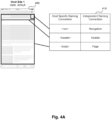
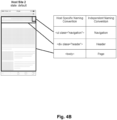
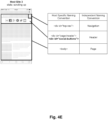
- Figs 4A-E illustrate the result of rendering the code of Host Sites 1, 2, and 3 from the examples of Figs 1A-C in a mobile web browser and the differing visual appearance in each representational state.
- Fig. 4A illustrates a sample webpage 400 and a set of components 410 in accordance with an independent naming convention, wherein the set of components 410 in this example include "Navigation", "Header” and "Page".
- Fig. 2 illustrates a method 200 for distributing electronic publishing content in accordance with the present disclosure.
- the method 200 begins at step 210, which creates a set of standardised independent naming conventions for components of websites, referred to as a host configuration database of independent naming conventions.
- Step 220 analyses a set of chosen sites and identifies the default representational state for each site.
- the state of the Site may change between a default representational state and one or more additional representational states.
- additional states are identified and described in terms of one or more conditional statements that must hold true for the state to be considered active. These conditional statements are composed using checks or measurements of a set of real time characteristics.
- the real time characteristics may relate, for example, to one or more of the site, the web browser, information pertaining to the user visiting the site or some third party data source, including, but not limited to, the current position of the viewport relative to the webpage document, the current scroll direction (up or down), the time elapsed since the user arrived on the page, the user's interactions with content on the page (e.g., clicking on a menu or interacting with some other dynamic component), whether or not the user has authenticated themselves to the site, the number of previous visits a user has made to a site, or the values from some external data source (e.g., weather information, a sporting result or schedule).
- some third party data source including, but not limited to, the current position of the viewport relative to the webpage document, the current scroll direction (up or down), the time elapsed since the user arrived on the page, the user's interactions with content on the page (e.g., clicking on a menu or interacting with some other dynamic component), whether or not the user has authenticated themselves to the
- Table 1 shows some example conditional statements that may be used to describe the prerequisite for a given representational state to be active at a given moment in time. This list is illustrative and non-exhaustive, as there are an infinite number of conditional states that may described for a given host site.
- Table 1 Representational state Conditional statement (pseudo code) Description Default True if no other state active The default state of the site when no other conditional states are active.
- Step 230 analyses said host sites and identifies a mapping between components of each host site and the independent component names in the host configuration database for each representational state of the host site.
- Step 250 receives a request for an advertisement from a host site.
- Step 260 creates a host-site specific version of the advertisement created in step 240 by using the data and mapping stored in the host configuration database.
- step 260 interrogates the host configuration database to retrieve a mapping of host-specific components against independent components for each representational state and configures the advertisement based on that mapping.
- Step 270 delivers the host-specific advertisement to the requesting host site, wherein the advertisement now contains a mapping to components in accordance with the host-specific naming conventions of the host page.
- Table 2 shows a sample host configuration database. Each row relates to a webpage component and lists any constraints that might apply to that component. A multiplicity field indicates how many instances of a component may exist on any web page. Table 2 Independent Naming Convention for Webpage Component Description/Function Constraints Multiplicity page The ancestor of all visible components on the page. Must be the ancestor of all other components 1 header The topmost component of a page, typically containing the website branding logo. 0..1 header-anchored As per header, but configured to be anchored to the top of the viewport. 0..1 menu A component that, when clicked, reveals a list of one or more site navigation options. 0..1 datestamp A component that contains the current date and/or time. 0..* weather A component that displays weather information.
- the weather information may be specific to the user's location or 0..* some other pre-defined location.
- navigation A component that contains one or more site navigation hyperlink. 0..* navigation-item A hyperlink contained within a navigation component. Child of navigation. 0..* content A component that contains the content proper. Typically, this component contains one or more articles, ad space, etc Child of page. 1..* hero A component that contains featured content on a page, typically a large image accompanied with byline and body. Child of content. 0..* hero-image The primary image contained within a hero element. Child of hero. 0..1 hero-text The primary text contained within a hero element. Child of hero. 0..1 adspace A component that contains advertising content.
- the host configuration database may evolve and adapt over time, depending on the particular application. As such, new webpage components may be introduced and existing webpage components may be modified or deleted.
- the method of the present disclosure establishes mappings between the standardised components of the independent naming convention and host-specific naming conventions used for webpage components in a set of host sites and their representational states. That is, the host configuration database stores a mapping across a set of host sites and their representational states to the independent naming convention of the host configuration database.
- Figs 1A-C showed three different implementations of code that are functionally equivalent.
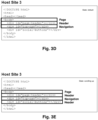
- Figs 3A-E highlight the mapping of different component names from each of Host Site 1, Host Site 2, and Host Site 3 to the independent naming convention of the host configuration database of Table 2.
- Site 1 exhibits only a single representational state, whereas Sites 2 and 3 exhibit multiple representational states, namely their "default" state and "scrolling up" state.
- Fig. 3A shows the code of Host Site 1 in its default representational state, with the following mappings identified: ⁇ body> ⁇ Page ⁇ header> ⁇ Header ⁇ nav> ⁇ Navigation.
- Table 3 shows a portion of the host configuration database of Table 2, updated to reflect the mappings for Host Site 1, Host Site 2, and Host Site 3.
- Table 3 Independent Naming Convention for Webpage Component Description/ Function Constraints Multiplicity Mapping to Host Site 1 on a mobile device Mapping to Host Site 2 on a mobile device Mapping to Host Site 2 on a mobile device Mapping to Host Site 3 on a mobile device Mapping to Host Site 3 on a mobile device Representational State default default scrolling up default scrolling up Conditional Statement - - scroll position ⁇ last scroll position - scroll position ⁇ last scroll position page The ancestor of all visible components on the page.
- a website may have different coding for different devices on which the website is to be displayed. Consequently, the host configuration database optionally includes mappings from the independent naming convention to a host site for a particular device.
- the code for each of Host Site 1, Host Site 2, and Host Site 3 is for display on a mobile computing device, such as a smartphone, tablet, phablet, or the like.
- a website that has different code for desktop devices and mobile devices may have two different mappings stored in the host configuration database. This is illustrated in Table 4, below, which shows extra columns in the host configuration database of Table 3 for Host Site 4 when displayed in a web browser and for a mobile device.
- Web advertisements are generally created as HTML documents. Typical advertisements are designed to appear within a specific region or "container" of a host site. Such advertisements usually do not seek to reference, modify, or interact with components of host site outside the container, despite it being possible for advertisements to do so.
- the components may include, for example, the page header, the navigation menu, the first article on the page, the title text of the articles on the page, and the like.
- the code of the advertisement needs to reference the components on the host page with which the advertisement wants to interact. This requires specific knowledge of the host page and its specific naming conventions for components on that host page, otherwise the advertisement will not work reliably and as intended on the host site. Furthermore, as the representation state of a site changes during the user's visit, additional specific knowledge of these states is required for each host page. In practice, this effectively means that to reference webpage components on a host page reliably, one advertisement must be constructed for each host page. Alternatively, one advertisement may be constructed for a set of host pages, with specific prior knowledge of each host page being built into the advertisement. Given that advertisements are often required to be delivered on hundreds or even thousands of different host sites, this referencing (and any subsequent use of) the webpage components is generally avoided.
- a first advertisement, Advertisement 1, created for Host Site 1 executes the following code periodically:
- each of the Advertisements 1, 2, and 3 is different in order to reference the webpage components of Host Sites 1, 2, and 3 correctly.
- the method and system of the present disclosure provide a framework whereby a single advertisement can be created that references and uses component names from the independent naming convention stored in the host configuration database.
- the step of creating such an advertisement corresponds to step 240 of Fig. 2 , described above.
- An example of an advertisement created in accordance with the independent naming convention of the host configuration database of Tables 2 and 3 is:
- Ad serving is a broad term that describes the process of a webpage or application requesting and displaying an advertisement.
- a digital advertising campaign will require that one or more advertisements are scheduled to run across one or more host sites, such as publisher websites, apps, and the like.
- the advertisements (“creatives") are built to predetermined specifications that define the size and characteristics of the advertisements for display on the selected host sites.
- Ad server a server that receives requests for advertising content, decides which creative to return from a pool of eligible campaigns, then responds with an ad file
- Creative ad server a server that receives requests for creative files and returns creative files to a web browser
- Web browser the web browser on a computing device accessed by a user
- Web server the publisher site's web server, which responds to requests for the site content.
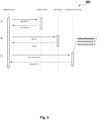
- Fig. 5 is a schematic representation illustrating a typical flow 500 of requests and responses to and from a web browser during an ad serving process, using Host Site 1 from Fig. 1A .
- a web browser sends a request for Site 1 from a web server.
- the web server responds by returning the requested html document and the web browser renders the returned document.
- the returned document contains a reference to an ad file hosted on an ad server.
- the web browser sends a request to the ad server for the ad file and the ad server returns the requested ad file.
- the returned ad file contains a reference to creative content to be retrieved from a creative ad server.
- the web browser sends a request to the creative ad server, which returns a creative file for display by the web browser.
- the creative ad server would need to store a single advertisement constructed with specific prior knowledge of each of the three host sites (Host Sites 1, 2, and 3).
- the creative ad server would need to identify the source of the request, such that:
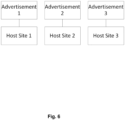
- This ad serving process wherein a separate advertisement is constructed for each destination host site, is illustrated in Fig. 6 .
- the ad serving process does not include step 260 of Fig. 2 .
- extra costs time, financial, and resources are incurred through the creation of separate advertisements for each of the destination host sites (Host Sites 1, 2, and 3).
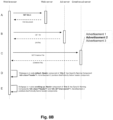
- Figs 8A-C illustrate delivery of customised advertisements for each of Host Sites 1, 2, and 3, respectively.
- a web browser requests HTML content from Host Site 1 and renders returned content received from a web server.
- the returned content contains a reference to an ad file hosted on an ad server, so the web browser requests the ad file from the ad server and executes an ad file returned from the ad server.
- the ad file includes a reference to a creative file, so the web browser requests the creative file from a creative ad server, which returns the requested creative file to the web browser.
- the web browser executes the creative file and applies desired changes to the web page of Host Site 1.
- Host Site 2 on Fig. 8B and Host Site 3 on Fig. 8C the creative ad server needs to store a customised advertisement (Advertisement 1, Advertisement 2, and Advertisement 3) for each of the respective host sites: Host Site 1, Host Site 2, and Host Site 3, or a single advertisement with prior specific knowledge of the host-site specific naming conventions of each of Host Site 1, Host Site 2, and Host Site 3.
- a customised advertisement Advertisement 1, Advertisement 2, and Advertisement 3
- the method of the present disclosure includes a request to the host configuration database to map components from a standardised ad using independent naming conventions to host-specific components of an intended host site.
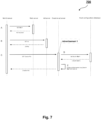
- Fig. 7 is a schematic representation of an ad serving process 700 using a host configuration database of the present disclosure.
- the ad serving process 700 includes a flow of requests and responses to and from a web browser during an ad serving process, using Host Site 1 from Fig. 1A .
- a web browser sends a request for Site 1 from a web server.
- the web server responds by returning the requested html document and the web browser renders the returned document.
- the returned document contains a reference to an ad file hosted on an ad server.
- the web browser sends a request to the ad server for the ad file and the ad server returns the requested ad file.
- the returned ad file contains a reference to creative content to be retrieved from a creative ad server.
- the creative ad server notes that the request originates from Host Site 1 and sends a request to the host configuration database for the mapping relevant to Host Site 1.
- the creative ad server is configured to communicate with the host configuration database.
- the creative ad server requests a mapping from the host configuration database for the originating host site from which the request is being made. Consequently, the creative ad server knows to request such a mapping from the host configuration database when the creative ad server receives a request in relation to one of those destination host sites.
- the creative file received by the web browser on the computing device includes an instruction to communicate with the host configuration database and request the required mapping for the relevant host site from the host configuration database.
- the creative ad server is not required to communicate with the host configuration database.
- the creative file received by the web browser includes an instruction to communicate with the host site in order to obtain the host configuration.
- the host site is performing the role of the host configuration database, albeit only for creative files delivered to this site.
- the host configuration database returns the mapping between the independent naming convention and Host Site 1 for each of the Host Site 1's representational states.
- the creative ad server configures or translates a stored advertisement compliant with the independent naming convention in accordance with the mapping for Host Site 1.
- the creative ad server then transmits the configured advertisement to the web browser for display by the web browser.
- the process 700 of Fig. 7 can be applied to deliver creative content for any of Host Site 1, Host Site 2, and Host Site 3, based on the mappings of Table 3 stored in the host configuration database and one or more stored advertisements that are compliant with the independent naming convention.
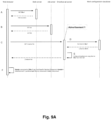
- Figs 9A-C illustrate an ad serving process in accordance with the present disclosure, when delivering creative content to each of Host Sites 1, 2, and 3, respectively, using a single advertisement, Advertisement 1, created in compliance with the independent naming convention of the host configuration database of Table 3.
- Fig. 9A illustrates an ad serving process in relation to Host Site 1.
- a creative ad server stores a single advertisement, Advertisement 1.
- the creative ad server receives a request from the web browser for a creative file, the creative ad server identifies that the request is associated with Host Site 1 and sends a request to the host configuration database for a host configuration pertaining to Host Site 1.
- the creative ad server configures the stored advertisement, Advertisement 1, for Host Site 1, based on the returned host configuration pertaining to Host Site 1.
- the creative ad server then returns the configured creative file to the web browser.
- the web browser executes the configured creative file, which interacts predictably and reliably with components of Host Site 1.
- Figs 9B and 9C illustrate a similar process repeated in respect of Host Sites 2 and 3, respectively, using the same advertisement, Advertisement 1, stored in the creative ad server.
- Advertisement 1 stored in the creative ad server.
- the creative ad server and the host configuration database are separate entities in communication with each other via a communications network.
- the communications network may be implemented using one or more wired or wireless transmission links and may include, for example, a cellular telephony network, a dedicated communications link, a local area network (LAN), a wide area network (WAN), the Internet, a telecommunications network, or any combination thereof.
- a telecommunications network may include, but is not limited to, a telephony network, such as a Public Switch Telephony Network (PSTN), a cellular (mobile) telephone cellular network, a short message service (SMS) network, or any combination thereof.
- PSTN Public Switch Telephony Network
- SMS short message service
- the creative ad server and the host configuration database are co-located and/or integral with one another, forming a single system.
- the host configuration database is stored on the host web server.
- Fig. 7 and Figs 9A-C illustrate a creative ad server making a request to the host configuration database in order to configure a stored advertisement for delivery to a host site.
- the host configuration database of the present disclosure is adapted to transmit the mapping associated with a destination host site to any requesting source.
- the requesting source may be, for example, but is not limited to, a creative ad server, an ad server, or a web browser.
- Fig. 14A illustrates an alternative implementation in which the creative ad server delivers requested creative content to the web browser, wherein the creative content includes a request to the host configuration database for the host configuration or mapping to be applied for the destination host site.
- the host configuration database returns the host configuration for the destination host site directly to the web browser, rather than to the creative ad server (as depicted in Fig. 7 and Figs 9A-C ), so that the web browser performs the configuration of the creative content for the particular destination host site.
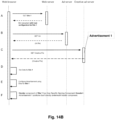
- Fig. 14B illustrates an alternative implementation in which the host site delivers the host configuration data to the web browser on the initial request.
- the creative content includes code to read the host configuration directly from the host page, rather than an external host configuration database providing the host configuration.
- Fig. 10 illustrates the distribution of a single advertisement to multiple destination host sites, as enabled by the method of the present disclosure, despite different host-specific naming conventions being present on each of the destination host sites.
- the above examples largely relate to scenarios in which ad content detects and reacts to changes in the representational state of a host page.
- the ad content is able to detect, react, modify, and interact with host pages in different ways, dependent on the representational state of the respective host page at a given time.
- an ad detects a header component of a host page across a set of representational states that are valid for that host page. In each representational state, the ad modifies the header component such that the header component has a predefined colour (e.g., red).
- a predefined colour e.g., red
- an ad detects all components of a host page in each representational state, with the exception of the header component, and pushes the detected components partially to one side of a display region while filling the remainder of the display region with ad content.
- an ad detects that the current representational state of the host page indicates the user is not logged in and applies a visual technique to blur the page article content.
- Fig. 11 is a schematic block diagram representation of a system 1100 on which an embodiment of the present disclosure may be practised.
- the system 1100 includes a communications network 1105 for enabling communication among different components of the system 1100.
- the communications network 1105 may be implemented using one or more wired or wireless transmission links and may include, for example, a dedicated communications link, a local area network (LAN), a wide area network (WAN), the Internet, a telecommunications network, or any combination thereof.
- a telecommunications network may include, but is not limited to, a telephony network, such as a Public Switch Telephony Network (PSTN), a mobile telephone cellular network, a short message service (SMS) network, or any combination thereof.
- PSTN Public Switch Telephony Network
- SMS short message service
- the system 1100 also includes a host configuration database 1150, which includes a database 1170 and a translator 1180.
- the database 1170 stores a table of independent component names and the translator 1180 stores mappings from those component names to corresponding host-specific naming conventions used by a set of host destinations, which may be web pages, applications, or the like.
- the database 1170 and translator 1180 are integrated as a single table, or the like.
- a user 1115 accesses a computing device 1110, such as a personal computer, laptop, smartphone, or the like, to browse information from a destination host web page hosted by a web server 1120.
- the web browser requests a page from the web server 1120 and the web server 1120 transmits the requested page as HTML content for display by the browser on a display device of the computing device 1110.
- the requested page includes embedded advertising content to be sourced from an ad server 1130.
- the web browser transmits a request to the ad server 1130 to deliver the relevant ad file.
- the ad server 1130 delivers the requested ad file to the web browser.
- the ad file includes a call for creative content, so the web browser transmits a further request, this time to a creative ad server 1140.
- the creative ad server 1140 receives the request and determines that translation of the creative content is required for the intended host web site.
- the creative ad server 1140 is configured to communicate with the host configuration database 1150 to provide mappings on request for a set of destination host sites.
- the creative file received by the web browser on the computing device 1110 includes an instruction to communicate with the host configuration database 1150 and request the required mapping for the relevant host site.
- the creative ad server 1140 sends a mapping request to the host configuration database 1150 to provide a mapping for the destination host web page.
- the translator 1180 receives the request and retrieves the relevant mapping from the database 1170.
- the host configuration database 1150 returns the mapping to the creative ad server 1140, which applies the mapping to translate one or more component names.
- the creative ad server 1140 then returns a creative file customised for the host web page to the web browser executing on the computing device 1110.
- the web browser executes the creative file to display the required advertising content and/or effect.
- the creative ad server 1140 responds to a request from the web browser by delivering a creative file to the web browser.
- the creative file When executed on the web browser, the creative file includes a call to the host configuration database 1150 to configure the creative content for the destination host web page being browsed by the user 1115.
- Fig. 12 is a schematic block diagram of a system 1200 that includes a general purpose computer 1210.
- the general purpose computer 1210 includes a plurality of components, including: a processor 1212, a memory 1214, a storage medium 1216, input/output (I/O) interfaces 1220, and input/output (I/O) ports 1222.
- Components of the general purpose computer 1210 generally communicate using one or more buses 1248.
- the memory 1214 may be implemented using Random Access Memory (RAM), Read Only Memory (ROM), or a combination thereof.
- the storage medium 1216 may be implemented as one or more of a hard disk drive, a solid state "flash" drive, an optical disk drive, or other storage means.
- the storage medium 1216 may be utilised to store one or more computer programs, including an operating system, software applications, and data. In one mode of operation, instructions from one or more computer programs stored in the storage medium 1216 are loaded into the memory 1214 via the bus 1248. Instructions loaded into the memory 1214 are then made available via the bus 1248 or other means for execution by the processor 1212 to implement a mode of operation in accordance with the executed instructions.
- One or more peripheral devices may be coupled to the general purpose computer 1210 via the I/O ports 1222.
- the general purpose computer 1210 is coupled to each of a speaker 1224, a camera 1226, a display device 1230, an input device 1232, a printer 1234, and an external storage medium 1236.
- the speaker 1224 may be implemented using one or more speakers, such as in a stereo or surround sound system.
- the camera 1226 may be a webcam, or other still or video digital camera, and may download and upload information to and from the general purpose computer 1210 via the I/O ports 1222, dependent upon the particular implementation. For example, images recorded by the camera 1226 may be uploaded to the storage medium 1216 of the general purpose computer 1210. Similarly, images stored on the storage medium 1216 may be downloaded to a memory or storage medium of the camera 1226.
- the camera 1226 may include a lens system, a sensor unit, and a recording medium.
- the display device 1230 may be a computer monitor, such as a cathode ray tube screen, plasma screen, or liquid crystal display (LCD) screen.
- the display 1230 may receive information from the computer 1210 in a conventional manner, wherein the information is presented on the display device 1230 for viewing by a user.
- the display device 1230 may optionally be implemented using a touch screen to enable a user to provide input to the general purpose computer 1210.
- the touch screen may be, for example, a capacitive touch screen, a resistive touchscreen, a surface acoustic wave touchscreen, or the like.
- the input device 1232 may be a keyboard, a mouse, a stylus, drawing tablet, or any combination thereof, for receiving input from a user.
- the external storage medium 1236 may include an external hard disk drive (HDD), an optical drive, a floppy disk drive, a flash drive, or any combination thereof and may be implemented as a single instance or multiple instances of any one or more of those devices.
- the external storage medium 1236 may be implemented as an array of hard disk drives.
- the I/O interfaces 1220 facilitate the exchange of information between the general purpose computing device 1210 and other computing devices.
- the I/O interfaces may be implemented using an internal or external modem, an Ethernet connection, or the like, to enable coupling to a transmission medium.
- the I/O interfaces 1222 are coupled to a communications network 1238 and directly to a computing device 1242.
- the computing device 1242 is shown as a personal computer, but may be equally be practised using a smartphone, laptop, or a tablet device. Direct communication between the general purpose computer 1210 and the computing device 1242 may be implemented using a wireless or wired transmission link.
- the communications network 1238 may be implemented using one or more wired or wireless transmission links and may include, for example, a dedicated communications link, a local area network (LAN), a wide area network (WAN), the Internet, a telecommunications network, or any combination thereof.
- a telecommunications network may include, but is not limited to, a telephony network, such as a Public Switch Telephony Network (PSTN), a mobile telephone cellular network, a short message service (SMS) network, or any combination thereof.
- PSTN Public Switch Telephony Network
- SMS short message service
- the general purpose computer 1210 is able to communicate via the communications network 1238 to other computing devices connected to the communications network 1238, such as the mobile telephone handset 1244, the touchscreen smartphone 1246, the personal computer 1240, and the computing device 1242.
- One or more instances of the general purpose computer 1210 may be utilised to implement a server acting as a host configuration database to implement a system for distributing customised advertising content in accordance with the present disclosure.
- the memory 1214 and storage 1216 are utilised to store data relating to a standardised, independent naming convention and mappings for a set of destination host web pages and applications.
- Software for implementing the advertising content distribution system is stored in one or both of the memory 1214 and storage 1216 for execution on the processor 1212.
- the software includes computer program code for implementing method steps in accordance with the method of distributing advertising content described herein.
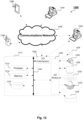
- Fig. 13 is a schematic block diagram of a system 1300 on which one or more aspects of an advertising distribution method and system of the present disclosure may be practised.
- the system 1300 includes a portable computing device in the form of a smartphone 1310, which may be used by a registered user 1115 of the advertising content distribution system in Fig. 11 .
- the smartphone 1310 includes a plurality of components, including: a processor 1312, a memory 1313, a storage medium 1316, a battery 1318, an antenna 1320, a radio frequency (RF) transmitter and receiver 1322, a subscriber identity module (SIM) card 1324, a speaker 1326, an input device 1328, a camera 1330, a display 1332, and a wireless transmitter and receiver 1334.
- RF radio frequency
- SIM subscriber identity module
- Components of the smartphone 1310 generally communicate using one or more bus connections 1348 or other connections therebetween.
- the smartphone 1310 also includes a wired connection 1345 for coupling to a power outlet to recharge the battery 1318 or for connection to a computing device, such as the general purpose computer 1210 of Fig. 12 .
- the wired connection 1345 may include one or more connectors and may be adapted to enable uploading and downloading of content from and to the memory 1313 and SIM card 1324.
- the smartphone 1310 may include many other functional components, such as an audio digital-to-analogue and analogue-to-digital converter and an amplifier, but those components are omitted for the purpose of clarity. However, such components would be readily known and understood by a person skilled in the relevant art.
- the memory 1313 may include Random Access Memory (RAM), Read Only Memory (ROM), or a combination thereof.
- the storage medium 1316 may be implemented as one or more of a solid state "flash” drive, a removable storage medium, such as a Secure Digital (SD) or microSD card, or other storage means.
- the storage medium 1316 may be utilised to store one or more computer programs, including an operating system, software applications, and data. In one mode of operation, instructions from one or more computer programs stored in the storage medium 1316 are loaded into the memory 1313 via the bus 1348. Instructions loaded into the memory 1313 are then made available via the bus 1348 or other means for execution by the processor 1312 to implement a mode of operation in accordance with the executed instructions.
- the smartphone 1310 also includes an application programming interface (API) module 1336, which enables programmers to write software applications to execute on the processor 1312.
- API application programming interface
- Such applications include a plurality of instructions that may be pre-installed in the memory 1313 or downloaded to the memory 1313 from an external source, via the RF transmitter and receiver 1322 operating in association with the antenna 1320 or via the wired connection 1345.
- the smartphone 1310 further includes a Global Positioning System (GPS) location module 1338.
- GPS Global Positioning System
- the GPS location module 1338 is used to determine a geographical position of the smartphone 1310, based on GPS satellites, cellular telephone tower triangulation, or a combination thereof. The determined geographical position may then be made available to one or more programs or applications running on the processor 1312.
- the wireless transmitter and receiver 1334 may be utilised to communicate wirelessly with external peripheral devices via Bluetooth, infrared, or other wireless protocol.
- the smartphone 1310 is coupled to each of a printer 1340, an external storage medium 1344, and a computing device 1342.
- the computing device 1342 may be implemented, for example, using the general purpose computer 1210 of Fig. 12 .
- the camera 1326 may include one or more still or video digital cameras adapted to capture and record to the memory 1313 or the SIM card 1324 still images or video images, or a combination thereof.
- the camera 1326 may include a lens system, a sensor unit, and a recording medium.
- a user of the smartphone 1310 may upload the recorded images to another computer device or peripheral device using the wireless transmitter and receiver 1334, the RF transmitter and receiver 1322, or the wired connection 1345.
- the display device 1332 is implemented using a liquid crystal display (LCD) screen.
- the display 1332 is used to display content to a user of the smartphone 1310.
- the display 1332 may optionally be implemented using a touch screen, such as a capacitive touch screen or resistive touchscreen, to enable a user to provide input to the smartphone 1310.
- the input device 1328 may be a keyboard, a stylus, or microphone, for example, for receiving input from a user.
- the keyboard may be implemented as an arrangement of physical keys located on the smartphone 610.
- the keyboard may be a virtual keyboard displayed on the display device 1332.
- the SIM card 1324 is utilised to store an International Mobile Subscriber Identity (IMSI) and a related key used to identify and authenticate the user on a cellular network to which the user has subscribed.
- IMSI International Mobile Subscriber Identity
- the SIM card 1324 is generally a removable card that can be used interchangeably on different smartphone or cellular telephone devices.
- the SIM card 1324 can be used to store contacts associated with the user, including names and telephone numbers.
- the SIM card 1324 can also provide storage for pictures and videos. Alternatively, contacts can be stored on the memory 1313.
- the RF transmitter and receiver 1322 in association with the antenna 1320, enable the exchange of information between the smartphone 1310 and other computing devices via a communications network 1390.
- RF transmitter and receiver 1322 enable the smartphone 1310 to communicate via the communications network 1390 with a cellular telephone handset 1350, a smartphone or tablet device 1352, a computing device 1354 and the computing device 1342.
- the computing devices 1354 and 1342 are shown as personal computers, but each may be equally be practised using a smartphone, laptop, or a tablet device.
- the communications network 1390 may be implemented using one or more wired or wireless transmission links and may include, for example, a cellular telephony network, a dedicated communications link, a local area network (LAN), a wide area network (WAN), the Internet, a telecommunications network, or any combination thereof.
- a telecommunications network may include, but is not limited to, a telephony network, such as a Public Switch Telephony Network (PSTN), a cellular (mobile) telephone cellular network, a short message service (SMS) network, or any combination thereof.
- PSTN Public Switch Telephony Network
- SMS short message service
- the method and system of the present disclosure enable creative code to interact with functional components from a requesting host web page in a predictable and reliable manner.
Landscapes
- Engineering & Computer Science (AREA)
- Business, Economics & Management (AREA)
- Theoretical Computer Science (AREA)
- Strategic Management (AREA)
- Finance (AREA)
- Accounting & Taxation (AREA)
- Development Economics (AREA)
- Physics & Mathematics (AREA)
- General Physics & Mathematics (AREA)
- Databases & Information Systems (AREA)
- Entrepreneurship & Innovation (AREA)
- Game Theory and Decision Science (AREA)
- Economics (AREA)
- Marketing (AREA)
- General Business, Economics & Management (AREA)
- General Engineering & Computer Science (AREA)
- Data Mining & Analysis (AREA)
- Information Transfer Between Computers (AREA)
- Information Retrieval, Db Structures And Fs Structures Therefor (AREA)
- Retry When Errors Occur (AREA)
Claims (12)
- Verfahren zum Verteilen von elektronischen Veröffentlichungsinhalten, umfassend die folgenden Schritte:Definieren einer unabhängigen Benennungskonvention für funktionelle Komponenten von Webseiten;Analysieren eines vordefinierten Satzes von Zielwebseiten, um einen Satz von repräsentativen Zuständen für jede Zielwebseite und einen Satz von Bedingungsaussagen zu bestimmen, die bestimmen, wann sich eine Seite während eines Besuchs der Zielwebseite in jedem repräsentativen Zustand befindet, wobei jeder repräsentative Zustand einem visuellen Layout der jeweiligen Zielwebseite zu einem Zeitpunkt entspricht und ferner wobei jede Bedingungsaussage unter Verwendung zumindest einer Prüfung oder einer Messung eines Satzes von Echtzeiteigenschaften erstellt wird;Analysieren der Zielwebseiten, um Ziel-Host-spezifische Benennungskonventionen, die jedem repräsentativen Zustand der Zielwebseiten zugeordnet sind, zu identifizieren;Speichern einer Zuordnungstabelle in einer Host-Konfigurationsdatenbank, wobei die Zuordnungstabelle eine Zuordnung zwischen den Ziel-Host-spezifischen Benennungskonventionen, die jedem repräsentativen Zustand der Zielwebseiten zugeordnet sind, dem Satz von Bedingungsaussagen, die jedem repräsentativen Zustand zugeordnet sind, und der unabhängigen Benennungskonvention erstellt;wobei ein Webbrowser eine Anfrage nach einer Zielhostseite an einen Webserver sendet und von dem Webserver die Zielhostseite empfängt, wobei die Zielhostseite eine aus dem Satz von Zielwebseiten ist und einen Verweis auf Werbungsinhalte enthält, die auf einem Werbungsserver gehostet werden;wobei der Webbrowser eine Anfrage nach den Werbungsinhalten an den Werbungsserver sendet und die Werbungsinhalte von dem Werbungsserver empfängt, wobei die Werbungsinhalte einen Verweis auf kreative Inhalte, die von einem kreativen Werbungsserver abzufragen sind, enthalten,wobei der kreative Werbungsserver eine Anfrage von dem Webbrowser für die Werbungsinhalte empfängt, die innerhalb der Zielhostseite auf einer Benutzercomputervorrichtung anzuzeigen sind;wobei der kreative Werbungsserver die kreativen Inhalte an den Webbrowser liefert, wobei die kreativen Inhalte einen Befehl zum Abfragen der Hostkonfigurationsdatenbank umfassen, um eine Zuordnung zwischen der unabhängigen Benennungskonvention, einer Zielbenennungskonvention, die jedem repräsentativen Zustand der Zielhostseite zugeordnet ist, zu erhalten;Senden einer Anfrage von einer Quelle an die Hostkonfigurationsdatenbank basierend auf dem Befehl, um eine Zuordnung zwischen der unabhängigen Benennungskonvention, der Ziel-Host-spezifischen Benennungskonvention, die jedem repräsentativen Zustand der Zielhostseite zugeordnet ist, zu erhalten;wobei die Hostkonfigurationsdatenbank die Zuordnung an die Quelle überträgt;wobei die Quelle die kreativen Inhalte für die Zielhostseite basierend auf dem aktuellen repräsentativen Zustand der Zielhostseite konfiguriert, wie basierend auf der übertragenen Zuordnung bestimmt;wobei die Quelle eine aus dem Webbrowser und dem kreativen Werbungsserver ist; undder gelieferte kreative Inhalt Änderungen an dem aktuellen repräsentativen Zustand der Zielhostseite während der gesamten Dauer eines Besuchs, wie durch die Bedingungsaussagen bestimmt, detektiert und auf die Änderungen in dem aktuellen repräsentativen Zustand der Zielhostseite durch dynamisches Selbstkonfigurieren mit der zugeordneten Zuordnung für den neuen repräsentativen Zustand reagiert.
- Verfahren nach Anspruch 1, wobei die Zielhostseite eine Webseite ist, die auf der Benutzercomputervorrichtung ausgeführt wird.
- Verfahren nach einem der Ansprüche 1 bis 2, wobei die funktionellen Komponenten der Webseiten HTML-Elemente sind.
- Verfahren nach einem der Ansprüche 1 bis 3, wobei jede Zielseite in dem Satz von Zielseiten einer Vorrichtung zugeordnet ist.
- Verfahren nach Anspruch 4, wobei die Vorrichtung aus der aus einem Desktopcomputer, einer Tablet-Computervorrichtung, einem Phablet und einem Smartphone bestehenden Gruppe ausgewählt ist.
- Verfahren nach einem der Ansprüche 1 bis 5, wobei die funktionellen Komponenten der Webseiten zumindest einen aus einem Header, einem Artikel, einem Inhalt, einem Logo und einer Navigation betreffen.
- Verfahren nach einem der Ansprüche 1 bis 6,wobei die Quelle der kreative Werbungsserver ist undder kreative Werbungsserver den kreativen Inhalt für die Zielhostseite konfiguriert, bevor er den kreativen Inhalt an den Webbrowser liefert.
- Hostkonfigurationsdatenbank, gekoppelt an ein Kommunikationsnetzwerk, das während eines Verfahrens zum Verteilen von elektronischen Veröffentlichungsinhalten nach einem der Ansprüche 1 bis 7 verwendet wird,
wobei die Hostkonfigurationsdatenbank Folgendes speichert:eine unabhängige Benennungskonvention für funktionelle Komponenten von Webseiten;einen Satz von repräsentativen Zuständen für jede Zielwebseite in einem vordefinierten Satz von Zielwebseiten und einen Satz von Bedingungsaussagen, die bestimmen, wann sich eine Seite während eines Besuchs der Zielwebseite in jedem repräsentativen Zustand befindet, wobei jeder repräsentative Zustand einem visuellen Layout der jeweiligen Zielwebseite zu einem Zeitpunkt entspricht und ferner wobei jede Bedingungsaussage unter Verwendung zumindest einer Prüfung oder einer Messung eines Satzes von Echtzeiteigenschaften erstellt wird; undeine Zuordnung zwischen der unabhängigen Benennungskonvention und einer Host-spezifischen Benennungskonventionen, die jedem repräsentativen Zustand einer Zielwebseite zugeordnet sind, basierend auf dem Satz von Bedingungsaussagen, wobei die Zielhostseite eine aus dem Satz von Zielwebseiten ist;wobei nach Empfang einer Anfrage zum Zuordnen in Relation zu der Zielhostseite von einer Quelle die Hostkonfigurationsdatenbank:unter Verwendung eines Übersetzers eine relevante Zuordnung abfragt; unddie abgefragte Zuordnung an die Quelle übermittelt. - Hostkonfigurationsdatenbank nach Anspruch 8, wobei die Quelle eines aus einem Webbrowser und einem kreativen Werbungsserver ist.
- Hostkonfigurationsdatenbank nach Anspruch 8, wobei die Host-spezifische Benennungskonvention, die einer Zielhostseite zugeordnet ist, von einer Vorrichtung abhängt, auf der die Zielhostseite angezeigt werden wird.
- Hostkonfigurationsdatenbank nach Anspruch 8, wobei die Vorrichtung aus der aus Folgenden bestehenden Gruppe ausgewählt ist: einem Desktopcomputer, einer Tablet-Computervorrichtung, einem Phablet und einem Smartphone.
- Hostkonfigurationsdatenbank nach einem der Ansprüche 8 bis 11, wobei die Hostkonfigurationsdatenbank in einem kreativen Werbungsserver integriert ist.
Applications Claiming Priority (2)
| Application Number | Priority Date | Filing Date | Title |
|---|---|---|---|
| AU2015904696A AU2015904696A0 (en) | 2015-11-13 | A method and system for distributing electronic publishing content | |
| PCT/AU2016/051091 WO2017079809A1 (en) | 2015-11-13 | 2016-11-11 | A method and system for distributing electronic publishing content |
Publications (4)
| Publication Number | Publication Date |
|---|---|
| EP3374957A1 EP3374957A1 (de) | 2018-09-19 |
| EP3374957A4 EP3374957A4 (de) | 2019-07-17 |
| EP3374957B1 true EP3374957B1 (de) | 2024-12-25 |
| EP3374957C0 EP3374957C0 (de) | 2024-12-25 |
Family
ID=58694464
Family Applications (1)
| Application Number | Title | Priority Date | Filing Date |
|---|---|---|---|
| EP16863243.8A Active EP3374957B1 (de) | 2015-11-13 | 2016-11-11 | Verfahren und system zur verteilung von elektronischem veröffentlichungsinhalt |
Country Status (6)
| Country | Link |
|---|---|
| US (1) | US11645680B2 (de) |
| EP (1) | EP3374957B1 (de) |
| CN (1) | CN108475385B (de) |
| AU (1) | AU2016354677B2 (de) |
| SG (1) | SG11201803927SA (de) |
| WO (1) | WO2017079809A1 (de) |
Family Cites Families (18)
| Publication number | Priority date | Publication date | Assignee | Title |
|---|---|---|---|---|
| US5933811A (en) * | 1996-08-20 | 1999-08-03 | Paul D. Angles | System and method for delivering customized advertisements within interactive communication systems |
| US5905862A (en) * | 1996-09-04 | 1999-05-18 | Intel Corporation | Automatic web site registration with multiple search engines |
| US6804659B1 (en) * | 2000-01-14 | 2004-10-12 | Ricoh Company Ltd. | Content based web advertising |
| US6605120B1 (en) * | 1998-12-10 | 2003-08-12 | International Business Machines Corporation | Filter definition for distribution mechanism for filtering, formatting and reuse of web based content |
| US7996259B1 (en) | 2000-06-07 | 2011-08-09 | Perfect Web Technologies, Inc. | Method for developing electronic documents providing e-commerce tools |
| WO2002037220A2 (en) * | 2000-10-31 | 2002-05-10 | Contextweb | Internet contextual communication system |
| KR100810010B1 (ko) * | 2003-06-30 | 2008-03-07 | 인터내셔널 비지네스 머신즈 코포레이션 | 웹 장치에서의 html 페이지의 프리젠테이션을 개선하는방법 및 시스템 |
| US20080033967A1 (en) | 2006-07-18 | 2008-02-07 | Ravi Murthy | Semantic aware processing of XML documents |
| US8086957B2 (en) * | 2008-05-21 | 2011-12-27 | International Business Machines Corporation | Method and system to selectively secure the display of advertisements on web browsers |
| US9224151B2 (en) * | 2008-06-18 | 2015-12-29 | Microsoft Technology Licensing, L.L.C. | Presenting advertisements based on web-page interaction |
| US20100131373A1 (en) * | 2008-11-25 | 2010-05-27 | Yahoo! Inc. | Dynamic advertisement tags |
| US20110106615A1 (en) * | 2009-11-03 | 2011-05-05 | Yahoo! Inc. | Multimode online advertisements and online advertisement exchanges |
| US9135345B1 (en) * | 2012-12-14 | 2015-09-15 | Google Inc. | Generating and updating online content using standardized tagged data |
| US10075554B2 (en) * | 2012-12-20 | 2018-09-11 | Facebook, Inc. | Detecting mobile device attributes |
| US10354294B2 (en) | 2013-08-28 | 2019-07-16 | Google Llc | Methods and systems for providing third-party content on a web page |
| CN105745644A (zh) | 2013-11-01 | 2016-07-06 | 柯宝科技公司 | 表示在网页浏览器中的网页的状态表示的建立 |
| US8893294B1 (en) * | 2014-01-21 | 2014-11-18 | Shape Security, Inc. | Flexible caching |
| US9361635B2 (en) | 2014-04-14 | 2016-06-07 | Yahoo! Inc. | Frequent markup techniques for use in native advertisement placement |
-
2016
- 2016-11-11 EP EP16863243.8A patent/EP3374957B1/de active Active
- 2016-11-11 SG SG11201803927SA patent/SG11201803927SA/en unknown
- 2016-11-11 WO PCT/AU2016/051091 patent/WO2017079809A1/en not_active Ceased
- 2016-11-11 US US15/775,722 patent/US11645680B2/en active Active
- 2016-11-11 AU AU2016354677A patent/AU2016354677B2/en active Active
- 2016-11-11 CN CN201680078986.1A patent/CN108475385B/zh active Active
Also Published As
| Publication number | Publication date |
|---|---|
| AU2016354677A1 (en) | 2018-06-28 |
| EP3374957A4 (de) | 2019-07-17 |
| AU2016354677B2 (en) | 2022-08-04 |
| WO2017079809A1 (en) | 2017-05-18 |
| SG11201803927SA (en) | 2018-06-28 |
| CN108475385B (zh) | 2023-10-03 |
| US20180349966A1 (en) | 2018-12-06 |
| EP3374957C0 (de) | 2024-12-25 |
| US11645680B2 (en) | 2023-05-09 |
| EP3374957A1 (de) | 2018-09-19 |
| CN108475385A (zh) | 2018-08-31 |
Similar Documents
| Publication | Publication Date | Title |
|---|---|---|
| US9360988B2 (en) | Browsing and quality of service features | |
| US20110153426A1 (en) | Mobile device advertising | |
| US20100099441A1 (en) | Mobile Device Advertising | |
| US20110082724A1 (en) | System and method for advertisement placement in an electronic reader device | |
| US20170192941A1 (en) | Computer-Automated Generation of Application Deep Links | |
| CA2764819A1 (en) | System and method for providing sub-publication content in an electronic device | |
| JP2014085544A (ja) | 広告配信装置及び広告配信方法 | |
| US20170316455A1 (en) | System and Method for Counting Advertisement Impressions | |
| US20110225028A1 (en) | System and method for providing communication with an advertiser from an electronic device | |
| US20170316465A1 (en) | Ad Context Visualization and Mock-Up Tool | |
| JP7044674B2 (ja) | 情報表示プログラム、情報表示装置、情報表示方法および配信装置 | |
| AU2016354677B2 (en) | A method and system for distributing electronic publishing content | |
| US20150006288A1 (en) | Online advertising integration management and responsive presentation | |
| JP7003017B2 (ja) | 情報表示プログラム、情報表示装置、情報表示方法および配信装置 | |
| JP6866242B2 (ja) | 表示制御プログラム、表示制御装置、表示制御方法及び配信装置 | |
| US20140101530A1 (en) | Web browsing system for content browsing | |
| CN114445103B (zh) | 网页广告过滤方法、电子设备及存储介质 | |
| KR20120079774A (ko) | 간단한 절차를 통한 온라인 광고 제공 방법 및 시스템 | |
| US20100313134A1 (en) | System and method for providing spatial and temporal content in an electronic device | |
| JP2020043553A (ja) | 情報表示プログラム、情報表示装置、情報表示方法および配信装置 | |
| JP5871352B1 (ja) | 情報処理装置、情報処理方法、プログラム、記憶媒体 | |
| WO2007086723A1 (en) | Information distribution and interactive e-commerce system and method | |
| JP2019144664A (ja) | 情報表示プログラム、情報表示方法、情報表示装置、及び配信装置 | |
| TW201037540A (en) | Method of displaying shopping information on web pages of a plurality of places and server thereof | |
| AU2013257491A1 (en) | Web application-based interface |
Legal Events
| Date | Code | Title | Description |
|---|---|---|---|
| STAA | Information on the status of an ep patent application or granted ep patent |
Free format text: STATUS: THE INTERNATIONAL PUBLICATION HAS BEEN MADE |
|
| PUAI | Public reference made under article 153(3) epc to a published international application that has entered the european phase |
Free format text: ORIGINAL CODE: 0009012 |
|
| STAA | Information on the status of an ep patent application or granted ep patent |
Free format text: STATUS: REQUEST FOR EXAMINATION WAS MADE |
|
| 17P | Request for examination filed |
Effective date: 20180611 |
|
| AK | Designated contracting states |
Kind code of ref document: A1 Designated state(s): AL AT BE BG CH CY CZ DE DK EE ES FI FR GB GR HR HU IE IS IT LI LT LU LV MC MK MT NL NO PL PT RO RS SE SI SK SM TR |
|
| AX | Request for extension of the european patent |
Extension state: BA ME |
|
| DAV | Request for validation of the european patent (deleted) | ||
| DAX | Request for extension of the european patent (deleted) | ||
| A4 | Supplementary search report drawn up and despatched |
Effective date: 20190614 |
|
| RIC1 | Information provided on ipc code assigned before grant |
Ipc: G06Q 30/02 20120101AFI20190607BHEP |
|
| STAA | Information on the status of an ep patent application or granted ep patent |
Free format text: STATUS: EXAMINATION IS IN PROGRESS |
|
| 17Q | First examination report despatched |
Effective date: 20210217 |
|
| RIC1 | Information provided on ipc code assigned before grant |
Ipc: G06F 16/958 20190101ALI20240605BHEP Ipc: G06Q 30/0241 20230101ALI20240605BHEP Ipc: G06Q 30/02 20120101AFI20240605BHEP |
|
| GRAP | Despatch of communication of intention to grant a patent |
Free format text: ORIGINAL CODE: EPIDOSNIGR1 |
|
| STAA | Information on the status of an ep patent application or granted ep patent |
Free format text: STATUS: GRANT OF PATENT IS INTENDED |
|
| INTG | Intention to grant announced |
Effective date: 20240712 |
|
| GRAS | Grant fee paid |
Free format text: ORIGINAL CODE: EPIDOSNIGR3 |
|
| GRAA | (expected) grant |
Free format text: ORIGINAL CODE: 0009210 |
|
| STAA | Information on the status of an ep patent application or granted ep patent |
Free format text: STATUS: THE PATENT HAS BEEN GRANTED |
|
| AK | Designated contracting states |
Kind code of ref document: B1 Designated state(s): AL AT BE BG CH CY CZ DE DK EE ES FI FR GB GR HR HU IE IS IT LI LT LU LV MC MK MT NL NO PL PT RO RS SE SI SK SM TR |
|
| REG | Reference to a national code |
Ref country code: GB Ref legal event code: FG4D |
|
| REG | Reference to a national code |
Ref country code: CH Ref legal event code: EP |
|
| REG | Reference to a national code |
Ref country code: DE Ref legal event code: R096 Ref document number: 602016090757 Country of ref document: DE |
|
| REG | Reference to a national code |
Ref country code: IE Ref legal event code: FG4D |
|
| U01 | Request for unitary effect filed |
Effective date: 20250124 |
|
| U07 | Unitary effect registered |
Designated state(s): AT BE BG DE DK EE FI FR IT LT LU LV MT NL PT RO SE SI Effective date: 20250130 |
|
| PG25 | Lapsed in a contracting state [announced via postgrant information from national office to epo] |
Ref country code: HR Free format text: LAPSE BECAUSE OF FAILURE TO SUBMIT A TRANSLATION OF THE DESCRIPTION OR TO PAY THE FEE WITHIN THE PRESCRIBED TIME-LIMIT Effective date: 20241225 |
|
| PG25 | Lapsed in a contracting state [announced via postgrant information from national office to epo] |
Ref country code: NO Free format text: LAPSE BECAUSE OF FAILURE TO SUBMIT A TRANSLATION OF THE DESCRIPTION OR TO PAY THE FEE WITHIN THE PRESCRIBED TIME-LIMIT Effective date: 20250325 |
|
| PG25 | Lapsed in a contracting state [announced via postgrant information from national office to epo] |
Ref country code: GR Free format text: LAPSE BECAUSE OF FAILURE TO SUBMIT A TRANSLATION OF THE DESCRIPTION OR TO PAY THE FEE WITHIN THE PRESCRIBED TIME-LIMIT Effective date: 20250326 |
|
| PG25 | Lapsed in a contracting state [announced via postgrant information from national office to epo] |
Ref country code: RS Free format text: LAPSE BECAUSE OF FAILURE TO SUBMIT A TRANSLATION OF THE DESCRIPTION OR TO PAY THE FEE WITHIN THE PRESCRIBED TIME-LIMIT Effective date: 20250325 |
|
| PG25 | Lapsed in a contracting state [announced via postgrant information from national office to epo] |
Ref country code: SM Free format text: LAPSE BECAUSE OF FAILURE TO SUBMIT A TRANSLATION OF THE DESCRIPTION OR TO PAY THE FEE WITHIN THE PRESCRIBED TIME-LIMIT Effective date: 20241225 |
|
| PG25 | Lapsed in a contracting state [announced via postgrant information from national office to epo] |
Ref country code: PL Free format text: LAPSE BECAUSE OF FAILURE TO SUBMIT A TRANSLATION OF THE DESCRIPTION OR TO PAY THE FEE WITHIN THE PRESCRIBED TIME-LIMIT Effective date: 20241225 |
|
| PG25 | Lapsed in a contracting state [announced via postgrant information from national office to epo] |
Ref country code: ES Free format text: LAPSE BECAUSE OF FAILURE TO SUBMIT A TRANSLATION OF THE DESCRIPTION OR TO PAY THE FEE WITHIN THE PRESCRIBED TIME-LIMIT Effective date: 20241225 |
|
| PG25 | Lapsed in a contracting state [announced via postgrant information from national office to epo] |
Ref country code: IS Free format text: LAPSE BECAUSE OF FAILURE TO SUBMIT A TRANSLATION OF THE DESCRIPTION OR TO PAY THE FEE WITHIN THE PRESCRIBED TIME-LIMIT Effective date: 20250425 |
|
| PG25 | Lapsed in a contracting state [announced via postgrant information from national office to epo] |
Ref country code: SK Free format text: LAPSE BECAUSE OF FAILURE TO SUBMIT A TRANSLATION OF THE DESCRIPTION OR TO PAY THE FEE WITHIN THE PRESCRIBED TIME-LIMIT Effective date: 20241225 |
|
| PG25 | Lapsed in a contracting state [announced via postgrant information from national office to epo] |
Ref country code: CZ Free format text: LAPSE BECAUSE OF FAILURE TO SUBMIT A TRANSLATION OF THE DESCRIPTION OR TO PAY THE FEE WITHIN THE PRESCRIBED TIME-LIMIT Effective date: 20241225 |
|
| PLBE | No opposition filed within time limit |
Free format text: ORIGINAL CODE: 0009261 |
|
| STAA | Information on the status of an ep patent application or granted ep patent |
Free format text: STATUS: NO OPPOSITION FILED WITHIN TIME LIMIT |
|
| 26N | No opposition filed |
Effective date: 20250926 |
|
| U20 | Renewal fee for the european patent with unitary effect paid |
Year of fee payment: 10 Effective date: 20251117 |
|
| PGFP | Annual fee paid to national office [announced via postgrant information from national office to epo] |
Ref country code: GB Payment date: 20251020 Year of fee payment: 10 |