EP3373670A1 - Resource scheduling method and device of vehicle-road cooperative communication system, and nodes - Google Patents
Resource scheduling method and device of vehicle-road cooperative communication system, and nodes Download PDFInfo
- Publication number
- EP3373670A1 EP3373670A1 EP16861616.7A EP16861616A EP3373670A1 EP 3373670 A1 EP3373670 A1 EP 3373670A1 EP 16861616 A EP16861616 A EP 16861616A EP 3373670 A1 EP3373670 A1 EP 3373670A1
- Authority
- EP
- European Patent Office
- Prior art keywords
- node
- nodes
- distance
- accordance
- time
- Prior art date
- Legal status (The legal status is an assumption and is not a legal conclusion. Google has not performed a legal analysis and makes no representation as to the accuracy of the status listed.)
- Granted
Links
Images



Classifications
-
- H—ELECTRICITY
- H04—ELECTRIC COMMUNICATION TECHNIQUE
- H04W—WIRELESS COMMUNICATION NETWORKS
- H04W72/00—Local resource management
- H04W72/50—Allocation or scheduling criteria for wireless resources
- H04W72/51—Allocation or scheduling criteria for wireless resources based on terminal or device properties
-
- H—ELECTRICITY
- H04—ELECTRIC COMMUNICATION TECHNIQUE
- H04L—TRANSMISSION OF DIGITAL INFORMATION, e.g. TELEGRAPHIC COMMUNICATION
- H04L5/00—Arrangements affording multiple use of the transmission path
- H04L5/0001—Arrangements for dividing the transmission path
- H04L5/0014—Three-dimensional division
- H04L5/0023—Time-frequency-space
-
- H—ELECTRICITY
- H04—ELECTRIC COMMUNICATION TECHNIQUE
- H04L—TRANSMISSION OF DIGITAL INFORMATION, e.g. TELEGRAPHIC COMMUNICATION
- H04L5/00—Arrangements affording multiple use of the transmission path
- H04L5/003—Arrangements for allocating sub-channels of the transmission path
- H04L5/0032—Distributed allocation, i.e. involving a plurality of allocating devices, each making partial allocation
- H04L5/0035—Resource allocation in a cooperative multipoint environment
-
- H—ELECTRICITY
- H04—ELECTRIC COMMUNICATION TECHNIQUE
- H04L—TRANSMISSION OF DIGITAL INFORMATION, e.g. TELEGRAPHIC COMMUNICATION
- H04L5/00—Arrangements affording multiple use of the transmission path
- H04L5/003—Arrangements for allocating sub-channels of the transmission path
- H04L5/0058—Allocation criteria
- H04L5/0069—Allocation based on distance or geographical location
-
- H—ELECTRICITY
- H04—ELECTRIC COMMUNICATION TECHNIQUE
- H04W—WIRELESS COMMUNICATION NETWORKS
- H04W4/00—Services specially adapted for wireless communication networks; Facilities therefor
- H04W4/02—Services making use of location information
- H04W4/025—Services making use of location information using location based information parameters
- H04W4/027—Services making use of location information using location based information parameters using movement velocity, acceleration information
-
- H—ELECTRICITY
- H04—ELECTRIC COMMUNICATION TECHNIQUE
- H04W—WIRELESS COMMUNICATION NETWORKS
- H04W4/00—Services specially adapted for wireless communication networks; Facilities therefor
- H04W4/30—Services specially adapted for particular environments, situations or purposes
- H04W4/40—Services specially adapted for particular environments, situations or purposes for vehicles, e.g. vehicle-to-pedestrians [V2P]
-
- H—ELECTRICITY
- H04—ELECTRIC COMMUNICATION TECHNIQUE
- H04W—WIRELESS COMMUNICATION NETWORKS
- H04W72/00—Local resource management
-
- H—ELECTRICITY
- H04—ELECTRIC COMMUNICATION TECHNIQUE
- H04W—WIRELESS COMMUNICATION NETWORKS
- H04W72/00—Local resource management
- H04W72/12—Wireless traffic scheduling
- H04W72/1215—Wireless traffic scheduling for collaboration of different radio technologies
-
- H—ELECTRICITY
- H04—ELECTRIC COMMUNICATION TECHNIQUE
- H04W—WIRELESS COMMUNICATION NETWORKS
- H04W72/00—Local resource management
- H04W72/12—Wireless traffic scheduling
- H04W72/1263—Mapping of traffic onto schedule, e.g. scheduled allocation or multiplexing of flows
-
- H—ELECTRICITY
- H04—ELECTRIC COMMUNICATION TECHNIQUE
- H04W—WIRELESS COMMUNICATION NETWORKS
- H04W72/00—Local resource management
- H04W72/20—Control channels or signalling for resource management
- H04W72/21—Control channels or signalling for resource management in the uplink direction of a wireless link, i.e. towards the network
-
- H—ELECTRICITY
- H04—ELECTRIC COMMUNICATION TECHNIQUE
- H04W—WIRELESS COMMUNICATION NETWORKS
- H04W72/00—Local resource management
- H04W72/04—Wireless resource allocation
- H04W72/044—Wireless resource allocation based on the type of the allocated resource
- H04W72/0446—Resources in time domain, e.g. slots or frames
-
- H—ELECTRICITY
- H04—ELECTRIC COMMUNICATION TECHNIQUE
- H04W—WIRELESS COMMUNICATION NETWORKS
- H04W72/00—Local resource management
- H04W72/04—Wireless resource allocation
- H04W72/044—Wireless resource allocation based on the type of the allocated resource
- H04W72/0453—Resources in frequency domain, e.g. a carrier in FDMA
Definitions
- the present disclosure relates to a vehicle infrastructure cooperative communication system, in particular to a resource scheduling method and a resource scheduling device for the vehicle infrastructure cooperative communication system, and a node of the vehicle infrastructure cooperative communication system.
- Vehicle infrastructure cooperative technique is used to perform dynamic, real-time information interaction between vehicles and between a vehicle and an infrastructure using such technologies as radio communication technology and a new-generation Internet technology, and perform active security control over the vehicles and cooperative management over the infrastructures on the basis of collecting and integrating dynamic traffic information in a full-time-space manner, so as to achieve effective cooperation among persons, vehicles and the infrastructures, ensure the traffic safety and improve the traffic efficiency, thereby to provide a safe, efficient and environmentally friendly traffic system.
- a vehicle infrastructure cooperative communication system For a vehicle infrastructure cooperative communication system, it is necessary to provide low time delay and high reliability for a road safety application.
- it is able to provide an appropriate spatial multiplexing distance, so as to enable a plurality of nodes to transmit information simultaneously using an identical time-frequency resource (i.e., achieve spatial multiplexing of the time-frequency resource in the vehicle infrastructure cooperative communication system), thereby to improve the utilization of the system resource.
- An object of the present disclosure is to provide a resource scheduling method and a resource scheduling device for a vehicle infrastructure cooperative communication system, and a node of the vehicle infrastructure cooperative communication system, so as to prevent the frequent adjustment of the time-frequency resource, and improve the utilization of the time-frequency resource.
- the present disclosure provides in some embodiments a resource scheduling method for a vehicle infrastructure cooperative communication system, including steps of: receiving node position information from nodes of the vehicle infrastructure cooperative communication system; calculating a distance between the nodes in accordance with the node position information, and determining a movement trend between the nodes, the movement trend indicating that the distance decreases, remains unchanged or increases; in the case that the movement trend indicates that the distance decreases or increases, determining whether or not spatial-multiplexed time-frequency resources are capable of being used for the nodes in accordance with the distance between the nodes and the movement trend, so as to acquire a determination result; and allocating available time-frequency resources for the nodes in accordance with the determination result.
- the resource scheduling method subsequent to the step of determining the movement trend between the nodes, the resource scheduling method further includes, in the case that the movement trend indicates that the distance remains unchanged, maintaining the time-frequency resources currently allocated for a first node and a second node.
- the step of determining whether or not the spatial-multiplexed time-frequency resources are capable of being used for the nodes in accordance with the distance between the nodes and the movement trend includes: in the case that the movement trend indicates that the distance increases and a current distance between the first node and the second node is greater than a predetermined spatial multiplexing distance threshold, determining that the spatial-multiplexed time-frequency resources are capable of being used for the first node and the second node, otherwise determining that the spatial-multiplexed time-frequency resources are incapable of being used for the first node and the second node; and in the case that the movement trend indicates that the distance decreases and the current distance between the first node and the second node is greater than a first sum, determining that the spatial-multiplexed time-frequency resources are capable of being used for the first node and the second node, otherwise determining that the spatial-multiplexed time-frequency resources are incapable
- the step of allocating the available time-frequency resources for the nodes in accordance with the determination result includes: in the case that the spatial-multiplexed time-frequency resources are capable of being used for the first node and the second node, allocating an identical time-frequency resource for the first node and the second node; and in the case that the spatial-multiplexed time-frequency resources are incapable of being used for the first node and the second node, allocating different time-frequency resources for the first node and the second node.
- the step of calculating the distance between the nodes in accordance with the node position information and determining the movement trend between the nodes includes: calculating a distance between the first node and the second node in accordance with node position information about the first node and the second node; and determining a variation trend of the distance in accordance with the distances acquired after two calculation operations, so as to acquire the movement trend between the first node and the second node.
- the resource scheduling method further includes receiving node running information from the nodes of the vehicle infrastructure cooperative communication system, the node running information at least including a movement speed of each node.
- the step of calculating the distance between the nodes in accordance with the node position information and determining the movement trend between the nodes includes: calculating a distance between the first node and the second node in accordance with node position information about the first node and the second node; and determining the movement trend between the first node and the second node in accordance with the node position information about the first node and the second node and the node running information.
- the step of determining the movement trend between the first node and the second node in accordance with the node position information about the first node and the second node and the node running information includes: determining a relative speed of the first node relative to the second node in accordance with a speed of the first node and a speed of the second node; and determining the movement trend between the first node and the second node in accordance with the relative speed of the first node relative to the second node.
- the present disclosure provides in some embodiments a resource scheduling method for a vehicle infrastructure cooperative communication system, including steps of: reporting, by each node of the vehicle infrastructure cooperative communication system, node position information about the node to a scheduling platform; receiving, by each node, a time-frequency resource allocated by the scheduling platform for the node, the time-frequency resource being allocated by the scheduling platform for the node in accordance with a distance between the nodes calculated in accordance with the node position information from the nodes and a movement trend between the nodes; and transmitting, by each node, information through the time-frequency resource allocated by the scheduling platform.
- the resource scheduling method further includes reporting, by each node, node running information to the scheduling platform so that the scheduling platform determines the movement trend between the nodes in accordance with the node running information, the node running information at least including a movement speed of each node.
- the present disclosure provides in some embodiments a resource scheduling device for a vehicle infrastructure cooperative communication system, including: a reception module configured to receive node position information from nodes of the vehicle infrastructure cooperative communication system; a first determination module configured to calculate a distance between the nodes in accordance with the node position information, and determine a movement trend between the nodes, the movement trend indicating that the distance decreases, remains unchanged or increases; a second determination module configured to, in the case that the movement trend indicates that the distance decreases or increases, determine whether or not spatial-multiplexed time-frequency resources are capable of being used for the nodes in accordance with the distance between the nodes and the movement trend, so as to acquire a determination result; and an allocation module configured to allocate available time-frequency resources for the nodes in accordance with the determination result.
- the allocation module is further configured to, in the case that the movement trend indicates that the distance remains unchanged, maintain the time-frequency resources currently allocated for a first node and a second node.
- the second determination module includes: a first output module configured to, in the case that the movement trend indicates that the distance increases and a current distance between the first node and the second node is greater than a predetermined spatial multiplexing distance threshold, determine that the spatial-multiplexed time-frequency resources are capable of being used for the first node and the second node, otherwise determine that the spatial-multiplexed time-frequency resources are incapable of being used for the first node and the second node; and a second output module configured to, in the case that the movement trend indicates that the distance decreases and the current distance between the first node and the second node is greater than a first sum, determine that the spatial-multiplexed time-frequency resources are capable of being used for the first node and the second node, otherwise determine that the spatial-multiplexed time-frequency resources are incapable of being used for the first node and the second node, the first sum being a sum of the spatial multiplexing distance threshold and a predetermined buffer distance.
- the allocation module includes: a first allocation sub-module configured to, in the case that the spatial-multiplexed time-frequency resources are capable of being used for the first node and the second node, allocate an identical time-frequency resource for the first node and the second node; and a second allocation sub-module configured to, in the case that the spatial-multiplexed time-frequency resources are incapable of being used for the first node and the second node, allocate different time-frequency resources for the first node and the second node.
- the first determination module includes: a first calculation module configured to calculate a distance between the first node and the second node in accordance with node position information about the first node and the second node; and a first acquisition module configured to determine a variation trend of the distance in accordance with the distances acquired after two calculation operations, so as to acquire the movement trend between the first node and the second node.
- the reception module is further configured to, in the case of receiving the node position information from the nodes of the vehicle infrastructure cooperative communication system, receive node running information from the nodes of the vehicle infrastructure cooperative communication system, the node running information at least including a movement speed of each node.
- the step first determination module includes: a second calculation module configured to determine a relative speed of the first node relative to the second node in accordance with a speed of the first node and a speed of the second node; and a second acquisition module configured to determine the movement trend between the first node and the second node in accordance with the relative speed of the first node relative to the second node.
- a resource scheduling device for a vehicle infrastructure cooperative communication system, including a receiver, a processor and a memory.
- the receiver is configured to receive node position information from nodes of the vehicle infrastructure cooperative communication system.
- the processor is configured to read programs stored in the memory, so as to: calculate a distance between the nodes in accordance with the node position information, and determine a movement trend between the nodes, the movement trend indicating that the distance decreases, remains unchanged or increases; in the case that the movement trend indicates that the distance decreases or increases, determine whether or not spatial-multiplexed time-frequency resources are capable of being used for the nodes in accordance with the distance between the nodes and the movement trend, so as to acquire a determination result; and allocate available time-frequency resources for the nodes in accordance with the determination result.
- the memory is configured to store therein data for the operation of the processor.
- the present disclosure provides in some embodiments a node of a vehicle infrastructure cooperative communication system, including: a first transmission module configured to report node position information about the node to a scheduling platform; a reception module configured to receive a time-frequency resource allocated by the scheduling platform for the node, the time-frequency resource being allocated by the scheduling platform for the node in accordance with a distance between the node and another node calculated in accordance with the node position information from the nodes and a movement trend between the nodes; and a second transmission module configured to transmit information through the time-frequency resource allocated by the scheduling platform.
- the first transmission module is further configured to, in the case of reporting the node position information about the node to the scheduling platform, report node running information to the scheduling platform so that the scheduling platform determines the movement trend between the nodes in accordance with the node running information, the node running information at least including a movement speed of each node.
- the present disclosure provides in some embodiments a node of a vehicle infrastructure cooperative communication system, including a processor and a memory.
- the processor is configured to read programs stored in the memory, so as to: report node position information about the node to a scheduling platform; receive a time-frequency resource allocated by the scheduling platform for the node, the time-frequency resource being allocated by the scheduling platform for the node in accordance with a distance between the node and another node calculated in accordance with the node position information from the nodes and a movement trend between the nodes; and transmit information through the time-frequency resource allocated by the scheduling platform.
- the memory is configured to store therein data for the operation of the processor.
- the movement trend between the nodes is determined in accordance with the node position information, and then the spatial multiplexing operation is performed in accordance with the movement trend.
- the spatial multiplexing operation is performed in accordance with the movement trend.
- resources may be spatially multiplexed between the nodes in accordance with static position information about the nodes and the predetermined spatially multiplexing distance.
- whether or not to perform a spatial multiplexing operation is determined in accordance with a static positions reported by each node.
- a spatial multiplexing condition may not be met any longer due to a topological change. At this time, it is necessary to re-adjust the resource allocation, resulting in an increase in the signaling overhead for allocating resources.
- An object of the present disclosure is to provide a resource scheduling method for a vehicle infrastructure cooperative communication system, so as to spatially multiplex time-frequency resources between the nodes through taking a possible movement trend between the nodes into consideration, thereby to prevent the frequent adjustment of the time-frequency resources, reduce the possibility of resource allocation collision, and improve the utilization of the system resources.
- a vehicle infrastructure cooperative communication system in the embodiments of the present disclosure includes a scheduling platform and a plurality of nodes.
- the scheduling platform may be deployed within an evolved NodeB (eNB).
- eNB evolved NodeB
- the scheduling platform may be deployed within one eNB having a certain coverage range, and it is capable of scheduling resources for the nodes within the coverage range of the eNB.
- the scheduling platform may also be deployed within more than one eNBs, and it is capable of scheduling the resources for the nodes within the coverage ranges of the eNBs.
- the present disclosure provides in some embodiments a resource scheduling method for a vehicle infrastructure cooperative communication system.
- the resource scheduling method is applied to a scheduling platform, and as shown in FIG. 1 , it includes: Step 11 of receiving node position information from nodes of the vehicle infrastructure cooperative communication system; Step 12 of calculating a distance between the nodes in accordance with the node position information, and determining a movement trend between the nodes, the movement trend indicating that the distance decreases, remains unchanged or increases; Step 13 of, in the case that the movement trend indicates that the distance decreases or increases, determining whether or not spatial-multiplexed time-frequency resources are capable of being used for the nodes in accordance with the distance between the nodes and the movement trend, so as to acquire a determination result; and Step 14 of allocating available time-frequency resources for the nodes in accordance with the determination result.
- each node may report the node position information to the scheduling platform via a signaling message.
- the scheduling platform may calculate the distance between the nodes in accordance with the node position information, determine the movement trend between the nodes, and determine whether or not an identical time-frequency resource is capable of being allocated for the nodes. Through taking the movement trend between the nodes into consideration while allocating the time-frequency resource, it is able to prevent the frequent adjustment of the time-frequency resources for the nodes, reduce the possibility of the resource allocation collision, and improve the utilization of the system resources.
- Step 13 of determining whether or not the spatial-multiplexed time-frequency resources are capable of being used for the nodes includes: in the case that the movement trend indicates that the distance increases and a current distance between the first node and the second node is greater than a predetermined spatial multiplexing distance threshold, determining that the spatial-multiplexed time-frequency resources are capable of being used for the first node and the second node, otherwise determining that the spatial-multiplexed time-frequency resources are incapable of being used for the first node and the second node; and in the case that the movement trend indicates that the distance decreases and the current distance between the first node and the second node is greater than a first sum, determining that the spatial-multiplexed time-frequency resources are capable of being used for the first node and the second node, otherwise determining that the spatial-multiplexed time-frequency resources are incapable of being used for the first node and the second node, the first sum being a sum of the spatial multiplexing distance threshold and
- the spatial multiplexing distance threshold is an empirical value preset in accordance with an interference distance of the time-frequency resource.
- interference caused by the multiplexing of the time-frequency resources between the nodes may be within an acceptable range.
- the interference caused by the multiplexing of the time-frequency resources may go beyond the acceptable range.
- An actual value of the spatial multiplexing distance threshold may be acquired through simulation in a corresponding multiplexing scenario.
- the predetermined buffer distance is set with respect to a situation where the movement trend between the nodes indicates that the distance decreases. For example, in the case that the distance between the nodes is far larger than the spatial multiplexing distance threshold and the current movement trend between the nodes indicates that the distance decreases, it may take a certain time period for the distance between the nodes to reach the spatial multiplexing distance threshold. At this time, in order to improve the utilization of the time-frequency resources, the buffer distance may be provided, so that the time-frequency resources may be spatially multiplexed continuously between the nodes. In the case that the distance between the nodes is smaller than a sum of the buffer distance and the spatial multiplexing distance threshold, it is not advisable to spatially multiplex the time-frequency resources.
- a value of the buffer distance may be set in accordance with a scheduling frequency of the scheduling platform. For example, in the case of a larger scheduling frequency, a smaller buffer distance may be set, otherwise a larger buffer distance may be set.
- a relative speed between the nodes may be further taken into consideration. The larger the relative speed, the larger the buffer distance, and vice versa.
- the time-frequency resources currently allocated for a first node and a second node may be maintained continuously, until the movement trend between the nodes changes.
- each node may transmit its node position information, or both the node position information and node running information, to the scheduling platform (eNB) via signaling in accordance with a predetermined period.
- each node may immediately report the node position information and/or the node running information.
- the scheduling platform may perform the above Steps 11 to 14 in accordance with the information reported by each node.
- Table 1 Content Content Reporting mode node position information longitude, latitude, lane, and etc.
- the node position information is reported by each node periodically, or immediately reported by each node upon the receipt of a request from the scheduling platform node running information speed, accelerated speed, direction, curvature, and etc.
- the node running information is reported by each node periodically, or immediately reported by each node upon the receipt of a request from the scheduling platform
- the movement trend between the nodes may be determined in various modes, some of which will be described illustratively hereinafter.
- the following modes are for illustrative purposes only, but shall not be construed as limiting the present disclosure, i.e., the movement trend between the nodes may also be determined in any other modes.
- a distance between the first node and the second node may be calculated in accordance with the node position information about the first node and the second node (i.e., information about the longitude, latitude and lane of each node). Then, a variation trend of the distance may be determined in accordance with the distances acquired after two calculation operations, so as to determine the movement trend between the first node and the second node. The movement trend indicates that the distance decreases, increases or remains unchanged.
- the distance between the nodes i.e., a first distance
- the distance between the nodes i.e., a second distance
- the distance between the nodes may be calculated in accordance with the node position information from the first node and the second node at a second time point.
- whether or not the distance between the first node and the second increases, decreases or remains unchanged may be determined in accordance with the first distance and the second distance, so as to acquire the movement trend between the nodes.
- the movement trend between the nodes may be further determined in accordance with the node running information reported by the nodes.
- the node running information may be further received from each node of the vehicle infrastructure cooperative communication system.
- the node running information at least includes such information as a movement speed of each node, an accelerated speed of each node, and a curvature, as shown in Table 1.
- the speed and the accelerated speed are both vectors.
- Step 12 includes: Step 121 of calculating the distance between the first node and the second node in accordance with the node position information about the first node and the second node; and Step 122 of determining the movement trend between the first node and the second node in accordance with the node position information about the first node and the second node and the node running information, the movement trend indicating that the distance decreases, increases or remained unchanged.
- Step 122 of determining the movement trend between the first node and the second node includes: Step 31 of determining a relative speed of the first node relative to the second node in accordance with a speed of the first node and a speed of the second node; and Step 32 of determining the movement trend between the first node and the second node in accordance with the relative speed of the first node relative to the second node.
- one of the nodes (e.g., the second node) is presumed to be in a stationary state, so a speed of the other node (e.g., the first node) relative to the second node is just the speed of the first node.
- a variation trend of the distance between the nodes may be determined in accordance with the speed of the first node.
- Step 13 whether or not the time-frequency resources are capable of being spatially multiplexed between the nodes may be determined in accordance with the distance between the nodes and the movement trend.
- the time-frequency resources may be capable of being spatially multiplexed between the first node and the second node, and otherwise the time-frequency resources may be incapable of being spatially multiplexed between the first node and the second node.
- the time-frequency resources may be incapable of being spatially multiplexed between the first node and the second node.
- time-frequency resources are capable of being spatially multiplexed between the first node and the second node
- an identical time-frequency resource may be allocated for the first node and the second node for transmitting the information, so as to improve the utilization of the resources.
- different time-frequency resources may be allocated for the first node and the second node, so as to reduce the possibility of resource allocation collision.
- the present disclosure further provides in some embodiments a scheme at a node side.
- the present disclosure further provides in some embodiments a resource scheduling method for a vehicle infrastructure cooperative communication system for use in a node. As shown in FIG.
- the resource scheduling method includes: Step 51 of reporting, by each node of the vehicle infrastructure cooperative communication system, node position information about the node to a scheduling platform; Step 52 of receiving, by each node, a time-frequency resource allocated by the scheduling platform for the node, the time-frequency resource being allocated by the scheduling platform for the node in accordance with a distance between the nodes calculated in accordance with the node position information from the nodes and a movement trend between the nodes; and Step 53 of transmitting, by each node, information through the time-frequency resource allocated by the scheduling platform.
- the information such as the node position information, the node running information and any other predefined information may be transmitted to the other node(s), so as to achieve the information interaction and sharing between vehicles.
- node running information may be further reported by each node to the scheduling platform so that the scheduling platform determines the movement trend between the nodes in accordance with the node running information.
- the node running information at least includes a movement speed of each node.
- the movement trend between the nodes may be determined in accordance with the node position information and the node running information, and whether or not the time-frequency resources are capable of being spatially multiplexed between the nodes may be determined in accordance with the movement trend, so as to reduce the signaling overhead due to the frequency adjustment of the resources.
- it is able to spatially multiple the time-frequency resources in accordance with the node position information and the node running information, thereby to improve the utilization of the time-frequency resources.
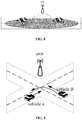
- Each scenario includes one eNB and two nodes (vehicle A and vehicle B), and the eNB is provided with a scheduling platform of the vehicle infrastructure cooperative communication system.
- the movement trend between the nodes is determined in accordance with the node position information about the nodes.
- the vehicles A and B are running in an identical direction on an identical lane of a road within a coverage range of the eNB, and the vehicle A is followed by the vehicle B.
- the vehicles A and B may report the node position information for the first time.
- the eNB may store therein the node position information about the vehicles A and B, and calculate a distance between the vehicle A and the vehicle B, i.e., 1500m, in accordance with the node position information.
- the vehicles A and B may report the node position information for the second time, and the distance between the vehicle A and the vehicle B calculated by the eNB is 1100m (namely, the distance decreases). For example, within an time interval between the two reporting operations, the vehicle A runs forward for 100m while the vehicle B runs forward for 500m.
- the predetermined spatial multiplexing distance threshold is 900m, so the current distance between the vehicles A and B meets the requirement on the spatial multiplexing distance. However, based on a variation trend of the distance, the movement trend between the vehicles A and B indicates that the distance decreases, so the eNB may determine that the time-frequency resources are incapable of being spatially multiplexed between the vehicles A and B.
- the vehicles A and B may report the node position information for the second time, and the distance between the vehicle A and the vehicle B calculated by the eNB is 1900m (namely, the distance increases). For example, within the time interval between the two reporting operations, the vehicle A runs forward for 500m while the vehicle B runs forward for 100m.
- the predetermined spatial multiplexing distance threshold is 900m, so the current distance between the vehicles A and B meets the requirement on the spatial multiplexing distance.
- the eNB may determine that the time-frequency resources are capable of being spatially multiplexed between the vehicles A and B.
- the movement trend between the nodes may be determined in accordance with the node position information and the node running information about the nodes, and the vehicles A and B are running away from each other in opposite directions.
- the vehicles A and B are running in opposite directions on two lanes of the road within the coverage arrange of the eNB respectively.
- the vehicles A and B may report the position information and the running information for the first time.
- the eNB may store therein the information, calculate the distance between the vehicles A and B, e.g., 1500m, in accordance with the information, and acquire the running information about the vehicles A and B at the first time point (including a speed, an acceleration speed and a direction of each of the vehicles A and B).
- the vehicles A and B may report the position information and the running information for the second time.
- the eNB may calculate the distance between the vehicles A and B in accordance with the updated positon information, e.g., 2100m (within the time interval, the vehicle A runs forward for 100m while the vehicle B runs forward for 500m).
- the eNB may acquire a running state of each vehicle in accordance with the position information and the running information. For example, the eNB may determine that the vehicles A and B are running in opposite directions, the vehicle A has a speed of 20km/h and an accelerated speed of 2m/s 2 , and the vehicle B has a speed of 100km/h and an accelerated speed of 2m/s 2 .
- the vehicles A and B are both running in an accelerated manner, and the movement trend between the vehicles A and B indicates that the distance increases.
- the predetermined spatial multiplexing distance is 900m, so the distance between the vehicles A and B meets the requirement on the spatial multiplexing distance.
- the eNB may determine that the time-frequency resources are capable of being spatially multiplexed between the vehicles A and B.
- the movement trend between the nodes may be determined in accordance with the node position information and the node running information about the nodes.
- the vehicles A and B are running close to each other in opposite directions.
- the vehicles A and B are running close to each other in opposite directions on two lanes of the road within the coverage arrange of the eNB respectively.
- the vehicles A and B may report the position information and the running information for the first time.
- the eNB may calculate the distance between the vehicles A and B, e.g., 1500m, and acquire the running information about the vehicles A and B (including the speed, the accelerated speed and the direction).
- the vehicles A and B may report the position information for the second time.
- the eNB may calculate the distance between the vehicles A and B in accordance with the updated positon information, e.g., 1300m (within the time interval, the vehicle A runs forward for 100m while the vehicle B runs forward for 100m).
- the eNB may acquire a running state of each vehicle in accordance with the running information. For example, the eNB may determine that the vehicles A and B are running in opposite directions, the vehicle A has a speed of 20km/h and an accelerated speed of 2m/s 2 , and the vehicle B has a speed of 20km/h and an accelerated speed of 2m/s 2 .
- the vehicles A and B are running in an accelerated manner, and the movement trend between the vehicles A and B indicates that the distance decreases.
- the predetermined spatial multiplexing distance is 900m, so the distance between the vehicles A and B meets the requirement on the spatial multiplexing distance.
- the eNB may determine that the time-frequency resources are incapable of being spatially multiplexed between the vehicles A and B.
- the movement trend between the nodes may be determined in accordance with the node position information and the node running information about the nodes.
- the vehicles A and B are running in an identical direction.
- the vehicles A and B are running in an identical direction on an identical lane of the road within the coverage range of the eNB.
- the vehicles A and B may report the position information and the running information for the first time.
- the eNB may calculate the distance between the vehicles A and B, e.g., 1500m, and acquire the running information about the vehicles A and B (including the speed, the accelerated speed and the direction).
- the vehicles A and B may report the position information for the second time.
- the eNB may calculate the distance between the vehicles A and B in accordance with the updated positon information, e.g., 1100m (within the time interval, the vehicle A runs forward for 100m while the vehicle B runs forward for 500m).
- the predetermined spatial multiplexing distance is 900m, so the distance between the vehicles A and B meets the requirement on the spatial multiplexing distance.
- the eNB may acquire a running state of each vehicle in accordance with the running information.
- the eNB may determine that the vehicles A and B are running in an identical direction, the vehicle A has a speed of 20km/h and an accelerated speed of -2m/s 2 , and the vehicle B has a speed of 100km/h and an accelerated speed of 2m/s 2 .
- the vehicle A is running in a deaccelerated manner while the vehicle B is running an accelerated manner, so the movement trend between the vehicles A and B indicates that the distance decreases.
- the eNB may determine that the time-frequency resources are incapable of being spatially multiplexed between the vehicles A and B.
- the movement trend between the nodes may be determined in accordance with the node position information and the node running information about the nodes.
- the vehicles A and B are running on two lanes of different sections of crossroads within the coverage range of the eNB.
- each of the vehicles runs forward directly without turning left or right.
- the vehicles A and B may report the position information and the running information for the first time.
- the eNB may calculate the distance between the vehicles A and B, e.g., 1500m, and acquire the running information about the vehicles A and B (including the speed, the accelerated speed and the direction).
- the vehicles A and B may report the position information for the second time.
- the eNB may calculate the distance between the vehicles A and B in accordance with the updated positon information, e.g., 1250m (within the time interval, the vehicle A runs forward for 100m while the vehicle B runs forward for 100m).
- the eNB may acquire a running state of each vehicle in accordance with the running information. For example, the eNB may determine that a running direction of the vehicle A is about to intersect a running direction of the vehicle B, the vehicle A has a speed of 20km/h and an accelerated speed of 2m/s 2 , and the vehicle B has a speed of 20km/h and an accelerated speed of 2m/s 2 .
- each of the vehicles A and B is running in an accelerated manner, so the movement trend between the vehicles A and B indicates that the distance decreases.
- the predetermined spatial multiplexing distance is 900m, so the distance between the vehicles A and B meets the requirement on the spatial multiplexing distance.
- the movement trend between the vehicles A and B indicates that the distance decreases, so the eNB may determine that the time-frequency resources are incapable of being spatially multiplexed between the vehicles A and B.
- the vehicle B is about to turn left.
- the vehicles A and B are running on two lanes of different sections of the crossroads within the coverage range of the eNB, and the vehicle B is about to turn left.
- the vehicles A and B may report the position information for the second time.
- the eNB may calculate the distance between the vehicles A and B in accordance with the updated position information, e.g., 1250m (within the time interval, the vehicle A runs forward for 100m while the vehicle B runs forward for 100m).
- the eNB may acquire a running state of each vehicle in accordance with the running information. For example, the eNB may determine that the running direction of the vehicle A is about to intersect the running direction of the vehicle B, the vehicle A has a speed of 20km/h, and the vehicle B has a speed of 20km/h, a turning radius of 1000m and an angular variation of 5°/s.
- each of the vehicles A and B is running at a constant speed, so the movement trend between the vehicles A and B indicates that the distance decreases.
- the predetermined spatial multiplexing distance is 900m, so the distance between the vehicles A and B meets the requirement on the spatial multiplexing distance.
- the eNB may determine that the time-frequency resources are incapable of being spatially multiplexed between the vehicles A and B.
- the present disclosure further provides in some embodiments a scheduling platform and a node for implementing the above-mentioned methods.
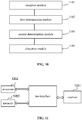
- the present disclosure provides in some embodiments a resource scheduling device for a vehicle infrastructure cooperative communication system, and it may be provided in one or more base stations. As shown in FIG.
- the resource scheduling device includes: a reception module 1101 configured to receive node position information from nodes of the vehicle infrastructure cooperative communication system; a first determination module 1102 configured to calculate a distance between the nodes in accordance with the node position information, and determine a movement trend between the nodes, the movement trend indicating that the distance decreases, remains unchanged or increases; a second determination module 1103 configured to, in the case that the movement trend indicates that the distance decreases or increases, determine whether or not spatial-multiplexed time-frequency resources are capable of being used for the nodes in accordance with the distance between the nodes and the movement trend, so as to acquire a determination result; and an allocation module 1104 configured to allocate available time-frequency resources for the nodes in accordance with the determination result.
- the allocation module 1104 is further configured to, in the case that the movement trend indicates that the distance remains unchanged, maintain the time-frequency resources currently allocated for a first node and a second node.
- the second determination module 1103 includes: a first output module configured to, in the case that the movement trend indicates that the distance increases and a current distance between the first node and the second node is greater than a predetermined spatial multiplexing distance threshold, determine that the spatial-multiplexed time-frequency resources are capable of being used for the first node and the second node, otherwise determine that the spatial-multiplexed time-frequency resources are incapable of being used for the first node and the second node; and a second output module configured to, in the case that the movement trend indicates that the distance decreases and the current distance between the first node and the second node is greater than a first sum, determine that the spatial-multiplexed time-frequency resources are capable of being used for the first node and the second node, otherwise determine that the spatial-multiplexed time-frequency resources are incapable of being used for the first node and the second node, the first sum being a sum of the spatial multiplexing distance threshold and a predetermined buffer distance.
- the allocation module 1104 includes: a first allocation sub-module configured to, in the case that the spatial-multiplexed time-frequency resources are capable of being used for the first node and the second node, allocate an identical time-frequency resource for the first node and the second node; and a second allocation sub-module configured to, in the case that the spatial-multiplexed time-frequency resources are incapable of being used for the first node and the second node, allocate different time-frequency resources for the first node and the second node.
- the movement trend between the nodes may be determined in accordance with the node position information.
- the first determination module 1102 includes: a first calculation module configured to calculate a distance between the first node and the second node in accordance with node position information about the first node and the second node; and a first acquisition module configured to determine a variation trend of the distance in accordance with the distances acquired after two calculation operations, so as to acquire the movement trend between the first node and the second node.
- the movement trend between the nodes may be determined in accordance with the node position information and the node running information.
- the reception module 1101 is further configured to, in the case of receiving the node position information from the nodes of the vehicle infrastructure cooperative communication system, receive node running information from the nodes of the vehicle infrastructure cooperative communication system, the node running information at least including a movement speed of each node.
- the first determination module 1102 includes: a second calculation module configured to determine a relative speed of the first node relative to the second node in accordance with a speed of the first node and a speed of the second node; and a second acquisition module configured to determine the movement trend between the first node and the second node in accordance with the relative speed of the first node relative to the second node.
- the present disclosure further provides in some embodiments a resource scheduling device for a vehicle infrastructure cooperative communication system which, as shown in FIG. 11 , includes a receiver 1201, a processor 1202 and a memory 1203.
- the receiver 1201 is configured to receive node position information from nodes of the vehicle infrastructure cooperative communication system.
- the processor 1202 is configured to read programs stored in the memory 1203, so as to: calculate a distance between the nodes in accordance with the node position information, and determine a movement trend between the nodes, the movement trend indicating that the distance decreases, remains unchanged or increases; in the case that the movement trend indicates that the distance decreases or increases, determine whether or not spatial-multiplexed time-frequency resources are capable of being used for the nodes in accordance with the distance between the nodes and the movement trend, so as to acquire a determination result; and allocate available time-frequency resources for the nodes in accordance with the determination result.
- the memory 1203 is configured to store therein the node position information from the nodes, the node running information, and data acquired by the processor 1202 during the calculation (e.g., the distance between the nodes, a speed of each node and an accelerated speed of each node).
- Bus architecture may include a number of buses and bridges connected to each other, so as to connect various circuits for one or more processors 1202 and one or more memories 1203.
- the bus architecture 1000 may be used to connect any other circuits, such as a circuit for a peripheral device, a circuit for a voltage stabilizer and a power management circuit, which are not particularly defined herein.
- Bus interfaces are provided, and the receiver 1201 may consist of a plurality of elements for communication with any other devices over a transmission medium.
- the processor 1202 may take charge of managing the bus architecture as well general processings, e.g., running a general-purpose operating system.
- the memory 1203 may store data therein for the operation of the processor.
- the present disclosure further provides in some embodiments a node of a vehicle infrastructure cooperative communication system, and the node may be a vehicle or a device within the vehicle.
- the node includes: a first transmission module 1301 configured to report node position information about the node to a scheduling platform; a reception module 1302 configured to receive a time-frequency resource allocated by the scheduling platform for the node, the time-frequency resource being allocated by the scheduling platform for the node in accordance with a distance between the node and another node calculated in accordance with the node position information from the nodes and a movement trend between the nodes; and a second transmission module 1303 configured to transmit information through the time-frequency resource allocated by the scheduling platform.
- the first transmission module 1301 is further configured to, in the case of reporting the node position information about the node to the scheduling platform, report node running information to the scheduling platform so that the scheduling platform determines the movement trend between the nodes in accordance with the node running information, the node running information at least including a movement speed of each node.
- the present disclosure further provides in some embodiments a node of a vehicle infrastructure cooperative communication system which, as shown in FIG. 13 , includes a processor 1401 and a memory 1402.
- the processor 1401 is configured to read programs stored in the memory 1402, so as to: report node position information about the node to a scheduling platform; receive a time-frequency resource allocated by the scheduling platform for the node, the time-frequency resource being allocated by the scheduling platform for the node in accordance with a distance between the node and another node calculated in accordance with the node position information from the nodes and a movement trend between the nodes; and transmit information through the time-frequency resource allocated by the scheduling platform.
- the memory 1402 is configured to store therein data for the operation of the processor 1401.
- bus architecture may include a number of buses and bridges connected to each other.
- the steps may be implemented through hardware, or through hardware in conjunction with computer programs.
- the computer programs may include instructions so as to execute all or parts of the steps.
- the computer programs may be stored in a computer-readable storage medium, and the computer-readable storage medium may be a nontransient storage medium in any form.
Landscapes
- Engineering & Computer Science (AREA)
- Signal Processing (AREA)
- Computer Networks & Wireless Communication (AREA)
- Mobile Radio Communication Systems (AREA)
- Traffic Control Systems (AREA)
Abstract
Description
- The present application claims a priority of the Chinese patent application No.
201510746136.1 filed on November 5, 2015 - The present disclosure relates to a vehicle infrastructure cooperative communication system, in particular to a resource scheduling method and a resource scheduling device for the vehicle infrastructure cooperative communication system, and a node of the vehicle infrastructure cooperative communication system.
- Vehicle infrastructure cooperative technique is used to perform dynamic, real-time information interaction between vehicles and between a vehicle and an infrastructure using such technologies as radio communication technology and a new-generation Internet technology, and perform active security control over the vehicles and cooperative management over the infrastructures on the basis of collecting and integrating dynamic traffic information in a full-time-space manner, so as to achieve effective cooperation among persons, vehicles and the infrastructures, ensure the traffic safety and improve the traffic efficiency, thereby to provide a safe, efficient and environmentally friendly traffic system.
- For a vehicle infrastructure cooperative communication system, it is necessary to provide low time delay and high reliability for a road safety application. In addition, on the premise of controlling interference and ensuring reception reliability, it is able to provide an appropriate spatial multiplexing distance, so as to enable a plurality of nodes to transmit information simultaneously using an identical time-frequency resource (i.e., achieve spatial multiplexing of the time-frequency resource in the vehicle infrastructure cooperative communication system), thereby to improve the utilization of the system resource.
- An object of the present disclosure is to provide a resource scheduling method and a resource scheduling device for a vehicle infrastructure cooperative communication system, and a node of the vehicle infrastructure cooperative communication system, so as to prevent the frequent adjustment of the time-frequency resource, and improve the utilization of the time-frequency resource.
- In one aspect, the present disclosure provides in some embodiments a resource scheduling method for a vehicle infrastructure cooperative communication system, including steps of: receiving node position information from nodes of the vehicle infrastructure cooperative communication system; calculating a distance between the nodes in accordance with the node position information, and determining a movement trend between the nodes, the movement trend indicating that the distance decreases, remains unchanged or increases; in the case that the movement trend indicates that the distance decreases or increases, determining whether or not spatial-multiplexed time-frequency resources are capable of being used for the nodes in accordance with the distance between the nodes and the movement trend, so as to acquire a determination result; and allocating available time-frequency resources for the nodes in accordance with the determination result.
- In a possible embodiment of the present disclosure, subsequent to the step of determining the movement trend between the nodes, the resource scheduling method further includes, in the case that the movement trend indicates that the distance remains unchanged, maintaining the time-frequency resources currently allocated for a first node and a second node.
- In a possible embodiment of the present disclosure, in the case that the movement trend indicates that the distance decreases or increases, the step of determining whether or not the spatial-multiplexed time-frequency resources are capable of being used for the nodes in accordance with the distance between the nodes and the movement trend includes: in the case that the movement trend indicates that the distance increases and a current distance between the first node and the second node is greater than a predetermined spatial multiplexing distance threshold, determining that the spatial-multiplexed time-frequency resources are capable of being used for the first node and the second node, otherwise determining that the spatial-multiplexed time-frequency resources are incapable of being used for the first node and the second node; and in the case that the movement trend indicates that the distance decreases and the current distance between the first node and the second node is greater than a first sum, determining that the spatial-multiplexed time-frequency resources are capable of being used for the first node and the second node, otherwise determining that the spatial-multiplexed time-frequency resources are incapable of being used for the first node and the second node, the first sum being a sum of the spatial multiplexing distance threshold and a predetermined buffer distance.
- In a possible embodiment of the present disclosure, the step of allocating the available time-frequency resources for the nodes in accordance with the determination result includes: in the case that the spatial-multiplexed time-frequency resources are capable of being used for the first node and the second node, allocating an identical time-frequency resource for the first node and the second node; and in the case that the spatial-multiplexed time-frequency resources are incapable of being used for the first node and the second node, allocating different time-frequency resources for the first node and the second node.
- In a possible embodiment of the present disclosure, the step of calculating the distance between the nodes in accordance with the node position information and determining the movement trend between the nodes includes: calculating a distance between the first node and the second node in accordance with node position information about the first node and the second node; and determining a variation trend of the distance in accordance with the distances acquired after two calculation operations, so as to acquire the movement trend between the first node and the second node.
- In a possible embodiment of the present disclosure, in the case of receiving the node position information from the nodes of the vehicle infrastructure cooperative communication system, the resource scheduling method further includes receiving node running information from the nodes of the vehicle infrastructure cooperative communication system, the node running information at least including a movement speed of each node. The step of calculating the distance between the nodes in accordance with the node position information and determining the movement trend between the nodes includes: calculating a distance between the first node and the second node in accordance with node position information about the first node and the second node; and determining the movement trend between the first node and the second node in accordance with the node position information about the first node and the second node and the node running information.
- In a possible embodiment of the present disclosure, the step of determining the movement trend between the first node and the second node in accordance with the node position information about the first node and the second node and the node running information includes: determining a relative speed of the first node relative to the second node in accordance with a speed of the first node and a speed of the second node; and determining the movement trend between the first node and the second node in accordance with the relative speed of the first node relative to the second node.
- In another aspect, the present disclosure provides in some embodiments a resource scheduling method for a vehicle infrastructure cooperative communication system, including steps of: reporting, by each node of the vehicle infrastructure cooperative communication system, node position information about the node to a scheduling platform; receiving, by each node, a time-frequency resource allocated by the scheduling platform for the node, the time-frequency resource being allocated by the scheduling platform for the node in accordance with a distance between the nodes calculated in accordance with the node position information from the nodes and a movement trend between the nodes; and transmitting, by each node, information through the time-frequency resource allocated by the scheduling platform.
- In a possible embodiment of the present disclosure, in the case of reporting, by each node, the node position information about the node to the scheduling platform, the resource scheduling method further includes reporting, by each node, node running information to the scheduling platform so that the scheduling platform determines the movement trend between the nodes in accordance with the node running information, the node running information at least including a movement speed of each node.
- In another aspect, the present disclosure provides in some embodiments a resource scheduling device for a vehicle infrastructure cooperative communication system, including: a reception module configured to receive node position information from nodes of the vehicle infrastructure cooperative communication system; a first determination module configured to calculate a distance between the nodes in accordance with the node position information, and determine a movement trend between the nodes, the movement trend indicating that the distance decreases, remains unchanged or increases; a second determination module configured to, in the case that the movement trend indicates that the distance decreases or increases, determine whether or not spatial-multiplexed time-frequency resources are capable of being used for the nodes in accordance with the distance between the nodes and the movement trend, so as to acquire a determination result; and an allocation module configured to allocate available time-frequency resources for the nodes in accordance with the determination result.
- In a possible embodiment of the present disclosure, the allocation module is further configured to, in the case that the movement trend indicates that the distance remains unchanged, maintain the time-frequency resources currently allocated for a first node and a second node.
- In a possible embodiment of the present disclosure, the second determination module includes: a first output module configured to, in the case that the movement trend indicates that the distance increases and a current distance between the first node and the second node is greater than a predetermined spatial multiplexing distance threshold, determine that the spatial-multiplexed time-frequency resources are capable of being used for the first node and the second node, otherwise determine that the spatial-multiplexed time-frequency resources are incapable of being used for the first node and the second node; and a second output module configured to, in the case that the movement trend indicates that the distance decreases and the current distance between the first node and the second node is greater than a first sum, determine that the spatial-multiplexed time-frequency resources are capable of being used for the first node and the second node, otherwise determine that the spatial-multiplexed time-frequency resources are incapable of being used for the first node and the second node, the first sum being a sum of the spatial multiplexing distance threshold and a predetermined buffer distance.
- In a possible embodiment of the present disclosure, the allocation module includes: a first allocation sub-module configured to, in the case that the spatial-multiplexed time-frequency resources are capable of being used for the first node and the second node, allocate an identical time-frequency resource for the first node and the second node; and a second allocation sub-module configured to, in the case that the spatial-multiplexed time-frequency resources are incapable of being used for the first node and the second node, allocate different time-frequency resources for the first node and the second node.
- In a possible embodiment of the present disclosure, the first determination module includes: a first calculation module configured to calculate a distance between the first node and the second node in accordance with node position information about the first node and the second node; and a first acquisition module configured to determine a variation trend of the distance in accordance with the distances acquired after two calculation operations, so as to acquire the movement trend between the first node and the second node.
- In a possible embodiment of the present disclosure, the reception module is further configured to, in the case of receiving the node position information from the nodes of the vehicle infrastructure cooperative communication system, receive node running information from the nodes of the vehicle infrastructure cooperative communication system, the node running information at least including a movement speed of each node. The step first determination module includes: a second calculation module configured to determine a relative speed of the first node relative to the second node in accordance with a speed of the first node and a speed of the second node; and a second acquisition module configured to determine the movement trend between the first node and the second node in accordance with the relative speed of the first node relative to the second node.
- In still yet another aspect, the present disclosure provides in some embodiments a resource scheduling device for a vehicle infrastructure cooperative communication system, including a receiver, a processor and a memory. The receiver is configured to receive node position information from nodes of the vehicle infrastructure cooperative communication system. The processor is configured to read programs stored in the memory, so as to: calculate a distance between the nodes in accordance with the node position information, and determine a movement trend between the nodes, the movement trend indicating that the distance decreases, remains unchanged or increases; in the case that the movement trend indicates that the distance decreases or increases, determine whether or not spatial-multiplexed time-frequency resources are capable of being used for the nodes in accordance with the distance between the nodes and the movement trend, so as to acquire a determination result; and allocate available time-frequency resources for the nodes in accordance with the determination result. The memory is configured to store therein data for the operation of the processor.
- In still yet another aspect, the present disclosure provides in some embodiments a node of a vehicle infrastructure cooperative communication system, including: a first transmission module configured to report node position information about the node to a scheduling platform; a reception module configured to receive a time-frequency resource allocated by the scheduling platform for the node, the time-frequency resource being allocated by the scheduling platform for the node in accordance with a distance between the node and another node calculated in accordance with the node position information from the nodes and a movement trend between the nodes; and a second transmission module configured to transmit information through the time-frequency resource allocated by the scheduling platform.
- In a possible embodiment of the present disclosure, the first transmission module is further configured to, in the case of reporting the node position information about the node to the scheduling platform, report node running information to the scheduling platform so that the scheduling platform determines the movement trend between the nodes in accordance with the node running information, the node running information at least including a movement speed of each node.
- In still yet another aspect, the present disclosure provides in some embodiments a node of a vehicle infrastructure cooperative communication system, including a processor and a memory. The processor is configured to read programs stored in the memory, so as to: report node position information about the node to a scheduling platform; receive a time-frequency resource allocated by the scheduling platform for the node, the time-frequency resource being allocated by the scheduling platform for the node in accordance with a distance between the node and another node calculated in accordance with the node position information from the nodes and a movement trend between the nodes; and transmit information through the time-frequency resource allocated by the scheduling platform. The memory is configured to store therein data for the operation of the processor.
- According to the embodiments of the present disclosure, the movement trend between the nodes is determined in accordance with the node position information, and then the spatial multiplexing operation is performed in accordance with the movement trend. As a result, it is able to optimize a spatial multiplexing policy of the time-frequency resources, reduce the possibility of resource allocation collision, and reduce the signaling overhead due to the frequent adjustment of the resources. In addition, it is able to effectively perform the spatial multiplexing operation on the time-frequency resources, and improve the utilization of the time-frequency resources.
-
-
FIG. 1 is a flow chart of a resource scheduling method for a vehicle infrastructure cooperative communication system according to one embodiment of the present disclosure; -
FIG. 2 is a flow chart of a step of calculating a distance between nodes and determining a movement trend between the nodes according to one embodiment of the present disclosure; -
FIG. 3 is a flow chart of a step of determining the movement trend between the nodes according to one embodiment of the present disclosure; -
FIG. 4 is a flow chart of another resource scheduling method for a vehicle infrastructure cooperative communication system according to one embodiment of the present disclosure; -
FIG. 5 through FIG. 9 are schematic views respectively showing illustrative application scenarios according to some embodiments of the present disclosure; -
FIG. 10 is a schematic view showing a resource scheduling device according to one embodiment of the present disclosure; -
FIG. 11 is another schematic view showing the resource scheduling device according to one embodiment of the present disclosure; -
FIG. 12 is a schematic view showing a node according to one embodiment of the present disclosure; and -
FIG. 13 is another schematic view showing the node according to one embodiment of the present disclosure. - Usually, for a vehicle infrastructure cooperative communication system, in the case that a distance between nodes is greater than a predetermined spatial multiplexing distance, resources may be spatially multiplexed between the nodes in accordance with static position information about the nodes and the predetermined spatially multiplexing distance. In other words, whether or not to perform a spatial multiplexing operation is determined in accordance with a static positions reported by each node. In an actual scenario, usually each node is in motion, and a spatial multiplexing condition may not be met any longer due to a topological change. At this time, it is necessary to re-adjust the resource allocation, resulting in an increase in the signaling overhead for allocating resources.
- An object of the present disclosure is to provide a resource scheduling method for a vehicle infrastructure cooperative communication system, so as to spatially multiplex time-frequency resources between the nodes through taking a possible movement trend between the nodes into consideration, thereby to prevent the frequent adjustment of the time-frequency resources, reduce the possibility of resource allocation collision, and improve the utilization of the system resources.
- In order to make the objects, the technical solutions and the advantages of the present disclosure more apparent, the present disclosure will be described hereinafter in conjunction with the drawings and embodiments.
- Usually, a vehicle infrastructure cooperative communication system in the embodiments of the present disclosure includes a scheduling platform and a plurality of nodes. The scheduling platform may be deployed within an evolved NodeB (eNB). To be specific, the scheduling platform may be deployed within one eNB having a certain coverage range, and it is capable of scheduling resources for the nodes within the coverage range of the eNB. Of course, the scheduling platform may also be deployed within more than one eNBs, and it is capable of scheduling the resources for the nodes within the coverage ranges of the eNBs.
- The present disclosure provides in some embodiments a resource scheduling method for a vehicle infrastructure cooperative communication system. The resource scheduling method is applied to a scheduling platform, and as shown in
FIG. 1 , it includes:Step 11 of receiving node position information from nodes of the vehicle infrastructure cooperative communication system;Step 12 of calculating a distance between the nodes in accordance with the node position information, and determining a movement trend between the nodes, the movement trend indicating that the distance decreases, remains unchanged or increases;Step 13 of, in the case that the movement trend indicates that the distance decreases or increases, determining whether or not spatial-multiplexed time-frequency resources are capable of being used for the nodes in accordance with the distance between the nodes and the movement trend, so as to acquire a determination result; andStep 14 of allocating available time-frequency resources for the nodes in accordance with the determination result. - In the above steps, each node may report the node position information to the scheduling platform via a signaling message. The scheduling platform may calculate the distance between the nodes in accordance with the node position information, determine the movement trend between the nodes, and determine whether or not an identical time-frequency resource is capable of being allocated for the nodes. Through taking the movement trend between the nodes into consideration while allocating the time-frequency resource, it is able to prevent the frequent adjustment of the time-frequency resources for the nodes, reduce the possibility of the resource allocation collision, and improve the utilization of the system resources.
- In a possible embodiment of the present disclosure,
Step 13 of determining whether or not the spatial-multiplexed time-frequency resources are capable of being used for the nodes includes: in the case that the movement trend indicates that the distance increases and a current distance between the first node and the second node is greater than a predetermined spatial multiplexing distance threshold, determining that the spatial-multiplexed time-frequency resources are capable of being used for the first node and the second node, otherwise determining that the spatial-multiplexed time-frequency resources are incapable of being used for the first node and the second node; and in the case that the movement trend indicates that the distance decreases and the current distance between the first node and the second node is greater than a first sum, determining that the spatial-multiplexed time-frequency resources are capable of being used for the first node and the second node, otherwise determining that the spatial-multiplexed time-frequency resources are incapable of being used for the first node and the second node, the first sum being a sum of the spatial multiplexing distance threshold and a predetermined buffer distance. - Here, the spatial multiplexing distance threshold is an empirical value preset in accordance with an interference distance of the time-frequency resource. Usually, in the case that the distance between the nodes is greater than the spatial multiplexing distance threshold, interference caused by the multiplexing of the time-frequency resources between the nodes may be within an acceptable range. In the case that the distance between the nodes is smaller than or equal to the spatial multiplexing distance threshold, the interference caused by the multiplexing of the time-frequency resources may go beyond the acceptable range. An actual value of the spatial multiplexing distance threshold may be acquired through simulation in a corresponding multiplexing scenario.
- Here, the predetermined buffer distance is set with respect to a situation where the movement trend between the nodes indicates that the distance decreases. For example, in the case that the distance between the nodes is far larger than the spatial multiplexing distance threshold and the current movement trend between the nodes indicates that the distance decreases, it may take a certain time period for the distance between the nodes to reach the spatial multiplexing distance threshold. At this time, in order to improve the utilization of the time-frequency resources, the buffer distance may be provided, so that the time-frequency resources may be spatially multiplexed continuously between the nodes. In the case that the distance between the nodes is smaller than a sum of the buffer distance and the spatial multiplexing distance threshold, it is not advisable to spatially multiplex the time-frequency resources. A value of the buffer distance may be set in accordance with a scheduling frequency of the scheduling platform. For example, in the case of a larger scheduling frequency, a smaller buffer distance may be set, otherwise a larger buffer distance may be set. In addition, in the case of setting the buffer distance, a relative speed between the nodes may be further taken into consideration. The larger the relative speed, the larger the buffer distance, and vice versa.
- In a possible embodiment of the present disclosure, in the case that the movement trend between the nodes determined in
Step 12 indicates that the distance remains unchanged, the time-frequency resources currently allocated for a first node and a second node may be maintained continuously, until the movement trend between the nodes changes. - As shown in Table 1, in a possible embodiment of the present disclosure, each node may transmit its node position information, or both the node position information and node running information, to the scheduling platform (eNB) via signaling in accordance with a predetermined period. Of course, upon the receipt of a request from the scheduling platform, each node may immediately report the node position information and/or the node running information. The scheduling platform may perform the
above Steps 11 to 14 in accordance with the information reported by each node.Table 1 Content Content Reporting mode node position information longitude, latitude, lane, and etc. The node position information is reported by each node periodically, or immediately reported by each node upon the receipt of a request from the scheduling platform node running information speed, accelerated speed, direction, curvature, and etc. The node running information is reported by each node periodically, or immediately reported by each node upon the receipt of a request from the scheduling platform - In
Step 12, the movement trend between the nodes may be determined in various modes, some of which will be described illustratively hereinafter. Of course, the following modes are for illustrative purposes only, but shall not be construed as limiting the present disclosure, i.e., the movement trend between the nodes may also be determined in any other modes. - Taking the first node and the second node as an example, in
Step 12, a distance between the first node and the second node may be calculated in accordance with the node position information about the first node and the second node (i.e., information about the longitude, latitude and lane of each node). Then, a variation trend of the distance may be determined in accordance with the distances acquired after two calculation operations, so as to determine the movement trend between the first node and the second node. The movement trend indicates that the distance decreases, increases or remains unchanged. - For example, the distance between the nodes (i.e., a first distance) may be calculated in accordance with the node position information from the first node and the second node at a first time point, and then the distance between the nodes (i.e., a second distance) may be calculated in accordance with the node position information from the first node and the second node at a second time point. Next, whether or not the distance between the first node and the second increases, decreases or remains unchanged may be determined in accordance with the first distance and the second distance, so as to acquire the movement trend between the nodes.
- In a possible embodiment of the present disclosure, the movement trend between the nodes may be further determined in accordance with the node running information reported by the nodes. In
Step 11, apart from the node position information, the node running information may be further received from each node of the vehicle infrastructure cooperative communication system. The node running information at least includes such information as a movement speed of each node, an accelerated speed of each node, and a curvature, as shown in Table 1. Here, the speed and the accelerated speed are both vectors. - At this time, as shown in
FIG. 2 ,Step 12 includes: Step 121 of calculating the distance between the first node and the second node in accordance with the node position information about the first node and the second node; and Step 122 of determining the movement trend between the first node and the second node in accordance with the node position information about the first node and the second node and the node running information, the movement trend indicating that the distance decreases, increases or remained unchanged. - As shown in
FIG. 3 , Step 122 of determining the movement trend between the first node and the second node includes: Step 31 of determining a relative speed of the first node relative to the second node in accordance with a speed of the first node and a speed of the second node; andStep 32 of determining the movement trend between the first node and the second node in accordance with the relative speed of the first node relative to the second node. - In the above steps, one of the nodes (e.g., the second node) is presumed to be in a stationary state, so a speed of the other node (e.g., the first node) relative to the second node is just the speed of the first node. At this time, a variation trend of the distance between the nodes may be determined in accordance with the speed of the first node.
- The above modes for determining the movement trend are merely for illustrative purposes, and the present disclosure is not limited thereto. In other words, any modes capable of determining the movement trend between the nodes in accordance with the node position information and/or node running information may also be applicable.
- After the movement trend between the nodes has been determined, in
Step 13, whether or not the time-frequency resources are capable of being spatially multiplexed between the nodes may be determined in accordance with the distance between the nodes and the movement trend. - To be specific, 1) in the case that the current first distance between the first node and the second node is greater than the predetermined spatial multiplexing distance threshold and the movement trend between the first node and the second node indicates that the distance increases, the time-frequency resources may be capable of being spatially multiplexed between the first node and the second node, and otherwise the time-frequency resources may be incapable of being spatially multiplexed between the first node and the second node. 2) In the case that the current first distance between the first node and the second node is not greater than the predetermined spatial multiplexing distance threshold, the time-frequency resources may be incapable of being spatially multiplexed between the first node and the second node.
- In the case that the time-frequency resources are capable of being spatially multiplexed between the first node and the second node, an identical time-frequency resource may be allocated for the first node and the second node for transmitting the information, so as to improve the utilization of the resources. In the case that the time-frequency resources are incapable of being spatially multiplexed between the first node and the second node, different time-frequency resources may be allocated for the first node and the second node, so as to reduce the possibility of resource allocation collision.
- The above description refers to the allocation of the resources for the nodes at a scheduling platform side. Correspondingly, the present disclosure further provides in some embodiments a scheme at a node side. To be specific, the present disclosure further provides in some embodiments a resource scheduling method for a vehicle infrastructure cooperative communication system for use in a node. As shown in
FIG. 4 , the resource scheduling method includes: Step 51 of reporting, by each node of the vehicle infrastructure cooperative communication system, node position information about the node to a scheduling platform; Step 52 of receiving, by each node, a time-frequency resource allocated by the scheduling platform for the node, the time-frequency resource being allocated by the scheduling platform for the node in accordance with a distance between the nodes calculated in accordance with the node position information from the nodes and a movement trend between the nodes; andStep 53 of transmitting, by each node, information through the time-frequency resource allocated by the scheduling platform. For example, the information such as the node position information, the node running information and any other predefined information may be transmitted to the other node(s), so as to achieve the information interaction and sharing between vehicles. - In
Step 51, in the case of reporting, by each node, the node position information about the node to the scheduling platform, node running information may be further reported by each node to the scheduling platform so that the scheduling platform determines the movement trend between the nodes in accordance with the node running information. The node running information at least includes a movement speed of each node. - According to the resource scheduling method in the embodiments of the present disclosure, the movement trend between the nodes may be determined in accordance with the node position information and the node running information, and whether or not the time-frequency resources are capable of being spatially multiplexed between the nodes may be determined in accordance with the movement trend, so as to reduce the signaling overhead due to the frequency adjustment of the resources. In addition, it is able to spatially multiple the time-frequency resources in accordance with the node position information and the node running information, thereby to improve the utilization of the time-frequency resources.
- For ease of understanding, the present disclosure will be described hereinafter in conjunction with several scenarios. Each scenario includes one eNB and two nodes (vehicle A and vehicle B), and the eNB is provided with a scheduling platform of the vehicle infrastructure cooperative communication system.
- In this scenario, the movement trend between the nodes is determined in accordance with the node position information about the nodes.
- As shown in
FIG. 5 , the vehicles A and B are running in an identical direction on an identical lane of a road within a coverage range of the eNB, and the vehicle A is followed by the vehicle B. - At a first time point, the vehicles A and B may report the node position information for the first time. The eNB may store therein the node position information about the vehicles A and B, and calculate a distance between the vehicle A and the vehicle B, i.e., 1500m, in accordance with the node position information. In one case, at a second time point, the vehicles A and B may report the node position information for the second time, and the distance between the vehicle A and the vehicle B calculated by the eNB is 1100m (namely, the distance decreases). For example, within an time interval between the two reporting operations, the vehicle A runs forward for 100m while the vehicle B runs forward for 500m. The predetermined spatial multiplexing distance threshold is 900m, so the current distance between the vehicles A and B meets the requirement on the spatial multiplexing distance. However, based on a variation trend of the distance, the movement trend between the vehicles A and B indicates that the distance decreases, so the eNB may determine that the time-frequency resources are incapable of being spatially multiplexed between the vehicles A and B.
- In another case, at the second time point, the vehicles A and B may report the node position information for the second time, and the distance between the vehicle A and the vehicle B calculated by the eNB is 1900m (namely, the distance increases). For example, within the time interval between the two reporting operations, the vehicle A runs forward for 500m while the vehicle B runs forward for 100m. The predetermined spatial multiplexing distance threshold is 900m, so the current distance between the vehicles A and B meets the requirement on the spatial multiplexing distance. At this time, based on a variation trend of the distance, the movement trend between the vehicles A and B indicates that the distance increases, so the eNB may determine that the time-frequency resources are capable of being spatially multiplexed between the vehicles A and B.
- In this scenario, the movement trend between the nodes may be determined in accordance with the node position information and the node running information about the nodes, and the vehicles A and B are running away from each other in opposite directions.
- As shown in
FIG. 6 , the vehicles A and B are running in opposite directions on two lanes of the road within the coverage arrange of the eNB respectively. - At the first time point, the vehicles A and B may report the position information and the running information for the first time. The eNB may store therein the information, calculate the distance between the vehicles A and B, e.g., 1500m, in accordance with the information, and acquire the running information about the vehicles A and B at the first time point (including a speed, an acceleration speed and a direction of each of the vehicles A and B).
- At the second time point, the vehicles A and B may report the position information and the running information for the second time. The eNB may calculate the distance between the vehicles A and B in accordance with the updated positon information, e.g., 2100m (within the time interval, the vehicle A runs forward for 100m while the vehicle B runs forward for 500m). In addition, the eNB may acquire a running state of each vehicle in accordance with the position information and the running information. For example, the eNB may determine that the vehicles A and B are running in opposite directions, the vehicle A has a speed of 20km/h and an accelerated speed of 2m/s2, and the vehicle B has a speed of 100km/h and an accelerated speed of 2m/s2. In other words, the vehicles A and B are both running in an accelerated manner, and the movement trend between the vehicles A and B indicates that the distance increases. The predetermined spatial multiplexing distance is 900m, so the distance between the vehicles A and B meets the requirement on the spatial multiplexing distance. Hence, the eNB may determine that the time-frequency resources are capable of being spatially multiplexed between the vehicles A and B.
- In this scenario, the movement trend between the nodes may be determined in accordance with the node position information and the node running information about the nodes. The vehicles A and B are running close to each other in opposite directions.
- As shown in
FIG. 7 , the vehicles A and B are running close to each other in opposite directions on two lanes of the road within the coverage arrange of the eNB respectively. - At the first time point, the vehicles A and B may report the position information and the running information for the first time. The eNB may calculate the distance between the vehicles A and B, e.g., 1500m, and acquire the running information about the vehicles A and B (including the speed, the accelerated speed and the direction).
- At the second time point, the vehicles A and B may report the position information for the second time. The eNB may calculate the distance between the vehicles A and B in accordance with the updated positon information, e.g., 1300m (within the time interval, the vehicle A runs forward for 100m while the vehicle B runs forward for 100m). In addition, the eNB may acquire a running state of each vehicle in accordance with the running information. For example, the eNB may determine that the vehicles A and B are running in opposite directions, the vehicle A has a speed of 20km/h and an accelerated speed of 2m/s2, and the vehicle B has a speed of 20km/h and an accelerated speed of 2m/s2. In other words, the vehicles A and B are running in an accelerated manner, and the movement trend between the vehicles A and B indicates that the distance decreases. The predetermined spatial multiplexing distance is 900m, so the distance between the vehicles A and B meets the requirement on the spatial multiplexing distance. However, because the movement trend between the vehicles A and B indicates that the distance decreases, the eNB may determine that the time-frequency resources are incapable of being spatially multiplexed between the vehicles A and B.
- In this scenario, the movement trend between the nodes may be determined in accordance with the node position information and the node running information about the nodes. The vehicles A and B are running in an identical direction.
- As shown in
FIG. 8 , the vehicles A and B are running in an identical direction on an identical lane of the road within the coverage range of the eNB. - At the first time point, the vehicles A and B may report the position information and the running information for the first time. The eNB may calculate the distance between the vehicles A and B, e.g., 1500m, and acquire the running information about the vehicles A and B (including the speed, the accelerated speed and the direction).
- At the second time point, the vehicles A and B may report the position information for the second time. The eNB may calculate the distance between the vehicles A and B in accordance with the updated positon information, e.g., 1100m (within the time interval, the vehicle A runs forward for 100m while the vehicle B runs forward for 500m). The predetermined spatial multiplexing distance is 900m, so the distance between the vehicles A and B meets the requirement on the spatial multiplexing distance. In addition, the eNB may acquire a running state of each vehicle in accordance with the running information. For example, the eNB may determine that the vehicles A and B are running in an identical direction, the vehicle A has a speed of 20km/h and an accelerated speed of -2m/s2, and the vehicle B has a speed of 100km/h and an accelerated speed of 2m/s2. In other words, the vehicle A is running in a deaccelerated manner while the vehicle B is running an accelerated manner, so the movement trend between the vehicles A and B indicates that the distance decreases. At this time, although the distance between the vehicles A and B meets the requirement on the spatial multiplexing distance, the movement trend between the vehicles A and B indicates that the distance decreases, so the eNB may determine that the time-frequency resources are incapable of being spatially multiplexed between the vehicles A and B.
- In this scenario, the movement trend between the nodes may be determined in accordance with the node position information and the node running information about the nodes.
- As shown in
FIG. 9 , the vehicles A and B are running on two lanes of different sections of crossroads within the coverage range of the eNB. - In a first circumstance, each of the vehicles runs forward directly without turning left or right. At the first time point, the vehicles A and B may report the position information and the running information for the first time. The eNB may calculate the distance between the vehicles A and B, e.g., 1500m, and acquire the running information about the vehicles A and B (including the speed, the accelerated speed and the direction).
- At the second time point, the vehicles A and B may report the position information for the second time. The eNB may calculate the distance between the vehicles A and B in accordance with the updated positon information, e.g., 1250m (within the time interval, the vehicle A runs forward for 100m while the vehicle B runs forward for 100m). In addition, the eNB may acquire a running state of each vehicle in accordance with the running information. For example, the eNB may determine that a running direction of the vehicle A is about to intersect a running direction of the vehicle B, the vehicle A has a speed of 20km/h and an accelerated speed of 2m/s2, and the vehicle B has a speed of 20km/h and an accelerated speed of 2m/s2. In other words, each of the vehicles A and B is running in an accelerated manner, so the movement trend between the vehicles A and B indicates that the distance decreases. The predetermined spatial multiplexing distance is 900m, so the distance between the vehicles A and B meets the requirement on the spatial multiplexing distance. However, the movement trend between the vehicles A and B indicates that the distance decreases, so the eNB may determine that the time-frequency resources are incapable of being spatially multiplexed between the vehicles A and B.
- In a second circumstance, the vehicle B is about to turn left. In other words, the vehicles A and B are running on two lanes of different sections of the crossroads within the coverage range of the eNB, and the vehicle B is about to turn left.
- At the second time point, the vehicles A and B may report the position information for the second time. The eNB may calculate the distance between the vehicles A and B in accordance with the updated position information, e.g., 1250m (within the time interval, the vehicle A runs forward for 100m while the vehicle B runs forward for 100m). In addition, the eNB may acquire a running state of each vehicle in accordance with the running information. For example, the eNB may determine that the running direction of the vehicle A is about to intersect the running direction of the vehicle B, the vehicle A has a speed of 20km/h, and the vehicle B has a speed of 20km/h, a turning radius of 1000m and an angular variation of 5°/s. In other words, each of the vehicles A and B is running at a constant speed, so the movement trend between the vehicles A and B indicates that the distance decreases. The predetermined spatial multiplexing distance is 900m, so the distance between the vehicles A and B meets the requirement on the spatial multiplexing distance. However, because the movement trend between the vehicles A and B indicates that the distance decreases, the eNB may determine that the time-frequency resources are incapable of being spatially multiplexed between the vehicles A and B.
- Based on an identical inventive concept, the present disclosure further provides in some embodiments a scheduling platform and a node for implementing the above-mentioned methods. The present disclosure provides in some embodiments a resource scheduling device for a vehicle infrastructure cooperative communication system, and it may be provided in one or more base stations. As shown in
FIG. 10 , the resource scheduling device includes: areception module 1101 configured to receive node position information from nodes of the vehicle infrastructure cooperative communication system; afirst determination module 1102 configured to calculate a distance between the nodes in accordance with the node position information, and determine a movement trend between the nodes, the movement trend indicating that the distance decreases, remains unchanged or increases; asecond determination module 1103 configured to, in the case that the movement trend indicates that the distance decreases or increases, determine whether or not spatial-multiplexed time-frequency resources are capable of being used for the nodes in accordance with the distance between the nodes and the movement trend, so as to acquire a determination result; and anallocation module 1104 configured to allocate available time-frequency resources for the nodes in accordance with the determination result. - In a possible embodiment of the present disclosure, the
allocation module 1104 is further configured to, in the case that the movement trend indicates that the distance remains unchanged, maintain the time-frequency resources currently allocated for a first node and a second node. - In a possible embodiment of the present disclosure, the
second determination module 1103 includes: a first output module configured to, in the case that the movement trend indicates that the distance increases and a current distance between the first node and the second node is greater than a predetermined spatial multiplexing distance threshold, determine that the spatial-multiplexed time-frequency resources are capable of being used for the first node and the second node, otherwise determine that the spatial-multiplexed time-frequency resources are incapable of being used for the first node and the second node; and a second output module configured to, in the case that the movement trend indicates that the distance decreases and the current distance between the first node and the second node is greater than a first sum, determine that the spatial-multiplexed time-frequency resources are capable of being used for the first node and the second node, otherwise determine that the spatial-multiplexed time-frequency resources are incapable of being used for the first node and the second node, the first sum being a sum of the spatial multiplexing distance threshold and a predetermined buffer distance. - In a possible embodiment of the present disclosure, the
allocation module 1104 includes: a first allocation sub-module configured to, in the case that the spatial-multiplexed time-frequency resources are capable of being used for the first node and the second node, allocate an identical time-frequency resource for the first node and the second node; and a second allocation sub-module configured to, in the case that the spatial-multiplexed time-frequency resources are incapable of being used for the first node and the second node, allocate different time-frequency resources for the first node and the second node. - In a possible embodiment of the present disclosure, the movement trend between the nodes may be determined in accordance with the node position information. At this time, the
first determination module 1102 includes: a first calculation module configured to calculate a distance between the first node and the second node in accordance with node position information about the first node and the second node; and a first acquisition module configured to determine a variation trend of the distance in accordance with the distances acquired after two calculation operations, so as to acquire the movement trend between the first node and the second node. - In a possible embodiment of the present disclosure, the movement trend between the nodes may be determined in accordance with the node position information and the node running information. At this time, the
reception module 1101 is further configured to, in the case of receiving the node position information from the nodes of the vehicle infrastructure cooperative communication system, receive node running information from the nodes of the vehicle infrastructure cooperative communication system, the node running information at least including a movement speed of each node. Thefirst determination module 1102 includes: a second calculation module configured to determine a relative speed of the first node relative to the second node in accordance with a speed of the first node and a speed of the second node; and a second acquisition module configured to determine the movement trend between the first node and the second node in accordance with the relative speed of the first node relative to the second node. - The present disclosure further provides in some embodiments a resource scheduling device for a vehicle infrastructure cooperative communication system which, as shown in
FIG. 11 , includes areceiver 1201, aprocessor 1202 and amemory 1203. Thereceiver 1201 is configured to receive node position information from nodes of the vehicle infrastructure cooperative communication system. Theprocessor 1202 is configured to read programs stored in thememory 1203, so as to: calculate a distance between the nodes in accordance with the node position information, and determine a movement trend between the nodes, the movement trend indicating that the distance decreases, remains unchanged or increases; in the case that the movement trend indicates that the distance decreases or increases, determine whether or not spatial-multiplexed time-frequency resources are capable of being used for the nodes in accordance with the distance between the nodes and the movement trend, so as to acquire a determination result; and allocate available time-frequency resources for the nodes in accordance with the determination result. Thememory 1203 is configured to store therein the node position information from the nodes, the node running information, and data acquired by theprocessor 1202 during the calculation (e.g., the distance between the nodes, a speed of each node and an accelerated speed of each node). - The
processor 1202 and thememory 1203 are connected to thereceiver 1201 via a bus interface. Bus architecture may include a number of buses and bridges connected to each other, so as to connect various circuits for one ormore processors 1202 and one ormore memories 1203. In addition, as is known in the art, the bus architecture 1000 may be used to connect any other circuits, such as a circuit for a peripheral device, a circuit for a voltage stabilizer and a power management circuit, which are not particularly defined herein. Bus interfaces are provided, and thereceiver 1201 may consist of a plurality of elements for communication with any other devices over a transmission medium. Theprocessor 1202 may take charge of managing the bus architecture as well general processings, e.g., running a general-purpose operating system. Thememory 1203 may store data therein for the operation of the processor. - The present disclosure further provides in some embodiments a node of a vehicle infrastructure cooperative communication system, and the node may be a vehicle or a device within the vehicle. As shown in
FIG. 12 , the node includes: afirst transmission module 1301 configured to report node position information about the node to a scheduling platform; areception module 1302 configured to receive a time-frequency resource allocated by the scheduling platform for the node, the time-frequency resource being allocated by the scheduling platform for the node in accordance with a distance between the node and another node calculated in accordance with the node position information from the nodes and a movement trend between the nodes; and asecond transmission module 1303 configured to transmit information through the time-frequency resource allocated by the scheduling platform. - In a possible embodiment of the present disclosure, the
first transmission module 1301 is further configured to, in the case of reporting the node position information about the node to the scheduling platform, report node running information to the scheduling platform so that the scheduling platform determines the movement trend between the nodes in accordance with the node running information, the node running information at least including a movement speed of each node. - The present disclosure further provides in some embodiments a node of a vehicle infrastructure cooperative communication system which, as shown in
FIG. 13 , includes aprocessor 1401 and amemory 1402. Theprocessor 1401 is configured to read programs stored in thememory 1402, so as to: report node position information about the node to a scheduling platform; receive a time-frequency resource allocated by the scheduling platform for the node, the time-frequency resource being allocated by the scheduling platform for the node in accordance with a distance between the node and another node calculated in accordance with the node position information from the nodes and a movement trend between the nodes; and transmit information through the time-frequency resource allocated by the scheduling platform. Thememory 1402 is configured to store therein data for the operation of theprocessor 1401. - The
processor 1401 and thememory 1402 are connected to each other via a bus interface, and bus architecture may include a number of buses and bridges connected to each other. - It should be appreciated that, all of, or parts of, the steps may be implemented through hardware, or through hardware in conjunction with computer programs. The computer programs may include instructions so as to execute all or parts of the steps. In addition the computer programs may be stored in a computer-readable storage medium, and the computer-readable storage medium may be a nontransient storage medium in any form.
- The above are merely the preferred embodiments of the present disclosure, but the present disclosure is not limited thereto. Obviously, a person skilled in the art may make further modifications and improvements without departing from the spirit of the present disclosure, and these modifications and improvements shall also fall within the scope of the present disclosure.
Claims (19)
- A resource scheduling method for a vehicle infrastructure cooperative communication system, comprising:receiving node position information from nodes of the vehicle infrastructure cooperative communication system;calculating a distance between the nodes in accordance with the node position information, and determining a movement trend between the nodes, the movement trend indicating that the distance decreases, remains unchanged or increases;in the case that the movement trend indicates that the distance decreases or increases, determining whether or not spatial-multiplexed time-frequency resources are capable of being used for the nodes in accordance with the distance between the nodes and the movement trend, so as to acquire a determination result; andallocating available time-frequency resources for the nodes in accordance with the determination result.
- The resource scheduling method according to claim 1, wherein subsequent to the step of determining the movement trend between the nodes, the resource scheduling method further comprises, in the case that the movement trend indicates that the distance remains unchanged, maintaining the time-frequency resources currently allocated for a first node and a second node.
- The resource scheduling method according to claim 1 or 2, wherein in the case that the movement trend indicates that the distance decreases or increases, the step of determining whether or not the spatial-multiplexed time-frequency resources are capable of being used for the nodes in accordance with the distance between the nodes and the movement trend comprises:in the case that the movement trend indicates that the distance increases and a current distance between the first node and the second node is greater than a predetermined spatial multiplexing distance threshold, determining that the spatial-multiplexed time-frequency resources are capable of being used for the first node and the second node, otherwise determining that the spatial-multiplexed time-frequency resources are incapable of being used for the first node and the second node; andin the case that the movement trend indicates that the distance decreases and the current distance between the first node and the second node is greater than a first sum, determining that the spatial-multiplexed time-frequency resources are capable of being used for the first node and the second node, otherwise determining that the spatial-multiplexed time-frequency resources are incapable of being used for the first node and the second node, the first sum being a sum of the spatial multiplexing distance threshold and a predetermined buffer distance.
- The resource scheduling method according to claim 3, wherein the step of allocating the available time-frequency resources for the nodes in accordance with the determination result comprises:in the case that the spatial-multiplexed time-frequency resources are capable of being used for the first node and the second node, allocating an identical time-frequency resource for the first node and the second node; andin the case that the spatial-multiplexed time-frequency resources are incapable of being used for the first node and the second node, allocating different time-frequency resources for the first node and the second node.
- The resource scheduling method according to claim 1, wherein the step of calculating the distance between the nodes in accordance with the node position information and determining the movement trend between the nodes comprises:calculating a distance between the first node and the second node in accordance with node position information about the first node and the second node; anddetermining a variation trend of the distance in accordance with the distances acquired after two calculation operations, so as to acquire the movement trend between the first node and the second node.
- The resource scheduling method according to claim 1, wherein in the case of receiving the node position information from the nodes of the vehicle infrastructure cooperative communication system, the resource scheduling method further comprises receiving node running information from the nodes of the vehicle infrastructure cooperative communication system, the node running information at least including a movement speed of each node, and
the step of calculating the distance between the nodes in accordance with the node position information and determining the movement trend between the nodes comprises:calculating a distance between the first node and the second node in accordance with node position information about the first node and the second node; anddetermining the movement trend between the first node and the second node in accordance with the node position information about the first node and the second node and the node running information. - The resource scheduling method according to claim 6, wherein the step of determining the movement trend between the first node and the second node in accordance with the node position information about the first node and the second node and the node running information comprises:determining a relative speed of the first node relative to the second node in accordance with a speed of the first node and a speed of the second node; anddetermining the movement trend between the first node and the second node in accordance with the relative speed of the first node relative to the second node.
- A resource scheduling method for a vehicle infrastructure cooperative communication system, comprising steps of:reporting, by each node of the vehicle infrastructure cooperative communication system, node position information about the node to a scheduling platform;receiving, by each node, a time-frequency resource allocated by the scheduling platform for the node, the time-frequency resource being allocated by the scheduling platform for the node in accordance with a distance between the nodes calculated in accordance with the node position information from the nodes and a movement trend between the nodes; andtransmitting, by each node, information through the time-frequency resource allocated by the scheduling platform.
- The resource scheduling method according to claim 8, wherein in the case of reporting, by each node, the node position information about the node to the scheduling platform, the resource scheduling method further comprises reporting, by each node, node running information to the scheduling platform so that the scheduling platform determines the movement trend between the nodes in accordance with the node running information, the node running information at least including a movement speed of each node.
- A resource scheduling device for a vehicle infrastructure cooperative communication system, comprising:a reception module configured to receive node position information from nodes of the vehicle infrastructure cooperative communication system;a first determination module configured to calculate a distance between the nodes in accordance with the node position information, and determine a movement trend between the nodes, the movement trend indicating that the distance decreases, remains unchanged or increases;a second determination module configured to, in the case that the movement trend indicates that the distance decreases or increases, determine whether or not spatial-multiplexed time-frequency resources are capable of being used for the nodes in accordance with the distance between the nodes and the movement trend, so as to acquire a determination result; andan allocation module configured to allocate available time-frequency resources for the nodes in accordance with the determination result.
- The resource scheduling device according to claim 10, wherein the allocation module is further configured to, in the case that the movement trend indicates that the distance remains unchanged, maintain the time-frequency resources currently allocated for a first node and a second node.
- The resource scheduling device according to claim 10 or 11, wherein the second determination module comprises:a first output module configured to, in the case that the movement trend indicates that the distance increases and a current distance between the first node and the second node is greater than a predetermined spatial multiplexing distance threshold, determine that the spatial-multiplexed time-frequency resources are capable of being used for the first node and the second node, otherwise determine that the spatial-multiplexed time-frequency resources are incapable of being used for the first node and the second node; anda second output module configured to, in the case that the movement trend indicates that the distance decreases and the current distance between the first node and the second node is greater than a first sum, determine that the spatial-multiplexed time-frequency resources are capable of being used for the first node and the second node, otherwise determine that the spatial-multiplexed time-frequency resources are incapable of being used for the first node and the second node, the first sum being a sum of the spatial multiplexing distance threshold and a predetermined buffer distance.
- The resource scheduling device according to claim 12, wherein the allocation module comprises:a first allocation sub-module configured to, in the case that the spatial-multiplexed time-frequency resources are capable of being used for the first node and the second node, allocate an identical time-frequency resource for the first node and the second node; anda second allocation sub-module configured to, in the case that the spatial-multiplexed time-frequency resources are incapable of being used for the first node and the second node, allocate different time-frequency resources for the first node and the second node.
- The resource scheduling device according to claim 10, wherein the first determination module comprises:a first calculation module configured to calculate a distance between the first node and the second node in accordance with node position information about the first node and the second node; anda first acquisition module configured to determine a variation trend of the distance in accordance with the distances acquired after two calculation operations, so as to acquire the movement trend between the first node and the second node.
- The resource scheduling device according to claim 10, wherein the reception module is further configured to, in the case of receiving the node position information from the nodes of the vehicle infrastructure cooperative communication system, receive node running information from the nodes of the vehicle infrastructure cooperative communication system, the node running information at least including a movement speed of each node, and
the step first determination module comprises:a second calculation module configured to determine a relative speed of the first node relative to the second node in accordance with a speed of the first node and a speed of the second node; anda second acquisition module configured to determine the movement trend between the first node and the second node in accordance with the relative speed of the first node relative to the second node. - A resource scheduling device for a vehicle infrastructure cooperative communication system, comprising a receiver, a processor and a memory,
wherein the receiver is configured to receive node position information from nodes of the vehicle infrastructure cooperative communication system,
the processor is configured to read programs stored in the memory, so as to: calculate a distance between the nodes in accordance with the node position information, and determine a movement trend between the nodes, the movement trend indicating that the distance decreases, remains unchanged or increases; in the case that the movement trend indicates that the distance decreases or increases, determine whether or not spatial-multiplexed time-frequency resources are capable of being used for the nodes in accordance with the distance between the nodes and the movement trend, so as to acquire a determination result; and allocate available time-frequency resources for the nodes in accordance with the determination result, and
the memory is configured to store therein data for the operation of the processor. - Anode of a vehicle infrastructure cooperative communication system, comprising:a first transmission module configured to report node position information about the node to a scheduling platform;a reception module configured to receive a time-frequency resource allocated by the scheduling platform for the node, the time-frequency resource being allocated by the scheduling platform for the node in accordance with a distance between the node and another node calculated in accordance with the node position information from the nodes and a movement trend between the nodes; anda second transmission module configured to transmit information through the time-frequency resource allocated by the scheduling platform.
- The node according to claim 17, wherein the first transmission module is further configured to, in the case of reporting the node position information about the node to the scheduling platform, report node running information to the scheduling platform so that the scheduling platform determines the movement trend between the nodes in accordance with the node running information, the node running information at least including a movement speed of each node.
- Anode of a vehicle infrastructure cooperative communication system, comprising a processor and a memory,
wherein the processor is configured to read programs stored in the memory, so as to:
report node position information about the node to a scheduling platform; receive a time-frequency resource allocated by the scheduling platform for the node, the time-frequency resource being allocated by the scheduling platform for the node in accordance with a distance between the node and another node calculated in accordance with the node position information from the nodes and a movement trend between the nodes; and transmit information through the time-frequency resource allocated by the scheduling platform, and
the memory is configured to store therein data for the operation of the processor.
Applications Claiming Priority (2)
| Application Number | Priority Date | Filing Date | Title |
|---|---|---|---|
| CN201510746136.1A CN106685608B (en) | 2015-11-05 | 2015-11-05 | Resource scheduling method, device and node of vehicle-road cooperative communication system |
| PCT/CN2016/104657 WO2017076348A1 (en) | 2015-11-05 | 2016-11-04 | Resource scheduling method and device of vehicle-road cooperative communication system, and nodes |
Publications (3)
| Publication Number | Publication Date |
|---|---|
| EP3373670A1 true EP3373670A1 (en) | 2018-09-12 |
| EP3373670A4 EP3373670A4 (en) | 2018-10-24 |
| EP3373670B1 EP3373670B1 (en) | 2020-04-15 |
Family
ID=58661687
Family Applications (1)
| Application Number | Title | Priority Date | Filing Date |
|---|---|---|---|
| EP16861616.7A Active EP3373670B1 (en) | 2015-11-05 | 2016-11-04 | Resource scheduling method and device for vehicle infrastructure cooperative communication system, and node of vehicle infrastruture cooperative communication system |
Country Status (4)
| Country | Link |
|---|---|
| US (1) | US10602524B2 (en) |
| EP (1) | EP3373670B1 (en) |
| CN (1) | CN106685608B (en) |
| WO (1) | WO2017076348A1 (en) |
Families Citing this family (5)
| Publication number | Priority date | Publication date | Assignee | Title |
|---|---|---|---|---|
| WO2018199135A1 (en) * | 2017-04-28 | 2018-11-01 | 株式会社Nttドコモ | Wireless base station |
| EP3690770A4 (en) * | 2017-09-27 | 2020-08-12 | Fujitsu Limited | DEVICE FOR PLANNING PERSONNEL ALLOCATION, PROCEDURE FOR PLANNING PERSONNEL ALLOCATION AND PROGRAM FOR PLANNING PERSONNEL ALLOCATION |
| CN108896063A (en) * | 2018-05-31 | 2018-11-27 | 同济大学 | A kind of identification of gyroscope road condition and reminding method based on bus or train route collaboration |
| CN111309599A (en) * | 2020-01-21 | 2020-06-19 | 同济大学 | A vehicle-road coordination system testing method and architecture |
| CN114937249B (en) * | 2022-07-21 | 2022-11-11 | 合肥工业大学 | Grid management-based vehicle-road cooperative visual perception processing method |
Family Cites Families (12)
| Publication number | Priority date | Publication date | Assignee | Title |
|---|---|---|---|---|
| GB2309616B (en) * | 1996-01-27 | 2000-05-17 | Motorola Ltd | A space division multiple access radio communication system and method for allocating channels therein |
| KR100987286B1 (en) * | 2003-07-31 | 2010-10-12 | 삼성전자주식회사 | Multiple access method and control system in wireless communication system |
| US8774100B2 (en) * | 2006-09-18 | 2014-07-08 | Nokia Corporation | Resource management techniques for wireless networks |
| CN101400133A (en) | 2007-09-29 | 2009-04-01 | 鼎桥通信技术有限公司 | Wireless resource distributing method and system |
| WO2010113219A1 (en) | 2009-04-01 | 2010-10-07 | 富士通株式会社 | Mobile station communication device, system for communication between mobile stations, and method of communication between mobile stations |
| JP5741390B2 (en) * | 2011-11-11 | 2015-07-01 | トヨタ自動車株式会社 | Frequency selection method and cognitive radio system |
| CN109257826B (en) * | 2012-12-05 | 2023-09-01 | 索尼公司 | Communication control device, communication control method, and terminal device |
| EP3005717B1 (en) * | 2013-06-05 | 2020-05-27 | InterDigital CE Patent Holdings | Method and apparatus for content distribution for multiscreen viewing |
| WO2015024243A1 (en) | 2013-08-23 | 2015-02-26 | 华为技术有限公司 | Resource scheduling method and apparatus |
| CN103716898B (en) | 2013-12-27 | 2016-09-14 | 天津大学 | Underwater sensor network media access control method based on motion prediction |
| WO2015147376A1 (en) * | 2014-03-24 | 2015-10-01 | 엘지전자 주식회사 | Communication method of in-vehicle communication apparatus in wireless communication system, and apparatus therefor |
| CN104981021B (en) | 2014-04-14 | 2019-07-05 | 电信科学技术研究院 | Resource regulating method and equipment in a kind of car networking system |
-
2015
- 2015-11-05 CN CN201510746136.1A patent/CN106685608B/en active Active
-
2016
- 2016-11-04 WO PCT/CN2016/104657 patent/WO2017076348A1/en not_active Ceased
- 2016-11-04 EP EP16861616.7A patent/EP3373670B1/en active Active
- 2016-11-04 US US15/768,420 patent/US10602524B2/en active Active
Also Published As
| Publication number | Publication date |
|---|---|
| US10602524B2 (en) | 2020-03-24 |
| CN106685608A (en) | 2017-05-17 |
| US20180310296A1 (en) | 2018-10-25 |
| EP3373670B1 (en) | 2020-04-15 |
| EP3373670A4 (en) | 2018-10-24 |
| WO2017076348A1 (en) | 2017-05-11 |
| CN106685608B (en) | 2020-03-24 |
Similar Documents
| Publication | Publication Date | Title |
|---|---|---|
| US20240334280A1 (en) | Communication method and apparatus | |
| EP3373670B1 (en) | Resource scheduling method and device for vehicle infrastructure cooperative communication system, and node of vehicle infrastruture cooperative communication system | |
| US10728892B2 (en) | Method and device for scheduling resources in internet of vehicles system | |
| US10462784B2 (en) | Method and device for information submission and resource allocation in internet of vehicles | |
| WO2021027861A1 (en) | Position information determination method and device, and first terminal and second terminal | |
| US20130265984A1 (en) | Grouped machine-to-machine communications | |
| Li et al. | Resource management in fog-enhanced radio access network to support real-time vehicular services | |
| EP3404937B1 (en) | Control plane signaling processing method and system in v2v transmission mechanism | |
| EP3780793A1 (en) | Communication device | |
| CN104869526A (en) | Device-to-device communication and resource allocation method and equipment thereof | |
| US10200878B2 (en) | Network node data scheduling method, apparatus, and system | |
| KR20220065806A (en) | Positioning method using sidelink and device therefor | |
| CN108347772A (en) | Resource allocation methods and device | |
| US12273831B2 (en) | Synchronization signal/broadcast signal block broadcast method and apparatus | |
| KR20210154250A (en) | Communication method and device | |
| WO2017166921A1 (en) | Resource allocation method and apparatus | |
| US20210306829A1 (en) | Method, device, and system for transmitting system information between internet-of-vehicles devices | |
| US20170303261A1 (en) | Method and device for allocating radio resource | |
| US11032836B2 (en) | Method and device for BWP allocation | |
| US10728849B2 (en) | Traffic indicator map for networks with multiple access points | |
| US20210144679A1 (en) | Communication method and device utilized in vehicle convoy | |
| CN109963343B (en) | Method and device for scheduling wireless resources | |
| CN107567098A (en) | The method and apparatus of power distribution | |
| US20230388849A1 (en) | Communication method and apparatus for automatic driving, device, storage medium and program product | |
| WO2017076097A1 (en) | Spatial multiplexing method, apparatus, and node for time-frequency resources of vehicle-road cooperation communication system |
Legal Events
| Date | Code | Title | Description |
|---|---|---|---|
| STAA | Information on the status of an ep patent application or granted ep patent |
Free format text: STATUS: THE INTERNATIONAL PUBLICATION HAS BEEN MADE |
|
| PUAI | Public reference made under article 153(3) epc to a published international application that has entered the european phase |
Free format text: ORIGINAL CODE: 0009012 |
|
| STAA | Information on the status of an ep patent application or granted ep patent |
Free format text: STATUS: REQUEST FOR EXAMINATION WAS MADE |
|
| 17P | Request for examination filed |
Effective date: 20180329 |
|
| AK | Designated contracting states |
Kind code of ref document: A1 Designated state(s): AL AT BE BG CH CY CZ DE DK EE ES FI FR GB GR HR HU IE IS IT LI LT LU LV MC MK MT NL NO PL PT RO RS SE SI SK SM TR |
|
| AX | Request for extension of the european patent |
Extension state: BA ME |
|
| A4 | Supplementary search report drawn up and despatched |
Effective date: 20180920 |
|
| RIC1 | Information provided on ipc code assigned before grant |
Ipc: H04W 72/04 20090101ALI20180915BHEP Ipc: H04W 72/00 20090101AFI20180915BHEP |
|
| DAV | Request for validation of the european patent (deleted) | ||
| DAX | Request for extension of the european patent (deleted) | ||
| GRAP | Despatch of communication of intention to grant a patent |
Free format text: ORIGINAL CODE: EPIDOSNIGR1 |
|
| STAA | Information on the status of an ep patent application or granted ep patent |
Free format text: STATUS: GRANT OF PATENT IS INTENDED |
|
| INTG | Intention to grant announced |
Effective date: 20191031 |
|
| GRAS | Grant fee paid |
Free format text: ORIGINAL CODE: EPIDOSNIGR3 |
|
| GRAA | (expected) grant |
Free format text: ORIGINAL CODE: 0009210 |
|
| STAA | Information on the status of an ep patent application or granted ep patent |
Free format text: STATUS: THE PATENT HAS BEEN GRANTED |
|
| AK | Designated contracting states |
Kind code of ref document: B1 Designated state(s): AL AT BE BG CH CY CZ DE DK EE ES FI FR GB GR HR HU IE IS IT LI LT LU LV MC MK MT NL NO PL PT RO RS SE SI SK SM TR |
|
| REG | Reference to a national code |
Ref country code: CH Ref legal event code: EP |
|
| REG | Reference to a national code |
Ref country code: DE Ref legal event code: R096 Ref document number: 602016034276 Country of ref document: DE |
|
| REG | Reference to a national code |
Ref country code: IE Ref legal event code: FG4D |
|
| REG | Reference to a national code |
Ref country code: AT Ref legal event code: REF Ref document number: 1258776 Country of ref document: AT Kind code of ref document: T Effective date: 20200515 |
|
| REG | Reference to a national code |
Ref country code: NL Ref legal event code: MP Effective date: 20200415 |
|
| REG | Reference to a national code |
Ref country code: LT Ref legal event code: MG4D |
|
| PG25 | Lapsed in a contracting state [announced via postgrant information from national office to epo] |
Ref country code: LT Free format text: LAPSE BECAUSE OF FAILURE TO SUBMIT A TRANSLATION OF THE DESCRIPTION OR TO PAY THE FEE WITHIN THE PRESCRIBED TIME-LIMIT Effective date: 20200415 Ref country code: PT Free format text: LAPSE BECAUSE OF FAILURE TO SUBMIT A TRANSLATION OF THE DESCRIPTION OR TO PAY THE FEE WITHIN THE PRESCRIBED TIME-LIMIT Effective date: 20200817 Ref country code: GR Free format text: LAPSE BECAUSE OF FAILURE TO SUBMIT A TRANSLATION OF THE DESCRIPTION OR TO PAY THE FEE WITHIN THE PRESCRIBED TIME-LIMIT Effective date: 20200716 Ref country code: SE Free format text: LAPSE BECAUSE OF FAILURE TO SUBMIT A TRANSLATION OF THE DESCRIPTION OR TO PAY THE FEE WITHIN THE PRESCRIBED TIME-LIMIT Effective date: 20200415 Ref country code: NO Free format text: LAPSE BECAUSE OF FAILURE TO SUBMIT A TRANSLATION OF THE DESCRIPTION OR TO PAY THE FEE WITHIN THE PRESCRIBED TIME-LIMIT Effective date: 20200715 Ref country code: IS Free format text: LAPSE BECAUSE OF FAILURE TO SUBMIT A TRANSLATION OF THE DESCRIPTION OR TO PAY THE FEE WITHIN THE PRESCRIBED TIME-LIMIT Effective date: 20200815 Ref country code: FI Free format text: LAPSE BECAUSE OF FAILURE TO SUBMIT A TRANSLATION OF THE DESCRIPTION OR TO PAY THE FEE WITHIN THE PRESCRIBED TIME-LIMIT Effective date: 20200415 Ref country code: NL Free format text: LAPSE BECAUSE OF FAILURE TO SUBMIT A TRANSLATION OF THE DESCRIPTION OR TO PAY THE FEE WITHIN THE PRESCRIBED TIME-LIMIT Effective date: 20200415 |
|
| REG | Reference to a national code |
Ref country code: AT Ref legal event code: MK05 Ref document number: 1258776 Country of ref document: AT Kind code of ref document: T Effective date: 20200415 |
|
| PG25 | Lapsed in a contracting state [announced via postgrant information from national office to epo] |
Ref country code: RS Free format text: LAPSE BECAUSE OF FAILURE TO SUBMIT A TRANSLATION OF THE DESCRIPTION OR TO PAY THE FEE WITHIN THE PRESCRIBED TIME-LIMIT Effective date: 20200415 Ref country code: HR Free format text: LAPSE BECAUSE OF FAILURE TO SUBMIT A TRANSLATION OF THE DESCRIPTION OR TO PAY THE FEE WITHIN THE PRESCRIBED TIME-LIMIT Effective date: 20200415 Ref country code: BG Free format text: LAPSE BECAUSE OF FAILURE TO SUBMIT A TRANSLATION OF THE DESCRIPTION OR TO PAY THE FEE WITHIN THE PRESCRIBED TIME-LIMIT Effective date: 20200715 Ref country code: LV Free format text: LAPSE BECAUSE OF FAILURE TO SUBMIT A TRANSLATION OF THE DESCRIPTION OR TO PAY THE FEE WITHIN THE PRESCRIBED TIME-LIMIT Effective date: 20200415 |
|
| PG25 | Lapsed in a contracting state [announced via postgrant information from national office to epo] |
Ref country code: AL Free format text: LAPSE BECAUSE OF FAILURE TO SUBMIT A TRANSLATION OF THE DESCRIPTION OR TO PAY THE FEE WITHIN THE PRESCRIBED TIME-LIMIT Effective date: 20200415 |
|
| REG | Reference to a national code |
Ref country code: DE Ref legal event code: R097 Ref document number: 602016034276 Country of ref document: DE |
|
| PG25 | Lapsed in a contracting state [announced via postgrant information from national office to epo] |
Ref country code: IT Free format text: LAPSE BECAUSE OF FAILURE TO SUBMIT A TRANSLATION OF THE DESCRIPTION OR TO PAY THE FEE WITHIN THE PRESCRIBED TIME-LIMIT Effective date: 20200415 Ref country code: DK Free format text: LAPSE BECAUSE OF FAILURE TO SUBMIT A TRANSLATION OF THE DESCRIPTION OR TO PAY THE FEE WITHIN THE PRESCRIBED TIME-LIMIT Effective date: 20200415 Ref country code: EE Free format text: LAPSE BECAUSE OF FAILURE TO SUBMIT A TRANSLATION OF THE DESCRIPTION OR TO PAY THE FEE WITHIN THE PRESCRIBED TIME-LIMIT Effective date: 20200415 Ref country code: SM Free format text: LAPSE BECAUSE OF FAILURE TO SUBMIT A TRANSLATION OF THE DESCRIPTION OR TO PAY THE FEE WITHIN THE PRESCRIBED TIME-LIMIT Effective date: 20200415 Ref country code: AT Free format text: LAPSE BECAUSE OF FAILURE TO SUBMIT A TRANSLATION OF THE DESCRIPTION OR TO PAY THE FEE WITHIN THE PRESCRIBED TIME-LIMIT Effective date: 20200415 Ref country code: RO Free format text: LAPSE BECAUSE OF FAILURE TO SUBMIT A TRANSLATION OF THE DESCRIPTION OR TO PAY THE FEE WITHIN THE PRESCRIBED TIME-LIMIT Effective date: 20200415 Ref country code: CZ Free format text: LAPSE BECAUSE OF FAILURE TO SUBMIT A TRANSLATION OF THE DESCRIPTION OR TO PAY THE FEE WITHIN THE PRESCRIBED TIME-LIMIT Effective date: 20200415 Ref country code: ES Free format text: LAPSE BECAUSE OF FAILURE TO SUBMIT A TRANSLATION OF THE DESCRIPTION OR TO PAY THE FEE WITHIN THE PRESCRIBED TIME-LIMIT Effective date: 20200415 |
|
| PLBE | No opposition filed within time limit |
Free format text: ORIGINAL CODE: 0009261 |
|
| STAA | Information on the status of an ep patent application or granted ep patent |
Free format text: STATUS: NO OPPOSITION FILED WITHIN TIME LIMIT |
|
| PG25 | Lapsed in a contracting state [announced via postgrant information from national office to epo] |
Ref country code: SK Free format text: LAPSE BECAUSE OF FAILURE TO SUBMIT A TRANSLATION OF THE DESCRIPTION OR TO PAY THE FEE WITHIN THE PRESCRIBED TIME-LIMIT Effective date: 20200415 Ref country code: PL Free format text: LAPSE BECAUSE OF FAILURE TO SUBMIT A TRANSLATION OF THE DESCRIPTION OR TO PAY THE FEE WITHIN THE PRESCRIBED TIME-LIMIT Effective date: 20200415 |
|
| 26N | No opposition filed |
Effective date: 20210118 |
|
| PG25 | Lapsed in a contracting state [announced via postgrant information from national office to epo] |
Ref country code: SI Free format text: LAPSE BECAUSE OF FAILURE TO SUBMIT A TRANSLATION OF THE DESCRIPTION OR TO PAY THE FEE WITHIN THE PRESCRIBED TIME-LIMIT Effective date: 20200415 |
|
| PG25 | Lapsed in a contracting state [announced via postgrant information from national office to epo] |
Ref country code: MC Free format text: LAPSE BECAUSE OF FAILURE TO SUBMIT A TRANSLATION OF THE DESCRIPTION OR TO PAY THE FEE WITHIN THE PRESCRIBED TIME-LIMIT Effective date: 20200415 |
|
| REG | Reference to a national code |
Ref country code: CH Ref legal event code: PL |
|
| PG25 | Lapsed in a contracting state [announced via postgrant information from national office to epo] |
Ref country code: LU Free format text: LAPSE BECAUSE OF NON-PAYMENT OF DUE FEES Effective date: 20201104 |
|
| REG | Reference to a national code |
Ref country code: DE Ref legal event code: R081 Ref document number: 602016034276 Country of ref document: DE Owner name: DATANG MOBILE COMMUNICATIONS EQUIPMENT CO., LT, CN Free format text: FORMER OWNER: CHINA ACADEMY OF TELECOMMUNICATIONS TECHNOLOGY, BEIJING, CN |
|
| REG | Reference to a national code |
Ref country code: BE Ref legal event code: MM Effective date: 20201130 |
|
| REG | Reference to a national code |
Ref country code: GB Ref legal event code: 732E Free format text: REGISTERED BETWEEN 20210729 AND 20210804 |
|
| PG25 | Lapsed in a contracting state [announced via postgrant information from national office to epo] |
Ref country code: CH Free format text: LAPSE BECAUSE OF NON-PAYMENT OF DUE FEES Effective date: 20201130 Ref country code: LI Free format text: LAPSE BECAUSE OF NON-PAYMENT OF DUE FEES Effective date: 20201130 |
|
| PG25 | Lapsed in a contracting state [announced via postgrant information from national office to epo] |
Ref country code: IE Free format text: LAPSE BECAUSE OF NON-PAYMENT OF DUE FEES Effective date: 20201104 |
|
| PG25 | Lapsed in a contracting state [announced via postgrant information from national office to epo] |
Ref country code: TR Free format text: LAPSE BECAUSE OF FAILURE TO SUBMIT A TRANSLATION OF THE DESCRIPTION OR TO PAY THE FEE WITHIN THE PRESCRIBED TIME-LIMIT Effective date: 20200415 Ref country code: MT Free format text: LAPSE BECAUSE OF FAILURE TO SUBMIT A TRANSLATION OF THE DESCRIPTION OR TO PAY THE FEE WITHIN THE PRESCRIBED TIME-LIMIT Effective date: 20200415 Ref country code: CY Free format text: LAPSE BECAUSE OF FAILURE TO SUBMIT A TRANSLATION OF THE DESCRIPTION OR TO PAY THE FEE WITHIN THE PRESCRIBED TIME-LIMIT Effective date: 20200415 |
|
| PG25 | Lapsed in a contracting state [announced via postgrant information from national office to epo] |
Ref country code: MK Free format text: LAPSE BECAUSE OF FAILURE TO SUBMIT A TRANSLATION OF THE DESCRIPTION OR TO PAY THE FEE WITHIN THE PRESCRIBED TIME-LIMIT Effective date: 20200415 |
|
| PG25 | Lapsed in a contracting state [announced via postgrant information from national office to epo] |
Ref country code: BE Free format text: LAPSE BECAUSE OF NON-PAYMENT OF DUE FEES Effective date: 20201130 |
|
| P01 | Opt-out of the competence of the unified patent court (upc) registered |
Effective date: 20230512 |
|
| PGFP | Annual fee paid to national office [announced via postgrant information from national office to epo] |
Ref country code: DE Payment date: 20251119 Year of fee payment: 10 |
|
| PGFP | Annual fee paid to national office [announced via postgrant information from national office to epo] |
Ref country code: GB Payment date: 20251121 Year of fee payment: 10 |
|
| PGFP | Annual fee paid to national office [announced via postgrant information from national office to epo] |
Ref country code: FR Payment date: 20251126 Year of fee payment: 10 |