EP3373385A1 - Zinc-air battery - Google Patents
Zinc-air battery Download PDFInfo
- Publication number
- EP3373385A1 EP3373385A1 EP16864481.3A EP16864481A EP3373385A1 EP 3373385 A1 EP3373385 A1 EP 3373385A1 EP 16864481 A EP16864481 A EP 16864481A EP 3373385 A1 EP3373385 A1 EP 3373385A1
- Authority
- EP
- European Patent Office
- Prior art keywords
- zinc
- electrode part
- air battery
- negative electrode
- case
- Prior art date
- Legal status (The legal status is an assumption and is not a legal conclusion. Google has not performed a legal analysis and makes no representation as to the accuracy of the status listed.)
- Withdrawn
Links
- KWYUFKZDYYNOTN-UHFFFAOYSA-M Potassium hydroxide Chemical compound [OH-].[K+] KWYUFKZDYYNOTN-UHFFFAOYSA-M 0.000 claims abstract description 46
- 239000000843 powder Substances 0.000 claims abstract description 27
- 239000012528 membrane Substances 0.000 claims abstract description 11
- 239000011701 zinc Substances 0.000 claims description 10
- 239000007773 negative electrode material Substances 0.000 claims description 5
- JBQYATWDVHIOAR-UHFFFAOYSA-N tellanylidenegermanium Chemical compound [Te]=[Ge] JBQYATWDVHIOAR-UHFFFAOYSA-N 0.000 claims description 4
- 239000002245 particle Substances 0.000 claims description 3
- 239000011148 porous material Substances 0.000 claims description 3
- HCHKCACWOHOZIP-UHFFFAOYSA-N Zinc Chemical compound [Zn] HCHKCACWOHOZIP-UHFFFAOYSA-N 0.000 claims description 2
- 229910052725 zinc Inorganic materials 0.000 claims 1
- XLYOFNOQVPJJNP-UHFFFAOYSA-N water Substances O XLYOFNOQVPJJNP-UHFFFAOYSA-N 0.000 description 11
- 230000005611 electricity Effects 0.000 description 10
- HBBGRARXTFLTSG-UHFFFAOYSA-N Lithium ion Chemical compound [Li+] HBBGRARXTFLTSG-UHFFFAOYSA-N 0.000 description 7
- 229910001416 lithium ion Inorganic materials 0.000 description 7
- 239000000463 material Substances 0.000 description 4
- 239000003792 electrolyte Substances 0.000 description 3
- 238000010438 heat treatment Methods 0.000 description 3
- 239000013535 sea water Substances 0.000 description 3
- PWHULOQIROXLJO-UHFFFAOYSA-N Manganese Chemical compound [Mn] PWHULOQIROXLJO-UHFFFAOYSA-N 0.000 description 2
- 239000013505 freshwater Substances 0.000 description 2
- 229910052748 manganese Inorganic materials 0.000 description 2
- 239000011572 manganese Substances 0.000 description 2
- 229910052751 metal Inorganic materials 0.000 description 2
- 239000002184 metal Substances 0.000 description 2
- 230000004048 modification Effects 0.000 description 2
- 238000012986 modification Methods 0.000 description 2
- 239000004743 Polypropylene Substances 0.000 description 1
- 230000004075 alteration Effects 0.000 description 1
- OJIJEKBXJYRIBZ-UHFFFAOYSA-N cadmium nickel Chemical compound [Ni].[Cd] OJIJEKBXJYRIBZ-UHFFFAOYSA-N 0.000 description 1
- 230000003197 catalytic effect Effects 0.000 description 1
- 238000009792 diffusion process Methods 0.000 description 1
- 230000000694 effects Effects 0.000 description 1
- 239000000835 fiber Substances 0.000 description 1
- 229910001385 heavy metal Inorganic materials 0.000 description 1
- 229910052739 hydrogen Inorganic materials 0.000 description 1
- 239000001257 hydrogen Substances 0.000 description 1
- 230000002631 hypothermal effect Effects 0.000 description 1
- 230000010220 ion permeability Effects 0.000 description 1
- 230000007774 longterm Effects 0.000 description 1
- QSHDDOUJBYECFT-UHFFFAOYSA-N mercury Chemical compound [Hg] QSHDDOUJBYECFT-UHFFFAOYSA-N 0.000 description 1
- 229910052753 mercury Inorganic materials 0.000 description 1
- -1 polypropylene Polymers 0.000 description 1
- 229920001155 polypropylene Polymers 0.000 description 1
- 238000006467 substitution reaction Methods 0.000 description 1
Images
Classifications
-
- H—ELECTRICITY
- H01—ELECTRIC ELEMENTS
- H01M—PROCESSES OR MEANS, e.g. BATTERIES, FOR THE DIRECT CONVERSION OF CHEMICAL ENERGY INTO ELECTRICAL ENERGY
- H01M12/00—Hybrid cells; Manufacture thereof
- H01M12/04—Hybrid cells; Manufacture thereof composed of a half-cell of the fuel-cell type and of a half-cell of the primary-cell type
- H01M12/06—Hybrid cells; Manufacture thereof composed of a half-cell of the fuel-cell type and of a half-cell of the primary-cell type with one metallic and one gaseous electrode
-
- H—ELECTRICITY
- H01—ELECTRIC ELEMENTS
- H01M—PROCESSES OR MEANS, e.g. BATTERIES, FOR THE DIRECT CONVERSION OF CHEMICAL ENERGY INTO ELECTRICAL ENERGY
- H01M4/00—Electrodes
- H01M4/02—Electrodes composed of, or comprising, active material
- H01M4/24—Electrodes for alkaline accumulators
- H01M4/244—Zinc electrodes
-
- H—ELECTRICITY
- H01—ELECTRIC ELEMENTS
- H01M—PROCESSES OR MEANS, e.g. BATTERIES, FOR THE DIRECT CONVERSION OF CHEMICAL ENERGY INTO ELECTRICAL ENERGY
- H01M4/00—Electrodes
- H01M4/86—Inert electrodes with catalytic activity, e.g. for fuel cells
- H01M4/8647—Inert electrodes with catalytic activity, e.g. for fuel cells consisting of more than one material, e.g. consisting of composites
- H01M4/8652—Inert electrodes with catalytic activity, e.g. for fuel cells consisting of more than one material, e.g. consisting of composites as mixture
-
- H—ELECTRICITY
- H01—ELECTRIC ELEMENTS
- H01M—PROCESSES OR MEANS, e.g. BATTERIES, FOR THE DIRECT CONVERSION OF CHEMICAL ENERGY INTO ELECTRICAL ENERGY
- H01M4/00—Electrodes
- H01M4/86—Inert electrodes with catalytic activity, e.g. for fuel cells
- H01M4/8647—Inert electrodes with catalytic activity, e.g. for fuel cells consisting of more than one material, e.g. consisting of composites
- H01M4/8657—Inert electrodes with catalytic activity, e.g. for fuel cells consisting of more than one material, e.g. consisting of composites layered
-
- H—ELECTRICITY
- H01—ELECTRIC ELEMENTS
- H01M—PROCESSES OR MEANS, e.g. BATTERIES, FOR THE DIRECT CONVERSION OF CHEMICAL ENERGY INTO ELECTRICAL ENERGY
- H01M4/00—Electrodes
- H01M4/86—Inert electrodes with catalytic activity, e.g. for fuel cells
- H01M4/90—Selection of catalytic material
- H01M4/9016—Oxides, hydroxides or oxygenated metallic salts
-
- H—ELECTRICITY
- H01—ELECTRIC ELEMENTS
- H01M—PROCESSES OR MEANS, e.g. BATTERIES, FOR THE DIRECT CONVERSION OF CHEMICAL ENERGY INTO ELECTRICAL ENERGY
- H01M4/00—Electrodes
- H01M4/86—Inert electrodes with catalytic activity, e.g. for fuel cells
- H01M4/90—Selection of catalytic material
- H01M4/9041—Metals or alloys
-
- H—ELECTRICITY
- H01—ELECTRIC ELEMENTS
- H01M—PROCESSES OR MEANS, e.g. BATTERIES, FOR THE DIRECT CONVERSION OF CHEMICAL ENERGY INTO ELECTRICAL ENERGY
- H01M6/00—Primary cells; Manufacture thereof
- H01M6/30—Deferred-action cells
- H01M6/32—Deferred-action cells activated through external addition of electrolyte or of electrolyte components
- H01M6/34—Immersion cells, e.g. sea-water cells
-
- Y—GENERAL TAGGING OF NEW TECHNOLOGICAL DEVELOPMENTS; GENERAL TAGGING OF CROSS-SECTIONAL TECHNOLOGIES SPANNING OVER SEVERAL SECTIONS OF THE IPC; TECHNICAL SUBJECTS COVERED BY FORMER USPC CROSS-REFERENCE ART COLLECTIONS [XRACs] AND DIGESTS
- Y02—TECHNOLOGIES OR APPLICATIONS FOR MITIGATION OR ADAPTATION AGAINST CLIMATE CHANGE
- Y02E—REDUCTION OF GREENHOUSE GAS [GHG] EMISSIONS, RELATED TO ENERGY GENERATION, TRANSMISSION OR DISTRIBUTION
- Y02E60/00—Enabling technologies; Technologies with a potential or indirect contribution to GHG emissions mitigation
- Y02E60/10—Energy storage using batteries
Definitions
- the present invention relates to a zinc-air battery having an excellent storage property in an ordinary situation and capable of effectively generating electricity when being exposed to a water environment.
- a battery has been conventionally and widely used as a means for supplying electric power to an electrical device.
- primary batteries such as a manganese dry cell, an alkaline manganese dry cell, a zinc-air battery, and the like
- secondary batteries such as a nickel-cadmium (Ni-Cd) battery, a nickel-hydrogen (Ni-H) battery, a lithium ion battery, and the like are used as batteries.
- the zinc-air battery has advantages of providing a relatively high voltage of 1.4 V and having high energy density and large discharge capacity. Further, the zinc-air battery exhibits an almost constant discharge characteristic until electrical discharge of the zinc-air battery is completed, and the zinc-air battery is considered as a battery capable of replacing a mercury battery of which usage is suppressed owing to containing a heavy metal.
- the zinc-air battery has been applied to various fields such as military weapons and industrial equipment, and the inventors of the present invention have sought for a strategy to apply the zinc-air battery to a device or equipment, such as marine rescue equipment, exposed to seawater and, to this end, it is necessary to find solutions to the following points.
- the marine rescue equipment is not required to operate in an ordinary situation other than emergency, but it is a very important property for the marine rescue equipment to appropriately operate in a situation in which rescue is required when a person falls into the sea, and thus it is important for the marine rescue equipment to use a battery optimized for such a property.
- the zinc-air battery is almost discharged during a storage period like the lithium ion battery due to a case in which the zinc-air battery is exposed to outside air in an ordinary situation, such that the rescue equipment may not operate normally in an emergency situation.
- the present invention is directed to providing a zinc-air battery having an excellent storage property because electrical discharge hardly occurs in an ordinary situation in which external moisture does not flow in and capable of generating electricity only when being exposed to an environment in which water flows into the zinc-air battery from the outside in the case of falling into the sea, thereby being usefully applied to a device or equipment, such as marine rescue equipment, requiring generation of electricity in an environment exposed to water.
- One aspect of the present invention provides a zinc-air battery including an air electrode part, a separator, and a negative electrode part which are sequentially included in a case, wherein the negative electrode part includes potassium hydroxide (KOH) in the form of a powder and an opening part is formed in at least a region of the case and is covered with a porous membrane.
- KOH potassium hydroxide
- the negative electrode part may further include zinc (Zn) in the form of a powder.
- the opening part may be formed in at least a portion of a region occupied by the negative electrode part of the case.
- the porous membrane may have a pore size that is smaller than a particle size of each of the zinc (Zn) powder and the KOH powder.
- the present invention may also include marine rescue equipment incorporating the zinc-air battery according to the present invention.
- a zinc-air battery of the present invention there are advantages in that a long-term storage property is very excellent because electrical discharge hardly occurs in an ordinary situation in which external moisture does not flow in, and electricity can be generated only when the zinc-air battery is exposed to an environment in which water flows into the zinc-air battery from the outside in the case of falling into the sea, such that the zinc-air battery can be usefully applied to a device or equipment, such as marine rescue equipment, requiring generation of electricity in an environment exposed to water.
- the present invention relates to a zinc-air battery, and more particularly, to a zinc-air battery including an air electrode part, a separator, and a negative electrode part which are sequentially included in a case, wherein the negative electrode part includes potassium hydroxide (KOH) in the form of a powder, and an opening part is formed in at least a region of the case and is covered with a porous membrane.
- KOH potassium hydroxide
- the air electrode part corresponds to a positive electrode part of a conventional zinc-air battery, which serves as a positive electrode into which external air flows, and includes an air diffusion layer and a catalytic active layer.
- the separator is disposed between the air electrode part and the negative electrode part to prevent a short-circuit between the air electrode part and the negative electrode part, and the separator is preferably made of a material, such as polypropylene, having ion permeability.
- the zinc-air battery of the present invention preferably includes the negative electrode part including KOH in the form of a powder so as to generate electricity when external water is supplied to the negative electrode part. Since the negative electrode part of the present invention includes KOH in the form of a powder, when external moisture such as seawater or fresh water flows into the negative electrode part, the KOH powder is converted into a KOH electrolyte such that zinc (Zn) existing in the negative electrode part is wet and is activated as a negative electrode active material.
- the negative electrode part includes Zn as a metal, and a shape of the Zn is not particularly limited, but the negative electrode part preferably includes a zinc powder in the form of a powder so as to maximize an active surface area as a negative electrode active material.
- the case is an exterior material of the zinc-air battery and serves to protect the air electrode part, the separator, and the negative electrode part, which are included in the case, from an external environment.
- the opening part is formed at the case in at least a portion of a region occupied by the negative electrode part and is covered with the porous membrane.
- the opening part serves as a path for allowing external moisture such as seawater or fresh water to flow into the negative electrode part, and when the external moisture flows into the negative electrode part through the opening part, the KOH powder existing in the negative electrode part is converted into a KOH electrolyte such that Zn existing in the negative electrode part is wet and is activated as a negative electrode active material.
- the opening part is preferably formed in only a region occupied by the negative electrode part of the case so as to minimize an inflow of the moisture into the air electrode part and the separator, and a shape and a size of the opening part and the number thereof are not particularly limited and thus various shapes, various sizes, and the various number thereof may be formed.
- the opening part is preferably covered with a porous membrane through which the external water may pass but the Zn powder and the KOH powder of the negative electrode part inside the case may not pass. Therefore, it is preferable that the porous membrane covering the opening part has a pore size that is smaller than a particle size of each of the Zn powder and the KOH powder, and a material of the porous membrane may be any material such as fiber or metal.
- the case may have an air hole formed in at least a portion of a region occupied by the air electrode part so as to allow external air to flow into the air electrode part, and a positive terminal and a negative terminal may be formed at the case and may be respectively and electrically connected to the air electrode part and the negative electrode part which are provided inside the case.
- the zinc-air battery according to the present invention Since electrical discharge does not occur in the zinc-air battery according to the present invention because moisture is not supplied in an ordinary situation, and the zinc-air battery is capable of generating electricity when water flows into the negative electrode part at least once through the opening part of the case, the zinc-air battery according to the present invention may be applied to various applications, e.g., marine rescue equipment.
- GPS global positioning system
- the lithium ion battery may be almost discharged as being stored for a long period of time and thus the GPS device may not operate normally at a time when marine rescue is required, but when the zinc-air battery of the present invention is incorporated into the GPS device, electrical discharge may hardly occur in an ordinary situation in which external moisture does not flow in and, when a person falls into the sea due to a marine accident, the external water may flow into the negative electrode part of the zinc-air battery to generate electricity, such that there is an advantage in that the GPS device operates normally and thus quick rescue is possible through a position tracking for the person falling into the sea.
- GPS global positioning system
- a heating device in the case that a heating device is attached to a portion of the life vest in contact with a heart of a person, when the zinc-air battery of the present invention is incorporated as a battery of the heating device, electrical discharge may hardly occur in an ordinary situation in which external moisture does not flow in and, when a person falls into the sea due to a marine accident, the external water may flow into the negative electrode part of the zinc-air battery to generate electricity, such that the heating device operates normally to apply heat to the heart of the person falling into the sea and thus there is an advantage in that hypothermia which is one of the biggest problems directly linked to the life of a person involved in a marine accident can be timely suppressed to maximally secure a life-saving time.
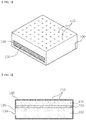
- FIG. 1 is a perspective view illustrating an exterior of a zinc-air battery according to one embodiment of the present invention.
- a zinc-air battery according to one embodiment of the present invention includes a plurality of air holes 110 formed at an upper surface of a rectangular parallelepiped case 100 and configured to allow air to flow into an air electrode part 210 disposed inside the case 100, an opening part 120 formed at one side surface of the case 100 and configured to allow water to flow into a negative electrode part 230 disposed inside the case 100, and a porous membrane 130 formed at the opening part 120 and configured to prevent a Zn powder and a KOH powder of the negative electrode part 230 disposed inside the case 100 from being discharged to the outside.
- the zinc-air battery according to the present invention is configured such that the air electrode part 210 is disposed at an upper portion of an interior of the case 100 to communicate with the plurality of air holes 110 formed at the upper surface of the case 100, a separator 220 is disposed immediately below the air electrode part 210, and the negative electrode part 230 is disposed immediately below the separator 220.
- the negative electrode part 230 includes a Zn powder and a KOH powder in the form of a powder, and thus when external moisture flows in through the opening part 120 formed at the one side surface of the case 100, the Zn powder is mixed with a KOH electrolyte and is activated as a negative electrode active material, such that the zinc-air battery of the present invention may generate electricity.
Landscapes
- Chemical & Material Sciences (AREA)
- Chemical Kinetics & Catalysis (AREA)
- Electrochemistry (AREA)
- General Chemical & Material Sciences (AREA)
- Engineering & Computer Science (AREA)
- Manufacturing & Machinery (AREA)
- Materials Engineering (AREA)
- Composite Materials (AREA)
- Hybrid Cells (AREA)
- Sealing Battery Cases Or Jackets (AREA)
- Battery Electrode And Active Subsutance (AREA)
Abstract
Description
- The present invention relates to a zinc-air battery having an excellent storage property in an ordinary situation and capable of effectively generating electricity when being exposed to a water environment.
- A battery has been conventionally and widely used as a means for supplying electric power to an electrical device. Conventionally, primary batteries such as a manganese dry cell, an alkaline manganese dry cell, a zinc-air battery, and the like, and secondary batteries such as a nickel-cadmium (Ni-Cd) battery, a nickel-hydrogen (Ni-H) battery, a lithium ion battery, and the like are used as batteries. Among the foregoing batteries, the zinc-air battery has advantages of providing a relatively high voltage of 1.4 V and having high energy density and large discharge capacity. Further, the zinc-air battery exhibits an almost constant discharge characteristic until electrical discharge of the zinc-air battery is completed, and the zinc-air battery is considered as a battery capable of replacing a mercury battery of which usage is suppressed owing to containing a heavy metal.
- Resulting from the foregoing advantages, the zinc-air battery has been applied to various fields such as military weapons and industrial equipment, and the inventors of the present invention have sought for a strategy to apply the zinc-air battery to a device or equipment, such as marine rescue equipment, exposed to seawater and, to this end, it is necessary to find solutions to the following points.
- Primarily, the marine rescue equipment is not required to operate in an ordinary situation other than emergency, but it is a very important property for the marine rescue equipment to appropriately operate in a situation in which rescue is required when a person falls into the sea, and thus it is important for the marine rescue equipment to use a battery optimized for such a property.
- However, when a conventional lithium ion battery is used, electrical discharge naturally occurs in an ordinary situation other than emergency, and thus, in consideration that the lithium ion battery is usually stored for a long period of time, there is a problem in that the lithium ion battery is almost discharged at a time when an emergency situation requiring marine rescue occurs such that rescue equipment may not operate normally.
- Further, even when a conventional zinc-air battery is used as a battery, the zinc-air battery is almost discharged during a storage period like the lithium ion battery due to a case in which the zinc-air battery is exposed to outside air in an ordinary situation, such that the rescue equipment may not operate normally in an emergency situation.
- Korean Patent Publication No.
2007-0101329 - The present invention is directed to providing a zinc-air battery having an excellent storage property because electrical discharge hardly occurs in an ordinary situation in which external moisture does not flow in and capable of generating electricity only when being exposed to an environment in which water flows into the zinc-air battery from the outside in the case of falling into the sea, thereby being usefully applied to a device or equipment, such as marine rescue equipment, requiring generation of electricity in an environment exposed to water.
- One aspect of the present invention provides a zinc-air battery including an air electrode part, a separator, and a negative electrode part which are sequentially included in a case, wherein the negative electrode part includes potassium hydroxide (KOH) in the form of a powder and an opening part is formed in at least a region of the case and is covered with a porous membrane.
- The negative electrode part may further include zinc (Zn) in the form of a powder.
- The opening part may be formed in at least a portion of a region occupied by the negative electrode part of the case.
- The porous membrane may have a pore size that is smaller than a particle size of each of the zinc (Zn) powder and the KOH powder.
- The present invention may also include marine rescue equipment incorporating the zinc-air battery according to the present invention.
- According to a zinc-air battery of the present invention, there are advantages in that a long-term storage property is very excellent because electrical discharge hardly occurs in an ordinary situation in which external moisture does not flow in, and electricity can be generated only when the zinc-air battery is exposed to an environment in which water flows into the zinc-air battery from the outside in the case of falling into the sea, such that the zinc-air battery can be usefully applied to a device or equipment, such as marine rescue equipment, requiring generation of electricity in an environment exposed to water.
-
-
FIG. 1 is a perspective view illustrating an exterior of a zinc-air battery according to one embodiment of the present invention. -
FIG. 2 is a side cross-sectional view of the zinc-air battery shown inFIG. 1 according to one embodiment of the present invention. - The present invention may be modified into various forms and may have a variety of embodiments, and, therefore, specific embodiments will be illustrated in the drawings and described. The embodiments, however, are not to be taken in a sense which limits the present invention to the specific embodiments, and should be construed to include modifications, equivalents, or substitutions within the spirit and technical scope of the present invention. Also, in the following description of the present invention, when a detailed description of a known related art is determined to obscure the gist of the present invention, the detailed description thereof will be omitted.
- The terms used herein are employed to describe only specific embodiments and are not intended to limit the present invention. Unless the context clearly dictates otherwise, the singular form includes the plural form. It should be understood that the terms "comprise," "include," and "have" specify the presence of stated herein features, numbers, steps, operations, components, parts, or combinations thereof, but do not preclude the presence or possibility of adding one or more other features, numbers, steps, operations, components, parts, or combinations thereof.
- Although the terms "first," "second," and the like may be used herein to describe various components, these components should not be limited by these terms. The terms are used only for the purpose of distinguishing one component from another component.
- The present invention relates to a zinc-air battery, and more particularly, to a zinc-air battery including an air electrode part, a separator, and a negative electrode part which are sequentially included in a case, wherein the negative electrode part includes potassium hydroxide (KOH) in the form of a powder, and an opening part is formed in at least a region of the case and is covered with a porous membrane.
- In the present invention, the air electrode part corresponds to a positive electrode part of a conventional zinc-air battery, which serves as a positive electrode into which external air flows, and includes an air diffusion layer and a catalytic active layer.
- In the present invention, the separator is disposed between the air electrode part and the negative electrode part to prevent a short-circuit between the air electrode part and the negative electrode part, and the separator is preferably made of a material, such as polypropylene, having ion permeability.
- The zinc-air battery of the present invention preferably includes the negative electrode part including KOH in the form of a powder so as to generate electricity when external water is supplied to the negative electrode part. Since the negative electrode part of the present invention includes KOH in the form of a powder, when external moisture such as seawater or fresh water flows into the negative electrode part, the KOH powder is converted into a KOH electrolyte such that zinc (Zn) existing in the negative electrode part is wet and is activated as a negative electrode active material.
- The negative electrode part includes Zn as a metal, and a shape of the Zn is not particularly limited, but the negative electrode part preferably includes a zinc powder in the form of a powder so as to maximize an active surface area as a negative electrode active material.
- The case is an exterior material of the zinc-air battery and serves to protect the air electrode part, the separator, and the negative electrode part, which are included in the case, from an external environment. In the present invention, the opening part is formed at the case in at least a portion of a region occupied by the negative electrode part and is covered with the porous membrane. The opening part serves as a path for allowing external moisture such as seawater or fresh water to flow into the negative electrode part, and when the external moisture flows into the negative electrode part through the opening part, the KOH powder existing in the negative electrode part is converted into a KOH electrolyte such that Zn existing in the negative electrode part is wet and is activated as a negative electrode active material.
- The opening part is preferably formed in only a region occupied by the negative electrode part of the case so as to minimize an inflow of the moisture into the air electrode part and the separator, and a shape and a size of the opening part and the number thereof are not particularly limited and thus various shapes, various sizes, and the various number thereof may be formed.
- However, in order to prevent discharge of the Zn powder and the KOH powder of the negative electrode part inside the case to the outside of the case, the opening part is preferably covered with a porous membrane through which the external water may pass but the Zn powder and the KOH powder of the negative electrode part inside the case may not pass. Therefore, it is preferable that the porous membrane covering the opening part has a pore size that is smaller than a particle size of each of the Zn powder and the KOH powder, and a material of the porous membrane may be any material such as fiber or metal.
- The case may have an air hole formed in at least a portion of a region occupied by the air electrode part so as to allow external air to flow into the air electrode part, and a positive terminal and a negative terminal may be formed at the case and may be respectively and electrically connected to the air electrode part and the negative electrode part which are provided inside the case.
- Since electrical discharge does not occur in the zinc-air battery according to the present invention because moisture is not supplied in an ordinary situation, and the zinc-air battery is capable of generating electricity when water flows into the negative electrode part at least once through the opening part of the case, the zinc-air battery according to the present invention may be applied to various applications, e.g., marine rescue equipment. More specifically describing an example of applications, in the case of a global positioning system (GPS) device attached to a life vest, when a conventional lithium ion battery or the like is used as a battery for the GPS device, the lithium ion battery may be almost discharged as being stored for a long period of time and thus the GPS device may not operate normally at a time when marine rescue is required, but when the zinc-air battery of the present invention is incorporated into the GPS device, electrical discharge may hardly occur in an ordinary situation in which external moisture does not flow in and, when a person falls into the sea due to a marine accident, the external water may flow into the negative electrode part of the zinc-air battery to generate electricity, such that there is an advantage in that the GPS device operates normally and thus quick rescue is possible through a position tracking for the person falling into the sea.
- As another example of applications, in the case that a heating device is attached to a portion of the life vest in contact with a heart of a person, when the zinc-air battery of the present invention is incorporated as a battery of the heating device, electrical discharge may hardly occur in an ordinary situation in which external moisture does not flow in and, when a person falls into the sea due to a marine accident, the external water may flow into the negative electrode part of the zinc-air battery to generate electricity, such that the heating device operates normally to apply heat to the heart of the person falling into the sea and thus there is an advantage in that hypothermia which is one of the biggest problems directly linked to the life of a person involved in a marine accident can be timely suppressed to maximally secure a life-saving time.
- A description for helping understanding of the present invention will be made below with reference to the accompanying drawings. The accompanying drawings are merely examples for helping understanding of the present invention, and thus the scope of the present invention is not limited thereto.
-
FIG. 1 is a perspective view illustrating an exterior of a zinc-air battery according to one embodiment of the present invention. Referring toFIG. 1 , a zinc-air battery according to one embodiment of the present invention includes a plurality ofair holes 110 formed at an upper surface of a rectangularparallelepiped case 100 and configured to allow air to flow into anair electrode part 210 disposed inside thecase 100, anopening part 120 formed at one side surface of thecase 100 and configured to allow water to flow into anegative electrode part 230 disposed inside thecase 100, and aporous membrane 130 formed at theopening part 120 and configured to prevent a Zn powder and a KOH powder of thenegative electrode part 230 disposed inside thecase 100 from being discharged to the outside. - An internal structure of the zinc-air battery shown in
FIG. 1 will be described below with reference to a side cross-sectional view shown inFIG. 2 . Referring toFIG. 2 , the zinc-air battery according to the present invention is configured such that theair electrode part 210 is disposed at an upper portion of an interior of thecase 100 to communicate with the plurality ofair holes 110 formed at the upper surface of thecase 100, aseparator 220 is disposed immediately below theair electrode part 210, and thenegative electrode part 230 is disposed immediately below theseparator 220. Thenegative electrode part 230 includes a Zn powder and a KOH powder in the form of a powder, and thus when external moisture flows in through theopening part 120 formed at the one side surface of thecase 100, the Zn powder is mixed with a KOH electrolyte and is activated as a negative electrode active material, such that the zinc-air battery of the present invention may generate electricity. - As described above, those skilled in the art can understand that the present invention may be implemented in other specific forms without departing from the technical spirit or the necessary features of the present disclosure. The scope of the present invention is defined by the appended claims rather than the detailed description, and it should be construed that all alterations or modifications derived from the meaning and scope of the appended claims and the equivalents thereof fall within the scope of the present invention.
Claims (5)
- A zinc-air battery comprising:an air electrode part, a separator, and a negative electrode part which are sequentially included in a case,wherein the negative electrode part includes potassium hydroxide (KOH) in a form of a powder, and an opening part is formed in at least one region of the case and is covered with a porous membrane.
- The zinc-air battery of claim 1, wherein the negative electrode material further includes zinc in a form of a powder.
- The zinc-air battery of claim 1, wherein the opening part is formed in at least a portion of a region occupied by the negative electrode part of the case.
- The zinc-air battery of claim 2, wherein the porous membrane has a pore size that is smaller than a particle size of each of the zinc (Zn) powder and the KOH powder.
- Marine rescue equipment incorporating the zinc-air battery according to any one of claims 1 to 4.
Applications Claiming Priority (2)
| Application Number | Priority Date | Filing Date | Title |
|---|---|---|---|
| KR1020150158393A KR101778059B1 (en) | 2015-11-11 | 2015-11-11 | Zinc-air cell |
| PCT/KR2016/012016 WO2017082555A1 (en) | 2015-11-11 | 2016-10-25 | Zinc-air battery |
Publications (2)
| Publication Number | Publication Date |
|---|---|
| EP3373385A1 true EP3373385A1 (en) | 2018-09-12 |
| EP3373385A4 EP3373385A4 (en) | 2019-05-01 |
Family
ID=58695696
Family Applications (1)
| Application Number | Title | Priority Date | Filing Date |
|---|---|---|---|
| EP16864481.3A Withdrawn EP3373385A4 (en) | 2015-11-11 | 2016-10-25 | Zinc-air battery |
Country Status (6)
| Country | Link |
|---|---|
| US (1) | US10594009B2 (en) |
| EP (1) | EP3373385A4 (en) |
| JP (1) | JP2018533817A (en) |
| KR (1) | KR101778059B1 (en) |
| CN (1) | CN108352589A (en) |
| WO (1) | WO2017082555A1 (en) |
Families Citing this family (5)
| Publication number | Priority date | Publication date | Assignee | Title |
|---|---|---|---|---|
| KR101934525B1 (en) * | 2017-11-24 | 2019-03-25 | (주) 엠파워 | Stack for Dry type Metal Air Fuel Cell |
| CN109119729A (en) * | 2018-08-06 | 2019-01-01 | 北京理工大学 | Floating marine formula metal-air electricity generation module |
| CN110635200A (en) * | 2019-10-01 | 2019-12-31 | 重庆大学 | A new passive miniature metal-air battery |
| CN110828855B (en) * | 2019-11-07 | 2022-09-06 | 上海电力大学 | Flexible self-oxygen-supply rechargeable zinc-air battery pack module |
| CN113363498B (en) * | 2021-05-26 | 2022-10-11 | 哈尔滨工业大学(威海) | Double-porous carbon cathode magnesium alloy dissolved oxygen seawater battery device based on marine floating platform |
Family Cites Families (19)
| Publication number | Priority date | Publication date | Assignee | Title |
|---|---|---|---|---|
| US2497852A (en) * | 1945-03-01 | 1950-02-21 | Gilbert H Arenstein | Transmitter buoy |
| US2865974A (en) * | 1955-04-28 | 1958-12-23 | Electric Storage Battery Co | Negative plates and the production thereof |
| NL298119A (en) * | 1962-09-21 | |||
| US3592693A (en) * | 1968-02-02 | 1971-07-13 | Leesona Corp | Consumable metal anode with dry electrolytic enclosed in envelope |
| CA1081318A (en) * | 1977-12-13 | 1980-07-08 | William A. Armstrong | Buoyant metal/air battery |
| US5362577A (en) | 1993-06-04 | 1994-11-08 | Aer Energy Resources, Inc. | Diffusion vent for a rechargeable metal-air cell |
| JP3168833B2 (en) | 1994-07-11 | 2001-05-21 | 松下電器産業株式会社 | Battery |
| JP2000082503A (en) | 1998-09-07 | 2000-03-21 | Sony Corp | Air battery |
| CN1613161A (en) * | 2002-01-08 | 2005-05-04 | 异能公司 | Reserve battery |
| AU2002951260A0 (en) * | 2002-09-06 | 2002-09-19 | Cochlear Limited | Zinc air battery |
| CN1288793C (en) * | 2004-11-28 | 2006-12-06 | 华南理工大学 | Dry charge type zinc air cell |
| KR100802324B1 (en) | 2006-04-14 | 2008-02-13 | 주식회사 디엠에스 | Marine battery unit and relief equipment having same |
| KR100886589B1 (en) | 2007-08-17 | 2009-03-05 | 주식회사 미트 | Air zinc battery |
| KR101198029B1 (en) | 2010-03-18 | 2012-11-07 | 주식회사 이엠따블유에너지 | Zinc-air cell |
| JP5221626B2 (en) | 2010-10-29 | 2013-06-26 | 国立大学法人京都大学 | Air electrode for metal-air secondary battery, membrane / air electrode assembly for metal-air secondary battery and metal-air secondary battery provided with the air electrode |
| JP6263371B2 (en) | 2013-11-26 | 2018-01-17 | シャープ株式会社 | Metal air battery |
| KR101574004B1 (en) | 2014-01-27 | 2015-12-02 | 울산대학교 산학협력단 | Zinc-air secondary cell battery and preparation method thereof |
| CN104966859B (en) * | 2015-07-14 | 2017-06-13 | 合肥献芝新能源有限公司 | It is a kind of can dormancy storage and in real time triggering power-supply system |
| KR101934525B1 (en) | 2017-11-24 | 2019-03-25 | (주) 엠파워 | Stack for Dry type Metal Air Fuel Cell |
-
2015
- 2015-11-11 KR KR1020150158393A patent/KR101778059B1/en not_active Expired - Fee Related
-
2016
- 2016-10-25 US US15/772,578 patent/US10594009B2/en active Active
- 2016-10-25 JP JP2018521595A patent/JP2018533817A/en active Pending
- 2016-10-25 WO PCT/KR2016/012016 patent/WO2017082555A1/en not_active Ceased
- 2016-10-25 EP EP16864481.3A patent/EP3373385A4/en not_active Withdrawn
- 2016-10-25 CN CN201680065638.0A patent/CN108352589A/en active Pending
Also Published As
| Publication number | Publication date |
|---|---|
| KR101778059B1 (en) | 2017-09-14 |
| EP3373385A4 (en) | 2019-05-01 |
| WO2017082555A1 (en) | 2017-05-18 |
| JP2018533817A (en) | 2018-11-15 |
| KR20170055343A (en) | 2017-05-19 |
| CN108352589A (en) | 2018-07-31 |
| US10594009B2 (en) | 2020-03-17 |
| US20190097290A1 (en) | 2019-03-28 |
Similar Documents
| Publication | Publication Date | Title |
|---|---|---|
| JP7029924B2 (en) | Power storage element and power storage module | |
| US10594009B2 (en) | Zinc-air battery | |
| JP6326272B2 (en) | Battery case and metal-air battery | |
| JP2018045966A (en) | Secondary battery, battery pack and vehicle | |
| US20140302348A1 (en) | Electrochemical cell including an integrated circuit | |
| KR101789804B1 (en) | Pouch for secondary battery with directional venting effect and pouch-type secondary battery comprising the same | |
| ES2980237T3 (en) | Secondary battery and secondary battery insulator | |
| Kim et al. | Primary seawater batteries | |
| US10573945B2 (en) | Metal-air fuel cell | |
| US20140302347A1 (en) | Electrochemical cell including an integrated circuit | |
| KR20190013034A (en) | Battery case, battery pack including the same, and vehicle including the same | |
| US20150079462A1 (en) | Battery cell | |
| AU2017381393B2 (en) | Metal-air fuel cell | |
| KR20160037350A (en) | Battery cell and device comprising thereof | |
| JPH07272704A (en) | Battery pack | |
| US10249851B2 (en) | Stacked battery | |
| JP4778753B2 (en) | Battery module | |
| JP6669863B2 (en) | Air-zinc battery module | |
| JP7041487B2 (en) | Power storage element | |
| JP6680544B2 (en) | Metal electrode cartridge accommodation item, metal electrode cartridge storage method, and metal electrode cartridge transportation method | |
| ES2540171A1 (en) | Aluminum-manganese electrochemical cell (Machine-translation by Google Translate, not legally binding) | |
| KR100545561B1 (en) | Spare battery for a portable terminal | |
| KR100883936B1 (en) | Cylindrical air zinc battery | |
| KR20130091454A (en) | Sodium secondary battery having safety vent | |
| KR20140140405A (en) | Electrode assembly and secondary battery including the same |
Legal Events
| Date | Code | Title | Description |
|---|---|---|---|
| STAA | Information on the status of an ep patent application or granted ep patent |
Free format text: STATUS: THE INTERNATIONAL PUBLICATION HAS BEEN MADE |
|
| PUAI | Public reference made under article 153(3) epc to a published international application that has entered the european phase |
Free format text: ORIGINAL CODE: 0009012 |
|
| STAA | Information on the status of an ep patent application or granted ep patent |
Free format text: STATUS: REQUEST FOR EXAMINATION WAS MADE |
|
| 17P | Request for examination filed |
Effective date: 20180601 |
|
| AK | Designated contracting states |
Kind code of ref document: A1 Designated state(s): AL AT BE BG CH CY CZ DE DK EE ES FI FR GB GR HR HU IE IS IT LI LT LU LV MC MK MT NL NO PL PT RO RS SE SI SK SM TR |
|
| AX | Request for extension of the european patent |
Extension state: BA ME |
|
| DAV | Request for validation of the european patent (deleted) | ||
| DAX | Request for extension of the european patent (deleted) | ||
| A4 | Supplementary search report drawn up and despatched |
Effective date: 20190402 |
|
| RIC1 | Information provided on ipc code assigned before grant |
Ipc: H01M 4/134 20100101ALI20190327BHEP Ipc: H01M 12/06 20060101AFI20190327BHEP Ipc: H01M 4/24 20060101ALI20190327BHEP Ipc: B63C 9/00 20060101ALI20190327BHEP Ipc: H01M 12/02 20060101ALI20190327BHEP Ipc: H01M 6/34 20060101ALI20190327BHEP |
|
| STAA | Information on the status of an ep patent application or granted ep patent |
Free format text: STATUS: THE APPLICATION IS DEEMED TO BE WITHDRAWN |
|
| 18D | Application deemed to be withdrawn |
Effective date: 20191105 |