EP3373013B1 - Verfahren zur vorhersage der off-target-bindung eines peptids an ein zielpeptid, dargestellt durch einen haupthistokompatibilitätskomplex - Google Patents
Verfahren zur vorhersage der off-target-bindung eines peptids an ein zielpeptid, dargestellt durch einen haupthistokompatibilitätskomplex Download PDFInfo
- Publication number
- EP3373013B1 EP3373013B1 EP18162980.9A EP18162980A EP3373013B1 EP 3373013 B1 EP3373013 B1 EP 3373013B1 EP 18162980 A EP18162980 A EP 18162980A EP 3373013 B1 EP3373013 B1 EP 3373013B1
- Authority
- EP
- European Patent Office
- Prior art keywords
- peptide
- binding
- amino acid
- cells
- peptides
- Prior art date
- Legal status (The legal status is an assumption and is not a legal conclusion. Google has not performed a legal analysis and makes no representation as to the accuracy of the status listed.)
- Active
Links
Images



Classifications
-
- G—PHYSICS
- G16—INFORMATION AND COMMUNICATION TECHNOLOGY [ICT] SPECIALLY ADAPTED FOR SPECIFIC APPLICATION FIELDS
- G16B—BIOINFORMATICS, i.e. INFORMATION AND COMMUNICATION TECHNOLOGY [ICT] SPECIALLY ADAPTED FOR GENETIC OR PROTEIN-RELATED DATA PROCESSING IN COMPUTATIONAL MOLECULAR BIOLOGY
- G16B35/00—ICT specially adapted for in silico combinatorial libraries of nucleic acids, proteins or peptides
- G16B35/20—Screening of libraries
-
- G—PHYSICS
- G01—MEASURING; TESTING
- G01N—INVESTIGATING OR ANALYSING MATERIALS BY DETERMINING THEIR CHEMICAL OR PHYSICAL PROPERTIES
- G01N33/00—Investigating or analysing materials by specific methods not covered by groups G01N1/00 - G01N31/00
- G01N33/48—Biological material, e.g. blood, urine; Haemocytometers
- G01N33/50—Chemical analysis of biological material, e.g. blood, urine; Testing involving biospecific ligand binding methods; Immunological testing
- G01N33/5005—Chemical analysis of biological material, e.g. blood, urine; Testing involving biospecific ligand binding methods; Immunological testing involving human or animal cells
- G01N33/5008—Chemical analysis of biological material, e.g. blood, urine; Testing involving biospecific ligand binding methods; Immunological testing involving human or animal cells for testing or evaluating the effect of chemical or biological compounds, e.g. drugs, cosmetics
- G01N33/5044—Chemical analysis of biological material, e.g. blood, urine; Testing involving biospecific ligand binding methods; Immunological testing involving human or animal cells for testing or evaluating the effect of chemical or biological compounds, e.g. drugs, cosmetics involving specific cell types
- G01N33/5047—Cells of the immune system
- G01N33/505—Cells of the immune system involving T-cells
-
- G—PHYSICS
- G01—MEASURING; TESTING
- G01N—INVESTIGATING OR ANALYSING MATERIALS BY DETERMINING THEIR CHEMICAL OR PHYSICAL PROPERTIES
- G01N33/00—Investigating or analysing materials by specific methods not covered by groups G01N1/00 - G01N31/00
- G01N33/48—Biological material, e.g. blood, urine; Haemocytometers
- G01N33/50—Chemical analysis of biological material, e.g. blood, urine; Testing involving biospecific ligand binding methods; Immunological testing
- G01N33/68—Chemical analysis of biological material, e.g. blood, urine; Testing involving biospecific ligand binding methods; Immunological testing involving proteins, peptides or amino acids
- G01N33/6863—Cytokines, i.e. immune system proteins modifying a biological response such as cell growth proliferation or differentiation, e.g. TNF, CNF, GM-CSF, lymphotoxin, MIF or their receptors
- G01N33/6866—Interferon
-
- G—PHYSICS
- G01—MEASURING; TESTING
- G01N—INVESTIGATING OR ANALYSING MATERIALS BY DETERMINING THEIR CHEMICAL OR PHYSICAL PROPERTIES
- G01N33/00—Investigating or analysing materials by specific methods not covered by groups G01N1/00 - G01N31/00
- G01N33/48—Biological material, e.g. blood, urine; Haemocytometers
- G01N33/50—Chemical analysis of biological material, e.g. blood, urine; Testing involving biospecific ligand binding methods; Immunological testing
- G01N33/68—Chemical analysis of biological material, e.g. blood, urine; Testing involving biospecific ligand binding methods; Immunological testing involving proteins, peptides or amino acids
- G01N33/6878—Chemical analysis of biological material, e.g. blood, urine; Testing involving biospecific ligand binding methods; Immunological testing involving proteins, peptides or amino acids in epitope analysis
-
- G—PHYSICS
- G16—INFORMATION AND COMMUNICATION TECHNOLOGY [ICT] SPECIALLY ADAPTED FOR SPECIFIC APPLICATION FIELDS
- G16B—BIOINFORMATICS, i.e. INFORMATION AND COMMUNICATION TECHNOLOGY [ICT] SPECIALLY ADAPTED FOR GENETIC OR PROTEIN-RELATED DATA PROCESSING IN COMPUTATIONAL MOLECULAR BIOLOGY
- G16B35/00—ICT specially adapted for in silico combinatorial libraries of nucleic acids, proteins or peptides
-
- G—PHYSICS
- G16—INFORMATION AND COMMUNICATION TECHNOLOGY [ICT] SPECIALLY ADAPTED FOR SPECIFIC APPLICATION FIELDS
- G16C—COMPUTATIONAL CHEMISTRY; CHEMOINFORMATICS; COMPUTATIONAL MATERIALS SCIENCE
- G16C20/00—Chemoinformatics, i.e. ICT specially adapted for the handling of physicochemical or structural data of chemical particles, elements, compounds or mixtures
- G16C20/60—In silico combinatorial chemistry
-
- G—PHYSICS
- G01—MEASURING; TESTING
- G01N—INVESTIGATING OR ANALYSING MATERIALS BY DETERMINING THEIR CHEMICAL OR PHYSICAL PROPERTIES
- G01N2333/00—Assays involving biological materials from specific organisms or of a specific nature
- G01N2333/435—Assays involving biological materials from specific organisms or of a specific nature from animals; from humans
- G01N2333/52—Assays involving cytokines
- G01N2333/555—Interferons [IFN]
- G01N2333/57—IFN-gamma
-
- G—PHYSICS
- G01—MEASURING; TESTING
- G01N—INVESTIGATING OR ANALYSING MATERIALS BY DETERMINING THEIR CHEMICAL OR PHYSICAL PROPERTIES
- G01N2333/00—Assays involving biological materials from specific organisms or of a specific nature
- G01N2333/435—Assays involving biological materials from specific organisms or of a specific nature from animals; from humans
- G01N2333/705—Assays involving receptors, cell surface antigens or cell surface determinants
- G01N2333/70503—Immunoglobulin superfamily, e.g. VCAMs, PECAM, LFA-3
- G01N2333/70539—MHC-molecules, e.g. HLA-molecules
-
- G—PHYSICS
- G01—MEASURING; TESTING
- G01N—INVESTIGATING OR ANALYSING MATERIALS BY DETERMINING THEIR CHEMICAL OR PHYSICAL PROPERTIES
- G01N2500/00—Screening for compounds of potential therapeutic value
- G01N2500/04—Screening involving studying the effect of compounds C directly on molecule A (e.g. C are potential ligands for a receptor A, or potential substrates for an enzyme A)
Definitions
- the present invention relates to a method for predicting whether an immunotherapeutic TCR, which binds to a target peptide that is presented in the context of major histocompatibility complex (MHC), and is for administration to a subject, will cross react with another peptide in the subject in vivo.
- MHC major histocompatibility complex
- MHC class I and class II are immunoglobulin superfamily proteins specialised for antigen presentation, with a polymorphic peptide binding site which enables them to present a diverse array of short peptide fragments at the surface of the antigen presenting cell.
- Peptides presented by MHC are derived from proteins which have been proteosomally processed within the cell.
- MHC molecules are known as human leukocyte antigens (HLA).
- a number of emerging immunotherapies rely on the administration to a subject to be treated of a binding peptide that binds a target peptide-MHC complex.
- the binding peptide may be an immune binding peptide such as, for example, an antibody or antigen binding fragment thereof or a T cell receptor or antigen binding fragment thereof.
- Such binding peptides bind to a binding sequence, comprising the amino acid sequence of the target MHC presented peptide. Often the binding sequence of the target peptide is known.
- the binding peptide binds to peptides other than the target peptide (referred to herein as "off target peptides"), causing unwanted side effects. It is therefore desirable to identify whether such off target peptides exist. This allows binding peptides to be chosen and designed that do not bind to off target peptides and consequently have a far greater chance of not causing unwanted side effects.
- the skilled person may measure any immune response generated by the binding peptide in the presence of cells derived from normal tissue(s) (which preferably do not express the target peptide). However, this can be a difficult process, depending on the number and type of cells tested. Furthermore, primary cells cultured in vitro, may have a different protein expression profile compared to the same cell type in vivo. This may result in a false assessment of potential cross reactivity in vivo. Finally, the skilled person may use animal models to measure any immune response generated by the binding peptide. Because of the differences between human protein sequences and those of the animal, the absence of unwanted side effects in the animal may not translate to humans.
- the invention provides a method for predicting whether an immunotherapeutic TCR has the potential to cross react with another peptide in the subject in vivo to give rise to unwanted side effects derived from off target specificities in said subject, wherein the TCR binds to a target peptide presented by a Major Histocompatibility Complex (MHC) and is for administration to a subject;
- MHC Major Histocompatibility Complex
- Methods of the invention may further comprise, where an amino acid residue at a position in the binding sequence is not identified as being part of the binding motif, substituting this position with at least one additional amino acid and testing for activity relative to the wild type peptide, wherein amino acid substitutions which result in a 50% or greater loss of activity relative to the wild type target peptide are considered to be non-tolerated amino acids and not part of the binding motif and/or amino acid substitutions which do not result in a 50% or greater loss of activity relative to the wild type target peptide are considered as part of the binding motif.
- the activity that is tested may be the ability of the mutant to bind to the immunotherapeutic TCR.
- the search may be carried out for peptides that are expressed in selected tissue(s) and/or accessible to the immunotherapeutic TCR.
- a treatment effective amount of the immunotherapeutic TCR may be administered to the subject, and/or when there is the presence of one or more such peptides and hence an indication that the immunotherapeutic TCR has the potential to cross react in vivo, the potential for each peptide to cause off target side effects in vivo may be identified, and where necessary, preparing an alternative immunotherapeutic TCR having the absence of one or more of such peptides and hence the indication that the alternative immunotherapeutic TCR has the potential not to cross react in vivo, and a treatment effective amount of the alternative immunotherapeutic TCR may be administered to the subject.
- the treatment effective amount of the immunotherapeutic TCR is that amount typically given to the suitable mammalian patient.
- the invention comprehends testing known immunotherapeutic TCR treatments for whether such treatment immunotherapeutic TCRs will bind to peptides other than the target peptide.
- the treatment effective amount of the alternative immunotherapeutic TCR is within the ambit of the skilled person from this disclosure and the knowledge in the art.
- the treatment effective amount can be determined by comparing the binding properties and/or ability to elicit the desired treatment biological response of the immunotherapeutic TCR with the binding properties and/or ability to elicit the desired treatment biological response of the alternative immunotherapeutic TCR, and adjusting the dosage of the immunotherapeutic TCR based on the difference in binding and/or ability to elicit the biological response of the alternative immunotherapeutic TCR in comparison with the binding and/or ability to elicit the biological response of the immunotherapeutic TCR peptide.
- the alternative immunotherapeutic TCR has binding properties and/or biological response eliciting properties akin to that of the immunotherapeutic TCR , and hence its dosage or amount to be administered is analogous to that of the immunotherapeutic TCR .
- an improvement in a method of treating a human or animal mammalian subject in need thereof comprising administering a binding peptide.
- This improvement comprises: predicting whether the binding peptide, which binds to a target peptide presented by a Major Histocompatibility Complex (MHC) in the subject to thereby provide said treatment and is for administration to the subject, has the potential to cross react with another peptide in the subject in vivo, comprising:
- MHC Major Histocompatibility Complex
- This method can include, when there is the presence of one or more such peptides and hence an indication that the binding peptide has the potential to cross react in vivo, preparing an alternative binding peptide having the absence of one or more of such peptides and hence the indication that the alternative binding peptide has the potential not to cross react in vivo, and administering a treatment effective amount of the alternative binding peptide to the subject.
- the invention provides a method for preparing a pharmaceutical composition comprising a binding peptide, or an improvement to methods for preparing a pharmaceutical composition comprising a binding peptide, comprising: predicting whether the binding peptide, which binds to a target peptide presented by a Major Histocompatibility Complex (MHC) in the subject to thereby provide said treatment and is for administration to the subject, has the potential to cross react with another peptide in the subject in vivo, comprising:
- MHC Major Histocompatibility Complex
- the inventors have found that, by identifying the binding motif in the target peptide to which the immunotherapeutic TCR binds, rather than the known binding sequence, off target peptides - that have the potential to, or will, cross react in vivo - can be identified far more accurately. If off target peptides are found, this allows immunotherapeutic TCRs to be altered so that they do not bind to these off target peptides.
- the binding motif(s) may be identified by creating a series of mutants of the target peptide, each mutant having the amino acid residue at one position in the sequence thereof that is involved in binding to the immunotherapeutic TCR (the "binding sequence") substituted for an alanine or glycine, such that over the series of mutants the amino acid residue in each position in the binding sequence is substituted for alanine or glycine. Each mutant in the series is then tested for its activity relative to the wild type target peptide.
- An amino acid residue at a position within the binding sequence may be identified as being part of the binding motif if the mutant in which the amino acid at that position is mutated to alanine or glycine has a 50, 55, 60, 65, 70, 75, 80, 85, 90% or greater loss of activity relative to the wild type target peptide. This may result in a binding motif comprising amino acid(s) at one or a plurality of positions (such as 2, 3, 4, 5, 5, 6, 7, 8, 9, 10 or more) within the binding sequence being identified.
- amino acid residue at a position in the binding sequence is not identified as being part of the binding motif (using the technique described above for example)
- this position may be further substituted with at least one additional amino acid and tested for activity relative to the wild type peptide.
- Amino acid substitutions which result in a 50, 55, 60, 65, 70, 75, 80, 85, 90% or greater loss of activity relative to the wild type target peptide are considered to be non-tolerated amino acids and/or not part of the binding motif.
- amino acid substitutions which do not result in a 50% or greater loss of activity relative to the wild type target peptide may be considered as part of the binding motif. This may result in a binding motif as defined above and additionally in which one or a plurality of positions are represented by more than one but not all amino acids.
- a series of mutants is made in which the amino acid residue at each position of the binding sequence is mutated to all alternative amino acids (relative to the wild type amino acid). For a binding sequence of nine amino acids, this would mean 171 peptides. Each mutant in the series is tested for activity relative to the wild type peptide. Amino acid substitutions which result in a 50, 55, 60, 65, 70, 75, 80, 85, 90% or greater loss of activity, are considered to be non-tolerated amino acids and/or not part of the binding motif. Conversely, amino acid substitutions which do not result in a 50% or greater loss of activity relative to the wild type target peptide may be considered as part of the binding motif. This may result in a binding motif in which each position is represented by at least one but not all amino acids.
- the activity that is tested is the ability of the mutant to bind to the immunotherapeutic TCR (this can be measured using Surface Plasmon Resonance for example). Also disclosed herein is testing the ability of the mutant to elicit the biological response caused by binding to the binding peptide.
- the biological response may be, for example, activation of immune system cells such as T cells, measured by cytokine production or destruction of the target cell; activation of an enzyme, measured by accumulation of product or disappearance of substrate; or activation of a signalling cascade (measured by monitoring protein phosphorylation, or changes in gene expression and protein production).
- the alternative amino acid substituted into the mutants is alanine or glycine.
- amino acid scanning are known in the art and have been used to determine a binding motif. See Wells, Methods Enzymol 1991; 202: 390-411 for example.
- a similar approach is also known for detecting other specificities of a T cell receptor (for example Udyavar et al. J Immunol 2009; 182(7):4439-47 ).
- amino acid scanning has not been used to identify off-target peptides which may cause undesirable side effects.
- protein databases may be searched for proteins which contain the binding motif.
- Suitable protein databases include but are not limited to UniProtKB/Swiss-Prot (http://www.uniprot.org/), Protein Information Resource (PIR) (http://pir.georgetown.edu/pirwww/index.shtml), and/or Reference Sequence (RefSeq) (www.ncbi.nlm.nih.gov/RefSeq).
- Searching for a peptide motif may be carried out using any one of a number of tools, which may be found on bioinformatics resource sites such as ExPASY (http://www.expasy.org/).
- the search tool ScanProsite identifies user-defined motifs in all protein sequences in the UniProtKB/Swiss-Prot Protein Knowledgebase ( De Castro et al. Nucleic Acids Res. 2006 Jul 1; 34 (Web Server issue):W362-5 ).
- binding motif i.e. with 100% identity to the binding motif
- proteins containing motifs that have less than 100% identity to the binding motif may be identified.
- the binding motif may be modified to include ambiguity at certain positions, for example with amino acids which have similar properties (e.g. leucine/ isoleucine, etc), or where it is already known in the literature that a particular amino acid is tolerated at a certain position (such as HLA anchor residues).
- the search may be carried out for peptides that are of human origin or of organisms which are commonly present in humans, such as viral or bacterial pathogens, or commensal bacteria.
- the search may be carried out for peptides that are of the relevant non-human animal origin or of organisms which are commonly present in such non-human animals.
- the search may be carried out for peptides that are expressed in selected tissue(s) and/or accessible to the immunotherapeutic TCR. Such information may be obtained from the literature.
- Peptides identified in the search as comprising the at least one binding motif may be confirmed as an off target peptide and cross reacting with the immunotherapeutic TCR by determining the ability of the identified peptide to bind to the immunotherapeutic TCR (for example using Surface Plasmon Resonance), or assessing the biological response generated by binding of the immunotherapeutic TCR to the identified peptide.
- the biological response may be for example, activation of immune system cells such as T cells, measured by cytokine production or destruction of the target cell; activation of an enzyme, measured by accumulation of product or disappearance of substrate; or, activation of a signalling cascade (measured by monitoring protein phosphorylation, or changes in gene expression and protein production).
- the potential of the (or each) off target peptide to cause unwanted side effects when bound by the immunotherapeutic TCR e may be determined. This may include searching literature sources to determine expression of the off target peptide in normal tissue. For example, where expression of the off target peptide in normal tissue is non-existent or limited (for example with cancer testis antigens), the immunotherapeutic TCR may be considered suitable for administration in vivo. In cases where expression of the off target peptide in normal tissue is widespread or is in critical tissues, such as heart cells, binding may optionally be additionally confirmed in vitro using cells which express the off target peptide. In some situations the immunotherapeutic TCR may not be administered in vivo because of the cross reaction that this can cause.
- the immunotherapeutic TCR may be redesigned so that there is no longer any cross reactivity to the off target peptide(s), while maintaining binding, preferably with high affinity, to the target peptide.
- T cell receptors can be redesigned by mutagenesis using the methods described in WO 03/020763 . Where redesigning does not prevent cross reactivity to the off target peptide, an alternative immunotherapeutic TCR may be sought.
- the immunotherapeutic TCR may be used in a method of preventing or treating a disease or condition which is ameliorated by administration of the immunotherapeutic TCR.
- Methods of treatment include but are not limited to immunotherapies; for example, administration to a patient of modified T cells (adoptive therapy), such as those transduced with affinity enhanced T cell receptors or chimeric antibody receptors; administration of monoclonal antibodies or monoclonal antibody fragments, especially TCR-like antibodies; administration of novel bi-specific immunotherapeutic agents such as ImmTACs (Immune mobilising TCRs against cancer) ( Liddy, et al. (2012) Not Med 18: 980-987 ) or BiTEs (Bispecific T cell engaging antibodies) ( Baeuerle, et al. (2009). Curr Opin Mol Ther 11(1): 22-30 ).
- immunotherapies for example, administration to a patient of modified T cells (adoptive therapy), such as those transduced with affinity enhanced T cell receptors or chimeric antibody receptors; administration of monoclonal antibodies or monoclonal antibody fragments, especially TCR-like antibodies; administration of novel bi-specific immunotherapeutic agents such as ImmTACs (Imm
- Such treatments may be provided in a pharmaceutical composition (which does not fall within the scope of the invention) together with one or more pharmaceutically acceptable carriers or excipients.
- Therapeutic TCRs, or cells will usually be supplied as part of a sterile, pharmaceutical composition which will normally include a pharmaceutically acceptable carrier.
- This pharmaceutical composition may be in any suitable form, (depending upon the desired method of administering it to a patient). It may be provided in unit dosage form, will generally be provided in a sealed container and may be provided as part of a kit. Such a kit would normally (although not necessarily) include instructions for use. It may include a plurality of said unit dosage forms.
- the pharmaceutical composition may be adapted for administration by any appropriate route, such as a parenteral (including subcutaneous, intramuscular, or intravenous) route.
- a parenteral route including subcutaneous, intramuscular, or intravenous
- Such compositions may be prepared by any method known in the art of pharmacy, for example by mixing the active ingredient with the carrier(s) or excipient(s) under sterile conditions.
- Dosages of the substances disclosed herein can vary between wide limits, depending upon the disease or disorder to be treated, the age and condition of the individual to be treated, etc; for example, a suitable dose range for an ImmTAC reagent may be between 25 ng/kg and 50 ⁇ g/kg. A physician will ultimately determine appropriate dosages to be used.
- T cell receptors includes antigen binding fragments of T cell receptors.
- TCRs mediate the recognition of specific Major Histocompatibility Complex (MHC)-peptide complexes by T cells and, as such, are essential to the functioning of the cellular arm of the immune system.
- MHC Major Histocompatibility Complex
- the TCR is a heterodimeric cell surface protein of the immunoglobulin superfamily which is associated with invariant proteins of the CD3 complex involved in mediating signal transduction.
- TCRs exist in ⁇ and ⁇ forms, which are structurally similar but T cells expressing them have quite distinct anatomical locations and probably functions.
- the extracellular portion of the receptor consists of two membrane-proximal constant domains, and two membrane-distal variable domains bearing polymorphic loops analogous to the complementarity determining regions (CDRs) of antibodies. It is these loops which form the binding site of the TCR molecule and determine peptide specificity.
- CDRs complementarity determining regions
- the TCR may be in soluble form (e.g. having no transmembrane or cytoplasmic domains), for example a monoclonal TCR as described in WO03/020763 , and/or in single chain form, as described in WO2004/033685 .
- soluble TCRs preferably have an introduced disulphide bond between residues of the respective constant domains, as described, for example, in WO 03/020763 .
- Single chain formats include ⁇ TCR polypeptides of the V ⁇ -L-V ⁇ , V ⁇ -L-V ⁇ , V ⁇ -C ⁇ -L-V ⁇ or V ⁇ -L-V ⁇ -C ⁇ types, wherein V ⁇ and V ⁇ are TCR ⁇ and ⁇ variable regions respectively, C ⁇ and C ⁇ are TCR ⁇ and ⁇ constant regions respectively, and L is a linker sequence.
- the TCR may be fused to an immune effector domain for use as a targeting agent for delivering therapeutic agents to an antigen presenting cell.
- therapeutic agents include for example antibodies or antibody fragments such as an anti-CD3 fragment, immunomodulators such as cytokines, enzymes such as perforin, or chemotherapeutic agents, such as cis-platin.
- TCRs may also be expressed on a cell, such as a T cell. Said T cells may be used in adoptive therapy.
- antibodies such as TCR like antibodies, which have been engineered to bind to MHC presented peptides (for example see, Sergeeva, A., G. et al. (2011). Blood 117(16): 4262-72 and/or Dahan, R., and Y. Reiter. 2012. Expert Rev Mol Med. 14:e6 .
- the term "antibody” as used herein refers to immunoglobulin molecules and immunologically active portions of immunoglobulin molecules, i.e., molecules that contain an antigen binding site that specifically binds an antigen, whether natural or partly or wholly synthetically produced.
- the term also covers any polypeptide or protein having a binding domain which is, or is homologous to, an antibody binding domain.
- antibodies are the immunoglobulin isotypes (e.g., IgG, IgE, IgM, IgD and IgA) and their isotypic subclasses; fragments which comprise an antigen binding domain such as Fab, scFv, Fv, dAb, Fd; and diabodies.
- Antibodies may be polyclonal or monoclonal. A monoclonal antibody may be referred to herein as "mab".
- antibody should be construed as covering antibody fragments, derivatives, functional equivalents and homologues of antibodies, humanised antibodies, including any polypeptide comprising an immunoglobulin binding domain, whether natural or wholly or partially synthetic. Chimeric molecules comprising an immunoglobulin binding domain, or equivalent, fused to another polypeptide are therefore included. Cloning and expression of chimeric antibodies are described in EP-A-0120694 and EP-A-0125023 .
- a humanised antibody may be a modified antibody having the variable regions of a non-human, e.g. murine, antibody and the constant region of a human antibody. Methods for making humanised antibodies are described in, for example, US Patent No. 5225539
- binding fragments are (i) the Fab fragment consisting of VL, VH, CL and CH1 domains; (ii) the Fd fragment consisting of the VH and CH1 domains; (iii) the Fv fragment consisting of the VL and VH domains of a single antibody; (iv) the dAb fragment ( Ward, E.S.
- Diabodies are multimers of polypeptides, each polypeptide comprising a first domain comprising a binding region of an immunoglobulin light chain and a second domain comprising a binding region of an immunoglobulin heavy chain, the two domains being linked (e.g. by a peptide linker) but unable to associated with each other to form an antigen binding site: antigen binding sites are formed by the association of the first domain of one polypeptide within the multimer with the second domain of another polypeptide within the multimer ( WO94/13804 ).
- bispecific antibodies may be conventional bispecific antibodies, which can be manufactured in a variety of ways ( Hollinger & Winter, Current Opinion Biotechnol. 4:446-449 (1993 )), e.g. prepared chemically or from hybrid hybridomas, or may be any of the bispecific antibody fragments mentioned above. It may be preferable to use scFv dimers or diabodies rather than whole antibodies. Diabodies and scFv can be constructed without an Fc region, using only variable domains, potentially reducing the effects of anti-idiotypic reaction. Other forms of bispecific antibodies include the single chain "Janusins" described in Traunecker et al., EMBO Journal 10:3655-3659 (1991 ).
- Bispecific diabodies as opposed to bispecific whole antibodies, may also be useful because they can be readily constructed and expressed in E. coli.
- Diabodies (and many other polypeptides such as antibody fragments) of appropriate binding specificities can be readily selected using phage display ( WO94/13804 ) from libraries. If one arm of the diabody is to be kept constant, for instance, with a specificity directed against antigen X, then a library can be made where the other arm is varied and an antibody of appropriate specificity selected.
- An "antigen binding domain” is the part of an antibody which comprises the area which specifically binds to and is complementary to part or all of an antigen.
- An antigen binding domain may be provided by one or more antibody variable domains.
- An antigen binding domain may comprise an antibody light chain variable region (VL) and an antibody heavy chain variable region (VH).
- binding peptides that bind to MHC presented peptides and are based on engineered protein scaffolds.
- Protein scaffolds are derived from stable, soluble, natural protein structures which have been modified to provide a binding site for a target molecule of interest.
- engineered protein scaffolds include, but are not limited to, affibodies, which are based on the Z-domain of staphylococcal protein A that provides a binding interface on two of its a-helices ( Nygren, P. A. (2008).
- FEBS J 275(11): 2668-76 anticalins, derived from lipocalins, that incorporate binding sites for small ligands at the open end of a beta-barrel fold ( Skerra, A. (2008) FEBS J 275(11): 2677-83 ), nanobodies, and DARPins.
- Engineered protein scaffolds are typically targeted to bind the same antigenic proteins as antibodies, and are potential therapeutic agents. They may act as inhibitors or antagonists, or as delivery vehicles to target molecules, such as toxins, to a specific tissue in vivo ( Gebauer, M. and A. Skerra (2009). Curr Opin Chem Biol 13(3): 245-55 ).
- Short peptides may also be used to bind a target protein.
- Phylomers are natural structured peptides derived from bacterial genomes. Such peptides represent a diverse array of protein structural folds and can be used to inhibit/disrupt protein-protein interactions in vivo ( Watt, P. M. (2006). Nat Biotechnol 24(2): 177-83 )].
- the target MHC presented peptide used in this example is derived from human cancer testis antigen MAGE A3 and has the following amino acid sequence; EVDPIGHLY.
- MAGE A3 peptide is presented on antigen presenting cells in the context of HLA-A*01.
- the binding peptide used in this example comprises a modified T cell receptor (TCR) which has been engineered to possess enhanced affinity for MAGE A3 peptide.
- TCR modified T cell receptor
- Methods to produce affinity enhanced TCRs are known in the art (for example, phage display WO 03/020763 ).
- the native MAGE A3 TCR was obtained from a MAGE A3 T cell clone, as described in WO2012/013913 . Two versions of the modified MAGE A3 TCR are used.
- a moderately affinity enhanced version expressed by transduced T cells (termed a3a T cells) as described in WO2012/013913 , and a high affinity version, produced as a soluble protein fused to a T cell activating anti-CD3 fragment (termed IMCmage1), according to the method of WO2010/133828 .
- Variants of the native MAGE A3 peptide were obtained in which each amino acid position was sequentially replaced with alanine, as shown below (in each case the alanine substitution is underlined).
- Peptides were obtained from Peptide Protein Research Limited, U K.
- the native and alanine-substituted peptides were pulsed on to antigen presenting cells, and interferon ⁇ (IFN ⁇ ) production, as measured using the ELISpot assay, used as a read-out for T cell activation.
- Essential positions were defined by a greater than 50% reduction in T cell activity relative to the native peptide.
- HLA-A1+ hepatocyte cells were used as target cells and pulsed with 10 ⁇ M of each peptide.
- Target cells were counted and plated at 50,000 cells per well in 50 ⁇ l assay buffer (10% FCS, 88% RPMI 1640, 1% glutamine and 1% penicillin/streptomycin).
- Effector T cells used in this method were a 1:1 mix of CD4+ and CD8+ T cells (obtained by negative selection (using the CD4 and CD8 Negative Isolation Kits, Dynal) from peripheral blood lymphocytes (PBL) obtained from a healthy donor).
- Cells were stimulated with anti CD3/CD28 coated beads (T cell expander, Invitrogen), transduced with lentivirus carrying the gene encoding a3a T cell receptor, and expanded in assay media containing 50 U/ml IL-2 until between 10 and 13 days post transduction. Effector T cells were plated at 15,000 cells per well. Plates were incubated overnight at 37 °C/5% CO 2 and quantified, after development, using an automated ELISpot reader ( Immunospot Series 5 Analyzer, Cellular Technology Ltd. ). Non-transduced PBLs from the same healthy donor were used as a negative control. All experiments were carried out in triplicate.
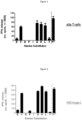
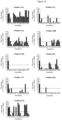
- Figure 1 shows IFN ⁇ production by a3a transduced T cells in response to native (wt) MAGE A3 peptide and each alanine-substituted peptide.
- Five of the alanine-substituted peptides resulted in a greater than 50 % decrease in IFN ⁇ production compared to native MAGE A3 peptide.
- the corresponding native residue at each of these five positions comprises the binding motif.
- the binding motif is defined as EXDPIXXXY, where X is any amino acid.
- ELISpot assays were carried out as described in section (1.1a), except effector cells were prepared from peripheral blood mononuclear cells (PBMCs) blood using standard procedures utilising Lymphoprep (Axis-Shields, cat# NYC-1114547) and Leucosep tubes (Greiner, cat# 227290), and plated at 25,000 cells per well. IMCmage1 was added to a final concentration of 0.1 nM per well. Controls were carried out in the absence of IMCmage1 (effectors + targets + peptide); and in the absence of peptide-pulsed target cells (effectors + IMCmage1).
- PBMCs peripheral blood mononuclear cells
- Figure 2 shows IFN ⁇ production by IMCmage1 redirected T cells in response to native (wt) MAGE A3 peptide and each alanine-substituted peptide.
- Five of the alanine-substituted peptides resulted in a greater than 50 % decrease in IFN ⁇ production compared to native MAGE A3.
- the corresponding native residue at each of these five positions comprises the binding motif.
- the binding motif is defined as EXDPIXXXY, where X is any amino acid.
- MAGE A3 peptide contains one native glycine residue; in this case the native glycine was considered nonessential for the purposes of defining the motif.
- Figure 3 shows IFN ⁇ production by IMCmage1 redirected T cells in response to native (wt) MAGE A3 peptide and each glycine-substituted peptide.
- Five of the glycine-substituted peptides resulted in a greater than 50 % decrease in IFN ⁇ production compared to native MAGE A3.
- the corresponding native residue at each of these five positions comprises the binding motif.
- the binding motif is defined as EXDPIXXXY, where X is any amino acid.
- the ScanProsite tool http://prosite.expasy.org/scanprosite was used to search all UniProtKB/Swiss-Prot (release 2012_10 of 31-Oct-12: 538259 entries) database sequences, for proteins which contain the motif identified above (entered as E-X-D-P-I-X-X-X-Y). No filters were used. Pattern options were set to allow at most 1 X sequence characters to match a conserved position in the pattern and the match mode was set to 'greedy, overlaps, no includes'.
- the search results also identified a number of motif-containing peptides from common human pathogens. Two peptides were selected from the list as examples for further testing; a nuclease protein present in three strains of Epstein Barr Virus (EBV), and a ribosomal maturation factor from Clostridium difficile, the amino acid sequences of these peptides are shown below.
- Protein accesion number
- Sequence EBV protein Q1HVE7) (P03217) (Q3KSR5)
- E F D P I Y P S Y C. difficile protein Q18BH3
- Activation of a3a T cells was determined by IFN ⁇ ELISpot assay using the same procedure as described in section 1.1a.
- HLA-A*01+ hepatocyte cells were used as targets and pulsed with 10 ⁇ M of each peptide.
- T cells were prepared from peripheral blood lymphocytes (PBLs) obtained from a healthy donor, and transduced with the a3a TCR. Non-transduced donor T cells were used as a negative control. T cell activation in response to cells pulsed with each of the motif-containing peptides was compared to activation by native MAGE A3 peptide pulsed cells.
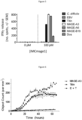
- FIG. 4 shows that cells pulsed with MAGE A3, MAGE A6, MAGE B18 and Titin peptides led to activation of a3a T cells.
- Peptide pulsed cells were prepared as described in 1.3a. Activation of IMCmage1 redirected T cells was determined by IFN ⁇ ELISpot assay using the same procedure as described in section 1.1b.
- FIG. 5 shows that cells pulsed with MAGE A3, MAGE A6, MAGE B18 and Titin peptides led to activation of IMCmage1 redirected T cells.
- Affinity was determined by surface plasmon resonance using a BIAcore 3000 instrument and reported in terms of an equilibrium dissociation constant (K D ).
- Soluble versions of the a3a and IMCmage1 TCRs were prepared using the method described in Boulter, et al., Protein Eng, 2003. 16: 707-711 .
- Biotinylated specific and control pMHC monomers were prepared as described in Garboczi, et al. Proc Natl Acad Sci U S A 1992. 89: 3429-3433 and O'Callaghan, et al., Anal Biochem 1999. 266: 9-15 , and immobilized on to a streptavidincoupled CM-5 sensor chips.
- Killing assays were carried out using the IncuCyte FLR-Platform (Essen Biosciences). Flat bottomed 96 well plates were used for assay.
- the assay medium was RPMI (w/o phenol red + 10% FCS +1% Pen/strep + 1% Glu).
- HLA-A*01+ hepatocyte cells were plated at 10,000 cells per well and incubated overnight to allow them to adhere.
- Peptides were made up at 10 ⁇ M final concentration and added at 25 ⁇ l (60 ⁇ M) per well.
- Effector T cells (prepared as described in 1.1b) were thawed from liquid N2, counted and plated at 100,000/well. IMCmage1 was added to a final concentration of 1 nM.
- Control measurements were carried out in the absence of IMCmage1 (effectors + targets). Images were taken every 2 h, over a three day period, and the number of apoptotic cells per mm 2 was quantified using the CellPlayer 96-well Kinetic Caspase 3/7 reagent and the IncuCyte FLR-Platform. The reagent is cleaved by activated Caspase 3/7 upon target cell apoptosis resulting in the release of the dye and green fluorescent staining of nuclear DNA.
- Figure 6 shows IMCmage1 redirected T cells kill cells pulsed with Titin peptide to a similar degree as native MAGE A3.
- iCell cardiomyocytes were obtained from Cellular Dynamics International. iCell cardiomyocytes are highly purified human cardiomyocytes derived from induced pluripotent stem (iPS) cells and are electrically active with typical mechanical characteristics of cardiac tissue. These cells are positive for Titin and negative for MAGE A3 as determined by standard RT-PCR methods.
- iPS induced pluripotent stem
- iCell cardiomyocytes were revived from liquid nitrogen and plated at 50,000 cells per well four days prior to the assay and treated as per the manufacturer's instructions.
- the iCell cardiomyocytes were virally transduced with HLA-A*01. EJM and colo205 (positive and negative controls respectively) were plated at 50,000 cells per well on the day of assay.
- iCell cardiomyocytes were washed once with R10 (RPMI + 10% FCS +1% Pen/strep + 1% Glu) and then incubated in R10 for the assay.
- a3a transduced T cells and corresponding non-transduced cells were taken from culture and plated at 50,000 cells per well.
- the cells were cultured for 24 h and then centrifuged at 800 xg for 4 min, 100 ul of supernatant was then removed and placed in a clean plate.
- the plates were stored at -70 °C until thawing and developing to measure multiple cytokine release (IFNy, GM-CSF and MIP-1 ⁇ ) by Luminex (25-plex kit), in accordance with manufacturer's instructions.
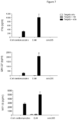
- Figure 7 shows a3a T cells release IFNy, GM-CSF and MIP-1 ⁇ in response to iCell cardiomyocytes.
- the BLAST search returned over 100 hits, including MAGE A3, MAGE A6, and MAGE B18, but not Titin.
- 15 sequences were selected for testing using peptide pulsed targets (HLA-A ⁇ 01+ hepatocyte cells) and IFN ⁇ ELISpot assays as described in Example 1 (section 1.1a and 1.1b).
- the peptide sequences are detailed in Figure 9 . None of these peptides was able to activate a3a T cells or IMCmage1 redirected T cells.
- HLA-A*01+ human cells from various tissues were screened for their ability to induce activation of a3a T cells and IMCmage1 redirected T cells. T cell activation was assessed by IFN ⁇ release using an ELISpot assay as described in Example 1 (section 1.1a and 1.1b). Multiple lots were used for most primary cell types. Cells were grown in 2D culture.
- Results showed no obvious reactivity for IMCmage1 and a3a transduced T cells. Since expression of MAGE family proteins is restricted to male germ line cells cross reactivity with MAGE A6 and MAGE B18 is not detected. However, despite Titin being expressed in cardiac and skeletal muscle, this experiment failed to detect cross reactivity with skeletal and muscle cells. Since titin expression is known to be upregulated in differentiated tissue ( Van der Loop, et al. (1996). J Muscle Res Cell Motil. 17:23-36 ) detecting cross reactivity required more specialised cell cultures (such as the iCells shown above).
- T cell activation was assessed using HLA-A*01+ hepatocyte cells pulsed with MAGE A3, human Titin or mouse Titin peptides. T cell activation was determined by IFN ⁇ ELISpot assay as described above. Synthetic peptides were obtained from Peptide Protein Research Limited, UK.
- Figure 10 shows IFN ⁇ release in response to HLA-A*01+ hepatocyte cells pulsed with MAGE A3 and human Titin; no IFN ⁇ was detected when cells were pulsed with the equivalent Titin peptide from mouse. Therefore, a mouse model would not have identified Titin as an off target peptide leading to unwanted side effects when administered to a patient.
- the target MHC-presented peptide used in this example is derived from human cancer testis antigen NY-ESO-1 and has the following amino acid sequence; SLLMWITQC.
- NY-ESO-1 peptide is presented on antigen presenting cells in the context of HLA-A*02.
- the binding peptide used in this example comprises a modified T cell receptor (TCR) fusion protein which has been engineered to possess enhanced affinity for NY-ESO-1 peptide, and is termed ImmTAC-NYESO in this example.
- TCR modified T cell receptor
- Variants of the native NY-ESO-1 peptide were obtained in which each amino acid position was sequentially replaced with alanine, as shown below (in each case the alanine substitution is underlined).
- Peptides were obtained from Peptide Protein Research Limited, UK.
- the native and alanine-substituted peptides were pulsed on to antigen presenting cells, and interferon ⁇ (IFN ⁇ ) production, as measured using the ELISpot assay, used as a read-out for T cell activation.
- Essential positions were defined by a greater than 50% reduction in T cell activity relative to the native peptide.
- ELISpot assays were carried as described in Example 1 section 1.1b except that HLA-A2+ T2 cells were used as target cells and effector PBMCs were plated at 40,000 cell per well. ImmTAC-NYESO was added to a final concentration of 0.1 nM per well.
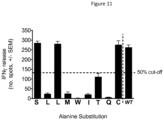
- Figure 11 shows IFN ⁇ production by ImmTAC-NYESO redirected T cells in response to native (wt) NY-ESO-1 peptide and each alanine-substituted peptide.
- Five of the alanine-substituted peptides resulted in a greater than 50 % decrease in IFN ⁇ production compared to native NY-ESO-1 peptide.
- the corresponding native residue at each of these five positions comprises the binding motif.
- the binding motif is defined as XLXMWITQX, where X is any amino acid.
- the ScanProsite tool http://prosite.expasy.org/scanprosite was used to search the UniProtKB/Swiss-Prot database (release date 13 th Nov 2013) for proteins which contain the motif identified above (entered as X L X M W I T Q X). The search was limited to human sequences.
- NY-ESO-1 accession no: P78358
- LAGE-1A accession no: O75638-2
- TCRs that bind to the NY-ESO-1 peptide are known to recognise cancer cells expressing LAGE-A1 ( McCormack et al, 2013, Cancer Immunol Immunother, 62 (4):773-85 ).
- Variants of the native NY-ESO peptide were obtained in which the amino acid residue at each position was sequentially replaced with all 19 alternative naturally-occurring amino acid, such that 171 peptides were prepared in total.
- the native and amino-acid substituted peptides were pulsed on to antigen presenting cells, and interferon ⁇ (IFN ⁇ ) production, as measured using the ELISpot assay, used as a read-out for T cell activation.
- Essential positions were defined by a greater than 50% reduction in T cell activity relative to the native peptide.
- ELISpot assays were carried as described in section 2.1a.
- Figure 12 shows IFN ⁇ production by ImmTAC-NYESO redirected T cells in response to native (wt) NY-ESO-1 peptide and each amino-acid-substituted peptide.
- the tolerated residues at each position of the peptide are shown below. For each position the first tolerated residue shown corresponds to the native (WT) residue at that position.
- the ScanProsite tool was used as described in section 2.2, to search for proteins containing the tolerated residues at the indicated positions (entered as [SVTYMFAGHNQKPRWLI]-[LI]-[LVAMICQNH]-[MQVTN]-W-[ITLMS]-[TSD]-[QG]-[CLVMSTGAI])
- Peptides from Plexin-D1 and protein 5B1 are tested in vitro as described in Example 1.3, to confirm recognition by ImmTAC-NYESO.
- the potential of these off-targets peptides to cause unwanted side effects in vivo is determined by, for example, reference to literature sources detailing expression of Plexin-D1 and protein 5B1 in normal tissue. Where expression in normal tissue is widespread, or in critical tissues, binding of ImmTAC-NYESO may be additionally be confirmed in vitro using cells which express the off target peptide.
- mouse model may not identify potential cross reactivity.
Landscapes
- Health & Medical Sciences (AREA)
- Life Sciences & Earth Sciences (AREA)
- Engineering & Computer Science (AREA)
- Chemical & Material Sciences (AREA)
- Immunology (AREA)
- Molecular Biology (AREA)
- Physics & Mathematics (AREA)
- Biomedical Technology (AREA)
- General Health & Medical Sciences (AREA)
- Urology & Nephrology (AREA)
- Hematology (AREA)
- Cell Biology (AREA)
- Biochemistry (AREA)
- Biotechnology (AREA)
- Bioinformatics & Cheminformatics (AREA)
- Medicinal Chemistry (AREA)
- Theoretical Computer Science (AREA)
- Bioinformatics & Computational Biology (AREA)
- Library & Information Science (AREA)
- Food Science & Technology (AREA)
- Analytical Chemistry (AREA)
- General Physics & Mathematics (AREA)
- Microbiology (AREA)
- Pathology (AREA)
- Biophysics (AREA)
- Medical Informatics (AREA)
- Spectroscopy & Molecular Physics (AREA)
- Evolutionary Biology (AREA)
- Proteomics, Peptides & Aminoacids (AREA)
- Toxicology (AREA)
- Tropical Medicine & Parasitology (AREA)
- Crystallography & Structural Chemistry (AREA)
- Computing Systems (AREA)
- Peptides Or Proteins (AREA)
- Medicines That Contain Protein Lipid Enzymes And Other Medicines (AREA)
Claims (5)
- Verfahren zur Vorhersage, ob ein immuntherapeutischer TCR das Potential für eine In-vivo-Kreuzreaktion mit einem weiteren Peptid in dem Individuum besitzt, um von Off-Target-Spezifitäten abgeleitete unerwünschte Nebenwirkungen in dem Individuum hervorzurufen, wobei der TCR an ein von einem MHC (Major Histocompatibility Complex) präsentiertes Zielpeptid bindet und zur Verabreichung an ein Individuum vorgesehen ist;
wobei das Verfahren Folgendes umfasst:(a) Identifizieren wenigstens eines Bindungsmotivs in dem Zielpeptid, an das der TCR bindet;(b) Suchen nach Peptiden, die bei dem Individuum vorliegen, die das wenigstens eine Bindungsmotiv umfassen und bei denen es sich nicht um das Zielpeptid handelt; und(c) Testen der Bindung eines solchen Peptids an den TCR in vitro,(d) wobei das Vorliegen eines oder mehrerer solcher Peptide, die an den TCR binden, anzeigt, dass der TCR das Potential für eine In-vivo-Kreuzreaktion sowie zum Verursachen unerwünschter Nebenwirkungen besitzt;wobei das wenigstens eine Bindungsmotiv identifiziert wird durch:(i) Erzeugen einer Reihe von Mutanten des Zielpeptids, wobei bei den Mutanten jeweils der Aminosäurerest an einer Position in der Bindungssequenz davon, die an der Bindung des TCR beteiligt ist, durch Alanin oder Glycin substituiert wird, so dass über die Reihe von Mutanten der Aminosäurerest in jeder Position in der Bindungssequenz durch Alanin oder Glycin substituiert ist; undTesten jeder Mutante in der Reihe auf ihre Aktivität relativ zum Wildtyp-Zielpeptid,wobei ein Aminosäurerest an einer Position innerhalb der Bindungssequenz als Teil des Bindungsmotivs identifiziert wird, falls die Mutante, bei der die Aminosäure an dieser Position zu Alanin oder Glycin mutiert ist, einen Aktivitätsverlust von 50 % oder höher relativ zum Wildtyp-Zielpeptid aufweist, oder(ii) Erzeugen einer Reihe von Mutanten, wobei bei den Mutanten jeweils der Aminosäurerest an einer Position in der Bindungssequenz durch eine alternative Aminosäure substituiert wird, so dass über die Reihe von Mutanten der Aminosäurerest in jeder Position in der Bindungssequenz durch alle alternativen Aminosäuren substituiert ist; undTesten jeder Mutante in der Reihe auf ihre Aktivität relativ zum Wildtyp-Peptid,wobei Aminosäuresubstitutionen, die zu einem Aktivitätsverlust von 50 % oder höher relativ zum Wildtyp-Zielpeptid führen, als nicht tolerierte Aminosäuren und nicht Teil des Bindungsmotivs betrachtet werden und/oder Aminosäuresubstitutionen, die nicht zu einem Aktivitätsverlust von 50 % oder höher relativ zum Wildtyp-Zielpeptid führen, als Teil des Bindungsmotivs betrachtet werden. - Verfahren nach Anspruch 1(i), ferner umfassend, wo ein Aminosäurerest an einer Position in der Bindungssequenz nicht als Teil des Bindungsmotivs identifiziert wird, Substituieren dieser Position mit wenigstens einer zusätzlichen Aminosäure und Testen auf Aktivität relativ zum Wildtyp-Peptid,
wobei Aminosäuresubstitutionen, die zu einem Aktivitätsverlust von 50 % oder höher relativ zum Wildtyp-Zielpeptid führen, als nicht tolerierte Aminosäuren und nicht Teil des Bindungsmotivs betrachtet werden und/oder Aminosäuresubstitutionen, die nicht zu einem Aktivitätsverlust von 50 % oder höher relativ zum Wildtyp-Zielpeptid führen, als Teil des Bindungsmotivs betrachtet werden. - Verfahren nach einem vorhergehenden Anspruch, wobei es sich bei der Aktivität, die getestet wird, um die Fähigkeit der Mutante, an den TCR zu binden, handelt.
- Verfahren nach einem vorhergehenden Anspruch, wobei es sich bei dem Individuum um einen Menschen handelt und die Suche nach Peptiden durchgeführt wird, die menschlichen Ursprungs sind oder aus Organismen stammen, die gewöhnlich in Menschen vorhanden sind.
- Verfahren nach einem vorhergehenden Anspruch, wobei die Suche nach Peptiden durchgeführt wird, die in ausgewähltem bzw. ausgewählten Gewebe(n) exprimiert werden und/oder dem TCR zugänglich sind.
Priority Applications (1)
| Application Number | Priority Date | Filing Date | Title |
|---|---|---|---|
| EP23179362.1A EP4297036A3 (de) | 2012-12-21 | 2013-12-17 | Verfahren zur vorhersage der off-target-bindung eines peptids an ein zielpeptid, dargestellt durch einen haupthistokompatibilitätskomplex |
Applications Claiming Priority (3)
| Application Number | Priority Date | Filing Date | Title |
|---|---|---|---|
| GBGB1223172.6A GB201223172D0 (en) | 2012-12-21 | 2012-12-21 | Method |
| PCT/GB2013/053320 WO2014096803A1 (en) | 2012-12-21 | 2013-12-17 | Method for predicting the off-target biding of a peptide which binds to a target peptide presented by a major histocompatibility complex |
| EP13811256.0A EP2936158B1 (de) | 2012-12-21 | 2013-12-17 | Methode zur vorhersage von off-target-bindung eines peptids, das ein vom mhc komplex präsentiertes zielpeptid bindet |
Related Parent Applications (2)
| Application Number | Title | Priority Date | Filing Date |
|---|---|---|---|
| EP13811256.0A Division-Into EP2936158B1 (de) | 2012-12-21 | 2013-12-17 | Methode zur vorhersage von off-target-bindung eines peptids, das ein vom mhc komplex präsentiertes zielpeptid bindet |
| EP13811256.0A Division EP2936158B1 (de) | 2012-12-21 | 2013-12-17 | Methode zur vorhersage von off-target-bindung eines peptids, das ein vom mhc komplex präsentiertes zielpeptid bindet |
Related Child Applications (2)
| Application Number | Title | Priority Date | Filing Date |
|---|---|---|---|
| EP23179362.1A Division EP4297036A3 (de) | 2012-12-21 | 2013-12-17 | Verfahren zur vorhersage der off-target-bindung eines peptids an ein zielpeptid, dargestellt durch einen haupthistokompatibilitätskomplex |
| EP23179362.1A Division-Into EP4297036A3 (de) | 2012-12-21 | 2013-12-17 | Verfahren zur vorhersage der off-target-bindung eines peptids an ein zielpeptid, dargestellt durch einen haupthistokompatibilitätskomplex |
Publications (2)
| Publication Number | Publication Date |
|---|---|
| EP3373013A1 EP3373013A1 (de) | 2018-09-12 |
| EP3373013B1 true EP3373013B1 (de) | 2023-07-19 |
Family
ID=47682402
Family Applications (3)
| Application Number | Title | Priority Date | Filing Date |
|---|---|---|---|
| EP13811256.0A Revoked EP2936158B1 (de) | 2012-12-21 | 2013-12-17 | Methode zur vorhersage von off-target-bindung eines peptids, das ein vom mhc komplex präsentiertes zielpeptid bindet |
| EP23179362.1A Pending EP4297036A3 (de) | 2012-12-21 | 2013-12-17 | Verfahren zur vorhersage der off-target-bindung eines peptids an ein zielpeptid, dargestellt durch einen haupthistokompatibilitätskomplex |
| EP18162980.9A Active EP3373013B1 (de) | 2012-12-21 | 2013-12-17 | Verfahren zur vorhersage der off-target-bindung eines peptids an ein zielpeptid, dargestellt durch einen haupthistokompatibilitätskomplex |
Family Applications Before (2)
| Application Number | Title | Priority Date | Filing Date |
|---|---|---|---|
| EP13811256.0A Revoked EP2936158B1 (de) | 2012-12-21 | 2013-12-17 | Methode zur vorhersage von off-target-bindung eines peptids, das ein vom mhc komplex präsentiertes zielpeptid bindet |
| EP23179362.1A Pending EP4297036A3 (de) | 2012-12-21 | 2013-12-17 | Verfahren zur vorhersage der off-target-bindung eines peptids an ein zielpeptid, dargestellt durch einen haupthistokompatibilitätskomplex |
Country Status (5)
| Country | Link |
|---|---|
| US (3) | US11017882B2 (de) |
| EP (3) | EP2936158B1 (de) |
| ES (2) | ES2718302T3 (de) |
| GB (1) | GB201223172D0 (de) |
| WO (1) | WO2014096803A1 (de) |
Cited By (1)
| Publication number | Priority date | Publication date | Assignee | Title |
|---|---|---|---|---|
| EP4297036A2 (de) | 2012-12-21 | 2023-12-27 | Immunocore Limited | Verfahren zur vorhersage der off-target-bindung eines peptids an ein zielpeptid, dargestellt durch einen haupthistokompatibilitätskomplex |
Families Citing this family (25)
| Publication number | Priority date | Publication date | Assignee | Title |
|---|---|---|---|---|
| NL2014935B1 (en) | 2015-06-08 | 2017-02-03 | Applied Immune Tech Ltd | T cell receptor like antibodies having fine specificity. |
| GB201604953D0 (en) | 2016-03-23 | 2016-05-04 | Immunocore Ltd | T cell receptors |
| DK3440105T3 (da) | 2016-04-08 | 2022-06-13 | Immunocore Ltd | T-cellereceptorer |
| MA46354A (fr) | 2016-10-03 | 2019-08-07 | Juno Therapeutics Inc | Molécules se liant spécifiquement au vph |
| CN111032076A (zh) | 2017-06-14 | 2020-04-17 | 阿迪塞特生物公司 | 能够以hla限制性方式结合hla-a2/tyrd的抗体及其用途 |
| GB201709866D0 (en) | 2017-06-20 | 2017-08-02 | Immunocore Ltd | T cell receptors |
| US11952408B2 (en) | 2017-10-03 | 2024-04-09 | Juno Therapeutics, Inc. | HPV-specific binding molecules |
| TWI840351B (zh) | 2018-04-05 | 2024-05-01 | 美商奇諾治療有限公司 | T細胞受體及表現其之工程化細胞 |
| GB201904328D0 (en) | 2019-03-28 | 2019-05-15 | Immunocore Ltd | Specific binding molecules |
| PH12021553042A1 (en) * | 2019-06-06 | 2023-09-11 | Immatics Biotechnologies Gmbh | Sorting with counter selection using sequence similar peptides |
| GB201915282D0 (en) | 2019-10-22 | 2019-12-04 | Immunocore Ltd | Specific binding molecules |
| GB202006629D0 (en) | 2020-05-05 | 2020-06-17 | Immunocore Ltd | Specific binding molecules |
| MX2022014636A (es) | 2020-05-19 | 2023-02-23 | Amgen Inc | Construcciones de unión a mageb2. |
| GB202010329D0 (en) | 2020-07-06 | 2020-08-19 | Immunocore Ltd | Specific binding molecules |
| WO2023099622A1 (en) | 2021-12-01 | 2023-06-08 | Immunocore Limited | Treatment |
| WO2023099606A1 (en) | 2021-12-01 | 2023-06-08 | Immunocore Limited | Treatment of mage-a4 positive cancer |
| WO2023156663A1 (en) | 2022-02-20 | 2023-08-24 | Immunocore Limited | Hiv-specific binding molecules and tcr |
| WO2024033332A1 (en) | 2022-08-08 | 2024-02-15 | Immatics Biotechnologies Gmbh | Guided positional scanning method |
| US20240092859A1 (en) | 2022-08-18 | 2024-03-21 | Immunocore Ltd | T cell receptors and fusion proteins thereof |
| EP4379726A1 (de) | 2022-12-02 | 2024-06-05 | Ardigen S.A. | Verfahren zur vorhersage des auftretens der off-target-toxizität infolge einer ähnlichkeit zwischen einem zielepitop und putativen off-target-epitopen |
| TW202434640A (zh) | 2023-01-06 | 2024-09-01 | 英商英美偌科有限公司 | 結合分子 |
| EP4646268A1 (de) | 2023-01-06 | 2025-11-12 | Immunocore Limited | Bindungsmoleküle gegen einen piwil1-peptid-hla-komplex |
| GB202306345D0 (en) | 2023-04-28 | 2023-06-14 | Immunocore Ltd | Binding molecules |
| GB202315181D0 (en) | 2023-10-03 | 2023-11-15 | Immunocore Ltd | Peptide-HLA binding molecules |
| US12367329B1 (en) * | 2024-06-06 | 2025-07-22 | EvolutionaryScale, PBC | Protein binder search |
Citations (2)
| Publication number | Priority date | Publication date | Assignee | Title |
|---|---|---|---|---|
| WO2003020763A2 (en) * | 2001-08-31 | 2003-03-13 | Avidex Limited | Soluble t cell receptor |
| WO2004044004A2 (en) * | 2002-11-09 | 2004-05-27 | Avidex Limited | T cell receptor display |
Family Cites Families (16)
| Publication number | Priority date | Publication date | Assignee | Title |
|---|---|---|---|---|
| GB8308235D0 (en) | 1983-03-25 | 1983-05-05 | Celltech Ltd | Polypeptides |
| US4816567A (en) | 1983-04-08 | 1989-03-28 | Genentech, Inc. | Recombinant immunoglobin preparations |
| JPS61134325A (ja) | 1984-12-04 | 1986-06-21 | Teijin Ltd | ハイブリツド抗体遺伝子の発現方法 |
| US5225539A (en) | 1986-03-27 | 1993-07-06 | Medical Research Council | Recombinant altered antibodies and methods of making altered antibodies |
| GB8607679D0 (en) | 1986-03-27 | 1986-04-30 | Winter G P | Recombinant dna product |
| EP0617706B1 (de) | 1991-11-25 | 2001-10-17 | Enzon, Inc. | Multivalente antigen-bindende proteine |
| DE69329974T2 (de) | 1992-12-04 | 2001-07-19 | Medical Research Council, London | Multivalente und multispezifische bindungsproteine, deren herstellung und verwendung |
| NZ507886A (en) | 1998-05-19 | 2003-05-30 | Avidex Ltd | Multivalent T cell receptor complexes |
| CA2398816A1 (en) * | 2000-02-04 | 2001-08-09 | Duke University | Human immunodeficiency virus vaccine |
| EP1549748B1 (de) | 2002-10-09 | 2014-10-01 | Immunocore Ltd. | Einkettige rekombinante t-zell rezeptoren |
| GB0908613D0 (en) | 2009-05-20 | 2009-06-24 | Immunocore Ltd | T Cell Reseptors |
| WO2011161127A1 (en) * | 2010-06-21 | 2011-12-29 | Medimmune, Llc | Protease variants of human neprilysin |
| EP2598528A1 (de) | 2010-07-28 | 2013-06-05 | Immunocore Ltd. | T-zell-rezeptoren |
| MX2015000979A (es) * | 2012-07-27 | 2015-11-23 | Univ Illinois | Ingenieria de receptores de celulas t. |
| GB201223172D0 (en) | 2012-12-21 | 2013-02-06 | Immunocore Ltd | Method |
| US9209965B2 (en) | 2014-01-14 | 2015-12-08 | Microsemi Semiconductor Ulc | Network interface with clock recovery module on line card |
-
2012
- 2012-12-21 GB GBGB1223172.6A patent/GB201223172D0/en not_active Ceased
-
2013
- 2013-12-17 WO PCT/GB2013/053320 patent/WO2014096803A1/en not_active Ceased
- 2013-12-17 EP EP13811256.0A patent/EP2936158B1/de not_active Revoked
- 2013-12-17 ES ES13811256T patent/ES2718302T3/es active Active
- 2013-12-17 ES ES18162980T patent/ES2959752T3/es active Active
- 2013-12-17 EP EP23179362.1A patent/EP4297036A3/de active Pending
- 2013-12-17 EP EP18162980.9A patent/EP3373013B1/de active Active
-
2015
- 2015-06-17 US US14/741,828 patent/US11017882B2/en active Active
-
2021
- 2021-01-26 US US17/158,940 patent/US11929151B2/en active Active
-
2024
- 2024-02-05 US US18/433,344 patent/US20240312566A1/en active Pending
Patent Citations (2)
| Publication number | Priority date | Publication date | Assignee | Title |
|---|---|---|---|---|
| WO2003020763A2 (en) * | 2001-08-31 | 2003-03-13 | Avidex Limited | Soluble t cell receptor |
| WO2004044004A2 (en) * | 2002-11-09 | 2004-05-27 | Avidex Limited | T cell receptor display |
Non-Patent Citations (33)
| Title |
|---|
| "Combinatorial Chemistry on Solid Supports. Topics in Current Chemistry, vol 278.", 2 February 2007, SPRINGER , Berlin, Heidelberg , ISBN: 978-3-540-72509-1, article MICHAEL HAACK, BECK-SICKINGER A.G.: "Multiple Peptide Synthesis to Identify Bioactive Hormone Structures", pages: 243 - 288, XP055705484, DOI: 10.1007/128_2006_106 |
| AKSHATA UDYAVAR, ALLI RAJSHEKHAR, NGUYEN PHUONG, BAKER LESLEY, GEIGER TERRENCE L.: "Subtle Affinity-Enhancing Mutations in a Myelin Oligodendrocyte Glycoprotein-Specific TCR Alter Specificity and Generate New Self-Reactivity", NIH PUBLIC ACCESS AUTHOR MANUSCRIPT, vol. 182, no. 7, 1 April 2009 (2009-04-01), pages 1 - 19, XP055654495, DOI: 10.4049/jimmunol.0804377 |
| BERT MAIER; MARC MOLINGER; ANDREW P. COPE; LARS FUGGER; JENS SCHNEIDER‐MERGENER; GRETE SØNDERSTRUP; THOMAS KAMRADT; ACHIM KRAMER: "Multiple cross‐reactive self‐ligands for Borrelia burgdorferi‐specific HLA‐DR4‐restricted T cells", EUROPEAN JOURNAL OF IMMUNOLOGY, WILEY-VCH, HOBOKEN, USA, vol. 30, no. 2, 31 August 2000 (2000-08-31), Hoboken, USA, pages 448 - 457, XP071220911, ISSN: 0014-2980, DOI: 10.1002/1521-4141(200002)30:2<448::AID-IMMU448>3.0.CO;2-9 |
| DAHAN RONY ET AL: "T-cell-receptor-like antibodies - generation, function and applications.", EXPERT REVIEWS IN MOLECULAR MEDICINE 24 FEB 2012, vol. 14, 24 February 2012 (2012-02-24), pages e6, ISSN: 1462-3994 * |
| GALINA PETROVA ET AL: "Cross-Reactivity of T Cells and Its Role in the Immune System", NIH PUBLIC ACCESS AUTHOR MANUSCRIPT, vol. 32, no. 4, 1 January 2012 (2012-01-01), pages 349 - 372, XP055578532, DOI: 10.1615/CritRevImmunol.v32.i4.50 |
| GROGAN JANE L., KRAMER ACHIM, NOGAI AXEL, DONG LIYING, OHDE MANUELA, SCHNEIDER-MERGENER JENS, KAMRADT THOMAS: "Cross-Reactivity of Myelin Basic Protein-Specific T Cells with Multiple Microbial Peptides: Experimental Autoimmune Encephalomyelitis Induction in TCR Transgenic Mice", THE JOURNAL OF IMMUNOLOGY, WILLIAMS & WILKINS CO., US, vol. 163, no. 7, 1 October 1999 (1999-10-01), US , pages 3764 - 3770, XP093189570, ISSN: 0022-1767, DOI: 10.4049/jimmunol.163.7.3764 |
| HAUSMANN STEFAN, BIDDISON WILLIAM E, SMITH KATHRINE J, DING YUAN-HUA, GARBOCZI DAVID N, UTZ URSULA, WILEY DON C, WUCHERPFENNIG2 KA: "Peptide Recognition by Two HLA-A2/TaXii_i9~Specific T Cell Clones in Relationship to Their MHC/Peptide/TCR Crystal Structures", THE JOURNAL OF IMMUNOLOGY, WILLIAMS & WILKINS CO., US, vol. 162, no. 9, 1 May 1999 (1999-05-01), US , pages 5389 - 5397, XP093189567, ISSN: 0022-1767 |
| HELENA M. BIJEN, DIRK M. VAN DER STEEN, RENATE S. HAGEDOORN, ANNE K. WOUTERS, LINDA WOOLDRIDGE, J.H. FREDERIK FALKENBURG, MIRJAM H: "Preclinical Strategies to Identify Off-Target Toxicity of High-Affinity TCRs", MOLECULAR THERAPY, ELSEVIER INC., US, vol. 26, no. 5, 1 May 2018 (2018-05-01), US , pages 1206 - 1214, XP055654816, ISSN: 1525-0016, DOI: 10.1016/j.ymthe.2018.02.017 |
| H�YDAHL LENE ST�KKEN ET AL: "Targeting the MHC Ligandome by Use of TCR-Like Antibodies.", ANTIBODIES (BASEL, SWITZERLAND) 09 MAY 2019, vol. 8, no. 2, 9 May 2019 (2019-05-09), ISSN: 2073-4468 * |
| ISABEL K. MACDONALD ET AL: "MHC Class I Bound to an Immunodominant Theileria parva Epitope Demonstrates Unconventional Presentation to T Cell Receptors", PLOS PATHOGENS, vol. 6, no. 10, 14 October 2010 (2010-10-14), pages 1 - 11, XP055578560, DOI: 10.1371/journal.ppat.1001149 |
| J. K. LEE: "T Cell Cross-Reactivity and Conformational Changes during TCR Engagement", JOURNAL OF EXPERIMENTAL MEDICINE, ROCKEFELLER UNIVERSITY PRESS, vol. 200, no. 11, 6 December 2004 (2004-12-06), pages 1455 - 1466, XP055108653, ISSN: 00221007, DOI: 10.1084/jem.20041251 |
| J. K. LEE: "T Cell Cross-Reactivity and Conformational Changes during TCR Engagement", JOURNAL OF EXPERIMENTAL MEDICINE, vol. 200, no. 11, 6 December 2004 (2004-12-06), pages 1455 - 1466, XP055108653, ISSN: 0022-1007, DOI: 10.1084/jem.20041251 * |
| JANE L GROGAN ET AL: "Cross-Reactivity of Myelin Basic Protein-Specific T Cells with Multiple Microbial Peptides: Experimental Autoimmune Encephalomyelitis Induction in TCR Transgenic Mice", THE JOURNAL OF IMMUNOLOGY, 1 October 1999 (1999-10-01), United States, pages 3764 - 3770, XP055654579, Retrieved from the Internet <URL:https://www.jimmunol.org/content/jimmunol/163/7/3764.full.pdf> [retrieved on 20191220] * |
| KINNUNEN NULL: "The immunodominant epitope of lipocalin allergen Bos d 2 is suboptimal for human T cells", EUR.J IMMUNOL, 2003 |
| LEVITSKY VICTOR, DE CAMPOS-LIMA PEDRO-OTAVIO, FRISAN TERESA, MASUCCI MARIA G.: "The Clonal Composition of a Peptide-Specific Oligoclonal CTL Repertoire Selected in Response to Persistent EBV Infection Is Stable Over Time", THE JOURNAL OF IMMUNOLOGY, WILLIAMS & WILKINS CO., US, vol. 161, no. 2, 15 July 1998 (1998-07-15), US , pages 594 - 601, XP093189560, ISSN: 0022-1767, DOI: 10.4049/jimmunol.161.2.594 |
| LIANG XIAOLING: "Functional characterization of allorestricted T cell receptors (TCRs)with specificity for HER2/neu and FMNL1 in vitro and in vivo for potential clinical application", DISSERTATION, TECHNISCHE UNIVERSITÄT MÜNCHEN, 1 January 2011 (2011-01-01), Technische Universität München, XP093189587, Retrieved from the Internet <URL:https://mediatum.ub.tum.de/doc/1079457/1079457.pdf> |
| MAIER B ET AL: "MULTIPLE CROSS-REACTIVE SELF-LIGANDS FOR BORRELIA BURGDORFERI-SPECIFIC HLA-DR4-RESTRICTED T CELLS", EUROPEAN JOURNAL OF IMMUNOLOGY, WILEY VCH, WEINHEIM, vol. 30, no. 2, 1 January 2000 (2000-01-01), pages 448 - 457, XP001029420, ISSN: 0014-2980, DOI: 10.1002/1521-4141(200002)30:2<448::AID-IMMU448>3.3.CO;2-0 * |
| MAIER B, ET AL.: "MULTIPLE CROSS-REACTIVE SELF-LIGANDS FOR BORRELIA BURGDORFERI-SPECIFIC HLA-DR4-RESTRICTED T CELLS", EUROPEAN JOURNAL OF IMMUNOLOGY, WILEY-VCH, HOBOKEN, USA, vol. 30, no. 02, 1 January 2000 (2000-01-01), Hoboken, USA, pages 448 - 457, XP001029420, ISSN: 0014-2980, DOI: 10.1002/1521-4141(200002)30:2<448::AID-IMMU448>3.3.CO;2-0 |
| MARTIN ROLAND ET AL: "Molecular Mimicry and Antigen-Specific T Cell Responses in Multiple Sclerosis and Chronic CNS Lyme Disease", JOURNAL OF AUTOIMMUNITY, LONDON, GB, vol. 16, no. 3, 1 May 2001 (2001-05-01), GB , pages 187 - 192, XP093189824, ISSN: 0896-8411, DOI: 10.1006/jaut.2000.0501 |
| MAYNARD JENNIFER, PETERSSON KARIN, WILSON DIANNE H., ADAMS ERIN J., BLONDELLE SYLVIE E., BOULANGER MARTY J., WILSON DARCY B., GARC: "Structure of an Autoimmune T Cell Receptor Complexed with Class II Peptide-MHC", IMMUNITY, CELL PRESS, AMSTERDAM, NL, vol. 22, no. 1, 1 January 2005 (2005-01-01), AMSTERDAM, NL , pages 81 - 92, XP093189597, ISSN: 1074-7613, DOI: 10.1016/j.immuni.2004.11.015 |
| NICHOLAS P. RESTIFO ET AL: "Adoptive immunotherapy for cancer: harnessing the T cell response", NATURE REVIEWS IMMUNOLOGY, NATURE PUB. GROUP, vol. 12, no. 4, 1 April 2012 (2012-04-01), pages 269 - 281, XP055034896, ISSN: 14741733, DOI: 10.1038/nri3191 |
| PINILLA C. ET AL: "Exploring immunological specificity using synthetic peptide combinatorial libraries", CURRENT OPINION IN IMMUNOLOGY, ELSEVIER, OXFORD., GB, vol. 11, no. 2, 1 April 1999 (1999-04-01), GB , pages 193 - 202, XP004257523, ISSN: 0952-7915, DOI: 10.1016/S0952-7915(99)80033-8 |
| RYAN L. HARD ET AL: "HDAC6 and Ubp-M BUZ Domains Recognize Specific C-Terminal Sequences of Proteins", NIH PUBLIC ACCESS AUTHOR MANUSCRIPT, vol. 49, no. 50, 21 December 2010 (2010-12-21), pages 1 - 19, XP055654582, DOI: 10.1021/bi101014s * |
| SEWELL ANDREW K.: "Why must T cells be cross-reactive? ", NATURE REVIEWS | IMMUNOLOGY, vol. 12, 1 September 2012 (2012-09-01), pages 669 - 677, XP093189831 |
| THOMAS LINNEMANN ET AL: "Mimotopes for tumor-specific T lymphocytes in human cancer determined with combinatorial peptide libraries", EUROPEAN JOURNAL OF IMMUNOLOGY, WILEY-VCH, HOBOKEN, USA, vol. 31, no. 1, 14 December 2000 (2000-12-14), pages 156 - 165, XP071221366, ISSN: 0014-2980, DOI: 10.1002/1521-4141(200101)31:1<156::AID-IMMU156>3.0.CO;2-P * |
| TUURE KINNUNEN ET AL: "The immunodominant epitope of lipocalin allergen Bos d 2 is suboptimal for human T cells", EUROPEAN JOURNAL OF IMMUNOLOGY, WILEY‐VCH VERLAG, WEINHEIM, 1 June 2003 (2003-06-01), Weinheim , pages 1717 - 1726, XP055654595, DOI: 10.1002/eji.200322952 |
| TUURE KINNUNEN ET AL: "The immunodominant epitope of lipocalin allergen Bos?d?2 is suboptimal for human T cells", EUROPEAN JOURNAL OF IMMUNOLOGY, 1 June 2003 (2003-06-01), Weinheim, pages 1717 - 1726, XP055654595, Retrieved from the Internet <URL:https://onlinelibrary.wiley.com/doi/full/10.1002/eji.200322952> [retrieved on 20211103], DOI: https://doi.org/10.1002/eji.200322952 * |
| WALDEN PETER: "T-cell epitope determination", CURRENT OPINION IN IMMUNOLOGY, ELSEVIER, OXFORD., GB, vol. 8, no. 1, 1 February 1996 (1996-02-01), GB , pages 68 - 74, XP093189856, ISSN: 0952-7915, DOI: 10.1016/S0952-7915(96)80107-5 |
| WILSON D. ET AL: "Specificity and degeneracy of T cells", MOLECULAR IMMUNOLOGY, PERGAMON, GB, vol. 40, 1 February 2004 (2004-02-01), GB , pages 1047 - 1055, XP093189820, ISSN: 0161-5890, DOI: 10.1016/j.molimm.2003.11.022 |
| WUCHERPFENNIG K. W., STROMINGER J. L.: "MOLECULAR MIMICRY IN T CELL-MEDIATED AUTOIMMUNITY: VIRAL PEPTIDES ACTIVATE HUMAN T CELL CLONES SPECIFIC FOR MYELIN BASIC PROTEIN.", CELL, ELSEVIER, AMSTERDAM NL, vol. 80., no. 05., 10 March 1995 (1995-03-10), Amsterdam NL , pages 695 - 705., XP000652360, ISSN: 0092-8674, DOI: 10.1016/0092-8674(95)90348-8 |
| X. LIANG, L. U. WEIGAND, I. G. SCHUSTER, E. EPPINGER, J. C. VAN DER GRIENDT, A. SCHUB, M. LEISEGANG, D. SOMMERMEYER, F. ANDERL, Y.: "A Single TCR -Chain with Dominant Peptide Recognition in the Allorestricted HER2/neu-Specific T Cell Repertoire", THE JOURNAL OF IMMUNOLOGY, AMERICAN ASSOCIATION OF IMMUNOLOGISTS, vol. 184, no. 3, 1 February 2010 (2010-02-01), pages 1617 - 1629, XP055065447, ISSN: 00221767, DOI: 10.4049/jimmunol.0902155 |
| Y. UEMURA ET AL: "Systematic Analysis of the Combinatorial Nature of Epitopes Recognized by TCR Leads to Identification of Mimicry Epitopes for Glutamic Acid Decarboxylase 65-Specific TCRs", THE JOURNAL OF IMMUNOLOGY, vol. 170, no. 2, 15 January 2003 (2003-01-15), US, pages 947 - 960, XP055578553, ISSN: 0022-1767, DOI: 10.4049/jimmunol.170.2.947 * |
| Y. UEMURA, S. SENJU, K. MAENAKA, L. K. IWAI, S. FUJII, H. TABATA, H. TSUKAMOTO, S. HIRATA, Y.-Z. CHEN, Y. NISHIMURA: "Systematic Analysis of the Combinatorial Nature of Epitopes Recognized by TCR Leads to Identification of Mimicry Epitopes for Glutamic Acid Decarboxylase 65-Specific TCRs", THE JOURNAL OF IMMUNOLOGY, WILLIAMS & WILKINS CO., US, vol. 170, no. 2, 15 January 2003 (2003-01-15), US , pages 947 - 960, XP055578553, ISSN: 0022-1767, DOI: 10.4049/jimmunol.170.2.947 |
Cited By (1)
| Publication number | Priority date | Publication date | Assignee | Title |
|---|---|---|---|---|
| EP4297036A2 (de) | 2012-12-21 | 2023-12-27 | Immunocore Limited | Verfahren zur vorhersage der off-target-bindung eines peptids an ein zielpeptid, dargestellt durch einen haupthistokompatibilitätskomplex |
Also Published As
| Publication number | Publication date |
|---|---|
| EP2936158A1 (de) | 2015-10-28 |
| GB201223172D0 (en) | 2013-02-06 |
| EP2936158B1 (de) | 2019-02-13 |
| WO2014096803A1 (en) | 2014-06-26 |
| ES2959752T3 (es) | 2024-02-28 |
| US11929151B2 (en) | 2024-03-12 |
| ES2718302T3 (es) | 2019-07-01 |
| EP4297036A2 (de) | 2023-12-27 |
| EP4297036A3 (de) | 2024-04-10 |
| US20210241854A1 (en) | 2021-08-05 |
| US20240312566A1 (en) | 2024-09-19 |
| EP3373013A1 (de) | 2018-09-12 |
| US20150284877A1 (en) | 2015-10-08 |
| US11017882B2 (en) | 2021-05-25 |
Similar Documents
| Publication | Publication Date | Title |
|---|---|---|
| EP3373013B1 (de) | Verfahren zur vorhersage der off-target-bindung eines peptids an ein zielpeptid, dargestellt durch einen haupthistokompatibilitätskomplex | |
| Engelhard et al. | MHC-restricted phosphopeptide antigens: preclinical validation and first-in-humans clinical trial in participants with high-risk melanoma | |
| Wang et al. | CD47/SIRPα blocking peptide identification and synergistic effect with irradiation for cancer immunotherapy | |
| Inderberg-Suso et al. | Widespread CD4+ T-cell reactivity to novel hTERT epitopes following vaccination of cancer patients with a single hTERT peptide GV1001 | |
| US20220025328A1 (en) | Inhibition of cytokine-induced sh2 protein in nk cells | |
| Stone et al. | Role of T cell receptor affinity in the efficacy and specificity of adoptive T cell therapies | |
| JP2021521776A (ja) | Mage−b2特異性を有するt細胞受容体およびその使用 | |
| CA2558371C (en) | Methods of modulating immune responses by modulating tim-1 and tim-4 function | |
| JP7760374B2 (ja) | T細胞治療薬を生成するためのエクスビボ方法ならびに関連する組成物および方法 | |
| Repáraz et al. | Neoantigens as potential vaccines in hepatocellular carcinoma | |
| MD3551664T2 (ro) | Anticorpi și polipeptide direcționate împotriva CD 127 | |
| KR20220122639A (ko) | 조절제를 이용한 종양 반응성 t 세포 조성물의 제조 방법 | |
| Clancy-Thompson et al. | IAP antagonists enhance cytokine production from mouse and human iNKT cells | |
| Ascione et al. | Development of a novel human phage display-derived anti-LAG3 scFv antibody targeting CD8+ T lymphocyte exhaustion | |
| Clancy-Thompson et al. | Altered binding of tumor antigenic peptides to MHC class I affects CD8+ T cell–effector responses | |
| AU2021286403A1 (en) | Target peptides for cancer therapy and diagnostics | |
| Liu et al. | Discovery of anti-PD-L1 human domain antibodies for cancer immunotherapy | |
| HK40104783A (en) | Method for predicting the off-target binding of a peptide which binds to a target peptide presented by a major histocompatibility complex | |
| US20250269000A1 (en) | Anti-tumour responses to cytokeratins | |
| KR20230004666A (ko) | 암 백신으로서의 시트룰린화된 뉴클레오포스민 펩티드 | |
| Repáraz-Pernaut et al. | Neoantigens as potential vaccines in hepatocellular carcinoma |
Legal Events
| Date | Code | Title | Description |
|---|---|---|---|
| PUAI | Public reference made under article 153(3) epc to a published international application that has entered the european phase |
Free format text: ORIGINAL CODE: 0009012 |
|
| STAA | Information on the status of an ep patent application or granted ep patent |
Free format text: STATUS: THE APPLICATION HAS BEEN PUBLISHED |
|
| AC | Divisional application: reference to earlier application |
Ref document number: 2936158 Country of ref document: EP Kind code of ref document: P |
|
| AK | Designated contracting states |
Kind code of ref document: A1 Designated state(s): AL AT BE BG CH CY CZ DE DK EE ES FI FR GB GR HR HU IE IS IT LI LT LU LV MC MK MT NL NO PL PT RO RS SE SI SK SM TR |
|
| STAA | Information on the status of an ep patent application or granted ep patent |
Free format text: STATUS: REQUEST FOR EXAMINATION WAS MADE |
|
| 17P | Request for examination filed |
Effective date: 20190307 |
|
| RBV | Designated contracting states (corrected) |
Designated state(s): AL AT BE BG CH CY CZ DE DK EE ES FI FR GB GR HR HU IE IS IT LI LT LU LV MC MK MT NL NO PL PT RO RS SE SI SK SM TR |
|
| STAA | Information on the status of an ep patent application or granted ep patent |
Free format text: STATUS: EXAMINATION IS IN PROGRESS |
|
| 17Q | First examination report despatched |
Effective date: 20200204 |
|
| TPAC | Observations filed by third parties |
Free format text: ORIGINAL CODE: EPIDOSNTIPA |
|
| TPAC | Observations filed by third parties |
Free format text: ORIGINAL CODE: EPIDOSNTIPA |
|
| RAP3 | Party data changed (applicant data changed or rights of an application transferred) |
Owner name: ADAPTIMMUNE LIMITED Owner name: IMMUNOCORE LIMITED |
|
| GRAP | Despatch of communication of intention to grant a patent |
Free format text: ORIGINAL CODE: EPIDOSNIGR1 |
|
| STAA | Information on the status of an ep patent application or granted ep patent |
Free format text: STATUS: GRANT OF PATENT IS INTENDED |
|
| RIC1 | Information provided on ipc code assigned before grant |
Ipc: G16B 35/20 20190101ALI20230109BHEP Ipc: G16B 35/00 20190101ALI20230109BHEP Ipc: C07K 14/725 19950101ALI20230109BHEP Ipc: G01N 33/50 19800101ALI20230109BHEP Ipc: G01N 33/68 19800101AFI20230109BHEP |
|
| INTG | Intention to grant announced |
Effective date: 20230131 |
|
| TPAC | Observations filed by third parties |
Free format text: ORIGINAL CODE: EPIDOSNTIPA |
|
| GRAS | Grant fee paid |
Free format text: ORIGINAL CODE: EPIDOSNIGR3 |
|
| P01 | Opt-out of the competence of the unified patent court (upc) registered |
Effective date: 20230427 |
|
| GRAA | (expected) grant |
Free format text: ORIGINAL CODE: 0009210 |
|
| STAA | Information on the status of an ep patent application or granted ep patent |
Free format text: STATUS: THE PATENT HAS BEEN GRANTED |
|
| AC | Divisional application: reference to earlier application |
Ref document number: 2936158 Country of ref document: EP Kind code of ref document: P |
|
| AK | Designated contracting states |
Kind code of ref document: B1 Designated state(s): AL AT BE BG CH CY CZ DE DK EE ES FI FR GB GR HR HU IE IS IT LI LT LU LV MC MK MT NL NO PL PT RO RS SE SI SK SM TR |
|
| REG | Reference to a national code |
Ref country code: GB Ref legal event code: FG4D |
|
| REG | Reference to a national code |
Ref country code: CH Ref legal event code: EP |
|
| REG | Reference to a national code |
Ref country code: DE Ref legal event code: R096 Ref document number: 602013084282 Country of ref document: DE |
|
| REG | Reference to a national code |
Ref country code: IE Ref legal event code: FG4D |
|
| REG | Reference to a national code |
Ref country code: LT Ref legal event code: MG9D |
|
| REG | Reference to a national code |
Ref country code: NL Ref legal event code: MP Effective date: 20230719 |
|
| REG | Reference to a national code |
Ref country code: AT Ref legal event code: MK05 Ref document number: 1589963 Country of ref document: AT Kind code of ref document: T Effective date: 20230719 |
|
| PG25 | Lapsed in a contracting state [announced via postgrant information from national office to epo] |
Ref country code: NL Free format text: LAPSE BECAUSE OF FAILURE TO SUBMIT A TRANSLATION OF THE DESCRIPTION OR TO PAY THE FEE WITHIN THE PRESCRIBED TIME-LIMIT Effective date: 20230719 |
|
| PG25 | Lapsed in a contracting state [announced via postgrant information from national office to epo] |
Ref country code: GR Free format text: LAPSE BECAUSE OF FAILURE TO SUBMIT A TRANSLATION OF THE DESCRIPTION OR TO PAY THE FEE WITHIN THE PRESCRIBED TIME-LIMIT Effective date: 20231020 |
|
| PG25 | Lapsed in a contracting state [announced via postgrant information from national office to epo] |
Ref country code: IS Free format text: LAPSE BECAUSE OF FAILURE TO SUBMIT A TRANSLATION OF THE DESCRIPTION OR TO PAY THE FEE WITHIN THE PRESCRIBED TIME-LIMIT Effective date: 20231119 |
|
| PG25 | Lapsed in a contracting state [announced via postgrant information from national office to epo] |
Ref country code: SE Free format text: LAPSE BECAUSE OF FAILURE TO SUBMIT A TRANSLATION OF THE DESCRIPTION OR TO PAY THE FEE WITHIN THE PRESCRIBED TIME-LIMIT Effective date: 20230719 Ref country code: RS Free format text: LAPSE BECAUSE OF FAILURE TO SUBMIT A TRANSLATION OF THE DESCRIPTION OR TO PAY THE FEE WITHIN THE PRESCRIBED TIME-LIMIT Effective date: 20230719 Ref country code: PT Free format text: LAPSE BECAUSE OF FAILURE TO SUBMIT A TRANSLATION OF THE DESCRIPTION OR TO PAY THE FEE WITHIN THE PRESCRIBED TIME-LIMIT Effective date: 20231120 Ref country code: NO Free format text: LAPSE BECAUSE OF FAILURE TO SUBMIT A TRANSLATION OF THE DESCRIPTION OR TO PAY THE FEE WITHIN THE PRESCRIBED TIME-LIMIT Effective date: 20231019 Ref country code: LV Free format text: LAPSE BECAUSE OF FAILURE TO SUBMIT A TRANSLATION OF THE DESCRIPTION OR TO PAY THE FEE WITHIN THE PRESCRIBED TIME-LIMIT Effective date: 20230719 Ref country code: LT Free format text: LAPSE BECAUSE OF FAILURE TO SUBMIT A TRANSLATION OF THE DESCRIPTION OR TO PAY THE FEE WITHIN THE PRESCRIBED TIME-LIMIT Effective date: 20230719 Ref country code: IS Free format text: LAPSE BECAUSE OF FAILURE TO SUBMIT A TRANSLATION OF THE DESCRIPTION OR TO PAY THE FEE WITHIN THE PRESCRIBED TIME-LIMIT Effective date: 20231119 Ref country code: HR Free format text: LAPSE BECAUSE OF FAILURE TO SUBMIT A TRANSLATION OF THE DESCRIPTION OR TO PAY THE FEE WITHIN THE PRESCRIBED TIME-LIMIT Effective date: 20230719 Ref country code: GR Free format text: LAPSE BECAUSE OF FAILURE TO SUBMIT A TRANSLATION OF THE DESCRIPTION OR TO PAY THE FEE WITHIN THE PRESCRIBED TIME-LIMIT Effective date: 20231020 Ref country code: FI Free format text: LAPSE BECAUSE OF FAILURE TO SUBMIT A TRANSLATION OF THE DESCRIPTION OR TO PAY THE FEE WITHIN THE PRESCRIBED TIME-LIMIT Effective date: 20230719 Ref country code: AT Free format text: LAPSE BECAUSE OF FAILURE TO SUBMIT A TRANSLATION OF THE DESCRIPTION OR TO PAY THE FEE WITHIN THE PRESCRIBED TIME-LIMIT Effective date: 20230719 |
|
| REG | Reference to a national code |
Ref country code: ES Ref legal event code: FG2A Ref document number: 2959752 Country of ref document: ES Kind code of ref document: T3 Effective date: 20240228 |
|
| PG25 | Lapsed in a contracting state [announced via postgrant information from national office to epo] |
Ref country code: PL Free format text: LAPSE BECAUSE OF FAILURE TO SUBMIT A TRANSLATION OF THE DESCRIPTION OR TO PAY THE FEE WITHIN THE PRESCRIBED TIME-LIMIT Effective date: 20230719 |
|
| REG | Reference to a national code |
Ref country code: DE Ref legal event code: R026 Ref document number: 602013084282 Country of ref document: DE |
|
| PLBI | Opposition filed |
Free format text: ORIGINAL CODE: 0009260 |
|
| PLAB | Opposition data, opponent's data or that of the opponent's representative modified |
Free format text: ORIGINAL CODE: 0009299OPPO |
|
| PLBI | Opposition filed |
Free format text: ORIGINAL CODE: 0009260 |
|
| PG25 | Lapsed in a contracting state [announced via postgrant information from national office to epo] |
Ref country code: SM Free format text: LAPSE BECAUSE OF FAILURE TO SUBMIT A TRANSLATION OF THE DESCRIPTION OR TO PAY THE FEE WITHIN THE PRESCRIBED TIME-LIMIT Effective date: 20230719 Ref country code: RO Free format text: LAPSE BECAUSE OF FAILURE TO SUBMIT A TRANSLATION OF THE DESCRIPTION OR TO PAY THE FEE WITHIN THE PRESCRIBED TIME-LIMIT Effective date: 20230719 Ref country code: EE Free format text: LAPSE BECAUSE OF FAILURE TO SUBMIT A TRANSLATION OF THE DESCRIPTION OR TO PAY THE FEE WITHIN THE PRESCRIBED TIME-LIMIT Effective date: 20230719 Ref country code: DK Free format text: LAPSE BECAUSE OF FAILURE TO SUBMIT A TRANSLATION OF THE DESCRIPTION OR TO PAY THE FEE WITHIN THE PRESCRIBED TIME-LIMIT Effective date: 20230719 Ref country code: CZ Free format text: LAPSE BECAUSE OF FAILURE TO SUBMIT A TRANSLATION OF THE DESCRIPTION OR TO PAY THE FEE WITHIN THE PRESCRIBED TIME-LIMIT Effective date: 20230719 Ref country code: SK Free format text: LAPSE BECAUSE OF FAILURE TO SUBMIT A TRANSLATION OF THE DESCRIPTION OR TO PAY THE FEE WITHIN THE PRESCRIBED TIME-LIMIT Effective date: 20230719 |
|
| PLAX | Notice of opposition and request to file observation + time limit sent |
Free format text: ORIGINAL CODE: EPIDOSNOBS2 |
|
| 26 | Opposition filed |
Opponent name: PAGE, RICHARD Effective date: 20240418 |
|
| 26 | Opposition filed |
Opponent name: STRAWMAN LIMITED Effective date: 20240419 Opponent name: GRAF VON STOSCH PATENTANWALTSGESELLSCHAFT MBH Effective date: 20240418 |
|
| R26 | Opposition filed (corrected) |
Opponent name: PAGE, RICHARD Effective date: 20240418 |
|
| PG25 | Lapsed in a contracting state [announced via postgrant information from national office to epo] |
Ref country code: IT Free format text: LAPSE BECAUSE OF FAILURE TO SUBMIT A TRANSLATION OF THE DESCRIPTION OR TO PAY THE FEE WITHIN THE PRESCRIBED TIME-LIMIT Effective date: 20230719 |
|
| PLAF | Information modified related to communication of a notice of opposition and request to file observations + time limit |
Free format text: ORIGINAL CODE: EPIDOSCOBS2 |
|
| PG25 | Lapsed in a contracting state [announced via postgrant information from national office to epo] |
Ref country code: SI Free format text: LAPSE BECAUSE OF FAILURE TO SUBMIT A TRANSLATION OF THE DESCRIPTION OR TO PAY THE FEE WITHIN THE PRESCRIBED TIME-LIMIT Effective date: 20230719 |
|
| PG25 | Lapsed in a contracting state [announced via postgrant information from national office to epo] |
Ref country code: LU Free format text: LAPSE BECAUSE OF NON-PAYMENT OF DUE FEES Effective date: 20231217 |
|
| PG25 | Lapsed in a contracting state [announced via postgrant information from national office to epo] |
Ref country code: MC Free format text: LAPSE BECAUSE OF FAILURE TO SUBMIT A TRANSLATION OF THE DESCRIPTION OR TO PAY THE FEE WITHIN THE PRESCRIBED TIME-LIMIT Effective date: 20230719 |
|
| REG | Reference to a national code |
Ref country code: BE Ref legal event code: MM Effective date: 20231231 |
|
| PG25 | Lapsed in a contracting state [announced via postgrant information from national office to epo] |
Ref country code: MC Free format text: LAPSE BECAUSE OF FAILURE TO SUBMIT A TRANSLATION OF THE DESCRIPTION OR TO PAY THE FEE WITHIN THE PRESCRIBED TIME-LIMIT Effective date: 20230719 Ref country code: LU Free format text: LAPSE BECAUSE OF NON-PAYMENT OF DUE FEES Effective date: 20231217 |
|
| PG25 | Lapsed in a contracting state [announced via postgrant information from national office to epo] |
Ref country code: BE Free format text: LAPSE BECAUSE OF NON-PAYMENT OF DUE FEES Effective date: 20231231 |
|
| PG25 | Lapsed in a contracting state [announced via postgrant information from national office to epo] |
Ref country code: BE Free format text: LAPSE BECAUSE OF NON-PAYMENT OF DUE FEES Effective date: 20231231 |
|
| PLBB | Reply of patent proprietor to notice(s) of opposition received |
Free format text: ORIGINAL CODE: EPIDOSNOBS3 |
|
| PG25 | Lapsed in a contracting state [announced via postgrant information from national office to epo] |
Ref country code: BG Free format text: LAPSE BECAUSE OF FAILURE TO SUBMIT A TRANSLATION OF THE DESCRIPTION OR TO PAY THE FEE WITHIN THE PRESCRIBED TIME-LIMIT Effective date: 20230719 |
|
| PG25 | Lapsed in a contracting state [announced via postgrant information from national office to epo] |
Ref country code: BG Free format text: LAPSE BECAUSE OF FAILURE TO SUBMIT A TRANSLATION OF THE DESCRIPTION OR TO PAY THE FEE WITHIN THE PRESCRIBED TIME-LIMIT Effective date: 20230719 |
|
| PGFP | Annual fee paid to national office [announced via postgrant information from national office to epo] |
Ref country code: DE Payment date: 20241216 Year of fee payment: 12 |
|
| PGFP | Annual fee paid to national office [announced via postgrant information from national office to epo] |
Ref country code: GB Payment date: 20241211 Year of fee payment: 12 |
|
| PGFP | Annual fee paid to national office [announced via postgrant information from national office to epo] |
Ref country code: FR Payment date: 20241219 Year of fee payment: 12 |
|
| PGFP | Annual fee paid to national office [announced via postgrant information from national office to epo] |
Ref country code: IE Payment date: 20241212 Year of fee payment: 12 |
|
| PGFP | Annual fee paid to national office [announced via postgrant information from national office to epo] |
Ref country code: ES Payment date: 20250117 Year of fee payment: 12 |
|
| PGFP | Annual fee paid to national office [announced via postgrant information from national office to epo] |
Ref country code: CH Payment date: 20250101 Year of fee payment: 12 |
|
| PLBP | Opposition withdrawn |
Free format text: ORIGINAL CODE: 0009264 |
|
| PG25 | Lapsed in a contracting state [announced via postgrant information from national office to epo] |
Ref country code: CY Free format text: LAPSE BECAUSE OF FAILURE TO SUBMIT A TRANSLATION OF THE DESCRIPTION OR TO PAY THE FEE WITHIN THE PRESCRIBED TIME-LIMIT; INVALID AB INITIO Effective date: 20131217 |
|
| PG25 | Lapsed in a contracting state [announced via postgrant information from national office to epo] |
Ref country code: HU Free format text: LAPSE BECAUSE OF FAILURE TO SUBMIT A TRANSLATION OF THE DESCRIPTION OR TO PAY THE FEE WITHIN THE PRESCRIBED TIME-LIMIT; INVALID AB INITIO Effective date: 20131217 |
|
| PLBP | Opposition withdrawn |
Free format text: ORIGINAL CODE: 0009264 |
|
| PLCK | Communication despatched that opposition was rejected |
Free format text: ORIGINAL CODE: EPIDOSNREJ1 |
|
| PG25 | Lapsed in a contracting state [announced via postgrant information from national office to epo] |
Ref country code: TR Free format text: LAPSE BECAUSE OF FAILURE TO SUBMIT A TRANSLATION OF THE DESCRIPTION OR TO PAY THE FEE WITHIN THE PRESCRIBED TIME-LIMIT Effective date: 20230719 |
|
| REG | Reference to a national code |
Ref country code: CH Ref legal event code: U11 Free format text: ST27 STATUS EVENT CODE: U-0-0-U10-U11 (AS PROVIDED BY THE NATIONAL OFFICE) Effective date: 20260101 |