EP3365462B1 - Nachweis bakterieller infektionen - Google Patents
Nachweis bakterieller infektionen Download PDFInfo
- Publication number
- EP3365462B1 EP3365462B1 EP16787529.3A EP16787529A EP3365462B1 EP 3365462 B1 EP3365462 B1 EP 3365462B1 EP 16787529 A EP16787529 A EP 16787529A EP 3365462 B1 EP3365462 B1 EP 3365462B1
- Authority
- EP
- European Patent Office
- Prior art keywords
- subject
- bacterial infection
- bacterial
- gene
- elane
- Prior art date
- Legal status (The legal status is an assumption and is not a legal conclusion. Google has not performed a legal analysis and makes no representation as to the accuracy of the status listed.)
- Active
Links
Images


Classifications
-
- C—CHEMISTRY; METALLURGY
- C12—BIOCHEMISTRY; BEER; SPIRITS; WINE; VINEGAR; MICROBIOLOGY; ENZYMOLOGY; MUTATION OR GENETIC ENGINEERING
- C12Q—MEASURING OR TESTING PROCESSES INVOLVING ENZYMES, NUCLEIC ACIDS OR MICROORGANISMS; COMPOSITIONS OR TEST PAPERS THEREFOR; PROCESSES OF PREPARING SUCH COMPOSITIONS; CONDITION-RESPONSIVE CONTROL IN MICROBIOLOGICAL OR ENZYMOLOGICAL PROCESSES
- C12Q1/00—Measuring or testing processes involving enzymes, nucleic acids or microorganisms; Compositions therefor; Processes of preparing such compositions
- C12Q1/68—Measuring or testing processes involving enzymes, nucleic acids or microorganisms; Compositions therefor; Processes of preparing such compositions involving nucleic acids
- C12Q1/6876—Nucleic acid products used in the analysis of nucleic acids, e.g. primers or probes
- C12Q1/6888—Nucleic acid products used in the analysis of nucleic acids, e.g. primers or probes for detection or identification of organisms
- C12Q1/689—Nucleic acid products used in the analysis of nucleic acids, e.g. primers or probes for detection or identification of organisms for bacteria
-
- C—CHEMISTRY; METALLURGY
- C12—BIOCHEMISTRY; BEER; SPIRITS; WINE; VINEGAR; MICROBIOLOGY; ENZYMOLOGY; MUTATION OR GENETIC ENGINEERING
- C12Q—MEASURING OR TESTING PROCESSES INVOLVING ENZYMES, NUCLEIC ACIDS OR MICROORGANISMS; COMPOSITIONS OR TEST PAPERS THEREFOR; PROCESSES OF PREPARING SUCH COMPOSITIONS; CONDITION-RESPONSIVE CONTROL IN MICROBIOLOGICAL OR ENZYMOLOGICAL PROCESSES
- C12Q1/00—Measuring or testing processes involving enzymes, nucleic acids or microorganisms; Compositions therefor; Processes of preparing such compositions
- C12Q1/68—Measuring or testing processes involving enzymes, nucleic acids or microorganisms; Compositions therefor; Processes of preparing such compositions involving nucleic acids
- C12Q1/6876—Nucleic acid products used in the analysis of nucleic acids, e.g. primers or probes
- C12Q1/6883—Nucleic acid products used in the analysis of nucleic acids, e.g. primers or probes for diseases caused by alterations of genetic material
-
- C—CHEMISTRY; METALLURGY
- C12—BIOCHEMISTRY; BEER; SPIRITS; WINE; VINEGAR; MICROBIOLOGY; ENZYMOLOGY; MUTATION OR GENETIC ENGINEERING
- C12Q—MEASURING OR TESTING PROCESSES INVOLVING ENZYMES, NUCLEIC ACIDS OR MICROORGANISMS; COMPOSITIONS OR TEST PAPERS THEREFOR; PROCESSES OF PREPARING SUCH COMPOSITIONS; CONDITION-RESPONSIVE CONTROL IN MICROBIOLOGICAL OR ENZYMOLOGICAL PROCESSES
- C12Q2600/00—Oligonucleotides characterized by their use
- C12Q2600/158—Expression markers
Definitions
- the present invention relates to methods of detecting a bacterial infection of the blood stream or central nervous system, such as bacterial meningitis.
- the invention provides the medical use of antibacterial agents in the treatment of a bacterial infection of the blood stream or central nervous system, such as bacterial meningitis, in a subject identified as having such a bacterial infection through use of a method of the invention.
- Bacterial infection remains a significant cause of morbidity and mortality in UK and worldwide. Bacterial infection can involve body compartments, such as the brain, lungs, gut. The infection can also involve the whole body.
- Bacterial infection of the brain known clinically as meningo-encephalitis or meningitis (because of associated inflammation of the brain and/or membranes [meninges] that cover the brain), is a catastrophic infection linked with high rates of death or disability
- Bacterial meningitis requires emergency treatment with antibiotics and other adjunctive therapies. It is a significant cause of morbidity and mortality in the UK and worldwide .
- the health economic costs of bacterial meningitis are disproportionately large because many patients are left with neurological disability; the costs to society of a single case can be as high as £3-5M (Meningitis Research Foundation data).
- LP lumbar puncture
- CSF cerebrospinal fluid
- the LP is not performed when needed: for some, because the patient is too critically ill, with acute seizures or coma; for others LP is delayed whilst brain scans are performed, or because of a lack of trained staff. Consequently, clinicians can start antibiotics which may later prove unnecessary, or delay starting antibiotics until all investigations are done. Delays in diagnosis or in starting anti-microbial therapy can lead to a worse patient outcome including increased mortality.
- the invention provides a method of detecting a bacterial infection of the blood stream or central nervous system in a subject, the method comprising:
- a method in accordance with the first aspect of the invention may comprise obtaining data indicative of the relative abundance ratio of target molecules in respect of each of the gene pairs in the group consisting of: ELANE and IFI44L; CTSG and IFI44L; ELANE and S1PR5; and CTSG and S1PR5; GRK6 and TXLNA; DUSP1 and IFI44L; APMAP and KMT2A ; DUSP1 and HP1BP3; APMAP and HUWE1; or DUSP1 and NMT1.
- a method in accordance with the first aspect of the invention in which a bacterial infection is detected in the subject, further comprises conducting a further confirmatory test for the bacterial infection in the subject.
- the invention provides a method in accordance with the first aspect of the invention, wherein the bacterial infection of the central nervous system is caused by bacteria selected from the group consisting of: Streptococcus pneumoniae, Neisseria meningitidis, Haemophilus influenzae; Streptococcus agalactiae; Listeria monocytogenes; Escherichia coli; Mycobacterium tuberculosis; and Staphylococcus aureus.
- bacteria selected from the group consisting of: Streptococcus pneumoniae, Neisseria meningitidis, Haemophilus influenzae; Streptococcus agalactiae; Listeria monocytogenes; Escherichia coli; Mycobacterium tuberculosis; and Staphylococcus aureus.
- the invention provides a method in accordance with the first aspect of the invention, wherein the target molecule is an mRNA target molecule, and wherein the assay is selected from the group consisting of: RT-PCR, real-time PCR, Northern blot, RNA sequencing (RNA-seq) and RNA microarray.
- the assay is selected from the group consisting of: RT-PCR, real-time PCR, Northern blot, RNA sequencing (RNA-seq) and RNA microarray.
- the invention provides a method in accordance with the first aspect of the invention, wherein the target molecule is a protein target molecule, and wherein the assay is selected from the group consisting of: ELISA, radioimmunoassay, immunoprecipitation, Western blot and mass spectrometry.
- a method wherein the subject has symptoms consistent with a bacterial infection such as bacterial meningitis, or wherein the subject lacks some or all symptoms consistent with a bacterial infection such as bacterial meningitis.
- the step of determining comprises using the data to calculate one or more functions, where the presence of a bacterial infection in the subject is determined to be present if one or more of the calculated functions satisfies a predetermined condition.
- the one or more functions includes a logical function or a linear function.
- the linear function is a linear discriminant function
- the predetermined condition is satisfied if the calculated linear discriminant function exceeds a predetermined threshold.
- the invention provides an antibacterial agent for use in the treatment of a bacterial infection of the central nervous system in a subject identified as having a bacterial infection of the central nervous system by a method in accordance with the first aspect of the invention.
- the bacterial infection is bacterial meningitis.
- a method of detecting a bacterial infection in a subject comprising:
- a method may comprise obtaining data indicative of the relative abundance of target molecules in respect of two or more gene pairs from those listed.
- a method of the first aspect of the invention may comprise obtaining data indicative of the relative abundance of target molecules in respect of three or the gene pairs listed, or of all four gene pairs listed.
- embodiments of the first aspect of the invention that obtain data indicative of the relative abundance of target molecules in respect of the four gene pairs: ELANE and IF144L; CTSG and IFI44L; ELANE and S1PR5; and CTSG and S1PR5; and determine the presence of a bacterial infection in the subject in dependence on such data represent particularly useful methods of the invention.
- Another example relates to a method of detecting a bacterial infection in a subject, the method comprising:
- a method of detecting a bacterial infection in accordance with the invention in which a bacterial infection is detected in a subject, which may further comprise a step of conducting a further confirmatory test for the bacterial infection in the subject.
- a bacterial infection is diagnosed when the results of both the first test (a method of the invention) and the second test (the confirmatory test) indicate the presence of bacterial infection.
- a sample of biological fluid such as CSF from lumbar puncture or blood from venepuncture, may be cultured in order to grow the microorganism associated with infection. This allows confirmation of bacterial infection and also allows determination of antimicrobial susceptibility of any isolated pathogen.
- the disclosure also provides an example of a method in which a bacterial infection is detected in a subject, which may further comprise a step of providing the subject with treatment for the bacterial infection.
- a method of treating a bacterial infection in a subject comprising:
- Also disclosed herein is a method of treating a bacterial infection in a subject, the method comprising:
- the treatment for a bacterial infection such as bacterial meningitis, provided in a method disclosed herein may comprise providing the subject requiring such treatment with a therapeutically effective amount of an antibacterial agent.
- Methods disclosed herein may comprise obtaining data indicative of the relative abundance of target molecules indicative of the expression further gene pairs, as long as this is in addition to obtaining data indicative of relative abundance of at least one of the gene pairs referred to in this section above.
- gene pairs particularly suitable for use in the methods disclosed herein may include at least one of: GRK6 and TXLNA; DUSP1 and IFI44L; C20ORF3 and MLL; DUSP1 and HP1BP3; ELANE and SIGLEC1; or ELANE and IFI27.
- Also disclosed herein is a method of detecting the relative abundance of target molecules in a subject suspected of having or developing a bacterial infection, the method comprising:
- the methods of the present disclosure provide simple tests that may be used in the diagnosis of bacterial infections.
- infections include, but are not limited to, bacterial meningitis.
- advantages provided in respect of bacterial meningitis are notable, and worthy of further comment at this time.
- the methods of the invention may be put into practice in the form of a blood test.
- a blood sample to detect bacterial infections of the brain, such as bacterial meningitis, provides advantages in that it avoids the need for the more invasive lumbar punctures generally used in accepted prior art techniques for the diagnosis of bacterial meningitis.
- a sample of biological fluid such as CSF from lumbar puncture or blood from venepuncture, may be cultured in order to grow the microorganism associated with infection.
- This allows confirmation of bacterial infection and also allows determination of antimicrobial susceptibility of any isolated pathogen.
- the disadvantage of culture is that it typically takes 48 hours or longer to grow a microorganism.
- the methods disclosed herein are able to provide an indication of bacterial infection 2-3 hours from sample receipt, allowing prompt initiation of antibiotics. Since the methods of the disclosure allow the prompt initiation of antibiotics, the additional combination of optional confirmatory steps need not unduly delay treatment.
- Methods of the invention may allow patients with suspected bacterial meningitis to be identified swiftly, and guide medical staff to commence appropriate treatment promptly. Furthermore, such methods allow patients without meningitis to avoid unnecessary antibiotics and be discharged from hospital quicker.
- Bacterial meningitis patients can present with a range of clinical symptoms and signs, such as headache, neck-stiffness, and dislike of bright lights (photophobia). However, some or all of these symptoms can be absent in individual subjects. As demonstrated in the Experimental Results, the methods of the invention are able to distinguish proven bacterial meningitis from 'look-a-like' conditions, such as meningism or viral meningitis that may give rise to symptoms that may otherwise be mistaken for those of bacterial meningitis.
- bacterial meningitis is diagnosed by; (i) an elevated number of white cells in the CSF and (ii) detection of bacteria (by bacterial culture or a bacteria specific nucleic acid amplification test [NAAT]).
- NAAT bacteria specific nucleic acid amplification test
- Patients with meningism often have clinically indistinguishable symptoms and signs to bacterial meningitis, but lumbar punctures conducted on such subjects demonstrate that there are none or very few white cells in the CSF ( ⁇ 4 cells/ ⁇ l).
- Patients with viral meningitis again can have clinically indistinguishable symptoms and signs to bacterial meningitis, but these cases lumbar punctures detect virus in the CSF (via viral specific NAAT).
- the methods disclosed herein allow the detection of bacterial infections, such as bacterial meningitis, even in cases where the sample is collected after the subject has received antibiotics and/or other anti-microbial treatment. This is in contrast to conventional methods for detecting bacteria, whether by culture or by NAAT, which often show poor sensitivity (fail to detect true cases of bacterial infection) when patient samples are collected after anti-microbial treatment has been initiated.
- the combinations of host biomarker gene pairs used in the methods of the invention have been deliberately selected using patient blood samples collected both before and after (up to 6 weeks) initiation of anti-microbial treatment.
- the invention offers to reduce the risk of missing true cases of bacterial meningitis among patients who have previously begun treatment with antibiotics.
- this invention offers to revolutionise, accelerate and improve diagnosis of bacterial infections, guide prompt provision of appropriate antibiotic management and enhance patient outcomes. This is of particular benefit in the case of bacterial infections of the CNS, such as bacterial meningitis.
- a "bacterial infection”, for the purposes of the present disclosure, may be taken as referring to any undesired presence and/or growth of bacteria in a subject. Such undesired presence of bacteria may have a negative effect on the host subject's health and well-being.
- bacteria infections should not be taken as encompassing the growth and/or presence of bacteria which are normally present in the subject, for example in the digestive tract of the subject, it may encompass the pathological overgrowth of such bacteria.
- Bacterial infections may be caused by the growth and/or presence of gram positive and/or gram negative bacteria.
- Bacterial infections may be caused by a wide range of bacteria.
- bacteria which are typically associated with meningo-encephalitis in human subjects may include: Streptococcus pneumoniae, Neisseria Meningitides. Haemophilus influenzae, Streptococcus agalactiae, Listeria monocytogenes, Escherichia coli and Mycobacterium tuberculosis.
- bacteria involved in human infection of the central nervous system particularly when subjects have indwelling catheters include: Staphylococcus aureus, Pseudomonas aeruginosa and Ureaplasma urealyticum.
- Bacteria involved in human infection outside the central nervous system include: Moraxella catarrhalis, Clostridium perfringens, Neisseria gonorrheae, Chlamydia trachomatis, Helicobacter pylori, Campylobacter jejuni, Salmonella enterica, Enterococcus faecalis, Clostridum difficile, Staphylococcus saprophyticus, Treponema pallidum, , Haemophilus ducreyi, Mycoplasma pneumoniae, Chlamydia pneumoniae, and Legionella pneumophila.
- the methods or medical uses disclosed herein are applicable to bacterial infection in any system, organ or area of the subject, such as but not limited to, gastrointestinal system, respiratory system, urinary system, the ocular system, the auditory system and the skin.
- bacterial infections such as sepsis (blood stream infection) and pneumonia (respiratory bacterial infection) may be detected using the methods described herein.
- the methods and medical uses disclosed herein are believed to have utility in helping to diagnose bacterial infections of prosthetic implants. These may include implants in the head or other body compartments.
- prosthetic head implant the Experimental Results demonstrate that methods of the disclosure are able to correctly distinguish bacterial infection from mechanical failure in ventriculo-peritoneal (VP) shunts, using either blood or CSF samples. It is anticipated the methods disclosed herein would work equally well using body fluid from other implants, such as CSF from external ventricular drains in the head, or synovial fluid from the joint space around prosthetic knee replacements.
- VP ventriculo-peritoneal
- the methods and uses of the invention are particularly suitable for use in connection with bacterial infections in the central nervous system, such as bacterial meningitis.
- bacterial meningitis refers to inflammation of the meninges caused by any form of bacteria.
- bacterial meningitis may be caused by bacteria selected from the group consisting of: Streptococcus pneumoniae, Neisseria Meningitides. Haemophilus influenzae, Streptococcus agalactiae, Listeria monocytogenes and Escherichia coli.
- the methods of the invention are able to distinguish between bacterial meningitis and other disorders of the meninges, including meningism and viral meningitis.
- References in the present specification to detection or diagnosis of bacterial meningitis should be construed as allowing such distinctions to be made, in keeping with the specificity and selectivity of the methods discussed further herein.
- the methods disclosed herein are methods for detecting bacterial infections in a subject.
- the term "detecting” is taken as meaning determining the presence of a bacterial infection in a subject.
- the methods of the invention may be used to detect bacterial meningitis.
- the method of the disclosure may be used to detect a bacterial infection that is associated with symptoms in a subject.
- the methods of the disclosure may also be used to detect a bacterial infection that is essentially asymptomatic.
- Such asymptomatic bacterial infections may be infections that are at a very early stage of the disease.
- one such advantage may be that target molecules indicative of expression of such genes are found at detectable levels at earlier time points than are potential markers expressed by the bacteria associated with the infection. While levels of expression of bacterial genes may be difficult to detect, especially during the early stages of bacterial infections, the expression of host genes may be readily assessed. The greater abundance of such target molecules indicative of expression of host response genes not only allows such assessments to be made at an earlier time, but may also improve the accuracy of the assessment.
- the methods of the invention are methods are particularly suitable for use in detecting bacterial meningitis in a subject.
- an additional step may optionally be practiced, to confirm the detection.
- the additional step may comprise performing a further diagnostic test for bacterial meningitis in respect of the subject. Such a further diagnostic test may be used to identify the bacterial pathogen present, or to provide information regarding the susceptibility of the bacterial pathogen to antimicrobial agents.
- the further diagnostic test may comprise a lumbar puncture.
- Bacteria collected as part of the further diagnostic test may be investigated by culturing or by NAAT as described elsewhere in the specification.
- the methods and medical uses are practiced in respect of a subject.
- the subject may be one requiring diagnosis or treatment for a bacterial infection, such as bacterial meningitis.
- the subject may be a human subject.
- the subject may be a patient undergoing medical care, or an individual requesting medical care.
- a suitable subject may be one believed to have a bacterial infection, such as bacterial meningitis.
- a suitable subject may have symptoms consistent with a bacterial infection, such as bacterial meningitis.
- the methods of the disclosure may be of use in definitively detecting or diagnosing the presence of a bacterial infection, such as bacterial meningitis.
- a suitable subject may lack some or all symptoms consistent with a bacterial infection, such as bacterial meningitis.
- such a subject may be substantially asymptomatic.
- a suitable subject in the context of the disclosure may be one believed to be at risk of developing a bacterial infection, such as bacterial meningitis.
- a subject may have been in contact with an individual suffering from a bacterial infection and consequently may be believed to be at elevated risk of developing a bacterial infection as a result of this contact.
- the ability of the methods of the disclosure to detect or diagnose a bacterial infection, such as bacterial meningitis, in a timely manner, and without the need for invasive procedures such as lumbar puncture, may be of benefit to any of the groups of subjects identified above.
- a subject who may gain benefit from the methods of the disclosure is one in whom a bacterial infection is determined to be present by the assessment and comparisons conducted as part of the methods of the first, second or sixth aspects of the invention.
- the methods of the invention make use of samples that are representative of gene expression in the subject in respect of whom the method is being practiced.
- the methods disclosed herein use samples representative of expression of host response genes involved in a subject's response to bacterial infection.
- Methods of the disclosure may make use of any sample which contains target molecules that provide a representation of such gene expression in the subject in question.
- the sample is a body fluid sample.
- suitable samples may include tissue samples, such as biopsies.
- tissue samples such as biopsies.
- a suitable sample (whether of a body fluid or tissue) may comprise biological cells from the subject that are involved in the host response to bacterial infection.
- a suitable body fluid sample may include: a blood sample (for example, a whole blood sample, a blood plasma sample, or a serum sample); or a cerebrospinal fluid (CSF) sample, or a synovial fluid sample.
- a blood sample for example, a whole blood sample, a blood plasma sample, or a serum sample
- CSF cerebrospinal fluid
- Blood samples are particularly suitable for use in the methods of the invention.
- the use of a blood sample (whether whole blood, plasma, or serum) is advantageous, since it is readily accessible. Additionally obtaining the sample is not associated with much less risk and patient discomfort than is the case for samples such as CSF.
- Samples may be processed for the enrichment of target molecules. Suitable techniques for such enrichment may be determined with reference to the nature of the sample, and of the target molecule in question. Generally, examples of suitable techniques (such as techniques for the isolation of biological cells from a sample, and the preparation of the cells to yield gene transcripts) will be well known to those skilled in the art.
- Target molecules suitable for use in the method of the disclosure are any molecules which are representative of gene expression in the subject. Such target molecules may be representative of gene expression either directly or indirectly.
- a suitable target molecule which is directly representative of gene expression may comprise an RNA transcript.
- a suitable target molecule which is indirectly representative of gene expression may comprise a protein encoded by the gene.
- a suitable target molecule may be either directly indicative of gene expression (such as an RNA transcript), or indirectly indicative of gene expression (such as a protein encoded by an expressed gene).
- a sample that is essentially acellular the use of target molecules that are indirectly indicative of gene expression may be preferred, since such target molecules (an in particular protein examples of such target molecules) may be shed into the sample, even in the absence of biological cells.
- the nature of the target molecule and therefore the nature of the sample representative of gene expression, may be chosen in order to be consistent with use in a preferred assaying system.
- the sample is assayed to determine the relative abundance of the target molecules of interest.
- techniques suitable for assaying gene expression in order to provide information regarding relative abundance will be known to the person skilled in the art.
- a suitable assay technique may be chosen with reference to the nature of the sample and the target molecules.
- gene expression can be measured directly by techniques that allow the detection and quantification of RNA target molecules, such as RT-PCR, real-time PCR, Northern blot, RNA sequencing (RNA-seq) and RNA microarray.
- RNA target molecules such as RT-PCR, real-time PCR, Northern blot, RNA sequencing (RNA-seq) and RNA microarray.
- Gene expression can be measured indirectly, by techniques that allow the detection and quantification of protein target molecules, such as ELISA, radioimmunoassay, immunoprecipitation, Western blot and mass spectrometry.
- ELISA enzyme-linked immunosorbent assay
- radioimmunoassay enzyme-mediated immunosorbent assay
- immunoprecipitation protein-specific blot assay
- Western blot protein-specific blot
- mass spectrometry Other suitable techniques for assaying proteins may be known to the person skilled in the art.
- an assay may allow the relative abundance of multiple sets of target molecules to be determined within a single reaction.
- An assay meeting such requirements may be referred to as a multiplex assay.
- a multiplex assay may allow the relative abundance of all requisite target molecules to be determined within a single reaction mixture (a "single tube” multiplex assay).
- Single tube multiplex assays may be particularly suitable for determining the relative abundance of mRNA transcript target molecules within a sample.
- the methods disclosed herein involve obtaining data indicative of the relative abundance of relevant target molecules.
- data indicative of relative abundance may be taken as encompassing any data that are capable of being used in determining the presence of a bacterial infection, such as bacterial meningitis, in a subject.
- the data provide a quantitative indication of relative abundance of expression of members of gene pairs, for example with reference to relevant target molecules.
- the methods disclosed herein involve obtaining data indicative of the relative abundance of target molecules indicative of the expression of at least one of the gene pairs referred to in the disclosure. These gene pairs are made up of first and second host response genes.
- the expression of the genes and gene pairs is investigated by assaying the sample for target molecules indicative of the expression of such host response genes, as referred to above.
- the methods disclosed herein involve obtaining data indicative of the relative abundance of target molecules indicative of the expression of at least at least one gene pair from the group consisting of: ELANE and IF144L; CTSG and IFI44L; ELANE and S1PR5; and CTSG and S1PR5.
- This group of gene pairs is set out in Table 2.
- a method of the disclosure may involve obtaining data indicative of the relative abundance of target molecules indicative of the expression of at least two, or at least three of the gene pairs set out in Table 2, and determining the presence of a bacterial infection in the subject in dependence on the data in respect of each pair for which data is obtained.
- a method of the disclosure may involve obtaining data indicative of the relative abundance of target molecules indicative of the expression of all four of the gene pairs set out in Table 2, and determining the presence of a bacterial infection in the subject in dependence on the data in respect of all four of these pairs.
- a method of the disclosure involves obtaining data indicative of the relative abundance of target molecules indicative of the expression of one, two, three, four, five, six, seven, eight, nine, ten, eleven, twelve or thirteen pairs of genes selected from the group consisting of: ELANE and IFI44L; CTSG and IFI44L; ELANE and S1PR5; CTSG and S1PR5; GRK6 and TXLNA; DUSP1 and IFI44L; APMAP and KMT2A; DUSP1 and HP1BP3; ,FLOT1 and NMT1, APMAP and HUWE1, ELANE and SIGLEC1; ELANE and IF127; and DUSP1 and NMT1.
- This group of gene pairs is set out in Table 3.
- a method disclosed herein may involve obtaining data indicative of the relative abundance of target molecules indicative of the expression of at least one, at least two, at least three, at least four, at least five, at least six, at least seven, at least eight, at least nine, at least ten, at least eleven, or at least twelve of the gene pairs set out in Table 3, and determining the presence of a bacterial infection in the subject in dependence on the data in respect of each pair for which data is obtained.
- a method disclosed herein involves obtaining data indicative of the relative abundance of target molecules indicative of the expression of two, up to three, up to four, up to five, up to six, up to seven, up to eight, up to nine, up to ten, up to eleven, or up to twelve of the gene pairs set out in Table 3, and determining the presence of a bacterial infection in the subject in dependence on the data in respect of each pair for which data is obtained.
- a method of the disclosure may involve obtaining data indicative of the relative abundance of target molecules indicative of the expression of all thirteen of the gene pairs set out in Table 3, and determining the presence of a bacterial infection in the subject in dependence on the data in respect of all thirteen of these gene pairs.
- the method of the disclosure involves obtaining data indicative of the relative abundance of target molecules indicative of the expression of one, two, three, four, five or six pairs of genes selected from the group consisting of: GRK6 and TXLNA; DUSP1 and IFI44L; APMAP and KMT2A; DUSP1 and HP1BP3; APMAP and HUWE1; and DUSP1 and NMT1.
- This group of gene pairs is set out in Table 4.
- a method disclosed herein may involve obtaining data indicative of the relative abundance of target molecules indicative of the expression of at least one, at least two, at least three, at least four, or at least five of the gene pairs set out in Table 4, and determining the presence of a bacterial infection in the subject in dependence on the data in respect of each pair for which data is obtained.
- a method of the disclosure involves obtaining data indicative of the relative abundance of target molecules indicative of the expression of two, up to three, up to four, or up to five of the gene pairs set out in Table 4, and determining the presence of a bacterial infection in the subject in dependence on the data in respect of each pair for which data is obtained.
- a method of the disclosure may involve obtaining data indicative of the relative abundance of target molecules indicative of the expression of all six of the gene pairs set out in Table 4, and determining the presence of a bacterial infection in the subject in dependence on the data in respect of all six of these gene pairs.
- the method of the disclosure involves obtaining data indicative of the relative abundance of target molecules indicative of the expression of one, two, three, four, five, six, seven, eight, nine, or ten pairs of genes selected from the group consisting of: ELANE and IFI44L; CTSG and IFI44L; ELANE and S1PR5; CTSG and S1PR5; GRK6 and TXLNA; DUSP1 and IFI44L; APMAP and KMT2A; DUSP1 and HP1BP3, ELANE and SIGLEC1; and ELANE and IFI27.
- This group of gene pairs is set out in Table 5.
- a method of the disclosure may involve obtaining data indicative of the relative abundance of target molecules indicative of the expression of at least one, at least two, at least three, at least four, at least five, at least six, at least seven, at least eight, or at least nine of the gene pairs set out in Table 5, and determining the presence of a bacterial infection in the subject in dependence on the data in respect of each pair for which data is obtained.
- a method of the disclosure involves obtaining data indicative of the relative abundance of target molecules indicative of the expression of two, up to three, up to four, up to five, up to six, up to seven, up to eight, or up to nine of the gene pairs set out in Table 5, and determining the presence of a bacterial infection in the subject in dependence on the data in respect of each pair for which data is obtained.
- a method of the disclosure may involve obtaining data indicative of the relative abundance of target molecules indicative of the expression of all ten of the gene pairs set out in Table 5, and determining the presence of a bacterial infection in the subject in dependence on the data in respect of all ten of these gene pairs.
- a method of the disclosure may be based upon the use of data only in respect of genes, or gene pairs, set out in the preceding paragraphs.
- a method of the invention may make use only of data in respect of the set of gene pairs set out in Table 2.
- a method of the disclosure may make use only of data in respect of the set of gene pairs set out in Table 3.
- a method of the disclosure may make use only of data in respect of the set of gene pairs set out in Table 4.
- a method of the disclosure may make use only of data in respect of the set of gene pairs set out in Table 5.
- the methods of the disclosure may employ one or more additional gene pairs beyond those set out in Table 3.
- the step of determining comprises using the data to calculate one or more functions, where the presence of a bacterial infection in the subject is determined to be present if one or more of the calculated functions satisfies a predetermined condition.
- the one or more functions includes a logical function. In another suitable embodiment, the one or more functions includes a linear function. Examples of such embodiments are set out in the Experimental Results below.
- the function is a linear discriminant function.
- An example of a suitable linear discriminant function that may be employed in the methods of the invention is described in the Experimental Results section.
- the predetermined condition is satisfied if the calculated linear discriminant function exceeds a predetermined threshold.
- a predetermined threshold An example of a suitable predetermined threshold that may be employed with reference to a linear discriminant function is described in the Experimental Results section.
- the present disclosure considers the treatment of bacterial infections, such as bacterial meningitis not only in the methods of treatment and medical uses described herein, but also in certain embodiments of the methods of detecting or diagnosing bacterial meningitis.
- Suitable antibacterial agents include antibiotics such as those selected from the group consisting of: Third generation cephalosporins (e.g. ceftriaxone, cefotaxime), ampicillin, penicillin G, meropenem, fluoroquinolone, trimethoprim-sulfamethoxazole, and chloramphenicol.
- antibiotics such as those selected from the group consisting of: Third generation cephalosporins (e.g. ceftriaxone, cefotaxime), ampicillin, penicillin G, meropenem, fluoroquinolone, trimethoprim-sulfamethoxazole, and chloramphenicol.
- an antibacterial agent for use in accordance with this aspect of the invention may be selected with reference to the nature of the bacteria giving rise to bacterial meningitis, to be treated.
- an antibacterial agent for use in accordance with this aspect of the invention may be selected from the group of: vancomycin plus a third-generation cephalosporin; ceftriaxone or cefotaxime; Meropenem (C-III), fluoroquinolonec (B-II).
- an antibacterial agent for use in accordance with this aspect of the disclosure may be selected from the group of: a third-generation cephalosporin; Ceftriaxone; Penicillin G, ampicillin, chloramphenicol, fluoroquinolone, aztreonam.
- an antibacterial agent for use in accordance with this aspect of the disclosure may be selected from the group of: Ampicillin (optionally with addition of an aminoglycoside) or penicillin G (optionally with addition of an aminoglycoside) Trimethoprim-sulfamethoxazole, meropenem (B-III).
- an antibacterial agent for use in accordance with this aspect of the disclosure may be selected from the group of: Ampicillind or penicillin G (optionally with addition of an aminoglycoside) Third-generation cephalosporins (B-III).
- an antibacterial agent for use in accordance with this aspect of the disclosure may be selected from the group of: Third-generation cephalosporin, Ceftriaxone; (A-I) Chloramphenicol, cefepime (A-I), meropenem (A-I), fluoroquinolone.
- an antibacterial agent for use in accordance with this aspect of the disclosure may be selected from the group of: Third-generation cephalosporin, ceftriaxone, (A-II) Cefepime, meropenem, aztreonam, fluoroquinolone, trimethoprim-sulfamethoxazole.
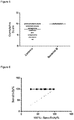
- X-axis - patient groups Whole-blood transcript abundance was measured in duplicate in each patient via qPCR.
- Y-axis - overall relative abundance ratio Nominal units. Median and Inter-quartile range exhibited.
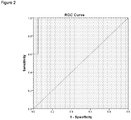
- ROC receiver operator curve
- Y-axis - overall relative abundance ratio (formulated via discriminant rule). Nominal units. Median and Inter-quartile range exhibited. Note: A low proportion of bacterial meningitis patients (13% [13/101]) was used in the sample set to reflect the prevalence of bacterial meningitis observed among adults with suspected meningitis in the UK.
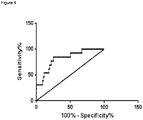
- ROC receiver operator curve
- FIG. 6 shows a receiver operator curve (ROC) for the 12 transcript host response test.
- the ROC is based on data from Figure 5 .
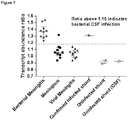
- Figure 7 is a scatter plot of relative abundance ratio (formulated via discriminant rule) for 4 transcript host response test among proven bacterial meningitis and proven ventriculo-peritoneal (VP) shunt infection.
- Y-axis - overall relative abundance ratio (formulated via discriminant rule). Nominal units. Median and Inter-quartile range exhibited.
- the blood host response assay distinguishes confirmed bacterial CSF infection (positive culture or pathogen specific PCR in CSF; or CSF pleocytosis and positive culture or pathogen specific PCR in blood) from look-a-like conditions; namely meningism or viral meningitis (patients with signs and symptoms of infection but sterile CSF; or viral specific PCR in CSF).
- qPCR quantitative PCR
- RNA stabilising tubes Pieris RNA stabilising tubes
- RNA 500ng per sample was amplified and labelled using Low Input Quick Amp. Labelling kits (Agilent). Patient sample derived amplified RNA was labelled with Cyanine-3. Control human amplified RNA (Universal RNA) was labelled with Cyanine-5. Labelled RNA (200ng) was hybridised to SurePrint G3 GE 8x60K (Design ID 030495) human-specific microarrays following the manufacturers' instructions (Agilent Technologies). Arrays were scanned using Agilent G2505C scanner (Agilent Technologies). Raw fluorescent intensity was measured and initial quality control assessment undertaken using Agilent Feature Extraction software (FE 10.5.1.1). Transcript data were processed as previously described.
- cDNA Complimentary DNA
- Retroscript II kit Retroscript II kit
- Quantitative PCR quantitative PCR
- qPCR Quantitative PCR
- Individual single-plex assays i.e. one assay per biomarker per well
- Relative target transcript abundance between markers was quantified using the ⁇ CT method.
- identification of the sample being as indicative of bacterial meningitis by relative transcript marker abundances can also be arrived at using different equations (which can include logical operands).
- the marker set was optimised using combinations of 11 additional transcripts (Table 3). In these marker sets relative ratio abundance from pairs of markers (up to 13 pairs) were used to provide a cumulative score. Further analysis of the results achieved using genes set out in Table 3 showed markers could be dropped to produce two refined marker sets without any significant drop in marker set performance (Table 4 and Table 5). All of these marker sets exhibited improved sensitivity compared to the group set out in Table 2.
- the 4 transcript host response test measured via qPCR among 30 patient samples' exhibited 100% (10/10) sensitivity, 95% (19/20) specificity and an accuracy of 97% (29/30).
- the 4 transcript host response test (Table 2) measured via qPCR among 101 patient samples' (independent sample set from microarray studies) exhibited 85% (11/13) sensitivity, 74% (65/88) specificity and an accuracy of 75% (76/101).
- the 15 transcript host response test (Table 3) measured via qPCR among 81 patient samples' (independent sample set from microarray studies) exhibited 100% (10/10) sensitivity, 72% (51/71) specificity and an accuracy of 75% (61/81)
- the 9 transcript host response set (Table 4) measured via qPCR among 102 patient samples' (independent sample set from microarray studies) exhibited 91% (10/11) sensitivity, 74% (68/91) specificity and an accuracy of 76% (78/102).
- the 12 transcript host response test (Table 5) measured via qPCR among 81 patient samples' (independent sample set from microarray studies) exhibited 100% (10/10) sensitivity, 72% (51/71) specificity and an accuracy of 75% (61/81) - Figure 5 .
- Table 1 Gene Encodes ELANE neutrophil elastase IFI44L Interferon-induced protein 44-like CTSG Cathepsin G S1PR5 sphingosine-1-phosphate receptor 5 GRK6 G protein-coupled receptor kinase 6 TXLNA taxilin alpha DUSP1 dual specificity phosphatase 1 APMAP (formerly C20orf3) adipocyte plasma membrane associated protein KMT2A lysine (K)-specific methyltransferase 2A HP1BP3 heterochromatin protein 1, binding protein 3 SIGLEC1 sialic acid binding Ig-like lectin 1, sialoadhesin IFI27 interferon, alpha-inducible protein 27 NMT1 N-myristoyltransferase 1 FLOT1 flotillin 1 HUWE1 HECT, UBA and WE domain containing 1, E3 ubiquitin protein ligase Table 2 First gene Second gene ELANE IFI44L CTSG IFI44L ELANE S
Landscapes
- Chemical & Material Sciences (AREA)
- Life Sciences & Earth Sciences (AREA)
- Proteomics, Peptides & Aminoacids (AREA)
- Organic Chemistry (AREA)
- Analytical Chemistry (AREA)
- Health & Medical Sciences (AREA)
- Wood Science & Technology (AREA)
- Zoology (AREA)
- Engineering & Computer Science (AREA)
- Genetics & Genomics (AREA)
- Biotechnology (AREA)
- Immunology (AREA)
- Microbiology (AREA)
- Molecular Biology (AREA)
- Physics & Mathematics (AREA)
- Biophysics (AREA)
- Biochemistry (AREA)
- Bioinformatics & Cheminformatics (AREA)
- General Engineering & Computer Science (AREA)
- General Health & Medical Sciences (AREA)
- Pathology (AREA)
- Measuring Or Testing Involving Enzymes Or Micro-Organisms (AREA)
Claims (13)
- Verfahren zum Nachweis einer bakteriellen Infektion des Blutkreislaufs oder des Zentralnervensystems bei einem Subjekt, wobei das Verfahren umfasst:• Untersuchen einer Blutprobe, die für die Genexpression bei dem Subjekt repräsentativ ist, um Daten zu erhalten, die das relative Häufigkeitsverhältnis von Zielmolekülen anzeigen, die die Expression des Genpaars anzeigen: ELANE und IFI44L, sowie optional mindestens ein weiteres Genpaar aus der Gruppe bestehend aus: CTSG und IFI44L; ELANE und S1PR5; CTSG und S1PR5; GRK6 und TXLNA; DUSP1 und IFI44L; APMAP und KMT2A; DUSP1 und HP1BP3; FLOT1 und NMT1; APMAP und HUWE1; ELANE und SIGLEC1; ELANE und IFI27; und DUSP1 und NMT1;• wobei die Zielmoleküle ausgewählt sind aus: einem mRNA-Zielmolekül, das ein RNA-Transkript des relevanten Gens umfasst, und einem Protein-Zielmolekül, das ein von dem relevanten Gen codiertes Protein umfasst; und• Bestimmen des Vorliegens einer bakteriellen Infektion des Blutkreislaufs oder des Zentralnervensystems bei dem Subjekt in Abhängigkeit der Daten.
- Verfahren nach Anspruch 1, umfassend ein Erhalten von Daten, die das relative Häufigkeitsverhältnis von Zielmolekülen in Bezug auf jedes der Genpaare in der Gruppe anzeigen, die aus ELANE und IFI44; CTSG und IFI44L; ELANE und S1PR5; und CTSG und S1PR5; GRK6 und TXLNA; DUSP1 und IFI44L; APMAP und KMT2A ; DUSP1 und HP1BP3; APMAP und HUWE1; oder DUSP1 und NMT1 besteht.
- Verfahren nach einem der vorhergehenden Ansprüche, bei dem eine bakterielle Infektion bei dem Subjekt nachgewiesen wird, ferner umfassend ein Durchführen eines weiteren Bestätigungstests für die bakterielle Infektion bei dem Subjekt.
- Verfahren nach einem der vorhergehenden Ansprüche, wobei die bakterielle Infektion des Zentralnervensystems durch Bakterien verursacht wird, die ausgewählt sind aus der Gruppe bestehend aus: Streptococcus pneumoniae, Neisseria meningitidis, Haemophilus influenzae, Streptococcus agalactiae; Listeria monocytogenes; Escherichia coli; Mycobacterium tuberculosis; und Staphylococcus aureus.
- Verfahren nach einem der vorhergehenden Ansprüche, wobei das Zielmolekül ein mRNA-Zielmolekül ist und wobei der Assay ausgewählt ist aus der Gruppe bestehend aus: RT-PCR, Echtzeit-PCR, Northern Blot, RNA-Sequenzierung (RNA-seq) und RNA-Microarray.
- Verfahren nach einem der vorhergehenden Ansprüche, wobei das Zielmolekül ein Proteinzielmolekül ist und wobei der Assay ausgewählt ist aus der Gruppe bestehend aus: ELISA, Radioimmunoassay, Immunpräzipitation, Western Blot und Massenspektrometrie.
- Verfahren nach einem der vorhergehenden Ansprüche, wobei das Subjekt Symptome hat, die mit einer bakteriellen Infektion, wie bakterieller Meningitis, übereinstimmen, oder wobei dem Subjekt einige oder alle Symptome fehlen, die mit einer bakteriellen Infektion, wie bakterieller Meningitis, übereinstimmen.
- Verfahren nach einem der vorhergehenden Ansprüche, wobei angenommen wird, dass das Subjekt einem Risiko ausgesetzt ist, eine bakterielle Meningitis zu entwickeln.
- Verfahren nach einem der vorhergehenden Ansprüche, wobei der Schritt des Bestimmens ein Verwenden der Daten umfasst, um eine oder mehrere Funktionen zu berechnen, wobei das Vorliegen einer bakteriellen Infektion bei dem Subjekt als vorhanden bestimmt wird, wenn eine oder mehrere der berechneten Funktionen eine vorgegebene Bedingung erfüllen.
- Verfahren nach Anspruch 9, wobei die eine oder mehreren Funktionen eine logische Funktion oder eine lineare Funktion beinhalten.
- Verfahren nach Anspruch 10, wobei die lineare Funktion eine lineare Diskriminanzfunktion ist, und wobei optional die vorgegebene Bedingung erfüllt ist, wenn die berechnete lineare Diskriminanzfunktion einen vorgegebenen Schwellenwert überschreitet.
- Antibakterielles Mittel zur Verwendung bei der Behandlung einer bakteriellen Infektion des Zentralnervensystems bei einem Subjekt, bei dem eine bakterielle Infektion des Zentralnervensystems durch ein Verfahren nach einem der vorhergehenden Ansprüche festgestellt wurde.
- Antibakterielles Mittel zur Verwendung nach Anspruch 12, wobei die bakterielle Infektion eine bakterielle Meningitis ist.
Applications Claiming Priority (2)
| Application Number | Priority Date | Filing Date | Title |
|---|---|---|---|
| GBGB1518597.8A GB201518597D0 (en) | 2015-10-20 | 2015-10-20 | Detection of bacterial infection |
| PCT/GB2016/053269 WO2017068347A1 (en) | 2015-10-20 | 2016-10-20 | Detection of bacterial infection |
Publications (2)
| Publication Number | Publication Date |
|---|---|
| EP3365462A1 EP3365462A1 (de) | 2018-08-29 |
| EP3365462B1 true EP3365462B1 (de) | 2021-09-29 |
Family
ID=55131362
Family Applications (1)
| Application Number | Title | Priority Date | Filing Date |
|---|---|---|---|
| EP16787529.3A Active EP3365462B1 (de) | 2015-10-20 | 2016-10-20 | Nachweis bakterieller infektionen |
Country Status (5)
| Country | Link |
|---|---|
| US (1) | US20180312907A1 (de) |
| EP (1) | EP3365462B1 (de) |
| ES (1) | ES2899788T3 (de) |
| GB (1) | GB201518597D0 (de) |
| WO (1) | WO2017068347A1 (de) |
Families Citing this family (2)
| Publication number | Priority date | Publication date | Assignee | Title |
|---|---|---|---|---|
| US9889151B2 (en) * | 2007-10-15 | 2018-02-13 | Hs Pharmaceuticals, Llc | Silicate containing compositions and methods of treatment |
| GB201806052D0 (en) * | 2018-04-12 | 2018-05-30 | Univ Liverpool | Detection of bacterial infections |
Family Cites Families (4)
| Publication number | Priority date | Publication date | Assignee | Title |
|---|---|---|---|---|
| FR2894675B1 (fr) * | 2005-12-14 | 2008-06-27 | Assist Publ Hopitaux De Paris | Distinction des meningites bacteriennes et virales |
| GB201016161D0 (en) * | 2010-09-24 | 2010-11-10 | Hansa Medical Ab | Diagnostic method |
| US10689701B2 (en) * | 2013-03-15 | 2020-06-23 | Duke University | Biomarkers for the molecular classification of bacterial infection |
| GB201406259D0 (en) * | 2014-04-07 | 2014-05-21 | Univ Edinburgh | Molecular predictors of neonatal sepsis |
-
2015
- 2015-10-20 GB GBGB1518597.8A patent/GB201518597D0/en not_active Ceased
-
2016
- 2016-10-20 US US15/770,030 patent/US20180312907A1/en not_active Abandoned
- 2016-10-20 WO PCT/GB2016/053269 patent/WO2017068347A1/en not_active Ceased
- 2016-10-20 ES ES16787529T patent/ES2899788T3/es active Active
- 2016-10-20 EP EP16787529.3A patent/EP3365462B1/de active Active
Also Published As
| Publication number | Publication date |
|---|---|
| EP3365462A1 (de) | 2018-08-29 |
| WO2017068347A1 (en) | 2017-04-27 |
| US20180312907A1 (en) | 2018-11-01 |
| GB201518597D0 (en) | 2015-12-02 |
| ES2899788T3 (es) | 2022-03-14 |
Similar Documents
| Publication | Publication Date | Title |
|---|---|---|
| US20140128277A1 (en) | Method for Identifying a Subset of Polynucleotides from an Initial Set of Polynucleotides Corresponding to the Human Genome for the In Vitro Determination of the Severity of the Host Response of a Patient | |
| US20240035097A1 (en) | Detection of bacterial infections | |
| US11365452B2 (en) | Composition for diagnosing or predicting risk of metabolic syndrome or metabolic syndrome-related diseases using human oral microbiome | |
| KR20160145093A (ko) | 이식거부 및 면억억제 요법의 내성을 진단하기 위한 마이크로 리보핵산(miRNA)의 용도 | |
| KR102691806B1 (ko) | 상향조절된 mirna의 진단 및 치료를 위한 용도 | |
| WO2021160978A1 (en) | Method for predicting the likelihood of ectopic pregnancy (ep), viable intrauterine pregnancy (viup), or non-viable intrauterine pregnancy (nviup). | |
| EP3365462B1 (de) | Nachweis bakterieller infektionen | |
| US20200277655A1 (en) | New tools for assessing fimh blockers therapeutic efficiency | |
| CN116656851B (zh) | 一种生物标志物及其在慢性阻塞性肺疾病诊断方面的应用 | |
| US20250320539A1 (en) | Method for determining risk of adverse event | |
| WO2019110706A1 (en) | Methods for predicting the risk of developing a sepsis or a systemic inflammatory response syndrome (sirs) | |
| WO2019197954A1 (en) | IDENTIFICATION OF MUSCULAR miRNAS AS MOLECULAR BIOMARKERS AND CO-ADJUVANT FOR THE TREATMENT OF SPINAL MUSCULAR ATROPHY | |
| JP7821416B2 (ja) | アトピー性皮膚炎の診断方法 | |
| KR102555467B1 (ko) | 과민성 대장 증후군의 진단 또는 예측용 엑소좀 바이오마커 및 이의 용도 | |
| KR102838081B1 (ko) | 마이크로바이옴을 이용하여 당뇨족부궤양 예후를 예측하는 방법 | |
| CN112226525B (zh) | 重症肌无力诊断用试剂 | |
| KR20210019962A (ko) | Gal3st1 유전자의 메틸화 수준을 이용한 고혈압의 예측 또는 진단을 위한 정보제공방법 및 이를 위한 조성물 | |
| KR20250176627A (ko) | miR-223 억제제를 포함하는 패혈증 예방 또는 치료용 약학적 조성물 | |
| KR20250033538A (ko) | 마이크로바이옴을 이용한 비결핵항산균 감염성 질환의 치료 반응성 예측을 위한 조성물 | |
| TW202317773A (zh) | 用於檢測或診斷心肌梗塞之方法與生物標誌物 | |
| JP2025171299A (ja) | 炎症性腸疾患の予後を予測するための、または、炎症性腸疾患を検査するための、方法、マーカーおよび検査キットならびに炎症性腸疾患の予防改善剤のスクリーニング方法 | |
| JP5264239B2 (ja) | スギ花粉症検査を補助する方法 | |
| CN115851948A (zh) | 一组预测颅内动脉瘤稳定性的菌群标志物及其应用 | |
| CN114107487A (zh) | 一种可用于诊断脑卒中的产品 | |
| US20200181705A1 (en) | Two molecular markers, kits and applications for glaucoma diagnosis |
Legal Events
| Date | Code | Title | Description |
|---|---|---|---|
| STAA | Information on the status of an ep patent application or granted ep patent |
Free format text: STATUS: UNKNOWN |
|
| STAA | Information on the status of an ep patent application or granted ep patent |
Free format text: STATUS: THE INTERNATIONAL PUBLICATION HAS BEEN MADE |
|
| PUAI | Public reference made under article 153(3) epc to a published international application that has entered the european phase |
Free format text: ORIGINAL CODE: 0009012 |
|
| STAA | Information on the status of an ep patent application or granted ep patent |
Free format text: STATUS: REQUEST FOR EXAMINATION WAS MADE |
|
| 17P | Request for examination filed |
Effective date: 20180516 |
|
| AK | Designated contracting states |
Kind code of ref document: A1 Designated state(s): AL AT BE BG CH CY CZ DE DK EE ES FI FR GB GR HR HU IE IS IT LI LT LU LV MC MK MT NL NO PL PT RO RS SE SI SK SM TR |
|
| AX | Request for extension of the european patent |
Extension state: BA ME |
|
| DAV | Request for validation of the european patent (deleted) | ||
| DAX | Request for extension of the european patent (deleted) | ||
| STAA | Information on the status of an ep patent application or granted ep patent |
Free format text: STATUS: EXAMINATION IS IN PROGRESS |
|
| 17Q | First examination report despatched |
Effective date: 20190527 |
|
| REG | Reference to a national code |
Ref country code: DE Ref legal event code: R079 Ref document number: 602016064368 Country of ref document: DE Free format text: PREVIOUS MAIN CLASS: C12Q0001680000 Ipc: C12Q0001688300 |
|
| GRAP | Despatch of communication of intention to grant a patent |
Free format text: ORIGINAL CODE: EPIDOSNIGR1 |
|
| STAA | Information on the status of an ep patent application or granted ep patent |
Free format text: STATUS: GRANT OF PATENT IS INTENDED |
|
| RIC1 | Information provided on ipc code assigned before grant |
Ipc: C12Q 1/689 20180101ALI20210318BHEP Ipc: C12Q 1/6883 20180101AFI20210318BHEP |
|
| INTG | Intention to grant announced |
Effective date: 20210409 |
|
| GRAS | Grant fee paid |
Free format text: ORIGINAL CODE: EPIDOSNIGR3 |
|
| GRAA | (expected) grant |
Free format text: ORIGINAL CODE: 0009210 |
|
| STAA | Information on the status of an ep patent application or granted ep patent |
Free format text: STATUS: THE PATENT HAS BEEN GRANTED |
|
| AK | Designated contracting states |
Kind code of ref document: B1 Designated state(s): AL AT BE BG CH CY CZ DE DK EE ES FI FR GB GR HR HU IE IS IT LI LT LU LV MC MK MT NL NO PL PT RO RS SE SI SK SM TR |
|
| REG | Reference to a national code |
Ref country code: GB Ref legal event code: FG4D |
|
| REG | Reference to a national code |
Ref country code: DE Ref legal event code: R096 Ref document number: 602016064368 Country of ref document: DE |
|
| REG | Reference to a national code |
Ref country code: CH Ref legal event code: EP Ref country code: AT Ref legal event code: REF Ref document number: 1434236 Country of ref document: AT Kind code of ref document: T Effective date: 20211015 |
|
| REG | Reference to a national code |
Ref country code: IE Ref legal event code: FG4D |
|
| REG | Reference to a national code |
Ref country code: LT Ref legal event code: MG9D |
|
| PG25 | Lapsed in a contracting state [announced via postgrant information from national office to epo] |
Ref country code: SE Free format text: LAPSE BECAUSE OF FAILURE TO SUBMIT A TRANSLATION OF THE DESCRIPTION OR TO PAY THE FEE WITHIN THE PRESCRIBED TIME-LIMIT Effective date: 20210929 Ref country code: RS Free format text: LAPSE BECAUSE OF FAILURE TO SUBMIT A TRANSLATION OF THE DESCRIPTION OR TO PAY THE FEE WITHIN THE PRESCRIBED TIME-LIMIT Effective date: 20210929 Ref country code: NO Free format text: LAPSE BECAUSE OF FAILURE TO SUBMIT A TRANSLATION OF THE DESCRIPTION OR TO PAY THE FEE WITHIN THE PRESCRIBED TIME-LIMIT Effective date: 20211229 Ref country code: HR Free format text: LAPSE BECAUSE OF FAILURE TO SUBMIT A TRANSLATION OF THE DESCRIPTION OR TO PAY THE FEE WITHIN THE PRESCRIBED TIME-LIMIT Effective date: 20210929 Ref country code: FI Free format text: LAPSE BECAUSE OF FAILURE TO SUBMIT A TRANSLATION OF THE DESCRIPTION OR TO PAY THE FEE WITHIN THE PRESCRIBED TIME-LIMIT Effective date: 20210929 Ref country code: LT Free format text: LAPSE BECAUSE OF FAILURE TO SUBMIT A TRANSLATION OF THE DESCRIPTION OR TO PAY THE FEE WITHIN THE PRESCRIBED TIME-LIMIT Effective date: 20210929 Ref country code: BG Free format text: LAPSE BECAUSE OF FAILURE TO SUBMIT A TRANSLATION OF THE DESCRIPTION OR TO PAY THE FEE WITHIN THE PRESCRIBED TIME-LIMIT Effective date: 20211229 |
|
| REG | Reference to a national code |
Ref country code: NL Ref legal event code: MP Effective date: 20210929 |
|
| REG | Reference to a national code |
Ref country code: AT Ref legal event code: MK05 Ref document number: 1434236 Country of ref document: AT Kind code of ref document: T Effective date: 20210929 |
|
| PG25 | Lapsed in a contracting state [announced via postgrant information from national office to epo] |
Ref country code: LV Free format text: LAPSE BECAUSE OF FAILURE TO SUBMIT A TRANSLATION OF THE DESCRIPTION OR TO PAY THE FEE WITHIN THE PRESCRIBED TIME-LIMIT Effective date: 20210929 Ref country code: GR Free format text: LAPSE BECAUSE OF FAILURE TO SUBMIT A TRANSLATION OF THE DESCRIPTION OR TO PAY THE FEE WITHIN THE PRESCRIBED TIME-LIMIT Effective date: 20211230 |
|
| REG | Reference to a national code |
Ref country code: ES Ref legal event code: FG2A Ref document number: 2899788 Country of ref document: ES Kind code of ref document: T3 Effective date: 20220314 |
|
| PG25 | Lapsed in a contracting state [announced via postgrant information from national office to epo] |
Ref country code: AT Free format text: LAPSE BECAUSE OF FAILURE TO SUBMIT A TRANSLATION OF THE DESCRIPTION OR TO PAY THE FEE WITHIN THE PRESCRIBED TIME-LIMIT Effective date: 20210929 |
|
| REG | Reference to a national code |
Ref country code: CH Ref legal event code: PL |
|
| PG25 | Lapsed in a contracting state [announced via postgrant information from national office to epo] |
Ref country code: IS Free format text: LAPSE BECAUSE OF FAILURE TO SUBMIT A TRANSLATION OF THE DESCRIPTION OR TO PAY THE FEE WITHIN THE PRESCRIBED TIME-LIMIT Effective date: 20220129 Ref country code: SK Free format text: LAPSE BECAUSE OF FAILURE TO SUBMIT A TRANSLATION OF THE DESCRIPTION OR TO PAY THE FEE WITHIN THE PRESCRIBED TIME-LIMIT Effective date: 20210929 Ref country code: RO Free format text: LAPSE BECAUSE OF FAILURE TO SUBMIT A TRANSLATION OF THE DESCRIPTION OR TO PAY THE FEE WITHIN THE PRESCRIBED TIME-LIMIT Effective date: 20210929 Ref country code: PT Free format text: LAPSE BECAUSE OF FAILURE TO SUBMIT A TRANSLATION OF THE DESCRIPTION OR TO PAY THE FEE WITHIN THE PRESCRIBED TIME-LIMIT Effective date: 20220131 Ref country code: PL Free format text: LAPSE BECAUSE OF FAILURE TO SUBMIT A TRANSLATION OF THE DESCRIPTION OR TO PAY THE FEE WITHIN THE PRESCRIBED TIME-LIMIT Effective date: 20210929 Ref country code: NL Free format text: LAPSE BECAUSE OF FAILURE TO SUBMIT A TRANSLATION OF THE DESCRIPTION OR TO PAY THE FEE WITHIN THE PRESCRIBED TIME-LIMIT Effective date: 20210929 Ref country code: EE Free format text: LAPSE BECAUSE OF FAILURE TO SUBMIT A TRANSLATION OF THE DESCRIPTION OR TO PAY THE FEE WITHIN THE PRESCRIBED TIME-LIMIT Effective date: 20210929 Ref country code: CZ Free format text: LAPSE BECAUSE OF FAILURE TO SUBMIT A TRANSLATION OF THE DESCRIPTION OR TO PAY THE FEE WITHIN THE PRESCRIBED TIME-LIMIT Effective date: 20210929 Ref country code: AL Free format text: LAPSE BECAUSE OF FAILURE TO SUBMIT A TRANSLATION OF THE DESCRIPTION OR TO PAY THE FEE WITHIN THE PRESCRIBED TIME-LIMIT Effective date: 20210929 |
|
| REG | Reference to a national code |
Ref country code: BE Ref legal event code: MM Effective date: 20211031 |
|
| PG25 | Lapsed in a contracting state [announced via postgrant information from national office to epo] |
Ref country code: MC Free format text: LAPSE BECAUSE OF FAILURE TO SUBMIT A TRANSLATION OF THE DESCRIPTION OR TO PAY THE FEE WITHIN THE PRESCRIBED TIME-LIMIT Effective date: 20210929 |
|
| REG | Reference to a national code |
Ref country code: DE Ref legal event code: R097 Ref document number: 602016064368 Country of ref document: DE |
|
| PG25 | Lapsed in a contracting state [announced via postgrant information from national office to epo] |
Ref country code: LU Free format text: LAPSE BECAUSE OF NON-PAYMENT OF DUE FEES Effective date: 20211020 Ref country code: DK Free format text: LAPSE BECAUSE OF FAILURE TO SUBMIT A TRANSLATION OF THE DESCRIPTION OR TO PAY THE FEE WITHIN THE PRESCRIBED TIME-LIMIT Effective date: 20210929 Ref country code: BE Free format text: LAPSE BECAUSE OF NON-PAYMENT OF DUE FEES Effective date: 20211031 |
|
| PLBE | No opposition filed within time limit |
Free format text: ORIGINAL CODE: 0009261 |
|
| STAA | Information on the status of an ep patent application or granted ep patent |
Free format text: STATUS: NO OPPOSITION FILED WITHIN TIME LIMIT |
|
| PG25 | Lapsed in a contracting state [announced via postgrant information from national office to epo] |
Ref country code: LI Free format text: LAPSE BECAUSE OF NON-PAYMENT OF DUE FEES Effective date: 20211031 Ref country code: CH Free format text: LAPSE BECAUSE OF NON-PAYMENT OF DUE FEES Effective date: 20211031 |
|
| 26N | No opposition filed |
Effective date: 20220630 |
|
| PG25 | Lapsed in a contracting state [announced via postgrant information from national office to epo] |
Ref country code: IE Free format text: LAPSE BECAUSE OF NON-PAYMENT OF DUE FEES Effective date: 20211020 |
|
| PG25 | Lapsed in a contracting state [announced via postgrant information from national office to epo] |
Ref country code: SI Free format text: LAPSE BECAUSE OF FAILURE TO SUBMIT A TRANSLATION OF THE DESCRIPTION OR TO PAY THE FEE WITHIN THE PRESCRIBED TIME-LIMIT Effective date: 20210929 |
|
| PG25 | Lapsed in a contracting state [announced via postgrant information from national office to epo] |
Ref country code: HU Free format text: LAPSE BECAUSE OF FAILURE TO SUBMIT A TRANSLATION OF THE DESCRIPTION OR TO PAY THE FEE WITHIN THE PRESCRIBED TIME-LIMIT; INVALID AB INITIO Effective date: 20161020 |
|
| PG25 | Lapsed in a contracting state [announced via postgrant information from national office to epo] |
Ref country code: CY Free format text: LAPSE BECAUSE OF FAILURE TO SUBMIT A TRANSLATION OF THE DESCRIPTION OR TO PAY THE FEE WITHIN THE PRESCRIBED TIME-LIMIT Effective date: 20210929 |
|
| P01 | Opt-out of the competence of the unified patent court (upc) registered |
Effective date: 20230525 |
|
| PG25 | Lapsed in a contracting state [announced via postgrant information from national office to epo] |
Ref country code: SM Free format text: LAPSE BECAUSE OF FAILURE TO SUBMIT A TRANSLATION OF THE DESCRIPTION OR TO PAY THE FEE WITHIN THE PRESCRIBED TIME-LIMIT Effective date: 20210929 |
|
| PG25 | Lapsed in a contracting state [announced via postgrant information from national office to epo] |
Ref country code: MK Free format text: LAPSE BECAUSE OF FAILURE TO SUBMIT A TRANSLATION OF THE DESCRIPTION OR TO PAY THE FEE WITHIN THE PRESCRIBED TIME-LIMIT Effective date: 20210929 |
|
| PG25 | Lapsed in a contracting state [announced via postgrant information from national office to epo] |
Ref country code: MT Free format text: LAPSE BECAUSE OF FAILURE TO SUBMIT A TRANSLATION OF THE DESCRIPTION OR TO PAY THE FEE WITHIN THE PRESCRIBED TIME-LIMIT Effective date: 20210929 |
|
| PGFP | Annual fee paid to national office [announced via postgrant information from national office to epo] |
Ref country code: IT Payment date: 20241031 Year of fee payment: 9 Ref country code: ES Payment date: 20241118 Year of fee payment: 9 |
|
| PG25 | Lapsed in a contracting state [announced via postgrant information from national office to epo] |
Ref country code: TR Free format text: LAPSE BECAUSE OF FAILURE TO SUBMIT A TRANSLATION OF THE DESCRIPTION OR TO PAY THE FEE WITHIN THE PRESCRIBED TIME-LIMIT Effective date: 20210929 |
|
| PGFP | Annual fee paid to national office [announced via postgrant information from national office to epo] |
Ref country code: DE Payment date: 20251020 Year of fee payment: 10 |
|
| PGFP | Annual fee paid to national office [announced via postgrant information from national office to epo] |
Ref country code: GB Payment date: 20251014 Year of fee payment: 10 |
|
| PGFP | Annual fee paid to national office [announced via postgrant information from national office to epo] |
Ref country code: FR Payment date: 20251029 Year of fee payment: 10 |