EP3363629A1 - Resin-coated sn-plated steel sheet, and method and facility for producing same - Google Patents
Resin-coated sn-plated steel sheet, and method and facility for producing same Download PDFInfo
- Publication number
- EP3363629A1 EP3363629A1 EP16855549.8A EP16855549A EP3363629A1 EP 3363629 A1 EP3363629 A1 EP 3363629A1 EP 16855549 A EP16855549 A EP 16855549A EP 3363629 A1 EP3363629 A1 EP 3363629A1
- Authority
- EP
- European Patent Office
- Prior art keywords
- layer
- resin
- steel sheet
- cured coating
- coating film
- Prior art date
- Legal status (The legal status is an assumption and is not a legal conclusion. Google has not performed a legal analysis and makes no representation as to the accuracy of the status listed.)
- Granted
Links
Images


Classifications
-
- C—CHEMISTRY; METALLURGY
- C23—COATING METALLIC MATERIAL; COATING MATERIAL WITH METALLIC MATERIAL; CHEMICAL SURFACE TREATMENT; DIFFUSION TREATMENT OF METALLIC MATERIAL; COATING BY VACUUM EVAPORATION, BY SPUTTERING, BY ION IMPLANTATION OR BY CHEMICAL VAPOUR DEPOSITION, IN GENERAL; INHIBITING CORROSION OF METALLIC MATERIAL OR INCRUSTATION IN GENERAL
- C23C—COATING METALLIC MATERIAL; COATING MATERIAL WITH METALLIC MATERIAL; SURFACE TREATMENT OF METALLIC MATERIAL BY DIFFUSION INTO THE SURFACE, BY CHEMICAL CONVERSION OR SUBSTITUTION; COATING BY VACUUM EVAPORATION, BY SPUTTERING, BY ION IMPLANTATION OR BY CHEMICAL VAPOUR DEPOSITION, IN GENERAL
- C23C28/00—Coating for obtaining at least two superposed coatings either by methods not provided for in a single one of groups C23C2/00 - C23C26/00 or by combinations of methods provided for in subclasses C23C and C25C or C25D
-
- B—PERFORMING OPERATIONS; TRANSPORTING
- B32—LAYERED PRODUCTS
- B32B—LAYERED PRODUCTS, i.e. PRODUCTS BUILT-UP OF STRATA OF FLAT OR NON-FLAT, e.g. CELLULAR OR HONEYCOMB, FORM
- B32B15/00—Layered products comprising a layer of metal
- B32B15/04—Layered products comprising a layer of metal comprising metal as the main or only constituent of a layer, which is next to another layer of the same or of a different material
- B32B15/08—Layered products comprising a layer of metal comprising metal as the main or only constituent of a layer, which is next to another layer of the same or of a different material of synthetic resin
- B32B15/09—Layered products comprising a layer of metal comprising metal as the main or only constituent of a layer, which is next to another layer of the same or of a different material of synthetic resin comprising polyesters
-
- B—PERFORMING OPERATIONS; TRANSPORTING
- B32—LAYERED PRODUCTS
- B32B—LAYERED PRODUCTS, i.e. PRODUCTS BUILT-UP OF STRATA OF FLAT OR NON-FLAT, e.g. CELLULAR OR HONEYCOMB, FORM
- B32B15/00—Layered products comprising a layer of metal
- B32B15/18—Layered products comprising a layer of metal comprising iron or steel
-
- B—PERFORMING OPERATIONS; TRANSPORTING
- B32—LAYERED PRODUCTS
- B32B—LAYERED PRODUCTS, i.e. PRODUCTS BUILT-UP OF STRATA OF FLAT OR NON-FLAT, e.g. CELLULAR OR HONEYCOMB, FORM
- B32B15/00—Layered products comprising a layer of metal
- B32B15/20—Layered products comprising a layer of metal comprising aluminium or copper
-
- B—PERFORMING OPERATIONS; TRANSPORTING
- B32—LAYERED PRODUCTS
- B32B—LAYERED PRODUCTS, i.e. PRODUCTS BUILT-UP OF STRATA OF FLAT OR NON-FLAT, e.g. CELLULAR OR HONEYCOMB, FORM
- B32B27/00—Layered products comprising a layer of synthetic resin
- B32B27/06—Layered products comprising a layer of synthetic resin as the main or only constituent of a layer, which is next to another layer of the same or of a different material
- B32B27/08—Layered products comprising a layer of synthetic resin as the main or only constituent of a layer, which is next to another layer of the same or of a different material of synthetic resin
-
- B—PERFORMING OPERATIONS; TRANSPORTING
- B32—LAYERED PRODUCTS
- B32B—LAYERED PRODUCTS, i.e. PRODUCTS BUILT-UP OF STRATA OF FLAT OR NON-FLAT, e.g. CELLULAR OR HONEYCOMB, FORM
- B32B27/00—Layered products comprising a layer of synthetic resin
- B32B27/36—Layered products comprising a layer of synthetic resin comprising polyesters
-
- B—PERFORMING OPERATIONS; TRANSPORTING
- B32—LAYERED PRODUCTS
- B32B—LAYERED PRODUCTS, i.e. PRODUCTS BUILT-UP OF STRATA OF FLAT OR NON-FLAT, e.g. CELLULAR OR HONEYCOMB, FORM
- B32B7/00—Layered products characterised by the relation between layers; Layered products characterised by the relative orientation of features between layers, or by the relative values of a measurable parameter between layers, i.e. products comprising layers having different physical, chemical or physicochemical properties; Layered products characterised by the interconnection of layers
- B32B7/04—Interconnection of layers
- B32B7/06—Interconnection of layers permitting easy separation
-
- C—CHEMISTRY; METALLURGY
- C23—COATING METALLIC MATERIAL; COATING MATERIAL WITH METALLIC MATERIAL; CHEMICAL SURFACE TREATMENT; DIFFUSION TREATMENT OF METALLIC MATERIAL; COATING BY VACUUM EVAPORATION, BY SPUTTERING, BY ION IMPLANTATION OR BY CHEMICAL VAPOUR DEPOSITION, IN GENERAL; INHIBITING CORROSION OF METALLIC MATERIAL OR INCRUSTATION IN GENERAL
- C23C—COATING METALLIC MATERIAL; COATING MATERIAL WITH METALLIC MATERIAL; SURFACE TREATMENT OF METALLIC MATERIAL BY DIFFUSION INTO THE SURFACE, BY CHEMICAL CONVERSION OR SUBSTITUTION; COATING BY VACUUM EVAPORATION, BY SPUTTERING, BY ION IMPLANTATION OR BY CHEMICAL VAPOUR DEPOSITION, IN GENERAL
- C23C22/00—Chemical surface treatment of metallic material by reaction of the surface with a reactive liquid, leaving reaction products of surface material in the coating, e.g. conversion coatings, passivation of metals
- C23C22/05—Chemical surface treatment of metallic material by reaction of the surface with a reactive liquid, leaving reaction products of surface material in the coating, e.g. conversion coatings, passivation of metals using aqueous solutions
- C23C22/06—Chemical surface treatment of metallic material by reaction of the surface with a reactive liquid, leaving reaction products of surface material in the coating, e.g. conversion coatings, passivation of metals using aqueous solutions using aqueous acidic solutions with pH less than 6
- C23C22/34—Chemical surface treatment of metallic material by reaction of the surface with a reactive liquid, leaving reaction products of surface material in the coating, e.g. conversion coatings, passivation of metals using aqueous solutions using aqueous acidic solutions with pH less than 6 containing fluorides or complex fluorides
-
- B—PERFORMING OPERATIONS; TRANSPORTING
- B29—WORKING OF PLASTICS; WORKING OF SUBSTANCES IN A PLASTIC STATE IN GENERAL
- B29K—INDEXING SCHEME ASSOCIATED WITH SUBCLASSES B29B, B29C OR B29D, RELATING TO MOULDING MATERIALS OR TO MATERIALS FOR MOULDS, REINFORCEMENTS, FILLERS OR PREFORMED PARTS, e.g. INSERTS
- B29K2705/00—Use of metals, their alloys or their compounds, for preformed parts, e.g. for inserts
- B29K2705/06—Tin
-
- B—PERFORMING OPERATIONS; TRANSPORTING
- B29—WORKING OF PLASTICS; WORKING OF SUBSTANCES IN A PLASTIC STATE IN GENERAL
- B29K—INDEXING SCHEME ASSOCIATED WITH SUBCLASSES B29B, B29C OR B29D, RELATING TO MOULDING MATERIALS OR TO MATERIALS FOR MOULDS, REINFORCEMENTS, FILLERS OR PREFORMED PARTS, e.g. INSERTS
- B29K2705/00—Use of metals, their alloys or their compounds, for preformed parts, e.g. for inserts
- B29K2705/08—Transition metals
- B29K2705/12—Iron
-
- B—PERFORMING OPERATIONS; TRANSPORTING
- B32—LAYERED PRODUCTS
- B32B—LAYERED PRODUCTS, i.e. PRODUCTS BUILT-UP OF STRATA OF FLAT OR NON-FLAT, e.g. CELLULAR OR HONEYCOMB, FORM
- B32B2255/00—Coating on the layer surface
- B32B2255/06—Coating on the layer surface on metal layer
-
- B—PERFORMING OPERATIONS; TRANSPORTING
- B32—LAYERED PRODUCTS
- B32B—LAYERED PRODUCTS, i.e. PRODUCTS BUILT-UP OF STRATA OF FLAT OR NON-FLAT, e.g. CELLULAR OR HONEYCOMB, FORM
- B32B2255/00—Coating on the layer surface
- B32B2255/20—Inorganic coating
- B32B2255/205—Metallic coating
-
- B—PERFORMING OPERATIONS; TRANSPORTING
- B32—LAYERED PRODUCTS
- B32B—LAYERED PRODUCTS, i.e. PRODUCTS BUILT-UP OF STRATA OF FLAT OR NON-FLAT, e.g. CELLULAR OR HONEYCOMB, FORM
- B32B2255/00—Coating on the layer surface
- B32B2255/26—Polymeric coating
-
- B—PERFORMING OPERATIONS; TRANSPORTING
- B32—LAYERED PRODUCTS
- B32B—LAYERED PRODUCTS, i.e. PRODUCTS BUILT-UP OF STRATA OF FLAT OR NON-FLAT, e.g. CELLULAR OR HONEYCOMB, FORM
- B32B2264/00—Composition or properties of particles which form a particulate layer or are present as additives
- B32B2264/10—Inorganic particles
- B32B2264/102—Oxide or hydroxide
-
- B—PERFORMING OPERATIONS; TRANSPORTING
- B32—LAYERED PRODUCTS
- B32B—LAYERED PRODUCTS, i.e. PRODUCTS BUILT-UP OF STRATA OF FLAT OR NON-FLAT, e.g. CELLULAR OR HONEYCOMB, FORM
- B32B2307/00—Properties of the layers or laminate
- B32B2307/70—Other properties
- B32B2307/714—Inert, i.e. inert to chemical degradation, corrosion
-
- B—PERFORMING OPERATIONS; TRANSPORTING
- B32—LAYERED PRODUCTS
- B32B—LAYERED PRODUCTS, i.e. PRODUCTS BUILT-UP OF STRATA OF FLAT OR NON-FLAT, e.g. CELLULAR OR HONEYCOMB, FORM
- B32B2307/00—Properties of the layers or laminate
- B32B2307/70—Other properties
- B32B2307/732—Dimensional properties
-
- B—PERFORMING OPERATIONS; TRANSPORTING
- B32—LAYERED PRODUCTS
- B32B—LAYERED PRODUCTS, i.e. PRODUCTS BUILT-UP OF STRATA OF FLAT OR NON-FLAT, e.g. CELLULAR OR HONEYCOMB, FORM
- B32B2439/00—Containers; Receptacles
- B32B2439/40—Closed containers
- B32B2439/66—Cans, tins
-
- C—CHEMISTRY; METALLURGY
- C23—COATING METALLIC MATERIAL; COATING MATERIAL WITH METALLIC MATERIAL; CHEMICAL SURFACE TREATMENT; DIFFUSION TREATMENT OF METALLIC MATERIAL; COATING BY VACUUM EVAPORATION, BY SPUTTERING, BY ION IMPLANTATION OR BY CHEMICAL VAPOUR DEPOSITION, IN GENERAL; INHIBITING CORROSION OF METALLIC MATERIAL OR INCRUSTATION IN GENERAL
- C23C—COATING METALLIC MATERIAL; COATING MATERIAL WITH METALLIC MATERIAL; SURFACE TREATMENT OF METALLIC MATERIAL BY DIFFUSION INTO THE SURFACE, BY CHEMICAL CONVERSION OR SUBSTITUTION; COATING BY VACUUM EVAPORATION, BY SPUTTERING, BY ION IMPLANTATION OR BY CHEMICAL VAPOUR DEPOSITION, IN GENERAL
- C23C2222/00—Aspects relating to chemical surface treatment of metallic material by reaction of the surface with a reactive medium
- C23C2222/20—Use of solutions containing silanes
Definitions
- the present invention relates to a resin-coated Sn-plated steel sheet, and a method and a facility for manufacturing the resin-coated Sn-plated steel sheet.
- Cans which are made from a steel sheet (hereinafter, referred to as resin-coated TFS) obtained by coating a tin-free steel sheet (hereinafter, referred to as TFS) obtained by treating a steel sheet with an electrolytic chromic acid with a resin, are widely used as a beverage can.
- resin-coated TFS a steel sheet obtained by coating a tin-free steel sheet (hereinafter, referred to as TFS) obtained by treating a steel sheet with an electrolytic chromic acid with a resin
- a resin-coated TFS may not have sufficient corrosion resistance for cans such as cans for food which are filled with a content having a strong corrosive property. Therefore, cans, which are made from a resin-coated Sn-plated steel sheet obtained by coating a Sn-plated steel sheet with a resin, are widely used as a can for food.
- a resin-coated TFS obtained by laminating a film having a primer layer on a TFS is given.
- a thermal fusion-bonding method which heats a TFS by a heating roll and brings a film into contact with both surfaces of the TFS using a pressing roll (hereinafter, referred to as lamination roll) is used.
- Patent Document 1 discloses a steel sheet for a container material in which a steel sheet surface on at least a side to be an inner surface of a can has a Sn-plated layer or a Fe-Sn alloy layer, and a chromium-free adhesive base treatment layer formed of a zirconium compound containing no fluoride or nitrate-nitrogen is formed thereon.
- Patent Document 2 discloses a can which is formed by drawing or drawing ironing forming of a laminate in which a copolymerized polyester film containing ethylene terephthalate as a main unit and having a melting point of 170°C to 252°C is provided directly or via an adhesive primer on at least a side of a metallic material to be an inner surface of a can.
- Patent Document 1 since Sn is scraped, a large amount of Sn powder is generated and transferred to the heating roll, and thus indentations are likely to be generated. Accordingly, in a case where a film is laminated on the Sn-plated steel sheet, it is necessary to clean the heating roll frequently, and an improvement in productivity is desired.
- the copolymerized polyester film is adhered via the adhesive primer, and the adhesive primer is coated on the copolymerized polyester film. Therefore, in a case where the copolymerized polyester film is laminated on the metallic material, a surface of the metallic material directly comes into contact with the heating roll. That is, the protection effect of the adhesive primer on the surface of the metallic material is very small. Accordingly, in a case where the copolymerized polyester film is laminated on the metallic material having a Sn-plated layer by using the technology disclosed in Patent Document 2, it is difficult to suppress the Sn powder.
- the invention is contrived in view of the circumstances, and an object thereof is to provide a resin-coated Sn-plated steel sheet having excellent corrosion resistance and having less indentations, and a method and a facility for manufacturing the resin-coated Sn-plated steel sheet.
- the invention employs the following means in order to solve the problems and achieve the object.
- the inventors have attempt to specify a step of generating a Sn powder in order to solve the problems caused in a case where a film is laminated on a Sn-plated steel sheet. As a result, the inventors have found that the Sn powder is mainly generated in a thermal fusion-bonding step of laminating a film, more specifically, in the heating roll.
- the inventors have examined a method for laminating a film without direct contact between a surface of the Sn-plated steel sheet between the heating roll. Specifically, the inventors have examined forming a resin-cured coating film layer on a Sn-plated steel sheet subjected to a chemical conversion treatment during a stage before the Sn-plated steel sheet is heated by the heating roll.
- FIGS. 1 and 2 are schematic views showing an example of a layer configuration of a resin-coated Sn-plated steel sheet 1 according to this embodiment.
- the resin-coated Sn-plated steel sheet 1 has a steel sheet 10, a Sn-plated layer 20 which is formed on at least one surface of the steel sheet 10 and contains 0.2 to 12.0 g/m 2 of Sn in terms of metal Sn amount, a chemical conversion layer 30 which is formed on the Sn-plated layer 20 and contains a total of 50% to 100% of inorganic hydroxide and inorganic oxide, and of which the adhered amount is 2 to 20 mg/m 2 , a resin-cured coating film layer 40 which is formed on the chemical conversion layer 30, and of which the maximum logarithmic decrement obtained by a rigid-body pendulum type vibration damping properties testing method at a temperature of 150°C to 200°C is 0.15 or less, and the adhered amount is 0.10 to 5.00 g/m 2 , and a thermoplastic resin layer
- the Sn-plated layer 20, the chemical conversion layer 30, the resin-cured coating film layer 40, and the thermoplastic resin layer 50 may be formed on one surface of the steel sheet 10 as shown in FIG. 1 , or on both surfaces of the steel sheet 10 as shown in FIG. 2 .
- the steel sheet 10 used in the resin-coated Sn-plated steel sheet 1 is not particularly limited. However, it is not preferable that the steel sheet 10 has a too small sheet thickness since workability is reduced. In addition, it is not preferable that the steel sheet 10 has a too large sheet thickness since this is not economical and the film is likely to break in a bending portion during the film lamination. For the above-described reasons, the steel sheet 10 preferably has a sheet thickness of 0.12 to 0.40 mm.
- the average surface roughness Ra of the steel sheet 10 is preferably 0.05 to 0.40 ⁇ m. It is not preferable that the average surface roughness Ra of the steel sheet 10 is less than 0.05 ⁇ m since sliding ability deteriorates in a case where the resin-coated Sn-plated steel sheet 1 is formed. It is not preferable that the average surface roughness Ra of the steel sheet 10 is greater than 0.40 ⁇ m since a small flaw is likely to be caused and become a pinhole on a surface of the thermoplastic resin layer 50 after the forming of the resin-coated Sn-plated steel sheet 1.
- the Sn-plated layer 20 containing 0.2 to 12.0 g/m 2 of Sn in terms of metal Sn amount is formed on at least one surface of the steel sheet 10.
- the resin-coated Sn-plated steel sheet 1 may have proper corrosion resistance.
- the Sn content of the Sn-plated layer 20 is preferably 0.2 to 12.0 g/m 2 in terms of metal Sn amount. It is not preferable that the Sn content of the Sn-plated layer 20 is less than 0.2 g/m 2 since the resin-coated Sn-plated steel sheet 1 does not have sufficient corrosion resistance. It is not preferable that the Sn content of the Sn-plated layer 20 is greater than 12.0 g/m 2 since the Sn-plated layer 20 is melted during the film lamination, and thus the metal Sn and/or Sn-Fe alloy of the surface thereof is peeled off in a spot-like pattern and unevenness is likely to occur.
- the Sn content of the Sn-plated layer 20 is preferably 85 mass% or greater, and more preferably 90 mass% or greater with respect to the total mass of the Sn-plated layer 20.
- the corrosion resistance of the resin-coated Sn-plated steel sheet 1 is improved as the Sn content of the Sn-plated layer 20 is increased. However, this is not preferable from the economical viewpoint. Therefore, the Sn content of the Sn-plated layer 20 may not be increased any more if the required corrosion resistance of the resin-coated Sn-plated steel sheet 1 is secured.
- the corrosion resistance of the resin-coated Sn-plated steel sheet 1 depends not only on the Sn content of the Sn-plated layer 20, but also on the compositions or adhered amounts of the resin-cured coating film layer 40 and the thermoplastic resin layer 50 to be described later. Therefore, the Sn content of the Sn-plated layer 20 may be appropriately determined within a range of 0.2 to 12.0 g/m 2 in accordance with the compositions or adhered amounts of the resin-cured coating film layer 40 and the thermoplastic resin layer 50.
- the chemical conversion layer 30 suppresses oxidation of Sn by forming a hydrated oxide film on the Sn-plated layer 20. In addition, the chemical conversion layer 30 improves adhesion of the resin-cured coating film layer 40 by hydrogen-bonding to the resin-cured coating film layer 40.
- the adhered amount of the chemical conversion layer 30 is less than 2.0 mg/m 2 since oxidation of the surface of the Sn-plated layer 20 cannot be properly suppressed, wettability of the chemical conversion layer 30 is reduced, and thus it is difficult to uniformly form the resin-cured coating film layer 40 on the chemical conversion layer 30. It is not preferable that the adhered amount of the chemical conversion layer 30 is greater than 20.0 mg/m 2 since the chemical conversion layer 30 is likely to be peeled off from the Sn-plated layer 20 which is a lower layer, and thus the thermoplastic resin layer 50 does not have a sufficient adhesive strength (peeling strength).
- the peeling resistance of the thermoplastic resin layer 50 to be required during the can making is 10 N/15 mm.
- FIG. 3 is a graph showing an example of the relationship between the adhered amount of the chemical conversion layer 30 and the formability of the resin-cured coating film layer 40 according to this embodiment.
- FIG. 3 is a graph showing the formability of the resin-cured coating film layer 40, in a case where a Sn-plated layer 20 containing 2.8 g/m 2 of Sn in terms of metal Sn amount is formed on a surface of a steel sheet 10, a chemical conversion layer 30 containing Zr hydroxide and Zr oxide is formed on a surface of the Sn-plated layer 20, a resin-cured coating film layer 40 containing an aqueous polyester-based resin as a main component is formed with an adhered amount of 0.5 g/m 2 on a surface of the chemical conversion layer 30.
- the vertical axis represents the followings.
- the adhered amount of the chemical conversion layer 30 is less than 2.0 mg/m 2 since the formability of the resin-cured coating film layer 40 is Poor as shown in FIG. 2 . Therefore, the adhered amount of the chemical conversion layer 30 is adjusted to 2.0 mg/m 2 or greater.
- FIG. 4 is a graph showing an example of the relationship between the adhered amount of the chemical conversion layer 30 and the 180° peeling strength of the thermoplastic resin layer 50.
- FIG. 4 is a graph showing the relationship between the adhered amount of the chemical conversion layer 30 and the 180° peeling strength of the thermoplastic resin layer 50, in a case where a Sn-plated layer 20 containing 2.8 g/m 2 of Sn in terms of metal Sn amount is formed on a surface of a steel sheet 10, a chemical conversion layer 30 containing Zr hydroxide and Zr oxide is formed on a surface of the Sn-plated layer 20, a resin-cured coating film layer 40 containing a polyester resin as a main component is formed with an adhered amount of 0.2 g/m 2 on a surface of the chemical conversion layer 30, and a thermoplastic resin layer 50 having a thickness of 20 ⁇ m and containing PET as a main component is formed on a surface of the resin-cured coating film layer 40.
- thermoplastic resin layer 50 The following method was used in the measurement of the 180° peeling strength of the thermoplastic resin layer 50. That is, the 180° peeling strength of the thermoplastic resin layer 50 was measured by a method to be described as follows.
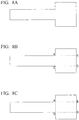
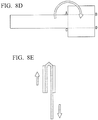
- a test piece was prepared by punching the resin-coated Sn-plated steel sheet 1 into a shape shown in FIG. 8A using a special punching die tool.
- flaws reaching the steel sheet surface from the film surface were formed along a line AB and a line CD, respectively.
- the test piece was cut along a line AC (length: 15 mm) using a special die press. In a case where the cutting is performed, the cutting was performed such that only the steel sheet was cut and the film was not cut.
- the test piece was folded left to right with the line AC as an axis to fold the film by 180°.
- the 180° peeling strength of the thermoplastic resin layer 50 is 10 N/15 mm or greater in a case where the adhered amount of the chemical conversion layer 30 is 0 to 20.0 mg/m 2 .
- the peeling strength of the thermoplastic resin layer 50 is lower than 10 N/15 mm in a case where the adhered amount of the chemical conversion layer 30 is greater than 20.0 mg/m 2 .
- the 180° peeling strength of the thermoplastic resin layer is approximately 10 to 15 N/15 mm. That is, the adhered amount of the chemical conversion layer 30 is preferably 20.0 mg/m 2 or less in order to allow the thermoplastic resin layer 50 to have the same level of 180° peeling resistance as the resin-coated TFS according to the prior art.
- the adhered amount of the chemical conversion layer 30 is adjusted to 2.0 to 20.0 mg/m 2 .
- the adhered amount of the chemical conversion layer 30 is preferably 2.0 to 10.0 mg/m 2 .
- the chemical conversion layer 30 contains inorganic hydroxide and inorganic oxide.
- the inorganic material is not particularly limited. However, one or more inorganic materials selected from the group consisting of Cr, Zr, Al, Si, P, Ti, Ce, and W are preferable from the viewpoint of the adhesion to the Sn-plated layer 20 and the adhesion to the resin-cured coating film layer 40.
- the total amount of the inorganic hydroxide and the inorganic oxide in the chemical conversion layer 30 is 50 to 100 mass%. It is not preferable that the total amount of the inorganic hydroxide and the inorganic oxide in the chemical conversion layer 30 is less than 50 mass% since the layer thickness of the chemical conversion layer 30 becomes too large, and thus the adhesion between the chemical conversion layer 30 and the Sn-plated layer 20 is reduced.
- the total amount of the inorganic hydroxide and the inorganic oxide in the chemical conversion layer 30 is preferably 80 to 100%, and more preferably 95% to 100%.
- Examples of the material contained in the chemical conversion layer 30, other than the inorganic hydroxide and the inorganic oxide, include O and impurities.
- the chemical conversion layer 30 contains the inorganic hydroxide.
- the hydroxyl group in the inorganic hydroxide forms a hydrogen bond with the hydroxyl group in the resin-cured coating film layer 40. Accordingly, the adhesion between the chemical conversion layer 30 and the resin-cured coating film layer 40 is improved, and thus it is particularly preferable.
- the resin-cured coating film layer 40 is formed on the chemical conversion layer 30.
- the resin-cured coating film layer 40 suppresses the generation of a Sn powder by protecting the Sn-plated layer 20, and suppresses air bubbles entering into the interface between the resin-cured coating film layer 40 and the thermoplastic resin layer 50 when the thermoplastic resin layer 50 is thermally fusion-bonded.
- the logarithmic decrement of the resin-cured coating film layer 40 in a rigid-body pendulum type vibration damping properties testing method is specified.
- the logarithmic decrement in the rigid-body pendulum type vibration damping properties testing method can be measured using, for example, a rigid-body pendulum type physical property tester (RPT-3000) manufactured by A&D Company, Limited.
- RPT-3000 rigid-body pendulum type physical property tester
- This rigid-body pendulum type physical property tester is a tester which applies a blade of a rigid-body pendulum to a coating film and vibrates the blade at predetermined intervals to measure a fluctuation in physical properties of the coating film when the temperature is increased.
- a steel sheet 10 having a thickness of 0.2 mm and including a Sn-plated layer 20, a chemical conversion layer 30, and a resin-cured coating film layer 40 having a coating film thickness of 300 to 800 nm is cut to have a length of 4 cm and a width of 2 cm so as to be used as a test piece.
- the test piece is set on a heating plate of the tester such that the resin-cured coating film layer 40 of the test piece faces upward, the blade part of the rigid-body pendulum is put on the resin-cured coating film layer 40, and the temperature is increased in steps of 1°C from 50°C.
- the measurement is started after 1 minute from the temperature increase of the heating plate, and is performed until the temperature reaches 250°C.
- the logarithmic decrement of a coating film is measured by a viscoelasticity measuring apparatus.
- the logarithmic decrement is measured using the viscoelasticity measuring apparatus, it is necessary to isolate only the resin-cured coating film layer 40 in order to measure the logarithmic decrement with one layer. Since the resin-cured coating film layer 40 has a small layer thickness, it is difficult to measure the logarithmic decrement of the resin-cured coating film layer 40 by the viscoelasticity measuring apparatus.
- the logarithmic decrement of the resin-cured coating film layer 40 is obtained using a rigid-body pendulum type vibration damping properties testing method, there is no need to isolate the resin-cured coating film layer 40, and even in a case where the resin-cured coating film layer 40 has a small layer thickness, the logarithmic decrement can be accurately measured.
- FIG. 5 is a graph showing an example of the relationship between the maximum logarithmic decrement of the resin-cured coating film layer 40 at 150°C to 200°C and the degree of adhesion of the resin-cured coating film layer and the Sn-plating to the heating roll.
- FIG. 5 shows an example of the relationship between the maximum logarithmic decrement of the resin-cured coating film layer 40 at 150°C to 200°C and the degree of adhesion of the resin-cured coating film layer and the Sn-plating to the heating roll, in a case where a Sn-plated layer 20 containing 2.8 g/m 2 of Sn in terms of metal Sn amount is formed on a steel sheet 10, a chemical conversion layer 30 of which the adhered amount is 5.0 mg/m 2 and which contains Zr hydroxide and Zr oxide is formed on the Sn-plated layer 20, and a resin-cured coating film layer 40 is formed on the chemical conversion layer 30.
- the logarithmic decrement of the resin-cured coating film layer 40 at 150°C to 200°C is changed by changing the conditions (heating temperature or heating time) for forming the resin-cured coating film layer 40.
- the logarithmic decrement of the resin-cured coating film layer 40 is measured every 1°C in a range of 150°C to 200°C to measure at least 50 points, and the maximum value among them is selected.
- the vertical axis is divided as follows based on the degree of adhesion of the resin-cured coating film layer and the Sn-plating to the heating roll.
- the maximum logarithmic decrement of the resin-cured coating film layer 40 at 150°C to 200°C is 0.15 or less since the degree of adhesion of the resin and the Sn-plating to the heating roll is equal to or higher than Fair. It is not preferable that the logarithmic decrement of the resin-cured coating film layer 40 at 150°C to 200°C is greater than 0.15 since the resin-cured coating film layer 40 or the Sn-plating is likely to adhere to the heating roll.
- FIG. 6 is a graph showing an example of the relationship between the adhered amount of the resin-cured coating film layer 40 and the amount of indentations generated on the surface of the resin-cured coating film layer 40 in a case where the resin-cured coating film layer 40 is formed, and then passes through the heating roll (not shown).
- FIG. 6 is a graph showing an example of the relationship between the adhered amount of the resin-cured coating film layer 40 and the amount of indentations generated, in a case where a Sn-plated layer 20 containing 2.8 g/m 2 of Sn in terms of metal Sn is formed on a steel sheet 10, a chemical conversion layer 30 of which the adhered amount is 4.0 mg/m 2 and which contains Zr hydroxide and Zr oxide is formed on the Sn-plated layer 20, and a resin-cured coating film layer 40 containing an aqueous polyester resin as a main component is formed on the chemical conversion layer 30.
- the vertical axis is divided into three as follows based on the amount of indentations generated on the surface of the resin-cured coating film layer 40 after passing through the heating roll (not shown).
- the adhered amount of the resin-cured coating film layer 40 is less than 0.1 g/m 2 or greater than 5.0 g/m 2 since indentations are generated on the surface of the resin-cured coating film layer 40 after passing through the heating roll (not shown).
- the adhered amount of the resin-cured coating film layer 40 is adjusted to 0.1 to 5.0 g/m 2 .
- the adhered amount of the resin-cured coating film layer 40 is preferably 0.2 to 2.0 g/m 2 , and more preferably 0.4 to 1.0 g/m 2 .
- Examples of the resin used in the resin-cured coating film layer 40 include epoxy-based coatings, epoxy phenol-based coatings, acrylic modified epoxy coatings, polyester-based resins, urethane-based resins, and urethane urea-based resins.
- Examples of the component of a curing agent of a polyester-based resin, a urethane-based resin, or a urethane urea-based resin include amine resins, polyisocyanates, and acid anhydrides.
- thermoplastic resin layer 50 having an oriented crystal layer (not shown) and having a thickness of 5 to 50 ⁇ m is formed on the resin-cured coating film layer 40.
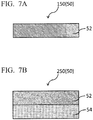
- the thermoplastic resin layer 50 may be a single-layer film 150 formed only of a stretched polyester-based film 52 having a melting point of 232°C or higher as shown in FIG. 7A , or a multi-layer film 250 in which a polyester-based resin layer 54 is formed under the stretched polyester-based film 52 as shown in FIG. 7B .
- the thermoplastic resin layer 50 has the stretched polyester-based film 52 having a melting point of 232°C or higher.
- the stretched polyester-based film 52 is preferable from the viewpoint of food sanitation since less odor components are adsorbed and monomer components are unlikely to be eluted.
- an oriented crystal layer (not shown) is developed in the stretched polyester-based film 52 in comparison with an unstretched film, and thus the stretched polyester-based film has a high film density and low water permeability. Therefore, the stretched polyester-based film has excellent corrosion resistance and an excellent breaking strength, and is thus preferable.
- the thermoplastic resin layer 50 is a single-layer film 150 formed only of a stretched polyester-based film 52 having a melting point of 232°C or higher, or a multi-layer film 250 in which a polyester-based resin layer 54 is formed under the stretched polyester-based film 52 since the oriented crystal layer (not shown) is likely to be formed as an outermost layer of the resin-coated Sn-plated steel sheet 1 in a case where the thermoplastic resin layer 50 is thermally fusion-bonded.
- thermoplastic resin layer 50 is performed at a temperature of 232°C (melting point of Sn) or higher.
- the melting point of the stretched polyester-based film 52 is lower than 232°C that is a melting point of Sn since in a case where the thermoplastic resin layer 50 is thermally fusion-bonded at a temperature of 232°C or higher, the thermoplastic resin layer 50 is melted up to near the outermost layer, the oriented layer (not shown) of the Sn-plated layer 20 hardly remains, and thus the corrosion resistance is reduced.
- the Sn-plated layer 20 is melted.
- the melting point of the stretched polyester-based film 52 is preferably 232°C or higher.
- the melting point of the polyester-based resin layer 54 is also preferably 232°C or higher, but this is not an essential condition.
- the single-layer film 150 include a single-layer film 150 in which a stretched polyester-based film 52 is a polyethylene terephthalate (PET)-based film.
- PET polyethylene terephthalate
- Preferable examples of the stretched polyester-based film 52 which is an upper layer of the multi-layer film 250 include PET-based films.
- the polyester-based resin layer 54 which is a lower layer of the multi-layer film 250 include a copolymerized polyester resin (hereinafter, referred to as first copolymerized polyester resin) which contains an ethylene terephthalate unit and an ethylene isophthalate unit, and in which an isophthalic acid component is less than 12 mol% in a case where a dicarboxylic acid component is 100 mol%, and the dicarboxylic acid component excluding the isophthalic acid component is a terephthalic acid component.
- first copolymerized polyester resin hereinafter, referred to as first copolymerized polyester resin
- first copolymerized polyester resin which contains an ethylene terephthalate unit and an ethylene isophthalate unit
- an isophthalic acid component is less than 12 mol% in a case where a dicarboxylic acid component is 100 mol%
- the dicarboxylic acid component excluding the isophthalic acid component is a terephthalic acid
- polyester-based resin layer 54 which is a lower layer of the multi-layer film 250 further include a copolymerized polyester resin (hereinafter, referred to as second copolymerized polyester resin) which contains an ethylene terephthalate unit and a butylene terephthalate unit, and in which the butylene terephthalate unit is 50 mol% or less in a case where a dicarboxylic acid component is 100 mol%.
- second copolymerized polyester resin which contains an ethylene terephthalate unit and a butylene terephthalate unit, and in which the butylene terephthalate unit is 50 mol% or less in a case where a dicarboxylic acid component is 100 mol%.
- an isophthalic acid component is preferably 12 mol% or less in a case where a dicarboxylic acid component is 100 mol%. It is not preferable that the isophthalic acid component is greater than 12 mol% since the crystallinity of the oriented crystal layer (not shown) formed on the outermost surface of the thermoplastic resin layer 50 is reduced, the moisture permeability and the water permeability of the thermoplastic resin layer 50 increase, and thus the corrosion resistance of the resin-coated Sn-plated steel sheet 1 is reduced.
- a butylene terephthalate unit is preferably 50 mol% or less in a case where a dicarboxylic acid component is 100 mol%.
- the ratio of the butylene terephthalate unit is greater than 50 mol%, the melting point of the thermoplastic resin layer 50 is reduced.
- spherocrystal is developed during the melting and solidification of the thermoplastic resin layer 50, and the thermoplastic resin layer 50 embrittles. Therefore, small cracks are likely to be generated on the thermoplastic resin layer 50 during the forming of the resin-coated Sn-plated steel sheet 1. Therefore, the corrosion resistance is reduced, and thus it is not preferable.
- the single-layer film 150 is likely to be melted up to the surface layer in a case where the single-layer film 150 is thermally fusion-bonded at a temperature that is higher than the melting point of the single-layer film 150 by 10°C or higher.
- the resin-coated Sn-plated steel sheet 1 is subjected to a printing baking treatment, spherocrystal is developed during the melting and solidification of the thermoplastic resin layer 50, and the thermoplastic resin layer 50 embrittles. Therefore, small cracks are likely to be generated on the thermoplastic resin layer 50 during the forming of the resin-coated Sn-plated steel sheet 1, and thus the corrosion resistance is reduced.
- the single-layer film 150 formed only of the first copolymerized polyester resin or the second copolymerized polyester resin is not preferable as the thermoplastic resin layer 50.
- the molecular weight of the stretched polyester-based film 52 is preferably 0.5 or greater in terms of intrinsic viscosity (IV) (measured using a mixed solvent of phenol and tetrachloroethane) from the viewpoint of the strength and the elongation rate of the thermoplastic resin layer 50.
- IV intrinsic viscosity
- the glass transition temperature of the stretched polyester-based film 52 is preferably 50°C or higher, and more preferably 60°C to 90°C from the viewpoint of preventing the elution of an oligomer component to the content.
- the thickness of the thermoplastic resin layer 50 is preferably 5 to 50 ⁇ m.
- the thickness of the thermoplastic resin layer 50 is less than 5 ⁇ m since the corrosion resistance may be insufficient in accordance with the content, and the thermoplastic resin layer 50 may break during the working.
- the thermoplastic resin layer 50 has a relatively large thickness in the resin-coated Sn-plated steel sheet 1. In this case, the constriction force after a retort treatment of the resin-coated Sn-plated steel sheet 1 increases, and thus the thermoplastic resin layer 50 may be peeled off. Accordingly, it is not preferable.
- the elongation rate of the thermoplastic resin layer 50 in a longitudinal direction (winding direction) of the resin film is less than 100%, the surface of the thermoplastic resin layer 50 may break in a portion with a small bend radius during the working into the resin-coated Sn-plated steel sheet 1. Therefore, the elongation rate of the thermoplastic resin layer 50 is preferably 100% or greater.
- the elongation rate of the thermoplastic resin layer 50 represents La/Lb that is a value obtained by dividing a length La of the thermoplastic resin layer 50 in the longitudinal direction immediately before the thermoplastic resin layer 50 is pulled in the longitudinal direction and breaks by a length Lb of the thermoplastic resin layer 50 in a longitudinal direction in a natural state before the thermoplastic resin layer is pulled.
- inorganic particles such as silica may be mixed and dispersed in the thermoplastic resin layer 50.
- thermoplastic resin layer 50 In a case where the thermoplastic resin layer 50 is directly applied, the components contained in the thermoplastic resin layer 50 become the raw materials of the thermoplastic resin layer 50.
- thermoplastic resin layer 50 is formed on at least a side to be an inner surface of the can due to the following reasons.
- thermoplastic resin layer 50 to be on the inner surface side of a can has a low melting point
- the thermoplastic resin layer 50 is made amorphous up to the surface layer in a case where the thermoplastic resin layer 50 is thermally fusion-bonded.
- the beverage or the liquid in the food is likely to penetrate into the thermoplastic resin layer 50, and thus the steel sheet 10 is likely to corrode in a case where the liquid reaches the steel sheet 10. Accordingly, it is not preferable.
- the thermoplastic resin layer 50 is formed on the inner surface side of a can.
- the melting point of the thermoplastic resin layer 50 is 232°C or higher. Accordingly, even in a case where the thermal fusion-bonding is performed, the surface layer of the thennoplastic resin layer 50 is not made amorphous, and the oriented crystal layer (not shown) is formed.
- the oriented crystal layer (not shown) present on the surface layer of the thennoplastic resin layer 50 it is possible to prevent the beverage or the liquid in the food from penetrating into the resin-coated Sn-plated steel sheet 1. Therefore, the resin-coated Sn-plated steel sheet 1 has proper corrosion resistance.
- the outer surface side of a can is not required to have the same corrosion resistance as the inner surface side of the can. Accordingly, there is no essential need for the thermoplastic resin layer 50 to be formed on the outer surface side of the can.
- the outer surface side of the can may be subjected to a coating treatment after the manufacturing of the resin-coated Sn-plated steel sheet 1.
- the Sn content in the Sn-plated layer 20 can be measured by, for example, a quantitative analysis method such as fluorescence X-ray analysis, or a method including: performing constant-current electrolysis of a test piece through an electrolytic peeling method applying a principle of constant current coulometry to record potential variations of the test piece accompanied by the electrolytic peeling by a pen recorder; calculating an electric quantity by an electrolysis time-potential curve; and estimating the adhered amount of Sn and a Sn-Fe alloy from the electric quantity.
- a calibration curve related to the metal Sn amount is identified in advance using a Sn-plated steel sheet sample of which the metal Sn amount is already known, and the metal Sn amount can be relatively identified using the calibration curve.
- the adhered amount of the chemical conversion layer 30 can be calculated by measuring the amount of the inorganic components contained in the chemical conversion layer 30 by fluorescent X-rays, and by performing the back calculation from the mixing ratio of the inorganic components among the components of the chemical conversion layer 30.
- the total amount of the inorganic hydroxide and the inorganic oxide in the chemical conversion layer 30 can be expressed as the amount of the inorganic material by measuring the amount of the inorganic components contained in the chemical conversion layer 30 by fluorescent X-rays.
- the adhered amount of the resin-cured coating film layer 40 can be measured by a weight method. That is, the mass of a steel sheet having a size of 20 cm ⁇ 20 cm before application of the resin-cured coating film layer 40 is measured to four decimal places in advance by a precision balance. After the resin-cured coating film layer 40 is applied, dried, and baked, the mass of the steel sheet is measured by the precision balance. A difference in mass of the steel sheet between before and after the formation of the resin-cured coating film layer 40 is obtained, and from the area of the resin-cured coating film layer 40 formed on the steel sheet, the adhered amount per unit area is calculated.
- the sheet thickness in a state before the formation of the thermoplastic resin layer 50 (a state in which the Sn-plated layer 20, the chemical conversion layer 30, and the resin-cured coating film layer 40 are formed on the steel sheet 10) is measured by a micrometer.
- the thickness after the formation of the thermoplastic resin layer 50 is measured by the micrometer. A difference between both of the thicknesses is defined as the thickness of the thermoplastic resin layer 50.
- the method for manufacturing a resin-coated Sn-plated steel sheet 1 has a plating step of forming a Sn-plated layer 20 containing 0.2 to 12.0 g/m 2 of Sn in terms of metal Sn amount on at least one surface of a steel sheet 10, a chemical conversion step of forming, on the Sn-plated layer 20, a chemical conversion layer 30 of which the adhered amount is 2.0 to 20.0 mg/m 2 and which contains a total of 50 to 100 mass% of inorganic hydroxide and inorganic oxide, a resin-cured coating film layer forming step of applying a resin to a surface of the chemical conversion layer 30 and curing the resin by baking to form a resin-cured coating film layer 40 of which the maximum logarithmic decrement obtained by a rigid-body pendulum type vibration damping properties testing method at a temperature of 150°C to 200°C is 0.15 or less, and the adhered amount is 0.10 to 5.00 g/m 2 , and a thermal fusion-bonding step of thermally fusion-
- a Sn-plated layer 20 containing 0.2 to 12.0 g/m 2 of Sn in terms of metal Sn amount is formed on a steel sheet 10.
- the method for forming the Sn-plated layer 20 is not particularly limited. A known electro-plating method, a method for immersing the steel sheet 10 in melted Sn, or the like can be used.
- a tin reflow process (a reflow treatment) may be performed on the steel sheet 10 having the Sn-plated layer 20 formed thereon.
- the steel sheet 10 having the Sn-plated layer 20 formed thereon is heated to a temperature that is equal to or higher than the melting point of Sn to melt the Sn-plated layer 20, and then rapid cooling is performed thereon. Due to the tin reflow process, Sn in the Sn-plated layer 20 positioned on the side of the steel sheet 10 is alloyed with Fe in the steel sheet 10, and thus a Fe-Sn alloy layer (not shown) is formed, and Sn of the remainder forms a Sn-plated layer (not shown).
- a chemical conversion layer 30 of which the adhered amount is 2.0 to 20.0 mg/m 2 and which contains a total of 50 to 100 mass% of inorganic hydroxide and inorganic oxide is formed on the Sn-plated layer 20.
- an aqueous solution (hereinafter, referred to as chemical conversion liquid) containing a fluoride, nitrate, sulfate, chloride, acetate, formate, carbonate, or the like of one or more elements selected from the group consisting of Cr, Zr, Al, P, Ti, Ce, and W is used.
- the method for forming the chemical conversion layer 30 is not particularly limited. Examples thereof include a method for subjecting the steel sheet 10 having the Sn-plated layer 20 formed thereon to an electrolytic treatment in a chemical conversion liquid, and a method for immersing the steel sheet 10 having the Sn-plated layer 20 formed thereon in a chemical conversion liquid.
- the chemical conversion liquid may contain, other than the above-described compounds, a Si compound which is used as a silane coupling agent.
- the Si compound is preferable since it has excellent adhesion to the steel sheet 10 and the thermoplastic resin layer 50.
- water washing or hot-water washing is preferably performed on the steel sheet 10 having the Sn-plated layer 20 and the chemical conversion layer 30 formed thereon. Water washing or hot-water washing is preferable since most of counter ion species of the elements is removed from the chemical conversion layer 30 by the water washing or hot-water washing.
- a small amount of counter ion species of the elements may remain even in a case where water washing or hot-water washing is performed. However, a small amount of counter ion species of the elements may remain as long as the characteristics of the chemical conversion layer 30 are not affected.
- a resin-cured coating film layer 40 of which the maximum logarithmic decrement obtained by a rigid-body pendulum type vibration damping properties testing method at 150°C to 200°C is 0.15 or less, and the adhered amount is 0.10 to 5.00 g/m 2 is formed by applying a resin to a surface of the chemical conversion layer 30 and by curing the resin by baking.
- the method for applying a resin to the surface of the chemical conversion layer 30 is not particularly limited, and examples thereof include an application method using a reverse roll coater, a gravure roll coater, a spray coater, a knife edge coater, a curtain coater, a dip coater, or the like.
- the method for baking and curing the resin is also not particularly limited, and examples thereof include a baking and curing method using hot air drying, near-infrared heating, IH, or the like. Among these, a baking and curing method using a hot air drying furnace or near-infrared heating is particularly preferable since the resin can be uniformly baked and cured.
- a baking time and a baking temperature for the resin are important in order to form the resin-cured coating film layer 40 of which the maximum logarithmic decrement obtained by a rigid-body pendulum type vibration damping properties testing method at 150°C to 200°C is 0.15 or less.
- the steel sheet temperature is preferably 220°C to 260°C.
- the baking time is preferably 20 seconds to 3 minutes after the steel sheet temperature reaches 220°C.
- the baking temperature for the steel sheet is preferably 250°C to 300°C.
- the baking time is preferably 1 second to 1 minute after the steel sheet temperature reaches 250°C.
- each of the baking temperature and the baking time is less than the above range since the maximum logarithmic decrement at 150°C to 200°C of the resin-cured coating film layer 40 to be formed is greater than 0.15.
- each of the baking temperature and the baking time is greater than the above range since the resin-cured coating film layer 40 to be formed deteriorates and the adhesion is reduced.
- thermoplastic resin layer 50 having an oriented crystal layer (not shown) and having a thickness of 5 to 50 ⁇ m is formed on the resin-cured coating film layer 40 by thermally fusion-bonding a single-layer film 150 formed only of a stretched polyester-based film 52 having a melting point of 232°C or higher, or a multi-layer film 250 in which a polyester-based resin layer 54 is formed under the stretched polyester-based film 52, at a temperature that is higher than the melting point of the stretched polyester-based film 52 by 10°C or higher.
- the method for thermally fusion-bonding the thermoplastic resin layer 50 is not particularly limited, and examples thereof include the following method.
- a steel sheet 10 (hereinafter, referred to as steel sheet before resin coating) having a Sn-plated layer 20, a chemical conversion layer 30, and a resin-cured coating film layer 40 formed thereon is heated by a method such as hot pressing, induction heating, a hot air drying furnace, or roll heating.
- films are separately fed from the front and rear surface sides of the steel sheet before resin coating (not shown). The fed films are pressed against the surface of the steel sheet before resin coating (not shown) by a lamination roll to thermally fusion-bond the films to the front and rear surfaces at the same time.
- This method is preferable since a thermoplastic resin layer 50 having a uniform layer structure in a width direction and in a length direction can be formed.
- heating using a jacket roll or a lamination roll with a built-in heater that is a method for heating a heat medium such as steam through the inside of a lamination roll, is preferable from the viewpoint of uniformly heating the steel sheet before resin coating (not shown) in the width direction and in the length direction.
- a rubber roll is preferable as the lamination roll since an appropriate nip length can be secured in a film lamination portion.
- rubber having high heat resistance such as fluororubber or silicon rubber is particularly preferable. Rubber obtained by appropriately kneading an inorganic filler such as talc, silica, and calcium carbonate in rubber to increase the rubber hardness may be used.
- the single-layer film 150 or the multi-layer film 250 is thermally fusion-bonded at a temperature that is higher than the melting point of the stretched polyester-based film 52 by 10°C or higher.
- the temperature during the thermal fusion-bonding of the thermoplastic resin layer 50 is referred to as a thermal fusion-bonding temperature
- the melting point of the stretched polyester-based film 52 is referred to as T m
- T m10 the temperature that is higher than the melting point of the stretched polyester-based film 52 by 10°C
- the upper limit of the thermal fusion-bonding temperature is not particularly limited, and is, for example, 300°C. This is because the stretched polyester-based film 52 is completely melted in a case where the temperature is too high.
- thermoplastic resin layer 50 may be peeled off during the forming of the resin-coated Sn-plated steel sheet 1, and thus it is not preferable.
- the thermal fusion-bonding step can be performed in a state in which the stretched polyester-based film 52 and the Sn-plated layer 20 are properly melted.
- the roughness of the steel sheet 10 has little influence in the thermal fusion-bonding step, and thus air bubbles entering into the interface between the resin-cured coating film layer 40 and the thermoplastic resin layer 50 can be reduced. Since the entering air bubbles are reduced, the adhesion of the thermoplastic resin layer 50 to the resin-cured coating film layer 40 is improved, and the rust which is generated due to the ingress of water into the interface between the resin-cured coating film layer 40 and the thermoplastic resin layer 50 can be reduced. Accordingly, it is preferable that the thermal fusion-bonding temperature is equal to or higher than T m10 from the viewpoint of an improvement in corrosion resistance.
- thermoplastic resin layer 50 is the multi-layer film 250
- the relationship between the thermal fusion-bonding temperature and the melting point of the polyester-based resin layer 54 is not particularly limited. However, in order to properly fusion-bond the thermoplastic resin layer 50 to the resin-cured coating film layer 40, it is preferable that the thermal fusion-bonding temperature is higher than the melting point of the polyester-based resin layer 54 by 10°C or higher in a case where the thermoplastic resin layer 50 is the multi-layer film 250.
- the resin-coated Sn-plated steel sheet 1 is preferably cooled to a temperature lower than the crystallization temperature of the stretched polyester-based film 52 by a method such as water cooling, gas-water cooling, or air cooling. Specifically, the entire resin-coated Sn-plated steel sheet 1 is preferably cooled to a temperature lower than the crystallization temperature of the stretched polyester-based film 52 by a method such as water cooling or air cooling.
- thermoplastic resin layer 50 Accordingly, the melted amorphous phase in the thermoplastic resin layer 50 is spherocrystallized, and thus it is possible to prevent the adhered surface of the thermoplastic resin layer 50 from embrittling.
- the time period from after the thermal fusion-bonding step until the cooling of the resin-coated Sn-plated steel sheet 1 to a temperature that is equal to or lower than the crystallization temperature is preferably 1 second or shorter. It is not preferable that the above-described time period is longer than 1 second since the melted amorphous phase in the thermoplastic resin layer 50 starts to crystallize, and thus the adhered surface of the thermoplastic resin layer 50 embrittles, and the peeling strength is reduced.
- a wax may be applied to the surface of the resin-coated Sn-plated steel sheet 1.
- the wax to be applied is not particularly limited, and examples thereof include a glamour wax.
- Examples of the method for applying a wax to the surface of the resin-coated Sn-plated steel sheet 1 include a method including: applying a melted wax or the like by a roll coater; and solidifying the wax by cooling, and a method including: immersing the resin-coated Sn-plated steel sheet 1 in a solvent obtained by melting a wax; and drying the wax.
- a facility (not shown) for manufacturing a resin-coated Sn-plated steel sheet 1 is provided with, in order from the upstream side, a plating device (not shown) which forms a Sn-plated layer 20 on at least one surface of a steel sheet 10, a chemical conversion device (not shown) which forms a chemical conversion layer 30 on the Sn-plated layer 20, a resin application device (not shown) which applies a resin on the chemical conversion layer 30, a resin baking and curing device (not shown) which is provided at a rear stage of the resin application device (not shown), and bakes and cures the applied resin to form a resin-cured coating film layer 40, and a thermal fusion-bonding device (not shown) which is provided at a rear stage of the resin baking and curing device (not shown) and is provided with a heating roll (not shown) and a lamination roll (not shown) to thermally fusion-bond a film to a surface of the resin-cured coating film layer 40 to thus form a thermoplastic resin layer 50.
- the heating roll which heats a steel sheet before resin coating (not shown) in the thermal fusion-bonding step generates the largest amount of Sn powder.
- the chemical conversion device (not shown) is provided on the downstream side of the plating device (not shown)
- the resin application device (not shown) is provided on the downstream side of the chemical conversion device (not shown)
- the thermal fusion-bonding device (not shown) is provided on the downstream side of the resin application device (not shown).
- the heating roll (not shown) can pass in a state in which the Sn-plated layer 20 is coated with the chemical conversion layer 30 and the resin-cured coating film layer 40. Accordingly, the generation of a Sn powder can be reduced in comparison with a case in which the Sn-plated layer 20 directly comes into contact with the heating roll (not shown).
- a steel sheet As a steel sheet, a steel sheet having a sheet thickness of 0.20 mm and surface roughness Ra of 0.30 ⁇ m was used. Regarding the size of the steel sheet, the width is 200 mm, and the length is 250 mm.
- a material subjected to single cold rolling which includes the following components: 0.04% of C; 0.25% of Mn; 0.02% of Si; 0.05% of P; 0.03% of Al; and the remainder of Fe with unavoidable impurities, and of which the Rockwell superficial hardness (HR30RT) is 61, was used.
- the Sn-plating method is a normal tin-electroplating method including: performing alkaline degreasing by subjecting a cold-rolled steel sheet to a cathodic electrolytic treatment in an aqueous solution of 5% sodium hydroxide; pickling the steel sheet in a 5% sulfuric acid; and subjecting the steel sheet to cathodic electrolysis in a phenol sulfonic acid bath to form a Sn-plated layer on a surface of the steel sheet.
- M2, M3, and M5 by performing a reflow treatment after the formation of a Sn-plated layer, a Sn-Fe alloy layer was formed on the steel sheet, and the Sn-plated layer was formed on the Sn-Fe alloy layer.
- a chemical conversion layer was formed by any one of methods of the following K1 to K4.
- a sample with a diameter of 5 cm was collected by punching from a center portion of an extra Sn-plated chemical conversion steel sheet produced for measurement of a chemical conversion layer, and using a fluorescence X-ray absorption spectrum measuring device (Rigaku ZSX Primus II), a strength of an absorption spectrum of inorganic materials in the chemical conversion layer was measured in a diameter of 3 cm (area: 7.07 cm 2 ).
- the adhered amounts of the inorganic materials were calculated per unit area from calibration curves of the respective inorganic materials, and the back calculation was performed from the composition ratio of the constituent elements of the chemical conversion layer to display an adhered amount (mg/m 2 ) of the chemical conversion layer per unit area.
- the adhered amount of the chemical conversion layer an average value obtained from three samples was used.
- the adhered amount of the resin-cured coating film layer was measured by a weight method. That is, the weight of the Sn-plated steel sheet having the chemical conversion layer before coating with the resin-cured coating film layer was measured in advance by a precision balance, and after the resin-cured coating film layer was coated and baked, the weight was measured again. From a difference in weight between before and after the formation of the resin-cured coating film layer and a coating area, the adhered amount of the resin-cured coating film layer per unit area was calculated. As the adhered amount of the resin-cured coating film layer, an average value obtained from three samples was used.
- the logarithmic decrement of the resin-cured coating film layer was measured by a rigid-body pendulum type vibration damping properties testing method (rigid-body pendulum type physical property tester (RPT-3000W manufactured by A&D Company, Limited).
- the temperature of a heating plate of the device was changed from 50°C to 250°C.
- the logarithmic decrement of the resin-cured coating film layer was measured every 1°C from 50°C to 250°C.
- the maximum logarithmic decrement of the resin-cured coating film layer at 150°C to 200°C was obtained.
- an average value obtained from three samples was used as the maximum logarithmic decrement of the resin-cured coating film layer.
- the temperature of the steel sheet before resin coating was the temperature of the heating plate of the device, and the measurement of the logarithmic decrement was performed after 1 minute from when the temperature of the heating plate of the device reached the measurement temperature.
- thermoplastic resin layer was formed by thermally fusion-bonding any one of films of the following F1 to F5 to the surface of the resin-cured coating film layer.
- the steel sheet before resin coating was heated to a predetermined temperature by passing the steel sheet between a pair of heating rolls, and just after that, films were fed to front and rear surfaces of the steel sheet before resin coating by a film feeding device.
- a lamination roll made of rubber TEFLON (registered trademark) a thermoplastic resin layer was thermally fusion-bonded to the front and rear surfaces of the steel sheet before resin coating.
- the surface temperature of the lamination roll can be controlled by a backup roll.
- the resin-coated Sn-plated steel sheet was immersed in a water cooling tank to water-cool the entire resin-coated Sn-plated steel sheet.
- the film lamination device used in the thermal fusion-bonding is designed such that after a steel sheet before resin coating is heated to a predetermined temperature by passing the steel sheet between a pair of heating rolls, the steel sheet before resin coating is fed to a lamination roll, and at the same time, films for front and rear surfaces are fed from the front and rear surface sides of the steel sheet before resin coating, roll-pressed, and water-cooled after approximately 1 second.
- the same films were thermally fusion-bonded to the front and rear surfaces of the steel sheet before resin coating.
- the temperature surface temperature of the steel sheet before resin coating
- the elongation rate of the film was measured by the following tension test.
- the film before thermal fusion-bonding to the steel sheet before resin coating was cut to have a vertical length of 10 mm and a horizontal length of 70 mm to produce a tension test piece.
- a cellophane tape was stuck in a range of 20 mm from a left end of the tension test piece and in a range of 20 mm from a right end to provide grip sections in the tension test.
- the right and left grip sections of the tension test piece were gripped with two chucks of a tension tester.
- the distance between the two chucks was set to 30 mm.
- the tension test piece was pulled in a horizontal direction at a speed of 20 mm/min until the tension test piece broke.
- the value obtained by dividing a distance between the chucks in unit mm at the time of breaking of the tension test piece by a distance of 30 (mm) between the chucks in the initial state was defined as an elongation rate (%).
- the elongation rate an average value obtained from three samples was used.
- the presence or absence of indentations was classified into the following two stages based on whether indentations (irregularities) resulting from the peeling of the Sn-plated layer were shown on the surface of the resin-coated Sn-plated steel sheet.
- the presence or absence of indentations was determined by observing the surface of the resin-coated Sn-plated steel sheet after the thermal fusion-bonding step.
- the resin-coated Sn-plated steel sheet used in the determination has a size of 200 mm ⁇ 200 mm.
- the presence or absence of indentations was evaluated using three samples at any level.
- Forming state of the resin-cured coating film layer was classified into three stages based on the following standards. Forming state of the resin-cured coating film layer was determined by visual observation after the resin-cured coating film layer forming step. The resin-coated Sn-plated steel sheet used in the determination has a size of 200 mm ⁇ 200 mm. Forming state of the resin-cured coating film layer forming state was evaluated using three samples at any level.
- the adhesion state of the resin-cured coating film layer to the heating roll was determined.
- the adhesion state of the resin-cured coating film layer to the heating roll was evaluated using three samples at any level.
- the determination standards are as follows.
- the resin-coated Sn-plated steel sheet was made into a drawing and redrawing (DRD) can.
- the DRD can was filled with an aqueous solution of 3% acetic acid and 2% salt, and put into a steam boiler to perform a retort treatment for 90 minutes at 125°C.
- the corrosion resistance was determined based on a corrosion state on the inner surface side of the can.
- the determination standards are as follows. The corrosion resistance was evaluated using three samples at any level.
- a case where the corrosion resistance is evaluated as good represents that the can is available not only for a content having a low corrosive property, but also for a content having a high corrosive property.
- a case where the corrosion resistance is evaluated as poor represents that the can is available for a content having a low corrosive property, but is difficult to use for a content having a high corrosive property.
- a case where the corrosion resistance is evaluated as bad represents that the can is difficult to use not only for a content having a high corrosive property, but also for a content having a low corrosive property.
- Tables 5 to 8 show the results obtained many times as a representative for the evaluation results obtained from three samples at each level.
- Table 1 Symbol Sheet Thickness of Steel Sheet (mm) Sn-plated layer Sn Content (gm/ 2 ) M1 0.20 metal Sn layer 0.2 M2 0.20 Sn-plated layer having metal Sn layer on Sn-Fe alloy layer 12.0 M3 0.20 Sn-plated layer having metal Sn layer on Sn-Fe alloy layer 1.2 M4 0.20 Sn-Fe alloy layer 0.1 M5 0.20 Sn-plated layer having metal Sn layer on Sn-Fe alloy layer 12.2 [Table 2] Symbol Chemical Conversion Film Layer Chemical Conversion Method Compounds Contained in Chemical Conversion Film Layer Film Amount (mg/m 2 ) K1-1 cathodic electrolytic treatment in aqueous solution of sodium bichromate chromium oxide and chromium hydroxide 2.0 K1-2 20.0 K1-3 1.0 K1-4 22.0 K2-1 cathodic electrolytic treatment
Landscapes
- Chemical & Material Sciences (AREA)
- Chemical Kinetics & Catalysis (AREA)
- Engineering & Computer Science (AREA)
- Materials Engineering (AREA)
- Mechanical Engineering (AREA)
- Metallurgy (AREA)
- Organic Chemistry (AREA)
- General Chemical & Material Sciences (AREA)
- Laminated Bodies (AREA)
- Other Surface Treatments For Metallic Materials (AREA)
Abstract
Description
- The present invention relates to a resin-coated Sn-plated steel sheet, and a method and a facility for manufacturing the resin-coated Sn-plated steel sheet.
- Priority is claimed on Japanese Patent Application No.
2015-202792, filed on October 14, 2015 - Cans, which are made from a steel sheet (hereinafter, referred to as resin-coated TFS) obtained by coating a tin-free steel sheet (hereinafter, referred to as TFS) obtained by treating a steel sheet with an electrolytic chromic acid with a resin, are widely used as a beverage can.
- A resin-coated TFS may not have sufficient corrosion resistance for cans such as cans for food which are filled with a content having a strong corrosive property. Therefore, cans, which are made from a resin-coated Sn-plated steel sheet obtained by coating a Sn-plated steel sheet with a resin, are widely used as a can for food.
- As an example of the resin-coated TFS, a resin-coated TFS obtained by laminating a film having a primer layer on a TFS is given. As a method for laminating a film on a TFS, a thermal fusion-bonding method which heats a TFS by a heating roll and brings a film into contact with both surfaces of the TFS using a pressing roll (hereinafter, referred to as lamination roll) is used.
-
Patent Document 1 discloses a steel sheet for a container material in which a steel sheet surface on at least a side to be an inner surface of a can has a Sn-plated layer or a Fe-Sn alloy layer, and a chromium-free adhesive base treatment layer formed of a zirconium compound containing no fluoride or nitrate-nitrogen is formed thereon. -
Patent Document 2 discloses a can which is formed by drawing or drawing ironing forming of a laminate in which a copolymerized polyester film containing ethylene terephthalate as a main unit and having a melting point of 170°C to 252°C is provided directly or via an adhesive primer on at least a side of a metallic material to be an inner surface of a can. -
- [Patent Document 1] Japanese Patent No.
5091803 - [Patent Document 2] Japanese Unexamined Patent Application, First Publication No.
H3-98844 - In the technology disclosed in
Patent Document 1, since the Sn-plated layer or Fe-Sn alloy layer formed on the base steel sheet directly comes into contact with the heating roll, Sn of a surface of the Sn-plated layer or Fe-Sn alloy layer is scraped. The reason why Sn is scraped is that Sn in the Sn-plated steel sheet has a low melting point and is soft, as compared with Cr in a TFS. - In the technology disclosed in
Patent Document 1, since Sn is scraped, a large amount of Sn powder is generated and transferred to the heating roll, and thus indentations are likely to be generated. Accordingly, in a case where a film is laminated on the Sn-plated steel sheet, it is necessary to clean the heating roll frequently, and an improvement in productivity is desired. - In addition, in the technology disclosed in
Patent Document 1, the cost increases in a case where the Sn-plating amount increases. - In the technology disclosed in
Patent Document 2, the copolymerized polyester film is adhered via the adhesive primer, and the adhesive primer is coated on the copolymerized polyester film. Therefore, in a case where the copolymerized polyester film is laminated on the metallic material, a surface of the metallic material directly comes into contact with the heating roll. That is, the protection effect of the adhesive primer on the surface of the metallic material is very small. Accordingly, in a case where the copolymerized polyester film is laminated on the metallic material having a Sn-plated layer by using the technology disclosed inPatent Document 2, it is difficult to suppress the Sn powder. - The invention is contrived in view of the circumstances, and an object thereof is to provide a resin-coated Sn-plated steel sheet having excellent corrosion resistance and having less indentations, and a method and a facility for manufacturing the resin-coated Sn-plated steel sheet.
- The invention employs the following means in order to solve the problems and achieve the object.
- (1) A resin-coated Sn-plated steel sheet according to an aspect of the invention is provided with a steel sheet, a Sn-plated layer which is formed on at least one surface of the steel sheet and contains 0.2 to 12.0 g/m2 of Sn in terms of metal Sn amount, a chemical conversion layer which is formed on the Sn-plated layer and contains a total of 50 to 100 mass% of inorganic hydroxide and inorganic oxide, and of which an adhered amount is 2.0 to 20.0 mg/m2, a resin-cured coating film layer which is formed on the chemical conversion layer, and of which a maximum logarithmic decrement obtained by a rigid-body pendulum type vibration damping properties testing method at 150°C to 200°C is 0.15 or less, and an adhered amount is 0.10 to 5.00 g/m2, and a thermoplastic resin layer which is formed on the resin-cured coating film layer, has an oriented crystal layer, and has a thickness of 5 to 50 µm. The thermoplastic resin layer is a single-layer film formed only of a stretched polyester-based film having a melting point of 232°C or higher, or a multi-layer film in which a polyester-based resin layer is formed under the stretched polyester-based film.
- (2) In the resin-coated Sn-plated steel sheet according to (1), the thermoplastic resin layer may be the single-layer film, and the stretched polyester-based film may be a polyethylene terephthalate resin.
- (3) In the resin-coated Sn-plated steel sheet according to (1), the thermoplastic resin layer may be the multi-layer film, the stretched polyester-based film may be a polyethylene terephthalate resin, and the polyester-based resin layer may be a first copolymerized polyester resin which contains an ethylene terephthalate unit and an ethylene isophthalate unit, and in which an isophthalic acid component is less than 12 mol% in a case where a dicarboxylic acid component is 100 mol%, and the dicarboxylic acid component excluding the isophthalic acid component is a terephthalic acid component, or a second copolymerized polyester resin which contains an ethylene terephthalate unit and a butylene terephthalate unit, and in which the butylene terephthalate unit is 50 mol% or less in a case where a dicarboxylic acid component is 100 mol%.
- (4) A method for manufacturing a resin-coated Sn-plated steel sheet according to another aspect of the invention has a plating step of forming a Sn-plated layer containing 0.2 to 12.0 g/m2 of Sn in terms of metal Sn amount on at least one surface of a steel sheet, a chemical conversion step of forming, on the Sn-plated layer, a chemical conversion layer of which an adhered amount is 2.0 to 20.0 mg/m2 and which contains a total of 50% to 100% of inorganic hydroxide and inorganic oxide, a resin-cured coating film layer forming step of applying a resin to a surface of the chemical conversion layer and curing the resin by baking to form a resin-cured coating film layer of which a maximum logarithmic decrement obtained by a rigid-body pendulum type vibration damping properties testing method at a temperature of 150°C to 200°C is 0.15 or less, and an adhered amount is 0.10 to 5.00 g/m2, and a thermal fusion-bonding step of thermally fusion-bonding a single-layer film formed only of a stretched polyester-based film having a melting point of 232°C or higher, or a multi-layer film in which a polyester-based resin layer is formed under the stretched polyester-based film at a temperature that is higher than the melting point of the stretched polyester-based film by 10°C or higher to form a thermoplastic resin layer having an oriented crystal layer and having a thickness of 5 to 50 µm on the resin-cured coating film layer.
- (5) In the method for manufacturing a resin-coated Sn-plated steel sheet according to (4), the thermoplastic resin layer may be the single-layer film, and the stretched polyester-based film may be a polyethylene terephthalate resin.
- (6) In the method for manufacturing a resin-coated Sn-plated steel sheet according to (4), the thermoplastic resin layer may be the multi-layer film, the stretched polyester-based film may be a polyethylene terephthalate resin, and the polyester-based resin layer may be a first copolymerized polyester resin which contains an ethylene terephthalate unit and an ethylene isophthalate unit, and in which an isophthalic acid component is less than 12 mol% in a case where a dicarboxylic acid component is 100 mol%, and the dicarboxylic acid component excluding the isophthalic acid component is a terephthalic acid component, or a second copolymerized polyester resin which contains the ethylene terephthalate unit and a butylene terephthalate unit, and in which the butylene terephthalate unit is 50 mol% or less in a case where a dicarboxylic acid component is 100 mol%.
- (7) In the method for manufacturing a resin-coated Sn-plated steel sheet according to any one of (4) to (6), in the resin-cured coating film layer forming step, the resin may be applied using any one of a reverse roll coater, a gravure roll coater, a spray coater, a knife edge coater, a curtain coater, and a dip coater, and the applied resin may be baked and cured by hot air drying or near-infrared heating.
- (8) A manufacturing facility for manufacturing a resin-coated Sn-plated steel sheet according to a further aspect of the invention is a manufacturing facility for manufacturing the resin-coated Sn-plated steel sheet according to any one of (1) to (3) and is provided with, in order from the upstream side, a plating device which is configured to form a Sn-plated layer on at least one surface of a steel sheet, a chemical conversion device which is configured to form a chemical conversion layer on the Sn-plated layer, a resin application device which is configured to apply a resin on the chemical conversion layer, a resin baking and curing device which is provided at a rear stage of the resin application device, and is configured to bake and cure the applied resin to form a resin-cured coating film layer, and a thermal fusion-bonding device which is provided at a rear stage of the resin baking and curing device and is provided with a heating roll and a lamination roll and thereby thermally fusion-bond a film to a surface of the resin-cured coating film layer to thus form a thermoplastic resin layer.
- According to the aspects, it is possible to provide a resin-coated Sn-plated steel sheet having excellent corrosion resistance and having less indentations, and a method and a facility for manufacturing the resin-coated Sn-plated steel sheet.
-
- [
FIG. 1] FIG. 1 is a schematic view showing an example of a layer configuration of a resin-coated Sn-plated steel sheet according to an embodiment. - [
FIG. 2] FIG. 2 is a schematic view showing an example of a layer configuration of the resin-coated Sn-plated steel sheet according to the embodiment. - [
FIG. 3] FIG. 3 is a graph showing an example of the relationship between the adhered amount of a chemical conversion layer and the formability of a resin-cured coating film layer according to the embodiment. - [
FIG. 4] FIG. 4 is a graph showing an example of the relationship between the adhered amount of the chemical conversion layer and the peeling strength of a thermoplastic resin layer according to the embodiment. - [
FIG. 5] FIG. 5 is a graph showing an example of the relationship between the maximum logarithmic decrement of the resin-cured coating film layer at 150°C to 200°C and the degree of adhesion of the resin and Sn-plating to a heating roll according to the embodiment. - [
FIG. 6] FIG. 6 is a graph showing an example of the relationship between the adhered amount of the resin-cured coating film layer and the amount of indentations generated according to the embodiment. - [
FIG. 7A] FIG. 7A is a schematic view showing an example of a layer configuration of the thermoplastic resin layer in a case where the thermoplastic resin layer is a single-layer film according to the embodiment. - [
FIG. 7B] FIG. 7B is a schematic view showing an example of a layer configuration of the thermoplastic resin layer in a case where the thermoplastic resin layer is a multi-layer film according to the embodiment. - [
FIG. 8A] FIG. 8A is a schematic view showing a method for measuring a 180° peeling strength of the thermoplastic resin layer according to the embodiment. - [
FIG. 8B] FIG. 8B is a schematic view showing the method for measuring a 180° peeling strength of the thermoplastic resin layer according to the embodiment. - [
FIG. 8C] FIG. 8C is a schematic view showing the method for measuring a 180° peeling strength of the thermoplastic resin layer according to the embodiment. - [
FIG. 8D] FIG. 8D is a schematic view showing the method for measuring a 180° peeling strength of the thermoplastic resin layer according to the embodiment. - [
FIG. 8E] FIG. 8E is a schematic view showing the method for measuring a 180° peeling strength of the thermoplastic resin layer according to the embodiment. - The inventors have attempt to specify a step of generating a Sn powder in order to solve the problems caused in a case where a film is laminated on a Sn-plated steel sheet. As a result, the inventors have found that the Sn powder is mainly generated in a thermal fusion-bonding step of laminating a film, more specifically, in the heating roll.
- The inventors have examined a method for laminating a film without direct contact between a surface of the Sn-plated steel sheet between the heating roll. Specifically, the inventors have examined forming a resin-cured coating film layer on a Sn-plated steel sheet subjected to a chemical conversion treatment during a stage before the Sn-plated steel sheet is heated by the heating roll.
- As a result of the examination, it has been found that by forming a resin-cured coating film layer on the Sn-plated steel sheet subjected to a chemical conversion treatment during a stage before the Sn-plated steel sheet is heated by the heating roll, the generation of the Sn powder can be prevented, and thus productivity of the resin-coated Sn-plated steel sheet can be improved.
- In addition, it has been found that by forming a chemical conversion layer and the resin-cured coating film layer on the Sn-plated steel sheet, proper corrosion resistance is obtained even in a case where the Sn-plated layer has a small Sn content.
- Hereinafter, a resin-coated Sn-plated steel sheet according to an embodiment, and a method and a facility for manufacturing the resin-coated Sn-plated steel sheet will be described with reference to thefigures.
-
FIGS. 1 and 2 are schematic views showing an example of a layer configuration of a resin-coated Sn-platedsteel sheet 1 according to this embodiment. As shown inFIGS. 1 and 2 , the resin-coated Sn-platedsteel sheet 1 has asteel sheet 10, a Sn-platedlayer 20 which is formed on at least one surface of thesteel sheet 10 and contains 0.2 to 12.0 g/m2 of Sn in terms of metal Sn amount, achemical conversion layer 30 which is formed on the Sn-platedlayer 20 and contains a total of 50% to 100% of inorganic hydroxide and inorganic oxide, and of which the adhered amount is 2 to 20 mg/m2, a resin-curedcoating film layer 40 which is formed on thechemical conversion layer 30, and of which the maximum logarithmic decrement obtained by a rigid-body pendulum type vibration damping properties testing method at a temperature of 150°C to 200°C is 0.15 or less, and the adhered amount is 0.10 to 5.00 g/m2, and athermoplastic resin layer 50 which is formed on the resin-curedcoating film layer 40, has an oriented crystal layer, and has a thickness of 5 to 50 µm. - The Sn-plated
layer 20, thechemical conversion layer 30, the resin-curedcoating film layer 40, and thethermoplastic resin layer 50 may be formed on one surface of thesteel sheet 10 as shown inFIG. 1 , or on both surfaces of thesteel sheet 10 as shown inFIG. 2 . - The
steel sheet 10 used in the resin-coated Sn-platedsteel sheet 1 is not particularly limited. However, it is not preferable that thesteel sheet 10 has a too small sheet thickness since workability is reduced. In addition, it is not preferable that thesteel sheet 10 has a too large sheet thickness since this is not economical and the film is likely to break in a bending portion during the film lamination. For the above-described reasons, thesteel sheet 10 preferably has a sheet thickness of 0.12 to 0.40 mm. - The average surface roughness Ra of the
steel sheet 10 is preferably 0.05 to 0.40 µm. It is not preferable that the average surface roughness Ra of thesteel sheet 10 is less than 0.05 µm since sliding ability deteriorates in a case where the resin-coated Sn-platedsteel sheet 1 is formed. It is not preferable that the average surface roughness Ra of thesteel sheet 10 is greater than 0.40 µm since a small flaw is likely to be caused and become a pinhole on a surface of thethermoplastic resin layer 50 after the forming of the resin-coated Sn-platedsteel sheet 1. - The Sn-plated
layer 20 containing 0.2 to 12.0 g/m2 of Sn in terms of metal Sn amount is formed on at least one surface of thesteel sheet 10. In a case where the resin-coated Sn-platedsteel sheet 1 has the Sn-platedlayer 20, the resin-coated Sn-platedsteel sheet 1 may have proper corrosion resistance. - In order to impart proper corrosion resistance to the resin-coated Sn-plated
steel sheet 1, the Sn content of the Sn-platedlayer 20 is preferably 0.2 to 12.0 g/m2 in terms of metal Sn amount. It is not preferable that the Sn content of the Sn-platedlayer 20 is less than 0.2 g/m2 since the resin-coated Sn-platedsteel sheet 1 does not have sufficient corrosion resistance. It is not preferable that the Sn content of the Sn-platedlayer 20 is greater than 12.0 g/m2 since the Sn-platedlayer 20 is melted during the film lamination, and thus the metal Sn and/or Sn-Fe alloy of the surface thereof is peeled off in a spot-like pattern and unevenness is likely to occur. - The Sn content of the Sn-plated
layer 20 is preferably 85 mass% or greater, and more preferably 90 mass% or greater with respect to the total mass of the Sn-platedlayer 20. - The corrosion resistance of the resin-coated Sn-plated
steel sheet 1 is improved as the Sn content of the Sn-platedlayer 20 is increased. However, this is not preferable from the economical viewpoint. Therefore, the Sn content of the Sn-platedlayer 20 may not be increased any more if the required corrosion resistance of the resin-coated Sn-platedsteel sheet 1 is secured. - The corrosion resistance of the resin-coated Sn-plated
steel sheet 1 depends not only on the Sn content of the Sn-platedlayer 20, but also on the compositions or adhered amounts of the resin-curedcoating film layer 40 and thethermoplastic resin layer 50 to be described later. Therefore, the Sn content of the Sn-platedlayer 20 may be appropriately determined within a range of 0.2 to 12.0 g/m2 in accordance with the compositions or adhered amounts of the resin-curedcoating film layer 40 and thethermoplastic resin layer 50. - The
chemical conversion layer 30, of which the adhered amount is 2.0 to 20.0 mg/m2 and which contains a total of 50 to 100 mass% of inorganic hydroxide and inorganic oxide, is formed on the Sn-platedlayer 20. - The
chemical conversion layer 30 suppresses oxidation of Sn by forming a hydrated oxide film on the Sn-platedlayer 20. In addition, thechemical conversion layer 30 improves adhesion of the resin-curedcoating film layer 40 by hydrogen-bonding to the resin-curedcoating film layer 40. - It is not preferable that the adhered amount of the
chemical conversion layer 30 is less than 2.0 mg/m2 since oxidation of the surface of the Sn-platedlayer 20 cannot be properly suppressed, wettability of thechemical conversion layer 30 is reduced, and thus it is difficult to uniformly form the resin-curedcoating film layer 40 on thechemical conversion layer 30. It is not preferable that the adhered amount of thechemical conversion layer 30 is greater than 20.0 mg/m2 since thechemical conversion layer 30 is likely to be peeled off from the Sn-platedlayer 20 which is a lower layer, and thus thethermoplastic resin layer 50 does not have a sufficient adhesive strength (peeling strength). The peeling resistance of thethermoplastic resin layer 50 to be required during the can making is 10 N/15 mm. -
FIG. 3 is a graph showing an example of the relationship between the adhered amount of thechemical conversion layer 30 and the formability of the resin-curedcoating film layer 40 according to this embodiment. -
FIG. 3 is a graph showing the formability of the resin-curedcoating film layer 40, in a case where a Sn-platedlayer 20 containing 2.8 g/m2 of Sn in terms of metal Sn amount is formed on a surface of asteel sheet 10, achemical conversion layer 30 containing Zr hydroxide and Zr oxide is formed on a surface of the Sn-platedlayer 20, a resin-curedcoating film layer 40 containing an aqueous polyester-based resin as a main component is formed with an adhered amount of 0.5 g/m2 on a surface of thechemical conversion layer 30. - In
FIG. 3 , the vertical axis represents the followings. - Good: The resin-cured
coating film layer 40 can be uniformly formed. - Fair: The resin-cured
coating film layer 40 can be formed, but the resin-curedcoating film layer 40 to be formed does not have a uniform film thickness. - Poor: The surface of the
chemical conversion layer 30 does not have preferable wettability, and thus the resin-curedcoating film layer 40 cannot be formed. - It is not preferable that the adhered amount of the
chemical conversion layer 30 is less than 2.0 mg/m2 since the formability of the resin-curedcoating film layer 40 is Poor as shown inFIG. 2 . Therefore, the adhered amount of thechemical conversion layer 30 is adjusted to 2.0 mg/m2 or greater. -
FIG. 4 is a graph showing an example of the relationship between the adhered amount of thechemical conversion layer 30 and the 180° peeling strength of thethermoplastic resin layer 50. -
FIG. 4 is a graph showing the relationship between the adhered amount of thechemical conversion layer 30 and the 180° peeling strength of thethermoplastic resin layer 50, in a case where a Sn-platedlayer 20 containing 2.8 g/m2 of Sn in terms of metal Sn amount is formed on a surface of asteel sheet 10, achemical conversion layer 30 containing Zr hydroxide and Zr oxide is formed on a surface of the Sn-platedlayer 20, a resin-curedcoating film layer 40 containing a polyester resin as a main component is formed with an adhered amount of 0.2 g/m2 on a surface of thechemical conversion layer 30, and athermoplastic resin layer 50 having a thickness of 20 µm and containing PET as a main component is formed on a surface of the resin-curedcoating film layer 40. - The following method was used in the measurement of the 180° peeling strength of the
thermoplastic resin layer 50. That is, the 180° peeling strength of thethermoplastic resin layer 50 was measured by a method to be described as follows. - First, a test piece was prepared by punching the resin-coated Sn-plated
steel sheet 1 into a shape shown inFIG. 8A using a special punching die tool. Next, as shown inFIG. 8B , flaws reaching the steel sheet surface from the film surface were formed along a line AB and a line CD, respectively. - Next, as shown in
FIG. 8C , the test piece was cut along a line AC (length: 15 mm) using a special die press. In a case where the cutting is performed, the cutting was performed such that only the steel sheet was cut and the film was not cut. Next, as shown inFIG. 8D , the test piece was folded left to right with the line AC as an axis to fold the film by 180°. - Using the test piece prepared as described above, a part on the right side of the line AC was inserted into a jig attached to one tension tester, and a part on the left side of the line AC was attached to a grip section of another tension tester as shown in
FIG. 8E . In this state, the 180° peeling strength of the film was measured at a tensile speed of 20 mm/min at room temperature. - As shown in
FIG. 4 , the 180° peeling strength of thethermoplastic resin layer 50 is 10 N/15 mm or greater in a case where the adhered amount of thechemical conversion layer 30 is 0 to 20.0 mg/m2. The peeling strength of thethermoplastic resin layer 50 is lower than 10 N/15 mm in a case where the adhered amount of thechemical conversion layer 30 is greater than 20.0 mg/m2. - Here, in a resin-coated TFS according to the prior art, the 180° peeling strength of the thermoplastic resin layer is approximately 10 to 15 N/15 mm. That is, the adhered amount of the
chemical conversion layer 30 is preferably 20.0 mg/m2 or less in order to allow thethermoplastic resin layer 50 to have the same level of 180° peeling resistance as the resin-coated TFS according to the prior art. - For the above-described reasons, the adhered amount of the
chemical conversion layer 30 is adjusted to 2.0 to 20.0 mg/m2. The adhered amount of thechemical conversion layer 30 is preferably 2.0 to 10.0 mg/m2. - The
chemical conversion layer 30 contains inorganic hydroxide and inorganic oxide. The inorganic material is not particularly limited. However, one or more inorganic materials selected from the group consisting of Cr, Zr, Al, Si, P, Ti, Ce, and W are preferable from the viewpoint of the adhesion to the Sn-platedlayer 20 and the adhesion to the resin-curedcoating film layer 40. - The total amount of the inorganic hydroxide and the inorganic oxide in the
chemical conversion layer 30 is 50 to 100 mass%. It is not preferable that the total amount of the inorganic hydroxide and the inorganic oxide in thechemical conversion layer 30 is less than 50 mass% since the layer thickness of thechemical conversion layer 30 becomes too large, and thus the adhesion between thechemical conversion layer 30 and the Sn-platedlayer 20 is reduced. The total amount of the inorganic hydroxide and the inorganic oxide in thechemical conversion layer 30 is preferably 80 to 100%, and more preferably 95% to 100%. - Examples of the material contained in the
chemical conversion layer 30, other than the inorganic hydroxide and the inorganic oxide, include O and impurities. - As described above, the
chemical conversion layer 30 contains the inorganic hydroxide. The hydroxyl group in the inorganic hydroxide forms a hydrogen bond with the hydroxyl group in the resin-curedcoating film layer 40. Accordingly, the adhesion between thechemical conversion layer 30 and the resin-curedcoating film layer 40 is improved, and thus it is particularly preferable. - The resin-cured
coating film layer 40 is formed on thechemical conversion layer 30. The resin-curedcoating film layer 40 suppresses the generation of a Sn powder by protecting the Sn-platedlayer 20, and suppresses air bubbles entering into the interface between the resin-curedcoating film layer 40 and thethermoplastic resin layer 50 when thethermoplastic resin layer 50 is thermally fusion-bonded. - In this embodiment, the logarithmic decrement of the resin-cured
coating film layer 40 in a rigid-body pendulum type vibration damping properties testing method is specified. The logarithmic decrement in the rigid-body pendulum type vibration damping properties testing method can be measured using, for example, a rigid-body pendulum type physical property tester (RPT-3000) manufactured by A&D Company, Limited. This rigid-body pendulum type physical property tester is a tester which applies a blade of a rigid-body pendulum to a coating film and vibrates the blade at predetermined intervals to measure a fluctuation in physical properties of the coating film when the temperature is increased. - As specific measurement procedures, first, a
steel sheet 10 having a thickness of 0.2 mm and including a Sn-platedlayer 20, achemical conversion layer 30, and a resin-curedcoating film layer 40 having a coating film thickness of 300 to 800 nm is cut to have a length of 4 cm and a width of 2 cm so as to be used as a test piece. The test piece is set on a heating plate of the tester such that the resin-curedcoating film layer 40 of the test piece faces upward, the blade part of the rigid-body pendulum is put on the resin-curedcoating film layer 40, and the temperature is increased in steps of 1°C from 50°C. The measurement is started after 1 minute from the temperature increase of the heating plate, and is performed until the temperature reaches 250°C. - In many cases, the logarithmic decrement of a coating film is measured by a viscoelasticity measuring apparatus. However, in a case where the logarithmic decrement is measured using the viscoelasticity measuring apparatus, it is necessary to isolate only the resin-cured
coating film layer 40 in order to measure the logarithmic decrement with one layer. Since the resin-curedcoating film layer 40 has a small layer thickness, it is difficult to measure the logarithmic decrement of the resin-curedcoating film layer 40 by the viscoelasticity measuring apparatus. - In a case where the logarithmic decrement of the resin-cured
coating film layer 40 is obtained using a rigid-body pendulum type vibration damping properties testing method, there is no need to isolate the resin-curedcoating film layer 40, and even in a case where the resin-curedcoating film layer 40 has a small layer thickness, the logarithmic decrement can be accurately measured. -
FIG. 5 is a graph showing an example of the relationship between the maximum logarithmic decrement of the resin-curedcoating film layer 40 at 150°C to 200°C and the degree of adhesion of the resin-cured coating film layer and the Sn-plating to the heating roll. -
FIG. 5 shows an example of the relationship between the maximum logarithmic decrement of the resin-curedcoating film layer 40 at 150°C to 200°C and the degree of adhesion of the resin-cured coating film layer and the Sn-plating to the heating roll, in a case where a Sn-platedlayer 20 containing 2.8 g/m2 of Sn in terms of metal Sn amount is formed on asteel sheet 10, achemical conversion layer 30 of which the adhered amount is 5.0 mg/m2 and which contains Zr hydroxide and Zr oxide is formed on the Sn-platedlayer 20, and a resin-curedcoating film layer 40 is formed on thechemical conversion layer 30. - In
FIG. 5 , the logarithmic decrement of the resin-curedcoating film layer 40 at 150°C to 200°C is changed by changing the conditions (heating temperature or heating time) for forming the resin-curedcoating film layer 40. In addition, in obtaining the maximum logarithmic decrement of the resin-curedcoating film layer 40 at 150°C to 200°C, the logarithmic decrement of the resin-curedcoating film layer 40 is measured every 1°C in a range of 150°C to 200°C to measure at least 50 points, and the maximum value among them is selected. - In
FIG. 5 , the vertical axis is divided as follows based on the degree of adhesion of the resin-cured coating film layer and the Sn-plating to the heating roll. - Good: The resin-cured coating film layer does not adhere to the heating roll surface.
- Fair: The resin-cured coating film layer adheres to a part of the heating roll surface, but does not adhere to almost all parts of the surface.
- Poor: The resin-cured coating film layer adheres to almost all parts of the heating roll surface, and the Sn-plating also adheres to a part of the surface.
- As shown in
FIG. 5 , it is preferable that the maximum logarithmic decrement of the resin-curedcoating film layer 40 at 150°C to 200°C is 0.15 or less since the degree of adhesion of the resin and the Sn-plating to the heating roll is equal to or higher than Fair. It is not preferable that the logarithmic decrement of the resin-curedcoating film layer 40 at 150°C to 200°C is greater than 0.15 since the resin-curedcoating film layer 40 or the Sn-plating is likely to adhere to the heating roll. -
FIG. 6 is a graph showing an example of the relationship between the adhered amount of the resin-curedcoating film layer 40 and the amount of indentations generated on the surface of the resin-curedcoating film layer 40 in a case where the resin-curedcoating film layer 40 is formed, and then passes through the heating roll (not shown). -
FIG. 6 is a graph showing an example of the relationship between the adhered amount of the resin-curedcoating film layer 40 and the amount of indentations generated, in a case where a Sn-platedlayer 20 containing 2.8 g/m2 of Sn in terms of metal Sn is formed on asteel sheet 10, achemical conversion layer 30 of which the adhered amount is 4.0 mg/m2 and which contains Zr hydroxide and Zr oxide is formed on the Sn-platedlayer 20, and a resin-curedcoating film layer 40 containing an aqueous polyester resin as a main component is formed on thechemical conversion layer 30. - In the graph of
FIG. 6 , the vertical axis is divided into three as follows based on the amount of indentations generated on the surface of the resin-curedcoating film layer 40 after passing through the heating roll (not shown). - Good: No indentations are generated on the surface of the resin-cured
coating film layer 40. - Fair: Indentations are generated on a part of the surface of the resin-cured
coating film layer 40, but the surface of the resin-curedcoating film layer 40 is not scraped. - Poor: The surface of the resin-cured
coating film layer 40 is scraped. - As shown in
FIG. 6 , it is not preferable the adhered amount of the resin-curedcoating film layer 40 is less than 0.1 g/m2 or greater than 5.0 g/m2 since indentations are generated on the surface of the resin-curedcoating film layer 40 after passing through the heating roll (not shown). - For the above-described reasons, the adhered amount of the resin-cured
coating film layer 40 is adjusted to 0.1 to 5.0 g/m2. The adhered amount of the resin-curedcoating film layer 40 is preferably 0.2 to 2.0 g/m2, and more preferably 0.4 to 1.0 g/m2 . - Examples of the resin used in the resin-cured
coating film layer 40 include epoxy-based coatings, epoxy phenol-based coatings, acrylic modified epoxy coatings, polyester-based resins, urethane-based resins, and urethane urea-based resins. Examples of the component of a curing agent of a polyester-based resin, a urethane-based resin, or a urethane urea-based resin include amine resins, polyisocyanates, and acid anhydrides. - The
thermoplastic resin layer 50 having an oriented crystal layer (not shown) and having a thickness of 5 to 50 µm is formed on the resin-curedcoating film layer 40. - The
thermoplastic resin layer 50 may be a single-layer film 150 formed only of a stretched polyester-basedfilm 52 having a melting point of 232°C or higher as shown inFIG. 7A , or amulti-layer film 250 in which a polyester-basedresin layer 54 is formed under the stretched polyester-basedfilm 52 as shown inFIG. 7B . - As described above, the
thermoplastic resin layer 50 has the stretched polyester-basedfilm 52 having a melting point of 232°C or higher. The stretched polyester-basedfilm 52 is preferable from the viewpoint of food sanitation since less odor components are adsorbed and monomer components are unlikely to be eluted. In addition, an oriented crystal layer (not shown) is developed in the stretched polyester-basedfilm 52 in comparison with an unstretched film, and thus the stretched polyester-based film has a high film density and low water permeability. Therefore, the stretched polyester-based film has excellent corrosion resistance and an excellent breaking strength, and is thus preferable. - It is preferable that the
thermoplastic resin layer 50 is a single-layer film 150 formed only of a stretched polyester-basedfilm 52 having a melting point of 232°C or higher, or amulti-layer film 250 in which a polyester-basedresin layer 54 is formed under the stretched polyester-basedfilm 52 since the oriented crystal layer (not shown) is likely to be formed as an outermost layer of the resin-coated Sn-platedsteel sheet 1 in a case where thethermoplastic resin layer 50 is thermally fusion-bonded. - Although details will be described later, the thermal fusion-bonding of the
thermoplastic resin layer 50 is performed at a temperature of 232°C (melting point of Sn) or higher. - It is not preferable that the melting point of the stretched polyester-based
film 52 is lower than 232°C that is a melting point of Sn since in a case where thethermoplastic resin layer 50 is thermally fusion-bonded at a temperature of 232°C or higher, thethermoplastic resin layer 50 is melted up to near the outermost layer, the oriented layer (not shown) of the Sn-platedlayer 20 hardly remains, and thus the corrosion resistance is reduced. - In a case where the
thermoplastic resin layer 50 is thermally fusion-bonded at a temperature of 232°C or higher, the Sn-platedlayer 20 is melted. In this state, in a case where thethermoplastic resin layer 50 melted up to near the outermost layer is thermally fusion-bonded, wrinkles are likely to occur on thethermoplastic resin layer 50. From this viewpoint, the melting point of the stretched polyester-basedfilm 52 is preferably 232°C or higher. - The melting point of the polyester-based
resin layer 54 is also preferably 232°C or higher, but this is not an essential condition. - Preferable examples of the single-
layer film 150 include a single-layer film 150 in which a stretched polyester-basedfilm 52 is a polyethylene terephthalate (PET)-based film. - Preferable examples of the stretched polyester-based
film 52 which is an upper layer of themulti-layer film 250 include PET-based films. - Preferable examples of the polyester-based
resin layer 54 which is a lower layer of themulti-layer film 250 include a copolymerized polyester resin (hereinafter, referred to as first copolymerized polyester resin) which contains an ethylene terephthalate unit and an ethylene isophthalate unit, and in which an isophthalic acid component is less than 12 mol% in a case where a dicarboxylic acid component is 100 mol%, and the dicarboxylic acid component excluding the isophthalic acid component is a terephthalic acid component. - Preferable examples of the polyester-based
resin layer 54 which is a lower layer of themulti-layer film 250 further include a copolymerized polyester resin (hereinafter, referred to as second copolymerized polyester resin) which contains an ethylene terephthalate unit and a butylene terephthalate unit, and in which the butylene terephthalate unit is 50 mol% or less in a case where a dicarboxylic acid component is 100 mol%. - In the above-described first copolymerized polyester resin, an isophthalic acid component is preferably 12 mol% or less in a case where a dicarboxylic acid component is 100 mol%. It is not preferable that the isophthalic acid component is greater than 12 mol% since the crystallinity of the oriented crystal layer (not shown) formed on the outermost surface of the
thermoplastic resin layer 50 is reduced, the moisture permeability and the water permeability of thethermoplastic resin layer 50 increase, and thus the corrosion resistance of the resin-coated Sn-platedsteel sheet 1 is reduced. - In the above-described second copolymerized polyester resin, a butylene terephthalate unit is preferably 50 mol% or less in a case where a dicarboxylic acid component is 100 mol%. In a case where the ratio of the butylene terephthalate unit is greater than 50 mol%, the melting point of the
thermoplastic resin layer 50 is reduced. In this case, in a case where the resin-coated Sn-platedsteel sheet 1 is subjected to a printing baking treatment, spherocrystal is developed during the melting and solidification of thethermoplastic resin layer 50, and thethermoplastic resin layer 50 embrittles. Therefore, small cracks are likely to be generated on thethermoplastic resin layer 50 during the forming of the resin-coated Sn-platedsteel sheet 1. Therefore, the corrosion resistance is reduced, and thus it is not preferable. - In a case of the single-
layer film 150 formed only of the first copolymerized polyester resin or the second copolymerized polyester resin, the single-layer film 150 is likely to be melted up to the surface layer in a case where the single-layer film 150 is thermally fusion-bonded at a temperature that is higher than the melting point of the single-layer film 150 by 10°C or higher. In this case, in a case where the resin-coated Sn-platedsteel sheet 1 is subjected to a printing baking treatment, spherocrystal is developed during the melting and solidification of thethermoplastic resin layer 50, and thethermoplastic resin layer 50 embrittles. Therefore, small cracks are likely to be generated on thethermoplastic resin layer 50 during the forming of the resin-coated Sn-platedsteel sheet 1, and thus the corrosion resistance is reduced. - For the above-described reasons, the single-
layer film 150 formed only of the first copolymerized polyester resin or the second copolymerized polyester resin is not preferable as thethermoplastic resin layer 50. - The molecular weight of the stretched polyester-based
film 52 is preferably 0.5 or greater in terms of intrinsic viscosity (IV) (measured using a mixed solvent of phenol and tetrachloroethane) from the viewpoint of the strength and the elongation rate of thethermoplastic resin layer 50. - The glass transition temperature of the stretched polyester-based
film 52 is preferably 50°C or higher, and more preferably 60°C to 90°C from the viewpoint of preventing the elution of an oligomer component to the content. - The thickness of the
thermoplastic resin layer 50 is preferably 5 to 50 µm. - It is not preferable that the thickness of the
thermoplastic resin layer 50 is less than 5 µm since the corrosion resistance may be insufficient in accordance with the content, and thethermoplastic resin layer 50 may break during the working. - In a case where the thickness of the
thermoplastic resin layer 50 is greater than 50 µm, thethermoplastic resin layer 50 has a relatively large thickness in the resin-coated Sn-platedsteel sheet 1. In this case, the constriction force after a retort treatment of the resin-coated Sn-platedsteel sheet 1 increases, and thus thethermoplastic resin layer 50 may be peeled off. Accordingly, it is not preferable. - In a case where the elongation rate of the
thermoplastic resin layer 50 in a longitudinal direction (winding direction) of the resin film is less than 100%, the surface of thethermoplastic resin layer 50 may break in a portion with a small bend radius during the working into the resin-coated Sn-platedsteel sheet 1. Therefore, the elongation rate of thethermoplastic resin layer 50 is preferably 100% or greater. - The elongation rate of the
thermoplastic resin layer 50 represents La/Lb that is a value obtained by dividing a length La of thethermoplastic resin layer 50 in the longitudinal direction immediately before thethermoplastic resin layer 50 is pulled in the longitudinal direction and breaks by a length Lb of thethermoplastic resin layer 50 in a longitudinal direction in a natural state before the thermoplastic resin layer is pulled. - In order to prevent blocking, inorganic particles such as silica may be mixed and dispersed in the
thermoplastic resin layer 50. - In a case where the
thermoplastic resin layer 50 is directly applied, the components contained in thethermoplastic resin layer 50 become the raw materials of thethermoplastic resin layer 50. - In a case where the resin-coated Sn-plated
steel sheet 1 is used as a beverage can or a can for food, thethermoplastic resin layer 50 is formed on at least a side to be an inner surface of the can due to the following reasons. - The inner surface side of a can directly comes into contact with a beverage or food. Accordingly, in a case where the
thermoplastic resin layer 50 to be on the inner surface side of a can has a low melting point, thethermoplastic resin layer 50 is made amorphous up to the surface layer in a case where thethermoplastic resin layer 50 is thermally fusion-bonded. In this case, the beverage or the liquid in the food is likely to penetrate into thethermoplastic resin layer 50, and thus thesteel sheet 10 is likely to corrode in a case where the liquid reaches thesteel sheet 10. Accordingly, it is not preferable. - In the resin-coated Sn-plated
steel sheet 1 according to this embodiment, thethermoplastic resin layer 50 is formed on the inner surface side of a can. The melting point of thethermoplastic resin layer 50 is 232°C or higher. Accordingly, even in a case where the thermal fusion-bonding is performed, the surface layer of thethennoplastic resin layer 50 is not made amorphous, and the oriented crystal layer (not shown) is formed. By virtue of the oriented crystal layer (not shown) present on the surface layer of thethennoplastic resin layer 50, it is possible to prevent the beverage or the liquid in the food from penetrating into the resin-coated Sn-platedsteel sheet 1. Therefore, the resin-coated Sn-platedsteel sheet 1 has proper corrosion resistance. - The outer surface side of a can is not required to have the same corrosion resistance as the inner surface side of the can. Accordingly, there is no essential need for the
thermoplastic resin layer 50 to be formed on the outer surface side of the can. The outer surface side of the can may be subjected to a coating treatment after the manufacturing of the resin-coated Sn-platedsteel sheet 1. - The Sn content in the Sn-plated
layer 20 can be measured by, for example, a quantitative analysis method such as fluorescence X-ray analysis, or a method including: performing constant-current electrolysis of a test piece through an electrolytic peeling method applying a principle of constant current coulometry to record potential variations of the test piece accompanied by the electrolytic peeling by a pen recorder; calculating an electric quantity by an electrolysis time-potential curve; and estimating the adhered amount of Sn and a Sn-Fe alloy from the electric quantity. In the fluorescence X-ray analysis, a calibration curve related to the metal Sn amount is identified in advance using a Sn-plated steel sheet sample of which the metal Sn amount is already known, and the metal Sn amount can be relatively identified using the calibration curve. - The adhered amount of the
chemical conversion layer 30 can be calculated by measuring the amount of the inorganic components contained in thechemical conversion layer 30 by fluorescent X-rays, and by performing the back calculation from the mixing ratio of the inorganic components among the components of thechemical conversion layer 30. - The total amount of the inorganic hydroxide and the inorganic oxide in the
chemical conversion layer 30 can be expressed as the amount of the inorganic material by measuring the amount of the inorganic components contained in thechemical conversion layer 30 by fluorescent X-rays. - The adhered amount of the resin-cured
coating film layer 40 can be measured by a weight method. That is, the mass of a steel sheet having a size of 20 cm × 20 cm before application of the resin-curedcoating film layer 40 is measured to four decimal places in advance by a precision balance. After the resin-curedcoating film layer 40 is applied, dried, and baked, the mass of the steel sheet is measured by the precision balance. A difference in mass of the steel sheet between before and after the formation of the resin-curedcoating film layer 40 is obtained, and from the area of the resin-curedcoating film layer 40 formed on the steel sheet, the adhered amount per unit area is calculated. - In the measurement of the thickness of the
thermoplastic resin layer 50, first, the sheet thickness in a state before the formation of the thermoplastic resin layer 50 (a state in which the Sn-platedlayer 20, thechemical conversion layer 30, and the resin-curedcoating film layer 40 are formed on the steel sheet 10) is measured by a micrometer. Next, the thickness after the formation of thethermoplastic resin layer 50 is measured by the micrometer. A difference between both of the thicknesses is defined as the thickness of thethermoplastic resin layer 50. - The method for manufacturing a resin-coated Sn-plated steel sheet 1 has a plating step of forming a Sn-plated layer 20 containing 0.2 to 12.0 g/m2 of Sn in terms of metal Sn amount on at least one surface of a steel sheet 10, a chemical conversion step of forming, on the Sn-plated layer 20, a chemical conversion layer 30 of which the adhered amount is 2.0 to 20.0 mg/m2 and which contains a total of 50 to 100 mass% of inorganic hydroxide and inorganic oxide, a resin-cured coating film layer forming step of applying a resin to a surface of the chemical conversion layer 30 and curing the resin by baking to form a resin-cured coating film layer 40 of which the maximum logarithmic decrement obtained by a rigid-body pendulum type vibration damping properties testing method at a temperature of 150°C to 200°C is 0.15 or less, and the adhered amount is 0.10 to 5.00 g/m2, and a thermal fusion-bonding step of thermally fusion-bonding a single-layer film 150 formed only of a stretched polyester-based film 52 having a melting point of 232°C or higher, or a multi-layer film 250 in which a polyester-based resin layer 54 is formed under the stretched polyester-based film 52 at a temperature that is higher than the melting point of the stretched polyester-based film 52 by 10°C or higher to form a thermoplastic resin layer 50 having an oriented crystal layer (not shown) and having a thickness of 5 to 50 µm on the resin-cured coating film layer 40.
- In the plating step, a Sn-plated
layer 20 containing 0.2 to 12.0 g/m2 of Sn in terms of metal Sn amount is formed on asteel sheet 10. The method for forming the Sn-platedlayer 20 is not particularly limited. A known electro-plating method, a method for immersing thesteel sheet 10 in melted Sn, or the like can be used. - After the plating step, a tin reflow process (a reflow treatment) may be performed on the
steel sheet 10 having the Sn-platedlayer 20 formed thereon. - To perform the tin reflow process, the
steel sheet 10 having the Sn-platedlayer 20 formed thereon is heated to a temperature that is equal to or higher than the melting point of Sn to melt the Sn-platedlayer 20, and then rapid cooling is performed thereon. Due to the tin reflow process, Sn in the Sn-platedlayer 20 positioned on the side of thesteel sheet 10 is alloyed with Fe in thesteel sheet 10, and thus a Fe-Sn alloy layer (not shown) is formed, and Sn of the remainder forms a Sn-plated layer (not shown). - In the chemical conversion step, a
chemical conversion layer 30 of which the adhered amount is 2.0 to 20.0 mg/m2 and which contains a total of 50 to 100 mass% of inorganic hydroxide and inorganic oxide is formed on the Sn-platedlayer 20. - In the formation of the
chemical conversion layer 30, an aqueous solution (hereinafter, referred to as chemical conversion liquid) containing a fluoride, nitrate, sulfate, chloride, acetate, formate, carbonate, or the like of one or more elements selected from the group consisting of Cr, Zr, Al, P, Ti, Ce, and W is used. - The method for forming the
chemical conversion layer 30 is not particularly limited. Examples thereof include a method for subjecting thesteel sheet 10 having the Sn-platedlayer 20 formed thereon to an electrolytic treatment in a chemical conversion liquid, and a method for immersing thesteel sheet 10 having the Sn-platedlayer 20 formed thereon in a chemical conversion liquid. - The chemical conversion liquid may contain, other than the above-described compounds, a Si compound which is used as a silane coupling agent. The Si compound is preferable since it has excellent adhesion to the
steel sheet 10 and thethermoplastic resin layer 50. - After the chemical conversion step, water washing or hot-water washing is preferably performed on the
steel sheet 10 having the Sn-platedlayer 20 and thechemical conversion layer 30 formed thereon. Water washing or hot-water washing is preferable since most of counter ion species of the elements is removed from thechemical conversion layer 30 by the water washing or hot-water washing. - A small amount of counter ion species of the elements may remain even in a case where water washing or hot-water washing is performed. However, a small amount of counter ion species of the elements may remain as long as the characteristics of the
chemical conversion layer 30 are not affected. - In the resin-cured coating film layer forming step, a resin-cured
coating film layer 40 of which the maximum logarithmic decrement obtained by a rigid-body pendulum type vibration damping properties testing method at 150°C to 200°C is 0.15 or less, and the adhered amount is 0.10 to 5.00 g/m2 is formed by applying a resin to a surface of thechemical conversion layer 30 and by curing the resin by baking. - The method for applying a resin to the surface of the
chemical conversion layer 30 is not particularly limited, and examples thereof include an application method using a reverse roll coater, a gravure roll coater, a spray coater, a knife edge coater, a curtain coater, a dip coater, or the like. - The method for baking and curing the resin is also not particularly limited, and examples thereof include a baking and curing method using hot air drying, near-infrared heating, IH, or the like. Among these, a baking and curing method using a hot air drying furnace or near-infrared heating is particularly preferable since the resin can be uniformly baked and cured.
- A baking time and a baking temperature for the resin are important in order to form the resin-cured
coating film layer 40 of which the maximum logarithmic decrement obtained by a rigid-body pendulum type vibration damping properties testing method at 150°C to 200°C is 0.15 or less. - Regarding the baking temperature in a hot air drying furnace, the steel sheet temperature is preferably 220°C to 260°C. The baking time is preferably 20 seconds to 3 minutes after the steel sheet temperature reaches 220°C.
- In a case where the steel sheet temperature can be instantaneously increased as in a case of near-infrared heating or induction heating, the baking temperature for the steel sheet is preferably 250°C to 300°C. The baking time is preferably 1 second to 1 minute after the steel sheet temperature reaches 250°C.
- It is not preferable that each of the baking temperature and the baking time is less than the above range since the maximum logarithmic decrement at 150°C to 200°C of the resin-cured
coating film layer 40 to be formed is greater than 0.15. In addition, it is not preferable that each of the baking temperature and the baking time is greater than the above range since the resin-curedcoating film layer 40 to be formed deteriorates and the adhesion is reduced. - In the thermal fusion-bonding step, a
thermoplastic resin layer 50 having an oriented crystal layer (not shown) and having a thickness of 5 to 50 µm is formed on the resin-curedcoating film layer 40 by thermally fusion-bonding a single-layer film 150 formed only of a stretched polyester-basedfilm 52 having a melting point of 232°C or higher, or amulti-layer film 250 in which a polyester-basedresin layer 54 is formed under the stretched polyester-basedfilm 52, at a temperature that is higher than the melting point of the stretched polyester-basedfilm 52 by 10°C or higher. - The method for thermally fusion-bonding the
thermoplastic resin layer 50 is not particularly limited, and examples thereof include the following method. First, a steel sheet 10 (hereinafter, referred to as steel sheet before resin coating) having a Sn-platedlayer 20, achemical conversion layer 30, and a resin-curedcoating film layer 40 formed thereon is heated by a method such as hot pressing, induction heating, a hot air drying furnace, or roll heating. Next, to the heated steel sheet before resin coating (not shown), films are separately fed from the front and rear surface sides of the steel sheet before resin coating (not shown). The fed films are pressed against the surface of the steel sheet before resin coating (not shown) by a lamination roll to thermally fusion-bond the films to the front and rear surfaces at the same time. This method is preferable since athermoplastic resin layer 50 having a uniform layer structure in a width direction and in a length direction can be formed. - As the heating method for the steel sheet before resin coating (not shown), heating using a jacket roll or a lamination roll with a built-in heater, that is a method for heating a heat medium such as steam through the inside of a lamination roll, is preferable from the viewpoint of uniformly heating the steel sheet before resin coating (not shown) in the width direction and in the length direction.
- A rubber roll is preferable as the lamination roll since an appropriate nip length can be secured in a film lamination portion. As a material of the rubber roll, rubber having high heat resistance such as fluororubber or silicon rubber is particularly preferable. Rubber obtained by appropriately kneading an inorganic filler such as talc, silica, and calcium carbonate in rubber to increase the rubber hardness may be used.
- In the thermal fusion-bonding step, the single-
layer film 150 or themulti-layer film 250 is thermally fusion-bonded at a temperature that is higher than the melting point of the stretched polyester-basedfilm 52 by 10°C or higher. The temperature during the thermal fusion-bonding of thethermoplastic resin layer 50 is referred to as a thermal fusion-bonding temperature, the melting point of the stretched polyester-basedfilm 52 is referred to as Tm, and the temperature that is higher than the melting point of the stretched polyester-basedfilm 52 by 10°C is referred to as Tm10. - The upper limit of the thermal fusion-bonding temperature is not particularly limited, and is, for example, 300°C. This is because the stretched polyester-based
film 52 is completely melted in a case where the temperature is too high. - In a case where the thermal fusion-bonding temperature is lower than 232°C, the stretched polyester-based
film 52 is not sufficiently melted, and thus the fusion-bonding to the resin-curedcoating film layer 40 is not sufficient. Therefore, thethermoplastic resin layer 50 may be peeled off during the forming of the resin-coated Sn-platedsteel sheet 1, and thus it is not preferable. - Even in a case where the thermal fusion-bonding temperature is 232°C or higher, in a case where the thermal fusion-bonding temperature is equal to or higher than Tm and is lower than Tm10, the stretched polyester-based
film 52 is not sufficiently fusion-bonded to the resin-curedcoating film layer 40, and thus it is not preferable. In a case where the thermal fusion-bonding temperature is equal to or higher than Tm10, the thermal fusion-bonding step can be performed in a state in which the stretched polyester-basedfilm 52 and the Sn-platedlayer 20 are properly melted. Accordingly, the roughness of thesteel sheet 10 has little influence in the thermal fusion-bonding step, and thus air bubbles entering into the interface between the resin-curedcoating film layer 40 and thethermoplastic resin layer 50 can be reduced. Since the entering air bubbles are reduced, the adhesion of thethermoplastic resin layer 50 to the resin-curedcoating film layer 40 is improved, and the rust which is generated due to the ingress of water into the interface between the resin-curedcoating film layer 40 and thethermoplastic resin layer 50 can be reduced. Accordingly, it is preferable that the thermal fusion-bonding temperature is equal to or higher than Tm10 from the viewpoint of an improvement in corrosion resistance. - In a case where the
thermoplastic resin layer 50 is themulti-layer film 250, the relationship between the thermal fusion-bonding temperature and the melting point of the polyester-basedresin layer 54 is not particularly limited. However, in order to properly fusion-bond thethermoplastic resin layer 50 to the resin-curedcoating film layer 40, it is preferable that the thermal fusion-bonding temperature is higher than the melting point of the polyester-basedresin layer 54 by 10°C or higher in a case where thethermoplastic resin layer 50 is themulti-layer film 250. - After the thermal fusion-bonding step, the resin-coated Sn-plated
steel sheet 1 is preferably cooled to a temperature lower than the crystallization temperature of the stretched polyester-basedfilm 52 by a method such as water cooling, gas-water cooling, or air cooling. Specifically, the entire resin-coated Sn-platedsteel sheet 1 is preferably cooled to a temperature lower than the crystallization temperature of the stretched polyester-basedfilm 52 by a method such as water cooling or air cooling. - Accordingly, the melted amorphous phase in the
thermoplastic resin layer 50 is spherocrystallized, and thus it is possible to prevent the adhered surface of thethermoplastic resin layer 50 from embrittling. - The time period from after the thermal fusion-bonding step until the cooling of the resin-coated Sn-plated
steel sheet 1 to a temperature that is equal to or lower than the crystallization temperature is preferably 1 second or shorter. It is not preferable that the above-described time period is longer than 1 second since the melted amorphous phase in thethermoplastic resin layer 50 starts to crystallize, and thus the adhered surface of thethermoplastic resin layer 50 embrittles, and the peeling strength is reduced. - After the thermal fusion-bonding step, a wax may be applied to the surface of the resin-coated Sn-plated
steel sheet 1. The wax to be applied is not particularly limited, and examples thereof include a glamour wax. - Examples of the method for applying a wax to the surface of the resin-coated Sn-plated
steel sheet 1 include a method including: applying a melted wax or the like by a roll coater; and solidifying the wax by cooling, and a method including: immersing the resin-coated Sn-platedsteel sheet 1 in a solvent obtained by melting a wax; and drying the wax. - A facility (not shown) for manufacturing a resin-coated Sn-plated
steel sheet 1 is provided with, in order from the upstream side, a plating device (not shown) which forms a Sn-platedlayer 20 on at least one surface of asteel sheet 10, a chemical conversion device (not shown) which forms achemical conversion layer 30 on the Sn-platedlayer 20, a resin application device (not shown) which applies a resin on thechemical conversion layer 30, a resin baking and curing device (not shown) which is provided at a rear stage of the resin application device (not shown), and bakes and cures the applied resin to form a resin-curedcoating film layer 40, and a thermal fusion-bonding device (not shown) which is provided at a rear stage of the resin baking and curing device (not shown) and is provided with a heating roll (not shown) and a lamination roll (not shown) to thermally fusion-bond a film to a surface of the resin-curedcoating film layer 40 to thus form athermoplastic resin layer 50. - In the manufacturing of the resin-coated Sn-plated
steel sheet 1, the heating roll (not shown) which heats a steel sheet before resin coating (not shown) in the thermal fusion-bonding step generates the largest amount of Sn powder. - In the facility (not shown) for manufacturing a resin-coated Sn-plated
steel sheet 1 according to this embodiment, the chemical conversion device (not shown) is provided on the downstream side of the plating device (not shown), the resin application device (not shown) is provided on the downstream side of the chemical conversion device (not shown), and the thermal fusion-bonding device (not shown) is provided on the downstream side of the resin application device (not shown). - In a case where the devices are provided in the above-described order, according to the facility (not shown) for manufacturing a resin-coated Sn-plated
steel sheet 1 according to this embodiment, the heating roll (not shown) can pass in a state in which the Sn-platedlayer 20 is coated with thechemical conversion layer 30 and the resin-curedcoating film layer 40. Accordingly, the generation of a Sn powder can be reduced in comparison with a case in which the Sn-platedlayer 20 directly comes into contact with the heating roll (not shown). - Next, the invention will be described in more detail with examples and comparative examples. The invention is not limited to the examples.
- As a steel sheet, a steel sheet having a sheet thickness of 0.20 mm and surface roughness Ra of 0.30 µm was used. Regarding the size of the steel sheet, the width is 200 mm, and the length is 250 mm. In addition, as a steel sheet, a material subjected to single cold rolling, which includes the following components: 0.04% of C; 0.25% of Mn; 0.02% of Si; 0.05% of P; 0.03% of Al; and the remainder of Fe with unavoidable impurities, and of which the Rockwell superficial hardness (HR30RT) is 61, was used.
- The above-described steel sheet was subjected to Sn-plating of the following M1 to M5. In M1 to M5, the Sn-plating method is a normal tin-electroplating method including: performing alkaline degreasing by subjecting a cold-rolled steel sheet to a cathodic electrolytic treatment in an aqueous solution of 5% sodium hydroxide; pickling the steel sheet in a 5% sulfuric acid; and subjecting the steel sheet to cathodic electrolysis in a phenol sulfonic acid bath to form a Sn-plated layer on a surface of the steel sheet. In M2, M3, and M5, by performing a reflow treatment after the formation of a Sn-plated layer, a Sn-Fe alloy layer was formed on the steel sheet, and the Sn-plated layer was formed on the Sn-Fe alloy layer.
- In order to measure a Sn-plating amount and a Sn-Fe alloy amount, in a part (area: 26.42 cm2) with a diameter of 5.8 cm in a center portion of an extra plated steel sheet produced for measurement of a plating amount, Sn-plating was electrolytically peeled using a hydrochloric acid of 1 mol/l, and from the time and the current value required at this time for the peeling of the Sn-plated layer and the Sn-Fe alloy layer, a coulomb amount required for the electrolytic peeling of the Sn-plated layer and the Sn-Fe alloy layer was obtained to estimate a Sn amount and a Sn-Fe alloy amount. As each of the Sn amount and the Sn-Fe alloy amount, an average value of measurement values obtained from three samples was used.
- M1: A Sn-plated layer having 0.2 g/m2 of Sn in terms of metal Sn amount was formed on a surface of a steel sheet.
- M2: A Sn-Fe alloy layer containing 1.3 g/m2 of Sn in terms of metal Sn amount was formed on a surface of a steel sheet. A Sn-plated layer containing 10.7 g/m2 of Sn in terms of metal Sn amount was formed on a surface of the Sn-Fe alloy layer.
- M3: A Sn-Fe alloy layer containing 0.7 g/m2 of Sn in terms of metal Sn amount was formed on a surface of a steel sheet. A Sn-plated layer containing 0.5 g/m2 of Sn in terms of metal Sn amount was formed on a surface of the Sn-Fe alloy layer.
- M4: A Sn-plated layer containing 0.1 g/m2 of Sn in terms of metal Sn amount was formed on a surface of a steel sheet.
- M5: A Sn-Fe alloy layer containing 1.5 g/m2 of Sn in terms of metal Sn amount was formed on a surface of a steel sheet. A Sn-plated layer containing 10.7 g/m2 of Sn in terms of metal Sn amount was formed on a surface of the Sn-Fe alloy layer.
- A chemical conversion layer was formed by any one of methods of the following K1 to K4.
- In the measurement of the adhered amount of the chemical conversion layer, first, a sample with a diameter of 5 cm was collected by punching from a center portion of an extra Sn-plated chemical conversion steel sheet produced for measurement of a chemical conversion layer, and using a fluorescence X-ray absorption spectrum measuring device (Rigaku ZSX Primus II), a strength of an absorption spectrum of inorganic materials in the chemical conversion layer was measured in a diameter of 3 cm (area: 7.07 cm2).
- Next, the adhered amounts of the inorganic materials were calculated per unit area from calibration curves of the respective inorganic materials, and the back calculation was performed from the composition ratio of the constituent elements of the chemical conversion layer to display an adhered amount (mg/m2) of the chemical conversion layer per unit area. As the adhered amount of the chemical conversion layer, an average value obtained from three samples was used.
- K1: A steel sheet having a Sn-plated layer formed thereon (hereinafter, referred to as Sn-plated steel sheet) was subjected to a cathodic electrolytic treatment in an aqueous solution of sodium bichromate to form a chemical conversion layer having chromium hydroxide and chromium oxide.
- K2: A Sn-plated steel sheet was subjected to a cathodic electrolytic treatment in an aqueous solution of fluorozirconic acid to form a chemical conversion layer having zirconium hydroxide and zirconium oxide.
- K3: A Sn-plated steel sheet was subjected to a cathodic electrolytic treatment in an aqueous solution of fluorotitanic acid to form a chemical conversion layer having titanium hydroxide and titanium oxide.
- K4: A Sn-plated steel sheet was immersed in an amino-based silane coupling liquid (aminosilane-based silane coupling agent KBE-903 manufactured by Shin-Etsu Chemical Co., Ltd.) to form a chemical conversion layer having silane hydroxide and silane oxide.
- An upper portion of the Sn-plated steel sheet having the chemical conversion layer formed thereon, in which the thickness of the chemical conversion layer was small, was cut, and the cut portion was adjusted to have a length of 200 mm. A solution of any one of resins of the following J1 to J4 was applied to the chemical conversion layer and baked in a hot air drying baking furnace to form a resin-cured coating film layer on the chemical conversion layer.
- The adhered amount of the resin-cured coating film layer was measured by a weight method. That is, the weight of the Sn-plated steel sheet having the chemical conversion layer before coating with the resin-cured coating film layer was measured in advance by a precision balance, and after the resin-cured coating film layer was coated and baked, the weight was measured again. From a difference in weight between before and after the formation of the resin-cured coating film layer and a coating area, the adhered amount of the resin-cured coating film layer per unit area was calculated. As the adhered amount of the resin-cured coating film layer, an average value obtained from three samples was used.
- J1: Epoxy phenol resin
- J2: Acrylic-modified epoxy resin
- J3: Polyester/amino resin
- J4: Polyester/isocyanate resin
- The logarithmic decrement of the resin-cured coating film layer was measured by a rigid-body pendulum type vibration damping properties testing method (rigid-body pendulum type physical property tester (RPT-3000W manufactured by A&D Company, Limited).
- As a measurement sample, a sample having a width of 20 mm and a length of 40 mm, which had been cut and collected from a center portion of an extra test sheet produced for measurement of a logarithmic decrement of a resin-cured coating film layer, was used.
- In the measurement, the temperature of a heating plate of the device was changed from 50°C to 250°C. The logarithmic decrement of the resin-cured coating film layer was measured every 1°C from 50°C to 250°C. By selecting the maximum value from the logarithmic decrements measured every 1°C in a range of 150°C to 200°C, the maximum logarithmic decrement of the resin-cured coating film layer at 150°C to 200°C was obtained. As the maximum logarithmic decrement of the resin-cured coating film layer, an average value obtained from three samples was used.
- The temperature of the steel sheet before resin coating was the temperature of the heating plate of the device, and the measurement of the logarithmic decrement was performed after 1 minute from when the temperature of the heating plate of the device reached the measurement temperature.
- A thermoplastic resin layer was formed by thermally fusion-bonding any one of films of the following F1 to F5 to the surface of the resin-cured coating film layer.
- F1: A single-layer film formed only of a stretched polyethylene terephthalate (PET)-based film having a melting point of 257°C
- F2: A two-layer film formed of the following upper and lower layers
- Upper Layer of F2: A polyethylene terephthalate resin which occupies 20% of the film thickness of F2 and has a melting point of 257°C
- Lower Layer of F2: A copolymerized polyester resin (first copolymerized polyester resin) which occupies 80% of the film thickness of F2, has a melting point of 228°C, contains an ethylene terephthalate unit and an ethylene isophthalate unit, and in which an isophthalic acid component is 11 mol% in a case where a dicarboxylic acid component is 100 mol%
- F3: A two-layer film formed of the following upper and lower layers
- Upper Layer of F3: A polyethylene terephthalate resin which occupies 20% of the film thickness of F3 and has a melting point of 257°C
- Lower Layer of F3: A copolymerized polyester resin (second copolymerized polyester resin) which occupies 80% of the film thickness of F3, has a melting point of 217°C, contains an ethylene terephthalate unit and a butylene terephthalate unit, and in which the butylene terephthalate unit is 50 mol%
- F4: A single-layer film formed only of a copolymerized polyester resin (first copolymerized polyester resin) which has a melting point of 228°C and contains an ethylene terephthalate unit and an ethylene isophthalate unit, and in which an isophthalic acid component is 11 mol% in a case where a dicarboxylic acid component is 100 mol%
- F5: A single-layer film formed only of a copolymerized polyester resin (second copolymerized polyester resin) which has a melting point of 217°C and contains an ethylene terephthalate unit and a butylene terephthalate unit, and in which the butylene terephthalate unit is 50 mol%
- F6: A two-layer film formed of the following upper and lower layers
- Upper Layer of F6: A crystalline polyamide resin which occupies 33% of the film thickness of F6 and has a melting point of 225°C
- Lower Layer of F6: An amorphous polyester resin which occupies 67% of the film thickness of F6 and has no specific melting point
- In the thermal fusion-bonding of the thermoplastic resin layer, the steel sheet before resin coating was heated to a predetermined temperature by passing the steel sheet between a pair of heating rolls, and just after that, films were fed to front and rear surfaces of the steel sheet before resin coating by a film feeding device. By a lamination roll made of rubber TEFLON (registered trademark), a thermoplastic resin layer was thermally fusion-bonded to the front and rear surfaces of the steel sheet before resin coating. The surface temperature of the lamination roll can be controlled by a backup roll.
- After approximately 1 second from the thermal fusion-bonding of the thermoplastic resin layer, the resin-coated Sn-plated steel sheet was immersed in a water cooling tank to water-cool the entire resin-coated Sn-plated steel sheet.
- The film lamination device used in the thermal fusion-bonding is designed such that after a steel sheet before resin coating is heated to a predetermined temperature by passing the steel sheet between a pair of heating rolls, the steel sheet before resin coating is fed to a lamination roll, and at the same time, films for front and rear surfaces are fed from the front and rear surface sides of the steel sheet before resin coating, roll-pressed, and water-cooled after approximately 1 second.
- In all of the examples and the comparative examples, the same films were thermally fusion-bonded to the front and rear surfaces of the steel sheet before resin coating. In the thermal fusion-bonding, the temperature (surface temperature of the steel sheet before resin coating) was equal to or higher than the melting point of the film, and was 270°C, 260°C, 240°C, 235°C, 230°C, or 225°C in accordance with the melting point of the film to be thermally fusion-bonded.
- The elongation rate of the film was measured by the following tension test.
- The film before thermal fusion-bonding to the steel sheet before resin coating was cut to have a vertical length of 10 mm and a horizontal length of 70 mm to produce a tension test piece. A cellophane tape was stuck in a range of 20 mm from a left end of the tension test piece and in a range of 20 mm from a right end to provide grip sections in the tension test.
- In the tension test, the right and left grip sections of the tension test piece were gripped with two chucks of a tension tester. The distance between the two chucks was set to 30 mm. In this state, the tension test piece was pulled in a horizontal direction at a speed of 20 mm/min until the tension test piece broke. The value obtained by dividing a distance between the chucks in unit mm at the time of breaking of the tension test piece by a distance of 30 (mm) between the chucks in the initial state was defined as an elongation rate (%). As the elongation rate, an average value obtained from three samples was used.
- The presence or absence of indentations was classified into the following two stages based on whether indentations (irregularities) resulting from the peeling of the Sn-plated layer were shown on the surface of the resin-coated Sn-plated steel sheet. The presence or absence of indentations was determined by observing the surface of the resin-coated Sn-plated steel sheet after the thermal fusion-bonding step. The resin-coated Sn-plated steel sheet used in the determination has a size of 200 mm × 200 mm. The presence or absence of indentations was evaluated using three samples at any level.
- Good: The surface of the resin-coated Sn-plated steel sheet was flat without indentations.
- Poor: Spot-like recessed parts were recognized on the surface of the resin-coated Sn-plated steel sheet.
- Forming state of the resin-cured coating film layer was classified into three stages based on the following standards. Forming state of the resin-cured coating film layer was determined by visual observation after the resin-cured coating film layer forming step. The resin-coated Sn-plated steel sheet used in the determination has a size of 200 mm × 200 mm. Forming state of the resin-cured coating film layer forming state was evaluated using three samples at any level.
- Good: The formed resin-cured coating film layer has a uniform film thickness.
- Poor: The formed resin-cured coating film layer has a non-uniform film thickness.
- Bad: In a case where the resin is applied to the chemical conversion layer, liquid repellency occurs, and thus the resin cannot be uniformly applied.
- Based on whether the resin-cured coating film layer was adhered to a surface of a pair of heating rolls (rolls made of chromium-plated steel with a built-in electrothermal heater) for steel sheet heating used in the thermal fusion-bonding step, the adhesion state of the resin-cured coating film layer to the heating roll was determined. The adhesion state of the resin-cured coating film layer to the heating roll was evaluated using three samples at any level.
- The determination standards are as follows.
- Good: The resin-cured coating film layer was not adhered to the surface of the heating roll surface.
- Poor: The resin-cured coating film layer was adhered to a part of the heating roll, but not adhered in almost all parts.
- Bad: The resin-cured coating film layer was adhered to almost all parts of the heating roll.
- The resin-coated Sn-plated steel sheet was made into a drawing and redrawing (DRD) can. The DRD can was filled with an aqueous solution of 3% acetic acid and 2% salt, and put into a steam boiler to perform a retort treatment for 90 minutes at 125°C.
- After the retort treatment, the corrosion resistance was determined based on a corrosion state on the inner surface side of the can. The determination standards are as follows. The corrosion resistance was evaluated using three samples at any level.
- Good: No corrosion occurred at all.
- Poor: A small number (1 to 10) of minute black rust spots occurred.
- Bad: The thermoplastic resin layer on the inner surface side of the can constricted and was peeled off due to the corrosion.
- A case where the corrosion resistance is evaluated as good represents that the can is available not only for a content having a low corrosive property, but also for a content having a high corrosive property. A case where the corrosion resistance is evaluated as poor represents that the can is available for a content having a low corrosive property, but is difficult to use for a content having a high corrosive property. A case where the corrosion resistance is evaluated as bad represents that the can is difficult to use not only for a content having a high corrosive property, but also for a content having a low corrosive property.
-
- Table 1 shows the steel sheets and the Sn-plated layers used in the examples and the comparative examples.
- Table 2 shows the chemical conversion methods used in the examples and the comparative examples.
- Table 3 shows the forming methods, the adhered amounts, and the maximum logarithmic decrements at 150°C to 200°C of the resin-cured coating film layers used in the examples and the comparative examples.
- Table 4 shows the layer configurations, the melting points, the thicknesses, and the elongation rates of the thermoplastic resin layers used in the examples and the comparative examples.
- Tables 5 to 8 show the steel sheets, the chemical conversion layers, the resin-cured coating film layers, the thermoplastic resin layers, the thermal fusion-bonding temperatures, and the evaluation results of the characteristics of the examples and the comparative examples.
- The examples and the comparative examples shown in Tables 5 to 8 show the results obtained many times as a representative for the evaluation results obtained from three samples at each level.
[Table 1] Symbol Sheet Thickness of Steel Sheet (mm) Sn-plated layer Sn Content (gm/2) M1 0.20 metal Sn layer 0.2 M2 0.20 Sn-plated layer having metal Sn layer on Sn-Fe alloy layer 12.0 M3 0.20 Sn-plated layer having metal Sn layer on Sn-Fe alloy layer 1.2 M4 0.20 Sn-Fe alloy layer 0.1 M5 0.20 Sn-plated layer having metal Sn layer on Sn-Fe alloy layer 12.2 [Table 2] Symbol Chemical Conversion Film Layer Chemical Conversion Method Compounds Contained in Chemical Conversion Film Layer Film Amount (mg/m2) K1-1 cathodic electrolytic treatment in aqueous solution of sodium bichromate chromium oxide and chromium hydroxide 2.0 K1-2 20.0 K1-3 1.0 K1-4 22.0 K2-1 cathodic electrolytic treatment in aqueous solution of fluorozirconic acid zirconium oxide and zirconium hydroxide 2.0 K2-2 20.0 K2-3 1.0 K2-4 22.0 K3-1 cathodic electrolytic treatment in aqueous solution of fluorotitanic acid titanium oxide and titanium hydroxide 2.0 K3-2 20.0 K3-3 1.0 K3-4 22.0 K4-1 immersing in amino-based silane coupling liquid silane oxide and silane hydroxide 2.0 K4-2 20.0 K4-3 1.0 K4-4 22.0 [Table 3] Symbol Resin-Cured Coating Film Layer Kind of Resin Baking Treatment Temperature (°C) Baking Treatment Time (minutes) Adhered Amount (g/m2) Maximum Logarithmic Decrement at 150°C to 200°C J1-1 epoxy phenol resin 260 2 0.10 0.11 J1-2 5.00 0.14 J1-3 220 2 0.10 0.16 J1-4 5.00 0.18 J1-5 260 2 0.06 0.11 J1-6 6.00 0.15 J2-1 acrylic modified epoxy resin 230 2 0.10 0.10 J2-2 5.00 0.13 J2-3 200 2 0.10 0.17 J2-4 5.00 0.19 J2-5 260 2 0.06 0.08 J2-6 6.00 0.14 J3-1 polyester/amino resin 280 1 0.10 0.12 J3-2 5.00 0.15 J3-3 220 1 0.10 0.17 J3-4 J3-5 5.00 0.20 240 1 0.06 0.12 J3-6 6.00 0.15 J4-1 polyester/isocyanate resin 280 2 0.10 0.13 J4-2 5.00 0.15 J4-3 260 1 0.10 0.16 J4-4 5.00 0.18 J4-5 260 2 0.06 0.14 J4-6 6.00 0.15 [Table 4] Symbol Layer Configuration Thermoplastic Resin Layer Kind of Upper Layer Kind of Lower Layer Melting Point Thickness Elongation Rate (°C) (µm) (%) F1-1 single layer stretched polyethylene terephthalate (PET)-based film (none) 257 5 130 F1-2 257 50 160 F1-3 257 4 130 F1-4 257 52 160 F2-1 two layer polyethylene terephthalate resin (20% of total thickness ) copolymer of ethylene isophthalate and ethylene terephthalate (11 mol% of isophthalic acid component) (80% of total thickness) upper layer: 257 5 140 F2-2 lower layer: 228 upper layer: 257 50 170 F2-3 lower layer: 228 upper layer: 257 4 140 F2-4 lower layer: 228 upper layer: 257 52 170 lower layer: 228 F3-1 two layer polyethylene terephthalate resin (20% of total thickness) copolymer of ethylene terephthalate and butylene terephthalate (50% of butylene terephthalate unit) (80% of total thickness) upper layer: 257 5 125 F3-2 lower layer: 217 upper layer: 257 50 135 F3-3 lower layer: 217 upper layer: 257 4 125 F3-4 lower layer: 217 upper layer: 257 52 135 lower layer: 217 F4 single layer copolymer of ethylene isophthalate and ethylene terephthalate (11 mol% of isophthalic acid component) (none) 228 20 140 F5 single layer copolymer of ethylene terephthalate and butylene terephthalate (50% of butylene terephthalate unit) (none) 217 20 140 F6 two layer crystalline polyamide resin (33% of total thickness) amorphous polyester resin (67% of total thickness) upper layer: 225 30 130 lower layer: (having no specific melting point) [Table 5] Level Steel Sheet Chemical Conversion Layer Resin-Cured Coating Film Layer Thermoplastic Resin Layer Thermal Fusion-Bonding Temperature (°C) Results of Determination of Characteristics Remarks Presence or Absence of Indentations Forming State of Resin-Cured Coating Film Layer Adhesion State of Resin-Cured Coating Film Layer to Heating Roll Corrosion Resistance 1 M1 K1-1 J1-1 F1-1 270 Good Good Good Good Invention Example 2 M2 K1-1 J1-1 F1-1 270 Good Good Good Good Invention Example 3 M4 K1-1 J1-1 F1-1 270 Good Good Good Poor Comparative Example 4 M5 K1-1 J1-1 F1-1 270 Poor Good Good Good Comparative Example 5 M1 K1-2 J1-1 F1-1 270 Good Good Good Good Invention Example 6 M2 K1-2 J1-1 F1-1 270 Good Good Good Good Invention Example 7 M4 K1-2 J1-1 F1-1 270 Good Good Good Poor Comparative Example 8 M5 K1-2 J1-1 F1-1 270 Poor Good Good Good Comparative Example 9 M1 K2-1 J1-1 F1-1 270 Good Good Good Good Invention Example 10 M2 K2-1 J1-1 F1-1 270 Good Good Good Good Invention Example 11 M4 K2-1 J1-1 F1-1 270 Good Good Good Poor Comparative Example 12 M5 K2-1 J1-1 F1-1 270 Poor Good Good Good Comparative Example 13 M1 K2-2 J1-1 F1-1 270 Good Good Good Good Invention Example 14 M2 K2-2 J1-1 F1-1 270 Good Good Good Good Invention Example 15 M4 K2-2 J1-1 F1-1 270 Good Good Good Poor Comparative Example 16 M5 K2-2 J1-1 F1-1 270 Poor Good Good Good Comparative Example 17 M3 K1-3 J1-1 F1-1 270 Good Poor Good Good Comparative Example 18 M3 K1-4 J1-1 F1-1 270 Poor Good Good Bad Comparative Example 19 M3 K2-3 J1-1 F1-1 270 Good Poor Good Good Comparative Example 20 M3 K2-4 J1-1 F1-1 270 Poor Good Good Bad Comparative Example 21 M3 K3-1 J1-1 F1-1 270 Good Good Good Good Invention Example 22 M3 K3-2 J1-1 F1-1 270 Good Good Good Good Invention Example 23 M3 K3-3 J1-1 F1-1 270 Good Poor Good Good Comparative Example 24 M3 K3-4 J1-1 F1-1 270 Poor Good Good Bad Comparative Example 25 M3 K4-1 J1-1 F1-1 270 Good Good Good Good Invention Example 26 M3 K1-1 J1-4 F1-1 270 Poor Good Poor Poor Comparative Example 27 M3 K1-1 J2-4 F1-1 270 Poor Good Poor Poor Comparative Example 28 M3 K1-1 J3-4 F1-1 270 Poor Good Poor Poor Comparative Example 29 M3 K1-1 J4-4 F1-1 270 Poor Good Poor Poor Comparative Example 30 M3 K1-1 J1-1 F1-4 270 Poor Good Poor Poor Comparative Example 31 M3 K1-1 J1-1 F2-4 270 Poor Good Poor Poor Comparative Example 32 M3 K1-1 J1-1 F3-4 270 Poor Good Poor Poor Comparative Example [Table 6] Level Steel Sheet Chemical Conversion Layer Resin-Cured Coating Film Layer Thermoplastic Resin Layer Thermal Fusion-Bonding Temperature (°C) Results of Determination of Characteristics Remarks Presence or Absence of Indentations Forming State of Resin-Cured Coating Film Layer Adhesion State of Resin-Cured Coating Film Layer to Heating Roll Corrosion Resistance 33 M3 K4-2 J1-1 F1-1 270 Good Good Good Good Invention Example 34 M3 K4-3 J1-1 F1-1 270 Good Poor Good Good Comparative Example 35 M3 K4-4 J1-1 F1-1 270 Good Good Good Bad Comparative Example 36 M3 K2-1 J1-2 F1-1 270 Good Good Good Good Invention Example 37 M3 K2-1 J2-1 F1-1 270 Good Good Good Good Invention Example 38 M3 K2-1 J2-2 F1-1 270 Good Good Good Good Invention Example 39 M3 K2-1 J3-1 F1-1 270 Good Good Good Good Invention Example 40 M3 K2-1 J3-2 F1-1 270 Good Good Good Good Invention Example 41 M3 K2-1 J4-1 F1-1 270 Good Good Good Good Invention Example 42 M3 K2-1 J4-2 F1-1 270 Good Good Good Good Invention Example 43 M3 K2-2 J1-2 F1-1 270 Good Good Good Good Invention Example 44 M3 K2-2 J2-1 F1-1 270 Good Good Good Good Invention Example 45 M3 K2-2 J2-2 F1-1 270 Good Good Good Good Invention Example 46 M3 K2-2 J3-1 F1-1 270 Good Good Good Good Invention Example 47 M3 K2-2 J3-2 F1-1 270 Good Good Good Good Invention Example 48 M3 K2-2 J4-1 F1-1 270 Good Good Good Good Invention Example 49 M3 K2-2 J4-2 F1-1 270 Good Good Good Good Invention Example 50 M3 K2-2 J1-3 F1-1 270 Good Good Poor Poor Comparative Example 51 M3 K2-2 J1-4 F1-1 270 Poor Good Bad Poor Comparative Example 52 M3 K2-2 J1-5 F1-1 270 Good Good Poor Poor Comparative Example 53 M3 K2-2 J1-6 F1-1 270 Good Good Poor Poor Comparative Example [Table 7] Level Steel Sheet Chemical Conversion Layer Resin-Cured Coating Film Layer Thermoplastic Resin Layer Thermal Fusion-Bonding Temperature (°C) Results of Determination of Characteristics Remarks Presence or Absence of Indentations Forming State of Resin-Cured Coating Film Layer Adhesion State of Resin-Cured Coating Film Layer to Heating Roll Corrosion Resistance 54 M3 K2-2 J2-3 F1-1 270 Good Good Poor Poor Comparative Example 55 M3 K2-2 J2-4 F1-1 270 Poor Good Bad Poor Comparative Example 56 M3 K2-2 J2-5 F1-1 270 Good Good Poor Poor Comparative Example 57 M3 K2-2 J2-6 F1-1 270 Good Good Poor Poor Comparative Example 58 M3 K2-2 J3-3 F1-1 270 Good Good Poor Poor Comparative Example 59 M3 K2-2 J3-4 F1-1 270 Poor Good Bad Poor Comparative Example 60 M3 K2-2 J3-5 F1-1 270 Good Good Poor Poor Comparative Example 61 M3 K2-2 J3-6 F1-1 270 Good Good Poor Poor Comparative Example 62 M3 K2-2 J4-3 F1-1 270 Good Good Poor Poor Comparative Example 63 M3 K2-2 J4-4 F1-1 270 Poor Good Bad Poor Comparative Example 64 M3 K2-2 J4-5 F1-1 270 Good Good Poor Poor Comparative Example 65 M3 K2-2 J4-6 F1-1 270 Good Good Poor Poor Comparative Example 66 M3 K2-2 J3-1 F1-2 270 Good Good Good Good Invention Example 67 M3 K2-2 J3-1 F2-1 240 Good Good Good Good Invention Example 68 M3 K2-2 J3-1 F2-2 240 Good Good Good Good Invention Example 69 M3 K2-2 J3-1 F3-1 235 Good Good Good Good Invention Example 70 M3 K2-2 J3-1 F3-2 235 Good Good Good Good Invention Example 71 M3 K2-2 J3-2 F1-2 270 Good Good Good Good Invention Example 72 M3 K2-2 J3-2 F2-1 240 Good Good Good Good Invention Example 73 M3 K2-2 J3-2 F2-2 240 Good Good Good Good Invention Example 74 M3 K2-2 J3-2 F3-1 230 Good Good Good Good Invention Example 75 M3 K2-2 J3-2 F3-2 230 Good Good Good Good Invention Example 76 M3 K2-2 J3-2 F1-3 270 Good Good Good Poor Comparative Example 77 M3 K2-2 J3-2 F1-4 270 Poor Good Good Bad Comparative Example 78 M3 K2-2 J3-2 F2-3 240 Good Good Good Poor Comparative Example [Table 8] Level Steel Sheet Chemical Conversion Layer Resin-Cured Coating Film Layer Thermoplastic Resin Layer Thermal Fusion-Bonding Temperature (°C) Results of Determination of Characteristics Remarks Presence or Absence of Indentations Forming State of Resin-Cured Coating Fil m Layer Adhesion State of Resin-Cured Coating Film Layer to Heating Roll Corrosion Resistance 79 M3 K2-2 J3-2 F2-4 240 Good Good Good Bad Comparative Example 80 M3 K2-2 J3-2 F3-3 235 Good Good Good Poor Comparative Example 81 M3 K2-2 J3-2 F3-4 235 Good Good Good Bad Comparative Example 82 M3 K1-1 J1-1 F1-1 260 Good Good Good Bad Comparative Example 83 M3 K1-1 J1-1 F1-2 260 Good Good Good Bad Comparative Example 84 M3 K1-1 J1-1 F2-1 235 Good Good Good Bad Comparative Example 85 M3 K1-1 J1-1 F2-2 235 Good Good Good Bad Comparative Example 86 M3 K1-1 J1-1 F3-1 225 Good Good Good Bad Comparative Example 87 M3 K1-1 J1-1 F3-2 225 Good Good Good Bad Comparative Example 88 M3 K1-1 J1-1 F3-2 225 Good Good Good Bad Comparative Example 89 M3 K1-1 J1-1 F4 240 Good Good Good Bad Comparative Example 90 M3 K1-1 J1-1 F5 230 Good Good Good Bad Comparative Example 91 M3 K1-1 J1-1 F6 240 Good Good Good Bad Comparative Example - As shown in Tables 1 to 8, the examples satisfying the conditions of the invention were excellent in all of the characteristics. In contrast, the comparative examples not satisfying the conditions of the invention were poor in some characteristics.
- According to the embodiment, it is possible to provide a resin-coated Sn-plated steel sheet having excellent corrosion resistance and having less indentations, and a method and a facility for manufacturing the resin-coated Sn-plated steel sheet.
-
- 1: RESIN-COATED Sn-PLATED STEEL SHEET
- 10: STEEL SHEET
- 20: Sn-PLATED LAYER
- 30: CHEMICAL CONVERSION LAYER
- 40: RESIN-CURED COATING FILM LAYER
- 50: THERMOPLASTIC RESIN LAYER
- 52: STRETCHED POLYESTER-BASED FILM
- 54: POLYESTER-BASED RESIN LAYER
- 150: SINGLE-LAYER FILM
- 250: MULTI-LAYER FILM
Claims (8)
- A resin-coated Sn-plated steel sheet comprising:a steel sheet;a Sn-plated layer which is formed on at least one surface of the steel sheet and contains 0.2 to 12.0 g/m2 of Sn in terms of metal Sn amount;a chemical conversion layer which is formed on the Sn-plated layer and contains a total of 50 to 100 mass% of inorganic hydroxide and inorganic oxide, and of which an adhered amount is 2.0 to 20.0 mg/m2;a resin-cured coating film layer which is formed on of the chemical conversion layer, and of which a maximum logarithmic decrement obtained by a rigid-body pendulum type vibration damping properties testing method at 150°C to 200°C is 0.15 or less, and an adhered amount is 0.10 to 5.00 g/m2; anda thermoplastic resin layer which is formed on the resin-cured coating film layer, has an oriented crystal layer, and has a thickness of 5 to 50 µm,wherein the thermoplastic resin layer is a single-layer film formed only of a stretched polyester-based film having a melting point of 232°C or higher, or a multi-layer film in which a polyester-based resin layer is formed under the stretched polyester-based film.
- The resin-coated Sn-plated steel sheet according to claim 1,
wherein the thermoplastic resin layer is the single-layer film, and
the stretched polyester-based film is a polyethylene terephthalate resin. - The resin-coated Sn-plated steel sheet according to claim 1,
wherein the thermoplastic resin layer is the multi-layer film,
the stretched polyester-based film is a polyethylene terephthalate resin, and
the polyester-based resin layer is a first copolymerized polyester resin which contains an ethylene terephthalate unit and an ethylene isophthalate unit, and in which an isophthalic acid component is less than 12 mol% in a case where a dicarboxylic acid component is 100 mol%, and the dicarboxylic acid component excluding the isophthalic acid component is a terephthalic acid component, or a second copolymerized polyester resin which contains an ethylene terephthalate unit and a butylene terephthalate unit, and in which the butylene terephthalate unit is 50 mol% or less in a case where a dicarboxylic acid component is 100 mol%. - A method for manufacturing a resin-coated Sn-plated steel sheet, comprising:a plating step of forming a Sn-plated layer containing 0.2 to 12.0 g/m2 of Sn in terms of metal Sn amount on at least one surface of a steel sheet;a chemical conversion step of forming, on the Sn-plated layer, a chemical conversion layer of which an adhered amount is 2.0 to 20.0 mg/m2 and which contains a total of 50% to 100% of inorganic hydroxide and inorganic oxide;a resin-cured coating film layer forming step of applying a resin to a surface of the chemical conversion layer and curing the resin by baking to form a resin-cured coating film layer of which a maximum logarithmic decrement obtained by a rigid-body pendulum type vibration damping properties testing method at a temperature of 150°C to 200°C is 0.15 or less, and an adhered amount is 0.10 to 5.00 g/m2; anda thermal fusion-bonding step of thermally fusion-bonding a single-layer film formed only of a stretched polyester-based film having a melting point of 232°C or higher, or a multi-layer film in which a polyester-based resin layer is formed under the stretched polyester-based film at a temperature that is higher than a melting point of the stretched polyester-based film by 10°C or higher to form a thermoplastic resin layer having an oriented crystal layer and having a thickness of 5 to 50 µm on the resin-cured coating film layer.
- The method for manufacturing a resin-coated Sn-plated steel sheet according to claim 4,
wherein the thermoplastic resin layer is the single-layer film, and
the stretched polyester-based film is a polyethylene terephthalate resin. - The method for manufacturing a resin-coated Sn-plated steel sheet according to claim 4,
wherein the thermoplastic resin layer is the multi-layer film,
the stretched polyester-based film is a polyethylene terephthalate resin, and
the polyester-based resin layer is a first copolymerized polyester resin which contains an ethylene terephthalate unit and an ethylene isophthalate unit, and in which an isophthalic acid component is less than 12 mol% in a case where a dicarboxylic acid component is 100 mol%, and the dicarboxylic acid component excluding the isophthalic acid component is a terephthalic acid component, or a second copolymerized polyester resin which contains the ethylene terephthalate unit and a butylene terephthalate unit, and in which the butylene terephthalate unit is 50 mol% or less in a case where a dicarboxylic acid component is 100 mol%. - The method for manufacturing a resin-coated Sn-plated steel sheet according to any one of claims 4 to 6,
wherein in the resin-cured coating film layer forming step, the resin is applied using any one of a reverse roll coater, a gravure roll coater, a spray coater, a knife edge coater, a curtain coater, and a dip coater, and
the applied resin is baked and cured by hot air drying or near-infrared heating. - A manufacturing facility for manufacturing the resin-coated Sn-plated steel sheet according to any one of claims 1 to 3, comprising in order from the upstream side:a plating device which is configured to form a Sn-plated layer on at least one surface of a steel sheet;a chemical conversion device which is configured to form a chemical conversion layer on the Sn-plated layer;a resin application device which is configured to apply a resin on the chemical conversion layer;a resin baking and curing device which is provided at a rear stage of the resin application device, and is configured to bake and cure the applied resin to form a resin-cured coating film layer; anda thermal fusion-bonding device which is provided at a rear stage of the resin baking and curing device and is provided with a heating roll and a lamination roll and thereby thermally fusion-bond a film to a surface of the resin-cured coating film layer and thus form a thermoplastic resin layer.
Applications Claiming Priority (2)
| Application Number | Priority Date | Filing Date | Title |
|---|---|---|---|
| JP2015202792 | 2015-10-14 | ||
| PCT/JP2016/080606 WO2017065296A1 (en) | 2015-10-14 | 2016-10-14 | Resin-coated sn-plated steel sheet, and method and facility for producing same |
Publications (3)
| Publication Number | Publication Date |
|---|---|
| EP3363629A1 true EP3363629A1 (en) | 2018-08-22 |
| EP3363629A4 EP3363629A4 (en) | 2019-05-15 |
| EP3363629B1 EP3363629B1 (en) | 2021-12-01 |
Family
ID=58517234
Family Applications (1)
| Application Number | Title | Priority Date | Filing Date |
|---|---|---|---|
| EP16855549.8A Active EP3363629B1 (en) | 2015-10-14 | 2016-10-14 | Resin-coated sn-plated steel sheet, and method and facility for manufacturing the same |
Country Status (5)
| Country | Link |
|---|---|
| EP (1) | EP3363629B1 (en) |
| JP (1) | JP6791157B2 (en) |
| CN (1) | CN108136735B (en) |
| TW (1) | TWI608933B (en) |
| WO (1) | WO2017065296A1 (en) |
Cited By (1)
| Publication number | Priority date | Publication date | Assignee | Title |
|---|---|---|---|---|
| CN115958849A (en) * | 2021-10-12 | 2023-04-14 | 宝山钢铁股份有限公司 | Chromium-free passivation film-coated tin plate and manufacturing method thereof |
Families Citing this family (5)
| Publication number | Priority date | Publication date | Assignee | Title |
|---|---|---|---|---|
| CN112956067A (en) * | 2018-10-24 | 2021-06-11 | 大日本印刷株式会社 | Exterior material for electricity storage device, method for producing same, and electricity storage device |
| JP6819839B1 (en) * | 2019-04-04 | 2021-01-27 | 大日本印刷株式会社 | Exterior materials for power storage devices, their manufacturing methods, and power storage devices |
| WO2024111158A1 (en) * | 2022-11-24 | 2024-05-30 | Jfeスチール株式会社 | Surface-treated steel sheet and method for producing same |
| WO2024111159A1 (en) * | 2022-11-24 | 2024-05-30 | Jfeスチール株式会社 | Surface-treated steel sheet and method for producing same |
| WO2024111157A1 (en) * | 2022-11-24 | 2024-05-30 | Jfeスチール株式会社 | Surface-treated steel sheet and method for producing same |
Family Cites Families (11)
| Publication number | Priority date | Publication date | Assignee | Title |
|---|---|---|---|---|
| US5094924A (en) * | 1988-10-19 | 1992-03-10 | Kenzo Matsui | Polyester resin film laminated steel sheet for drawn and ironed can |
| JP2581624B2 (en) * | 1991-05-21 | 1997-02-12 | 東洋鋼鈑株式会社 | Method for producing polyester resin-coated steel sheet for thinned deep drawn cans with excellent impact resistance |
| JPH0577358A (en) * | 1991-09-19 | 1993-03-30 | Nippon Steel Corp | Composite steel sheet for EOE and manufacturing method thereof |
| US5389451A (en) * | 1992-03-25 | 1995-02-14 | Nkk Corporation | Laminated steel sheet for welded can |
| JP3032154B2 (en) * | 1996-05-14 | 2000-04-10 | 東洋鋼鈑株式会社 | Thermoplastic resin-coated metal sheet excellent in moldability, manufacturing method and manufacturing apparatus |
| JP3876652B2 (en) * | 2001-06-21 | 2007-02-07 | Jfeスチール株式会社 | Polyester resin coated tinned steel sheet |
| JP2003253466A (en) * | 2002-02-27 | 2003-09-10 | Jfe Steel Kk | Polyester resin coated tin alloy plated steel sheet |
| JP2004068063A (en) * | 2002-08-05 | 2004-03-04 | Jfe Steel Kk | Polyester resin coated tin alloy plated steel sheet |
| JP4492224B2 (en) * | 2004-06-22 | 2010-06-30 | 東洋製罐株式会社 | Surface-treated metal material, surface treatment method thereof, and resin-coated metal material |
| JP4471171B2 (en) * | 2005-06-17 | 2010-06-02 | 大和製罐株式会社 | Method for manufacturing metal plate material having hologram pattern and printed pattern |
| JP4803734B2 (en) * | 2006-09-13 | 2011-10-26 | 東洋鋼鈑株式会社 | Organic resin film laminated steel sheet for can and manufacturing method thereof |
-
2016
- 2016-10-14 CN CN201680059661.9A patent/CN108136735B/en active Active
- 2016-10-14 WO PCT/JP2016/080606 patent/WO2017065296A1/en not_active Ceased
- 2016-10-14 TW TW105133245A patent/TWI608933B/en active
- 2016-10-14 EP EP16855549.8A patent/EP3363629B1/en active Active
- 2016-10-14 JP JP2017545499A patent/JP6791157B2/en active Active
Cited By (2)
| Publication number | Priority date | Publication date | Assignee | Title |
|---|---|---|---|---|
| CN115958849A (en) * | 2021-10-12 | 2023-04-14 | 宝山钢铁股份有限公司 | Chromium-free passivation film-coated tin plate and manufacturing method thereof |
| EP4393699A4 (en) * | 2021-10-12 | 2025-10-22 | Baoshan Iron & Steel | Chromium-free passivated film-coated tinned plate and manufacturing process therefor |
Also Published As
| Publication number | Publication date |
|---|---|
| TWI608933B (en) | 2017-12-21 |
| CN108136735B (en) | 2020-10-09 |
| EP3363629B1 (en) | 2021-12-01 |
| TW201726405A (en) | 2017-08-01 |
| EP3363629A4 (en) | 2019-05-15 |
| JP6791157B2 (en) | 2020-11-25 |
| WO2017065296A1 (en) | 2017-04-20 |
| JPWO2017065296A1 (en) | 2018-09-13 |
| CN108136735A (en) | 2018-06-08 |
Similar Documents
| Publication | Publication Date | Title |
|---|---|---|
| EP3363629B1 (en) | Resin-coated sn-plated steel sheet, and method and facility for manufacturing the same | |
| JP5978576B2 (en) | Steel plate for container and method for producing the same | |
| JP5729230B2 (en) | Steel plate for container and method for producing the same | |
| JP5602356B2 (en) | Surface-treated steel sheet and resin-coated steel sheet | |
| JP2008184630A (en) | Surface-treated metal plate and manufacturing method thereof, resin-coated metal plate, metal can and can lid | |
| KR20100072056A (en) | Surface-treated steel sheet, method for producing the same, and resin-coated steel sheet | |
| WO2015174190A1 (en) | Steel plate for container | |
| CN102822387A (en) | Steel sheet for vessel having excellent corrosion resistance | |
| JPWO2008029916A1 (en) | Steel plate for container and manufacturing method thereof | |
| CN115190922B (en) | Method for manufacturing laminated tin-plated steel, laminated tin-plated steel produced thereby, and its uses | |
| JP4626532B2 (en) | Surface-treated steel sheet and method for producing the same, resin-coated steel sheet, can and can lid | |
| JP6380688B2 (en) | Film laminated metal plate having excellent retort adhesion and method for producing the same | |
| EP2489760B1 (en) | Method for producing resin-coated metal plate | |
| JP5765391B2 (en) | Easy-open can lid made of resin-coated steel sheet and method for producing the same | |
| JP5482775B2 (en) | Surface-treated metal plate, resin-coated metal plate, metal can and can lid | |
| JP5407279B2 (en) | Easy-open can lid made of resin-coated steel sheet and method for producing the same | |
| JP5669344B2 (en) | Easy-open can lid made of resin-coated steel sheet and method for producing the same | |
| JP2003277903A (en) | Precoated galvanized steel sheet having excellent workability and corrosion resistance of worked portion | |
| JP2803837B2 (en) | Manufacturing method of polyester resin film laminated steel sheet | |
| JP4872315B2 (en) | Surface-treated steel sheet and method for producing the same, resin-coated steel sheet, can and can lid | |
| JP2012107335A (en) | Surface treated metallic plate, resin-coated metallic plate, metallic can, and metallic lid |
Legal Events
| Date | Code | Title | Description |
|---|---|---|---|
| STAA | Information on the status of an ep patent application or granted ep patent |
Free format text: STATUS: THE INTERNATIONAL PUBLICATION HAS BEEN MADE |
|
| PUAI | Public reference made under article 153(3) epc to a published international application that has entered the european phase |
Free format text: ORIGINAL CODE: 0009012 |
|
| STAA | Information on the status of an ep patent application or granted ep patent |
Free format text: STATUS: REQUEST FOR EXAMINATION WAS MADE |
|
| 17P | Request for examination filed |
Effective date: 20180514 |
|
| AK | Designated contracting states |
Kind code of ref document: A1 Designated state(s): AL AT BE BG CH CY CZ DE DK EE ES FI FR GB GR HR HU IE IS IT LI LT LU LV MC MK MT NL NO PL PT RO RS SE SI SK SM TR |
|
| AX | Request for extension of the european patent |
Extension state: BA ME |
|
| DAV | Request for validation of the european patent (deleted) | ||
| DAX | Request for extension of the european patent (deleted) | ||
| A4 | Supplementary search report drawn up and despatched |
Effective date: 20190416 |
|
| RIC1 | Information provided on ipc code assigned before grant |
Ipc: B32B 15/08 20060101ALI20190410BHEP Ipc: B29K 705/12 20060101ALN20190410BHEP Ipc: B29K 705/06 20060101ALN20190410BHEP Ipc: C23C 28/00 20060101ALI20190410BHEP Ipc: B32B 27/36 20060101ALI20190410BHEP Ipc: B29C 65/44 20060101AFI20190410BHEP |
|
| RAP1 | Party data changed (applicant data changed or rights of an application transferred) |
Owner name: NIPPON STEEL CORPORATION |
|
| STAA | Information on the status of an ep patent application or granted ep patent |
Free format text: STATUS: EXAMINATION IS IN PROGRESS |
|
| 17Q | First examination report despatched |
Effective date: 20200504 |
|
| REG | Reference to a national code |
Ref country code: DE Ref legal event code: R079 Ref document number: 602016066960 Country of ref document: DE Free format text: PREVIOUS MAIN CLASS: B32B0015080000 Ipc: C23C0028000000 |
|
| GRAP | Despatch of communication of intention to grant a patent |
Free format text: ORIGINAL CODE: EPIDOSNIGR1 |
|
| STAA | Information on the status of an ep patent application or granted ep patent |
Free format text: STATUS: GRANT OF PATENT IS INTENDED |
|
| RIC1 | Information provided on ipc code assigned before grant |
Ipc: B29K 67/00 20060101ALN20210429BHEP Ipc: B29K 705/12 20060101ALN20210429BHEP Ipc: B29K 705/06 20060101ALN20210429BHEP Ipc: B32B 27/36 20060101ALI20210429BHEP Ipc: B32B 27/08 20060101ALI20210429BHEP Ipc: B32B 15/20 20060101ALI20210429BHEP Ipc: B32B 15/18 20060101ALI20210429BHEP Ipc: B32B 15/09 20060101ALI20210429BHEP Ipc: B32B 7/06 20190101ALI20210429BHEP Ipc: B29C 65/00 20060101ALI20210429BHEP Ipc: C23C 22/34 20060101ALI20210429BHEP Ipc: C23C 28/00 20060101AFI20210429BHEP |
|
| INTG | Intention to grant announced |
Effective date: 20210519 |
|
| GRAS | Grant fee paid |
Free format text: ORIGINAL CODE: EPIDOSNIGR3 |
|
| GRAA | (expected) grant |
Free format text: ORIGINAL CODE: 0009210 |
|
| STAA | Information on the status of an ep patent application or granted ep patent |
Free format text: STATUS: THE PATENT HAS BEEN GRANTED |
|
| AK | Designated contracting states |
Kind code of ref document: B1 Designated state(s): AL AT BE BG CH CY CZ DE DK EE ES FI FR GB GR HR HU IE IS IT LI LT LU LV MC MK MT NL NO PL PT RO RS SE SI SK SM TR |
|
| REG | Reference to a national code |
Ref country code: GB Ref legal event code: FG4D |
|
| REG | Reference to a national code |
Ref country code: AT Ref legal event code: REF Ref document number: 1451826 Country of ref document: AT Kind code of ref document: T Effective date: 20211215 Ref country code: CH Ref legal event code: EP |
|
| REG | Reference to a national code |
Ref country code: IE Ref legal event code: FG4D |
|
| REG | Reference to a national code |
Ref country code: DE Ref legal event code: R096 Ref document number: 602016066960 Country of ref document: DE |
|
| REG | Reference to a national code |
Ref country code: NL Ref legal event code: FP |
|
| REG | Reference to a national code |
Ref country code: LT Ref legal event code: MG9D |
|
| REG | Reference to a national code |
Ref country code: AT Ref legal event code: MK05 Ref document number: 1451826 Country of ref document: AT Kind code of ref document: T Effective date: 20211201 |
|
| PG25 | Lapsed in a contracting state [announced via postgrant information from national office to epo] |
Ref country code: RS Free format text: LAPSE BECAUSE OF FAILURE TO SUBMIT A TRANSLATION OF THE DESCRIPTION OR TO PAY THE FEE WITHIN THE PRESCRIBED TIME-LIMIT Effective date: 20211201 Ref country code: LT Free format text: LAPSE BECAUSE OF FAILURE TO SUBMIT A TRANSLATION OF THE DESCRIPTION OR TO PAY THE FEE WITHIN THE PRESCRIBED TIME-LIMIT Effective date: 20211201 Ref country code: FI Free format text: LAPSE BECAUSE OF FAILURE TO SUBMIT A TRANSLATION OF THE DESCRIPTION OR TO PAY THE FEE WITHIN THE PRESCRIBED TIME-LIMIT Effective date: 20211201 Ref country code: BG Free format text: LAPSE BECAUSE OF FAILURE TO SUBMIT A TRANSLATION OF THE DESCRIPTION OR TO PAY THE FEE WITHIN THE PRESCRIBED TIME-LIMIT Effective date: 20220301 Ref country code: AT Free format text: LAPSE BECAUSE OF FAILURE TO SUBMIT A TRANSLATION OF THE DESCRIPTION OR TO PAY THE FEE WITHIN THE PRESCRIBED TIME-LIMIT Effective date: 20211201 |
|
| PG25 | Lapsed in a contracting state [announced via postgrant information from national office to epo] |
Ref country code: SE Free format text: LAPSE BECAUSE OF FAILURE TO SUBMIT A TRANSLATION OF THE DESCRIPTION OR TO PAY THE FEE WITHIN THE PRESCRIBED TIME-LIMIT Effective date: 20211201 Ref country code: PL Free format text: LAPSE BECAUSE OF FAILURE TO SUBMIT A TRANSLATION OF THE DESCRIPTION OR TO PAY THE FEE WITHIN THE PRESCRIBED TIME-LIMIT Effective date: 20211201 Ref country code: NO Free format text: LAPSE BECAUSE OF FAILURE TO SUBMIT A TRANSLATION OF THE DESCRIPTION OR TO PAY THE FEE WITHIN THE PRESCRIBED TIME-LIMIT Effective date: 20220301 Ref country code: LV Free format text: LAPSE BECAUSE OF FAILURE TO SUBMIT A TRANSLATION OF THE DESCRIPTION OR TO PAY THE FEE WITHIN THE PRESCRIBED TIME-LIMIT Effective date: 20211201 Ref country code: HR Free format text: LAPSE BECAUSE OF FAILURE TO SUBMIT A TRANSLATION OF THE DESCRIPTION OR TO PAY THE FEE WITHIN THE PRESCRIBED TIME-LIMIT Effective date: 20211201 Ref country code: GR Free format text: LAPSE BECAUSE OF FAILURE TO SUBMIT A TRANSLATION OF THE DESCRIPTION OR TO PAY THE FEE WITHIN THE PRESCRIBED TIME-LIMIT Effective date: 20220302 Ref country code: ES Free format text: LAPSE BECAUSE OF FAILURE TO SUBMIT A TRANSLATION OF THE DESCRIPTION OR TO PAY THE FEE WITHIN THE PRESCRIBED TIME-LIMIT Effective date: 20211201 |
|
| PG25 | Lapsed in a contracting state [announced via postgrant information from national office to epo] |
Ref country code: SM Free format text: LAPSE BECAUSE OF FAILURE TO SUBMIT A TRANSLATION OF THE DESCRIPTION OR TO PAY THE FEE WITHIN THE PRESCRIBED TIME-LIMIT Effective date: 20211201 Ref country code: SK Free format text: LAPSE BECAUSE OF FAILURE TO SUBMIT A TRANSLATION OF THE DESCRIPTION OR TO PAY THE FEE WITHIN THE PRESCRIBED TIME-LIMIT Effective date: 20211201 Ref country code: RO Free format text: LAPSE BECAUSE OF FAILURE TO SUBMIT A TRANSLATION OF THE DESCRIPTION OR TO PAY THE FEE WITHIN THE PRESCRIBED TIME-LIMIT Effective date: 20211201 Ref country code: PT Free format text: LAPSE BECAUSE OF FAILURE TO SUBMIT A TRANSLATION OF THE DESCRIPTION OR TO PAY THE FEE WITHIN THE PRESCRIBED TIME-LIMIT Effective date: 20220401 Ref country code: EE Free format text: LAPSE BECAUSE OF FAILURE TO SUBMIT A TRANSLATION OF THE DESCRIPTION OR TO PAY THE FEE WITHIN THE PRESCRIBED TIME-LIMIT Effective date: 20211201 Ref country code: CZ Free format text: LAPSE BECAUSE OF FAILURE TO SUBMIT A TRANSLATION OF THE DESCRIPTION OR TO PAY THE FEE WITHIN THE PRESCRIBED TIME-LIMIT Effective date: 20211201 |
|
| REG | Reference to a national code |
Ref country code: DE Ref legal event code: R097 Ref document number: 602016066960 Country of ref document: DE |
|
| PG25 | Lapsed in a contracting state [announced via postgrant information from national office to epo] |
Ref country code: IS Free format text: LAPSE BECAUSE OF FAILURE TO SUBMIT A TRANSLATION OF THE DESCRIPTION OR TO PAY THE FEE WITHIN THE PRESCRIBED TIME-LIMIT Effective date: 20220401 |
|
| PLBE | No opposition filed within time limit |
Free format text: ORIGINAL CODE: 0009261 |
|
| STAA | Information on the status of an ep patent application or granted ep patent |
Free format text: STATUS: NO OPPOSITION FILED WITHIN TIME LIMIT |
|
| PG25 | Lapsed in a contracting state [announced via postgrant information from national office to epo] |
Ref country code: DK Free format text: LAPSE BECAUSE OF FAILURE TO SUBMIT A TRANSLATION OF THE DESCRIPTION OR TO PAY THE FEE WITHIN THE PRESCRIBED TIME-LIMIT Effective date: 20211201 Ref country code: AL Free format text: LAPSE BECAUSE OF FAILURE TO SUBMIT A TRANSLATION OF THE DESCRIPTION OR TO PAY THE FEE WITHIN THE PRESCRIBED TIME-LIMIT Effective date: 20211201 |
|
| 26N | No opposition filed |
Effective date: 20220902 |
|
| PG25 | Lapsed in a contracting state [announced via postgrant information from national office to epo] |
Ref country code: SI Free format text: LAPSE BECAUSE OF FAILURE TO SUBMIT A TRANSLATION OF THE DESCRIPTION OR TO PAY THE FEE WITHIN THE PRESCRIBED TIME-LIMIT Effective date: 20211201 |
|
| PG25 | Lapsed in a contracting state [announced via postgrant information from national office to epo] |
Ref country code: MC Free format text: LAPSE BECAUSE OF FAILURE TO SUBMIT A TRANSLATION OF THE DESCRIPTION OR TO PAY THE FEE WITHIN THE PRESCRIBED TIME-LIMIT Effective date: 20211201 Ref country code: IT Free format text: LAPSE BECAUSE OF FAILURE TO SUBMIT A TRANSLATION OF THE DESCRIPTION OR TO PAY THE FEE WITHIN THE PRESCRIBED TIME-LIMIT Effective date: 20211201 |
|
| REG | Reference to a national code |
Ref country code: CH Ref legal event code: PL |
|
| PG25 | Lapsed in a contracting state [announced via postgrant information from national office to epo] |
Ref country code: LU Free format text: LAPSE BECAUSE OF NON-PAYMENT OF DUE FEES Effective date: 20221014 |
|
| PG25 | Lapsed in a contracting state [announced via postgrant information from national office to epo] |
Ref country code: LI Free format text: LAPSE BECAUSE OF NON-PAYMENT OF DUE FEES Effective date: 20221031 Ref country code: FR Free format text: LAPSE BECAUSE OF NON-PAYMENT OF DUE FEES Effective date: 20221031 Ref country code: CH Free format text: LAPSE BECAUSE OF NON-PAYMENT OF DUE FEES Effective date: 20221031 |
|
| PG25 | Lapsed in a contracting state [announced via postgrant information from national office to epo] |
Ref country code: IE Free format text: LAPSE BECAUSE OF NON-PAYMENT OF DUE FEES Effective date: 20221014 |
|
| PG25 | Lapsed in a contracting state [announced via postgrant information from national office to epo] |
Ref country code: HU Free format text: LAPSE BECAUSE OF FAILURE TO SUBMIT A TRANSLATION OF THE DESCRIPTION OR TO PAY THE FEE WITHIN THE PRESCRIBED TIME-LIMIT; INVALID AB INITIO Effective date: 20161014 |
|
| PG25 | Lapsed in a contracting state [announced via postgrant information from national office to epo] |
Ref country code: CY Free format text: LAPSE BECAUSE OF FAILURE TO SUBMIT A TRANSLATION OF THE DESCRIPTION OR TO PAY THE FEE WITHIN THE PRESCRIBED TIME-LIMIT Effective date: 20211201 |
|
| PG25 | Lapsed in a contracting state [announced via postgrant information from national office to epo] |
Ref country code: MK Free format text: LAPSE BECAUSE OF FAILURE TO SUBMIT A TRANSLATION OF THE DESCRIPTION OR TO PAY THE FEE WITHIN THE PRESCRIBED TIME-LIMIT Effective date: 20211201 |
|
| PG25 | Lapsed in a contracting state [announced via postgrant information from national office to epo] |
Ref country code: TR Free format text: LAPSE BECAUSE OF FAILURE TO SUBMIT A TRANSLATION OF THE DESCRIPTION OR TO PAY THE FEE WITHIN THE PRESCRIBED TIME-LIMIT Effective date: 20211201 |
|
| PG25 | Lapsed in a contracting state [announced via postgrant information from national office to epo] |
Ref country code: MT Free format text: LAPSE BECAUSE OF FAILURE TO SUBMIT A TRANSLATION OF THE DESCRIPTION OR TO PAY THE FEE WITHIN THE PRESCRIBED TIME-LIMIT Effective date: 20211201 |
|
| PGFP | Annual fee paid to national office [announced via postgrant information from national office to epo] |
Ref country code: NL Payment date: 20250912 Year of fee payment: 10 |
|
| PGFP | Annual fee paid to national office [announced via postgrant information from national office to epo] |
Ref country code: GB Payment date: 20250828 Year of fee payment: 10 Ref country code: BE Payment date: 20250917 Year of fee payment: 10 |
|
| PGFP | Annual fee paid to national office [announced via postgrant information from national office to epo] |
Ref country code: DE Payment date: 20250902 Year of fee payment: 10 |