EP3361303A1 - Display system for a windshield and a method for configuring the display system - Google Patents
Display system for a windshield and a method for configuring the display system Download PDFInfo
- Publication number
- EP3361303A1 EP3361303A1 EP18156362.8A EP18156362A EP3361303A1 EP 3361303 A1 EP3361303 A1 EP 3361303A1 EP 18156362 A EP18156362 A EP 18156362A EP 3361303 A1 EP3361303 A1 EP 3361303A1
- Authority
- EP
- European Patent Office
- Prior art keywords
- projection surface
- display system
- windshield
- image
- control device
- Prior art date
- Legal status (The legal status is an assumption and is not a legal conclusion. Google has not performed a legal analysis and makes no representation as to the accuracy of the status listed.)
- Withdrawn
Links
Images


Classifications
-
- G—PHYSICS
- G02—OPTICS
- G02B—OPTICAL ELEMENTS, SYSTEMS OR APPARATUS
- G02B27/00—Optical systems or apparatus not provided for by any of the groups G02B1/00 - G02B26/00, G02B30/00
- G02B27/01—Head-up displays
-
- G—PHYSICS
- G02—OPTICS
- G02B—OPTICAL ELEMENTS, SYSTEMS OR APPARATUS
- G02B27/00—Optical systems or apparatus not provided for by any of the groups G02B1/00 - G02B26/00, G02B30/00
- G02B27/0025—Optical systems or apparatus not provided for by any of the groups G02B1/00 - G02B26/00, G02B30/00 for optical correction, e.g. distorsion, aberration
-
- G—PHYSICS
- G02—OPTICS
- G02B—OPTICAL ELEMENTS, SYSTEMS OR APPARATUS
- G02B27/00—Optical systems or apparatus not provided for by any of the groups G02B1/00 - G02B26/00, G02B30/00
- G02B27/01—Head-up displays
- G02B27/0101—Head-up displays characterised by optical features
-
- G—PHYSICS
- G02—OPTICS
- G02B—OPTICAL ELEMENTS, SYSTEMS OR APPARATUS
- G02B27/00—Optical systems or apparatus not provided for by any of the groups G02B1/00 - G02B26/00, G02B30/00
- G02B27/01—Head-up displays
- G02B27/0101—Head-up displays characterised by optical features
- G02B27/0103—Head-up displays characterised by optical features comprising holographic elements
-
- G—PHYSICS
- G02—OPTICS
- G02F—OPTICAL DEVICES OR ARRANGEMENTS FOR THE CONTROL OF LIGHT BY MODIFICATION OF THE OPTICAL PROPERTIES OF THE MEDIA OF THE ELEMENTS INVOLVED THEREIN; NON-LINEAR OPTICS; FREQUENCY-CHANGING OF LIGHT; OPTICAL LOGIC ELEMENTS; OPTICAL ANALOGUE/DIGITAL CONVERTERS
- G02F1/00—Devices or arrangements for the control of the intensity, colour, phase, polarisation or direction of light arriving from an independent light source, e.g. switching, gating or modulating; Non-linear optics
- G02F1/29—Devices or arrangements for the control of the intensity, colour, phase, polarisation or direction of light arriving from an independent light source, e.g. switching, gating or modulating; Non-linear optics for the control of the position or the direction of light beams, i.e. deflection
-
- G—PHYSICS
- G09—EDUCATION; CRYPTOGRAPHY; DISPLAY; ADVERTISING; SEALS
- G09F—DISPLAYING; ADVERTISING; SIGNS; LABELS OR NAME-PLATES; SEALS
- G09F9/00—Indicating arrangements for variable information in which the information is built-up on a support by selection or combination of individual elements
- G09F9/30—Indicating arrangements for variable information in which the information is built-up on a support by selection or combination of individual elements in which the desired character or characters are formed by combining individual elements
- G09F9/35—Indicating arrangements for variable information in which the information is built-up on a support by selection or combination of individual elements in which the desired character or characters are formed by combining individual elements being liquid crystals
-
- B—PERFORMING OPERATIONS; TRANSPORTING
- B60—VEHICLES IN GENERAL
- B60K—ARRANGEMENT OR MOUNTING OF PROPULSION UNITS OR OF TRANSMISSIONS IN VEHICLES; ARRANGEMENT OR MOUNTING OF PLURAL DIVERSE PRIME-MOVERS IN VEHICLES; AUXILIARY DRIVES FOR VEHICLES; INSTRUMENTATION OR DASHBOARDS FOR VEHICLES; ARRANGEMENTS IN CONNECTION WITH COOLING, AIR INTAKE, GAS EXHAUST OR FUEL SUPPLY OF PROPULSION UNITS IN VEHICLES
- B60K2360/00—Indexing scheme associated with groups B60K35/00 or B60K37/00 relating to details of instruments or dashboards
- B60K2360/20—Optical features of instruments
- B60K2360/33—Illumination features
- B60K2360/334—Projection means
-
- B—PERFORMING OPERATIONS; TRANSPORTING
- B60—VEHICLES IN GENERAL
- B60K—ARRANGEMENT OR MOUNTING OF PROPULSION UNITS OR OF TRANSMISSIONS IN VEHICLES; ARRANGEMENT OR MOUNTING OF PLURAL DIVERSE PRIME-MOVERS IN VEHICLES; AUXILIARY DRIVES FOR VEHICLES; INSTRUMENTATION OR DASHBOARDS FOR VEHICLES; ARRANGEMENTS IN CONNECTION WITH COOLING, AIR INTAKE, GAS EXHAUST OR FUEL SUPPLY OF PROPULSION UNITS IN VEHICLES
- B60K2360/00—Indexing scheme associated with groups B60K35/00 or B60K37/00 relating to details of instruments or dashboards
- B60K2360/77—Instrument locations other than the dashboard
-
- B—PERFORMING OPERATIONS; TRANSPORTING
- B60—VEHICLES IN GENERAL
- B60K—ARRANGEMENT OR MOUNTING OF PROPULSION UNITS OR OF TRANSMISSIONS IN VEHICLES; ARRANGEMENT OR MOUNTING OF PLURAL DIVERSE PRIME-MOVERS IN VEHICLES; AUXILIARY DRIVES FOR VEHICLES; INSTRUMENTATION OR DASHBOARDS FOR VEHICLES; ARRANGEMENTS IN CONNECTION WITH COOLING, AIR INTAKE, GAS EXHAUST OR FUEL SUPPLY OF PROPULSION UNITS IN VEHICLES
- B60K35/00—Instruments specially adapted for vehicles; Arrangement of instruments in or on vehicles
- B60K35/20—Output arrangements, i.e. from vehicle to user, associated with vehicle functions or specially adapted therefor
- B60K35/21—Output arrangements, i.e. from vehicle to user, associated with vehicle functions or specially adapted therefor using visual output, e.g. blinking lights or matrix displays
- B60K35/211—Output arrangements, i.e. from vehicle to user, associated with vehicle functions or specially adapted therefor using visual output, e.g. blinking lights or matrix displays producing three-dimensional [3D] effects, e.g. stereoscopic images
-
- B—PERFORMING OPERATIONS; TRANSPORTING
- B60—VEHICLES IN GENERAL
- B60K—ARRANGEMENT OR MOUNTING OF PROPULSION UNITS OR OF TRANSMISSIONS IN VEHICLES; ARRANGEMENT OR MOUNTING OF PLURAL DIVERSE PRIME-MOVERS IN VEHICLES; AUXILIARY DRIVES FOR VEHICLES; INSTRUMENTATION OR DASHBOARDS FOR VEHICLES; ARRANGEMENTS IN CONNECTION WITH COOLING, AIR INTAKE, GAS EXHAUST OR FUEL SUPPLY OF PROPULSION UNITS IN VEHICLES
- B60K35/00—Instruments specially adapted for vehicles; Arrangement of instruments in or on vehicles
- B60K35/20—Output arrangements, i.e. from vehicle to user, associated with vehicle functions or specially adapted therefor
- B60K35/21—Output arrangements, i.e. from vehicle to user, associated with vehicle functions or specially adapted therefor using visual output, e.g. blinking lights or matrix displays
- B60K35/22—Display screens
-
- B—PERFORMING OPERATIONS; TRANSPORTING
- B60—VEHICLES IN GENERAL
- B60K—ARRANGEMENT OR MOUNTING OF PROPULSION UNITS OR OF TRANSMISSIONS IN VEHICLES; ARRANGEMENT OR MOUNTING OF PLURAL DIVERSE PRIME-MOVERS IN VEHICLES; AUXILIARY DRIVES FOR VEHICLES; INSTRUMENTATION OR DASHBOARDS FOR VEHICLES; ARRANGEMENTS IN CONNECTION WITH COOLING, AIR INTAKE, GAS EXHAUST OR FUEL SUPPLY OF PROPULSION UNITS IN VEHICLES
- B60K35/00—Instruments specially adapted for vehicles; Arrangement of instruments in or on vehicles
- B60K35/20—Output arrangements, i.e. from vehicle to user, associated with vehicle functions or specially adapted therefor
- B60K35/21—Output arrangements, i.e. from vehicle to user, associated with vehicle functions or specially adapted therefor using visual output, e.g. blinking lights or matrix displays
- B60K35/23—Head-up displays [HUD]
-
- B—PERFORMING OPERATIONS; TRANSPORTING
- B60—VEHICLES IN GENERAL
- B60K—ARRANGEMENT OR MOUNTING OF PROPULSION UNITS OR OF TRANSMISSIONS IN VEHICLES; ARRANGEMENT OR MOUNTING OF PLURAL DIVERSE PRIME-MOVERS IN VEHICLES; AUXILIARY DRIVES FOR VEHICLES; INSTRUMENTATION OR DASHBOARDS FOR VEHICLES; ARRANGEMENTS IN CONNECTION WITH COOLING, AIR INTAKE, GAS EXHAUST OR FUEL SUPPLY OF PROPULSION UNITS IN VEHICLES
- B60K35/00—Instruments specially adapted for vehicles; Arrangement of instruments in or on vehicles
- B60K35/60—Instruments characterised by their location or relative disposition in or on vehicles
-
- G—PHYSICS
- G02—OPTICS
- G02B—OPTICAL ELEMENTS, SYSTEMS OR APPARATUS
- G02B27/00—Optical systems or apparatus not provided for by any of the groups G02B1/00 - G02B26/00, G02B30/00
- G02B27/01—Head-up displays
- G02B27/0101—Head-up displays characterised by optical features
- G02B2027/0138—Head-up displays characterised by optical features comprising image capture systems, e.g. camera
-
- G—PHYSICS
- G02—OPTICS
- G02B—OPTICAL ELEMENTS, SYSTEMS OR APPARATUS
- G02B26/00—Optical devices or arrangements for the control of light using movable or deformable optical elements
- G02B26/08—Optical devices or arrangements for the control of light using movable or deformable optical elements for controlling the direction of light
- G02B26/0808—Optical devices or arrangements for the control of light using movable or deformable optical elements for controlling the direction of light by means of one or more diffracting elements
-
- G—PHYSICS
- G02—OPTICS
- G02B—OPTICAL ELEMENTS, SYSTEMS OR APPARATUS
- G02B5/00—Optical elements other than lenses
- G02B5/32—Holograms used as optical elements
Definitions
- the invention relates to a display system for a windshield of a vehicle, an airplane, or another means of transportation with a windshield, in which the user can maintain the posture of his head or his viewing direction.
- the display system comprises a liquid crystal display.
- the invention relates to a method for configuring the display system.
- a head-up display also called HUD for short, is meant a display system in which the user can maintain the posture of his head or his viewing direction substantially in the original orientation for viewing the displayed information.
- Such head-up displays generally comprise an image-producing unit, which provides the information being represented in the form of an image, an optical module, which allows the beams to travel inside the head-up display as far as an exit opening and which is also called the mirror optics, and a projection surface for representing the image being generated.
- the optical module conveys the image to the projection surface, which is formed as a reflective, light-transparent windshield and which is also called a combiner.
- the driver of the vehicle sees the reflected information of the image-generating unit and at the same time the actual surroundings behind the windshield. In this way, the driver's attention, especially when driving a motor vehicle, is directed at happenings in front of the vehicle, while he can discern the information projected into his visual field.
- HUD systems enhance the safety of driving the vehicle.
- EP 0 286 962 A2 describes a laser projector, with which an image generated on a projection screen is projected onto a frequency-dependent mirror on a windshield so that the driver gets a virtual image seemingly in the visual range in front of the windshield. Furthermore, the possibility is disclosed of representing an image, generated with a laser projector, in the region of the windshield by means of a holographic optical element which is arranged on the windshield or in the vicinity of the windshield. The errors arising due to the curvature of the windshield are to be compensated by an appropriately designed optics, which is done by polished lenses or mirrors. Curved mirrors can also be used here.
- Speckles are produced by unevenness of an illuminated surface, each unevenness constituting a scattering center from which spherical waves emanate, interfering in turn with spherical waves of other scattering centers in the far field.
- the pattern is basically random, since the surfaces used in HUD systems usually have no systematic structures. Speckles need to be suppressed in order to provide a clear image within a HUD system.
- speckle is minimized by suitably adapted lenses or lens arrangements.
- the problem which the invention proposes to solve is to provide a display system for a windshield which can be manufactured economically yet still meets the high demands on image quality.
- the problem of the invention is to provide a method by which the quality of the images generated within a HUD system can be increased in simple manner.
- the problem is solved by a display system according to the invention for a windshield, similar to other HUD systems.
- the display system comprises a projection device, a projection surface and a control device.
- control device besides the functions of the present invention, may also fulfil other control functions, such as those regarding the content of a projected image.
- the display system is designed with a recording device, which is pointed toward the projection surface.
- the recording device may be, for example, a camera, which is adapted in its resolution to the corresponding requirements.
- Information registered by the recording device is taken by means of a first data highway to the control device.
- the control device there are also stored parameters, such as those pertaining to the elements of the HUD system.
- the projection surface is configurable such that different diffraction patterns can be defined.
- the recording device can make changes to the diffraction pattern which are then sent to the projection surface and which can be used there as the basis for the reproduction of the image for an observer.
- the projection surface is likewise connected by means of a second data highway to the control device.
- the data highways are preferably configured in the form of a cable, but other forms of data transmittal are conceivable, such as by means of Bluetooth, infrared, or radio.
- the projection surface is formed as a transparent liquid crystal display, arranged in particular in the region of the windshield.
- a liquid crystal display known as a LCD for short
- any given contents can be represented by changing the orientation of the liquid crystals.
- HUD systems often constitute transparent projection surfaces which are folded down or moved into the visual field of the user, without hindering the forward view of the user in the viewing direction.
- a recording device may then be arranged so that it scans and relays for example the transparent image surface out of sight of the user or the objects represented thereon.
- Virtual images can be provided with the HUD system being described.
- display systems for a windshield are usually designed such in motor vehicles that the projection surface is a flexible liquid crystal display arranged on the windshield. It is an advantage that the independently produced element can easily be designed by the method described below, thanks to the improvement by means of the recording device, and also be produced economically as a result of larger manufacturing lots.
- the projection surface of the display system for a windshield has a mirror reflecting design. As soon as an image is projected onto the projection field or the projection surface, the observer receives the impression that the represented object is situated in space in the viewing direction behind the windshield.
- a further advantageous embodiment of the invention consists in that the projection surface of the display system for a windshield is designed as a diffuser, so that holographic representations in improved quality can also be reproduced.
- the data obtained with the recording device which is compared by computer to an ideal and used for the improvement, can in one advantageous embodiment of the invention be stored by means of a photopolymer and saved for when it is needed.
- the stored data for example, may be used for a calibration in event of a changing of components of the HUD system.
- the problem is also solved by a method according to the invention for the configuring of a display system for a windshield.
- a projection device by means of a projection device an image is generated on a projection surface, the projection surface having an expected diffraction pattern.
- the image is registered by means of a recording device and sent to a control device. Within the control device, the image is compared to a desired quality of the representation.
- an improved diffraction pattern is generated to improve the representation by means of a projection surface and transmitted to the projection surface for the configuring of the projection surface.
- the method for configuring a display system for a windshield can also use the expected diffraction pattern as the image, especially in regard to the computing power of the control device.
- the diffraction pattern is advantageously saved as a grey scale image and can be quickly compared against the recording.
- the phase of each beam of light is adapted depending on the grey value of each pixel of the liquid crystal display, so that a diffraction pattern can be registered by the recording device.
- the comparison carried out inside the control device results in an improvement which is relayed to the projection surface.
- an improved image can be reproduced on the projection surface, which can be configured as an element of a HUD system, such as a DOE (diffractive optical element) or HOE (holographicoptical element).
- the DOE serves for the forming of a beam of light, often a laser beam.
- the physical principle is based on diffraction by a grating.
- the HOE is needed for the representation of a holographic image.
- the method for configuring a display system for a windshield is repeated one time or multiple times to enhance the image quality.
- especially high quality can be produced for an image by iteration or generically by other mathematical algorithms.
- the improved diffraction pattern is stored, so that when needed it can be retrieved.
- the manufacturing of a HOE can thus be avoided, which results in lower costs.
- the improved diffraction pattern is preferably stored by means of a photopolymer.
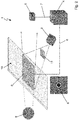
- Figure 1 shows an arrangement of a display system 1 for a windshield, having a projection device 2, a projection surface 3, especially a projection screen 11, and a control device 4. At the projection surface 3 is pointed a recording device 5, which is designed to register images 9 projected onto the projection surface 3. The registered images are sent from the recording device 5 by a first data highway 7 to the control device 4.
- the control device 4 computes an improved diffraction pattern 6, which in turn is transmitted from the control device 4 by means of a second data highway 8 to the projection surface 3 for further use. With the use of the improved diffraction pattern 6, losses in image quality caused by the projection surface 3 can be compensated.
- Figure 2 shows an arrangement of the display systems 1 for a windshield in which the projection surface 3 is arranged on a windshield 10.
- a projection device 2 an image 9 is transmitted through a transparent projection screen 11 of an HOE onto the projection surface 3, constituting the reflecting part of an HOE.
- the recording device 5 is aimed at the projection surface 3 and receives the image 9, which appears virtually behind the windshield 10 out of sight of an observer.
- the recording is transmitted by the recording device 5 by means of the first data highway 7 to the control device 4 and evaluated within the control device 4.
- the computed improved diffraction pattern 6 is then relayed by means of the second data highway 8 to the projection surface 3 for further use.
- the display system 1 for a windshield can furthermore be used as well for the representation of a holographic image, according to Figure 3 .
- a projection device 2 projects an image 9 onto a projection surface 3, which is arranged on a windshield 10.
- the recording device 5 in order to receive the image 9 is aimed at the projection surface 3, especially a projection screen 11.
- the image 9 received is transmitted by means of the first data highway 7 to the control device 4 and checked for the desired quality.
- the improved diffraction pattern 6 is relayed by means of the second data highway 8 to the projection surface 3, designed as a diffuser, and used to enhance the quality of further representations.
- the preceding display systems described in detail are sample embodiments, they may be modified as usual by the person skilled in the art to a broad degree, without leaving the scope of the invention.
- the specific embodiments of the projection surfaces may also have a form other than described here.
- the recording device may be designed in a different form when such is required to enhance the quality.
- the use of the indefinite article "a” or “an” does not rule out the respective features also being present in the plural.
Landscapes
- Physics & Mathematics (AREA)
- General Physics & Mathematics (AREA)
- Optics & Photonics (AREA)
- Nonlinear Science (AREA)
- Engineering & Computer Science (AREA)
- Chemical & Material Sciences (AREA)
- Crystallography & Structural Chemistry (AREA)
- Theoretical Computer Science (AREA)
- Instrument Panels (AREA)
- Combustion & Propulsion (AREA)
- Transportation (AREA)
- Mechanical Engineering (AREA)
Abstract
Head-up displays for vehicles are usually very cost-intensive due to the high requirements during development and manufacture. The invention relates to a display system (1) for a windshield of a means of transportation. The display system (1) comprises a projection device (2), a projection surface (3) and a control device (4). Furthermore, the display device (1) is configured with a recording device (5), which is oriented to the projection surface (3) and connected to the control device (4) by means of a first data highway (7). The projection surface (3) is configurable and likewise connected by means of a second data highway (8) to the control device (4). The invention furthermore relates to a method for configuring the display system.
Description
- The invention relates to a display system for a windshield of a vehicle, an airplane, or another means of transportation with a windshield, in which the user can maintain the posture of his head or his viewing direction. The display system comprises a liquid crystal display. Furthermore, the invention relates to a method for configuring the display system.
- It is known from the prior art how to project information into the visual field of a driver, such as the driver or an automobile or a pilot, by means of a head-up display. By a head-up display, also called HUD for short, is meant a display system in which the user can maintain the posture of his head or his viewing direction substantially in the original orientation for viewing the displayed information.
- Such head-up displays generally comprise an image-producing unit, which provides the information being represented in the form of an image, an optical module, which allows the beams to travel inside the head-up display as far as an exit opening and which is also called the mirror optics, and a projection surface for representing the image being generated. The optical module conveys the image to the projection surface, which is formed as a reflective, light-transparent windshield and which is also called a combiner. The driver of the vehicle sees the reflected information of the image-generating unit and at the same time the actual surroundings behind the windshield. In this way, the driver's attention, especially when driving a motor vehicle, is directed at happenings in front of the vehicle, while he can discern the information projected into his visual field. HUD systems enhance the safety of driving the vehicle.
- In head-up displays one often distinguishes between virtual images and real images.
-
EP 0 286 962 A2 describes a laser projector, with which an image generated on a projection screen is projected onto a frequency-dependent mirror on a windshield so that the driver gets a virtual image seemingly in the visual range in front of the windshield. Furthermore, the possibility is disclosed of representing an image, generated with a laser projector, in the region of the windshield by means of a holographic optical element which is arranged on the windshield or in the vicinity of the windshield. The errors arising due to the curvature of the windshield are to be compensated by an appropriately designed optics, which is done by polished lenses or mirrors. Curved mirrors can also be used here. - With HUD systems it is desirable on the one hand for the user to have a good visual field and on the other hand for the extra display to have a good image quality with sufficient image brightness, good contrast, and high resolution, as well as minimum distortion and minimum image errors. In the past, various possibilities were pointed out for increasing the image quality. Among the factors which worsen the image quality are so-called speckles or image distortions, for example.
- Speckles are produced by unevenness of an illuminated surface, each unevenness constituting a scattering center from which spherical waves emanate, interfering in turn with spherical waves of other scattering centers in the far field. The pattern is basically random, since the surfaces used in HUD systems usually have no systematic structures. Speckles need to be suppressed in order to provide a clear image within a HUD system.
- From
DE 10 2013 008 372 A1 there is disclosed a method in which an identical image is reflected repeatedly, one after another in time succession, on a projection surface. The individual images are distinguished from one another by the variation of the position of the object being represented in the light modulator, known as the SLM (Spatial Light Modulator) for short, by their position on the projection surface. Due to the position differences of the individual images, the interference conditions are disrupted on average and thus speckle is reduced or prevented. - According to
WO 2016 072 372 A1 , speckle is minimized by suitably adapted lenses or lens arrangements. - What the developments of the prior art have in common is that the elements of the particular display systems for windshields, especially mirror reflecting surfaces and diffracting optical elements, need to be specially adapted and designed for each model series of a means of transportation. This adaptation is very tedious and thus cost-intensive. Especially on account of the small number of means of transportation of each individual model series, the manufacture of a small lot size of HUD systems is also very cost-intensive. Also when the windshield is replaced the representation might be greatly impaired, so that the system needs to be adapted once more.
- The problem which the invention proposes to solve is to provide a display system for a windshield which can be manufactured economically yet still meets the high demands on image quality.
- The problem is solved by a display system for a windshield with the features of
independent patent claim 1. - Modifications are indicated in the
dependent patent claims 2 to 6. - Furthermore, the problem of the invention is to provide a method by which the quality of the images generated within a HUD system can be increased in simple manner.
- The problem is solved by a method with the features of the
independent patent claim 7. Modifications are indicated in thedependent patent claims 8 to 11. - The problem is solved by a display system according to the invention for a windshield, similar to other HUD systems. The display system comprises a projection device, a projection surface and a control device.
- The control device, besides the functions of the present invention, may also fulfil other control functions, such as those regarding the content of a projected image.
- According to the concept of the invention, the display system is designed with a recording device, which is pointed toward the projection surface.
- The recording device may be, for example, a camera, which is adapted in its resolution to the corresponding requirements. Information registered by the recording device is taken by means of a first data highway to the control device. In the control device there are also stored parameters, such as those pertaining to the elements of the HUD system.
- The projection surface is configurable such that different diffraction patterns can be defined. In coordination with the results of the recording, the recording device can make changes to the diffraction pattern which are then sent to the projection surface and which can be used there as the basis for the reproduction of the image for an observer. For the transmittal of new diffraction patterns, the projection surface is likewise connected by means of a second data highway to the control device.
- The data highways are preferably configured in the form of a cable, but other forms of data transmittal are conceivable, such as by means of Bluetooth, infrared, or radio.
- According to a first alternative embodiment of the invention, the projection surface is formed as a transparent liquid crystal display, arranged in particular in the region of the windshield. With a liquid crystal display, known as a LCD for short, any given contents can be represented by changing the orientation of the liquid crystals.
- HUD systems often constitute transparent projection surfaces which are folded down or moved into the visual field of the user, without hindering the forward view of the user in the viewing direction. A recording device may then be arranged so that it scans and relays for example the transparent image surface out of sight of the user or the objects represented thereon. Virtual images can be provided with the HUD system being described.
- According to a second alternative embodiment of the invention, display systems for a windshield are usually designed such in motor vehicles that the projection surface is a flexible liquid crystal display arranged on the windshield. It is an advantage that the independently produced element can easily be designed by the method described below, thanks to the improvement by means of the recording device, and also be produced economically as a result of larger manufacturing lots.
- For a further virtual representation of images, it can be provided that the projection surface of the display system for a windshield has a mirror reflecting design. As soon as an image is projected onto the projection field or the projection surface, the observer receives the impression that the represented object is situated in space in the viewing direction behind the windshield.
- A further advantageous embodiment of the invention consists in that the projection surface of the display system for a windshield is designed as a diffuser, so that holographic representations in improved quality can also be reproduced.
- The data obtained with the recording device, which is compared by computer to an ideal and used for the improvement, can in one advantageous embodiment of the invention be stored by means of a photopolymer and saved for when it is needed. The stored data, for example, may be used for a calibration in event of a changing of components of the HUD system.
- The problem is also solved by a method according to the invention for the configuring of a display system for a windshield. First of all, by means of a projection device an image is generated on a projection surface, the projection surface having an expected diffraction pattern. After this, the image is registered by means of a recording device and sent to a control device. Within the control device, the image is compared to a desired quality of the representation. Next, an improved diffraction pattern is generated to improve the representation by means of a projection surface and transmitted to the projection surface for the configuring of the projection surface. This does away with costly computations of the individual parts of the system, since an image is created first on the basis of an estimated diffraction pattern and then serves as the computational basis for an adaptation of the projection surface, so that the same components can always be used regardless of the type of the means of transportation or the model series, although each is adapted in its quality.
- The method for configuring a display system for a windshield can also use the expected diffraction pattern as the image, especially in regard to the computing power of the control device. The diffraction pattern is advantageously saved as a grey scale image and can be quickly compared against the recording. For the representation of the expected diffraction pattern in this case, the phase of each beam of light is adapted depending on the grey value of each pixel of the liquid crystal display, so that a diffraction pattern can be registered by the recording device.
- The comparison carried out inside the control device results in an improvement which is relayed to the projection surface. After this, an improved image can be reproduced on the projection surface, which can be configured as an element of a HUD system, such as a DOE (diffractive optical element) or HOE (holographicoptical element). The DOE serves for the forming of a beam of light, often a laser beam. The physical principle is based on diffraction by a grating. The HOE is needed for the representation of a holographic image.
- According to one modification of the invention, the method for configuring a display system for a windshield is repeated one time or multiple times to enhance the image quality. For example, especially high quality can be produced for an image by iteration or generically by other mathematical algorithms.
- According to one preferred embodiment of the invention, in the method for configuring a display system for a windshield the improved diffraction pattern is stored, so that when needed it can be retrieved. In particular, the manufacturing of a HOE can thus be avoided, which results in lower costs.
The improved diffraction pattern is preferably stored by means of a photopolymer. - Consequently, the generally known advantages of photopolymers can be employed.
- The invention will now be further described, by way of example only, with reference to the accompanying drawings, in which:
-
Figure 1 shows an arrangement of a display system with a transparent liquid crystal display acting as a diffuser; -
Figure 2 shows an arrangement of a display system with a reflective liquid crystal display; and - Figure 4 shows an arrangement of a display system with a reflective liquid crystal display acting as a diffuser.
-
Figure 1 shows an arrangement of adisplay system 1 for a windshield, having aprojection device 2, aprojection surface 3, especially aprojection screen 11, and a control device 4. At theprojection surface 3 is pointed arecording device 5, which is designed to registerimages 9 projected onto theprojection surface 3. The registered images are sent from therecording device 5 by afirst data highway 7 to the control device 4. - The control device 4 computes an
improved diffraction pattern 6, which in turn is transmitted from the control device 4 by means of asecond data highway 8 to theprojection surface 3 for further use. With the use of the improveddiffraction pattern 6, losses in image quality caused by theprojection surface 3 can be compensated. -
Figure 2 shows an arrangement of thedisplay systems 1 for a windshield in which theprojection surface 3 is arranged on awindshield 10. By aprojection device 2, animage 9 is transmitted through atransparent projection screen 11 of an HOE onto theprojection surface 3, constituting the reflecting part of an HOE. Therecording device 5 is aimed at theprojection surface 3 and receives theimage 9, which appears virtually behind thewindshield 10 out of sight of an observer. The recording is transmitted by therecording device 5 by means of thefirst data highway 7 to the control device 4 and evaluated within the control device 4. - The computed
improved diffraction pattern 6 is then relayed by means of thesecond data highway 8 to theprojection surface 3 for further use. - The
display system 1 for a windshield can furthermore be used as well for the representation of a holographic image, according toFigure 3 . For this, aprojection device 2 projects animage 9 onto aprojection surface 3, which is arranged on awindshield 10. Therecording device 5 in order to receive theimage 9 is aimed at theprojection surface 3, especially aprojection screen 11. Theimage 9 received is transmitted by means of thefirst data highway 7 to the control device 4 and checked for the desired quality. After an improvement, theimproved diffraction pattern 6 is relayed by means of thesecond data highway 8 to theprojection surface 3, designed as a diffuser, and used to enhance the quality of further representations. - Since the preceding display systems described in detail are sample embodiments, they may be modified as usual by the person skilled in the art to a broad degree, without leaving the scope of the invention. In particular, the specific embodiments of the projection surfaces may also have a form other than described here. Likewise, the recording device may be designed in a different form when such is required to enhance the quality. Moreover, the use of the indefinite article "a" or "an" does not rule out the respective features also being present in the plural.
-
- 1
- Display system
- 2
- Projection device
- 3
- Projection surface
- 4
- Control device
- 5
- Recording device
- 6
- Improved diffraction pattern
- 7
- First data highway
- 8
- Second data highway
- 9
- Image
- 10
- Windshield
- 11
- Projection screen
Claims (11)
- A display system (1) for a windshield, comprising a projection device (2), a projection surface (3) and a control device (4), characterized in that a recording device (5) is formed, which is oriented to the projection surface (3) and connected to the control device (4) by means of a first data highway (7), wherein the projection surface (3) is configurable and likewise connected by means of a second data highway (8) to the control device (4).
- The display system (1) as claimed in claim 1, characterized in that the projection surface (3) is configured as a light-transparent liquid crystal display arranged in particular in the region of the windshield (10).
- The display system (1) as claimed in claim 1, characterized in that the projection surface (3) is configured as a flexible liquid crystal display arranged on the windshield (10).
- The display system (1) as claimed in claim 3, characterized in that the projection surface (3) is configured as a mirror.
- The display system (1) as claimed in claim 3, characterized in that the projection surface (3) is configured as a diffuser.
- The display system (1) as claimed in any preceding claim, characterized in that a photopolymer is provided with which an improved diffraction pattern (6) can be stored.
- A method for configuring a display system (1) for a windshield, involving the following steps:- generating an image (9) by means of a projection device (2) on a projection surface (3), the projection surface (3) having an expected diffraction pattern;- registering of the image (9) by means of a recording device (5) and transmitting it to a control device (4);- comparing the image (9) against a desired quality of representation by means of the control device (4);- generating an improved diffraction patterns (6) to improve the representation by means of the projection surface (3); and- configuring the projection surface (3) with the aid of the improved diffraction pattern (6).
- The method as claimed in claim 7, characterized in that the image (9) corresponds to the expected diffraction pattern.
- The method as claimed in claim 7 or claim 8, characterized in that the steps are repeated singly or multiple times.
- The method as claimed in claim 8 or claim 9, characterized in that the improved diffraction pattern (6) is stored.
- The method as claimed in claim 10, characterized in that the improved diffraction pattern (6) is stored by means of a photopolymer.
Applications Claiming Priority (1)
| Application Number | Priority Date | Filing Date | Title |
|---|---|---|---|
| DE102017102704.1A DE102017102704A1 (en) | 2017-02-10 | 2017-02-10 | Front screen display system and method of configuring the display system |
Publications (1)
| Publication Number | Publication Date |
|---|---|
| EP3361303A1 true EP3361303A1 (en) | 2018-08-15 |
Family
ID=61192822
Family Applications (1)
| Application Number | Title | Priority Date | Filing Date |
|---|---|---|---|
| EP18156362.8A Withdrawn EP3361303A1 (en) | 2017-02-10 | 2018-02-12 | Display system for a windshield and a method for configuring the display system |
Country Status (4)
| Country | Link |
|---|---|
| US (1) | US20180231773A1 (en) |
| EP (1) | EP3361303A1 (en) |
| CN (1) | CN108415161A (en) |
| DE (1) | DE102017102704A1 (en) |
Families Citing this family (1)
| Publication number | Priority date | Publication date | Assignee | Title |
|---|---|---|---|---|
| CN110861580B (en) * | 2019-11-19 | 2022-07-22 | 博泰车联网科技(上海)股份有限公司 | Driving method and related product |
Citations (4)
| Publication number | Priority date | Publication date | Assignee | Title |
|---|---|---|---|---|
| US20080192312A1 (en) * | 2007-02-09 | 2008-08-14 | Gm Global Technology Operations, Inc. | Holographic information display |
| US20080218434A1 (en) * | 2007-03-05 | 2008-09-11 | The Boeing Company | Electrically Dimmable Combiner Optics for Head-Up Display |
| US8412413B1 (en) * | 2011-12-21 | 2013-04-02 | Delphi Technologies, Inc. | Vehicle windshield display with obstruction detection |
| US20130222384A1 (en) * | 2010-11-08 | 2013-08-29 | Seereal Technologies S.A. | Display device, in particular a head-mounted display, based on temporal and spatial multiplexing of hologram tiles |
Family Cites Families (12)
| Publication number | Priority date | Publication date | Assignee | Title |
|---|---|---|---|---|
| US5694230A (en) | 1995-06-07 | 1997-12-02 | Digital Optics Corp. | Diffractive optical elements as combiners |
| US6018402A (en) * | 1998-03-24 | 2000-01-25 | Lucent Technologies Inc. | Apparatus and method for phase-encoding off-axis spatial light modulators within holographic data systems |
| DE10046019A1 (en) | 2000-09-18 | 2002-03-28 | Esg Elektroniksystem Und Logis | Distortion-free representation of image elements on a curved surface, esp. a vehicle wind-screen, requires correction step for pre-correcting the image elements before display |
| US7873233B2 (en) | 2006-10-17 | 2011-01-18 | Seiko Epson Corporation | Method and apparatus for rendering an image impinging upon a non-planar surface |
| KR101539668B1 (en) * | 2008-06-26 | 2015-08-06 | 삼성전자주식회사 | 3D image display apparatus and method using hologram element |
| FR2957683B1 (en) * | 2010-03-17 | 2012-03-23 | Delphi Tech Inc | DIFFRACTIVE COMBINER FOR HIGH COLOR HEAD DISPLAY |
| JP5344069B2 (en) * | 2011-08-29 | 2013-11-20 | 株式会社デンソー | Head-up display device |
| JP5994715B2 (en) * | 2012-04-10 | 2016-09-21 | パナソニックIpマネジメント株式会社 | Computer generated hologram display |
| US20140092481A1 (en) * | 2012-09-28 | 2014-04-03 | Delphi Technologies, Inc. | Head-up display system with dynamic image field and brightness control |
| DE102013008372A1 (en) | 2013-05-16 | 2014-11-20 | GM Global Technology Operations LLC (n. d. Gesetzen des Staates Delaware) | Method and device for reducing speckles of an image of an object generated in a reproduction device |
| KR102100911B1 (en) * | 2013-08-30 | 2020-04-14 | 엘지전자 주식회사 | Wearable glass-type device, systme habving the samde and method of controlling the device |
| DE102014224189A1 (en) | 2014-11-26 | 2016-06-02 | Continental Automotive Gmbh | Holographic head-up display system |
-
2017
- 2017-02-10 DE DE102017102704.1A patent/DE102017102704A1/en not_active Withdrawn
-
2018
- 2018-02-09 US US15/892,755 patent/US20180231773A1/en not_active Abandoned
- 2018-02-09 CN CN201810135287.7A patent/CN108415161A/en active Pending
- 2018-02-12 EP EP18156362.8A patent/EP3361303A1/en not_active Withdrawn
Patent Citations (4)
| Publication number | Priority date | Publication date | Assignee | Title |
|---|---|---|---|---|
| US20080192312A1 (en) * | 2007-02-09 | 2008-08-14 | Gm Global Technology Operations, Inc. | Holographic information display |
| US20080218434A1 (en) * | 2007-03-05 | 2008-09-11 | The Boeing Company | Electrically Dimmable Combiner Optics for Head-Up Display |
| US20130222384A1 (en) * | 2010-11-08 | 2013-08-29 | Seereal Technologies S.A. | Display device, in particular a head-mounted display, based on temporal and spatial multiplexing of hologram tiles |
| US8412413B1 (en) * | 2011-12-21 | 2013-04-02 | Delphi Technologies, Inc. | Vehicle windshield display with obstruction detection |
Also Published As
| Publication number | Publication date |
|---|---|
| CN108415161A (en) | 2018-08-17 |
| US20180231773A1 (en) | 2018-08-16 |
| DE102017102704A1 (en) | 2018-08-16 |
Similar Documents
| Publication | Publication Date | Title |
|---|---|---|
| EP3557307B1 (en) | Image display device | |
| JP6409015B2 (en) | Projection display device for vehicle | |
| CN105204172B (en) | Show that the visual field of image shows equipment for the passenger for vehicle | |
| CN114600034B (en) | Head-up display without ghosting | |
| CN107430274B (en) | Projection optical system and head-up display device using the same | |
| US20190116344A1 (en) | Multiple image plane head-up display | |
| JP7027856B2 (en) | Display devices and equipment | |
| JP2019219555A (en) | Display device and automobile head-up display system using the same | |
| JP4914799B2 (en) | Windshield and head-up display unit | |
| JPWO2017072841A1 (en) | Information display device | |
| JPWO2017064797A1 (en) | Information display device | |
| CN112105982A (en) | Head-up display without mirror | |
| WO2017035053A1 (en) | Image projection system | |
| EP3605191B1 (en) | Virtual image display device | |
| JP7048792B2 (en) | In-vehicle display device | |
| WO2017061016A1 (en) | Information display device | |
| JP2021012255A (en) | Virtual image display device | |
| Biswas et al. | 47.3: Invited Paper: World Fixed Augmented‐Reality HUD for Smart Notifications | |
| US20180231773A1 (en) | Display system for a windshield and method for configuring the display system | |
| EP3534202B1 (en) | Virtual image display device | |
| JP7631836B2 (en) | Display control device, display device, display system, and image display control method | |
| CN109154719B (en) | Projection optical system, head-up display device, and automobile | |
| JP2024048865A (en) | Display control device, display device | |
| WO2018199244A1 (en) | Display system | |
| JP7095018B2 (en) | Head-up display device |
Legal Events
| Date | Code | Title | Description |
|---|---|---|---|
| PUAI | Public reference made under article 153(3) epc to a published international application that has entered the european phase |
Free format text: ORIGINAL CODE: 0009012 |
|
| AK | Designated contracting states |
Kind code of ref document: A1 Designated state(s): AL AT BE BG CH CY CZ DE DK EE ES FI FR GB GR HR HU IE IS IT LI LT LU LV MC MK MT NL NO PL PT RO RS SE SI SK SM TR |
|
| AX | Request for extension of the european patent |
Extension state: BA ME |
|
| STAA | Information on the status of an ep patent application or granted ep patent |
Free format text: STATUS: THE APPLICATION IS DEEMED TO BE WITHDRAWN |
|
| 18D | Application deemed to be withdrawn |
Effective date: 20190216 |