EP3359541B1 - N-sulfonylated pyrazolo[3,4-b]pyridin-6-carboxamides and method of use - Google Patents
N-sulfonylated pyrazolo[3,4-b]pyridin-6-carboxamides and method of use Download PDFInfo
- Publication number
- EP3359541B1 EP3359541B1 EP16788232.3A EP16788232A EP3359541B1 EP 3359541 B1 EP3359541 B1 EP 3359541B1 EP 16788232 A EP16788232 A EP 16788232A EP 3359541 B1 EP3359541 B1 EP 3359541B1
- Authority
- EP
- European Patent Office
- Prior art keywords
- pyrazolo
- pyridine
- carboxamide
- phenyl
- cyclobutyl
- Prior art date
- Legal status (The legal status is an assumption and is not a legal conclusion. Google has not performed a legal analysis and makes no representation as to the accuracy of the status listed.)
- Active
Links
- 0 CC(C)(C)OC(*(CC1)CCC1(c(cc1)ccc1N)C#*)=O Chemical compound CC(C)(C)OC(*(CC1)CCC1(c(cc1)ccc1N)C#*)=O 0.000 description 18
- YPSRHLLNHZEZFE-UHFFFAOYSA-N CCOC(c1cc(-c(cc2)ccc2C(O)=O)c2c(OC(C)C)n[n](C3CCCCC3)c2n1)=O Chemical compound CCOC(c1cc(-c(cc2)ccc2C(O)=O)c2c(OC(C)C)n[n](C3CCCCC3)c2n1)=O YPSRHLLNHZEZFE-UHFFFAOYSA-N 0.000 description 2
- NMCMCSHJONWGMS-UHFFFAOYSA-N C(C1CCNCC1)N1CCCC1 Chemical compound C(C1CCNCC1)N1CCCC1 NMCMCSHJONWGMS-UHFFFAOYSA-N 0.000 description 1
- DXSGXEMMBLFIEK-UHFFFAOYSA-N C(CN1CCOCC1)C1CCNCC1 Chemical compound C(CN1CCOCC1)C1CCNCC1 DXSGXEMMBLFIEK-UHFFFAOYSA-N 0.000 description 1
- UIBUFGUIDCGKIF-UHFFFAOYSA-N CC(C)(C)OC(N(CC1)CC=C1c1c(c(C2CCC2)n[n]2-c(cc3)ccc3F)c2nc(C(OC)=O)c1)=O Chemical compound CC(C)(C)OC(N(CC1)CC=C1c1c(c(C2CCC2)n[n]2-c(cc3)ccc3F)c2nc(C(OC)=O)c1)=O UIBUFGUIDCGKIF-UHFFFAOYSA-N 0.000 description 1
- JNFVRQCBGQNNAU-UHFFFAOYSA-N CC(C)(C)OC(N(CC1)CCC1c1c(c(C2CCC2)n[n]2-c(cc3)ccc3F)c2nc(C(OC)=O)c1)=O Chemical compound CC(C)(C)OC(N(CC1)CCC1c1c(c(C2CCC2)n[n]2-c(cc3)ccc3F)c2nc(C(OC)=O)c1)=O JNFVRQCBGQNNAU-UHFFFAOYSA-N 0.000 description 1
- QBQOPNYILDXCBJ-UHFFFAOYSA-N CC(C)(C)OC(N(CCC1)CC1(CO)F)=O Chemical compound CC(C)(C)OC(N(CCC1)CC1(CO)F)=O QBQOPNYILDXCBJ-UHFFFAOYSA-N 0.000 description 1
- VVDCRJGWILREQH-UHFFFAOYSA-N CC(C)(C)OC(N1CC=C(B2OC(C)(C)C(C)(C)O2)CC1)=O Chemical compound CC(C)(C)OC(N1CC=C(B2OC(C)(C)C(C)(C)O2)CC1)=O VVDCRJGWILREQH-UHFFFAOYSA-N 0.000 description 1
- QWTCNGSICNOICM-UHFFFAOYSA-N CC(C)(C1)CC1c(cc1N)n[n]1-c1ccccc1 Chemical compound CC(C)(C1)CC1c(cc1N)n[n]1-c1ccccc1 QWTCNGSICNOICM-UHFFFAOYSA-N 0.000 description 1
- GUQXBKDDGLIKPH-UHFFFAOYSA-O CC(C)C(c(c(Cl)c1)c([NH2+]c(cc2)ccc2F)nc1C(OC)=O)=N Chemical compound CC(C)C(c(c(Cl)c1)c([NH2+]c(cc2)ccc2F)nc1C(OC)=O)=N GUQXBKDDGLIKPH-UHFFFAOYSA-O 0.000 description 1
- FVAAVKMKXGWNNI-UHFFFAOYSA-N CC(C)Oc1n[n](C2CCCCC2)c(N)c1 Chemical compound CC(C)Oc1n[n](C2CCCCC2)c(N)c1 FVAAVKMKXGWNNI-UHFFFAOYSA-N 0.000 description 1
- IXDHRQCZGUOSEV-UHFFFAOYSA-N CC(C)Oc1n[n](C2CCCCC2)c2nc(C(OC)=O)cc(-c(cc3)ccc3Br)c12 Chemical compound CC(C)Oc1n[n](C2CCCCC2)c2nc(C(OC)=O)cc(-c(cc3)ccc3Br)c12 IXDHRQCZGUOSEV-UHFFFAOYSA-N 0.000 description 1
- JPOPRLADMWZIGD-UHFFFAOYSA-N CC(C)c(c(c1nc(C(NS(CCCCl)(=O)=O)=O)c2)c2N2CCC(COC)CC2)n[n]1-c(cc1)ccc1F Chemical compound CC(C)c(c(c1nc(C(NS(CCCCl)(=O)=O)=O)c2)c2N2CCC(COC)CC2)n[n]1-c(cc1)ccc1F JPOPRLADMWZIGD-UHFFFAOYSA-N 0.000 description 1
- AVUVGPPJMVXFSG-UHFFFAOYSA-N CC(C)c(c(c1nc(C(OC)=O)c2)c2N2CCC(COC)CC2)n[n]1-c(cc1)ccc1F Chemical compound CC(C)c(c(c1nc(C(OC)=O)c2)c2N2CCC(COC)CC2)n[n]1-c(cc1)ccc1F AVUVGPPJMVXFSG-UHFFFAOYSA-N 0.000 description 1
- VHYBIFWCNJRTLQ-UHFFFAOYSA-N CC(C)c(cc1N)n[n]1-c1cc(Cl)ncc1 Chemical compound CC(C)c(cc1N)n[n]1-c1cc(Cl)ncc1 VHYBIFWCNJRTLQ-UHFFFAOYSA-N 0.000 description 1
- GLUMROVQHOAFAW-UHFFFAOYSA-N CC(C)c(cc1N)n[n]1-c1cc(N2CCCC2)ncc1 Chemical compound CC(C)c(cc1N)n[n]1-c1cc(N2CCCC2)ncc1 GLUMROVQHOAFAW-UHFFFAOYSA-N 0.000 description 1
- LVUFFYIXCMAQSX-UHFFFAOYSA-N CC(C)c(cc1N)n[n]1-c1cccc(N2CCOCC2)n1 Chemical compound CC(C)c(cc1N)n[n]1-c1cccc(N2CCOCC2)n1 LVUFFYIXCMAQSX-UHFFFAOYSA-N 0.000 description 1
- BRBDRIXLWIZFLS-UHFFFAOYSA-N CC(NCCS(NC(c1cc(N2CCC(COC)CC2)c(c(C2CCC2)n[n]2-c3ccccc3)c2n1)=O)(=O)=O)=O Chemical compound CC(NCCS(NC(c1cc(N2CCC(COC)CC2)c(c(C2CCC2)n[n]2-c3ccccc3)c2n1)=O)(=O)=O)=O BRBDRIXLWIZFLS-UHFFFAOYSA-N 0.000 description 1
- OXQULEMKVPOULD-HWKANZROSA-N CCOC(C(/C=C/c1ccc(N(CC2)CCC2C#N)nc1)=O)=O Chemical compound CCOC(C(/C=C/c1ccc(N(CC2)CCC2C#N)nc1)=O)=O OXQULEMKVPOULD-HWKANZROSA-N 0.000 description 1
- AQUDJUAHRVMYFQ-UHFFFAOYSA-N CCOC(c1cc(-c(cc2)ccc2C(N(C2)CC(C3)C2CN3C(OC(C)(C)C)=O)=O)c2c(OC(C)C)n[n](C3CCCCC3)c2n1)=O Chemical compound CCOC(c1cc(-c(cc2)ccc2C(N(C2)CC(C3)C2CN3C(OC(C)(C)C)=O)=O)c2c(OC(C)C)n[n](C3CCCCC3)c2n1)=O AQUDJUAHRVMYFQ-UHFFFAOYSA-N 0.000 description 1
- YUVDTVLADSKZHN-UHFFFAOYSA-N CCOC(c1cc(-c(cc2)ccc2C(N(C2)CC2N(C)C)=O)c2c(OC(C)C)n[n](C3CCCCC3)c2n1)=O Chemical compound CCOC(c1cc(-c(cc2)ccc2C(N(C2)CC2N(C)C)=O)c2c(OC(C)C)n[n](C3CCCCC3)c2n1)=O YUVDTVLADSKZHN-UHFFFAOYSA-N 0.000 description 1
- NLAJGHZREQBIRY-UHFFFAOYSA-N CCOC(c1cc(Cl)c(c(C(C)C)n[n]2-c3cccc(N(C)C)c3)c2n1)=O Chemical compound CCOC(c1cc(Cl)c(c(C(C)C)n[n]2-c3cccc(N(C)C)c3)c2n1)=O NLAJGHZREQBIRY-UHFFFAOYSA-N 0.000 description 1
- RDKHLPIICRBLSI-UHFFFAOYSA-N CCOC(c1cc(Cl)c(c(C(C)Cc(c(C)c2)ccc2-[n](c2nc(C(O)=O)c3)nc(C(C)C)c2c3N)n[n]2-c3cc(C)ccc3)c2n1)=O Chemical compound CCOC(c1cc(Cl)c(c(C(C)Cc(c(C)c2)ccc2-[n](c2nc(C(O)=O)c3)nc(C(C)C)c2c3N)n[n]2-c3cc(C)ccc3)c2n1)=O RDKHLPIICRBLSI-UHFFFAOYSA-N 0.000 description 1
- SQFTTXCZAKNVLK-UHFFFAOYSA-N CCOC(c1cc(N(CC2)CCC2N2CCOCC2)c(c(C2CCC2)n[n]2-c3cc(C)ccc3)c2n1)=O Chemical compound CCOC(c1cc(N(CC2)CCC2N2CCOCC2)c(c(C2CCC2)n[n]2-c3cc(C)ccc3)c2n1)=O SQFTTXCZAKNVLK-UHFFFAOYSA-N 0.000 description 1
- XPDORZDEXZNHMI-UHFFFAOYSA-N CCOC(c1cc(N(CC2)CCC2N2CCOCC2)c(c(C2CCC2)n[n]2-c3cc(O)ncc3)c2n1)=O Chemical compound CCOC(c1cc(N(CC2)CCC2N2CCOCC2)c(c(C2CCC2)n[n]2-c3cc(O)ncc3)c2n1)=O XPDORZDEXZNHMI-UHFFFAOYSA-N 0.000 description 1
- RTTJPCWXMGSNTK-UHFFFAOYSA-N CCOC(c1cc(N(CC2)CCC2N2CCOCC2)c(c(C2CCC2)n[n]2-c3cc(OCc4ccccc4)ncc3)c2n1)=O Chemical compound CCOC(c1cc(N(CC2)CCC2N2CCOCC2)c(c(C2CCC2)n[n]2-c3cc(OCc4ccccc4)ncc3)c2n1)=O RTTJPCWXMGSNTK-UHFFFAOYSA-N 0.000 description 1
- HBBFYROVCFZHRE-UHFFFAOYSA-N CCOC(c1cc(N)c(c(C(C)C)n[n]2-c3cc(N(C)C)ccc3)c2n1)=O Chemical compound CCOC(c1cc(N)c(c(C(C)C)n[n]2-c3cc(N(C)C)ccc3)c2n1)=O HBBFYROVCFZHRE-UHFFFAOYSA-N 0.000 description 1
- HWUNHHANRZKRJZ-UHFFFAOYSA-N CCOC(c1cc(N)c(c(C(C)Cc(c(C)c2)ccc2-[n](c2nc(C#N)c3)nc(C(C)C)c2c3NC(OC(C)(C)C)=O)n[n]2-c3cc(C)ccc3)c2n1)O Chemical compound CCOC(c1cc(N)c(c(C(C)Cc(c(C)c2)ccc2-[n](c2nc(C#N)c3)nc(C(C)C)c2c3NC(OC(C)(C)C)=O)n[n]2-c3cc(C)ccc3)c2n1)O HWUNHHANRZKRJZ-UHFFFAOYSA-N 0.000 description 1
- KWZGNJOEOWIMRL-UHFFFAOYSA-O CCOC(c1nc([NH2+]c2ccccc2)c(C(C2CCC2)=N)c(-c2ccc(N(CC3)CCC3C#N)nc2)c1)=O Chemical compound CCOC(c1nc([NH2+]c2ccccc2)c(C(C2CCC2)=N)c(-c2ccc(N(CC3)CCC3C#N)nc2)c1)=O KWZGNJOEOWIMRL-UHFFFAOYSA-O 0.000 description 1
- WZGFDJSOYNAPHT-UHFFFAOYSA-O CCOC(c1nc([NH2+]c2ccccc2)c(C(N)=O)c(-c2ccc(N(CC3)CCC3C#N)nc2)c1)=O Chemical compound CCOC(c1nc([NH2+]c2ccccc2)c(C(N)=O)c(-c2ccc(N(CC3)CCC3C#N)nc2)c1)=O WZGFDJSOYNAPHT-UHFFFAOYSA-O 0.000 description 1
- ULZUWBOMCRBGGN-UHFFFAOYSA-O CCOC(c1nc([NH2+]c2ccccc2)c(C(OC(CC2)CCN2C(OC(C)(C)C)=O)=N)c(-c2ccc(N(CC3)CCC3C#N)nc2)c1)=O Chemical compound CCOC(c1nc([NH2+]c2ccccc2)c(C(OC(CC2)CCN2C(OC(C)(C)C)=O)=N)c(-c2ccc(N(CC3)CCC3C#N)nc2)c1)=O ULZUWBOMCRBGGN-UHFFFAOYSA-O 0.000 description 1
- DRTVCFAKCRFCHB-UHFFFAOYSA-N CN(C)S(NC(c1nc([n](-c2ccccc2)nc2C3CCC3)c2c(N(CC2)CCC2N2CCCCC2)c1)=O)(=O)=O Chemical compound CN(C)S(NC(c1nc([n](-c2ccccc2)nc2C3CCC3)c2c(N(CC2)CCC2N2CCCCC2)c1)=O)(=O)=O DRTVCFAKCRFCHB-UHFFFAOYSA-N 0.000 description 1
- QAODEKCAIIROOU-UHFFFAOYSA-N CN(C)c(nc1)ncc1-c1c(c(C(C2)CN2C(OC)=O)n[n]2C3CCCCC3)c2nc(C(O)=O)c1 Chemical compound CN(C)c(nc1)ncc1-c1c(c(C(C2)CN2C(OC)=O)n[n]2C3CCCCC3)c2nc(C(O)=O)c1 QAODEKCAIIROOU-UHFFFAOYSA-N 0.000 description 1
- LUPBLLABDPCGGG-UHFFFAOYSA-N CN(C)c(nc1)ncc1-c1c(c(C2CNC2)n[n]2C3CCCCC3)c2nc(C(O)=O)c1 Chemical compound CN(C)c(nc1)ncc1-c1c(c(C2CNC2)n[n]2C3CCCCC3)c2nc(C(O)=O)c1 LUPBLLABDPCGGG-UHFFFAOYSA-N 0.000 description 1
- RAWGJCGRNMVXST-UHFFFAOYSA-N CN(C1CCOCC1)c1ncc(C=O)cc1 Chemical compound CN(C1CCOCC1)c1ncc(C=O)cc1 RAWGJCGRNMVXST-UHFFFAOYSA-N 0.000 description 1
- VXPVIWBBPDKFTJ-UHFFFAOYSA-N COC(CCSN)=O Chemical compound COC(CCSN)=O VXPVIWBBPDKFTJ-UHFFFAOYSA-N 0.000 description 1
- XKNUHQIIHDSGGZ-UHFFFAOYSA-N COC(N1[IH]CCC[IH]1)=O Chemical compound COC(N1[IH]CCC[IH]1)=O XKNUHQIIHDSGGZ-UHFFFAOYSA-N 0.000 description 1
- SAQSPCGDLQVPLJ-UHFFFAOYSA-N COC(c1cc(-c(cc2)ccc2Br)c2c(O)n[n](C3CCCCC3)c2n1)=O Chemical compound COC(c1cc(-c(cc2)ccc2Br)c2c(O)n[n](C3CCCCC3)c2n1)=O SAQSPCGDLQVPLJ-UHFFFAOYSA-N 0.000 description 1
- LVNNULBDNLPSGG-UHFFFAOYSA-N COC(c1cc(C2CCNCC2)c(c(C2CCC2)n[n]2-c(cc3)ccc3F)c2n1)=O Chemical compound COC(c1cc(C2CCNCC2)c(c(C2CCC2)n[n]2-c(cc3)ccc3F)c2n1)=O LVNNULBDNLPSGG-UHFFFAOYSA-N 0.000 description 1
- RJYCKCYSZDNXQM-UHFFFAOYSA-N COC(c1cc(Cl)c(c(C2CCC2)n[n]2-c(cc3)ccc3F)c2n1)=O Chemical compound COC(c1cc(Cl)c(c(C2CCC2)n[n]2-c(cc3)ccc3F)c2n1)=O RJYCKCYSZDNXQM-UHFFFAOYSA-N 0.000 description 1
- RXLZXJMALCIQMY-UHFFFAOYSA-N COC(c1cc(Cl)c(c(C2CCC2)n[n]2-c3ccccc3)c2n1)=O Chemical compound COC(c1cc(Cl)c(c(C2CCC2)n[n]2-c3ccccc3)c2n1)=O RXLZXJMALCIQMY-UHFFFAOYSA-N 0.000 description 1
- OFMIJPYNYGLFMS-UHFFFAOYSA-N COC(c1cc(N2CCC(CN3CCCC3)CC2)c(c(C2CCC2)n[n]2-c3ccccc3)c2n1)=O Chemical compound COC(c1cc(N2CCC(CN3CCCC3)CC2)c(c(C2CCC2)n[n]2-c3ccccc3)c2n1)=O OFMIJPYNYGLFMS-UHFFFAOYSA-N 0.000 description 1
- GOFSIILKWJAUMX-UHFFFAOYSA-O COC(c1nc([NH2+]c2ccccc2)c(C(C2CCC2)=N)c(Cl)c1)=O Chemical compound COC(c1nc([NH2+]c2ccccc2)c(C(C2CCC2)=N)c(Cl)c1)=O GOFSIILKWJAUMX-UHFFFAOYSA-O 0.000 description 1
- JBCDIRTZKRZGJJ-UHFFFAOYSA-N COCC(CC1)CCN1c1c(c(C2CCC2)n[n]2-c3ccccc3)c2nc(C(NS(CCNC(OCc2ccccc2)=O)(=O)=O)=O)c1 Chemical compound COCC(CC1)CCN1c1c(c(C2CCC2)n[n]2-c3ccccc3)c2nc(C(NS(CCNC(OCc2ccccc2)=O)(=O)=O)=O)c1 JBCDIRTZKRZGJJ-UHFFFAOYSA-N 0.000 description 1
- IHJDIDHHEBJPDL-UHFFFAOYSA-N COCC1CCNCC1 Chemical compound COCC1CCNCC1 IHJDIDHHEBJPDL-UHFFFAOYSA-N 0.000 description 1
- BZBIEHIVJVDGND-UHFFFAOYSA-N COCCOCC1(CNCCC1)F Chemical compound COCCOCC1(CNCCC1)F BZBIEHIVJVDGND-UHFFFAOYSA-N 0.000 description 1
- OSHXIBALERRJPA-UHFFFAOYSA-N COc1cc(OC)c(CN(Cc(ccc(OC)c2)c2OC)S(CCCN2CCOCC2)(=O)=O)cc1 Chemical compound COc1cc(OC)c(CN(Cc(ccc(OC)c2)c2OC)S(CCCN2CCOCC2)(=O)=O)cc1 OSHXIBALERRJPA-UHFFFAOYSA-N 0.000 description 1
- REWRGJSWLNPCNT-UHFFFAOYSA-N CS(NC(OCc1ccccc1)=O)(=O)=O Chemical compound CS(NC(OCc1ccccc1)=O)(=O)=O REWRGJSWLNPCNT-UHFFFAOYSA-N 0.000 description 1
- DSCDGLKAZAHTNR-UHFFFAOYSA-N Cc(cc1N)n[n]1-c1cccc(OC(F)(F)F)c1 Chemical compound Cc(cc1N)n[n]1-c1cccc(OC(F)(F)F)c1 DSCDGLKAZAHTNR-UHFFFAOYSA-N 0.000 description 1
- MIUJAKYZGCOJMM-UHFFFAOYSA-N Cc1cccc(-[n](c2nc(C(O)=O)c3)nc(C4CCC4)c2c3N(CC2)CCC2N2CCOCC2)c1 Chemical compound Cc1cccc(-[n](c2nc(C(O)=O)c3)nc(C4CCC4)c2c3N(CC2)CCC2N2CCOCC2)c1 MIUJAKYZGCOJMM-UHFFFAOYSA-N 0.000 description 1
- RZFGLHUCZXTUOS-UHFFFAOYSA-N NS(CCCN1CCOCC1)(=O)=O Chemical compound NS(CCCN1CCOCC1)(=O)=O RZFGLHUCZXTUOS-UHFFFAOYSA-N 0.000 description 1
- FHOZFHRATQJGOG-UHFFFAOYSA-N Nc1cc(C2CCC2)n[n]1-c(cc1)ccc1F Chemical compound Nc1cc(C2CCC2)n[n]1-c(cc1)ccc1F FHOZFHRATQJGOG-UHFFFAOYSA-N 0.000 description 1
- MHGJYMMATRHDRY-UHFFFAOYSA-N O=C([n]1cncc1)[n]1cnc(C2N(CCCCC3)C3=NCC2)c1 Chemical compound O=C([n]1cncc1)[n]1cnc(C2N(CCCCC3)C3=NCC2)c1 MHGJYMMATRHDRY-UHFFFAOYSA-N 0.000 description 1
- JNDSXJBRDIQOMK-UHFFFAOYSA-N O=C(c1cc(N(CC2)CCC2N2CCOCC2)c(c(C2CCC2)n[n]2-c(cc3)ccc3F)c2n1)NS=O Chemical compound O=C(c1cc(N(CC2)CCC2N2CCOCC2)c(c(C2CCC2)n[n]2-c(cc3)ccc3F)c2n1)NS=O JNDSXJBRDIQOMK-UHFFFAOYSA-N 0.000 description 1
- OSHRZGQSJOAQKN-UHFFFAOYSA-N O=S(CCCN1CCOCC1)(Cl)=O Chemical compound O=S(CCCN1CCOCC1)(Cl)=O OSHRZGQSJOAQKN-UHFFFAOYSA-N 0.000 description 1
- JYQJXKXIFGHFNX-HNQUOIGGSA-N OC(C(/C=C/c(cc1)cnc1N1CCOCC1)=O)=O Chemical compound OC(C(/C=C/c(cc1)cnc1N1CCOCC1)=O)=O JYQJXKXIFGHFNX-HNQUOIGGSA-N 0.000 description 1
- HVTRMFLGXXYROK-UHFFFAOYSA-N OC(c1cc(Cl)c(c(C2CCC2)n[n]2-c3ccccc3)c2n1)=O Chemical compound OC(c1cc(Cl)c(c(C2CCC2)n[n]2-c3ccccc3)c2n1)=O HVTRMFLGXXYROK-UHFFFAOYSA-N 0.000 description 1
- MXZGZBGIHXOKLK-UHFFFAOYSA-N OC(c1nc([n](-c2ccccc2)nc2C3CCC3)c2c(N(CC2)CCC2N2CCCCC2)c1)=O Chemical compound OC(c1nc([n](-c2ccccc2)nc2C3CCC3)c2c(N(CC2)CCC2N2CCCCC2)c1)=O MXZGZBGIHXOKLK-UHFFFAOYSA-N 0.000 description 1
- DSKBTBMUAWUKGM-UHFFFAOYSA-N OC(c1nc([n](-c2ccccc2)nc2C3CCC3)c2c(N2CCC(CCN3CCOCC3)CC2)c1)=O Chemical compound OC(c1nc([n](-c2ccccc2)nc2C3CCC3)c2c(N2CCC(CCN3CCOCC3)CC2)c1)=O DSKBTBMUAWUKGM-UHFFFAOYSA-N 0.000 description 1
- DIVVZWLEPHZZCD-UHFFFAOYSA-O OC1(CN(CC2)CC[S+]2(O)=O)CCNCC1 Chemical compound OC1(CN(CC2)CC[S+]2(O)=O)CCNCC1 DIVVZWLEPHZZCD-UHFFFAOYSA-O 0.000 description 1
- NDOVLWQBFFJETK-UHFFFAOYSA-O O[S+]1(CCNCC1)=O Chemical compound O[S+]1(CCNCC1)=O NDOVLWQBFFJETK-UHFFFAOYSA-O 0.000 description 1
Classifications
-
- A—HUMAN NECESSITIES
- A61—MEDICAL OR VETERINARY SCIENCE; HYGIENE
- A61K—PREPARATIONS FOR MEDICAL, DENTAL OR TOILETRY PURPOSES
- A61K31/00—Medicinal preparations containing organic active ingredients
- A61K31/33—Heterocyclic compounds
- A61K31/395—Heterocyclic compounds having nitrogen as a ring hetero atom, e.g. guanethidine or rifamycins
- A61K31/435—Heterocyclic compounds having nitrogen as a ring hetero atom, e.g. guanethidine or rifamycins having six-membered rings with one nitrogen as the only ring hetero atom
- A61K31/4353—Heterocyclic compounds having nitrogen as a ring hetero atom, e.g. guanethidine or rifamycins having six-membered rings with one nitrogen as the only ring hetero atom ortho- or peri-condensed with heterocyclic ring systems
- A61K31/437—Heterocyclic compounds having nitrogen as a ring hetero atom, e.g. guanethidine or rifamycins having six-membered rings with one nitrogen as the only ring hetero atom ortho- or peri-condensed with heterocyclic ring systems the heterocyclic ring system containing a five-membered ring having nitrogen as a ring hetero atom, e.g. indolizine, beta-carboline
-
- A—HUMAN NECESSITIES
- A61—MEDICAL OR VETERINARY SCIENCE; HYGIENE
- A61K—PREPARATIONS FOR MEDICAL, DENTAL OR TOILETRY PURPOSES
- A61K31/00—Medicinal preparations containing organic active ingredients
- A61K31/33—Heterocyclic compounds
- A61K31/395—Heterocyclic compounds having nitrogen as a ring hetero atom, e.g. guanethidine or rifamycins
- A61K31/435—Heterocyclic compounds having nitrogen as a ring hetero atom, e.g. guanethidine or rifamycins having six-membered rings with one nitrogen as the only ring hetero atom
- A61K31/44—Non condensed pyridines; Hydrogenated derivatives thereof
- A61K31/445—Non condensed piperidines, e.g. piperocaine
- A61K31/4523—Non condensed piperidines, e.g. piperocaine containing further heterocyclic ring systems
- A61K31/4545—Non condensed piperidines, e.g. piperocaine containing further heterocyclic ring systems containing a six-membered ring with nitrogen as a ring hetero atom, e.g. pipamperone, anabasine
-
- A—HUMAN NECESSITIES
- A61—MEDICAL OR VETERINARY SCIENCE; HYGIENE
- A61K—PREPARATIONS FOR MEDICAL, DENTAL OR TOILETRY PURPOSES
- A61K31/00—Medicinal preparations containing organic active ingredients
- A61K31/33—Heterocyclic compounds
- A61K31/395—Heterocyclic compounds having nitrogen as a ring hetero atom, e.g. guanethidine or rifamycins
- A61K31/495—Heterocyclic compounds having nitrogen as a ring hetero atom, e.g. guanethidine or rifamycins having six-membered rings with two or more nitrogen atoms as the only ring heteroatoms, e.g. piperazine or tetrazines
- A61K31/50—Pyridazines; Hydrogenated pyridazines
- A61K31/501—Pyridazines; Hydrogenated pyridazines not condensed and containing further heterocyclic rings
-
- A—HUMAN NECESSITIES
- A61—MEDICAL OR VETERINARY SCIENCE; HYGIENE
- A61K—PREPARATIONS FOR MEDICAL, DENTAL OR TOILETRY PURPOSES
- A61K31/00—Medicinal preparations containing organic active ingredients
- A61K31/33—Heterocyclic compounds
- A61K31/395—Heterocyclic compounds having nitrogen as a ring hetero atom, e.g. guanethidine or rifamycins
- A61K31/495—Heterocyclic compounds having nitrogen as a ring hetero atom, e.g. guanethidine or rifamycins having six-membered rings with two or more nitrogen atoms as the only ring heteroatoms, e.g. piperazine or tetrazines
- A61K31/505—Pyrimidines; Hydrogenated pyrimidines, e.g. trimethoprim
- A61K31/506—Pyrimidines; Hydrogenated pyrimidines, e.g. trimethoprim not condensed and containing further heterocyclic rings
-
- A—HUMAN NECESSITIES
- A61—MEDICAL OR VETERINARY SCIENCE; HYGIENE
- A61K—PREPARATIONS FOR MEDICAL, DENTAL OR TOILETRY PURPOSES
- A61K31/00—Medicinal preparations containing organic active ingredients
- A61K31/33—Heterocyclic compounds
- A61K31/395—Heterocyclic compounds having nitrogen as a ring hetero atom, e.g. guanethidine or rifamycins
- A61K31/535—Heterocyclic compounds having nitrogen as a ring hetero atom, e.g. guanethidine or rifamycins having six-membered rings with at least one nitrogen and one oxygen as the ring hetero atoms, e.g. 1,2-oxazines
- A61K31/5375—1,4-Oxazines, e.g. morpholine
- A61K31/5377—1,4-Oxazines, e.g. morpholine not condensed and containing further heterocyclic rings, e.g. timolol
-
- A—HUMAN NECESSITIES
- A61—MEDICAL OR VETERINARY SCIENCE; HYGIENE
- A61K—PREPARATIONS FOR MEDICAL, DENTAL OR TOILETRY PURPOSES
- A61K45/00—Medicinal preparations containing active ingredients not provided for in groups A61K31/00 - A61K41/00
- A61K45/06—Mixtures of active ingredients without chemical characterisation, e.g. antiphlogistics and cardiaca
-
- A—HUMAN NECESSITIES
- A61—MEDICAL OR VETERINARY SCIENCE; HYGIENE
- A61P—SPECIFIC THERAPEUTIC ACTIVITY OF CHEMICAL COMPOUNDS OR MEDICINAL PREPARATIONS
- A61P1/00—Drugs for disorders of the alimentary tract or the digestive system
-
- A—HUMAN NECESSITIES
- A61—MEDICAL OR VETERINARY SCIENCE; HYGIENE
- A61P—SPECIFIC THERAPEUTIC ACTIVITY OF CHEMICAL COMPOUNDS OR MEDICINAL PREPARATIONS
- A61P1/00—Drugs for disorders of the alimentary tract or the digestive system
- A61P1/18—Drugs for disorders of the alimentary tract or the digestive system for pancreatic disorders, e.g. pancreatic enzymes
-
- A—HUMAN NECESSITIES
- A61—MEDICAL OR VETERINARY SCIENCE; HYGIENE
- A61P—SPECIFIC THERAPEUTIC ACTIVITY OF CHEMICAL COMPOUNDS OR MEDICINAL PREPARATIONS
- A61P11/00—Drugs for disorders of the respiratory system
-
- A—HUMAN NECESSITIES
- A61—MEDICAL OR VETERINARY SCIENCE; HYGIENE
- A61P—SPECIFIC THERAPEUTIC ACTIVITY OF CHEMICAL COMPOUNDS OR MEDICINAL PREPARATIONS
- A61P11/00—Drugs for disorders of the respiratory system
- A61P11/12—Mucolytics
-
- A—HUMAN NECESSITIES
- A61—MEDICAL OR VETERINARY SCIENCE; HYGIENE
- A61P—SPECIFIC THERAPEUTIC ACTIVITY OF CHEMICAL COMPOUNDS OR MEDICINAL PREPARATIONS
- A61P13/00—Drugs for disorders of the urinary system
- A61P13/02—Drugs for disorders of the urinary system of urine or of the urinary tract, e.g. urine acidifiers
-
- A—HUMAN NECESSITIES
- A61—MEDICAL OR VETERINARY SCIENCE; HYGIENE
- A61P—SPECIFIC THERAPEUTIC ACTIVITY OF CHEMICAL COMPOUNDS OR MEDICINAL PREPARATIONS
- A61P13/00—Drugs for disorders of the urinary system
- A61P13/12—Drugs for disorders of the urinary system of the kidneys
-
- A—HUMAN NECESSITIES
- A61—MEDICAL OR VETERINARY SCIENCE; HYGIENE
- A61P—SPECIFIC THERAPEUTIC ACTIVITY OF CHEMICAL COMPOUNDS OR MEDICINAL PREPARATIONS
- A61P15/00—Drugs for genital or sexual disorders; Contraceptives
-
- A—HUMAN NECESSITIES
- A61—MEDICAL OR VETERINARY SCIENCE; HYGIENE
- A61P—SPECIFIC THERAPEUTIC ACTIVITY OF CHEMICAL COMPOUNDS OR MEDICINAL PREPARATIONS
- A61P19/00—Drugs for skeletal disorders
-
- A—HUMAN NECESSITIES
- A61—MEDICAL OR VETERINARY SCIENCE; HYGIENE
- A61P—SPECIFIC THERAPEUTIC ACTIVITY OF CHEMICAL COMPOUNDS OR MEDICINAL PREPARATIONS
- A61P21/00—Drugs for disorders of the muscular or neuromuscular system
-
- A—HUMAN NECESSITIES
- A61—MEDICAL OR VETERINARY SCIENCE; HYGIENE
- A61P—SPECIFIC THERAPEUTIC ACTIVITY OF CHEMICAL COMPOUNDS OR MEDICINAL PREPARATIONS
- A61P21/00—Drugs for disorders of the muscular or neuromuscular system
- A61P21/04—Drugs for disorders of the muscular or neuromuscular system for myasthenia gravis
-
- A—HUMAN NECESSITIES
- A61—MEDICAL OR VETERINARY SCIENCE; HYGIENE
- A61P—SPECIFIC THERAPEUTIC ACTIVITY OF CHEMICAL COMPOUNDS OR MEDICINAL PREPARATIONS
- A61P25/00—Drugs for disorders of the nervous system
-
- A—HUMAN NECESSITIES
- A61—MEDICAL OR VETERINARY SCIENCE; HYGIENE
- A61P—SPECIFIC THERAPEUTIC ACTIVITY OF CHEMICAL COMPOUNDS OR MEDICINAL PREPARATIONS
- A61P25/00—Drugs for disorders of the nervous system
- A61P25/14—Drugs for disorders of the nervous system for treating abnormal movements, e.g. chorea, dyskinesia
-
- A—HUMAN NECESSITIES
- A61—MEDICAL OR VETERINARY SCIENCE; HYGIENE
- A61P—SPECIFIC THERAPEUTIC ACTIVITY OF CHEMICAL COMPOUNDS OR MEDICINAL PREPARATIONS
- A61P25/00—Drugs for disorders of the nervous system
- A61P25/28—Drugs for disorders of the nervous system for treating neurodegenerative disorders of the central nervous system, e.g. nootropic agents, cognition enhancers, drugs for treating Alzheimer's disease or other forms of dementia
-
- A—HUMAN NECESSITIES
- A61—MEDICAL OR VETERINARY SCIENCE; HYGIENE
- A61P—SPECIFIC THERAPEUTIC ACTIVITY OF CHEMICAL COMPOUNDS OR MEDICINAL PREPARATIONS
- A61P27/00—Drugs for disorders of the senses
- A61P27/02—Ophthalmic agents
- A61P27/04—Artificial tears; Irrigation solutions
-
- A—HUMAN NECESSITIES
- A61—MEDICAL OR VETERINARY SCIENCE; HYGIENE
- A61P—SPECIFIC THERAPEUTIC ACTIVITY OF CHEMICAL COMPOUNDS OR MEDICINAL PREPARATIONS
- A61P37/00—Drugs for immunological or allergic disorders
- A61P37/02—Immunomodulators
-
- A—HUMAN NECESSITIES
- A61—MEDICAL OR VETERINARY SCIENCE; HYGIENE
- A61P—SPECIFIC THERAPEUTIC ACTIVITY OF CHEMICAL COMPOUNDS OR MEDICINAL PREPARATIONS
- A61P43/00—Drugs for specific purposes, not provided for in groups A61P1/00-A61P41/00
-
- A—HUMAN NECESSITIES
- A61—MEDICAL OR VETERINARY SCIENCE; HYGIENE
- A61P—SPECIFIC THERAPEUTIC ACTIVITY OF CHEMICAL COMPOUNDS OR MEDICINAL PREPARATIONS
- A61P5/00—Drugs for disorders of the endocrine system
- A61P5/14—Drugs for disorders of the endocrine system of the thyroid hormones, e.g. T3, T4
-
- A—HUMAN NECESSITIES
- A61—MEDICAL OR VETERINARY SCIENCE; HYGIENE
- A61P—SPECIFIC THERAPEUTIC ACTIVITY OF CHEMICAL COMPOUNDS OR MEDICINAL PREPARATIONS
- A61P7/00—Drugs for disorders of the blood or the extracellular fluid
-
- C—CHEMISTRY; METALLURGY
- C07—ORGANIC CHEMISTRY
- C07D—HETEROCYCLIC COMPOUNDS
- C07D471/00—Heterocyclic compounds containing nitrogen atoms as the only ring hetero atoms in the condensed system, at least one ring being a six-membered ring with one nitrogen atom, not provided for by groups C07D451/00 - C07D463/00
- C07D471/02—Heterocyclic compounds containing nitrogen atoms as the only ring hetero atoms in the condensed system, at least one ring being a six-membered ring with one nitrogen atom, not provided for by groups C07D451/00 - C07D463/00 in which the condensed system contains two hetero rings
- C07D471/04—Ortho-condensed systems
-
- C—CHEMISTRY; METALLURGY
- C07—ORGANIC CHEMISTRY
- C07D—HETEROCYCLIC COMPOUNDS
- C07D519/00—Heterocyclic compounds containing more than one system of two or more relevant hetero rings condensed among themselves or condensed with a common carbocyclic ring system not provided for in groups C07D453/00 or C07D455/00
-
- A—HUMAN NECESSITIES
- A61—MEDICAL OR VETERINARY SCIENCE; HYGIENE
- A61K—PREPARATIONS FOR MEDICAL, DENTAL OR TOILETRY PURPOSES
- A61K2300/00—Mixtures or combinations of active ingredients, wherein at least one active ingredient is fully defined in groups A61K31/00 - A61K41/00
Definitions
- the invention relates to compounds that are modulators of the Cystic Fibrosis Transmembrane Conductance Regulator (CFTR) protein, useful in treating diseases and conditions mediated and modulated by CFTR. Additionally, the invention relates to compositions containing compounds of the invention and processes for their preparation.
- CFTR Cystic Fibrosis Transmembrane Conductance Regulator
- ATP-Binding Cassette are a family of homologous membrane transporter proteins regulating the transport of a wide variety of pharmacological agents (for example drugs, xenobiotics, anions, etc.) that bind and use cellular adenosine triphosphate (ATP) for their specific activities. Some of these transporters were found to defend malignant cancer cells against chemotherapeutic agents, acting as multidrug resistance proteins (like the MDR1 -P glycoprotein, or the multidrug resistance protein, MRP 1). So far, 48 ABC transporters, grouped into 7 families based on their sequence identity and function, have been identified.
- ABC transporters provide protection against harmful environmental compounds by regulating a variety of important physiological roles within the body, and therefore represent important potential drug targets for the treatment of diseases associated with transporter defects, outwards cell drug transport, and other diseases in which modulation of ABC transporter activity may be beneficial.
- CFTR The cAMP/ATP-mediated anion channel, CFTR, is one member of the ABC transporter family commonly associated with diseases, which is expressed in a variety of cell types, including absorptive and secretory epithelia cells, where it regulates anion flux across the membrane, as well as the activity of other ion channels and proteins.
- the activity of CFTR in epithelial cells is essential for the maintenance of electrolyte transport throughout the body, including respiratory and digestive tissue ( Quinton, P.M., 1990. Cystic fibrosis: a disease in electrolyte transport. FASEB J. 4, 2709-2717 ).
- CFTR comprises about 1480 amino acids that encode a protein made up of a tandem repeat of transmembrane domains, each containing six transmembrane helices and a nucleotide binding domain. The pair of transmembrane domains is linked by a large, polar, regulatory (R)-domain with multiple phosphorylation sites that regulate channel activity and cellular trafficking.
- Cystic fibrosis is (CF) caused by a defect in this gene which induces mutations in CFTR. Cystic fibrosis is the most common fatal genetic disease in humans and affects ⁇ 0.04% of white individuals ( Bobadilla, J.L., Macek, M., Jr, Fine, J.P., Farrell, P.M., 2002. Cystic fibrosis: a worldwide analysis of CFTR mutations--correlation with incidence data and application to screening. Hum. Mutat. 19, 575-606. doi:10.1002/humu.
- CF patients Beyond respiratory disease, CF patients also suffer from gastrointestinal problems and pancreatic insufficiency that result in death if left untreated. Furthermore, female subjects with cystic fibrosis suffer from decreased fertility, whilst males with cystic fibrosis are infertile.
- mutations with lower incidence have also been identified that alter the channel regulation or the channel conductance.
- the mutated protein is properly trafficked and localized to the plasma membrane but either cannot be activated or cannot function as a chloride channel (e.g. missense mutations located within the nucleotide binding domains), examples of these mutations are G551D, G178R, and G1349D.
- Mutations affecting chloride conductance have a CFTR protein that is correctly trafficked to the cell membrane but that generates reduced chloride flow (e.g. missense mutations located within the membrane-spanning domain), examples of these mutations are R117H and R334W.
- CFTR activity modulation may be beneficial for other diseases not directly caused by mutations in CFTR, such as, for example, chronic obstructive pulmonary disease (COPD), dry eye disease, and Sjogren's syndrome.
- COPD chronic obstructive pulmonary disease
- COPD dry eye disease
- Sjogren's syndrome a chronic obstructive pulmonary disease
- COPD is characterized by a progressive and non-reversible airflow limitation, which is due to mucus hypersecretion, bronchiolitis, and emphysema.
- a potential treatment of mucus hypersecretion and impaired mucociliary clearance that is common in COPD could consist in using activators of mutant or wild-type CFTR.
- the anion secretion increase across CFTR may facilitate fluid transport into the airway surface liquid to hydrate the mucus and optimize periciliary fluid viscosity.
- the resulting enhanced mucociliary clearance would help in reducing the symptoms associated with COPD.
- Dry eye disease is characterized by a decrease in tear production and abnormal tear film lipid, protein and mucin profiles. Many factors may cause dry eye disease, some of which include age, arthritis, LASIK eye surgery, chemical/thermal burns, medications, allergies, and diseases, such as cystic fibrosis and Sjogrens's syndrome. Increasing anion secretion via CFTR could enhance fluid transport from the corneal endothelial cells and secretory glands surrounding the eye, and eventually improve corneal hydration, thus helping to alleviate dry eye disease associated symptoms.
- Sjogrens's syndrome is an autoimmune disease where the immune system harms moisture-producing glands throughout the body, including the eye, mouth, skin, respiratory tissue, liver, vagina, and gut.
- the ensuing symptoms include, dry eye, mouth, and vagina, as well as lung disease.
- Sjogrens's syndrome is also associated with rheumatoid arthritis, systemic lupus, systemic sclerosis, and polymyositis/dermatomyositis.
- the cause of the disease is believed to lie in defective protein trafficking, for which treatment options are limited.
- modulation of CFTR activity may help hydrate the various organs and help alleviate the associated symptoms.
- the defective protein trafficking induced by the ⁇ F508-CFTR has been shown to be the underlying basis for a wide range of other diseases, in particular diseases where the defective functioning of the endoplasmic reticulum (ER) may either prevent the CFTR protein to exit the cell, and/or the misfolded protein is degraded ( Morello, J.-P., Bouvier, M., Petäjä-Repo, U.E., Bichet, D.G., 2000. Pharmacological chaperones: a new twist on receptor folding. Trends Pharmacol. Sci. 21, 466-469. doi:10.1016/S0165-6147(00)01575-3 ; Shastry, B.S., 2003.
- a number of genetic diseases are associated with a defective ER processing equivalent to the defect observed with CFTR in CF such as glycanosis CDG type 1, hereditary emphysema ( ⁇ -1-antitrypsin (PiZ variant)), congenital hyperthyroidism, osteogenesis imperfecta (Type I, II, or IV procollagen), hereditary hypofibrinogenemia (fibrinogen), ACT deficiency ( ⁇ -1-antichymotrypsin), diabetes insipidus (DI), neurophyseal DI (vasopvessin hormoneN2-receptor), neprogenic DI (aquaporin II), Charcot-Marie Tooth syndrome (peripheral myelin protein 22), Perlizaeus-Merzbacher disease, neurodegenerative diseases such as Alzheimer's disease (APP and presenilins), Parkinson's disease, amyotrophic lateral sclerosis, progressive supranuclear palsy, Pick's disease, several
- anion secretion reduction by CFTR modulators may be beneficial for the treatment of secretory diarrheas, in which epithelial water transport is dramatically increased as a result of secretagogue activated chloride transport.
- the mechanism involves elevation of cAMP and stimulation of CFTR.
- diarrhoea Regardless of the cause, excessive chloride transport is seen in all diarrhoeas, and results in dehydration, acidosis, impaired growth and death. Acute and chronic diarrhoeas remain a major medical problem worldwide, and are a significant factor in malnutrition, leading to death in children of less than five years old (5,000,000 deaths/year). Furthermore, in patients with chronic inflammatory bowel disease (IBD) and/or acquired immunodeficiency syndrome (AIDS), diarrhoea is a dangerous condition.
- IBD chronic inflammatory bowel disease
- AIDS acquired immunodeficiency syndrome
- the present invention discloses compounds that may act as CFTR modulators for the treatment of cystic fibrosis.
- the present invention also provides methods for the preparation of these compounds, pharmaceutical compositions comprising these compounds and methods for the treatment of cystic fibrosis by administering the compounds of the invention.
- the present invention provides for compounds of formula (I) or a pharmaceutically acceptable salt thereof, wherein
- compositions comprising a compound of the invention, and a pharmaceutical carrier.
- Such compositions can be administered in accordance with a method of the invention, typically as part of a therapeutic regimen for treatment or prevention of conditions and disorders related to Cystic Fibrosis Transmembrane Conductance Regulator activity.
- the pharmaceutical compositions may additionally comprise further therapeutically active ingredients suitable for use in combination with the compounds of the invention.
- the further therapeutically active ingredient is an agent for the treatment of cystic fibrosis.
- the compounds of the invention useful in the pharmaceutical compositions and treatment methods disclosed herein, are pharmaceutically acceptable as prepared and used.
- Yet another aspect of the invention relates to a method for treating, or preventing conditions and disorders related to Cystic Fibrosis Transmembrane Conductance Regulator activity in mammals. More particularly, the method is useful for treating or preventing conditions and disorders related to cystic fibrosis, Sjögren's syndrome, pancreatic insufficiency, chronic obstructive lung disease, or chronic obstructive airway disease. Accordingly, the compounds and compositions of the invention are useful as a medicament for treating or preventing Cystic Fibrosis Transmembrane Conductance Regulator modulated disease.
- compositions comprising the compounds, methods for making the compounds, and methods for treating or preventing conditions and disorders by administering the compounds are further described herein.
- the compounds of the invention are provided for use in the treatment of cystic fibrosis.
- the compounds of the invention are provided for use in the treatment of cystic fibrosis caused by class I, II, III, IV, V, and/or VI mutations.
- the present invention also provides pharmaceutical compositions comprising a compound of the invention, and a suitable pharmaceutical carrier for use in medicine.
- the pharmaceutical composition is for use in the treatment of cystic fibrosis.
- variable(s) may contain one or more variable(s) that occur more than one time in any substituent or in the formulae herein. Definition of a variable on each occurrence is independent of its definition at another occurrence. Further, combinations of substituents are permissible only if such combinations result in stable compounds. Stable compounds are compounds, which can be isolated from a reaction mixture.
- alkenyl as used herein, means a straight or branched hydrocarbon chain containing from 2 to 10 carbons and containing at least one carbon-carbon double bond.
- C 2 -C 6 alkenyl means an alkenyl group containing 2-6 carbon atoms.
- Non-limiting examples of C 2 -C 6 alkenyl include buta-1,3-dienyl, ethenyl, 2-propenyl, 2-methyl-2-propenyl, 3-butenyl, 4-pentenyl, and 5-hexenyl.
- alkoxy as used herein, means a C 1 -C 6 alkyl group, as defined herein, appended to the parent molecular moiety through an oxygen atom.
- alkoxy include methoxy, ethoxy, propoxy, 2-propoxy, butoxy, tert-butoxy, pentyloxy, and hexyloxy.
- alkoxyalkyl as used herein, means an alkoxy group, as defined herein, appended to the parent molecular moiety through a C 1 -C 6 alkyl group, as defined herein.
- alkoxyalkyl include tert-butoxymethyl, 2-ethoxyethyl, 2-methoxyethyl, and methoxymethyl.
- alkyl as used herein, means a saturated, straight or branched hydrocarbon chain radical. In some instances, the number of carbon atoms in an alkyl moiety is indicated by the prefix “C x -C y ", wherein x is the minimum and y is the maximum number of carbon atoms in the substituent. Thus, for example, “C 1 -C 6 alkyl” means an alkyl substituent containing from 1 to 6 carbon atoms and "C 1 -C 3 alkyl” means an alkyl substituent containing from 1 to 3 carbon atoms.
- alkyl include, but are not limited to, methyl, ethyl, n -propyl, iso-propyl, n -butyl, sec -butyl, iso-butyl, tert -butyl, n -pentyl, isopentyl, neopentyl, n -hexyl, 1-methylbutyl, 2-methylbutyl, 3-methylbutyl, 3,3-dimethylbutyl, 1,1-dimethylpropyl, 1,2-dimethylpropyl, 2,2-dimethylpropyl, 1-methylpropyl, 2-methylpropyl, 1-ethylpropyl, and 1,2,2-trimethylpropyl.
- alkyl used herein are unsubstituted, unless otherwise indicated.
- alkylene or "alkylenyl” means a divalent radical derived from a straight or branched, saturated hydrocarbon chain, for example, of 1 to 10 carbon atoms or of 1 to 6 carbon atoms (C 1 -C 6 alkylenyl) or of 1 to 4 carbon atoms or of 1 to 3 carbon atoms (C 1 -C 3 alkylenyl) or of 2 to 6 carbon atoms (C 2 -C 6 alkylenyl).
- C 1 -C 6 alkylenyl examples include, but are not limited to, -CH 2 -, -CH 2 CH 2 -, -C(CH 3 ) 2 -CH 2 CH 2 CH 2 -, -C(CH 3 ) 2 -CH 2 CH 2 -, -CH 2 CH 2 CH 2 CH 2 -, and -CH 2 CH(CH 3 )CH 2 -.
- C 2 -C 6 alkynyl as used herein, means a straight or branched chain hydrocarbon radical containing from 2 to 6 carbon atoms and containing at least one carbon-carbon triple bond.
- Representative examples of C 2 -C 6 alkynyl include, but are not limited, to acetylenyl, 1-propynyl, 2-propynyl, 3-butynyl, 2-pentynyl, and 1-butynyl.
- C 3 -C 11 cycloalkyl as used herein, means a hydrocarbon ring radical containing 3-11 carbon atoms, zero heteroatom, and zero double bond.
- the C 3 -C 11 cycloalkyl group may be a single-ring (monocyclic) or have two or more rings (polycyclic or bicyclic).
- Monocyclic cycloalkyl groups typically contain from 3 to 8 carbon ring atoms (C 3 -C 8 monocyclic cycloalkyl), and even more typically 3-6 carbon ring atoms (C 3 -C 6 monocyclic cycloalkyl).
- Examples of monocyclic cycloalkyls include cyclopropyl, cyclobutyl, cyclopentyl, cyclohexyl, cycloheptyl, and cyclooctyl.
- Polycyclic cycloalkyl groups contain two or more rings, and bicyclic cycloalkyls contain two rings. In certain embodiments, the polycyclic cycloalkyl groups contain 2 or 3 rings.
- the rings within the polycyclic and the bicyclic cycloalkyl groups may be in a bridged, fused, or spiro orientation, or combinations thereof. In a spirocyclic cycloalkyl, one atom is common to two different rings.
- a spirocyclic cycloalkyl is spiro[4.5]decane.
- the rings share at least two non-adjacent atoms.
- bridged cycloalkyls include, but are not limited to, bicyclo[2.2.2]octyl, bicyclo[3.2.1]octyl, bicyclo[3.1.1]heptyl, bicyclo[2.2.1]heptyl, bicyclo[3.2.2]nonyl, bicyclo[3.3.1]nonyl, and bicyclo[4.2.1]nonyl, tricyclo[3.3.1.0 3,7 ]nonyl (octahydro-2,5-methanopentalenyl or noradamantyl), tricyclo[3.3.1.1 3,7 ]decyl (adamantyl), and tricyclo[4.3.1.1 3,8 ]undecyl (homoadamantyl).
- fused-ring cycloalkyl In a fused ring cycloalkyl, the rings share one common bond.
- fused-ring cycloalkyl include, but not limited to, decalin (decahydronaphthyl) and bicyclo[2.2.0]octyl.
- C 4 -C 7 monocyclic cycloalkenyl as used herein, means cyclobutenyl, cyclopentenyl, cyclohexenyl, and cycloheptyl.
- halo or halogen as used herein, means Cl, Br, I, and F.
- haloalkyl as used herein, means an alkyl group, as defined herein, in which one, two, three, four, five or six hydrogen atoms are replaced by halogen.
- C 1 -C 6 haloalkyl means a C 1 -C 6 alkyl group, as defined herein, in which one, two, three, four, five, or six hydrogen atoms are replaced by halogen.
- C 1 -C 3 haloalkyl means a C 1 -C 3 alkyl group, as defined herein, in which one, two, three, four, or five hydrogen atoms are replaced by halogen.
- haloalkyl include, but are not limited to, chloromethyl, 2-fluoroethyl, 2,2-difluoroethyl, fluoromethyl, 2,2,2-trifluoroethyl, trifluoromethyl, difluoromethyl, pentafluoroethyl, 2-chloro-3-fluoropentyl, trifluorobutyl, and trifluoropropyl.
- haloalkyl C 1 -C 6 haloalkyl
- C 1 -C 3 haloalkyl used herein are unsubstituted, unless otherwise indicated.
- 4-11 membered heterocycle means a hydrocarbon ring radical of 4-11 carbon ring atoms wherein at least one carbon atom is replaced by a heteroatom(s) independently selected from the group consisting of O, N, and S.
- the 4-11 membered heterocycle ring may be a single ring (monocyclic) or have two or more rings (bicyclic or polycyclic).
- the monocyclic heterocycle is a four-, five-, six-, seven-, or eight-membered hydrocarbon ring wherein at least one carbon ring atom is replaced by a heteroatom(s) independently selected from the group consisting of O, N, and S.
- the monocyclic heterocycle is a 4-7 membered hydrocarbon ring wherein at least one carbon ring atom is replaced by a heteroatom(s).
- a four-membered monocyclic heterocycle contains zero or one double bond, and one heteroatom selected from the group consisting of O, N, and S.
- a five-membered monocyclic heterocycle contains zero or one double bond and one, two, or three heteroatoms selected from the group consisting of O, N, and S. Examples of five-membered monocyclic heterocycles include those containing in the ring: 1 O; 1 S; 1 N; 2 N; 3 N; 1 S and 1 N; 1 S, and 2 N; 1 O and 1 N; or 1 O and 2 N.
- Non-limiting examples of 5-membered monocyclic heterocyclic groups include 1,3-dioxolanyl, tetrahydrofuranyl, dihydrofuranyl, tetrahydrothienyl, dihydrothienyl, imidazolidinyl, oxazolidinyl, imidazolinyl, imidazolidinyl, isoxazolidinyl, pyrazolidinyl, pyrazolinyl, pyrrolidinyl, 2-pyrrolinyl, 3-pyrrolinyl, thiazolinyl, and thiazolidinyl.
- a six-membered monocyclic heterocycle contains zero, one, or two double bonds and one, two, or three heteroatoms selected from the group consisting of O, N, and S.
- Examples of six-membered monocyclic heterocycles include those containing in the ring: 1 O; 2 O; 1 S; 2 S; 1 N; 2 N; 3 N; 1 S, 1 O, and 1 N; 1 S and 1 N; 1 S and 2 N; 1 S and 1 O; 1 S and 2 O; 1 O and 1 N; and 1 O and 2 N.
- six-membered monocyclic heterocycles include 1,6-dihydropyridazinyl, dihydropyranyl, 1,3-dioxanyl, 1,4-dithianyl, hexahydropyrimidine, morpholinyl, piperazinyl, piperidinyl, tetrahydropyranyl, 1,2,3,6-tetrahydropyridinyl, tetrahydrothiopyranyl, thiomorpholinyl, thioxanyl, and trithianyl.
- Seven- and eight-membered monocyclic heterocycles contains zero, one, two, or three double bonds and one, two, or three heteroatoms selected from the group consisting of O, N, and S.
- Examples of monocyclic heterocycles include, but are not limited to, azetidinyl, azepanyl, aziridinyl, 1,4-diazepanyl, dihydropyranyl, 1,6-dihydropyridazinyl, 1,3-dioxanyl, 1,3-dioxolanyl, 1,3-dithiolanyl, 1,3-dithianyl, imidazolinyl, imidazolidinyl, isothiazolinyl, isothiazolidinyl, isoxazolinyl, isoxazolidinyl, morpholinyl, oxazepanyl, oxadiazolinyl, oxadiazolidinyl, oxazolinyl, oxazolidinyl, oxetanyl, piperazinyl, piperidinyl, pyranyl, pyrazolinyl, pyrazolid
- Polycyclic heterocycle groups contain two or more rings, and bicyclic heterocycles contain two rings.
- the polycyclic heterocycle groups contain 2 or 3 rings.
- the rings within the polycyclic and the bicyclic heterocycle groups may be in a bridged, fused, or spiro orientation, or combinations thereof. In a spirocyclic heterocycle, one atom is common to two different rings.
- Non-limiting examples of the spirocyclic heterocycle include 2-azaspiro[3.3]heptyl, 5-azaspiro[2.4]heptyl, 5-azaspiro[2.5]octyl, 2-azaspiro[3.5]nonyl, 2-azaspiro[3.4]octyl, 3-azaspiro[5.5]undecyl, 5-azaspiro[3.4]octyl, 2-oxaspiro[3.3]heptyl, 2-oxa-6-azaspiro[3.3]heptyl, 6-oxa-2-azaspiro[3.4]octyl, 6-azaspiro[3.4]octyl, 7-azaspiro[3.5]nonyl, 8-azaspiro[4.5]decyl, 1-oxa-7-azaspiro[4.4]nonyl, 1-oxa-7-azaspiro[3.5]nonyl, 1-oxa-8-azaspiro[4.5]de
- fused ring heterocycle In a fused ring heterocycle, the rings share one common bond.
- fused bicyclic heterocycles are a 4-6 membered monocyclic heterocycle fused to a phenyl group, or a 4-6 membered monocyclic heterocycle fused to a C 3 -C 6 monocyclic cycloalkyl, or a 4-6 membered monocyclic heterocycle fused to a C 4 -C 7 monocyclic cycloalkenyl, or a 4-6 membered monocyclic heterocycle fused to a 4-7 membered monocyclic heterocycle.
- fused bicyclic heterocycles include, but are not limited to, 1,3-benzodioxolyl, 3-azabicyclo[3.1.0]hexyl, benzopyranyl, benzothiopyranyl, indolinyl, decahydropyrrolo[3,4- b ]azepinyl, 2,3-dihydrobenzofuranyl, 2,3-dihydrobenzothienyl, 2,3-dihydro-1 H -indolyl, 3,4-dihydroisoquinolin-2(1 H )-yl, 2,3,4,6-tetrahydro-1 H -pyrido[1,2- a ]pyrazin-2-yl, hexahydropyrano[3,4- b ][1,4]oxazin-1(5 H )-yl, hexahydropyrrolo[3,4- c ]pyrrol-2(1 H )-yl, hexahydropyr
- bridged heterocycle the rings share at least two non-adjacent atoms.
- bridged heterocycles include, but are not limited to, azabicyclo[2.2.1]heptyl (including 2-azabicyclo[2.2.1]hept-2-yl and 2-oxa-5-azabicyclo[2.2.1]heptyl), 8-azabicyclo[3.2.1]oct-8-yl, octahydro-2,5-epoxypentalene, 8-oxa-3-azabicyclo[3.2.1]octyl, hexahydro-1 H -1,4-methanocyclopenta[ c ]furan, aza-admantane (1-azatricyclo[3.3.1.1 3,7 ]decane), and oxa-adamantane (2-oxatricyclo[3.3.1.1 3,7 ]decane).
- the nitrogen and sulfur heteroatoms in the heterocycle rings may optionally be oxidized (e.g. 1,1-dioxidotetrahydrothienyl, 1,1-dioxido-1,2-thiazolidinyl, 1,1-dioxidothiomorpholinyl) and the nitrogen atoms may optionally be quaternized.
- the term "5-11 membered heteroaryl” as used herein, means a monocyclic heteroaryl and a bicyclic heteroaryl.
- the monocyclic heteroaryl is a five- or six-membered ring.
- the five-membered ring contains two double bonds.
- the five membered ring may contain one heteroatom selected from O or S; or one, two, three, or four nitrogen atoms and optionally one oxygen or one sulfur atom.
- the six-membered ring contains three double bonds and one, two, three or four nitrogen atoms.
- Examples of 5-6 membered monocyclic heteroaryl include, but are not limited to, furanyl, imidazolyl, isoxazolyl, isothiazolyl, oxadiazolyl, 1,3-oxazolyl, pyridinyl, pyridazinyl, pyrimidinyl, pyrazinyl, pyrazolyl, pyrrolyl, tetrazolyl, thiadiazolyl, 1,3-thiazolyl, thienyl, triazolyl, and triazinyl.
- the bicyclic heteroaryl consists of a monocyclic heteroaryl fused to a phenyl, or a monocyclic heteroaryl fused to a C 3 -C 6 monocyclic cycloalkyl, or a monocyclic heteroaryl fused to C 4 -C 7 monocyclic cycloalkenyl, or a monocyclic heteroaryl fused to a monocyclic heteroaryl, or a monocyclic heteroaryl fused to a 4-7 membered monocyclic heterocycle.
- bicyclic heteroaryl groups include, but are not limited to, benzofuranyl, benzothienyl, benzoxazolyl, benzimidazolyl, benzoxadiazolyl, phthalazinyl, 2,6-dihydropyrrolo[3,4- c ]pyrazol-5(4 H )-yl, 6,7-dihydro-pyrazolo[1,5- a ]pyrazin-5(4 H )-yl, 6,7-dihydro-1,3-benzothiazolyl, imidazo[1,2- a ]pyridinyl, indazolyl, indolyl, isoindolyl, isoquinolinyl, naphthyridinyl, pyridoimidazolyl, quinolinyl, 2,4,6,7-tetrahydro-5 H -pyrazolo[4,3- c ]pyridin-5-yl, thiazolo[5,4-
- phenyl, the cycloalkyls, the cycloalkenyls, the heterocycles, and the heteroaryls, including the exemplary rings are optionally substituted unless otherwise indicated; and are attached to the parent molecular moiety through any substitutable atom contained within the ring system.
- heteroatom as used herein, means a nitrogen, oxygen, and sulfur.
- radioactive atoms means a compound of the invention in which at least one of the atoms is a radioactive atom or a radioactive isotope, wherein the radioactive atom or isotope spontaneously emits gamma rays or energetic particles, for example alpha particles or beta particles, or positrons.
- radioactive atoms include, but are not limited to, 3 H (tritium), 14 C, 11 C, 15 O, 18 F, 35 S, 123 I, and 125 I.
- a moiety is described as "substituted" when a non-hydrogen radical is in the place of hydrogen radical of any substitutable atom of the moiety.
- a substituted heterocycle moiety is a heterocycle moiety in which at least one non-hydrogen radical is in the place of a hydrogen radical on the heterocycle. It should be recognized that if there are more than one substitution on a moiety, each non-hydrogen radical may be identical or different (unless otherwise stated).
- a moiety is described as being “optionally substituted,” the moiety may be either (1) not substituted or (2) substituted. If a moiety is described as being optionally substituted with up to a particular number of non-hydrogen radicals, then that moiety may be either (1) not substituted; or (2) substituted by up to that particular number of non-hydrogen radicals or by up to the maximum number of substitutable positions on the moiety, whichever is less. Thus, for example, if a moiety is described as a heteroaryl optionally substituted with up to 3 non-hydrogen radicals, then any heteroaryl with less than 3 substitutable positions would be optionally substituted by up to only as many non-hydrogen radicals as the heteroaryl has substitutable positions.
- tetrazolyl (which has only one substitutable position) would be optionally substituted with up to one non-hydrogen radical.
- an amino nitrogen is described as being optionally substituted with up to 2 non-hydrogen radicals, then a primary amino nitrogen will be optionally substituted with up to 2 non-hydrogen radicals, whereas a secondary amino nitrogen will be optionally substituted with up to only 1 non-hydrogen radical.
- treat refers to a method of alleviating or abrogating a disease and/or its attendant symptoms.
- “treat,” “treating,” and “treatment” refer to ameliorating at least one physical parameter, which may not be discernible by the subject.
- “treat”, “treating”, and “treatment” refer to modulating the disease or disorder, either physically (for example, stabilization of a discernible symptom), physiologically (for example, stabilization of a physical parameter), or both.
- “treat”, “treating”, and “treatment” refer to slowing the progression of the disease or disorder.
- prevent refers to a method of preventing the onset of a disease and/or its attendant symptoms or barring a subject from acquiring a disease.
- prevent also include delaying the onset of a disease and/or its attendant symptoms and reducing a subject's risk of acquiring or developing a disease or disorder.
- terapéuticaally effective amount means an amount of a compound, or a pharmaceutically acceptable salt thereof, sufficient to prevent the development of or to alleviate to some extent one or more of the symptoms of the condition or disorder being treated when administered alone or in conjunction with another therapeutic agent for treatment in a particular subject or subject population.
- the "therapeutically effective amount” may vary depending on the compound, the disease and its severity, and the age, weight, health, etc., of the subject to be treated. For example in a human or other mammal, a therapeutically effective amount may be determined experimentally in a laboratory or clinical setting, or may be the amount required by the guidelines of the United States Food and Drug Administration, or equivalent foreign agency, for the particular disease and subject being treated.
- subject is defined herein to refer to animals such as mammals, including, but not limited to, primates (e.g., humans), cows, sheep, goats, pigs, horses, dogs, cats, rabbits, rats, mice and the like. In one embodiment, the subject is a human.
- primates e.g., humans
- cows e.g., humans
- sheep cows
- goats pigs
- horses dogs
- cats rabbits
- rats mice and the like.
- mice e.g., mice
- human e.g., human
- 'one or more' refers to one to four. In one embodiment it refers to one or three. In another embodiment it refers to one to three. In a further embodiment it refers to one to two. In yet other embodiment it refers to two. In yet other further embodiment it refers to one.
- Class I mutation(s) refers to mutations which interfere with protein synthesis. They result in the introduction of a premature signal of termination of translation (stop codon) in the mRNA. The truncated CFTR proteins are unstable and rapidly degraded, so, the net effect is that there is no protein at the apical membrane.
- Class I mutation(s) refers to p.Gly542X (G542X), W1282X, c.489+1G>T (621+1G>T), or c.579+1G>T (711+1 G>T) mutation. More particularly, Class I mutation(s) refers to G542X; or W1282X mutations.
- Class II mutation(s) refers to mutations which affect protein maturation. These lead to the production of a CFTR protein that cannot be correctly folded and/or trafficked to its site of function on the apical membrane.
- Class II mutation(s) refers to p.Phe508del (F508del), p.Ile507del, or p.Asn1303Lys (N1303K) mutations. More particularly, Class II mutation(s) refers to F508del or N1303K mutations.
- Class III mutation(s) refers to mutations which alter the regulation of the CFTR channel.
- the mutated CFTR protein is properly trafficked and localized to the plasma membrane but cannot be activated, or it cannot function as a chloride channel.
- Class III mutation(s) refers to p.Gly551Asp (G551D), G551S, R553G, G1349D, S1251N, G178R, S549N mutations. More particularly, Class III mutation(s) refers to G551D, R553G, G1349D, S1251N, G178R, or S549N mutations.
- Class IV mutation(s) refers to mutations which affect chloride conductance.
- the CFTR protein is correctly trafficked to the cell membrane but generates reduced chloride flow or a "gating defect" (most are missense mutations located within the membrane-spanning domain).
- Class IV mutation(s) refers to p.Arg117His (R117H), R347P, or p.Arg334Trp (R334W) mutations.
- Class V mutation(s) refers to mutations which reduce the level of normally functioning CFTR at the apical membrane or result in a "conductance defect" (for example partially aberrant splicing mutations or inefficient trafficking missense mutations).
- Class V mutation(s) refers to c.1210-12T[5] (5T allele), c.S3140-26A>G (3272-26A>G), c.3850-2477C>T (3849+10kbC>T) mutations.
- Class VI mutation(s) refers to mutations which decrease the stability of the CFTR which is present or which affect the regulation of other channels, resulting in inherent instability of the CFTR protein. In effect, although functional, the CFTR protein is unstable at the cell surface and it is rapidly removed and degraded by cell machinery.
- Class VI mutation(s) refers to Rescued F508del, 120del23, N287Y, 4326dellTC, or 4279insA mutations. More particularly, Class VI mutation(s) refers to Rescued F508del mutations.
- variable groups in compounds of formula (I) are as follows. Such values may be used where appropriate with any of the other values, definitions, claims or embodiments defined hereinbefore or hereinafter.
- R 1 is G 1A , C 1 -C 6 haloalkyl, or C 1 -C 6 alkyl.
- R 1 is G 1A .
- R 1 is G 1A wherein G 1A is phenyl, pyrazolyl, pyridinyl, pyrimidinyl, pyrazinyl, pyridazinyl, azetidinyl, oxetanyl, tetrahydrofuranyl, pyrrolidinyl, dihydropyranyl,1,6-dihydropyridazinyl, tetrahydropyranyl, tetrahydrothienyl, piperidinyl, cyclopropyl, cyclobutyl, cyclopentyl, or cyclohexyl.
- R 1 is G 1A wherein G 1A is phenyl, pyridinyl, tetrahydrofuranyl, tetrahydropyranyl, cyclopropyl, cyclopentyl, or cyclohexyl.
- R 1 is G 1A wherein G 1A is phenyl, pyridinyl, or cyclohexyl.
- R 1 is G 1A wherein G 1A is 4-7 membered monocyclic heterocycle.
- the 4-7 membered monocyclic heterocycle is tetrahydrofuranyl or tetrahydropyranyl.
- R 1 is G 1A wherein G 1A is C 3 -C 6 monocyclic cycloalkyl.
- the C 3 -C 6 monocyclic cycloalkyl is cyclohexyl.
- the C 3 -C 6 monocyclic cycloalkyl is cyclopentyl.
- the C 3 -C 6 monocyclic cycloalkyl is cyclopropyl.
- R 1 is G 1A wherein G 1A is 5-11 membered fused bicyclic heterocycle.
- the 5-11 membered fused bicyclic heterocycle is 1,3-benzodioxolyl.
- R 1 is G 1A wherein G 1A is phenyl or 5-6 membered monocyclic heteroaryl.
- the 5-6 membered monocyclic heteroaryl is pyridinyl, pyrimidinyl, pyrazinyl, or pyridazinyl.
- the 5-6 membered monocyclic heteroaryl is pyridinyl or pyrimidinyl.
- the 5-6 membered monocyclic heteroaryl is pyridinyl.
- R 1 is G 1A wherein G 1A is phenyl.
- R 1 is G 1A wherein G 1A is 5-6 membered monocyclic heteroaryl.
- the 5-6 membered monocyclic heteroaryl is pyridinyl, pyrimidinyl, pyrazinyl, or pyridazinyl.
- the 5-6 membered monocyclic heteroaryl is pyridinyl or pyrimidinyl.
- the 5-6 membered monocyclic heteroaryl is pyridinyl.
- G 1A including the exemplary rings, are optionally substituted with 1, 2, 3, or 4 substituents independently selected from the group consisting of R 1a and G 1B .
- G 1A including the exemplary rings, are optionally substituted with 1, 2, 3, or 4 independently selected R 1a .
- G 1A including the exemplary rings, are optionally substituted with 1, 2, or 3 independently selected R 1a .
- G 1A including the exemplary rings, are optionally substituted with 1 or 2 independently selected R 1a .
- G 1A including the exemplary rings, are unsubstituted.
- G 1A including the exemplary rings
- G 1B are substituted with one G 1B
- said G 1A including the exemplary rings
- said G 1A , including the exemplary rings are optionally further substituted with 1 or 2 independently selected R 1a .
- said G 1A including the exemplary rings
- said G 1A , including the exemplary rings are not further substituted.
- each R 1a is independently C 1 -C 6 alkyl, halogen, C 1 -C 6 haloalkyl, oxo, -CN, -OR m , -S(O) 2 R m , -S(O) 2 N(R m ) 2 , -C(O)R m , -C(O)OR m , -C(O)N(R m ) 2 , -N(R m ) 2 , -N(R m )(alkoxyalkyl), -N(alkoxyalkyl) 2 , or -(C 1 -C 6 alkylenyl-CN).
- each R 1a is independently C 1 -C 6 alkyl, halogen, C 1 -C 6 haloalkyl, -CN, -OR m , -N(R m ) 2 , -N(R m )(alkoxyalkyl), or -N(alkoxyalkyl) 2 .
- each R 1a is independently C 1 -C 3 alkyl, halogen, C 1 -C 3 haloalkyl, -CN, -OR m , or -N(R m ) 2 .
- G 1B is a 4-7 membered monocyclic heterocycle.
- G 1B is azetidinyl, pyrrolidinyl, piperidinyl, tetrahydropyranyl, or morpholinyl.
- G 1B including the exemplary rings, are optionally substituted with 1, 2, 3, or 4 independently selected R 1b groups.
- G 1B including the exemplary rings, are optionally substituted with 1, 2, or 3 independently selected R 1b groups.
- G 1B including the exemplary rings, are optionally substituted with 1 or 2 independently selected R 1b .
- G 1B including the exemplary rings, are unsubstituted.
- each R 1b is independently C 1 -C 3 alkyl, halogen, C 1 -C 3 haloalkyl, or -OR m .
- R 1 is C 1 -C 6 alkyl. In some such embodiments, R 1 is -C(CH 3 ) 3 , -C(H)(CH 3 ) 2 , or -CH 2 -CH(CH 3 ) 2 . In some such embodiments, R 1 is -C(H)(CH 3 ) 2 or -CH 2 -CH(CH 3 ) 2 . In some such embodiments, R 1 is -C(H)(CH 3 ) 2 .
- R 1 is C 1 -C 6 alkyl substituted with one G 1A .
- G 1A is optionally substituted C 3 -C 6 monocyclic cycloalkyl.
- G 1A is optionally substituted cyclobutyl.
- G 1A is unsubstituted cyclobutyl.
- R 2 is C 1 -C 6 alkyl, C 1 -C 6 haloalkyl, -OR 2xa , -N(R 2xa )(R 2xb ), or G 2A .
- R 2 is C 1 -C 6 alkyl, C 1 -C 6 haloalkyl, -OR 2xa , or G 2A .
- R 2 is C 1 -C 6 alkyl, C 1 -C 6 haloalkyl, or G 2A .
- R 2 is C 1 -C 6 alkyl or G 2A .
- R 2 is -CH 3 , -C(H)(CH 3 ) 2 , -C(CH 3 ) 3 , or G 2A .
- R 2 is -CH 3 , -C(H)(CH 3 ) 2 , or G 2A .
- R 2 is -C(H)(CH 3 ) 2 or G 2A .
- R 2 is C 1 -C 6 alkyl.
- R 2 is -CH 3 , -C(H)(CH 3 ) 2 , or -C(CH 3 ) 3 .
- R 2 is -CH 3 or -C(H)(CH 3 ) 2 .
- R 2 is G 2A .
- G 2A is a C 3 -C 6 monocyclic cycloalkyl. In some such embodiments, G 2A is cyclopropyl or cyclobutyl. In some such embodiments, G 2A is cyclobutyl.
- G 2A is a 4-7 membered monocyclic heterocycle.
- G 2A is azetidinyl, oxetanyl, pyrrolidinyl, or tetrahydrofuranyl.
- G 2A is azetidinyl or oxetanyl.
- G 2A is azetidinyl.
- G 2A is azetidinyl, oxetanyl, pyrrolidinyl, tetrahydrofuranyl, cyclopropyl, or cyclobutyl.
- G 2A is azetidinyl, pyrrolidinyl, cyclopropyl, or cyclobutyl.
- G 2A is azetidinyl or cyclobutyl.
- G2A is azetidinyl.
- G 2A is cyclobutyl
- G 2A including the exemplary rings, are optionally substituted with 1, 2, or 3 independently selected R 2a groups.
- G 2A including the exemplary rings, are optionally substituted with 1 or 2 independently selected R 2a groups.
- G 2A including the exemplary rings, are unsubstituted.
- R 2 is -OR 2xa .
- R 2 is -OR 2xa wherein R 2xa is C 1 -C 6 alkyl or G 2B .
- G 2B is a 4-7 membered monocyclic heterocycle.
- G 2B is azetidinyl, pyrrolidinyl, piperidinyl, oxetanyl, tetrahydrofuranyl, or tetrahydropyranyl.
- G 2B is piperidinyl, oxetanyl, or tetrahydrofuranyl.
- G 2B is oxetanyl
- G 2B is a C 3 -C 6 monocyclic cycloalkyl.
- the C 3 -C 6 monocyclic cycloalkyl is cyclobutyl.
- G 2B including the exemplary rings, are optionally substituted with 1, 2, or 3 independently selected R 2a groups.
- G 2B including the exemplary rings, are optionally substituted with 1 or 2 independently selected R 2a groups.
- G 2B including the exemplary rings, are unsubstituted.
- each R 2a is independently C 1 -C 6 alkyl, halogen, C 1 -C 6 haloalkyl, oxo, -CN, -OR m , -C(O)R m , -C(O)OR m , or -(C 1 -C 6 alkylenyl)-CN.
- each R 2a is independently C 1 -C 3 alkyl, halogen, C 1 -C 3 haloalkyl, -OR m , or -C(O)OR m .
- R 3 is G 3A , -G 3B -L 1 -G 3C , -G 3B -L 3 -G 3C -G 3E , -(C 1 -C 6 alkylenyl)-G 3D , or -OR 3a .
- R 3 is G 3A , -G 3B -L 1 -G 3C , or -OR 3a .
- R 3 is G 3A or -G 3B -L 1 -G 3C .
- R 3 is G 3A .
- R 3 is G 3A wherein G 3A is phenyl, 5-6 membered monocyclic heteroaryl, or 4-11 membered heterocycle.
- R 3 is G 3A wherein G 3A is phenyl or 5-6 membered monocyclic heteroaryl.
- R 3 is G 3A wherein G 3A is phenyl, pyrazolyl, pyrrolyl, pyridinyl, pyrimidinyl, pyridazinyl, or pyrazinyl.
- R 3 is G 3A wherein G 3A is phenyl, pyridinyl, pyrimidinyl, pyridazinyl, or pyrazinyl.
- R 3 is G 3A wherein G 3A is phenyl, pyridinyl, or pyrimidinyl.
- R 3 is G 3A wherein G 3A is phenyl.
- R 3 is G 3A wherein G 3A is pyridinyl.
- R 3 is G 3A wherein G 3A is a 4-11 membered heterocycle.
- R 3 is G 3A wherein G 3A is azetidinyl, pyrrolidinyl, piperidinyl, dihydropyranyl, piperazinyl, morpholinyl, thiomorpholinyl, tetrahydropyridinyl, azepanyl, 1,4-oxazepanyl, 1,4-diazepanyl, 2-azaspiro[3.3]heptyl, 2-oxaspiro[3.3]heptyl, 5-azaspiro[2.4]heptyl, 2-azaspiro[3.4]octyl, 5-azaspiro[2.5]octyl, 5-azaspiro[3.4]octyl, 5-oxa-2-azaspiro[3.5]nonyl, 6-oxa-2-azaspiro[3.4]octyl, 6-oxa-2-azaspiro[3.5]nonyl, 7-oxa
- R 3 is G 3A wherein G 3A is azetidinyl, piperidinyl, piperazinyl, morpholinyl, thiomorpholinyl, 2-azaspiro[3.3]heptyl, 5-azaspiro[2.4]heptyl, 2-azaspiro[3.4]octyl, 5-azaspiro[2.5]octyl, 5-oxa-2-azaspiro[3.5]nonyl, 6-oxa-2-azaspiro[3.5]nonyl, 7-oxa-2-azaspiro[3.5]nonyl, 1-oxa-7-azaspiro[3.5]nonyl, 2-azaspiro[3.5]nonyl, 1,3,8-triazaspiro[4.5]decyl, 8-oxa-2-azaspiro[4.5]decyl, 1-oxa-8-azaspiro[4.5]decyl, 1-oxa-3
- R 3 is G 3A is a 4-7 membered monocyclic heterocycle.
- R 3 is G 3A wherein G 3A is azetidinyl, pyrrolidinyl, piperidinyl, dihydropyranyl, piperazinyl, morpholinyl, thiomorpholinyl, tetrahydropyridinyl, azepanyl, 1,4-oxazepanyl, or 1,4-diazepanyl.
- R 3 is G 3A wherein G 3A is azetidinyl, piperidinyl, or piperazinyl.
- R 3 is G 3A wherein G 3A is piperidinyl or piperazinyl.
- R 3 is G 3A wherein G 3A is piperidinyl.
- each of the aforementioned G 3A including the exemplary rings, are optionally substituted with 1, 2, 3, or 4 independently selected R e groups.
- each of the aforementioned G 3A including the exemplary rings, are optionally substituted with 1, 2, or 3 independently selected R e groups.
- each of the aforementioned G 3A including the exemplary rings, are optionally substituted with 1 or 2 independently selected R e groups.
- G 3A including the exemplary rings, are unsubstituted.
- each of the optional substituents of G 3A is independently C 1 -C 6 alkyl, C 1 -C 6 haloalkyl, halogen, oxo, -CN, -N 3 , -OR f , -S(O) 2 R f , -C(O)R f , -C(O)OR f , -C(O)NR f R h , -N(R f ) 2 , -N(R h )C(O)R h , -N(R h )S(O) 2 R g , or -N(R h )C(O)O(R g ); wherein the C 1 -C 6 haloalkyl and the C 1 -C 6 alkyl are each optionally substituted with 1 or 2 substituents independently selected from the group consisting of -CN, -OR f , -N(R f ) 2 ,
- each of the optional substituents of G 3A is independently C 1 -C 6 alkyl, C 1 -C 6 haloalkyl, halogen, oxo, -CN, -N 3 , -OR f , -S(O) 2 R f , -C(O)OR f , -N(R f ) 2 , or -N(R h )C(O)R h ; wherein the C 1 -C 6 haloalkyl and the C 1 -C 6 alkyl are each optionally substituted with 1 or 2 substituents independently selected from the group consisting of -CN, -OR f , and -N(R f ) 2 ; and each R f is independently hydrogen, C 1 -C 6 alkyl, C 1 -C 6 haloalkyl, -(C 1 -C 6 alkylenyl)-OR m , or -(C 1 -C
- each of the optional substituents of G 3A is independently C 1 -C 6 alkyl, C 1 -C 6 haloalkyl, halogen, -OR f , or -N(R f ) 2 ; wherein the C 1 -C 6 haloalkyl and the C 1 -C 6 alkyl are each optionally substituted with 1 or 2 substituents independently selected from the group consisting of -OR f and -N(R f ) 2 ; and each R f is independently hydrogen, C 1 -C 6 alkyl, C 1 -C 6 haloalkyl, -(C 1 -C 6 alkylenyl)-OR m , or -(C 1 -C 6 alkylenyl)-N(R m ) 2 .
- R 3 is -G 3B -L 1 -G 3C .
- G 3B is phenyl, 5-6 membered monocyclic heteroaryl, or 4-7 membered monocyclic heterocycle.
- G 3B is phenyl, pyridinyl, pyrazinyl, pyrimidinyl, pyridazinyl, azetidinyl, pyrrolidinyl, piperidinyl, piperazinyl, morpholinyl, 1-oxa-8-azaspiro[4.5]decyl, 3,9-diazaspiro[5.5]undecyl, octahydro-1 H -pyrrolo[3,2- c ]pyridinyl, or 1,4-diazepanyl.
- G 3B is phenyl, pyridinyl, pyrazinyl, pyrimidinyl, pyridazinyl, piperidinyl, or piperazinyl.
- G 3B is phenyl, pyridinyl, pyrimidinyl, piperidinyl, or piperazinyl.
- G 3B is a 4-7 membered monocyclic heterocycle.
- G 3B is azetidinyl, pyrrolidinyl, piperidinyl, piperazinyl, morpholinyl, or 1,4-diazepanyl.
- G 3B is piperidinyl or piperazinyl.
- G 3B is piperidinyl
- G 3B is piperazinyl
- G 3C is C 3 -C 6 monocyclic cycloalkyl, phenyl, 5-6 membered monocyclic heteroaryl, or 4-7 membered monocyclic heterocycle.
- G 3C is cyclopropyl, cyclobutyl, cyclopentyl, cyclohexyl, phenyl, pyridinyl, pyrazinyl, pyrimidinyl, pyridazinyl, azetidinyl, oxetanyl, pyrrolidinyl, tetrahydrofuranyl, oxazolidinyl, piperidinyl, piperazinyl, tetrahydropyranyl, thiomorpholinyl, 2-oxa-5,8-diazaspiro[3.5]nonyl, 2-oxa-5-azabicyclo[2.2.1]heptyl, hexahydropyrrolo[3,4-c]pyrrolyl, or morpholinyl.
- G 3C is 4-7 membered monocyclic heterocycle.
- G 3C is azetidinyl, oxetanyl, pyrrolidinyl, tetrahydrofuranyl, oxazolidinyl, piperidinyl, piperazinyl, tetrahydropyranyl, thiomorpholinyl, or morpholinyl.
- G 3C is azetidinyl, pyrrolidinyl, piperidinyl, piperazinyl, tetrahydropyranyl, tetrahydropyranyl, or morpholinyl.
- G 3C is pyrrolidinyl, piperidinyl, piperazinyl, or morpholinyl.
- each of the aforementioned G 3B and G 3C are optionally substituted with 1, 2, 3, or 4 independently selected R e groups.
- each of the aforementioned G 3B and G 3C are optionally substituted with 1, 2, or 3 independently selected R e groups.
- each of the aforementioned G 3B and G 3C are optionally substituted with 1 or 2 independently selected R e groups.
- G 3B and G 3C are unsubstituted.
- each of the optional substituents of G 3B is independently C 1 -C 6 alkyl, C 1 -C 6 haloalkyl, halogen, -OR f , or -CN.
- R f is hydrogen, C 1 -C 3 alkyl, or C 1 -C 3 haloalkyl.
- each of the optional substituents of G 3B is independently -CH 3 , -CH 2 F, -CHF 2 , -CF 3 , or F.
- each of the optional substituents of G 3C is independently C 1 -C 6 alkyl, C 1 -C 6 haloalkyl, halogen, oxo, -OR f , -N(R f ) 2 , -C(O)OR f , or -CN; wherein the C 1 -C 6 alkyl is optionally substituted with one -OR f .
- each of the optional substituents of G 3C is independently -CH 3 , -CH 2 F, -CHF 2 , -CF 3 , F, or -CN.
- L 1 is a bond, C 1 -C 3 alkylenyl, or (C 1 -C 3 alkylenyl) r -L 2 -(C 1 -C 3 alkylenyl) s .
- L 2 is O, N(R x ), or C(O).
- L 2 is O or N(R x ).
- R 3 is -OR 3a .
- R 3 is -OR 3a wherein R 3a is G 3D , C 1 -C 6 haloalkyl, or C 1 -C 6 alkyl; wherein the C 1 -C 6 haloalkyl and the C 1 -C 6 alkyl are each substituted with one or two substituents independently selected from the group consisting of G 3D , -OR 3xa , and -N(R 3xb ) 2 .
- R 3 is -OR 3a ; and R 3a is C 1 -C 6 haloalkyl and C 1 -C 6 alkyl; wherein the C 1 -C 6 haloalkyl and the C 1 -C 6 alkyl are each substituted with one G 3D .
- G 3D is oxetanyl, pyrrolidinyl, tetrahydrofuranyl, imidazolidinyl, tetrahydropyranyl, piperidinyl, piperazinyl, thiomorpholinyl, morpholinyl, 1,3-dioxolanyl, azepanyl, 1,4-diazepanyl, 1,3-dioxanyl, 1,4-dioxanyl, 8-azaspiro[4.5]decyl, cyclopropyl, cyclobutyl, cyclopentyl, or cyclohexyl.
- G 3D is a 4-7 membered monocyclic heterocycle.
- G 3D is oxetanyl, pyrrolidinyl, tetrahydrofuranyl, imidazolidinyl, tetrahydropyranyl, piperidinyl, piperazinyl, thiomorpholinyl, morpholinyl, 1,3-dioxolanyl, azepanyl, 1,4-diazepanyl, 1,3-dioxanyl, or 1,4-dioxanyl.
- G 3D is tetrahydrofuranyl, tetrahydropyranyl, piperidinyl, piperazinyl, thiomorpholinyl, morpholinyl, or 1,4-dioxanyl.
- G 3D is tetrahydropyranyl.
- each of the aforementioned G 3D including the exemplary rings, are optionally substituted with 1, 2, 3, or 4 independently substituents independently selected from the group consisting of R e and G 3E .
- each of the aforementioned G 3D including the exemplary rings, are optionally substituted with 1, 2, or 3 independently selected R e groups.
- each of the aforementioned G 3D including the exemplary rings, are optionally substituted with 1 or 2 independently selected R e groups.
- each of the aforementioned G 3D including the exemplary rings, are optionally substituted with one G 3E and optionally with 1 or 2 independently selected R e groups.
- G 3E include cyclobutyl, cyclohexyl, and tetrahydropyranyl, each of which is optionally substituted.
- G 3D including the exemplary rings, are unsubstituted.
- each of the R e groups of G 3D is independently C 1 -C 6 alkyl, C 1 -C 6 haloalkyl, halogen, oxo, -OR f , -C(O)R f , -C(O)OR f , or -CN.
- R 3 is -N(R 3a )(R 3b ).
- R 3 is -N(R 3a )(R 3b ) wherein R 3a is C 1 -C 3 haloalkyl or C 1 -C 3 alkyl; wherein the C 1 -C 3 haloalkyl and the C 1 -C 3 alkyl are each substituted with one substituent independently selected from the group consisting of -OR 3xa and -N(R 3Xb ) 2 .
- R 3xa and R 3xb at each occurrence, are each independently hydrogen, C 1 -C 3 haloalkyl, or C 1 -C 3 alkyl.
- R 3 is -G3 3B -L 3 -G 3C -G 3E .
- G 3B is phenyl, 5-6 membered heteroaryl, or 4-11 membered heterocycle
- G 3C is 4-11 membered heterocycle
- G 3E is C 3 -C 8 monocyclic cycloalkyl.
- Examples of G 3B are phenyl, pyridinyl, piperidinyl, and piperazinyl.
- G 3C is piperidinyl or piperazinyl.
- G 3E is cyclopropyl.
- G 3B , G 3C , and G 3E including the exemplary rings, are each optionally substituted as described in the summary and embodiments herein above.
- R 3 is-(C 1 -C 6 alkylenyl)-G 3D .
- G 3D is 4-7 membered monocyclic heterocycle.
- G 3D is piperidinyl, piperazinyl or morpholinyl.
- G 3D , including the exemplary rings are each optionally substituted as described in the Summary and embodiments herein above.
- R 4 is hydrogen or C 1 -C 3 alkyl.
- R 4 is hydrogen
- R 5 is C 1 -C 6 alkyl, C 2 -C 6 alkenyl, C 2 -C 6 alkynyl, or C 1 -C 6 haloalkyl; wherein the C 1 -C 6 alkyl and the C 1 -C 6 haloalkyl are each optionally substituted with one or two substituents independently selected from the group consisting of G 5A , -CN, -N 3 , -OR 5ax , -S(O) 2 R 5ax , -S(O) 2 N(R 5ax )(R 5bx ), -N(R 5ax )(R 5bx ), -N(R5 bx )S(O) 2 R 5cx , -N(R 5bx )C(O)R5 cx , -N(R 5bx )C(O)N(R 5ax )(R 5bx ), -N(R 5bx )
- R 5 is C 1 -C 6 alkyl or C 1 -C 6 haloalkyl.
- R 5 is -CH 3 , -CH 2 CH 3 , -CH 2 C(H)C(CH 3 ) 2 , -C(CH 3 ) 3 , -CF 3 , -CH 2 Cl, -CH 2 CF 3 , or -CH 2 CH 2 CF 3 .
- R 5 is -CH 3 .
- R 5 is C 1 -C 6 alkyl which is substituted with one substituent selected from the group consisting of G 5A , -CN, -N 3 , -OR 5ax , -S(O) 2 R 5ax , -S(O) 2 N(R 5ax )(R 5bx ), -N(R 5ax )(R 5bx ), -N(R 5bx )S(O)2R 5cx , -N(R 5bx )C(O)R 5cx , -N(R 5bx )C(O)N(R 5ax )(R 5bX ), -N(R 5bx )C(O)OR 5cx , -C(O)R 5ax , -C(O)OR 5ax , -C(O)N(R 5bx )S(O) 2 R 5cx , and -C(O)OR 5cx ,
- R 5 is C 1 -C 6 alkyl which is substituted with one substituent selected from the group consisting of G 5A , -CN, -N 3 , -OR 5ax , -N(R 5ax )(R 5bx ), -N(R 5bx )C(O)R 5cx , -N(R 5bx )C(O)OR 5cx , -C(O)OR 5ax , and -C(O)N(R 5ax )(R 5bx ).
- R 5 is C 1 -C 6 alkyl substituted with one G 5A .
- G 5A is 5-6 membered monocyclic heteroaryl or a 4-11 membered heterocycle.
- R 5 is -N(R 5ax )(R 5bx ).
- R 5ax is hydrogen, C 1 -C 6 alkyl, or C 1 -C 6 haloalkyl; and
- R 5bx is C 1 -C 6 alkyl, C 1 -C 6 haloalkyl or G 5A .
- R 5ax and R 5bx are each C 1 -C 6 alkyl.
- R 5 is G 5A .
- R 5 is G 5A wherein G 5A is C 3 -C 6 monocyclic cycloalkyl, phenyl, 5-6 membered monocyclic heteroaryl, or 4-11 membered heterocycle.
- each of the aforementioned G 5A is optionally substituted with 1, 2, 3, or 4 independently selected R 5a groups.
- G 5A is optionally substituted with 1, 2, or 3, independently selected R 5a groups.
- G 5A is optionally substituted with 1, or 2 independently selected R 5a groups.
- G 5A is unsubstituted.
- R 6 is hydrogen
- R 6 is C 1 -C 6 alkyl or C 1 -C 6 haloalkyl.
- R 6 is C 1 -C 6 alkyl. In some such embodiments, R 6 is -CH 3 .
- R 5 and R 6 together form a C 1 -C 6 alkylenyl or - N(R z )-(C 1 -C 6 alkylenyl)- wherein the N(R z ) is attached to the S(O) 2 moiety of formula (I).
- R 5 and R 6 together form a C 1 -C 6 alkylenyl.
- R 5 and R 6 together form a -N(R z )-(C 1 -C 6 alkylenyl)- wherein the N(R z ) is attached to the S(O) 2 moiety of formula (I).
- substituents R 1 , R 2 , R 3 , R 4 , R 5 , R 6 , G 1A , R 1a , G 1B , R 1b , G 2A , G2 B , R 2a , R 2xa , G 3A , G 3B , G 3C , R e , R f , L 1 , L 2 , R 3a , G 3D , G 5A , R 5ax , and R 5bx have been discussed above.
- substituents embodiments can be combined to form various embodiments of the invention. All embodiments of present compounds, formed by combining the substituent embodiments discussed above are within the scope of Applicant's invention, and some illustrative embodiments of present compounds are provided below.
- the invention is directed to compounds wherein R 1 is G 1A , C 1 -C 6 haloalkyl, or C 1 -C 6 alkyl; and R 2 is C 1 -C 6 alkyl, C 1 -C 6 haloalkyl, or G 2A .
- R 6 is hydrogen.
- R 6 is C 1 -C 6 alkyl or C 1 -C 6 haloalkyl.
- R 6 is C 1 -C 6 alkyl.
- R 6 is -CH 3 .
- R 5 and R 6 together form a C 1 -C 6 alkylenyl or -N(R z )-(C 1 -C 6 alkylenyl)-wherein the N(R z ) is attached to the S(O) 2 moiety of formula (I).
- the invention is directed to compounds wherein R 1 is G 1A ; and R 2 is C 1 -C 6 alkyl or G 2A .
- R 6 is hydrogen.
- R 6 is C 1 -C 6 alkyl or C 1 -C 6 haloalkyl.
- R 6 is C 1 -C 6 alkyl.
- R 6 is -CH 3 .
- R 5 and R 6 together form a C 1 -C 6 alkylenyl or -N(R z )-(C 1 -C 6 alkylenyl)- wherein the N(R z ) is attached to the S(O) 2 moiety of formula (I).
- the invention is directed to compounds wherein R 1 is G 1A wherein G 1A is phenyl or 5-6 membered monocyclic heteroaryl; and R 2 is C 1 -C 6 alkyl or G 2A wherein G 2A is C 3 -C 6 monocyclic cycloalkyl.
- R 6 is hydrogen.
- R 6 is C 1 -C 6 alkyl or C 1 -C 6 haloalkyl.
- R 6 is C 1 -C 6 alkyl.
- R 6 is -CH 3 .
- R 5 and R 6 together form a C 1 -C 6 alkylenyl or -N(R z )-(C 1 -C 6 alkylenyl)- wherein the N(R z ) is attached to the S(O) 2 moiety of formula (I).
- the invention is directed to compounds wherein R 1 is G 1A wherein G 1A is phenyl or pyridinyl; and R 2 is C 1 -C 6 alkyl.
- R 6 is hydrogen.
- R 6 is C 1 -C 6 alkyl or C 1 -C 6 haloalkyl.
- R 6 is C 1 -C 6 alkyl.
- R 6 is -CH 3 .
- R 5 and R 6 together form a C 1 -C 6 alkylenyl or -N(R z )-(C 1 -C 6 alkylenyl)- wherein the N(R z ) is attached to the S(O) 2 moiety of formula (I).
- the invention is directed to compounds wherein R 1 is G 1A wherein G 1A is phenyl or pyridinyl; and R 2 is G 2A wherein G 2A is C 3 -C 6 monocyclic cycloalkyl.
- R 6 is hydrogen.
- R 6 is C 1 -C 6 alkyl or C 1 -C 6 haloalkyl.
- R 6 is C 1 -C 6 alkyl.
- R 6 is -CH 3 .
- R 5 and R 6 together form a C 1 -C 6 alkylenyl or -N(R z )-(C 1 -C 6 alkylenyl)- wherein the N(R z ) is attached to the S(O) 2 moiety of formula (I).
- the invention is directed to compounds wherein R 1 is G 1A wherein G 1A is phenyl or pyridinyl; and R 2 is G 2A wherein G 2A is unsubstituted cyclobutyl.
- R 6 is hydrogen.
- R 6 is C 1 -C 6 alkyl or C 1 -C 6 haloalkyl.
- R 6 is C 1 -C 6 alkyl.
- R 6 is -CH 3 .
- R 5 and R 6 together form a C 1 -C 6 alkylenyl or -N(R z )-(C 1 -C 6 alkylenyl)- wherein the N(R z ) is attached to the S(O) 2 moiety of formula (I).
- the invention is directed to compounds wherein R 1 is G 1A ; R 2 is C 1 -C 6 alkyl or G 2A ; and R 3 is G 3A , -G 3B -L 1 -G 3C , or -OR 3a .
- R 6 is hydrogen.
- R 6 is C 1 -C 6 alkyl or C 1 -C 6 haloalkyl.
- R 6 is C 1 -C 6 alkyl.
- R 6 is -CH 3 .
- R 5 and R 6 together form a C 1 -C 6 alkylenyl or -N(R z )-(C 1 -C 6 alkylenyl)- wherein the N(R z ) is attached to the S(O) 2 moiety of formula (I).
- the invention is directed to compounds wherein R 1 is G 1A ; R 2 is C 1 -C 6 alkyl or G 2A ; and R 5 is C 1 -C 6 alkyl or C 1 -C 6 haloalkyl.
- R 6 is hydrogen.
- R 6 is C 1 -C 6 alkyl or C 1 -C 6 haloalkyl.
- R 6 is C 1 -C 6 alkyl.
- R 6 is -CH 3 .
- the invention is directed to compounds wherein R 1 is G 1A ; R 2 is C 1 -C 6 alkyl or G 2A ; and R 5 is C 1 -C 6 alkyl which is substituted with one substituent selected from the group consisting of G 5A , -CN, -N 3 , -OR 5ax , -N(R 5ax )(R 5bx ), -N(R 5bx )C(O)R 5cx , -N(R 5bx )C(O)OR 5cx , -C(O)OR 5ax , and -C(O)N(R 5ax )(R 5bx ).
- R 6 is hydrogen.
- R 6 is C 1 -C 6 alkyl or C 1 -C 6 haloalkyl. In some such embodiments, R 6 is C 1 -C 6 alkyl. In some such embodiments, R 6 is -CH 3 .
- the invention is directed to compounds wherein R 1 is G 1A ; R 2 is C 1 -C 6 alkyl or G 2A ; and R 5 is -N(R 5ax )(R 5bx ).
- R 6 is hydrogen.
- R 6 is C 1 -C 6 alkyl or C 1 -C 6 haloalkyl.
- R 6 is C 1 -C 6 alkyl.
- R 6 is -CH 3 .
- the invention is directed to compounds wherein R 1 is G 1A ; R 2 is C 1 -C 6 alkyl or G 2A ; and R 5 is G 5A .
- R 6 is hydrogen.
- R 6 is C 1 -C 6 alkyl or C 1 -C 6 haloalkyl.
- R 6 is C 1 -C 6 alkyl.
- R 6 is -CH 3 .
- the invention is directed to compounds wherein R 1 is G 1A ; wherein G 1A is phenyl or 5-6 membered monocyclic heteroaryl; R 2 is C 1 -C 6 alkyl or G 2A ; wherein G 2A is a C 3 -C 6 monocyclic cycloalkyl; R 3 is G 3A , -G 3B -L 1 -G 3C , or -OR 3a ; and R 5 is C 1 -C 6 alkyl which is substituted with one substituent selected from the group consisting of G 5A , -CN, -N 3 , -OR 5ax , -N(R 5ax )(R 5bx ), -N(R 5bx )C(O)R 5cx , -N(R 5bx )C(O)OR 5cx , -C(O)OR 5ax , and -C(O)N(R 5ax )(R 5
- R 6 is hydrogen. In some such embodiments, R 6 is C 1 -C 6 alkyl or C 1 -C 6 haloalkyl. In some such embodiments, R 6 is C 1 -C 6 alkyl. In some such embodiments, R 6 is -CH 3 .
- the invention is directed to compounds wherein R 1 is G 1A ; wherein G 1A is phenyl or 5-6 membered monocyclic heteroaryl; R 2 is C 1 -C 6 alkyl or G 2A ; wherein G 2A is a C 3 -C 6 monocyclic cycloalkyl; R 3 is G 3A , -G 3B -L 1 -G 3C , or -OR 3a ; and R 5 is C 1 -C 6 alkyl or C 1 -C 6 haloalkyl.
- R 6 is hydrogen.
- R 6 is C 1 -C 6 alkyl or C 1 -C 6 haloalkyl.
- R 6 is C 1 -C 6 alkyl.
- R 6 is -CH 3 .
- the invention is directed to compounds wherein R 1 is G 1A ; wherein G 1A is phenyl or 5-6 membered monocyclic heteroaryl; R 2 is C 1 -C 6 alkyl or G 2A ; wherein G 2A is a C 3 -C 6 monocyclic cycloalkyl; R 3 is G 3A , -G 3B -L 1 -G 3C , or -OR 3a ; and R 5 is -N(R 5ax )(R 5bx ) or -OR 5dx .
- R 6 is hydrogen.
- R 6 is C 1 -C 6 alkyl or C 1 -C 6 haloalkyl.
- R 6 is C 1 -C 6 alkyl.
- R 6 is -CH 3 .
- the invention is directed to compounds wherein R 1 is G 1A ; wherein G 1A is phenyl or 5-6 membered monocyclic heteroaryl; R 2 is C 1 -C 6 alkyl or G 2A ; wherein G 2A is a C 3 -C 6 monocyclic cycloalkyl; R 3 is G 3A , -G 3B -L 1 -G 3C , or -OR 3a ; and R 5 is G 5A .
- R 6 is hydrogen.
- R 6 is C 1 -C 6 alkyl or C 1 -C 6 haloalkyl.
- R 6 is C 1 -C 6 alkyl.
- R 6 is -CH 3 .
- the invention is directed to compounds wherein R 1 is G 1A ; wherein G 1A is phenyl optionally substituted with 1, 2, 3, or 4 independently selected R 1a ; R 2 is C 1 -C 6 alkyl or G 2A ; wherein G 2A is unsubstituted cyclobutyl; R 3 is G 3A wherein G 3A is a 4-11 membered heterocycle; and R 5 is C 1 -C 6 alkyl.
- R 6 is hydrogen.
- R 6 is C 1 -C 6 alkyl or C 1 -C 6 haloalkyl.
- R 6 is C 1 -C 6 alkyl.
- R 6 is -CH 3 .
- the invention is directed to compounds wherein R 1 is G 1A ; wherein G 1A is phenyl substituted with one G 1B , and said phenyl is optionally further substituted with 1, 2, or 3 independently selected R 1a ; R 2 is C 1 -C 6 alkyl or G 2A ; wherein G 2A is unsubstituted cyclobutyl; R 3 is G 3A wherein G 3A is a 4-11 membered heterocycle; and R 5 is C 1 -C 6 alkyl.
- R 6 is hydrogen.
- R 6 is C 1 -C 6 alkyl or C 1 -C 6 haloalkyl.
- R 6 is C 1 -C 6 alkyl.
- R 6 is -CH 3 .
- the invention is directed to compounds wherein R 1 is G 1A ; wherein G 1A is phenyl optionally substituted with 1, 2, 3, or 4 independently selected R 1a ; R 2 is C 1 -C 6 alkyl or G 2A ; wherein G 2A is unsubstituted cyclobutyl; R 3 is -G 3B -L 1 -G 3C ; and R 5 is C 1 -C 6 alkyl.
- R 6 is hydrogen.
- R 6 is C 1 -C 6 alkyl or C 1 -C 6 haloalkyl.
- R 6 is C 1 -C 6 alkyl.
- R 6 is -CH 3 .
- the invention is directed to compounds wherein R 1 is G 1A ; wherein G 1A is phenyl optionally substituted with 1, 2, 3, or 4 independently selected R 1a ; R 2 is C 1 -C 6 alkyl or G 2A ; wherein G 2A is unsubstituted cyclobutyl; R 3 is -G 3B -L 1 -G 3C ; G 3B and G 3C are 4-7 membered monocyclic heterocycle; and R 5 is C 1 -C 6 alkyl.
- R 6 is hydrogen.
- R 6 is C 1 -C 6 alkyl or C 1 -C 6 haloalkyl.
- R 6 is C 1 -C 6 alkyl.
- R 6 is -CH 3 .
- the invention is directed to compounds wherein R 1 is G 1A ; wherein G 1A is phenyl substituted with one G 1B , and said phenyl is optionally further substituted with 1, 2, or 3 independently selected R 1a ; R 2 is C 1 -C 6 alkyl or G 2A ; wherein G 2A is unsubstituted cyclobutyl; R 3 is -G 3B -L 1 -G 3C ; G 3B and G 3C are 4-7 membered monocyclic heterocycle; and R 5 is C 1 -C 6 alkyl.
- R 6 is hydrogen.
- R 6 is C 1 -C 6 alkyl or C 1 -C 6 haloalkyl. In some such embodiments, R 6 is C 1 -C 6 alkyl. In some such embodiments, R 6 is -CH 3 .
- the invention is directed to compounds wherein R 1 is G 1A ; wherein G 1A is phenyl optionally substituted with 1, 2, 3, or 4 independently selected R 1a ; R 2 is C 1 -C 6 alkyl or G 2A ; wherein G 2A is unsubstituted cyclobutyl; R 3 is -OR 3a ; R 3a is C 1 -C 6 alkyl or C 1 -C 6 haloalkyl wherein the C 1 -C 6 alkyl and the C 1 -C 6 haloalkyl are each substituted with one G 3D ; G 3D is a 4-7 membered monocyclic heterocycle; and R 5 is C 1 -C 6 alkyl.
- R 6 is hydrogen. In some such embodiments, R 6 is C 1 -C 6 alkyl or C 1 -C 6 haloalkyl. In some such embodiments, R 6 is C 1 -C 6 alkyl. In some such embodiments, R 6 is -CH 3 .
- the invention is directed to compounds wherein R 1 is G 1A ; wherein G 1A is phenyl substituted with one G 1B , and said phenyl is optionally further substituted with 1, 2, or 3 independently selected R 1a ; R 2 is C 1 -C 6 alkyl or G 2A ; wherein G 2A is unsubstituted cyclobutyl; R 3 is -OR 3a ; R 3a is C 1 -C 6 alkyl or C 1 -C 6 haloalkyl wherein the C 1 -C 6 alkyl and the C 1 -C 6 haloalkyl are each substituted with one G 3D ; G 3D is a 4-7 membered monocyclic heterocycle; and R 5 is C 1 -C 6 alkyl.
- R 6 is hydrogen. In some such embodiments, R 6 is C 1 -C 6 alkyl or C 1 -C 6 haloalkyl. In some such embodiments, R 6 is C 1 -C 6 alkyl. In some such embodiments, R 6 is -CH 3 .
- the invention is directed to compounds wherein R 3 is -G 3B -L 3 -G 3C -G 3E ;
- G 3B is phenyl, 5-6 membered heteroaryl, or 4-11 membered heterocycle; each of which is optionally substituted;
- G 3C is optionally substituted 4-11 membered heterocycle; and
- G 3E is optionally substituted C 3 -C 8 monocyclic cycloalkyl.
- R 6 is hydrogen.
- R 6 is C 1 -C 6 alkyl or C 1 -C 6 haloalkyl.
- R 6 is C 1 -C 6 alkyl.
- R 6 is -CH 3 .
- R 5 and R 6 together form a C 1 -C 6 alkylenyl or -N(R z )-(C 1 -C 6 alkylenyl)- wherein the N(R z ) is attached to the S(O) 2 moiety of formula (I).
- the invention is directed to compounds wherein R 1 is G 1A ; wherein G 1A is phenyl, 5-6 membered monocyclic heteroaryl, or C 3 -C 6 monocyclic cycloalkyl; R 2 is C 1 -C 6 alkyl, -OR 2xa , or G 2A ; wherein G 2A is an optionally substituted C 3 -C 6 monocyclic cycloalkyl; and R 3 is G 3A , -G 3B -L 1 -G 3C , -G 3B -L 3 -G 3C -G 3E , -(C 1 -C 6 alkylenyl)-G 3D , or -OR 3a .
- R 6 is hydrogen. In some such embodiments, R 6 is C 1 -C 6 alkyl or C 1 -C 6 haloalkyl. In some such embodiments, R 6 is C 1 -C 6 alkyl. In some such embodiments, R 6 is -CH 3 . In some such embodiments, R 5 and R 6 together form a C 1 -C 6 alkylenyl or -N(R z )-(C 1 -C 6 alkylenyl)- wherein the N(R z ) is attached to the S(O) 2 moiety of formula (I).
- the invention is directed to compounds wherein R 1 is G 1A ; wherein G 1A is phenyl, 5-6 membered monocyclic heteroaryl, or C 3 -C 6 monocyclic cycloalkyl; R 2 is C 1 -C 6 alkyl, -OR 2xa , or G 2A ; wherein G 2A is an optionally substituted C 3 -C 6 monocyclic cycloalkyl; R 3 is G 3A , -G 3B -L 1 -G 3C , -G 3B -L 3 -G 3C -G 3E , -(C 1 -C 6 alkylenyl)-G 3D , or -OR 3a ; and R 5 is C 1 -C 6 alkyl or C 1 -C 6 haloalkyl.
- R 6 is hydrogen. In some such embodiments, R 6 is C 1 -C 6 alkyl or C 1 -C 6 haloalkyl. In some such embodiments, R 6 is C 1 -C 6 alkyl. In some such embodiments, R 6 is -CH 3 .
- the invention is directed to compounds wherein R 1 is G 1A , C 1 -C 6 haloalkyl, or C 1 -C 6 alkyl; wherein the C 1 -C 6 haloalkyl and the C 1 -C 6 alkyl are each optionally substituted with one G 1A ;
- G 1A at each occurrence, is independently phenyl, 5-6 membered monocyclic heteroaryl, 4-7 membered monocyclic heterocycle, or C 3 -C 6 monocyclic cycloalkyl; wherein each G 1A is optionally substituted with 1, 2, 3, or 4 substituents independently selected from the group consisting of R 1a and G 1B ;
- G 1B at each occurrence, is independently 4-7 membered monocyclic heterocycle which is optionally substituted with 1, 2, 3, or 4 independently selected R 1b groups;
- R 2 is hydrogen, C 2 -C 4 alkenyl, C 1 -C 6 alkyl, C 1 -C 6 haloalky
- Exemplary compounds of formula (I) include, but are not limited to:
- Stereoisomers may exist as stereoisomers wherein asymmetric or chiral centers are present. These stereoisomers are " R “ or " S “ depending on the configuration of substituents around the chiral carbon atom.
- R and “ S” used herein are configurations as defined in IUPAC 1974 Recommendations for Section E, Fundamental Stereochemistry, in Pure Appl. Chem., 1976, 45: 13-30 .
- Stereoisomers include enantiomers and diastereomers, and mixtures of enantiomers or diastereomers.
- Individual stereoisomers of compounds of the invention may be prepared synthetically from commercially available starting materials which contain asymmetric or chiral centers or by preparation of racemic mixtures followed by methods of resolution well-known to those of ordinary skill in the art. These methods of resolution are exemplified by (1) attachment of a mixture of enantiomers to a chiral auxiliary, separation of the resulting mixture of diastereomers by recrystallization or chromatography and optional liberation of the optically pure product from the auxiliary as described in Furniss, Hannaford, Smith, and Tatchell, "Vogel's Textbook of Practical Organic Chemistry", 5th edition (1989 ), Longman Scientific & Technical, Essex CM20 2JE , England, or (2) direct separation of the mixture of optical enantiomers on chiral chromatographic columns or (3) fractional recrystallization methods.
- Compounds of the invention may exist as cis or trans isomers, wherein substituents on a ring may attached in such a manner that they are on the same side of the ring ( cis ) relative to each other, or on opposite sides of the ring relative to each other ( trans ) .
- cyclobutane may be present in the cis or trans configuration, and may be present as a single isomer or a mixture of the cis and trans isomers.
- Individual cis or trans isomers of compounds of the invention may be prepared synthetically from commercially available starting materials using selective organic transformations, or prepared in single isomeric form by purification of mixtures of the cis and trans isomers. Such methods are well-known to those of ordinary skill in the art, and may include separation of isomers by recrystallization or chromatography.
- the present disclosure includes all pharmaceutically acceptable isotopically-labelled compounds of formula (I) wherein one or more atoms are replaced by atoms having the same atomic number, but an atomic mass or mass number different from the atomic mass or mass number which predominates in nature.
- isotopes suitable for inclusion in the compounds of the disclosure include isotopes of hydrogen, such as 2 H and 3 H, carbon, such as 11 C, 13 C and 14 C, chlorine, such as 36 Cl, fluorine, such as 18 F, iodine, such as 123 I and 125 I, nitrogen, such as 13 N and 15 N, oxygen, such as 15 O, 17 O and 18 O, phosphorus, such as 32 P, and sulphur, such as 35 S.
- isotopically-labelled compounds of formula (I), for example, those incorporating a radioactive isotope, are useful in drug and/or substrate tissue distribution studies.
- the radioactive isotopes tritium, i.e. 3 H, and carbon-14, i.e. 14 C, are particularly useful for this purpose in view of their ease of incorporation and ready means of detection.
- Substitution with heavier isotopes such as deuterium, i.e. 2 H may afford certain therapeutic advantages resulting from greater metabolic stability, for example, increased in vivo half-life or reduced dosage requirements, and hence may be preferred in some circumstances.
- Isotopically-labeled compounds of formula (I) may generally be prepared by conventional techniques known to those skilled in the art or by processes analogous to those described in the accompanying Examples using an appropriate isotopically-labeled reagents in place of the non-labeled reagent previously employed.
- compositions of formula (I) may be used in the form of pharmaceutically acceptable salts.
- pharmaceutically acceptable salt means those salts which are, within the scope of sound medical judgement, suitable for use in contact with the tissues of humans and lower animals without undue toxicity, irritation, allergic response and the like and are commensurate with a reasonable benefit/risk ratio.
- Compounds of formula (I) may contain either a basic or an acidic functionality, or both, and can be converted to a pharmaceutically acceptable salt, when desired, by using a suitable acid or base.
- the salts may be prepared in situ during the final isolation and purification of the compounds of the invention.
- acid addition salts include, but are not limited to acetate, adipate, alginate, citrate, aspartate, benzoate, benzenesulfonate, bisulfate, butyrate, camphorate, camphorsulfonate, digluconate, glycerophosphate, hemisulfate, heptanoate, hexanoate, fumarate, hydrochloride, hydrobromide, hydroiodide, 2-hydroxyethansulfonate (isothionate), lactate, malate, maleate, methanesulfonate, nicotinate, 2-naphthalenesulfonate, oxalate, palmitoate, pectinate, persulfate, 3-phenylpropionate, picrate, pivalate, propionate, succinate, tartrate, thiocyanate, phosphate, glutamate, bicarbonate, p-toluenesulfonate and undecan
- the basic nitrogen-containing groups may be quaternized with such agents as lower alkyl halides such as, but not limited to, methyl, ethyl, propyl, and butyl chlorides, bromides and iodides; dialkyl sulfates like dimethyl, diethyl, dibutyl and diamyl sulfates; long chain halides such as, but not limited to, decyl, lauryl, myristyl and stearyl chlorides, bromides and iodides; arylalkyl halides like benzyl and phenethyl bromides and others. Water or oil-soluble or dispersible products are thereby obtained.
- lower alkyl halides such as, but not limited to, methyl, ethyl, propyl, and butyl chlorides, bromides and iodides
- dialkyl sulfates like dimethyl, diethyl, dibutyl and diamyl
- acids which may be employed to form pharmaceutically acceptable acid addition salts include such inorganic acids as hydrochloric acid, hydrobromic acid, sulfuric acid, and phosphoric acid and such organic acids as acetic acid, fumaric acid, maleic acid, 4-methylbenzenesulfonic acid, succinic acid, and citric acid.
- Basic addition salts may be prepared in situ during the final isolation and purification of compounds of this invention by reacting a carboxylic acid-containing moiety with a suitable base such as, but not limited to, the hydroxide, carbonate or bicarbonate of a pharmaceutically acceptable metal cation or with ammonia or an organic primary, secondary or tertiary amine.
- a suitable base such as, but not limited to, the hydroxide, carbonate or bicarbonate of a pharmaceutically acceptable metal cation or with ammonia or an organic primary, secondary or tertiary amine.
- Pharmaceutically acceptable salts include, but are not limited to, cations based on alkali metals or alkaline earth metals such as, but not limited to, lithium, sodium, potassium, calcium, magnesium and aluminum salts and the like and nontoxic quaternary ammonia and amine cations including ammonium, tetramethylammonium, tetraethylammonium, methylamine, dimethylamine, trimethylamine, triethylamine, diethylamine, ethylamine and the like.
- Other examples of organic amines useful for the formation of base addition salts include ethylenediamine, ethanolamine, diethanolamine, piperidine, piperazine and the like.
- prodrug refers to derivatives of the compounds of the invention which have cleavable groups. Such derivatives become, by solvolysis or under physiological conditions, the compounds of the invention which are pharmaceutically active in vivo.
- Prodrugs of the compounds of the invention are, within the scope of sound medical judgement, suitable for use in contact with the tissues of humans and lower animals without undue toxicity, irritation, allergic response, and the like, commensurate with a reasonable benefit/risk ratio, and effective for their intended use.
- the invention contemplates compounds of formula (I) formed by synthetic means or formed by in vivo biotransformation of a prodrug.
- compositions When employed as a pharmaceutical, a compound of the invention is typically administered in the form of a pharmaceutical composition.
- Such compositions can be prepared in a manner well known in the pharmaceutical art and comprise a therapeutically effective amount of a compound of formula (I), or a pharmaceutically acceptable salt thereof together with a pharmaceutically acceptable carrier.
- pharmaceutical composition refers to a composition suitable for administration in medical or veterinary use.
- compositions that comprise a compound of formula (I), alone or in combination with further therapeutically active ingredient may be administered to the subjects orally, rectally, parenterally, intracisternally, intravaginally, intraperitoneally, topically (as by powders, ointments or drops), bucally or as an oral or nasal spray.
- parenterally refers to modes of administration which include intravenous, intramuscular, intraperitoneal, intrasternal, subcutaneous and intraarticular injection and infusion.
- pharmaceutically acceptable carrier means a non-toxic, inert solid, semi-solid or liquid filler, diluent, encapsulating material or formulation auxiliary of any type.
- materials which may serve as pharmaceutically acceptable carriers are sugars such as, but not limited to, lactose, glucose and sucrose; starches such as, but not limited to, corn starch and potato starch; cellulose and its derivatives such as, but not limited to, sodium carboxymethyl cellulose, ethyl cellulose and cellulose acetate; powdered tragacanth; malt; gelatin; talc; excipients such as, but not limited to, cocoa butter and suppository waxes; oils such as, but not limited to, peanut oil, cottonseed oil, safflower oil, sesame oil, olive oil, corn oil and soybean oil; glycols; such a propylene glycol; esters such as, but not limited to, ethyl oleate and
- compositions for parenteral injection comprise pharmaceutically acceptable sterile aqueous or nonaqueous solutions, dispersions, suspensions or emulsions as well as sterile powders for reconstitution into sterile injectable solutions or dispersions just prior to use.
- suitable aqueous and nonaqueous diluents, solvents, or vehicles include water, ethanol, polyols (such as glycerol, propylene glycol, polyethylene glycol and the like), vegetable oils (such as olive oil), injectable organic esters (such as ethyl oleate), and suitable mixtures thereof.
- Proper fluidity may be maintained, for example, by the use of coating materials such as lecithin, by the maintenance of the required particle size in the case of dispersions and by the use of surfactants.
- compositions may also contain adjuvants such as preservatives, wetting agents, emulsifying agents and dispersing agents. Prevention of the action of microorganisms may be ensured by the inclusion of various antibacterial and antifungal agents, for example, paraben, chlorobutanol, phenol sorbic acid, and the like. It may also be desirable to include isotonic agents such as sugars, sodium chloride, and the like. Prolonged absorption of the injectable pharmaceutical form may be brought about by the inclusion of agents which delay absorption, such as aluminum monostearate and gelatin.
- the absorption of the drug in order to prolong the effect of the drug, it may be desirable to slow the absorption of the drug from subcutaneous or intramuscular injection. This may be accomplished by the use of a liquid suspension of crystalline or amorphous material with poor water solubility. The rate of absorption of the drug then depends upon its rate of dissolution which, in turn, may depend upon crystal size and crystalline form. Alternatively, delayed absorption of a parenterally-administered drug form may be accomplished by dissolving or suspending the drug in an oil vehicle.
- Injectable depot forms are made by forming microencapsule matrices of the drug in biodegradable polymers such as polylactide-polyglycolide. Depending upon the ratio of drug to polymer and the nature of the particular polymer employed, the rate of drug release may be controlled. Examples of other biodegradable polymers include poly(orthoesters) and poly(anhydrides). Depot injectable formulations are also prepared by entrapping the drug in liposomes or microemulsions which are compatible with body tissues.
- the injectable formulations may be sterilized, for example, by filtration through a bacterial-retaining filter or by incorporating sterilizing agents in the form of sterile solid compositions which can be dissolved or dispersed in sterile water or other sterile injectable medium just prior to use.
- Solid dosage forms for oral administration include capsules, tablets, pills, powders, and granules.
- solid dosage forms may contain from 1% to 95% (w/w) of a compound of formula (I).
- the compound of formula (I), or pharmaceutically acceptable salts thereof may be present in the solid dosage form in a range of from 5% to 70% (w/w).
- the active compound may be mixed with at least one inert, pharmaceutically acceptable carrier, such as sodium citrate or dicalcium phosphate and/or a), fillers or extenders such as starches, lactose, sucrose, glucose, mannitol, and silicic acid; b) binders such as carboxymethylcellulose, alginates, gelatin, polyvinylpyrrolidone, sucrose, and acacia; c) humectants such as glycerol; d) disintegrating agents such as agar-agar, calcium carbonate, potato or tapioca starch, alginic acid, certain silicates, and sodium carbonate; e) solution retarding agents such as paraffin; f) absorption accelerators such as quaternary ammonium compounds; g) wetting agents such as cetyl alcohol and glycerol monostearate; h) absorbents such as kaolin and bentonite clay and i) lubricants such as
- the pharmaceutical composition may be a unit dosage form.
- the preparation is subdivided into unit doses containing appropriate quantities of the active component.
- the unit dosage form can be a packaged preparation, the package containing discrete quantities of preparation, such as packeted tablets, capsules, and powders in vials or ampules.
- the unit dosage form may be a capsule, tablet, cachet, or lozenge itself, or it may be the appropriate number of any of these in packaged form.
- the quantity of active component in a unit dose preparation may be varied or adjusted from 0.1 mg to 1000 mg, from 1 mg to 100 mg, or from 1% to 95% (w/w) of a unit dose, according to the particular application and the potency of the active component.
- the composition may, if desired, also contain other compatible therapeutic agents.
- the dose to be administered to a subject may be determined by the efficacy of the particular compound employed and the condition of the subject, as well as the body weight or surface area of the subject to be treated.
- the size of the dose also will be determined by the existence, nature, and extent of any adverse side-effects that accompany the administration of a particular compound in a particular subject.
- the physician may evaluate factors such as the circulating plasma levels of the compound, compound toxicities, and/or the progression of the disease, etc.
- compounds may be administered at a rate determined by factors that may include, but are not limited to, the LD 50 of the compound, the pharmacokinetic profile of the compound, contraindicated drugs, and the side-effects of the compound at various concentrations, as applied to the mass and overall health of the subject. Administration may be accomplished via single or divided doses.
- the compounds utilized in the pharmaceutical method of the invention may be administered at the initial dosage of about 0.001 mg/kg to about 100 mg/kg daily.
- the daily dose range is from about 0.1 mg/kg to about 10 mg/kg.
- the dosages may be varied depending upon the requirements of the subject, the severity of the condition being treated, and the compound being employed. Determination of the proper dosage for a particular situation is within the skill of the practitioner. Treatment may be initiated with smaller dosages, which are less than the optimum dose of the compound. Thereafter, the dosage is increased by small increments until the optimum effect under circumstances is reached. For convenience, the total daily dosage may be divided and administered in portions during the day, if desired.
- compositions of a similar type may also be employed as fillers in soft and hard-filled gelatin capsules using such carriers as lactose or milk sugar as well as high molecular weight polyethylene glycols and the like.
- the solid dosage forms of tablets, dragees, capsules, pills and granules can be prepared with coatings and shells such as enteric coatings and other coatings well-known in the pharmaceutical formulating art. They may optionally contain opacifying agents and may also be of a composition such that they release the active ingredient(s) only, or preferentially, in a certain part of the intestinal tract, optionally, in a delayed manner.
- coatings and shells such as enteric coatings and other coatings well-known in the pharmaceutical formulating art. They may optionally contain opacifying agents and may also be of a composition such that they release the active ingredient(s) only, or preferentially, in a certain part of the intestinal tract, optionally, in a delayed manner.
- embedding compositions which can be used include polymeric substances and waxes.
- the active compounds may also be in micro-encapsulated form, if appropriate, with one or more of the above-mentioned carriers.
- Liquid dosage forms for oral administration include pharmaceutically acceptable emulsions, solutions, suspensions, syrups and elixirs.
- the liquid dosage forms may contain inert diluents commonly used in the art such as, for example, water or other solvents, solubilizing agents and emulsifiers such as ethyl alcohol, isopropyl alcohol, ethyl carbonate, ethyl acetate, benzyl alcohol, benzyl benzoate, propylene glycol, 1,3-butylene glycol, dimethyl formamide, oils (in particular, cottonseed, groundnut, corn, germ, olive, castor and sesame oils), glycerol, tetrahydrofurfuryl alcohol, polyethylene glycols, and fatty acid esters of sorbitan and mixtures thereof.
- inert diluents commonly used in the art such as, for example, water or other solvents, solubilizing agents and emulsifiers such as
- the oral compositions may also include adjuvants such as wetting agents, emulsifying and suspending agents, sweetening, flavoring and perfuming agents.
- Suspensions in addition to the active compounds, may contain suspending agents as, for example, ethoxylated isostearyl alcohols, polyoxyethylene sorbitol and sorbitan esters, microcrystalline cellulose, aluminum metahydroxide, bentonite, agar-agar, tragacanth and mixtures thereof.
- compositions for rectal or vaginal administration are preferably suppositories which may be prepared by mixing the compounds with suitable non-irritating carriers or carriers such as cocoa butter, polyethylene glycol, or a suppository wax which are solid at room temperature but liquid at body temperature and therefore melt in the rectum or vaginal cavity and release the active compound.
- suitable non-irritating carriers or carriers such as cocoa butter, polyethylene glycol, or a suppository wax which are solid at room temperature but liquid at body temperature and therefore melt in the rectum or vaginal cavity and release the active compound.
- Liposomes generally may be derived from phospholipids or other lipid substances. Liposomes are formed by mono-or multi-lamellar hydrated liquid crystals which are dispersed in an aqueous medium. Any non-toxic, physiologically acceptable and metabolizable lipid capable of forming liposomes may be used.
- the present compositions in liposome form may contain, in addition to a compound of the invention, stabilizers, preservatives, excipients, and the like. Examples of lipids include, but are not limited to, natural and synthetic phospholipids, and phosphatidyl cholines (lecithins), used separately or together.
- Dosage forms for topical administration of a compound described herein include powders, sprays, ointments, and inhalants.
- the active compound may be mixed under sterile conditions with a pharmaceutically acceptable carrier and any needed preservatives, buffers or propellants which may be required.
- Opthalmic formulations, eye ointments, powders and solutions are also contemplated as being within the scope of this invention.
- a compound of the invention may also be administered in sustained release forms or from sustained release drug delivery systems.
- the compounds and compositions using any amount and any route of administration may be administered to a subject for the treatment or prevention of cystic fibrosis, pancreatic insufficiency, Sjögren's Syndrome (SS), chronic obstructive lung disease (COLD), or chronic obstructive airway disease (COAD).
- cystic fibrosis pancreatic insufficiency
- Sjögren's Syndrome SS
- COLD chronic obstructive lung disease
- COAD chronic obstructive airway disease
- administering refers to the method of contacting a compound with a subject.
- the compounds may be administered by injection, that is, intravenously, intramuscularly, intracutaneously, subcutaneously, intraduodenally, parentally, or intraperitoneally.
- the compounds described herein may be administered by inhalation, for example, intranasally.
- the compounds may be administered transdermally, topically, and via implantation.
- the compounds and compositions thereof may be delivered orally.
- the compounds may also be delivered rectally, bucally, intravaginally, ocularly, or by insufflation.
- CFTR-modulated disorders and conditions may be treated prophylactically, acutely, and chronically using compounds and compositions thereof, depending on the nature of the disorder or condition.
- the host or subject in each of these methods is human, although other mammals may also benefit from the administration of compounds and compositions thereof as set forth hereinabove.
- the invention provides a method for treating cystic fibrosis, pancreatic insufficiency, Sjögren's Syndrome (SS), chronic obstructive lung disease (COLD), or chronic obstructive airway disease (COAD) in a subject, wherein the method comprises the step of administering to said subject a therapeutically effective amount of a compound of formula (I), or a pharmaceutically acceptable salt thereof, or a preferred embodiment thereof as set forth above, with or without a pharmaceutically acceptable carrier.
- the method is for the treatment or prevention of cystic fibrosis.
- the cystic fibrosis is caused by a Class I, II, III, IV, V, and/or VI mutation.
- One embodiment is directed to a compound of the invention or a pharmaceutically acceptable salt thereof, or pharmaceutical compositions comprising a compound of the invention for use in medicine.
- One embodiment is directed to a compound of the invention or a pharmaceutically acceptable salt thereof, or pharmaceutical compositions thereof, for use in the treatment of cystic fibrosis, pancreatic insufficiency, Sjögren's Syndrome (SS), chronic obstructive lung disease (COLD) or chronic obstructive airway disease (COAD).
- the present invention provides compounds of the invention or pharmaceutically acceptable salts thereof, or pharmaceutical compositions comprising thereof, for use in the treatment of cystic fibrosis.
- the cystic fibrosis is caused by a Class I, II, III, IV, V, and/or VI mutation.
- One embodiment is directed to the use of a compound according to formula (I) or a pharmaceutically acceptable salt thereof in the preparation of a medicament.
- the medicament optionally can comprise one or more additional therapeutic agents.
- the medicament is for use in the treatment of cystic fibrosis, pancreatic insufficiency, Sjögren's Syndrome (SS), chronic obstructive lung disease (COLD) or chronic obstructive airway disease (COAD).
- the medicament is for use in the treatment of cystic fibrosis.
- the cystic fibrosis is caused by a Class I, II, III, IV, V, and/or VI mutation.
- This invention also is directed to the use of a compound according to formula (I) or a pharmaceutically acceptable salt thereof in the manufacture of a medicament for the treatment of cystic fibrosis, Sjögren's syndrome, pancreatic insufficiency, chronic obstructive lung disease, and chronic obstructive airway disease.
- the medicament optionally can comprise one or more additional therapeutic agents.
- the invention is directed to the use of a compound according to formula (I) or a pharmaceutically acceptable salt thereof in the manufacture of a medicament for the treatment of cystic fibrosis.
- the cystic fibrosis is caused by a Class I, II, III, IV, V, and/or VI mutation.
- the present invention provides pharmaceutical compositions comprising a compound of the invention or a pharmaceutically acceptable salt thereof, and one or more additional therapeutic agents.
- the other therapeutic agent is a cystic fibrosis treatment agent.
- the cystic fibrosis is caused by a Class I, II, III, IV, V, and/or VI mutation.
- the present compounds or pharmaceutically acceptable salts thereof may be administered as the sole active agent or it may be co-administered with other therapeutic agents, including other compounds or pharmaceutically acceptable salts thereof that demonstrate the same or a similar therapeutic activity and that are determined to be safe and efficacious for such combined administration.
- the present compounds may be co-administered to a subject.
- co-administered means the administration of two or more different therapeutic agents to a subject in a single pharmaceutical composition or in separate pharmaceutical compositions.
- co-administration involves administration at the same time of a single pharmaceutical composition comprising two or more therapeutic agents or administration of two or more different compositions to the same subject at the same or different times.
- the compounds of the invention or a pharmaceutically acceptable salt thereof may be co-administered with a therapeutically effective amount of one or more additional therapeutic agents to treat a CFTR mediated disease
- the therapeutic agents include, but are not limited to antibiotics (for example, aminoglycosides, colistin, aztreonam, ciprofloxacin, and azithromycin), expectorants (for example, hypertonic saline, acetylcysteine, dornase alfa, and denufosol), pancreatic enzyme supplements (for example, pancreatin, and pancrelipase), epithelial sodium channel blocker (ENaC) inhibitors, CFTR modulators (for example, CFTR potentiators, CFTR correctors), and CFTR amplifiers.
- antibiotics for example, aminoglycosides, colistin, aztreonam, ciprofloxacin, and azithromycin
- expectorants for example, hypertonic
- the CFTR mediated disease is cystic fibrosis, chronic obstructive pulmonary disease (COPD), dry eye disease, pancreatic insufficiency, or Sjogren's syndrome.
- the CFTR mediated disease is cystic fibrosis.
- the compounds of the invention or pharmaceutically acceptable salts thereof may be co-administered with one or two CFTR modulators and one CFTR amplifier.
- the compounds of the invention or pharmaceutically acceptable salts thereof may be co-administered with one potentiator, one or more correctors, and one CFTR amplifier.
- the compounds of the invention or pharmaceutically acceptable salts thereof may be co-administered with one or more CFTR modulators. In one embodiment, the compounds of the invention or pharmaceutically acceptable salts thereof may be co-administered with one CFTR modulators. In one embodiment, the compounds of the invention or pharmaceutically acceptable salts thereof may be co-administered with two CFTR modulators. In one embodiment, the compounds of the invention or pharmaceutically acceptable salts thereof may be co-administered with three CFTR modulators. In one embodiment, the compounds of the invention or pharmaceutically acceptable salts thereof may be co-administered with one potentiator and one or more correctors.
- the compounds of the invention or pharmaceutically acceptable salts thereof may be co-administered with one potentiator and one corrector. In one embodiment, the compounds of the invention or pharmaceutically acceptable salts thereof may be co-administered with one potentiator and two correctors. In one embodiment, the compounds of the invention or pharmaceutically acceptable salts thereof may be co-administered with one potentiator. In one embodiment, the compounds of the invention or pharmaceutically acceptable salts thereof may be co-administered with one or more correctors. In one embodiment, the compounds of the invention or pharmaceutically acceptable salts thereof may be co-administered with one corrector. In one embodiment, the compounds of the invention or pharmaceutically acceptable salts thereof may be co-administered with two correctors.
- CFTR potentiators include, but are not limited to, Ivacaftor (VX-770), CTP-656, NVS-QBW251, FD1860293, PTI-808, GLPG2451, GLPG1837, N -(3-carbamoyl-5,5,7,7-tetramethyl-5,7-dihydro-4 H -thieno[2,3- c ]pyran-2-yl)-1 H -pyrazole-5-carboxamide and 3-amino- N -[(2 S )-2-hydroxypropyl]-5- ⁇ [4-(trifluoromethoxy)phenyl]sulfonyl ⁇ pyridine-2-carboxamide.
- potentiators are also disclosed in publications: WO2005120497 , WO2008147952 , WO2009076593 , WO2010048573 , WO2006002421 , WO2011072241 , WO2011113894 , WO2013038373 , WO2013038378 , WO2013038381 , WO2013038386 , WO2013038390 , WO2014180562 , WO2015018823 ; and US Applications 14/271,080 , 14/451,619 , and 15/164,317 .
- the potentiator can be selected from the group consisting of:
- Non-limiting examples of correctors include Lumacaftor (VX-809), 1-(2,2-difluoro-1,3-benzodioxol-5-yl)- N - ⁇ 1-[(2 R )-2,3-dihydroxypropyl]-6-fluoro-2-(1-hydroxy-2-methylpropan-2-yl)-1 H -indol-5-yl ⁇ cyclopropanecarboxamide (VX-661), VX-983, GLPG2222, GLPG2665, GLPG2851, VX-152, VX-440, FDL169, FDL304, FD2052160, FD2035659 and PTI-801. Examples of correctors are also disclosed in US Applications 14/925,649 , 14/926,727 , 15/205,512 , and 62/239475 .
- the corrector(s) can be selected from the group consisting of:
- the additional therapeutic agent is a CFTR amplifier.
- CFTR amplifiers enhance the effect of known CFTR modulators, such as potentiators and correctors. Examples of CFTR amplifiers are PTI130 and PTI-428. Examples of amplifiers are also disclosed in publications: WO2015138909 and WO2015138934 .
- the additional therapeutic agent is a CFTR stabilizer.
- CFTR stabilizers enhance the stability of corrected CFTR that has been treated with a corrector, corrector/potentiator or other CFTR modulator combination(s).
- An example of a CFTR stabilizer is cavosonstat. Examples of stabilizers are also disclosed in publication: WO2012048181 .
- the additional therapeutic agent is an agent that reduces the activity of the epithelial sodium channel blocker (ENaC) either directly by blocking the channel or indirectly by modulation of proteases that lead to an increase in ENaC activity (e.g., serine proteases, channel-activating proteases).
- ENaC activity e.g., serine proteases, channel-activating proteases.
- agents include camostat (a trypsin-like protease inhibitor), QAU145, 552-02, GS-9411, INO-4995, Aerolytic, amiloride, and VX-371.
- Additional agents that reduce the activity of the epithelial sodium channel blocker (ENaC) can be found, for example, in PCT Publication No. WO2009074575 and WO2013043720 ; and US Patent No. US8999976 .
- the ENaC inhibitor is VX-371.
- the ENaC inhibitor is SPX-101 (S18).
- the present invention provides pharmaceutical compositions comprising a compound of the invention, or a pharmaceutically acceptable salt thereof, and one or more additional therapeutic agents.
- the additional therapeutic agents are selected from the group consisting of CFTR modulators and CFTR amplifiers.
- the additional therapeutic agents are CFTR modulators.
- the present invention provides pharmaceutical compositions comprising a compound of the invention, or a pharmaceutically acceptable salt thereof, one potentiator, and one or more additional correctors.
- kits that comprise one or more compounds and/or salts of the invention, and, optionally, one or more additional therapeutic agents.
- This invention also is directed to methods of use of the compounds, salts, compositions, and/or kits of the invention to, with or without one or more additional therapeutic agents, for example, modulate the Cystic Fibrosis Transmembrane Conductance Regulator (CFTR) protein, and treat a disease treatable by modulating the Cystic Fibrosis Transmembrane Conductance Regulator (CFTR) protein (including cystic fibrosis, Sjögren's syndrome, pancreatic insufficiency, chronic obstructive lung disease, and chronic obstructive airway disease).
- CFTR Cystic Fibrosis Transmembrane Conductance Regulator
- the compounds of this invention can be prepared by a variety of synthetic procedures. Representative procedures are shown in, but are not limited to, Schemes 1-6. In Schemes 1-6, the variables R 1 , R 2 , R 3 , R 4 , R 5 and R 6 are as described in the Summary.
- reaction conditions and reaction times for each individual step may vary depending on the particular reactants employed and substituents present in the reactants used. Unless otherwise specified, solvents, temperatures and other reaction conditions may be readily selected by one of ordinary skill in the art. Specific procedures are provided in the Synthetic Examples section. Reactions may be further processed in the conventional manner, e.g. by eliminating the solvent from the residue and further purified according to methodologies generally known in the art such as, but not limited to, crystallization, distillation, extraction, trituration and chromatography. Unless otherwise described, the starting materials and reagents are either commercially available or may be prepared by one skilled in the art from commercially available materials using methods described in the chemical literature.
- an optically active form of a compound When an optically active form of a compound is required, it can be obtained by carrying out one of the procedures described herein using an optically active starting material (prepared, for example, by asymmetric induction of a suitable reaction step), or by resolution of a mixture of the stereoisomers of the compound or intermediates using a standard procedure (such as chromatographic separation, recrystallization or enzymatic resolution).
- an optically active starting material prepared, for example, by asymmetric induction of a suitable reaction step
- resolution of a mixture of the stereoisomers of the compound or intermediates using a standard procedure (such as chromatographic separation, recrystallization or enzymatic resolution).
- a pure geometric isomer of a compound when required, it can be prepared by carrying out one of the above procedures using a pure geometric isomer as a starting material, or by resolution of a mixture of the geometric isomers of the compound or intermediates using a standard procedure such as chromatographic separation.
- the compounds of the invention can be prepared from readily available starting materials using the following general methods and procedures. It will be appreciated that where typical or preferred process conditions (i.e. reaction temperatures, times, mole ratios of reactants, solvents, pressures, etc.) were given, other process conditions can also be used unless otherwise stated. Optimum reaction conditions may vary with the particular reactants or solvent used, but such conditions can be determined by one skilled in the art by routine optimization procedures.
- a compound of the invention may be prepared from known or commercially available starting materials and reagents by one skilled in the art of organic synthesis.
- Electrospray MS spectra were obtained on Waters Acquity UPLC systems coupled to Waters SQD or SQD2 mass spectrometers. Columns used: Waters Acquity UPLC BEH C18 1.7 ⁇ m, 2.1 mm ID x 50 mm L or Waters Acquity UPLC BEH C18 1.7 ⁇ m, 2.1 mm ID x 30 mm L. The methods were using MeCN/H 2 O gradients (both MeCN and H 2 O contained either 0.1% formic acid or 0.05% NH 3 ).
- an XBridgeTM Prep Guard Column C18 19 ⁇ 10 mm 5 ⁇ m (Waters) with a XBridgeTM Prep OBD Column, C18 19 ⁇ 100 mm 5 ⁇ m (Waters) and a gradient of 0.5% NH 3 in water (A) and acetonitrile (B) at a flow rate of 20 mL/minute is used. After elution, the solvent was removed under vacuum to provide the product.
- compounds were purified by automated reversed phase HPLC, using a Phenomenex® Luna® C8(2), 5 ⁇ m, 100 ⁇ , 50 ⁇ 30 mm, with a SecurityGuardTM 15 ⁇ 30 mm guard column, and a gradient of acetonitrile (A) and 0.1% trifluoroacetic acid in water (B), at a flow rate of 40 mL/min (0 - 1.0 minute 10% A, 1.0 - 9.0 minutes linear gradient 10 - 100% A, 9.0 - 9.5 minutes 100% A, 9.5 - 10.0 minutes linear gradient 100 - 10% A). After elution, solvent was removed under vacuum to provide the pure product.
- A acetonitrile
- B trifluoroacetic acid in water
- Racemic mixtures were separated on an Agilent HP1100 system with UV detection. Column used: Chiralpak® IA (10 x 250 mm, 5 ⁇ m). Solvents used: i PrOH and t BME Enantiomeric purity was determined on an Agilent HP1100 system with UV detection. Column used: Chiralpak IA (4.6x250 mm, 5 ⁇ m). Solvents used: iPrOH and tBME
- the compounds of the invention and the comparative examples can be produced according to the following schemes.
- a flame-dried round bottom flask is cooled down to RT under nitrogen.
- a solution of 1 M LiHMDS in THF (1.5 equiv) is introduced into the flask, and then it is cooled down to -78 °C (acetone/dry ice bath).
- Dry MeCN (from 1.5 to 1.7 equiv) is then added dropwise under nitrogen, and the reaction mixture is stirred for 30 min at -78 °C.
- a solution of ester (1.0 equiv) in dry THF is added dropwise, and then the reaction mixture is stirred at -78 °C for 1-2 h.
- reaction mixture is quenched with cold H 2 O, partitioned between ethyl acetate (or diethyl ether) and H 2 O.
- the organic layer is separated, and the aqueous layer is extracted with ethyl acetate (or diethyl ether).
- the combined organic layers are then washed with brine, dried over MgSO 4 , filtered and concentrated in vacuo to afford the titled compound which is used as such or purified by flash chromatography on silica gel.
- a 1 L 4 neck round bottom flask was equipped with 2 dropping funnels and a septum on top of the apparatus.
- the whole system was flame-dried (heat gun) for 10 minutes under vacuum and then cooled down to RT under a positive stream of nitrogen (balloon).
- a low-temperature thermometer was adapted under a positive stream of nitrogen, then a 1 N LiHMDS solution in THF (468.0 mL, 468.0 mmol, 1.5 equiv) was cannulated into the flask using a positive stream of nitrogen.
- the solution was cooled down to -78 °C (dry ice/acetone cooling bath) as confirmed with the thermometer.
- the reaction mixture was poured into 300 mL of cold water, stirred for 30 min and allowed to warm to RT. The mixture was then partitioned between ethyl acetate and H 2 O. The organic layer was separated, and the aqueous layer was extracted with ethyl acetate (3 ⁇ 300 mL). The combined organic phases were discarded. The aqueous layer was then acidified with 100 mL of 2 N HCl, then extracted with ethyl acetate (3 ⁇ 300 mL), washed with 50 mL of brine, dried over MgSO 4 , filtered and concentrated in vacuo to afford the titled compound which was used without further purification. Table II. List of cyanoketones Int.
- tert- butyl carbazate CAS: 870-46-2 , 1.0 equiv.
- the reaction mixture is stirred for 20 minutes at RT, then acetic acid (3.0 equiv) and sodium cyanoborohydride ( CAS: 25895-60-7 , 1.5 equiv) are added.
- the reaction mixture is stirred at RT for 1 h to several days (up to 8).
- the reaction mixture is then basified with a solution of 2 M sodium hydroxide and a saturated solution of sodium hydrogencarbonate. The two phases are separated, and the aqueous phase is extracted with dichloromethane.
- a tert -butoxy carbonyl hydrazine intermediate from Methods C1 or C2 is stirred at RT in a 1:1 mixture of dichloromethane and trifluoroacetic acid until the reaction is finished.
- the reaction mixture is concentrated in vacuo.
- the residue is taken up three times with toluene and concentrated in vacuo to afford the hydrazine which is used as such.
- reaction mixture was warmed up to RT and stirred for 24 h.
- the reaction mixture was then basified with a solution of 2 M sodium hydroxide (45 mL) and a saturated solution of sodium hydrogencarbonate (30 mL).
- the two phases were separated, and the aqueous phase was extracted with dichloromethane.
- the combined organic phases were washed with a saturated solution of sodium hydrogencarbonate and brine, dried over MgSO 4 , filtered and concentrated in vacuo.
- the resulting residue was purified by flash chromatography on silica gel (eluent system: heptane/ethyl acetate 70/30) to afford tert -butyl 2-(oxan-3-yl)hydrazine-1-carboxylate.
- Step 1 tert-butyl N-[(4,4-difluorocyclohexyl)amino]carbamate
- reaction mixture was stirred at RT overnight.
- the reaction mixture was then basified with a solution of 2 M sodium hydroxide (22 mL) and a saturated solution of sodium hydrogencarbonate (15 mL).
- the two phases were separated, and the aqueous phase was extracted with dichloromethane.
- the combined organic phases were washed with a saturated solution of sodium hydrogencarbonate and brine, dried over MgSO 4 , filtered and concentrated in vacuo.
- Step 1 tert-butyl N-[(E)-(2,4-dimethoxyphenyl)methyleneamino]carbamate
- Step 2 tert-butyl N-[(2,4-dimethoxyphenyl)methylamino]carbamate
- R 1 phenyl or 5-6 membered monocyclic heteroaryl
- the reaction mixture is heated at 100 °C until the reaction is finished.
- the reaction mixture is cooled down to RT and filtered through a pad of diatomaceous earth. Solids were washed with ethyl acetate, and the filtrate is concentrated in vacuo.
- the titled compound is obtained from the crude filtrate either by precipitation from a suitable solvent or by purification by flash chromatography on silica gel (eluent system: heptane/ethyl acetate).
- the slurry was purged with argon (bubbling), and then palladium(II) acetate ( CAS: 3375-31-3 , 0.556 g, 2.48 mmol, 0.02 equiv) and sodium tert- butoxide ( CAS: 865-48-5 , 15.46 g, 161 mmol, 1.3 equiv) were added.
- the resulting slurry was purged with argon again, and the reaction mixture was heated at 100 °C for 1.5 h.
- the reaction mixture was cooled down to RT and filtered through a pad of diatomaceous earth. The solids were washed with ethyl acetate, and the filtrate was concentrated in vacuo.
- this crude mixture is partitioned between water and either ethyl acetate or dichloromethane.
- the two phases are separated, and the aqueous phase is washed with either ethyl acetate or dichloromethane, basified with a saturated solution of sodium hydrogencarbonate and extracted with either ethyl acetate or dichloromethane.
- the combined organic phases are washed with brine, dried over MgSO 4 , filtered and concentrated in vacuo to afford the aminopyrazole as its free base which is used as such or further purified by flash chromatography on silica gel.
- reaction mixture was cooled down to RT and concentrated in vacuo to afford a crude mixture which was purified by flash chromatography on silica gel (eluent system: heptane/ethyl acetate gradient from 100/0 to 30/70) to afford the titled compound.
- the reaction mixture is concentrated to dryness in vacuo to afford a crude mixture.
- the aminopyrazole is obtained from this crude mixture by precipitation from a suitable solvent to afford the aminopyrazole as its hydrochloride salt and used as such.
- Ethanol from the reaction mixture is removed in vacuo.
- the resulting aqueous residue is diluted with an aqueous solution of 2 M HCl, washed with dichloromethane, then basified with a saturated solution of sodium hydrogencarbonate and extracted with dichloromethane.
- the combined organic phases are washed with brine, dried over MgSO 4 , filtered and concentrated in vacuo to afford the aminopyrazole as a free base which is used as such or further purified by flash chromatography on silica gel.
- a sealed tube is charged with the 2-(2-chloro-pyridin-4-yl)-yl-2 H -pyrazol-3-ylamine intermediate (1 equiv), the amine (from 10 to 15 equiv), DIPEA (3equiv) and DMA.
- This mixture is heated at a temperature ranging from 130 °C to 160 °C until the reaction is finished. Then the reaction mixture is cooled down to RT and partitioned between ethyl acetate and water. The two phases are separated and the aqueous phase is extracted with ethyl acetate. The combined organic phases are washed with water and brine, dried over MgSO 4 , filtered and concentrated in vacuo.
- the substituted aminopyrazole is obtained from the crude mixture either by precipitation or by purification by flash chromatography on silica gel.
- reaction mixture was cooled down to RT, and additional pyrrolidine (CAS: 123-75-1 , 1 mL, 12.67 mmol, 2.5 equiv) was introduced, and the reaction mixture was heated at 130 °C for 30 minutes. Then the reaction mixture was cooled down to RT and partitioned between ethyl acetate and water. The two phases were separated, and the aqueous phase was extracted twice with ethyl acetate. The combined organic phases were washed with water (three times) and brine, dried over MgSO 4 , filtered and concentrated in vacuo. The crude mixture was purified by flash chromatography on silica gel (eluent system: dichloromethane/methanol gradient from 100/0 to 97/3) to afford the titled compound.
- additional pyrrolidine CAS: 123-75-1 , 1 mL, 12.67 mmol, 2.5 equiv
- the combined organic phases are washed with brine, dried over MgSO 4 , filtered and concentrated in vacuo.
- the substituted aminopyrazole is obtained from the crude mixture by purification with flash chromatography on silica gel (eluent system: heptane/ethyl acetate).
- the reaction mixture was treated with a saturated solution of ammonium chloride and diluted with dichloromethane. The two phases were separated, and the aqueous phase was extracted with dichloromethane. The combined organic phases were washed with brine, dried over MgSO 4 , filtered and concentrated in vacuo. The crude mixture was purified by flash chromatography on silica gel (eluent system: heptane/ethyl acetate gradient from 100/0 to 65/35) to afford the titled compound.
- a solution of the aldehyde (1 equiv), the amine (1.3 to 2 equiv) and the base (DIPEA or K 2 CO 3 ) (2 equiv) is prepared in acetonitrile, DMSO or DMA. This mixture is heated under thermal conditions or under microwave irradiations at a temperature ranging from 85 °C to 150 °C. The reaction is worked up either by filtration of the base when needed or by diluting the reaction mixture with ethyl acetate or DCM and washing the organic phase with water and brine. In all cases, the organic phase is concentrated under reduced pressure, and the crude residue is used as such or purified either by flash column chromatography or precipitation to give the titled compound.
- a solution of potassium hydroxide (from1.5 to 2 equiv) in water is added dropwise at 0 °C to a solution of aldehyde (lequiv) and pyruvic acid ( CAS 127-17-3 , from1 eq to 1.5 equiv) in methanol.
- the reaction is warmed up to RT and then heated at 40 °C for 1 h to several days. Then the reaction mixture undergoes one of the following processes:
- Triflic acid ( CAS 1493-13-6 , from 1.35 eq to 2.5 equiv) is added dropwise to a solution of aldehyde (1 equiv), triethyl orthoformate ( CAS 122-51-0 , from 1.1 eq to 1.3 equiv) and ethyl pyruvate ( CAS 617-35-6 , from 1.5 to 3.5 equiv) in chloroform.
- the solution is refluxed for 30 minutes to 24 h.
- the reaction mixture is cooled down to RT, diluted with dichloromethane, basified with a saturated aqueous solution of Na 2 CO 3 or NaHCO 3 .
- the two phases are separated, and the aqueous phase is extracted with dichloromethane.
- the combined organic phases are dried over sodium sulfate, filtered and concentrated under reduced pressure. This crude mixture is purified either by flash chromatography on silica gel or by precipitation to afford the titled compound.
- Triflic acid (CAS 1493-13-6 , 26.7 mL, 301 mmol) was added dropwise to a solution of intermediate ALD02 (32.4 g, 150.5 mmol), triethyl orthoformate (CAS 122-51-0 ,32.6 g, 195.7 mmol) and ethyl pyruvate ( CAS 617-35-6 , 41.7 mL, 376.3 mmol) in chloroform (180 mL). The solution was refluxed for 30 minutes and then cooled to RT. The reaction mixture was diluted with DCM (500 mL) and washed successively with a saturated aqueous solution of Na 2 CO 3 (400 mL) and brine (400 mL).
- the organic phase was dried over sodium sulfate, filtered and concentrated under reduced pressure.
- the crude sample was purified by flash column chromatography on silica gel eluting with a gradient of n -heptane/ethyl acetate to yield the titled compound.
- Step 1 4-Cyano-4- ⁇ 4-[(triisopropylsilanyl)-ethynyl]-phenyl ⁇ -piperidine-1-carboxylic acid tert-butyl ester
- the tube was sealed and heated at 100 °C for 6 hours. The mixture was then concentrated under reduced pressure, and the residue was partitioned between ethyl acetate and water. The organic phase was dried over sodium sulfate, filtered and concentrated in vacuo. The residue was purified by flash column chromatography eluting with ethyl acetate/ n -heptane to give the titled compound.
- Step 2 4-Cyano-4-(4-ethynyl-phenyl)-piperidine-1-carboxylic acid tert-butyl ester
- Step 3 4-Cyano-4-[4-((E)-3-ethoxycarbonyl-3-oxo-propenyl)-phenyl]-piperidine-1-carboxylic acid tert-butyl ester
- reaction mixture was cooled down to RT and 50% ethyl glyoxalate in toluene ([924-44-7], 232 ⁇ L, 1.16 mmol), morpholine ([110-91-8], 101 ⁇ L, 1.16 mmol), and copper(I) bromide ([7787-70-4], 42 mg, 0.29 mmol) were added again, and the sealed tube was heated at 100 °C for 1 hour.
- the reaction mixture was cooled to RT and concentrated under reduced pressure.
- the residue was suspended in DCM (20 mL) and washed with water (15 mL). The organic phase was dried over sodium sulfate, filtered and concentrated under reduced pressure.
- Step 1 6-Hydroxy-3-isopropyl-1-m-tolyl-1H-pyrazolo[3,4-b]pyridine-4-carboxylic acid ethyl ester
- Step 2 3-Isopropyl-1-m-tolyl-6-trifluoromethanesulfonyloxy-1H-pyrazolo[3,4-b]pyridine-4-carboxy / ic acid ethyl ester
- Step 3 6-Iodo-3-isopropyl-1-m-tolyl-1H-pyrazolo[3,4-b]pyridine-4-carboxylic acid ethyl ester
- 6-Iodo-3-isopropyl-1- m -tolyl-1 H -pyrazolo[3,4- b ]pyridine-4-carboxylic acid ethyl ester (8.73 g, 4.63 mmol) was suspended in ethanol (10 mL). An aqueous solution of 2 M sodium hydroxide (10 mL, 20 mmol, 4.3 equiv) was added, and the reaction mixture was stirred at 70 °C until complete conversion. Then the reaction mixture was cooled down to 0 °C, and an aqueous solution of 2 M HCl was added until pH ⁇ 2 was reached. The resulting suspension was filtered, and the solid was dried in vacuo to afford the titled compound.
- Step 5 (6-Iodo-3-isopropyl-1-m-tolyl-1H-pyrazolo[3,4-b]pyridin-4-yl)-carbamicacid tert-butyl ester
- 6-Iodo-3-isopropyl-1- m -tolyl-1 H -pyrazolo[3,4- b ]pyridine-4-carboxylic acid (8.12 g, 19.3 mmol) was suspended in toluene (43 mL).
- tert -Butanol (3.1 mL, 32.6 mmol, 2.0 equiv)
- triethylamine (4.54 mL, 32.6 mmol, 2.0 equiv)
- diphenylphosphoryl azide CAS 26386-88-9 , 5 mL, 23.1 mmol, 1.2 equiv
- the reaction mixture was cooled down to RT and partitioned between ethyl acetate and water.
- the aqueous phase was further extracted with ethyl acetate.
- the combined organic phases were washed with brine, dried over Na 2 SO 4 , filtered and concentrated in vacuo.
- the residue was suspended in ethanol.
- the resulting precipitate was collected by filtration, washed with ethanol and dried under vacuum to provide the titled compound.
- Step 6 (6-Cyano-3-isopropyl-1-m-tolyl-1H-pyrazolo[3,4-b]pyridin-4-yl)-carbamic acid tert-butyl ester
- Tetrakis(triphenylphosphine)palladium(0) (CAS 14221-01-3 , 0.9 g, 0.77 mmol, 0.05 equiv) was added, and the reaction mixture was degassed again with argon (bubbling) for 5 minutes. The vial was sealed, and the reaction mixture was stirred at 110 °C for 2 hour. The reaction mixture was cooled down to room temperature and diluted with water and ethyl acetate. The aqueous phase was further extracted with ethyl acetate. The combined organic phases were washed with brine, dried over Na 2 SO 4 , filtered and concentrated to a volume of 10 mL. Ethanol (10 mL) was added, and the suspension was stirred at 0 °C for 10 min. The resulting precipitate was collected by filtration, washed with ethanol and dried under vacuum to provide the titled compound.
- Step 7 4-Amino-3-isopropyl-1-m-tolyl-1H-pyrazolo[3,4-b]pyridine-6-carboxylic acid hydrochloride salt
- Step 8 4-Amino-3-isopropyl-1-m-tolyl-1H-pyrazolo[3,4-b]pyridine-6-carboxylic acid ethyl ester
- Step 9 4-Chloro-3-isopropyl-1-m-tolyl-1H-pyrazolo[3,4-b]pyridine-6-carboxylic acid ethyl ester
- the reaction mixture was stirred at 75 °C for 2.5 h.
- the reaction mixture was cooled down to 0 °C, and the resulting suspension was filtered.
- the solid was washed with cold acetonitrile and dried in vacuo to afford the titled compound.
- the filtrate was concentrated in vacuo and purified by flash chromatography on silica gel (eluent system: heptane /ethyl acetate gradient from 100/0 to 98/2) to provide additional titled compound.
- the reaction mixture was diluted with dichloromethane and with a saturated solution of sodium hydrogencarbonate. The two phases were separated, and the aqueous phase was extracted with dichloromethane. The combined organic phases were washed with brine, dried over MgSO 4 , filtered and concentrated in vacuo. The resulting residue was purified by flash chromatography on silica gel (eluent system: heptane/ethyl acetate gradient from 100/0 to 90/10) to afford the titled compound.
- reaction mixture was extracted twice with ethyl acetate, and the combined organic phases were washed with brine, dried over Na 2 SO 4 , filtered and concentrated in vacuo.
- the residue was purified by filtration on a pad of silica gel (200 g), heptane/EtOAc 100/0 to 90/10) to give the titled compound.
- 6-Bromo-3-methyl-1-phenyl-1 H -pyrazolo[3,4- b ]pyridine-4-carboxylic acid ethyl ester (3.90 g, 10.8 mmol) was suspended in ethanol (20 mL). An aqueous solution of 1 M sodium hydroxide (20 mL, 20 mmol, 1.9 equiv) was added, and the reaction mixture was stirred at 70 °C for 30 min. The reaction mixture was then concentrated in vacuo. The residue was acidified with an aqueous solution of 2 M HCl and extracted with ethyl acetate. The organic phase was dried over Na 2 SO 4 , filtered and concentrated in vacuo to yield the titled compound.
- Step 4 (6-Bromo-3-methyl-1-phenyl-1H-pyrazolo[3,4-b]pyridin-4-yl)-carbamic acid tert-butyl ester
- 6-Bromo-3-methyl-1-phenyl-1 H -pyrazolo[3,4- b ]pyridine-4-carboxylic acid (3.50 g, 10.4 mmol) was suspended in toluene (35 mL).
- tert -Butanol (2 mL, 21.6 mmol, 2.1 equiv)
- triethylamine (4.4 mL, 31.2 mmol, 3.0 equiv)
- diphenylphosphoryl azide CAS 26386-88-9 , 3.2 mL, 14.8 mmol, 1.4 equiv
- reaction mixture was cooled down to RT and concentrated in vacuo, then partitioned between ethyl acetate and water.
- the aqueous phase was further extracted with ethyl acetate.
- the combined organic phases were washed with brine, dried over Na 2 SO 4 , filtered and concentrated in vacuo.
- the residue was purified by filtration on a pad of silica gel (200 g, heptane/EtOAc 100/0 to 90/10) to give the titled compound.
- Step 5 (6-Cyano-3-methyl-1-phenyl-1H-pyrazolo[3,4-b]pyridin-4-yl)-carbamic acid tert-butyl ester
- Tetrakis(triphenylphosphine) palladium(0) (CAS 14221-01-3 , 0.595 g, 0.5 mmol, 0.05 equiv) was added, and the vial was sealed. The reaction mixture was stirred at 100 °C for 1 hour. The reaction was not complete. Additional tetrakis(triphenylphosphine)palladium(0) ( CAS 14221-01-3 , 0.595 g, 0.5 mmol, 0.05 equiv) and zinc cyanide ( CAS 14221-01-3 , 0.485 g, 4.1 mmol, 0.4 equiv) were added at RT, and the vial was sealed again.
- the reaction mixture was stirred at 100 °C for one hour and cooled down to room temperature. Water was added to the reaction mixture and precipitation occurred. The suspension was filtered, and the cake was washed with water. The solid residue was taken up with dichloromethane and with an aqueous solution of 0.5 M NaOH. The organic phase was separated, dried over Na 2 SO 4 , filtered and concentrated. The residue was purified by filtration on a pad of silica gel (150 g, heptane/EtOAc 100/0 to 60/40) to give the titled compound mixed with (6-cyano-3-methyl-1-phenyl-1 H -pyrazolo[3,4- b ]pyridin-4-yl)-carbonitrile. The mixture was engaged in the next step without further purification.
- Step 7 4-Amino-3-methyl-1-phenyl-1H-pyrazolo[3,4-b]pyridine-6-carboxylic acid ethyl ester
- Step 8 4-Chloro-3-methyl-1-phenyl-1H-pyrazolo[3,4-b]pyridine-6-carboxylic acid ethyl ester
- the reaction mixture was stirred at 75 °C for 2.5 h.
- the reaction mixture was cooled down and concentrated in vacuo. Water was added to the residue, and the mixture was extracted with ethyl acetate. Copper salts prevented clean extraction.
- the suspension was filtered through diatomaceous earth.
- the organic phase was dried over Na 2 SO 4 , filtered and concentrated.
- the residue was suspended in ethanol (10 mL) and filtered. The solid was dried in vacuo to give the titled compound.
- the copper salts on the diatomaceous earth were washed with dichloromethane. The filtrate was concentrated to provide additional titled compound.
- the solid was collected by filtration.
- the wet solid was dissolved in dichloromethane (3 L) and filtered through a short path of silica gel (2 kg), eluting with dichloromethane (15 L).
- the filtrate was concentrated to a solid which was triturated with acetonitrile (1.5 L) and and collected by filtration to give the titled compound.
- Step 3 methyl 4-chloro-3-cyclobutyl-1-phenyl-pyrazolo[3,4-b]pyridine-6-carboxylate
- Step 2 4, 6-Dichloro-3-cyclobutyl-1-(4-fluorophenyl)-1H-pyrazolo[3,4-b]pyridine
- Step 3 methyl 4-chloro-3-cyclobutyl-1-(4-fluorophenyl)-1H-pyrazolo[3,4-b]pyridine-6-carboxylate
- a pressured vessel was charged with 4,6-dichloro-3-cyclobutyl-1-(4-fluorophenyl)-1 H -pyrazolo[3,4- b ]pyridine (5 g, 14.9 mmol), Pd(dppf)Cl 2 •DCM ( CAS 95464-05-4 , 218 mg, 0.3 mmol), and sodium acetate (1.8 g, 22.3 mmol) in dioxane/methanol (1:1, 25 mL).
- the system was loaded with CO (4 bars) and heated at 40 °C for 2 hours.
- the vessel was cooled to RT, and the conversion was monitored by LCMS.
- the reaction vessel was charged again with CO (4 bars) and heated at 40 °C.
- Step 1 3-cyclobutyl-1-cyclohexyl-4-hydroxy-3aH-pyrazolo[3,4- b ]pyridin-6-one
- Step 3 methyl 4-chloro-3-cyclobutyl-1-cyclohexyl-1 H -pyrazolo[3,4- b ]pyridine-6-carboxylate
- the diethyl but-2-enedioate is heated under air atmosphere at 190-195 °C for one hour.
- the reaction mixture is cooled to room temperature and is partitioned between dichloromethane and water.
- the aqueous phase is separated and extracted two times with dichloromethane.
- the combined organic phases were dried, filtered and concentrated in vacuo.
- the crude residue can be purified by silica gel column chromatography to provide the pyrazolopyridine.
- Step 1 2-[2-(2,4-Dimethoxy-benzyl)-5-isopropyl-2H-pyrazol-3-ylamino]-but-2-enedioic acid diethyl ester
- Step 2 Compound HP06: 1-(2,4-Dimethoxy-benzyl)-4-hydroxy-3-isopropyl-1H-pyrazolo[3,4-b]pyridine-6-carboxylic acid ethyl ester
- Step 3 Compound HP08: 4-Chloro-3-isopropyl-1H-pyrazolo[3,4-b]pyridine-6-carboxylic acid ethyl ester
- Step 1 diethyl 2-[(1-tert-butyl-3-cyclobutyl-1H-pyrazol-5-yl)amino]but-2-enedioate
- diethyl acetylenedicarboxylate [762-21-0], 14.8 mL, 87 mmol
- AMP94 15.2 g, 78.8 mmol
- ethanol 200 mL
- the reaction mixture was stirred at room temperature for 20 hours, and the mixture was concentrated in vacuo.
- the crude residue was purified by silica gel column chromatography (heptane/dichloromethane 100/0 to 0/100) to give the titled compound.
- Step 2 ethyl 1-tert-butyl-3-cyclobutyl-4-hydroxy-1H-pyrazolo[3,4-b]pyridine-6-carboxylate
- Step 3 ethyl 1-tert-butyl-3-cyclobutyl-4-[(trifluoromethanesulfonyl)oxy]-1H-pyrazolo[3,4-b]pyridine-6-carboxylate
- Trifluoromethanesulfonic anhydride [358-23-6], 1.9 mL, 11.3 mmol was added dropwise to a solution of ethyl 1- tert -butyl-3-cyclobutyl-4-hydroxy-1 H -pyrazolo[3,4- b ]pyridine-6-carboxylate (2.5 g, 7.89 mmol) and pyridine (1.9 mL, 23.5 mmol) in acetonitrile (80 mL), maintaining the temperature around 20-25 °C. The reaction mixture was stirred at RT for 20 hours. Then solid sodium hydrogencarbonate and few milliliters of water were added, and the reaction mixture was concentrated in vacuo.
- Step 2 [1-cyclohexyl-3-isopropyl-6-(trifluoromethylsulfonyloxy)pyrazolo[3,4-b]pyridin-4-yl]trifluoromethanesulfonate
- Trifluoromethanesulfonic anhydride (CAS 358-23-6,6 .26 mL, 37.2 mmol, 1.75 equiv) was added dropwise at 0 °C to a solution of 1-cyclohexyl-3-isopropyl-pyrazolo[3,4- b ]pyridine-4,6-diol (5.85 g, 21.2 mmol) and pyridine (4.3 mL, 53.1 mmol, 2.5 equiv) in acetonitrile (145 mL). The reaction mixture was stirred at RT for 16 hours. Dichloromethane and water were added to the reaction mixture. The two phases were separated, and the organic phase was washed with water and brine, dried over MgSO 4 , filtered and concentrated in vacuo. The residue was taken up in toluene and concentrated again in vacuo to give the titled compound.
- Step 3 4,6-dichloro-1-cyclohexyl-3-isopropyl-pyrazolo[3,4-b]pyridine
- Step 4 HP12: methyl 4-chloro-1-cyclohexyl-3-isopropyl-pyrazolo[3,4-b]pyridine-6-carboxylate
- Triethylamine (1.9 mL, 13.6 mmol, 2.0 equiv) and Pd(dppf)Cl 2 ( CAS : 72287-26-4 , 100 mg, 0.14 mmol, 0.02 equiv) were added to a solution of 4,6-dichloro-1-cyclohexyl-3-isopropyl-pyrazolo[3,4- b ]pyridine (2.13 g, 6.82 mmol) in methanol (55 mL). The system was filled at RT with CO (40 psi) and heated at 100 °C for 1 hour. The reaction mixture was cooled down to RT and concentrated in vacuo. The residue was purified by chromatography on silica gel (heptane/ethyl acetate 100/0 to 90/10) to yield the titled compound.
- Trifluoromethanesulfonic anhydride (CAS 358-23-6 , 92 ⁇ L, 0.56 mmol, 1.45 equiv) was added dropwise at RT to a solution of HP15 (160 mg, 0.39 mmol, 1 equiv) and pyridine (46 ⁇ L, 0.58 mmol, 1.5 equiv) in acetonitrile (4 mL). The reaction mixture was stirred at RT for 3 h. Then solid sodium hydrogencarbonate and few milliliters of water were added, and the reaction mixture was concentrated in vacuo. The residue was taken up in dichloromethane and water. The two phases were separated, and the aqueous phase was extracted with dichloromethane.
- the alkylidene pyruvate (1 to 1.5 equiv) and the aminopyrazole (1 to 1.5 equiv) in acetic acid or DMF are stirred under air at temperatures ranging from RT to reflux for 1 h to several days.
- the reaction mixture is heated under microwave irradiation at 150 °C for 20 minutes to 2 h followed either by stirring under air in an opened flask at temperatures ranging from RT to 90 °C for 1 h to several days or by removal of the solvent in vacuo, dilution of the residue in ethanol and stirring at reflux for 1 h to several days.
- the alkylidene pyruvate (1 equiv) and the aminopyrazole (1 equiv) in N -methylpyrrolidone can be heated at 80 to 100 °C over 8 to 24 hours.
- the reaction mixture is cooled down to room temperature and a base such as Cs 2 CO 3 (2-6 equiv) is added.
- the resulting mixture is stirred open to the air until full oxidation is observed.
- the alkylidene pyruvate ALP09 (47.1 g, 150.5 mmol) and the aminopyrazole AMP29 (30 g, 140.7 mmol) were dissolved in acetic acid (240 mL) in an opened round bottom flask equipped with a condenser. The solution was heated at 80 °C for 40 hours and then left cooling down to RT. The mixture was concentrated under reduced pressure, and the crude residue was diluted with DCM (400 mL). The organic phase was washed successively with a saturated aqueous solution of Na 2 CO 3 and a saturated aqueous solution of NaCl, dried over sodium sulfate, filtered and concentrated in vacuo. The crude sample was purified by flash column chromatography eluting with dichloromethane/ethyl acetate. The solid was stirred for 10 minutes in methanol, filtered and dried at 40 °C under reduced pressure to give the titled compound.
- a solution of ALP36 (116 mg, 0.5 mmol) and AMP95 (112 mg, 0.5 mmol) in N- methylpyrrolidine (2 mL) was heated at 100 °C for 20 hours in a sealed tube.
- the volatiles were removed in vacuo, and the residue was purified by flash chromatography on silica gel eluted with ethyl acetate/ n -heptane (0/1 to 1/0) to give the titled compound.
- Step 1 methyl 4-(1-tert-butoxycarbonyl-3,6-dihydro-2H-pyridin-4-yl)-1-(4-fluorophenyl)-3-isopropyl-pyrazolo[3,4-b]pyridine-6-carboxylate E198
- the reaction mixture was heated at reflux overnight.
- the mixture was cooled to RT, and the mixture was poured into 150 mL of water and diluted with ethyl acetate.
- the two phases were separated, and the aqueous phase was extracted with ethyl acetate.
- the combined organic layers were washed with brine, dried over MgSO 4 , filtered and concentrated.
- the crude residue was purified by silica gel chromatography (heptane/ethyl acetate: 100/0 to 80/20) to give E198.
- Step 2 methyl 4-(1-tert-butoxycarbonyl-4-piperidyl)-1-(4-fluorophenyl)-3-isopropyl-pyrazolo[3,4-b]pyridine-6-carboxylate
- a mixture of the chloride or triflate pyrazolopyridine intermediate (1.0 equiv), the amine as free base or hydrochloride salt (from 1 to 10 equiv) and DIPEA (from 1 to 15 equiv) in anhydrous acetonitrile and DMSO in a sealed tube or a round bottom flask is heated at a temperature ranging from 50 to 130 °C for 1 h to several days (up to 8 days).
- the reaction mixture is cooled to RT, and volatiles are removed in vacuo.
- the resulting residue is either purified by precipitation or by flash chromatography on silica gel to afford the titled compound or alternatively partitioned between either dichloromethane or ethyl acetate and water.
- the two phases are then separated, and the aqueous phase is extracted with either ethyl acetate or dichloromethane.
- the combined organic phases are washed with brine, dried over MgSO 4 , filtered and concentrated in vacuo and the resulting crude mixture is either used as such or purified by flash chromatography on silica gel to afford the titled compound.
- Methyl 4-chloro-3-cyclobutyl-1-phenyl-pyrazolo[3,4- b ]pyridine-6-carboxylate (15 g, 43.9 mmol, HP02) and 4-(pyrrolidin-1-ylmethyl)piperidine (13.29 g, 79 mmol) were dissolved in a mixture of N -ethyl- N -isopropylpropan-2-amine (45.9 mL, 263 mmol) and N- methylpyrrolidinone (90 mL). The resulting solution was heated at 100 °C under nitrogen for two hours.
- reaction mixture was stirred at room temperature under air overnight.
- the reaction mixture was filtered on a pad of diatomaceous earth. Solids were washed with dichloromethane, and the filtrate was concentrated in vacuo.
- the resulting residue was purified by flash chromatography on silica gel (eluent system: heptane/ethyl acetate: 100/0 to 70/30) to give the titled compound.
- reaction mixture was partitioned between water and ethyl acetate and acidified to pH 5 with AcOH. The two phases were separated. The organic phase was washed with brine, dried over MgSO 4 , filtered and concentrated in vacuo to afford the titled compound which was used as such.
- the aqueous phase is extracted with ethyl acetate.
- the combined organic phases are washed with brine, dried over MgSO 4 , filtered and concentrated in vacuo.
- the crude mixture is purified by flash chromatography on silica gel to afford the titled compound.
- the reaction mixture is stirred at 100 °C for 30 minutes to 24 h.
- the reaction mixture is concentrated in vacuo, and the residue is partitioned between water and dichloromethane and filtered on a pad of Celpure P65®. Solids were washed with dichloromethane and water, and the two phases of the filtrate are separated. The aqueous layer is extracted with dichloromethane. The combined organic phases are washed with brine, dried over MgSO 4 , filtered and concentrated in vacuo.
- the titled compound is obtained from the crude mixture either by precipitation or by purification by flash chromatography on silica gel.
- Azetidine (13 ⁇ L, 0.149 mmol, 1.3 equiv) was added, and the mixture was purged with argon at RT for 2 minutes. The reaction mixture was stirred at 100 °C for 1 hour. The reaction mixture was concentrated in vacuo; the residue was partitioned between water and dichloromethane, and then was filtered on a pad of Celpure P65®. Solids were washed with dichloromethane and water, and the two phases of the filtrate were separated. The aqueous layer was extracted with dichloromethane. The combined organic phases were washed with brine, dried over MgSO 4 , filtered and concentrated in vacuo.
- N,N -dimethylazetidin-3-amine hydrochloride CAS: 935670-07-8 , 40 mg, 0.194 mmol, 1.3 equiv
- E010 100 mg, 0.23 mmol, 1 equiv
- sodium tert-butoxide CAS: 865-48-5 , 57 mg, 0.598 mmol, 2.6 equiv
- degassed toluene (2 mL).
- the reaction mixture was purged with argon, XPhos Pd G1 ( CAS 1028206-56-5 , 17 mg, 0.023 mmol, 0.1 equiv) was added and the mixture was purged again with argon.
- the reaction mixture was stirred at 100 °C for 1 hour.
- the reaction mixture was cooled down and filtered on a pad of diatomaceous earth. Solids were washed with toluene, ethyl acetate and dichloromethane, and the combined filtrates were concentrated in vacuo. The residue was purified by flash chromatography on silica gel (dichloromethane/methanol 98/2) to afford the titled compound.
- Diisopropyl azodicarboxylate (CAS: 2446-83-5 , 0.606 mL, 3.075 mmol, 1.5 equiv) is added dropwise to a stirred solution of the intermediate phenol HP (1 equiv), tetrahydropyran-4-methanol ( CAS: 14774-37-9 , from 1.5 to 2.0 equiv) and triphenylphosphine ( CAS: 603-35-0 , 1.5 equiv) in tetrahydrofuran under nitrogen atmosphere.
- the reaction mixture is stirred at RT for 1 to 3 h.
- the solvent is removed under reduced pressure, and the resulting crude sample is purified by flash column chromatography on silica gel (eluent system: heptane/ethyl acetate) to yield the titled compound.
- Trifluoroacetic acid or a mixture of dichloromethane and trifluoroacetic acid is added to the (2,4-dimethoxyphenyl)methyl]pyrazolo[3,4- b ]pyridine compound.
- the reaction mixture is stirred at RT for several hours.
- the titled compound is isolated by precipitation in diethyl ether directly from the reaction mixture or after removal of volatiles and is used as such or is taken up in dichloromethane and basified with a saturated solution of sodium hydrogencarbonate.
- the phases are separated and the aqueous phase is extracted with dichloromethane.
- the combined organic phases are washed with brine, dried over MgSO 4 , filtered and concentrated in vacuo to afford the titled compound which is used as such or further purified by silica gel chromatography.
- reaction mixture is concentrated in vacuo.
- the residue is taken up in dichloromethane and basified with a saturated solution of sodium hydrogencarbonate.
- the phases are separated and the aqueous phase is extracted with dichloromethane.
- the combined organic phases are washed with brine, dried over MgSO 4 , filtered and concentrated in vacuo which was used as such or purified by precipitation or by flash chromatography on silica gel.
- Trifluoroacetic acid (4.24 mL, 55.4 mmol, 71 equiv) was added to compound E056 (424 mg, 0.78 mmol).
- the reaction mixture was stirred at RT for 3 hours.
- Diethyl ether (20 mL) was added to the reaction mixture which was vigorously stirred for 5 minutes.
- the resulting suspension was filtered, and the cake was washed with diethyl ether.
- the solid was partitioned between dichloromethane and a saturated solution of sodium hydrogencarbonate and vigorously stirred.
- the suspension was filtered, and the solids were washed with dichloromethane.
- the two phases of the filtrate were separated, and the aqueous phase was extracted with dichloromethane.
- the combined organic phases were dried over MgSO 4 , filtered and concentrated in vacuo to yield the titled compound which was used without further purification.
- the reaction mixture was cooled down to RT and partitioned between water and ethyl acetate.
- the organic phase was separated, dried over MgSO 4 , filtered and concentrated in vacuo.
- the residue was purified by silica gel chromatography (dichloromethane/heptane/ethyl acetate: 100/0/0 to 0/70/30) to give the titled compound.
- a suspension of ketone (1 eq), amine (1.5 to 3 eq) and triethylamine (1 to 2 eq) in dichloromethane is stirred at RT for 5 minutes.
- Acetic acid (1 to 2 eq) is added, and the stirring at RT is continued for 30 minutes.
- Sodium triacetoxyborohydride (1 to 3 eq) is then added, and the stirring is continued for 20 hours.
- the reaction mixture is diluted with dichloromethane and washed with a saturated aqueous solution of NaHCO 3 .
- the organic phase is separated, dried over sodium sulfate and concentrated under reduced pressure.
- the crude sample is used as such or purified by flash column chromatography.
- Dess Martin's periodinane (1 to 2 eq) is added at RT to a stirred solution of alcohol (1 eq) in dichloromethane. After 0.5 to 2 hours, the reaction mixture is diluted with dichloromethane. A solution of 20% Na 2 S 2 O 3 in water and a saturated aqueous solution of NaHCO 3 (1:1) is added and the stirring is continued for 30 minutes. The organic phase is separated, dried over sodium sulfate, filtered and concentrated under reduced pressure to give the titled compound. The compound can be used as such or purified by flash column chromatography.
- Dess-Martin periodinane (4 g, 9.4 mmol) was added at RT to a stirred solution of E352 (3.6 g, 8.6 mmol) in dichloromethane (40 mL). After 30 minutes, the reaction mixture was diluted with dichloromethane (50 mL). A solution of 20% aqueous Na 2 S 2 O 3 20% and a saturated aqueous solution of NaHCO 3 (1:1, 50 mL) were added, and the stirring was continued for 30 minutes. The organic phase was separated, dried over sodium sulfate, filtered and concentrated under reduced pressure to give the titled compound.
- EDC•HCl ([25952-538], 1.2 equiv) is added at RT to a stirring solution of carboxylic acid (1 equiv), amine (4 equiv) and 4-(dimethylamino) pyridine ([1122-58-3], 2 equiv) in dichloromethane.
- the reaction mixture is stirred at RT for 20 hours.
- the solvent is evaporated under reduced pressure.
- the residue is purified flash column chromatography eluting with ethyl acetate/ n -heptane and/or DCM/MeOH to yield the desired compound.
- EDC•HCl ([25952-538], 18 mg, 74 ⁇ mol) was added at RT to a stirred solution of E438 (30 mg, 62 ⁇ mol), tert -butyl hexahydropyrrolo[3,4- c ]pyrrole-2(1 H )-carboxylate ([141449-85-6], 52 mg, 248 ⁇ mol) and 4-(dimethylamino) pyridine ([1122-58-3], 17 mg, 124 ⁇ mol) in dichloromethane (5 mL). The reaction mixture was stirred at RT for 20 hours. The mixture was concentrated under reduced pressure. The residue was purified by flash column chromatography eluting with ethyl acetate/ n -heptane to yield the titled compound.
- EDC•HCl ([25952-538], 24 mg, 125 ⁇ mol) was added at RT to a stirred solution of E438 (40 mg, 89 ⁇ mol), N , N -dimethylazetidin-3-amine hydrochloride ([935670-07-8], 49 mg, 358 ⁇ mol), triethylamine (50 ⁇ L, 358 ⁇ mol) and 4-(dimethylamino)pyridine ([1122-58-3], 24 mg, 196 ⁇ mol) in dichloromethane (15 mL). The reaction mixture was stirred at RT for 20 hours. The mixture was concentrated under reduced pressure. The residue was purified by flash column chromatography eluting with ethyl acetate/DCM/MeOH (100/0/0 to 0/90/10) to yield the titled compound.
- Trifluoroacetic acid (1.0 mL, 13.0 mmol, 33 equiv) was added at 0 °C to a solution of E044 (230 mg, 0.39 mmol) in dichloromethane (5.0 mL). The reaction mixture was stirred at RT for 1 hour. The reaction mixture was partitioned between dichloromethane and a saturated solution of sodium hydrogencarbonate. The organic phase was separated, dried over Na 2 SO 4 , filtered and concentrated to give the titled compound.
- the amine (1 eq) is mixed with (1-ethoxycyclopropoxy)trimethylsilane ([27374-25-0], 2 eq), AcOH (1.6 eq) and NaBH 3 CN (1.5 eq) in a mixture of THF/MeOH (1/1).
- the resulting mixture is stirred overnight at 50 °C. After cooling the mixture down to room temperature, the reaction is quenched by the addition of water. Next, 1 M NaOH solution is added, and the mixture is stirred for another 15 minutes. After dilution with DCM, the organic layer is separated, dried and concentrated to give the titled compound.
- the amine (1 eq) is mixed with 1-bromo-2-methoxyethane ([6482-24-2], 1.1 eq) and K 2 CO 3 (2 eq) in MeCN.
- the resulting mixture is heated at reflux overnight at 50 °C. After cooling down, the mixture is used as such in the next step.
- A is CH or N
- the reactor was evacuated and back-filled with N 2 , Et 3 N (4.0 equiv, 2.0 mmol, 279 ⁇ L) and 1,4-dioxane (dry, 8 mL/mmol, 4 mL) were added, and the reaction mixture was heated to 100 °C under a CO atmosphere (5 bar) overnight.
- the reaction mixture was concentrated in vacuo, and the residue was partitioned between H 2 O and dichloromethane.
- the organic phase was dried and concentrated in vacuo to give the titled compound which was used as such in the next step.
- a tube is loaded with the arylbromide (1 eq).
- the amine (1.2 eq) is added together with (RuPhos) palladium(II) phenethylamine chloride (1:1 MTBE solvate, 0.1 eq), NaO t Bu (1.2 eq) in dioxane.
- the resulting suspension is put under a N 2 atmosphere and stirred at 100 °C.
- the mixture is diluted with water and acidified with a 1 N citric acid solution till pH 3-4. Extraction with DCM gives the crude product that is either used as such or purified by chromatography. During this method, it is possible that partial hydrolysis of the ester to the corresponding acid occurs.
- A is -O-C 1 -C 6 alkyl or -NHS(O) 2 R 5
- a suspension of amine hydrochloride or free base (1 to 2 equiv) and triethylamine (from 1 to 2 equiv) in 1,2-dichloroethane is stirred at RT for 10 minutes.
- Aldehyde (1 equiv), sodium triacetoxyborohydride (2 equiv), and acetic acid (0.6 to 4 equiv) are successively added, and the stirring at RT is continued for 20 hours.
- Starting reagents can be added until full conversion is observed.
- the reaction mixture is diluted with DCM, washed with a saturated aqueous solution of NaHCO 3 and/or a saturated aqueous solution of NH 4 Cl and a phosphate buffer (pH 6.2).
- the organic phase is dried over sodium sulfate and concentrated under reduced pressure. The residue is used as such or purified by flash column chromatography to yield the reductively aminated compound.
- Step 1 E390: ethyl 3-cyclobutyl-1-[2-(3,6-dihydro-2H-pyran-4-yl)pyridin-4-yl]-4-[4-(methoxymethyl)piperidin-1-yl]-1H-pyrazolo[3,4-b]pyridine-6-carboxylate
- Step 2 E391: ethyl 3-cyclobutyl-4-[4-(methoxymethyl)piperidin-1-yl]-1-[2-(oxan-4-yl)pyridin-4-yl]-1H-pyrazolo[3,4-b]pyridine-6-carboxylate
- Trifluoromethanesulfonic acid (860 ⁇ L, 10 mmol) was added dropwise at RT to a solution of E392 (1 g, 2 mmol) in dichloromethane (10 mL). The reaction mixture was stirred for 4 hours and poured into a mixture of saturated aqueous NaHCO 3 and water (1:1, 10 mL). The aqueous phase was extracted twice with dichloromethane/isopropanol (95/5, 20 mL). The combined organic phases were combined, dried over sodium sulfate, filtered and concentrated under reduced pressure to give the titled compound as a colorless solid.
- Step 1 ethyl 3-cyclobutyl-1-[2-(3,6-dihydro-2H-pyran-4-yl)pyridin-4-yl]-4-[4-(morpholin-4-yl)piperidin-1-yl]-1H-pyrazolo[3,4-b]pyridine-6-carboxylate
- Step 2 ethyl 3-cyclobutyl-4-[4-(morpholin-4-yl)piperidin-1-yl]-1-[2-(oxan-4-yl)pyridin-4-yl]-1H-pyrazolo[3,4-b]pyridine-6-carboxylate
- Step 1 methyl 4-[1-(tert-butoxycarbonyl)-1,2,3,6-tetrahydropyridin-4-yl]-3-cyclobutyl-1-(4-fluorophenyl)-1H-pyrazolo[3,4-b]pyridine-6-carboxylate
- the reaction mixture was refluxed for 20 hours.
- the mixture was cooled to RT, poured into 150 mL of iced water and diluted with ethyl acetate.
- the two phases were separated, and the aqueous phase was extracted again with ethyl acetate.
- the combined organic layers were washed with brine, dried over sodium sulfate, filtered and concentrated.
- the crude residue was purified by silica gel chromatography (heptane/ethyl acetate: 100/0 to 80/20) to give the titled compound.
- Step 2 methyl 4-[1-(tert-butoxycarbonyl)piperidin-4-yl]-3-cyclobutyl-1-(4-fluorophenyl)-1H-pyrazolo[3,4-b]pyridine-6-carboxylate
- Step 3 methyl 3-cyclobutyl-1-(4-fluorophenyl)-4-(piperidin-4-yl)-1H-pyrazolo[3,4-b]pyridine-6-carboxylate
- the ester, E431 (732 mg, 1.64 mmol), was dissolved in DCM and TFA (2.2 mL, 3 volumes) was added dropwise at RT. The solution was stirred for 48 hours and then diluted with DCM. The mixture was washed with a saturated aqueous solution of NaHCO 3 . The organic phase was separated, dried over sodium sulfate, filtered and concentrated in vacuo. The residue was purified by silica gel chromatography eluting with ethyl acetate/ n -heptane to give the titled compound E432.
- Step 1 ethyl 4- ⁇ 4-[1-(tert-butoxycarbonyl)-4-cyanopiperidin-4-yl]phenyl ⁇ -1-cyclohexyl-3-[(propan-2-yl)oxy]-1H-pyrazolo[3,4-b]pyridine-6-carboxylate
- a solution of ALP38 (305 mg, 0.74 mmol) and AMP95 (575 mg, 0.77 mmol) in N-methylpyrrolidine (4 mL) was heated at 110 °C for 24 hours in an opened vessel.
- the reaction mixture was cooled to RT, and the mixture was concentrated in vacuo.
- the residue was partitioned between ethyl acetate and water.
- the organic phase was separated, dried over sodium sulfate, filtered and concentrated under reduced pressure.
- the residue was purified by flash chromatography on silica gel eluting with ethyl acetate/ n -heptane to give the titled compound.
- Step 2 ethyl 4-[4-(4-cyanopiperidin-4-yl)phenyl]-1-cyclohexyl-3-[(propan-2-yl)oxy]-1H-pyrazolo[3,4-b]pyridine-6-carboxylate.
- Trifluoroacetic acid (1 mL) was added to a solution of the tert -butoxycarbonyl protected compound from Step 1 (230 mg, 0.37 mmol) in DCM (10 mL). The solution was stirred at RT for 2 hours. The reaction mixture was diluted with toluene (5mL) and then concentrated under reduced pressure. The residue was partitioned between ethyl acetate, water, and a phosphate buffer solution (pH 6.2). The organic phase was dried over sodium sulfate, filtered and concentrated in vacuo. The residue was purified by flash column chromatography on silica gel eluting with ethyl acetate/ n -heptane to give the titled compound.
- Step 3 ethyl 4-[4-(4-cyano-1-methylpiperidin-4-yl)phenyl]-1-cyclohexyl-3-[(propan-2-yl)oxy]-1H-pyrazolo[3,4-b]pyridine-6-carboxylate
- N -Ethyl- N -isopropylpropan-2-amine (22.91 mL, 132 mmol) was added to a suspension of 2,4,6-trichloropyridine (12 g, 65.8 mmol) and 4-(piperidin-4-yl)morpholine (13.44 g, 79 mmol) in acetonitrile (120 mL).
- the reaction mixture was heated to 60 °C and stirred for 16 hours. Upon cooling to room temperature, the precipitate was collected by filtration. The crude solid was then precipitated from EtOAc to give the titled compound.
- Step 2 cyclobutyl ⁇ 2,6-dichloro-4-[4-(morpholin-4-yl)piperidin-1-yl]pyridin-3-yl ⁇ methanone
- n -Butyllithium (19.2 mL, 26.9 mmol) was added in 5 mL portions to a stirred solution of 4-[1-(2,6-dichloropyridin-4-yl)piperidin-4-yl]morpholine (7.95 g, 25.1 mmol) in THF (160 mL) at -78 °C.
- cyclobutanecarbonyl chloride (1.42 g, 11.9 mmol) was added rapidly, and the reaction mixture was stirred for 10 minutes.
- sequential additions of n -butyllithium and cyclobutanecarbonyl chloride were performed in the same manner.
- n -butyl lithium was quenched with water (200 mL), and the mixture was extracted with ethyl acetate (3 x 100 mL). The combined organic fractions were washed with brine (100 mL), dried over sodium sulfate, and concentrated in vacuo. The residue was purified by column chromatography (0-5% 95/5 MeOH/30% aqueous NH 3 in DCM) to give the titled compound.
- Step 3 6-chloro-3-cyclobutyl-4-[4-(morpholin-4-yl)piperidin-1-yl]-1H-pyrazolo[3,4-b]pyridine
- Step 4 methyl 3-cyclobutyl-4-(4-morpholinopiperidin-1-yl)-1H-pyrazolo[3,4-b]pyridine-6-carboxylate
- the reaction vessel was purged with argon followed by CO, pressurized to 100 psig with CO, and heated to 80 °C. After 8 hours, the reaction mixture was cooled to room temperature, diluted with CH 2 Cl 2 (800 mL), and filtered. The filtrate was concentrated in vacuo, and the residue was dissolved in CH 2 Cl 2 (800 mL). The organic mixture was washed with saturated aqueous NaHCO 3 (300 mL), dried over Na 2 SO 4 , filtered, and concentrated in vacuo. The crude residue was slurried in EtOAc to give the titled compound.
- Step 2 1-(4-fluorophenyl)-3-[(propan-2-yl)oxy]-1H-pyrazolo[3,4-b]pyridine-4,6-diyl bis(trifluoromethanesulfonate)
- Trifluoromethanesulfonic anhydride [358-23-6], 302 ⁇ L, 1.8 mmol was added dropwise to a solution of 1-(4-fluorophenyl)-3-[(propan-2-yl)oxy]-1 H- pyrazolo[3,4- b ]pyridine-4,6-diol (270 mg, 0.9 mmol, Step 1) and pyridine (220 ⁇ L, 2.25 mmol) in acetonitrile (5 mL), maintaining the temperature around 20-25 °C. The reaction mixture was stirred at RT for 20 hours. The reaction mixture was diluted with DCM and extracted twice with a saturated aqueous solution of NaHCO 3 .
- Step 3 1-(4-fluorophenyl)-4-(4-methoxy[1,4'-bipiperidin]-1'-yl)-3-[(propan-2-yl)oxy]-1H-pyrazolo[3,4-b]pyridin-6-yl trifluoromethanesulfonate
- Step 4 methyl 1-(4-fluorophenyl)-4-(4-methoxy[1,4'-bipiperidin]-1'-yl)-3-[(propan-2-yl)oxy]-1H-pyrazolo[3,4-b]pyridine-6-carboxylate
- a pressured vessel was charged with 1-(4-fluorophenyl)-4-(4-methoxy[1,4'-bipiperidin]-1'-yl)-3-[(propan-2-yl)oxy]-1 H -pyrazolo[3,4- b ]pyridin-6-yl trifluoromethanesulfonate (145 mg, 240 ⁇ mol, Step 3), Pd(dppf)Cl 2 •DCM ([95464-05-4], 4 mg, 4.8 ⁇ mol), and triethylamine (66 ⁇ L, 500 ⁇ mol) in MeOH (5 mL). The system was loaded with CO (6 bars) and heated at 100 °C for 1 hour.
- the vessel was cooled down to RT, and the mixture was concentrated under reduced pressure.
- the residue was purified by flash column chromatography eluting with a mixture of ethyl acetate/(DCM/MeOH, 9/1) (1/0 to 0/1) to give the titled compound.
- Step 1 4-Hydroxy-4-methoxymethyl-piperidine-1-carboxylic acid tert-butyl ester
- Step 1 tert-butyl 4-[(1,1-dioxo-1,4-thiazinan-4-yl)methyl]-4-hydroxy-piperidine-1-carboxylate
Landscapes
- Health & Medical Sciences (AREA)
- Chemical & Material Sciences (AREA)
- Organic Chemistry (AREA)
- Life Sciences & Earth Sciences (AREA)
- Veterinary Medicine (AREA)
- Public Health (AREA)
- General Health & Medical Sciences (AREA)
- Animal Behavior & Ethology (AREA)
- Pharmacology & Pharmacy (AREA)
- Medicinal Chemistry (AREA)
- Bioinformatics & Cheminformatics (AREA)
- Engineering & Computer Science (AREA)
- Nuclear Medicine, Radiotherapy & Molecular Imaging (AREA)
- General Chemical & Material Sciences (AREA)
- Chemical Kinetics & Catalysis (AREA)
- Epidemiology (AREA)
- Neurology (AREA)
- Pulmonology (AREA)
- Biomedical Technology (AREA)
- Neurosurgery (AREA)
- Physical Education & Sports Medicine (AREA)
- Orthopedic Medicine & Surgery (AREA)
- Diabetes (AREA)
- Immunology (AREA)
- Urology & Nephrology (AREA)
- Endocrinology (AREA)
- Psychiatry (AREA)
- Psychology (AREA)
- Reproductive Health (AREA)
- Hospice & Palliative Care (AREA)
- Hematology (AREA)
- Ophthalmology & Optometry (AREA)
- Pharmaceuticals Containing Other Organic And Inorganic Compounds (AREA)
- Nitrogen Condensed Heterocyclic Rings (AREA)
- Medicines That Contain Protein Lipid Enzymes And Other Medicines (AREA)
- Nitrogen And Oxygen Or Sulfur-Condensed Heterocyclic Ring Systems (AREA)
Description
- The invention relates to compounds that are modulators of the Cystic Fibrosis Transmembrane Conductance Regulator (CFTR) protein, useful in treating diseases and conditions mediated and modulated by CFTR. Additionally, the invention relates to compositions containing compounds of the invention and processes for their preparation.
- ATP-Binding Cassette ("ABC") transporters are a family of homologous membrane transporter proteins regulating the transport of a wide variety of pharmacological agents (for example drugs, xenobiotics, anions, etc.) that bind and use cellular adenosine triphosphate (ATP) for their specific activities. Some of these transporters were found to defend malignant cancer cells against chemotherapeutic agents, acting as multidrug resistance proteins (like the MDR1 -P glycoprotein, or the multidrug resistance protein, MRP 1). So far, 48 ABC transporters, grouped into 7 families based on their sequence identity and function, have been identified.
- ABC transporters provide protection against harmful environmental compounds by regulating a variety of important physiological roles within the body, and therefore represent important potential drug targets for the treatment of diseases associated with transporter defects, outwards cell drug transport, and other diseases in which modulation of ABC transporter activity may be beneficial.
- The cAMP/ATP-mediated anion channel, CFTR, is one member of the ABC transporter family commonly associated with diseases, which is expressed in a variety of cell types, including absorptive and secretory epithelia cells, where it regulates anion flux across the membrane, as well as the activity of other ion channels and proteins. The activity of CFTR in epithelial cells is essential for the maintenance of electrolyte transport throughout the body, including respiratory and digestive tissue (Quinton, P.M., 1990. Cystic fibrosis: a disease in electrolyte transport. FASEB J. 4, 2709-2717).
- The gene encoding CFTR has been identified and sequenced (Kerem, B., Rommens, J.M., Buchanan, J.A., Markiewicz, D., Cox, T.K., Chakravarti, A., Buchwald, M., Tsui, L.C., 1989. Identification of the cystic fibrosis gene: genetic analysis. Science 245, 1073-1080). CFTR comprises about 1480 amino acids that encode a protein made up of a tandem repeat of transmembrane domains, each containing six transmembrane helices and a nucleotide binding domain. The pair of transmembrane domains is linked by a large, polar, regulatory (R)-domain with multiple phosphorylation sites that regulate channel activity and cellular trafficking.
- Cystic fibrosis is (CF) caused by a defect in this gene which induces mutations in CFTR. Cystic fibrosis is the most common fatal genetic disease in humans and affects ∼0.04% of white individuals (Bobadilla, J.L., Macek, M., Jr, Fine, J.P., Farrell, P.M., 2002. Cystic fibrosis: a worldwide analysis of CFTR mutations--correlation with incidence data and application to screening. Hum. Mutat. 19, 575-606. doi:10.1002/humu. 10041), for example, in the United States, about one in every 2,500 infants is affected, and up to 10 million people carry a single copy of the defective gene without apparent ill effects; moreover subjects bearing a single copy of the gene exhibit increased resistance to cholera and to dehydration resulting from diarrhea. This effect might explain the relatively high frequency of the CF gene within the population.
- In contrast, individuals with two copies of the CF associated gene suffer from the debilitating and fatal effects of CF, including chronic lung infections.
- In cystic fibrosis patients, mutations in endogenous respiratory epithelial CFTR fail to confer chloride and bicarbonate permeability to epithelial cells in lung and other tissues, thus leading to reduced apical anion secretion and disruptions of the ion and fluid transport. This decrease in anion transport causes an enhanced mucus and pathogenic agent accumulation in the lung triggering microbial infections that ultimately cause death in CF patients.
- Beyond respiratory disease, CF patients also suffer from gastrointestinal problems and pancreatic insufficiency that result in death if left untreated. Furthermore, female subjects with cystic fibrosis suffer from decreased fertility, whilst males with cystic fibrosis are infertile.
- A variety of disease causing mutations have been identified through sequence analysis of the CFTR gene of CF chromosomes (Kerem, B., Rommens, J.M., Buchanan, J.A., Markiewicz, D., Cox, T.K., Chakravarti, A., Buchwald, M., Tsui, L.C., 1989. Identification of the cystic fibrosis gene: genetic analysis. Science 245, 1073-1080). ΔF508-CFTR, the most common CF mutation (present in at least 1 allele in ∼90% of CF patients) and occurring in approximately 70% of the cases of cystic fibrosis, contains a single amino acid deletion of phenylalanine 508. This deletion prevents the nascent protein from folding correctly, which protein in turn cannot exit the endoplasmic reticulum (ER) and traffic to the plasma membrane, and then is rapidly degraded. As a result, the number of channels present in the membrane is far less than in cells expressing wild-type CFTR. In addition to impaired trafficking, the mutation results in defective channel gating. Indeed, even if ΔF508-CFTR is allowed to reach the cell plasma membrane by low-temperature (27 °C) rescue where it can function as a cAMP-activated chloride channel, its activity is decreased significantly compared with WT-CFTR (Pasyk, E.A., Foskett, J.K., 1995. Mutant (ΔF508) Cystic Fibrosis Transmembrane Conductance Regulator Cl- Channel Is Functional When Retained in Endoplasmic Reticulum of Mammalian Cells. J. Biol. Chem. 270, 12347-12350).
- Other mutations with lower incidence have also been identified that alter the channel regulation or the channel conductance. In case of the channel regulation mutants, the mutated protein is properly trafficked and localized to the plasma membrane but either cannot be activated or cannot function as a chloride channel (e.g. missense mutations located within the nucleotide binding domains), examples of these mutations are G551D, G178R, and G1349D. Mutations affecting chloride conductance have a CFTR protein that is correctly trafficked to the cell membrane but that generates reduced chloride flow (e.g. missense mutations located within the membrane-spanning domain), examples of these mutations are R117H and R334W.
- In addition to cystic fibrosis, CFTR activity modulation may be beneficial for other diseases not directly caused by mutations in CFTR, such as, for example, chronic obstructive pulmonary disease (COPD), dry eye disease, and Sjogren's syndrome.
- COPD is characterized by a progressive and non-reversible airflow limitation, which is due to mucus hypersecretion, bronchiolitis, and emphysema. A potential treatment of mucus hypersecretion and impaired mucociliary clearance that is common in COPD could consist in using activators of mutant or wild-type CFTR. In particular, the anion secretion increase across CFTR may facilitate fluid transport into the airway surface liquid to hydrate the mucus and optimize periciliary fluid viscosity. The resulting enhanced mucociliary clearance would help in reducing the symptoms associated with COPD.
- Dry eye disease is characterized by a decrease in tear production and abnormal tear film lipid, protein and mucin profiles. Many factors may cause dry eye disease, some of which include age, arthritis, LASIK eye surgery, chemical/thermal burns, medications, allergies, and diseases, such as cystic fibrosis and Sjogrens's syndrome. Increasing anion secretion via CFTR could enhance fluid transport from the corneal endothelial cells and secretory glands surrounding the eye, and eventually improve corneal hydration, thus helping to alleviate dry eye disease associated symptoms. Sjogrens's syndrome is an autoimmune disease where the immune system harms moisture-producing glands throughout the body, including the eye, mouth, skin, respiratory tissue, liver, vagina, and gut. The ensuing symptoms, include, dry eye, mouth, and vagina, as well as lung disease. Sjogrens's syndrome is also associated with rheumatoid arthritis, systemic lupus, systemic sclerosis, and polymyositis/dermatomyositis. The cause of the disease is believed to lie in defective protein trafficking, for which treatment options are limited. As a consequence, modulation of CFTR activity may help hydrate the various organs and help alleviate the associated symptoms.
- In addition to CF, the defective protein trafficking induced by the ΔF508-CFTR has been shown to be the underlying basis for a wide range of other diseases, in particular diseases where the defective functioning of the endoplasmic reticulum (ER) may either prevent the CFTR protein to exit the cell, and/or the misfolded protein is degraded (Morello, J.-P., Bouvier, M., Petäjä-Repo, U.E., Bichet, D.G., 2000. Pharmacological chaperones: a new twist on receptor folding. Trends Pharmacol. Sci. 21, 466-469. doi:10.1016/S0165-6147(00)01575-3; Shastry, B.S., 2003. Neurodegenerative disorders of protein aggregation. Neurochem. Int. 43, 1-7. doi:10.1016/S0197-0186(02)00196-1; Zhang, W., Fujii, N., Naren, A.P., 2012. Recent advances and new perspectives in targeting CFTR for therapy of cystic fibrosis and enterotoxin-induced secretory diarrheas. Future Med. Chem. 4, 329-345. doi:10.4155/fmc.12.1).
- A number of genetic diseases are associated with a defective ER processing equivalent to the defect observed with CFTR in CF such as glycanosis CDG type 1, hereditary emphysema (α-1-antitrypsin (PiZ variant)), congenital hyperthyroidism, osteogenesis imperfecta (Type I, II, or IV procollagen), hereditary hypofibrinogenemia (fibrinogen), ACT deficiency (α-1-antichymotrypsin), diabetes insipidus (DI), neurophyseal DI (vasopvessin hormoneN2-receptor), neprogenic DI (aquaporin II), Charcot-Marie Tooth syndrome (peripheral myelin protein 22), Perlizaeus-Merzbacher disease, neurodegenerative diseases such as Alzheimer's disease (APP and presenilins), Parkinson's disease, amyotrophic lateral sclerosis, progressive supranuclear palsy, Pick's disease, several polyglutamine neurological disorders such as Huntington's disease, spinocerebullar ataxia type I, spinal and bulbar muscular atrophy, dentatorubal pallidoluysian, and myotonic dystrophy, as well as spongiform encephalopathies, such as hereditary Creutzfeldt-Jakob disease (prion protein processing defect), Fabry disease (lysosomal α-galactosidase A), Straussler-Scheinker syndrome, chronic obstructive pulmonary disease (COPD), dry eye disease, and Sjogren's Syndrome.
- In addition to up-regulation of the activity of CFTR, anion secretion reduction by CFTR modulators may be beneficial for the treatment of secretory diarrheas, in which epithelial water transport is dramatically increased as a result of secretagogue activated chloride transport. The mechanism involves elevation of cAMP and stimulation of CFTR.
- Regardless of the cause, excessive chloride transport is seen in all diarrhoeas, and results in dehydration, acidosis, impaired growth and death. Acute and chronic diarrhoeas remain a major medical problem worldwide, and are a significant factor in malnutrition, leading to death in children of less than five years old (5,000,000 deaths/year). Furthermore, in patients with chronic inflammatory bowel disease (IBD) and/or acquired immunodeficiency syndrome (AIDS), diarrhoea is a dangerous condition.
- Accordingly, there is a need for novel compounds able to modulate CFTR. In particular, the present invention discloses compounds that may act as CFTR modulators for the treatment of cystic fibrosis. The present invention also provides methods for the preparation of these compounds, pharmaceutical compositions comprising these compounds and methods for the treatment of cystic fibrosis by administering the compounds of the invention.
- In one aspect the present invention provides for compounds of formula (I)

- R1 is G1A, C1-C6 haloalkyl, or C1-C6 alkyl; wherein the C1-C6 haloalkyl and the C1-C6 alkyl are each optionally substituted with one G1A;
- G1A, at each occurrence, is independently phenyl, 5-6 membered monocyclic heteroaryl, 4-7 membered monocyclic heterocycle, 5-11 membered fused bicyclic heterocycle, or C3-C6 monocyclic cycloalkyl; wherein each G1A is optionally substituted with 1, 2, 3, or 4 substituents independently selected from the group consisting of R1a and G1B;
- G1B, at each occurrence, is independently 4-7 membered monocyclic heterocycle which is optionally substituted with 1, 2, 3, or 4 independently selected R1b groups;
- R2 is hydrogen, C2-C4 alkenyl, C1-C6 alkyl, C1-C6 haloalkyl, -OR2xa, -N(R2xa)(R2xb), or G2A;
- R2xa, at each occurrence, is independently C1-C6 alkyl, C1-C6 haloalkyl, or G2B;
- R2xb is hydrogen, C1-C3 alkyl, or C1-C3 haloalkyl;
- G2A and G2B are each independently a 4-7 membered monocyclic heterocycle or a C3-C6 monocyclic cycloalkyl; wherein G2A and G2B are each optionally substituted with 1, 2, or 3 independently selected R2a groups;
- R3 is G3A, -G3B-L1-G3C, -G3B-L3-G3C-G3E, -(C1-C6 alkylenyl)-G3D, -OR3a, or -N(R3a)(R3b);
- R3a, at each occurrence, is independently G3D, C1-C6 haloalkyl, or C1-C6 alkyl; wherein the C1-C6 haloalkyl and the C1-C6 alkyl are each optionally substituted with one or two substituents independently selected from the group consisting of G3D, -OR3xa, and -N(R3xb)2;
- R3xa and R3xb, at each occurrence, are each independently hydrogen, C1-C6 haloalkyl, C1-C6 alkyl, or G3D;
- R3b is hydrogen, C1-C6 alkyl, or C1-C6 haloalkyl;
- L1 is a bond, C1-C6 alkylenyl, (C1-C6 alkylenyl)r-L2-(C1-C6 alkylenyl)s, or O-(C1-C6 alkylenyl)-C(O), wherein the left end of the L1 moiety is attached to G3B;
- L2 is O, N(Rx), C(O), N(Rx)C(O), or C(O)N(Rx); wherein each Rx is independently hydrogen, C1-C6 alkyl, or C1-C6 haloalkyl;
- L3 is a bond or C1-C6 alkylenyl;
- r is 0 or 1;
- s is 0 or 1;
- G3A, G3B, and G3C and each independently C3-C11 cycloalkyl, phenyl, 5-6 membered monocyclic heteroaryl, or 4-11 membered heterocycle; wherein G3A, G3B, and G3C are each optionally substituted with 1, 2, 3, or 4 independently selected Re groups;
- G3D, at each occurrence, is independently C3-C8 monocyclic cycloalkyl, 4-7 membered monocyclic heterocycle, a 5-11 membered fused bicyclic heterocycle, or a 5-11 membered spiro heterocycle; wherein each G3D is optionally substituted with 1, 2, 3, or 4 substituents independently selected from the group consisting of Re and G3E;
- G3E, at each occurrence, is independently C3-C8 monocyclic cycloalkyl or 4-7 membered monocyclic heterocycle; wherein each G3E is optionally substituted with 1, 2, 3, or 4 independently selected Re groups;
- R4 is hydrogen, C1-C3 alkyl, or C1-C3 haloalkyl;
- R5 is C1-C6 alkyl, C2-C6 alkenyl, C2-C6 alkynyl, C1-C6 haloalkyl, -N(R5ax)(R5bx), -OR5dx, or G5A; wherein the C1-C6 alkyl and the C1-C6 haloalkyl are each optionally substituted with one or two substituents independently selected from the group consisting of G5A, -CN, -N3, -OR5ax, -S(O)2R5ax, -S(O)2N(R5ax)(R5bx), -N(R5ax)(R5bx), -N(R5bx)S(O)2R5cx, -N(R5bx)C(O)R5cx, -N(R5bx)C(O)N(R5ax)(R5bx), -N(R5bx)C(O)OR5cx, -C(O)R5ax, -C(O)OR5ax, -C(O)N(R5bx)S(O)2R5cx, and -C(O)N(R5ax)(R5bx);
- R5ax and R5bx, at each occurrence, are each independently hydrogen, C1-C6 alkyl, C1-C6 haloalkyl, -OR5ex, -(C1-C6 alkylenyl)-OR5ex, G5A, or -(C1-C6 alkylenyl)-G5A;
- R5cx, at each occurrence, is independently C1-C6 alkyl, C1-C6 haloalkyl, G5A, or -(C1-C6 alkylenyl)-G5A;
- R5dx is C1-C6 alkyl, or C1-C6 haloalkyl;
- R5ex is hydrogen, C1-C6 alkyl, or C1-C6 haloalkyl;
- G5A, at each occurrence, is independently C3-C11 cycloalkyl, phenyl, 5-6 membered monocyclic heteroaryl, or 4-11 membered heterocycle; wherein each G5A is optionally substituted with 1, 2, 3, or 4 independently selected R5a groups;
- R5a, at each occurrence, is independently C1-C6 alkyl, C2-C6 alkenyl, C2-C6 alkynyl, halogen, C1-C6 haloalkyl, oxo, G5B, -CN, NO2, -ORb, -OC(O)Rc, -OC(O)N(Rd)2, -SRb, -S(O)2Rb, -S(O)2N(Rd)2, -C(O)Rb, -C(O)ORb, -C(O)N(Rd)2, -C(O)N(Rd)S(O)2Rc, -N(Rd)2, -N(Rd)C(O)RC, -N(Rd)S(O)2Rc, -N(Rd)C(O)O(Rb), -N(Rd)C(O)N(Rd)2, -N(Rd)S(O)2N(Rd)2, -(C1-C6 alkylenyl)-CN, -(C1-C6 alkylenyl)-G5B, -(C1-C6 alkylenyl)-ORb, -(C1-C6 alkylenyl)-OC(O)Rc, -(C1-C6 alkylenyl)-OC(O)N(Rd)2, -(C1-C6 alkylenyl)-SRb, -(C1-C6 alkylenyl)-S(O)2Rb, -(C1-C6 alkylenyl)-S(O)2N(Rd)2, -(C1-C6 alkylenyl)-C(O)Rb, -(C1-C6 alkylenyl)-C(O)ORb, -(C1-C6 alkylenyl)-C(O)N(Rd)2, -(C1-C6 alkylenyl)-C(O)N(Rd)S(O)2Rc, -(C1-C6 alkylenyl)-N(Rd)2, -(C1-C6 alkylenyl)-N(Rd)C(O)Rc, -(C1-C6 alkylenyl)-N(Rd)S(O)2Rc, -(C1-C6 alkylenyl)-N(Rd)C(O)O(Rc), -(C1-C6 alkylenyl)-N(Rd)C(O)N(Rd)2, or -(C1-C6 alkylenyl)-N(Rd)S(O)2N(Rd)2;
- Rb and Rd, at each occurrence, are each independently hydrogen, C1-C6 alkyl, C1-C6 haloalkyl, alkoxyalkyl, G5B, or -(C1-C6 alkylenyl)-G5B;
- Rc, at each occurrence, is independently C1-C6 alkyl, C1-C6 haloalkyl, alkoxyalkyl, G5B, or -(C1-C6 alkylenyl)-G5B;
- G5B, at each occurrence, is independently C3-C6 monocyclic cycloalkyl, phenyl, 5-6 membered monocyclic heteroaryl, or 4-7 membered monocyclic heterocycle; wherein each G5B is optionally substituted with 1, 2, 3, or 4 independently selected R5b groups;
- Re, at each occurrence, is independently C2-C6 alkenyl, C2-C6 alkynyl, C1-C6 alkyl, C1-C6 haloalkyl, halogen, oxo, -CN, -N3, NO2, -ORf, -OC(O)Rg, -OC(O)NRfRh, -SRf, -S(O)2Rf, -S(O)2NRfRh, -C(O)Rf, -C(O)ORf, -C(O)NRfRh, -C(O)N(Rh)S(O)2Rf, -N(Rf)2, -N(Rh)C(O)Rh, -N(Rh)S(O)2Rg, -N(Rh)C(O)O(Rg), -N(Rh)C(O)NRfRh, or -N(Rh)S(O)2NRfRh; wherein the C1-C6 haloalkyl and the C1-C6 alkyl are each optionally substituted with 1 or 2 substituents independently selected from the group consisting of-CN, NO2, -ORf, -OC(O)Rg, -OC(O)NRfRh, -SRf, -S(O)2Rf, -S(O)2NRfRh, -C(O)Rf, -C(O)ORf, -C(O)NRfRh, -C(O)N(Rh)S(O)2Rf, -N(Rf)2, -N(Rh)C(O)Rg, -N(Rh)S(O)2Rg, -N(Rh)C(O)O(Rg), -N(Rh)C(O)NRfRh, and -N(Rh)S(O)2NRfRh;
- Rf, at each occurrence, is independently hydrogen, C1-C6 alkyl, C2-C6 alkenyl, C2-C6 alkynyl, C1-C6 haloalkyl, -(C1-C6 alkylenyl)-CN, -(C1-C6 alkylenyl)-ORm, -(C1-C6 alkylenyl)-OC(O)Rn, -(C1-C6 alkylenyl)-OC(O)N(Rm)2, -(C1-C6 alkylenyl)-SRm, -(C1-C6 alkylenyl)-S(O)2Rm, -(C1-C6 alkylenyl)-S(O)2N(Rm)2, -(C1-C6 alkylenyl)-C(O)Rm, -(C1-C6 alkylenyl)-C(O)ORm, -(C1-C6 alkylenyl)-C(O)N(Rm)2, -(C1-C6 alkylenyl)-C(O)N(Rm)S(O)2Rn, -(C1-C6 alkylenyl)-N(Rm)2, -(C1-C6 alkylenyl)-N(Rm)C(O)Rn, -(C1-C6 alkylenyl)-N(Rm)S(O)2Rn, -(C1-C6 alkylenyl)-N(Rm)C(O)O(Rn), -(C1-C6 alkylenyl)-N(Rm)C(O)N(Rm)2, or -(C1-C6 alkylenyl)-N(Rm)S(O)2N(Rm)2;
- Rg, at each occurrence, is independently C1-C6 alkyl, C2-C6 alkenyl, C2-C6 alkynyl, C1-C6 haloalkyl, -(C1-C6 alkylenyl)-CN, -(C1-C6 alkylenyl)-ORm, -(C1-C6 alkylenyl)-OC(O)Rn, -(C1-C6 alkylenyl)-OC(O)N(Rm)2, -(C1-C6 alkylenyl)-SRm, -(C1-C6 alkylenyl)-S(O)2Rm, -(C1-C6 alkylenyl)-S(O)2N(Rm)2, -(C1-C6 alkylenyl)-C(O)Rm, -(C1-C6 alkylenyl)-C(O)ORm, -(C1-C6 alkylenyl)-C(O)N(Rm)2, -(C1-C6 alkylenyl)-C(O)N(Rm)S(O)2Rn, -(C1-C6 alkylenyl)-N(Rm)2, -(C1-C6 alkylenyl)-N(Rm)C(O)Rn, -(C1-C6 alkylenyl)-N(Rm)S(O)2Rn, -(C1-C6 alkylenyl)-N(Rm)C(O)O(Rn), -(C1-C6 alkylenyl)-N(Rm)C(O)N(Rm)2, or -(C1-C6 alkylenyl)-N(Rm)S(O)2N(Rm)2;
- Rh, at each occurrence, is independently hydrogen, C1-C6 alkyl, C1-C6 haloalkyl, or -(C1-C6 alkylenyl)-ORm;
- R1a, R1b, R2a, and R5b, at each occurrence, are each independently C1-C6 alkyl, C2-C6 alkenyl, C2-C6 alkynyl, halogen, C1-C6 haloalkyl, oxo, -CN, -NO2, -ORm, -OC(O)Rn, -OC(O)N(Rm)2, -SRm, -S(O)2Rm, -S(O)2N(Rm)2, -C(O)Rm, -C(O)ORm, -C(O)O(benzyl), -C(O)N(Rm)2, -C(O)N(Rm)S(O)2Rn, -N(Rm)2, -N(Rm)(alkoxyalkyl), -N(alkoxyalkyl)2, -N(Rm)C(O)Rn, -N(Rm)S(O)2Rn, -N(Rm)C(O)O(Rn), -N(Rm)C(O)N(Rm)2, -N(Rm)S(O)2N(Rm)2, -(C1-C6 alkylenyl)-CN, -(C1-C6 alkylenyl)-ORm, -(C1-C6 alkylenyl)-OC(O)Rn, -(C1-C6 alkylenyl)-OC(O)N(Rm)2, -(C1-C6 alkylenyl)-SRm, -(C1-C6 alkylenyl)-S(O)2Rm, -(C1-C6 alkylenyl)-S(O)2N(Rm)2, -(C1-C6 alkylenyl)-C(O)Rm, -(C1-C6 alkylenyl)-C(O)ORm, -(C1-C6 alkylenyl)-C(O)N(Rm)2, -(C1-C6 alkylenyl)-C(O)N(Rm)S(O)2Rn, -(C1-C6 alkylenyl)-N(Rm)2, -(C1-C6 alkylenyl)-N(Rm)C(O)Rn, -(C1-C6 alkylenyl)-N(Rm)S(O)2Rn, -(C1-C6 alkylenyl)-N(Rm)C(O)O(Rn), -(C1-C6 alkylenyl)-N(Rm)C(O)N(Rn)2, or -(C1-C6 alkylenyl)-N(Rm)S(O)2N(Rn)2;
- Rm, at each occurrence, is independently hydrogen, C1-C6 alkyl, or C1-C6 haloalkyl;
- Rn, at each occurrence, is independently C1-C6 alkyl or C1-C6 haloalkyl;
- R6 is hydrogen, C1-C6 alkyl, or C1-C6 haloalkyl; or
- R5 and R6 together form a C1-C6 alkylenyl or -N(Rz)-(C1-C6 alkylenyl)- wherein the N(Rz) is attached to the S(O)2 moiety of formula (I); and
- Rz is hydrogen, C1-C6 alkyl, or C1-C6 haloalkyl.
- Another aspect of the invention relates to pharmaceutical compositions comprising a compound of the invention, and a pharmaceutical carrier. Such compositions can be administered in accordance with a method of the invention, typically as part of a therapeutic regimen for treatment or prevention of conditions and disorders related to Cystic Fibrosis Transmembrane Conductance Regulator activity. In a particular aspect, the pharmaceutical compositions may additionally comprise further therapeutically active ingredients suitable for use in combination with the compounds of the invention. In a more particular aspect, the further therapeutically active ingredient is an agent for the treatment of cystic fibrosis.
- Moreover, the compounds of the invention, useful in the pharmaceutical compositions and treatment methods disclosed herein, are pharmaceutically acceptable as prepared and used.
- Yet another aspect of the invention relates to a method for treating, or preventing conditions and disorders related to Cystic Fibrosis Transmembrane Conductance Regulator activity in mammals. More particularly, the method is useful for treating or preventing conditions and disorders related to cystic fibrosis, Sjögren's syndrome, pancreatic insufficiency, chronic obstructive lung disease, or chronic obstructive airway disease. Accordingly, the compounds and compositions of the invention are useful as a medicament for treating or preventing Cystic Fibrosis Transmembrane Conductance Regulator modulated disease.
- The compounds, compositions comprising the compounds, methods for making the compounds, and methods for treating or preventing conditions and disorders by administering the compounds are further described herein.
- In a particular aspect, the compounds of the invention are provided for use in the treatment of cystic fibrosis. In a particular aspect, the compounds of the invention are provided for use in the treatment of cystic fibrosis caused by class I, II, III, IV, V, and/or VI mutations.
- The present invention also provides pharmaceutical compositions comprising a compound of the invention, and a suitable pharmaceutical carrier for use in medicine. In a particular aspect, the pharmaceutical composition is for use in the treatment of cystic fibrosis.
- These and other objects of the invention are described in the following paragraphs. These objects should not be deemed to narrow the scope of the invention.
- Described herein are compounds of formula (I)

- Compounds included herein may contain one or more variable(s) that occur more than one time in any substituent or in the formulae herein. Definition of a variable on each occurrence is independent of its definition at another occurrence. Further, combinations of substituents are permissible only if such combinations result in stable compounds. Stable compounds are compounds, which can be isolated from a reaction mixture.
- It is noted that, as used in this specification and the intended claims, the singular form "a," "an," and "the" include plural referents unless the context clearly dictates otherwise. Thus, for example, reference to "a compound" includes a single compound as well as one or more of the same or different compounds; reference to "a pharmaceutically acceptable carrier" means a single pharmaceutically acceptable carrier as well as one or more pharmaceutically acceptable carriers, and the like.
- As used in the specification and the appended claims, unless specified to the contrary, the following terms have the meaning indicated:
- The term "alkenyl" as used herein, means a straight or branched hydrocarbon chain containing from 2 to 10 carbons and containing at least one carbon-carbon double bond. The term "C2-C6 alkenyl" means an alkenyl group containing 2-6 carbon atoms. Non-limiting examples of C2-C6 alkenyl include buta-1,3-dienyl, ethenyl, 2-propenyl, 2-methyl-2-propenyl, 3-butenyl, 4-pentenyl, and 5-hexenyl.
- The term "alkoxy" as used herein, means a C1-C6 alkyl group, as defined herein, appended to the parent molecular moiety through an oxygen atom. Non-limiting examples of alkoxy include methoxy, ethoxy, propoxy, 2-propoxy, butoxy, tert-butoxy, pentyloxy, and hexyloxy.
- The term "alkoxyalkyl" as used herein, means an alkoxy group, as defined herein, appended to the parent molecular moiety through a C1-C6 alkyl group, as defined herein. Non-limiting examples of alkoxyalkyl include tert-butoxymethyl, 2-ethoxyethyl, 2-methoxyethyl, and methoxymethyl.
- The term "alkyl" as used herein, means a saturated, straight or branched hydrocarbon chain radical. In some instances, the number of carbon atoms in an alkyl moiety is indicated by the prefix "Cx-Cy", wherein x is the minimum and y is the maximum number of carbon atoms in the substituent. Thus, for example, "C1-C6 alkyl" means an alkyl substituent containing from 1 to 6 carbon atoms and "C1-C3 alkyl" means an alkyl substituent containing from 1 to 3 carbon atoms. Representative examples of alkyl include, but are not limited to, methyl, ethyl, n-propyl, iso-propyl, n-butyl, sec-butyl, iso-butyl, tert-butyl, n-pentyl, isopentyl, neopentyl, n-hexyl, 1-methylbutyl, 2-methylbutyl, 3-methylbutyl, 3,3-dimethylbutyl, 1,1-dimethylpropyl, 1,2-dimethylpropyl, 2,2-dimethylpropyl, 1-methylpropyl, 2-methylpropyl, 1-ethylpropyl, and 1,2,2-trimethylpropyl. The terms "alkyl," "C1-C6 alkyl," "C1-C4 alkyl," and "C1-C3 alkyl" used herein are unsubstituted, unless otherwise indicated.
- The term "alkylene" or "alkylenyl" means a divalent radical derived from a straight or branched, saturated hydrocarbon chain, for example, of 1 to 10 carbon atoms or of 1 to 6 carbon atoms (C1-C6 alkylenyl) or of 1 to 4 carbon atoms or of 1 to 3 carbon atoms (C1-C3 alkylenyl) or of 2 to 6 carbon atoms (C2-C6 alkylenyl). Examples of C1-C6 alkylenyl include, but are not limited to, -CH2-, -CH2CH2-, -C(CH3)2-CH2CH2CH2-, -C(CH3)2-CH2CH2-, -CH2CH2CH2CH2-, and -CH2CH(CH3)CH2-.
- The term "C2-C6 alkynyl" as used herein, means a straight or branched chain hydrocarbon radical containing from 2 to 6 carbon atoms and containing at least one carbon-carbon triple bond. Representative examples of C2-C6 alkynyl include, but are not limited, to acetylenyl, 1-propynyl, 2-propynyl, 3-butynyl, 2-pentynyl, and 1-butynyl.
- The term "C3-C11 cycloalkyl" as used herein, means a hydrocarbon ring radical containing 3-11 carbon atoms, zero heteroatom, and zero double bond. The C3-C11 cycloalkyl group may be a single-ring (monocyclic) or have two or more rings (polycyclic or bicyclic). Monocyclic cycloalkyl groups typically contain from 3 to 8 carbon ring atoms (C3-C8 monocyclic cycloalkyl), and even more typically 3-6 carbon ring atoms (C3-C6 monocyclic cycloalkyl). Examples of monocyclic cycloalkyls include cyclopropyl, cyclobutyl, cyclopentyl, cyclohexyl, cycloheptyl, and cyclooctyl. Polycyclic cycloalkyl groups contain two or more rings, and bicyclic cycloalkyls contain two rings. In certain embodiments, the polycyclic cycloalkyl groups contain 2 or 3 rings. The rings within the polycyclic and the bicyclic cycloalkyl groups may be in a bridged, fused, or spiro orientation, or combinations thereof. In a spirocyclic cycloalkyl, one atom is common to two different rings. An example of a spirocyclic cycloalkyl is spiro[4.5]decane. In a bridged cycloalkyl, the rings share at least two non-adjacent atoms. Examples of bridged cycloalkyls include, but are not limited to, bicyclo[2.2.2]octyl, bicyclo[3.2.1]octyl, bicyclo[3.1.1]heptyl, bicyclo[2.2.1]heptyl, bicyclo[3.2.2]nonyl, bicyclo[3.3.1]nonyl, and bicyclo[4.2.1]nonyl, tricyclo[3.3.1.03,7]nonyl (octahydro-2,5-methanopentalenyl or noradamantyl), tricyclo[3.3.1.13,7]decyl (adamantyl), and tricyclo[4.3.1.13,8]undecyl (homoadamantyl). In a fused ring cycloalkyl, the rings share one common bond. Examples of fused-ring cycloalkyl include, but not limited to, decalin (decahydronaphthyl) and bicyclo[2.2.0]octyl.
- The term "C4-C7 monocyclic cycloalkenyl" as used herein, means cyclobutenyl, cyclopentenyl, cyclohexenyl, and cycloheptyl.
- The term "halo" or "halogen" as used herein, means Cl, Br, I, and F.
- The term "haloalkyl" as used herein, means an alkyl group, as defined herein, in which one, two, three, four, five or six hydrogen atoms are replaced by halogen. The term "C1-C6 haloalkyl" means a C1-C6 alkyl group, as defined herein, in which one, two, three, four, five, or six hydrogen atoms are replaced by halogen. The term "C1-C3 haloalkyl" means a C1-C3 alkyl group, as defined herein, in which one, two, three, four, or five hydrogen atoms are replaced by halogen. Representative examples of haloalkyl include, but are not limited to, chloromethyl, 2-fluoroethyl, 2,2-difluoroethyl, fluoromethyl, 2,2,2-trifluoroethyl, trifluoromethyl, difluoromethyl, pentafluoroethyl, 2-chloro-3-fluoropentyl, trifluorobutyl, and trifluoropropyl. The terms "haloalkyl," "C1-C6 haloalkyl," and "C1-C3 haloalkyl" used herein are unsubstituted, unless otherwise indicated.
- The term "4-11 membered heterocycle" as used herein, means a hydrocarbon ring radical of 4-11 carbon ring atoms wherein at least one carbon atom is replaced by a heteroatom(s) independently selected from the group consisting of O, N, and S. The 4-11 membered heterocycle ring may be a single ring (monocyclic) or have two or more rings (bicyclic or polycyclic). In certain embodiments, the monocyclic heterocycle is a four-, five-, six-, seven-, or eight-membered hydrocarbon ring wherein at least one carbon ring atom is replaced by a heteroatom(s) independently selected from the group consisting of O, N, and S. In certain embodiments, the monocyclic heterocycle is a 4-7 membered hydrocarbon ring wherein at least one carbon ring atom is replaced by a heteroatom(s). A four-membered monocyclic heterocycle contains zero or one double bond, and one heteroatom selected from the group consisting of O, N, and S. A five-membered monocyclic heterocycle contains zero or one double bond and one, two, or three heteroatoms selected from the group consisting of O, N, and S. Examples of five-membered monocyclic heterocycles include those containing in the ring: 1 O; 1 S; 1 N; 2 N; 3 N; 1 S and 1 N; 1 S, and 2 N; 1 O and 1 N; or 1 O and 2 N. Non-limiting examples of 5-membered monocyclic heterocyclic groups include 1,3-dioxolanyl, tetrahydrofuranyl, dihydrofuranyl, tetrahydrothienyl, dihydrothienyl, imidazolidinyl, oxazolidinyl, imidazolinyl, imidazolidinyl, isoxazolidinyl, pyrazolidinyl, pyrazolinyl, pyrrolidinyl, 2-pyrrolinyl, 3-pyrrolinyl, thiazolinyl, and thiazolidinyl. A six-membered monocyclic heterocycle contains zero, one, or two double bonds and one, two, or three heteroatoms selected from the group consisting of O, N, and S. Examples of six-membered monocyclic heterocycles include those containing in the ring: 1 O; 2 O; 1 S; 2 S; 1 N; 2 N; 3 N; 1 S, 1 O, and 1 N; 1 S and 1 N; 1 S and 2 N; 1 S and 1 O; 1 S and 2 O; 1 O and 1 N; and 1 O and 2 N. Examples of six-membered monocyclic heterocycles include 1,6-dihydropyridazinyl, dihydropyranyl, 1,3-dioxanyl, 1,4-dithianyl, hexahydropyrimidine, morpholinyl, piperazinyl, piperidinyl, tetrahydropyranyl, 1,2,3,6-tetrahydropyridinyl, tetrahydrothiopyranyl, thiomorpholinyl, thioxanyl, and trithianyl. Seven- and eight-membered monocyclic heterocycles contains zero, one, two, or three double bonds and one, two, or three heteroatoms selected from the group consisting of O, N, and S. Examples of monocyclic heterocycles include, but are not limited to, azetidinyl, azepanyl, aziridinyl, 1,4-diazepanyl, dihydropyranyl, 1,6-dihydropyridazinyl, 1,3-dioxanyl, 1,3-dioxolanyl, 1,3-dithiolanyl, 1,3-dithianyl, imidazolinyl, imidazolidinyl, isothiazolinyl, isothiazolidinyl, isoxazolinyl, isoxazolidinyl, morpholinyl, oxazepanyl, oxadiazolinyl, oxadiazolidinyl, oxazolinyl, oxazolidinyl, oxetanyl, piperazinyl, piperidinyl, pyranyl, pyrazolinyl, pyrazolidinyl, pyrrolinyl, pyrrolidinyl, tetrahydrofuranyl, tetrahydropyridinyl, tetrahydropyranyl, tetrahydrothienyl, thiadiazolinyl, thiadiazolidinyl, thiazolinyl, thiazolidinyl, thiomorpholinyl, thiopyranyl, and trithianyl. Polycyclic heterocycle groups contain two or more rings, and bicyclic heterocycles contain two rings. In certain embodiments, the polycyclic heterocycle groups contain 2 or 3 rings. The rings within the polycyclic and the bicyclic heterocycle groups may be in a bridged, fused, or spiro orientation, or combinations thereof. In a spirocyclic heterocycle, one atom is common to two different rings. Non-limiting examples of the spirocyclic heterocycle include 2-azaspiro[3.3]heptyl, 5-azaspiro[2.4]heptyl, 5-azaspiro[2.5]octyl, 2-azaspiro[3.5]nonyl, 2-azaspiro[3.4]octyl, 3-azaspiro[5.5]undecyl, 5-azaspiro[3.4]octyl, 2-oxaspiro[3.3]heptyl, 2-oxa-6-azaspiro[3.3]heptyl, 6-oxa-2-azaspiro[3.4]octyl, 6-azaspiro[3.4]octyl, 7-azaspiro[3.5]nonyl, 8-azaspiro[4.5]decyl, 1-oxa-7-azaspiro[4.4]nonyl, 1-oxa-7-azaspiro[3.5]nonyl, 1-oxa-8-azaspiro[4.5]decyl, 1-oxa-3,8-diazaspiro[4.5]decyl, 1-oxa-4,9-diazaspiro[5.5]undecyl, 3,9-diazaspiro[5.5]undecyl, 2-oxa-7-azaspiro[3.5]nonyl, 5-oxa-2-azaspiro[3.5]nonyl, 6-oxa-2-azaspiro[3.5]nonyl, 2-oxa-5,8-diazaspiro[3.5]nonyl, 7-oxa-2-azaspiro[3.5]nonyl, 8-oxa-1-azaspiro[4.5]decyl, 8-oxa-2-azaspiro[4.5]decyl, 2,7-diazaspiro[4.4]nonyl, 1,4-dioxa-8-azaspiro[4.5]decyl, 1,3,8-triazaspiro[4.5]decyl. In a fused ring heterocycle, the rings share one common bond. Examples of fused bicyclic heterocycles are a 4-6 membered monocyclic heterocycle fused to a phenyl group, or a 4-6 membered monocyclic heterocycle fused to a C3-C6 monocyclic cycloalkyl, or a 4-6 membered monocyclic heterocycle fused to a C4-C7 monocyclic cycloalkenyl, or a 4-6 membered monocyclic heterocycle fused to a 4-7 membered monocyclic heterocycle. Examples of fused bicyclic heterocycles include, but are not limited to, 1,3-benzodioxolyl, 3-azabicyclo[3.1.0]hexyl, benzopyranyl, benzothiopyranyl, indolinyl, decahydropyrrolo[3,4-b]azepinyl, 2,3-dihydrobenzofuranyl, 2,3-dihydrobenzothienyl, 2,3-dihydro-1H-indolyl, 3,4-dihydroisoquinolin-2(1H)-yl, 2,3,4,6-tetrahydro-1H-pyrido[1,2-a]pyrazin-2-yl, hexahydropyrano[3,4-b][1,4]oxazin-1(5H)-yl, hexahydropyrrolo[3,4-c]pyrrol-2(1H)-yl, hexahydrocyclopenta[c]pyrrol-3a(1H)-yl, hexahydro-1H-oxazolo[3,4-a]pyrazinyl, octahydropyrrolo[3,4-b][1,4]oxazinyl, octahydroimidazo[1,5-a]pyrazinyl, octahydropyrrolo[1,2-a]pyrazinyl, octahydro-1H-pyrrolo[3,2-c]pyridinyl, and octahydropyrrolo[3,4-c]pyrrolyl. In a bridged heterocycle, the rings share at least two non-adjacent atoms. Examples of such bridged heterocycles include, but are not limited to, azabicyclo[2.2.1]heptyl (including 2-azabicyclo[2.2.1]hept-2-yl and 2-oxa-5-azabicyclo[2.2.1]heptyl), 8-azabicyclo[3.2.1]oct-8-yl, octahydro-2,5-epoxypentalene, 8-oxa-3-azabicyclo[3.2.1]octyl, hexahydro-1H-1,4-methanocyclopenta[c]furan, aza-admantane (1-azatricyclo[3.3.1.13,7]decane), and oxa-adamantane (2-oxatricyclo[3.3.1.13,7]decane). The nitrogen and sulfur heteroatoms in the heterocycle rings may optionally be oxidized (e.g. 1,1-dioxidotetrahydrothienyl, 1,1-dioxido-1,2-thiazolidinyl, 1,1-dioxidothiomorpholinyl) and the nitrogen atoms may optionally be quaternized.
- The term "5-11 membered heteroaryl" as used herein, means a monocyclic heteroaryl and a bicyclic heteroaryl. The monocyclic heteroaryl is a five- or six-membered ring. The five-membered ring contains two double bonds. The five membered ring may contain one heteroatom selected from O or S; or one, two, three, or four nitrogen atoms and optionally one oxygen or one sulfur atom. The six-membered ring contains three double bonds and one, two, three or four nitrogen atoms. Examples of 5-6 membered monocyclic heteroaryl include, but are not limited to, furanyl, imidazolyl, isoxazolyl, isothiazolyl, oxadiazolyl, 1,3-oxazolyl, pyridinyl, pyridazinyl, pyrimidinyl, pyrazinyl, pyrazolyl, pyrrolyl, tetrazolyl, thiadiazolyl, 1,3-thiazolyl, thienyl, triazolyl, and triazinyl. The bicyclic heteroaryl consists of a monocyclic heteroaryl fused to a phenyl, or a monocyclic heteroaryl fused to a C3-C6 monocyclic cycloalkyl, or a monocyclic heteroaryl fused to C4-C7 monocyclic cycloalkenyl, or a monocyclic heteroaryl fused to a monocyclic heteroaryl, or a monocyclic heteroaryl fused to a 4-7 membered monocyclic heterocycle. Representative examples of bicyclic heteroaryl groups include, but are not limited to, benzofuranyl, benzothienyl, benzoxazolyl, benzimidazolyl, benzoxadiazolyl, phthalazinyl, 2,6-dihydropyrrolo[3,4-c]pyrazol-5(4H)-yl, 6,7-dihydro-pyrazolo[1,5-a]pyrazin-5(4H)-yl, 6,7-dihydro-1,3-benzothiazolyl, imidazo[1,2-a]pyridinyl, indazolyl, indolyl, isoindolyl, isoquinolinyl, naphthyridinyl, pyridoimidazolyl, quinolinyl, 2,4,6,7-tetrahydro-5H-pyrazolo[4,3-c]pyridin-5-yl, thiazolo[5,4-b]pyridin-2-yl, thiazolo[5,4-d]pyrimidin-2-yl, and 5,6,7,8-tetrahydroquinolin-5-yl. The nitrogen atom in the heteroaryl rings may optionally be oxidized and may optionally be quaternized.
- The phenyl, the cycloalkyls, the cycloalkenyls, the heterocycles, and the heteroaryls, including the exemplary rings, are optionally substituted unless otherwise indicated; and are attached to the parent molecular moiety through any substitutable atom contained within the ring system.
- The term "heteroatom" as used herein, means a nitrogen, oxygen, and sulfur.
- The term "oxo" as used herein, means a =O group.
- The term "radiolabel" means a compound of the invention in which at least one of the atoms is a radioactive atom or a radioactive isotope, wherein the radioactive atom or isotope spontaneously emits gamma rays or energetic particles, for example alpha particles or beta particles, or positrons. Examples of such radioactive atoms include, but are not limited to, 3H (tritium), 14C, 11C, 15O, 18F, 35S, 123I, and 125I.
- A moiety is described as "substituted" when a non-hydrogen radical is in the place of hydrogen radical of any substitutable atom of the moiety. Thus, for example, a substituted heterocycle moiety is a heterocycle moiety in which at least one non-hydrogen radical is in the place of a hydrogen radical on the heterocycle. It should be recognized that if there are more than one substitution on a moiety, each non-hydrogen radical may be identical or different (unless otherwise stated).
- If a moiety is described as being "optionally substituted," the moiety may be either (1) not substituted or (2) substituted. If a moiety is described as being optionally substituted with up to a particular number of non-hydrogen radicals, then that moiety may be either (1) not substituted; or (2) substituted by up to that particular number of non-hydrogen radicals or by up to the maximum number of substitutable positions on the moiety, whichever is less. Thus, for example, if a moiety is described as a heteroaryl optionally substituted with up to 3 non-hydrogen radicals, then any heteroaryl with less than 3 substitutable positions would be optionally substituted by up to only as many non-hydrogen radicals as the heteroaryl has substitutable positions. To illustrate, tetrazolyl (which has only one substitutable position) would be optionally substituted with up to one non-hydrogen radical. To illustrate further, if an amino nitrogen is described as being optionally substituted with up to 2 non-hydrogen radicals, then a primary amino nitrogen will be optionally substituted with up to 2 non-hydrogen radicals, whereas a secondary amino nitrogen will be optionally substituted with up to only 1 non-hydrogen radical.
- The terms "treat", "treating", and "treatment" refer to a method of alleviating or abrogating a disease and/or its attendant symptoms. In certain embodiments, "treat," "treating," and "treatment" refer to ameliorating at least one physical parameter, which may not be discernible by the subject. In yet another embodiment, "treat", "treating", and "treatment" refer to modulating the disease or disorder, either physically (for example, stabilization of a discernible symptom), physiologically (for example, stabilization of a physical parameter), or both. In a further embodiment, "treat", "treating", and "treatment" refer to slowing the progression of the disease or disorder.
- The terms "prevent", "preventing", and "prevention" refer to a method of preventing the onset of a disease and/or its attendant symptoms or barring a subject from acquiring a disease. As used herein, "prevent", "preventing" and "prevention" also include delaying the onset of a disease and/or its attendant symptoms and reducing a subject's risk of acquiring or developing a disease or disorder.
- The phrase "therapeutically effective amount" means an amount of a compound, or a pharmaceutically acceptable salt thereof, sufficient to prevent the development of or to alleviate to some extent one or more of the symptoms of the condition or disorder being treated when administered alone or in conjunction with another therapeutic agent for treatment in a particular subject or subject population. The "therapeutically effective amount" may vary depending on the compound, the disease and its severity, and the age, weight, health, etc., of the subject to be treated. For example in a human or other mammal, a therapeutically effective amount may be determined experimentally in a laboratory or clinical setting, or may be the amount required by the guidelines of the United States Food and Drug Administration, or equivalent foreign agency, for the particular disease and subject being treated.
- The term "subject" is defined herein to refer to animals such as mammals, including, but not limited to, primates (e.g., humans), cows, sheep, goats, pigs, horses, dogs, cats, rabbits, rats, mice and the like. In one embodiment, the subject is a human. The terms "human," "patient," and "subject" are used interchangeably herein.
- The term 'one or more' refers to one to four. In one embodiment it refers to one or three. In another embodiment it refers to one to three. In a further embodiment it refers to one to two. In yet other embodiment it refers to two. In yet other further embodiment it refers to one.
- As used herein, "Class I mutation(s)" refers to mutations which interfere with protein synthesis. They result in the introduction of a premature signal of termination of translation (stop codon) in the mRNA. The truncated CFTR proteins are unstable and rapidly degraded, so, the net effect is that there is no protein at the apical membrane. In particular, Class I mutation(s) refers to p.Gly542X (G542X), W1282X, c.489+1G>T (621+1G>T), or c.579+1G>T (711+1 G>T) mutation. More particularly, Class I mutation(s) refers to G542X; or W1282X mutations.
- As used herein, "Class II mutation(s)" refers to mutations which affect protein maturation. These lead to the production of a CFTR protein that cannot be correctly folded and/or trafficked to its site of function on the apical membrane. In particular, Class II mutation(s) refers to p.Phe508del (F508del), p.Ile507del, or p.Asn1303Lys (N1303K) mutations. More particularly, Class II mutation(s) refers to F508del or N1303K mutations.
- As used herein, "Class III mutation(s)" refers to mutations which alter the regulation of the CFTR channel. The mutated CFTR protein is properly trafficked and localized to the plasma membrane but cannot be activated, or it cannot function as a chloride channel. In particular, Class III mutation(s) refers to p.Gly551Asp (G551D), G551S, R553G, G1349D, S1251N, G178R, S549N mutations. More particularly, Class III mutation(s) refers to G551D, R553G, G1349D, S1251N, G178R, or S549N mutations.
- As used herein, "Class IV mutation(s)" refers to mutations which affect chloride conductance. The CFTR protein is correctly trafficked to the cell membrane but generates reduced chloride flow or a "gating defect" (most are missense mutations located within the membrane-spanning domain). In particular, Class IV mutation(s) refers to p.Arg117His (R117H), R347P, or p.Arg334Trp (R334W) mutations.
- As used herein, "Class V mutation(s)" refers to mutations which reduce the level of normally functioning CFTR at the apical membrane or result in a "conductance defect" (for example partially aberrant splicing mutations or inefficient trafficking missense mutations). In particular, Class V mutation(s) refers to c.1210-12T[5] (5T allele), c.S3140-26A>G (3272-26A>G), c.3850-2477C>T (3849+10kbC>T) mutations.
- As used herein, "Class VI mutation(s)" refers to mutations which decrease the stability of the CFTR which is present or which affect the regulation of other channels, resulting in inherent instability of the CFTR protein. In effect, although functional, the CFTR protein is unstable at the cell surface and it is rapidly removed and degraded by cell machinery. In particular, Class VI mutation(s) refers to Rescued F508del, 120del23, N287Y, 4326dellTC, or 4279insA mutations. More particularly, Class VI mutation(s) refers to Rescued F508del mutations.
- Compounds of the invention have the general formula (I) as described above.
- Particular values of variable groups in compounds of formula (I) are as follows. Such values may be used where appropriate with any of the other values, definitions, claims or embodiments defined hereinbefore or hereinafter.
- In certain embodiments of formula (I), R1 is G1A, C1-C6 haloalkyl, or C1-C6 alkyl.
- In certain embodiments of formula (I), R1 is G1A.
- In certain embodiments of formula (I), R1 is G1A wherein G1A is phenyl, pyrazolyl, pyridinyl, pyrimidinyl, pyrazinyl, pyridazinyl, azetidinyl, oxetanyl, tetrahydrofuranyl, pyrrolidinyl, dihydropyranyl,1,6-dihydropyridazinyl, tetrahydropyranyl, tetrahydrothienyl, piperidinyl, cyclopropyl, cyclobutyl, cyclopentyl, or cyclohexyl.
- In certain embodiments of formula (I), R1 is G1A wherein G1A is phenyl, pyridinyl, tetrahydrofuranyl, tetrahydropyranyl, cyclopropyl, cyclopentyl, or cyclohexyl.
- In certain embodiments of formula (I), R1 is G1A wherein G1A is phenyl, pyridinyl, or cyclohexyl.
- In certain embodiments of formula (I), R1 is G1A wherein G1A is 4-7 membered monocyclic heterocycle. In some such embodiments, the 4-7 membered monocyclic heterocycle is tetrahydrofuranyl or tetrahydropyranyl.
- In certain embodiments of formula (I), R1 is G1A wherein G1A is C3-C6 monocyclic cycloalkyl. In some such embodiments, the C3-C6 monocyclic cycloalkyl is cyclohexyl. In some such embodiments, the C3-C6 monocyclic cycloalkyl is cyclopentyl. In some such embodiments, the C3-C6 monocyclic cycloalkyl is cyclopropyl.
- In certain embodiments, R1 is G1A wherein G1A is 5-11 membered fused bicyclic heterocycle. In some such embodiments, the 5-11 membered fused bicyclic heterocycle is 1,3-benzodioxolyl.
- In certain embodiments of formula (I), R1 is G1A wherein G1A is phenyl or 5-6 membered monocyclic heteroaryl. In some such embodiments, the 5-6 membered monocyclic heteroaryl is pyridinyl, pyrimidinyl, pyrazinyl, or pyridazinyl. In some such embodiments, the 5-6 membered monocyclic heteroaryl is pyridinyl or pyrimidinyl. In some such embodiments, the 5-6 membered monocyclic heteroaryl is pyridinyl.
- In certain embodiments of formula (I), R1 is G1A wherein G1A is phenyl.
- In certain embodiments of formula (I), R1 is G1A wherein G1A is 5-6 membered monocyclic heteroaryl. In some such embodiments, the 5-6 membered monocyclic heteroaryl is pyridinyl, pyrimidinyl, pyrazinyl, or pyridazinyl. In some such embodiments, the 5-6 membered monocyclic heteroaryl is pyridinyl or pyrimidinyl. In some such embodiments, the 5-6 membered monocyclic heteroaryl is pyridinyl.
- In certain embodiments, G1A, including the exemplary rings, are optionally substituted with 1, 2, 3, or 4 substituents independently selected from the group consisting of R1a and G1B.
- In certain embodiments, G1A, including the exemplary rings, are optionally substituted with 1, 2, 3, or 4 independently selected R1a.
- In certain embodiments, G1A, including the exemplary rings, are optionally substituted with 1, 2, or 3 independently selected R1a.
- In certain embodiments, G1A, including the exemplary rings, are optionally substituted with 1 or 2 independently selected R1a.
- In certain embodiments, G1A, including the exemplary rings, are unsubstituted.
- In certain embodiments, G1A, including the exemplary rings, are substituted with one G1B, and said G1A, including the exemplary rings, are optionally further substituted with 1, 2, or 3 independently selected R1a. In some such embodiments, said G1A, including the exemplary rings, are optionally further substituted with 1 or 2 independently selected R1a. In some such embodiments, said G1A, including the exemplary rings, are optionally further substituted with one R1a. In some such embodiments, said G1A, including the exemplary rings, are not further substituted.
- In certain embodiments of formula (I), each R1a is independently C1-C6 alkyl, halogen, C1-C6 haloalkyl, oxo, -CN, -ORm, -S(O)2Rm, -S(O)2N(Rm)2, -C(O)Rm, -C(O)ORm, -C(O)N(Rm)2, -N(Rm)2, -N(Rm)(alkoxyalkyl), -N(alkoxyalkyl)2, or -(C1-C6 alkylenyl-CN).
- In certain embodiments of formula (I), each R1a is independently C1-C6 alkyl, halogen, C1-C6 haloalkyl, -CN, -ORm, -N(Rm)2, -N(Rm)(alkoxyalkyl), or -N(alkoxyalkyl)2.
- In certain embodiments of formula (I), each R1a is independently C1-C3 alkyl, halogen, C1-C3 haloalkyl, -CN, -ORm, or -N(Rm)2.
- In certain embodiments of formula (I), G1B is a 4-7 membered monocyclic heterocycle.
- In certain embodiments of formula (I), G1B is azetidinyl, pyrrolidinyl, piperidinyl, tetrahydropyranyl, or morpholinyl.
- In certain embodiments, G1B, including the exemplary rings, are optionally substituted with 1, 2, 3, or 4 independently selected R1b groups.
- In certain embodiments, G1B, including the exemplary rings, are optionally substituted with 1, 2, or 3 independently selected R1b groups.
- In certain embodiments, G1B, including the exemplary rings, are optionally substituted with 1 or 2 independently selected R1b.
- In certain embodiments, G1B, including the exemplary rings, are unsubstituted.
- In certain embodiments of formula (I), each R1b is independently C1-C3 alkyl, halogen, C1-C3 haloalkyl, or -ORm.
- In certain embodiments of formula (I), R1 is C1-C6 alkyl. In some such embodiments, R1 is -C(CH3)3, -C(H)(CH3)2, or -CH2-CH(CH3)2. In some such embodiments, R1 is -C(H)(CH3)2 or -CH2-CH(CH3)2. In some such embodiments, R1 is -C(H)(CH3)2.
- In certain embodiments of formula (I), R1 is C1-C6 alkyl substituted with one G1A. In some such embodiments, G1A is optionally substituted C3-C6 monocyclic cycloalkyl. In some such embodiments, G1A is optionally substituted cyclobutyl. In some such embodiments, G1A is unsubstituted cyclobutyl.
- In certain embodiments of formula (I), R2 is C1-C6 alkyl, C1-C6 haloalkyl, -OR2xa, -N(R2xa)(R2xb), or G2A.
- In certain embodiments of formula (I), R2 is C1-C6 alkyl, C1-C6 haloalkyl, -OR2xa, or G2A.
- In certain embodiments of formula (I), R2 is C1-C6 alkyl, C1-C6 haloalkyl, or G2A.
- In certain embodiments of formula (I), R2 is C1-C6 alkyl or G2A.
- In certain embodiments of formula (I), R2 is -CH3, -C(H)(CH3)2, -C(CH3)3, or G2A.
- In certain embodiments of formula (I), R2 is -CH3, -C(H)(CH3)2, or G2A.
- In certain embodiments of formula (I), R2 is -C(H)(CH3)2 or G2A.
- In certain embodiments of formula (I), R2 is C1-C6 alkyl.
- In certain embodiments of formula (I), R2 is -CH3, -C(H)(CH3)2, or -C(CH3)3.
- In certain embodiments of formula (I), R2 is -CH3 or -C(H)(CH3)2.
- In certain embodiments of formula (I), R2 is G2A.
- In certain embodiments, G2A is a C3-C6 monocyclic cycloalkyl. In some such embodiments, G2A is cyclopropyl or cyclobutyl. In some such embodiments, G2A is cyclobutyl.
- In certain embodiments, G2A is a 4-7 membered monocyclic heterocycle. In some such embodiments, G2A is azetidinyl, oxetanyl, pyrrolidinyl, or tetrahydrofuranyl. In some such embodiments, G2A is azetidinyl or oxetanyl. In some such embodiments, G2A is azetidinyl.
- In certain embodiments, G2A is azetidinyl, oxetanyl, pyrrolidinyl, tetrahydrofuranyl, cyclopropyl, or cyclobutyl.
- In certain embodiments, G2A is azetidinyl, pyrrolidinyl, cyclopropyl, or cyclobutyl.
- In certain embodiments, G2A is azetidinyl or cyclobutyl.
- In certain embodiments, G2A is azetidinyl.
- In certain embodiments, G2A is cyclobutyl.
- In certain embodiments of formula (I), G2A, including the exemplary rings, are optionally substituted with 1, 2, or 3 independently selected R2a groups.
- In certain embodiments of formula (I), G2A, including the exemplary rings, are optionally substituted with 1 or 2 independently selected R2a groups.
- In certain embodiments of formula (I), G2A, including the exemplary rings, are unsubstituted.
- In certain embodiments of formula (I), R2 is -OR2xa.
- In certain embodiments of formula (I), R2 is -OR2xa wherein R2xa is C1-C6 alkyl or G2B.
- In certain embodiments, G2B is a 4-7 membered monocyclic heterocycle.
- In certain embodiments, G2B is azetidinyl, pyrrolidinyl, piperidinyl, oxetanyl, tetrahydrofuranyl, or tetrahydropyranyl.
- In certain embodiments, G2B is piperidinyl, oxetanyl, or tetrahydrofuranyl.
- In certain embodiments, G2B is oxetanyl.
- In certain embodiments, G2B is a C3-C6 monocyclic cycloalkyl. In some such embodiments, the C3-C6 monocyclic cycloalkyl is cyclobutyl.
- In certain embodiments of formula (I), G2B, including the exemplary rings, are optionally substituted with 1, 2, or 3 independently selected R2a groups.
- In certain embodiments of formula (I), G2B, including the exemplary rings, are optionally substituted with 1 or 2 independently selected R2a groups.
- In certain embodiments of formula (I), G2B, including the exemplary rings, are unsubstituted.
- In certain embodiments of formula (I), each R2a is independently C1-C6 alkyl, halogen, C1-C6 haloalkyl, oxo, -CN, -ORm, -C(O)Rm, -C(O)ORm, or -(C1-C6 alkylenyl)-CN.
- In certain embodiments of formula (I), each R2a is independently C1-C3 alkyl, halogen, C1-C3 haloalkyl, -ORm, or -C(O)ORm.
- In certain embodiments of formula (I), R3 is G3A, -G3B-L1-G3C, -G3B-L3-G3C-G3E, -(C1-C6 alkylenyl)-G3D, or -OR3a.
- In certain embodiments of formula (I), R3 is G3A, -G3B-L1-G3C, or -OR3a.
- In certain embodiments of formula (I), R3 is G3A or -G3B-L1-G3C.
- In certain embodiments of formula (I), R3 is G3A.
- In certain embodiments of formula (I), R3 is G3A wherein G3A is phenyl, 5-6 membered monocyclic heteroaryl, or 4-11 membered heterocycle.
- In certain embodiments of formula (I), R3 is G3A wherein G3A is phenyl or 5-6 membered monocyclic heteroaryl.
- In certain embodiments of formula (I), R3 is G3A wherein G3A is phenyl, pyrazolyl, pyrrolyl, pyridinyl, pyrimidinyl, pyridazinyl, or pyrazinyl.
- In certain embodiments of formula (I), R3 is G3A wherein G3A is phenyl, pyridinyl, pyrimidinyl, pyridazinyl, or pyrazinyl.
- In certain embodiments of formula (I), R3 is G3A wherein G3A is phenyl, pyridinyl, or pyrimidinyl.
- In certain embodiments of formula (I), R3 is G3A wherein G3A is phenyl.
- In certain embodiments of formula (I), R3 is G3A wherein G3A is pyridinyl.
- In certain embodiments of formula (I), R3 is G3A wherein G3A is a 4-11 membered heterocycle.
- In certain embodiments of formula (I), R3 is G3A wherein G3A is azetidinyl, pyrrolidinyl, piperidinyl, dihydropyranyl, piperazinyl, morpholinyl, thiomorpholinyl, tetrahydropyridinyl, azepanyl, 1,4-oxazepanyl, 1,4-diazepanyl, 2-azaspiro[3.3]heptyl, 2-oxaspiro[3.3]heptyl, 5-azaspiro[2.4]heptyl, 2-azaspiro[3.4]octyl, 5-azaspiro[2.5]octyl, 5-azaspiro[3.4]octyl, 5-oxa-2-azaspiro[3.5]nonyl, 6-oxa-2-azaspiro[3.4]octyl, 6-oxa-2-azaspiro[3.5]nonyl, 7-oxa-2-azaspiro[3.5]nonyl, 1-oxa-7-azaspiro[3.5]nonyl, 1-oxa-7-azaspiro[4.4]nonyl, 2-oxa-7-azaspiro[3.5]nonyl, 7-azaspiro[3.5]nonyl, 2,7-diazaspiro[4.4]nonyl, 2-azaspiro[3.5]nonyl, 1,3,8-triazaspiro[4.5]decyl, 8-azaspiro[4.5]decyl, 8-oxa-2-azaspiro[4.5]decyl, 1-oxa-8-azaspiro[4.5]decyl, 1-oxa-3,8-diazaspiro[4.5]decyl, 1-oxa-4,9-diazaspiro[5.5]undecyl, 1,4-dioxa-8-azaspiro[4.5]decyl, 3-azaspiro[5.5]undecyl, 3-azabicyclo[3.1.0]hexyl, 8-azabicyclo[3.2.1]octyl, octahydropyrrolo[3,4-c]pyrrolyl, hexahydro-1H-oxazolo[3,4-a]pyrazinyl, octahydropyrrolo[1,2-a]pyrazinyl, octahydroimidazo[1,5-a]pyrazinyl, octahydro-1H-pyrrolo[3,2-c]pyridinyl, decahydropyrrolo[3,4-b]azepinyl, or isoindolinyl.
- In certain embodiments of formula (I), R3 is G3A wherein G3A is azetidinyl, piperidinyl, piperazinyl, morpholinyl, thiomorpholinyl, 2-azaspiro[3.3]heptyl, 5-azaspiro[2.4]heptyl, 2-azaspiro[3.4]octyl, 5-azaspiro[2.5]octyl, 5-oxa-2-azaspiro[3.5]nonyl, 6-oxa-2-azaspiro[3.5]nonyl, 7-oxa-2-azaspiro[3.5]nonyl, 1-oxa-7-azaspiro[3.5]nonyl, 2-azaspiro[3.5]nonyl, 1,3,8-triazaspiro[4.5]decyl, 8-oxa-2-azaspiro[4.5]decyl, 1-oxa-8-azaspiro[4.5]decyl, 1-oxa-3,8-diazaspiro[4.5]decyl, 3-azaspiro[5.5]undecyl, 3-azabicyclo[3.1.0]hexyl, or octahydro-1H-pyrrolo[3,2-c]pyridinyl.
- In certain embodiments of formula (I), R3 is G3A is a 4-7 membered monocyclic heterocycle.
- In certain embodiments of formula (I), R3 is G3A wherein G3A is azetidinyl, pyrrolidinyl, piperidinyl, dihydropyranyl, piperazinyl, morpholinyl, thiomorpholinyl, tetrahydropyridinyl, azepanyl, 1,4-oxazepanyl, or 1,4-diazepanyl.
- In certain embodiments of formula (I), R3 is G3A wherein G3A is azetidinyl, piperidinyl, or piperazinyl.
- In certain embodiments of formula (I), R3 is G3A wherein G3A is piperidinyl or piperazinyl.
- In certain embodiments of formula (I), R3 is G3A wherein G3A is piperidinyl.
- In certain embodiments, each of the aforementioned G3A, including the exemplary rings, are optionally substituted with 1, 2, 3, or 4 independently selected Re groups.
- In certain embodiments, each of the aforementioned G3A, including the exemplary rings, are optionally substituted with 1, 2, or 3 independently selected Re groups.
- In certain embodiments, each of the aforementioned G3A, including the exemplary rings, are optionally substituted with 1 or 2 independently selected Re groups.
- In certain embodiments, G3A, including the exemplary rings, are unsubstituted.
- In certain embodiments, each of the optional substituents of G3A is independently C1-C6 alkyl, C1-C6 haloalkyl, halogen, oxo, -CN, -N3, -ORf, -S(O)2Rf, -C(O)Rf, -C(O)ORf, -C(O)NRfRh, -N(Rf)2, -N(Rh)C(O)Rh, -N(Rh)S(O)2Rg, or -N(Rh)C(O)O(Rg); wherein the C1-C6 haloalkyl and the C1-C6 alkyl are each optionally substituted with 1 or 2 substituents independently selected from the group consisting of -CN, -ORf, -N(Rf)2, -C(O)N(Rf)2, and -N(Rh)C(O)O(Rg).
- In certain embodiments, each of the optional substituents of G3A is independently C1-C6 alkyl, C1-C6 haloalkyl, halogen, oxo, -CN, -N3, -ORf, -S(O)2Rf, -C(O)ORf, -N(Rf)2, or -N(Rh)C(O)Rh; wherein the C1-C6 haloalkyl and the C1-C6 alkyl are each optionally substituted with 1 or 2 substituents independently selected from the group consisting of -CN, -ORf, and -N(Rf)2; and each Rf is independently hydrogen, C1-C6 alkyl, C1-C6 haloalkyl, -(C1-C6 alkylenyl)-ORm, or -(C1-C6 alkylenyl)-N(Rm)2.
- In certain embodiments, each of the optional substituents of G3A is independently C1-C6 alkyl, C1-C6 haloalkyl, halogen, -ORf, or -N(Rf)2; wherein the C1-C6 haloalkyl and the C1-C6 alkyl are each optionally substituted with 1 or 2 substituents independently selected from the group consisting of -ORf and -N(Rf)2; and each Rf is independently hydrogen, C1-C6 alkyl, C1-C6 haloalkyl, -(C1-C6 alkylenyl)-ORm, or -(C1-C6 alkylenyl)-N(Rm)2.
- In certain embodiments of formula (I), R3 is -G3B-L1-G3C.
- In certain embodiments of formula (I), G3B is phenyl, 5-6 membered monocyclic heteroaryl, or 4-7 membered monocyclic heterocycle.
- In certain embodiments of formula (I), G3B is phenyl, pyridinyl, pyrazinyl, pyrimidinyl, pyridazinyl, azetidinyl, pyrrolidinyl, piperidinyl, piperazinyl, morpholinyl, 1-oxa-8-azaspiro[4.5]decyl, 3,9-diazaspiro[5.5]undecyl, octahydro-1H-pyrrolo[3,2-c]pyridinyl, or 1,4-diazepanyl.
- In certain embodiments of formula (I), G3B is phenyl, pyridinyl, pyrazinyl, pyrimidinyl, pyridazinyl, piperidinyl, or piperazinyl.
- In certain embodiments of formula (I), G3B is phenyl, pyridinyl, pyrimidinyl, piperidinyl, or piperazinyl.
- In certain embodiments of formula (I), G3B is a 4-7 membered monocyclic heterocycle.
- In certain embodiments of formula (I), G3B is azetidinyl, pyrrolidinyl, piperidinyl, piperazinyl, morpholinyl, or 1,4-diazepanyl.
- In certain embodiments of formula (I), G3B is piperidinyl or piperazinyl.
- In certain embodiments of formula (I), G3B is piperidinyl.
- In certain embodiments of formula (I), G3B is piperazinyl.
- In certain embodiments of formula (I), G3C is C3-C6 monocyclic cycloalkyl, phenyl, 5-6 membered monocyclic heteroaryl, or 4-7 membered monocyclic heterocycle.
- In certain embodiments of formula (I), G3C is cyclopropyl, cyclobutyl, cyclopentyl, cyclohexyl, phenyl, pyridinyl, pyrazinyl, pyrimidinyl, pyridazinyl, azetidinyl, oxetanyl, pyrrolidinyl, tetrahydrofuranyl, oxazolidinyl, piperidinyl, piperazinyl, tetrahydropyranyl, thiomorpholinyl, 2-oxa-5,8-diazaspiro[3.5]nonyl, 2-oxa-5-azabicyclo[2.2.1]heptyl, hexahydropyrrolo[3,4-c]pyrrolyl, or morpholinyl.
- In certain embodiments of formula (I), G3C is 4-7 membered monocyclic heterocycle.
- In certain embodiments of formula (I), G3C is azetidinyl, oxetanyl, pyrrolidinyl, tetrahydrofuranyl, oxazolidinyl, piperidinyl, piperazinyl, tetrahydropyranyl, thiomorpholinyl, or morpholinyl.
- In certain embodiments of formula (I), G3C is azetidinyl, pyrrolidinyl, piperidinyl, piperazinyl, tetrahydropyranyl, tetrahydropyranyl, or morpholinyl.
- In certain embodiments of formula (I), G3C is pyrrolidinyl, piperidinyl, piperazinyl, or morpholinyl.
- In certain embodiments, each of the aforementioned G3B and G3C, including the exemplary rings, are optionally substituted with 1, 2, 3, or 4 independently selected Re groups.
- In certain embodiments, each of the aforementioned G3B and G3C, including the exemplary rings, are optionally substituted with 1, 2, or 3 independently selected Re groups.
- In certain embodiments, each of the aforementioned G3B and G3C, including the exemplary rings, are optionally substituted with 1 or 2 independently selected Re groups.
- In certain embodiments, G3B and G3C, including the exemplary rings, are unsubstituted.
- In certain embodiments, each of the optional substituents of G3B is independently C1-C6 alkyl, C1-C6 haloalkyl, halogen, -ORf, or -CN. In some such embodiments, Rf is hydrogen, C1-C3 alkyl, or C1-C3 haloalkyl.
- In certain embodiments, each of the optional substituents of G3B is independently -CH3, -CH2F, -CHF2, -CF3, or F.
- In certain embodiments, each of the optional substituents of G3C is independently C1-C6 alkyl, C1-C6 haloalkyl, halogen, oxo, -ORf, -N(Rf)2, -C(O)ORf, or -CN; wherein the C1-C6 alkyl is optionally substituted with one -ORf.
- In certain embodiments, each of the optional substituents of G3C is independently -CH3, -CH2F, -CHF2, -CF3, F, or -CN.
- In certain embodiments, L1 is a bond, C1-C3 alkylenyl, or (C1-C3 alkylenyl)r-L2-(C1-C3 alkylenyl)s.
- In certain embodiments, L2 is O, N(Rx), or C(O).
- In certain embodiments, L2 is O or N(Rx).
- In certain embodiments of formula (I), R3 is -OR3a.
- In certain embodiments of formula (I), R3 is -OR3a wherein R3a is G3D, C1-C6 haloalkyl, or C1-C6 alkyl; wherein the C1-C6 haloalkyl and the C1-C6 alkyl are each substituted with one or two substituents independently selected from the group consisting of G3D, -OR3xa, and -N(R3xb)2.
- In certain embodiments of formula (I), R3 is -OR3a; and R3a is C1-C6 haloalkyl and C1-C6 alkyl; wherein the C1-C6 haloalkyl and the C1-C6 alkyl are each substituted with one G3D.
- In certain embodiments, G3D is oxetanyl, pyrrolidinyl, tetrahydrofuranyl, imidazolidinyl, tetrahydropyranyl, piperidinyl, piperazinyl, thiomorpholinyl, morpholinyl, 1,3-dioxolanyl, azepanyl, 1,4-diazepanyl, 1,3-dioxanyl, 1,4-dioxanyl, 8-azaspiro[4.5]decyl, cyclopropyl, cyclobutyl, cyclopentyl, or cyclohexyl.
- In certain embodiments, G3D is a 4-7 membered monocyclic heterocycle.
- In certain embodiments, G3D is oxetanyl, pyrrolidinyl, tetrahydrofuranyl, imidazolidinyl, tetrahydropyranyl, piperidinyl, piperazinyl, thiomorpholinyl, morpholinyl, 1,3-dioxolanyl, azepanyl, 1,4-diazepanyl, 1,3-dioxanyl, or 1,4-dioxanyl.
- In certain embodiments, G3D is tetrahydrofuranyl, tetrahydropyranyl, piperidinyl, piperazinyl, thiomorpholinyl, morpholinyl, or 1,4-dioxanyl.
- In certain embodiments, G3D is tetrahydropyranyl.
- In certain embodiments, each of the aforementioned G3D, including the exemplary rings, are optionally substituted with 1, 2, 3, or 4 independently substituents independently selected from the group consisting of Re and G3E.
- In certain embodiments, each of the aforementioned G3D, including the exemplary rings, are optionally substituted with 1, 2, or 3 independently selected Re groups.
- In certain embodiments, each of the aforementioned G3D, including the exemplary rings, are optionally substituted with 1 or 2 independently selected Re groups.
- In certain embodiments, each of the aforementioned G3D, including the exemplary rings, are optionally substituted with one G3E and optionally with 1 or 2 independently selected Re groups. Examples of G3E include cyclobutyl, cyclohexyl, and tetrahydropyranyl, each of which is optionally substituted.
- In certain embodiments, G3D, including the exemplary rings, are unsubstituted.
- In certain embodiments, each of the Re groups of G3D is independently C1-C6 alkyl, C1-C6 haloalkyl, halogen, oxo, -ORf, -C(O)Rf, -C(O)ORf, or -CN.
- In certain embodiments of formula (I), R3 is -N(R3a)(R3b).
- In certain embodiments of formula (I), R3 is -N(R3a)(R3b) wherein R3a is C1-C3 haloalkyl or C1-C3 alkyl; wherein the C1-C3 haloalkyl and the C1-C3 alkyl are each substituted with one substituent independently selected from the group consisting of -OR3xa and -N(R3Xb)2. In some such embodiments, R3xa and R3xb, at each occurrence, are each independently hydrogen, C1-C3 haloalkyl, or C1-C3 alkyl.
- In certain embodiments of formula (I), R3 is -G33B-L3-G3C-G3E. In some such embodiments, G3B is phenyl, 5-6 membered heteroaryl, or 4-11 membered heterocycle, G3C is 4-11 membered heterocycle; and G3E is C3-C8 monocyclic cycloalkyl. Examples of G3B are phenyl, pyridinyl, piperidinyl, and piperazinyl. In some such embodiments, G3C is piperidinyl or piperazinyl. In some such embodiments, G3E is cyclopropyl. G3B, G3C, and G3E, including the exemplary rings, are each optionally substituted as described in the summary and embodiments herein above.
- In certain embodiments, R3 is-(C1-C6 alkylenyl)-G3D. In some such embodiments, G3D is 4-7 membered monocyclic heterocycle. In some such embodiments, G3D is piperidinyl, piperazinyl or morpholinyl. G3D, including the exemplary rings are each optionally substituted as described in the Summary and embodiments herein above.
- In certain embodiments of formula (I), R4 is hydrogen or C1-C3 alkyl.
- In certain embodiments of formula (I), R4 is hydrogen.
- In certain embodiments of formula (I), R5 is C1-C6 alkyl, C2-C6 alkenyl, C2-C6 alkynyl, or C1-C6 haloalkyl; wherein the C1-C6 alkyl and the C1-C6 haloalkyl are each optionally substituted with one or two substituents independently selected from the group consisting of G5A, -CN, -N3, -OR5ax, -S(O)2R5ax, -S(O)2N(R5ax)(R5bx), -N(R5ax)(R5bx), -N(R5bx)S(O)2R5cx, -N(R5bx)C(O)R5cx, -N(R5bx)C(O)N(R5ax)(R5bx), -N(R5bx)C(O)OR5cx, -C(O)R5ax, -C(O)OR5ax, -C(O)N(R5bx)S(O)2R5cx, and -C(O)N(R5ax)(R5bx).
- In certain embodiments of formula (I), R5 is C1-C6 alkyl or C1-C6 haloalkyl.
- In certain embodiments of formula (I), R5 is -CH3, -CH2CH3, -CH2C(H)C(CH3)2, -C(CH3)3, -CF3, -CH2Cl, -CH2CF3, or -CH2CH2CF3.
- In certain embodiments of formula (I), R5 is -CH3.
- In certain embodiments of formula (I), R5 is C1-C6 alkyl which is substituted with one substituent selected from the group consisting of G5A, -CN, -N3, -OR5ax, -S(O)2R5ax, -S(O)2N(R5ax)(R5bx), -N(R5ax)(R5bx), -N(R5bx)S(O)2R5cx, -N(R5bx)C(O)R5cx, -N(R5bx)C(O)N(R5ax)(R5bX), -N(R5bx)C(O)OR5cx, -C(O)R5ax, -C(O)OR5ax, -C(O)N(R5bx)S(O)2R5cx, and -C(O)N(R5ax)(R5bx).
- In certain embodiments of formula (I), R5 is C1-C6 alkyl which is substituted with one substituent selected from the group consisting of G5A, -CN, -N3, -OR5ax, -N(R5ax)(R5bx), -N(R5bx)C(O)R5cx, -N(R5bx)C(O)OR5cx, -C(O)OR5ax, and -C(O)N(R5ax)(R5bx).
- In certain embodiments of formula (I), R5 is C1-C6 alkyl substituted with one G5A. In some such embodiments, G5A is 5-6 membered monocyclic heteroaryl or a 4-11 membered heterocycle.
- In certain embodiments of formula (I), R5 is -N(R5ax)(R5bx). In some such embodiments, R5ax is hydrogen, C1-C6 alkyl, or C1-C6 haloalkyl; and R5bx is C1-C6 alkyl, C1-C6 haloalkyl or G5A. In some such embodiments, R5ax and R5bx are each C1-C6 alkyl.
- In certain embodiments of formula (I), R5 is G5A.
- In certain embodiments of formula (I), R5 is G5A wherein G5A is C3-C6 monocyclic cycloalkyl, phenyl, 5-6 membered monocyclic heteroaryl, or 4-11 membered heterocycle.
- In certain embodiments, each of the aforementioned G5A is optionally substituted with 1, 2, 3, or 4 independently selected R5a groups.
- In certain embodiments, G5A is optionally substituted with 1, 2, or 3, independently selected R5a groups.
- In certain embodiments, G5A is optionally substituted with 1, or 2 independently selected R5a groups.
- In certain embodiments, G5A is unsubstituted.
- In certain embodiments of formula (I), R6 is hydrogen.
- In certain embodiments of formula (I), R6 is C1-C6 alkyl or C1-C6 haloalkyl.
- In certain embodiments of formula (I), R6 is C1-C6 alkyl. In some such embodiments, R6 is -CH3.
- In certain embodiments of formula (I), R5 and R6 together form a C1-C6 alkylenyl or - N(Rz)-(C1-C6 alkylenyl)- wherein the N(Rz) is attached to the S(O)2 moiety of formula (I).
- In certain embodiments of formula (I), R5 and R6 together form a C1-C6 alkylenyl.
- In certain embodiments of formula (I), R5 and R6 together form a -N(Rz)-(C1-C6 alkylenyl)- wherein the N(Rz) is attached to the S(O)2 moiety of formula (I).
- Various embodiments of substituents R1, R2, R3, R4, R5, R6, G1A , R1a, G1B, R1b, G2A, G2B , R2a , R2xa , G3A , G3B , G3C , Re, Rf, L1, L2, R3a , G3D, G5A, R5ax, and R5bx have been discussed above. These substituents embodiments can be combined to form various embodiments of the invention. All embodiments of present compounds, formed by combining the substituent embodiments discussed above are within the scope of Applicant's invention, and some illustrative embodiments of present compounds are provided below.
- In one embodiment, the invention is directed to compounds wherein R1 is G1A, C1-C6 haloalkyl, or C1-C6 alkyl; and R2 is C1-C6 alkyl, C1-C6 haloalkyl, or G2A. In some such embodiments, R6 is hydrogen. In some such embodiments, R6 is C1-C6 alkyl or C1-C6 haloalkyl. In some such embodiments, R6 is C1-C6 alkyl. In some such embodiments, R6 is -CH3. In some such embodiments, R5 and R6 together form a C1-C6 alkylenyl or -N(Rz)-(C1-C6 alkylenyl)-wherein the N(Rz) is attached to the S(O)2 moiety of formula (I).
- In one embodiment, the invention is directed to compounds wherein R1 is G1A; and R2 is C1-C6 alkyl or G2A. In some such embodiments, R6 is hydrogen. In some such embodiments, R6 is C1-C6 alkyl or C1-C6 haloalkyl. In some such embodiments, R6 is C1-C6 alkyl. In some such embodiments, R6 is -CH3. In some such embodiments, R5 and R6 together form a C1-C6 alkylenyl or -N(Rz)-(C1-C6 alkylenyl)- wherein the N(Rz) is attached to the S(O)2 moiety of formula (I).
- In one embodiment, the invention is directed to compounds wherein R1 is G1A wherein G1A is phenyl or 5-6 membered monocyclic heteroaryl; and R2 is C1-C6 alkyl or G2A wherein G2A is C3-C6 monocyclic cycloalkyl. In some such embodiments, R6 is hydrogen. In some such embodiments, R6 is C1-C6 alkyl or C1-C6 haloalkyl. In some such embodiments, R6 is C1-C6 alkyl. In some such embodiments, R6 is -CH3. In some such embodiments, R5 and R6 together form a C1-C6 alkylenyl or -N(Rz)-(C1-C6 alkylenyl)- wherein the N(Rz) is attached to the S(O)2 moiety of formula (I).
- In one embodiment, the invention is directed to compounds wherein R1 is G1A wherein G1A is phenyl or pyridinyl; and R2 is C1-C6 alkyl. In some such embodiments, R6 is hydrogen. In some such embodiments, R6 is C1-C6 alkyl or C1-C6 haloalkyl. In some such embodiments, R6 is C1-C6 alkyl. In some such embodiments, R6 is -CH3. In some such embodiments, R5 and R6 together form a C1-C6 alkylenyl or -N(Rz)-(C1-C6 alkylenyl)- wherein the N(Rz) is attached to the S(O)2 moiety of formula (I).
- In one embodiment, the invention is directed to compounds wherein R1 is G1A wherein G1A is phenyl or pyridinyl; and R2 is G2A wherein G2A is C3-C6 monocyclic cycloalkyl. In some such embodiments, R6 is hydrogen. In some such embodiments, R6 is C1-C6 alkyl or C1-C6 haloalkyl. In some such embodiments, R6 is C1-C6 alkyl. In some such embodiments, R6 is -CH3. In some such embodiments, R5 and R6 together form a C1-C6 alkylenyl or -N(Rz)-(C1-C6 alkylenyl)- wherein the N(Rz) is attached to the S(O)2 moiety of formula (I).
- In one embodiment, the invention is directed to compounds wherein R1 is G1A wherein G1A is phenyl or pyridinyl; and R2 is G2A wherein G2A is unsubstituted cyclobutyl. In some such embodiments, R6 is hydrogen. In some such embodiments, R6 is C1-C6 alkyl or C1-C6 haloalkyl. In some such embodiments, R6 is C1-C6 alkyl. In some such embodiments, R6 is -CH3. In some such embodiments, R5 and R6 together form a C1-C6 alkylenyl or -N(Rz)-(C1-C6 alkylenyl)- wherein the N(Rz) is attached to the S(O)2 moiety of formula (I).
- In one embodiment, the invention is directed to compounds wherein R1 is G1A; R2 is C1-C6 alkyl or G2A; and R3 is G3A, -G3B-L1-G3C, or -OR3a. In some such embodiments, R6 is hydrogen. In some such embodiments, R6 is C1-C6 alkyl or C1-C6 haloalkyl. In some such embodiments, R6 is C1-C6 alkyl. In some such embodiments, R6 is -CH3. In some such embodiments, R5 and R6 together form a C1-C6 alkylenyl or -N(Rz)-(C1-C6 alkylenyl)- wherein the N(Rz) is attached to the S(O)2 moiety of formula (I).
- In one embodiment, the invention is directed to compounds wherein R1 is G1A; R2 is C1-C6 alkyl or G2A; and R5 is C1-C6 alkyl or C1-C6 haloalkyl. In some such embodiments, R6 is hydrogen. In some such embodiments, R6 is C1-C6 alkyl or C1-C6 haloalkyl. In some such embodiments, R6 is C1-C6 alkyl. In some such embodiments, R6 is -CH3.
- In one embodiment, the invention is directed to compounds wherein R1 is G1A; R2 is C1-C6 alkyl or G2A; and R5 is C1-C6 alkyl which is substituted with one substituent selected from the group consisting of G5A, -CN, -N3, -OR5ax, -N(R5ax)(R5bx), -N(R5bx)C(O)R5cx, -N(R5bx)C(O)OR5cx, -C(O)OR5ax , and -C(O)N(R5ax)(R5bx). In some such embodiments, R6 is hydrogen. In some such embodiments, R6 is C1-C6 alkyl or C1-C6 haloalkyl. In some such embodiments, R6 is C1-C6 alkyl. In some such embodiments, R6 is -CH3.
- In one embodiment, the invention is directed to compounds wherein R1 is G1A; R2 is C1-C6 alkyl or G2A; and R5 is -N(R5ax)(R5bx). In some such embodiments, R6 is hydrogen. In some such embodiments, R6 is C1-C6 alkyl or C1-C6 haloalkyl. In some such embodiments, R6 is C1-C6 alkyl. In some such embodiments, R6 is -CH3.
- In one embodiment, the invention is directed to compounds wherein R1 is G1A; R2 is C1-C6 alkyl or G2A; and R5 is G5A. In some such embodiments, R6 is hydrogen. In some such embodiments, R6 is C1-C6 alkyl or C1-C6 haloalkyl. In some such embodiments, R6 is C1-C6 alkyl. In some such embodiments, R6 is -CH3.
- In one embodiment, the invention is directed to compounds wherein R1 is G1A; wherein G1A is phenyl or 5-6 membered monocyclic heteroaryl; R2 is C1-C6 alkyl or G2A; wherein G2A is a C3-C6 monocyclic cycloalkyl; R3 is G3A, -G3B-L1-G3C, or -OR3a; and R5 is C1-C6 alkyl which is substituted with one substituent selected from the group consisting of G5A, -CN, -N3, -OR5ax, -N(R5ax)(R5bx), -N(R5bx)C(O)R5cx, -N(R5bx)C(O)OR5cx, -C(O)OR5ax, and -C(O)N(R5ax)(R5bx). In some such embodiments, R6 is hydrogen. In some such embodiments, R6 is C1-C6 alkyl or C1-C6 haloalkyl. In some such embodiments, R6 is C1-C6 alkyl. In some such embodiments, R6 is -CH3.
- In one embodiment, the invention is directed to compounds wherein R1 is G1A; wherein G1A is phenyl or 5-6 membered monocyclic heteroaryl; R2 is C1-C6 alkyl or G2A; wherein G2A is a C3-C6 monocyclic cycloalkyl; R3 is G3A, -G3B-L1-G3C, or -OR3a; and R5 is C1-C6 alkyl or C1-C6 haloalkyl. In some such embodiments, R6 is hydrogen. In some such embodiments, R6 is C1-C6 alkyl or C1-C6 haloalkyl. In some such embodiments, R6 is C1-C6 alkyl. In some such embodiments, R6 is -CH3.
- In one embodiment, the invention is directed to compounds wherein R1 is G1A; wherein G1A is phenyl or 5-6 membered monocyclic heteroaryl; R2 is C1-C6 alkyl or G2A; wherein G2A is a C3-C6 monocyclic cycloalkyl; R3 is G3A, -G3B-L1-G3C, or -OR3a; and R5 is -N(R5ax)(R5bx) or -OR5dx. In some such embodiments, R6 is hydrogen. In some such embodiments, R6 is C1-C6 alkyl or C1-C6 haloalkyl. In some such embodiments, R6 is C1-C6 alkyl. In some such embodiments, R6 is -CH3.
- In one embodiment, the invention is directed to compounds wherein R1 is G1A; wherein G1A is phenyl or 5-6 membered monocyclic heteroaryl; R2 is C1-C6 alkyl or G2A; wherein G2A is a C3-C6 monocyclic cycloalkyl; R3 is G3A, -G3B-L1-G3C, or -OR3a; and R5 is G5A. In some such embodiments, R6 is hydrogen. In some such embodiments, R6 is C1-C6 alkyl or C1-C6 haloalkyl. In some such embodiments, R6 is C1-C6 alkyl. In some such embodiments, R6 is -CH3.
- In one embodiment, the invention is directed to compounds wherein R1 is G1A; wherein G1A is phenyl optionally substituted with 1, 2, 3, or 4 independently selected R1a; R2 is C1-C6 alkyl or G2A; wherein G2A is unsubstituted cyclobutyl; R3 is G3A wherein G3A is a 4-11 membered heterocycle; and R5 is C1-C6 alkyl. In some such embodiments, R6 is hydrogen. In some such embodiments, R6 is C1-C6 alkyl or C1-C6 haloalkyl. In some such embodiments, R6 is C1-C6 alkyl. In some such embodiments, R6 is -CH3.
- In one embodiment, the invention is directed to compounds wherein R1 is G1A; wherein G1A is phenyl substituted with one G1B, and said phenyl is optionally further substituted with 1, 2, or 3 independently selected R1a; R2 is C1-C6 alkyl or G2A; wherein G2A is unsubstituted cyclobutyl; R3 is G3A wherein G3A is a 4-11 membered heterocycle; and R5 is C1-C6 alkyl. In some such embodiments, R6 is hydrogen. In some such embodiments, R6 is C1-C6 alkyl or C1-C6 haloalkyl. In some such embodiments, R6 is C1-C6 alkyl. In some such embodiments, R6 is -CH3.
- In one embodiment, the invention is directed to compounds wherein R1 is G1A; wherein G1A is phenyl optionally substituted with 1, 2, 3, or 4 independently selected R1a; R2 is C1-C6 alkyl or G2A; wherein G2A is unsubstituted cyclobutyl; R3 is -G3B-L1-G3C; and R5 is C1-C6 alkyl. In some such embodiments, R6 is hydrogen. In some such embodiments, R6 is C1-C6 alkyl or C1-C6 haloalkyl. In some such embodiments, R6 is C1-C6 alkyl. In some such embodiments, R6 is -CH3.
- In one embodiment, the invention is directed to compounds wherein R1 is G1A; wherein G1A is phenyl optionally substituted with 1, 2, 3, or 4 independently selected R1a; R2 is C1-C6 alkyl or G2A; wherein G2A is unsubstituted cyclobutyl; R3 is -G3B-L1-G3C; G3B and G3C are 4-7 membered monocyclic heterocycle; and R5 is C1-C6 alkyl. In some such embodiments, R6 is hydrogen. In some such embodiments, R6 is C1-C6 alkyl or C1-C6 haloalkyl. In some such embodiments, R6 is C1-C6 alkyl. In some such embodiments, R6 is -CH3.
- In one embodiment, the invention is directed to compounds wherein R1 is G1A; wherein G1A is phenyl substituted with one G1B, and said phenyl is optionally further substituted with 1, 2, or 3 independently selected R1a; R2 is C1-C6 alkyl or G2A; wherein G2A is unsubstituted cyclobutyl; R3 is -G3B-L1-G3C; G3B and G3C are 4-7 membered monocyclic heterocycle; and R5 is C1-C6 alkyl. In some such embodiments, R6 is hydrogen. In some such embodiments, R6 is C1-C6 alkyl or C1-C6 haloalkyl. In some such embodiments, R6 is C1-C6 alkyl. In some such embodiments, R6 is -CH3.
- In one embodiment, the invention is directed to compounds wherein R1 is G1A; wherein G1A is phenyl optionally substituted with 1, 2, 3, or 4 independently selected R1a; R2 is C1-C6 alkyl or G2A; wherein G2A is unsubstituted cyclobutyl; R3 is -OR3a; R3a is C1-C6 alkyl or C1-C6 haloalkyl wherein the C1-C6 alkyl and the C1-C6 haloalkyl are each substituted with one G3D; G3D is a 4-7 membered monocyclic heterocycle; and R5 is C1-C6 alkyl. In some such embodiments, R6 is hydrogen. In some such embodiments, R6 is C1-C6 alkyl or C1-C6 haloalkyl. In some such embodiments, R6 is C1-C6 alkyl. In some such embodiments, R6 is -CH3.
- In one embodiment, the invention is directed to compounds wherein R1 is G1A; wherein G1A is phenyl substituted with one G1B, and said phenyl is optionally further substituted with 1, 2, or 3 independently selected R1a; R2 is C1-C6 alkyl or G2A; wherein G2A is unsubstituted cyclobutyl; R3 is -OR3a; R3a is C1-C6 alkyl or C1-C6 haloalkyl wherein the C1-C6 alkyl and the C1-C6 haloalkyl are each substituted with one G3D; G3D is a 4-7 membered monocyclic heterocycle; and R5 is C1-C6 alkyl. In some such embodiments, R6 is hydrogen. In some such embodiments, R6 is C1-C6 alkyl or C1-C6 haloalkyl. In some such embodiments, R6 is C1-C6 alkyl. In some such embodiments, R6 is -CH3.
- In one embodiment, the invention is directed to compounds wherein R3 is -G3B-L3-G3C-G3E; G3B is phenyl, 5-6 membered heteroaryl, or 4-11 membered heterocycle; each of which is optionally substituted; G3C is optionally substituted 4-11 membered heterocycle; and G3E is optionally substituted C3-C8 monocyclic cycloalkyl. In some such embodiments, R6 is hydrogen. In some such embodiments, R6 is C1-C6 alkyl or C1-C6 haloalkyl. In some such embodiments, R6 is C1-C6 alkyl. In some such embodiments, R6 is -CH3. In some such embodiments, R5 and R6 together form a C1-C6 alkylenyl or -N(Rz)-(C1-C6 alkylenyl)- wherein the N(Rz) is attached to the S(O)2 moiety of formula (I).
- In one embodiment, the invention is directed to compounds wherein R1 is G1A; wherein G1A is phenyl, 5-6 membered monocyclic heteroaryl, or C3-C6 monocyclic cycloalkyl; R2 is C1-C6 alkyl, -OR2xa, or G2A; wherein G2A is an optionally substituted C3-C6 monocyclic cycloalkyl; and R3 is G3A, -G3B-L1-G3C, -G3B-L3-G3C-G3E, -(C1-C6 alkylenyl)-G3D, or -OR3a. In some such embodiments, R6 is hydrogen. In some such embodiments, R6 is C1-C6 alkyl or C1-C6 haloalkyl. In some such embodiments, R6 is C1-C6 alkyl. In some such embodiments, R6 is -CH3. In some such embodiments, R5 and R6 together form a C1-C6 alkylenyl or -N(Rz)-(C1-C6 alkylenyl)- wherein the N(Rz) is attached to the S(O)2 moiety of formula (I).
- In one embodiment, the invention is directed to compounds wherein R1 is G1A; wherein G1A is phenyl, 5-6 membered monocyclic heteroaryl, or C3-C6 monocyclic cycloalkyl; R2 is C1-C6 alkyl, -OR2xa, or G2A; wherein G2A is an optionally substituted C3-C6 monocyclic cycloalkyl; R3 is G3A, -G3B-L1-G3C, -G3B-L3-G3C-G3E, -(C1-C6 alkylenyl)-G3D, or -OR3a; and R5 is C1-C6 alkyl or C1-C6 haloalkyl. In some such embodiments, R6 is hydrogen. In some such embodiments, R6 is C1-C6 alkyl or C1-C6 haloalkyl. In some such embodiments, R6 is C1-C6 alkyl. In some such embodiments, R6 is -CH3.
- In one embodiment, the invention is directed to compounds wherein
R1 is G1A, C1-C6 haloalkyl, or C1-C6 alkyl; wherein the C1-C6 haloalkyl and the C1-C6 alkyl are each optionally substituted with one G1A;
G1A, at each occurrence, is independently phenyl, 5-6 membered monocyclic heteroaryl, 4-7 membered monocyclic heterocycle, or C3-C6 monocyclic cycloalkyl; wherein each G1A is optionally substituted with 1, 2, 3, or 4 substituents independently selected from the group consisting of R1a and G1B;
G1B, at each occurrence, is independently 4-7 membered monocyclic heterocycle which is optionally substituted with 1, 2, 3, or 4 independently selected R1b groups;
R2 is hydrogen, C2-C4 alkenyl, C1-C6 alkyl, C1-C6 haloalkyl, -OR2xa, -N(R2xa)(R2xb), or G2A;
R2xa, at each occurrence, is independently C1-C6 alkyl, C1-C6 haloalkyl, or G2B;
R2xb is hydrogen, C1-C3 alkyl, or C1-C3 haloalkyl;
G2A and G2B are each independently a 4-7 membered monocyclic heterocycle or a C3-C6 monocyclic cycloalkyl; wherein G2A and G2B are each optionally substituted with 1, 2, or 3 independently selected R2a groups;
R3 is G3A, -G3B-L1-G3C, -OR3a, or -N(R3a)(R3b);
R3a, at each occurrence, is independently G3D, C1-C6 haloalkyl, or C1-C6 alkyl; wherein the C1-C6 haloalkyl and the C1-C6 alkyl are each optionally substituted with one or two substituents independently selected from the group consisting of G3D, -OR3xa, and -N(R3xb)2;
R3xa and R3xb, at each occurrence, are each independently hydrogen, C1-C6 haloalkyl, C1-C6 alkyl, or G3D;
R3b is hydrogen, C1-C6 alkyl, or C1-C6 haloalkyl;
L1 is a bond, C1-C6 alkylenyl, (C1-C6 alkylenyl)r-L2-(C1-C6 alkylenyl)s, or O-(C1-C6 alkylenyl)-C(O), wherein the left end of the L1 moiety is attached to G3B;
L2 is O, N(Rx), C(O), N(Rx)C(O), or C(O)N(Rx); wherein each Rx is independently hydrogen, C1-C6 alkyl, or C1-C6 haloalkyl;
r is 0 or 1;
s is 0 or 1;
G3A, G3B , and G3C and each independently C3-C11 cycloalkyl, phenyl, 5-6 membered monocyclic heteroaryl, or 4-11 membered heterocycle; wherein G3A, G3B, and G3C are each optionally substituted with 1, 2, 3, or 4 independently selected Re groups;
G3D, at each occurrence, is independently C3-C8 monocyclic cycloalkyl or 4-7 membered monocyclic heterocycle; wherein each G3D is optionally substituted with 1, 2, 3, or 4 independently selected Re groups;
R4 is hydrogen, C1-C3 alkyl, or C1-C3 haloalkyl;
R5 is C1-C6 alkyl, C2-C6 alkenyl, C2-C6 alkynyl, C1-C6 haloalkyl, -N(R5ax)(R5bx), or G5A; wherein the C1-C6 alkyl and the C1-C6 haloalkyl are each optionally substituted with one or two substituents independently selected from the group consisting of G5A, -CN, -N3, -OR5ax, -S(O)2R5ax, -S(O)2N(R5ax)(R5bx), -N(R5ax)(R5bx), -N(R5bx)S(O)2R5cx, -N(R5bx)C(O)R5cx, -N(R5bx)C(O)N(R5ax)(R5bx), -N(R5bx)C(O)OR5cx, -C(O)R5ax, -C(O)OR5ax, -C(O)N(R5bx)S(O)2R5cx, and -C(O)N(R5ax)(R5bx);
R5ax and R5bx, at each occurrence, are each independently hydrogen, C1-C6 alkyl, C1-C6 haloalkyl, G5A, or -(C1-C6 alkylenyl)-G5A;
R5cx, at each occurrence, is independently C1-C6 alkyl, C1-C6 haloalkyl, G5A, or -(C1-C6 alkylenyl)-G5A;
G5A, at each occurrence, is independently C3-C11 cycloalkyl, phenyl, 5-6 membered monocyclic heteroaryl, or 4-11 membered heterocycle; wherein each G5A is optionally substituted with 1, 2, 3, or 4 independently selected R5a groups;
R5a, at each occurrence, is independently C1-C6 alkyl, C2-C6 alkenyl, C2-C6 alkynyl, halogen, C1-C6 haloalkyl, oxo, G5B, -CN, NO2, -ORb, -OC(O)Rc, -OC(O)N(Rd)2, -SRb, -S(O)2Rb, -S(O)2N(Rd)2, -C(O)Rb, -C(O)ORb, -C(O)N(Rd)2, -C(O)N(Rd)S(O)2Rc, -N(Rd)2, -N(Rd)C(O)Rc, -N(Rd)S(O)2Rc, -N(Rd)C(O)O(Rb), -N(Rd)C(O)N(Rd)2, -N(Rd)S(O)2N(Rd)2, -(C1-C6 alkylenyl)-CN, -(C1-C6 alkylenyl)-G5B, -(C1-C6 alkylenyl)-ORb, -(C1-C6 alkylenyl)-OC(O)Rc, -(C1-C6 alkylenyl)-OC(O)N(Rd)2, -(C1-C6 alkylenyl)-SRb, -(C1-C6 alkylenyl)-S(O)2Rb, -(C1-C6 alkylenyl)-S(O)2N(Rd)2, -(C1-C6 alkylenyl)-C(O)Rb, -(C1-C6 alkylenyl)-C(O)ORb, -(C1-C6 alkylenyl)-C(O)N(Rd)2, -(C1-C6 alkylenyl)-C(O)N(Rd)S(O)2Rc, -(C1-C6 alkylenyl)-N(Rd)2, -(C1-C6 alkylenyl)-N(Rd)C(O)Rc, -(C1-C6 alkylenyl)-N(Rd)S(O)2Rc, -(C1-C6 alkylenyl)-N(Rd)C(O)O(Rc), -(C1-C6 alkylenyl)-N(Rd)C(O)N(Rd)2, or -(C1-C6 alkylenyl)-N(Rd)S(O)2N(Rd)2;
Rb and Rd, at each occurrence, are each independently hydrogen, C1-C6 alkyl, C1-C6 haloalkyl, alkoxyalkyl, G5B, or -(C1-C6 alkylenyl)-G5B;
Rc, at each occurrence, is independently C1-C6 alkyl, C1-C6 haloalkyl, alkoxyalkyl, G5B, or -(C1-C6 alkylenyl)-G5B;
G5B, at each occurrence, is independently C3-C6 monocyclic cycloalkyl, phenyl, 5-6 membered monocyclic heteroaryl, or 4-7 membered monocyclic heterocycle; wherein each G5B is optionally substituted with 1, 2, 3, or 4 independently selected R5b groups;
Re, at each occurrence, is independently C2-C6 alkenyl, C2-C6 alkynyl, C1-C6 alkyl, C1-C6 haloalkyl, halogen, oxo, -CN, -N3, NO2, -ORf, -OC(O)Rg, -OC(O)NRfRh, -SRf, -S(O)2Rf, -S(O)2NRfRh, -C(O)Rf, -C(O)ORf, -C(O)NRfRh, -C(O)N(Rh)S(O)2Rf, -N(Rf)2, -N(Rh)C(O)Rh, -N(Rh)S(O)2Rg, -N(Rh)C(O)O(Rg), -N(Rh)C(O)NRfRh, or -N(Rh)S(O)2NRfRh; wherein the C1-C6 haloalkyl and the C1-C6 alkyl are each optionally substituted with 1 or 2 substituents independently selected from the group consisting of-CN, NO2, -ORf, -OC(O)Rg, -OC(O)NRfRh, -SRf, -S(O)2Rf, -S(O)2NRfRh, -C(O)Rf, -C(O)ORf, -C(O)NRfRh, -C(O)N(Rh)S(O)2Rf, -N(Rf)2, -N(Rh)C(O)Rg, -N(Rh)S(O)2Rg, -N(Rh)C(O)O(Rg), -N(Rh)C(O)NRfRh, and -N(Rh)S(O)2NRfRh;
Rf, at each occurrence, is independently hydrogen, C1-C6 alkyl, C2-C6 alkenyl, C2-C6 alkynyl, C1-C6 haloalkyl, -(C1-C6 alkylenyl)-CN, -(C1-C6 alkylenyl)-ORm, -(C1-C6 alkylenyl)-OC(O)Rn, -(C1-C6 alkylenyl)-OC(O)N(Rm)2, -(C1-C6 alkylenyl)-SRm, -(C1-C6 alkylenyl)-S(O)2Rm, -(C1-C6 alkylenyl)-S(O)2N(Rm)2, -(C1-C6 alkylenyl)-C(O)Rm, -(C1-C6 alkylenyl)-C(O)ORm, -(C1-C6 alkylenyl)-C(O)N(Rm)2, -(C1-C6 alkylenyl)-C(O)N(Rm)S(O)2Rn, -(C1-C6 alkylenyl)-N(Rm)2, -(C1-C6 alkylenyl)-N(Rm)C(O)Rn, -(C1-C6 alkylenyl)-N(Rm)S(O)2Rn, -(C1-C6 alkylenyl)-N(Rm)C(O)O(Rn), -(C1-C6 alkylenyl)-N(Rm)C(O)N(Rm)2, or -(C1-C6 alkylenyl)-N(Rm)S(O)2N(Rm)2;
Rg, at each occurrence, is independently C1-C6 alkyl, C2-C6 alkenyl, C2-C6 alkynyl, C1-C6 haloalkyl, -(C1-C6 alkylenyl)-CN, -(C1-C6 alkylenyl)-ORm, -(C1-C6 alkylenyl)-OC(O)Rn, -(C1-C6 alkylenyl)-OC(O)N(Rm)2, -(C1-C6 alkylenyl)-SRm, -(C1-C6 alkylenyl)-S(O)2Rm, -(C1-C6 alkylenyl)-S(O)2N(Rm)2, -(C1-C6 alkylenyl)-C(O)Rm, -(C1-C6 alkylenyl)-C(O)ORm, -(C1-C6 alkylenyl)-C(O)N(Rm)2, -(C1-C6 alkylenyl)-C(O)N(Rm)S(O)2Rn, -(C1-C6 alkylenyl)-N(Rm)2, -(C1-C6 alkylenyl)-N(Rm)C(O)Rn, -(C1-C6 alkylenyl)-N(Rm)S(O)2Rn, -(C1-C6 alkylenyl)-N(Rm)C(O)O(Rn), -(C1-C6 alkylenyl)-N(Rm)C(O)N(Rm)2, or -(C1-C6 alkylenyl)-N(Rm)S(O)2N(Rm)2;
Rh, at each occurrence, is independently hydrogen, C1-C6 alkyl, C1-C6 haloalkyl, or -(C1-C6 alkylenyl)-ORm;
R1a, R1b, R2a, and R5b, at each occurrence, are each independently C1-C6 alkyl, C2-C6 alkenyl, C2-C6 alkynyl, halogen, C1-C6 haloalkyl, oxo, -CN, -NO2, -ORm, -OC(O)Rn, -OC(O)N(Rm)2, -SRm, -S(O)2Rm, -S(O)2N(Rm)2, -C(O)Rm, -C(O)ORm, -C(O)O(benzyl), -C(O)N(Rm)2, -C(O)N(Rm)S(O)2Rn, -N(Rm)2, -N(Rm)(alkoxyalkyl), -N(alkoxyalkyl)2, -N(Rm)C(O)Rn, -N(Rm)S(O)2Rn, -N(Rm)C(O)O(Rn), -N(Rm)C(O)N(Rm)2, -N(Rm)S(O)2N(Rm)2, -(C1-C6 alkylenyl)-CN, -(C1-C6 alkylenyl)-ORm, -(C1-C6 alkylenyl)-OC(O)Rn, -(C1-C6 alkylenyl)-OC(O)N(Rm)2, -(C1-C6 alkylenyl)-SRm, -(C1-C6 alkylenyl)-S(O)2Rm, -(C1-C6 alkylenyl)-S(O)2N(Rm)2, -(C1-C6 alkylenyl)-C(O)Rm, -(C1-C6 alkylenyl)-C(O)ORm, -(C1-C6 alkylenyl)-C(O)N(Rm)2, -(C1-C6 alkylenyl)-C(O)N(Rm)S(O)2Rn, -(C1-C6 alkylenyl)-N(Rm)2, -(C1-C6 alkylenyl)-N(Rm)C(O)Rn, -(C1-C6 alkylenyl)-N(Rm)S(O)2Rn, -(C1-C6 alkylenyl)-N(Rm)C(O)O(Rn), -(C1-C6 alkylenyl)-N(Rm)C(O)N(Rn)2, or -(C1-C6 alkylenyl)-N(Rm)S(O)2N(R7)2;
Rm, at each occurrence, is independently hydrogen, C1-C6 alkyl, or C1-C6 haloalkyl;
Rn, at each occurrence, is independently C1-C6 alkyl or C1-C6 haloalkyl; and
R6 is hydrogen. - Exemplary compounds of formula (I) include, but are not limited to:
- N-(methanesulfonyl)-3-methyl-4-[4-(morpholin-4-yl)phenyl]-1-phenyl-1H-pyrazolo[3,4-b]pyridine-6-carboxamide;
- N-(benzenesulfonyl)-3-methyl-4-[4-(morpholin-4-yl)phenyl]-1-phenyl-1H-pyrazolo[3,4-b]pyridine-6-carboxamide;
- 3-methyl-4-[4-(morpholin-4-yl)phenyl]-1-phenyl-N-(trifluoromethanesulfonyl)-1H-pyrazolo[3,4-b]pyridine-6-carboxamide;
- N-(cyclopropanesulfonyl)-3-methyl-4-[4-(morpholin-4-yl)phenyl]-1-phenyl-1H-pyrazolo[3,4-b]pyridine-6-carboxamide;
- N-(ethanesulfonyl)-3-methyl-4-[4-(morpholin-4-yl)phenyl]-1-phenyl-1H-pyrazolo[3,4-b]pyridine-6-carboxamide;
- N-(methanesulfonyl)-3-methyl-4-[4-(morpholin-4-yl)phenyl]-1-[3-(trifluoromethoxy)phenyl]-1H-pyrazolo[3,4-b]pyridine-6-carboxamide;
- 4-[4-(dimethylamino)phenyl]-N-(methanesulfonyl)-1-phenyl-3-(propan-2-yl)-1H-pyrazolo[3,4-b]pyridine-6-carboxamide;
- N-(methanesulfonyl)-3-methyl-4-[4-(morpholin-4-yl)phenyl]-1-[3-(trifluoromethyl)phenyl]-1H-pyrazolo[3,4-b]pyridine-6-carboxamide;
- 1-cyclohexyl-4-[2-(dimethylamino)pyrimidin-5-yl]-N-(methanesulfonyl)-3-(propan-2-yl)-1H-pyrazolo[3,4-b]pyridine-6-carboxamide;
- 1-[3-(azetidin-1-yl)phenyl]-N-(methanesulfonyl)-4-[4-(morpholin-4-yl)phenyl]-3-(propan-2-yl)-1H-pyrazolo[3,4-b]pyridine-6-carboxamide;
- 1-cyclohexyl-N-(methanesulfonyl)-4-[2-(morpholin-4-yl)pyrimidin-5-yl]-3-(propan-2-yl)-1H-pyrazolo[3,4-b]pyridine-6-carboxamide;
- 3-tert-butyl-1-cyclopentyl-N-(methanesulfonyl)-4-[6-(morpholin-4-yl)pyridin-3-yl]-1H-pyrazolo[3,4-b]pyridine-6-carboxamide;
- N-(methanesulfonyl)-3-methyl-1-phenyl-4-(piperidin-1-yl)-1H-pyrazolo[3,4-b]pyridine-6-carboxamide;
- N-(methanesulfonyl)-4-(4-methoxyphenyl)-3-methyl-1-phenyl-1H-pyrazolo[3,4-b]pyridine-6-carboxamide;
- N-(ethanesulfonyl)-4-(4-methoxyphenyl)-3-methyl-1-phenyl-1H-pyrazolo[3,4-b]pyridine-6-carboxamide;
- N-(methanesulfonyl)-4-[4-(morpholin-4-yl)phenyl]-3-(propan-2-yl)-1-[3-(pyrrolidin-1-yl)phenyl]-1H-pyrazolo[3,4-b]pyridine-6-carboxamide;
- 4-[4-(dimethylamino)phenyl]-N-(methanesulfonyl)-1-(6-methoxypyridin-3-yl)-3-(propan-2-yl)-1H-pyrazolo[3,4-b]pyridine-6-carboxamide;
- 1-(3-chloro-4-methylphenyl)-N-(methanesulfonyl)-4-(4-methoxyphenyl)-3-methyl-1H-pyrazolo[3,4-b]pyridine-6-carboxamide;
- N-(ethanesulfonyl)-3-methyl-1-phenyl-4-(piperidin-1-yl)-1H-pyrazolo[3,4-b]pyridine-6-carboxamide;
- N-(methanesulfonyl)-4-[2-(morpholin-4-yl)pyrimidin-5-yl]-1-phenyl-3-(propan-2-yl)-1H-pyrazolo[3,4-b]pyridine-6-carboxamide;
- 1-(2,4-difluorophenyl)-N-(methanesulfonyl)-3-methyl-4-[4-(morpholin-4-yl)phenyl]-1H-pyrazolo[3,4-b]pyridine-6-carboxamide;
- 1-cyclohexyl-4-[6-(dimethylamino)pyridin-3-yl]-N-(methanesulfonyl)-3-(propan-2-yl)-1H-pyrazolo[3,4-b]pyridine-6-carboxamide;
- 1-(3,5-difluorophenyl)-N-(methanesulfonyl)-3-methyl-4-[4-(morpholin-4-yl)phenyl]-1H-pyrazolo[3,4-b]pyridine-6-carboxamide;
- 1-(3,5-dimethylphenyl)-N-(methanesulfonyl)-3-methyl-4-[4-(morpholin-4-yl)phenyl]-1H-pyrazolo[3,4-b]pyridine-6-carboxamide;
- 1-(3,4-difluorophenyl)-N-(methanesulfonyl)-3-methyl-4-[4-(morpholin-4-yl)phenyl]-1H-pyrazolo[3,4-b]pyridine-6-carboxamide;
- 4-[4-(dimethylamino)phenyl]-N-(methanesulfonyl)-3-methyl-1-[3-(trifluoromethyl)phenyl]-1H-pyrazolo[3,4-b]pyridine-6-carboxamide;
- N-(methanesulfonyl)-4-(4-methoxyphenyl)-3-methyl-1-(3-methylphenyl)-1H-pyrazolo[3,4-b]pyridine-6-carboxamide;
- N-(ethanesulfonyl)-4-(4-methoxyphenyl)-3-methyl-1-(3-methylphenyl)-1H-pyrazolo[3,4-b]pyridine-6-carboxamide;
- 4-[2-(dimethylamino)pyrimidin-5-yl]-N-(methanesulfonyl)-1-[3-(morpholin-4-yl)phenyl]-3-(propan-2-yl)-1H-pyrazolo[3,4-b]pyridine-6-carboxamide;
- 4-[2-(dimethylamino)pyrimidin-5-yl]-N-(ethanesulfonyl)-1-[3-(morpholin-4-yl)phenyl]-3-(propan-2-yl)-1H-pyrazolo[3,4-b]pyridine-6-carboxamide;
- 4-[6-(dimethylamino)pyridin-3-yl]-N-(methanesulfonyl)-1-[3-(morpholin-4-yl)phenyl]-3-(propan-2-yl)-1H-pyrazolo[3,4-b]pyridine-6-carboxamide;
- 4-[6-(dimethylamino)pyridin-3-yl]-N-(ethanesulfonyl)-1-[3-(morpholin-4-yl)phenyl]-3-(propan-2-yl)-1H-pyrazolo[3,4-b]pyridine-6-carboxamide;
- 4-[4-(dimethylamino)phenyl]-N-(methanesulfonyl)-3-methyl-1-phenyl-1H-pyrazolo[3,4-b]pyridine-6-carboxamide;
- N-(methanesulfonyl)-4-[6-(morpholin-4-yl)pyridin-3-yl]-1-phenyl-3-(propan-2-yl)-1H-pyrazolo[3,4-b]pyridine-6-carboxamide;
- N-(ethanesulfonyl)-4-[6-(morpholin-4-yl)pyridin-3-yl]-1-phenyl-3-(propan-2-yl)-1H-pyrazolo[3,4-b]pyridine-6-carboxamide;
- N-(methanesulfonyl)-1-[3-(3-methoxyazetidin-1-yl)phenyl]-4-[4-(morpholin-4-yl)phenyl]-3-(propan-2-yl)-1H-pyrazolo[3,4-b]pyridine-6-carboxamide;
- N-(methanesulfonyl)-3-methyl-4-[6-(morpholin-4-yl)pyridin-3-yl]-1-phenyl-1H-pyrazolo[3,4-b]pyridine-6-carboxamide;
- 1-(4,4-difluorocyclohexyl)-N-(methanesulfonyl)-4-[4-(morpholin-4-yl)phenyl]-3-(propan-2-yl)-1H-pyrazolo[3,4-b]pyridine-6-carboxamide;
- N-(methanesulfonyl)-4-[4-(morpholin-4-yl)phenyl]-1-(oxan-3-yl)-3-(propan-2-yl)-1H-pyrazolo[3,4-b]pyridine-6-carboxamide;
- N-(ethanesulfonyl)-4-[4-(morpholin-4-yl)phenyl]-1-(oxan-3-yl)-3-(propan-2-yl)-1H-pyrazolo[3,4-b]pyridine-6-carboxamide;
- 4-{4-[3-(dimethylamino)azetidin-1-yl]phenyl}-N-(methanesulfonyl)-3-methyl-1-phenyl-1H-pyrazolo[3,4-b]pyridine-6-carboxamide;
- 4-{4-[3-(dimethylamino)azetidin-1-yl]phenyl}-N-(ethanesulfonyl)-3-methyl-1-phenyl-1H-pyrazolo[3,4-b]pyridine-6-carboxamide;
- 1-[3-(3,3-dimethylazetidin-1-yl)phenyl]-N-(methanesulfonyl)-4-[4-(morpholin-4-yl)phenyl]-3-(propan-2-yl)-1H-pyrazolo[3,4-b]pyridine-6-carboxamide;
- 1-cyclohexyl-N-(methanesulfonyl)-4-[6-(morpholin-4-yl)pyridin-3-yl]-3-(propan-2-yl)-1H-pyrazolo[3,4-b]pyridine-6-carboxamide;
- 1-cyclohexyl-N-(ethanesulfonyl)-4-[4-(morpholin-4-yl)phenyl]-3-(propan-2-yl)-1H-pyrazolo[3,4-b]pyridine-6-carboxamide;
- 1-[3-(3-fluoropyrrolidin-1-yl)phenyl]-N-(methanesulfonyl)-4-[4-(morpholin-4-yl)phenyl]-3-(propan-2-yl)-1H-pyrazolo[3,4-b]pyridine-6-carboxamide;
- 1-cyclohexyl-N-(methanesulfonyl)-3-methyl-4-[6-(morpholin-4-yl)pyridin-3-yl]-1H-pyrazolo[3,4-b]pyridine-6-carboxamide;
- 1-cyclohexyl-N-(ethanesulfonyl)-3-methyl-4-[6-(morpholin-4-yl)pyridin-3-yl]-1H-pyrazolo[3,4-b]pyridine-6-carboxamide;
- 1-cyclohexyl-4-[2-(dimethylamino)pyrimidin-5-yl]-N-(methanesulfonyl)-3-methyl-1H-pyrazolo[3,4-b]pyridine-6-carboxamide;
- 1-cyclohexyl-4-[2-(dimethylamino)pyrimidin-5-yl]-N-(ethanesulfonyl)-3-methyl-1H-pyrazolo[3,4-b]pyridine-6-carboxamide;
- 1-cyclohexyl-N-(methanesulfonyl)-4-{6-[methyl(oxan-4-yl)amino]pyridin-3-yl}-3-(propan-2-yl)-1H-pyrazolo[3,4-b]pyridine-6-carboxamide;
- methyl 3-{1-cyclohexyl-4-[2-(dimethylamino)pyrimidin-5-yl]-6-[(ethanesulfonyl)carbamoyl]-1H-pyrazolo[3,4-b]pyridin-3-yl}azetidine-1-carboxylate;
- 1-[3-(dimethylamino)phenyl]-N-(methanesulfonyl)-4-[6-(morpholin-4-yl)pyridin-3-yl]-3-(propan-2-yl)-1H-pyrazolo[3,4-b]pyridine-6-carboxamide;
- 1-[3-(dimethylamino)phenyl]-N-(ethanesulfonyl)-4-[6-(morpholin-4-yl)pyridin-3-yl]-3-(propan-2-yl)-1H-pyrazolo[3,4-b]pyridine-6-carboxamide;
- 1-cyclopentyl-4-[6-(dimethylamino)pyridin-3-yl]-N-(methanesulfonyl)-3-(propan-2-yl)-1H-pyrazolo[3,4-b]pyridine-6-carboxamide;
- 1-cyclopentyl-4-[6-(dimethylamino)pyridin-3-yl]-N-(ethanesulfonyl)-3-(propan-2-yl)-1H-pyrazolo[3,4-b]pyridine-6-carboxamide;
- N-(methanesulfonyl)-3-methyl-4-[6-(morpholin-4-yl)pyridin-3-yl]-1-[3-(trifluoromethyl)phenyl]-1H-pyrazolo[3,4-b]pyridine-6-carboxamide;
- N-(ethanesulfonyl)-3-methyl-4-[6-(morpholin-4-yl)pyridin-3-yl]-1-[3-(trifluoromethyl)phenyl]-1H-pyrazolo[3,4-b]pyridine-6-carboxamide;
- 1-[3-(dimethylamino)phenyl]-N-(methanesulfonyl)-4-[2-(morpholin-4-yl)pyrimidin-5-yl]-3-(propan-2-yl)-1H-pyrazolo[3,4-b]pyridine-6-carboxamide;
- 1-(2,4-difluorophenyl)-N-(methanesulfonyl)-3-methyl-4-[6-(morpholin-4-yl)pyridin-3-yl]-1H-pyrazolo[3,4-b]pyridine-6-carboxamide;
- 1-(2,4-difluorophenyl)-N-(ethanesulfonyl)-3-methyl-4-[6-(morpholin-4-yl)pyridin-3-yl]-1H-pyrazolo[3,4-b]pyridine-6-carboxamide;
- 1-[3-(dimethylamino)phenyl]-N-(ethanesulfonyl)-4-[2-(morpholin-4-yl)pyrimidin-5-yl]-3-(propan-2-yl)-1H-pyrazolo[3,4-b]pyridine-6-carboxamide;
- 3-cyclobutyl-N-(methanesulfonyl)-4-{6-[(2-methoxyethyl)(methyl)amino]pyridin-3-yl}-1-phenyl-1H-pyrazolo[3,4-b]pyridine-6-carboxamide;
- 1-cyclohexyl-4-[6-(3,3-difluoropyrrolidin-1-yl)pyridin-3-yl]-N-(methanesulfonyl)-3-(propan-2-yl)-1H-pyrazolo[3,4-b]pyridine-6-carboxamide;
- 1-(3-chlorophenyl)-N-(methanesulfonyl)-3-methyl-4-[4-(morpholin-4-yl)phenyl]-1H-pyrazolo[3,4-b]pyridine-6-carboxamide;
- 1-(3-chlorophenyl)-N-(ethanesulfonyl)-3-methyl-4-[4-(morpholin-4-yl)phenyl]-1H pyrazolo[3,4-b]pyridine-6-carboxamide;
- 1-(3-fluorophenyl)-N-(methanesulfonyl)-3-methyl-4-[4-(morpholin-4-yl)phenyl]-1H-pyrazolo[3,4-b]pyridine-6-carboxamide;
- N-(ethanesulfonyl)-1-(3-fluorophenyl)-3-methyl-4-[4-(morpholin-4-yl)phenyl]-1H-pyrazolo[3,4-b]pyridine-6-carboxamide;
- N-(methanesulfonyl)-3-methyl-4-[4-(morpholin-4-yl)phenyl]-1-[4-(trifluoromethoxy)phenyl]-1H-pyrazolo[3,4-b]pyridine-6-carboxamide;
- N-(ethanesulfonyl)-3-methyl-4-[4-(morpholin-4-yl)phenyl]-1-[4-(trifluoromethoxy)phenyl]-1H-pyrazolo[3,4-b]pyridine-6-carboxamide;
- 4-[6-(4-cyanopiperidin-1-yl)pyridin-3-yl]-3-cyclobutyl-N-(methanesulfonyl)-1-phenyl-1H-pyrazolo[3,4-b]pyridine-6-carboxamide;
- N-(methanesulfonyl)-1-(3-methoxyphenyl)-3-methyl-4-[4-(morpholin-4-yl)phenyl]-1H-pyrazolo[3,4-b]pyridine-6-carboxamide;
- N-(ethanesulfonyl)-1-(3-methoxyphenyl)-3-methyl-4-[4-(morpholin-4-yl)phenyl]-1H-pyrazolo[3,4-b]pyridine-6-carboxamide;
- 3-cyclobutyl-N-(methanesulfonyl)-4-{6-[methyl(oxan-4-yl)amino]pyridin-3-yl}-1-phenyl-1H-pyrazolo[3,4-b]pyridine-6-carboxamide;
- 3-cyclobutyl-N-(methanesulfonyl)-4-{4-[(2-methoxyethyl)(methyl)amino]phenyl}-1-phenyl-1H-pyrazolo[3,4-b]pyridine-6-carboxamide;
- N-(methanesulfonyl)-1-{3-[(2-methoxyethyl)(methyl)amino]phenyl}-4-[4-(morpholin-4-yl)phenyl]-3-(propan-2-yl)-1H-pyrazolo[3,4-b]pyridine-6-carboxamide;
- 1-[3-(dimethylamino)phenyl]-4-[2-(dimethylamino)pyrimidin-5-yl]-N-(methanesulfonyl)-3-(propan-2-yl)-1H-pyrazolo[3,4-b]pyridine-6-carboxamide;
- 1-[3-(dimethylamino)phenyl]-4-[2-(dimethylamino)pyrimidin-5-yl]-N-(ethanesulfonyl)-3-(propan-2-yl)-1H-pyrazolo[3,4-b]pyridine-6-carboxamide;
- 4-(4-acetamidophenyl)-1-cyclohexyl-N-(methanesulfonyl)-3-(propan-2-yl)-1H-pyrazolo[3,4-b]pyridine-6-carboxamide;
- 4-[4-(4-cyanopiperidin-1-yl)phenyl]-1-cyclohexyl-N-(methanesulfonyl)-3-(propan-2-yl)-1H-pyrazolo[3,4-b]pyridine-6-carboxamide;
- 4-[4-(4-cyanopiperidin-1-yl)phenyl]-1-[3-(dimethylamino)phenyl]-N-(methanesulfonyl)-3-(propan-2-yl)-1H-pyrazolo[3,4-b]pyridine-6-carboxamide;
- 1-[3-(dimethylamino)phenyl]-N-(methanesulfonyl)-4-{4-[(2-methoxyethyl)(methyl)amino]phenyl}-3-(propan-2-yl)-1H-pyrazolo[3,4-b]pyridine-6-carboxamide;
- 4-[6-(4-cyanopiperidin-1-yl)pyridin-3-yl]-1-[3-(dimethylamino)phenyl]-N-(methanesulfonyl)-3-(propan-2-yl)-1H-pyrazolo[3,4-b]pyridine-6-carboxamide;
- 1-[3-(dimethylamino)phenyl]-N-(methanesulfonyl)-4-{6-[(2-methoxyethyl)(methyl)amino]pyridin-3-yl}-3-(propan-2-yl)-1H-pyrazolo[3,4-b]pyridine-6-carboxamide;
- 4-[6-(4-cyanopiperidin-1-yl)pyridin-3-yl]-N-(methanesulfonyl)-1-[3-(morpholin-4-yl)phenyl]-3-(propan-2-yl)-1H-pyrazolo[3,4-b]pyridine-6-carboxamide;
- N-(methanesulfonyl)-4-{6-[(2-methoxyethyl)(methyl)amino]pyridin-3-yl}-1-[3-(morpholin-4-yl)phenyl]-3-(propan-2-yl)-1H-pyrazolo[3,4-b]pyridine-6-carboxamide;
- N-(methanesulfonyl)-4-{6-[methyl(oxan-4-yl)amino]pyridin-3-yl}-1-[3-(morpholin-4-yl)phenyl]-3-(propan-2-yl)-1H-pyrazolo[3,4-b]pyridine-6-carboxamide;
- N-(methanesulfonyl)-4-{4-[(2-methoxyethyl)(methyl)amino]phenyl}-1-[3-(morpholin-4-yl)phenyl]-3-(propan-2-yl)-1H-pyrazolo[3,4-b]pyridine-6-carboxamide;
- 1-[3-(dimethylamino)phenyl]-N-(methanesulfonyl)-4-{6-[methyl(oxan-4-yl)amino]pyridin-3-yl}-3-(propan-2-yl)-1H-pyrazolo[3,4-b]pyridine-6-carboxamide;
- 1-cyclohexyl-N-(ethanesulfonyl)-4-{6-[methyl(oxan-4-yl)amino]pyridin-3-yl}-3-(propan-2-yl)-1H-pyrazolo[3,4-b]pyridine-6-carboxamide;
- 1-[3-(dimethylamino)phenyl]-N-(methanesulfonyl)-4-{2-[methyl(oxan-4-yl)amino]pyrimidin-5-yl}-3-(propan-2-yl)-1H-pyrazolo[3,4-b]pyridine-6-carboxamide;
- 1-cyclohexyl-3-cyclopropyl-4-[6-(dimethylamino)pyridin-3-yl]-N-(ethanesulfonyl)-1H-pyrazolo[3,4-b]pyridine-6-carboxamide;
- 1-cyclohexyl-4-[6-(2,6-dimethylmorpholin-4-yl)pyridin-3-yl]-N-(methanesulfonyl)-3-(propan-2-yl)-1H-pyrazolo[3,4-b]pyridine-6-carboxamide;
- 1-cyclohexyl-4-[6-(2,2-dimethylmorpholin-4-yl)pyridin-3-yl]-N-(methanesulfonyl)-3-(propan-2-yl)-1H-pyrazolo[3,4-b]pyridine-6-carboxamide;
- 4-[2-(4-cyanopiperidin-1-yl)pyrimidin-5-yl]-1-[3-(dimethylamino)phenyl]-N-(methanesulfonyl)-3-(propan-2-yl)-1H-pyrazolo[3,4-b]pyridine-6-carboxamide;
- 1-[3-(dimethylamino)phenyl]-N-(methanesulfonyl)-4-{4-[methyl(oxan-4-yl)amino]phenyl}-3-(propan-2-yl)-1H-pyrazolo[3,4-b]pyridine-6-carboxamide;
- N-(methanesulfonyl)-4-{4-[methyl(oxan-4-yl)amino]phenyl]-1-[3-(morpholin-4-yl)phenyl]-3-(propan-2-yl)-1H-pyrazolo[3,4-b]pyridine-6-carboxamide;
- 4-[6-(4-cyano-4-methylpiperidin-1-yl)pyridin-3-yl]-1-cyclohexyl-N-(methanesulfonyl)-3-(propan-2-yl)-1H-pyrazolo[3,4-b]pyridine-6-carboxamide;
- 4-[2-(4-cyanopiperidin-1-yl)pyrimidin-5-yl]-N-(methanesulfonyl)-1-[3-(morpholin-4-yl)phenyl]-3-(propan-2-yl)-1H-pyrazolo[3,4-b]pyridine-6-carboxamide;
- 4-{4-[3-(dimethylamino)pyrrolidin-1-yl]phenyl}-N-(methanesulfonyl)-3-methyl-1-phenyl-1H-pyrazolo[3,4-b]pyridine-6-carboxamide;
- N-(methanesulfonyl)-1-(3-methylphenyl)-4-(piperidin-1-yl)-3-(propan-2-yl)-1H-pyrazolo[3,4-b]pyridine-6-carboxamide;
- N-(ethanesulfonyl)-1-(3-methylphenyl)-4-(piperidin-1-yl)-3-(propan-2-yl)-1H-pyrazolo[3,4-b]pyridine-6-carboxamide;
- 4-[4-(4-cyanopiperidin-1-yl)phenyl]-3-cyclobutyl-1-cyclohexyl-N-(methanesulfonyl)-1H pyrazolo[3,4-b]pyridine-6-carboxamide;
- 4-[6-(4-cyanopiperidin-1-yl)pyridin-3-yl]-3-cyclobutyl-1-cyclohexyl-N-(methanesulfonyl)-1H-pyrazolo[3,4-b]pyridine-6-carboxamide;
- 1-[3-(3-hydroxyazetidin-1-yl)phenyl]-N-(methanesulfonyl)-4-[4-(morpholin-4-yl)phenyl]-3-(propan-2-yl)-1H-pyrazolo[3,4-b]pyridine-6-carboxamide;
- 1-cyclohexyl-N-(methanesulfonyl)-4-[6-(3-methoxypyrrolidin-1-yl)pyridin-3-yl]-3-(propan-2-yl)-1H-pyrazolo[3,4-b]pyridine-6-carboxamide;
- methyl 3-{4-(4-acetamidophenyl)-1-(3,5-difluorophenyl)-6-[(methanesulfonyl)carbamoyl]-1H-pyrazolo[3,4-b]pyridin-3-yl}azetidine-1-carboxylate;
- 1-cyclohexyl-4-[6-(3-fluoropiperidin-1-yl)pyridin-3-yl]-N-(methanesulfonyl)-3-(propan-2-yl)-1H-pyrazolo[3,4-b]pyridine-6-carboxamide;
- N-(methanesulfonyl)-4-{4-[(2-methoxyethyl)(methyl)amino]phenyl}-3-(propan-2-yl)-1-[3-(pyrrolidin-1-yl)phenyl]-1H-pyrazolo[3,4-b]pyridine-6-carboxamide;
- N-(methanesulfonyl)-4-{4-[methyl(oxan-4-yl)amino]phenyl}-3-(propan-2-yl)-1-[3-(pyrrolidin-1-yl)phenyl]-1H-pyrazolo[3,4-b]pyridine-6-carboxamide;
- 3-cyclobutyl-N-(methanesulfonyl)-4-{4-[methyl(oxan-4-yl)amino]phenyl}-1-[3-(pyrrolidin-1-yl)phenyl]-1H-pyrazolo[3,4-b]pyridine-6-carboxamide;
- N-(ethanesulfonyl)-4-[2-(morpholin-4-yl)pyrimidin-5-yl]-1-phenyl-3-(propan-2-yl)-1H-pyrazolo[3,4-b]pyridine-6-carboxamide;
- 1-(2,4-difluorophenyl)-N-(ethanesulfonyl)-3-methyl-4-[4-(morpholin-4-yl)phenyl]-1H pyrazolo[3,4-b]pyridine-6-carboxamide;
- 1-(3-chloro-4-methylphenyl)-N-(ethanesulfonyl)-4-(4-methoxyphenyl)-3-methyl-1H pyrazolo[3,4-b]pyridine-6-carboxamide;
- 1-(3,5-dimethylphenyl)-N-(ethanesulfonyl)-3-methyl-4-[4-(morpholin-4-yl)phenyl]-1H-pyrazolo[3,4-b]pyridine-6-carboxamide;
- 1-(3,4-difluorophenyl)-N-(ethanesulfonyl)-3-methyl-4-[4-(morpholin-4-yl)phenyl]-1H-pyrazolo[3,4-b]pyridine-6-carboxamide;
- N-(methanesulfonyl)-4-(4-methoxypiperidin-1-yl)-1-(3-methylphenyl)-3-(propan-2-yl)-1H-pyrazolo[3,4-b]pyridine-6-carboxamide;
- N-(ethanesulfonyl)-4-(4-methoxypiperidin-1-yl)-1-(3-methylphenyl)-3-(propan-2-yl)-1H-pyrazolo[3,4-b]pyridine-6-carboxamide;
- 4-[2-(4-cyanopiperidin-1-yl)pyrimidin-5-yl]-1-cyclohexyl-N-(methanesulfonyl)-3-(propan-2-yl)-1H-pyrazolo[3,4-b]pyridine-6-carboxamide;
- 1-cyclohexyl-N-(methanesulfonyl)-4-{2-[(2-methoxyethyl)(methyl)amino]pyrimidin-5-yl}-3-(propan-2-yl)-1H-pyrazolo[3,4-b]pyridine-6-carboxamide;
- 4-{6-[bis(2-methoxyethyl)amino]pyridin-3-yl}-1-cyclohexyl-N-(methanesulfonyl)-3-(propan-2-yl)-1H-pyrazolo[3,4-b]pyridine-6-carboxamide;
- 1-cyclohexyl-N-(methanesulfonyl)-4-{6-[methyl(oxolan-3-yl)amino]pyridin-3-yl}-3-(propan-2-yl)-1H-pyrazolo[3,4-b]pyridine-6-carboxamide;
- 1-cyclohexyl-N-(methanesulfonyl)-4-{2-[methyl(oxan-4-yl)amino]pyrimidin-5-yl}-3-(propan-2-yl)-1H-pyrazolo[3,4-b]pyridine-6-carboxamide;
- 4-[6-(4-cyanopiperidin-1-yl)pyridin-3-yl]-N-(methanesulfonyl)-3-(propan-2-yl)-1-[3-(trifluoromethyl)phenyl]-1H-pyrazolo[3,4-b]pyridine-6-carboxamide;
- 1-[6-(dimethylamino)pyridin-2-yl]-N-(methanesulfonyl)-4-[4-(morpholin-4-yl)phenyl]-3-(propan-2-yl)-1H-pyrazolo[3,4-b]pyridine-6-carboxamide;
- N-(methanesulfonyl)-4-[4-(morpholin-4-yl)phenyl]-3-(propan-2-yl)-1-[3-(trifluoromethoxy)phenyl]-1H-pyrazolo[3,4-b]pyridine-6-carboxamide;
- 1-(3,4-difluorophenyl)-N-(methanesulfonyl)-4-[4-(morpholin-4-yl)phenyl]-3-(propan-2-yl)-1H-pyrazolo[3,4-b]pyridine-6-carboxamide;
- N-(methanesulfonyl)-4-[4-(morpholin-4-yl)phenyl]-1-[6-(morpholin-4-yl)pyridin-2-yl]-3-(propan-2-yl)-1H-pyrazolo[3,4-b]pyridine-6-carboxamide;
- 4-(2,6-difluoro-4-methoxyphenyl)-1-(3-fluoro-5-methoxyphenyl)-N-(methanesulfonyl)-3-methyl-1H-pyrazolo[3,4-b]pyridine-6-carboxamide;
- 4-[4-(4-cyanopiperidin-1-yl)phenyl]-1-(3,5-difluorophenyl)-N-(methanesulfonyl)-3-(propan-2-yl)-1H-pyrazolo[3,4-b]pyridine-6-carboxamide;
- 4-[4-(4-cyanopiperidin-1-yl)phenyl]-1-(3-fluorophenyl)-N-(methanesulfonyl)-3-(propan-2-yl)-1H-pyrazolo[3,4-b]pyridine-6-carboxamide;
- N-(methanesulfonyl)-4-{4-[(2-methoxyethyl)(methyl)amino]phenyl}-3-(propan-2-yl)-1-[3-(trifluoromethyl)phenyl]-1H-pyrazolo[3,4-b]pyridine-6-carboxamide;
- N-(methanesulfonyl)-4-{6-[methyl(oxan-4-yl)amino]pyridin-3-yl}-3-(propan-2-yl)-1-[3-(trifluoromethyl)phenyl]-1H-pyrazolo[3,4-b]pyridine-6-carboxamide;
- 1-(4-fluorophenyl)-N-(methanesulfonyl)-4-{2-[methyl(oxan-4-yl)amino]pyrimidin-5-yl}-3-(propan-2-yl)-1H-pyrazolo[3,4-b]pyridine-6-carboxamide;
- 4-[4-(4-cyanopiperidin-1-yl)phenyl]-N-(methanesulfonyl)-3-(propan-2-yl)-1-[3-(trifluoromethyl)phenyl]-1H-pyrazolo[3,4-b]pyridine-6-carboxamide;
- N-(methanesulfonyl)-4-[4-(morpholin-4-yl)phenyl]-1-[2-(morpholin-4-yl)pyridin-4-yl]-3-(propan-2-yl)-1H-pyrazolo[3,4-b]pyridine-6-carboxamide;
- N-(methanesulfonyl)-3-(1-methylcyclobutyl)-4-[4-(morpholin-4-yl)phenyl]-1-phenyl-1H-pyrazolo[3,4-b]pyridine-6-carboxamide;
- N-(ethanesulfonyl)-3-(1-methylcyclobutyl)-4-[4-(morpholin-4-yl)phenyl]-1-phenyl-1H-pyrazolo[3,4-b]pyridine-6-carboxamide;
- 4-[2-(4-cyanopiperidin-1-yl)pyrimidin-5-yl]-1-(2,4-difluorophenyl)-N-(methanesulfonyl)-3-(propan-2-yl)-1H-pyrazolo[3,4-b]pyridine-6-carboxamide;
- 4-[6-(4-cyanopiperidin-1-yl)pyridin-3-yl]-1-(2,4-difluorophenyl)-N-(methanesulfonyl)-3-(propan-2-yl)-1H-pyrazolo[3,4-b]pyridine-6-carboxamide;
- 4-[4-(4-cyanopiperidin-1-yl)phenyl]-1-(2,4-difluorophenyl)-N-(methanesulfonyl)-3-(propan-2-yl)-1H-pyrazolo[3,4-b]pyridine-6-carboxamide;
- 3-cyclobutyl-N-(methanesulfonyl)-4-(4-methoxypiperidin-1-yl)-1-phenyl-1H-pyrazolo[3,4-b]pyridine-6-carboxamide;
- 3-cyclobutyl-N-(1,1-dioxo-1λ6-thiolane-3-sulfonyl)-4-(4-methoxypiperidin-1-yl)-1-phenyl-1H-pyrazolo[3,4-b]pyridine-6-carboxamide;
- 1-[3-(dimethylamino)phenyl]-N-(methanesulfonyl)-4-[4-(methoxymethyl)piperidin-1-yl]-3-(propan-2-yl)-1H-pyrazolo[3,4-b]pyridine-6-carboxamide;
- 4-[6-(4-cyanopiperidin-1-yl)pyridin-3-yl]-N-(methanesulfonyl)-1-(oxan-3-yl)-3-(propan-2-yl)-1H-pyrazolo[3,4-b]pyridine-6-carboxamide;
- 3-cyclobutyl-N-(2-methoxyethanesulfonyl)-4-(4-methoxypiperidin-1-yl)-1-phenyl-1H-pyrazolo[3,4-b]pyridine-6-carboxamide;
- 3-cyclobutyl-4-(4-methoxypiperidin-1-yl)-1-phenyl-N-(3,3,3-trifluoropropane-1-sulfonyl)-1H-pyrazolo[3,4-b]pyridine-6-carboxamide;
- 3-cyclobutyl-N-(methanesulfonyl)-4-[4-(morpholin-4-yl)phenyl]-1-phenyl-1H-pyrazolo[3,4-b]pyridine-6-carboxamide;
- 4-(1,1-difluoro-5-azaspiro[2.4]heptan-5-yl)-N-(methanesulfonyl)-1-(3-methylphenyl)-3-(propan-2-yl)-1H-pyrazolo[3,4-b]pyridine-6-carboxamide;
- 1-cyclohexyl-N-(methanesulfonyl)-4-(4-methoxypiperidin-1-yl)-3-(propan-2-yl)-1H pyrazolo[3,4-b]pyridine-6-carboxamide;
- 3-cyclobutyl-N-(methanesulfonyl)-1-phenyl-4-{4-[(propan-2-yl)oxy]piperidin-1-yl}-1H-pyrazolo[3,4-b]pyridine-6-carboxamide;
- 3-cyclobutyl-N-(methanesulfonyl)-1-phenyl-4-(4-propoxypiperidin-1-yl)-1H-pyrazolo[3,4-b]pyridine-6-carboxamide;
- 3-cyclobutyl-N-(methanesulfonyl)-4-[3-(methoxymethyl)piperidin-1-yl]-1-phenyl-1H-pyrazolo[3,4-b]pyridine-6-carboxamide;
- 3-cyclobutyl-N-(methanesulfonyl)-4-{4-[2-oxo-2-(pyrrolidin-1-yl)ethoxy]piperidin-1-yl}-1-phenyl-1H-pyrazolo[3,4-b]pyridine-6-carboxamide;
- 1-[3-(dimethylamino)phenyl]-N-(methanesulfonyl)-4-(4-methoxypiperidin-1-yl)-3-(propan-2-yl)-1H-pyrazolo[3,4-b]pyridine-6-carboxamide;
- N-(methanesulfonyl)-4-[4-(methoxymethyl)piperidin-1-yl]-1-(3-methylphenyl)-3-(propan-2-yl)-1H-pyrazolo[3,4-b]pyridine-6-carboxamide;
- 1-[3-(dimethylamino)phenyl]-N-(methanesulfonyl)-4-(piperidin-1-yl)-3-(propan-2-yl)-1H-pyrazolo[3,4-b]pyridine-6-carboxamide;
- 4-[6-(4-cyanopiperidin-1-yl)pyridin-3-yl]-N-(methanesulfonyl)-3-(propan-2-yl)-1-[2-(pyrrolidin-1-yl)pyridin-4-yl]-1H-pyrazolo[3,4-b]pyridine-6-carboxamide;
- 3-cyclobutyl-N-(methanesulfonyl)-4-(1-oxa-7-azaspiro[3.5]nonan-7-yl)-1-phenyl-1H-pyrazolo[3,4-b]pyridine-6-carboxamide;
- 4-(4-cyanopiperidin-1-yl)-1-[3-(dimethylamino)phenyl]-N-(methanesulfonyl)-3-(propan-2-yl)-1H-pyrazolo[3,4-b]pyridine-6-carboxamide;
- N-(methanesulfonyl)-4-[4-(2-methoxyethyl)piperidin-1-yl]-1-(3-methylphenyl)-3-(propan-2-yl)-1H-pyrazolo[3,4-b]pyridine-6-carboxamide;
- N-(methanesulfonyl)-4-(3-methoxypiperidin-1-yl)-1-(3-methylphenyl)-3-(propan-2-yl)-1H-pyrazolo[3,4-b]pyridine-6-carboxamide;
- N-(ethanesulfonyl)-4-(3-methoxypiperidin-1-yl)-1-(3-methylphenyl)-3-(propan-2-yl)-1H-pyrazolo[3,4-b]pyridine-6-carboxamide;
- 4-[4-(fluoromethyl)piperidin-1-yl]-N-(methanesulfonyl)-1-(3-methylphenyl)-3-(propan-2-yl)-1H-pyrazolo[3,4-b]pyridine-6-carboxamide;
- N-(methanesulfonyl)-4-[4-(methanesulfonyl)piperidin-1-yl]-1-(3-methylphenyl)-3-(propan-2-yl)-1H-pyrazolo[3,4-b]pyridine-6-carboxamide;
- N-(methanesulfonyl)-4-[4-(morpholin-4-yl)phenyl]-1-phenyl-3-[(propan-2-yl)oxy]-1H-pyrazolo[3,4-b]pyridine-6-carboxamide;
- 1-(4-fluorophenyl)-N-(methanesulfonyl)-4-(4-methoxypiperidin-1-yl)-3-(propan-2-yl)-1H-pyrazolo[3,4-b]pyridine-6-carboxamide;
- 1-(4-fluorophenyl)-N-(methanesulfonyl)-4-[4-(methoxymethyl)piperidin-1-yl]-3-(propan-2-yl)-1H-pyrazolo[3,4-b]pyridine-6-carboxamide;
- 4-[4-(4-cyanopiperidin-1-yl)phenyl]-N-(methanesulfonyl)-3-(propan-2-yl)-1-[2-(pyrrolidin-1-yl)pyridin-4-yl]-1H-pyrazolo[3,4-b]pyridine-6-carboxamide;
- N-(methanesulfonyl)-4-[(2-methoxyethyl)(methyl)amino]-1-(3-methylphenyl)-3-(propan-2-yl)-1H-pyrazolo[3,4-b]pyridine-6-carboxamide;
- N-(methanesulfonyl)-1-(3-methylphenyl)-4-(8-oxa-2-azaspiro[4.5]decan-2-yl)-3-(propan-2-yl)-1H-pyrazolo[3,4-b]pyridine-6-carboxamide;
- 4-(4-butoxypiperidin-1-yl)-1-(4-fluorophenyl)-N-(methanesulfonyl)-3-(propan-2-yl)-1H-pyrazolo[3,4-b]pyridine-6-carboxamide;
- 1-(4-fluorophenyl)-N-(methanesulfonyl)-4-(4-methoxy-4-methylpiperidin-1-yl)-3-(propan-2-yl)-1H-pyrazolo[3,4-b]pyridine-6-carboxamide;
- 2-[(2-{[3-cyclobutyl-4-(4-methoxypiperidin-1-yl)-1-phenyl-1H-pyrazolo[3,4-b]pyridine-6-carbonyl]sulfamoyl}ethyl)carbamoyl]benzoic acid;
- 1-(4-fluorophenyl)-N-(methanesulfonyl)-4-[4-(2-methylpropoxy)piperidin-1-yl]-3-(propan-2-yl)-1H-pyrazolo[3,4-b]pyridine-6-carboxamide;
- 3-cyclobutyl-4-(4-methoxypiperidin-1-yl)-1-phenyl-N-(2,2,2-trifluoroethanesulfonyl)-1H-pyrazolo[3,4-b]pyridine-6-carboxamide;
- 1-(4-fluorophenyl)-N-(methanesulfonyl)-4-(1-oxa-7-azaspiro[3.5]nonan-7-yl)-3-(propan-2-yl)-1H-pyrazolo[3,4-b]pyridine-6-carboxamide;
- 4-[3-(difluoromethyl)piperidin-1-yl]-1-(4-fluorophenyl)-N-(methanesulfonyl)-3-(propan-2-yl)-1H-pyrazolo[3,4-b]pyridine-6-carboxamide;
- 1-(4-fluorophenyl)-N-(methanesulfonyl)-4-(6-oxa-2-azaspiro[3.5]nonan-2-yl)-3-(propan-2-yl)-1H-pyrazolo[3,4-b]pyridine-6-carboxamide;
- 1-(4-fluorophenyl)-N-(methanesulfonyl)-4-(1-oxa-8-azaspiro[4.5]decan-8-yl)-3-(propan-2-yl)-1H-pyrazolo[3,4-b]pyridine-6-carboxamide;
- 3-cyclobutyl-4-(cyclohexylmethoxy)-N-(methanesulfonyl)-1-phenyl-1H-pyrazolo[3,4-b]pyridine-6-carboxamide;
- 3-cyclobutyl-N-(methanesulfonyl)-1-phenyl-4-(piperidin-1-yl)-1H-pyrazolo[3,4-b]pyridine-6-carboxamide;
- 3-cyclobutyl-N-(methanesulfonyl)-4-[4-(2-methoxyethyl)piperidin-1-yl]-1-phenyl-1H-pyrazolo[3,4-b]pyridine-6-carboxamide;
- 4-(2-azaspiro[3.4]octan-2-yl)-3-cyclobutyl-N-(methanesulfonyl)-1-phenyl-1H-pyrazolo[3,4-b]pyridine-6-carboxamide;
- 3-cyclobutyl-N-(methanesulfonyl)-4-[4-(methoxymethyl)piperidin-1-yl]-1-phenyl-1H-pyrazolo[3,4-b]pyridine-6-carboxamide;
- 4-(3-azabicyclo[3.1.0]hexan-3-yl)-3-cyclobutyl-N-(methanesulfonyl)-1-phenyl-1H-pyrazolo[3,4-b]pyridine-6-carboxamide;
- N-(methanesulfonyl)-4-(4-methoxypiperidin-1-yl)-1-[2-(morpholin-4-yl)pyridin-4-yl]-3-(propan-2-yl)-1H-pyrazolo[3,4-b]pyridine-6-carboxamide;
- N-(methanesulfonyl)-4-(4-methoxypiperidin-1-yl)-3-(propan-2-yl)-1-[2-(pyrrolidin-1-yl)pyridin-4-yl]-1H-pyrazolo[3,4-b]pyridine-6-carboxamide;
- 4-[6-(4-cyanopiperidin-1-yl)pyridin-3-yl]-3-cyclobutyl-N-(methanesulfonyl)-1-[2-(pyrrolidin-1-yl)pyridin-4-yl]-1H-pyrazolo[3,4-b]pyridine-6-carboxamide;
- 3-cyclobutyl-N-(methanesulfonyl)-4-[4-(methanesulfonyl)piperidin-1-yl]-1-phenyl-1H-pyrazolo[3,4-b]pyridine-6-carboxamide;
- 4-(4-cyanopiperidin-1-yl)-3-cyclobutyl-N-(methanesulfonyl)-1-phenyl-1N-pyrazolo[3,4-b]pyridine-6-carboxamide;
- 4-(2-azaspiro[3.5]nonan-2-yl)-3-cyclobutyl-N-(methanesulfonyl)-1-phenyl-1H-pyrazolo[3,4-b]pyridine-6-carboxamide;
- 3-cyclobutyl-N-(methanesulfonyl)-4-[3-(methoxymethyl)azetidin-1-yl]-1-phenyl-1H-pyrazolo[3,4-b]pyridine-6-carboxamide;
- 4-[6-(4-cyanopiperidin-1-yl)pyridin-3-yl]-N-(methanesulfonyl)-3-(cis-3-methoxycyclobutyl)-1-phenyl-1H-pyrazolo[3,4-b]pyridine-6-carboxamide;
- 4-[6-(4-cyanopiperidin-1-yl)pyridin-3-yl]-3-(3,3-difluorocyclobutyl)-N-(methanesulfonyl)-1-phenyl-1H-pyrazolo[3,4-b]pyridine-6-carboxamide;
- 4-[6-(4-cyanopiperidin-1-yl)pyridin-3-yl]-3-(3,3-dimethylcyclobutyl)-N (methanesulfonyl)-1-phenyl-1H-pyrazolo[3,4-b]pyridine-6-carboxamide;
- 4-[6-(4-cyanopiperidin-1-yl)pyridin-3-yl]-3-(3-fluorocyclobutyl)-N-(methanesulfonyl)-1-phenyl-1H-pyrazolo[3,4-b]pyridine-6-carboxamide;
- 3-cyclobutyl-N-(methanesulfonyl)-4-[2-(oxan-4-yl)ethoxy]-1-phenyl-1H-pyrazolo[3,4-b]pyridine-6-carboxamide;
- 3-cyclobutyl-4-[(2S)-2-fluoro-2-(oxan-4-yl)ethoxy]-N-(methanesulfonyl)-1-phenyl-1H-pyrazolo[3,4-b]pyridine-6-carboxamide;
- 3-cyclobutyl-N-(methanesulfonyl)-4-[(oxan-4-yl)methoxy]-1-phenyl-1H-pyrazolo[3,4-b]pyridine-6-carboxamide;
- 4-[6-(4-cyanopiperidin-1-yl)pyridin-3-yl]-3-cyclobutyl-N-(methanesulfonyl)-1-[2-(morpholin-4-yl)pyridin-4-yl]-1H-pyrazolo[3,4-b]pyridine-6-carboxamide;
- 3-cyclobutyl-4-(1,1-difluoro-5-azaspiro[2.4]heptan-5-yl)-N-(methanesulfonyl)-1-phenyl-1H-pyrazolo[3,4-b]pyridine-6-carboxamide;
- 3-cyclobutyl-N-(methanesulfonyl)-4-(5-oxa-2-azaspiro[3.5]nonan-2-yl)-1-phenyl-1H-pyrazolo[3,4-b]pyridine-6-carboxamide;
- 3-cyclobutyl-N-(methanesulfonyl)-4-(7-oxa-2-azaspiro[3.5]nonan-2-yl)-1-phenyl-1H-pyrazolo[3,4-b]pyridine-6-carboxamide;
- 4-(5-azaspiro[2.5]octan-5-yl)-3-cyclobutyl-N-(methanesulfonyl)-1-phenyl-1H-pyrazolo[3,4-b]pyridine-6-carboxamide;
- 3-cyclobutyl-N-(methanesulfonyl)-4-[(2-methoxyethyl)(methyl)amino]-1-phenyl-1H-pyrazolo[3,4-b]pyridine-6-carboxamide;
- 3-cyclobutyl-4-(4-methoxypiperidin-1-yl)-N-(oxane-4-sulfonyl)-1-phenyl-1H pyrazolo[3,4-b]pyridine-6-carboxamide;
- benzyl 4-{[3-cyclobutyl-4-(4-methoxypiperidin-1-yl)-1-phenyl-1H-pyrazolo[3,4-b]pyridine-6-carbonyl]sulfamoyl}piperidine-1-carboxylate;
- 4-[6-(4-cyanopiperidin-1-yl)pyridin-3-yl]-3-(cis-3-fluorocyclobutyl)-N-(methanesulfonyl)-1-phenyl-1H-pyrazolo[3,4-b]pyridine-6-carboxamide;
- 4-[6-(4-cyanopiperidin-1-yl)pyridin-3-yl]-3-(trans-3-fluorocyclobutyl)-N-(methanesulfonyl)-1-phenyl-1H-pyrazolo[3,4-b]pyridine-6-carboxamide;
- 3-cyclobutyl-N-(methanesulfonyl)-4-[(cis-4-methoxycyclohexyl)oxy]-1-phenyl-1H-pyrazolo[3,4-b]pyridine-6-carboxamide;
- 3-cyclobutyl-N-(methanesulfonyl)-4-[(trans-4-methoxycyclohexyl)oxy]-1-phenyl-1H-pyrazolo[3,4-b]pyridine-6-carboxamide;
- 4-{4-[(benzyloxy)methyl]piperidin-1-yl}-3-cyclobutyl-N-(methanesulfonyl)-1-phenyl-1H-pyrazolo[3,4-b]pyridine-6-carboxamide;
- 4-(2-azaspiro[3.3]heptan-2-yl)-3-cyclobutyl-N-(methanesulfonyl)-1-phenyl-1H-pyrazolo[3,4-b]pyridine-6-carboxamide;
- methyl 5-{3-cyclobutyl-6-[(methanesulfonyl)carbamoyl]-1-phenyl-1H-pyrazolo[3,4-b]pyridin-4-yl}octahydro-1H-pyrrolo[3,2-c]pyridine-1-carboxylate;
- 4-(1-acetyloctahydro-5H-pyrrolo[3,2-c]pyridin-5-yl)-3-cyclobutyl-N-(methanesulfonyl)-1-phenyl-1H-pyrazolo[3,4-b]pyridine-6-carboxamide;
- N-(methanesulfonyl)-4-(4-methoxypiperidin-1-yl)-1-[6-(morpholin-4-yl)pyridin-2-yl]-3-(propan-2-yl)-1H-pyrazolo[3,4-b]pyridine-6-carboxamide;
- 1-cyclohexyl-N-(methanesulfonyl)-4-[4-(methoxymethyl)piperidin-1-yl]-3-(propan-2-yl)-1H-pyrazolo[3,4-b]pyridine-6-carboxamide;
- 3-cyclobutyl-4-{4-[(1S)-2-(dimethylamino)-1-fluoroethyl]piperidin-1-yl}-N-(methanesulfonyl)-1-phenyl-1H-pyrazolo[3,4-b]pyridine-6-carboxamide;
- 3-cyclobutyl-4-[4-(fluoromethyl)piperidin-1-yl]-N-(methanesulfonyl)-1-phenyl-1H-pyrazolo[3,4-b]pyridine-6-carboxamide;
- 1-(4-fluorophenyl)-N-(methanesulfonyl)-4-[4-(2-methoxypropan-2-yl)piperidin-1-yl]-3-(propan-2-yl)-1H-pyrazolo[3,4-b]pyridine-6-carboxamide;
- 4-(3-azaspiro[5.5]undecan-3-yl)-3-cyclobutyl-N-(methanesulfonyl)-1-phenyl-1H pyrazolo[3,4-b]pyridine-6-carboxamide;
- 1-(3,4-difluorophenyl)-N-(ethanesulfonyl)-4-[4-(morpholin-4-yl)phenyl]-3-(propan-2-yl)-1H-pyrazolo[3,4-b]pyridine-6-carboxamide;
- N-(ethanesulfonyl)-1-(3-fluorophenyl)-4-{6-[methyl(oxan-4-yl)amino]pyridin-3-yl}-3-(propan-2-yl)-1H-pyrazolo[3,4-b]pyridine-6-carboxamide;
- N-(cyclopropanesulfonyl)-4-[4-(morpholin-4-yl)phenyl]-1-phenyl-3-[(propan-2-yl)oxy]-1H-pyrazolo[3,4-b]pyridine-6-carboxamide;
- N-(2-methoxyethanesulfonyl)-4-[4-(morpholin-4-yl)phenyl]-1-phenyl-3-[(propan-2-yl)oxy]-1H-pyrazolo[3,4-b]pyridine-6-carboxamide;
- 4-[6-(4-cyanopiperidin-1-yl)pyridin-3-yl]-N-(methanesulfonyl)-1-[2-(morpholin-4-yl)pyridin-4-yl]-3-(propan-2-yl)-1H-pyrazolo[3,4-b]pyridine-6-carboxamide;
- 3-cyclobutyl-4-[4-(cyclopentyloxy)piperidin-1-yl]-N-(methanesulfonyl)-1-phenyl-1H-pyrazolo[3,4-b]pyridine-6-carboxamide;
- 3-cyclobutyl-4-[4-(cyclohexyloxy)piperidin-1-yl]-N-(methanesulfonyl)-1-phenyl-1H-pyrazolo[3,4-b]pyridine-6-carboxamide;
- 3-cyclobutyl-4-[4-(cyclopropylmethoxy)piperidin-1-yl]-N-(methanesulfonyl)-1-phenyl-1H-pyrazolo[3,4-b]pyridine-6-carboxamide;
- N-(2-methoxyethanesulfonyl)-4-(4-methoxyphenyl)-3-methyl-1-(2-methylpropyl)-1H-pyrazolo[3,4-b]pyridine-6-carboxamide;
- N-(2-methoxyethanesulfonyl)-4-[4-(morpholin-4-yl)phenyl]-1-(oxolan-3-yl)-3-(propan-2-yl)-1H-pyrazolo[3,4-b]pyridine-6-carboxamide;
- N-(2-methoxyethanesulfonyl)-4-[4-(morpholin-4-yl)phenyl]-1-phenyl-1H-pyrazolo[3,4-b]pyridine-6-carboxamide;
- N-(2-methoxyethanesulfonyl)-4-(4-methoxyphenyl)-3-methyl-1-(propan-2-yl)-1H-pyrazolo[3,4-b]pyridine-6-carboxamide;
- 1-cyclopropyl-N-(2-methoxyethanesulfonyl)-3-methyl-4-[4-(morpholin-4-yl)phenyl]-1H-pyrazolo[3,4-b]pyridine-6-carboxamide;
- 1-(4-fluorophenyl)-N-(2-methoxyethanesulfonyl)-4-[4-(methoxymethyl)piperidin-1-yl]-3-(propan-2-yl)-1H-pyrazolo[3,4-b]pyridine-6-carboxamide;
- 3-cyclobutyl-4-[(2R)-2-fluoro-2-(oxan-4-yl)ethoxy]-N-(methanesulfonyl)-1-phenyl-1H-pyrazolo[3,4-b]pyridine-6-carboxamide;
- 3-cyclobutyl-4-[(3,3-difluorocyclopentyl)methoxy]-N-(methanesulfonyl)-1-phenyl-1H-pyrazolo[3,4-b]pyridine-6-carboxamide;
- 1-cyclohexyl-N-(cyclopropanesulfonyl)-3-methyl-4-[4-(morpholin-4-yl)phenyl]-1H-pyrazolo[3,4-b]pyridine-6-carboxamide;
- 4-(4-cyanopiperidin-1-yl)-1-(4-fluorophenyl)-N-(methanesulfonyl)-3-(propan-2-yl)-1H-pyrazolo[3,4-b]pyridine-6-carboxamide;
- 3-cyclobutyl-N-(methanesulfonyl)-4-[4-(1-methoxyethyl)piperidin-1-yl]-1-phenyl-1H-pyrazolo[3,4-b]pyridine-6-carboxamide;
- 3-cyclobutyl-N-(methanesulfonyl)-1-phenyl-4-[4-(1,1,1-trifluoro-2-methoxypropan-2-yl)piperidin-1-yl]-1H-pyrazolo[3,4-b]pyridine-6-carboxamide;
- 3-cyclobutyl-4-[2-(1,1-dioxo-1λ6,4-thiazinan-4-yl)ethoxy]-N-(methanesulfonyl)-1-phenyl-1H-pyrazolo[3,4-b]pyridine-6-carboxamide;
- 3-cyclobutyl-4-[4-(hydroxymethyl)piperidin-1-yl]-N-(methanesulfonyl)-1-phenyl-1H-pyrazolo[3,4-b]pyridine-6-carboxamide;
- 3-cyclobutyl-4-[4-(methoxymethyl)piperidin-1-yl]-N-(1-methyl-1H-pyrazole-4-sulfonyl)-1-phenyl-1H-pyrazolo[3,4-b]pyridine-6-carboxamide;
- 4-{6-[bis(2-methoxyethyl)amino]pyridin-3-yl}-3-cyclobutyl-N-(methanesulfonyl)-1-phenyl-1H-pyrazolo[3,4-b]pyridine-6-carboxamide;
- 3-cyclobutyl-N-(methanesulfonyl)-4-[4-methoxy-4-(methoxymethyl)piperidin-1-yl]-1-phenyl-1H-pyrazolo[3,4-b]pyridine-6-carboxamide;
- N-(methanesulfonyl)-4-[4-(methoxymethyl)piperidin-1-yl]-1-[2-(morpholin-4-yl)pyridin-4-yl]-3-(propan-2-yl)-1H-pyrazolo[3,4-b]pyridine-6-carboxamide;
- N-(2-methoxyethanesulfonyl)-4-[4-(methoxymethyl)piperidin-1-yl]-1-[2-(morpholin-4-yl)pyridin-4-yl]-3-(propan-2-yl)-1H-pyrazolo[3,4-b]pyridine-6-carboxamide;
- 3-cyclobutyl-N-(1,2-dimethyl-1H-imidazole-4-sulfonyl)-4-[4-(methoxymethyl)piperidin-1-yl]-1-phenyl-1H-pyrazolo[3,4-b]pyridine-6-carboxamide;
- 1-cyclohexyl-N-(2-methoxyethanesulfonyl)-4-[4-(methoxymethyl)piperidin-1-yl]-3-(propan-2-yl)-1H-pyrazolo[3,4-b]pyridine-6-carboxamide;
- 4-{6-[bis(2-methoxyethyl)amino]pyridin-3-yl}-N-(methanesulfonyl)-1-[2-(morpholin-4-yl)pyridin-4-yl]-3-(propan-2-yl)-1H-pyrazolo[3,4-b]pyridine-6-carboxamide;
- 3-cyclobutyl-4-[4-(methoxymethyl)piperidin-1-yl]-1-phenyl-N-(1H-pyrazole-4-sulfonyl)-1H-pyrazolo[3,4-b]pyridine-6-carboxamide;
- 3-cyclobutyl-N-(methanesulfonyl)-4-[(3-methyloxetan-3-yl)methoxy]-1-phenyl-1H-pyrazolo[3,4-b]pyridine-6-carboxamide;
- 3-cyclobutyl-4-{4-[(1,1-dioxo-1λ6,4-thiazinan-4-yl)methyl]-4-methoxypiperidin-1-yl}-N-(methanesulfonyl)-1-phenyl-1H-pyrazolo[3,4-b]pyridine-6-carboxamide;
- 3-cyclobutyl-N-(2-methoxyethanesulfonyl)-4-[4-(methoxymethyl)piperidin-1-yl]-1-phenyl-1H-pyrazolo[3,4-b]pyridine-6-carboxamide;
- 4-[6-(4-cyanopiperidin-1-yl)pyridin-3-yl]-N-(methanesulfonyl)-3-(trans-3-methylcyclobutyl)-1-phenyl-1H-pyrazolo[3,4-b]pyridine-6-carboxamide;
- 4-[6-(4-cyanopiperidin-1-yl)pyridin-3-yl]-N-(methanesulfonyl)-1-phenyl-3-[(piperidin-4-yl)oxy]-1H-pyrazolo[3,4-b]pyridine-6-carboxamide;
- tert-butyl 4-({4-[6-(4-cyanopiperidin-1-yl)pyridin-3-yl]-6-[(methanesulfonyl)carbamoyl]-1-phenyl-1H-pyrazolo[3,4-b]pyridin-3-yl}oxy)piperidine-1-carboxylate;
- 3-cyclobutyl-N-[2-(1,3-dioxo-1,3-dihydro-2H-isoindol-2-yl)ethanesulfonyl]-4-[4-(methoxymethyl)piperidin-1-yl]-1-phenyl-1H-pyrazolo[3,4-b]pyridine-6-carboxamide;
- N-(2-aminoethanesulfonyl)-3-cyclobutyl-4-[4-(methoxymethyl)piperidin-1-yl]-1-phenyl-1H-pyrazolo[3,4-b]pyridine-6-carboxamide;
- 1-(cyclobutylmethyl)-N-(methanesulfonyl)-4-[4-(methoxymethyl)piperidin-1-yl]-3-(propan-2-yl)-1H-pyrazolo[3,4-b]pyridine-6-carboxamide;
- 1-(cyclobutylmethyl)-N-(2-methoxyethanesulfonyl)-4-[4-(methoxymethyl)piperidin-1-yl]-3-(propan-2-yl)-1H-pyrazolo[3,4-b]pyridine-6-carboxamide;
- N-(methanesulfonyl)-4-[4-(methoxymethyl)piperidin-1-yl]-1-(2-methylpropyl)-3-(propan-2-yl)-1H-pyrazolo[3,4-b]pyridine-6-carboxamide;
- N-(2-methoxyethanesulfonyl)-4-[4-(methoxymethyl)piperidin-1-yl]-1-(2-methylpropyl)-3-(propan-2-yl)-1H-pyrazolo[3,4-b]pyridine-6-carboxamide;
- 1-(4-fluorophenyl)-N-(methanesulfonyl)-3-(propan-2-yl)-4-[4-(2,2,2-trifluoroethyl)piperazin-1-yl]-1H-pyrazolo[3,4-b]pyridine-6-carboxamide;
- 3-cyclobutyl-4-[4-(methoxymethyl)piperidin-1-yl]-N-[2-(morpholin-4-yl)ethanesulfonyl]-1-phenyl-1H-pyrazolo[3,4-b]pyridine-6-carboxamide;
- N-(methanesulfonyl)-4-[4-(methoxymethyl)piperidin-1-yl]-1-(1-methyl-6-oxo-1,6-dihydropyridazin-3-yl)-3-(propan-2-yl)-1H-pyrazolo[3,4-b]pyridine-6-carboxamide;
- 3-cyclobutyl-N-(2-methoxyethanesulfonyl)-4-[(3-methyloxetan-3-yl)methoxy]-1-phenyl-1H-pyrazolo[3,4-b]pyridine-6-carboxamide;
- 3-cyclobutyl-N-(methanesulfonyl)-1-phenyl-4-[4-(propan-2-yl)piperazin-1-yl]-1H-pyrazolo[3,4-b]pyridine-6-carboxamide;
- 3-cyclobutyl-N-(2-methoxyethanesulfonyl)-1-phenyl-4-[4-(propan-2-yl)piperazin-1-yl]-1H-pyrazolo[3,4-b]pyridine-6-carboxamide;
- 1-(4-fluorophenyl)-4-[4-(methoxymethyl)piperidin-1-yl]-N-[3-(morpholin-4-yl)propane-1-sulfonyl]-3-(propan-2-yl)-1H-pyrazolo[3,4-b]pyridine-6-carboxamide;
- 3-cyclobutyl-N-[2-(dimethylamino)ethanesulfonyl]-4-[4-(methoxymethyl)piperidin-1-yl]-1-phenyl-1H-pyrazolo[3,4-b]pyridine-6-carboxamide;
- 4-[(1-acetyl-4-fluoropiperidin-4-yl)methoxy]-3-cyclobutyl-N-(methanesulfonyl)-1-phenyl-1H-pyrazolo[3,4-b]pyridine-6-carboxamide;
- 4-[6-(4-cyanopiperidin-1-yl)pyridin-3-yl]-N-(2-methoxyethanesulfonyl)-3-[(oxolan-3-yl)oxy]-1-phenyl-1H-pyrazolo[3,4-b]pyridine-6-carboxamide;
- 4-[6-(4-cyanopiperidin-1-yl)pyridin-3-yl]-N-(2-methoxyethanesulfonyl)-3-(trans-3-methylcyclobutyl)-1-phenyl-1H-pyrazolo[3,4-b]pyridine-6-carboxamide;
- 4-[6-(4-cyanopiperidin-1-yl)pyridin-3-yl]-N-(methanesulfonyl)-3-[(oxolan-3-yl)oxy]-1-phenyl-1H-pyrazolo[3,4-b]pyridine-6-carboxamide;
- 1-[3-(dimethylamino)phenyl]-N-(methanesulfonyl)-4-[(oxan-4-yl)methoxy]-3-(propan-2-yl)-1H-pyrazolo[3,4-b]pyridine-6-carboxamide;
- N-(methanesulfonyl)-4-[4-(methoxymethyl)piperidin-1-yl]-1-[2-(morpholin-4-yl)pyrimidin-4-yl]-3-(propan-2-yl)-1H-pyrazolo[3,4-b]pyridine-6-carboxamide;
- 4-(4-cyclobutylpiperazin-1-yl)-1-(4-fluorophenyl)-N-(methanesulfonyl)-3-(propan-2-yl)-1H-pyrazolo[3,4-b]pyridine-6-carboxamide;
- 3-cyclobutyl-N-(methanesulfonyl)-4-[3-(morpholin-4-yl)propoxy]-1-phenyl-1H-pyrazolo[3,4-b]pyridine-6-carboxamide;
- 3-cyclobutyl-4-[(3,3-difluoro-1-methylcyclobutyl)methoxy]-N-(methanesulfonyl)-1-phenyl-1H-pyrazolo[3,4-b]pyridine-6-carboxamide;
- 3-cyclobutyl-N-(methanesulfonyl)-4-[(oxolan-2-yl)methoxy]-1-phenyl-1H-pyrazolo[3,4-b]pyridine-6-carboxamide;
- 1-(4-fluorophenyl)-N-(methanesulfonyl)-4-[(oxan-4-yl)methoxy]-3-(propan-2-yl)-1H-pyrazolo[3,4-b]pyridine-6-carboxamide;
- 1-(4-fluorophenyl)-N-(methanesulfonyl)-4-[2-(oxan-4-yl)ethoxy]-3-(propan-2-yl)-1H-pyrazolo[3,4-b]pyridine-6-carboxamide;
- 3-cyclobutyl-4-[4-(methoxymethyl)piperidin-1-yl]-N-(1-methyl-1H-imidazole-4-sulfonyl)-1-phenyl-1H-pyrazolo[3,4-b]pyridine-6-carboxamide;
- 3-cyclobutyl-N-(3,5-dimethyl-1,2-oxazole-4-sulfonyl)-4-[4-(methoxymethyl)piperidin-1-yl]-1-phenyl-1H-pyrazolo[3,4-b]pyridine-6-carboxamide;
- methyl 3-({3-cyclobutyl-4-[4-(methoxymethyl)piperidin-1-yl]-1-phenyl-1H-pyrazolo[3,4-b]pyridine-6-carbonyl}sulfamoyl)propanoate;
- 3-({3-cyclobutyl-4-[4-(methoxymethyl)piperidin-1-yl]-1-phenyl-1H-pyrazolo[3,4-b]pyridine-6-carbonyl}sulfamoyl)propanoic acid;
- N-[3-(dimethylamino)propane-1-sulfonyl]-1-(4-fluorophenyl)-4-[4-(methoxymethyl)piperidin-1-yl]-3-(propan-2-yl)-1H-pyrazolo[3,4-b]pyridine-6-carboxamide;
- 1-(4-fluorophenyl)-4-[4-(methoxymethyl)piperidin-1-yl]-3-(propan-2-yl)-N-[3-(pyrrolidin-1-yl)propane-1-sulfonyl]-1H-pyrazolo[3,4-b]pyridine-6-carboxamide;
- 1-(4-fluorophenyl)-N-(methanesulfonyl)-4-[3-(morpholin-4-yl)propoxy]-3-(propan-2-yl)-1H-pyrazolo[3,4-b]pyridine-6-carboxamide;
- 1-(4-fluorophenyl)-N-(methanesulfonyl)-4-[(3-methyloxetan-3-yl)methoxy]-3-(propan-2-yl)-1H-pyrazolo[3,4-b]pyridine-6-carboxamide;
- 3-cyclobutyl-N-(methanesulfonyl)-4-[4-(2-methoxypropan-2-yl)piperidin-1-yl]-1-phenyl-1H-pyrazolo[3,4-b]pyridine-6-carboxamide;
- 1-(4-fluorophenyl)-N-(methanesulfonyl)-4-[(oxolan-2-yl)methoxy]-3-(propan-2-yl)-1H-pyrazolo[3,4-b]pyridine-6-carboxamide;
- 4-[(1-acetylpiperidin-4-yl)methoxy]-3-cyclobutyl-N-(methanesulfonyl)-1-phenyl-1H pyrazolo[3,4-b]pyridine-6-carboxamide;
- methyl 4-[({3-cyclobutyl-6-[(methanesulfonyl)carbamoyl]-1-phenyl-1H-pyrazolo[3,4-b]pyridin-4-yl}oxy)methyl]piperidine-1-carboxylate;
- 3-cyclobutyl-N-[3-(dimethylamino)-3-oxopropane-1-sulfonyl]-4-[4-(methoxymethyl)piperidin-1-yl]-1-phenyl-1H-pyrazolo[3,4-b]pyridine-6-carboxamide;
- 4-[3-(dimethylamino)propoxy]-1-(4-fluorophenyl)-N-(methanesulfonyl)-3-(propan-2-yl)-1H-pyrazolo[3,4-b]pyridine-6-carboxamide;
- 4-[6-(4-cyanopiperidin-1-yl)pyridin-3-yl]-N-(methanesulfonyl)-3-[(oxetan-3-yl)oxy]-1-phenyl-1H-pyrazolo[3,4-b]pyridine-6-carboxamide;
- 1-(4-fluorophenyl)-N-(methanesulfonyl)-4-[(2-methoxyethyl)(methyl)amino]-3-(propan-2-yl)-1H-pyrazolo[3,4-b]pyridine-6-carboxamide;
- N-[3-(azetidin-1-yl)propane-1-sulfonyl]-1-(4-fluorophenyl)-4-[4-(methoxymethyl)piperidin-1-yl]-3-(propan-2-yl)-1H-pyrazolo[3,4-b]pyridine-6-carboxamide;
- 3-cyclobutyl-4-[3-(dimethylamino)propoxy]-N-(methanesulfonyl)-1-phenyl-1H-pyrazolo[3,4-b]pyridine-6-carboxamide;
- 1-(4-fluorophenyl)-4-[4-(2-hydroxypropan-2-yl)piperidin-1-yl]-N-(methanesulfonyl)-3-(propan-2-yl)-1H-pyrazolo[3,4-b]pyridine-6-carboxamide;
- 1-(4-fluorophenyl)-N-(methanesulfonyl)-4-[2-(1-methylpiperidin-2-yl)ethoxy]-3-(propan-2-yl)-1H-pyrazolo[3,4-b]pyridine-6-carboxamide;
- 4-[(3,3-difluoro-1-methylcyclobutyl)methoxy]-1-(4-fluorophenyl)-N-(methanesulfonyl)-3-(propan-2-yl)-1H-pyrazolo[3,4-b]pyridine-6-carboxamide;
- 1-(4-fluorophenyl)-N-(methanesulfonyl)-4-[3-(piperidin-1-yl)propoxy]-3-(propan-2-yl)-1H-pyrazolo[3,4-b]pyridine-6-carboxamide;
- 4-[(1-acetyl-4-fluoropiperidin-4-yl)methoxy]-1-(4-fluorophenyl)-N-(methanesulfonyl)-3-(propan-2-yl)-1H-pyrazolo[3,4-b]pyridine-6-carboxamide;
- 1-(4-fluorophenyl)-N-(methanesulfonyl)-4-{2-[(oxetan-3-yl)(propan-2-yl)amino]ethoxy}-3-(propan-2-yl)-1H-pyrazolo[3,4-b]pyridine-6-carboxamide;
- 1-(4-fluorophenyl)-N-(methanesulfonyl)-3-(propan-2-yl)-4-{[4-(propan-2-yl)morpholin-3-yl]methoxy}-1H-pyrazolo[3,4-b]pyridine-6-carboxamide;
- 4-[(1,3-dimethoxypropan-2-yl)oxy]-1-(4-fluorophenyl)-N-(methanesulfonyl)-3-(propan-2-yl)-1H-pyrazolo[3,4-b]pyridine-6-carboxamide;
- 4-[(1,4-dioxan-2-yl)methoxy]-1-(4-fluorophenyl)-N-(methanesulfonyl)-3-(propan-2-yl)-1H-pyrazolo[3,4-b]pyridine-6-carboxamide;
- 1-(4-fluorophenyl)-N-(methanesulfonyl)-4-{2-[(oxetan-3-yl)oxy]ethoxy}-3-(propan-2-yl)-1H-pyrazolo[3,4-b]pyridine-6-carboxamide;
- 3-cyclobutyl-N-(methanesulfonyl)-1-phenyl-4-[3-(piperidin-1-yl)propoxy]-1H-pyrazolo[3,4-b]pyridine-6-carboxamide;
- 3-cyclobutyl-N-(2-methoxyethanesulfonyl)-4-[(oxan-4-yl)methoxy]-1-phenyl-1H-pyrazolo[3,4-b]pyridine-6-carboxamide;
- 3-cyclobutyl-1-(4-fluorophenyl)-N-(methanesulfonyl)-4-[4-(methoxymethyl)piperidin-1-yl]-1H-pyrazolo[3,4-b]pyridine-6-carboxamide;
- 3-cyclobutyl-4-[4-(2-hydroxypropan-2-yl)piperidin-1-yl]-N-(methanesulfonyl)-1-phenyl-1H-pyrazolo[3,4-b]pyridine-6-carboxamide;
- 3-cyclobutyl-1-(4-fluorophenyl)-N-(methanesulfonyl)-4-[(oxan-4-yl)methoxy]-1H-pyrazolo[3,4-b]pyridine-6-carboxamide;
- 4-[4-(dimethylamino)piperidin-1-yl]-1-(4-fluorophenyl)-N-(methanesulfonyl)-3-(propan-2-yl)-1H-pyrazolo[3,4-b]pyridine-6-carboxamide;
- 1-(4-fluorophenyl)-N-(methanesulfonyl)-4-(1'-methyl[4,4'-bipiperidin]-1-yl)-3-(propan-2-yl)-1H-pyrazolo[3,4-b]pyridine-6-carboxamide;
- 4-[(1-acetylpiperidin-4-yl)methoxy]-1-(4-fluorophenyl)-N-(methanesulfonyl)-3-(propan-2-yl)-1H-pyrazolo[3,4-b]pyridine-6-carboxamide;
- methyl 4-({[1-(4-fluorophenyl)-6-[(methanesulfonyl)carbamoyl]-3-(propan-2-yl)-1H-pyrazolo[3,4-b]pyridin-4-yl]oxy}methyl)piperidine-1-carboxylate;
- 3-cyclobutyl-N-(methanesulfonyl)-4-[2-(1-methylpiperidin-2-yl)ethoxy]-1-phenyl-1H-pyrazolo[3,4-b]pyridine-6-carboxamide;
- 3-cyclobutyl-4-[(1,3-dimethoxypropan-2-yl)oxy]-N-(methanesulfonyl)-1-phenyl-1H-pyrazolo[3,4-b]pyridine-6-carboxamide;
- 3-cyclobutyl-N-(methanesulfonyl)-4-{2-[(oxetan-3-yl)(propan-2-yl)amino]ethoxyl-1-phenyl-1H-pyrazolo[3,4-b]pyridine-6-carboxamide;
- 4-[4-(cyanomethyl)-4-hydroxypiperidin-1-yl]-3-cyclobutyl-N-(methanesulfonyl)-1-phenyl-1H-pyrazolo[3,4-b]pyridine-6-carboxamide;
- 4-(4-azidophenyl)-N-(3-azidopropane-1-sulfonyl)-1-[3-(dimethylamino)phenyl]-3-(propan-2-yl)-1H-pyrazolo[3,4-b]pyridine-6-carboxamide;
- 3-cyclobutyl-N-(methanesulfonyl)-4-[4-(morpholin-4-yl)piperidin-1-yl]-1-phenyl-1H-pyrazolo[3,4-b]pyridine-6-carboxamide;
- 3-cyclobutyl-N-(methanesulfonyl)-1-phenyl-4-[4-(2,2,2-trifluoroethyl)piperazin-1-yl]-1H-pyrazolo[3,4-b]pyridine-6-carboxamide;
- 3-cyclobutyl-N-(2-methoxyethanesulfonyl)-1-phenyl-4-[4-(2,2,2-trifluoroethyl)piperazin-1-yl]-1H-pyrazolo[3,4-b]pyridine-6-carboxamide;
- 3-cyclobutyl-N-(methanesulfonyl)-4-{4-[2-(morpholin-4-yl)ethyl]piperidin-1-yl}-1-phenyl-1H-pyrazolo[3,4-b]pyridine-6-carboxamide;
- rac-4-[(3aR,7aS)-1-acetyloctahydro-5H-pyrrolo[3,2-c]pyridin-5-yl]-3-cyclobutyl-N-[3-(morpholin-4-yl)propane-1-sulfonyl]-1-phenyl-1H-pyrazolo[3,4-b]pyridine-6-carboxamide;
- 3-cyclobutyl-N-(cyclopropanesulfonyl)-4-[(oxan-4-yl)methoxy]-1-phenyl-1H-pyrazolo[3,4-b]pyridine-6-carboxamide;
- 3-cyclobutyl-N-(dimethylsulfamoyl)-4-[(oxan-4-yl)methoxy]-1-phenyl-1H-pyrazolo[3,4-b]pyridine-6-carboxamide;
- 3-cyclobutyl-N-(ethanesulfonyl)-4-[(oxan-4-yl)methoxy]-1-phenyl-1H-pyrazolo[3,4-b]pyridine-6-carboxamide;
- N-(methanesulfonyl)-1-[2-(morpholin-4-yl)pyridin-4-yl]-4-[(oxan-4-yl)methoxy]-3-(propan-2-yl)-1H-pyrazolo[3,4-b]pyridine-6-carboxamide;
- ethyl 4-[1-(4-fluorophenyl)-6-[(methanesulfonyl)carbamoyl]-3-(propan-2-yl)-1H-pyrazolo[3,4-b]pyridin-4-yl]piperazine-1-carboxylate;
- 1-(4-fluorophenyl)-N-(methanesulfonyl)-4-(3-methyl-2-oxo-1-oxa-3,8-diazaspiro[4.5]decan-8-yl)-3-(propan-2-yl)-1H-pyrazolo[3,4-b]pyridine-6-carboxamide;
- 1-(4-fluorophenyl)-N-(methanesulfonyl)-3-(propan-2-yl)-4-[3-(trifluoromethyl)piperazin-1-yl]-1H-pyrazolo[3,4-b]pyridine-6-carboxamide;
- 1-(4-fluorophenyl)-N-(methanesulfonyl)-4-[4-(2-methoxyethyl)piperazin-1-yl]-3-(propan-2-yl)-1H-pyrazolo[3,4-b]pyridine-6-carboxamide;
- 4-(2,4-dioxo-1,3,8-triazaspiro[4.5]decan-8-yl)-1-(4-fluorophenyl)-N-(methanesulfonyl)-3-(propan-2-yl)-1H-pyrazolo[3,4-b]pyridine-6-carboxamide;
- 4-[4-(ethoxymethyl)-4-fluoropiperidin-1-yl]-1-(4-fluorophenyl)-N-(methanesulfonyl)-3-(propan-2-yl)-1H-pyrazolo[3,4-b]pyridine-6-carboxamide;
- 4-{4-fluoro-4-[(2-methoxyethoxy)methyl]piperidin-1-yl}-1-(4-fluorophenyl)-N-(methanesulfonyl)-3-(propan-2-yl)-1H-pyrazolo[3,4-b]pyridine-6-carboxamide;
- 4-[(3R,4R)-3-fluoro-4-hydroxypiperidin-1-yl]-1-(4-fluorophenyl)-N-(methanesulfonyl)-3-(propan-2-yl)-1H-pyrazolo[3,4-b]pyridine-6-carboxamide;
- 4-[4-fluoro-4-(methoxymethyl)piperidin-1-yl]-1-(4-fluorophenyl)-N-(methanesulfonyl)-3-(propan-2-yl)-1H-pyrazolo[3,4-b]pyridine-6-carboxamide;
- 4-{3-fluoro-3-[(2-methoxyethoxy)methyl]piperidin-1-yl}-1-(4-fluorophenyl)-N-(methanesulfonyl)-3-(propan-2-yl)-1H-pyrazolo[3,4-b]pyridine-6-carboxamide;
- 3-cyclobutyl-N-[3-(morpholin-4-yl)propane-1-sulfonyl]-4-[(oxan-4-yl)methoxy]-1-phenyl-1H-pyrazolo[3,4-b]pyridine-6-carboxamide;
- 4-([1,4'-bipiperidin]-1'-yl)-1-(4-fluorophenyl)-N-(methanesulfonyl)-3-(propan-2-yl)-1H-pyrazolo[3,4-b]pyridine-6-carboxamide;
- 3-cyclobutyl-4-[(3R)-3-(hydroxymethyl)piperidin-1-yl]-N-(methanesulfonyl)-1-phenyl-1H-pyrazolo[3,4-b]pyridine-6-carboxamide;
- 3-cyclobutyl-4-[(3R)-3-(hydroxymethyl)piperidin-1-yl]-N-[3-(morpholin-4-yl)propane-1-sulfonyl]-1-phenyl-1H-pyrazolo[3,4-b]pyridine-6-carboxamide;
- 3-cyclobutyl-4-[(oxan-4-yl)methoxy]-1-phenyl-N-[4-(pyrrolidin-1-yl)piperidine-1-sulfonyl]-1H-pyrazolo[3,4-b]pyridine-6-carboxamide;
- 3-cyclobutyl-N-[(2S)-2-(4-methylpiperazine-1-carbonyl)pyrrolidine-1-sulfonyl]-4-[(oxan-4-yl)methoxy]-1-phenyl-1H-pyrazolo[3,4-b]pyridine-6-carboxamide;
- N-([1,4'-bipiperidine]-1'-sulfonyl)-3-cyclobutyl-4-[(oxan-4-yl)methoxy]-1-phenyl-1H-pyrazolo[3,4-b]pyridine-6-carboxamide;
- 3-cyclobutyl-N-[methyl(propyl)sulfamoyl]-4-[(oxan-4-yl)methoxy]-1-phenyl-1H-pyrazolo[3,4-b]pyridine-6-carboxamide;
- 3-cyclobutyl-N-[ethyl(propyl)sulfamoyl]-4-[(oxan-4-yl)methoxy]-1-phenyl-1H-pyrazolo[3,4-b]pyridine-6-carboxamide;
- ethyl 4-[({3-cyclobutyl-4-[(oxan-4-yl)methoxy]-1-phenyl-1H-pyrazolo[3,4-b]pyridine-6-carbonyl} sulfamoyl)amino]piperidine-1-carboxylate;
- N-(4-acetyl-1,4-diazepane-1-sulfonyl)-3-cyclobutyl-4-[(oxan-4-yl)methoxy]-1-phenyl-1H-pyrazolo[3,4-b]pyridine-6-carboxamide;
- 3-cyclobutyl-N-(morpholine-4-sulfonyl)-4-[(oxan-4-yl)methoxy]-1-phenyl-1H-pyrazolo[3,4-b]pyridine-6-carboxamide;
- 3-cyclobutyl-N-[4-(morpholin-4-yl)piperidine-1-sulfonyl]-4-[(oxan-4-yl)methoxy]-1-phenyl-1H-pyrazolo[3,4-b]pyridine-6-carboxamide;
- 3-cyclobutyl-N-[4-(4-methylpiperazine-1-carbonyl)piperidine-1-sulfonyl]-4-[(oxan-4-yl)methoxy]-1-phenyl-1H-pyrazolo[3,4-b]pyridine-6-carboxamide;
- 3-cyclobutyl-N-(4-methylpiperazine-1-sulfonyl)-4-[(oxan-4-yl)methoxy]-1-phenyl-1H-pyrazolo[3,4-b]pyridine-6-carboxamide;
- 3-cyclobutyl-N-(2-methylpropane-2-sulfonyl)-4-[(oxan-4-yl)methoxy]-1-phenyl-1H-pyrazolo[3,4-b]pyridine-6-carboxamide;
- 4-(4-azidophenyl)-N-(but-3-yne-1-sulfonyl)-1-[3-(dimethylamino)phenyl]-3-(propan-2-yl)-1H-pyrazolo[3,4-b]pyridine-6-carboxamide;
- N-(cyanomethanesulfonyl)-3-cyclobutyl-4-[4-(methoxymethyl)piperidin-1-yl]-1-phenyl-1H-pyrazolo[3,4-b]pyridine-6-carboxamide;
- 4-([1,4'-bipiperidin]-1'-yl)-3-cyclobutyl-N-(methanesulfonyl)-1-phenyl-1H-pyrazolo[3,4-b]pyridine-6-carboxamide;
- 3-cyclobutyl-N-(2-hydroxyethanesulfonyl)-4-[4-(methoxymethyl)piperidin-1-yl]-1-phenyl-1H-pyrazolo[3,4-b]pyridine-6-carboxamide;
- 3-cyclobutyl-N-(3-hydroxypropane-1-sulfonyl)-4-[4-(methoxymethyl)piperidin-1-yl]-1-phenyl-1H-pyrazolo[3,4-b]pyridine-6-carboxamide;
- 3-cyclobutyl-4-[4-(methoxymethyl)piperidin-1-yl]-1-phenyl-N-(piperidine-4-sulfonyl)-1H-pyrazolo[3,4-b]pyridine-6-carboxamide;
- 3-cyclobutyl-4-[4-(methoxymethyl)piperidin-1-yl]-N-(oxolane-3-sulfonyl)-1-phenyl-1H-pyrazolo[3,4-b]pyridine-6-carboxamide;
- 1-(2,6-dimethylpyridin-4-yl)-N-(methanesulfonyl)-4-[4-(methoxymethyl)piperidin-1-yl]-3-(propan-2-yl)-1H-pyrazolo[3,4-b]pyridine-6-carboxamide;
- 3-cyclobutyl-4-(1,1-dioxo-1λ6,4-thiazinan-4-yl)-N-(methanesulfonyl)-1-phenyl-1H-pyrazolo[3,4-b]pyridine-6-carboxamide;
- 3-cyclobutyl-4-[4-(methoxymethyl)piperidin-1-yl]-1-phenyl-N-[2-(1H-pyrazol-1-yl)ethanesulfonyl]-1H-pyrazolo[3,4-b]pyridine-6-carboxamide;
- benzyl[2-({3-cyclobutyl-4-[4-(methoxymethyl)piperidin-1-yl]-1-phenyl-1H-pyrazolo[3,4-b]pyridine-6-carbonyl}sulfamoyl)ethyl]carbamate;
- 3-cyclobutyl-4-[4-(methoxymethyl)piperidin-1-yl]-N-(1-methylcyclopropane-1-sulfonyl)-1-phenyl-1H-pyrazolo[3,4-b]pyridine-6-carboxamide;
- 3-cyclobutyl-4-[4-(methoxymethyl)piperidin-1-yl]-N-(2-methylpropane-1-sulfonyl)-1-phenyl-1H-pyrazolo[3,4-b]pyridine-6-carboxamide;
- methyl ({3-cyclobutyl-4-[4-(methoxymethyl)piperidin-1-yl]-1-phenyl-1H-pyrazolo[3,4-b]pyridine-6-carbonyl}sulfamoyl)acetate;
- benzyl 3-({3-cyclobutyl-4-[4-(methoxymethyl)piperidin-1-yl]-1-phenyl-1H-pyrazolo[3,4-b]pyridine-6-carbonyl}sulfamoyl)pyrrolidine-1-carboxylate;
- tert-butyl 4-[1-(4-fluorophenyl)-6-[(methanesulfonyl)carbamoyl]-3-(propan-2-yl)-1H-pyrazolo[3,4-b]pyridin-4-yl]piperidine-1-carboxylate;
- 3-cyclobutyl-N-(dimethylsulfamoyl)-1-(4-fluorophenyl)-4-{4-[2-(methoxymethyl)morpholin-4-yl]piperidin-1-yl}-1H-pyrazolo[3,4-b]pyridine-6-carboxamide;
- 3-cyclobutyl-N-(morpholine-4-sulfonyl)-1-phenyl-4-{4-[(pyrrolidin-1-yl)methyl]piperidin-1-yl}-1H-pyrazolo[3,4-b]pyridine-6-carboxamide;
- 3-cyclobutyl-N-(dimethylsulfamoyl)-1-(4-fluorophenyl)-4-(4-methoxy[1,4'-bipiperidin]-1'-yl)-1H-pyrazolo[3,4-b]pyridine-6-carboxamide;
- 3-cyclobutyl-N-(dimethylsulfamoyl)-1-(4-fluorophenyl)-4-{4-[4-(propan-2-yl)piperazin-1-yl]piperidin-1-yl}-1H-pyrazolo[3,4-b]pyridine-6-carboxamide;
- 3-cyclobutyl-N-(morpholine-4-sulfonyl)-4-[4-(morpholin-4-yl)piperidin-1-yl]-1-phenyl-1H-pyrazolo[3,4-b]pyridine-6-carboxamide;
- N-(2-amino-2-oxoethanesulfonyl)-3-cyclobutyl-4-[4-(methoxymethyl)piperidin-1-yl]-1-phenyl-1H-pyrazolo[3,4-b]pyridine-6-carboxamide;
- 3-cyclobutyl-N-(methanesulfonyl)-4-[4-(methoxymethyl)piperidin-1-yl]-1-(2-methoxypyridin-4-yl)-1H-pyrazolo[3,4-b]pyridine-6-carboxamide;
- N-(2-acetamidoethanesulfonyl)-3-cyclobutyl-4-[4-(methoxymethyl)piperidin-1-yl]-1-phenyl-1H-pyrazolo[3,4-b]pyridine-6-carboxamide;
- 3-cyclobutyl-4-[4-(methoxymethyl)piperidin-1-yl]-1-phenyl-N-(pyrrolidine-3-sulfonyl)-1H-pyrazolo[3,4-b]pyridine-6-carboxamide;
- 3-cyclobutyl-4-[4-(methoxymethyl)piperidin-1-yl]-1-phenyl-N-[4-(pyrrolidin-1-yl)piperidine-1-sulfonyl]-1H-pyrazolo[3,4-b]pyridine-6-carboxamide;
- 3-cyclobutyl-4-[4-(methoxymethyl)piperidin-1-yl]-N-[(2S)-2-(4-methylpiperazine-1-carbonyl)pyrrolidine-1-sulfonyl]-1-phenyl-1H-pyrazolo[3,4-b]pyridine-6-carboxamide;
- 3-cyclobutyl-4-[4-(methoxymethyl)piperidin-1-yl]-N-{4-[(2S)-2-(methoxymethyl)pyrrolidin-1-yl]piperidine-1-sulfonyl}-1-phenyl-1H-pyrazolo[3,4-b]pyridine-6-carboxamide;
- 3-cyclobutyl-4-[4-(methoxymethyl)piperidin-1-yl]-N-[methyl(propyl)sulfamoyl]-1-phenyl-1H-pyrazolo[3,4-b]pyridine-6-carboxamide;
- 3-cyclobutyl-N-[ethyl(propyl)sulfamoyl]-4-[4-(methoxymethyl)piperidin-1-yl]-1-phenyl-1H-pyrazolo[3,4-b]pyridine-6-carboxamide;
- ethyl 4-[({3-cyclobutyl-4-[4-(methoxymethyl)piperidin-1-yl]-1-phenyl-1H-pyrazolo[3,4-b]pyridine-6-carbonyl}sulfamoyl)amino]piperidine-1-carboxylate;
- N-(4-acetyl-1,4-diazepane-1-sulfonyl)-3-cyclobutyl-4-[4-(methoxymethyl)piperidin-1-yl]-1-phenyl-1H-pyrazolo[3,4-b]pyridine-6-carboxamide;
- 3-cyclobutyl-4-[4-(methoxymethyl)piperidin-1-yl]-N-{4-[(2R)-2-(methoxymethyl)pyrrolidin-1-yl]piperidine-1-sulfonyl}-1-phenyl-1H-pyrazolo[3,4-b]pyridine-6-carboxamide;
- 3-cyclobutyl-4-[4-(methoxymethyl)piperidin-1-yl]-N-(morpholine-4-sulfonyl)-1-phenyl-1H-pyrazolo[3,4-b]pyridine-6-carboxamide;
- 3-cyclobutyl-4-[4-(methoxymethyl)piperidin-1-yl]-N-[4-(morpholin-4-yl)piperidine-1-sulfonyl]-1-phenyl-1H-pyrazolo[3,4-b]pyridine-6-carboxamide;
- 3-cyclobutyl-4-[4-(methoxymethyl)piperidin-1-yl]-N-[4-(4-methylpiperazine-1-carbonyl)piperidine-1-sulfonyl]-1-phenyl-1H-pyrazolo[3,4-b]pyridine-6-carboxamide;
- 3-cyclobutyl-N-(4-fluoropiperidine-1-sulfonyl)-4-[4-(methoxymethyl)piperidin-1-yl]-1-phenyl-1H-pyrazolo[3,4-b]pyridine-6-carboxamide;
- 3-cyclobutyl-4-[4-(methoxymethyl)piperidin-1-yl]-N-(4-methylpiperazine-1-sulfonyl)-1-phenyl-1H-pyrazolo[3,4-b]pyridine-6-carboxamide;
- 3-cyclobutyl-N-(cyclopropanesulfonyl)-4-[4-(methoxymethyl)piperidin-1-yl]-1-phenyl-1H-pyrazolo[3,4-b]pyridine-6-carboxamide;
- 3-cyclobutyl-N-(dimethylsulfamoyl)-4-[4-(methoxymethyl)piperidin-1-yl]-1-phenyl-1H-pyrazolo[3,4-b]pyridine-6-carboxamide;
- 3-cyclobutyl-N-(ethanesulfonyl)-4-[4-(methoxymethyl)piperidin-1-yl]-1-phenyl-1H-pyrazolo[3,4-b]pyridine-6-carboxamide;
- 1-cyclohexyl-N-(methanesulfonyl)-4-{4-[(morpholin-4-yl)methyl]phenyl}-3-[(propan-2-yl)oxy]-1H-pyrazolo[3,4-b]pyridine-6-carboxamide;
- 1-cyclohexyl-N-(2-methoxyethanesulfonyl)-4-{4-[(morpholin-4-yl)methyl]phenyl}-3-[(propan-2-yl)oxy]-1H-pyrazolo[3,4-b]pyridine-6-carboxamide;
- 1-cyclohexyl-N-(dimethylsulfamoyl)-4-{4-[(morpholin-4-yl)methyl]phenyl}-3-[(propan-2-yl)oxy]-1H-pyrazolo[3,4-b]pyridine-6-carboxamide;
- 3-cyclobutyl-1-(4-fluorophenyl)-N-(2-methoxyethanesulfonyl)-4-[4-(morpholin-4-yl)piperidin-1-yl]-1H-pyrazolo[3,4-b]pyridine-6-carboxamide;
- 3-cyclobutyl-N-(dimethylsulfamoyl)-1-(4-fluorophenyl)-4-[4-(morpholin-4-yl)piperidin-1-yl]-1H-pyrazolo[3,4-b]pyridine-6-carboxamide;
- 3-cyclobutyl-N-(dimethylsulfamoyl)-1-(4-fluorophenyl)-4-{4-[(morpholin-4-yl)methyl]piperidin-1-yl}-1H-pyrazolo[3,4-b]pyridine-6-carboxamide;
- 3-cyclobutyl-1-(4-fluorophenyl)-N-(methanesulfonyl)-4-{4-[(morpholin-4-yl)methyl]piperidin-1-yl}-1H-pyrazolo[3,4-b]pyridine-6-carboxamide;
- 1-(4-fluorophenyl)-N-(methanesulfonyl)-4-[4-(morpholin-4-yl)piperidin-1-yl]-3-(propan-2-yl)-1H-pyrazolo[3,4-b]pyridine-6-carboxamide;
- N-(dimethylsulfamoyl)-1-(4-fluorophenyl)-4-[4-(morpholin-4-yl)piperidin-1-yl]-3-(propan-2-yl)-1H-pyrazolo[3,4-b]pyridine-6-carboxamide;
- N-(ethanesulfonyl)-1-(4-fluorophenyl)-4-[4-(morpholin-4-yl)piperidin-1-yl]-3-(propan-2-yl)-1H-pyrazolo[3,4-b]pyridine-6-carboxamide;
- N-(cyclopropanesulfonyl)-1-(4-fluorophenyl)-4-[4-(morpholin-4-yl)piperidin-1-yl]-3-(propan-2-yl)-1H-pyrazolo[3,4-b]pyridine-6-carboxamide;
- 3-cyclobutyl-1-(4-fluorophenyl)-N-(2-methoxyethanesulfonyl)-4-{4-[2-(morpholin-4-yl)ethyl]piperidin-1-yl}-1H-pyrazolo[3,4-b]pyridine-6-carboxamide;
- 3-cyclobutyl-N-(dimethylsulfamoyl)-1-(4-fluorophenyl)-4-{4-[2-(morpholin-4-yl)ethyl]piperidin-1-yl}-1H-pyrazolo[3,4-b]pyridine-6-carboxamide;
- 3-cyclobutyl-N-[(1,4-dioxan-2-yl)methanesulfonyl]-4-[4-(methoxymethyl)piperidin-1-yl]-1-phenyl-1H-pyrazolo[3,4-b]pyridine-6-carboxamide;
- 3-cyclobutyl-1-cyclohexyl-N-(methanesulfonyl)-4-[4-(morpholin-4-yl)piperidin-1-yl]-1H-pyrazolo[3,4-b]pyridine-6-carboxamide;
- 3-cyclobutyl-1-cyclohexyl-N-(2-methoxyethanesulfonyl)-4-[4-(morpholin-4-yl)piperidin-1-yl]-1H-pyrazolo[3,4-b]pyridine-6-carboxamide;
- 3-cyclobutyl-1-cyclohexyl-N-(dimethylsulfamoyl)-4-[4-(morpholin-4-yl)piperidin-1-yl]-1H-pyrazolo[3,4-b]pyridine-6-carboxamide;
- 3-cyclobutyl-1-(4-fluorophenyl)-N-(methanesulfonyl)-4-[4-(morpholin-4-yl)piperidin-1-yl]-1H-pyrazolo[3,4-b]pyridine-6-carboxamide;
- 1-cyclohexyl-N-methanesulfonyl)-4-[4-(4-methylpiperazine-1-carbonyl)phenyl]-3-[(propan-2-yl)oxy]-1H-pyrazolo[3,4-b]pyridine-6-carboxamide;
- 1-cyclohexyl-N-(dimethylsulfamoyl)-4-[4-(4-methylpiperazine-1-carbonyl)phenyl]-3-[(propan-2-yl)oxy]-1H-pyrazolo[3,4-b]pyridine-6-carboxamide;
- 3-cyclobutyl-1-cyclohexyl-N-(dimethylsulfamoyl)-4-{4-[(morpholin-4-yl)methyl]piperidin-1-yl}-1H-pyrazolo[3,4-b]pyridine-6-carboxamide;
- 3-cyclobutyl-1-cyclohexyl-N-(dimethylsulfamoyl)-4-{4-[2-(morpholin-4-yl)ethyl]piperidin-1-yl}-1H-pyrazolo[3,4-b]pyridine-6-carboxamide;
- 4-([1,4'-bipiperidin]-1'-yl)-3-cyclobutyl-N-(dimethylsulfamoyl)-1-phenyl-1H-pyrazolo[3,4-b]pyridine-6-carboxamide;
- 4-([1,4'-bipiperidin]-1'-yl)-3-cyclobutyl-N-(ethanesulfonyl)-1-phenyl-1H-pyrazolo[3,4-b]pyridine-6-carboxamide;
- 4-([1,4'-bipiperidin]-1'-yl)-3-cyclobutyl-N-(cyclopropanesulfonyl)-1-phenyl-1H-pyrazolo[3,4-b]pyridine-6-carboxamide;
- 3-cyclobutyl-1-(4-fluorophenyl)-4-[4-(morpholin-4-yl)piperidin-1-yl]-N-(oxolane-3-sulfonyl)-1H-pyrazolo[3,4-b]pyridine-6-carboxamide;
- 3-cyclobutyl-N-(methanesulfonyl)-4-[4-(methoxymethyl)piperidin-1-yl]-1-(2-methylpyridin-4-yl)-1H-pyrazolo[3,4-b]pyridine-6-carboxamide;
- 3-cyclobutyl-1-(4-fluorophenyl)-N-(methanesulfonyl)-4-{4-[2-(morpholin-4-yl)ethyl]piperidin-1-yl}-1H-pyrazolo[3,4-b]pyridine-6-carboxamide;
- 3-cyclobutyl-N-[methyl(propyl)sulfamoyl]-4-[4-(morpholin-4-yl)piperidin-1-yl]-1-phenyl-1H-pyrazolo[3,4-b]pyridine-6-carboxamide;
- ethyl 4-[({3-cyclobutyl-4-[4-(morpholin-4-yl)piperidin-1-yl]-1-phenyl-1H-pyrazolo[3,4-b]pyridine-6-carbonyl}sulfamoyl)amino]piperidine-1-carboxylate;
- 3-cyclobutyl-N-(4-fluoropiperidine-1-sulfonyl)-4-[4-(morpholin-4-yl)piperidin-1-yl]-1-phenyl-1H-pyrazolo[3,4-b]pyridine-6-carboxamide;
- 3-cyclobutyl-N-(1-methylcyclopropane-1-sulfonyl)-4-[4-(morpholin-4-yl)piperidin-1-yl]-1-phenyl-1H-pyrazolo[3,4-b]pyridine-6-carboxamide;
- 3-cyclobutyl-N-(cyclopropanesulfonyl)-4-[4-(morpholin-4-yl)piperidin-1-yl]-1-phenyl-1H-pyrazolo[3,4-b]pyridine-6-carboxamide;
- 3-cyclobutyl-N-(ethanesulfonyl)-4-[4-(morpholin-4-yl)piperidin-1-yl]-1-phenyl-1H-pyrazolo[3,4-b]pyridine-6-carboxamide;
- 3-cyclobutyl-N-(2-methoxyethanesulfonyl)-4-[4-(morpholin-4-yl)piperidin-1-yl]-1-phenyl-1H-pyrazolo[3,4-b]pyridine-6-carboxamide;
- 3-cyclobutyl-N-{4-[(2S)-2-(methoxymethyl)pyrrolidin-1-yl]piperidine-1-sulfonyl}-4-[4-(morpholin-4-yl)piperidin-1-yl]-1-phenyl-1H-pyrazolo[3,4-b]pyridine-6-carboxamide;
- 3-cyclobutyl-N-(dimethylsulfamoyl)-1-(4-fluorophenyl)-4-{4-[1-(morpholin-4-yl)ethyl]piperidin-1-yl}-1H-pyrazolo[3,4-b]pyridine-6-carboxamide;
- 1-cyclohexyl-N-(methanesulfonyl)-4-{4-[(4-methylpiperazin-1-yl)methyl]phenyl}-3-[(propan-2-yl)oxy]-1H-pyrazolo[3,4-b]pyridine-6-carboxamide;
- 1-cyclohexyl-N-(dimethylsulfamoyl)-4-{4-[(4-methylpiperazin-1-yl)methyl]phenyl}-3-[(propan-2-yl)oxy]-1H-pyrazolo[3,4-b]pyridine-6-carboxamide;
- 1-cyclohexyl-N-(dimethylsulfamoyl)-4-{4-[(piperidin-1-yl)methyl]phenyl}-3-[(propan-2-yl)oxy]-1H-pyrazolo[3,4-b]pyridine-6-carboxamide;
- 1-cyclohexyl-N-(dimethylsulfamoyl)-3-[(propan-2-yl)oxy]-4-{4-[(pyrrolidin-1-yl)methyl]phenyl}-1H-pyrazolo[3,4-b]pyridine-6-carboxamide;
- 3-cyclobutyl-1-(4-fluorophenyl)-N-(methanesulfonyl)-4-{4-[1-(morpholin-4-yl)ethyl]piperidin-1-yl}-1H-pyrazolo[3,4-b]pyridine-6-carboxamide;
- 3-cyclobutyl-N-(ethanesulfonyl)-1-(4-fluorophenyl)-4-{4-[1-(morpholin-4-yl)ethyl]piperidin-1-yl}-1H-pyrazolo[3,4-b]pyridine-6-carboxamide;
- 3-cyclobutyl-1-(4-fluorophenyl)-N-(2-methoxyethanesulfonyl)-4-{4-[(morpholin-4-yl)methyl]piperidin-1-yl}-1H-pyrazolo[3,4-b]pyridine-6-carboxamide;
- 3-cyclobutyl-1-(4-fluorophenyl)-N-(2-hydroxyethanesulfonyl)-4-[4-(morpholin-4-yl)piperidin-1-yl]-1H-pyrazolo[3,4-b]pyridine-6-carboxamide;
- N-(chloromethanesulfonyl)-3-cyclobutyl-4-[4-(methoxymethyl)piperidin-1-yl] -1-phenyl-1H-pyrazolo[3,4-b]pyridine-6-carboxamide;
- 4-([1,4'-bipiperidin]-1'-yl)-3-cyclobutyl-1-(4-fluorophenyl)-N-(methanesulfonyl)-1H-pyrazolo[3,4-b]pyridine-6-carboxamide;
- 4-([1,4'-bipiperidin]-1'-yl)-3-cyclobutyl-1-(4-fluorophenyl)-N-(oxolane-3-sulfonyl)-1H-pyrazolo[3,4-b]pyridine-6-carboxamide;
- 3-cyclobutyl-1-(4-fluorophenyl)-4-{4-[2-(morpholin-4-yl)ethyl]piperidin-1-yl}-N-(oxolane-3-sulfonyl)-1H-pyrazolo[3,4-b]pyridine-6-carboxamide;
- N-([1,4'-bipiperidine]-1'-sulfonyl)-3-cyclobutyl-4-[4-(morpholin-4-yl)piperidin-1-yl]-1-phenyl-1H-pyrazolo[3,4-b]pyridine-6-carboxamide;
- 4-([1,4'-bipiperidin]-1'-yl)-3-cyclobutyl-N-[3-(morpholin-4-yl)propane-1-sulfonyl]-1-phenyl-1H-pyrazolo[3,4-b]pyridine-6-carboxamide;
- 3-cyclobutyl-N-(4-methylpiperazine-1-sulfonyl)-4-[4-(morpholin-4-yl)piperidin-1-yl]-1-phenyl-1H-pyrazolo[3,4-b]pyridine-6-carboxamide;
- 3-cyclobutyl-N-(dimethylsulfamoyl)-4-[4-(morpholin-4-yl)piperidin-1-yl]-1-phenyl-1H-pyrazolo[3,4-b]pyridine-6-carboxamide;
- ethyl 4-{[(3-cyclobutyl-1-phenyl-4-{4-[(pyrrolidin-1-yl)methyl]piperidin-1-yl}-1H-pyrazolo[3,4-b]pyridine-6-carbonyl)sulfamoyl]amino}piperidine-1-carboxylate;
- 3-cyclobutyl-N-{4-[(2R)-2-(methoxymethyl)pyrrolidin-1-yl]piperidine-1-sulfonyl}-1-phenyl-4-{4-[(pyrrolidin-1-yl)methyl]piperidin-1-yl}-1H-pyrazolo[3,4-b]pyridine-6-carboxamide;
- 3-cyclobutyl-N-(4-fluoropiperidine-1-sulfonyl)-1-phenyl-4-{4-[(pyrrolidin-1-yl)methyl]piperidin-1-yl}-1H-pyrazolo[3,4-b]pyridine-6-carboxamide;
- 3-cyclobutyl-N-(4-methylpiperazine-1-sulfonyl)-1-phenyl-4-{4-[(pyrrolidin-1-yl)methyl]piperidin-1-yl}-1H-pyrazolo[3,4-b]pyridine-6-carboxamide;
- 3-cyclobutyl-N-(1-methylcyclopropane-1-sulfonyl)-1-phenyl-4-{4-[(pyrrolidin-1-yl)methyl]piperidin-1-yl}-1H-pyrazolo[3,4-b]pyridine-6-carboxamide;
- 3-cyclobutyl-N-(cyclopropanesulfonyl)-1-phenyl-4-{4-[(pyrrolidin-1-yl)methyl]piperidin-1-yl}-1H-pyrazolo[3,4-b]pyridine-6-carboxamide;
- 3-cyclobutyl-N-(ethanesulfonyl)-1-phenyl-4-{4-[(pyrrolidin-1-yl)methyl]piperidin-1-yl}-1H-pyrazolo[3,4-b]pyridine-6-carboxamide;
- 3-cyclobutyl-N-(2-methoxyethanesulfonyl)-1-phenyl-4-{4-[(pyrrolidin-1-yl)methyl]piperidin-1-yl}-1H-pyrazolo[3,4-b]pyridine-6-carboxamide;
- 3-cyclobutyl-N-(2-methylpropane-2-sulfonyl)-1-phenyl-4-{4-[(pyrrolidin-1-yl)methyl]piperidin-1-yl}-1H-pyrazolo[3,4-b]pyridine-6-carboxamide;
- 3-cyclobutyl-N-(ethanesulfonyl)-1-(4-fluorophenyl)-4-[4-(morpholin-4-yl)piperidin-1-yl]-1H-pyrazolo[3,4-b]pyridine-6-carboxamide;
- 3-(cyclobutyloxy)-1-cyclohexyl-4-{4-[(morpholin-4-yl)methyl]phenyl}-N-(oxolane-3-sulfonyl)-1H-pyrazolo[3,4-b]pyridine-6-carboxamide;
- 3-cyclobutyl-1-cyclohexyl-N-(oxolane-3-sulfonyl)-4-[4-(pyridin-4-yl)piperazin-1-yl]-1H-pyrazolo[3,4-b]pyridine-6-carboxamide;
- 3-cyclobutyl-1-cyclohexyl-N-(dimethylsulfamoyl)-4-[4-(pyridin-4-yl)piperazin-1-yl]-1H-pyrazolo[3,4-b]pyridine-6-carboxamide;
- 3-cyclobutyl-1-cyclohexyl-N-(ethanesulfonyl)-4-[4-(pyridin-4-yl)piperazin-1-yl]-1H-pyrazolo[3,4-b]pyridine-6-carboxamide;
- 3-cyclobutyl-1-(4-fluorophenyl)-N-[(2-methoxyethyl)(methyl)sulfamoyl]-4-[4-(morpholin-4-yl)piperidin-1-yl]-1H-pyrazolo[3,4-b]pyridine-6-carboxamide;
- 4-([1,4'-bipiperidin]-1'-yl)-3-cyclobutyl-N-(dimethylsulfamoyl)-1-(4-fluorophenyl)-1H-pyrazolo[3,4-b]pyridine-6-carboxamide;
- 3-cyclobutyl-N-(methanesulfonyl)-4-[4-(methoxymethyl)piperidin-1-yl]-1-[2-(oxan-4-yl)pyridin-4-yl]-1H-pyrazolo[3,4-b]pyridine-6-carboxamide;
- 3-cyclobutyl-N-(methanesulfonyl)-1-(2-methoxypyridin-4-yl)-4-[4-(morpholin-4-yl)piperidin-1-yl]-1H-pyrazolo[3,4-b]pyridine-6-carboxamide;
- 3-cyclobutyl-1-cyclohexyl-N-(dimethylsulfamoyl)-4-{4-[(morpholin-4-yl)methyl]phenyl}-1H-pyrazolo[3,4-b]pyridine-6-carboxamide;
- 3-cyclobutyl-1-cyclohexyl-N-(dimethylsulfamoyl)-4-{4-[2-(morpholin-4-yl)ethyl]phenyl}-1H-pyrazolo[3,4-b]pyridine-6-carboxamide;
- N-(but-3-yne-1-sulfonyl)-3-cyclobutyl-1-(4-fluorophenyl)-4-[4-(morpholin-4-yl)piperidin-1-yl]-1H-pyrazolo[3,4-b]pyridine-6-carboxamide;
- 4-([1,4'-bipiperidin]-1'-yl)-3-cyclobutyl-N-(ethanesulfonyl)-1-(4-fluorophenyl)-1H-pyrazolo[3,4-b]pyridine-6-carboxamide;
- 3-cyclobutyl-N-(dimethylsulfamoyl)-1-(4-fluorophenyl)-4-{4-[(1R)-1-(morpholin-4-yl)ethyl]piperidin-1-yl}-1H-pyrazolo[3,4-b]pyridine-6-carboxamide;
- 3-cyclobutyl-N-(dimethylsulfamoyl)-1-(4-fluorophenyl)-4-{4-[(1S)-1-(morpholin-4-yl)ethyl]piperidin-1-yl}-1H-pyrazolo[3,4-b]pyridine-6-carboxamide;
- 3-(cyclobutyloxy)-1-cyclohexyl-N-(dimethylsulfamoyl)-4-{4-[(morpholin-4-yl)methyl]phenyl}-1H-pyrazolo[3,4-b]pyridine-6-carboxamide;
- 3-cyclobutyl-1-(4-fluorophenyl)-N-[methyl(propan-2-yl)sulfamoyl]-4-[4-(morpholin-4-yl)piperidin-1-yl]-1H-pyrazolo[3,4-b]pyridine-6-carboxamide;
- 3-cyclobutyl-N-[ethyl(methyl)sulfamoyl]-1-(4-fluorophenyl)-4-[4-(morpholin-4-yl)piperidin-1-yl]-1H-pyrazolo[3,4-b]pyridine-6-carboxamide;
- 3-cyclobutyl-1-(4-fluorophenyl)-N-(3-methoxyazetidine-1-sulfonyl)-4-[4-(morpholin-4-yl)piperidin-1-yl]-1H-pyrazolo[3,4-b]pyridine-6-carboxamide;
- 3-cyclobutyl-1-(4-fluorophenyl)-4-[4-(morpholin-4-yl)piperidin-1-yl]-N-(pyrrolidine-1-sulfonyl)-1H-pyrazolo[3,4-b]pyridine-6-carboxamide;
- 3-cyclobutyl-1-(4-fluorophenyl)-4-[4-(morpholin-4-yl)piperidin-1-yl]-N-(2,2,2-trifluoroethanesulfonyl)-1H-pyrazolo[3,4-b]pyridine-6-carboxamide;
- 3-cyclobutyl-1-(4-fluorophenyl)-N-(morpholine-4-sulfonyl)-4-[4-(morpholin-4-yl)piperidin-1-yl]-1H-pyrazolo[3,4-b]pyridine-6-carboxamide;
- 4-([1,4'-bipiperidin]-1'-yl)-3-cyclobutyl-1-(4-fluorophenyl)-N-(2-methoxyethanesulfonyl)-1H-pyrazolo[3,4-b]pyridine-6-carboxamide;
- N-(dimethylsulfamoyl)-1-[2-(morpholin-4-yl)pyridin-4-yl]-4-[(oxan-4-yl)methoxy]-3-(propan-2-yl)-1H-pyrazolo[3,4-b]pyridine-6-carboxamide;
- 3-cyclobutyl-N-(methanesulfonyl)-4-[4-(morpholin-4-yl)piperidin-1-yl]-1-[2-(oxan-4-yl)pyridin-4-yl]-1H-pyrazolo[3,4-b]pyridine-6-carboxamide;
- 3-cyclobutyl-1-(4-fluorophenyl)-N-(2-hydroxyethanesulfonyl)-4-{4-[2-(morpholin-4-yl)ethyl]piperidin-1-yl}-1H-pyrazolo[3,4-b]pyridine-6-carboxamide;
- methyl 4-(1-{3-cyclobutyl-6-[(dimethylsulfamoyl)carbamoyl]-1-(4-fluorophenyl)-1H-pyrazolo[3,4-b]pyridin-4-yl}piperidin-4-yl)piperazine-1-carboxylate;
- 4-[4-(4-acetylpiperazin-1-yl)piperidin-1-yl]-3-cyclobutyl-N-(dimethylsulfamoyl)-1-(4-fluorophenyl)-1H-pyrazolo[3,4-b]pyridine-6-carboxamide;
- 3-cyclobutyl-N-(ethanesulfonyl)-1-(4-fluorophenyl)-4-{4-[(morpholin-4-yl)methyl]piperidin-1-yl}-1H-pyrazolo[3,4-b]pyridine-6-carboxamide;
- 3-cyclobutyl-1-(4-fluorophenyl)-4-{4-[(morpholin-4-yl)methyl]piperidin-1-yl}-N-(oxolane-3-sulfonyl)-1H-pyrazolo[3,4-b]pyridine-6-carboxamide;
- ethyl 4-[1-(4-fluorophenyl)-6-[(methanesulfonyl)carbamoyl]-3-(propan-2-yl)-1H-pyrazolo[3,4-b]pyridin-4-yl]piperidine-1-carboxylate;
- ethyl 4-{6-[(dimethylsulfamoyl)carbamoyl]-1-(4-fluorophenyl)-3-(propan-2-yl)-1H-pyrazolo[3,4-b]pyridin-4-yl}piperidine-1-carboxylate;
- 3-cyclobutyl-N-(dimethylsulfamoyl)-1-(3-methylphenyl)-4-[4-(morpholin-4-yl)piperidin-1-yl]-1H-pyrazolo[3,4-b]pyridine-6-carboxamide;
- 3-cyclobutyl-N-(dimethylsulfamoyl)-1-(3-methoxyphenyl)-4-[4-(morpholin-4-yl)piperidin-1-yl]-1H-pyrazolo[3,4-b]pyridine-6-carboxamide;
- 3-cyclobutyl-N-(dimethylsulfamoyl)-4-[4-(morpholin-4-yl)piperidin-1-yl]-1-[4-(trifluorornethyl)phenyl]-1H-pyrazolo[3,4-b]pyridine-6-carboxamide;
- 3-cyclobutyl-4-[4-(ethoxymethyl)-4-fluoropiperidin-1-yl]-N-(methanesulfonyl)-1-phenyl-1H-pyrazolo[3,4-b]pyridine-6-carboxamide;
- 3-cyclobutyl-4-{4-fluoro-4-[(2-methoxyethoxy)methyl]piperidin-1-yl}-N-(methanesulfonyl)-1-phenyl-1H-pyrazolo[3,4-b]pyridine-6-carboxamide;
- 3-cyclobutyl-4-{3-fluoro-3-[(2-methoxyethoxy)methyl]piperidin-1-yl}-N-(methanesulfonyl)-1-phenyl-1H-pyrazolo[3,4-b]pyridine-6-carboxamide;
- 3-cyclobutyl-4-[4-fluoro-4-(methoxymethyl)piperidin-1-yl]-N-(methanesulfonyl)-1-phenyl-1H-pyrazolo[3,4-b]pyridine-6-carboxamide;
- N-(4-cyanopiperidine-1-sulfonyl)-3-cyclobutyl-1-(4-fluorophenyl)-4-[4-(morpholin-4-yl)piperidin-1-yl]-1H-pyrazolo[3,4-b]pyridine-6-carboxamide;
- 3-cyclobutyl-1-(4-fluorophenyl)-4-[4-(morpholin-4-yl)piperidin-1-yl]-N-(oxetane-3-sulfonyl)-1H-pyrazolo[3,4-b]pyridine-6-carboxamide;
- 3-cyclobutyl-N-(cyclopropanesulfonyl)-1-(4-fluorophenyl)-4-[4-(morpholin-4-yl)piperidin-1-yl]-1H-pyrazolo[3,4-b]pyridine-6-carboxamide;
- 3-cyclobutyl-1-(4-fluorophenyl)-N-(1-methylcyclopropane-1-sulfonyl)-4-[4-(morpholin-4-yl)piperidin-1-yl]-1H-pyrazolo[3,4-b]pyridine-6-carboxamide;
- 3-cyclobutyl-N-(methanesulfonyl)-1-(3-methylphenyl)-4-[4-(morpholin-4-yl)piperidin-1-yl]-1H-pyrazolo[3,4-b]pyridine-6-carboxamide;
- 3-cyclobutyl-N-(methanesulfonyl)-4-[4-(morpholin-4-yl)piperidin-1-yl]-1-[4-(trifluoromethyl)phenyl]-1H-pyrazolo[3,4-b]pyridine-6-carboxamide;
- 3-cyclobutyl-N-(dimethylsulfamoyl)-1-(4-fluoro-3-methylphenyl)-4-[4-(morpholin-4-yl)piperidin-1-yl]-1H-pyrazolo[3,4-b]pyridine-6-carboxamide;
- 3-cyclobutyl-N-(dimethylsulfamoyl)-1-(3-fluorophenyl)-4-[4-(morpholin-4-yl)piperidin-1-yl]-1H-pyrazolo[3,4-b]pyridine-6-carboxamide;
- 3-cyclobutyl-N-(dimethylsulfamoyl)-4-[4-(morpholin-4-yl)piperidin-1-yl]-1-[3-(trifluoromethyl)phenyl]-1H-pyrazolo[3,4-b]pyridine-6-carboxamide;
- 3-cyclobutyl-1-(4-fluoro-3-methylphenyl)-N-(methanesulfonyl)-4-[4-(morpholin-4-yl)piperidin-1-yl]-1H-pyrazolo[3,4-b]pyridine-6-carboxamide;
- 3-cyclobutyl-1-(3-fluorophenyl)-N-(methanesulfonyl)-4-[4-(morpholin-4-yl)piperidin-1-yl]-1H-pyrazolo[3,4-b]pyridine-6-carboxamide;
- 3-cyclobutyl-N-(methanesulfonyl)-4-[4-(morpholin-4-yl)piperidin-1-yl]-1-[3-(trifluoromethyl)phenyl]-1H-pyrazolo[3,4-b]pyridine-6-carboxamide;
- 3-cyclobutyl-1-(4-fluorophenyl)-N-(methylsulfamoyl)-4-[4-(morpholin-4-yl)piperidin-1-yl]-1H-pyrazolo[3,4-b]pyridine-6-carboxamide;
- 3-cyclobutyl-1-(4-fluorophenyl)-N-(methanesulfonyl)-4-[(4-methylpiperazin-1-yl)methyl]-1H-pyrazolo[3,4-b]pyridine-6-carboxamide;
- 3-cyclobutyl-1-(4-fluorophenyl)-N-(methanesulfonyl)-4-[(morpholin-4-yl)methyl]-1H-pyrazolo[3,4-b]pyridine-6-carboxamide;
- 3-cyclobutyl-N-(dimethylsulfamoyl)-1-(4-fluorophenyl)-4-[(morpholin-4-yl)methyl]-1H-pyrazolo[3,4-b]pyridine-6-carboxamide;
- 3-cyclobutyl-N-(dimethylsulfamoyl)-1-(4-fluorophenyl)-4-{[4-(methoxymethyl)piperidin-1-yl]methyl}-1H-pyrazolo[3,4-b]pyridine-6-carboxamide;
- 4-(4-cyano[1,4'-bipiperidin]-1'-yl)-3-cyclobutyl-N-(dimethylsulfamoyl)-1-(4-fluorophenyl)-1H-pyrazolo[3,4-b]pyridine-6-carboxamide;
- 4-[4-(3-cyanoazetidin-1-yl)piperidin-1-yl]-3-cyclobutyl-N-(dimethylsulfamoyl)-1-(4-fluorophenyl)-1H-pyrazolo[3,4-b]pyridine-6-carboxamide;
- 3-cyclobutyl-N-(dimethylsulfamoyl)-1-(4-fluorophenyl)-4-[4-(3-methoxypyrrolidin-1-yl)piperidin-1-yl]-1H-pyrazolo[3,4-b]pyridine-6-carboxamide;
- 3-cyclobutyl-N-(dimethylsulfamoyl)-4-(4-fluoro[1,4'-bipiperidin]-1'-yl)-1-(4-fluorophenyl)-1H-pyrazolo[3,4-b]pyridine-6-carboxamide;
- 3-cyclobutyl-4-(4,4-difluoro[1,4'-bipiperidin]-1'-yl)-N-(dimethylsulfamoyl)-1-(4-fluorophenyl)-1H-pyrazolo[3,4-b]pyridine-6-carboxamide;
- 4-[4-(2-cyanomorpholin-4-yl)piperidin-1-yl]-3-cyclobutyl-N-(dimethylsulfamoyl)-1-(4-fluorophenyl)-1H-pyrazolo[3,4-b]pyridine-6-carboxamide;
- 3-cyclobutyl-N-(dimethylsulfamoyl)-1-(4-fluorophenyl)-4-{4-[methyl(oxan-4-yl)amino]piperidin-1-yl}-1H-pyrazolo[3,4-b]pyridine-6-carboxamide;
- 3-cyclobutyl-N-(dimethylsulfamoyl)-4-[4-(morpholin-4-yl)piperidin-1-yl]-1-{2-[(propan-2-yl)oxy]pyridin-4-yl}-1H-pyrazolo[3,4-b]pyridine-6-carboxamide;
- 3-cyclobutyl-N-(methanesulfonyl)-4-[4-(morpholin-4-yl)piperidin-1-yl]-1-{2-[(propan-2-yl)oxy]pyridin-4-yl}-1H-pyrazolo[3,4-b]pyridine-6-carboxamide;
- 3-cyclobutyl-N-(dimethylsulfamoyl)-4-[4-(methoxymethyl)piperidin-1-yl]-1-[2-(oxan-4-yl)pyridin-4-yl]-1H-pyrazolo[3,4-b]pyridine-6-carboxamide;
- 3-cyclobutyl-N-(dimethylsulfamoyl)-1-(4-fluorophenyl)-4-[4-(2-oxa-5-azabicyclo[2.2.1]heptan-5-yl)piperidin-1-yl]-1H-pyrazolo[3,4-b]pyridine-6-carboxamide;
- 3-cyclobutyl-N-(dimethylsulfamoyl)-1-(4-fluorophenyl)-4-[3-(morpholin-4-yl)-1-oxa-8-azaspiro[4.5]decan-8-yl]-1H-pyrazolo[3,4-b]pyridine-6-carboxamide;
- 1-cyclohexyl-N-(dimethylsulfamoyl)-3-[(propan-2-yl)oxy]-4-{4-[4-(propan-2-yl)piperazin-1-yl]phenyl}-1H-pyrazolo[3,4-b]pyridine-6-carboxamide;
- 3-cyclobutyl-1-cyclohexyl-N-(dimethylsulfamoyl)-4-[4-(2-methylpyridin-4-yl)piperazin-1-yl]-1H-pyrazolo[3,4-b]pyridine-6-carboxamide;
- 3-cyclobutyl-1-cyclohexyl-4-[6-(4-cyclopropylpiperazin-1-yl)pyridin-3-yl]-N-(dimethylsulfamoyl)-1H-pyrazolo[3,4-b]pyridine-6-carboxamide;
- 3-cyclobutyl-1-(4-fluorophenyl)-N-(3-fluoropyrrolidine-1-sulfonyl)-4-[4-(morpholin-4-yl)piperidin-1-yl]-1H-pyrazolo[3,4-b]pyridine-6-carboxamide;
- 3-cyclobutyl-1-(4-fluorophenyl)-N-(3-methoxypyrrolidine-1-sulfonyl)-4-[4-(morpholin-4-yl)piperidin-1-yl]-1H-pyrazolo[3,4-b]pyridine-6-carboxamide;
- 4-[6-(4-cyanopiperidin-1-yl)pyridin-3-yl]-3-cyclobutyl-N-(dimethylsulfamoyl)-1-phenyl-1H-pyrazolo[3,4-b]pyridine-6-carboxamide;
- 3-cyclobutyl-1-(4-fluorophenyl)-N-[4-(methoxymethyl)piperidine-1-sulfonyl]-4-[4-(morpholin-4-yl)piperidin-1-yl]-1H-pyrazolo[3,4-b]pyridine-6-carboxamide;
- 3-cyclobutyl-N-(dimethylsulfamoyl)-1-(4-fluorophenyl)-4-[4-(3-fluoropyrrolidin-1-yl)piperidin-1-yl]-1H-pyrazolo[3,4-b]pyridine-6-carboxamide;
- 3-cyclobutyl-1-cyclohexyl-N-(dimethylsulfamoyl)-4-{6-[4-(propan-2-yl)piperazin-1-yl]pyridin-3-yl}-1H-pyrazolo[3,4-b]pyridine-6-carboxamide;
- 3-cyclobutyl-1-cyclohexyl-N-(dimethylsulfamoyl)-4-{4-[1-(morpholin-4-yl)ethyl]phenyl}-1H-pyrazolo[3,4-b]pyridine-6-carboxamide;
- 1-cyclohexyl-4-{4-[4-(dimethylamino)piperidine-1-carbonyl]phenyl}-N-(methanesulfonyl)-3-[(propan-2-yl)oxy]-1H-pyrazolo[3,4-b]pyridine-6-carboxamide;
- 1-cyclohexyl-4-{4-[4-(dimethylamino)piperidine-1-carbonyl]phenyl}-N-(2-methoxyethanesulfonyl)-3-[(propan-2-yl)oxy]-1H-pyrazolo[3,4-b]pyridine-6-carboxamide;
- 1-cyclohexyl-4-{4-[4-(dimethylamino)piperidine-1-carbonyl]phenyl}-N-(dimethylsulfamoyl)-3-[(propan-2-yl)oxy]-1H-pyrazolo[3,4-b]pyridine-6-carboxamide;
- 3-cyclobutyl-1-cyclohexyl-N-(dimethylsulfamoyl)-4-{4-[4-(propan-2-yl)piperazin-1-yl]phenyl}-1H-pyrazolo[3,4-b]pyridine-6-carboxamide;
- 3-cyclobutyl-1-(4-fluorophenyl)-N-(methanesulfonyl)-4-(4-methoxy[1,4'-bipiperidin]-1'-yl)-1H-pyrazolo[3,4-b]pyridine-6-carboxamide;
- 3-cyclobutyl-4-[4-(4-cyclopropylpiperazin-1-yl)piperidin-1-yl]-N-(dimethylsulfamoyl)-1-phenyl-1H-pyrazolo[3,4-b]pyridine-6-carboxamide;
- 3-cyclobutyl-N-(cyclopropanesulfonyl)-4-[4-(4-cyclopropylpiperazin-1-yl)piperidin-1-yl]-1-phenyl-1H-pyrazolo[3,4-b]pyridine-6-carboxamide;
- 3-cyclobutyl-1-cyclohexyl-N-(dimethylsulfamoyl)-4-[6-(4-methylpiperazin-1-yl)pyridin-3-yl]-1H-pyrazolo[3,4-b]pyridine-6-carboxamide;
- 3-cyclobutyl-1-cyclohexyl-N-(dimethylsulfamoyl)-4-{6-[4-(2-methoxyethyl)piperazin-1-yl]pyridin-3-yl}-1H-pyrazolo[3,4-b]pyridine-6-carboxamide;
- 3-cyclobutyl-1-cyclohexyl-N-(dimethylsulfamoyl)-4-{4-[4-(propan-2-yl)piperazin-1-yl]piperidin-1-yl}-1H-pyrazolo[3,4-b]pyridine-6-carboxamide;
- 3-cyclobutyl-4-[4-(4-cyclopropylpiperazin-1-yl)piperidin-1-yl]-N-[methyl(propyl)sulfamoyl]-1-phenyl-1H-pyrazolo[3,4-b]pyridine-6-carboxamide;
- 3-cyclobutyl-4-[4-(4-cyclopropylpiperazin-1-yl)piperidin-1-yl]-N-(morpholine-4-sulfonyl)-1-phenyl-1H-pyrazolo[3,4-b]pyridine-6-carboxamide;
- 3-cyclobutyl-4-[4-(4-cyclopropylpiperazin-1-yl)piperidin-1-yl]-N-(methanesulfonyl)-1-phenyl-1H-pyrazolo[3,4-b]pyridine-6-carboxamide;
- 3-cyclobutyl-4-[4-(4-cyclopropylpiperazin-1-yl)piperidin-1-yl]-N-(1-methylcyclopropane-1-sulfonyl)-1-phenyl-1H-pyrazolo[3,4-b]pyridine-6-carboxamide;
- 3-cyclobutyl-4-[4-(4-cyclopropylpiperazin-1-yl)piperidin-1-yl]-N-(methylsulfamoyl)-1-phenyl-1H-pyrazolo[3,4-b]pyridine-6-carboxamide;
- 1-cyclohexyl-4-[4-(4-cyclopropylpiperazin-1-yl)phenyl]-N-(dimethylsulfamoyl)-3-[(propan-2-yl)oxy]-1H-pyrazolo[3,4-b]pyridine-6-carboxamide;
- 3-cyclobutyl-N-(dimethylsulfamoyl)-1-(4-fluorophenyl)-4-{4-[3-(trifluoromethyl)pyrrolidin-1-yl]piperidin-1-yl}-1H-pyrazolo[3,4-b]pyridine-6-carboxamide;
- 4-[4-(3-cyanopyrrolidin-1-yl)piperidin-1-yl]-3-cyclobutyl-N-(dimethylsulfamoyl)-1-(4-fluorophenyl)-1H-pyrazolo[3,4-b]pyridine-6-carboxamide;
- 4-(3-cyano[1,4'-bipiperidin]-1'-yl)-3-cyclobutyl-N-(dimethylsulfamoyl)-1-(4-fluorophenyl)-1H-pyrazolo[3,4-b]pyridine-6-carboxamide;
- 3-cyclobutyl-N-(dimethylsulfamoyl)-4-(3-fluoro[1,4'-bipiperidin]-1'-yl)-1-(4-fluorophenyl)-1H-pyrazolo[3,4-b]pyridine-6-carboxamide;
- 3-cyclobutyl-1-(4-fluorophenyl)-N-(methanesulfonyl)-4-{4-[3-(trifluoromethyl)pyrrolidin-1-yl]piperidin-1-yl}-1H-pyrazolo[3,4-b]pyridine-6-carboxamide;
- 4-[4-(3-cyanopyrrolidin-1-yl)piperidin-1-yl]-3-cyclobutyl-1-(4-fluorophenyl)-N-(methanesulfonyl)-1H-pyrazolo[3,4-b]pyridine-6-carboxamide;
- 4-(3-cyano[1,4'-bipiperidin]-1'-yl)-3-cyclobutyl-1-(4-fluorophenyl)-N-(methanesulfonyl)-1H-pyrazolo[3,4-b]pyridine-6-carboxamide;
- 3-cyclobutyl-4-(3-fluoro[1,4'-bipiperidin]-1'-yl)-1-(4-fluorophenyl)-N-(methanesulfonyl)-1H-pyrazolo[3,4-b]pyridine-6-carboxamide;
- 3-cyclobutyl-1-(4-fluorophenyl)-4-[4-(morpholin-4-yl)piperidin-1-yl]-N-(piperidine-1-sulfonyl)-1H-pyrazolo[3,4-b]pyridine-6-carboxamide;
- 3-cyclobutyl-N-(3-fluoroazetidine-1-sulfonyl)-1-(4-fluorophenyl)-4-[4-(morpholin-4-yl)piperidin-1-yl]-1H-pyrazolo[3,4-b]pyridine-6-carboxamide;
- 3-cyclobutyl-N-(dimethylsulfamoyl)-1-(4-fluorophenyl)-4-[4-(3-methoxyazetidin-1-yl)piperidin-1-yl]-1H-pyrazolo[3,4-b]pyridine-6-carboxamide;
- 3-cyclobutyl-N-(dimethylsulfamoyl)-1-(4-fluorophenyl)-4-[3-(trifluoromethyl)[1,4'-bipiperidin]-1'-yl]-1H-pyrazolo[3,4-b]pyridine-6-carboxamide;
- 3-cyclobutyl-N-(dimethylsulfamoyl)-1-(4-fluorophenyl)-4-(3-methoxy[1,4'-bipiperidin]-1'-yl)-1H-pyrazolo[3,4-b]pyridine-6-carboxamide;
- 3-cyclobutyl-4-[4-(2,2-dimethylmorpholin-4-yl)piperidin-1-yl]-N-(dimethylsulfamoyl)-1-(4-fluorophenyl)-1H-pyrazolo[3,4-b]pyridine-6-carboxamide;
- N-(2-acetamidoethanesulfonyl)-3-cyclobutyl-1-(4-fluorophenyl)-4-[4-(morpholin-4-yl)piperidin-1-yl]-1H-pyrazolo[3,4-b]pyridine-6-carboxamide;
- 3-cyclobutyl-1-[2-(difluoromethoxy)pyridin-4-yl]-N-(dimethylsulfamoyl)-4-[4-(morpholin-4-yl)piperidin-1-yl]-1H-pyrazolo[3,4-b]pyridine-6-carboxamide;
- N-(azetidine-1-sulfonyl)-3-cyclobutyl-1-(4-fluorophenyl)-4-[4-(morpholin-4-yl)piperidin-1-yl]-1H-pyrazolo[3,4-b]pyridine-6-carboxamide;
- 3-cyclobutyl-1-(4-fluorophenyl)-N-[(2R)-2-(methoxymethyl)pyrrolidine-1-sulfonyl]-4-[4-(morpholin-4-yl)piperidin-1-yl]-1H-pyrazolo[3,4-b]pyridine-6-carboxamide;
- 3-cyclobutyl-1-(4-fluorophenyl)-4-[4-(morpholin-4-yl)piperidin-1-yl]-N-[(oxan-4-yl)sulfamoyl]-1H-pyrazolo[3,4-b]pyridine-6-carboxamide;
- 3-cyclobutyl-1-(4-fluorophenyl)-N-[methyl(oxan-4-yl)sulfamoyl]-4-[4-(morpholin-4-yl)piperidin-1-yl]-1H-pyrazolo[3,4-b]pyridine-6-carboxamide;
- 3-cyclobutyl-N-(3,3-difluoroazetidine-1-sulfonyl)-1-(4-fluorophenyl)-4-[4-(morpholin-4-yl)piperidin-1-yl]-1H-pyrazolo[3,4-b]pyridine-6-carboxamide;
- 4-[(3S)-4-benzyl-3-methylpiperazin-1-yl]-3-cyclobutyl-1-cyclohexyl-N-(dimethylsulfamoyl)-1H-pyrazolo[3,4-b]pyridine-6-carboxamide;
- 4-[(3R)-4-benzyl-3-methylpiperazin-1-yl]-3-cyclobutyl-1-cyclohexyl-N-(dimethylsulfamoyl)-1H-pyrazolo[3,4-b]pyridine-6-carboxamide;
- 3-cyclobutyl-4-[4-(4-cyclopropylpiperazin-1-yl)piperidin-1-yl]-N-(dimethylsulfamoyl)-1-(4-fluorophenyl)-1H-pyrazolo[3,4-b]pyridine-6-carboxamide;
- 3-cyclobutyl-4-(9-cyclopropyl-3,9-diazaspiro[5.5]undecan-3-yl)-N-(dimethylsulfamoyl)-1-(4-fluorophenyl)-1H-pyrazolo[3,4-b]pyridine-6-carboxamide;
- 3-cyclobutyl-1-(4-fluorophenyl)-N-(methanesulfonyl)-4-[4-(3-methoxyazetidin-1-yl)piperidin-1-yl]-1H-pyrazolo[3,4-b]pyridine-6-carboxamide;
- 3-cyclobutyl-1-(4-fluorophenyl)-N-(methanesulfonyl)-4-[3-(trifluoromethyl)[1,4'-bipiperidin]-1'-yl]-1H-pyrazolo[3,4-b]pyridine-6-carboxamide;
- 3-cyclobutyl-1-(4-fluorophenyl)-N-(methanesulfonyl)-4-(3-methoxy[1,4'-bipiperidin]-1'-yl)-1H-pyrazolo[3,4-b]pyridine-6-carboxamide;
- 3-cyclobutyl-4-[4-(2,2-dimethylmorpholin-4-yl)piperidin-1-yl]-1-(4-fluorophenyl)-N-(methanesulfonyl)-1H-pyrazolo[3,4-b]pyridine-6-carboxamide;
- 3-cyclobutyl-N-(dimethylsulfamoyl)-1-(4-fluorophenyl)-4-{4-[(pyrrolidin-1-yl)methyl]piperidin-1-yl}-1H-pyrazolo[3,4-b]pyridine-6-carboxamide;
- ethyl 4-(1-{3-cyclobutyl-6-[(dimethylsulfamoyl)carbamoyl]-1-(4-fluorophenyl)-1H-pyrazolo[3,4-b]pyridin-4-yl}piperidin-4-yl)piperazine-1-carboxylate;
- 3-cyclobutyl-N-(dimethylsulfamoyl)-1-(4-fluorophenyl)-4-{4-[(2-methoxyethyl)(methyl)amino]piperidin-1-yl}-1H-pyrazolo[3,4-b]pyridine-6-carboxamide;
- 3-cyclobutyl-1-(4-fluorophenyl)-N-(methoxysulfamoyl)-4-[4-(morpholin-4-yl)piperidin-1-yl]-1H-pyrazolo[3,4-b]pyridine-6-carboxamide;
- 3-cyclobutyl-4-[1-(4,4-difluorocyclohexyl)piperidin-4-yl]-1-(4-fluorophenyl)-N-(methanesulfonyl)-1H-pyrazolo[3,4-b]pyridine-6-carboxamide;
- 3-cyclobutyl-4-[1-(4,4-difluorocyclohexyl)piperidin-4-yl]-N-(dimethylsulfamoyl)-1-(4-fluorophenyl)-1H-pyrazolo[3,4-b]pyridine-6-carboxamide;
- 3-cyclobutyl-N-(dimethylsulfamoyl)-1-(4-fluorophenyl)-4-{[4-(morpholin-4-yl)piperidin-1-yl]methyl}-1H-pyrazolo[3,4-b]pyridine-6-carboxamide;
- 3-cyclobutyl-1-(4-fluorophenyl)-N-(methanesulfonyl)-4-{[4-(morpholin-4-yl)piperidin-1-yl]methyl}-1H-pyrazolo[3,4-b]pyridine-6-carboxamide;
- 1-cyclohexyl-4-{4-[(4-cyclopropylpiperazin-1-yl)methyl]phenyl}-N-(methanesulfonyl)-3-[(propan-2-yl)oxy]-1H-pyrazolo[3,4-b]pyridine-6-carboxamide;
- 3-cyclobutyl-N-(dimethylsulfamoyl)-1-(4-fluorophenyl)-4-[1-(propan-2-yl)piperidin-4-yl]-1H-pyrazolo[3,4-b]pyridine-6-carboxamide;
- 3-cyclobutyl-1-(4-fluorophenyl)-N-(methanesulfonyl)-4-[1-(oxan-4-yl)piperidin-4-yl]-1H-pyrazolo[3,4-b]pyridine-6-carboxamide;
- 3-cyclobutyl-1-(4-fluorophenyl)-N-(methanesulfonyl)-4-{1-[(oxan-4-yl)methyl]piperidin-4-yl}-1H-pyrazolo[3,4-b]pyridine-6-carboxamide;
- 3-cyclobutyl-N-(dimethylsulfamoyl)-1-(4-fluorophenyl)-4-{1-[(oxan-4-yl)methyl]piperidin-4-yl}-1H-pyrazolo[3,4-b]pyridine-6-carboxamide;
- 3-cyclobutyl-4-{1-[(2,5-dimethoxyoxolan-3-yl)methyl]piperidin-4-yl}-1-(4-fluorophenyl)-N-(methanesulfonyl)-1H-pyrazolo[3,4-b]pyridine-6-carboxamide;
- 3-cyclobutyl-1-(4-fluorophenyl)-N-(methanesulfonyl)-4-[1-(3,3,3-trifluoropropyl)piperidin-4-yl]-1H-pyrazolo[3,4-b]pyridine-6-carboxamide;
- 3-cyclobutyl-N-(dimethylsulfamoyl)-1-(4-fluorophenyl)-4-[1-(3,3,3-trifluoropropyl)piperidin-4-yl]-1H-pyrazolo[3,4-b]pyridine-6-carboxamide;
- 3-cyclobutyl-N-(dimethylsulfamoyl)-1-(4-fluorophenyl)-4-(4-hydroxy[1,4'-bipiperidin]-1'-yl)-1H-pyrazolo[3,4-b]pyridine-6-carboxamide;
- methyl {3-cyclobutyl-1-(4-fluorophenyl)-4-[4-(morpholin-4-yl)piperidin-1-yl]-1H-pyrazolo[3,4-b]pyridine-6-carbonyl}sulfamate;
- 3-cyclobutyl-N-(dimethylsulfamoyl)-1-(4-fluorophenyl)-4-{4-[4-(2-methoxyethyl)piperazin-1-yl]piperidin-1-yl}-1H-pyrazolo[3,4-b]pyridine-6-carboxamide;
- 3-cyclobutyl-1-(4-fluorophenyl)-4-[4-(methoxymethyl)piperidin-1-yl]-N-[3-(morpholin-4-yl)pyrrolidine-1-sulfonyl]-1H-pyrazolo[3,4-b]pyridine-6-carboxamide;
- 3-cyclobutyl-N-(4-cyclopropylpiperazine-1-sulfonyl)-1-(4-fluorophenyl)-4-[4-(methoxymethyl)piperidin-1-yl]-1H-pyrazolo[3,4-b]pyridine-6-carboxamide;
- 3-cyclobutyl-1-(4-fluorophenyl)-N-[4-(2-methoxyethyl)piperazine-1-sulfonyl]-4-[4-(methoxymethyl)piperidin-1-yl]-1H-pyrazolo[3,4-b]pyridine-6-carboxamide;
- 3-cyclobutyl-1-(4-fluorophenyl)-N-(methanesulfonyl)-4-[1-(propan-2-yl)piperidin-4-yl]-1H-pyrazolo[3,4-b]pyridine-6-carboxamide;
- 3-cyclobutyl-N-(dimethylsulfamoyl)-1-(4-fluorophenyl)-4-[1-(oxan-4-yl)piperidin-4-yl]-1H-pyrazolo[3,4-b]pyridine-6-carboxamide;
- 3-cyclobutyl-4-[1-(cyclopropylmethyl)piperidin-4-yl]-N-(dimethylsulfamoyl)-1-(4-fluorophenyl)-1H-pyrazolo[3,4-b]pyridine-6-carboxamide;
- 3-cyclobutyl-N-(dimethylsulfamoyl)-1-(4-fluorophenyl)-4-[9-(oxetan-3-yl)-3,9-diazaspiro[5.5]undecan-3-yl]-1H-pyrazolo[3,4-b]pyridine-6-carboxamide;
- 3-cyclobutyl-N-(dimethylsulfamoyl)-1-(4-fluorophenyl)-4-{4-[4-(oxetan-3-yl)piperazin-1-yl]piperidin-1-yl}-1H-pyrazolo[3,4-b]pyridine-6-carboxamide;
- 3-cyclobutyl-4-[(1-cyclopropylpiperidin-4-yl)methoxy]-N-(dimethylsulfamoyl)-1-(4-fluorophenyl)-1H-pyrazolo[3,4-b]pyridine-6-carboxamide;
- 3-cyclobutyl-4-[(1-cyclobutylpiperidin-4-yl)methoxy]-N-(dimethylsulfamoyl)-1-(4-fluorophenyl)-1H-pyrazolo[3,4-b]pyridine-6-carboxamide;
- 3-cyclobutyl-4-[(1-cyclohexylpiperidin-4-yl)methoxy]-N-(dimethylsulfamoyl)-1-(4-fluorophenyl)-1H-pyrazolo[3,4-b]pyridine-6-carboxamide;
- 3-cyclobutyl-N-(dimethylsulfamoyl)-1-(4-fluorophenyl)-4-{[1-(oxan-4-yl)piperidin-4-yl]methoxy}-1H-pyrazolo[3,4-b]pyridine-6-carboxamide;
- 3-cyclobutyl-4-{1-[(2,5-dimethoxyoxolan-3-yl)methyl]piperidin-4-yl}-N-(dimethylsulfamoyl)-1-(4-fluorophenyl)-1H-pyrazolo[3,4-b]pyridine-6-carboxamide;
- 3-cyclobutyl-N-(dimethylsulfamoyl)-4-[4-(morpholin-4-yl)piperidin-1-yl]-1-{2-[(propan-2-yl)oxy]pyrimidin-4-yl}-1H-pyrazolo[3,4-b]pyridine-6-carboxamide;
- 3-cyclobutyl-N-(dimethylsulfamoyl)-1-(2-ethoxypyrimidin-4-yl)-4-[4-(morpholin-4-yl)piperidin-1-yl]-1H-pyrazolo[3,4-b]pyridine-6-carboxamide;
- 3-cyclobutyl-1-(2,2-difluoro-2H-1,3-benzodioxol-5-yl)-N-(dimethylsulfamoyl)-4-[4-(morpholin-4-yl)piperidin-1-yl]-1H-pyrazolo[3,4-b]pyridine-6-carboxamide;
- 3-cyclobutyl-1-(4-fluorophenyl)-N-(4-methylpiperazine-1-sulfonyl)-4-[4-(morpholin-4-yl)piperidin-1-yl]-1H-pyrazolo[3,4-b]pyridine-6-carboxamide;
- 3-cyclobutyl-N-(dimethylsulfamoyl)-1-(4-fluorophenyl)-4-[1-(propan-2-yl)octahydro-5H-pyrrolo[3,2-c]pyridin-5-yl]-1H-pyrazolo[3,4-b]pyridine-6-carboxamide;
- 3-cyclobutyl-4-(1-cyclobutyloctahydro-5H-pyrrolo[3,2-c]pyridin-5-yl)-N-(dimethylsulfamoyl)-1-(4-fluorophenyl)-1H-pyrazolo[3,4-b]pyridine-6-carboxamide;
- 3-cyclobutyl-N-(dimethylsulfamoyl)-1-(4-fluorophenyl)-4-[1-(oxetan-3-yl)octahydro-5H-pyrrolo[3,2-c]pyridin-5-yl]-1H-pyrazolo[3,4-b]pyridine-6-carboxamide;
- 3-cyclobutyl-N-(dimethylsulfamoyl)-1-(4-fluorophenyl)-4-[1-(oxan-4-yl)octahydro-5H-pyrrolo[3,2-c]pyridin-5-yl]-1H-pyrazolo[3,4-b]pyridine-6-carboxamide;
- 3-cyclobutyl-1-(4-fluorophenyl)-4-(4-methoxy[1,4'-bipiperidin]-1'-yl)-N-(methylsulfamoyl)-1H-pyrazolo[3,4-b]pyridine-6-carboxamide;
- 3-cyclobutyl-1-(4-fluorophenyl)-4-(4-methoxy[1,4'-bipiperidin]-1'-yl)-N-sulfamoyl-1H-pyrazolo[3,4-b]pyridine-6-carboxamide;
- 1-cyclohexyl-4-[4-(hexahydropyrrolo[3,4-c]pyrrole-2(1H)-carbonyl)phenyl]-N-(methanesulfonyl)-3-[(propan-2-yl)oxy]-1H-pyrazolo[3,4-b]pyridine-6-carboxamide;
- N-(azetidine-1-sulfonyl)-3-cyclobutyl-1-(4-fluorophenyl)-4-(4-methoxy[1,4'-bipiperidin]-1'-yl)-1H-pyrazolo[3,4-b]pyridine-6-carboxamide;
- 1-cyclohexyl-4-(4-{[3-(dimethylamino)azetidin-1-yl]methyl}phenyl)-N-(methanesulfonyl)-3-[(propan-2-yl)oxy]-1H-pyrazolo[3,4-b]pyridine-6-carboxamide;
- 1-cyclohexyl-N-(methanesulfonyl)-3-[(propan-2-yl)oxy]-4-(4-{[4-(propan-2-yl)piperazin-1-yl]methyl}phenyl)-1H-pyrazolo[3,4-b]pyridine-6-carboxamide;
- 1-cyclohexyl-N-(methanesulfonyl)-4-{4-[(4-methoxypiperidin-1-yl)methyl]phenyl}-3-[(propan-2-yl)oxy]-1H-pyrazolo[3,4-b]pyridine-6-carboxamide;
- 1-cyclohexyl-N-(methanesulfonyl)-4-{4-[(5-methylhexahydropyrrolo[3,4-c]pyrrol-2(1H)-yl)methyl]phenyl}-3-[(propan-2-yl)oxy]-1H-pyrazolo[3,4-b]pyridine-6-carboxamide;
- 1-cyclohexyl-N-(methanesulfonyl)-4-[4-(5-methylhexahydropyrrolo[3,4-c]pyrrole-2(1H)-carbonyl)phenyl]-3-[(propan-2-yl)oxy]-1H-pyrazolo[3,4-b]pyridine-6-carboxamide;
- 3-cyclobutyl-1-(4-fluorophenyl)-N-(methylsulfamoyl)-4-{4-[4-(propan-2-yl)piperazin-1-yl]piperidin-1-yl}-1H-pyrazolo[3,4-b]pyridine-6-carboxamide;
- 4-[4-(4-cyano-1-methylpiperidin-4-yl)phenyl]-1-cyclohexyl-N-(methanesulfonyl)-3-[(propan-2-yl)oxy]-1H-pyrazolo[3,4-b]pyridine-6-carboxamide;
- 1-cyclohexyl-4-{4-[3-(dimethylamino)azetidine-1-carbonyl]phenyl}-N-(methanesulfonyl)-3-[(propan-2-yl)oxy]-1H-pyrazolo[3,4-b]pyridine-6-carboxamide;
- 1-cyclohexyl-N-(methanesulfonyl)-4-{4-[(8-methyl-2-oxa-5,8-diazaspiro[3.5]nonan-5-yl)methyl]phenyl}-3-[(propan-2-yl)oxy]-1H-pyrazolo[3,4-b]pyridine-6-carboxamide;
- 1-cyclohexyl-4-{4-[(4-ethylpiperazin-1-yl)methyl]phenyl}-N-(methanesulfonyl)-3-[(propan-2-yl)oxy]-1H-pyrazolo[3,4-b]pyridine-6-carboxamide;
- 1-cyclohexyl-4-(4-{[4-(dimethylamino)piperidin-1-yl]methyl}phenyl)-N-(methanesulfonyl)-3-[(propan-2-yl)oxy]-1H-pyrazolo[3,4-b]pyridine-6-carboxamide;
- 1-(4-fluorophenyl)-N-(methanesulfonyl)-4-(4-methoxy[1,4'-bipiperidin]-1'-yl)-3-[(propan-2-yl)oxy]-1H-pyrazolo[3,4-b]pyridine-6-carboxamide;
- 3-cyclobutyl-1-(4-fluorophenyl)-N-(3-methoxyazetidine-1-sulfonyl)-4-(4-methoxy[1,4'-bipiperidin]-1'-yl)-1H-pyrazolo[3,4-b]pyridine-6-carboxamide;
- 3-cyclobutyl-N-(3-fluoroazetidine-1-sulfonyl)-1-(4-fluorophenyl)-4-(4-methoxy[1,4'-bipiperidin]-1'-yl)-1H-pyrazolo[3,4-b]pyridine-6-carboxamide;
- 3-cyclobutyl-1-(4-fluorophenyl)-4-(4-methoxy[1,4'-bipiperidin]-1'-yl)-N-(morpholine-4-sulfonyl)-1H-pyrazolo[3,4-b]pyridine-6-carboxamide;
- 3-cyclobutyl-N-(methanesulfonyl)-4-[4-(morpholin-4-yl)cyclohexyl]-1-phenyl-1H-pyrazolo[3,4-b]pyridine-6-carboxamide;
- 3-cyclobutyl-N-(dimethylsulfamoyl)-4-[4-(morpholin-4-yl)cyclohexyl]-1-phenyl-1H-pyrazolo[3,4-b]pyridine-6-carboxamide;
- 3-cyclobutyl-4-(4-fluoro[1,4'-bipiperidin]-1'-yl)-1-(4-fluorophenyl)-N-(methylsulfamoyl)-1H-pyrazolo[3,4-b]pyridine-6-carboxamide;
- N-(azetidine-1-sulfonyl)-3-cyclobutyl-1-(4-fluorophenyl)-4-{4-[4-(propan-2-yl)piperazin-1-yl]piperidin-1-yl}-1H-pyrazolo[3,4-b]pyridine-6-carboxamide;
- 3-cyclobutyl-1-[3-(difluoromethoxy)phenyl]-N-(dimethylsulfamoyl)-4-[4-(morpholin-4-yl)piperidin-1-yl]-1H-pyrazolo[3,4-b]pyridine-6-carboxamide;
- 3-cyclobutyl-1-(4-fluorophenyl)-N-(methanesulfonyl)-N-methyl-4-[4-(morpholin-4-yl)piperidin-1-yl]-1H-pyrazolo[3,4-b]pyridine-6-carboxamide;
- 3-cyclobutyl-N-(methanesulfonyl)-N-methyl-4-[4-(morpholin-4-yl)piperidin-1-yl]-1-phenyl-1H-pyrazolo[3,4-b]pyridine-6-carboxamide;
- 3-cyclobutyl-N-(methanesulfonyl)-4-[4-(methoxymethyl)piperidin-1-yl]-N-methyl-1-phenyl-1H-pyrazolo[3,4-b]pyridine-6-carboxamide;
- 3-cyclobutyl-N-(ethanesulfonyl)-N-methyl-4-[4-(morpholin-4-yl)piperidin-1-yl]-1-phenyl-1H-pyrazolo[3,4-b]pyridine-6-carboxamide;
- 3-cyclobutyl-N-(ethanesulfonyl)-N-methyl-1-phenyl-4-{4-[(pyrrolidin-1-yl)methyl]piperidin-1-yl}-1H-pyrazolo[3,4-b]pyridine-6-carboxamide;
- 2-(3-cyclobutyl-1-phenyl-4-{4-[(pyrrolidin-1-yl)methyl]piperidin-1-yl}-1H-pyrazolo[3,4-b]pyridine-6-carbonyl)-6-methyl-1λ6,2,6-thiadiazinane-1,1-dione;
- 2-(3-cyclobutyl-1-phenyl-4-{4-[(pyrrolidin-1-yl)methyl]piperidin-1-yl}-1H-pyrazolo[3,4-b]pyridine-6-carbonyl)-1λ6,2-thiazolidine-1,1-dione;
- 3-cyclobutyl-N-(methanesulfonyl)-N-methyl-1-phenyl-4-{4-[(pyrrolidin-1-yl)methyl]piperidin-1-yl}-1H-pyrazolo[3,4-b]pyridine-6-carboxamide;
- 2-(3-cyclobutyl-1-phenyl-4-{4-[(pyrrolidin-1-yl)methyl]piperidin-1-yl}-1H-pyrazolo[3,4-b]pyridine-6-carbonyl)-1λ6,2-thiazinane-1,1-dione;
- 2-{3-cyclobutyl-4-[4-(morpholin-4-yl)piperidin-1-yl]-1-phenyl-1H-pyrazolo[3,4-b]pyridine-6-carbonyl}-6-methyl-1λ6,2,6-thiadiazinane-1,1-dione;
- 2-{3-cyclobutyl-4-[4-(morpholin-4-yl)piperidin-1-yl]-1-phenyl-1H-pyrazolo[3,4-b]pyridine-6-carbonyl}-1λ6,2-thiazolidine-1,1-dione;
- 2-{3-cyclobutyl-4-[4-(morpholin-4-yl)piperidin-1-yl]-1-phenyl-1H-pyrazolo[3,4-b]pyridine-6-carbonyl}-1λ6,2-thiazinane-1,1-dione;
- 2-{3-cyclobutyl-4-[4-(methoxymethyl)piperidin-1-yl]-1-phenyl-1H-pyrazolo[3,4-b]pyridine-6-carbonyl}-1λ6,2-thiazolidine-1,1-dione;
- 2-{3-cyclobutyl-4-[4-(methoxymethyl)piperidin-1-yl]-1-phenyl-1H-pyrazolo[3,4-b]pyridine-6-carbonyl}-1λ6,2-thiazinane-1,1-dione;
- 3-cyclobutyl-1-(4-fluorophenyl)-4-[4-(methoxymethyl)piperidin-1-yl]-N-(methylsulfamoyl)-1H-pyrazolo[3,4-b]pyridine-6-carboxamide;
- 3-cyclobutyl-1-(4-fluorophenyl)-N-(2-methoxyethanesulfonyl)-4-[4-(methoxymethyl)piperidin-1-yl]-1H-pyrazolo[3,4-b]pyridine-6-carboxamide;
- 3-cyclobutyl-1-(4-fluorophenyl)-4-[4-(methoxymethyl)piperidin-1-yl]-N-(morpholine-4-sulfonyl)-1H-pyrazolo[3,4-b]pyridine-6-carboxamide;
- 3-cyclobutyl-1-(4-fluorophenyl)-N-(3-hydroxypropane-1-sulfonyl)-4-[4-(methoxymethyl)piperidin-1-yl]-1H-pyrazolo[3,4-b]pyridine-6-carboxamide;
- ethyl 4-[({3-cyclobutyl-1-(4-fluorophenyl)-4-[4-(methoxymethyl)piperidin-1-yl]-1H-pyrazolo[3,4-b]pyridine-6-carbonyl}sulfamoyl)amino]piperidine-1-carboxylate;
- 3-cyclobutyl-1-(4-fluorophenyl)-4-[4-(methoxymethyl)piperidin-1-yl]-N-[(oxetan-3-yl)sulfamoyl]-1H-pyrazolo[3,4-b]pyridine-6-carboxamide;
- 3-cyclobutyl-1-(4-fluorophenyl)-4-[4-(methoxymethyl)piperidin-1-yl]-N-[(oxan-4-yl)sulfamoyl]-1H-pyrazolo[3,4-b]pyridine-6-carboxamide;
- 3-cyclobutyl-1-(4-fluorophenyl)-4-[4-(methoxymethyl)piperidin-1-yl]-N-[4-(morpholin-4-yl)piperidine-1-sulfonyl]-1H-pyrazolo[3,4-b]pyridine-6-carboxamide;
- ethyl 4-{3-cyclobutyl-1-(4-fluorophenyl)-6-[(2-methoxyethanesulfonyl)carbamoyl]-1H-pyrazolo[3,4-b]pyridin-4-yl}piperazine-1-carboxylate;
- ethyl 4-{3-cyclobutyl-1-(4-fluorophenyl)-6-[(morpholine-4-sulfonyl)carbamoyl]-1H-pyrazolo[3,4-b]pyridin-4-yl}piperazine-1-carboxylate;
- ethyl 4-{3-cyclobutyl-1-(4-fluorophenyl)-6-[(methanesulfonyl)carbamoyl]-1H-pyrazolo[3,4-b]pyridin-4-yl}piperazine-1-carboxylate;
- ethyl 4-{3-cyclobutyl-1-(4-fluorophenyl)-6-[(methylsulfamoyl)carbamoyl]-1H-pyrazolo[3,4-b]pyridin-4-yl}piperazine-1-carboxylate;
- 2-methylpropyl 4-{3-cyclobutyl-1-(4-fluorophenyl)-6-[(methanesulfonyl)carbamoyl]-1H-pyrazolo[3,4-b]pyridin-4-yl}piperazine-1-carboxylate;
- 2-methylpropyl 4-{3-cyclobutyl-1-(4-fluorophenyl)-6-[(morpholine-4-sulfonyl)carbamoyl]-1H-pyrazolo[3,4-b]pyridin-4-yl}piperazine-1-carboxylate;
- 2-methylpropyl 4-{3-cyclobutyl-1-(4-fluorophenyl)-6-[(2-methoxyethanesulfonyl)carbamoyl]-1H-pyrazolo[3,4-b]pyridin-4-yl}piperazine-1-carboxylate;
- 2-methylpropyl 4-{3-cyclobutyl-1-(4-fluorophenyl)-6-[(methylsulfamoyl)carbamoyl]-1H-pyrazolo[3,4-b]pyridin-4-yl}piperazine-1-carboxylate;
- 3-cyclobutyl-1-(4-fluorophenyl)-4-(9-methyl-3,9-diazaspiro[5.5]undecan-3-yl)-N-(morpholine-4-sulfonyl)-1H-pyrazolo[3,4-b]pyridine-6-carboxamide; and
- N-(2-aminopyridine-3-sulfonyl)-3-cyclobutyl-1-(4-fluorophenyl)-4-[4-(methoxymethyl)piperidin-1-yl]-1H-pyrazolo[3,4-b]pyridine-6-carboxamide.
- Compounds of the invention are named by using Name 2015 naming algorithm by Advanced Chemical Development, Struct=Name naming algorithm as part of CHEMDRAW® ULTRA v. 12.0.2.1076, or Accelrys Draw 4.2.
- Compounds of the invention may exist as stereoisomers wherein asymmetric or chiral centers are present. These stereoisomers are "R" or "S" depending on the configuration of substituents around the chiral carbon atom. The terms "R" and "S" used herein are configurations as defined in IUPAC 1974 Recommendations for Section E, Fundamental Stereochemistry, in Pure Appl. Chem., 1976, 45: 13-30. The invention contemplates various stereoisomers and mixtures thereof and these are specifically included within the scope of this invention. Stereoisomers include enantiomers and diastereomers, and mixtures of enantiomers or diastereomers. Individual stereoisomers of compounds of the invention may be prepared synthetically from commercially available starting materials which contain asymmetric or chiral centers or by preparation of racemic mixtures followed by methods of resolution well-known to those of ordinary skill in the art. These methods of resolution are exemplified by (1) attachment of a mixture of enantiomers to a chiral auxiliary, separation of the resulting mixture of diastereomers by recrystallization or chromatography and optional liberation of the optically pure product from the auxiliary as described in Furniss, Hannaford, Smith, and Tatchell, "Vogel's Textbook of Practical Organic Chemistry", 5th edition (1989), Longman Scientific & Technical, Essex CM20 2JE, England, or (2) direct separation of the mixture of optical enantiomers on chiral chromatographic columns or (3) fractional recrystallization methods.
- Compounds of the invention may exist as cis or trans isomers, wherein substituents on a ring may attached in such a manner that they are on the same side of the ring (cis) relative to each other, or on opposite sides of the ring relative to each other (trans). For example, cyclobutane may be present in the cis or trans configuration, and may be present as a single isomer or a mixture of the cis and trans isomers. Individual cis or trans isomers of compounds of the invention may be prepared synthetically from commercially available starting materials using selective organic transformations, or prepared in single isomeric form by purification of mixtures of the cis and trans isomers. Such methods are well-known to those of ordinary skill in the art, and may include separation of isomers by recrystallization or chromatography.
- It should be understood that the compounds of the invention may possess tautomeric forms, as well as geometric isomers, and that these also constitute an aspect of the invention.
- The present disclosure includes all pharmaceutically acceptable isotopically-labelled compounds of formula (I) wherein one or more atoms are replaced by atoms having the same atomic number, but an atomic mass or mass number different from the atomic mass or mass number which predominates in nature. Examples of isotopes suitable for inclusion in the compounds of the disclosure include isotopes of hydrogen, such as 2H and 3H, carbon, such as 11C, 13C and 14C, chlorine, such as 36Cl, fluorine, such as 18F, iodine, such as 123I and 125I, nitrogen, such as 13N and 15N, oxygen, such as 15O, 17O and 18O, phosphorus, such as 32P, and sulphur, such as 35S. Certain isotopically-labelled compounds of formula (I), for example, those incorporating a radioactive isotope, are useful in drug and/or substrate tissue distribution studies. The radioactive isotopes tritium, i.e. 3H, and carbon-14, i.e. 14C, are particularly useful for this purpose in view of their ease of incorporation and ready means of detection. Substitution with heavier isotopes such as deuterium, i.e. 2H, may afford certain therapeutic advantages resulting from greater metabolic stability, for example, increased in vivo half-life or reduced dosage requirements, and hence may be preferred in some circumstances. Substitution with positron emitting isotopes, such as 11C, 18F, 15O and 13N, can be useful in Positron Emission Topography (PET) studies for examining substrate receptor occupancy. Isotopically-labeled compounds of formula (I) may generally be prepared by conventional techniques known to those skilled in the art or by processes analogous to those described in the accompanying Examples using an appropriate isotopically-labeled reagents in place of the non-labeled reagent previously employed.
- Thus, the formula drawings within this specification can represent only one of the possible tautomeric, geometric, or stereoisomeric forms. It is to be understood that the invention encompasses any tautomeric, geometric, or stereoisomeric form, and mixtures thereof, and is not to be limited merely to any one tautomeric, geometric, or stereoisomeric form utilized within the formula drawings.
- Compounds of formula (I) may be used in the form of pharmaceutically acceptable salts. The phrase "pharmaceutically acceptable salt" means those salts which are, within the scope of sound medical judgement, suitable for use in contact with the tissues of humans and lower animals without undue toxicity, irritation, allergic response and the like and are commensurate with a reasonable benefit/risk ratio.
- Pharmaceutically acceptable salts have been described in S. M. Berge et al. J. Pharmaceutical Sciences, 1977, 66: 1-19.
- Compounds of formula (I) may contain either a basic or an acidic functionality, or both, and can be converted to a pharmaceutically acceptable salt, when desired, by using a suitable acid or base. The salts may be prepared in situ during the final isolation and purification of the compounds of the invention.
- Examples of acid addition salts include, but are not limited to acetate, adipate, alginate, citrate, aspartate, benzoate, benzenesulfonate, bisulfate, butyrate, camphorate, camphorsulfonate, digluconate, glycerophosphate, hemisulfate, heptanoate, hexanoate, fumarate, hydrochloride, hydrobromide, hydroiodide, 2-hydroxyethansulfonate (isothionate), lactate, malate, maleate, methanesulfonate, nicotinate, 2-naphthalenesulfonate, oxalate, palmitoate, pectinate, persulfate, 3-phenylpropionate, picrate, pivalate, propionate, succinate, tartrate, thiocyanate, phosphate, glutamate, bicarbonate, p-toluenesulfonate and undecanoate. Also, the basic nitrogen-containing groups may be quaternized with such agents as lower alkyl halides such as, but not limited to, methyl, ethyl, propyl, and butyl chlorides, bromides and iodides; dialkyl sulfates like dimethyl, diethyl, dibutyl and diamyl sulfates; long chain halides such as, but not limited to, decyl, lauryl, myristyl and stearyl chlorides, bromides and iodides; arylalkyl halides like benzyl and phenethyl bromides and others. Water or oil-soluble or dispersible products are thereby obtained. Examples of acids which may be employed to form pharmaceutically acceptable acid addition salts include such inorganic acids as hydrochloric acid, hydrobromic acid, sulfuric acid, and phosphoric acid and such organic acids as acetic acid, fumaric acid, maleic acid, 4-methylbenzenesulfonic acid, succinic acid, and citric acid.
- Basic addition salts may be prepared in situ during the final isolation and purification of compounds of this invention by reacting a carboxylic acid-containing moiety with a suitable base such as, but not limited to, the hydroxide, carbonate or bicarbonate of a pharmaceutically acceptable metal cation or with ammonia or an organic primary, secondary or tertiary amine. Pharmaceutically acceptable salts include, but are not limited to, cations based on alkali metals or alkaline earth metals such as, but not limited to, lithium, sodium, potassium, calcium, magnesium and aluminum salts and the like and nontoxic quaternary ammonia and amine cations including ammonium, tetramethylammonium, tetraethylammonium, methylamine, dimethylamine, trimethylamine, triethylamine, diethylamine, ethylamine and the like. Other examples of organic amines useful for the formation of base addition salts include ethylenediamine, ethanolamine, diethanolamine, piperidine, piperazine and the like.
- The term "pharmaceutically acceptable prodrug" or "prodrug" as used herein refers to derivatives of the compounds of the invention which have cleavable groups. Such derivatives become, by solvolysis or under physiological conditions, the compounds of the invention which are pharmaceutically active in vivo. Prodrugs of the compounds of the invention are, within the scope of sound medical judgement, suitable for use in contact with the tissues of humans and lower animals without undue toxicity, irritation, allergic response, and the like, commensurate with a reasonable benefit/risk ratio, and effective for their intended use.
- The invention contemplates compounds of formula (I) formed by synthetic means or formed by in vivo biotransformation of a prodrug.
- Compounds described herein may exist in unsolvated as well as solvated forms, including hydrated forms, such as hemi-hydrates. In general, the solvated forms, with pharmaceutically acceptable solvents such as water and ethanol among others are equivalent to the unsolvated forms for the purposes of the invention.
- When employed as a pharmaceutical, a compound of the invention is typically administered in the form of a pharmaceutical composition. Such compositions can be prepared in a manner well known in the pharmaceutical art and comprise a therapeutically effective amount of a compound of formula (I), or a pharmaceutically acceptable salt thereof together with a pharmaceutically acceptable carrier. The phrase "pharmaceutical composition" refers to a composition suitable for administration in medical or veterinary use.
- The pharmaceutical compositions that comprise a compound of formula (I), alone or in combination with further therapeutically active ingredient, may be administered to the subjects orally, rectally, parenterally, intracisternally, intravaginally, intraperitoneally, topically (as by powders, ointments or drops), bucally or as an oral or nasal spray. The term "parenterally" as used herein, refers to modes of administration which include intravenous, intramuscular, intraperitoneal, intrasternal, subcutaneous and intraarticular injection and infusion.
- The term "pharmaceutically acceptable carrier" as used herein, means a non-toxic, inert solid, semi-solid or liquid filler, diluent, encapsulating material or formulation auxiliary of any type. Some examples of materials which may serve as pharmaceutically acceptable carriers are sugars such as, but not limited to, lactose, glucose and sucrose; starches such as, but not limited to, corn starch and potato starch; cellulose and its derivatives such as, but not limited to, sodium carboxymethyl cellulose, ethyl cellulose and cellulose acetate; powdered tragacanth; malt; gelatin; talc; excipients such as, but not limited to, cocoa butter and suppository waxes; oils such as, but not limited to, peanut oil, cottonseed oil, safflower oil, sesame oil, olive oil, corn oil and soybean oil; glycols; such a propylene glycol; esters such as, but not limited to, ethyl oleate and ethyl laurate; agar; buffering agents such as, but not limited to, magnesium hydroxide and aluminum hydroxide; alginic acid; pyrogen-free water; isotonic saline; Ringer's solution; ethyl alcohol, and phosphate buffer solutions, as well as other non-toxic compatible lubricants such as, but not limited to, sodium lauryl sulfate and magnesium stearate, as well as coloring agents, releasing agents, coating agents, sweetening, flavoring and perfuming agents, preservatives and antioxidants may also be present in the composition, according to the judgment of the formulator.
- Pharmaceutical compositions for parenteral injection comprise pharmaceutically acceptable sterile aqueous or nonaqueous solutions, dispersions, suspensions or emulsions as well as sterile powders for reconstitution into sterile injectable solutions or dispersions just prior to use. Examples of suitable aqueous and nonaqueous diluents, solvents, or vehicles include water, ethanol, polyols (such as glycerol, propylene glycol, polyethylene glycol and the like), vegetable oils (such as olive oil), injectable organic esters (such as ethyl oleate), and suitable mixtures thereof. Proper fluidity may be maintained, for example, by the use of coating materials such as lecithin, by the maintenance of the required particle size in the case of dispersions and by the use of surfactants.
- These compositions may also contain adjuvants such as preservatives, wetting agents, emulsifying agents and dispersing agents. Prevention of the action of microorganisms may be ensured by the inclusion of various antibacterial and antifungal agents, for example, paraben, chlorobutanol, phenol sorbic acid, and the like. It may also be desirable to include isotonic agents such as sugars, sodium chloride, and the like. Prolonged absorption of the injectable pharmaceutical form may be brought about by the inclusion of agents which delay absorption, such as aluminum monostearate and gelatin.
- In some cases, in order to prolong the effect of the drug, it may be desirable to slow the absorption of the drug from subcutaneous or intramuscular injection. This may be accomplished by the use of a liquid suspension of crystalline or amorphous material with poor water solubility. The rate of absorption of the drug then depends upon its rate of dissolution which, in turn, may depend upon crystal size and crystalline form. Alternatively, delayed absorption of a parenterally-administered drug form may be accomplished by dissolving or suspending the drug in an oil vehicle.
- Injectable depot forms are made by forming microencapsule matrices of the drug in biodegradable polymers such as polylactide-polyglycolide. Depending upon the ratio of drug to polymer and the nature of the particular polymer employed, the rate of drug release may be controlled. Examples of other biodegradable polymers include poly(orthoesters) and poly(anhydrides). Depot injectable formulations are also prepared by entrapping the drug in liposomes or microemulsions which are compatible with body tissues.
- The injectable formulations may be sterilized, for example, by filtration through a bacterial-retaining filter or by incorporating sterilizing agents in the form of sterile solid compositions which can be dissolved or dispersed in sterile water or other sterile injectable medium just prior to use.
- Solid dosage forms for oral administration include capsules, tablets, pills, powders, and granules. In certain embodiments, solid dosage forms may contain from 1% to 95% (w/w) of a compound of formula (I). In certain embodiments, the compound of formula (I), or pharmaceutically acceptable salts thereof, may be present in the solid dosage form in a range of from 5% to 70% (w/w). In such solid dosage forms, the active compound may be mixed with at least one inert, pharmaceutically acceptable carrier, such as sodium citrate or dicalcium phosphate and/or a), fillers or extenders such as starches, lactose, sucrose, glucose, mannitol, and silicic acid; b) binders such as carboxymethylcellulose, alginates, gelatin, polyvinylpyrrolidone, sucrose, and acacia; c) humectants such as glycerol; d) disintegrating agents such as agar-agar, calcium carbonate, potato or tapioca starch, alginic acid, certain silicates, and sodium carbonate; e) solution retarding agents such as paraffin; f) absorption accelerators such as quaternary ammonium compounds; g) wetting agents such as cetyl alcohol and glycerol monostearate; h) absorbents such as kaolin and bentonite clay and i) lubricants such as talc, calcium stearate, magnesium stearate, solid polyethylene glycols, sodium lauryl sulfate and mixtures thereof. In the case of capsules, tablets and pills, the dosage form may also comprise buffering agents.
- The pharmaceutical composition may be a unit dosage form. In such form the preparation is subdivided into unit doses containing appropriate quantities of the active component. The unit dosage form can be a packaged preparation, the package containing discrete quantities of preparation, such as packeted tablets, capsules, and powders in vials or ampules. Also, the unit dosage form may be a capsule, tablet, cachet, or lozenge itself, or it may be the appropriate number of any of these in packaged form. The quantity of active component in a unit dose preparation may be varied or adjusted from 0.1 mg to 1000 mg, from 1 mg to 100 mg, or from 1% to 95% (w/w) of a unit dose, according to the particular application and the potency of the active component. The composition may, if desired, also contain other compatible therapeutic agents.
- The dose to be administered to a subject may be determined by the efficacy of the particular compound employed and the condition of the subject, as well as the body weight or surface area of the subject to be treated. The size of the dose also will be determined by the existence, nature, and extent of any adverse side-effects that accompany the administration of a particular compound in a particular subject. In determining the effective amount of the compound to be administered in the treatment or prophylaxis of the disorder being treated, the physician may evaluate factors such as the circulating plasma levels of the compound, compound toxicities, and/or the progression of the disease, etc.
- For administration, compounds may be administered at a rate determined by factors that may include, but are not limited to, the LD50 of the compound, the pharmacokinetic profile of the compound, contraindicated drugs, and the side-effects of the compound at various concentrations, as applied to the mass and overall health of the subject. Administration may be accomplished via single or divided doses.
- The compounds utilized in the pharmaceutical method of the invention may be administered at the initial dosage of about 0.001 mg/kg to about 100 mg/kg daily. In certain embodiments, the daily dose range is from about 0.1 mg/kg to about 10 mg/kg. The dosages, however, may be varied depending upon the requirements of the subject, the severity of the condition being treated, and the compound being employed. Determination of the proper dosage for a particular situation is within the skill of the practitioner. Treatment may be initiated with smaller dosages, which are less than the optimum dose of the compound. Thereafter, the dosage is increased by small increments until the optimum effect under circumstances is reached. For convenience, the total daily dosage may be divided and administered in portions during the day, if desired.
- Solid compositions of a similar type may also be employed as fillers in soft and hard-filled gelatin capsules using such carriers as lactose or milk sugar as well as high molecular weight polyethylene glycols and the like.
- The solid dosage forms of tablets, dragees, capsules, pills and granules can be prepared with coatings and shells such as enteric coatings and other coatings well-known in the pharmaceutical formulating art. They may optionally contain opacifying agents and may also be of a composition such that they release the active ingredient(s) only, or preferentially, in a certain part of the intestinal tract, optionally, in a delayed manner. Examples of embedding compositions which can be used include polymeric substances and waxes.
- The active compounds may also be in micro-encapsulated form, if appropriate, with one or more of the above-mentioned carriers.
- Liquid dosage forms for oral administration include pharmaceutically acceptable emulsions, solutions, suspensions, syrups and elixirs. In addition to the active compounds, the liquid dosage forms may contain inert diluents commonly used in the art such as, for example, water or other solvents, solubilizing agents and emulsifiers such as ethyl alcohol, isopropyl alcohol, ethyl carbonate, ethyl acetate, benzyl alcohol, benzyl benzoate, propylene glycol, 1,3-butylene glycol, dimethyl formamide, oils (in particular, cottonseed, groundnut, corn, germ, olive, castor and sesame oils), glycerol, tetrahydrofurfuryl alcohol, polyethylene glycols, and fatty acid esters of sorbitan and mixtures thereof.
- Besides inert diluents, the oral compositions may also include adjuvants such as wetting agents, emulsifying and suspending agents, sweetening, flavoring and perfuming agents. Suspensions, in addition to the active compounds, may contain suspending agents as, for example, ethoxylated isostearyl alcohols, polyoxyethylene sorbitol and sorbitan esters, microcrystalline cellulose, aluminum metahydroxide, bentonite, agar-agar, tragacanth and mixtures thereof.
- Compositions for rectal or vaginal administration are preferably suppositories which may be prepared by mixing the compounds with suitable non-irritating carriers or carriers such as cocoa butter, polyethylene glycol, or a suppository wax which are solid at room temperature but liquid at body temperature and therefore melt in the rectum or vaginal cavity and release the active compound.
- Compounds may also be administered in the form of liposomes. Liposomes generally may be derived from phospholipids or other lipid substances. Liposomes are formed by mono-or multi-lamellar hydrated liquid crystals which are dispersed in an aqueous medium. Any non-toxic, physiologically acceptable and metabolizable lipid capable of forming liposomes may be used. The present compositions in liposome form may contain, in addition to a compound of the invention, stabilizers, preservatives, excipients, and the like. Examples of lipids include, but are not limited to, natural and synthetic phospholipids, and phosphatidyl cholines (lecithins), used separately or together.
- Methods to form liposomes have been described, see example, Prescott, Ed., Methods in Cell Biology, Volume XIV, Academic Press, New York, N.Y. (1976), p. 33 et seq. Dosage forms for topical administration of a compound described herein include powders, sprays, ointments, and inhalants. The active compound may be mixed under sterile conditions with a pharmaceutically acceptable carrier and any needed preservatives, buffers or propellants which may be required. Opthalmic formulations, eye ointments, powders and solutions are also contemplated as being within the scope of this invention.
- A compound of the invention may also be administered in sustained release forms or from sustained release drug delivery systems.
- The compounds and compositions using any amount and any route of administration may be administered to a subject for the treatment or prevention of cystic fibrosis, pancreatic insufficiency, Sjögren's Syndrome (SS), chronic obstructive lung disease (COLD), or chronic obstructive airway disease (COAD).
- The term "administering" refers to the method of contacting a compound with a subject. Thus, the compounds may be administered by injection, that is, intravenously, intramuscularly, intracutaneously, subcutaneously, intraduodenally, parentally, or intraperitoneally. Also, the compounds described herein may be administered by inhalation, for example, intranasally. Additionally, the compounds may be administered transdermally, topically, and via implantation. In certain embodiments, the compounds and compositions thereof may be delivered orally. The compounds may also be delivered rectally, bucally, intravaginally, ocularly, or by insufflation. CFTR-modulated disorders and conditions may be treated prophylactically, acutely, and chronically using compounds and compositions thereof, depending on the nature of the disorder or condition. Typically, the host or subject in each of these methods is human, although other mammals may also benefit from the administration of compounds and compositions thereof as set forth hereinabove.
- Compounds of the invention are useful as modulators of CFTR. Thus, the compounds and compositions are particularly useful for treating or lessening the severity or progression of a disease, disorder, or a condition where hyperactivity or inactivity of CFTR is involved. Accordingly, the invention provides a method for treating cystic fibrosis, pancreatic insufficiency, Sjögren's Syndrome (SS), chronic obstructive lung disease (COLD), or chronic obstructive airway disease (COAD) in a subject, wherein the method comprises the step of administering to said subject a therapeutically effective amount of a compound of formula (I), or a pharmaceutically acceptable salt thereof, or a preferred embodiment thereof as set forth above, with or without a pharmaceutically acceptable carrier. Particularly, the method is for the treatment or prevention of cystic fibrosis. In a more particular embodiment, the cystic fibrosis is caused by a Class I, II, III, IV, V, and/or VI mutation.
- One embodiment is directed to a compound of the invention or a pharmaceutically acceptable salt thereof, or pharmaceutical compositions comprising a compound of the invention for use in medicine. One embodiment is directed to a compound of the invention or a pharmaceutically acceptable salt thereof, or pharmaceutical compositions thereof, for use in the treatment of cystic fibrosis, pancreatic insufficiency, Sjögren's Syndrome (SS), chronic obstructive lung disease (COLD) or chronic obstructive airway disease (COAD). In a more particular embodiment, the present invention provides compounds of the invention or pharmaceutically acceptable salts thereof, or pharmaceutical compositions comprising thereof, for use in the treatment of cystic fibrosis. In a more particular embodiment, the cystic fibrosis is caused by a Class I, II, III, IV, V, and/or VI mutation.
- One embodiment is directed to the use of a compound according to formula (I) or a pharmaceutically acceptable salt thereof in the preparation of a medicament. The medicament optionally can comprise one or more additional therapeutic agents. In some embodiments, the medicament is for use in the treatment of cystic fibrosis, pancreatic insufficiency, Sjögren's Syndrome (SS), chronic obstructive lung disease (COLD) or chronic obstructive airway disease (COAD). In a particular embodiment, the medicament is for use in the treatment of cystic fibrosis. In a more particular embodiment, the cystic fibrosis is caused by a Class I, II, III, IV, V, and/or VI mutation.
- This invention also is directed to the use of a compound according to formula (I) or a pharmaceutically acceptable salt thereof in the manufacture of a medicament for the treatment of cystic fibrosis, Sjögren's syndrome, pancreatic insufficiency, chronic obstructive lung disease, and chronic obstructive airway disease. The medicament optionally can comprise one or more additional therapeutic agents. In a particular embodiment, the invention is directed to the use of a compound according to formula (I) or a pharmaceutically acceptable salt thereof in the manufacture of a medicament for the treatment of cystic fibrosis. In a more particular embodiment, the cystic fibrosis is caused by a Class I, II, III, IV, V, and/or VI mutation.
- In one embodiment, the present invention provides pharmaceutical compositions comprising a compound of the invention or a pharmaceutically acceptable salt thereof, and one or more additional therapeutic agents. In a particular embodiment, the other therapeutic agent is a cystic fibrosis treatment agent. In a more particular embodiment, the cystic fibrosis is caused by a Class I, II, III, IV, V, and/or VI mutation.
- The present compounds or pharmaceutically acceptable salts thereof may be administered as the sole active agent or it may be co-administered with other therapeutic agents, including other compounds or pharmaceutically acceptable salts thereof that demonstrate the same or a similar therapeutic activity and that are determined to be safe and efficacious for such combined administration. The present compounds may be co-administered to a subject. The term "co-administered" means the administration of two or more different therapeutic agents to a subject in a single pharmaceutical composition or in separate pharmaceutical compositions. Thus co-administration involves administration at the same time of a single pharmaceutical composition comprising two or more therapeutic agents or administration of two or more different compositions to the same subject at the same or different times.
- The compounds of the invention or a pharmaceutically acceptable salt thereof may be co-administered with a therapeutically effective amount of one or more additional therapeutic agents to treat a CFTR mediated disease, where examples of the therapeutic agents include, but are not limited to antibiotics (for example, aminoglycosides, colistin, aztreonam, ciprofloxacin, and azithromycin), expectorants (for example, hypertonic saline, acetylcysteine, dornase alfa, and denufosol), pancreatic enzyme supplements (for example, pancreatin, and pancrelipase), epithelial sodium channel blocker (ENaC) inhibitors, CFTR modulators (for example, CFTR potentiators, CFTR correctors), and CFTR amplifiers. In one embodiment, the CFTR mediated disease is cystic fibrosis, chronic obstructive pulmonary disease (COPD), dry eye disease, pancreatic insufficiency, or Sjogren's syndrome. In one embodiment, the CFTR mediated disease is cystic fibrosis. In one embodiment, the compounds of the invention or pharmaceutically acceptable salts thereof may be co-administered with one or two CFTR modulators and one CFTR amplifier. In one embodiment, the compounds of the invention or pharmaceutically acceptable salts thereof may be co-administered with one potentiator, one or more correctors, and one CFTR amplifier. In one embodiment, the compounds of the invention or pharmaceutically acceptable salts thereof may be co-administered with one or more CFTR modulators. In one embodiment, the compounds of the invention or pharmaceutically acceptable salts thereof may be co-administered with one CFTR modulators. In one embodiment, the compounds of the invention or pharmaceutically acceptable salts thereof may be co-administered with two CFTR modulators. In one embodiment, the compounds of the invention or pharmaceutically acceptable salts thereof may be co-administered with three CFTR modulators. In one embodiment, the compounds of the invention or pharmaceutically acceptable salts thereof may be co-administered with one potentiator and one or more correctors. In one embodiment, the compounds of the invention or pharmaceutically acceptable salts thereof may be co-administered with one potentiator and one corrector. In one embodiment, the compounds of the invention or pharmaceutically acceptable salts thereof may be co-administered with one potentiator and two correctors. In one embodiment, the compounds of the invention or pharmaceutically acceptable salts thereof may be co-administered with one potentiator. In one embodiment, the compounds of the invention or pharmaceutically acceptable salts thereof may be co-administered with one or more correctors. In one embodiment, the compounds of the invention or pharmaceutically acceptable salts thereof may be co-administered with one corrector. In one embodiment, the compounds of the invention or pharmaceutically acceptable salts thereof may be co-administered with two correctors.
- Examples of CFTR potentiators include, but are not limited to, Ivacaftor (VX-770), CTP-656, NVS-QBW251, FD1860293, PTI-808, GLPG2451, GLPG1837, N-(3-carbamoyl-5,5,7,7-tetramethyl-5,7-dihydro-4H-thieno[2,3-c]pyran-2-yl)-1H-pyrazole-5-carboxamide and 3-amino-N-[(2S)-2-hydroxypropyl]-5-{[4-(trifluoromethoxy)phenyl]sulfonyl}pyridine-2-carboxamide. Examples of potentiators are also disclosed in publications:
WO2005120497 ,WO2008147952 ,WO2009076593 ,WO2010048573 ,WO2006002421 ,WO2011072241 ,WO2011113894 ,WO2013038373 ,WO2013038378 ,WO2013038381 ,WO2013038386 ,WO2013038390 ,WO2014180562 ,WO2015018823 ; andUS Applications 14/271,080 14/451,619 15/164,317 - In one embodiment, the potentiator can be selected from the group consisting of:
- Ivacaftor (VX-770, N-(2,4-di-tert-butyl-5-hydroxyphenyl)-4-oxo-1,4-dihydroquinoline-3-carboxamide);
- CTP-656;
- NVS-QBW251;
- FD1860293;
- PTI-808;
- GLPG1837;
- GLPG2451;
- 2-(2-fluorobenzamido)-5,5,7,7-tetramethyl-5,7-dihydro-4H-thieno[2,3-c]pyran-3-carboxamide;
- N-(3-carbamoyl-5,5,7,7-tetramethyl-4,7-dihydro-5H-thieno[2,3-c]pyran-2-yl)-1H-pyrazole-5-carboxamide;
- 2-(2-hydroxybenzamido)-5,5,7,7-tetramethyl-5,7-dihydro-4H-thieno[2,3-c]pyran-3-carboxamide;
- 2-(1-hydroxycyclopropanecarboxamido)-5,5,7,7-tetramethyl-5,7-dihydro-4H-thieno[2,3-c]pyran-3-carboxamide;
- 5,5,7,7-tetramethyl-2-(2-(trifluoromethyl)benzamido)-5,7-dihydro-4H-thieno[2,3-c]pyran-3-carboxamide;
- 2-(2-hydroxy-2-methylpropanamido)-5,5,7,7-tetramethyl-5,7-dihydro-4H-thieno[2,3-c]pyran-3-carboxamide;
- 2-(1-(hydroxymethyl)cyclopropanecarboxamido)-5,5,7,7-tetramethyl-5,7-dihydro-4H-thieno[2,3-c]pyran-3-carboxamide;
- 2-(3-hydroxy-2,2-dimethylpropanamido)-5,5,7,7-tetramethyl-5,7-dihydro-4H-thieno[2,3-c]pyran-3-carboxamide;
- N-(3-carbamoyl-5,5,7,7-tetramethyl-5,7-dihydro-4H-thieno[2,3-c]pyran-2-yl)-5-methyl-1H-pyrazole-3-carboxamide;
- N-(3-carbamoyl-5,5,7,7-tetramethyl-5,7-dihydro-4H-thieno[2,3-c]pyran-2-yl)-5-cyclopropyl-1H-pyrazole-3-carboxamide;
- N-(3-carbamoyl-5,5,7,7-tetramethyl-5,7-dihydro-4H-thieno[2,3-c]pyran-2-yl)-5-isopropyl-1H-pyrazole-3-carboxamide;
- N-(3-carbamoyl-5,5,7,7-tetramethyl-5,7-dihydro-4H-thieno[2,3-c]pyran-2-yl)-5-(trifluoromethyl)-1H-pyrazole-3-carboxamide;
- 5-tert-butyl-N-(3-carbamoyl-5,5,7,7-tetramethyl-5,7-dihydro-4H-thieno[2,3-c]pyran-2-yl)-1H-pyrazole-3-carboxamide;
- N-(3-carbamoyl-5,5,7,7-tetramethyl-5,7-dihydro-4H-thieno[2,3-c]pyran-2-yl)-5-ethyl-1H-pyrazole-3-carboxamide;
- N-(3-carbamoyl-5,5,7,7-tetramethyl-5,7-dihydro-4H-thieno[2,3-c]pyran-2-yl)-3-ethyl-4-methyl-1H-pyrazole-5-carboxamide;
- 2-(2-hydroxypropanamido)-5,5,7,7-tetramethyl-5,7-dihydro-4H-thieno[2,3-c]pyran-3-carboxamide;
- N-(3-carbamoyl-5,5,7,7-tetramethyl-5,7-dihydro-4H-thieno[2,3-c]pyran-2-yl)-4-chloro-1H-pyrazole-3-carboxamide;
- N-(3-carbamoyl-5,5,7,7-tetramethyl-5,7-dihydro-4H-thieno[2,3-c]pyran-2-yl)-1,4,6,7-tetrahydropyrano[4,3-c]pyrazole-3-carboxamide;
- 4-bromo-N-(3-carbamoyl-5,5,7,7-tetramethyl-5,7-dihydro-4H-thieno[2,3-c]pyran-2-yl)-1H-pyrazole-3-carboxamide;
- N-(3-carbamoyl-5,5,7,7-tetramethyl-5,7-dihydro-4H-thieno[2,3-c]pyran-2-yl)-4-chloro-5-methyl-1H-pyrazole-3-carboxamide;
- N-(3-carbamoyl-5,5,7,7-tetramethyl-5,7-dihydro-4H-thieno[2,3-c]pyran-2-yl)-4-methyl-1H-pyrazole-3-carboxamide;
- 2-(2-hydroxy-3,3-dimethylbutanamido)-5,5,7,7-tetramethyl-5,7-dihydro-4H-thieno[2,3-c]pyran-3-carboxamide;
- 2-[(2-hydroxy-4-methyl-pentanoyl)amino]-5,5,7,7-tetramethyl-4H-thieno[2,3-c]pyran-3-carboxamide;
- 5-(2-methoxy-ethoxy)-1H-pyrazole-3-carboxylic acid (3-carbamoyl-5,5,7,7-tetramethyl-4,7-dihydro-5H-thieno[2,3-c]pyran-2-yl)-amide;
- N-(3-carbamoyl-5,5,7,7-tetramethyl-4H-thieno[2,3-c]pyran-2-yl)-4-(3-methoxypropyl)-1H-pyrazole-3-carboxamide;
- N-(3-carbamoyl-5,5,7,7-tetramethyl-4H-thieno[2,3-c]pyran-2-yl)-4-(2-ethoxyethyl)-1H-pyrazole-3-carboxamide;
- 2-[[(2S)-2-hydroxy-3,3-dimethyl-butanoyl]amino]-5,5,7,7-tetramethyl-4H-thieno[2,3-c]pyran-3-carboxamide;
- 2-[[(2R)-2-hydroxy-3,3-dimethyl-butanoyl]amino]-5,5,7,7-tetramethyl-4H-thieno[2,3-c]pyran-3-carboxamide;
- 2-[(2-hydroxy-2,3,3-trimethyl-butanoyl)amino]-5,5,7,7-tetramethyl-4H-thieno[2,3-c]pyran-3-carboxamide;
- [5-[(3-carbamoyl-5,5,7,7-tetramethyl-4H-thieno[2,3-c]pyran-2-yl)carbamoyl]pyrazol-1-yl]methyldihydrogen phosphate;
- [3-[(3-carbamoyl-5,5,7,7-tetramethyl-4H-thieno[2,3-c]pyran-2-yl)carbamoyl]pyrazol-1-yl]methyl dihydrogen phosphate;
- N-(3-carbamoyl-5,5,7,7-tetramethyl-4H-thieno[2,3-c]pyran-2-yl)-4-(1,4-dioxan-2-yl)-1H-pyrazole-3-carboxamide;
- 5,5,7,7-tetramethyl-2-[[(2S)-3,3,3-trifluoro-2-hydroxy-2-methyl-propanoyl]amino]-4H-thieno[2,3-c]pyran-3-carboxamide;
- 2-[[(2S)-2-hydroxypropanoyl]amino]-5,5,7,7-tetramethyl-4H-thieno[2,3-c]pyran-3-carboxamide;
- 3-amino-N-(2-hydroxy-2-methylpropyl)-5-{[4-(trifluoromethoxy)phenyl]sulfonyl}pyridine-2-carboxamide;
- 3-amino-N-[(4-hydroxy-1-methylpiperidin-4-yl)methyl]-5-{[4-(trifluoromethoxy)phenyl]sulfonyl}pyridine-2-carboxamide;
- 3-amino-N-(3-hydroxy-2,2-dimethylpropyl)-5-{[4-(trifluoromethoxy)phenyl]sulfonyl}pyridine-2-carboxamide;
- 3-amino-5-[(4-fluorophenyl)sulfonyl]-N-[(1-hydroxycyclopropyl)methyl]pyridine-2-carboxamide;
- 3-amino-5-[(4-fluorophenyl)sulfonyl]-N-[(2R)-3,3,3-trifluoro-2-hydroxypropyl]pyridine-2-carboxamide;
- 3-amino-5-[(3-fluorophenyl)sulfonyl]-N-(2-hydroxy-2-methylpropyl)pyridine-2-carboxamide;
- 3-amino-N-[2-(cyclopropylamino)-2-oxoethyl]-5-{[4-(trifluoromethoxy)phenyl]sulfonyl}pyridine-2-carboxamide;
- (3-amino-5-{[4-(trifluoromethoxy)phenyl]sulfonyl}pyridin-2-yl)(azetidin-1-yl)methanone;
- (3-amino-5-{[4-(trifluoromethoxy)phenyl]sulfonyl}pyridin-2-yl)[3-(hydroxymethyl)azetidin-1-yl]methanone;
- (3-amino-5-{[4-(trifluoromethoxy)phenyl]sulfonyl}pyridin-2-yl)(3-fluoroazetidin-1-yl)methanone;
- 3-amino-N-[(2R)-2-hydroxy-3-methoxypropyl]-5-{[4-(trifluoromethyl)phenyl]sulfonyl}pyridine-2-carboxamide;
- (3-amino-5-{[2-fluoro-4-(trifluoromethoxy)phenyl]sulfonyl}pyridin-2-yl)(3-hydroxyazetidin-1-yl)methanone;
- (3-amino-5-{[2-(trifluoromethoxy)phenyl]sulfonyl}pyridin-2-yl)(3,3-difluoroazetidin-1-yl)methanone;
- rac-3-amino-N-[(3R,4S)-4-hydroxytetrahydro-2H-pyran-3-yl]-5-{[2-(trifluoromethoxy)phenyl]sulfonyl}pyridine-2-carboxamide;
- 3-amino-5-[(4,4-difluoropiperidin-1-yl)sulfonyl]-N-(3,3,3-trifluoro-2-hydroxypropyl)pyridine-2-carboxamide;
- (3-amino-5-{[2-(trifluoromethoxy)phenyl]sulfonyl}pyridin-2-yl)[3-hydroxy-3-(trifluoromethyl)azetidin-1-yl]methanone;
- 3-amino-N-(2-hydroxy-4-methylpentyl)-5-{[4-(trifluoromethoxy)phenyl]sulfonyl}pyridine-2-carboxamide;
- (3-amino-5-{[4-(trifluoromethyl)phenyl]sulfonyl}pyridin-2-yl)(3-hydroxy-3-methylazetidin-1-yl)methanone;
- 3-amino-N-(3,3,3-trifluoro-2-hydroxypropyl)-5-{[4-(trifluoromethyl)piperidin-1-yl]sulfonyl}pyridine-2-carboxamide;
- 3-amino-N-[2-hydroxy-1-(4-methoxyphenyl)ethyl]-5-{[4-(trifluoromethoxy)phenyl]sulfonyl}pyridine-2-carboxamide;
- 3-amino-5-[(3,3-difluoroazetidin-1-yl)sulfonyl]-N-(3,3,3-trifluoro-2-hydroxypropyl)pyridine-2-carboxamide;
- 3-amino-5-{[2-fluoro-4-(trifluoromethyl)phenyl]sulfonyl}-N-[(2S)-2-hydroxypropyl]pyridine-2-carboxamide;
- 3-amino-5-{[2-fluoro-4-(trifluoromethyl)phenyl]sulfonyl}-N-[(2R)-2-hydroxy-3-methoxypropyl]pyridine-2-carboxamide;
- 3-amino-N-[2-oxo-2-(propan-2-ylamino)ethyl]-5-{[4-(trifluoromethyl)phenyl]sulfonyl}pyridine-2-carboxamide;
- (3-amino-5-{[4-(trifluoromethyl)phenyl]sulfonyl}pyridin-2-yl)[3-hydroxy-3-(trifluoromethyl)azetidin-1-yl]methanone;
- 3-amino-5-{[2-fluoro-4-(trifluoromethyl)phenyl]sulfonyl}-N-[(3R)-tetrahydrofuran-3-ylmethyl]pyridine-2-carboxamide;
- (3-amino-5-{[2-fluoro-4-(trifluoromethyl)phenyl]sulfonyl}pyridin-2-yl)[3-hydroxy-3-(trifluoromethyl)azetidin-1-yl]methanone;
- 3-amino-5-{[2-fluoro-4-(trifluoromethyl)phenyl]sulfonyl}-N-[(3S)-tetrahydrofuran-3-ylmethyl]pyridine-2-carboxamide;
- 3-amino-5-{[2-fluoro-4-(trifluoromethoxy)phenyl]sulfonyl}-N-[(3S)-tetrahydrofuran-3-ylmethyl]pyridine-2-carboxamide;
- 3-amino-N-[2-hydroxy-3-(2,2,2-trifluoroethoxy)propyl]-5-{[4-(trifluoromethyl)phenyl]sulfonyl}pyridine-2-carboxamide;
- 3-amino-N-(3-tert-butoxy-2-hydroxypropyl)-5-{[2-fluoro-4-(trifluoromethyl)phenyl]sulfonyl}pyridine-2-carboxamide;
- [3-amino-5-(phenylsulfonyl)pyridin-2-yl][3-hydroxy-3-(trifluoromethyl)azetidin-1-yl]methanone;
- {3-amino-5-[(3-fluorophenyl)sulfonyl]pyridin-2-yl}[3-hydroxy-3-(trifluoromethyl)azetidin-1-yl]methanone; and
- 3-amino-N-[(2S)-2-hydroxypropyl]-5-{[4-(trifluoromethoxy)phenyl]sulfonyl}pyridine-2-carboxamide.
- Non-limiting examples of correctors include Lumacaftor (VX-809), 1-(2,2-difluoro-1,3-benzodioxol-5-yl)-N-{1-[(2R)-2,3-dihydroxypropyl]-6-fluoro-2-(1-hydroxy-2-methylpropan-2-yl)-1H-indol-5-yl}cyclopropanecarboxamide (VX-661), VX-983, GLPG2222, GLPG2665, GLPG2851, VX-152, VX-440, FDL169, FDL304, FD2052160, FD2035659 and PTI-801. Examples of correctors are also disclosed in
US Applications 14/925,649 14/926,727 15/205,512 62/239475 - In one embodiment, the corrector(s) can be selected from the group consisting of:
- Lumacaftor (VX-809);
- 1-(2,2-difluoro-1,3-benzodioxol-5-yl)-N-{1-[(2R)-2,3-dihydroxypropyl]-6-fluoro-2-(1-hydroxy-2-methylpropan-2-yl)-1H-indol-5-yl}cyclopropanecarboxamide (VX-661);
- PTI-801;
- VX-983;
- GLPG2665;
- VX-152;
- VX-440;
- FDL169;
- FDL304;
- FD2052160;
- FD2035659;
- 3-[(2R,4R)-4-({[1-(2,2-difluoro-1,3-benzodioxol-5-yl)cyclopropyl]carbonyl}amino)-7-methoxy-3,4-dihydro-2H-chromen-2-yl]benzoic acid;
- 3-[(2R,4R)-4-({[1-(2,2-difluoro-1,3-benzodioxol-5-yl)cyclopropyl]carbonyl}amino)-3,4-dihydro-2H-chromen-2-yl]benzoic acid;
- 3-[(2R,4R)-4-({[1-(2,2-difluoro-1,3-benzodioxol-5-yl)cyclopropyl]carbonyl}amino)-6-methyl-3,4-dihydro-2H-chromen-2-yl]benzoic acid;
- 3-[(2R,4R)-4-({[1-(2,2-difluoro-1,3-benzodioxol-5-yl)cyclopropyl]carbonyl}amino)-7-methyl-3,4-dihydro-2H-chromen-2-yl]benzoic acid;
- 3-[(2R,4R)-4-({[1-(2,2-difluoro-1,3-benzodioxol-5-yl)cyclopropyl]carbonyl}amino)-6-methoxy-3,4-dihydro-2H-chromen-2-yl]benzoic acid;
- 3-[(2R,4R)-4-({[1-(2,2-difluoro-1,3-benzodioxol-5-yl)cyclopropyl]carbonyl}amino)-7-(difluoromethoxy)-3,4-dihydro-2H-chromen-2-yl]cyclohexanecarboxylic acid;
- 3-[(2R,4R)-4-({[1-(2,2-difluoro-1,3-benzodioxol-5-yl)cyclopropyl]carbonyl}amino)-7-(difluoromethoxy)-3,4-dihydro-2H-chromen-2-yl]benzoic acid;
- 3-[(2R,4R)-4-({[1-(2,2-difluoro-1,3-benzodioxol-5-yl)cyclopropyl]carbonyl}amino)-7-methoxy-3,4-dihydro-2H-chromen-2-yl]cyclohexanecarboxylic acid;
- 3-[(2R,4R)-4-({[1-(2,2-difluoro-1,3-benzodioxol-5-yl)cyclopropyl]carbonyl}amino)-7-fluoro-3,4-dihydro-2H-chromen-2-yl]benzoic acid;
- 3-({3-[(2R,4R)-4-({[1-(2,2-difluoro-1,3-benzodioxol-5-yl)cyclopropyl]carbonyl}amino)-7-methyl-3,4-dihydro-2H-chromen-2-yl]benzoyl}amino)-1-methylcyclopentanecarboxylic acid;
- 3-[(2R,4R)-4-({[1-(2,2-difluoro-1,3-benzodioxol-5-yl)cyclopropyl]carbonyl}amino)-7-methyl-3,4-dihydro-2H-chromen-2-yl]-N-[(2R)-2,3-dihydroxypropyl]benzamide;
- 3-[(2R,4R)-4-({[1-(2,2-difluoro-1,3-benzodioxol-5-yl)cyclopropyl]carbonyl}amino)-7-(2-methoxyethoxy)-3,4-dihydro-2H-chromen-2-yl]benzoic acid;
- 3-[(2R,4R)-7-(benzyloxy)-4-({[1-(2,2-difluoro-1,3-benzodioxol-5-yl)cyclopropyl]carbonyl}amino)-3,4-dihydro-2H-chromen-2-yl]benzoic acid;
- 3-[(2R,4R)-4-({[1-(2,2-difluoro-1,3-benzodioxol-5-yl)cyclopropyl]carbonyl}amino)-7-(2-fluoroethoxy)-3,4-dihydro-2H-chromen-2-yl]benzoic acid;
- 3-[(2R,4R)-4-({[1-(2,2-difluoro-1,3-benzodioxol-5-yl)cyclopropyl]carbonyl}amino)-7-(trifluoromethyl)-3,4-dihydro-2H-chromen-2-yl]benzoic acid;
- 3-[(2R,4R)-4-({[1-(2,2-difluoro-1,3-benzodioxol-5-yl)cyclopropyl]carbonyl}amino)-7-(trifluoromethyl)-3,4-dihydro-2H-chromen-2-yl]cyclohexanecarboxylic acid;
- 4-[(2R,4R)-4-({[1-(2,2-difluoro-1,3-benzodioxol-5-yl)cyclopropyl]carbonyl}amino)-7-methoxy-3,4-dihydro-2H-chromen-2-yl]benzoic acid;
- 3-[(2R,4R)-4-({[1-(2,2-difluoro-1,3-benzodioxol-5-yl)cyclopropyl]carbonyl}amino)-8-fluoro-3,4-dihydro-2H-chromen-2-yl]benzoic acid;
- 4-[(2R,4R)-4-({[1-(2,2-difluoro-1,3-benzodioxol-5-yl)cyclopropyl]carbonyl}amino)-3,4-dihydro-2H-chromen-2-yl]benzoic acid;
- 4-[(2R,4R)-4-({[1-(2,2-difluoro-1,3-benzodioxol-5-yl)cyclopropyl]carbonyl}amino)-7-(difluoromethoxy)-3,4-dihydro-2H-chromen-2-yl]benzoic acid;
- rac-3-[(2R,4S)-4-({[1-(2,2-difluoro-1,3-benzodioxol-5-yl)cyclopropyl]carbonyl}amino)tetrahydro-2H-pyran-2-yl]benzoic acid;
- rac-4-[(2R,4S)-4-({[1-(2,2-difluoro-1,3-benzodioxol-5-yl)cyclopropyl]carbonyl}amino)tetrahydro-2H-pyran-2-yl]benzoic acid;
- 3-[(2S,4R)-4-({[1-(2,2-difluoro-1,3-benzodioxol-5-yl)cyclopropyl]carbonyl}amino)tetrahydro-2H-pyran-2-yl]benzoic acid;
- 3-[(2R,4S)-4-({[1-(2,2-difluoro-1,3-benzodioxol-5-yl)cyclopropyl]carbonyl}amino)tetrahydro-2H-pyran-2-yl]benzoic acid;
- rac-3-[(2R,4S,6S)-4-({[1-(2,2-difluoro-1,3-benzodioxol-5-yl)cyclopropyl]carbonyl}amino)-6-phenyltetrahydro-2H-pyran-2-yl]benzoic acid;
- 3-[(2S,4R,6R)-4-({[1-(2,2-difluoro-1,3-benzodioxol-5-yl)cyclopropyl]carbonyl}amino)-6-phenyltetrahydro-2H-pyran-2-yl]benzoic acid;
- 3-[(2R,4S,6S)-4-({[1-(2,2-difluoro-1,3-benzodioxol-5-yl)cyclopropyl]carbonyl}amino)-6-phenyltetrahydro-2H-pyran-2-yl]benzoic acid;
- 4-[(2R,4S)-4-({[1-(2,2-difluoro-1,3-benzodioxol-5-yl)cyclopropyl]carbonyl}amino)tetrahydro-2H-pyran-2-yl]benzoic acid;
- 3-cyclobutyl-4-[4-(morpholin-4-yl)piperidin-1-yl]-1-phenyl-1H-pyrazolo[3,4-b]pyridine-6-carboxylic acid;
- 3-cyclobutyl-1-phenyl-4-{4-[(pyrrolidin-1-yl)methyl]piperidin-1-yl}-1H-pyrazolo[3,4-b]pyridine-6-carboxylic acid;
- 5-[(2R,4R)-4-{[(7R)-2,2-difluoro-7-methyl-6,7-dihydro-2H-furo[2,3-f][1,3]benzodioxole-7-carbonyl]amino}-7-methoxy-3,4-dihydro-2H-1-benzopyran-2-yl]pyrazine-2-carboxylic acid;
- 6-[(2R,4R)-4-{[(7R)-2,2-difluoro-7-methyl-6,7-dihydro-2H-furo[2,3-f][1,3]benzodioxole-7-carbonyl]amino}-7-(trifluoromethoxy)-3,4-dihydro-2H-1-benzopyran-2-yl]pyridine-3-carboxylic acid;
- trans-4-[(2S,4S)-4-{[(7R)-2,2-difluoro-7-methyl-6,7-dihydro-2H-furo[2,3-f][1,3]benzodioxole-7-carbonyl]amino}-7-(trifluoromethoxy)-3,4-dihydro-2H-1-benzopyran-2-yl]cyclohexane-1-carboxylic acid;
- 6-[(2R,4R)-7-(difluoromethoxy)-4-{[(7R)-2,2-difluoro-7-methyl-6,7-dihydro-2H-furo[2,3-f][1,3]benzodioxole-7-carbonyl]amino}-3,4-dihydro-2H-1-benzopyran-2-yl]pyridine-3-carboxylic acid;
- trans-4-[(2S,4S)-4-{[(7R)-2,2-difluoro-7-methyl-6,7-dihydro-2H-furo[2,3-f][1,3]benzodioxole-7-carbonyl]amino}-7-methoxy-3,4-dihydro-2H-1-benzopyran-2-yl]cyclohexane-1-carboxylic acid;
- ethyl trans-4-[(2S,4S)-7-(difluoromethoxy)-4-{[(7R)-2,2-difluoro-7-methyl-6,7-dihydro-2H-furo[2,3-f][1,3]benzodioxole-7-carbonyl]amino}-3,4-dihydro-2H-1-benzopyran-2-yl]cyclohexane-1-carboxylate;
- cis-4-[(2R,4R)-4-{[(7R)-2,2-difluoro-7-methyl-6,7-dihydro-2H-furo[2,3-f][1,3]benzodioxole-7-carbonyl]amino-7-(trifluoromethoxy)-3,4-dihydro-2H-1-benzopyran-2-yl]cyclohexane-1-carboxylic acid;
- trans-4-[(2S,4S)-7-(difluoromethoxy)-4-{[(7R)-2,2-difluoro-7-methyl-6,7-dihydro-2H-furo[2,3-f][1,3]benzodioxole-7-carbonyl]amino}-3,4-dihydro-2H-1-benzopyran-2-yl]cyclohexane-1-carboxylic acid;
- 1-[(2R,4R)-4-{[(7R)-2,2-difluoro-7-methyl-6,7-dihydro-2H-furo[2,3-f][1,3]benzodioxole-7-carbonyl]amino}-7-(trifluoromethoxy)-3,4-dihydro-2H-1-benzopyran-2-yl]cyclopropane-1-carboxylic acid;
- trans-4-[(2R,4R)-4-{[(5S)-2,2-difluoro-5-methyl-6,7-dihydro-2H,5H-indeno[5,6-d][1,3]dioxole-5-carbonyl]aminol-7-(trifluoromethoxy)-3,4-dihydro-2H-1-benzopyran-2-yl]cyclohexane-1-carboxylic acid;
- trans-4-[(2R,4R)-4-{[(5S)-2,2-difluoro-5-methyl-6,7-dihydro-2H,5H-indeno[5,6-d][1,3]dloxole-5-carbonyl]amino}-7-methoxy-3,4-dihydro-2H-1-benzopyran-2-yl]cyclohexane-1-carboxylic acid;
- trans-4-[(2R,4R)-4-{[(7R)-2,2-difluoro-7-methyl-6,7-dihydro-2H-furo[2,3-f][1,3]benzodioxole-7-carbonyl]amino}-7-methoxy-3,4-dihydro-2H-1-benzopyran-2-yl]cyclohexane-1-carboxylic acid;
- trans-4-[(2R,4R)-7-(difluoromethoxy)-4-{[(7R)-2,2-difluoro-7-methyl-6,7-dihydro-2H-furo[2,3-f][1,3]benzodioxole-7-carbonyl]amino}-3,4-dihydro-2H-1-benzopyran-2-yl]cyclohexane-1-carboxylic acid; and
- trans-4-[(2R,4R)-4-{[(7R)-2,2-difluoro-7-methyl-6,7-dihydro-2H-furo[2,3-f][1,3]benzodioxole-7-carbonyl]amino}-7-(trifluoromethoxy)-3,4-dihydro-2H-1-benzopyran-2-yl]cyclohexane-1-carboxylic acid.
- In one embodiment, the additional therapeutic agent is a CFTR amplifier. CFTR amplifiers enhance the effect of known CFTR modulators, such as potentiators and correctors. Examples of CFTR amplifiers are PTI130 and PTI-428. Examples of amplifiers are also disclosed in publications:
WO2015138909 andWO2015138934 . - In one embodiment, the additional therapeutic agent is a CFTR stabilizer. CFTR stabilizers enhance the stability of corrected CFTR that has been treated with a corrector, corrector/potentiator or other CFTR modulator combination(s). An example of a CFTR stabilizer is cavosonstat. Examples of stabilizers are also disclosed in publication:
WO2012048181 . - In one embodiment, the additional therapeutic agent is an agent that reduces the activity of the epithelial sodium channel blocker (ENaC) either directly by blocking the channel or indirectly by modulation of proteases that lead to an increase in ENaC activity (e.g., serine proteases, channel-activating proteases). Exemplary of such agents include camostat (a trypsin-like protease inhibitor), QAU145, 552-02, GS-9411, INO-4995, Aerolytic, amiloride, and VX-371. Additional agents that reduce the activity of the epithelial sodium channel blocker (ENaC) can be found, for example, in
PCT Publication No. WO2009074575 andWO2013043720 ; and US Patent No.US8999976 . - In one embodiment, the ENaC inhibitor is VX-371.
- In one embodiment, the ENaC inhibitor is SPX-101 (S18).
- In one embodiment, the present invention provides pharmaceutical compositions comprising a compound of the invention, or a pharmaceutically acceptable salt thereof, and one or more additional therapeutic agents. In a particular embodiment, the additional therapeutic agents are selected from the group consisting of CFTR modulators and CFTR amplifiers. In a further embodiment, the additional therapeutic agents are CFTR modulators. In one embodiment, the present invention provides pharmaceutical compositions comprising a compound of the invention, or a pharmaceutically acceptable salt thereof, one potentiator, and one or more additional correctors.
- This invention also is directed to kits that comprise one or more compounds and/or salts of the invention, and, optionally, one or more additional therapeutic agents.
- This invention also is directed to methods of use of the compounds, salts, compositions, and/or kits of the invention to, with or without one or more additional therapeutic agents, for example, modulate the Cystic Fibrosis Transmembrane Conductance Regulator (CFTR) protein, and treat a disease treatable by modulating the Cystic Fibrosis Transmembrane Conductance Regulator (CFTR) protein (including cystic fibrosis, Sjögren's syndrome, pancreatic insufficiency, chronic obstructive lung disease, and chronic obstructive airway disease).
- The compounds of the invention can be better understood in connection with the following synthetic schemes and methods which illustrate a means by which the compounds may be prepared.
- The compounds of this invention can be prepared by a variety of synthetic procedures. Representative procedures are shown in, but are not limited to, Schemes 1-6. In Schemes 1-6, the variables R1, R2, R3, R4, R5 and R6 are as described in the Summary.
- Optimum reaction conditions and reaction times for each individual step may vary depending on the particular reactants employed and substituents present in the reactants used. Unless otherwise specified, solvents, temperatures and other reaction conditions may be readily selected by one of ordinary skill in the art. Specific procedures are provided in the Synthetic Examples section. Reactions may be further processed in the conventional manner, e.g. by eliminating the solvent from the residue and further purified according to methodologies generally known in the art such as, but not limited to, crystallization, distillation, extraction, trituration and chromatography. Unless otherwise described, the starting materials and reagents are either commercially available or may be prepared by one skilled in the art from commercially available materials using methods described in the chemical literature.
- Routine experimentations, including appropriate manipulation of the reaction conditions, reagents and sequence of the synthetic route, protection of any chemical functionality that may not be compatible with the reaction conditions, and deprotection at a suitable point in the reaction sequence of the method are included in the scope of the invention. Suitable protecting groups and the methods for protecting and deprotecting different substituents using such suitable protecting groups are well known to those skilled in the art; examples of which can be found in T. Greene and P. Wuts, Protecting Groups in Organic Synthesis (3rd ed.), John Wiley & Sons, NY (1999). Synthesis of the compounds of the invention can be accomplished by methods analogous to those described in the synthetic schemes described hereinabove and in specific examples.
- Starting materials, if not commercially available, can be prepared by procedures selected from standard organic chemical techniques, techniques that are analogous to the synthesis of known, structurally similar compounds, or techniques that are analogous to the above described schemes or the procedures described in the synthetic examples section.
- When an optically active form of a compound is required, it can be obtained by carrying out one of the procedures described herein using an optically active starting material (prepared, for example, by asymmetric induction of a suitable reaction step), or by resolution of a mixture of the stereoisomers of the compound or intermediates using a standard procedure (such as chromatographic separation, recrystallization or enzymatic resolution).
- Similarly, when a pure geometric isomer of a compound is required, it can be prepared by carrying out one of the above procedures using a pure geometric isomer as a starting material, or by resolution of a mixture of the geometric isomers of the compound or intermediates using a standard procedure such as chromatographic separation.
- The compounds of the invention can be prepared from readily available starting materials using the following general methods and procedures. It will be appreciated that where typical or preferred process conditions (i.e. reaction temperatures, times, mole ratios of reactants, solvents, pressures, etc.) were given, other process conditions can also be used unless otherwise stated. Optimum reaction conditions may vary with the particular reactants or solvent used, but such conditions can be determined by one skilled in the art by routine optimization procedures.
- The following methods are presented with details as to the preparation of a compound of the invention as defined hereinabove and the comparative examples. A compound of the invention may be prepared from known or commercially available starting materials and reagents by one skilled in the art of organic synthesis.
- All reagents were of commercial grade and were used as received without further purification, unless otherwise stated. Commercially available anhydrous solvents were used for reactions conducted under inert atmosphere. Reagent grade solvents were used in all other cases, unless otherwise specified. Column chromatography was performed on silica gel 60 (35-70 µm). Thin layer chromatography was carried out using pre-coated silica gel F-254 plates (thickness 0.25 mm). 1H NMR spectra were recorded on a Bruker Advance 300 NMR spectrometer (300 MHz) unless otherwise noted. Chemical shifts (δ) for 1H NMR spectra were reported in parts per million (ppm) relative to tetramethylsilane (δ 0.00) or the appropriate residual solvent peak, i.e. CHCl3 (δ 7.27), as internal reference. Multiplicities were given as singlet (s), doublet (d), triplet (t), quartet (q), quintuplet (quin), multiplet (m) and broad (br). Electrospray MS spectra were obtained on a Waters platform LC/MS spectrometer or with Waters Acquity H-Class UPLC coupled to a Waters Mass detector 3100 spectrometer. Columns used: Waters Acquity UPLC BEH C18 1.7 µm, 2.1 mm ID x 50 mm L, Waters Acquity UPLC BEH C18 1.7 µm, 2.1 mm ID x 30 mm L, or Waters Xterra® MS 5 µm C18, 100 x 4.6 mm. The methods were using either MeCN/H2O gradients (H2O contains either 0.1% TFA or 0.1% NH3) or Methanol/H2O gradients (H2O contains 0.05% TFA). Microwave heating was performed with a Biotage® Initiator. Electrospray MS spectra were obtained on Waters Acquity UPLC systems coupled to Waters SQD or SQD2 mass spectrometers. Columns used: Waters Acquity UPLC BEH C18 1.7 µm, 2.1 mm ID x 50 mm L or Waters Acquity UPLC BEH C18 1.7 µm, 2.1 mm ID x 30 mm L. The methods were using MeCN/H2O gradients (both MeCN and H2O contained either 0.1% formic acid or 0.05% NH3).
- For the compounds purified by preparative chromatography, an XSelect™ CSH Prep Guard Column, C18 19×10mm 5 µm (Waters) with an XSelect™ CSH Prep OBD Column, C18 19×100 mm 5 µm (Waters) and a gradient of 0.1% formic acid in water (A) and acetonitrile (B) at a flow rate of 20 mL/minute is used. Alternatively, an XBridge™ Prep Guard Column, C18 19×10 mm 5 µm (Waters) with a XBridge™ Prep OBD Column, C18 19×100 mm 5 µm (Waters) and a gradient of 0.5% NH3 in water (A) and acetonitrile (B) at a flow rate of 20 mL/minute is used. After elution, the solvent was removed under vacuum to provide the product. For the compounds purified by preparative chromatography, an XBridge™ Prep Guard Column, C18 19×10 mm 5 µm (Waters) with a XBridge™ Prep OBD Column, C18 30×100 mm 5 µm (Waters) and a gradient of 0.1% formic acid in water (A) and acetonitrile (B) at a flow rate of 50 mL/minute were used. Alternatively, a gradient of 0.1% DEA in water (A) and acetonitrile (B) at a flow rate of 50 mL/minute was used on the same references of guard column and column. After elution, the solvent was removed under vacuum to provide the dry product.
- Alternatively, compounds were purified by automated reversed phase HPLC, using a Phenomenex® Luna® C8(2), 5 µm, 100Å, 50 × 30 mm, with a SecurityGuard™ 15 × 30 mm guard column, and a gradient of acetonitrile (A) and 0.1% trifluoroacetic acid in water (B), at a flow rate of 40 mL/min (0 - 1.0 minute 10% A, 1.0 - 9.0 minutes linear gradient 10 - 100% A, 9.0 - 9.5 minutes 100% A, 9.5 - 10.0 minutes linear gradient 100 - 10% A). After elution, solvent was removed under vacuum to provide the pure product.
- Racemic mixtures were separated on an Agilent HP1100 system with UV detection. Column used: Chiralpak® IA (10 x 250 mm, 5 µm). Solvents used: iPrOH and tBME Enantiomeric purity was determined on an Agilent HP1100 system with UV detection. Column used: Chiralpak IA (4.6x250 mm, 5µm). Solvents used: iPrOH and tBME
- List of abbreviations used in the experimental section:
Abbreviation Definition Bn benzyl Boc tert-butoxycarbonyl Et ethyl Me methyl Ph phenyl Pr propyl Tf trifluoromethanesulfonyl OTf trifluormethanesulfonate DCM dichloromethane MeCN acetonitrile DMA N,N-dimethylacetamide DMF N,N-dimethylformamide AcOH or HOAc acetic acid eq or equiv equivalents TFA trifluoroacetic acid THF tetrahydrofuran NMR nuclear magnetic resonance DMSO dimethyl sulfoxide LC/MS or LCMS liquid chromatography-mass spectrometry EtOAc ethyl acetate EtOH ethanol MeOH methanol tBuOH or t-BuOH tert-butanol tBME or MTBE tert-butyl methyl ether s singlet br s broad singlet d duplet dd double duplet m multiplet min minute h hours mL milliliter µL microliter g gram mg milligram kg kilogram atm atmosphere w/w weight/weight RT room(ambient) temperature NEt3 triethylamine BOP (benzotriazol-yloxy)tris(dimethylamino)phosphonium hexafluorophosphate DIPEA diisopropylethylamine DMAP dimethylaminopyridine EDC N-ethyl-N'-(3-dimethylaminopropyl)carbodiimide mmol millimoles HPLC high pressure liquid chromatography MS mass spectrum NMR nuclear magnetic resonance TLC thin layer chromatography NMP N-methylpyrrolidone ppm parts per million psi pounds per square inch Pd(OAc)2 palladium(II) acetate Xantphos 4,5-bis(diphenylphosphino)-9,9-dimethylxanthene SM starting material Cpd compound Int intermediate MW molecular weight Mes molecular weight measured NA not active Pd(dppf)Cl2 [1,1'-bis(diphenylphosphino)ferrocene]dichloropalladium(II) Pd(dppf)Cl2•CH2Cl2 or Pd(dppf)Cl2•DCM [1,1'-bis(diphenylphosphino)ferrocene]dichloropalladium(II) complex with dichloromethane µm micrometer iPrOH iso-propanol DBU 1,8-diazabicycloundec-7-ene DPPA diphenylphosphoryl azide LiHMDS lithium hexamethyldisilazide or lithium bis(trimethylsilyl)amide rac-BINAP rac-1,1'-binaphthyl-2,2'-diamine TfOH trifluoromethanesulfonic acid Tf2O trifluoromethanesulfonic anhydride XPhos 2-dicyclohexylphosphino-2',4',6'-triisopropylbiphenyl XPhos Pd G1 (2-dicyclohexylphosphino-2',4',6'-triisopropyl-1,1'-biphenyl)[2-(2-aminoethyl)phenyl)]palladium(II) chloride K2CO3 potassium carbonate MgSO4 magnesium sulfate NaHCO3 sodium hydrogencarbonate or sodium bicarbonate Na2CO3 sodium carbonate Na2SO4 sodium sulfate CO carbon monoxide NaCl sodium chloride NaH sodium hydride LiOH lithium hydroxide Pd(amphos)Cl2 bis(di-tert-butyl(4-dimethylaminophenyl)phosphine)dichloropalladium(II) SPhos 2-dicyclohexylphosphino-2',6'-dimethoxybiphenyl -

- The compounds of the invention and the comparative examples can be produced according to the following schemes.




-

- To a solution of the carboxylic acid (1.0 equiv) in either dry DMF or dry acetonitrile is added K2CO3 (1.3 equiv) followed by benzyl bromide (1.1 equiv). The reaction mixture is heated at a temperature ranging from RT to 85 °C for 2-4 h and then partitioned between brine and either ethyl acetate or dichloromethane. The organic layer is separated, washed with brine and saturated ammonium chloride, dried over MgSO4, filtered and concentrated in vacuo. The resulting residue is purified by flash chromatography on silica gel (eluent system: heptane/ethyl acetate) to afford the titled compound.
-

- To a solution of 1-methylcyclobutanecarboxylic acid (CAS: 32936-76-8, 0.5 g, 4.38 mmol, 1.0 equiv) in dry DMF was added K2CO3 (0.787 g, 5.69 mmol, 1.3 equiv) followed by benzyl bromide (CAS: 100-39-0, 0.57 mL, 4.82 mmol, 1.1 equiv). The reaction mixture was stirred at RT for 2.5 h and then diluted with ethyl acetate and brine. The organic layer was separated, washed with a saturated solution of ammonium chloride and brine, dried over MgSO4, filtered and concentrated in vacuo. The resulting residue was purified by flash chromatography on silica gel (eluent system: heptane/ethyl acetate gradient from 100/0 to 90/10) to afford the titled compound.
-
Int. Structure Name SM method MW BE01 
1-Methyl-cyclobutanecarboxyl ic acid benzyl ester 32936-76-8 A, Specific example 204 BE02 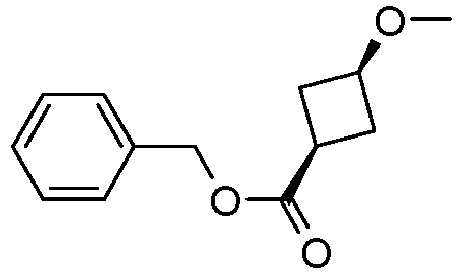
3-Methoxy-cyclobutanecarboxyl ic acid benzyl ester 552849-35-1 A 220 BE03 
3-Fluoro-cyclobutanecarboxyl ic acid benzyl ester 122665-96-7 A 208 BE04 
3-Methyl-cyclobutanecarboxyl ic acid benzyl ester 87863-09-0 A 204 -

- A flame-dried round bottom flask is cooled down to RT under nitrogen. A solution of 1 M LiHMDS in THF (1.5 equiv) is introduced into the flask, and then it is cooled down to -78 °C (acetone/dry ice bath). Dry MeCN (from 1.5 to 1.7 equiv) is then added dropwise under nitrogen, and the reaction mixture is stirred for 30 min at -78 °C. At this point a solution of ester (1.0 equiv) in dry THF is added dropwise, and then the reaction mixture is stirred at -78 °C for 1-2 h. The reaction mixture is quenched with cold H2O, partitioned between ethyl acetate (or diethyl ether) and H2O. The organic layer is separated, and the aqueous layer is extracted with ethyl acetate (or diethyl ether). The aqueous fraction is then acidified to pH=1 with 2 N HCl and extracted with ethyl acetate (or diethyl ether). The combined organic layers are then washed with brine, dried over MgSO4, filtered and concentrated in vacuo to afford the titled compound which is used as such or purified by flash chromatography on silica gel.
-

- A 1 L 4 neck round bottom flask was equipped with 2 dropping funnels and a septum on top of the apparatus. The whole system was flame-dried (heat gun) for 10 minutes under vacuum and then cooled down to RT under a positive stream of nitrogen (balloon). A low-temperature thermometer was adapted under a positive stream of nitrogen, then a 1 N LiHMDS solution in THF (468.0 mL, 468.0 mmol, 1.5 equiv) was cannulated into the flask using a positive stream of nitrogen. The solution was cooled down to -78 °C (dry ice/acetone cooling bath) as confirmed with the thermometer. Dry MeCN (24.4 mL, 468.0 mmol, 1.5 equiv) was added via syringe into the first dropping funnel, and then added dropwise (over 20 min) into the reaction mixture. After the end of the addition, the mixture was stirred at -78 °C for 1 h. At this point, cyclobutanecarboxylic acid ethyl ester (CAS: 14924-53-9, 43.1 mL, 312.1 mmol, 1.0 equiv) as a solution in dry THF (106 mL) was introduced into the second dropping funnel. This solution was slowly added over 2 h into the reaction mixture at -78 °C. The mixture was stirred at -78 °C for 2 h. The reaction mixture was poured into 300 mL of cold water, stirred for 30 min and allowed to warm to RT. The mixture was then partitioned between ethyl acetate and H2O. The organic layer was separated, and the aqueous layer was extracted with ethyl acetate (3 × 300 mL). The combined organic phases were discarded. The aqueous layer was then acidified with 100 mL of 2 N HCl, then extracted with ethyl acetate (3 × 300 mL), washed with 50 mL of brine, dried over MgSO4, filtered and concentrated in vacuo to afford the titled compound which was used without further purification.
Table II. List of cyanoketones Int. Structure Name SM method MW Mes 29509-06-6 
4-Methyl-3-oxo-pentanenitrile 111 29509-06-6 
4-Methyl-3-oxo-pentanenitrile 111 CK01, 118431-89-3 
3-Cyclobutyl-3-oxo-propionitrile 14924-53-9 B, Specific example 123 59997-51-2 
4,4-Dimethyl-3-oxo-pentanenitrile 125 887594-13-0 
3-(2-Cyanoacetyl)-azetidine-1-carboxylic acid tert-butyl ester 224 118431-88-2 
3-Cyclopropyl-3-oxo-propionitrile 109 CK02 
3-(1-Methylcyclobutyl)-3-oxo-propionitrile BE01 B 137 138 CK03 
3-(cis-3-Methoxy-cyclobutyl)-3-oxo-propionitrile BE02 B 153 29509-06-6 
4-Methyl-3-oxo-pentanenitrile 111 1234616-26-2 
3-(3,3-Difluoro-cyclobutyl)-3-oxo-propionitrile 159 CK04 
3-(3,3-Dimethyl-cyclobutyl)-3-oxo-propionitrile 3854-83-9 B 151 CK05 
3-(3-Fluoro-cyclobutyl)-3-oxo-propionitrile BE03 B 141 CK06 
3-(trans-3-Methylcyclobutyl)-3-oxo-propionitrile BE04 B 137 -

- To a solution of ketone (1 equiv) and tert-butyl carbazate (CAS: 870-46-2, 1.0 equiv) in anhydrous dichloromethane at 0 °C is added acetic acid (2.0 equiv) and sodium triacetoxyborohydride (CAS: 56553-60-7, 3.0 equiv). The reaction mixture is warmed up to RT and stirred for 1h to several days (up to 8). The reaction mixture is then basified with a solution of 2 M sodium hydroxide and a saturated solution of sodium hydrogencarbonate. The two phases are separated, and the aqueous phase is extracted with dichloromethane. The combined organic phases are washed with a saturated solution of sodium hydrogencarbonate and brine, dried over MgSO4, filtered and concentrated in vacuo to afford the tert-butoxy carbonyl hydrazine which is used as such or purified by flash chromatography on silica gel.
- To the ketone (1 equiv) in anhydrous methanol at RT is added tert-butyl carbazate (CAS: 870-46-2, 1.0 equiv). The reaction mixture is stirred for 20 minutes at RT, then acetic acid (3.0 equiv) and sodium cyanoborohydride (CAS: 25895-60-7, 1.5 equiv) are added. The reaction mixture is stirred at RT for 1 h to several days (up to 8). The reaction mixture is then basified with a solution of 2 M sodium hydroxide and a saturated solution of sodium hydrogencarbonate. The two phases are separated, and the aqueous phase is extracted with dichloromethane. The combined organic phases are washed with a saturated solution of sodium hydrogencarbonate and brine, dried over MgSO4, filtered and concentrated in vacuo to afford the tert-butoxy carbonyl hydrazine which is used as such or purified by flash chromatography on silica gel.
- To a solution of a tert-butoxy carbonyl hydrazine intermediate from Methods C1 or C2 in anhydrous dichloromethane at RT is added 4 M HCl in dioxane (20 equiv). The reaction mixture is stirred at RT until the reaction is finished. The solids are collected by filtration, washed twice with diethyl ether, and dried in vacuo to afford the hydrazine which is used as such.
- A tert-butoxy carbonyl hydrazine intermediate from Methods C1 or C2 is stirred at RT in a 1:1 mixture of dichloromethane and trifluoroacetic acid until the reaction is finished. The reaction mixture is concentrated in vacuo. The residue is taken up three times with toluene and concentrated in vacuo to afford the hydrazine which is used as such.
-

- To a solution of dihydro-2H-pyran-3(4H)-one (CAS: 23462-75-1, 0.6 g, 5.99 mmol, 1.0 equiv) and tert-butyl carbazate (CAS: 870-46-2, 0.792 g, 5.99 mmol, 1.0 equiv) in anhydrous dichloromethane (20 mL) at 0 °C was added acetic acid (0.685 mL, 11.98 mmol, 2.0 equiv) and sodium triacetoxyborohydride (CAS: 56553-60-7, 3.81 g, 17.97 mmol, 3.0 equiv). The reaction mixture was warmed up to RT and stirred for 24 h. The reaction mixture was then basified with a solution of 2 M sodium hydroxide (45 mL) and a saturated solution of sodium hydrogencarbonate (30 mL). The two phases were separated, and the aqueous phase was extracted with dichloromethane. The combined organic phases were washed with a saturated solution of sodium hydrogencarbonate and brine, dried over MgSO4, filtered and concentrated in vacuo. The resulting residue was purified by flash chromatography on silica gel (eluent system: heptane/ethyl acetate 70/30) to afford tert-butyl 2-(oxan-3-yl)hydrazine-1-carboxylate.
- To a solution of tert-butyl 2-(oxan-3-yl)hydrazine-1-carboxylate from Step 1 (0.534 g, 2.46 mmol, 1 equiv) in anhydrous dichloromethane (1.74 mL) at RT was added 4 M HCl in dioxane (12.34 mL, 49.38 mmol, 20 equiv). The reaction mixture was stirred at RT overnight, and then the solid was collected by filtration. The solid was washed twice with diethyl ether and dried in vacuo to afford the titled compound, H01.
-

- To 4,4-difluorocyclohexanone (CAS: 22515-18-0, 0.4 g, 2.98 mmol, 1.0 equiv) in anhydrous methanol (8.5 mL) at RT was added tert-butyl carbazate (CAS: 870-46-2, 0.394 g, 2.98 mmol, 1.0 equiv). The reaction mixture was stirred for 20 minutes at RT, and then acetic acid (0.51 mL, 8.95 mmol, 3.0 equiv) and sodium cyanoborohydride (CAS: 25895-60-7, 0.281 g, 4.47 mmol, 1.5 equiv) were added. The reaction mixture was stirred at RT overnight. The reaction mixture was then basified with a solution of 2 M sodium hydroxide (22 mL) and a saturated solution of sodium hydrogencarbonate (15 mL). The two phases were separated, and the aqueous phase was extracted with dichloromethane. The combined organic phases were washed with a saturated solution of sodium hydrogencarbonate and brine, dried over MgSO4, filtered and concentrated in vacuo. The resulting residue was purified by flash chromatography on silica gel (eluent system: heptane/ethyl acetate gradient from 100/0 to 50/50) to afford tert-butyl 2-(4,4-difluorocyclohexyl)hydrazine-1-carboxylate.
- The tert-butyl 2-(4,4-difluorocyclohexyl)hydrazine-1-carboxylate intermediate from Step 1 (0.2 g, 0.8 mmol, 1 equiv) was stirred at RT in a 1:1 mixture of dichloromethane (0.65 mL) and trifluoroacetic acid (0.65 mL) for 1.5 h. The reaction mixture was concentrated in vacuo. The residue was taken up three times with toluene and concentrated in vacuo to afford the titled compound, H02.
-

- To 2,4-dimethoxybenzaldehyde (CAS: 613-45-6, 37.82 g, 228 mmol, 1.0 equiv) in methanol at RT was added tert-butyl carbazate (CAS: 870-46-2, 30.08 g, 228 mmol, 1.0 equiv) and MgSO4 (18.9 g). The reaction mixture was stirred at RT overnight. The reaction mixture was filtered through a pad of diatomaceous earth. The solids were washed with dichloromethane, and the filtrate was concentrated in vacuo. The residue was taken up in diethyl ether (120 mL) and stirred at RT. The resulting slurry was filtered. The solid was washed three times with diethyl ether and dried in vacuo to afford tert-butyl 2-[(2,4-dimethoxyphenyl)methylidene]hydrazine-1-carboxylate.
- A 2-L round bottom flask under nitrogen atmosphere was charged with methanol (1.3 L), 10% palladium on carbon (13.6g), and tert-butyl 2-[(2,4-dimethoxyphenyl)methylidene]hydrazine-1-carboxylate from Step 1 (68.41 g, 228 mmol, 1 equiv). The reaction mixture was placed under vacuum then filled with hydrogen and kept under a hydrogen atmosphere (balloon). The reaction mixture was stirred at RT for 5 h. The reaction mixture was filtered through a pad of diatomaceous earth. The solids were washed with methanol, and the filtrate was concentrated in vacuo. The resulting residue was purified by flash chromatography on silica gel (eluent system: heptane/ethyl acetate, gradient from 50/50 to 40/60) to afford tert-butyl 2-[(2,4-dimethoxyphenyl)methyl]hydrazine-1-carboxylate.
- A 2-L round bottom flask was charged with tert-butyl 2-[(2,4-dimethoxyphenyl)methyl]hydrazine-1-carboxylate from Step 2 (59.8 g, 211 mmol, 1.0 equiv), then a solution of 4 M HCl in dioxane (600mL, 2400 mmol, 11.35 equiv) was added. The reaction mixture was stirred at RT overnight. The reaction mixture was filtered. The solid was washed three times with diethyl ether and dried in vacuo to afford the titled compound, H04.
Table III. List of Hydrazines Int. Structure Name SM method MW Mes H01 
(Tetrahydro-pyran-3-yl)-hydrazine di-hydrochloride salt 23462-75-1 C1, C3 Specific example 116 H02 
(4,4-Difluorocyclohexyl)-hydrazine di-trifluoroacetic acid salt 22515-18-0 C2, C4 Specific example 150 H03 
(Tetrahydro-furan-3-yl)-hydrazine di-hydrochloride salt 22929-52-8 C2, C3 102 H04 
(2,4-Dimethoxybenzyl)-hydrazine di-hydrochloride salt 613-45-6 Specific example 182 183 -

- An aryl bromide (1.05 equiv), benzophenone hydrazone (CAS: 5350-57-2, 1.0 equiv) and rac-BINAP (CAS: 98327-87-8, 0.06 equiv) are introduced in a round bottom flask at RT and suspended in anhydrous toluene. The slurry is purged with argon (bubbling). Then palladium(II) acetate (CAS: 3375-31-3, 0.02 equiv) and sodium tert-butoxide (CAS: 865-48-5, 1.3 equiv) are added, and the resulting slurry is purged with argon again. The reaction mixture is heated at 100 °C until the reaction is finished. The reaction mixture is cooled down to RT and filtered through a pad of diatomaceous earth. Solids were washed with ethyl acetate, and the filtrate is concentrated in vacuo. The titled compound is obtained from the crude filtrate either by precipitation from a suitable solvent or by purification by flash chromatography on silica gel (eluent system: heptane/ethyl acetate).
-

- 3-Bromo-N,N-dimethylaniline (CAS: 16518-62-0, 18.55 mL, 130 mmol, 1.05 equiv), benzophenone hydrazone (CAS: 5350-57-2, 24.29 g, 124 mmol, 1.0 equiv) and rac-BINAP (CAS: 98327-87-8, 4.62g, 7.43 mmol, 0.06 equiv) were combined in a round bottom flask at RT and suspended in anhydrous toluene (80 mL). The slurry was purged with argon (bubbling), and then palladium(II) acetate (CAS: 3375-31-3, 0.556 g, 2.48 mmol, 0.02 equiv) and sodium tert-butoxide (CAS: 865-48-5, 15.46 g, 161 mmol, 1.3 equiv) were added. The resulting slurry was purged with argon again, and the reaction mixture was heated at 100 °C for 1.5 h. The reaction mixture was cooled down to RT and filtered through a pad of diatomaceous earth. The solids were washed with ethyl acetate, and the filtrate was concentrated in vacuo. The residue was taken up in diethyl ether, and stirred at RT. The resulting slurry was filtered. The collected solid was washed twice with diethyl ether and dried in vacuo to afford the titled compound.
Table IV. List of Arylhydrazones Int. Structure Name SM method MW Mes ArH01 
[3-(N'-Benzhydrylidenehydrazino)-phenyl]-dimethyl-amine 16518-62-0 D Specific example 315 316 ArH02 
N-Benzhydrylidene-N'-(3-morpholin-4 -yl-phenyl)-hydrazine 197846-82-5 D 357 358 ArH03 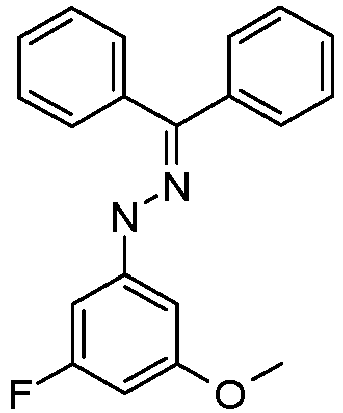
N-Benzhydrylidene-N'-(3-fluoro-5-methoxy-phenyl)-hydrazine 29578-39-0 D 320 321 ArH04 
N-Benzhydrylidene-N'-(6-fluoro-pyridin-2-yl)-hydrazine 144100-07-2 D 291 292 ArH05 
N-Benzhydrylidene-N'-(2-chloro-pyri din-4-yl)-hydrazine 73583-37-6 D 308 309 -

- 3-Aminocrotononitrile (CAS: 1118-61-2, 1.1 equiv), the hydrazine hydrochloride (1.0 equiv) and few drops of 1 N HCl solution are heated in EtOH at reflux until the reaction is finished. The reaction mixture is cooled down to RT and then is diluted with a saturated solution of sodium hydrogencarbonate. The aqueous phase is extracted with dichloromethane. The combined organic phases are filtered through a phase separator and concentrated under vacuum to afford the aminopyrazole which is used as such.
-

- 3-Aminocrotononitrile (CAS: 1118-61-2, 0.5 g, 6.09 mmol, 1.1 eq;), 3-(trifluoromethoxy)phenylhydrazine hydrochloride (1.27 g, 5.54 mmol, 1.0 equiv) and two drops of 1 N HCl solution were heated in EtOH (1.5 mL) at reflux overnight. The reaction mixture was diluted with a saturated solution of sodium hydrogencarbonate, and the aqueous phase was extracted with dichloromethane. The combined organic phases were filtered through a phase separator and concentrated under vacuum to afford the titled compound which was used as such.
-

- A round bottom flask is charged with the cyanoketone (from 1.0 to 1.5 equiv), the hydrazine hydrochloride or dihydrochloride (1 equiv) and EtOH. This mixture is stirred at a temperature ranging from RT to refluxing ethanol until the reaction is finished. Then the reaction mixture is concentrated in vacuo to afford a crude mixture which is used as such or undergoes one of the following processes:
- Either the crude mixture is taken up in a suitable solvent. The resulting slurry is filtered, and the solids are washed with the same solvent and dried in vacuo to afford the aminopyrazole as its hydrochloride salt which is used as such or is taken up in either ethyl acetate or dichloromethane and basified with a saturated solution of either potassium carbonate or sodium hydrogencarbonate. The two phases are separated, and the aqueous phase is extracted with either ethyl acetate or dichloromethane. The combined organic phases are washed with brine, dried over MgSO4, filtered and concentrated in vacuo to afford the aminopyrazole as its free base which is used as such or further purified by flash chromatography on silica gel.
- Or alternatively this crude mixture is partitioned between water and either ethyl acetate or dichloromethane. The two phases are separated, and the aqueous phase is washed with either ethyl acetate or dichloromethane, basified with a saturated solution of sodium hydrogencarbonate and extracted with either ethyl acetate or dichloromethane. The combined organic phases are washed with brine, dried over MgSO4, filtered and concentrated in vacuo to afford the aminopyrazole as its free base which is used as such or further purified by flash chromatography on silica gel.
-

- A round bottom flask was charged with 3-cyclobutyl-3-oxo-propionitrile (CK01, 19.6 g, 159 mmol, 1.1 equiv), phenylhydrazine hydrochloride (CAS: 59-88-1, 20.92 g, 145 mmol, 1.0 equiv) and EtOH (210 mL). The reaction mixture was stirred at reflux for 1 h. Then the reaction mixture was concentrated in vacuo to afford a crude mixture which was taken up in diethyl ether. The resulting slurry was filtered, and the solid was washed with diethyl ether and dried in vacuo to afford the titled compound as its hydrochloride salt which was taken up in dichloromethane and basified with a saturated solution of sodium hydrogencarbonate. The two phases were separated, and the aqueous phase was extracted with dichloromethane. The combined organic phases were washed with brine, dried over MgSO4, filtered and concentrated in vacuo to afford the titled compound as its free base.
-

- A round bottom flask was charged with 3-cyclobutyl-3-oxo-propionitrile (CK01, [118431-89-3], 20.4 g, 166 mmol), cyclohexylhydrazine hydrochloride ([24214-73-1], 25 g, 166 mmol) and EtOH (200 mL). The reaction mixture was refluxed overnight and cooled down to RT. Next, the mixture was concentrated and water (150 mL) was added. The pH was modified till pH = 7 with a saturated K2CO3 solution. Subsequently, the aqueous phase was extracted with DCM. The obtained organic phase was dried and concentrated to give a yellow solid. Trituration with MTBE gave the titled compound.
-

- A round bottom flask was charged with 3-cyclobutyl-3-oxo-propionitrile (CK01, 10 g, 81.4 mmol), 4-fluorophenylhydrazine hydrochloride ([823-85-8], 12 g, 74 mmol) and EtOH (35 mL). The reaction mixture was refluxed for 2 hours and cooled down to RT. Half of the solvent was removed in vacuo. The mixture was vigorously stirred and diisopropyl ether (350 mL) was added. The stirring was continued for 1 hour, and the formed precipitate was filtered, washed with diisopropyl ether and dried at 40 °C under reduced pressure to give the titled compound.
-

- A round bottom flask was charged with 3-cyclobutyl-3-oxo-propionitrile (CK01, 12.3 g, 0.1 mol), tert-butylhydrazine hydrochloride ([7400-27-3], 13.5 g, 0.11 mol) and EtOH (150 mL). The reaction mixture was refluxed for 20 hours and cooled down to RT. Half of the solvent was removed by concentration in vacuo, and the mixture was cooled in an ice bath. The formed precipitate was collected by filtration and washed successively with diethyl ether and n-pentane. The filtrate was allowed to stand for 1 hour, and the formed precipitate was again collected by filtration and washed with diethyl ether and n-pentane. The combined solids were stirred in ethyl acetate and a saturated solution of NaHCO3. The organic phase was dried over sodium sulfate, filtered and evaporated under reduced pressure to give the titled compound.
-

- To the hydrazine either as free base or as a hydrochloride or a trifluoroacetic acid mono or di-salt (1 equiv) and the cyanoketone (from 1.0 to 1.5 equiv) in ethanol or toluene at RT is added DIPEA (from 0 to 2.0 equiv). Then the reaction mixture is heated at reflux until the reaction is finished. The reaction mixture is concentrated in vacuo to afford a crude mixture which is used as such or purified by flash chromatography on silica gel to afford the aminopyrazole as its free base.
-

- To cyclopentylhydrazine hydrochloride (CAS: 24214-72-0, 0.35 g, 2.56 mmol, 1.0 equiv) and 4-methyl-3-oxo-pentanenitrile (CAS: 29509-06-6, 0.33 mL, 2.82 mmol, 1.1 equiv) in toluene (12.8 mL) at RT was added DIPEA (0.82 mL, 5.12 mmol, 2.0 equiv). Then the reaction mixture was heated at reflux for 1.5 h. The reaction mixture was cooled down to RT and concentrated in vacuo to afford a crude mixture which was purified by flash chromatography on silica gel (eluent system: heptane/ethyl acetate gradient from 100/0 to 30/70) to afford the titled compound.
-

- To the arylhydrazone (1 equiv) and the cyanoketone (from 1.0 to 2 equiv) in ethanol at RT is added an aqueous solution of 2 M HCl or 12 M HCl (5 equiv). Then the reaction mixture is heated at reflux until the reaction is finished. Then the reaction mixture is cooled down to RT and undergoes one of the following processes.
- The reaction mixture is concentrated to dryness in vacuo to afford a crude mixture. The aminopyrazole is obtained from this crude mixture by precipitation from a suitable solvent to afford the aminopyrazole as its hydrochloride salt and used as such.
- Ethanol from the reaction mixture is removed in vacuo. The resulting aqueous residue is diluted with an aqueous solution of 2 M HCl, washed with dichloromethane, then basified with a saturated solution of sodium hydrogencarbonate and extracted with dichloromethane. The combined organic phases are washed with brine, dried over MgSO4, filtered and concentrated in vacuo to afford the aminopyrazole as a free base which is used as such or further purified by flash chromatography on silica gel.
-

- To [3-(N'-benzhydrylidene-hydrazino)-phenyl]-dimethyl-amine (ArH01, 25.57g, 81 mmol, 1 equiv) and 4-methyl-3-oxo-pentanenitrile (CAS: 29509-06-6, 10.57 mL, 89.2 mmol, 1.1 equiv) in ethanol (255 mL) at RT was added an aqueous solution of 2 M HCl (203 mL, 405 mmol, 5 equiv). Then the reaction mixture was heated at reflux overnight. The reaction mixture was cooled down to RT, and ethanol from the reaction mixture was removed in vacuo. The resulting aqueous residue was diluted with an aqueous solution of 2 M HCl, washed with dichloromethane, then basified with a saturated solution of sodium hydrogencarbonate and extracted twice with dichloromethane. The combined organic phases were washed with brine, dried over MgSO4, filtered and concentrated in vacuo to afford the titled compound which was used as such.
-

- A sealed tube is charged with the 2-(2-chloro-pyridin-4-yl)-yl-2H-pyrazol-3-ylamine intermediate (1 equiv), the amine (from 10 to 15 equiv), DIPEA (3equiv) and DMA. This mixture is heated at a temperature ranging from 130 °C to 160 °C until the reaction is finished. Then the reaction mixture is cooled down to RT and partitioned between ethyl acetate and water. The two phases are separated and the aqueous phase is extracted with ethyl acetate. The combined organic phases are washed with water and brine, dried over MgSO4, filtered and concentrated in vacuo. The substituted aminopyrazole is obtained from the crude mixture either by precipitation or by purification by flash chromatography on silica gel.
-

- A sealed tube was charged with 2-(2-chloro-pyridin-4-yl)-yl-2H-pyrazol-3-ylamine intermediate (AMP20, 1.2 g, 5.07 mmol, 1 equiv), pyrrolidine (CAS: 123-75-1, 4 mL, 50.7 mmol, 10 equiv), DIPEA (2.6 mL, 15.2 mmol, 3equiv) and DMA (10 mL). This mixture was heated at 130 °C for 2 h. Then the reaction mixture was cooled down to RT, and additional pyrrolidine (CAS: 123-75-1, 1 mL, 12.67 mmol, 2.5 equiv) was introduced, and the reaction mixture was heated at 130 °C for 30 minutes. Then the reaction mixture was cooled down to RT and partitioned between ethyl acetate and water. The two phases were separated, and the aqueous phase was extracted twice with ethyl acetate. The combined organic phases were washed with water (three times) and brine, dried over MgSO4, filtered and concentrated in vacuo. The crude mixture was purified by flash chromatography on silica gel (eluent system: dichloromethane/methanol gradient from 100/0 to 97/3) to afford the titled compound.
-

- To the 2-(3-bromo-phenyl)-2H-pyrazol-3-ylamine hydrochloride salt intermediate (1 equiv) in anhydrous THF at RT under a nitrogen atmosphere is added the amine (1.2 equiv), a solution of 1 N LiHMDS in THF (5 equiv) and XPhos Pd G1 (CAS 1028206-56-5, 0.1 equiv). The reaction mixture is stirred at RT until the reaction is finished. The reaction mixture is hydrolyzed with a saturated solution of ammonium chloride and diluted with dichloromethane. The two phases are separated, and the aqueous phase is extracted with dichloromethane. The combined organic phases are washed with brine, dried over MgSO4, filtered and concentrated in vacuo. The substituted aminopyrazole is obtained from the crude mixture by purification with flash chromatography on silica gel (eluent system: heptane/ethyl acetate).
-

- To 2-(3-bromo-phenyl)-5-isopropyl-2H-pyrazol-3-ylamine hydrochloride salt (AMP05, 0.5g, 1.58 mmol, 1 equiv) in anhydrous THF (5 mL) at RT under nitrogen atmosphere was added pyrrolidine (CAS: 123-75-1, 0.16 mL, 1.9 mmol, 1.2 equiv), a solution of 1 N LiHMDS in THF (8mL, 8 mmol, 5 equiv) and XPhos Pd G1 (CAS 1028206-56-5, 0.117 g, 0.16 mmol, 0.1 equiv). The reaction mixture was stirred at RT for 5 h. The reaction mixture was treated with a saturated solution of ammonium chloride and diluted with dichloromethane. The two phases were separated, and the aqueous phase was extracted with dichloromethane. The combined organic phases were washed with brine, dried over MgSO4, filtered and concentrated in vacuo. The crude mixture was purified by flash chromatography on silica gel (eluent system: heptane/ethyl acetate gradient from 100/0 to 65/35) to afford the titled compound.
-

- A suspension of 5-aminopyrazol-3-ol derivative (1 equiv), cesium carbonate (1.2 equiv) and 2-bromopropane (1 equiv) in N-methylpyrrolidine is stirred at RT for 20 to 72 hours. The reaction mixture is diluted with DCM and washed with water. The organic phase is dried over sodium sulfate, filtered and concentrated under reduced pressure. The O-alkylated product is purified by flash column chromatography on silica gel.
-

- A suspension of 5-amino-1-(4-fluorophenyl)-1H-pyrazol-3-ol ([1247169-18-1], 800 mg, 4.14 mmol), cesium carbonate (2.15 g, 4.97 mmol) and 2-bromopropane (516 µL, 4.14 mmol) in N-methylpyrrolidine (8 mL) was stirred at RT for 20 hours. The reaction mixture was diluted with DCM and washed with water. The organic phase was dried over sodium sulfate, filtered and concentrated under reduced pressure. The residue was purified by flash column chromatography on silica gel eluting with ethyl acetate/n-heptane to yield the titled compound.
-

- A sealed tube was charged with 2-(6-fluoro-pyridin-2-yl)-5-isopropyl-2H-pyrazol-3-ylamine (AMP17, 0.2 g, 0.91 mmol, 1 equiv), morpholine (CAS: 110-91-8, 0.12 mL, 1.37 mmol, 1.5 equiv), DIPEA (0.19 mL, 1.09 mmol, 1.2 equiv) and DMF (2 mL). This mixture was heated at 100 °C overnight. Then the reaction mixture was cooled down to RT and partitioned between ethyl acetate and water. The two phases were separated, and the aqueous phase was extracted with ethyl acetate. The combined organic phases were washed with water (three times) and brine, dried over MgSO4, filtered and concentrated in vacuo. The crude mixture was purified by flash chromatography on silica gel (eluent system: heptane/ethyl acetate gradient from 100/0 to 60/40) to afford the two titled compounds.
Table V. List of aminopyrazoles Int. Structure Name SM method MW Mes 70373-98-7 
5-Amino-1-phenyl-1,2-dihydropyrazol-3-one 175 826-85-7 
2-Phenyl-2H-pyrazol-3-ylamine 159 1131-18-6 
5-Methyl-2-phenyl-2H-pyrazol-3-ylamine 173 345-07-3 
5-Methyl-2-(3-trifluoromethylphenyl)-2H-pyrazol-3-ylamine 241 866472-29-9 
2-(3-Chloro-4-methyl-phenyl)-5-methyl-2H-pyrazol-3-ylamine 221 380569-79-9 
2-(2,4-Difluorophenyl)-5-methyl-2H-pyrazol-3-ylamine 209 123279 6-65-4 
2-(3,5-Difluorophenyl)-5-methyl-2H-pyrazol-3-ylamine 209 890010-89-6 
2-(3,5-Dimethylphenyl)-5-methyl-2H-pyrazol-3-ylamine 201 92721-83-0 
5-Methyl-2-m-tolyl-2H-pyrazol-3-ylamine 187 56547-82-1 
2-Cyclohexyl-5-methyl-2H-pyrazol-3-ylamine 179 40401-41-0 
2-(3-Chlorophenyl)-5-methyl-2H-pyrazol-3-ylamine 207 105438-45-7 
2-(3-Fluorophenyl)-5-methyl-2H-pyrazol-3-ylamine 191 497141-59-0 
5-Methyl-2-(4-trifluoromethoxyphenyl)-2H-pyrazol-3-ylamine 257 92721-94-3 
2-(3-Methoxyphenyl)-5-methyl-2H-pyrazol-3-ylamine 203 3524-36-5 
2-Isobutyl-5-methyl-2H-pyrazol-3-ylamine 153 1124-16-9 
2-Isopropyl-5-methyl-2H-pyrazol-3-yL amine 139 436088-86-7 
5-Amino-1-cyclohexyl-1H-pyrazol-3-ol 181 124716 9-18-1 
5-Amino-1-(4-fluorophenyl)-1H-pyrazol-3-ol 193 AMP01 
5-Methyl-2-(3-trifluoromethoxyphenyl)-2H-pyrazol-3-ylamine 133115-55-6, 1118-61-2 E1 Specific example 257 258 AMP02 
2-(3,4-Difluorophenyl)-5-methyl-2H-pyrazol-3-ylamine 161886-22-2, 1118-22-2 E1 209 210 AMP03 
2-(3-Fluoro-5-methoxy-phenyl)-5-methyl-2H-pyrazol-3-ylamine ArH03, 1118-61-2 E4 221 222 AMP04 
5-Isopropyl-2-phenyl-2H-pyrazol-3-ylamine 100-63 - 0, 29509- 06-6 E3 201 202 AMP05 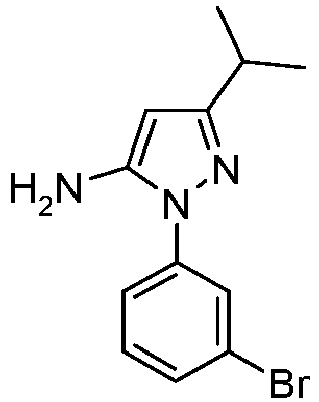
2-(3-Bromophenyl)-5-isopropyl-2H-pyrazol-3-ylamine 27246-81-7, 29509-06-6 E2 280 281 AMP06 
2-(3-Dimethylaminophenyl)-5-isopropyl-2H-pyrazol-3-ylamine ArH01, 29509-06-6 E4 Specific example 244 245 AMP07 
5-Isopropyl-2-m-tolyl-2H-pyrazol-3-ylamine 637-04-7, 29509-06-6 E2 215 216 AMP08 
5-Isopropyl-2-(3-trifluoromethylphenyl)-2H-pyrazol-3-ylamine 368-78-5, 29509-06-6 E3 269 270 AMP09 
2-(3,5-Difluorophenyl)-5-isopropyl-2H-pyrazol-3-ylamine 134993-88-7, 29509-06-6 E2 237 238 AMP10 
5-Isopropyl-2-(3-morpholin-4-yl-phenyl)-2H-pyrazol-3-ylamine ArH02, 29509-06-6 E4 286 287 AMP11 
5-Isopropyl-2-(3-pyrrolidin-1-yl-phenyl)-2H-pyrazol-3-ylamine AMP05 E6 Specific example 270 271 AMP12 
2-(3-Fluorophenyl)-5-isopropyl-2H-pyrazol-3-ylamine 502496-27-7, 2950906-6 E2 219 220 AMP13 
2-(4-Fluorophenyl)-5-isopropyl-2H-pyrazol-3-ylamine 823-85-8, 29509-06-6 E2 219 220 AMP14 
2-(2,4-Difluorophenyl)-5-isopropyl-2H-pyrazol-3-ylamine 51523-79-6, 29509-06-6 E2 237 238 AMP15 
2-Cyclopropyl-5-methyl-2H-pyrazol-3-ylamine 213764-25-1, 1118-61-2 E1 137 138 AMP16 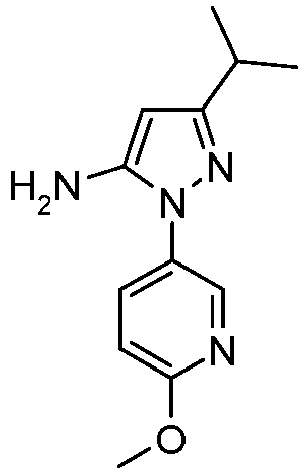
5-Isopropyl-2-(6-methoxy-pyridin-3-yl)-2H-pyrazol-3-ylamine 179543-88-5, 29509-06-6 E2 232 233 AMP17 
2-(6-Fluoropyridin-2-yl)-5-isopropyl-2H-pyrazol-3-ylamine ArH04, 29509-06-6 E4 220 221 AMP18 
[6-(5-Amino-3-isopropyl-pyrazol-1-yl)-pyridin-2-yl]-dimethyl-amine AMP17 Specific example 245 246 AMP19 
5-Isopropyl-2-(6-morpholin-4-yl-pyridin-2-yl)-2H-pyrazol-3-ylamine AMP17 Specific example 287 288 AMP20 
2-(2-Chloropyridin-4-yl)-5-isopropyl-2H-pyrazol-3-ylamine ArH05, 29509-06-6 E4 237 238 AMP21 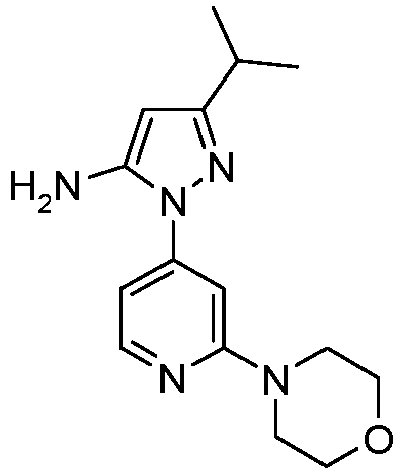
5-Isopropyl-2-(2-morpholin-4-yl-pyridin-4-yl)-2H-pyrazol-3-ylamine AMP20 E5 287 288 AMP22 
5-Isopropyl-2-(2-pyrrolidin-1-yl-pyridin-4-yl)-2H-pyrazol-3-ylamine AMP20 E5 Specific example 271 272 AMP23 
2-Cyclohexyl-5-isopropyl-2H-pyrazol-3-ylamine 30929-57-8, 29509-06-6 E2 207 208 AMP24 
2-(4,4-Difluorocyclohexyl)-5-isopropyl-2H-pyrazol-3-ylamine H02, 29509-06-6 E3 243 244 AMP25 
5-Isopropyl-2-(tetrahydro-pyran-3-yl)-2H-pyrazol-3-ylamine H01, 29509-06-6 E3 209 210 AMP26 
2-Cyclopentyl-5-isopropyl-2H-pyrazol-3-ylamine 24214-72-0, 29509-06-6 E3 Specific example 193 194 AMP27 
5-Isopropyl-2-(tetrahydro-furan-3-yl)-2H-pyrazol-3-ylamine H03, 29509-06-6 E3 195 196 AMP28 
2-(2,4-Dimethoxybenzyl)-5-isopropyl-2H-pyrazol-3-ylamine H04, 29509-06-6 E2 275 276 AMP29 
5-Cyclobutyl-2-phenyl-2H-pyrazol-3-ylamine 59-88-1, CK01 E2 Specific example 213 214 AMP30 
2-(3-Bromophenyl)-5-cyclobutyl-2H-pyrazol-3-ylamine 27246-81-7, CK01 E3 292 293 AMP31 
5-Cyclobutyl-2-(3-pyrrolidin-1-yl-phenyl)-2H-pyrazol-3-ylamine AMP3 0 E6 282 283 AMP32 
2-(2-Chloropyridin-4-yl)-5-cyclobutyl-2H-pyrazol-3-ylamine 700811-29-6, CK01 E3 248 249 AMP33 
5-Cyclobutyl-2-(2-morpholin-4-yl-pyridin-4-yl)-2H-pyrazol-3-ylamine AMP32 E5 299 300 AMP34 
5-Cyclobutyl-2-(2-pyrrolidin-1-yl-pyridin-4-yl)-2H-pyrazol-3-ylamine AMP32 E5 283 284 AMP35 
5-Cyclobutyl-2-cyclohexyl-2H-pyrazol-3-ylamine 30929-57-8, CK01 E2, Specific Example 219 220 AMP36 
5-Cyclobutyl-2-(2,4-dimethoxybenzyl)-2H-pyrazol-3-ylamine H04, CK01 E2 287 288 AMP37 
5-tert-Butyl-2-cyclopentyl-2H-pyrazol-3-ylamine 24214-72-0, 599917-51-2 E2 207 208 AMP38 
3-(5-Amino-1-cyclohexyl-1H-pyrazol-3-yl)-azetidine-1-carboxylic acid tert-butyl ester 30929-57-8, 887594-13-0 E2 320 321 AMP39 
2-Cyclohexyl-5-cyclopropyl-2H-pyrazol-3-ylamine 30929-57-8, 118431-88-2 E2 205 206 AMP40 
3-[5-Amino-1-(3,5-difluoro-phenyl)-1H-pyrazol-3-yl]-azetidine-1-carboxylic acid tert-butyl ester 134993-88-7, 887594-13-0 E2 350 2951 AMP41 
5-(1-Methylcyclobutyl)-2-phenyl-2H-pyrazol-3-ylamine 100-63 - 0, CK02 E3 227 228 AMP42 
5-(3-Methoxy-cyclobutyl)-2-phenyl-2H-pyrazol-3-ylamine 59-88-1, CK03 E2 243 AMP43 
5-(3,3-Difluoro-cyclobutyl)-2-phenyl-2H-pyrazol-3-ylamine 59-88-1, 1234616-26-2 E2 249 AMP44 
5-(3,3-Dimethyl-cyclobutyl)-2-phenyl-2H-pyrazol-3-ylamine 59-88-1, CK04 E2 241 AMP45 
5-(3-Fluoro-cyclobutyl)-2-phenyl-2H-pyrazol-3-ylamine 59-88-1, CK05 E2 231 AMP46 
5-(trans-3-Methylcyclobutyl)-2-phenyl-2H-pyrazol-3-ylamine 59-88-1, CK06 E2 227.31 AMP93 
3-Cyclobutyl-1-(4-fluorophenyl)-1H-pyrazol-5-amine 823-85-8, CK01 Specific example 231 232 AMP94 
1-tert-Butyl-3-cyclobutyl-1H-pyrazol-5-amine 7400-27-3, 118431-89-3 Specific example 193 194 AMP95 
1-Cyclohexyl-3-[(propan-2-yl)oxy]-1H-pyrazol-5-amine 436088-86-7 E7 223 224 AMP96 
1-(4-Fluorophenyl)-3-[(propan-2-yl)oxy]-1H-pyrazol-5-amine 1247169-18-1 E7, Specific example 235 236 1(M-tBu+H)+ -

- A is either CH or N
- LG is F, Cl, or Br
- A solution of the aldehyde (1 equiv), the amine (1.3 to 2 equiv) and the base (DIPEA or K2CO3) (2 equiv) is prepared in acetonitrile, DMSO or DMA. This mixture is heated under thermal conditions or under microwave irradiations at a temperature ranging from 85 °C to 150 °C. The reaction is worked up either by filtration of the base when needed or by diluting the reaction mixture with ethyl acetate or DCM and washing the organic phase with water and brine. In all cases, the organic phase is concentrated under reduced pressure, and the crude residue is used as such or purified either by flash column chromatography or precipitation to give the titled compound.
-

- A solution of 2-chloropyridine-5-carboxaldehyde (CAS: 23100-12-1, 25.1 g, 177.4 mmol), 4-cyanopiperidine (CAS: 4395-98-6, 25.4 g, 230.6 mmol) and DIPEA (62 mL, 354.7 mmol) in acetonitrile (250 mL) was refluxed for 20 hours. The reaction mixture was cooled to RT, and the mixture was concentrated under reduced pressure. The residue was dissolved in DCM (500 mL) and washed successively with a saturated aqueous solution of Na2CO3 (250 mL) and brine (250 mL). The organic phase was stirred for 2 minutes with 10 g of silica gel, dried over sodium sulfate, filtered and concentrated under reduced pressure. The resulting mixture was dissolved in DCM (150 mL) and poured into a stirring solution of diisopropyl ether (1.5 L). The mixture was stirred vigorously for 4 hours. The precipitate was collected by filtration, washed with diisopropyl ether, and dried at 40 °C under reduced pressure to give the titled compound.
Table VI. List of aldehydes Int. Structure Name SM method MW Mes ALD01 
6-[(2-Methoxyethyl)-methylamino]-pyridine-3-carbaldehyde 23100-12-1 F 194 195 ALD02 
5'-Formyl-3,4,5,6-tetrahydro-2H-[1,2']bipyridinyl-4-carbonitrile 23100-12-1 F, Specific example 215 216 ALD03 
6-[Methyl-(tetrahydropyran-4-yl)-amino]-pyridine-3-carbaldehyde 23100-12-1 F 220 221 ALD04 
4-[(2-Methoxyethyl)-methylamino]-benzaldehyde 459-57-4 F 193 194 ALD05 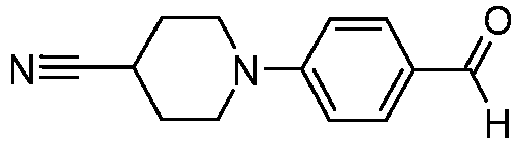
1-(4-Formylphenyl)-piperidine-4-carbonitrile 459-57-4 F 214 215 ALD06 
2-[Methyl-(tetrahydropyran-4-yl)-amino]-pyrimidine-5-carbaldehyde 933702 -55-7 F 221 222 ALD07 
1-(5-Formyl-pyrimidin-2-yl)-piperidine-4-carbonitrile 933702 -55-7 F 216 217 ALD08 
4-[Methyl-(tetrahydropyran-4-yl)-amino]-benzaldehyde 459-57-4 F 219 220 ALD09 
2-[(2-Methoxyethyl)-methyl-amino]-pyrimidine-5-carbaldehyde 933702 -55-7 F 195 196 ALD10 
6-Dimethylamino-pyridine-3-carbaldehyde 23100-12-1 F 150 151 ALD11 1204-86-0 
4-Morpholinobenza ldehyde 191 ALD12 
6-[bis(2-methoxyethyl)ami no]pyridine-3-carbaldehyde 23100-12-1 F 238 239 -

- A is either N or CH
- A' is either Re or L1-G3C as described in the Summary
- A solution of potassium hydroxide (from1.5 to 2 equiv) in water is added dropwise at 0 °C to a solution of aldehyde (lequiv) and pyruvic acid (CAS 127-17-3, from1 eq to 1.5 equiv) in methanol. The reaction is warmed up to RT and then heated at 40 °C for 1 h to several days. Then the reaction mixture undergoes one of the following processes:
- Either the formed precipitate is collected by filtration, suspended in an aqueous acidic solution, collected by filtration again, and dried in vacuo to give the titled compound.
- Or alternatively, methanol is removed in vacuo, and the resulting suspension is filtered. The solid is taken up in water and either ethyl acetate or dichloromethane and acidified to pH=3-5 with either acetic acid or an aqueous solution of 2 M HCl. The two phases are separated, and the aqueous phase is extracted with either ethyl acetate or dichloromethane. The combined organic phases are washed with water and brine, dried over MgSO4, filtered and concentrated in vacuo to afford the titled compound which is used as such or further purified by precipitation.
-

- A solution of potassium hydroxide (6.9 g, 121.6 mmol) in water (45 mL) was added at 0 °C to a stirring solution of 4-bromobenzaldehyde (CAS 1122-91-4, 15 g, 81.1 mmol) and pyruvic acid (CAS 127-17-3, 5.7 mL, 81.1 mmol) in methanol (105 mL) over a 5 minutes period. The reaction mixture was then heated at 40 °C for 4 hours, cooled down to RT and poured into ice/water (300 mL). The precipitate was stirred for 10 minutes, collected by filtration, washed with water and n-heptane, and air dried for 1 hour. The solid was suspended in aqueous 2 N HCl and stirred for 10 minutes. The precipitate was collected by filtration and dried at 40 °C under reduced pressure to afford the titled compound.
-

- A is either N or CH
- A' is either Re or L1-G3C as described in the Summary
- Triflic acid (CAS 1493-13-6, from 1.35 eq to 2.5 equiv) is added dropwise to a solution of aldehyde (1 equiv), triethyl orthoformate (CAS 122-51-0, from 1.1 eq to 1.3 equiv) and ethyl pyruvate (CAS 617-35-6, from 1.5 to 3.5 equiv) in chloroform. The solution is refluxed for 30 minutes to 24 h. The reaction mixture is cooled down to RT, diluted with dichloromethane, basified with a saturated aqueous solution of Na2CO3 or NaHCO3. The two phases are separated, and the aqueous phase is extracted with dichloromethane. The combined organic phases are dried over sodium sulfate, filtered and concentrated under reduced pressure. This crude mixture is purified either by flash chromatography on silica gel or by precipitation to afford the titled compound.
-
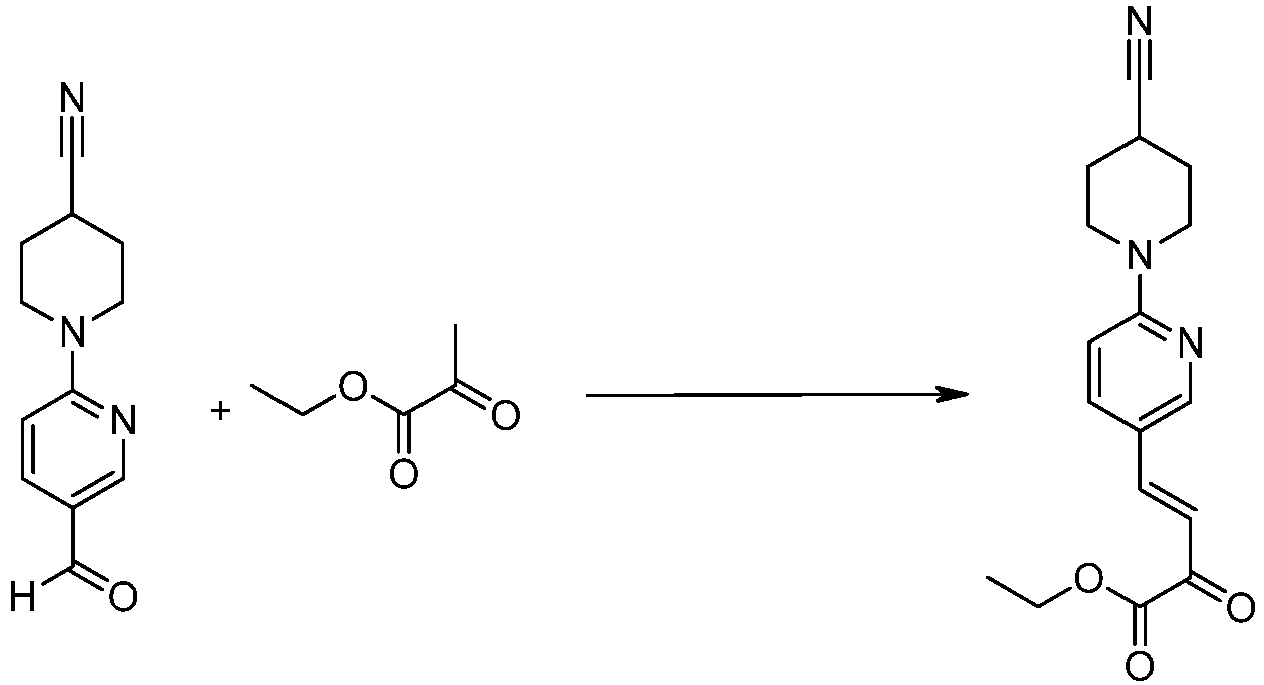
- Triflic acid (CAS 1493-13-6, 26.7 mL, 301 mmol) was added dropwise to a solution of intermediate ALD02 (32.4 g, 150.5 mmol), triethyl orthoformate (CAS 122-51-0,32.6 g, 195.7 mmol) and ethyl pyruvate (CAS 617-35-6, 41.7 mL, 376.3 mmol) in chloroform (180 mL). The solution was refluxed for 30 minutes and then cooled to RT. The reaction mixture was diluted with DCM (500 mL) and washed successively with a saturated aqueous solution of Na2CO3 (400 mL) and brine (400 mL). The organic phase was dried over sodium sulfate, filtered and concentrated under reduced pressure. The crude sample was purified by flash column chromatography on silica gel eluting with a gradient of n-heptane/ethyl acetate to yield the titled compound.
-

- In a round bottom flask, under a nitrogen atmosphere, a suspension of 4-ethynylbenzene derivative (1 equiv.), 50% ethyl glyoxalate in toluene (2 equiv), morpholine ([110-91-8], 2 equiv), copper(I) bromide ([7787-70-4], 0.5 equiv) in dioxane is heated to 85 °C for 3 to 20 hours. The reaction mixture is cooled to RT, and the solvent was evaporated under reduced pressure. The residue is suspended in a mixture of DCM or DCM/2-propanol (95/5) and is washed twice with water. The organic phase is dried over sodium sulfate, filtered and concentrated under reduced pressure. The crude sample is purified by flash chromatography eluting with ethyl acetate/n-heptane/DCM.
-

- In a round bottom flask, under a nitrogen atmosphere, a suspension of 4-ethynylbenzaldehyde ([63697-96-1], 5 g, 38.4 mmol), 50% ethyl glyoxalate in toluene ([924-44-7], 15.7 mL, 15.7 g, 76.8 mmol), morpholine ([110-91-8], 6.7 mL, 76.8 mmol), copper(I) bromide ([7787-70-4], 2.8 g, 19.2 mmol) in dioxane (50 mL) was heated to 85 °C for 3 hours. The reaction mixture was cooled to RT, and the volatiles were removed under reduced pressure. The residue was suspended in a mixture of DCM/2-propanol (200 mL, 95/5) and washed twice with water (50 mL). The organic phase was dried over sodium sulfate, filtered and concentrated under reduced pressure. The residue was purified by flash chromatography eluting with ethyl acetate/n-heptane to yield the titled compound.
-

- Nitrogen was bubbled for 5 minutes through a suspension of tert-butyl 4-(4-bromophenyl)-4-cyanopiperidine-1-carboxylate ([847615-14-9], 547 mg, 1.5 mmol), tetrakis(triphenylphosphine)palladium(0) ([14221-01-3], 90 mg, 77 µmol), copper(I) iodide ([7681-65-4], 8 mg, 42 µmol), lithium chloride ([7447-41-8], 8 mg, 189 µmol), and (triisopropylsilyl)acetylene ([89343-06-6], 670 µL, 3 mmol) in triethylamine (8 mL). The tube was sealed and heated at 100 °C for 6 hours. The mixture was then concentrated under reduced pressure, and the residue was partitioned between ethyl acetate and water. The organic phase was dried over sodium sulfate, filtered and concentrated in vacuo. The residue was purified by flash column chromatography eluting with ethyl acetate/n-heptane to give the titled compound.
- The compound from Step 1 (700 mg, 1.5 mmol) was dissolved in anhydrous THF (10 mL) and 1 M tetra-n-butylammonium fluoride in THF (1.7 mL, 1.7 mmol) was added. The reaction mixture was stirred at RT for 2 hours and then concentrated under reduced pressure. The residue was partitioned between ethyl acetate and water. The organic phase was dried over sodium sulfate, filtered and concentrated in vacuo. The residue was purified by flash column chromatography eluting with ethyl acetate/n-heptane to give the titled compound.
- In a round bottom flask, under a nitrogen atmosphere, a suspension of the compound from Step 2 (270 mg, 0.58 mmol), 50% ethyl glyoxalate in toluene ([924-44-7], 232 µL, 1.16 mmol), morpholine ([110-91-8], 101 µL, 1.16 mmol), and copper(I) bromide ([7787-70-4], 42 mg, 0.29 mmol) in dioxane (5 mL) was heated to 85 °C for 20 hours. The reaction mixture was cooled down to RT and 50% ethyl glyoxalate in toluene ([924-44-7], 232 µL, 1.16 mmol), morpholine ([110-91-8], 101 µL, 1.16 mmol), and copper(I) bromide ([7787-70-4], 42 mg, 0.29 mmol) were added again, and the sealed tube was heated at 100 °C for 1 hour. The reaction mixture was cooled to RT and concentrated under reduced pressure. The residue was suspended in DCM (20 mL) and washed with water (15 mL). The organic phase was dried over sodium sulfate, filtered and concentrated under reduced pressure. The residue was purified by flash chromatography eluting with ethyl acetate/n-heptane to yield the titled compound.
Table VII. List of alkylidene pyruvates Int. Structure Name SM method MW Mes ALP01 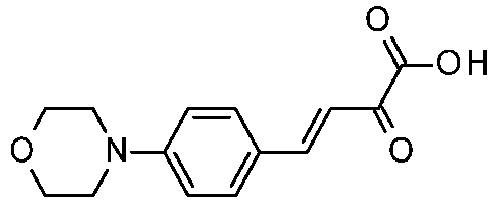
(E)-4-(4-morpholinophen yl)-2-oxo-but-3-enoic acid 1204-86-0 G1 261 262 ALP02 
(E)-4-[4-(dimethylamino) phenyl]-2-oxobut-3-enoic acid 100-10-7 G1 219 220 ALP03 
(E)-4-[2-(dimethylamino) pyrimidin-5-yl]-2-oxo-but-3-enoic acid 55551-49-0 G1 221 222 ALP04 
(E)-4-(2-morpholinopyri midin-5-yl)-2-oxo-but-3-enoic acid 842974-69-0 G1 263 264 ALP05 
(E)-4-(6-morpholino-3-pyridyl)-2-oxobut-3-enoic acid 173282-60-5 G1 262 263 ALP06 
(E)-4-(4-methoxyphenyl) -2-oxo-but-3-enoic acid 123-11-5 G1 206 207 ALP07 
(E)-4-(6-Chloropyridin-3-yl)-2-oxo-but-3-enoic acid 23100-12-1 G1 211-213 212-214 ALP08 
ethyl (E)-4-[6-[2-methoxyethyl(m ethyl)amino]-3-pyridyl]-2-oxobut-3-enoate ALD01 G2 291 292 ALP09 
ethyl (E)-4-[6-(4-cyano-1-piperidyl)-3-pyridyl]-2-oxobut-3-enoate ALD02 G2, Specific example 313 314 ALP10 
ethyl (E)-4-[6-[methyl(tetrahyd ropyran-4-yl)amino]-3-pyridyl]-2-oxobut-3-enoate ALD03 G2 318 319 ALP11 
ethyl (E)-4-[4-[2-methoxyethyl(m ethyl)amino]phe nyl]-2-oxo-but-3-enoate ALD04 G2 291 292 ALP12 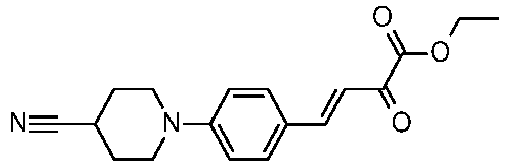
ethyl (E)-4-[4-(4-cyano-1-piperidyl)phenyl ]-2-oxo-but-3-enoate ALD 05 G2 312 313 ALP13 
ethyl (E)-4-[2-[methyl(tetrahyd ropyran-4-yl)amino]pyrimi din-5-yl]-2-oxobut-3-enoate ALD06 G2 319 320 ALP14 
ethyl (E)-4-[2-(4-cyano-1-piperidyl)pyrimi din-5-yl]-2-oxobut-3-enoate ALD07 G2 314 315 ALP15 
ethyl (E)-4-[4-[methyl(tetrahyd ropyran-4-yl)amino]phenyl ]-2-oxo-but-3-enoate ALD08 G2 317 318 ALP16 
ethyl (E)-4-[2-[2-methoxyethyl(m ethyl)amino]pyri midin-5-yl]-2-oxo-but-3-enoate ALD09 G2 293 294 ALP17 
ethyl (E)-4-(2,6-difluoro-4-methoxyphenyl)-2-oxobut-3-enoate 256417-10-4 G2 270 271 ALP18 
(E)-4-(4-Morpholin-4-yl-phenyl)-2-oxobut-3-enoic acid ethyl ester ALD 11, 1204-86-0 G2 289 290 ALP19 
(E)-4-(4-Bromophenyl)-2-oxobut-3-enoic acid 1122-91-4 G1, Specific example 254-256 255-257 ALP20 
(E)-4-(6-Dimethylaminopyridin-3-yl)-2-oxo-but-3-enoic acid ethyl ester ALD10 G2 248 249 ALP21 
(E)-4-(6-Dimethylaminopyridin-3-yl)-2-oxo-but-3-enoic acid ALD10 G1 220 221 ALP22 
(E)-4-(2-Morpholin-4-yl-pyrimidin-5-yl)-2-oxo-but-3-enoic acid ethyl ester 842974-69-0 G2 291 292 ALP23 
(E)-4-{6-[Bis-(2-methoxyethyl)-amino]-pyridin-3-yl}-2-oxo-but-3-enoic acid ethyl ester ALD12 G2 336 337 ALP24 
(E)-4-(4-Acetylaminophenyl)-2-oxobut-3-enoic acid ethyl ester 122-85-0 G2 261 262 ALP25 
(E)-4-(4-Dimethylaminophenyl)-2-oxobut-3-enoic acid ethyl ester 100-10-7 G2 247 248 ALP26 
(E)-4-(6-Morpholin-4-yl-pyridin-3-yl)-2-oxo-but-3-enoic acid ethyl ester 173282-60-5 G2 290 291 ALP36 
ethyl 4-(4-formylphenyl)-2-oxobut-3-enoate 63697-96-1 G3, Specific example 232 ALP38 
4-Cyano-4-[4-((E)-3-ethoxycarbonyl-3-oxopropenyl)-phenyl]-piperidine-1-carboxylic acid tert-butyl ester 847615-14-9 Specific example 412 NA -


- 5-Isopropyl-2-m-tolyl-2H-pyrazol-3-ylamine hydrochloride (AMP07, 14.97 g, 59.7 mmol) was dissolved in AcOH (100 mL). Diethyloxalacetate sodium salt (CAS: 40876-98-0, 15 g, 71.6 mmol, 1.2 equiv) was added, and the reaction mixture was refluxed overnight. The reaction mixture was cooled down to RT, poured into water (400 mL) and diluted with ethyl acetate. The two phases were separated, and the aqueous phase was extracted with ethyl acetate. The combined organic layers were concentrated in vacuo, and the resulting residue was taken up twice with cyclohexane (2×200 mL) and concentrated in vacuo again. The residue was suspended in a mixture of ethanol/water (100 mL/20 mL), and the resulting precipitate was collected by filtration and washed with heptane. The solid was dried under vacuum to provide the titled compound.
- 6-Hydroxy-3-isopropyl-1-m-tolyl-1H-pyrazolo[3,4-b]pyridine-4-carboxylic acid ethyl ester (14.25 g, 42 mmol) was suspended in acetonitrile under nitrogen atmosphere. Pyridine (3.8 mL, 46.2 mmol, 1.1 equiv) was added. The reaction mixture was cooled to 0 °C, and trifluoromethanesulfonic anhydride (CAS 358-23-6, 7.8 mL, 46.2 mmol, 1.1 equiv) was added dropwise over 20 min. The reaction mixture was then warmed up to RT over 20 min. Water was added (200 mL), and the suspension was filtered. The solid was washed successively with water and ethanol (40 mL) and then dried in vacuo to afford the titled compound.
- 3-Isopropyl-1-m-tolyl-6-trifluoromethanesulfonyloxy-1H-pyrazolo[3,4-b]pyridine-4-carboxylic acid ethyl ester (13.0 g, 27.6mmol) was suspended in acetonitrile. Sodium iodide (20.7 g, 138 mmol, 5 equiv) was added. The reaction mixture was cooled to 0 °C, trifluoromethanesulfonic acid (5.4 mL, 60.7 mmol, 2.2 equiv) was added dropwise. The reaction mixture was stirred at RT overnight. At this point, the reaction was not complete and additional trifluoromethanesulfonic acid (2 mL, 22.6 mmol,0.8 equiv) was added and stirring was continued for 1 hour. Water was added to the reaction mixture, and the suspension was filtered. The solid was washed with ethanol (10 mL) and dried in vacuo to afford the titled compound.
- 6-Iodo-3-isopropyl-1-m-tolyl-1H-pyrazolo[3,4-b]pyridine-4-carboxylic acid ethyl ester (8.73 g, 4.63 mmol) was suspended in ethanol (10 mL). An aqueous solution of 2 M sodium hydroxide (10 mL, 20 mmol, 4.3 equiv) was added, and the reaction mixture was stirred at 70 °C until complete conversion. Then the reaction mixture was cooled down to 0 °C, and an aqueous solution of 2 M HCl was added until pH < 2 was reached. The resulting suspension was filtered, and the solid was dried in vacuo to afford the titled compound.
- 6-Iodo-3-isopropyl-1-m-tolyl-1H-pyrazolo[3,4-b]pyridine-4-carboxylic acid (8.12 g, 19.3 mmol) was suspended in toluene (43 mL). tert-Butanol (3.1 mL, 32.6 mmol, 2.0 equiv), triethylamine (4.54 mL, 32.6 mmol, 2.0 equiv) and diphenylphosphoryl azide (CAS 26386-88-9, 5 mL, 23.1 mmol, 1.2 equiv) were successively added. The reaction mixture was refluxed for 30 minutes. The reaction mixture was cooled down to RT and partitioned between ethyl acetate and water. The aqueous phase was further extracted with ethyl acetate. The combined organic phases were washed with brine, dried over Na2SO4, filtered and concentrated in vacuo. The residue was suspended in ethanol. The resulting precipitate was collected by filtration, washed with ethanol and dried under vacuum to provide the titled compound.
- (6-Iodo-3-isopropyl-1-m-tolyl-1H-pyrazolo[3,4-b]pyridin-4-yl)-carbamicacid tert-butyl ester (7.56 g, 15.4 mmol) was solubilized in dry dimethylformamide (20 mL) in a sealed vial. Zinc cyanide (CAS 557-21-1, 1.1 g, 9.2 mmol, 0.6 equiv) was added, and the reaction mixture was degassed with argon (bubbling) for 5 minutes. Tetrakis(triphenylphosphine)palladium(0) (CAS 14221-01-3, 0.9 g, 0.77 mmol, 0.05 equiv) was added, and the reaction mixture was degassed again with argon (bubbling) for 5 minutes. The vial was sealed, and the reaction mixture was stirred at 110 °C for 2 hour. The reaction mixture was cooled down to room temperature and diluted with water and ethyl acetate. The aqueous phase was further extracted with ethyl acetate. The combined organic phases were washed with brine, dried over Na2SO4, filtered and concentrated to a volume of 10 mL. Ethanol (10 mL) was added, and the suspension was stirred at 0 °C for 10 min. The resulting precipitate was collected by filtration, washed with ethanol and dried under vacuum to provide the titled compound.
- (6-Cyano-3-isopropyl-1-m-tolyl-1H-pyrazolo[3,4-b]pyridin-4-yl)-carbamic acid tert-butyl ester (4.8 g, 12.26 mmol) was suspended in 6 M HCl (50 mL). The reaction mixture was refluxed for 24 h. The reaction mixture was cooled to 0 °C, and the obtained suspension was filtered. The solid was washed with diisopropyl ether and dried in vacuo to yield the titled compound.
- 4-Amino-3-isopropyl-1-m-tolyl-1H-pyrazolo[3,4-b]pyridine-6-carboxylic acid hydrochloride salt (4.23 g, 12.26 mmol) was solubilized in ethanol (150 mL). Thionyl chloride (CAS 7719-09-7, 1.34 mL, 18.39 mmol, 1.5 equiv) was carefully added. The reaction mixture was refluxed for 24 hours. The reaction mixture was cooled down to RT and concentrated in vacuo. The residue was taken up in ethanol (85 mL) and thionyl chloride (CAS 7719-09-7, 2.32 mL, 31.86 mmol, 2.6 equiv) was carefully added at RT. The mixture was refluxed for 6 hours. The reaction mixture was cooled down to RT and concentrated in vacuo. The crude mixture was diluted with ethyl acetate, basified with a saturated solution of sodium hydrogencarbonate. This mixture was filtered through a pad of Celpure® P65. Solids were washed with ethyl acetate. The two phases of the filtrate were separated, and the aqueous fraction was further extracted with ethyl acetate. The combined organic phases were washed with brine, dried over MgSO4, filtered and concentrated in vacuo. The residue was purified by flash chromatography on silica gel (eluent system : heptane / ethyl acetate gradient from 95/5 to 80/20) to afford the titled compound.
- Copper (II) chloride (CAS 7447-39-4, 1.045 g, 7.77 mmol, 1.0 equiv) was suspended in acetonitrile (33 mL). Isopentylnitrite (CAS 110-46-3, 1.57 mL, 11.65 mmol, 1.5 equiv) was added, and the reaction mixture was stirred at RT for 30 minutes. 4-Amino-3-isopropyl-1-m-tolyl-1H-pyrazolo[3,4-b]pyridine-6-carboxylic acid ethyl ester (2.63 g, 7.77 mmol, 1.0 equiv) was added. The reaction mixture was stirred at 75 °C for 2.5 h. The reaction mixture was cooled down to 0 °C, and the resulting suspension was filtered. The solid was washed with cold acetonitrile and dried in vacuo to afford the titled compound. The filtrate was concentrated in vacuo and purified by flash chromatography on silica gel (eluent system: heptane /ethyl acetate gradient from 100/0 to 98/2) to provide additional titled compound.
-

- To the 4-amino intermediate (1 equiv) in acetonitrile at RT is added isopentylnitrite (CAS 110-46-3, from 3 to 6 eq) followed by copper(I) chloride (CAS 7758-89-6, from 3 to 6 equiv), and the reaction mixture is stirred at RT for 1 h to 24 h. The reaction mixture is diluted with dichloromethane and with a saturated solution of sodium hydrogencarbonate. The two phases are separated, and the aqueous phase is extracted with dichloromethane. The combined organic phases are washed with brine, dried over MgSO4, filtered and concentrated in vacuo. The resulting residue is purified by flash chromatography on silica gel to afford the titled compound.
-

- To 4-amino-1-(3-dimethylamino-phenyl)-3-isopropyl-1H-pyrazolo[3,4-b]pyridine-6-carboxylic acid ethyl ester (1 g, 2.74 mmol, 1 equiv) in acetonitrile (10 mL) at RT was added isopentylnitrite (CAS 110-46-3, 1.1 mL, 8.21 mmol, 3 equiv) followed by copper(I) chloride (CAS 7758-89-6, 0.82 g, 8.21 mmol, 3 equiv), and the reaction mixture was stirred at RT for 1 h. The reaction mixture was diluted with dichloromethane and with a saturated solution of sodium hydrogencarbonate. The two phases were separated, and the aqueous phase was extracted with dichloromethane. The combined organic phases were washed with brine, dried over MgSO4, filtered and concentrated in vacuo. The resulting residue was purified by flash chromatography on silica gel (eluent system: heptane/ethyl acetate gradient from 100/0 to 90/10) to afford the titled compound.
-


- 5-Amino-3-methyl-1-phenylpyrazole (CAS: 1131-18-6, 6.83 g, 39.4 mmol) was dissolved in AcOH (70 mL). Diethyloxalacetate sodium salt (CAS: 40876-98-0, 9.12 g, 44.4 mmol, 1.1 equiv) was added, and the reaction mixture was refluxed until complete conversion. The reaction mixture was concentrated in vacuo, and the residue was taken up in cyclohexane (2×100 mL) and concentrated in vacuo again. The residue was suspended in a mixture of MeOH/water (150 mL/100 mL). The resulting precipitate was collected by filtration and washed with heptane. The solid was dried under vacuum to provide the titled compound.
- 6-Hydroxy-3-methyl-1-phenyl-1H-pyrazolo[3,4-b]pyridine-4-carboxylic acid ethyl ester (7.27 g, 24.5 mmol) was solubilized in anisole (30 mL). Phosphorous(V) oxybromide (CAS 7789-59-5, 8.23 g, 29.3 mmol, 1.2 equiv) was added, and the reaction mixture was refluxed at 140 °C for 1 h. The reaction mixture was cooled down to room temperature and basified with a saturated solution of sodium hydrogencarbonate. The reaction mixture was extracted twice with ethyl acetate, and the combined organic phases were washed with brine, dried over Na2SO4, filtered and concentrated in vacuo. The residue was purified by filtration on a pad of silica gel (200 g), heptane/EtOAc 100/0 to 90/10) to give the titled compound.
- 6-Bromo-3-methyl-1-phenyl-1H-pyrazolo[3,4-b]pyridine-4-carboxylic acid ethyl ester (3.90 g, 10.8 mmol) was suspended in ethanol (20 mL). An aqueous solution of 1 M sodium hydroxide (20 mL, 20 mmol, 1.9 equiv) was added, and the reaction mixture was stirred at 70 °C for 30 min. The reaction mixture was then concentrated in vacuo. The residue was acidified with an aqueous solution of 2 M HCl and extracted with ethyl acetate. The organic phase was dried over Na2SO4, filtered and concentrated in vacuo to yield the titled compound.
- 6-Bromo-3-methyl-1-phenyl-1H-pyrazolo[3,4-b]pyridine-4-carboxylic acid (3.50 g, 10.4 mmol) was suspended in toluene (35 mL). tert-Butanol (2 mL, 21.6 mmol, 2.1 equiv), triethylamine (4.4 mL, 31.2 mmol, 3.0 equiv) and diphenylphosphoryl azide (CAS 26386-88-9, 3.2 mL, 14.8 mmol, 1.4 equiv) were successively added. The reaction mixture was refluxed for 1.5 h. The reaction mixture was cooled down to RT and concentrated in vacuo, then partitioned between ethyl acetate and water. The aqueous phase was further extracted with ethyl acetate. The combined organic phases were washed with brine, dried over Na2SO4, filtered and concentrated in vacuo. The residue was purified by filtration on a pad of silica gel (200 g, heptane/EtOAc 100/0 to 90/10) to give the titled compound.
- (6-Bromo-3-methyl-1-phenyl-1H-pyrazolo[3,4-b]pyridin-4-yl)-carbamic acid tert-butyl ester (4.16 g, 10.3 mmol) was solubilized in dry dimethylformamide (20 mL) in a sealed vial. Zinc cyanide (CAS 557-21-1, 0.727 g, 6.2 mmol, 0.6 equiv) was added, and the reaction mixture was degassed with argon for 5 minutes. Tetrakis(triphenylphosphine) palladium(0) (CAS 14221-01-3, 0.595 g, 0.5 mmol, 0.05 equiv) was added, and the vial was sealed. The reaction mixture was stirred at 100 °C for 1 hour. The reaction was not complete. Additional tetrakis(triphenylphosphine)palladium(0) (CAS 14221-01-3, 0.595 g, 0.5 mmol, 0.05 equiv) and zinc cyanide (CAS 14221-01-3, 0.485 g, 4.1 mmol, 0.4 equiv) were added at RT, and the vial was sealed again. The reaction mixture was stirred at 100 °C for one hour and cooled down to room temperature. Water was added to the reaction mixture and precipitation occurred. The suspension was filtered, and the cake was washed with water. The solid residue was taken up with dichloromethane and with an aqueous solution of 0.5 M NaOH. The organic phase was separated, dried over Na2SO4, filtered and concentrated. The residue was purified by filtration on a pad of silica gel (150 g, heptane/EtOAc 100/0 to 60/40) to give the titled compound mixed with (6-cyano-3-methyl-1-phenyl-1H-pyrazolo[3,4-b]pyridin-4-yl)-carbonitrile. The mixture was engaged in the next step without further purification.
- A mixture of (6-cyano-3-methyl-1-phenyl-1H pyrazolo[3,4-b]pyridin-4-yl)-carbamic acid tert-butyl ester and (6-cyano-3-methyl-1-phenyl-1H-pyrazolo[3,4-b]pyridin-4-yl)-carbonitrile (3.5 g) was suspended in 6 M HCl (50 mL). The reaction mixture was refluxed for 18 h. The reaction mixture was cooled to 0 °C and the obtained suspension was filtered. The solid was washed with an aqueous solution of 0.1 M HCl. The filtrate was concentrated in vacuo and precipitation occurred. The solid was also collected by filtration. The combined solids were dried in vacuo to yield the titled compound.
- 4-Amino-3-methyl-1-phenyl-1H-pyrazolo[3,4-b]pyridine-6-carboxylic acid hydrochloride salt (2.03 g, 7.6 mmol) was solubilized in ethanol (40 mL). Thionyl chloride (CAS 7719-09-7, 1.16 mL, 15.9 mmol, 2.1 equiv) was carefully added. The reaction mixture was refluxed for 24 hours. The reaction mixture was concentrated in vacuo and partitioned between ethyl acetate and aqueous saturated NaHCO3. The aqueous phase was further extracted with ethyl acetate. The combined organic phases were dried over Na2SO4, filtered and concentrated in vacuo to give the titled compound.
- Copper (II) chloride (CAS 7447-39-4, 0.908 g, 6.75 mmol, 1.0 equiv) was added to acetonitrile (50 mL). Isopentylnitrite (CAS 110-46-3, 1.4 mL, 10.1 mmol, 1.5 equiv) was added, and the reaction mixture was stirred at 75 °C for 5 minutes. 4-Amino-3-methyl-1-phenyl-1H-pyrazolo[3,4-b]pyridine-6-carboxylic acid ethyl ester (2.0 g, 6.75 mmol, 1.0 equiv) dissolved in acetonitrile (50 mL) was added. The reaction mixture was stirred at 75 °C for 2.5 h. The reaction mixture was cooled down and concentrated in vacuo. Water was added to the residue, and the mixture was extracted with ethyl acetate. Copper salts prevented clean extraction. The suspension was filtered through diatomaceous earth. The organic phase was dried over Na2SO4, filtered and concentrated. The residue was suspended in ethanol (10 mL) and filtered. The solid was dried in vacuo to give the titled compound. The copper salts on the diatomaceous earth were washed with dichloromethane. The filtrate was concentrated to provide additional titled compound.
-

- To a mixture of 3-cyclobutyl-1-phenyl-1H-pyrazol-5-amine (AMP29, 74.0 g, 347 mmol) in oxydibenzene (450.0 g, 2.64 mol) was added diethyl malonate (CAS 105-53-3, 139.0 g, 867 mmol). The system was heated at 130-150 °C for 40 h. By this time solid had precipitated and heating was stopped. Two more reactions were set up as described above. All three reaction mixtures were combined. The combined mixture was cooled to below 40 °C and diluted with about 1.8 L of diethyl ether, and the resulting suspension was stirred for 2 h and then filtered. The collected solids were rinsed with diethyl ether (1 L). The solids were dried on the filter to give the titled compound. 1H NMR (400 MHz, DMSO-d6) δ ppm 11.28 (s, 1H), 8.18 (d, J=7.9 Hz, 2H), 7.58 - 7.39 (m, 2H), 7.21 (t, J=7.1 Hz, 1H), 5.85 (s, 1H), 3.88 (quin, J=8.4 Hz, 1H), 2.44 - 2.22 (m, 4H), 2.07 - 1.78 (m, 2H).
- A mixture of 3-cyclobutyl-1-phenyl-pyrazolo[3,4-b]pyridine-4,6-diol (60.0 g, 213 mmol) in phenyl dichlorophosphate (CAS 770-12-7,135 g, 640 mmol) was stirred at 170 °C for 15 h. Two more reactions were set up as described above. All three reaction mixtures were combined and poured into ice water (5 L) keeping the internal temperature <10 °C. The mixture was neutralized with concentrated NH4OH (500 mL) to pH 6∼7, then the suspension was stirred for 2 h. As the pH increased and with continued stirring, the semi-solid suspension becomes a flowing solid. The solid was collected by filtration. The wet solid was dissolved in dichloromethane (3 L) and filtered through a short path of silica gel (2 kg), eluting with dichloromethane (15 L). The filtrate was concentrated to a solid which was triturated with acetonitrile (1.5 L) and and collected by filtration to give the titled compound. 1H NMR (400 MHz, DMSO-d6) δ ppm 8.20 (d, J=7.9 Hz, 2H), 7.51 (t, J=7.5 Hz, 2H), 7.35 - 7.27 (m, 1H), 7.16 (s, 1H), 4.15 (quin, J=8.4 Hz, 1H), 2.63 - 2.41 (m, 4H), 2.20 - 2.07 (m, 1H), 2.00 (s, 1H).
- To a mixture of 4,6-dichloro-3-cyclobutyl-1-phenyl-1H-pyrazolo[3,4-b]pyridine (50.0 g, 157 mmol) in methanol (700 mL) was added triethylamine (31.8 g, 314 mmol) and Pd(dppf)Cl2•DCM (CAS 95464-05-4, 6.4 g, 7.86 mmol). The system was heated at 60 °C under CO (30 psi) for 40 h. Two more reactions were set up as described above. All three reaction mixtures were combined and concentrated to give a semisolid which was dissolved in dichloromethane (3 L) and filtered through a 2 kg plug of silica gel. After concentration, about 130 g of solid was obtained. This solid was taken up in 1.3 L of ethyl acetate with heating. This solution was stirred at room temperature. Solids came out over a couple of minutes, and then 1.3 L of hexane was added in a thin stream via addition funnel with stirring for 2 hours. The solids were collected by filtration to give the titled compound. 1H NMR (400 MHz, CDCl3) δ ppm 8.38 - 8.27 (m, 2H), 7.95 (s, 1H), 7.53 (t, J=7.9 Hz, 2H), 7.35 - 7.27 (m, 1H), 4.21 (q, J=8.6 Hz, 1H), 4.08 - 4.03 (m, 1H), 2.66 - 2.40 (m, 4H), 2.22 - 1.93 (m, 2H).
-
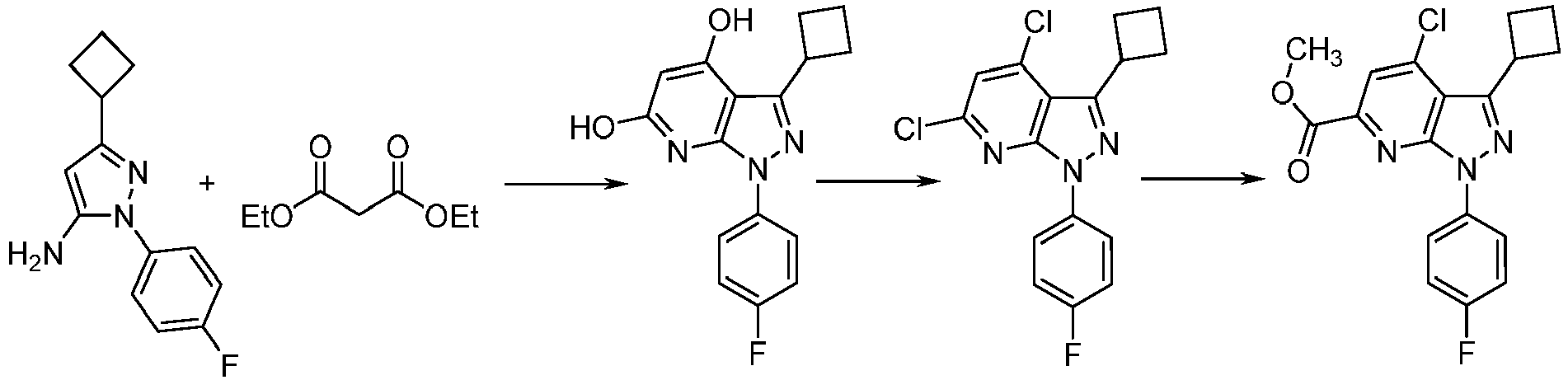
- A mixture of 3-cyclobutyl-1-(4-fluorophenyl)-1H-pyrazol-5-amine (AMP93, 5 g, 18.6 mmol) and diethyl malonate ([105-53-3], 8.5 mL, 55.8 mmol) was heated at 100 °C for 30 minutes and then at 170 °C for 3 hours. The reaction mixture was cooled down to RT and dissolved in dichloromethane (60 mL). The resultant solution was poured into a stirred solution of n-heptane (700 mL). The precipitate was collected by filtration, washed with n-heptane and dried at 40 °C under reduced pressure to give the titled compound.
- A three-neck round-bottom flask equipped with a Dean-Stark apparatus was charged with phenyl dichlorophosphate ([770-12-7], 854 g, 4.05 mol). 3-Cyclobutyl-1-(4-fluorophenyl)-1H-pyrazolo[3,4-b]pyridine-4,6-diol (404 g, 1.35 mol) was added in portions over a period of 5 minutes. The temperature was increased to 170 °C over a period of 1 hour, and the stirring at 170 °C was continued for 21 hours. The reaction mixture was cooled down to 50 °C and added slowly to a stirred aqueous 4 N NaOH (5 L) keeping the temperature below 20 °C. The suspension was stirred for 1 hour at 10-15 °C, and then cold water (3 L) was added. The precipitate was collected by filtration, washed with water and dried at 40 °C under reduced pressure to give the titled compound.
- A pressured vessel was charged with 4,6-dichloro-3-cyclobutyl-1-(4-fluorophenyl)-1H-pyrazolo[3,4-b]pyridine (5 g, 14.9 mmol), Pd(dppf)Cl2•DCM (CAS 95464-05-4, 218 mg, 0.3 mmol), and sodium acetate (1.8 g, 22.3 mmol) in dioxane/methanol (1:1, 25 mL). The system was loaded with CO (4 bars) and heated at 40 °C for 2 hours. The vessel was cooled to RT, and the conversion was monitored by LCMS. The reaction vessel was charged again with CO (4 bars) and heated at 40 °C. The sequence was repeated until full conversion was observed. The crude mixture was concentrated under reduced pressure and purified by flash column chromatography eluting with a mixture of n-heptane/dichloromethane (90/10 to 30/70) to give the titled compound.
-

- A mixture of 5-cyclobutyl-2-cyclohexyl-2H-pyrazol-3-ylamine (AMP35, 10 g, 45.7 mmol) and diethyl malonate ([105-53-3], 27.7 mL, 183 mmol) in diphenylether (50 mL) was heated at 130 °C over approximately 60 hours. The reaction mixture was cooled down to RT and quenched with 0.5 M NaOH solution (100 mL, 50 mmol). Extraction with EtOAc gave an aqueous phase that was acidified with a 12 M HCl solution (4.3 mL, 51.6 mmol) giving rise to a suspension. This suspension was extracted with EtOAc. The obtained organic layer was dried and concentrated to give the titled compound that was used as such.
- The 3-cyclobutyl-1-cyclohexyl-4-hydroxy-3aH-pyrazolo[3,4-b]pyridin-6-one (5.15 g, 17.9 mmol) was suspended in phenyl dichlorophosphate ([770-12-7], 8.01 mL, 53.8 mmol). The mixture was heated at 130 °C overnight. Next, the mixture was diluted in DCM and poured into ice water. After increasing the pH till 7-8 with a 20% NH4OH solution, the biphasic mixture was stirred for 30 minutes. Subsequently, the organic phase was separated, dried and concentrated to give a residue. This residue was purified by chromatography using a petroleum ether/EtOAc gradient (100/0 to 90/10). This resulted in the titled compound that was used as such.
- In a Parr apparatus, 4,6-dichloro-3-cyclobutyl-1-cyclohexyl-pyrazolo[3,4-b]pyridine (2.17 g, 6.72 mmol) was dissolved in MeOH (50 mL) together with Pd(dppf)Cl2•DCM (CAS 95464-05-4, 275 mg, 0.33 mmol) and triethylamine (1.87 mL, 13.4 mmol). The system was loaded with CO (5 bar) and heated at 45 °C for 18 hours. After cooling down the mixture till RT, the mixture was concentrated, and the obtained residue was purified by chromatography using a petroleum ether/EtOAc gradient (100/0 till 95/5). This yielded the titled compound.
-

- To a suspension of aminopyrazole (1 equiv) in ethanol (150 mL) is added diethyl acetylenedicarboxylate (1.1 equiv). The reaction mixture is stirred at room temperature for 4 hours. The reaction mixture is concentrated. The crude residue is purified by silica gel column chromatography (heptane/EtOAc 100/0 to 70/30) to give the titled compound.
- The diethyl but-2-enedioate is heated under air atmosphere at 190-195 °C for one hour. The reaction mixture is cooled to room temperature and is partitioned between dichloromethane and water. The aqueous phase is separated and extracted two times with dichloromethane. The combined organic phases were dried, filtered and concentrated in vacuo. The crude residue can be purified by silica gel column chromatography to provide the pyrazolopyridine.
- A solution of the above pyrazolopyridine (1 equiv) in phosphorus(V) oxychloride (32 equiv) was stirred at 115 °C for 1 h. The reaction mixture is then cooled to room temperature and concentrated in vacuo. The residue is dissolved in ethyl acetate, and the reaction mixture is added dropwise to a solution of saturated of sodium hydrogencarbonate till total neutralization of phosphorus(V) oxychloride (pH 8). The aqueous phase is separated and extracted two times with ethyl acetate. The combined organic phases are washed with brine, dried, filtered and concentrated in vacuo. The crude residue can be purified by silica gel column chromatography to provide the chlorinated pyrazolopyridine from which the dimethoxybenzyl group has also been removed.
-

- To a suspension of 2-(2,4-dimethoxy-benzyl)-5-isopropyl-2H-pyrazol-3-ylamine (AMP28, 18.14 g, 65.88 mmol) in ethanol (150 mL) was added diethyl acetylenedicarboxylate (CAS: 762-21-0, 11.60 mL, 72.47 mmol). The reaction mixture was stirred at room temperature for 4 hours. The reaction mixture was concentrated. The crude residue was purified by silica gel column chromatography (heptane/EtOAc 100/0 to 70/30) to give the titled compound.
- 2-[2-(2,4-Dimethoxy-benzyl)-5-isopropyl-2H-pyrazol-3-ylamino]-but-2-enedioic acid diethyl ester (13.46 g, 30.21 mmol) was heated under air atmosphere at 190-195 °C for one hour. The reaction mixture cooled to room temperature and was partitioned between dichloromethane and water. The aqueous phase was separated and extracted two times with dichloromethane. The combined organic phases were dried over MgSO4, filtered and concentrated in vacuo. The crude residue was purified by silica gel column chromatography (heptane/EtOAc 100/0 to 60/40) to provide the titled compound.
- A solution of 1-(2,4-dimethoxy-benzyl)-4-hydroxy-3-isopropyl-1H-pyrazolo[3,4-b]pyridine-6-carboxylic acid ethyl ester (HP06, 4.02 g, 10.06 mmol) in phosphorus(V) oxychloride (CAS 100025-87-3, 30 mL, 322 mmol) was stirred at 115 °C for 1 h. The reaction mixture was then cooled to room temperature and concentrated in vacuo. The residue was dissolved in ethyl acetate, and the reaction mixture was added dropwise to a solution of saturated of sodium hydrogencarbonate till total neutralization of phosphorus(V) oxychloride (pH 8). The aqueous phase was separated and extracted two times with ethyl acetate. The combined organic phases were washed with brine, dried over MgSO4, filtered and concentrated in vacuo. The crude residue was purified by silica gel column chromatography (heptane/EtOAc 100/0 to 75/25) to provide the titled compound.
-

- In an amber round bottom flask, diethyl acetylenedicarboxylate ([762-21-0], 14.8 mL, 87 mmol) was added to a suspension of AMP94 (15.2 g, 78.8 mmol) in ethanol (200 mL). The reaction mixture was stirred at room temperature for 20 hours, and the mixture was concentrated in vacuo. The crude residue was purified by silica gel column chromatography (heptane/dichloromethane 100/0 to 0/100) to give the titled compound.
- In a sealed tube, a suspension of diethyl 2-[(1-tert-butyl-3-cyclobutyl-1H-pyrazol-5-yl)amino]but-2-enedioate (5 g, 13.8 mmol) in Dowtherm® A (5 mL) was heated at 185-190 °C for 24 hours. The reaction mixture was cooled to room temperature and was partitioned between n-heptane and acetonitrile. The acetonitrile phase was separated and evaporated under reduced pressure. The crude sample was purified by silica gel column chromatography (dichloromethane/n-heptane) to give the titled compound.
- Trifluoromethanesulfonic anhydride ([358-23-6], 1.9 mL, 11.3 mmol) was added dropwise to a solution of ethyl 1-tert-butyl-3-cyclobutyl-4-hydroxy-1H-pyrazolo[3,4-b]pyridine-6-carboxylate (2.5 g, 7.89 mmol) and pyridine (1.9 mL, 23.5 mmol) in acetonitrile (80 mL), maintaining the temperature around 20-25 °C. The reaction mixture was stirred at RT for 20 hours. Then solid sodium hydrogencarbonate and few milliliters of water were added, and the reaction mixture was concentrated in vacuo. The residue was taken up in dichloromethane and water. The two phases were separated, and the aqueous phase was again extracted with dichloromethane. The combined organic phases were washed with brine, dried over MgSO4, filtered and concentrated under reduced pressure. The resulting residue was purified by silica gel chromatography (n-heptane/ethyl acetate) to yield the titled compound.
-

- A mixture of AMP23 (5.0 g, 24.1 mmol) and diethylmalonate (CAS 105-53, 37.36 mL, 48.2 mmol, 2.0 equiv) was stirred at 190 °C for 2 hours. The reaction mixture was then cooled to RT, and diethyl ether was added. The obtained suspension was filtered; the solid was washed with pentane, and dried in vacuo to give the titled compound.
- Trifluoromethanesulfonic anhydride (CAS 358-23-6,6.26 mL, 37.2 mmol, 1.75 equiv) was added dropwise at 0 °C to a solution of 1-cyclohexyl-3-isopropyl-pyrazolo[3,4-b]pyridine-4,6-diol (5.85 g, 21.2 mmol) and pyridine (4.3 mL, 53.1 mmol, 2.5 equiv) in acetonitrile (145 mL). The reaction mixture was stirred at RT for 16 hours. Dichloromethane and water were added to the reaction mixture. The two phases were separated, and the organic phase was washed with water and brine, dried over MgSO4, filtered and concentrated in vacuo. The residue was taken up in toluene and concentrated again in vacuo to give the titled compound.
- A mixture of [1-cyclohexyl-3-isopropyl-6-(trifluoromethylsulfonyloxy)pyrazolo[3,4-b]pyridin-4-yl] trifluoromethanesulfonate (10.86 g, 20.1 mmol) and 4 N HCl in dioxane (50 mL, 200 mmol, 10 equiv) was stirred at 100 °C for 16 hours in a sealed tube. The reaction mixture was cooled to RT and concentrated in vacuo. The residue was purified by chromatography on silica gel (heptane/dichloromethane 100/0 to 80/20) to yield the titled compound.
- Triethylamine (1.9 mL, 13.6 mmol, 2.0 equiv) and Pd(dppf)Cl2 (CAS : 72287-26-4, 100 mg, 0.14 mmol, 0.02 equiv) were added to a solution of 4,6-dichloro-1-cyclohexyl-3-isopropyl-pyrazolo[3,4-b]pyridine (2.13 g, 6.82 mmol) in methanol (55 mL). The system was filled at RT with CO (40 psi) and heated at 100 °C for 1 hour. The reaction mixture was cooled down to RT and concentrated in vacuo. The residue was purified by chromatography on silica gel (heptane/ethyl acetate 100/0 to 90/10) to yield the titled compound.
-

- Trifluoromethanesulfonic anhydride (CAS 358-23-6, 92 µL, 0.56 mmol, 1.45 equiv) was added dropwise at RT to a solution of HP15 (160 mg, 0.39 mmol, 1 equiv) and pyridine (46 µL, 0.58 mmol, 1.5 equiv) in acetonitrile (4 mL). The reaction mixture was stirred at RT for 3 h. Then solid sodium hydrogencarbonate and few milliliters of water were added, and the reaction mixture was concentrated in vacuo. The residue was taken up in dichloromethane and water. The two phases were separated, and the aqueous phase was extracted with dichloromethane. The combined organic phases were washed with brine, dried over MgSO4, filtered and concentrated in vacuo. The resulting residue was purified by flash chromatography on silica gel (eluent system: heptane/dichloromethane gradient from 100/0 to 0/100) to yield the titled compound.
Table VIII. List of halogenated pyrazolopyridine Int. Structure Name SM method MW Mes HP01 
ethyl 4-chloro-3-isopropyl-1-(m-tolyl)pyrazolo[ 3,4-b]pyridine-6-carboxylate AMP07 H1 Specific example 357-359 358-360 HP02 
methyl 4-chloro-3-cyclobutyl-1-phenylpyrazolo[3,4-b]pyridine-6-carboxylate AMP29 H2 Specific example 341-343 342-344 HP03 
ethyl 4-chloro-1-[3-(dimethylamin o)phenyl]-3-isopropylpyrazolo[3,4-b]pyridine-6-carboxylate AMP06 H1(steps 1 to 8) and H1' (step 9) Specific example 386-388 387-389 HP04 
ethyl 4-chloro-1-cyclohexyl-3-isopropylpyrazolo[3,4-b]pyridine-6-carboxylate AMP23 H1(steps 1 to 8) and H1' (step 9) 349-351 350-352 HP05 
methyl 4-chloro-1-(4-fluorophenyl)-3-isopropylpyrazolo[3,4-b]pyridine-6-carboxylate AMP13 H2 347-349 348-350 HP06 
ethyl 1-[(2,4-dimethoxyphen yl)methyl]-4-hydroxy-3-isopropylpyrazolo[3,4-b]pyridine-6-carboxylate AMP28 H3 (steps 1 & 2 only) 399 400 HP07 
4-chloro-1-[3-(dimethylamin o)phenyl]-3-isopropylpyrazolo[3,4-b]pyridine-6-carboxylic acid HP03 J1 358-360 359-361 HP08 
ethyl 4-chloro-3-isopropyl-1H-pyrazolo[3,4-b]pyridine-6-carboxylate AMP28 H3 Specific example 267-269 268-270 HP09 
ethyl 4-chloro-1-(4-fluorophenyl)-3-isopropylpyrazolo[3,4-b]pyridine-6-carboxylate HP08, 1765-93-1 14 361-363 362-364 HP10 
4-chloro-3-cyclobutyl-1-phenylpyrazolo[3,4-b]pyridine-6-carboxylic acid HP02 J1 327-329 328-330 HP11 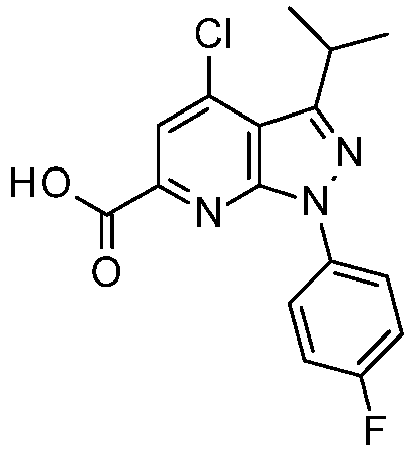
4-chloro-1-(4-fluorophenyl)-3-isopropylpyrazolo[3,4-b]pyridine-6-carboxylic acid HP05 J1 333-335 334-336 HP12 
methyl 4-chloro-1-cyclohexyl-3-isopropylpyrazolo[3,4-b]pyridine-6-carboxylate AMP23 Specific example 335-337 336-338 HP13 
ethyl 4-chloro-3-methyl-1-phenylpyrazolo[3,4-b]pyridine-6-carboxylate 1131-18-6 Specific example 315-317 316-318 HP14 
ethyl 3-cyclobutyl-1-[(2,4-dimethoxyphen yl)methyl]-4-(trifluoromethy lsulfonyloxy)p yrazolo[3,4-b]pyridine-6-carboxylate HP15 Specific example 543 544 HP15 
ethyl 3-cyclobutyl-1-[(2,4-dimethoxyphen yl)methyl]-4-hydroxypyrazolo[3,4-b]pyridine-6-carboxylate AMP36 H3 (steps 1 & 2 only)1 411 412 HP16 
4-chloro-3-isopropyl-1-(m-tolyl)pyrazolo[ 3,4-b]pyridine-6-carboxylic acid HP01 J1 329-331 330-332 HP19 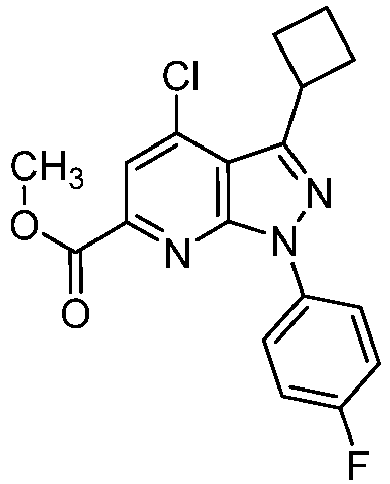
methyl 4-chloro-3-cyclobutyl-1-(4-fluorophenyl)-1H-pyrazolo[3,4-b]pyridine-6-carboxylate AMP93 Specific example 359-361 360-362 HP20 
ethyl 1-tert-butyl-3-cyclobutyl-4-[(trifluorometh anesulfonyl)ox y]-1H-pyrazolo[3,4-b]pyridine-6-carboxylate AMP94 Specific example 449 450 HP25 
methyl 4-chloro-3-cyclobutyl-1-cyclohexyl-1H-pyrazolo[3,4-b]pyridine-6-carboxylate AMP3 5 Specific example 347 348 HP26 
4-chloro-3-cyclobutyl-1-(4-fluorophenyl)-1H-pyrazolo[3,4-b]pyridine-6-carboxylic acid HP19 J1 345 346 1Step 2 performed in Dowtherm™ at 160 °C for 48 h. -
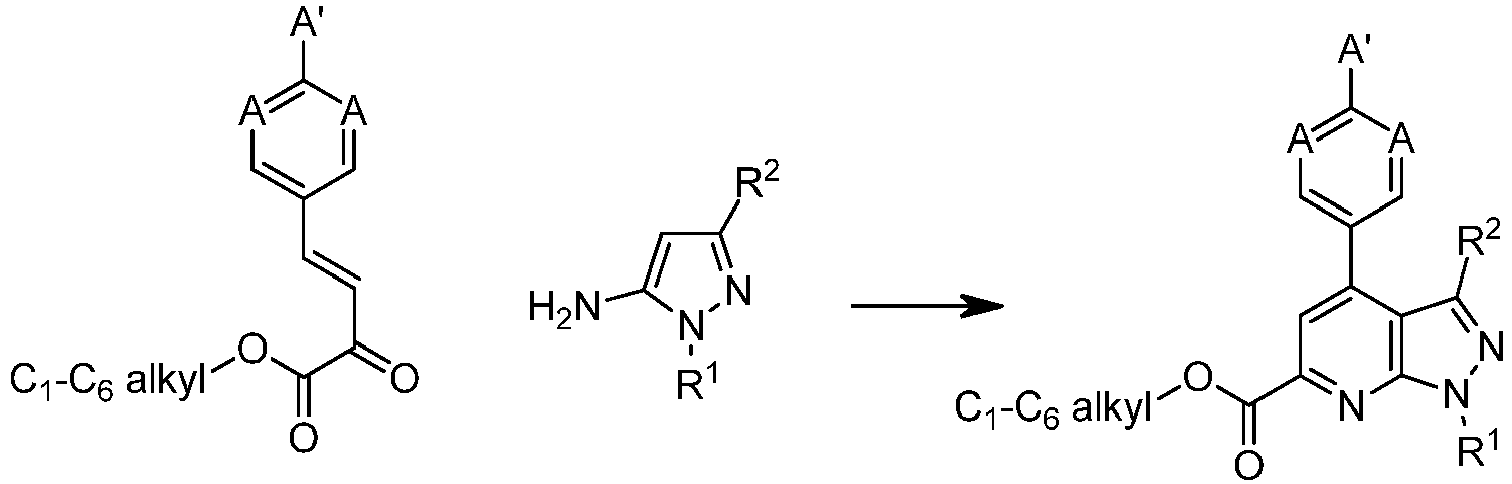
- A is either N or CH
- A' is either Re or L1-G3C as described in the Summary
- The alkylidene pyruvate (1 to 1.5 equiv) and the aminopyrazole (1 to 1.5 equiv) in acetic acid or DMF are stirred under air at temperatures ranging from RT to reflux for 1 h to several days. Alternatively, the reaction mixture is heated under microwave irradiation at 150 °C for 20 minutes to 2 h followed either by stirring under air in an opened flask at temperatures ranging from RT to 90 °C for 1 h to several days or by removal of the solvent in vacuo, dilution of the residue in ethanol and stirring at reflux for 1 h to several days. Then volatiles are removed in vacuo to afford the titled compound which is used as such or alternatively worked up by dilution with an organic solvent, washed successively with a basic aqueous solution and brine, dried over sodium sulfate, filtered and concentrated in vacuo and used as such or further purified either by precipitation, by preparative HPLC or by flash chromatography on silica gel.
- Alternatively, the alkylidene pyruvate (1 equiv) and the aminopyrazole (1 equiv) in N-methylpyrrolidone can be heated at 80 to 100 °C over 8 to 24 hours. Next, the reaction mixture is cooled down to room temperature and a base such as Cs2CO3 (2-6 equiv) is added. The resulting mixture is stirred open to the air until full oxidation is observed.
-

- The alkylidene pyruvate ALP09 (47.1 g, 150.5 mmol) and the aminopyrazole AMP29 (30 g, 140.7 mmol) were dissolved in acetic acid (240 mL) in an opened round bottom flask equipped with a condenser. The solution was heated at 80 °C for 40 hours and then left cooling down to RT. The mixture was concentrated under reduced pressure, and the crude residue was diluted with DCM (400 mL). The organic phase was washed successively with a saturated aqueous solution of Na2CO3 and a saturated aqueous solution of NaCl, dried over sodium sulfate, filtered and concentrated in vacuo. The crude sample was purified by flash column chromatography eluting with dichloromethane/ethyl acetate. The solid was stirred for 10 minutes in methanol, filtered and dried at 40 °C under reduced pressure to give the titled compound.
-

- A solution of ALP36 (116 mg, 0.5 mmol) and AMP95 (112 mg, 0.5 mmol) in N-methylpyrrolidine (2 mL) was heated at 100 °C for 20 hours in a sealed tube. The volatiles were removed in vacuo, and the residue was purified by flash chromatography on silica gel eluted with ethyl acetate/n-heptane (0/1 to 1/0) to give the titled compound.
-

- 5-Amino-1-cyclohexyl-1H-pyrazol-3-01 ([436088-86-7], 5.54 g, 30.5 mmol,) and (E)-methyl-4-(4-bromophenyl)-2-oxobut-3-enoate ([608128-34-3], 8.22 g, 30.5 mmol,) in NMP (60 mL,) were heated overnight at 90 °C. Next, the reaction mixture was cooled down to room temperature and Cs2CO3 (30 g, 91.6 mmol) was added. The resulting mixture was stirred open to the air until full oxidation to the titled compound was observed. The obtained solution was used as such for alkylation.
-

- A suspension of methyl 4-chloro-1-(4-fluorophenyl)-3-isopropyl-pyrazolo[3,4-b]pyridine-6-carboxylate (HP05, 2.0 g, 5.75 mmol, 1.0 equiv), tert-butyl 4-(4,4,5,5-tetramethyl-1,3,2-dioxaborolan-2-yl)-3,6-dihydro-2H-pyridine-1-carboxylate (CAS 286961-14-6, 3.6 g, 11.5 mmol, 2.0 equiv), K2CO3 (2.4 g, 17.25 mmol, 3.0 equiv)and Pd(dppf)Cl2 (CAS : 72287-26-4, 939 mg, 1.15 mmol, 0.2 equiv) in anhydrous DMF (15 mL) was degassed with nitrogen at room temperature for 2 minutes. The reaction mixture was heated at reflux overnight. The mixture was cooled to RT, and the mixture was poured into 150 mL of water and diluted with ethyl acetate. The two phases were separated, and the aqueous phase was extracted with ethyl acetate. The combined organic layers were washed with brine, dried over MgSO4, filtered and concentrated. The crude residue was purified by silica gel chromatography (heptane/ethyl acetate: 100/0 to 80/20) to give E198.
- A suspension of E198 (2.44 g, 4.93 mmol, 1.0 equiv) and platinum(IV) oxide (CAS 1314-15-4, 1.2 g) in AcOH was stirred at RT under hydrogen atmosphere (balloon) overnight. Then the reaction mixture was filtered over Celpure® P65. Solids were washed with ethyl acetate, and the filtrate was concentrated in vacuo. The crude residue was purified by silica gel chromatography (heptane/ethyl acetate: 100/0 to 80/20) to give the title compound.
-

- A mixture of the chloride or triflate pyrazolopyridine intermediate (1.0 equiv), the amine as free base or hydrochloride salt (from 1 to 10 equiv) and DIPEA (from 1 to 15 equiv) in anhydrous acetonitrile and DMSO in a sealed tube or a round bottom flask is heated at a temperature ranging from 50 to 130 °C for 1 h to several days (up to 8 days). The reaction mixture is cooled to RT, and volatiles are removed in vacuo. The resulting residue is either purified by precipitation or by flash chromatography on silica gel to afford the titled compound or alternatively partitioned between either dichloromethane or ethyl acetate and water. The two phases are then separated, and the aqueous phase is extracted with either ethyl acetate or dichloromethane. The combined organic phases are washed with brine, dried over MgSO4, filtered and concentrated in vacuo and the resulting crude mixture is either used as such or purified by flash chromatography on silica gel to afford the titled compound.
-

- A mixture of HP05 (6.71g, 19.29 mmol, 1.0 equiv), 4-(methoxymethyl)piperidine hydrochloride (CAS 916317-00-5, 6.39g, 38.58 mmol, 2 equiv) and DIPEA (10.1 mL, 57.88 mmol, 3 equiv) in anhydrous DMSO (65 mL) was heated at 100 °C for 20 h. The reaction mixture was cooled to RT, partitioned between ethyl acetate (300 mL) and a mixture of water and a saturated solution of NaCl 1:1 (300 mL). The two phases were separated, and the aqueous phase was extracted with ethyl acetate (150 mL). The combined organic phases were washed with brine, dried over MgSO4, filtered and concentrated in vacuo. The crude mixture was purified by flash chromatography on silica gel eluting with n-heptane/ethyl acetate to afford the titled compound.
-

- To a solution of HP19 (8.11 gram, 22.6 mmol) in dry N-methylpyrrolidinone (100 mL) was added 4-methoxy-1,4'-bipiperidine (5.37 gram, 27.1 mmol, AMI10) and diisopropylethylamine (9.42 mL, 54.2 mmol). The reaction mixture was stirred at 100 °C for 24 hours and then cooled down to ambient temperature and diluted with water. A suspension formed upon cooling at 0 °C. The suspension was filtered, and the obtained precipitate was washed with water. After drying, the titled compound was obtained.
-

- Methyl 4-chloro-3-cyclobutyl-1-phenyl-pyrazolo[3,4-b]pyridine-6-carboxylate (15 g, 43.9 mmol, HP02) and 4-(pyrrolidin-1-ylmethyl)piperidine (13.29 g, 79 mmol) were dissolved in a mixture of N-ethyl-N-isopropylpropan-2-amine (45.9 mL, 263 mmol) and N-methylpyrrolidinone (90 mL). The resulting solution was heated at 100 °C under nitrogen for two hours. After diluting with water (200 mL), the mixture was extracted with tert-butyl methyl ether (3 × 150 mL). The combined organic fractions were washed with 1 M aqueous NaOH (2 × 100 mL), water (2 × 50 mL), and saturated aqueous sodium chloride, then dried over sodium sulfate and concentrated under vacuum to approximately 100 mL followed by the addition of heptanes (200 mL). Volatiles were removed under vacuum, and the resulting thick slurry was stirred overnight at room temperature. The solid was collected by filtration, and then dried to constant weight under vacuum to give 18.39 g of the titled compound. 1H NMR (400 MHz, CDCl3) δ ppm 8.39 - 8.31 (m, 2H), 7.51 (dd, J = 8.6, 7.4 Hz, 2H), 7.40 (s, 1H), 7.31 - 7.23 (m, 1H), 4.00 (m, 4H), 3.70 - 3.57 (m, 2H), 2.89 (td, J = 12.2, 2.4 Hz, 2H), 2.63 (dq, J = 11.7, 9.2 Hz, 2H), 2.56 - 2.49 (m, 4H), 2.47 - 2.38 (m, 4H), 2.05 (m, 4H), 1.86 - 1.78 (m, 4H), 1.73 (m, 1H), 1.53 (qd, J = 12.1, 3.7 Hz, 2H); LC/MS (APCI) m/z 474.6 (M+H)+.
-

- To a solution of ethyl 1H-pyrazolo[3,4-b]pyridine-6-carboxylate intermediate (1.0 equiv) in dichloromethane at RT is added the aryl boronic acid (2.0 to 3.0 equiv), copper(II) acetate (CAS 142-71-2, 1.5 equiv) and pyridine (4.0 equiv). The reaction mixture is stirred at room temperature under air for 1 h to 48 h. Then the reaction mixture is filtered on a pad of diatomaceous earth. Solids are washed with dichloromethane, and the filtrate is concentrated in vacuo. The resulting residue is purified by flash chromatography on silica gel to afford the titled compound.
-

- To a solution of ethyl 3-isopropyl-4-(4-methoxy-1-piperidyl)-1H-pyrazolo[3,4-b]pyridine-6-carboxylate E109 (70 mg, 0.20 mmol, 1.0 equiv) in dichloromethane (2 mL) at RT was added (2-fluoropyridin-4-yl)boronic acid (CAS: 401815-98-3, 56 mg, 0.40 mmol, 2.0 equiv), copper(II) acetate (CAS 142-71-2, 54 mg, 0.30 mmol, 1.5 equiv) and pyridine (64 µL, 0.80 mmol, 4.0 equiv). The reaction mixture was stirred at room temperature under air overnight. The reaction mixture was filtered on a pad of diatomaceous earth. Solids were washed with dichloromethane, and the filtrate was concentrated in vacuo. The resulting residue was purified by flash chromatography on silica gel (eluent system: heptane/ethyl acetate: 100/0 to 70/30) to give the titled compound.
-

- R2 is isopropyl or cyclobutyl
- A is CH or N
- LG1 and LG2 are independently F, Cl or Br
- To a solution of ethyl 3-substituted-1H-pyrazolo[3,4-b]pyridine-6-carboxylate intermediate (1.0 equiv) in anhydrous DMF or THF under nitrogen atmosphere at 0 °C is added sodium hydride (60% in mineral oil, from 1.2 equiv to 1. 5equiv), and the mixture is stirred 5 minutes at 0 °C. Then an aromatic halide (2.0 equiv) is added, and the reaction mixture is warmed up to RT and stirred overnight. The reaction mixture is partitioned between water and ethyl acetate and acidified to pH 5 with AcOH. The two phases are separated. The organic phase is washed with brine, dried over MgSO4, filtered and concentrated in vacuo to afford the titled compound which is used as such or purified by flash chromatography on silica gel.
-

- To a solution of ethyl 3-isopropyl-4-(4-methoxy-1-piperidyl)-1H-pyrazolo[3,4-b]pyridine-6-carboxylate E109 (245 mg, 0.71 mmol, 1.0 equiv) in anhydrous DMF (3 mL) under nitrogen atmosphere at 0 °C was added sodium hydride (60% in mineral oil, 34 mg, 0.85 mmol, 1.2 equiv), and the mixture was stirred 5 minutes at 0 °C then 2-bromo-6-fluoropyridine (CAS 144100-07-2, 250 mg, 1.42 mmol, 2.0 equiv) was added, and the reaction mixture was warmed up to RT and stirred overnight. The reaction mixture was partitioned between water and ethyl acetate and acidified to pH 5 with AcOH. The two phases were separated. The organic phase was washed with brine, dried over MgSO4, filtered and concentrated in vacuo to afford the titled compound which was used as such.
-

- To a suspension of ethyl 3-isopropyl-4-[4-(methoxymethyl)-1-piperidyl]-1H-pyrazolo[3,4-b]pyridine-6-carboxylate E148 (1.0 equiv) in anhydrous DMF under nitrogen atmosphere is added potassium carbonate (1.2 equiv), then alkyl bromide (1.1 equiv). The reaction mixture is stirred at room temperature overnight. Then cesium carbonate (1.2 equiv) and potassium iodide (0.1 equiv) are added, and the reaction mixture is stirred at room temperature for 24 h. The mixture is partitioned between water and ethyl acetate. The aqueous phase is extracted with ethyl acetate. The combined organic phases are washed with brine, dried over MgSO4, filtered and concentrated in vacuo. The crude mixture is purified by flash chromatography on silica gel to afford the titled compound.
-

- To a suspension of ethyl 3-isopropyl-4-[4-(methoxymethyl)-1-piperidyl]-1H-pyrazolo[3,4-b]pyridine-6-carboxylate E148 (100 mg, 0.28 mmol, 1.0 equiv) in anhydrous DMF (2 mL) under nitrogen atmosphere was added potassium carbonate (47 mg, 0.34 mmol, 1.2 equiv) and then (bromomethyl)cyclobutane (CAS: 17247-58-4, 35 µL, 0.31 mmol, 1.1 equiv). The reaction mixture was stirred at room temperature overnight. Then cesium carbonate (111 mg, 0.34 mmol, 1.2 equiv) and potassium iodide (5 mg, 0.028 mmol, 0.1 equiv) were added, and the reaction mixture was stirred at room temperature for 24 h. The mixture was partitioned between water and ethyl acetate. The aqueous phase was extracted with ethyl acetate. The combined organic phases were washed with brine, dried over MgSO4, filtered and concentrated in vacuo. The crude mixture was purified by flash chromatography on silica gel (eluent system: heptane/ethyl acetate gradient from 100/0 to 75/25) to afford the titled compound.
-

- A suspension of ethyl 3-isopropyl-4-[4-(methoxymethyl)-1-piperidyl]-1H-pyrazolo[3,4-b]pyridine-6-carboxylate E148 (100 mg, 0.28 mmol, 1.0 equiv) in anhydrous toluene (1 mL) was degassed with nitrogen (bubbling) at room temperature for 5 minutes. Then to this suspension was added 6-bromo-2-methyl-pyridazin-3-one (CAS 1123169-25-4, 58 mg, 0.31 mmol, 1.1 equiv), cesium carbonate (365 mg, 1.12 mmol, 4.0 equiv), Xantphos (CAS 161265-03-8, 16 mg, 0.028 mmol, 0.1 equiv), and palladium(II) acetate (CAS 3375-31-3, 3 mg, 0.014 mmol, 0.05 equiv). The mixture was purged again with nitrogen at RT for 10 minutes, and then the mixture was stirred at reflux overnight. The reaction mixture was cooled down and concentrated in vacuo. The residue was partitioned between water and ethyl acetate. The aqueous phase was extracted with ethyl acetate. The combined organic phases were washed with brine, dried over MgSO4, filtered and concentrated in vacuo. The crude mixture was purified by flash chromatography on silica gel (eluent system: heptane/ethyl acetate gradient from 100/0 to 0/100) to afford the titled compound.
-

- A nitrogen-purged mixture of tris(dibenzylideneacetone)dipalladium(0) (0.0193 g, 0.021 mmol), and di-tert-butyl(2',4',6'-triisopropyl-3,4,5,6-tetramethyl-[1,1'-biphenyl]-2-yl)phosphine (0.0251 g, 0.052 mmol) in toluene (2.2 mL) was stirred for 20 minutes and then added to an nitrogen-purged mixture of methyl 3-cyclobutyl-4-[4-(morpholin-4-yl)piperidin-1-yl]-1H-pyrazolo[3,4-b]pyridine-6-carboxylate (0.1760 g, 0.441 mmol, E509), 1-bromo-3-(difluoromethoxy)benzene (0.1179 g, 0.529 mmol), and Cs2CO3 (0.2143 g, 0.658 mmol). The mixture was heated to 70 °C overnight, diluted with water, extracted with DCM (3 x 8 mL), dried (Na2SO4), and concentrated. The residue was chromatographed on silica (30-60% EtOAc/DCM to 4% MeOH/DCM) and re-chromatographed (2.5-4% iPrOH/DCM) to give the titled compound. 1H NMR (400 MHz, DMSO-d 6) δ ppm 8.28 - 8.16 (m, 2H), 7.58 (t, J = 8.2 Hz, 1H), 7.51 - 7.03 (m, 3H), 3.95 (dq, J = 18.1, 9.8, 8.5 Hz, 1H), 3.88 (s, 3H), 3.63 - 3.48 (m, 6H), 2.91 (t, J = 11.9 Hz, 2H), 2.53 - 2.48 (m, 4H), 2.46 - 2.28 (m, 2H), 2.12 - 1.88 (m, 4H), 1.63 (td, J = 13.1, 12.6, 6.4 Hz, 2H).
-

- A suspension of ethyl 1-(3-bromophenyl)-3-isopropyl-4-(4-morpholinophenyl)pyrazolo[3,4-b]pyridine-6-carboxylate E001 (1.0 equiv), XPhos Pd G1 (CAS 1028206-56-5, 0.1 equiv) and sodium tert-butoxide (CAS: 865-48-5, 1.3 equiv) in anhydrous toluene is degassed with argon (bubbling) at room temperature for 15 minutes. Amine (1.3 equiv) is added, and the mixture is purged with argon at RT for 2 minutes. The reaction mixture is stirred at 100 °C for 30 minutes to 24 h. The reaction mixture is concentrated in vacuo, and the residue is partitioned between water and dichloromethane and filtered on a pad of Celpure P65®. Solids were washed with dichloromethane and water, and the two phases of the filtrate are separated. The aqueous layer is extracted with dichloromethane. The combined organic phases are washed with brine, dried over MgSO4, filtered and concentrated in vacuo. The titled compound is obtained from the crude mixture either by precipitation or by purification by flash chromatography on silica gel.
-

- A suspension of ethyl 1-(3-bromophenyl)-3-isopropyl-4-(4-morpholinophenyl)pyrazolo[3,4-b]pyridine-6-carboxylate E001 (60 mg, 0.115 mmol, 1.0 equiv), XPhos Pd G1 (CAS 1028206-56-5, 9 mg, 0.011 mmol, 0.1 equiv), and sodium tert-butoxide (CAS: 865-48-5, 14 mg, 0.149 mmol, 1.3 equiv) in anhydrous toluene (1.2 mL) was degassed with argon (bubbling) at room temperature for 15 minutes. Azetidine (13 µL, 0.149 mmol, 1.3 equiv) was added, and the mixture was purged with argon at RT for 2 minutes. The reaction mixture was stirred at 100 °C for 1 hour. The reaction mixture was concentrated in vacuo; the residue was partitioned between water and dichloromethane, and then was filtered on a pad of Celpure P65®. Solids were washed with dichloromethane and water, and the two phases of the filtrate were separated. The aqueous layer was extracted with dichloromethane. The combined organic phases were washed with brine, dried over MgSO4, filtered and concentrated in vacuo. The residue was purified by flash chromatography on silica gel (eluent system: dichloromethane/methanol gradient from 100/0 to 90/10). The obtained solid was suspended in ethanol, filtered, washed with diethyl ether and dried in vacuo to afford the titled compound.
-

- To the acid (1 equiv) in either ethanol or methanol at RT is added concentrated sulfuric acid (catalytic amount). The reaction mixture is refluxed for 1 h to several days (up to 8 days). Then the reaction mixture is cooled down to RT. The resulting suspension is filtered; the solid is washed with either ethanol or methanol and then dried in vacuo. The crude solid is purified by flash chromatography on silica gel (eluent system: heptane/ethyl acetate) to give the titled compound.
- Alternatively, if no suspension is formed when cooling down the reaction mixture, the solvent is removed in vacuo. The resulting residue is taken up in dichloromethane and basified with a saturated solution of NaHCO3. The two phases are separated, and the aqueous phase is extracted with dichloromethane. The combined organic phases are washed with brine, dried over MgSO4, filtered and concentrated in vacuo to afford the titled compound which is used as such or further purified by flash chromatography on silica gel.
-

- Concentrated sulfuric acid (0.23 mL) was added to a suspension of A242 (2.56 g, 4.9 mmol) in absolute ethanol (64 mL) at RT. The reaction mixture was refluxed for 5 hours. The reaction mixture was cooled down to RT, and the obtained suspension was filtered. The cake was washed with ethanol and dried in vacuo. The solid residue was purified by chromatography on silica gel (heptane/ethyl acetate 100/0 to 70/30) to give the titled compound.
-

- To the amine (from 1.3 to 2 equiv), E010 (1 equiv) and sodium tert-butoxide (CAS: 865-48-5, from 1.3 to 3 equiv) is added degassed anhydrous toluene. The reaction mixture is purged with argon, XPhos Pd G1 (CAS 1028206-56-5, 0.1 equiv) is added, and the mixture is purged again with argon. The reaction mixture is stirred at a temperature ranging from 90 °C to 110 °C for 1 h to 24 h. The reaction mixture is cooled down and filtered on a pad of diatomaceous earth. Solids are washed with organic solvents, and the combined filtrates are concentrated in vacuo. The resulting residue is purified by flash chromatography on silica gel to afford the titled compound.
-

- To N,N-dimethylazetidin-3-amine hydrochloride (CAS: 935670-07-8, 40 mg, 0.194 mmol, 1.3 equiv), E010 (100 mg, 0.23 mmol, 1 equiv) and sodium tert-butoxide (CAS: 865-48-5, 57 mg, 0.598 mmol, 2.6 equiv) was added degassed toluene (2 mL). The reaction mixture was purged with argon, XPhos Pd G1 (CAS 1028206-56-5, 17 mg, 0.023 mmol, 0.1 equiv) was added and the mixture was purged again with argon. The reaction mixture was stirred at 100 °C for 1 hour. The reaction mixture was cooled down and filtered on a pad of diatomaceous earth. Solids were washed with toluene, ethyl acetate and dichloromethane, and the combined filtrates were concentrated in vacuo. The residue was purified by flash chromatography on silica gel (dichloromethane/methanol 98/2) to afford the titled compound.
-

- To E177 (0.1g, 0.23 mmol, 1 equiv) in anhydrous dichloromethane (2 mL) at RT was added acetyl chloride (CAS 75-36-5, 19 µL, 0.28 mmol, 1.2 equiv) followed by triethylamine (47 µL, 0.345 mmol, 1.5 equiv). The reaction mixture was stirred at RT for 2 h. The reaction mixture was diluted with dichloromethane and water. The two phases were separated, and the aqueous phase was extracted with dichloromethane. The combined organic phases were washed with brine, dried over MgSO4, filtered and concentrated in vacuo. The resulting residue was purified by flash chromatography on silica gel (eluent system: heptane/ethyl acetate gradient from 100/0 to 0/100) to afford the titled compound.
-

- To E177 (0.1g, 0.23 mmol, 1 equiv) in anhydrous dichloromethane (2 mL) at RT was added methyl chloroformate (CAS: 79-22-1, 19 µL, 0.28 mmol, 1.2 equiv) followed by triethylamine (47 µL, 0.345 mmol, 1.5 equiv). The reaction mixture was stirred at RT for 2 h. The reaction mixture was diluted with dichloromethane and water. The two phases were separated, and the aqueous phase was extracted with dichloromethane. The combined organic phases were washed with brine, dried over MgSO4, filtered and concentrated in vacuo. The resulting residue was purified by flash chromatography on silica gel (eluent system: heptane/ethyl acetate gradient from 100/0 to 50/50) to afford the titled compound.
-

- Diisopropylethylamine (0.045 mL, 0.26 mmol, 2.0 equiv) and 4-(dimethylamino)pyridine (CAS 1122-58-3, 3 mg, 0.026, 0.2 equiv) were added to a solution of E043 (65 mg, 0.13 mmol, 1 equiv) in dichloromethane (1 mL) at RT. The reaction mixture was cooled to 0 °C and methyl chloroformate (CAS: 79-22-1, 0.010 mL, 0.13 mmol, 1.0 equiv) was added. The reaction mixture was stirred at RT for 45 min then partitioned between dichloromethane and water. The organic phase was separated, washed with water, dried over MgSO4, filtered and concentrated. The residue was purified by silica gel chromatography (DCM/MeOH: 100/0 to 93/7) to give the titled compound.
-

- To E130 (31 mg, 0.073 mmol, 1 equiv) in anhydrous dichloromethane (0.5 mL) at 0 °C was added triethylamine (31 µL, 0.219 mmol, 3 equiv) followed by methyl chloroformate (CAS: 79-22-1, 7 µL, 0.088 mmol, 1.2 equiv). The reaction mixture was stirred at RT for 1.5 h. The reaction mixture was diluted with dichloromethane and water. The two phases were separated, and the aqueous phase was extracted with dichloromethane. The combined organic phases were washed with brine, dried over MgSO4, filtered and concentrated in vacuo. The resulting residue was purified by flash chromatography on silica gel (eluent system: dichloromethane/methanol, gradient from 100/0 to 98/2) to afford the titled compound.
-

- To E130 (31 mg, 0.073 mmol, 1 equiv) in anhydrous dichloromethane (2 mL) at 0 °C was added (31 µL, 0.219 mmol, 3 equiv) followed by acetyl chloride (CAS 75-36-5, 5 µL, 0.088 mmol, 1.2 equiv). The reaction mixture was stirred at RT for 1.5 h. The reaction mixture was diluted with dichloromethane and water. The two phases were separated, and the aqueous phase was extracted with dichloromethane. The combined organic phases were washed with brine, dried over MgSO4, filtered and concentrated in vacuo. The resulting residue was purified by flash chromatography on silica gel (eluent system: dichloromethane/methanol, gradient from 100/0 to 96/4) to afford the titled compound.
-

- To a solution of the intermediate ester (1.0 equiv) in anhydrous DMSO, are added the amine (from 2.0 to 3.0 equiv) and K2CO3 (3.0 equiv). The reaction mixture is stirred at 100 °C overnight. The reaction mixture is cooled down to RT, poured into water and extracted with ethyl acetate. The combined organic layers are washed with brine, dried over MgSO4, filtered and concentrated in vacuo. The resulting residue is purified by silica gel chromatography to afford the titled compound.
-

- To a solution of ethyl 1-(2-fluoro-4-pyridyl)-3-isopropyl-4-(4-methoxy-1-piperidyl)pyrazolo[3,4-b]pyridine-6-carboxylate E111 (50 mg, 0.11 mmol, 1.0 equiv) in anhydrous DMSO (1 mL), were added pyrrolidine (18 µL, 0.22 mmol, 2.0 equiv) and K2CO3 (46 mg, 0.33 mmol, 3.0 equiv). The reaction mixture was stirred at 100 °C overnight. The reaction mixture was cooled down to RT, poured into water and extracted with ethyl acetate. The combined organic layers were washed with brine, dried over MgSO4, filtered and concentrated in vacuo. The crude residue was purified by silica gel chromatography (heptane/ethyl acetate: 100/0 to 40/60) to afford the titled compound.
-

- Intermediate E153 (1.0 equiv), the alkyl iodide (from 3 to 5.7 equiv) and cesium carbonate (from 3 to 5.7 equiv) are charged in a sealed vial. NMP is added, and the vial is sealed. The reaction mixture is stirred at 130 °C for 1 hour. The reaction mixture is cooled down to RT and partitioned between water and ethyl acetate. The phases are separated, and the aqueous phase is extracted with ethyl acetate. The combined organic phases are washed with brine, dried over MgSO4, filtered and concentrated in vacuo to afford the titled compound which is used as such or purified by flash chromatography on silica gel.
-

- Intermediate E153 (110 mg, 0.23 mmol), N-Boc-4-iodo-piperidine (CAS: 301673-14-3, 410 mg, 1.32 mmol, 5.7 equiv) and cesium carbonate (430 mg, 1.32 mmol, 5.7 equiv) were charged in a sealed vial. NMP (2.9 mL) was added, and the vial was sealed. The reaction mixture was stirred at 130 °C for 1 hour. The reaction mixture was cooled down to RT and partitioned between water and ethyl acetate. The phases were separated, and the aqueous phase was extracted with ethyl acetate. The combined organic phases were washed with brine, dried over MgSO4, filtered and concentrated in vacuo. The residue was purified by silica gel chromatography (heptane/ethyl acetate: gradient from 100/0 to 2:1) to give the titled compound.
-

- Diisopropyl azodicarboxylate (CAS: 2446-83-5, 0.606 mL, 3.075 mmol, 1.5 equiv) is added dropwise to a stirred solution of the intermediate phenol HP (1 equiv), tetrahydropyran-4-methanol (CAS: 14774-37-9, from 1.5 to 2.0 equiv) and triphenylphosphine (CAS: 603-35-0, 1.5 equiv) in tetrahydrofuran under nitrogen atmosphere. The reaction mixture is stirred at RT for 1 to 3 h. The solvent is removed under reduced pressure, and the resulting crude sample is purified by flash column chromatography on silica gel (eluent system: heptane/ethyl acetate) to yield the titled compound.
-

- Diisopropyl azodicarboxylate (CAS: 2446-83-5, 0.606 mL, 3.075 mmol, 1.5 equiv) was added dropwise to a stirred solution of HP06 (820 mg, 2.05 mmol), tetrahydropyran-4-methanol (CAS: 14774-37-9, 477 mg, 4.1 mmol, 2.0 equiv) and triphenylphosphine (CAS: 603-35-0, 806 mg, 3.075 mmol, 1.5 equiv) in tetrahydrofuran (20 mL) under nitrogen atmosphere. The reaction mixture was stirred at RT for 1 hour. The volatiles were removed under reduced pressure, and the crude sample was purified by flash column chromatography on silica gel eluting with n-heptane/ethyl acetate from 90/10 to 1/1 to yield the titled compound.
-

- Trifluoroacetic acid or a mixture of dichloromethane and trifluoroacetic acid is added to the (2,4-dimethoxyphenyl)methyl]pyrazolo[3,4-b]pyridine compound. The reaction mixture is stirred at RT for several hours. Then the titled compound is isolated by precipitation in diethyl ether directly from the reaction mixture or after removal of volatiles and is used as such or is taken up in dichloromethane and basified with a saturated solution of sodium hydrogencarbonate. The phases are separated and the aqueous phase is extracted with dichloromethane. The combined organic phases are washed with brine, dried over MgSO4, filtered and concentrated in vacuo to afford the titled compound which is used as such or further purified by silica gel chromatography.
- Alternatively the reaction mixture is concentrated in vacuo. The residue is taken up in dichloromethane and basified with a saturated solution of sodium hydrogencarbonate. The phases are separated and the aqueous phase is extracted with dichloromethane. The combined organic phases are washed with brine, dried over MgSO4, filtered and concentrated in vacuo which was used as such or purified by precipitation or by flash chromatography on silica gel.
-

- Trifluoroacetic acid (4.24 mL, 55.4 mmol, 71 equiv) was added to compound E056 (424 mg, 0.78 mmol). The reaction mixture was stirred at RT for 3 hours. Diethyl ether (20 mL) was added to the reaction mixture which was vigorously stirred for 5 minutes. The resulting suspension was filtered, and the cake was washed with diethyl ether. The solid was partitioned between dichloromethane and a saturated solution of sodium hydrogencarbonate and vigorously stirred. The suspension was filtered, and the solids were washed with dichloromethane. The two phases of the filtrate were separated, and the aqueous phase was extracted with dichloromethane. The combined organic phases were dried over MgSO4, filtered and concentrated in vacuo to yield the titled compound which was used without further purification.
-

- A degassed solution of trans-N,N'-dimethyl-1,2-cyclohexane (CAS: 67579-81-1, 0.002 mL, 0.01 mmol, 0.15 equiv) and 1-fluoro-4-iodobenzene (CAS: 352-34-1, 0.007 mL, 0.06 mmol, 0.7 equiv) in toluene (2 mL) was added to a mixture of E172 (30 mg, 0.08 mmol), K3PO4 (35 mg, 0.167 mmol, 2.0 equiv) and CuI (1 mg, 0.005 mmol, 0.07 equiv). The vial was sealed and the reaction mixture was stirred at 110 °C for 16 hours. The reaction mixture was cooled down to RT and partitioned between water and ethyl acetate. The organic phase was separated, dried over MgSO4, filtered and concentrated in vacuo. The residue was purified by silica gel chromatography (dichloromethane/heptane/ethyl acetate: 100/0/0 to 0/70/30) to give the titled compound.
-

- To a solution of A256 (330 mg, 0.79 mmol) and 2-iodopropane (CAS 75-30-9, 0.19 mL, 1.90 mmol, 2.4 equiv) in anhydrous NMP (4 mL) was added cesium carbonate (775 mg, 2.38 mmol, 3.0 equiv), and the reaction mixture was stirred at 130 °C for 16 hours. The reaction mixture was cooled down to RT and partitioned between dichloromethane and a saturated solution of sodium hydrogencarbonate. The organic phase was separated, washed with brine, dried over MgSO4, filtered and concentrated in vacuo. The residue was purified by silica gel chromatography (petroleum ether/ethyl acetate: 80/20 to 70/30) to give the titled compound.
-

- To a solution containing methyl 4-(4-bromophenyl)-1-cyclohexyl-3-hydroxy-1H-pyrazolo[3,4-b]pyridine-6-carboxylate (30.5 mmol, E503) was added isopropyl bromide ([75-26-3], 5.73 mL, 61.1 mmol) and cesium carbonate (2.70 g, 8.28 mmol), and the resulting mixture stirred under N2 at 60 °C for 1 hour. The mixture was diluted with water and extracted with ethyl acetate. The organic phase was washed with brine (2x) and concentrated. The obtained residue was purified by column chromatography using a petroleum ether/EtOAc gradient (95/5 till 90/10) to afford the titled compound.
-

- To a solution containing methyl 4-(4-bromophenyl)-1-cyclohexyl-3-hydroxy-1H-pyrazolo[3,4-b]pyridine-6-carboxylate (5.52 mmol, E503) was added cyclobutyl bromide ([4399-47-7], 1.04 mL, 11.0 mmol) and cesium carbonate (5.40 g, 11.0 mmol), and the resulting mixture stirred under N2 at 60 °C for 1 hour. The mixture was diluted with water and extracted with ethyl acetate. The organic phase was washed with brine (2x) and concentrated. The obtained residue was purified by column chromatography using a petroleum ether/EtOAc gradient (95/5 till 90/10) to afford the titled compound.
-

- A suspension of ketone (1 eq), amine (1.5 to 3 eq) and triethylamine (1 to 2 eq) in dichloromethane is stirred at RT for 5 minutes. Acetic acid (1 to 2 eq) is added, and the stirring at RT is continued for 30 minutes. Sodium triacetoxyborohydride (1 to 3 eq) is then added, and the stirring is continued for 20 hours. The reaction mixture is diluted with dichloromethane and washed with a saturated aqueous solution of NaHCO3. The organic phase is separated, dried over sodium sulfate and concentrated under reduced pressure. The crude sample is used as such or purified by flash column chromatography.
-

- A suspension of E353 (0.1 g, 0.24 mmol), 2-(methoxymethyl)morpholine ([156121-15-2], 63 mg, 0.47 mmol) and triethylamine (33 µL, 0.24 mmol) in dichloromethane (2 mL) was stirred at RT for 5 minutes. Acetic acid (21 µL, 0.35 mmol) was added, and the stirring at RT was continued for 30 minutes. Sodium triacetoxyborohydride (76 mg, 0.35 mmol) was then added, and the stirring was continued for 20 hours. The reaction mixture was diluted with dichloromethane (3 mL) and washed with a saturated aqueous solution of NaHCO3 (2 mL). The organic phase was separated using a phase separator and concentrated in vacuo to give the titled compound.
-

- A solution of the benzyloxycarbonyl-protected amine (1 eq) in methanol is flushed with N2. Next, 10% Pd/C (0.1 eq) is added and the mixture is put under hydrogen pressure with a balloon. After stirring overnight at ambient temperature, the mixture is filtered through diatomaceous earth, and the filtrate is concentrated. The residue is used as such or purified by flash column chromatography.
-

- Dess Martin's periodinane (1 to 2 eq) is added at RT to a stirred solution of alcohol (1 eq) in dichloromethane. After 0.5 to 2 hours, the reaction mixture is diluted with dichloromethane. A solution of 20% Na2S2O3 in water and a saturated aqueous solution of NaHCO3 (1:1) is added and the stirring is continued for 30 minutes. The organic phase is separated, dried over sodium sulfate, filtered and concentrated under reduced pressure to give the titled compound. The compound can be used as such or purified by flash column chromatography.
-

- Dess-Martin periodinane (4 g, 9.4 mmol) was added at RT to a stirred solution of E352 (3.6 g, 8.6 mmol) in dichloromethane (40 mL). After 30 minutes, the reaction mixture was diluted with dichloromethane (50 mL). A solution of 20% aqueous Na2S2O3 20% and a saturated aqueous solution of NaHCO3 (1:1, 50 mL) were added, and the stirring was continued for 30 minutes. The organic phase was separated, dried over sodium sulfate, filtered and concentrated under reduced pressure to give the titled compound.
-

- EDC•HCl ([25952-538], 1.2 equiv) is added at RT to a stirring solution of carboxylic acid (1 equiv), amine (4 equiv) and 4-(dimethylamino) pyridine ([1122-58-3], 2 equiv) in dichloromethane. The reaction mixture is stirred at RT for 20 hours. The solvent is evaporated under reduced pressure. The residue is purified flash column chromatography eluting with ethyl acetate/n-heptane and/or DCM/MeOH to yield the desired compound.
-

- EDC•HCl ([25952-538], 18 mg, 74 µmol) was added at RT to a stirred solution of E438 (30 mg, 62 µmol), tert-butyl hexahydropyrrolo[3,4-c]pyrrole-2(1H)-carboxylate ([141449-85-6], 52 mg, 248 µmol) and 4-(dimethylamino) pyridine ([1122-58-3], 17 mg, 124 µmol) in dichloromethane (5 mL). The reaction mixture was stirred at RT for 20 hours. The mixture was concentrated under reduced pressure. The residue was purified by flash column chromatography eluting with ethyl acetate/n-heptane to yield the titled compound.
-

- EDC•HCl ([25952-538], 24 mg, 125 µmol) was added at RT to a stirred solution of E438 (40 mg, 89 µmol), N,N-dimethylazetidin-3-amine hydrochloride ([935670-07-8], 49 mg, 358 µmol), triethylamine (50 µL, 358 µmol) and 4-(dimethylamino)pyridine ([1122-58-3], 24 mg, 196 µmol) in dichloromethane (15 mL). The reaction mixture was stirred at RT for 20 hours. The mixture was concentrated under reduced pressure. The residue was purified by flash column chromatography eluting with ethyl acetate/DCM/MeOH (100/0/0 to 0/90/10) to yield the titled compound.
-
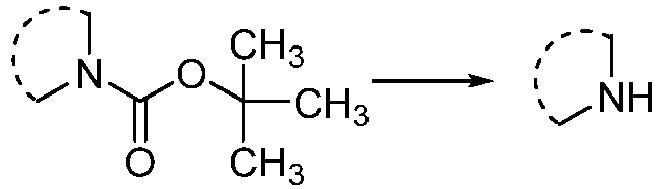
- To a solution of the Boc-protected amine (1 eq) in dichloromethane at 0 °C, TFA (76-05-1, 5-20 eq) is added. The resulting mixture is stirred at room temperature until deprotection is complete. The mixture can be worked up by diluting the reaction mixture with DCM followed by washing with a saturated aqueous NaHCO3 solution. The organic fraction is dried over sodium sulfate, filtered, and concentrated under reduced pressure to give the titled compound. Alternatively, the reaction mixture can be concentrated under reduced pressure, and the crude titled compound can be used as such without further purification.
-

- Trifluoroacetic acid (1.0 mL, 13.0 mmol, 33 equiv) was added at 0 °C to a solution of E044 (230 mg, 0.39 mmol) in dichloromethane (5.0 mL). The reaction mixture was stirred at RT for 1 hour. The reaction mixture was partitioned between dichloromethane and a saturated solution of sodium hydrogencarbonate. The organic phase was separated, dried over Na2SO4, filtered and concentrated to give the titled compound.
-

- A solution of 4 M HCl in dioxane (0.245 mL, 0.98 mmol, 4.0 equiv) was added at RT to a solution of E131 (130 mg, 0.24 mmol) in dioxane (2.0 mL). The reaction mixture was stirred at RT for 16 hours. Additional 4 M HCl in dioxane (0.1 mL, 0.4 mmol, 1.7 equiv) was added, and the reaction mixture was stirred at RT for 48 hours. The reaction mixture was concentrated in vacuo and partitioned between dichloromethane and a saturated solution of sodium hydrogencarbonate. The organic phase was separated, dried over Na2SO4, filtered and concentrated in vacuo to give the titled compound.
-

- The amine (1 eq) is mixed with (1-ethoxycyclopropoxy)trimethylsilane ([27374-25-0], 2 eq), AcOH (1.6 eq) and NaBH3CN (1.5 eq) in a mixture of THF/MeOH (1/1). The resulting mixture is stirred overnight at 50 °C. After cooling the mixture down to room temperature, the reaction is quenched by the addition of water. Next, 1 M NaOH solution is added, and the mixture is stirred for another 15 minutes. After dilution with DCM, the organic layer is separated, dried and concentrated to give the titled compound.
-

- Methyl 3-cyclobutyl-1-(4-fluorophenyl)-4-[4-(piperazin-1-yl)piperidin-1-yl]-1H-pyrazolo[3,4-b]pyridine-6-carboxylate (200 mg, 0.41 mmol, E498) was mixed with (1-ethoxycyclopropoxy)trimethylsilane ([27374-25-0], 163 µL, 0.81 mmol), AcOH (26 µL, 0.65 mmol) and sodium cyanoborohydride ([25895-60-7], 38 mg, 0.61 mmol) in a mixture of THF/MeOH (1/1, 1 mL). The resulting mixture was stirred overnight at 50 °C. After cooling the mixture down to room temperature, the reaction was quenched by the addition of water. Next, 1 M NaOH solution was added, and the mixture was stirred for another 15 minutes. After dilution with DCM, the organic layer was separated, dried and concentrated to give the titled compound.
-

- The amine (1 eq) is mixed with 1-bromo-2-methoxyethane ([6482-24-2], 1.1 eq) and K2CO3 (2 eq) in MeCN. The resulting mixture is heated at reflux overnight at 50 °C. After cooling down, the mixture is used as such in the next step.
-

- In a Parr reactor, the arylbromide (1 eq) is mixed with an amine (2 eq), Et3N (4 eq) and Xantphos Pd G3 (0.03 eq) in dioxane. A CO pressure of 5 bars is applied and the mixture is heated at 100 °C overnight. Concentration gives a residue that is re-dissolved in DCM. Extraction with water gives an organic phase that is concentrated to give a residue that is used as such in the next step.
-

- A Parr reactor was loaded with E504 (0.50 mmol, 250 mg), 1-methylpiperazine dihydrochloride ([34352-59-5], 1.0 mmol, 173 mg) and [(4,5-bis(diphenylphosphino)-9,9-dimethylxanthene)-2-(2'-amino-1,1'-biphenyl)]palladium(II) methanesulfonate] (0.015 mmol, 14 mg). The reactor was evacuated and back-filled with N2, Et3N (4.0 equiv, 2.0 mmol, 279 µL) and 1,4-dioxane (dry, 8 mL/mmol, 4 mL) were added, and the reaction mixture was heated to 100 °C under a CO atmosphere (5 bar) overnight. The reaction mixture was concentrated in vacuo, and the residue was partitioned between H2O and dichloromethane. The organic phase was dried and concentrated in vacuo to give the titled compound which was used as such in the next step.
-

- A tube is loaded with the arylbromide (1 eq). The amine (1.2 eq) is added together with (RuPhos) palladium(II) phenethylamine chloride (1:1 MTBE solvate, 0.1 eq), NaOtBu (1.2 eq) in dioxane. The resulting suspension is put under a N2 atmosphere and stirred at 100 °C. Next, the mixture is diluted with water and acidified with a 1 N citric acid solution till pH 3-4. Extraction with DCM gives the crude product that is either used as such or purified by chromatography. During this method, it is possible that partial hydrolysis of the ester to the corresponding acid occurs.
-

- A tube was loaded with the E504 (100 mg, 0.21mmol). 1-Methylpiperazine ([109-01-3], 28µL, 0.25 mmol) was added together with (RuPhos) palladium(II) phenethylamine chloride (1:1 MTBE solvate, 17 mg, 0.02 mmol), and NaOtBu (25 mg, 0.25 mmol) in dioxane (1 mL). The resulting suspension was put under a N2 atmosphere and stirred at 100 °C. Next, the mixture was diluted with water and acidified with a 1 N citric acid solution till pH 3-4. Extraction with DCM gave the titled compound that was used as such. Partial hydrolysis of the ester to the corresponding acid was observed.
-

- A solution of the amine (1 eq), the ketone (2 eq) and AcOH (1.5 eq) in DCM is cooled to 0 °C. Next, sodium triacetoxyborohydride ([56553-60-7], 2 eq) is added portionwise, and the reaction is stirred overnight at ambient temperature. Subsequently, the mixture is diluted with saturated NaHCO3 solution and extracted with DCM. The organic phase is concentrated to give the alkylated amine that is used as such or purified by chromatography.
-

- A solution of the methyl 3-cyclobutyl-4-(3,9-diazaspiro[5.5]undecan-3-yl)-1-(4-fluorophenyl)-1H-pyrazolo[3,4-b]pyridine-6-carboxylate (200 mg, 0.42 mmol, E500), 3-oxetanone ([6704-31-0], 54 µL, 0.84 mmol) and AcOH (36 µL) in DCM (3 mL) was cooled at 0 °C. Next, sodium triacetoxyborohydride ([56553-60-7], 178 mg, 0.84 mmol) was added portion wise and the reaction was stirred overnight at ambient temperature. Subsequently, the mixture was diluted with sat. NaHCO3 solution and extracted with DCM. The organic phase was evaporated to give the titled compound.
-

- To a solution of the amine (1 eq) in DCM is added trimethylamine (2 eq) and then methyl chloroformate ([79-22-1], 2 eq). The mixture is stirred at RT overnight. Next, the reaction mixture is diluted with saturated NaHCO3 solution and extracted with DCM. After concentration, the carbamate is obtained that is used as such or purified by chromatography.
-

- To a solution of the E498 (118 mg, 0.239 mmol) in DCM (1 mL) was added triethylamine (67 µL, 0.478 mmol) and then methyl chloroformate (37µL, 0.478 mmol). The mixture was stirred at RT overnight. Next, the reaction mixture was diluted with saturated NaHCO3 solution and extracted with DCM. After concentration, the titled compound was obtained that was used as such.
-

- To a solution of the amine (1 eq) in DCM is added trimethylamine (2 eq) and then acetyl chloride ([75-36-5], 2 eq). The mixture is stirred at RT overnight. Next, the reaction mixture is diluted with saturated NaHCO3 solution extracted with DCM. After concentration, the amide is obtained that is used as such or purified by chromatography.
-

- To a solution of the E498 (118 mg, 0.239 mmol) in DCM (1 mL) was added triethylamine (67 µL, 0.478 mmol) and then acetyl chloride ([75-36-5], 0.478 mmol). The mixture was stirred at RT overnight. Next, the reaction was diluted with saturated NaHCO3 solution and extracted with DCM. After concentration, the titled compound was obtained that was used as such.
-

- A suspension of amine hydrochloride or free base (1 to 2 equiv) and triethylamine (from 1 to 2 equiv) in 1,2-dichloroethane is stirred at RT for 10 minutes. Aldehyde (1 equiv), sodium triacetoxyborohydride (2 equiv), and acetic acid (0.6 to 4 equiv) are successively added, and the stirring at RT is continued for 20 hours. Starting reagents can be added until full conversion is observed. The reaction mixture is diluted with DCM, washed with a saturated aqueous solution of NaHCO3 and/or a saturated aqueous solution of NH4Cl and a phosphate buffer (pH 6.2). The organic phase is dried over sodium sulfate and concentrated under reduced pressure. The residue is used as such or purified by flash column chromatography to yield the reductively aminated compound.
-

- A suspension of 3-(dimethylamino)azetidine dihydrochloride ([124668-49-1], 17 mg, 124 µmol) and triethylamine (35 µL, 248 µmol) in 1,2-dichloroethane (2 mL) was stirred at RT for 10 minutes. Aldehyde E425 (54 mg, 124 µmol), sodium triacetoxyborohydride (53 mg, 248 µmol), and acetic acid (29 µL, 496 µmol) were successively added, and the stirring at RT was continued for 20 hours. The reaction mixture was diluted with DCM and washed with a saturated aqueous solution of NaHCO3. The organic phase was separated, dried over sodium sulfate and concentrated under reduced pressure. The residue was used as such or purified by flash column chromatography eluted with ethyl acetate/n-heptane to yield the titled compound.
-

- Intermediate E074 (0.5g, 1.013 mmol, 1.0 equiv) and sodium azide (CAS 26628-22-8, 132 mg, 2.026 mmol, 2 equiv) were put in a sealed vial. A 2:1 mixture of ethanol and water (2 mL) was added, and the vial was purged with nitrogen. Then copper(I) iodide (CAS 7681-65-4, 20 mg, 0.101 mmol, 0.1 equiv), sodium ascorbate (CAS 134-03-2, 11 mg, 0.051 mmol, 0.05 equiv) and N,N'-dimethylethylenediamine (CAS 110-70-3, 45 µL, 0.405 mmol, 0.2 equiv) were added, and the vial was sealed. The reaction mixture was heated under microwave irradiation at 80 °C for 45 minutes. Volatiles were removed in vacuo. The resulting aqueous residue was diluted with ethyl acetate. The two phases were separated, and the aqueous phase was extracted with ethyl acetate. The combined organic phases were washed with brine, dried over MgSO4, filtered and concentrated in vacuo to afford the titled compound which was used as such.
-

- In a sealed tube, a suspension of E389 (110 mg, 0.23 mmol), 3,6-dihydro-2H-pyran-4-boronic pinacol ester (72 mg, 0.34 mmol), K3PO4 (146 mg, 0.69 mmol) and Pd(Amphos)Cl2 ([887919-35-9], 16 mg, 23 µmol) in dioxane (3 mL) and water (0.5 mL) was degassed with N2 at room temperature for 2 minutes. The reaction mixture was heated at 100 °C for 3 hours. The mixture was cooled to RT and then concentrated under reduced pressure. The crude sample was purified by flash column chromatography eluted with ethyl acetate/n-heptane to give the titled compound E390.
- A suspension of E390 (60 mg, 0.11 mmol) and palladium hydroxide on carbon (20 mg) in ethanol was hydrogenated for 6 hours. The reaction mixture was filtered over Celpure® and washed with ethyl acetate. The filtrate was concentrated in vacuo, and the residue was purified by silica gel chromatography eluted with ethyl acetate/n-heptane to give the titled compound E391.
-

- Trifluoromethanesulfonic acid (860 µL, 10 mmol) was added dropwise at RT to a solution of E392 (1 g, 2 mmol) in dichloromethane (10 mL). The reaction mixture was stirred for 4 hours and poured into a mixture of saturated aqueous NaHCO3 and water (1:1, 10 mL). The aqueous phase was extracted twice with dichloromethane/isopropanol (95/5, 20 mL). The combined organic phases were combined, dried over sodium sulfate, filtered and concentrated under reduced pressure to give the titled compound as a colorless solid.
-

- A suspension of E401 (75 mg, 0.12 mmol) and palladium hydroxide on carbon (10 mg) in THF was hydrogenated for 20 hours. The reaction mixture was filtered over Celpure® that was washed with dichloromethane/methanol. The filtrate was concentrated in vacuo to give the titled compound E402.
-

- In a sealed tube, a suspension of E406 (110 mg, 0.21 mmol), 3,6-dihydro-2H-pyran-4-boronic pinacol ester (72 mg, 0.34 mmol), K3PO4 (146 mg, 0.69 mmol) and Pd(Amphos)Cl2 ([887919-35-9], 16 mg, 23 µmol) in dioxane (3 mL) and water (0.5 mL) was degassed with N2 at room temperature for 2 minutes. The reaction mixture was heated at 100 °C for 20 hours. The mixture was cooled to RT, and the mixture was concentrated under reduced pressure. The crude sample was purified by flash column chromatography eluted with ethyl acetate/n-heptane to give the titled compound.
- A suspension of ethyl 3-cyclobutyl-1-[2-(3,6-dihydro-2H-pyran-4-yl)pyridin-4-yl]-4-[4-(morpholin-4-yl)piperidin-1-yl]-1H-pyrazolo[3,4-b]pyridine-6-carboxylate (54 mg, 0.94 mmol) and palladium hydroxide on carbon (15 mg) in ethanol/THF (1 : 1, 10 mL) was hydrogenated for 6 hours. The reaction mixture was filtered over Celpure® that was washed with ethyl acetate, and the filtrate was concentrated in vacuo. The residue was purified by silica gel chromatography eluted with ethyl acetate/n-heptane to give the titled compound, E407.
-

- A suspension of methyl 4-chloro-3-cyclobutyl-1-(4-fluorophenyl)-1H-pyrazolo[3,4-b]pyridine-6-carboxylate (HP19, 2.0 g, 5.75 mmol, 1.0 equiv), tert-butyl 4-(4,4,5,5-tetramethyl-1,3,2-dioxaborolan-2-yl)-3,6-dihydro-2H-pyridine-1-carboxylate (CAS 286961-14-6, 3.6 g, 11.5 mmol, 2.0 equiv), K2CO3 (2.4 g, 17.25 mmol, 3.0 equiv) and Pd(dppf)Cl2 (CAS : 72287-26-4, 939 mg, 1.15 mmol, 0.2 equiv) in anhydrous DMF (15 mL) was degassed with nitrogen at room temperature for 2 minutes. The reaction mixture was refluxed for 20 hours. The mixture was cooled to RT, poured into 150 mL of iced water and diluted with ethyl acetate. The two phases were separated, and the aqueous phase was extracted again with ethyl acetate. The combined organic layers were washed with brine, dried over sodium sulfate, filtered and concentrated. The crude residue was purified by silica gel chromatography (heptane/ethyl acetate: 100/0 to 80/20) to give the titled compound.
- A suspension of compound from Step 1 (2.44 g, 4.93 mmol, 1.0 equiv) and platinum (IV) oxide (CAS 1314-15-4, 1.2 g) in acetic acid (240 mL) was stirred at RT under a hydrogen atmosphere (balloon) for 20 hours. The reaction mixture was filtered over Celpure® P65. Solids were washed with ethyl acetate, and the filtrate was concentrated in vacuo. The crude residue was purified by silica gel chromatography (heptane/ethyl acetate: 100/0 to 80/20) to give the title compound.
- Methyl 4-[1-(tert-butoxycarbonyl)piperidin-4-yl]-3-cyclobutyl-1-(4-fluorophenyl)-1H-pyrazolo[3,4-b]pyridine-6-carboxylate (2.75 g, 5.4 mmol, 1 equiv) was dissolved in 4 M HCl in dioxane (40 mL, 162.2 mmol, 30 equiv), and the solution was stirred at RT for 2 hours. The solvent was concentrated under reduced pressure. The residue was dissolved in a minimum of methanol and poured into diethyl ether (500 mL). The precipitate was filtered, washed with diethyl ether and dried at 40 °C under reduced pressure to give the titled compound, E413.
-

- In a sealed tube, a suspension of HP02 (1 g, 2.92 mmol), 1,4-dioxa-spiro[4,5]dec-7-en-8-boronic acid, pinacol ester ([680596-79-6], 1.01 g, 3.8 mmol), K3PO4 (1.86 g, 8.77 mmol), Pd(OAc)2 ([3375-31-3], 330 mg, 0.14 mmol), and SPhos ([657408-07-6], 150 mg, 0.365 mmol) in toluene (22 mL) and water (6 mL) was degassed with N2 at room temperature for 5 minutes. The reaction mixture was stirred at RT for 2 hours. Additional Pd(OAc)2 ([3375-31-3], 330 mg, 0.14 mmol) and SPhos ([657408-07-6], 150 mg, 0.365 mmol) were added. The stirring atRT was continued for 20 hours. Pd(OAc)2 ([3375-31-3], 165 mg, 0.07 mmol) and SPhos ([657408-07-6], 75 mg, 0.18 mmol) were again added, and the reaction mixture was heated at 100 °C for 1 hour. The reaction mixture was cooled to RT, diluted with ethyl acetate and filtered. The filtrate was washed successively with water and a saturated aqueous solution of NaCl. The organic phase was separated, dried over sodium sulfate, filtered and concentrated under reduced pressure. The crude residue was purified by flash column chromatography on silica gel eluting with ethyl acetate/n-heptane to give the titled compound.
-

- A suspension of E430 (823 mg, 1.85 mmol) and palladium hydroxide on carbon ([12135-22-7], 280 mg) in THF/MeOH (25 mL, 2/1) was hydrogenated for 20 hours. The reaction mixture was filtered over Celpure® which was washed with DCM. The filtrate was concentrated in vacuo. The residue was purified by silica gel chromatography eluting with ethyl acetate/n-heptane to give the titled compound E431.
-

- The ester, E431 (732 mg, 1.64 mmol), was dissolved in DCM and TFA (2.2 mL, 3 volumes) was added dropwise at RT. The solution was stirred for 48 hours and then diluted with DCM. The mixture was washed with a saturated aqueous solution of NaHCO3. The organic phase was separated, dried over sodium sulfate, filtered and concentrated in vacuo. The residue was purified by silica gel chromatography eluting with ethyl acetate/n-heptane to give the titled compound E432.
-

- A mixture of aldehyde E425 (27 mg, 62 µmol), sulfamic acid ([226-18-8], 17 mg, 168 µmol), and sodium chlorite ([7758-19-2], 17 mg, 188 µmol) in THF/water (3.3 mL, 10/1) was stirred at RT for 1 hour. The reaction mixture was diluted with DCM (20 mL) and washed with water (20 mL). The organic phase was dried over sodium sulfate, filtered and evaporated under reduced pressure. The titled compound was used as such in the next step.
-

- Iodomethane (3 µL, 48 µmol) was added at RT to a stirred suspension of E443 (22 mg, 40 µmol) and cesium carbonate (33 mg, 100 µmol) in DMF (2 mL). The reaction mixture was stirred for 20 hours. The reaction mixture was partitioned between water and ethyl acetate. The organic phase was dried over sodium sulfate, filtered and concentrated under reduced pressure. The residue was purified by flash column chromatography eluting with ethyl acetate/DCM/MeOH (100/0/0 to 0/90/10) to give the titled compound.
-

- A solution of ALP38 (305 mg, 0.74 mmol) and AMP95 (575 mg, 0.77 mmol) in N-methylpyrrolidine (4 mL) was heated at 110 °C for 24 hours in an opened vessel. The reaction mixture was cooled to RT, and the mixture was concentrated in vacuo. The residue was partitioned between ethyl acetate and water. The organic phase was separated, dried over sodium sulfate, filtered and concentrated under reduced pressure. The residue was purified by flash chromatography on silica gel eluting with ethyl acetate/n-heptane to give the titled compound.
- Trifluoroacetic acid (1 mL) was added to a solution of the tert-butoxycarbonyl protected compound from Step 1 (230 mg, 0.37 mmol) in DCM (10 mL). The solution was stirred at RT for 2 hours. The reaction mixture was diluted with toluene (5mL) and then concentrated under reduced pressure. The residue was partitioned between ethyl acetate, water, and a phosphate buffer solution (pH 6.2). The organic phase was dried over sodium sulfate, filtered and concentrated in vacuo. The residue was purified by flash column chromatography on silica gel eluting with ethyl acetate/n-heptane to give the titled compound.
- Iodomethane (2 µL, 32 µmol) was added at RT to a stirred suspension of the compound from Step 2 (15 mg, 29 µmol) and cesium carbonate (33 mg, 100 µmol) in DMF (2 mL). The reaction mixture was stirred for 2 hours. The reaction mixture was partitioned between water and DCM. The organic phase was dried over sodium sulfate, filtered and concentrated under reduced pressure. The residue was purified by flash column chromatography eluting with ethyl acetate/DCM/MeOH (100/0/0 to 0/90/10) to give the titled compound.
-


- N-Ethyl-N-isopropylpropan-2-amine (22.91 mL, 132 mmol) was added to a suspension of 2,4,6-trichloropyridine (12 g, 65.8 mmol) and 4-(piperidin-4-yl)morpholine (13.44 g, 79 mmol) in acetonitrile (120 mL). The reaction mixture was heated to 60 °C and stirred for 16 hours. Upon cooling to room temperature, the precipitate was collected by filtration. The crude solid was then precipitated from EtOAc to give the titled compound. 1H NMR (400 MHz, CDCl3) δ ppm 6.59 (s, 2H), 3.89 - 3.79 (m, 2H), 3.77 - 3.69 (m, 4H), 2.96 (ddd, J = 13.3, 11.8, 2.8 Hz, 2H), 2.60 - 2.52 (m, 4H), 2.45 (tt, J = 10.8, 3.7 Hz, 1H), 1.95 (ddd, J = 12.9, 3.9, 1.9 Hz, 2H), 1.61 - 1.48 (m, 2H); MS (APCI+) m/z 316.2 (M+H)+.
- n-Butyllithium (19.2 mL, 26.9 mmol) was added in 5 mL portions to a stirred solution of 4-[1-(2,6-dichloropyridin-4-yl)piperidin-4-yl]morpholine (7.95 g, 25.1 mmol) in THF (160 mL) at -78 °C. After stirring at this temperature for 1.5 hours, cyclobutanecarbonyl chloride (1.42 g, 11.9 mmol) was added rapidly, and the reaction mixture was stirred for 10 minutes. To obtain higher conversion, sequential additions of n-butyllithium and cyclobutanecarbonyl chloride were performed in the same manner. Addition 1: n-butyllithium (13.0 mL, 18.2 mmol) and cyclobutanecarbonyl chloride (0.97 g, 8.1 mmol); Addition 2: n-butyllithium (9.2 mL, 12.9 mmol) and cyclobutanecarbonyl chloride (0.68 g, 5.6 mmol); Addition 3: n-butyllithium (6.9 mL, 9.7 mmol) and cyclobutanecarbonyl chloride (0.51 g, 4.2 mmol); Addition 4: n-butyllithium (5.7 mL, 8.0 mmol) and cyclobutanecarbonyl chloride (0.41 g, 3.4 mmol). Upon completion of the last addition, the excess n-butyl lithium was quenched with water (200 mL), and the mixture was extracted with ethyl acetate (3 x 100 mL). The combined organic fractions were washed with brine (100 mL), dried over sodium sulfate, and concentrated in vacuo. The residue was purified by column chromatography (0-5% 95/5 MeOH/30% aqueous NH3 in DCM) to give the titled compound. 1H NMR (400 MHz, CDCl3) δ ppm 6.76 (s, 1H), 3.80 - 3.65 (m, 5H), 3.50 - 3.40 (m, 2H), 2.98 - 2.76 (m, 2H), 2.62 - 2.50 (m, 4H), 2.50 - 2.37 (m, 2H), 2.29 (tt, J = 11.0, 3.8 Hz, 1H), 2.22 - 2.08 (m, 2H), 2.08 - 1.93 (m, 2H), 1.93 - 1.83 (m, 2H), 1.52 (dddd, J = 14.8, 12.8, 7.5, 3.8 Hz, 2H); MS (APCI+) m/z 398.2 (M+H)+.
- Hydrazine (35% in water, 3.10 mL, 33.9 mmol) was added to cyclobutyl{2,6-dichloro-4-[4-(morpholin-4-yl)piperidin-1-yl]pyridin-3-yl}methanone (4.5 g, 11.30 mmol) in EtOH (32 mL). The reaction mixture was heated to reflux for 14 hours. Upon cooling to -5 °C, the precipitate was isolated by filtration. The filter cake was rinsed with cold EtOH to give the titled compound. 1H NMR (400 MHz, CDCl3) δ ppm 10.21 (br s, 1H), 6.45 (s, 1H), 3.94 - 3.76 (m, 5H), 3.63 (d, J = 12.4 Hz, 2H), 2.84 (td, J = 12.4, 2.3 Hz, 2H), 2.71 - 2.59 (m, 4H), 2.58 - 2.44 (m, 2H), 2.44 - 2.31 (m, 3H), 2.14 - 1.97 (m, 4H), 1.85 - 1.70 (m, 2H); MS (APCI+) m/z 376.2 (M+H)+.
- Into a 600 mL Parr reactor was charged 6-chloro-3-cyclobutyl-4-[4-(morpholin-4-yl)piperidin-1-yl]-1H-pyrazolo[3,4-b]pyridine (3.4 g, 9.05 mmol), followed by THF (170 mL) and MeOH (170 mL). 1,1'-Bis(diphenylphosphino)ferrocene-palladium (II) dichloride dichloromethane complex (0.739 g, 0.905 mmol), and triethylamine (2.52 mL, 18.09 mmol) were added to give a suspension. The reaction vessel was purged with argon followed by CO, pressurized to 100 psig with CO, and heated to 80 °C. After 8 hours, the reaction mixture was cooled to room temperature, diluted with CH2Cl2 (800 mL), and filtered. The filtrate was concentrated in vacuo, and the residue was dissolved in CH2Cl2 (800 mL). The organic mixture was washed with saturated aqueous NaHCO3 (300 mL), dried over Na2SO4, filtered, and concentrated in vacuo. The crude residue was slurried in EtOAc to give the titled compound. 1H NMR (400 MHz, CDCl3) δ ppm 10.98 (br s, 1H), 7.37 (s, 1H), 4.08 (s, 3H), 3.96 (p, J = 8.4 Hz, 1H), 3.83 - 3.76 (m, 4H), 3.70 (d, J = 12.3 Hz, 2H), 2.92 (t, J = 11.8 Hz, 2H), 2.66 (t, J = 4.7 Hz, 4H), 2.55 (dq, J = 11.3, 9.0 Hz, 2H), 2.44 - 2.31 (m, 3H), 2.15 - 2.00 (m, 4H), 1.88 - 1.74 (m, 2H); MS (APCI+) m/z 400.3 (M+H)+.
-

- In a sealed tube, a suspension of AMP96 (215 mg, 0.91 mmol) and diethyl malonate ([105-53-3], 418 µL, 2.75 mmol) in Dowtherm® A was heated at 200 °C 4 hours. The reaction mixture was cooled down to 70-80 °C and poured onto a stirring solution of n-heptane (200 mL). The precipitate was collected by filtration, washed with n-heptane and dried at 40 °C under reduced pressure to give the titled compound.
- Trifluoromethanesulfonic anhydride ([358-23-6], 302 µL, 1.8 mmol) was added dropwise to a solution of 1-(4-fluorophenyl)-3-[(propan-2-yl)oxy]-1H-pyrazolo[3,4-b]pyridine-4,6-diol (270 mg, 0.9 mmol, Step 1) and pyridine (220 µL, 2.25 mmol) in acetonitrile (5 mL), maintaining the temperature around 20-25 °C. The reaction mixture was stirred at RT for 20 hours. The reaction mixture was diluted with DCM and extracted twice with a saturated aqueous solution of NaHCO3. The organic phase was separated, dried over MgSO4, filtered and concentrated under reduced pressure. The resulting residue was purified by silica gel chromatography (n-heptane/ethyl acetate, 1/0 to 0/1) to yield the titled compound.
- A mixture of 1-(4-fluorophenyl)-3-[(propan-2-yl)oxy]-1H-pyrazolo[3,4-b]pyridine-4,6-diyl bis(trifluoromethanesulfonate) (29 mg, 50 µmol, Step 2), 4-methoxy-1-piperidin-4-ylpiperidine hydrochloride ([930603-98-8], 14 mg, 50 µmol) and DIPEA (35 µL, 200 µmol) in anhydrous DMSO (1 mL) was heated at 100 °C for 2 hours. The reaction mixture was cooled to RT and partitioned between ethyl acetate (50 mL) and water (30 mL). The organic phase was separated, dried over MgSO4, filtered and concentrated in vacuo. The crude mixture was purified by flash chromatography on silica gel eluting with n-heptane/ethyl acetate (1/0 to 0/1) and ethyl acetate/(DCM/MeOH, 9/1) (1/0 to 0/1) to afford the titled compound.
- A pressured vessel was charged with 1-(4-fluorophenyl)-4-(4-methoxy[1,4'-bipiperidin]-1'-yl)-3-[(propan-2-yl)oxy]-1H-pyrazolo[3,4-b]pyridin-6-yl trifluoromethanesulfonate (145 mg, 240 µmol, Step 3), Pd(dppf)Cl2•DCM ([95464-05-4], 4 mg, 4.8 µmol), and triethylamine (66 µL, 500 µmol) in MeOH (5 mL). The system was loaded with CO (6 bars) and heated at 100 °C for 1 hour. The vessel was cooled down to RT, and the mixture was concentrated under reduced pressure. The residue was purified by flash column chromatography eluting with a mixture of ethyl acetate/(DCM/MeOH, 9/1) (1/0 to 0/1) to give the titled compound.
-

- A suspension of tert-butyl 1-oxa-6-azaspiro[2.5]octane-6-carboxylate (CAS: 147804-30-6, 200 mg, 0.94 mmol) and sodium methoxide (61 mg, 1.13 mmol) in methanol (2 mL) was placed in a sealed tube and was heated at 100 °C for 20 hours. The reaction mixture was cooled to RT, acidified with acetic acid to pH 5-6, diluted with DCM and washed with water. The organic phase was separated using a phase separator and concentrated in vacuo. The titled compound was used as such in the next step without any further purification.
- 4-Hydroxy-4-methoxymethyl-piperidine-1-carboxylic acid tert-butyl ester (206 mg, 0.84 mmol) was dissolved in dioxane (2 mL). 4 M HCl in dioxane (1.05 mL, 4.2 mmol) was added, and the solution was stirred at RT for 20 hours. The volatiles were removed under reduced pressure. The titled compound was used as such in the next step without any further purification.
-
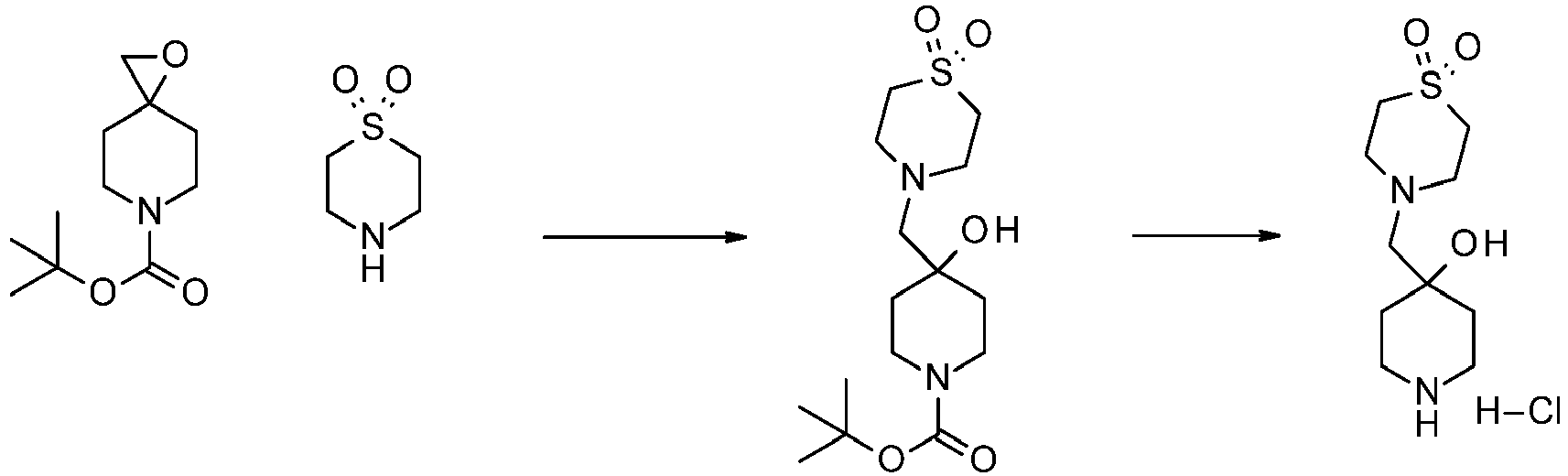
- A solution of tert-butyl 1-oxa-6-azaspiro[2.5]octane-6-carboxylate (CAS: 147804-30-6, 150 mg, 0.7 mmol) and thiomorpholine 1,1-dioxide (CAS: 39093-93-1, 380 mg, 2.8 mmol) in ethanol (2 mL) was placed in a sealed tube and was heated at 75 °C for 20 hours. The reaction mixture was cooled to RT, diluted with DCM and washed with water. The organic phase was separated using a phase separator and concentrated in vacuo. The titled compound was obtained by flash column chromatography eluting with DCM/MeOH.
- tert-Butyl 4-[(1,1-dioxo-1,4-thiazinan-4-yl)methyl]-4-hydroxy-piperidine-1-carboxylate (215 mg, 0.62 mmol) was dissolved in dioxane (2 mL). 4 M HCl in dioxane (0.89 mL, 3.6 mmol) was added, and the solution was stirred at RT for 20 hours. The volatiles were removed under reduced pressure. The titled compound was used as such in the next step without any further purification.
-

- To a suspension of N-fluoro-N-(phenylsulfonyl)benzenesulfonamide ((CAS 133745-75-2, 347 g, 1100 mmol) and (5R)-(+)-2,2,3-trimethyl-5-benzyl-4-imidazolidinone dichloroacetic acid (CAS 857303-87-8, 76 g, 220 mmol) in THF and isopropyl alcohol at -20 °C was added a solution of tert-butyl 4-(2-oxoethyl)piperidine-1-carboxylate (250 g, 1100 mmol, CAS: 142374-19-4) in THF. The mixture was stirred at 10 °C for 16 h, diluted with hexane at -78 °C and filtered through silica, washed with hexane, then with saturated aqueous NaHCO3, dried, filtered, and concentrated to give (S)-tert-butyl 4-(1-fluoro-2-oxoethyl)piperidine-1-carboxylate.
- A solution of (S)-tert-butyl 4-(1-fluoro-2-oxoethyl)piperidine-1-carboxylate (10 g, 40.8 mmol) in dichloromethane (280 mL) and ethanol (220 mL) was stirred at 10 °C. Then, sodium borohydride (CAS 16940-66-2, 4.0 g, 105.7 mmol, 2.6 equiv) was added. The mixture was stirred at 10 °C for 1 hour, was diluted with water and extracted with dichloromethane. The organic layer was dried, filtered and concentrated, and the residue was purified by chromatography on silica gel (petroleum ether:ethyl acetate) to give (S)-tert-butyl 4-(1-fluoro-2-hydroxyethyl)piperidine-1-carboxylate.
- Trifluoromethanesulfonic anhydride (CAS 358-23-6, 5.70 g, 20.22 mmol, 1.0 equiv) was added to a solution of (S)-tert-butyl 4-(1-fluoro-2-hydroxyethyl)piperidine-1-carboxylate (5 g, 20.22 mmol) and 2,6-dimethylpyridine (CAS 108-48-5,2.166 g, 20.22 mmol, 1.0 equiv) in dichloromethane at 0 °C. The mixture was stirred at 0 °C for 0.5 h. A separated round bottom flask was charged with benzylamine (2.166 g, 20.22 mmol, 1.0 equiv) in dichloromethane at 0 °C. The solution of the triflate was then added slowly at 0 °C. The reaction mixture was stirred at 25 °C for 12 hours, quenched with a saturated aqueous solution of sodium hydrogencarbonate, and extracted with dichloromethane. The organic fraction was concentrated. The residue was purified on silica gel chromatography, eluting with acetone/dichloromethane to give (S)-tert-butyl 4-(2-(benzylamino)-1-fluoroethyl)piperidine-1-carboxylate.
- To a solution of (S)-tert-butyl 4-(2-(benzylamino)-1-fluoroethyl)piperidine-1-carboxylate (4.5 g, 13.38 mmol) in methanol was added Pd/C, then the solution was stirred at 35 °C under hydrogen atmosphere (45 psi) for 12 hours. The mixture was filtered and concentrated to give (S)-tert-butyl 4-(2-amino-1-fluoroethyl)piperidine-1-carboxylate.
- To a mixture of (S)-tert-butyl 4-(2-amino-1-fluoroethyl)piperidine-1-carboxylate (3.0 g, 12.18 mmol) in methanol was added paraformaldehyde (CAS 30525-89-4, 1.828 g, 60.9 mmol, 5.0 equiv) followed by three drops of acetic acid. The reaction mixture stirred for 1 hour. Then sodium cyanoborohydride (CAS 25895-60-7, 1.148 g, 18.27 mmol, 1.5 equiv) was added, and the mixture was stirred for 12 hours. The reaction mixture was filtered and concentrated, and the residue was purified by column chromatography on silica gel (DCM/MeOH) to afford (S)-tert-butyl 4-(2-(dimethylamino)-1-fluoroethyl)piperidine-1-carboxylate
- To a solution of (S)-tert-butyl 4-(2-(dimethylamino)-1-fluoroethyl)piperidine-1-carboxylate (2 g, 7.29 mmol) in MeOH was added 4 N hydrogen chloride in methanol (10 mL, 40 mmol, 5.5 equiv), and the mixture was stirred at RT for 2 hours. Then the solution was concentrated to give (S)-2-fluoro-N,N-dimethyl-2-(piperidin-4-yl)ethanamine hydrochloride.
-

- In a 100 mL round-bottomed flask was combined 1-tert-butyl 4-ethyl piperidine-1,4-dicarboxylate (1 g, 3.89 mmol) and THF (10 mL). The solution was cooled to -78 °C, and sodium hexamethyldisilazide (6 mL of 1 M THF solution, 6.00 mmol) was added slowly via syringe. After 60 min, N-fluoro-N-(phenylsulfonyl)benzenesulfonamide (2 g, 6.34 mmol) in THF (3 mL) was added. After 2 h, dichloromethane/water (1:1, 40 mL) was added. The aqueous layer was extracted with dichloromethane, and the combined organic fractions were dried over Na2SO4, filtered, and concentrated in vacuo.
- A solution of 1-tert-butyl 4-ethyl 4-fluoropiperidine-1,4-dicarboxylate (1.5g, 5.45 mmol) in THF (5 mL) was cooled to 0 °C, and then 1 M LiAlH4 in THF (3.81 mL, 3.81 mmol) was added dropwise. The reaction mixture was warmed up to RT and stirred for 2 h. Water (0.9 mL) was added to the reaction mixture dropwise followed by 2 N NaOH (0.3 mL). The mixture was stirred for another 30 minutes, and then solid removed by filtration through diatomaceous earth and washed with EtOAc. The filtrate was washed with brine, dried over Na2SO4, and concentrated from acetonitrile under vacuum several time to remove the water to afford tert-butyl 4-fluoro-4-(hydroxymethyl)piperidine-1-carboxylate.
- tert-Butyl 4-fluoro-4-(hydroxymethyl)piperidine-1-carboxylate (30 g, 129 mmol) was first treated with sodium hydride (6.17 g, 154 mmol) DMF (500 mL), and then iodoethane (24.07 g, 154 mmol) was added at room temperature. The reaction mixture was stirred at 25 °C for 12 h. The mixture was washed with H2O and extracted with EtOAc, and then the combined organic phases were washed with H2O, and brine. The organic fraction was dried Na2SO4, filtered and concentrated to give tert-butyl 4-(ethoxymethyl)-4-fluoropiperidine-1-carboxylate (26.9 g, 103 mmol, 80% purity).
- A mixture of tert-butyl 4-(ethoxymethyl)-4-fluoropiperidine-1-carboxylate 26.9g, 103 mmol) in ethyl acetate (200 mL) was made acidic by addition of HCl in ethyl acetate solution at 0 °C. Then the mixture was allowed to warm to 15 °C and stirred at 15 °C for 3h. The reaction mixture was concentrated under vacuum to yield 4-(ethoxymethyl)-4-fluoropiperidine as a hydrochloride salt (15.27 g, 95 mmol, 92% yield).
-

- To a mixture of tert-butyl 4-fluoro-4-(hydroxymethyl)piperidine-1-carboxylate (30 g, 129 mmol, prepared as described in the synthesis of AMI04) in DMF (400 mL) was added sodium hydride (6.43 g, 161 mmol) at 0 °C. After 15 minutes, 1-bromo-2-methoxyethane (35.7 g, 257 mmol) was added at 0 °C, and the mixture was stirred at 25 °C for 12 h. The mixture was quenched with 200 mL of aqueous NH4Cl at 5 °C. The organic layer was separated, washed with water and brine, dried over Na2SO4, and concentrated. After column chromatography on silica gel (petroleum ether/EtOAc = 10:1 to petroleum ether/EtOAc = 2:1), tert-butyl 4-fluoro-4-((2-methoxyethoxy)methyl)piperidine-1-carboxylate (20.5 g, 70.4 mmol, 54.% yield) was obtained.
- A solution of tert-butyl 4-fluoro-4-((2-methoxyethoxy)methyl)piperidine-1-carboxylate (20 g, 68.6 mmol) in 200 mL EtOAc was made acidic with HCl in EtOAc at room temperature. After TLC on silica gel (petroleum ether/EtOAc = 1:1) showed that the reaction was complete, the mixture was concentrated to afford the titled compound as a hydrochloride salt (15 g, 65.9 mmol, 96% yield).
-

- To a mixture of tert-butyl 4-fluoro-4-(hydroxymethyl)piperidine-1-carboxylate (30 g, 129 mmol, prepared as described in the synthesis of AMI04) and NaH (3.09 g, 129 mmol) in THF (500 mL) was added iodomethane (41.9 g, 295 mmol) at room temperature, and then the mixture was stirred at 25 °C for 12 h, The reaction mixture was diluted with water and extracted with EtOAc. The combined organic phases were washed with water and brine. The organic fraction was dried over Na2SO4, filtered, and concentrated under vacuum. The residue was purified on a silica gel column eluted with petroleum ether/EtOAc=2:1 to give tert-butyl 4-fluoro-4-(methoxymethyl)piperidine-1-carboxylate (25 g, 101 mmol, 79% yield).
- A mixture of tert-butyl 4-fluoro-4-(methoxymethyl)piperidine-1-carboxylate (25 g, 101 mmol) in EtOAc (300 mL) was made acidic with HCl in EtOAc at 0 °C, and the mixture was allowed to warm to 15 °C and stirred at 15 °C for 3h. The reaction mixture was concentrated under vacuum to yield the titled compound as a hydrochloride salt (13 g, 70.8 mmol, 70.0% yield).
-

- To a mixture of tert-butyl 3-fluoro-3-(hydroxymethyl)piperidine-1-carboxylate (25 g, 107 mmol) in THF (300 mL) was added NaH (2.57 g, 107 mmol) at 0 °C. After 15 minutes, 1-bromo-2-methoxyethane (29.8 g, 214 mmol) was added at 0 °C. The mixture was stirred at 25 °C for 12 h, and then the reaction was quenched by the addition of saturated aqueous NH4Cl and extracted with EtOAc. The combined organic phases were washed with water and brine, dried over Na2SO4, filtered and concentrated in vacuum. The residue was added to a silica gel column eluted with hexanes:ethyl acetate (2:1) to give tert-butyl 3-fluoro-3-((2-methoxyethoxy)methyl)piperidine-1-carboxylate (22 g, 76 mmol, 70.5% yield).
- A mixture of tert-butyl 3-fluoro-3-((2-methoxyethoxy)methyl)piperidine-1-carboxylate (25 g, 86 mmol) in EtOAc (200 mL) was made acidic with HCl in EtOAc at 0 °C. The mixture was allowed to warm to 15 °C and stirred at 15 °C for 3h. The reaction mixture was concentrated under vacuum to the titled compound as a hydrochloride salt (15 g, 65.9 mmol, 77% yield).
-

- A flame-dried round bottom flask was cooled down to RT under argon. A solution of 1 M LiHMDS in THF (1.51 mL, 3.02 mmol, 2.0 equiv) was introduced into the flask and cooled down to -78 °C (acetone/dry ice bath). Dry MeCN (157 µL, 3.02 mmol, 2.0 equiv) in anhydrous THF (5 mL) was then added dropwise under argon, and the reaction mixture was stirred for 45 minutes at -78 °C. At this point, a solution of 1-(tert-butoxycarbonyl)-4-piperidone (300 mg, 1.51 mmol, 1.0 equiv) in dry THF (5 mL) was added dropwise, and the reaction mixture was stirred at -78 °C for 1 h. The reaction mixture was quenched with an aqueous saturated solution of ammonium chloride and diluted with ethyl acetate. The two phases were separated, and the aqueous phase was extracted with ethyl acetate. The combined organic layers were washed with brine, dried over MgSO4, filtered and concentrated in vacuo to afford tert-butyl 4-(cyanomethyl)-4-hydroxypiperidine-1-carboxylate which was used as such in the next step.
- tert-Butyl 4-(cyanomethyl)-4-hydroxypiperidine-1-carboxylate (226 mg, 0.94 mmol, 1 equiv) was dissolved in dioxane (2.5 mL). 4 M HCl in dioxane (1.41 mL, 1.88 mmol, 6 equiv) was added, and the solution was stirred at RT for 5 days. The reaction mixture was concentrated under reduced pressure. The titled compound was used as such without any further purification.
-

- To a solution of benzyl 4-oxopiperidine-1-carboxylate ([19099-93-5], 40 gram, 171 mmol) and 4-methoxypiperidine ([4045-24-3], 24.6 gram) in dichloromethane (800 mL) was added acetic acid (10.8 mL, 189 mmol) and sodium triacetoxyborohydride (54.5 gram, 257 mmol). The mixture was stirred at 0 °C for 120 minutes. Next, the mixture was washed with a saturated aqueous K2CO3 solution. The organic phase was separated and concentrated to give a residue that was purified by chromatography on silica gel using a gradient elution with CH2Cl2 to CH2Cl2/CH3OH (100/0 to 97/2.5) to give the titled compound.
- Benzyl 4-methoxy-[1,4'-bipiperidine]-1'-carboxylate (23 gram, 69 mmol) was dissolved in CH3OH (350 mL). The solution was flushed with N2 and 10% Pd/C (7.3 gram, 6.9 mmol) was added. After applying a balloon with H2, the mixture was stirred at ambient temperature overnight. Next, the mixture was filtered through diatomaceous earth, and the resulting filtrate was concentrated to give the titled compound.
-

- A suspension of 4-cyanopiperidine ([4395-98-6], 500 mg, 4.5 mmol), tert-butyl 4-oxopiperidine-1-carboxylate ([79099-07-3], 900 mg, 4.5 mmol) and AcOH (0.27 mL) in DCM (66 mL) was cooled at 0 °C. Next, sodium triacetoxyborohydride ([56553-60-7], 955 mg, 4.5 mmol) was added portion wise. After overnight stirring, the reaction was diluted with 60 mL of water together with a 1 N citric acid solution to bring down the pH till 3-4. The organic layer was separated and discarded. Next, the aqueous layer was brought to neutral pH with a saturated aqueous NaHCO3 solution. After extraction with DCM, the organic phase was concentrated to give the titled compound.
- tert-Butyl 4-(4-cyano-1-piperidyl)piperidine-1-carboxylate (662 mg, 2.26 mmol) was dissolved in DCM and trifluoroacetic acid ([76-05-1], 0.93 mL) was added. After overnight stirring, the mixture was concentrated to dryness. The obtained residue was suspended in 4 N HCl in dioxane. The addition of ethanol gave a suspension which was filtered to give the titled compound as a precipitate.
-

- To a mixture of (R)-5-benzyl-2,2,3-trimethylimidazolidin-4-one dichloroacetic acid salt (CAS 857303-87-8, 2.71 g, 7.80 mmol, 0.2 equiv) and N-fluoro-N-(phenylsulfonyl)benzenesulfonamide (CAS 133745-75-2, 12.30 g, 39 mmol, 1.0 equiv) in THF (200 mL) and isopropyl alcohol (25 mL) was slowly added at -20 °C a solution 2-(tetrahydro-2H-pyran-4-yl)acetaldehyde (5 g, 39 mmol, CAS 65626-23-5) in THF (25 mL). The mixture was stirred at -20 °C for 12 hours, then diluted with hexane (800 mL) cooled to -78 °C and filtered through silica, washed with hexane. The filtrate was concentrated to give (R)-2-fluoro-2-(tetrahydro-2H-pyran-4-yl)acetaldehyde.
- To a solution of (R)-2-fluoro-2-(tetrahydro-2H-pyran-4-yl)acetaldehyde (4 g, 27.4 mmol) in dichloromethane (48 mL) and ethanol (40 mL) was added sodium borohydride (CAS 16940-66-2, 2.59 g, 68.4 mmol, 2.5 equiv). The mixture was stirred at 25 °C for 12 hours, then diluted with water and extracted with dichloromethane. The organic layer was dried, filtered, concentrated and purified by chromatography (petroleum ether, ethylate) to give (2R)-2-fluoro-2-tetrahydropyran-4-yl-ethanol.
-

- To a mixture of tert-butyl 4-methylenepiperidine-1-carboxylate (159635-49-1, 50 g, 253 mmol) and triethylamine trihydrofluoride (102 g, 634 mmol) in dichloromethane (1 L) was added 1-bromopyrrolidine-2,5-dione (67.7 g, 380 mmol) at 0 °C. After 15 min, stirring was continued at 20 °C for 3 h. Then the mixture was poured into ice-water, neutralized with aqueous 28% ammonia and extracted with dichloromethane. The combined extracts were washed with ∼0.1 N HCl and with 5% aqueous sodium hydrogencarbonate solution, dried with sodium sulfate, filtered and concentrated. The residue was purified by column chromatography to provide tert-butyl 4-(bromomethyl)-4-fluoropiperidine-1-carboxylate (60.1 g, 203 mmol, 80% yield).
- To a mixture of tert-butyl 4-(bromomethyl)-4-fluoropiperidine-1-carboxylate (50 g, 169 mmol) and potassium iodide (7.01 g, 42.2 mmol) in dimethyl formamide (1.5 L) was added potassium acetate (249 g, 2532 mmol) at room temperature. The mixture was stirred at 120-140 °C for 12 h, then cooled, diluted with water, and extracted with ethyl acetate. The combined organic phases were washed with water and brine. The organic layer was dried over Na2SO4, filtered, and concentrated in vacuo. The residue was purified by chromatography on a silica gel column eluted with hexanes: ethyl acetate to give tert-butyl 4-(acetoxymethyl)-4-fluoropiperidine-1-carboxylate (42 g, 153 mmol, 90% yield).
- To a mixture of tert-butyl 4-(acetoxymethyl)-4-fluoropiperidine-1-carboxylate (50 g, 182 mmol) in ethyl acetate (400 mL) was added a solution of HCl (1 L) at 0 °C. The mixture was allowed to warm to 15 °C and stirred at 15 °C overnight. The reaction mixture was concentrated under vacuum, and the residue washed with dichloromethane. Then the precipitate was collected by filtration to obtain (4-fluoropiperidin-4-yl)methyl acetate hydrochloride (33 g, 156 mmol, 86% yield).
- To a solution of (4-fluoropiperidin-4-yl)methyl acetate hydrochloride (30 g, 142 mmol) and triethylamine (59.3 mL, 425 mmol) in dichloromethane (300 mL) was added acetyl chloride (16.69 g, 213 mmol) at 0 °C. The mixture was stirred overnight at 20 °C, then diluted with dichloromethane and washed with water. The dichloromethane layer was concentrated to give crude (1-acetyl-4-fluoropiperidin-4-yl)methyl acetate (21 g, 97 mmol, 68.2% yield).
- (1-Acetyl-4-fluoropiperidin-4-yl)methyl acetate (30.8 g, 142 mmol) was dissolved in 3:1 THF:water (400 mL) at 0 °C, and then lithium hydroxide (6.80 g, 284 mmol) was added in one portion. The reaction mixture was stirred for 1 hour at 0 °C. The mixture was poured into ethyl acetate and water, shaken, and the layers separated. The aqueous layer was extracted with ethyl acetate. The ethyl acetate extracts were combined, dried over Na2SO4, and concentrated under reduced pressure. The residue was titrated with CH2Cl2 and cyclohexane to afford 1-[4-fluoro-4-(hydroxymethyl)-1-piperidyl]ethanone (19 g, 108 mmol, 76% yield). Alternatively, 1-[4-fluoro-4-(hydroxymethyl)-1-piperidyl]ethanone is available by treatment of commercially available (4-fluoropiperidin-4-yl)methanol (CAS: 949100-11-2) with acetic anhydride.
-

- 2-[Isopropyl(oxetan-3-yl)amino]ethanol is available by the reaction of (isopropylamino)ethanol (CAS: 109-56-8) with 1 equivalent of 3-oxetanone (CAS: 6704-31-0) in a solvent such as isopropanol or THF with a reducing agent such as sodium borohydride or sodium triacetoxyborohydride, followed by distillation.
-

- 1.0 M Lithium bis(trimethylsilyl)amide in THF (31.1 mL, 31.1 mmol, 1.2 equiv) was added dropwise at RT to a solution of oxetan-3-ol (1.92 g, 25.9 mmol) and ((2-bromoethoxy)methyl)benzene (6.13 g, 28.5 mmol, 1.1 equiv) in dioxane (15 mL). The mixture was stirred at ambient temperature for 2 hours. DMF (20 mL) was added along with sodium iodide, and the reaction mixture was stirred at ambient temperature overnight, then stirred at 70 °C for 20 hours. The reaction mixture was concentrated under reduced pressure, and the residue was partitioned between ethyl acetate and aqueous citric acid. The organic layer was washed twice with brine, then dried over MgSO4, filtered and concentrated. The residue was purified by column chromatography on silica gel (dichloromethane and ethyl acetate) to give 3-(2-(benzyloxy)ethoxy)oxetane.
- To a solution of 3-(2-(benzyloxy)ethoxy)oxetane (1.40 g, 6.72 mmol) in THF (28 mL) was added 20% palladium hydroxide on carbon (0.178 g, 0.645 mmol) in a 50 mL pressure bottle, and the mixture was stirred for 4 h under a hydrogen atmosphere. The reaction mixture was filtered free of catalyst and solids, and the filtrate was concentrated under reduced pressure. The residue was purified by silica gel chromatography eluting with a mixture of ethyl acetate and dichloromethane to give the titled compound.
-

- 4-(Methoxymethyl)piperidine hydrochloride ([916317-00-5], 1.0 g, 6.03 mmol,), potassium bromomethyl trifluoroborate (1.21 g, 6.03 mmol), KHCO3 (1.2 g, 12.1 mmol) and KI (100 mg, 0.6 mmol) were stirred under N2 in dry THF (8 mL) at 80 °C for 4 hours. The reaction mixture was cooled to room temperature and concentrated in vacuo. The residue was suspended in dry acetone and filtered. The filtrate was treated with diethyl ether, and the resulting precipitate was collected by filtration and dried to afford the titled compound, which was used as such in the next step.
Table IX. List of amines Int. Structure Name SM method MW Mes AMI01 
4-(methoxymeth yl)piperidin-4-ol hydrochloride 14780 4-30-6 Specific example 181 AMI02 
4-[(1,1-dioxo-1,4-thiazinan-4-yl)methyl]pipe ridin-4-ol hydrochloride 14780 4-30-6 Specific example 284 AMI03 
(2S)-2-fluoro-N,N-dimethyl-2-(4-piperidyl)ethan amine hydrochloride 14237 4-19-4 Specific example 210 AMI04 
4-(ethoxymethyl) -4-fluoro-piperidine 14285 1-03-4 Specific example 161 AMI05 
4-fluoro-4-(2-methoxyethoxy methyl)piperidi ne 61473 0-97-1 Specific example 191 AMI06 955082-95-8 or 955028-84-9 (HCl salt) 
(3R,4R)-3-fluoropiperidin -4-ol 119 AMI07 
4-fluoro-4-(methoxymeth yl)piperidine 61473 0-97-1 Specific example 147 AMI08 
3-fluoro-3-(2-methoxyethoxy methyl)piperidi ne 12097 81-11-2 Specific example 191 AMI09 
2-(4-hydroxy-4-piperidyl)aceto nitrile hydrochloride 79099 -07-3 Specific example 140 AMI10 
4-methoxy-1,4'-bipiperidine 19099 -93-5 and 4045-24-3 Specific example 198 AMI11 
1-piperidin-1-ium-4-ylpiperidine -4-carbonitrile chloride 79099 -07-3 and 4395-98-6 Specific example 249 Table X. List of alcohols Int. Structure Name SM method MW Mes ALC01 
(2S)-2-fluoro-2-tetrahydropyra n-4-yl-ethanol Analogous to ALC02 148 ALC02 
(2R)-2-fluoro-2-tetrahydropyra n-4-yl-ethanol 65626 -23-5 Specific example 148 ALC03 
1-[4-fluoro-4-(hydroxymethy 1)-1-piperidyl]ethan one 15963 5-49-1 Specific example 175 ALC04 
2-[isopropyl(oxet an-3-yl)amino]ethan ol Specific example 159 ALC05 
2-(oxetan-3-yloxy)ethanol Specific example 118 ALC06 
(1-cyclobutyl-4-pipendyl)m ethanol 6457-49-4 and 1191-95-3 118 169 170 ALC07 
(1-cyclohexyl-4-piperidyl)m ethanol 6457-49-4 and 108-94-1 118 197 198 ALC08 
(1-tetrahydrop yran-4-yl-4-piperidyl)m ethanol 6457-49-4 and 29943 -42-8 118 199 200 ALC09 
(1-cyclopropyl -4-piperidyl)m ethanol 6457-49-4 and 27374 -25-0 126 155 156 Table XI. List of BF3 salts Int. Structure Name SM method MW Mes BF01 
potassium trifluorido{[4-(methoxymeth yl)piperidin-1-yl]methyl} bora te 916317 -00-5 and 888711 -44-2 Specific example 249 NA 
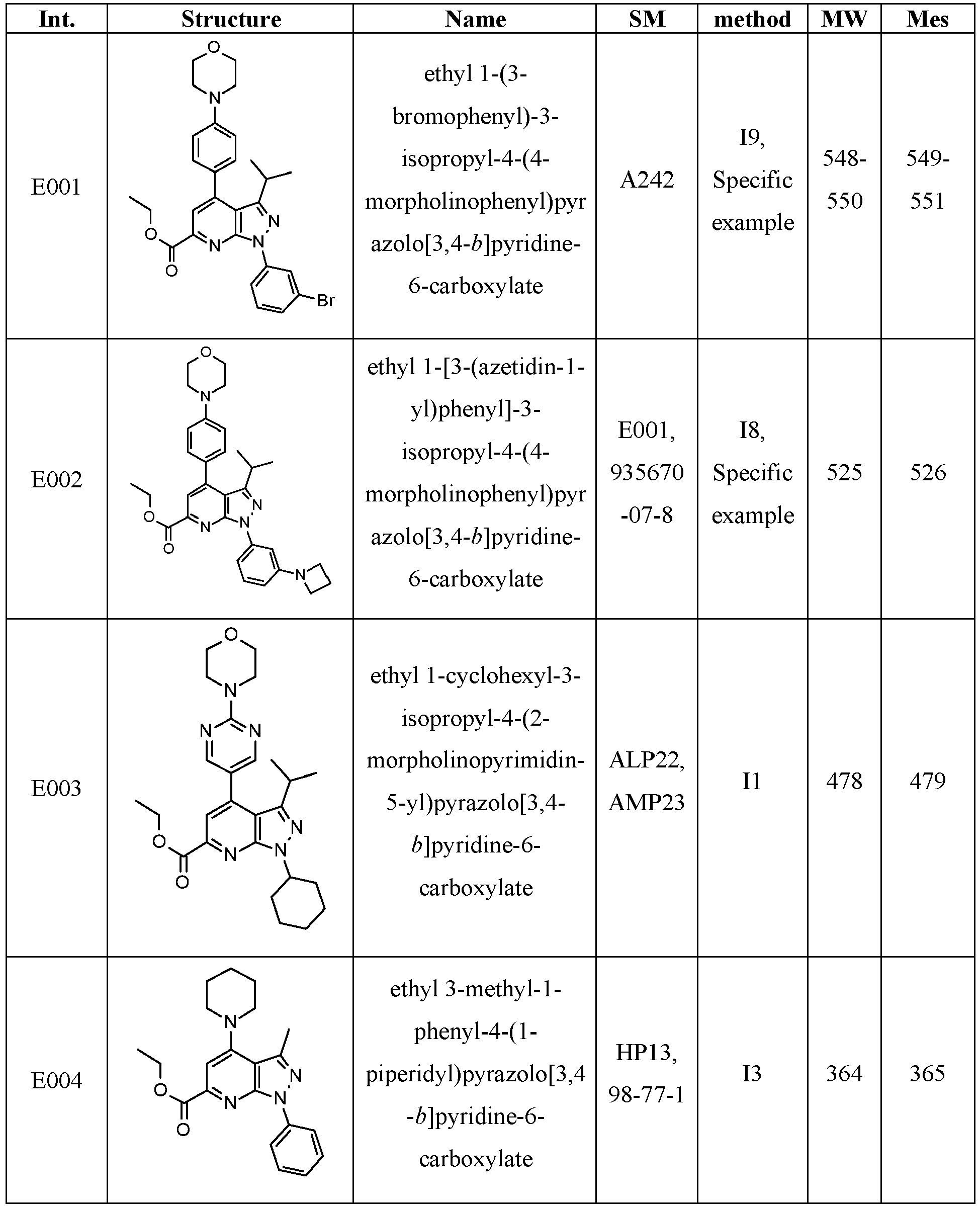


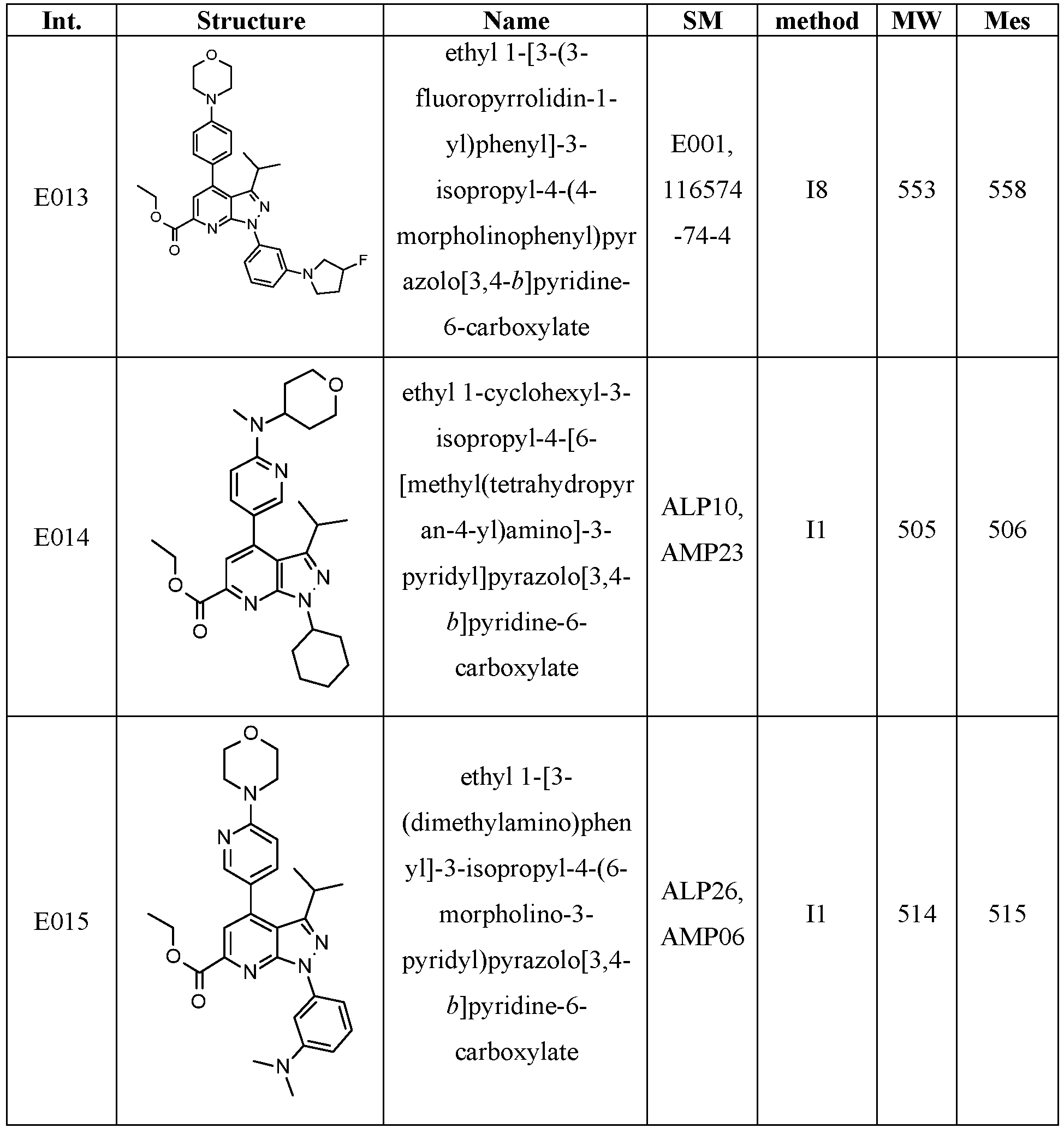


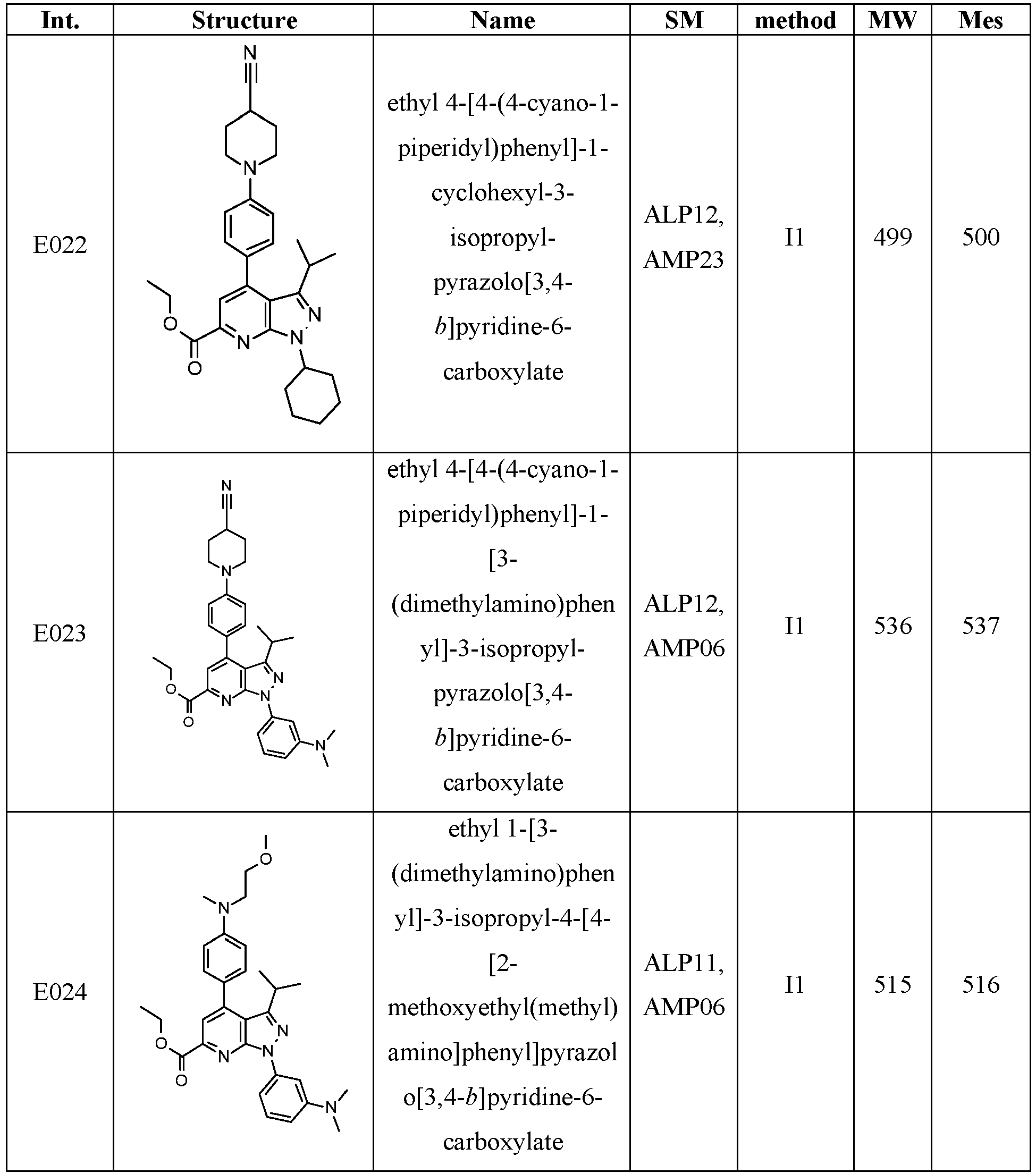


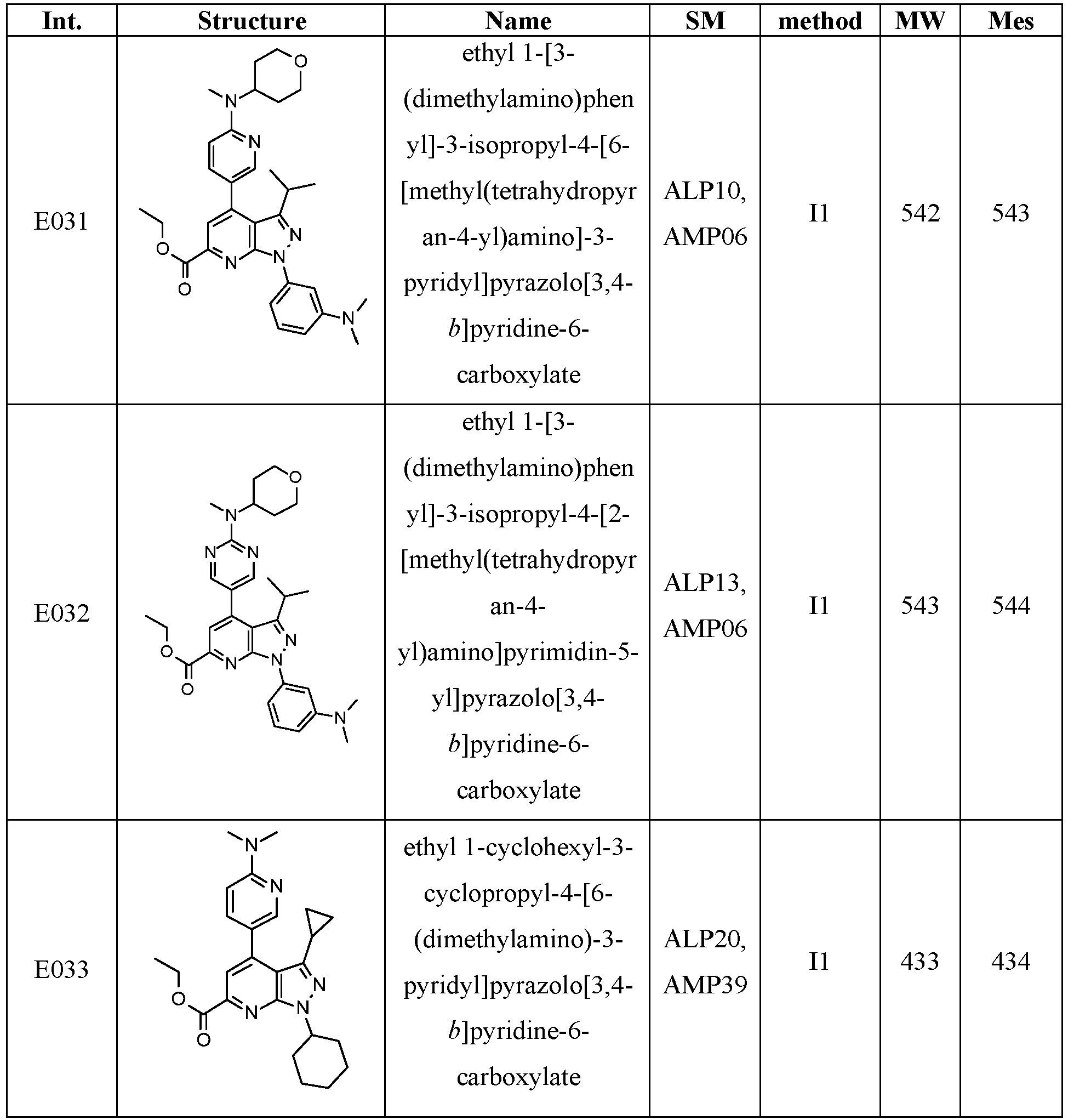


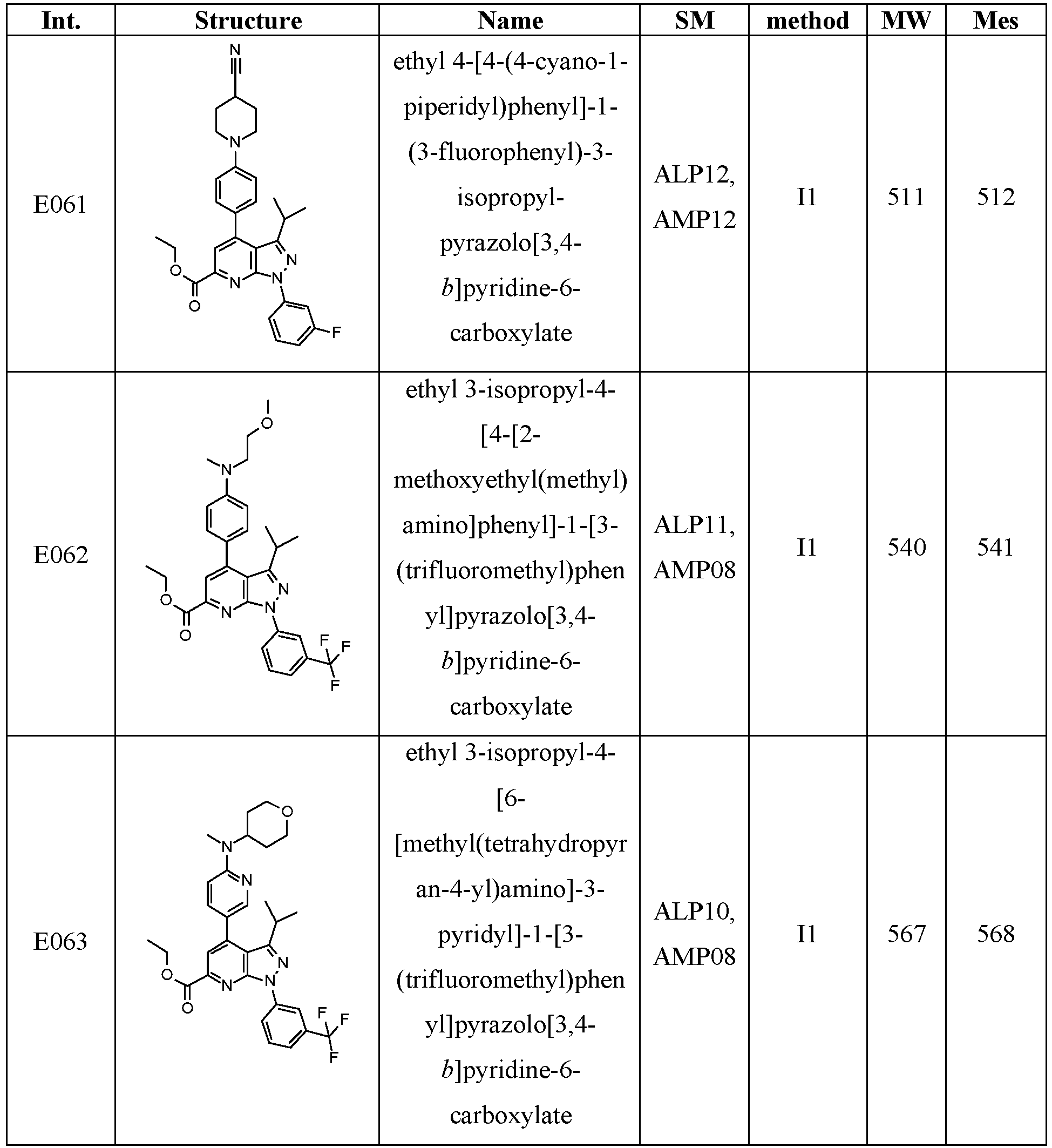


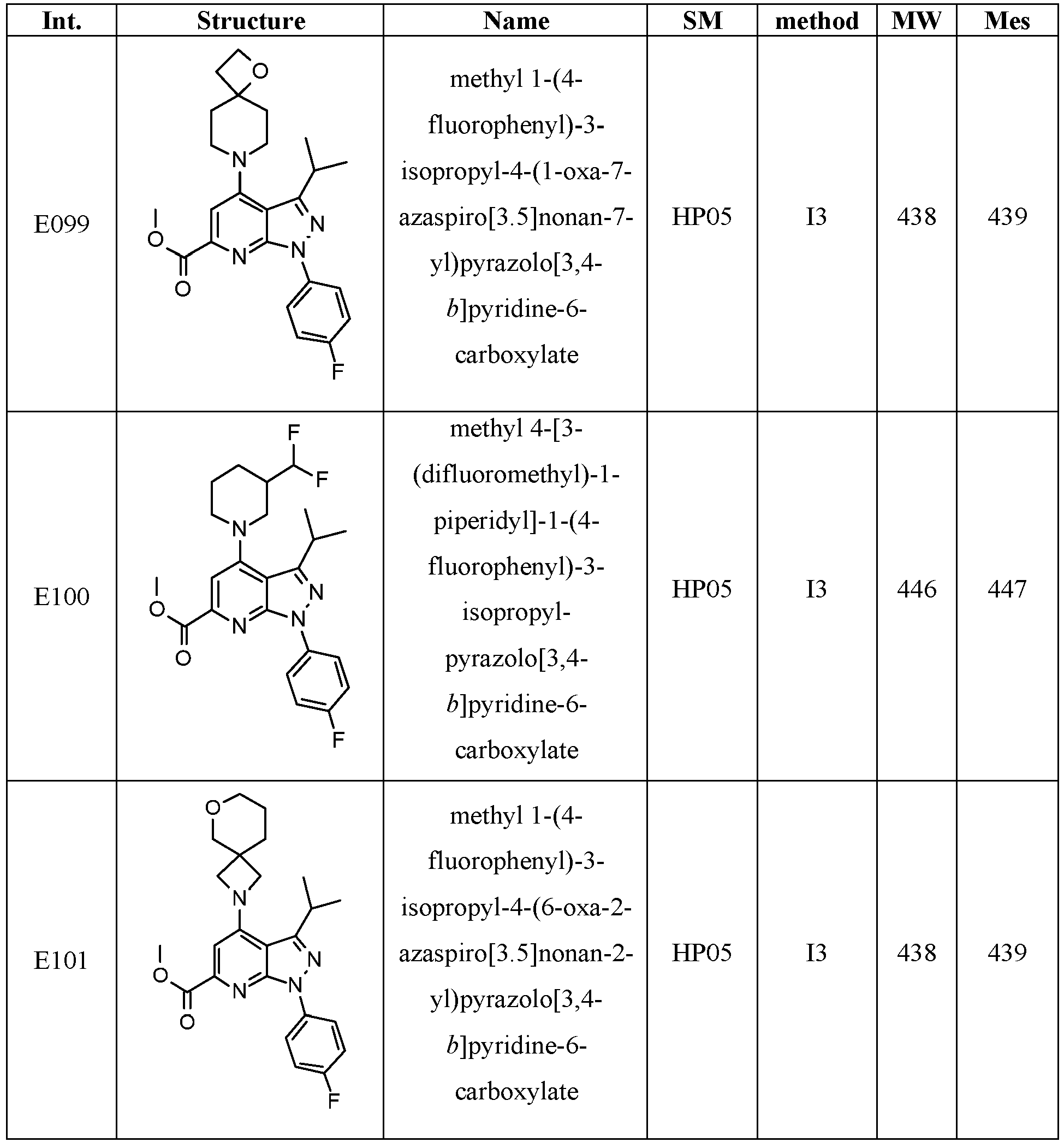
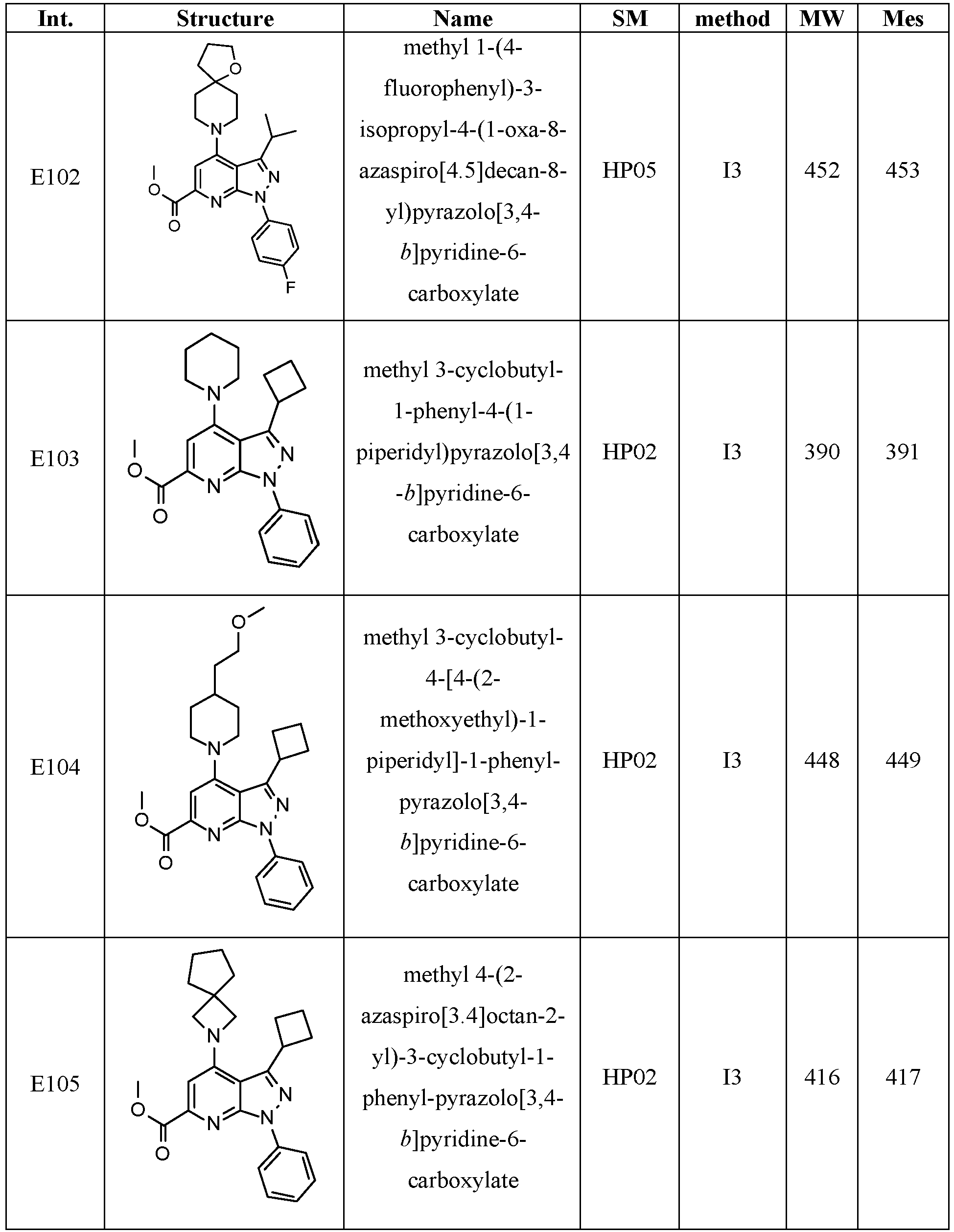


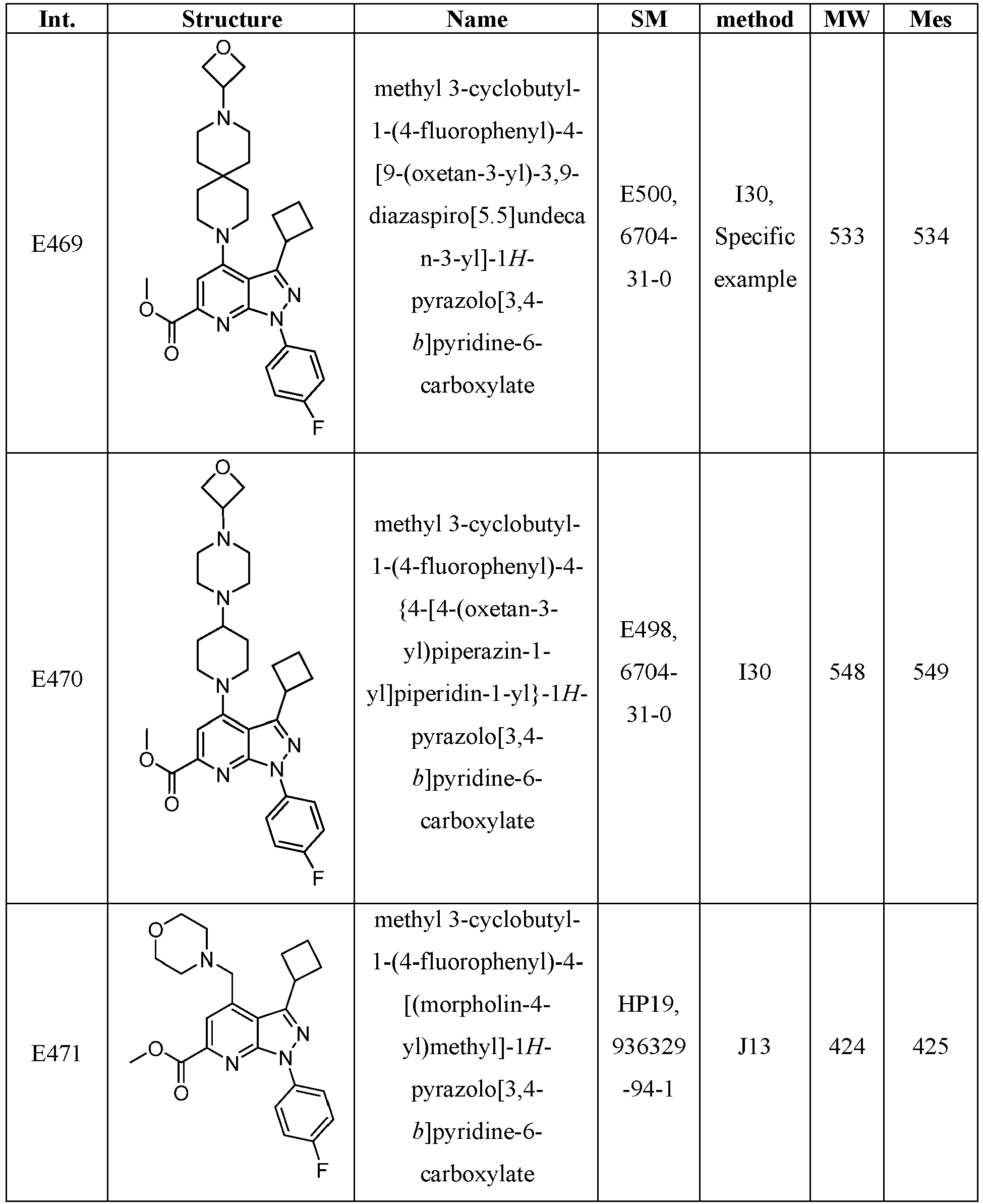


-

- To the intermediate ester (1 equiv) in THF or in a mixture of THF/methanol or in dioxane/water or in THF/methanol/water at RT is added either aqueous 1 to 2 N sodium hydroxide or lithium hydroxide monohydrate (from 1 to 5 equiv). The reaction mixture is stirred at a temperature ranging from RT to 60 °C for 20 minutes to several days (up to 8 days). The volatiles are removed under reduced pressure, and the resulting mixture is acidified with either aqueous 2-6 N HCl or acetic acid. If a filterable suspension is obtained, the precipitate is collected by filtration, washed with water and dried in vacuo to afford the titled compound which is used as such or further purified either by preparative HPLC or flash chromatography on silica gel. In other cases, the mixture is partitioned between water and either dichloromethane or ethyl acetate. The two phases are separated, and the aqueous phase is optionally neutralized and then extracted either with dichloromethane or ethyl acetate. The combined organic phases are washed with brine, dried over MgSO4, filtered and concentrated in vacuo to afford the titled compound which is used as such or further purified either by preparative HPLC or flash chromatography on silica gel.
-

- Intermediate E018 (30.7g, 60.3 mmol) was dissolved in a mixture of THF/methanol (1/1; 1 L) and 2 N sodium hydroxide (109 mL, 218 mmol) in water was added at RT. The solution was stirred for 1 hour. The volatiles were removed under reduced pressure, and the resulting mixture was diluted with water (300 mL). The aqueous phase was acidified with aqueous 2 N HCl (110 mL), and the precipitate was filtered, washed with water and dried at 40 °C under reduced pressure to give the titled compound.
-

- Methyl 3-cyclobutyl-1-phenyl-4-{4-[(pyrrolidin-1-yl)methyl]piperidin-1-yl}-1H-pyrazolo[3,4-b]pyridine-6-carboxylate (18.39 g, 38.8 mmol, E357) was dissolved in a mixture of tetrahydrofuran (100 mL), methanol (50 mL), and water (100 mL). To this mixture was added lithium hydroxide hydrate (4.89 g, 116 mmol). The resulting suspension was heated at 50 °C for 30 minutes. The reaction mixture was cooled to room temperature and neutralized with 6 M aqueous HCl (6 mL) to a pH of 7. To this was then added water in 10 mL portions. After a total of 200 mL of water had been added, a solid formed. The solid was collected by filtration and dried to constant weight in a vacuum oven at 50 °C over 72 hours to give 14.98 g of the titled compound. 1H NMR (400 MHz, pyridine-d 5) δ ppm 8.89 (d, J = 8.0 Hz, 2H), 7.84 (s, 1H), 7.52 (t, J = 7.9 Hz, 2H), 7.25 (t, J = 7.5 Hz, 1H), 4.14 (p, J = 8.4 Hz, 1H), 3.56 (dd, J = 12.2, 3.7 Hz, 2H), 2.86 - 2.67 (m, 4H), 2.63 (br s, 4H), 2.53 - 2.42 (m, 4H), 2.10 - 1.98 (m, 4H), 1.83 - 1.68 (m, 5H), 1.63 - 1.48 (m, 2H); MS (ESI+) m/z 460.2 (M+H)+.
-

- To the ester intermediate (1 equiv) in THF or ethanol or methanol or a mixture of the cited solvents at RT is added either aqueous 1 N or 2 N sodium hydroxide 1 (from 1 to 10 equiv). The reaction mixture is stirred at RT until complete conversion is observed. Sodium hydroxide can be added to allow the full conversion of the starting ester. The volatiles are removed under reduced pressure, and the resulting mixture is acidified with either aqueous 1 N or 2 N HCl. If a filterable suspension is obtained, the precipitate is collected by filtration, washed with water and dried in vacuo to afford the titled compound which is used as such or further purified either by preparative HPLC or flash chromatography on silica gel. In other cases, the mixture is partitioned between a phosphate buffer (pH 6.2) and either dichloromethane or chloroform or a mixture of dichloromethane/isopropanol. The organic phases are separated, dried over MgSO4, filtered and concentrated in vacuo to afford the titled compound which is used as such or further purified either by preparative HPLC or flash chromatography on silica gel.
-

- Ester E395 (40 mg, 80 µmol) was dissolved in a mixture of THF/ethanol (1/1; 6 mL) and 1 N sodium hydroxide (0.5 mL, 500 µmol) in water was added at RT. The solution was stirred for 4 hours. Aqueous 1 N HCl (0.5 mL, 500 µmol) and a phosphate buffer were added (pH 6.2). The solvent was partially removed under reduced pressure, and the resulting mixture was extracted twice with chloroform. The combined organic phases were dried over magnesium sulfate, filtered and evaporated under reduced pressure to give the titled compound.
-

- A is either N or CH
- A' is either Re or L1-G3C as described in the Summary
- The alkylidene pyruvate (1 to 1.5 equiv) and the aminopyrazole (1 to 1.5 equiv) in acetic acid are stirred under air at temperatures ranging from RT to reflux for 1 h to several days. Alternatively, the alkylidene pyruvate (1 to 1.5 equiv) and the aminopyrazole (1 to 1.5 equiv) in DMF or acetic acid are heated under microwave irradiation at 150 °C for 20 minutes to 2 h followed by stirring under air in an opened flask at temperatures ranging from RT to 90 °C for 1 h to several days with or without dilution of the reaction mixture with a large amount of ethanol or methanol. Then the reaction mixture is filtered, and the solid is washed with solvents, and dried in vacuo to afford the titled compound which is used as such or purified by precipitation, by preparative HPLC or by flash chromatography on silica gel. Alternatively, the reaction mixture is concentrated in vacuo to afford a crude mixture which is used as such or further purified either by precipitation, by preparative HPLC or by flash chromatography on silica gel.
-

- ALP01 (261 mg, 1 mmol, 1 equiv) and 3-methyl-1-phenyl-1H-pyrazol-5-amine (CAS 1131-18-6, 173mg, 1 mmol, 1 equiv) were introduced in a sealed tube. DMF (2 mL) was added, and the vial was sealed. The reaction mixture was heated under microwave irradiation at 150 °C for 1 h. Then after cooling down to RT, the vial was opened, diluted with a large amount of ethanol, and stirred vigorously under air at RT overnight. The resulting suspension was filtered. The solid was washed with ethanol, and dried in vacuo to afford the titled compound.
-

- To a solution of alcohol (3.0 equiv) in anhydrous THF under nitrogen atmosphere at RT is added 60% sodium hydride in mineral oil (6.0 equiv), and the mixture is stirred at room temperature for 30 minutes. Then the aryl chloride intermediate HP (1.0 equiv) is added, the reaction mixture is stirred at room temperature for 5 minutes, and then heated at reflux for 1 h to 24 h. The reaction mixture is cooled to 0 °C, diluted with heptane, quenched with water and acidified with 2 N HCl (6.0 equiv). Volatiles are removed in vacuo. The resulting aqueous residue is filtered, and the solid is washed with water and with a mixture heptane/Et2O 1/1, and dried in vacuo to afford the titled compound which is used as such or purified by silica gel chromatography. Alternatively, the aqueous residue is diluted with dichloromethane. The two phases are separated and the aqueous phase is extracted with dichloromethane. The combined organic phases are washed with brine, dried over MgSO4, filtered and concentrated in vacuo to afford the titled compound which is used as such or purified by silica gel chromatography.
- Alternatively, to a solution of alcohol (2.0 equiv) in anhydrous DMF is added 1 M potassium tert-butoxide (3-4 equiv), and the mixture is stirred at room temperature for several minutes. Then the aryl chloride intermediate HP (1.0 equiv) is added, and then the reaction mixture is heated at 40-60 °C for 1 h to 24 h. After cooling to ambient temperature, the product can be precipitated from an appropriate solvent or purified chromatographically.
-

- To a solution of tetrahydropyran-4-ylmethanol (CAS: 14774-37-9, 54 mg, 0.457 mmol, 3.0 equiv) in anhydrous THF (1 mL) under nitrogen atmosphere was added 60% sodium hydride in mineral oil (37 mg, 0.915 mmol, 6.0 equiv), and the mixture was stirred at room temperature for 30 minutes. HP10 (50 mg, 0.152 mmol, 1.0 equiv) was added; the reaction mixture was stirred at room temperature for 5 minutes and then heated at reflux for 3 hours. The reaction mixture was cooled to 0 °C, diluted with heptane (1 mL), quenched with water (1 mL) and acidified with 2 N HCl (0.46 mL, 6.0 equiv). Volatiles were removed in vacuo. The resulting aqueous suspension was diluted with a mixture heptane/Et2O: 1/1 (1 mL) and filtered. The solid was washed with water and with a mixture heptane/Et2O 1/1 and dried in vacuo. The crude solid was purified by silica gel chromatography (eluent system: DCM/(DCM/MeOH/AcOH/H2O: 90/10/1/1) gradient from 100/0 to 90/10) to give the titled compound.
-

- 3-Morpholinopropan-1-ol (73 mg, 0.50 mmol) was dissolved into anhydrous DMF (830 µL), treated with 1 M KOtBu in THF (830 µL, 0.83 mmol), stirred three minutes, treated further with intermediate HP10 (82 mg, 0.25 mmol), and heated at 50 °C for about an hour. More DMF (570 µL) was added and heating was continued overnight. The mixture was brought to room temperature, diluted with MeCN and filtered with a MeCN rinse. The collected solids were mixed with acetic acid into DMSO, and diluted with water to precipitate solids which were collected by filtration, rinsed with water and dried under vacuum to give the titled compound (65 mg). 1H NMR (400 MHz, DMSO-d 6) δ ppm 8.38-8.28 (m, 2H), 7.61-7.52 (m, 2H), 7.41 (s, 1H), 7.36-7.29 (m, 1H), 4.43-4.34 (m, 2H), 4.08-3.98 (m, 1H), 3.62-3.58 (m, 4H), 2.57-2.35 (m, 10H), 2.15-1.89 (m, 4H).
-

- To a degassed solution of the aryl chloride intermediate HP (1.0 equiv) and the amine as free base or hydrochloride salt (1.5 equiv) in anhydrous THF at RT under nitrogen atmosphere in a sealed vial is added XPhos Pd G1 (CAS 1028206-56-5, 0.1 equiv) followed by 1 N LiHMDS in THF (from 3 to 5 equiv). The reaction mixture is purged with nitrogen and the vial is sealed. The reaction mixture is stirred at 100 °C for 1 h to 24 h. Then the reaction mixture is cooled down and volatiles are removed in vacuo. The resulting residue is taken up in dichloromethane and water and acidified with acetic acid. The two phases are separated and the aqueous phase is extracted with dichloromethane. The combined organic layers are washed with brine, dried over MgSO4, filtered and concentrated in vacuo. The resulting residue is purified by flash chromatography on silica gel to afford the titled compound.
-

- To a degassed solution of HP 10 (64 mg, 0.194 mmol, 1.0 equiv) and 4-(fluoromethyl)piperidine hydrochloride (CAS 259143-04-9, 45mg, 0.292 mmol, 1.5 equiv) in anhydrous THF (2 mL) at RT under nitrogen atmosphere in a sealed vial was added XPhos Pd G1 (CAS 1028206-56-5, 14 mg, 0.019 mmol, 0.1 equiv) followed by 1 N LiHMDS in THF (0.97 mL, 0.97 mmol, 5.0 equiv). The reaction mixture was purged with nitrogen, and the vial was sealed. The reaction mixture was stirred at 100 °C overnight. Then the reaction mixture was cooled down and volatiles were removed in vacuo. The resulting residue was taken up in dichloromethane and water and acidified with acetic acid. The two phases were separated, and the aqueous phase was extracted with dichloromethane. The combined organic layers were washed with brine, dried over MgSO4, filtered and concentrated in vacuo. The resulting residue was purified by flash chromatography on silica gel (eluent system: dichloromethane/methanol gradient from 100/0 to 95/5) to afford the titled compound.
-

- To a degassed solution of pyridyl chloride (1.0 equiv) and amine (1.5 equiv) in anhydrous THF at RT under nitrogen atmosphere is added 1 N LiHMDS in THF (from 3 to 4.5 equiv) followed by XPhos Pd G1 (CAS 1028206-56-5, 0.1 equiv). The reaction mixture is stirred at room temperature for 1 h to 24 h. The mixture is quenched with acetic acid and diluted with water and dichloromethane. The organic layer is separated, washed with water and brine, dried over MgSO4, filtered and concentrated in vacuo to afford the titled compound which is used as such or further purified by preparative HPLC or by flash chromatography on silica gel. The cross-coupling reaction can be performed on either a carboxylic acid or ester. In some instances, an ester starting material is concomitantly hydrolyzed to the corresponding carboxylic acid product under the reaction conditions.
-

- To a degassed solution of A250 (75 mg, 0.188 mmol, 1.0 equiv) and 2,6-dimethylmorpholine (CAS 141-91-3, 32 µL, 0.26 mmol, 1.5 equiv) in anhydrous THF (0.7 mL) at RT under nitrogen atmosphere was added 1 N LiHMDS in THF (765 µL, 0.765 mmol, 4.5 equiv) followed by XPhos Pd G1 (CAS 1028206-56-5, 12.5 mg, 0.017 mmol, 0.1 equiv). The reaction mixture was stirred at room temperature for 1 h. The mixture was quenched with AcOH and diluted with water and dichloromethane. The organic layer was separated, washed with water and brine, dried over MgSO4, filtered and concentrated in vacuo. The resulting residue was purified by silica gel chromatography (eluent system: dichloromethane/methanol, gradient from 100/0 to 95/5) to afford the titled compound.
-

- To the intermediate fluoropyridine (1.0 equiv) in anhydrous DMSO is added the amine (from 2.0 to 10.0 equiv) and K2CO3 (from 3.0 to 10 equiv). The reaction mixture is stirred at 100 °C overnight. If the reaction is not complete, additional amine (from 2.0 to 10 equiv) and K2CO3 (from 0 to 10 equiv) are added, and the reaction mixture is stirred at 100 °C until the reaction is finished. Then the reaction mixture is cooled down to RT, diluted with water and extracted with ethyl acetate. The combined organic layers are washed with brine, dried over MgSO4, filtered and concentrated in vacuo to afford the titled compound which is used as such or purified by flash chromatography on silica gel.
-

- To E147 (144 mg, 0.32 mmol, 1.0 equiv) in anhydrous DMSO (1.5 mL) was added morpholine (56 µL, 0.64 mmol, 2.0 equiv) and K2CO3 (133 mg, 0.96 mmol, 3.0 equiv). The reaction mixture was stirred at 100 °C overnight. Additional morpholine (56 µL, 0.64 mmol, 2.0 equiv) and K2CO3 (133 mg, 0.96 mmol, 3.0 equiv) were added, and the reaction mixture was stirred at 100 °C for 24 h. Then additional morpholine (56 µL, 0.64 mmol, 2.0 equiv) was added again, and the reaction mixture was stirred at 100 °C for 5 days. Then the reaction mixture was cooled down to RT, diluted with water and extracted with ethyl acetate. The combined organic layers were washed with brine, dried over MgSO4, filtered and concentrated in vacuo. The resulting residue was purified by silica gel chromatography (eluent system: dichloromethane/methanol, gradient 100/0 to 95/5 with 0.1% AcOH) to afford the titled compound.
-

- To a degassed solution of the aromatic bromide intermediate (1.0 equiv) and the amine as free base or hydrochloride salt (from 1.5 to 2 equiv) in anhydrous THF at RT under nitrogen atmosphere in a sealed vial is added XPhos Pd G1 (CAS 1028206-56-5, 0.1 equiv) followed by 1 N LiHMDS in THF (from 3 to 5 equiv). The reaction mixture is purged with nitrogen, and the vial is sealed. The reaction mixture is stirred at a temperature ranging from RT to 100 °C for 1 h to 3 h. If the reaction is not complete, additional amine (from 1.0 to 3.0 equiv), LiHMDS (from 1.5 to 6.0 equiv) and XPhos Pd G1 (CAS 1028206-56-5, from 0.05 to 0.2 equiv) are added at RT. The reaction mixture is purged again with nitrogen and the vial is sealed. The reaction mixture is stirred at a temperature ranging from RT to 100 °C for 1 h to 3 h. Then the reaction mixture is cooled down and volatiles are removed in vacuo. The resulting residue is taken up in dichloromethane and water and acidified with acetic acid. The two phases are separated, and the aqueous phase is extracted with dichloromethane. The combined organic layers are washed with brine, dried over MgSO4, filtered and concentrated in vacuo. The resulting residue is purified by flash chromatography on silica gel to afford the titled compound.
-

- To a degassed solution of A257 (22 mg, 0.046 mmol, 1.0 equiv) and morpholine (6 µL, 0.069 mmol, 1.5 equiv) in anhydrous THF (1 mL) at RT under nitrogen atmosphere in a sealed vial was added XPhos Pd G1 (CAS 1028206-56-5, 3 mg, 0.0046 mmol, 0.1 equiv) followed by 1 N LiHMDS in THF (138 µL, 0.138 mmol, 3.0 equiv). The reaction mixture was purged with nitrogen, and the vial was sealed. The reaction mixture was stirred at 100 °C for 1.5 h. Additional morpholine (12 µL, 0.138 mmol, 3.0 equiv), 1 N LiHMDS in THF (276 µL, 0.276 mmol, 6.0 equiv) and XPhos Pd G1 (CAS 1028206-56-5, 6 mg, 0.0092 mmol, 0.2 equiv) were added at RT. The reaction mixture was purged again with nitrogen, and the vial was sealed. The reaction mixture was stirred at 100 °C for 1 h. Then the reaction mixture was cooled down and volatiles were removed in vacuo. The resulting residue was taken up in dichloromethane and water and acidified with acetic acid. The two phases were separated, and the aqueous phase was extracted with dichloromethane. The combined organic layers were washed with brine, dried over MgSO4, filtered and concentrated in vacuo. The resulting residue was purified by flash chromatography on silica gel (eluent system dichloromethane/ methanol gradient from 100/0 to 90/10 with 0.1% AcOH) to afford the titled compound.
-


- 60% NaH in mineral oil (6.0 equiv) is added to a solution of an ester/alcohol or a 2-oxo-1,2-dihydropyridin-4-yl/ester (1 equiv) in THF. The reaction mixture is stirred at RT for 5 minutes, and a C1-C6 alkyl halide (6.0 equiv) was added. The reaction mixture was stirred at RT for 1-24 hours and then concentrated. The residue was purified by silica gel chromatography to give the ether/carboxylic acid or the 1-methyl-2-oxo-1,2-dihydropyridin-4-yl/carboxylic acid.
-
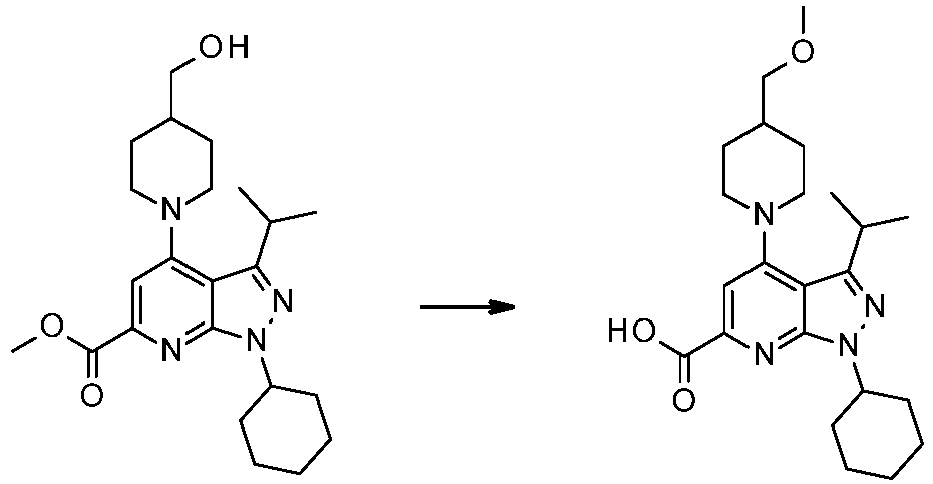
- 60% NaH in mineral oil (24 mg, 0.60 mmol, 6.0 equiv) was added to a solution of E134 (42 mg, 0.10 mmol) in THF (1 mL). The reaction mixture was stirred at RT for 5 minutes, and methyl iodide (0.037 mL, 0.60 mmol, 6.0 equiv) was added. The reaction mixture was stirred at RT for 16 hours and then concentrated. The residue was purified by silica gel chromatography (DCM/MeOH: 100/0 to 90/10) to give the titled compound.
-


- A heterocyclic amine at either the R2 or R3 positions can be reacted with an acid chloride or chloroformate dissolved is solvents such as dichloromethane, tetrahydrofuran or DMF at 0 °C to ambient temperature over 0.5-4 hours in the presence a tertiary amine base or an inorganic carbonate base. The reaction mixture is extractively worked up and/or purified chromatographically either by flash chromatography or by preparative HPLC.
-

- To A261 as a trifluoroacetic acid salt (0.43g, 0.83 mmol, 1 equiv) in anhydrous dichloromethane (10 mL) at 0 °C was added triethyl amine (0.69 mL, 4.98 mmol, 6 equiv) followed by acetyl chloride (CAS 75-36-5, 119 µL, 1.66 mmol, 2 equiv). The reaction mixture was stirred at RT for 1 h. The reaction mixture was diluted with dichloromethane and water. The two phases were separated, and the aqueous phase was extracted with dichloromethane. The combined organic phases were washed with brine, dried over MgSO4, filtered and concentrated in vacuo. The resulting residue was purified by flash chromatography on silica gel (eluent system: dichloromethane/methanol gradient from 100/0 to 95/5) to afford the titled compound.
-

- To A261 as a trifluoroacetic acid salt (0.43g, 0.83 mmol, 1 equiv) in anhydrous dichloromethane (10 mL) at 0 °C was added triethylamine (0.69 mL, 4.98 mmol, 6 equiv) followed by methyl chloroformate (CAS: 79-22-1, 128 µL, 1.66 mmol, 2 equiv). The reaction mixture was stirred at RT for 1 h. The reaction mixture was diluted with dichloromethane and water. The two phases were separated, and the aqueous phase was extracted with dichloromethane. The combined organic phases were washed with brine, dried over MgSO4, filtered and concentrated in vacuo. The resulting residue was taken up in a mixture of THF (1.5 mL), methanol (1.5 mL) and aqueous 2 M sodium hydroxide (0.17 mL) and stirred at RT for 1.5 h. The mixture was concentrated in vacuo. The residue was diluted with ethyl acetate and water and acidified with 1 M HCl (0.34 mL). The two phases were separated, and the aqueous phase was extracted with ethyl acetate. The combined organic phases were washed with brine, dried over MgSO4, filtered and concentrated in vacuo to afford the titled compound which was used as such.
-

- Diisopropylethylamine (0.55 mL, 3.12 mmol, 6.0 equiv) and DMAP (13 mg, 0.104 mmol, 0.2 equiv) were added to a solution of A248 (220 mg, 0.52 mmol, 1 equiv) in dichloromethane (2 mL). The mixture was cooled to 0 °C and methyl chloroformate (CAS: 79-22-1, 81 µL, 0.104 mmol, 2.0 equiv) was added. The reaction mixture was warmed up to RT and stirred for 1.5 h. The reaction mixture was partitioned between dichloromethane and water. The two phases were separated, and the aqueous phase was extracted with dichloromethane. The combined organic phase were dried over MgSO4, filtered and concentrated in vacuo. The residue was purified by preparative HPLC to afford the titled compound.
-

- A mixture of the chloride or triflate intermediate HP (1.0 equiv), the amine as free base or hydrochloride salt (from 1 to 10 equiv) and DIPEA (from 1 to 15 equiv) in anhydrous acetonitrile and DMSO or N,N-dimethylacetamide in a sealed tube or a round bottom flask is heated at a temperature ranging from 50 to 130 °C for 1 h to several days (up to 8 days). The reaction mixture is cooled to RT. The resulting residue is either purified by precipitation or by flash chromatography on silica gel to afford the titled compound or alternatively partitioned between either dichloromethane or ethyl acetate and water. The two phases are then separated, and the aqueous phase is extracted with either ethyl acetate or dichloromethane. The combined organic phases are dried, filtered and concentrated in vacuo, and the resulting crude mixture is either used as such or purified by flash chromatography on silica gel to afford the titled compound.
- Alternatively, a mixture of the chloride or triflate intermediate HP (1.0 equiv), the amine as free base or hydrochloride salt (from 1 to 10 equiv) and triethylamine (from 1 to 15 equiv) in N,N-dimethylacetamide is heated with microwave irradiation at a temperature ranging from 130 to 150 °C for 5 to 20 min. DBU (1 equiv) was added, and the reaction mixture is again heated with microwave irradiation for 1 to 4 hours at 130 to 150 °C Upon cooling, solids are collected and then precipitated from a solvent such as acetonitrile.
-

- A suspension of intermediate HP10 (328 mg, 1.0 mmol), 1,4'-bipiperidine (253 mg, 1.50 mmol) and triethylamine (350 µL, 2.5 mmol) in anhydrous DMA (800 µL) was heated in a Biotage® Initiator microwave synthesizer at 150 °C for fifteen minutes. DBU (180 µL, 1.2 mmol) was added, and the reaction mixture was heated with microwave irradiation at 150 °C for one hour and 45 minutes, brought to room temperature, diluted with water (8 mL) and washed with 1:2 EtOAc/MTBE. The aqueous phase was acidified with 3 M aqueous citric acid (400 µL) to precipitate the product, which was collected by filtration, washed with water and dried under vacuum to give the titled compound (423 mg). 1H NMR (400 MHz, DMSO-d 6, 120 °C) δ ppm 8.32 (d, J = 8.1 Hz, 2H), 7.54-7.48 (m, 2H), 7.32-7.26 (m, 2H), 4.02 (p, J = 8.1 Hz, 1H), 3.63-3.58 (m, 2H), 3.00-2.91 (m, 2H), 2.63-2.57 (m, 4H), 2.56-2.41 (m, 5H), 2.16-1.91 (m, 4H), 1.82-1.69 (m, 2H), 1.60-1.51 (m, 4H), 1.48-1.39 (m, 2H).
-

- A suspension of intermediate HP10 (230 mg, 0.70 mmol), 4-(piperidin-4-yl)morpholine (177 mg, 1.05 mmol) and triethylamine (245 µL, 1.76 mmol) in anhydrous DMA (600 µL) was heated in a Biotage® Initiator microwave synthesizer at 140 °C for five minutes. DBU (105 µL, 0.70 mmol) was added, and the reaction mixture was heated with microwave irradiation at 140 °C for three hours, brought to room temperature and filtered through a C18 column (MeOH/H2O). The filtrate was concentrated, and the residual solids were washed with EtOAc, boiled in MeCN and allowed to cool to room temperature. The solid was collected by filtration, rinsed with acetonitrile and dried under vacuum to give the titled compound (305 mg). 1H NMR (400 MHz, DMSO-d 6, 90 °C) δ ppm 8.34-8.30 (m, 2H), 7.54-7.48 (m, 2H), 7.30-7.25 (m, 2H), 4.00 (p, J = 8.1 Hz, 1H), 3.62-3.58 (m, 4H), 3.56-3.53 (m, 2H), 2.97-2.89 (m, 1H), 2.76-2.68 (m, 1H), 2.56-2.51 (m, 4H), 2.45-2.41 (m, 3H), 2.11-1.94 (m, 4H), 1.85-1.77 (m, 1H), 1.74-1.63 (m, 2H), 1.55-1.44 (m, 1H).
-

- A suspension of intermediate HP10 (164 mg, 0.50 mmol), 4-(2-(piperidin-4-yl)ethyl)morpholine (149 mg, 0.75 mmol) and triethylamine (175 µL, 1.26 mmol) in anhydrous DMA (400 µL) was heated in a Biotage® Initiator microwave synthesizer at 150 °C for fifteen minutes. DBU (90 µL, 0.60 mmol) was added, and the reaction mixture was heated by microwave irradiation at 150 °C for one hour, brought to room temperature, diluted with water (8 mL) and concentrated. The residue was slurried in acetonitrile and the solids were collected by filtration to give the titled compound (155 mg).
-

- A suspension of 4-chloro-3-cyclobutyl-1-phenyl-pyrazolo[3,4-b]pyridine-6-carboxylic acid (HP10, 164 mg, 0.50 mmol), (R)-piperidin-3-ylmethanol (86 mg, 0.75 mmol) and triethylamine (175 µL, 1.26 mmol) in anhydrous DMA (400 µL) was heated in a microwave reactor at 150 °C for fifteen minutes. DBU (90 µL, 0.60 mmol) was added, and the reaction mixture was heated in the reactor at 150 °C for one hour, brought to room temperature, diluted with water (8 mL), concentrated, and purified by preparative HPLC on a Waters® T3 column (30 mm × 100 mm) with a 20 to 100% gradient of acetonitrile in 10 mM aqueous ammonium acetate to give the titled compound (156 mg). 1H NMR (400 MHz, CD2Cl2) δ ppm 7.84 (d, J = 8.1 Hz, 2H), 7.21-7.13 (m, 3H), 6.92 (t, J = 7.4 Hz, 1H), 3.81 (tt, J = 8.5, 8.4 Hz, 1H), 3.54-3.46 (m, 1H), 3.43-3.20 (m, 3H), 2.57-2.24 (m, 6H), 2.04-1.88 (m, 2H), 1.84-1.71 (m, 1H), 1.63-1.49 (m, 3H), 0.95-0.79 (m, 1H).
-

- A suspension of the 4-chloro-1-(4-fluorophenyl)-3-isopropyl-pyrazolo[3,4-b]pyridine-6-carboxylic acid (267 mg, 0.80 mmol, HP11), 4-morpholinopiperidine (204 mg, 1.2 mmol) and triethylamine (280 µL, 2.0 mmol) in anhydrous DMA (700 µL) was heated in a microwave reactor at 150 °C for fifteen minutes. DBU (145 µL, 0.96 mmol) was added, and the reaction mixture was heated at 150 °C two hours, brought to room temperature, diluted with water (7 mL) and washed twice with 1:2 EtOAc/MTBE. The aqueous phase was acidified with aqueous citric acid to pH 5, and the solids were collected by filtration, washed with water and dried under vacuum to give the titled compound.
-

- To a solution of HP10 (0.502 g, 1.532 mmol) and 4-piperidinemethanol (0.441 g, 3.83 mmol) in N,N-dimethylacetamide (DMA, 1.5 mL) was added diisopropylethylamine (1.5 mL, 8.59 mmol), and the reaction mixture was then stirred at 150 °C for 12 hours. The reaction mixture was then partitioned between dichloromethane and 1 N HCl. The organic fraction was separated, dried over anhydrous sodium sulfate, filtered, and concentrated under vacuum. The residue was purified on silica gel, eluting with a gradient of 0-5% MeOH/DCM to give the titled compound. 1H NMR (400 MHz, DMSO-d 6) δ ppm 1.41 (qd, J = 12.2, 3.7 Hz, 2H), 1.60 (dtdd, J = 13.2, 10.0, 6.2, 3.6 Hz, 1H), 1.83 (dd, J = 13.3, 3.4 Hz, 2H), 1.87 - 2.12 (m, 3H), 2.36 (dtd, J = 11.8, 8.5, 3.1 Hz, 2H), 2.51 (dd, J = 9.3, 2.3 Hz, 1H), 2.76 - 2.96 (m, 2H), 3.54 (dd, J = 9.4, 6.2 Hz, 2H), 3.94 (p, J = 8.4 Hz, 1H), 4.55 (s, 1H), 7.24 - 7.33 (m, 2H), 7.47 - 7.58 (m, 2H), 8.30 (d, J = 8.0 Hz, 2H).
-

- The intermediate ester (1 equiv) is suspended in a mixture of appropriate alcohol for the nucleophilic substitution and THF. 1 N NaOH (from 17 to 19 equiv) is added, and the reaction mixture is stirred at RT or 50 °C until full conversion is observed. 1 N HCl (2 equiv) and a phosphate buffer solution (pH 6.2) are added. The mixture is concentrated under reduced pressure, and the crude residue is partitioned between water and dichloromethane. The organic phase is dried over sodium sulfate, filtered and concentrated under reduced pressure to give the titled compound.
-

- The intermediate ester E422 (30 mg, 57 µmol) was suspended in a mixture of ethanol (8 mL) and THF (3 mL). 1 N NaOH (1 mL, 1 mmol) was added, and the reaction mixture was stirred at RT for 2 hours. IN HCl (1 mL, 1 mmol) and a phosphate buffer solution (pH 6.2, 5 mL) were added. The mixture was concentrated under reduced pressure, and the crude residue was partitioned between water and dichloromethane. The organic phase was dried over sodium sulfate, filtered and concentrated under reduced pressure to give the titled compound, A343.
-

- The (6-fluoro-pyridin-3-yl)-1H-pyrazolo[3,4-b]pyridine-6-carboxylic acid (1 eq) is heated together with the amine (1.05 eq) and DIPEA (1.25 eq) in NMP at 100 °C for 18 hours. Mixture is diluted with EtOAc and water. Isolation of the organic layer and subsequent concentration yields the desired product.
-

- 3-Cyclobutyl-1-cyclohexyl-4-(6-fluoro-pyridin-3-yl)-1H-pyrazolo[3,4-b]pyridine-6-carboxylic acid (200 mg, 0.51 mmol) was heated together with 1-cyclopropylpiperazine ([20327-23-5], 64 µL, 0.53 mmol) and DIPEA (110 µL, 0.64 mmol) in NMP (2 mL) at 100 °C for 18 hours. The mixture was diluted with EtOAc and water. Isolation of the organic layer and subsequent concentration yielded the titled compound.
-

- LG3 is a leaving group suitable for the coupling reaction
- Gx is -G3B or -G3B-L1-G3C
- The aryl halide (1 eq) is mixed together with the alkyl-BF3 salt (1.5 eq), Pd(dppf)Cl2•DCM (CAS 95464-05-4, 0.05 eq) and Cs2CO3 (3 eq) in a mixture of THF/H2O (10/1). The mixture is put under N2 atmosphere and heated at 80 °C overnight.
- If the method is performed on an ester, the ester can be subsequently hydrolyzed to the acid by the addition of LiOH (2 eq) and heating at 50 °C. The titled compound is isolated by acidifying with citric acid till pH = 6 and extraction with EtOAc. Concentration, possibly followed by chromatographic purification, gives the titled compound.
-

- HP19 (352 mg, 0.98 mmol) was mixed together with the potassium trifluorido{[4-(morpholin-4-yl)piperidin-1-yl]methyl}borate (426 mg, 1.47 mmol), Pd(dppf)Cl2•DCM (CAS 95464-05-4, 40 mg, 0.05 mmol) and Cs2CO3 (959 mg, 2.94 mmol) in a mixture of THF/H2O (10/1, 5 mL). The mixture was put under a N2 atmosphere and heated at 80 °C overnight. Next, LiOH (82 mg, 2 mmol) was added, and the mixture was heated at 50 °C. The titled compound was isolated by acidifying with citric acid till pH = 6 and extraction with EtOAc. Concentration, followed by automated preparative chromatographic purification, gave the titled compound.
-

- The arylchloride (1 eq) is mixed with the boronic ester (or acid) (1.5 eq), Pd(dppf)Cl2•DCM (CAS 95464-05-4, 0.1 eq) and DIPEA (3 eq) in a mixture of water/dioxane (1/2). The resulting mixture is stirred at 120 °C for 18 hours. Next, LiOH (2 eq) is added, and the mixture is heated at 40 °C. After acidifying with 2 M HCl solution, extraction with EtOAc gives an organic phase that is concentrated to give the titled compound.
-

- Intermediate HP25 (140 mg, 0.40 mmol), 4-(2-morpholinoethyl)phenylboronic acid (142 mg, 0.60 mmol, CAS#1150114-55-8), Pd(dppf)2Cl2 (33 mg, 0.04 mmol) and DIPEA (211 µL, 1.20 mmol) were heated at 120 °C in a mixture of water and dioxane (3 mL, 1:2 water/dioxane). After overnight stirring, LiOH (34 mg, 0.81 mmol) was added, and the resulting mixture was stirred at 40 °C until the hydrolysis was finished. Next, the mixture was diluted with EtOAc and water. After separation, the aqueous phase was acidified with 2 N HCl and subsequently extracted with DCM. The resulting organic phase was dried and concentrated to give the titled compound.
-

- Intermediate HP10 (164 mg, 0.50 mmol), the tert-butyl rac-(3aR,7aS)-octahydro-1H-pyrrolo[3,2-c]pyridine-1-carboxylate (181 mg, 0.80 mmol, CAS#848410-13-9) and diisopropylethylamine (175 µL, 1.0 mmol) were heated in DMSO (350 µL) at 120 °C for a day, brought to room temperature, and partitioned between EtOAc and 2:1 water/brine (600 µL). The aqueous phase was separated and extracted thrice with EtOAc, and the combined organic phases were acidified with TFA, concentrated and chromatographed on silica (0.1% TFA in 1:1 EtOAc/heptane) to give the titled compound (274 mg). 1H NMR (501 MHz, methanol-d 4) δ ppm 1.50 (s, 9H), 1.94 2.27 (m, 6H), 2.42-2.51 (m, 2H), 2.52-2.66 (m, 3H), 2.95-3.06 (m, 1H), 3.37-3.58 (m, 5H), 3.94-4.00 (m, 1H), 4.02-4.07 (m, 1H), 7.31-7.35 (m, 1H), 7.44 (s, 1H), 7.50-7.55 (m, 2H), 8.24-8.28 (m, 2H).
- rac-4-[(3aR,7aS)-1-(tert-Butoxycarbonyl)octahydro-5H-pyrrolo[3,2-c]pyridin-5-yl]-3-cyclobutyl-1-phenyl-1H-pyrazolo[3,4-b]pyridine-6-carboxylic acid (1.00 g, <1.9 mmol) was dissolved into anhydrous CH2Cl2 (8.0 mL), treated with TFA (2.0 mL), stirred at room temperature for two hours and then concentrated. The residue was redissolved into CH2Cl2, treated with aqueous K2HPO4 and basified to pH 11+ with aqueous NaOH. Brine was added, and the mixture was extracted with 10% MeOH/CH2Cl2. The separated organic phase was dried (Na2SO4), passed through a short column of Na2SO4 and concentrated to give the titled compound (452 mg). 1H NMR (500 MHz, methanol-d 4) δ ppm 1.69-1.77 (m, 1H), 1.98-2.21 (m, 5H), 2.40-2.66 (m, 6H), 2.94-3.01 (m, 2H), 3.15-3.3 (m, 3H), 3.32-3.36 (m, 1H), 4.07-4.15 (m, 1H), 7.24-7.28 (m, 1H), 7.38 (s, 1H), 7.47-7.51 (m, 2H), 8.35-8.38 (m, 2H); MS (ESI) m/z 418 (M+H)+.
- Sodium rac-3-cyclobutyl-4-[(3aR,7aS)-octahydro-5H-pyrrolo[3,2-c]pyridin-5-yl]-1-phenyl-1H-pyrazolo[3,4-b]pyridine-6-carboxylate (209 mg, 0.50 mmol) and N-methylmorpholine (220 µL, 2.0 mmol) were suspended in DMF (2.5 mL) and chilled with a water ice bath. A solution of acetyl chloride (50 µL, 0.70 mmol) in dichloromethane (500 µL) was added dropwise, and the mixture was stirred for two minutes before the bath was removed. The cloudy solution was stirred another thirty minutes at room temperature before being diluted with EtOAc and placed directly on silica for chromatography (EtOAc, then 0 to 20% MeOH/MeCN, then 0.1% TFA/19.9% MeOH/80% MeCN) to give rac-4-[(3aR,7aS)-1-acetyloctahydro-5H-pyrrolo[3,2-c]pyridin-5-yl]-3-cyclobutyl-1-phenyl-1H-pyrazolo[3,4-b]pyridine-6-carboxylic acid (236 mg).
- The racemate was then subjected to preparative supercritical fluid chromatography set to maintain a maximum back pressure of 100 MPa using a Chiralcel® OJ-H (21 x 250 mm) column with the sample at a concentration of 10 mg/mL in methanol using 35% methanol in CO2 at a flow rate of 45 mL/minute to provide both enantiomers separately. The first enantiomer eluted (retention time = 5.4 minutes), and the second enantiomer eluted (retention time = 7.4 minutes) as the titled compound (stereochemistry arbitrarily assigned). 1H NMR (400 MHz, DMSO-d 6, 120 °C) δ ppm 1.98 (s, 3H), 1.88-2.22 (m, 6H), 2.40-2.59 (m, 4H), 2.98-3.07 (m, 1H), 3.15-3.19 (m, 1H), 3.31-3.61 (m, 4H), 3.78-3.83 (m, 1H), 3.99-4.13 (m, 2H), 7.27-7.32 (m, 1H), 7.34 (s, 1H), 7.49-7.55 (m, 2H), 8.29-8.35 (m, 2H).
-

- 4-(4-Morpholinyl)benzaldehyde (CAS 1204-86-0, 241 mg, 1.26 mmol, 1 equiv), pyruvic acid (CAS 127-17-3, 88 µL, 1.26 mmol, 1 equiv) and 5-amino-1-phenylpyrazole (CAS 826-85-7, 200 mg, 1.26 mmol, 1 equiv) were combined in a sealed tube. Acetic acid (5 mL) was added, and the vial was sealed. The reaction mixture was heated under microwave irradiation at 160 °C for 20 min. The reaction mixture was cooled down and concentrated in vacuo. The resulting residue was purified by preparative HPLC to afford the tiled compound.


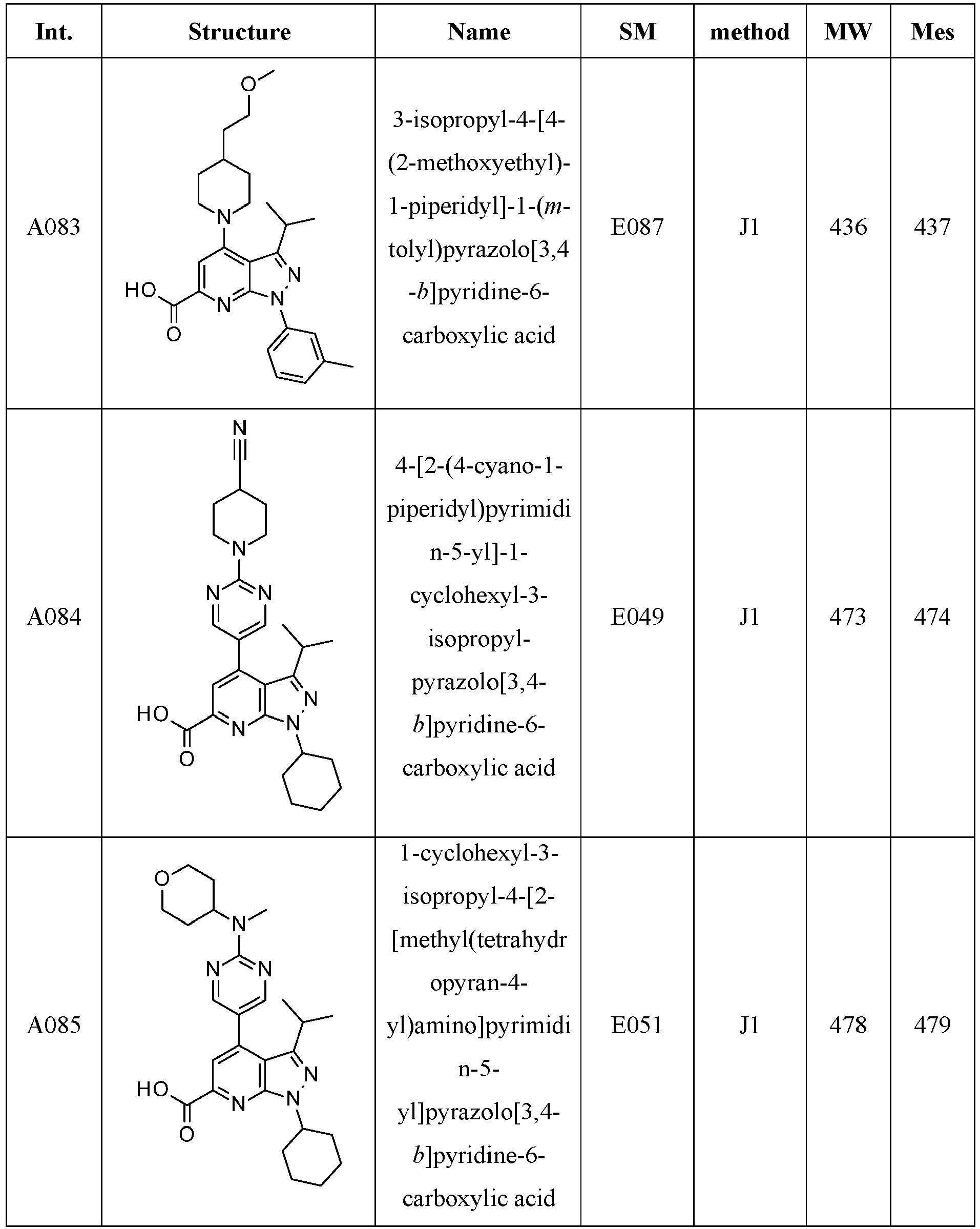


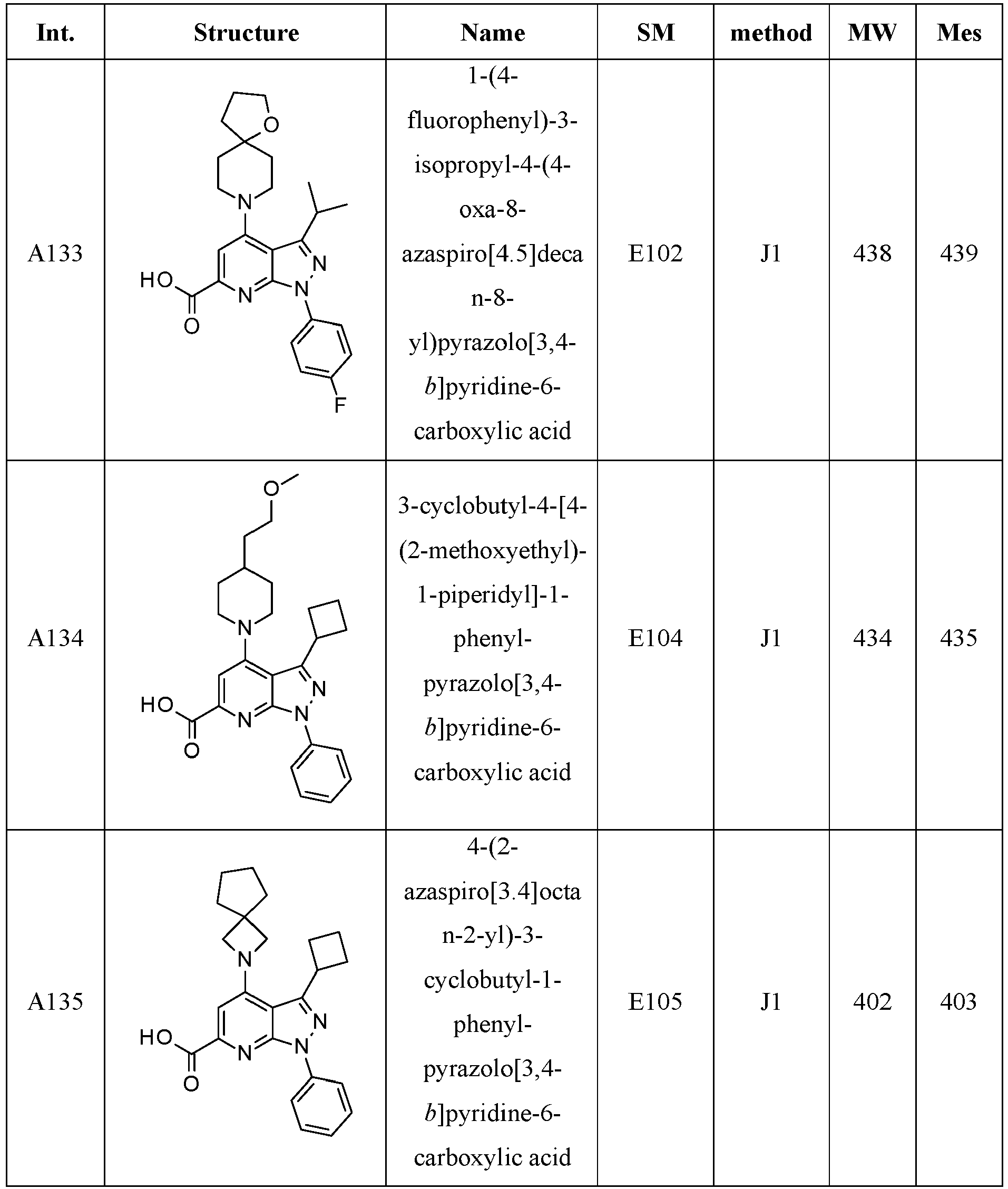


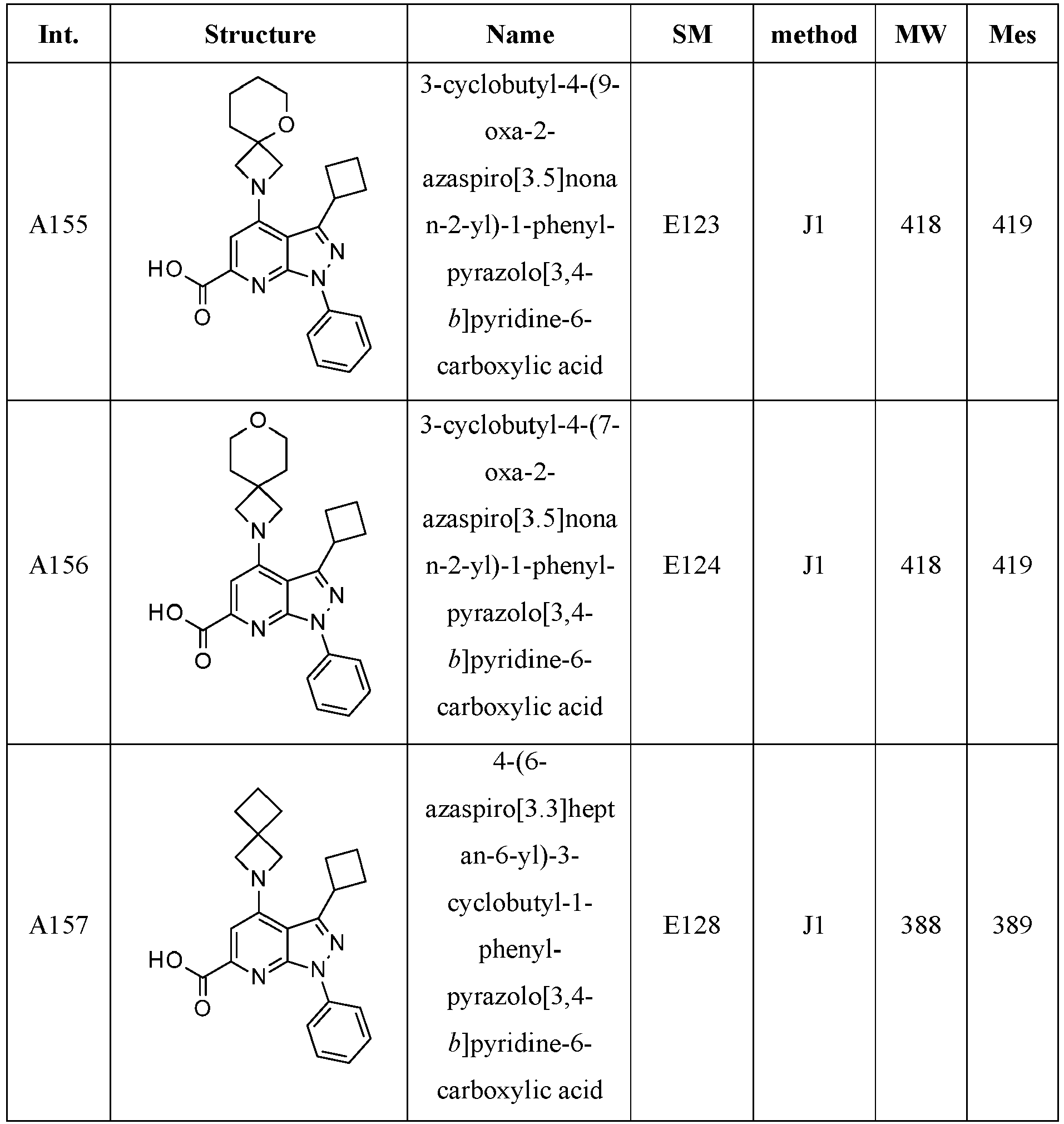


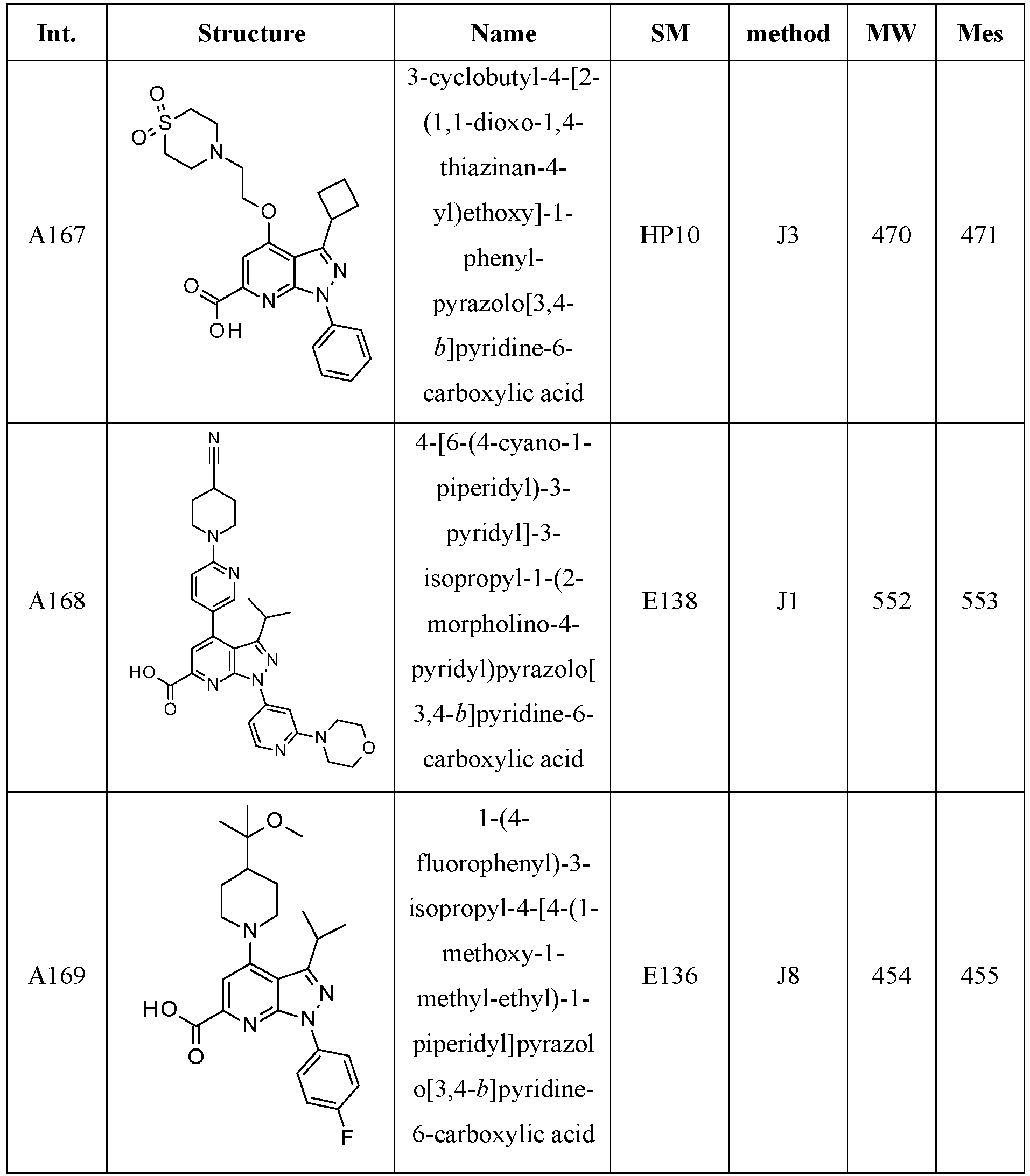
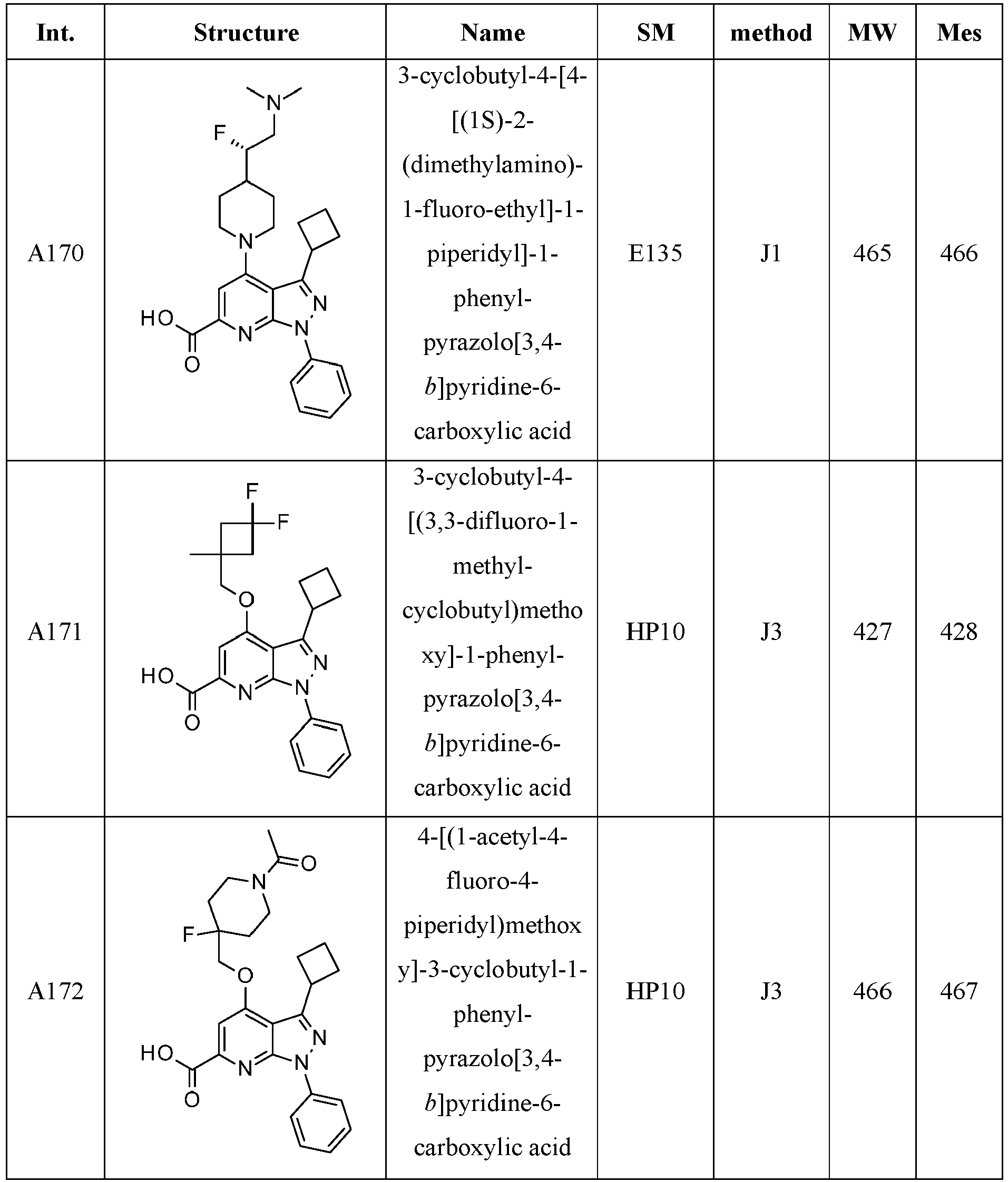


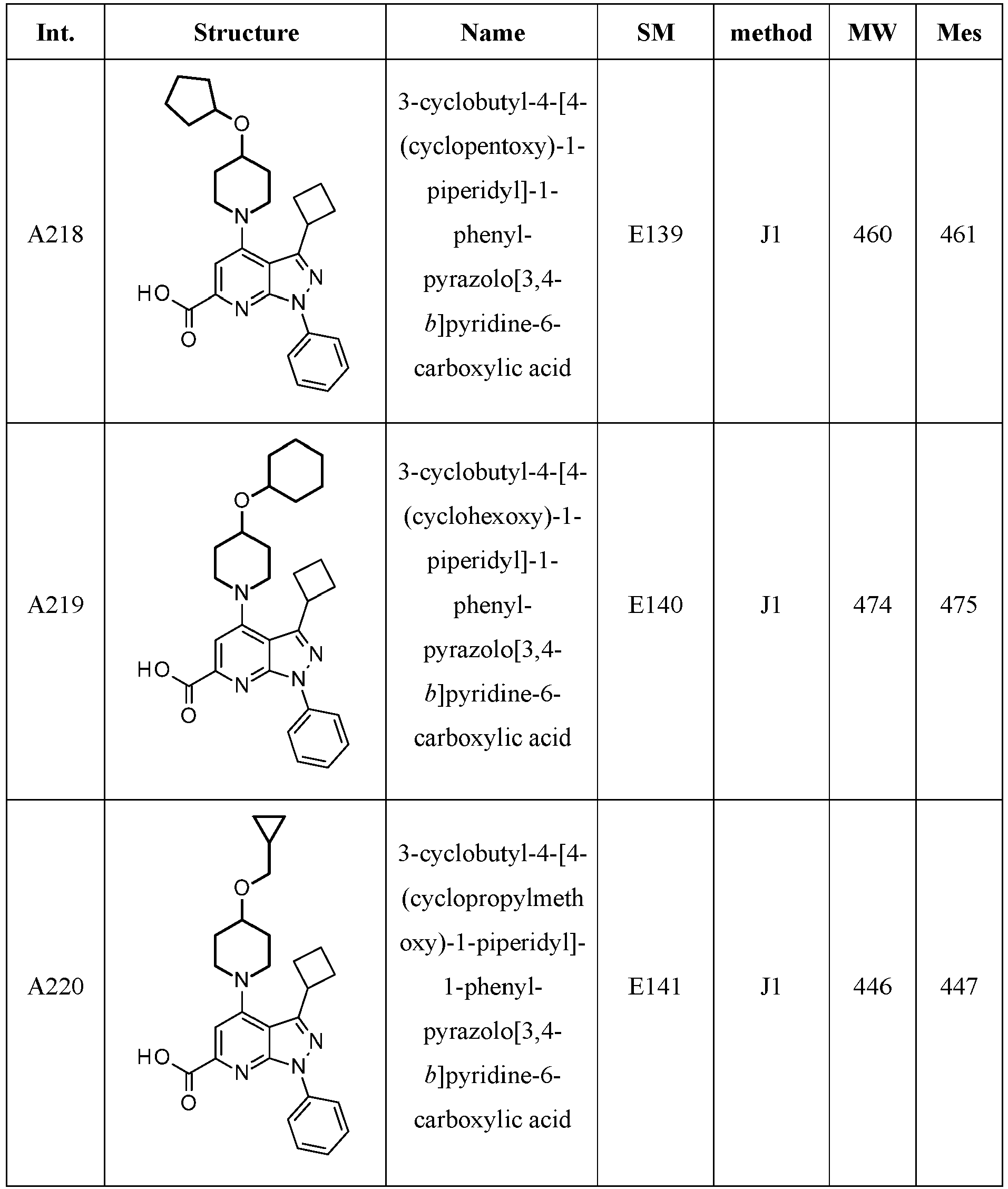


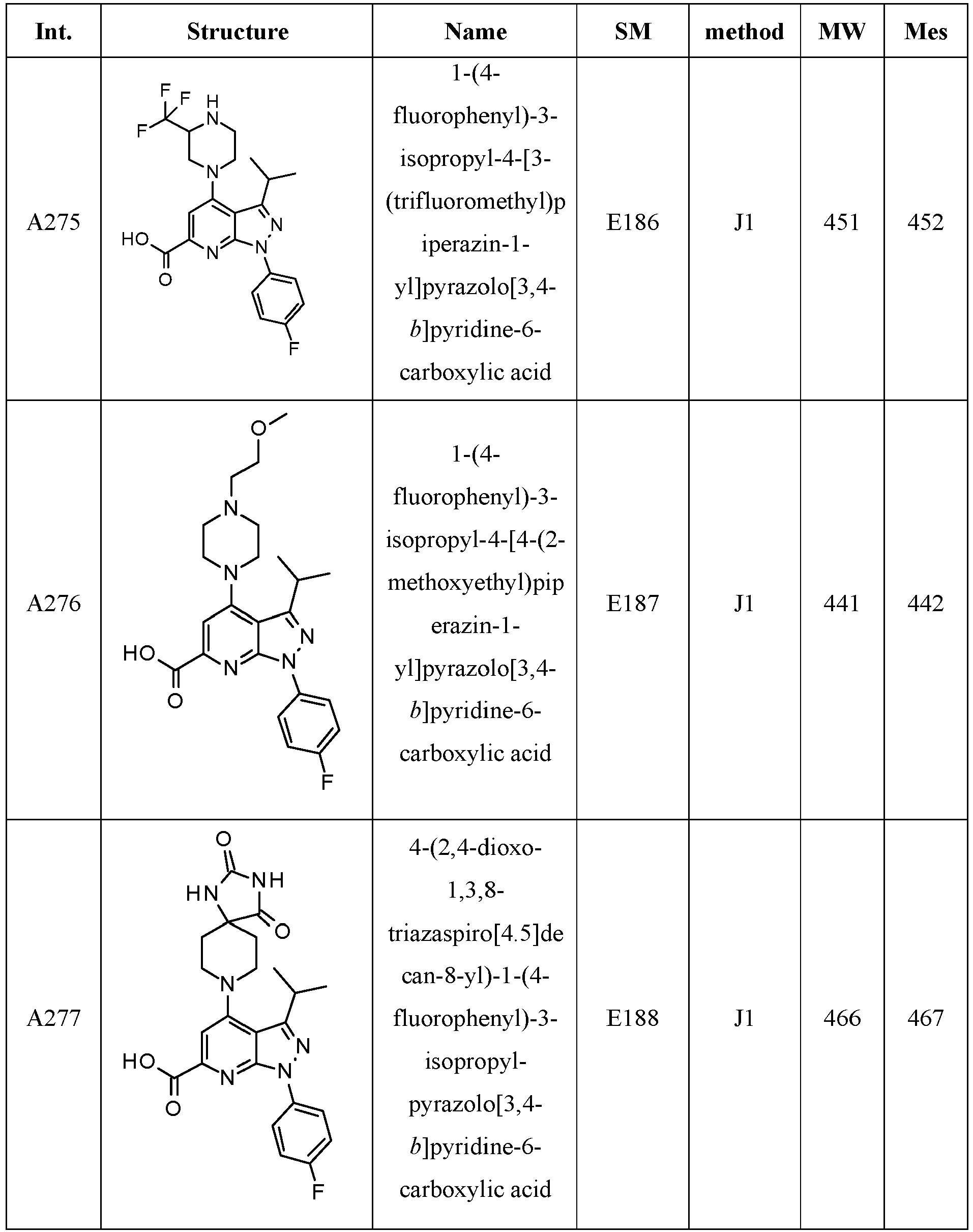

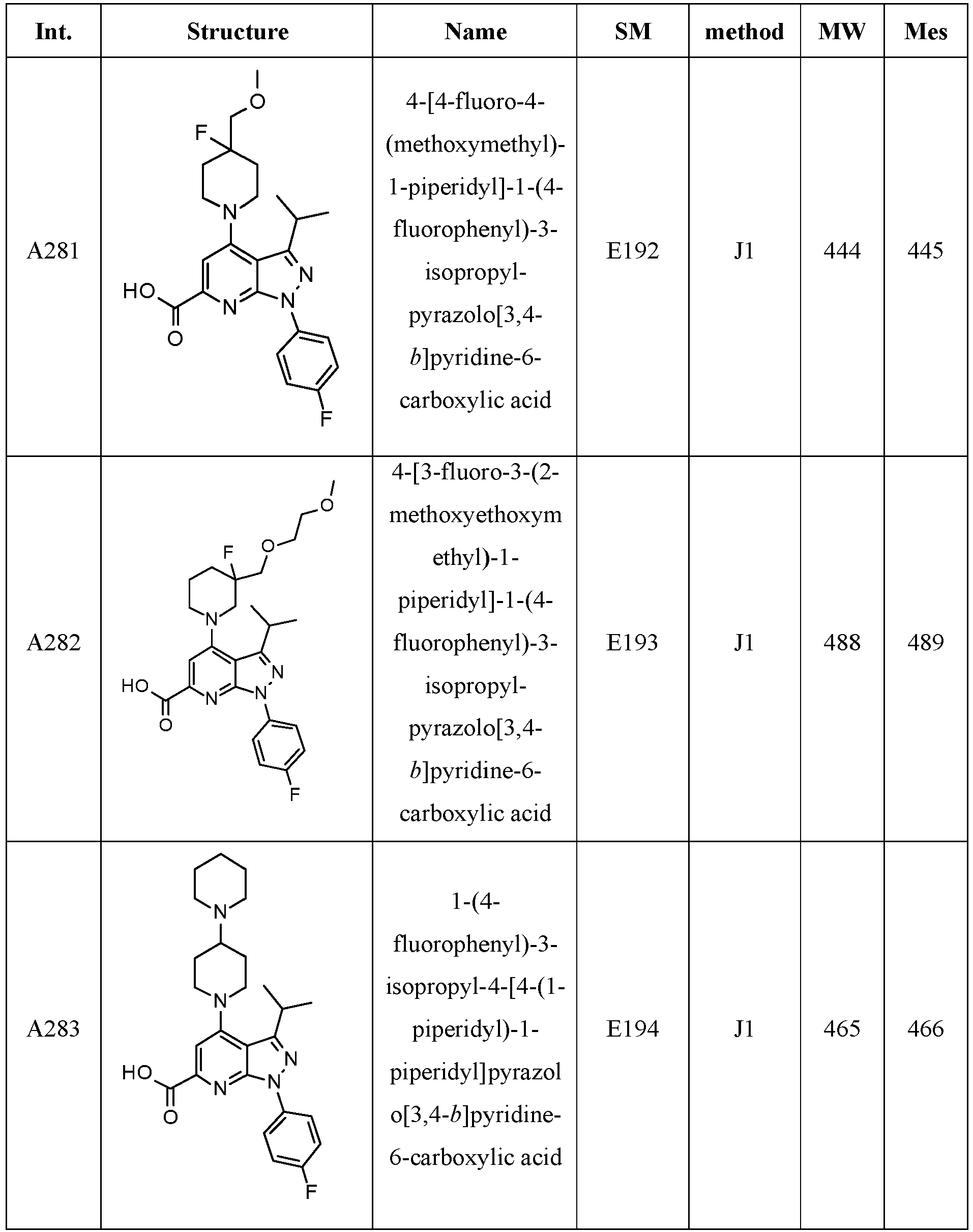


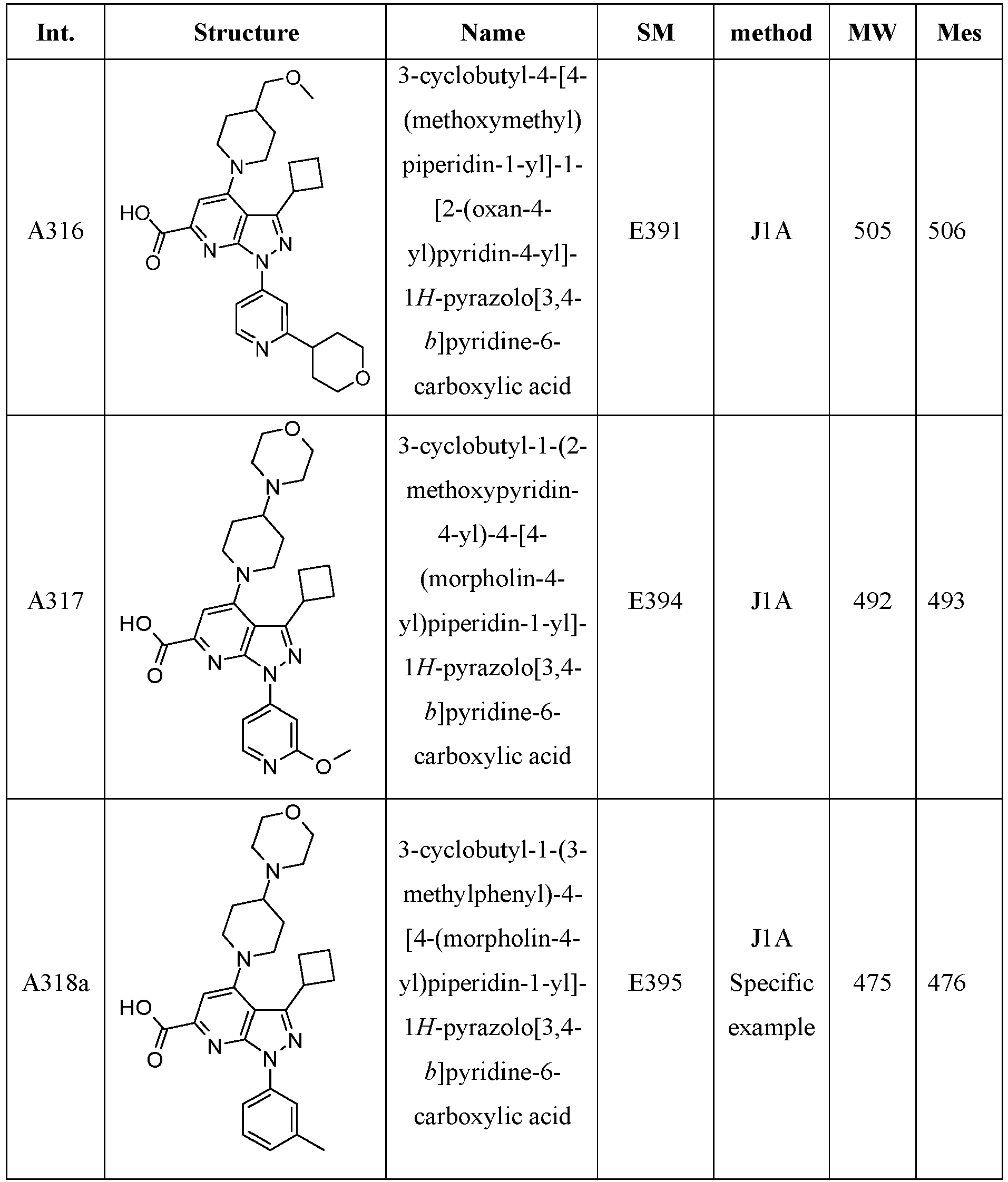


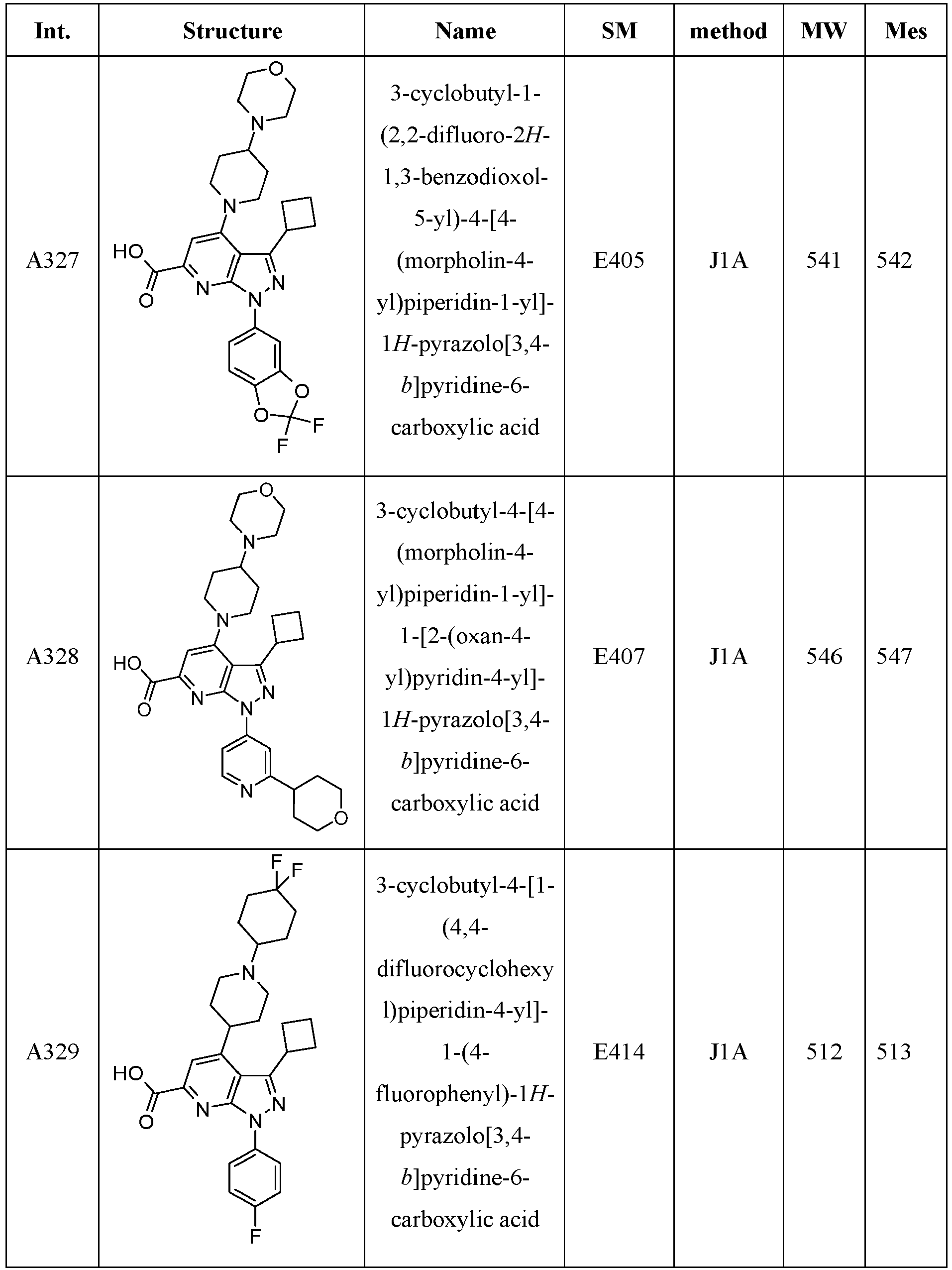


-

- A procedure similar to that described in J. Org. Chem. (1968) 33(2), 897 is followed: A round bottomed flask is charged with the sulfonyl chloride and diethyl ether (0.06 M), sealed with a septum and cooled in an ice bath. To the cooled solution is slowly added two molar equivalents of a dioxane solution of ammonia (0.5 M), and then the cold bath is removed. After 16 hours, the resulting heterogeneous mixture is filtered through filter paper. Volatiles are removed from the filtrate via rotary evaporation to give the sulfonamide which is used without further purification.
-

- A dioxane solution of ammonia (0.5 M, 10.5 mL, 5.25 mmol, 2.05 equiv) was added at 0 °C to a solution of methyl 3-(chlorosulfonyl)propanoate (CAS: 15441-07-3, 0.476 g, 2.55 mmol) in diethyl ether (10 mL). The reaction mixture was stirred at 0 °C for 1 hour and then 16 hours at RT. The reaction mixture was filtered, and the filtrate was concentrated to give the titled compound which was used without further purification.
-

- 3-Morpholinopropanesulfonic acid (CAS: 1132-61-2, 0.63 g, 3.0 mmol) was added to thionyl chloride (4.0 mL, 54.8 mmol, 18 equiv). Dimethylformamide (0.1 mL, 1.2 mmol, 0.4 equiv) was added, and the reaction mixture was stirred at RT for 5 hours. The reaction mixture was diluted with dichloromethane (4 mL) and dropped into heptane. Precipitation occurred, and the supernatant was removed. The residue dissolved in dichloromethane was dropped into pentane. The supernatant was removed, and the solid dried to give 3-morpholinopropanesulfonyl chloride hydrochloride.
- Bis(2,4-dimethoxybenzyl)amine (CAS: 20781-23-1, 0.32 g, 1.0 mmol, 1.0 equiv) and potassium carbonate (0.28 g, 2.0 mmol, 2.0 equiv) were added to a solution of 3-morpholinopropanesulfonyl chloride hydrochloride (0.26 g, 1.0 mmol) in acetonitrile (20 mL). The reaction mixture was stirred at RT for 8 hours. The reaction mixture was concentrated and the residue partitioned between water and ethyl acetate. The organic phase was dried over sodium sulfate, filtered and concentrated under reduced pressure. The residue was purified by flash column chromatography eluting with heptane/ethyl acetate (100/0 to 0/100) to give N,N-bis[(2,4-dimethoxyphenyl)methyl]-3-morpholino-propane-1-sulfonamide.
- Trifluoroacetic acid (0.8 mL, 10.4 mmol, 39 equiv) was added to a solution of N,N-bis[(2,4-dimethoxyphenyl)methyl]-3-morpholino-propane-1-sulfonamide (0.135 g, 0.27 mmol) in dichloromethane (4 mL). The reaction mixture was stirred at RT for 16 hours and was added to a saturated aqueous solution of sodium hydrogencarbonate. The mixture was extracted with ethyl acetate and then with a 9:1 mixture of dichloromethane/isopropanol. The organic phases were dried over sodium sulfate, filtered and concentrated under reduced pressure to give the titled compound.
- As an alternative preparation of S10, 3-chloropropane-1-sulfonamide (3.15 g, 20.0 mmol), morpholine (1.84, 21.0 mmol), sodium carbonate (4.24 g, 40.0 mmol) and sodium iodide (300 mg, 2.0 mmol) were heated in anhydrous dioxane (70 mL) at 70 °C for a day. The suspension was permitted to cool towards room temperature and then filtered through diatomaceous earth with an MTBE rinse. The filtrate was concentrated and chromatographed on silica (0 to 4% concentrated aqueous NH4OH/CH3CN) to give the titled compound (1.47 g). 1H NMR (400 MHz, CDCl3) δ ppm 5.41 (s, 2H), 3.70 (t, J = 4.7 Hz, 4H), 3.23 (t, J = 7.2 Hz, 2H), 2.54-2.43 (m, 6H), 2.10-2.02 (m, 2H); MS (DCI) m/z 209 (M+H)+.
-

- The titled compound may be prepared by the method described in
Ebden, et al. PCT Int. Appl. WO2004 011443 , example 25, substituting N-methylpiperidine hydrochloride for dimethylamine hydrochloride. To 1-(tert-butoxycarbonyl)-L-proline (5.0 g) in DCM (50 mL) at 5 °C was added dicyclohexylcarbodiimide (5.22 g) and N-hydroxysuccinimide (2.91 g). The mixture was stirred at this temperature for 16 hours. The solid was filtered, and the filtrate cooled to 5 °C. To this mixture was added triethylamine (9.80 mL) and N-methylpiperidine hydrochloride (4.7 g). The mixture was stirred at room temperature for 2 days, H2O (50 mL) was added, and the phases were separated. The organic fraction was washed with saturated sodium carbonate (2×20 mL) and brine (20 mL). This was then dried (MgSO4) and concentrated to dryness to afford tert-butyl(2S)-2-(4-methylpiperazine-1-carbonyl)pyrrolidine-1-carboxylate. This was then treated with 4 M aqueous HCl (20 mL), stirred at room temperature 3 hours, and concentrated in vacuo to dryness. A solution of the residue in dioxane was then treated with 2 grams of triethylamine and 10 grams of sulfamide, and the mixture was heated at reflux for 3 days before cooling. Solids were removed by filtration and washed with methanol. The combined filtrate and washing are concentrated in vacuo, and the residue was purified by column chromatography to give the titled compound. -

- A solution of (4-methylpiperazin-1-yl)(piperidin-4-yl)methanone hydrochloride in dioxane was treated with 5 equivalents of triethylamine and 10 equivalents of sulfamide and heated at reflux for 3 days. The mixture was then cooled and filtered, and the solids were washed with methanol. The filtrate and washings were concentration in vacuo, and the residue was purified by column chromatography to give the titled compound.
-

- A solution of amine hydrochloride (from 1 to 2 equiv.) in dioxane is treated with triethylamine (from 1.1 to 2.2 equiv), and sulfamide (from 1 to 2 equiv) and refluxed until full conversion is observed. The mixture is then cooled to RT, and the residue is purified by flash column chromatography to give the desired sulfamide derivative.
-

- A solution of 3-methoxypyrrolidine hydrochloride ([136725-50-3], 136 mg, 0.98 mmol) in dioxane (2 mL) was treated with triethylamine (0.2 mL, 1.4 mmol) and sulfamide (7803-58-9, 130 mg, 1.3 mmol), and the mixture was refluxed for 16 hours. The mixture was then cooled to RT, and the residue was purified by column chromatography eluted with DCM/MeOH (9/1) to give the titled compound.
-

- A solution of chlorosulfonylisocyanate ([1189-71-5], 1 eq) in anhydrous DCM (2.5 vol.) is cooled down in an ice batch under argon atmosphere. Benzyl alcohol ([100-51-6], 1 eq) is added dropwise over a 15 minutes period. The reaction mixture is stirred for 5 minutes and allowed to warm up to RT. The reaction mixture is worked up when no more starting material remained, by adding n-pentane. The precipitate is filtered, washed with n-pentane, and dried at 40 °C under reduced pressure to give the titled compound.
- A solution of amine (1 eq) and N,N-diisopropylethylamine (1.2 eq) in anhydrous DCM (10 vol.) is cooled down in an ice bath under an argon atmosphere. The compound from Step 1 (1.2 eq) is added, and after 5 minutes, the solution is allowed to warm up to RT. The reaction mixture is worked up when no more starting material remained, by adding water. The organic phase is diluted, separated, and washed successively with an aqueous 1 M HCl solution and a saturated aqueous solution of NaCl. The organic phase is dried over magnesium sulfate, filtered and concentrated in vacuo. The crude sample is either purified by flash column chromatography or suspended in a mixture of n-heptane/ethyl acetate (9/1), refluxed for 15 minutes, and then left cooling down to RT. The precipitate is collected by filtration, washed with a mixture of n-heptane/ethyl acetate (9/1), and dried at 40 °C under reduced pressure to give the desired N-benzyloxycarbonyl protected sulfamide.
- A solution of N-benzyloxycarbonyl protected sulfamide (1 eq) in THF or MeOH (20 vol.) is degassed with nitrogen. 20% Pd(OH)2 w/w is added, and the reaction mixture is purged with H2. The mixture is stirred at room temperature under a hydrogen atmosphere (balloon) until no more starting material is observed. Additional 20% Pd(OH)2 is added if necessary. The reaction mixture is filtered over a diatomaceous earth pad that is washed with THF or MeOH. The filtrate is concentrated in vacuo. The residue is purified by preparative HPLC or by flash column chromatography or used as such in the next step.
-

- A solution of chlorosulfonylisocyanate ([1189-71-5], 8.1 g, 57.4 mmol) in anhydrous DCM (20 mL) was cooled down in an ice bath under an argon atmosphere. Benzyl alcohol ([100-51-6], 5.9 mL, 57.4 mmol) was added dropwise over a 15 minutes period. The reaction mixture was stirred for 5 minutes and allowed to warm up to RT. After 10 minutes, n-pentane (20 mL) was added, and the resulting mixture was stirred at RT for 30 minutes. The precipitate was collected by filtration, washed with n-pentane, and dried at 40 °C under reduced pressure to give the titled compound.
- A solution of 4-(methoxymethyl)piperidine hydrochloride ([399580-55-3], 1.0 g, 6.0 mmol) and N,N-diisopropylethylamine (2.3 mL, 13.3 mmol) in anhydrous DCM (10 mL) was cooled down in an ice bath under an argon atmosphere. Benzyl (chlorosulfonyl)carbamate from Step 1 (1.8 g, 7.2 mmol) was added and after 5 minutes, and the solution was allowed to warm up to RT. After 3 hours, water (10 mL) and DCM (10 mL) were added, and stirring was continued for 15 minutes. The organic phase was separated, washed successively with an aqueous 1 M HCl solution (2 x 10 mL), and a saturated aqueous solution of NaCl (10 mL). The organic phase was dried over magnesium sulfate, filtered and concentrated in vacuo. The residue was purified by flash column chromatography eluting with a gradient of DCM/MeOH to give the titled compound.
- A solution of compound from Step 2 (570 mg, 1.8 mmol) in THF (11 mL) was degassed with nitrogen. 20% Pd(OH)2 (w/w, 114 mg) was added, and the reaction mixture was purged with H2. The mixture was stirred for 20 hours at RT under a hydrogen atmosphere (balloon). The reaction mixture was filtered over a diatomaceous earth pad that was washed with THF. The filtrate was concentrated in vacuo to give the titled compound.
Table XIV. List of sulfonamides Int. Structure Name SM method MW Mes S1 
2-morpholinoethanes ulfonamide 103654-84-8 X1 194 S2 
methyl 3-sulfamoylpropanoa te 15441-07-3 X1 Specific example 167 S3 
cyanomethanesulfo namide 27869-04-1 X1 120 S4 
tetrahydrofuran-3-sulfonamide 1207346 -29-9 X1 151 S5 
benzyl N-(2-sulfamoylethyl)car bamate 52530-50-4 X1 258 259 S6 
methyl 2-sulfamoylacetate 52530-50-4 X1 153 S7 
benzyl 3-sulfamoylpyrrolidi ne-1-carboxylate 1035173 -74-0 X1 284 S8 
tetrahydro-2H-pyran-4-sulfonamide 1058131 -55-7 X1 165 S9 
benzyl 4-sulfamoylpiperidin e-1-carboxylate 287953-54-2 X1 298 S10 
3-morpholinopropan e-1-sulfonamide 1132-61-2 X2 Specific example 208 209 S11 
(2S)-2-(4-methylpiperazine-1-carbonyl)pyrrolidi ne-1-sulfonamide 15761-39-4 X3 Specific example 276 S12 
4-(4-methylpiperazine-1-carbonyl)piperidin e-1-sulfonamide 1018826 -44-2 X4 Specific example 290 S13 
3-fluoropyrrolidine-1)-sulfonamide 7803-58-9, 169750-17-8 X4B 168 S14 
3-methoxypyrrolidin e-1-sulfonamide 7803-58-9, 136725-50-3 X4B Specific example 180 S15 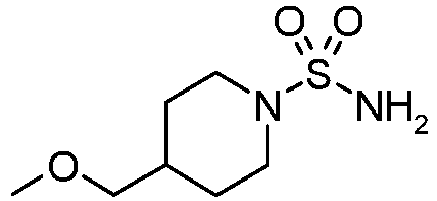
4-(methoxymethyl)pi peridine-1-sulfonamide 1189-71-5, 399580-55-3 X5 Specific example 208 S16 
piperidine-1-sulfonamide 1189-71-5, 110-89-4 X5 164 S17 
3-fluoroazetidine-1-sulfonamide 1189-71-5, 617718-46-4 X5 154 S18 
azetidine-1-sulfonamide 1189-71-5, 503-29-7 X5 136 S19 
(2R)-2-(methoxymethyl)p yrrolidine-1-sulfonamide 1189-71-5, 84025-81-0 X5 194 S20 
N-oxan-4-ylsulfuric diamide 1189-71-5, 38041-19-9 X5 180 S21 
N-methyl-N-oxan-4-ylsulfuric diamide 1189-71-5, 220641-87-2 X5 194 S22 
3,3-difluoroazetidine-1)-sulfonamide 1189-71-5, 288315-03-7 X5 172 S23 
N-methoxysulfuric diamide 1189-71-5, 593-56-6 X5 126 S24 
3-(morpholin-4-yl)pyrrolidine-1-sulfonamide 1189-71-5, 53617-37-1 X5 235 S25 
4-cyclopropylpiperaz ine-1-sulfonamide 1189-71-5, 20327-23-5 X5 205 S26 
4-(2-methoxyethyl)pipe razine-1-sulfonamide 1189-71-5, 13484-40-7 X5 223 S27 
3-methoxyazetidine-1)-sulfonamide 1189-71-5, 148644-09-1 X5 166 S28 
morpholine-4-sulfonamide 1189-71-5, 110-91-8 X5 166 -

- EDC•HCl (CAS 25952-538, 1.0 to 4.0 equiv) is added at RT to a stirring solution of carboxylic acid, sulfonamide or sulfamate (from 1.0 to 4.0 equiv) and 4-(dimethylamino) pyridine (CAS 1122-58-3, from 0.1 to 2.0 equiv) in dichloromethane or/and THF or/and acetone or/and acetonitrile. The reaction mixture is stirred at RT until full conversion is observed. The reaction mixture can be worked up or the solvent can be evaporated and the residue is purified by precipitation, by flash column chromatography or by preparative HPLC to yield the titled acylsulfonamide or acylsulfamide. To work up the reaction mixture, the solvent can be evaporated, and the residue is then partitioned between dichloromethane and water. The organic phase is successively washed with a saturated aqueous solution of NaHCO3, aqueous 0.5 N HCl and brine. The organic phase is separated, dried over sodium sulfate, filtered and concentrated in vacuo. Alternatively, the reaction mixture may be concentrated without an extractive workup. The residue is purified either by precipitation, by flash column chromatography or by preparative HPLC to yield the titled acylsulfonamide or acylsulfamate.
- Alternatively, acylsulfonamides or acylsulfamates can be prepared in the following manner. A solution of the carboxylic acid (1 eq) in dichloromethane, dichloroethane or dimethylformamide can be treated with carbodiimidazole (1-2.5 eq) stirred at ambient temperature to 65 °C for from 0.5-3 hours. Then the sulfonamide or sulfamate (1-3 eq) and optional potassium bis(trimethylsilyl)amide, sodium hydride, or triethylamine followed by 1,8-diazabicycloundec-7-ene (1-3 eq) and optional 4-(dimethylamino)pyridine (1-2 eq) can be added, and the reaction mixture is stirred at 20-60 °C for 2-16 hours. The reaction mixture can then be concentrated and the residue purified.
-

- EDC•HCl (CAS 25952-538, 24.6 g, 128.3 mmol) was added at RT to a stirring solution of intermediate A056 (30.7g, 64.1 mmol), methanesulfonamide (CAS 3144-09-0, 12.2 g, 128.3 mmol) and 4-(dimethylamino) pyridine (CAS 1122-58-3, 3.1 g, 25.7 mmol) in DCM (1L). The reaction mixture was stirred at RT for 1.5 hours. The solution was diluted with DCM (700 mL), washed successively with a saturated aqueous solution of sodium hydrogencarbonate (500 mL), aqueous 0.5 N HCl (500 mL) and a saturated aqueous solution of NaCl (500 mL). The organic phase was dried over sodium sulfate, filtered and concentrated under reduced pressure. The crude sample was purified by flash column chromatography eluting with DCM/ethyl acetate. The compound was suspended in acetonitrile and refluxed until complete dissolution. The warm solution was poured in hot water (700 mL), and the mixture was refluxed for 2 hours. The reaction volume was reduced to one third under a flow of nitrogen at 80 °C. The precipitate was collected by filtration and dried at 40 °C under reduced pressure.
-

- To a 4 mL vial charged with stir bar was added 3-cyclobutyl-4-[4-(methoxymethyl)-1-piperidyl]-1-phenyl-pyrazolo[3,4-b]pyridine-6-carboxylic acid (A136, 40 mg, 0.095 mmol) dissolved in 600 µL of dichloroethane followed by carbodiimidazole (34 mg, 0.21 mmol) in 600 µL of dichloroethane. The mixture was stirred at 42 °C for two hours. Then 2-methoxyethanesulfonamide (40 mg, 3 eq, 0.28 mmol) was then added followed by 1,8-diazabicycloundec-7-ene (43 uL, 3 eq, 0.28 mmol). The resultant mixture was heated at 60 °C for 16 hours. After completion of reaction, the reaction mixture was concentrated, dissolved in DMSO, and purified by reverse phase HPLC (C18, 0-100% CH3CN/water (0.1% TFA)). A gradient of acetonitrile (A) and 0.1% trifluoroacetic acid in water (B) was used, at a flow rate of 50 mL/min (0-0.5 min 10% A, 0.5-6.0 min linear gradient 10-100% A, 6.0-7.0 min 100% A, 7.0-8.0 min linear gradient 100-10% A) to afford the title compound.
-

- 3-Cyclobutyl-4-(4-morpholino-1-piperidyl)-1-phenyl-pyrazolo[3,4-b]pyridine-6-carboxylic acid (A268, 139 mg, 0.30 mmol) and carbonyl diimidazole (73 mg, 0.45 mmol) were stirred in anhydrous DMF (2 mL) at room temperature for 50 minutes. Then methanesulfonamide (57 mg, 0.60 mmol) was added, followed by triethylamine (125 µL, 0.90 mmol), and the suspension was stirred overnight. DBU (45 µL, 0.30 mmol) was added dropwise to the suspension, which was stirred for more than forty minutes before additional DBU (22.5 µL, 0.15 mmol) was added, and the solution was heated at 50 °C for more than 4 hours. The reaction mixture was then purified by preparative HPLC on a preparatory Waters® Atlantis® T3 column (30 mm × 100 mm) with a 20 to 100% gradient of acetonitrile in 10 mM aqueous ammonium acetate at 40 mL/min to give the titled compound (70 mg).
-

- 3-Cyclobutyl-4-[4-(2-morpholinoethyl)-1-piperidyl]-1-phenyl-pyrazolo[3,4-b]pyridine-6-carboxylic acid (A270, 118 mg, 0.24 mmol) and carbonyl diimidazole (78 mg, 0.48 mmol) were stirred in anhydrous DMF (1.5 mL) at room temperature for one hour. Then methanesulfonamide (46 mg, 0.48 mmol) and triethylamine (67 µL, 0.48 mmol) were added, followed by slow, dropwise addition of DBU (54 µL, 0.36 mmol). The reaction mixture was stirred for about another 30 minutes, diluted with water (8 mL), concentrated and purified by preparative HPLC on a preparatory Waters® Atlantis® T3 column (30 mm × 100 mm) with a 20 to 100% gradient of acetonitrile in 10 mM aqueous ammonium acetate at 40 mL/min to give the titled compound (46 mg).
-

- 4-[(3aR,7aS)-1-Acetyl-3,3a,4,6,7,7a-hexahydro-2H-pyrrolo[3,2-c]pyridin-5-yl]-3-cyclobutyl-1-phenyl-pyrazolo[3,4-b]pyridine-6-carboxylic acid (A271, <0.5 mmol) and carbonyl diimidazole (243 mg, 1.5 mmol) were stirred in anhydrous DMF (4 mL) at room temperature for an hour. Then triethylamine (210 µL, 1.5 mmol) and a solution of 3-(morpholin-4-yl)propane-1-sulfonamide (S10, 313 mg, 1.5 mmol) in anhydrous acetonitrile (400 µL) were added, followed by slow dropwise addition of DBU (75 µL, 0.50 mmol). The reaction mixture was stirred for an hour, more DBU (45 µL, 0.30 mmol) was added dropwise, and the reaction mixture was stirred another hour before being diluted with water (20 mL), concentrated and purified by preparative HPLC on a preparatory Waters® Atlantis® T3 column (30 mm × 100 mm) with a 5 to 100% gradient of acetonitrile in 10 mM aqueous ammonium acetate at 40 mL/min to give the titled compound (74 mg).
-

- 3 -Cyclobutyl-1-phenyl-4-(tetrahydropyran-4-ylmethoxy)pyrazolo[3,4-b]pyridine-6-carboxylic acid (A148, 102 mg, 0.25 mmol) and carbonyl diimidazole (61 mg, 0.38 mmol) were stirred in anhydrous DMF (1.6 mL) at room temperature for one hour. Then a solution of 3-(morpholin-4-yl)propane-1-sulfonamide (S10, 104 mg, 0.50 mmol) in DMF (0.4 mL) and triethylamine (70 µL, 0.50 mmol) were added, followed by slow, dropwise addition of DBU (56 µL, 0.37 mmol). The reaction mixture was stirred for another thirty minutes, diluted with water (8 mL), concentrated and purified by preparative HPLC on a Waters® Atlantis® T3 column (30 mm × 100 mm) with a 30 to 60% gradient of acetonitrile in 10 mM aqueous ammonium acetate at 50 mL/min to give the titled compound (61 mg).
-

- 3-Cyclobutyl-4-[(3R)-3-(hydroxymethyl)piperidin-1-yl]-1-phenyl-1H-pyrazolo[3,4-b]pyridine-6-carboxylic acid (A284, 57 mg, 0.14 mmol) and carbonyl diimidazole (46 mg, 0.28 mmol) were stirred in anhydrous DMF (1.0 mL) at room temperature for about one hour. Then methanesulfonamide (27 mg, 0.28 mmol) and triethylamine (39 µL, 0.28 mmol) were added, followed by slow, dropwise addition of DBU (31.5 µL, 0.21 mmol). The reaction mixture was stirred more than 30 minutes, diluted with water (8 mL), concentrated and purified by preparative HPLC on a Waters® Atlantis® T3 C18 column (30 × 150 mm) with a 30 to 60% gradient of acetonitrile in 10 mM aqueous ammonium acetate at 50 mL/min to give the titled compound (17 mg).
-

- 3-Cyclobutyl-4-[(3R)-3-(hydroxymethyl)piperidin-1-yl]-1-phenyl-1H-pyrazolo[3,4-b]pyridine-6-carboxylic acid (A284, 61 mg, 0.15 mmol) and carbonyl diimidazole (49 mg, 0.30 mmol) were stirred in anhydrous DMF (1.0 mL) at room temperature for about one hour. Then a solution of 3-(morpholin-4-yl)propane-1-sulfonamide (S10, 63 mg, 0.30 mmol) in anhydrous acetonitrile (200 µL) and triethylamine (42 µL, 0.30 mmol) were added, followed by slow, dropwise addition of DBU (34 µL, 0.23 mmol). The reaction mixture was stirred for more than 30 minutes, diluted with water (8 mL), concentrated and purified by preparative HPLC on a Waters® Atlantis® T3 C18 column (30 × 150 mm) with a 40 to 70% gradient of acetonitrile in 10 mM aqueous ammonium acetate at 50 mL/min to the titled compound (30 mg).
-

- 3-Cyclobutyl-1-phenyl-4-[4-(1-piperidyl)-1-piperidyl]pyrazolo[3,4-b]pyridine-6-carboxylic acid (A081, 51 mg, 0.11 mmol) and carbonyl diimidazole (28 mg, 0.17 mmol) were stirred in anhydrous DMF (600 µL) at room temperature for an hour. Then methanesulfonamide (21 mg, 0.22 mmol) and triethylamine (31 µL, 0.22 mmol) were added, followed by DBU (25.5 µL, 0.17 mmol). The reaction mixture was stirred 30 minutes at room temperature, diluted with water (5 mL), concentrated and purified by preparative HPLC on a Waters® Sunfire™ C8 column (30 × 150 mm) with a 30 to 60% gradient of acetonitrile in 10 mM aqueous ammonium acetate at 50 mL/min to give the titled compound (30 mg).
-
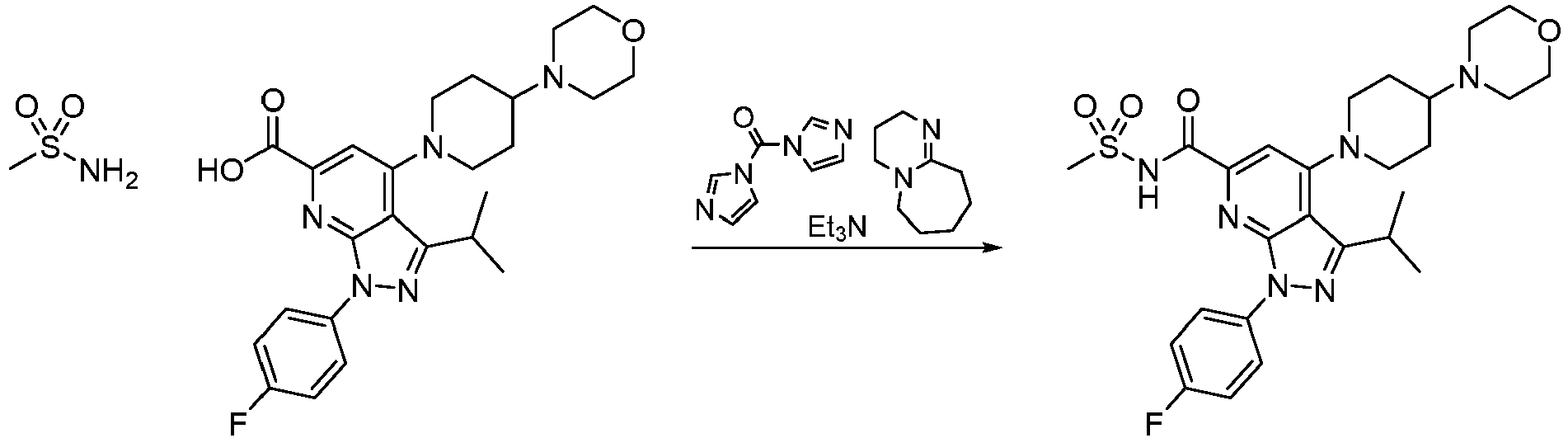
- 1-(4-Fluorophenyl)-4-[4-(morpholin-4-yl)piperidin-1-yl]-3-(propan-2-yl)-1H-pyrazolo[3,4-b]pyridine-6-carboxylic acid (A408, 70 mg, 0.15 mmol) and carbonyl diimidazole (37 mg, 0.23 mmol) were stirred in anhydrous DMF (800 µL) at room temperature for an hour. Then methanesulfonamide (29 mg, 0.30 mmol) and triethylamine (42 µL, 0.30 mmol) were added, followed by slow addition of DBU (34 µL, 0.23 mmol). The reaction mixture was stirred 30 minutes at room temperature, diluted with methanol and purified by preparative HPLC on a Waters® Sunfire™ C8 column (30 × 150 mm) with a 30 to 60% gradient of acetonitrile in 10 mM aqueous ammonium acetate to give the titled compound.
-

- 1 -(4-Fluorophenyl)-4- [4-(morpholin-4-yl)piperidin-1-yl]-3-(propan-2-yl)-1H-pyrazolo[3,4-b]pyridine-6-carboxylic acid (A408, 70 mg, 0.15 mmol) and carbonyl diimidazole (37 mg, 0.23 mmol) were stirred in anhydrous DMF (800 µL) at room temperature for an hour. Then ethanesulfonamide (33 mg, 0.30 mmol) and triethylamine (42 µL, 0.30 mmol) were added, followed by slow addition of DBU (34 µL, 0.23 mmol). The reaction mixture was stirred 30 minutes at room temperature, diluted with methanol and purified by preparative HPLC on a Waters® Sunfire™ C8 column (30 × 150 mm) with a 30 to 60% gradient of acetonitrile in 10 mM aqueous ammonium acetate to give the titled compound.
-

- 1 -(4-Fluorophenyl)-4- [4-(morpholin-4-yl)piperidin-1-yl]-3-(propan-2-yl)-1H-pyrazolo[3,4-b]pyridine-6-carboxylic acid (A408, 70 mg, 0.15 mmol) and carbonyl diimidazole (37 mg, 0.23 mmol) were stirred in anhydrous DMF (800 µL) at room temperature for an hour. Then cyclopropanesulfonamide (36 mg, 0.30 mmol) and triethylamine (42 µL, 0.30 mmol) were added, followed by slow addition of DBU (34 µL, 0.23 mmol). The reaction mixture was stirred 30 minutes at room temperature, diluted with methanol and purified by preparative HPLC on a Waters® Sunfire™ C8 column (30 × 150 mm) with a 30 to 60% gradient of acetonitrile in 10 mM aqueous ammonium acetate to give the titled compound.
-

- 3-Cyclobutyl-1-phenyl-4-[4-(1-piperidyl)-1-piperidyl]pyrazolo[3,4-b]pyridine-6-carboxylic acid (A081, 92 mg, 0.20 mmol) and carbonyl diimidazole (49 mg, 0.30 mmol) were stirred in anhydrous DMF (1.0 mL) at room temperature for 90 minutes. Then ethanesulfonamide (44 mg, 0.40 mmol) and triethylamine (56 µL, 0.40 mmol) were added, followed nearly 15 minutes later by slow addition DBU (45 µL, 0.30 mmol). The reaction mixture was stirred 30 minutes at room temperature, diluted with methanol and purified by preparative HPLC on a Waters® Sunfire™ C8 column (30 × 150 mm) with a 40 to 70% gradient of acetonitrile in 10 mM aqueous ammonium acetate to give the titled compound.
-

- 3-Cyclobutyl-1-phenyl-4-[4-(1-piperidyl)-1-piperidyl]pyrazolo[3,4-b]pyridine-6-carboxylic acid (A081, 92 mg, 0.20 mmol) and carbonyl diimidazole (49 mg, 0.30 mmol) were stirred in anhydrous DMF (1.0 mL) at room temperature for 90 minutes. Then cyclopropanesulfonamide (49 mg, 0.40 mmol) and triethylamine (56 µL, 0.40 mmol) were added, followed nearly 15 minutes later by slow addition DBU (45 µL, 0.30 mmol). The reaction mixture was stirred 30 minutes at room temperature, diluted with methanol and purified by preparative HPLC on a Waters® Sunfire™ C8 column (30 × 150 mm) with a 30 to 60% gradient of acetonitrile in 10 mM aqueous ammonium acetate to give the titled compound.
-

- To a suspension of the 3-cyclobutyl-1-phenyl-4-[4-(1-piperidyl)-1-piperidyl]pyrazolo[3,4-b]pyridine-6-carboxylic acid (46 mg, 0.10 mmol, A081) and carbonyl diimidazole (29 mg, 0.18 mmol) in anhydrous DMF (400 µL) was added pyridine (81 µL, 1.0 mmol). The mixture was stirred nearly ten minutes at room temperature and then another 15 minutes at 50 °C before being brought to room temperature. In a separate vial, 3-morpholinopropane-1-sulfonamide (42 mg, 0.20 mmol) under nitrogen was dissolved into anhydrous DMF (400 µL) and treated with 1 M potassium bis(trimethylsilyl)amide in THF (190 µL, 0.19 mmol), stirred ten minutes to give a suspension and then treated dropwise with the contents of the first vial, which were transferred with a DMF (200 µL) rinse. The mixture was stirred at room temperature for three days, diluted with methanol and purified by preparative HPLC on a Waters® Sunfire™ C8 column (30 × 150 mm) with a 35 to 65% gradient of acetonitrile in 10 mM aqueous ammonium acetate to give the titled compound.
-

- 3-Cyclobutyl-4-[4-(morpholin-4-yl)piperidin-1-yl]-1-phenyl-1H-pyrazolo[3,4-b]pyridine-6-carboxylic acid (45 mg, 0.10 mmol, A409) dissolved in dichloromethane (500 µL) was treated with 1-ethyl-3-(3-dimethylaminopropyl)carbodiimide (18 mg, 0.12 mmol) in dichloromethane (500 µL), dimethyl amino pyridine (24 mg, 0.2 mmol) and N-methylethanesulfonamide (13 mg, 0.11 mmol). The mixture was then stirred at room temperature overnight. The mixture was concentrated, and the residue was dissolved DMSO and purified by reverse phase HPLC (C18, 0-100% CH3CN/water (0.1% TFA)). A gradient of acetonitrile (A) and 0.1% trifluoroacetic acid in water (B) was used, at a flow rate of 50mL/minute (0-0.5 minute 10% A, 0.5-6.0 minutes linear gradient 10-100% A, 6.0-7.0 minutes 100% A, 7.0-8.0 minutes linear gradient 100-10% A) gave the titled compound.
-

- A solution of LiOH (0.0189 g, 0.45 mmol, 2.1 equiv) in H2O (1 mL) was added to a solution of compound 288 (0.123 g, 0.216 mmol) in THF. The reaction mixture was stirred for 30 min and then concentrated. The residue was partitioned between dichloromethane (100 mL) and an aqueous H3PO4/NaH2PO4 buffer (1.0 M, pH 2, 100 mL). The organic phase was washed with brine, dried over MgSO4, filtered and concentrated to give compound 289 (carboxylic acid).
- BOP (CAS: 56602-33-6, 0.037 g, 0.084 mmol, 1.2 equiv) was added to a solution of compound 289 (0.0378 g, 0.0680 mmol) in dichloromethane (4 mL). After 10 minutes, a THF solution of dimethylamine (2.0 M, 0.25 mL, 0.50 mmol, 7.3 equiv) was added. The reaction mixture was stirred at room temperature for 16 hours. The reaction mixture was charged onto a column of silica gel and eluted with CH2Cl2/iPrOH (20:1) to yield the titled compound. 1H NMR (400 MHz, CDCl3/CD3OD) δ ppm 7.99 (d, J=8.25, 2H), 7.51 (t, J=8.0 Hz, 2H), 7.44 (s, 1H), 7.32 (t, J=7.4, 1H), 3.98 (pent, J=8.4 Hz, 1H), 3.67-3.59 (m, 2H), 3.50 (t, J=6.5 Hz, 2H), 3.40-3.33 (m, 2H), 3.37 (s, 3H), 3.14 (t, J=6.5 Hz, 2H), 2.94-2.84 (m, 2H), 2.6-2.49 (m, 2H), 2.44-2.34 (m, 2H), 2.38 (s, 6H), 2.12-1.79 (m, 5H), 1.60-1.48 (m, 2H)
-

- Potassium iodide (0.3 equiv) is added to a solution of alkylchloride in acetonitrile. The amine (15 to 20 equiv) is added, and the vial is sealed. The reaction mixture is stirred at RT or 50 °C for 16 hours. After concentration, the residue is partitioned between water and dichloromethane. The organic phase is washed with brine, dried over MgSO4, filtered and concentrated in vacuo. If necessary, the residue was purified either by precipitation in pentane or by silica gel chromatography.
-

- KI (2 mg, 0.012 mmol, 0.3 equiv) was added to a solution of N-(3-chloropropylsulfonyl)-1-(4-fluorophenyl)-3-isopropyl-4-[4-(methoxymethyl)-1-piperidyl]pyrazolo[3,4-b]pyridine-6-carboxamide (AC01, 20 mg, 0.035 mmol) in acetonitrile (3 mL). The vial was sealed, and the reaction mixture was saturated with gaseous dimethylamine. The reaction mixture was stirred at RT for 16 hours. After concentration, the residue was partitioned between water and dichloromethane. The organic phase was washed with brine, dried over MgSO4, filtered and concentrated to give the titled compound.
-

- Step 1: Oxalyl chloride (0.40 mL, 4.7 mmol, 9.6 equiv) and a drop of dimethylformamide are added to a solution of carboxylic acid (0.49 mmol) in dichloromethane (2 mL). After effervescence has ceased, the vial is sealed, and the reaction mixture is stirred at room temperature for 1 hour. The reaction mixture is concentrated in vacuo, and to the residue is added a dioxane solution of ammonia (0.5 M, 10.0 mL, 5.0 mmol, 10 equiv). After 1 hour, volatiles are then removed via rotary evaporation. The residue is purified by silica gel chromatography (dichloromethane/ethyl acetate, 4:1) to give the intermediate carboxamide.
- Step 2: NaH (60% in mineral oil, 21 equiv to 50 equiv) is added to a solution of carboxamide in dry THF. After effervescence has ceased, sulfonyl chloride (1.4 to 2.0 equiv) is added. The reaction mixture is stirred at room temperature for several hours. An aqueous solution of malate buffer (1.0 M sodium malate/disodium malate, pH 4.5, 4 mL) is slowly added. After 5 minutes, the mixture is combined with chloroform or dichloromethane and stirred. The organic phase is collected and concentrated in vacuo. The residue is purified by preparative HPLC or by flash column chromatography to give the titled compound.
-

- Step 1: Oxalyl chloride (0.40 mL, 4.7 mmol, 9.6 equiv) and a drop of dimethylformamide were added to a solution of A136 (0.207 g, 0.49 mmol) in dichloromethane (2 mL). After effervescence had ceased, the vial was sealed, and the reaction mixture was stirred at room temperature for 1 hour. The reaction mixture was concentrated, and to the residue was added a dioxane solution of ammonia (0.5M, 10.0 mL, 5.0 mmol, 10 equiv). After 1 hour, volatiles were then removed via rotary evaporation. The residue was purified by silica gel chromatography (CH2Cl2/EtOAc, 4:1) to give 3-cyclobutyl-4-[4-(methoxymethyl)-1-piperidyl]-1-phenyl-pyrazolo[3,4-b]pyridine-6-carboxamide.
- Step 2: NaH (60% in mineral oil, 0.080 g, 2.0 mmol, 21 equiv) was added to a solution of 3-cyclobutyl-4-[4-(methoxymethyl)-1-piperidyl]-1-phenyl-pyrazolo[3,4-b]pyridine-6-carboxamide (0.041 g, 0.098 mmol) in dry THF (2 mL). After effervescence has ceased, 3,5-dimethylisoxazole-4-sulfonyl chloride (CAS: 877861-76-2, 0.038 g, 0.19 mmol, 1.9 equiv) was added. The reaction mixture was stirred at room temperature for 16 h. An aqueous solution of malate buffer (1.0 M sodium malate/disodium malate, pH 4.5, 4 mL) was slowly added. After 5 minutes, the mixture was combined with chloroform and agitated. The organic phase was collected and concentrated in vacuo. The residue was purified by preparative HPLC to give the titled compound.
-

- Oxalyl chloride (CAS 79-37-8, 1.5 equiv) and 3 drops of dimethylformamide are added at 0 °C to a solution of carboxylic acid in dichloromethane. After 1 h of stirring at room temperature, additional oxalyl chloride (CAS 79-37-8, 1.5 equiv) is added. After 30 minutes of stirring, the reaction mixture is cooled to 0 °C and sulfonamide (3.0 equiv) followed by triethylamine (2.0 equiv) are added. The reaction mixture is stirred at room temperature for 3 h and then concentrated in vacuo. The residue is partitioned between a saturated aqueous solution of sodium hydrogencarbonate and dichloromethane. The organic phase is dried over MgSO4, filtered and concentrated in vacuo. The residue dissolved in dichloromethane is precipitated by addition to a mixture of diethyl ether/pentane. The solid collected by filtration is purified by silica gel chromatography to give the titled compound.
- Alternatively, oxalyl chloride (5-10 equivalents) is added to a mixture of carboxylic acid (1 equiv) in dichloromethane followed by stirring at ambient temperature over 8-24 hours. The reaction mixture is diluted with dichloromethane and concentrated several times followed by drying under vacuum. The carboxylic acid chloride (1 equiv) is then combined with sulfonamide (2 equiv) and triethylamine (2.5-5 equiv) in dichloromethane with stirring at ambient temperature over 1-24 hours. The reaction mixture is concentrated and purified by preparative HPLC.
-
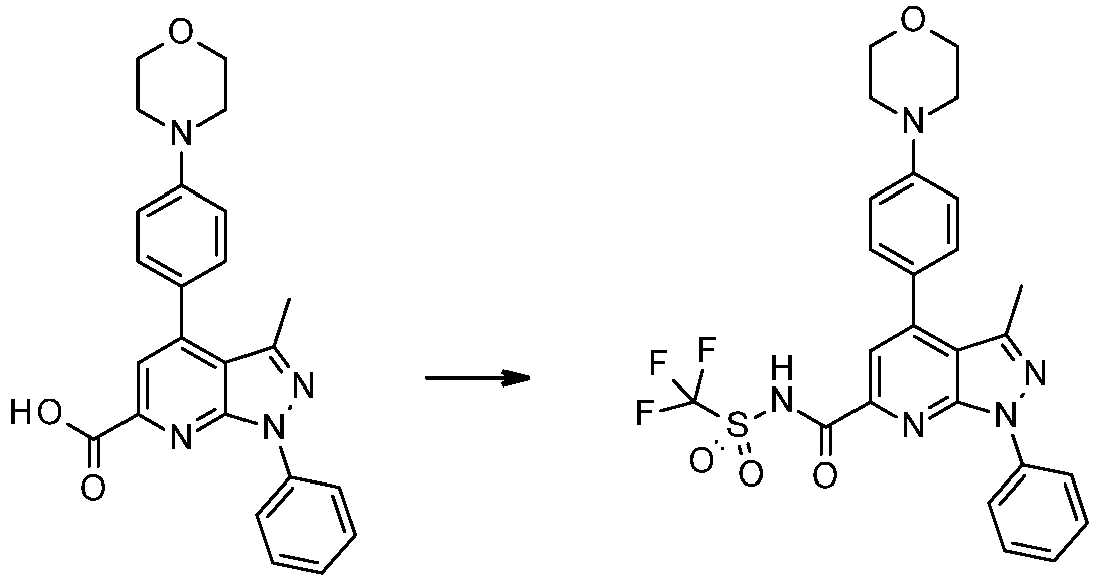
- Oxalyl chloride (CAS 79-37-8, 0.012 mL, 0.15 mmol, 1.5 equiv) and 3 drops of dimethylformamide were added at 0 °C to a solution of A002 (41 mg, 0.1 mmol) in dichloromethane (2 mL). After 1 h of stirring at room temperature, additional oxalyl chloride (CAS 79-37-8, 0.012 mL, 0.15 mmol, 1.5 equiv) was added. After 30 minutes of stirring, the reaction mixture was cooled to 0 °C and trifluoromethanesulfonamide (CAS 421-85-2, 48 mg, 0.3 mmol, 3.0 equiv) followed by triethylamine (0.029 mL, 0.2 mmol, 2.0 equiv) were added. The reaction mixture was stirred at room temperature for 3 h and then concentrated in vacuo. The residue was partitioned between a saturated aqueous solution of sodium hydrogencarbonate and dichloromethane. The organic phase was dried over MgSO4, filtered and concentrated. The residue dissolved in dichloromethane was precipitated by addition to a mixture of diethyl ether/pentane. The solid collected by filtration was purified by silica gel chromatography (heptane/EtOAc 100/0 to 0/100) to give the titled compound.
-

- A suspension of 3-cyclobutyl-4-(4-morpholino-1-piperidyl)-1-phenyl-pyrazolo[3,4-b]pyridine-6-carboxylic acid (A268, 0.0511 g, 0.111 mmol) and (COCl)2 (18 µL, 0.206 mmol) in CH2Cl2 (0.40 mL) with catalytic DMF was stirred for 90 minutes, concentrated, and re-dissolved in CH2Cl2 (0.40 mL). To this mixture was added morpholine-4-sulfonamide (0.0213 g, 0.128 mmol), DMAP (0.0141 g, 0.115 mmol), and triethylamine (18 µL, 0.129 mmol), and the mixture was stirred overnight. The reaction mixture was then diluted with saturated NaHCO3, extracted with CH2Cl2, concentrated, and chromatographed on silica gel (25% acetone/CH2Cl2) and re-chromatographed (2.5% CH3OH/CH2Cl2) and precipitated (methanol/methyl tert-butyl ether) to give the titled compound (0.0267 g, 0.044 mmol, 40% yield).
-
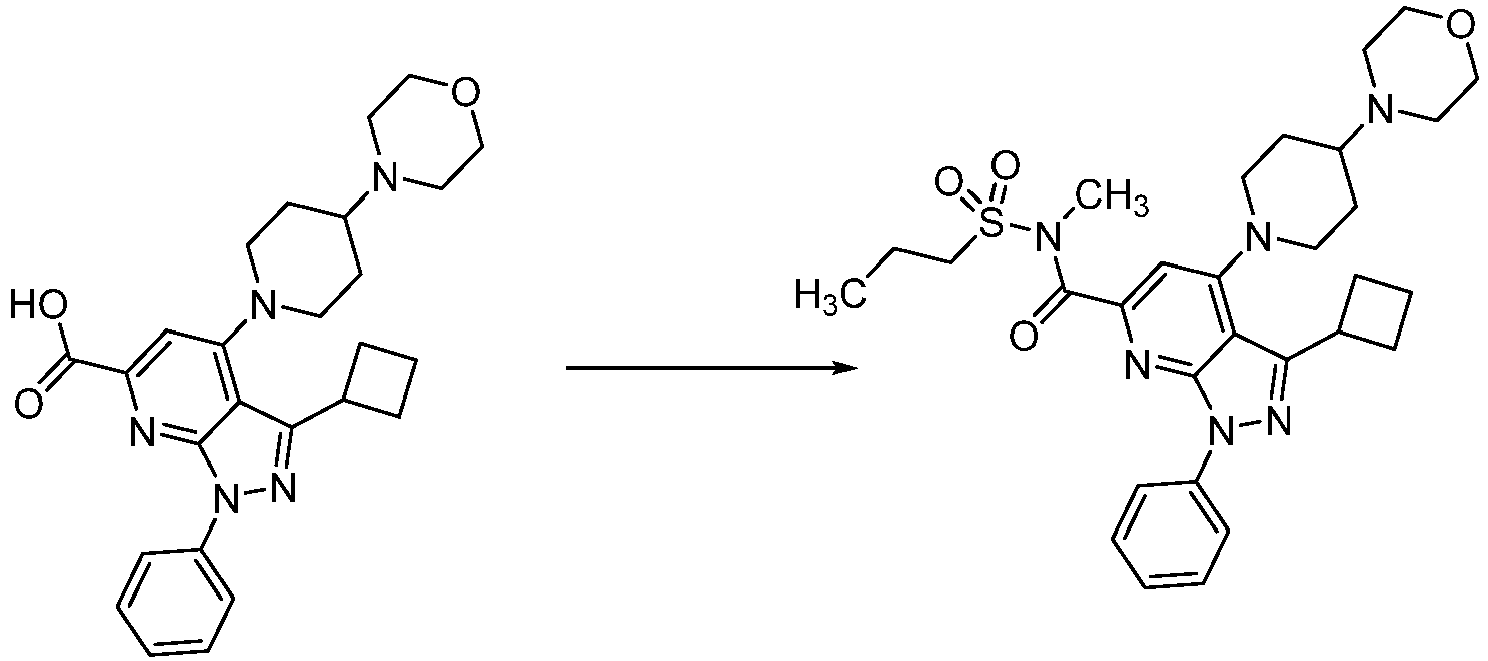
- A vial was charged with 3-cyclobutyl-4-[4-(morpholin-4-yl)piperidin-1-yl]-1-phenyl-1H-pyrazolo[3,4-b]pyridine-6-carbonyl chloride (35 mg, 0.08 mmol, prepared as described below for the synthesis of compound 437) dissolved in 500 µL of dichloromethane followed by N-methyl-N-propylsulfonamide (2 eq, 0.15 mmol) in 500 µL of dichloromethane and neat triethylamine (38 µL, 4 eq, 0.32 mmol). The mixture was then stirred at room temperature for one hour. After completion of reaction, the mixture was concentrated, and the residue was dissolved in DMSO and purified by reverse phase HPLC (C18, 0-100% CH3CN/water (0.1% TFA)). A gradient of acetonitrile (A) and 0.1% trifluoroacetic acid in water (B) was used, at a flow rate of 50mL/minute (0-0.5 minute 10% A, 0.5-6.0 minutes linear gradient 10-100% A, 6.0-7.0 minutes 100% A, 7.0-8.0 minutes linear gradient 100-10% A) to afford the title compound.
-

- To a suspension of 3-cyclobutyl-4-[4-(morpholin-4-yl)piperidin-1-yl]-1-phenyl-1H-pyrazolo[3,4-b]pyridine-6-carboxylic acid (A409, 0.8117 g, 1.759 mmol) in dichloromethane (10 mL) was added oxalyl chloride (1 mL, 11.4 mmol) dropwise, and the mixture was stirred at RT overnight. The reaction mixture was diluted with more dichloromethane (11 mL) and concentrated under vacuum. This process was repeated two additional times. The resultant yellow solid material, which was kept under vacuum for one hour to give 3-cyclobutyl-4-[4-(morpholin-4-yl)piperidin-1-yl]-1-phenyl-1H--pyrazolo[3,4-b]pyridine-6-carbonyl chloride.
- To a suspension of 3-cyclobutyl-4-[4-(morpholin-4-yl)piperidin-1-yl]-1-phenyl-1H-pyrazolo[3,4-b]pyridine-6-carbonyl chloride (0.050 g, 0.104 mmol) in dichloromethane (1.5 mL) was added ethanesulfonamide (0.023 g, 0.208 mmol) and triethylamine (0.051 mL, 0.365 mmol), and the mixture was stirred at RT for overnight. The reaction mixture was concentrated under vacuum and purified by preparative HPLC on a Waters® Sunfire™ C8 column (30 × 150 mm) with an escalating gradient of acetonitrile in 10 mM aqueous ammonium acetate to the titled compound.
- Protecting groups, known to one of skill in the art can be removed using appropriate procedures known to remove such protecting groups. Specific illustrations for select protecting group removal are provided in the examples below.
-

- A solution of AC05 (8 mg, 0.013 mmol) in THF (5 mL) was degassed with nitrogen. Palladium hydroxide (2 mg, 25% w/w) was added, and the reaction mixture was stirred under hydrogen atmosphere (balloon) for 3 hours. The reaction mixture was then filtered on Dicalite® diatomaceous earth, and the filtrate was concentrated in vacuo. The residue dissolved in dichloromethane (1 mL) was precipitated by addition to heptane. The collected solid was dried in vacuo to yield the titled compound.
-

- A solution of AC02 (38 mg, 0.06 mmol) in a mixture of EtOH/THF (1/2 mL) was degassed with nitrogen. 10% Pd/C (5 mg) was added. The reaction mixture was degassed with H2 for 5 min, and then was stirred for 48 hours at room temperature under hydrogen atmosphere (balloon). Additional 10% Pd/C (5 mg) was added, and the reaction mixture was stirred for 18 hours at room temperature under hydrogen atmosphere. The reaction mixture was filtered, and the filtrate was concentrated in vacuo. The residue was purified by preparative HPLC to give the titled compound.
-

- A solution of AC03 (60 mg, 0.09 mmol) in ethanol (10 mL) was degassed with nitrogen. Palladium hydroxide (15 mg, 25% w/w) was added, and the reaction mixture was stirred at RT under hydrogen atmosphere (balloon) for 16 hours. The reaction mixture was filtered, and the cake washed with THF, MeOH and chloroform. The filtrate was concentrated in vacuo. The residue dissolved in dichloromethane was precipitated by addition to a mixture of diethyl ether and pentane. The obtained solid was dried in vacuo to yield the titled compound.
-

- Hydrazine hydrate (50-60% in water, 0.015 mL, 0.2 mmol, 6.7 equiv) was added to a solution of 3-cyclobutyl-N-[2-(1,3-dioxoisoindolin-2-yl)ethylsulfonyl]-4-[4-(methoxymethyl)-1-piperidyl]-1-phenyl-pyrazolo[3,4-b]pyridine-6-carboxamide (compound 260, 20 mg, 0.03 mmol) in ethanol (3 mL). The reaction mixture was refluxed for 3 hours and then concentrated in vacuo. The residue was partitioned between a saturated aqueous solution of sodium hydrogencarbonate and dichloromethane. The organic phase was dried over MgSO4, filtered and concentrated in vacuo. The residue was purified by silica gel chromatography (dichloromethane/acetone 95/5 to 85/15) to give the titled compound.
-

- Trifluoroacetic acid (0.1 mL, 1.0 mmol, 23 equiv) was added to a solution of tert-butyl 4-[4-[6-(4-cyano-1-piperidyl)-3-pyridyl]-6-(methylsulfonylcarbamoyl)-1-phenyl-pyrazolo[3,4-b]pyridin-3-yl]oxypiperidine-1-carboxylate (compound 259, 30 mg, 0.043 mmol) in dichloromethane (1 mL). The reaction mixture was stirred at room temperature until completion of the reaction. The reaction mixture was quenched with a saturated solution of sodium bicarbonate. The obtained precipitate was collected by filtration, washed with water and dried to yield the titled compound.
-

- AC15 (18 mg, 26 µmol) was dissolved in dichloromethane (5 mL) and 4 M HCl in dioxane (0.5 mL, 2 mmol) was added. The solution was stirred at room temperature for two hours and then concentrated in vacuo. The residue was suspended in DCM and washed with a phosphate buffer solution (pH 6.2). The organic phase was dried over sodium sulfate, filtered and concentrated under reduced pressure to give the titled compound.
-

- AC06 (160 mg, 0.275 mmol, 1 equiv) in anhydrous DMSO (2 mL) at RT under nitrogen atmosphere was added sodium azide (CAS 26628-22-8, 36 mg, 0.550 mmol, 2.0 equiv). The reaction mixture was stirred at 80 °C for 1 h. Then the reaction mixture was cooled down, diluted with dichloromethane, washed with water and brine, dried over MgSO4, filtered and concentrated in vacuo. The resulting crude mixture was purified by preparative HPLC to afford the titled compound.
-

- EDC•HCl (CAS 25952-538, 1.0 to 4.0 equiv) is added at RT to a stirring solution of carboxylic acid, sulfamide (from 1 to 4.0 equiv) and 4-(dimethylamino) pyridine (CAS 1122-58-3, from 0.2 to 2 equiv) in dichloromethane or/and THF or/and acetonitrile. The reaction mixture is stirred at RT until complete conversion. The solvent can be evaporated under reduced pressure. The residue can be worked up or purified by preparative HPLC. The work up consists in dissolving the sample in DCM and washing it with water and/or a saturated aqueous solution of NaHCO3. The organic phase is separated, dried over sodium sulfate, filtered and concentrated in vacuo. The residue is purified either by flash column chromatography or by preparative HPLC to yield the titled compound.
- Alternatively, acylsulfamides can be prepared in the following manner. A solution of the carboxylic acid (1 eq) in dichloromethane, dichloroethane or dimethylformamide can be treated with carbodiimidazole (1-2.5 eq) stirred at ambient temperature to 65 °C for 0.5-3 hours. Then the sulfamide (1-3 eq) and optional potassium bis(trimethylsilyl)amide or triethylamine followed by 1,8-diazabicycloundec-7-ene (1-3 eq) and optional 4-(dimethylamino)pyridine (1-2 eq) can be added, and the reaction mixture is stirred at 20-60 °C for 2-16 hours. The reaction mixture can then be concentrated or extractively worked up. The residue can be purified by precipitation, silica gel flash chromatography, or preparative HPLC.
-
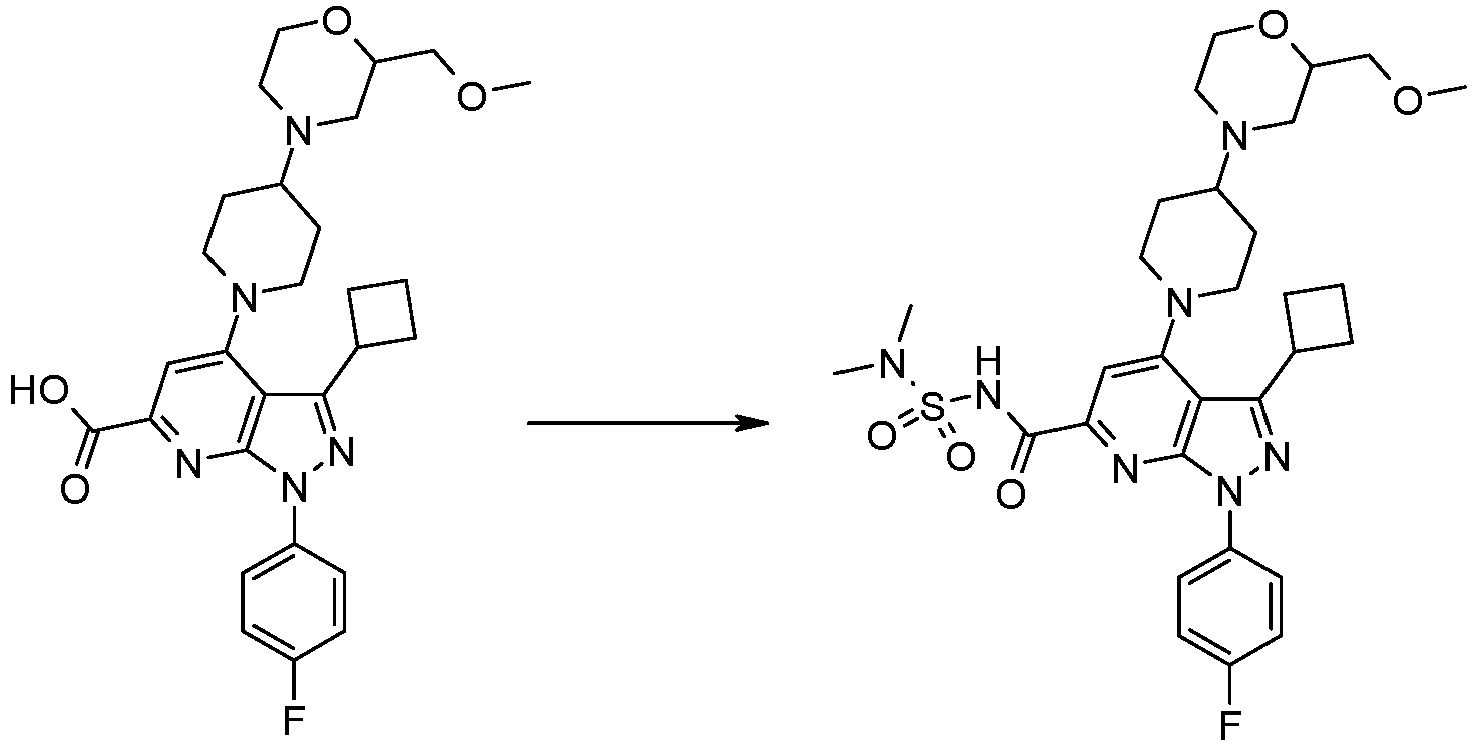
- EDC•HCl ([25952-538], 58 mg, 0.46 mmol) was added at RT to a stirred solution of A286 (120 mg, 0.23 mmol), N,N-dimethylsulfamide (58 mg, 0.46 mmol) and 4-(dimethylamino) pyridine (CAS 1122-58-3, 58 mg, 0.46 mmol) in a mixture of dichloromethane/acetonitrile (1:1, 4 mL). The reaction mixture was stirred at RT for 20 hours. The solvent was evaporated at 40 °C under a nitrogen flow. The residue was purified by preparative HPLC to yield the titled compound as formate salt.
-

- A suspension of 3 -cyclobutyl-1-phenyl-4- {4- [(pyrrolidin-1-yl)methyl]piperidin-1-yl}-1H-pyrazolo[3,4-b]pyridine-6-carboxylic acid (A285, 0.1498 g, 0.326 mmol) and carbonyl diimidazole (0.0795 g, 0.490 mmol) in dimethylformamide (DMF) (1.0 mL) was stirred for 2.5 hours, and then morpholine-4-sulfonamide (0.0815 g, 0.490 mmol, [25999-04-6]), DMAP (0.0444 g, 0.363 mmol), and DBU (0.075 mL, 0.498 mmol) were added. The resultant mixture was stirred overnight. The reaction mixture was then diluted with water (10 mL), extracted with dichloromethane (3 × 8 mL), dried (Na2SO4), and chromatographed (7% CH3OH/CH2Cl2) and triturated (10 volumes methyl tert-butyl ether/5 volumes methanol) to give the titled compound (0.0602 g, 0.099 mmol, 30% yield).
-

- A 4-mL vial was charged with 3-cyclobutyl-4-[4-(methoxymethyl)-1-piperidyl]-1-phenyl-pyrazolo[3,4-b]pyridine-6-carboxylic acid (A136, 35 mg, 0.09 mmol) dissolved in 600 µL of dichloroethane followed by carbonyldiimidazole (27 mg, 0.18 mmol) in 600 µL of dichloroethane, and the mixture was stirred at 40 °C for two hours. To this mixture was then added 4-(pyrrolidin-1-yl)piperidine-1-sulfonamide (40 mg, 3 eq, 0.28 mmol) followed by 1,8-diazabicycloundec-7-ene (42 µL, 3eq, 0.28 mmol), and the mixture was heated at 60 °C for 16 hours. The mixture was concentrated, and the residue was dissolved in DMSO and purified by reverse phase HPLC (C18, 0-100% CH3CN/water (0.1% TFA)). A gradient of acetonitrile (A) and 0.1% trifluoroacetic acid in water (B) was used, at a flow rate of 50 mL/minute (0-0.5 minute 10% A, 0.5-6.0 minutes linear gradient 10-100% A, 6.0-7.0 minutes 100% A, 7.0-8.0 minutes linear gradient 100-10% A) to afford the title compound.
-

- 1 -(4-Fluorophenyl)-4- [4-(morpholin-4-yl)piperidin-1-yl] -3-(propan-2-yl)-1H-pyrazolo[3,4-b]pyridine-6-carboxylic acid (A408, 70 mg, 0.15 mmol) and carbonyl diimidazole (37 mg, 0.23 mmol) were stirred in anhydrous DMF (800 µL) at room temperature for an hour. Then N,N-dimethylsulfamide (37 mg, 0.30 mmol) and triethylamine (42 µL, 0.30 mmol) were added, followed by slow addition of DBU (34 µL, 0.23 mmol). The reaction mixture was stirred 30 minutes at room temperature, diluted with methanol and purified by preparative HPLC on a Waters® Sunfire™ C8 column (30 × 150 mm) with a 40 to 70% gradient of acetonitrile in 10 mM aqueous ammonium acetate to give the titled compound.
-
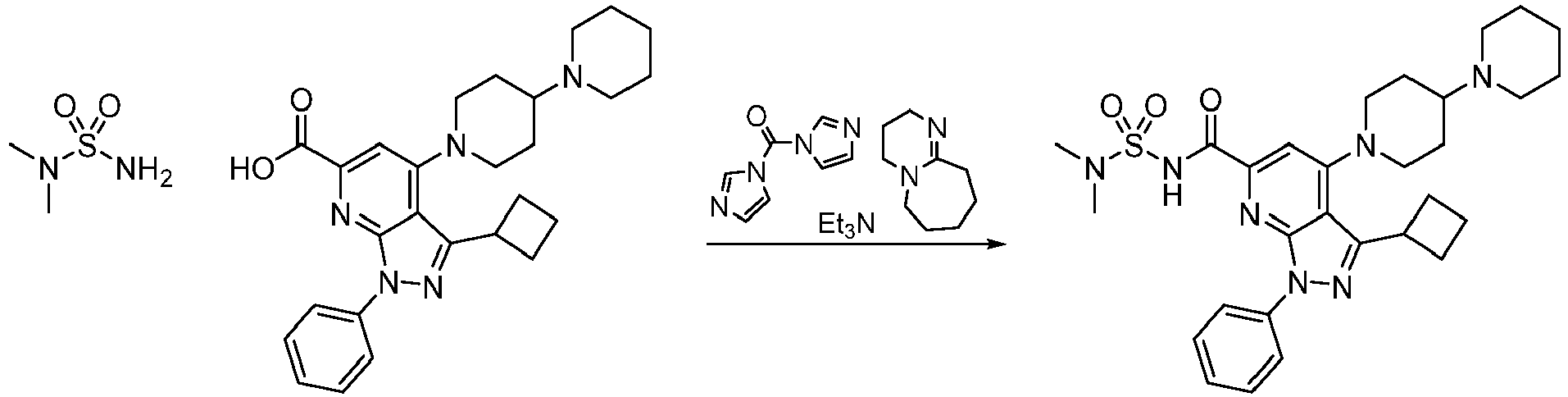
- 3-Cyclobutyl-1-phenyl-4-[4-(1-piperidyl)-1-piperidyl]pyrazolo[3,4-b]pyridine-6-carboxylic acid (A081, 92 mg, 0.20 mmol) and carbonyl diimidazole (49 mg, 0.30 mmol) were stirred in anhydrous DMF (1.0 mL) at room temperature for 90 minutes. Then N,N-dimethylsulfamide (50 mg, 0.40 mmol) and triethylamine (56 µL, 0.40 mmol) were added, followed nearly 15 minutes later by slow addition DBU (45 µL, 0.30 mmol). The reaction mixture was stirred 30 minutes at room temperature, diluted with methanol and purified by preparative HPLC on a Waters® Sunfire™ C8 column (30 × 150 mm) with a 30 to 60% gradient of acetonitrile in 10 mM aqueous ammonium acetate to give the titled compound.
-

- A solution of 3-cyclobutyl-1-[3-(difluoromethoxy)phenyl]-4-[4-(morpholin-4-yl)piperidin-1-yl]-1H-pyrazolo[3,4-b]pyridine-6-carboxylic acid (0.0536 g, 0.102 mmol, A410) and 1,1'-carbonyldiimidazole (0.0253 g, 0.156 mmol) in N,N-dimethylformamide (DMF) (0.40 mL) was stirred at 60 °C for 1 hour. Then N,N-dimethylsulfamide (0.0192 g, 0.155 mmol), DMAP (0.0138 g, 0.113 mmol), and DBU (0.023 mL, 0.153 mmol) were added, and the mixture was stirred for 2.5 hours. The mixture was diluted with water (10 mL), extracted with DCM (4x8 mL), dried (Na2SO4), and concentrated. The residue was purified by chromatography on silica gel (0-3% isopropanol/DCM) to give the titled compound
-

- A vial is loaded with benzylated acylsulfonamide (1.0 equiv) and 10% Pd on charcoal (0.1 equiv). The vial is sealed, evacuated and back-filled with N2 and THF/MeOH 1:1 is added by syringe. The reaction mixture is evacuated and back-filled with H2 three times, and the reaction mixture is stirred overnight at 50 °C. The mixture is filtered on a Pall-Seitz thick paper filter and concentrated in vacuo. The residue is dissolved in MeOH, filtered over a 0.45 µM plug filter and purified by means of semi-preparative HPLC (0.1% TFA in water /CH3CN). The compound is dissolved in DCM, 4 M HCl in dioxane is added, and the mixture was concentrated in vacuo to afford the debenzylated compound.
-

- A vial was loaded with N-[benzyl(methyl)sulfamoyl]-3-cyclobutyl-1-(4-fluorophenyl)-4-[4-(morpholin-4-yl)piperidin-1-yl]-1H-pyrazolo[3,4-b]pyridine-6-carboxamide (AC16, 1.0 equiv., 0.151 mmol, 100 mg) and 10% Pd on charcoal (0.1 equiv., 0.015 mmol, 16 mg). The vial was sealed, evacuated and back-filled with N2, and THF/MeOH 1:1 (2 mL) was added by syringe. The reaction mixture was evacuated and back-filled with H2 three times, and the reaction mixture was stirred overnight at 50 °C. The mixture was filtered on a Pall-Seitz thick paper filter and concentrated in vacuo. The residue was dissolved in MeOH, filtered over a 0.45 µM plug filter and purified by means of semi-preparative HPLC (0.1% TFA in water/CH3CN). The compound was dissolved in DCM, and then 4 M HCl in dioxane (0.1 mL) was added and the mixture was concentrated in vacuo to afford the titled compound.
-

- An acylsulfonamide is treated with a C1-C6 alkyl halide or C1-C6 alkyl halide in the presence of a base such as but not limited to sodium bicarbonate or cesium carbonate in acetonitrile or N,N-dimethylformamide or a mixture thereof at room temperature to 70 °C over 8-60 hours. The reaction mixture is optionally quenched with water. The mixture may be optionally extractively worked up and concentrated or simply concentrated. The residue can be purified by precipitation, chromatography on silica gel, or by preparative HPLC to give the N-alkylated acylsulfonamide.
-

- A mixture of 3-cyclobutyl-N-(methanesulfonyl)-4-[4-(morpholin-4-yl)piperidin-1-yl]-1-phenyl-1H-pyrazolo[3,4-b]pyridine-6-carboxamide dihydrochloride (0.0318 g, 0.052 mmol, compound 328), iodomethane (4.86 µl, 0.078 mmol), and Cs2CO3 (0.0506 g, 0.155 mmol) in N,N-dimethylformamide (DMF) (0.25 mL) was stirred at RT for 1 hour, and at 60 °C overnight. The mixture was then quenched with water, concentrated, and chromatographed on silica gel (5% MeOH/DCM) and re-chromatographed (15-25% acetone/DCM) to give the titled compound.
-

- A mixture of 3-cyclobutyl-N-(methanesulfonyl)-4-[4-(methoxymethyl)piperidin-1-yl]-1-phenyl-1H-pyrazolo[3,4-b]pyridine-6-carboxamide (0.0508 g, 0.102 mmol, compound 185), iodomethane (10 µL, 0.161 mmol), and NaHCO3 (0.0265 g, 0.315 mmol) in acetonitrile (0.40 mL) was stirred at RT overnight. N,N-Dimethylformamide (DMF) (0.20 mL) was added, and the mixture was heated to 60 °C for 5 hours (little reaction). Then, additional iodomethane (10 µL, 0.161 mmol) and NaHCO3 (0.0265 g, 0.315 mmol) were added, and the mixture was stirred at 60 °C overnight. The mixture was diluted with water, extracted with DCM, dried (Na2SO4), and chromatographed on silica gel (2% EtOAc/DCM) to give the titled compound.
-

- A solution of AC08 (42 mg, 0.06 mmol) in a mixture of THF (6 mL) and acetic anhydride (0.1 mL, 1.0 mmol) was degassed with nitrogen. 10% Pd/C (9 mg, 0.008 mmol) was added and the reaction mixture was purged with H2. The mixture was stirred for 16 hours at RT under a hydrogen atmosphere (balloon). The reaction mixture was filtered over a pad of diatomaceous earth that was then washed with THF. The filtrate was concentrated in vacuo, and the residue was purified by flash column chromatography eluted with DCM/MeOH (20/1) to give the titled compound.
-

- A solution of AC09 (103 mg, 0.15 mmol) in a mixture of THF(8 mL), ethanol (8 mL), acetic acid (1 mL), and aqueous 1 M HCl (1 mL) was degassed with nitrogen. 10% Pd(OH)2 (21 mg, 0.015 mmol) was added, and the reaction mixture was purged with H2. The mixture was stirred for 16 hours at RT under a hydrogen atmosphere (balloon). The reaction mixture was filtered over a pad of diatomaceous earth that was washed with THF. The filtrate and wash were concentrated in vacuo. The residue was partitioned between chloroform (100 mL) and aqueous 1 M NaOH (50 mL). The organic phase was dried over magnesium sulfate, filtered and concentrated under reduced pressure. The residue was purified by silica gel chromatography eluted with DCM/MeOH (20/1) to give the titled compound.
-

- To a solution of E168 (64 mg, 0.17 mmol) in dichloromethane (4 mL) at RT was added 2-chloro-6-methylpyridine-4-boronic acid ([1320397-15-6], 43 mg, 0.25 mmol), copper(II) acetate ([142-71-2], 56 mg, 0.31 mmol) and pyridine (66 µL, 0.81 mmol). The reaction mixture was stirred at room temperature under air for 72 hours. The reaction mixture was filtered through a pad of diatomaceous earth. Solids were washed with dichloromethane, and the filtrate was concentrated in vacuo. The resulting residue was purified by flash chromatography on silica gel eluted with ethyl acetate/n-heptane (0/1 to 1/0) to give the titled compound.
- A solution of the compound from the previous step (50 mg, 0.1 mmol) in ethanol (20 mL) was degassed with nitrogen. 10% Pd/C (5 mg, 0.005 mmol) was added, and the reaction mixture was purged with H2. The mixture was stirred for 16 hours at RT under a hydrogen atmosphere (balloon). The reaction mixture was filtered through a pad of diatomaceous earth that was washed with ethanol. The filtrate was concentrated in vacuo to give the titled compound.
- The previous compound (50 mg, 0.1 mmol) was dissolved ethanol (5 mL), and aqueous 1 N sodium hydroxide (0.5 mL, 0.5 mmol) was added at RT. The solution was stirred for 16 hours. A phosphate buffer was added (pH 6.2). The solvent was partially removed under reduced pressure, and the resulting mixture was extracted twice with chloroform. The combined organic phases were dried over magnesium sulfate, filtered and concentrated under reduced pressure to give the titled compound.
-

- E197 (1.7 g, 3.42 mmol) was dissolved into 4 MHCl in dioxane (25.7 mL, 102 mmol), stirred at room temperature for two hours, and then concentrated in vacuo to give the titled compound.
- Ethyl chloroformate (67 µL, 0.7 mmol) was added dropwise at RT to a stirring solution of the compound from Step 1 (200 mg, 0.42 mmol) and DIPEA (294 µL, 1.7 mmol) in anhydrous DCM (2 mL). The reaction was complete after 2 hours. The reaction solution was diluted with DCM (10 mL) and washed with water (5 mL). The organic phase was dried over sodium sulfate, filtered and concentrated under reduced pressure to give the titled compound.
- The compound from Step 2 (196 mg, 0.42 mmol) was dissolved in THF (5 mL) and aqueous 2 N sodium hydroxide (1.05 mL, 2.1 mmol) was added at RT. The solution was stirred for 20 hours. The resulting mixture was diluted with water (10 mL) and then acidified with aqueous 2 N HCl (1.05 mL). The aqueous phase was extracted twice with DCM. The combined organic phases were dried over sodium sulfate, filtered, and concentrated under reduced pressure to give the titled compound.
Table XVa. List of intermediate acylsulfonamides Int. Structure Name SM method MW Mes AC01 
N-(3-chloropropane-1-sulfonyl)-1-(4-fluorophenyl)-4-[4-(methoxymeth yl)piperidin-1-yl]-3-(propan-2-yl)-1H-pyrazolo[3,4-b]pyridine-6-carboxamide A124, 35578 -28-0 Y1 566 567 AC02 
1-{3-[3-(benzyloxy)aze tidin-1-yl]phenyl}-N-(methanesulfon yl)-4-[4-(morpholin-4-yl)phenyl]-3-(propan-2-yl)-1H-pyrazolo[3,4-b]pyridine-6-carboxamide A252, 3144-09-0 Y1 680 681 AC03 
benzyl 4-({3-cyclobutyl-4-[4-(methoxymeth yl)piperidin-1-yl]-1-phenyl-1H-pyrazolo[3,4-b]pyridine-6-carbonyl}sulfa moyl)piperidin e-1-carboxylate A136, S9 Y1 700 701 AC04 
N-[3-(benzyloxy)pro pane-1-sulfonyl]-3-cyclobutyl-4-[4-(methoxymeth yl)piperidin-1-yl]-1-phenyl-1H-pyrazolo[3,4-b]pyridine-6-carboxamide A136, 14086 46-99-0 Y1 631 632 AC05 
N-[2-(benzyloxy)eth anesulfonyl]-3-cyclobutyl-4-[4-(methoxymeth yl)piperidin-1-yl]-1-phenyl-1H-pyrazolo[3,4-b]pyridine-6-carboxamide A136, 88140 7-21-2 Y1 617 618 AC06 
4-(4-azidophenyl)-N-(3-chloropropane-1-sulfonyl)-1-[3-(dimethylamin o)phenyl]-3-(propan-2-yl)-1H-pyrazolo[3,4-b]pyridine-6-carboxamide A238, 35578 -28-0 Y1 580 581 AC07 
N-(chloromethan esulfonyl)-3-cyclobutyl-4-[4-(methoxymeth yl)piperidin-1-yl]-1-phenyl-1H-pyrazolo[3,4-b]pyridine-6-carboxamide A136 Y1 532-534 533-535 AC08 
benzyl [2-({3-cyclobutyl-4-[4-(methoxymeth yl)piperidin-1-yl]-1-phenyl-1H-pyrazolo[3,4-b]pyridine-6-carbonyl}sulfa moyl)ethyl]car bamate A136, S5 Y1 660 661 AC09 
benzyl 3-({3-cyclobutyl-4-[4-(methoxymeth yl)piperidin-1-yl]-1-phenyl-1H-pyrazolo[3,4-b]pyridine-6-carbonyl}sulfa moyl)pyrrolidi ne-1-carboxylate A136, S7 Y1 686 687 AC10 
3-cyclobutyl-4-[4-(methoxymeth yl)piperidin-1-yl]-1-(2-methylpyridin-4-yl)-1H-pyrazolo[3,4-b]pyridine-6-carboxylic acid E168 Specific example 435 436 AC11 
N-[2-(benzyloxy)eth anesulfonyl]-3-cyclobutyl-1-(4-fluorophenyl)-4-[4-(morpholin-4-yl)piperidin-1-yl]-1H-pyrazolo[3,4-b]pyridine-6-carboxamide A308 Y1 676 677 AC12 
N-[2-(benzyloxy)eth anesulfonyl]-3-cyclobutyl-1-(4-fluorophenyl)-4-{4-[2-(piperidin-1-yl)ethyl]piperi din-1-yl}-1H-pyrazolo[3,4-b]pyridine-6-carboxamide A311 Y1 704 705 AC13 
4-[1-(ethoxycarbon yl)piperidin-4-yl]-1-(4-fluorophenyl)-3-(propan-2-yl)-1H-pyrazolo[3,4-b]pyridine-6-carboxylic acid E197 Specific example 454 455 AC14 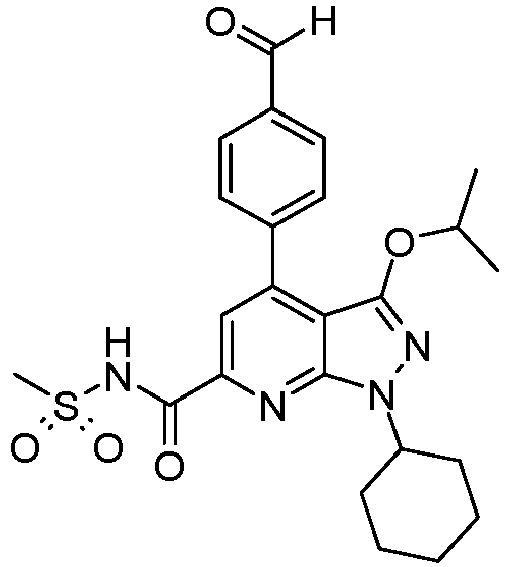
1 -cyclohexyl-4-(4-formylphenyl)-N-(methanesulfon yl)-3-[(propan-2-yl)oxy]-1H-pyrazolo[3,4-b]pyridine-6-carboxamide A350 Y1 484 485 AC15 
tert-butyl 5-(4-{1-cyclohexyl-6-[(methanesulfo nyl)carbamoyl] -3-[(propan-2-yl)oxy]-1H-pyrazolo[3,4-b]pyridin-4-yl} benzoyl)hex ahydropyrrolo[ 3,4-c]pyrrole-2(1H)-carboxylate A351 Y1 694 695 AC16 
N-[benzyl(methyl )sulfamoyl]-3-cyclobutyl-1-(4-fluorophenyl)-4-[4-(morpholin-4-yl)piperidin-1-yl]-1H-pyrazolo[3,4-b]pyridine-6-carboxamide A308, 15205 -37-5 Y8 662 662 AC17 
N-[3-(benzyloxy)pro pane-1-sulfonyl]-3-cyclobutyl-1-(4-fluorophenyl)-4-[4-(methoxymeth yl)piperidin-1-yl]-1H-pyrazolo[3,4-b]pyridine-6-carboxamide A202, 14086 46-99-0 Y1 649 650 


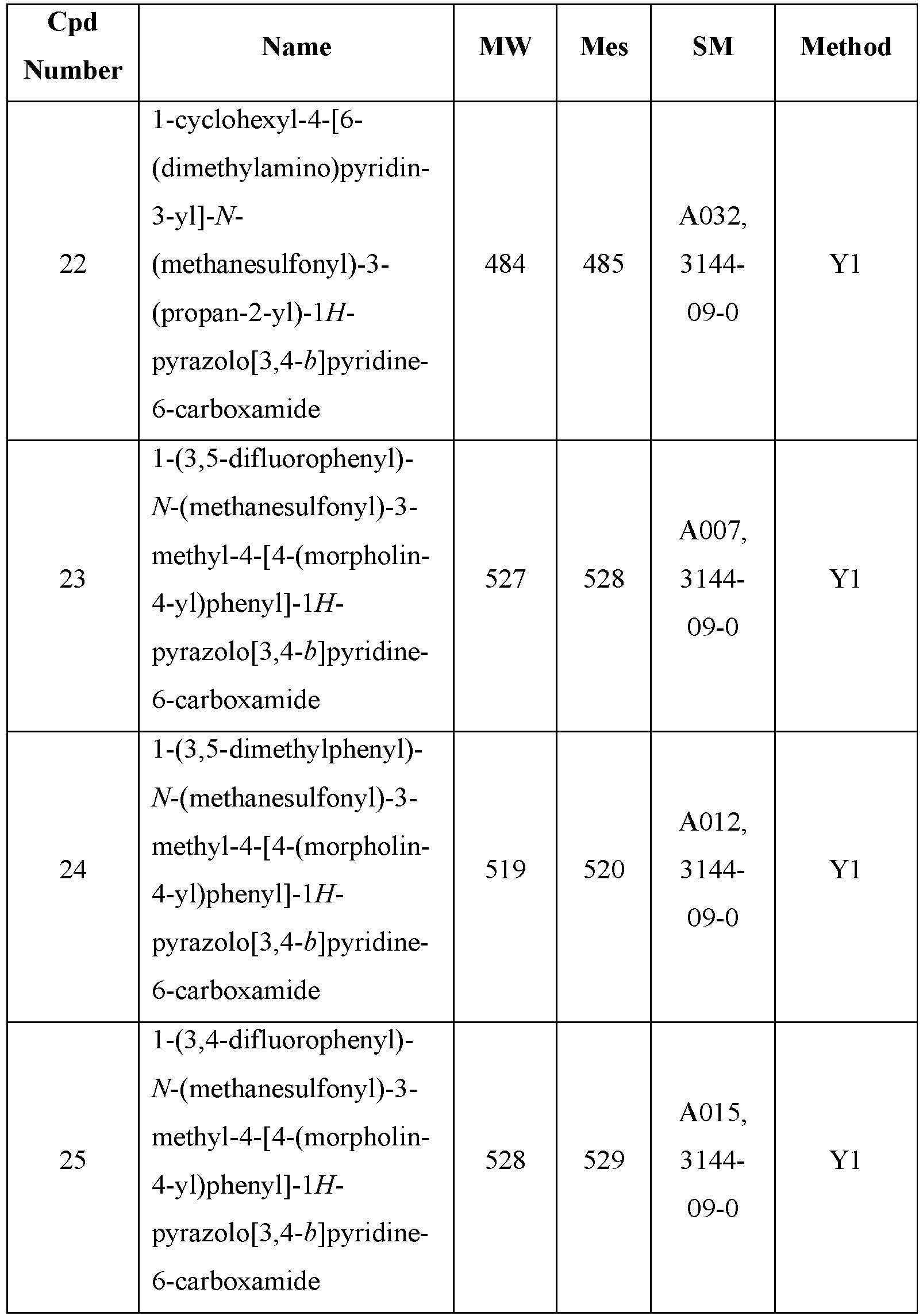


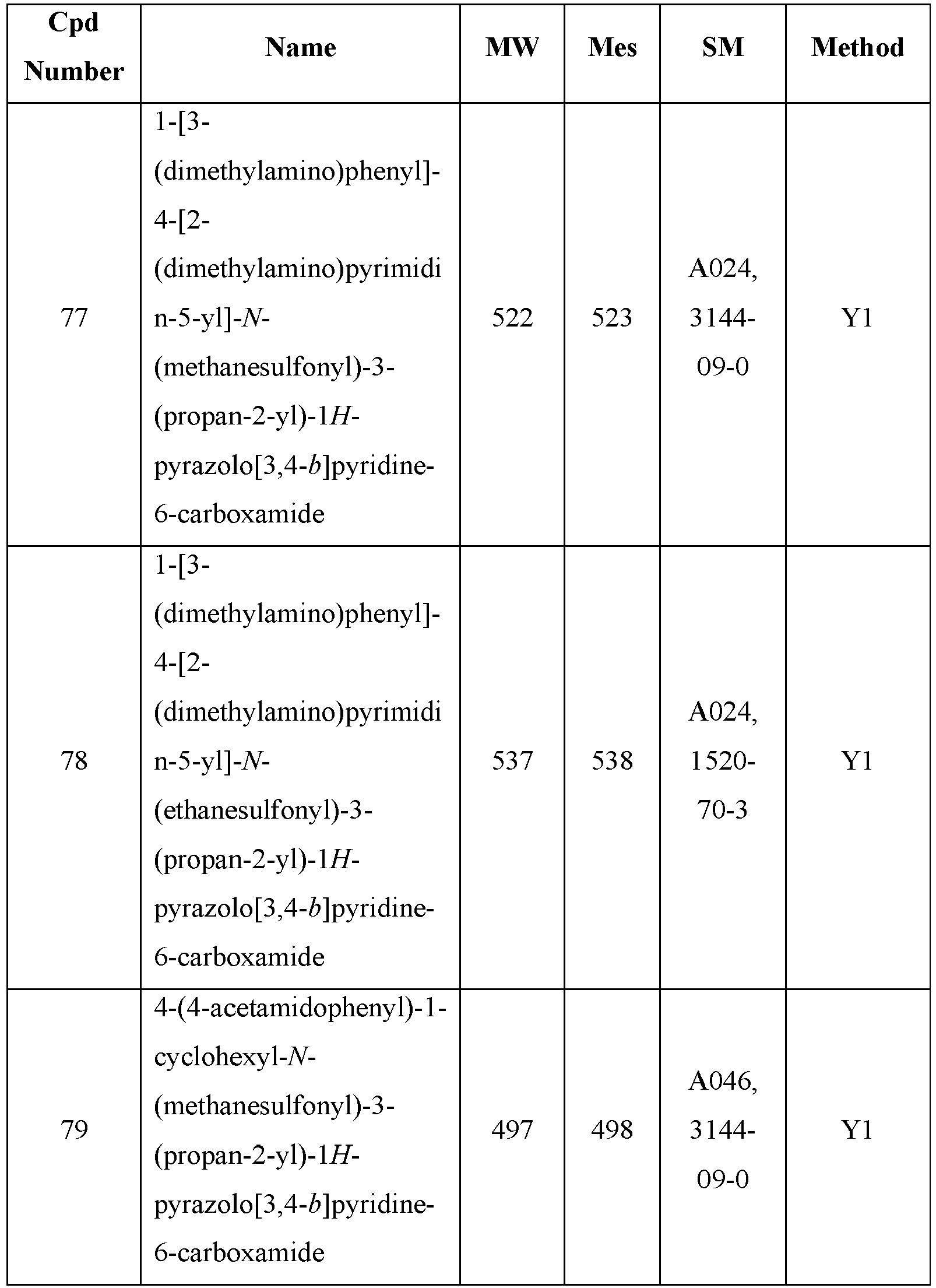


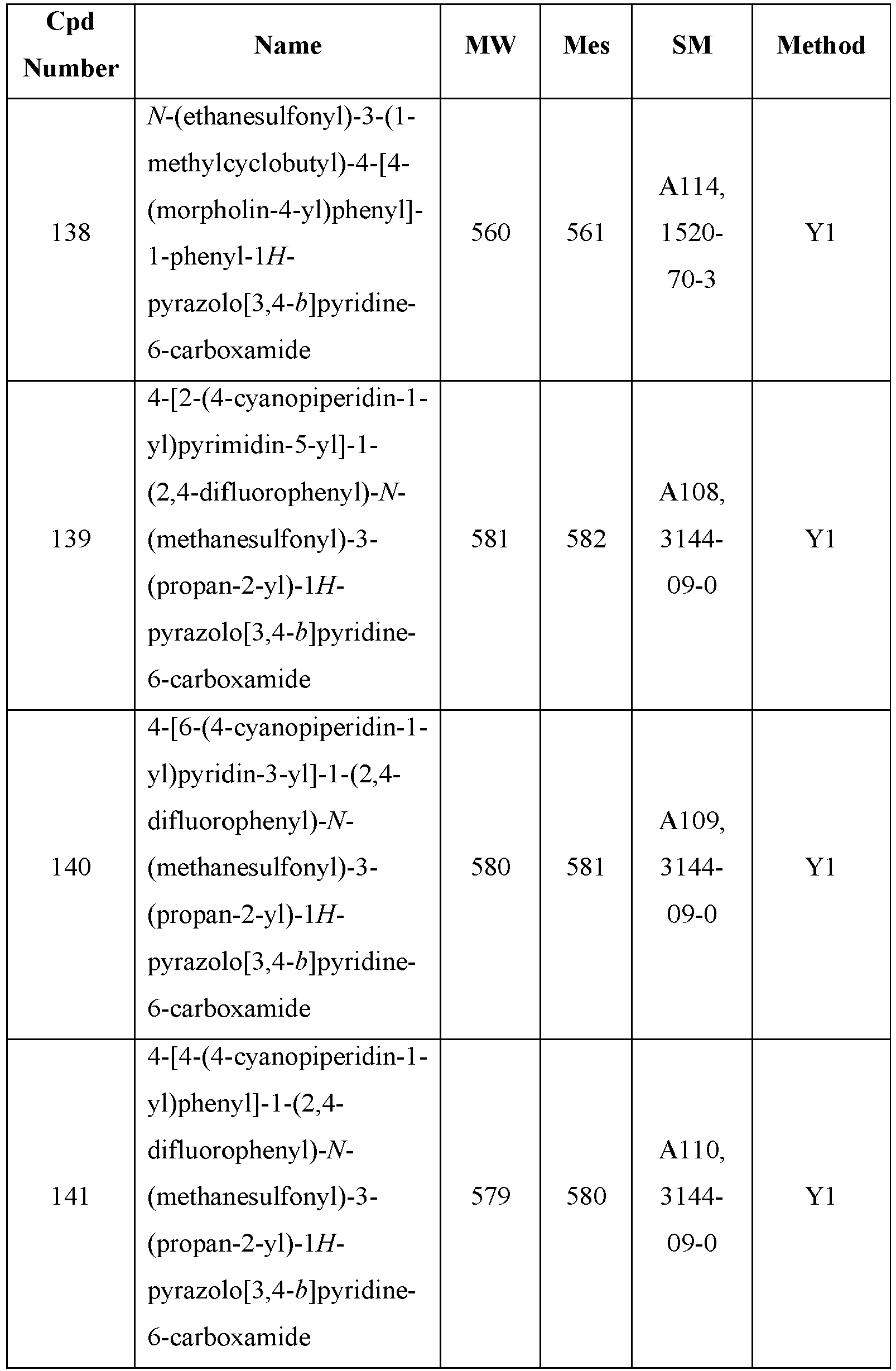


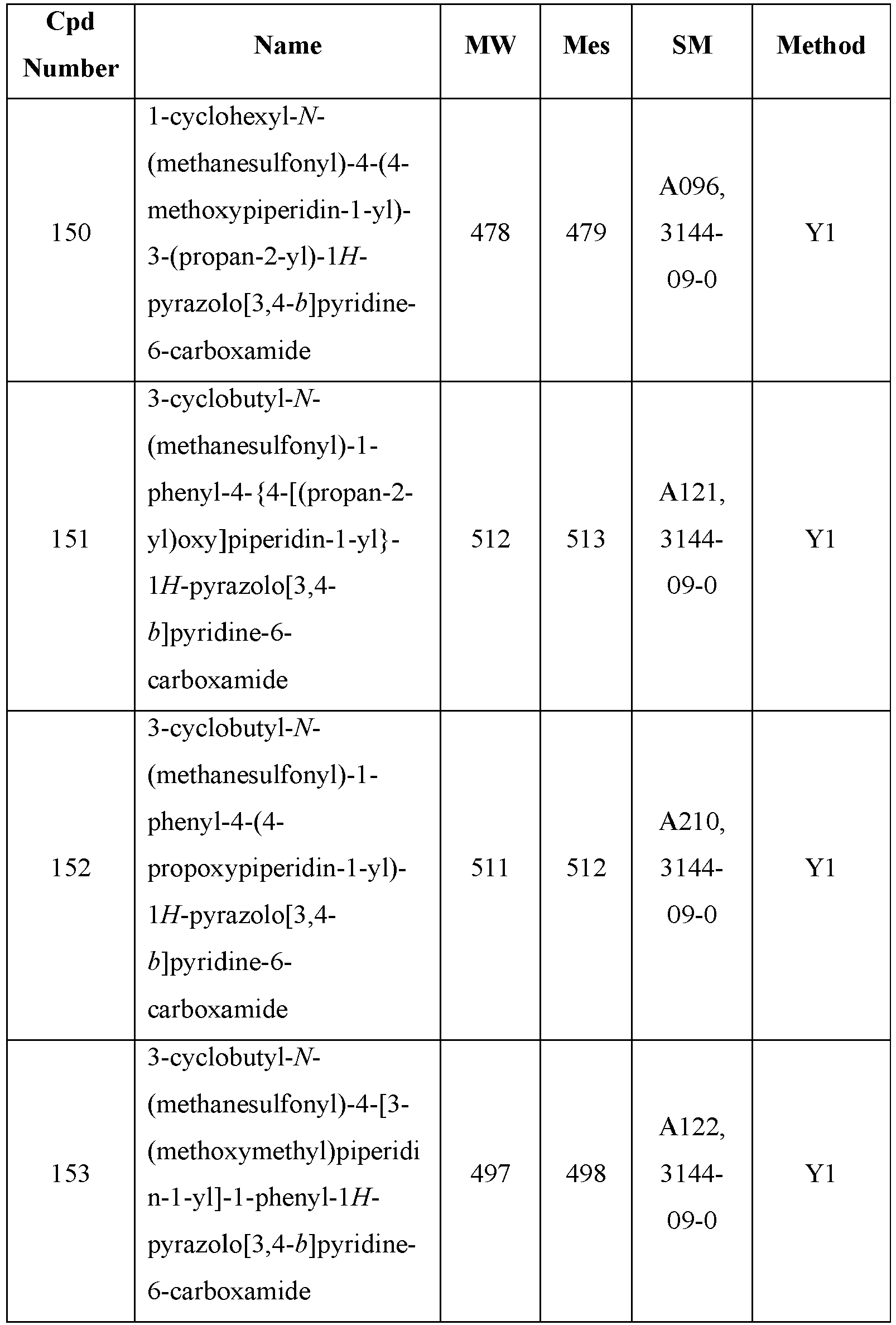


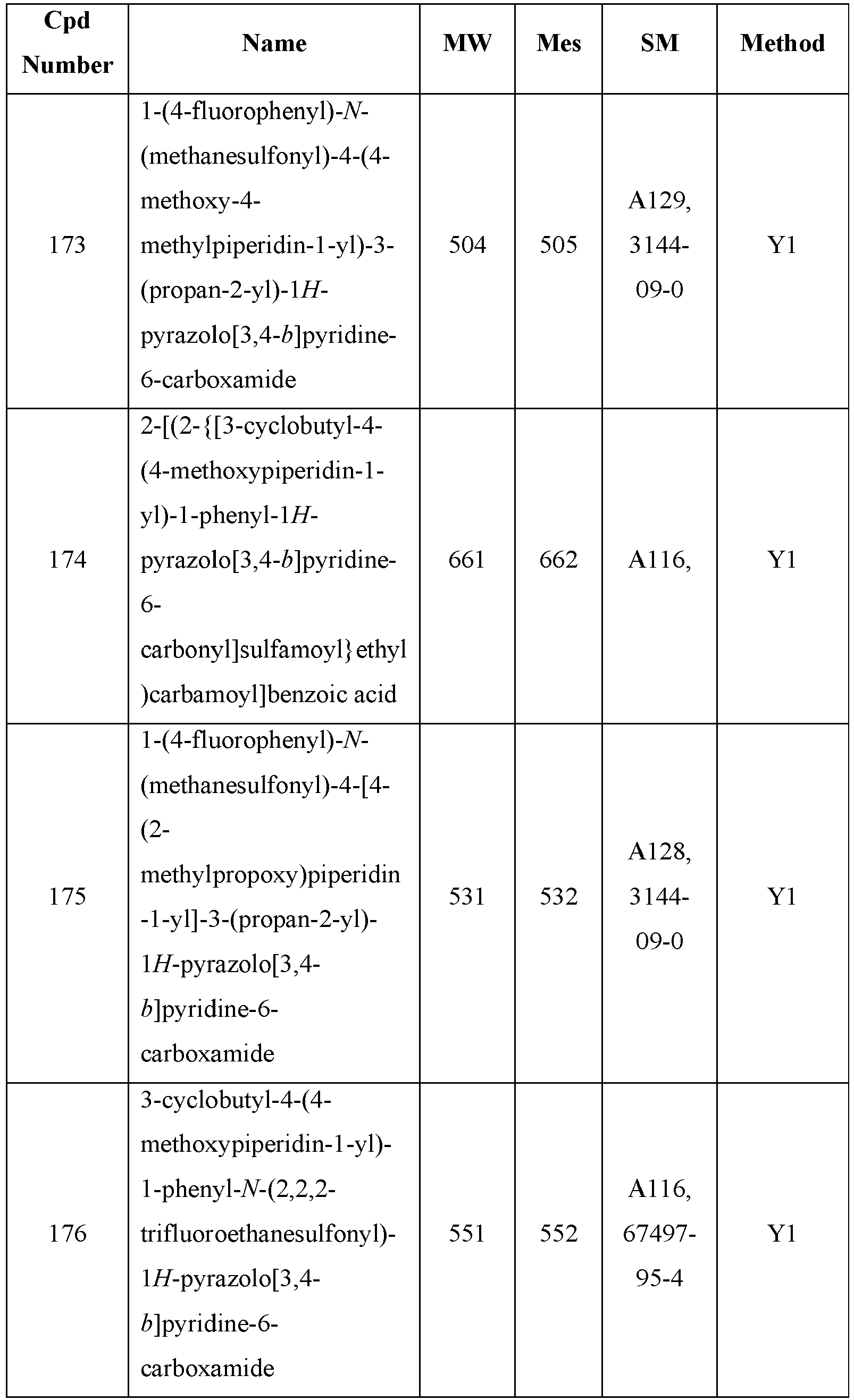

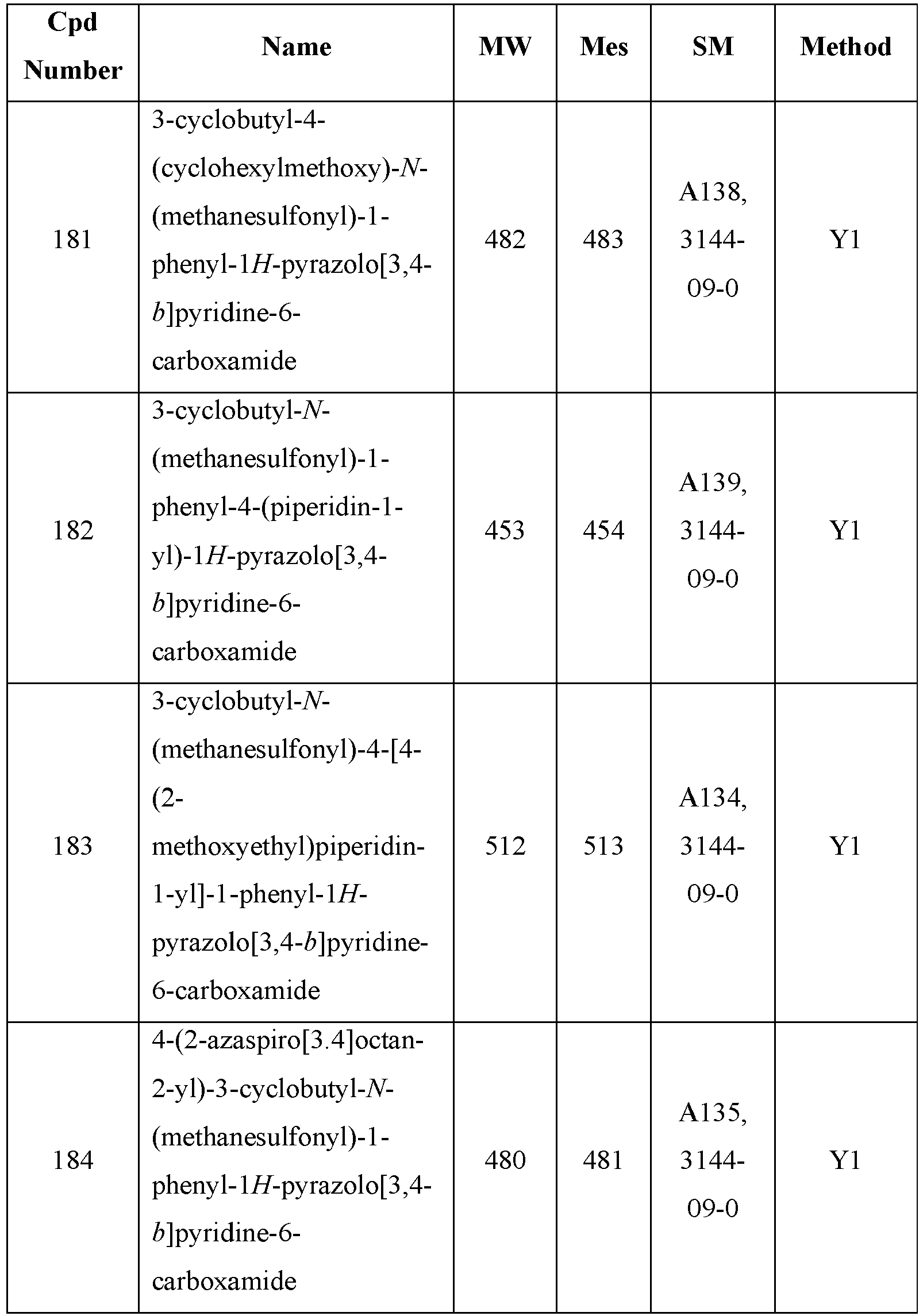


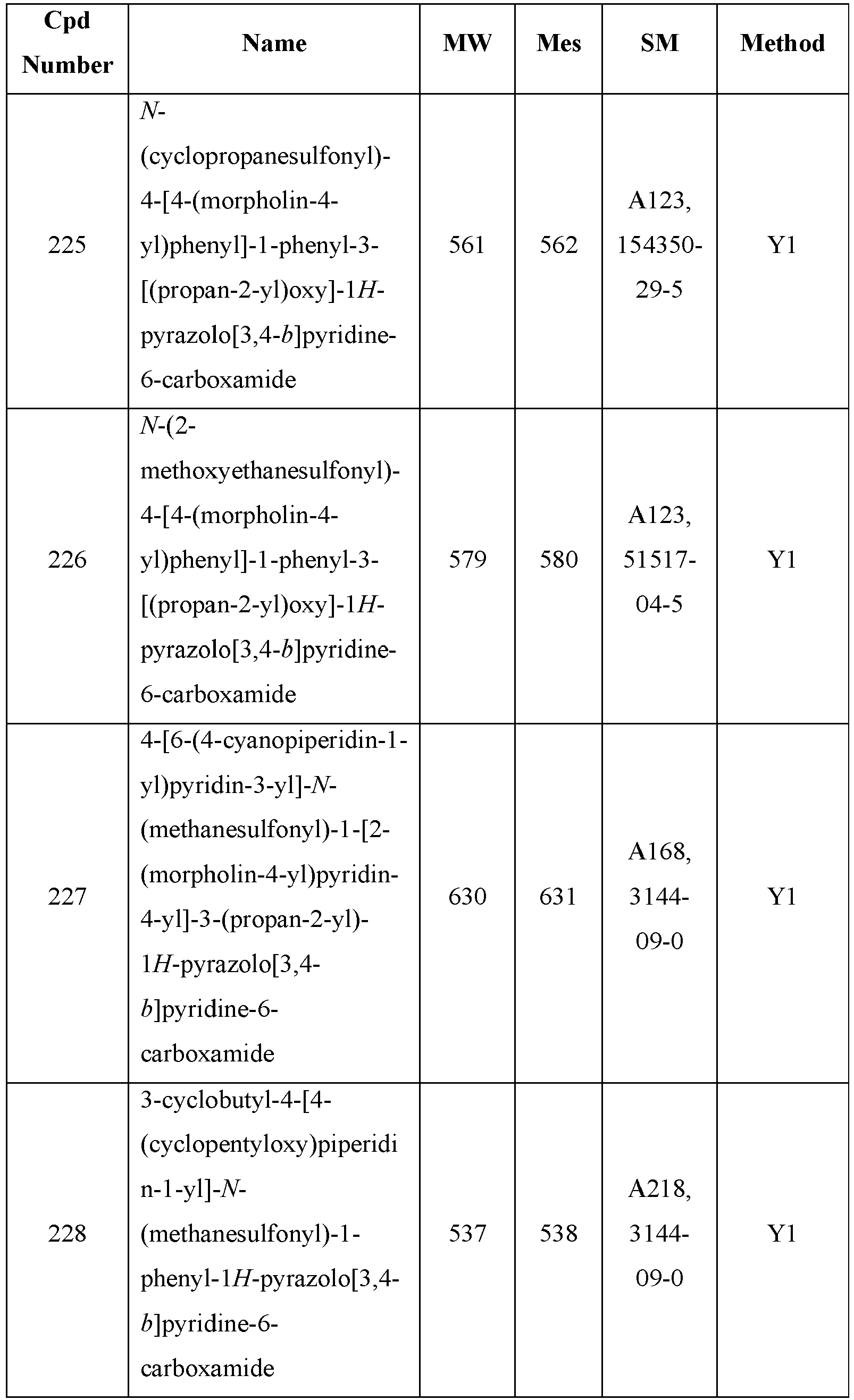


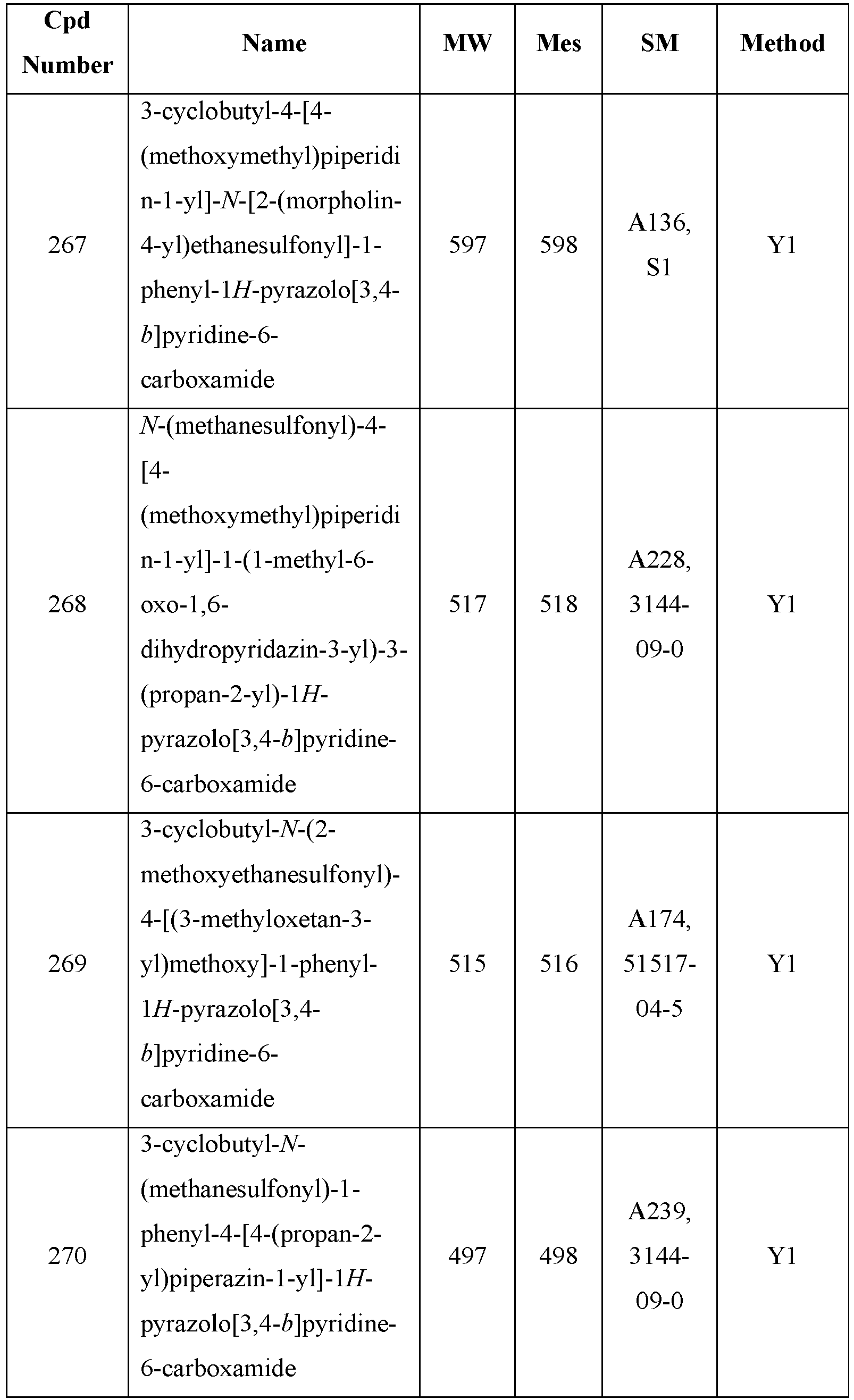


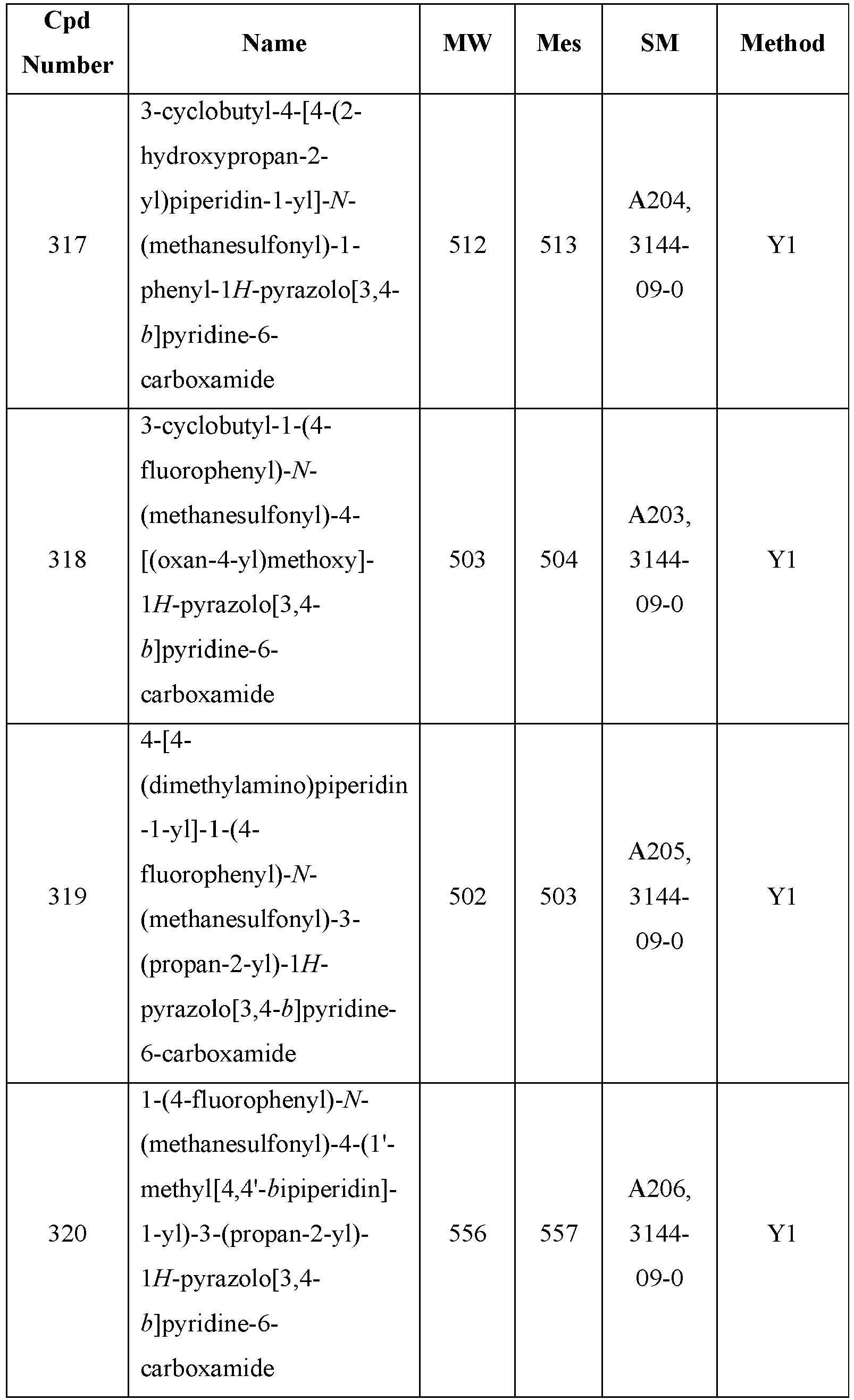
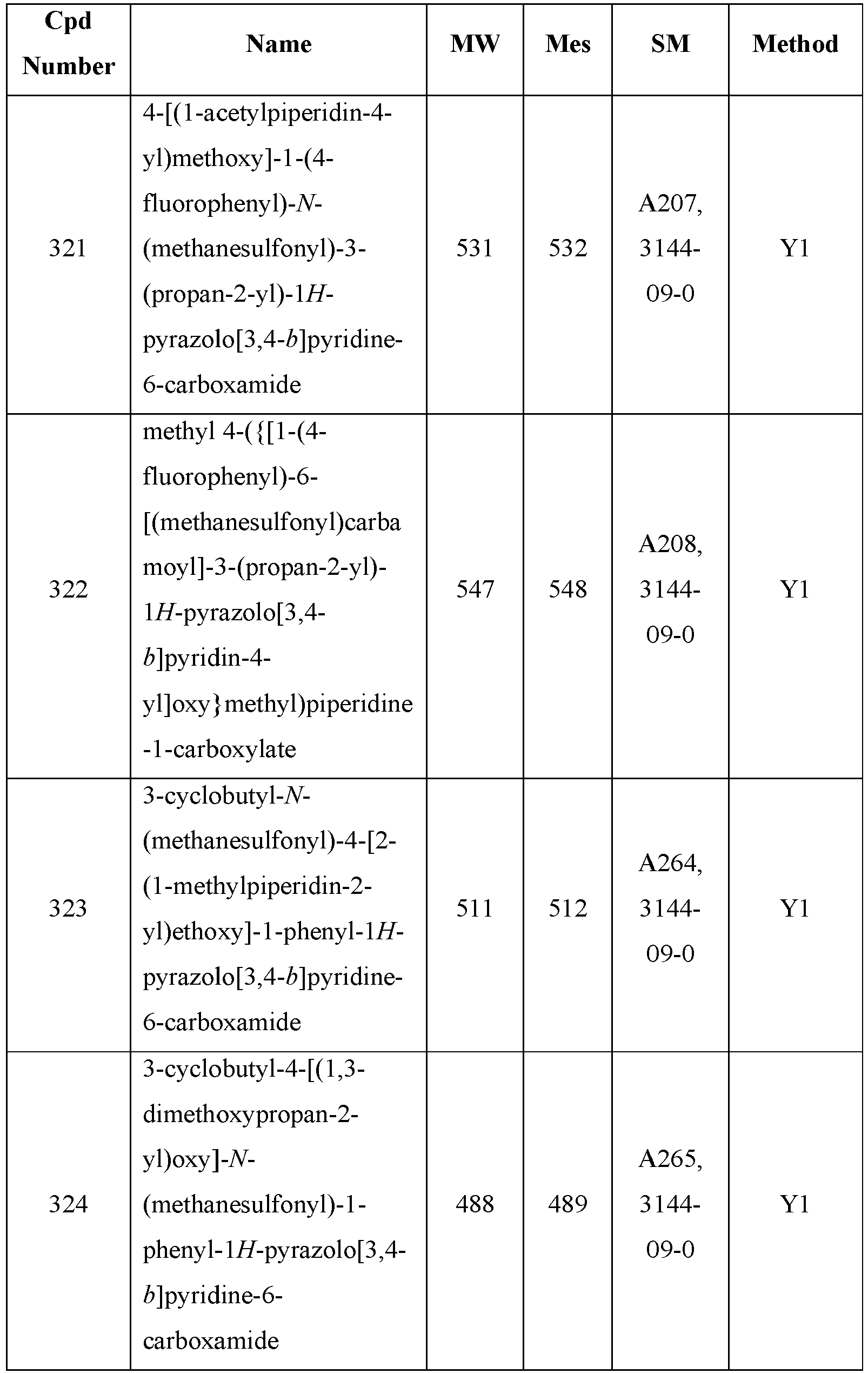


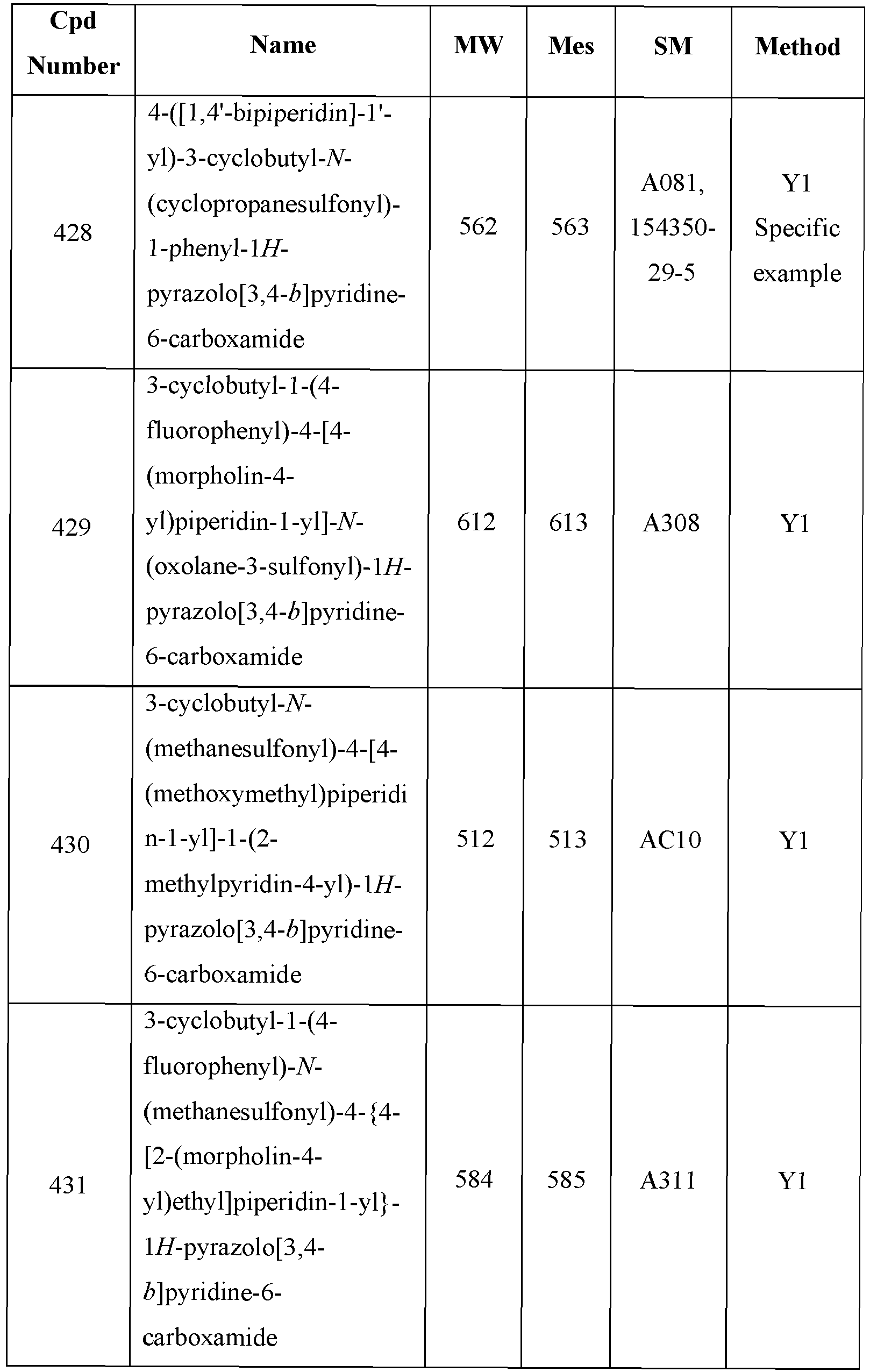


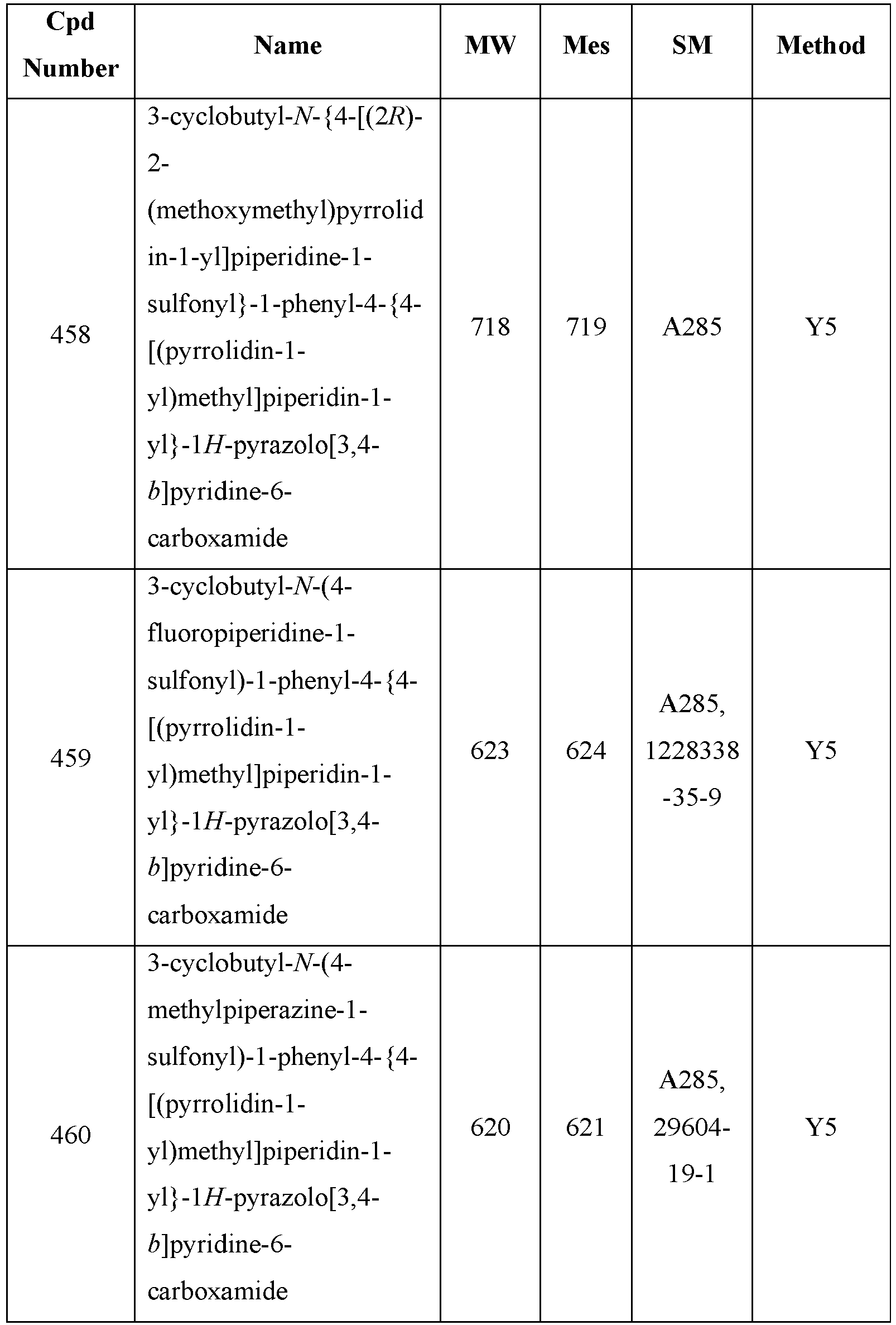


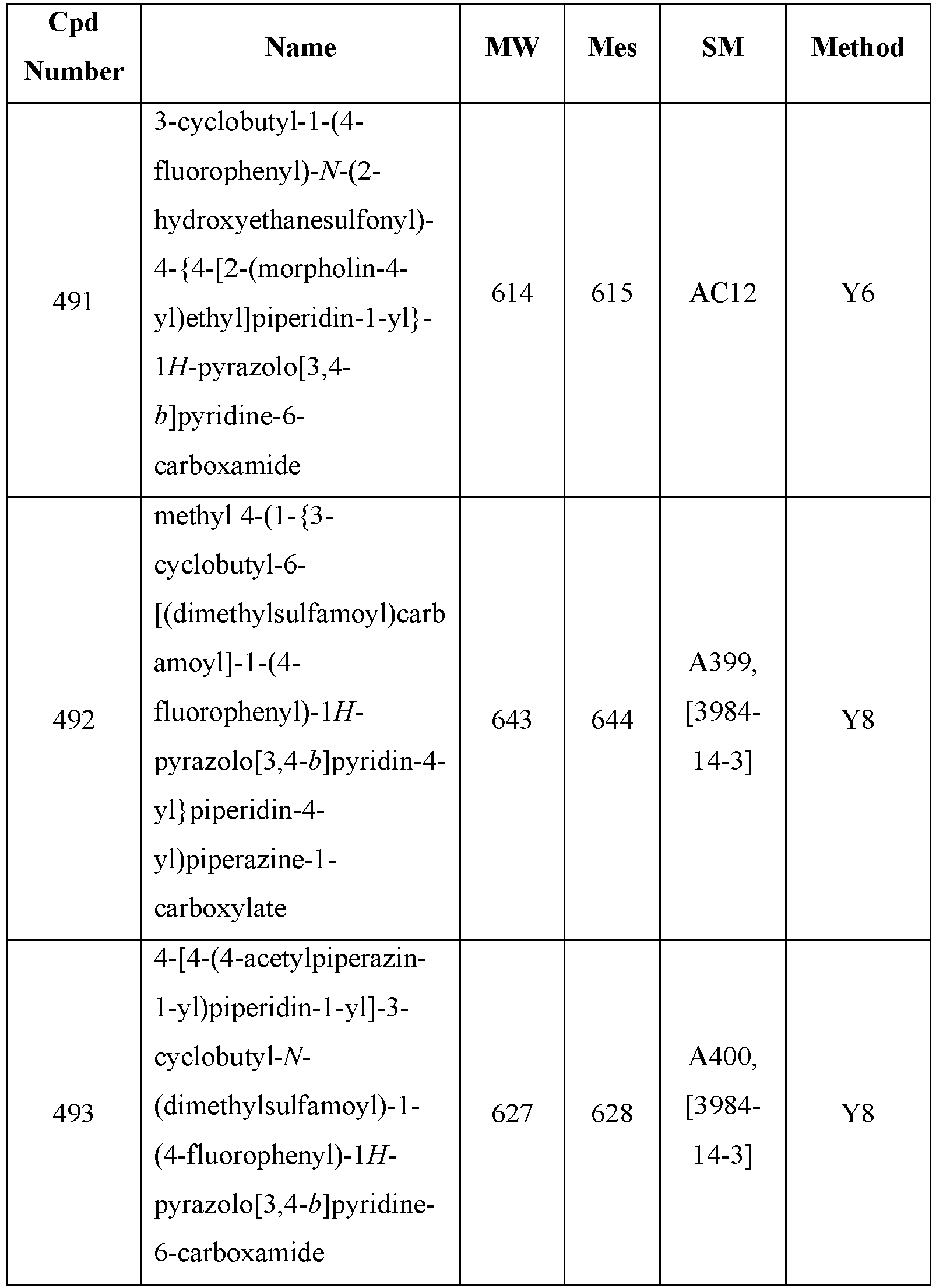
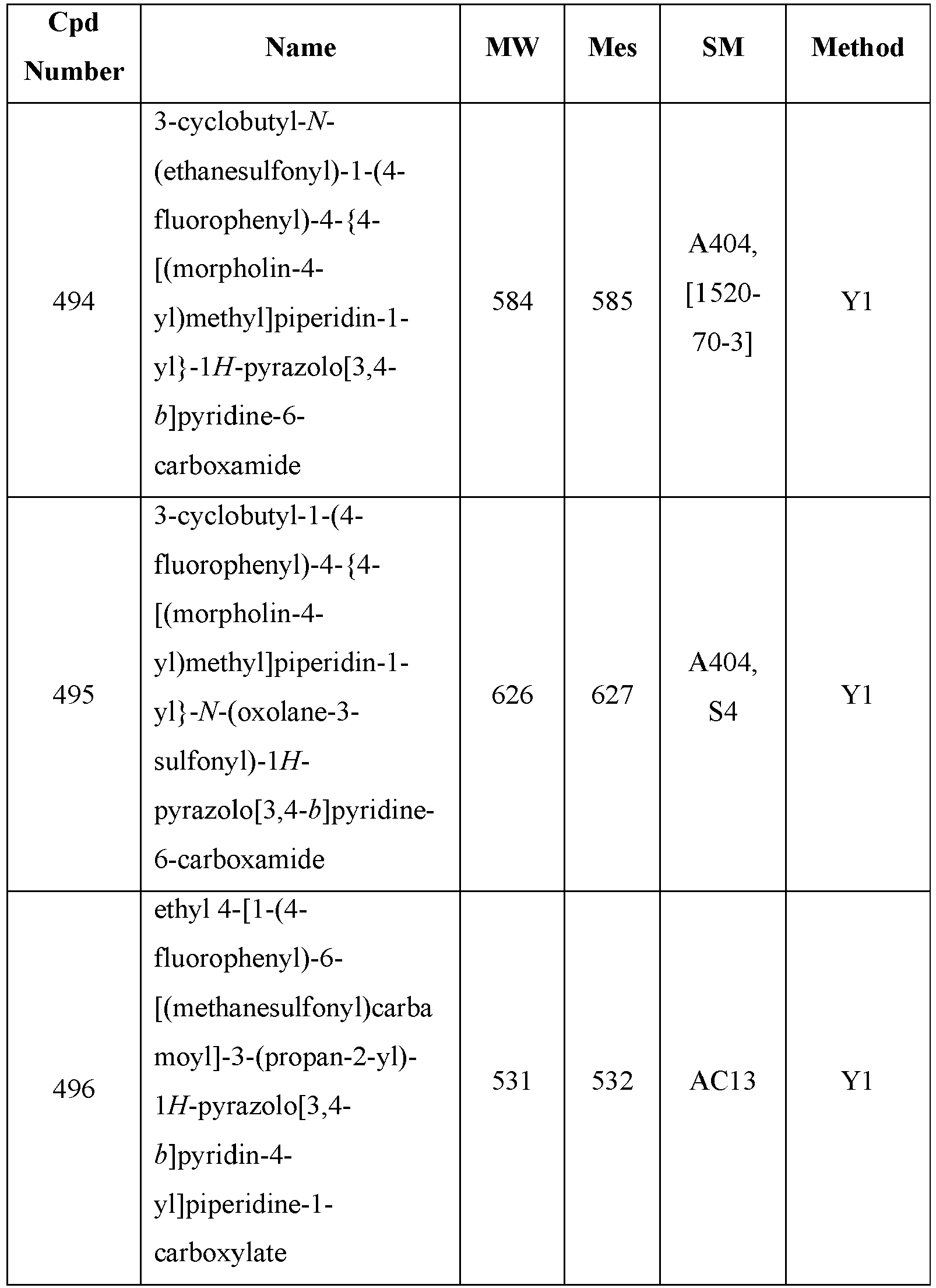


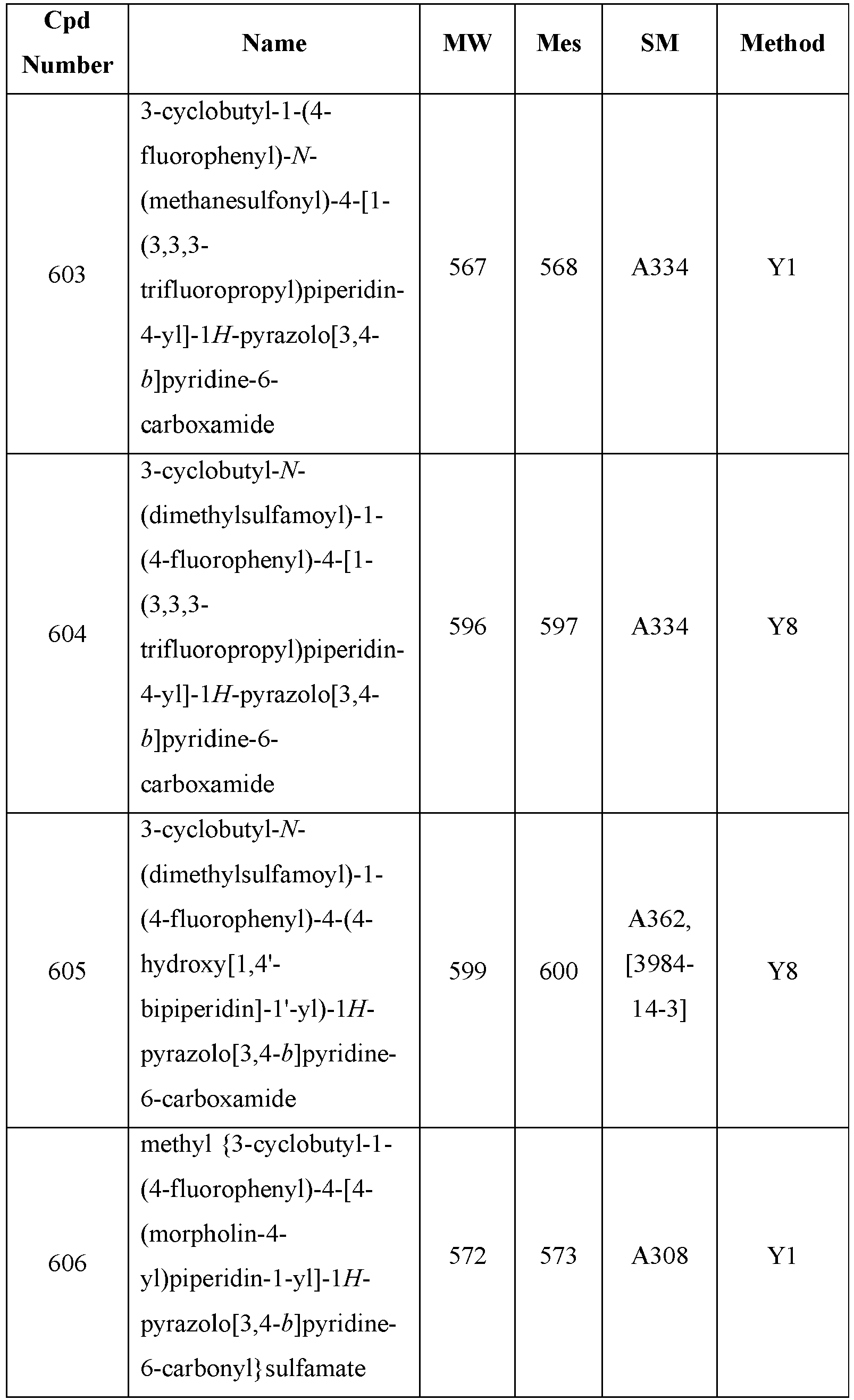

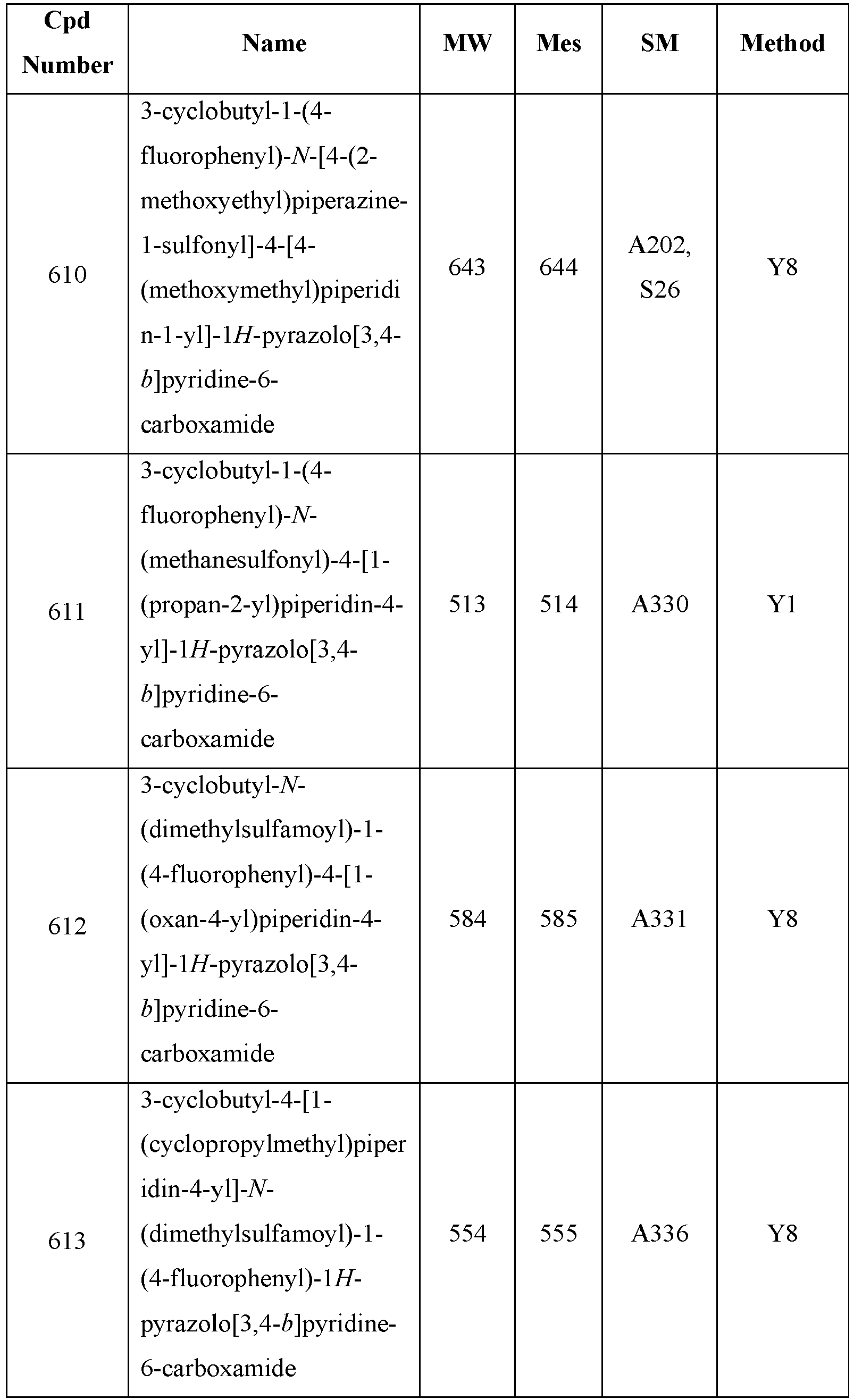


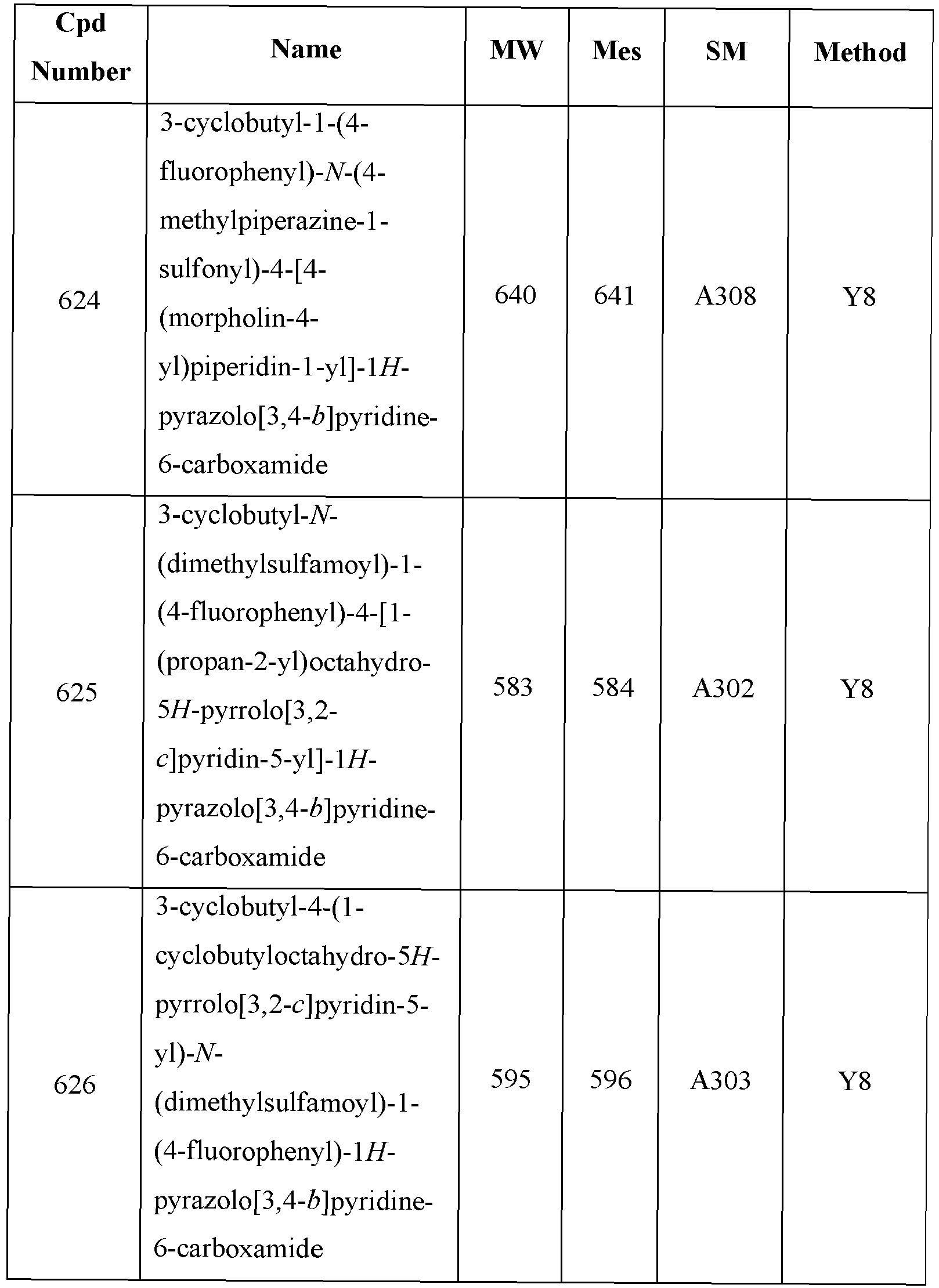


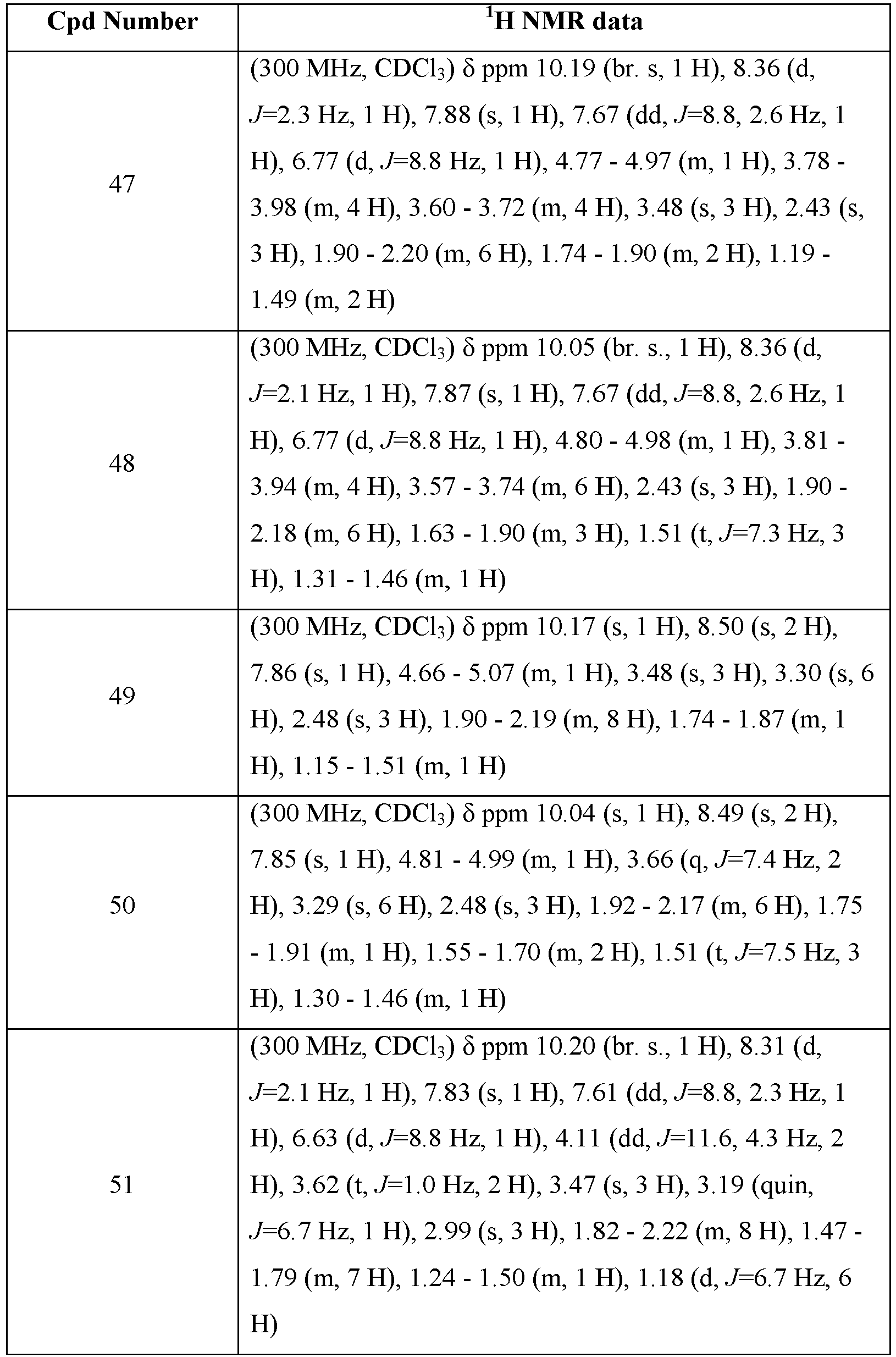


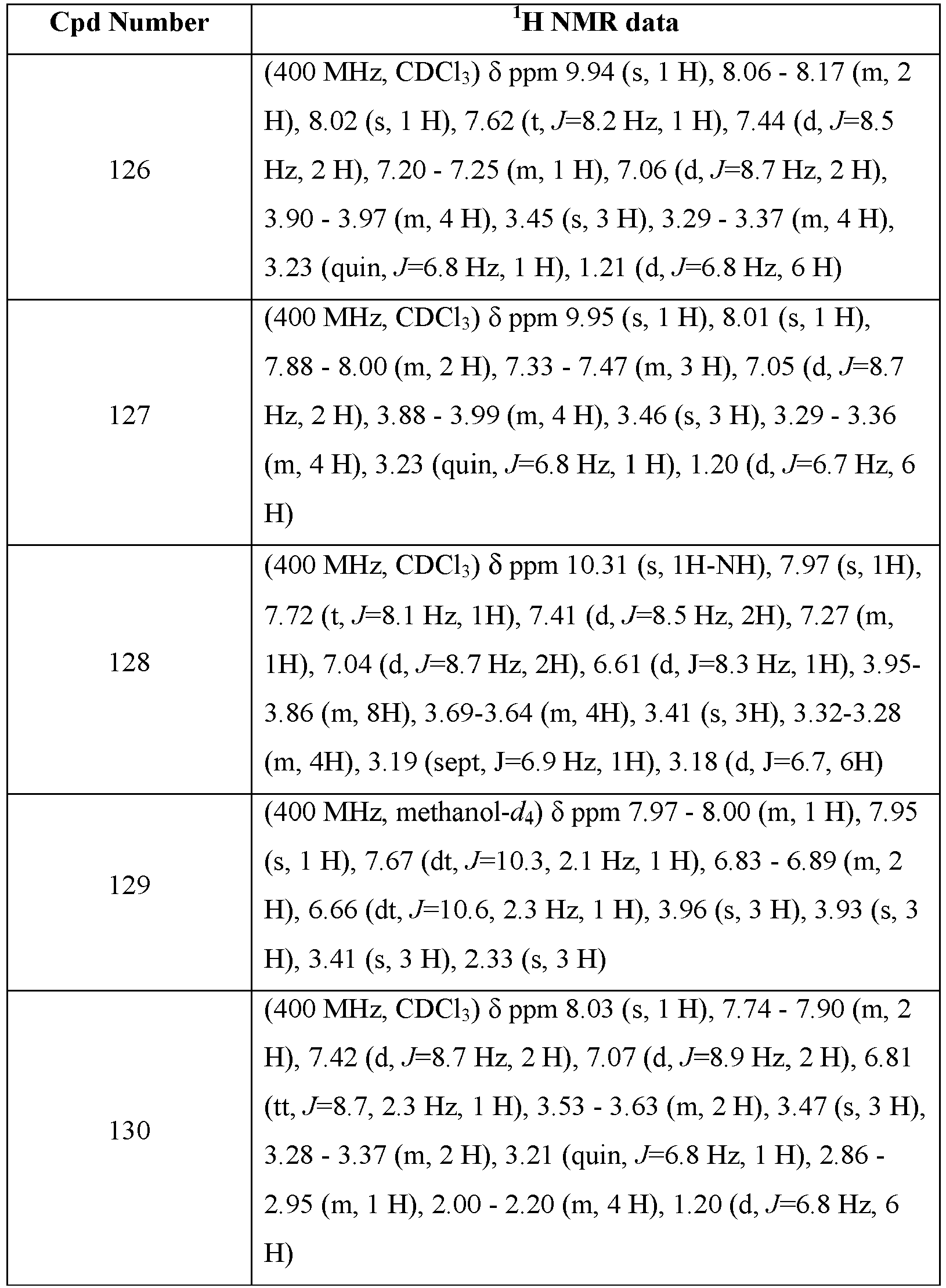


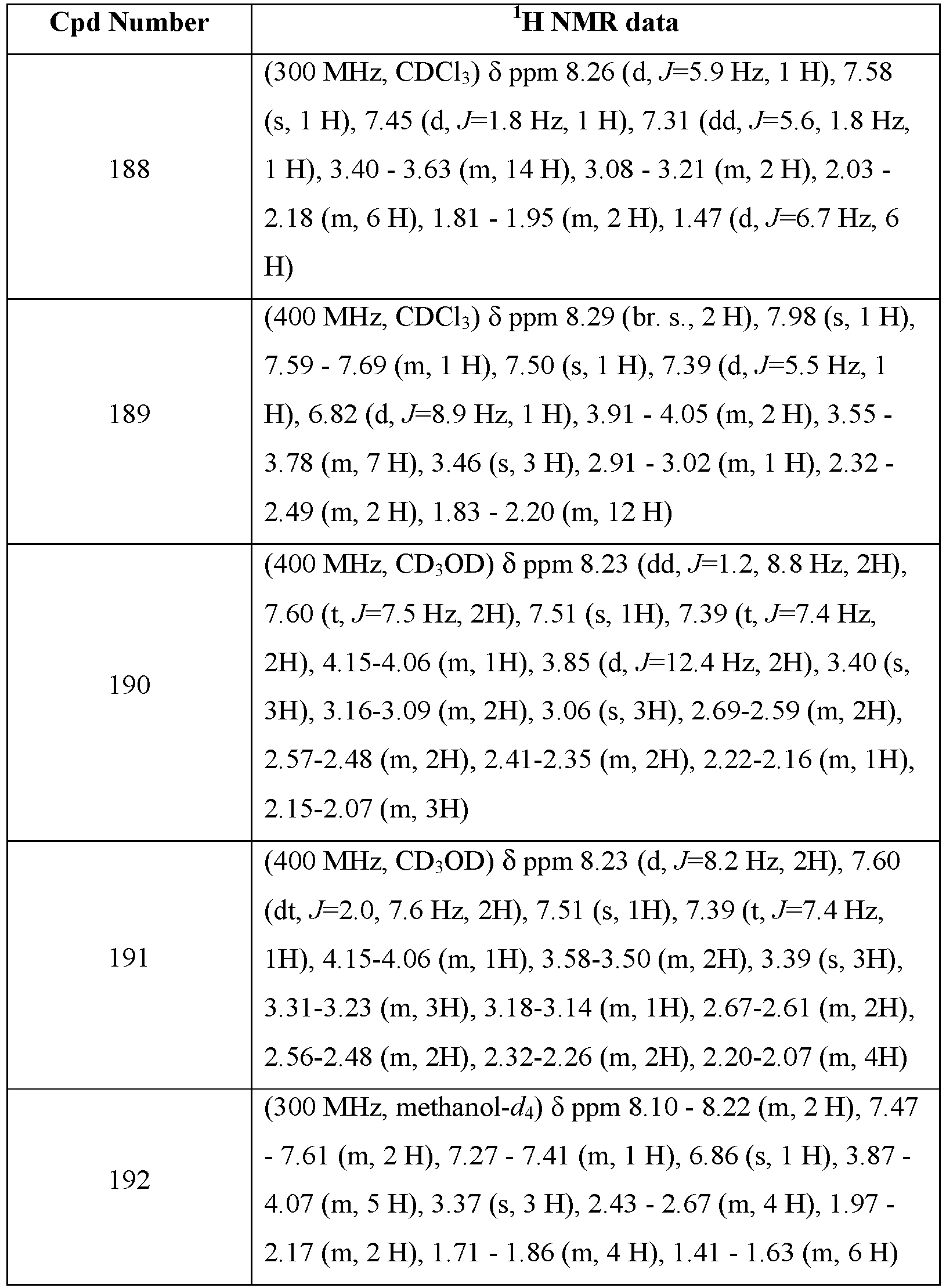


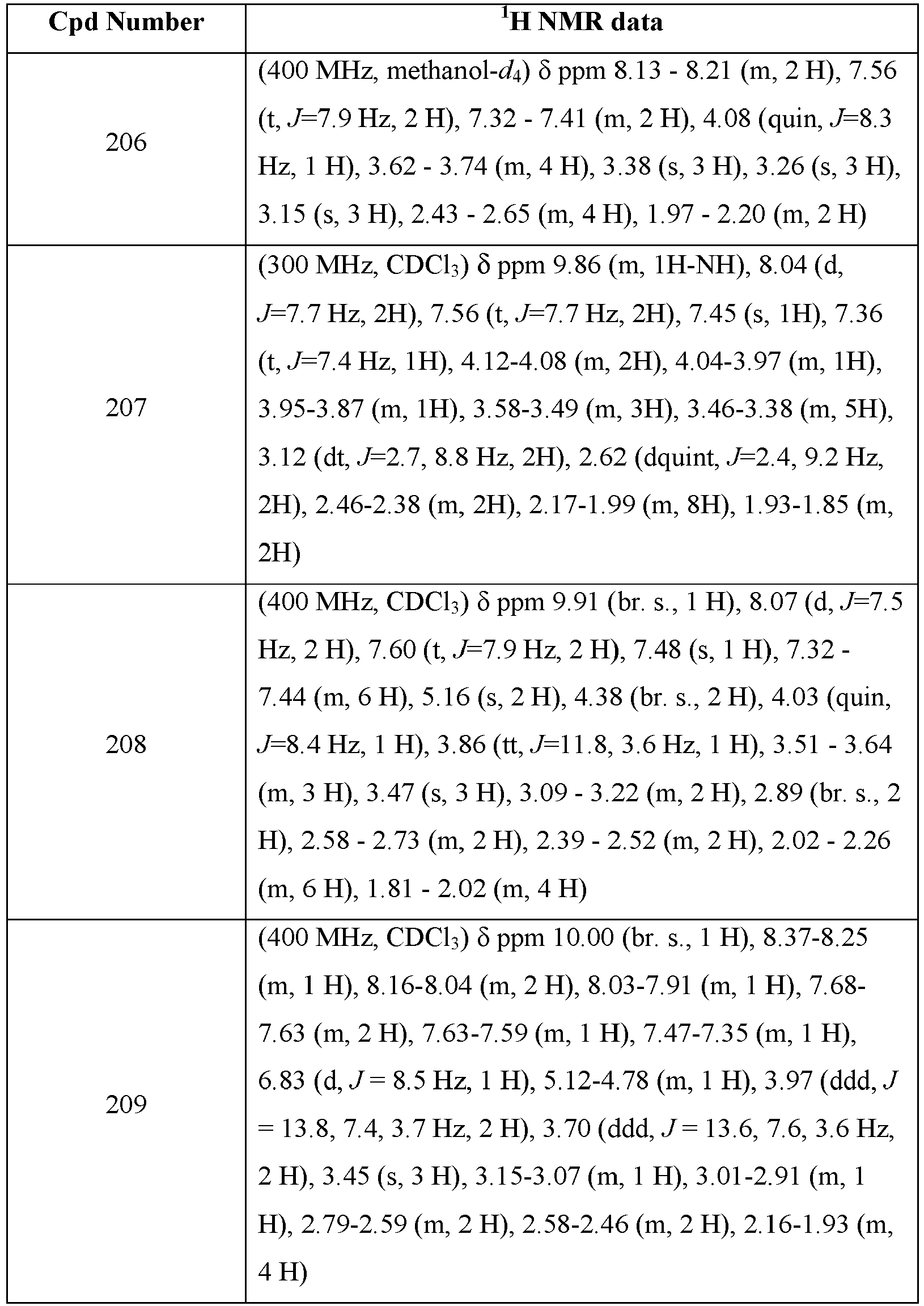


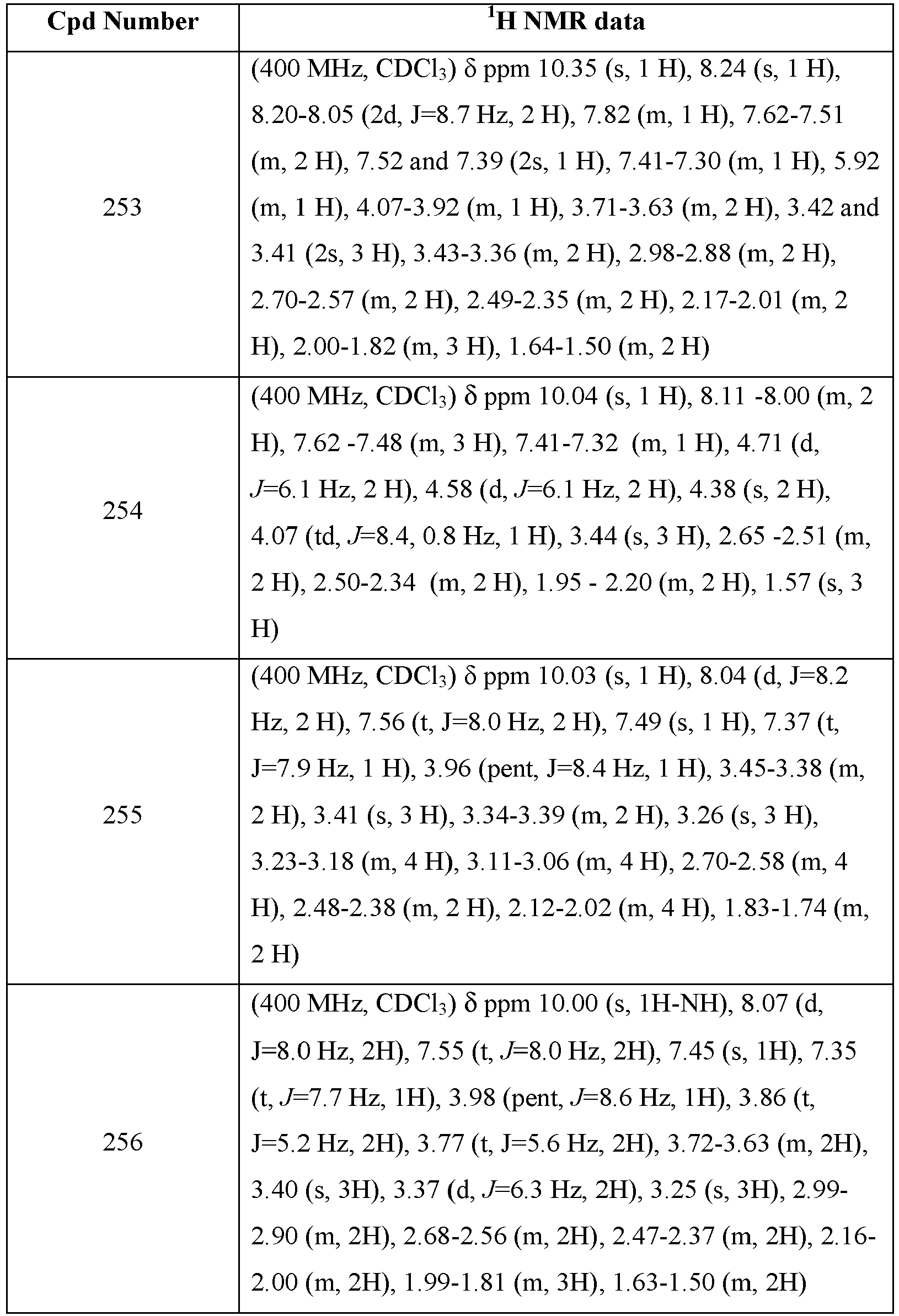
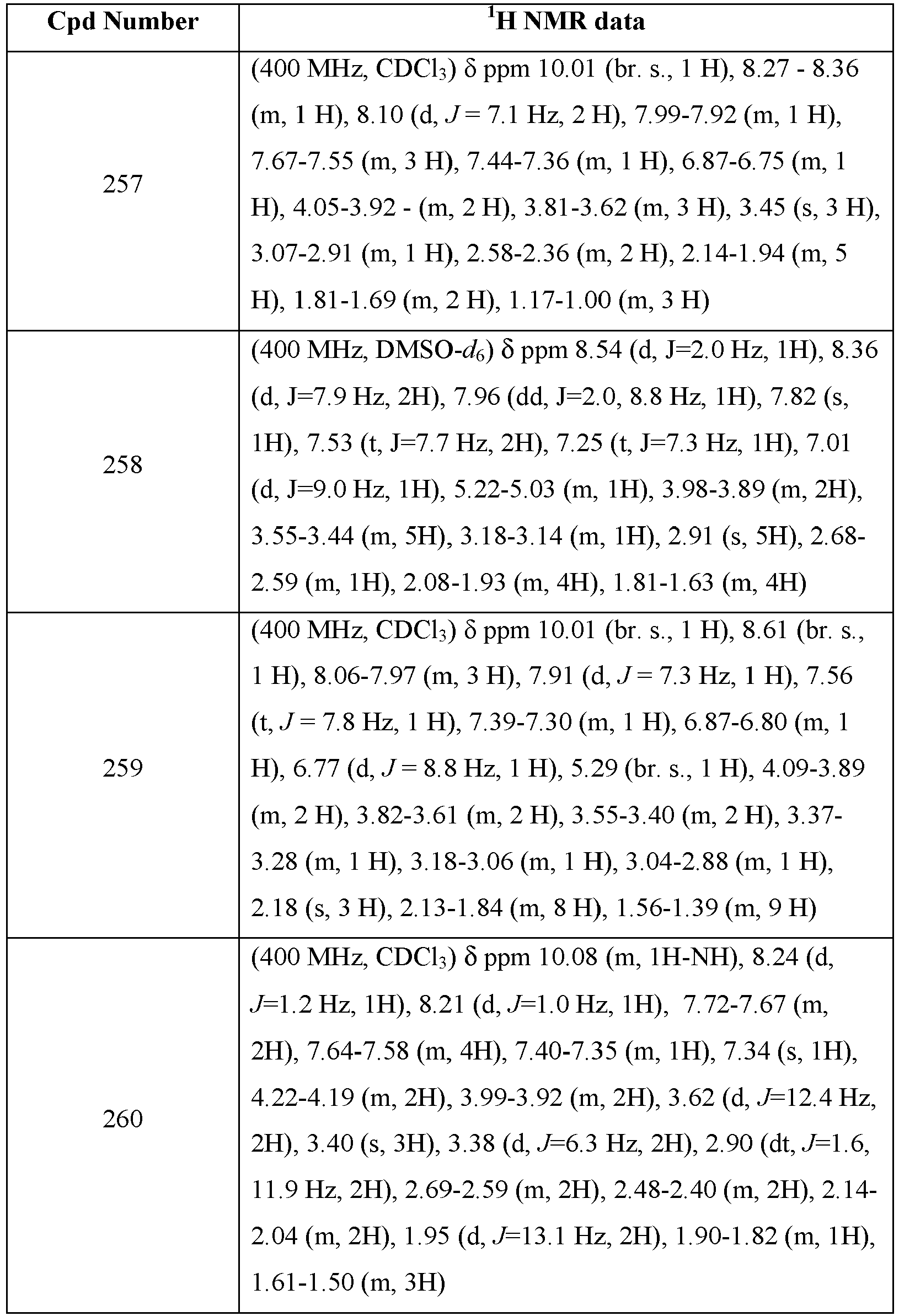


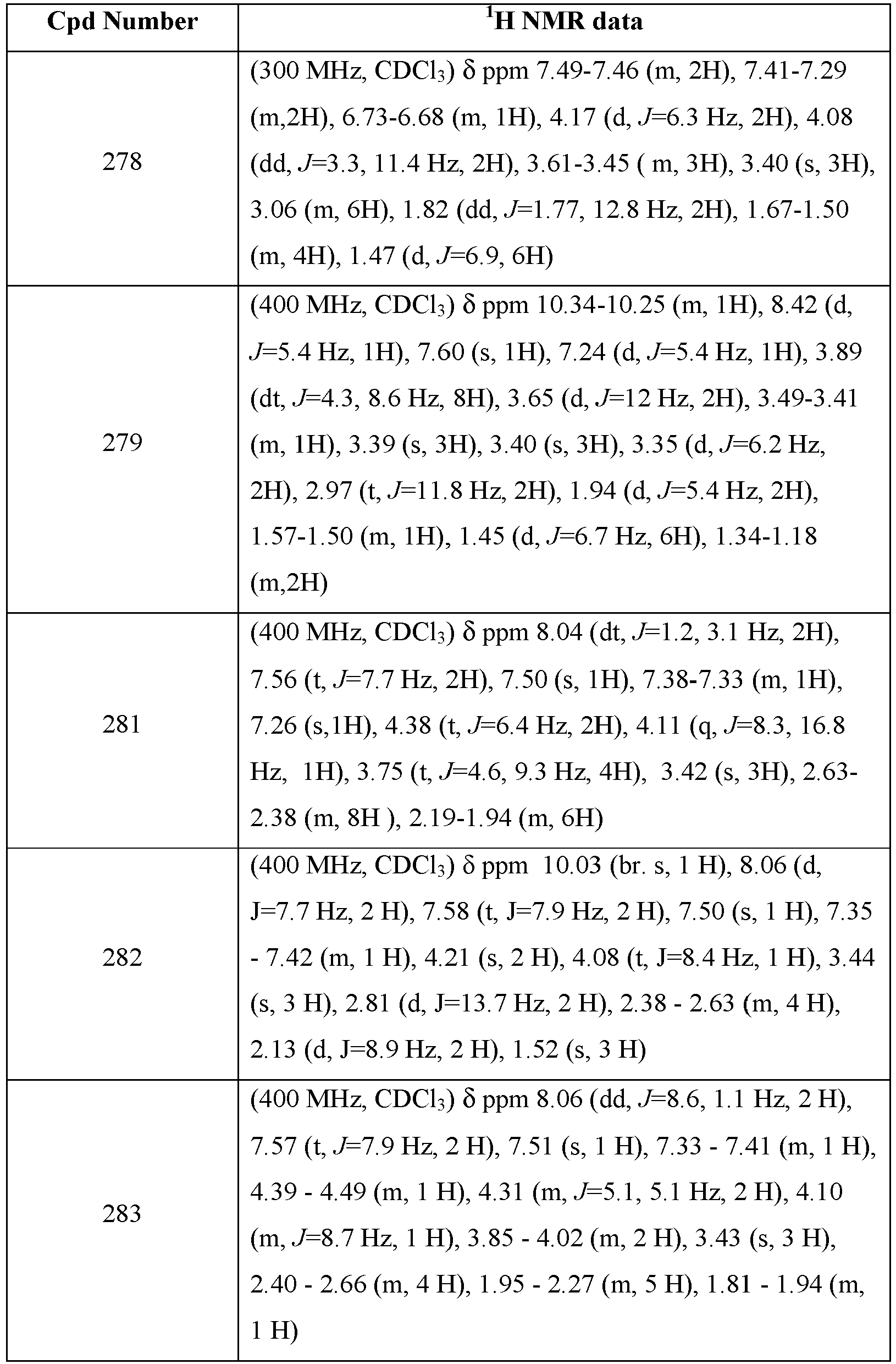


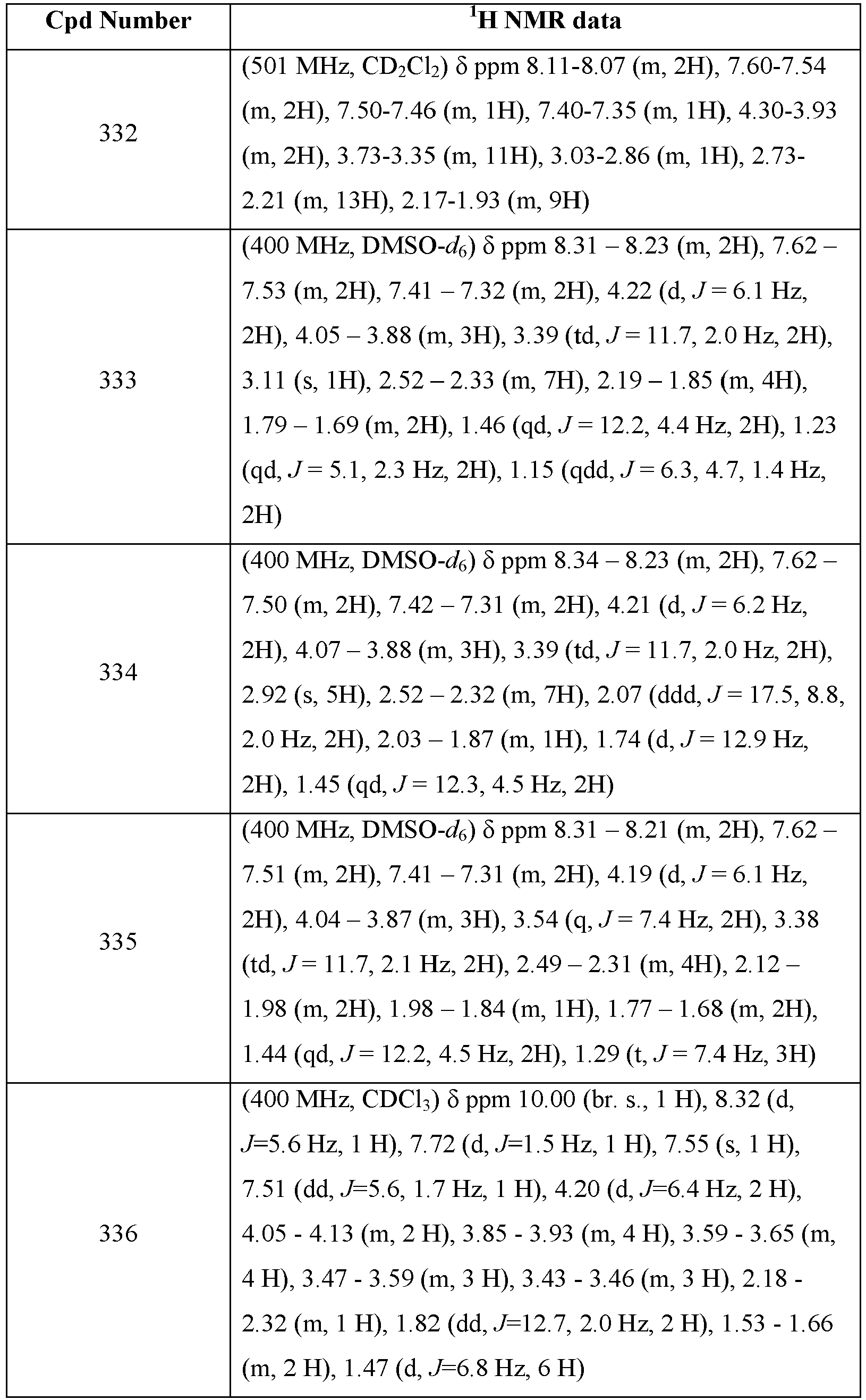


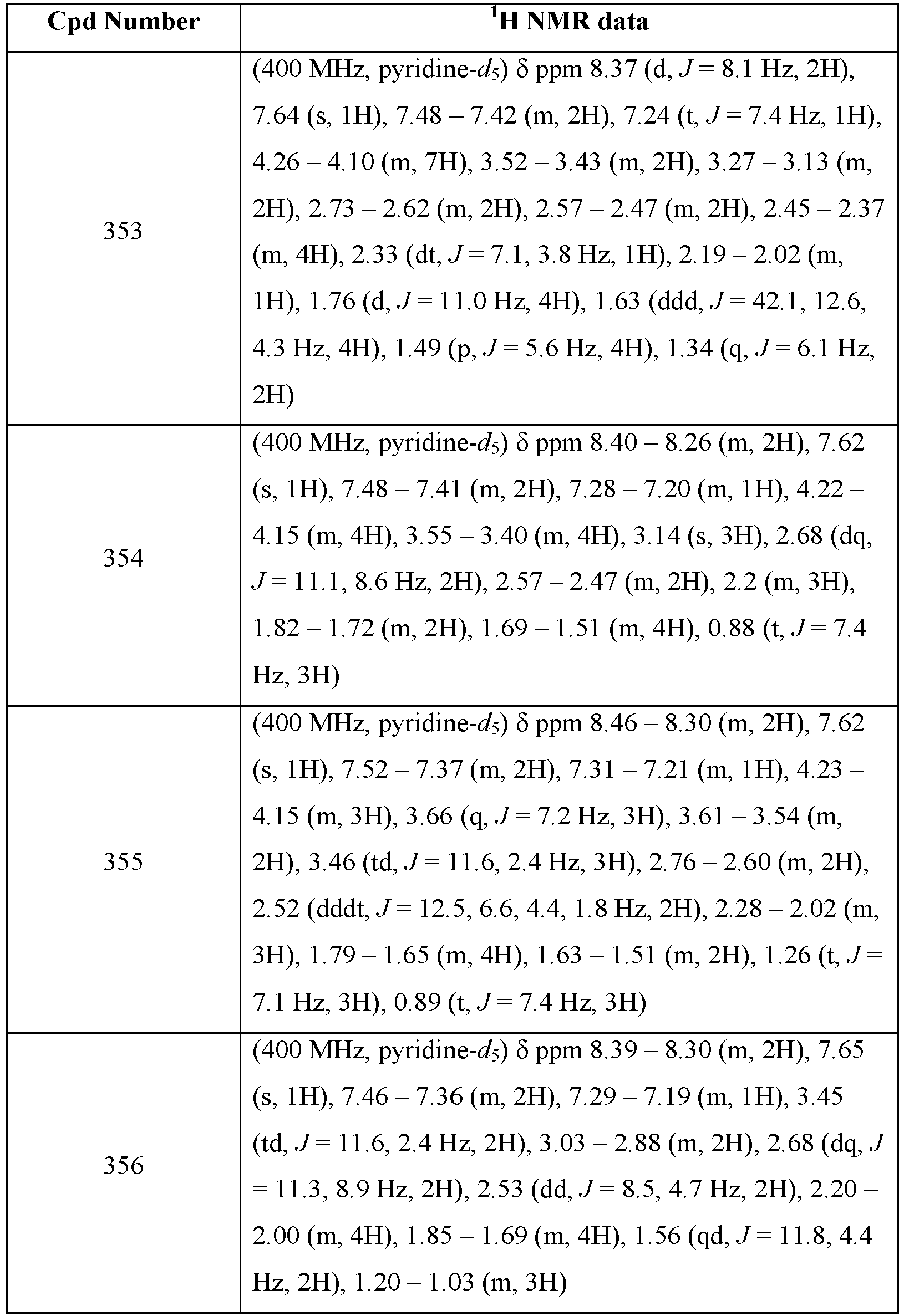


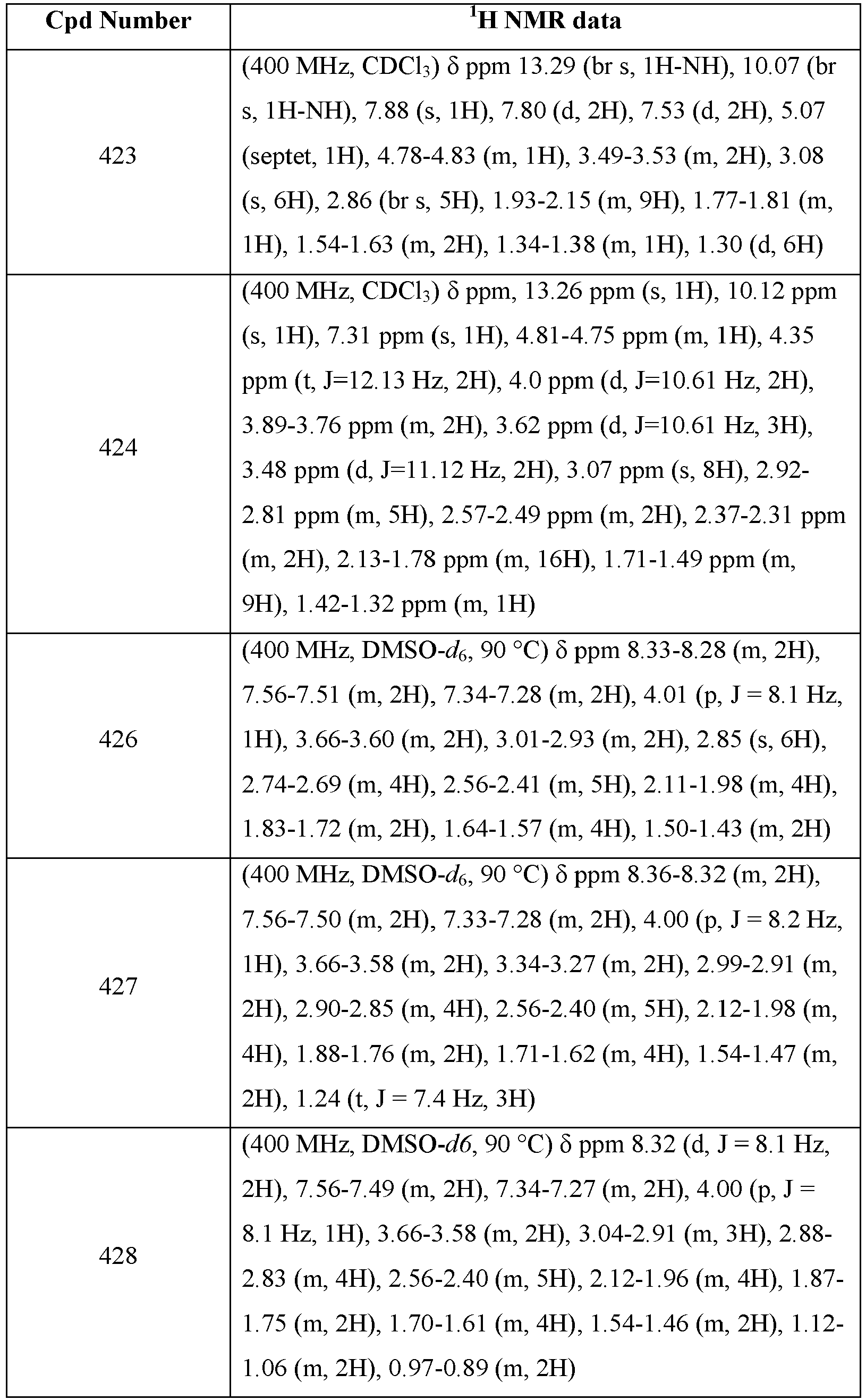


- The PathHunter® U2OS CFTR-ΔF508 cell assay (DiscoveRx) measures the expression of CFTR-ΔF508 at the plasma membrane. CFTR-ΔF508 has a folding defect leading to absence of protein at the plasma membrane. This assay is used to evaluate the capacity of compounds to increase the expression of CFTR-ΔF508 at the plasma membrane. The CFTR-ΔF508 is tagged with a ProLink™ peptide which can complement with plasma membrane expressed enzyme acceptor protein (EA-MEM). When both the ProLink™ and EA-MEM acceptor are in close proximity, i.e. both are located at the plasma membrane; a functional enzyme is formed of which the activity can be measured. The amount of CFTR-ΔF508 that can be rescued to the plasma membrane is correlated with the amount of functional enzyme that can be measured.
- There are several ways to measure the capacity of compounds to rescue CFTR-ΔF508 to the plasma membrane; either compounds are evaluated on their own and the impact on plasma membrane levels is measured or compounds are evaluated in combination with a co-corrector, i.e. a compound that rescues CFTR-ΔF508 to the plasma membrane but rescue can be enhanced by addition of compounds due to a complementary mode of action.
- For this purpose, PathHunter® U2OS CFTR-ΔF508 cells (DiscoveRx; custom made were cultured in AssayComplete™ U2OS Cell Culture medium (DiscoveRx; 92-0018GK3) as per manufacturer's instructions. For compound testing, cells were seeded in white 384-well plates (Greiner; 781080) at five thousand cells/well in 25 µL AssayComplete™ Cell Plating 5 Reagent (DiscoveRx; 93-0563R5A) and incubated overnight at 37 °C, 5% CO2. On day two, 5 µL of test compounds diluted in Cell Plating 5 Reagent were added to the cells with a final dimethyl sulfoxide (DMSO) concentration of 0.1%. In order to measure synergy with a co-corrector (3-[(2R,4R)-4-({[1-(2,2-difluoro-1,3-benzodioxol-5-yl)cyclopropyl]carbonyl}amino)-7-methoxy-3,4-dihydro-2H-chromen-2-yl]benzoic acid), 3 µM of co-corrector was added along with test compounds. All cell plates contained 3 µM of co-corrector or DMSO as positive and negative controls, respectively. Cells were incubated with compounds for twenty to twenty-four hours at 37 °C, 5% CO2. On day three, plates were placed at room temperature for thirty minutes and then 15 µL of substrate (PathHunter® Flash Detection Kit, DiscoveRx; 93-0247) was added per well. After one hour of incubation at room temperature in the dark, the luminescence signal was measured on a plate reader (Envision®, Perkin Elmer). Raw data were normalized to percentage activity values using the equation: 100 × (Sample - Negative control)/(Positive control - Negative Control).
- For this purpose PathHunter® U2OS CFTR-ΔF508 cells (DiscoveRx; custom made as described above) were cultured in AssayComplete™ U2OS Cell Culture medium (DiscoveRx; 92-0018GK3) as per manufacturer's instructions. For compound testing, cells were seeded in white 384-well plates (Greiner; 781080) at five thousand cells/well in 25 µL AssayComplete™ Cell Plating 5 Reagent (DiscoveRx; 93-0563R5A) and incubated overnight at 37 °C, 5% CO2. On day two, 5 µL of test compounds diluted in Cell Plating 5 Reagent were added to the cells with a final DMSO concentration of 0.1%. All cell plates contained 3 µM corrector (3-[(2R,4R)-4-({[1-(2,2-difluoro-1,3-benzodioxol-5-yl)cyclopropyl]carbonyl}amino)-7-methoxy-3,4-dibydro-2H-chromen-2-yl]benzoic acid) or DMSO as positive and negative controls, respectively. Cells were incubated with compounds for twenty to twenty-four hours at 37 °C, 5% CO2. On day three, plates were placed at room temperature for thirty minutes and then 15 µL of substrate (PathHunter® Flash Detection Kit, DiscoveRx; 93-0247) was added per well. After one hour of incubation at room temperature in the dark, the luminescence signal was measured on a plate reader (Envision®, Perkin Elmer). Raw data were normalized to percentage activity values using the equation: 100 × (Sample - Negative control)/(Positive control - Negative Control).
- To evaluate the impact of plasma protein binding of compounds on their biological activity, the PathHunter® U2OS CFTR-ΔF508 assay was run in the presence of 40% human serum (Sigma; H4522). For this purpose PathHunter® U2OS CFTR-ΔF508 cells (DiscoveRx; custom made) were cultured in AssayComplete™ U2OS Cell Culture medium (DiscoveRx; 92-0018GK3) as per manufacturer's instructions. For compound testing, cells were seeded in white 384-well plates (Greiner; 781080) at five thousand cells/well in 25 µL AssayComplete™ Cell Plating 5 Reagent (DiscoveRx; 93-0563R5A) containing 40% human serum and incubated overnight at 37 °C, 5% CO2. On day two, 5 µL of test compounds diluted in Cell Plating 5 Reagent were added to the cells with a final DMSO concentration of 0.1%. All cell plates contained 3µM corrector (4-[(2R,4R)-4-({[1-(2,2-difluoro-1,3-benzodioxol-5-yl)cyclopropyl]carbonyl}amino)-7-methoxy-3,4-dihydro-2H-chromen-2-yl]benzoic acid) or DMSO as positive and negative controls respectively. Cells were incubated with compounds for twenty to twenty-four hours at 37 °C, 5% CO2. On day three, plates were placed at room temperature for thirty minutes, and then 15 µL of substrate (PathHunter® Flash Detection Kit, DiscoveRx; 93-0247) was added per well. After one hour of incubation at room temperature in the dark, the luminescence signal was measured on a plate reader (Envision®, Perkin Elmer). Raw data were normalized to percentage activity values using the equation: 100 × (Sample - Negative control)/(Positive control - Negative Control).
- To evaluate the impact of plasma protein binding of compounds on their biological activity, the PathHunter® U2OS CFTR-ΔF508 was run in the presence of 40% human serum (Sigma; H4522). For this purpose PathHunter® U2OS CFTR-ΔF508 cells (DiscoveRx; custom made) were cultured in AssayComplete™ U2OS Cell Culture medium (DiscoveRx; 92-0018GK3) as per manufacturer's instructions. For compound testing, cells were seeded in white 384-well plates (Greiner; 781080) at five thousand cells/well in 25 µL AssayComplete™ Cell Plating 5 Reagent (DiscoveRx; 93-0563R5A) and incubated overnight at 37 °C, 5% CO2. On day two, the medium was replaced with 25 µL of primary human airway epithelial cell air-liquid interface medium or ALI medium, a 50:50 mixture of DMEM (Dulbecco's Modified Eagle Medium, Invitrogen; 41966-029) and LHC Basal Medium (Invitrogen; 12677-019) with additives as described in Table XVII) and containing 40% human serum. One hour later, 5 µL of test compounds diluted in ALI medium were added to the cells with a final DMSO concentration of 0.1%. All cell plates contained 3 µM corrector (4-[(2R,4R)-4-({[1-(2,2-difluoro-1,3-benzodioxol-5-yl)cyclopropyl]carbonyl}amino)-7-methoxy-3,4-dihydro-2H-chromen-2-yl]benzoic acid) or DMSO as positive and negative controls respectively. Cells were incubated with compounds for twenty to twenty-four hours at 37 °C, 5% CO2. On day three, plates were placed at room temperature for thirty minutes and then washed twice with PBS (phosphate buffered saline) followed by the addition of 15 µL of substrate (PathHunter® Flash Detection Kit, DiscoveRx; 93-0247) per well. After one hour of incubation at room temperature in the dark, the luminescence signal was measured on a plate reader (Envision®, Perkin Elmer). Raw data were normalized to percentage activity values using the equation: 100 × (Sample - Negative control)/(Positive control - Negative Control).
Table XVII. Ingredient Final concentration in medium Provider Cat# BSA 0.5 mg/mL Sigma A7638 bovine pituitary extract 10 µg/mL Sigma P1476 Insulin 0.87 µM Sigma 19278 transferrin 0.125 µM Sigma T0665 hydrocortisone 0.21 µM Sigma H0396 triiodothyronine 0.01 µM Sigma T6397 Epinephrine 0.01 µM Sigma E4250 epidermal growth factor 5 ng/mL Invitrogen PHG0313 All-trans retinoic acid 5 × 10⁻⁸ M Sigma R-2625 o-Phosphoethanolamine 0.5 µM Sigma P-0503 ethanolamine 0.5 µM Sigma E0135 zinc sulfate (ZnSO4 · 7H2O) 3.0 µM Sigma Z0251 pen/strep 100 U/mL Sigma 15140-122 ferrous sulfate 1.5 × 10⁻⁶ M Sigma F8048 magnesium chloride hexahydrate 6 × 10⁻⁴ Sigma M2670 calcium chloride dihydrate 1.1 × 10⁻⁴ M Fluka 21097 Trace elements: sodium selenite 30 nM Sigma S5261 manganese chloride tetrahydrate 1 nM Sigma M8054 sodium metasilicate nonahydrate 500 nM Sigma S5904 ammonium molybdate tetrahydrate 1 nM Sigma M1019 ammonium metavanadate 5 nM Sigma 398128 nickel(II)sulfate hexahydrate 1 nM Fluka (Sigma) 72280 (N4882) tin(II) chloride dihydrate 0.5 nM Sigma 243523 - The HRP-tagged ΔF508-CFTR cell assay measures the expression of CFTR-ΔF508 at the plasma membrane. CFTR-ΔF508 has a folding defect leading to absence of protein at the plasma membrane. This assay is used to evaluate the capacity of compounds to increase the expression of CFTR-ΔF508 at the plasma membrane. The CFTR-ΔF508 is tagged with HRP (horse radish peroxidase enzyme) within the ECL4 (Extracellular loop 4) of CFTR (Phuan, P.-W. et al. Synergy-based small-molecule screen using a human lung epithelial cell line yields ΔF508-CFTR correctors that augment VX-809 maximal efficacy. Mol. Pharmacol. 86, 42-51 (2014)). When HRP-tagged ΔF508-CFTR is present at the plasma membrane, the HRP enzyme activity can be measured. The amount of CFTR-ΔF508 that can be rescued to the plasma membrane is correlated with the amount of functional enzyme that can be measured.
- There are several ways to measure the capacity of compounds to rescue CFTR-ΔF508 to the plasma membrane; either compounds are evaluated on their own and the impact on plasma membrane levels is measured or compounds are evaluated in combination with a co-corrector, i.e. a compound that rescues CFTR-ΔF508 to the plasma membrane but rescue can be enhanced by addition of compounds due to a complementary mode of action.
- For this purpose doxycycline-inducible ΔF508-CFTR-HRP expressing CFBE41 o- cells (obtained from Gergely Lukacs, McGill University) were maintained in MEM (Minimum Essential Medium, Gibco; 31095) supplemented with 10% fetal bovine serum (Hyclone; SV30160.03) under puromycin (3 µg/mL) and G418 selection (0.2 mg/mL). For compound testing, cells were seeded at 4000 cells/well in white 384-well plates (Greiner; 781080) in 50 µL of medium containing 0.5 µg/mL doxycycline and incubated for 68 hours at 37 °C, 5% CO2. On day four, 10 µL of test compounds diluted in PBS (phosphate buffered saline) were added to the plates at a final DMSO concentration of 0.1%. In order to measure compound synergy with a co-corrector, 3 µM co-corrector (3-[(2R,4R)-4-({[1-(2,2-difluoro-1,3-benzodioxol-5-yl)cyclopropyl]carbonyl}amino)-7-methoxy-3,4-dihydro-2H-chromen-2-yl]benzoic acid) was added along with test compounds. All compound plates contained negative controls (DMSO) and positive controls (3 µM co-corrector). Cell plates were incubated at 33 °C, 5% CO2 for 20 hours. On day five, the cells were washed five times with phosphate-buffered saline, and HRP activity was assayed by the addition of 50 µL/well of HRP substrate (SuperSignal™ West Pico Chemiluminescent Substrate, Thermo Scientific; 34080). After incubation for 15 minutes in the dark, the chemiluminescence was measured using a plate reader (EnVision®, Perkin Elmer). Raw data were normalized to percentage activity values using the equation: 100 × (Sample - Negative control)/(Positive control - Negative Control).
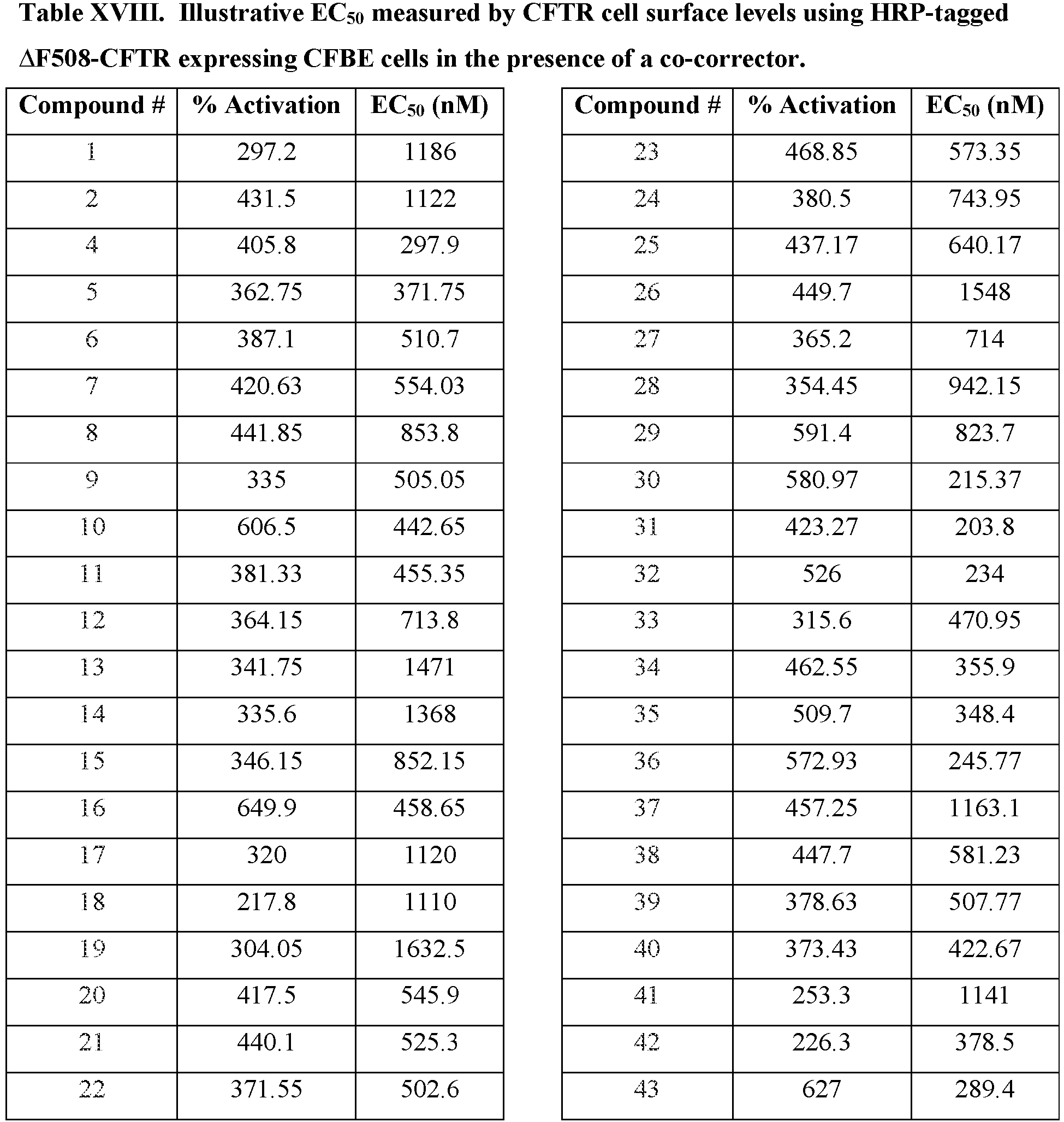


- For this purpose doxycycline-inducible ΔF508-CFTR-HRP expressing CFBE41o- cells (obtained from Gergely Lukacs, McGill University) were maintained in MEM (Gibco; 31095) supplemented with 10% fetal bovine serum (Hyclone; SV30160.03) under puromycin (3 µg/mL) and G418 selection (0.2 mg/mL). For compound testing, cells were seeded at 4000 cells/well in white 384-well plates (Greiner; 781080) in 50 µL medium containing 0.5 µg/mL doxycycline and incubated for 68 hours at 37 °C, 5% CO2. On day four, 10 µL test compounds diluted in PBS were added to the plates at a final DMSO concentration of 0.1%. All compound plates contained negative controls (DMSO) and positive controls (3 µM corrector, 3-[(2R,4R)-4-({[1-(2,2-difluoro-1,3-benzodioxol-5-yl)cyclopropyl]carbonyl}amino)-7-methoxy-3,4-dihydro-2H-chromen-2-yl]benzoic acid). Cell plates were incubated at 33 °C, 5% CO2 for 20 hours. On day five, the cells were washed five times with phosphate-buffered saline, and HRP activity was assayed by the addition of 50 µL/well of HRP substrate (SuperSignal™ West Pico Chemiluminescent Substrate, Thermo Scientific; 34080). After incubation for 15 minutes in the dark, chemiluminescence was measured using a plate reader (EnVision®, Perkin Elmer). Raw data were normalized to percentage activity values using the equation: 100 × (Sample - Negative control)/(Positive control - Negative Control).


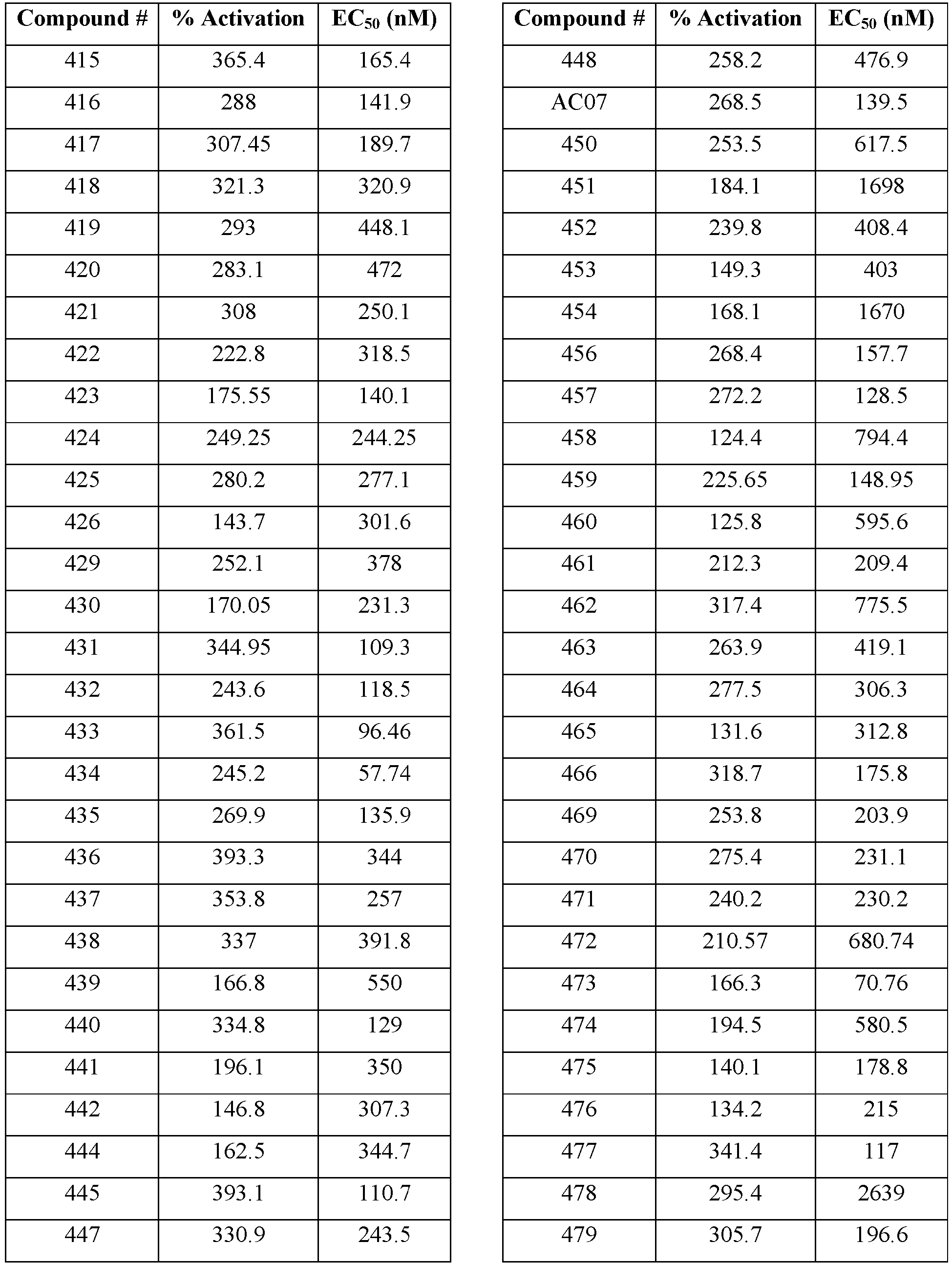


- The YFP halide influx assay measures the functionality of the Cystic Fibrosis Transmembrane Conductance regulator (CFTR) channels in the cystic fibrosis bronchial epithelium cell line CFBE41o-. The fluorescence of the yellow fluorescent protein (YFP) variant YFP H148Q, I152L or variant YFP H148Q, I152L & F47L is substantially quenched by iodine, a halide that is efficiently transported by CFTR. The assay is thus used to evaluate the effect of corrector compounds on CFTR channel function by measuring the extent of YFP signal quenching. (Galietta, L.J.V., Haggie, P.M., Verkman, A.S., 2001. Green fluorescent protein-based halide indicators with improved chloride and iodide affinities. FEBS Lett. 499, 220-224. doi: 10.1016/S0014-5793(01)02561-3; Nagai, T., Ibata, K., Park, E.S., Kubota, M., Mikoshiba, K., Miyawaki, A., 2002. A variant of yellow fluorescent protein with fast and efficient maturation for cell-biological applications. Nat. Biotechnol. 20, 87-90. doi: 10.1038/nbt0102-87). For this purpose, CFBE41o- cells were seeded in 96-well plates (6000 CFBE cells/well). One day after seeding, the CFBE cells were transduced with adenoviral vectors that direct the expression of the CFTR ΔF508 mutant and of the YFP reporter. Cells were treated with test compounds for 24 hours at 37 °C to allow trafficking of corrected CFTR to the membrane. The next day the CFTR channels were activated by treatment with the cAMP inducer forskolin (10.67 µM) and potentiator, N-(3-carbamoyl-5,5,7,7-tetramethyl-4,7-dihydro-5H-thieno[2,3-c]pyran-2-yl)-1H-pyrazole-5-carboxamide (0.5µM), in 1 ×D-PBS (from Gibco, Cat n# 14090-091) for 20 minutes prior to addition of an I- solution (137 mM NaI, 2.7 mM KI, 1.76 mM KH2PO4, 10.1 mM Na2HPO4, 5 mM glucose). The potentiator, 3-amino-N-[(2S)-2-hydroxypropyl]-5-{[4-(trifluoromethoxy)phenyl]sulfonyl}pyridine-2-carboxamide, was used in place of N-(3-carbamoyl-5,5,7,7-tetramethyl-4,7-dihydro-5H-thieno[2,3-c]pyran-2-yl)-1H-pyrazole-5-carboxamide in some assays. The I- induced quenching of fluorescence is recorded immediately after injection of I- for 7 seconds. The capacity of a compound to increase number of channels, and therefore overall halide influx is directly correlated with the decrease in fluorescence, and is expressed as (1- (fluorescence after 7 seconds (F)/fluorescence before injection (F0))) and an EC50 can be derived from a (1-F/F0) vs compound concentration plot.
- The TECC (Tranepithelial Clamp Circuit, EP-design) assay measures the functionality of the cystic fibrosis Transmembrane Conductance regulator (CFTR) by measuring the short circuit current (ISC) generated over the basolateral and apical membrane of lung epithelial cells. In TECC the transepithelial potential PD and transepithelial resistance (Rt ) are measured in an open circuit and transformed to I eq using Ohm's law. 24 Wells can be measured simultaneously allowing a higher throughput compared to Ussing chambers.
- For this purpose, bronchial epithelial cells isolated from CF patients homozygous for the CFTR ΔF508 mutation (hAEC-CF, Epithelix, Geneva, Switzerland; McGill University, Montreal, Qc; Asterand, Detroit, MI; University of North Carolina, Chapel Hill, NC) are plated on type IV collagen-coated Transwell® supports (Costar). Human airway epithelia are generated by provision of an air-liquid interface for 21 days to form well-differentiated polarized cultures that resemble in vivo pseudo-stratified ciliated epithelium (Fulcher, M.L., Gabriel, S., Burns, K.A., Yankaskas, J.R, Randell, S.H., 2005. Well-differentiated human airway epithelial cell cultures. Methods Mol. Med. 107, 183-206). The differentiated cells are treated with test corrector compound(s) (corrector alone or in combination with co-corrector, 4-[(2R,4R)-4-({[1-(2,2-difluoro-1,3-benzodioxol-5-yl)cyclopropyl]carbonyl}amino)-7-methoxy-3,4-dihydro-2H-chromen-2-yl]benzoic acid ("acute") or test corrector compounds, co-corrector and potentiator, N-(3-carbamoyl-5,5,7,7-tetramethyl-4,7-dihydro-5H-thieno[2,3-c]pyran-2-yl)-1H-pyrazole-5-carboxamide ("chronic") for 24 hours basolaterally to allow sufficient expression of properly folded CFTR protein on the membrane. All compound plates contained negative controls (DMSO) and positive controls (0.15µM, 4-[(2R,4R)-4-({[1-(2,2-difluoro-1,3-benzodioxol-5-yl)cyclopropyl]carbonyl}amino)-7-(difluoromethoxy)-3,4-dihydro-2H-chromen-2-yl]benzoic acid).
- For electrophysiological recording of the "acute" experiments, the human airway epithelia are mounted in the TECC heating plate and kept at 37 °C. The epithelia are bathed in a NaCl-Ringer solution (120 mM NaCl, 25 mM NaHCO3, 1.2 mM CaCl2, 1.2 mM MgCl2, 0.8 mM KH2PO4, 0.8 mM K2HPO4, pH 7.4, 5 mM glucose) on both the basolateral and apical sides. Apical amiloride is used to inhibit the endogenous epithelial sodium channel (ENaC) currents while forskolin is applied on both apical and basolateral side to stimulate CFTR. CFTR activity is measured by addition of forskolin followed by addition of a potentiator, N-(3-carbamoyl-5,5,7,7-tetramethyl-4,7-dihydro-5H-thieno[2,3-c]pyran-2-yl)-1H-pyrazole-5-carboxamide, on both sides. The potentiator, 3-amino-N-[(2S)-2-hydroxypropyl]-5-{[4-(trifluoromethoxy)phenyl]sulfonyl}pyridine-2-carboxamide, was used in place of N-(3-carbamoyl-5,5,7,7-tetramethyl-4,7-dihydro-5H-thieno[2,3-c]pyran-2-yl)-1H-pyrazole-5-carboxamide in some assays. Measurements are done during a 20 minute timeframe with recordings every 2 minutes. The increase in I eq is used as a measure for the increased CFTR activity, EC50 values can be generated by measuring impact of different concentrations of compound on I eq on primary cells, for this purpose each transwell is treated with a different compound concentration for 24 hours. Inhibitor-172, an inhibitor specific for CFTR, is used to test the specificity of the tested compounds. Raw data were normalized to percentage activity values using the equation: 100 × (Sample - Negative control)/(Positive control - Negative Control).
Table XX. Illustrative acute TECC assay response with and without the presence of a co-corrector. Compound # % Activity at 3 µM (Ieq*) % Activity at 10 µM (Ieq*) % Activity at 3 µM with co-corrector (Ieq*) 10 591.84 11 351 13 74.32 174.53 104 102.36 *Ieq refers to calculations based on the maximum current. - For electrophysiological recording of the "chronic" experiments, the human airway epithelia are mounted in the TECC heating plate for electrophysiological measurement and kept at 37 °C. The epithelia are bathed in a NaCl-Ringer solution (120 mM NaCl, 25 mM NaHCO3, 1.2 mM CaCl2, 1.2 mM MgCl2, 0.8 mM KH2PO4, 0.8 mM K2HPO4, pH 7.4, 5 mM glucose) on both the basolateral and apical sides. Test compounds (corrector, co-corrector, 4-[(2R,4R)-4-({[1-(2,2-difluoro-1,3-benzodioxol-5-yl)cyclopropyl]carbonyl}amino)-7-(difluoromethoxy)-3,4-dibydro-2H-chromen-2-yl]benzoic acid, and potentiator, N-(3-carbamoyl-5,5,7,7-tetramethyl-4,7-dihydro-5H-thieno[2,3-c]pyran-2-yl)-1H-pyrazole-5-carboxamide), are re-added to the recording solution prior to measurement. The potentiator, 3-amino-N-[(2S)-2-hydroxypropyl]-5-{[4-(trifluoromethoxy)phenyl]sulfonyl}pyridine-2-carboxamide (1.5 µM), was used in place of N-(3-carbamoyl-5,5,7,7-tetramethyl-4,7-dihydro-5H-thieno[2,3-c]pyran-2-yl)-1H-pyrazole-5-carboxamide in some assays (for Compound numbers >370). Apical amiloride is used to inhibit the endogenous ENaC currents while forskolin is applied on both apical and basolateral side to stimulate CFTR. Measurements are done during a 20 minute timeframe with recordings every 2 minutes. The increase in I eq is used as a measure for the increased CFTR activity, EC50 values can be generated by measuring impact of different concentrations of compound on I eq on primary cells, for this purpose each transwell is treated with a different compound concentration. Inhibitor-172, an inhibitor specific for CFTR, is used to test the specificity of the tested compounds. Raw data were normalized to percentage activity values using the equation: 100 × (Sample - Negative control)/(Positive control - Negative Control).
Table XXI. Illustrative chronic TECC assay response. Compound # %Activity at 1 µM (Ieq*) EC50 (nM) (Ieq*) %Activity at 1 µM (AUC**) %Activity at 3 µM (AUC**) EC50 (nM) (AUC**) 30 450 <30 34 270 <30 63 325 40 71 270 19.5 74 240 <30 75 316 30 80 250 19.3 85 120 >1000 86 210 30 87 150 <30 91 250 <30 93 220 <30 95 180 10 96 310 <30 104 720 <30 110 170 <30 113 310 32 117 81 >1000 119 157 >1000 121 206 74 128 235 <30 136 233.2 23.5 142 250 <300 144 350 12 146 310 30 150 100 152 482.77 16 155 200 4 158 370.9 160 190 160 167 260 32 168 282.45 38.2 169 210 2.1 177 419.90 >100 185 453 45.4 187 180 >1000 188 257.3 190 269 51 193 317.57 198 477.39 199 627.48 >1000 200 364.3 201 250 <300 207 441.31 215 320 45 219 298.20 221 245.9 40 226 530 56 228 240 32 229 430 20 230 265.44 27 236 434.22 80 238 521.96 240 288.71 140 241 400 <10 242 308.45 14 243 165.81 244 238.89 245 628.25 246 301.36 61 247 422.93 81 248 275.96 249 271.29 250 331.21 251 336.34 252 248.51 263 399.85 77 267 130 269 172.35 270 250 297 272 285.35 273 197.06 274 224.99 >300 279 109 291 255.92 294 21 297 470.97 ≤30 298 318059 304 194.54 316 452.88 45 317 311.08 24 318 439.94 320 215.3 322 440.86 323 217.91 325 317.57 328 531.7 423.1 96 331 537.3 10 334 345.13 100 337 299.50 340 216.53 348 343.24 200 365 521.8 200 366 427.95 369 583.16 8.3 370 226.54 379 370 43 380 250 381 441 4105 382 204.7 347 100 383 299 2 385 12.3 396 259.4666 397 251.7766 399 244.7508 400 230 402 345.045 12.1 404 433.3333 405 323.3333 406 235 407 310 48.94 408 430 21 409 420 149.8 410 233.3333 1.582 415 196.1812 28.4 416 288.6036 118.9 417 256.6667 418 196.6667 19.19 420 223.3333 0 421 193.3333 45.63 422 320 423 365 39.83 424 462.0976 429 180 83.75 431 280 440 696.6667 2.98 441 236.6667 205.8 445 406.6667 447 330 448 116.8948 456 261.1621 469 293.3333 108.2 470 210 471 296.6667 472 181.0865 34.24 473 243.3333 474 226.6667 480 548.575 484 380 487 340 493 271.4141 370.8 495 262.4635 517 309.141 522 666.6667 21.95 523 460.2177 525 477.2665 50.35 526 400 14.23 527 370.693 529 520 19.11 530 326.6667 535 335.0294 537 261.5724 541 320 546 282.0317 549 373.3333 242.7 551 239.0643 552 235.2857 555 296.6667 107 558 221.9818 4.74 559 231.6378 561 620 562 289.8854 569 1156.667 570 377.5594 575 246.6667 576 225.798 578 936.6667 583 613.3333 51.3 589 236.6667 590 220.4586 594 320 597 263.3333 599 116.6667 605 726.6667 608 442.1916 609 306.6667 611 176.7495 614 407.7118 621 256.6667 623 433.3333 624 310 625 403.3333 626 387.4854 627 446.6667 628 473.0586 88.4 629 153.3918 6.848 630 125.1944 47.07 631 156.9645 632 237.1158 29.28 633 204.5 634 137.5 638 341.3493 11.24 645 246.4648 646 276.7167 23.45 647 420.0246 150.7 648 366.0679 649 224.5026 654 293.3333 656 197.5908 657 357.6409 658 260.3278 659 251.6549 *Ieq refers to calculations based on the maximum current.
**AUC is the full area under the curve upon forskolin stimulation. - Information on protein binding of compounds can be retrieved from incubation of compounds in the presence of 40% human serum. For this purpose the differentiated cells are treated basolaterally with test compounds in medium containing 40% human serum (Sigma; H4522) for 24 hours. For electrophysiological recording, the human airway epithelia are mounted in the TECC heating plate and kept at 37 °C. The epithelia are bathed in a NaCl-Ringer solution (120 mM NaCl, 25 mM NaHCO3, 1.2 mM CaCl2, 1.2 mM MgCl2, 0.8 mM KH2PO4, 0.8 mM K2HPO4, pH 7.4, 5 mM glucose) on both the basolateral and apical sides. Test compounds (corrector, co-corrector, 4-[(2R,4R)-4-({[1-(2,2-difluoro-1,3-benzodioxol-5-yl)cyclopropyl]carbonyl}amino)-7-(difluoromethoxy)-3,4-dihydro-2H-chromen-2-yl]benzoic acid, and potentiator, N-(3-carbamoyl-5,5,7,7-tetramethyl-4,7-dihydro-5H-thieno[2,3-c]pyran-2-yl)-1H-pyrazole-5-carboxamide), are re-added to the recording solution prior to measurement. Apical amiloride is used to inhibit the endogenous ENaC currents while forskolin is applied on both apical and basolateral side to stimulate CFTR. Measurements are done during a 20 minute timeframe with recordings every 2 minutes. The increase in I eq is used as a measure for the increased CFTR activity, EC50 values can be generated by measuring impact of different concentrations of compound on I eq on primary cells, for this purpose each transwell is treated with a different compound concentration. Inh-172, an inhibitor specific for CFTR, is used to test the specificity of the tested compounds.
Claims (22)
- A compound of formula (I) or a pharmaceutically acceptable salt thereof,
 R1 is G1A, C1-C6 haloalkyl, or C1-C6 alkyl; wherein the C1-C6 haloalkyl and the C1-C6 alkyl are each optionally substituted with one G1A;G1A, at each occurrence, is independently phenyl, 5-6 membered monocyclic heteroaryl, 4-7 membered monocyclic heterocycle, 5-11 membered fused bicyclic heterocycle, or C3-C6 monocyclic cycloalkyl; wherein each G1A is optionally substituted with 1, 2, 3, or 4 substituents independently selected from the group consisting of R1a and G1B;G1B, at each occurrence, is independently 4-7 membered monocyclic heterocycle which is optionally substituted with 1, 2, 3, or 4 independently selected R1b groups;R2 is hydrogen, C2-C4 alkenyl, C1-C6 alkyl, C1-C6 haloalkyl, -OR2xa, -N(R2xa)(R2xb), or G2A;R2xa, at each occurrence, is independently C1-C6 alkyl, C1-C6 haloalkyl, or G2B;R2xb is hydrogen, C1-C3 alkyl, or C1-C3 haloalkyl;G2A and G2B are each independently a 4-7 membered monocyclic heterocycle or a C3-C6 monocyclic cycloalkyl; wherein G2A and G2B are each optionally substituted with 1, 2, or 3 independently selected R2a groups;R3 is G3A, -G3B-L1-G3C, -G3B-L3-G3C-G3E, -(C1-C6 alkylenyl)-G3D, -OR3a, or -N(R3a)(R3b);R3a, at each occurrence, is independently G3D, C1-C6 haloalkyl, or C1-C6 alkyl; wherein the C1-C6 haloalkyl and the C1-C6 alkyl are each optionally substituted with one or two substituents independently selected from the group consisting of G3D, -OR3xa, and -N(R3xb)2;R3xa and R3xb, at each occurrence, are each independently hydrogen, C1-C6 haloalkyl, C1-C6 alkyl, or G3D;R3b is hydrogen, C1-C6 alkyl, or C1-C6 haloalkyl;L1 is a bond, C1-C6 alkylenyl, (C1-C6 alkylenyl)r-L2-(C1-C6 alkylenyl)s, or O-(C1-C6 alkylenyl)-C(O), wherein the left end of the L1 moiety is attached to G3B;L2 is O, N(Rx), C(O), N(Rx)C(O), or C(O)N(Rx); wherein each Rx is independently hydrogen, C1-C6 alkyl, or C1-C6 haloalkyl;L3 is a bond or C1-C6 alkylenyl;r is 0 or 1;s is 0 or 1;G3A, G3B, and G3C and each independently C3-C11 cycloalkyl, phenyl, 5-6 membered monocyclic heteroaryl, or 4-11 membered heterocycle; wherein G3A, G3B, and G3C are each optionally substituted with 1, 2, 3, or 4 independently selected Re groups;G3D, at each occurrence, is independently C3-C8 monocyclic cycloalkyl, 4-7 membered monocyclic heterocycle, a 5-11 membered fused bicyclic heterocycle, or a 5-11 membered spiro heterocycle; wherein each G3D is optionally substituted with 1, 2, 3, or 4 substituents independently selected from the group consisting of Re and G3E;G3E, at each occurrence, is independently C3-C8 monocyclic cycloalkyl or 4-7 membered monocyclic heterocycle; wherein each G3E is optionally substituted with 1, 2, 3, or 4 independently selected Re groups;R4 is hydrogen, C1-C3 alkyl, or C1-C3 haloalkyl;R5 is C1-C6 alkyl, C2-C6 alkenyl, C2-C6 alkynyl, C1-C6 haloalkyl, -N(R5ax)(R5bx), -OR5dx, or G5A; wherein the C1-C6 alkyl and the C1-C6 haloalkyl are each optionally substituted with one or two substituents independently selected from the group consisting of
G5A, -CN, -N3, -OR5ax, -S(O)2R5ax, -S(O)2N(R5ax)(R5bx), -N(R5ax)(R5bx), -N(R5bx)S( O)2R5cx, -N(R5bx)C(O)R5cx, -N(R5bx)C(O)N(R5ax)(R5bx), -N(R5bx)C(O)OR5xc, -C(O )R5ax, -C(O)OR5ax, -C(O)N(R5bx)S(O)2R5cx, and -C(O)N(R5ax)(R5bx);R5ax and R5bx, at each occurrence, are each independently hydrogen, C1-C6 alkyl, C1-C6 haloalkyl, -OR5ex, -(C1-C6 alkylenyl)-OR5ex, G5A, or -(C1-C6 alkylenyl)-G5A;R5cx, at each occurrence, is independently C1-C6 alkyl, C1-C6 haloalkyl, G5A, or -(C1-C6 alkylenyl)-G5A;R5dx is C1-C6 alkyl, or C1-C6 haloalkyl;R5ex is hydrogen, C1-C6 alkyl, or C1-C6 haloalkyl;G5A, at each occurrence, is independently C3-C11 cycloalkyl, phenyl, 5-6 membered monocyclic heteroaryl, or 4-11 membered heterocycle; wherein each G5A is optionally substituted with 1, 2, 3, or 4 independently selected R5a groups;R5a, at each occurrence, is independently C1-C6 alkyl, C2-C6 alkenyl, C2-C6 alkynyl, halogen, C1-C6 haloalkyl, oxo, G5B, -CN,
NO2, -ORb, -OC(O)Rc, -OC(O)N(Rd)2, -SRb, -S(O)2Rb, -S(O)2N(Rd)2, -C(O)Rb, -C (O)ORb, -C(O)N(Rd)2, -C(O)N(Rd)S(O)2Rc, -N(Rd)2, -N(Rd)C(O)Rc, -N(Rd)S(O)2 Rc, -N(Rd)C(O)O(Rb), -N(Rd)C(O)N(Rd)2, -N(Rd)S(O)2N(Rd)2, -(C1-C6 alkylenyl)-CN, -(C1-C6 alkylenyl)-G5B, -(C1-C6 alkylenyl)-ORb, -(C1-C6 alkylenyl)-OC(O)Rc, -(C1-C6 alkylenyl)-OC(O)N(Rd)2, -(C1-C6 alkylenyl)-SRb, -(C1-C6 alkylenyl)-S(O)2Rb, -(C1-C6 alkylenyl)-S(O)2N(Rd)2, -(C1-C6 alkylenyl)-C(O)Rb, -(C1-C6 alkylenyl)-C(O)ORb, -(C1-C6 alkylenyl)-C(O)N(Rd)2, -(C1-C6 alkylenyl)-C(O)N(Rd)S(O)2Rc, -(C1-C6 alkylenyl)-N(Rd)2, -(C1-C6 alkylenyl)-N(Rd)C(O)Rc, -(C1-C6 alkylenyl)-N(Rd)S(O)2Rc, -(C1-C6 alkylenyl)-N(Rd)C(O)O(Rc), -(C1-C6 alkylenyl)-N(Rd)C(O)N(Rd)2, or -(C1-C6 alkylenyl)-N(Rd)S(O)2N(Rd)2;Rb and Rd, at each occurrence, are each independently hydrogen, C1-C6 alkyl, C1-C6 haloalkyl, alkoxyalkyl, G5B, or -(C1-C6 alkylenyl)-G5B;Rc, at each occurrence, is independently C1-C6 alkyl, C1-C6 haloalkyl, alkoxyalkyl, G5B, or -(C1-C6 alkylenyl)-G5B;G5B, at each occurrence, is independently C3-C6 monocyclic cycloalkyl, phenyl, 5-6 membered monocyclic heteroaryl, or 4-7 membered monocyclic heterocycle; wherein each G5B is optionally substituted with 1, 2, 3, or 4 independently selected R5b groups;Re, at each occurrence, is independently C2-C6 alkenyl, C2-C6 alkynyl, C1-C6 alkyl, C1-C6 haloalkyl, halogen, oxo, -CN, -N3,-NO2, -ORf, -OC(O)Rg, -OC(O)NRfRh, -SRf, -S(O)2Rf, -S(O)2NRfRh, -C(O)Rf, -C( O)ORf, -C(O)NRfRh, -C(O)N(Rh)S(O)2Rf, -N(Rf)2, -N(Rh)C(O)Rh, -N(Rh)S(O)2Rg , -N(Rh)C(O)O(Rg), -N(Rh)C(O)NRfRh, or -N(Rh)S(O)2NRfRh; wherein the C1-C6 haloalkyl and the C1-C6 alkyl are each optionally substituted with 1 or 2 substituents independently selected from the group consisting of -CN,
NO2, -ORf, -OC(O)Rg, -OC(O)NRfRh, -SRf, -S(O)2Rf, -S(O)2NRfRh, -C(O)Rf, -C( O)ORf, -C(O)NRfRh, -C(O)N(Rh)S(O)2Rf, -N(Rf)2, -N(Rh)C(O)Rg, -N(Rh)S(O)2Rg , -N(Rh)C(O)O(Rg), -N(Rh)C(O)NRfRh, and -N(Rh)S(O)2NRfRh;Rf, at each occurrence, is independently hydrogen, C1-C6 alkyl, C2-C6 alkenyl, C2-C6 alkynyl, C1-C6 haloalkyl, -(C1-C6 alkylenyl)-CN, -(C1-C6 alkylenyl)-ORm, -(C1-C6 alkylenyl)-OC(O)Rn, -(C1-C6 alkylenyl)-OC(O)N(Rm)2, -(C1-C6 alkylenyl)-SRm, -(C1-C6 alkylenyl)-S(O)2Rm, -(C1-C6 alkylenyl)-S(O)2N(Rm)2, -(C1-C6 alkylenyl)-C(O)Rm, -(C1-C6 alkylenyl)-C(O)ORm, -(C1-C6 alkylenyl)-C(O)N(Rm)2, -(C1-C6 alkylenyl)-C(O)N(Rm)S(O)2Rn, -(C1-C6 alkylenyl)-N(Rm)2, -(C1-C6 alkylenyl)-N(Rm)C(O)Rn, -(C1-C6 alkylenyl)-N(Rm)S(O)2Rn, -(C1-C6 alkylenyl)-N(Rm)C(O)O(Rn), -(C1-C6 alkylenyl)-N(Rm)C(O)N(Rm)2, or -(C1-C6 alkylenyl)-N(Rm)S(O)2N(Rm)2Rg, at each occurrence, is independently C1-C6 alkyl, C2-C6 alkenyl, C2-C6 alkynyl, C1-C6 haloalkyl, -(C1-C6 alkylenyl)-CN, -(C1-C6 alkylenyl)-ORm, -(C1-C6 alkylenyl)-OC(O)Rn, -(C1-C6 alkylenyl)-OC(O)N(Rm)2, -(C1-C6 alkylenyl)-SRm, -(C1-C6 alkylenyl)-S(O)2Rm, -(C1-C6 alkylenyl)-S(O)2N(Rm)2, -(C1-C6 alkylenyl)-C(O)Rm, -(C1-C6 alkylenyl)-C(O)ORm, -(C1-C6 alkylenyl)-C(O)N(Rm)2, -(C1-C6 alkylenyl)-C(O)N(Rm)S(O)2Rn, -(C1-C6 alkylenyl)-N(Rm)2, -(C1-C6 alkylenyl)-N(Rm)C(O)Rn, -(C1-C6 alkylenyl)-N(Rm)S(O)2Rn, -(C1-C6 alkylenyl)-N(Rm)C(O)O(Rn), -(C1-C6 alkylenyl)-N(Rm)C(O)N(Rm)2, or -(C1-C6 alkylenyl)-N(Rm)S(O)2N(Rm)2;Rh, at each occurrence, is independently hydrogen, C1-C6 alkyl, C1-C6 haloalkyl, or -(C1-C6 alkylenyl)-ORm;R1a, R1b, R2a, and R5b, at each occurrence, are each independently C1-C6 alkyl, C2-C6 alkenyl, C2-C6 alkynyl, halogen, C1-C6 haloalkyl, oxo, -CN, NO2, -ORm, -OC(O)Rn, -OC(O)N(Rm)2, -SRm, -S(O)2Rm, -S(O)2N(Rm)2, -C(O)Rm, -C(O)ORm, -C(O)O(benzyl), -C(O)N(Rm)2, -C(O)N(Rm)S(O)2Rn, -N(Rm)2, -N(Rm) (alkoxyalkyl), -N(alkoxyalkyl)2, -N(Rm)C(O)Rn, -N(Rm)S(O)2Rn, -N(Rm)C(O)O(R n), -N(Rm)C(O)N(Rm)2, -N(Rm)S(O)2N(Rm)2, -(C1-C6 alkylenyl)-CN, -(C1-C6;alkylenyl)-ORm, -(C1-C6 alkylenyl)-OC(O)Rn, -(C1-C6 alkylenyl)-OC(O)N(Rm)2, -(C1-C6 alkylenyl)-SRm, -(C1-C6 alkylenyl)-S(O)2Rm, -(C1-C6 alkylenyl)-S(O)2N(Rm)2, -(C1-C6 alkylenyl)-C(O)Rm, -(C1-C6 alkylenyl)-C(O)ORm, -(C1-C6 alkylenyl)-C(O)N(Rm)2, -(C1-C6 alkylenyl)-C(O)N(Rm)S(O)2Rn, -(C1-C6 alkylenyl)-N(Rm)2, -(C1-C6 alkylenyl)-N(Rm)C(O)Rn, -(C1-C6 alkylenyl)-N(Rm)S(O)2Rn, -(C1-C6 alkylenyl)-N(Rm)C(O)O(Rn), -(C1-C6 alkylenyl)-N(Rm)C(O)N(Rn)2, or -(C1-C6 alkylenyl)-N(Rm)S(O)2N(Rn)2;Rm, at each occurrence, is independently hydrogen, C1-C6 alkyl, or C1-C6 haloalkyl;Rn, at each occurrence, is independently C1-C6 alkyl or C1-C6 haloalkyl;R6 is hydrogen, C1-C6 alkyl, or C1-C6 haloalkyl; orR5 and R6 together form a C1-C6 alkylenyl or -N(Rz)-(C1-C6 alkylenyl)- wherein the N(Rz) is attached to the S(O)2 moiety of formula (I); andRz is hydrogen, C1-C6 alkyl, or C1-C6 haloalkyl. - The compound of claim 1 or a pharmaceutically acceptable salt thereof, wherein
R1 is G1A, C1-C6 haloalkyl, or C1-C6 alkyl;preferably, wherein R1 is G1A;more preferably wherein R1 is G1A; wherein G1A is optionally substituted phenyl or optionally substituted 5-6 membered monocyclic heteroaryl. - The compound of claim 1 or a pharmaceutically acceptable salt thereof, wherein
R2 is C1-C6 alkyl, C1-C6 haloalkyl, -OR2xa, or G2A;
preferably wherein R2 is C1-C6 alkyl, C1-C6 haloalkyl, or G2A; and
G2A is an optionally substituted C3-C6 monocyclic cycloalkyl. - The compound of claim 1 or a pharmaceutically acceptable salt thereof, wherein
R2 is -OR2xa. - The compound of claim 1 or a pharmaceutically acceptable salt thereof, wherein
R3 is G3A, -G3B-L1-G3C, or -OR3a;
preferably wherein R3 is G3A or -G3B-L1-G3C;
more preferably wherein(a) R3 is G3A; and
G3A is optionally substituted phenyl, optionally substituted 5-6 membered monocyclic heteroaryl, or optionally substituted 4-11 membered heterocycle; or(b) R3 is -G3B-L1-G3C;
G3B is phenyl, 5-6 membered monocyclic heteroaryl, or 4-7 membered monocyclic heterocycle; each of which is optionally substituted; and G
3C is C3-C6 monocyclic cycloalkyl, phenyl, 5-6 membered monocyclic heteroaryl, or 4-7 membered monocyclic heterocycle; each of which is optionally substituted. - The compound of claim 1 or a pharmaceutically acceptable salt thereof, wherein
R3 is -OR3a; and
R3a is G3D, C1-C6 haloalkyl, or C1-C6 alkyl; wherein the C1-C6 haloalkyl and the C1-C6 alkyl are each substituted with one or two substituents independently selected from the group consisting of G3D, -OR3xa, and -N(R3xb)2. - The compound of claim 1 or a pharmaceutically acceptable salt thereof, wherein
R5 is C1-C6 alkyl, C2-C6 alkenyl, C2-C6 alkynyl, or C1-C6 haloalkyl; wherein the C1-C6 alkyl and the C1-C6 haloalkyl are each optionally substituted with one or two substituents independently selected from the group consisting of G5A, -CN, -N3, -OR5ax, -S(O)2R5ax, -S(O)2N(R5ax)(R5bx), -N(R5ax)(R5bx), -N(R5bx)S(O) 2R5cx, -N(R5bx)C(O)R5cx, -N(R5bx)C(O)N(R5ax)(R5bx), -N(R5bx)C(O)OR5cx, -C(O)R5ax, -C(O)OR5ax, -C(O)N(R5bx)S(O)2R5cx, and -C(O)N(R5ax)(R5bx). - The compound of claim 1 or a pharmaceutically acceptable salt thereof, wherein R5 is -N(R5ax)(R5bx), or G5A.
- The compound of claim 1 or a pharmaceutically acceptable salt thereof, wherein
R1 is G1A, C1-C6 haloalkyl, or C1-C6 alkyl; and
R2 is C1-C6 alkyl, C1-C6 haloalkyl, or G2A;
preferably wherein R1 is G1A;
R2 is C1-C6 alkyl or G2A; and
R3 is G3A, -G3B-L1-G3C, or -OR3a. - The compound of claim 1 or a pharmaceutically acceptable salt thereof, wherein(a) R1 is G1A;
R2 is C1-C6 alkyl or G2A; and
R5 is C1-C6 alkyl or C1-C6 haloalkyl; or(b) R1 is G1A;
R2 is C1-C6 alkyl or G2A; and
R5 is C1-C6 alkyl which is substituted with one substituent selected from the group consisting of
G5A, -CN, -N3, -OR5ax, -N(R5ax)(R5bx), -N(R5bx)C(O)R5cx, -N(R5bx)C(O)OR5cx, -C(O) OR5ax, and -C(O)N(R5ax)(R5bx); or(c) R1 is G1A;
R2 is C1-C6 alkyl or G2A; and
R5 is -N(R5ax)(R5bx); or(d) R1 is G1A;
R2 is C1-C6 alkyl or G2A; and
R5 is G5A. - The compound of claim 1 or a pharmaceutically acceptable salt thereof, wherein(a) R1 is G1A; wherein G1A is optionally substituted phenyl, or optionally substituted 5-6 membered monocyclic heteroaryl;
R2 is C1-C6 alkyl or G2A; wherein G2A is an optionally substituted C3-C6 monocyclic cycloalkyl;
R3 is G3A, -G3B-L1-G3C, or -OR3a; and
R5 is C1-C6 alkyl which is substituted with one substituent selected from the group consisting of
G5A, -CN, -N3, -OR5ax, -N(R5ax)(R5bx), -N(R5bx)C(O)R5cx, -N(R5bx)C(O)OR5cx, -C( O)OR5ax, and -C(O)N(R5ax)(R5bx); or(b) R1 is G1A; wherein G1A is optionally substituted phenyl or optionally substituted 5-6 membered monocyclic heteroaryl;
R2 is C1-C6 alkyl or G2A; wherein G2A is an optionally substituted C3-C6 monocyclic cycloalkyl;
R3 is G3A, -G3B-L1-G3C, or -OR3a; and
R5 is C1-C6 alkyl or C1-C6 haloalkyl; or(c) R1 is G1A; wherein G1A is optionally substituted phenyl or optionally substituted 5-6 membered monocyclic heteroaryl;
R2 is C1-C6 alkyl, or G2A; wherein G2A is an optionally substituted C3-C6 monocyclic cycloalkyl;
R3 is G3A, -G3B-L1-G3C, or -OR3a; and
R5 is -N(R5ax)(R5bx) or -OR5dx; or(d) R1 is G1A; wherein G1A is optionally substituted phenyl or optionally substituted 5-6 membered monocyclic heteroaryl;
R2 is C1-C6 alkyl, or G2A; wherein G2A is an optionally substituted C3-C6 monocyclic cycloalkyl;
R3 is G3A, -G3B-L1-G3C, or -OR3a; and
R5 is G5A. - The compound of claim 1 or a pharmaceutically acceptable salt thereof, wherein
R3 is -G3B-L3-G3C-G3E;
G3B is phenyl, 5-6 membered heteroaryl, or 4-11 membered heterocycle; each of which is optionally substituted;
G3C is optionally substituted 4-11 membered heterocycle; and
G3E is optionally substituted C3-C8 monocyclic cycloalkyl. - The compound of claim 1 or a pharmaceutically acceptable salt thereof, wherein
R1 is G1A; wherein G1A is phenyl, 5-6 membered monocyclic heteroaryl, or C3-C6 monocyclic cycloalkyl; each of which is optionally substituted;
R2 is C1-C6 alkyl, -OR2xa, or G2A; wherein G2A is an optionally substituted C3-C6 monocyclic cycloalkyl; and
R3 is G3A, -G3B-L1-G3C, -G3B-L3-G3C-G3E, -(C1-C6 alkylenyl)-G3D, or -OR3a, and preferably wherein R5 is C1-C6 alkyl or C1-C6 haloalkyl. - The compound of any one of claims 1 - 13 or a pharmaceutically acceptable salt thereof, wherein R6 is hydrogen.
- The compound of any one of claims 1- 13 or a pharmaceutically acceptable salt thereof, wherein R6 is C1-C6 alkyl or C1-C6 haloalkyl.
- The compound of any one of claims 1-6, 9, and 13 or a pharmaceutically acceptable salt thereof, wherein R5 and R6 together form a C1-C6 alkylenyl a -N(Rz)-(C1-C6 alkylenyl)- wherein the N(Rz) is attached to the S(O)2 moiety of formula (I).
- The compound of claim 1 or a pharmaceutically acceptable salt thereof, wherein the compound is selected from the group consisting of:N-(methanesulfonyl)-3-methyl-4-[4-(morpholin-4-yl)phenyl]-1-phenyl-1H-pyrazolo[3,4-b]pyridine-6-carboxamide;N-(benzenesulfonyl)-3-methyl-4-[4-(morpholin-4-yl)phenyl]-1-phenyl-1H-pyrazolo[3,4-b]pyridine-6-carboxamide;3-methyl-4-[4-(morpholin-4-yl)phenyl]-1-phenyl-N-(trifluoromethanesulfonyl)-1H-pyrazolo[3,4-b]pyridine-6-carboxamide;N-(cyclopropanesulfonyl)-3-methyl-4-[4-(morpholin-4-yl)phenyl]-1-phenyl-1H-pyrazolo[3,4-b]pyridine-6-carboxamide;N-(ethanesulfonyl)-3-methyl-4-[4-(morpholin-4-yl)phenyl]-1-phenyl-1H-pyrazolo[3,4-b]pyridine-6-carboxamide;N-(methanesulfonyl)-3-methyl-4-[4-(morpholin-4-yl)phenyl]-1-[3-(trifluoromethoxy)phenyl]-1H-pyrazolo[3,4-6]pyridine-6-carboxamide;4-[4-(dimethylamino)phenyl]-N-(methanesulfonyl)-1-phenyl-3-(propan-2-yl)-1H-pyrazolo[3,4-b]pyridine-6-carboxamide;N-(methanesulfonyl)-3-methyl-4-[4-(morpholin-4-yl)phenyl]-1-[3-(trifluoromethyl)phenyl]-1H-pyrazolo[3,4-b]pyridine-6-carboxamide;1-cyclohexyl-4-[2-(dimethylamino)pyrimidin-5-yl]-N-(methanesulfonyl)-3-(propan-2-yl)-1H-pyrazolo[3,4-b]pyridine-6-carboxamide;1-[3-(azetidin-1-yl)phenyl]-N-(methanesulfonyl)-4-[4-(morpholin-4-yl)phenyl]-3-(propan-2-yl)-1H-pyrazolo[3,4-b]pyridine-6-carboxamide;1-cyclohexyl-N-(methanesulfonyl)-4-[2-(morpholin-4-yl)pyrimidin-5-yl]-3-(propan-2-yl)-1H-pyrazolo[3,4-b]pyridine-6-carboxamide;3-tert-butyl-1-cyclopentyl-N-(methanesulfonyl)-4-[6-(morpholin-4-yl)pyridin-3-yl]-1H-pyrazolo[3,4-b]pyridine-6-carboxamide;N-(methanesulfonyl)-3-methyl-1-phenyl-4-(piperidin-1-yl)-1H-pyrazolo[3,4-b]pyridine-6-carboxamide;N-(methanesulfonyl)-4-(4-methoxyphenyl)-3-methyl-1-phenyl-1H-pyrazolo[3,4-b]pyridine-6-carboxamide;N-(ethanesulfonyl)-4-(4-methoxyphenyl)-3-methyl-1-phenyl-1H-pyrazolo[3,4-b]pyridine-6-carboxamide;N-(methanesulfonyl)-4-[4-(morpholin-4-yl)phenyl]-3-(propan-2-yl)-1-[3-(pyrrolidin-1-yl)phenyl]-1H-pyrazolo[3,4-b]pyridine-6-carboxamide;4-[4-(dimethylamino)phenyl]-N-(methanesulfonyl)-1-(6-methoxypyridin-3-yl)-3-(propan-2-yl)-1H-pyrazolo[3,4-b]pyridine-6-carboxamide;1-(3-chloro-4-methylphenyl)-N-(methanesulfonyl)-4-(4-methoxyphenyl)-3-methyl-1H-pyrazolo[3,4-b]pyridine-6-carboxamide;N-(ethanesulfonyl)-3-methyl-1-phenyl-4-(piperidin-1-yl)-1H-pyrazolo[3,4-b]pyridine-6-carboxamide;N-(methanesulfonyl)-4-[2-(morpholin-4-yl)pyrimidin-5-yl]-1-phenyl-3-(propan-2-yl)-1H-pyrazolo[3,4-b]pyridine-6-carboxamide;1-(2,4-difluorophenyl)-N-(methanesulfonyl)-3-methyl-4-[4-(morpholin-4-yl)phenyl]-1H-pyrazolo[3,4-b]pyridine-6-carboxamide;1-cyclohexyl-4-[6-(dimethylamino)pyridin-3-yl]-N-(methanesulfonyl)-3-(propan-2-yl)-1H-pyrazolo[3,4-b]pyridine-6-carboxamide;1-(3,5-difluorophenyl)-N-(methanesulfonyl)-3-methyl-4-[4-(morpholin-4-yl)phenyl]-1H-pyrazolo[3,4-b]pyridine-6-carboxamide;1-(3,5-dimethylphenyl)-N-(methanesulfonyl)-3-methyl-4-[4-(morpholin-4-yl)phenyl]-1H-pyrazolo[3,4-b]pyridine-6-carboxamide;1-(3,4-difluorophenyl)-N-(methanesulfonyl)-3-methyl-4-[4-(morpholin-4-yl)phenyl]-1H-pyrazolo[3,4-b]pyridine-6-carboxamide;4-[4-(dimethylamino)phenyl]-N-(methanesulfonyl)-3-methyl-1-[3-(trifluoromethyl)phenyl]-1H-pyrazolo[3,4-b]pyridine-6-carboxamide;N-(methanesulfonyl)-4-(4-methoxyphenyl)-3-methyl-1-(3-methylphenyl)-1H-pyrazolo[3,4-b]pyridine-6-carboxamide;N-(ethanesulfonyl)-4-(4-methoxyphenyl)-3-methyl-1-(3-methylphenyl)-1H-pyrazolo[3,4-b]pyridine-6-carboxamide;4-[2-(dimethylamino)pyrimidin-5-yl]-N-(methanesulfonyl)-1-[3-(morpholin-4-yl)phenyl]-3-(propan-2-yl)-1H-pyrazolo[3,4-b]pyridine-6-carboxamide;4-[2-(dimethylamino)pyrimidin-5-yl]-N-(ethanesulfonyl)-1-[3-(morpholin-4-yl)phenyl]-3-(propan-2-yl)-1H-pyrazolo[3,4-b]pyridine-6-carboxamide;4-[6-(dimethylamino)pyridin-3-yl]-N-(methanesulfonyl)-1-[3-(morpholin-4-yl)phenyl]-3-(propan-2-yl)-1H-pyrazolo[3,4-b]pyridine-6-carboxamide;4-[6-(dimethylamino)pyridin-3-yl]-N-(ethanesulfonyl)-1-[3-(morpholin-4-yl)phenyl]-3-(propan-2-yl)-1H-pyrazolo[3,4-b]pyridine-6-carboxamide;4-[4-(dimethylamino)phenyl]-N-(methanesulfonyl)-3-methyl-1H-phenyl-1H-pyrazolo[3,4-b]pyridine-6-carboxamide;N-(methanesulfonyl)-4-[6-(morpholin-4-yl)pyridin-3-yl]-1-phenyl-3-(propan-2-yl)-1H-pyrazolo[3,4-b]pyridine-6-carboxamide;N-(ethanesulfonyl)-4-[6-(morpholin-4-yl)pyridin-3-yl]-1-phenyl-3-(propan-2-yl)-1H-pyrazolo[3,4-b]pyridine-6-carboxamide;N-(methanesulfonyl)-1-[3-(3-methoxyazetidin-1-yl)phenyl]-4-[4-(morpholin-4-yl)phenyl]-3-(propan-2-yl)-1H-pyrazolo[3,4-b]pyridine-6-carboxamide;N-(methanesulfonyl)-3-methyl-4-[6-(morpholin-4-yl)pyridin-3-yl]-1-phenyl-1H-pyrazolo[3,4-b]pyridine-6-carboxamide;1-(4,4-difluorocyclohexyl)-N-(methanesulfonyl)-4-[4-(morpholin-4-yl)phenyl]-3-(propan-2-yl)-1H-pyrazolo[3,4-b]pyridine-6-carboxamide;N-(methanesulfonyl)-4-[4-(morpholin-4-yl)phenyl]-1-(oxan-3-yl)-3-(propan-2-yl)-1H-pyrazolo[3,4-b]pyridine-6-carboxamide;N-(ethanesulfonyl)-4-[4-(morpholin-4-yl)phenyl]-1-(oxan-3-yl)-3-(propan-2-yl)-1H-pyrazolo[3,4-b]pyridine-6-carboxamide;4-{4-[3-(dimethylamino)azetidin-1-yl]phenyl}-N-(methanesulfonyl)-3-methyl-1-phenyl-1H-pyrazolo[3,4-b]pyridine-6-carboxamide;4-{4-[3-(dimethylamino)azetidin-1-yl]phenyl}-N-(ethanesulfonyl)-3-methyl-1-phenyl-1H-pyrazolo[3,4-b]pyridine-6-carboxamide;1-[3-(3,3-dimethylazetidin-1-yl)phenyl]-N-(methanesulfonyl)-4-[4-(morpholin-4-yl)phenyl]-3-(propan-2-yl)-1H-pyrazolo[3,4-b]pyridine-6-carboxamide;1-cyclohexyl-N-(methanesulfonyl)-4-[6-(morpholin-4-yl)pyridin-3-yl]-3-(propan-2-yl)-1H-pyrazolo[3,4-b]pyridine-6-carboxamide;1-cyclohexyl-N-(ethanesulfonyl)-4-[4-(morpholin-4-yl)phenyl]-3-(propan-2-yl)-1H-pyrazolo[3,4-b]pyridine-6-carboxamide;1-[3-(3-fluoropyrrolidin-1-yl)phrnyl]-N-(methanesulfonyl)-4-[4-(morpholin-4-yl)phenyl]-3-(propan-2-yl)-1H-pyrazolo[3,4-b]pyridine-6-carboxamide;1-cyclohexyl-N-(methanesulfonyl)-3-methyl-4-[6-(morpholin-4-yl)pyridin-3-yl]-1H-pyrazolo[3,4-b]pyridine-6-carboxamide;1-cyclohexyl-N-(ethanesulfonyl)-3-methyl-4-[6-(morpholin-4-yl)pyridin-3-yl]-1H-pyrazolo[3,4-b]pyridine-6-carboxamide;1 -cyclohexyl-4-[2-(dimethylamino)pyrimidin-5-yl]-N-(methanesulfonyl)-3-methyl-1H-pyrazolo[3,4-b]pyridine-6-carboxamide;1-cyclohexyl-4-[2-(dimethylamino)pyrimidin-5-yl]-N-(ethanesulfonyl)-3-methyl-1H-pyrazolo[3,4-b]pyridine-6-carboxamide;1-cyclohexyl-N-(methanesulfonyl)-4-{6-[methyl(oxan-4-yl)amino]pyridin-3-yl}-3-(propan-2-yl)-1H-pyrazolo[3,4-b]pyridine-6-carboxamide;methyl 3-{-cyclohexyl-4-[2-(dimethylamino)pyrimidin-5-yl] -6-[(ethanesulfbnyl)carbamoyl]-1H-pyrazolo[3,4-6]pyridin-3-yl}azetidine-1-carboxylate;1-[3-(dimethylamino)phenyl]-N-(methanesulfonyl)-4-[6-(morpholin-4-yl)pyridin-3-yl]-3-(propan-2-yl)-1H-pyrazolo[3,4-b]pyridine-6-carboxamide;1-[3-(dimethylamino)phenyl]-N-(ethanesulfonyl)-4-[6-(morpholin-4-yl)pyridin-3-yl]-3-(propan-2-yl)-1H-pyrazolo[3,4-b]pyridine-6-carboxamide;1-cyclopentyl-4-[6-(dimethylamino)pyridin-3-yl]-N-(methanesulfonyl)-3-(propan-2-yl)-1H-pyrazolo[3,4-b]pyridine-6-carboxamide;1-cyclopentyl-4-[6-(dimethylamino)pyridin-3-yl]-N-(ethanesulfonyl)-3-(propan-2-yl)-1H-pyrazolo[3,4-b]pyridine-6-carboxamide;N-(methanesulfonyl)-3-methyl-4-[6-(morpholin-4-yl)pyridin-3-yl]-1-[3-(trifluoromethyl)phenyl]-1H-pyrazolo[3,4-b]pyridine-6-carboxamide;N-(ethanesulfonyl)-3-methyl-4-[6-(morpholin-4-yl)pyridin-3-yl]-1-[3-(trifluoromethyl)phenyl]-1H-pyrazolo[3,4-b]pyridine-6-carboxamide;1-[3-(dimethylamino)phenyl]-N-(methanesulfonyl)-4-[2-(morpholin-4-yl)pyrimidin-5-yl]-3-(propan-2-yl)-1H-pyrazolo[3,4-b]pyridine-6-carboxamide;1-(2,4-difluorophenyl)-N-(methanesulfonyl)-3-methyl-4-[6-(morpholin-4-yl)pyridin-3-yl]-1H-pyrazolo[3,4-6]pyridine-6-carboxamide;1-(2,4-difluorophenyl)-N-(ethanesulfonyl)-3-methyl-4-[6-(morpholin-4-yl)pyridin-3-yl]-1H-pyrazolo[3,4-b]pyridine-6-carboxamide;1-[3-(dimethylamino)phenyl]-N-(ethanesulfonyl)-4-[2-(morpholin-4-yl)pyrimidin-5-yl]-3-(propan-2-yl)-1H-pyrazolo[3,4-b]pyridine-6-carboxamide;3-cyclobutyl-N-(methanesulfonyl)-4-{6-[(2-methoxyethyl)(methyl)amino]pyridin-3-yl}-1-phenyl-1H-pyrazolo[3,4-b]pyridine-6-carboxamide;1-cyclohexyl-4-[6-(3,3-difluoropyrrolidin-1-yl)pyridin-3-yl]-N-(methanesulfonyl)-3-(propan-2-yl)-1H-pyrazolo[3,4-b]pyridine-6-carboxamide;1-(3-chlorophenyl)-N-(methanesulfonyl)-3-methyl-4-[4-(morpholin-4-yl)phenyl]-1H-pyrazolo[3,4-b]pyridine-6-carboxamide;1-(3-chlorophenyl)-N-(ethanesulfonyl)-3-methyl-4-[4-(morpholin-4-yl)phenyl]-1H-pyrazolo[3,4-b]pyridine-6-carboxamide;1-(3-fluorophenyl)-N-(methanesulfonyl)-3-methyl-4-[4-(morpholin-4-yl)phenyl]-1H-pyrazolo[3,4-b]pyridine-6-carboxamide;N-(ethanesulfonyl)-1-(3-fluorophenyl)-3-methyl-4-[4-(morpholin-4-yl)phenyl]-1H-pyrazolo[3,4-b]pyridine-6-carboxamide;N-(methanesulfonyl)-3-methyl-4-[4-(morpholin-4-yl)phenyl]-1-[4-(trifluoromethoxy)phenyl]-1H-pyrazolo[3,4-b]pyridine-6-carboxamide;N-(ethanesulfonyl)-3-methyl-4-[4-(morpholin-4-yl)phenyl]-1-[4-(trifluoromethoxy)phenyl]-1H-pyrazolo[3,4-b]pyridine-6-carboxamide;4-[6-(4-cyanopiperidin-1-yl)pyridin-3-yl]-3-cyclobutyl-N-(methanesulfonyl)-1-phenyl-1H-pyrazolo[3,4-b]pyridine-6-carboxamide;N-(methanesulfonyl)-1-(3-methoxyphenyl)-3-methyl-4-[4-(morpholin-4-yl)phenyl]-1H-pyrazolo[3,4-b]pyridine-6-carboxamide;N-(ethanesulfbnyl)-1-(3-methoxyphenyl)-3-methyl-4-[4-(morpholin-4-yl)phenyl]-1H-pyrazolo[3,4-b]pyridine-6-carboxamide;3 -cyclobutyl-N-(methanesulfonyl)-4-{6-[methyl(oxan-4-yl)amino]pyridin-3-yl}-1-phenyl-1H-pyrazolo[3,4-b]pyridine-6-carboxamide;3-cyclobutyl-N-(methanesulfonyl)-4-{4-[(2-methoxyethyl)(methyl)amino]phenyl}-1-phenyl-1H-pyrazolo[3,4-b]pyridine-6-carboxamide;N-(methanesulfonyl)-1-{3-[(2-methoxyethyl)(methyl)amino]phenyl}-4-[4-(morpholin-4-yl)phenyl]-3-(propan-2-yl)-1H-pyrazolo[3,4-b]pyridine-6-carboxamide;1-[3-(dimethylamino)phenyl]-4-[2-(dimethylamino)pyrimidin-5-yl]-N-(methanesulfonyl)-3-(propan-2-yl)-1H-pyrazolo[3,4-b]pyridine-6-carboxamide;1-[3-(dimethylamino)phenyl]-4-[2-(dimethylamino)pyrimidin-5-yl]-N-(ethanesulfonyl)-3-(propan-2-yl)-1H-pyrazolo[3,4-b]pyridine-6-carboxamide;4-(4-acetamidophenyl)-1-cyclohexyl-N-(methanesulfonyl)-3-(propan-2-yl)-1H-pyrazolo[3,4-b]pyridine-6-carboxamide;4-[4-(4-cyanopiperidin-1-yl)phenyl]-1-cyclohexyl-N-(methanesulfonyl)-3-(propan-2-yl)-1H-pyrazolo[3,4-b]pyridine-6-carboxamide;4-[4-(4-cyanopiperidin-1-yl)phenyl]-1-[3-(dimethylamino)phenyl]-N-(methanesulfonyl)-3-(propan-2-yl)-1H-pyrazolo[3,4-b]pyridine-6-carboxamide;1-[3-(dimethylamino)phenyl]-N-(methanesulfonyl)-4-{4-[(2-methoxyethyl)(methyl)amino]phenyl}-3-(propan-2-yl)-1H-pyrazolo[3,4-b]pyridine-6-carboxamide;4-[6-(4-cyanopiperidin-1-yl)pyridin-3-yl]-1-[3-(dimethylamino)phenyl]-N-(methanesulfonyl)-3-(propan-2-yl)-1H-pyrazolo[3,4-b]pyridine-6-carboxamide;1-[3-(dimethylamino)phenyl]-N-(methanesulfonyl)-4-{6-[(2-methoxyethyl)(methyl)amino]pyridin-3-yl}-3-(propan-2-yl)-1H-pyrazolo[3,4-b]pyridine-6-carboxamide;4-[6-(4-cyanopiperidin-1-yl)pyridin-3-yl]-N-(methanesulfonyl)-1-[3-(morpholin-4-yl)phenyl]-3-(propan-2-yl)-1H-pyrazolo[3,4-b]pyridine-6-carboxamide;N-(methanesulfonyl)-4-{6-[(2-methoxyethyl)(methyl)amino]pyridin-3-yl}-1-[3-(morpholin-4-yl)phenyl]-3-(propan-2-yl)-1H-pyrazolo[3,4-b]pyridine-6-carboxamide;N-(methanesulfonyl)-4-{6-[methyl(oxan-4-yl)amino]pyridin-3-yl}-1-[3-(morpholin-4-yl)phenyl]-3-(propan-2-yl)-1H-pyrazolo[3,4-b]pyridine-6-carboxamide;N-(methanesulfonyl)-4-{4-[(2-methoxyethyl)(methyl)amino]phenyl}-1-[3-(morpholin-4-yl)phenyl]-3-(propan-2-yl)-1H-pyrazolo[3,4-b]pyridine-6-carboxamide;1-[3-(dimethylamino)phenyl]-N-(methanesulfonyl)-4-{6-[methyl(oxan-4-yl)amino]pyridin-3-yl}-3-(propan-2-yl)-1H-pyrazolo[3,4-b]pyridine-6-carboxamide;1-cyclohexyl-N-(ethanesulfonyl)-4-{6-[methyl(oxan-4-yl)amino]pyridin-3-yl}-3-(propan-2-yl)-1H-pyrazolo[3,4-b]pyridine-6-carboxamide;1-[3-(dimethylamino)phenyl]-N-(methanesulfonyl)-4-{2- [methyl (oxan-4-yl)amino]pyrimidin-5-yl}-3-(propan-2-yl)-1H-pyrazolo[3,4-b]pyridine-6-carboxamide;1-cyclohexyl-3-cyclopropyl-4-[6-(dimethylamino)pyridin-3-yl]-N-(ethanesulfonyl)-1H-pyrazolo[3,4-b]pyridine-6-carboxamide;1-cyclohexyl-4-[6-(2,6-dimethylmorpholin-4-yl)pyridin-3-yl]-N-(methanesulfonyl)-3-(propan-2-yl)-1H-pyrazolo[3,4-b]pyridine-6-carboxamide;1-cyclohexyl-4-[6-(2,2-dimethylmorpholin-4-yl)pyridin-3-yl]-N-(methanesulfonyl)-3-(propan-2-yl)-1H-pyrazolo[3,4-b]pyridine-6-carboxamide;4-[2-(4-cyanopiperidin-1-yl)pyrimidin-5-yl]-1-[3-(dimethylamino)phenyl]-N-(methanesulfonyl)-3-(propan-2-yl)-1H-pyrazolo[3,4-b]pyridine-6-carboxamide;1-[3-(dimethylamino)phenyl]-N-(methanesulfonyl)-4-{4-[methyl(oxan-4-yl)amino]phenyl}-3-(propan-2-yl)-1H-pyrazolo[3,4-b]pyridine-6-carboxamide;N-(methanesulfonyl)-4-{4-[methyl(oxan-4-yl)amino]phenyl}-1-[3-(morpholin-4-yl)phenyl]-3-(propan-2-yl)-1H-pyrazolo[3,4-b]pyridine-6-carboxamide;4-[6-(4-cyano-4-methylpiperidin-1-yl)pyridin-3-yl]-1-cyclohexyl-N-(methanesulfonyl)-3-(propan-2-yl)-1H-pyrazolo[3,4-b]pyridine-6-carboxamide;4-[2-(4-cyanopiperidin-1-yl)pyrimidin-5-yl]-N-methanesulfonyl)-1-[3-(morpholin-4-yl)phenyl]-3-(propan-2-yl)-1H-pyrazolo[3,4-b]pyridine-6-carboxamide;4-{4-[3-(dimethylamino)pyrrolidin-1-yl]phenyl}-N-(methanesulfonyl)-3-methyl-1-phenyl-1H-pyrazolo[3,4-b]pyridine-6-carboxamide;N-(methanesulfonyl)-1-(3-methylphenyl)-4-(piperidin-1-yl)-3-(propan-2-yl)-1H-pyrazolo[3,4-b]pyridine-6-carboxamide;N-(ethanesulfonyl)-1-(3-methylphenyl)-4-(piperidin-1-yl)-3-(propan-2-yl)-1H-pyrazolo[3,4-b]pyridine-6-carboxamide;4-[4-(4-cyanopiperidin-1-yl)phenyl]-3-cyclobutyl-1-cyclohexyl-N-(methanesulfonyl)-1H-pyrazolo[3,4-b]pyridine-6-carboxamide;4-[6-(4-cyanopiperidin-1-yl)pyridin-3-yl]-3-cyclobutyl-1-cyclohexyl-N-(methanesulfonyl)-1H-pyrazolo[3,4-b]pyridine-6-carboxamide;1-[3-(3-hydroxyazetidin-1-yl)phenyl]-N-(methanesulfonyl)-4-[4-(morpholin-4-yl)phenyl]-3-(propan-2-yl)-1H-pyrazolo[3,4-b]pyridine-6-carboxamide;1-cyclohexyl-N-(methanesulfonyl)-4-[6-(3-methoxypyrrolidin-1-yl)pyridin-3-yl]-3-(propan-2-yl)-1H-pyrazolo[3,4-b]pyridine-6-carboxamide;methyl 3-{4-(4-acetamidophenyl)-1-(3,5-difluorophenyl)-6-[(methanesulfonyl)carbamoyl]-1H-pyrazolo[3,4-b]pyridin-3-yl}azetidine-1-carboxylate;1-cyclohexyl-4-[6-(3-fluoropiperidin-1-yl)pyridin-3-yl]-N-(methanesulfonyl)-3-(propan-2-yl)-1H-pyrazolo[3,4-b]pyridine-6-carboxamide;N-(methanesulfonyl)-4-{4-[(2-methoxyethyl)(methyl)amino]phenyl}-3-(propan-2-yl)-1-[3-(pyrrolidin-1-yl)phenyl]-1H-pyrazolo[3,4-b]pyridine-6-carboxamide;N-(methanesulfonyl)-4-{4-[methyl(oxan-4-yl)amino]phenyl}-3-(propan-2-yl)-1-[3-(pyrrolidin-1-yl)phenyl]-1H-pyrazolo[3,4-b]pyridine-6-carboxamide;3-cyclobutyl-N-(methanesulfonyl)-4-{4-[methyl(oxan-4-yl)amino]phenyl}-1-[3-(pyrrolidin-1-yl)phenyl]-1H-pyrazolo[3,4-b]pyridine-6-carboxamide;N-(ethanesulfonyl)-4-[2-(morpholin-4-yl)pyrimidin-5-yl]-1-phenyl-3-(propan-2-yl)-1H-pyrazolo[3,4-b]pyridine-6-carboxamide;1-(2,4-difluorophenyl)-N-(ethanesulfonyl)-3-methyl-4-[4-(morpholin-4-yl)phenyl]-1H-pyrazolo[3,4-b]pyridine-6-carboxamide;1-(3-chloro-4-methylphenyl)-N-(ethanesulfonyl)-4-(4-methoxyphenyl)-3-methyl-1H-pyrazolo[3,4-b]pyridine-6-carboxamide;1-(3,5-dimethylphenyl)-N-(ethanesulfonyl)-3-methyl-4-[4-(morpholin-4-yl)phenyl]-1H-pyrazolo[3,4-b]pyridine-6-carboxamide;1-(3,4-difluorophenyl)-N-(ethanesulfonyl)-3-methyl-4-[4-(morpholin-4-yl)phenyl]-1H-pyrazolo[3,4-b]pyridine-6-carboxamide;N-(methanesulfbnyl)-4-(4-methoxypiperidin-1-yl)-1-(3-methylphenyl)-3-(propan-2-yl)-1H-pyrazolo[3,4-b]pyridine-6-carboxamide;N-(ethanesulfonyl)-4-(4-methoxypiperidin-1-yl)-1-(3-methylphenyl)-3-(propan-2-yl)-1H-pyrazolo[3,4-b]pyridine-6-carboxamide;4-[2-(4-cyanopiperidin-1-yl)pyrimidin-5-yl]-1-cyclohexyl-N-(methanesulfonyl)-3-(propan-2-yl)-1H-pyrazolo[3,4-b]pyridine-6-carboxamide;1-cyclohexyl-N-(methanesulfonyl)-4-{2-[(2-methoxyethyl)(methyl)amino]pyrimidin-5-yl}-3-(propan-2-yl)-1H-pyrazolo[3,4-b]pyridine-6-carboxamide;4-{6-[bis(2-methoxyethyl)amino]pyridin-3-yl}-1-cyclohexyl-N-(methanesulfonyl)-3-(propan-2-yl)-1H-pyrazolo[3,4-b]pyridine-6-carboxamide;1-cyclohexyl-N-(methanesulfonyl)-4-{6-[methyl(oxolan-3-yl)amino]pyridin-3-yl}-3-(propan-2-yl)-1H-pyrazolo[3,4-b]pyridine-6-carboxamide;1-cyclohexyl-N-(methanesulfonyl)-4-{2-[methyl(oxan-4-yl)amino]pyrimidin-5-yl}-3-(propan-2-yl)-1H-pyrazolo[3,4-b]pyridine-6-carboxamide;4-[6-(4-cyanopiperidin-1-yl)pyridin-3-yl]-N-(methanesulfonyl)-3-(propan-2-yl)-1-[3-(tnfluoromethyl)phenyl]-1H-pyrazolo[3,4-b]pyridine-6-carboxamide;1-[6-(dimethylamino)pyridin-2-yl]-N-(methanesulfonyl)-4-[4-(morpholin-4-yl)phenyl]-3-(propan-2-yl)-1H-pyrazolo[3,4-b]pyridine-6-carboxamide;N-(methanesulfonyl)-4-[4-(morpholin-4-yl)phenyl]-3-(propan-2-yl)-1-[3-(trifluoromethoxy)phenyl]-1H-pyrazolo[3,4-b]pyridine-6-carboxamide;1-(3,4-difluorophenyl)-N-(methanesulfonyl)-4-[4-(morpholin-4-yl)phenyl]-3-(propan-2-yl)-1H-pyrazolo[3,4-b]pyridine-6-carboxamide;N-(methanesulfonyl)-4-[4-(morpholin-4-yl)phenyl]-1-[6-(morpholin-4-yl)pyridin-2-yl]-3-(propan-2-yl)-1H-pyrazolo[3,4-b]pyridine-6-carboxamide;4-(2,6-difluoro-4-methoxyphenyl)-1-(3-fluoro-5-methoxyphenyl)-N-(methanesulfonyl)-3-methyl-1H-pyrazolo[3,4-b]pyridine-6-carboxamide;4-[4-(4-cyanopiperidin-1-yl)phenyl]-1-(3,5-difluorophenyl)-N-(methanesulfonyl)-3-(propan-2-yl)-1H-pyrazolo[3,4-b]pyridine-6-carboxamide;4-[4-(4-cyanopiperidin-1-yl)phenyl]-1-(3-fluorophenyl)-N-(methanesulfonyl)-3-(propan-2-yl)-1H-pyrazolo[3,4-b]pyridine-6-carboxamide;N-(methanesulfonyl)-4-{4-[(2-methoxyethyl)(methyl)amino]phenyl}-3-(propan-2-yl)-1-[3-(trifluoromethyl)phenyl]-1H-pyrazolo[3,4-b]pyridine-6-carboxamide;N-(methanesulfonyl)-4-{6-[methyl(oxan-4-yl)amino]pyridin-3-yl}-3-(propan-2-yl)-1-[3-(trifluoromethyl)phenyl]-1H-pyrazolo[3,4-b]pyridine-6-carboxamide;1-(4-fluorophenyl)-N-(methanesulfonyl)-4-{2-[methyl(oxan-4-yl)amino]pyrimidin-5-yl}-3-(propan-2-yl)-1H-pyrazolo[3,4-b]pyridine-6-carboxamide;4-[4-(4-cyanopiperidin-1-yl)phenyl]-N-(methanesulfonyl)-3-(propan-2-yl)-1-[3-(trifluoromethyl)phenyl]-1H-pyrazolo[3,4-b]pyridine-6-carboxamide;N-(methanesulfonyl)-4-[4-(morpholin-4-yl)phenyl]-1-[2-(morpholin-4-yl)pyridin-4-yl]-3-(propan-2-yl)-1H-pyrazolo[3,4-b]pyridine-6-carboxamide;N-(methanesulfonyl)-3-(1-methylcyclobutyl)-4-[4-(morpholin-4-yl)phenyl]-1-phenyl-1H-pyrazolo[3,4-b]pyridine-6-carboxamide;N-(ethanesulfonyl)-3-(1-methylcyclobutyl)-4-[4-(morpholin-4-yl)phenyl]-1-phenyl-1H-pyrazolo[3,4-b]pyridine-6-carboxamide;4-[2-(4-cyanopiperidin-1-yl)pyrimidin-5-yl]-1-(2,4-difluorophenyl)-N-(methanesulfonyl)-3-(propan-2-yl)-1H-pyrazolo[3,4-6]pyridine-6-carboxamide;4-[6-(4-cyanopiperidin-1-yl)pyridin-3-yl]-1-(2,4-difluorophenyl)-N-(methanesulfonyl)-3-(propan-2-yl)-1H-pyrazolo[3,4-b]pyridine-6-carboxamide;4-[4-(4-cyanopiperidin-1-yl)phenyl]-1-(2,4-difluorophenyl)-N-(methanesulfonyl)-3-(propan-2-yl)-1H-pyrazolo[3,4-b]pyridine-6-carboxamide;3-cyclobutyl-N-(methanesulfonyl)-4-(4-methoxypiperidin-1-yl)-1-phenyl-1H-pyrazolo[3,4-b]pyridine-6-carboxamide;3-cyclobutyl-N-(1,1-dioxo-1λ6-thiolane-3-sulfonyl)-4-(4-methoxypiperidin-1-yl)-1-phenyl-1H-pyrazolo[3,4-b]pyridine-6-carboxamide;1-[3-(dimethylamino)phenyl]-N-(methanesulfonyl)-4-[4-(methoxymethyl)piperidin-1-yl]-3-(propan-2-yl)-1H-pyrazolo[3,4-b]pyridine-6-carboxamide;4-[6-(4-cyanopiperidin-1-yl)pyridin-3-yl]-N-(methanesulfonyl)-1-(oxan-3-yl)-3-(propan-2-yl)-1H-pyrazolo[3,4-b]pyridine-6-carboxamide;3-cyclobutyl-N-(2-methoxyethanesulfonyl)-4-(4-methoxypiperidin-1-yl)-1-phenyl-1H-pyrazolo[3,4-b]pyridine-6-carboxamide;3-cyclobutyl-4-(4-methoxypiperidin-1-yl)-1-phenyl-N-(3,3,3-trifluoropropane-1-sulfonyl)-1H-pyrazolo[3,4-b]pyridine-6-carboxamide;3-cyclobutyl-N-(methanesulfonyl)-4-[4-(morpholin-4-yl)phenyl]-1-phenyl-1H-pyrazolo[3,4-b]pyridine-6-carboxamide;4-(1,1-difluoro-5-azaspiro[2.4]heptan-5-yl)-N-(methanesulfonyl)-1-(3-methylphenyl)-3-(propan-2-yl)-1H-pyrazolo[3,4-b]pyridine-6-carboxamide;1-cyclohexyl-N-(methanesulfonyl)-4-(4-methoxypiperidin-1-yl)-3-(propan-2-yl)-1H-pyrazolo[3,4-b]pyridine-6-carboxamide;3-cyclobutyl-N-(methanesulfonyl)-1-phenyl-4-{4-[-yl}-1H-pyrazolo[3,4-b]pyridine-6-carboxamide;3-cyclobutyl-N-(methanesulfonyl)-1-phenyl-4-(4-propoxypiperidin-1-yl)-1H-pyrazolo[3,4-b]pyridine-6-carboxamide;3-cyclobutyl-N-(methanesulfonyl)-4-[3-(methoxymethyl)piperidin-1-yl]-1-phenyl-1H-pyrazolo[3,4-b]pyridine-6-carboxamide;3-cyclobutyl-N-(methanesulfonyl)-4-{4-[2-oxo-2-(pyrrolidin-1-yl)ethoxy]piperidin-1-yl}-1-phenyl-pyrazolo[3,4-b]pyridine-6-carboxamide;1-[3-(dimethylamino)phenyl]-N-(methanesulfonyl)-4-(4-methoxypiperidin-1-yl)-3-(propan-2-yl)-1H-pyrazolo[3,4-b]pyridine-6-carboxamide;N-(methanesulfonyl)-4-[4-(methoxymethyl)piperidin-1-yl]-1-(3-methylphenyl)-3- (propan-2-yl)-1H-pyrazolo[3,4-b]pyridine-6-carboxamide;1-[3-(dimethylamino)phenyl]-N-(methanesulfonyl)-4-(piperidin-1-yl)-3-(propan-2-yl)-1H-pyrazolo[3,4-b]pyridine-6-carboxamide;4-[6-(4-cyanopiperidin-1-yl)pyridin-3-yl]-N-(methanesulfonyl)-3-(propan-2-yl)-1-[2-(pyrrolidin-1-yl)pyridin-4-yl]-1H-pyrazolo[3,4-b]pyridine-6-carboxamide;3-cyclobutyl-N-(methanesulfonyl)-4-(1-oxa-7-azaspiro[3.5]nonan-7-yl)-1-phenyl-1H-pyrazolo[3,4-b]pyridine-6-carboxamide;4-(4-cyanopiperidin-1-yl)-1-[3-(dimethylamino)phenyl]-N-(methanesulfonyl)-3-(propan-2-yl)-1H-pyrazolo[3,4-b]pyridine-6-carboxamide;N-(methanesulfonyl)-4-[4-(2-methoxyethyl)piperidin-1-yl]-1-(3-methylphenyl)-3-(propan-2-yl)-1H-pyrazolo[3,4-b]pyridine-6-carboxamide;N-(methanesulfonyl)-4-(3-methoxypiperidin-1-yl)-1-(3-methylphenyl)-3-(propan-2-yl)-1H-pyrazolo[3,4-b]pyridine-6-carboxamide;N-(ethanesulfonyl)-4-(3-methoxypiperidin-1-yl)-1-(3-methylphenyl)-3-(propan-2-yl)-1H-pyrazolo[3,4-b]pyridine-6-carboxamide;4-[4-(fluoromethyl)piperidin-1-yl]-N-(methanesulfonyl)-1-(3-methylphenyl)-3-(propan-2-yl)-1H-pyrazolo[3,4-b]pyridine-6-carboxamide;N-(methanesulfonyl)-4-[4-(methanesulfonyl)piperidin-1-yl]-1-(3-methylphenyl)-3-(propan-2-yl)-1H-pyrazolo[3,4-b]pyridine-6-carboxamide;N-(methanesulfonyl)-4-[4-(morpholin-4-yl)phenyl]-1-phenyl-3-[(propan-2-yl)oxy]-1H-pyrazolo[3,4-b]pyridine-6-carboxamide;1-(4-fluorophenyl)-N-(methanesulfonyl)-4-(4-methoxypiperidin-1-yl)-3-(propan-2-yl)-1H-pyrazolo[3,4-b]pyridine-6-carboxamide;1-(4-fluorophenyl)-N-(methanesulfonyl)-4-[4-(methoxymethyl)piperidin-1-yl]-3-(propan-2-yl)-1H-pyrazolo[3,4-b]pyridine-6-carboxamide;4-[4-(4-cyanopiperidin-1-yl)phenyl]-N-(methanesulfonyl)-3-(propan-2-yl)-1-[2-(pyrrolidin-1-yl)pyridin-4-yl]-1H-pyrazolo[3,4-b]pyridine-6-carboxamide;N-(methanesulfonyl)-4-[(2-methoxyethyl)(methyl)amino]-1-(3-methylphenyl)-3 -(propan-2-yl)-1H-pyrazolo[3,4-b]pyridine-6-carboxamide;N-(methanesulfonyl)-1-(3-methylphenyl)-4-(8-oxa-2-azaspiro[4.5]decan-2-yl)-3-(propan-2-yl)-1H-pyrazolo[3,4-b]pyridine-6-carboxamide;4-(4-butoxypiperidin-1-yl)-1-(4-fluorophenyl)-N-(methanesulfonyl)-3-(propan-2-yl)-1H-pyrazolo[3,4-b]pyridine-6-carboxamide;1-(4-fluorophenyl)-N-(methanesulfonyl)-4-(4-methoxy-4-methylpiperidin-1-yl)-3-(propan-2-yl)-1H-pyrazolo[3,4-b]pyridine-6-carboxamide;2-[(2-{[3-cyclobutyl-4-(4-methoxypiperidin-1-yl)-1-phenyl-1H-pyrazolo[3,4-b]pyridine-6-carbonyl]sulfamoyl} ethyl)carbamoyl]benzoic acid;1-(4-fluorophenyl)-N-(methanesulfonyl)-4-[4-(2-methylpropoxy)piperidin-1-yl]-3-(propan-2-yl)-1H-pyrazolo[3,4-b]pyridine-6-carboxamide;3-cyclobutyl-4-(4-methoxypiperidin-1-yl)-1-phenyl-N-(2,2,2-trifluoroethanesulfonyl)-1H-pyrazolo[3,4-b]pyridine-6-carboxamide;1-(4-fluorophenyl)-N-(methanesulfonyl)-4-(1-oxa-7-azaspiro[3.5]nonan-7-yl)-3-(propan-2-yl)-1H-pyrazolo[3,4-b]pyridine-6-carboxamide;4-[3-(difluoromethyl)piperidin-1-yl]-1-(4-fluorophenyl)-N-(methanesulfonyl)-3-(propan-2-yl)-1H-pyrazolo[3,4-b]pyridine-6-carboxamide;1-(4-fluorophenyl)-N-(methanesulfonyl)-4-(6-oxa-2-azaspiro[3.5]nonan-2-yl)-3-(propan-2-yl)-1H-pyrazolo[3,4-b]pyridine-6-carboxamide;1-(4-fluorophenyl)-N-(methanesulfonyl)-4-(1-oxa-8-azaspiro[4.5]decan-8-yl)-3-(propan-2-yl)-1H-pyrazolo[3,4-b]pyridine-6-carboxamide;3-cyclobutyl-4-(cyclohexylmethoxy)-N-(methanesulfonyl)-1-phenyl-1H-pyrazolo[3,4-b]pyridine-6-carboxamide;3-cyclobutyl-N-(methanesulfonyl)-1-phenyl-4-(piperidin-1-yl)-1H-pyrazolo[3,4-b]pyridine-6-carboxamide;3-cyclobutyl-N-(methanesulfonyl)-4-[4-(2-methoxyethyl)piperidin-1-yl]-1-phenyl-1H-pyrazolo[3,4-b]pyridine-6-carboxamide;4-(2-azaspiro[3.4]octan-2-yl)-3-cyclobutyl-N-(methanesulfonyl)-1-phenyl-1H-pyrazolo[3,4-b]pyridine-6-carboxamide;3-cyclobutyl-N-(methanesulfonyl)-4-[4-(methoxymethyl)piperidin-1-yl]-1-phenyl-1H-pyrazolo[3,4-b]pyridine-6-carboxamide;4-(3-azabicyclo[3.1.0]hexan-3-yl)-3-cyclobutyl-N-(methanesulfonyl)-1-phenyl-1H-pyrazolo[3,4-b]pyridine-6-carboxamide;N-(methanesulfonyl)-4-(4-methoxypiperidin-1-yl)-1-[2-(morpholin-4-yl)pyridin-4-yl]-3-(propan-2-yl)-1H-pyrazolo[3,4-b]pyridine-6-carboxamide;N-(methanesulfonyl)-4-(4-methoxypiperidin-1-yl)-3-(propan-2-yl)-1-[2-(pyrrolidin-1-yl)pyridin-4-yl]-1H-pyrazolo[3,4-b]pyridine-6-carboxamide;4-[6-(4-cyanopiperidin-1-yl)pyridin-3-yl]-3-cyclobutyl-N-(methanesulfonyl)-1-[2-(pyrrolidin-1-yl)pyridin-4-yl]-1H-pyrazolo[3,4-b]pyridine-6-carboxamide;3-cyclobutyl-N-(methanesulfonyl)-4-[4-(methanesulfonyl)piperidin-1-yl]-1-phenyl-1H-pyrazolo[3,4-b]pyridine-6-carboxamide;4-(4-cyanopiperidin-1-yl)-3-cyclobutyl-N-(methanesulfonyl)-1-phenyl-1H-pyrazolo[3,4-b]pyridine-6-carboxamide;4-(2-azaspiro[3,5]nonan-2-yl)-3-cyclobutyl-N-(methanesulfonyl)-1-phenyl-1H-pyrazolo[3,4-b]pyridine-6-carboxamide;3-cyclobutyl-N-(methanesulfonyl)-4-[3-(methoxymethyl)azetidin-1-yl]-1-phenyl-1H-pyrazolo[3,4-b]pyridine-6-carboxamide;4-[6-(4-cyanopiperidin-1-yl)pyridin-3-yl]-N-(methanesulfonyl)-3-(cis-3-methoxycyclobutyl)-1-phenyl-1H-pyrazolo[3,4-b]pyridine-6-carboxamide;4-[6-(4-cyanopiperidin-1-yl)pyridin-3-yl]-3-(3,3-difluorocyclobutyl)-N-(methanesulfonyl)-1-phenyl-1H-pyrazolo[3,4-b]pyridine-6-carboxamide;4-[6-(4-cyanopiperidin-1-yl)pyridin-3-yl]-3-(3,3-dimethylcyclobutyl)-N-(methanesulfonyl)-1-phenyl-1H-pyrazolo[3,4-b]pyridine-6-carboxamide;4-[6-(4-cyanopiperidin-1-yl)pyridin-3-yl]-3-(3-fluorocyclobutyl)-N-(methanesulfonyl)-1-phenyl-1H-pyrazolo[3,4-b]pyridine-6-carboxamide;3-cyclobutyl-N-(methanesulfonyl)-4-[2-(oxan-4-yl)ethoxy]-1-phenyl-1H-pyrazolo[3,4-b]pyridine-6-carboxamide;3-cyclobutyl-4-[(2S)-2-fluoro-2-(oxan-4-yl)ethoxy]-N-(methanesulfonyl)-1-phenyl-1H-pyrazolo[3,4-b]pyridine-6-carboxamide;3-cyclobutyl-N-(methanesulfonyl)-4-[(oxan-4-yl)methoxy]-1-phenyl-1H-pyrazolo[3,4-b]pyridine-6-carboxamide;4-[6-(4-cyanopiperidin-1-yl)pyridin-3-yl]-3-cyclobutyl-N-(methanesulfonyl)-1-[2-(morpholin-4-yl)pyridin-4-yl]-1H-pyrazolo[3,4-b]pyridine-6-carboxamide;3-cyclobutyl-4-(1,1-difluoro-5-azaspiro[2.4]heptan-5-yl)-N-(methanesulfonyl)-1-phenyl-1H-pyrazolo[3,4-b]pyridine-6-carboxamide;3-cyclobutyl-N-(methanesulfonyl)-4-(5-oxa-2-azaspiro[3.5]nonan-2-yl)-1-phenyl-1H-pyrazolo[3,4-b]pyridine-6-carboxamide;3-cyclobutyl-N-(methanesulfonyl)-4-(7-oxa-2-azaspiro[3.5]nonan-2-yl)-1-phenyl-1H-pyrazolo[3,4-b]pyridine-6-carboxamide;4-(5-azaspiro[2.5]octan-5-yl)-3-cyclobutyl-N-(methanesulfonyl)-1-phenyl-1H-pyrazolo[3,4-b]pyridine-6-carboxamide;3-cyclobutyl-N-(methanesulfonyl)-4-[(2-methoxyethyl)(methyl)amino]-1-phenyl-1H-pyrazolo[3,4-b]pyridine-6-carboxamide;3-cyclobutyl-4-(4-methoxypiperidin-1-yl)-N-(oxane-4-sulfonyl)-1-phenyl-1H-pyrazolo[3,4-b]pyridine-6-carboxamide;benzyl 4-{[3-cyclobutyl-4-(4-methoxypiperidin-1-yl)-1-phenyl-1H-pyrazolo[3,4-b]pyridine-6-carbonyl]sulfamoyl}piperidine-1-carboxylate;4-[6-(4-cyanopiperidin-1-yl)pyridin-3-yl]-3-(cis-3-fluorocyclobutyl)-N-(methanesulfonyl)-1-phenyl-1H-pyrazolo[3,4-b]pyridine-6-carboxamide;4-[6-(4-cyanopiperidin-1-yl)pyridin-3-yl]-3-(trans-3-fluorocyclobutyl)-N-(methanesulfonyl)-1-phenyl-1H-pyrazolo[3,4-b]pyridine-6-carboxamide;3-cyclobutyl-N-(methanesulfonyl)-4-[(cis-4-methoxycyclohexyl)oxy]-1-phenyl-1H-pyrazolo[3,4-b]pyridine-6-carboxamide;3-cyclobutyl-N-(methanesulfonyl)-4-[(trans-4-methoxycyclohexyl)oxy]-1-phenyl-1H-pyrazolo[3,4-b]pyridine-6-carboxamide;4-{4-[(benzyloxy)methyl]piperidin-1-yl}-3-cyclobutyl-N-(methanesulfonyl)-1-phenyl-1H-pyrazolo[3,4-b]pyridine-6-carboxamide;4-(2-azaspiro[3.3]heptan-2-yl)-3-cyclobutyl-N-(methanesulfonyl)-1-phenyl-1H-pyrazolo[3,4-b]pyridine-6-carboxamide;methyl 5-{3-cyclobutyl-6-[(methanesulfonyl)carbamoyl]-1-phenyl-1H-pyrazolo[3,4-b]pyridin-4-yl}octahydro-1H-pyrrolo[3,2-c]pyridine-1-carboxylate;4-(1-acetyloctahydro-5H-pyrrolo[3,2-c]pyridin-5-yl)-3-cyclobutyl-N-(methanesulfonyl)-1-phenyl-1H-pyrazolo[3,4-b]pyridine-6-carboxamide;N-(methanesulfonyl)-4-(4-methoxypiperidin-1-yl)-1-[6-(morpholin-4-yl)pyridin-2-yl]-3-(propan-2-yl)-1H-pyrazolo[3,4-b]pyridine-6-carboxamide;1-cyclohexyl-N-(methanesulfonyl)-4-[4-(methoxymethyl)piperidin-1-yl]-3-(propan-2-yl)-1H-pyrazolo[3,4-b]pyridine-6-carboxamide;3-cyclobutyl-4-{4-[(1S)-2-(dimethylamino)-1-fluoroethyl]piperidin-1-yl}-N-(methanesulfonyl)-1-phenyl-1H-pyrazolo[3,4-b]pyridine-6-carboxamide;3-cyclobutyl-4-[4-(fluoromethyl)piperidin-1-yl]-N-(methanesulfonyl)-1-phenyl-1H-pyrazolo[3,4-b]pyridine-6-carboxamide;1-(4-fluorophenyl)-N-(methanesulfonyl)-4-[4-(2-methoxypropan-2-yl)piperidin-1-yl]-3-(propan-2-yl)-1H-pyrazolo[3,4-b]pyridine-6-carboxamide;4-(3-azaspiro[5.5]undecan-3-yl)-3-cyclobutyl-N-(methanesulfonyl)-1-phenyl-1H-pyrazolo[3,4-b]pyridine-6-carboxamide;1-(3,4-difluorophenyl)-N-(ethanesulfonyl)-4-[4-(morpholin-4-yl)phenyl]-3-(propan-2-yl)-1H-pyrazolo[3,4-b]pyridine-6-carboxamide;N-(ethanesulfonyl)-1-(3-fluorophenyl)-4-{6-[methyl(oxan-4-yl)amino]pyridin-3-yl}-3-(propan-2-yl)-1H-pyrazolo[3,4-b]pyridine-6-carboxamide;N-(cyclopropanesulfonyl)-4-[4-(morpholin-4-yl)phenyl]-1-phenyl-3-[(propan-2-yl)oxy]-1H-pyrazolo[3,4-b]pyridine-6-carboxamide;N-(2-methoxyethanesulfonyl)-4-[4-(morpholin-4-yl)phenyl]-1-phenyl-3-[(propan-2-yl)oxy]-1H-pyrazolo[3,4-b]pyridine-6-carboxamide;4-[6-(4-cyanopipcridin-1-yl)pyridin-3-yl]-N-(methanesulfonyl)-1-[2-(morpholin-4-yl)pyridin-4-yl]-3-(propan-2-yl)-1H-pyrazolo[3,4-b]pyridine-6-carboxamide;3-cyclobutyl-4-[4-(cyclopentyloxy)piperidin-1-yl]-N-(methanesulfonyl)-1-phenyl-1H-pyrazolo[3,4-b]pyridine-6-carboxamide;3-cyclobutyl-4-[4-(cyclohexyloxy)piperidin-1-yl]-N-(methanesulfonyl)-1-phenyl-1H-pyrazolo[3,4-b]pyridine-6-carboxamide;3-cyclobutyl-4-[4-(cyclopropylmethoxy)piperidin-1-yl]-N-(methanesulfonyl)-1-phenyl-1H-pyrazolo[3,4-b]pyridine-6-carboxamide;N-(2-methoxyethanesulfonyl)-4-(4-methoxyphenyl)-3-methyl-1-(2-methylpropyl)-1H-pyrazolo[3,4-b]pyridine-6-carboxamide;N-(2-methoxyethanesulfonyl)-4-[4-(morpholin-4-yl)phenyl]-1-(oxolan-3-yl)-3-(propan-2-yl)-1H-pyrazolo[3,4-b]pyridine-6-carboxamide;N-(2-methoxyethanesulfonyl)-4-[4-(morpholin-4-yl)phenyl]-1-phenyl-1H-pyrazolo[3,4-b]pyridine-6-carboxamide;N-(2-methoxyethanesulfonyl)-4-(4-methoxyphenyl)-3-methyl-1-(propan-2-yl)-1H-pyrazolo[3,4-b]pyridine-6-carboxamide;1-cyclopropyl-N-(2-methoxyethanesulfonyl)-3-methyl-4-[4-(morpholin-4-yl)phenyl]-1H-pyrazolo[3,4-b]pyridine-6-carboxamide;1-(4-fluorophenyl)-N-(2-methoxyethanesulfonyl)-4-[4-(methoxymethyl)piperidin-1-yl]-3-(propan-2-yl)-1H-pyrazolo[3,4-b]pyridine-6-carboxamide;3-cyclobutyl-4-[(2R)-2-fluoro-2-(oxan-4-yl)ethoxy]-N-(methanesulfonyl)-1-phenyl-1H-pyrazolo[3,4-b]pyridine-6-carboxamide;3-cyclobutyl-4-[(3,3-difluorocyclopentyl)methoxy]-N-(methanesulfonyl)-1-phenyl-1H-pyrazolo[3,4-b]pyridine-6-carboxamide;1-cyclohexyl-N-(cyclopropanesulfonyl)-3-methyl-4-[4-(morpholin-4-yl)phenyl]-1H-pyrazolo[3,4-b]pyridine-6-carboxamide;4-(4-cyanopiperidin-1-yl)-1-(4-fluorophenyl)-N-(methanesulfonyl)-3-(propan-2-yl)-1H-pyrazolo[3,4-b]pyridine-6-carboxamide;3-cyclobutyl-N-(methanesulfonyl)-4-[4-(1-methoxyethyl)piperidin-1-yl]-1-phenyl-1H-pyrazolo[3,4-b]pyridine-6-carboxamide;3-cyclobutyl-N-(methanesulfonyl)-1-phenyl-4-[4-(1,1,1-trifluoro-2-methoxypropan-2-yl)pipendin-1-yl]-1H-pyrazolo[3,4-b]pyridine-6-carboxamide;3-cyclobutyl-4-[2-(1,1-dioxo-1λ6,4-thiazinan-4-yl)ethoxy]-N-(methanesulfonyl)-1-phenyl-1H-pyrazolo[3,4-b]pyridine-6-carboxamide;3-cyclobutyl-4-[4-(hydroxymethyl)piperidin-1-yl]-N-(methanesulfonyl)-1-phenyl-1H-pyrazolo[3,4-b]pyridine-6-carboxamide;3-cyclobutyl-4-[4-(methoxymethyl)piperidin-1-yl]-N-(1-methyl-1H-pyrazole-4-sulfonyl)-1-phenyl-1H-pyrazolo[3,4-b]pyridine-6-carboxamide;4-{6-[bis(2-methoxyethyl)amino]pyridin-3-yl}-3-cyclobutyl-N-(methanesulfonyl)-1-phenyl-1H-pyrazolo[3,4-b]pyridine-6-carboxamide;3-cyclobutyl-N-(methanesulfonyl)-4-[4-methoxy-4-(methoxymethyl)piperidin-1-yl]-1-phenyl-1H-pyrazolo[3,4-b]pyridine-6-carboxamide;N-(methanesulfonyl)-4-[4-(methoxymethyl)piperidin-1-yl]-1-[2-(morpholin-4-yl)pyridin-4-yl]-3-(propan-2-yl)-1H-pyrazolo[3,4-b]pyridine-6-carboxamide;N-(2-methoxyethanesulfonyl)-4-[4-(methoxymethyl)piperidin-1-yl]-1-[2-(morpholin-4-yl)pyridin-4-yl]-3-(propan-2-yl)-1H-pyrazolo[3,4-b]pyridine-6-carboxamide;3-cyclobutyl-N-(1,2-dimethyl-1H-imidazole-4-sulfonyl)-4-[4-(methoxymethyl)piperidin-1-yl]-1-phenyl-1H-pyrazolo[3,4-b]pyridine-6-carboxamide;1-cyclohexyl-N-(2-methoxyethanesulfonyl)-4-[4-(methoxymethyl)piperidin-1-yl]-3-(propan-2-yl)-1H-pyrazolo[3,4-b]pyridine-6-carboxamide;4-{6-[bis(2-methoxyethyl)amino]pyridin-3-yl}-N-(methanesulfonyl)-1-[2-(morpholin-4-yl)pyridin-4-yl]-3-(propan-2-yl)-1H-pyrazolo[3,4-b]pyridine-6-carboxamide;3-cyclobutyl-4-[4-(methoxymethyl)piperidin-1-yl]-1-phenyl-N-(1H-pyrazole-4-sulfonyl)-1H-pyrazolo[3,4-b]pyridine-6-carboxamide;3-cyclobutyl-N-(methanesulfonyl)-4-[(3-methyloxetan-3-yl)methoxy]-1-phenyl-1H-pyrazolo[3,4-b]pyridine-6-carboxamide;3-cyclobutyl-4-{4-[(1,1-dioxo-1λ6,4-thiazinan-4-yl)methyl]-4-methoxypiperidin-1-yl}-N-(methanesulfonyl)-1-phenyl-1H-pyrazolo[3,4-b]pyridine-6-carboxamide;3-cyclobutyl-N-(2-methoxyethanesulfonyl)-4-[4-(methoxymethyl)piperidin-1-yl]-1-phenyl-1H-pyrazolo[3,4-b]pyridine-6-carboxamide;4-[6-(4-cyanopiperidin-1-yl)pyridin-3-yl]-N-(methanesulfonyl)-3-(trans-3-methylcyclobutyl)-1-phenyl-1H-pyrazolo[3,4-b]pyridine-6-carboxamide;4-[6-(4-cyanopiperidin-1-yl)pyridin-3-yl]-N-(methanesulfonyl)-1-phenyl-3-[(piperidin-4-yl)oxy]-1H-pyrazolo[3,4-b]pyridine-6-carboxamide;tert-butyl 4-({4-[6-(4-cyanopiperidin-1-yl)pyridin-3-yl]-6-[(methanesulfonyl)carbamoyl]-1-phenyl-1H-pyrazolo[3,4-b]pyridin-3-yl}oxy)piperidine-1-carboxylate;3-cyclobutyl-N-[2-(1,3-dioxo-1,3-dihydro-2H-isoindol-2-yl)ethanesulfonyl]-4-[4-(methoxymethyl)piperidin-1-yl]-1-phenyl-1H-pyrazolo[3,4-b]pyridine-6-carboxamide;N-(2-aminoethanesulfonyl)-3-cyclobutyl-4-[4-(methoxymethyl)piperidin-1-yl]-1-phenyl-1H-pyrazolo[3,4-b]pyridine-6-carboxamide;1-(cyclobutylmethyl)-N-(methanesulfonyl)-4-[4-(methoxymethyl)piperidin-1-yl]-3-(propan-2-yl)-1H-pyrazolo[3,4-b]pyridine-6-carboxamide;1-(cyclobutylmethyl)-N-(2-methoxyethanesulfonyl)-4-[4-(methoxymethyl)piperidin-1-yl]-3-(propan-2-yl)-1H-pyrazolo[3,4-b]pyridine-6-carboxamide;N-(methanesulfonyl)-4-[4-(methoxymethyl)piperidin-1 -yl] -1 -(2-methylpropyl)-3 - (propan-2-yl)-1H-pyrazolo[3,4-b]pyridine-6-carboxamide;N-(2-methoxyethanesulfonyl)-4-[4-(methoxymethyl)piperidin-1-yl]-1-(2-methylpropyl)-3-(propan-2-yl)-1H-pyrazolo[3,4-b]pyridine-6-carboxamide;1-(4-fluorophenyl)-N-(methanesulfonyl)-3-(propan-2-yl)-4-[4-(2,2,2-trifluoroethyl)piperazin-1-yl]-1H-pyrazolo[3,4-b]pyridine-6-carboxamide;3-cyclobutyl-4-[4-(methoxymethyl)piperidin-1-yl]-N-[2-(morpholin-4-yl)ethanesulfonyl]-1-phenyl-1H-pyrazolo[3,4-b]pyridine-6-carboxamide;N-(methanesulfonyl)-4-[4-(methoxymethyl)piperidin-1-yl]-1-(1-methyl-6-oxo-1,6-dihydropyridazin-3-yl)-3-(propan-2-yl)-1H-pyrazolo[3,4-b]pyridine-6-carboxamide;3-cyclobutyl-N-(2-methoxyethanesulfonyl)-4-[(3-methyloxetan-3-yl)methoxy]-1-phenyl-1H-pyrazolo[3,4-b]pyridine-6-carboxamide;3-cyclobutyl-N-(methanesulfonyl)-1-phenyl-4-[4-(propan-2-yl)piperazin-1-yl]-1H-pyrazolo[3,4-b]pyridine-6-carboxamide;3-cyclobutyl-N-(2-methoxyethanesulfonyl)-1-phenyl-4-[4-(propan-2-yl)piperazin-1-yl]-1H-pyrazolo[3,4-b]pyridine-6-carboxamide;1-(4-fluorophenyl)-4-[4-(methoxymethyl)piperidin-1-yl]-N-[3-(morpholin-4-yl)propane-1-sulfonyl]-3-(propan-2-yl)-1H-pyrazolo[3,4-b]pyridine-6-carboxamide;3-cyclobutyl-N-[2-(dimethylamino)ethanesulfonyl]-4-[4-(methoxymethyl)piperidin-1-yl]-1-phenyl-1H-pyrazolo[3,4-b]pyridine-6-carboxamide;4-[(1-acetyl-4-fluoropiperidin-4-yl)methoxy]-3-cyclobutyl-N-(methanesulfonyl)-1-phenyl-1H-pyrazolo[3,4-b]pyridine-6-carboxamide;4-[6-(4-cyanopiperidin-1-yl)pyridin-3-yl]-N-(2-methoxyethanesulfonyl)-3-[(oxolan-3-yl)oxy]-1-phenyl-1H-pyrazolo[3,4-b]pyridine-6-carboxamide;4-[6-(4-cyanopiperidin-1-yl)pyridin-3-yl]-N-(2-methoxyethanesulfonyl)-3-(trans-3-methylcyclobutyl)-1-phenyl-1H-pyrazolo[3,4-b]pyridine-6-carboxamide;4-[6-(4-cyanopiperidin-1-yl)pyridin-3-yl]-N-(methanesulfonyl)-3-[(oxolan-3-yl)oxy]-1-phenyl-1H-pyrazolo[3,4-6]pyridine-6-carboxamide;1-[3-(dimethylamino)phenyl]-N-(methanesulfonyl)-4-[(oxan-4-yl)methoxy]-3-(propan-2-yl)-1H-pyrazolo[3,4-b]pyridine-6-carboxamide;N-(methanesulfonyl)-4-[4-(methoxymethyl)piperidin-1-yl]-1-[2-(morpholin-4-yl)pyrimidin-4-yl]-3-(propan-2-yl)-1H-pyrazolo[3,4-b]pyridine-6-carboxamide;4-(4-cyclobutylpiperazin-1-yl)-N-(4-fluorophenyl)-N-(methanesulfonyl)-3-(propan-2-yl)-1H-pyrazolo[3,4-b]pyridine-6-carboxamide;3-cyclobutyl-N-(methanesulfonyl)-4-[3-(morpholin-4-yl)propoxy]-1-phenyl-1H-pyrazolo[3,4-b]pyridine-6-carboxamide;3-cyclobutyl-4-[(3,3-difluoro-1-methylcyclobutyl)methoxy]-N-(methanesulfonyl)-1-phenyl-1H-pyrazolo[3,4-b]pyridine-6-carboxamide;3-cyclobutyl-N-(methanesulfonyl)-4-[(oxolan-2-yl)methoxy]-1-phenyl-1H-pyrazolo[3,4-b]pyridine-6-carboxamide;1-(4-fluorophenyl)-N-(methanesulfonyl)-4-[(oxan-4-yl)methoxy]-3-(propan-2-yl)-1H-pyrazolo[3,4-b]pyridine-6-carboxamide;1-(4-fluorophenyl)-N-(methanesulfonyl)-4-[2-(oxan-4-yl)ethoxy]-3-(propan-2-yl)-1H-pyrazolo[3,4-b]pyridine-6-carboxamide;3-cyclobutyl-4-[4-(methoxymethyl)piperidin-1-yl]-N-(1-methyl-1H-imidazole-4-sulfonyl)-1-phenyl-1H-pyrazolo[3,4-b]pyridine-6-carboxamide;3-cyclobutyl-N-(3,5-dimethyl-1,2-oxazole-4-sulfonyl)-4-[4-(methoxymethyl)piperidin-1-yl]-1-phenyl-1H-pyrazolo[3,4-b]pyridine-6-carboxamide;methyl 3-({3-cyclobutyl-4-[4-(methoxymethyl)piperidin-1-yl]-1-phenyl-1H-pyrazolo[3,4-b]pyridine-6-carbonyl}sulfamoyl)propanoate;3-({3-cyclobutyl-4-[4-(methoxymethyl)piperidin-1-yl]-1-phenyl-1H-pyrazolo[3,4-b]pyridine-6-carbonyl}sulfamoyl)propanoic acid;N-[3-(dimethylamino)propane-1-sulfonyl]-1-(4-fluorophenyl)-4-[4-(methoxymethyl)piperidin-1-yl]-3-(propan-2-yl)-1H-pyrazolo[3,4-b]pyridine-6-carboxamide;1-(4-fluorophenyl)-4-[4-(methoxymethyl)piperidin-1-yl]-3-(propan-2-yl)-N-[3-(pyrrolidin-1-yl)propane-1-sulfonyl]-1H-pyrazolo[3,4-b]pyridine-6-carboxamide;1-(4-fluorophenyl)-N-(methanesulfonyl)-4-[3-(morpholin-4-yl)propoxy]-3-(propan-2-yl)-1H-pyrazolo[3,4-b]pyridine-6-carboxamide;1-(4-fluorophenyl)-N-(methanesulfonyl)-4-[(3-methyloxetan-3-yl)methoxy]-3-(propan-2-yl)-1H-pyrazolo[3,4-b]pyridine-6-carboxamide;3-cyclobutyl-N-(methanesulfonyl)-4-[4-(2-methoxypropan-2-yl)piperidin-1-yl]-1-phenyl-1H-pyrazolo[3,4-b]pyridine-6-carboxamide;1-(4-fluorophenyl)-N-(methanesulfonyl)-4-[(oxolan-2-yl)methoxy]-3-(propan-2-yl)-1H-pyrazolo[3,4-b]pyridine-6-carboxamide;4-[(1-acetylpiperidin-4-yl)methoxy]-3-cyclobutyl-N-(methanesulfonyl)-1-phenyl-1H-pyrazolo[3,4-b]pyridine-6-carboxamide;methyl 4-[({3-cyclobutyl-6-[(methanesulfonyl)carbamoyl]-1-phenyl-1H-pyrazolo [3,4-b]pyridin-4-yl}oxy)methyl]piperidine-1-carboxylate;3-cyclobutyl-N-[3-(dimethylamino)-3-oxopropane-1-sulfonyl]-4-[4-(methoxymethyl)piperidin-1-yl]-1-phenyl-1H-pyrazolo[3,4-b]pyridine-6-carboxamide;4-[3-(dimethylamino)propoxy]-1-(4-fluorophenyl)-N-(methanesulfonyl)-3-(propan-2-yl)-1H-pyrazolo[3,4-b]pyridine-6-carboxamide;4-[6-(4-cyanopiperidin-1-yl)pyridin-3-yl]-N-(methanesulfonyl)-3-[(oxetan-3-yl)oxy]-1-phenyl-1H-pyrazolo[3,4-b]pyridine-6-carboxamide;1-(4-fluorophenyl)-N-(methanesulfonyl)-4-[(2-methoxyethyl)(methyl)amino]-3-(propan-2-yl)-1H-pyrazolo[3,4-b]pyridine-6-carboxamide;N-[3-(azetidin-1-yl)propane-1-sulfonyl]-1-(4-fluorophenyl)-4-[4-(methoxymethyl)piperidin-1-yl]-3-(propan-2-yl)-1H-pyrazolo[3,4-b]pyridine-6-carboxamide;3-cyclobutyl-4-[3-(dimethylamino)propoxy]-N-(methanesulfonyl)-1-phenyl-1H-pyrazolo[3,4-b]pyridine-6-carboxamide;1-(4-fluorophenyl)-4-[4-(2-hydroxypropan-2-yl)piperidin-1-yl]-N-(methanesulfonyl)-3-(propan-2-yl)-1H-pyrazolo[3,4-b]pyridine-6-carboxamide;1-(4-fluorophenyl)-N-(methanesulfonyl)-4-[2-(1-methylpiperidin-2-yl)ethoxy]-3-(propan-2-yl)-1H-pyrazolo[3,4-b]pyridine-6-carboxamide;4-[(3,3-difluoro-1-methylcyclobutyl)methoxy]-1-(4-fluorophenyl)-N-(methanesulfonyl)-3-(propan-2-yl)-1H-pyrazolo[3,4-b]pyridine-6-carboxamide;1-(4-(fluorophenyl)-N-(methanesulfonyl)-4-[3-(piperidin-1-yl)propoxy]-3-(propan-2-yl)-1H-pyrazolo[3,4-b]pyridine-6-carboxamide;4-[(1-acetyl-4-fluoropiperidin-4-yl)methoxy]-1-(4-fluorophenyl)-N-(methanesulfonyl)-3-(propan-2-yl)-1H-pyrazolo[3,4-b]pyridine-6-carboxamide;1-(4-fluorophenyl)-N-(methanesulfonyl)-4-{2-[(oxcean-3-yl)(propan-2-yl)amino]ethoxy}-3-(propan-2-yl)-1H-pyrazolo[3,4-b]pyridine-6-carboxamide;1-(4-fluorophenyl)-N-(methanesulfonyl)-3-(propan-2-yl)-4-{[4-(propan-2-yl)morpholin-3-yl]methoxy}-1H-pyrazolo[3,4-b]pyridine-6-carboxamide;4-[(1,3-dimethoxypropan-2-yl)oxy]-1-(4-fluorophenyl)-N-(methanesulfonyl)-3-(propan-2-yl)-1H-pyrazolo[3,4-b]pyridine-6-carboxamide;4-[(1,4-dioxan-2-yl)methoxy]-1-(4-fluorophenyl)-N-(methanesulfonyl)-3-(propan-2-yl)-1H-pyrazolo[3,4-b]pyridine-6-carboxamide;1-(4-fluorophenyl)-N-(methanesulfonyl)-4-{2-[(oxetan-3-yl)oxy]ethoxy} -3-(propan-2-yl)-1H-pyrazolo[3,4-b]pyridine-6-carboxamide;3-cyclobutyl-N-(methanesulfonyl)-1-phenyl-4-[3-(piperidin-1-yl)propoxy]-1H-pyrazolo[3,4-b]pyridine-6-carboxamide;3-cyclobutyl-N-(2-methoxyethanesulfonyl)-4-[(oxan-4-yl)methoxy]-1-phenyl-1H-pyrazolo[3,4-b]pyridine-6-carboxamide;3-cyclobutyl-1-(4-fluorophenyl)-N-(methanesulfonyl)-4-[4-(methoxymethyl)piperidin-1-yl]-1H-pyrazolo[3,4-b]pyridine-6-carboxamide;3-cyclobutyl-4-[4-(2-hydroxypropan-2-yl)piperidin-1-yl]-N-(methanesulfonyl)-1-phenyl-1H-pyrazolo[3,4-b]pyridine-6-carboxamide;3-cyclobutyl-1-(4-fluorophenyl)-N-(methanesulfonyl)-4-[(oxan-4-yl)methoxy]-1H-pyrazolo[3,4-b]pyridine-6-carboxamide;4-[4-(dimethylamino)piperidin-1-yl]-1-(4-fluorophenyl)-N-(methanesulfonyl)-3-(propan-2-yl)-1H-pyrazolo[3,4-b]pyridine-6-carboxamide;1-(4-fluorophenyl)-N-(methanesulfonyl)-4-(1'-methyl[4,4'-bipiperidin]-1-yl)-3-(propan-2-yl)-1H-pyrazolo[3,4-b]pyridine-6-carboxamide;4-[(1-acetylpiperidin-4-yl)methoxy]-1-(4-fluorophenyl)-N-(methanesulfonyl)-3-(propan-2-yl)-1H-pyrazolo[3,4-b]pyridine-6-carboxamide;methyl 4-({[1-(4-fluorophenyl)-6-[(methanesulfonyl)carbamoyl]-3-(propan-2-yl)-1H-pyrazolo[3,4-b]pyridin-4-yl]oxy}methyl)piperidine-1-carboxylate;3-cyclobutyl-N-(methanesulfonyl)-4-[2-(1-methylpiperidin-2-yl)ethoxy]-1-phenyl-1H-pyrazolo[3,4-b]pyridine-6-carboxamide;3-cyclobutyl-4-[(1,3-dimethoxypropan-2-yl)oxy]-N-(methanesulfonyl)-1-phenyl-1H-pyrazolo[3 ,4-b]pyridine-6-carboxamide;3-cyclobutyl-N-(methanesulfonyl)-4-{2-[(oxetan-3-yl)(propan-2-yl)amino]ethoxy}-1-phenyl-1H-pyrazolo[3,4-b]pyridine-6-carboxamide;4-[4-(cyanomethyl)-4-hydroxypiperidin-1-yl]-3-cyclobutyl-N-(methanesulfonyl)-1-phenyl-1H-pyrazolo[3,4-b]pyridine-6-carboxamide;4-(4-azidophenyl)-N-(3-azidopropane-1-sulfonyl)-1-[3-(dimethylamino)phenyl]-3-(propan-2-yl)-1H-pyrazolo[3,4-b]pyridine-6-carboxamide;3-cyclobutyl-N-(methanesulfonyl)-4-[4-(morpholin-4-yl)piperidin-1-yl]-1-phenyl-1H-pyrazolo[3,4-b]pyridine-6-carboxamide;3-cyclobutyl-N-(methanesulfonyl)-1-phenyl-4-[4-(2,2,2-trifluoroethyl)piperazin-1-yl]-1H-pyrazolo[3,4-b]pyridine-6-carboxamide;3-cyclobutyl-N-(2-methoxyethanesulfonyl)-1-phenyl-4-[4-(2,2,2-trifluoroethyl)piperazin-1-yl]-1H-pyrazolo[3,4-6]pyridine-6-carboxamide;3-cyclobutyl-N-(methanesulfonyl)-4-{4-[2-(morpholin-4-yl)ethyl]piperidin-1-yl}-1-phenyl-1H-pyrazolo[3,4-b]pyridine-6-carboxamide;rac-4-[(3aR,7aS)-1-acetyloctahydro-5H-pyrrolo[3,2-c]pyridin-5-yl]-3-cyclobutyl-N-[3-(morpholin-4-yl)propane-1-sulfonyl]-1-phenyl-1H-pyrazolo[3,4-b]pyridine-6-carboxamide;3-cyclobutyl-N-(cyclopropanesulfonyl)-4-[(oxan-4-yl)methoxy]-1-phenyl-1H-pyrazolo[3,4-b]pyridine-6-carboxamide;3-cyclobutyl-N-(dimethylsulfamoyl)-4-[(oxan-4-yl)methoxy]-1-phenyl-1H-pyrazolo[3,4-b]pyridine-6-carboxamide;3-cyclobutyl-N-(ethanesulfonyl)-4-[(oxan-4-yl)methoxy]-1-phenyl-1H-pyrazolo[3,4-b]pyridine-6-carboxamide;N-(methanesulfonyl)-1-[2-(morpholin-4-yl)pyridin-4-yl]-4-[(oxan-4-yl)methoxy]-3-(propan-2-yl)-1H-pyrazolo[3,4-b]pyridine-6-carboxamide;ethyl 4-[1-(4-fluorophenyl)-6-[(methanesulfonyl)carbamoyl]-3-(propan-2-yl)-1H-pyrazolo[3,4-b]pyridin-4-yl]piperazine-1-carboxylate;1-(4-fluorophenyl)-N-(methanesulfonyl)-4-(3-methyl-2-oxo-1-oxa-3,8-diazaspiro[4.5]decan-8-yl)-3-(propan-2-yl)-1H-pyrazolo[3,4-b]pyridine-6-carboxamide;1-(4-fluorophenyl)-N-(methanesulfonyl)-3-(propan-2-yl)-4-[3-(trifluoromethyl)piperazin-1-yl]-1H-pyrazolo[3,4-b]pyridine-6-carboxamide;1-(4-fluorophenyl)-N-(methanesulfonyl)-4-[4-(2-methoxyethyl)piperazin-1-yl]-3-(propan-2-yl)-1H-pyrazolo[3,4-b]pyridine-6-carboxamide;4-(2,4-dioxo-1,3,8-triazaspiro[4.5]decan-8-yl)-1-(4-fluorophenyl)-N-(methanesulfonyl)-3-(propan-2-yl)-1H-pyrazolo[3,4-b]pyridine-6-carboxamide;4-[4-(ethoxymethyl)-4-fluoropiperidin-1-yl]-1-(4-fluorophenyl)-N-(methanesulfonyl)-3-(propan-2-yl)-1H-pyrazolo[3,4-b]pyridine-6-carboxamide;4-{4-fluoro-4-[(2-methoxyethoxy)methyl]piperidin-1-yl}-1-(4-fluorophenyl)-N-(methanesulfonyl)-3-(propan-2-yl)-1H-pyrazolo[3,4-b]pyridine-6-carboxamide;4-[(3R,4R)-3-fluoro-4-hydroxypiperidin-1-yl]-1-(4-fluorophenyl)-N-(methanesulfonyl)-3-(propan-2-yl)-1H-pyrazolo[3,4-b]pyridine-6-carboxamide;4-[4-fluoro-4-(methoxymethyl)piperidin-1-yl]-1-(4-fluorophenyl)-N-(methanesulfonyl)-3-(propan-2-yl)-1H-pyrazolo[3,4-b]pyridine-6-carboxamide;4-{3-fluoro-3-[(2-methoxyethoxy)methyl]piperidin-1-yl}-1-(4-fluorophenyl)-N-(methanesulfonyl)-3-(propan-2-yl)-1H-pyrazolo[3,4-b]pyridine-6-carboxamide;3-cyclobutyl-N-[3-(morpholin-4-yl)propane-1-sulfonyl]-4-[(oxan-4-yl)methoxy]-1-phenyl-1H-pyrazolo[3,4-b]pyridine-6-carboxamide;4-([1,4'-bipiperidin]-1'-yl)-1-(4-fluorophenyl)-N-(methanesulfonyl)-3-(propan-2-yl)-1H-pyrazolo[3,4-b]pyridine-6-carboxamide;3-cyclobutyl-4-[(3R)-3-(hydroxymethyl)piperidin-1-yl]-N-(methanesulfonyl)-1-phenyl-1H-pyrazolo[3,4-b]pyridine-6-carboxamide;3-cyclobutyl-4-[(3R)-3-(hydroxymethyl)piperidin-1-yl]-N-[3-(morpholin-4-yl)propane-1-sulfonyl]-1-phenyl-1H-pyrazolo[3,4-b]pyridine-6-carboxamide;3-cyclobutyl-4-[(oxan-4-yl)methoxy]-1-phenyl-N-[4-(pyrrolidin-1-yl)piperidine-1-sulfonyl]-1H-pyrazolo[3,4-b]pyridine-6-carboxamide;3-cyclobutyl-N-[(2S)-2-(4-methylpiperazine-1-carbonyl)pyrrolidine-1-sulfonyl]-4-[(oxan-4-yl)methoxy]-1-phenyl-pyrazolo[3,4-b]pyridine-6-carboxamide;N-([1,4'-bipiperidine]-1'-sulfonyl)-3-cyclobutyl-4-[(oxan-4-yl)methoxy]-1-phenyl-1H-pyrazolo[3,4-b]pyridine-6-carboxamide;3-cyclobutyl-N-[methyl(propyl)sulfamoyl]-4-[(oxan-4-yl)methoxy]-1-phenyl-1H-pyrazolo[3,4-b]pyridine-6-carboxamide;3-cyclobutyl-N-[ethyl(propyl)sulfamoyl]-4-[(oxan-4-yl)methoxy]-1-phenyl-1H-pyrazolo[3,4-b]pyridine-6-carboxamide;ethyl 4-[({3-cyclobutyl-4-[(oxan-4-yl)methoxy]-1-phenyl-1H-pyrazolo[3,4-b]pyridine-6-carbonyl}sulfamoyl)amino]piperidine-1-carboxylate;N-(4-acetyl-1,4-diazepane-1-sulfonyl)-3-cyclobutyl-4-[(oxan-4-yl)methoxy]-1-phenyl-1H-pyrazolo[3,4-b]pyridine-6-carboxamide;3-cyclobutyl-N-(morpholine-4-sulfonyl)-4-[(oxan-4-yl)methoxy]-1-phenyl-1H-pyrazolo[3,4-b]pyridine-6-carboxamide;3-cyclobutyl-N-[4-(morpholin-4-yl)piperidine-1-sulfonyl]-4-[(oxan-4-yl)methoxy]-1-phenyl-1H-pyrazolo[3,4-b]pyridine-6-carboxamide;3-cyclobutyl-N-[4-(4-methylpiperazine-1-carbonyl)piperidine-1-sulfonyl]-4-[(oxan-4-yl)methoxy]-1-phenyl-1H-pyrazolo[3,4-b]pyridine-6-carboxamide;3-cyclobutyl-N-(4-methylpiperazine-1-sulfonyl)-4-[(oxan-4-yl)methoxy]-1-phenyl-1H-pyrazolo[3,4-b]pyridine-6-carboxamide;3-cyclobutyl-N-(2-methylpropane-2-sulfonyl)-4-[(oxan-4-yl)methoxy]-1-phenyl-1H-pyrazolo[3,4-b]pyridine-6-carboxamide;4-(4-azidophenyl)-N-(but-3-yne-1-sulfonyl)-1-[3-(dimethylamino)phenyl]-3-(propan-2-yl)-1H-pyrazolo[3,4-b]pyridine-6-carboxamide;N-(cyanomethanesulfonyl)-3-cyclobutyl-4-[4-(methoxymethyl)piperidin-1-yl]-1-phenyl-1H-pyrazolo[3,4-b]pyridine-6-carboxamide;4-([1,4'-bipiperidin]-1'-yl)-3-cyclobutyl-N-(methanesulfonyl)-1-phenyl-1H-pyrazolo[3,4-b]pyridine-6-carboxamide;3-cyclobutyl-N-(2-hydroxyethanesulfonyl)-4-[4-(methoxymethyl)piperidin-1-yl]-1-phenyl-1H-pyrazolo[3,4-b]pyridine-6-carboxamide;3-cyclobutyl-N-(3-hydroxypropane-1-sulfonyl)-4-[4-(methoxymethyl)piperidin-1-yl]-1-phenyl-1H-pyrazolo[3,4-b]pyridine-6-carboxamide;3-cyclobutyl-4-[4-(methoxymethyl)piperidin-1-yl]-1-phenyl-N-(piperidine-4-sulfonyl)-1H-pyrazolo[3,4-b]pyridine-6-carboxamide;3-cyclobutyl-4-[4-(methoxymethyl)piperidin-1-yl]-N-(oxolane-3-sulfonyl)-1-phenyl-1H-pyrazolo[3,4-b]pyridine-6-carboxamide;1-(2,6-dimethylpyridin-4-yl)-N-(methanesulfonyl)-4-[4-(methoxymethyl)piperidin-1-yl]-3-(propan-2-yl)-1H-pyrazolo[3,4-6]pyridine-6-carboxamide;3-cyclobutyl-4-(1,1-dioxo-1λ6,4-thiazinan-4-yl)-N-(methanesulfonyl)-1-phenyl-1H-pyrazolo[3,4-b]pyridine-6-carboxamide;3-cyclobutyl-4-[4-(methoxymethyl)piperidin-1-yl]-1-phenyl-N-[2-(1H-pyrazol-1-yl)ethanesulfonyl]-1H-pyrazolo[3,4-b]pyridine-6-carboxamide;benzyl [2-({3-cyclobutyl-4-[4-(methoxymethyl)piperidin-1-yl]-1-phenyl-1H-pyrazolo[3,4-b]pyridine-6-carbonyl}sulfamoyl)ethyl]carbamate;3-cyclobutyl-4-[4-(methoxymethyl)piperidin-l-yl]-N-(1-methylcyclopropane-1-sulfonyl)-1-phenyl-1H-pyrazolo[3,4-b]pyridine-6-carboxamide;3-cyclobutyl-4-[4-(methoxymethyl)piperidin-1-yl]-N-(2-methylpropane-1-sulfonyl)-1-phenyl-1H-pyrazolo[3,4-b]pyridine-6-carboxamide;methyl ({3-cyclobutyl-4-[4-(methoxymethyl)piperidin-1-yl]-1-phenyl-1H-pyrazolo[3,4-b]pyridine-6-carbonyl} sulfamoyl)acetate;benzyl 3-({3-cyclobutyl-4-[4-(methoxymethyl)piperidin-1-yl]-1-phenyl-1H-pyrazolo[3,4-b]pyridine-6-carbonyl}sulfamoyl)pyrrolidine-1-carboxylate;tert-butyl 4-[1-(4-fluorophenyl)-6-[(methanesulfonyl)carbamoyl]-3-(propan-2-yl)-1H-pyrazolο[3,4-b]pyridin-4-yl]piperidine-1-carboxylate; and3-cyclobutyl-N-(dimethylsulfamoyl)-1-(4-fluorophenyl)-4-{4-[2-(methoxymethyl)morpholin-4-yl]piperidin-1-yl}-1H-pyrazolo[3,4-6]pyndine-6-carboxamide;3-cyclobutyl-N-(morpholine-4-sulfonyl)-1-phenyl-4-{4-[(pyrrolidin-1-yl)methyl]pipendin-1-yl}-1H-pyrazolo[3,4-b]pyridine-6-carboxamide;3-cyclobutyl-N-(dimethylsulfamoyl)-1-(4-fluorophenyl)-4-(4-methoxy[1,4'-bipiperidin]-1'-yl)-1H-pyrazolo[3,4-b]pyridine-6-carboxamide;3-cyclobutyl-N-(dimethylsulfamoyl)-1-(4-fluorophenyl)-4-{4-[4-(propan-2-yl)piperazin-1-yl]piperidin-1-yl}-1H-pyrazolo[3,4-b]pyridine-6-carboxamide;3-cyclobutyl-N-(morpholine-4-sulfonyl)-4-[4-(morpholin-4-yl)piperidin-1-yl]-1-phenyl-1H-pyrazolo[3,4-b]pyridine-6-carboxamide;N-(2-amino-2-oxoethanesulfonyl)-3-cyclobutyl-4-[4-(methoxymethyl)piperidin-1-yl]-1-phenyl-1H-pyrazolo[3,4-b]pyridine-6-carboxamide;3-cyclobutyl-N-(methanesulfonyl)-4-[4-(methoxymethyl)piperidin-1-yl]-1-(2-methoxypyridin-4-yl)-1H-pyrazolo[3,4-b]pyridine-6-carboxamide;N-(2-acetamidoethanesulfonyl)-3-cyclobutyl-4-[4-(methoxymethyl)piperidin-1-yl]-1-phenyl-1H-pyrazolo[3,4-b]pyridine-6-carboxamide;3-cyclobutyl-4-[4-(methoxymethyl)piperidin-1-yl]-1-phenyl-N-(pyrrolidine-3-sulfonyl)-1H-pyrazolo[3,4-b]pyridine-6-carboxamide;3-cyclobutyl-4-[4-(methoxymethyl)piperidin-1-yl]-1-phenyl-N-[4-(pyrrolidin-1-yl)piperidine-1-sulfonyl]-1H-pyrazolo[3,4-b]pyridine-6-carboxamide;3-cyclobutyl-4-[4-(methoxymethyl)piperidin-1-yl]-N-[(2S)-2-(4-methylpiperazine-1-carbonyl)pyrrolidine-1-sulfonyl]-1-phenyl-1H-pyrazolo[3,4-b]pyridine-6-carboxamide;3-cyclobutyl-4-[4-(methoxymethyl)piperidin-1-yl]-N-{4-[(2S)-2-(methoxymethyl)pyrrolidin-1-yl]piperidine-1-sulfonyl}-1-phenyl-1H-pyrazolo[3,4-b]pyridine-6-carboxamide;3-cyclobutyl-4-[4-(methoxymethyl)piperidin-1-yl]-N-[methyl(propyl)sulfamoyl]-1-phenyl-1H-pyrazolo[3,4-b]pyridine-6-carboxamide;3-cyclobutyl-N-[ethyl(propyl)sulfamoyl]-4-[4-(methoxymethyl)piperidin-1-yl]-1-phenyl-1H-pyrazolo[3,4-b]pyridine-6-carboxamide;ethyl 4-[({3-cyclobutyl-4-[4-(methoxymethyl)piperidm-1-yl]-1-phenyl-1H-pyrazolo[3,4-b]pyridine-6-carbonyl}sulfamoyl)amino]piperidine-1-carboxylate;N-(4-acetyl-1,4-diazepane-1-sulfonyl)-3-cyclobutyl-4-[4-(methoxymethyl)piperidin-1-yl]-1-phenyl-1H-pyrazolo[3,4-b]pyridine-6-carboxamide;3-cyclobutyl-4-[4-(methoxymethyl)piperidin-1-yl]-N-{4-[(2R)-2-(methoxymethyl)pyrrolidin-1-yl]piperidine-1-sulfonyl}-1-phenyl-1H-pyrazolo[3,4-b]pyridine-6-carboxamide;3-cyclobutyl-4-[4-(methoxymethyl)piperidin-1-yl]-N-(morpholine-4-sulfonyl)-1-phenyl-1H-pyrazolo[3,4-b]pyridine-6-carboxamide;3-cyclobutyl-4-[4-(methoxymethyl)piperidin-1-yl]-N-[4-(morpholin-4-yl)piperidine-1-sulfonyl]-1-phenyl-1H-pyrazolo[3,4-b]pyridine-6-carboxamide;3-cyclobutyl-4-[4-(methoxymethyl)piperidin-1-yl]-N-[4-(4-methylpiperazine-1-carbonyl)piperidine-1-sulfonyl]-1-phenyl-1H-pyrazolo[3,4-b]]pyridine-6-carboxamide;3-cyclobutyl-N-(4-fluoropiperidine-1-sulfonyl)-4-[4-(methoxymethyl)piperidin-1-yl]-1-phenyl-1H-pyrazolo[3,4-b]pyridine-6-carboxamide;3-cyclobutyl-4-[4-(methoxymethyl)piperidin-1-yl]-N-(4-methylpiperazine-1-sulfonyl)-1-phenyl-1H-pyrazolo[3,4-b]pyridine-6-carboxamide;3-cyclobutyl-N-(cyclopropanesulfonyl)-4-[4-(methoxymethyl)piperidin-1-yl]-1-phenyl-1H-pyrazolo[3,4-b]pyridine-6-carboxamide;3-cyclobutyl-N-(dimethylsulfamoyl)-4-[4-(methoxymethyl)piperidin-1-yl]-1-phenyl-1H-pyrazolo[3,4-b]pyridine-6-carboxamide;3-cyclobutyl-N-(ethanesulfonyl)-4-[4-(methoxymethyl)piperidin-1-yl]-1-phenyl-1H-pyrazolo[3,4-b]pyridine-6-carboxamide;1-cyclohexyl-N-(methanesulfonyl)-4-{4-[(morpholin-4-yl)methyl]phenyl}-3-[(propan-2-yl)oxy]-1H-pyrazolo[3,4-b]pyridine-6-carboxamide;1-cyclohexyl-N-(2-methoxyethanesulfonyl)-4-{4-[(morpholin-4-yl)methyl]phenyl}-3-[(propan-2-yl)oxy]-1H-pyrazolo[3,4-b]pyridine-6-carboxamide;1-cyclohexyl-N-(dimethylsulfamoyl)-4-{4-[(morpholin-4-yl)methyl]phenyl}-3-[(propan-2-yl)oxy]-1H-pyrazolo[3,4-b]pyridine-6-carboxamide;3-cyclobutyl-1-(4-fluorophenyl)-N-(2-methoxyethanesulfonyl)-4-[4-(morpholin-4-yl)piperidin-1-yl]-1H-pyrazolo[3,4-b]pyridine-6-carboxamide;3-cyclobutyl-N-(dimethylsulfamoyl)-1-(4-fluorophenyl)-4-[4-(morpholin-4-yl)piperidin-1-yl]-1H-pyrazolo[3,4-b]pyridine-6-carboxamide;3-cyclobutyl-N-(dimethylsulfamoyl)-1-(4-fluorophenyl)-4-{4-[(morpholin-4-yl)methyl]piperidin-1-yl}-1H-pyrazolo[3,4-b]pyridine-6-carboxamide;3-cyclobutyl-1-(4-fluorophenyl)-N-(methanesulfonyl)-4-{4-[(morpholin-4-yl)methyl]piperidin-1-yl}-1H-pyrazolo[3,4-b]pyridine-6-carboxamide;1-(4-fluorophenyl)-N-(methanesulfonyl)-4-[4-(morpholin-4-yl)piperidin-1-yl]-3-(propan-2-yl)-1H-pyrazolo[3,4-b]pyridine-6-carboxamide;N-(dimethylsulfamoyl)-1-(4-fluorophenyl)-4-[4-(morpholin-4-yl)piperidin-1-yl]-3-(propan-2-yl)-1H-pyrazolo[3,4-b]pyridine-6-carboxamide;N-(ethanesulfonyl)-1-(4-fluorophenyl)-4-[4-(morpholin-4-yl)piperidin-1-yl]-3-(propan-2-yl)-1H-pyrazolo[3,4-b]pyridine-6-carboxamide;N-(cyclopropanesulfonyl)-1-(4-fluorophenyl)-4-[4-(morpholin-4-yl)piperidin-1-yl]-3-(propan-2-yl)-1H-pyrazolo[3,4-b]pyridine-6-carboxamide;3-cyclobutyl-1-(4-fluorophenyl)-N-(2-methoxyethanesulfonyl)-4-{4-[2-(morpholin-4-yl)ethyl]pipendin-1-yl}-1H-pyrazolo[3,4-b]pyridine-6-carboxamide;3-cyclobutyl-N-(dimethylsulfamoyl)-1-(4-fluorophenyl)-4-{4-[2-(morpholin-4-yl)ethyl]piperidin-1-yl}-1H-pyrazolo[3,4-b]pyridine-6-carboxamide;3-cyclobutyl-N-[(1,4-dioxan-2-yl)methanesulfonyl]-4-[4-(methoxymethyl)piperidin-1-yl]-1-phenyl-1H-pyrazolo[3,4-b]pyridine-6-carboxamide;3-cyclobutyl-1-cyclohexyl-N-(methanesulfonyl)-4-[4-(morpholin-4-yl)piperidin-1-yl]-1H-pyrazolo[3,4-b]pyridine-6-carboxamide;3-cyclobutyl-1-cyclohexyl-N-(2-methoxyethanesulfonyl)-4-[4-(morpholin-4-yl)piperidin-1-yl]-1H-pyrazolo[3,4-b]pyridine-6-carboxamide;3-cyclobutyl-1-cyclohexyl-N-(dimethylsulfamoyl)-4-[4-(morpholin-4-yl)piperidin-1-yl]-1H-pyrazolo[3,4-b]pyridine-6-carboxamide;3-cyclobutyl-1-(4-fluorophenyl)-N-(methanesulfonyl)-4-[4-(morpholin-4-yl)piperidin-1-yl]-1H-pyrazolo[3,4-b]pyridine-6-carboxamide;1-cyclohexyl-N-(methanesulfonyl)-4-[4-(4-methylpiperazine-1-carbonyl)phenyl]-3-[(propan-2-yl)oxy]-1H-pyrazolo[3,4-b]pyridme-6-carboxamide;1-cyclohexyl-N-(dimethylsulfamoyl)-4-[4-(4-methylpiperazine-1-carbonyl)phenyl]-3-[(propan-2-yl)oxy]-1H-pyrazolo[3,4-b]pyridme-6-carboxamide;3-cyclobutyl-1-cyclohexyl-N-(dimethylsulfamoyl)-4-{4-[(morpholin-4-yl)methyl]piperidin-1-yl}-1H-pyrazolo[3,4-b]pyridine-6-carboxamide;3-cyclobutyl-1-cyclohexyl-N-(dimethylsulfamoyl)-4-{4-[2-(morpholin-4-yl)ethyl]piperidin-1-yl}-1H-pyrazolo[3,4-b]pyridine-6-carboxamide;4-([1,4'-bipiperidin]-1'-yl)-3-cyclobutyl-N-(dimethylsulfamoyl)-1-phenyl-1H-pyrazolo[3,4-b]pyridine-6-carboxamide;4-([1,4'-bipiperidin]-1'-yl)-3-cyclobutyl-N-(ethanesulfonyl)-1-phenyl-1H-pyrazolo[3,4-b]pyridine-6-carboxamide;4-([1,4'-bipiperidin]-1'-yl)-3-cyclobutyl-N-(cyclopropanesulfonyl)-1-phenyl-1H-pyrazolo[3,4-b]pyridine-6-carboxamide;3-cyclobutyl-1-(4-fluorophenyl)-4-[4-(morpholin-4-yl)piperidin-1-yl]-N-(oxolane-3-sulfonyl)-1H-pyrazolo[3,4-b]pyridine-6-carboxamide;3-cyclobutyl-N-(methanesulfonyl)-4-[4-(methoxymethyl)piperidin-1-yl]-1-(2-methylpyridin-4-yl)-1H-pyrazolo[3,4-b]pyridine-6-carboxamide;3-cyclobutyl-1-(4-fluorophenyl)-N-(methanesulfonyl)-4-{4-[2-(morpholin-4-yl)ethyl]piperidin-1-yl}-1H-pyrazolo[3,4-b]pyridine-6-carboxamide;3-cyclobutyl-N-[methyl(propyl)sulfamoyl]-4-[4-(morpholin-4-yl)piperidin-1-yl]-1-phenyl-1H-pyrazolo[3,4-b]pyridine-6-carboxamide;ethyl 4-[({3-cyclobutyl-4-[4-(morpholin-4-yl)piperidin-1-yl]-1-phenyl-1H-pyrazolo[3,4-b]pyridine-6-carbonyl}sulfamoyl)amino]piperidine-1-carboxylate;3-cyclobutyl-N-(4-fluoropiperidine-1-sulfonyl)-4-[4-(morpholin-4-yl)piperidin-1-yl]-1-phenyl-1H-pyrazolo[3,4-b]pyndine-6-carboxamide;3-cyclobutyl-N-(1-methylcyclopropane-1-sulfonyl)-4-[4-(morpholin-4-yl)piperidin-1-yl]-1-phenyl-1H-pyrazolo[3,4-b]pyridine-6-carboxamide;3-cyclobutyl-N-(cyclopropanesulfonyl)-4-[4-(morpholin-4-yl)piperidin-1-yl]-1-phenyl-1H-pyrazolo[3,4-b]pyridine-6-carboxamide;3-cyclobutyl-N-(ethanesulfonyl)-4-[4-(morpholin-4-yl)piperidin-1-yl]-1-phenyl-1H-pyrazolo[3,4-b]pyridine-6-carboxamide;3-cyclobutyl-N-(2-methoxyethanesulfonyl)-4-[4-(morpholin-4-yl)piperidin-1-yl]-1-phenyl-1H-pyrazolo[3,4-b]pyridine-6-carboxamide;3-cyclobutyl-N-{4-[(2S)-2-(methoxymethyl)pyrrolidin-1-yl]piperidine-1-sulfonyl}-4-[4-(morpholin-4-yl)piperidin-1-yl]-1-phenyl-1H-pyrazolo[3,4-b]pyridine-6-carboxamide;3-cyclobutyl-N-(dimethylsulfamoyl)-1-(4-fluorophenyl)-4-{4-[1-(morpholin-4-yl)ethyl]piperidin-1-yl}-1H-pyrazolo[3,4-b]pyridine-6-carboxamide;1-cyclohexyl-N-(methanesulfonyl)-4-{4-[(4-methylpiperazin-1-yl)methyl]phenyl}-3-[(propan-2-yl)oxy]-1H-pyrazolo[3,4-b]pyridine-6-carboxamide;1-cyclohexyl-N-(dimethylsulfamoyl)-4-{4-[(4-methylpiperazin-1-yl)methyl]phenyl}-3-[(propan-2-yl)oxy]-1H-pyrazolo[3,4-b]pyridine-6-carboxamide;1-cyclohexyl-N-(dimethylsulfamoyl)-4-{4-[(piperidin-1-yl)methyl]phenyl}-3-[(propan-2-yl)oxy]-1H-pyrazolo[3,4-b]]pyridine-6-carboxamide;1-cyclohexyl-N-(dimethylsulfamoyl)-3-[(propan-2-yl)oxy]-4-{4-[(pyrrolidin-1-yl)methyl]phenyl}-1H-pyrazolo[3,4-6]pyridine-6-carboxamide;3-cyclobutyl-1-(4-fluorophenyl)-N-(methanesulfonyl)-4-{4-[1-(morpholin-4-yl)ethyl]pipendin-1-yl}-1H-pyrazolo[3,4-b]pyridine-6-carboxamide;3-cyclobutyl-N-(ethanesulfonyl)-1-(4-fluorophenyl)-4-{4-[1-(morpholin-4-yl)ethyl]piperidin-1-yl}-1H-pyrazolo[3,4-b]pyridine-6-carboxamide;3-cyclobutyl-1-(4-fluorophenyl)-N-(2-methoxyethanesulfonyl)-4-{4-[(morpholin-4-yl)methyl]piperidin-1-yl}-1H-pyrazolo[3,4-b]pyridine-6-carboxamide;3-cyclobutyl-1-(4-fluorophenyl)-N-(2-hydroxyethanesulfonyl)-4-[4-(morpholin-4-yl)piperidin-1-yl]-1H-pyrazolo[3,4-b]pyridme-6-carboxamide;N-(chloromethanesulfonyl)-3-cyclobutyl-4-[4-(methoxymethyl)piperidin-1-yl]-1-phenyl-1H-pyrazolo[3,4-b]pyridine-6-carboxamide;4-([1,4'-bipiperidin]-1'-yl)-3-cyclobutyl-1-(4-fluorophenyl)-N-(methanesulfonyl)-1H-pyrazolo[3,4-b]pyridine-6-carboxamide;4-([1,4'-bipiperidin]-1'-yl)-3-cyclobutyl-1-(4-fluorophenyl)-N-(oxolane-3-sulfonyl)-1H-pyrazolo[3,4-b]pyridine-6-carboxamide;3-cyclobutyl-1-(4-fluorophenyl)-4-{4-[2-(morpholin-4-yl)ethyl]piperidin-1-yl}-N-(oxolane-3-sulfonyl)-1H-pyrazolo[3,4-b]pyridine-6-carboxamide;N-([1,4'-bipiperidine]-1'-sulfonyl)-3-cyclobutyl-4-[4-(morpholin-4-yl)piperidin-1-yl]-1-phenyl-1H-pyrazolo[3,4-b]pyridine-6-carboxamide;4-([1,4'-bipiperidin]-1'-yl)-3-cyclobutyl-N-[3-(morpholin-4-yl)propane-1-sulfonyl]-1-phenyl-1H-pyrazolo[3,4-b]pyridine-6-carboxamide;3-cyclobutyl-N-(4-methylpiperazine-1-sulfonyl)-4-[4-(morpholin-4-yl)piperidin-1-yl]-1-phenyl-1H-pyrazolo[3,4-b]pyridine-6-carboxamide;3-cyclobutyl-N-(dimethylsulfamoyl)-4-[4-(morpholin-4-yl)piperidin-1-yl]-1-phenyl-1H-pyrazolo[3,4-b]pyridine-6-carboxamide;ethyl 4-{[(3-cyclobutyl-1-phenyl-4-{4-[(pyrrolidin-1-yl)methyl]piperidin-1-yl}-1H-pyrazolo[3,4-b]pyridine-6-carbonyl)sulfamoyl]amino}piperidine-1-carboxylate;3-cyclobutyl-N-{4-[(2R)-2-(methoxymethyl)pyrrolidin-1-yl]piperidine-1-sulfonyl}-1-phenyl-4-{4-[(pyrrolidin-1-yl)methyl]piperidin-1-yl}-1H-pyrazolo[3,4-b]pyridine-6-carboxamide;3-cyclobutyl-N-(4-fluoropiperidine-1-sulfonyl)-1-phenyl-4-{4-[(pyrrolidin-1-yl)methyl]pipendin-1-yl}-1H-pyrazolo[3,4-b]pyridine-6-carboxamide;3-cyclobutyl-N-(4-methylpiperazine-1-sulfonyl)-1-phenyl-4-{4-[(pyrrolidin-1-yl)methyl]piperidin-1-yl}-1H-pyrazolo[3,4-b]pyridine-6-carboxamide;3-cyclobutyl-N-(1-methylcyclopropane-1-sulfonyl)-1-phenyl-4-{4-[(pyrrolidin-1-yl)methyl]piperidin-1-yl}-1H-pyrazolo[3,4-b]pyridine-6-carboxamide;3-cyclobutyl-N-(cyclopropanesulfonyl)-1-phenyl-4-{4-[(pyrrolidin-1-yl)methyl]pipendin-1-yl}-1H-pyrazolo[3,4-b]pyridine-6-carboxamide;3-cyclobutyl-N-(ethanesulfonyl)-1-phenyl-4-{4-[(pyrrolidin-1-yl)methyl]piperidin-1-yl}-1H-pyrazolo[3,4-b]pyridine-6-carboxamide;3-cyclobutyl-N-(2-methoxyethanesulfonyl)-1-phenyl-4-{4-[(pyrrolidin-1-yl)methyl]piperidin-1-yl}-1H-pyrazolo[3,4-b]pyridine-6-carboxamide;3-cyclobutyl-N-(2-methylpropane-2-sulfonyl)-1-phenyl-4-{4-[(pyrrolidin-1-yl)methyl]piperidin-1-yl}-1H-pyrazolo[3,4-b]pyridine-6-carboxamide;3-cyclobutyl-N-(ethanesulfonyl)-1-(4-fluorophenyl)-4-[4-(morpholin-4-yl)piperidin-1-yl]-1H-pyrazolo[3,4-b]pyridine-6-carboxamide;3-(cyclobutyloxy)-1-cyclohexyl-4-{4-[(morpholin-4-yl)methyl]phenyl}-N-(oxolane-3-sulfonyl)-1H-pyrazolo[3,4-b]pyridine-6-carboxamide;3-cyclobutyl-1-cyclohexyl-N-(oxolane-3-sulfonyl)-4-[4-(pyridin-4-yl)piperazin-1-yl]-1H-pyrazolo[3,4-b]pyridine-6-carboxamide;3-cyclobutyl-1-cyclohexyl-N-(dimethylsulfamoyl)-4-[4-(pyridin-4-yl)piperazin-1-yl]-1H-pyrazolo[3,4-b]pyridine-6-carboxamide;3-cyclobutyl-1-cyclohexyl-N-(ethanesulfonyl)-4-[4-(pyridin-4-yl)piperazin-1-yl]-1H-pyrazolo[3,4-b]pyridine-6-carboxamide;3-cyclobutyl-1-(4-fluorophenyl)-N-[(2-methoxyethyl)(methyl)sulfamoyl]-4-[4-(morpholin-4-yl)piperidin-1-yl]-1H-pyrazolo[3,4-b]pyndine-6-carboxamide;4-([1,4'-bipiperidin]-1'-yl)-3-cyclobutyl-N-(dimethylsulfamoyl)-1-(4-fluorophenyl)-1H-pyrazolo[3,4-b]pyridine-6-carboxamide;3-cyclobutyl-N-(methanesulfonyl)-4-[4-(methoxymethyl)piperidin-1-yl]-1-[2-(oxan-4-yl)pyridin-4-yl]-1H-pyrazolo[3,4-b]pyridine-6-carboxamide;3-cyclobutyl-N-(methanesulfonyl)-1-(2-methoxypyridin-4-yl)-4-[4-(morpholin-4-yl)piperidin-1-yl]-1H-pyrazolo[3,4-b]pyridme-6-carboxamide;3-cyclobutyl-1-cyclohexyl-N-(dimethylsulfamoyl)-4-{4-[(morpholin-4-yl)methyl]phenyl}-1H-pyrazolo[3,4-b]pyridine-6-carboxamide;3-cyclobutyl-1-cyclohexyl-N-(dimethylsulfamoyl)-4-{4-[2-(morpholin-4-yl)ethyl]phenyl}-1H-pyrazolo[3,4-b]pyridine-6-carboxamide;N-(but-3-yne-1-sulfonyl)-3-cyclobutyl-1-(4-fluorophenyl)-4-[4-(morpholin-4-yl)piperidin-1-yl]-1H-pyrazolo[3,4-b]pyridine-6-carboxamide;4-([1,4'-bipiperidin]-1'-yl)-3-cyclobutyl-N-(ethanesulfonyl)-1-(4-fluorophenyl)-1H-pyrazolo[3,4-b]pyridine-6-carboxamide;3-cyclobutyl-N-(dimethylsulfamoyl)-1-(4-fluorophenyl)-4-{4-[(1R)-1-(morpholin-4-yl)ethyl]pipendin-1-yl}-1H-pyrazolo[3,4-b]pyridine-6-carboxamide;3-cyclobutyl-N-(dimethylsulfamoyl)-1-(4-fluorophenyl)-4-{4-[(1S)-1-(morpholin-4-yl)ethyl]piperidin-1-yl}-1H-pyrazolo[3,4-b]pyridine-6-carboxamide;3-(cyclobutyloxy)-1-cyclohexyl-N-(dimethylsulfamoyl)-4-{4-[(morpholin-4-yl)methyl]phenyl}-1H-pyrazolo[3,4-b]pyridine-6-carboxamide;3-cyclobutyl-1-(4-fluorophenyl)-N-[methyl(propan-2-yl)sulfamoyl]-4-[4-(morpholin-4-yl)piperidin-1-yl]-1H-pyrazolo[3,4-b]pyridine-6-carboxamide;3-cyclobutyl-N-[ethyl(methyl)sulfamoyl]-1-(4-fluorophenyl)-4-[4-(morpholin-4-yl)piperidin-1-yl]-1H-pyrazolo[3,4-b]pyridine-6-carboxamide;3-cyclobutyl-1-(4-fluorophenyl)-N-(3-methoxyazetidine-1-sulfonyl)-4-[4-(morpholin-4-yl)pipridin-1-yl]-1H-pyrazolo[3,4-b]pyridine-6-carboxamide;3-cyclobutyl-1-(4-fluorophenyl)-4-[4-(morpholin-4-yl)piperidin-1-yl]-N-(pyrrolidine-1-sulfonyl)-1H-pyrazolo[3,4-b]pyridine-6-carboxamide;3-cyclobutyl-1-(4-fluorophenyl)-4-[4-(morpholin-4-yl)piperidin-1-yl]-N-(2,2,2-trifluoroethanesulfonyl)-1H-pyrazolo[3,4-b]pyridine-6-carboxamide;3-cyclobutyl-1-(4-fluorophenyl)-N-(morpholine-4-sulfonyl)-4-[4-(morpholin-4-yl)piperidin-1-yl]-1H-pyrazolo[3,4-b]pyridme-6-carboxamide;4-([1,4'-bipiperidin]-1'-yl)-3-cyclobutyl-1-(4-fluorophenyl)-N-(2-methoxyethanesulfbnyl)-1H-pyrazolo[3,4-b]pyridine-6-carboxamide;N-(dimethylsulfamoyl)-1-[2-(morpholin-4-yl)pyridin-4-yl]-4-[(oxan-4-yl)methoxy]-3-(propan-2-yl)-1H-pyrazolo[3,4-b]pyridine-6-carboxamide;3-cyclobutyl-N-(methanesulfonyl)-4-[4-(morpholin-4-yl)piperidin-1-yl]-1-[2-(oxan-4-yl)pyridin-4-yl]-1H-pyrazolo[3,4-b]pyridine-6-carboxamide;3-cyclobutyl-1-(4-fluorophenyl)-N-(2-hydroxyethanesulfonyl)-4-{4-[2-(morpholin-4-yl)ethyl]piperidin-1-yl}-1H-pyrazolo[3,4-b]pyridine-6-carboxamide;methyl 4-(1-{3-cyclobutyl-6-[(dimethylsulfamoyl)carbamoyl]-1-(4-fluorophenyl)-1H-pyrazolo[3,4-b]pyridin-4-yl}piperidin-4-yl)piperazine-1-carboxylate;4-[4-(4-acetylpiperazin-1-yl)piperidin-1-yl]-3-cyclobutyl-N-(dimethylsulfamoyl)-1-(4-fluorophenyl)-1H-pyrazolo[3,4-b]pyridine-6-carboxamide;3-cyclobutyl-N-(ethanesulfonyl)-1-(4-fluorophenyl)-4-{4-[(morpholin-4-yl)methyl]piperidin-1-yl}-1H-pyrazolo[3,4-6]pyridine-6-carboxamide;3-cyclobutyl-1-(4-fluorophenyl)-4-{4-[(morpholin-4-yl)methyl]piperidin-1-yl}-N-(oxolane-3-sulfonyl)-1H-pyrazolo[3,4-b]pyridine-6-carboxamide;ethyl 4-[1-(4-fluorophenyl)-6-[(methanesulfonyl)carbamoyl]-3-(propan-2-yl)-1H-pyrazolo[3,4-b]pyridin-4-yl]piperidine-1-carboxylate;ethyl 4-{6-[(dimethylsulfamoyl)carbamoyl]-1-(4-fluorophenyl)-3-(propan-2-yl)-1H-pyrazolo[3,4-b]pyridin-4-yl}piperidine-1-carboxylate;3-cyclobutyl-N-(dimethylsulfamoyl)-1-(3-methylphenyl)-4-[4-(morpholin-4-yl)piperidin-1-yl]-1H-pyrazolo[3,4-b]pyridine-6-carboxamide;3-cyclobutyl-N-(dimethylsulfamoyl)-1-(3-methoxyphenyl)-4-[4-(morpholin-4-yl)piperidin-1-yl]-1H-pyrazolo[3,4-6]pyridine-6-carboxamide;3-cyclobutyl-N-(dimethylsulfamoyl)-4-[4-(morpholin-4-yl)piperidin-1-yl]-1-[4-(trifluoromethyl)phenyl]-1H-pyrazolo[3,4-b]pyridine-6-carboxamide;3-cyclobutyl-4-[4-(ethoxymethyl)-4-fluoropiperidin-1-yl]-N-(methanesulfonyl)-1-phenyl-1H-pyrazolo[3,4-b]pyridine-6-carboxamide;3-cyclobutyl-4-{4-fluoro-4-[(2-methoxyethoxy)methyl]piperidin-1-yl}-N-(methanesulfonyl)-1-phenyl-1H-pyrazolo[3,4-b]pyridine-6-carboxamide;3-cyclobutyl-4-{3-fluoro-3-[(2-methoxyethoxy)methyl]piperidin-1-yl}-N-(methanesulfonyl)-1-phenyl-1H-pyrazolo[3,4-b]pyridine-6-carboxamide;3-cyclobutyl-4-[4-fluoro-4-(methoxymethyl)piperidin-1-yl]-N-(methanesulfonyl)-1-phenyl-1H-pyrazolo[3,4-b]pyridine-6-carboxamide;N-(4-cyanopiperidine-1-sulfonyl)-3-cyclobutyl-1-(4-fluorophenyl)-4-[4-(morpholin-4-yl)piperidin-1-yl]-1H-pyrazolo[3,4-b]pyridme-6-carboxamide;3-cyclobutyl-1-(4-fluorophenyl)-4-[4-(morpholin-4-yl)piperidin-1-yl]-N-(oxetane-3-sulfonyl)-1H-pyrazolo[3,4-b]pyridine-6-carboxamide;3-cyclobutyl-N-(cyclopropanesulfonyl)-1-(4-fluorophenyl)-4-[4-(morpholin-4-yl)piperidin-1-yl]-1H-pyrazolo[3,4-b]pyridine-6-carboxamide;3-cyclobutyl-1-(4-fluorophenyl)-N-(1-methylcyclopropane-1-sulfonyl)-4-[4-(morpholin-4-yl)piperidin-1-yl]-1H-pyrazolo[3,4-b]pyridine-6-carboxamide;3-cyclobutyl-N-(methanesulfonyl)-1-(3-methylphenyl)-4-[4-(morpholin-4-yl)piperidin-1-yl]-1H-pyrazolo[3,4-b]pyridine-6-carboxamide;3-cyclobutyl-N-(methanesulfonyl)-4-[4-(morpholin-4-yl)piperidin-1--yl]-1-[4-(trifluoromethyl)phenyl]-1H-pyrazolo[3,4-b]pyridine-6-carboxamide;3-cyclobutyl-N-(dimethylsulfamoyl)-1-(4-fluoro-3-methylphenyl)-4-[4-(morpholin-4-yl)piperidin-1-yl]-1H-pyrazolo[3,4-b]pyridine-6-carboxamide;3-cyclobutyl-N-(dimethylsulfamoyl)-1-(3-fluorophenyl)-4-[4-(morpholin-4-yl)piperidin-1-yl]-1H-pyrazolo[3,4-b]pyridine-6-carboxamide;3-cyclobutyl-N-(dimethylsulfamoyl)-4-[4-(morpholin-4-yl)piperidin-1-yl]-1-[3-(trifluoromethyl)phenyl]-1H-pyrazolo[3,4-b]pyridine-6-carboxamide;3-cyclobutyl-1-(4-fluoro-3-methylphenyl)-N-(methanesulfonyl)-4-[4-(morpholin-4-yl)piperidin-1-yl]-1H-pyrazolo[3,4-b]pyridine-6-carboxamide;3-cyclobutyl-1-(3-fluorophenyl)-N-(methanesulfonyl)-4-[4-(morpholin-4-yl)piperidin-1-yl]-1H-pyrazolo[3,4-b]pyridine-6-carboxamide;3-cyclobutyl-N-(methanesulfonyl)-4-[4-(morpholin-4-yl)piperidin-1-yl]-1-[3-(trifluoromethyl)phenyl]-1H-pyrazolo[3,4-b]pyridine-6-carboxamide;3-cyclobutyl-1-(4-fluorophenyl)-N-(methylsulfamoyl)-4-[4-(morpholin-4-yl)piperidin-1-yl]-1H-pyrazolo[3,4-b]pyridine-6-carboxamide;3-cyclobutyl-1-(4-fluorophenyl)-N-(methanesulfonyl)-4-[(4-methylpiperazin-1-yl)methyl]-1H-pyrazolo[3,4-b]pyridine-6-carboxamide;3-cyclobutyl-1-(4-fluorophenyl)-N-(methanesulfonyl)-4-[(morpholin-4-yl)methyl]-1H-pyrazolo[3,4-b]pyridine-6-carboxamide;3-cyclobutyl-N-(dimethylsulfamoyl)-1-(4-fluorophenyl)-4-[(morpholin-4-yl)methyl]-1H-pyrazolo[3,4-b]pyridine-6-carboxamide;3-cyclobutyl-N-(dimethylsulfamoyl)-1-(4-fluorophenyl)-4-{[4-(methoxymethyl)piperidin-1-yl]methyl}-1H-pyrazolo[3,4-b]pyridine-6-carboxamide;4-(4-cyano[1,4'-bipiperidin]-1'-yl)-3-cyclobutyl-N-(dimethylsulfamoyl)-1-(4-fluorophenyl)-1H-pyrazolo[3,4-b]pyridine-6-carboxamide;4-[4-(3-cyanoazetidin-1-yl)piperidin-1-yl]-3-cyclobutyl-N-(dimethylsulfamoyl)-1-(4-fluorophenyl)-1H-pyrazolo[3,4-b]pyridine-6-carboxamide;3-cyclobutyl-N-(dimethylsulfamoyl)-1-(4-fluorophenyl)-4-[4-(3-methoxypyrrolidm-1-yl)piperidin-1-yl]-1H-pyrazolo[3,4-b]pyridine-6-carboxamide;3-cyclobutyl-N-(dimethylsulfamoyl)-4-(4-fluoro[1,4'-bipiperidin]-1'-yl)-1-(4-fluorophenyl)-1H-pyrazolo[3,4-b]pyridine-6-carboxamide;3-cyclobutyl-4-(4,4-difluoro[1,4'-bipiperidin]-1'-yl)-N-(dimethylsulfamoyl)-1-(4-fluorophenyl)-1H-pyrazolo[3,4-b]pyridine-6-carboxamide;4-[4-(2-cyanomorpholin-4-yl)piperidin-1-yl]-3-cyclobutyl-N-(dimethylsulfamoyl)-1-(4-fluorophenyl)-1H-pyrazolo[3,4-b]pyridine-6-carboxamide;3-cyclobutyl-N-(dimethylsulfamoyl)-1-(4-fluorophenyl)-4-{4-[methyl(oxan-4-yl)amino]piperidin-1-yl}-1H-pyrazolo[3,4-b]pyridine-6-carboxamide;3-cyclobutyl-N-(dimethylsulfamoyl)-4-[4-(morpholin-4-yl)piperidin-1-yl]-1-{2-[(propan-2-yl)oxy]pyridin-4-yl}-1H-pyrazolo[3,4-b]pyridine-6-carboxamide;3-cyclobutyl-N-(methanesulfonyl)-4-[4-(morpholin-4-yl)piperidin-1-yl]-1-{2-[(propan-2-yl)oxy]pyridin-4-yl}-1H-pyrazolo[3,4-b]pyridine-6-carboxamide;3-cyclobutyl-N-(dimethylsulfamoyl)-4-[4-(methoxymethyl)piperidin-1-yl]-1-[2-(oxan-4-yl)pyridin-4-yl]-1H-pyrazolo[3,4-b]pyridine-6-carboxamide;3-cyclobutyl-N-(dimethylsulfamoyl)-1-(4-fluorophenyl)-4-[4-(2-oxa-5-azabicyclo[2.2.1]heptan-5-yl)piperidin-1-yl]-1H-pyrazolo[3,4-b]pyridine-6-carboxamide;3-cyclobutyl-N-(dimethylsulfamoyl)-1-(4-fluorophenyl)-4-[3-(morpholin-4-yl)-1-oxa-8-azaspiro[4.5]decan-8-yl]-1H-pyrazolo[3,4-b]pyridine-6-carboxamide;1-cyclohexyl-N-(dimethylsulfamoyl)-3-[(propan-2-yl)oxy]-4-{4-[4-(propan-2-yl)piperazin-1-yl]phenyl}-1H-pyrazolo[3,4-b]pyridine-6-carboxamide;3-cyclobutyl-1-cyclohexyl-N-(dimethylsulfamoyl)-4-[4-(2-methylpyridin-4-yl)piperazin-1-yl]-1H-pyrazolo[3,4-b]pyridine-6-carboxamide;3-cyclobutyl-1-cyclohexyl-4-[6-(4-cyclopropylpiperazin-1-yl)pyridin-3-yl]-N-(dimethylsulfamoyl)-1H-pyrazolo[3,4-b]pyridine-6-carboxamide;3-cyclobutyl-1-(4-fluorophenyl)-N-(3-fluoropyrrolidine-1-sulfonyl)-4-[4-(morpholin-4-yl)piperidin-1-yl]-1H-pyrazolo[3,4-b]pyridine-6-carboxamide;3-cyclobutyl-1-(4-fluorophenyl)-N-(3-methoxypyrrolidine-1-sulfonyl)-4-[4-(morpholin-4-yl)piperidin-1-yl]-1H-pyrazolo[3,4-b]pyridine-6-carboxamide;4-[6-(4-cyanopiperidin-1-yl)pyridin-3-yl]-3-cyclobutyl-N-(dimethylsulfamoyl)-1-phenyl-1H-pyrazolo[3,4-b]pyridine-6-carboxamide;3-cyclobutyl-1-(4-fluorophenyl)-N-[4-(methoxymethyl)piperidine-1-sulfonyl]-4-[4-(morpholin-4-yl)piperidin-1-yl]-1H-pyrazolo[3,4-b]pyridine-6-carboxamide;3-cyclobutyl-N-(dimethylsulfamoyl)-1-(4-fluorophenyl)-4-[4-(3-fluoropyrrolidin-1-yl)piperidin-1-yl]-1H-pyrazolo[3,4-b]pyridine-6-carboxamide;3-cyclobutyl-1-cyclohexyl-N-(dimethylsulfamoyl)-4-{6-[4-(propan-2-yl)piperazin-1-yl]pyridin-3-yl}-1H-pyrazolo[3,4-b]pyridine-6-carboxamide;3-cyclobutyl-1-cyclohexyl-N-(dimethylsulfamoyl)-4-{4-[1-(morpholin-4-yl)ethyl]phenyl}-1H-pyrazolo[3,4-b]pyridine-6-carboxamide;1-cyclohexyl-4-{4-[4-(dimethylamino)piperidine-1-carbonyl]phenyl}-N-(methanesulfonyl)-3-[(propan-2-yl)oxy]-1H-pyrazolo[3,4-b]pyridine-6-carboxamide;1-cyclohexyl-4-{4-[4-(dimethylamino)piperidine-1-carbonyl]phenyl}-N-(2-methoxyethanesulfonyl)-3-[(propan-2-yl)oxy]-1H-pyrazolo[3,4-b]pyridine-6-carboxamide;1-cyclohexyl-4-{4-[4-(dimethylamino)piperidine-1-carbonyl]phenyl}-N-(dimethylsulfamoyl)-3-[(propan-2-yl)oxy]-1H-pyrazolo[3,4-b]pyridine-6-carboxamide;3-cyclobutyl-1-cyclohexyl-N-(dimethylsulfamoyl)-4-{4-[4-(propan-2-yl)piperazin-1-yl]phenyl}-1H-pyrazolo[3,4-b]pyridine-6-carboxamide;3-cyclobutyl-1-(4-fluorophenyl)-N-(methanesulfonyl)-4-(4-methoxy[1,4'-bipiperidin]-1'-yl)-1H-pyrazolo[3,4-b]pyridine-6-carboxamide;3-cyclobutyl-4-[4-(4-cyclopropylpiperazin-1-yl]piperidin-1-yl]-N-(dimethylsulfamoyl)-1-phenyl-1H-pyrazolo[3,4-b]pyridine-6-carboxamide;3-cyclobutyl-N-(cyclopropanesulfonyl)-4-[4-(4-cyclopropylpiperazin-1-yl)piperidin-1-yl]-1-phenyl-1H-pyrazolo[3,4-b]pyridine-6-carboxamide;3-cyclobutyl-1-cyclohexyl-N-(dimethylsulfamoyl)-4-[6-(4-methylpiperazin-1-yl)pyridin-3-yl]-1H-pyrazolo[3,4-b]pyridine-6-carboxamide;3-cyclobutyl-1-cyclohexyl-N-(dimethylsulfamoyl)-4-{6-[4-(2-methoxyethyl)piperazin-1-yl]pyridin-3-yl}-1H-pyrazolo[3,4-b]pyridine-6-carboxamide;3-cyclobutyl-1-cyclohexyl-N-(dimethylsulfamoyl)-4-{4-[4-(propan-2-yl)piperazin-1-yl]piperidin-1-yl}-1H-pyrazolo[3,4-b]pyridine-6-carboxamide;3-cyclobutyl-4-[4-(4-cyclopropylpiperazin-1-yl)piperidin-1-yl]-N-[methyl(propyl)sulfamoyl]-1-phenyl-1H-pyrazolo[3,4-b]pyridine-6-carboxamide;3-cyclobutyl-4-[4-(4-cyclopropylpiperazin-1-yl)piperidin-1-yl]-N-(morpholine-4-sulfonyl)-1-phenyl-1H-pyrazolo[3,4-b]pyridine-6-carboxamide;3-cyclobutyl-4-[4-(4-cyclopropylpiperazin-1-yl)piperidin-1-yl]-N-(methanesulfonyl)-1-phenyl-1H-pyrazolo[3,4-b]pyridine-6-carboxamide;3-cyclobutyl-4-[4-(4-cyclopropylpiperazin-1-yl)piperidin-1-yl]-N-(1-methylcyclopropane-1-sulfonyl)-1-phenyl-1H-pyrazolo[3,4-b]pyridine-6-carboxamide;3-cyclobutyl-4-[4-(4-cyclopropylpiperazin-1-yl)piperidin-1-yl]-N-(methylsulfamoyl)-1-phenyl-1H-pyrazolo[3,4-b]pyridine-6-carboxamide;1-cyclohexyl-4-[4-(4-cyclopropylpiperazin-1-yl)phenyl]-N-(dimethylsulfamoyl)-3-[(propan-2-yl)oxy]-1H-pyrazolo[3,4-b]pyridine-6-carboxamide;3-cyclobutyl-N-(dimethylsulfamoyl)-1-(4-fluorophenyl)-4-{4-[3-(trifluoromethyl)pyrrolidin-1-yl]piperidin-1-yl}-1H-pyrazolo[3,4-b]pyridine-6-carboxamide;4-[4-(3-cyanopyrrolidin-1-yl)piperidin-1-yl]-3-cyclobutyl-N-(dimethylsulfamoyl)-1-(4-fluorophenyl)-1H-pyrazolo[3,4-b]pyridine-6-carboxamide;4-(3-cyano[1,4'-bipiperidin]-1'-yl)-3-cyclobutyl-N-(dimethylsulfamoyl)-1-(4-fluorophenyl)-1H-pyrazolo[3,4-b]pyridine-6-carboxamide;3-cyclobutyl-N-(dimethylsulfamoyl)-4-(3-fluoro[1,4'-bipiperidin]-1'-yl)-1-(4-fluorophenyl)-1H-pyrazolo[3,4-b]pyridine-6-carboxamide;3-cyclobutyl-1-(4-fluorophenyl)-N-(methanesulfonyl)-4-{4-[3-(trifluoromethyl)pyrrolidin-1-yl]piperid-1-yl}-1H-pyrazolo[3,4-b]pyridine-6-carboxamide;4-[4-(3-cyanopyrrolidin-1-yl)piperidin-1-yl]-3-cyclobutyl-1-(4-fluorophenyl)-N-(methanesulfonyl)-1H-pyrazolo[3,4-b]pyridine-6-carboxamide;4-(3-cyano[1,4'-bipiperidin]-1'-yl)-3-cyclobutyl-1-(4-fluorophenyl)-N-(methanesulfonyl)-1H-pyrazolo[3,4-b]pyridine-6-carboxamide;3-cyclobutyl-4-(3-fluoro[1,4'-bipiperidin]-1'-yl)-1-(4-fluorophenyl)-N-(methanesulfonyl)-1H-pyrazolo[3,4-b]pyridine-6-carboxamide;3-cyclobutyl-1-(4-fluorophenyl)-4-[4-(morpholin-4-yl)piperidin-1-yl]-N-(piperidine-1-sulfonyl)-1H-pyrazolo[3,4-b]pyridine-6-carboxamide;3-cyclobutyl-N-(3-fluoroazetidine-1-sulfonyl)-1-(4-fluorophenyl)-4-[4-(morpholin-4-yl)piperidin-1-yl]-1H-pyrazolo[3,4-b]pyridine-6-carboxamide;3-cyclobutyl-N-(dimethylsulfamoyl)-1-(4-fluorophenyl)-4-[4-(3-methoxyazetidin-1-yl)piperidin-1-yl]-1H-pyrazolo[3,4-b]pyridine-6-carboxamide;3-cyclobutyl-N-(dimethylsulfamoyl)-1-(4-fluorophenyl)-4-[3-(trifluoromethyl)[1,4'-bipiperidin]-1'-yl]-1H-pyrazolo[3,4-b]pyridine-6-carboxamide;3-cyclobutyl-N-(dimethylsulfamoyl)-1-(4-fluorophenyl)-4-(3-methoxy[1,4'-bipiperidin]-1'-yl)-1H-pyrazolo[3,4-b]pyridine-6-carboxamide;3-cyclobutyl-4-[4-(2,2-dimethylmorpholin-4-yl)piperidin-1-yl]-N-(dimethylsulfamoyl)-1-(4-fluorophenyl)-1H-pyrazolo[3,4-b]pyridine-6-carboxamide;N-(2-acetamidoethanesulfonyl)-3-cyclobutyl-1-(4-fluorophenyl)-4-[4-(morpholin-4-yl)piperidin-1-yl]-1H-pyrazolo[3,4-b]pyridine-6-carboxamide;3-cyclobutyl-1-[2-(difluoromethoxy)pyridin-4-yl]-N-(dimethylsulfamoyl)-4-[4-(morpholin-4-yl)piperidin-1-yl]-1H-pyrazolo[3,4-b]pyridine-6-carboxamide;N-(azetidine-1-sulfonyl)-3-cyclobutyl-1-(4-fluorophenyl)-4-[4-(morpholin-4-yl)piperidin-1-yl]-1H-pyrazolo[3,4-b]pyridine-6-carboxamide;3-cyclobutyl-1-(4-fluorophenyl)-N-[(2R)-2-(methoxymethyl)pyrrolidine-1-sulfonyl]-4-[4-(morpholin-4-yl)piperidin-1-yl]-1H-pyrazolo[3,4-b]pyridine-6-carboxamide;3-cyclobutyl-1-(4-fluorophenyl)-4-[4-(morpholin-4-yl)piperidin-1-yl]-N-[(oxan-4-yl)sulfamoyl]-1H-pyrazolo[3,4-b]pyridine-6-carboxamide;3-cyclobutyl-1-(4-fluorophenyl)-N-[methyl(oxan-4-yl)sulfamoyl]-4-[4-(morpholin-4-yl)piperidin-1-yl]-1H-pyrazolo[3,4-b]pyridme-6-carboxamide;3-cyclobutyl-N-(3,3-difluoroazetidine-1-sulfonyl)-1-(4-fluorophenyl)-4-[4-(morpholin-4-yl)piperidin-1-yl]-1H-pyrazolo[3,4-b]pyridme-6-carboxamide;4-[(3S)-4-benzyl-3-methylpiperazin-1-yl]-3-cyclobutyl-1-cyclohexyl-N-(dimethylsulfamoyl)-1H-pyrazolo[3,4-b]pyridine-6-carboxamide;4-[(3R)-4-benzyl-3-methylpiperazin-1-yl]-3-cyclobutyl-1-cyclohexyl-N-(dimethylsulfamoyl)-1H-pyrazolo[3,4-b]pyridine-6-carboxamide;3-cyclobutyl-4-[4-(4-cyclopropylpiperazin-1-yl)piperidin-1-yl]-N-(dimethylsulfamoyl)-1-(4-fluorophenyl)-1H-pyrazolo[3,4-6]pyridine-6-carboxamide;3-cyclobutyl-4-(9-cyclopropyl-3,9-diazaspiro[5.5]undecan-3-yl)-N-(dimethylsulfamoyl)-1-(4-fluorophenyl)-1H-pyrazolo[3,4-b]pyridine-6-carboxamide;3-cyclobutyl-1-(4-fluorophenyl)-N-(methanesulfonyl)-4-[4-(3-methoxyazetidin-1-yl)pipridin-1-yl]-1H-pyrazolo[3,4-b]pyridine-6-carboxamide;3-cyclobutyl-1-(4-fluorophenyl)-N-(methanesulfonyl)-4-[3-(trifluoromethyl)[1,4'-bipiperidin]-1'-yl]-1H-pyrazolo[3,4-b]pyridine-6-carboxamide;3-cyclobutyl-1-(4-fluorophenyl)-N-(methanesulfonyl)-4-(3-methoxy[1,4'-bipiperidin]-1'-yl)-1H-pyrazolo[3,4-6]pyridine-6-carboxamide;3-cyclobutyl-4-[4-(2,2-dimethylmorpholin-4-yl)piperidin-1-yl]-1-(4-fluorophenyl)-N-(methanesulfonyl)-1H-pyrazolo[3,4-6]pyridine-6-carboxamide;3-cyclobutyl-N-(dimethylsulfamoyl)-1-(4-fluorophenyl)-4-{4-[(pyrrolidin-1-yl)methyl]piperidin-1-yl}-1H-pyrazolo[3,4-b]pyridine-6-carboxamide;ethyl 4-(1-{3-cyclobutyl-6-[(dimethylsulfamoyl)carbamoyl]-1-(4-fluorophenyl)-1H-pyrazolo[3,4-b]pyridin-4-yl}piperidin-4-yl)piperazme-1-carboxylate;3-cyclobutyl-N-(dimethylsulfamoyl)-1-(4-fluorophenyl)-4-{4-[(2-methoxyethyl)(methyl)ammo]piperidin-1-yl}-1H-pyrazolo[3,4-b]pyridine-6-carboxamide;3-cyclobutyl-1-(4-fluorophenyl)-N-(methoxysulfamoyl)-4-[4-(morpholin-4-yl)piperidin-1-yl]-1H-pyrazolo[3,4-b]pyridine-6-carboxamide;3-cyclobutyl-4-[1-(4,4-difluorocyclohexyl)piperidin-4-yl]-1-(4-fluorophenyl)-N-(methanesulfonyl)-1H-pyrazolo[3,4-b]pyridine-6-carboxamide;3-cyclobutyl-4-[1-(4,4-difluorocyclohexyl)piperidin-4-yl]-N-(dimethylsulfamoyl)-1-(4-fluorophenyl)-1H-pyrazolo[3,4-b]pyridine-6-carboxamide;3-cyclobutyl-N-(dimethylsulfamoyl)-1-(4-fluorophenyl)-4-{[4-(morpholin-4-yl)piperidin-1-yl]methyl}-1H-pyrazolo[3,4-b]pyridine-6-carboxamide;3-cyclobutyl-1-(4-fluorophenyl)-N-(methanesulfonyl)-4-{[4-(morpholin-4-yl)piperidin-1-yl]methyl}-1H-pyrazolo[3,4-b]pyridine-6-carboxamide;1-cyclohexyl-4-{4-[(4-cyclopropylpiperazin-1-yl)methyl]phenyl}-N-(methanesulfonyl)-3-[(propan-2-yl)oxy]-1H-pyrazolo[3,4-b]pyridine-6-carboxamide;3-cyclobutyl-N-(dimethylsulfamoyl)-1-(4-fluorophenyl)-4-[1-(propan-2-yl)piperidin-4-yl]-1H-pyrazolo[3,4-b]pyridine-6-carboxamide;3-cyclobutyl-1-(4-fluorophenyl)-N-(methanesulfonyl)-4-[1-(oxan-4-yl)piperidin-4-yl]-1H-pyrazolo[3,4-b]pyridine-6-carboxamide;3-cyclobutyl-1-(4-fluorophenyl)-N-(methanesulfonyl)-4-{1-[(oxan-4-yl)methyl]piperidin-4-yl}-1H-pyrazolo[3,4-b]pyridine-6-carboxamide;3-cyclobutyl-N-(dimethylsulfamoyl)-1-(4-fluorophenyl)-4-{1-[(oxan-4-yl)methyl]piperidin-4-yl}-1H-pyrazolo[3,4-b]pyridine-6-carboxamide;3-cyclobutyl-4-{1-[(2,5-dimethoxyoxolan-3-yl)methyl]piperidin-4-yl}-1-(4-fluorophenyl)-N-(methanesulfonyl)-1H-pyrazolo[3,4-b]pyridine-6-carboxamide;3-cyclobutyl-1-(4-fluorophenyl)-N-(methanesulfonyl)-4-[1-(3,3,3-trifluoropropyl)piperidin-4-yl]-1H-pyrazolo[3,4-b]pyridine-6-carboxamide;3-cyclobutyl-N-(dimethylsulfamoyl)-1-(4-fluorophenyl)-4-[1-(3,3,3-trifluoropropyl)piperidin-4-yl]-1H-pyrazolo[3,4-b]pyridine-6-carboxamide;3-cyclobutyl-N-(dimethylsulfamoyl)-1-(4-fluorophenyl)-4-(4-hydroxy[1,4'-bipiperidin]-1'-yl)-1H-pyrazolo[3,4-b]pyridine-6-carboxamide;methyl {3-cyclobutyl-1-(4-fluorophenyl)-4-[4-(morpholin-4-yl)piperidin-1-yl]-1H-pyrazolo[3,4-b]pyridine-6-carbonyl}sulfamate;3-cyclobutyl-N-(dimethylsulfamoyl)-1-(4-fluorophenyl)-4-{4-[4-(2-methoxyethyl)piperazin-1-yl]piperidm-1-yl}-1H-pyrazolo[3,4-b]pyridine-6-carboxamide;3-cyclobutyl-1-(4-fluorophenyl)-4-[4-(methoxymethyl)piperidin-1-yl]-N-[3-(morpholin-4-yl)pyrrolidine-1-sulfonyl]-1H-pyrazolo[3,4-b]pyridine-6-carboxamide;3-cyclobutyl-N-(4-cyclopropylpiperazine-1-sulfonyl)-1-(4-fluorophenyl)-4-[4-(methoxymethyl)piperidin-1-yl]-1H-pyrazolo[3,4-b]pyridine-6-carboxamide;3-cyclobutyl-1-(4-fluorophenyl)-N-[4-(2-methoxyethyl)piperazine-1-sulfonyl]-4-[4-(methoxymethyl)piperidin-1-yl]-1H-pyrazolo[3,4-b]pyridine-6-carboxamide;3-cyclobutyl-1-(4-fluorophenyl)-N-(methanesulfonyl)-4-[1-(propan-2-yl)piperidin-4-yl]-1H-pyrazolo[3,4-b]pyridine-6-carboxamide;3-cyclobutyl-N-(dimethylsulfamoyl)-1-(4-fluorophenyl)-4-[1-(oxan-4-yl)piperidin-4-yl]-1H-pyrazolo[3,4-b]pyridine-6-carboxamide;3-cyclobutyl-4-[1-(cyclopropylmethyl)piperidin-4-yl]-N-(dimethylsulfamoyl)-1-(4-fluorophenyl)-1H-pyrazolo[3,4-b]pyridine-6-carboxamide;3-cyclobutyl-N-(dimethylsulfamoyl)-1-(4-fluorophenyl)-4-[9-(oxetan-3-yl)-3,9-diazaspiro[5.5]undecan-3-yl]-1H-pyrazolo[3,4-b]pyridine-6-carboxamide;3-cyclobutyl-N-(dimethylsulfamoyl)-1-(4-fluorophenyl)-4-{4-[4-(oxetan-3-yl)piperazin-1-yl]piperidin-1-yl}-1H-pyrazolo[3,4-b]pyridine-6-carboxamide;3-cyclobutyl-4-[(1-cyclopropylpiperidin-4-yl)methoxy]-N-(dimethylsulfamoyl)-1-(4-fluorophenyl)-1H-pyrazolo[3,4-b]pyridine-6-carboxamide;3-cyclobutyl-4-[(1-cyclobutylpiperidin-4-yl)methoxy]-N-(dimethylsulfamoyl)-1-(4-fluorophenyl)-1H-pyrazolo[3,4-b]pyridine-6-carboxamide;3-cyclobutyl-4-[(1-cyclohexylpiperidin-4-yl)methoxy]-N-(dimethylsulfamoyl)-1-(4-fluorophenyl)-1H-pyrazolo[3,4-b]pyridine-6-carboxamide;3-cyclobutyl-N-(dimethylsulfamoyl)-1-(4-fluorophenyl)-4-{[1-(oxan-4-yl)piperidin-4-yl]methoxy}-1H-pyrazolo[3,4-b]pyridine-6-carboxamide;3-cyclobutyl-4-{1-[(2,5-dimethoxyoxolan-3-yl)methyl]piperidin-4-yl}-N-(dimethylsulfamoyl)-1-(4-fluorophenyl)-1H-pyrazolo[3,4-b]pyridine-6-carboxamide;3-cyclobutyl-N-(dimethylsulfamoyl)-4-[4-(morpholin-4-yl)piperidin-1-yl]-1-{2-[(propan-2-yl)oxy]pyrimidin-4-yl}-1H-pyrazolo[3,4-b]pyridine-6-carboxamide;3-cyclobutyl-N-(dimethylsulfamoyl)-1-(2-ethoxypyrimidin-4-yl)-4-[4-(morpholin-4-yl)pipridin-1-yl]-1H-pyrazolo[3,4-b]pyridine-6-carboxamide;3-cyclobutyl-1-(2,2-difluoro-2H-1,3-benzodioxol-5-yl)-N-(dimethylsulfamoyl)-4-[4-(morpholin-4-yl)piperidin-1-yl]-1H-pyrazolo[3,4-b]pyridine-6-carboxamide;3-cyclobutyl-1-(4-fluorophenyl)-N-(4-methylpiperazine-1-sulfonyl)-4-[4-(morpholin-4-yl)piperidin-1-yl]-1H-pyrazolo[3,4-b]pyridme-6-carboxamide;3-cyclobutyl-N-(dimethylsulfamoyl)-1-(4-fluorophenyl)-4-[1-(propan-2-yl)octahydro-5H-pyrrolo[3,2-c]pyridin-5-yl]-1H-pyrazolo[3,4-b]pyridine-6-carboxamide;3-cyclobutyl-4-(1-cyclobutyloctahydro-5H-pyrrolo[3,2-c]pyridin-5-yl)-N-(dimethylsulfamoyl)-1-(4-fluorophenyl)-1H-pyrazolo[3,4-b]pyridine-6-carboxamide;3-cyclobutyl-N-(dimethylsulfamoyl)-1-(4-fluorophenyl)-4-[1-(oxetan-3-yl)octahydro-5H-pyrrolo[3,2-c]pyridin-5-yl]-1H-pyrazolo[3,4-b]pyridine-6-carboxamide;3-cyclobutyl-N-(dimethylsulfamoyl)-1-(4-fluorophenyl)-4-[1-(oxan-4-yl)octahydro-5H-pyrrolo[3,2-c]pyridin-5-yl]-1H-pyrazolo[3,4-b]pyridine-6-carboxamide;3-cyclobutyl-1-(4-fluorophenyl)-4-(4-methoxy[1,4'-bipiperidin]-1'-yl)-N-(methylsulfamoyl)-1H-pyrazolo[3,4-b]pyridine-6-carboxamide;3-cyclobutyl-1-(4-fluorophenyl)-4-(4-methoxy[1,4'-bipiperidin]-1'-yl)-N-sulfamoyl-1H-pyrazolo[3,4-b]pyridine-6-carboxamide;1-cyclohexyl-4-[4-(hexahydropyrrolo[3,4-c]pyrrole-2(1H)-carbonyl)phenyl]-N-(methanesulfonyl)-3-[(propan-2-yl)oxy]-1H-pyrazolo[3,4-b]pyridine-6-carboxamide;N-(azetidine-1-sulfonyl)-3-cyclobutyl-1-(4-fluorophenyl)-4-(4-methoxy[1,4'-bipiperidin]-1'-yl)-1H-pyrazolo[3,4-6]pyridine-6-carboxamide;1-cyclohexyl-4-(4-{[3-(dimethylamino)azetidin-1-yl]methyl}phenyl)-N-(methanesulfonyl)-3-[(propan-2-yl)oxy]-1H-pyrazolo[3,4-6]pyridine-6-carboxamide;1-cyclohexyl-N-(methanesulfonyl)-3-[(propan-2-yl)oxy]-4-(4-{[4-(propan-2-yl)piperazin-1-yl]methyl[phenyl)-1H-pyrazolo[3,4-b]]pyridine-6-carboxamide;1-cyclohexyl-N-(methanesulfonyl)-4-{4-[(4-methoxypiperidin-1-yl)methyl]phenyl}-3-[(propan-2-yl)oxy]-1H-pyrazolo[3,4-b]pyridine-6-carboxamide;1-cyclohexyl-N-(methanesulfonyl)-4-{4-[(5-methylhexahydropyrrolo[3,4-c]pyrrol-2(1H)-yl)methyl]phenyl}-3-[(propan-2-yl)oxy]-1H-pyrazolo[3,4-b]pyridine-6-carboxamide;1-cyclohexyl-N-(methanesulfonyl)-4-[4-(5-methylhexahydropyrrolo[3,4-clpyrrole-2(1H)-carbonyl)phenyl]-3-[(propan-2-yl)oxy]-1H-pyrazolo[3,4-b]pyridine-6-carboxamide;3-cyclobutyl-1-(4-fluorophenyl)-N-(methylsulfamoyl)-4-{4-[4-(propan-2-yl)piperazin-1-yl]piperidin-1-yl}-1H-pyrazolo[3,4-b]pyridine-6-carboxamide;4-[4-(4-cyano-1-methylpiperidin-4-yl)phenyl]-1-cyclohexyl-N-(methanesulfonyl)-3-[(propan-2-yl)oxy]-1H-pyrazolo[3,4-b]pyridme-6-carboxamide;1-cyclohexyl-4-{4-[3-(dimethylamino)azetidine-1-carbonyl]phenyl}-N-(methanesulfonyl)-3-[(propan-2-yl)oxy]-1H-pyrazolo[3,4-b]pyridine-6-carboxamide;1-cyclohexyl-N-(methanesulfonyl)-4-{4-[(8-methyl-2-oxa-5,8-diazaspiro[3.5]nonan-5-yl)methyl]phenyl}-3-[(propan-2-yl)oxy]-1H-pyrazolo[3,4-b]pyridine-6-carboxamide;1-cyclohexyl-4-{4-[(4-ethylpiperazin-1-yl)methyl]phenyl}-N-(methanesulfonyl)-3-[(propan-2-yl)oxy]-1H-pyrazolo[3,4-b]pyridine-6-carboxamide;1-cyclohexyl-4-(4-{[4-(dimethylamino)piperidin-1-yl]methyl}phenyl)-N-(methanesulfonyl)-3-[(propan-2-yl)oxy]-1H-pyrazolo[3,4-b]pyridine-6-carboxamide;1-(4-fluorophenyl)-N-(methanesulfonyl)-4-(4-methoxy[1,4'-bipiperidin]-1'-yl)-3-[(propan-2-yl)oxy]-1H-pyrazolo[3,4-b]pyridme-6-carboxamide;3-cyclobutyl-1-(4-fluorophenyl)-N-(3-methoxyazetidme-1-sulfonyl)-4-(4-methoxy[1,4'-bipiperidin]-1'-yl)-1H-pyrazolo[3,4-b]pyridine-6-carboxamide;3-cyclobutyl-N-(3-fluoroazetidine-1-sulfonyl)-1-(4-fluorophenyl)-4-(4-methoxy[1,4'-bipiperidin]-1'-yl)-1H-pyrazolo[3,4-b]pyridine-6-carboxamide;3-cyclobutyl-1-(4-fluorophenyl)-4-(4-methoxy[1,4'-bipiperidin]-1'-yl)-N-(morpholine-4-sulfonyl)-1H-pyrazolo[3,4-b]pyridine-6-carboxamide;3-cyclobutyl-N-(methanesulfonyl)-4-[4-(morpholin-4-yl)cyclohexyl]-1-phenyl-1H-pyrazolo[3,4-b]pyridine-6-carboxamide;3-cyclobutyl-N-(dimethylsulfamoyl)-4-[4-(morpholin-4-yl)cyclohexyl]-1-phenyl-1H-pyrazolo[3,4-b]pyridine-6-carboxamide;3-cyclobutyl-4-(4-fluoro[1,4'-bipiperidin]-1'-yl)-1-(4-fluorophenyl)-N-(methylsulfamoyl)-1H-pyrazolo[3,4-b]pyridine-6-carboxamide;N-(azetidine-1-sulfonyl)-3-cyclobutyl-1-(4-fluorophenyl)-4-{4-[4-(propan-2-yl)piperazin-1-yl]piperidin-1-yl}-1H-pyrazolo[3,4-b]pyridine-6-carboxamide;3-cyclobutyl-1-[3-(difluoromethoxy)phenyl]-N-(dimethylsulfamoyl)-4-[4-(morpholin-4-yl)piperidin-1-yl]-1H-pyrazolo[3,4-b]pyridine-6-carboxamide;3-cyclobutyl-1-(4-fluorophenyl)-N-(methanesulfonyl)-N-methyl-4-[4-(morpholin-4-yl)piperidin-1-yl]-1H-pyrazolo[3,4-b]pyridine-6-carboxamide;3-cyclobutyl-N-(methanesulfonyl)-N-methyl-4-[4-(morpholin-4-yl)piperidin-1-yl]-1-phenyl-1H-pyrazolo[3,4-b]pyridine-6-carboxamide;3-cyclobutyl-N-(methanesulfonyl)-4-[4-(methoxymethyl)piperidin-1-yl]-N-methyl-1-phenyl-1H-pyrazolo[3,4-b]pyridine-6-carboxamide;3-cyclobutyl-N-(ethanesulfonyl)-N-methyl-4-[4-(morpholin-4-yl)piperidin-1-yl]-1-phenyl-1H-pyrazolo[3,4-b]pyridine-6-carboxamide;3-cyclobutyl-N-(ethanesulfonyl)-N-methyl-1-phenyl-4-{4-[(pyrrolidin-1-yl)methyl]piperidin-1-yl}-1H-pyrazolo[3,4-b]pyridine-6-carboxamide;2-(3-cyclobutyl-1-phenyl-4-{4-[(pyrrolidin-1-yl)methyl]piperidin-1-yl}-1H-pyrazolo[3,4-b]pyridine-6-carbonyl)-6-methyl-1λ6,2,6-thiadiazinane-1,1-dione;2-(3-cyclobutyl-1-phenyl-4-{4-[(pyrrolidin-1-yl)methyl]piperidin-1-yl}-1H-pyrazolo[3,4-b]pyridine-6-carbonyl)-1λ6,2-thiazolidine-1,1-dione;3-cyclobutyl-N-(methanesulfonyl)-N-methyl-1--phenyl-4-{4-[(pyrrolidin-1-yl)methyl]piperidin-1-yl}-1H-pyrazolo[3,4-b]pyridine-6-carboxamide;2-(3-cyclobutyl-1-phenyl-4-{4-[(pyrrolidin-1-yl)methyl]piperidin-1-yl}-1H-pyrazolo[3,4-b]pyridine-6-carbonyl)-1λ6,2-thiazinane-1,1-dione;2-{3-cyclobutyl-4-[4-(morpholin-4-yl)piperidin-1-yl]-1-phenyl-1H-pyrazolo[3,4-b]pyridine-6-carbonyl}-6-methyl-1λ6,2,6-thiadiazinane-1,1-dione;2-{3-cyclobutyl-4-[4-(morpholin-4-yl)piperidin-1-yl]-1-phenyl-1H-pyrazolo[3,4-b]pyridine-6-carbonyl}-1λ6,2-thiazolidine-1,1-dione;2-{3-cyclobutyl-4-[4-(morpholin-4-yl)piperidin-1-yl]-1-phenyl-1H-pyrazolo[3,4-b]pyridine-6-carbonyl}-1λ6,2-thiazinane-1,1-dione;2-{3-cyclobutyl-4-[4-(methoxymethyl)piperidin-1-yl]-1-phenyl-1H-pyrazolo[3,4-b]pyridine-6-carbonyl}-1λ6,2-thiazolidine-1,1-dione;2-{3-cyclobutyl-4-[4-(methoxymethyl)piperidin-1-yl]-1-phenyl-1H-pyrazolo[3,4-b]pyridine-6-carbonyl}-1λ6,2-thiazinane-1,1-dione;3-cyclobutyl-1-(4-fluorophenyl)-4-[4-(methoxymethyl)piperidin-1-yl]-N-(methylsulfamoyl)-1H-pyrazolo[3,4-b]pyridine-6-carboxamide;3-cyclobutyl-1-(4-fluorophenyl)-N-(2-methoxyethanesulfonyl)-4-[4-(methoxymethyl)piperidin-1-yl]-1H-pyrazolo[3,4-6]pyridine-6-carboxamide;3-cyclobutyl-1-(4-fluorophenyl)-4-[4-(methoxymethyl)piperidin-1-yl]-N-(morpholine-4-sulfonyl)-1H-pyrazolo[3,4-b]pyridine-6-carboxamide;3-cyclobutyl-1-(4-fluorophenyl)-N-(3-hydroxypropane-1-sulfonyl)-4-[4-(methoxymethyl)piperidin-1-yl]-1H-pyrazolo[3,4-b]pyridine-6-carboxamide;ethyl 4-[({3-cyclobutyl-1-(4-fluorophenyl)-4-[4-(methoxymethyl)piperidin-1-yl]-1H-pyrazolo[3,4-b]pyridine-6-carbonyl}sulfamoyl)amino]piperidine-1-carboxylate;3-cyclobutyl-1-(4-fluorophenyl)-4-[4-(methoxymethyl)piperidin-1-yl]-N-[(oxetan-3-yl)sulfamoyl]-1H-pyrazolo[3,4-b]pyridine-6-carboxamide;3-cyclobutyl-1-(4-fluorophenyl)-4-[4-(methoxymethyl)piperidin-1-yl]-N-[(oxan-4-yl)sulfamoyl]-1H-pyrazolo[3,4-b]pyridine-6-carboxamide;3-cyclobutyl-1-(4-fluorophenyl)-4-[4-(methoxymethyl)piperidin-1-yl]-N-[4-(morpholin-4-yl)piperidine-1-sulfbnyl]-1H-pyrazolo[3,4-b]pyridine-6-carboxamide;ethyl 4-{3-cyclobutyl-1-(4-fluorophenyl)-6-[(2-methoxyethanesulfonyl)carbamoyl]-1H-pyrazolo[3,4-b]pyridin-4-yl}piperazine-1-carboxylate;ethyl 4-{3-cyclobutyl-1-(4-fluorophenyl)-6-[(morpholine-4-sulfonyl)carbamoyl]-1H-pyrazolo[3,4-b]pyridin-4-yl}piperazine-1-carboxylate;ethyl 4-{3-cyclobutyl-1-(4-fluorophenyl)-6-[(methanesulfonyl)carbamoyl]-1H-pyrazolo[3,4-b]pyridin-4-yl}piperazine-1-carboxylate;ethyl 4-{3-cyclobutyl-1-(4-fluorophenyl)-6-[(methylsulfamoyl)carbamoyl]-1H-pyrazolo[3,4-b]pyridin-4-yl}piperazine-1-carboxylate;2-methylpropyl 4-{3-cyclobutyl-1-(4-fluorophenyl)-6-[(methanesulfonyl)carbamoyl]-1H-pyrazolo[3,4-b]pyridin-4-yl}piperazine-1-carboxylate;2-methylpropyl 4-{3-cyclobutyl-1-(4-fluorophenyl)-6-[(morpholine-4-sulfonyl)carbamoyl]-1H-pyrazolo[3,4-b]pyridin-4-yl}piperazine-1-carboxylate;2-methylpropyl 4-{3-cyclobutyl-1-(4-fluorophenyl)-6-[(2-methoxyethanesulfonyl)carbamoyl]-1H-pyrazolo[3,4-b]pyridin-4-yl}piperazine-1-carboxylate;2-methylpropyl 4-{3-cyclobutyl-1-(4-fluorophenyl)-6-[(methylsulfamoyl)carbamoyl]-1H-pyrazolo[3,4-b]pyridin-4-yl}piperazine-1-carboxylate;3-cyclobutyl-1-(4-fluorophenyl)-4-(9-methyl-3,9-diazaspiro[5.5]undecan-3-yl)-N-(morpholine-4-sulfonyl)-1H-pyrazolo[3,4-6]pyridine-6-carboxamide; andN-(2-aminopyridine-3-sulfonyl)-3-cyclobutyl-1-(4-fluorophenyl)-4-[4-(methoxymethyl)piperidin-1-yl]-1H-pyrazolo[3,4-b]pyridine-6-carboxamide.
- 3-Cyclobutyl-N-(dimethylsulfamoyl)-1-(4-fluorophenyl)-4-(4-methoxy[1,4'-bipiperidin]-1'-yl)-1H-pyrazolo[3,4-b]pyridine-6-carboxamide, or a pharmaceutically acceptable salt thereof.
- A pharmaceutical composition comprising a therapeutically effective amount of a compound of claim 1 or 18, or a pharmaceutically acceptable salt thereof, in combination with a pharmaceutically acceptable carrier.
- The pharmaceutical composition of claim 19 further comprising (i) one potentiator, and one or more additional correctors, or (ii) one or more additional therapeutic agents, preferably wherein the additional therapeutic agents are selected from the group consisting of CFTR modulators and CFTR amplifiers.
- A compound of claim 1 or 18 or a pharmaceutically acceptable salt thereof, or a pharmaceutical composition of claim 19, for use in medicine.
- A compound of claim 1 or 18 or a pharmaceutically acceptable salt thereof, or a pharmaceutical composition of claim 19, for use in the treatment of cystic fibrosis.
Priority Applications (3)
| Application Number | Priority Date | Filing Date | Title |
|---|---|---|---|
| PL16788232T PL3359541T3 (en) | 2015-10-09 | 2016-10-07 | N-sulfonylated pyrazolo[3,4-b]pyridin-6-carboxamides and method of use |
| SI201630965T SI3359541T1 (en) | 2015-10-09 | 2016-10-07 | N-sulfonylated pyrazolo(3,4-b)pyridin-6-carboxamides and method of use |
| HRP20201618TT HRP20201618T1 (en) | 2015-10-09 | 2016-10-07 | N-SULPHONYLANIZED PYRAZOLO [3,4-b] PYRIDINE-6-CARBOXAMIDES AND PROCEDURE FOR THEIR USE |
Applications Claiming Priority (3)
| Application Number | Priority Date | Filing Date | Title |
|---|---|---|---|
| US201562239647P | 2015-10-09 | 2015-10-09 | |
| US201662309794P | 2016-03-17 | 2016-03-17 | |
| PCT/IB2016/056029 WO2017060874A1 (en) | 2015-10-09 | 2016-10-07 | N-sulfonylated pyrazolo[3,4-b]pyridin-6-carboxamides and method of use |
Publications (2)
| Publication Number | Publication Date |
|---|---|
| EP3359541A1 EP3359541A1 (en) | 2018-08-15 |
| EP3359541B1 true EP3359541B1 (en) | 2020-08-05 |
Family
ID=57209654
Family Applications (1)
| Application Number | Title | Priority Date | Filing Date |
|---|---|---|---|
| EP16788232.3A Active EP3359541B1 (en) | 2015-10-09 | 2016-10-07 | N-sulfonylated pyrazolo[3,4-b]pyridin-6-carboxamides and method of use |
Country Status (32)
| Country | Link |
|---|---|
| US (4) | US9890158B2 (en) |
| EP (1) | EP3359541B1 (en) |
| JP (1) | JP6779992B2 (en) |
| KR (1) | KR20180083323A (en) |
| CN (1) | CN108513574B (en) |
| AU (1) | AU2016333856C1 (en) |
| BR (1) | BR112018007161B1 (en) |
| CA (1) | CA3001096A1 (en) |
| CL (1) | CL2018000911A1 (en) |
| CO (1) | CO2018003716A2 (en) |
| CR (1) | CR20180215A (en) |
| CY (1) | CY1123545T1 (en) |
| DK (1) | DK3359541T3 (en) |
| EC (1) | ECSP18032223A (en) |
| ES (1) | ES2829636T3 (en) |
| HR (1) | HRP20201618T1 (en) |
| HU (1) | HUE051067T2 (en) |
| IL (1) | IL258553A (en) |
| LT (1) | LT3359541T (en) |
| MX (1) | MX379276B (en) |
| NZ (1) | NZ741223A (en) |
| PE (1) | PE20181348A1 (en) |
| PH (1) | PH12018500765B1 (en) |
| PL (1) | PL3359541T3 (en) |
| PT (1) | PT3359541T (en) |
| RU (1) | RU2724345C2 (en) |
| SG (1) | SG11201802932VA (en) |
| SI (1) | SI3359541T1 (en) |
| TW (1) | TWI720032B (en) |
| UY (1) | UY36943A (en) |
| WO (1) | WO2017060874A1 (en) |
| ZA (1) | ZA201802976B (en) |
Families Citing this family (30)
| Publication number | Priority date | Publication date | Assignee | Title |
|---|---|---|---|---|
| ES2739697T3 (en) | 2014-08-21 | 2020-02-03 | Boehringer Ingelheim Int | New compounds and derivatives of spiro [3H-indole-3,2-pyrrolidin] -2 (1H) -one as MDM2-p53 inhibitors |
| PL3359541T3 (en) * | 2015-10-09 | 2021-01-11 | AbbVie Overseas S.à r.l. | N-sulfonylated pyrazolo[3,4-b]pyridin-6-carboxamides and method of use |
| HRP20210960T1 (en) | 2015-10-09 | 2021-09-03 | Boehringer Ingelheim International Gmbh | COMPOUNDS AND DERIVATIVES OF SPIRO [3H-INDOL-3,2'-PYROLIDINE] -2 (1H) -ONA AS MDM2-P53 INHIBITORS |
| US10138227B2 (en) | 2016-06-03 | 2018-11-27 | Abbvie S.Á.R.L. | Heteroaryl substituted pyridines and methods of use |
| US9981910B2 (en) | 2016-10-07 | 2018-05-29 | Abbvie S.Á.R.L. | Substituted pyrrolidines and methods of use |
| US10399940B2 (en) | 2016-10-07 | 2019-09-03 | Abbvie S.Á.R.L. | Substituted pyrrolidines and methods of use |
| WO2018116185A1 (en) | 2016-12-20 | 2018-06-28 | AbbVie S.à.r.l. | Deuterated cftr modulators and methods of use |
| TW201831471A (en) | 2017-02-24 | 2018-09-01 | 盧森堡商艾伯維公司 | Modulators of the cystic fibrosis transmembrane conductance regulator protein and methods of use |
| US10988454B2 (en) | 2017-09-14 | 2021-04-27 | Abbvie Overseas S.À.R.L. | Modulators of the cystic fibrosis transmembrane conductance regulator protein and methods of use |
| WO2019193062A1 (en) | 2018-04-03 | 2019-10-10 | Abbvie S.Á.R.L | Substituted pyrrolidines and their use |
| GB201905711D0 (en) * | 2019-04-24 | 2019-06-05 | Galapagos Nv | Novel compounds and pharmaceutical compositions thereof for the treatment of kidney diseases |
| US11345691B2 (en) | 2019-06-03 | 2022-05-31 | AbbVie Global Enterprises Ltd. | Prodrug modulators of the cystic fibrosis transmembrane conductance regulator protein and methods of use |
| US20220267300A1 (en) * | 2019-06-12 | 2022-08-25 | NodThera Limited | Sulfonamide derivatives and uses thereof |
| WO2021011327A1 (en) | 2019-07-12 | 2021-01-21 | Orphomed, Inc. | Compound for treating cystic fibrosis |
| ES2974680T3 (en) * | 2019-08-09 | 2024-07-01 | Idorsia Pharmaceuticals Ltd | Derivatives of (2-acetamidyl)thio-beta-D-galactopyranosides |
| FI4073065T3 (en) | 2019-12-10 | 2025-04-16 | Hoffmann La Roche | New methylquinazolinone derivatives |
| PH12022553024A1 (en) | 2020-05-08 | 2024-05-20 | Halia Therapeutics Inc | Inhibitors of nek7 kinase |
| CA3186041A1 (en) | 2020-06-08 | 2021-12-16 | Halia Therapeutics, Inc. | Inhibitors of nek7 kinase |
| CR20230120A (en) | 2020-08-07 | 2023-09-01 | Vertex Pharma | Modulators of cystic fibrosis transmembrane conductance regulator |
| IL300405A (en) | 2020-08-20 | 2023-04-01 | Univ Leland Stanford Junior | Methods for treating respiratory diseases characterized by mucus hypersecretion |
| US12324802B2 (en) | 2020-11-18 | 2025-06-10 | Vertex Pharmaceuticals Incorporated | Modulators of cystic fibrosis transmembrane conductance regulator |
| EP4274828A1 (en) | 2021-01-06 | 2023-11-15 | AbbVie Global Enterprises Ltd. | Modulators of the cystic fibrosis transmembrane conductance regulator protein and methods of use |
| WO2022150173A1 (en) | 2021-01-06 | 2022-07-14 | AbbVie Global Enterprises Ltd. | Modulators of the cystic fibrosis transmembrane conductance regulator protein and methods of use |
| IL314691A (en) | 2022-02-03 | 2024-10-01 | Vertex Pharma | Methods of preparing and crystalline forms of (6a,12a)-17-amino-12-methyl-6,15-bis(trifluoromethyl)-13,19-dioxa-3,4,18-triazatricyclo[ 12.3.1.12,5]nonadeca-1(18),2,4,14,16-pentaen-6-ol |
| CA3249378A1 (en) | 2022-02-03 | 2023-08-10 | Vertex Pharmaceuticals Incorporated | Methods of treatment for cystic fibrosis |
| CN118974059A (en) | 2022-02-08 | 2024-11-15 | 弗特克斯药品有限公司 | Modulator of the cystic fibrosis transmembrane conductance regulator |
| CA3253026A1 (en) | 2022-05-16 | 2023-11-23 | Vertex Pharmaceuticals Incorporated | Methods of treatment for cystic fibrosis |
| CN115806532A (en) * | 2022-08-31 | 2023-03-17 | 大连百傲化学股份有限公司 | Preparation method of impurities in MIT |
| WO2024059200A1 (en) | 2022-09-14 | 2024-03-21 | Halia Therapeutics, Inc. | Nek7 inhibitors |
| CN115960100B (en) * | 2022-12-28 | 2023-08-18 | 北京康立生医药技术开发有限公司 | Synthesis method of Pi Mite xib drug for treating gastrointestinal stromal tumor |
Family Cites Families (34)
| Publication number | Priority date | Publication date | Assignee | Title |
|---|---|---|---|---|
| US3833598A (en) * | 1972-12-29 | 1974-09-03 | Squibb & Sons Inc | Amino derivatives of pyrazolopyridine-6-carboxylic acids and esters |
| GB0217431D0 (en) | 2002-07-27 | 2002-09-04 | Astrazeneca Ab | Novel compounds |
| EP1740590A1 (en) * | 2004-03-16 | 2007-01-10 | Glaxo Group Limited | PYRAZOLO [3,4- b] PYRIDINE COMPOUNDS, AND THEIR USE AS PDE4 INHIBITORS |
| WO2005120497A2 (en) | 2004-06-04 | 2005-12-22 | The Regents Of The University Of California | Compounds having activity in increasing ion transport by mutant-cftr and uses thereof |
| US8354427B2 (en) | 2004-06-24 | 2013-01-15 | Vertex Pharmaceutical Incorporated | Modulators of ATP-binding cassette transporters |
| CN101891680B (en) | 2004-06-24 | 2014-10-29 | 沃泰克斯药物股份有限公司 | Modulators of ATP-binding cassette transporters |
| JP5092402B2 (en) * | 2004-07-05 | 2012-12-05 | アステラス製薬株式会社 | Pyrazolopyridine derivative |
| US8362031B2 (en) * | 2004-08-20 | 2013-01-29 | University Of Kansas | Lonidamine analogues and treatment of polycystic kidney disease |
| AU2008256717B2 (en) | 2007-05-25 | 2013-11-21 | Vertex Pharmaceuticals Incorporated | Modulators of cystic fibrosis transmembrane conductance regulator |
| CN101917999A (en) * | 2007-11-07 | 2010-12-15 | 弗尔德里克斯制药股份有限公司 | regulation of protein transport |
| EA017919B1 (en) | 2007-12-10 | 2013-04-30 | Новартис Аг | Pyrazine-2 carboxamide derivatives for treating diseases which respond to the blocade of the epithelial sodium channels |
| WO2009076593A1 (en) | 2007-12-13 | 2009-06-18 | Vertex Pharmaceuticals Incorporated | Modulators of cystic fibrosis transmembrane conductance regulator |
| EP2358680B1 (en) | 2008-10-23 | 2013-03-20 | Vertex Pharmaceuticals Incorporated | Solid forms of n-(4-(7-azabicyclo[2.2.1]heptan-7-yl)-2-(trifluoromethyl)phenyl)-4-oxo-5-(trifluoromethyl)-1,4-dihydroquinoline-3-carboxamide |
| EP2382197B1 (en) | 2008-12-30 | 2016-10-05 | Vertex Pharmaceuticals Incorporated | Modulators of cystic fibrosis transmembrane conductance regulator |
| US8247436B2 (en) | 2010-03-19 | 2012-08-21 | Novartis Ag | Pyridine and pyrazine derivative for the treatment of CF |
| SI2616444T1 (en) * | 2010-09-14 | 2016-03-31 | Instytut Biochemii I Biofizyki Pan | Compounds as modulators of a mutant cftr protein and their use for treating diseases associated with cftr protein malfunction |
| WO2012048181A1 (en) | 2010-10-08 | 2012-04-12 | N30 Pharmaceuticals, Llc | Novel substituted quinoline compounds as s-nitrosoglutathione reductase inhibitors |
| WO2013038378A1 (en) | 2011-09-16 | 2013-03-21 | Novartis Ag | Pyridine amide derivatives |
| WO2013038373A1 (en) | 2011-09-16 | 2013-03-21 | Novartis Ag | Pyridine amide derivatives |
| ES2882807T3 (en) | 2011-09-16 | 2021-12-02 | Novartis Ag | N-substituted heterocyclyl carboxamides |
| WO2013038386A1 (en) | 2011-09-16 | 2013-03-21 | Novartis Ag | Heterocyclic compounds for the treatment of cystic fibrosis |
| WO2013038381A1 (en) | 2011-09-16 | 2013-03-21 | Novartis Ag | Pyridine/pyrazine amide derivatives |
| PT2760463T (en) | 2011-09-20 | 2019-02-27 | Univ North Carolina Chapel Hill | Regulation of sodium channels by plunc proteins |
| ES2586213T3 (en) * | 2011-10-31 | 2016-10-13 | Xenon Pharmaceuticals Inc. | Benzenesulfonamide compounds and their use as therapeutic agents |
| WO2014081820A1 (en) * | 2012-11-20 | 2014-05-30 | Discoverybiomed, Inc. | Small molecule cftr correctors |
| MX368263B (en) | 2013-05-07 | 2019-09-26 | Galapagos Nv | Novel compounds and pharmaceutical compositions thereof for the treatment of cystic fibrosis. |
| JP6425724B2 (en) | 2013-08-08 | 2018-11-21 | ガラパゴス・ナムローゼ・フェンノートシャップGalapagos N.V. | Thieno [2,3-C] pyrans as CFTR Modulators |
| JP6532474B2 (en) * | 2014-02-06 | 2019-06-19 | アッヴィ・インコーポレイテッド | 6-heteroaryloxy- and 6-aryloxy-quinoline-2-carboxamides and their use |
| AU2015229188A1 (en) | 2014-03-13 | 2016-09-29 | Proteostasis Therapeutics, Inc. | Compounds, compositions, and methods for increasing CFTR activity |
| CA2942387A1 (en) | 2014-03-13 | 2015-09-17 | Proteostasis Therapeutics, Inc. | Compounds, compositions and methods of increasing cftr actvity |
| SG10201803472QA (en) | 2014-10-31 | 2018-06-28 | Abbvie Sarl | Substituted chromanes and method of use |
| US9567322B2 (en) | 2014-10-31 | 2017-02-14 | Abbvie S.Á.R.L. | Substituted tetrahydropyrans and method of use |
| PL3359541T3 (en) * | 2015-10-09 | 2021-01-11 | AbbVie Overseas S.à r.l. | N-sulfonylated pyrazolo[3,4-b]pyridin-6-carboxamides and method of use |
| WO2017060879A1 (en) * | 2015-10-09 | 2017-04-13 | AbbVie S.à.r.l. | Novel compounds for treatment of cystic fibrosis |
-
2016
- 2016-10-07 PL PL16788232T patent/PL3359541T3/en unknown
- 2016-10-07 CA CA3001096A patent/CA3001096A1/en active Pending
- 2016-10-07 ES ES16788232T patent/ES2829636T3/en active Active
- 2016-10-07 CN CN201680069459.4A patent/CN108513574B/en active Active
- 2016-10-07 AU AU2016333856A patent/AU2016333856C1/en not_active Ceased
- 2016-10-07 DK DK16788232.3T patent/DK3359541T3/en active
- 2016-10-07 US US15/287,911 patent/US9890158B2/en not_active Expired - Fee Related
- 2016-10-07 JP JP2018517444A patent/JP6779992B2/en active Active
- 2016-10-07 WO PCT/IB2016/056029 patent/WO2017060874A1/en not_active Ceased
- 2016-10-07 TW TW105132676A patent/TWI720032B/en not_active IP Right Cessation
- 2016-10-07 CR CR20180215A patent/CR20180215A/en unknown
- 2016-10-07 PE PE2018000521A patent/PE20181348A1/en unknown
- 2016-10-07 EP EP16788232.3A patent/EP3359541B1/en active Active
- 2016-10-07 KR KR1020187012937A patent/KR20180083323A/en not_active Ceased
- 2016-10-07 BR BR112018007161-7A patent/BR112018007161B1/en active IP Right Grant
- 2016-10-07 HU HUE16788232A patent/HUE051067T2/en unknown
- 2016-10-07 NZ NZ741223A patent/NZ741223A/en unknown
- 2016-10-07 RU RU2018115722A patent/RU2724345C2/en active
- 2016-10-07 MX MX2018004359A patent/MX379276B/en unknown
- 2016-10-07 SI SI201630965T patent/SI3359541T1/en unknown
- 2016-10-07 SG SG11201802932VA patent/SG11201802932VA/en unknown
- 2016-10-07 PT PT167882323T patent/PT3359541T/en unknown
- 2016-10-07 LT LTEP16788232.3T patent/LT3359541T/en unknown
- 2016-10-07 HR HRP20201618TT patent/HRP20201618T1/en unknown
- 2016-10-11 UY UY0001036943A patent/UY36943A/en not_active Application Discontinuation
-
2017
- 2017-12-15 US US15/843,917 patent/US10259810B2/en active Active
-
2018
- 2018-04-06 PH PH12018500765A patent/PH12018500765B1/en unknown
- 2018-04-06 CO CONC2018/0003716A patent/CO2018003716A2/en unknown
- 2018-04-08 IL IL258553A patent/IL258553A/en active IP Right Grant
- 2018-04-09 CL CL2018000911A patent/CL2018000911A1/en unknown
- 2018-04-26 EC ECIEPI201832223A patent/ECSP18032223A/en unknown
- 2018-05-07 ZA ZA2018/02976A patent/ZA201802976B/en unknown
-
2019
- 2019-03-06 US US16/293,973 patent/US20190202823A1/en not_active Abandoned
- 2019-06-18 US US16/444,495 patent/US10647717B2/en active Active
-
2020
- 2020-11-03 CY CY20201101034T patent/CY1123545T1/en unknown
Non-Patent Citations (1)
| Title |
|---|
| None * |
Also Published As
Similar Documents
| Publication | Publication Date | Title |
|---|---|---|
| US10647717B2 (en) | N-sulfonylated-pyrazolo[3,4-b]pyridin-6-carboxamides and method of use | |
| AU2021282409B2 (en) | Heteroaryl substituted pyridines and methods of use | |
| US12077536B2 (en) | BCL-2 inhibitors | |
| US10392391B2 (en) | Compounds useful as inhibitors of ATR kinase | |
| EP3359539A1 (en) | Substituted pyrazolo[3,4-b]pyridin-6-carboxylic acids and their use | |
| CN103987707B (en) | The base heterocyclic radical benzamide compound of pyrazoles 4 and application method | |
| KR20190040319A (en) | N- (pyridin-2-yl) pyridine-sulfonamide derivatives and their use in the treatment of diseases | |
| EP2912037A1 (en) | 2-aminopyridine compounds | |
| EP4313293B1 (en) | Tetrahydrothieno pyridine derivatives as ddrs inhibitors | |
| WO2024227026A1 (en) | Heterocyclic compounds as parp1 inhibitors | |
| HK40006841B (en) | Heteroaryl substituted pyridines and methods of use | |
| HK40006841A (en) | Heteroaryl substituted pyridines and methods of use |
Legal Events
| Date | Code | Title | Description |
|---|---|---|---|
| STAA | Information on the status of an ep patent application or granted ep patent |
Free format text: STATUS: UNKNOWN |
|
| STAA | Information on the status of an ep patent application or granted ep patent |
Free format text: STATUS: THE INTERNATIONAL PUBLICATION HAS BEEN MADE |
|
| PUAI | Public reference made under article 153(3) epc to a published international application that has entered the european phase |
Free format text: ORIGINAL CODE: 0009012 |
|
| STAA | Information on the status of an ep patent application or granted ep patent |
Free format text: STATUS: REQUEST FOR EXAMINATION WAS MADE |
|
| 17P | Request for examination filed |
Effective date: 20180430 |
|
| AK | Designated contracting states |
Kind code of ref document: A1 Designated state(s): AL AT BE BG CH CY CZ DE DK EE ES FI FR GB GR HR HU IE IS IT LI LT LU LV MC MK MT NL NO PL PT RO RS SE SI SK SM TR |
|
| AX | Request for extension of the european patent |
Extension state: BA ME |
|
| DAV | Request for validation of the european patent (deleted) | ||
| GRAP | Despatch of communication of intention to grant a patent |
Free format text: ORIGINAL CODE: EPIDOSNIGR1 |
|
| STAA | Information on the status of an ep patent application or granted ep patent |
Free format text: STATUS: GRANT OF PATENT IS INTENDED |
|
| INTG | Intention to grant announced |
Effective date: 20200303 |
|
| RAP1 | Party data changed (applicant data changed or rights of an application transferred) |
Owner name: ABBVIE OVERSEAS S.A R.L. Owner name: GALAPAGOS NV |
|
| GRAS | Grant fee paid |
Free format text: ORIGINAL CODE: EPIDOSNIGR3 |
|
| GRAA | (expected) grant |
Free format text: ORIGINAL CODE: 0009210 |
|
| STAA | Information on the status of an ep patent application or granted ep patent |
Free format text: STATUS: THE PATENT HAS BEEN GRANTED |
|
| AK | Designated contracting states |
Kind code of ref document: B1 Designated state(s): AL AT BE BG CH CY CZ DE DK EE ES FI FR GB GR HR HU IE IS IT LI LT LU LV MC MK MT NL NO PL PT RO RS SE SI SK SM TR |
|
| AX | Request for extension of the european patent |
Extension state: BA ME |
|
| REG | Reference to a national code |
Ref country code: GB Ref legal event code: FG4D |
|
| REG | Reference to a national code |
Ref country code: CH Ref legal event code: EP |
|
| REG | Reference to a national code |
Ref country code: AT Ref legal event code: REF Ref document number: 1298572 Country of ref document: AT Kind code of ref document: T Effective date: 20200815 |
|
| REG | Reference to a national code |
Ref country code: DE Ref legal event code: R096 Ref document number: 602016041461 Country of ref document: DE |
|
| REG | Reference to a national code |
Ref country code: IE Ref legal event code: FG4D |
|
| REG | Reference to a national code |
Ref country code: CH Ref legal event code: NV Representative=s name: RENTSCH PARTNER AG, CH |
|
| REG | Reference to a national code |
Ref country code: HR Ref legal event code: TUEP Ref document number: P20201618 Country of ref document: HR |
|
| REG | Reference to a national code |
Ref country code: FI Ref legal event code: FGE |
|
| REG | Reference to a national code |
Ref country code: DK Ref legal event code: T3 Effective date: 20201103 |
|
| REG | Reference to a national code |
Ref country code: SE Ref legal event code: TRGR |
|
| REG | Reference to a national code |
Ref country code: PT Ref legal event code: SC4A Ref document number: 3359541 Country of ref document: PT Date of ref document: 20201111 Kind code of ref document: T Free format text: AVAILABILITY OF NATIONAL TRANSLATION Effective date: 20201104 |
|
| REG | Reference to a national code |
Ref country code: HR Ref legal event code: ODRP Ref document number: P20201618 Country of ref document: HR Payment date: 20201104 Year of fee payment: 5 |
|
| REG | Reference to a national code |
Ref country code: NO Ref legal event code: T2 Effective date: 20200805 |
|
| REG | Reference to a national code |
Ref country code: HR Ref legal event code: T1PR Ref document number: P20201618 Country of ref document: HR |
|
| REG | Reference to a national code |
Ref country code: NL Ref legal event code: FP |
|
| REG | Reference to a national code |
Ref country code: GR Ref legal event code: EP Ref document number: 20200403042 Country of ref document: GR Effective date: 20201215 |
|
| REG | Reference to a national code |
Ref country code: HU Ref legal event code: AG4A Ref document number: E051067 Country of ref document: HU |
|
| PG25 | Lapsed in a contracting state [announced via postgrant information from national office to epo] |
Ref country code: BG Free format text: LAPSE BECAUSE OF FAILURE TO SUBMIT A TRANSLATION OF THE DESCRIPTION OR TO PAY THE FEE WITHIN THE PRESCRIBED TIME-LIMIT Effective date: 20201105 |
|
| PG25 | Lapsed in a contracting state [announced via postgrant information from national office to epo] |
Ref country code: RS Free format text: LAPSE BECAUSE OF FAILURE TO SUBMIT A TRANSLATION OF THE DESCRIPTION OR TO PAY THE FEE WITHIN THE PRESCRIBED TIME-LIMIT Effective date: 20200805 |
|
| PG25 | Lapsed in a contracting state [announced via postgrant information from national office to epo] |
Ref country code: RO Free format text: LAPSE BECAUSE OF FAILURE TO SUBMIT A TRANSLATION OF THE DESCRIPTION OR TO PAY THE FEE WITHIN THE PRESCRIBED TIME-LIMIT Effective date: 20200805 Ref country code: EE Free format text: LAPSE BECAUSE OF FAILURE TO SUBMIT A TRANSLATION OF THE DESCRIPTION OR TO PAY THE FEE WITHIN THE PRESCRIBED TIME-LIMIT Effective date: 20200805 Ref country code: SM Free format text: LAPSE BECAUSE OF FAILURE TO SUBMIT A TRANSLATION OF THE DESCRIPTION OR TO PAY THE FEE WITHIN THE PRESCRIBED TIME-LIMIT Effective date: 20200805 |
|
| REG | Reference to a national code |
Ref country code: DE Ref legal event code: R097 Ref document number: 602016041461 Country of ref document: DE |
|
| PG25 | Lapsed in a contracting state [announced via postgrant information from national office to epo] |
Ref country code: AL Free format text: LAPSE BECAUSE OF FAILURE TO SUBMIT A TRANSLATION OF THE DESCRIPTION OR TO PAY THE FEE WITHIN THE PRESCRIBED TIME-LIMIT Effective date: 20200805 |
|
| REG | Reference to a national code |
Ref country code: ES Ref legal event code: FG2A Ref document number: 2829636 Country of ref document: ES Kind code of ref document: T3 Effective date: 20210601 |
|
| PLBE | No opposition filed within time limit |
Free format text: ORIGINAL CODE: 0009261 |
|
| STAA | Information on the status of an ep patent application or granted ep patent |
Free format text: STATUS: NO OPPOSITION FILED WITHIN TIME LIMIT |
|
| PG25 | Lapsed in a contracting state [announced via postgrant information from national office to epo] |
Ref country code: SK Free format text: LAPSE BECAUSE OF FAILURE TO SUBMIT A TRANSLATION OF THE DESCRIPTION OR TO PAY THE FEE WITHIN THE PRESCRIBED TIME-LIMIT Effective date: 20200805 |
|
| 26N | No opposition filed |
Effective date: 20210507 |
|
| REG | Reference to a national code |
Ref country code: LT Ref legal event code: MM4D Effective date: 20201007 |
|
| REG | Reference to a national code |
Ref country code: HR Ref legal event code: ODRP Ref document number: P20201618 Country of ref document: HR Payment date: 20211001 Year of fee payment: 6 |
|
| PG25 | Lapsed in a contracting state [announced via postgrant information from national office to epo] |
Ref country code: MT Free format text: LAPSE BECAUSE OF FAILURE TO SUBMIT A TRANSLATION OF THE DESCRIPTION OR TO PAY THE FEE WITHIN THE PRESCRIBED TIME-LIMIT Effective date: 20200805 |
|
| PG25 | Lapsed in a contracting state [announced via postgrant information from national office to epo] |
Ref country code: MK Free format text: LAPSE BECAUSE OF FAILURE TO SUBMIT A TRANSLATION OF THE DESCRIPTION OR TO PAY THE FEE WITHIN THE PRESCRIBED TIME-LIMIT Effective date: 20200805 |
|
| REG | Reference to a national code |
Ref country code: AT Ref legal event code: UEP Ref document number: 1298572 Country of ref document: AT Kind code of ref document: T Effective date: 20200805 |
|
| REG | Reference to a national code |
Ref country code: HR Ref legal event code: ODRP Ref document number: P20201618 Country of ref document: HR Payment date: 20220929 Year of fee payment: 7 |
|
| P01 | Opt-out of the competence of the unified patent court (upc) registered |
Effective date: 20230331 |
|
| REG | Reference to a national code |
Ref country code: HR Ref legal event code: ODRP Ref document number: P20201618 Country of ref document: HR Payment date: 20230919 Year of fee payment: 8 |
|
| PGFP | Annual fee paid to national office [announced via postgrant information from national office to epo] |
Ref country code: MC Payment date: 20240926 Year of fee payment: 9 Ref country code: FI Payment date: 20240926 Year of fee payment: 9 Ref country code: IE Payment date: 20240925 Year of fee payment: 9 Ref country code: LT Payment date: 20240913 Year of fee payment: 9 Ref country code: HR Payment date: 20240923 Year of fee payment: 9 |
|
| PGFP | Annual fee paid to national office [announced via postgrant information from national office to epo] |
Ref country code: GR Payment date: 20240925 Year of fee payment: 9 Ref country code: DK Payment date: 20240930 Year of fee payment: 9 |
|
| REG | Reference to a national code |
Ref country code: HR Ref legal event code: ODRP Ref document number: P20201618 Country of ref document: HR Payment date: 20240923 Year of fee payment: 9 |
|
| PGFP | Annual fee paid to national office [announced via postgrant information from national office to epo] |
Ref country code: PT Payment date: 20240925 Year of fee payment: 9 Ref country code: GB Payment date: 20240912 Year of fee payment: 9 |
|
| PGFP | Annual fee paid to national office [announced via postgrant information from national office to epo] |
Ref country code: LU Payment date: 20240917 Year of fee payment: 9 Ref country code: BE Payment date: 20240917 Year of fee payment: 9 |
|
| PGFP | Annual fee paid to national office [announced via postgrant information from national office to epo] |
Ref country code: FR Payment date: 20240913 Year of fee payment: 9 |
|
| PGFP | Annual fee paid to national office [announced via postgrant information from national office to epo] |
Ref country code: NL Payment date: 20240918 Year of fee payment: 9 |
|
| PGFP | Annual fee paid to national office [announced via postgrant information from national office to epo] |
Ref country code: CZ Payment date: 20240925 Year of fee payment: 9 |
|
| PGFP | Annual fee paid to national office [announced via postgrant information from national office to epo] |
Ref country code: PL Payment date: 20240913 Year of fee payment: 9 |
|
| PGFP | Annual fee paid to national office [announced via postgrant information from national office to epo] |
Ref country code: LV Payment date: 20240917 Year of fee payment: 9 |
|
| PGFP | Annual fee paid to national office [announced via postgrant information from national office to epo] |
Ref country code: NO Payment date: 20240925 Year of fee payment: 9 |
|
| PGFP | Annual fee paid to national office [announced via postgrant information from national office to epo] |
Ref country code: HU Payment date: 20241008 Year of fee payment: 9 |
|
| PGFP | Annual fee paid to national office [announced via postgrant information from national office to epo] |
Ref country code: TR Payment date: 20240917 Year of fee payment: 9 |
|
| PGFP | Annual fee paid to national office [announced via postgrant information from national office to epo] |
Ref country code: DE Payment date: 20240913 Year of fee payment: 9 |
|
| PGFP | Annual fee paid to national office [announced via postgrant information from national office to epo] |
Ref country code: IS Payment date: 20241008 Year of fee payment: 9 Ref country code: AT Payment date: 20240925 Year of fee payment: 9 |
|
| PGFP | Annual fee paid to national office [announced via postgrant information from national office to epo] |
Ref country code: IT Payment date: 20241011 Year of fee payment: 9 Ref country code: ES Payment date: 20241113 Year of fee payment: 9 |
|
| PGFP | Annual fee paid to national office [announced via postgrant information from national office to epo] |
Ref country code: SE Payment date: 20241015 Year of fee payment: 9 |
|
| PGFP | Annual fee paid to national office [announced via postgrant information from national office to epo] |
Ref country code: CH Payment date: 20241101 Year of fee payment: 9 |
|
| PGFP | Annual fee paid to national office [announced via postgrant information from national office to epo] |
Ref country code: SI Payment date: 20240917 Year of fee payment: 9 |
|
| PGFP | Annual fee paid to national office [announced via postgrant information from national office to epo] |
Ref country code: CY Payment date: 20240917 Year of fee payment: 9 |
|
| REG | Reference to a national code |
Ref country code: HR Ref legal event code: PBON Ref document number: P20201618 Country of ref document: HR Effective date: 20251007 |
|
| PG25 | Lapsed in a contracting state [announced via postgrant information from national office to epo] |
Ref country code: CZ Free format text: LAPSE BECAUSE OF NON-PAYMENT OF DUE FEES Effective date: 20251007 |
|
| REG | Reference to a national code |
Ref country code: LT Ref legal event code: MM4D Effective date: 20251007 |