EP3358544A1 - Signboard, vehicle and traffic control system - Google Patents
Signboard, vehicle and traffic control system Download PDFInfo
- Publication number
- EP3358544A1 EP3358544A1 EP17155051.0A EP17155051A EP3358544A1 EP 3358544 A1 EP3358544 A1 EP 3358544A1 EP 17155051 A EP17155051 A EP 17155051A EP 3358544 A1 EP3358544 A1 EP 3358544A1
- Authority
- EP
- European Patent Office
- Prior art keywords
- traffic
- signboard
- related information
- vehicle
- radio transmitter
- Prior art date
- Legal status (The legal status is an assumption and is not a legal conclusion. Google has not performed a legal analysis and makes no representation as to the accuracy of the status listed.)
- Withdrawn
Links
Images



Classifications
-
- G—PHYSICS
- G08—SIGNALLING
- G08G—TRAFFIC CONTROL SYSTEMS
- G08G1/00—Traffic control systems for road vehicles
- G08G1/09—Arrangements for giving variable traffic instructions
- G08G1/0962—Arrangements for giving variable traffic instructions having an indicator mounted inside the vehicle, e.g. giving voice messages
- G08G1/0967—Systems involving transmission of highway information, e.g. weather, speed limits
- G08G1/096766—Systems involving transmission of highway information, e.g. weather, speed limits where the system is characterised by the origin of the information transmission
- G08G1/096783—Systems involving transmission of highway information, e.g. weather, speed limits where the system is characterised by the origin of the information transmission where the origin of the information is a roadside individual element
-
- G—PHYSICS
- G08—SIGNALLING
- G08G—TRAFFIC CONTROL SYSTEMS
- G08G1/00—Traffic control systems for road vehicles
- G08G1/09—Arrangements for giving variable traffic instructions
- G08G1/091—Traffic information broadcasting
- G08G1/094—Hardware aspects; Signal processing or signal properties, e.g. frequency bands
-
- G—PHYSICS
- G08—SIGNALLING
- G08G—TRAFFIC CONTROL SYSTEMS
- G08G1/00—Traffic control systems for road vehicles
- G08G1/09—Arrangements for giving variable traffic instructions
- G08G1/0962—Arrangements for giving variable traffic instructions having an indicator mounted inside the vehicle, e.g. giving voice messages
- G08G1/0967—Systems involving transmission of highway information, e.g. weather, speed limits
- G08G1/096708—Systems involving transmission of highway information, e.g. weather, speed limits where the received information might be used to generate an automatic action on the vehicle control
- G08G1/096716—Systems involving transmission of highway information, e.g. weather, speed limits where the received information might be used to generate an automatic action on the vehicle control where the received information does not generate an automatic action on the vehicle control
Definitions
- the present disclosure relates to a signboard. Furthermore, the present disclosure relates to a vehicle. Furthermore, the present disclosure relates to a traffic control system comprising a signboard and at least one vehicle.
- a signboard comprising a radio transmitter, wherein said radio transmitter is configured to continuously or repeatedly transmit traffic-related information in a broadcast mode.
- the traffic-related information comprises information on roadwork.
- the radio transmitter is an ultra-high frequency (UHF) radio transmitter.
- UHF ultra-high frequency
- the radio transmitter is configurable in that said traffic-related information is changeable.
- the traffic-related information comprises at least one of the following data: an information-identifying key; the number of lanes on a road; a lane-identifier identifying a specific lane; an obstacle-identifier identifying a specific obstacle; the distance to an obstacle; the length of an obstacle; a speed limit.
- the signboard further comprises a configuration interface for changing the traffic-related information.
- the configuration interface comprises a password-protected display.
- the signboard further comprises a connector for connecting the radio transmitter to external configuration equipment.
- a vehicle comprising a radio receiver
- said radio receiver is configured to receive continuously or repeatedly broadcasted traffic-related information.
- the traffic-related information comprises information on roadwork.
- the radio receiver is further configured to decode the traffic-related information into video and/or audio data.
- the vehicle further comprises a user interface for presenting the decoded traffic-related information to a user.
- the radio receiver is an ultra-high frequency (UHF) radio receiver.
- UHF ultra-high frequency
- a traffic control system comprising a signboard of the kind set forth and at least one vehicle of the kind set forth.
- Fig. 1 shows an illustrative embodiment of a signboard 100 in accordance with the first aspect of the present disclosure.
- the signboard 100 comprises a radio transmitter 102 which is configured to operate in a broadcast mode.
- the radio transmitter 102 is configured to continuously or repeatedly transmit traffic-related information. Since this information is broadcasted, it can be received by a plurality of radio receivers. These receivers may be passive in the sense that they extract their operating power from the RF field generated by the radio transmitter 102. Thus, power may be saved in the vehicles in which these radio receivers are integrated.
- the probability that drivers perceive the information of a signboard is increased.
- more detailed traffic-related information can be provided to the driver, compared to the visual information shown on the signboard itself.
- the drivers can be informed in a power-efficient yet adequate manner.
- Fig. 2 shows an illustrative embodiment of a vehicle 200 in accordance with the second aspect of the present disclosure.
- the vehicle 200 comprises a radio receiver 202 which is configured to receive continuously or repeatedly broadcasted traffic-related information.
- the radio receiver 202 may be passive in the sense that it extracts its operating power from the RF field generated by a broadcasting radio transmitter. Since the radio receiver 202 is configured to receive continuously or repeatedly broadcasted traffic-related information, it facilitates providing traffic-related information to a driver. For example, it facilitates providing information shown on a signboard that might otherwise be missed or more detailed information than what can be shown on the signboard. Since the radio receiver 202 can be passive, power may be saved in the vehicle 200. Thus, the driver can be informed in a power-efficient yet adequate manner.
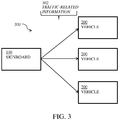
- Fig. 3 shows an illustrative embodiment of a traffic control system 300 in accordance with the third aspect of the present disclosure.
- the traffic control system 300 comprises a signboard 100 of the kind set forth and a plurality of vehicles 200 of the kind set forth.
- the signboard 100 comprises a radio transmitter 102 which is configured to operate in a broadcast mode.
- the radio transmitter 102 is configured to continuously or repeatedly transmit traffic-related information 302. Since this information 302 is broadcasted, it can be received by a plurality of radio receivers 202 comprised in the respective vehicles 200. In this way, the drivers of these vehicles 200 can be informed in detail about changed and/or unexpected circumstances in a power-efficient yet adequate manner.
- the traffic-related information comprises information on roadwork.
- drivers can be warned about roadwork activities in a timely and detailed manner.
- the driver may receive an audible and/or visual warning of roadwork lying ahead when his vehicle enters the RF field generated by a radio transmitter embedded in a nearby signboard.
- the audible and/or visual warning may include more detailed information than what can be shown on the signboard.
- the audible and/or visual warning may be presented by a user interface within the vehicle, the probability that the driver does not perceive the warning is small.
- the traffic-related information comprises at least one of the following data: an information-identifying key; the number of lanes on a road; a lane-identifier identifying a specific lane; an obstacle-identifier identifying a specific obstacle; the distance to an obstacle; the length of an obstacle; a speed limit.
- the signboard further comprises a configuration interface for changing the traffic-related information.
- the key may identify the information as information on roadwork.
- the lane-identifier may identify one or more lanes in which the roadwork activities take place, and the obstacle-identifier may identify the type of roadwork.
- the distance to and the length of the roadwork may be presented.
- a change in the speed limit may be indicated.
- this type of traffic-related information is particularly suitable for roadwork warnings.
- the radio transmitter is an ultra-high frequency (UHF) radio transmitter.
- the radio receiver is a UHF radio receiver. Since UHF transmitters may have a range of around 7 to 35 meters, they are particularly suitable for use in the presently disclosed signboard. That is to say, the probability that the UHF receivers in the vehicles receive the broadcasted traffic-related information is high.
- UHF chip is the UCODE® product developed by NXP Semiconductors. UCODE® is a registered trademark of NXP B.V.
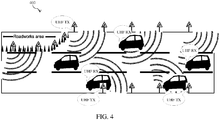
- Fig. 4 shows another illustrative embodiment of a traffic control system 400.
- the traffic control system 400 comprises a plurality of signboards equipped with UHF radio transmitters (UHF TX) of the kind set forth.
- the traffic control system 400 comprises a plurality of vehicles equipped with UHF radio receivers (UHF RX) of the kind set forth.
- the UHF radio transmitters broadcast information on roadwork lying ahead.
- the driver may receive an audible and/or visual warning of the roadwork lying ahead.
- Fig. 5 shows a further illustrative embodiment of a traffic control system 500.
- the traffic control system 500 comprises a UHF radio transmitter 504 comprised in a signboard (not shown). Since the UHF radio transmitter 504 operates in a broadcast mode, the signboard may also comprise a power supply 506 for providing operating power to the UHF radio transmitter 504. Alternatively or in addition, the UHF radio transmitter 504 may receive operating power from another source, e.g. through an electrical grid. Furthermore, configuration input 502 may be provided to the UHF radio transmitter 504. As mentioned above, in one or more embodiments, the radio transmitter is configurable in that the traffic-related information is changeable. This facilitates providing up-to-date traffic-related information to drivers. Also, it facilitates re-using the radio transmitter.
- the configuration input 502 may contain updated information on the roadwork, for example.
- the signboard comprises a configuration interface (not shown) for changing the traffic-related information.
- the configuration interface may facilitate providing the configuration input 502 to the UHF radio transmitter 504.
- the configuration interface may include a password-protected display, so that only authorized persons can change the traffic-related information.
- the signboard further comprises a connector (not shown) for connecting the UHF radio transmitter to external configuration equipment. In that case, at least a part of the configuration input 502 may be entered using the external configuration equipment.
- the traffic control system 500 further comprises a UHF radio receiver 508 that connects to the UHF radio transmitter 504 via an air interface 512 when the former enters the RF field generated by the latter.
- the traffic control system 500 also comprises a user interface 510 operatively coupled to the UHF radio receiver 508.
- Both the UHF radio receiver 508 and the user interface 510 may be comprised in a vehicle (not shown).
- the radio receiver 508 is configured to decode the traffic-related information into video and/or audio data. Then, the radio receiver 508 may provide the decoded traffic-related information to the user interface 510.
- the user interface 510 may, in turn, present the decoded traffic-related information to a user (e.g., the driver).
- the user interface 510 may contain a display and/or loudspeaker for this purpose.
- the user interface 510 may be integrated into the vehicle's infotainment system or navigation system, for example.
- Fig. 6 shows an illustrative embodiment of a method 600 of operating a radio receiver.
- the method 600 starts at 602.
- the radio receiver waits for an RF field generated by a radio transmitter.
- the radio receiver may be passive in the sense that it extracts its operating power from the RF field generated by a radio transmitter.
- the radio receiver may be excited by the RF field when it is within the range of the radio transmitter. Then, it may extract the power for subsequent operations (e.g., receiving, decoding) from the RF field. For instance, at 606, the radio receiver is excited by an RF field. Then, at 608, it receives encoded traffic-related information from the radio transmitter.
- the radio receiver decodes, at 610, the information and checks for the presence of an information-identifying key. If a key is available 612, the decoded traffic-related information is presented, at 614, to the user. The method ends at 616.
- an audio/video-based alert system may let a driver know that he or she is approaching a roadwork area well in advance. Furthermore, since the broadcasted information may be detailed, the driver may be instructed to move to a specific lane or side of the road, for example. Since the driver is already aware that he or she is approaching the roadwork area, he or she can then take appropriate action so as to reduce the chances of an accident. It is noted that the presently disclosed vehicle may be any type of vehicle, for example a car, a truck, a bus, or a motorcycle. The presently disclosed traffic control system does not need a complex infrastructure or additional devices, such as satellite receivers and cellular devices.
- the presently disclosed signboard is also particularly suitable for use in remote locations, where no or only few traffic guidance devices are present. Furthermore, since a radio receiver of the kind set forth does not need to occupy much space, it can easily be integrated into small vehicles, such as bicycles and scooters. It is noted that the drawings are schematic. In different drawings, similar or identical elements are provided with the same reference signs. Furthermore, it is noted that in an effort to provide a concise description of the illustrative embodiments, implementation details which fall into the customary practice of the skilled person may not have been described.
Landscapes
- Physics & Mathematics (AREA)
- General Physics & Mathematics (AREA)
- Life Sciences & Earth Sciences (AREA)
- Atmospheric Sciences (AREA)
- Engineering & Computer Science (AREA)
- Signal Processing (AREA)
- Multimedia (AREA)
- Traffic Control Systems (AREA)
Abstract
According to a first aspect of the present disclosure, a signboard comprising a radio transmitter is provided, wherein said radio transmitter is configured to continuously or repeatedly transmit traffic-related information in a broadcast mode. According to a second aspect of the present disclosure, a vehicle comprising a radio receiver is provided, wherein said radio receiver is configured to receive continuously or repeatedly broadcasted traffic-related information. According to a third aspect of the present disclosure, a traffic control system is provided, comprising a signboard of the kind set forth and at least one vehicle of the kind set forth.
Description
- The present disclosure relates to a signboard. Furthermore, the present disclosure relates to a vehicle. Furthermore, the present disclosure relates to a traffic control system comprising a signboard and at least one vehicle.
- Nowadays, traffic control is an important topic. The amount of vehicles on the streets has grown significantly, and, as a consequence, it is increasingly difficult to provide the drivers of these vehicles with sufficient information for driving safely. For example, it is increasingly difficult to provide the drivers with information that warns them of changed and/or unexpected circumstances, for example new speed limits, traffic jams and roadwork activities. Although signboards can provide a visual indication of such circumstances, this indication is often difficult to perceive.
- According to a first aspect of the present disclosure, a signboard comprising a radio transmitter is provided, wherein said radio transmitter is configured to continuously or repeatedly transmit traffic-related information in a broadcast mode.
- In one or more embodiments, the traffic-related information comprises information on roadwork.
- In one or more embodiments, the radio transmitter is an ultra-high frequency (UHF) radio transmitter.
- In one or more embodiments, the radio transmitter is configurable in that said traffic-related information is changeable.
- In one or more embodiments, the traffic-related information comprises at least one of the following data: an information-identifying key; the number of lanes on a road; a lane-identifier identifying a specific lane; an obstacle-identifier identifying a specific obstacle; the distance to an obstacle; the length of an obstacle; a speed limit.
- In one or more embodiments, the signboard further comprises a configuration interface for changing the traffic-related information.
- In one or more embodiments, the configuration interface comprises a password-protected display.
- In one or more embodiments, the signboard further comprises a connector for connecting the radio transmitter to external configuration equipment.
- According to a second aspect of the present disclosure, a vehicle comprising a radio receiver is provided, wherein said radio receiver is configured to receive continuously or repeatedly broadcasted traffic-related information.
- In one or more embodiments, the traffic-related information comprises information on roadwork.
- In one or more embodiments, the radio receiver is further configured to decode the traffic-related information into video and/or audio data.
- In one or more embodiments, the vehicle further comprises a user interface for presenting the decoded traffic-related information to a user.
- In one or more embodiments, the radio receiver is an ultra-high frequency (UHF) radio receiver.
- According to a third aspect of the present disclosure, a traffic control system is provided, comprising a signboard of the kind set forth and at least one vehicle of the kind set forth.
- Embodiments will be described in more detail with reference to the appended drawings, in which:
-
Fig. 1 shows an illustrative embodiment of a signboard; -
Fig. 2 shows an illustrative embodiment of a vehicle; -
Fig. 3 shows an illustrative embodiment of a traffic control system; -
Fig. 4 shows another illustrative embodiment of a traffic control system; -
Fig. 5 shows a further illustrative embodiment of a traffic control system; -
Fig. 6 shows an illustrative embodiment of a method of operating a radio receiver. -
Fig. 1 shows an illustrative embodiment of asignboard 100 in accordance with the first aspect of the present disclosure. Thesignboard 100 comprises aradio transmitter 102 which is configured to operate in a broadcast mode. In this broadcast mode, theradio transmitter 102 is configured to continuously or repeatedly transmit traffic-related information. Since this information is broadcasted, it can be received by a plurality of radio receivers. These receivers may be passive in the sense that they extract their operating power from the RF field generated by theradio transmitter 102. Thus, power may be saved in the vehicles in which these radio receivers are integrated. By continuously or repeatedly (e.g. at regular intervals) broadcasting the traffic-related information, the probability that drivers perceive the information of a signboard is increased. Furthermore, more detailed traffic-related information can be provided to the driver, compared to the visual information shown on the signboard itself. Thus, the drivers can be informed in a power-efficient yet adequate manner. -
Fig. 2 shows an illustrative embodiment of avehicle 200 in accordance with the second aspect of the present disclosure. Thevehicle 200 comprises aradio receiver 202 which is configured to receive continuously or repeatedly broadcasted traffic-related information. Theradio receiver 202 may be passive in the sense that it extracts its operating power from the RF field generated by a broadcasting radio transmitter. Since theradio receiver 202 is configured to receive continuously or repeatedly broadcasted traffic-related information, it facilitates providing traffic-related information to a driver. For example, it facilitates providing information shown on a signboard that might otherwise be missed or more detailed information than what can be shown on the signboard. Since theradio receiver 202 can be passive, power may be saved in thevehicle 200. Thus, the driver can be informed in a power-efficient yet adequate manner. -
Fig. 3 shows an illustrative embodiment of atraffic control system 300 in accordance with the third aspect of the present disclosure. Thetraffic control system 300 comprises asignboard 100 of the kind set forth and a plurality ofvehicles 200 of the kind set forth. As explained above, thesignboard 100 comprises aradio transmitter 102 which is configured to operate in a broadcast mode. In this broadcast mode, theradio transmitter 102 is configured to continuously or repeatedly transmit traffic-related information 302. Since thisinformation 302 is broadcasted, it can be received by a plurality ofradio receivers 202 comprised in therespective vehicles 200. In this way, the drivers of thesevehicles 200 can be informed in detail about changed and/or unexpected circumstances in a power-efficient yet adequate manner. - In one or more embodiments, the traffic-related information comprises information on roadwork. In this way, drivers can be warned about roadwork activities in a timely and detailed manner. For instance, the driver may receive an audible and/or visual warning of roadwork lying ahead when his vehicle enters the RF field generated by a radio transmitter embedded in a nearby signboard. The audible and/or visual warning may include more detailed information than what can be shown on the signboard. Furthermore, since the audible and/or visual warning may be presented by a user interface within the vehicle, the probability that the driver does not perceive the warning is small.
In one or more embodiments, the traffic-related information comprises at least one of the following data: an information-identifying key; the number of lanes on a road; a lane-identifier identifying a specific lane; an obstacle-identifier identifying a specific obstacle; the distance to an obstacle; the length of an obstacle; a speed limit.
In one or more embodiments, the signboard further comprises a configuration interface for changing the traffic-related information. For instance, the key may identify the information as information on roadwork. In that case, the lane-identifier may identify one or more lanes in which the roadwork activities take place, and the obstacle-identifier may identify the type of roadwork. Furthermore, the distance to and the length of the roadwork may be presented. Furthermore, a change in the speed limit may be indicated. Thus, this type of traffic-related information is particularly suitable for roadwork warnings. - In one or more embodiments, the radio transmitter is an ultra-high frequency (UHF) radio transmitter. Furthermore, in one or more embodiments, the radio receiver is a UHF radio receiver. Since UHF transmitters may have a range of around 7 to 35 meters, they are particularly suitable for use in the presently disclosed signboard. That is to say, the probability that the UHF receivers in the vehicles receive the broadcasted traffic-related information is high. An example of a UHF chip is the UCODE® product developed by NXP Semiconductors. UCODE® is a registered trademark of NXP B.V.
-
Fig. 4 shows another illustrative embodiment of atraffic control system 400. Thetraffic control system 400 comprises a plurality of signboards equipped with UHF radio transmitters (UHF TX) of the kind set forth. Furthermore, thetraffic control system 400 comprises a plurality of vehicles equipped with UHF radio receivers (UHF RX) of the kind set forth. In this example, the UHF radio transmitters broadcast information on roadwork lying ahead. When a vehicle approaches a particular signboard and its UFH radio receiver enters the range of the UHF radio transmitter of the signboard, the driver may receive an audible and/or visual warning of the roadwork lying ahead. -
Fig. 5 shows a further illustrative embodiment of atraffic control system 500. Thetraffic control system 500 comprises aUHF radio transmitter 504 comprised in a signboard (not shown). Since theUHF radio transmitter 504 operates in a broadcast mode, the signboard may also comprise apower supply 506 for providing operating power to theUHF radio transmitter 504. Alternatively or in addition, theUHF radio transmitter 504 may receive operating power from another source, e.g. through an electrical grid. Furthermore,configuration input 502 may be provided to theUHF radio transmitter 504. As mentioned above, in one or more embodiments, the radio transmitter is configurable in that the traffic-related information is changeable. This facilitates providing up-to-date traffic-related information to drivers. Also, it facilitates re-using the radio transmitter. Theconfiguration input 502 may contain updated information on the roadwork, for example. In a practical and efficient implementation, the signboard comprises a configuration interface (not shown) for changing the traffic-related information. The configuration interface may facilitate providing theconfiguration input 502 to theUHF radio transmitter 504. The configuration interface may include a password-protected display, so that only authorized persons can change the traffic-related information. In another practical and efficient implementation, the signboard further comprises a connector (not shown) for connecting the UHF radio transmitter to external configuration equipment. In that case, at least a part of theconfiguration input 502 may be entered using the external configuration equipment.
Thetraffic control system 500 further comprises aUHF radio receiver 508 that connects to theUHF radio transmitter 504 via anair interface 512 when the former enters the RF field generated by the latter. In this example, thetraffic control system 500 also comprises auser interface 510 operatively coupled to theUHF radio receiver 508. Both theUHF radio receiver 508 and theuser interface 510 may be comprised in a vehicle (not shown). In a practical and efficient implementation, theradio receiver 508 is configured to decode the traffic-related information into video and/or audio data. Then, theradio receiver 508 may provide the decoded traffic-related information to theuser interface 510. Theuser interface 510 may, in turn, present the decoded traffic-related information to a user (e.g., the driver). Theuser interface 510 may contain a display and/or loudspeaker for this purpose. Theuser interface 510 may be integrated into the vehicle's infotainment system or navigation system, for example. -
Fig. 6 shows an illustrative embodiment of amethod 600 of operating a radio receiver. Themethod 600 starts at 602. At 604, the radio receiver waits for an RF field generated by a radio transmitter. As mentioned above, the radio receiver may be passive in the sense that it extracts its operating power from the RF field generated by a radio transmitter. In practice, the radio receiver may be excited by the RF field when it is within the range of the radio transmitter. Then, it may extract the power for subsequent operations (e.g., receiving, decoding) from the RF field. For instance, at 606, the radio receiver is excited by an RF field. Then, at 608, it receives encoded traffic-related information from the radio transmitter. Furthermore, in this example the radio receiver decodes, at 610, the information and checks for the presence of an information-identifying key. If a key is available 612, the decoded traffic-related information is presented, at 614, to the user. The method ends at 616. - Thus, in accordance with one or more of the presently disclosed embodiments, an audio/video-based alert system may let a driver know that he or she is approaching a roadwork area well in advance. Furthermore, since the broadcasted information may be detailed, the driver may be instructed to move to a specific lane or side of the road, for example. Since the driver is already aware that he or she is approaching the roadwork area, he or she can then take appropriate action so as to reduce the chances of an accident. It is noted that the presently disclosed vehicle may be any type of vehicle, for example a car, a truck, a bus, or a motorcycle. The presently disclosed traffic control system does not need a complex infrastructure or additional devices, such as satellite receivers and cellular devices. The presently disclosed signboard is also particularly suitable for use in remote locations, where no or only few traffic guidance devices are present. Furthermore, since a radio receiver of the kind set forth does not need to occupy much space, it can easily be integrated into small vehicles, such as bicycles and scooters.
It is noted that the drawings are schematic. In different drawings, similar or identical elements are provided with the same reference signs. Furthermore, it is noted that in an effort to provide a concise description of the illustrative embodiments, implementation details which fall into the customary practice of the skilled person may not have been described. It should be appreciated that in the development of any such implementation, as in any engineering or design project, numerous implementation-specific decisions must be made in order to achieve the developers' specific goals, such as compliance with system-related and business-related constraints, which may vary from one implementation to another. Moreover, it should be appreciated that such a development effort might be complex and time consuming, but would nevertheless be a routine undertaking of design, fabrication, and manufacture for those of ordinary skill.
Finally, it is noted that the skilled person will be able to design many alternative embodiments without departing from the scope of the appended claims. In the claims, any reference sign placed between parentheses shall not be construed as limiting the claim. The word "comprise(s)" or "comprising" does not exclude the presence of elements or steps other than those listed in a claim. The word "a" or "an" preceding an element does not exclude the presence of a plurality of such elements. Measures recited in the claims may be implemented by means of hardware comprising several distinct elements and/or by means of a suitably programmed processor. In a device claim enumerating several means, several of these means may be embodied by one and the same item of hardware. The mere fact that certain measures are recited in mutually different dependent claims does not indicate that a combination of these measures cannot be used to advantage. -
- 100
- signboard
- 102
- radio transmitter
- 200
- vehicle
- 202
- radio receiver
- 300
- traffic control system
- 302
- traffic-related information
- 400
- traffic control system
- 500
- traffic control system
- 502
- configuration input
- 504
- UHF transmitter
- 506
- power supply
- 508
- UHF receiver
- 510
- user interface
- 512
- air interface
- 600
- method of operating a radio receiver
- 602
- start
- 604
- wait for RF field
- 606
- in RF field?
- 608
- received encoded info
- 610
- decode info & check for key
- 612
- key available?
- 614
- present decoded info
- 616
- end
Claims (14)
- A signboard comprising a radio transmitter, wherein said radio transmitter is configured to continuously or repeatedly transmit traffic-related information in a broadcast mode.
- The signboard of claim 1, wherein the traffic-related information comprises information on roadwork.
- The signboard of any preceding claim, wherein the radio transmitter is an ultra-high frequency, UHF, radio transmitter.
- The signboard of any preceding claim, wherein the radio transmitter is configurable in that said traffic-related information is changeable.
- The signboard of any preceding claim, wherein the traffic-related information comprises at least one of the following data: an information-identifying key; the number of lanes on a road; a lane-identifier identifying a specific lane; an obstacle-identifier identifying a specific obstacle; the distance to an obstacle; the length of an obstacle; a speed limit.
- The signboard of any preceding claim, further comprising a configuration interface for changing the traffic-related information.
- The signboard of claim 6, wherein the configuration interface comprises a password-protected display.
- The signboard of any preceding claim, further comprising a connector for connecting the radio transmitter to external configuration equipment.
- A vehicle comprising a radio receiver, wherein said radio receiver is configured to receive continuously or repeatedly broadcasted traffic-related information.
- The vehicle of claim 9, wherein the traffic-related information comprises information on roadwork.
- The vehicle of claim 9 or 10, wherein the radio receiver is further configured to decode the traffic-related information into video and/or audio data.
- The vehicle of claim 11, further comprising a user interface for presenting the decoded traffic-related information to a user.
- The vehicle of any one of claims 9 to 12, wherein the radio receiver is an ultra-high frequency, UHF, radio receiver.
- A traffic control system comprising a signboard as claimed in any one of claims 1 to 8 and at least one vehicle as claimed in any one of claims 9 to 13.
Priority Applications (1)
| Application Number | Priority Date | Filing Date | Title |
|---|---|---|---|
| EP17155051.0A EP3358544A1 (en) | 2017-02-07 | 2017-02-07 | Signboard, vehicle and traffic control system |
Applications Claiming Priority (1)
| Application Number | Priority Date | Filing Date | Title |
|---|---|---|---|
| EP17155051.0A EP3358544A1 (en) | 2017-02-07 | 2017-02-07 | Signboard, vehicle and traffic control system |
Publications (1)
| Publication Number | Publication Date |
|---|---|
| EP3358544A1 true EP3358544A1 (en) | 2018-08-08 |
Family
ID=58009685
Family Applications (1)
| Application Number | Title | Priority Date | Filing Date |
|---|---|---|---|
| EP17155051.0A Withdrawn EP3358544A1 (en) | 2017-02-07 | 2017-02-07 | Signboard, vehicle and traffic control system |
Country Status (1)
| Country | Link |
|---|---|
| EP (1) | EP3358544A1 (en) |
Cited By (1)
| Publication number | Priority date | Publication date | Assignee | Title |
|---|---|---|---|---|
| CN110246353A (en) * | 2019-06-18 | 2019-09-17 | 北京中位科技有限公司 | A kind of road network map speed limit alarm system based on car-mounted terminal |
Citations (4)
| Publication number | Priority date | Publication date | Assignee | Title |
|---|---|---|---|---|
| DE202009001514U1 (en) * | 2009-02-06 | 2009-07-16 | Hunscher, Andreas, Dr.-Ing. | Control system in road traffic |
| US20100324775A1 (en) * | 2000-01-21 | 2010-12-23 | Bahram Ghaffarzadeh Kermani | Vehicle interaction communication system |
| US20110187558A1 (en) * | 2010-01-29 | 2011-08-04 | Patrick Serex | Method and system for improved traffic signage |
| US9142127B1 (en) * | 2014-04-29 | 2015-09-22 | Maxwell Consulting, LLC | Systems and methods for traffic guidance nodes and traffic navigating entities |
-
2017
- 2017-02-07 EP EP17155051.0A patent/EP3358544A1/en not_active Withdrawn
Patent Citations (4)
| Publication number | Priority date | Publication date | Assignee | Title |
|---|---|---|---|---|
| US20100324775A1 (en) * | 2000-01-21 | 2010-12-23 | Bahram Ghaffarzadeh Kermani | Vehicle interaction communication system |
| DE202009001514U1 (en) * | 2009-02-06 | 2009-07-16 | Hunscher, Andreas, Dr.-Ing. | Control system in road traffic |
| US20110187558A1 (en) * | 2010-01-29 | 2011-08-04 | Patrick Serex | Method and system for improved traffic signage |
| US9142127B1 (en) * | 2014-04-29 | 2015-09-22 | Maxwell Consulting, LLC | Systems and methods for traffic guidance nodes and traffic navigating entities |
Cited By (1)
| Publication number | Priority date | Publication date | Assignee | Title |
|---|---|---|---|---|
| CN110246353A (en) * | 2019-06-18 | 2019-09-17 | 北京中位科技有限公司 | A kind of road network map speed limit alarm system based on car-mounted terminal |
Similar Documents
| Publication | Publication Date | Title |
|---|---|---|
| US9142127B1 (en) | Systems and methods for traffic guidance nodes and traffic navigating entities | |
| EP3026939B1 (en) | Traffic control system | |
| US7482948B1 (en) | Roadway systems and methods for conditionally transmitting a radio signal to vehicles, depending on whether a certain person is in the area | |
| US7825825B2 (en) | Terminal and computer program product for receiving traffic information, method of providing signal light information, and method of guiding signal | |
| Hegde et al. | RFID and GPS based automatic lane clearance system for ambulance | |
| US7397390B2 (en) | Wireless traffic control system | |
| US20130009790A1 (en) | Method and system for improved traffic signage | |
| US10182952B1 (en) | Wheelchair systems and related methods | |
| US20170270787A1 (en) | System and method for roadside alerts | |
| US20170015242A1 (en) | Method and system to warn of a vehicle moving in the wrong direction of travel | |
| US20100001880A1 (en) | Detecting and sharing road traffic condition information | |
| US20090212942A1 (en) | Street lamp system | |
| Sattibabu et al. | Automatic vehicle speed control with wireless in-vehicle road sign delivery system using ARM 7 | |
| KR101621891B1 (en) | Apparatus, vehicle terminal and system for bus bording service using the welfare card | |
| KR20200059986A (en) | System to inform the approach of emergency vehicles in crossroad | |
| US11282377B2 (en) | Vehicle, roadside apparatus, communication apparatus and transport communication system | |
| EP3358544A1 (en) | Signboard, vehicle and traffic control system | |
| US7010397B1 (en) | Utilization by a vehicle of wireless data from intelligent street signs | |
| KR102338434B1 (en) | Pedestrian terminal for providing information of crossroad based on beacon signal and system of the same | |
| JP2017212579A (en) | Communication device and mobile communication device | |
| CN104835338B (en) | The preposition caution system of traffic administration signal based on mobile unit | |
| CN104504924A (en) | Intersection vehicle road condition display system | |
| CN106023624A (en) | Road signal processing method, device and system and equipment | |
| KR20120039979A (en) | Apparatus for providing road information using wireless signal | |
| Mohandes et al. | A preference based smart parking system: KFUPM case study |
Legal Events
| Date | Code | Title | Description |
|---|---|---|---|
| PUAI | Public reference made under article 153(3) epc to a published international application that has entered the european phase |
Free format text: ORIGINAL CODE: 0009012 |
|
| AK | Designated contracting states |
Kind code of ref document: A1 Designated state(s): AL AT BE BG CH CY CZ DE DK EE ES FI FR GB GR HR HU IE IS IT LI LT LU LV MC MK MT NL NO PL PT RO RS SE SI SK SM TR |
|
| AX | Request for extension of the european patent |
Extension state: BA ME |
|
| 18D | Application deemed to be withdrawn |
Effective date: 20190209 |